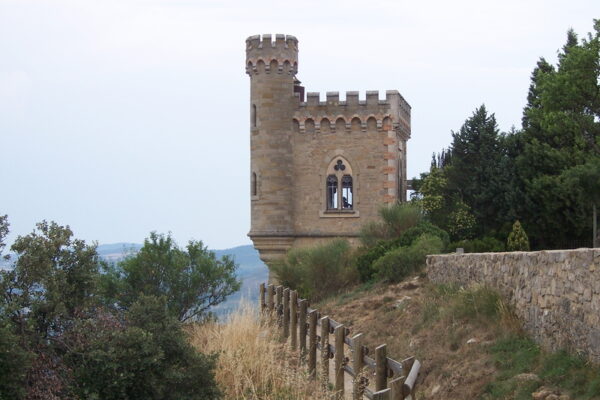
Le Tour Magdala. (Zewan)
Henry Lincoln promised at the end of “The Priest, the Painter, and the Devil” that he would continue to investigate the case of François-Bérenger Saunière and Rennes-le-Château. He proved as good as his word. Over the next several years, he sidled steadily further away from his screenwriting career to dig his way deeper and deeper down the rabbit hole. By now, he had inherited from Gérard de Sède the mantle of chief spokesman for this fast-evolving modern mythology, just as Sède had once taken over from Noël Corbu. For Lincoln had not only energy and passion and an uncanny talent for making the outlandish sound reasonable on his side, but the ability to communicate fluently in both French and English. This made him the ideal figure to bring this French story to the larger English-speaking world.
Lincoln pulled a couple of other men from his side of the language divide into the rabbit hole along with him. At a British writing retreat in August of 1975, he met a 32-year-old aspiring novelist from the United States named Richard Leigh, the proud possessor of a freshly minted PhD from Stony Brook University and a burning passion for James Joyce and Marcel Proust. His love for those labyrinthine writers may help to explain why he found Lincoln’s stories of equally obscure and many-tendriled centuries-spanning conspiracies so compelling. (It may also be relevant to note that Proust himself was deeply interested in the Merovingian dynasty, whom he romanticized and celebrated as the forefathers of all things French.) Leigh in turn brought into the fold a photographer from New Zealand named Michael Baigent, who was not yet 30 years old but had already lived through more adventures than many another person experiences in a lifetime, traveling around the globe and taking pictures of everything from war zones to fashion models. This trio of Lincoln, Leigh, and Baigent would show themselves to be formidable myth-makers indeed, capable of driving Rennes-le-Château right into the heart of the popular consciousness.
The two Chronicle episodes on Rennes-le-Château had been big ratings successes by the usual standards of the documentary series, even if they had caused some of the more sober minds involved with the program to turn up their noses a bit. The BBC was more than happy for Lincoln to make a third episode once he thought he was ready. He and his two new partners spent a few years trying to wrestle the amorphous mass of evidence they were collecting into some kind of coherent shape suitable for a one-hour television program. But the real coup came courtesy of a doubtless underpaid Chronicle research assistant named Jania Macgillivray, who was able to put Lincoln in touch with an obscure Frenchman with a grandiose name: Count Pierre Plantard de Saint-Clair.
Lincoln had first seen the name of Plantard years ago, when it turned up in the Lobineau dossier as the one by which Sigebert’s branch of the Merovingian line had been known after the last king of the mainline dynasty had been deposed in Paris in 751. Not long after sending the Lobineau papers, Sède had loaned Lincoln a clutch of photographs of Bérenger Saunière. On the back of each was a purple stamp that read “Plantard,” as if they had come from the personal collection of a man by that name. Chasing down these leads, Lincoln found that one Pierre Plantard featured prominently in Sède’s 1962 book about the Knights Templar in the role of a “hermeticist,” scattering hints hither and yon that the Knights had not been completely destroyed in 1307, as historians believed; no, they had lived on in some form or fashion, influencing or even controlling world events as part of a hidden network of secret societies. Pierre Plantard’s name was conspicuously absent from Sède’s 1967 book on Rennes-le-Château proper, but if anything this only made Lincoln more suspicious that it had been him who who had sent Sède the Altar Documents in 1964, him who he had been silently guiding Sède’s hand ever since. Lincoln, who seems never to have overcome a certain early contempt for Sède that was raised by his spotting a secret message that his French counterpart did not, was eager to cut out the middle-man.
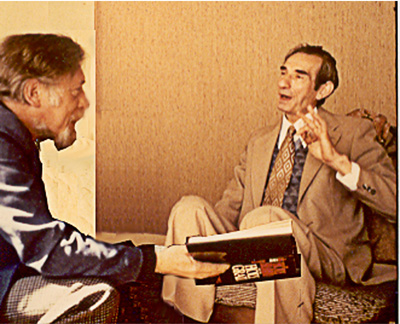
Henry Lincoln with Pierre Plantard in the 1980s.
And so on a windy late morning in Paris in March of 1979, Lincoln, Baigent, and Leigh met Pierre Plantard face to face for the first time, in a movie theater the BBC had rented for the occasion. Already before the meeting began, any pretense that Plantard was a mere informant had been dropped. He appeared as the avowed current Grand Master of the Priory of Sion, the latest in a roll call of names that included Leonardo da Vinci, Isaac Newton, and Claude Debussy. In addition, he was the direct descendant of the Merovingian line which had ruled the kingdom of the Franks from 481 to 751.
Lincoln was thoroughly entranced by Plantard, who showed up fashionably late, accompanied by a small entourage presumably made up of other members of the secret order.
M. Plantard proved to be a dignified, courteous man of discreetly aristocratic bearing, unostentatious in appearance, with a gracious, volatile but soft-spoken manner. He displayed enormous erudition and impressive nimbleness of mind — a gift for dry, witty, mischievous but in no way barbed repartee. There was frequently a gently amused, indulgent twinkle in his eyes, almost an avuncular quality. For all his modest, unassertive manner, he exercised an imposing authority over his companions. And there was a marked quality of asceticism and austerity about him. He did not flaunt any wealth. His apparel was conservative, tasteful, insouciantly informal, but neither ostentatiously elegant nor manifestly expensive. As far as we could gather, he did not even drive a car.
Lincoln addressed Plantard with no trace of irony as the roi perdu: the “lost king.”
The first order of business was a screening of “The Priest, the Painter, and the Devil”; this was the reason the meeting took place in a theater. (The program was overdubbed in French for the benefit of Plantard, who for all of his “enormous erudition” neither spoke nor understood any English.) Then the negotiations as to the rules of engagement began.
M. Plantard made it clear to us that he would saying nothing whatever about the Prieuré de Sion’s activities or objectives at the present time. On the other hand, he offered to answer any questions we might have about the order’s past history. And although he refused to discuss the future in any public statements — on film, for instance — he did vouchsafe us a few hints in conversation. He declared, for example, that the Prieuré de Sion did in fact hold the lost treasure of the Temple of Jerusalem — the booty plundered by Titus’ Roman legions in AD 70. These items, he stated, would be “returned to Israel when the time is right.” But whatever the historical, archaeological, or even political significance of the treasure, M. Plantard dismissed it as incidental. The true treasure, he insisted, was “spiritual.” And he implied that this “spiritual treasure” consisted, at least in part, of a secret. In some unspecified way the secret in question would facilitate a major social change. M. Plantard [stated] that, in the near future, there would be a dramatic upheaval in France — not a revolution, but a dramatic change in French institutions that would pave the way for the reinstatement of a monarchy. This assertion was not made with any prophetic histrionics. On the contrary, M. Plantard simply assured us of it, very quietly, very matter-of-factly — and very definitely.
The mystery of Rennes-le-Château had started out in the mid-1950s as a simple treasure hunt, the ultimate get-rich-quick scheme. In the late 1960s, it had become far more intimately intertwined with history, promising to revise much of our understanding of the past. And now, at the end of the 1970s, it was beginning to take on a freshly and even urgently contemporary cast, as an ongoing conspiracy that was acting right now to change the direction of current events. And the man behind the proverbial curtain was, it was becoming increasingly clear, Pierre Plantard.
For all that, though, Plantard was certainly not ready to let himself be pinned down on any specifics. He met three times with Lincoln and his friends in 1979, submitting to an on-camera interview during the last of these meetings. Yet Lincoln had to admit that “after three meetings with M. Plantard and his associates we were not significantly wiser than we had been before.” Of course, there is reason to ask at this point who was really using whom. The fact was that Henry Lincoln, a well-connected man who was obviously taken with him, represented a golden opportunity for Plantard to get his message out all over the world. After the meetings in Paris, Plantard severed the last of his ties to Sède and began to communicate primarily through Lincoln. On his side, Sède took this rejection with no good grace. He would eventually join the side of the skeptics and try to debunk the Priory of Sion and the rest of the conspiracy theories around Rennes-le-Château, but these efforts would get less traction than his earlier ones. Many another, more credible writer who has tried to bring a dose of sanity to these subjects has had to swallow the same bitter pill. People crave the legend, not the truth.
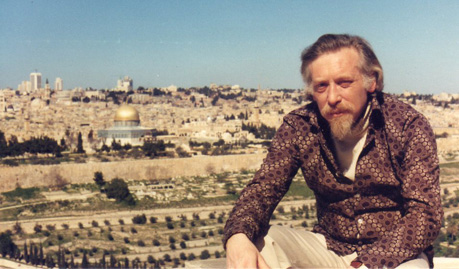
The third episode of Chronicle to deal with Rennes-le-Château aired in Britain on November 27, 1979, under the name of “The Shadow of the Templars.” With this third outing, any semblance of this being a normal episode of the show is gone. This is a Henry Lincoln joint from first to last — a chronicle, if you will, of one man’s very personal quest. Other than a few minutes of interview footage of Pierre Plantard, Lincoln’s voice is literally the only one we hear, his face the only living one we ever see up close.
Indeed, the most interesting aspect of the episode in some ways is the psychology of Henry Lincoln as he wanders ever further into a hall of mirrors that is increasingly of his own making. If he isn’t a true believer, he’s one hell of an actor. “I’ve chased many a false lead, leapt to many a deceptive conclusion, been blinded by ingenious smokescreens, by clues strewn by others to conceal one astonishing and simple truth,” he says. He is correct, as far as it goes — but sadly, the simple truth at the heart of the case is not the one that Lincoln so fondly imagines. To paraphrase Fox Mulder, Henry Lincoln desperately wants to believe. That’s a dangerous place from which to start any investigation of history.
Just as I looked at some of the core documents behind the conspiracy theories of Rennes-le-Château in some depth in my last article, I think it makes sense to examine this program rather closely in this one. For we are now on the verge of what will become the mature mythology of Rennes-le-Château. There is only one really important point — admittedly, the most important one of all — that is still only hinted at in “The Shadow of the Templars.”
Instead of making yet another beeline for Rennes-le-Château and Bérenger Saunière, we start this time with a reasonably accurate summary of the history of the Knights Templar, who are correctly described as a chivalrous order of “fighting monks” that was founded in Jerusalem in 1118, when the city was in the hands of European Crusaders. After achieving impressive heights of power and influence, the Knights were brutally dissolved by King Philip IV of France in 1307. But Lincoln is on less firm ground when he strongly implies that the Knights may have dug up King Solomon’s legendary treasure in Jerusalem during their first few years of existence, and that this became the wellspring if not the sum total of their eventual daunting wealth.
He does admit that the French crown owed embarrassing sums of money to the Knights Templar by the time of Philip IV. (The most careful readers among you may remember that this same financially-troubled king was cited as proof of Noël Corbu’s original theory of the treasure of Rennes-le-Château; tropes do tend to cycle around and around inside the mirrored halls of conspiracy theorists, continually popping into view again where you least expect them.) Yet Lincoln finds it weirdly difficult to understand why King Philip and his cronies might have accused the avowedly pious Knights of “denying Christ” and “spitting on the cross,” implying some other reason for casting these aspersions than that of simply needing an excuse to do away with them. In reality, charges of sacrilege and black magic were practically par for the course when the overlords of Europe decided that a group like this one had become inconvenient.
There is no evidence in the historical record that King Philip believed the Knights Templar to be in possession of some singular treasure that he was unable to find after their destruction, as Lincoln claims. To put the subject in modern terms, it is better to think of destroying the Knights as akin to destroying a major multi-national bank, not the ransacking of a dragon’s hoard. There is wealth there, yes, but it comes for the most part in the form of contracts and infrastructure and credit and loans and investments, not in that of a giant pile of gold sitting there ripe for the taking. Ironically, Lincoln himself credits the Knights with doing much to invent modern banking.
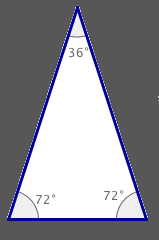
A golden triangle.
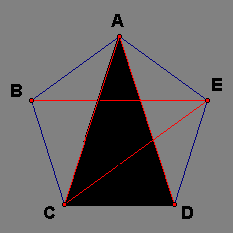
A pentagon formed from two golden triangles.
Now we abruptly transition back to the Languedoc. In “The Priest, the Painter, and the Devil,” Lincoln broached the idea that a pentagon could be found hidden in the Nicolas Poussin painting The Shepherds of Arcadia, which Lincoln believed to depict a tomb located near Rennes-le-Château. Continuing on the geometrical tip, he tells us now that three elevated castles in the area form a golden triangle, one whose sides make two angles of 72 degrees and one of 36 degrees. On its own, such a shape is fraught with significance in certain occult traditions, for two of these golden triangles can be superimposed upon one another to create a pentagon, an even more powerful shape. The three castles in question, all of which are now in ruins, are the one that lent its name to Rennes-le-Château; the Château du Bézu, a former Knights Templar fortress; and the Château de Blanchefort, built by the same family who built or at least occupied the castle of Rennes-le-Château. (You will remember that we spent much time with the gravestone of Marie de Nègre d’Ables, the last Marquise de Blanchefort, in our last article.) A little outside fact-checking will confirm for us that these three castles really do form a golden triangle, to an error tolerance of less than five percent.
One Bertrand de Blanchefort provides Lincoln with the historical glue he needs to bind the three castles together: Bertrand was Grand Master of the Knights Templar from 1156 to 1169. Sadly, though, this time a fact-checker is not Lincoln’s friend, for the truth is that this Bertrand de Blanchefort is actually not a member of the Blnachefort family from the Languedoc. In their eagerness to draw the connections that suit them, conspiracy theorists are often confused by simple coincidences of nomenclature like this one.
Lincoln now leaps even further back in time, to Dagobert II, the Merovingian king of the Franks for a few years in the seventh century. His infant son Sigebert was, Lincoln believes, spirited away from Paris to the Languedoc for safekeeping after his father was assassinated. (See my last article if you need a refresher on this claim.) In a first hint of a bombshell which he will drop in full only a few years later, Lincoln tells us portentously that “the Merovingians were not anointed kings, but kings by virtue of their blood.” He says that all members of the line displayed an unusual birthmark in the shape of a rose-red cross. (This assertion doesn’t appear in any accepted historical records from the period.) Qualifiers like “supposedly” gradually fall away from the narrative, as we are told that Sigebert was hidden away in Rennes-le-Château, or Rhedae as it was then known, because it was the childhood home of Dagobert’s queen. (The truth is that we have no historical record of Dagobert’s queen, presuming she even existed; nor is there is any good reason to connect the Visigoth town of Rhedae with Rennes-le-Château.) Sigebert grew to noble manhood in the Languedoc much like Wart in the Castle Sauvage of T.H. White’s The Sword in the Stone, and the Merovingian line was carried on in secret.
We are told that Godfrey of Bouillon, a leader of the First Crusade who became the first Christian king of Jerusalem after the city was conquered in 1099, was of this Merovingian blood. Lincoln says that he has found “a document” — no other details are provided — that connects the selection of Godfrey for that throne to an organization called the “Order of Our Lady of the Mount of Sion.” Then he goes on to connect the same organization to the formation of the Knights Templar nineteen years later. Fact-check time: an Order of Sion does appear on a few authenticated documents from the twelfth century, indicating that some sort of organization by that name really must have existed. But we now know that all of the other, otherwise unsubstantiated claims that Lincoln makes about it and about the Merovingian line stem from the Lobineau dossier that dates no further back than the mid-twentieth century.
These same documents state that the Order of Sion decided to separate itself from the Knights Templar after Jerusalem was recaptured by a Muslim army in 1187, partially thanks to the Knights’ growing arrogance and foolishness. It was at this point that the Order of Sion renamed itself the Priory of Sion. Reading the roll call of subsequent Grand Masters of the Priory, Lincoln flirts with a moment of clarity: “Some of these names are so illustrious that the list seemed just the sort of grandiose pedigree that would be created for itself by a lunatic-fringe body of eccentrics playing at secret societies.” But he turns away from the brink of sanity: “It’s all too easy to make assumptions, and not to keep an open mind.” (The first part of this statement at least is true…)
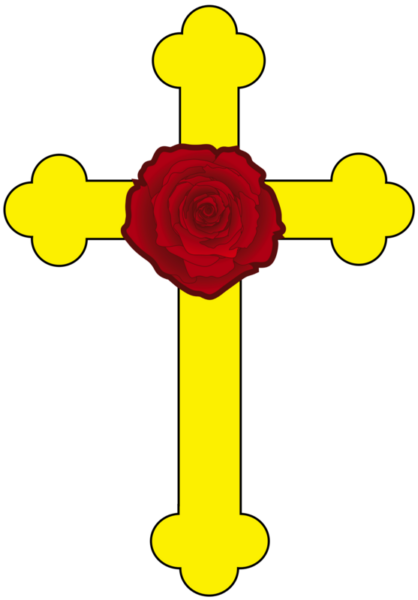
We touch upon the Rosicrucians, a Christian movement with occult overtones which swept across Europe during the early seventeenth century. The name means “rose-red cross,” which cannot be a coincidence. And sure enough, the Lobineau dossier lists Johannes Valentinus Andreae, a German theologian who was one of the leading voices behind the movement, as one of the Grand Masters of the Priory of Sion. Lincoln finds pictures of rose-red crosses and other, more veiled references to the Priory and the Rosicrucians in and around Bérenger Saunière’s church.
And now we come at last to the moment we have been waiting for, by far the most fascinating point in the episode. We meet Pierre Plantard, the only person other than Henry Lincoln who is ever allowed to speak to us, whom Lincoln sincerely believes to be not only the current Grand Master of the Priory of Sion but the scion of the Merovingian dynasty, those once and possibly future kings of France. Plantard appears much as Lincoln described him earlier in this article: slim, neatly dressed, coolly avuncular, and thoroughly Gallic, with a slyly mischievous glint in his eyes that can be read in different ways, depending on your opinion as to his trustworthiness. For once we can be fully in agreement with Lincoln when he posits that this man is the real key to the mystery.
Monsieur Plantard, is there still a secret at Rennes-le-Château?
The secret is not only at Rennes-le-Château, it is around Rennes-le-Château.
Will the treasure of Rennes-le-Château ever be found?
Here you are speaking of a material treasure. We are not talking of a material treasure. Let us say, quite simply, that there is a secret in Rennes-le-Château and that it is possible there is something else around Rennes-le-Château.
And how does Poussin fit into the story?
To be seen in Poussin’s painting are certain revelations. Poussin was an initiate, and therefore created his painting as an initiate. But he was not the only one in this story. There are other characters. In artistic expression, the truth is concealed and one uses symbolism.
Tell us whether the Priory of Sion exists today.
At this moment, Sion still exists. One of its recent members — one of the last Grand Masters — was Jean Cocteau. Everyone knows this.
Monsieur Plantard, over the centuries you have — how shall I put it? — supported the Priory of Sion?
We have supported Sion and Sion has supported us.
We? Who are we?
We — I am speaking of the Merovingian line, for our line descended from Dagobert II. The Merovingians, it was they who made France. Without them there would be no France. The Capetians and the Carolingians followed on from the Merovingian line. The Merovingians represent France.
With that, Pierre Plantard disappears from our screen again. Lincoln could get nothing more concrete out of him.
Instead he returns to mystical geometry; by now, the episode’s organizing principle seems to have become Henry Lincoln’s stream of consciousness. We are reintroduced to the idea of a pentagon hidden in Poussin’s Shepherds of Arcadia. Lincoln mentions a letter written by Louis Fouquet, the French finance minister under King Louis XIV and a known friend of Poussin, to the minister’s brother in 1656, the year after the painter completed the work in question. This letter is genuine, and may be worth quoting here at greater length than Lincoln does in the interest of full disclosure.
[Poussin] and I have planned certain things, of which I shall be able to talk to you in depth, which will give you by M. Poussin advantages (if you do not wish to despise them) that kings would have great difficulty in drawing from him, and that after him perhaps no one in the world will ever recover in the centuries to come. And what is more, that could be done without much expense and could even turn to profit, and these things are so hard to discover that no one, no matter who, upon this earth today could have better fortune or perhaps equal.
Some have wondered whether this elliptical missive might refer to the creation of forgeries, as potentially lucrative a practice back then as it remains today. Louis Fouquet may not have been the most ethical character: he was convicted of embezzlement and sentenced to life in prison in 1661, although it’s difficult to know how much of the charge was real and how much was the work of his enemies at court. Then, too, Poussin would hardly have been the only great artist to have been tempted to the dark side: Michelangelo among others got his start in just this way. Still, forgery does seem a strange practice for Poussin to have engaged in at this point in his career, when he was a much-lauded artist whom the pope and the French king openly squabbled over, one who was perfectly capable of selling as many paintings as he could create under his own name at a handsome profit. All told, then, the letter presents a puzzle, but it’s hard to say that it really proves anything about The Shepherds of Arcadia absent other, corroborating evidence.
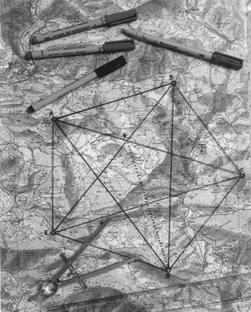
Lincoln now informs us that he has returned to his studies of the landscape around Rennes-le-Château, and has identified two more promontories — known as La Soulane and Serre de Lauzet — that turn his golden triangle into a pentagon. Although he’s not wrong about the figure he maps out, it shouldn’t be forgotten that he is examining the foothills of a major mountain range, a landscape whose defining feature is its many peaks and valleys; there are a lot of promontories to pick and choose from. Meanwhile what Lincoln wishes to infer from all of this remains frustratingly opaque. His two latest promontories sport no human-made structures from the past or present, leaving us with nothing more than the fact of the topographical coincidence. Does Lincoln intend to imply that God himself sculpted the landscape around Rennes-le-Château to send us a message or otherwise to serve his purposes somehow? That would be plot inflation indeed.
Pierre Plantard now pops up for the second and last time. “The geometry is pentagonal, isn’t it?” Lincoln asks him.
Plantard seems to be at a loss for a second or two. Then he smiles his enigmatic smile. “I can’t answer that,” he says.
This is, I think, a moment worth reflecting upon.
In later years, Lincoln wrote in some detail about his very first meeting with Plantard, the one that began with a screening of “The Priest, the Painter, and the Devil.” Among the associates or acolytes who accompanied Plantard to that meeting, he clearly had the most intimate friendship with a man named Philippe de Chérisey, whom we will meet again later. Lincoln:
The Grand Master and his acolytes watch the film with quiet concentration. Occasionally Plantard and de Chérisey’s heads incline together as they exchange a whispered comment. It is not until the film has almost reached its end that they show anything other than relaxed interest. But suddenly the two backs in front of me stiffen and M. Plantard sits upright, bending forward in concentration. But the image on the screen is a fleeting one. As it disappears, the two heads lean together again in a brief and vehement conversation. Touché! I have shown them something they weren’t expecting. The image, which has no explanatory text, is of the parchment [Altar Document 2] overlaid with the pentacle. Are they unaware of the existence of the geometry? Or are they simply surprised that I have found it out?
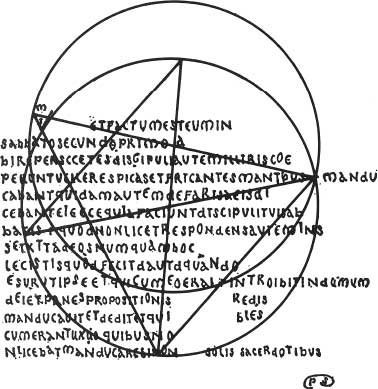
Some of the geometry which Henry Lincoln believed to have been deliberately hidden in Altar Document 2.
I think it most probable that they were unaware of it, although, once again, this would not necessarily mean what Lincoln wished it to mean. Lincoln had dutifully followed the trail of clues they had laid down for him, and had now arrived at the sweet spot of any conspiracy theory: he had begun to invent new facets of the mystery himself from whole cloth. The geometrical obsessions of the cult of Rennes-le-Château would spill across thousands of rambling pages in the years to come. Plantard merely gleaned where Lincoln was going and got out of his way. You can practically see this happening in real time when Lincoln asks him on camera about the significance of the pentagon of which Rennes-le-Château constitutes one point. “At that moment, M. Plantard could have said, ‘I don’t know what you’re talking about,’ or even, ‘There is no significance,'” Lincoln tells us. “But in a sense, his answer confirmed my suspicion that there was an importance attached to that symbol which I had yet to discover.” One can imagine Plantard’s self-satisfied smile as he sits back to watch Lincoln build new twisty little passages in which to lose himself.
From here, the program takes on more and more supernatural overtones, as Lincoln connects the Priory of Sion with the long history of alchemy, hermeticism, and the occult more generally — traditions to which many of those we think of today as foremost lights of rational science, such as Johannes Kepler and Isaac Newton, were very much in thrall. Lincoln explains, correctly, that the pentagon has long been linked to the planet Venus. From the standpoint of a terrestrial observer, Venus goes through five inferior conjunctions — meaning that it passes between the Earth and the Sun — in the course of every eight years. These conjunctions are quite obvious to anyone who pays even cursory attention to the sky: the planet goes from being the brightest object in the sky at sunset with the possible exception of the Moon to disappearing entirely for a few days to reappearing just as bright as before, only now at dawn. Marked on a map of the sky, one complete cycle of five inferior conjunctions forms a well-nigh perfect pentagon.
Venus was in turn the symbol of Mary Magdalene, the saint whom Saunière’s church was named after. It might perhaps be more convenient in some ways if Saunière himself had chosen that name, if a Church of Sainte Marie-Madeleine hadn’t existed in Rennes-le-Château for 700 years prior to his arrival, but needs must. Lincoln is encouraged that Saunière did choose to name the observation tower he built in the garden of his villa Le Tour Magdala, predictably failing to consider that he may have simply named the tower after the church.
So, the area around Rennes-le-Château must be a place of enormous supernatural importance, or at least a place that various shadowy groups throughout history have believed to be a locus of mystical power. Lincoln doesn’t explain how these groups would have spotted the pentagon hidden in its topography without benefit of aerial observation or modern measuring equipment. But he has at least decided that the fortune in gold fondly imagined by the likes Noël Corbu probably doesn’t exist. Saunière, he thinks, became an initiate of the Priory of Sion through those documents he found hidden in his church. “The real treasure of Rennes-le-Château is a secret,” Lincoln says. This secret, whatever it is, is surely connected with the Merovingian bloodline. “What is so special about this royal bloodline that can ensure centuries of loyalty?” Lincoln asks. And that is where he leaves it, with the words “To Be Continued…” flashing subliminally if not literally.
The continuation would arrive barely two years later, but it would do so in a different format than yet another episode of Chronicle. For the evolving mystery of Rennes-le-Château had now outgrown the constraints of a workaday BBC documentary series in the opinion of its leading advocate.
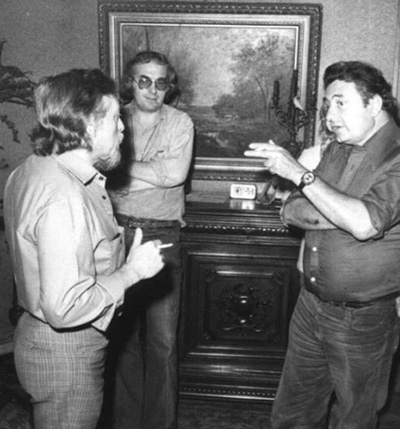
Henry Lincoln (left) with Gérard de Sède (right) just before the latter punched the former in the face.
Lincoln’s first hope was to shoot a documentary feature film. “The notion of addressing the subject without the usual sobering constraints of the BBC’s more serious documentary approach seems appealing,” he said with his customary obliviousness to irony. He signed a contract with a London production house. But the project descended into squabbling when it became clear that the director was a more lurid sort of conspiracy theorist, more interested in Black Masses and sex orgies in the pews of Saunière’s church than the bloodline of the Merovingian dynasty and the vagaries of pentagonal geometry. Gérard de Sède was hired as a consultant to the film, turning up just long enough to punch Lincoln in the face for stealing Pierre Plantard from him. Meanwhile the producer was perpetually drunk and insisted on driving his cast and crew everywhere, a bad combination if ever there was one. The farce turned into a tragedy when this fellow keeled over dead from a brain tumor. It turned out that the relative sobriety of the BBC had its positive sides.
Suitably chastened by this experience, Lincoln, Leigh, and Baigent thought to write a book instead. After all, their theories were nothing if not complicated, so much so that they demanded the cooler, self-paced medium of text if one was ever to understand them thoroughly. The trio signed on with Jonathan Cape, one of the most respected publishing houses in Britain. The Holy Blood and the Holy Grail would not be the first book about Rennes-le-Château — a goodly number of others were already available in several languages, even setting aside the pioneering work of Sède — but it would present itself in avowedly scholarly tweed, almost audibly sniffing its nose at the tinfoil-hat brigade hanging out in their parents’ basements. This would be a weighty tome, both literally and metaphorically, the type of book that could make its subject matter an acceptable topic of drawing-room conversation among the chattering classes.
The spine of the book’s narrative is the same as that of “The Shadow of the Templars,” with the addition of a lot more detail and one last bombshell revelation, the same one that Lincoln was recently assiduously hinting at on camera. The secret that Saunière and so many others had sworn to protect was the true bloodline of the Merovingian dynasty. For Jesus, it turned out, had not been celibate as the Bible tells us, had in fact wedded and had children with Mary Magdalene before his crucifixion. In time, these children had begotten the Merovingian kings.
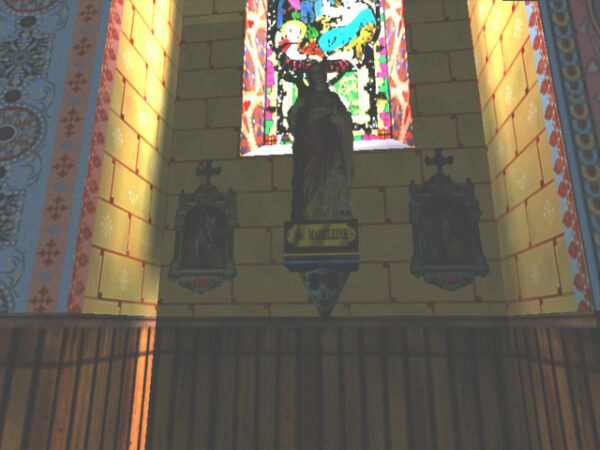
Mary Magdalene — who is not to be confused with the Virgin Mary, the mother of Jesus — has long punched well above her textual weight in Christian oral traditions. Biblical scholars believe that she was called by that name because she came from a town known as Magdala, on the Sea of Galilee. She appears indubitably in the Bible only once prior to Jesus’s death: she is mentioned in passing in the Gospel of Luke as one of a group of female followers who gathered around the Son of God, who in his turn cast “seven demons” out of her. But according to all four of the canonical gospels, it was she who discovered that Jesus’s tomb was empty three days after the crucifixion and went out to spread word of the miracle. In a sense, then, she might have been the very first true Christian believer, as we understand that descriptor today.
Mary Magdalene appears more prominently in two of the so-called “apocryphal” gospels, those which were not included when the New Testament as we know it today was compiled in fourth-century Alexandria. In fact, she has an entire Gospel of Mary of her own, which has survived only in scattered fragments that were rediscovered during the nineteenth century. It is considered a Gnostic gospel, a part of the same mystical Christian tradition that was embraced by the Cathars of the Medieval Languedoc. These gospels tend to emphasize knowledge over narrative, and this one is no exception. At the beginning of the text, Saint Peter turns to Mary Magdalene at a gathering of Jesus’s disciples after his death and says, “Sister, we know that the savior loved you more than the rest of the women. Tell us the words of the savior which you remember — which you know but we do not.” Alas, most of Mary’s response is missing — but her audience’s response to her response is not. “Surely the savior knows her very well,” says the disciple Levi. “That is why he loved her more than us.”
The Gospel of Philip is another Gnostic gospel, one that was not rediscovered until 1945. It is even more fragmentary than the Gospel of Mary, being riddled with “lacunae,” holes that make complete sentences, much less paragraphs, few and far between. But it does say of Mary Magdalene that “Christ loved her more than all the disciples and used to kiss her often on her…” something, presumably mouth. Oh là là! That said, it should be understood that such a kiss was not necessarily a romantic or sexual gesture among early Christians, that many congregations exchanged kisses on the lips before and after worship as a matter of course.
The popular tradition that Mary Magdalene was a prostitute or otherwise fallen woman seems to date from considerably later, from a sermon that Pope Gregory I gave around the year 600, in which he conflated her with several other women who appear in the gospels. In the same spirit, Henry Lincoln and his friends were bound to wonder about the Biblical passage on Altar Document 2. Did it mean to say that the Mary who washed Jesus’s feet in the home of Lazarus was actually Mary Magdalene?
At any rate, the Gospels of Mary and Philip, combined with the Lobineau dossier and various other esoteric clues, were enough for them. Almost 30 years after it was born as Noël Corbu’s vague notions of a hidden royal treasure, the mystery of Rennes-le-Château had blossomed into the most earthshaking millennia-spanning conspiracy imaginable.
Jesus’s wife and offspring (and he could have fathered a number of children between the ages of sixteen or seventeen and his supposed death), after fleeing the Holy Land, found refuge in the south of France, and in a Jewish community there preserved their lineage. During the fifth century this lineage appears to have intermarried with the royal line of the Franks, thus engendering the Merovingian dynasty. In AD 496 the Church made a pact with this dynasty, pledging itself in perpetuity [to] the Merovingian bloodline — presumably in the full knowledge of that bloodline’s true identity.
But the Catholic Church later had a change of heart. Gregory’s sermon marked the beginning of a campaign to suppress the truth about the marriage of Jesus and Mary Magdalene and to slander the wife’s image by turning her into a prostitute, all in the name of preserving the patriarchy and giving exclusive authority over the Christian religion to the popes in Rome. The same impulse caused the powers that were in Rome to do their darnedest to destroy the Merovingian dynasty to their northwest, which was fast emerging as the most powerful in all of Europe.
When the Church colluded in Dagobert’s assassination and the subsequent betrayal of the Merovingian bloodline, it rendered itself guilty of a crime that could neither be rationalized nor expunged. It could only be suppressed. It would have had to be suppressed — for a disclosure of the Merovingians’ real identity would hardly have strengthened Rome’s position against her enemies.
Despite all efforts to eradicate it, Jesus’s bloodline survived…
From this point on, we are on relatively familiar ground. The Priory of Sion was formed to protect the bloodline and prepare the world for its return to power and glory. Working through its offshoot the Knights Templar, the Priory found something related to its mission in Jerusalem during the time of the Crusades: “It may have been Jesus’s mummified body. It may have been the equivalent, so to speak, of Jesus’s marriage license and/or the birth certificates of his children.”
Should we bother to discuss the fact that ancient Palestine had neither marriage licenses nor birth certificates nor even any “equivalents” of same? No. Let us charge giddily onward!
Historians of literature tell us that it was around this time that the legend of the Holy Grail, an object which is never mentioned in the Bible, was created by the French poet Chrétien de Troyes. Chrétien is decidedly vague as to what this object, which he calls Sangraal in Old French, actually is. The conventional approach, taken not only by the literary scholars of today but by writers such as Thomas Malory who continued the legend during later Medieval times, is to divide the word into two: San, meaning “holy,” and graal (or slightly later greal), meaning “grail,” an archaic word for a cup or goblet. But if you split the word differently, you end up with sang raal: “royal blood.” For what it’s worth, this is actually one of the book’s more compelling, cogent arguments. It may even be the truth, although this wouldn’t mean that Chrétien meant the blood of Jesus; if this was the case, it would surely make more sense for him to refer to “holy” rather than “royal” blood.
The Cathars, who had gone missing from the last of Lincoln’s Chronicle episodes, make a return at this stage as well, as people who were also privy to the secret before they were massacred by the dastardly Catholic Church. In this telling, the legendary Cathar treasure was quite possibly the very same Holy Grail alluded to by Chrétien: genealogies of Jesus’s family tree. This treasure was smuggled out of Château de Montségur before it fell and hidden at Rennes-le-Château until it was discovered by Bérenger Saunière 700 years later, just as Albert Salamon first proposed. Lincoln, in other words, no longer believes that the Altar Documents which surfaced through the good offices of Gérard de Sède were truly what was found by Saunière inside his church, even though he still treats them as good-faith evidence for his theories. (Why does he? Because he wants to believe, of course.)
After the downfall of the Knights Templar and the Cathars, various schemes were mooted by the Priory of Sion to restore the bloodline to its proper place at the head of France, Europe, or possibly the entire world. All of these failed for one reason or another. One particularly clever if rather tasteless twist in the tale involves the infamous Protocols of the Elders of Zion, a “genuine” historical forgery, in the sense that, although it was not what it claimed to be, nor was it created specifically to serve the Rennes-le-Château conspiracy theories. The Protocols of the Elders of Zion were purported to be plans for world domination by a secret international Jewish cabal. After first appearing in Russia in 1903, they went on to provide grist for the mill of the Holocaust. In this new telling, however, they actually issued from the Priory of Sion, reflecting its plans for world domination.
But why was it necessary for the Priory to go through all of these behind-the-scenes machinations? Why not just tell the world the secret and be done with it? Lincoln, Leigh, and Baigent do what they can to answer this eminently reasonable question.
On first consideration it might seem that such Byzantine procedures would have been unnecessary; it might seem that the Merovingians — if they were indeed descended from Jesus — would have no trouble establishing their supremacy. They needed only to disclose and establish their real identity, and the world would acknowledge them. In fact, however, the thing would not have been so simple. Jesus himself was not recognized by the Roman Empire. When it was expedient to do so, the Church had no compunction in sanctioning the murder of Dagobert and the overthrow of his bloodline. A premature disclosure of their pedigree would not have guaranteed success for the Merovingians. On the contrary, it would have been much more likely to misfire — to engender factional strife, precipitate a crisis in faith, and provoke challenges from both the Church and other secular potentates. Unless they were well entrenched in positions of power, the Merovingians could not have withstood such repercussions — and the secret of their identity, their trump card as it were, would have been played and lost forever. Given the realities of both history and politics, this trump card could not have been used as a stepping stone to power. It could only be played when power had already been acquired — played, in other words, from a position of strength.
Despite or perhaps because of its many blithe leaps over credibility gap after credibility gap, The Holy Blood and the Holy Grail is an oddly enjoyable, even exciting read. Michael Leigh approaches the material with a novelist’s eye, knowing when to hold back and when to toss the reader a dramatic reveal. Michael Baigent ferrets out countless interesting facts from history’s nooks and crannies which give the book an air of erudition, if one that is ultimately superficial. And Henry Lincoln is Henry Lincoln, wanting so badly for his delusions to be true that we have almost started to believe them as well, if only out of sympathy, by the time he tries to sell us on utopia in the final paragraphs. Over the course of the book, the mystery of Rennes-le-Château has morphed before our eyes into an eschatology. Or is it an entire new religion in the making, the latest offshoot of Christianity’s fruitful tree? In the grand sweep of time, after all, Mormonism isn’t all that much older than this budding faith. Why shouldn’t Pierre Plantard become the next Joseph Smith, with Henry Lincoln in the role of Brigham Young?
All ages like to see themselves as uniquely fallen, and thus uniquely ripe for spiritual renewal. And so, given enough time, all conspiracy theories will become apocalyptic.
We know that the Prieuré de Sion is not a “lunatic fringe” organization. We know it is well financed and includes — or, at any rate, commands sympathy from — men in responsible and influential positions in politics, economics, media, the arts. We know that since 1956 it has increased its membership more than fourfold, as if it were mobilizing or preparing for something; and M. Plantard told us personally that he and his order were working to a more or less precise timetable. We also know that since 1956 Sion has been making certain information available — discreetly, tantalizingly, in piecemeal fashion, in measured quantities just sufficient to provide alluring hints. Those hints provoked this book.
In a very real sense the time is ripe for the Prieuré to show its hand. The political systems and ideologies that in the early years of our century seemed to promise so much have virtually all displayed a degree of bankruptcy. Communism, socialism, fascism, capitalism, Western-style democracy have all, in one way or another, betrayed their promise, jaundiced their adherents, and failed to fulfill the dreams they engendered. Because of their small-mindedness, lack of perspective, and abuse of office, politicians no longer inspire confidence, only distrust. In the West today there are increasing cynicism, dissatisfaction, and disillusion. There are increasing psychic stress, anxiety, and despair. But there is also an intensifying quest for meaning, for emotional fulfillment, for a spiritual dimension to our lives, for something in which genuinely to believe. There is a longing for a renewed sense of the sacred that amounts, in effect, to a full-scale religious revival — exemplified by the proliferation of sects and cults, for example, and the swelling tide of fundamentalism in the United States. There is also, increasingly, a desire for a true “leader” — not a führer, but a species of wise and benign spiritual figure, a “priest-king” in whom mankind can safely repose its trust. Our civilization has sated itself with materialism and in the process become aware of a more profound hunger. It is now beginning to look elsewhere, seeking the fulfillment of emotional, psychological, and spiritual needs.
Such an atmosphere would seem eminently conducive to the Prieuré de Sion’s objectives…
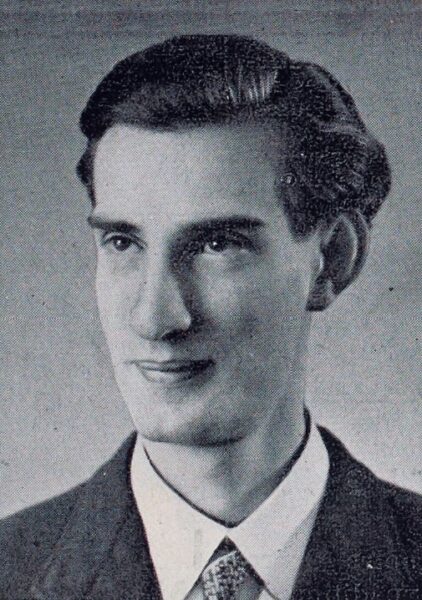
Would you trust this man to be your savior?
Did you enjoy this article? If so, please think about pitching in to help me make many more like it. You can pledge any amount you like.

Sources: The books Holy Blood, Holy Grail by Michael Baigent, Richard Leigh, and Henry Lincoln; Bloodline of the Holy Grail: The Hidden Lineage of Jesus Revealed by Laurence Gardner; The Treasure of Rennes-le-Château: A Mystery Solved by Bill Putnam and John Edwin Wood; The Holy Grail: The History of a Legend by Richard Barber; Invented Knowledge: False History, Fake Science and Pseudo-religions by Ronald H. Fritze; The Tomb of God: The Body of Jesus and the Solution to a 2,000-Year-Old Mystery by Richard Andrews and Paul Schellenberger; Rennes-le-Château et l’enigme de l’or maudit by Jean Markale; Le Trésor Maudit de Rennes-le-Château by Gérard de Sède; The Holy Place: Saunière and the Decoding of the Mystery of Rennes-le-Château by Henry Lincoln; Key to the Sacred Pattern: The Untold Story of Rennes-le-Château by Henry Lincoln; Les Templiers sont parmi nous, ou, L’Enigme de Gisors by Gérard de Sède; Les Mérovingiens à Rennes-le-Château. Mythes ou Réalités. Réponse à Messieurs: Plantard, Lincoln, Vazart & Cie by Richard Bordes; Lives of the Popes: The Pontiffs from St. Peter to Benedict XVI by Richard P. McBrien. Skeptical Inquirer of November/December 2004.
Online sources include the websites Rennes-le-Château: Where History Meets Evidence and Priory of Sion.com. Also the Misquoting Jesus podcast’s episode on Mary Magdalene.