Also, a little programming note: there will go one extra week between this article on The Analog Antiquarian and the next one on The Digital Antiquarian. Just the usual excuses: a holiday and a five-Friday month.
Monthly Archives: September 2026
The Lamentable Later Life of Lemmings
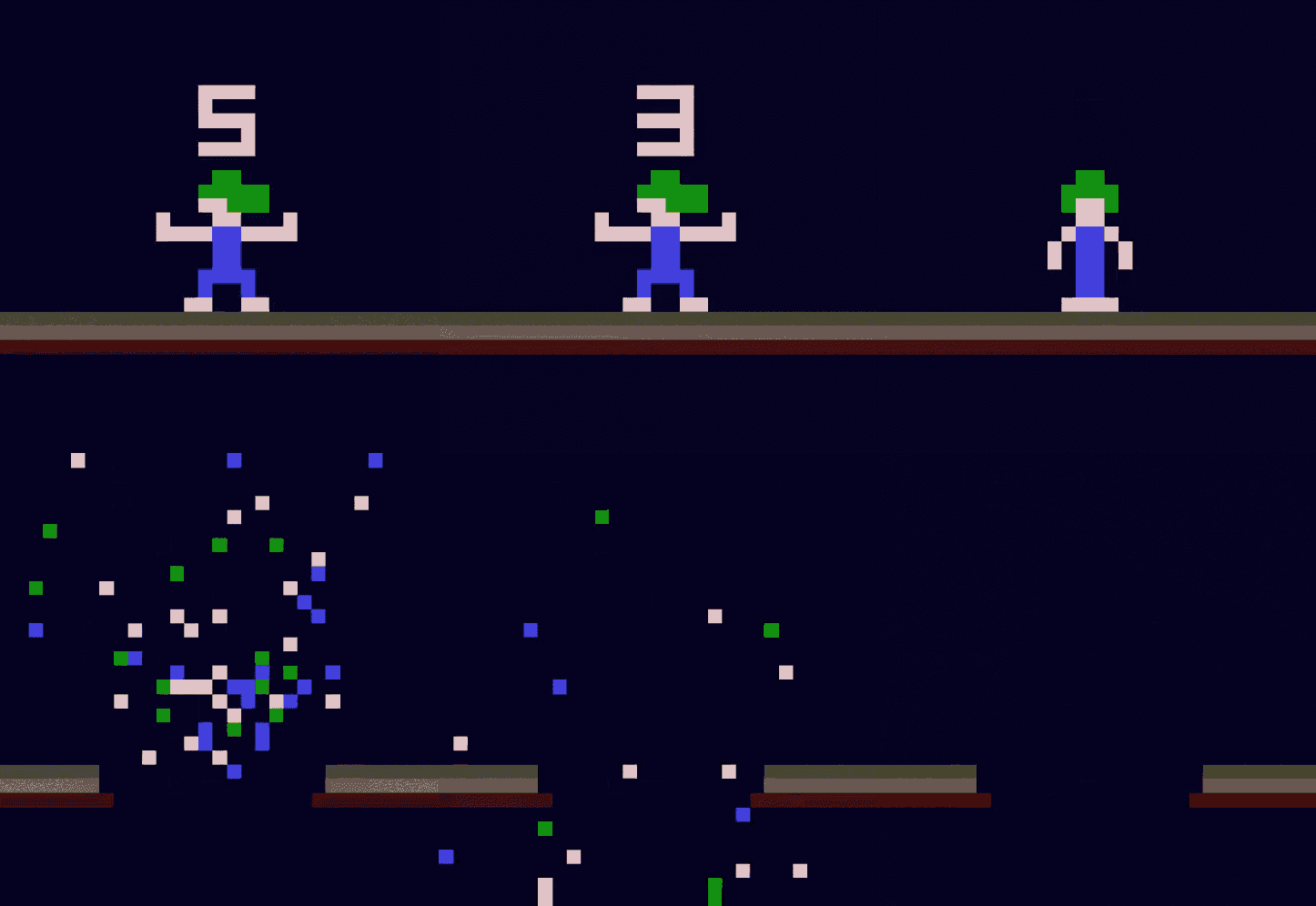
This article tells the last part of the story of Lemmings.
For a while there in the early 1990s, there seemed to be good reason to believe that Lemmings was on its way to becoming one of gaming’s perennial franchises. Developed by DMA Design of Dundee, Scotland, the original Lemmings game took the world by storm upon its release in 1991. From its first home on the Commodore Amiga, its Liverpool-based publisher Psygnosis brought it to no fewer than 23 other platforms, from natural habitats like MS-DOS and the Apple Macintosh to such refugees of the 8-bit era as the Sinclair Spectrum and the Amstrad CPC, from cutting-edge multimedia appliances like the Philips CD-i and the 3DO to handheld gadgets like the Atari Lynx and the Sega Game Gear. In all of its incarnations, it outsold any other game ever to have passed through the hands of Psygnosis by a veritable order of magnitude.
The combination of simplicity, juiciness, addictiveness, and cuteness was truly a lethal one. Psygnosis had to set up an entire call center in the United States to deal with the avalanche of frustrated players begging for hints on this or that devious level. The little creatures made appearances in newspapers, glossy magazines, and mainstream news broadcasts all over the world, even as playing the annual holiday Lemmings mini-games that could be found stacked as stocking stuffers next to cashier stands threatened to become a new Christmas-morning tradition for families. Lemmings joined Tetris and SimCity as one of the computer games that the zeitgeist deemed acceptable for those who did not self-identify as gamers to indulge in. Like those two others, it was an early harbinger of the casual revolution in gaming that would begin to arrive in earnest a decade later.
But whereas Tetris and SimCity would be grandfathered into that revolution at the turn of the millennium — SimCity spawning The Sims, the 800-pound gorilla in the new space — Lemmings would have flamed out by then, being remembered, to whatever extent it was remembered at all, more as a kitschy fad than as an enduring entertainment staple. I quite like the early Lemmings games, for reasons that I’ve explained in detail in the past. Therefore I came to this article with a simple question: just how did the franchise manage to squander all of that early momentum so quickly and completely? And as usual, I found that the answer comes down less to the choosing of a single ill-advised fork in the road than to a series of smaller decisions that doubtless seemed like a good idea at the time, but were exposed as less than good in retrospect.
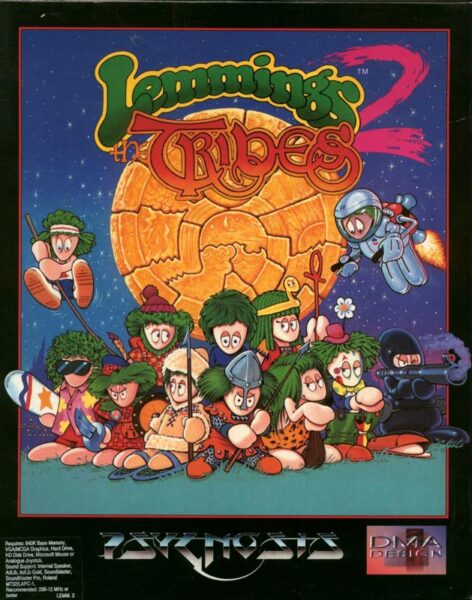
Lemmings 2: The Tribes, the big sequel to the original game — it was actually the third full-sized game in the series, coming after the less inspired Oh No! More Lemmings, which was largely filled with levels that had been rejected for its predecessor — was released in 1993 amidst huge anticipation and expectation. In many ways, it lived up to its advance press. In place of the suite of eight special abilities with which a player of the earlier games could invest her lemmings, it provided no fewer than 60 of them. The subtitle came from the fact that the lemmings were now divided into twelve tribes, each with their own abilities, appearance, and environments to traverse. The whole endeavor also boasted a new thread of narrative, about helping the twelve tribes escape from captivity. (The Biblical overtones were apparently intentional.)
As a player who had greatly enjoyed the first Lemmings, I found it to be a brilliant sequel. It was, however, every inch a sequel, being built strictly for the gratification of someone like me: someone who had a lot of experience with what had come before. This was not the best place to start your Lemmings journey, as the kids like to say today — not with all of the additional complexity, not with the disappearance of the gentle tutorial levels that eased you into the first game. Inspired as it was on its own terms, The Tribes‘s approach was questionable for a mass-market series of more or less casual games, which the customer should ideally be able to hop on and off of with the same aplomb as a subway rider. Then, too, the heavier weight of the game meant that it could be ported to only eight instead of 24 platforms. Lemmings 2 was a solid hit by all of the normal standards of the games industry, yet it failed to do much to further raise its franchise’s profile as a budding pop-culture staple. The original game, which was now available at a greatly reduced price, in all likelihood outsold it considerably even in the year of its release.
One of the problems, if we want to call it that, was a growing mismatch between the expectations of the market and the instincts and desires of DMA Design. The Scottish gang were gamer’s gamers of the old school, whose two creations before Lemmings had been the straightforward shoot-em-ups Menace and Blood Money. Lemmings had been something of an aberration for them; the cuteness had come about almost by accident, a case of mordant laddish humor ramming slightly askew. If DMA were to continue with the series, they wanted to make it more complicated, more difficult, more ambitious… in short, more hardcore. This was not a recipe for success in the space the first Lemmings had opened up for itself. After The Tribes failed to set the world on fire, DMA felt pressure from above to revert to the mean. This bred an atmosphere of resentment in Dundee that was hardly conducive to productive game development.
As was typical of such contracts at the time, the Lemmings intellectual property actually resided with the publisher rather than the developer. And the former was undergoing big changes. Just before the release of The Tribes, Psygnosis and its in-house studio — the same one responsible for most of the Lemmings ports — were acquired by the Japanese electronics giant Sony, which was looking for a Western partner to make games for its upcoming PlayStation console. This event, combined with the success of Lemmings, raised Psygnosis’s profile enormously, from a niche purveyor of graphically dazzling but often gameplay-deficient Amiga action games to a real force to be reckoned with on the modern entertainment landscape. The Children’s Television Workshop, the maker of Sesame Street, entered into talks with Psygnosis about a Lemmings television show.
It was a tempting prospect on the face of it, but it became problematic as soon as you started to dig into it. Television shows, whether aimed at adults or children, are built around memorable characters. DMA’s lemmings were not quite this. They were a generic mass, all of them identical, the very definition of a faceless horde. Each blobby little creature filled a space no more than ten pixels square on the screen. The lemmings were many things, but they were not Super Mario or Sonic the Hedgehog, much less Big Bird or Oscar the Grouch.
So, an edict went down from Psygnosis to DMA to find a way to give the lemmings more individualized personalities. For their next trick, DMA had been toying with a continuation of the story of The Tribes — or rather a whole set of continuations. The next four Lemmings games would each deal with the fate of three of the twelve tribes after they left the Ark the player had helped them reach last time around. The whole series would be called All New World of Lemmings. (In North America, it would take the name of The Lemmings Chronicles; unlike the vast majority of such re-christenings, this was actually a better name in my opinion.) To satisfy Psygnosis and the Children’s Television Workshop, DMA now promised to make the lemmings bigger, and to fill the menu and victory and failure screens with cute faces that looked different from one another and could play well on television.
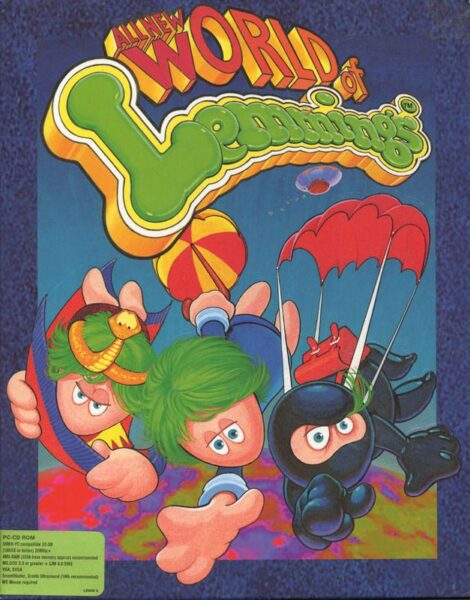
If matters had transpired differently, All New World of Lemmings would have been the banner title of a new sub-series, with different subtitles for each of its entries. As it was, Psygnosis just dumped the would-be first entry of the sub-series out there on its own, sans subtitle, and abandoned the other nine tribes to their fate.
“I couldn’t think of any new way to take Lemmings at this point,” admits David Jones, the series’s mastermind from the beginning. Desperate for some sort of gameplay distinction from what had come before, DMA decided to combine the newly television-friendly presentation with yet more complications to the formula — complications that proved not to be much fun. You could no longer invest your lemmings with specific skills from a master pool of same just by clicking on them; now, you had to have them walk over loot boxes scattered around the levels, an incredibly fiddly and annoying mechanic. Meanwhile the increased size of the lemmings had unexpected knock-on effects. When the creatures were tiny, watching them die was funny even for people who reacted to the violence found in other videogames with horror and outrage. But when they became bigger, that changed; their deaths became grislier, possibly amusing for a teenage boy but less so for his mother. In addition to its gameplay issues, the tone of World of Lemmings was badly off in relation to the franchise’s established personality.
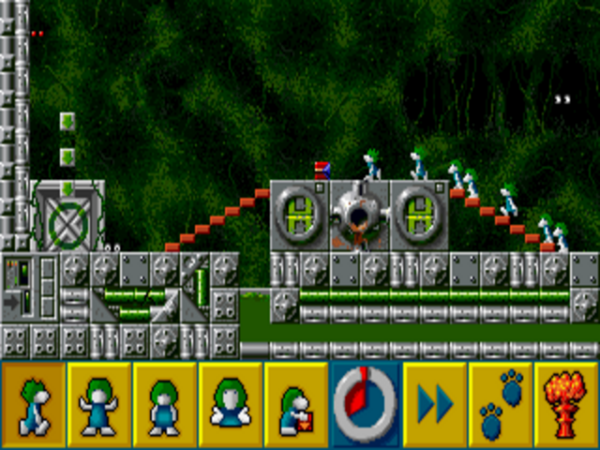
You have to walk your lemmings into crates like this one to give them special abilities now. Everything about the gameplay and aesthetics of World of Lemmings hits wrong, sometimes subtly so, sometimes blatantly. This was not promising television fodder.
Not long into development, a feeling took hold in Dundee that they were all just done with Lemmings, ready to come out from under the shadow of the casual monster they had accidentally created and return to making the games they wanted to make. As it happened, this was to be the last game of a six-game contract they had signed with Psygnosis back in the 1980s. Just get ‘er done became the watchword, so that they could take their Lemmings loot and do something more exciting with it. The new passion project around the office was a little something called Race ‘n’ Chase, which would evolve into a bigger something called Grand Theft Auto. “Lemmings 3 was a bit crap,” says DMA’s Mike Dailly, the artist who drew the very first eight-pixel-high versions of the creatures. It was done “more to end our commitment to Psygnosis than to actually do a good game.”
Unsurprisingly, then, it did not end up being a good game. Released in 1994, it made the concept that had seemed so fresh barely three years earlier feel trite and stale and kind of tasteless; even the soundtrack was annoying, the same two-bar fragment of circus music pounded into your head ad nauseam. DMA’s ennui oozed from its every slapdash pixel. This was a genuinely new thing under the sun: an outright bad Lemmings game. Evidently knowing it had a turkey on its hands, Psygnosis did virtually nothing to promote it, a huge contrast to the extensive outreach and advertising that had been done for The Tribes. It appeared on only two platforms, MS-DOS and the by now fast-fading Amiga. Those magazines that bothered to review it at all generally weren’t kind.
This first bad Lemmings game combined with a distracted Psygnosis, now busying itself making fresh games to order for the Sony PlayStation, to let all of the air out of the Lemmings balloon, practically all at once. The negotiation with the Children’s Television Workshop died on the vine. Lemmings was in acute danger of being exposed as a one-hit wonder, fodder for nostalgic “Where Are They Now?” retrospectives, rather than the enduring entertainment icon it had so recently seemed destined to become.
The following year the PlayStation dropped; it would go on to become the most successful single games console of the entire twentieth century, redefining the broader culture’s view of digital games forever with its edgy advertising and its deliberate courtship of the booming rave scene. Psygnosis was a big part of all that, through such early PlayStation hits as WipEout and Destruction Derby. Betwixt and between, it tried to get some more mileage out of Lemmings, efforts which came across rather like a child halfheartedly poking a dead dog with a stick. Having now parted ways with DMA Design, Psygnosis had to give its latest Lemmings projects to other developers with no previous connection to the franchise.
In 1995, we got Lemmings 3D from an outfit called Clockwork Games. The episodic approach of All New World of Lemmings was abandoned, in favor of the technological gimmick of the title. In a sense, the franchise became a pioneer one last time, albeit of a more dubious sort than before: Lemmings 3D was an early manifestation of an industry mania for stuffing 3D graphics into absolutely everything, whether they made sense there or not. “The fundamental core of the game of digging or building across the landscape to rescue the lemmings didn’t need an extra dimension,” says Gary Timmons of DMA Design, who could now only look on from afar as Psygnosis subjected their concept to ever more unfortunate contortions. Mike Dailly is blunter: “It was badly thought-out and just plain rubbish.” And truly, Lemmings 3D is agony to play; the newly mobile camera always seems to be pointing just where you don’t want it to be, forcing you to spend more time trying to get the viewing angle right than manipulating your lemmings. Nobody ever asked for this.
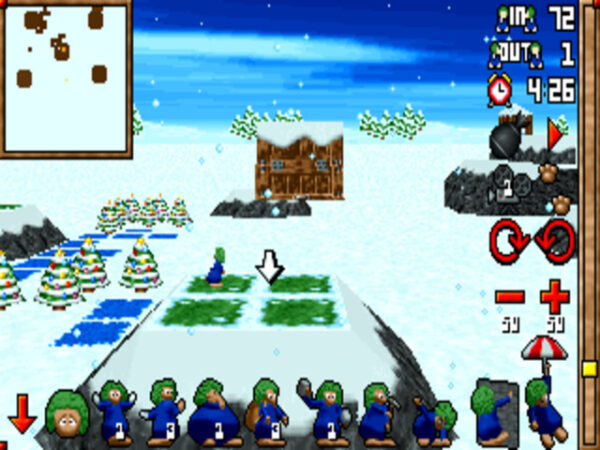
3D Lemmings Winterland marked the last gasp of the tradition of Christmas-themed Lemmings mini-games. The spirit was willing, but the 3D engine was lacking.
With the semi-traditionalist (but in 3D!) approach having failed, Psygnosis swung and missed in 1996 with Visual Science’s Lemmings Paintball — yes, really — and the in-house-developed The Adventures of Lomax. Here we can see the publisher still trying to do what the Children’s Television Workshop had once requested, turning the lemmings into characters to be moved in and out of different gameplay paradigms, something Nintendo had long done for its stable of trademarks with remarkable fluidity. But it was far too late in this case, and far too poorly done. The Adventures of Lomax gave a lemming a name of his own for the first and only time — for, of all types of game, a Super Mario Bros.-style platformer. The kindest thing to be said about it is that some of the art — pixel art again this time — is quite lovely, even as the gameplay is more or less acceptable in a workmanlike sort of way. But it never feels like it has much of anything to do with Lemmings.
After this, Psygnosis seemed to have decided to let the dead dog lie — until, that is, another, final Lemmings game popped up out of the blue almost four years later. It did not succeed in rescuing the franchise from oblivion; it came and went from the budget bins barely noticed by the gaming press. But it did succeed, against long odds indeed, in being a really, really good Lemmings game, by far the best since The Tribes. It’s hard to imagine any anticlimactic swansong acquitting itself much better.
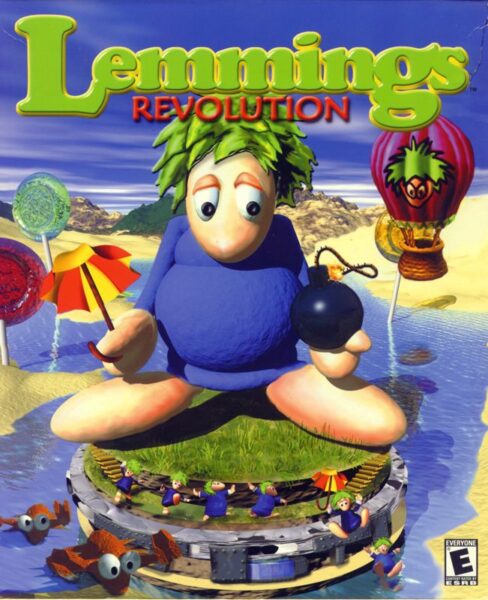
Lemmings Revolution is not without a gimmick, but for once it’s a reasonably interesting one. Instead of stretching out from left to right, each of its 102 levels is wrapped around a giant pillar that you can rotate at will. The gimmick is not what I would call revolutionary in the non-physical sense, but it mixes the usual formula up in enjoyable ways when it’s at its best, and is never actively irritating even at its worst.
But more important to this game’s success than the gimmick are the cleverest, most inspired set of levels since The Tribes. The team who made it, who were housed at Psygnosis’s satellite studio in Leeds, brought a passionate whimsy to the project that the series had been sorely lacking in its last several installments. Co-designer Mat Thomas describes a creative atmosphere that resembles the one from back in the day at DMA Design, when the idea of Lemmings was still fresh and everyone was eager to get an oar in with a level or two.
The entire development team were delighted to work on such a famous series, and we took the challenge. We had a fabulous editor developed by a programmer called Ben Dixon. It was very easy to mock up and create levels. The key to level design with Lemmings is trying to think of ways to use the skills presented to the player in different ways. Inspiration came from each other, and other mediums such as the earlier Lemmings games and, dare I say it, films! Goonies — one of my levels — was inspired by the named film. I tried to put in many gadgets to give that feeling of technology driving the level. Our team created nearly 200 levels for Lemmings Revolution, which allowed us to pick the cream of the crop.
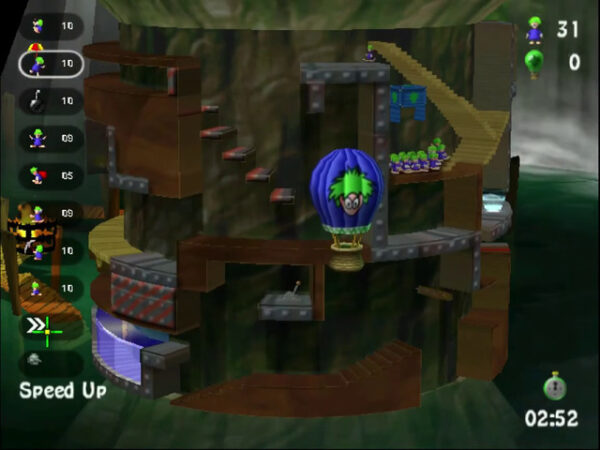
The “Goonies” level mentioned by Mat Thomas.
The finished game goes back to the roots in many ways. The suite of abilities with which you can equip your lemmings is the exact same collection as the original game: the familiar climbers, parachutists, bombers, and bridge builders, plus the three kinds of diggers. Seeing them again feels like meeting old friends.
Yet by no means is Lemmings Revolution a carbon copy of the first game in the series. In addition to the revolution mechanic itself, there are any number of new obstacles and affordances within the levels: switches, saws, lasers, instantaneous transporters, and, most ingeniously, gates that reverse the force of gravity to make your lemmings walk on the ceiling. All of this contribute to a slightly more mechanized feel this time around. There are now weasels to contend with as well; these consider a lemming to be a delightful snack, and must be either avoided or — more satisfyingly — done away with in one way or another. Another new wrinkle comes in the form of special lemmings who are impervious to either drowning in water or being scorched by acid, the better to handle the pools of same that are occasionally found in their way. Exits are now hot-air balloons that must be reached, and sometimes there are more than one of these, with each only able to accept a limited number of riders. The most important point is that all of the additions feel organic to the experience rather than tacked on by some focus group somewhere. Thankfully, no attempt is made to individualize the lemmings and turn them into fodder for television. We’re back to the juxtaposition of generic cuteness and morbidity that made the series stand out during its glory days.
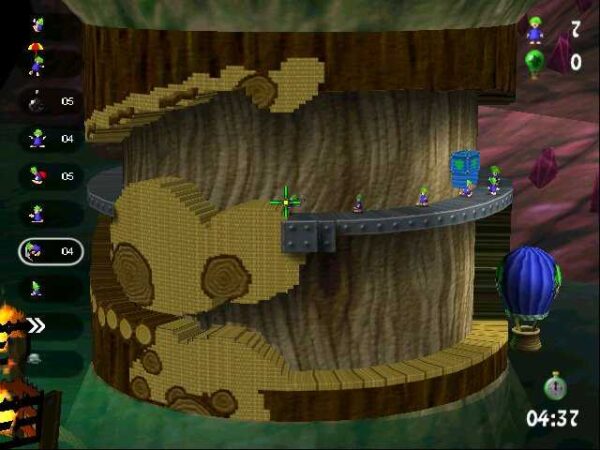
For the first time since The Tribes, these lemmings look like they should.
All told, then, playing this Lemmings game is like going home again. Early training levels yield to more fiendish ones that will have you scratching your head by the middle stages, pulling your hair out by the last ones, as you have to make use of every single affordance at your disposal to succeed. As many of you know by now, I adore games that build up gradually in just this way to challenge their players. And I’m proud to say that my wife and I rose (gradually) to the challenge; we made it all the way to the end.
That Lemmings Revolution succeeds as well as it does in so many ways begins to seem still more remarkable when one considers the rest of its development history. After first agreeing to pay for this last kick at the can for the franchise, Sony abruptly pulled its funding just as it was nearing completion. Through some last-minute scrambling, Psygnosis’s management was able to place the game with the rival publisher Take Two Interactive and see it released for Microsoft Windows if not for the PlayStation.
Granted, some scars from the trauma were left behind. Several levels were bugged badly enough in the initial release to be impossible to complete, until Take Two came out with a patch. Even in the final version of the game, one level — the one called “Lock In” — can be completed only by exploiting a glitch in the game engine. It’s so at odds with the rest of the level designs, which are sometimes diabolical but always scrupulously fair, that I can’t believe this was intentional. I even fancy I can see how the level was supposed to be solved. At any rate, if you decide to play the game, I recommend that you save yourself a lot of frustration and just turn to a walkthrough when you get to this level.
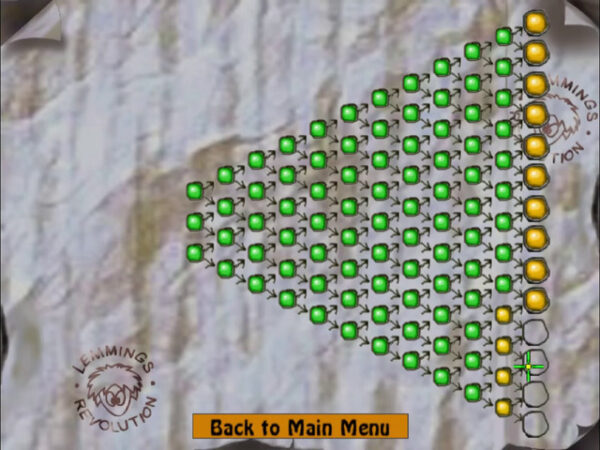
One nice touch in Lemmings Revolution is the ability to choose to some extent what level you tackle next. The green dots represent solved levels, the yellow those you haven’t yet completed. Once you beat a level, you open up the two that are connected to it by arrows. It’s a little hard to see here because I’m boring and just tackle the levels in order, top to bottom and left to right. But if you’re less stubborn and methodical than me, you can take a break from a level that’s giving you trouble and work on another one for a while. Like so much else here, this is just really good, player-friendly game design.
It’s obvious that Lemmings Revolution didn’t have an overly lavish budget even before Sony pulled the plug on it. A thin glaze of story — something or other to do with those weasels who can sometimes be found lurking in the levels — is presented via an opening movie that probably absorbed about half the budget on its own. It’s never mentioned again afterward — not that it really matters. We are given only as many bells and whistles as are necessary to make the levels go and remind us that we’re playing a Lemmings game. The closing movie lasts all of seven seconds; the operative philosophy was apparently that it’s better to tempt the punters in the shops who might buy the game than it is to reward the already captured players who have put many hours of their life into it.
All of which is fine really. By the turn of the millennium, so-called “mid-priced releases” like this one — Lemmings Revolution sold for just $20 from its very first day on store shelves — were often more interesting and innovative than the expensive AAA opuses, whose publishers felt more of a need to protect their investment via micromanagement and risk aversion. Certainly the production values of this Lemmings game are no worse than those of the original. We never came to Lemmings to participate in epic stories; we come to face puzzles and to curse and stomp and almost throw our mice across the room, until a light bulb goes off somewhere in the old noggin and the fingers do what they’re supposed to and we solve that level. At which point it’s on to the next level, to repeat the procedure. We are strange creatures, we humans, aren’t we? Even stranger than lemmings, one might want to say.
Anyway, this humble game called Lemmings Revolution is one of my favorites of all the ones I’ve played from the year 2000 for these histories. I’m happy to give it a place in my personal Hall of Fame and to recommend it to all of you — especially any of you who might have enjoyed the more famous and popular Lemmings games, and thought the later ones had nothing comparable to offer. You were mostly right — but only mostly.
For better or for worse, there isn’t much else to say about the series after Lemmings Revolution came and went with so little fanfare (or, one has to suspect, sales). There have been occasional remakes over the past quarter-century, mostly for mobile platforms, but nothing that displays much in the way of design or commercial ambition. As late as 2010, the franchise was frequently mentioned as being “ripe for revival” for a new era where unabashedly simple and cartoony casual games were by some reckonings out-earning the hardcore ones. But for whatever reason, that revival was never seriously attempted, and the cultural window for the franchise is probably closed by now, what with most of us who were there when it was so huge having entered into our fifth or sixth decade of life by this point.
This is no tragedy. Lemmings came to the zeitgeist and then it went; such is the fate of most pop culture. Good game design, however, transcends trends and fads. If you’re a fan of puzzle games and you haven’t played these ones, know that Lemmings, Lemmings 2: The Tribes, and Lemmings Revolution, the three high points of the series, can still be very vexing and satisfying indeed. This is as true today as it was a quarter-century ago, as true as it will still be a quarter-century on. Even if everyone stopped making games tomorrow, we would still live in an era of unprecedented ludic riches.
Did you enjoy this article? If so, please think about pitching in to help me make many more like it. You can pledge any amount you like.

Sources: The books Grand Thieves & Tomb Raiders: How British Video Games Conquered the World by Magnus Anderson and Rebecca Levene and Jacked: The Outlaw Story of Grand Theft Auto by David Kushner. Retro Gamer 39; Computer Gaming World of September 2000.
Online sources include “The Making of Lemmings” by Rich Stanton for Read-Only Memory, “An Ode to the Owl: The Inside Story of Psygnosis” by Damien McFerran for Time Extension, a Lemmings Universe interview with Mat Thomas, and Damian Katz’s gamebook page.
Where to Get Them: Oddly, none of the vintage Lemmings games are currently available for purchase. You can find downloadable versions of the original Lemmings and Lemmings 2: The Tribes in my earlier articles associated with those games. As for Lemmings Revolution, the third of the three Lemmings games that are well worth revisiting today: you can find it on a certain well-known archiving site if you only search for it. After you install it, you will need to install a patch to make it run properly on modern versions of Windows (and Linux systems under WINE).
Porsche Unleashed

This Porsche is very much leashed. The one I got wasn’t even a turbo model.
I’ve had a running joke with my wife Dorte for almost as long as we’ve been a couple. I reasoned back in the day that, since she was going to be a doctor — a more reliable source of income than writing about computer games — she should be expected to buy me the Porsche of my dreams at some point. Needless to say, I’m still waiting. I had to learn the hard way that a doctor in Denmark doesn’t earn quite as much as one in the United States. (On the other hand, a doctor here doesn’t have to work such ridiculously long hours or have to pay ridiculous insurance premiums either, so it all balances out.)
The closest my dream ever did come to fruition was not that long after we moved to Denmark, when Dorte decided to empty out much of our meager bank account to rent me a Porsche for a weekend as a birthday present. But bless her heart, she didn’t know one model from another. So, what with our finances being so stretched, she just took the cheapest one when she booked the rental online — something called a Cayenne.
This was not the Porsche of my dreams. It was a hulking SUV of the sort that… well, I won’t say that I left the United States just to escape them, but I did enjoy not being surrounded by so many of them on European roads, especially given that my standard mode of conveyance in my new life was a bicycle. Having had no idea where we were going when we climbed into a bus that morning to get to the rental place, I was more confused than disappointed as I handed over my freshly minted Danish driver’s license to the man behind the desk in order to drive away in the least interesting vehicle on the premises.
Of course, it didn’t take me that long to work out what had happened. When I did, I didn’t know whether to laugh at the best wife in the world or hug her as I observed her dismay. So, I did a little bit of both. It was like landing in an O. Henry story — but with Porsches.
In that same “Gift of the Magi” spirit, the Cayenne turned into the gift that kept on giving. We drove down to Germany that weekend to visit my in-laws, whom Dorte had informed of my big surprise beforehand. Their faces showed as much shock as hers had when they saw what we rolled up in. I then had to inform everyone, in my insufferable car-nerd way, that this Porsche was no real Porsche at all, that it was just a rebadged and gussied-up Volkswagen, with an automatic transmission, for Pete’s sake. My father-in-law thought this speech was the best part of all. He still talks regularly about the “Volksporsche” Dorte found for me.
In the end, then, we all got more pleasure out of that frumpy Cayenne than any Boxster or 911 could have given. Even Dorte has come around to admitting that the whole episode was pretty darn funny.
She hasn’t tried again; in fact, I haven’t driven another Porsche since. (In real life, that is; more on the virtual breed momentarily.) The next time Dorte led me to an undisclosed location on my birthday, it was to meet the kitten she’d picked out for me. Thankfully, unlike my Porsche, the kitten was just exactly perfect.
As the car enthusiasts among you are doubtless already raising hands to point out, the irony of my Volksporsche story is that the two brands — the one so utilitarian, the other so prestigious — have always been intimately linked. The Volkswagen Beetle was, after all, designed by a fellow named Ferdinand Porsche. And for most of the second half of the twentieth century, Porsche sports cars and that humble Volkswagen were the only mass-produced cars to sport rear-mounted, air-cooled engines. This is just one of the things that you will learn if you spend some time with Need for Speed: Porsche Unleashed, a rather unusual entry in Electronic Arts’s signature series of aspirational driving games.
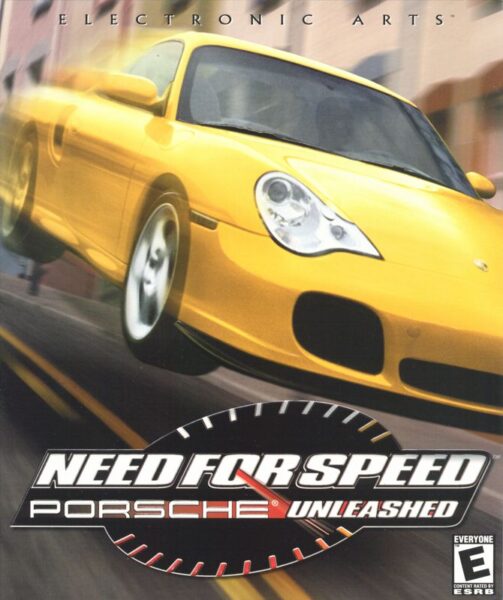
Porsche Unleashed is a digital love letter to the marque. No other driving game has ever been so laser-focused on a single brand; even the police cars in this game are Porsches. You could say that it all amounts to an extended corporate infomercial, and you’d be completely correct. But what an infomercial!
Like all aspirational driving games, Porsche Unleashed is a snapshot of the moment it was created. Released in March of 2000, it captured the storied sports-car maker as it charged into the new millennium with renewed purpose and optimism. Porsche had recently survived a near-death experience, and, like many a survivor of same, it had emerged determined to seize life by the throat and make up for lost time.
In 1986, Porsche had a record year, turning out 50,000 cars. In 1993, it made 14,000. Between these two data points lay a brutal sales collapse, exacerbated by a global economic downturn but primarily caused, said many, by arrogance and complacency. Hemorrhaging money, facing the very real prospect of bankruptcy, the company turned to a 38-year-old wunderkind engineer named Wendelin Wiedeking to turn things around. He remains a polarizing figure among Porsche enthusiasts to this day.
For Wiedeking utterly remade the company, turning it from an old-school maker of semi-handcrafted vehicles to an efficient, ultra-modern mass manufacturer. He went to Japan to tour the factories of Toyota, Honda, and Nissan, then returned to Porsche’s hometown of Stuttgart to implement the same processes there. In five years, he reduced the amount of time it took to make a Porsche 911 from 128 hours to 70 hours, increasing throughput in terms of cars per employee per year from 4.9 to 9.1.

The Boxster, the car which did much to pull Porsche back from the brink. Unsurprisingly, it features prominently in Porsche Unleashed.
More controversially, he revamped the model lineup, saying it was no longer possible to survive by making vehicles that appealed exclusively to the kind of uncompromising sports-car connoisseurs who had bought Porsches in the past — the sort of people who regarded heel-and-toe braking as an essential life skill and weren’t bothered in the least by fiddly maintenance procedures or a complete lack of luggage space. He introduced the Boxster, a mid-engine roadster that was cheaper than the flagship 911 model, more livable, and less demanding to drive and maintain. Porsche sold 16,000 of them in their debut year of 1996. For his next trick, Wiedeking gave the world a more robust and practical variant of the 911 itself, the first ever to be powered by a water-cooled engine; the anguished cries of the purists can still be heard echoing down through the years. By the turn of the millennium, Porsche’s total vehicle production had returned to its 1984 levels, with profit margins that were much higher. The financial pages were calling Porsche the automotive turnaround story of the decade, calling Wendelin Wiedeking a genius. Not content to rest on his laurels, he had moved on to his next trick: a luxury SUV called the Cayenne, based on a Volkswagen design, that was set to reach dealers in 2003. The purists (hey, that’s me!) would soon have more cause than ever to howl.
As of the year 2000, though, Porsche was still a maker of sports cars only, with a proud past, a winning present, and a bright future. It felt it had something to celebrate. And indeed, Porsche Unleashed was nothing if not a celebration.
This, then, was Porsche’s motivation. That of Electronic Arts is slightly harder to discern. Like so many other driving and sports games, the Need for Speed series has always been a bit of a black box, lacking the big public-facing personalities who place their stamp on the more design-centric genres. The decision to go in a more historical, simulation-focused direction with Porsche Unleashed is counter-intuitive on the face of it, in that this was the opposite of the direction the series had been trending over its last couple of installments — and, for that matter, the direction it would continue down as soon as this installment was done. It may be relevant to note here that Hanno Lemke, the series’s guiding light from its inception until 2007, seems to have had the least to do with this entry; he is credited here as only the executive producer rather than a line producer.
For whatever reason, Porsche Unleashed is in some ways of a piece with what came before — it’s still every inch an aspirational driving game — while being quite dramatically different in tone and feel. It is, dare I say it… classier? The only tacky part of this game is the name; Porsche Unleashed sounds more like branding for a man’s razor or a sexual supplement than a vital creative work.
I originally played it not long after its release, attracted by its Porsche-centric focus and by a stellar review from the long-defunct Games Domain, my favorite gaming website lo those many years ago. I vaguely remember loving it, but my most indelible recollection is of breaking at least three driving wheels — pulling the shift paddles right off, I believe — in my over-enthusiasm to finish first. When I picked the game up again last year, I was curious whether my jaded middle-aged self would respond to it in the same way. I didn’t buy a driving wheel, for two reasons: because it seemed incompatible with my present-day preference for playing games from the couch, and because I knew that Dorte would laugh at me as soon as I emerged from my office with such a contraption just as much as I’ve laughed at her for the Cayenne fiasco over the years. But even with a plain old Xbox controller, the magic was still there for me.
In the interest of full disclosure, I should tell you at this point something that you may have already gathered for yourself: that Porches have always been the exception to my general disinterest in high-priced, high-powered sports cars. This may be down to their shared heritage with Volkswagen, a brand with which I was quite enamored and could actually afford in my younger days. The very first Porsche-branded car was the 356, built in the immediate aftermath of the Second World War, by some reports with money looted from a factory for military vehicles which Ferdinand Porsche and Anton Piëch, the company’s patriarchs, had set up in Stuttgart. That first 356 was little more than a Volkswagen Beetle with a different body, a stiffened-up chassis, and a souped-up engine capable of churning out all of 40 horsepower. (If that doesn’t sound like much, know that it was almost twice what you could expect from a Beetle in those early days.)
Prior to the tenure of Wendelin Wiedeking, there was a clarity of purpose — almost an austerity — about Porsches that I have always adored. They didn’t chase trends. In fact, they scarcely changed at all over whole stretches of years (which, yes, was doubtless a big reason for the morass the company had sunk into by the beginning of the 1990s.) They remained rear-engined and air-cooled long after even Volkswagen had given up on that design. To drive a car of such a design fast, you really had to know what you were doing. If you didn’t, that heavy rear end would start to come around on you, you’d hit the brakes trying to plant it down again, and in the best case you’d find yourself sitting in a roadside ditch with the hood pointing in the wrong direction entirely. Some people, myself included, found something deeply appealing about such an uncompromising vehicle. You bought a Ferrari or a Lamborghini to show off to others. You bought a Porsche for yourself. Looking back on the late 1980s — my formative years in car culture, as they were those of the modern aspirational driving game — I find that the Porsches from that time have aged a heck of a lot better than their slightly more expensive companions in games like Test Drive, even if the company wasn’t selling as many of them as it might have wished.
So, all of this is surely bound up with my appreciation for Porsche Unleashed. But I think a difference is discernible in this Need for Speed game regardless. Certainly you won’t find a sleeker and more stylish game from the turn of the millennium, a time when tastes in gaming aesthetics in general were often still those of nerdy adolescents. Although it was made in Canada, the feel of the game is more European than North American, which is only appropriate given the subject matter. The chilly house beats that play behind the proceedings are a perfect match for the airbrushed discotheque-ready sheen of the rest of the production.
Another thing you’ll notice before you actually set yourself behind the wheel are the gallery of photographs and press clipping awaiting your perusal, now or later. Although I’ve never been to Porsche’s official museum in Stuttgart, I can imagine that its mood might be a lot like this, at least if they’re doing it right.
But of course, none of this would matter at all if the cars weren’t fun to drive. Happily, then, fun they are. Really, really fun. Porsche Unleashed lands in exactly the right sweet spot between an obviously artificial arcade game like the old Outrun and a fiddly, rigorous simulator like the NASCAR games from Papyrus Design. It is, in other words, an aesthetic simulation par excellence; it feels like you’re actually driving one of these cool cars. The 911s are the highlight of the experience, as they by all rights ought to be. You have to learn that, when that infamously squirrelly rear end comes around on you, you can’t follow your natural instinct to hit the brakes, for that way lies a disastrous spin. No, you have to step on the gas, which will transfer the car’s weight to the rear and let those loosy-goosy tires grip the road again. When you figure out that you can throw your car into the curves, let the back end drift around deliberately, and then down-shift and clomp down on the accelerator to power out of them, it’s an awesome, well-nigh revelatory moment. I’m not sure that I can recall a more satisfying feeling in all my decades of playing videogames. Spend some time with this game, and you will begin to understand why people love those vintage 911s so much.
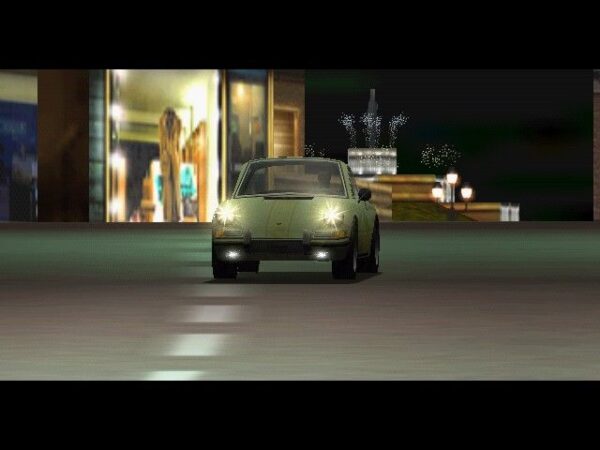
The streets of Monte Carlo.
All of the courses you can drive are located in Europe. They include the streets of Monte Carlo, the German Autobahn, and a rather generic industrial zone that could be found on any of six continents. But most of them put you on twisting smaller roads, mostly in France. While this is in some ways an odd choice for a game about a legendary German automaker, the end result is so lovely that I’ll let it pass without further comment.

These courses are all a blast to drive and explore, with plenty of the shortcuts and hidden byways that virtual motorists love. They looked spectacular in the year 2000, and still stand up surprisingly well today; this game is almost as effective an advertisement for France as it is for Porsche. It seems weird to use the word “bucolic” in reference to a franchise called Need for Speed, but for this installment it really is applicable. I sometimes like to take an old, slow 356 out just to practice my line through the courses and enjoy the scenery. Call it a reminder of what driving a sports car used to mean: driving well, and having a great time doing it, even if you weren’t going all that fast in absolute terms.
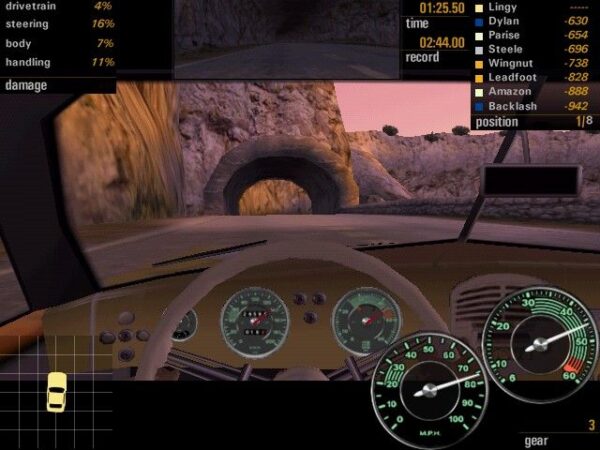
Out for a Sunday drive in a 356. I’ve said it before and I’ll say it again: it’s funner to drive a slow car fast than a fast car slow…
Just one year after Need for Speed: High Stakes introduced a longer-term meta-game to the franchise, Porsche Unleashed gave you two of them, both equally well-done. Its direct equivalent to the High Stakes career mode is called Evolution. Just like in the previous game, you start out with a single modest car and an equally modest sum of cash, with the dictate to go forth and win races to improve the state of your garage and your bank account. But Porsche Unleashed adds a larger historical chronology to the proceedings. As you open up new races to enter, you also advance through time from your starting point in 1950, when the only car you can buy is a Porsche 356 that sways and rolls more than a fat man on a bender and is powered by what sounds and performs like a lawn-mower engine.
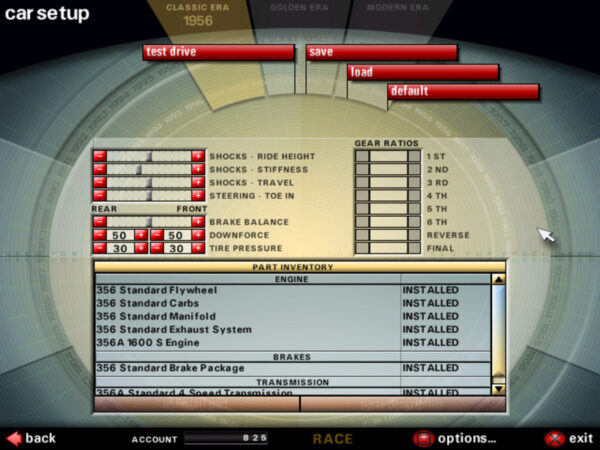
In one of the few reflections of the direction the franchise took after this game, Porsche Unleashed lets you tune your cars in career mode. I must admit that this sort of thing exceeds my patience level. I find it easier just to buy new cars instead of mucking about with my existing ones.
In addition to its other attractions, the Evolution mode is another fine history lesson, this time an interactive, hands-on one. When the 911 comes onto the stage in 1964, well after the 356 has overcome its humble origins to get pretty darn good, you might feel like many a 356 aficionado did at the time: skeptical of the newcomer, to put it mildly. But rest assured that the 911, an automotive icon for a reason, will win you over quickly enough.
To its credit, the Evolution mode includes lots of Porsches that aren’t the 356s and 911s around which the brand built its reputation. The 914 is here — this being the semi-infamous Volksporsche which combined a Porsche chassis with the exact same motor that powered the Volkswagen bus I owned all those years ago. (I kid you not.) And we can have a go with the 944, a later lower-end sports car, and the 928, the grand tourer that Porsche made twenty years before the Cayenne was a gleam in Wendelin Wiedeking’s eye. None of these cars is as fun to drive as the fishy-tailed 911, but it’s great to see them nonetheless. Ditto the real oddballs, such as the Porsche 550 Spyder, which looks like an overturned bathtub and is a terrifying handful on the road, such that you can understand all too well how the actor James Dean could have met his death in one in 1955. All told, playing through the entirety of the Evolution mode, from that first 356 to the Y2K incarnations of the Boxster and 911, is quite a trip. A course that used to take you six or seven minutes to traverse will be done in barely two by the time you’ve finished assembling your garage full of Porsches. Evolution indeed!
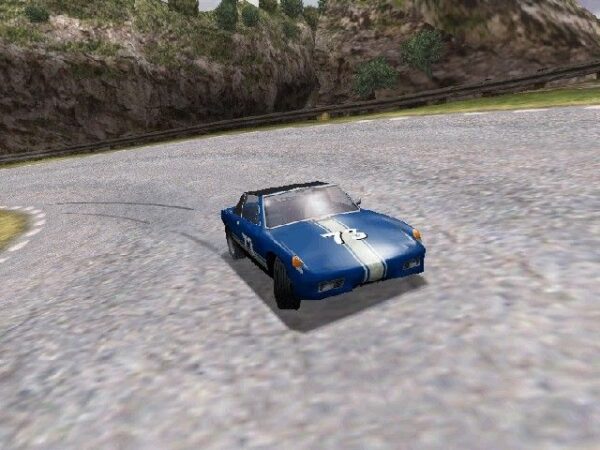
The 914, the ugly duckling of the Porsche flock.
The other meta-game here is a dramatic new innovation for the series. The Factory Driver mode is a sign of the changing times in gaming circa 2000, when more and more genres were finding ways to include set-piece story lines. The story here isn’t a particularly good one in the abstract, mind you, but it’s notable for existing at all. More importantly, it’s at least as entertaining as the Evolution mode in practice.
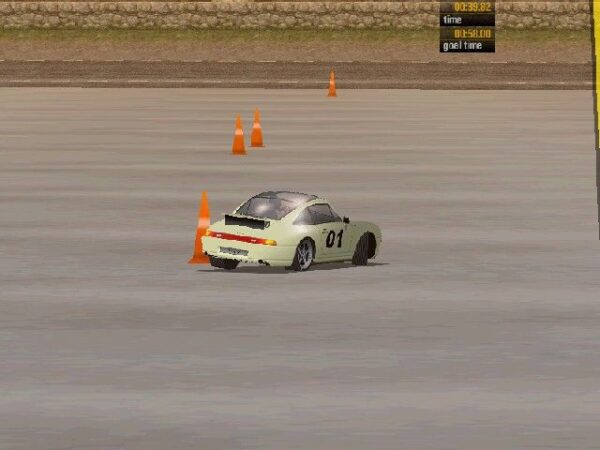
On the skid pad in Factory Driver mode.
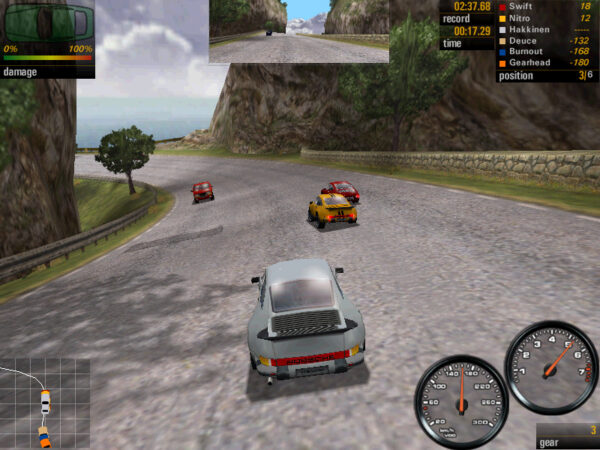
You’ve come to Porsche to work as a test driver. Over 34 assignments, you have to prove your mettle and fend off various challengers from among your colleagues. Some assignments take place on a slalom course right there in the factory parking lot, but most repurpose the same roadways that you race on in Evolution mode. Realism is not a priority; I certainly hope that the real Porsche doesn’t deliver its cars to the port for shipment by racing them at breakneck speeds over public thoroughfares. Some of the assignments are really hard, at least for a middle-aged man like me; it took me more than an hour of trying to complete an embarrassing number of them. But boy, are they fun, and boy, is it satisfying when you win a race against the clock that had seemed impossible at the outset.
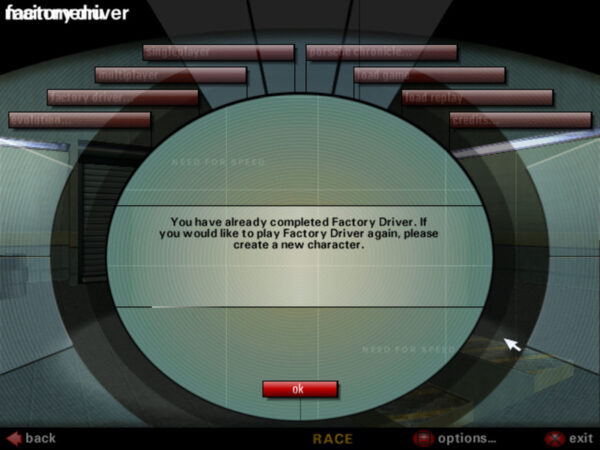
Yes, I am proud. It wasn’t easy, let me tell you.
In fact, I think that I adore this part of the game even more than the rest of it; I don’t even mind that you’re mostly driving 1990s-vintage Porsches in Factory Driver mode, with only the occasional blast from the past. This mode is actually an excellent place to start with the game, as it will teach you skills that will serve you well when you move on to Evolution mode. The only drawback to this ordering is that, if you’re at all like me, you may find that Evolution mode, good as it is, pales just slightly in comparison.
As has surely become all too clear by now, I have very little bad to say about this game. Normally, when I’m writing about a game, I try to temper my criticisms by reminding myself that there is someone out there who likes it a lot more than I do, who cares about it more than I do. Well, that may not be the case with Porsche Unleashed. Even grizzled, jaded critics like me have those special games that stick in our craw for reasons that we may not be entirely able to articulate. Porsche Unleashed is one of those games for me. It seems that all I can bring myself to do is gush over it.
Yes, it’s easy enough to call it too slick by half, to call it corporate propaganda. But it’s just so well-done, so aesthetically masterful and so carefully calibrated for the maximum enjoyment of yours truly, that I don’t care. Part of me feels bad that I haven’t found any other driving games to fall in love with in the same way as this one. Another part of me — the bigger part, I think — feels that, when a driving game is as good as this one, what’s the point of having any others?
Despite reviews that tended to be almost as gushing as the one I’ve just written, Porsche Unleashed was less commercially successful than its predecessors in the Need for Speed series. That disappointment prompted a franchise course correction — or rather re-correction, back to the direction the series had been trending before this detour into a single marque’s history. I feel like I ought to write that this was a shame, but, honestly, what would more games in this spirit have looked like? Ferrari Unleashed? Lamborghini Unleashed? I suppose you could try, but somehow it wouldn’t be the same. Or maybe that’s just the Porsche lover in me talking once again.
As it was, the Need for Speed series soared to new commercial heights early in the aughts by capitalizing on the craze among the youth for “tuning” and (illegally) racing more ordinary and accessible cars, as celebrated by the 2001 cinematic blockbuster The Fast and the Furious and its sequels. For many post-millennial driving-game fans, Porsche Unleashed remained relevant primarily for the sixteen-year (!) exclusive license Porsche had granted to Electronic Arts; this meant that their cars could not appear in anyone else’s games, even as EA’s own were now favoring Hondas and Nissans and even Volkswagens over Porsches and Ferraris and Lamborghinis. When the long moratorium finally ended in 2016, it was front-page news on many a gaming website. (Would we have gotten more exclusively Porsche Need for Speed games if the first one had been more successful? It’s tempting to wonder — but, again, what else could those games have done that the first one didn’t?)
Today, the expired status of the same license agreement means that Porsche Unleashed is not available for purchase anywhere. But you can still find it in the musty back hallways of the Internet, including at a certain archiving organization. It can be tricky to get running well on modern hardware, but it’s not impossible. A good place to start is with the “Combined Patch” by Tsalikon. Just make sure to play the Windows rather than the Playstation version; the latter is so dramatically stripped down as to be for all practical purposes a different, inferior game altogether.
Naturally, you will have to decide for yourself whether it’s worth the effort to track down the game and get it running. I can only say that it was most emphatically worth it for me to renew my relationship with this old flame. I am, it seems, a driving-game monogamist. What I lack in my breadth of appreciation for them is made up for by the depth of my attachment to this one.
Did you enjoy this article? If so, please think about pitching in to help me make many more like it. You can pledge any amount you like.
Sources: I drew my brief summation of Porsche’s recent history and situation circa 2000 from a Harvard Business School case study by Jeffrey Fear and Carin-Isabel Knoop. And let me recommend the book The Nazi Billionaires by David de Jong to anyone who wants to explore the darker side of Volkswagen and Porsche’s origins, the stuff you will never see in a slick propaganda piece like this one.