RSS

Tag Archives: garriott

The Road to V

Ultima V

It’s not easy having a software superstar for a little brother. That’s something that Robert Garriott, president of Origin Systems, had more and more cause to realize as the 1980s wore on. Whilst Richard Garriott quite literally lived out his fantasies, it was Robert who was left to deal with all the mundanities of running a small game developer in an industry that was ever becoming a more precarious place. Whilst Richard wrote the games and gave all the interviews and reveled in his Lord British persona, it was Robert who dealt with the sort of people who might not be terribly impressed by a wispy 25-year-old that liked to affect the personality and the dress code of a Medieval monarch. It was Robert who negotiated the business deals, Robert who represented Origin’s interests with the Software Publishers Association, Robert who put a sober, businesslike face on a company that to a lot of outsiders looked like little more than a bunch of nerds with too much time on their hands. And sometimes it was Robert who found himself trapped between the practicalities of running a business and the desires of a famous younger brother who was just slightly full of himself — what young man wouldn’t be slightly full of himself in his situation? — and was used to having things his own way.

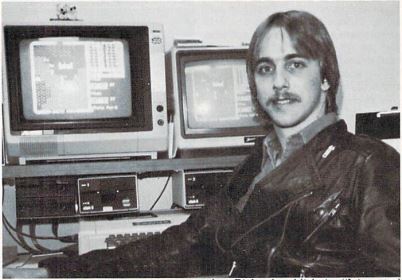
Honestly, now... would you feel comfortable investing in a company run by this guy?

Honestly, now… would you feel comfortable investing in a company run by this guy?

The most dangerous of these conflicts was the great sibling squabble over just where Origin Systems should be located. Back at the end of 1983, you may remember, Robert had been able to convince Richard to move the company from their parents’ garage in Houston, Texas, up to New Hampshire, where his wife Marcy had found a fine position of her own working for Bell Labs. The deal was that they would remain there for at least three years. Robert, who had spent the months before the move commuting cross-country in his private plane, hoped that during the three years something might change: Marcy might get a transfer, or Richard might decide he actually liked New England and wanted to stay there. Well, at the end of 1986 the three years were up, and neither of those things had happened. Richard, who persists to this day in describing his exile in the “frozen wasteland” of New Hampshire in terms lifted straight out of Ethan Frome, figured he had fulfilled his side of the deal, had done his three years as he’d said he would. Now he wanted to move. And he knew exactly where he wanted to move to: back to warm, sunny Austin, the city that had felt like the only place he wanted to make his home almost from the day he arrived to attend university there back in 1979.

A deal being a deal notwithstanding, Robert tried to nix the move, at least for the time being. In addition to his own marriage — he and Marcy certainly didn’t relish going back to commuting cross-country — there were the other Origin employees to think about. Sure, most of the technical staff remained the same group of youngsters that had trooped up north with the Garriotts three years before; they were almost one and all in agreement with Richard that it was time to be southbound again. But there were also the support personnel to think of, New Englanders hired in New England who had been doing good work for the company for quite some time. Robert proposed that they put Origin’s future location to a simple company-wide vote.

That proposal really pissed Richard off. New Englanders now well outnumbered Texas transplants, meaning the outcome of any vote must be a foreordained conclusion — which was, Richard believed, exactly why Robert was asking for one. The two had screaming rows that spilled out of their offices into the hallways of a suddenly very tense suite of offices, while the occupants of those offices, northerners and southerners crammed together under one roof for years, now felt free to let loose on each other with all of the frustrations they’d been keeping under wraps for so long. It was civil war — the staid New Englanders who were loyal to Robert against Lord British’s merry band of anarchists. In a fit of pique and homesickness, Richard’s right-hand man Chuck Bueche, programmer for the Ultima games, porting expert, and designer of games in his own right, announced he’d had enough and headed for Texas on his own. Richard and Robert each threatened to break with the other, to do his own thing with his own splinter of the company.

Such threats were ridiculous. Richard and his crew were no more capable of taking full responsibility for a company than Robert and his were of writing the next Ultima. These two needed each other for more reasons than just the ties of blood. It was finally left to older and cooler heads, in the form of the brothers’ parents, to broker a compromise. Richard would move back to Austin with most of the technical team, to set up a small studio there that would make the games; Robert would remain in New Hampshire with Marcy, a couple of programmers working on ports and ancillary projects, and the larger support staff that was responsible for packaging and marketing the games and running the business as a whole.

Thus Richard and company, reunited again with Bueche, found themselves a minimalist office in Austin in early 1987, fifteen desks ranged along a single long hallway. And Richard himself, now becoming a very wealthy young man indeed thanks to the huge success of Ultima III and IV, started work on Britannia Manor, a custom-built house-cum-castle worthy of Lord British; it came complete with secret passageways, a cave, a wine cellar, and a stellar observatory. It was pretty clear he wasn’t planning to go anywhere else anytime soon.

Carried out though it was for very personal reasons, Richard’s return to Austin would prove the single best business move Origin ever made. Eastern Texas may not have had as sexy a reputation as Silicon Valley, but there was plenty of high technology in the environs of Dallas, Houston, and Austin, along with a booming economy and low taxes to boot. Austin itself, in addition to being home to a prestigious university boasting almost 50,000 students of diverse talents, was something of the cultural as well as government capital of the state. Along with a lively music scene and tattoo parlors and all the other attributes of a thriving college town, Weird Austin boasted a diverse tapestry of nerdier culture, including Richard’s beloved SCA chapter and the hugely influential tabletop-game publisher Steve Jackson Games. What Austin, and Texas in general for that matter, rather oddly lacked was any notable presence in the computer-games industry. Richard himself was shocked at the hungry talent that washed up unbidden at Origin’s doorstep almost as soon as they hung their shingle, all eager to work for the house that Ultima had built. “Austin as a location was fundamental to the success of Origin,” remembers Richard, “because there was so much talent here in this town.” The atmosphere inside Origin’s new Austin office was soon so exciting, so positively bursting with possibility, that Robert had to admit defeat. More and more of Origin’s operations steadily moved south. Within a couple of years, Robert would convince Marcy to make the move with him, and Origin’s operations in New Hampshire would come to an end.

But hardly was the great Texas/New Hampshire crisis resolved than another raised its head. This time the dispute wasn’t intra-family or even intra-company. It rather involved Electronic Arts, a much bigger publisher with which little Origin would have quite the love-hate relationship over the years.

The origin of Origin’s EA problem dated back to August of 1985, about a month before the release of Ultima IV. By this point distribution was starting to become a real issue for a little publisher like Origin, as the few really big publishers, small enough in number to count on one hand, were taking advantage of their size and clout to squeeze the little guys off of store shelves. Knowing he had a hugely anticipated game on his hands with Ultima IV, one that with the proper care and handling should easily exceed the considerable-in-its-own-right success of Ultima III, Robert also knew he needed excellent distribution to realize its potential. He therefore turned to EA, one of the biggest of the big boys of the industry.

The agreement that resulted was quite the coup for EA as well as Origin. Thanks to it, they would enjoy a big share of the profits not just from The Bard’s Tale, the hit CRPG they had just released under their own imprint, but also from Origin’s Ultima IV. Together these two games came to dominate the CRPG field of the mid-1980s, each selling well over 200,000 copies. For a company that had never had much of anything to do with this genre of games before, it made for one hell of a double whammy to start things off.

While it’s been vaguely understood for years that Origin and EA had a mid-1980s distribution agreement that broke down in discord, the details have never been aired. I’m happy to say that I can shed a lot more light on just what happened thanks to documents housed in the Strong Museum of Play‘s collection of Brøderbund papers. (The reason I was able to find them in a Brøderbund archive will become clear shortly.) I unfortunately can’t make these documents publicly available, but I can summarize and quote extracts from them. I do want to look at the contract that EA and Origin signed and the dispute that would eventually result from it in some detail, both because it’s so very illustrative of how the industry was changing as it entered the second half of the 1980s and because it provides a great example of one of the most dangerous of the potential traps that awaited the small fry who still tried to survive as independents. Origin would escape the trap, but many another small publisher/developer would not.

At first glance the distribution contract might seem more generous to Origin than to EA. Origin is obligated to remain the distributee only as long as EA has bought product from them totaling a stipulated amount over the course of a rolling calendar. By the end of the contract’s first year, which comes on September 1, 1986, EA must have bought $3.3 million worth of Origin games. The goal for the second year of the contract doubles; EA must have bought games worth $9.3 million in total from Origin by September 1, 1987, in order for the latter company to be obligated to honor the third and final year of their distribution contract. That’s a very ambitious sales goal for a little company like Origin whose entire reason for existence was a single series of games with a sporadic release schedule. (Origin had already released some non-Ultima titles and would continue to do so, but it would be years yet before any of them would make an impact on their bottom line to even begin to rival that of Ultima.)

All went well between Origin and EA for the first eighteen months. The trouble started shortly after Richard’s move back to Austin, when he got word of EA’s plans to release a rather undistinguished CRPG called Deathlord that was even more derivative of Ultima than was the norm. As Strategic Simulations, Incorporated, had learned to their chagrin a few years earlier in the case of their own Ultima clone Questron, Richard didn’t take kindly to games that copied his own work too blatantly. When EA refused to nix their game, and also proved uninterested in negotiating to license the “game structure and style” as SSI had done, Richard was incensed enough to blow up the whole distribution deal.

Richard and Robert believed that Origin would be on firm legal ground in withdrawing from the distribution agreement at the onset of the third year because EA was projected to have purchased just $6.6 million worth of product from Origin by September 1, 1987, way short of the goal of $9.3 million. Origin informed EA of their intentions and commenced negotiating a new distribution agreement with another of the big boys, Brøderbund, currently riding even higher than EA on the strength of The Print Shop and Carmen Sandiego.

The notice was greeted with shock and outrage by EA, who felt, and by no means entirely without reason, that it was hardly their fault that they were so far from the goal. That goal had been predicated on not just one but two or three or possibly even four new Ultima games being released during those first two years. Foreshadowing the way that Origin would handle Ultima VII years later, Richard’s plan at the time the contract was signed had been to release an Ultima IV Part 2 that would reuse the same engine in relatively short order, and only then to turn to Ultima V. But those plans had fallen by the wayside, undone by Richard’s idealistic need to make each Ultima clearly, comprehensively better than its predecessor. And now Ultima V was taking even longer than had Ultima IV. Having long since missed the original target of Christmas 1986, it now looked almost certain to miss Christmas 1987 as well; it still looked to be a good six months away from release as of mid-1987.

Yet it was the Ultima I situation that most ruffled EA’s feathers. When the rights to the first game of the series, having passed through the hands of the long-defunct California Pacific and then Sierra, reverted back to Richard in 1986, Origin assigned several programmers to rewrite it from scratch in assembly language rather than BASIC, adding graphical upgrades and interface enhancements along the way to bring it at least nominally up to date. Already a semi-legendary game, long out of print on the Apple II and never before available at all on the Commodore 64 or MS-DOS, the new and improved Ultima I carried with it reasonably high commercial hopes. While not the new Ultima, it was a new Ultima for the vast majority of Lord British fans, and should ease some of the disappointment of not being able to get Ultima V out that year. But in the wake of the Deathlord dust-up it became clear to EA that Origin was deliberately holding Ultima I back, wanting to tempt their prospective next distributor with it rather than give EA their fair share of its earnings. This… well, this pissed EA right the hell off. And, then as now, pissing off EA wasn’t usually a very good idea.

EA’s lawyers went through the contract carefully, looking for anywhere where they might knock a few dollars off the requirement of $9.3 million in orders inside two years.

The original goal for 9/1/87 was stated in Exhibit A as $9,300,000. This amount “is reduced by $40,000 for every month in which any of the software products listed in Exhibit B are not available according to the schedules set forth in Exhibit B.” Moebius/Apple was listed as being available in September 1985, and was not available until November 1985, a slip of two months. Ogre/Apple was listed as being available in November 1985 and was not available until June 1986, a slip of seven months. Moebius/C64 was listed as being available in November 1985 and was not available until October 1986, a slip of eleven months. Taking into account only those titles listed in Exhibit B, a total of 22 months are applicable to the $40,000 provision, equaling a deduction of $880,000 from the $9,300,000 goal mentioned earlier, leaving a net goal of $8,420,000 for 9/1/87.

The adjusted goal of $8.4 million still left EA $1.8 million short. No problem. They attached to the same letter a purchase order for a random hodgepodge of Origin products totaling the full $1.8 million. EA didn’t really care what Origin shipped them, as long as they billed them $1.8 million for it: “If Origin is unable to ship any of the products in the quantities stated on the purchase orders, please consider this an order for a similar dollar volume of any of your products that can be shipped in sufficient quantities to meet our 9/1/87 objectives.”

You’re probably wondering what on earth EA is thinking in throwing away almost $2 million on any old anything at all just to retain Origin as a distributee. Far from cutting off their nose to spite their face, they’re playing hardball here; what they’ve just done is far more dangerous for Origin than it is for them. To understand why requires an understanding of “overstock adjustments,” better known as returns. It’s right there in the original contract: “Vendor [Origin] agrees to issue credit to EA based on the original purchase price for the return of resalable overstock made any time beyond 90 days of original receipt.” This provision gives EA the ability to crush Origin, accidentally or on purpose, by over-ordering. Origin can honor the order, only to have it all come back to them along with a bill big enough to bury them when EA doesn’t sell it on. Or Origin can refuse to honor the order and get buried under a nasty breach-of-contract lawsuit. Or they can come back to EA hat in hand and ask nicely if both parties can just forget the whole thing ever happened and continue that third year of their agreement as was once planned.

Many small publishers like Origin were becoming more and more angry and/or terrified by the logistics of distribution by the latter half of the 1980s. This is why. Nevertheless, with the big publishers squeezing out any other means of getting their games onto store shelves, most of the small companies were forced to get in bed with one of the big boys against their better judgment. Although several other big publishers had affiliate distribution programs, Activision and EA became the most aggressive of the bunch, both in recruiting and, if things didn’t work out, destroying affiliated labels by returning hundreds of thousands or millions of dollars worth of product along with a bill for same. The battlefield of the industry’s history is fairly littered with the corpses of companies who signed distribution deals much like Origin’s with EA.

Origin, however, was lucky. In rushing to become a distributee of Brøderbund, they’d found shelter with a company with the resources to go toe-to-toe with EA; Doug Carlston, founder and president of Brøderbund, was himself a lawyer. Brøderbund took Origin’s cause as their own, and a settlement agreement presumably entailing the payment of some sort of penalty from Origin and/or Brøderbund to EA was reached in fairly short order. (The actual settlement agreement is unfortunately not included in the Strong’s collection.) Origin signed a two-year distribution contract with Brøderbund, and all of EA’s worst suspicions were confirmed when the revamped Ultima I shipped on the very first day of the new agreement. And that wasn’t even Origin’s last laugh: Deathlord, the match that had lit the whole powder keg, got mediocre reviews and flopped. True to his tradition of adding references to his contemporary personal life into each Ultima, Richard added the words “Electronic Arts” to the in-progress Ultima V’s list of forbidden swear words (“With language like that, how didst thou become an Avatar?”). Just for good measure, he also built a mausoleum for “Pirt Snikwah” on the grounds of Britannia Manor. Like most monarchs, Lord British apparently didn’t forget a slight quickly.

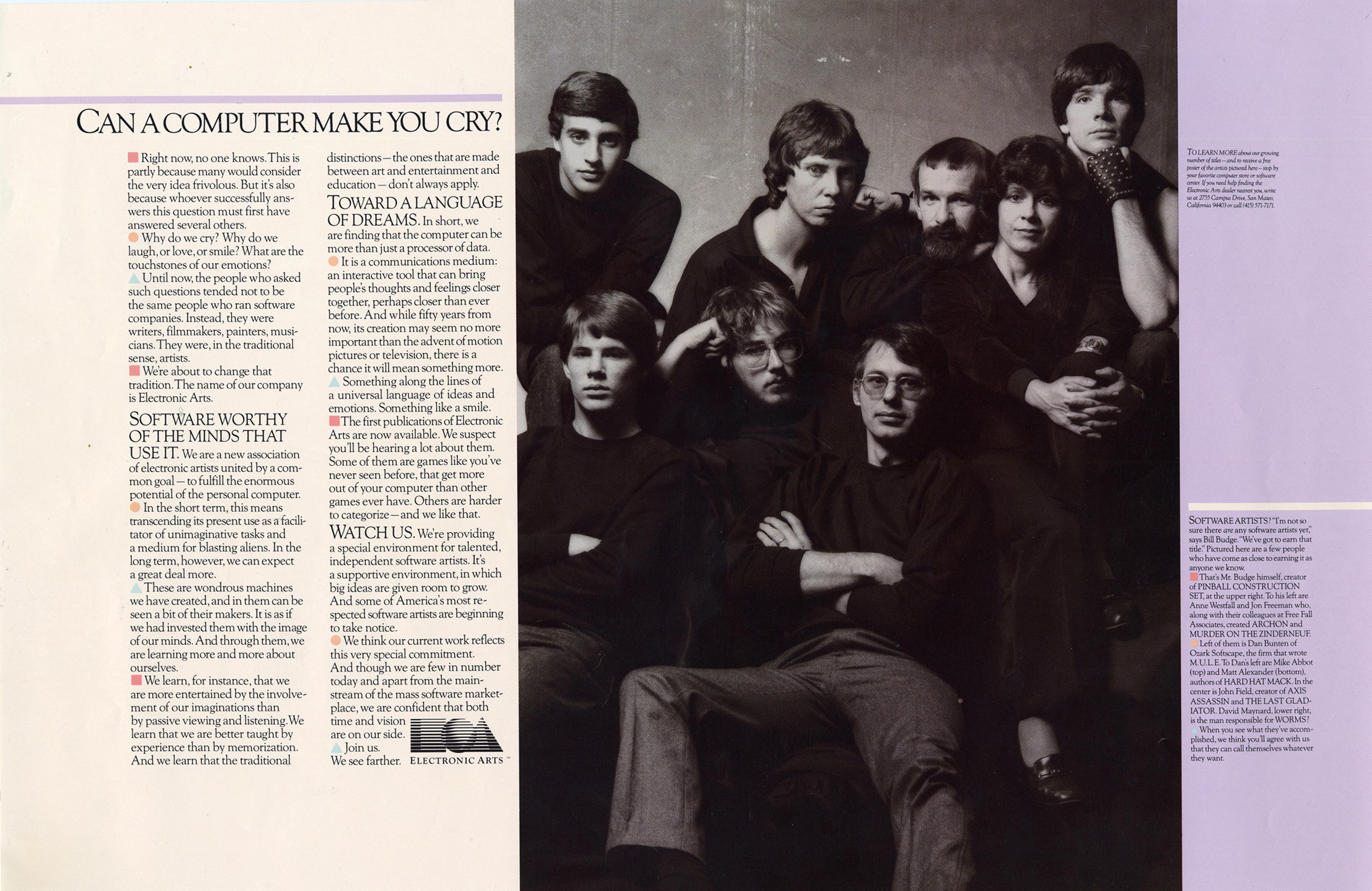
The Garriotts were still living charmed lives. Much as so many love to romanticize Trip Hawkins’s “electronic artists” of the 1980s, complete with crying computers and all the rest, EA has always been a rough customer when it gets down to the brass tacks (knuckles?) of doing business. Few others have tangled with them like Origin did and lived to tell the tale.

Behind all this drama there lurked always the real point of the whole endeavor that was Origin Systems: Ultima, specifically Ultima V. Just like all the other games in the series, it was well on the way to dwarfing its predecessor in terms of scale and technical ambition, with all the birthing pains that must imply.

Beginnings and endings can be tricky things for an historian to come to grips with. Certainly the middle period of the eventual nine-game Ultima series is full of them. There’s the beginning marked by the great conceptual leap that is Ultima IV, when the series became about more than killing monsters, collecting loot, and leveling up — a leap that changed the series’s character to such an extent that plenty of fans will tell you that you needn’t even bother with anything that came before, that the real Ultima starts right here. And there’s the ending that is Ultima VI, the first Ultima not built on the code base of its predecessor, the first not developed and released first and foremost for the Apple II, the first for which Richard did none of the programming.

In between the two lies Ultima V, a crossroads game if ever there was one. It marks the end of the line for the 8-bit Ultimas, the basic structure that began with Akalabeth pushed to a complex extreme that would have been unthinkable back in 1980. How extraordinary to think that this game runs on essentially the same computer as Akalabeth, plus only 16 K of memory here or an extra disk drive there. The series’s glorious last hurrah on the Apple II, it also marks the beginning of a radically different development methodology that would carry forward into the era of the MS-DOS-developed Ultimas. Starting with Ultima V, new Ultimas would no longer be the end result of Richard Garriott toiling alone in front of a single Apple II for months or years until he emerged with bleary eyes and disk in hand. From now on, Richard would direct, design, and supervise, while other people did most of the grunt work.

It was an obviously necessary step from the perspective of even the most minimally informed outsider. Ultima IV had taken him two years, twice as long as originally planned, and had nearly killed him in the process. If the series was to continue to grow in scale and ambition, as he himself always demanded it should, something had to give. Yet Richard resisted the obvious for quite some time. He struggled alone, first with the abortive Ultima IV Part 2 and then with Ultima V, for almost a year while everyone fretted at the lack of progress. He genuinely loved programming, took pride in knowing each new Ultima was truly his personal expression, top to bottom. But at last he accepted that he needed help — an acceptance that would change everything about the way that Ultimas got made forevermore.

The process started with two new programmers, Steve Meuse and John Miles. The former started writing tools to make it easier to create the world, to put a friendly interface on all of the tasks that Richard normally managed by hand using nothing more than a hex editor. Meuse’s “Ultima Creation Package” would grow into something that, according to Richard, “almost anyone could use.” Meanwhile Miles took over most of the actual game-programming tasks from Richard; more than half of the code that shipped in the finished game would be his. “The transition of doing it all yourself to doing it as a team was very painful,” Richard says of this landmark change of late 1986 that marked the abrupt end of his days as a working programmer. “However, once you had a team in place, and especially once you were no longer sharing the duties of both doing it and managing it, the pain went away.”

Richard’s team only continued to expand after the move to Austin, as all of that pent-up Texas talent began arriving on Origin’s doorstep. The finished game credits no fewer than six programmers in addition to Richard himself. With so many more people involved, this Ultima needed a project manager — the role also commonly referred to as “producer” — for the first time as well. That role went to Dallas Snell, late of Penguin Software, who, nobody being too specialized yet at this stage, did some of the programming as well. Snell lobbied for months for the hiring of a full-time artist, but Richard remained skeptical of the need for one until quite some time after the move to Austin. But at last Denis Loubet, an Austin artist who had been doing cover art for Richard’s games since the days of Akalabeth, joined the Origin staff to do all of the art for Ultima V, whether the media be paper or cardboard or pixels. Loubet’s work, blessedly free of the chainmail bikinis and other cheesecake tendencies that make most vintage CRPG art so cringe-worthy, would now become even more integral to the series, helping to maintain its aura of having just a little more class than the standard CRPG fare. Finally, and also largely thanks to Snell’s determination to professionalize the process of making Ultimas, there are fourteen people — fourteen! — credited solely for play-testing Ultima V, more than enough to ensure that there wouldn’t be any more blatant screw-ups like the vital clue that was left out of Ultima IV.

Denis Loubet on the job at Origin.

Denis Loubet on the job at Origin.

Freed from the pressure of programming, Richard could make Ultima V a much more consciously designed game than its predecessors. From an interview conducted almost a year before the game was published:

In previous Ultimas the combat systems were not designed out on paper ahead of time. I kind of ranked weapons in order of strength… the higher up the list of weapons you got, the better the weapon. Now I’ve actually designed an entire gaming system, including magic and combat, that is just as good to play on paper as on the computer. It’s extremely well-balanced, both [sic.] the weapons, armor, and magic, and we’ve been balancing the costs and uses of those things for six months — essentially by playing Ultima on paper.

Origin was so proud of this system of rules that they planned for some time to make an Ultima tabletop RPG out of them. That project fell by the wayside, but just the fact that Richard was thinking this way represented a huge step forward for a series whose mechanics had always felt ad hoc in comparison to those of its original rival, Wizardry. “I can tell you in numbers the probabilities of your being able to do something,” said Richard, “whereas in previous Ultimas I probably wouldn’t be able to do so. I just kind of did it until it looked right.”

While all of the extra care and thought that was going into this Ultima was welcome, it was also time-consuming. A series of release dates spouted by an overoptimistic Richard in interview after interview fell by the wayside, as subscribers to adventurer-catering magazines like Questbusters read for a year and a half of a game that was perpetually just a few months away. Still, the game they kept reading about sounded better with every mention: it would fill no less than eight Apple II disk sides; it would offer twice as much territory as Ultima IV to explore; each non-player character would have three times as much to say; non-player characters would have realistic day-and-night schedules that they followed; just about every single thing in the world, from table and chairs to torches and even a harpsichord, would be a discrete, manipulable object.

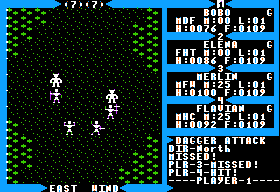
An early public preview of Ultima V at Dragon Con, October 1987.

An early public preview of Ultima V at Dragon Con, October 1987.

More philosophically-minded fans wondered about a subject on which there was less concrete information available: what would the new Ultima be about? After the great conceptual leap that had been Ultima IV, would Lord British be content to return to monster-killing and evil-wizard-bashing, or would there be another — or perhaps the same? — message on offer this time out?

All of their questions were answered on March 18, 1988, when Origin released Ultima V: Warriors of Destiny for the Apple II; versions for MS-DOS and the Commodore 64 followed in July and October respectively, with ports to a handful of other platforms trickling out over the following year or so. We’ll dive into the virtual world that awaited Ultima V‘s army of 200,000-plus eager buyers next time.

(Sources for this article and the next: Questbusters of June 1987, July 1987, August 1987, March 1988, July 1988; Game Developer of September 1994; Computer Gaming World of March 1986, December 1987, July 1988, January 1989, November 1991, November 1992. The books The Official Book of Ultima by Shay Addams; Dungeons and Dreamers by Brad King and John Borland; Ultima: The Avatar Adventures by Rusel DeMaria and Caroline Spector. See also Richard Garriott’s extended interview with Warren Spector. And of course the Strong’s collection; my thanks to Jon-Paul Dyson and his colleagues for hosting me there for a very productive week!

Ultima V is available from GOG.com in a collection with its predecessor and sequel.)


Tags: , , , ,

Ultima IV

There’s lots of somethings to be said for sheer audacity in art, for a willingness to stick your neck out and give your audience something they never, ever expected from you. I think sometimes about how the first folks who listened to Revolver must have felt when the erstwhile cuddly Fab Four unleashed the otherworldly chaos of “Tomorrow Never Knows”; how the first buyers of Achtung, Baby must have felt when they hit the play button and heard not the expected soaring anthem but the grinding industrial murk of “Zoo Station”; how, to choose something I’ve already written a bit about here on this blog, viewers who tuned into The Prisoner‘s “Living in Harmony” episode must have felt when instead of a spy drama they got a Western that refused to reveal itself as a dream sequence but instead just kept going and going right through the show’s running time. Lots and lots of people run screaming from these sorts of switcheroos. As for me, though… they always send a thrill up my spine. A willingness to rip it up and start again is pretty high on the list of things likely to draw me to a creator.

Ultima IV

I get some of that thrill when I think about those first people who booted up Ultima IV expecting to create a party via the usual min/maxing routine, only to be greeted with a simple story with the gravitas of a parable — a parable about, well, you.

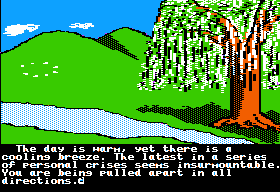
The day is warm, yet there is a cooling breeze. The latest in a series of personal crises seems insurmountable. You are being pulled apart in all directions.

Yet this afternoon walk in the countryside slowly brings relaxation to your harried mind. The soil and stain of modern high-tech living begins to wash off in layers. That willow tree near the stream looks comfortable and inviting.

The buzz of dragonflies and the whisper of the willow’s swaying branches bring a deep peace. Searching inward for tranquility and happiness, you close your eyes.

A high-pitched cascading sound like crystal wind chimes impinges on your floating awareness. As you open your eyes, you see a shimmering blueness rise from the ground. The sound seems to be emanating from this glowing portal.

There’s the echo of another spiritual journey’s beginning, that undertaken by the narrator of Dante’s Inferno: “In this the midway of our mortal life, I found me in a gloomy wood, astray, gone from the path direct.”

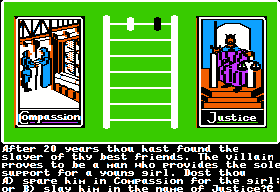
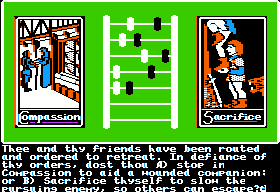
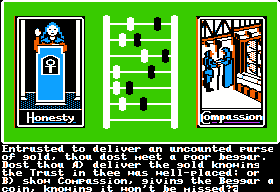
Ultima IV‘s opening parable culminates in a mysterious gypsy fortune teller who poses a series of ethical dilemmas designed to determine not what class or race you’d like to play but what kind of person you are. Of the eight noble virtues of Compassion, Honesty, Honor, Humility, Justice, Sacrifice, Spirituality, and Valor, which ones matter most to you?

Ultima IV

Ultima IV

Ultima IV

By 1985 gaming had already seen its fair share of debates about who the player’s character in a role-playing game or interactive fiction really was. The very term “role-playing” would seem to imply that the player was not just playing herself thrust into another world, that she was playing a role there, performing as one of Gary Gygax’s idealized Shakespearian thespians. Infocom also had tried to sell their players, to decidedly mixed success and occasional howls of outrage, on seeing interactive fiction through the eyes of people who weren’t necessarily the same as them. For the grand experiment of Ultima IV to succeed it was critical that the opposite point of view prevail, that the player feel it to really be her in the game. Richard Garriott: “Since this is a game about the player’s personal virtues, it is very important that one always identifies with the character and feels responsible for the character’s deeds.”

In a computer game if you roll random dice, you’re just going to sit there and go roll, roll, roll. You get all maxed-out numbers and it’s, “Okay, I’ll take that one.” If you don’t let them roll out and you let them choose numbers, well, it’s kind of a fixed equation. Once they know the map and the game, they can make the perfect decision as to exactly what their stats should be if they are aware that the equations are internal. So I don’t want to give you either of those.

Ultima IV I wanted to be a very personal experience. The reason is because in most of these games you are the puppeteer running this puppet around the world. If this puppet is doing bad things it’s not you, it’s the puppet. You can detach. And I wanted this game to be about personal and social responsibility. It is very important that this be you in the world of Britannia, not something you’ve rolled up. If I’m the computer nerd at home wanting to be a big barbarian going around crushing things, I still want to be a computer nerd down there, in nice clothing. The essence of that character is really the essence of you as an individual.

The gypsy’s questions were designed to tease out the player’s real beliefs and place her in the role in the game that best suited her own personality — to whatever extent seven questions determining the most important to her of eight abstract virtues could manage such a feat, of course. Richard again:

We worked on the phrasing of those questions. Unfortunately, there’s no really perfect way to ask those questions that we’ve yet discovered. Here’s something else that’s interesting. When we were working on this system, I said, “Here’s what I want to do for character development.” I went around to everyone in the office, saying, “Here’s these eight virtues along with a short description as to what I mean by them. Give me your ranking, one to eight, as to how important you think they are.” And then about a week later, after we generated those questions, we went back to the same people and said, “Answer these questions.” Although our company was only about twenty people large, everybody except two people had the exact same outcome to the questions as they did to the judgment. And those two who were wrong only had two transposed in the list. And so it turns out you get the exact same responses as you do to an intellectual discussion of it.

For the record, every time I answer the questions Compassion trumps everything else, and thus I end up a bard starting just outside Lord British’s castle. I don’t know whether this necessarily represents the person I always am, but it’s certainly a good approximation of the person I’d most like to be. So, at least for me, the system does indeed seem to work pretty well.

After that radical opening, the screen which greets the player after the gypsy has passed her final judgment must have struck many as comforting in its familiarity.

Ultima IV

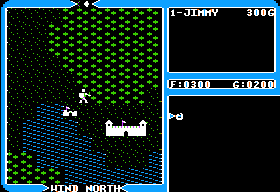
Yes, we’re back to our familiar view with our familiar alphabet soup of single-letter commands to explore the world. That world is now named Britannia rather than Sosaria; it was so renamed after Lord British united the land under his rule following the passing of the Three Ages of Darkness represented by Ultima I, II, and III. The fact that the geography is completely different from that of the previous game is similarly handwaved away, attributed to a great upheaval — must have been one hell of an upheaval — following the destruction of Exodus in Ultima III. The fact that Ultima II inexplicably took place on our Earth is, as per developing Ultima tradition, completely ignored; there are limits to what even the most dedicated ret-conner can accomplish. Also simply ignored is the last of the stupid attempts at anachronistic cleverness that dogged the early Ultimas, the big reveal at the end of Ultima III that Exodus was really a giant computer; in the Ultima IV manual’s version he was just your everyday world-domination-bent evil wizard.

Importantly, this new world of Britannia that you enter is not under attack from yet another evil wizard, or an evil anything else for that matter. This is one of the few CRPGs ever made, and almost certainly the first, to neither have an evil wizard nor to take place in some melodramatic Age of Darkness. Richard has drawn parallels between the Britannia of Ultima IV and Renaissance Italy — or, even better, King’s Arthur’s Britain at the height of the golden age of Camelot; between the player’s quest to become an Avatar of Virtue and the similarly spiritual quest for the Holy Grail. This quest is necessary not despite the land being peaceful and prosperous but because of it, because times of peace and prosperity are the only ones that allow the luxury of pondering a philosophy for living.

That said, becoming an Avatar of Virtue actually represents only the first step of the two-step process of solving Ultima IV. The second step requires you to descend into the Stygian Abyss, a remnant of the Dante-inspired Hell that was the centerpiece of Richard’s first conception for the game, and recover something called the Codex of Ultimate Wisdom. The final dungeon serves to hammer home the game’s rhetorical message via a series of puzzles which require you to apply what you’ve learned about the system of virtues, but everything that happens after you become an Avatar is otherwise much less interesting than what happens before. Just as what the Holy Grail represents to Lancelot is far more important to the legend than Galahad’s eventual drinking from it, the recovery of the physical Codex comes as something of an anticlimax to your achievement of Avatarhood. Richard Garriott himself said as much in later interviews, calling the Codex “largely irrelevant” to the real message of Ultima IV, even admitting that he had trouble remembering where or what the Codex actually was. Mostly it just allows Ultima IV a bit more of a traditional CRPG structure, serving as a stand-in for the usual evil wizard’s Whatchamacallit of Infinite Power that can be recovered only by defeating him at the bottom of the last and cruelest dungeon.

Let’s talk, then, about that first, more interesting stage of the game. Becoming an Avatar of Virtue requires that you demonstrate your dedication to each of the eight virtues through your deeds over many hours of adventuring in Britannia. When you have proved yourself worthy of “ascension” in a particular virtue, and have collected a necessary entry rune and a mantra, you can visit a shrine to that virtue and meditate to achieve one-eighth of your eventual Avatarhood. Ultima IV boldly applies these sorts of mystical trappings to an ethical philosophy which carefully avoids the subject of God in favor of simple practicality. Richard Garriott: “If I beat you up, you are going to be angry at me and will be on my back. If I’m nice to you, you are likely to be nice back. It makes good rational sense.” This has been expressed more rigorously by philosophers for millennia now as the idea of enlightened self-interest: you do best for yourself by doing well by others. Parsing a distinction which admittedly really exists only in his mind, Richard claims to ignore morals, which to him represent decisions about right and wrong based on feelings or spiritual beliefs, in favor of ethics, which are grounded in simple, rational common sense. A similar determination to remove the supernatural from the fantastic is everywhere in Ultima, perhaps as a byproduct of Richard being the son of a scientist who would probably have become one himself had Dungeons and Dragons and computers not stepped in. Richard saw Ultima IV‘s magic system, for instance, not as something mystical and mysterious but as merely the natural science of a world that just happens to have different natural laws than our own.

In developing Ultima IV‘s system of ethics, Richard began with a long jumble of possible virtues. Among them were three rather extreme abstractions on this list of abstractions: Truth, Love, and Courage. Watching The Wizard of Oz one day, it struck him that L. Frank Baum may have started with a similar list: “I thought of the Scarecrow looking for a brain, which was Truth; the Tin Man looking for a heart, Love; and the Cowardly Lion, looking for Courage.” It then occurred to his scientist’s mind that these three could be seen as core principles which could be combined to form most of the other items on his list. Honesty is Truth alone; Compassion is Love alone; Valor is Courage alone; Truth tempered by Love is Justice; Love and Courage are Sacrifice; Courage and Truth are Honor; Truth and Love and Courage all together become Spirituality; the absence of all three is Humility. Richard, who loved his symbols, devised a cool-looking diagram to represent the relationships, which ended up inadvertently — or at least subconsciously — resembling Judaism’s Star of David.

The symbol of Ultima IV's system of virtues. The three traditional primary colors represent the core principles: blue is Truth, red Courage, yellow Compassion. They combine to form the eight virtues (including Humility, which contains none of the three and is thus the black border).

The symbol of Ultima IV’s system of virtues. The three traditional primary colors represent the core principles: blue is Truth, red Courage, yellow Love. They combine to form the eight virtues (including Humility, which contains none of the three and is thus the black border).

A more readable if less ornate diagram of the virtues

A more readable if less ornate diagram of the virtues.

As a system of belief, it’s perhaps not exactly compelling for an adult (although, hey, cults have been founded on less). As an ethical philosophy… well, let’s just say that Richard Garriott is unlikely to ever rival Kant in university philosophy curricula. There are plenty of points to quibble about: Honesty, Compassion, and Valor are, at least in this formulation, really just synonyms for the core principles that supposedly compose them; the idea that Spirituality is made up of all the virtues lumped together seems kind of strange, as does its presence at all given Richard’s determinedly materialist worldview; the idea of Humility as literally an ethical vacuum seems truly bizarre. (Richard later clarified in interviews that he would have preferred this latter to be Pride, but, “Pride not being a virtue, we have to use Humility”; make of that what you will.) And of course the names of the virtues themselves are rather painfully redolent of the life of a Dungeons and Dragons-obsessed teenager. But poking holes in the system is really missing the point. Ultima IV gave its audience permission to think about these things, laid out in a cool if only superficially logical way. The fact that these ethics still speak the language of Dungeons and Dragons was a good thing, because that’s the language most of Ultima IV‘s audience spoke. Richard himself didn’t claim any mystical truth for the system, freely admitting in interviews that it was essentially arbitrary, that dozens of other formulations could have served his purposes just as well. The one real overriding concern I have with the system is that it can lead to a possibly dangerous ethical absolutism; the only place where Ultima IV does even lip service to the idea that there can be conflicts between its virtues, debate about their merits, is in those questions that open the game. (To his credit, Richard Garriott also spotted the danger, and, indeed, dedicated Ultima V, in many ways an even more thoughtful work than its more heralded predecessor, to exploring the danger of ethical absolutism. Richard characterized that game as, “Now that you’ve shown everybody Avatarhood, let’s show everybody why it’s bad.”)
The way that you build (or lose) mastery of the various virtues is by far the most interesting mechanic in the game, the core thing that makes Ultima IV Ultima IV and the core reason for the game’s stellar reputation today. As you go about your business in its world, Ultima IV is quietly monitoring your actions. If you cheat the blind magic-store proprietor by sneakily paying her less than you should, you lose Honesty; if you’re square with her, you gain it. Running away from enemies costs you Valor; standing and fighting gains it. Giving blood to the healer gains you Sacrifice; refusing costs it. Giving money to beggars gains you Compassion; refusing them… well, you get the picture. Unsurprisingly, the idea has its roots in an admittedly not-widely-used rule in Dungeons and Dragons, which recommends that Dungeon Masters monitor and chart the actions of their players in relation to their professed alignment — “lawful evil,” “chaotic good,” etc. Drift enough and the Dungeon Master could actually impose a new alignment on you, possibly with drastic consequences if, say, your god demanded a certain alignment. In Ultima IV, your progress in the virtues is, inevitably, nothing more than a system of numerical attributes not fundamentally unlike other character attributes — Strength, Experience, Gold, etc. Still, just as Ultima IV tries to make character creation more than a series of dice rolls, it strains mightily to make the virtues an honest reflection of your attitudes and behaviors rather than just a system to be optimized. It hides all of the numbers from you. The only way to learn of your progress in the virtues is to visit the Seer Hawkwind in Lord British’s castle, and even then he just describes your progress in vague generalities. Especially in this day and age, when all of the virtue system’s mechanics have been meticulously documented, we understand all too well that it’s possible to, say, raise Compassion to Avatar level just by giving over and over to the same beggar in the same town. But back in the day particularly, when the system’s underpinnings were not so well understood, it really did feel organic.

The other mechanics of solving Ultima IV — the minutiae of classes and equipment and monsters and leveling up, the puzzles and quests and how to solve them, the locations of towns and dungeons and shrines and artifacts, the seven companions (each representing one of the seven virtues you didn’t choose as most important to you at the beginning of the game) you must eventually round up to complete your adventuring party, etc., etc. — have likewise already been documented as extensively as those of any videogame ever produced. In addition to the countless FAQs, blogs, and web sites generated by the franchise’s many still-rabid fans, at least half a dozen entire books have been published with detailed descriptions of exactly how to best play and solve the game. Most of the nuts and bolts of Ultima IV‘s engine merely extend the technology that Richard had already built through Ultima III in fairly commonsense ways; Richard has often stated that Akalabeth through Ultima III were mostly about improving his technology, Ultima IV about applying his technology at long last to a really worthwhile design. So, I’m not going to talk about most of that in a great deal of depth here; there’s little or nothing I could add to the mountain of practical data at every web surfer’s fingertips, and few fundamental changes to note in the mechanics I described in earlier articles about the franchise. You’ve got a (larger) world map to traverse along with cities, towns, castles, and dungeons; you’ve got horses, ships, and other vehicles to acquire; you’ve got food and equipment to manage (along with, this time, spell reagents, and for a party that will eventually number eight rather than the four of Ultima III); you’ve got lots of people to talk to (this time with a keyword-based pseudo-parser to deepen the interactive possibilities); and of course you’ve got monsters to fight. By now you know the drill.

At this point I probably should confess something: I’m far from sold on Ultima IV as a holistic, playable game. Oh, the concept of the virtues that overlays and underlies the whole is as brilliant and inspiring as I and so many others have already said it is. But you don’t spend all that large a percentage of your time in Ultima IV directly engaging with that concept. You rather spend a whole lot of time, easily hundreds of hours worth if you play the game “straight,” without walkthroughs or spoilers, on lots of things that are often less than compelling at best, dull at average, horrifically, unfairly cruel at worst. Take (please!) the much-vaunted new magic system, in which you have to prepare every single spell you cast by buying its reagents and mixing them together one at a time, a process absolutely devoid of interest after you figure out a given spell’s recipe, one that entails about half a dozen key presses for every single spell you prepare; you can easily spend ten minutes just getting the spells ready for a major dungeon expedition. Combat, never a strong point for Ultima, is more infuriating here than ever; you now have to micromanage up to eight characters through the busywork of taking out the endless hordes of uninteresting monsters that constantly attack when you just want to, you know, walk to the next damn town already. (The number of monsters in each attacking group is actually keyed to the number of characters in your party. In an interesting example of unintended consequences, this means that just about all guides to the game recommend keeping to a party of one as long as possible to try to stave off some of the soul-killing boredom of combat for as long as possible.)
Ultima IV itself doesn’t do a very good job of evincing virtues like Compassion, Justice, even Honor. This is a staggeringly difficult game, a fact that gets rather obscured by the fact that most people playing the game and/or writing about it today are mostly replaying it, and usually with the benefit of that aforementioned copious store of FAQs and walkthroughs. Taken without all that, the way a kid who found it under the tree at Christmas 1985 would have had to approach it, it’s honestly hard to imagine anyone solving it unaided. The design is a spiderweb of all but invisible strands; fail to trace any one of them and you won’t win. Most of the cities in the game are marked on the cloth map that came in the package, but just enough are left unmarked that you’ll need to scour the whole map square by tedious square to find everything. One village sits at the center of a huge inland lake, its existence impossible to detect unless you happen to meet a pirate ship on the lake — a vanishingly unusual occurrence — fight it, steal it, and take it for a sail. Or you can find the village if you manifest an apparent death wish and sail a ship on the open ocean directly into a whirlpool. Many of the towns and castles contain critical secret doors that are distinguished by the presence of one extra pixel amidst the grainy graphics.

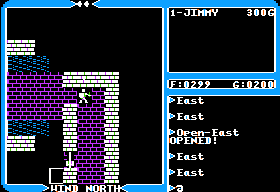
See that single white dot above the character that looks kind of like a graphics artifact of some sort? That's a game-critical secret door.

See that single white dot above the character that looks kind of like a graphics artifact of some sort? That’s a game-critical secret door.

Conversations can be another nightmare. Every character in the game responds to three keywords given in the manual: “Name,” “Job,” and “Health” (no, I don’t know how Richard settled on that particular inexplicable trio). You’re expected to find other keywords by asking about things the character mentions in those three generic openers, in addition to following up on clues gained in other places of the “Ask XX about YY” variety. But, inevitably, the vast majority of promising-looking words any character mentions are actually not keywords at all. Conversations quickly devolve into a rote entering of every noun or active verb a character uses, with 90 percent of them resulting in “That, I cannot help thee with.” Miss one critical word in a conversation out of sloth or negligence, and that’s a clue overlooked, a thread untraced, and your chance for victory undone. Each town or castle, which number sixteen in total, is populated with dozens of individuals. Miss that critical fellow hiding out in a visually impenetrable glade at the extreme edge of the map, and you’re screwed. Miss the single pixel representing a secret door, and you’re screwed. When you finally get to the very bottom of the Stygian Abyss and stand before the Codex of Ultimate Wisdom, if you fail to answer correctly an out-of-left-field question whose answer requires the ability to read Richard Garriott’s mind, you’re screwed — teleported back to the surface to battle your way down through eight levels of the fiercest creatures in the game and try again. If you were playing in 1985, without the benefit of emulator save states, you would get to do this again and again until you gave up or, as many people finally did, called Origin’s hint line for the answer. If none of what I’ve just described sounds like all that much fun, that’s because for all but the most dogged of players of today it’s really not. Like so many old-school adventure designs, it rewards not cleverness but sheer persistence, a willingness to lawnmower through map after conversation after battle no matter how boring it is.

That, then, is the flip side to Ultima IV the transcendent masterwork: Ultima IV the fiddly, borderline unplayable, tedious mishmash. It’s absurdly easy to make any adventure game impossible, which is one of the many reasons that a designer needs playtesters, and lots of them. Richard Garriott, however, had basically no feedback on many parts of his design. In an interview for Computer Gaming World published shortly after the game, he let drop the bombshell that he was the only person who had managed to complete the game when Origin put it in a box and unleashed it on the world.

A few years ago Michael Abbott, academic and “Brainy Gamer,” sparked quite some conversation with a blog post telling how his students had rejected Ultima IV as “boring.” Predictable outrage toward those kids today followed in the comments and the heaps of reaction posts from other bloggers. Yet my own reaction is to side with Dr. Abbott’s students; Ultima IV is, most of the time, pretty boring. Good on them for recognizing this, I say, for refusing to get sucked into doing boring things for the sake of it. I think kids today are at a minimum every bit as smart as those of my generation were when Ultima IV first hit store shelves, thoroughly capable of deciding that a game is mostly just wasting their time. We shouldn’t begrudge them that freedom if more refined entertainments make their verdict an uncomfortable one for us. Ultima IV stands for me as a hugely important work in the history of its medium, but also one that hasn’t stood the test of time all that well. I love to think about it, love the fact that it exists, that Richard Garriott had the courage to make it — but just thinking about playing it makes me tired. Like a work of conceptual art, to some extent the real power of Ultima IV today is just the fact of its existence.

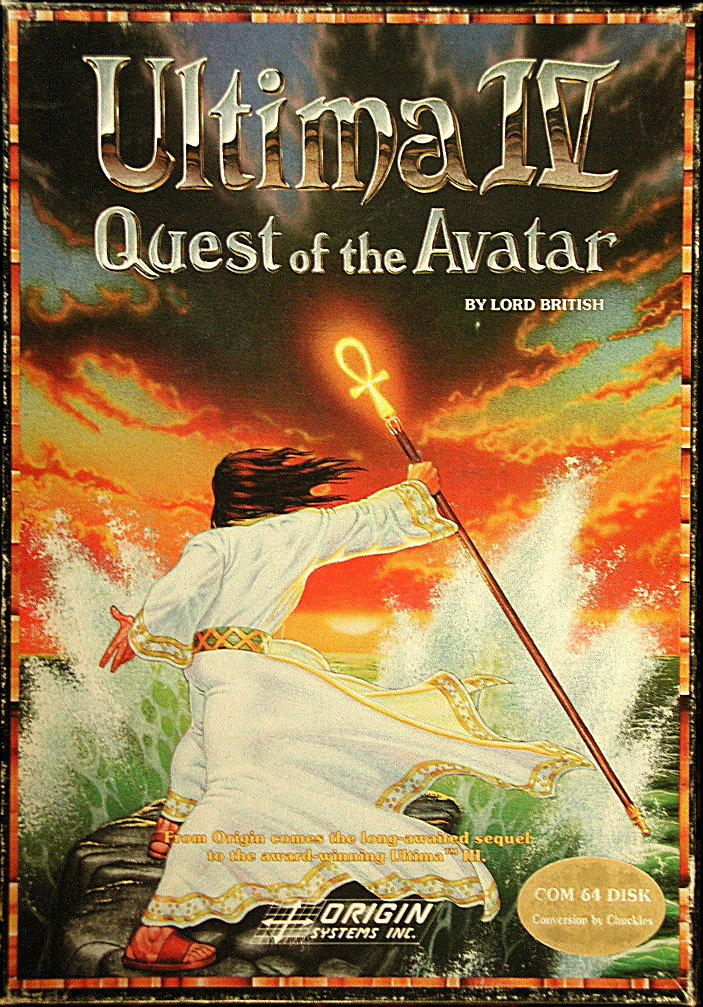
Of course I’m well aware as a digital historian that my modern take on Ultima IV is a fundamentally anachronistic one. In 1985, the game represented an all but unrivaled gateway to imagination. Solving an Ultima wasn’t really the point; these were worlds to explore, to revisit over a period of months or years until the next Ultima came out (Ultima V would be almost three years in arriving). Everything about Ultima IV — packaged in its big, grandiose box with two big, ornate manuals, with its die-cast ankh that countless boys stuck on a chain and wore to school around their necks, with its big cloth map — marked it as something special, something to be cherished and savored.

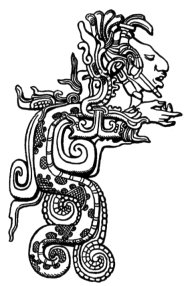
The ankh would join the Silver Serpent as one of the enduring symbols of Ultima, a supposed visual representation of the Way of the Avatar to stand alongside the diagram of the virtues. It was yet another bit of pop-culture detritus that made its way into Ultima: Richard first saw it in the movie Logan’s Run, where it served as the symbol of an underground resistance movement, thought it looked cool and “positive,” and stuck it in the game. When he learned that it meant “life and rebirth” to ancient Egyptians, that just made it that much cooler.

The ankh would join the Silver Serpent as one of the enduring symbols of Ultima, a supposed visual representation of the Way of the Avatar to stand alongside the diagram of the virtues. It was yet another bit of pop-culture detritus that made its way into Ultima: Richard first saw it in the movie Logan’s Run, where it served as the symbol of an underground resistance movement, thought it looked cool and “positive,” and stuck it in the game. When he learned that it meant “life and rebirth” to ancient Egyptians, that just made it that much cooler.

When you discovered a new village tucked away in some corner of the map you didn’t complain about the unfairness of it all, you rejoiced at having uncovered another corner of this fantastic world. Actually solving the game was something that few managed, but it didn’t really matter that much anyway. The point was the journey. Even the price contributed: showing an instinct for manipulating perception through pricing that would have done Apple proud, Origin’s suggested list price gave the game a street price of $50 to $55, about $20 more than the typical title. Far from cutting into its sales, the high price just made the game all the more desirable, all the more special. This experience of Ultima IV was absolutely specific to its time and place, not something we can recapture today no matter how much we blog or commentate or notate. Yes, the magic of Ultima IV was ephemeral, but in its day it was very, very powerful.

By way of illustration, let me tell you about Brian. Brian was one of my best friends in middle and high school, his attitudes fairly typical of the cracking and pirating underground in which he was quite thoroughly immersed. Like most of his friends in the scene, Brian didn’t so much play games as collect them. He had hundreds, maybe thousands of Commodore 64 floppies containing virtually every remotely notable game released for the platform in North America or Europe. Most got booted once or twice, to see what the graphics were like; a few action games would grab his attention in a bigger way for a while, but were soon set aside in favor of haunting the pirate BBS network and enjoying the social dramas of the cracking scene (let me tell you, teenage girls had nothing on this crew). Ultima IV, though, was different. It’s the only game I can ever remember Brian actually buying, the only one more complicated than Boulderdash for which he read the manual, into which he put a real effort. Like a hundred thousand other kids, he hung the map on his bedroom wall, wore the ankh to school. Oh, I’m pretty sure he never came close to finishing it. He probably played it much less, all told, than most similar kids who didn’t have the same embarrassment of gaming riches from which to choose. But the fact that his teenage heavy-metal nihilism went away when he talked about the virtues, that it awoke some other — better? — part of him that was impervious to every other game… I’ve always remembered that. Ultima, and Ultima IV in particular, was just like that.

Chester Bolingbroke, better known as the CRPG Addict, was another Brian.

I wrote each [virtue] with its definition on an index card and every morning I shuffled the cards and chose one at random. That one, I did my best to practice for the day. If honesty came up, I was careful to tell no lies throughout the day. If it was sacrifice, I looked for ways to do something charitable.

Not many, I suspect, would admit to deriving what amounts to their religion from a computer game. But I had rejected conventional religion even as a pre-teen. I balked at Judeo-Christian doctrines that seemed both haphazard and arbitrary: meticulous rules about food and dress, but none about the need to actively seek out and destroy evil (my interpretation of “valor”); commandments against adultery and sabbath-breaking, but none against assault and slavery. Ultima IV, on the other hand, offered a comprehensive and completely nondenominational — secular, even — system of virtue. It fit me like a glove.

There were hundreds of thousands of kids just like Brian and Chester. Ultima IV caused its players to set aside their angst and their irony and try to improve themselves in school lunch rooms and family dinner tables across the land. It was far from the first game with artistic aspirations, far from the first to want to be about something more than escapism; 1985 alone also brought Mindwheel, A Mind Forever Voyaging, and Balance of Power. But those admittedly more philosophically sophisticated efforts appealed mostly to a different, older audience; the average age of the average Infocom buyer was north of thirty, while very few kids indeed had the wherewithal to corner a Macintosh long enough to play Balance of Power even had they been interested in the vagaries of geopolitics. Part of the magic of Ultima IV was that it had been created by a kid just like the ones who mostly played it, raised on Dungeons and Dragons and Star Wars, more comfortable with a movie than a novel. Richard Garriott spoke their language, came from the same place they were coming from. Ultima IV, the last of the one-man-band Ultimas, still stands as the most personal expression he would ever create. When he said that ethics matter, that we have the power to choose our values and to live according to them, it resonated because it reflected, as art should, his own lived experience. Yes, many of its players would outgrow Ultima IV‘s simplistic take on ethics, just as many would outgrow the game itself. But hopefully few of that small minority who completed it ever forgot its closing exhortation, delivered as it was in Richard Garriott’s best teenage-Dungeon-Master diction:

Thou must know that the quest to become an Avatar is the endless quest of a lifetime. Avatarhood is a living gift. It must always and forever be nurtured to flourish. For if thou dost stray from the paths of virtue, thy way may be lost forever. Return now unto thine own world. Live there as an example to thy people, as our memory of thy gallant deeds serves us.

(You can download Ultima IV for free from GOG.com. Sources for this article are the same as for the last. I borrowed the diagram of the virtues from Eliott Wall.)

 

Tags: , , ,

The Road to IV

Ultima IV

Late in the fall of 1983, when it was clear that Ultima III was turning into a huge success and thus that their new company Origin Systems was going to be a viable operation, Robert Garriott came to his little brother Richard with a forlorn plea. Robert, you may remember, had for months been commuting via his private Cessna between the Garriotts’ family home in Houston, whose garage served as Origin’s development studio and assembly line, and North Andover, Massachusetts, where his wife Marcy worked for Bell Labs. It wasn’t, to say the least, an ideal way to run a marriage. Would Richard and the rest of the fledgling company agree to move to North Andover for three years? After that, Marcy expected a promotion that should make it much easier for her and Robert to move, and, assuming the company was still alive, they’d then move wherever Richard and the rest liked. Young, unattached, and ready for adventure as they were, just about everyone agreed. They packed their cars with their personal possessions and rented two trucks to fill with supplies, computers, and other equipment — most notably the precious shrink-wrap machine — and headed northeast just weeks later.

That winter was a bad one, with some of the worst storms of the decade. They hit major snow before they got out of Arkansas. Anyone who’s ever seen a Texan trying to drive on snow and ice can perhaps attest to what a miracle it was that they got to North Andover at all. Once there, the snow and bitter cold just continued for months. That first winter wasn’t the best introduction to the place that Richard still calls “the frozen wastes of New England.” He totaled his car on the icy streets within days; his house right next door to his brother Robert’s, which he rented with Chuck Bueche and Mary Fenton, was burglarized not once but twice, resulting in the loss of thousands of dollars worth of computers and home electronics; he and his buddies couldn’t seem to connect with any of the locals, who viewed their Texas accents and strange business of making computer games with suspicion. Things wouldn’t get much better; Richard in particular remained a hopeless fish out of water throughout his time in New England.

The only thing to do was to throw himself into life inside the Origin bubble. He made his own fun, instituting a daily five o’clock ritual called “Rubbaser war,” using $75 graphite-and-steel guns that could shoot rubber bands at speeds of up to 120 miles per hour; they hit with such force that the combatants had to wear helmets. He also continued to celebrate his favorite holiday with elaborate Halloween parties, even if the number of people around him eager to attend them had rather dwindled since the move. The moment when the locals decided once and for all that they wanted nothing to do with him may well have been the first of these: Richard, who was great at preparing for such big events but not so great at cleaning up after himself, left unnervingly realistic-looking bloody body parts strewn across his lawn through much of the following winter.

With Chuck Bueche’s action game Caverns of Callisto having failed to set the industry on fire, Origin now concentrated on, as their tagline would eventually have it, “creating worlds” in the form of big, ambitious games. Soon after the move to New England, they hired Dave Albert away from Penguin Software. Albert, who had majored in journalism at university and served as editor and writer for SoftSide magazine before coming to Penguin, would help Robert Garriott to put a professional face to this collection of young hackers. Albert also brought with him Greg Malone and his game in progress, the very original if polarizing oriental CRPG Moebius. Before releasing their next slate of games after Ultima III and Caverns of Callisto, Origin signed a distribution deal with Electronic Arts, becoming one of the first of what would eventually be quite a number of EA “Affiliated Labels.” This gave the still tiny Origin a badly needed presence in mass-market chains like Toys “R” Us and Sears.

Origin stretched out its tendrils in many intriguing directions during these early days. They entered into a contract with Steve Jackson Games — Steve Jackson was a friend of Richard’s from his Austin SCA troupe — to adapt that company’s popular board game Car Wars for the computer. They also agreed to make a computer game to accompany a planned film version of Morgan Llywelyn’s novel Lion of Ireland; Richard would get to spend two weeks on the set in southern Ireland soaking up the ambiance in the name of research. Richard also made tentative plans with none other than Andrew Greenberg of Wizardry fame to collaborate on “the ultimate fantasy role-playing game.” Most of this came to naught: the movie’s financing fell through and it never got made; the ultimate collaboration remained nothing more than talk. Only the Car Wars project survived, and only after a fashion: Chuck Bueche turned the turn-based board game into the real-time CRPG Autoduel over the considerable misgivings of Steve Jackson.

Meanwhile and preeminently, there was Ultima IV, the game that would change everything for Ultima and for Origin. As was his routine by now, Richard started working on it almost from the moment that Ultima III shipped, starting once again from the previous game’s code base and once again designing and coding virtually everything himself on his trusty Apple II. But, like the fourth Wizardry game that was its obvious competitor, it took much longer to complete than anyone had anticipated. Originally slated for Christmas 1984, it took a final desperate dash just to get it out in time for Christmas 1985.

Anticipation grew all the while. For a game to remain in active, continuous development for two years at that time was virtually unprecedented. Truly Richard Garriott must be doing something amazing. The hints and tidbits that he let drop during interviews certainly sounded good: Ultima IV‘s world map would consist of 256 X 256 tiles, 16 times the size of Ultima III‘s 64 X 64-tile world; there would be a full parser-based conversation engine for talking with others; spells would now require reagents to cast, with the finding of their recipes and ingredients a mini-game within the game; dungeons would now contain “rooms” that opened into a tactical map. Yet the thing that Richard kept bringing up most was none of these incremental improvements, but something he insisted marked a change in the very nature of the game. There would be, he said, no evil character to defeat. Instead the player must become a better person, an “Avatar of Virtue.” What was that all about?

Richard Garriott has told many times the story of how Ultima IV came to be. Akalabeth, Ultima I, and Ultima II had, he says, existed for him in a vacuum — or, maybe better said, an echo chamber. Any fan mail or other feedback from players of those games had never reached him because neither California Pacific nor Sierra had bothered to forward it to him. Once Ultima III came out under his own company’s aegis, however, he started getting a flood of letters telling him how fans really played his games. This generally entailed lots of murdering, stealing, and all-around reprehensible behavior. Now, it’s perhaps a bit surprising that this should come as such a shock to Richard, since those early games essentially forced this behavior on the player if she wished to succeed. Still, the letters set it all out in unmistakeable black and white, as it were. And then there were the truly crazy letters from religious fundamentalists and anti-Dungeons and Dragons activists, which included such lovely epithets as “Satanic perverter of America’s youth.”

The first few of those letters that I got at the age of 22 really bothered me. You sit back and go, “Gosh, I know I’m not a wicked individual, I know I’m not teaching Satan worship, I know I’m not doing any of these things.” But the fact that someone would think so bothered me. It made me want to call the person up and say, “Look, you’re wrong, you just misinterpreted it.” But of course it would do no good to do so.

“People,” Richard said in another interview, “read things into my games that were simply statistical anomalies in the programming. They thought I was putting messages into the game.” To his mind, those first four games were all simply “here’s some money, here’s some weapons, here’s some monsters, go kill them and you win.” Like the Beatles a generation earlier, he now decided to give those who wanted hidden messages something that actually, you know, existed to think about it. Less facetiously, all of this feedback did make him begin to think seriously for the first time about the sorts of messages his games were delivering, to begin to understand they were not “just games,” that they could and did say something about the world. He began to understand that every creative work says something, whether its creator intends it to do so or not. It says something about the person who created it, the culture he came from, the audience to which it’s expected to appeal. Richard wasn’t sure he liked what his games were saying — albeit all but unbeknownst to their creator — so he decided to take conscious control of his message with Ultima IV.

It makes for kind of a beautiful story about a young man discovering himself as an artist, discovering that the work he puts into the world really does matter. And there’s no reason to believe it isn’t true in the large strokes. That said, there are indications that the full story may be at least a bit more complicated than the glib summary that Richard has given in almost thirty years worth of interviews.

In the November 1983 issue of Softline magazine is an interview with Richard in which he describes his plans for the nascent Ultima IV. Already at this stage the player’s goal was to become an enlightened avatar by acquiring sixteen attributes — twice as many as in the finished game.

Fifteen attributes represent powers over forces of nature and life, and the final attribute is clairvoyance. The first fifteen attributes may be obtained through certain great deeds in the physical world: areas like those portrayed by all the previous Ultima games. For the final attribute, the adventurer must make a quest into the ninth plane of Hell (presumably through all the lesser planes as well).

The article goes on to state that the resolutely non-bookish Richard had read Dante’s Inferno by way of preparation, “so we can expect the depictions of the planes to be vivid and graphic.”

This is fascinating stuff on a couple of levels. It’s of course always interesting to see how a major work like Ultima IV evolved (if you didn’t find it so, I assume you wouldn’t be reading this blog). It’s interesting that sixteen “attributes” — a word that positively reeks of Dungeons and Dragons — became a more manageable eight virtues. It’s interesting to note how Dante’s Hell turned into the more abstract Stygian Abyss of the final game, doubtless a very wise decision in light of the easily outraged folks already convinced that fantasy role-playing in general and Ultima in particular were the work of Satan. It’s interesting just to note the influence Dante had on Ultima IV, an influence which, for all the words that have been spilled about the game since its release, appears to have gone completely unremarked in all of them.

But perhaps most interesting of all is the timeline of all this. Given magazine lead times, the interview that led to this article must have been done bare weeks or days after Ultima III‘s release — hardly enough time to let Richard receive lots of fan mail and other feedback on the game, internalize it all, and proceed so far down the road to a response in the form of Ultima IV. If we take that as a given, it leaves open just two alternative possibilities: that Sierra at least had in fact been forwarding to Richard his fan mail (this wouldn’t hugely surprise me; demonizing those first two publishers who did so much to give him his start has unfortunately become one of Richard’s less noble hobbies in recent years), or that this feedback, when it arrived, would be a contributory factor to Ultima IV but not quite the prime motivator it’s become in Richard’s telling. With that in mind, let’s look at some of the other factors that may have been at play here.

It seems likely that the real point of genesis of Ultima IV was not a fan letter but rather a television documentary about the Dead Sea Scrolls. This program, mentioned by Richard in interviews but which I unfortunately haven’t been able to identify more specifically, apparently mentioned in passing the belief held by some Christians and Hindus that Jesus Christ visited India during the so-called “unknown years” of his life, that period between about age twelve and thirty which is not described in the New Testament or any other accepted record. Some such folks believe that Jesus was a Hindu “avatar,” a god descended to earth in human form. Richard was captivated by the concept. He wasn’t the first bright young person to seek in the religions of the East a spiritual alternative to the dogmatic rigidity of the Christianity that he saw around him in his daily life. His august company includes the likes of Roger Zelazny, Steve Jobs, and of course a certain four lads from Liverpool. “I am not a religious individual,” he once said, “but I do have difficulty with the scare tactics that religions use to teach ethics, saying you must be good or something bad will happen to you.”

But what was the religious history of the “not religious” Richard? He described it at greatest length to Shay Addams for The Official Book of Ultima:

My family did go to church when I was very young, but by the time I was in my teens we really didn’t. So I went to Sunday school at an interdenominational church, which was a very interesting upbringing because it was extremely interdenominational. I mean, all sorts of different sects of Christianity as well as Judaism and who knows what else — I was too young to know what else might have been there. But it was very interesting the way Sunday school was taught in this church, which I really believe was an amazingly responsible thing to do: they would read a Biblical story that had a moral to it, and they would tell you why this means achieved this end, and then say, “This is a story put in the Bible to teach this lesson.” Christians believe it because it was recorded in this way, and so on, and they would explain it to you not as “this is fact” but as “this is a story that exists for this purpose.”

Although I was a child, I accepted it as fact, literally, but they didn’t tell me this was fact — that you must believe or you are going to Hell. As an adult, I could reflect upon it and say, “I don’t have to believe that. I understand why it was told, and why it was recorded. But it is my choice as to whether I believe it or not.” My eldest brother is religious; myself and Robert are not. We had a choice, though, which is the point. That is why I find it amazingly responsible, the way they brought us up. My father, for instance, was not religious and my mother only somewhat religious, but they believed it was important that their children have that upbringing as a knowledge base, and they found a place where they could get it. So, we all got to make those choices as adults. I thought that was very responsible on my parents’ part and pretty rare.

The factors that made the notion of an interdenominational church so appealing to the pragmatic Richard were likely the same that drew him to the story of Jesus as Hindu avatar: an emphasis on shared spirituality and shared ethics over the niceties of religious dogma. He became fascinated with Hinduism and in particular with Hindu Yoga. Their influence would be all over that first conception of Ultima IV he outlined for Softline, and internalized somewhat more subtly into the finished game.

They have a belief that there are sixteen ways you could purify yourself. In one of these sixteen ways you would get some sort of power, spiritual power, based on that. Some Yogis can kind of like stop their heart and other bodily functions and things of this nature, and I believe these people can literally do those physical things. I’m not saying why they can do them, but apparently the biggest, most powerful Yogis can even do things like teleport themselves to other places on the planet, which I have never seen personally and am somewhat skeptical of, but you never know. But it’s a very interesting thing that the Hindus believe Christ was a very powerful Yogi who, when he studied with them, attained the most powerful level, the avatar. The culmination of Yogis is to become an avatar, and the definition of an avatar is someone who has purified themselves in all sixteen of these ways.

There are five ways of purifying your physical body, for example, and five ways of purifying your spirit, and so on, and the last one, the sixteenth way, was to become one with God Himself. Interestingly enough, to this day Hindus say there have been two avatars in existence throughout history: one was a woman who predates written history, and the second one was Christ.

Garriott’s conception of Hinduism and Yoga is, shall we say, a somewhat idiosyncratic and confused one, steeped at least as much in Dungeons and Dragons and his work-hard-and-achieve upbringing as Hindu or Biblical scripture; this was after all still the kid who had named the villain in Ultima III “Exodus” just because it sounded cool. Thus we have Christ “leveling up” until he becomes an avatar — a word which itself means something different in Hinduism from what Richard seems to think it means — at level 16. Still, what Richard learned or thought he learned about Hinduism and Yoga would remain a critical piece of Ultima IV.

If we postulate a new concern with the messages that his games were sending and a renewed interest in religion — particularly Hinduism — as two legs of the three-legged stool on which rests Ultima IV, the last must be something even more universal: the simple life experience of growing up. Richard had, truth be told, lived a pretty sheltered existence to this point in the bosom of his family and NASA and his Dungeons and Dragons buddies and later of the University of Texas and his SCA troupe. Escapism, whether into fantasy or just the well-scrubbed safety of high-school science fairs, is an obvious running theme. By Richard’s own admission, he was if anything quite immature for his age when Origin decamped for New England. But now he was suddenly living in a house he and his friends were renting for themselves, far from home in the “frozen wastes” of Massachusetts. He was becoming an adult at last, with adult responsibilities.

Lord British in leather

Lord British in leather

Richard started to feel his oats a bit during this period. He found his rather mild rebellious streak later than do many of us, but this did give him the luxury of something teenage rebels mostly lack: money. And so he replaced the practical car he had totaled in the snow with a new Mitsubishi Starion painted a striking jet black. He took to dressing in black leather pants and jacket, with studded bracelets around his wrists. He grew a single strand of hair into a long, braided pony tail that stretched beyond his shoulder blades. His relationship with his “extraordinarily conservative” brother and next-door neighbor Robert became decidedly strained; it seems Robert was usually more inclined to agree with his other neighbors than Richard regarding the latter’s parties and other antics. Warren Spector, a game designer who would become an important contributor to later Ultimas, was working as an assistant editor at Steve Jackson Games in Austin at this time. He describes the version of Richard that he glimpsed for the first time during one of the latter’s occasional return visits to Austin thus: “In drove this rock star in his Mitsubishi, all black. Got out, all black, bling everywhere. I was thinking, okay, I’m in the wrong line of work, I’ve got to find a way to work with this guy!”

The changes were not just external. Richard went through something of a minor existential crisis: “I wasn’t sure I knew what I was doing anymore. I tried to figure out who I was and what I was going to do next.” Trivial as it may sound, when Robert Garriott shook his head in embarrassment and the neighbors scowled at the body parts strewn across his lawn after Halloween or the empty trash cans that remained unretrieved at roadside for days on end, he was learning that actions — or, as the case may be, inaction — has consequences. All of these factors led Richard, like so many idealistically-inclined young men before him, to try to develop a philosophy of life that made sense to him. Richard was unique, however, in that he planned to put it all into a computer game — indeed, he saw doing so almost as a duty. He was well aware that the audience for his games was a pretty young and impressionable one, the most common demographic category being an adolescent boy.

If someone spends 100 hours playing my game, I have 100 hours of the input that makes that person what they are. With that comes, in my mind, a sense of responsibility regarding the content of what I’m going to pipeline into that individual for 100 hours. That was really the kernel thought that started what has now really changed Ultima henceforth and probably forever.

He set himself no less a task than the development of a complete code of ethics, a set of rules for living. As interesting as he found Hinduism and other religious traditions, it was very important to him that his rules for living must be explicitly divorced from any sort of supernatural agency. Some of the most brilliant thinkers in history, a list including Plato, Kant, and Nietzsche just for starters, devoted their lives to wrestling with the same task. Now the 22-year-old college drop-out Richard Garriott hung up a whiteboard, bought a stack of books, and prepared to do the same. The biggest issues he’d wrestled with for previous Ultimas were how many hit points this or that monster should have or how many experience points it should take to raise a character’s level. Now he was trying to devise a complete, internally consistent system of moral philosophy. It was a heady change indeed. Rather typically, Richard found the basic building blocks of the system of ethics he would finally include in Ultima IV not in any of the aforementioned highbrow philosophers but in The Wizard of Oz.

And that makes a pretty good place to stop for today. Next time we’ll look more closely at the ethical system he devised, along with much else in the finished game. Before I let you go, though, I do want to ask you to think about just what a remarkable conceptual leap Richard Garriott was making here, a leap made all the more remarkable by the fact that he did it all on its own, in a vacuum that still contained barely a whiff of our contemporary notions of serious games or ludic rhetoric, and in the genre of the CRPG that had heretofore been about little more than killing monsters and taking their stuff, with none of the higher-toned literary aspirations that Infocom and their competitors had brought to the text adventure.

Above all, it was — and I think this is a very important point with which to close — a tremendously brave choice. Richard was desperately worried about how it would be received by a public who expected just a bigger version of Ultima III. Should enough of those players accustomed to “kill, kill, kill” reject the game, it could bring down his company and put most of his closest friends out of work. The stress actually caused him to suffer the occasional panic attack while he programmed; his stomach would suddenly cramp up and he would have to lie down, willing himself to just breathe. “To succeed in this game,” he notes, “you had to radically change the way you’d ever played a game before.” This was the leap that the creators of Wizardry were unable to make, the one that transformed Ultima forevermore into something just a little bit nobler, a little bit more important, a little bit better than competing franchises. The fact that Richard was willing to make that leap, and that — yes, I’m sparing you the suspense — his public responded to it in huge numbers, makes it in its way as inspiring a story as any you’ll find in gaming history. Robert Gregg’s comments in Dungeons and Dreamers, describing the revelation that Ultima IV was to him when he first encountered it, offer the perfect closing thoughts: “The game was commenting on society, and on the observer himself, just like other forms of art. That was the most exciting part to me — watching the emergence of a new form of art, coming right off the computer.” You and me both, Robert.

(Sources for this article and the next include the books The Official Book of Ultima by Shay Addams, Dungeons and Dreamers by Brad King and John Borland, and Ultima: The Avatar Adventures by Rusel DeMaria and Caroline Spector; the Computer Gaming World issues of September/October 1984, November/December 1985, and March 1986; the Questbusters of August 1985; the Softline of November/December 1983; and the Commodore Power Play of August/September 1985. Also useful were Warren Spector’s video interview with Richard Garriott, and Matt Barton’s with Richard Garriott and with Chuck Bueche.)


Tags: , , ,

Ultima III in Pictures

Ultima III

There’s a lot of interesting stuff to talk about in Ultima III, to the extent that I wasn’t quite sure how to wedge it all into a conventional review. So I decided to try this approach, to balance my usual telling with quite a bit of showing. Or something like that. Anyway, I found it fun to do.

If you’re inspired to play Ultima III yourself, know that Good Old Games is selling it in a collection which also contains Ultima I and II. Less legitimately, there are the usual abandonware sites and ROM collections where you can find the original Apple II version that I play here, but you’re on your own there. Some spoilers do follow, although Ultima III is tricky enough that you may just welcome whatever little bit of guidance you glean from this post.


Ultima III

Garriott was really proud of his game’s subtitle, Exodus, to the extent that in the game itself and most early advertising it’s actually more prominent than the Ultima name. He draws no connection to its meaning as an English noun or to the Bible. It’s simply a cool-sounding word that he takes as the name of his latest evil wizard, the love child of his two previous evil wizards, Mondain from Ultima I and Minax from Ultima II. Roe R. Adams III did make a somewhat strained attempt to draw a connection to the expected implications of the word in the manual via a recasting of an old seafaring mystery:

One possible clue as to the identity of thy nemesis has been discovered. A derelict merchant ship was recently towed into port. No crewmen were aboard, alive or dead. Everyone had vanished, as if plucked by some evil force off the boat. The only thing found was a word written in blood on the deck: EXODUS.

I never hear anything about this ghost ship in the game itself. Also left unexplained, as it was in Ultima II, is why Mondain was on Garriott’s fantasy world of Sosaria and Minax was on our own Earth. This time I’m stuck back on Sosaria again. Garriott would finally get more serious about making an Ultima mythos that makes some kind of sense with the next game, but for now… let’s just say I won’t be spending much more time discussing the plotting or the worldbuilding.


Ultima III

In Ultima III I get to create and control a full party of four adventurers rather than a single avatar. This is actually the only Ultima that works quite this way. Later games would use the code Garriott first developed here to allow players to have more than one person in their parties, but would start them off with a single avatar. Finding other adventurers in the game world itself and convincing them to join would become part of the experience of play and an important component of those games’ much richer plots.


Ultima II

Ultima III

With my party created, I’m dumped into Sosaria, right outside the town of Britain and the castle of Lord British in what has already become by Ultima III a time-honored tradition.

One of the fascinating aspects of playing through the Ultima games in order is seeing which pieces are reused from earlier games and which are replaced. Programming often really is a game of interchangeable parts. On the left above is Ultima II, on the right Ultima III. The same old tile engine that dates back to Ultima I is still in place in both games, but Ultima III changes the screen layout considerably and makes everything a bit more attractive and ornate within the considerable limitations of the Apple II. It no longer uses the Apple II’s mixed display mode that displays text rather than graphics on the bottom four lines of the screen. Instead the whole screen is now given over to a graphics display, with a character generator, once an exotic piece of technology but by 1983 commonplace, used to put words anywhere on the screen.


Ultima III

When I enter a town for the first time another of Ultima III‘s additions to the old tile-graphics engine becomes clear: a line-of-sight algorithm now prevents me from seeing through walls. This adds an extra dimension of realism, but proves to be a mixed blessing. We’ll talk about why that is in just a little bit.


Ultima II

Ultima III

And when I run into a couple of wandering orcs for the first time I see another big addition: a separate strategic-combat screen that pops up when a fight begins. You can see that on the right above; the old Ultima II system of flailing in place on the map screen is on the left. The earlier system would obviously be unworkable with a party of four. Unlike with Wizardry, combat has never been the heart of Ultima‘s appeal, but that doesn’t mean you don’t spend a lot of time — maybe too much time — in Ultima III engaging in it. The new system does add some welcome interest to the old formula. I can now move each character about individually, use missile weapons (a highly recommended strategy that lets me take out many monsters before they can get close enough to damage me), and cast quite a variety of offensive and defensive spells. Less wonderfully, all those random encounters with orcs and cutthroats now take much more time to resolve, which is one of the things that can turn Ultima III into quite the slog by the time all is said and done. Also contributing to the tedium: in a harbinger of certain modern CRPGs, random encounters are balanced to suit the general potency of my party, thus guaranteeing that they will still take some time even once I have quite a powerful group of characters.


Ultima III

As part of a general tightening of the game’s mechanics likely prompted by unfavorable comparisons of previous Ultimas to previous Wizardries, the strange system of hit points as a commodity purchasable from Lord British has finally been overhauled. Now healing works as you might expect: each character has a maximum number of hit points which Lord British raises by 100 every time I visit him after gaining a level. Alas, this works only until level 25 and 2500 hit points. At least I don’t have to pay him for his trouble anymore. In the screenshot above his “Experience more!” means that I haven’t yet gained a level for him to boost my hit-point total; small wonder, as all my characters are still level 1.


Ultima III

Ultima III

Having gotten the initial lay of the land, I settle into the rhythm of building my characters, exploring the world map, and talking to everyone I can find in the towns. The latter process, like so much in Ultima III, is equal parts frustrating and gratifying. The good citizens of Sosaria insist on speaking in the most cryptic of riddles. And here we see the darker side of Garriott’s new line-of-sight system: most of the most vital clue-givers are tucked away in the most obscure possible corners of the towns, like the fellow shown in the screenshot above and left. I have to scour every town square by tedious square to be absolutely certain I haven’t missed a vital clue, a vital link in a chain of tasks required to win that is much more complicated than those found in the earlier games. On the other hand, the gratification that comes when another piece of the puzzle falls into place is considerable. Ultima has always been better at delivering that thrill of exploration than just about any other CRPG.

There are in many places in Ultima III some small kindnesses, some elements that, once I figure out how they work, can make things easier. In the screenshot to the right I’m using a magic gem, purchasable from thieves guilds in a couple of the towns, to get a bird’s-eye view of the town I’m currently in. Ferreting out these secrets and hidden mechanics contributes to another thing Ultima always does well: making you feel smart.


Ultima III

Ultima III

Still, it’s possible to take this whole discovery thing too far. In one of the more astonishing design decisions in Ultima III, Garriott has consciously engineered into his hotkey-driven interface an element of guess the verb. After all, why should text adventurers have all the fun? There’s a mysterious OTHER command this time, which lets me enter new verbs. Divining what these are depends on my sussing that words surrounded by “<>” in characters’ speech refer to new verbs. (“<SEARCH> the shrines.”) A very strange design choice, which does a good job of illustrating the gulf in player expectations between now and then, when guess the verb was still trumpeted by many as an essential element of adventure games rather than just a byproduct of their technical limitations. Given that, why not try to engineer it into Ultima, a series which always tried to offer more, more, more? Thankfully, it would disappear again from Ultima IV, in what could be read as another reflection of changing player expectations.

In the screenshot at left above I’ve just used the hidden verb “BRIBE” to convince a guard who just a second before was standing right next to me to go away for the modest fee of 100 gold. Now I can go into the shop and steal with relative impunity. (Ultima III is, as we’ll continue to see, very much an amoral world, the last Ultima about which that can be said.) Bribing is only useful; other hidden verbs are vital.

For instance, the second screenshot above shows me gathering a piece of important information using the hidden verb “PRAY” inside a temple. This is actually quite an interesting sequence. PRAYing yields the information that I must YELL — YELL being one of the standard hotkey-based commands — “EVOCARE” at a certain place. It’s perilously close to two guess-the-verb — or at least guess-the-word — puzzles joined together.


Ultima III

Ultima III

We see an interesting re-purposing of previous Ultima technology in the form of the eight moon gates which wink in and out of existence in a set pattern on the world map. In Ultima II, you may recall, these supposedly allowed me to travel through time, although effectively they just provided access to different world maps; nothing I did in one time could have any direct effect on any of the others. Here they’re renamed and used more honestly, as ways to move quickly from place to place on the primary world map. (There are only two world maps this time, the primary one and an alternate world called Ambrosia which we’ll get to shortly.) They also allow me to reach a few places that are otherwise completely inaccessible, as the screenshot at right above illustrates. Well, okay… I could also get there with a ship, an element we’ll talk about later. But that’s not always the case; there’s at least one vital location that can be visited only via moon gate. Thus understanding the logic of the moon gates and charting their patterns is another critical aspect of cracking the puzzle of Ultima III. Moon gates would continue to be a fixture in the Ultimas to come.


Ultima III

Ultima III

Garriott had completely rewritten his dungeon-delving engine for Ultima II, replacing what had been the slowest and most painful part of Ultima I with a snappy new piece that replaced a wire-frame portrait of the surroundings with glorious filled-in color. It’s easily the most impressive and appreciated improvement in that game. But then, like so much else in Ultima II, he squandered it by giving his players no reason to go there. Thus Ultima III almost feels like the new dungeon engine’s real debut. Not only can I harvest a lot of desperately needed gold from the dungeons, but I must also explore them to find five vital “marks” that give special abilities which are in turn key to solving the game. And at the bottom of the Dungeon of Time I meet the Time Lord. (Garriott’s Time Bandits fixation had apparently not yet completely run its course — or are we now dealing with a Doctor Who obsession?) He gives a portentous clue that will be vital to the end-game.


Ultima III

Ultima III

Sosaria is still a world where might makes right. Lord British, the supposedly benevolent monarch, has a dirty little secret, an ugly torture chamber hidden in the depths of his castle. It’s almost enough to make you ask who’s really the evil one here. The manual talks a good game about Exodus, but he doesn’t actually do anything at all in the game itself, just hangs out in his castle and waits for us to come kill him. Meanwhile Lord British has torture chambers, and his lands are beset with monsters trying to kill me, and he seems completely disinterested in helping me beyond boosting my hit points from time to time. Nor am I exactly morally pure: my own mission in the torture chamber is not to save the fellow who’s been thrown into a lake of fire, merely to extract some information from him.

The screenshot at the right shows an even more morally questionable episode, albeit one that requires a bit more explanation. I’m the one on the horse. Each of the three clerics next to me has a critical clue to convey. However, I can’t interact on a diagonal, meaning that the one at bottom right is inaccessible to me — unless I open up a lane by killing one of his companions in cold blood, that is. I want to emphasize here that the clue the inaccessible cleric has to offer is absolutely necessary; he tells where to dig for some special weapons and armor that provide the only realistic way to survive the end-game in Exodus’s castle. Thus the only way forward is, literally, murder, and it’s a conscious design choice on Garriott’s part. Of course, he didn’t think of it quite that way. He just saw it as an interesting mechanic for a puzzle, having not yet made the leap himself from mechanics to experiential fiction. Again, all of that would change with Ultima IV.


Ultima III

Ultima III

Speaking of horses: given Garriott’s newfound willingness to edit, the vehicles available to me in Ultima III are neither so plentiful nor so outrageous as they were in Ultima II. The ridiculous and ridiculously cool airplane, for instance, is gone.

I can buy horses for my party in a couple of towns. These let me move overland a bit faster, using less food and avoiding many of the wandering monsters and the endless combats they bring which can test the patience of the hardiest of players. A ship can be acquired only by taking it from one of the roving bands of pirates that haunt the coastline. There aren’t actually a lot of pirates about, which can get very frustrating; a ship is required to visit several important areas of the game, and finding one can be tough. In the right-hand screenshot above I’ve sailed to an island, where, following the lead of the cleric whose companion I killed in cold blood, I’ve dug up the aforementioned special weapons that are required to harm Exodus’s innermost circle of minions.


Ultima III

Ultima III

I also need a ship to get to the alternate world of Ambrosia, which I can manage only by the counter-intuitive step of sailing into a whirlpool. Here I find shrines to each of the four abilities, the only ways to raise my scores above their starting values. Doing so is vital; in Ultima III‘s still somewhat strange system, ability scores have much more effect on my performance in combat and other situations than my character level. For instance, the number and power of spells I can cast has nothing to do with my level, only with my intelligence (wizard spells) or wisdom (cleric spells).

The explicitly Christian imagery in these shrines, and occasionally in other places in the game, is worth noting. It’s doubtless a somewhat thoughtless result of Garriott’s SCA activities and his accompanying fascination with real medieval culture, but it could certainly be read as disrespectful, a trivializing of religious belief. It’s the sort of thing that TSR, creators of Dungeons and Dragons, were always smart enough to stay well away from (not that it always helped them to avoid controversy). Similarly, you definitely will never see crosses in a big-budget modern fantasy CRPG.


Ultima III

Ready at last, I piece together a string of clues and sail to the “Silver Snake”. There I yell the password “EVOCARE” to enter Exodus’s private grotto. The Silver Snake itself provides a good illustration of just how intertwined the early Ultima games were with Garriott’s own life. And the anecdote that explains its presence here also shows some of the difficulties of trying to pin down the facts about Garriott’s life and career.

Growing up in Houston in the mid-1970s, Garriott was one of the few people to see the infamously awful adventure film Doc Savage: The Man of Bronze. Members of the lost Central American tribe that Savage battles in the movie all bear a tattoo on their chest of the Mayan god Kulkulkan, about whom little is known today apart from his symbol: a serpent.

Kulkulkan

Young Richard thought the symbol so cool-looking that he went to his mother’s silversmithing workshop in that room above his family’s garage that would one day house Origin Systems and made the design — or as close an approximation as he could manage — for himself. He put his new amulet on a chain made from one of his mother’s belts. He told Shay Addams about it circa 1990:

“And this chain now resides around my neck 365 days a year, 24 hours a day — it has essentially remained there for the rest of my life ever since the day I put it on. There is no way to remove it without taking a screwdriver to it and prying open one of the links. For the first couple of years that I wore it, I actually had a link that I used to open and close a little bit. After I realized I was wearing out something by doing that, I quit doing it, so this necklace has remained here ever since. It literally never comes off. The chain was gold-colored when I first put it on. As it wears off, the colors keep changing, and now it rusts on my neck. I mean literally, every day. When I go, I may die of rust poisoning or something.”

Shortly after finishing Ultima III, Garriott loaned the original to his father Owen to carry with him on his second and final trip into space. It went into space again with Richard himself in 2008, and it seems that he still wears it frequently if not constantly. For what it’s worth, the color now seems to be a dull silver, almost a pewter shade.

But… wait. A close look at the early portrait of Origin Systems I published earlier shows that he doesn’t seem to be wearing it there, although Ken Arnold is using either the original or a duplicate as a key ring. Various other contemporary photos show no evidence of a chain or amulet, at least not of the construction and bulk of the one he wears to public appearances in recent years. Now, you could say that to even question this is petty, and in a very real sense you’d be right. Really what does it matter whether he never takes the serpent medallion off or whether it’s merely a precious link to his past that he wears on special occasions? I mention it here only because it points to how slippery everything involving Garriott can be, how much the man often seems to prefer SCA-style legend over the messier world of historical facts, and by extension how eager his interviewers and chroniclers often are to mythologize rather than document. That in turn forces me to spend far more time than I’d like to debunking or at least double-checking everything he says and much of what is said about him. But we’ve moved far afield from Ultima III now, so enough beating of this particular dead horse.


Ultima III

Ultima III

As I’ve mentioned before, Garriott excised most of the anachronistic science-fiction elements from Ultima III to focus on fantasy. But notice that I said “most.” When I get to the grand climax at last, I learn that Exodus apparently is in fact… a giant deranged computer in the tradition of Star Trek. The four magic cards I quested for were apparently punched cards — Exodus is an old-fashioned evil computer — that I need to use to shut him down or change his programming or… something. Of course, none of this make a lick of sense — how did Mondain and Minax manage to breed a computer child? But I dutifully insert the cards and shut him down, and am left to “speculation” about Ultima IV.

In that spirit, let’s note that Garriott himself sees the Ultimas through Ultima III as essentially technical exercises, written “to satisfy my personal interest in seeing how much better a game I could put together with the skills I’d acquired while creating the previous game.” While his technology would continue to improve, with Ultima III it reached a certain point of fruition at which it was capable of delivering more than an exercise in rote mechanics, was capable of sustaining real experiential fictions. Garriott didn’t entirely realize that at the time he was writing Ultima III, and thus the game takes only the most modest of steps in that direction. When he started on the next one, however, it would all come home. In a way, it’s with that game that Ultima really became Ultima as we remember it today. We have much else to talk about before we get there, but I hope you’ll still be around when we do. With Ultima III Garriott had his foundation in place. Next would come the cathedral.


Tags: , , ,

The Legend of Escape from Mt. Drash

The only published advert for Escape from Mt. Drash

Ultima collectors are a hardy and dedicated lot, not only authoring web sites but even huge books on their passion. An oddity called Ultima: Escape from Mt. Drash has for years been rivaled only by the original hand-assembled Akalabeth as the Holy Grail for these folks. Drash, a game for of all platforms the lowly Commodore VIC-20, trickled out of Sierra in the spring of 1983, achieved minuscule distribution and minuscule sales, then vanished from history. For some years there was reason to wonder whether it had actually been released at all, rather than only being something that came and went from a single advertisement (as shown above, from the July 1983 Compute!) and a few product catalogs. Only in 2000 did a working copy of the game finally surface on the Internet, the source being an Indiana teenager whose parents had come home from a garage sale with it several years before.

As befits a Holy Grail, a legend sprung up around Drash that consisted of a few known facts woven together within a tapestry of conjecture. Drash, the story went, was an attempt by Sierra to make a quick buck off the Ultima name by releasing a slapdash game to the VIC-20 market, terra incognita to Richard Garriott, without his knowledge or consent. The implication is that someone at Sierra eventually got nervous about this dubious scheme and buried the game — in some versions of the story literally, by dumping remaining copies into a landfill in a tale that echoes the (itself likely exaggerated) tale of Atari’s dumping of millions of E.T. cartridges into a New Mexico landfill that same year. It’s a glib story which seems to explain much about the game’s obscurity while also investing it with a nice dollop of the nefarious, a plus for collectors of an industry that, let’s face it, isn’t exactly rife with the sort of dark secrets and forbidden fruits that their pals who collect, say, vintage records get to enjoy. Yet it’s also a story that doesn’t stand up to scrutiny, to an extent that it’s hard to understand how so many bright people could buy into it. There are two serious objections, either of which would make it highly improbable. Together they make it impossible to believe.

We should first of all take note of the author of Drash: Keith Zabalaoui. Zabalaoui was a member of what I somewhat facetiously called Garriott’s “entourage” in my previous post, one of his old high-school running buddies who hung around with him in Houston and helped from time to time with his various projects. It could only have been through Garriott that Zabalaoui came into contact with Sierra in the first place. So, the legend requires us to believe that Zabalaoui met the folks at Sierra through Garriott and sold them a game, then agreed with them to secretly release it as an illegitimate knockoff of his friend’s work. Finally, after publishing the game and receiving at least some sort of royalties he continued to keep the whole affair a secret from his buddy. That’s behavior that borders on the sociopathic. There are also some serious plotting problems to this little narrative; didn’t Richard ever say, “Hey, Keith, whatever happened to that game you were working on for Sierra?”

And then let’s look at this from the other side, from the viewpoint of Sierra. Yes, the company may have started with advertising pasted together from newspaper clippings around Ken and Roberta Williams’s kitchen table, but those days were already long gone by early 1983. Sierra was by then negotiating licensing deals with Big Media players like The Jim Henson Company and accepting millions from venture capitalists who saw them as major players in a major emerging industry. Can we really believe that such a company, which by now employed a substantial legal team, would risk their reputation by sticking someone else’s trademarked name on a game in the hopes of making a quick few (tens of?) thousands of dollars and maybe sticking it somehow to Garriott, the man who had recently jilted them? As John Williams says, “Sierra On-Line management was young but not stupid.” Ken Williams had been closely involved in the complications of securing for Garriott and Sierra legal right to the Ultima name from the now defunct California Pacific after Garriott had first agreed to sign with Sierra. To imagine that he would then just blatantly steal the trademark is… well, absurd is perhaps being kind. To imagine that the legal team the venture capitalists insisted be in place would even allow him to do so is to fail to understand how such relationships work.

So, the true story is, as these things so often go, more prosaic than the legend. Zabalaoui did visit Sierra in Garriott’s company, where he was inspired to start work on a simple maze-running action game. When he eventually showed the finished product to them, they were doubtful. It wasn’t a terrible game, but it wasn’t a great one either. And by early 1983 the huge but breathtakingly short-lived VIC-20 software market had already passed its peak and started on a downward slope that would soon turn into a veritable cliff as the ever-plunging price of the vastly more capable Commodore 64 made the older machine more and more irrelevant. And Zabalaoui’s game required more than just a VIC-20: one also needed to have the 8 K memory expansion (to boost the machine’s RAM from just 5 K to 13 K) and a cassette drive, since it was too large to be installed onto a cartridge. Most of the kids who owned VIC-20s as learning toys or game machines didn’t equip them with such luxuries. Sierra hemmed and hawed, and then made a suggestion: if they could maybe market it as an Ultima that might help… Garriott was perhaps not thrilled with Sierra at this point in time, but he was always good to his friends. When Zabalaoui came to him with Sierra’s request, Garriott agreed, likely more as a personal favor to someone who had helped him out with his own projects quite a bit in the past than anything else. Today, of course, when the industry is so much more mature and so much more sensitive to the power of branding, one in Garriott’s position would never risk tarnishing his trademark in such a way. But in 1983 both Garriott and his industry were still very young.

Even with the Ultima name, Sierra was obviously skeptical about the game’s chances, particularly as the VIC-20 software market continued to decline even as packaging was prepared and the game was sent off for duplication. They manufactured the minimum quantity required by their contract with Zabalaoui, on the order of a few thousand units, placed that one halfhearted advertisement, and watched with disinterest as the game foundered commercially. The vast majority of the production run was likely, like that first copy that was rediscovered in 2000, written off and trashed, whether by Sierra themselves or their various distributors. It’s an example of a phenomenon you see from time to time in business, where a project about which no one (with the possible exception in this case of Zabalaoui) feels terribly enthusiastic just sort of drifts to completion through inertia and the lack of anyone stepping up to kill it with a definitive “no.” In this case that led to Escape from Mt. Drash passing into history as the first of the spin-off Ultimas, games that are not part of the main sequence but nevertheless use the name. Future entries in that category would actually be some of the most impressive to bear the Ultima name; Mt. Drash, however, should most definitely not be included in that group.

I’m not the first one to reveal the true story of Escape from Mt. Drash. John Williams has occasionally tried to correct the record in the past via comments to other blog posts and the like that repeated the legend. Recently it has begun to seem that word is finally getting out. Blogger Pix had the opportunity to interact with Garriott personally last year, and asked him directly about the Mt. Drash legend. Garriott at last confirmed to him that he had known about the game and duly authorized its release.

So why should I take up the cause now? Well, there are still plenty of online sources that repeat the legend. I’d thus like to add this blog’s weight — to whatever extent it has weight — to the true story. This I partly do as a favor to John Williams, who has gifted me (and you) with so many memories and insights on the early days of Sierra and the industry as a whole. John is, understandably enough, annoyed at the persistence of this falsehood, as it directly impinges the honor of Sierra and by extension himself.

More generally — and yes, I know I rant about this more than I should — this can serve as a lesson to people who consider themselves historians in this field to be a bit more rigorous, and not to substitute easy assumptions for research. I won’t get into the original source of the false legend here, only say that I’m disappointed that it was repeated for so long without ever being seriously questioned. When you are thinking of saying something that directly accuses people of unethical dealings you really need to be sure of your facts and careful with your words. Frankly, that’s a lesson that Richard Garriott himself could learn; despite my admiration for his vision and persistence as a gaming pioneer, I find his glib dismissal of the folks at California Pacific and Sierra who launched his career as dishonest, “stupid bozos,” and “heavy drug users” to be unconscionable. It’s a lesson his fans should also take to heart.

If you do have one of those websites that repeats the legend of Escape from Mt. Drash… hey, it happens. I’ve made a hash of things myself once or twice in public. But maybe think about taking a moment to make a correction? I’m sure that at the very least John Williams and the others who built Sierra would appreciate it.


Tags: , , ,