RSS

Tag Archives: psygnosis

The Lamentable Later Life of Lemmings


This article tells the last part of the story of Lemmings.


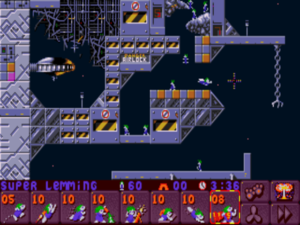
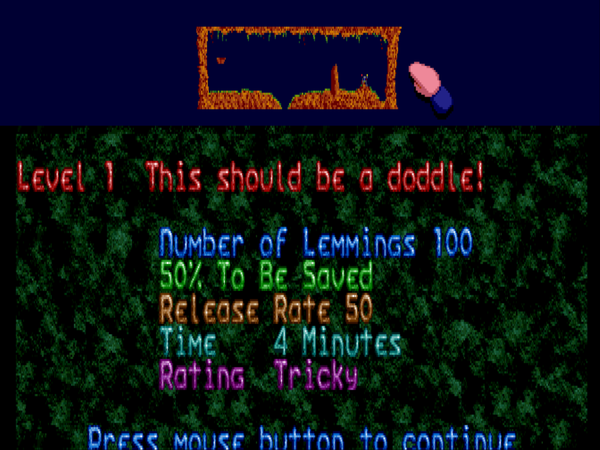
For a while there in the early 1990s, there seemed to be good reason to believe that Lemmings was on its way to becoming one of gaming’s perennial franchises. Developed by DMA Design of Dundee, Scotland, the original Lemmings game took the world by storm upon its release in 1991. From its first home on the Commodore Amiga, its Liverpool-based publisher Psygnosis brought it to no fewer than 23 other platforms, from natural habitats like MS-DOS and the Apple Macintosh to such refugees of the 8-bit era as the Sinclair Spectrum and the Amstrad CPC, from cutting-edge multimedia appliances like the Philips CD-i and the 3DO to handheld gadgets like the Atari Lynx and the Sega Game Gear. In all of its incarnations, it outsold any other game ever to have passed through the hands of Psygnosis by a veritable order of magnitude.

The combination of simplicity, juiciness, addictiveness, and cuteness was truly a lethal one. Psygnosis had to set up an entire call center in the United States to deal with the avalanche of frustrated players begging for hints on this or that devious level. The little creatures made appearances in newspapers, glossy magazines, and mainstream news broadcasts all over the world, even as playing the annual holiday Lemmings mini-games that could be found stacked as stocking stuffers next to cashier stands threatened to become a new Christmas-morning tradition for families. Lemmings joined Tetris and SimCity as one of the computer games that the zeitgeist deemed acceptable for those who did not self-identify as gamers to indulge in. Like those two others, it was an early harbinger of the casual revolution in gaming that would begin to arrive in earnest a decade later.

But whereas Tetris and SimCity would be grandfathered into that revolution at the turn of the millennium — SimCity spawning The Sims, the 800-pound gorilla in the new space — Lemmings would have flamed out by then, being remembered, to whatever extent it was remembered at all, more as a kitschy fad than as an enduring entertainment staple. I quite like the early Lemmings games, for reasons that I’ve explained in detail in the past. Therefore I came to this article with a simple question: just how did the franchise manage to squander all of that early momentum so quickly and completely? And as usual, I found that the answer comes down less to the choosing of a single ill-advised fork in the road than to a series of smaller decisions that doubtless seemed like a good idea at the time, but were exposed as less than good in retrospect.
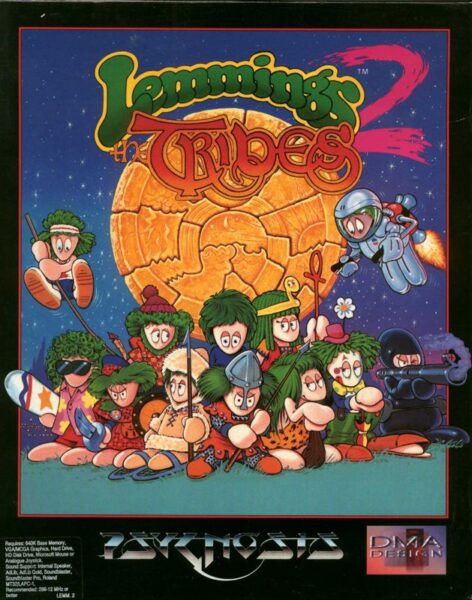

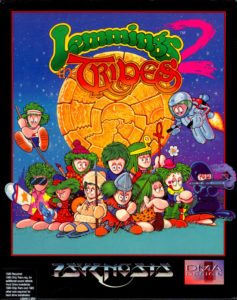
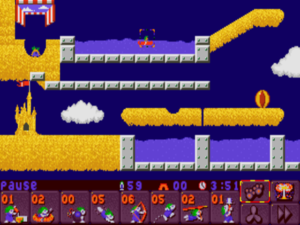
Lemmings 2: The Tribes, the big sequel to the original game — it was actually the third full-sized game in the series, coming after the less inspired Oh No! More Lemmings, which was largely filled with levels that had been rejected for its predecessor — was released in 1993 amidst huge anticipation and expectation. In many ways, it lived up to its advance press. In place of the suite of eight special abilities with which a player of the earlier games could invest her lemmings, it provided no fewer than 60 of them. The subtitle came from the fact that the lemmings were now divided into twelve tribes, each with their own abilities, appearance, and environments to traverse. The whole endeavor also boasted a new thread of narrative, about helping the twelve tribes escape from captivity. (The Biblical overtones were apparently intentional.)

As a player who had greatly enjoyed the first Lemmings, I found it to be a brilliant sequel. It was, however, every inch a sequel, being built strictly for the gratification of someone like me: someone who had a lot of experience with what had come before. This was not the best place to start your Lemmings journey, as the kids like to say today — not with all of the additional complexity, not with the disappearance of the gentle tutorial levels that eased you into the first game. Inspired as it was on its own terms, The Tribes‘s approach was questionable for a mass-market series of more or less casual games, which the customer should ideally be able to hop on and off of with the same aplomb as a subway rider. Then, too, the heavier weight of the game meant that it could be ported to only eight instead of 24 platforms. Lemmings 2 was a solid hit by all of the normal standards of the games industry, yet it failed to do much to further raise its franchise’s profile as a budding pop-culture staple. The original game, which was now available at a greatly reduced price, in all likelihood outsold it considerably even in the year of its release.

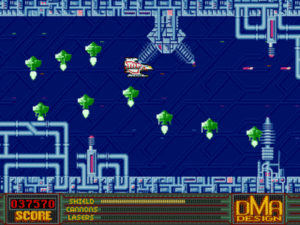
One of the problems, if we want to call it that, was a growing mismatch between the expectations of the market and the instincts and desires of DMA Design. The Scottish gang were gamer’s gamers of the old school, whose two creations before Lemmings had been the straightforward shoot-em-ups Menace and Blood Money. Lemmings had been something of an aberration for them; the cuteness had come about almost by accident, a case of mordant laddish humor ramming slightly askew. If DMA were to continue with the series, they wanted to make it more complicated, more difficult, more ambitious… in short, more hardcore. This was not a recipe for success in the space the first Lemmings had opened up for itself. After The Tribes failed to set the world on fire, DMA felt pressure from above to revert to the mean. This bred an atmosphere of resentment in Dundee that was hardly conducive to productive game development.

As was typical of such contracts at the time, the Lemmings intellectual property actually resided with the publisher rather than the developer. And the former was undergoing big changes. Just before the release of The Tribes, Psygnosis and its in-house studio — the same one responsible for most of the Lemmings ports — were acquired by the Japanese electronics giant Sony, which was looking for a Western partner to make games for its upcoming PlayStation console. This event, combined with the success of Lemmings, raised Psygnosis’s profile enormously, from a niche purveyor of graphically dazzling but often gameplay-deficient Amiga action games to a real force to be reckoned with on the modern entertainment landscape. The Children’s Television Workshop, the maker of Sesame Street, entered into talks with Psygnosis about a Lemmings television show.

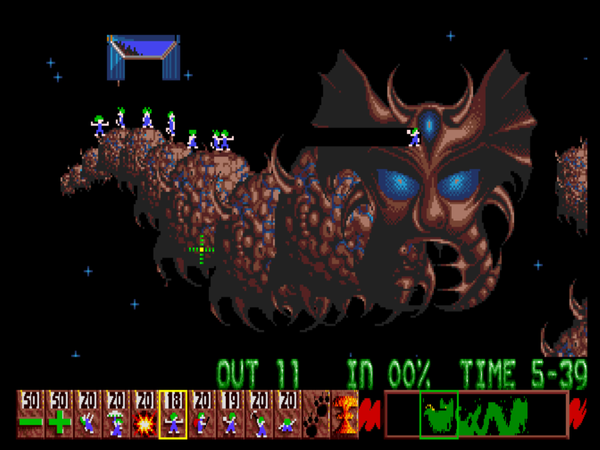
It was a tempting prospect on the face of it, but it became problematic as soon as you started to dig into it. Television shows, whether aimed at adults or children, are built around memorable characters. DMA’s lemmings were not quite this. They were a generic mass, all of them identical, the very definition of a faceless horde. Each blobby little creature filled a space no more than ten pixels square on the screen. The lemmings were many things, but they were not Super Mario or Sonic the Hedgehog, much less Big Bird or Oscar the Grouch.

So, an edict went down from Psygnosis to DMA to find a way to give the lemmings more individualized personalities. For their next trick, DMA had been toying with a continuation of the story of The Tribes — or rather a whole set of continuations. The next four Lemmings games would each deal with the fate of three of the twelve tribes after they left the Ark the player had helped them reach last time around. The whole series would be called All New World of Lemmings. (In North America, it would take the name of The Lemmings Chronicles; unlike the vast majority of such re-christenings, this was actually a better name in my opinion.) To satisfy Psygnosis and the Children’s Television Workshop, DMA now promised to make the lemmings bigger, and to fill the menu and victory and failure screens with cute faces that looked different from one another and could play well on television.
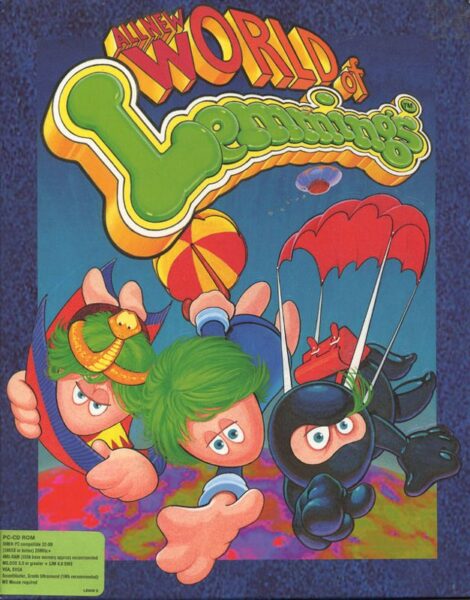
If matters had transpired differently, All New World of Lemmings would have been the banner title of a new sub-series, with different subtitles for each of its entries. As it was, Psygnosis just dumped the would-be first entry of the sub-series out there on its own, sans subtitle, and abandoned the other nine tribes to their fate.

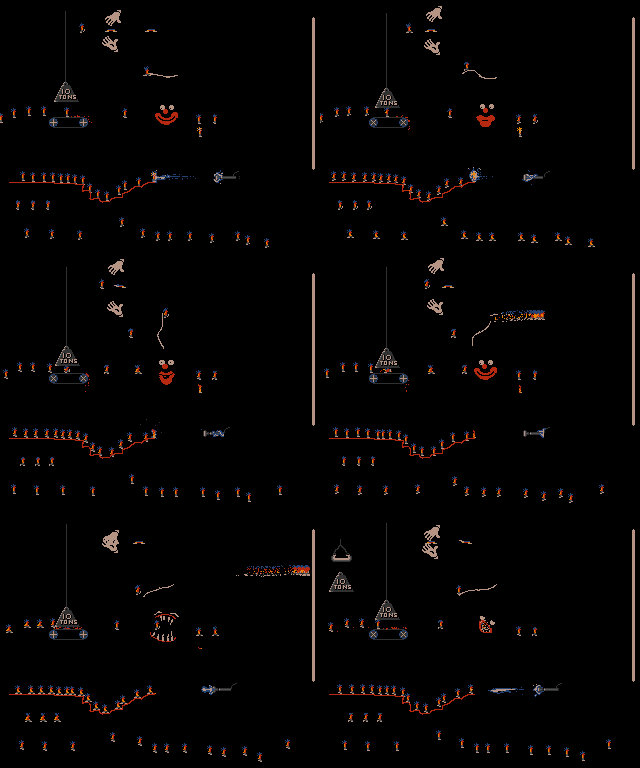
“I couldn’t think of any new way to take Lemmings at this point,” admits David Jones, the series’s mastermind from the beginning. Desperate for some sort of gameplay distinction from what had come before, DMA decided to combine the newly television-friendly presentation with yet more complications to the formula — complications that proved not to be much fun. You could no longer invest your lemmings with specific skills from a master pool of same just by clicking on them; now, you had to have them walk over loot boxes scattered around the levels, an incredibly fiddly and annoying mechanic. Meanwhile the increased size of the lemmings had unexpected knock-on effects. When the creatures were tiny, watching them die was funny even for people who reacted to the violence found in other videogames with horror and outrage. But when they became bigger, that changed; their deaths became grislier, possibly amusing for a teenage boy but less so for his mother. In addition to its gameplay issues, the tone of World of Lemmings was badly off in relation to the franchise’s established personality.
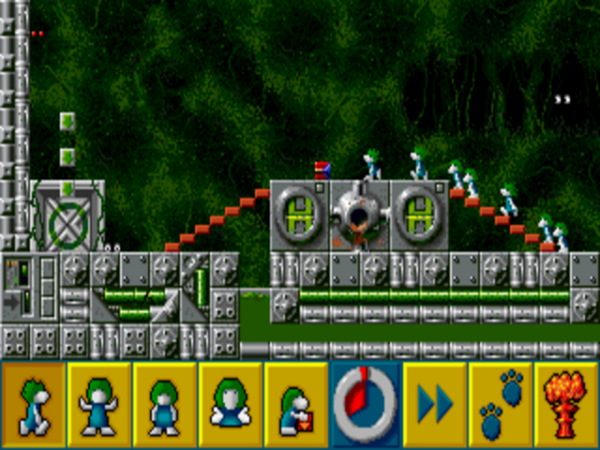
You have to walk your lemmings into crates like this one to give them special abilities now. Everything about the gameplay and aesthetics of World of Lemmings hits wrong, sometimes subtly so, sometimes blatantly. This was not promising television fodder.

Not long into development, a feeling took hold in Dundee that they were all just done with Lemmings, ready to come out from under the shadow of the casual monster they had accidentally created and return to making the games they wanted to make. As it happened, this was to be the last game of a six-game contract they had signed with Psygnosis back in the 1980s. Just get ‘er done became the watchword, so that they could take their Lemmings loot and do something more exciting with it. The new passion project around the office was a little something called Race ‘n’ Chase, which would evolve into a bigger something called Grand Theft Auto. “Lemmings 3 was a bit crap,” says DMA’s Mike Dailly, the artist who drew the very first eight-pixel-high versions of the creatures. It was done “more to end our commitment to Psygnosis than to actually do a good game.”

Unsurprisingly, then, it did not end up being a good game. Released in 1994, it made the concept that had seemed so fresh barely three years earlier feel trite and stale and kind of tasteless; even the soundtrack was annoying, the same two-bar fragment of circus music pounded into your head ad nauseam. DMA’s ennui oozed from its every slapdash pixel. This was a genuinely new thing under the sun: an outright bad Lemmings game. Evidently knowing it had a turkey on its hands, Psygnosis did virtually nothing to promote it, a huge contrast to the extensive outreach and advertising that had been done for The Tribes. It appeared on only two platforms, MS-DOS and the by now fast-fading Amiga. Those magazines that bothered to review it at all generally weren’t kind.

This first bad Lemmings game combined with a distracted Psygnosis, now busying itself making fresh games to order for the Sony PlayStation, to let all of the air out of the Lemmings balloon, practically all at once. The negotiation with the Children’s Television Workshop died on the vine. Lemmings was in acute danger of being exposed as a one-hit wonder, fodder for nostalgic “Where Are They Now?” retrospectives, rather than the enduring entertainment icon it had so recently seemed destined to become.

The following year the PlayStation dropped; it would go on to become the most successful single games console of the entire twentieth century, redefining the broader culture’s view of digital games forever with its edgy advertising and its deliberate courtship of the booming rave scene. Psygnosis was a big part of all that, through such early PlayStation hits as WipEout and Destruction Derby. Betwixt and between, it tried to get some more mileage out of Lemmings, efforts which came across rather like a child halfheartedly poking a dead dog with a stick. Having now parted ways with DMA Design, Psygnosis had to give its latest Lemmings projects to other developers with no previous connection to the franchise.

In 1995, we got Lemmings 3D from an outfit called Clockwork Games. The episodic approach of All New World of Lemmings was abandoned, in favor of the technological gimmick of the title. In a sense, the franchise became a pioneer one last time, albeit of a more dubious sort than before: Lemmings 3D was an early manifestation of an industry mania for stuffing 3D graphics into absolutely everything, whether they made sense there or not. “The fundamental core of the game of digging or building across the landscape to rescue the lemmings didn’t need an extra dimension,” says Gary Timmons of DMA Design, who could now only look on from afar as Psygnosis subjected their concept to ever more unfortunate contortions. Mike Dailly is blunter: “It was badly thought-out and just plain rubbish.” And truly, Lemmings 3D is agony to play; the newly mobile camera always seems to be pointing just where you don’t want it to be, forcing you to spend more time trying to get the viewing angle right than manipulating your lemmings. Nobody ever asked for this.
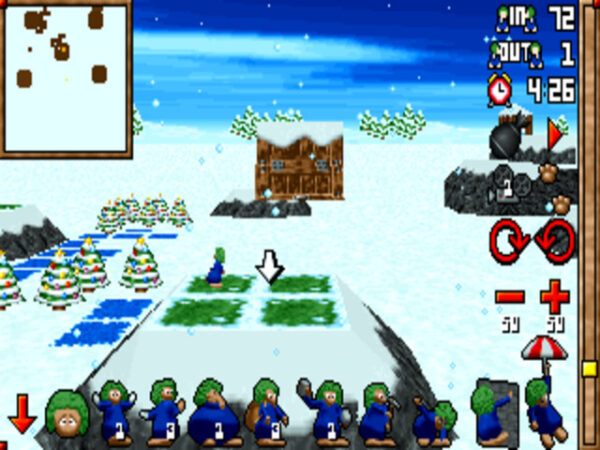
3D Lemmings Winterland marked the last gasp of the tradition of Christmas-themed Lemmings mini-games. The spirit was willing, but the 3D engine was lacking.

With the semi-traditionalist (but in 3D!) approach having failed, Psygnosis swung and missed in 1996 with Visual Science’s Lemmings Paintball — yes, really — and the in-house-developed The Adventures of Lomax. Here we can see the publisher still trying to do what the Children’s Television Workshop had once requested, turning the lemmings into characters to be moved in and out of different gameplay paradigms, something Nintendo had long done for its stable of trademarks with remarkable fluidity. But it was far too late in this case, and far too poorly done. The Adventures of Lomax gave a lemming a name of his own for the first and only time — for, of all types of game, a Super Mario Bros.-style platformer. The kindest thing to be said about it is that some of the art — pixel art again this time — is quite lovely, even as the gameplay is more or less acceptable in a workmanlike sort of way. But it never feels like it has much of anything to do with Lemmings.

After this, Psygnosis seemed to have decided to let the dead dog lie — until, that is, another, final Lemmings game popped up out of the blue almost four years later. It did not succeed in rescuing the franchise from oblivion; it came and went from the budget bins barely noticed by the gaming press. But it did succeed, against long odds indeed, in being a really, really good Lemmings game, by far the best since The Tribes. It’s hard to imagine any anticlimactic swansong acquitting itself much better.
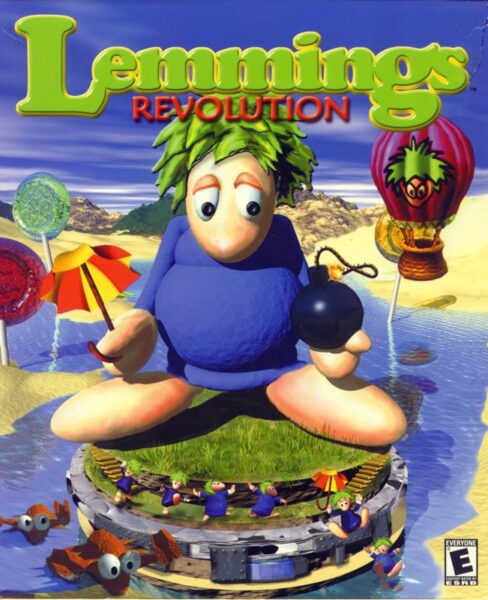

Lemmings Revolution is not without a gimmick, but for once it’s a reasonably interesting one. Instead of stretching out from left to right, each of its 102 levels is wrapped around a giant pillar that you can rotate at will. The gimmick is not what I would call revolutionary in the non-physical sense, but it mixes the usual formula up in enjoyable ways when it’s at its best, and is never actively irritating even at its worst.

But more important to this game’s success than the gimmick are the cleverest, most inspired set of levels since The Tribes. The team who made it, who were housed at Psygnosis’s satellite studio in Leeds, brought a passionate whimsy to the project that the series had been sorely lacking in its last several installments. Co-designer Mat Thomas describes a creative atmosphere that resembles the one from back in the day at DMA Design, when the idea of Lemmings was still fresh and everyone was eager to get an oar in with a level or two.

The entire development team were delighted to work on such a famous series, and we took the challenge. We had a fabulous editor developed by a programmer called Ben Dixon. It was very easy to mock up and create levels. The key to level design with Lemmings is trying to think of ways to use the skills presented to the player in different ways. Inspiration came from each other, and other mediums such as the earlier Lemmings games and, dare I say it, films! Goonies — one of my levels — was inspired by the named film. I tried to put in many gadgets to give that feeling of technology driving the level. Our team created nearly 200 levels for Lemmings Revolution, which allowed us to pick the cream of the crop.
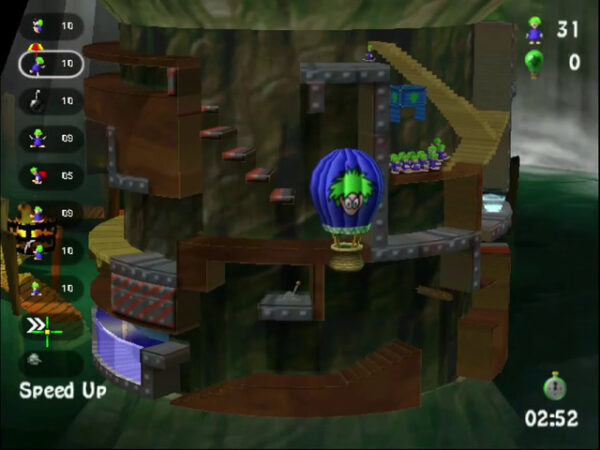
The “Goonies” level mentioned by Mat Thomas.

The finished game goes back to the roots in many ways. The suite of abilities with which you can equip your lemmings is the exact same collection as the original game: the familiar climbers, parachutists, bombers, and bridge builders, plus the three kinds of diggers. Seeing them again feels like meeting old friends.

Yet by no means is Lemmings Revolution a carbon copy of the first game in the series. In addition to the revolution mechanic itself, there are any number of new obstacles and affordances within the levels: switches, saws, lasers, instantaneous transporters, and, most ingeniously, gates that reverse the force of gravity to make your lemmings walk on the ceiling. All of this contribute to a slightly more mechanized feel this time around. There are now weasels to contend with as well; these consider a lemming to be a delightful snack, and must be either avoided or — more satisfyingly — done away with in one way or another. Another new wrinkle comes in the form of special lemmings who are impervious to either drowning in water or being scorched by acid, the better to handle the pools of same that are occasionally found in their way. Exits are now hot-air balloons that must be reached, and sometimes there are more than one of these, with each only able to accept a limited number of riders. The most important point is that all of the additions feel organic to the experience rather than tacked on by some focus group somewhere. Thankfully, no attempt is made to individualize the lemmings and turn them into fodder for television. We’re back to the juxtaposition of generic cuteness and morbidity that made the series stand out during its glory days.
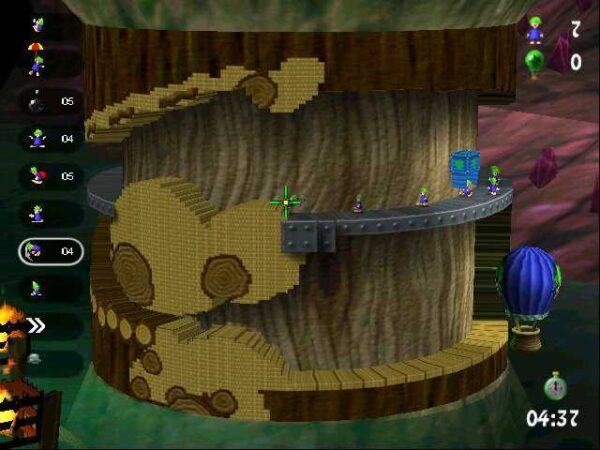
For the first time since The Tribes, these lemmings look like they should.

All told, then, playing this Lemmings game is like going home again. Early training levels yield to more fiendish ones that will have you scratching your head by the middle stages, pulling your hair out by the last ones, as you have to make use of every single affordance at your disposal to succeed. As many of you know by now, I adore games that build up gradually in just this way to challenge their players. And I’m proud to say that my wife and I rose (gradually) to the challenge; we made it all the way to the end.

That Lemmings Revolution succeeds as well as it does in so many ways begins to seem still more remarkable when one considers the rest of its development history. After first agreeing to pay for this last kick at the can for the franchise, Sony abruptly pulled its funding just as it was nearing completion. Through some last-minute scrambling, Psygnosis’s management was able to place the game with the rival publisher Take Two Interactive and see it released for Microsoft Windows if not for the PlayStation.

Granted, some scars from the trauma were left behind. Several levels were bugged badly enough in the initial release to be impossible to complete, until Take Two came out with a patch. Even in the final version of the game, one level — the one called “Lock In” — can be completed only by exploiting a glitch in the game engine. It’s so at odds with the rest of the level designs, which are sometimes diabolical but always scrupulously fair, that I can’t believe this was intentional. I even fancy I can see how the level was supposed to be solved. At any rate, if you decide to play the game, I recommend that you save yourself a lot of frustration and just turn to a walkthrough when you get to this level.
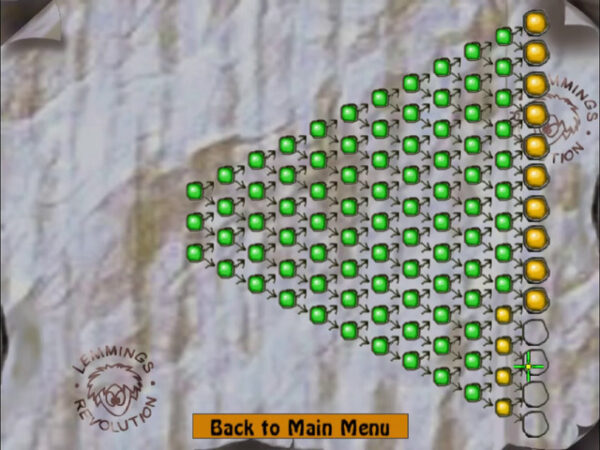
One nice touch in Lemmings Revolution is the ability to choose to some extent what level you tackle next. The green dots represent solved levels, the yellow those you haven’t yet completed. Once you beat a level, you open up the two that are connected to it by arrows. It’s a little hard to see here because I’m boring and just tackle the levels in order, top to bottom and left to right. But if you’re less stubborn and methodical than me, you can take a break from a level that’s giving you trouble and work on another one for a while. Like so much else here, this is just really good, player-friendly game design.

It’s obvious that Lemmings Revolution didn’t have an overly lavish budget even before Sony pulled the plug on it. A thin glaze of story — something or other to do with those weasels who can sometimes be found lurking in the levels — is presented via an opening movie that probably absorbed about half the budget on its own. It’s never mentioned again afterward — not that it really matters. We are given only as many bells and whistles as are necessary to make the levels go and remind us that we’re playing a Lemmings game. The closing movie lasts all of seven seconds; the operative philosophy was apparently that it’s better to tempt the punters in the shops who might buy the game than it is to reward the already captured players who have put many hours of their life into it.

All of which is fine really. By the turn of the millennium, so-called “mid-priced releases” like this one — Lemmings Revolution sold for just $20 from its very first day on store shelves — were often more interesting and innovative than the expensive AAA opuses, whose publishers felt more of a need to protect their investment via micromanagement and risk aversion. Certainly the production values of this Lemmings game are no worse than those of the original. We never came to Lemmings to participate in epic stories; we come to face puzzles and to curse and stomp and almost throw our mice across the room, until a light bulb goes off somewhere in the old noggin and the fingers do what they’re supposed to and we solve that level. At which point it’s on to the next level, to repeat the procedure. We are strange creatures, we humans, aren’t we? Even stranger than lemmings, one might want to say.

Anyway, this humble game called Lemmings Revolution is one of my favorites of all the ones I’ve played from the year 2000 for these histories. I’m happy to give it a place in my personal Hall of Fame and to recommend it to all of you — especially any of you who might have enjoyed the more famous and popular Lemmings games, and thought the later ones had nothing comparable to offer. You were mostly right — but only mostly.

For better or for worse, there isn’t much else to say about the series after Lemmings Revolution came and went with so little fanfare (or, one has to suspect, sales). There have been occasional remakes over the past quarter-century, mostly for mobile platforms, but nothing that displays much in the way of design or commercial ambition. As late as 2010, the franchise was frequently mentioned as being “ripe for revival” for a new era where unabashedly simple and cartoony casual games were by some reckonings out-earning the hardcore ones. But for whatever reason, that revival was never seriously attempted, and the cultural window for the franchise is probably closed by now, what with most of us who were there when it was so huge having entered into our fifth or sixth decade of life by this point.

This is no tragedy. Lemmings came to the zeitgeist and then it went; such is the fate of most pop culture. Good game design, however, transcends trends and fads. If you’re a fan of puzzle games and you haven’t played these ones, know that Lemmings, Lemmings 2: The Tribes, and Lemmings Revolution, the three high points of the series, can still be very vexing and satisfying indeed. This is as true today as it was a quarter-century ago, as true as it will still be a quarter-century on. Even if everyone stopped making games tomorrow, we would still live in an era of unprecedented ludic riches.


Did you enjoy this article? If so, please think about pitching in to help me make many more like it. You can pledge any amount you like.


Sources: The books Grand Thieves & Tomb Raiders: How British Video Games Conquered the World by Magnus Anderson and Rebecca Levene and Jacked: The Outlaw Story of Grand Theft Auto by David Kushner. Retro Gamer 39; Computer Gaming World of September 2000.

Online sources include “The Making of Lemmings” by Rich Stanton for Read-Only Memory, “An Ode to the Owl: The Inside Story of Psygnosis” by Damien McFerran for Time Extension, a Lemmings Universe interview with Mat Thomas, and Damian Katz’s gamebook page.

Where to Get Them: Oddly, none of the vintage Lemmings games are currently available for purchase. You can find downloadable versions of the original Lemmings and Lemmings 2: The Tribes in my earlier articles associated with those games. As for Lemmings Revolution, the third of the three Lemmings games that are well worth revisiting today: you can find it on a certain well-known archiving site if you only search for it. After you install it, you will need to install a patch to make it run properly on modern versions of Windows (and Linux systems under WINE).
 
44 Comments

Posted by on September 18, 2026 in Digital Antiquaria, Interactive Fiction


Tags: , ,

Discworld on Page and Screen, Part 2: The First Three Discworld Games

As a man of wide-ranging curiosity, Terry Pratchett was drawn to personal computers early. In 1981, he purchased a Sinclair ZX81 in kit form and soldered it together successfully. He soon upgraded to a Sinclair Spectrum and then to an Amstrad CPC 464, which was his first computer strong enough to run a practical word processor. From the second Discworld novel on, he wrote all of his books digitally; this was undoubtedly a factor in the prodigious writing and publishing pace he maintained for so many years. But computers were more than a tool to him: right from the beginning, he also played computer games enthusiastically. In a 1986 interview, for example, he mentions being obsessed with Infocom’s interactive version of The Hitchhiker’s Guide to the Galaxy.

The first Discworld computer game came surprisingly quickly, courtesy of a teenage entrepreneur named Fergus McNeill and his little company Delta 4, who had made a name for themselves by writing slapstick fantasy parodies as Quill-based text adventures, with names like Bored of the Rings (which didn’t share anything but a name and a certain sensibility with the book of the same name) and The Boggit. While it would be a stretch to say that they transcended their author’s age and the technology used to create them, they were amusing in their way, and became quite popular. Some of them reportedly sold as many as 20,000 copies, a very impressive number in the British games industry of the mid-1980s. They made McNeill a natural to adapt Terry Pratchett to an interactive medium, given that the latter’s first couple of Discworld novels were content to plow much the same satirical territory, albeit in a more erudite and sophisticated way.

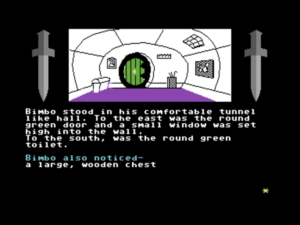
The Boggit contains its share of literal toilet humor.

McNeill says that he originally bought the novel The Colour of Magic “as a present for someone else, but I accidentally started reading it myself and found myself unable to stop.” It was he who suggested an adaptation to Pratchett’s publisher, to capitalize on the British appetite for bookware. “It’s important to remember that this was Olden Times — the 1980s, for goodness sake,” he says. “So, when I said ‘Terry Pratchett,’ people didn’t laugh at my audacity for wanting to work with the great man. They frowned and said, “Who’s he?'”

Thus McNeill was able to make the deal, and created his Colour of Magic text adventure in short order, with some direct input from Pratchett himself. The end result, which was released in late 1986 in Britain and Europe only, is an abbreviated version of the novel, walking through its plot scene by scene. Solving it entails looking up what Rincewind did in the same situation in the book, then figuring out how to express the concept to the balky, fiddly parser. Those who have read the book, in other words, will vacillate between boredom and frustration, while those who haven’t will be utterly lost. Even in its day, when a disconcerting number of players were willing to accept fighting the parser as an inherent part of the challenge of playing a text adventure, the game was less popular than its license might suggest.

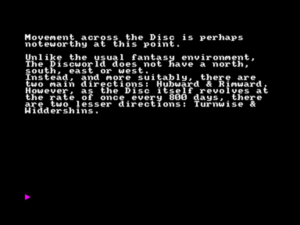
The Colour of Magic replaces the standard text-adventure compass directions with those of the Disc: “hubward,” “rimward,” “turnwise,” and “widdershins.” One plus for verisimilitude, but ten minuses for annoying the heck out of the player.

McNeill speaks of his communications with Pratchett fondly, going so far as to call him “a big inspiration for me,” whilst calling being allowed to make the game at all “a huge privilege.” Yet Pratchett was enough of a gamer himself to recognize how underwhelming the final product really was. In his view, it cheapened the Discworld brand, of which he was always keenly protective; he would refer to the interactive Colour of Magic only as a “bad experience” in later years. It was enough to make him shy away from further game adaptations for quite some time, despite his personal fondness for computers and the games they played. It wasn’t until mid-1993, when Discworld mania was in full swing, that someone managed to convince Pratchett to give the idea of ludic Discworld a second chance.

Actually, there were two someones, the first of whom was one Angela Sutherland, who had gotten her start in the games industry back in 1983. She had been studying to become a sculptor at that time at the Edinburgh College of Art, when a fellow student and good friend named Sandy White had showed her a simple action game called Ant Attack which he had been writing on his Sinclair Spectrum. She helped him to flesh it out and get it published, whereupon it became one of the big early hits on the Speccy. Sutherland worked with White on several more games after that, moved on to become head of development for Firebird and Rainbird, and then became a producer for the British division of Beam Software, the Australian software house famous for The Hobbit, probably the best-selling text adventure of all time (and the thing which Fergus McNeill’s early games were really parodying, at least as much as Tolkien’s books).

Seeing an opportunity in the market, she left Beam and founded her own studio, Teeny Weeny Games, in 1991. Its name reflected its focus: games for handheld systems like the Nintendo Game Boy. Such gadgets were not yet hugely popular among consumers in her home country, but the average British wage was lower than that of the average American or Japanese, making a British studio such as the one she was setting up a good option for big publishers looking to get a product onto the international market quickly and fairly inexpensively, but also competently. So, Teeny Weeny cut their teeth on playable but forgettable licensed fare and ports. For all that it was the games industry’s version of flyover country, this was also a space where a pragmatist like Sutherland could do very well for herself. These sorts of projects would remain the studio’s bread and butter throughout its lifetime.

Teeny Weeny enjoyed an unusual symbiotic relationship with another studio called Perfect 10 Productions, founded at almost the same time by Gregg Barnett, a former colleague of Sutherland from Beam. Perfect 10 had much the same business philosophy as Teeny Weeny, but focused on the full-sized console systems; this created an opportunity for the two developers to collaborate in order to bring the same game out on living-room and handheld consoles. And indeed, they came to share code, assets, strategies, and even office space and to some extent employees with one another, until it became difficult for the outside observer to see where one stopped and the other began.

Thus it was Sutherland and Barnett together who made the pitch to Terry Pratchett for a Discworld adventure game. It seems that their pragmatism had served to conceal a streak of more ambitious creativity, a desire to make something more exciting than the games that were currently keeping the lights on in their offices. But at the same time, they were still hard-nosed enough to appreciate the value of licenses — particularly a license of the biggest literary phenomenon in Britain, a series of novels which Sutherland and Barnett happened to adore, just like millions of their countryfolk.

Angela Sutherland, Terry Pratchett, and… Death.

Pratchett, however, was not easy to convince. It took six months of tireless courting, and ultimately the presentation of a complete design document written by Barnett himself, to get him to say yes. “The main reason he signed,” says Barnett, “was that we did a design, which showed we were willing to put in the work without any initial reward, and that we understood and respected the property.” Sutherland and Barnett promised Pratchett that they would wash away the bad taste of the Colour of Magic text adventure by sparing no expense or effort this time around. They would make a fully-voiced point-and-click graphic adventure for the latest CD-ROM-capable personal computers, one that was as good or better than any of the big titles coming out of the United States.

In fact, the Discworld game almost came out under one of those American publishers’ imprint. Using their international connections to maximum advantage, Sutherland and Barnett signed a deal with Sierra, along with LucasArts one of the two biggest names of all in adventure gaming. The agreement would let them make their game using that company’s state-of-the-art SCI engine, with the support of some Sierra personnel who would temporarily relocate to the project’s South London headquarters. But the American publisher didn’t quite seem to grasp what a huge license Discworld really was on the other side of the Atlantic. Bleeding money from their visionary but unprofitable online gaming space The Sierra Network, they backed out of the deal. Talks with the American giant Electronic Arts also fell through, whereupon Sutherland and Barnett finally signed with the homegrown publisher Psygnosis, best known for the global hit Lemmings, the most popular British-developed videogame prior to the Grand Theft Auto franchise many years later. By virtue of their location at Ground Zero of Discworld mania, Psygnosis knew very well how big a Discworld game could be, such that they had already tried without success to pitch the idea directly to the wary Pratchett. At their first meeting with Sutherland and Barnett, they became the suitor rather than the courted: they “wouldn’t leave until we did a deal,” says Barnett.

Pratchett himself was if anything even more into games now than he had been during the previous decade. For a man who had grown up in a house without electricity or an indoor toilet, the games of the 1990s were nothing short of wondrous. “I play games a lot — and I mean a lot,” he said in a contemporary interview. “Sitting in front of a screen writing, you need some relaxation, and what better way than to load in something like Wing Commander, which is one of my faves. One of the nice things about making lots of money from books is that I can go down to the local Virgin Store and buy what I want!” This habit, combined with his protectiveness of Discworld as a property, ensured that he would take a healthy interest in the Discworld game. He went so far as to rewrite some of Gregg Barnett’s dialog.

Barnett’s script borrows heavily from Pratchett’s 1989 novel Guards! Guards!. Given how close Watch Commander Sam Vimes, its protagonist, was to his creator’s heart, it must have rankled Pratchett a bit when Barnett elected to write him out of the story, replacing him with Rincewind as chief investigator and player’s avatar. Ditto when Barnett cut out most of the novel’s serious subtext, leaving behind only the gags, jokes, and tropes. And double ditto when the game’s developers eventually cast Eric Idle of Monty Python — a part of the archly absurdist Oxbridge comedy tradition that also included the likes of Douglas Adams, and to which Pratchett did not see Discworld as belonging — to voice the part of Rincewind.

Yet Pratchett was also a reasonable man with a good grasp of what it took to sell creative product, and he could see the logic behind each of Barnett’s decisions. Rincewind was still the series’s most well-known character at this stage in its evolution; serious themes are even harder to bring off in a comic adventure game than they are in a comic novel; and the casting of a real live member of Monty Python in any game was a tremendous coup, even if Eric Idle wasn’t Barnett’s first choice of John Cleese. (According to Barnett, “Fuck off! I don’t do games,” was the latter’s response to his inquiry…) The finished game does absorb some of the flavor of Monty Python — Barnett admits to making the onscreen Rincewind into something of a doppelgänger of Idle’s typically disheveled Python personae — but the combination works. I dare you to try to read a Discworld novel that stars Rincewind after playing this game without hearing Idle’s voice in your head.

The voice-acting cast was rounded out with some other enviable comedic talents: Tony Robinson, Blackadder’s perpetual sidekick; Kate Robbins of Spitting Image; Jon Pertwee, the third incarnation of Doctor Who; and Rob Brydon, a relative newcomer with a prolific career still in front of him (international audiences may know him best today for starring in the very funny Trip series of travel mockumentaries). The only problem with the cast is that there just aren’t enough of them, meaning that everyone with the exception of Idle is juggling many roles, a fact which mugging and accent-switching can’t completely obscure. Still, if one must settle for a cast of less than half a dozen, one couldn’t do much better these actors. It’s a pleasure to listen to the game’s collection of skittish, skeevy, occasionally lovable characters, every single one of them more or less off their nut, prattle on about nothing much in particular. “Is this fish fresh?” Rincewind asks a fishmonger. “Fresh? Fresh?” he replies. “It just made a pass at my wife, sir!”

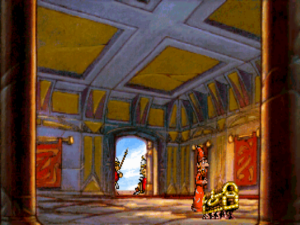
The game’s visuals are equally distinctive. Under the direction of veteran artist Paul Mitchell, the metropolis of Ankh-Morpork, where the entire game takes place, becomes a Disney film as viewed by a cock-eyed drunk: everything is subtly warped and shifted, with nary a straight line to be seen (or heard, for that matter). Rincewind shuffles from location to location in his bedraggled wizard’s robes, looking like he would rather be anywhere else. (Maybe that’s understandable, given that every other character in the game asks him why he’s wearing a “dress.”) He’s trailed all the time by The Luggage, an inexplicably sentient suitcase with the legs of a centipede, the disposition of a pit bull, and the teeth of a bear trap; this movable feast serves as the means of conveyance of the incredible amount of stuff Rincewind will eventually collect and tote through the city.

As in the novel Guards! Guards!, the plot hinges on a fire-breathing dragon which a cabal of less-than-upstanding Ankh-Morpork citizens have summoned. Thwarting the monster and its minions requires playing through three lengthy, non-linear acts, followed by the climactic showdown with the dragon. Two of the main acts are scavenger hunts: find the five ridiculous things that are needed to build a Dragon’s Lair Revealer; steal the six golden talismans from the dragon-summoning cabal. We’ve all been here before — as has Rincewind apparently, judging from the scorn he is constantly heaping on the whole enterprise. Many adventure games use this sort of self-referential humor as a lazy excuse for derivative, uninspired design, and perhaps Discworld cannot be fully absolved of this sin. It does, however, have the virtue of being much, much funnier than the vast majority of such exercises. And, given that it’s meant to evoke the aesthetic of the early Discworld novels, which lampooned the conventions of paperback fantasy fiction in a similar way, the sin is venal rather than mortal.

Still, the game’s satire is at its best when it aims slightly higher in a meta-fictional sense. The point of the third act is to manipulate circumstances so that Rincewind will have exactly a million-to-one chance against the dragon. Because, as Terry Pratchett himself once put it, “we know — it is built into our very understanding of the narrative universe — that if it is a million-to-one chance that might just work, it will work. Because no one has ever heard of a million-to-one chance that just might work not working. In other words, a million-to-one chance is a certainty. It’s a cliché that we accept. We accept it from James Bond and from Bilbo Baggins.”


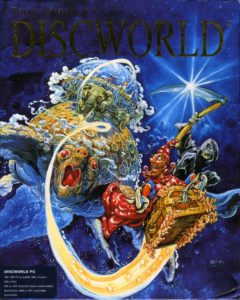
Josh Kirby, Terry Pratchett’s longtime cover illustrator, provided the art for the Discworld game box as well.

Rincewind with the Luggage.

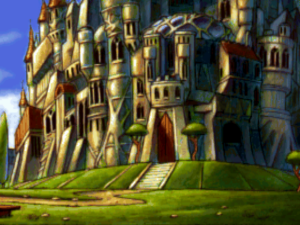
Unseen University, where Rincewind has been studying without any obvious benefit to himself or society for years and years.

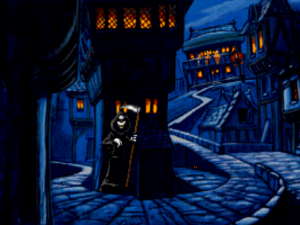
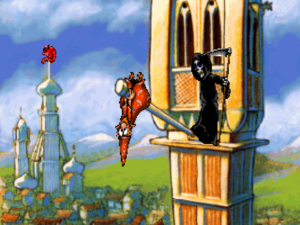
Death makes a cameo in the first Discworld graphic adventure. He will take a starring role in the second.

“A wizard’s staff has a knob on the end of it…”


Released in Britain in early 1995 under the name of simply Discworld, the game was praised to the skies by reviewer after reviewer. PC Zone magazine wasn’t that much of an outlier in calling it “possibly the best point-and-click adventure game ever made.” Everyone marveled over the graphics, the voice acting, and the humor, declaring that it really was like seeing the world of the novels come to life. Most of all, though, they marveled over the sheer size of the thing. They noted, accurately, that each of the game’s first three acts could easily have been a standalone game in its own right. It was and remains abundantly obvious that the people who made this game did so for all the right reasons, that they genuinely loved Anhk-Morpork and wanted to shove as much of it as possible onto a CD.

Unfortunately, these same people had never actually made an adventure game before. And, once the initial euphoria died down, players could all too plainly see this too in the finished product. It is — or at least ought to be — a truism in adventure design that every puzzle you make is ten times harder than you think it is. The only way to calibrate your game’s difficulty is to put it in front of real players and see how much they struggle. Sadly, it is all too clear that the people who made this game failed to do that in the midst of their zeal to keep adding more, more, more to it.

Discworld is for all intents and purposes insoluble. There is simply no way to reason out many of its puzzles; this is where the cockamamie nature of the world comes back to bite. The designers have paid no heed to what Bob Bates calls the “else” rule of good puzzle design. It states that, if the player has not done the correct thing, but she has done some other thing that might make some degree of logical or comedic sense, the game should recognize and acknowledge that in some way, ideally whilst embedding within its response a hint as to the correct way forward. In this game, though, everything you try to do that isn’t the One True Way Forward is met only by a scornful Eric Idle telling you, “That doesn’t work!” This is the one quote from Discworld that absolutely everyone remembers. Long before you finish the first act, it will have begun to haunt your very dreams, will pop back into your head to enrage you at random moments throughout your day. And just to ensure that you get to hear it even more often than you otherwise might, the game is littered with red herrings that have no purpose whatsoever.

To sum up, then, we have a huge environment to wander around in, one which provides no shortcuts to get from place to place, just Rincewind’s lackadaisical stroll; an enormous pile of objects, many of which are literally good for nothing; puzzles whose solutions are amusing in retrospect but cannot possibly be anticipated before the fact; and no middle ground between wrong and right when it comes to solving them, to provide useful feedback or at least some small dollop of amusement. Oh, and there are also dead ends that you can stumble into without realizing it, after which you’ll get to spend hours banging your head against brick walls even more fruitlessly than usual. As a piece of game design, Discworld is hopeless.

When the game came out in the United States several weeks after its British release, the reviewers there were clearer-eyed, being carried away with neither excitement over the very existence of a Discworld game nor home-country partisanship. Computer Gaming World magazine wrote that “the overall impression the game conveys is not one of richness but one of clutter and surfeit.” It sold in only middling numbers in the American market.

But that was not the case in Britain and much of Europe. There the game sold hundreds of thousands of copies before second takes started to appear in the gaming press and on the Internet, noting belatedly that labeling it “best adventure game of all time” may have been laying it on a bit thick. Needless to say, it was full speed ahead on the sequel.

Before starting on it in earnest, Angela Sutherland and Gregg Barnett finally did the logical thing and merged their two companies together as Perfect Entertainment. The new entity continued to devote the preponderance of its effort to workaday projects for the console market, but the connections forged thereby brought more than financial benefits to the passion projects: both Discworld and its sequel would be ported to the Sony PlayStation and the Sega Saturn, opening up whole new worlds of potential sales. (Their publisher Psygnosis had in fact been bought by Sony in 1993.)

If the first Discworld game is a sad story of good intentions and soaring ambitions derailed by a lack of experience with the nuts and bolts of adventure design, Discworld II: Missing, Presumed…!? is a happier tale of a development team willing and able to learn from their failures — a less common phenomenon than one might expect in the world of adventure games. It doesn’t so much try to break new ground as to perfect the experience which Perfect Entertainment had attempted to deliver last time around. And it succeeds on these terms rather magnificently. Right from the first page of the manual, where they promise that this Discworld game is “a little easier,” the makers make it clear that they understand what they did wrong last time.

Interestingly, Pratchett was less involved with the sequel. “I let them have their heads a bit more,” he said after its release. “It seemed that they could create a game that had the right kind of feel to it, so I didn’t have to shepherd them so much. There wasn’t quite so much shouting this time around.”

Once again the broad plot is lifted from a beloved Discworld novel: this time it’s 1991’s Reaper Man, in which Death leaves his job and retires to the countryside, with chaotic results for the whole Disc. As in the last game, matters are rejiggered to insert Rincewind into the story as the protagonist, while space is also made for elements of the 1990 Discworld novel Moving Pictures, an entertaining if not particularly deep pastiche of old Hollywood (“Holy Wood” on the Disc), with motion-picture cameras which consist of fast-painting imps trapped inside windowed boxes.

The second game is another joy to listen to; Eric Idle agreed to return, as did Kate Robbins and Rob Brydon. Tony Robinson elected not to, however, while the elderly Jon Pertwee was too ill to participate. (He died in May of 1996, leaving Discworld I as one of his last media legacies.) To take up some of the slack, Perfect hired Nigel Planer, another stalwart comedy veteran, who would go on to narrate almost all of the audio-book versions of the Discworld novels. Barnett tried to recruit Christopher Lee for the role of Death — an inspired choice by any standard — but Perfect couldn’t afford his asking price in the end. So, Rob Brydon took the role instead, and did very well with it, bringing out the mix of fussiness, petulance, and compassion that has since made Death arguably the most popular Discworld character of all time. On the whole, then, the voice acting in Discworld II is on a level with that of the first game — including, alas, the same major weakness of there just not being enough different actors. Kate Robbins, for example, voices every single female character in both games, and most of the children to boot.

The truly striking change from the first game to the second is the look of the production; the difference here is truly night and day. The switchover in the mid-1990s from the VGA graphics standard, with a typical resolution of 320 X 200, to SVGA, with a resolution of 640 X 480 or more, strikes me as the second of the two most dramatic inflection points in the history of computer-game graphics. (The first, for the record, is the arrival of the Commodore Amiga in the mid-1980s, followed soon after by VGA on MS-DOS machines.) The first and second Discworld graphic adventures stand on either side of the VGA/SVGA Rubicon, which divides games that look undeniably old today from those that can at least potentially still look quite contemporary. I would place Discworld II among this group without hesitation.

The higher resolution allowed Perfect to outsource the animation to Hanna-Barbera’s studio in the Philippines, a decision which would have made no sense under the constraints of VGA. Characters and backgrounds that looked a bit muddy and blurry in the first game pop on the screen in sharp, vivid cartoon colors this time around. Meanwhile the static views of the first game are replaced by fades, pans, and close-ups; it’s like going from the typical 1930s film to Citizen Kane.

Most importantly of all, Discworld II plays better. We have the same three-act structure as last time, with all of the acts no more than scavenger hunts at bottom. But this time we get to venture beyond Ankh-Morpork to other locations on the Disc. Counterintuitively with this last, the game as a whole is a bit smaller — and yet this is by no means a bad thing. The combinatorial explosion is much reduced, thanks to fewer locations, fewer objects, almost no red herrings, an absence of dead ends, and a much more concentrated effort to calibrate the puzzles to that sweet spot which lies equidistant from the trivial and the impossible. Discworld II isn’t an easy game; its puzzle-dependency chains are sometimes nested a dozen layers deep. Yet it is a soluble one, with puzzles that make a modicum of sense on the vast majority of occasions. Rincewind even deigns to say something other than “That doesn’t work!” some of the time when you try something that, well, doesn’t work. And the world of the game is even more of a delight than last time just to explore, being stuffed to the brim with eccentric characters and curious sights. Meaty, funny, generous, and yet unabashedly traditionalist, it succeeds in actually being everything its predecessor tried but failed to be.


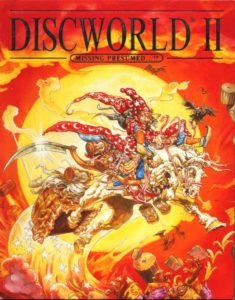
Josh Kirby again provided the cover art for Discworld II.

Eric Idle, who was always Monty Python’s go-to song-and-dance man, contributed an original song to Discworld II.

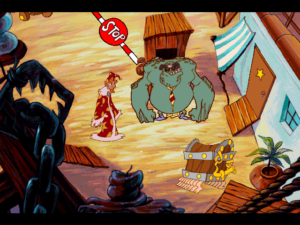
On a “Holy Wood” set, complete with troll security for the actors’ trailers.

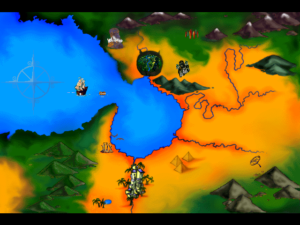
You can move around on a larger world map this time. Notice the Luggage swimming behind Rincewind’s ship.

Visiting Death’s home, which is as Gothic chic as a Bauhaus song.

Oh, my, what’s happened here? In one of the best gags in a game that delights in pulverizing the fourth wall at every opportunity, Rincewind 2.0 gets transported for a few minutes back into the world of Discworld I, where he meets his low-res counterpart.


Thanks to already-built tools and the outsourcing of the animation, Perfect Entertainment was able to finish their second Discworld game in less than eighteen months, and Psygnosis released it in late 1996. By this time the adventure market in the United States was showing undeniable signs of mushiness, but it was still holding up comparatively well in Britain and Germany; Broken Sword, another homegrown British production from Revolution Software, would be a substantial hit that holiday season. Still, a sense of gloom was creeping in even on this side of the Atlantic. Discworld II testifies to this with a considerable amount of gallows humor about its genre. “Aren’t you gonna miss it when they stop making these games?” says Rincewind at one point.

Discworld II did reasonably well in the friendliest markets, but not as well as the first game. And it again made even less of an impact in the United States, despite a gushing review from Scorpia, Computer Gaming World‘s long-tenured, infamously cantankerous adventure columnist. “It’s been too long since I could unreservedly recommend a game,” she wrote. “I can do it now.”

Between its computer and console versions, Discworld II sold just well enough to justify one more game. This would be a brave effort which eschewed the low-hanging fruit of cartoon comedy in favor of a dramatically different direction, enough so as to justify comparisons with Equal Rites, the Terry Pratchett novel which proved that the literary Discworld was more than just a fantasy version of Hitchhiker’s Guide to the Galaxy. We’ll turn to that final Discworld computer game to date, as well as the later years in Pratchett’s life and literary career, in due course, in another article.

For now, though, let me echo Scorpia’s unreserved endorsement of Discworld II. Its predecessor is an interesting but badly flawed creation, best left for hardcore fans of Rincewind who are willing to play with a walkthrough by their side, but the sequel deserves to be better remembered today as the minor classic it is. It represents the Discworld comedy game perfected.

(Sources: the books The Magic of Terry Pratchett by Marc Burrows and Terry Pratchett’s Discworld: The Official Strategy Guide by Glen Eldridge; Starlog of August 1990; CD-ROM Today of April 1995; Computer Gamer of January 1987; Computer Gaming World of June 1995 and May 1997; Computer and Video Games of September 1986; Electronic Entertainment of July 1995; GameFan of September 1997; Next Generation of August 1997; PC Zone of January 1995, August 1996, November 1996, and May 1999; PC Powerplay of November 1996 and July 1997; Sinclair User of December 1986; The One of September 1993; Retro Gamer 94 and 164.

None of the Discworld game are available for legal purchase today, doubtless due to complications with the literary license. Thankfully, Perfect Entertainment’s Discworld and Discworld II are available in ready-to-play Windows versions on The Collection Chamber. Mac and Linux users can import the data files there into their computer’s version of ScummVM.)


Tags: ,

Lemmings 2: The Tribes

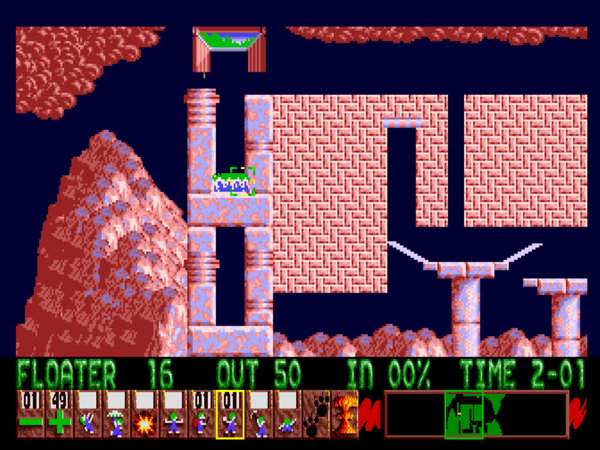
When the lads at DMA Design started making the original Lemmings, they envisioned that it would allow you to bestow about twenty different “skills” upon your charges. But as they continued working on the game, they threw more and more of the skills out, both to make the programming task simpler and to make the final product more playable. They finally ended up with just eight skills, the perfect number to neatly line up as buttons along the bottom of the screen. In the process of this ruthless culling, Lemmings became a classic study in doing more with less in game design: those eight skills, combined in all sorts of unexpected ways, were enough to take the player through 120 ever-more-challenging levels in the first Lemmings, then 100 more in the admittedly less satisfying pseudo-sequel/expansion pack Oh No! More Lemmings.

Yet when the time came to make the first full-fledged sequel, DMA resurrected some of their discarded skills. And then they added many, many more of them: Lemmings 2: The Tribes wound up with no less than 52 skills in all. For this reason not least, it’s often given short shrift by critics, who compare its baggy maximalism unfavorably with the first game’s elegant minimalism. To my mind, though, Lemmings 2 is almost a Platonic ideal of a sequel, building upon the genius of the original game in a way that’s truly challenging and gratifying to veterans. Granted, it isn’t the place you should start; by all means, begin with the classic original. When you’ve made it through those 120 levels, however, you’ll find 120 more here that are just as perplexing, frustrating, and delightful — and with even more variety to boot, courtesy of all those new skills.


The DMA Design that made Lemmings 2 was a changed entity in some ways. The company had grown in the wake of the first game’s enormous worldwide success, such that they had been forced to move out of their cozy digs above a baby store in the modest downtown of Dundee, Scotland, and into a more anonymous office in a business park on the outskirts of town. The core group that had created the first Lemmings — designer, programmer, and DMA founder David Jones; artists and level designers Mike Dailly and Gary Timmons; programmer and level designer Russell Kay — all remained on the job, but they were now joined by an additional troupe of talented newcomers.

Lemmings 2 also reflects changing times inside the games industry in ways that go beyond the size of its development team. Instead of 120 unrelated levels, there’s now a modicum of story holding things together. A lengthy introductory movie — which, in another telling sign of the times, fills more disk space than the game itself and required almost as many people to make — tells how the lemmings were separated into twelve tribes, all isolated from one another, at some point in the distant past. Now, the island (continent?) on which they live is facing an encroaching Darkness which will end all life there. Your task is to reunite the tribes, by guiding each of them through ten levels to reach the center of the island. Once all of the tribes have gathered there, they can reassemble a magical talisman, of which each tribe conveniently has one piece, and use it to summon a flying ark that will whisk them all to safety.

It’s not exactly an air-tight plot, but no matter; you’ll forget about it anyway as soon as the actual game begins. What’s really important are the other advantages of having twelve discrete progressions of ten levels instead of a single linear progression of 120. You can, you see, jump around among all these tribes at will. As David Jones said at the time of the game’s release, “We want to get away from ‘you complete a level or you don’t.'” When you get frustrated banging your head against a single stubborn level — and, this being a Lemmings game, you will get frustrated — you can just go work on another one for a while.

Rather than relying largely on the same set of graphics over the course of its levels, as the original does, each tribe in Lemmings 2 has its own audiovisual theme: there are beach-bum lemmings, Medieval lemmings, spooky lemmings, circus lemmings, alpine lemmings, astronaut lemmings, etc. In a tribute to the place where the game was born, there are even Scottish Highland lemmings (although Dundee is actually found in the less culturally distinctive — or culturally clichéd — Lowlands). And there’s even a “classic” tribe that reuses the original graphics; pulling it up feels a bit like coming home from an around-the-world tour.


Teaching Old Lemmings New Tricks

In this Beach level, a lemming uses the “kayak” skill to cross a body of water.

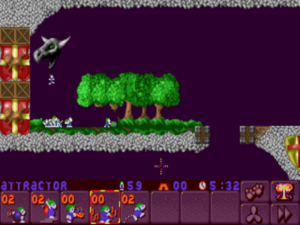
In this Medieval level, one lemming has become an “attractor”: a minstrel who entrances all the lemmings around him with his music, keeping them from marching onward. Meanwhile one of his colleagues is blazing a trail in front for the rest to eventually follow.

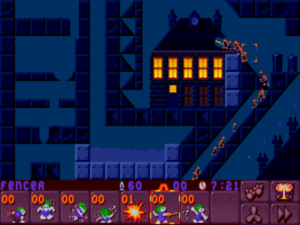
In this Shadow level, the lemming in front has become a “Fencer.” This allows him to dig out a path in front of himself at a slight upward angle. (Most of the skills in the game that at first seem bewilderingly esoteric actually do have fairly simple effects.)

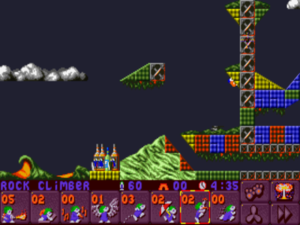
In this Circus level, one lemming has become a “rock climber”: a sort of super-powered version of an ordinary climber, who can climb even a canted wall like this one.

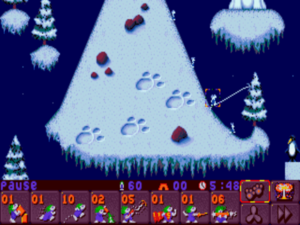
In this Polar level, a lemming has become a “roper,” making a handy tightrope up and over the tree blocking the path.

In this Space level, we’ve made a “SuperLem” who flies in the direction of the mouse cursor.


Other pieces of plumbing help to make Lemmings 2 feel like a real, holistic game rather than a mere series of puzzles. The first game, as you may recall, gives you an arbitrary number of lemmings which begin each level and an arbitrary subset of them which must survive it; this latter number thus marks the difference between success and failure. In the sequel, though, each tribe starts its first level with 60 lemmings, who are carried over through all of the levels that follow. Any lemmings lost on one level, in other words, don’t come back in the succeeding ones. It’s possible to limp to the final finish line with just one solitary survivor remaining — and, indeed, you quite probably will do exactly this with a few of the tribes the first time through. But it’s also possible to finish all but a few of the levels without killing any lemmings at all. At the end of each level and then again at the end of each tribe’s collection of levels, you’re awarded a bronze, silver, or gold star based on your performance. To wind up with gold at the end, you usually need to have kept every single one of the little fellows alive through all ten levels. There’s a certain thematic advantage in this: people often note how the hyper-cute original Lemmings is really one of the most violent videogames ever, requiring you to kill thousands and thousands of the cuties over its course. This objection no longer applies to Lemmings 2. But more importantly, it sets up an obsessive-compulsive-perfectionist loop. First you’ll just want to get through the levels — but then all those bronze and silver performances lurking in your past will start to grate, and pretty soon you’ll be trying to figure out how to do each level just that little bit more efficiently. The ultimate Lemmings 2 achievement, needless to say, is to collect gold stars across the board.

This tiered approach to success and failure might be seen as evidence of a kinder design sensibility, but in most other respects just the opposite is true; Lemmings 2 has the definite feel of a game for the hardcore. The first Lemmings does a remarkably good job of teaching you how to play it interactively over the course of its first twenty levels or so, introducing you one by one to each of its skills along with its potential uses and limitations. There’s nothing remotely comparable in Lemmings 2; it just throws you in at the deep end. While there is a gradual progression in difficulty within each tribe’s levels, the game as a whole is a lumpier affair, especially in the beginning. Each level gives you access to between one and eight of the 52 available skills, whilst evincing no interest whatsoever in showing you how to use any of them. There is some degree of thematic grouping when it comes to the skills: the Highland lemmings like to toss cabers; the beach lemmings are fond of swimming, kayaking, and surfing; the alpine lemmings often need to ski or skate. Nevertheless, the sheer number of new skills you’re expected to learn on the fly is intimidating even for a veteran of the first game. The closest Lemmings 2 comes to its predecessor’s training levels are a few free-form sandbox environments where you can choose your own palette of skills and have at it. But even here, your education can be a challenging one, coming down as it still does to trial and error.

Your first hours with the game can be particularly intimidating; as soon as you’ve learned how one group of skills works well enough to finish one level, you’re confronted with a whole new palette of them on the next level. Even I, a huge fan of the first game, bounced off the second one quite a few times before I buckled down, started figuring out the skills, and, some time thereafter, started having fun.

Luckily, once you have put in the time to learn how the skills work, Lemmings 2 becomes very fun indeed, — every bit as rewarding as the first game, possibly even more so. Certainly its level design is every bit as good — better in fact, relying more on logic and less on dodgy edge cases in the game engine than do the infamously difficult final levels of the first Lemmings. Even the spiky difficulty curve isn’t all bad; it can be oddly soothing to start on a new tribe’s relatively straightforward early levels after being taxed to the upmost on another tribe’s last level. If the first Lemmings is mountain climbing as people imagine it to be — a single relentless, ever-steeper ascent to a dizzying peak — the second Lemmings has more in common with the reality of the sport: a set of more or less difficult stages separated by more or less comfortable base camps. While it’s at least as daunting in the end, it does offer more ebbs and flows along the way.

One might say, then, that Lemmings 2 is designed around a rather literal interpretation of the concept of a sequel. That is to say, it assumes that you’ve played its predecessor before you get to it, and are now ready for its added complexity. That’s bracing for anyone who fulfills that criterion. But in 1993, the year of Lemmings 2‘s release, its design philosophy had more negative than positive consequences for its own commercial arc and for that of the franchise to which it belonged.

The fact is that Lemmings 2‘s attitude toward its sequel status was out of joint with the way sequels had generally come to function by 1993. In a fast-changing industry that was fast attracting new players, the ideal sequel, at least in the eyes of most industry executives, was a game equally welcoming to both neophytes and veterans. Audiovisual standards were changing so rapidly that a game that was just a couple of years old could already look painfully dated. What new player with a shiny new computer wanted to play some ugly old thing just to earn a right to play the latest and greatest?

That said, Lemmings 2 actually didn’t look all that much better than its predecessor either, flashy opening movie aside. Part of this was down to DMA Design still using the 1985-vintage Commodore Amiga, which was still very popular as a gaming computer in Britain and other European countries, as their primary development platform, then porting the game to MS-DOS and various other more modern platforms. Staying loyal to the Amiga meant working within some fairly harsh restrictions, such as that of having no more than 32 colors on the screen at once, not to mention making the whole game compact enough to run entirely off floppy disk; hard drives, much less CD-ROM drives, were still not common among European Amiga owners. Shortly before the release of Lemmings 2, David Jones confessed to being “a little worried” about whether people would be willing to look beyond the unimpressive graphics and appreciate the innovations of the game itself. As it happened, he was right to be worried.

Lemmings and Oh No! More Lemmings sold in the millions across a bewildering range of platforms, from modern mainstream computers like the Apple Macintosh and Wintel machines to antique 8-bit computers like the Commodore 64 and Sinclair Spectrum, from handheld systems like the Nintendo Game Boy and Atari Lynx to living-room game consoles like the Sega Master System and the Nintendo Entertainment System. Lemmings 2, being a much more complex game under the hood as well as on the surface, wasn’t quite so amenable to being ported to just about any gadget with a CPU, even as its more off-putting initial character and its lack of new audiovisual flash did it no favors either. It was still widely ported and still became a solid success by any reasonable standard, mind you, but likely sold in the hundreds of thousands rather than the millions. All indications are that the first game and its semi-expansion pack continued to sell more copies than the second even after the latter’s release.

In the aftermath of this muted reception, the bloom slowly fell off the Lemmings rose, not only for the general public but also for DMA Design themselves. The franchise’s true jump-the-shark moment ironically came as part of an attempt to re-jigger the creatures to become media superstars beyond the realm of games. The Children’s Television Workshop, the creator of Sesame Street among other properties, was interested in moving the franchise onto television screens. In the course of these negotiations, they asked DMA to give the lemmings more differentiated personalities in the next game, to turn them from anonymous marchers, each just a few pixels across, into something more akin to individualized cartoon characters. Soon the next game was being envisioned as the first of a linked series of no less than four of them, each one detailing the further adventures of three of the tribes after their escape from the island at the end of Lemmings 2, each one ripe for trans-media adaptation by the Children’s Television Workshop. But the first game of this new generation, called The Lemmings Chronicles, just didn’t work. The attempt to cartoonify the franchise was cloying and clumsy, and the gameplay fell to pieces; unlike Lemmings 2, Lemmings Chronicles eminently deserves its underwhelming critical reputation. DMA insiders like Mike Dailly have since admitted that its was developed more out of obligation than enthusiasm: “We were all ready to move on.” When it performed even worse than its predecessor, the Children’s Television Workshop dropped out; all of its compromises had been for nothing.

Released just a year after Lemmings 2, Lemmings Chronicles marked the last game in the six-game contract that DMA Design had signed with their publisher Psygnosis what seemed like an eternity ago — in late 1987 to be more specific, when David Jones had first come to Psygnosis with his rather generic outer-space shoot-em-up Menace, giving no sign that he was capable of something as ingenious as Lemmings. Now, having well and truly demonstrated their ingenuity, DMA had little interest in re-upping; they were even willing to leave behind all of their intellectual property, which the contract Jones had signed gave to Psygnosis in perpetuity. In fact, they were more than ready to leave behind the cute-and-cuddly cartoon aesthetic of Lemmings and return to more laddish forms of gaming. The eventual result of that desire would be a second, more long-lasting worldwide phenomenon, known as Grand Theft Auto.

Meanwhile Sony, who had acquired Psygnosis in 1993, continued off and on to test the waters with new iterations of the franchise, but all of those attempts evinced the same vague sense of ennui that had doomed Lemmings Chronicles; none became hits. The last Lemmings game that wasn’t a remake appeared in 2000.

It’s interesting to ask whether DMA Design and Psygnosis could have managed the franchise better, thereby turning it into a permanent rather than a momentary icon of gaming, perhaps even one on a par with the likes of Super Mario and Sonic the Hedgehog; they certainly had the sales to compete head-to-head with those other videogame icons for a few years there in the early 1990s. The obvious objection is that Mario and Sonic were individualized characters, while DMA’s lemmings were little more than a handful of tropes moving in literal lockstep. Still, more has been done with less in the annals of media history. If everyone had approached Lemmings Chronicles with more enthusiasm and a modicum more writing and branding talent, maybe the story would have turned out differently.

Many speculate today that the franchise must inevitably see another revival at some point, what with 21st-century pop culture’s tendency to mine not just the A-list properties of the past, but increasingly its B- and C-listers as well, in the name of one generation’s nostalgia and another’s insatiable appetite for kitsch. Something tells me as well that we haven’t seen the last of Lemmings, but, as of this writing anyway, the revival still hasn’t arrived.

As matters currently stand, then, the brief-lived but frenzied craze for Lemmings has gone down in history, alongside contemporaries like Tetris and The Incredible Machine, as one more precursor of the casual revolution in gaming that was still to come, with its very different demographics and aesthetics. But in addition to that, it gave us two games that are brilliant in their own right, that remain as vexing but oh-so-rewarding as they were in their heyday. Long may they march on.

One other surviving tribute to Dundee’s second most successful gaming franchise is this little monument at the entrance to the city’s Seabraes Park, erected by local artist Alyson Conway in 2013. Lemmings and Grand Theft Auto… not bad for a city of only 150,000 souls.

(Sources: the book Grand Thieves and Tomb Raiders by Magnus Anderson and Rebecca Levene; Compute! of January 1992; Amiga Format of May 1993 and the special 1992 annual; Retro Gamer 39; The One of November 1993; Computer Gaming World of July 1993.

Lemmings 2 has never gotten a digital re-release. I therefore make it available for download here, packaged to be as easy as possible to get running under DOSBox on your modern computer.)


Tags: , , ,

Games on the Mersey, Part 5: The Lemmings Effect

“Mummy, what’s a group of lemmings called?”

“A pact. That’s right, a suicide pact.”

“Mummy, when a lemming dies does it go to heaven like all good little girls?”

“Don’t be soft. They burn in hell — like distress flares.”

(courtesy of the January 1991 issue of The One)


If you had looked at the state of Psygnosis in 1990 and tried to decide which of their outside developers would break the mold of beautiful-but-empty action games, you would have no reason to single out DMA Design over any of the others. Certainly Menace and Blood Money, the two games DMA had already created for Psygnosis, gave little sign that any visionaries lurked within their ranks. From their generic teenage-cool titles to their rote gameplay, both games were as typical of Psygnosis as anything else in their catalog.

And yet DMA Design — and particularly their leader, David Jones — did in fact have abilities as yet undreamt of. People have a way of surprising you sometimes. And isn’t that a wonderful thing?


There are some interesting parallels between the early days of DMA Design and the early days of Imagine Software, that predecessor to Psygnosis. Like Imagine, DMA was born in a city far from the cultural capitals of Britain — even farther away than Liverpool, in fact, all the way up in Dundee, Scotland.

Dundee as well had traditionally been a working-class town that thrived as a seaport, until the increasing size of merchant ships gradually made the role untenable over the course of the twentieth century. Leaders in Dundee, as in Liverpool, worked earnestly to find new foundations for their city’s economy. And one of these vectors of economic possibility — yet again as in Liverpool — was electronics. Dundee convinced the American company National Cash Register Corporation, better known as NCR, to build their principal manufacturing plant for Britain and much of Europe there as early as 1945, and by the 1960s the city was known throughout Britain as a hub of electronics manufacture. Among the electronics companies that came to Dundee was Timex, the Norwegian/Dutch/American watchmaking conglomerate.

In 1980, Sinclair Research subcontracted out most of the manufacture of their new ZX80 home computer to the Timex plant in Dundee. The relationship continued with the ZX81, and then with Sinclair’s real heavy hitter, the Spectrum. By 1983, Timex was straining to keep up with demand for the little machines, hiring like mad in and around Dundee in order to keep the production lines rolling day and night.

David Jones. (It’s my understanding that the nose is removable.)

One of the people they hired was David Jones, 18 years old and fresh out of an experimental new “computer studies” program that was being pioneered in Dundee. He came to Timex on an apprenticeship, which paid for him to take more computer courses at nearby Kingsway Technical College.

Just as had Bruce Everiss’s Microdigital shop in Liverpool, Kingsway College was fomenting a hacking scene in Dundee, made up largely of working-class youths who but for this golden chance might have had to resign themselves to lives spent sweeping out warehouses. Both students of the college and interested non-students would meet regularly in the common areas to talk shop and, inevitably, to trade pirated games. Jones became one of the informal leaders of the collective. To ensure a steady supply of games for his mates, he even joined a cracking group in the international piracy “scene” who called themselves the Kent Team.

But for the most dedicated of the Kingsway gang, Jones among them, trading and playing games was a diversion rather than the real point. Like the gang as a whole, this hacker hardcore was of disparate temperaments and ages — one of them, named Mike Dailly, was just 14 years old when he started showing up at the college — but they were united by a certain seriousness about computers, by the fact that computers for them were, rather than just a hobby or even a potential means of making a living, an all-consuming passion. Unlike their more dilettantish peers, they were more interested in understanding how the games they copied worked and learning how to make their own than they were in playing them for their own sake.

In 1986, Sinclair sold their entire extant home-computer line to Amstrad, who promptly took the manufacturing of same in-house, leaving Timex out of a huge contract. Most of the Dundee plant’s employees, Jones among them, were laid off as a result. At the urging of his parents, he invested half of his £2000 severance check into a degree course in Computer Science at the Dundee College of Technology (now known as Abertay University). He used the other half to buy a Commodore Amiga.

Brand-new and pricey, the Amiga was still a very exotic piece of kit anywhere in Britain in 1986, much less in far-flung Dundee; Jones may very well have been the first person in his hometown to own one. His new computer made him more popular than ever among the Kingsway hackers. With the help of his best buddies from there and some others he’d met through the Kent Team, his experiments with his new toy gradually coalesced around making a shoot-em-up game that he could hopefully sell to a publisher.

David Jones first met Ian Hetherington and Dave Lawson of Psygnosis in late 1987, when he took his shoot-em-up-in-progress to a Personal Computer World Show to hawk it to potential publishers. Still at that age when the events of last year, much less those of three years ago, seem like ancient history, he had little awareness of their company’s checkered past as Imagine, and less concern about it. “You know, I don’t think I even researched it that well,” he says. “I remember the stories about it, but back in those days everything was moving so quickly, it never even crossed my mind.” Instead he was wowed, like so many developers, by Psygnosis’s cool good looks. The idea of seeing his game gussied up by the likes of Roger Dean was a difficult one to resist. He also liked the fact that Psygnosis was, relatively speaking, close to Dundee: only about half a day by car.

Menace

Psygnosis was perhaps slightly less impressed. They agreed to publish the game, running it through their legendary art department in the process, giving it the requisite Roger Dean cover, and changing the name from the Psygnosis-like Draconia to the still more Psygnosis-like Menace. But they didn’t quite judge it to be up to the standard of their flagship games, publishing it in a smaller box under a new budget line they were starting called Psyclapse (a name shared with the proposed but never-completed second megagame from the Imagine days).

Still, even at a budget price and thus a budget royalty rate, Menace did well enough to make Jones a very happy young man, selling about 20,000 copies in the still emerging European Amiga market. It even got a showcase spot in the United States, when the popular television program Computer Chronicles devoted a rare episode to the Amiga and Commodore’s representative chose Menace as the game to show off alongside Interplay’s hit Battle Chess; host Stewart Cheifet was wowed by the “really hot graphics.” A huge auto buff — another trait he shared with the benighted original founders of Imagine — Jones made enough from the game to buy his first new car. It was a Vauxhall Astra hot hatch rather than a Ferrari, but, hey, you had to start somewhere.

Even before Menace‘s release, he had taken to calling his informal game-development club DMA Design, a name that fit right in with Psygnosis’s effect-obsessed aesthetic: “DMA” in the computer world is short for “Direct Memory Access,” something the Amiga’s custom chips all utilized to generate audiovisual effects without burdening the CPU. (When the glory days of Psygnosis with Amiga tech-heads had passed, Jones would take to saying that the name stood for “Doesn’t Mean Anything.”) In the wake of Menace‘s success, he decided to drop out of college and hang up his shingle in a cramped two-room space owned by his fiancée’s father, located on a quiet street above a baby shop and across the way from a fish-and-chips joint. He moved in in August of 1989, bringing with him many of his old Kingsway College mates on a full-time or part-time basis, as their circumstances and his little company’s income stream dictated.

DMA’s first office, a nondescript place perched above a baby shop in Dundee. That’s artist Gary Timmons peering out the window. It was in this improbable location that the most successful game the British games industry had produced to date was born.

DMA, which still had more the atmosphere of a computer clubhouse than a conventional company, gladly took on whatever projects Psygnosis threw them, including the rather thankless task of converting existing Amiga titles — among them Shadow of the Beast — to more limited, non-Amiga platforms like the Commodore 64. Meanwhile Jones shepherded to completion their second original game, another typically Psygnosisian confection called Blood Money. This game came out as a full-price title, a sign that they were working their way up through the ranks. Even better, it sold twice as many copies as had Menace.

So, they charged ahead on yet another game cut from the same cloth. Just about everything you need to know about their plans for Gore is contained in the name. Should you insist on more information, consider this sample from a magazine preview of the work-in-progress: “Slicing an adversary’s neck in two doesn’t necessarily guarantee its defeat. There’s a chance the decapitated head will sprout wings and fly right back at you!” But then, in the midst of work on that charming creation, fate intervened to change everything forever for DMA and Psygnosis alike.

The process that would lead to the most popular computer game the nation of Britain had yet produced had actually begun months before, in fact within days of the DMA crew moving into their new clubhouse. It all began with an argument.

Blood Money was in the final stages of development at the time — it would be released before the end of 1989 — and, having not yet settled on making Gore, Jones and company had been toying with ideas for a potential sequel they tentatively called Walker, based around one of the characters in Blood Money, a war robot obviously inspired by the Imperial walkers in Star Wars: The Empire Strikes Back. Scott Johnson, an artist whom DMA had recently rescued from a life of servitude behind the counter of the local McDonald’s, said that the little men which the walker in the new game would shoot with its laser gun and crush beneath its feet would need to be at least 16 by 16 pixels in size to look decent. Mike Dailly, the Kingsway club veteran, disagreed, and set about trying to prove himself right by drawing them inside a box of just 8 by 8 pixels.

But once he got started drawing little men in Deluxe Paint, he just couldn’t stop. (Deluxe Paint did always tend to have that effect on people; not for nothing did artist George Christensen once call it “the greatest videogame ever designed.”) Just for fun, he added a ten-ton weight out of a Coyote-and-Road-Runner cartoon, which crushed the little fellows as they walked beneath it. Johnson soon jumped back into the fray as well, and the two wound up creating a screen-full of animations, mostly showing the little characters coming to various unhappy ends. Almost forgotten by the end of the day was the fact that Dailly had proved his point: a size of 8 by 8 pixels was enough.

This screen of Deluxe Paint animations, thrown together on a lark one afternoon by a couple of bored young men, would spawn a franchise which sold 15 million games.

It was another member of the DMA club, Russell Kay, who looked at the animations and spoke the fateful words: “There’s a game in that!” He took to calling the little men lemmings. It was something about the way they always seemed to be moving in lockstep and in great quantities across the screen whenever they showed up — and the way they were always blundering into whatever forms of imaginative deaths their illustrators could conjure up. The new name resulted in the appearance of the little men morphing into something not quite rodent-like but not quite human either, a bunch of vaguely Smurf-like fellows with bulbous noses and a cuteness people all over the world would soon find irresistible — even as they watched them die horribly by the dozens.

The very first lemmings


Did you know?

James Bond author Ian Fleming’s real name was in fact Ian Frank Lemming. It doesn’t take a genius to see how easily a mistake was made.

Success for Jane Lemming was always on the cards, but it took a change of name and hairstyle to become a top television personality — better known as Jan Leeming.

“One day you’ll be a big movie star,” someone once told leading Hollywood heartthrob Jack Lemmon (real name Jack Lemming). And he is.

(courtesy of the January 1991 issue of The One)

The actuality of real-world lemmings is in fact very different from the myth of little rodent soldiers following one another blindly off the side of a cliff. The myth, which may first have shown up in print in Cyril Kornbluth’s 1951 science-fiction story “The Marching Morons,” was popularized by Disney later in the decade, first in their cartoons and later in a purported nature documentary called White Wilderness, whose makers herded the poor creatures off a cliff while the cameras rolled.

While it has little to no basis in reality, the myth can be a difficult proposition to resist in terms of metaphor. Fans of Infocom’s interactive fiction may remember lemmings showing up in Trinity, where the parallel between lemmings marching off a cliff and Cold War nuclear brinkmanship becomes a part of author Brian Moriarty’s rich symbolic language. It’s safe to say, though, that no similarly rarefied thoughts about the creatures were swirling around DMA Design. They just thought they were really, really funny.


Despite Russell Kay’s prophetic comment, no one at DMA Design was initially in a hurry to do anything more with their lemmings than amuse themselves. For some months, the lemmings were merely a joke that was passed around DMA’s circle in Dundee in the form of pictures and animations, showing them doing various ridiculous things and getting killed in various hilarious ways.

In time, though, Jones found himself at something of an impasse with the Gore project. He had decided he simply couldn’t show all the gore he wanted to on a 512 K Amiga, but Psygnosis was extremely reluctant, despite the example of other recent releases like Dungeon Master, to let him make a game that required 1 MB of memory. He decided to shelve Gore for a while, to let the market catch up to his ambitions for it. In the meantime, he turned, almost reluctantly, to those lemmings that were still crawling all over the office, to see if there was indeed a game there. The answer, of course, would prove to be a resounding yes. There was one hell of a game there, one great enough to ensure that Gore would never cross anyone’s mind again.

The game which Jones started to program in June of 1990 was in one sense a natural evolution of the animations, so often featuring long lines of marching lemmings, that his colleagues had been creating in recent months. In another, though, it was a dramatic break from anything DMA — or, for that matter, Psygnosis — had done before, evolving into a constructive puzzle game rather than another destructive action game.

That said, reflexes and timing and even a certain amount of destruction certainly have their roles to play as well. Lemmings is a level-based game. The little fellows — up to 100 of them in all — pour out of a chute and march mindlessly across the level’s terrain from left to right. They’ll happily walk off cliffs or into vats of water or acid, or straight into whatever other traps the level contains. They’ll turn around and march in the other direction only if they encounter a wall or other solid barrier — and, once they start going from right to left instead of left to right, they won’t stop until they’re dead or they’re forced to turn around yet again. Your task is to alter their behavior just enough to get as many of them as possible safely to the level’s exit. Doing so often requires sacrificing some of them for the greater good.

To meet your goal, you have a limited but surprisingly flexible palette of possibilities at your disposal. You can change the behavior of individual lemmings by assigning them one or both of two special abilities, and/or by telling them to perform one of six special actions. The special abilities include making a lemming a “climber,” able to crawl up sheer vertical surfaces like a sort of inchworm; and making a lemming a “floater,” equipped with an umbrella-cum-parachute which will let him fall any distance without harm. The special actions include telling a lemming to blow himself up (!), possibly damaging the terrain around him in the process; turning him into a “blocker,” standing in one place and forcing any other lemmings who bump into him to turn around and march in the other direction; having him build a section of bridge — or, perhaps better said, of an upward-angling ramp; or having him dig in any of three directions: horizontally, diagonally, or vertically. Each level lets you use each special ability and each special action only a limited number of times. These restrictions are key to much of the challenge of the later levels; advanced Lemmings players become all too familiar with the frustration of winding up short by that one bridge-builder or digger, and having to start over with a completely new approach because of it.

In addition to the tools at your disposal which apply to individual lemmings, you also have a couple of more universal tools to hand. You can control the rate at which lemmings pour out of the entrance chute — although you can’t slow them down below a level’s starting speed — and you can pause the game to take a breather and position your cursor just right. The later levels require you to take advantage of both of these abilities, not least because each level has a time limit.


A Four-Screenshot Introduction to Lemmings

We’re about to begin one of the early levels — the first on the second difficulty level, or 31st out of 120 in all. We see the level’s name, the number of lemmings with which we have to deal, the number we’re required to save, their “release rate” — how quickly they fall out of the chute and into the world — and how much time we have.

Now we’ve started the level proper. We need to build a bridge to cross this gap. To keep the other lemmings from rushing after our slow-working bridge-builder and falling into the abyss, we’ve turned the one just behind him into a blocker. When we’re ready to let the lemmings all march onward, we can tell the blocker to blow himself up, thus clearing the way again. Note our toolbar at the bottom of the screen, including the count of how many of each type of action we have left.

With the gap safely bridged, we turn our lead lemming into a horizontal digger — or “basher” in the game’s preferred nomenclature — to get through the outcropping.

There were no other barriers between our lead lemming and the exit. So, we’ve blown up our blocker to release the hounds — er, lemmings — and now watch them stream toward the exit. We’ve only lost one lemming in total, that one being our poor blocker — a 99-percent survival rate on a level that only required us to save 50 percent. But don’t get too cocky; the levels will soon start getting much, much harder.


Setting aside design considerations for the moment, Lemmings is nothing short of an amazing feat in purely technical terms. Its levels, which usually sprawl over the width of several screens, consist entirely of deformable terrain. In other words, you can, assuming you have the actions at your disposal, dig wherever you want, build bridges wherever you want, etc., and the lemmings will interact with the changed terrain just as you would expect. To have the computer not just paint a landscape onto the screen but to be aware of and reactive to the potentially changing contents of every single pixel was remarkable in the game’s day. And then to move up to 100 independent lemmings in real time, while also being responsive to the player’s inputs… Lemmings is a program any hacker would be thrilled to claim.

As soon as he had the basic engine up and running, David Jones visited Psygnosis with it and “four or eight” levels in tow, to show them what he was now planning to turn into DMA’s next game. Jones:

They were a big company, probably about thirty or forty people. I said, “I’ll just go out to lunch, but what I’ll do is I’ll just leave the demo with a bunch of you here — grab it, play it, see what you think.” I remember coming back from lunch and it was on every single machine in the office. And everybody was just really, really enjoying it. At that time I thought, “Well, we have something really special here.”

That reaction would become typical. In an earlier article, I wrote about a Tetris Effect, meant to describe the way that game took over lives and destroyed productivity wherever it went. We might just as well coin the term “Lemmings Effect” now to describe a similar phenomenon. Part and parcel of the Lemmings Effect were all the terrible jokes: “What do lemmings drink?” “Lemmingade!” “What’s their favorite dessert?” “Lemming meringue pie!”

Following its release, Lemmings would be widely greeted as an immaculate creation, a stroke of genius with no antecedents. Our old friend Bruce Everiss, not someone inclined to praise anything Ian Hetherington was involved in without ample justification, nevertheless expressed the sentiment in his inimitably hyperbolic way in 1995:

In the worlds of novels and cinema, it is recognised that there are only a small number of plots in the universe. Each new book or film takes one of these plots and interprets it in a different way.

So it is in computer games. Every new title has been seen in many different guises; it is merely the execution that is new. The Amiga unleashed new levels of sound, graphics, and computer power on the home market. Software titles utilised these capabilities in some amazing packages, but they were all just re-formulations of what had gone before.

Until Lemmings. DMA Design created a totally new concept. In computer games this is less common than rocking-horse manure. Not only was the concept of Lemmings completely new, but also the execution was exemplary, displaying the Amiga’s capabilities well.

Lemmings is indeed a shockingly original game, made all the more shocking by coming from a developer and a publisher that had heretofore given one so little reason to anticipate originality. Still, if we join some of the lemmings in digging a bit beneath the surface, we can in fact see a source for some of the ideas that went into it.

David Jones and his colleagues were fanatic devotees of Peter Molyneux’s Populous before and during their work on Lemmings. Populous, like Lemmings, demands that you control a diffuse mass of actors through somewhat indirect means, by manipulating the environment and changing the behavior of certain individuals in the mass. Indeed, Lemmings has a surprising amount in common with Populous, even as the former is a puzzle game of rodent rescue and the latter a strategy game of Medieval warfare. Jones and company went so far as to add a two-player mode to Lemmings in homage to the Populous tournaments that filled many an evening spent in the clubhouse above the baby shop. (In the case of Lemmings, however, the two-player mode wouldn’t prove terribly popular, not least because it required a single Amiga equipped with two mice; unique and entertaining, it’s also largely forgotten today, having been left out of the sequels and most of the ports.)

Although it’s seldom if ever described using the name, Lemmings thus fits into a group of so-called “god games” that were coming to the fore at the turn of the decade; in addition to Populous, the other famous exemplar from the time is Will Wright’s SimCity. More broadly, it also fits into a longstanding British tradition of spatial puzzle games, as exemplified by titles like The Sentinel.

The Lemmings level editor

But one area where David Jones and company wisely departed from the model of Populous and The Sentinel was in building all of the levels in Lemmings by hand. British programmers had always had a huge fondness for procedural generation, which suited both the more limited hardware they had to work with in comparison to their American peers and the smaller teams in which they generally worked. Jones bucked that precedent by building a level editor for Lemmings as soon as he had the game engine itself working reasonably well. The gang in and around the clubhouse all spent time with the level editor, coming up with devious creations. Once a week or so, they would vote on the best of them, then upload these to Psygnosis.

Belying their reputation for favoring style over substance, Psygnosis had fallen in love with the game of Lemmings from the day of Jones’s first visit with his early demo in tow. It had won over virtually everyone who worked there, gamer and non-gamer alike. That fact became a key advantage for the work-in-progress. Everyone in Liverpool would pile on to play the latest levels as they were sent over from Dundee, faxing back feedback on which ones should make the cut and how those that did could be made even more interesting. As the game accelerated toward completion, Jones started offering a £10 bounty for every level that passed muster with Psygnosis, leading to yet more frenzied activity in both Dundee and Liverpool. Almost accidentally, DMA and Psygnosis had hit upon a way of ensuring that Lemmings would get many times the play-testing of the typical game of its era, all born of the fact that everyone was dying to play it — and dying to talk about playing it, dying to explain how the levels could be made even better. The results would show in the finished product. Without the 120 lovingly handcrafted levels that shipped with the finished game, Lemmings would have been an incredible programming feat and perhaps an enjoyable diversion, but it could never have been the sensation it became.

Just as the quality of the levels was undoubtedly increased immeasurably by the huge willing testing pool of Psygnosis staffers, their diversity was increased by having so many different personalities making them. Even today, those who were involved in making the game can immediately recognize a level’s author from its design and even from its graphical look. Gary Timmons, a DMA artist, became famed, oddly enough given his day job, for his minimalist levels that featured little but the bare essentials needed to fulfill their functions. Mike Dailly, at the other extreme, loved to make his levels look “pretty,” filling them with colors and patterns that had nothing to do with the gameplay. The quintessential examples of Dailly’s aesthetic were a few special levels which were filled with graphics from the earlier Psygnosis games Shadow of the Beast I and II, Awesome, and DMA’s own Menace.

Awesome meets Lemmings. For some reason, I find the image of all these little primary-colored cartoon lemmings blundering through these menacing teenage-cool landscapes to be about the funniest — and certainly the most subversive — thing in the entire game.

But of course the most important thing is how the levels play — and here Lemmings only rarely disappoints. There are levels which play like action games, demanding perfect clicking and good reflexes above all; there are levels which play like the most cerebral of strategy games, demanding perfect planning followed by methodical execution of the plan. There are levels where you need to shepherd a bare handful of lemmings through an obstacle course of tricks and traps without losing a single one; there are levels where you have 100 lemmings, and will need to kill 90 percent of them in order to get a few traumatized survivors to the exit. There are levels which are brutally compressed, where you have only one minute to succeed or fail; there are levels which you give you fully nine minutes to guide your charges on a long journey across several screens worth of terrain.

One of the most remarkable aspects of Lemmings is the way it takes the time to teach you how to play it. The very first level is called “Just Dig!,” and, indeed, requires nothing more of you. As you continue through the first dozen levels or so, the game gradually introduces you to each of the verbs at your command. Throughout the levels that follow, necessity — that ultimate motivator — will force you to build upon what you already know, learning new tricks and new combinations. But it all begins gently, and the progression from rank beginner to master lemming-herder feels organic. Although the general trajectory of the difficulty is ever upward as you work your way through the levels, there are peaks and valleys along the way, such that a level that you have to struggle with for an hour or two will usually be followed by one or two less daunting challenges.

All of this has since become widely accepted as good design practice, but games in 1990 were very seldom designed like this. Looking for contemporaneous points of comparison, the best I can come up with is a game in a very different genre: the pioneering real-time dungeon-crawler Dungeon Master, which also gently teaches you how to play it interactively, without ever resorting to words, and then slowly ramps up the difficulty until it becomes very difficult indeed. Dungeon Master and Lemmings stand out in gaming history for not only inventing whole new paradigms of play, but for perfecting them in the same fell swoop. Just as it’s difficult to find a real-time dungeon crawler that’s better than Dungeon Master, you won’t find a creature-herding puzzle game that’s better than the original Lemmings without looking long and hard.

If I was to criticize anything in Lemmings, I’d have to point to the last handful of levels. For all its progressive design sensibilities, Lemmings was created in an era when games were expected to be hard, when the consensus view had it that actually beating one ought to be a monumental achievement. In that spirit, DMA pushed the engine — not to mention the player — to the ragged edge and perhaps a little beyond in the final levels. A blogger named Nadia, who took upon herself the daunting task of completing every single level in every single Lemmings game and writing about them all, described the things you need to do to beat many of these final levels as “exploiting weird junk in the game engine.” These levels are “the wrong kind of difficult,” she goes on to say, and I agree. Ah, well… at least the very last level is a solid one that manages to encompass much of what has come before, sending the game out on a fine note.

Here we see one of the problems that dog the final levels. There are 49 lemmings packed together in a tiny space. I have exactly one horizontal dig at my disposal, and need to apply it to a lemming pointing to the right so the group can make its exit, but there’s no possible way to separate one lemming from another in this jumble. So, I’m down to blind luck. If luck isn’t with me — if the lemming I wind up clicking on is pointed in the wrong direction — I have to start the level over through no fault of my own. It will then take considerable time and effort to arrive back at this point and try again. This sort of situation is sometimes called “fake difficulty” — difficulty that arises from the technical limitations of the interface or the game engine rather than purer design considerations. It is, needless to say, not ideal.

To modern ears, taking this ludic masterpiece from nothing to finished in less than a year sounds like an incredible feat. Yet that was actually a fairly long development cycle by the standards of the British games industry of 1990. Certainly Psygnosis’s marketers weren’t entirely happy about its length. Knowing they had something special on their hands, they would have preferred to release it in time for Christmas. Thankfully, better sense prevailed, keeping the game off the market until it was completely ready.

As Lemmings‘s February 1991 release date approached, Psygnosis’s marketers therefore had to content themselves with beating the hype drum for all it was worth. They sent early versions to the magazines, to enlist them in building up the buzz about the game. One by one, the magazines too fell under the thrall of the Lemmings Effect. Amiga Format would later admit that they had greeted the arrival of the first jiffy bag from Psygnosis with little excitement. “Some snubbed it at first,” they wrote, “saying that they didn’t like puzzlers, but in the end the sound of one ‘Oh, no!’ would turn even the most hardened cynic into an addict.”

When a journalist from the American magazine .info visited Liverpool, he went to a meeting where Psygnosis showed the game to their distributors for the first time. The reaction of these jaded veterans of the industry was as telling as had been the Lemmings Effect that had swept through all those disparate magazine offices. “They had to be physically torn away from the computers,” wrote .info, “and crowds of kibitzers gathered to tell the person playing how to do it.” When an eight-level demo version of the game went out on magazine cover disks a few weeks before the launch, the response from the public at large was once again in David Jones’s words “tremendous,” prompting the usually cautious Psygnosis — the lessons of the Imagine days still counted with Ian Hetherington — to commit to an initial pressing that was far larger than they had done for any game before.

And yet it wasn’t anywhere near large enough. When Lemmings was released on Valentine’s Day, 1991, its first-day sales were unprecedented for Psygnosis, who were, for all their carefully cultivated cool, still a small publisher in a big industry. Jones remembers Ian Hetherington phoning him up hourly to report the latest numbers from the distributors: 40,000 sold, 50,000 sold. On its very first day, the game sold out all 60,000 copies Psygnosis had pressed. To put this number in perspective, consider that DMA’s Menace had sold 20,000 copies in all, Blood Money had sold 40,000 copies, and a game which sold 60,000 copies over its lifetime on the Amiga was a huge success by Psygnosis’s usual standards. Lemmings was a success on another level entirely, transforming the lives literally overnight of everyone who had been involved in making it happen. Psygnosis would struggle for months to turn out enough copies to meet the insatiable demand.

Unleashed at last to write about the game which had taken over their offices, the gaming press fell over themselves to praise it; it may have been only February, but there was no doubt what title was destined to be game of the year. The magazine The One felt they needed five pages just to properly cover all its nuances — or, rather, to gush all over them. (“There’s only one problem with Lemmings: it’s too addictive by half. Don’t play it if you have better things to do. You won’t ever get round to doing them.”) ACE openly expressed the shock many were feeling: shock that this hugely playable game could have come out of Psygnosis. It felt as if all of the thinking about design that they could never be bothered to do in the past had now been packed into this one release.

And as went the British Amiga scene, so went Europe and then the world. The game reached American shores within weeks, and was embraced by the much smaller Amiga scene there with the same enthusiasm their European peers had evinced. North American Amiga owners had seen their favored platform, so recently the premiere gaming computer on their continent as it still was in Europe, falling out of favor over the course of the previous year, with cutting-edge releases like Wing Commander appearing first on MS-DOS and only later making their way — and in less impressive versions at that — to the Amiga. Lemmings would go down in history as a somewhat melancholy milestone: as one of the last Amiga games to make American owners of other computers envious.

But then, Psygnosis had no intention of keeping a hit like this one as an Amiga exclusive for very long. Within months, an MS-DOS version was available. Amiga owners didn’t hesitate to point out its failings in comparison to the original — the controls weren’t quite right, they insisted, and the unique two-player mode had been cut out entirely — but the game’s charms were still more than intact enough. It was in MS-DOS form that Lemmings really conquered North America, thus belatedly fulfilling for Ian Hetherington, last man standing at Psygnosis from the Imagine days, the old Imagine dream of becoming a major player on the worldwide software stage. In 1992, the magnitude of their newfound success in North America led Psygnosis to open their first branch office in Boston. The people who worked there spent most of their time answering a hint line set up for the hundreds of thousands — soon, millions, especially after the game made its way to Nintendo consoles — of frazzled Americans who were hopelessly stymied by this or that level.

Britain was the country that came the closest to realizing the oft-repeated ambition of having its game developers treated like rock stars. DMA Design was well-nigh worshiped by Amiga owners in the wake of Lemmings. Here they appear in a poster inserted into a games magazine, ready to be pasted onto a teenage girl’s wall alongside her favorite boy bands. Well, perhaps a really nerdy teenage girl’s wall. Hey, it could happen…

There was talk for some time of polishing up David Jones’s in-house level editor and turning it into a Lemmings Construction Kit, but Psygnosis soon decided that they would rather sell their customers more content in the form of add-on disks than a way of making their own levels. Addicts looking for their next fix could thus get their hands on Oh, No! More Lemmings before the end of 1991, with 100 more levels on offer. This collection had largely been assembled from the cast-offs that hadn’t quite made the cut for the first game, and the reasons why weren’t that hard to sense: these levels were hard, and a little too often in that same cheap way as some of the final levels from the original. Still, it served the purpose, delivering another huge hit. That Christmas, Psygnosis gave away Xmas Lemmings, a free demo disk with a few levels re-skinned for the holiday season. They hit upon a magical synergy in doing so; the goofy little creatures, now dressed in Santa suits, went together perfectly with Christmas, and similar disks would become a tradition for several more holiday seasons to come.

This insertion of Lemmings into the cozy family atmosphere of Christmas is emblematic of the game’s appeal to so many outside the usual hardcore-gamer demographic. Indeed, Lemmings joined Tetris during this period in presaging the post-millennial casual-game market. Perhaps even more so than Tetris, it has most of the important casual traits: it’s eminently approachable, easy to learn, bright and friendly in appearance, and thoroughly cute. Granted, it’s cute in an odd way that doesn’t reward close thinking overmuch: the lemmings are after all exploding when they pipe up with their trademark “Oh, no!,” and playing the game for any length of time entails sending thousands upon thousands of the little buggers to their deaths. And yet cute it somehow manages to be.

One important quality Lemmings shares with Tetris is the way it rewards whatever level of engagement you care to give it. The early levels can be blundered through by anyone looking for a few minutes’ diversion — stories abounded of four-year-olds managing the training levels — but the later ones will challenge absolutely anyone who tackles them. Likewise, the level-based structure means Lemmings can be used to fill a coffee break or a long weekend, as you wish. This willingness to meet players on their own terms is another of the traits of gaming’s so-called “casual revolution” to come. It’s up to you to get off the train wherever interest and dedication dictate.

But those aspects of the Lemmings story — and with them the game’s full historical importance — would be clearly seen only years in the future. In the here and now, DMA had more practical concerns. David Jones abandoned the clubhouse above the baby shop for much larger digs, hired more staff, and went back to the grindstone to deliver a full-fledged sequel. He didn’t, however, neglect to upgrade his lifestyle to match his new circumstances, including the requisite exotic sports car.

Unlike the old guard of Imagine Software, Jones could actually afford his excesses. When all the sales of all the sequels that would eventually be released are combined with those of the original, the total adds up to some 15 million games sold, making Lemmings by far the biggest gaming property ever to be born on the Amiga and the biggest to be born in Britain prior to Grand Theft Auto — a series which, because the success of Lemmings apparently hadn’t been enough for them, the nucleus of DMA Design would later be responsible for as well.

Meanwhile Psygnosis, now The House That Lemmings Built, also found larger offices, in Liverpool’s Brunswick Business Park, and began to cautiously indulge in a bit more excess of their own. Ian Hetherington was the only Imagine veteran still standing, but never mind: games on the Mersey had finally come of age thanks to a game from — of all places! — Dundee.

(Sources: the book Grand Thieves and Tomb Raiders: How British Videogames Conquered the World by Rebecca Levene and Magnus Anderson and Sinclair and the “Sunrise” Technology: The Deconstruction of a Myth by Ian Adamson and Richard Kennedy; the 1989 episode of Computer Chronicles entitled “The Commodore Amiga”; The One of June 1989, March 1990, September 1990, and January 1991; .info of November 1990 and February 1991; Amiga Format of May 1993 and July 1995, and the annual for 1992; The Games Machine of June 1989; ACE of April 1991; Amiga World of June 1991; Amazing Computing of April 1991 and March 1992; the online articles “From Lemmings to Wipeout: How Ian Hetherington Incubated Gaming Success” from Polygon, “The Psygnosis Story: John White, Director of Software” from Edge Online, and “An Ode to the Owl: The Inside Story of Psygnosis” from Push Square; “Playing Catch Up: GTA/Lemmings‘ Dave Jones” from Game Developer; Mike Dailly’s “Complete History of DMA Design.” My thanks also go to Jason Scott for sharing his memories of working at Psygnosis’s American branch office in the early 1990s.

If you haven’t played Lemmings before, you’ve been missing out; this is one game everyone should experience. Feel free to download the original Amiga version from here. Amiga Forever is an excellent, easy-to-use emulation package for running it. For those less concerned about historical purity, there are a number of versions available to play right in your browser.)


Tags: , , ,

Games on the Mersey, Part 4: The All-Importance of Graphics

The die for the first successful incarnation of Psygnosis was cast in the summer of 1987 with the release of a game called Barbarian. It was actually the company’s fourth game, following Brataccas, that underwhelming fruition of Imagine Software’s old megagame dream, and two other titles which had tried to evoke some of the magic of games from other publishers and rather resoundingly failed: Arena, an unfun alternative to the Epyx Games sports series, and Deep Space, a vaguely Elite-like game of interstellar trading and space combat saddled with a control scheme so terrible that many buyers initially thought it was a bug. None of this trio, needless to say, had done much for Psygnosis’s reputation. But with Barbarian the company’s fortunes finally began to change. It provided them at last with just the formula for commercial success they had been so desperately seeking.

Barbarian

Programmed by the redoubtable Dave Lawson, Barbarian might be labeled an action-adventure if we’re feeling generous, although it offers nothing like the sort of open-ended living world other British developers of the era were creating under that label. It rather takes the form of a linear progression through a series of discrete screens, fighting monsters and dodging traps as the titular barbarian Hegor. The control scheme — for some reason a consistent sore spot in almost every game Lawson programmed — once again annoys more than it ought to, and the game as a whole is certainly no timeless classic. What it did have going for it back in the day, however, were its superb graphics and sound. Released initially only on the Atari ST and the Commodore Amiga, just as the latter especially was about to make major inroads in Britain and Europe thanks to the new Amiga 500 model, it was one of the first games to really show what these 16-bit powerhouses could do in the context of a teenage-boy-friendly action game. Reviewers were so busy gushing about the lengthy opening animation, the “strange-looking animals,” and the “digitised groans and grunts” that accompanied each swing of Hegor’s sword as he butchered them that they barely noticed the game’s more fundamental failings.

Barbarian became the first unadulterated, undeniable hit to be created by the Imagine/Psygnosis nexus since Dave Lawson’s Arcadia had kicked everything off on the Sinclair Spectrum almost five years before. Thus was a precedent set. Out were the old dreams of revolutionizing the substance of gaming via the megagame project; in were simple, often slightly wonky action games that looked absolutely great to the teenage boys who devoured them. If Lawson and Ian Hetherington were disappointed to have abandoned more high-concept fare for simple games with spectacular visuals, they could feel gratified that, after all the years of failure and fiasco as Imagine, Finchspeed, Fireiron, and finally Psygnosis, they were at last consistently making games that made them actual money.

Psygnosis’s first games had been created entirely in-house, with much of the design and coding done by Lawson and Hetherington themselves. In the wake of Barbarian‘s success, however, that approach was changed to prioritize what was really important in them. After the games already in the pipeline at the time of Barbarian‘s release were completed, future programming and design — such as the latter was in the world of Psygnosis — would mostly be outsourced to the hotshot young bedroom coders with which Britain was so amply endowed.

Psygnosis hired far more artists rather than programmers as in-house employees. They built an art team that became the envy of the industry around one Garvan Corbett, a talented illustrator and animator who had come to Psygnosis out of a workfare program in the very early days, before even Brataccas had been released, and who had been responsible for the precedent-setting graphics in Barbarian. Notably, none of Psygnosis’s artists had much prior experience with computers; the company preferred to hire exceptional artists in traditional mediums and teach them what they needed to know to apply their skills to computer games. It gave Psygnosis’s games a look that was, if not quite what one might describe as more mature than the rest of the industry, certainly more striking, more polished. Working with Amigas running the games-industry stalwart Deluxe Paint, Corbett and his colleagues would build on the submissions of the outside teams to bring them in line with Psygnosis’s house style, giving the in-game graphics that final sheen for which the company was so famous whilst also adding the elaborate title screens and opening animations for which they were if anything even more famous. Such a hybrid of in-house and out-of-house development was totally unique in late-1980s game-making, but it suited Psygnosis’s style-over-substance identity perfectly. “At Psygnosis, graphics are all-important,” wrote one journalist as his final takeaway after a visit to the company. Truer words were never written.

With the assistance of an ever-growing number of outside developers, the games poured out of Psygnosis in the years after Barbarian, sporting short, punchy titles that sounded like heavy-metal bands or Arnold Schwarzenegger movies, both of which things served as a profound influence on their young developers: Terrorpods, Obliterator, Menace, Baal, Stryx, Blood Money, Ballistix, Infestation, Anarchy, Nitro, Awesome, Agony. Occasionally Psygnosis would tinker with the formula, as when they released the odd French adventure game Chrono Quest, but mostly it was nothing but relentless action played over a relentlessly thumping soundtrack. An inordinate number of Psygnosis games seemed to feature tentacled aliens that needed to be blown up with various forms of lasers and high explosives. In light of this, even the most loyal Psygnosis fan could be forgiven for finding it a little hard to keep them all straight. Many of the plots and settings of the games would arrive on the scene only after the core gameplay had been completed, when Psygnosis’s stable of artists were set loose to wrap the skeletons submitted by the outside developers in all the surrealistic gore and glory they could muster. Such a development methodology couldn’t help but lend the catalog as a whole a certain generic quality. Yet it did very, very well for the company, as the sheer number of games they were soon churning out — nearly one new game every other month by 1989 — will attest.

Psygnosis’s favored machine during this era was the Amiga, where their aesthetic maximalism could be deployed to best effect. They became known among owners of Amigas and those who wished they were as the platform’s signature European publisher, the place to go for the most impressive Amiga audiovisuals of all. This was the same space occupied by Cinemaware among the North American publishers. It thus makes for an interesting exercise to compare and contrast the two companies’ approaches.

In the context of the broader culture, few would have accused Cinemaware’s Bob Jacob, a passionate fan of vintage B-movies, of having overly sophisticated tastes. Yet, and often problematic though they admittedly were in gameplay terms, Cinemaware’s games stand out next to those of Psygnosis for the way they use the audiovisual capabilities of the Amiga in the service of a considered aesthetic, whether they happen to be harking back to the Robin Hood of Errol Flynn in Defender of the Crown or the vintage Three Stooges shorts in the game of the same name. There was a coherent and unique-to-it sense of aesthetic unity behind each one of Cinemaware’s games, as indicated by the oft-mocked title Jacob created for the person tasked with bringing it all together: the “computographer,” who apparently replaced the cinematographer of a movie.

Psygnosis games, in contrast, had an aesthetic that could be summed up in the single word “more”: more explosions, more aliens, more sprites flying around, more colors. This was aesthetic maximalism at its most maximalist, where the impressiveness of the effect itself was its own justification. Psygnosis’s product-development manager John White said that “half the battle is won if the visuals are interesting.” In fact, he was being overly conservative in making that statement; for Psygnosis, making the graphics good was actually far more than half the battle that went into making a game. Ian Hetherington:

We always start with a technical quest — achieving something new with graphics. We have to satisfy ourselves that what we are trying to achieve is possible before we go ahead with a game. My worst moments are when I show innovative techniques to the Japanese, and all they want to know is, what is the plot. They don’t understand our way of going about things.

The Japanese approach, as practiced by designers like the legendary Shigeru Miyamoto, would lead to heaps of Nintendo Entertainment System games that remain as playable today as they were in their heyday. The Psygnosis approach… not so much. In fact, Psygnosis’s games have aged almost uniquely poorly among their peers. While we can still detect and appreciate the “computography” of a Cinemaware interactive movie, Psygnosis games hit us only with heaps of impressive audiovisual tricks that no longer impress. Their enormous pixels and limited color palettes — yes, even on an audiovisual powerhouse of the era like the Amiga — now make them look quaint rather than awe-inspiring. Their only hope to move us thus becomes their core gameplay — and gameplay wasn’t one of Psygnosis’s strengths. Tellingly, most Psygnosis games don’t sport credited designers at all, merely programmers and artists who cobbled together the gameplay in between implementing the special effects. An understanding of what people saw in all these interchangeable games with the generic teenage-cool titles therefore requires a real effort of imagination from anyone who wasn’t there during the games’ prime.

The success of Psygnosis’s games was inextricably bound up with the platform patriotism that was so huge a part of the computing scene of the 1980s. What with the adolescent tendency to elevate consumer lifestyle choices to the status of religion, the type of computer a kid had in his bedroom was as important to his identity as the bands he liked, the types of sports cars he favored, or the high-school social set he hung out with — or possibly all three combined. Where adults saw just another branded piece of consumer electronics, he saw a big chunk of his self-image. It was deeply, personally important to him to validate his choice by showing off his computer to best effect, preferably by making it do things of which no other computer on the market was capable. For Amiga owners in particular, the games of Psygnosis fulfilled this function better than those of any other publisher. You didn’t so much buy a Psygnosis game to play it as you did to look at it, and to throw it in the face of any of your mates who might dare to question the superiority of your Amiga. A Psygnosis game was graphics porn of the highest order.

But Psygnosis’s graphics-über-alles approach carried with it more dangers than just that of making games whose appeal would be a little incomprehensible to future generations. Nowhere was the platform patriotism that they traded on more endemic than in the so-called “scene” of software piracy, whose members had truly made the computers they chose to use the very center of their existence. And few games were more naturally tempting targets for these pirates than those of Psygnosis. After all, what you really wanted out of a Psygnosis game was just a good look at the graphics. Why pay for that quick look-see when you could copy the disk for free? Indeed, cracked versions of the games were actually more appealing than the originals in a way, for the cracking groups who stripped off the copy protection also got into the habit of adding options for unlimited lives and other “trainers.” By utilizing them, you could see everything a Psygnosis game had to offer in short order, without having to wrestle with the wonky gameplay at all.

It was partially to combat piracy that Psygnosis endeavored to make the external parts of their games’ presentations as spectacular — and as appealing to teenage sensibilities — as the graphics in the games themselves. Most of their games were sold in bloated oblong boxes easily twice the size of the typical British game box — rather ironically so, given that few games had less need than those of Psygnosis for all that space; it wasn’t as if there was a burning need for lengthy manuals or detailed background information to accompany such simple, generic shoot-em-ups. Virtually all of Psygnosis’s covers during this era were painted by Roger Dean, the well-known pop artist with whom Ian Hetherington and Dave Lawson had first established a relationship back in the Imagine days. “If you’re asking so much for a piece of software,” said Hetherington, “you can’t package it like a Brillo pad.”

Dean’s packaging artwork was certainly striking, if, like most things associated with Psygnosis during this period, a little one-note. Not a gamer himself, Dean had little real concept of the games he was assigned, for which he generally drew the cover art well before they had been completed anyway. He usually had little more to go on than the name of the game and whatever said name might happen to suggest to his own subconscious. The results were predictable; the way that Psygnosis’s covers never seemed to have anything to do with the games inside the boxes became a running joke. No matter: they looked great in their own right, just begging to be hung up in a teenager’s bedroom. In that spirit, Psygnosis took to including the cover art in poster or tee-shirt form inside many of those cavernous boxes of theirs. Whatever else one could say about them, they knew their customers.

It’s difficult to exaggerate the role that image played in every aspect of Psygnosis’s business. Some of the people who wound up making games for them, who were almost universally in the same demographic group as those who played their games, were first drawn to this particular publisher by the box art. “I was always a fan of the art style and the packaging,” remembers outside developer Martin Edmondson. “Against a sea of brightly-colored and cheap-looking game boxes the Psygnosis products stood out a mile and had an air of mystery — and quality — about them.” Richard Browne, who became a project manager at Psygnosis in early 1991, noted that “while many of the games they produced were renowned somewhat for style over substance, they just oozed quality and the presentation was just sheer class.”

The quintessential Psygnosis game of the period between 1987 and 1990 is undoubtedly the 1989 release Shadow of the Beast. The company’s most massively hyped title since the days of Brataccas and the Imagine megagames, it differed from them by rewarding its hypers with sales to match. It was the creation of a three-man development studio who called themselves Reflections, who had already created an earlier hit for Psygnosis in the form of Ballistix. Unusually among Psygnosis’s outside developers, Reflections created all of their own graphics, outsourcing only the music and of course the Roger Dean cover art. Martin Edmondson, the leader of the Reflections trio, makes no bones about their priorities when creating Shadow of the Beast:

For me, it was about the technical challenge of getting something working that was far beyond the theoretical limits of the machine. It wasn’t a story originally. It was a technical demonstration of what the machine could do — I suppose sort of a “look how clever we are” type of thing. So, yeah… less interested in the subtleties of game design and game process, more “let’s see if we can do what these big expensive arcade machines are doing on our small home computer.”

Edmondson describes the book that most inspired Shadow of the Beast not as any work of fiction but rather the Amiga Technical Reference Manual. Every element of the game was crafted with the intention of pushing the hardware described therein to heights that had only been hinted at even in Psygnosis’s own earlier works. Barely two years after Shadow of the Beast‘s release, Edmondson’s assessment of its design — or perhaps lack thereof — was unflinching: “We couldn’t get away with it now. It was definitely a case of being in the right place at the right time. Apart from how many colors and layers of parallax and monsters we could squeeze on screen, no thought went into it whatsoever.” Its general approach is similar to that of the earlier Barbarian, but it’s a much more constrained experience than even that game had been. As the landscape scrolls behind your running avatar, you have to execute a series of rote moves with pinpoint timing to avoid seeing him killed. It’s brutally difficult, and difficult in ways that really aren’t much fun at all.

But, as Edmondson himself stated, to complain overmuch about the gameplay of Shadow of the Beast is to rather miss the point of the game. While plenty of praise would be given to the atmospheric soundtrack Psygnosis commissioned from veteran game composer David Whittaker and to the unprecedentedly huge sprites programmed by Reflections, the most attention of all would be paid to the thirteen layers of parallax scrolling that accompany much of the action.

Parallax scrolling is a fancy phrase used to describe the simulation of a real-world property so ingrained in us that we rarely even realize it exists — until, that is, we see a videogame that doesn’t implement it. Imagine you’re standing at the edge of a busy highway on a flat plain, with a second highway also in view beyond this one, perhaps half a kilometer in the distance. Cars on the highway immediately before you whiz by very quickly, perhaps almost too quickly to track with the eyes. Those on the distant highway, however, appear to move through your field of view relatively slowly, even though they’re traveling at roughly the same absolute speed as those closer to you. This difference is known as the parallax effect.

Because the real world we live in is an analog one, the parallax effect here has infinite degrees of subtle shading. But videogames which implemented parallax in the 1980s usually did so on only one or two rigid levels, resulting in scrolling landscapes that, while they may have looked better than those showing no parallax effect at all, nevertheless had their own artificial quality. Shadow of the Beast, however, uses its thirteen separate parallax layers to approach the realm of the analog, producing an effect that feels startlingly real in contrast to any of its peers. As you watch YouTube creator Phoenix Risen’s playthrough of some of the trained version of Shadow of the Beast below — playing a non-trained version of this game is an exercise for masochists only —  be sure to take note of the scrolling effects; stunning though they were in their day, they’re like much else that used to impress in vintage Psygnosis games in that they’re all too easy to overlook entirely today.


Whether such inside baseball as the numbers of layers of parallax scrolling really ought to be the bedrock of a game’s reputation is perhaps debatable, but such was the nature of the contemporary gaming beast upon which Shadow of the Beast so masterfully capitalized. Edmondson has admitted that implementing the thirteen-layer scheme consumed so much of the Amiga’s considerable power that there was very little left over to implement an interesting game even had he and his fellow developers been more motivated to do so.

Psygnosis sold this glorified tech demo for fully £35, moving into the territory Imagine had proposed to occupy with the megagames back in the day. This time, though, they had a formula for success at that extreme price point. “Shadow of the Beast just went to show that you don’t need quality gameplay to sell a piece of software,” wrote a snarky reviewer from the magazine The One. Zzap! described it only slightly more generously, as “very nice to look at, very tough to play, and very expensive.” Whatever its gameplay shortcomings, Shadow of the Beast became the most iconic Amiga game since Cinemaware’s Defender of the Crown, the ultimate argument to lay before your Atari ST-owning schoolmate. “Within a week or so of launch they could barely press enough disks to keep up with demand,” remembers Edmondson. For the Imagine veterans who had stayed the course at Psygnosis, it had to feel like the sweetest of vindications.

One can’t help but admire Psygnosis’s heretofore unimagined (ha!) ability to change. They had managed to execute a complete about-face, shedding the old Imagine legacy of incompetence and corruption. In addition to being pretty poor at making games people actually wanted to play, Imagine had been staggeringly, comprehensively bad at all of the most fundamental aspects of running a business, whilst also being, to put it as gently as possible, rather ethically challenged to boot. They had had little beyond audacity going for them. Few would have bet that Psygnosis, with two of their three leaders the very same individuals who had been responsible for the Imagine debacle, would have turned out any different. And yet, here they were.

It’s important to note that the transition from Imagine to Psygnosis encompassed much more than just hitting on a winning commercial formula. Ian Hetherington and Dave Lawson, with the aid of newcomer Jonathan Ellis, rather changed their whole approach to doing business, creating a sustainable company this time around that conducted itself with a measure of propriety and honesty. Whereas Imagine had enraged and betrayed everyone with whom they ever signed a contract, Psygnosis developed a reputation — whatever you thought of their actual games — as a solid partner, employer, and publisher. There would never be anything like the external scandals and internal backstabbing that had marked Imagine’s short, controversial life. Indeed, none of the many outside developers with whom Psygnosis did deals ever seemed to have a bad word to say about them. Hetherington’s new philosophy was to “back the talent, not the product.” Said talent was consistently supported, consistently treated fairly and even generously. Outside developers felt truly valued, and they reciprocated with fierce loyalty.

As people interested in the processes of history, we naturally want to understand to what we can attribute this transformation. Yet that question is ironically made more difficult to answer by another aspect of said transformation: rather than making a constant spectacle of themselves as had Imagine, Psygnosis became a low-key, tight-lipped organization when it came to their personalities and their internal politics, preferring to let their games, their advertising, and all those gorgeous Roger Dean cover paintings speak for them. Neither Hetherington, Lawson, nor Ellis spoke publicly on a frequent basis, and full-on interviews with them were virtually nonexistent in the popular or the trade press.

That said, we can hazard a few speculations about how this unlikely transformation came to be. The obvious new variable in the equation is Jonathan Ellis, a quietly competent businessman of exactly the type Imagine had always so conspicuously lacked; his steady hand at the wheel must have made a huge difference to the new company. If we’re feeling kind, we might also offer some praise to Ian Hetherington, who showed every sign of having learned from his earlier mistakes — a far less common human trait than one might wish it was — and having revamped his approach to match his hard-won wisdom.

If we’re feeling a little less kind, we might note that Dave Lawson’s influence at Psygnosis steadily waned after Brataccas was completed, with Hetherington and Ellis coming to the fore as the real leaders of the company. He left entirely in 1989, giving as his public reason his dissatisfaction with Psygnosis’s new focus on outside rather than in-house development. He went on to form a short-lived development studio of his own called Kinetica, who released just one unsuccessful game before disbanding. And after that, Dave Lawson left the industry for good, to join his old Imagine colleague Mark Butler in modern obscurity.

A rare shot of Ian Hetherington, left, with his business partner Jonathan Ellis, right, in 1991. (In the middle is Gary Bracey of Imagine’s old Commercial Breaks companion Ocean Software.) In contrast to the look-at-me! antics of the Imagine days, Hetherington and Ellis were always among the most elusive of games-industry executives, preferring to let the products — and their superb marketing department — speak for themselves.

None of this is to say that there were no traces of the Imagine that had been to be found in the Psygnosis that was by 1989. On the contrary: for all the changes Hetherington and Ellis wrought, the new Psygnosis still evinced much of the Imagine DNA. To see it, one needed look no further than the Roger Dean cover art, a direct legacy of Imagine’s megagame dream. Indeed, the general focus on hype and style was as pronounced as ever at Psygnosis, albeit executed in a far more sophisticated, ethical, and sustainable fashion. One might even say that Hetherington and Ellis built Psygnosis by discarding all the scandalous aspects of Imagine while retaining and building upon the visionary aspects. Sometimes the legacy could be subtle rather than obvious. For example, the foreign distribution network that had been set up by Bruce Everiss to fuel Imagine’s first rush of success was also a key part of the far more long-lived success enjoyed by Psygnosis. Hetherington and Ellis never forgot Everiss’s lesson that having better distribution than the competition — having more potential customers to sell to — could make all the difference. As home computers spread like wildfire across Western Europe during the latter half of the 1980s, Psygnosis games were there early and in quantity to reap the benefits. In 1989, Jonathan Ellis estimated that France and West Germany alone made up 60 percent of Psygnosis’s sales.

Psygnosis knew that many of their potential customers, particularly in less well-off countries, weren’t lucky enough to own Amigas. Thus, while Psygnosis games were almost always born on Amigas, they were ported widely thereafter. Like those of Cinemaware, Psygnosis games gained a cachet merely from being associated with the Amiga, the computer everyone recognized as the premiere game machine of the time — even if some were, for reasons of that afore-described platform patriotism, reluctant to acknowledge the fact out loud. Even the most audiovisually spectacular Psygnosis experiences, like Shadow of the Beast, were duly ported to the humble likes of the Commodore 64 and Sinclair Spectrum, where they paled in comparison to their Amiga antecedents but sold well anyway on the strength of the association. This determination to meet the mass market wherever it lived also smacked of Imagine — albeit, yet again, being far more competently executed.

The South Harrington Building, Liverpool, home of Psygnosis for several years from 1989.

In addition to cutting ties with Dave Lawson in 1989, Hetherington and Ellis also shed original investor and Liverpool big wheel Roger Talbot Smith that year, convincing him to give up his share of the company in return for royalty payments on all Psygnosis sales over the next several years. Yet, and even as their network of outside developers and contractors spread across Britain and beyond, Psygnosis’s roots remained firmly planted in Liverpudlian soil. They moved out of their dingy offices behind Smith’s steel foundry and into a stylish gentrified shipping warehouse known as the South Harrington Building. It lay just one dock over from the city’s new Beatles museum, a fact that must have delighted any old Imagine stalwarts still hanging about the place. While an American journalist visiting Psygnosis in early 1991 could still pronounce Liverpool as a whole to be “very grim,” they were certainly doing their bit to change the economic picture.

Meanwhile Ian Hetherington in particular was developing a vision for Psygnosis’s future — indeed, for the direction that games in general must go. Like many of his counterparts in the United States, he saw the CD-ROM train coming down the track early. “The technological jump is exponential,” he said, “which means you have to make the jump now — otherwise when CD happens you’re going to be ten years behind, not two, and you’re never going to catch up.” With the move to the larger South Harrington Building offices, he set up an in-house team to research CD-ROM applications and develop techniques that could be utilized when the time was right by Psygnosis’s collection of loyal outside developers.

In this interest in CD-ROM — still a rare preoccupation among British publishers, where consumer-computing technology lagged two or three years behind the United States — Psygnosis once again invited comparison with that most obvious point of comparison, the American publisher Cinemaware. Yet there were important differences between the two companies on this front as well. While Cinemaware invested millions into incorporating real-world video footage into their games, Hetherington rejected the fad of “interactive video” which was all the rage in the United States at the time. His point of view reads as particularly surprising given that so many interactive-video zealots of the immediate future would be accused of making pretty but empty games — exactly what Psygnosis was so often accused of in the here and now. It serves perhaps as further evidence of Hetherington’s ability to learn and to evolve. Hetherington:

Interactive video is a farce. It is ill-conceived and it doesn’t work. It is seductive, though. Trying to interact with £400,000 worth of video on disc is a complete fiasco. We are looking for alternative uses of CD. You have to throw your existing thinking in the bin, then go sit in the middle of a field and start again from scratch. Most developers will evolve into CD. They will go from 5 MB products to 10 MB products with studio-quality soundtracks, and that will be what characterizes CD products for the next few years.

Hetherington also differed from Cinemaware head Bob Jacob in making sure his push into CD-ROM was, in keeping with the new operational philosophy behind Psygnosis in general, a sustainable one. Rather than betting the farm like his American counterpart and losing his company when the technology didn’t mature as quickly as anticipated, Hetherington used the ongoing sales from Psygnosis’s existing premium, high-profit-margin games — for all their audiovisual slickness, these simple action games really didn’t cost all that much to make — to fund steady, ongoing work in figuring out what CD-ROM would be good for, via an in-house team known as the Advanced Technology Group. When the advanced technology was finally ready, Psygnosis would be ready as well. At risk of belaboring the point, I will just note one last time how far this steady, methodical, reasoned approach to gaming’s future was from the pie-in-the-sky dreaming of the Imagine megagames.

The Psygnosis Advanced Technology Group in 1991. Standing second from left in the back row is John Gibson — the media’s favorite “Granddad” himself — who after spending some years with Denton Designs wound up rejoining some other old Imagine mates at Psygnosis.

As the 1990s began, then, Psygnosis had a lot going for them, both in the Amiga-dominated present and in the anticipated CD-ROM-dominated future. One thing they still lacked, though — one thing that Imagine also had resoundingly failed to produce — was a single game to their name that could be unequivocally called a classic. It was perhaps inevitable that one of the company’s stable of outside developers, nurtured and supported as they were, must eventually break away from the established Psygnosis gameplay formulas and deliver said classic. Still, such things are always a surprise when they happen. And certainly when Psygnosis did finally get their classic, the magnitude of its success would come as a shock even to them.

(Sources: the book Grand Thieves and Tomb Raiders: How British Videogames Conquered the World by Rebecca Levene and Magnus Anderson; the extra interviews that accompanied the documentary film From Bedrooms to Billions; Retro Gamer 50; Computer and Video Games of October 1987; STart of June 1990; The One of July 1989, March 1990, September 1990 and February 1992; The Game Machine of October 1989 and August 1990; Transactor of August 1989; Next Generation of November 1995; the online articles “From Lemmings to Wipeout: How Ian Hetherington Incubated Gaming Success” from Polygon, “The Psygnosis Story: John White, Director of Software” from Edge Online, and “An Ode to the Owl: The Inside Story of Psygnosis” from Push Square.)

 
21 Comments

Posted by on September 29, 2017 in Digital Antiquaria, Interactive Fiction


Tags: ,