RSS

Tag Archives: ultima

Ultima, Part 3

You may have noticed that I haven’t heretofore said much about what the ultimate goal of Ultima is, beyond collecting gems and statistics. That’s because for the most part the game hasn’t said much about it either; all we know is that it’s something to do with a time machine. After drinking in a pub, it all finally comes out in an infodump that is downright epic by this game’s standards, as well as amusing for the way that Garriott gradually drops the fiction of the bartender entirely to just tell us directly how it is.

BUB, YOU SHOULD KNOW THAT OVER 1000 YEARS AGO MONDAIN THE WIZARD CREATED AN EVIL GEM. WITH THIS GEM, HE IS IMMORTAL AND CANNOT BE DEFEATED. THE QUEST OF ULTIMA IS TO TRAVERSE THE LANDS IN SEARCH OF A TIME MACHINE. UPON FINDING SUCH A DEVICE, YOU SHOULD GO BACK IN TIME TO THE DAYS BEFORE MONDAIN CREATED THE EVIL GEM AND DESTROY HIM BEFORE IT’S [sic] CREATION. IF YOU DO THIS, YOU WILL SAVE THE UNIVERSE AND WIN THE GAME!!!

Doing this would of course introduce a veritable moebius strip of paradoxes. Nor does the land feel particularly oppressed at the moment. Granted, there are roving bands of monsters everywhere, but, hey, I’m in a CRPG, and anyway they’re mostly bears and giant squids and that sort of thing, not really your typical evil minions. I’ve yet to see Mondain or his minions at all, and the kings all seem benevolent enough if we are willing to overlook the princesses they have locked up in their dungeons. And hey, who hasn’t had a princess or two locked up in their dungeon at one time or another? Still, we have our quest. Time to get on with it.

We also learn some other things in the pub:

BUB, YOU SHOULD KNOW ABOUT SPACE TRAVEL! AND THAT YOU MUST DESTROY AT LEAST 20 ENEMY VESSELS TO BECOME AN ACE!

BUB, YOU SHOULD KNOW THAT THE PRINCESS WILL GIVE GREAT REWARD TO THE ONE WHO SAVES HER, AND AN EXTRA GIFT IF THE PLAYER IS 8TH LEVEL OR GREATER!

Reading between the lines here, we need to reach 8th level (already done), become a space ace (?), and then rescue yet another princess. So, what the hell… we buy a space shuttle, and park it next to the “air car” we’ve had for a while now, a vehicle that looks suspiciously like Luke Skywalker’s landspeeder.
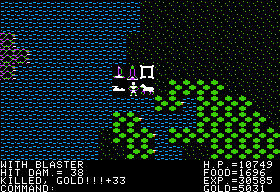
Okay, what is going on here? In Garriott’s own words:

The earliest Ultimas really were an amalgamation of everything I thought was cool in the few books that I’d read, the many movies I’d seen, and the few other games that I’d played — all thrown into one game. It was pretty much anything goes.

So, D&D and fantasy in general were cool. In they went. Star Wars was cool. In it went. Garriott’s astronaut father was soon to fly into space again aboard the space shuttle, and that was really cool. In it went. In addition to all of the pop-culture influences, these early Ultima games are filled with Garriott’s family, friends, and acquaintances — and of course Garriott himself in the person of not only Lord British but also his normal SCA character, the more understated ranger Shamino. When some scholar of the future studying this pioneer of ludic narrative creates an Annotated Ultima, she’ll have a goldmine of references to illuminate.

But as for us, we’re going into space now to try to become a space ace. The space parts of Ultima introduce a whole new sub-game, added by Richard out of a self-proclaimed desire to pack as much onto its two disk sides as he possibly could. Obviously editing was not, at this stage at least, Garriott’s strong suit. That said, the space game is more complex and satisfying than one might expect, if as limited in its potential for fast action as one might expect given its BASIC implementation. Our first task is to safely dock our shuttle — which for some reason no longer looks quite so much like the NASA space shuttle as it did on the ground — to a space station.
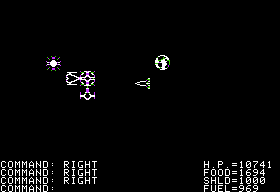
With that accomplished, we can choose a more combat-appropriate vessel and begin to hyperjump from sector to sector on the trail of enemy ships. We do need to keep an eye on our fuel supplies whilst doing so, returning from time to time to a station to top off. And exactly how does this relate to Mondain? Sigh… I really don’t know. I suppose it’s possible that the enemy ships belong to his forces — although they look, inevitably, like TIE fighters.
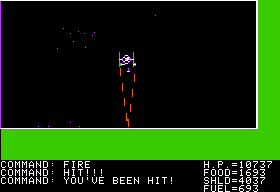
So, we finally shoot down our 20th TIE fighter and return to Sosaria as a space ace, primed for the climax. We dutifully rescue our umpteenth princess. This time she tells us about a time machine “far to the northwest.”
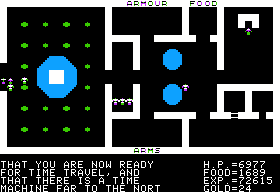
We go there in our trusty landspeeder…
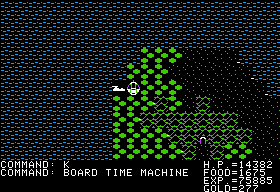
We activate the time machine, a process described with another unusually long string of text:

UPON ENTERING THE CRAFT, YOU FIND FOUR HOLES MARKED R, G, B, AND W. YOU PLACE THE PROPER GEMS IN EACH. YOU SEE A BUTTON MARKED LAUNCH. FURTHER EXAMINATION LEADS YOU TO NOTICE THAT YOU ARE LOCKED IN… NOTHING TO DO BUT LAUNCH?!?!

AFTER ONLY A FEW MOMENTS, YOU FEEL A STRONG MAGIC PULLING YOU FROM THE CRAFT. A MOMENT LATER…

…YOU FIND YOURSELF FACE TO FACE WITH MONDAIN HIMSELF. GOOD LUCK, THIS IS IT!

And the final showdown begins…
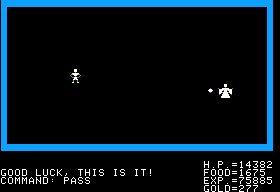
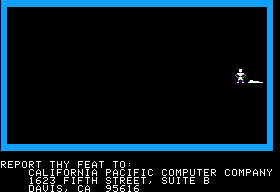
There’s actually a somewhat unfair trick to this final battle, the only such in the entire game. We can pound on Mondain endlessly — by this point he’s really not that dangerous to us — but he will keep coming back to life on us. We need to move over to that little ball sitting next to him, which represents his “EVIL GEM,” and pick it up using a command, G for “Get,” that we’ve never had occasion to use in the entire game to this point. This is all somewhat at odds with what Garriott — I mean, the bartender — told us was supposed to be happening here. We were supposed to be traveling back to a time before Mondain made the gem, not taking it from him and destroying it. Ah, well. We finally figure out what the game expects of us, and prevail at last. It all ends with a message that would become another of the Ultima series’s trademarks, albeit later games would ask us to report our victory to Lord British directly rather than his flunkies at California Pacific.
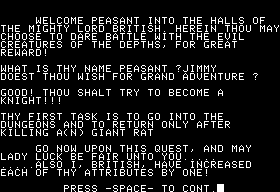
I’ve spent quite a lot of time in these posts poking fun at Ultima. At times it’s kind of hard not to; the game plays like exactly what it is, a catalog of one particularly bright nerd’s rather typically nerdy interests, circa 1981. Yet that’s also exactly what gives the game its charm as well as its time-capsule quality. I’m sure a few of us were similar kids once upon a time, and hopefully we won’t ever completely outgrow our sensawunda. There’s an openhearted quality about Ultima; it wouldn’t know irony if it walked up and bashed it for 1000 hit points. Yes, that makes it easy to make fun of, but that also makes it kind of lovable. And I’d be remiss not to point out that, in an era rife with horribly designed adventure games, Ultima is, that one misstep at the end aside, remarkably fair. If Zork hates its player, Ultima just wants us to have a good time, and it’s willing to throw in everything up to and including the proverbial kitchen sink to make sure that happens. “And hey, there’s a princess to rescue, and a spaceship to fly, and these really cool monsters to fight, and the dungeons are in, like, 3D…” God bless its innocence.

Ultima‘s charms were rewarded with some very impressive sales by the standards of the still small entertainment software market: 20,000 copies sold in its first year. Still, Garriott, who had led a charmed existence thus far, was about to run into his first real complications.

But next time: something a bit less innocent than Ultima.
 
10 Comments

Posted by on February 15, 2012 in Digital Antiquaria, Interactive Fiction


Tags: , ,

Ultima, Part 2

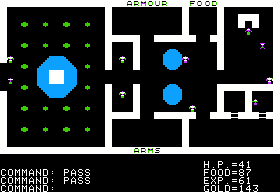
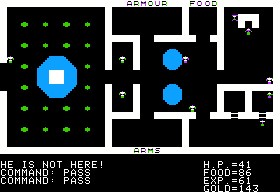
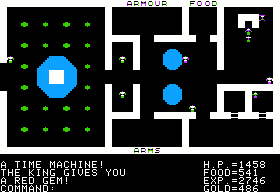
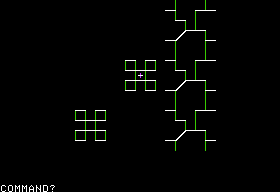
As anyone who’s ever played an Ultima can tell you, our first step upon beginning a new game must be to seek out the castle of the in-game version of Lord British. Unlike in Akalabeth, shown to the left above, castles in Ultima are implemented as little navigable worlds of their own, complete with king, guards, jesters, and even a handy princess awaiting rescue; in the image below I’m standing at the bottom right, just outside her cell.

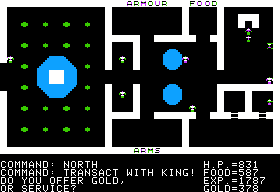
Every castle, like every town, is identical except for its name and the king we find there. Like in Akalabeth these kings provide us with direction for the bulk of the game in the form of quests, a welcome design choice that helps Ultima, again like Akalabeth, avoid the sense of aimless needle-in-a-haystack wandering that plagues so many other early adventure games. In Ultima, we can also opt for “gold” instead of “service” when speaking to a king, meaning we can trade cash for hit points.

Here I have to take a moment to talk about this game’s, um, unusual approach to character building. Hit points here are a collectable resource awarded by the game or bought from kings, with no relation to anything else about your character. There is, in other words, no maximum total of hit points to which you can be healed and, indeed, no real concept of healing at all. You simply earn hit points questing or buy them from kings, and spend them fighting monsters. And that’s just the beginning of the strangeness. The game provides a running total of experience points, but I haven’t been able to actually determine what they do for you. In a Republican’s fever dream of a socialist dystopia, leveling up is simply a function of hours spent on the job; every 1000 turns earns you another level. (There’s actually no variable at all in the code assigned to your character’s level; the game just divides time by 1000 every time it needs to print your level.) And then there’s the game’s oft-remarked obsession with food: you consume a little bit with every move, and if you ever run out you die — instantly. I kind of like what one Ophidian Dragon said about Akalabeth‘s food system, which worked the same way: “It’s like you have a gigantic bag of potato chips on your back, and are constantly munching on them, and when the bag is empty you instantly die!” Such absurdities are sometimes necessary to make of a piece of ludic narrative a playable game, but the mechanics of this and later Ultimas are often suspect not just from a narrative but also from a game-design perspective. The joy of Ultima is more in exploration and discovery than in strategizing. In other words, Ultima is no Wizardry (and vice versa — and if you don’t know what I’m talking about, well, we’ll be getting to Wizardry soon).

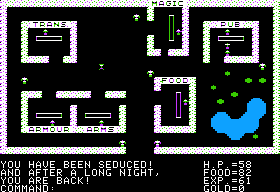
After leaving Lord British, we head for the nearest town — Britain, natch — to stock up on supplies. Like the castles, the towns are now implemented as navigable environments of their own, albeit once again all identical. There’s an unusually off-color element here in this otherwise asexual world: if we drink too much at one time in a pub (in best D&D fashion, a necessary source of hints and tips about goings-on), we get seduced by the local wench, who gives us a “long night” but takes all our money in return. I suppose you get what you pay for. (And apparently our character is a heterosexual man. Good to know.)

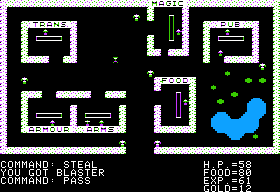
More productively, we can pick up some new armor and weapons. Trouble is, we’re not exactly flush with cash. Luckily, there’s the handy “Steal” command. But if we get caught, the whole town goes apeshit and comes after us. So we do what Ultima players have been doing for time immemorial: save our game outside town (the only place saving is allowed), then enter and try our luck. With a bit of patience if not much fidelity to the game’s fiction, we eventually equip ourselves with plate armor and a blaster. “Wait,” I hear you say, “a blaster? Like a Star Wars blaster?” Just hold off; we’ll get to that.

Incidentally: in one of those user-interface choices that make these early games such a delight, we steal by pressing “S.” We’re thus pretty much guaranteed to do lots of accidental stealing when we really want to “sell,” at least until we’ve gotten it pounded into our little heads that the command for selling is actually “Transact.” And don’t even get me started on “Klimb,” or the immortal “Ztatistics” command.

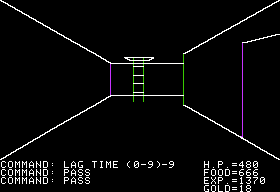
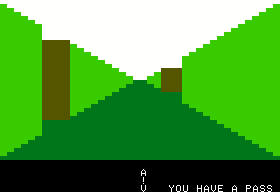
Journeying onward, we spend some time killing monsters outdoors to build up our cash reserves and test out our ill-gotten hardware. Then we visit the Castle of the Lost King and accept our first quest: to kill a gelatinous cube. Doing so requires venturing into a dungeon. And doing that in turn brings on a case of deja vu: the dungeon-delving part of Ultima has been left unchanged from Akalabeth.

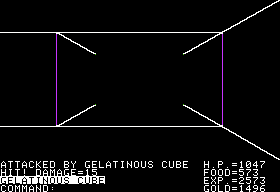
Well, I say unchanged, but it sure feels like it’s gotten even slower. Most of one’s time underground is spent watching the screen lugubriously redraw itself. A few of Mr. Arnold’s assembly-language routines would have been welcome here. In between redraws, we fight a mixed bag of monsters, many of them, like the gelatinous cube we’re after for this first quest, drawn straight from the D&D Monster Manual. (A quick way to guess whether a given monster is drawn from some mythology or fiction or original to D&D: the more ridiculous it is, the greater the chance of the latter.) The gelatinous cube is kind of annoying in that it’s really, really hard to see against the walls of the dungeon itself.

It’s also kind of annoying in that it eats our armor when it hits us successfully. We could carry nine or ten suits of plate mail with us for occasions just like this (no sniggering on how ridiculous that is!), but, thanks to a bug or Garriott’s just never having gotten around to it, it’s actually impossible to equip new armor while in a dungeon. Sigh.

So, by this point the structure of the game begins to become clear. There are eight castles to be visited, arranged, in that symmetric way so common to made-up worlds, two to a continent. Four of the kings — you guessed it, one per continent — send us on quests to kill progressively more dangerous monsters at progressively lower dungeon levels. When we complete each of these quests, each king gives us a gem, and also babbles something or other about a time machine.

The other four send us to seek out above-ground landmarks, but only raise our strength score in return. (The landmarks themselves raise our other statistics.) Of course, all is not as easy as it sounds. Unlike the later games, Ultima shipped with no map of its world, meaning just finding all of the castles and landmarks requires quite a bit of patient, methodical exploration. At least our searching expends the turns needed to gain levels, a good thing considering we need to get to at least level 8 to finish the game.

One thing we can do to speed our development is to rescue princesses. Note the plural; there’s one in every castle, and since each castle is reset as soon as we leave it we’ve got an effectively infinite supply of damsels in distress. Exactly why these presumably benevolent kings are keeping the poor princesses under lock and key is never adequately explained. Indeed, Sosaria is not so much a world as a shadowy projection of the possibility of a world, onto which we can graft our own fictions and justifications. Or not: as we’ll soon see in the context of the princess as well as other things, there are plenty of signs that Garriott doesn’t take it all that seriously himself.

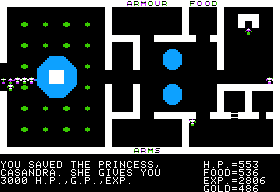
Rescuing a princess first involves killing — yes, killing, in cold blood — the jester who is helpfully yelling, “I’ve got the key!” every few turns. After that the castle guards go predictably apeshit, while we check our “Ztats” to see whether we got the key to Cell #1 or Cell #2. In the former case, we can only run for it — or restore a saved game — and try again. In the latter case, we can effect our rescue. In the screenshot below I’m at the extreme left edge, just making my escape with the princess and most of the castle guards hot on my heels. My reward is 3000 hit points, 3000 gold pieces, and 3000 experience points. Not bad.

Now, there’s so much about this game that is so ridiculous that it’s hardly worth flying into a rage about the moral shadiness of all this. I do want to be sure to point it out, however, because Garriott would later have something of an epiphany after taking a hard look at the many situations like this in his own works and decide to stand up for morality. But that’s a story for another time.

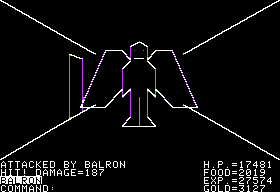
We eventually acquire the fourth and final gem by killing a “balron,” a creature that in Akalabeth was named after the balrog of Gandalf-killing fame. As the game industry grew in size and public exposure, Garriott and other designers slowly found themselves having to be more careful about the niceties of copyright law. He even made some efforts in Ultima to rename some of the obviously D&D-inspired monsters; the carrion crawler, for instance, becomes the “carrion creeper.” Anyway, Garriott’s balron looks more like a kid in an angel costume than Gandalf’s “foe beyond any of you.”

Notice in the screenshot above the ridiculous number of hit points we’ve bought by this point.

With the balron dispatched, we’re about to move past the mushy middle toward the climax. And things are about to get weird. We’ll try to finish up next time, if we can manage to find a plot. I’m pretty sure there’s one around here somewhere.

 
12 Comments

Posted by on February 13, 2012 in Digital Antiquaria, Interactive Fiction


Tags: , ,

Ultima, Part 1

When we left Richard Garriott, California Pacific had just released his first game, Akalabeth, a substantial windfall for the 19-year-old university student. In between classes and SCA events, he spent his sophomore year at the University of Texas writing a new, much more ambitious game, which CP published just as the spring semester of 1981 was wrapping up. I think we can best proceed by just diving right into the game that retroactively came to be known as Ultima I.

Like Zork, making Ultima available here presented a bit of an ethical dilemma for me. You can actually now buy the first three Ultima games again via GOG.com, a service I can hardly applaud enough for keeping deep catalog works like these in print in a form easily runnable on modern PCs. However, the version they sell is the Origin Systems remake from 1986. It’s much more polished and playable than the original that Garriott wrote in BASIC on his Apple II Plus, but it’s of course also something of an anachronism for a digital antiquarian like me. So, I’m going to go ahead and offer here the original California Pacific Ultima as Apple II disk images along with the original accompanying documentation, at least until someone tells me not to. If you’re following closely along with my journey into the game, or want to do some digital archaeology of your own, have at it. If, on the other hand, you’re a bit less hardcore but your interest is piqued enough to want to give Ultima a shot, by all means go for the much more playable and accessible version you’ll find on Good Old Games — no emulator required.

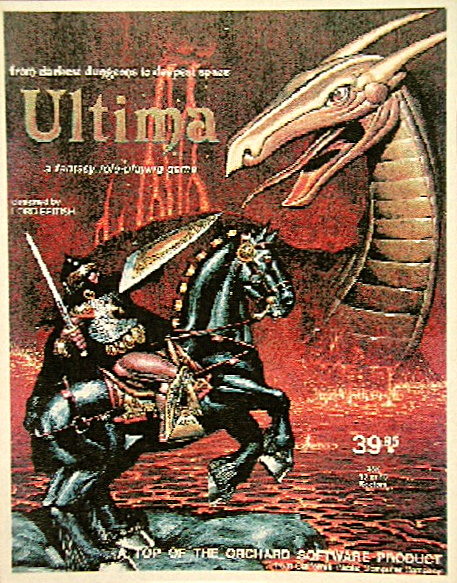
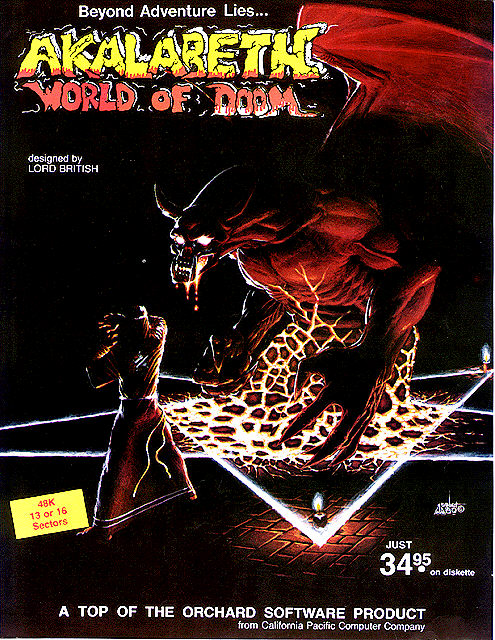
By the standards of later Ultimas, the packaging of Ultima I is spartan: the two disks, a very to-the-point 10-page manual, and a player reference card that, oddly, includes important information not included in the manual (and vice versa). No lengthy books of lore, no cloth maps, no ankh medallions. Yet by the standards of its time, in which games were just transitioning from Ziploc baggies to more professional packaging (a symptom of the slowly encroaching professionalization of the industry as a whole), it’s a fairly generous production. More ephemerally, this first Ultima experience feels like the CRPG experience that so many fans would come to know over the next decade, the era Matt Barton calls the “Golden Age” of the CRPG: a big experience promising many hours of adventure from its garishly illustrated outside to the multiple disks found inside. (In fact, Ultima is the earliest game I know of to spill across more than a single disk side.) And that impression stems from more than just the details of its presentation. If Zork in some sense perfected the text adventure by hitting upon a robust approach to interactive fiction that still persists to this day, Ultima, one could argue, did much of the same for the CRPG. Like Zork, Ultima is perhaps the first example of its form that one might actually want to play today just to, you know, play. So let’s boot our Apple II and have at it, shall we?

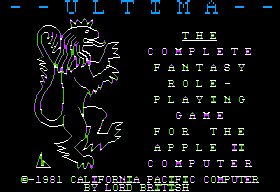
Until very shortly before its release, Ultima was not called Ultima, but rather Ultimatum. We can see evidence of this by listing the directories of the disks themselves; the file holding the title screen you see above is still titled “PIC.ULTIMATUM.” Why choose that name? Like so much in Garriott’s early games, simply because it sounded cool; certainly this title has no more bearing on the game’s plot, such as it is, than does the name Ultima. The change was made when Garriott and California Pacific discovered that there was already a tabletop war game in print under the name Ultimatum. Wishing to avoid confusion and legal complications, it was Al Remmers of CP who suggested that they shorten the name to simply Ultima because, once again, it sounded cool. (Later apologists’ attempts to construe the name as a reference to the semi-mythical classical land of ultima Thule are about as convincing as their attempts to construct a coherent narrative arc out of the random smorgasbord of plot and setting of the first three Ultima games.) Remmers, you may remember, also suggested that Garriott take his occasional nickname Lord British as his nom de plume, drumming up a promotional campaign for Akalabeth depicting Lord British as a reclusive and enigmatic genius. It’s ironic that Remmers, a guy that Garriott didn’t know that well and with whom he would soon have an ugly falling out, essentially created the two brand names for which Garriott will forever be remembered, while he himself faded quickly into obscurity. It’s also emblematic of the uncanny luck that seemed to follow young Garriott around, luck which brought various older and (possibly) wiser men to further his career almost in spite of themselves. Remember also John Mayer, his ComputerLand manager who convinced him to sell Akalabeth in the store and by some accounts was responsible for bringing it to the attention of Remmers and CP…

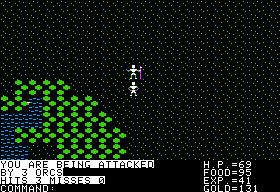
Just like Akalabeth, Ultima — shown on the right in the comparison above — dumps us into an overhead view of the outdoor landscape after we create our character. Unlike in Akalabeth, we now have monsters to contend with out here as well as in the dungeons. And if Ultima is still not exactly a graphical extravaganza, things sure do look a whole lot better than before, thanks largely to the game’s major technical innovation: tile graphics.

Ultima‘s world is a pretty big one, spanning four continents each many times the length and width of a single screen. At a resolution of 280 X 160, trying to draw all of this at the level of individual pixels would be untenable, both technically (even two disk sides couldn’t possibly store that much information) and practically (Garriott was just one guy, and not really an artist either; nor was the the Apple II’s library of graphics software terribly mature by this point). The solution was to draw the world using a collection of pre-rendered tiles, each 14 X 16 pixels. Each screen is thus formed from 200 of these tiles, in rows of 20 and columns of 10, laid together in a process that would feel kind of similar to doing a jigsaw puzzle or playing a tile-laying board game like Carcassonne. Ultima‘s world map is represented on the computer as just a grid of numbers specifying which tile should be slotted into which position by the graphics engine. It’s often claimed that Ultima represents the very first application of this technique that was soon everywhere in videogames of the 1980s, one that still crops up more than you might expect even today. Being a skeptical bastard by nature, I do wonder that no one thought of it in even the relatively brief history of videogames prior to Ultima; it does seem a fairly obvious approach, after all. On the other hand, I can’t point to a specific example that would give me grounds to really challenge the claim. As always, post ’em (or comment ’em) if you got ’em.

Ultima‘s tile-graphics engine was not so much the work of Garriott as of a friend of his who was the only other person to have a significant role in the game’s design and implementation: Ken W. Arnold (not the Ken Arnold who created Rogue). A neighborhood chum of Garriott’s, Arnold worked at the same ComputerLand store where Garriott spent that fateful summer of 1980. The two sketched out the initial plan for the game together when Garriott, excited by the sale of Akalabeth to California Pacific and beginning to realize he could make money at this stuff, began work on Ultima even before leaving again for university. Arnold not only invented the tile graphics scheme but also handled the technical implementation, writing an assembly-language routine to fetch the tiles and rapidly paint them onto the screen as the player moves about the world. This routine, along with another to generate the game’s simple combat sound effects, were the only parts of Ultima not to be written in BASIC. Garriott, unlike Arnold, had not yet learned assembly language, and thus implemented everything else in BASIC after leaving Arnold, Houston, and ComputerLand to return to university in Austin.

Even with the tile system, creating Ultima‘s graphics was a challenge. From The Official Book of Ultima:

“We had to actually enter all the shapes in hex,” Garriott says, detailing the primitive process. First he and Arnold would draw them out on graph paper, then convert the graphs to binary, which in turn had to be reversed because the pixels appeared on the screen backwards. After converting it into hex, they entered the tile as data, stored it on disk, and then ran it to see if it looked right on the screen. “We had no editors or anything, so it was a very painful thing.”

Indeed, one suspects that, even in the context of 1980-81, easier ways could have been devised. Put another way, young Richard and Ken had not yet learned the value of making programs to make programs. Still, stories like the above illustrate one of the most remarkable things about these early games of Garriott’s: they were created by a self-taught kid who literally figured things out as he went along, working on a single Apple II and with none of the technical background or resources of an Infocom or even an On-Line Systems or Muse to call upon. Their ramshackle technological underpinnings may be less elegant than the Z-Machine, but they are in their own way just as remarkable. In a very real sense it’s amazing that Ultima exists at all.

The world all of their labor lets us explore is based upon Garriott’s latest Dungeons and Dragons campaign world circa mid-1980, which he called Sosaria; he literally transcribed his D&D maps right into the game. As we’ll soon see, Sosaria is not exactly the most coherent of milieu. A person could also say that gameplay has not progressed all that much beyond Akalabeth: we still move around the wilderness map to visit towns (for our shopping needs), castles (for quests), and dungeons (for critter bashing). One is reminded once again of Garriott’s joking comment that he spent some 15 years making the same game again and again. The person who said Garriott hadn’t progressed much would be pretty unfair, however, because much has changed here too. Virtually everything is now bigger and more fleshed out, and there’s a big overarching quest to solve. In fact, the whole philosophy of the game has moved from the Akalabeth approach of being a relatively short, replayable experience to the extended, save-game-enabled epic journey CRPG fans would soon come to associate with the name Ultima.

 
15 Comments

Posted by on February 10, 2012 in Digital Antiquaria, Interactive Fiction


Tags: , ,

Escape!

Ever stumbled across something you’ve been looking for for a long time while you’re doing something else entirely? Well, I’ve just found the digital equivalent of my cat’s favorite toy which I found last week while reaching under the television stand to try to reset our infernal TV box. I’ve found the game Escape!, the Apple II maze game that inspired Richard Garriott to program the 3D dungeons of Akalabeth. Turns out it was written by Silas Warner of Muse Software, about whom I’ll have much more to say shortly. In the meantime, I’ve updated the old post on Garriott to reflect my discovery. Or, if you’d like to cut to the chase, here’s a screenshot and a disk image for ya. Type “RUN ESCAPE” after booting the disk to get started.

 
6 Comments

Posted by on January 23, 2012 in Digital Antiquaria, Interactive Fiction


Tags: , , , ,

California Pacific

There are two conflicting stories about how the game that Richard Garriott sold in that Houston-area ComputerLand store made it to the West Coast offices of California Pacific, one of the most prolific and prominent of early Apple II software publishers. One says that the man who had prompted Garriott to start selling Akalabeth in the first place, ComputerLand manager John Mayer, did him a second huge favor by sending a copy of the game to CP for their consideration. The other says that the game got to CP’s offices within a few weeks of appearing in that ComputerLand via software-piracy channels. The latter story is the one Richard himself tells today, and, for what it’s worth, the one I tend to subscribe to. Perhaps the former was invented closer to the events themselves, to avoid anyone having to explain just how pirated software made its way into CP’s offices. However Akalabeth came to their attention, CP’s founder, Al Remmers, called Richard before the summer of 1980 was out, offering to fly him to Davis, California, to discuss a publication contract that would give Akalabeth nationwide distribution.

In those days game designers and programmers (almost always embodied in the same person) who could push the envelope conceptually and technically were worshiped within the still small but rapidly growing community of Apple II users. Amongst the most prominent of these was the star in CP’s stable, Bill Budge, who made his name during 1979 and 1980 with a series of frenetic action games considered remarkable for their graphics. Garriott, like any engaged Apple II user, knew Budge’s work well, so much so that his first reaction on getting the call was amazement that his work could be considered worthy by the publisher of the great Budge. He made the trip to California with nervous parents in tow, who wanted to be sure their son would not be ripped off by the fast-talking Remmers. They found no grounds for concern, and the deal was quickly done.

It was Remmers, who could show a keen promotional instinct when the mood struck him, that suggested they credit the game not to Richard Garriott but only to his in-game alter ego, Lord British, starting a tradition that would persist for many years. Upon Akalabeth‘s CP release, probably in late October or November of 1980, Remmers orchestrated a contest with Softalk magazine, in which the magazine would publish a series of cryptic clues from which readers were expected to guess Lord British’s real identity:

Lord British is not a member of the Silicon Gulch.

Lord British attends the largest university in the state of friendship.

He and his home city are closely related to present and future blastoffs.

He works at a store on the King’s Highway near the city of the clear lake in the land of computers.

ComputerLand knows him as the Son of Skylab I and if you call you’ll know him too.

No one who wasn’t already a Richard Garriott acquaintance managed to decipher the clues, and the contest fizzled out rather anticlimactically with a series of consolation prizes for things like most imaginative solution methodology in Softalk‘s May, 1981, issue. The following issue featured a full profile of Garriott that revealed all at last. Still, yet another thing that would follow Garriott throughout his career, his larger-than-life persona in the computer press as Lord British, was now in place, and once again largely accidentally, at the behest of others. Truly the young Richard Garriott led a charmed life.

While Akalabeth and Garriott did receive considerable press thanks to Remmers’s cozy relationship with Softalk, the question of its actual sales is one I can’t quite consider settled. Garriott himself recently reiterated in this blog’s comments a claim he has often made, that Akalabeth sold some 30,000 copies and netted for its author at least $150,000. There are however, several pieces of admittedly circumstantial evidence that do tend to pull against this a bit.

As a point of comparison, we might take a game I discussed earlier in this blog, On-Line Systems’s The Wizard and the Princess. According to official histories from Sierra (the company that On-Line Systems morphed into), this game eventually sold 60,000 copies. However, in the September/October, 1982, issue of Computer Gaming World, we find a list of the top sellers of various game publishers as of June 30, 1982. There, The Wizard and the Princess is listed as having sold just 25,000 copies by that date, almost two years after its release. That’s surprising, but not untenable; the microcomputer industry was growing so quickly in the early 1980s that sales even of older games could increase month by month and even year by year simply because there were so many new consumers always coming online to buy them. So, let’s run with The Wizard and the Princess as a 25,000-copy seller through mid-1982. As I noted in an earlier post, The Wizard and the Princess was a perennial on Softalk‘s best-seller top ten for well over a year after its release, spending much of that time in the top five. Akalabeth, by contrast, made just two appearances in the top 30, appearing in the January, 1981, list at number 23 and then disappearing for two months, only to bubble up one last time at number 26 in the April issue. Given that Akalabeth would permanently disappear from shelves in 1982 for reasons we’ll get to down the road a bit, and thus would not be able to benefit from the long tail of new consumers that presumably benefited The Wizard and the Princess, this is hard to reconcile with the idea that Akalabeth outsold The Wizard and the Princess by 5000 copies between the former’s late 1980 release and mid-1982.

On that same mid-1982 Computer Gaming World list, California Pacific claims Garriott’s next game, Ultima, as its own top seller, with sales of — and this is interesting — just 20,000 copies. And then there is a question that’s been raised in vintage-software-collector circles: if 30,000 copies of Akalabeth were sold, where are they? The California Pacific Akalabeth (let’s not even talk about the ComputerLand version) remains exceedingly rare, much more so than other titles of similar vintage which allegedly sold in much smaller numbers.

Now, it’s very true that objections could be raised to many of these points. Softalk‘s sales listings, for instance, were generated by surveying “Apple-franchised retail stores representing approximately 15 percent of all sales of Apple and Apple-related products [who] volunteered to participate in this poll.” Notably, mail-order sales were not considered at all. Since it deals only in ratios, not absolute numbers, Softalk‘s editors assumed the poll to be a valid reflection of the Apple II software market in general, but perhaps this assumption did not entirely hold true. Even the Computer Gaming World list was generated by simply asking the various publishers. It’s entirely possible that, due to conscious deception, confusion that grew from an admittedly rather poorly worded premise, or simple mistakes, some of these numbers are inaccurate — perhaps dramatically so. And I do want to emphasize again that, if the 30,000-copy figure is not correct, I certainly don’t attribute the confusion to deliberate deception on Garriott’s part — merely to 30-year-old events and poor record keeping in a software industry that, as we’ll see all too clearly when we get to later events in Garriott’s career, was not exactly a model of responsible business practice.

Whatever its sales figures, we can feel confident that Akalabeth generated a nice chunk of money for its starving-student creator. Garriott has characterized this time in the software industry as the “free money era,” during which even programs that frankly weren’t very good could generate a lot of money for their creators — such was the demand for new software, any software among new minted Apple II zealots. CP sold Akalabeth for $35 (up from the $20 Garriott had charged at ComputerLand). Accounting for inflation, this figure puts it right in line and then some with a hot new AAA console title of today. CP was known for offering a very generous royalty rate to its developers, often as high as 50%. Garriott presumably gave a little something to his title-screen artist Keith Zabalaoui, but the rest was all his. Even if Akalabeth didn’t sell anywhere near 30,000 copies, that adds up to one hell of a windfall for a university student. (If Garriott earned $15 per copy and Akalabeth sold even 10,000 copies, there’s your $150,000 right there.) As Garriott recently said in a lengthy interview by Warren Spector, it’s been “all downhill from there” as far as return on investment in the computer-game industry. Indeed, I find the idea that it was for at least a year or two possible to make $150,000 from a 22 K BASIC program you wrote all by yourself simultaneously exciting and vaguely horrifying. Alas, I was born ten years too late…

Even before he returned to Austin for another year of classes and SCA events, Garriott began working on another game. This one would be more ambitious than Akalabeth, his first creation conceived and written entirely on the Apple II and his first to be consciously crafted for commercial sale. We’ll get to that soon, but next I want to switch topics yet again to look at the origins of the company many of you who read this blog love more than any other.

 
10 Comments

Posted by on December 20, 2011 in Digital Antiquaria, Interactive Fiction


Tags: , , ,