RSS

Category Archives: Interactive Fiction

A Need for Speed

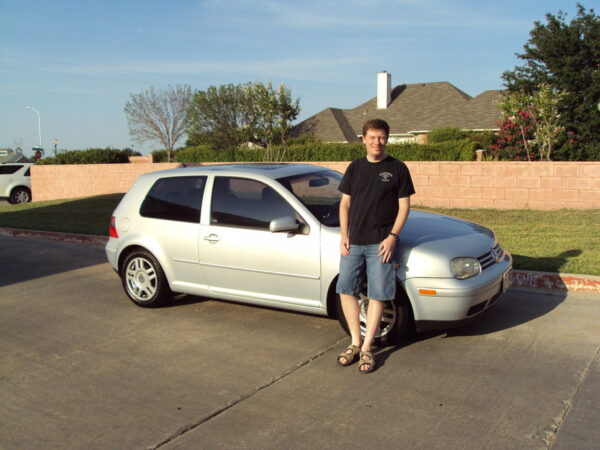
Your humble author in 2009, with his last even vaguely cool car, a 2000 Volkswagen GTI. I sold the GTI and left the United States that same summer. I wouldn’t own another car for ten years.

Looking back from the vantage point of today, it’s hard for even me to believe, but it’s true all the same: I used to be a full-blown car guy. I bought my first car, a 1966 Volkswagen Beetle, for $800 in 1989, when I was sixteen years old. The bad thing about a Beetle was that you could generally expect no more than 60,000 miles or so out of the motor; the good thing was that you could rebuild the motor in your garage over a long weekend and make it good as new again. My inner Luddite, who seems to become stronger almost by the day in our current era of feverish tech-sector nonsense, still feels that something was lost when we stopped making cars that were so amenable to shade-tree mechanics.

I had a couple of other Beetles over the decade and a half that followed that first one, along with a number of other vehicles that made them look like the height of sober-minded practicality.

I had a 1965 Ford Mustang that was rusted out so badly it was literally on the verge of breaking in two. (I maybe should have taken a look underneath before I bought it.) I sold it to a fellow who ran an import/export business; the plan was to send it to Finland for restoration and resale, which means my old Mustang may have beat me to northern Europe by about fifteen years.

I had a 1969 MGB that was determined to prove every cliché about the quirky unreliability of British sports cars to be the gospel truth. I learned that there’s a reason that Lucas Industries, which was responsible for the electrical systems in those cars, is known in enthusiast circles as “the Prince of Darkness.” That MGB is the only car I’ve ever driven where you had a choice between headlights and windshield wipers; there wasn’t enough juice to run them both at the same time. Then again, you probably didn’t want to be driving in the rain anyway, because never was an MGB made without a top that leaked like a sieve. All that aside, the car was a hell of a lot of fun whenever the weather was good and it decided it was in the mood to start.

I had a 1975 Nissan — or Datsun, as they were known in the United States back then — 280Z. It was more fun to drive than any car I’ve ever owned, even the MGB, with an in-line six-cylinder engine that was the stuff of which car-nerd wet dreams are made. For some reason, I decided to swap that 280Z for a 1981 280ZX. I knew I had made a terrible mistake within a week, even if the new car did have the exact same engine. It was like trading the svelte Elvis of 1956 for the fat one of 1976.

But the all-around funnest vehicle I’ve ever owned — not just fun to drive, but fun in general — was a 1972 Volkswagen camper van. It would do about 50 miles per hour flat-out on level ground. Driving it felt weirdly like guiding a boat, and not only because the engine was chirping away about fifteen feet behind you when you sat at the wheel. You could expect a delay of several seconds to any control input as it bobbed and swayed gently on its well-worn springs. So, you just kind of pointed it in the general direction you wanted to go and hoped for the best. Looking back on it, it was a good thing that it wouldn’t go any faster.

That little Volkswagen bus could sleep four people — or rather two couples, assuming you didn’t want to cuddle too much with mere friends. There could be two in the back and two under the pop-up roof, with just a thin net between them and the great outdoors. It had a little refrigerator, a little stove, and even a little heater that ran on — I kid you not — pure gasoline. It’s a wonder that we didn’t blow ourselves up at some point during the weekends that we drove the magic bus up from Dallas to southern Oklahoma’s Arbuckle Mountains.

The joys of all of these oddball vehicles started to pale a bit for me as I entered my thirties. (Come to think of it, it was at about this same point that I started to feel too old for backpacker hostels; this must have been the borderline that marked the onset of a belated adulthood.) In 2004, I bought a Volkswagen GTI that was just a few years old instead of a few decades. It was a nice enough car, but it was kind of soft and heavy in the same way that the Datsun 280ZX had been. Still, it did have the advantage of being (more or less) reliable.

Then I moved to Denmark in 2009 with my new wife, and that was that for the car life. We didn’t even own a car for ten years thereafter. I re-familiarized myself with the lost (to me) art of biking, which is certainly a healthier way to get around as one closes in on middle age. These days we have a Hyundai Plug-In Hybrid, which is… fine, but it doesn’t exactly get the blood pumping, you know? Discounting the odd roadside emergency, I haven’t looked under a hood with deadly intent in seventeen years. I can’t even tell one (modern) car from another anymore.

And yet nothing that we have done and been in our lives ever truly and completely leaves us, does it? Our current house, which we moved into four and a half years ago, has quite a big yard, such that I have to cut the grass with a garden tractor. I still feel a certain quickening in my soul when I smell gasoline and oil and hear the motor fire up, still enjoy doing the maintenance myself. In fact, I just bought a new (to me) tractor this year; I’ll go so far as to say that it’s the best one in our village. I do like to ride around on it, the child being the father to the man and all. As one of my wife’s uncles likes to say, every man should have a tractor of his own, whether real or metaphorical.

But that’s far as I go these days. Sometimes I muse about getting a project car, but I know that I don’t really have the time, and probably not the long-term desire either. I content myself with the occasional veteran bil exhibition (as they’re called here in Denmark) and with seeing what’s on Jay Leno’s Garage each week on YouTube. (If it’s something old, I’m in; if it’s something new, I move on; if it’s something borrowed or something blue, I’m as confused as you are.)

Here’s the weird thing, though: I never had all that much interest in driving cars on the computer, even when my passion for the real McCoys was at its peak. Of course, there are various sub-genres of driving games, as there are of all other types. I’m not so surprised that I never got into the hardcore racing simulations, where it becomes all about grip and downforce and gear ratios and wind-tunnel coefficients and many other numbers I don’t really understand. God bless those who like that sort of thing, but I never had the patience for it, whether the vehicle being modeled is an airplane, a ship, a submarine, or a racing car. Yet I never cared much more about what we might call the aspirational driving games: you know, the ones that assemble a bunch of exotic street cars and set you loose with them, on the premise that, if you can’t afford them in the real world, you can satisfy at least some of your lust for them vicariously on the computer.

I think the problem for me here was that I didn’t aspire to what these aspirational games were offering. At some point many years ago now — definitely before I learned to drive in the real world — high-end sports car reached a level of performance that made them, in my opinion, less rather than more fun. They started to not just include but require traction control and all manner of other driver-assistance measures just to make them controllable, which detracted from the purity of the experience. At the same time, they became so ridiculously fast in comparison to the traffic laws of the realm that I’m left wondering what you’re actually supposed to do with them, assuming you don’t want to be a jerk who endangers everyone else on the road and likely gets himself thrown in jail and his car confiscated before all is said and done. (Denmark isn’t known for being tough on crime, but they do love to confiscate cars here…)

There’s an old saying that has long been my mantra on this subject: “It’s more fun to drive a slow car fast than a fast car slow.” Just last year, my wife and I took a holiday to Zagori, a mountainous region in the northwest of Greece, close to the border with Albania. We were there to hike, but I had just as much fun driving our rental car, a Ford something-or-other with a gerbil wheel attached to a couple of rubber bands for an engine, up and down switchback mountain roads that sometimes had me shifting all the way down to first gear. I know that electric cars are the socially responsible future and all, but I’m a little sad that I most presumably won’t be able to rent a simple, basic traditional car like this one for much longer, then proceed to wring every last bit of potential out of it in the old-fashioned, manual way. In my book, that’s a lot more fun than driving a Ferrari responsibly on the same roads would be.

Waiting for goats to cross the road in the Pindus Mountains. A little later, the goat herder emerged, and we had a “conversation” that relied principally on smiling and gesturing. It may be a romanticized whimsy, but I kept thinking that his life wasn’t all that different from that of his ancestors of 1000 years ago. There’s a part of me that hopes his descendants are still living the same way 1000 years hence.

In short, then, the aspirational driving sims were sold on the premise that you really, really wanted to own the exotic cars they featured, and I never particularly did; if we’re being completely honest, I find most post-1970s supercars to be painfully tacky-looking in addition to everything else. This goes a long way toward explaining why I’ve scarcely seen fit to mention driving games in these histories before today. On top of my personal proclivities, I would add one last factor. Some gaming genres, I’ve come to learn, age better than other ones, and thus do more to encourage re-visitation. If you ask me, adventure, puzzle, and action games age the best, followed by CRPG and strategy games. (The latter tending to be more complicated genres in general, they do often fall completely or partially victim to shifting interface conventions; we’ve learned how to present information and let the player twiddle the knobs so much better over the decades that going too far back can be a pain.)

At the bottom of the heap in this respect are undoubtedly sports games and vehicular simulations. As purported simulations of the real world, such games foreground technology more than they do design, meaning that there’s less reason to revisit them when the technology moves on and can present simulations of a better fidelity. If you were to create a list of the most prominent and respected designers of gaming’s various ages, you would find that virtually none of them worked in these genres. (The only name I can think of off-hand is Sid Meier, who did so very early in his career, a fact that I hear trotted out from time to time as a curious anecdote: “Did you know he used to make flight simulators before Pirates! and Railroad Tycoon and Civilization?”)

Sports games and sims tend to be as ephemeral as they are anonymous. The former are generally cranked out on an explicitly annual basis, with the year appended right there to the name, with all of the teams and athletes of right now. If you’re still stuck with an earlier year’s edition, and if you don’t happen to be a very special sort of cultural time traveler indeed, you’re left out, bereft and bereaved. You can still find plenty of die-hard partisans of Civilization II or IV or VI. I presume that you can also find footie fans who insist that FC 24 is where it’s really at and the later versions are pants — you can find anything on the Internet if you look hard enough — but they seem to be a lot less common. Driving games are for all practical purposes the same. Each new annual or biennial edition of the big franchises comes chock-a-block with all of the hot cars of that moment. Who wants to be stuck with a bunch of old cars? (I do! I do! But much older…)

All of which helps to clarify why a quick glance around the retro-gaming blogosphere reveals a CRPG Addict, a Wargaming Scribe, an Adventurers’ Guild, an All the (Text) Adventures project, even a Space Game Junkie, but no one seems to be documenting every iteration of Tiger Woods PGA Tour or Microsoft Flight Simulator in similarly granular detail. Call it the rest of the explanation of why I too have given those genres short shrift in these histories.

Nevertheless, said histories do try to capture the landscape of gaming as it was viewed at the time, not just the nostalgic, fannish perspective of today. Sports games and vehicular simulations were a huge part of that landscape, representing as much as 40 percent of the market at times during the 1980s and 1990s. So, today I’ll try to remedy my neglect at least a little bit, by tracing aspirational driving games back to their point of origin. (Sports game will have to wait for another day.) This will lead us nicely into a big exception to the general rule I’ve just belabored at such length: the one vintage driving game that I actually do dig, even today.


The exception to another rule, that of me ignoring driving sims in the past, is a game called Test Drive, to which I devoted a handful of paragraphs many years ago. Developed by a Vancouver-based outfit called Distinctive Software and published by Accolade in 1987, Test Drive was a fine place to break my silence on the subject of driving sims, however briefly, in that it was arguably the most important such game ever to appear on personal computers. I say this not because it generated enormous sales — it was a big success by the standards of its time, but later driving sims would sell many, many times more copies — but because it was the template for countless games to come. For it introduced the driving sim as an aspirational lifestyle product, almost as much an exercise in branding and promotion for the car makers whose vehicles were included as it was a self-contained game.

Test Drive offered up five of the cars whose posters could be found stuck to the wall in teenage-male bedrooms from sea to shining sea: a Porsche 911 Turbo, a Ferrari Testarossa, a Lotus Esprit Turbo, a Lamborghini Countach, and (for those with slightly less exotic tastes) a Chevrolet Corvette. You got to pick one of these cars, then drive it up a twisting mountain road as quickly as possible, dodging slower traffic and trying to stay ahead of the police cars who were in somewhat inept pursuit. The meta-game that took place when you weren’t behind the steering wheel extended no further than trying to get your time on a high-scores list. It wasn’t much in comparison to what these games would become — but it was enough. You got the chance to drive a car you weren’t likely to ever even ride in, and you got to do it in all the reckless ways that only a maniac would in real life. For the car manufacturers, being featured in sleek and stylish games like this one would soon become an important promotional strategy, creating the customers of tomorrow from the teenagers of today. It was an early step in gaming’s integration into the larger consumer economy, one which happened at almost the same time that sports games began to move toward a season-by-season model that kept them in tune with the latest headlines on ESPN.
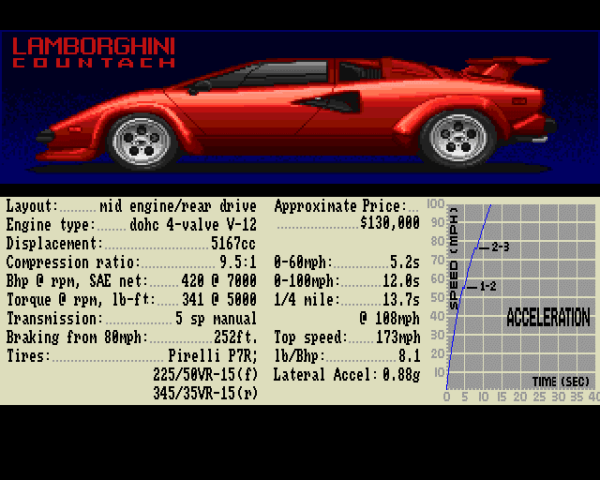
Just to further blur the lines between game and advertisement, between game and aspirational lifestyle product, Test Drive helpfully included the sticker prices of each of its cars on the information screen alongside all of the other statistics.

The bona fides of games like these as simulations was a case of a delicate balancing act. On the one hand, you didn’t want to make the cars too dauntingly difficult to drive, in the way of so many hardcore flight simulations — or for that matter some hardcore motorsports simulations, such as Papyrus Design’s IndyCar and NASCAR series. On the other hand, you wanted to ensure that the player could tell the difference between a Countach and a Corvette. You wanted to convey the impression of what it would be like to drive a supercar, in a way that remained accessible even to kids who might not have a driver’s license for the family minivan yet. Michael Bate, a designer for Artech, another Canada-based studio whose works were published by Accolade during the 1980s, called games hewing to this impressionistic philosophy “aesthetic simulations,” a neologism I’ve returned to again and again ever since I first heard it. Hanno Lemke, the producer of Test Drive, describes that game’s goals in classic aesthetic-simulation terms: to “create the most immersive, visceral, and relevant kind of car experiences [emphasis mine] you could imagine.”

When I grew up, it was the white Lamborghini poster in your bedroom or the red Ferrari, and it was very much about [how] the exotics mattered back then. And so, immersion was really important — getting into the driver’s seat, that virtual fantasy, you know. No real-life consequences — I can drive as fast as I want, the cops can chase me, but largely it was all about what it would feel like to drive these exotics.
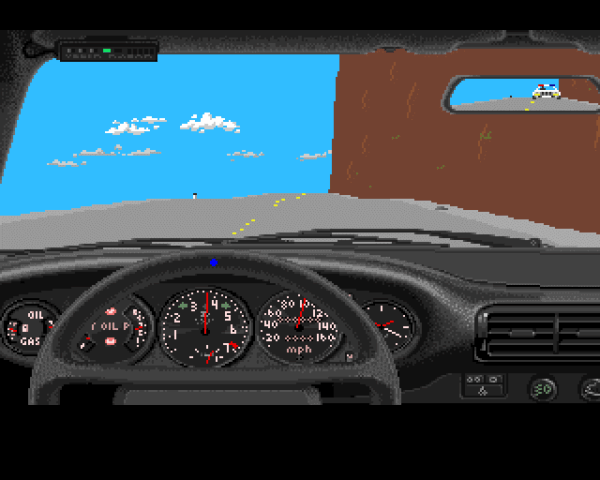
Each dashboard in Test Drive was a painstaking re-creation of the real thing. This is, believe it or not, that of a Porsche 911. I would have expected a bit more for my money…

Accolade published sequels to Test Drive in 1989 and 1990, alongside separate boxed add-ons with new cars to try out and scenery to traverse, thereby pioneering the model of the driving game as an entire ecosystem you bought into. (Today, that model is driven by the ubiquitous DLC packs.) By Test Drive III: The Passion, other staples of modernity were creeping in as well, such as the ability to rewatch and share your exploits after a particularly good (or bad) run and even a radio where you could select your own station, although we were still a long way from the times when bands and singers would lobby almost as aggressively as car companies to have their music included in such products.

Despite its innovations, the third game was not as well-reviewed or well-received as the ones before. Accolade had developed this installment in-house instead of letting Distinctive do it; this may be the reason that many gamers found it to be lacking a certain ineffable feel for the road. Then, too, some of the design choices were just weird: Test Drive III made keeping your windshield clear of bugs into a central aspect of its gameplay. The franchise effectively ended here, not to be revived until years later, as an also-ran rather than a pioneer.

The third game’s shortcomings notwithstanding, if you’ve played or even seen any of the modern driving sims, and try out any one of these Test Drive games today, you’ll immediately sense the same vibe, even if you are less impressed by the implementation. That’s a remarkable thing to contemplate all these decades later. For all that gaming has changed, it’s amazing how much it’s stayed the same in some of its core genres.

Distinctive was acquired by Electronic Arts in 1991. The new EA Canada focused more than ever on, for lack of a better term, “lifestyle games.” Being Canadian, it was given responsibility for creating the annual installments of the EA Sports National Hockey League franchise in the exploding console-game space. It has continued to this day to crank out a new edition every single year: 34 installments and counting as of this writing. This must surely be a record of some sort.

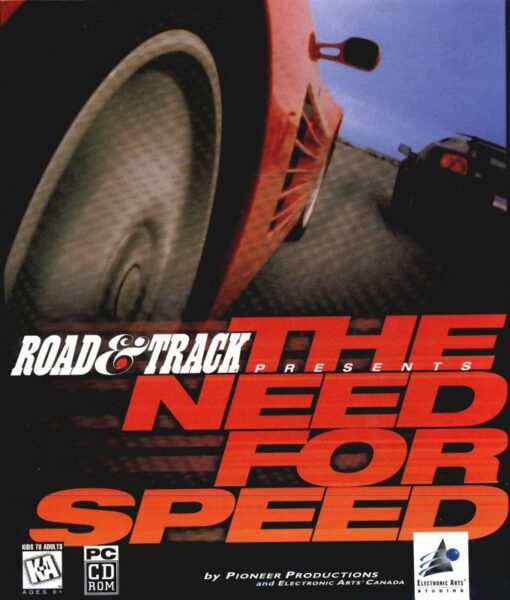
Driving games soon returned to the agenda as well. EA negotiated a deal with Road & Track, a slick magazine that sold an only modestly more grounded version of the fantasy of fast cars with expensive price tags than had Test Drive. Hanno Lemke was put in charge of Road & Track Presents: The Need for Speed, with many of the same people who had helped him build Test Drive working under him. It was to be a launch title for the 3DO, a new games console cum “multimedia appliance” whose finances were thoroughly muddled up with those of EA: Trip Hawkins, the founder of EA, had left that company with his board’s blessing and plenty of their investment dollars to embark on this new venture. The 3DO was envisioned as a sort of lifestyle console, appealing to an older demographic than the likes of Nintendo and Sega. It requires no great imaginative leap to understand why a game like The Need for Speed could be a good fit with that vision. If all went according to plan, the same people who perused Road & Track might soon be picking up 3DOs.

The 3DO’s not-so-secret weapon was to be the CDs on which all of its games would ship. These CDs would in turn enable lots and lots of digitized video and sound sourced from the real world, a possibility which would have seemed like science fiction just a few years earlier. The Need for Speed embraced said possibility with all the enthusiasm that was expected of a 3DO game; you didn’t see a computer-drawn car on your screen until you settled down into the driver’s seat of one.

The video clips were typical of the era — which is to say, amazing simply for existing at the time of the game’s release in 1994, but ho-hum at best today. The worst decision was to add a shakily acted fellow named Mr. X to serve as the player’s antagonist, popping up from time to time with some trash talk. This was exactly as grating as it sounds like it would be, especially after you had seen him deliver every one of his limited repertoire of one-liners multiple (dozen?) times.

Mr. X has something to say about your performance. He is aptly described by a contributor to MobyGames as “a face you love to punch.”

The means of production of all this video reflected the fact that the games industry, for all its rapid evolution, still had a ways to go before it would be competing on a level field with Hollywood. EA didn’t even have the clout to borrow cars from the manufacturers whose vehicles were included. So, Hanno Lemke and his friends had to go begging. Luckily, Road & Track had whole filing cabinets full of still photographs of the cars in question that were ripe for digitizing. In the category of the moving image, the Ferrari Testarossa seen in the video clips belonged to Chris Roberts of Wing Commander fame, the Lamborghini Diablo to Richard Garriott of Ultima fame, and the Porsche 911 to an EA Canada executive. Other cars were scavenged by still more humble methods, being vehicles that the team simply spotted driving by and chased down to ask the owners if they were interested in making a cameo appearance in a videogame.

Speaking of people with punchable faces: Chris Roberts’s Ferrari. (I kid! I kid!)

Once you got past all of the multimedia-age gilding, however, you found a very credible aesthetic simulation waiting for you. The Need for Speed reinvented no wheels; it was a recapitulation of Test Drive on a larger canvas, right down to the vaguely hapless cops who lay in wait to chase you down public highways. Once again, you had a selection of mouth-watering sports cars to hand, updated to reflect the latest developments in the field. (This time, the Japanese got a chance: no fewer than three of the eight cars — the Mazda RX-7, the Toyota Supra, and the Acura NSX — came from the Land of the Rising Sun.) But it was all done better, reflecting the seven years of steady technological advancement that separated The Need for Speed from the original Test Drive.

The game nailed the look and feel it was going for. No one would accuse this of being a hardcore simulation of driving — not when you could bump and bash and grind against the other vehicles with impunity, when even crashing head-on at speed into the side of a building resulted in little visible damage to the car. (This was a requirement of the contracts with the manufacturers, who had no desire to see their halo vehicles getting smashed up and exploding on screens; such requirements are still the rule in the contracts of today.) Even the non-police computerized drivers you could race against — another advancement over Test Drive — were more interested in showing you a good time and keeping the adrenaline level up than they were in earnestly trying to win. As one reviewer put it, “the AI drivers don’t race; they shadow.”
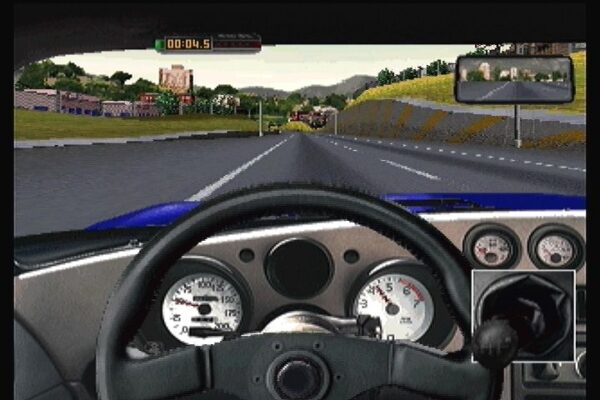
Driving a Dodge Viper, one of the new supercars that had appeared on the scene since Test Drive.

The point was that it was fun, being just close enough — but not too close — to what racing cars such as these might really be like. The game presented an alternative universe where you could not only afford a supercar, but one where insurance premiums didn’t exist and the police would give you no more than a ticket and a stern talking-to if they caught you driving 170 miles per hour down a heavily trafficked road. This was a universe that teenage boys everywhere — even the ones who happened to be in their twenties, thirties, forties or fifties — could well and truly get behind.

But sadly for everyone involved, the 3DO console was a marketplace flop. On the supply side, a scheme for renting out the console’s specifications and firmware to multiple consumer-electronics makers proved a recipe for confusion, while the slightly older folks who wanted to play multimedia videogames in their living rooms of an evening in lieu of watching television proved rather less plentiful than anticipated. Still believing they had a good thing on their hands, one which was just on the wrong platform at the moment, EA Canada reworked The Need for Speed for ordinary personal computers. This allowed them to turn it into the biggest game ever to be born on Trip Hawkins’s misbegotten console.

Released in 1995, this incarnation of The Need for Speed dialed back on the most annoying aspects of the 3DO version — Mr. X got the well-deserved axe — while keeping everything that had made it appealing. In its review, Computer Gaming World magazine made note of the tightrope it walked with such aplomb: “Realistic elements are usually compromised for the sake of a quick learning curve and blazing arcade action. But Need for Speed is kind of an anomaly: it borrows some from both styles and thrills the senses along the way.” It became a huge hit on personal computers. It was then ported to the Sony PlayStation, a new CD-based console which had set out to do much of what the 3DO had, and would pull it off much better. The Need for Speed took off there as well. Indeed, in some ways games like these were always more natural fits for consoles.
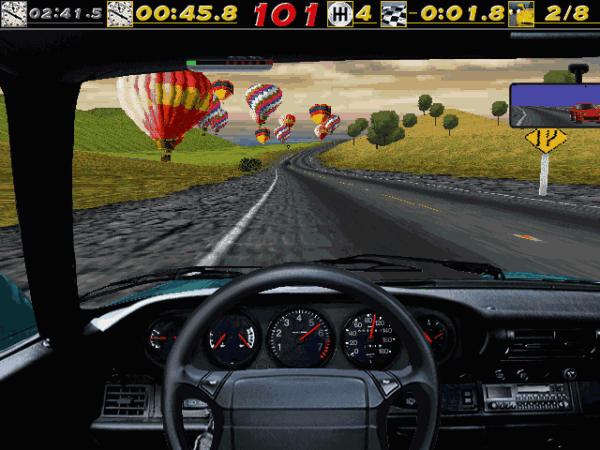
“Balloons ahoy!” in the computer version of The Need for Speed.

So, out of the smoking rubble of the 3DO, a long-running driving-game franchise arose. Need for Speed II came out in 1997. Along with the definite article in the name, it dropped the Road & Track partnership; EA now had more than enough clout to get all of the glamor shots and test models it could want from the manufacturers. Some complained that the advancement was all in the department of graphics and sound, but that was fine for most fans of this most deeply experiential of all gaming genres. “Little details like hearing the shift click mattered back then,” says Hanno Lemke, who would continue to act as the franchise’s primary producer until 2007. “Watching the dials move mattered.” (There is a reason that I like to call these games aesthetic simulations.)

The series was moving now toward an annual release schedule, just like the sports games. In that spirit of ongoing perpetuity, Need for Speed III: Hot Pursuit, which came out in 1998, was the last installment with a Roman numeral and the first with a subtitle. To further press home the notion of Need for Speed as a subculture you bought into rather than a single game you bought, EA began to regularly put up new, downloadable content — most importantly, new supercars to add to the ever-growing list of same — on its website.
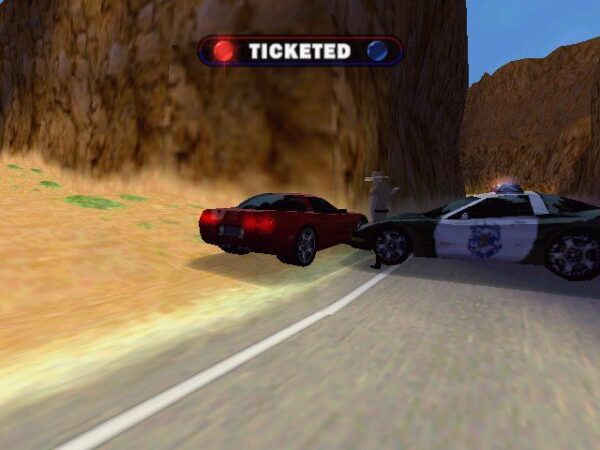
The police have upgraded their stodgy cruisers to Camaros in Need for Speed III.

In a decision which was polarizing in some circles but doubtless exhaustively market-researched, this installment leaned further toward the arcade game at the expense of the simulation. As its subtitle would imply, it heavily emphasized the police-chase aspect. The cops, who had verged on being little more than props at times in the past, could now go so far as to set up roadblocks ahead of you, complete with tire spikes. But, as Computer Gaming World’s reviewer captured, the core attributes of the aspirational lifestyle game, as deft at promoting the cars it featured as it was at being good fun in its own right, remained as pronounced as ever.

During the time I was writing this review, I went driving in the mountains. As I cruised along narrow, twisting roads, I kept thinking about how much the experience reminded me of playing Need for Speed III — at least as far as handling the car went. I wasn’t being chased by the police, and I wasn’t pushing my Lamborghini much past 60 miles per hour. Okay, so I don’t own a Lamborghini. But after playing this game, I sure wish that I did.

Need for Speed: High Stakes appeared right on time in 1999. In order to give the Buford T. Justices of the world some redemption, it let you become the police instead of forever being chased by them. But the less gimmicky, vastly more significant addition was that of a career mode, which finally provided a proper meta-game to bridge and give context to your exploits on the highways and raceways. You started with only enough money to buy what passed for a budget car in this august assemblage: a Mercedes SLK or a BMW Z3. You had to earn your way into the more exclusive rides by winning ever more challenging tournaments, whilst keeping your repair bills to a minimum in the process. High Stakes wasn’t quite the first aspirational driving game to introduce a career mode — that distinction belongs to Gran Turismo, a PlayStation-exclusive competitor — but it was a huge step forward nonetheless. Suddenly the individual races had… well, high stakes, that extended beyond the moment-to-moment maneuvering on the road, that might even cause you to exercise a modicum of caution out there from time to time. And as you progressed, you slowly amassed a garage full of tricked-out, exotic sports cars. I trust that I’ve flogged my hobby horse sufficiently by now to not have to tell you what this meant for these games as aspirational lifestyle products.
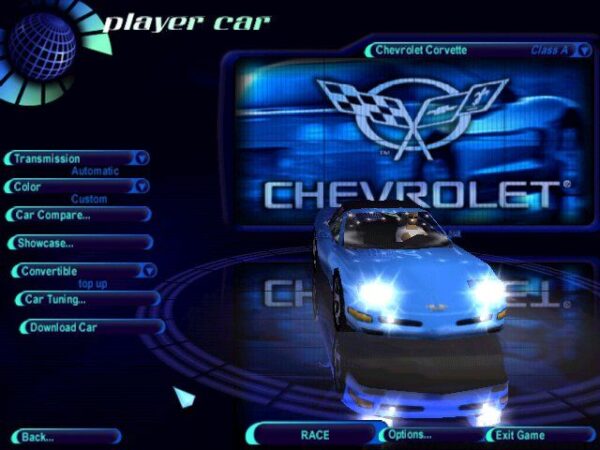
Your garage in High Stakes looks like a car dealer’s showroom. This is not a coincidence…

All of this was great, if you were interested in buying what these games were so explicitly selling. I must confess that I really wasn’t, even back in the day. The cars that were featured weren’t generally the ones I lusted after, and I found the whole presentation a bit too boy-racer for my tastes. But then Need for Speed took a surprising detour — one that would prove a bit of a blind alley for the franchise, but one that I enjoyed immensely. I’ll tell you all about that next time.


Did you enjoy this article? If so, please think about pitching in to help me make many more like it. You can pledge any amount you like.


Sources: Edge of October 1994; Retro Gamer 59 and 178; Computer Gaming World of February 1988, April 1991, November 1995, August 1997, March 1998, and January 1999; the Harvard Business School case studies “Electronic Arts in 1995,” “Electronic Arts in 2002,” and “Electronic Arts: The Blockbuster Strategy.”

Online sources include “A Distinctive Lineage” by Chris LaVigne for The Escapist, “How Need for Speed Became the World’s Biggest Racing Game” by Mack Hogan for Road & Track, and an interview with Hanno Lemke conducted by John Davison for 1UP.com.

Where to Get Them: Unfortunately, none of the games discussed here are available for legal purchase, presumably due to the expiration of the various licensing agreements with automobile manufacturers. It’s another reason that these sorts of games are so easily forgotten by history…



Tags: , , , ,

The Life and Times of Maxis, Part 3: The Sims


This article tells part of the story of Maxis Software.

I don’t think people realize how much tactical and strategic forethought goes into their daily lives. There’s a whole subconscious time-efficiency layer in our lives. In essence, real-time strategy is our lives.

— Will Wright

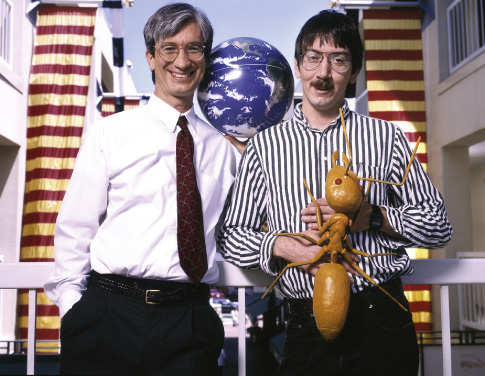
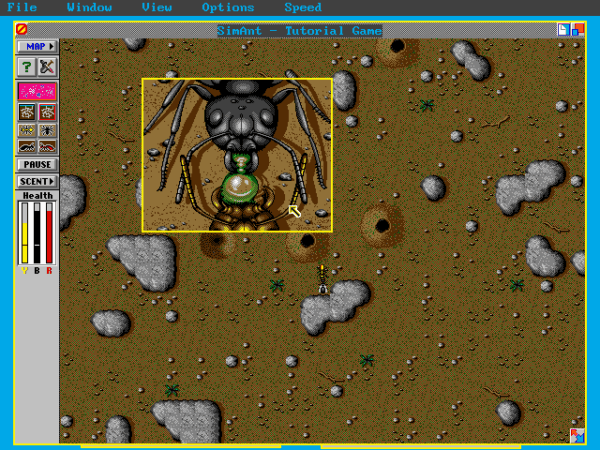
On the morning of October 19, 1991, two weeks after writing his last bit of code for SimAnt, Will Wright climbed out of bed and smelled smoke. Looking out the window of his home in the Oakland Hills of California he saw a dense black cloud blowing in from the east. He called emergency services, who informed him that the culprit was a grass fire that was under control.

But after his morning shower, the smoke was worse than ever; great acrid plumes of the stuff were engulfing the house and seeping past the window frames, making it hard to breathe. The emergency-services number now yielded only a busy signal.

Wright gathered up his wife Joell and their five-year-old daughter Cassidy and bundled them into the family car along with a neighbor couple. They shot down the road under a rain of ashes and cinder, choking on smoke so thick that it was all Wright could do to keep the car’s tires on the pavement. Finally, they burst out of the maelstrom into blessedly clear air. Wright continued holding the accelerator down until they were well away. He guesses that, had they been five minutes slower getting away, their names would all have been added to the list of 25 victims of the Oakland Firestorm of 1991.

A week passed before the family could return to the charred remnants of their house, still smouldering there under a glowering autumn sky. There was virtually nothing left — except for the ants, that is. (Wright was rather primed to notice them…) “The interesting part was to find that I wasn’t really attached to much,” Wright says. “I started assessing my material needs: a toothbrush, underwear, a car, a house… I was surprised how I didn’t miss stuff. The fact [that] we got out and none of our family was hurt seemed much more important.”
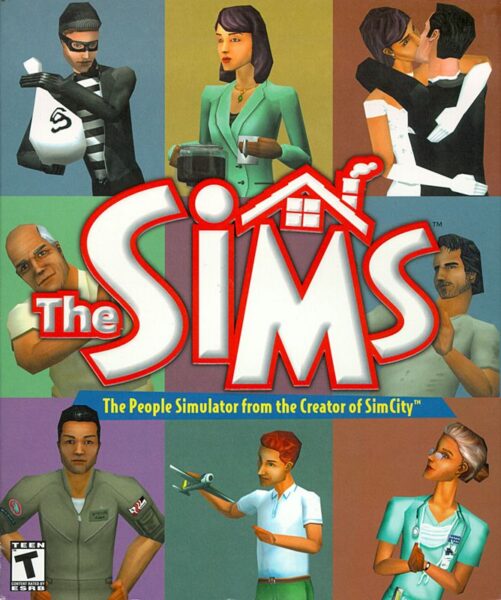
Wright found himself asking,

What is life made of? Rarely do you do that in your real life. When something like this happens you get a big picture. Where do I want to live? What sort of things do I need to buy? You see your life almost as a project in process. When you’re embedded in your day-to-day life, you don’t get that perspective. I started to wonder about all the things we have and how we purchased them for a reason. Why do we need X or Y or Z? Why do we think something will make [us] happier? It almost comes down to Maslow’s Pyramid of Needs.

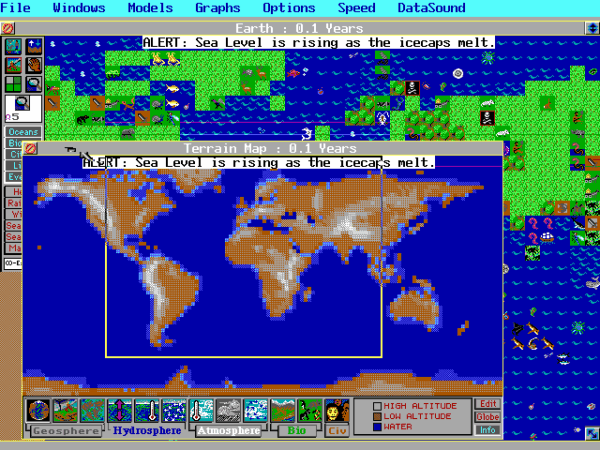
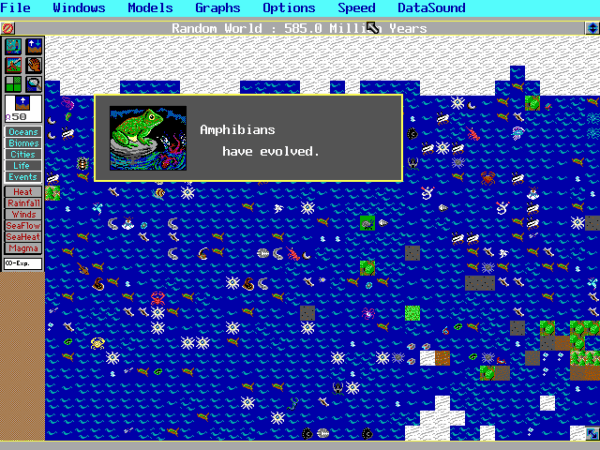
A period of reassessment like this might end for some people in a decision to climb a mountain, walk a camino, quit a job, write a novel, join a charity, or move into a monastery. But Will Wright wasn’t that sort of man; he was someone who thought in systems and algorithms. He wondered if there was a game — no, a simulation, or maybe just a software toy — lurking in the prospect he was now facing in the real world, that of assembling the material components of day-to-day life from scratch. Back at work at Maxis, he sat down in front of his computer to find out. His first three games since co-founding the company — SimCitySimEarth, and SimAnt — had been simulations of complex systems with thousands of incidental living actors. Could you simulate the spaces and clutter of individual lives instead?

It would take him eight and a half years to answer that question affirmatively. The belated result of his close encounter with the Oakland Firestorm would be The Sims, the best-selling line of boxed computer games in history. Some would celebrate the series for offering a whole new vision of what games could do and the subject matter they could tackle, drawing in tens of millions of new players who would never have given SimCity — much less Diablo or Starcraft or any of the other hardcore standard bearers — a second glance. Some would condemn it for being just another empty monument to conspicuous consumption and shallow egotism, of a piece with the “reality” shows that were suddenly inescapable on American television screens. In the final reckoning, of course, it was a little of both.


Stories of how The Sims came to be have a tendency to fall into some well-worn patterns. We are told how Will Wright, the brave and pioneering creator, had to fight for his dream against the unimaginative suits who surrounded him for the better part of a decade, until he finally got to enjoy sweet validation as he watched it turn into the biggest game ever. There is something to this telling of the tale, but it’s missing a lot of nuance. First and foremost, it commits the fallacy of assuming that the version of The Sims which Wright conceived in late 1991 was essentially the same as the game which was released in early 2000. In truth, it went through a protracted process of evolution, from which it emerged with a radically different focus. Along the way, several other people became almost as instrumental as Wright himself in shaping it into a game with such extraordinary mass appeal. This is not, in other words, another case of a single genius auteur imagining and implementing something unprecedented, as Wright did when he made the original SimCity. The creation of The Sims was a more organic, at times almost accidental process. For Wright specialized in systems, not in people. To make an appealing simulation of the latter, he had to draw on folks whose strengths were very different from his own.

But all of that was still in the future when Wright was contemplating the altered nature of his existence in the wake of the Oakland Firestorm. At that time, it was accurate enough to say that no one else at Maxis knew quite what to make of his new hobby horse. That he could so thoroughly flummox even this bunch, the makers and publishers of some of the most esoteric games in the world, really says something. Indeed, it may very well say that he himself wasn’t entirely sure what he was doing. Some game designers are like military strategists, speccing out every element of a campaign beforehand. Some are more like mad scientists, mixing a bit of this with a bit of that to see what turns into a useful synergy and what just blows up in their face. Wright is the poster child for the mad-scientist school.

For a long time, he called his idea Dollhouse. As the name would imply, it was all about architecture and interior design. He had become enamored with a book called A Pattern Language, written in 1977 by a Berkeley architecture professor named Christopher Alexander and several colleagues. It can be read as an attempt to define a Western version of the ancient Chinese concept of feng shui, explaining how our living spaces can be arranged so as to bring a sense of peace and harmony to our lives. It defines everything from the amount of green space a city should have to how many floors a building should contain to how high a windowsill should be, all based on universal and eternal “archetypes” that are “deeply rooted in the nature of things.” “You can use this book to design a house for yourself with your family,” wrote Alexander. “You can use it to work with your neighbors to improve your town and neighborhood; you can use it to design an office, or a workshop, or a public building.”

Wright wanted to use it to design a computer game, one that would bring Alexander’s theories to the masses, in the same way that his earlier games had promoted those of Jay Wright Forrester, James Lovelock, and E.O. Wilson. As in those games, the dolls in this dollhouse would be purely supporting players to the real star of the show, the physical environment itself. Their reaction to the spaces you put them in would provide a way of “scoring” how well your layout conformed to the principles of Christopher Alexander. This was their one important function.

Jeff Braun couldn’t have been thrilled at seeing his partner going down this rabbit hole, an abstruse one even by Maxis’s usual standards; SimCity this was not. But as always, he did his best to support Wright, whom he unabashedly regarded as a “genius.” He arranged for Wright to explain his concept to a focus group, just to gauge their reaction. Setting something called Dollhouse in front of a bunch of self-identified gamers circa 1992 was always destined to be a fraught endeavor, but Wright and Braun were nonetheless taken aback by the vehemence of the rejection. “This was probably the most negative focus-group experience I have ever seen,” says Wright. “It was actually quite remarkable. They universally hated it.”

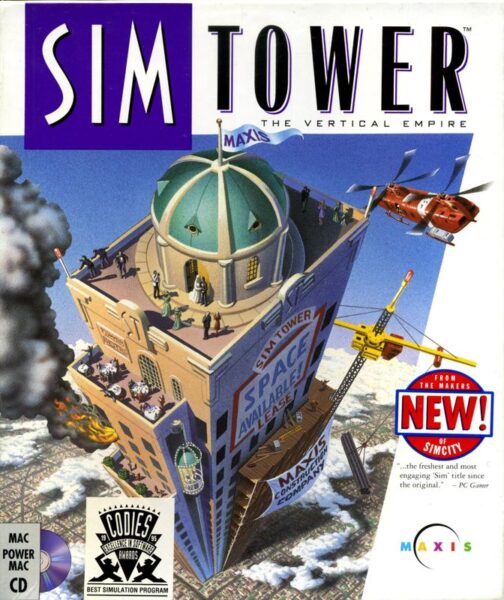
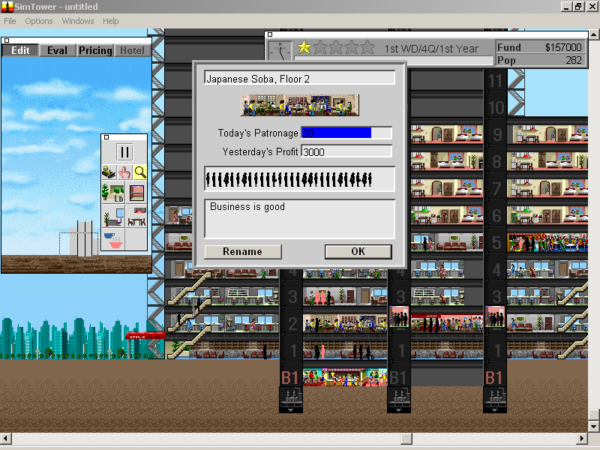
Soon after, Braun wheedled his partner into agreeing to lead the development of SimCity 2000, pulling him away from his living-spaces simulation for a year. After that, the concept got muddled up with SimWorld, this attempt to make all of Maxis’s games interoperable so that they were all essentially one big game in the end. So, you would be able to pick a building in a SimCity city and zoom in to tinker with the fine details of its exterior and interior using Dollhouse. Part of the reason that Wright was so enamored with Yoot Saito’s SimTower was that it was already blurring some of the lines between SimCity and Dollhouse. (The Sony PlayStation port of SimTower even let you explore your skyscraper from a crudely implemented first-person perspective.)

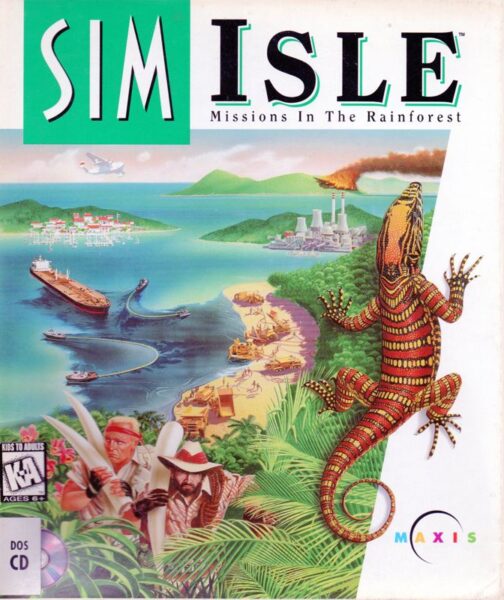
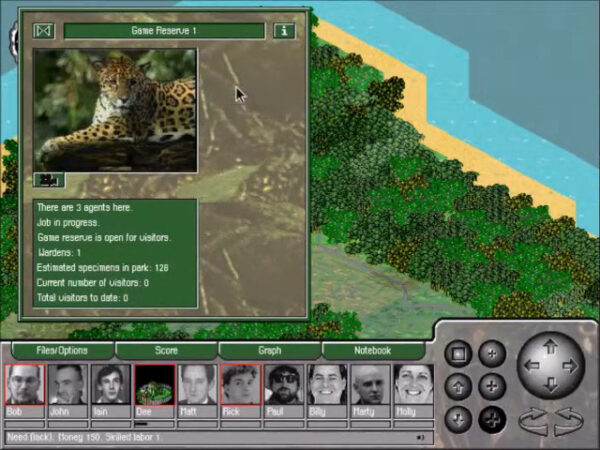
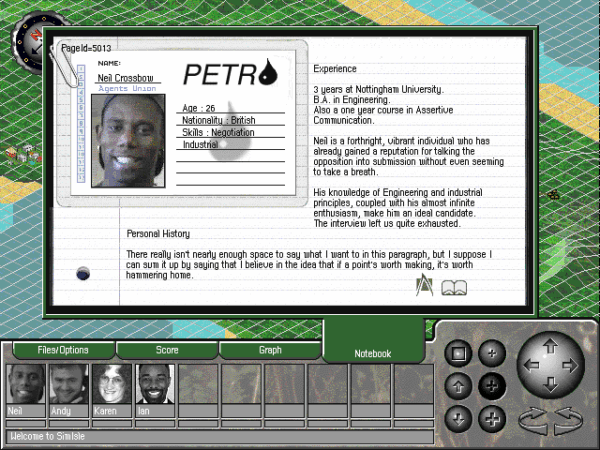
That said, the people around Wright still didn’t entirely get what he was trying to do with Dollhouse. “It just felt kind of peculiar, you know?” says the Maxis researcher, writer, and producer Chris Trottier, whose first assignment as a new hire was to travel to real tropical islands and take pictures for SimIsle. (Nice work if you can get it…) “Will’s goal for it was that it was about efficiency and architectural layout and that the people were just there as a byproduct. The people were what measured your success in setting things up efficiently.”

But in trying to model the behavior of the people well enough to measure the quality of the player’s architectural and interior-design efforts, Wright would wind up inadvertently discovering a whole different, more immediately appealing game.

It began in 1995, when Jeff Braun agreed to bring on a bright young Stanford graduate named Jamie Doornbos to help program the dolls in Wright’s dollhouse. Doing that well enough to properly grade the player’s layouts proved to be far more difficult, complex, and time-consuming than Wright and Doornbos had thought it would be. Luckily, it was also more fascinating than they had ever imagined. Together they realized that the fun of the game may not be where Wright had thought it was. Wright:

We were trying to figure out how we could simulate an open-ended system where the behaviors [of the people] were expandable and they had the level of intelligence that we would require for the game, so that they could basically live out their whole home life and we could simulate it reasonably. So Jamie and I spent about a year and a half just working on the behavior model, as a little research project. At some point it just started really working out, and really looking pretty good.

It turned out that controlling the little people was actually more interesting. It was still fun designing houses for them, but controlling their lives actually turned out to be far more compelling, so the whole project took a turn toward the people. I kept the architecture tools in there, but then I just really started focusing more on the people and objects and their behaviors and relationships — all that sort of stuff.

Thus the stars of Dollhouse became the dolls, with their houses as supporting players, instead of the other way around.

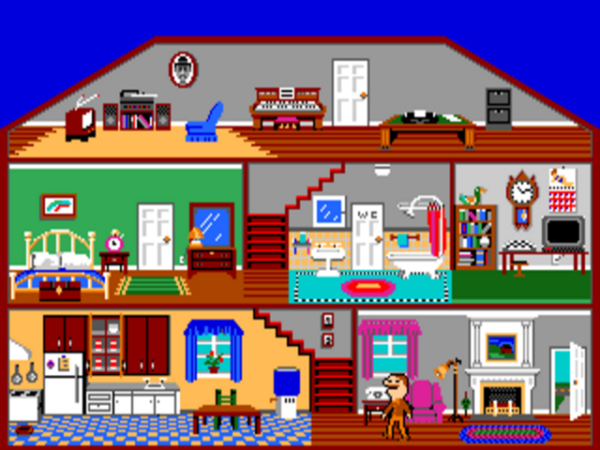
As they did so, the simulation came more and more to resemble an oddity from the previous decade called Little Computer People. Created by Rich Gold and David Crane, Little Computer People was published by Activision in 1985 in the midst of that company’s artsy-fartsy period, when the warehouse full of cash it had collected on the pre-crash Atari VCS market gave it the luxury of venturing down a number of such avant-garde, high-concept alleyways. The “game,” if that’s what you chose to call it, was a bit like the Maxis-published El-Fish aquarium simulator, but with a human in the fishbowl. A little man lives in a little house inside your computer, and you can watch as he and his dog go about their day on a realistic albeit compressed schedule, with 24 hours inside the computer passing for every six outside of it. Depending on the time of day and his personality and mood, the fellow might prefer to relax with a book in his favorite armchair, make music on his piano, exercise, chat on the phone, wrestle with his dog, watch television, listen to his record collection, or play a game of cards with you — when he isn’t sleeping, brushing his teeth, or showering, that is.  You can try to get him to do your bidding via a parser interface, but if you aren’t polite enough about it or if he’s just feeling cranky the answer is likely to be a big fat “No!”

Little Computer People.

The most unique aspect of Little Computer People was that all of the little people were, well, unique. Each floppy disk that shipped had a different personality magnetically encoded on its sectors. You might wind up with a sluggard or an athlete, a Pigpen or a neat freak, according to the luck of the draw. Rich Gold envisioned Little Computer People becoming merely the beginning of a whole product ecosystem which would let you watch and nudge your little people in all sorts of different environments: at school, at work, during a night on the town, etc. Maybe you could even put your little person together with someone else’s to see how they got on! All of those plans were scrapped when sales were not up to snuff — but they were an uncanny reflection of the direction that Will Wright’s game would later go.

This was probably not completely coincidental. Wright has stated that he himself played Little Computer People in the mid-1980s; thus his early habit of referring to the characters in his own game as “little people.” During an online chat hosted by CNN in 2001, he said that “I’ve since gotten to know several who were involved with that project, and many of them gave valuable feedback, especially Rich Gold.” The most obvious differences between the two projects had to do with resources. Whereas Little Computer People had to run on an 8-bit Commodore 64, Dollhouse was implemented for a 32-bit Mac or Windows machine with a thousand times the storage and processing power. And whereas Little Computer People was made by two men in a handful of months, Wright had the privilege of tinkering for years, and would have a team of several dozen at his disposal before all was said and done.

For right now and quite some time to come, though, it was just Wright and Doornbos. They rechristened Dollhouse “Project X,” reflecting the reality that its goals were becoming more open-ended rather than less so, even more of a “little research project” than a coherent game. Which isn’t to say that the tech wasn’t cool and innovative. At bottom, Wright and Doornbos strove to create a simulation of the psychologist Abraham Maslow’s Hierarchy of Needs. This was a huge leap into the wild blue yonder for a project that had begun as a simulation of architecture and interior design. “I spent a lot of time thinking about how to make the behavior of these people very robust, interesting, and plausible, no matter what kind of environment you put them in,” says Wright. Chaim Gingold described the approach in his (highly recommended) 2024 book Building SimCity: How to Put the World in a Machine.

Wright crafted a simulation of a person’s needs. A simple prototype showed [how] a person’s hunger, bladder, and other needs evolve over time. If the person peed in their pants or fell asleep, a dialog box popped up. Doornbos incorporated this “motive engine,” a concise set of equations and coefficients, into a new Project X prototype focused on imbuing the people and things of this dollhouse world with behaviors.

“SimAntics,” as the language came to be known, went through many iterations, but from the start it had a graphical editor inspired by the diagrams Wright drew to explain how people would do things like go to the bathroom, brush their teeth, and make breakfast. These behavior scripts, which were compiled into a compact bytecode, told people and objects how to do things like select activities, walk around, animate, and, in the case of insensate objects like appliances, break. As in SimAnt, intelligence emerged from the coupling between agent and environment. Objects broadcast advertisements that claimed to service a person’s changing motives. A toilet, for instance, would advertise its ability to relieve the bladder motive. Crucially, the custom language scaffolded the design conversation between Doornbos and Wright, who could discuss its limitations. As a result, SimAntics was highly extensible; new objects could easily plug into Project X’s dollhouse world and describe both why and how a person might use them.

In a sense, then, the system worked by inverting the expected order of things, by making the people dumb and the objects smart. “This all happens behind the scenes,” Will Wright said, “but basically the fridge yells at [a person], ‘I can satisfy Hunger Five!’ and the chair says, ‘But I’m all about Comfort Four!’ and the bath says, ‘Hygiene Seven right here!'” This approach was rather brilliant in that it meant that you could add new objects without touching the core “needs” simulation, and have the inhabitants of the world respond believably. As we will see, this modularity, and the nearly infinite extendibility it brought with it, would be key to what Project X would become; stated in terms of filthy lucre, it was capable of turning one product into a potentially limitless line of same. In the meanwhile, notes Chaim, “Doornbos wasn’t sure if Project X would be fun, but he loved working for Wright.”

For a while, the two men were allowed to tinker in peace; again, Jeff Braun always prided himself on letting his resident genius do his thing without outside interference. Yet Wright and Doornbos would only be able to ignore the clouds that were gathering outside their blue-sky bubble for so long. As Maxis’s financial situation began to look worrisome, the now publicly-traded company’s board could hardly fail to note that its star designer hadn’t finished an original game since SimAnt almost five years ago, hadn’t contributed anything tangible to the bottom line since leading the SimCity 2000 effort. Nevertheless, it was Braun rather than Wright who was dismissed in August of 1996. Wright was then more or less forced by new CEO Sam Poole to take a hiatus from Project X and help out on SimCopter, the long-delayed proof of concept for SimWorld. Pressed to focus on something more realizable and practical than his people simulator even after SimCopter was finished, he spent time drawing up plans for a simulation of, of all things, the infamous German airship Hindenburg. He gave that up, he admits, only because “the Hindenburg had a swastika on the tail. And even if we took the swastika off, a lot of people have this association in their mind of the Hindenburg as a Nazi symbol.”

In June of 1997, the struggling Maxis was purchased by Electronic Arts. One might have guessed at the time that this event would represent the final kiss of death for Project X. Luc Barthelet, the manager whom the new corporate overlords sent in, was not at all a blue-sky type. On the contrary, he sounded almost like a caricature of a soulless gaming executive when he insisted that the time of Maxis as a maker of quirky little simulations of unusual things was well and truly over: from now on, he said, they would make only “top-ten” games.

And yet Barthelet surprised everyone by recognizing that Project X could be just that — recognizing it far better, in fact, than anyone had during Maxis’s years of independence, including Will Wright himself. He saw that all of the computers that were being sold in the wake of Windows 95 and the dot.com craze were being bought by new demographics with wildly divergent interests from conventional gamers. If you could give those people something fun and engaging to do on the computer when they weren’t surfing the young Web over creaky dial-up connections, you could open up and own a whole new market. So, rather than cancel Project X, he put roughly half of Maxis’s resources into it, while the other half worked on the safer and more predictable bet known as SimCity 3000. With the injection of employees and resources came a new focus on turning the research project into a product that could be sold; Will Wright says that it was “probably Luc more than anybody else [who] was responsible” for turning Project X into a proper game. It was rebranded simply The Sims, a name that had been used for the anonymous, interchangeable people in the company’s simulations since the days of the original SimCity. They would be anonymous and interchangeable no more; they would be the whole point of this latest game.

Whatever else they may have been, Will Wright and Jamie Doornbos weren’t touchy-feely guys. They had been and remained all about their algorithms, which had the potential to become the plumbing of a game, but were nothing like the sum total of one. The colleagues who joined them had the assignment of turning a research project into a playable, saleable game.  Claire Curtin and Roxana Wolosenko, two women who joined the project in co-designer roles, strove to humanize the algorithms. Ditto the aforementioned Chris Trottier, another woman, who came aboard as an associate producer. The ranks of the team came tantalizingly close to gender parity, in an industry that was at least 90 percent male outside of Maxis’s offices. This surely had much to do with how appealing The Sims would become to a wide and divergent swath of folks, gamers and non-gamers alike.

As Maxis’s later promotional materials would advertise, the principal facets of the game were building, buying, and living. You made a place for your Sim to dwell, filled it with stuff, then helped her to deal with the fallout of your choices. It quickly became clear to the team that they needed to dial back some of Wright and Doornbos’s behavioral algorithms in order to give the player something to do during the living phases. In fact, in the finished game, Sims don’t do much of anything on their own volition other than eating. You have to tell them when to go to bed and when to get up, when to wash the dishes and water the plants — and yes, even when to go to the bathroom. If you fail to send them to the toilet in a timely manner, a messy and embarrassing accident will follow. Some future players would find this elevation of the mundanities of life to the heart of the gameplay loop weirdly riveting; others would find it mind-numbingly boring. But no one could deny that it was daringly different.

The Sims would be a lonely experience if it was, like Little Computer People, all about one person alone in a house. It ought to be possible to have friends and families living together, ought to be possible to have outsiders come over for a visit, for barbecues and pool parties — both kinds of pool — and even romantic trysts. At bottom, the game would remain a nesting simulator — there was no possibility for leaving the house and its environs — but at least there would be relationships inside the nest. Indeed, these would become the real heart of the game in the eyes of most of its players. This was no small achievement. Games tend to be good with structured fictional genres like mysteries, the kind that have goals which are never in doubt and are achievable by taking logical, concrete steps. Relationship drama is the opposite of that. Maxis pulled it off well enough to mimic a frothy sitcom or soap opera if not deathless literature — which was more than anyone else had managed.

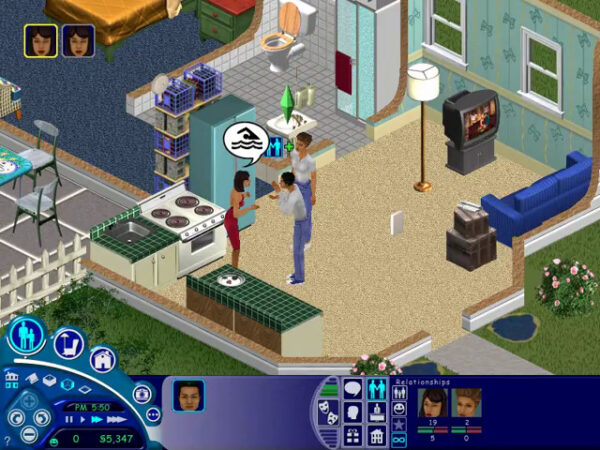
The first and trickiest problem to solve in this context was the question of how the Sims should communicate with one another. Maxis wanted to create the impression of conversations without delivering literal meaning; as Will Wright noted, even if they included five CDs worth of voice-acted stock phrases, the conversations would soon start to sound repetitive and moronic, pulling the player right out of the fantasy. Maxis’s first idea was to use a language that few of their players would be able to identify, much less understand: they toyed with such tongues as Ukrainian, Estonian, and Navajo. But with them too, familiarity bred contempt, when it became clear that the Sims were repeating the same stock phrases over and over, even if the player didn’t know what they meant. Maxis finally settled on a gibberish that has become known as Simlish. Manipulated to suit the mood of an encounter, a fairly small amount of formless mumbling, provided by just two talented improv actors, could be stretched a surprisingly long way.

The speech bubbles convey the broad contours of what is being discussed. Here the topic is swimming.

Maxis created a look and personality for The Sims that were familiar from other forms of media but new to games. In place of the tacky-looking digital Arnold Schwarzeneggers and Pamela Andersons who dominated hardcore gaming, they offered up relatively normal-looking people — idealized to some degree, yes, but possessed of normal proportions and normal sartorial instincts. The people and environments were given an airbrushed sheen that was, if not quite realistic, sanguinely adjacent to real life in the turn-of-the-millennium United States. The aesthetic and the vibe of the game were of a piece with those of a “hangout” television show like Friends or Dawson’s CreekThe Sims too was real life, only better, with no truly intractable tribulations to suffer through, with stakes that were big enough to engage but not big enough to make anyone uncomfortable. We might go so far as to call it the first hangout game.


The music contributed as much as the visuals to making The Sims stand out from the gaming crowd. In place of the bombastic John Williams-inspired orchestral soundtracks and jackhammer metal tunes of other games, it featured perky, pleasant, melodic tracks with a range of inspirations spanning from Antonio Vivaldi to Keith Jarrett. Created by a whole stable of professional composers and musicians, herded by Maxis’s in-house sound man Jerry Martin, at its best the music of The Sims transcends the artifact to which it has been attached to become something pure and lovely in its own right. A surprising number of players would go so far as to buy EA’s official soundtrack CD, so that they could listen to the music without playing the game; many considered it a fine accompaniment to household chores, which seemed thoroughly appropriate. As Alex Robert Ross wrote in an article for Vice, “it wouldn’t be a stretch to say that more people have heard Jerry Martin’s minimal jazz than Thom Yorke’s measured howls on ‘Everything in Its Right Place.’” (This is a reference to Radiohead’s Kid A, arguably the most critically acclaimed album to be released in the same year as The Sims.)


In the spirit of being a welcoming space — real life with the sharp edges sanded off — The Sims broke ground by not just permitting same-sex romantic relationships but thoroughly normalizing them, treating them as just another thread in the fabric of humanity. This makes quite a contrast to Maxis’s swift backpedaling the moment the kissing lads of SimCopter were discovered. Gay relationships wound up in this game more by accident than any premeditated effort to stand up for equal rights. Then, once they were there, no one had the heart to take them out. It strikes me that a lot of positive change in the world happens in exactly this way.

The story in this case involves a programmer named Patrick J. Barrett III, who was himself gay. Unlike his predecessor Jacques Servin, who had deliberately inserted kissing men into SimCopter as an act of provocation and been fired for his trouble, Barrett really did do so accidentally, according to his own telling. He joined Maxis in October of 1998, after the decision had already been quietly made not to allow homosexual relationships; this was still a dismayingly commonsense one in the late-1990s United States. But nobody ever told Barrett about it. So, when he was asked to implement some algorithms found in a planning document for handling romantic relationships, he gave them equal weight for everyone. And once they were in the game, it seemed to all of his colleagues too sad and cowardly to even contemplate going back and taking them out. Nobody made a big deal out of it. Everyone “just pretty much ignored” that the rules had been changed, says Barrett. “The topic didn’t come up again.”

Under the new rules, every Sim started out in the dead center of a spectrum. If you prodded her to direct toward the opposite gender actions that were tagged as “romantic,” she would drift toward the heterosexual end; vice versa if you pointed her toward her own gender. If you played your cards just right, you could even keep her poised right in the middle of the spectrum — effectively, bisexual, or asexual if you preferred.

The low-key way in which the game tackled the subject would wind up being more powerfully validating to some of its players than a box festooned with rainbow flags and Pride regalia would have been. Patrick Barrett:

At the time, it wasn’t considered “normal” to be gay or lesbian. Some even saw it as dangerous. But in The Sims it was normal and safe to be a gay person. It was the first time we could play a game and be free to be ourselves within. It was a magical moment when my first same-sex Sims couple kissed. I still sometimes wonder how in the world I got away with it.

In keeping with the law of the land at the time, gay Sims could do everything except marry one another and have children. The picture of happy domestic cohabitation the game presented was enough to make you wonder why not — and that, of course, was a potent statement in itself.

The Sims had its coming-out party at the E3 trade show in May of 1999. It caused a buzz there that belied its modest booth in a back corner of the show floor. That E3 took place in the heart of Hollywood, and seemed to many attendees to mark the opening of a new chapter in gaming culture’s relationship with the rest of pop culture. Rock star David Bowie was there, exuding relaxed cool as he signed autographs, gave interviews, and even put on a concert, all to mark the inclusion of his songs, voice, and visage in the upcoming Omikron: The Nomad Soul. Despite bearing no surface resemblance whatsoever to Omikron, The Sims seemed somehow to be part and parcel of the same trends that had landed Bowie at this gathering. Indeed, taken purely as games, The Sims actually stood out far more than Omikron. It had no dragons, no spaceships, not even any guns. It struck many as an argument for the vitality and relevance of the medium that was even more convincing than cameos from an aging rock star.

Chris Trottier’s memories of the show are of near-pandemonium: “There were just rows of people, and we were just trying to project our voices. We were completely hoarse. That was the turning point.” Two female Sims kissed there on the screen in front of the assembled crowd on the very first day of the show. This provoked more excitement than controversy: “You might say that they stole the show,” says Patrick Barrett. Given the demographics of the attendees, it was probably for the best that the kissers were two women rather than two men: “I guess straight guys that make sports games loved the idea of controlling two lesbians.”

After that E3 show The Sims, which had heretofore received little outside attention, became a fixture in the gaming press. Some of the hardcore set reflexively kicked against it for watering down their hobby in some amorphous way, but most looked forward to seeing how it would turn out.

Just as had happened the previous year to SimCity 3000The Sims wasn’t quite ready to go in time for that Christmas buying season. For the second year in a row, Luc Barthelet had the unenviable task of convincing his bosses at EA to choose quality over timing. And for the second year in a row, he succeeded.

The Sims shipped in February of 2000, exactly one year after SimCity 3000. It immediately became clear that, while SimCity 3000 had been a massive success by all of the usual metrics, The Sims was going to blow all of those same metrics right out of the water. It was exactly the right game at exactly the right time, feeding a latent demand from all of those new purchasers of personal computers for something absorbing and engaging, but also lighter, more approachable, less zero-sum, and less “gamer dark” than the industry’s standard fare. In many ways, it was the fulfillment of a dream that the games industry had been flirting with since Trip Hawkins founded EA back in 1982, with only localized and intermittent signs of success. This was the moment when digital games went fully and irrefutably mainstream, the moment when mothers and sisters, shopkeepers and hairdressers joined their nerdy brothers, sons, and husbands in the hobby. Most of these folks would never self-identify as gamers, but they played. Boy, did they play.


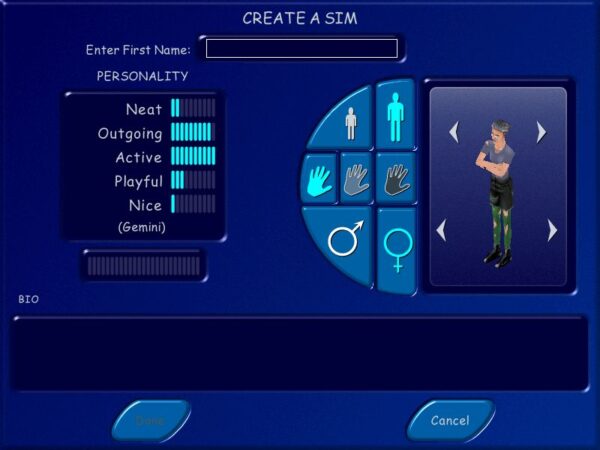
You start out by creating your Sim, giving her an appearance, a gender, and a personality profile defined along five continuums. In keeping with a game that is proudly goalless, the emphasis is not on making the best character, as in many CRPGs; it’s on making the character that you want to play.

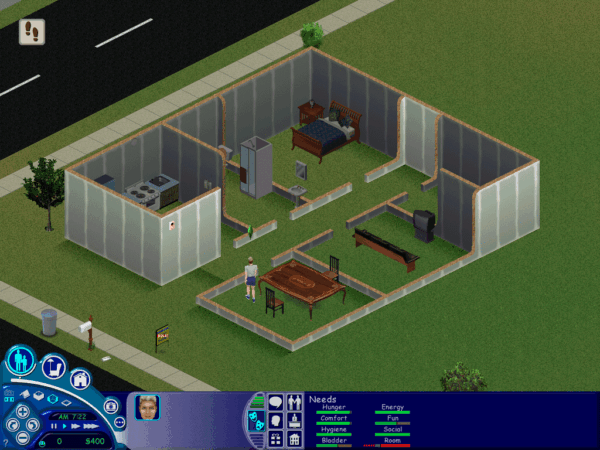
Next you need to build a house for your Sim to live in. You only have $20,000 to start with, so you have to economize. Note the bar graphs of her current needs. These lie at the heart of the gameplay loop. Your goal is to never let them drop any lower than they have to. Yes, this means that going to the toilet is as important as love and friendship. Perhaps this is more true to life than most of us would like to believe…

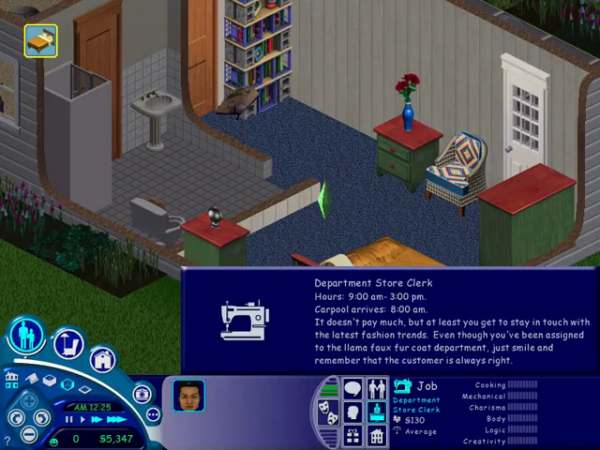
Now you need a job. You can advance along ten different career tracks in the original game, more if you’ve installed expansions. You don’t actually follow your Sim to work, but her performance on the job is dictated by how well her needs are being met at home. Send her to work tired or hungry, and she’ll under-perform and eventually get fired; send her out in tip-top condition, and a promotion could soon be coming, with the requisite higher salary attached. (This is where criticisms of the game as a consumption simulator can begin to take root…) In one of the game’s more baffling omissions, there are no weekends. Your Sim needs to go to work every single day. How’s that for a capitalist treadmill?

The Sims may have seemed like a kinder and gentler game by the standards of its time, but it’s much more unforgiving than its sequels. Your Sims can die in a housefire or even starve to death. Public assistance doesn’t exist in its dog-eat-dog economy, but one type of social worker does — the type who can carry off your Sims’ crying children if they aren’t being properly cared for. Predictably enough, some players found their fun after they got bored with being nurturing in making life hell for their Sims, from bulldozing their houses to killing their pets.

Naked Sims are discreetly blurred out, and there is no explicit sex.

Sex is certainly implied, however, through home accessories like a “vibromatic heart bed” well-suited to “play.” This is contrasted with the more conventional “mission bed”; the folks at Maxis were winking and nudging so hard they must have developed permanent twitches. Sims can have extramarital affairs, or even engage in openly polygamous relationships. In retrospect, it’s a wonder more people didn’t notice and complain about this stuff.


The commercial trajectory of The Sims was unprecedented in the history of computer games. It shifted a million units within its first few months. It duplicated the achievement of SimCity 3000 by becoming the best-selling computer game of its release year; then it duplicated that feat again in 2001, all in an intensely novelty-driven industry where most titles went in and out of print in well under a year. In 2002, the two-year-old The Sims officially snatched the title of best-selling computer game of all time away from the nine-year-old Myst. It just kept on keeping on from there. Its total sales reached 16 million copies by 2005, numbers comparable to those an upper-echelon pop star could expect to put up with a hit album, a product with a far cheaper price tag and a far lower technological barrier to entry. Only four albums released in 2000 managed to sell as many or more copies than The Sims (and no, the critics’ darling Kid A was not among them.)

But that first boxed game was only the beginning of the marketplace story. Will Wright’s decade-old idea for an interoperable universe of games finally bore proper fruit now, as Maxis turned their hands to creating expansion after expansion, to add more environments, more stuff, more relationship options… just more, more, more. Take your Sims out on dates; take them on vacation; give them pets; even teach them to cast spells. The Superstar pack let you turn them into celebrity-tabloid fodder, which felt like closing a circle; as I noted earlier, The Sims had always had some of the same appeal and even many of the same visual cues as a fishbowl reality show like The Real World. The expansions packs included cameos by hot stars of the day like Avril Lavigne, Christina Aguilera, and Drew Carey, further blurring the lines between gaming culture and generalized pop culture. There were seven of them in all released between 2000 and 2003. Will Wright has confessed to some discomfort with the sheer quantity of them, but Maxis kept the quality just high enough, and they too sold in the tens of millions. Needless to say, lots of people — most prominently among them Will Wright and Luc Barthelet — got very, very wealthy in the process.

One can go so far as to say that Maxis, alongside the makers of early MMORPGs such as EverQuest, invented the modern approach of treating games as services, to be kept alive almost indefinitely by a steady stream of fresh content and a serious focus on community. By no means has this been an unmitigated positive for gaming — DLC and loot packs have deservedly garnered a terrible reputation in some corners, and that’s without even discussing such grift-adjacent boondoggles as Star Citizen and Shroud of the Avatar — but in this early, comparatively innocent age it worked a treat. As a supplement to the expansion packs, Maxis put up a lot of fresh content on The Sims website, which also gave fans the opportunity to share their own mods, objects, screenshots, and stories. Importantly in an era when CD burners had become commonplace, you needed a valid serial number to access all of this and become a full-fledged member of a community that was, estimated Will Wright, half of the reason people played the game. As he said, “If you register the game, you get more than a pirate would get.” This too doubtless drove sales.

The knock-on effects were enormous. The Sims essentially created the casual-game aesthetic that persisted throughout the aughts and beyond on portals like Big Fish Games and in series like Diner Dash: bright, colorful, pleasant environments and people, coupled to fictional premises with personal rather than epic stakes. Like The Sims itself, these games were the polar opposite of the ones preferred by the hardcore set, with their demanding, ultra-violent quests to save one more dark-fantasy world or other. You could dismiss the casual scene as Hallmark Channel pablum if you liked, but the fact remained that many people — especially women, who came to make up well over half of the casual player base — felt they had more than enough stress in their day-to-day lives already, and didn’t feel a need to seek out more of it in their interactive entertainments. Meanwhile, for publishers like EA, whose acquisition of Maxis had paid off beyond its wildest expectations, The Sims and what it spawned became the ultimate validation of the premise with which I opened this trio of articles: that the real money in games does not come from targeting gamers. By many reckonings, casual games would be outselling and out-earning hardcore games by a considerable margin by 2010.

A game this huge was bound to attract journalists, columnists, and academics. And did it ever. The Sims was SimCity times ten in that respect. It was widely lauded for finally cracking the puzzle of how to make a game with genuinely broad appeal, long after other misbegotten attempts like the “Siliwood” movement had been cast into the dustbin of history.

Other aspects of the game were perchance less laudable. It was hard for some to ignore how it restricted the simulated inhabitants of its world to conformist, bourgeois lives, in which happiness was derived from having the right interior accessories and a mate with a suitable income. In a contemporary journal article, Russell W. Belk pointed out how conventional and even retrograde — same-sex relationships excepted — the assumptions and expectations built into the game really were.

Many elements in this game represent a morality that is centered in the suburban America of the 1950s. Characters must get a job, get up early to catch their carpool (no telecommuting allowed), advance through a career path, earn more money, buy more things, clean house, and practice good personal hygiene. The Sims manual recommends having one spouse in a family stay at home and keep house. If possessions are bought on credit and the credit bills go unpaid, they are repossessed. The dating model of Hot Date is also retro in this age of hanging out and hooking up. Among the ways to impress a date (with greater intimacy being the payoff) are to bring flowers, go shopping together, give gifts, and take the date to more expensive bars and restaurants. The one who asks the other out does all the paying, and those with more money have a distinct advantage. Children must get enough sleep and food so that they don’t get picked up by the welfare worker or sent to military school. Maids and gardeners are also throwbacks to an earlier era when such pseudo-slavery was more democratized.

“A look at the homes and people uploaded by players onto The Sims’s website,” notes Belk, “will show much that mimics what is and has been and little or nothing that anticipates what might be.”

The Sims trivializes or ignores most of what really matters in human existence. Friends and romantic partners are interchangeable, a matter of changing numbers on a graph which you can see right there on the screen. Philosophy and religion and spirituality are nowhere to be found. Your Sim will never have her life changed by a book, sit at the bedside of a dying loved one, have an epiphany while out on a long walk, serve a country or a cause, create a work of art (even though she can learn to paint), commit a flagrant act of kindness, attend a funeral, or become the victim of a crime and have to choose whether to forgive or hate the perpetrator. The life the game presents is a plastic pantomime of the real thing.

There are no such things as social problems in The Sims. If your Sim has a problem, it’s her — or rather your — own fault. The only way to get ahead in its picket-fence world is to play the game of life according to the rules of the day. Some folks called it thinly veiled propaganda for the American consumer economy, of a piece with the hollow words of President George W. Bush when he said that the best way to be a patriot in the wake of the September 11 attacks was to go spend money at Disney World. (Never fear, Maxis had you covered with the Vacation expansion…)

Personally, I don’t get too up in arms about this commoditization of the human experience. I’m not even inclined to get too upset about the way the game places the needs of your Sim’s bladder on a level footing with her social needs; after all, it really is pretty darn hard to focus on anything else when you desperately need a toilet. I presume that few of the people who bought or played The Sims did so expecting life-changing epiphanies. Yet I can’t quite bring myself to ignore the perhaps uniquely American emptiness that yawns at the center of it either. In the end, it’s a social-status simulator in which everything and everyone are transactional. I’m sure that this is more an artifact of its algorithmic nature than any conscious or even unconscious attempt to inculcate a set of values, but it still leaves me with an uncomfortable feeling.

Setting questions about values aside, many old-school gamers responded to The Sims by asking why they should want to take out virtual trash and water virtual plants when they do plenty of that sort of thing in real life. In this case, too, I kind of find myself agreeing with the critics. Is it worth taking time out from your real life to lead a mundane virtual one? Will Wright said to Computer Gaming World shortly after The Sims’s release that, based on Maxis’s early playtesting, six out of every ten people loved it, two were lukewarm on it, and two hated it. I lie somewhere between the second and third groups, for reasons that were pinpointed by reviewer Chris Lombardi in the same issue.

The fundamental challenge of The Sims, as in life, is to find the time to meet all of your Sim’s basic needs and still have time to boogie. Each day, you face questions like: Do I spend my two hours of free time tonight playing pool with my friends or studying for a promotion? Computer games until the wee hours or a good night’s sleep? A bath tonight or in the morning? It’s the juggling act that each of us performs every single day, each in our own way and to varying degrees of success. It’s life in all of its drab, humdrum detail, as well as in the little victories and achievements that make it all worthwhile.

What can I say? These do not strike me as Interesting Decisions in a ludic sense, any more than “life in all of its drab, humdrum detail” strikes me as an overly compelling ludic premise. For me, The Sims is a fiddly, relentless minutiae simulator. The problem is doubtless compounded by my genetic difficulty with games that don’t give me concrete goals to work toward. (This same difficulty is the reason that I struggle with the entirety of Maxis’s catalog, SimIsle excepted.) Sheepish as I am to admit this, if The Sims gave me a to-do list, maybe I would suddenly feel differently about it.

But having said all that, I’m well past the stage of life where I judge people for their entertainment preferences or try to convince them to like the things that I do. So, by all means, play The Sims if you enjoy it, subject only to the one caveat that I attach to all games: don’t do so too much, to the point of neglecting your real life that is filled with all of those other, more ineffable experiences that The Sims does not and cannot include.

Whether you happen to be a fan or not, there is no denying that The Sims changed the face of gaming forever, possibly even more so than Will Wright’s previous masterstroke SimCity. In so doing, it opened up what had become a dismayingly homogeneous industry to fresh aesthetics, themes, and approaches, paving the way for other games that I do enjoy more than this one. For this reason alone, Wright must be considered one of the most important — not to mention commercially successful — people ever to work in his field. It may be that the only person whose games have reached more and more diverse people and created more change in their image is his old friend Shigeru Miyamoto. That’s not bad for a man who never really wanted to be a game designer at all, who preferred the label of software toy-maker. Under either heading, Will Wright transformed the way that people play.


Did you enjoy this article? If so, please think about pitching in to help me make many more like it. You can pledge any amount you like.


Sources: The books Games That Sell! by Mark H. Walker; Building SimCity: How to Put the World in a Machine by Chaim Gingold; Game Design Theory & Practice (2nd ed.) by Richard Rouse III; Time, Space, and the Market: Retroscapes Rising, edited by Stephen Brown and John F. Sherry Jr.; A Pattern Language: Towns, Buildings, Construction by Christopher Alexander, Sara Ishikawa, and Murray Silverstein with Max Jacobson, Ingrid Fiksdahl-King, and Shlomo Angel. Computer Gaming World of May 2000; Retro Gamer 115.

Online sources include Tristan Donovan’s interview with Will Wright for the old Gamasutra site, “SIMply Divine: The Story of Maxis Software” by Geoff Keighley for GameSpot, “Will Wright Inspired to Make The Sims After Losing a Home” by Tracey Taylor for Berkeleyside, “The Kiss That Changed Video Games” by Simon Parkin for the New Yorker website, “The Untold Story of The Sims, Your First Favorite Jazz Record” by Alex Robert Ross for Vice, and an online chat with Will Wright conducted by CNN on January 20, 2000.

Where to Get Them: The Sims and all of its expansions can be purchased as a “Legacy Collection” on Steam.


Tags: , , ,

The Life and Times of Maxis, Part 2: SimWorld

Would you trust these two men with your investment? Jeff Braun and Will Wright shortly before Maxis’s IPO.


This article tells part of the story of Maxis Software.

Maxis came into 1994 riding high on the wings of SimCity 2000, the hit of the previous holiday season. They followed up that success with… SimHealth: The National Health Care Simulation. This may sound like satire, but it was all too real.

To be clear, SimHealth was not, say, a playful look at the life of a hospital, with eccentric doctors and bizarre made-up diseases. It wasn’t even an earnest simulation of performing surgery. No, this was exactly what it said on the tin, a simulation of healthcare in the most macro sense. It was, to put it another way, literally a simulation of government bureaucracy. If you were getting bored with saving fantasy worlds from evil wizards and fighting the Second World War over and over, said Maxis, you could buy this game and engage with some truly exciting dilemmas. “Who gets health insurance? What does it cover? Who pays for it? How do you control costs? How will your plan affect business, physicians, specialists, insurance companies, lawyers, medical research, and the average citizen?” Hours and hours of fun for the whole family, am I right? Um… am I right?

Ironically, this most defiantly esoteric Maxis game ever arose from the same set of circumstances that gave birth to the multi-million-selling SimCity 2000. The venture capitalists at Warburg Pincus Ventures, who had traded $10 million in cash for 30 percent of Maxis’s equity and a seat on its board in 1992, thought that the company could find a profitable sideline — or possibly even a mainline — in making simulations for Corporate America to use for internal training and planning. The sticking point was that neither Will Wright nor any of the other idealists around him had much interest in such things. Jeff Braun’s solution was to buy a little software house called Delta Logic, built around a couple of refugees from the wreckage of Digital Research, the firm that had made the most popular business-oriented personal-computer operating system in the world until Bill Gates and Microsoft came along. Since then, John Hiles, Greg Rossi, and their colleagues at Delta Logic had been tinkering with social simulations of various stripes. They were now to be rebranded Maxis Business Simulations, given a lot more money than they had ever had before, and set loose to realize the venture capitalists’ dreams. “There’s the potential for this new business to be bigger than the games business,” enthused Braun dutifully.

That didn’t happen, although a surprising number of projects came and went during the less than two years that Maxis Business Simulations was a going concern. There were a simulation of an oil refinery for Chevron, a simulation of the power grid for the Pacific Gas & Electric Company, a simulation of a telephone network for a communications consultancy, a simulation of pollution management for the Environmental Protection Agency, and a simulation of the closure of a military base (?) for the new Maxis subsidiary’s hometown of Monterey, California. With the exception of a prototype version of SimRefinery, none of the actual software that resulted from these initiatives has been preserved, to whatever extent it came to exist at all. Constant churn was a fact of life at Maxis Business Simulations. It seems safe to say that the idea of doing corporate or civic planning via interactive simulations was one of those that looked better on paper than it tended to turn out on the computer screen.

SimHealths origin story isn’t that different from most of the other Maxis Business Simulations projects. It began when the Markle Foundation, a bedrock of old-school American philanthropy, requested a simulation to illuminate one of the hottest political debates of the 1990s, as it seems to be of every decade: what, if anything, to do about the uniquely strange and byzantine American healthcare system. President Bill Clinton, who in January of 1993 became the first Democrat to occupy the Oval Office in twelve years, made reforming healthcare on a more efficient, equitable basis the flagship issue of his first term. So far, so good. But then he decided to place the project under the stewardship of his unelected wife Hillary Clinton, who was already at this early date a lightning rod for Republicans and no small percentage of independents. It turned into an epic fiasco, burning up most of the president’s political capital without benefiting anyone and setting the stage for a brutal midterm shellacking at the hands of the Republicans. Indeed, many political scientists argue that the current, hyper-partisan era of American politics dates from those 1994 midterms, when Republicans under their future Speaker of the House Newt Gingrich first learned to characterize their Democratic opponents as not just misguided about means but evil in intent.

Is this the weirdest game ever to be reviewed in Computer Gaming World?

If this is the case, then SimHealth stands today as an oddly touching artifact of the Before Times, when there was still more than lip service paid to the notion of politics as a good-faith quest for the policies that yield the most good for the most people. In that spirit, the Markle Foundation decided to make SimHealth available to everyone as a boxed… well, I suppose the word “game” is the only one to use, considering that it was sold in the games section of those stores who were willing to sell it at all, and considering that it was given a two-page review by Computer Gaming World magazine, alongside the likes of Wing of GloryAlone in the Dark 2Carriers at War IIRavenloft, and Aces of the Deep. (One of these things was not like the others…)

SimHealth even played like a game, albeit one with unusually sober — not to say boring — subject matter; in some ways, it was actually more of a game than Maxis’s earlier SimEarth or SimLife. You start out with your political party having just won an election, and have to try to maintain your mandate and with it your chosen approach to healthcare through the elections that follow. Everything about it is incongruous. Once it was decided to release SimHealth publicly, the main Maxis office pitched in with art drawn in the house style; inevitably, it brings to mind nothing so much as good old SimCity. All told, SimHealth stands today as one of the more bizarre games ever to be put in a box and sold. One doesn’t know whether to hail it for its chutzpah or laugh at it. Whatever else you can say about it, it certainly didn’t embrace the then-prevalent gaming mono-culture of sci-fi, fantasy, and war.

The discussion that sprang up around SimHealth was, to the extent it sprang up at all, dogged by the same fallacies that swirled around SimCity. For all that SimHealth presented itself as an early example of a “serious game” with something to say about the real world, there was no reason to believe that this purported “simulation,” created by a few harried programmers in well under a year, could possibly be modeling anything as complicated as a national healthcare system for one of the more populous and diffuse countries in the world with any sort of accuracy. Approaching it as a gamer would — because how else was he supposed to approach it? — Computer Gaming World’s Keith Schlesinger quickly found a winning strategy.

All you have to do is adopt an extreme libertarian ideology, eliminate all federal healthcare (including Medicare!), and cut other government services by $100-300 billion per year. The polls never sink below 57 percent favorable, and the behavior point total is almost a perfect 400. You can set the game to “Run to the End” and breeze to victory while hardly touching the mouse or keyboard. Institutions wax and wane, but the “invisible hand” of the free market keeps everything pretty much in line.

There is one catch: the entire private insurance industry goes bankrupt in the first three months of the game! That means no one has any protection even from catastrophic disease and injury. One wonders what people are doing about this. Why aren’t [they] rioting and burning down Main Street?

Once they’re through celebrating this endorsement of their views, even the extreme libertarians among us may, if they’re being honest with themselves, feel a twinge of concern at the pernicious idea that simulations like this one are somehow modeling abstract truths instead of being a morass of oversimplifications, biases, and highly questionable judgment calls on the part of their designers. I do suspect that the anecdote above arose by accident rather than out of any deliberate attempt to instill an ideological slant into the software. In fact, to their credit I suppose, the designers of SimHealth included an “Assumptions” menu which lets players tinker with the most fundamental rules of the simulation itself. But it does rather raise the question of what the point of it all is. What am I meant to learn from SimHealth if even the designers aren’t sure what the rules should be? The whole project was noble and well-meaning — and also kind of useless.

Unlike SimCity, though, SimHealth came and went quickly enough that the debate around it hardly got started. By the time it was released to retail in early 1994, Maxis was already in the process of divesting themselves of their brief-lived Business Simulations division. “The gap between building simulations for entertainment and simulations for businesses was too great,” said an older and wiser Jeff Braun. “One was a product, the other was a service.” The former Maxis Business Simulations would soldier on independently for a while as Thinking Tools before closing up shop for good.

In his (excellent) article on this side quest, Phil Salvador of The Obscuritory states that Maxis sold about 50,000 copies of SimHealth. I find that number extremely surprising, assuming it’s correct — not because it’s so low but because it’s so high. My guess would have been more in the range of 5000 copies — and that’s if I was feeling generous.


Regardless of the exact numbers that SimHealth did, we can say with confidence that Maxis’s second and last Sim title of 1994 sold far more. SimTower: The Vertical Empire still stands today as the best-remembered Sim game of the 1990s that isn’t a SimCity. That said, this particular apple didn’t fall that far from the SimCity tree. Your task in SimTower as well is that of building a functioning community — but here you’re to do it all inside a single skyscraper. It feels only appropriate that the game was conceived and coded in Japan, where people have long been in the habit of living small and vertically.

Yoot Saito, the mastermind of SimTower, was once memorably described by Jeff Braun as “a rock-star groupie who became a rock star himself.” He fell in love with SimCity not long after its release: “I didn’t leave the Macintosh for almost 24 hours. I so much admired the creator of this genius and crazy software.” He chased Will Wright into a hotel lobby during a MacWorld exhibition like a screaming girl from A Hard Day’s Night. He then proceeded to tell his cornered hero about his idea for a SimCity inside a single building. One thing led to another, and in late 1994 Maxis brought his SimTower to the West.

Your goal in SimTower — and yes, you do have a goal — is to eventually erect a five-star building, meaning one that has at least 100 floors and at least 10,000 more or less happy residents, with a cathedral as the cherry on top of the imposing sundae. How you do this is entirely up to you. Your biggest challenge, the direct equivalent to SimCity’s need for efficient roadways and subways, is your elevator system; get this wrong and your gleaming utopian tower will soon collapse into impatience and discord. As Yoot Saito would be the first to tell you, the rest of the game was really born out of his odd fascination with elevator systems.

Late one night, I was waiting in my building’s lobby for an elevator. There are two cars in my building’s shaft. I pushed the button, but instead of the closest car coming to my floor, the farthest car arrived first. In my usual questioning way, I asked myself, “What happened here? How are these cars logically synchronized?” That was the beginning of SimTower.

Yoot Saito was truly a man after Will Wright’s heart.

SimTower has many of the cute, juicy touches that lent personality to the Japanese ports of SimCity. Add a restaurant to your tower, and a food critic will stop in to eat and pass judgment. Play the game on Christmas, and Santa Claus will fly overhead. SimTower isn’t as deep or complex as SimCity 2000, but this was probably more of a plus than a minus for the nascent casual-gaming market of the mid-1990s. It became a surprise hit for Maxis, giving them their second holiday season in a row with a new game near the top of the bestseller charts. Suddenly the bottom line was looking pretty darn good.

As a result, Jeff Braun made a fateful decision, one that he would later deem “a big mistake.” He took Maxis public on May 25, 1995. It “was just sort of the thing to do, and it just felt right,” he says. This year would prove the first of the dot.com boom, highlighted by Netscape’s $3 billion public bow in August. Maxis’s own $35 million IPO may have been a vastly more modest affair on the face of it, but the cachet of SimCity and SimTower were enough to get Jeff Braun and Will Wright mentioned in some of the same conversations as Netscape’s dynamic duo of Marc Andreessen and Jim Clark. In December of 1995, Braun showed up alongside Andreeseen in Newsweek’s list of “The Net 50,” despite the fact that Maxis had yet to release a game that connected to the Internet in any sort of way. Newsweek was blissfully unfazed: “Look for Braun to start moving his world of fantastic simulations to the Internet sometime next year.” Maxis took out a lease on the glass-enclosed sixth floor of a glitzy high-rise in Walnut Creek, California.

In addition to the generalized furor over all things tech, the Maxis IPO was fueled by the excitement surrounding educational and edutational software. These categories were widely considered to have a very lucrative future in the offing, as school administrators bought the new generation of multimedia computers and looked for things to do with them in classrooms at the same time that parents were doing the same at home. If Maxis perhaps wasn’t quite of the category, their games’ non-violent nature and engagement with real-world topics placed them solidly adjacent to it. Their new Sim games of 1995 reflected a desire to align themselves still more closely.

SimTown was a kid-friendly, simplified version of SimCity, wrapped in a bright, cartoony aesthetic. “This town is run by kids!” screamed the back of the box. Unfortunately for Maxis, children tend to require less simplification than many adults think they do, even as they can smell adult condescension from a mile away. SimTown wasn’t a big seller.

SimIsle: Missions in the Rainforest was a worthier effort with a lot more heart and soul put into it, so much so that I’m prepared to call it the hidden gem in the 1990s Maxis catalog. Developed in collaboration with a British house called Intelligent Games, it plunks you down in a tropical archipelago of 30 islands. But instead of settling for being just another “SimCity except somewhere else,” SimIsle brings some fresh ideas to the table. Each of the islands constitutes a set-piece scenario, complete with a set victory condition and a defined endpoint. As Computer Gaming World wrote in its review, SimIsle has “a lot of good old SimCity charm with a bit more game than is customary in the series.” It replaces the usual Sim abstractions with a distinctive and compelling sense of place, fed by digitized photographs and an evocative soundtrack. At times, it feels less like a Maxis Sim game than it does an early version of Tropico.

Some of the islands are to be developed for tourism, some for resource extraction or industry, some as wildlife preserves. There’s an environmental message to SimIsle, but you’re never beaten over the head with it in that way that can make some other Maxis games feel so simultaneously noble and dull. “If you want to explore what happens when you tarmac an entire island, that’s your affair,” said lead designer Matthew Stibbe. “Alternatively, you can see if it is possible to marry economic growth, with all its benefits, to ecological safety.” The game succeeds in making you want to preserve and conserve as much as possible, by making its archipelago an interesting and even exciting place to explore. Finding a new species of flora or fauna or an unsuspected ancient ruin is a genuine thrill. Destroying such things can be devastating, but sometimes you feel like you have no choice if you want to satisfy a scenario’s goals. You often have to settle for preserving what you can. These agonizing tradeoffs convey a different sort of realism than most Maxis games, showing the world to be a messy place where exploitation and conservation are less binary choices than a precarious balancing act.

In keeping with this Sim game being not only about nature, science, and other such abstract forces, it features, for the first time ever — outside of the SNES SimCity, that is — individual people. You can accomplish things on your island only by directing “agents,” each with a picture, a capsule biography, a personality profile, and a unique set of skills and abilities, from “flora and forestry” to “construction,” “negotiation” to “local ecology.” You can even find agents with underworld connections, if that’s your bag; setting up a drug trade is a possibility for the unscrupulous player. Your agents can improve their skills with experience and training, further tightening the bond between you and them. The lack of just such a personal touch is one of the reasons that most Maxis Sim games leave this player feeling kind of cold. Everybody is different, of course, but I have to say that SimIsle is the direction that I wish Maxis had begun to take much earlier and had stuck to thereafter.

The agents system of SimIsle smacks oddly of Sir-tech’s cult classic Jagged Alliance, which came out the very same year.

Indeed, the places where SimIsle disappoints me most are the ones where it misses opportunities to take its freshly “game-like” approach still further. The archipelago itself positively begs for a larger campaign to structure your play. As it is, though, SimIsle maintains no memory of what you’ve done before as you go from island to island; nor can you take the same team of agents with you. But this failing isn’t enough to keep it from becoming my personal favorite Maxis game. I first played it shortly after its release, played it again more briefly for this article, and really wish I had the time to play it some more. I highly recommend it to anyone who is left a little cold by the rest of Maxis’s catalog for any or all of the same reasons that I am.

Sadly, SimIsle was not rewarded for its uniqueness. It was no more commercially successful than SimTown, being written off by most gamers as just more of the same, from a publisher that had become rather too much of a known quantity. From the perspective of the marketplace, the bloom had come off the Sim rose just as the post-IPO firm was supposed to be taking flight.

SimGolf wasn’t a bad effort as golf simulations went, but it never had a prayer against the Links juggernaut.

So, by 1996, the Sim line was flailing, casting about for the right combination of familiarity and freshness that could make it feel relevant again. There were no fewer than five new Sim-branded games that year, and they were well and truly all over the place. SimPark was a simulation of a wildlife park, but with the kid-friendly branding and simplifications that had made their dubious debut in SimTownSimTunes was a visual music-making system that could have been released under any of a dozen educational-software imprints. And SimGolf was nothing more nor less than a straightforward golf simulator, dumped onto a market that was already full to bursting with the things. One of the most distinctive brands in the industry just a couple of years earlier, the Sim line was now being diluted to the point of meaninglessness. Was it for adults or children? Was it games or educational software? Was it products in the mold of SimCity or just anything upon which you could conceivably slap the label of “simulation?” Maxis seemed to want the answer to all of these questions to be “Yes,” full stop. The result was just confusion.

Even the stuff that ought to have been in their wheelhouse didn’t quite pan out. SimCity 2000: Network Edition added online-multiplayer functionality to the venerable city-builder; rumors of this product were presumably the reason that Newsweek had buzzed about Jeff Braun “moving his world of fantastic simulations to the Internet.” But the sales of the finished product weren’t anything like Maxis had hoped. This may have been because they did nothing to update the graphics or interface, leaving the Network Edition looking like exactly the three-year-old game it otherwise was. But more likely, it was down to the questionable value proposition of a multiplayer SimCity. How was such a thing supposed to work, given that competition was so conspicuously absent from the franchise’s DNA? Maxis’s approach was to let you divide a city into different zones, then place one person in charge of each of them, to compete or cooperate as they chose. It felt more forced than exciting.


You may have noticed that the name of Will Wright has appeared in this article much less than it did in the one before it. There’s a reason for that: after completing (the non-networked) SimCity 2000, he had stepped back from day-to-day game development to work on various “research projects.” One of these tried to make a reality out of the idea he had presented at the 1990 Game Developers Conference, for a new ecosystem of interoperable games. He was no longer so bold — or naïve? — as to imagine the entire industry joining him in this effort right away, but he did think it could be a very good thing for Maxis games at least to learn to talk to other Maxis games, as summarized in Game Developer magazine:

Most Maxis games occupied some of the same intellectual real estate, which made them natural candidates to extend into each other. For example, one of the central strategies a player can use in SimCity is to develop a mass-transit system to help the city grow. In A-Train, a game Maxis imported from the Japanese company Artdink, the goal is to help a community expand using a commuter rail line. In the same vein, the monster towers of the future in SimCity 2000 are similar in nature to those players build in another Japanese game imported by Maxis, SimTower.

Thus the SimWorld project was born. The goal of this project was twofold. It would allow Maxis to create future games with the capability to extend and merge into other preexisting and future games. And it would leverage SimCity and the millions of hours of playtime that people have invested in SimCity saved games into new markets.

The most intriguing Sim title of 1996 was also the first concrete manifestation of all this. SimCopter was a helicopter simulator, marking the brand’s first foray into first-person vehicular simulators of any sort and Maxis’s first foray into 3D graphics. But this was a helicopter simulator with a difference. You could take a city you’d built in SimCity 2000, load it into SimCopter, and fly around looking at your handiwork close-up. No one could say it wasn’t a cool gimmick.

SimCopter did have other things to enjoy as well once you got past the gimmick. The flight simulator itself was pleasantly forgiving, making it stand out in a genre that usually wanted to make games only for the hardcore of the hardcore. Best of all, SimCopter took a lesson from SimIsle in structuring the time you spent with it more than did your typical Maxis game. If you play in “career” mode, you take the role of an urban helicopter pilot tasked with putting out fires — mostly figuratively, occasionally literally. In addition to extinguishing the literal conflagrations, your assignments can involve traffic jams, rooftop rescues, crowd control, police chases, medical evacuations, and VIP taxi flights. If you do well, you earn money and points and advance to better helicopters, bigger cities, and more difficult (and profitable) missions.

It’s surprisingly engaging, although it can leave you wanting more in the longer term. The reality that there are less than ten types of mission in all, procedurally generated over and over, sets in well before the campaign is over. “We could not miss Christmas, which meant we really couldn’t aim too high,” admits Will Wright. “Had we had another six to eight months to work on it, I think it would have turned out much, much better.” (How many times has a game developer said this?)

Immediately after its release, SimCopter and Maxis were embroiled in an unwelcome but kind of hilarious controversy, when it was discovered that the virtual citizens over whom the helicopter flew included crowds of strapping young men in Speedos who enjoyed kissing one another. The source of the transgression proved to be a gay Maxis artist named Jacques Servin, who wished to make a statement about the “aggressive heterosexuality” of game culture: “I’ve always wanted to be an activist, but activism is so moribund now. Do you think these heads of corporations are going to walk into an art gallery and say, ‘Oh, wow, I was wrong?’ Symbols are so much more powerful where you don’t expect them.” Servin was fired by Maxis after his handiwork hit the press — not, the company was careful to say, for being gay, but for inserting unapproved content into its game. Nonetheless, a brouhaha with the gay advocacy group ACT UP followed, despite Servin’s own statement that his former employer was actually “very enlightened” about sexual orientation. This was publicity that Maxis emphatically didn’t need, managing to cast them in an unfavorable light with the accepting and the bigoted alike. It became one more data point to contribute to the growing impression of a company for which absolutely nothing was going right anymore.

I never saw any men in Speedos during my time with SimCopter; Maxis patched them out of the game just as quickly as they could. But never fear, the Internet preserves all.

Just eighteen months after the IPO, Maxis was looking like a hot mess. From a high of $50, the stock price was down to barely $10. None of their Sim games since SimTower had done very well, nor any of the grab bag of non-Sim oddities they had published on behalf of other studios. Meanwhile the excitement over educational software that had done so much to fuel the IPO was starting to look misplaced, for the same reason that the buzz over non-game multimedia CD-ROMs was fizzling out: the World Wide Web was eating those offline software markets alive.

Development had begun on a new SimCity, traditionally the company’s savior, but that wasn’t going well either, having gotten bogged down in a bid to make the game fully 3D. A free-floating 3D camera, noted Will Wright,

takes what used to be a very simple, Lego-like thing and turns it into AutoCAD. “What am I looking at? Oh, I see, I’m facing the building two inches away.” It becomes that kind of experience. So that was part of it. The other part was the technology. Without going with really severe restrictions on what you could build, we just couldn’t have a decent frame rate and have the level of detail that we could have in an isometric viewpoint.

Both of these issues were exaggerated by the need to cater to the casual players who made up so much of the SimCity base, who were neither comfortable with the latest generation of 3D games nor had computers that were up to running them all that well.

Maxis’s investors pronounced themselves “concerned” by the direction of the company, which was on track to lose more than $2 million in 1996. What revenues there were were mostly still being generated by SimCity 2000, now a steady-selling staple of the world’s budget bins. But even that wouldn’t last forever.

Jeff Braun was forced out of the company he had co-founded by his own board of directors in August of 1996. His replacement in the CEO’s chair was one Sam Poole, a former Disney executive who had joined up as sales manager at the time of the IPO. His marching orders from the board were clear: find a buyer before the ship of Maxis went under.

In June of 1997, Electronic Arts stepped up. No cash changed hands, only stock, worth $125 million on paper. “I entered the deal with a lot of trepidation,” says Will Wright. “I knew there were going to be layoffs, but not doing the deal would have meant even more layoffs down the road.” For its part, EA made it clear that it was buying Maxis for just one reason: to get its hands on the SimCity brand, the one item in the Maxis portfolio that it considered to be worth anything at all. Whatever was left of the old dream of SimEverything died the moment the contract was signed. As far as EA was concerned, Maxis was a one-product studio.

The last couple of shambling embodiments of the old spirit, in the form of products that had been a little too far along in the pipeline to cancel, came out in the months just after the acquisition. Streets of SimCity operated on the same principle as SimCopter, letting you drive instead of fly around your handmade city. But for some reason — one has to suspect the intervention of someone at EA, looking jealously at Activision’s hit Interstate ’76 — your car had guns to shoot the other cars on the road with. The whole thing was as ineptly implemented as it was abjectly tone-deaf. Had EA actually understood the brand it was buying? You know, the one that was always described as not being violent in the way of all those other videogames?

SimSafari was more defensible, if not ultimately all that much more compelling. It was another game in the mold of SimTown and SimPark, a “kid-friendly,” simplified version of the SimCity approach. But one might be excused for asking how big a difference there really was between building a “wildlife” park, as in SimPark, and a “safari” park, as in SimSafari.

Meanwhile back at the Maxis ranch, major if fairly predictable changes were afoot. Relieving Sam Poole of his duties, EA parachuted in a manager named Luc Barthelet to fix whatever ailed its acquisition and to get that all-important third SimCity back on track. In a report back to the mother ship that surprised absolutely no one, Barthelet bemoaned a lack of “focus” and “structure.” He set out to re-instill these qualities. “I told people from day one: we are going to be a PC studio that does top-ten products, and if we did that we’d stay in business,” he says. “A lot of people weren’t interested in this. They wanted to do their own little projects, and didn’t care if they would sell. Those people left.”

Barthelet may not have been an overly cuddly or sentimental sort, but his tough love was probably just what the moribund next-generation SimCity needed. He could see no reason why that game needed to be 3D. Stop screwing around, go back to the tried-and-true isometric view, and just get it done, he said. Ocean Quigly, the project’s art director, compares his early days on it to “running through the fog not knowing where we were going.” The fog was now lifted and a compass provided.

SimCity 3000 would prove another picture-perfect sequel. By some metrics, it expanded dramatically on its predecessor, with the possibility to construct 400 instead of just 100 different types of buildings in a city up to four times as big, all with sharper graphics and a cleaner interface. But it was still the SimCity that its fans and the media knew and loved, exuding a “don’t fix what isn’t broke” philosophy from its every pixel. The additions were largely commonsensical and cosmetic. The larger selection of buildings let you give your city a distinctive American or European aesthetic; the likes of the Statue of Liberty and the Eiffel Tower were waiting for you right there in the menu. Borrowing a page from Civilization II, a franchise it had partially inspired (have I mentioned that game design is always a dialog?), SimCity 3000 had a panel of municipal department heads to offer their advice to mayors who happened to be in doubt. (Also like in Civilization II, some of their advice was wise, some of it self-servingly parochial.) The biggest conceptual leap was to turn your city from an isolated specimen under glass into a part of a larger nation, complete with other towns with which you could trade electricity, water, or sewage services and enter into other sorts of business arrangements. There was still no structure beyond abstract building for its own sake, no campaign or thread of narrative, placing it at odds with some other city-builders, such as the historical ones made by Impressions Games. That said, a substantial percentage of SimCity players probably wouldn’t want it any other way. This SimCity product was as in harmony with its brand as Streets of SimCity had been off-key.

Maxis learned some of the advantages of hooking up with a deeper-pocketed parent when the time came to demonstrate the game publicly for the first time at the 1998 E3 trade show: EA flew former New York City Mayor Ed Koch in to promote SimCity 3000 in person. Sure, as a spokesman Koch was better primed to entice the mainstream media than the E3 gamer crowd — but then, that was kind of the point, wasn’t it? EA knew well where its SimCity bread would be buttered.

The original targeted release date was the Christmas of 1998, but Maxis couldn’t quite get it done to their satisfaction. Rather than let this make-or-break game out in a less than ideal state, Luc Barthelet convinced the EA brass to let them hold onto it a few months more. SimCity 3000 finally shipped in February of 1999, whereupon it became clear that the franchise’s winning streak would continue, as it became Maxis’s first really successful game since SimTower four and a half years earlier. In fact, it became the best-selling single computer game of 1999. (Admittedly, its release date so early in the year did give it a longer runway than almost all of the competition.) Luc Barthelet had his top-ten game and then some; the old SimCity magic of mixing casual with hardcore appeal still worked. This was a game that your Starcraft-playing buddies could enjoy as much as your middle-aged dad. By the end of 1999, Maxis could boast of having sold more than 7 million copies of its three SimCity games over the past decade. In comparison to this figure, the sales of all of their other games combined constituted little more than a rounding error.

There was one thing that did separate SimCity 3000 from its two predecessors: Will Wright contributed practically nothing to it. “It was a running joke around Maxis that whenever the SimCity team would come to ask me for advice I would go running,” he says. “They finally gave up. You know, the day they shipped SimCity 3000 was one of the happiest days of my life. They proved that we have a team within Maxis that knows how to build a SimCity without my involvement.”

Yet Will Wright was still employed at Maxis. So, just what was he doing, wondered plenty of people at the time. The answer to that question would soon turn the games industry on its head, making all of SimCity’s success look like the merest prelude to this, the mad scientist’s main act.


Did you enjoy this article? If so, please think about pitching in to help me make many more like it. You can pledge any amount you like.


Sources: The books Games That Sell! by Mark H. Walker; Building SimCity: How to Put the World in a Machine by Chaim Gingold; Game Design Theory & Practice (2nd ed.) by Richard Rouse III; SimIsle: The Official Strategy Guide by Douglas R. Brumley, Phil Powell, and Selby Bateman; The Secret History of Mac Gaming (expanded edition) by Richard Moss. Computer Gaming World of June 1994, April 1995, December 1995, March 1997, and May 1999; Retro Gamer 115; The American Prospect of March/April 1994 and March/April 1997.

Online sources include the collection of Maxis articles by Phil Salvador at The Obscuritory, Tristan Donovan’s interview with Will Wright for the old Gamasutra site, and “SIMply Divine: The Story of Maxis Software” by Geoff Keighley for GameSpot.

Where to Get Them: Of the Maxis games described in this article, only SimCity 3000 is currently available as a digital purchase.


Tags: , , , , , , ,

The Life and Times of Maxis, Part 1: SimEverything


This article tells part of the story of Maxis Software.

I’m still to this day just blown away by continental drift and things like that, stuff that most people think sounds pretty boring.

— Will Wright

Gamers are both extremely dedicated to and really good at preserving the history of their hobby. Seldom has a month gone by in the fifteen years that I’ve been writing for this site that I haven’t had cause to feel grateful for their efforts. During the early years, I was most thankful for their lovingly curated archives of 8-bit disk images and the emulators to run them on our modern-day supercomputers; more recently, it’s initiatives like ScummVM and the welter of patches and fixes that make it easier to experience games that are, for all that they may be infinitely more advanced than the ones I started out writing about, nevertheless decades old by this point, designed for versions of Microsoft Windows that fell out of support before some people who are old enough to vote today were even born. More recently still, projects like Wine and Lutris have allowed me to run these games on Linux, in many cases more easily than I could under Windows. And then of course there’s MobyGames, a site I have visited and will doubtless continue to visit almost every single day that I write about gaming history.

It therefore pains me just slightly to say that, for all the good they do, these same fans can create a somewhat distorted impression of the history they work so hard to preserve. The fact is that the version of our ludic past which you find chronicled on a site like MobyGames is often markedly at odds with the real facts on the ground from back in the day. The games which get most of the attention there, and garner multiple loving retrospectives in fan journals like Retro Gamer magazine, are seldom the ones that actually sold the best. Then as now, the best way to sell a lot of games was to make ones that appealed to people who don’t self-identify as gamers, who would have no idea how to even begin to interact with a DOOM or a Starcraft, to whom it would certainly never occur in a million years to visit a site like MobyGames. For these people, games are just a way of passing the time, not a passion or a lifestyle. And there are a lot more of them than there are of us, my friends. If you’re basing your understanding of which games were the most successful in their day on the ones that have the largest quantity of nostalgic reviews on MobyGames, Steam, and GOG.com, you’ve gone badly astray.

The canonical example of this disconnect is Myst. Widely dismissed by the hardcore set as nothing more than a slideshow of pretty pictures wired together with a handful of switch-flipping set-piece puzzles, Myst was the face of the multimedia revolution in personal computing in the eyes of Jack and Jill America during the 1990s. As a result, it became the best-selling single game of the decade. There’s a surprising number of other non-core-gaming successes of almost the same magnitude to be spotted if you only pause to look, most of them without the note of highbrow artsiness that has always elevated the discussion around Myst. The most successful game ever made by Dynamix — the studio behind such hardcore classics as ArticfoxRed BaronBetrayal at Krondor, and Aces of the Deep — was a far more populist offering called Trophy Bass, which as of this writing has precisely zero reviews on MobyGames. And don’t even get me started on Deer Hunter, the schlocky big-box-store sensation of the late 1990s, a punchline among hardcore gamers that just sold and sold and sold and sold.

A subtler example of the phenomenon — also one that gives a modicum more hope than Deer Hunter for the taste and intelligence of the proverbial unwashed masses, even as it cuts across some of the boundaries behind hardcore and casual play — is SimCity. Designed by Will Wright and published in early 1989 by a company he co-founded called Maxis Software, SimCitys combination of compulsive playability with the serious, adult-approved theme of urban planning famously inspired Time magazine to write its first computer-game review ever within mere weeks of its release. The sky was the limit from there. The rumpled, chain-smoking, mile-a-minute-talking Wright became a minor celebrity in his own right as magazines, newspapers, and even television shows piled in to cover this game and this man that conformed to none of their preconceived stereotypes. Reflecting on those heady days in 2013, Wright called SimCity “kind of the earliest example of a game that was leaning more to a mainstream audience. They were interesting people that were not necessarily into dragons or history or sports. And so they were into games that were more about reality than fantasy.” The only game of the time that gained as much traction among people who didn’t usually play games was Tetris. But there was only so much you could say about a game of falling blocks, whereas the literally-titled SimCity, a game which really did purport to simulate an entire city, opened up endless vistas of thoughtful exposition in middlebrow media.

This discourse was frequently self-contradictory. On the one hand, SimCity’s lack of explicit goals or winning states caused it to be deemed the harbinger of a new generation of “software toys,” a frivolous-sounding description which Will Wright nevertheless enthusiastically embraced. On the other hand, the same media was full of reports of university professors and city councils who claimed to take the software toy seriously enough as a simulation to apply it to their work. Wright was more ambivalent about this sort of thing, presumably because he knew all too well just how much SimCity was not based on anything real in any but the most abstract of senses. Still, he couldn’t quite find it in himself to say that these folks were full of it either. Not until years later did he feel he could come completely clean and admit that SimCity was really “a caricature of the way a city works, not a realistic model.”

Many people come to us and say, “You should do the professional version.” That really scares me because I know how pathetic the simulations are, really, compared to reality. The last thing I want people to come away with is that we’re on the verge of being able to simulate the way that a city really develops, because we’re not.

At the time, though, few proved able to grasp this reality that, just because something walks like a duck and quacks like a duck on a computer screen, that doesn’t mean it is an accurate simulation of a duck. “When I was running Lower Gomorrah, something that looked like a city and felt like a city,” pondered tech journalist Steven Levy, “was I really manipulating anything that bore formal resemblance to a city? How relevant is the imitation of the real thing?” (The answers to these questions, for the record, are “not really” and “not very.”)

But whatever its shortcomings as a real, honest-to-God simulation of urban spaces, there can be no doubt that SimCity should be numbered among the most influential games of all time. In this respect, it makes a stark contrast to Myst, which proved to be something of an evolutionary dead end after the inevitable flurry of largely unsuccessful clones (and one almost as successful direct sequel) had exhausted themselves. SimCity spawned a new gaming sub-genre known as the city-builder, a niche category to be sure but one that proved far more popular and enduring than first-person slideshow adventure games. And yet this constitutes the merest beginning of SimCity’s actual influence. By showing how a real-time approach could benefit even a game that wasn’t particularly interested in testing its player’s reflexes, it revealed new possibilities to designers, who went on to implement real-time in a wide array of strategy games, from Railroad Tycoon to Europa Universalis. And in popularizing and legitimizing the notions of “builder games” and “software toys,” it likewise changed design aesthetics forever; after it, even games that did boast the campaigns and stories and goals that SimCity had so conspicuously lacked felt obliged to provide a “sandbox” or “free-play” mode to satisfy the appetites that Will Wright had inculcated. In all of these ways and more, SimCity’s influence extends astonishingly far afield. For example, Sid Meier has gone on record many times to say that Civilization would never have come to be absent SimCity. (He actually tried very, very hard to make the original Civilization run in real-time before finally accepting that it just wasn’t a good fit with the other parts of the design.) Whatever your favorite modern game happens to be, the odds are better than even that it bears a trace of SimCity somewhere in its DNA.

In a more immediate context, though, the success of SimCity posed a dilemma for Will Wright: what would he and Maxis do to follow up a game that was being discussed in borderline worshipful terms in such unlikely media organs as InfoWorld, The New York Times, and Newsweek? Wright was determined to keep on keeping on with his idiosyncratic vision of games as intricate systems to be tinkered with and learned from rather than competitions to be won or interactive stories to be experienced. Why should he do anything else, given the money and celebrity that SimCity was garnering him? Maxis’s co-founder Jeff Braun, the business mind to complement Wright’s creative one, thought his responsibility was “to protect him [Wright], in a sense, and create a structure where he can do his thing. It really was not about me and what I thought would be successful. It was about Will and getting his creative thing out.”

At the Game Developer’s Conference in the spring of 1990, Wright made a presentation that says as much about his way of thinking about games as it does the heady tenor of the times. He proposed an industry-wide standardized file format “so that players could switch accomplishments from one imaginary world to another. For instance, one might be able to use the road system from SimCity in order to race in Vette!, or one’s approval rating for the former might be enhanced by one’s accomplishments in, say, Ultima VI.” (Had these three games ever been mentioned together in the same sentence before?)

Naïve and ultimately pointless though the proposal may be, it demonstrates something important about Will Wright. In his mind, all of the games he would make or enable to be made in the future would be in some sense part of a single larger, overarching game, an entire simulated universe. To Will Wright it was, to paraphrase Neil Young, all one game.


The dawn of the 1990s was an important period for environmental science, when talk of temporally and/or geographically localized effects like acid rain began to shift toward wider-frame discussions of human impacts on our planet over a scale of many generations; not coincidentally, it was at this time that the term “global warming” first entered the popular discourse in a big way. The original Civilization’s inclusion of global warming as a game mechanic, one of the few drawbacks it saw to its larger theme of boundless human Progress, is very much a reflection of the period in which it was conceived. This statement is even more true about Will Wright’s SimEarth, which appeared a year and a half before Civilization, in mid-1990. Rather than just incorporating one trending aspect of environmental theory as a mechanic, it aspired to be a full-blown simulation of the Gaia hypothesis about our planet.

Dating back to the mid-1970s, and with philosophical and spiritual roots stretching back thousands of year further, the Gaia hypothesis was the brainchild of a former NASA scientist named James Lovelock. It proposed that all of the Earth, both its living and its non-living components, ought to be seen and understood as a single interlocking system, almost a meta-organism unto itself. By Lovelock’s own description,

Gaia is a hard-science theory about the evolution of the Earth and the life upon it. In no way is it contradictory to Darwin; it extends Darwinism to include the evolution of the rocks, the atmosphere, and the oceans. Gaia theory sees the evolution of the material world and the evolution of the organisms as a tightly coupled process. Changes in the organisms always affect the environment, and vice versa.

The problem in the opinion of most mainstream scientists was that Lovelock was never able to adequately explain just how this symbiosis occurred, how the living could so comprehensively communicate with and affect the non-living. It sounded to them more like mysticism or religion than science, a point which they hammered home again and again. Said point is probably valid enough according to the principles of hard science, but the Gaia hypothesis remains immensely appealing and even inspiring as a thought experiment, almost regardless of its literal truth. This was expressed with surprising eloquence back in 1990 by gaming journalist Rusel DeMaria:

The Gaia hypothesis helps us to see this warm, blue sphere not as a rock which happens to support life in the middle of the forbidding void of space, but as an organism that has successfully sustained its own state of aliveness for billions of years. Are we part of the evolution of a super-organism? Will we be the beings that help that organism reproduce itself in space and throughout the galaxy? These are some of the questions I’ve considered since encountering Dr. Lovelock’s remarkable theory. My view of the world is forever changed.

James Lovelock was always interested in using computers to model and teach his hypothesis, believing that it was easier to understand Gaia if one could see it in action than if one could only read about it on the page. In the early 1980s, he and a colleague named Andrew Watson developed an extremely simple simulation they called Daisyworld, which modeled a planet that was host to only two forms of life: white daisies that reflected sunlight and black daisies that absorbed it. Therefore white daises would tend to make the planet cooler, all else being equal, while black daisies warmed it up. The fun, if you chose to call it that, was in tinkering with the daisy numbers and coverage to see what kind of climate resulted. Daisyworld was partly intended as riposte to those scientists who said that the Gaia hypothesis lacked a mechanism to explain how living things could affect the planet to the extent claimed. Alas, most of them were still not convinced: they said that such a simplified model was all well and good for understanding some aspects of the environment, not least human-caused climate change, but it didn’t begin to address the full scope of the symbiosis of the Gaia hypothesis.

But the point remains that Lovelock had a well-known interest in computer modeling. On that basis, Stewart Brand, a proudly unreformed hippie with a techno-optimist bent, the founder of The Whole Earth Catalog, introduced him to Will Wright in the first blush of the latter’s SimCity fame. The two quickly decided to collaborate on a simulation of a living planet that would be far more sophisticated than Daisyworld, that would model the evolution of a planet and all of the life that might eventually arise on it over billions and billions of years. This planet could be as similar to or different from our Earth as the player wished. At first, Wright and Lovelock thought to call their simulation simply Gaia, but bowed in the due course of things to the wisdom of Jeff Braun, who said that Maxis had the beginning of a wonderful brand in the name of SimCity and that they ought to exploit it. Thus Gaia became SimEarth: The Living Planet.

SimEarth was an almost achingly earnest exercise, a million miles away from what the average person on the street might imagine a videogame to be. The official strategy guide, written by the aforementioned Rusel DeMaria, included what might have been the only call to political action ever presented in this genre of books that were usually all about tips, tricks, and cheats to improve your score and impress your friends: “It is my hope that by bringing these issues to your attention, we’ll all be able to remember our priorities and perhaps take action to stop our destructive behaviors and find ways to live in harmony with our world.” Maxis promised to funnel a portion of the game’s proceeds into environmental charities. Lovelock wrote that he hoped SimEarth “might develop into something more [than just a game], a personal model that might become a guide for living right with the world. A way of testing for ourselves the long-term consequences of different ways of living.”

If there was a goal to be found in SimEarth, it must be to guide one’s personal Gaia along until it yielded intelligent life capable of surviving and thriving in harmony with the planet. Johnny L. Wilson, an ordained Christian minister who also happened to be the editor of Computer Gaming World magazine, took on the task of reviewing SimEarth himself. One might have expected him to be hostile to the very idea of a game where Darwinian evolution took such pride of place, but he declared that in the end SimEarth only reaffirmed his faith, by showing him that life could only evolve if he, in the role of the God of this simulation, tinkered with the system constantly to ensure that the fragile flora and fauna on his planet could progress from stage to stage. It wasn’t the dramatic creation narrative of the Book of Genesis, but it was good enough for him.

Of course, we shouldn’t get too carried away by SimEarth, any more than we should by SimCity. It may have been created with a more serious intent than SimCity, but all of the same caveats about its accuracy as a simulation apply; if anything, they’re amplified by the absurd vastness of its scope. Yet that need not have mattered so much if it could convince its players to think differently about our delicate planet and our relationship to it. Sadly, however, it never found anything like the same audience as SimCity, because it just wasn’t as relatable. Even colossal failures of urban planning could be fun in SimCity — in fact, sometimes the most fun of all. But if you failed to twiddle the knobs just right in SimEarth, you just wound up with a dead lump of rock rather than a cataclysmic fire or an epic traffic jam to gawk at. It was all so very slow and abstract, so divorced from real life as its players knew it.

This would prove to be something of a problem for Will Wright and Maxis going forward. Their earnest simulations of big ideas weren’t always all that obviously fun. Although SimEarth sold well initially, its momentum petered out as it became clear that this software toy was less joyously playful than its predecessor. The same fate would befall almost every Maxis game that didn’t bear the name of SimCity for a long time to come.


That said, Wright’s next game did include more whimsy and humor than were to be found in the stolidly portentous SimEarth. Like so many of his other games, 1991’s SimAnt: The Electronic Ant Colony was inspired by his readings in popular science: in this case, by the book The Ants by E.O. Wilson, the dark-horse winner of the 1991 Pulitzer Prize for General Nonfiction. This time, however, Wright was not able to work directly with the man whose theories he was trying to bring to interactive life on the computer. Wilson neglected to read closely the letter Wright sent him proposing a collaboration, and was thus left to find out about SimAnt after it was finished, just like everyone else. But when he did, he praised its “sophistication and precision,” so it was all good.

E.O. Wilson was the man who first discovered that individual ants, although each possessed of only the most rudimentary forms of awareness, communicate over amazingly long distances using pheromones, resulting in a group intelligence that enormously transcends that of its constituent parts. Seen in a certain light, then, Wright’s first three Sim games were all grappling with what he liked to called “distributed,” communal forms of sentience: SimEarth on a macro level, SimAnt on a micro level, and SimCity somewhere in between. In SimAnt, you have to find the right ratio of breeders to workers to soldiers in the colony you build around your all-important queen. You also have to contend with a rival ant colony and other, bigger creatures that can wreak havoc on your insect society, such as a marauding tarantula.

Wright and the slowly growing team around him at Maxis did look for ways to make this simulation more relatable than SimEarth. If you need an action fix, you can take direct control of one of your soldier ants and charge into battle. Maxis even deigned to include a score and a high-score table. The ultimate achievement is to drive a hapless human and his dog right out of their house. Observing all of this, Computer Gaming World noted that there weren’t actually all that many differences between the life of your ant colony and “an exciting space-opera story line”: “The horrible, nearly indestructible insect-like monster in the movie Alien was, after all, a souped-up, acid-puking, survivalist ant from a mixed marriage with a scorpion.”

But, for all that ravenous insects — not to mention hive minds — had been a staple of science fiction since the very beginning, the answer to the question of whether people wanted to spend hours on end seeing the world through insectoid compound photo-receptors proved mixed. Although SimAnt did considerably better than SimEarth in the long run, selling over 100,000 copies, Wright was vaguely disappointed that its primary demographic wound up being “ten-to-thirteen-year-old” boys, the group best primed to respond to its squishy sound effects and shadings of the grotesque: “I was expecting it to be more older people that would appreciate how amazingly interesting ants are as an example of distributed intelligence. But in fact, I ended up appealing to twelve-year-olds who just loved playing with ants.” Ah, well… it’s better to have the “wrong” customers than no customers at all. The latter would be the case to an alarming degree for the two games after SimAnt.

Those two games marked the first times that Maxis applied the Sim branding to the work of other designers than Will Wright. By now, the studio had developed into a utopian collective of thinkers and dreamers, who barely felt they were a part of the commercial games industry at all and definitely didn’t feel like they had to abide by its usual rules. SimCity, that gift that kept on giving, ensured that, funding whatever esoteric experiments they wished to pursue.

A former Apple hardware engineer named Ken Karakotsios was responsible for SimLife, Maxis’s most esoteric simulation yet, which abandoned all of the concessions to accessibility that were to be found in SimAnt. SimLife was responding to yet another buzz in popular science, in this case over the prospects for digital “cellular automata” — or, to use the title of a popular 1992 book by Steven Levy, Artificial Life.

This notion of self-replicating digital organisms was an old one in computer science even then, having originated in the 1940s with John von Neumann. It was given a practical spin circa 1970 by the mathematician John Conway, whose Game of Life allowed the user to set up collections of “cells” in different configurations on a computer and then watch to see what patterns they created as they lived and died. The claims that were made on the basis of simple experiments like this one were either boldly visionary or wildly overblown, depending on your point of view. But, as so often happens in fields of or adjacent to artificial intelligence, the boosters found it hard to explain how genuine consciousness was going to arise from their crude imitations of life.

This isn’t to say that cellular-automata couldn’t be useful and intriguing. Will Wright himself had employed some of these approaches in all three of his Sim games. Ken Karakotsios’s implementation of them was at bottom a dramatically expanded version of The Game of Life, which permitted the single cells to evolve into all manner of plants and animals, then compete and cooperate in various simulated environments while the player tinkered from on-high as much or as little as she preferred. It was interesting enough conceptually even if one hadn’t drunk all of the artificial-life Kool Aid — it was a decent simulation of the way that evolution is believed to work in the non-digital world as well — but the things that had made SimEarth problematic as a marketplace proposition were exaggerated even further here: it was all just so attenuated, so very abstract. And it didn’t help that, on a superficial level at least, it was plowing so much of the same ground as SimEarth, which had also allowed you to watch lifeforms evolve, albeit in the context of a grander world simulation.

Computer scientist Christopher Langton, the most prominent academic booster of cellular automata at the time, said that SimLife was “awfully close to being a useful tool for scientific research.” Yet it was competing with games, not with scientific tools. It became Maxis’s worst-selling release to date.

SimFarm, which was conceived and designed by a former Maxis playtester named Eric Albers, was more down to earth in all respects. As Maxis’s marketing copy put it, it was “SimCity’s country cousin,” simulating the life of a farm. But it turned out that digging irrigation ditches was less exciting than building roads, and that watching cows graze was less entertaining than watching human commuters go about their day. SimCity was kinetic; SimFarm just sat there baking in the sun, succeeding mostly in demonstrating why fleeing the farm for the bright lights and big city has long been such a staple of fiction and nonfiction. It didn’t sell much better than SimLife.


A meeting of great gaming minds. Shigeru Miyamoto, Will Wright, and Jeff Braun in Japan, October 1989.

Indeed, SimEarthSimAntSimLife, and SimFarm combined struggled to come within an order of magnitude of SimCity’s total sales. Defying the usual logic of the computer-game marketplace, SimCity’s sales increased rather than decreased year by year, as more and more people who weren’t traditional gamers, hackers, or nerds brought computers into their homes, thanks to the excitement about CD-ROM and multimedia, the user-friendliness of the latest versions of Microsoft Windows, and, soon enough, the chatter about the burgeoning World Wide Web. SimCity subsidized everything else that Maxis did.

It had been widely ported from its first home on the Apple Macintosh. First it had made its way to the Commodore Amiga, then to MS-DOS, the platform where it really started to drum up the sales figures. After that came just about every other viable or semi-viable computing platform in the Western world, including even such aged refugees of an earlier computing epoch as the Commodore 64 (the machine on which Wright had coded his first prototype of the game), the Sinclair Spectrum, and the BBC Micro. But the next really key port after the MS-DOS one was to the new Super Nintendo Entertainment System, the much-anticipated successor to the best-selling single games console to date. When the SNES came to North America in August of 1991, SimCity was one of its launch titles, serving as an early demonstration that this console was capable of far more than the likes of Super Mario Bros.

It’s therefore ironic to note that SimCity’s biggest champion inside Nintendo was none other than the creator of Super Mario Bros., the legendary Shigeru Miyamoto. Wright had first bonded with him over the course of a week-long, exploratory visit to Japan in October of 1989. Nintendo then agreed to undertake the port themselves under Miyamoto’s guidance, “Nintendoizing” the game without losing its essence. Miyamoto inserted his American friend into the proceedings as “Dr. Wright,” who popped up from time to time to offer comments and advice, doing much to personalize a game that was, like all of Maxis’s software toys, utterly bereft of identifiable characters in its original form. Having SimCity on the SNES, which quickly became a bigger self-contained market for games than all of the existing computer platforms combined, was another huge boon for Maxis, even if the more cartoony look wasn’t going to do them any favors with the furled-brow Time magazine crowd.

At the same time that they were expanding onto a living-room console, Maxis was becoming a publisher of out-of-house games. These weren’t generally given the Sim branding but did tend to be aligned with it in spirit. Maxis provided an entrée to the American market for any number of international studios whose abstruse concepts had been given short shrift by other publishers. Their games ranged from A-Train, a Japanese-developed, finance-heavy Railroad Tycoon competitor that gave the lie to the idea that all Japanese games were simple and cutesy like Super Mario Bros., to a passive Russian “aquarium simulator” called El-Fish that was as proudly goalless — some might opt for the term “pointless” — as anything that ever sprang from the mind of Will Wright.

Many of these were worthy, even noble efforts in their way, even if they don’t float your humble author’s particular boat. But that fact kind of points out the problem with them: they were ultra-nichey titles that demanded players who were seriously interested in their unusual subject matter, at a time when the distribution systems of commercial computer gaming were not well-suited to such products. Maxis struggled even to get them into the stores where they might be bought. Few retail orderers were excited about wasting precious shelf space on El-Fish when that same shelf could be filled with yet more copies of DOOM and Myst — and yes, of SimCity as well.

In the summer of 1992, Jeff Braun traded 30 percent of Maxis’s equity and a seat on the company’s board for a cash injection of $10 million from Warburg Pincus Ventures. The deal was predicated on the understanding that some of the money would be used for a new SimCity that was more in tune with the expectations of the 1990s, one that could be sold to all of the people who had bought the first one all over again, at the same time that it hopefully reached large numbers of new people.

At the time, Will Wright had been tinkering for months with something that even the dreamy minds around him didn’t quite understand, a virtual dollhouse that he was building up from some of the core algorithms of SimAnt. By Wright’s own admission, Braun had to “drag” him away from it to do SimCity 2000. He wound up devoting more than a year of his life to the project, but he did so more begrudgingly than passionately, because his trusted business partner was telling him that Maxis needed this game in order to survive and make possible all of the other ones. “I was in management mode,” he says. “I had a pretty clear idea of what the design would be, since we were basically just doing a sequel, which is always easier. It was more just making sure the engineering was good and the performance was decent.”

Co-designed by Fred Haslam, who had previously worked with Wright  and James Lovelock on SimEarthSimCity 2000 was a new software-development experience for Maxis all the way around. Prior to this point, Maxis had been as much a creative playground as a serious company, happily thumbing its nose at all of the established industry logic about what you needed to do to actually sell games. And, sure enough, they hadn’t sold all that terribly many games beyond the sui generis SimCity. Now, Braun told everyone, they needed to make their sequel to that game match a set of bullet points that were demanded by the marketplace, needed not to challenge anyone’s expectations unduly while they were doing so, and, most importantly of all, needed to have the finished product ready to go for the Christmas buying season of 1993. They managed all of these feats, but not without some friction and hard feelings. Some employees, finding the dictates to be a betrayal of everything they had thought Maxis stood for, quit rather than abide by them. Those who stayed became familiar before all was said and done with the nature of crunch, another new experience for Maxis people.

In the end, though, SimCity 2000 did exactly what was required of it, both as a computer program and as a commercial product. The most obvious improvement over its predecessor of four and a half years previous was in the visuals. An isometric view replaced the old top-down one, the onscreen color count increased from 16 to 256, and professional artists were… well, suffice to say that they were present this time. The difference really was night and day.

To the improved visuals were added an improved interface and a host of fairly commonsense gameplay extensions: hospitals and schools, new types of heavy industry and power plants, a plumbing system, subways and trains and other new transportation options. (One can detect some influence from Railroad Tycoon in these, feeding back into the game that had done so much to inspire it; game design has always been a dialog.) You could choose an historical starting date for your game and take advantage of new technologies as they became available: subways in 1910, buses in 1920, highways in 1930, etc., all the way up to microwave and fusion power in 2050. (If only…) As your city’s mayor, you could issue ordinances and read about your accomplishments and your follies in an in-game newspaper. It was all done well, but at the same time not overdone, being still eminently recognizable as the same SimCity that the old fans knew and loved. In the eyes of a business professional like Jeff Braun, it was the perfect sequel.

He was amply rewarded for his foresight in getting it out before the first SimCity cash cow had dried up completely. SimCity 2000 rocketed up the bestseller charts that Christmas of 1993 in just the way that all of those other recent Maxis games hadn’t. Then it kept right on selling for months and then years, another rare perennial in an intensely seasonal industry, a game so popular that it spawned three separate trade-paperback strategy guides from big outside book publishers. Although Maxis had as yet found only one way to actually make consistent money, they were fortunate in that it made them a lot of money. Having given SimCity another lease on life, they could go back to being weird… okay, no, let’s call it esoteric.


Did you enjoy this article? If so, please think about pitching in to help me make many more like it. You can pledge any amount you like.


Sources: The books Games That Sell! by Mark H. Walker, Building SimCity: How to Put the World in a Machine by Chaim Gingold, SimEarth: The Official Strategy Guide by Rusel DeMaria, SimCity 2000: Power, Politics, and Plumbing (revised ed.) by Nick Dargahi and Michael Bremer, SimCity 2000 Strategies and Secrets (2nd ed.) by Daniel A. Tauber and Brenda Kienan, The Official SimCity 2000 Planning Commission Handbook by Peter Spear and Johnny L. Wilson, Game Design Theory & Practice (2nd ed.) by Richard Rouse III, and Artificial Life: A Report from the Frontier Where Computers Meet Biology by Steven Levy. Macworld of April 1990; Computer Gaming World of September 1990, January 1991, March 1992, September 1992, April 1993, July 1993, and November 1993; Retro Gamer 115 and 210.

Online sources include the collection of Maxis articles by Phil Salvador at The Obscuratory, Matt Barton’s video interview with Jeff Tunnell, and Tristan Donovan’s interview with Will Wright for the old Gamasutra site.

Where to Get Them: Of the Maxis games described in this article, only SimCity 2000 is currently available as a digital purchase.


Tags: , , , , , ,

The Goldilocks Principle in Fantasy Strategy

Although I’ve played way too many games for way too many hours over the way too many years I’ve been writing these histories, it’s safe to say that I haven’t spent more time with any one game than Heroes of Might and Magic II. Partly this was down to circumstance. Heroes II showed up on the syllabus just as I was embarking on one of my periodic digressions, a long series about international communications networks and how they culminated in the World Wide Web. Without the need to write in detail about a new game every fortnight, I was freer than I usually am just to play whatever I felt like playing. And what I felt like playing at that time was Heroes II. I beat every single Heroes II scenario in my Heroes of Might and Magic Millennium Edition set, some alone, some in multiplayer mode with my wife Dorte, who became almost as obsessed as I was. I must confess that my usual rule of no more than two hours of gaming per day was strained at times, shattered completely at others. But we were still in the midst of the pandemic then and there wasn’t much else for me to do with my free time, so I figured it was okay to set self-discipline aside for a while. Maybe it was even good experiential research, in that it re-familiarized me with that strange hungover feeling you get when you’ve spent hours and hours peering into an imaginary world behind your monitor screen — like butter that’s been scraped over too much bread, to steal a phrase from Tolkien. (For what it’s worth, I’ve found that the best cure for this condition is the same as that for a conventional hangover: a long walk in nature.)

I played and enjoyed Heroes III a lot as well, but not quite as much as Heroes II. Again, I’m sure that this was down to circumstance as much as anything else. By the time I got to that game, the pandemic was over, I was busier with real life again, and my two-hour rule was firmly back in place. Then, too, I had played a lot of Heroes of Might and Magic by that point, and was perchance finally growing tired of the basic concept in the abstract. So, when I say that I don’t like the more conventionally “gamer-dark” Heroes III art style as well as the previous game’s brighter, more cartoony vibe, and say that I am not entirely convinced that its new factions and other additional complexities really add that much to the experience, take that with a grain of salt. My opinion might be just the opposite if I had encountered these games in the opposite order.

Anyway, all of this had led me to ask two questions. Why did I find these particular games so appealing, given that I’ve never been all that hugely taken with world-conquering strategy games in the abstract? And what else is out there in a similar vein that I might also enjoy?

To try to answer the first question first: I think I like the unreality of fantasy strategy. I’m not at all averse to games that depict the real world, mind you, but I do start to have a problem when such games tackle weighty subjects in a thoughtless way. Call me a woke snowflake, but I just don’t want to play a Nazi general preparing Europe for the Holocaust or a Spanish conquistador subjugating the native inhabitants of the New World. I know too much about what those job descriptions entailed. I have no objection to playing a wizard, however — not even an evil one. For I know that the elves and dwarves he kills do not and never have actually existed.

The rest of this article constitutes the merest beginning of an answer to that other question I asked, about what else is out there when it comes to turn-based fantasy strategy. As most of you doubtless know, games fitting this broad description have been around since the dawn of personal computers. Knowing that I couldn’t possibly play all of them, I decided to confine this investigation to the late 1990s, the era of Heroes II and III and the period we still find ourselves in in the larger chronology of these histories. I picked out three examples of the species that are generally regarded as worthy: Warlords IIIAge of Wonders, and Disciples: Sacred Lands. Let’s give them each a spin and see how we go, shall we? Maybe one of them will turn out to be Just Right for me or for you.


As the name would imply, Warlords III is the third entry in a series, one that was designed by the Aussie Steve Fawkner and developed by a little Australian studio called Strategic Studies Group. But just to keeping things from becoming too straightforward, there are actually two games that bear the name of Warlords III, both of them published by Red Orb Entertainment, a brief-lived subsidiary label of the venerable Brøderbund Software. Warlords III: Reign of Heroes was released in 1997, only to be superseded the following year by Warlords III: Darklords Rising, which sported more unit types and additional campaigns. In a sudden outbreak of good taste, it also excised its predecessor’s hilariously cheesy cutscenes, featuring real human actors — by a generous definition of the term “actor,” that is — dressed up in crude latex monster suits. One of the enduring mysteries of the 1990s is why anyone ever thought this sort of thing was a good idea…

I must say that I adore the name Strategic Studies Group (SSG from here on), a wonderful example of the longstanding grognard determination to dodge the insinuation that they were engaged in anything so frivolous as making and playing games. No, friends, these are strategic studies of the battlefield, which in this case just happens to be filled with orcs and zombies and dragons in lieu of tanks and infantry and airplanes. (See TSR, or “Tactical Studies Rules,” and SSI, or “Strategic Simulations, Incorporated,” for other canonical examples of the trend.)

I’ve mentioned SSG only in passing before today; The Wargaming Scribe has done the best job of documenting their story that I know of. As he tells us, the company was founded in a suburb of Sydney, Australia, by two military-history and wargame buffs named Ian Trout and Roger Keating. They enjoyed a noteworthy international success right out of the gate in 1983 with their wide-frame conquer-the-galaxy game Reach for the Stars, the forerunner of interstellar 4X strategy games like my beloved Master of Orion. (I think that I tend to gravitate to this sub-genre for the same reason I do fantasy strategy: no messy, complicated real history to prick the conscience and muck up the joy of megalomaniac conquest.)

After Reach for the Stars put them on the map, SSG settled down to become a reliable purveyor of historical wargames, a kind of Aussie counterpart to the American SSI. Trout and Keating’s strong suit was the artificial intelligence that powered their computer opponents. In an era when even games like the landmark Civilization were able to offer up a challenge only by augmenting the rudimentary algorithms governing their computer players with an ever higher stack of material advantages, to the point that the human and the computer were in effect playing different games entirely, Trout and Keating obstinately refused to cheat in this fashion. Their computer players were widely acknowledged to be the craftiest in the business, capable of genuinely surprising human players from time to time with a clever bit of subterfuge or an unexpected ambush — no mean feat on an 8-bit machine with as little as 64 kilobytes of memory.

Fantasy strategy was added to SSG’s portfolio after Steve Fawkner sent the founders an early version of Warlords I for their consideration. The story goes that an unimpressed Ian Trout threw the disk in the trash — only to have his son come along, fish it out, and spend hours playing the game. On the basis of his testimony as to its merit, Keating and Trout gave it a second look, and eventually hired Fawkner to develop it further. This proved one of the best decisions they ever made. Released in 1989, Warlords I was simple and clean in a way that no SSG game had been since Reach for the Stars. Not coincidentally, it sold better than any SSG game since Reach for the StarsWarlords II followed in 1993, and also did well by the company’s modest standards.

For the third installment, Fawkner and his colleagues updated their paradigm in some ways to suit the changing times. Instead of relying strictly on randomly generated maps, Reign of Heroes offered up a ten-episode pre-scripted campaign, complete with the aforementioned cheesy cutscenes. In other areas, however, Fawkner stuck to his guns. Most notably, he refused to add player-managed tactical combat. When two armies meet on the strategic map, the computer resolves the outcome with a series of virtual dice rolls that flash across the screen while you wring your hands and hope for the best from the sidelines.

Believe it or not, this screen shows a battle in progress.

Once you get past the tacky cutscenes, which probably cost as much as the rest of the game combined if industry norms held true, Warlords III can seem almost like a shareware game. The in-game graphics are best described as rudimentary — in my opinion, actually worse than those in the previous games, which had a colorful low-res charm that these lack. The writing in the tutorial and campaign gives cause to wonder whether the author has entered a contest to see how many overwrought clichés he can pack into a small volume of sentences.

It was 1252 years since the founding of the Selentine Empire when the greatest threat to the free races of Etheria reared its ugly head (1). In the icy wastelands (2) of the far north, Lord Bane, Master of the Undead, and Lord Sartek, Keeper of the Chaos Beasts, had formed an unholy alliance (3). Like a plague (4), they swept down from the northern tundra, crushing the citadels of the High Elves beneath their bony feet (5).

(Not bad for three sentences…)

But we aren’t supposed to care about any of this, we are told by a small but devoted cult of Warlords III admirers. This game is all about the gameplay.

In practice, it feels very much like a board game. You start out with a single hero, and can recruit more as a scenario goes on, but, unlike in Heroes of Might and Magic, you’re free to move your armies — or “stacks,” as the game prefers to call them, thus maintaining the tabletop feel — without a leader at their head. Although the maps in the campaigns are fixed, there is a lot of randomness embedded within them. For instance, you can accept randomized quests on behalf of your heroes. These often entail plundering the dungeons, ruins, barrows, and other such archetypes of fantasy architecture that are scattered around the map for randomized treasure and experience; in keeping with the nature of the combat, the results of any given expedition are revealed to you with a simple onscreen message. The scale of the strategic maps is usually huge, with dozens of towns to dispute with your foes in addition to the other points of interest, but the lack of a tactical component means that the game plays quickly even by comparison with Heroes of Might and Magic.

All of this is… fine, I guess, but I struggled to grow invested in it. I admit that I didn’t get far enough into the campaign to say whether the much-vaunted SSG artificial intelligence makes a difference. With no way to control my units on the battlefield or in the dungeons, I felt like I was playing half a game while someone else played the other half for me and told me what happened. Meanwhile the aesthetics did nothing to make me want to spend time in this world. I tip my hat to anyone who has gotten past these initial impressions and embraced the great game which I am told is lurking underneath. But, speaking personally, Warlords III flew pretty wide of my strike zone.


Next up is Age of Wonders, which came out late in 1999. Designed by Lennart Sas and Arno van Wingerden, it was the first game ever from a Dutch outfit known as Triumph Studios. It was published in North America by Gathering of Developers and elsewhere in the world by GOD’s biggest shareholder, Take Two Interactive.

The impression its opening cutscene gives is the polar opposite of Warlords III‘s: digitized cheese is replaced with lush hand-drawn art (even if it does unveil a dubious new innovation in videogame babes, the first female suit of armor to display the poor girl’s nipples as bas-reliefs). The dramatically different aesthetic sensibility obscures the ironic reality that Age of Wonders owes a massive debt to the older, uglier Warlords series.

Indeed, Age of Wonders makes for a fascinating study in game design as dialog and evolution, in that almost all of its elements are so obviously lifted from earlier exercises in turn-based fantasy strategy. The core of its movement and logistics is Warlords III, with the same stacks of up to eight units, one or more of which may be heroes who can go up in levels and gain skills and equipment. We likewise have the same large maps strewn with towns to conquer, resources to corner, and dungeons to delve.

But when armies meet one another on one of these maps, there emerges an important difference. You have the option to let the battle resolve itself automatically — i.e., Warlords-style —  but you can also oversee the fray yourself in a tactical game that smacks strongly of MicroProse’s much-loved classic Master of Magic. There’s a global magic system here which is straight out of that game as well. You receive a certain number of mana points per turn, derived from the number of magical wellsprings you control on the map. You can invest your mana into researching new spells for your magic-using heroes or have them expend it by casting the spells they already know. Some of these spells are triggered from the strategic map, where they can remain in effect for many turns as long as you have the necessary mana to sustain them. Others are one-shots for use on the battlefield. And some spells, such as heals and buffs, can be used in either situation.

When you add in a town-management layer that falls somewhere between Warlords and Master of Magic in complexity, you wind up with a considerably heavier game than Heroes of Might and Magic. Speaking of which: the influence of that series can be most readily detected in Age of Wonders’s interest in set-piece storytelling, which extends far beyond the procedurally generated maps of Master of Magic or the halfhearted, poorly written campaigns of Warlords III. The campaign here is presented as a literal storybook, in which you can choose to join the side of one of two elvish factions, one peaceful and idealistic and the other warlike and pragmatic, who are each responding in their own way to an invasion by a new race known as… wait for it… the Humans. Rather than handing you a simple linear ladder of scenarios to overcome, the game lets you make choices at the macro-level from time to time, even gives you the opportunity to switch sides mid-campaign.

Age of Wonders’s commitment to its fiction is impressive. The diligent and inquisitive player will come to realize that even the standalone scenarios constitute an extended story; if you play them in the order of the dates which stand in their descriptions, you wind up living through a prequel to the main campaign. The atmosphere throughout is slavishly Tolkienesque high fantasy — not exactly the highest-hanging fruit in gaming, but this game pulls it off with more panache than most. Aesthetically speaking, Age of Wonders has aged remarkably well. The art and the music seem as lovely today as they must have the day it was released. (The one odd exception is the sound effects during the tactical battles, which sound like they were lifted from old Three Stooges reels.)

Age of Wonders supports any screen resolution you care to throw at it, including widescreen ones. It ran happily for me in my monitor’s native resolution of 3440 X 1440, making it only the second game I’ve come upon in this fifteen-years-long-and-counting journey through time about which I can make such a statement. The interface elements don’t scale, and became so small at that resolution that the game is effectively unplayable, at least for someone with middle-aged eyes like me — but still, the fact that it works at all right out of the box is amazing.

For all that, though, I couldn’t quite make friends with Age of Wonders either. My problem with it comes down to what the legendary game designer Sid Meier has immortalized as “the Covert Action Rule,” after a flawed and otherwise forgotten game of his that came out in 1991. Meier believes that the reason his attempt to do for spies what his earlier Pirates! had done for corsairs didn’t work as well was that its mini-games were ironically too well-developed, such that they could take too long for the player to complete. By the time she finally gets back to the overarching strategic layer, goes the theory, she’s forgotten what she was doing there, has lost that ineffable sense of flow. “One good game is better than two great ones” stuffed into the same box, goes one of Meier’s oft-quoted design principles. Of course, game design is as much art as science, and the Covert Action Rule is a real problem right up until the point when it inexplicably isn’t. Speaking for myself, I don’t even think it’s the principal issue with the game Covert Action itself.

But I do think that it’s my problem — mileages will obviously vary here — with Age of Wonders. Those tactical battles you get dropped into when armies clash are very slow. Your units usually start out well away from the enemy, far enough away that just maneuvering them into range can require several turns of careful micro-management. Worst of all are the dungeon-delving expeditions, in which you find yourself trying to move up to eight units one by one through a series of twisty little passages, hoping not to get any of them caught out by the monsters that might be lurking around every corner. It takes forever. When you’re finally dumped back into the overland map after one of these extended interludes, it can be downright disorienting, as if you really are trying to play two completely different games at the same time.

These big, bland tactical maps can be kind of tiring just to look at.

It’s true that Age of Wonders has the option to auto-resolve the battles if not the dungeon-delving. But doing so seldom produces the results you can achieve by taking charge yourself, even as the scenarios tend to be mercilessly tough by the middle stages of the campaign, requiring you to make use of every advantage at your disposal. And anyway, as I already noted in the context of Warlords III, I don’t find auto-resolving the battles very satisfying either.

So, yes, I’m a tough crowd to win over. If Warlords III feels to me like too little game, Age of Wonders feels like too much of one, full of side-quests that are more burdensome than fun. I will say that I’m curious to try the sequels to Age of Wonders at some point in the future; I understand that Triumph Studios made an effort in them to address some of my complaints, by starting tactical fights with the armies closer together and by eliminating the manual dungeon-delving entirely. For this reason, the sequels are definitely on my syllabus.

In the meantime, though, I sort of promised you a Goldilocks game right there in the title of this article, didn’t I? I’m a hard guy to please by this point in my life, after playing games for more than 40 years, but I’m not a hopelessly jaded player. It is possible to strike a balance that makes me happy, as Heroes of Might and Magic proves… and as does Disciples: Sacred Lands.


The narrator’s voice here always makes me a do a double-take, because it reminds me so much of that of the Irish poet Paul Durcan, who lent his talent’s to Van Morrison’s “In the Days Before Rock ‘n’ Roll.”


Disciples comes to us by way of a Canadian company called Strategy First, which was founded in Montreal around 1990 by Don McFatridge and Steve Wall. After playing supporting roles in the industry for a number of years, they decided to try to make a go of it as a full-fledged developer and publisher late in the decade, peddling lower-budget, nichier games than those that tended to interest the established publishers. Disciples, which was released at about the same time as Age of Wonders, was created by a small French-Canadian studio, previously known as Micomeq, which Strategy First had recently acquired.

The game was designed by one Danny Bélanger. Sometimes dismissed by reviewers even today as just a low-budget Heroes of Might and Magic clone, it actually has a mind and personality that are very much its own. Its most obvious fresh idea is its approach to territorial gain, the source of its subtitle. (The name “Disciples,” on the other hand, has nothing much to do with anything here as far as I can tell; the developers seem to have chosen it just because they thought it sounded cool.) You don’t manually tag the gold and mana sources on the map with your armies to claim them for yourself, as you do in most other games of this style. Instead there is a zone of influence around each town a player owns, which widens its circumference gradually at a rate of one square per turn. This process continues until the expanding circle of influence is blocked, by the territory of a rival, a border of the map, or a mountain range, ocean, or other impassible landmark. Thanks to this system, you can tell from a glance at the map which faction is winning: the human Empire’s territory is lush green, the Undead Horde’s bleak and dark, the dwarven Mountain Clan’s a snowy white, and the Legions of the Damned’s a fiery red. In fact, many of the scenarios have victory conditions that crown as the winner the first faction whose terrain fills a given percentage of the map. It’s a unique and enjoyable mechanic, with the potential added bonus of staving off the late-game tedium of conquering the last few enemy towns left on the map.

The symbol of the evil Legion of the Damned faction (as seen on the mini-map at top right here) is the Danish flag. I’m not sure what to make of that…

Doing a clean sweep of the whole map would be almost impossible anyway, because each faction’s capital comes complete with a single super-strong unit that cannot be moved but is virtually impossible to defeat. In effect, then, you never really have to worry about losing your capital. This is especially nice in multiplayer sessions, as it means that no one has to suffer the indignity of being knocked out of the game early and then sitting around waiting for the other players to finish, feeling like the world’s biggest loser all the while.

As in Heroes of Might and Magic, units here can only move if led by a hero. Each of these can have from zero to five subordinates, depending on his or her Leadership level. In another break from other games of this general type, even the underlings here are explicitly cast as individuals, not groups, and have the ability to level up and get stronger just like the main heroes as they fight battles and win experience points, as long as you have built the appropriate upgrades in your capital to enable their advancement. (These features led Strategy First to call Disciples a full-fledged CRPG in some of their press materials, but this is going rather too far.) Each faction has a different selection of hero and underling types that can be purchased in its towns — as many of each as you can afford — and then further customized as they gain levels. (Pro tip: more Leadership is always the right choice for your heroes whenever it’s available.) The game is quite well-balanced on the whole, with no faction having a truly decisive advantage.

Now, to address the Goldilocks in the room: there is tactical combat in the game, but it’s extremely simple even in comparison to Heroes of Might and Magic, much less Age of Wonders. Each unit has exactly one attack to inflict upon its enemies, or, in the case of defensive units, one heal or one buff to apply to its comrades. Your job in combat entails nothing more than deciding whom your units hurt or help when their turns come up, by clicking the appropriate enemy or friend. Maneuvering on the battlefield is not a consideration, for the very good reason that it’s impossible. The whole exercise is so ridiculously simple that at first you might think it rote, nothing but a more click-intensive version of Warlord’s automated battles. Give it a chance, though, and you’ll find that it’s not entirely bereft of Sid Meier’s proverbial Interesting Decisions. Whom do you choose to attack first? Whom do you heal or buff? These decisions can be the difference between victory and defeat in a close fight.

The combat screen. I’ve just hit all of my enemies with an area attack, although my hero missed one of the polar bears. (Ah, well… we’re supposed to be trying to save the polar bears, right?) Two members of my party here are specters, who paralyze a single opponent for one turn rather than damage him. I just have to decide whom to paralyze. That’s where some dilemmas start to creep in…

There’s a magic system here too, a highly streamlined take on the Master of Magic approach. You have to research spells before you can cast them. You can’t use these spells in battle (other than if your unit has a “built-in” magic spell as its one and only move), but you can use them on the strategic map to soften up enemy stacks before you attack them, to buff your own units, or to do other things, such as revealing a section of map hidden by the fog of war or, conversely, hiding a piece of it from your opponents once again. With the tactical combat being so basic, success often hinges on what you do before a fight begins.

The spell book. Each faction has one type of mana that it favors and its own unique set of spells to research. The only way to obtain other spells is to trade for them.

Disciples isn’t what anyone would call an overly complex game, but it has more subtleties to it than you might think. Dorte and I had more fun with this game in multi-player mode than we have with any since Heroes III. (She found Warlords III too ugly and dull and Age of Wonders too complicated to want to play them with me.) We’re not particularly cut-throat competitors, especially against one another, so we appreciated being able to approach the scenarios more as a race for third-party towns and territory than a mano a mano fight to the death.

Of course, there are aspects of the game that could stand improvement. On the whole, Disciples’s flaws are the inevitable byproducts of a small team working within a budget of well under $1 million Canadian. The artificial intelligence of your enemies could be better, as could the single-player campaigns in general. There are four of these, one for each faction, albeit consisting of just four scenarios each. I found them to be pretty much incomprehensible in terms of narrative, just a lot of portentous word-salad speechifying adding up to nothing. They must relate to one another somehow, must be parts of some grander story, but I certainly couldn’t explain it to you even after watching all of the cutscenes on YouTube. Nor do I care enough to want to try — which is always the worst indictment anyone can level against any piece of fiction, isn’t it?

Within the campaign scenarios, the developers attempt to compensate for the poor artificial intelligence by stacking the odds more and more wildly against you; this is, in other words, another one of those asymmetric strategy games which SSG so decried. Even so, I never found the one campaign I actually completed — that of the Empire faction — all that taxing.

The capital-management screen for the Mountain Clans. It changes as you build more structures, but to tell the truth that’s something I scarcely notice. The graphics in this game aren’t actively bad, but are kind of anonymous-looking, with a palette dominated by dull browns and grays.

The above means that Disciples is easier for me to recommend as a game to play with a friend or two than as a single-player experience. When played with others, the stupid enemies no longer matter so much and the disarmingly elegant core rules are allowed to shine. Disciples hits that sweet spot of being easy to pick up but… okay, not exactly hard to master, but not trivial either.  I love it when I discover a new game that Dorte and I can enjoy together. And it’s always great to see a small team with original ideas come up with something as well put-together as this. The graphics and sound they could afford are not those of a AAA game — not even a AAA game from 1999 — but they’re just good enough not to be actively distracting, living somewhere between those of Warlords III and Age of Wonders.

Everyone’s mileage will vary, but for me, Disciples is the keeper of this trio. Fast-playing and straightforward, it’s the perfect game to share with someone else on the patio on a warm summer day in between sipping on a cool beverage and shooting the breeze. I like it. I like it quite a lot. And I very much look forward to trying out Disciples II.


Did you enjoy this article? If so, please think about pitching in to help me make many more like it. You can pledge any amount you like.


Sources: This article is a bit more experiential than a product of deep research, but there are a few online sources that proved exceptionally useful. These are The Wargaming Scribe’s write-up of SSG and Reach for the Stars, an old Gamespy piece by John Keefer on “Developer Origins,”Game Daily interview with Don McFatridge, a Home LAN interview with McFatridge, and a Kotaku interview with Steve Fawkner. Also the February/March 2000 issue of the French magazine Cyber Stratege.

Where to Get Them: Warlords III: Darklords RisingAge of Wonders, and Disciples: Sacred Lands are all available as digital purchases at GOG.com.


Tags: , , , , , ,