
Stevie Case and John Romero early in their courtship.
Note that there is a sexually suggestive image below that may be Not Safe For Work!
In the badlands of what used to be Texas, rumor has it that John Romero has thrown himself out the window of Ion Storm’s penthouse offices. Apparently Romero had finally finished Daikatana, only to have the Y2K bug destroy the gaming rigs of the world mere seconds later, thus rendering the last three years of Romero’s life terribly, terribly moot.
— Computer Gaming World, January 2000 issue
When Stevana “Stevie” Case arrived for her freshman year at the University of Nebraska in 1996, her conception of digital games was limited to the likes of Super Mario Bros. The daughter of a science professor, she had grown up in Kansas in comfortable middle-class surroundings, a precocious overachiever who told her family early on that her goal in life was to become the first female president of the United States. As her first steps toward that position, at age seventeen she had unsuccessfully run for the Kansas state legislature and successfully run for president of her high-school student body, in which capacity she had shaken hands with Bill Clinton. Now, she intended to become a lawyer as her next steppingstone to Clinton’s current office. She was already familiar with the inside of a courtroom, because she and her family had sued her school in federal court for banning Annie on My Mind, a young-adult novel about a lesbian relationship, from its library. They had won the suit, forcing the school to reimburse their costs and, most importantly, return the book to the library shelves. Prim and articulate, Stevie Case gave every sign of being destined for a bright future in the public sphere.
But then, almost as soon as she arrived at university, some of the young men who lived in her dorm complex showed her DOOM and Quake. She was immediately transfixed. Hyper-competitive ever since she had muscled her way onto a boys’ T-ball team when she was barely out of preschool, she adored the deathmatch ethos: “It was really fast, and you felt like you were flying through that world. And then when you added the ability to compete and beat other people, it just felt really addictive. I was all about the rockets and blowing shit up.” She was soon spending far more time playing Quake than studying.
These were the dawning days of what we call e-sports today, when deathmatchers were beginning to organize themselves into teams and leagues and hold tournaments to test their mettle against one another in public. This burgeoning culture of competition was clustered around the nation’s universities, whose fast local-area networks made it possible. Case won her first Quake tournament at her university in January of 1997, playing as the only woman on a team called Impulse 9. Her personal handle was KillCreek, after a Midwestern indie-rock band by the same name. She was a solid enough player, but it was her gender that truly made her stand out; her fame as “the girl who is pretty damn good at Quake” spread quickly online.
Despite his responsibilities as a founder of Ion Storm, man-of-the-people John Romero was still an active participant in the deathmatch community. “Hey, I know a girl that can kick your ass,” said a member of his circle. “No way. Never happen,” he replied.
One thing led to another, and it was arranged for the two of them to meet and do battle that spring, during a road trip to Dallas that Case and some of her friends had already planned. That semi-anonymous city of technology and finance, so often overshadowed by oil-rich Houston, music-rich Austin, and romantic San Antonio, had finally forged a proper identity for itself, among people like Case at any rate, as the wellspring of first-person shooters, home of id, 3D Realms, and now Ion Storm. For a shooter fan in 1997, making a pilgrimage there was akin to a flower-power hippie hitchhiking to San Francisco 30 years earlier. And now Stevie Case was not only going there, but going there to meet the fragger-power movement’s equivalent of Jerry Garcia.
When Romero walked into the room in his full rock-star regalia, she perceived him as a “god”: “And I’m just some person from Kansas. I had no idea if I could beat this guy or not.” As it turned out, she couldn’t, at least not on this occasion. She put up a decent fight, but Romero won fairly easily. Afterward, he posted online that “deathmatch is a man’s game and women will never fully understand it.”
Still, the novelty of a girl who could play Quake decently well was difficult for the community to resist. Encouraged to try again, Case publicly challenged Romero to a rematch, a best-of-three this time, with the loser expected to create an “online shrine” to the winner. Pressured by his own fans to pick up the gauntlet, Romero agreed to her terms. And so, once again, Case made the trek to Dallas — her ambition to become president, and with it her studies, had pretty thoroughly fallen by the wayside by now — to join battle with gaming’s biggest rock star.
She came prepared this time, having learned a bit about Romero’s play style from the previous match, more from talking to others. Her newfound confidence caught him by surprise; she won the first game handily. Romero then buckled down and took the second one, trash-talking ever more volubly and profanely as he did so, with plenty of disparaging references to her gender. The momentum seemed to be with him going into the final match. Case was thrown back on her heels in the early stages of the tiebreaker. But then…
“I’m hearing him say this running sexist commentary,” she remembers, “and it’s like something snapped in my brain. It was just this moment of, ‘Fuck this, this is not happening!’ So, I went on a rampage.” She turned the tide and won the game. As she recalls it, Romero responded ungraciously, by smashing his keyboard to pieces in a fit of pique and storming out of the room. Once he had calmed down, however, he did create the online shrine demanded by the terms of his deal with Case, even if he couldn’t resist making a backhanded excuse for the loss: “Maybe someday I will learn the secret of her master ability, or maybe next time I will, uh, eat some food before playing.”
When Case returned home from university for summer break, she told her confused parents that she was dropping out and moving to Dallas. She rented a truck, filled it with her things, and drove south to her gaming promised land.
She found herself a job there in tech-support to pay the bills, and renewed her connection to Romero through the new Cyberathlete Professional League, an organization that had him on its board of directors and routinely conducted its meetings in Ion Storm’s offices. The same species of awed, slightly clueless mainstream journalists who would soon be trooping through the Ion Storm penthouse in Chase Tower beat a path to the CPL’s door as well, trying to understand and translate what was going on there to their viewers and readers. Case made for a compelling human-interest story, being virtually the only female about the place. She began to appear with some regularity in their reporting. Her role as a mascot was valuable enough that the CPL agreed to pay her a fixed monthly stipend of $1000.
Cases’s prominence undoubtedly helped to lure more women into the scene, although they would always remain a decided minority. John Carmack was recruited to hand out the grand prize at one deathmatch tournament for women only: a signed garter belt. Such a prize encapsulated the queasy mixture of empowerment and objectification that came to characterize the female participants’ experience of this testosterone-soaked realm of endeavor.
Like her peers, Case enjoyed some of the attention that came her way thanks to her gender, but by no means all of it. Her email inbox filled up with messages from men, everything from shy inquiries into her relationship status to meticulously detailed fantasies of sex, rape and sometimes murder. She had never spared that much effort on fashion before, favoring low-maintenance bobbed hair, baggy sweaters, and jeans. But on Halloween in 1997, she went to a deathmatch party dressed as a femme fatale in a tight black dress, and was amazed and gratified by the reaction it provoked, the sense of power it gave her. Around the same time, she found herself cornered in the car of a creepy fellow who had offered her a ride, who now demanded that she show him “it” — meaning her vagina — as payment for the lift. On the spur of the moment, she did as he asked, pulling down her pants to give him a quick peek as he licked his lips in shocked silence. Again, this act seemed to turn the tables on her harasser, to give her power over him.
So, Stevie Case began to radically alter her appearance and demeanor. She had her hair styled, bought a new wardrobe, hit the gym daily, put increasingly revealing and provocative photos up on her personal website, eventually bought herself the most widely discussed breast implants in the history of gaming. “I’ll never regret having a breast augmentation,” she would say to Rolling Stone magazine in 2000. “Did people look at me differently? You’re damn right they did!”
In a sense, Case was of a piece with other unlikely suspects who found some form or other of satisfaction through sexual exhibitionism on the early Web. Whether her moves were the “correct” response to the challenges she faced, whether her newly sexualized persona reflected genuine empowerment or merely internalized misogyny, isn’t a question I can answer for you. I will only venture to say that, if a woman was going to try to turn the male gaze against itself in this way, the deathmatch scene was probably a fairly safe place to do it in comparison to many others, if only because most of its young male participants tended to be more talk than action when it came to matters sexual, not having a surfeit of experience with same in real life. (To wit: the stunned posture of Case’s harasser in the car…) They were well-primed to be cowed by, for example, an all-woman team going under the name of PMS, what with the vagaries of the female body and psyche still being such a mystery to most of them.
Case was well into her transformation in July of 1998, when she became a permanent resident of the Chase Tower penthouse suite, having been hired by Ion Storm as a tester. Shortly thereafter, she began a romantic relationship with the newly divorced John Romero. At a glance, they looked like a rock star and his supermodel girlfriend: he in his leather and chains, she in her leopard pants and high heels. The mainstream press took it as just one more layer to the human-interest story. The gaming press, just about out of patience with Romero eight months after the infamous “bitch” advertisement, was less positively disposed toward his new girlfriend.
Then came the walkout of the heart of the Daikatana team in November. Looking for loyalty in a workplace riven with rumor, innuendo, and guile, Romero promoted Case to level designer, the position she had had her eyes on all along. “I was ecstatic,” she says. “I felt like this brotherhood of designers had accepted me.”
Alas, it didn’t quite turn out that way in practice. Many in the shooter fraternity perceived Case as gaming’s Yoko Ono, an interloper whose talents lay strictly in the direction of distracting her man, stirring up dissension, and raising her own media profile. Their comments could get really, really ugly: “Just another slut that swallowed her way to fifteen minutes of fame”; “Yeah, she’s John Romero’s slut”; “She sucked about 80 dicks to get into games.”
The months that followed Case’s promotion were not easy ones for Ion Storm. On January 14, 1999, The Dallas Observer, a free local newspaper best known for concert reviews and singles ads, published an unusually lengthy piece of investigative journalism. Under the innocuous-sounding headline “Stormy Weather for Popular Computer-Game Company,” journalist Christine Biederman, a future recipient of the Pulitzer Prize, expended 7000 words detailing Ion Storm’s checkered history and what she described as its “toxic mix of prima donnas and personality cults,” sourced largely from an extensive tranche of emails smuggled out of the place by disgruntled current and former employees. It hit the world of gaming like the bombshell it was. I was playing games only occasionally at the time, but I nevertheless vividly remember stumbling upon the exposé for the first time in a copy of the Observer lying on the table in my workplace break room and reading it through in slack-jawed disbelief. The stir it caused came down to its truthiness, the way it confirmed in stark black-and-white newsprint everyone’s worst suspicions. Needless to say, copies of the article were all over the Internet within hours. Although none of the principals are much inclined to thank Biederman for writing it even today, none have refuted her reporting in any serious way either. (I relied on it extensively for the previous article in this duology.)
As if to confirm Biederman’s claims, Romero had to go to Eidos soon after the article dropped to tell them that he would not be able to deliver Daikatana to them that spring, as he had promised to do before most of his development team had walked out the previous autumn. He did his best to mollify the impatient publisher by pointing to his recent hiring of Chris Klie as the project’s new lead designer and Stephen Ash as its latest lead programmer. Both came from LucasArts, where they had worked together on the Western-themed shooter Outlaws and the expansion pack to Jedi Knight. Their arrival in Dallas really did bring some much-needed professionalism to the team.
But even when Romero made wise choices for his game, external events conspired to undermine him. On April 20, 1999, came a shock felt round the world, when two alienated teenage shooter fans — deathmatch handles “RebDoomer” and “Vodka” — walked into their high school in Columbine, Colorado, and shot the place up with portable arsenals that were all too real, killing 14 people and injuring another 23 before turning their weapons on themselves. For all his wild-man reputation, Romero had more natural empathy for the parents who were left grieving for their senselessly murdered offspring than did most hardcore players of his games, having brought three children into the world himself with his two wives. He still calls that April 20 “one of the darkest days of my life,” a day which forced him to confront the question of his own culpability in what had transpired. He had never shot a real gun in his life, had never imagined anything like this, had always assumed that the people with whom he deathmatched were just like him, with no interest in turning the bloody hyper-violence they saw on the monitor screen into a tragic lived reality. Now he had learned in a single searing instant that this was not uniformly correct.
From the moment the news programs broadcast footage of police officers carrying DOOM paraphernalia out of the perpetrators’ bedrooms, Columbine transformed the mainstream culture’s perception of id, Ion Storm, and all of their fellow travelers. Since the last brouhaha over violence and sex in videogames, the one initiated by Senator Joseph Lieberman in 1993, had convinced the industry to grudgingly accept a content-rating system, the subject had been treated with more bemusement than real concern even in non-gaming circles. But now, Lieberman was back, more exercised than ever, calling for “a ceasefire in the virtual arms race” with new allies by his side, such as the syndicated columnist Ellen Goodman, who claimed that the military was using DOOM to “desensitize” new recruits to the horrors of combat in advance, and President Bill Clinton, who held up some of the more macabre advertisements for “so-called first-person-shooter videogames” during a press conference. Gaming executives rushed to sanitize and/or postpone their latest hyper-violent releases.
It would all blow over in time, as these things always do; by the following spring, Activision would dare to belatedly publish Soldier of Fortune, which upped the ante on grisly violence higher than ever through “26 different hit locations on each enemy for pinpoint accuracy and realism!” Nonetheless, for many who had come of age with shooters in the freewheeling 1990s, deathmatch would never feel quite the same again.
The 1999 E3 show took place just a month after Columbine, still very much under its cloud. Ion Storm brought all three of their works in progress. Deus Ex was looking very promising indeed; it was shown off by Warren Spector, pleasant and articulate as ever and, it was now more obvious than ever, very eager to distance himself and his game from the rest of Ion Storm. Tom Hall’s Anachronox looked interesting, if massively under-baked for a game that had been in active development for almost two and a half years. (To be fair, this project had tended to get the short end of all of the sticks at Ion Storm.) But Daikatana… Daikatana was a disaster. For some reason that even Romero didn’t understand, the frame rate of the demo at the show was painfully, unplayably slow. “What the fuck is going on? What the fuck happened?” he could be heard to shout from his company’s booth, his rage and stress palpable. Ion Storm had become a laughingstock yet again.
As Romero has long told the story, the cause of the disaster was Todd Porter, who had ordered some last-minute changes to the build of the demo that was sent to E3, then never bothered to see how it performed. Romero says that, after two years of constant low- or high-intensity conflict with his cofounder, he finally reached his breaking point at this juncture: he went to Eidos just after the show to tell them that “either Todd goes or I go. There’s always some kind of bullshit going on.” This was an odd ultimatum to lay down on the face of it, considering that Eidos did not formally own even a piece of Ion Storm at this point, and thus ought not to have anything to say about its personnel decisions — but then again, nothing about the relationship between the two companies was typical, much to Eidos’s chagrin. Even the Tomb Raider juggernaut wasn’t enough to offset the constant drain on Eidos’s finances that propping up Ion Storm had become; the publisher posted a substantial loss that year.
However it transpired, a deal was engineered over the next few months, in which Eidos would pay Todd Porter and his crony Jerry O’Flaherty a (still undisclosed) sum of cash to leave and would take over the studio completely, forgiving the nearly $30 million they had advanced Ion Storm to date in lieu of any payment to the other two owners. John Romero, Tom Hall, and Warren Spector all promised to stay on as employees at least long enough to finish their respective games. All three were eager to trumpet the acquisition as a turning of a page that would finally let them buckle down and focus on making the best games possible.
Yet even now, the various wars of words in the press continued. Having stolen Romero’s last development team out from under him, Mike Wilson apparently considered his debt of honor duly paid, and now took Romero’s side. He informed Computer Gaming World that Ion Storm was poised at long last to become “the powerhouse it always should have been. Everyone that truly understands the goings-on at that company can tell you that 99 percent of their problems stemmed from Todd Porter and his hand puppet O’Flaherty. It took John and Tom longer than it should have to fix the problem, but the important thing is that it’s fixed, and that the games coming out of that tower look phenomenal. I expect great things from them now.” Not to be outdone, Bob Wright, a corporate lawyer and loyalist of Porter who had helped to set up the studio, riposted that “John [Romero] hates confrontation. John didn’t want to run the business, he just wanted to be a celebrity. [Porter has] a tremendous capacity to rise above impending doom. I’ve never seen anything like it. It’s like trying to drown a cat. He stands on the bodies of the people he’s buried.” (Rather disturbing imagery, that, especially so close on the heels of Columbine.) Gamers lapped it up and waited for the next turn of events in their favorite soap opera.
Like clockwork, Stevie Case now came roaring back into view to add another heaping dollop of sex to all of the delicious backbiting. That fall, she agreed to do a nude pictorial for the Playboy website. The reaction to the photo spread from some gamers was cruel enough to make her begin to question some of her recent life choices. This may not be, she reluctantly concluded, the best way to build a long-lived career for herself as a game designer. “The more I leaned into being beautiful, the more intense the harassment became, and the louder that message of ‘You are worthless!’ came from the community,” she told journalist David Kushner in 2022. John Romero seemed incapable of giving her the sort of support she needed, being still compelled, presumably by his own insecurities, to play the edgelord rock star for his (increasingly disgruntled) fan base. “Just imagine having sex with a super hot model,” he said to one online interviewer who asked about the couple’s love life. “She’s so hot, we have to get back home as fast as possible almost every day! I was going to send some photos, but the attachment was too big.” Case developed bulimia as her self-worth plummeted.

Rolling Stone seemed scarcely less horny than a panting teenage gamer when it did a photo shoot and profile of Stevie Case in 2000. As any real gamer could have told the magazine, the irony of this picture was that nobody played shooters using a joystick anymore. Case had to track down and borrow a suitably phallic-looking example of the peripheral.
In the meanwhile, Ion Storm still had three games to finish — none of which would, a frustrated but unsurprised Eidos was informed, be ready for the Christmas of 1999, thus making that holiday season the studio’s third in a row with no product to sell. Deus Ex at least was looking more impressive than ever, as Warren Spector’s team down in Austin settled in for the sprint to the finish line with camaraderie and purpose. Daikatana and Anachronox, by contrast, were lurching along in an awkward shamble. Daikatana especially exuded the stench of failure and obsolescence. Romero was finding it harder than ever to hold a team together. Chris Klie and Stephen Ash, the veteran hands who were supposed to have been the project’s saviors, both decamped to less chaotic work assignments after less than nine months on the job. Few other established professionals were interested in joining a project and studio that had become a punchline, leaving Romero to rely, this time out of necessity rather than idealism, on yet more inexperienced amateur modders and promoted testers. He insisted to Eidos that the morale and productivity of his team had been tremendously improved by the departure of Porter and O’Flaherty, and he was probably correct as far as it went, but the lack of simple game-making competence among the rank and file was more painfully evident than ever.
Despite it all, Eidos told Romero, who was no longer in any position to argue, that they wanted Daikatana in stores by May of 2000, no matter what it looked and played like at that point. Faced with his first unshiftable deadline, he met it — after a fashion anyway. Daikatana finally shipped. “It was not the game we hoped it might be, but we had run out of time,” says Romero, apparently oblivious to the irony that Eidos had given Ion Storm fully three and a half years and many millions of dollars to make it live up to the hype. Through all the turmoil of the last several years, the basic structure of a battle through time for a magical Japanese sword had remained intact. But the old aspirations to elevate the art of shooter storytelling and make the player cry were comprehensively not achieved. This was a game to make its player cry — and laugh — for completely different reasons.
Daikatana’s use of the two-and-a-half-year-old Quake II engine, coming after id had already dropped Quake III on the world, was the least of its problems. The reviewers who had been waiting for it with knives out were not disappointed; if anything, the game outdid even their high expectations for terribleness. They savaged it with glee. Robert Coffey’s colorful takedown for Computer Gaming World came under the headline of “Yep… It Stinks.”
Daikatana has a story buried in it somewhere, something about a magic time-traveling sword, and some evil guy using it for nefarious ends, and some other stuff, but odds are you won’t follow it. Not that the game fails to devote time to the story. No, the game devotes too much time to the plot, spelling it out in the most tedious cutscenes imaginable. Unbearably long and wordy, the cutscenes are the epitome of the “3D Model Standing Around Bobbing Its Head at Another 3D Model Bobbing Its Head” school of storytelling. An irritating series of swooping camera pans futilely tries to inject life into these stillborn dramas.
Immediately after the opening movie comes the definitive Daikatana moment, a moment you’ll relive hundreds of times throughout the game: you mutter, “What were they thinking?” The game is carved up into four time periods, and the execrable first episode — set in 2455 Japan — brazenly throws down a gauntlet, daring you not to uninstall the game. Drenched from the first second in a godawful puke green, Daikatana wastes no time besetting you with the worst first-level enemies ever, a robotic frog and his buddy robo-mosquito. Almost impossible to see as you tromp through the stereotypical sewers, the poisonous Froginators are as fun as a cold sore and the hideous buzzing of the mosquitoes stays with you even after you’ve left the game. That persistent buzzing is the sound your brain makes as it desperately tries to slither out the back of your skull…
This opening act against mechanical amphibians and insects was inexplicably the hardest of the whole game. “I decided to make the first level super challenging, but players didn’t like that,” says Romero, “something that would surely be revealed in today’s focus-test-driven development.” I’m all for focus groups in general, but I must say that I do wonder why a seasoned designer like him should have needed a focus group to tell him that your on-ramp for your players shouldn’t be a brick wall. It smacks of an old-school, retrograde theory of game design, which says that players need to pay their dues to be deemed worthy of actually having fun. Games can and should be fun from the very start.
Once you got a ways into Daikatana, you met your two companions, the same ones who had been so widely hyped in the early previews. These embarrassing attempts by nerdy white men to capture the personalities of a Japanese woman and a black American man — named “Superfly,” no less! — turned out to be arguably the worst thing of all about this very bad game. They hopped constantly into your line of fire when they weren’t shooting you in the back. From the moment of their arrival on, Daikatana became more of a babysitting simulation than a shooter, as you struggled to devise ways to keep your idiotic companions and yourself alive in the face of the broken artificial intelligence and glitches galore — trying to keep them from getting their heads embedded into the walls and from climbing and falling down the same ladder again and again for eternity. These two dimwits, the death of either of which spelled an instant Game Over, became your true nemeses. Thanks to them, the most frequent adjective applied to Daikatana isn’t any of the more flamboyantly disdainful ones; it’s simply “irritating.” This was the game that it had taken John Romero, the mastermind of DOOM’s most brilliant levels, three and a half years to make?
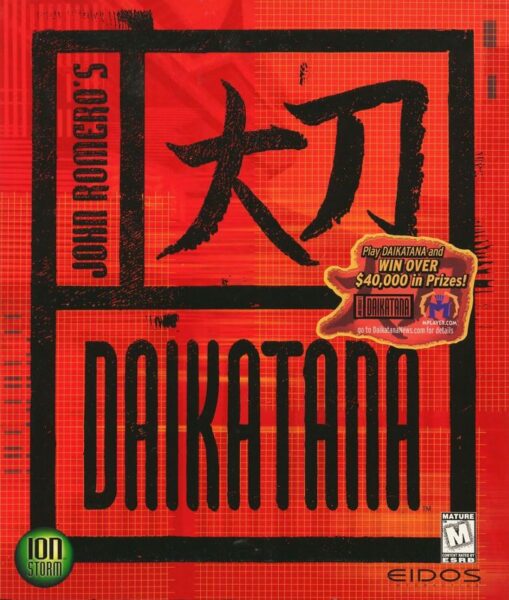
Word on the street was that it was called John Romero’s Daikatana because nobody else wanted their name associated with this thing.
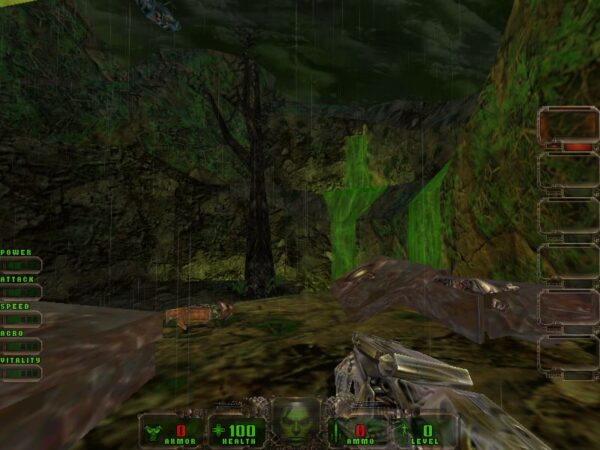
What does Daikatana have to do with The Muppet Movie? They both start with someone wishing they weren’t stuck in a swamp. (Bah-bum-dum! I’ll be here all week, folks…)
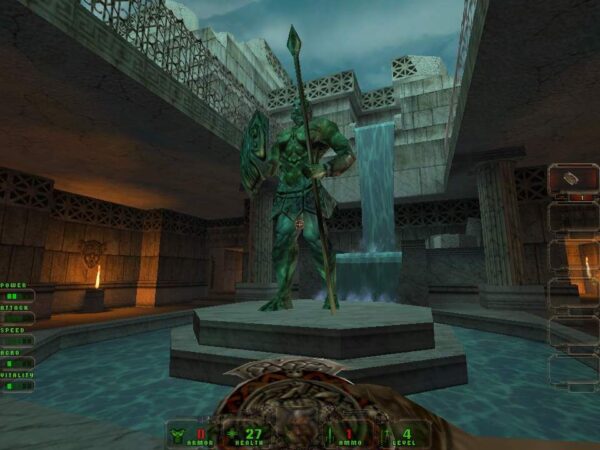
Most agree that the second of Daikatana’s four chapters, which takes place in ancient Greece, comes the closest to being tolerable, with the additions by subtraction of no robot frogs and mosquitoes and companions who mostly take a backseat to the action.
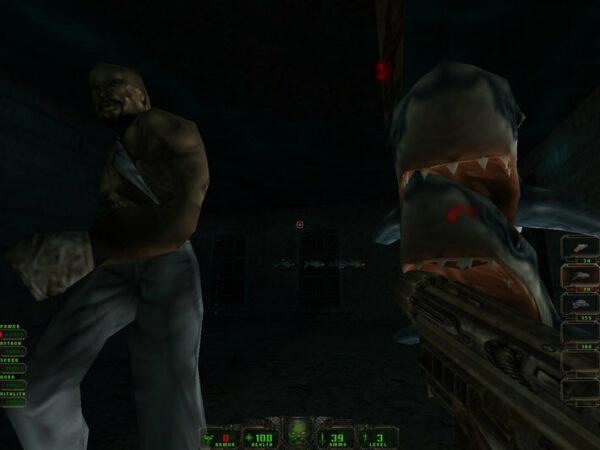
Superfly Johnson (yes, he’s really called that), whose dialog sounds like it was written by that little white-guy rap fan from Office Space. And yes, the graphics really are this bad.
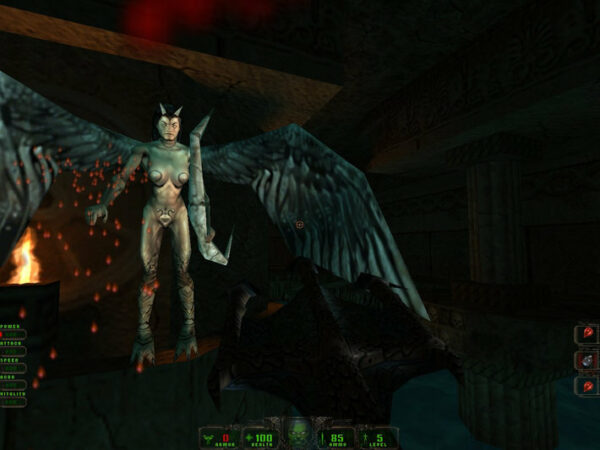
Here we have… you know what? I think we’ve all had enough. Never has a game so made me want to gather all of its makers together in a room and shout at them, “Grow the F up already!”
Setting its many granular infelicities aside, Daikatana just felt old and out of touch, an anachronism from a pre-millennial (pre-Columbine?) version of gaming that had fallen out of the zeitgeist. Oddly for a man so closely identified with the deathmatch, Romero had chosen to focus heavily on the story-driven single-player campaign, leaving the multiplayer mode as an even more broken afterthought; this at a time when online play had become so dominant that id hadn’t even bothered to include a single-player campaign in Quake III. Lingering traces of Romero’s infatuation with Japanese console games showed up not only in its elaborate if incoherent story but in an irritating (there’s that word again!) console-style save system that required you to collect and expend in-game gems for the privilege of being able to step away from your computer for a little while. Small wonder that, after all the time and all the drama that had gone into making it, Daikatana sold just 41,000 copies in North America.
From Eidos’s perspective, the one bright spot was that, by pushing Daikatana out first, they ensured that they got the worst over with first. Just one month later, they published Deus Ex to reviews that were as positive as those of Daikatana had been negative. Every inch an immersive sim of the old Looking Glass school, a fine heir to Warren Spector’s work on Ultima Underworld and System Shock, Deus Ex alone would eventually be deemed by many gamers to have amply made up for all of the rest of the Ion Storm fiasco. And it was a million-selling hit as well, a feat of which the Looking Glass games that preceded and inspired it had not been able to brag. Romero claims that “Eidos easily earned out its investment in Ion Storm on Deus Ex sales alone.” Although it’s hard for me to see how this statement could be correct when I sit down to do the math for myself, there can be no question that Spector’s game made the whole Ion Storm train wreck look substantially better from a financial point of view than it otherwise would have. (I’ll dig into Deus Ex and its legacy in more depth in my next article.)
Deus Ex’s success was enough to save the team who had created it; Warren Spector and company embarked immediately on a sequel down in Austin. Meanwhile much of the Daikatana team was unceremoniously let go that summer, the rest moved over to the laggardly Anachronox, all too aware that finishing that game would probably mark the end of their tenures inside the Chase Tower — indeed, of the absurdly costly gamers’ penthouse itself. Now plainly under-populated, with large parts of the space abandoned and closed off to save on air-conditioning costs, the penthouse already felt like a ghost town. No more awed reporters trooped through. Even the gaming sites didn’t much care what went on here anymore now that they had had their fun mocking Daikatana. Ion Storm had become an anachronistic artifact of a different era. The bravado and excess of its heyday seemed silly and passé in this post-millennial context.
Hoping against hope, John Romero busied himself for a while drawing up designs for another shooter that might salvage his reputation and restore his rock-star mojo. But in time he got the message that this was not going to happen — not at this studio, at any rate — and buckled down to help his old buddy Tom Hall make his game as good as he could. When it came out in June of 2001, fully a year after Deus Ex, Anachronox proved a rough-cut gem by any objective standard. Still, it wasn’t another Daikatana; while all too clearly less than what it had been intended to be, it was able to coast a surprising distance on Hall’s native gee-whiz enthusiasm and the likability this instilled. Unfortunately, it didn’t sell very well. (Rest assured that I’ll look at Anachronox too in more detail in a future article.)
With this game done, the two remaining Ion Storm founders quietly shut off the lights at the top of Chase Tower and went home. “See you,” said Romero to Hall as they climbed into their cars in the parking garage. “Yeah, see you,” answered Hall.
And so it was all over, but for Warren Spector’s gaggle of survivors in Austin, who had never had all that much to do with their colleagues in Dallas anyway. John Romero’s adventure in Behind the Music-style excess had led to one awful game in Daikatana, one merely bad one in Dominion, one fairly brilliant one in Deus Ex, and one that lay somewhere in between all of the extremes in Anachronox. All things considered, it could have been much, much worse. Thank God for Warren Spector!
Still, the Ion Storm saga as a whole had already been enshrined in gaming lore as a monument to rampant egotism and entitled indolence. Nobody was knocking at the door to hire John Romero now; one of the two hottest names in the business five years ago, he was now all but unemployable. Longing to recapture the fun of the early days at id Software, when it had just been a matter of a few friends in a clubhouse inventing gaming’s future, Romero formed Monkeystone Games with Tom Hall and Stevie Case. They would forgo the big budgets and large teams in favor of small games aimed at handheld devices like the new Pocket PC, games not all that far removed from the ones id had made before John Carmack turned his friends on to the potential of first-person 3D graphics. To emphasize the sense of a new beginning and raise some much-needed cash, Romero sold his mock-Tudor mansion and his Ferrari; he even cut his hair. Instead of auctioning off his trademark flowing locks for a doubtless hefty sum, he sent them to a nonprofit that made hairpieces for cancer-stricken children. Whatever his faults, John Romero was never a man without a heart.
The pivot to mobile showed prescience about where gaming would go in the smartphone era to come, but Monkeystone was just a little bit too early on that scene, and never made that much of an impact. The same can be said of most of what Romero and Hall did after Monkeystone closed up shop in 2004. Neither has been given the chance to helm another big-budget game since Daikatana and Anachronox; in this sense, their years of excess at Ion Storm continue to haunt them.
For her part, Stevie Case was secretly relieved when the Ion Storm rat race ended, taking with it her fifteen minutes of fame as, to quote Rolling Stone, “a real-life Lara Croft,” on the arm of gaming’s biggest rock star. The end of that era certainly improved her mental health. But it wasn’t enough to save her relationship with Romero in the longer term. Although he was nine years her senior, she felt herself to be growing up in ways that he could not or would not. “He was like a perpetual fifteen-year-old boy,” she says. “That’s ultimately why I wanted to leave him. ‘I’m not fifteen anymore. I want an adult life. I want to have dinner parties and adult friends.’ And he had no interest in that.” The couple split permanently in 2003.
Case never did become president of the United States, but she did go on to a very successful career as a Silicon Valley executive. Today she is the chief revenue officer of Vanta, a digital-security firm worth $4 billion as of its latest valuation. She no longer plays shooters or any other games with any frequency, but says that she will always be a gamer in spirit.

An older and wiser and once more lavishly coiffured John Romero in 2022.
In 2023, John Romero published a memoir called DOOM Guy: Life in First Person. The name is a disarmingly accurate assessment of his current place in gaming culture; he is, quite literally, still “the DOOM guy,” both to gamers of his own generation and those who came later. Unlike his old partner in crime John Carmack, who managed to remain at the forefront of gaming technology for many years after the turn of the millennium, Romero is doomed (ha!) to be remembered for just one decade of his life, bookended by the soaring triumphs that were Wolfenstein 3D and DOOM and the disastrous crash landing that was Daikatana. The table of contents of his book doesn’t lie: 22 out of its 27 chapters are devoted to the years before the closure of Ion Storm Dallas ended his tenure as an A-list game developer, leaving him to summarize the last quarter-century of false starts and nostalgia-fueled celebrity in an anticlimactic whirlwind.
To be honest, I didn’t expect much from his memoir when I picked it up, having always found his rock-star posture be the apotheosis of the grating bro-gamer man-child; I half expected every sentence to begin or end with the word “dude,” as most of his email communications did back in the day. Imagine my surprise, then, to meet a more or less thoughtful and reflective man in its pages, one who fesses up with surprising readiness to many of his mistakes, at Ion Storm especially: “As you read, you will likely note moments where I should have made a different decision or seen the writing on the wall, and you will not be wrong. I own the train wreck that was Ion Storm. If nothing else, writing this book has been a transformative process. It has allowed me to see patterns that have followed and defined me, patterns I may not otherwise have seen.” The book thus makes it clear that Stevie Case was wrong in her assessment of her boyfriend, at least in the long term: this is a guy who can and has grown up. Having lived through the maelstrom of Ion Storm and all that came before and after, John Romero has by all indications come out to a place of acceptance and gratitude, aging far more gracefully than many of his peers. “When I was a kid,” he tells us, “all I wanted to do was wake up and make games every day for the rest of my life. How lucky am I that this has happened?” The rebel has become an elder statesman, always ready with a pat of encouragement and a word of advice for young would-be game developers who aren’t so different from the kid he used to be.
In retrospect, I shouldn’t have been so surprised that John Romero, like all of us, can contain multitudes. There were always hints of it to be found, such as in his expressed desire to make a computer game with a story that could make you cry, or the revelation that, in between the bouts of herculean lovemaking that he loved to describe to his slathering fans, he used to read books — yes, actual books — to Stevie Case in bed at night. Quite some years ago now, near the beginning of this history project of mine, Mark Pelczarski, an Apple II magazine columnist and founder of an important early software maker called Penguin, shared this anecdote with me.
John Romero tracked me down and e-mailed me sometime in the mid-90’s, with a subject line that was simply “YOU!” He wrote this e-mail about how he learned programming back in the early 80’s using [Penguin’s] Graphics Magician and reading my articles, and that’s how he got his start. Actually, I had no idea who John was at the time, but he signed it “John Romero, id Software”, and “id” rang a bell. I thought it was the company that published DOOM, so I looked it up, found I was right, then was startled to find John’s connection to that [game] and his other work. Cool.
Actually, that led to one of my coolest teaching moments. I was teaching freshman/sophomore C++ courses for CS majors, and I mentioned this e-mail from this Romero guy in one of my classes. Turns out I had a student, Chris Avila (now in the software industry himself) who was one of those who held John up to rock-star status. So Chris e-mails John, asking if he really knew me, and John writes him this glowing e-mail about how I was one of his heroes when he was first learning programming, etc., etc. (Chris showed it to me, and it really WAS nice.) So Chris shows up to me next class basically with his jaw hanging to the floor in disbelief, saying something like, “John Romero is my idol, and then I find out my CS teacher is HIS idol….” (his choice of words, probably not John’s), and standing there bug-eyed just trying to grok it all. Priceless.
Shortly after the events Pelczarski has just described for us, Romero held a reunion for many of his game-development heroes from the 1980s up there at the top of the Chase Tower. Most of them, Mark Pelczarski included, were long since out of the industry, and could only gawk in astonishment at the spectacle of how far it had come from the suburban garages and spare bedrooms where they had founded their companies and made their first games.
The important point here, of course, is that Romero didn’t have to hold this reunion, and yet he did. So, rock on, John Romero… rock on. I suspect that you have always been more generous than not at heart — more generous perhaps than I have given you credit for — even as I know that you have always genuinely loved games.
Did you enjoy this article? If so, please think about pitching in to help me make many more like it. You can pledge any amount you like.

Sources: The books Masters of DOOM: How Two Guys Created an Empire and Transformed Pop Culture by David Kushner, Online Game Pioneers at Work by Morgan Ramsay, DOOM Guy: Life in First Person by John Romero, and Protecting Intellectual Freedom in Your School Library: Scenarios from the Front Lines by Pat R. Scales. Retro Gamer 75; Dallas Observer of January 19 1999; Computer Gaming World of August 1999, January 2000, July 2000, and August 2000; Rolling Stone of October 12 2000; Los Angeles Times of August 1 1999.
Online sources include “A Hardcore Elegy for Ion Storm” by Christian Divine for Salon, “Stevie Case vs. the World” by David Kushner for Vanity Fair, and a vintage “Daikatana Demo Review” by Daily Radar.
Where to Get It: Daikatana is available for digital purchase at GOG.com. If you want to try it and you aren’t a complete masochist, be sure to apply the unofficial patch, which in the reckoning of some elevates a godawful mess of a game almost to the status of mediocrity.








John Quietus
October 23, 2026 at 5:28 pm
Nice piece of marketing on top :) I wonder how many others couldn’t resist scrolling down to find said image right after reading the disclaimer?
mycophobia
October 23, 2026 at 5:44 pm
Typo: “Daiktana”
Jimmy Maher
October 23, 2026 at 5:46 pm
Thanks!
Jason
October 23, 2026 at 7:31 pm
I can’t say I’m particularly an FPS lover or John Romero superfan, but I find myself thinking that it would be cool if he had one last hit in him.
Joe
October 24, 2026 at 4:34 am
He did recently put out Sigil, a collection of new Doom II maps! They’re *quite* good, though very, very difficult.
Josh Martin
October 24, 2026 at 5:58 am
Sigil and its sequel are for OG Doom, which was an interesting choice since it has a much smaller pool of enemies (plus no super shotgun) and the modding scene overwhelmingly prefers to work with Doom II for that reason. I enjoyed both Sigils but I’m a bit impatient for Hellion, which he’s developing for Doom II. He recently mentioned that he’s planning a level set for Quake as well.
Unfortunately Romero hasn’t had as much luck with new standalone games. He had an FPS in the works with Adrian Carmack that didn’t seem to go anywhere, Empire of Sin was a dud, and an unannounced project was dropped by Microsoft during all their recent cutbacks/layoffs. He says that project “survived” but that it’s now “a very much smaller game” and “the design is completely different,” which doesn’t sound like much of a “survival” to me. But I’m glad he’s still trucking along.
form
October 24, 2026 at 5:36 pm
I get the feeling that he’s a bit gun shy now (the irony) because he’s both a grown up father and a man now aware of his mistakes.
He seems like the kind of guy who in the past would have come out of obscurity to have something to say, but we can immediately find his past and discount him, even when we shouldn’t.
form
October 24, 2026 at 5:39 pm
If you want a lovely lesson in what fatherhood does to a man, look up the big guy from ICP. He has a full fursuit he wears to go with his daughter to furry conventions.
Josh Martin
October 25, 2026 at 9:46 pm
In a similar vein, Romero Games’ Gunman Taco Truck (a decent roguelike good for a few hours of amusement if you’re into that sort of thing) was co-designed by Donovan Brathwaite-Romero, who was nine years old when development started and 12 when the game came out.
Jeff Sampson
October 23, 2026 at 7:34 pm
The Christian Divine article was for Salon.
And speaking of NSFW, CGW claimed this remix “spins gold out of Daikatana’s leaden dialog” or some such, in a sidebar where they noted neat stuff that was already ancient news to anyone with an internet connection(there was no YouTube to host it back then of course): https://www.youtube.com/watch?v=y8SC7z8W134
Jimmy Maher
October 23, 2026 at 7:44 pm
Thanks! (It was an old copy and paste from the last article.)
Jeff Sampson
October 23, 2026 at 8:48 pm
Some trivia, “DOOM Guy” is also a bit of word play on Romero’s part, “doom guy” is the community nickname for the unarmed hero of the first two DOOM games.
Jeff Sampson
October 23, 2026 at 8:57 pm
Err, “unnamed hero” rather, seeing as the space marine protagonist of DOOM was only unarmed if you were very spendthrift with your ammo and hadn’t found a chainsaw.
calvin
October 23, 2026 at 8:18 pm
My impression (and I think this is also my impression of online consensus) is the failure of Daikatana and Ion Storm really did humble Romero, who became kinder and an elder statesman. Sort of the opposite trajectory to Carmack post-id.
Another Alex
October 23, 2026 at 9:38 pm
Of all the 90’s tech wunderkinds – so many of whom went far off the deep end – I certainly would not have expected *John Romero* to be the elder statesman.
What has Carmack’s post-id trajectory been? I know he did something with rocketry.
Pauli Ojala
October 25, 2026 at 10:01 am
John Carmack spent roughly a decade (2012-22) on VR hardware, first as CTO of Oculus and then in a similar role at Facebook/Meta. The cheap standalone Quest headset was his baby.
Brent
October 25, 2026 at 3:55 pm
He’s obviously very smart, but also evidence that this type of tech genius should not be leading society. I would describe him as a Libertarian with general disdain for anyone that isn’t rich, incapable of understanding anyone who has had a different life experience. Palmer Lucky is his protege.
Josh Martin
October 23, 2026 at 9:52 pm
Lingering traces of Romero’s infatuation with Japanese console RPGs showed up not only in its elaborate if incoherent story but in an irritating (there’s that word again!) console-style save system that required you to collect and expend in-game gems for the privilege of being able to step away from your computer for a little while.>/i>
This is really an area where Romero would’ve done better to take more inspiration from console JRPGs: in those days a console JRPG would generally only let you save at certain points, but required no special items and put no limits on how often you could do it. Some (like Romero’s beloved Chrono Trigger) also allowed saving at any time in the overworld.Daikatana‘s save gems could be used anywhere at any time, but you could only carry a maximum of three and they existed in a strictly limited quantity (usually three per level). I would say that Anachronox‘s save system is clearly drawn from traditional console JRPGs whereas Daikatana‘s is more like a variation on Resident Evil‘s typewriter ink ribbons (which was unusually restrictive even by console standards of the era).
On the subject of Romero and JRPGs, one of the attendees of that reunion in the Chase Tower was Nasir Gebelli, a prominent figure in the Apple II gaming scene who’s come up in some of your earlier articles. Gebelli eventually went to Japan and worked as lead programmer on (among other things) the first three Final Fantasy games, and by the time of the reunion he’d retired on the royalties he’d negotiated at Square (an extraordinarily rare arrangement). The twenty-minute interview he recorded there was, I believe, his only one on video until a much shorter sit-down for a Japanese TV documentary a couple of years ago. He later did a three-part interview for Romero’s sadly short-lived podcast, which is and will almost certainly remain the main source for info on Gebelli’s life and career, given his evident reclusiveness.
killias2
October 24, 2026 at 2:08 pm
It is kind of interesting how big of a Final Fantasy guy Romero is, given the divide between PC and console, FPS and RPG (especially JRPG), and East and West that apparently exists between Doom and FF.
LanceBoyle
October 24, 2026 at 7:55 pm
It’s also funny in hindsight considering Square Enix owns Daikatana now (after they bought Eidos years ago); I wonder if Romero ever imagined that back then.
Relatedly there was the console versions of Daikatana, both of them developed in Japan, most famously the Game Boy Color one that adapted it as a Zelda-like action RPG (apparently at Romero’s own request), which is generally considered the best thing to come out of Daikatana.
(the Nintendo 64 version meanwhile is a kinda compromised port of the PC game, the total opposite of that GBC one; considering it released roughly at the same time as the PC one I imagine the dev team behind it were probably kinda screwed by Ion Storm’s own issues on the main version)
Jeff Sampson
October 26, 2026 at 11:43 am
Games used to be more finite affairs, before the rise of online multiplayer and the unfortunate development of all-consuming games like EverQuest. A frequent gamer who stuck to just one genre in the 80s through mid-90s would end up having to play the dregs, so I think most played more than one genre.
And it’s funny Square Enix is still listed as the publisher for Daikatana, even though they sold the rest of the Eidos portfolio. It seems there were no takers for the rights to Romero’s last big budget epic.
LanceBoyle
October 27, 2026 at 10:09 pm
It’s really weird cuz in reality Square didn’t end up selling off all that much in regards to the Eidos IPs, even tho one would think they’d sell off as much as possible; all that Embracer ended up getting were a few IPs (plus Crystal Dynamics and Eidos Montreal), albeit pretty notable ones (off the top of my head Tomb Raider, Deus Ex, Thief, Legacy of Kain, and also that Guardians of the Galaxy game Eidos Montreal did), so clearly they still see some sort of value even on I guess lesser properties like Daikatana (especially cuz one would assume the likes of Embracer would be 100% open to getting as much as possible)
It’s funny too cuz some years prior they had let IO Interactive keep the rights to Hitman when they went independent from Square, but IIRC they still kept Kane & Lynch, so it seems to depend.
Play History
October 25, 2026 at 7:41 pm
Gebelli reappeared recently for a spot on Japanese television to talk about his work with Square.
Josh Martin
October 25, 2026 at 9:10 pm
That’s the Japanese TV documentary I mentioned. That interview was less than five minutes long as broadcast, so it was pretty underwhelming compared to even the twenty-minute interview from 1998, much less his 4+ hours on Romero’s podcast. At least it shows he’s willing to be interviewed without Romero being involved (I think the last time he did that was with Next Generation magazine in 1999, where he answered the question “What do you do these days?” with “Nothing, absolutely nothing”).
Vauban
October 23, 2026 at 9:53 pm
> These embarrassing attempts by nerdy white men to capture the personalities of a Japanese woman and a black American man
Rule of thumb: if inverting colors makes a sentence look fascist, maybe it’s the case to review it.
Veronica Connor
October 31, 2026 at 7:51 pm
No, because power dynamics matter. “Reverse racism” isn’t real because punching up is satire but punching down is oppression. This is basic stuff.
David Simon
October 23, 2026 at 10:12 pm
> Lingering traces of Romero’s infatuation with Japanese console RPGs showed up not only in its elaborate if incoherent story but in an irritating (there’s that word again!) console-style save system that required you to collect and expend in-game gems for the privilege of being able to step away from your computer for a little while.
I’m not sure which RPG this is referring to? The only major console game I can think of with a system like this is Resident Evil, which doesn’t fit well with most definitions of “RPG”.
Ice Cream Jonsey
October 24, 2026 at 12:15 am
Does Final Fantasy for the original Nintendo feature consumables as a way to save? I think you can also save in other ways though.
Jeff Sampson
October 24, 2026 at 12:19 am
In the original NES/Famicom Final Fantasy, you had to either save at an inn or use a camping item to save in the over world. By the SNES era the series let you save anywhere on the over world, and at designated save points elsewhere.
Only being able to save on the over world or at an inn was a technical limitation on the NES(but not on the SNES), but having to expend a camp item outside of town was a design choice.
Gems are also kinda JRPG like. Crystals are extremely on-brand for Final Fantasy.
Jeff Sampson
October 24, 2026 at 12:38 am
That being said, even though the first Final Fantasy made you pay to save, it wasn’t a rationing system like Daikatana’s. There was no scarcity of camp items or nights at the inn, nor were they prohibitively expensive, and the series mostly got easier, so the save system only got nicer.
Given how many JRPGs there are, I figured there had to be one with a save rationing system. I guessed Breath of Fire: Dragon Quarter, because it’s known for its difficulty, and I was right.
But Daikatana precedes Dragon Quarter, and it’s unlikely Romero played a JRPG that was that hardcore. So the Daikatana save system was inspired by Resident Evil.
Fro
October 26, 2026 at 1:20 pm
It’s not exactly save rationing but the American release of Lunar:Eternal Blue made you have to pay for saves to increase difficulty
Josh Martin
October 24, 2026 at 5:44 am
The cost of memory was a big factor here, possibly the biggest. I suspect a fair number of NES RPGs could’ve allowed saving anywhere if they’d used the maximum amount of supported cartridge RAM (128K with the MMC5 mapper), but that would’ve cost a fortune and only three NES games even used more than 8K of battery-backed RAM (all of them Japan-only historical sims from Koei, with 32K). The SNES eliminated the need for mappers to use cart RAM, and that combined with lower RAM costs meant games with 64K of save RAM became fairly common. Some particularly complex games, like the ports of SimCity and Civilization, used 256K. But most SNES RPGs used 64K and had at least three save slots, further limiting how much of the game state could be stored. Allowing the player to save anywhere at any time increases the number of possible variables involved in the current game state, so limiting saves to certain locations gave the developers more control over the variables involved and reduced the storage requirements. There may have been some cases where saving was limited purely as a design choice, but I think it was more commonly a storage concern—the SNES version of Eye of Beholder supports saving anywhere at any time and it needs 256K of cart RAM for just a single save slot.
(There were a few outliers on the SNES that used more than 256K of cartridge RAM, going all the way up to 4096K. These were all either a) games with the Super FX or SA-1 chips, which used most of the additional storage as work RAM for the co-processors rather than save data; b) Japan-only carts for placing bets on horse racing via a modem attachment; or c) another Japan-only release that allowed the player to design their own vertically-scrolling shmups, complete with custom graphics.)
Sniffnoy
October 24, 2026 at 5:06 pm
Sorry, are these numbers in kilobytes or in kilobits? I remember that at the time it was common to measure cartridge sizes in kilobits or megabits rather than in bytes, so I have to ask.
Peter
October 24, 2026 at 7:06 pm
Just popping in to note that this is due to digital electronics industry convention, where the sizes of memory chips are given in bits in datasheets and part names. Having the size in bits directly tells you how many address and data signals you need to route to interface with it. This practice then carried over into ROM cartridge based game systems.
(I assume all the sizes give above are in bits)
Josh Martin
October 24, 2026 at 10:08 pm
You’re right and I got tripped up on this myself–the NES figures are in kilobytes but the SNES figures are in a mix of kilobits and kilobytes. The SNES versions of SimCity, Civilization, and Eye of the Beholder (among others) used 32 kilobytes of save RAM, equivalent to the largest amount ever used on the NES (but the NES games in question probably used the SRAM as work RAM, meaning only some of it could be used for save games). That also means the typical amount of save RAM was the same on both the NES and SNES (8 kilobytes), but the NES only had three games exceeding that whereas the SNES had a few dozen, with a small handful topping out at 64 kilobytes (not “4096K,” which someone seems to have arrived at by seeing “512K” used to mean 512 kilobits/64 kilobytes, assuming it actually meant 512 kilobytes, and then converting that to 4096 kilobits). In my defense, the sites providing this information for SNES games are kind of a mess.
Josh Martin
October 25, 2026 at 9:40 pm
Dug into it a little more and it looks like that 4096 kilobits/512 kilobytes figure referred to the largest amount of SRAM supported by any of the PCBs used for commercially-released SNES games, although no game actually used anywhere near that amount. This is also supposedly the most SRAM the SNES can address without additional hardware for memory mapping above that limit. Additionally, that shmup construction kit title I mentioned (Kaite Tsukutte Asoberu: Dezaemon) uses 1 megabit/128 kilobytes of SRAM, confirmed by both a photo of the PCB and testing it in an emulator.
Ross
October 26, 2026 at 1:27 am
And for clarity, the limits on save locations was generally more a platform limitation than a conscious design decision. Save data needed to be compact, which meant that there was a tangible benefit to being able to encode the party’s location in a save as “Save Spot 7” rather than “Coordinates 221, 553 on Map 9”
Jeff Sampson
October 27, 2026 at 9:34 am
I’d have to do more research before concluding that saving at any position outside of battle wasn’t technically feasible even on the first NES Final Fantasy. 48 bits is more than enough to save the map number(16 bits) and X(16 bits) and Y(16 bits) coords for a 2D NES game. The game already saves stats and inventory and basic world state like which chests have been opened, and the use of random encounters precludes having to store anything beyond the player’s position on what were mostly static maps.
But the first Final Fantasy had only one save slot on the NES, so preventing the player from saving in a bad situation made sense.
Sarah Walker
October 24, 2026 at 7:29 am
Tomb Raider 3’s save system sounds basically identical to Daikatana’s – collect save crystals, consume them anywhere. Again not an RPG though.
There was a bit of a trend for restrictive save systems in FPS games at the time, Daikatana wasn’t unique. Alien Vs Predator had a fixed number of saves per level, depending on difficulty level, though this was later patched out. IIRC Soldier of Fortune only saves at the beginning of a level. Any others?
Alison Kirkland
October 24, 2026 at 7:57 pm
Doesn’t the article on this blog about “The Nomad Soul” mention that it has an irritating save system something like this?
Zed Banville
October 25, 2026 at 6:22 pm
Yes, Omikron: The Nomad Soul, which released near the end of 1999, had a save system where the player could only save at specified points and each save consumed one of an item that existed only in a finite quantity.
Jimmy Maher
October 24, 2026 at 9:47 am
Fair enough. Made a couple of edits. Thanks!
Feldspar
October 24, 2026 at 11:43 am
Daikatana’s save system sounds overly restrictive, but I do think that in spite of the fact that their origins in the limited memory of consoles, limited saves and checkpoints are a very valid and often good design decision, and that unlimited saving isn’t necessarily the ideal system just because technically it can be done. Limited saving/checkpoints create a certain structure of tension and release and force players to commit to their actions. In particular, in spite of technical limitations no longer being an issue, designing around limited checkpoints to create tension has seen a big resurgence in the last decade or so thanks to Dark Souls’s huge influence on the action genre.
More relevant to this series, I feel that games like Thief and Deus Ex are harmed by the ease and lack of restrictions on saving, since unless the player sets out to actively restrict when they can save, the strong temptation to abuse the quick load and quick save hotkeys can deflate much of the tension that the games are trying to achieve.
Frans
October 24, 2026 at 5:44 pm
To me it’s the opposite. Thanks to the save system that you can try and practice cool things instead of just playing it safe. That’s no different in Thief / Dishonored than it is in Commandos / Shadow Tactics. Imagine trying to find out from what height you can jump down after your latest upgrade in Deus Ex and having to redo half the level as a consequence. Instead you’d just take the stairs.
I also think that not having (practically) unlimited saves is disrespectful of your time, as if a book glued itself shut as soon as you read a page, or spit out a bookmark if you hadn’t read enough pages to its liking yet.
Busca
October 25, 2026 at 10:45 pm
Regarding limited saving, there were different ideas already implemented in PC games in the early 90s. As an example, mentioned in an entry on the CRPG Addict blog, three RPGs from 1992:
– Ishar: Legend of the Fortress, in which you had to pay 1000 gold pieces each time to save (not a small amount in that game)
– Realms of Arkania – Blade of Destiny, where saving outside of temples costs every party member a certain amount of experience points per save.
– Ragnarok, a roguelike which allows you to quit and save at any point, but destroys your save file upon reloading (just like most roguelikes). However, you also have the option to create a game-sanctioned ‘backup’ of your game — but only once every 200 turns (which equates about 5-10 min of gameplay, depending on your style). The European version, Valhalla, has an ‘expert’ mode that increases this figure to 4,000 turns.
Said entry led to a discussion in a comment thread which basically showed two opposed ‘schools of thought’ also already reflected in the comments here: ‘Games should be fun and let me save whenever I want instead of stealing my valuable free time’ vs ‘Such games are designed to present challenges and save-scumming through/around those subverts that, makes it meaningless and takes any fun out of the game’.
The middle ground being the game giving you options, e.g. difficulty settings, a separate ironman mode or other alternatives which let everybody adapt the experience to their preferences. There is also the difference between just ‘freezing’ the game when you have to step away and creating a large number of saves to pick up from at any time.
Another earlier entry on that blog which touches upon this subject and contains a discussion of save systems both in the article and in its comments is the one about ‘The Perfect CRPG: Difficulty’.
Frans
October 27, 2026 at 7:01 pm
It doesn’t have anything to do with difficulty at all. There’s rarely a reason a game should force a long play session, some boss-type stuff possibly excluded. Redoing the same thing is tedious at best; not being able to replay a part of the game without starting from scratch is absolutely maddening. Even 99 saves can be quite an annoying limitation. The Telltale concept of dividing episodes into chapters is a somewhat reasonable alternative without allowing for manual saves.
In relatively recent memory I played Nier: Automata for about an hour until some boss fight; I had to go, so I closed it and later I had to repeat that from scratch because why would it save at literally any of the various logical save points that already passed. I picked it back up again one or two years later because people assured me it was a good game nonetheless, and, well, it was. Nice combat etc. But that ’90s console-style choice was just terrible. You can save fairly liberally later on, at official save points spread around the world. That being said, you’re right that saving could theoretically be implemented as part of “difficulty” settings, even if it’s not related to difficulty, where you might set something like: puzzles hard, combat hard, saving always.
Modern savepoints occur every five to ten minutes and can sometimes be forced by swapping your weapon or some such, or by finding an item, so they tend not to be bothersome anymore, but even so I’d prefer to just take off where I left it. I recognize that’s probably more of a technical concern about not having to save enemy placement and the like, though simultaneously it seems there are also modern games that still manage to do it just fine like they used to.
I don’t do save scumming, except of course in games that are meant to be save scummed, like Shadow Tactics. Though amusingly the only time I’ve save scummed in recent memory was in a modern consolitis-suffering savepoint-based game (Rise or Shadow of the Tomb Raider), by accidentally running past the next save point during an ongoing fight and then dying… subsequently the game assumed the savepoint came after the enemy encounter, so they were all mysteriously absent. I think they generally prevent that with walls of some sort that you can only cross after combat.
The idea of paying for saves isn’t great either because that just punishes you for only having twenty to thirty minutes available instead of the two-plus hours the developer thinks you must be obliged to spend on their brilliant game at the cost of anything else in your life.
Though since multiple people here seem to be intent to incorrectly frame it as a matter of difficulty, how about this? Endless saves, but no loading the save if it was made within the last 5 minutes.
Wade
October 24, 2026 at 5:20 am
From the perspective of someone in the active Apple II community today, I can (and would like to) say that Romero is a generous contributor to it. I say this from both a little direct and much indirect experience.
He has collected and shared detailed interviews with a lot of the classic era Apple II developers. For instance, in his Apple II Time Warp podcast (it’s been on hiatus for a long time) there’s the only interview I ever heard with Stuart Smith, creator of Adventure Construction Set. That was a holy grail sort of event for me, which to my astonishment, just showed up in a podcast one day.
A long time ago, a friend and I also received out of the blue a complimentary email from Romero about a review we did for an Apple II game.
He’s also been the keynote speaker at the annual Kansasfest event.
Busca
October 25, 2026 at 7:25 am
I guess you already know, because it’s mentioned in the interview, but just in case: the third person on that Romero podcast with Stuart Smith, known online as Chester ‘Chet’ Bolingbroke, covered Smith’s games on his CRPG Addict blog. A good point to start is his (revisiting) entry on the ACS (with links to the others plus to a comment by Smith on the blog), which he also named his game of the year 1984.
There are quite a few Apple II games which appeared on said blog – you can check known names through his indexes of games played by title or by year (or, under construction, by lineage), though he did not necessarily play the Apple II version if there are others.
form
October 25, 2026 at 9:05 am
For whatever it’s worth, I do think Romero is a good guy. Some people aren’t managers, (most people tbh) and he learned the hardest and most public way possible.
Veronica Connor
October 31, 2026 at 7:58 pm
I’m glad someone mentioned this, as it speaks to Jimmy’s point that John is a man with a heart under it all. He’s used his celebrity to benefit the community lately, by being able to get interviews with reclusive Apple II developers that *nobody* else could get (and trust me, we all tried). His Nasir Gebelli interview is an incredible historical artifact that we’d never have without John.
He’s a deeply flawed guy (like all of us) and did a lot of very bad things in his youth (like many of us) but I do think his heart has mostly been in the right place most of the time. I don’t think many of us can claim more.
Hresna
October 24, 2026 at 1:20 pm
In a moment of rather base curiosity, I set about to find a more recent photo of Stevie. She evidently announced her departure from Vanta about a month ago on LinkedIn.
Lt. Nitpicker
October 24, 2026 at 6:19 pm
>by the following spring, Electronic Arts would dare to belatedly publish Soldier of Fortune
Soldier of Fortune was published by Activision, not EA.
Jimmy Maher
October 24, 2026 at 9:43 pm
Thanks!
Sebastian
October 25, 2026 at 5:10 am
Awesome article as always, thank you! Small typo: there is a reference to Todd Hall which should be Tom Hall.
Jimmy Maher
October 25, 2026 at 7:17 am
Thanks!
Busca
October 25, 2026 at 8:20 am
It’s probably fitting for the events and ambiance you describe that the official Prima strategy guide for Daikatana, written by Stevie Case, came with a centerfold poster of her.
Another fitting detail for the whole debacle: Released, as you wrote, in May 2000, Daikatana had a quote inside its box stating: “Daikatana. Best game of 1999. I stand by it.“, (supposedly, see below) from the magazine PC Accelerator. This was mentioned in a 2003 Computer Games article about “bad games […] that made it to store shelves” where Shawn Green, who was part of the team and became lead programmer after most of the core group left, reflected on his experience making Daikatana.
Ironically, the quote as printed seems not to even have appeared verbatim in PC Accelerator, as far as I could see (and obviously not as a statement on the finished game in its released form). In its March 1999 issue, Rob Smith did write: “Game of the Year 1999? My money’s on Daikatana.”
After that year had passed, but the game still not been published, the February 2000 issue included a portrait of the magazine’s team where the entry for Rob Smith read: “Most offensive thing ever written in PCXL -> ‘Daikatana will be game of the year.’ His Excuse -> ‘Until the game comes out, I can’t be wrong. I stand by it.’ ”
Obviously, if at all, at this point it would now have been his game of the year 2000… .
Pauli Ojala
October 25, 2026 at 10:09 am
I’ve enjoyed your deep dives into the flawed characters of gaming history, the men who became consumed by money and fame rather than the usual nerdy curiosity: Ken Williams, Chris Roberts, John Romero.
Honestly didn’t expect that my lowest opinion of this bunch would be for Roberts.
Torbjörn Andersson
October 25, 2026 at 6:13 pm
I remember playing the Soldier of Fortune demo. I actually found that turning off the gore made the game more uncomfortable, not less. It was still just as violent, but there was less consequence to the violence. With the gore enabled, I found myself disarming, rather than killing, my enemies whenever I could.
Though when I mentioned this to a co-worker, he told me that I was just playing it wrong, and I’m still not sure if he meant that seriously or tongue-in-cheek.
Play History
October 25, 2026 at 7:48 pm
John (and Brenda!) were both very helpful and encouraging to me at the start of my video game history research when I was initially trying to get contact with Nasir Gebelli. Big pluses to the both of them for staying in touch with gaming history.
Despite the embarrassing things he said back then, my opinion of Romero even in that context isn’t as harsh as Jimmy puts it. I think in a time of personal exploration, there’s a lot of things we do that we’re not proud of. And I also think that crudeness has a place – even if the examples pulled from here are certainly excessive. I don’t think there’s as hard a line between thoughtful critique and willingness to let the less elegant side of yourself come through as it seems to be for Jimmy.
Quite looking forward to your Deus Ex evaluation. Alex Smith has commented it’s sort of the point where delineated genres in in games sort of stop mattering and there’s no longer this line between games with storytelling and RPG systems versus games with action and meticulous detail in their worlds.
Paulo Vicente
October 26, 2026 at 12:10 pm
That was an interesting tale, turning everything up and pouring money down the pipe doesn’t guarantee results, far from it. A lot of people should heed that lesson, especially today with millionaire gaming projects burning money like crazy.
When you think about it, part of the appeal of the original Doom is its simplicity, it does what’s supposed to do well and doesn’t worry too much about fancy features or “realism”. You get a main character running and spinning around, filling the air with shots, battling hordes of crazy critters, it’s fast and to the point and it doesn’t try to imitate reality or anything like it.
And yet the FPS genre always seemed to have some trouble following that trend, it’s almost as if a lot of people can’t believe that simplicity can work better than complexity even after seeing the living proof of that.
Keith
October 26, 2026 at 12:27 pm
> the irony of this picture was that nobody played shooters using a joystick anymore.
Historical aside: after beating John in their deathmatch, Stevie got a sponsorship from the makers of the SpaceOrb 360, a bizarre controller which was a sort of hand-held trackball. I’ve always believed she actually won using the thing, but a quick Google search told me that wasn’t the Case.
RandomGamer
October 26, 2026 at 6:29 pm
It would have been much better for ION Storm the company to release Daikatana later, because after Dominion/Daikatana one-two punch the company was seen as a joke; if instead it started on Anachronox/Deus Ex, its reputation would have been quite different.