RSS

Tag Archives: dungeons and dragons

Britain’s Occult Uncle

There are some successful writers who are, as Ben Jonson wrote of Shakespeare, “not of an age but for all time.” But there are many more who become rich and famous in their own time only to be forgotten by later generations — or, if and when recalled by academics and diehards, remembered not for their continuing resonance but as curiosities, clues to understanding those strange people who lived all those years ago. Dennis Wheatley, for four decades one of the most bankable bestsellers in the book trade, belongs to this category. Upon his death in 1977, the vast majority of his immense oeuvre went almost immediately out of print even in his native Britain, and that was pretty much that for a fellow whose books even while he was still writing them had begun to seem painfully out of joint with the times.

To modern sensibilities, Wheatley’s life story is perhaps more interesting than his fiction. Born the son of an increasingly prosperous middle-class wine merchant in 1897, he was groomed virtually from birth to take over the business from his father when the time came. In that spirit, he received a respectable if not exceptional English public-school education. Indeed, “respectable but not exceptional” is a good way to describe the young Wheatley. Thanks to his family’s growing influence, he was able to finagle an officer’s billet in World War I and, even more importantly, to get himself posted to an artillery unit rather than the meat-grinder that was the infantry. Thus Wheatley had a comparatively easy war of it, in which, in the words of his biographer Phil Baker, “he did his duty; no less, if no more.” With that behind him, Wheatley, desperately class-conscious in the way that only one of somewhat uncertain status himself (in this case the son of a tradesman) could be, devoted himself to climbing society’s ranks while dabbling just enough in the business to keep his father soothed.

In 1927 his father died, leaving Wheatley in sole charge of the business. Unfortunately, thanks to the Great Depression that arrived a couple of years later and perhaps also to Wheatley’s decision to refocus the business on selling only very expensive wines and liquors to the most exclusive social sets, things started to go badly. Soon Wheatley, now entering his mid-30s, was forced to sell the failing business before it collapsed entirely. Worse, the purchasers upon examining the books began to speak of irregularities with regard to the money that Wheatley personally had taken out of the business. Soon they were threatening legal action in criminal court, and Wheatley was contemplating the prospect of jail time in addition to destitution. This man who had for 35 years been exactly what you would expect him to be now made the one really unexpected, audacious decision of his life. Despite having only his boyhood love of adventure novels and some earlier, unpublished and halfhearted stabs at fiction to his credit, he would write his way out of his financial straits. And so, in 1933, Dennis Wheatley the novelist was born.

In a great bit of damning with faint praise, Baker notes that Wheatley turned out to be only “good at writing books, after a fashion,” but “extremely good at selling them.” The critics, or at least those who didn’t lunch with him at one of his clubs, delighted in eviscerating him, and for many good reasons. His prose was remarkably awful, his characters paper-thin, his politics reactionary. Wheatley was a thoroughgoing manichean. People are either Good (Tories, businessmen, military men, the aristocracy, fascists in the early years) or Evil (communists, socialists, labor, Satanists, fascists after appeasement went out of fashion amongst the British Right, still later hippies and civil-rights activists). As time went on all of these latter groups started to blend into one overarching conspiracy of Evil in his books, communists walking hand in hand with Satanists. Wheatley does not allow the possibility of equally well-meaning people who simply disagree about means as opposed to ends. There is only Good and Evil, the former usually handsome or beautiful, the latter ugly. Subtle Wheatley ain’t.

For all his failings, however, Wheatley did have a flair for exciting plotting. He knew how to layer on the unexpected twists and turns, to get his heroes in and out of jam after jam by the skin of their teeth, each more dangerous and improbable than the last. For readers who shared his politics, and probably even a fair number of guilty-pleasure seekers who did not, his books were reliable comfort reads. To his credit, he never claimed them to be anything more. He replied to bad reviews with a bemused shrug, saying that he had “no pretensions to literary merit”; was “better aware than most of my shortcomings where fine English is concerned.” And anyway, he said, reading his books was at least better than going to the cinema, which was what his customers would otherwise do.

Wheatley took his customers’ wishes very, very seriously. Some of his books ended with a questionnaire, asking what they had thought of the book and what they would like to see in the next: what setting, which of his cast of recurring heroes and villains, even what percentage should be devoted to romance. Apropos this last: one other key to Wheatley’s success was his inclusion of a love story in each novel. This was thought to attract women readers — and, it must be said, he did sell far more books to women than did other writers in the traditionally male-dominated genres of thrillers and adventure stories. Wheatley wrote quickly, ensuring his fans were never kept waiting long for new material. In 1933, his first year as a working writer, he churned out an incredible three novels as well as one nonfiction book (on King Charles II of England, his personal hero) to buy himself out of his legal difficulties. After that outburst he settled into the only slightly more sedate pace of two novels per year, year after year.

But, you might be wondering, what does this fellow have to do with videogames? More than you might expect, actually. Wheatley, despite being very much a character of a different era than my usual concerns on this blog, is nevertheless important to them in two ways. One is somewhat tangential and one surprisingly direct. Let’s talk about the former today.

On Halloween, 1934, The Daily Mail began publishing a new Wheatley novel in serial form. It was called The Devil Rides Out, and concerned a cabal of Satan worshipers out to plunge the world into an at-the-time-still-hypothetical World War II by stirring up opposition to Hitler’s new Nazi regime. There are parts of the book that read just horribly wrong today. The heroes’ talisman of good, for instance, which when hung around the neck functions to protect them against the Satanists much as does garlic against vampires, is a swastika, “the oldest symbol of wisdom and right thinking in the world.” Despite — or perhaps because of — stuff like this, it’s become a kitschy classic of sorts today, the book most of the few who do bother to read Wheatley begin with — and, one suspects, usually end with.

In its own time, Devil became a sensation. Wheatley had been successful before, but Devil took him to a whole new level of fortune and fame, as Britain’s foremost popular pundit on all things occult. The book was in fact broadly if shallowly researched. Wheatley cultivated relationships with such figures as Montague Summers, a loathsome old reprobate of a priest who was convinced that witches in the medieval tradition remained a clear and present danger; and even an aging and ever more ridiculous Aleister Crowley, whose name still left many people in terror for their immortal soul but who in person was more likely to ask to borrow a fiver to feed his various addictions than anything more threatening. Crowley, Summers and a handful of other similarly dissipated, over-privileged Edwardians with too much time on their hands had in the decades before his book been largely responsible for reviving the notion of the occult, previously thought banished to the Middle Ages where it belonged, as an at least theoretically vital force again.

The problem with Satanism, at least from a certain point of view, is that there’s just not a whole lot of there there. Our perception of it through the ages is not down to any actual evidence from Satanists themselves, who seem to have barely existed if at all, but rather the fever dreams of those on the side of Good who claim to be desperate to stamp it out. From the Malleus Maleficarum down to the works of Summer, the scholarship on Satanism and witchcraft consists entirely of what the Good side of the hypothetical debate speculated that those on the side of Evil must be doing. The entire scholarly edifice is built on sand. Wheatley based much of the detail in Devil on Summers, who drew from the Malleus Maleficarum, which drew from… what? The whole is a chain of conjecture and imaginings (and, one suspects, fantasizing) of what a genuine cult of Satanists must be like if anyone ever met one. Direct experience is entirely absent. As we’re about to see, Wheatley just added another link to that chain.

As already described, Wheatley was always eager to give his public exactly what they wanted. And what they wanted, judging from sales of The Devil Rides Out and the excitement it generated, was more novels about Satanism and the occult. And so for the remainder of his life, interspersed with his tremendous output of other novels, he continued to churn them out. He also continued to cultivate his persona as “Britain’s occult uncle,” one on the side of Good who nevertheless had access to Dark Secrets that could be dangerous to lesser men. And he continued the bizarre, and increasingly ridiculous, practice of mixing worldly politics with spiritual struggle as he aged and the world around him agreed less and less with his traditionalist Tory values. “Is it possible that riots, wildcat strikes, anti-apartheid demonstrations and the appalling increase in crime have any connection with magic and Satanism?” he asked in 1971. The answer, as far as he was concerned, was a quite definite yes. He even advocated for a reinstatement of Britain’s anti-witchcraft laws, despite the last of them having only recently been taken off the books. Late in his life Wheatley almost seemed to morph into the now-deceased Montague Summers. He published a non-fiction treatise of his own, The Devil and All His Works, and sponsored the “Dennis Wheatley Library of the Occult,” a series of paperback editions that ranged from classic literature (Stoker’s Dracula, Goethe’s Faust) to the ramblings of Crowley and his ilk.

It’s hard to say to what extent Wheatley really believed this nonsense. He loved to sell books, and, while his books on other subjects were very successful, this stuff sold a whole order of magnitude better. It’s hard to understand why, if he thought Satanism a genuine danger to society, he continued to make it sound so damn appealing to so many of his readers via his novels, all of which featured a nubile, naked young virgin almost deflowered on an altar of Satan or similarly charged mixtures of black magic, sex, and sadism. Readers were not clucking over them as warnings about the spiritual dangers around them; no, they were getting off on the stuff. Wheatley therefore shouldn’t have been surprised when one of the elements of modern culture he hated most, a rock band, drew from his work — or, rather, pretty much blatantly ripped him off.

The band in question, Coven, was the first to really cement the link between Satanism and rock and roll. They were, however, far from one of the more talented bands to be accused of witchcraft. Their first album, the ponderously titled Witchcraft Destroys and Reaps Souls (1969), was a very contrived affair, largely the brainchild not of the band (who frankly don’t strike me as the brightest sorts) but of the producer, Bill Traut. He hired an outside songwriter, James Vincent, to put most of the album together:

“Bill brought me a large box full of books about witchcraft and related subjects. He told me to read them and start writing some songs … Sometime before the sun came up, I had completely written all the material requested of me for the entire album.”

It is, as you might imagine from a gestation like that, pretty dire stuff, like Jefferson Airplane with less impressive instrumentalists and very generic songs (apart from the EEEVVVVIIILLLL lyrics, of course). The most interesting track is not a song at all, but rather the 13-minute recording of an allegedly “authentic” Black Mass that concludes the album.

I have to put “authentic” in quotes in the context of a Black Mass because it’s very debatable whether there is such a thing. All evidence would seem to indicate that the Black Mass is not an ancient, timeless ritual, but an invention of the twentieth century. Further, it seems that none other than Wheatley’s erstwhile mentor Montague Summers may have been the man who invented it. Before suffering a spiritual “shock” that led him to God, Summers was himself a budding Satanist, one of the community of occult dabblers that swirled around Aleister Crowley. In his superb Lure of the Sinister, Gareth Medway accords a ritual conducted by Summers at his home in 1918 as “the earliest Black Mass for which there is reliable evidence.” Indeed, the younger Summers was quite a piece of work. A recollection from this era given by an acquaintance, from Baker’s Wheatley biography:

James was not invited to the Black Mass again, but he continued to see Summers socially: heavily made up and perfumed, drunk on liqueurs, Summers would cruise the London streets in search of young men. One day Summers confided his particular taste: “He was aroused only by devout young Catholics, their subsequent corruption giving him inexhaustible pleasure.”

There is evil here, but its source is not the supernatural entities the later Summers was so eager to stamp out.

So, we now have the older Summers feverishly describing and condemning the “ancient” ritual of the Black Mass which he himself likely invented as a younger man. Next, inevitably, we have Wheatley putting all of the “authentic” details into his novels. And then… then along comes Coven. Their recorded Black Mass is hilarious in its own right; for starters, the priest of Satan serving as master of ceremonies has the stentorian voice of a radio DJ, a far cry from the Voice of Evil one might expect. It gets even funnier, however, when you realize that virtually the entire ritual is plagiarized from one of Wheatley’s novels, The Satanist (1960).

The Coven album generated just the sort of controversy it had been intended to provoke. More so, actually; the outcry was so extreme that their record company pulled the album from shelves entirely in fairly short order. Thus in this case the real object of the endeavor, which was (in common with so much of the Satan industry) to make lots of money off cheap sensationalism, didn’t quite pan out. However, other bands, particularly in the emerging genre of heavy metal, now began dabbling in occult subject matter, most notably Black Sabbath. (In an odd coincidence, Coven’s bassist was named Oz Osbourne and the first song on their album was called “Black Sabbath.”) Most of these bands simply wrote about Satanism and the occult — with the usual dodgy research — rather than claiming to be full-on devil worshipers. Mostly it was all just silly fun perfect for teenage boys, and some of it was even pretty good; I’m still known to spin the occasional Iron Maiden. Yet it caused a firestorm of fear and anger from conservative Christians and orthodox Establishment-types who imagined their headbanging children being seduced to Satan through this music. What went unnoticed and unremarked, of course, was that the real source of most of the Satanic tropes they condemned was a man who was in a very real sense one of their own, Dennis Wheatley. One can make a pretty strong case that Wheatley essentially invented Satanism as it has existed in the popular imagination of the last 50 years — not a bad legacy for an otherwise forgotten author.

So, let’s see if we can bring this around to games at last, by looking at the urtext of ludic narrative, Dungeons and Dragons. There’s actually very little occult influence in the original edition of the game. It was, as I described in an earlier post, a product of dedicated wargamers with an interest in fantasy literature; there was nary an occultist among them. Later sourcebooks would begin to introduce somewhat generic devils and demons, and even to outline entire religious pantheons via the Deities and Demigods tome, but TSR was smart enough to stay well clear of any sort of obviously Christian mythos; certainly you won’t find stats for Satan in any of the official literature. Still, demons and devils and other horrors were in the game, as were spells. Many apparently found these elements hard to place outside of a Christian context. Nor was the artwork always helpful; in a picture, a generic demon and Satan look pretty much the same.

Further, there was a substantial crossover between the kids listening to all this allegedly Satanic heavy-metal music and those playing D&D. While the lure of the forbidden (i.e., Satanism) was certainly part of heavy metal’s appeal, it also gave them grand themes of heroism and villainy, fantasy and history — all just the thing for teenagers looking for an escape from the trials and tribulations of high school. D&D, of course, gave them some of the same things. When concerned elders worried over the lurid heavy-metal posters on Junior’s bedroom walls, then saw that he was also playing this odd game of imagination full of spells and devils, and with similarly lurid artwork… well, it wasn’t a difficult leap to make. D&D and heavy metal must be the new face of Satanism — which, as we have seen and although no one seemed to realize it, didn’t actually have an old face.

The wrath of these crusaders would largely come down on D&D the tabletop RPG, as opposed to its computerized descendents that I’ve been writing about on this blog. Yet even they would not be immune. Richard Garriott received plenty of outraged letters accusing him of being an ambassador of Satan, particularly after Ultima III came out with its particularly Satanic-looking figure on the cover.

All of this controversy ended up playing a significant role in Garriott’s work as well as that of others, and I’ll be returning to it again in the future. However, I don’t want to move too far afield from Wheatley himself at just this moment. You see, he had yet another, completely different role to play in the field — in fact, the one I teased you with in my last post. We’ll pick that up again at last next time.


Tags: , ,

DunjonQuest

I can hardly emphasize enough the influence that war games and tabletop role-playing games (particularly, of course, TSR’s Dungeons and Dragons) had on early computer-based ludic narratives. Sometimes that influence is obvious, as in games like Eamon that explicitly sought to bring the D&D experience to the computer. In other cases it’s more subtle.

Unlike traditional board or even war games, D&D and its contemporaries were marketed not as single products but as a whole collection of experiences, almost a lifestyle choice. Just getting started with the flagship Advanced Dungeons and Dragons system required the purchase of three big hardcover volumes — Monster Manual, Players Handbook, Dungeon Masters Guide — and to this were soon added many more volumes, detailing additional monsters, treasures, gods, character classes, and increasingly fiddly rules for swimming, workshopping, sneaking, thieving, and of course fighting. But most of all there were adventure modules — pre-crafted adventures, actual ludic narratives to be run using the D&D ludic narrative system — by the dozen, meticulously cataloged via an alphanumeric system to help the obsessive keep track of their collection; a trilogy of modules dealing with giants got labelled “G1” through “G3,” a series of modules originating in Britain was labelled with “UK,” etc. Whatever its other advantages, this model was a marketer’s dream. Why sell just one game to your customers when you can lock them into an ever-expanding universe of products?

TSR’s one game / many products approach to marketing and its zeal for cataloging surfaces even amongst early computer-game developers that were not trying to adapt the D&D rules to the digital world. Scott Adams, for instance, numbered each of his adventures, eventually ending up with a canonical dozen. (Other adventures, presumably worthy but not written by the master himself, were published by Adventure International as a sort of official apocrypha in the form of the OtherVentures series.) Players were encouraged to play the adventures in order, as they gradually increased in difficulty; thus could the beginner cut her teeth on relatively forgiving efforts like Adventureland and Pirate Adventure before plunging into the absurdly difficult later games like Ghost Town and Savage Island. On-Line Systems adapted a similar model, retroactively subtitling Mystery House to Hi-Res Adventure #1 when Hi-Res Adventure #2, The Wizard and the Princess, hit the scene. The next game, Mission: Asteroid, which appeared in early 1981, was subtitled Hi-Res Adventure #0 in defiance of chronology, as it was meant to be a beginner’s game featuring somewhat fewer absurdities and unfair puzzles than the norm. These similarities with the D&D approach are in fact more than a marketing phenomenon. Both lines were built on reusable adventuring engines, after all. Just as a group of players would have many different adventures using the core D&D rules set, the Scott Adams or Hi-Res Adventures lines were essentially a core set of enabling “rules” (the engine) applied to many different instances of ludic narrative.


Still, of the developers we’ve look at so far, the ones who most obviously mimicked the D&D model were, unsurprisingly, the ones who came directly out of the culture of D&D itself: Donald Brown with the Eamon system, and Automated Simulations, developers of the DunjonQuest line that began with Temple of Apshai. J.W. Connelley, the principal technical architect for Automated Simulations, designed for Temple of Aphsai a reusable engine that read in data files representing each level of the dungeon being explored. As it did for Scott Adams and On-Line Systems, this approach both made the game more easily portable — versions for the three most viable machines in 1979, the TRS-80, the Apple II, and the Commodore PET, were all available that year — and sped development of new iterations of the concept. These were marketed as part of a unified set of experiences, called DunjonQuest; the alternative medieval-era spelling was possibly chosen to avoid conflict with a litigious TSR, who marketed a board game called simply Dungeon! in addition to the D&D rules.

And iterate Automated Systems did. Two more DunjonQuest games appeared the same year as Apshai. Both Datestones of Ryn and Morloc’s Tower were what Automated Simulations called MicroQuests, in which the character-building elements were removed entirely. Instead the player guided a preset character through a much smaller environment. The player was expected to play many times, trying to build a better score. In 1980 Automated Simulations released the “true” sequel to Apshai, Hellfire Warrior, featuring levels 5 through 8 of the labyrinth that began in that earlier game. They also released two more modest games, Rescue at Rigel and Star Warrior, the first and only entries in a new series, StarQuest, which took the DunjonQuest system into space.

At least from a modern perspective, there is a sort of cognitive dissonance to the series as a whole. The manuals push the experiential aspect of the games hard, as shown by this extract from the Hellfire Warrior manual:

Whatever your background and previous experience, we invite you to project not just your character but yourself into the dunjon. Wander lost through the labyrinth. Feel the dust underfoot. Listen for the sound of inhuman footsteps or a lost soul’s wailing. Let sulfur and brimstone assail your nostrils. Burn in the heat of hellfire, and freeze on a bridge of ice. Run your fingers through a pile of gold pieces, and bathe in a magic pool.

Enter the world of DunjonQuest.

For all that, none of the games has any real plot within the game itself. Neither Apshai nor Hellfire Warrior even has an ending, just endlessly regenerating dungeons to explore and a player character to perpetually improve. And the MicroQuests reward their players only with an unsatisfying final score in lieu of a denoument. Datestones of Ryn has a time limit of just 20 minutes, making it, in spite of the usual carefully crafted background narrative of its manual, feel almost more like an endlessly replayable, almost context-less action game than a CRPG. The gameplay of the series as a whole, meanwhile, strikes modern eyes as most similar to the genre of roguelikes, storyless (or at least story-light) dungeon crawls through randomly generated environments. This, however, is something of an anachronistic reading; Rogue, the urtext of the genre, actually postdates Apshai by a year.

I think we can account for these oddities when we understand that Jon Freeman, the principal game designer behind the systems, is aiming for a different kind of ludic narrative than that of the text adventures of Scott Adams and On-Line Systems. He hopes that, given the background, a description of the environment, a set of rules to control what happens there, and a healthy dose of imagination on the player’s part, a narrative experience will arise of its own accord. In other words, and to choose a term from a much later era, he throws in his lot with emergent narrative. To understand his approach better, I thought we might briefly take a closer look at one of the games, Rescue at Rigel.

Rescue at Rigel draws its inspiration from classic space opera, a genre that had recently been revived by the phenomenal success of the first two Star Wars movies.

In the arenas of our imagination, not all of our heroes (or heroines!) wear rent black armor or shining silver mail, cleave barbarian foes on a wind-swept deck, or face a less clean fate at the hands of some depraved adept whose black arts were old when the world was young. Science fiction propels us about space-faring ships like Enterprise, Hooligan, Little Giant, Millenium Falcon, Nemesis, Nostromo, Sisu, Skylark, and Solar Queen into starry seas neither storm-tossed nor demon-haunted but no less daunting for all that — and lands us on brave new worlds whose shapes and sights and sounds are more plausible — but no less astonishing — then any seen by Sinbad.

The Rescue at Rigel player takes the role of Sudden Smith, a classic two-fisted pulp hero. He is about to beam down to the base of a race of insectoid aliens known as the Toolah, who have captured a group of scientists for “research,” among them Sudden’s girlfriend. The Toolah provide one of the surprisingly few references to events in the broader world outside of fantasy and science-fiction fandom that you’ll find in very early computer games. The leader caste of the Toolah are the “High Toolah,” a clear reference to Ayatollah Khomeini who had recently assumed power in Iran and held 52 Americans hostage there. “High Tollah,” the manual tells us, “are smug, superior, authoritarian, intolerant, narrow-minded, unimaginative, and set in their ways.” In this light, the inspiration for the scientist-rescue scenario becomes clear.

The gameplay involves exploring the conveniently dungeon-like labyrinth of the Toolah base, warding off Toolah and security robots while searching for the ten scientists being held hostage there. It is, like so many CRPGs, essentially a game of resource management; Sudden has limited medkits, limited ammunition, and, most of all, limited energy in the portable backpack he must use for everything from shooting Toolah to beaming scientists to safety. Worse, he has just 60 minutes of real time to rescue as many scientists as possible and also beam himself back to safety. Freeman takes pain to make the game an engine for exciting emergent narrative. If Sudden runs out of energy completely, for instance, he still has one potential avenue of escape: if he can return to his beam-down location and be there in the 60th minute, an automated transporter beam will carry him to safety. One can imagine a desperate situation straight out of Star Wars or a Dominic Flandry story, the player racing back amid a hail of blaster fire as the clock runs down and Toolah dog his footsteps. Certainly one can imagine Freeman imagining it.

But living that drama requires a pretty substantial degree of commitment and a lively imagination on the part of the player, as one look at the rather ugly screenshot above will probably attest. Indeed, the DunjonQuest games feel always like a sort of hybrid of the digital and the tabletop RPG experience, with at least as much of the experience emerging from the player’s imagination as from the game itself. Perhaps it was a wise move, then, for Automated Simulations to target tabletop RPG players so aggressively in marketing DunjonQuest. After all, they were accustomed to having to roll up their sleeves a bit and exercise some imagination to come up with satisfying narratives. Automated Simulations advertised DunjonQuest extensively in TSR’s Dragon magazine, and, in a move that could hardly be more illustrative of the types of people they imagined enjoying DunjonQuest, even gave away for a time a strategic board game called Sticks and Stones with purchase of a DunjonQuest game.

In late 1980, Automated Simulations changed its game imprint to the less prosaic Epyx, adapting the tagline “Computer games thinkers play.” The DunjonQuest games just kept coming for another two years. Included amongst the later releases were a pair of expansion packs each for Temple of Apshai and Hellfire Warrior, the first examples of such I know amongst commercial computer games. The weirdest and most creative use of the DunjonQuest engine came with 1981’s Crush, Crumble, and Chomp!: The Great Movie Monster Game, in which the player got to take control of Godzilla (woops! Goshzilla!) or another famous monster on an urban rampage. (For a detailed overview of the entire DunjonQuest series, which eventually amounted to a dozen games in total, see this article on Hardcore Gaming 101.)

Crush, Crumble, and Chomp! was, as it happened, the last work Freeman did for Epyx. At the West Coast Computer Faire of 1980, he had met a programmer named Anne Westfall; the two were soon dating. Westfall joined Epyx for a time, working as a programmer on some of the later DunjonQuest games. Both she and Freeman were, however, frustrated by Connelley’s disinterest in improving the DunjonQuest engine. Written in BASIC and originating on the now aging TRS-80 Model I, it had always been painfully slow, and was by now beginning to look dated indeed when ported to more modern and capable platforms. In addition, Freeman, a restless and creative designer, was growing tired with endless iterations on the DunjonQuest concept itself; he had had to battle hard even to go as far afield as Crush, Crumble, and Chomp!. At the end of 1981, Freeman and Westfall left Epyx to form the independent development house Free Fall Associates, about which I will have much more to say in the future. And after a couple of final DunjonQuest releases, Epyx morphed from “Computer Games Thinkers Play” into something very different, about which I will also have more to say in the future. Solid but never huge sellers even in their heyday, the DujonQuest games by that time did not compare terribly well to a new generation of computer RPGs — about which, you guessed it, I will have more to say in the future.

If you’d like to sample the DunjonQuest experience, I can provide a sampler package with an Apple II disk image which includes Temple of Apshai, Rescue at Rigel, Morloc’s Tower, and Datestones of Ryn, as well as the manuals for each.

Next up: we begin to explore a work of unprecedented thematic depth that sets my literary-scholar proboscises all atingle.

 
5 Comments

Posted by on October 28, 2011 in Digital Antiquaria, Interactive Fiction


Tags: , , ,

Temple of Apshai

In 1978 a fellow named John Connelley purchased a Commodore PET to aid in the bookkeeping of the Dungeons and Dragons campaign he was running. When he got the thing home and perhaps realized that the 8 K wonder’s utility for such a purpose was limited at best, he was afflicted with a bit of buyer’s remorse at the money he’d spent on it. Since he loved games, he hit upon the idea of writing one for the machine. Even if he didn’t sell enough copies to make any real money, he could at least use the project to justify writing the PET off on his taxes as a “business expense.” Unfortunately, Connelley was a better programmer than a game designer, and so his initial attempts went nowhere. In the end he turned to one of his D&D players, Jon Freeman, for help. Freeman was in just the opposite boat: he had been working for several years as a freelance games journalist and had a strong aptitude for game design, but knew nothing about programming. And so a marriage of convenience was born.

The first fruit of this union appeared before the end of the year in the form of a space strategy game called Starfleet Orion. To release it, Connelley and Freeman formed Automated Simulations, the first software publisher dedicated solely to games. Starfleet Orion looks rather bizarre when viewed through modern eyes, seeming more a sort of ludic construction set than a completed videogame. Its manual lays out an elaborate back story to justify a dozen space-battles scenarios between two alien races. The setup and order of battle for each of these is given, tabletop wargame style, in the manual; as the first step before actually playing one must key all of this data into the program and save it to a blank cassette using a separate program called BUILDER. In a touch that seems particularly bizarre to modern sensibilities, the BASIC source code for the game itself is also given in full in the manual, in case the player wants to tinker or the cassette on which the game is housed gets corrupted. Not only is Starfleet Orion two-player only, but it requires quite a time commitment; the manual estimates the climactic scenario to require about six hours to play, with no provision for saving state. Freeman and Connelley addressed these issues at least somewhat with Invasion Orion, a more accessible sequel with provision for solo play that they released early in 1979.

The really big release of 1979, though, took them out of space and into the dungeon. For Temple of Apshai, they brought in a third partner from their D&D group, Jeff Johnson, to help with an even more ambitious game design. Apshai was to be a full-fledged CRPG, drawing from the PLATO tradition of games like dnd, but also, in keeping with its designers’ background, paying very explicit homage to the deeper tabletop D&D experience that had brought them together in the first place. Its manual opens with a description of experiential gaming that is drawn straight from the tabletop RPG experience:

Role-playing games are not so much “played” as they are experienced. Instead of manipulating an army of chessmen about an abstract but visible board, or following a single piece around and around a well-defined track, collecting $200 every time you pass Go, in RPGs you venture into an essentially unknown world with a single piece — your alter ego for the game, a character at home in a world of demons and darkness, dragons and dwarves. You see with the eyes of your character a scene described by the “author” of the adventure — and no more. There is no board in view, no chance squares to inspect; the imaginary landscape exists only in the notebooks of the world’s creator (commonly called a referee or dunjonmaster) and, gradually, in the imaginations of your fellow players. As you set off in quest of fame and fortune in company with those other player/characters, you are both a character in and a reader of an epic you are helping to create. Your character does whatever you wish him to do, subject to his human (or near-human) capabilities and the vagaries of chance. Fight, flee, or parley; take the high road or low: the choice is yours. You may climb a mountain or go around it, but since at the top may be a rock, a roc’s egg, or a roc, you can find challenge and conflict without fighting with your fellow players, who are usually (in several senses) in the same boat.

Like the Orion games, Apshai foregrounds its experiential aspect. Games such as dnd quickly devolved into abstract exercises in tactics and strategy, with little thought paid to their fictional premise of dungeon exploration. Apshai, however, goes to great pains to try to get its player not to adapt that mindset. It plainly wants us to put ourselves right there in its dank dungeons, through the aforementioned proselytizing introduction; through an extended backstory justifying the existence of the dungeon you explore and describing a character you are free to imagine as your alter ego (“Brian Hammerhand”); and, most notably of all, through a set of D&D adventure module-style room descriptions the player is expected to read from the manual as she explores:

Room One — The smooth stonework of the passageway floor shows that advanced methods were used in its creation. A skeleton sprawls on the floor just inside the door, a bony hand, still clutching a rusty dagger, outstretched toward the door to safety. A faint roaring sound can be heard from the far end of the passage.

Unlike other early dungeon crawl games, whose dungeons were randomly generated or put together so haphazardly that they might as well have been, Apshai‘s dungeons are crafted to feel like a real place, even though that means that its monsters must be limited largely to sewer inhabitants (giant rats, various giant insects) and, on the lower levels that house the temple proper, various undead.

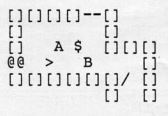
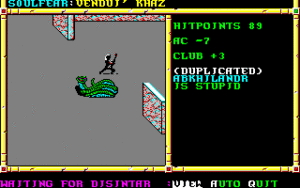
To be honest, all of this experiential gilding can feel a bit ridiculous to modern sensibilities because… well, to start, here’s what the actual game looks like in its original TRS-80 incarnation:

The fact that this display is a bit underwhelming is not the fault of Apshai‘s designers. The TRS-80 was limited to black and white (not gray-scale, mind — exactly two colors, black and white). Further, it wasn’t really capable of graphics at all in the way we think of them today, only character graphics. (In addition to a set of 64 commonly used English glyphs, it includes 64 more graphical tiles, each containing a simple abstract shape in lieu of a character glyph. By combining these together, it was possible to build larger pictures out of what remained essentially a text-only display.)

Viewed in the light of such a display system and the 16 K cassette-based computer on which it ran, Apshai is actually quite a technical achievement. Its rules also bear the stamp of an experienced game designer. They actually do not draw as heavily from D&D as one might expect given the game’s origins and the extended praise of the tabletop experience that fills its manual. While the expected six character attributes are present, and while they even number from 3 to 18 just like in classic D&D, combat and movement is very much its own thing here, a pseudo-real-time system that shows a willingness to harness the unique capabilities of the computer rather than just translate a pen-and-paper rules set into code. In fact, Apshai plays better in some ways than it has a right to; there’s a real tension to navigating through this labyrinth, deciding whether to press your luck and venture onward or turn for the exit, dreading the appearance of the next wandering monster as you do trudge back heavily wounded, having perhaps pressed your luck too far. There’s a visceral feel to the experience that many later dungeon crawls would fail to capture. This quality owes its existence partly to the real-time nature of play but hardly to other choices that have no counterpart in tabletop D&D. As your character loses health, for instance, he moves more slowly, gets fatigued faster, and becomes less effective, bringing home his state in a palpable way. Freeman’s design is a very smart one, in many ways very original even in comparison to games that would follow.

But there are inevitable limits to what even a smart designer can do on a 16 K TRS-80. One can easily forgive the fact that magic is not present at all in the game; the player is restricted to playing what amounts to the D&D fighter class. Of more concern is the fact that the two components of the game, the “Innkeeper” which is used for character management, and the “DunjonMaster” where the dungeon delving actually happens, don’t really talk to one another. The player is expected to keep a list of her attributes and the items she finds in the dungeon on each expedition, then enter those manually when she returns to the Innkeeper! Rather than being linked together, the four levels of the dungeon can each only be entered separately; there is absolutely nothing preventing the player from entering a super-character into the Innkeeper and starting out on level 4. There’s not much point to methodical exploration anyway, as there is absolutely no way to really win the game. For all its emphasis on the experiential, one cannot bring Apshai to any conclusion. One merely explores, levels up, and collects until one gets tired of the whole thing.

Still, even dictated as it is by technical limitations, there’s an odd sort of charm to Apshai. Rather than delivering a story, it really does expect its player to work with it, to build a story that exists as much in the imagination as it does in the computer. “Sure, you are free to ‘cheat’ and create a character with stats of all 18,” it says, “but what fun would that be?” Similarly, if the game doesn’t deliver an ending like we’ve come to expect, that doesn’t prevent the player from making up one of her own. There is an encounter on level 4 that feels kind of like a climax — or maybe the player just sets her own goal of visiting every single room and collecting every single treasure. Apshai expects you to work with it to make your own fun. Anyway, as Freeman wrote of a tabletop RPG campaign, “It never stops, except temporarily: there is no final victory, no point to playing except playing, and no ultimate aim except the continuing development of your character.” Why should the computer equivalent be any different? Indeed, if played as its designers imagined Apshai doesn’t really feel like a pure computer game, but some hybrid — a computer-assisted solo RPG rather than a CRPG, if you like.

In an article in Byte magazine, Freeman described the differences between the RPG’s simulational approach to narrative and the text adventure’s preference for set-piece design, while leaving little doubt which he preferred:

There is no real role-playing, for instance, in the Adventure/Zork family: the protagonist is just you in a strange setting. Games of that sort concentrate on the perceived open-endedness of action: not only is there a multitude of command options available (typically far more than Dunjonquest‘s eighteen or so), but also they are not made known to you except by trial and error. It can be quite challenging to find the right key, the right moment, and the right command necessary to insert it in the right lock; but once you do, the door will always open — always. Thus, a game like Adventure is really a puzzle that, once solved, is without further interest.

The Dunjonquest series employs a different approach. For one thing, situations are primarily defined graphically, not textually: you see the situation rather than just being told about it. More to our present purpose, while some Dunjonquest games, like Morloc’s Tower, have a specific object (finding and slaying the mad and elusive wizard Morloc), there is an open-endedness of result in all of them on the micro level (if you’ll excuse a small pun). Generally speaking, there are no “right” answers; the outcome of events is probabilistic, not predetermined.

Brian Hammerhand, the assigned alter ego/protagonist of Morloc’s Tower and The Datestones of Ryn, can, for example, slay a dire wolf nine times out of ten, but on any particular occasion he may survive the encounter unscratched, or limp away badly mauled and out of breath — and there is also that tenth time. Moreover, the exact outcome of any encounter depends both on the tactics you choose and on the specific traits of your surrogate character. The experience is different every time you play and quite different with each new character you take on your adventure. You are role-playing: getting outside yourself and into the skin of another (albeit imaginary) being.

The contention that the simulational approach leads to role-playing while the set-piece approach does not is highly suspect — although we should remember that at the time Freeman wrote this passage IF protagonists were universally of the “nameless, faceless adventurer” type. Still, the tension between the two approaches that Freeman describes here remain with ludic narrative right up to the present, often within the same design. We’ll doubtlessly be revisiting the topic many more times as we continue on this little historical journey.

If you’d like to experience Temple of Apshai for yourself, here are some instructions to get you started. Note, however, that you’ll need the patience of a saint; by modern sensibilities the original TSR-80 version is all but unplayable, what with the sloooooow speed of its screen updates and the aforementioned divide between the two halves of the program.

1. Download my neat little Temple of Apshai starter pack.
2. Start the sdltrs emulator.
3. Press F7, then load “newdos.dsk” in floppy drive 0 and “apshai.dsk” into floppy drive 1.
4. Reboot the emulator by pressing F10.
5. At the DOS prompt, type BASIC.
6. Type LOAD “INN:1”.
7. Type RUN.

The manual and quick reference card in the zipped download above should see you through the rest.

We’ll continue to check in on the developing CRPG in the future, but next time we’ll get back to text adventures, and see what our old friend Scott Adams got up to as the 1980s began.


Tags: , , ,

The First CRPGs

The CRPG form lacks an Adventure — an urtext universally known and acknowledged as its starting point. I can propose a couple of reasons why this is so.

CRPG fans have, some exceptions aside, generally not shown anything like the same dedication to documentation and historical preservation that marks the modern interactive-fiction community, which has perhaps prevented an accepted canon of historically significant works from appearing amongst the former as it has amongst the latter. Likewise, for all its enduring commercial popularity the CRPG has not acquired the same academic caché as has IF; it’s easier to justify study of a “literary” form like IF within the academy than it is a form that revolves around killing hordes of monsters and leveling up, no matter how much fun that process might be. Just as significantly, Adventure had the good fortune to become really, really popular. It was the Doom of late 1970s institutional computing, a game that absolutely everyone who spent any time within that culture had to know and probably tried to play at least once or twice. The early proto-CRPGs of the same era, of which there were a fair number, did not spread so widely and did not come to occupy the same storied place in hacker lore. Most were created on a pioneering system called PLATO (Programmed Logic for Automated Teaching Operations — how long did they work to make that acronym fit?), which linked hundreds of educational institutions around the U.S. together via thousands of dumb terminals, a handful of mainframe computers, and a central hub at the University of Illinois.

I could easily devote a whole series of posts to PLATO, the first sustained online community to connect everyday people — mostly students from elementary to university age — together. I’ll just give you the short version here, though, and mention that PLATO was remarkable indeed in many ways, laboratory of countless innovations, from the vision of computer-assisted instruction that spawned it in the first place to the uniquely user-friendly custom operating system it ran to its TUTOR programming language that let anyone design new “lessons.” Uniquely amongst institutional systems, its terminals offered graphics and, if your school had chosen to spring for some additional gadgetry, possibly even some sound and music capabilities. Originating all the way back in 1960, PLATO reached a certain level of maturity with the roll-out of the PLATO IV system in 1972, and grew rapidly in this incarnation throughout the 1970s. Its graphical capabilities made PLATO exceptionally suited for gaming in comparison to other institutional systems, which still generally relied on clunky text-only teletypes for input and output. Throw in the fact that most of these terminals were being used by students with a bit of time on their hands, and that they had the easy-to-learn TUTOR language at their disposal, and it’s not surprising that PLATO became something of a hotbed of game development immediately before the beginning of the PC era and even for some years thereafter. Amongst these games were the first attempts to bring the Dungeons and Dragons experience to the computer. They began to appear as early as 1975 — even before Will Crowther’s creation of Adventure.

The earliest of these games were created without proper authorization from PLATO’s administrators. Thus they had to hide out on the system under unassuming, workmanlike names such as pedit5 and m199h, with word of their existence being passed around in secret. Inevitably, as their popularity increased they attracted the notice of administrators and were promptly deleted. Luckily, what appears to be the original version of Rusty Rutherford’s pedit5 has been restored and made available by the folks at cyber1, a resurrected PLATO system accessible via the Internet.

As the first or second game of its type to appear, pedit5 has a decent claim to stand as the CRPG’s equivalent of Adventure. Certainly it’s of immense historical importance.

That said, the most long-lived and popular of these games, the one that first defined the experience of the CRPG for many in the same way that Adventure did that of the text adventure, came a bit later. Its name left no doubt as to its inspiration: dnd. A much more sustained and ambitious project than the one-off pedit5, dnd was initially written by Gary Wisenhunt and Ray Wood, then expanded and refined by Dirk Pellett. By October of 1976 it had reached a basically finished state, becoming a surprisingly complex experience and a very popular one amongst PLATO users; the counter of total plays bwas already almost to 100,000 at that time.

Dnd spawned a whole family of PLATO dungeon crawls which share their ancestor’s blissful unconcern with copyright. Nowadays the lawyers of the Tolkien estate would be all over Moria, Baraddur, and Orthanc.

It might make an interesting little exercise in platform studies to ask why the PLATO system hosted so many dungeon crawls, while text adventures became the diversion of choice amongst the hardcore hackers working on their DEC systems. A good part of the answer comes down to technological constraints: PLATO could do screen-oriented, graphical displays rather beautifully really, while the PDP line continued to rely on line-oriented output devices capable only of text. The broader implications of this for interactive-fiction fans, that gamers have always preferred their pretty pictures and will take them whenever they can get them over plain text, are perhaps too disquieting to dwell on. If it helps, though, it’s also true that the two computing cultures used incompatible hardware and communicated over wholly separate networks, thus keeping these two burgeoning gaming traditions wholly separate from one another before they began to mix in the great melting pot of the PC world. Adventure and dnd after all gave each of these communities, still very small by modern computing standards, plenty of inspiration and plenty to iterate on without leaping into whole other paradigms of play.

Similarly, the most popular platforms of the early PC era, the TRS-80 and the Apple II, initially hosted quite different strains of adventure. Thanks largely to the efforts of Scott Adams, the TRS-80 went in the PDP hackers’ direction to host the first text adventures to enter the home. The Apple II, meanwhile, the only member of the class of 1977 with graphics capabilities even close to those of PLATO, went in the direction of dnd. Given the sketchy documentation and the ad hoc nature of most software “publication” of that era, it’s extremely difficult to say with certainty what game marked the first CRPG to appear on the Apple II — and by extension the first to appear on a home PC. Synergistic Software’s Dungeon Campaign, which appeared right about the time that Adams was shipping off those first tapes of Adventureland, is probably the best candidate.

For our purposes, though, I want to stick with our faithful old TRS-80 for just a little bit more. Next time I’ll be taking a close look at the first commercial RPG to be developed and sold for that platform, The Temple of Apshai (1979). As an heir both to Dungeons and Dragons and the early CRPG tradition that began with pedit5 and dnd, Apshai will give us a chance to see how a CRPG of this very early era actually played.

 
1 Comment

Posted by on August 18, 2011 in Digital Antiquaria, Interactive Fiction


Tags: ,

From the Tabletop to the Computer

Let’s say that it’s the mid-1970s, and that you’re an early fan of Dungeons and Dragons, still a tiny offshoot of the niche hobby that is wargaming. Let’s further say that you have regular access to a computer at your place of education or work, and that you know how to program it. It might seem absurd to imagine a substantial overlap between the tiny number of people playing D&D circa 1975 and the decidedly limited if not quite so miniscule number who had access to a computer at that time, but in fact Will Crowther was hardly an anomaly; there was an inordinate number of hackers among early fans of the game. We can assume that hackers’ love of complex systems brought them to the game, just as it drew them to fantasy and science-fiction literature such as the works of Tolkien, where character and plot were subservient to (or at least equal in importance with) world-building.

So, we have a substantial number of hackers entranced with D&D. Hackers being hackers, it’s not difficult to guess what happened next: various projects got under way to bring the experience of D&D to the computer. This was a task for which, depending on how you looked at it and to whom you talked, the computer was either ideally suited for or woefully unequipped to handle. We’ll take the best-case scenario first.

D&D was complicated. Even the original 1974 rules, which virtually everyone agreed were crude and sketchy in many areas, filled three separate booklets of about 35 pages each while recommending that the players also have on hand a copy of Gygax’s earlier Chainmail rules. But that was only the beginning. Just the core of Advanced Dungeons and Dragons, the definitive rules for the hardcore which TSR rolled out over the last three years of the 1970s, ran to hundreds of pages housed in three big, close-typed, hardcover volumes. To this ample base were added layer after layer of further embellishment via yet more hardcover volumes and an endless stream of Dragon magazine articles. It’s fair to say that a certain subset of D&D players — those who took after Gygax himself — absolutely reveled in all of this minutiae. Indeed, for some players the baroqueness of the whole endeavor was the major part of its appeal. Plenty of others, though, were like Arneson, in it for the visceral thrill of lived (if imaginary) experience. When they mustered their last bit of carefully hoarded mana to cast Cone of Cold, their last memorized spell, on the Lizard King (apologies to Jim Morrison), these players did not want to spend ten minutes cross-referencing manuals, calculating probabilities, and pondering such unsolvable existential conundrums as just why the hell an armor class of -5 was vastly better than an armor class of 10. They just wanted to know whether their spell sputtered and died, taking it with it their party’s last hope, or whether the Lizard King had been turned into a giant green popsicle. Computers were pretty good at crunching numbers, and happy to apply even the most obtuse of rules to them. What if all of those tedious bits could be stuck into the computer, programmed and tinkered with by the Gygax-types of the world who enjoyed such things, leaving the Arnesons of the world free to just play? As an added bonus, the use of a computer might mean they could play all alone on their own time if they wanted to, rather than needing to assemble four or five friends. It seemed like a dream come true.

But wait a minute, said the naysayers (a group which included, ironically, many of the most committed Arnesons). One of the major things that defined D&D as different from any game that had come before was the sheer scope of possibility it offered to its players. A player was free, theoretically at least, to do absolutely anything she wanted to at any time. It was then up to the DM to find the rule he felt applied best from the small library he had lugged with him to the session. Failing that, he had to use his judgment to make up something appropriate on the spot. (We could note at this point that all of those rules TSR was constantly pumping out could never come to cover every concievable situation anyway, and that there must come a point of diminishing returns where just making things up in such unusual circumstances was preferably to buying yet more rulebooks in the forlorn hope of covering all the bases, but let’s just let that go.) A computer, of course, can’t make judgment calls; it can only do what it’s been programmed to do. Further, it cannot appreciate the dashing rogue of a leather-clad thief with a severe aversion to wood elves (a case of childhood trauma) you have so creatively personified. It cannot craft an adventure into the heart of the forest just for you, during which Dirk Darkstone will have to confront his horror of effeminate green-clad men wielding bows. It can’t even provide you with Tasha Brightstone, the virtuous blonde paladin in the chainmail bikini torn between her desire for Dirk and the Code of the Virgin Warrior to which she has signed her name. Every computer program ever created, games included, must ultimately offer the user only the limited menu of possible actions anticipated by its designer. Whether that set consists of the up-and-down trackball motions of Pong or the various verbs a text-adventure designer has coded his game to recognize, this constraint is immutable. How then can a computer administer a game whose players can do literally anything? The gospel of tabletop D&D tells us that, even when presented with a tempting dungeon to plunder by the DM, the players are perfectly free to walk on past the Ominous Castle of the Mad Wizard Yordor and spend the evening trying to get a really good brawl started in the local tavern instead. So, the Arnesons of the world tell us, D&D and the computer are not such a marriage made in heaven. The computerized D&D player could avoid the Mad Wizard only by turning off the computer and doing something else, after all.

We’ve certainly hit upon a significant limitation, but let’s think about all this again before we go too much farther with that train of thought. I submit that in practice the players of D&D are restricted in their field of action, by social if not rules-derived constraints. How would you feel if you were that DM who had spent his entire weekend designing the Castle of the Mad Wizard Yordor, stocking it with fearsome monsters (but balanced to not be too much for the players to handle if they play it smart) and devious traps (but not so devious they cannot be disarmed most of the time by a thief of exactly the same level as Dirk Darkstone if he is cautious), only to have your players march on past the lot to go grope the local chicks in the pub? I’m guessing you’d consider the players a bunch of ungrateful bastards whom you’d just as soon not play with again. Thus, there is an implied social contract between DM and players, one in which the players, at least in the broad strokes, are expected to, well, do what is expected of them.

Further, I submit that the rhetoric of D&D as a form of improvisational storytelling and the reality of most player’s experience of the game were somewhat at odds. The AD&D Player’s Handbook tells us:

You interact with your fellow role players, not as Jim and Bob and Mary who work at the office together, but as Falstaff the fighter, Angore the cleric, and Filmar, the mistress of magic! The Dungeon Master will act the parts of “everyone else,” and will present to you a variety of new characters to talk with, drink with, gamble with, adventure with, and often fight with! Each of you will become an artful thespian as time goes by…

The “fight with” part of the extract above was the really important part to most players, the thing that defined the experience of D&D. TSR released at least a hundred adventure modules that had players descending into one thinly justified underground lair or another to kill things and take their stuff using the 23 pages of combat rules found in the Dungeon Master’s Guide alone, and exactly zero that principally involved talking, drinking, or gambling with new friends. Even Gygax seemed of two minds about the real point of D&D. For all the parallels he drew with Shakespeare and Aristotle, in practice he was a dungeon crawler all the way, dismissive of elaborate role-playing: “If I want to do that, I’ll join an amateur theater group.” I submit that D&D was in practice not mostly played by groups of “artful thespians,” but by scruffy teenage boys and men perfectly happy to remain Jim and Bob as they pondered the best way to kill that group of trolls in the next room. And that experience of D&D a computer could, within inevitable limits, simulate pretty well.


Tags: