Even the authorship of books about Rennes-le-Château is unnecessarily complicated. Richard Leigh almost adopted the pen name of “Richard Bardmont,” perhaps to keep his work in alternative history separate from the “serious” novels he still dreamed of writing. At the last minute, however, he changed his mind and allowed the book to be published under his real name. Just as well; the novels would never emerge.
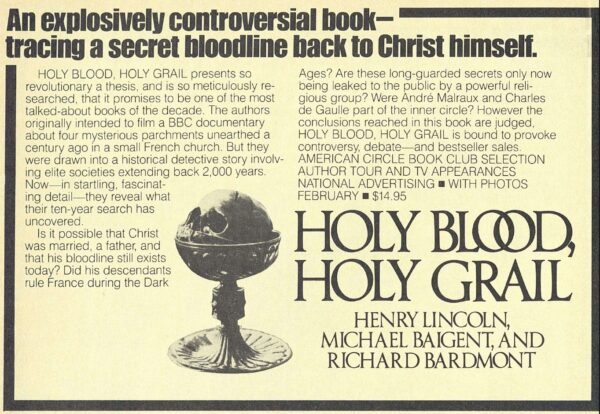
The Holy Blood and the Holy Grail was published by Jonathan Cape in Britain on January 18, 1982. Delacorte released an American edition five weeks later, under the punchier title of simply Holy Blood, Holy Grail. Sales were strong right out of the gate, and in time the book grew into something of a sensation on both sides of the Atlantic.
Taken only on its literary merits, The Holy Blood and the Holy Grail was an unusually well-crafted example of its pseudo-historical breed, but that was only a prerequisite to success, not a guarantee. In other ways, its success was a case of excellent timing, as media sensations always tend to be. Steven Spielberg and George Lucas’s Raiders of the Lost Ark, the biggest movie by far of 1981, had told the story of a two-fisted archeologist on the trail of the legendary Ark of the Covenant, the vessel in which the Ten Commandments had supposedly been kept after Moses brought them down from Mount Sinai. The Holy Blood and the Holy Grail had much the same spirit about it, even if its legendary artifact proved to be a bait and switch in the end, being secret knowledge rather than a physical object.
Britain was just exiting an extended obsession with Masquerade, a lavishly illustrated puzzle book by a heretofore obscure artist named Kit Williams that could allegedly be used by the sufficiently motivated to reveal the location of a “golden hare” that had been hidden somewhere in the country. Also a Jonathan Cape book, Masquerade had left the British public primed for more of exactly the sort of obscure and intricate riddles in which the authors of The Holy Blood and the Holy Grail loved to lose themselves. Meanwhile, on the other side of the Atlantic, the Day-Glo, “greed is good” 1980s America remembered by 21st-century popular culture was still a year or more away at the beginning of 1982, with the economy still struggling to exit an ugly recession. What better way to escape day-to-day troubles than by immersing oneself in the distant past and dreaming of the possibility of a Merovingian savior still to come?
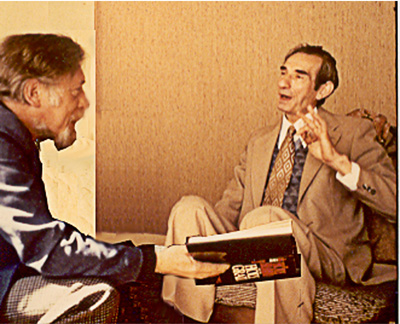
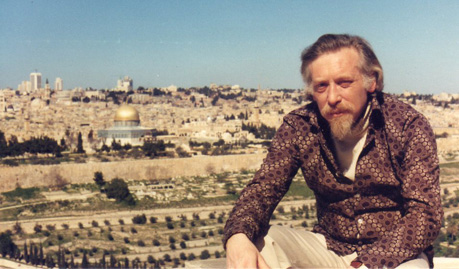
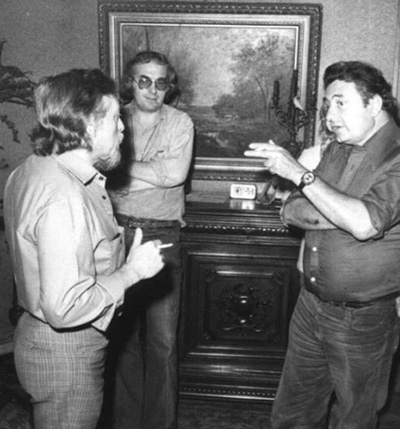
In the United States, Delacorte’s cautious initial print run of 45,000 copies sold out within days, leaving the publisher scrambling to get more off the press. The book never topped the bestseller charts, but it hung around the lower reaches of the non-fiction top ten — operating on a fairly generous definition of “non-fiction,” of course — for months on end, selling steadily while the books above it came and went. In that chicken-or-the-egg equation that often holds sway with trends, bookstores that had at first simply shelved The Holy Blood and the Holy Grail in their history section rushed to set up floor and window displays as the months went by and its sales showed no sign of slackening. Newspapers ran feature articles about what was now being called a “phenomenon” on their front pages. Henry Lincoln, Richard Leigh, and Michael Baigent became in-demand guests on television and radio. Lincoln in particular was markedly ebullient in these appearances. And why shouldn’t he be? He had managed to make his idiosyncratic vision of history a vital part of modern pop culture, not only in his home country but in the biggest media market on the planet; he had come a long way indeed from semi-anonymously penning workaday episodes of Doctor Who.
Exactly one year after the hardback, Delacorte launched the paperback edition of Holy Blood, Holy Grail with an initial print run of half a million copies. The book was by now being translated into a dozen languages, including French. It would sell well into the millions before the 1980s were over, making Lincoln, Leigh, and Baigent enviably wealthy men.
All of this ignited a scramble in the press to figure out What It All Means, beyond the mere fact of the book being “controversial” and “provocative.” Catholic bishops, Protestant theologians, and professional secular historians found themselves in rare agreement when they said that the book was shoddy history, growing out of supposition and insinuation rather than proven fact, in addition to being “an attack on the very core of Christianity and the Christian ethos.” But even some of these folks had to give some measure of grudging credit to the compelling way the book was put together. Novelist Anthony Burgess of Clockwork Orange fame unwittingly forecast the future when he wrote that “it is typical of my unregenerable soul that I can only see this as a marvelous theme for a novel,” thereby thrilling Richard Leigh, who had long held Burgess up as one of his literary heroes. As oblivious to irony as ever, he and his partners explained in a new foreword written for the paperback edition that
it was significant, and not just coincidental, that the most sympathetic responses to our book seemed to come from literary figures — from important novelists like Anthony Burgess, Anthony Powell, and Peter Vansittart. For, unlike the professional historian, the novelist is accustomed to an approach such as ours. He is accustomed to synthesizing diverse material, to making connections more elusive than those explicitly preserved in documents. He recognizes that truth may not be confined only to recorded facts but often lies in more intangible domains — in cultural achievements, in myths, legends, and traditions; in the psychic life of both individuals and entire peoples. For the novelist knowledge is not subdivided into rigid compartments, and there are no taboos, no “disreputable” subjects. History is not for him something frozen, something petrified into periods, each of which can be isolated and subjected to a controlled laboratory experiment. On the contrary it is for him a fluid organic and dynamic process wherein psychology, sociology, politics, art, and tradition are interwoven in a single seamless fabric. It was with a vision akin to that of the novelist that we created our book.
The most amusing response came from Pierre Plantard. The idea that the Merovingian kings were the direct descendants of Jesus Christ had never been a part of his agenda; it had sprung entirely from the mind of Henry Lincoln as he fell deeper and deeper down the rabbit hole during the 1970s. It turned out that, while Plantard was perfectly happy to be labeled the scion of a legendary French dynasty awaiting reinstatement to his throne, the suggestion that he was a literal demigod with the divine blood of Jesus himself coursing through his veins was a step too far even for his prodigious ego. “How can you prove a heritage of four centuries from Jesus to the Merovingians?” he asked on a French radio show. “I have never put myself forward as a descendant of Jesus Christ.”
Plantard would now begin to distance himself from Lincoln and his friends and the full-fledged cottage industry in conspiracy that their book would spawn. And this would in turn have an important effect on said industry. Deprived of its one tangible living link to its preferred version of the past, it would drift yet further away from real history toward castles in the air built out of magical geometry and New Age mysticism. There would be no really new evidence to point to, whether forged or genuine, issuing from Plantard or anyone else; nor would the Priory of Sion show any sign of emerging from hiding like the Phoenix to forge a better or at least different world order, as was mooted at the end of The Holy Blood and the Holy Grail. New theories about Rennes-le-Château and the holy bloodline would have to be arrived at by churning endlessly through the same old data points to arrive at new juxtapositions.
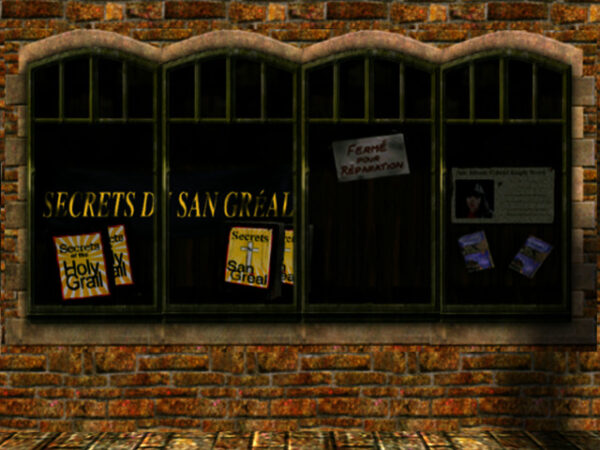
That the conspiracy was already reaching a point of diminishing returns was made manifest by the inevitable sequel to The Holy Blood and the Holy Grail. Published in 1987, Lincoln, Leigh, and Baigent’s The Messianic Legacy had some of what had made its predecessor so alluring, but not enough of it. It endeavored to fill in the gaps of the story by embellishing both the pre- and post-Medieval stages of the secret history. After a lengthy, readable, and surprisingly accurate description of ancient Judea and the most likely versions of an historical Jesus Christ, the conspiracy theories came back to the fore. The Freemasons were added to the list of secret societies privy to the great secret, and the Mafia and CIA were given roles to play, as was the Guardian Assurance Company, the biggest insurance firm in Britain during the peak years of empire. (Who says that insurance is boring?) “Those who believe in global conspiracies will enjoy the intrigue; others may be rightfully amused,” wrote Publishers Weekly, not even pretending to take any of it seriously anymore. The book sold well by the usual standards of its kind, but nothing like the first book had sold. This is the great drawback of enjoying such a singular success: the fact that it is so singular, that everything you do afterward is destined to pale in comparison. The first book may have spawned a cottage industry that would persist for decades, but in a broader cultural context its moment seemed to have passed.
Henry Lincoln parted ways from its two co-authors at this point. In the years that followed, he plowed the same old ground obsessively. Lacking the fertilizer of any really new information, his crop yield became ever more shabby. He increasingly found himself telling how his younger self came to write about Rennes-le-Château, reliving those glory years of the 1970s and early 1980s on the page as he doubtless was doing in his mind. When he wasn’t sharing the old war stories, he chased his geometrical chimeras to ever more uncertain ends. It strikes me that there was something a little tragic about the man, caught like a lab rat in a nonsensical labyrinth that was largely of his own devising.
For their part, Leigh and Baigent continued to work together, casting a slightly wider net than Lincoln at times but always coming back to their comfort zone of hidden Christianity and secret cabals attempting or succeeding in controlling the world. Leigh never did get around to becoming a serious novelist.
It all started to feel a bit tired even to some of the folks who were most predisposed to believe in it. Other stars of pseudo-history emerged to outshine our trio in recognition and sales. The most prominent was one Graham Hancock, who kicked off his pseudo-historical career with The Sign and the Seal. Possibly the best-reading book of the type since The Holy Blood and the Holy Grail, it posited that the Ark of the Covenant was hidden in a remote church in Ethiopia, a thesis it padded out to 600 weirdly riveting pages; I remember being utterly entranced with it upon discovering it shortly after its publication in 1992. But Hancock found his true métier three years later with Fingerprints of the Gods, which proposed that a civilization vastly more advanced than our own had once been centered on Egypt’s Giza Plateau. Being even less tethered to reality than the myths that were born around Rennes-le-Château, this thesis was amenable to virtually endless embellishment — an excellent foundation for a lengthy career on the part of Hancock, one that is still ongoing today.
The influence which Hancock and his peers had on the media landscape during the second half of the 1990s and beyond was deceptively large. Popular television shows like Stargate SG-1 played with their ideas. Ditto computer games. Indeed, alternative archaeology seemed tailor-made for a certain stripe of slow-paced, contemplative, first-person adventure game, dubbed “Myst clones” by fans in honor of their urtext. Games like Timelapse and Riddle of the Sphinx substituted set-piece puzzle-solving for more dynamic forms of interactive narrative in much the same way that the likes of Henry Lincoln and Graham Hancock used it as a replacement for serious historical inquiry.
Through it all, Rennes-le-Château remained a part of the constellation of conspiratorial history, if a less prominent one than it had been during the heyday of The Holy Blood and the Holy Grail. Another adventure game called Broken Sword: The Shadow of the Templars borrowed heavily from the lore; the subtitle it shared with the last of Lincoln’s Chronicle episodes was not coincidental.
The most heavily promoted book on Rennes-le-Château during this decade issued not from any of the trio behind The Holy Blood and the Holy Grail but rather from a pair of British newcomers. Paul Schellenberger was a civil engineer, Richard Andrews a professional diver; neither had ever written a book of any type before. Nevertheless, they were given an advance of £300,000 by Little, Brown and Company to write The Tomb of God, in which they proposed to correct what they believed to be Henry Lincoln’s mistakes and then to carry his ideas about mystic geometry yet further.
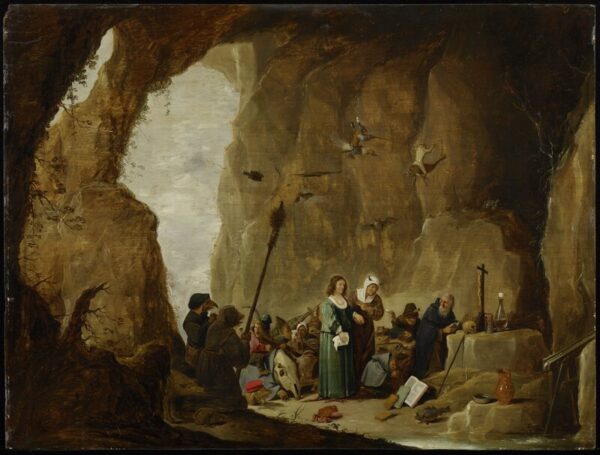
The Temptation of Saint Anthony by David Tenier the Younger.
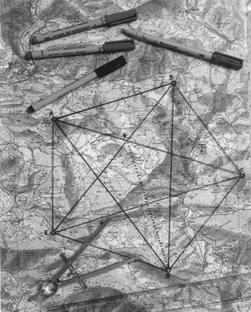
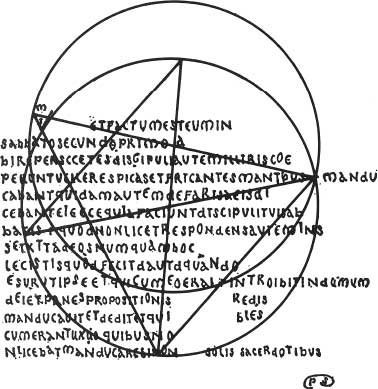
You may recall that Gérard de Sède stated in the very first book ever written about Rennes-le-Château that François-Bérenger Saunière returned to the village from his much-discussed trip to Paris with three paintings: Nicolas Poussin’s The Shepherds of Arcadia, David Teniers the Younger’s The Temptation of Saint Anthony, and a portrait of Pope Celestine V by an unknown artist. Lincoln had never figured out what to do with the second two paintings, concentrating almost all of his attention on the first. Schellenberger and Andrews now set out to remedy that failing. Fiddling about with the two Altar Documents, they identified a tilted square hidden within them, a shape which they also believed to be present in all three paintings. (So much for Lincoln’s pentagons!) They read the message encoded so deviously into Altar Document 1 as describing four points on the landscape around Rennes-le-Château — points which also formed a tilted square. All of the clues were extremely tenuous — the phrase “blue apples” in the secret message, for example, was read as “slang” for grapes, thus pointing to a local vineyard — but needs must. Gravestone 1 as well came into the picture to provide a vital angle. They followed these textual and geometrical clues to a point deep within the base of Mount Cardou.
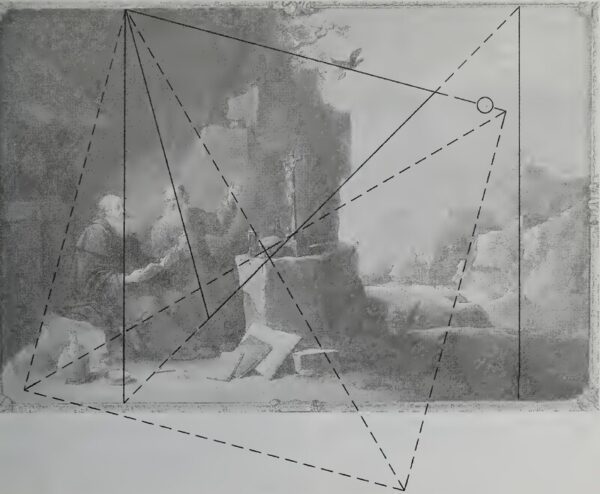
And what was concealed here? Nothing less than the body of Jesus Christ, who in their new reading of the conspiracy hadn’t risen from the dead at all circa AD 29. Instead his corpse had been spirited away by his followers during the three days between his death on the cross and the discovery of his empty tomb. The principal clue to this bombshell revelation — one that was even more of “an attack on the very core of Christianity and the Christian ethos” than anything Lincoln had claimed — was the Latin phrase written on the tomb in the Poussin painting: Et in Arcadia Ego. As we learned in an earlier article, this is only a fragment of a sentence: “And in Arcadia I…”
“What if the trick is to complete it in the shortest possible way to make it grammatical, not only with the smallest number of words, but also with the smallest number of letters?” asked Schellenberger and Andrews. Well, if you add the three-letter word sum to the end, you do wind up with a complete Latin sentence, one that can be translated to “And I am in Arcadia.” Et in Arcadia Ego sum in turn happens to be an anagram of Arcam dei tango, Iesu: “I touch the tomb of God, Jesus.” Granted, some might complain that you can turn any sentence into an anagram of just about anything you want it to be if you allow yourself to start sticking arbitrary words onto the end, but our intrepid authors were satisfied with their results. They concluded their book with a call to excavate Mount Cardou forthwith, a project that would necessitate the removal of “thousands of tons of rock.” Needless to say, this had about as much chance of happening as France spontaneously deciding to adopt English as its national language.
Published in 1996, The Tomb of God brought Rennes-le-Château back into the international conspiratorial spotlight, just after the 40th anniversary of Albert Salamon’s first articles about the subject for a regional French newspaper. The mystery had come a long way over that time, from vague talk about a pile of gold of uncertain origin buried somewhere in the vicinity of the village into a set of crazily gnarled and intricate conspiracy theories about secret faiths, secret bloodlines, and secret societies that were of urgent contemporary geopolitical relevance — assuming one chose to believe them, of course.
The Tomb of God was also the book which Jane Jensen stumbled across while she was taking a year off from her job as a game designer for Sierra On-Line, waiting to see whether her bosses would judge the state of the market to be conducive to a third entry in her Gabriel Knight series of adventure games. Once she did get the green light, the book became the primary source for the most celebrated puzzle sequence in Gabriel Knight 3: Blood of the Sacred, Blood of the Damned. She imported many of Schellenberger and Andrews’s geometrical ideas wholesale, with the original addition of hints drawn from Le Serpent Rouge, the poem included in the Lobineau dossier, which the authors of The Tomb of God never see fit to mention at all. To be fair, it’s hard to blame them for this; Le Serpent Rouge has long been the true wild card of the dossier, defeating even the most dedicated attempts to make sense of it.
In the world of a computer game, however, it can all be made to hang together nicely. Gabriel Knight indubitably finds the object of his search, which is more than can be said for any of the real people who have chased the mystery of Rennes-le-Château over the years. To my knowledge, Jensen has never stated publicly whether she placed any credence in the conspiracy theories or simply saw them as a great hook around which to build an interactive mystery. Ultimately, it really doesn’t matter. In my opinion, Gabriel Knight 3 is by far the most enjoyable way to engage with the lore of Rennes-le-Château, being even more of an entertaining potboiler than The Holy Blood and the Holy Grail.
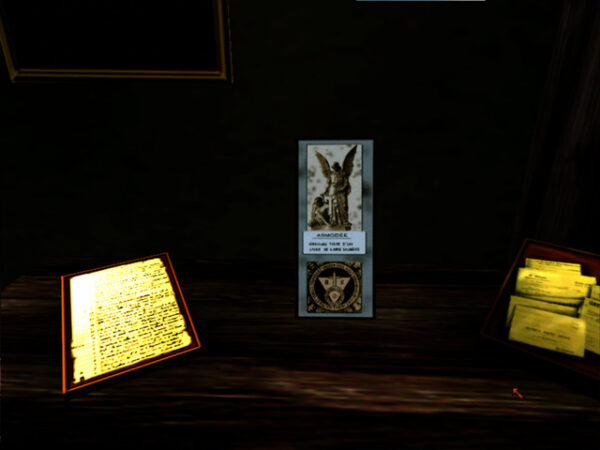
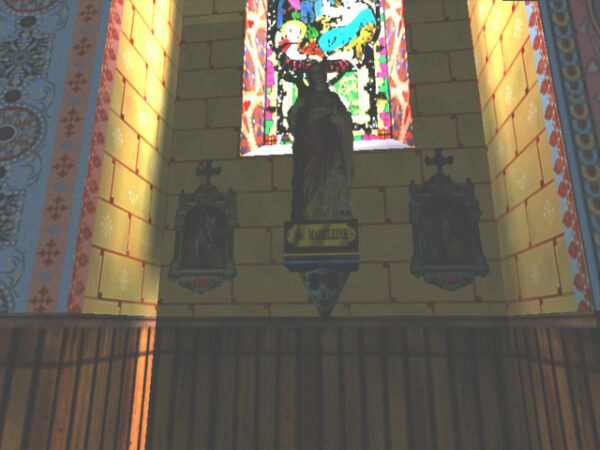
Gabriel Knight 3 provides an almost unnervingly accurate depiction of the real Rennes-le-Château. Here we’re inside the museum that stands close to the church. I was there about ten years after the game was made. It looks here just as I remember it.
Some of Jane Jensen’s contemporaries were less cagey than she was. There were some voices who were prepared to push back publicly outside of the cloistered halls of religion and academia, even though there has always been more money and fame to be garnered in conspiratorial credence than skepticism.
The slyest and cleverest of the skeptics was Umberto Eco, the famed Italian Medievalist, semiotic philosopher, and novelist. In an ironic way that he must surely have appreciated, Eco owed some of his international success in the last profession to Rennes-le-Château. For his first novel The Name of the Rose, about secrets that lived within the labyrinthine corridors of an early fourteenth-century monastery, had come out in English translation the year after The Holy Blood and the Holy Grail had done much to familiarize the public with the time period and milieu and primed their pump for just such murky tales of hidden truths. Eco’s book too became an unlikely, zeitgeist-defining bestseller, spawning a hit movie with Sean Connery in the starring role of William of Baskerville. (Eco was a postmodernist, after all…)
Eco paid his benefactors backhanded tribute in 1988, in his second novel Foucault’s Pendulum, which set out to show how easy it really is to construct a secret history by drawing arbitrary lines between disparate historical events, stating conjecture as proven fact, and ignoring any evidence which doesn’t support the narrative. The foreground plot of the novel hinges on a group of merry pranksters who, with visions of fun and profit dancing before their eyes, start feeding the aforementioned disparate historical data points into a computer. (Such an approach reads as far more ominously plausible in our current age of large language models than it might have in 1988…)
“The challenge isn’t to find occult links between Debussy and the Templars. Everybody does that. The problem is to find occult links between, for example, cabala and the spark plugs of a car….”
“Any fact becomes important when it’s connected to another. The connection changes the perspective; it leads you to think that every detail of the world, every voice, every word written or spoken has more than its literal meaning, that it tells us of a Secret. The rule is simple: Suspect, only suspect. You can read subtexts even in a traffic sign that says ‘No Littering…'”
“Last night I happened to come across a driver’s manual… I began to imagine that those pages were saying Something Else. Suppose the automobile existed only to serve as a metaphor of creation? And we mustn’t confine ourselves to the exterior, or to the surface reality of the dashboard; we must learn to see what only the Maker sees, what lies beneath. What lies beneath and what lies above. It is the Tree of Sefirot.”
“You don’t say.”
“I am not the one who says; it is the thing itself that says. The drive shaft is the trunk of the tree. Count the parts: engine, two front wheels, clutch, transmission, two axles, differential, and two rear wheels. Ten parts, ten Sefirot.”
“But the positions don’t coincide.”
“Who says they don’t? Diotallevi’s explained to us that in certain versions Tiferet isn’t the sixth Sifirah, but the eighth, below Nezah and Hod. My axle-tree is the tree of Belboth…”
Predictably enough, Eco’s cynical protagonists are eventually sucked in by their own elaborate postmodern joke, getting high on their own supply, as it were. And equally predictably, there were people who read Eco’s novel only to conclude that it was a vehicle for hidden truths rather than a cutting satire of writers and readers just like them.
The program above is well worth watching in its entirety. But let me make a strong suggestion to you for right now: watch only up to the 35-minute mark. You can come back and watch the rest after you’ve read the fifth and last article in this series. In other words: spoiler alert past minute 35!
Years later, the BBC television program Timewatch, a continuation in spirit if not in name of the old Chronicle series, demolished the conspiracy theories around Rennes-le-Château in a less unmistakable but almost equally clever fashion, thereby atoning for some of the sins of its forefather. The occasion which prompted the show to have a go at the subject was the publication of The Tomb of God. That book’s authors Paul Schellenberger and Richard Andrews feature prominently in the episode, which for the first half of its running time states their theories and the older conspiratorial narratives that underpin them in what seems to be an unskeptical way. Then writer and director William Cran drops the hammer on them.
Do they have any proof that Bérenger Saunière bought copies of three particular paintings from the Louvre, as was stated by Gérard de Sède in his 1967 book and then restated in The Holy Blood and the Holy Grail? Have they, for example, checked with the Louvre, which keeps quite meticulous records of copies of its paintings that it sells, the better to avoid having to contend later on with claims that the copies are the real things?
No, they have not checked with the Louvre. But Cran’s team now does, and finds no record of copies of those three paintings being sold, together or separately, anywhere close to 1891.
Do Schellenberger and Andrews have proof that Saunière was ever in Paris at all circa 1891?
They have heard that his name shows up in the records of the Parisian Church of Saint-Sulpice as having attended Mass there that year, but haven’t checked this personally. Cran’s team now does, finding that his name does not show up in those records.
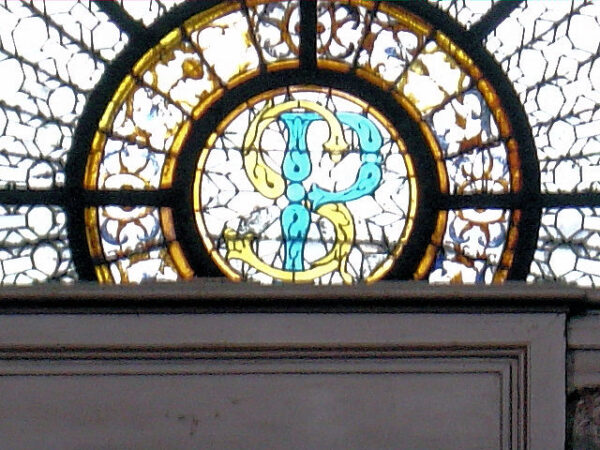
A persistent belief that the Church of Saint-Sulpice was or is somehow connected with Saunière and the Priory of Sion stems from a stained-glass window on the building that displays the letters “P” and “S.” But these actually stand for Peter and Sulpitius — or Pierre and Sulpice in French — who are the church’s patron saints.
We continue in this vein. Forensic examination of Poussin’s The Shepherds of Arcadia as well as a perusal of the artist’s preparatory sketches reveal no sign of the geometrical framework he would have had to draw onto the blank canvas to guide his painting if what Schellenberger and Andrews — or for that matter Henry Lincoln — say is true. A note in Saunière’s journal which is supposed to connect his treasure hunt explicitly with Gravestone 1 turns out to be only a passing reference to “a tomb”; he provides no more detailed description. As you and I have already learned, the 1884 book by Eugène Stübeln which is purported to be the original source for the sketch of Gravestone 1 seems never to have actually existed, leaving us with only a “reproduction” of the sketch dating from the 1960s; sure enough, the signature on this sketch is completely different from the signature of the real Eugène Stübeln. The Crusades-era documents which Schellenberger and Andrews point to as proof of the existence of a Priory of Sion almost a millennium ago turn out not to mention a Priory at all, only an Order of Sion.
Schellenberger and Andrews stubbornly hold their ground in the face of all this. Even if most of their case is built upon blatant distortions and fabrications, they say, this proves nothing, other than that the forgers must themselves have been initiates into the secret. It is as hard to convince conspiracy theorists to let go of such circular logic as it is to convince a true believer to leave a religious cult — especially when there is money to be made from forwarding the myth. (As Upton Sinclair once said, “It is difficult to get a man to understand something when his salary depends upon his not understanding it.”) Nevertheless, Schellenberger and Andrews do look increasingly sweaty as the episode goes on, their eyes taking on more and more of a deer-in-the-headlights look. One almost starts to feel sorry for them.
Perhaps a modicum of sympathy is even warranted from our side, given that there is some circumstantial evidence that this devastating Timewatch episode badly blunted their book’s sales trajectory. Whatever else you can say about Graham Hancock, he was careful never to let himself get caught out alone and exposed on the hostile territory of a sober fact-based investigation like Schellenberger and Andrews were. They disappeared from the pseudo-historical scene as suddenly as they had arrived, leaving Hancoock’s ancient Egyptians to take center stage once again. By the time that Jane Jensen’s computer game finally appeared in late 1999, its theme seemed almost an anachronism, a relic of an earlier era of conspiracy theories. Little did anyone know that Rennes-le-Château and the hidden bloodline of Jesus Christ were about to come roaring back with a vengeance.
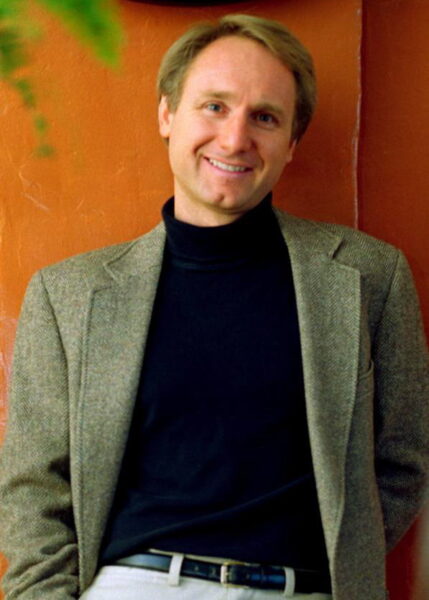
Dan Brown.
At the turn of the millennium, Dan Brown was a former high-school English teacher and current struggling author living in a small town in New Hampshire. His first three books, thrillers all, had all flopped in the marketplace. Like Anthony Burgess almost two decades earlier, he came across the The Holy Blood and the Holy Grail and thought to himself that it might make for one hell of a novel. But unlike Burgess, he followed through. The result arrived in 2003 in the form of The Da Vinci Code, a by-the-numbers thriller on the surface whose secret weapon was its conspiratorial backstory, appropriated from the accumulated lore of Rennes-le-Château.
As we have seen, it’s possible to identify some reasons that The Holy Blood and the Holy Grail became as popular as it did at the time it did. The Da Vinci Code is an altogether less explicable case. It came out of nowhere and blindsided everyone, for reasons that are difficult to discern on the surface. It certainly wasn’t a literary masterpiece; most critics found it to be not particularly good even as workmanlike pulp adventure novels went. But its publisher Doubleday did see a glint of something in it — perhaps just the shiny allure of potential controversy — and gave it a fairly concerted push out of the gate. And just like that, it became ubiquitous, meteoric, striking a nerve that nobody had suspected was sitting out there itching to be struck. It was soon selling 100,000 copies a week in the United States alone. By the beginning of 2006, it had hit 30 million copies sold worldwide, a mass-market phenomenon rivaled in its day only by the Harry Potter books. Dan Brown was by then earning more than $75 million per year from it — and that was before the movie dropped that May, and went on to become the second biggest blockbuster of 2006. In the fullness of time, The Da Vinci Code single-handedly made Brown a billionaire.
Just as happened with Harry Potter, an entire media ecosystem sprang up around The Da Vinci Code, one which was simply inescapable. The Western world went absolutely crazy for this stuff, and the suppliers of books went more than half insane trying to feed the demand. An issue of Publishers Weekly dated March 6, 2006, shows the novel still to be the second best-selling work of fiction in the United States after 151 weeks on the chart; other, coattail-riding novels called The Templar Legacy and The Last Templar sit at number four and five respectively. Later that year, Little, Brown and Company paid a first-time author named Elizabeth Kostova an advance of $2 million for The Historian, a vaguely Da Vinci Code-like novel whose central premise was that Dracula was still alive and an active player in the world. Meanwhile dozens of books purporting to explain the pseudo-history behind The Da Vinci Code — some skeptically, most credulously — became big successes in their own right; ditto a myriad of television documentaries. The Holy Blood and the Holy Grail was dusted off and given new trade dress and a renewed promotional push; it may very well have sold more copies in the mid-naughts than it did when it was a hot topic in its own right in the early 1980s. Travel agencies all over North America and Europe rushed to set up Da Vinci Code tours, in which punters trooped through hotspots like the Louvre and the Church of Saint-Sulpice behind their bemused-looking guides, ignoring most of the real beauty around them to focus on the fantasy. The Rennes-le-Château hardcore who had kept the flame burning all these years didn’t know whether to feel vindicated or dismayed by all these unwashed barbarians at their gates.
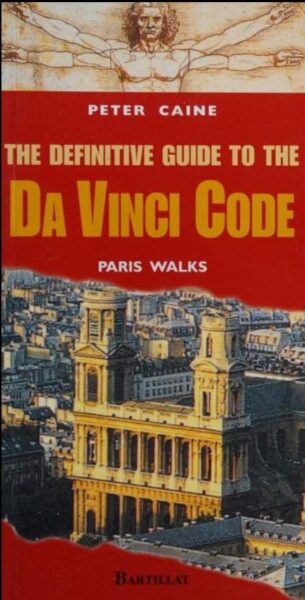
An argument can be made that The Da Vinci Code was the last phenomenon of its kind, the last time that something so old-school as a linear book printed on paper was able to dominate the pop-cultural discourse so thoroughly. What came after, of course, was an almost purely digital media age engineered for interactivity.
As so often happens with these things, the actual artifact that was at the center of it all seems bizarrely underwhelming today in proportion to the hubbub it raised. Written in clumsy grade-school-level prose, The Da Vinci Code reads like exactly what it ultimately is: Rennes-le-Château fan fiction, even if Brown does omit any mention of the village itself. He lays his cards on the table in the prologue, where the first character we meet is named “Jacques Saunière,” who is by day a mild-mannered employee of the Louvre, by night a keeper of the Great Secret. All of the characters that come after him are equally cartoonish; a subtle writer Dan Brown is not. The villain Silas is an albino monk who prefers to shoot his victims in the stomach so that they die as slowly and painfully as possible. The hero Robert Langdon is a classic Mary Sue: a handsome “professor of religious symbology” who swims 50 laps every morning and then dries off to dazzle his colleagues at Harvard with his intellectual brilliance across dozens of domains. The story is all external action, reading more like a script treatment than a conventional novel; if the people found in these pages have any internal lives at all, we definitely aren’t privy to them. The Da Vinci Code is a novel that’s perfect for people who would rather be watching a movie than reading a book — which may go a long way to explain its popular appeal, come to think of it. It’s shocking to think that the guy who wrote this extravagantly terrible prose taught English before he became an author.
I’m sorry to carry on like such a snob. Please believe me when I say that that’s really not who I am; I’m a reader who loves Stephen King almost as much as he does Shakespeare, who often feels a sneaking suspicion that the only real divide between genre and “higher” literature as they are practiced today is that the purveyors of the one know how to construct a story that makes you want to keep reading while the purveyors of the other do not. It’s just that it’s hard for anyone who cares at all about the craft of writing to avoid getting his hackles up when writing about Dan Brown. If you’re comfortable reading in a language other than English and you want to read this book, my advice to you is to pick it up in translation. The translator will almost certainly be a better writer than the original author.
In terms of plot, The Da Vinci Code breezes swiftly through a sort of Cliff’s Notes version of Henry Lincoln’s conspiracy theories, presented in 105 chapters that seldom exceed a few pages in length. The Holy Blood and the Holy Grail itself makes a cameo appearance on the bookshelf of one character. (“The authors made some dubious leaps of faith in their analysis, but their fundamental premise is sound, and to their credit, they finally brought the idea of Christ’s bloodline into the mainstream.”) To keep everything thoroughly relatable, Brown changes the artwork at the center of the story to Leonardo da Vinci’s The Last Supper, one of the relatively few paintings in the world that almost everybody knows by name and by sight. In place of esoteric geometry, Brown sees in it the figure of Mary Magdalene, standing next to Jesus where art historians tell us Saint John is to be found. The Mona Lisa, another Leonardo painting that is if anything even more famous, also features prominently. The very name of the novel screams of its historical and cultural illiteracy. No real historian, much less any of Leonardo da Vinci’s contemporaries, would ever call him simply “da Vinci,” as if that was his last name. He is Leonardo of the town of Vinci, called Leonardo in short form. Henry Lincoln may have been more than half off his nut, but he was a deep historical thinker next to Dan Brown (yes, even if he did believe that ancient Judea had the equivalent of birth certificates and marriage licenses).
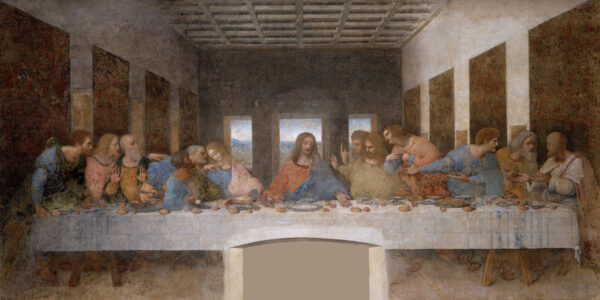
Brown suggests that the effeminate-looking figure immediately to the left of Jesus from our perspective, whom art historians believe to be Saint John, is actually Mary Magdalene. The “V” formed by the two figures is said to be a symbol for the womb. The “V” can also be extended to form an “M,” as in “Madeleine” or matrimonium: Latin for “marriage.”
But now I’m sounding like a snob again, aren’t I? So, let me say that The Da Vinci Code isn’t entirely without value. It did spawn hundreds of ofttimes hilarious reviews, which rose to giddy heights of scathing eloquence in their efforts to explain just how bad it is. A surprising number of these reviews came from other writers. Jealousy was undoubtedly a factor here — why should this hack be given a billion dollars when a talented artiste like myself is not? — but one senses that there was also a deeper well of moral outrage at the idea that someone who so manifestly just didn’t care about the basic craft of putting sentences together in a pleasing or evocative way should be rewarded in such a lavish fashion. Stephen King, who was normally unfailingly generous and welcoming to new writers, who had been known to compare his own books to a well-made burger and fries, called The Da Vinci Code the literary equivalent of a box of Kraft Macaroni and Cheese: nutrition-free, un-filling, and artificial to the core, leaving bright orange fake cheese powder all over everything it touched. And yet for some reason a lot of people loved them both.
That said, you could and can find worse crimes against the craft of writing all over the Internet. What makes Dan Brown guilty of something potentially worse than poor craftsmanship is his decision to present his book as both fiction and non-fiction at the same time in order to juice its sales. The opening epigram tells us, beneath the word FACT in large boldface letters, that “the Priory of Sion — a European secret society founded in 1099 — is a real organization. In 1975 Paris’s Bibliothèque Nationale discovered parchments known as Les Dossiers Secrets, identifying numerous members of the Priory of Sion, including Sir Isaac Newton, Botticelli, Victor Hugo, and Leonardo da Vinci.” These two sentences are remarkable for how much they manage to get wrong even if one subscribes to the narrative of The Holy Blood and the Holy Grail. The year 1099 was the year that the Crusaders conquered Jerusalem and the already extant Order of Sion allegedly engineered the selection of Godfrey of Bouillon as the king of the new Christian city-state, not the year that the organization was founded. The dossier in question consisted not of parchments but typewritten pages on modern paper. And the dossier was not fortuitously discovered by employees of the library itself, but by Gérard de Sède after he was explicitly told by Pierre Plantard to go and look there. “All descriptions of artwork, architecture, documents, and secret rituals in this novel are accurate,” the book goes on to state. As the sentences that precede this one so amply illustrate, this assertion could hardly be more false. But if Brown hadn’t seen fit to make it, it is highly doubtful that the book would ever have achieved a shadow of the success it did.
I think that Henry Lincoln was a sincere believer in the Rennes-le-Château conspiracy theories, but the divide between belief and opportunism is less clear to me in the case of others. I include in this group not only Jane Jensen, Dan Brown, and the indomitable Schellenberger and Andrews, but even Lincoln’s own co-authors Richard Leigh and Michael Baigent. Their reaction to The Da Vinci Code gives me all the more reason to suspect that their motives were primarily mercenary and cynical, or had at any rate become that way over the decades since the publication of their most famous book. For, being not content with the tenfold boost which Brown’s novel had given to sales of The Holy Blood and the Holy Grail, Leigh and Baigent chose to sue him in British court for plagiarism; significantly, Lincoln elected not to join this lawsuit.
The High Court of Chancery found for the defendant in 2006; the same verdict was reaffirmed under appeal the following year. The courts noted that the plaintiffs could produce no examples of word-for-word copying on Brown’s part. Indeed, the prose styles of the two books were as different as they could be; The Holy Blood and the Holy Grail was as ramblingly discursive as The Da Vinci Code was almost childishly simplistic. If both books had been novels, the lack of word-for-word copying would still have left the question of whether Dan Brown had blatantly lifted elements of character and plot. But they were not both novels. The Holy Blood and the Holy Grail proclaimed itself to be a book of history, even if it was “speculative” history. And you can’t copyright real or even speculative facts and events, the stuff of history. Given that, Leigh and Baigent were forced to fall back on a rather tortured argument that Brown had plagiarized their “central theme,” essentially rewriting The Holy Blood and the Holy Grail as a novel. The court didn’t buy their attempt to equate avowed non-fiction with fiction, and they were left with nothing to show for trying to muscle in on Brown’s action but legal bills of a reported £3 million. I don’t think you have to be too mean-spirited to consider this a deserved comeuppance.
The episode is telling in that it provides us with a window into Leigh and Baigent’s own view of their work, which was more akin to the attitude of a novelist than a historian. In so doing, it begins to crystallize some questions that have been lurking around the edges of this chronicle almost from the start. To what extent did most of the people who made Rennes-le-Château and everything that came to surround it their hobbies really, truly believe it all in their heart of hearts? And did the truth or fiction of it actually matter so much to them one way or the other when all was said and done?
Many years ago now, I read a piece on a gaming or pop-culture website — I’m sorry to say that I can’t find the link anymore — which presented the best “shared worlds” of modern entertainment. I remember being shocked to see at the top of the list not Middle-earth or the Star Wars or Star Trek universe, but rather the Second World War. This struck me as being in vaguely poor taste; surely the Holocaust and all of the other real horrors of that conflict don’t deserve to be set up alongside The Lord of the Rings as just another venue for comics and cosplay. And yet it was hard to deny that the article kind of had it right: that the Second World War really is an inexhaustible stage for fiction, richer than the ones you find in even the richest purely fictional novels, movies, and games.
Another anecdote, running in the other direction: much more recently, I was listening to a radio interview with a journalist who had been embedded for a period of time with Anthropic, the company behind the AI chatbot Claude. As an experiment, the Anthropic people put their AI in charge of a vending machine, with full authority to set its own prices, source the products that it sold, etc. Much to everyone’s surprise, Claude started to behave like a mob boss, threatening its suppliers with veiled violence if they didn’t meet its demands. It turned out that it was divining how a competent small-business owner ought to conduct himself from the mobster fiction it had scarfed up trawling the Internet.
These are examples of what the French philosopher Jean Baudrillard dubbed “hyperreality.” Already in the 1980s, he postulated that media was coming to fill so much of our lives that “fact” and “fiction” were becoming less and less meaningful as distinctions, that we were coming to live our lives in a sort of media-facilitated simulation of whatever reality we happened to find most appealing. Of course, the Internet has only accelerated that trend by an order of magnitude. For some of us, its virtual realities have become more real than the ones of flesh and blood. Meanwhile chatbots like Claude, which alarming numbers of us are coming to regard as friends and confidantes and even romantic partners, are true digital natives, untethered to any understanding of physical truths. What does it mean for us when our reality becomes the things we pick and choose in liminal digital spaces, based on vibes and our peer groups and the outputs of an algorithm, rather than the things that simply are? That is becoming a question of existential relevance. And I must confess that I half dread learning the answer. Already we can see the impact across a wide swath of our “real-world” culture and politics. As I write these words, the American presidency is explicitly guided by the ethos of television “reality” shows, prioritizing cliffhangers over policy, juxtaposing clips of real and deadly war with clips from Top Gun and Rambo, as if they were all of a piece. And a substantial quantity of American voters admit that they elected this administration not to implement any specific policy but because they wanted to watch the show. By way of taking the theory of hyperreality to its absurdist end point, some of our current flock of poorly socialized, algorithm-addled Silicon Valley overlords propose that physical reality itself is just a computer simulation — and it might well be a single-player game at that, giving free rein to their sociopathy.
The now 70-year-old conspiracy culture of Rennes-le-Château is a microcosm of hyperreality, if a less obviously dangerous one than some of those that have come along since. Were you to attend a gathering of Rennes-le-Château devotees, you might have trouble distinguishing them from a gathering of Tolkien or Star Wars or Star Trek fans — or for that matter Second World War buffs — if you didn’t know the lingo beforehand. These conspiracy theorists devotedly want to live in a world where millennia-old secret societies lie in wait to take over the Earth; it’s a lot more exciting than one where our problems arise from systemic issues of education and culture and sometimes just the vagaries of Mother Nature. And so they have constructed a virtual world for themselves where the conspiracies can be their truth. They can meet friends and lovers there, socialize and solve puzzles together, take vacations to places that feature in the mystery. Does it matter so much in the end if none of it is real? Are these people actually so qualitatively different from those who upload a big part of their lives into a shared social fantasy like Ultima Online or EverQuest?
These are questions we all have to grapple with for ourselves. For my part, though, I will say that I love fictions and firmly believe that they can be a wonderful vehicle not only for entertainment but for countless abstract truths about the human condition in general. And yet it remains important to me to know where the boundaries between concrete truth and fiction lie. I think it’s fine to enjoy a fiction like Gabriel Knight 3 or even The Da Vinci Code, if that’s the way your tastes run — but I also think it’s important for this collective project that we call civilization that we know that these things are fictions, no matter how much we may wish otherwise. Because wishful thinking, my friends, is one hell of a drug, one that’s made addicts out of better minds than mine.
Witness: poor Henry Lincoln, who passed away in 2022, still babbling away about his sacred geometry, sure he was on the verge of the final breakthrough he’d been seeking for 50 years. Richard Leigh and Michael Baigent are likewise no longer with us, having died in 2007 and 2013 respectively. Ditto Gérard de Sède, who passed in 2004, still howling at the world that it was all a fake — and who would know better than he? — and finding that no one wanted to listen to him. Despite the absence of all of these seminal figures, the conspiracy theories they promulgated live on today on the Internet and in the pages of books — not least those of Dan Brown, who continues to churn out a new Robert Langdon novel every few years, to strong sales if no longer astronomical ones. (I don’t know whether he’s gotten any better at his craft.)
But I think we’ve spent more than enough time with the conspiracy theories by now, even as we still haven’t gotten to the full truth of how a simple treasure hunt in a remote corner of France turned into one of the biggest international media sensations of recent decades. There is still one more figure we have to scrutinize before we can close the book on Rennes-le-Château: the self-styled Count Pierre Plantard de Saint-Clair, the simultaneously enigmatic and banal human wellspring of it all.
Did you enjoy this article? If so, please think about pitching in to help me make many more like it. You can pledge any amount you like.

Sources: The books Holy Blood, Holy Grail and The Messianic Legacy by Michael Baigent, Richard Leigh, and Henry Lincoln; Bloodline of the Holy Grail: The Hidden Lineage of Jesus Revealed by Laurence Gardner; The Treasure of Rennes-le-Château: A Mystery Solved by Bill Putnam and John Edwin Wood; The Holy Grail: The History of a Legend by Richard Barber; Invented Knowledge: False History, Fake Science and Pseudo-religions by Ronald H. Fritze; The Tomb of God: The Body of Jesus and the Solution to a 2,000-Year-Old Mystery by Richard Andrews and Paul Schellenberger; Rennes-le-Château et l’enigme de l’or maudit by Jean Markale; Le Trésor Maudit de Rennes-le-Château by Gérard de Sède; The Holy Place: Saunière and the Decoding of the Mystery of Rennes-le-Château by Henry Lincoln; Key to the Sacred Pattern: The Untold Story of Rennes-le-Château by Henry Lincoln; Les Templiers sont parmi nous, ou, L’Enigme de Gisors by Gérard de Sède; Les Mérovingiens à Rennes-le-Château. Mythes ou Réalités. Réponse à Messieurs: Plantard, Lincoln, Vazart & Cie by Richard Bordes; Lives of the Popes: The Pontiffs from St. Peter to Benedict XVI by Richard P. McBrien; Foucault’s Pendulum by Umberto Eco; The Da Vinci Code by Dan Brown; Are We Idiots?: The Simulacra of Jean Baudrillard by Boris Kriger; Simulations by Jean Baudrillard.
Skeptical Inquirer of November/December 2004; Publishers Weekly of November 13 1981, February 4 1983, September 25 1987, August 4 1989, November 15 1991, February 9 2004, January 24 2005, March 14 2005, and March 6 2006.
Online sources include the websites Rennes-le-Château: Where History Meets Evidence and Priory of Sion.com. And The Real Da Vinci Code, a television documentary by the ever excellent Tony Robinson. And my thanks to commenter Alexey Romanov for clarifying some of the detail of Michael Baigent and Richard Leigh’s lawsuit against Dan Brown.