RSS

Tag Archives: sierra

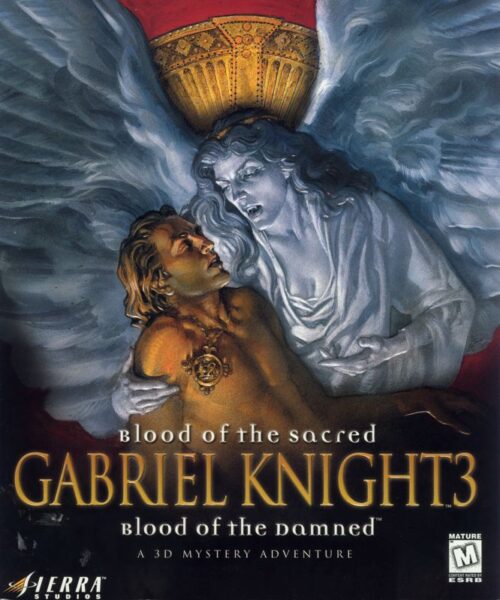
Gabriel Knight 3: Blood of the Sacred, Blood of the Damned


This article tells part of the story of Jane Jensen.

I think I became convinced when I went to CES [in January of 1997] and I walked around the show looking at all these titles that were the big new things, and not one screen had full-motion video. I realized that if I wanted anyone to look at the game, it had to be in 3D.

— Jane Jensen

Gabriel Knight 3: Blood of the Sacred, Blood of the Damned is proof that miracles do occur in gaming. It was remarkable enough that the game ever got made at all, in the face of gale-force headwinds blowing against the adventure genre. But the truly miraculous thing is that it turned out as well as it did. In my last article, I told you about Ultima IX, the sad-sack conclusion to another iconic series. The story of Gabriel Knight 3′s development is eerily similar in the broad strokes: the same real or perceived need to chase marketplace trends, the same unsupportive management, the same morale problems that resulted in an absurdly high turnover rate on the team. But Gabriel Knight 3 had one thing going for it that Ultima IX did not. Whereas Richard Garriott, the father of Ultima, always seemed to be somewhere else when someone might be on the verge of asking him to get his hands dirty, Jane Jensen was on the scene from first to last with her project. Just as much as the first two games, Gabriel Knight 3 managed at the last to reflect her unique vision more than some corporate committee’s view of what an adventure game should be in 1999. And that made all the difference.

In fact, I’m going to go out on a limb right here and now and deliver this article’s bombshell up-front: in defiance of the critical consensus, Gabriel Knight 3 is actually my favorite of the trilogy. As always, I don’t necessarily expect you to agree with me, but I will do my best to explain just what it is that delights, intrigues, and even moves me so much about this game.
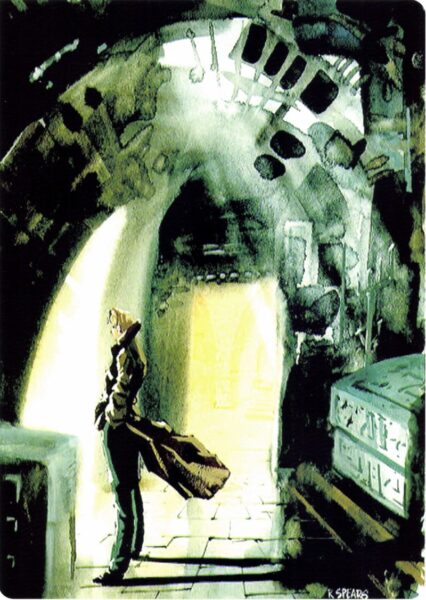

Before we get to that, though, we need to turn the dial of our time machine back another few years from 1999, to late 1995, when Jane Jensen has just finished The Beast Within, her second Gabriel Knight game. That game was the product of a giddy but ultimately brief-lived era at Sierra On-Line, when the company’s founders Ken and Roberta Williams were convinced that the necessary future of mass-market gaming was a meeting of the minds of Silicon Valley and Hollywood: it would be a case of players making the decisions for real live actors they saw on the screen. Sierra was so committed to this future that it built its own professional-grade sound stage in its hometown of tiny Oakhurst, California. Gabriel Knight 2 was the second game to emerge from this facility, following Roberta Williams’s million-selling Phantasmagoria. But, although Gabriel Knight 2 acquitted itself vastly better as both a game and a work of fiction than that schlocky splatter-fest, it sold only a fraction as many copies. “I thought we’d done a hell of a job,” says Jensen. “I thought it would appeal to that mass market out there. I thought it would be top ten. And it was — for about a week. I watched the charts in the months after shipping and saw the games that outsold [it], and I thought, ‘Ya know, I’m in the wrong industry.'”

The underwhelming sales figures affected more than just the psyche of Jane Jensen. Combined with the similarly disappointing sales figures of other, similar games, they sent the Siliwood train careening off the rails when it had barely left the station. In the aftermath, everyone was left to ponder hard questions about the fate of the Gabriel Knight series, about the fate of Sierra, and about the fate of adventure games in general.

No offer to make a third Gabriel Knight game was immediately forthcoming. Jane Jensen took a year’s sabbatical from Sierra, busying herself with the writing of novelizations of the first two games for Roc Books. While she was away, the new, more action-focused genres of the first-person shooter and real-time strategy completed their conquest of the computer-gaming mainstream, and Sierra itself was taken over by an unlikely buyer of obscure provenance and intent known as CUC.

Thus she found that everything was different when she returned to Sierra, bubbling over with excitement about a new idea she had. During her break, she had read a purportedly non-fiction book called The Tomb of God, the latest in a long and tangled skein of literature surrounding the tiny French village of Rennes-le-Château. The stories had begun with a mysteriously wealthy nineteenth-century priest and rumors of some treasure he may have hidden in or around the village, then grown in the telling to incorporate the Holy Grail, Mary Magdalene, the Knights Templar, the Freemasons, the true bloodline of Jesus Christ, and the inevitable millennia-spanning conspiracy to control the world and hide The Truth. The bizarre cottage industry would reach its commercial zenith a few years into the 21st century, with Dan Brown’s novel The Da Vinci Code and the movie of same that followed. It’s unclear whether Jensen herself truly believed any of it, but she did see a way to add vampires to the equation — she had long intended the third Gabriel Knight game to deal with vampires — and turn it into an adventure game that blended history and horror in much the same audacious way as Gabriel Knight 2, which had dared to posit that “Mad King” Ludwig II of Bavaria had been a werewolf, then went on to make an uncannily believable case for that nutso proposition.

Sierra’s new management agreed to make the game, for reasons that aren’t crystal clear but can perhaps be inferred. It was the end of 1996, still early enough that a sufficiently determined industry observer could make the case that the failure of the adventure genre to produce any new million-selling hits of late might be more of a fluke than a long-term trend. Ken Williams was still on the scene at Sierra, albeit with greatly diminished influence in comparison to the years when he alone had called the shots. For better and sometimes for worse, he had always loved the idea of “controversial” games. The would-be Gabriel Knight 3 certainly seemed like it would fit that bill, what with being based around the heretical premise that Jesus Christ had not been celibate, had in fact married Mary Magdalene and conceived children with her in the biological, less-than-immaculate way. A few centuries earlier, saying that sort of thing would have gotten you drawn and quartered or burnt at the stake; now, it would just leave every priest, preacher, and congregation member in the country spluttering with rage. It was one way to get people talking about adventure games again.

Even so, it wasn’t as if everything could just be business as usual for the genre. The times were changing: digitized human actors were out, real-time 3D was in, and even an unfashionable straggler of a genre like this one would have to adapt. So, Gabriel Knight 3 would be done in immersive 3D, both for the flexibility it lent when contrasted with the still photographs and chunks of canned video around which Gabriel Knight 2 had been built and because it ought to be, theoretically at least, considerably cheaper than trying to film a whole cast of professional actors cavorting around a sound stage. The new game would be made from Sierra’s new offices in Bellevue, Washington, to which the company had been gradually shifting development for the past few years.

Jane Jensen officially returned to Sierra in December of 1996, to begin putting together a script and a design document while a team of engineers got started on the core technology. The planned ship date was Christmas of 1998. But right from the get-go, there were aspects of the project to cause one to question the feasibility of that timeline.

Sierra actually had three projects going at the same time which were all attempting to update the company’s older adventure series for this new age of real-time 3D. And yet there was no attempt made to develop a single shared engine to power them, despite the example of SCI, one of the key building blocks of Sierra’s earlier success, which had powered all of its 2D adventures from late 1988 on. Gabriel Knight 3 was the last of the three 3D projects to be initiated, coming well after King’s Quest: Mask of Eternity and Quest for Glory V. Its engine, dubbed the G-Engine for obvious reasons, was primarily the creation of a software engineer named Jim Napier, who set the basics of it in place during the first half of 1997. Unfortunately, Napier was transferred to work on SWAT 3 after that, leaving the technology stack in a less than ideal state.

Abrupt transfers like this one would prove a running theme. The people working on Gabriel Knight 3 were made to feel like the dregs of the employee rolls, condemned to toil away on Sierra’s least commercially promising game. Small wonder that poor morale and high turnover would be constant issues for the project. Almost 50 people would be assigned to Gabriel Knight 3 before all was said and done, but never more than twenty at a time. Among them would be two producers, three art directors, and three project leads. The constant chaos, combined with the determination to reinvent the 3D-adventure wheel every time it was taken for a spin, undermined any and all cost savings that might otherwise have flowed from the switch from digitized video to 3D graphics. Originally projected to cost around $1.5 million, Gabriel Knight 3 would wind up having cost no less than $4.2 million by the time it was finished. That it was never cancelled was more a result of inertia and an equally insane churn rate in Sierra’s executive suites than any real belief in the game’s potential.

For her part, Jane Jensen displayed amazing resilience and professionalism throughout. She had shot too high with Gabriel Knight 2, turning in a script that had to be cut down by 25 percent or more during development, leaving behind some ugly plot and gameplay holes to be imperfectly papered over. This time around, she kept in mind that game development, like politics, is the art of the possible. Despite all the problems, very little of her design would be cut this time.

The people around her were a mixture of new faces who were there because they had been ordered to be and a smattering of old-timers who shared her passion for this set of themes and characters. Among these latter was her husband Robert Holmes, who provided his third moody yet hummable soundtrack for the series, and Stu Rosen, who had directed the voice-acting cast in Gabriel Knight 1. Rosen convinced Tim Curry, who had voiced the title role in that game but sat out the live-action Gabriel Knight 2, to return for this one. His exaggerated New Orleans drawl is not to all tastes, but it did provide a welcome note of continuity through all of the technological changes the series had undergone. Recording sessions began already in November of 1997, just after Jane Jensen returned from her first in-person visit to Rennes-le-Château.

But as we saw with Ultima IX, such sessions are superficial signs of progress only, and as such are often the refuge of those in denial about more fundamental problems. When one Scott Bilas arrived in early 1998 to become Gabriel Knight 3′s latest Technical Lead, he concluded that “the engineering team must have been living in a magical dream world. I can’t find any other way to explain it. At that point, the game was a hacked-up version of a sample application that Jim Napier wrote some time earlier to demonstrate the G-Engine.” Bilas spent months reworking the G-Engine and adding an SCI-like scripting language called Sheep to separate the game design from low-level engine programming. His postmortem of the project, written for Game Developer magazine about six months after Gabriel Knight 3′s release, makes for brutal reading. For most of the people consigned to it, the project was more of a death march than a labor of love, being a veritable encyclopedia of project-management worst practices.

There was a serious lack of love and appreciation [from Sierra’s management] throughout the project. Recognition of work (other than relief upon its completion) was very rare, lacked sincerity, and was always too little, too late. Internally, a lot of the team believed that the game was of poor quality. And of course, the many websites and magazines that proclaimed “adventure games are dead” only made things worse. Tim Schafer’s Grim Fandango, although a fabulous game and critically acclaimed, was supposedly (we heard) performing poorly in the marketplace…

The low morale resulted in a lot of send-off lunches for developers seeking greener pastures. Gabriel Knight 3 had a ridiculous amount of turnover that never would have been necessary had these people been properly cast or well-treated…

After a certain amount of time on a project like this, morale can sink so low that the team develops an incredible amount of passive resistance to any kind of change. Developers can get so tired of the project and build up such hatred for it that they avoid doing anything that could possibly make it ship later. This was a terrible problem during the last half of the Gabriel Knight 3 development cycle…

Our engineers never had an accurate development schedule; the schedules we had were so obviously wrong that everybody on the team knew there was no way to meet them. Our leads often lied to management about progress, tasks, and estimates, and I believe this was because they were in over their heads and weren’t responding well to the stress. Consequently, upper management thought the project was going to be stable and ready to ship long before it actually was, and we faced prolonged crunch times to deliver promised functionality…

Most of the last year of the project we spent in [crunch] mode, which meant that even small breaks for vacations, attending conferences, and often even taking off nights and weekends were looked down upon. It was time that the team “could not afford to lose.” The irony is that this overtime didn’t help anyway; the project didn’t move any faster or go out any sooner. The lack of respect for our personal lives and attention to our well-being caused our morale to sink…

Gabriel Knight 3 became a black hole that sucked in many developers from other projects, often at the expense of those projects. Artists were shifted off the team to cut the burn rate, and then pulled back on later because there was so much work left to do…

Management, thinking that it would save time, often encouraged content developers to hack and work around problems rather than fix them properly…

All of this happened against a backdrop of thoroughgoing confusion and dysfunction at Sierra in general. A sidelined Ken Williams got fed up and left the company he had founded in August of 1997. At the end of that year, Sierra’s new parent CUC merged with another large conglomerate called HFS to create a new entity named Cendant. Just a few months later, CUC was revealed to have been a house of cards the whole time, the locus of one of the biggest accounting scandals in the history of American business. For a long stretch of the time that Gabriel Knight 3 was in the works, there was reason to wonder whether there would even still be a Sierra for the team to report to in a week or a month. Finally, in November of 1998, Sierra was bought again, this time by the French media mega-corp Vivendi, whose long-term plan was, it slowly became evident, to end all internal game development and leverage the label’s brand recognition by turning it into a publisher only. Needless to say, this did nothing for the morale of the people who were still making games there.

Sierra’s Oakhurst office was shut down in February of 1999. The first wave of layoffs swept through Bellevue the following summer, while the Gabriel Knight 3 team were striving desperately to get the game out in time for the Christmas of 1999 instead of 1998. In a stunning testimony to corporate cluelessness about the psychology of human beings, some of those working on Gabriel Knight 3 were told straight-up that they were to be fired, but not until they had given the last of their blood, sweat, and tears to finish the game. “Having a group of people who are (understandably) upset with your company for laying them off and actively looking for a job while still trying to contribute to a project is a touchy situation that should be avoided,” understates Scott Bilas. The words “no shit, Sherlock” would seem to apply here.

But the one person who comes in for sustained praise in Bilas’s postmortem is Jane Jensen, whose vision and commitment never wavered.

Gabriel Knight 3 would have simply fallen over and died had we had a less experienced designer than Jane Jensen. Throughout the entire development process, the one thing that we could count on was the game design. It was well thought-out and researched, and had an entertaining and engrossing story. Best of all, Jane got it right well in advance; aside from some of the puzzles, nothing really needed to be reworked during development. She delivered the design on time and maintained it meticulously as the project went on.

This was Gabriel Knight 3′s secret weapon, the thing that prevented it from becoming a disaster like Ultima IX. With Jane Jensen onboard, there was always someone to turn to who knew exactly what the game was meant to do and be. The vision thing matters.

When Gabriel Knight 3: Blood of the Sacred, Blood of the Damned shipped in November of 1999, it marked the definitive end of an era, being the last Sierra adventure game ever, the final destination of a cultural tradition that stretched all the way back to Mystery House almost twenty years before, to a time when the computer-game industry was more inchoate than concrete. During the graphic adventure’s commercial peak of the early 1990s, Sierra and LucasArts had been the yang and the yin of the field, the bones of endless partisan contentions among gamers. It’s therefore intriguing and perhaps instructive to compare the press reception of Gabriel Knight 3 with that of 1998’s Grim Fandango, the most recent high-profile adventure release from LucasArts.

Grim Fandango was taken up as a sort of cause célèbre by critics, who rightly praised its unusual setting, vividly drawn characters, and moving story, even as they devoted less attention to its clumsy interface and convoluted and illogical puzzle structure. Those who wrote about games tended to be a few years older on average than those who simply played them. Many of this generation of journalists had grown up with Maniac Mansion and/or The Secret of Monkey Island. They were bothered by the notion of a LucasArts that no longer made adventure games, and sought to make this one enough of a success to avoid that outcome. At times, their reviews took on almost a hectoring tone: you must buy this game, they lectured their readers. The pressure campaign failed to fully accomplish its goal; Grim Fandango wasn’t a complete flop, but it did no more than break even at best, providing LucasArts with no particularly compelling financial argument for making more games like it.

Alas, when it arrived a year later, Gabriel Knight 3 was not given the same benefit of the doubt as to its strengths and weaknesses. Some of the reviews were not just negative but savagely so, almost as if their writers were angry at the game for daring to exist at all in this day and age. GameSpot pronounced this third installment fit “only for the most die-hard fans of the series.” Even the generally sober-minded Computer Gaming World, the closest thing the industry had to a mature journal of record, came at this game with knives out. In a two-stars-out-of-five review, Tom Chick said that “you’ll spend a lot of time fumbling in limbo, wandering aimlessly, trying to trigger whatever unknowable act will end the time block.” Okay — but it’s very hard to reconcile this criticism with the same magazine’s four-and-a-half star, “Editor’s Choice”-winning review of Grim Fandango. In my experience at least, aimless wandering and unknowable acts are far more of a fact of life in that game than in Gabriel Knight 3, which does a far better job of telling you what your goals are from story beat to story beat.

What might be going on here? To begin with, we do have to factor in that LucasArts had historically enjoyed better reviews and the benefit of more doubts than Sierra, whose adventure games came more frequently but really did tend to be rougher around the edges in the aggregate. Yet I don’t think that explains the contrast in its entirety. The taste-makers of mainstream gaming were still in a bargaining phase when it came to adventure games in 1998, still trying to find a place for them amidst all the changes that had come down the pipe since id Software unleashed DOOM upon the world. That bargaining had been given up as a lost cause a year later. The adventure game, said the new conventional wisdom, was dead as a doorknob, and it wasn’t coming back. A pack mentality kicked in and everyone rushed to pile on. It’s a disconcerting, maybe even disturbing thing to witness, but such is this thing we call human nature sometimes. If the last few years of our more recent social history tell us anything, it is that cultural change can burst upon the scene with head-snapping speed and force to make yesterday’s conventional wisdom suddenly beyond the pale today.

Adventure games would soon disappear entirely from the catalogs of the major publishers and from the tables of contents of the magazines and websites that followed them. In a rare sympathetic take on the genre’s travails, the website Gamecenter wrote just after the release and less than awe-inspiring commercial performance of Gabriel Knight 3 that “now it seems people want more action than adventure. They would rather run around in short shorts raiding tombs than experience real stories.” This was the true nub of the issue, for all that the belittling tone was no more necessary here than when it was directed in the opposite direction. People just wanted different things; a player of Gabriel Knight 3 was not inherently more or less smart, wise, or culturally sophisticated than a player of Starcraft or Unreal Tournament.

So, then, at the risk of stating the obvious, the core problem for the adventure genre was a mismatch between the desires of the majority of gamers at the turn of the millennium and the things the adventure game could offer them. The ultimate solution was for the remaining adventure fans to get their own cottage industry to make for them the games that they enjoyed, plus their own media ecosystem to cover them, replete with sympathetic critics who wanted the same things from gaming that their readers did. That computer gaming as a whole could sustain being siloed off into parallel ecosystems was a testament to how much bigger the tent had gotten over the course of the 1990s. But as of 1999, the siloing hadn’t quite happened yet, leaving a game like Gabriel Knight 3 trapped on the stage of an unfriendly theater, staring down an audience who were no longer interested in the type of entertainment it was peddling. While the game was still in development, Jane Jensen had mused about the controversial elements that may have helped to get it funded: “I guess the worst case would be that no one would care, or even notice.”

The worst case came true. Gabriel Knight 3 became its woebegone genre’s sacrificial lamb, controversial only for daring to exist at all as an ambitious adventure game in 1999. It deserved better, for reasons which I shall now go into.
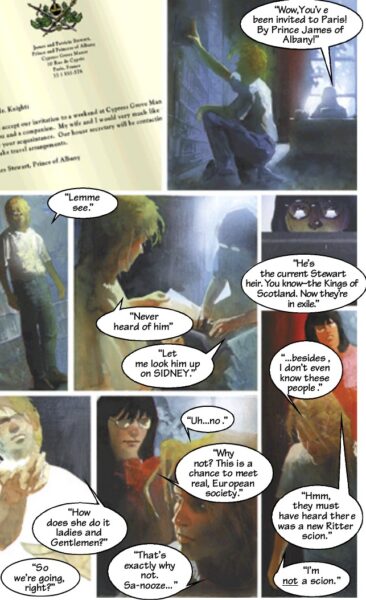

This final Sierra adventure game opens with something else that was not long for this world in 1999: a story setup that’s conveyed in the manual — or rather in an accompanying comic book — instead of in a cutscene. Four years on from their hunt for werewolves in Gabriel Knight 2, Gabriel and his assistant Grace Nakimura are asked to come to the Paris mansion of one Prince James, a scion of the Stuart line that once ruled Scotland and England. After they arrive, the good prince explains that he needs their help to protect his infant son from “Night Visitors” — i.e., vampires. Gabriel and Grace agree to take on the task, only to fail at it rather emphatically; the baby is kidnapped out from under their noses that very night. But Gabriel does manage to give chase, tracking the men or monsters who have absconded with the infant to the vicinity of Rennes-le-Château. Not sure how to proceed from here, he checks into a hotel in the village. The game proper begins the next morning.

At breakfast, he learns that a tour group of treasure hunters has also just arrived at the hotel, all of them dreaming of the riches that are purported to be hidden somewhere in or near the village. In addition to the fetching French tour guide Madeline (to whom Gabriel reacts in his standard lecherous fashion), there are Emilio, a stoic Middle Easterner; Lady Lily Howard and Estelle Stiles, a British blue-blood and her companion; John Wilkes, an arrogant, muscle-bound Aussie; and Vittorio Buchelli, an irritable Italian scholar. To this cast of characters worthy of an Agatha Christie novel we must add Gabriel’s old New Orleans running buddy Detective Frank Mosely, who, in a coincidence that would cause Charles Dickens to roll over in his grave, just happens to have joined this very tour group to try his hand at treasure hunting. Each member of the group has his or her own theory about the real nature of the treasure and how to find it, leaving Gabriel to try to sort out which ones really are the hopeless amateurs they seem to be and which ones have relevant secrets to hide, possibly involving the kidnapping which brought him here.
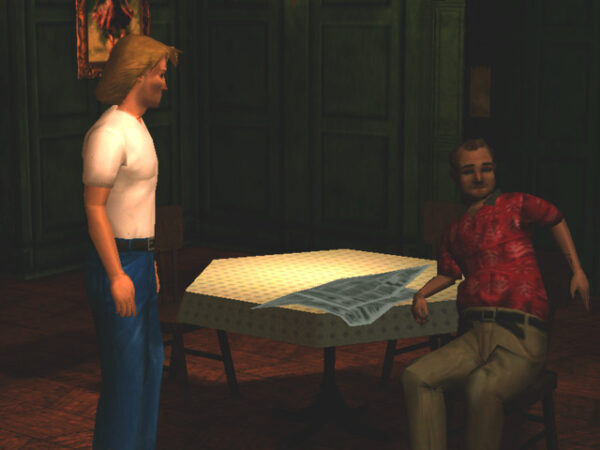
Gabriel has an unexpected meeting with Mosely.

Anyone who has played the first two Gabriel Knight games will be familiar with this one’s broad approach to its story. It takes place over three days, each of which is divided up into a number of time blocks. Rather than running on clock time, the game runs on plot time: the clock advances only when you’ve fulfilled a set of requirements for ending a time block. Grace arrives at the hotel on the evening of the first day. Thereafter, you control her and Gabriel alternately, just as in Gabriel Knight 2, with Gabriel’s sections leaning harder on conversations and practical investigation, while Grace delves deep into the lore and conspiracy theories of Rennes-le-Château. Don’t let the fact that the whole game is compressed into just three days fool you: they’re three busy days (and nights), busier than any three days could reasonably be in real life.

In this article, I won’t say anything more about the mystery of Rennes-le-Château. For the time being, you’ll just have to trust me when I tell you that it’s an endlessly fascinating rabbit hole. In fact, it fascinates on two separate levels: that of the tinfoil-hat theories themselves, and the meta-level of how they came to find such purchase here in this real world of ours, which is — spoiler alert! — actually not controlled by secret cabals of Knights Templar and the like. I’ll be exploring these subjects in some articles that will follow this one. It’s a digression from my normal beat, but one that I just can’t resist; I hope you’ll wind up agreeing with me that it was well worth it.

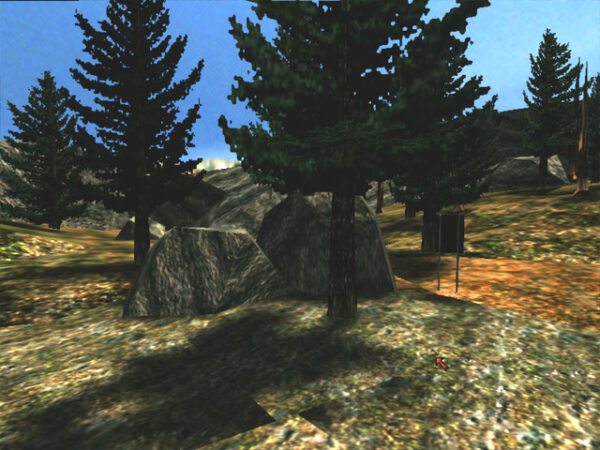
Today, though, let me tell you about some of the other aspects of this game. One of Jane Jensen’s greatest talents as a writer is her skill at evoking a sense of place, whether her setting be Louisiana, Bavaria, or now southern France. If you ask me, this game is her magnum opus in this sense. The 3D graphics here are pretty crude — far from state of the art even by the standards of 1999, never mind today. Characters move more like zombies or robots than real people and look like collections of interchangeable parts crudely sewn together. Gabriel’s hair looks like an awkwardly shaped helmet that’s perpetually in danger of falling right off his head, while trees and plants are jagged-edged amalgamations of pixels that look like they could slice him right open if he bumped into them. And yet darned if playing this game doesn’t truly feel like exploring a sun-kissed village on the edge of the French Riviera. The screenshots may not come off very well in an article like this one, but there’s an Impressionistic quality (how French, right?) to the game’s aesthetics that may actually serve it better than more photo-realistic graphics would. When I think back on it now, I do so almost as I might a memorable vacation, the kind whose contours are blended and softened by the soothing hand of sentiment. If a good game is a space where you want to go just to hang out, then Gabriel Knight 3 is a very good game indeed.

The geography is fairly constrained, meaning you’ll be visiting the same places again and again as the plot unfolds. Far from a drawback, I found this oddly soothing too. I mentioned Agatha Christie earlier; let me double-down on that reference now, and say that the geography is tight enough to remind me of a locked-room cozy mystery. The fact that you’re staying in a hotel with a gaggle of tourists only enhances the feeling of being on a virtual holiday. Playing this game, you never sense the stress and conflict and exhaustion that were so frequently the lot of its developers. Call it one more way in which Gabriel Knight 3 is kind of miraculous; most games reflect the circumstances of their creation much more indelibly.
I suppose it could be considered a problem with Gabriel Knight 3 as a piece of fiction that the setting comes off so bucolic when the stakes are meant to be so high. But I don’t care. I like it here; I really like it.

Meet the story where it lives and let it unfold at its own pace, and you’ll be amply rewarded. Both the backstory of the historical conspiracy and the foreground plot with which it becomes intertwined, about finding the vampiric kidnappers, become riveting. I often play games on the television in the living room while my wife Dorte reads or crochets or does something else, popping up from time to time with a comment, usually one making fun of whatever nerdy thing I happen to be up to tonight. But Gabriel Knight 3 grabbed her too, something that doesn’t happen all that often. She had to go off to a week-long course just as I was getting close to the end. She informed me in no uncertain terms that I was not allowed to finish without her, because she wanted to see how it ended as well. Trust me when I tell you that that is really saying something.

The 3D engine that powers all of this is one of a goodly number of alternative approaches to the traditional point-and-click adventure that appeared as the genre was flailing against the dying of the mainstream light, aimed at helping it to feel more in tune with the times and, in some cases, making it a more friendly fit with alternative platforms like the Sony PlayStation. Few of these reinventions make much of a case for their own existence in my opinion, but the G-Engine is an exception. It’s a surprisingly effective piece of kit. Instead of relying on fixed camera angles, as Grim Fandango does in its 3D engine, Gabriel Knight 3 gives you a free-floating camera that you can move about at will. The environment fills the whole screen; there are no fixed interface elements. Clicking on a hot spot brings up a context-sensitive menu of interaction possibilities. And naturally, you can delve into an inventory screen to look at and combine the items you’re carrying, or to snatch them up for use out in the world. I really, really like the system, which genuinely does add something extra that you wouldn’t get from 2D pixel graphics. You can look up and down, left and right, under and on top of things. A room suddenly feels like a real space, full of nooks and crannies to be explored.
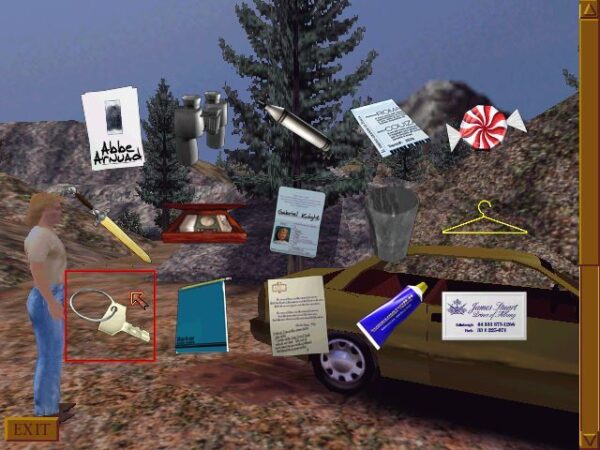
Admittedly, the setup is kind of weird on a conceptual level, in that you’re doing all of this exploration while Gabriel or Grace, whichever one you happen to be controlling, is standing stock still. This game, in other words, lends fresh credence to Scott Adams’s age-old conception of the player of an adventure game being in command of a “puppet” that does her bidding. Here you’re a disembodied spirit who does all the real work, pressing Gabriel or Grace into service only when you have need of hands, feet, or a mouth. You can even “inspect” an object in the room without their assistance — doing so shows it to you in close-up — although you do need them to help you “look,” which elicits a verbal description from your puppet. Gabriel Knight 3 doesn’t take place in a contiguous world; discrete “rooms” are loaded in when you direct your puppet to cross a boundary from one to another. Nevertheless, some of the rooms can be quite large. When you’re out and about on the streets of Rennes-le-Château, for example, the camera might be a block away from Gabriel or Grace, well out of his or her line of sight. It’s odd to think about, but it works a treat in practice.
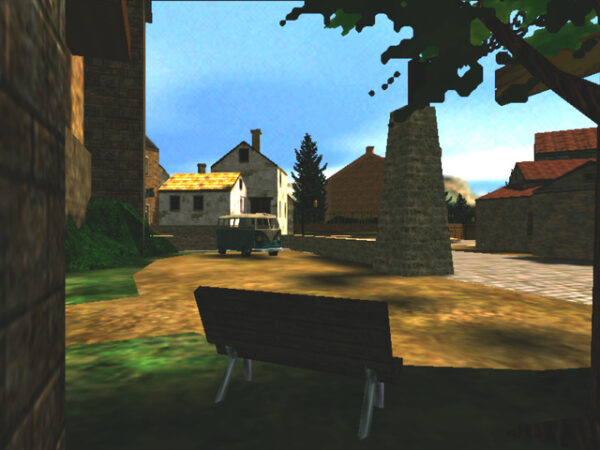
One of the strangest things about the G-Engine is how the camera seems to have a corporeal form. You can get it hung up behind objects like this bench.

The G-Engine doesn’t add much in the way of emergent possibility. Reading between the lines of some of the reviews, one can’t help but sense that some critics thought the switch to 3D ought to make Gabriel Knight 3 play more like Tomb Raider — and who knows, perhaps this was even envisioned by the developers as well at one time. The game we have, however, is very much an adventure game of the old school, a collection of set-piece puzzles with set-piece solutions, with a set-piece plot that is predestined to play out in one and only one way. Some alternative solutions are provided, even some optional pathways and puzzles that you can engage with for extra points, but there’s no physics engine to speak of here, and definitely no possibility to do anything that Jane Jensen never anticipated for you to do.

That said, there are a few places where the game demands timing and reflexes, especially at the climax. These bits aren’t horrible, but they aren’t likely to leave you wishing there were more of them either. In the end, they too are set-piece exercises, more Dragon’s Lair than Tomb Raider.


Erik Wolpaw and Chet Faliszek wrote Gabriel Knight 3 into gaming history for all the wrong reasons via their website Old Man Murray. They created fictional teenage personas for themselves, Erik being a “fat, girl-looking boy” and Chet being a kid who “likes Ministry and not much else.” How meta, right?

We can’t avoid it anymore, my friends. It’s impossible to discuss Gabriel Knight 3′s puzzles in any depth without addressing the elephant — or rather the cat-hair mustache — that’s been in the room with us this whole time. The uninitiated among you, assuming there are any, will require a bit of explanation.

During the burgeoning years of the World Wide Web, many gaming sites popped up to live on the hazy border between fanzines and professional media organs. One of these went for some reason by the name of Old Man Murray, a place for irreverent piss takes on the games that Computer Gaming World was covering with more earnestness and less profanity. Erik Wolpaw, one of the proprietors, took exception to one particular puzzle that crops up fairly early on in Gabriel Knight 3. He vented his frustration in a… a column, I guess we can call it?…  published on September 11, 2000 — i.e., ten months after the game’s release, and well after its lackluster commercial fate had already been decided.
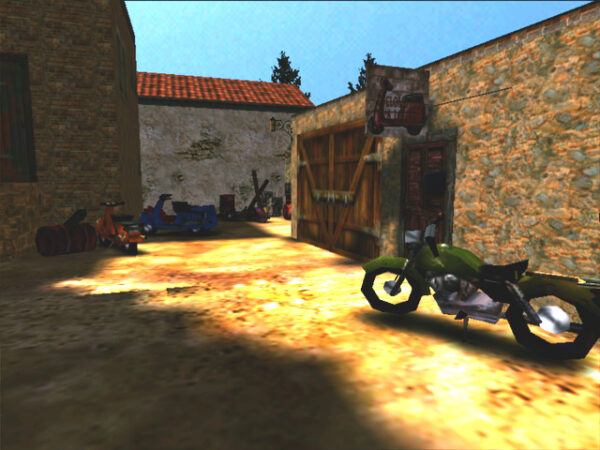
Gabriel needs to get his hands on some form of transportation in order to explore the countryside around Rennes-le-Château. Unfortunately, the motorbike rental lot right next door to the hotel mostly offers only sissy-looking mopeds of a sort that he wouldn’t be caught dead riding. The sole exception is a gleaming Harley-Davidson — but it has been reserved, by, of all people, his old buddy Mosely. Gabriel must engage in an extended round of subterfuge to pretend to be Mosely and secure the bike. This will turn out to involve, among other things, stealing the poor fellow’s passport and concocting a disguise for himself that involves masking tape, maple syrup, and a stray tuft of cat hair. I’ll let Erik tell you more about it. (The bold text below is present in the original.)

Dumb as your television enjoying ass probably is, you’re smarter than the genius adventure gamers who, in a truly inappropriate display of autism-level concentration, willingly played the birdbrained events. Permit me to summarize:

  • Gabriel Knight must disguise himself as a man called Mosley [sic] in order to fool a French moped rental clerk into renting him the shop’s only motorcycle.
  • In order to construct the costume, Gabriel Knight must manufacture a fake moustache. Utilizing the style of logic adventure game creators share with morons, Knight must do this even though Mosely does not have a moustache.
  • So in order to even begin formulating your strategy, you have to follow daredevil of logic Jane Jensen as she pilots Gabriel Knight 3 right over common sense, like Evel Knievel jumping Snake River Canyon. Maybe Jane Jensen was too busy reading difficult books by Pär Lagerkvist to catch what stupid Quake players learned from watching the A-Team: The first step in making a costume to fool people into thinking you’re a man without a moustache, is not to construct a fake moustache.
  • Still, you might think that you could yank some hair from one of the many places it grows out of your own body and attach it to your lip with the masking tape in your inventory. But obviously, Ms. Jensen felt that an insane puzzle deserved a genuinely deranged solution. In order to manufacture the moustache, you must attach the masking tape to a hole at the base of a toolshed then chase a cat through the hole. In the real world, such as the one that stupid people like me and Adrian Carmack use to store our televisions, this would result in a piece of masking tape with a few cat hairs stuck to it, or a cat running around with tape on its back. Apparently, in Jane Jensen’s exciting, imaginative world of books, masking tape is some kind of powerful neodymium supermagnet for cat hair.
  • Remember how shocked you were at the end of the Sixth Sense when it turned out Bruce Willis was a robot? Well, check this out: At the end of this puzzle, you have to affix the improbable cat hair moustache to your lip with maple syrup! Someone ought to give Jane Jensen a motion picture deal and also someone should CAT scan her brain.

A penetrating work of satire for the ages this column is not, but it nevertheless went viral, until it seemed to be absolutely everywhere on the Internet. In an ironic, backhanded way, Gabriel Knight 3′s cat-hair mustache puzzle became one of the most famous puzzles in all of adventure-gaming history, right up there with the Babel Fish in The Hitchhiker’s Guide to the Galaxy or Monkey Island’s Monkey Wrench. It became so famous that it has its own Wikipedia page today. At the same time, it became Exhibit Number One in the burgeoning debate over Why Adventure Games Died. Right up to this day, whenever talk turns to the genre’s fall from grace at the end of the twentieth century, a reference to the cat-hair mustache cannot be long in coming. For a considerable number of people today, Gabriel Knight 3 is not a game about vampires or the source material of The Da Vinci Code before Dan Brown discovered it; it’s a game about a cat-hair mustache.

So, what is a Gabriel Knight 3 apologist like myself supposed to do with this? First, let me acknowledge that this is not a great puzzle in strictly mimetic terms, in that it’s impossible to take seriously as a part of the game’s fiction. Setting aside all of the other improbable steps Gabriel has to go through, he steals and defaces — more on the latter in a moment — his good friend’s passport in order to work the scam. All of this instead of just, you know, asking his buddy to help him out. (Mosely is gruff on the outside, but he’s a good egg underneath, as Gabriel knows better than anyone.) Or he could just suck it up and ride a moped for a few days, given that the fate of an innocent baby and who knows what else may depend on it.

Of course, Gabriel Knight 3 is hardly the only adventure game that makes sociopathic behavior a staple of its puzzle tree. This is the root of the genre’s centrifugal pull toward comedy, which almost invariably injects a patina of goofiness even into allegedly serious games like this one. Stuff like this is more naturally at home in a game like Monkey Island. But leave it entirely out of any sort of adventure, and you run the risk of having a game without enough gameplay. If we aren’t afraid of a little bit of whataboutism, we might defend the adventure game by noting here that it’s hardly the only genre whose gameplay is frequently at odds with its fiction: think of putting saving the world on hold in order to hunt down lost pets and carry out a hundred other piddling side-quests in a CRPG, or researching the same technologies over and over from scratch in an RTS campaign. I’ll leave you to decide for yourself how compelling such a defense is.

For what it’s worth, there are reports that this puzzle was not in Jane Jensen’s original design, that it was swapped in late in the day in place of another one that had proved impractical to implement. Rest assured that you won’t catch me calling it a great puzzle, either in the context of this game or of adventure history.

But here’s the thing: mimesis aside, it’s nowhere near as terrible a puzzle as the one that our friend Erik describes either. I played this game a few months ago for the first time, knowing vaguely that it included an infamous puzzle involving a cat-hair mustache — how could I not? — but knowing nothing of the specifics. I went in fully expecting the worst, keeping in mind the design issues I remembered from the first two Gabriel Knight games. I was therefore surprised by how smoothly — and, yes, even enjoyably — the whole puzzle played out for me. Perhaps I was helped by the knowledge I brought with me into the game, but I never had the feeling that I was relying on it, never felt that I couldn’t have progressed without it. There are two hugely important mitigating factors which Erik neglects to mention.

The first is that there actually is a logic to Gabriel making a mustache for himself to imitate the clean-shaven (more or less) Mosely. He thinks that the facial hair will disguise the very different facial bone structures of the two men. Therefore he draws a mustache onto Mosely’s passport photo with a marker — how would you like to have a friend like him? — to complete the deception.
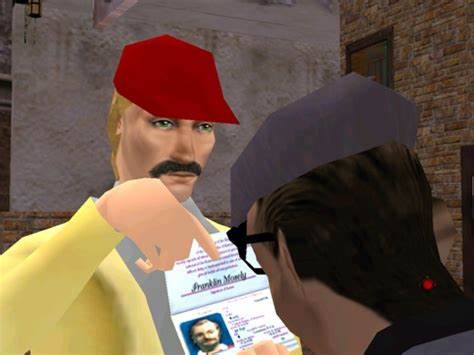
Notice that Mosely does have a mustache in his passport photo now.

The second factor is more thoroughgoing: the player is guided through all of the steps quite explicitly by Gabriel himself. (Who’s the puppet now, right?) In addition to “Look” and “Inspect,” many hot spots pop up a handy light-bulb icon when you click them: “Think.” These provide vital guidance on, well, what your character is thinking — or rather what Jane Jensen is thinking, what avenues she expects you to explore to advance the story. It’s not a walkthrough — what fun would that be? — but it does give you the outlines of what you’re trying to accomplish. In this case, looking carefully at and “thinking” about all of the objects involved turn a puzzle that truly would be absurdly unfair without this extra information into one that’s silly on the face of it, yes, but pretty good fun all the same. I’ve ranted plenty over bad adventure-game puzzles in the past, the kind where you have no clue what the game wants you to do or how it wants you to do it. This is not one of those. This puzzle doesn’t deserve the eternal infamy in which Old Man Murray draped it.

In point of fact, Gabriel Knight 3 is a major leap forward over the first two games in terms of pure design. Although it’s not trivial to solve by any means, nor does it seem to hate its player in the way of so many older Sierra games. The “Think” verb is one example. And for another one: once you solve the cat-hair-mustache-puzzle, get on your ill-gotten Harley, and start visiting the places around Rennes-le-Château, you can start to ask the game to show you where you still need to accomplish things in your current time block; this alone does much to alleviate the sense of “fumbling around in limbo,” as Tom Chick described it in Computer Gaming World. I don’t know whether the more soluble design of this game is a result of Jane Jensen improving her craft, unsung heroes on the team she worked with, or possibly even directives that came down from the dreaded upper management. I just know that it’s really, really nice to see — nice to be surprised by a game that turns out to be better than its reputation.
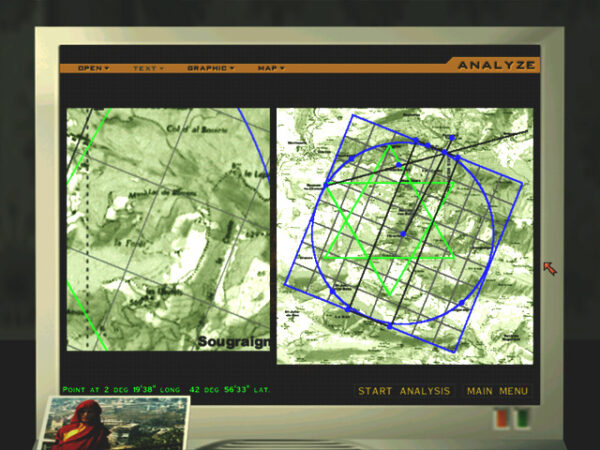
Solving the Le Serpent Rouge puzzle. Jane Jensen cribbed all this business about “sacred geometries” from the book The Tomb of God, which in turn borrowed it from Renaissance and Early Modern hermetic philosophy. (Johannes Kepler was very big on this sort of thing when he wasn’t developing the first credible model of our heliocentric solar system.) It may be nonsense, but it’s wonderfully evocative nonsense when it’s embedded in a story like this one.

The other puzzles here are a commodious grab bag of types. A few of them are every bit as silly as the cat-hair mustache, but most of them are more pertinent to the mysteries you’re actually trying to solve. The most elaborate of them all is a whole chain of puzzles that become Grace’s principal focus over the second and third days, and that are almost as well-remembered within hardcore adventure circles today as the cat-hair mustache is outside of them. The Le Serpent Rouge puzzle sequence — another one with its own Wikipedia page, if you can believe it — takes its name from a 1967 poem by an anonymous author that has become an indelible part of the conspiracy lore surrounding Rennes-le-Château.  The reliably bookish Grace has to ferret out its coded meanings, verse by verse, using a variety of software tools on her laptop computer. Some reviewers have called it the best adventure-game puzzle of all time.

For my part, I can’t go quite that far. Like everything else in the G-Engine, the software Grace uses is more of a veneer over the set-piece design than a true simulation. At several stages, I more or less just clicked on things until the game told me I had it right. But if it has its limitations as a set of pure puzzles, Le Serpent Rouge succeeds brilliantly as interactive drama. You’re fully invested by the time it comes along, and the buzz you get as you close in on the heart of the mystery, step by step, is not to be dismissed lightly. In a more just world it would be these puzzles rather than the cat-hair-mustache one that have taken a place in mainstream-gaming lore. For they show just how exciting and gripping smart, textured, context-appropriate adventure-game puzzles can be.

Much the same sentiment can be applied to Gabriel Knight 3 as a whole, a rare Sierra adventure game that I find to be underrated rather than overrated. I’ve not always been so kind toward Sierra’s games, as many of you know all too well. But almost twenty years on, just before they turned the lights out for good, they finally got everything right. This game is my favorite of the entire Sierra catalog. It’s the antithesis of Ultima IX, as high of a note to go out on as that game was a low one. Let’s hear it for lost causes and eleventh-hour miracles.
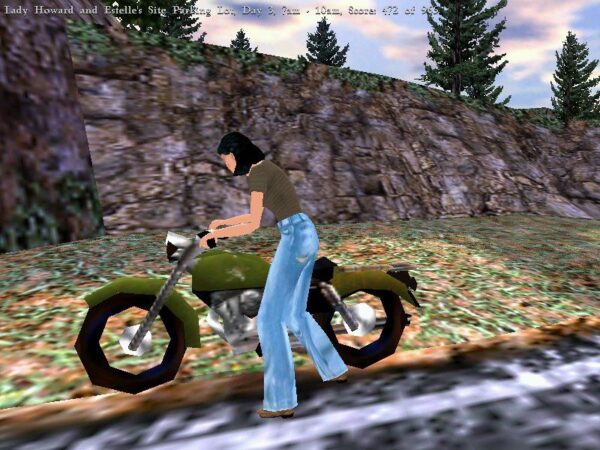

Girls can ride Harleys too, y’all.

I have to admit that my experience with Gabriel Knight 3 has to some extent caused me to reevaluate the whole series of which it is a part. Bloody-minded iconoclast that I am, I find that I have to rank the games in reverse chronological order, the opposite of the typical fan’s ordering. I still can’t get fully behind Gabriel Knight I, even when I try to separate the story and setting from my nightmares about searching for a two-pixel-wide snake scale in a Bayou swamp and tapping out nonsensical codes on a bongo drum. Gabriel Knight 2, though… that really is an edge case for me. I still have my share of quibbles with its design, but its flaws are certainly less egregious than those of its predecessor, even as it has stuck in my memory in a way that very few of the narrative-oriented games which I’ve played for these histories have been able to do. Both the second and the third games make me feel emotions that aren’t primary-colored, that are more textured and complex than love and hate, fight and flight. And that is nothing to be sneezed at in the videogame medium.

So, readers, I think I have to put both Gabriel Knight 2 and 3 into my personal Hall of Fame. It was a long time coming for the former, but I did come around to old Gabe and Gracie eventually. It’s only too bad that their story had to end here, just when it was starting to get juicy.

Oh là là!


Did you enjoy this article? If so, please think about pitching in to help me make many more like it. You can pledge any amount you like.


Sources: The book Gabriel Knight 3: Prima’s Official Strategy Guide by Rick Barba and Jane Jensen: Gabriel Knight, Adventure Games, Hidden Objects by Anastasia Salter. Computer Gaming World of February 1999, June 1999, and April 2000; Game Developer of June 2000; PC Zone of July 1998; Sierra’s newsletter InterAction of Spring 1999.

Online sources include Adventure Gamer’s interview with Gabriel Knight 3 design assistant Adam D. Bormann, Women Gamers’s interview with Jane Jensen, the vintage GameSpot review of Gabriel Knight 3, the Old Man Murray column discussed in the article, and a designer diary that Jane Jensen wrote for GameSpot during the game’s development.

Where to Get It: Gabriel Knight 3: Blood of the Sacred, Blood of the Damned is available as a digital purchase at GOG.com.

 
45 Comments

Posted by on February 20, 2026 in Digital Antiquaria, Interactive Fiction


Tags: , ,

Homeworld


This article tells part of the story of real-time strategy.

The first-person shooter and the real-time-strategy game, those two genres that had come to absolutely dominate mainstream computer gaming by the end of the 1990s, were surprisingly different in their core technologies. The FPS was all about 3D graphics, as aided and abetted by the new breed of hardware-accelerated 3D cards that seemed to be getting more powerful — and also more expensive — almost by the month. A generation of young men whose fathers might have spent their time tinkering with hot rods in the garage could be found in their studies and bedrooms, trying to outdo their peers by squeezing a little bit more speed and fidelity out of their “rigs”; in this latest era of hot-rodding, frame rate and resolution were the metrics rather than quarter-mile times and dynamometer results.

The technology behind the RTS was fairly traditional by comparison; these games relied on sprites and pixel graphics that weren’t that dissimilar in the broad strokes from the graphics of the 1980s. Running them was less a continuum — less of a question of running a game better or worse — and more a simple binary divide between a computer that could run a given game at an acceptable speed and one that could not. If you happened to be a fan of both dominant genres, as plenty of people were, your snazzy new 3D card had to sit idle when you took a break from Quake or Half-Life to fire up Command & Conquer or Starcraft.

Still, one didn’t have to be much of a tech visionary to see that the unique affordances of 3D graphics could be applied to many other gameplay formulas beyond running around and shooting things from an embodied first-person perspective. The 3D revolution offered a whole slate of temptations to RTS makers and players. Instead of staring down on a battlefield from a fixed isometric view, you could pan around to view it from whatever angle made most sense in the current situation. You could zoom in to micro-manage a skirmish in detail, then zoom out to take in the whole strategic panorama. Embracing the third dimension in graphics promised to bring a whole new dimension of play and spectacle to the RTS.  Already in 1997, RTS games like Total Annihilation and Myth: The Fallen Lords were making some use of 3D technology to bring some of those features to the table.

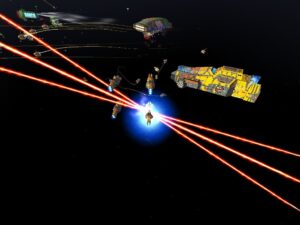
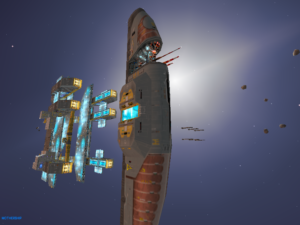
But it wasn’t until Homeworld, a game developed by Relic Entertainment and published by Sierra in late 1999, that an RTS went all-in on 3D, moving the battlefield from the surface of a planet to the infinite depths of space, where up could just as easily be down, or left, or right. Such an experiment was surely inevitable; if these folks hadn’t done it when they did, someone else would have soon enough. What feels far less predestined is how fully-formed this first maximally 3D RTS was, so much so that it would never be comprehensively surpassed in the opinion of some fans of the genre. This is highly unusual in game development, where innovations more typically make their debut complete with plenty of rough edges, which need a few iterations to be sanded down to friction-less perfection. Homeworld, however, was a seemingly immaculate conception, the full package of technology and design right out of the gate. It frustrated the competition by leaving them with so little to improve upon. And it did something else as well, something guaranteed to endear it to me: in an era and a genre in which narrative was widely debased and dismissed, it showed how much a well-presented, intelligent story could do to elevate a game.


The folks from Relic Entertainment who made Homeworld. Alex Garden is at center right, wearing blue jeans and a black pullover.

Most games begin with a gameplay genre: I want to make an FPS, or an RTS, or a CRPG. (Gamers do love to make an alphabet soup out of their hobby, don’t they?) But some games — including many of the most special ones — begin instead with an experience their makers wish to offer their players, then let that dictate the mechanics. It feels appropriate that Homeworld, notwithstanding its status as the canonical first 3D RTS, started the latter way, in the head of a 21-year-old Canadian named Alex Garden in the spring of 1997.

Despite his tender age, Garden thought of himself as a grizzled industry survivor, having been involved with games for five years. He had first been hired as a games tester at Distinctive Software, based right there in his hometown of Vancouver, after he met Distinctive’s founder Don Mattrick in the frozen-yogurt shop where he was working at the time. Half a decade later, he had become a software engineer at Electronic Arts Canada, the new incarnation of Distinctive, working primarily on the Triple Play series of baseball games. But Garden was a young man with big ideas, equipped with a personality big enough to sell them. He was already itching to strike out on his own and try to bring some of them to fruition.

Garden was a big fan of the old but sneakily influential 1978 television show Battlestar Galactica. One of the first pieces of media to capitalize on the craze for science fiction ignited by the original Star Wars, it was irredeemably cheesy in many respects, boasting characters with names like “Apollo” and “Starbuck” and the obligatory insufferable kid with a robot dog. But its visual effects were exceptional for the era; it offered up the most exciting pictures of combat in space that anyone had seen on a screen since its inspiration had dazzled moviegoers a year earlier. Then, too, there was a vein of myth that ran beneath all of the surface cheese to lend the show an odd sort of gravitas. Creator Glen A. Larson was a devout Mormon, and he based his semi-serialized story on that of the twelve wandering tribes of Israel, as well as the so-called Mormon Exodus, the overland trek of Brigham Young and his followers from Illinois to Utah in the mid-nineteenth century. In the show, a “ragtag fleet” of humans who look just like us seek a new home after their planet has been destroyed by the evil Cylons, a robotic race of aliens who continue to harry them even now. This new planet the humans search for is called — wait for it! — Earth, purported to be the home of a legendary “thirteenth tribe of humanity.”

You might be inclined to dismiss it all as just the usual claptrap about “ancient astronauts” and the like, one more misbegotten spawn of Erich von Däniken’s wildly popular book of pseudo-archaeology Chariots of the Gods, and I wouldn’t rush to argue with you. But to Star Wars-loving youngsters, all those portentous voiceovers gave the show a weighty resonance that even their favorite film couldn’t match. Battlestar Galactica lasted just one season on the air; its ratings weren’t terrible, but were deemed not sufficient to justify the $1 million per episode the show cost to produce. Yet it had a profound impact on some of those who saw it, both during its short prime-time run and during the decades it spent as a fixture of syndicated television thereafter. Among these people was our old friend Chris Roberts, who lifted its conceit of “World War II aircraft carriers in space” for Wing Commander, the biggest computer-game franchise of the early 1990s. And to that same list we can now add Alex Garden, who would appropriate less its surface trappings and more its deeper theme of ragtag refugees searching for a home.

To hear Garden tell the tale, the trip from Battlestar Galactica to Homeworld was a quick and logical one.

I was having a conversation with some friends about how much we loved Battlestar Galactica, and wouldn’t it be great if it was back on TV. We were also talking about how much we loved X-Wing vs. TIE Fighter, but how all you could do was pull back, pull left, and so on. So I started thinking to myself, “Wouldn’t it be great if you could have a 3D game that looked like you were watching Star Wars but had a story line like Battlestar Galactica?” And the game just came to me. Like a flash.

The idea, then, was to use 3D graphics in a different way from the norm, liberating you from a single embodied perspective and letting you roam free around and through a space battle, the way that the cameras of George Lucas and Glen Larsen were allowed to do. But at the same time, there would be more than spectacle to Homeworld. The story was key to Garden’s vision in a way that it wasn’t for most working in the RTS genre, where the single-player campaigns often seemed like mere training exercises to prepare you for the real point of the endeavor, the online multiplayer component.

Garden may have been young and unproven, but he could be very persuasive, and the blueprint for a 3D RTS that he was selling was both bracing and a fairly obvious next technological step for the suddenly ascendant genre as Warcraft II and Command & Conquer were tearing up the sales charts. On the strength of “two whiteboard presentations and no demo,” he signed a contract with Sierra On-Line, freshly pried out of the clutches of its founders Ken and Roberta Williams and ready to leave its roots in adventure games behind and go where the present-day action in gaming was. Sierra would endure a wild roller-coaster ride during the 28 months that Homeworld would spend in development, encompassing a vexed merger, a massive financial scandal, and finally another sale. Yet all of this affected Relic Entertainment, the little studio that Alex Garden founded above a nightclub in Vancouver in order to make Homeworld a reality, less than one might expect. He and the twenty or so compatriots he gathered around him just kept their heads down and kept on keeping on. Garden evinced a wisdom far beyond his years when he described his approach to leadership: “Figure out what you’re good at, assume you’re lousy at everything else, hire people to do all the things you’re lousy at, and get out of their way.”

Anyway, they had way too much to worry about in the realms of technology and design to pay much attention to corporate politics. Although most of the core gameplay concepts in Homeworld would be familiar to any RTS veteran, their implementation in 3D was uncharted territory. All past games that had tried to model space combat from an admiral’s point of view, dating back to tabletop classics like Star Fleet Battles, had struggled with the third dimension, consigned as they were to playing out on a 2D canvas. The most typical solution had been to more or less ignore the dimension of depth, to present space combat as if these were dreadnoughts floating on an ebony ocean rather than the inhabitants of an environment where up, down, left, and right were all available options at all times, and all strictly a matter of one’s current perspective on the battlefield. Needless to say, this wouldn’t do for Homeworld. How to present this three-dimensional battlefield in a way that human gamers, sad terrestrial creatures that they were, could grasp and manipulate?

They settled on an interface that stayed invisible most of the time. The screen was filled entirely with the open vista of space, through which you would ideally roam by taking advantage of one of the more baroque mice that were just starting to replace the basic two-button rodents on many new computers. You rotated the view by holding down the right button and moving the mouse; zoomed in and out using the mouse wheel; set the camera to follow a ship by clicking it with the middle button. You issued orders to your vessels by left-clicking them to select them and then right-clicking to bring up context menus — or, even better, by learning the keyboard shortcuts to the various commands. Initially, it could make for a disorienting mixture of old and new. “We found players who had very little exposure to top-down RTS games had an easier time learning the controls to Homeworld,” admits Erin Daly, lead designer of the game and the very first employee hired by Relic to join Alex Garden there above the nightclub. Once you spent some time with it, though, the interface began to seem less baffling and, indeed, the only reasonable one.

Homeworld was built as a multiplayer game first, in order to get the core gameplay working without having to think above the vagaries of artificial intelligence. Yet Alex Garden’s determination to make it a compelling, immersive fiction in addition to a place to fight with your buddies never wavered. He entrusted the world-building to a 27-year-old anthropologist, archaeologist, and part-time science-fiction writer named Arinn Dembo, the manual and the in-game script to a 32-year-old games journalist named Martin Cirulis. They made the setting and the story as rich as Garden could possibly have hoped for — in fact, far outdistancing Battlestar Galactica in detail and coherency. The eventual manual would open with 40 pages of “historical and technical briefings” in small type. At the end of the day, Homeworld may still have been a game about blowing things up in outer space, a theme handed down from the original Space Invaders, but it was going to try its darnedest to give the explosions some contextual resonance.

This isn’t to say that the story was the first thing that leaped out at the legions of eager gaming scribes who started to write about Homeworld in the magazines already more than a year before its release. And in truth it’s hard to blame them: even in its formative stages, Homeworld looked absolutely amazing, like nothing else out there. It remains a wonderland of heavenly delights for screen-shooters, presenting an endless series of striking tableaux that are each unique, because each of them stems from your game and no one else’s.


The many published previews provide us with a rare window into Homeworld’s development. Most of all, they tell us how stable the core tenets of the design remained; by the time the first journalists came through the door, all of the fundamentals of the gameplay were in place, leaving only the endless labor of refining, refining, refining. “We had the basic control scheme nailed on day one,” laughed Alex Garden later. “Ironing out the details of that basic scheme was a simple two-year task…”

The structure of the campaign is the one place where the design was overhauled in a more dramatic way. It was first envisioned as a somewhat non-linear affair that would let players literally pick their battles as they guided their fleet from star system to star system in search of home. In the end, though, this meta-game was abandoned in favor of a more standard fixed ladder of increasingly difficult scenarios. But one important twist on the standard RTS campaign formula did survive: instead of starting each scenario from scratch, researching the same technologies and building a fleet of the same old units, you would be able to take both your current tech tree and your current fleet with you from scenario to scenario. This makes a huge difference to the overall experience, about which more in a moment.

Undoubtedly the strangest outcome of the mounting hype over Homeworld was a partnership with, of all people, the venerable rock group Yes. Prior to this point, it had been game developers who had sought comparisons and collaborations with rock stars, not the other way around. In this case, however, the initial overture came from the musicians’ side. It seems that Jon Anderson, Yes’s lead singer, had decided that an association with a computer game might be a good way to promote his band’s next album. He directed his publicist to shop the idea around the industry. It was an odd avenue of promotion on the face of it, but not completely inexplicable when you thought it through. After a reign as one of the most popular progressive-rock bands on the planet during the heyday of that style in the 1970s, releasing albums where the ten-minute tracks were sometimes the short ones, Yes had managed to pull off an opportunistic transformation in the 1980s, into sleek, New Wave-inflected pop hit-makers. Alas, the 1990s had been less welcoming, seeing Yes caught between their two identities amid ever-shifting personnel lineups, awakening only indifference outside of their dwindling hardcore fan base. With their days of getting radio play long behind them, it perhaps wasn’t so unreasonable to try to capture the attention of computer gamers, whose Venn diagram was known to have a significant overlap with that of prog-rock listeners.

Jon Anderson’s inquiries eventually led him to Sierra, who passed him on to Relic Entertainment. He came out to Vancouver to spend a day looking at Homeworld and discussing the story, although it’s questionable how deeply he understood either; he “loved” the story, he later said, because “the story line was very similar to thoughts common to human beings. We’re all trying to find our way home.” But for a songwriter famous for his nonsensical lyrics (“In and around the lake, mountains come out of the sky and stand there…”), it probably didn’t matter all that much one way or the other. He patched together several shorter songs to make one long one called, appropriately enough, “Homeworld.” (“Just what keeps us so alive, just what makes us realize, our home is our world, our life, home is our world…”) “It was really all about getting people who had enjoyed Yes in the ’70s to come back,” Anderson says. And indeed, the track does feel more like fan service than a vital artistic statement, a description which can be applied to most of the band’s latter-day efforts.

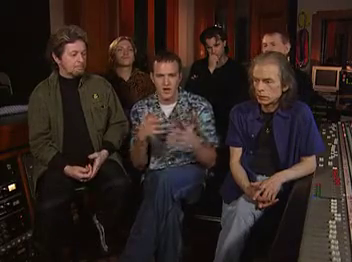
One of these people doesn’t belong here: Alex Garden, center, visits Yes in the studio. Jon Anderson, left, speaks for his bandmates, who positively radiate their disinterest.

Be that as it may, “Homeworld” was the lead-off track on Yes’s album The Ladder, which was released on September 20, 1999. A demo of the game was included on the CD. When the full game shipped just a week later, it included promotional materials advertising The Ladder as “a striking return to form for the band” (the same words that would be used to describe every subsequent Yes album for the next quarter-century, as it happened). The song played over the game’s credits sequence. When all was said and done, it seems doubtful whether the odd cross-promotional strategy did much of anything for either Relic or Yes. Homeworld sold over half a million copies in its first six months; The Ladder sold rather less well.

But if the Yes song turned out to be kind of pointless, there was very little else in the game about which one could make the same statement. Homeworld is a marvel of focused design, a game which knows exactly what it wants to do and be, and achieves every one of its goals with grace and verve. I must admit that I didn’t finish it, but that says more about the player than it does about the game; as most of you know by now, I have no natural affinity or talent whatsoever for the RTS genre, and in the end I just had too many other games on the syllabus to spend any more time struggling with this one, which becomes very challenging by its middle phases.

Given how rubbish I am at the genre, I’m woefully unqualified to write in detail about Homeworld’s mechanical merits as an RTS; suffice to say that, while the learning curve is a bit steep for my tastes, Homeworld is amazingly mature for being the first of its 3D breed. What I’d like to drill down on here is something closer to my heart: the incredible extent to which it succeeds as a lived fictional experience. To my knowledge, no other RTS of its era comes close to it in this respect. Command & ConquerWarcraft I and II, even to a large degree Starcraft… all had campaigns that served more as excuses for their scenarios — or, in the case of Command & Conquer, excuses for the creators to make the deliriously campy B-movies of their dreams — than compelling fictions in their own right. Homeworld is not like that. Even once the gameplay had worn me out, I still had to see the story through on YouTube, simply because I wanted to know what would happen. There are very, very few ludic fictions, from any gameplay genre, about which I can make such a statement.

Homeworld is about a group of humans from a planet called Kharak, for whom the “ancient astronauts” theory promulgated by Erich von Däniken here on Planet Earth turned out to actually be true. For there came a point when the steady march of their science “revealed a disturbing lack of commonality between our biochemical makeup and that of most Kharakid life.” Their satellites found “unusual pieces of metallic debris in high orbit,” containing “trace elements and isotope combinations unknown on Kharak.” Finally, the remnants of an enormous interstellar spaceship were found buried beneath the surface of the planet. Amidst the wreckage there was unearthed the “Guidestone,” an artifact engraved with a map of the known galaxy, highlighting Kharak and another planet labeled as Hiigara, a word meaning “Home.”

Using knowledge scavenged from the wreckage, the Kharakids spent more than a century constructing an interstellar vessel of their own, a “Mothership” capable of carrying up to 600,000 souls, suspended in cryogenic sleep, to this lost home world of Hiigara. The Mothership is a mobile factory as well as a colony ship, able to produce more, smaller ships from mined materials. (Anyone who has ever stood within ten feet of an RTS can probably sense where this is going…) It is controlled by a neuroscientist named Karan Sjet, who has volunteered to have her own brain wired into its computer systems. Karan Sjet is you, of course.

So, the campaign is about the Mothership’s search for home. The fact that your fleet and your research progress carry over from scenario to scenario makes it feel like one seamless story, epic in a way that smacks more of Civilization than Starcraft. Major plot developments occur within the scenarios more often than between them, further breaking down the standard RTS drill of mission briefing, mission, and victory screen. Individual ships become known to you for their exploits, even as they learn to fly and fight better over time. You develop a real attachment to them in much the same way you might to, say, the soldiers you send into battle in XCOM; you’ll find yourself looking out for them, trying to minimize their exposure to danger just as any humane real-world admiral would. In my admittedly limited experience, none of these feelings are at all typical of the RTS genre.

That said, a disarming amount of Homeworld’s success as a fiction comes down to its aesthetic presentation. In a genre known for its frenetic pace, built around scenarios that are considered to have overstayed their welcome if they stretch out to more than half an hour, this game is willing to take its time, with scenarios that can take several hours to finish. Everything is slower, more stately, allowing you plenty of opportunity to… well, to simply contemplate the scene before you, to think about where you have been and where you are going. The vibe is more 2001: A Space Odyssey than Star Wars or Battlestar Galactica, weird as that may sound for a game that is ultimately still about blowing things up in space. Relic made the bold choice of building the soundtrack around moody synths, strings, and choral voicings, eschewing the clichéd heavy-metal guitar riffs and techno beats that dominated the RTS scene. The choice lends the game a timeless dignity. Its real theme song isn’t the busybody Yes tune, but rather the elegiac choral voicings of Samuel Barber’s Agnus Dei, the only other piece of music in the soundtrack not composed by Paul Ruskay of Vancouver’s Studio X Production Labs. Combined with the visuals, which radiate their own stately beauty, the music makes Homeworld feel like the lone adult in a genre full of screeching adolescents. Even the voice-acting is more subdued and mature than the RTS norm — no sign of Starcraft’s cigar-chomping space marines here. In a genre known for having all of its aesthetic dials set to eleven all the time, Homeworld understands that grace notes can be more affecting than power chords.

I want to tell you about what I found to be the most jaw-dropping moment of the game, but, in order to do so, I do need to spoil the first stage of the campaign just a little bit. So, if you haven’t played Homeworld, think you might want to, and want to go in completely cold, skip to just beyond the video below….

The first two scenarios of the campaign are essentially extensions of the tutorial, in which you take the Mothership on a shakedown cruise before embarking on the long voyage in search of Hiigara. In the third scenario, you return to Kharak to take the colonists aboard and make final preparations for the real odyssey. But you are greeted there with the rudest of all imaginable awakenings: your people’s return to interstellar space has activated an ancient tripwire, prompting a race of aliens known as the Taiidan to come to your defenseless planet and pound it into uninhabitability. You’re thrown into a race to collect as many as possible of the cryogenic modules holding the sleeping colonists, which have already been fired into orbit, before the attackers destroy them as well. But this happens, like almost everything else in Homeworld, at an almost paradoxically stately pace, leaving plenty of the aforementioned room for contemplation. A wind of tragedy that Aeschylus would have understood blows through the whole thing. There is no triumphant fanfare at the end, just the quiet words, “There’s nothing left for us here. Let’s go.” Wow.

Thinking back on it, I realize that I want to set Homeworld up alongside Half-Life and FreeSpace 1 and 2 as a sort of late-1990s triptych of games that dared to do more with their fictions than anyone could ever have expected of them. All three of these titles are unabashedly difficult games aimed pretty firmly at the hardcore cognoscenti, working within action-oriented genres not particularly known for their aesthetic or thematic sophistication. And yet they all found ways to make us care about what we were seeing on the monitor screen on a deeper level than that of high scores and bragging rights. They have, for lack of a better word, gravitas. Less ideally, all three make me wish I had the time to get better at their individual forms of gameplay, so I would be better equipped to experience them as they were meant to be. But even failing that, it makes me happy to know that the old Infocom ideal of “waking up inside a story” still lived on amidst the deathmatches and corporate mergers of the turn of the millennium.

If you’re an RTS fan, you owe it to yourself to give Homeworld a shot. And if you’re not… well, you should probably play at least some of it anyway, just to get a taste of its incredible audacity and uncanny beauty. Art, after all, is where you find it.


Did you enjoy this article? If so, please think about pitching in to help me make many more like it. You can pledge any amount you like.


Sources: The books Close to the Edge: The Story of Yes by Chris Welch and Game Design: Secrets of the Sages (2nd ed.) by Marc Saltzman; Computer Gaming World of September 1998 and January 2000; Sierra’s customer newsletter InterAction of August 1998 and Spring 1999;  Game Trade 23; Next Generation of August 1998; PC Zone of July 1998, February 1999, and November 1999.

Online sources include a video advertisement for Yes’s Ladder album and one dealing more directly with the “Homeworld,”Homeworld retrospective by John Beford for Eurogamer, “Games That Changed the World: Homeworld at the old Computer and Video Games site, and a tribute to Glen A. Larsen by Jim Bennett at Deseret News.

Where to Get It:Homeworld Remastered Collection at GOG.com includes the unaltered original game as a bonus, should you want to play it as people did back in 1999. And you might just want to: the remaster makes some significant gameplay changes which don’t thrill everybody.


Tags: , , ,

The End of Sierra as We Knew It, Part 4: Chainsaw Monday


This article tells part of the story of Sierra On-Line.

In 1825, in Paris, France, a man named Charles-Louis Havas set up an agency to translate foreign news reports into French for the benefit of local newspapers. At that time, his country along with the rest of the Western world stood on the cusp of far-reaching changes. Over the next few decades, the railroad and the telegraph remade travel and communications in their image. This led in turn to the rise of consumerism, as exemplified by the opening of Le Bon Marché Rive Gauche, the world’s first big-box department store, in Paris in 1852. And with consumerism came mass-market advertising, a practice which was to a large extent invented in France.

The Havas Agency rode this wave of change adroitly. Charles-Louis Havas’s two sons, who took over the company after their father’s death, reoriented it toward advertising, making it into the dominant power in the field in France. Havas went public in 1879. During the twentieth century, it expanded into tourism and magazine and book publishing, and eventually into cable television, via Canal+, by far the most popular paid television channel in France from 1984 until the arrival of Netflix in that market in 2014.

The creation of Canal+ marked the point where Havas first became intertwined with another many-tendriled French conglomerate: the Compagnie Générale des Eaux, or CGE. The name translates to “The General Water Company.” As it would imply, CGE had gotten its start when modern plumbing was first spreading across France, all the way back in 1853. It later expanded into other types of urban service, from garbage collection to parking to public transportation. Veering still further out of its original lane, CGE invested enough into Canal+ to be given a 15-percent stake in the nascent channel in 1983, marking the start of a new era for the formerly staid provider of utility services. Over the next fifteen years, its growth outstripped that of Havas dramatically, as it became a major player in cable television, in film and television production, in telecommunications and wired and cellular telephony.

By 1997, CGE had acquired a 29.3-percent stake in Havas as well. In May of the following year, it completed the process of absorption. The new entity abandoned the anachronistic reference to water and became known as Vivendi, a far catchier name that can be roughly translated as “Of Life” or “About Life.” Having expanded by now to the point that it was running out of obvious growth opportunities inside France, it looked beyond the borders of its homeland. In the next few years, it would buy up a wide cross-section of foreign media.

This impulse to grow put the software arm of Cendant Corporation on Vivendi’s hit list just as soon as Henry Silverman, that troubled American company’s boss, made it clear that said division was on the market. For, of all sectors of media, gaming seemed set for the most explosive growth of all, and Vivendi was eager to grab a chunk of that action. It was not alone in this: a deregulation of the French telecommunications industry that had been completed on January 1, 1998, was spawning a foreign feeding frenzy among actual and would-be French game publishers. Conglomerates like Ubisoft, Titus, and Infogrames would soon join Vivendi as new household words among American gamers. The days of the “French Touch” being the mark of games that were sometimes charmingly, sometimes infuriatingly off-kilter would fade into the past, as French publishers would come to stand behind some of the biggest mass-market hits in the field.

Seen through this prism, there can be no doubt about the main reason Vivendi chose to take Cendant’s games division off Henry Silverman’s hands: Blizzard Entertainment, whose games Warcraft 2Diablo, and Starcraft had combined with the Battle.net matchmaking service to become a literal modus vivendi for millions of loyal acolytes. For its part, Sierra was on the verge of scoring a massive, long overdue hit of its own with Half-Life, but that had not yet come to pass as negotiations were taking place. As matters currently stood, Sierra was merely the additional baggage which Vivendi had to accept in order to get its hands on Blizzard.

The deal was done with remarkable speed. On November 20, 1998 — one day after the release of Half-Life, four days before the release of King’s Quest: Mask of Eternity, and eighteen days before that of Quest for Glory V: Dragon Fire — it was announced that the now-former Cendant software division had become a new subsidiary of the Vivendi empire, under the name of Havas Interactive. The price? A cool $1 billion in cash — cash that was, needless to say, much-needed by the beleaguered Cendant. The current Cendant software head David Grenewetzki, who as far as the French financiers could see had done a pretty good job so far of cutting fat and improving efficiency, would be allowed to continue to do so as the first boss of Havas Interactive.

The folks in Oakhurst had been through such a roller-coaster ride already that they were by now almost numb to further surprises. First had come the acquisition by CUC and the sidelining of Ken Williams, who looked a lot less like a soulless fat cat in comparison to what came after him. Then the merger with HFS, then the shock and horror of the revelations of accounting fraud and the plummeting share price, which had cost some staffers dearly — especially the ones who had signed onto the plan to replace some of their salary with Cendant stock. Al Lowe of Leisure Suit Larry fame, for example, says that almost overnight he and his wife lost “the equivalent of a really nice home.” So, the news of this latest sale, to yet another company that no one had ever heard of, was greeted mostly with resigned shrugs. Everyone had long since learned just to take it day by day, to hope for the best and to try to ignore the little voice inside that was telling them that they probably ought to be expecting the worst.

For three months, sanguinity seemed justified; not much changed. Then came February 22, 1999.

The first sign the Oakhurst employees encountered that something was out of the ordinary on that Monday morning were a few Pinkerton Security vans that they saw parked in front of the building as they arrived at work. Not knowing what else to do, they shrugged and went about their usual start-of-the-week routines. An all-hands meeting was scheduled for that morning at the movie theater next door, the latest installment in a longstanding quarterly tradition of same. If anyone felt a premonition of danger — the mass layoff of 1994 had been announced at another of these meetings, at the same theater — no one voiced their concerns. Instead everyone shuffled in in the standard fashion, swapping stories about the weekend just passed and other inter-office scuttlebutt, a little impatient as always with this corporate rigamarole, eager to get back to their desks and get back to work making games.

They soon learned that they would not be making games in Oakhurst, today or ever again. The instant they had all taken their places, the axe fell — or rather the chainsaw, as it would later be dubbed by Scott Murphy, a designer of Sierra’s Space Quest series. The Oakhurst office was closing, the staffers were told matter-of-factly. While they were still struggling to process this piece of information, they were each handed an envelope with their name on it. Inside was a short note, telling them whether they had just lost their job entirely or whether they were being offered the opportunity to relocate to the Bellevue office, to continue making games there.

As of February of 1999, Yosemite Entertainment had three major projects in development; in an indubitable sign of the changing times in gaming, none was an adventure game. One was a “space simulator” in the mold of Wing Commander and TIE Fighter, based in this case on the Babylon 5 television series; one was an MMORPG, a far more ambitious successor to The Realm that was to take place in J.R.R. Tolkien’s world of Middle-earth; and one was a shooter powered by the Unreal engine that was being created in consultation with a former Navy SEAL commander. The first two projects were to resume production in Bellevue; the last was cancelled outright.

When all of the support staff who are needed to run an office like this one were added to the chopping block, the number of people who lost their jobs that day came to almost 100 — almost two-thirds of the total number of Sierra employees remaining in Oakhurst. The ranks of the newly jobless also included a small team that had been working with Corey and Lori Ann Cole to make an expansion pack for Quest for Glory V, which was to add to the base game some form of the multiplayer support that had once been the whole thrust of the project as well as some new single-player content.

Sierra’s new management had left nothing to chance. While the meeting had been taking place at the theater, the Pinkerton hired guns had been changing the security codes that employees used to access the office building. The victims of the layoff were now led inside in small groups under armed guard, where they were permitted just a few minutes to clean their personal belongings out of their desks.

The shock of it all can hardly be overstated. No one had seen this coming; even Craig Alexander, the manager of Yosemite Entertainment, had been given no more than a few minutes warning on the morning of the layoff itself. With cataclysmic suddenness, the largest employer in Oakhurst had simply ceased to be. Come the day after Chainsaw Monday, the old office building and its previously bustling parking lot looked like a movie set after hours. The only people left to roam the halls were a few support personnel for The Realm, whose servers were to remain in Oakhurst for lack of anyplace better to put them while Havas Interactive sought a buyer for the building and if possible the MMORPG as well. (The Realm had just enough players that its new mother corporation hesitated to piss them off by shutting it down, but neither did Havas Interactive want to invest any real money in a virtual world built around the creaky old SCI engine.)

As an ironic capstone to the brutal proceedings in Oakhurst, both the Babylon 5 game and the Middle-earth MMORPG were themselves cancelled just six months later in Bellevue, as part of another round of “reorganizing.” The folks who had relocated to a big city 1000 miles further up the coast to continue these projects learned that the joke was on them, as they were left high and dry there in Seattle. The emerging new business model for Sierra was that of a publisher and distributor of games only, not an active developer of them. In other words, Sierra was deemed by Vivendi to be of further use only as a recognizable brand name, not as a coherent ongoing creative enterprise. Had he been paying attention, Henry Silverman, Wall Street’s king of outsourcing and branding, would surely have approved.

In the years that followed, surprisingly few of the prominent names who had built Sierra’s original brand, that of the biggest adventure-games studio on the planet, continued to work in the industry. What with the diminished state of the adventure game in general, the skill sets of people like them just weren’t so much in demand anymore.

Corey and Lori Ann Cole did find employment in the industry at least intermittently, but did so in roles that no longer got their names featured on box covers. Corey worked as a consultant on such unlikely projects as Barbie: Fashion Pack Games (to which he contributed a Space Invaders clone that replaced spaceships and laser guns with hearts and lipstick). Both Corey and Lori Ann worked on a virtual world called Explorati, which, had it ever come to fruition, might have been the missing link between Habitat and Second Life. Later, Corey worked on online-poker sites. Eventually, the Coles did come home again, to make Hero-U: Rogue to Redemption, which is Quest for Glory VI in all but name, and the more modestly scaled but equally warm-hearted Summer Daze: Tilly’s Tale. Corey told me recently that he and Lori Ann have some other ideas in the pipeline that might come to fruition someday, but he also told me that they “are pushing 70, and spending more time on ourselves.” Which is more than fair enough, of course.

Embracing the spirit of the late 1990s, when you couldn’t toss a dead rat into the air without hitting five different dot.com startups, Ken Williams initially envisioned a second act for his career, as an Internet entrepreneur. He passed up a chance to get in on the ground floor with Jeff Bezos’s Amazon.com in favor of a venture of his own called TalkSpot, which aimed to bring talk radio online. Born, one senses, largely out of Ken’s longstanding infatuation with Rush Limbaugh, a hard-right AM-radio provocateur of the old school, TalkSpot can nevertheless be read as prescient if you squint at it just right, a harbinger of the podcasts that were still to come. But it was just a little bit too far out in front of the nation’s telecommunications infrastructure; almost everyone was still accessing the Internet over dial-up at the time, which made even audio-only streaming a well-nigh insurmountable challenge. An attempted pivot from being a public-facing provider of online talk radio to providing streaming services to other companies, under the name of WorldStream, couldn’t overcome this reality, and the company closed up shop — ironically, not all that long before the DSL lines that might have made it sustainable started to roll out across the country.

Then again, it may be that Ken Williams’s heart was never really in it. Realizing that he had achieved his lifelong dream of becoming rich — he had all the money that he, Roberta, and their children could ever possibly need — he didn’t become a third-time entrepreneur. Instead he and Roberta threw themselves into an active and enviable early retirement. They sailed a boat all over the world, blogging about their travels to a whole new audience who often knew nothing about their previous lives. “We somehow achieved a second fifteen minutes of fame as world cruisers and explorers,” writes Ken in his memoir, exaggerating only slightly.

In 2023, they made a belated return to game development, via a graphical remake of the game that had started it all, for them as for so many others: Will Crowther and Don Woods’s original Adventure. It struck many as an odd choice, given the rich well of beloved Sierra intellectual property from which they might have drawn instead, but it seemed that they wanted above all to pay tribute to the game that had first prompted them to create their seminal Mystery House all those years ago, and to create Sierra On-Line in order to sell it. Having accomplished that mission, they have no plans to make more games.

And as for little Oakhurst, California, the strangest place at which anyone ever decided to found a games company: it weathered the turbulence of Sierra’s departure surprisingly well in the end, as it had so many changes before. There was a brief flicker of hope that game development might again become a linchpin of the town’s economy when, about six months after Chainsaw Monday, the British publisher Codemasters bought Sierra’s old facility, along with The Realm and its servers and the rights to the Navy SEAL game that had been cancelled when the chainsaw fell. Codemasters tried to assemble a team in Oakhurst to complete the SEAL game, which would seem to have been as prescient as Ken Williams’s TalkSpot in its way, anticipating the craze for military-themed shooters that would be ignited by Medal of Honor: Allied Assault in 2002. But most of the people who had once worked on the project had already left town, and Codemasters had trouble attracting more to such a rural location. The winds of corporate politics are fickle; within barely six months, the SEAL game was cancelled a second and final time, the Realm servers were finally moved out, and the now-empty building was put up for sale once again. These events marked the definitive end of game development in Oakhurst, barring the contracting jobs that the Coles did out of their house.

The loss was a serious blow to the local economy in the short term. But, luckily for Oakhurst, Yosemite National Park abides. After a brief-lived dip, the town started to grow again, thanks to the tourists who were now streaming through the “Gateway to Yosemite” in greater numbers than ever. Oakhurst’s population as of the 2020 American census was just shy of 6000 souls — twice the number counted by the 2000 census, when the community was still reeling from Sierra’s departure.

Today, then, Sierra On-Line’s sixteen-year stay in Oakhurst has gone down in local lore as just one more anecdote involving the eccentric outsiders who have always been drawn to the place. Still, among the hordes of families and hardcore hikers who pass through, one can sometimes spot a different breed of middle-aged tourist, who arrives brimming with nostalgia for a second-hand past he or she knew only through the pictures and articles in Sierra’s newsletters. Such is the nature of time. What is passed but remembered, if only by a few, becomes history.

Oakhurst in 2022. Life goes on…

I’d like to share with you a eulogy for Sierra — one that you may very well have seen before, written by someone far closer to all of this than I am. Josh Mandel was a writer and designer who worked at Sierra for several years. Just three days after Chainsaw Monday, he wrote the following.

On Monday, the last vestige of the original Sierra On-Line was laid to rest in Oakhurst, California. That branch, renamed “Yosemite Entertainment,” was shuttered on February 22nd, putting most of its 125-plus employees out of work.

You may not care for what Sierra has become since the days when dozens of unpretentious parser-driven graphic adventures flowed, seemingly effortlessly, out of Oakhurst. But there’s no denying that, back then, Sierra On-Line was the life’s blood of the adventure-game industry.

Maybe the games were a little more rough-hewn than those of its competitors — not that there were many competitors at that point. But Sierra kept adventure gamers happy and fed, gamers who would’ve otherwise starved to death on the arguably more polished, but frustratingly infrequent, releases of Lucasfilm Games (as they were once called).

Sierra alone grew the industry in other ways, too. It was Ken Williams who, almost single-handedly, created the market for PC sound hardware by vigorously educating the public [on] the AdLib card and, shortly thereafter, the breathtaking Roland MT-32. He supported those cards in style while other publishers wanted nothing to do with them. It was Corey and Lori Cole who invented the first true hybrid, replayable adventure/RPG. It was Christy Marx’s lump-in-the-throat ending to Conquests of Camelot that reminded us that not every computer game had to have a group hug at the end. It was Mark Crowe and Scott Murphy who made us want to kill off our onscreen alter ego, to see what inventive, gooey death had been anticipated for us. It was Roberta, before anyone else, who invented strong female heroines. It was Al Lowe, bringing up the rear (literally and figuratively) by creating Leisure Suit Larry, the most popular, pirated game of its decade. We knew this because we sold far more Larry hint books than we sold of the actual software.

It was the Sierra News Magazine (later InterAction) that let us feel like we knew the people making these games, that they were a family-run business, staffed by people who lived an isolated life, surrounded by idyllic, ageless beauty and creating games that were a labor of love. That was, at least for a while, an accurate picture. This was a family we wanted to feel a part of, for good reason, and people came from thousands of miles away to take a tour and see how real it all was…

Some may argue that Sierra lives on in Bellevue, Washington, where Al Lowe, Jane Jensen, Roberta Williams, Mark Seibert, and a handful of [other] Oakhurst refugees still labor diligently on games side-by-side with scores of newer talent. But games like King’s Quest: Mask of Eternity and Leisure Suit Larry 7 have a distinctly different flavor than the seat-of-the-pants, funny, touching adventures that Oakhurst once produced. They are commercial.

Invariably, in a company that grows the way Sierra grew, innovation gives way to emulation. Whereas Sierra’s management once strove to make it solid, profitable, and yet fun, they now strive to dominate other companies, force annual growth in the double digits, and (like so many other companies) cut jobs mercilessly to improve the bottom line and thrill the stockholders. Yet the Ghost of Sierra Past still walked the halls in Oakhurst. The rooms were adorned with the art of glories past, the artists and programmers who helped to create those glories were, in fair measure, still living and working there. Now that spirit has been exorcised by scrubbed, glad-handing executives who don’t know, or don’t care, what those artists and programmers could do when they were motivated and well-managed.

People, living and working closely together in the pursuit of shared joy, were what made Sierra games great. Thank you, Ken, for creating something utterly unique, something warm, fun, and beautiful. Damn you, Ken, for allowing others to tear it down.

Whether you were a Sierra fan or not, we are all diminished by the loss of history, talent, and continuity within the gaming industry. Rest in peace, Sierra On-Line.

The skeptical historian in me hastens to state that this eulogy is very sentimentalized; whatever else they may have been, Sierra’s games were always at least trying to be deeply commercial, as Ken Williams will happily tell you today if you ask him. On the other hand, though, it’s rather in the nature of eulogies to be sentimental, isn’t it? This one is not without plenty of wise truths as well. And among its truths is its willingness to acknowledge that Sierra’s games “were a little more rough-hewn than those of its competitors.”

I, for one, have definitely spent more time over the years complaining about the rough edges in Sierra’s adventure games than I have praising their strong points. I’ve occasionally been accused of ungraciousness in this regard, even of having it in personally for Ken and Roberta Williams. The latter has never been the case, but, looking back, I can understand why it might have seemed that way sometimes, especially in the early years of this site.

Throughout most of the 1980s, the yin and yang of adventure gaming were Infocom and Sierra, each manifesting a contrasting philosophy. As Ken Williams himself has put it, Infocom was “literary,” while Sierra was “mass-market.” One Infocom game looked exactly the same as any other; they were all made up of nothing but text, after all. But Sierra’s games were, right from the very start, the products of Ken’s “ten-foot rule”: meaning that they had to be so audiovisually striking that a shopper would notice them running on a demo machine from ten feet away and rush over to find out more. (It may seem impossible to imagine today that a game with graphics as rudimentary as those of, say, The Wizard and the Princess could have such an effect on anyone, but trust me when I say that, in a time when no other adventure game had any graphics at all, these graphics were more exciting than any ultra-HD wonder is to a jaded modern soul.) Infocom had to prioritize design and writing, because design and writing were all they had. Sierra had other charms with which to beguile their customers. It’s no great wonder that today, when those other charms have ceased to be so beguiling, Infocom’s games tend to hold up much better.

But I’m not here to play the part of an old Infocom fanboy with a bad case of sour grapes. (Whatever we can say about their respective games today, there’s no doubt which company won the fight for hearts and minds in the 1980s…) I actually think a comparison between the two is useful in another way. Infocom was always a collective enterprise, an amalgamation of equals that came into being behind an appropriately round conference table in Cambridge, Massachusetts. Strong personalities though the principals may have been, one cannot say that Infocom was ever Al Vezza’s company or Joel Berez’s company, nor Dave Lebling’s or Marc Blank’s. From first to last, it was a choir of voices, if sometimes a discordant one. Compare this to Sierra: there wasn’t ever an inch of daylight between that company and Ken and Roberta Williams. Sierra’s personality was theirs. Sierra’s strengths were theirs. And, yes, Sierra’s weaknesses, the same ones I’ve documented at so much length over the years, were theirs as well.

I’ll get to their strengths — no, really, I will, I promise — but permit me to dwell on their weaknesses just a little bit longer before I do so. I think that these mostly come down to one simple fact: that neither Ken nor Roberta Williams was ever really a gamer. Ken has admitted that the only Sierra game he ever sat down and played to completion for himself, the way that his customers did it, was SoftPorn — presumably because it was so short and easy (not to mention it being so in tune with where Ken’s head was at in the early 1980s). In his memoir, Ken writes that “to me, Sierra was a marketing company. Lots of people can design products, advertise products, and sell products. But what really lifted Sierra above the pack was our marketing.” Here we see his blasé attitude toward design laid out in stark black and white: “lots of people” can do it. A talent for marketing, it seems, is rarer, and thus apparently more precious. (As for the rest of that sentence: I’m afraid you’ll have to ask Ken how “marketing” is different from “advertising” and “selling…”)

Roberta has not made so explicit a statement on the subject, but it does strike me as telling that, when she was given her choice of any project in the world recently, she chose to remake Crowther and Woods’s Adventure. That game was, it would seem, a once-in-a-lifetime obsession for her.

Needless to say, there’s nothing intrinsically wrong with not being a gamer; there are plenty of other hobbies in this world that are equally healthy and stimulating and satisfying, or quite possibly more so. Yet not being a gamer can become an issue when one is running a games company or designing games for a living. At some very fundamental level, neither Ken nor Roberta had any idea what it was like to experience the products Sierra made. And because they didn’t know this, they also didn’t know how important design is to that experience — didn’t understand that, while the ten-foot rule applies for only a limited window of time, writing and puzzles and systems are timeless. Infocom scheduled weekly lunches for everyone who wished to attend to discuss the nature of good and bad design at sometimes heated length, drafted documents full of guidelines about same, made design the cornerstone of their culture. As far as I can tell, discussions of this nature never took place at Sierra. Later, after Infocom was shuttered, LucasArts picked up the torch, publicizing Ron Gilbert’s famous manifesto on “Why Adventure Games Suck” — by “adventure games,” of course, he largely meant “Sierra adventure games” — and including a short description of its design philosophy in every single game manual. Again, such a chapter is unimaginable in a Sierra manual.

For, like everything else associated with the company, Sierra’s games reflected the personalities of Ken and Roberta Williams. They were better at the big picture than they were at the details; they were flashy, audacious, and technologically cutting-edge on the surface, and all too often badly flawed underneath. Those Sierra designers who were determined to make good games, by seeking the input of outside testers and following other best practices, had to swim against the tide of the company’s culture in order to do so. Not that many of them were willing or able to put in the effort when push came to shove, although I have no doubt that everyone had the best of intentions. The games did start to become a bit less egregiously unfair in the 1990s, by which time LucasArts’s crusade for “no deaths and no dead ends” had become enough of a cause célèbre to shame Sierra’s designers as well into ceasing to abuse their players so flagrantly. Nevertheless, even at this late date, Sierra’s games still tended to combine grand concepts with poor-to-middling execution at the level of the granular details. If I’m hard on them, this is the reason why: because they frustrate me to no end with the way they could have been so great, if only Ken Williams had instilled a modicum of process at his company to make them so.

Having said that, though, I have to admit as well that Ken and Roberta Williams are probably deserving of more praise than I’ve given them over the fifteen years I’ve been writing these histories; it’s not as if they were the only people in games with blind spots. Contrary to popular belief, Roberta was not the first female adventure-game designer — that honor goes to Alexis Adams, wife of Scott Adams, who beat her to the punch by a year — but she was by far the most prominent woman in the field of game design in general for the better part of two decades, an inspiration to countless other girls and women, some of whom are making games today because of her. That alone is more than enough to ensure her a respected place in gaming history.

Meanwhile Sierra itself was a beacon of diversity in an industry that sometimes seemed close to a mono-culture, the sole purview of a certain stripe of nerdy young white man with a sharply circumscribed range of cultural interests. The people behind Sierra’s most iconic games came from everywhere but the places and backgrounds you might expect. Al Lowe was a music teacher; Gano Haine was a social-studies teacher; Christy Marx was a cartoon scriptwriter; Jim Walls was a police officer; Jane Jensen and Lorelei Shannon were aspiring novelists; Mark Crowe was a visual artist; Scott Murphy was a short-order cook; Corey and Lori Ann Cole were newsletter editors and publishers and tabletop-RPG designers; Josh Mandel was a standup comedian; Roberta Williams, of course, was a homemaker. At one point in the early 1990s, fully half of Sierra’s active game-development projects were helmed by women. You would be hard-pressed to find a single one at any other studio.

This was the positive side of Ken Williams’s mass-market vision — the one which said that games were for everyone, and that they could be about absolutely anything. There was no gatekeeping at Sierra, in any sense of the word. For all of LucasArts’s thoughtfulness about design, it seldom strayed far from its comfort zone of cartoon-comedy graphic adventures. Sierra, by contrast, dared to be bold, thematically and aesthetically as well as technologically. I may have a long list of niggly complaints about a game like, say, Jane Jensen’s Gabriel Knight: The Beast Within, but I’ll never forget it either. Despite all of its infelicities, it dares to engage with aspects of life that are raw and tragic and real, giving rise to emotions in this player at least that are the opposite of trite. How many of its contemporaries from companies other than Sierra can say the same?

And as went the production side of the business, so went the reception side. Perhaps ironically because he wasn’t a gamer himself, perhaps just because one doesn’t get to be Walt Disney by selling to a niche audience, Ken understood that computer games had to become more accessible if they were ever to make a sustained impact beyond the core demographic of technically proficient young men. He strove mightily on multiple fronts to make this happen. Very early in his time as the head of Sierra, he was instrumental in setting up distribution systems to ensure that computer games were readily available all over the United States, the way that a new form of consumer entertainment ought to be. (Few Sierra fans are aware that it was Ken who founded SoftSel, the dominant American consumer-software distributor of the 1980s and beyond, in order to ensure that Sierra’s games and those of others had a smoothly paved highway to retail stores. Doing so may have been his most important single contribution of all from a purely business perspective.) A little later, he put together easy-to-assemble “multimedia upgrade kits” for everyday computers, and made sure that Sierra’s software installers were the most user-friendly in the business, asking you for IRQ and DMA numbers only as a last resort. If some of his ideas about interactive movies as the future of mainstream entertainment proved a bit half-baked in the long run, other Sierra games like The Incredible Machine more directly anticipated the “Casual Revolution” to come. If his wide-angle vision of gaming seemed increasingly anachronistic in the latter 1990s, even if it was wrong-headed in a hundred particulars, the fact was that it would come roaring back and win the day in the broader strokes. His only real mistake was that of leaving the industry which he had done so much to build a little bit too early to be vindicated.

So, let us wave a fond farewell to Ken and Roberta Williams as they sail off into the sunset, and give them their full measure of absolution from the petty carping of critics like me as we do so. In every sense of the words, Ken and Roberta were pioneers and visionaries. Their absence from these histories will be keenly felt. Godspeed and bon voyage, you two. Your certainly made your presence felt while you were with us.


Did you enjoy this article? If so, please think about pitching in to help me make many more like it. You can pledge any amount you like.


Sources: The books Not All Fairy Tales Have Happy Endings: The Rise and Fall of Sierra On-Line by Ken Williams and Vivendi: A Key Player in Global Entertainment and Media by Philippe Bouquillion.

Online sources include “How Sierra was Captured, Then Killed, by a Massive Accounting Fraud” by Duncan Fyfe at Vice, “Chainsaw Monday (Sierra On-Line Shuts Down)” at Larry Laffer Dot Net, Ken Williams’s page of thoughts and rambles at Sierra Gamers, and an old TalkSpot interview with some of Sierra’s employees, done just after the second round of lay-offs hit Bellevue.

I also made use of the materials held in the Sierra archive at the Strong Museum of Play. And once again I owe a debt of gratitude to Corey Cole for answering my questions about this period at his usual thoughtful length.


Tags: , ,

The End of Sierra as We Knew It, Part 3: The Dog Days of Oakhurst


This article tells part of the story of Sierra On-Line.

If you take the time to dig beneath the surface of any human community, no matter how humble, you’ll be rewarded with a welter of fascinating tales and characters. Certainly this is true of Oakhurst, California. The little town nestled in central California’s Yosemite Valley near the western end of the Sierra Nevada Mountains has attracted more than its fair share of dreamers and chancers over the past 175 years or so.

Oakhurst sprang up under the name of Fresno Flats back in the 1850s, when, according to the received wisdom back East, the streams of this part of California glittered with gold; one only had to dip a hand in and scoop one’s fortune out. Needless to say, that was not really the case: the vast majority of the starry-eyed prospectors who passed through the budding settlement found only hardship and disillusionment in the forest around it. The people who did best from the gold rush were those who never ventured any farther into the wilderness than Fresno Flats itself, the ones who settled down right there to serve the needs of the dreamers, by selling them picks, axes, shovels, and pans, not to mention food, liquor, beds, and companions to share said beds for a brief spell of a night. Other hardy pioneers later opened a school, a post office, a lumber mill (complete with a log flume on the Fresno River), and eventually even a proper, moderately productive goldmine. Every one of the brave souls who came to the town and stayed had a unique story to tell, but for sensation value none can top that of Charley Meyers.

On the evening of May 22, 1885, two masked men armed with pistols and shotguns robbed a Wells Fargo stagecoach passing through the Yosemite Valley. The sheriff was at a loss about the crime and its perpetrators until the next afternoon, when a local man noticed some footprints leading away from the site of the robbery through the forest — leading, as it happened, directly to Fresno Flats and then right up to the front porch of Charley Meyers, a young farmer and handyman whose family had heretofore been held in good repute. Called to the scene by the amateur sleuth, the sheriff and his deputies burst into Meyers’s log cabin, where they found another resident of the town, a fellow named William Prescott, fast asleep in bed, looking like he had had quite a night. Prescott told the lawmen that Meyers had gone to Coarsegold, the closest town to Fresno Flats. He was duly rounded up there in short order.

The sheriff thought he had his quarry dead to rights. Not only had they left a trail through the woods obvious enough for his half-blind grandma to follow, but their frames matched the victims’ descriptions of their attackers’ build and they were found with guns in their possession that matched the ones used at the robbery. The victims had said that their assailants had smeared boot blacking over all of their exposed skin to further conceal their identity; sure enough, a can of the stuff was found in Meyers’s barn, traces of the same substance on two shirts that had been left lying on the floor inside the house. Further, one of the robbers had been so impolitic as to call the stagecoach driver by his name, indicating that he had to be a local who knew the man. Meyers and Prescott’s claim that they had gone into the woods that night merely to hunt wild hogs fell apart when they were asked to lead their interrogators to their supposed hunting ground separately, and each proceeded to go to a completely different place.

But, once taken to the larger city of Fresno to stand trial, these two rather astonishingly inept criminals were fortunate enough to enlist the services of a rather astonishingly wily defense attorney. Walter D. Grady was a scion of double-barrelled frontier justice straight out of a Zane Gray novel, a hard-drinking brawler who had lost an arm during a shootout. In addition to being a lawyer, he was a California state senator, a goldmine owner, and the proprietor of Fresno’s opera house.

Five years earlier, the transportation arm of the Wells Fargo conglomerate had hired Grady to help it secure the conviction of a different accused robber. But after that task had been accomplished, Grady’s client agreed to pay him only half of the amount he billed it. From that moment on, Walter Grady regarded Wells Fargo as his sworn enemy, making it known near and far that he would happily become the pro bono legal representative of anyone who got sideways with the nineteenth-century mega-corp. For he regarded his feud as a matter of personal manly honor; mere questions of guilt and innocence became less important in the face of such a consideration as this.

As the representative of Charley Meyers and William Prescott, Grady embarked on a strategy of legal exhaustion that Johnnie Cochran would have recognized and nodded along with. He refused to concede even the most trivial of points to the prosecution, even as he scored repeated laughs from the jury with his folksy manner, ribald jokes, and sheer pigheadedness in the face of common sense. For example, he noted that the can of boot blacking found in Meyers’s barn could also be found in those of dozens of other people, and speculated that the traces of the same substance found on the defendants’ shirts might just be residue from “the perspiration of a hard-working man.” (“I never worked hard enough to know,” quipped the sheriff, no stranger to folksy charm himself, by way of response.)

Despite Grady’s legal and logical contortions, Meyers and Prescott were found guilty and sentenced to twenty years at San Quentin State Prison. But their defense attorney refused to give up the fight even now. He appealed all the way to the California Supreme Court, with whom he shared damning evidence that the sheriff and the prosecution team had taken the jury out for drinks on at least two occasions. (He neglected to mention that he had done the same thing himself once.) The conviction was overturned and the prisoners remanded for a new trial. Grady did his thing, and this time he was able to charm or flummox enough of the jury to secure a mistrial. A third trial was ordered; another mistrial followed. By this point, the case had become a running joke in Fresno and its surroundings, with Grady, Meyers, and Prescott becoming unlikely folk heroes for the way they kept fighting the law and common sense and, if not quite winning, at least staving off defeat again and again. The authority figures who had been cast in the roles of the straight men in this legal farce decided they had had enough; they vacated the case and let the prisoners go free. You win some, you lose some.

So, Meyers and Prescott came home to Fresno Flats about a year and a half after they had been led away in handcuffs. Justice may not have been served, but Charley Meyers at least seemed to have been scared straight by his brief sojourn in San Quentin. He worked hard at legitimate pursuits, married well, and became a prominent landowner and businessman in his community. Throughout, he refused as adamantly as ever to fess up to being one of the perpetrators of the stagecoach robbery of 1885. Yet people in Fresno and elsewhere continued to remember him and the town from which he hailed primarily for that bizarre series of trials and his improbable escape from justice.

This really stuck in the craw of his wife Kitty Meyers, an eminently respectable lady. She decided that, if only a town called Fresno Flats no longer existed, people might stop talking about her and her husband in this unsavory context. She therefore embarked upon a lengthy campaign with the post office to change the official name of the town, a campaign whose ultimate success was more a testimony to apathy among her fellow residents than any groundswell of support for the idea. On April 1, 1912, Fresno Flats became Oakhurst in the eyes of the post office and the rest of the government. For many or most of the residents of the town, however, it would remain Fresno Flats for decades to come.

Charley and Kitty Meyers, long after the former had put his stagecoach-robbing days behind him. If Kitty hadn’t gotten tired of hearing her husband’s name brought up in association with that crime, Sierra On-Line’s boxes would have listed Fresno Flats rather than Oakhurst as the company’s address 70 years later. When a butterfly flaps its wings…

By whatever name, the town was still, as a report in the closest newspaper delicately put it, a “lively” place at this time, filled with miners and lumberjacks whose interests and recreations weren’t all that far removed from those of the starry-eyed prospectors the place had first been built to serve. (“One of the major sports among men at payday was pitching $20 gold pieces to a wagon rut. [The] man pitching the closest took all the coins on the ground.”) In time, though, the local goldmine ran out of bounty from the earth, and in 1931 the onset of the Great Depression spelled the end of the lumber mill as well. “Now, like so many of the early mountain towns, Fresno Flats finds itself slowly rotting away, soon to become another of the ghost towns of the Sierras,” wrote its last remaining schoolteacher despairingly in 1938.

But this mountain town got a new lease on life before it rotted away completely. In the 1950s, automobiles and the new interstate highway system led to an explosion in the number of visitors to this region of incredible natural beauty. Fulfilling at long last the ambition of the now long-dead Kitty Meyers by shedding the name of Fresno Flats once and for all, Oakhurst reinvented itself as “The Gateway to Yosemite National Park.” Road-tripping families became a more lucrative and far more reliable source of revenue for Oakhurst businesses than the gold hunters of yore had ever been.

Yet just like back then, some minuscule percentage of the visitors who streamed through the town elected to stay and leave their mark upon it. They were people like Jack Gyer and Cal Ragland, a pair of Los Angelenos who started the Sierra Star, the town’s first and only newspaper, in 1957, when there were still just 85 telephone numbers in all of Oakhurst. And they were people like the Ohioan Hugh Shollenbarger, who in 1965 erected the optimistically titled “World Famous Talking Bear” on Highway 41 just at the edge of Oakhurst. In the decades since, this statue of a grizzly bear has growled and spouted facts about his species from a tape recorder ensconced somewhere inside his fiberglass innards to thousands upon thousands of tourists, winning himself a page in many a catalog of roadside American kitsch. (“I am a native of this area, but don’t be alarmed. There are not many of us left…”)

The World Famous Talking Bear in Oakhurst. Notice the name on the storefront just behind him. Century 21 Real Estate was one of the brands owned by HFS, then later by Cendant Corporation. It’s a small world sometimes…

Seen in the light of this long tradition of creative entrepreneurship, Ken and Roberta Williams’s decision to move the “headquarters” of their budding two-person company On-Line Systems to Oakhurst in December of 1980 begins to seem like less of an aberration — even if, as I wrote quite some years ago now in these histories, Oakhurst was “about the unlikeliest site imaginable for a major software publisher.” They bought a home in Coarsegold, the neighboring town where Charley Meyers had been apprehended all those years ago, and leased their first office space in Oakhurst proper, in the form of a tiny ten-foot-by-ten-foot room above the print shop where new issues of the Sierra Star were run off each week. Indeed, the name of their early newspaper landlord may very well have been a factor in the Williamses’ decision to rechristen their company “Sierra On-Line” within a couple of years.

Like so many of those who had come to Oakhurst before them, Ken and Roberta Williams arrived seeking financial success; Ken, you’ll recall from the first article in this series, wanted more than anything else in life simply to become rich. Yet they both wanted to attain success on their own terms, in a town surrounded by all the trappings of paradise; their dream was half Ayn Rand, half Robert M. Pirsig. But first, like Charley Meyer before him, Ken Williams in particular had to go through a bit of an outlaw phase, filled with wild parties and a fair amount of recreational drug use and even a modicum of libertine sex, before he straightened up and turned Sierra into a respectable company. The tales about how he did that, and of a goodly number of the hundreds of games said company published over its nearly sixteen years of independent existence, have been a regularly recurring fixture of these histories of mine almost since the very beginning. So, rather than attempt to summarize them here, allow me to point you to the hundreds of thousands of words I’ve already written on these subjects.

As these tales were playing out, Oakhurst was being invaded by a new breed of outsider: folks who tended to be somewhat paler and skinnier than the legions of road-trippers and hardcore hikers streaming through, folks who tended to talk an awful lot about kilobytes and registers and opcodes and other incomprehensible technical arcana. The locals shrugged their shoulders and accepted them, as they had so many other strangers in the past. After all, their money spent just as well as anyone else’s at restaurants, shops, and gas stations, and some of them seemed to have a considerable amount of it to throw around. For their part, some of the computer-mad newcomers learned to love their new lives here in paradise, a few of them to such an extent that they would do their darnedest to avoid leaving it, even after the job that had brought them here was no more.

For to everything there is a season — to computer-game publishers just as to everything else, in Oakhurst just as everywhere else. The first indubitable sign that Sierra On-Line’s season in Oakhurst might not be eternal emerged already in 1993, when Ken and Roberta Williams set up a second office for the company in Bellevue, Washington, not far from Microsoft’s sprawling campus, to serve as its new “administrative headquarters.” By now, Ken was no longer the genial, party-hearty boss who had once celebrated the end of the working week each Friday by slamming down schnapps shots with his staff. The more buttoned-down version of Ken Williams insisted that the office in Bellevue was necessary. He said — and we have no reason to doubt his word on this — that Sierra’s isolated location was making it hard for him to hire top-flight talent from the world of business and finance, that Oakhurst’s lack of proximity to a major airport was becoming a crippling disadvantage in an ever more competitive, increasingly globalized industry. Nevertheless, in a telling testament to how big the gap between the Williams family and the rank and file in Oakhurst was already becoming, some of the latter believed the decision to up stakes for Bellevue was an essentially personal one, having much to do with the absence of a state income tax in Washington. And who knows? That may very well have been a consideration as well. For whatever reason or reasons, the era of a collective of “software artisans in the woods” effectively ended for Ken and Roberta Williams in 1993.

Although the announced plan was to continue to make the games in Oakhurst and to market them from Bellevue, many of the established staff suspected that this division of labor would prove no more than temporary. Sierra game designer Corey Cole, for one, told me that he was “pretty sure that the move would soon result in moving most or all of the project teams out of Oakhurst.” His cynicism was partially validated just one year after the Bellevue office opened, when Sierra laid off a substantial chunk of the Oakhurst workforce, in the most brutal downsizing of same since the company had nearly gone bankrupt in the wake of the Great Videogame Crash of 1983. Sure enough, Bellevue now started making games as well as selling them. In fact, as the Oakhurst employees saw it, Ken Williams now displayed a marked tendency to choose the projects that he felt had the most potential for his own backyard, leaving the scraps to the town that had built Sierra. Be that as it may, one definitely didn’t need to be a complete cynic by this point to suspect that the writing was on the wall for Sierra’s remaining software artisans in the woods.

Thus when the news came down to Oakhurst from Bellevue a year and a half after the traumatic layoff that Sierra On-Line had been suddenly, unexpectedly acquired by a company called CUC, it was greeted with more trepidation than excitement. The Oakhurst people’s first question was the obvious one: “Who the hell is CUC?” Craig Alexander, the current manager of the Oakhurst operation, was less surprised that Sierra had been acquired — he had always suspected that to be Ken Williams’s endgame — than he was by the acquirerer. “We always thought we’d be bought by a large media concern or Hollywood studio or technology company,” he says. A peddler of borderline-reputable shopping clubs and timeshares had not been on his bingo card. Al Lowe of Leisure Suit Larry fame saw dark clouds on the horizon as soon as he read the email from CUC that said, “We love this company. That’s why we bought it.” “Translated into English,” Lowe says wryly, “that means, ‘We’re going to change everything.'”

In the long run, his prediction wouldn’t be wrong, but there was a period when the more optimistic folks in Oakhurst were given enough space to fondly imagine that their lives might continue more or less as usual indefinitely. The Sierra employees who lost their jobs in the immediate aftermath of the acquisition were the marketers, accountants, and other front-office personnel who worked from Bellevue, who were deemed redundant after it became clear that Bob Davidson and his administrative staff rather than Ken Williams and his would be setting the direction of the new CUC software arm. The Oakhurst people sympathized with the plight of their ostensible comrades in arms, but the truth was that there had been little day-to-day contact between the two halves of the company — and, what with the stresses and rivalries playing out in the corporation as a whole, not always a lot of love lost between them either.

Still, there were some changes in Oakhurst as well, some of which become distinctly ominous in retrospect. “Little conversations stick out” today in the memory of Craig Alexander: “I remember CUC management lecturing me and my leadership about why we couldn’t deliver revenue and earnings on a quarterly basis. They were all proud of the fact that they had been delivering to Wall Street expectations for the last four or five years. ‘How come you guys can’t do that?'” CUC called everyone in Oakhurst together to pitch to them a scheme known as “salary replacement,” in which employees would agree to be paid partly in stock rather than cash; a fair number of them signed up, much to their eventual regret. Less sketchily but no less disturbingly, the Oakhurst folks were told that they now worked at “Yosemite Entertainment,” just one of a portfolio of studios that would henceforward live under a broad umbrella known as Sierra. To be thus labeled just one among many sounded worrisomely close to being labeled expendable.

For the time being, though, games continued to be made in Oakhurst. One of these would prove the very last of the “Quest”-branded Sierra adventure games, released about two weeks after King’s Quest: Mask of Eternity wrapped up another such series in such confusing and dismaying fashion. Quest for Glory V: Dragon Fire would acquit itself decidedly better, even though it too was subject to many of the same pressures that conspired to so thoroughly undo Mask of Eternity. As was always the case with the Quest for Glory series, its ability to at least partially defy the natural gravity of Sierra, where good design was never a thoroughgoing organizational focus even in far less unsettled times than these, was a tribute to Corey and Lori Ann Cole, to my mind the two best pure game designers who ever worked on Sierra’s adventure games.


In a way, the most remarkable thing about Quest for Glory V is that it ever got made at all. Certainly no reasonable person would have bet much money on its chances a short while after the fourth game in the Coles’ series of adventure/CRPG hybrids came out.

That entry, Quest for Glory: Shadows of Darkness,1 is considered by many fans today to be the very best of them all. Yet the game that modern players experience through facilitators like ScummVM is not the same as the one that was released on December 31, 1993, just in the nick of time to book its revenues as belonging to the third quarter of Sierra’s Fiscal 1994. The game as first shipped was riddled with bugs and glitches that led to harsh reviews and many, many returns. Although some of the worst of the problems were later remedied through patches, the damage had been done: Shadows of Darkness’s final sales figures were not overly impressive. The Coles were contractors rather than employees of Sierra at the time they made it, but they too felt the pain of the layoff of 1994. The day after more than 100 regular employees had gotten their pink slips, Ken Williams met with them to tell them that there would be no Quest for Glory V. The series, it seemed, was finished, one game short of the epic finale that the Coles had been planning for it ever since embarking on the first installment circa 1988.

I mentioned earlier that some of the people who came to Oakhurst to work at Sierra never left the town even after the job that had brought them disappeared. Count Corey and Lori Ann Cole among this group. Even though their services were no longer desired at Sierra, they were determined to keep on living here in paradise. They took on contracting projects that they could do from their home, most notably the adventure game Shannara for Legend Entertainment, based on the long-running series of fantasy novels by Terry Brooks.

Some time after that game came out — and after a second game for Legend, to be based on Piers Anthony’s Xanth novels, had fallen through — a rapprochement between the Coles and Sierra took place. One of the projects that was still being run out of Oakhurst was The Realm, one of the first graphical MMORPGs, which ran on a modified version of Sierra’s venerable SCI adventure engine and even lifted some of its code straight from the Quest for Glory games — understandably so, given that these were the only other SCI games which, like The Realm, weaved monster-killing, character levels and stats, and other CRPG traits into their tapestry of adventure. For a while, Craig Alexander considered turning The Realm into some sort of Quest for Glory Online with the help of the Coles, but ultimately thought better of it.

Nonetheless, the lines of communication had been reestablished. Sierra had received a good deal of fan mail over the last couple of years asking if and when the next Quest for Glory would come out; the fourth game had ended on a cliffhanger, which only made the fans that much more desperate to know how the story ended. So, it did seem that there was a market for a Quest for Glory V, even if a relatively small one by the standards of the growing industry. Hedging his bets in much the same way that Roberta Williams was about to do with King’s Quest: Mask of Eternity, Craig Alexander came up with the idea of a “small-group multiplayer” game; a matchmaking service would put players together in “shards” with just a handful of others, as opposed to the hundreds or thousands who could play together in The Realm. Yet it was never clear how the narrative focus of the older Quest for Glory entries might be made to work under such a conception. Lori Ann Cole accepted a commission to work up a design, but she almost immediately began lobbying for the inclusion of a single-player mode as well. This, one senses, is where her heart really was right from the start: giving players the narrative closure they were begging for in all those letters. Under the pressure of practicalities, the multiplayer aspect gradually slid away, from being the whole point of the game to an optional, additional way to play it; then it disappeared entirely in favor of a Quest for Glory like the series had always been, in the broad strokes at least.

Still, Quest for Glory V was destined to remain the odd man out in the series in many other, more granular respects. The SCI engine wasn’t maintained after 1996 — The Realm was one of the last things ever done with it — and so the team behind the fifth game was forced to look for another way of implementing it. Lead programmer Eric Lengyel first devised a state-of-the-art voxel-graphics system, only to find that it was too demanding for the hardware of the day. After some flailing against the inevitable, he agreed to scrap it and code up a more conventional 3D-graphics engine from scratch. Corey Cole, who didn’t join the project until it was about a year old, considers all of these efforts to have been misplaced. Buying someone else’s 3D engine would have entailed a large one-time cost, he notes, but it would have freed up a lot of time and energy to focus on design rather than technicalities. He has a point.

During 1998 and 1999, the new-look Sierra would release three adventure games with one foot in the past and one in the future: King’s Quest: Mask of EternityQuest for Glory V: Dragon Fire, and Gabriel Knight 3: Blood of the Sacred, Blood of the Damned (a subject for a future article). Rather incredibly, each of these games would run in a different 3D engine, two of them custom-built for this application and then never used again. The contrast with the 2D SCI engine, which was used over and over again in dozens and dozens of applications, could hardly be more stark. It seems that there are major advantages to having a group of developers all working out of the same location and communicating daily with one another, as was the case during the glory days of Sierra in Oakhurst. Who would have imagined?

Of the three aforementioned games, Quest for Glory V is the only one that could have been implemented in 2D without losing much if anything. Despite the departure from the comfortable old SCI environment, its presentation and gameplay are quite consistent with that of the earlier games in the series: that of a (mostly) fixed-camera, mouse-driven, third-person graphic adventure of the classic style, with a geography divided into discrete areas or “rooms.” Combat is a little different from before, in that it takes place on the same screen as the rest of the gameplay, but, again, it’s hard to see why this couldn’t have been implemented in SCI. The benefits of 3D graphics, such as they were, must have come down largely to the production costs they could save — although one does have to question how much money if any was really saved in the end, given the time and effort that went into making a 3D engine from scratch, such that Quest for Glory V ended up becoming by far the most expensive of all the games in the series. On the plus side, though, the visuals are generally sharp, colorful, and reasonably attractive; they’ve held up a darn sight better than many other examples of 1990s 3D. From the player’s perspective, then, the choice between 2D and 3D is mostly a wash.

In other respects, Quest for Glory V has a lot going for it. Each game in the series before it has a setting drawn from the myths and legends of a different real-world culture: Medieval Europe for the original Quest for Glory, the tales of the Arabian Nights for Quest for Glory II: Trial by Fire, Sub-Saharan African and Egyptian mythology for Quest for Glory III: The Wages of War, Gothic Transylvania (plus an oddly discordant note of H.P. Lovecraft) for Quest for Glory: Shadows of Darkness. Quest for Glory V: Dragon Fire is based on ancient Greek myth, a milieu more familiar to most Western gamers than any since that of the first game. The Coles take their usual care to depict the culture in ways that combine humor, excitement, and respect. And in the end, who isn’t happy at the prospect of spending some time on a sun-kissed Aegean archipelago? Quest for Glory V is a nice virtual place just to inhabit, which is a large part of the battle in making a satisfying adventure game.

Another large part is the gameplay itself, of course, and here as well Quest for Glory V acquits itself pretty well. The puzzles are generally solid. The combat is more frequent and more action-oriented than in the earlier games, betraying more than a slight influence from the hugely popular real-time-strategy genre, but the shift is more one of degree than of kind. At its best, Quest for Glory V, like its predecessors, manages to avoid that sense of jumping through arbitrary hoops that dogs so many adventure games, making you feel instead like you’ve been plunked down at the center of an organically unfolding story. This isn’t always the case, mind you; there are a few puzzles that are under-clued in my opinion, such that the grinding gears of the game show through when you encounter them and have your progress stopped dead. But by any objective standard, there’s more to like than dislike about the design of Quest for Glory V.

For all that, though, I must admit that I walked away from the game feeling a little bit underwhelmed — and, judging from what I’ve read of other players’ reactions, that feeling is fairly typical. There’s an elegiac quality to Quest for Glory V that overshadows the here-and-now plot, involving, it eventually emerges, a dragon who is ravaging the archipelago by night. The Coles indulge in buckets and buckets of fan service, bringing back characters who were both prominent and obscure in the previous games, for starring roles and cameos in this one. Nice as it is to see them, the Greekness of the setting sometimes threatens to get lost entirely amidst this multicultural babble. It’s a double-edged sword for which I can’t prescribe any ready remedy. For a fan who grew up with Quest for Glory, seeing characters from childhood memory return like this must have been magical indeed. For fans who grew up with Sierra’s adventure games in general, and were now beginning to suspect that there were not likely to be many more such games, the poignancy must have been that much more intense — as if all of these beloved characters were waving farewell not just to this gaming series, but to an entire era of gaming history.

That said, the constant nostalgic callbacks do have a way of preventing Quest for Glory V from ever fully standing on its own two feet, separate from the series for which it serves as the finale. Even those players whose eyes filled with tears upon seeing the wise old leonine paladin Rasha Rakeesh on their monitor screens again might have to admit that the game never quite feels like the epic culmination of all that has come before which it perhaps ought to be; throughout its considerable length, it feels rather more like The Lord of the Rings after Frodo has thrown the One Ring into Mount Doom. In one sense, that’s noble, moving as it does beyond the lizard-brain emotional affect of most games. But it does also demonstrate that, although Quest for Glory V is a vastly better game than King’s Quest: Mask of Eternity by any standard you care to name, it was nevertheless subject to some of the same cognitive dissonances. There weren’t enough old Quest for Glory players to justify its budget, even as the new players that the better graphics and more extensive and action-oriented combat were meant to attract would feel like they had been invited to a cocktail party where everyone knew each other and they didn’t know anybody.


Despite the technological changes, Quest for Glory V still looks and feels like a Quest for Glory. The Adventurer’s Guild here looks much like the one in the first game, except that it’s now filled with mementos of your own previous adventures.

In addition to looking like Quest for Glory, the game also manages to look appropriately Greek. And note the time that is displayed at the upper right. Like all of the other games in the series, Quest for Glory V plays in accelerated real time, complete with day-to-night cycles. This can be annoying in that you have to keep going back to your hotel room to eat and sleep, but it does wonders for the verisimilitude of the experience.

Fighting a hydra with your old friend Elsa, whom you first met all the way back in the first game, where you freed her from Baba Yaga’s curse. In another blast from the past, the Quest for Glory V combat engine was the work of John Harris, one of Ken Williams’s star programmers from the very early days, the creator of a masterful clone of Pac-Man. As chronicled at almost disturbing length in Steven Levy’s classic book Hackers, Ken Williams made it his mission in life for a while to get the shy and awkward young man laid. The version of John Harris who returned to work on this game was presumably more worldly…

You can take the same character through all five Quest for Glory games, which is kind of amazing when one considers the transformative changes in computer technology that took place over the decade or so that the series encompassed. And yet Quest for Glory V doesn’t give you the feeling that your character has become really, really powerful. All of the monsters to be found here are strong enough themselves to challenge him; there are no kobolds to go and beat on to prove how far he’s come. Similarly, if you create a character from scratch, you don’t necessarily feel that this is a high-level character. Is this part of the reason that the game fails to inculcate that elusive sense of being truly epic? Perhaps.

The Science Island section smacks of The Castle of Doctor Brain.

Veterans of the series will be horrified when Rakeesh is poisoned. Newcomers will wonder who the hell this weird lion guy is and why they should care what happens to him. Herein lay many of the game’s problems as a commercial proposition.


Quest for Glory V was released on December 8, 1998, about a year behind schedule. Reviews tended to be on the tepid side. Computer Gaming World’s was typical. “While Quest for Glory V isn’t likely to win over anyone new,” wrote Elliot Chin, “it will serve as a fond farewell for all those longtime fans who want to guide the Hero through one last adventure”; he went on to admit that “what fueled my desire to play the game was nostalgia.” Perhaps surprisingly in light of reviews like this one, Corey Cole believes it may have sold as many as 150,000 copies, although a substantial portion of those sales were probably at a steep discount as bargain-bin treasures.

If you had told the people in Oakhurst on the day that Quest for Glory V shipped that it would be the very last adventure game to come out of their offices, they might have been saddened, but they wouldn’t have been shocked. For it had been announced just eighteen days earlier that Sierra had another new owner, this one based more than a quarter of the way around the world from the Yosemite Valley. The people at Yosemite Entertainment had good cause to feel themselves more expendable than ever.


Did you enjoy this article? If so, please think about pitching in to help me make many more like it. You can pledge any amount you like.


Sources: The books Not All Fairy Tales Have Happy Endings: The Rise and Fall of Sierra On-Line by Ken Williams and Hackers: Heroes of the Computer Revolution by Steven Levy. Computer Gaming World of October 1997 and April 1999; Sierra’s customer newsletter InterAction of Fall 1996, Spring 1997, Fall 1997, and Fall 1998, Sierra Star of November 28 2017; Fresno Bee of March 8 1912; Madera Tribune of September 24 1957 and February 18 1965.

Online sources include “How Sierra was Captured, Then Killed, by a Massive Accounting Fraud” by Duncan Fyfe at Vice, the Fresno Flats Historic Village & Park’s “History of Fresno Flats & Oakhurst,” “Stagecoach to Yosemite: Robbery on the Road” by William B. Secrest at Historynet, and an old television interview with Hugh Schollenbarger.

I also made use of the materials held in the Sierra archive at the Strong Museum of Play. Most of all, though, I owe a debt of gratitude to Corey Cole for answering my questions about this period at his usual thoughtful length.

Where to Get It: All five Quest for Glory games are available for digital purchase as a single package at GOG.com. And be sure to check out Corey and Lori Ann Cole’s more recent games Hero-U: From Rogue to Redemption and Summer Daze: Tilly’s Tale.



Tags: , ,

The End of Sierra as We Knew It, Part 2: The Scandal

That’s the challenge: giving the public a formula they know and feel comfortable with, but making it different from anything they’ve seen or experienced before.

— Roberta Williams


This article tells part of the story of Sierra On-Line.

Although Ken Williams left his office at Sierra On-Line for the last time on November 1, 1997, his wife Roberta Williams stayed on for another year, working on the eighth entry in her iconic King’s Quest series. King’s Quest: Mask of Eternity turned into the most protracted and tortured project of her long career.

Roberta had long since fallen into a pattern of alternating new King’s Quest games with other, original creations. Thus after Phantasmagoria shipped in the summer of 1995, it was time for her to begin to sculpt a King’s Quest VIII. Yet she was unusually slow to get going in earnest this time around; perhaps she was feeling some of the same sense of exhaustion that her husband was struggling with in a very different professional context. She tinkered with ideas for the better part of a year, during which the fateful acquisition of Sierra by CUC came to pass. By the time a team was finally assembled around her to make King’s Quest: Mask of Eternity in mid-1996, Sierra’s day-to-day operations were teetering on the cusp of enormous changes, not the least of which would be Ken Williams’s dramatically circumscribed authority. To further punctuate the sense of a new era in the offing, Mask of Eternity was to be the first King’s Quest game ever not to be made in Oakhurst, California; this one would come out of the new offices in Bellevue, Washington. Most members of the team assigned to it were new as well, with the most prominent exception being producer Mark Seibert, who had filled the same role on the hugely successful King’s Quest VII: The Princeless Bride and Phantasmagoria.

By this point, the lack of any subsequent point-and-click adventure games that had sold in similar numbers to Phantasmagoria, from Sierra or anyone else, was sufficient to raise concerns about the genre’s health in any thoughtful observer of the state of the industry. Roberta Williams apparently was such an observer, for it was she herself who decided to make Mask of Eternity different from all of the King’s Quest games that had come before, in order to better meet the desires of contemporary gamers as she understood them. Using Mark Seibert, who had played a lot more of the recent popular non-adventure games than she had, as something of a spirit guide to the new normal, she conceived a King’s Quest that would run in a real-time 3D engine, combining her usual focus on storytelling and puzzle-solving with some action elements. The broader goal would be to create a dynamic living world full of emergent potential, rather than another collection of set-piece puzzles linked together by semi-interactive conversations and non-interactive cutscenes. “We didn’t want to make it so you go here and solve a puzzle, then go there to solve a puzzle, then go to a puzzle somewhere else,” she told an early journalist on the scene. “What we really wanted to bring was that sense of going on an adventure, of going on a quest. It’s not just a word in the title. We want you to feel like you’re really doing it.”

Taken in the abstract, her understanding of what she needed to do in order to keep King’s Quest relevant wasn’t by any means completely misguided. Yet circumstances almost immediately began to militate against it cohering into a solid, playable game. SCI, the venerable adventure engine that had powered the last four King’s Quest games and Phantasmagoria, along with dozens of other products from Sierra, was totally unsuited for this one. To replace it, the team wound up borrowing a 3D engine that had been developed by Sierra’s subsidiary Dynamix with flight simulators in mind. They never were able to fully wrestle it into a form suitable for this application; the finished game remains a festival of jank, sporting walls that you can literally walk right through if you hit them just right.

Roberta Williams felt her own authority being gradually undermined as the new order at Sierra, now merely one part of the software arm of CUC, became a fact of life. In the past, she had enjoyed privileges that were granted to none of Sierra’s other designers — such were the benefits of sleeping with the boss, as she herself sometimes joked. She had worked from home most days, emailing her design documents to the people entrusted with implementing them and then supervising their labor only loosely from afar. But she now found that her ability to set her own working hours and location and even to make fundamental decisions about her own game was waning in tandem with her husband’s fading star. “Suddenly finding that she was expected to build another bestselling King’s Quest game, but that the developers didn’t really have to do what she said, was something Roberta had never had to face,” writes Ken in his memoir. “There were days when she would come home crying.”

In the last week of 1996, Blizzard Entertainment, that rising star of the CUC software arm, shipped Diablo to instant, smashing success. A decree came down from above to make Mask of Eternity more like Diablo, by adding extensive monster-killing and other CRPG-like elements to the design. Roberta Williams was utterly out of her depth. Increasingly, she felt like a third wheel on her own bicycle. And yet there was no other confident and empowered voice and vision to replace hers, just a babble of opinions — hers among them, of course — trying to arrive at some sort of consensus on every new question that came up. Whatever his other faults as an administrator and organizer, Ken Williams had never allowed this to happen. His rule had always been that there was one lead designer on each project, and that person called the shots. If the lead designer “wanted something done, whether the team agreed or not, it didn’t matter. It’s her game and her career on the line.” Now, though, this philosophy no longer held sway at Sierra, even as there was no coherent alternative one to take its place.

So, the Mask of Eternity team bumbled along with no clear ship date in sight, more a mob of wayward peasants than a well-honed army. In the meantime, there were more big changes at the corporate level: as we learned in the last article, the merger of CUC with HFS was announced in May of 1997. It was to be consummated that December, with the conjoined corporation taking the name of “Cendant,” from the Latin root that has given us the verb “to ascend” in English. The name was chosen by Walter Forbes, reflecting the conceit of a culture-vulture sophisticate in which he so loved to cloak himself. For his part, Henry Silverman of HFS, who was all about facts and figures and bottom lines, thought one name was as good as another, as long as his marketing people told him it would pass muster on Wall Street.

Well before the merger was completed, there were signs that this shotgun marriage of opposites was going to be a more challenging relationship than either had anticipated. Silverman ran a tight, focused ship, while Forbes’s board of directors and senior managers were, as Ken Williams had experienced firsthand, more inclined to discuss their golf handicaps than matters of vital interest to the company. “They were like children playing at business,” says one of Silverman’s top lieutenants of his counterparts from CUC. Growing concerned about the overall competence level and work ethic of Forbes himself, Silverman suggested to him in November of 1997, before the merger was even completed, that it might be best if he, Silverman, stayed on a little longer as CEO instead of turning over that position on January 1, 2000, as stipulated in the merger contract.

This was not music to Forbes’s ears. He had already been complaining for a while about Silverman’s high-handed style — about the way he was treating CUC as if it was being bought rather than being an equal partner in a merger — and he didn’t even deign to reply to this latest proof of his allegations. The relationship between the two executives grew so poisonous that Silverman hired a private detective to investigate rumors of womanizing and sexual harassment on Forbes’s part, hoping to find some leverage to use against him. Much to his disappointment, the detective failed to dig up enough actionable dirt.

Again, it should be remembered that all of this jockeying was taking place before the merger had even come off. Given the warning signs that were blinking red everywhere by November, one does wonder why Henry Silverman went through with the deal. The best answer anyone has come up with is that he was a creature of the stock market right down to his bones, and both companies’ stock prices had been sent soaring by the news of the merger. To call it off now would cause the stock to crater just as quickly.

So, the marriage was consummated on schedule, with Henry Silverman as the first CEO of the new Cendant Corporation. By virtue of his job title, he ought to have had access to every aspect of the former CUC’s operations and finances. Yet he ran into a baffling resistance from Forbes’s middle managers whenever he tried to dig beneath the surface. When he called on Forbes directly to intercede and get him the numbers he wanted, Forbes said blithely that he would prefer to preserve the “financial-reporting autonomy” of his half of the company. Silverman, whose temper could be volcanic, had to expend great effort to keep it under control now. He explained to his new chairman of the board, as clearly and calmly as he could, that that wasn’t how a merger worked. Forbes seemed to accept this. And yet at the end of February, more than two months after the merger had ostensibly been effected, Silverman still had no clear figures on his desk. His accountants were now telling him that, if these didn’t surface soon, they would be unable to make a legally mandated filing with the Securities and Exchange Commission. Silverman would have to be a far less perceptive businessman than he was not to smell a rat of considerable proportions.

On March 6, 1998, he dispatched his chief accounting officer Scott Forbes — no relation to Walter — from Cendant’s new headquarters in Manhattan to CUC’s old ones in Stamford, Connecticut. The accountant’s orders were to get the numbers he needed by any means necessary, even if it required getting Silverman himself to come onto the speakerphone and threaten somebody’s job. He met with E. Kirk Shelton, Walter Forbes’s right-hand man. Caving at last, Shelton sheepishly explained that there was a little problem — only a little one, mind you — with the former CUC’s books. Its actual revenues during its last year had come in about $165 million under the figures it had reported. While Scott Forbes was still shaking his head at this piece of news, wondering if he had heard correctly, Shelton rushed to add that the problem was easily fixable, by reporting equity from the merger as operating revenue. “We want you to help us figure out how to creatively do this,” said Shelton, as if committing accounting fraud was just another day at the office — which to him it was, as would soon become all too clear.

Henry Silverman was predictably livid when Scott Forbes told him what had just transpired in Connecticut. He tried to contact Walter Forbes, but learned that that gentleman of leisure was on vacation in Hawaii and wasn’t receiving calls. Walter did eventually deign to send an email in response to the CEO’s increasingly furious queries, saying that they would get together and sort everything out when he came home in a few weeks. Like Shelton, he seemed to believe that the discovery of a $165 million shortfall was no big deal — or else he had made a strategic decision to act as if it was.

Not realizing that he would soon be wishing that $165 million was the full extent of the discrepancy in CUC’s books, Silverman said nothing publicly, hoping this could all still be swept under the rug as the mere teething problems that always accompany big mergers, even as he privately vowed to be rid of Walter Forbes by hook or by crook. “I can’t have people working with me that lie to me!” he raged.

Rather belying his own attempt to treat CUC’s accounting irregularities as No Big Deal, Walter Forbes, upon his return from Hawaii, refused to meet with Silverman at the headquarters of the company that they supposedly ran together. Instead he insisted that Silverman and his closest lieutenants talk with him and his on neutral ground, in a Manhattan hotel suite. This meeting took place on April 1, which must have struck Silverman as an appropriate date, seeing how Forbes had fooled him into merging their companies. Brushing off all of Forbes’s efforts at preliminary light conversation, Silverman got straight to the point — or rather to the ultimatum. He was prepared, he said, to look for a way to keep CUC’s shortfall from becoming public and placing Forbes in serious legal jeopardy. He would do this not for Forbes’s sake — for Forbes, he made it clear, he had nothing but contempt — but for that of Cendant’s employees and shareholders. As a condition, though, Forbes, Skelton, and the rest of the old CUC inner circle would have to open their books to him at long last — full transparency across the board. Then they would need to leave the company, just as soon as the necessary severance contracts and press releases could be crafted. According to most reports of the meeting, Forbes and his people agreed to this.

Having vented his rage on these eminently deserving targets, Silverman left the hotel suite feeling cautiously optimistic. The shortfall was ugly, but it shouldn’t be enough to sink the business as a whole. And the upshot of the whole affair was that he would get Walter Forbes and rest of the CUC amateurs out of his hair once and for all. Silverman ordered his accountants to conduct a thorough audit of CUC’s books, to provide him at last with that which he had been seeking for so long, the same thing that Ken Williams had sought much more lackadaisically before him: a proper picture of what exactly CUC did, how it did it, and where its money was coming from and going to. He gave them two weeks.

The day of reckoning was April 15, 1998. Silverman might have suspected the worst when he saw that his own people had brought two mid-level CUC accountants with them, and insisted that they give the presentation, as if afraid of becoming collateral damage of the CEO’s temper. Their fear was thoroughly understandable. For what was revealed on that day was a tale of fraud on a scale literally unprecedented in the history of American business. Over the past three years alone, CUC had conjured out of thin air more than half a billion dollars in revenue that had never actually existed in the real world. To Walter Forbes, business had been a shell game. Now you see it, now you don’t.

CUC’s long tradition of financial malfeasance had apparently begun, as these things so often do, with dubious short-term measures that were intended merely to grease the wheels of the company’s legitimate operations as they passed from a slow-moving present to a doubtless supersonic future. Already before the end of the 1980s, CUC had taken to booking pledged membership fees — fees that would be realized only if the members in question didn’t cancel, which they frequently did — as guaranteed revenues at the start of each fiscal year. More and more such schemes came into play as Walter Forbes and his cronies fell further and further down the slippery slope of fraud. When a new fiscal year began, they would figure out how much money they needed to have made during the last one to slightly outperform Wall Street’s expectations, then fiddle with the books appropriately. Jerry Bowerman of Sierra, in other words, had been onto something when he pointed out to Ken Williams how weirdly consistent CUC’s revenue growth had been for years and years. “That’s categorically impossible,” he had said. “Does not happen.”

Except, that is, in the case of fraud. The scope of the malfeasance was breathtaking, permeating every layer of the company, as later described by the forensic accountant Ron Rimkus.

According to later testimony by the company and the SEC, CUC managers would analyze the difference between actual financial results and the estimates put out by Wall Street analysts at the end of each quarter. They would then target specific aspects of the business to adjust in order to inflate earnings. After determining the best areas to change, the managers would then instruct others in the company hierarchy to adjust the various accounts — thus creating a false income statement and balance sheet. Their methods included under-funding reserves, accelerating recognition of revenues, deferring expenses, and drawing money from a merger account to boost income. After lower-level managers made the accounting changes to the financials, the cycle would be completed by adjusting the top line of quarterly changes and, subsequently, making back-dated journal entries at the division level to get the general ledger to balance. CUC’s leadership was able to hide the irregularities through misrepresented accounting entries, often moving certain transactions off the books. For a company of this size to maintain two sets of books requires a widespread internal effort to produce the second set of books so the company can present a blend of truth and fiction to the auditor without getting caught.

Eventually, CUC started to run out of internal revenue streams to which it could apply its portfolio of tricks. It was at this point that Walter Forbes began aggressively buying up other companies, among them Sierra On-Line and Davidson and Associates. These transactions were always conducted in stocks, never cash. The fraud that followed depended on the concept of the “merger reserve,” meaning the cash profits and assets that the acquired company brought with it into the new relationship. CUC reported this reserve as operating income for the parent company. In order to keep the hamster wheel spinning, of course, CUC had to keep buying more companies with the funny money it had “earned” from its last round of acquisitions. Underneath his unruffled exterior, Walter Forbes had been paddling as furiously as a duck on a placid pond.

But there had to come an end point, when neither the internal shenanigans nor the acquisitions could continue to paper over the discrepancy between the money CUC said it was making and the money it was really making. This limit point was looming by 1997. And this was what had set Walter Forbes down at a table with Henry Silverman, to negotiate a merger on a whole different scale from the acquisitions he had carried out to date. That said, it’s hard to identify what his real endgame in all of this actually was. He had to know that the fraud would come to light soon after the merger was consummated, and even he could hardly have been delusional enough to believe that Silverman would be willing and able to cover it up and let bygones be bygones. We can only conclude that chicanery had become such a way of life that the deal was worth it to him just to keep the wheel spinning for a few more months. When you get down to it, everything he and his people had done before negotiating the merger had been equally short-term. It was just a question of surviving and continuing to play the rich and successful businessman for today. Tomorrow could be dealt with when it came.

For once, even Henry Silverman was rendered speechless when he was told all of this about the man to whom he had shackled himself. After he picked his jaw up off the floor of his office, his analytical mind went to work. He knew right away that there could be no attempt to hide, minimize, or excuse this fraud; to do so would be to run the risk that the legal authorities would suspect that he and his people were also complicit in it in one way or another. The only way to save Cendant, and with it his own reputation, was to get out in front of the scandal before it broke on its own. He prepared a press release, to be sent out just after the markets closed on that very day. It spoke vaguely of “accounting irregularities” that had been perpetrated by “certain members of the former CUC management,” then announced matter-of-factly that the latter company’s earnings for 1997 would have to be adjusted — reduced, that is — by $165 million immediately, with more such adjustments very likely to come later. Having fired off this bombshell, Henry Silverman went home to get a good night’s sleep, knowing the storm that would break over his head when the next day’s trading began.

The tempest was as violent as he had anticipated, if not worse. Almost 110 million Cendant shares were traded that day, setting a Wall Street record. The stock price plunged from $36 to $19, reducing the company’s market cap by $14 billion. The first three shareholder lawsuits had already been filed before the trading day was over. In the weeks that followed, Cendant adjusted the figure of $165 million to $260 million in missing revenue for 1997 alone, with yet more years full of “irregularities” still craving investigation. Within six months, the stock price would be down to $9, the shareholder lawsuits numbering more than 70.

With characteristic brazenness, Walter Forbes contended that he had known nothing of the fraud committed on his watch — a claim of innocence that was, even if believed, as damning in its way as a confession, what with the degree of incompetence and negligence it would have to reveal. Nevertheless, forgetting what had been discussed in that Manhattan hotel suite on April 1, he fought to stay on as the current chairman of the board and the CEO in waiting of Cendant. He urged stonewalling opacity to the rest of the board as an alternative to Silverman’s strategy of transparency. The ruthless Wall Street money man thus found himself cast in the unwonted role of Cendant’s voice of conscience. “To urge me, as you seem to do, to not properly portray accurate information about our businesses,” wrote Silverman to Forbes in a letter (“I had difficulty looking at him” face to face, he admits), “appears to be of similar ilk to the conduct that brought us to this situation. I will not do that.”

Silverman didn’t manage to force Forbes out once and for all until July of 1998. When Forbes did leave, he took with him ten members of his board (good riddance, thought Silverman!) and a $47.5 million severance check. Whatever the long-term future held for Walter Forbes, he would have no problem continuing to enjoy his current lifestyle for the time being.

While Forbes was doing so, Henry Silverman rolled up his sleeves and set to work repairing the damage the disastrous merger had done to his own, legitimately profitable company. It was a daunting task, but it would prove not to be an impossible one. Hewing still to his strategy of powering through the heart of scandal so as to put it behind him as quickly as possible, Silverman agreed to shell out $2.83 billion in December of 1999 to settle the various shareholder lawsuits. The fact that Cendant, the name now associated with the biggest accounting scandal in American business history, was almost unknown to the American public in any other context, being hidden behind a welter of other brand names that they did know well, was an immeasurable aid to its survival; few consumers made any mental connection to the scandal when they booked a room at a Days Inn or rented a car from Avis. Indeed, most of those rental-car, hotel, and real-estate franchises which Cendant administered were still doing pretty darn well out there in the real world. For all of its difficulties, then, Cendant still had real money coming in, enough to offset the missing funny money of CUC over the long arc of time. It would survive and even expand its franchising reach well into the new millennium. In 2005, it voluntarily broke itself up into four separate companies to better service its increasingly diverse portfolio of brands. Henry Silverman, the first, last, and only CEO of Cendant, walked away from that culmination of fifteen years of work with a cool $250 million. Seen from this perspective, the CUC merger seemed like little more than a bump in the road.

As for Walter Forbes: the pace of criminal law for white-collar offenders like him is regrettably slow in the United States, but, in some cases at least, some form of justice is served in the end. After eight years of legal wrangling, he was convicted of conspiracy to defraud and two counts of submitting false reports to the Securities and Exchange Commission in October of 2006. (E. Kirk Shelton had been found guilty of a similar collection of charges a year earlier.) Forbes was sentenced to twelve years in prison and $3.28 billion in fines and restitution — fines which, needless to say, nobody expected him to ever be able to pay. By the time he was released from prison in July of 2018, the financial scandal that had made him and CUC infamous for a while had been all but forgotten, eclipsed by even bigger ones like the collapse of Enron and the machinations of Bernie Madoff. As far as I know, he is still alive today. If you asked the current 82-year-old Walter Forbes about his history, and if he happened to be in an honest mood when you did so, perhaps he would tell you that his halcyon decades as a jet-setting titan of industry were worth the twelve years of his life he had had to spend in prison to pay for them. He booked his revenue well ahead of his debt to society, just the way CUC always did it.


The infamous merger between CUC and HFS was actually a brilliant stroke of luck for the former Sierra On-line. For if that deal hadn’t gone through, CUC would almost certainly have crashed and burned at some point during late 1997 or early 1998, with no Henry Silverman to hand to clean up the mess. Blizzard Entertainment was doing so well by then that someone would probably have found a way to scoop it out of the wreckage, but Sierra, which could boast of no similar run of recent hits — Ken Williams’s parting gift to his old company of Half-Life wouldn’t be released until November of 1998 — might very well have been permanently buried under the rubble.

As it was, Silverman had no long-term interest in maintaining the software arm of Cendant. For him, games studios and publishers were a distraction from Cendant’s core business, to be unloaded as quickly as possible. To accomplish this, he replaced the rather clueless Chris McLeod — yet another legacy of Walter Forbes whom he couldn’t be rid of fast enough — with a well-respected games-industry executive named David Grenewetzki, whose last job had been with the publisher Accolade. While Blizzard was obviously doing just fine as it was, Grenewetzki’s brief when it came to Sierra and the rest of the software arm was to trim the fat, to finish and ship whatever was reasonably far along and worth the effort, and to cancel whatever was not, all in order to make this superfluous part of Cendant look as attractive as possible to potential buyers. If he did a good enough job that a buyer wanted to keep him on afterward, more power to him.

By this point, King’s Quest: Mask of Eternity had been dawdling along without any firm sense of direction for some eighteen months. Grenewetzki ordered Roberta Williams, Mark Siebert, and the rest of their unruly crew to kick it into gear and get the game done in time for Christmas, assigning them a new set of minders to settle their disputes and make sure they met their milestones. These were effective enough: the game shipped on November 24, 1998. Roberta Williams was largely missing in action during the last few months, choosing to join her husband on a vacation to France while the rest of the team was crunching.

Playing the game today puts me in mind of Douglas Adams’s description of an aye-aye lemur: “a very strange-looking creature that seems to have been assembled from bits of other animals.” Or perhaps the old joke about a camel being a horse that was designed by a committee is more apropos. Collaboration, feedback, and testing are of incalculable importance in any kind of game development, mind you; in fact, I would argue that one of the biggest problems with virtually all of Roberta Williams’s earlier games was that she didn’t engage in enough of these things. Yet a game also needs to have a firm sense of its own identity, which usually translates into having a decisive final arbiter in charge of it. Mask of Eternity all too clearly didn’t have that; neither Roberta nor anyone else was allowed to fill that role. In the absence of an empowered lead designer, Mask of Eternity became a game of bits, a collection of disparate parts that clash more often than they gel.

This strange-looking digital creature that was assembled from bits of other popular games sports the acrobatic challenges of Tomb Raider, the ultra-violent action of DOOM and Quake, the CRPG-lite trappings of Diablo, and even from time to time the puzzle-solving of a traditional King’s Quest, all of it implemented more or less badly. The floating camera is an especial pain, requiring constant fiddly adjustments that break up whatever sense of flow the rest of the game permits you to establish. The writing veers all over the place, from Roberta Williams’s trademark fairy-tale whimsy to adolescent gross-out humor that wouldn’t have felt out of place in Duke Nukem 3D. The dialog is delivered for some reason in a pseudo-Shakespearian diction, all “thee” and “thou” and “by your leave, milady,” read by dulcet-toned British voice actors who clearly have no idea what the characters they’re playing are on about and don’t much care. The game is very hard to connect with King’s Quest at all for long periods, until someone seems suddenly to remember the name on the box and throws in a few gratuitous references to King Grahame’s earlier adventures or the history of Castle Daventry. I’m not the best person to wax outraged over all the ways that Mask of Eternity betrays its lineage, given that I’m the farthest thing from a hardcore fan of King’s Quest in general. Yet even I can see why so many gamers who are much more invested in the series than I am consider this, its final official entry prior to a brief-lived and almost equally underwhelming 2015 revival, such an insult to everything that came before.

As is the case with so many such Frankenstein’s monsters, it’s hard to figure out just whom Mask of Eternity was supposed to be for. The series’s usual pool of players — who tended to skew younger and to include more women and girls than was the norm even for the adventure genre in general — would be put off the first time they punched a monster in the face and saw its head fly off in a shower of blood and gore. And yet the demographic that enjoyed more violent and visceral games would be equally put off by the harsh reality that Mask of Eternity just wasn’t a very good action game long before they came across the first convoluted adventure-style puzzle to cement their indifference. You can’t be all things to all people — especially not with all-around execution as poor as this.

If anything, reviewers were kinder to the game than it deserved. Computer Gaming World magazine gave it four out of five stars, whilst admitting that it “required an open mind” and that “the old-school puzzles may frustrate newbies, while the veterans may be annoyed at the jumping and the combat.”2 The website GameSpot called it “enjoyable” but “occasionally maddening”: “Sierra should be applauded for trying something new, even if its reach somewhat exceeds its grasp.”

But gamers weren’t buying such prevarications, and didn’t buy many copies of Mask of Eternity. Its commercial failure killed the longest-running series in the adventure genre as dead as one of its pixelated goblins. It marked the final nail in the coffin as well of Roberta Williams’s tenure as the “Queen of Adventure Games.” She wouldn’t design another game for a quarter of a century. The times, they were a-changing.


Sierra’s decision to drop the Roman numeral from the eighth King’s Quest game is indicative of the confused, have-your-cake-and-eat-it-too quality of all of its messaging around Mask of Eternity. The logic was that the new generation of gamers Sierra was hoping to attract would be intimidated by its being the eighth game in a series, might even feel they shouldn’t bother with it if they hadn’t played the previous seven. But then, if you are so concerned about reaching these people, why call it a King’s Quest game at all? The only cachet that brand might have held for most of them was the negative cachet of the “kiddie games” their moms or sisters used to play.

Mask of Eternity’s hero Connor looks like he could break Sir Grahame or any of the other protagonists from the first seven King’s Quest games in two without straining his tree-trunk-sized arms.

This level — err, area — is Egyptian-themed. What does this have to do with King’s Quest? Beats me… but Stargate SG-1 was popular on television at the time. Got to tick those boxes…

“Oh, great, another jumping challenge! I love those, especially with these extra clunky controls!” said no player of Mask of Eternity ever.


Did you enjoy this article? If so, please think about pitching in to help me make many more like it. You can pledge any amount you like.


Sources: The books Not All Fairy Tales Have Happy Endings: The Rise and Fall of Sierra On-Line by Ken Williams, Financial Shenanigans: How to Detect Accounting Gimmicks & Fraud in Financial Reports by Howard Schilit, Stay Awhile and Listen, Book II: Heaven, Hell, and Secret Cow Levels by David L. Craddock, Gamers at Work: Stories Behind the Games People Play by Morgan Ramsay, and Last Chance to See by Douglas Adams and Mark Carwardine. Wired of November 1997; New York Times of May 27 1997, July 4 1998, July 5 1998, and June 16 2000; Wall Street Journal of July 29 1998; Fortune of November 1998; Next Generation of June 1997; Sierra’s customer magazine InterAction of Fall 1996, Holiday 1996, and Fall 1997; Computer Gaming World of April 1999.

Online sources include “How Sierra was Captured, Then Killed, by a Massive Accounting Fraud” by Duncan Fyfe at Vice, Ron Rimkus’s analysis of the CUC/Cendant debacle for the CFA Institute, “A Pathological Probe of a Pool of Pervasive Perversion” by Abraham J. Briloff of Baruch College, Forbes’s report of Walter Forbes’s sentencing, and the vintage GameSpot review of King’s Quest: Mask of Eternity.

I also made use of the materials held in the Sierra archive at the Strong Museum of Play.

Where to Get It: King’s Quest: Mask of Eternity is available as a digital purchase at GOG.com, packaged together with the more fondly remembered King’s Quest VII: The Princeless Bride.


Tags: , ,