RSS

Monthly Archives: December 2025

Huge for the Holidays: Epic Interactive Fiction of the Millennial Period


This article tells part of the story of post-commercial interactive fiction.


After fighting the tendency for decades, I’ve finally learned to accept that I’m a bit of a conservative, if not a downright Luddite, when it comes to my interactive fiction — or my text adventures, as I still persist in calling them. Despite its name, parser-based interactive fiction doesn’t actually strike me as all that good at plot-heavy storytelling. What it does excel at is setting.

And this is just fine with me. Give me an interesting environment that I can sink my teeth into, filled with puzzles to solve and relations to tease out and exploit, and I’m all over it. Bigger is better here, as far as I’m concerned. I love a text adventure that I can live with for weeks or months, that I can leave open on a separate virtual desktop and let ruminate in the back of my mind while I’m doing other things, popping into it from time to time to try out a brainstorm or add another few rooms to the steadily expanding map of the world that I keep open in another window. Other people use Tetris as a mental palate-cleanser; I use The Mulldoon Legacy. What can I say? As you readers must surely have recognized by now, I’m kind of a weirdo.

Unfortunately for me, by the end of the 1990s, the types of text adventures I like best were beginning to fall out of favor with the post-commercial interactive-fiction community. Amidst much excitement over the newly “literary” paths the medium was blazing, a background chorus of atavistic throwbacks just like me bemoaned the dwindling number of new big games. The annual Interactive Fiction Competition, which at that time strongly encouraged its authors to limit themselves to games that could be played to completion in two hours or less, was widely blamed for the drift toward snacks instead of full meals. There is undoubtedly a lot of truth to this, but to that truth must also be added the simple reality that making a big text adventure is hard, and by this point there had long since ceased to be any tangible reward in it beyond the praise and approbation of a small group of diehards. Small wonder that so many people began to opt for shorter games; making even one of those well is more than hard enough.

Still, there has always, through all eras, been the occasional crazy person who is ready and willing to make a text adventure that is big and crunchy and unabashedly gamey in that old-school way that is guaranteed to warm this aging Luddite’s heart. There was actually a small cluster of such games around 1999. These are games to snuggle down with like your favorite blanket, perfect companions to long winter nights with a cup of tea by your side. So, I hope you’ll indulge me as I make this last article of 2025 another of my periodic homages to the humble text adventure, the first form of digital gaming I learned to love and the one I will surely never entirely leave behind until the day I die. We’ll get back to the glitzier computer games and the cutthroat commercial industry that produced them in the new year. The holiday season seems to me the ideal time for something more cozy and personal.


Once and Future by Kevin Wilson

PLAY ONLINE

“Therefore,” seyde kynge Arthur unto sir Bedwere, “take thou here Excalyber, my good swerde, and go wyth hit to yondir watirs syde; and whan thou commyste there, I charge the throw my swerde in that water, and com agayne and telle me what thou syeste there.”

“My lorde,” seyde sir Bedwere, “youre commaundement shall be done, and lyghtly brynge you wordagayne.”

So sir Bedwere departed. And by the way he behylde that noble swerde, and the pomell and the hauffte was all precious stonys. And than he seyde to hymselff, “If I throw thys ryche swerde in the water, thereof shall never com good, but harme and losse.” And than sir Bedwere hyd Excalyber undir a tre, and so as sone as he myght he came agayne unto the kynge and seyde he had bene at the watir and had throwen the swerde into the watir.

“What sawe thou there?” seyde the kynge.

“Sir,” he seyde, “I saw nothyng but wawis and wyndys.”

“That ys untruly seyde of the,” seyde the kynge. “And therefore go thou lyghtly agayne, and do my commaundemente; as thou arte to me lyff and dere, spare nat, but throw hit in.”

Once agayne Sir Bedwere came and toke the swerde in honde. And yet hym he could not throw hit away. Once agayne Arthur called hym false and told hym to do hys byddyng.

Than sir Bedwere departed and wente to the swerde and lyghtly toke hit up, and so he wente unto the watirs syde. And there he bounde the gyrdyll aboute the hyltis, and threw the swerde as farre into the watir as he myght. And there cam an arme and an honde above the watir, and toke hit and cleyght hit, and shoke hit thryse and braundysshed, and than vanysshed with the swerde into the watir.

So sir Bedwere cam agayne to the kynge and tolde hym what he saw.

“Alas,” seyde the kynge, “helpe me hens, for I drede me I have taryed over longe.”

Than sir Bedwere toke the kynge uppon hys bak and so wente with hym to the watirs syde. And whan they were there, evyn faste by the banke hoved a lytyll barge wyth many fayre ladyes in hit, and amonge them all was a quene, and all they had blak hoodis. And all they wepte and shryked whan they saw kynge Arthur.

“Now put me into that barge,” seyde the kynge.

And so he ded sofftely, and there resceyved hym three ladyes with grete mournyng. And so they sette hem downe, and in one of their lappis kyng Arthure layde hys hede. And than the quene seyde,

“A, my dere brothir! Why have ye taryed so longe frome me? Alas, thys wounde on youre hede hath caught overmuch coulde!”

And anne they rowed fromward the londe, and sir Bedwere behyle all tho ladyes go frowarde him. Than sir Bedwere cryed and seyde,

“A, my lorde Arthur, what shall becom of me, now ye go frome me and leve me here alone amonge myne enemyes?”

“Comforte thyselff,” seyde the kynge, “and do as well as thou mayste, for in me ys no truste for to truste in. For I muste into the veil of Avylyon to hele me of my grevous wounde. And if thou here nevermore of me, pray for my soule!”

Barracks, at the card table

Dark and dirty, this tent is where you spend most of your time, waiting for Charlie to attack. The pale lamp casts dark shadows across the room and onto your faces, even as this war does the same to your souls. You sigh as you see the scars in the eyes of your three friends: Joe, Rob, and Mark. There is a piece of paper tacked to the wall.

You see a card table here.

Some games are impossible to separate from their origin stories. Fourteen years ago, what would a review of Duke Nukem Forever have been which didn’t bother to point out that this game had been in development for longer than some of people who might be expected to play it had been alive? And if the Star Citizen money-spinner ever results in an official Version 1.0, we all know what the reviewers’ lede will be. In its far more modest way, Once and Future is the same sort of thing.

As those of you who read my last text-adventure roundup may remember, Kevin Wilson is one of the principal reasons that an interactive-fiction community still exists today. Truly a community-builder par excellence, in the mid-1990s he used his bottomless reservoirs of enthusiasm and energy to start up SPAG magazine, for many years the community’s essential journal of record, and the Interactive Fiction Competition, to this day the event around which the community’s entire calendar revolves. Less enduringly but no less impressively, he forged ties with Activision, the often neglectful steward of Infocom’s legacy, and even convinced the old dogs Marc Blank and Mike Berlyn to write up one final Zorkian trick in pure text. Amidst it all, he was working on a game of his own called Avalon, which was to be the biggest, most awesome thing ever, at least to hear him tell the tale.

Avalon was classic vaporware with all the trimmings, perpetually just around the corner — due next month, next season, early next year. This went on for a good long while — about five years, which somehow felt like a much more ridiculous span of time for a game to be in development back then than it does today. While everyone waited, Kevin Wilson just kept talking it up more and more, and the scale and scope of what Avalon would eventually achieve just kept growing in the telling. Inevitably, it all became a bit of a joke; many strongly suspected that no game would ever emerge, that good old “Whizzard,” as he was known, would never find it in himself to pronounce his brainchild finished.

In the end, though, Avalon was released, under a different name and unexpected circumstances. Mike Berlyn was so inspired by the experience of co-authoring Zork: The Undiscovered Underground in 1997 that he decided to start a company of his own to try to revive the market for commercial interactive fiction. This would probably have been a quixotic endeavor even if the enterprise had been well funded, promoted, and managed, which it was most definitely not. Cascade Mountain Publishing released just two text adventures before closing up shop with no more fanfare than it had arrived with. One was Mike and Muffy Berlyn’s Dr. Dumont’s Wild P.A.R.T.I., a game which comes and goes without leaving much impression on this reviewer. The other was Kevin Wilson’s Once and Future, renamed thusly to avoid possible confusion or legal trouble with the dozens of other media properties that used the name “Avalon” in one way or another. On November 28, 1998, SPAG devoted a special issue just to reviewing it, from no fewer than six different critical perspectives. (No one complained; everyone could agree that Kevin Wilson had done so much for the community that he could be forgiven a little bit of self-dealing — and anyway, he wasn’t even the magazine’s editor anymore by that point.)

Alas, it turned into a sad case of much ado about nothing. Promotion and retail distribution were nonexistent from Cascade Mountain’s side, and it seems unlikely that either of their text adventures ever sold more than 100 copies. As revivals go, it was a pretty thin gruel. It turned out even most of the existing interactive-fiction community didn’t care to plunk down $25 for a text adventure that came on an actual disk in an actual box.

So, Once and Future, which had had a legitimate claim to being the most hotly anticipated game within the community for several years, vanished into the memory hole with breathtaking speed. A year after that special issue of SPAG, you would be hard-pressed to figure out from the discussions on the community newsgroups that a game called Once and Future — or Avalon, for that matter — had ever existed. A belated release as freeware in January of 2001 did little to help its profile. It got short shrift even then, being written off as an awkward relic of the community’s recent past, too old to be exciting but too new and too unpopular to activate the nostalgia gene.

I’m not quite prepared to call Once and Future’s neglect a crime against the ludic arts. If Kevin Wilson actively wanted to drive off potential players, he could hardly have come up with a better way to do so than by opening his game with a lengthy (and unattributed) quotation from Le Morte d’Arthur in the original Middle English. (I’m sorry I had to subject you to that, by the way.) In many ways, Once and Future comes off as exactly what it is, a game written by a bright but less than culturally sophisticated fellow who was still in his teens during most of the years he worked on it. It’s all too easy to write the game off as a grab bag of the pop culture the young Kevin Wilson was consuming, assembled with little regard to how well the pieces fit together, or rather fail to do so. The Vietnam War plays a supporting role to King Arthur, and the whole thing wraps up with the player thwarting the assassination of President John F. Kennedy, leaning hard into the exasperating, deeply ahistorical Baby Boomer fantasy that doing so would automatically have prevented Vietnam and much else that went wrong over the ensuing decades. Structurally, the game is a slavish tribute to Brian Moriarty’s Trinity, straining to evoke the same sense of historical tragedy, without as much success. And it’s conspicuously unfinished to boot. The geography of the climax, which was once envisioned as a companion piece to Trinity’s masterful re-creation of the first test of an atomic bomb, is just a handful of nearly empty rooms with optimistic names like “Inside the Texas School Book Repository.”

And yet I just can’t bring myself to dislike Once and Future in the way that my inner critic says I ought to. (Those looking for a foolish consistency in these reviews should note that there’s a game below that I like much less than I ought to, so it will all balance out before we’re through.) Even at its most gawkish, Once and Future never ceases to be likable. It just wants so badly to show you a good time, wants so badly to be awesome. Even with its literary infelicities and occasional sketchiness of implementation, it remains surprisingly playable. Although it’s a very big game, its bigness is divided into discrete areas that never feel overwhelming. The puzzles found within each of them are nicely balanced between trivial and frustrating — fun to solve, without ever making you work too hard. There’s little danger of locking yourself out of victory unless you’re being aggressively irresponsible. In many ways, in other words, Once and Future is actually more modern in sensibility than it first seems.

To be sure, this is a game that resoundingly fails to put its best foot forward. Yet the overwrought writing above — “the pale lamp casts dark shadows across the room and onto your faces, even as this war does the same to your souls”; oh, my lord — gradually gets a lot better as you go on. Some have suggested that this is a byproduct of the game’s long gestation and Kevin Wilson’s steady improvement as a writer over the course of it, a theory which strikes me as completely reasonable. It may be going too far to say that Once and Future transcends itself — it remains intermittently gawkish from start to finish — but at certain times and places Wilson connects with a deeper vein of myth. He finds an Avalon that is not the one of Monty Python and the Holy Grail, nor even The Once and Future King, the book from which this game obviously draws its final title. It’s a before-time of primordial mist, a literal landscape of myth: “The forest and the land seem to thrum beneath the gentle caresses of the wind, singing you a tender lullaby. Far, far away you can catch the faintest hint of a flute player, blowing a soothing air that you can almost, but not quite, recognize.”

I’m just about willing to accept that all of this might be a product of free association on my part, that my critical faculties might have been irreparably undermined by my love for all those mystical 1980s records of Van Morrison. But still: Once and Future delighted and even moved me from time to time, in between inadvertently making me giggle. Not many games can produce such a combination of reactions. So, don’t read too much into the well-nigh unreadable extract you see above. Check the game out; give it a chance. You might just like it in some of the same ways that I did.


The Mulldoon Legacy by Jon Ingold

PLAY ONLINE

Tangled trees whip past your face as you run, stumbling and tripping through the bushes in the forest. Your breath is coming in short gasps. Not far behind are the shouts and clatter of the men chasing you. You are a young boy, and you have just shot one of the King’s deer. In your hand you clutch the piece of blue coral, snatched from the neckband of the beast.

Tangled Forest (as a young boy)

You know the woods backwards, the shaded bowers, the winding roots and scurrying creatures in damp earth. But now you are lost, or not looking where you go as you run. The sunlight flickers through the green leaves like the flash of blades. The only sounds you hear are your own laboured breathing, your pumping heart and your pursuers; getting closer.

The Mulldoon Legacy is another text adventure written by a precocious teenager who would go on to a long career in another field of gaming; whereas Kevin Wilson wound up designing board games for Fantasy Flight Games and others, Jon Ingold co-founded Inkle, a maker of award-winning narrative-driven digital games like Sorcery!, 80 Days, and Heaven’s Vault. He tells us in his introductory notes for this, his very first game, that he “wrote this when he really should have been getting on with his A-levels.” The air of tossed-off casualness is perhaps affected, for this is hardly a casual affair, but rather an enormous puzzlefest that is polished, tantalizing, and well-written in equal measure. Once and Future often feels like the work of a teenager; The Mulldoon Legacy, not so much. Where the one is gushy and excitable, the other is cool and collected.

There’s a mystery here to be slowly uncovered, but this game is really all about the setting and the puzzles. The former is a sort of magical museum, a place of intrigue and deception where anything can happen and nothing is quite what it seems. The latter are staggering in their sheer quantity and variety, being of every conceivable type and level of difficulty.

It’s abundantly obvious right from the start that Graham Nelson’s landmark Curses! was a massive influence on The Mulldoon Legacy. The same sense of whimsical magical unreality pervades this game. The sturdy structure as well is the same. After the introductory dream sequence shown above — a sequence which might lead you to expect a more plot-heavy experience than you will actually get — the game proper begins with you standing outside the museum, with access to only a couple of locations. From first to last, this game’s definition of progress is refreshingly literal: you spend most of your time seeking ways to open up the next piece of its geography. Once you penetrate a new space, you invariably find a new set of puzzles, along with some more objects and clues to help you make progress here or, more commonly, with one of the other real or metaphorical locked doors you’ve been banging your head against elsewhere in this ever-growing museum. Sometimes — again, much like in Curses! — you exit the confines of the museum to enter other dimensions of time and space, where you can suddenly find yourself in the role of a James Bond-like secret agent or the captain of a spaceship. But you always come back to the museum in the end, to ferret out some more of its secrets and force the score counter up a little more toward your goal of 256 points. These are dealt out sparingly, in ones and twos, and every one you are given feels well-earned.

As it does in Curses!, tying progress writ large to geography here works really, really well. It keeps The Mulldoon Legacy from ever feeling quite as daunting as its size suggests it should, helps to avoid that sinking feeling of wandering around through dozens of rooms and poking at dozens of puzzles without knowing where to begin. Even as it learns from the master, however, The Mulldoon Legacy lets us know that it was written more than half a decade after Curses!. It tries — perhaps not entirely successfully, but it tries — to keep you from stumbling into the walking-dead situations that I found so frustrating in Curses!, and it’s better about giving feedback and subtle nudges as you experiment with the environment. Even when I was incredibly frustrated, I had the desire to stick with it in a way I didn’t when I played Curses!.

Indeed, this game pretty well consumed me for quite some weeks last summer. I solved it without a hint, a fact of which I am inordinately proud. It wasn’t easy; my Lord, was it not easy. Do you want to know how determined I became to beat this game on its own terms? So determined that I brute-forced one math problem by typing in each of several hundred combinations, one by one, until I stumbled upon the right one. My wife looked at me like I was insane when she saw what I was doing, and she was right to do so; a productive use of my time this was not. But such are the wages of obsession. (For the record, I still don’t understand the math problem…)

If you truly want to test your mettle as a puzzle solver, The Mulldoon Legacy is an excellent game to do it with. The puzzles are often hard, but I can’t call any of them blatantly unfair. (No, not even the math problem.) In that sense, it’s a 1990s version of Infocom’s Spellbreaker — only much, much bigger.  Even though I played it in the bright days of summer, I find that I associate it in my mind with Christmas; it’s something to do with the atmosphere of a cold, dark winter’s night, not to mention the inverted Christmas tree you find hanging in the museum’s lobby. Call it a Christmas game, then, in the same sense that Die Hard is a Christmas movie. But whatever time of year you choose to tackle it, The Mulldoon Legacy will give you all you can handle and then some.


Not Just An Ordinary Ballerina by Jim Aikin

PLAY ONLINE

It’s Christmas Eve. Rather late on Christmas Eve.

Just this afternoon your darling 7-year-old daughter Samantha announced that fully a week ago she mailed a letter to Santa Claus asking for Sugar Toes Ballerina, the unbelievably sought-after, impossible-to-find fad doll of the decade. Unwilling to see little Sam heartbroken on Christmas morning, you frantically phoned every toy store in town. Miraculously, you found a shop that claimed to have a Sugar Toes Ballerina in stock!

But that was two hours ago — before the flat tire. Now it’s getting dark, and icy weather is closing in. The address you were given, on the outskirts of town, has proven to be that of a dilapidated and disreputable-looking shopping center — not a modern chrome-and-neon strip mall, either, but a hulking two-story structure that looks to be the ill-favored offspring of a fairy castle and a canning factory. The shopping center is tucked well back from the street among brooding skeletal trees. Other than a few dim yellowish lights that show no trace of holiday spirit, the building is shrouded in gloom, and yours is the only car in the parking lot.

The Parking Lot

Except for your car and the dirty snowdrifts in the corners, this broad expanse of pavement is entirely empty. The wind whistles a little, and instinctively you hunch your shoulders and turn up your collar. The dark bulk of the shopping center squats in decaying splendor to the south, and a paved walkway leads in that direction.

Jim Aikin has been the interactive-fiction community’s resident lovable curmudgeon for a good long while. An accomplished cello and keyboard player, former editor of the now-defunct Keyboard magazine, author of fantasy and detective novels, and unrepentant grammarian, he knows for a fact that he can write much better than you can, whoever you happen to be. I’ve been dropping into his blog from time to time for what seems like forever, just to see what he’s been getting up to. Somehow it’s nice to know that he’s still plugging away at his creative interests, even as he’s constantly complaining about the lack of remuneration and recognition they bring him. He’s mostly on the same side as me when it comes to the Big Issues of the day that he takes up, but he does tend to ram his opinions home with a pile-driver where a softer touch might prove more persuasive. He’s a world-class grump with a heart of gold. A man with the preternatural ability to spot the one cloud lurking at the margins of any given clear blue sky, he’s been vacillating between denouncing the text adventure as a bastardized, inherently unsatisfactory form of media and releasing new text adventures of his own for as long as I’ve been aware of him.

All of that began with Not Just an Ordinary Ballerina, which popped out of nowhere in 1999, just a few months after The Mulldoon Legacy. (This is kind of a trend for epic text adventures: as often as not, they seem to be the work of completely unknown authors who arrive out of the blue from what might just as well be an alternative dimension.) Like Jon Ingold, Aikin was inspired by Curses! to make a game of his own. You can spot its influence not least in the way that his game too makes a magical-realist mountain out of the most ordinary of molehills: here, the buying of a Christmas gift for your daughter replaces a hunt in your attic for a map of Paris. Yet Aikin was far less aware than Ingold of the dialog that had been going on in interactive-fiction circles since Curses!. He has since admitted that he filled his game with mazes — about half a dozen of them, constituting hundreds of empty rooms in the aggregate  — because he honestly didn’t know that the cognoscenti now considered them beyond the pale. Not Just an Ordinary Ballerina was in no sense of the word fashionable, even in 1999, but it has a lot to recommend it if you love to untangle an intricate web of tough, crunchy puzzles.

For me, the simultaneously best and most disappointing aspect of the game is the setting, a down-at-the-heels shopping mall just after closing time on Christmas Eve. If anything, it feels more resonant today than it must have back then, what with the decline of retail capitalism that has left the United States littered with so many zombie shopping malls. My disappointment comes from the fact that, for all that Aikin describes the mall with vivid precision, he never leans into the theme the way he might have, never tries to draw out a deeper critique of the culture of conspicuous consumption that produced and then abandoned these spaces, whose sense of vacant sterility is only increased by miles of Christmas lights and piped-in Mariah Carey songs. He’s content to use his mall as merely a setting for an adventure game, with tons of opportunities for puzzles tucked within its twenty or so separate shops of every imaginable description. And this is of course fine. A reader isn’t entitled to criticize a writer for failing to ride his preferred hobby horses. (Thus says your humble critic, having just done so.)

When all is said and done, then, Not Just An Ordinary Ballerina is about its puzzles, which are as numerous, as varied, and as frequently difficult as those of The Mulldoon Legacy. One of the very first that you need to solve in order to get anywhere at all involves converting numbers between the familiar base-ten system and two other bases. (No, computer programmers, these aren’t base-sixteen or even base-eight.) If an exercise like that sounds like fun to you, know that there’s a lot more fun of a similar nature to be had here. If it doesn’t, it’s probably best that you stay far, far away from this one. The same dynamic applies to sitting down to map some absolutely ginormous mazes.

The mazes aren’t my biggest issue with this game; I actually find the things oddly soothing to map out from time to time. But Not Just an Ordinary Ballerina does have two other weaknesses that cause it to fall down a bit in my estimation when I compare it with The Mulldoon Legacy. The one is the decision to open up a huge swath of the world after the player has solved only a few preliminary puzzles; this makes it feel confusing and overwhelming in precisely the way that The Mulldoon Legacy mostly manages to avoid, sending you trekking endlessly back and forth over the map trying to figure out where you should be focusing your efforts. (It doesn’t help that there’s an inventory limit, meaning that you can’t even carry everything with you everywhere, but have to make the rounds in relays from wherever you’re stashing your loot.) The other problem is the multitude of opportunities to lock yourself out of victory. I’m not sure that any of these traps were really intentional on Jim Aikin’s part, but neither does he seem to have expended much energy trying to steer you away from them in the way that Jon Ingold did. The knowledge that you might do something now that will leave you stuck hundreds of moves later is a kind of stress that very few players enjoy.

On the other hand, Not Just an Ordinary Ballerina does do one better than The Mulldoon Legacy in another respect: it sports a comprehensive hint system built right in. So, you can kind of set your own rules for how you play. For instance, you might give yourself permission to look at the first, vague hint relating to each puzzle as a matter of course. I’m a big supporter of games of all types that let you play them your way.

That said, I must admit that I did bounce off Not Just an Ordinary Ballerina before I collected more than a quarter of the points. The issue may have been one of simple timing. I jumped into this game right after finishing The Mulldoon Legacy; maybe I just wasn’t up for another drawn-out intellectual death struggle. I can say, however, that I still feel a little bit bad about failing to stay the course. I might just revisit this game at some point, if I can ever find the time. Maybe in my dotage, when I will have need to something to keep the old synapses firing properly. If ever there was a game to fill that bill, it is this one.


Worlds Apart by Suzanne Britton

PLAY ONLINE

Lost.

Something is lost -- something that permeated through to the deepest waters of the ocean. You feel a tingling, then a burning at the back of your neck, a burning that spreads throughout your body as gills struggle for oxygen that isn’t there any longer. The silence within turns into silent panic. You try to ascend to the surface, but the not-water closes in around you with the weight of solid rock. It is at once solid and suffocatingly empty, and there is no channel of escape.

Readers, this is the most painful of these reviews for me to write because I know going in that it won’t do justice to the game in question. Worlds Apart, a text adventure released by Suzanne Britton during the last fortnight of the twentieth century, is a genuinely important work in the interactive-fiction canon, with a critical reputation that has only grown over the years. It is currently the second highest-rated game of the 1990s on The Interactive Fiction Database, behind Michael Gentry’s perennial Anchorhead. There is no doubt in my mind that it deserves its reputation, being a rare member of a nearly nonexistent breed, a huge text adventure that isn’t a puzzlefest at bottom. Yet neither can it be dismissed as just another short story — or rather novel in this case — where you have to type something from time to time in order to be given permission to read the next page. Worlds Apart presents a true interactive world for you to explore. But it shames and saddens me to say that I just can’t bring myself to care about it the way I should.

All readers have blind spots. (Your humble critic says, knowing he needs to mount some sort of defense of himself.) One of mine is a certain stripe of fantasy fiction — embarrassingly enough, the more serious and literary stripe, the kind that prides itself on not just being a gloss on some historical earthly culture or established set of tropes, that tries to present a new world with absolutely no relation to our own. I recognize the creative effort that goes into such fictions, but I have no interest whatsoever in reading them. I find them utterly irrelevant to my life as a human being on Planet Earth.

Sadly for me (and for those of you expecting a proper review), Worlds Apart is this kind of fantasy fiction. “For over twenty years, I dreamed about an alternate universe I called the Higher World,” Suzanne Britton tells us. “For three of those years, I poured almost all of my creative energy into a novel-length story set in that universe.” Playing Worlds Apart, it’s easy to believe that it would have taken that long to make. The prose is consistently vivid, particularly when it comes to the descriptions of nature. (I wasn’t all that surprised to find out that Britton is an excellent nature photographer as well as writer.) Britton has invented a full-fledged alien society, complete with castes and classes and social mores, which resembles none of the ones found on Earth in any but the most tangential ways. Her characters are not humans, not even terribly human-like in the way of your stereotypical elves and dwarves and hobbits, and yet they act believably within the framework she’s set up. All of this is extraordinarily difficult to do at all, much less do well. And Suzanne Britton does do it well.

Because I could see from the outset that Worlds Apart is objectively Good, I gave myself a stern talking-to going into it, ordering myself not to be dismissive. I went so far as to open a window for note-taking — notes which entailed not lists of puzzles and objects and clues, as they usually do, but rather lists of characters and a lexicon of the strange words I encountered. In the end, though, the creeping sense of ennui did me in, as it always does when I try to force myself to care about this type of fantasy fiction. This is 100-percent my problem, not the game’s or its author’s.

By way of offering some kind of relevant criticism, however, I will just note that the game isn’t completely free of the issues which always tend to dog the more forthrightly literary, puzzle-less or puzzle-lite strains of interactive fiction. At times, I found myself stuck in conversations that I couldn’t figure out how to end, hunting about for an arbitrary keyword or just waiting for an arbitrary number of turns to elapse. And I found some of the puzzles that do exist quite obscure, a matter more of figuring out what the author wanted to happen next in the story than asking myself what I would do in the situation before me. I do harbor a vague suspicion, as I do so often when I run into these kinds of works, that Worlds Apart might have turned into an even better version of itself if it had ditched the parser and gone with a hypertext engine. Then again, my inability to work up much of an interest in the story and setting surely made me less patient with its foibles than I might ideally have been.

So, don’t let my carping put you off too much. Some people have described playing Worlds Apart as thoroughly entrancing, an immersive journey like nothing else they have ever experienced in an interactive work. I normally don’t include games that didn’t grab me in these occasional interactive-fiction roundups, simply because I write no more than one or of them per year, and I’d much rather accentuate the positive when I do get the chance. But with Worlds Apart, the problem is so clearly with the player rather than the game that I’ve made an exception. If you’re at all interested in interactive fiction, you owe it to yourself to give this game a try. The potential rewards are too immense not to.


Augmented Fourth by Brian Uri!

PLAY ONLINE

“In ye go!” With a heave and shove, two burly guards in matching green tights toss you into Orchestra Pit. As the earthen sides rush past you and sunlight dims, you have the sinking sensation that perhaps “Ode to a Duck” was not the best choice from your repertoire...

Orchestra Pit, in Midair

The earthen sides of this pit look loose and near the consistency of mud. They seem to rush past as the speed of your descent increases.

Augmented Fourth is another fantasy game, but it is light-hearted and easygoing where Worlds Apart is ambitious and demanding. Philistine that I am, I got on much better with it.

This game never aspires to be anything more than a romp, but what a fun romp it is. Like its author, who was studying music, computer science, and mathematics at Virginia Tech when he wrote it, its protagonist is a trumpeter. In this world, however, music is magical. (Well, okay, it’s magical in our world as well, but here the magic is far more concrete.) Boiled down to brass tacks, Augmented Fourth is Infocom’s Enchanter, but with the spells in your spell book replaced by magical refrains you can play on your trumpet. Fortunately, it’s a sturdy conceit to build an adventure game around. And even more fortunately, Augmented Fourth is as clever and charming as the Infocom classic that so plainly inspired it.

This is by a considerable margin the smallest of the allegedly epic games I’ve covered today — maybe five hours or so if you’re taking your time, enough to call it fairly large by modern standards, but on nothing like the scale of the four games I’ve already written about. It’s also, by an even greater margin, the least taxing of the group. The puzzles here are all quite straightforward, but that doesn’t prevent the solutions from being loopy fun. This is one of those games that keeps you trucking along just to see what amusing nonsense it’s going to come up with next. It’s sharp and smart and funny without ever feeling like it’s trying too hard, which is not something I can say all that often about would-be humorous ludic fantasy.

Augmented Fourth evinces a crazy level of polish. The latest version dates from 2020, twenty years after the first release; this says something about Brian Uri!’s commitment to sanding off every single rough edge. I’ve heard a few people over the years say that it might go too far in this direction, if you can imagine such a thing is possible — that there’s an air-tightness about the implementation that some wish to conflate with soullessness. But these people are not me; knowing the sheer amount of work that goes into making something that feels as breezy and effortless as this does, I can only applaud the author for his efforts.

This is the only game on this list that I would recommend — would recommend full-throatedly, in fact — to someone who hasn’t played a lot of interactive fiction, or hasn’t done so recently. If all of those giant games above seem way too intimidating, fair enough: give this one a try. It won’t change your life, but it will make you smile. And sometimes that’s all you really need, isn’t it?


And now for something completely different…


Aisle by Sam Barlow

PLAY ONLINE

Late Thursday night. You've had a hard day and the last thing you need is this: shopping. Luckily, the place is pretty empty and you're progressing rapidly.

On to the next aisle.

Interesting... fresh Gnocchi -- you haven't had any of that since... Rome.

The aisle stretches to the north, and back to the south. The shelves on either side of you block your view of the rest of the supermarket, with only the brightly coloured aisle markers visible.

You have stopped your trolley next to the pasta section, bright plastic bags full of pale skin-tone shapes.

There is a brunette woman a few metres ahead, filling her trolley with sauces.

Just as the evolution of computing technology came to mean that the only effective barrier to the size of a text adventure was the energy of its creator, a rather perverse counter-movement started up, determined to see how small you could make a work of interactive fiction and still deliver a reasonably coherent experience. The first Competition of 1995 featured a game that took place entirely in one room, and it wasn’t even the first of its kind. In 1999, Sam Barlow pushed this trend to its ultimate extreme, by making a “game” that consisted of just a single turn.

Some of you may recognize Sam Barlow by name. Like Kevin Wilson and Jon Ingold, he’s one of a surprising number of authors from interactive fiction’s amateur scene who went on to careers in more commercially viable forms of gaming. Barlow has been making a heroic effort in recent years to resuscitate on a sounder basis the old 1990s vision of the interactive movie that is built from live-action footage of real human actors. Although I haven’t played any of them myself — too many old games on the syllabus! — each of Her StoryTelling L!es, and Immortality has garnered strong reviews.

Long before any of that, though, there was Aisle. As you all have doubtless gathered by now, I tend to be rather skeptical of interactive fiction’s avant garde, but this game really works for me. The scene is the interior of a grocery store just before closing time, when most of the shoppers have gone home to their families, leaving only lonely stragglers like you to haunt the aisles, filling up their carts with microwave dinners and beer. In this aisle of the store your attention is attracted by two things: a woman you’ve never met and a bag of gnocchi, which reminds you of a trip to Rome. You have one turn to do something.

In truth, calling Aisle a one-turn game is a bit of a cheat. It explicitly tells you that it’s meant to be played over and over. You can only begin to properly interrogate your relationship with Clare, the woman you were with in Rome, once you’ve learned that name from one of the ending paragraphs.

Aisle isn’t an internally consistent story space, and this is arguably its biggest weakness. While most of the endings cast you as a jilted lover, some of them rather jarringly rejigger that picture so that you and Clare are still a happy couple. A few others cast you as an addled religious fanatic, or just a plain old psychopath. I don’t know quite how I feel about this; it seems to some extent a betrayal of the central premise. On the other hand, maybe it reveals a deeper truth, about how unknowable and unpredictable the life and thoughts of any random person we might see in a grocery store really are. It’s not as if the game isn’t upfront about its approach; it says at the outset that “not all of the stories are about the same man.”

All I can say for sure is that Aisle intrigues and moves me more than I would think it would if you just told me about it. For the record, the most evocative ending that I’ve found is this one, what with the ocean of isolation and loneliness it reveals, the modern condition of way too many of us in this strange hyper-digital age of ours.

>x trolley

The trolley is a small cage of steel with bent rubber wheels. Full of your shopping: meals for one, drinks for one (well, drinks for several, but hey, who's counting?).

Gnocchi for one wouldn't really work. You settle for spaghetti and continue on to the next aisle.

Happy holidays, everyone. In the coming year, may we all find ways out there in the real world to lessen our own isolation and that of others.
 
21 Comments

Posted by on December 19, 2025 in Digital Antiquaria, Interactive Fiction


Tags: , , , , , , , , , , , ,

Mr. Roberts Goes to Hollywood, Part 2: The Producer


This article tells part of the story of Chris Roberts.

With the Wing Commander movie having gone down in flames, there was nothing left for Chris Roberts and the rest of Digital Anvil to do but go back to making games. This undoubtedly pleased Microsoft, which had been waiting for some return on its generous investment in what it had thought was a new games studio for more than two years now. Yet Microsoft must have been considerably less pleased by the actual states of the game projects being undertaken by Digital Anvil. For they rather belied Roberts’s repeated assurances that doing the special effects for the movie wouldn’t affect the games at all. Of the five game projects that had been begun before the movies came calling, Robert Rodriguez’s Tribe had ended with his departure and Highway Knight had also been quietly abandoned. Two of the other projects — the real-time-strategy game Conquest and the crazily ambitious alternative-life-in-a-box Freelancer — were spinning their wheels with no firm timetable.

That did at least leave Starlancer to stand out as a rare example of good sense. At the height of his brother’s movie mania, Erin Roberts had flown to Britain, to place his Starlancer design documents in the hands of a new outfit called Warthog, located in the Robertses’ old hometown of Manchester. The first tangible product to result from Microsoft’s investment in Digital Anvil would thus come from a sub-contractor rather than from the studio itself.

Starlancer shipped in April of 2000, whereupon it became clear that, while Warthog had done a competent job with it, they hadn’t been able to make it feel fresh or exciting. “An interest-killing combination of ennui and déjà vu snakes through the whole endeavor,” wrote Computer Gaming World. In terms of presentation, it most resembled a higher-resolution version of Wing Commander II, the last game in the series before digitized human actors entered the picture. It too made do with straightforward mission briefings and the occasional computer-generated cutscene. By no means ought this to have been an automatically bad thing. Yet Starlancer lacked the spark that might have let it challenge the previous year’s Freespace 2 for the title of the 1990s space sim’s crowning glory. It sold like the afterthought it felt like.

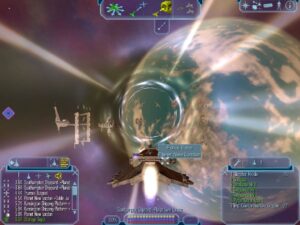
In the meantime, Chris Roberts had picked up the pieces after the disappointment of the Wing Commander movie’s reception and unleashed his prodigious capacity for enthusiasm upon the Freelancer project. As he told gaming magazines and websites throughout 1999 and 2000, his goal was to create a “detailed, dynamic, living world” — or rather a galaxy, in which you could travel from planet to planet in your customized spaceship, doing just about anything you could imagine.

Freelancer is way beyond anything I’ve done in the Wing Commander universe. It’s going to be a fully functioning, living, breathing universe with a whole ecosystem. You can see the promise in something like Privateer, but this is geometrically [exponentially?] beyond that game. It’s like building a city. [?] Compared to Privateer, the scope, the dynamic universe  — it’s all 3D — is much more interesting. There’s much more intrigue the player can get involved in. Everything’s rules-based versus scripted. Commerce happens, trade happens, and piracy happens because of what’s going on in the game universe and not because of scripted events.

Freelancer could be played alone, but would well and truly come alive only when played online, as described by Computer Gaming World:

Freelancer’s multiplayer game will be a massively-multiplayer universe where thousands of players will be able to fly around and interact with each other in a variety of capacities. Digital Anvil envisions a dynamic, socially-oriented game that features the single-player game’s politics and clans as a backdrop. This multiplayer game will also permit you to ally with one of the main houses in the game, or go it alone.

Perhaps the coolest potential feature is the ability to own your own base…

Any of you reading this article who have been following the more recent career of Chris Roberts will readily recognize the themes here. Roberts is not a designer with a huge number of grand conceptual ideas, but once he has one he likes, he holds onto it like a dog does a bone.

Alas, by the summer of 2000 Microsoft was finally running out of patience. Seeing Digital Anvil’s lack of concrete progress toward finishing Freelancer as their fourth anniversary as a studio approached, the mega-corp was becoming restless. Even Erin Roberts seemed to be losing patience with his brother. With Chris’s acquiescence, he set up his own studio in Austin, called Fever Pitch Studios, to finish Digital Anvil’s long back-burnered real-time-strategy game Conquest. It would emerge in August of 2001 under the name of Conquest: Frontier Wars, the second Digital Anvil game that had had to leave its place of birth in order to come to fruition. It would prove no more successful than Starlancer, drowning in a sea of similar games.

Well before then, Microsoft reluctantly concluded that Chris Roberts, the whole reason it had invested so heavily in Digital Anvil in the first place, was the primary reason that the studio couldn’t finish a single game on its own. Still not wanting to raise a scandal the year before the Xbox launched to signal an even deeper commitment to games, it “offered” to buy Roberts out, a transaction which would give it a majority stake in the studio. On December 5, 2000, the press release went out: “Microsoft has reached a preliminary agreement to buy Digital Anvil. The acquisition will strengthen our commitment to producing top-quality PC and Xbox titles.” Roberts was to be given the face-saving ongoing role of “creative consultant” on Freelancer, but the reality was that he had been fired from his own company for his inability to keep to a schedule and hold to a plan. His time at Digital Anvil had resulted in one commercially failed and critically panned movie, plus two games that had had to be sub-contracted out to other developers in order to get them finished; both of them as well had been or would become commercial failures. Yet Chris Roberts walked away from Digital Anvil much wealthier than when he had gone in. He told the press that he would “take some time off to kind of rethink what I want to do in the interactive-entertainment field.” When he was done thinking, he would decide to go back to movies instead of games.

In the meantime, Microsoft installed a new management team down in Austin, with orders to sort through the unfocused sprawl that Freelancer had become and find out if there was a game in there that was worth saving. Perhaps surprisingly, they decided that there was, and turned the project over to a producer named Phil Wattenberger and a lead designer named Jörg Neumann, both Origin Systems alumni who had worked on the old Wing Commander games. At Microsoft’s behest, they steered Freelancer in a slightly more casual direction, making the player’s ship easily — in fact, optimally — controllable using a mouse alone. The mouse-driven approach had actually originated during Roberts’s tenure, but there it had been tied to a customizable and upgradable “Neuronet,” an onboard artificial intelligence that was supposed to let you vibe-sim your way to glory. That got jettisoned, as did many other similarly unwieldy complications. The massively-multiplayer living galaxy, for example, became a single-player or locally multiplayer one that wasn’t quite so living as once envisioned.

When it finally shipped in March of 2003, Freelancer garnered unexpectedly strong reviews; Computer Gaming World called it “the best Chris Roberts space sim Chris Roberts didn’t actually make.” But it wasn’t rewarded commensurately in the marketplace. Even with its newfound accessibility, it was hard for it to shake the odor of an anachronism of the previous decade among gamers in general; meanwhile the dwindling number of TIE Fighter and Freespace enthusiasts had a tendency to reject it for being irredeemably dumbed-down. Instead of marking the beginning of a new era for the space sim, it went down in history as a belated coda: the very last space sim to be put out by a major publisher with real promotional efforts and the hope — unrealized in this case — of relatively high sales behind it.

As for Digital Anvil: it was shut down by Microsoft once and for all in November of 2005, after completing just one more game, a painfully unoriginal Xbox shoot-em-up called Brute Force. Two games finished in almost nine years, neither of them strong sellers; the most remarkable thing about Digital Anvil is that Microsoft allowed it to continue for as long as it did.

By the time his games studio shuffled off this mortal coil, Chris Roberts had been living in Hollywood for a number of years. And he had found a way to do pretty well for himself there, albeit in a role that he had never anticipated going in.


The decade that Chris Roberts spent in Hollywood is undoubtedly the least understood period of his career today, among both his detractors and his partisans. It is no secret why: documentation of his activities during the decade in question is far thinner on the ground than during any other time. Roberts arrived in Hollywood as just another semi-anonymous striver, not as the “game god” who had given the world Wing Commander. No one in Tinsel Town was lining up to interview him, and no one in the press paid all that much attention to what he got up to. Still, we can piece together a picture of his trajectory in which we can have reasonable confidence, even if some of the details remain hazy.

Roberts moved to Hollywood in the spring of 2001 with his windfall from the Digital Anvil buyout burning a hole in his pocket. Notwithstanding the fiasco that had been Wing Commander: The Movie, he still harbored serious ambitions of becoming a director, probably assuming that his ability to finance at least part of the budget of any film he was placed in charge of would give him a leg up. He even brought a preliminary script to show around town. It was called The American Knight, being a cinematic reinterpretation of another computer game: in this case, Origin Systems’s 1995 game Wings of Glory, which was itself yet another variation on the Wing Commander theme, dealing with the life of a World War I fighter ace in the air and on the ground. In an even more marked triumph of hope over experience, Roberts also nursed a dream of making a live-action Wing Commander television series. He founded a production company of his own, called Point of No Return Films, to forward both of these agendas. January of 2002 found Point of No Return at the Sundance Film Festival; according to E! Online, they “threw an after-hours shindig that attracted 250 revelers, with Treach and De La Soul among them.” It really did help Roberts’s cause to have some money to splash around.

But Roberts soon found that the people he met in Hollywood knew Wing Commander, if they knew it at all, only as a misbegotten flop of a film. And they weren’t much more interested in his World War I movie. They were, on the other hand, always ready to talk backroom business with someone who had some number of millions in his pocket, as Roberts did. What followed was a gradual but inexorable pivot away from being a filmmaker and toward being a film enabler, one of those who secured the cash that the creative types needed to do their thing. A watershed was reached in March of 2002, when Point of No Return Films morphed into Ascendant Pictures, whose focus was to be “improving film value in foreign territories (presales), attracting top talent and film projects, and generating equity investment in films.” It wasn’t the romantic life of an auteur, but it did show that Chris Roberts was learning to talk the talk of back-office Hollywood, aided and abetted by a network of more experienced hands that he was assembling around him. Among them was a German immigrant named Ortwin Freyermuth, who would become the most important and enduring business partner of Roberts’s post-Origin career.

Ortwin Freyermuth, right, discusses a director’s cut of Das Boot with the film’s original editor Hannes Nikel circa 1997. Like Chris Roberts, Freyermuth really does love movies.

Freyermuth was renowned in the proverbial smoke-filled rooms of Hollywood for having pioneered an incredibly useful funding model for American films. It hinged on a peculiarity of German tax law that had been intended to encourage local film-making but instead wound up becoming a demonstration of the law of unintended consequences, played out on an international stage. The original rule, as implemented by the German Ministry of Finance in the 1970s, stated that any money that a German resident invested into a film production could be immediately deducted from his or her taxable income as if it was a total loss. It was hoped that this would encourage more well-heeled Germans to invest in homegrown movies, in order to combat the creeping mono-culture of Hollywood and ensure that Germans would have films to see that dealt with contemporary life in their own country. In time, this well-meaning measure would produce just the opposite result.

Enter Ortwin Freyermuth, a lawyer who enrolled at the University of California, Los Angeles, in the mid-1980s to study international copyright law. When he stumbled across the German law I’ve just described in the course of his studies, he noted with no small excitement what it didn’t say: that the films that were deemed eligible for the tax deduction had to be German films. He arranged to fund the 1990 movie The Neverending Story II almost exclusively with German money. This first experiment in the field was not so egregious compared to what would come later, given that the movie was also shot in Germany, albeit using mostly American actors. Then again, it was only a proof of concept. Freyermuth co-founded Capella Films thereafter to make German financing a veritable way of life for Hollywood. “In the best Hollywood tradition,” wrote Variety in 1994, “the company is rife with layers of relationships, both contractual and personal, here and abroad, such that an organizational chart, if one existed, would have more lines and intersections than fractal math.” Such byzantine structures, which had a way of obscuring realities upon which people might otherwise look askance, were standard operating procedure for Freyermuth.

The Freyermuth model spread throughout Hollywood as the 1990s wore on. It seemed like a win-win, both to those in California and to the Germans who were suddenly funding so many of their movies. In some cases, you could just borrow the money you wanted to invest, use your investment to reduce your taxable income dramatically, then pay off the loan from the returns a year or two later. And there was nothing keeping you from doing this over and over, year after year. Large private-equity funds emerged in Germany, pooling the contributions of hundreds of shareholders to invest them in movies, 80 percent of them made outside of the country. These Medienfonds became as ordinary as any other form of financial planning for Herr und Frau Deutschland. They were great for people on the verge of retirement: make an investment just before retiring, then enjoy the return afterward when your tax rate was lower. They were great for spreading out and reducing the tax liability that accompanied a major windfall, great for parents wishing to move money into the hands of their grown children without getting hit by high inheritance taxes. For Hollywood, meanwhile, they turned into a money spigot like no other. Insiders took to calling it “stupid German money,” because the people behind the spigot tended to take it in stride even if the films they were investing in never turned much of a profit. The real point of the investment was the tax relief; any additional profits that emerged were just gravy. The highest tax bracket in Germany at the time was about 51.5 percent. If you were in this tax bracket, then as long as you got at least half of your money back, you came out ahead.

The sheer ubiquity of these media funds placed the German people’s elected representatives in Berlin in a delicate situation; a growing number of their own constituents were benefiting from the current state of the law. Nevertheless, in 1999 the Ministry of Finance made an attempt to stop the madness. It revised the rules to bring them into closer alignment with those that governed other, superficially similar European incentive schemes: to qualify, a film now had to either be made in Germany at least partially or have a German copyright owner. (A law of this sort in Luxembourg was the reason that the Wing Commander movie had been shot in that country.) But stupid German money was now too entrenched as a modus operandi for people on either side of the Atlantic to walk away from it without putting up a fight. Artful dodgers like Ortwin Freyermuth realized that they could sell the copyright to a Hollywood production to a German media fund, whilst inserting into the sales contract a right to buy it back at a future date for an agreed-upon price. Far from being hobbled by the change in law, they realized that they could use it to charge a premium for the tax relief they were providing to the citizens of Germany. For example, the Germans paid $94 million to Paramount Pictures for the copyright to the 2001 videogame adaptation Lara Croft: Tomb Raider. When they sold it back, the Germans were paid only $83.8 million. The tax benefits were so great that it was still worth it. By now, half of all the foreign money pouring into Hollywood was coming from the single country of Germany: $1.1 billion in 2004 alone.

Despite their ongoing popularity among the well-heeled classes, the media funds became more and more controversial in Germany as the young millennium wore on. Germany was, it was more and more loudly complained, effectively subsidizing Hollywood using money that ought to have been going to roads, schools, hospitals, and defense. Stefan Arndt, the producer of the rather wonderful German movies Run Lola Run and Good Bye Lenin!, noted that he had had to go outside his homeland to finance them because his fellow citizens all had their gazes fixed so firmly on Hollywood. “It’s crazy,” he said. “Every other country in the world ties strings to its film subsidies.” Even a group of hardcore Tolkien fans sleeping in line the night of the premiere of The Return of the King, the third film in Peter Jackson’s disproportionately German-funded Lord of the Rings trilogy, thought the situation a little bit absurd when they were told about it: “I don’t think that’s good, because I think that the three films carry themselves, that they put in enough money, that it doesn’t necessarily have to be financed with taxes.”

Whether we wish to see him as a devil tempting a young Faust named Chris Roberts, or just as a savvy man of business who found a mentee he deemed well worth his time, Ortwin Freyermuth showed our once and future game developer how this particular game was played. In April of 2004, Roberts was credited onscreen for the first time in a finished wide-release film as an executive producer. As if to underscore the transition he had made from creator to enabler, it was not a terribly Chris Roberts sort of movie. The Punisher was based on a Marvel Comics character, but it was no family-friendly superhero movie either. It was a grim, dark, and brutally violent revenge fantasy that made Dirty Harry look cute and cuddly. “At the end,” wrote the late great Roger Ebert in his review, “we feel battered down and depressed, emotions we probably don’t seek from comic-book heroes.” Whatever else you can say about Wing Commander, it does care deeply about the nobler human virtues which The Punisher submerges under fountains of blood, even if Chris Roberts is often irredeemably clumsy at presenting them.

Although The Punisher may have had a B-movie attitude, it wasn’t a B-movie, any more than Wing Commander had been. It was made for a budget of $33 million, with a cast that included John Travolta. (Admittedly, he sleepwalks through his performance as if he can barely be bothered to learn his lines, but one can’t have everything.) However joyless fuddy-duddies like yours truly and Roger Ebert may find movies like this, there was and is a market for them. The Punisher earned $20 million more than it had cost to make at the box office even before the long tail of cable-television showings and home-video rentals was factored into the equation.

Chris Roberts was off and running as a backstage Hollywood player. At the Sundance Film Festival in January of 2005, his name could be seen alongside those of George Clooney and Steven Soderbergh among the producer credits for The Jacket, an arty but flawed science-fiction film starring Adrien Brody, Keira Knightley, Kris Kristofferson, and the future Agent 007 Daniel Craig, with a soundtrack by Brian Eno. Again, these names are not the stuff of B-movies.

After The Jacket, Ascendant Pictures graduated from being an ancillary source of funding to becoming one of the primary production houses behind four reasonably high-profile independent features during 2005 and 2006. None of Lord of WarThe Big WhiteAsk the Dust, or Lucky Number Slevin has gone down in film history as a deathless classic. Yet all of them could boast of A-list actors: Nicolas Cage, Jared Leto, Ethan Hawke, Robin Williams, Holly Hunter, Woody Harrelson, Colin Farrell, Salma Hayek, Donald Sutherland, Morgan Freeman, Ben Kingsley, and Bruce Willis can all be found amongst their casts.

As you have probably guessed, all of these films were funded primarily with German money. The aggregate return on them was middling at best. Lord of War and Lucky Number Slevin did pretty well; The Big White and Ask the Dust flopped miserably. As already noted, though, the fact that most of their investors were more concerned about the tax benefits than a more conventional return on investment made this less of an issue than it might otherwise have been. Then, too, like mutual funds on the conventional stock market, the German media funds put money into many movies in order to avoid a single point of failure. A film that became an unexpected hit could easily offset two or three duds.

Chris Roberts had arrived in the Hollywood inner circle — perhaps still the outer edge of the inner circle, but still. He had come a long way from that nerdy bedroom coder who had bumped into an artist from Origin Systems one day in an Austin games shop. Now he was living in a luxury condo in the Hollywood Hills, with one live-in girlfriend and a former one stalking him. (Oddly, it would be the latter whom he would wind up marrying.) I’ve been pretty hard on Roberts in these articles, and I’m afraid I’m going to have to be so again — harder than ever, in fact — before we’re finished. But two things he most definitely is not are stupid or lazy. I wrote at the outset of this pair of articles that few people have ever stretched so thin a thread of creative talent as far as he has. Let me amend that bit of snark now by acknowledging that he could never have done so if he wasn’t smart and driven in a very different sort of way. And let me make it crystal clear as well that nothing I’ve written about Roberts’s tenure in Hollywood so far should necessarily lead us to criticize him in any but the most tempered of ways. In exploiting a loophole in German tax law for all it was worth, he wasn’t doing anything that tons of others — a full-fledged cottage industry worth of them, on both sides of the Atlantic — weren’t also doing. But there’s more to the story in his case. Chris Roberts and Ortwin Freyermuth were actually near the center of one of the biggest financial scandals in modern German history, where dubious ethics crossed over into outright fraud.

Hollywood accounting is never simple. In that spirit, Ascendant Pictures spun off another company not long after its own founding. The wholly-owned subsidiary Rising Star Pictures was created to “closely cooperate with VIP Medienfonds Film and Entertainment”; this was the largest of all the German media funds, which collected almost half a billion Euros every year from its shareholders. Rising Star’s purpose was to be VIP’s anointed agent on the left side of the Atlantic, directing that fire hose of stupid German money around Hollywood. This meant the films of Ascendant, yes, but also those of others, to which Rising Star presumably charged a brokering fee. The final incarnation of Ascendant’s website, which is for some reason still extant, claims that Rising Star was involved in the funding of fourteen films in 2003 alone. A version of their site from March of 2005, accessible today via the Internet Archive’s Wayback Machine, heavily stresses the relationship with VIP, calling Rising Star the latter’s “primary placement agent.” This was a big, big deal, given the sheer quantity of money that VIP was taking in and paying out; more than $250 million came into Rising Star from VIP during 2003. The speed and scale of Chris Roberts’s rise in Hollywood becomes even more impressive when figures like these are taken into consideration.

Andreas Schmid

Unfortunately, Andreas Schmid, the head of VIP, was arrested for tax fraud in Cologne in October of 2005. It seemed that he had not been putting most of the money he collected into movies with even ostensibly German owners, as the law required. At regular intervals, Schmid dutifully gave his shareholders a list of films into which he claimed to have invested their contributions. In actuality, however, VIP used only 20 percent of their money for its advertised purpose of funding movies. Schmid deposited the remaining 80 percent into his bank, either parking it there to earn long-term interest or sending it elsewhere from there, to places where he thought he could get a higher rate of return. He then sent fake earnings reports to his shareholders. By defrauding both the government and his clients in this way, he could make a lot of money for himself and his partners in crime. There is reason to believe that Chris Roberts and Ortwin Freyermuth were among said partners, working the scam with him through Rising Star. I’ll return to that subject shortly.

For now, though, know that Schmid may have gotten so greedy because he knew the jig was soon to be up. Rumors were swirling in both Hollywood and Berlin throughout 2005 that the German Ministry of Finance had just about had enough of watching its tax money fly out of the country. The VIP Media scandal proved the last straw, if one was needed. In November of 2005, just one month after Schmid’s arrest, it was announced that blanket tax write-offs for film investments of any stripe were a thing of the past. Going forward, Hollywood would have to find another golden goose.

Even if they weren’t in on the fix, so to speak, the arrest of Schmid and the elimination of their primary funding mechanism could only have had a deleterious effect on Ascendant Pictures. Just when they had seemed to be hitting the big time, the ground had shifted beneath their feet. Those films that were already paid for by Germans could still be made, but there would be no more like them. The last Ascendant movie from the salad days to emerge from the pipeline was Outlander, their most expensive one ever and arguably also their worst one yet; not released until 2008 due to a whole host of difficulties getting it done, it managed to lose $40 million on a $47 million budget.

Deprived of the golden eggs, Ascendant blundered from lowlight to lowlight. They had to renege on a promise to Kevin Costner to line up the financing for a movie called Taming Ben Taylor, about “a grouchy, divorced man who refuses to sell his failing vineyard to the golf course next door.” Costner, who had been so excited about the movie that he had co-written the screenplay himself, sued Ascendant for $8 million for breach of contract; the case was settled in March of 2008 under undisclosed terms.

The first and only film that Ascendant helped to fund without German money only served to advertise how far down they had come in the world. Keeping with the golf theme, the low-rent Caddyshack ripoff Who’s Your Caddy?, which made Wing Commander look like Hamlet, was released in 2007 and failed to earn back its $7 million budget. It’s best remembered today for an anecdotal report that Bill Clinton loved it. By this point, Ascendant was little more than Chris Roberts and Ortwin Freyermuth; everyone else had jumped ship. (Freyermuth seems genuinely fond of Roberts. He has stuck with him through thick and thin.) The company would nominally continue to exist for another three years, but would shepherd no more movies to completion. Its final notices in the Hollywood trade press were in association with Black Water Transit, a locus of chaos, conflict, and dysfunction that culminated in a film so incoherent that it would never be released.

Over in Germany, Andreas Schmid was convicted and sentenced to six years in prison in November of 2007. Yet the fallout from the VIP scandal was still ongoing. Shortly after his conviction in criminal court, 250 former shareholders in his fund, from whom the German government was aggressively demanding the taxes they ought to have paid earlier, launched a civil lawsuit against Schmid and the UniCredit Bank of Munich, where he had been depositing the money he claimed was being used to fund movies. The case hinged on a single deceptively simple question: had the information that Schmid sent to his shareholders in the reports issued by his fund been knowingly falsified? Some of the documents from these court proceedings, which would be decided in favor of the plaintiffs on December 30, 2011, can be accessed online at the German Ministry of Justice. I’ve spent some time going over them in the hope of learning more about the role played by Roberts and Freyermuth.

It’s been a challenge because the documents in question are not the trial transcripts, transcripts of witness interviews, nor the detailed briefs one might wish to have. They are rather strictly procedural documents, used by the court to schedule its sessions, outline the arguments being made before it, and handle the other logistics of the proceedings. Nonetheless, they contain some tantalizing tidbits that point more in the direction of Roberts and Freyermuth as co-conspirators with Schmid than as his innocent victims. I’ll tell you now what I’ve been able to glean from them as a non-lawyer and non-accountant. I’ve also made them available for download from this site, for any readers who might happen to have a more nuanced command of the German language and German law than I do.

The claimants in the lawsuit show great interest in Ascendant’s daughter company Rising Star, which they believe had no legitimate reason for existing at all, a judgment which is confirmed by the court in a preliminary draft of the final ruling. A document dated June 27, 2008, contains the startling charge that Rising Star “never produced films, but were merely an intermediary layer used for concealment,”[1]Diese produzierten nie Filme, sondern waren lediglich eine zur Verschleierung eingeschaltete Zwischenebene. citing emails written by Chris Roberts and Ortwin Freyermuth to Andreas Schmid between 2003 and 2005 that have been submitted into evidence. (Sadly, they are not included among these papers.) Another document, dated May 15, 2009, calls Rising Star “an artificially imposed layer.”[2]Eine künstlich dazwischen geschaltete Ebene. The final judgment concludes that Rising Star was an essential conduit of the fraud. What with Rising Star being “the primary placement agency for VIP,” as was acknowledged on the Ascendant website, all of the money passed through it. But instead of putting the entirety of the money into movies, it only used 20 percent of it for that purpose, funneling the rest of it back to the UniCredit Bank of Munich, Andreas Schmid’s co-defendant in the shareholder lawsuit. Even the 20 percent that stayed in Hollywood was placed with other production companies that took over the responsibility of overseeing the actual movies. Rising Star, in other words, was nothing but a shell company, a false front for getting the money from the investment fund into Schmid’s bank.

Both Roberts and Freyermuth were interviewed at least once, presumably in the United States, by investigators from the Munich Public Prosecutor’s Office; this must have been done in the run-up to Schmid’s earlier, criminal trial. They were witnesses in that trial rather than defendants, yet the facts from their testimony that are cited here leave one wondering why that should be the case. From a document dated May 15, 2009: “The structure provided by VIP was a ‘pro forma transaction,’ solely intended to achieve a certain tax advantage. This was also explained by witness Freyermuth.”[3]Die von VIP vorgegebene Struktur sei ein „Pro-Forma-Geschäft“ gewesen, alleine mit der Zielsetzung einen gewissen Steuervorteil zu erreichen. Dies habe auch der Zeuge Freyermuth so erläutert. The claimants cite the testimony of Roberts and Freyermuth as evidence that “the fund managers therefore instructed their American partners to submit inflated estimates.”[4]Die Fondsverantwortlichen hätten deshalb ihre amerikanischen Partner veranlasst, überhöhte Schätzungen abzugeben. Likewise, it is written that Roberts and Freyermuth confessed to a falsified “profit distribution for the film Perfume: The Story of a Murderer, which, according to the fund’s information, was 45 percent produced by VIP. In reality, the profit distribution did not correspond to the alleged 45-percent co-production share; it was significantly less favorable.”[5]Insoweit greift die Klageseite auf eine Gewinnverteilung (sog „waterfall“) für den Film „Das Parfum“ zurück, der nach den Fondsangaben zu 45 % von VIP 4 produziert worden sei (sog. Coproduktion). Tatsächlich habe die Gewinnverteilung keinesfalls dem angeblichen Co.-Produktionsanteil von 45 % entsprochen, sie sei wesentlich ungünstiger gewesen. Even with the most open of minds, it is very hard to read statements like this and conclude that Chris Roberts and Ortwin Freyermuth were anything other than active, willing co-conspirators in a large-scale, concerted fraud perpetrated on German investors and ordinary taxpayers.

In a document dated May 17, 2010, it is stated that Freyermuth and Roberts are being summoned to appear as witnesses before this court, on the morning and afternoon respectively of July 16, 2010. But a report dated July 8, 2010, states that “the hearing scheduled for July 16, 2010, is cancelled after witness Freyermuth informed the court that he could not appear on such short notice, and the summons for witness Chris Roberts was returned to the court as undeliverable.”[6]Der Termin vom 16. Juli 2010 wird aufgehoben, nachdem der Zeuge Freyermuth mitgeteilt hat, nicht so kurzfristig erscheinen zu können, und die Ladung des Zeugen Chris Roberts als unzustellbar wieder in den Gerichtseinlauf gekommen ist. On August 3, 2010, the court states that they will be ordered to appear again, this time on September 20, 2010, saying that Freyermuth will be told to inform Roberts, who apparently still cannot be reached, about the summons.[7]Zu diesem Termin sind die Zeugen Freyermuth und Roberts, letzterer über Freyermuth, zu laden. However, the paper trail ends there. It seems most likely that the two never did come to Munich to answer questions before the court.

Assuming all of this really is as bad as it looks, the final question we are left with is why and how Roberts and Freyermuth escaped prosecution. This question I cannot even begin to answer, other than to say that international prosecutions for financial malfeasance are notoriously difficult to coordinate and carry off. Perhaps the German authorities decided they had the ringleader in Andreas Schmid, and that was good enough. Perhaps Roberts and Freyermuth were given immunity in return for their testimony about the mechanics of the fraud in the United States. Or maybe there were some extenuating circumstances of which I am not aware, hard as it is to imagine what they might be.

In July of 2010, Roberts and Freyermuth sold Ascendant Pictures and all of its intellectual property to a film studio, film school, film distributor, real-estate developer, venture-capital house, and children’s charity — never put all your eggs in one basket! — called Bigfoot, located in, of all places, the Philippines. Roberts had left Hollywood some weeks or months before this transaction was finalized; thus the undeliverable court summons from Germany, addressed to the old Ascendant office. I do not know whether or how much he and Freyermuth ended up profiting personally from the VIP Media affair when all was said and done. I can only say that he does not seem to have been a poor man when he moved back to Austin to think about his next steps in life.


Most of you probably know what Chris Roberts got up to after leaving Hollywood, but a brief precis may be in order by way of conclusion, given that it will be many years at best before we meet him again in these histories.

Man of good timing that he was, Roberts started looking for fresh opportunities just as the new Kickstarter crowd-funding platform was tempting dozens of figures from the old days of gaming to launch new projects. In 2012, he joined together with a number of his earlier business partners, from both Digital Anvil and Ascendant Pictures — Erin Roberts, Tony Zurovec, and Ortwin Freyermuth were all among them — to found Cloud Imperium Games and kick-start Star Citizen, the “virtual life in space” game that he had once thought Freelancer would become. Brilliantly executed from a promotional standpoint, it turned into the biggest crowd-funded game ever, raising hundreds of millions of dollars.

As of this writing, thirteen years later, Star Citizen is officially still in the early alpha stage of development, although it is actively played every day by tens of thousands of subscribers who are willing to pay for the privilege. A single-player variant called Squadron 42 — the Starlancer to Star Citizen’Freelancer — was originally slated for release in 2014, and is thus now eleven years behind schedule. Cloud Imperium promises that it is coming soon. (If and when it finally does surface, it will include motion-captured footage, shot in 2015, of Mark Hamill, Gillian Anderson, Andy Serkis, and Gary Oldman.)

Having long since exhausted its initial rounds of crowd-funding, Cloud Imperium now pays its bills largely through pay-to-win schemes involving in-game spaceships and other equipment, often exorbitantly priced; Ars Technica reported in January of 2024 that buying the full hangar of ships would set up you back a cool $48,000, almost enough to make you start looking around for the real spaceship in the deal. By any standard, the amount of money Cloud Imperium has brought in over the years is staggering. Assuming the whole thing doesn’t implode in the coming months, Star Citizen seems set to become the world’s first $1-billion videogame. While we wait, Wing Commander IV, the last game Chris Roberts actually finished, looks forward to its swift-approaching 30-year anniversary.

Naturally, all of this has made Cloud Imperium and Chris Roberts himself magnets for controversy. The loyal fans who continue to log on every day insist that the scale of what Star Citizen is trying to achieve is so enormous that the time and money being spent on it are unavoidable. Others accuse the game of being nothing but a giant scam, of a size and shameless audacity that would put a twinkle in even Andreas Schmid’s jaundiced eyes. Some of those who think the truth is most likely somewhere in between these extremes — a group that includes me — wonder if we should really be encouraging people to upload so much of their existence into a game in the first place. It seems to me that games that are meant to be enjoyed in the real world are healthier than those that set themselves up as a replacement for it.

Even if everything about Star Citizen is on the up-and-up, it’s difficult to avoid the conclusion that breathtaking incompetence has played as big a part as over-ambition in running up the budget and pushing out the timeline. I tend to suspect that some sort of spectacular collapse is more probable than a triumphant version 1.0 as the climax of the Star Citizen saga. But we shall see… we shall see. Either way, I have a feeling that Chris Roberts will emerge unscathed. Some guys just have all the luck, don’t they?


Did you enjoy this article? If so, please think about pitching in to help me make many more like it. You can pledge any amount you like.


SourcesComputer Gaming World of November 1999, August 2000, and May 2003; PC Gamer of November 2000; Los Angeles Times of August 14 2008; Der Spiegel of June 13 1993; Variety of February 24 1994 and November 13 2007; Los Angeles Daily News of March 5 2008; Billboard of April 19 2005, May 10 2005, September 20 2005, October 4 2005, and October 11 2005; Austin Business Journal of April 20 2001; Die Welt of December 6 2009; Deutsches Ärzteblatt of May 2 2003; New York Times of December 13 2004; Forbes of May 31 2019.

Online sources about games include a 2002 Wing Commander retrospective by the German website PC Player Forever; a 2000 GameSpot interview with Chris Roberts; Freelancer previews on ActionTrip and Games Domain; the old Freelancer News site; and the GameSpot review of Freelancer. Vintage reports of Digital Anvil’s acquisition by Microsoft can be found on GameSpotIGN, Microsoft’s home page, and EuroGamer.

Online sources about movies include “Send in the Clowns (But Beware of Their Funny Money)” by Doug Richardson, Roger Ebert’s review of The Punisher, a profile of Ortwin Freyermuth at Alumniportal Deutschland, “How to Finance a Hollywood Blockbuster” and “Hollywood’s Big Loss” by Edward Jay Epstein at Slate, the current zombie version of Ascendant’s website and the more incriminating 2005 version, Bigfoot’s 2011-vintage websiteE! Online’s report from the 2002 Sundance festival, “Medienfonds als ‘Stupid German Money'” by Dr. Matthias Kurp at Medienmaerkte.de, “Filmfonds für Reiche” at ansTageslicht.de, “Was sind Medienfonds?” at Investoren Beteiligung, and “Stupid German Money” by Günter Jagenburg at Deutschlandfunk. I made extensive use of the Wing Commander Combat Information Center, and especially its voluminous news archives that stretch all the way back to 1998.

As noted above, I’ve made the documents I found relating to Rising Star in the class-action lawsuit against Andreas Schmid available for local download. By all means, German speakers, dive in and tell me if you can find anything I’ve missed! I retrieved them from the official German Federal Gazette, or Bundesanzeiger.

My invaluable cheat sheet for this article, as for the last, was “The Chris Roberts Theory of Everything” by Nick Monroe from Gameranx.

But my superhero and secret weapon was our own stalwart commenter Busca, who used his far greater familiarity with the German Web and the German language to find most of the German-language sources shown above, and even provided some brief summaries of their content for orientation purposes. I owe him a huge debt of gratitude. Do note, however, that the buck stops with me as far as factual accuracy goes, and that all of the opinions and conclusions expressed in this article are strictly my own.

Footnotes

Footnotes
1 Diese produzierten nie Filme, sondern waren lediglich eine zur Verschleierung eingeschaltete Zwischenebene.
2 Eine künstlich dazwischen geschaltete Ebene.
3 Die von VIP vorgegebene Struktur sei ein „Pro-Forma-Geschäft“ gewesen, alleine mit der Zielsetzung einen gewissen Steuervorteil zu erreichen. Dies habe auch der Zeuge Freyermuth so erläutert.
4 Die Fondsverantwortlichen hätten deshalb ihre amerikanischen Partner veranlasst, überhöhte Schätzungen abzugeben.
5 Insoweit greift die Klageseite auf eine Gewinnverteilung (sog „waterfall“) für den Film „Das Parfum“ zurück, der nach den Fondsangaben zu 45 % von VIP 4 produziert worden sei (sog. Coproduktion). Tatsächlich habe die Gewinnverteilung keinesfalls dem angeblichen Co.-Produktionsanteil von 45 % entsprochen, sie sei wesentlich ungünstiger gewesen.
6 Der Termin vom 16. Juli 2010 wird aufgehoben, nachdem der Zeuge Freyermuth mitgeteilt hat, nicht so kurzfristig erscheinen zu können, und die Ladung des Zeugen Chris Roberts als unzustellbar wieder in den Gerichtseinlauf gekommen ist.
7 Zu diesem Termin sind die Zeugen Freyermuth und Roberts, letzterer über Freyermuth, zu laden.


Tags: , , , , , ,