
With the Wing Commander movie having gone down in flames, there was nothing left for Chris Roberts and the rest of Digital Anvil to do but go back to making games. This undoubtedly pleased Microsoft, which had been waiting for some return on its generous investment in what it had thought was a new games studio for more than two years now. Yet Microsoft must have been considerably less pleased by the actual states of the game projects being undertaken by Digital Anvil. For they rather belied Roberts’s repeated assurances that doing the special effects for the movie wouldn’t affect the games at all. Of the five game projects that had been begun before the movies came calling, Robert Rodriguez’s Tribe had ended with his departure and Highway Knight had also been quietly abandoned. Two of the other projects — the real-time-strategy game Conquest and the crazily ambitious alternative-life-in-a-box Freelancer — were spinning their wheels with no firm timetable.
That did at least leave Starlancer to stand out as a rare example of good sense. At the height of his brother’s movie mania, Erin Roberts had flown to Britain, to place his Starlancer design documents in the hands of a new outfit called Warthog, located in the Robertses’ old hometown of Manchester. The first tangible product to result from Microsoft’s investment in Digital Anvil would thus come from a sub-contractor rather than from the studio itself.

Starlancer shipped in April of 2000, whereupon it became clear that, while Warthog had done a competent job with it, they hadn’t been able to make it feel fresh or exciting. “An interest-killing combination of ennui and déjà vu snakes through the whole endeavor,” wrote Computer Gaming World. In terms of presentation, it most resembled a higher-resolution version of Wing Commander II, the last game in the series before digitized human actors entered the picture. It too made do with straightforward mission briefings and the occasional computer-generated cutscene. By no means ought this to have been an automatically bad thing. Yet Starlancer lacked the spark that might have let it challenge the previous year’s Freespace 2 for the title of the 1990s space sim’s crowning glory. It sold like the afterthought it felt like.
In the meantime, Chris Roberts had picked up the pieces after the disappointment of the Wing Commander movie’s reception and unleashed his prodigious capacity for enthusiasm upon the Freelancer project. As he told gaming magazines and websites throughout 1999 and 2000, his goal was to create a “detailed, dynamic, living world” — or rather a galaxy, in which you could travel from planet to planet in your customized spaceship, doing just about anything you could imagine.
Freelancer is way beyond anything I’ve done in the Wing Commander universe. It’s going to be a fully functioning, living, breathing universe with a whole ecosystem. You can see the promise in something like Privateer, but this is geometrically [exponentially?] beyond that game. It’s like building a city. [?] Compared to Privateer, the scope, the dynamic universe — it’s all 3D — is much more interesting. There’s much more intrigue the player can get involved in. Everything’s rules-based versus scripted. Commerce happens, trade happens, and piracy happens because of what’s going on in the game universe and not because of scripted events.
Freelancer could be played alone, but would well and truly come alive only when played online, as described by Computer Gaming World:
Freelancer’s multiplayer game will be a massively-multiplayer universe where thousands of players will be able to fly around and interact with each other in a variety of capacities. Digital Anvil envisions a dynamic, socially-oriented game that features the single-player game’s politics and clans as a backdrop. This multiplayer game will also permit you to ally with one of the main houses in the game, or go it alone.
Perhaps the coolest potential feature is the ability to own your own base…
Any of you reading this article who have been following the more recent career of Chris Roberts will readily recognize the themes here. Roberts is not a designer with a huge number of grand conceptual ideas, but once he has one he likes, he holds onto it like a dog does a bone.
Alas, by the summer of 2000 Microsoft was finally running out of patience. Seeing Digital Anvil’s lack of concrete progress toward finishing Freelancer as their fourth anniversary as a studio approached, the mega-corp was becoming restless. Even Erin Roberts seemed to be losing patience with his brother. With Chris’s acquiescence, he set up his own studio in Austin, called Fever Pitch Studios, to finish Digital Anvil’s long back-burnered real-time-strategy game Conquest. It would emerge in August of 2001 under the name of Conquest: Frontier Wars, the second Digital Anvil game that had had to leave its place of birth in order to come to fruition. It would prove no more successful than Starlancer, drowning in a sea of similar games.
Well before then, Microsoft reluctantly concluded that Chris Roberts, the whole reason it had invested so heavily in Digital Anvil in the first place, was the primary reason that the studio couldn’t finish a single game on its own. Still not wanting to raise a scandal the year before the Xbox launched to signal an even deeper commitment to games, it “offered” to buy Roberts out, a transaction which would give it a majority stake in the studio. On December 5, 2000, the press release went out: “Microsoft has reached a preliminary agreement to buy Digital Anvil. The acquisition will strengthen our commitment to producing top-quality PC and Xbox titles.” Roberts was to be given the face-saving ongoing role of “creative consultant” on Freelancer, but the reality was that he had been fired from his own company for his inability to keep to a schedule and hold to a plan. His time at Digital Anvil had resulted in one commercially failed and critically panned movie, plus two games that had had to be sub-contracted out to other developers in order to get them finished; both of them as well had been or would become commercial failures. Yet Chris Roberts walked away from Digital Anvil much wealthier than when he had gone in. He told the press that he would “take some time off to kind of rethink what I want to do in the interactive-entertainment field.” When he was done thinking, he would decide to go back to movies instead of games.
In the meantime, Microsoft installed a new management team down in Austin, with orders to sort through the unfocused sprawl that Freelancer had become and find out if there was a game in there that was worth saving. Perhaps surprisingly, they decided that there was, and turned the project over to a producer named Phil Wattenberger and a lead designer named Jörg Neumann, both Origin Systems alumni who had worked on the old Wing Commander games. At Microsoft’s behest, they steered Freelancer in a slightly more casual direction, making the player’s ship easily — in fact, optimally — controllable using a mouse alone. The mouse-driven approach had actually originated during Roberts’s tenure, but there it had been tied to a customizable and upgradable “Neuronet,” an onboard artificial intelligence that was supposed to let you vibe-sim your way to glory. That got jettisoned, as did many other similarly unwieldy complications. The massively-multiplayer living galaxy, for example, became a single-player or locally multiplayer one that wasn’t quite so living as once envisioned.
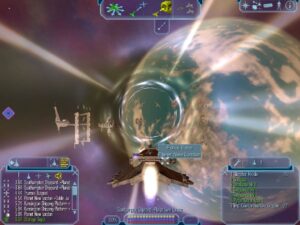
When it finally shipped in March of 2003, Freelancer garnered unexpectedly strong reviews; Computer Gaming World called it “the best Chris Roberts space sim Chris Roberts didn’t actually make.” But it wasn’t rewarded commensurately in the marketplace. Even with its newfound accessibility, it was hard for it to shake the odor of an anachronism of the previous decade among gamers in general; meanwhile the dwindling number of TIE Fighter and Freespace enthusiasts had a tendency to reject it for being irredeemably dumbed-down. Instead of marking the beginning of a new era for the space sim, it went down in history as a belated coda: the very last space sim to be put out by a major publisher with real promotional efforts and the hope — unrealized in this case — of relatively high sales behind it.
As for Digital Anvil: it was shut down by Microsoft once and for all in November of 2005, after completing just one more game, a painfully unoriginal Xbox shoot-em-up called Brute Force. Two games finished in almost nine years, neither of them strong sellers; the most remarkable thing about Digital Anvil is that Microsoft allowed it to continue for as long as it did.
By the time his games studio shuffled off this mortal coil, Chris Roberts had been living in Hollywood for a number of years. And he had found a way to do pretty well for himself there, albeit in a role that he had never anticipated going in.

The decade that Chris Roberts spent in Hollywood is undoubtedly the least understood period of his career today, among both his detractors and his partisans. It is no secret why: documentation of his activities during the decade in question is far thinner on the ground than during any other time. Roberts arrived in Hollywood as just another semi-anonymous striver, not as the “game god” who had given the world Wing Commander. No one in Tinsel Town was lining up to interview him, and no one in the press paid all that much attention to what he got up to. Still, we can piece together a picture of his trajectory in which we can have reasonable confidence, even if some of the details remain hazy.
Roberts moved to Hollywood in the spring of 2001 with his windfall from the Digital Anvil buyout burning a hole in his pocket. Notwithstanding the fiasco that had been Wing Commander: The Movie, he still harbored serious ambitions of becoming a director, probably assuming that his ability to finance at least part of the budget of any film he was placed in charge of would give him a leg up. He even brought a preliminary script to show around town. It was called The American Knight, being a cinematic reinterpretation of another computer game: in this case, Origin Systems’s 1995 game Wings of Glory, which was itself yet another variation on the Wing Commander theme, dealing with the life of a World War I fighter ace in the air and on the ground. In an even more marked triumph of hope over experience, Roberts also nursed a dream of making a live-action Wing Commander television series. He founded a production company of his own, called Point of No Return Films, to forward both of these agendas. January of 2002 found Point of No Return at the Sundance Film Festival; according to E! Online, they “threw an after-hours shindig that attracted 250 revelers, with Treach and De La Soul among them.” It really did help Roberts’s cause to have some money to splash around.
But Roberts soon found that the people he met in Hollywood knew Wing Commander, if they knew it at all, only as a misbegotten flop of a film. And they weren’t much more interested in his World War I movie. They were, on the other hand, always ready to talk backroom business with someone who had some number of millions in his pocket, as Roberts did. What followed was a gradual but inexorable pivot away from being a filmmaker and toward being a film enabler, one of those who secured the cash that the creative types needed to do their thing. A watershed was reached in March of 2002, when Point of No Return Films morphed into Ascendant Pictures, whose focus was to be “improving film value in foreign territories (presales), attracting top talent and film projects, and generating equity investment in films.” It wasn’t the romantic life of an auteur, but it did show that Chris Roberts was learning to talk the talk of back-office Hollywood, aided and abetted by a network of more experienced hands that he was assembling around him. Among them was a German immigrant named Ortwin Freyermuth, who would become the most important and enduring business partner of Roberts’s post-Origin career.
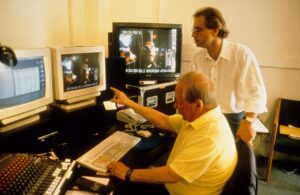
Ortwin Freyermuth, right, discusses a director’s cut of Das Boot with the film’s original editor Hannes Nikel circa 1997. Like Chris Roberts, Freyermuth really does love movies.
Freyermuth was renowned in the proverbial smoke-filled rooms of Hollywood for having pioneered an incredibly useful funding model for American films. It hinged on a peculiarity of German tax law that had been intended to encourage local film-making but instead wound up becoming a demonstration of the law of unintended consequences, played out on an international stage. The original rule, as implemented by the German Ministry of Finance in the 1970s, stated that any money that a German resident invested into a film production could be immediately deducted from his or her taxable income as if it was a total loss. It was hoped that this would encourage more well-heeled Germans to invest in homegrown movies, in order to combat the creeping mono-culture of Hollywood and ensure that Germans would have films to see that dealt with contemporary life in their own country. In time, this well-meaning measure would produce just the opposite result.
Enter Ortwin Freyermuth, a lawyer who enrolled at the University of California, Los Angeles, in the mid-1980s to study international copyright law. When he stumbled across the German law I’ve just described in the course of his studies, he noted with no small excitement what it didn’t say: that the films that were deemed eligible for the tax deduction had to be German films. He arranged to fund the 1990 movie The Neverending Story II almost exclusively with German money. This first experiment in the field was not so egregious compared to what would come later, given that the movie was also shot in Germany, albeit using mostly American actors. Then again, it was only a proof of concept. Freyermuth co-founded Capella Films thereafter to make German financing a veritable way of life for Hollywood. “In the best Hollywood tradition,” wrote Variety in 1994, “the company is rife with layers of relationships, both contractual and personal, here and abroad, such that an organizational chart, if one existed, would have more lines and intersections than fractal math.” Such byzantine structures, which had a way of obscuring realities upon which people might otherwise look askance, were standard operating procedure for Freyermuth.
The Freyermuth model spread throughout Hollywood as the 1990s wore on. It seemed like a win-win, both to those in California and to the Germans who were suddenly funding so many of their movies. In some cases, you could just borrow the money you wanted to invest, use your investment to reduce your taxable income dramatically, then pay off the loan from the returns a year or two later. And there was nothing keeping you from doing this over and over, year after year. Large private-equity funds emerged in Germany, pooling the contributions of hundreds of shareholders to invest them in movies, 80 percent of them made outside of the country. These Medienfonds became as ordinary as any other form of financial planning for Herr und Frau Deutschland. They were great for people on the verge of retirement: make an investment just before retiring, then enjoy the return afterward when your tax rate was lower. They were great for spreading out and reducing the tax liability that accompanied a major windfall, great for parents wishing to move money into the hands of their grown children without getting hit by high inheritance taxes. For Hollywood, meanwhile, they turned into a money spigot like no other. Insiders took to calling it “stupid German money,” because the people behind the spigot tended to take it in stride even if the films they were investing in never turned much of a profit. The real point of the investment was the tax relief; any additional profits that emerged were just gravy. The highest tax bracket in Germany at the time was about 51.5 percent. If you were in this tax bracket, then as long as you got at least half of your money back, you came out ahead.
The sheer ubiquity of these media funds placed the German people’s elected representatives in Berlin in a delicate situation; a growing number of their own constituents were benefiting from the current state of the law. Nevertheless, in 1999 the Ministry of Finance made an attempt to stop the madness. It revised the rules to bring them into closer alignment with those that governed other, superficially similar European incentive schemes: to qualify, a film now had to either be made in Germany at least partially or have a German copyright owner. (A law of this sort in Luxembourg was the reason that the Wing Commander movie had been shot in that country.) But stupid German money was now too entrenched as a modus operandi for people on either side of the Atlantic to walk away from it without putting up a fight. Artful dodgers like Ortwin Freyermuth realized that they could sell the copyright to a Hollywood production to a German media fund, whilst inserting into the sales contract a right to buy it back at a future date for an agreed-upon price. Far from being hobbled by the change in law, they realized that they could use it to charge a premium for the tax relief they were providing to the citizens of Germany. For example, the Germans paid $94 million to Paramount Pictures for the copyright to the 2001 videogame adaptation Lara Croft: Tomb Raider. When they sold it back, the Germans were paid only $83.8 million. The tax benefits were so great that it was still worth it. By now, half of all the foreign money pouring into Hollywood was coming from the single country of Germany: $1.1 billion in 2004 alone.
Despite their ongoing popularity among the well-heeled classes, the media funds became more and more controversial in Germany as the young millennium wore on. Germany was, it was more and more loudly complained, effectively subsidizing Hollywood using money that ought to have been going to roads, schools, hospitals, and defense. Stefan Arndt, the producer of the rather wonderful German movies Run Lola Run and Good Bye Lenin!, noted that he had had to go outside his homeland to finance them because his fellow citizens all had their gazes fixed so firmly on Hollywood. “It’s crazy,” he said. “Every other country in the world ties strings to its film subsidies.” Even a group of hardcore Tolkien fans sleeping in line the night of the premiere of The Return of the King, the third film in Peter Jackson’s disproportionately German-funded Lord of the Rings trilogy, thought the situation a little bit absurd when they were told about it: “I don’t think that’s good, because I think that the three films carry themselves, that they put in enough money, that it doesn’t necessarily have to be financed with taxes.”
Whether we wish to see him as a devil tempting a young Faust named Chris Roberts, or just as a savvy man of business who found a mentee he deemed well worth his time, Ortwin Freyermuth showed our once and future game developer how this particular game was played. In April of 2004, Roberts was credited onscreen for the first time in a finished wide-release film as an executive producer. As if to underscore the transition he had made from creator to enabler, it was not a terribly Chris Roberts sort of movie. The Punisher was based on a Marvel Comics character, but it was no family-friendly superhero movie either. It was a grim, dark, and brutally violent revenge fantasy that made Dirty Harry look cute and cuddly. “At the end,” wrote the late great Roger Ebert in his review, “we feel battered down and depressed, emotions we probably don’t seek from comic-book heroes.” Whatever else you can say about Wing Commander, it does care deeply about the nobler human virtues which The Punisher submerges under fountains of blood, even if Chris Roberts is often irredeemably clumsy at presenting them.
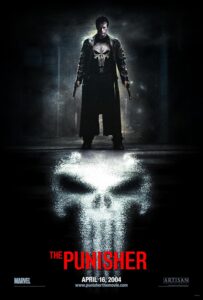
Although The Punisher may have had a B-movie attitude, it wasn’t a B-movie, any more than Wing Commander had been. It was made for a budget of $33 million, with a cast that included John Travolta. (Admittedly, he sleepwalks through his performance as if he can barely be bothered to learn his lines, but one can’t have everything.) However joyless fuddy-duddies like yours truly and Roger Ebert may find movies like this, there was and is a market for them. The Punisher earned $20 million more than it had cost to make at the box office even before the long tail of cable-television showings and home-video rentals was factored into the equation.
Chris Roberts was off and running as a backstage Hollywood player. At the Sundance Film Festival in January of 2005, his name could be seen alongside those of George Clooney and Steven Soderbergh among the producer credits for The Jacket, an arty but flawed science-fiction film starring Adrien Brody, Keira Knightley, Kris Kristofferson, and the future Agent 007 Daniel Craig, with a soundtrack by Brian Eno. Again, these names are not the stuff of B-movies.
After The Jacket, Ascendant Pictures graduated from being an ancillary source of funding to becoming one of the primary production houses behind four reasonably high-profile independent features during 2005 and 2006. None of Lord of War, The Big White, Ask the Dust, or Lucky Number Slevin has gone down in film history as a deathless classic. Yet all of them could boast of A-list actors: Nicolas Cage, Jared Leto, Ethan Hawke, Robin Williams, Holly Hunter, Woody Harrelson, Colin Farrell, Salma Hayek, Donald Sutherland, Morgan Freeman, Ben Kingsley, and Bruce Willis can all be found amongst their casts.
As you have probably guessed, all of these films were funded primarily with German money. The aggregate return on them was middling at best. Lord of War and Lucky Number Slevin did pretty well; The Big White and Ask the Dust flopped miserably. As already noted, though, the fact that most of their investors were more concerned about the tax benefits than a more conventional return on investment made this less of an issue than it might otherwise have been. Then, too, like mutual funds on the conventional stock market, the German media funds put money into many movies in order to avoid a single point of failure. A film that became an unexpected hit could easily offset two or three duds.
Chris Roberts had arrived in the Hollywood inner circle — perhaps still the outer edge of the inner circle, but still. He had come a long way from that nerdy bedroom coder who had bumped into an artist from Origin Systems one day in an Austin games shop. Now he was living in a luxury condo in the Hollywood Hills, with one live-in girlfriend and a former one stalking him. (Oddly, it would be the latter whom he would wind up marrying.) I’ve been pretty hard on Roberts in these articles, and I’m afraid I’m going to have to be so again — harder than ever, in fact — before we’re finished. But two things he most definitely is not are stupid or lazy. I wrote at the outset of this pair of articles that few people have ever stretched so thin a thread of creative talent as far as he has. Let me amend that bit of snark now by acknowledging that he could never have done so if he wasn’t smart and driven in a very different sort of way. And let me make it crystal clear as well that nothing I’ve written about Roberts’s tenure in Hollywood so far should necessarily lead us to criticize him in any but the most tempered of ways. In exploiting a loophole in German tax law for all it was worth, he wasn’t doing anything that tons of others — a full-fledged cottage industry worth of them, on both sides of the Atlantic — weren’t also doing. But there’s more to the story in his case. Chris Roberts and Ortwin Freyermuth were actually near the center of one of the biggest financial scandals in modern German history, where dubious ethics crossed over into outright fraud.
Hollywood accounting is never simple. In that spirit, Ascendant Pictures spun off another company not long after its own founding. The wholly-owned subsidiary Rising Star Pictures was created to “closely cooperate with VIP Medienfonds Film and Entertainment”; this was the largest of all the German media funds, which collected almost half a billion Euros every year from its shareholders. Rising Star’s purpose was to be VIP’s anointed agent on the left side of the Atlantic, directing that fire hose of stupid German money around Hollywood. This meant the films of Ascendant, yes, but also those of others, to which Rising Star presumably charged a brokering fee. The final incarnation of Ascendant’s website, which is for some reason still extant, claims that Rising Star was involved in the funding of fourteen films in 2003 alone. A version of their site from March of 2005, accessible today via the Internet Archive’s Wayback Machine, heavily stresses the relationship with VIP, calling Rising Star the latter’s “primary placement agent.” This was a big, big deal, given the sheer quantity of money that VIP was taking in and paying out; more than $250 million came into Rising Star from VIP during 2003. The speed and scale of Chris Roberts’s rise in Hollywood becomes even more impressive when figures like these are taken into consideration.

Andreas Schmid
Unfortunately, Andreas Schmid, the head of VIP, was arrested for tax fraud in Cologne in October of 2005. It seemed that he had not been putting most of the money he collected into movies with even ostensibly German owners, as the law required. At regular intervals, Schmid dutifully gave his shareholders a list of films into which he claimed to have invested their contributions. In actuality, however, VIP used only 20 percent of their money for its advertised purpose of funding movies. Schmid deposited the remaining 80 percent into his bank, either parking it there to earn long-term interest or sending it elsewhere from there, to places where he thought he could get a higher rate of return. He then sent fake earnings reports to his shareholders. By defrauding both the government and his clients in this way, he could make a lot of money for himself and his partners in crime. There is reason to believe that Chris Roberts and Ortwin Freyermuth were among said partners, working the scam with him through Rising Star. I’ll return to that subject shortly.
For now, though, know that Schmid may have gotten so greedy because he knew the jig was soon to be up. Rumors were swirling in both Hollywood and Berlin throughout 2005 that the German Ministry of Finance had just about had enough of watching its tax money fly out of the country. The VIP Media scandal proved the last straw, if one was needed. In November of 2005, just one month after Schmid’s arrest, it was announced that blanket tax write-offs for film investments of any stripe were a thing of the past. Going forward, Hollywood would have to find another golden goose.
Even if they weren’t in on the fix, so to speak, the arrest of Schmid and the elimination of their primary funding mechanism could only have had a deleterious effect on Ascendant Pictures. Just when they had seemed to be hitting the big time, the ground had shifted beneath their feet. Those films that were already paid for by Germans could still be made, but there would be no more like them. The last Ascendant movie from the salad days to emerge from the pipeline was Outlander, their most expensive one ever and arguably also their worst one yet; not released until 2008 due to a whole host of difficulties getting it done, it managed to lose $40 million on a $47 million budget.
Deprived of the golden eggs, Ascendant blundered from lowlight to lowlight. They had to renege on a promise to Kevin Costner to line up the financing for a movie called Taming Ben Taylor, about “a grouchy, divorced man who refuses to sell his failing vineyard to the golf course next door.” Costner, who had been so excited about the movie that he had co-written the screenplay himself, sued Ascendant for $8 million for breach of contract; the case was settled in March of 2008 under undisclosed terms.

The first and only film that Ascendant helped to fund without German money only served to advertise how far down they had come in the world. Keeping with the golf theme, the low-rent Caddyshack ripoff Who’s Your Caddy?, which made Wing Commander look like Hamlet, was released in 2007 and failed to earn back its $7 million budget. It’s best remembered today for an anecdotal report that Bill Clinton loved it. By this point, Ascendant was little more than Chris Roberts and Ortwin Freyermuth; everyone else had jumped ship. (Freyermuth seems genuinely fond of Roberts. He has stuck with him through thick and thin.) The company would nominally continue to exist for another three years, but would shepherd no more movies to completion. Its final notices in the Hollywood trade press were in association with Black Water Transit, a locus of chaos, conflict, and dysfunction that culminated in a film so incoherent that it would never be released.
Over in Germany, Andreas Schmid was convicted and sentenced to six years in prison in November of 2007. Yet the fallout from the VIP scandal was still ongoing. Shortly after his conviction in criminal court, 250 former shareholders in his fund, from whom the German government was aggressively demanding the taxes they ought to have paid earlier, launched a civil lawsuit against Schmid and the UniCredit Bank of Munich, where he had been depositing the money he claimed was being used to fund movies. The case hinged on a single deceptively simple question: had the information that Schmid sent to his shareholders in the reports issued by his fund been knowingly falsified? Some of the documents from these court proceedings, which would be decided in favor of the plaintiffs on December 30, 2011, can be accessed online at the German Ministry of Justice. I’ve spent some time going over them in the hope of learning more about the role played by Roberts and Freyermuth.
It’s been a challenge because the documents in question are not the trial transcripts, transcripts of witness interviews, nor the detailed briefs one might wish to have. They are rather strictly procedural documents, used by the court to schedule its sessions, outline the arguments being made before it, and handle the other logistics of the proceedings. Nonetheless, they contain some tantalizing tidbits that point more in the direction of Roberts and Freyermuth as co-conspirators with Schmid than as his innocent victims. I’ll tell you now what I’ve been able to glean from them as a non-lawyer and non-accountant. I’ve also made them available for download from this site, for any readers who might happen to have a more nuanced command of the German language and German law than I do.
The claimants in the lawsuit show great interest in Ascendant’s daughter company Rising Star, which they believe had no legitimate reason for existing at all, a judgment which is confirmed by the court in a preliminary draft of the final ruling. A document dated June 27, 2008, contains the startling charge that Rising Star “never produced films, but were merely an intermediary layer used for concealment,”[1]Diese produzierten nie Filme, sondern waren lediglich eine zur Verschleierung eingeschaltete Zwischenebene. citing emails written by Chris Roberts and Ortwin Freyermuth to Andreas Schmid between 2003 and 2005 that have been submitted into evidence. (Sadly, they are not included among these papers.) Another document, dated May 15, 2009, calls Rising Star “an artificially imposed layer.”[2]Eine künstlich dazwischen geschaltete Ebene. The final judgment concludes that Rising Star was an essential conduit of the fraud. What with Rising Star being “the primary placement agency for VIP,” as was acknowledged on the Ascendant website, all of the money passed through it. But instead of putting the entirety of the money into movies, it only used 20 percent of it for that purpose, funneling the rest of it back to the UniCredit Bank of Munich, Andreas Schmid’s co-defendant in the shareholder lawsuit. Even the 20 percent that stayed in Hollywood was placed with other production companies that took over the responsibility of overseeing the actual movies. Rising Star, in other words, was nothing but a shell company, a false front for getting the money from the investment fund into Schmid’s bank.
Both Roberts and Freyermuth were interviewed at least once, presumably in the United States, by investigators from the Munich Public Prosecutor’s Office; this must have been done in the run-up to Schmid’s earlier, criminal trial. They were witnesses in that trial rather than defendants, yet the facts from their testimony that are cited here leave one wondering why that should be the case. From a document dated May 15, 2009: “The structure provided by VIP was a ‘pro forma transaction,’ solely intended to achieve a certain tax advantage. This was also explained by witness Freyermuth.”[3]Die von VIP vorgegebene Struktur sei ein „Pro-Forma-Geschäft“ gewesen, alleine mit der Zielsetzung einen gewissen Steuervorteil zu erreichen. Dies habe auch der Zeuge Freyermuth so erläutert. The claimants cite the testimony of Roberts and Freyermuth as evidence that “the fund managers therefore instructed their American partners to submit inflated estimates.”[4]Die Fondsverantwortlichen hätten deshalb ihre amerikanischen Partner veranlasst, überhöhte Schätzungen abzugeben. Likewise, it is written that Roberts and Freyermuth confessed to a falsified “profit distribution for the film Perfume: The Story of a Murderer, which, according to the fund’s information, was 45 percent produced by VIP. In reality, the profit distribution did not correspond to the alleged 45-percent co-production share; it was significantly less favorable.”[5]Insoweit greift die Klageseite auf eine Gewinnverteilung (sog „waterfall“) für den Film „Das Parfum“ zurück, der nach den Fondsangaben zu 45 % von VIP 4 produziert worden sei (sog. Coproduktion). Tatsächlich habe die Gewinnverteilung keinesfalls dem angeblichen Co.-Produktionsanteil von 45 % entsprochen, sie sei wesentlich ungünstiger gewesen. Even with the most open of minds, it is very hard to read statements like this and conclude that Chris Roberts and Ortwin Freyermuth were anything other than active, willing co-conspirators in a large-scale, concerted fraud perpetrated on German investors and ordinary taxpayers.
In a document dated May 17, 2010, it is stated that Freyermuth and Roberts are being summoned to appear as witnesses before this court, on the morning and afternoon respectively of July 16, 2010. But a report dated July 8, 2010, states that “the hearing scheduled for July 16, 2010, is cancelled after witness Freyermuth informed the court that he could not appear on such short notice, and the summons for witness Chris Roberts was returned to the court as undeliverable.”[6]Der Termin vom 16. Juli 2010 wird aufgehoben, nachdem der Zeuge Freyermuth mitgeteilt hat, nicht so kurzfristig erscheinen zu können, und die Ladung des Zeugen Chris Roberts als unzustellbar wieder in den Gerichtseinlauf gekommen ist. On August 3, 2010, the court states that they will be ordered to appear again, this time on September 20, 2010, saying that Freyermuth will be told to inform Roberts, who apparently still cannot be reached, about the summons.[7]Zu diesem Termin sind die Zeugen Freyermuth und Roberts, letzterer über Freyermuth, zu laden. However, the paper trail ends there. It seems most likely that the two never did come to Munich to answer questions before the court.
Assuming all of this really is as bad as it looks, the final question we are left with is why and how Roberts and Freyermuth escaped prosecution. This question I cannot even begin to answer, other than to say that international prosecutions for financial malfeasance are notoriously difficult to coordinate and carry off. Perhaps the German authorities decided they had the ringleader in Andreas Schmid, and that was good enough. Perhaps Roberts and Freyermuth were given immunity in return for their testimony about the mechanics of the fraud in the United States. Or maybe there were some extenuating circumstances of which I am not aware, hard as it is to imagine what they might be.
In July of 2010, Roberts and Freyermuth sold Ascendant Pictures and all of its intellectual property to a film studio, film school, film distributor, real-estate developer, venture-capital house, and children’s charity — never put all your eggs in one basket! — called Bigfoot, located in, of all places, the Philippines. Roberts had left Hollywood some weeks or months before this transaction was finalized; thus the undeliverable court summons from Germany, addressed to the old Ascendant office. I do not know whether or how much he and Freyermuth ended up profiting personally from the VIP Media affair when all was said and done. I can only say that he does not seem to have been a poor man when he moved back to Austin to think about his next steps in life.

Most of you probably know what Chris Roberts got up to after leaving Hollywood, but a brief precis may be in order by way of conclusion, given that it will be many years at best before we meet him again in these histories.
Man of good timing that he was, Roberts started looking for fresh opportunities just as the new Kickstarter crowd-funding platform was tempting dozens of figures from the old days of gaming to launch new projects. In 2012, he joined together with a number of his earlier business partners, from both Digital Anvil and Ascendant Pictures — Erin Roberts, Tony Zurovec, and Ortwin Freyermuth were all among them — to found Cloud Imperium Games and kick-start Star Citizen, the “virtual life in space” game that he had once thought Freelancer would become. Brilliantly executed from a promotional standpoint, it turned into the biggest crowd-funded game ever, raising hundreds of millions of dollars.
As of this writing, thirteen years later, Star Citizen is officially still in the early alpha stage of development, although it is actively played every day by tens of thousands of subscribers who are willing to pay for the privilege. A single-player variant called Squadron 42 — the Starlancer to Star Citizen’s Freelancer — was originally slated for release in 2014, and is thus now eleven years behind schedule. Cloud Imperium promises that it is coming soon. (If and when it finally does surface, it will include motion-captured footage, shot in 2015, of Mark Hamill, Gillian Anderson, Andy Serkis, and Gary Oldman.)
Having long since exhausted its initial rounds of crowd-funding, Cloud Imperium now pays its bills largely through pay-to-win schemes involving in-game spaceships and other equipment, often exorbitantly priced; Ars Technica reported in January of 2024 that buying the full hangar of ships would set up you back a cool $48,000, almost enough to make you start looking around for the real spaceship in the deal. By any standard, the amount of money Cloud Imperium has brought in over the years is staggering. Assuming the whole thing doesn’t implode in the coming months, Star Citizen seems set to become the world’s first $1-billion videogame. While we wait, Wing Commander IV, the last game Chris Roberts actually finished, looks forward to its swift-approaching 30-year anniversary.
Naturally, all of this has made Cloud Imperium and Chris Roberts himself magnets for controversy. The loyal fans who continue to log on every day insist that the scale of what Star Citizen is trying to achieve is so enormous that the time and money being spent on it are unavoidable. Others accuse the game of being nothing but a giant scam, of a size and shameless audacity that would put a twinkle in even Andreas Schmid’s jaundiced eyes. Some of those who think the truth is most likely somewhere in between these extremes — a group that includes me — wonder if we should really be encouraging people to upload so much of their existence into a game in the first place. It seems to me that games that are meant to be enjoyed in the real world are healthier than those that set themselves up as a replacement for it.
Even if everything about Star Citizen is on the up-and-up, it’s difficult to avoid the conclusion that breathtaking incompetence has played as big a part as over-ambition in running up the budget and pushing out the timeline. I tend to suspect that some sort of spectacular collapse is more probable than a triumphant version 1.0 as the climax of the Star Citizen saga. But we shall see… we shall see. Either way, I have a feeling that Chris Roberts will emerge unscathed. Some guys just have all the luck, don’t they?
Did you enjoy this article? If so, please think about pitching in to help me make many more like it. You can pledge any amount you like.

Sources: Computer Gaming World of November 1999, August 2000, and May 2003; PC Gamer of November 2000; Los Angeles Times of August 14 2008; Der Spiegel of June 13 1993; Variety of February 24 1994 and November 13 2007; Los Angeles Daily News of March 5 2008; Billboard of April 19 2005, May 10 2005, September 20 2005, October 4 2005, and October 11 2005; Austin Business Journal of April 20 2001; Die Welt of December 6 2009; Deutsches Ärzteblatt of May 2 2003; New York Times of December 13 2004; Forbes of May 31 2019.
Online sources about games include a 2002 Wing Commander retrospective by the German website PC Player Forever; a 2000 GameSpot interview with Chris Roberts; Freelancer previews on ActionTrip and Games Domain; the old Freelancer News site; and the GameSpot review of Freelancer. Vintage reports of Digital Anvil’s acquisition by Microsoft can be found on GameSpot, IGN, Microsoft’s home page, and EuroGamer.
Online sources about movies include “Send in the Clowns (But Beware of Their Funny Money)” by Doug Richardson, Roger Ebert’s review of The Punisher, a profile of Ortwin Freyermuth at Alumniportal Deutschland, “How to Finance a Hollywood Blockbuster” and “Hollywood’s Big Loss” by Edward Jay Epstein at Slate, the current zombie version of Ascendant’s website and the more incriminating 2005 version, Bigfoot’s 2011-vintage website, E! Online’s report from the 2002 Sundance festival, “Medienfonds als ‘Stupid German Money'” by Dr. Matthias Kurp at Medienmaerkte.de, “Filmfonds für Reiche” at ansTageslicht.de, “Was sind Medienfonds?” at Investoren Beteiligung, and “Stupid German Money” by Günter Jagenburg at Deutschlandfunk. I made extensive use of the Wing Commander Combat Information Center, and especially its voluminous news archives that stretch all the way back to 1998.
As noted above, I’ve made the documents I found relating to Rising Star in the class-action lawsuit against Andreas Schmid available for local download. By all means, German speakers, dive in and tell me if you can find anything I’ve missed! I retrieved them from the official German Federal Gazette, or Bundesanzeiger.
My invaluable cheat sheet for this article, as for the last, was “The Chris Roberts Theory of Everything” by Nick Monroe from Gameranx.
But my superhero and secret weapon was our own stalwart commenter Busca, who used his far greater familiarity with the German Web and the German language to find most of the German-language sources shown above, and even provided some brief summaries of their content for orientation purposes. I owe him a huge debt of gratitude. Do note, however, that the buck stops with me as far as factual accuracy goes, and that all of the opinions and conclusions expressed in this article are strictly my own.
Footnotes
| ↑1 | Diese produzierten nie Filme, sondern waren lediglich eine zur Verschleierung eingeschaltete Zwischenebene. |
|---|---|
| ↑2 | Eine künstlich dazwischen geschaltete Ebene. |
| ↑3 | Die von VIP vorgegebene Struktur sei ein „Pro-Forma-Geschäft“ gewesen, alleine mit der Zielsetzung einen gewissen Steuervorteil zu erreichen. Dies habe auch der Zeuge Freyermuth so erläutert. |
| ↑4 | Die Fondsverantwortlichen hätten deshalb ihre amerikanischen Partner veranlasst, überhöhte Schätzungen abzugeben. |
| ↑5 | Insoweit greift die Klageseite auf eine Gewinnverteilung (sog „waterfall“) für den Film „Das Parfum“ zurück, der nach den Fondsangaben zu 45 % von VIP 4 produziert worden sei (sog. Coproduktion). Tatsächlich habe die Gewinnverteilung keinesfalls dem angeblichen Co.-Produktionsanteil von 45 % entsprochen, sie sei wesentlich ungünstiger gewesen. |
| ↑6 | Der Termin vom 16. Juli 2010 wird aufgehoben, nachdem der Zeuge Freyermuth mitgeteilt hat, nicht so kurzfristig erscheinen zu können, und die Ladung des Zeugen Chris Roberts als unzustellbar wieder in den Gerichtseinlauf gekommen ist. |
| ↑7 | Zu diesem Termin sind die Zeugen Freyermuth und Roberts, letzterer über Freyermuth, zu laden. |









Alexander Smith
December 5, 2025 at 6:35 pm
“featuring not only Mark Hamill as good old Commander Blair”
I stay away from all the Star Citizen nonsense, so someone can correct me if I am wrong, but I don’t think Hamill is technically reprising that role, which is tied to the Wing Commander IP that Roberts does not possess. I suspect whatever fighter pilot he is playing will be eerily similar, but that is not quite the same thing.
Jimmy Maher
December 5, 2025 at 6:49 pm
Yes. Pure brain misfire on my part. Thanks!
Throteka
December 5, 2025 at 6:39 pm
Maher, have you got your hands on Neal Hallford’s Heroes 30th Anniversary Retrospective book?
https://www.amazon.com/Heroes-Might-Magic-Anniversary-Retrospective/dp/150675130X
It’s lavishly produced, and an amazing source of interviews on the whole history of Might & Magic and Heroes, a must-read!
>Conquest: Frontier Wars:
What doesn’t stand out about the game is its sci-fi premise (humans vs. bugs vs. energy beings, where had we heard this before?) and rote humor.
Mechanics-wise, it’s actually an interesting unique game that tackles interstellar space warfare in a 2D top-down RTS with its own mechanical flourishes, more inspired and innovative than, say, Star Trek: Armada (which probably sold better on the back of its license).
Its new ideas include orbital stations as RTS buildings, wormhole-linked maps,and assigning admiral characters to control groups.
In 2017, they actually attempted an unsuccessful Kickstarter to revive its canceled sequel.
https://www.kicktraq.com/projects/1869102574/conquest-2-vyrium-uprising-rts-fans-unite/
https://steamcommunity.com/app/578670/discussions/0/2217311444332258343/
Jimmy Maher
December 5, 2025 at 6:51 pm
The book looks like something I would have loved to have a few years ago. That happens a lot. ;)
MW
December 5, 2025 at 6:54 pm
If anything, Star Citizen seems like a great idea poorly executed, because No Man’s Sky, X4 and Starfield provide something similar between them. I thini it shows Chris Roberts should have relaunched the game as a series, with smaller, minmimum viable product type games coming out every four years or so.
sion fiction
January 19, 2026 at 9:42 am
erm, hasn’t that always been the plan? The single player campaign, Squadron 42 Chapter One comes first, as a minimum viable product. Then come further SQ42 episodes, adding the features necessary to build the grand online persistent universe that Star Citizen reqd. And then over time they added more episodes like First-Person-Shooter modules etc. They just haven’t delivered on any of it – Alphas aren’t games.
I could be wrong, but I’m pretty sure that was the plan from if not the start, quite early on.
It seems the more power & resources you give Chris Roberts the less likely it is he will actually finish a project. Has he ever finished a game that he was in complete control of? With no-one above him to crack the wrap?
Sniffnoy
December 5, 2025 at 7:18 pm
Sounds like EVE Online actually did a lot of what Roberts was trying to do, didn’t it? Only that launched in 2003.
And “geometric” is an old-fashioned (and somewhat context-limited) term for “exponential”, yes. (You might say “it’s increasing geometrically”, but you wouldn’t say “the geometric function”.) It’s still commonly used in a few specific phrases, like “geometric series”.
John
December 5, 2025 at 9:23 pm
As a math major, the common misuse of the word exponential drives me nuts. If you say that something is growing exponentially, I know exactly what you mean, which is that the rate of growth is directly proportional to the size of the thing. If you say that one thing is “exponentially bigger” than another, as people often do, then I have no idea what you mean at all except perhaps that you felt that such words and phrases as “much” and “a lot” were insufficiently superlative.
I don’t know what Roberts meant by “geometrically” any more than Jimmy does, but for whatever it’s worth, something that grows geometrically is growing at a constant rate. If you plot the growth rate over time for an exponentially growing population and a geometrically growing population on the same set of axes, you’ll see that the exponential growth rate is a convex curve with a positive and ever-increasing slope while the geometric growth rate is a horizontal line. This means that an exponentially growing population will eventually and inevitably overtake a geometrically growing one.
John
December 5, 2025 at 9:49 pm
Actually, I mis-spoke. (Hopefully, this will teach me not to type in haste.) If something is growing exponentially, then the rate at which its size changes is proportional to the size. The growth rate, defined as the rate of change divided by the size, is in fact constant. Exponential growth is usually expressed as a continuous-time phenomenon, whereas geometric growth is usually expressed as a discrete-time phenomenon, and I think that’s why I got mixed up. Sniffnoy had the right of it. Exponential growth in a discrete-time context is effectively geometric growth expressed less elegantly.
I nevertheless reserve the right to get a little irritated when people compare two numbers and say that one is exponentially bigger than the other.
Sniffnoy
December 5, 2025 at 9:52 pm
Apologies, but as a working mathematician, what you say about “geometric” is incorrect. I think you’ve gotten “geometric” mixed up with “arithmetic”. “Arithmetic” is old-timey for “linear”; “geometric” is old-timey for “exponential”. Hence arithmetic series vs geometric series.
(I must of course concur that the misuse of “exponential”/”geometric” is annoying, and I generally have no idea what is supposed to be meant when people say “this quantities is exponentially greater than that quantity”, when the quantities in question are static rather than functions; and that as such, Roberts’s statement is not really meaningful, for exactly the reasons you say.)
Sniffnoy
December 5, 2025 at 9:53 pm
Oops, looks like you noticed the mistake while I was typing!
Schnittstelle
December 6, 2025 at 12:57 am
Thank you for this comprehensible explanation. While we are nitpicking: Neither “much” nor “a lot” nor “bigger” are superlatives. ;)
Ross
December 5, 2025 at 7:43 pm
directing that firehouse of stupid German money around Hollywood
“firehose”, I should think?
Jimmy Maher
December 5, 2025 at 8:51 pm
Thanks!
John
December 5, 2025 at 9:03 pm
Thanks, Jimmy. I knew that Roberts had gone off to Hollywood and achieved some sort of quasi-success, but that was about it. The details are pretty interesting, not to mention alarming.
When I think about Star Citizen, which has taken thirteen years, hundreds of millions of dollars, and who knows how many tens of thousands of man-hours to not finish, I can’t help but contrast it with Rebel Galaxy Outlaw, an excellent if fairly straightforward Privateer clone finished by a core team of five guys in under five years. It makes me wonder how many Rebel Galaxy Outlaws we could have gotten since 2012 if all of the resources poured into Star Citizen had been diverted towards smaller, more focused games instead. When I hear about Star Citizen employees being forced to crunch not to get the game out but instead to produce stuff for Roberts’ annual funding drive, it breaks my heart.
On a related note, as one of the dwindling number of TIE Fighter enthusiasts I also wonder if the conditions aren’t right for a space sim resurgence. My personal theory has long been that one of the major contributing factors to the death of the traditional space sim is the death of the two-button joystick as a common PC peripheral. Even in 2025 gamepads with analog thumb sticks aren’t as ubiquitous among PC owners as two-button joysticks once were, but they are pretty common, and Outlaw has proved to me that you can make a traditional space sim that controls well with a gamepad. It therefore seems to me that there is a sizeable potential audience for a new traditional space sim designed for modern peripherals. The only question–and I admit that it’s a BIG question–is whether that potential audience would be interested in such a thing.
Sniffnoy
December 5, 2025 at 9:59 pm
Dear God…
John
December 6, 2025 at 4:45 pm
Well, it’s officially called CitizenCon and it’s technically a big annual online event featuring news, announcements, trailers, livestreams, etc. rather than a funding drive, though it is when most of the years’ donations occur. It’s where Roberts makes a big show to demonstrate what progress has been made and to assure people that the game will come out eventually. In 2024, some internal RSI (i.e., Star Citizen) memos leaked revealing that staff working on CitizenCon content would be required to work seven days a week for the two weeks preceding that year’s CitizenCon. The employees were supposed to be compensated with additional time off following the release of Squadron 42, but given Roberts’ terrible track record with actually releasing things that was viewed as and has proven to be an empty promise.
gamer indreams
December 7, 2025 at 11:47 pm
Well, it’s officially called CitizenCon
I think the fact that no one complains about the conference title despite it being full of conned citizens speaks volumes about how Star Citizen is able to continue…
WellTemperedClavier
December 6, 2025 at 9:31 pm
As another space sim enthusiast (GoG.com was a godsend for me), I think there’d be a market for a niche title.
IMO, one of the big challenges facing space sims is that there’s not necessarily much variety. There are only so many mission types you can do before you reach the limitations of what you can do in a spaceship. Contrast this with the FPS. Since you’re typically just controlling a person there, you can in theory do all the things a person can do, which makes it easier to cross-pollinate with other genres like RPGs and immersive sims.
On the other hand, if you replay something like Privateer, you quickly see just how limited the game is (and how heavily it relied upon the then-impressive presentation). There’s far less to do in the Gemini Sector than in, say, any given location in Deus Ex.
Games like Elite Dangerous still have some following today, and they lean very heavily into the simulation aspect. This isn’t personally my cup of tea but it’s definitely a valid option. Still, I’m sure a well-made Wing Commander or TIE Fighter clone could do reasonably well provided it doesn’t cost too much to make. It’d be like the in-space version of a Boomer Shooter. Though even there, I wonder if it’ll end up feeling flat due to the inherent limitations of the genre.
arthurdawg
December 6, 2025 at 2:56 am
Wow… I had no idea about Roberts after he left Origin.
Sounds like making a buck is the deal and the path there can be winding and twisting and grifty!
Ignacio
December 6, 2025 at 5:47 am
Hi! I believe there is a “to” missing before bone here:
… but once he has one he likes, he holds onto it like a dog does a bone.
Jimmy Maher
December 6, 2025 at 7:08 am
The “to” can be left out as understood in this case…
Jeff Sampson
December 6, 2025 at 6:52 am
Star Citizen does not require a subscription to play, requiring a sub for an alpha game would be too shifty even by Star Citizen standards, and would explicitly break an early promise: https://robertsspaceindustries.com/en/comm-link/transmission/12797-Unlock-Caterpillar-New-Items-And-Subscriptions. As for the claim from that November 17th, 2012 post(yeesh) that Star Citizen will never be pay to win, I would prefer not to defend that statement, given that there are now optional subscriptions that give in-game perks, to say nothing of the ridiculous moolah that’s since been spent on exclusive ships. Some might claim the ships are merely cosmetic, the perks are still obtainable in-game etc., but I don’t have enough experience with Star Citizen or motivation to litigate that
But as an early backer with a $50 pledge, I can confirm that I was able to play two or three years ago. I do not plan to give them another dime. The most charitable thing I can say is that backers have at least gotten a playable tech demo, and they can’t claim they aren’t able to track the progress of the latest builds.
There could also be potential legal issues if they implemented mandatory subscriptions, I don’t know enough to comment on that, but one can always check the original Kickstarter to see the initial promises, as well as have a laugh at the estimated completion dates. Speaking of legal issues and German fantasy movies, there’s a classic Simpsons line: “Mr. Simpson, this is the most blatant case of fraudulent advertising since my suit against the film The Neverending Story.”
Also, Mark Hamil and the rest of the Hollywood gang did motion capture for pre-rendered CGI in Squadron 42, which I don’t think counts as live action. But it doesn’t strike me as good practice to have to build your game around ancient pre-rendered footage(see also: Ultima IX).
Jimmy Maher
December 6, 2025 at 7:05 am
It was my impression that if you’re coming in fresh to Star Citizen, not having been a Kickstarter backer, you have to pay a one-time fee of something like $50 to gain access. Is this correct?
And although you can grind for spaceships and equipment, any that you earn this way is impermanent, and will be lost next time there is a server wipe — something that apparently happens quite frequently. If you pay for stuff, on the other hand, it persists even after a server wipe. That said, I’ve heard that over the past year or so there has been a drift toward making some equipment available *only* as for-money purchases, perhaps motivated by a funding crunch which, some speculate, Cloud Imperium is experiencing. Again, if you or anyone else can correct or confirm, it would be much appreciated.
Good catch on the motion-capture. Thanks!
Jeff Sampson
December 6, 2025 at 7:13 am
That would require research on my part, I have not logged in or checked in on Star Citizen for a few years.
But as for my comment about ancient pre-rendered video: if Chris Roberts just *had* to have the man who was Luke Skywalker in his single-player magnum opus, good on him for getting that motion capture and voice work in the can while Mr. Hamil is still available, and before The Last Jedi likely led to him upping his quote.
Jeff Sampson
December 6, 2025 at 7:22 am
I would be willing to bet though that an initial payment is still needed to play, that would be similar to Steam Early Access, and there is no way CIG would turn down a potential revenue stream.
Jeff Sampson
December 6, 2025 at 7:56 am
One other thing about the motion-capture; I don’t think they were filming back in 2013: https://www.wcnews.com/chatzone/threads/squadron-42-cast-revealed-hamill-rhys-davis-again-voicing-space-sim-characters-october-10-2015.28047/. It was probably shot in 2015: https://www.wcnews.com/news/2015/05/26/mark-hamill-and-chris-roberts-together-again.
The original funding campaign only promised celebrity voice acting for Squadron 42 as a stretch goal: https://www.wcnews.com/news/2012/10/27/rsi-stretch-goals-announced-everybody-gets-a-robot. “”Celebrity voice-acting for Squadron 42; we will bring back at least one favorite from Wing Commander!””
I remember that when it was announced Chris Roberts was playing movie director again is when gamers started saying “Are you kidding me?” and realized the scope was just going to keep growing out of control.
Jimmy Maher
December 6, 2025 at 9:36 am
Cool. Thanks!
Golgot100
December 7, 2025 at 7:47 pm
Yep access to the alpha requires a ‘Starter Pack, with the cheapest being $45:
https://robertsspaceindustries.com/en/store/pledge/browse/game-packages
From there you don’t need to pay any more in theory. Although as you say, items earned in game can be removed in the occasional wipes, as opposed to $ items. These are infrequent these days, but CIG’s database is still decidedly ‘alpha’, and tends to both lose and supplement inventory items with every patch, purely due to bugs. Here’s a particularly frustrated take on that issue from an otherwise supportive backer and popular streamer:
https://www.twitch.tv/xerostate/clip/ZanyRefinedLaptopAMPTropPunch-zj7T8Pr7AzW2PjMr
https://clips.twitch.tv/OriginalAmazonianPartridgeMikeHogu-QGe0FAjyJg_2F4vq
The ‘Wikelo Polaris’ he mentions there is part of CIG’s most recent strategies regarding in-game access to the most recent $ ship releases. In this case the ship is earnable, but only via a very heavy and buggy grind which is pretty unpopular with the playerbase. (And made worse by any downstream loss to database burps etc). Here’s some reddit drama on the theme:
https://www.reddit.com/r/starcitizen/comments/1odrop0/another_roadmap_update_another_wave_of_ships/
The most infamous issue this year was the attempt to sell certain items as store-only, such as ‘Flight Blades’. This was seen as testing the waters by the community, caused much outrage, and was in theory rolled back, although that’s still to be proven out. Example reddit drama here:
https://www.reddit.com/r/starcitizen/comments/1kncxze/flight_blades_this_is_not_ok/
https://www.reddit.com/r/starcitizen/comments/1p6qx3r/900_million_dollars_btw/
Regarding funding crunch, CIG’s website funding tracker suggests this has been a record breaking year.
https://robertsspaceindustries.com/en/funding-goals
You can see a fan-collated history of the tracker here:
https://ccugame.app/star-citizen-funding-dashboard/funding-dashboard
However CIG do seem to be exploring monetization policies at a fairly frantic rate in recent years. They’ve upped the frequency of sales events notably, for example. (Their ‘limited stock’ sales technique revolves around periodic windows of access to key ships).
This wonderful person has been tracking the changes in cadence:
https://forums.frontier.co.uk/threads/star-citizen-discussion-thread-v12.548510/post-10385720
They’ve also ‘broken the emergency glass’ on ships which were supposed to be reserved for the single player SQ42 (the F8A fighter), or held back until technically complete (the $1000+ Idris).
Alongside the other experiments in monetization it’s suggestive that they are eager for more cash. One possible explanation for why that might be is that their main minority investor has an exit option coming due between Jan-Sept of 2026. You can see some backstory for that on the ‘refund reddit’ for the game:
https://www.reddit.com/r/starcitizen_refunds/comments/1o0fr9o/cigs_investors_can_now_pull_out_q1q3_2026/
It’s also possible that they’re just building up a war chest for their imminent 2026 SQ42 release. But something about their track record makes me doubt that ;)
Just for fun, and in the name of archiving, here’s a vid I made on all of their previous release pronouncements on SQ42 :)
https://www.youtube.com/watch?v=SC0fWbrmyyE
Jeff Sampson
December 8, 2025 at 2:24 am
Thanks for the summary. That “flight blades” fiasco had to be a trial balloon. But anything that lets you use real money to skip a grind(and skip re-grinding in the case of Star Citizen) deserves to be called pay to win, so Star Citizen already qualifies.
Dungeons and Dragons Online introduced the freemium/free to play/pay to win model to the American market. It can be a necessary evil, DDO is supposedly a great and faithful multiplayer implementation of D&D, so the model they chose is preferable to abruptly shutting down. But CIG has brought in way more money, and has yet to deliver a complete game.
Golgot100
December 8, 2025 at 10:57 am
Yep absolutely, SC is P2W.
CR has gone to comical lengths to claim that it isn’t though, and that the Kickstarter ‘No Pay to Win’ claim stands. Some good early examples are his 2013 ‘PayToBeEqual’ post on players with less time buying currency:
https://web.archive.org/web/20150408060121/https://forums.robertsspaceindustries.com/discussion/comment/173901/#Comment_173901
And his 2018 claim that SC doesn’t have a ‘win-state’. (Just after they removed the cap on buying launch-day currency ;))
https://robertsspaceindustries.com/en/comm-link/transmission/16700-Letter-From-The-Chairman
In terms of 1.0, it’s obvious that all of the pre-purchases confer an advantage verses a new player. But another good way to gauge P2W is whether game design is adapted to accommodate the higher payers, and we can see fairly obvious rolling examples of that in the ‘live service’ alpha. Despite repeated claims that large capital ships cannot be solo-piloted effectively, and so do not confer personal advantage, the Idris capital ship was launched with its main weapon fireable by the pilot. As such the lone owner can dominate many forms of gameplay.
(Here’s a recent post where plenty of sarcasm is in evidence about a solo captain ‘whale fight’ between a flock of Idrises)
https://www.reddit.com/r/starcitizen/comments/1pgxyd2/what_is_happening_in_olp/
The ship is now queued to be released into the ‘free’ ship pool via the Wikelo grind missions, with a punishing ‘collect 50 of everything’ style requirements. (Which will prove extra challenging, as many of the event missions which provide the materials are alpha-tier degraded and bugged).
Nobody would argue that getting end-game ships through play should be easy. But CIG have certainly reneged on CR’s 2013 ‘No grind’ ideal, to the point that ‘accessible’ barely seems an appropriate term ;)
Anyway, SC is a deep rabbit hole, and there’s lots more that could be said on all of it’s aspects. But I just want to say thanks for this article! The overview of the tangled VIP Media era was particularly welcome :)
Cheers,
Gol
Sam Mell
March 14, 2026 at 9:33 pm
“Nobody would argue that getting end-game ships through play should be easy.”
This is a bit of a digression but this had me thinking of something I see often argued about. Of pay to win/free to play game design, and also of more “normally” monetized games. That of difficulty, and how it is often used when “tedious” would be more accurate.
I think that I largely agree with you, getting end game ships (or that same kind of thing for a different genre) oughtn’t be easy. But it bears saying that what it should still be is engaging and entertaining. Perhaps some folks take that as assumed but I value it being directly stated.
Golgot100
December 8, 2025 at 6:50 pm
Oh whoops, mistook you for JM there :D
Pa
December 8, 2025 at 8:03 am
You have to buy a “Starter Pack”, cheapest around $50.
That gets you “Digital Access” to the game, the PU ” Persistant Universe”.
CIG no longer sell a Squadron 42 access.
Any new ship or new variant of an existing ship is initially not available to buy ingame, usually 1 or 2 major game updates before available ingame.
Wipes aren’t common, there will be one for Release 1.0, ie leaving “Early Release Alpha”
What is common is your hangar to loose ships you bought ingame, even to get multiples of an ingame ship you have bought/own.
Also common to loose ships you may have bought with Real money, for the current update. They usually return in the next major update.
We used to be able to get things back with a “Character Reset”, in their wisdom, they took that feature away and you can only do a “Character Refresh” which basically resets your Main spawnpoint. No longer refreshes your Hangar/Items.
Free Fly is pretty good for ppl who want to give it go, no need to spend anything, and they get a few free/curated set of ships to fly around.
Honestly though, there is so much more still to do, development wise, lots of stuff is bare bones, Tier 0, as they call it.
I agree with an earlier comment, they should/could have released system by system, with a new feature, fully fleshed out. Example a Mining system then a Bounty Hunting or Salvaging system.
I think it may have required good planning to do that, which seems to be lacking and basic things, like the Flight Model for example, to be locked down early in development.
I play, have sold all my ships though and kept a Starter pack for access, and just buy ships ingame now. If it goes leg up, I will just be down $50 now.
You can get about 50 to 60% back on the grey market r/SC Trades, for ordinary ships at its melt value (Store Credits), rare unique ships can get more, most Reddit Trades site Traders will give advice/appraisals.
Burned Loaf
December 6, 2025 at 8:03 am
Err, “Selma” Hayek?
Jimmy Maher
December 6, 2025 at 9:38 am
Thanks! (A friend of mine’s daughter is named Selma…)
Elmo Allén
December 7, 2025 at 8:05 pm
Also Keira Knightley, not Kiera, and Nicolas Cage, not Nicholas.
But good read, as always!
Jimmy Maher
December 7, 2025 at 8:13 pm
Thanks!
Richard Moss
December 6, 2025 at 9:56 am
I was a backer of Star Citizen and I consider it a scam. Godus, Star Citizen, Shroud of the Avatar… a fool and his money.
Emil Vikjær-Andresen
December 6, 2025 at 11:07 am
Another amazing article – Thanks Jimmy!
Leo Vellés
December 6, 2025 at 12:42 pm
Spot a couple of typos, Jimmy:
“A you have probably guessed, all of these films were funded primarily with German money”.
A missing “s” at the beginning of the sentence.
“What with Rising Star being the “the primary placement agency for VIP,””. One of the “the” is too many I believe
Jimmy Maher
December 6, 2025 at 4:40 pm
Thanks!
Alianora La Canta
December 7, 2025 at 12:17 am
Star Citizen sounds like Space Station 13, except with ambition significantly ahead of ability to deliver*. Stubbornness and continued ability to earn enough money to keep the doors open are likely why this could become a billion-dollar not-yet-launched game.
I think Chris Roberts has never learned what many game designers learn fairly early: how to manage scope creep on a compelling idea. Stubbornness of vision is probably a more likely explanation than evil – but I fear it can cause exactly as much harm.
* – Space Station 13 is a minor enough game that it probably won’t warrant a spot in the history when you reach 2003. It has a whole bunch of roles on a space station, who deal with various emergencies and disasters. However, there are limits in what can happen (granted that many are by convention on individual servers rather than inherent limits of the game), the graphics would mostly be at home in a 1994 game and it shipped as a minimally-viable product. Had it taken the Star Citizen approach, it probably would still be in beta or even alpha.
Dan
December 10, 2025 at 1:38 am
Space Station 13 is a collectively produced collection of several competing open and closed-source variations of a freeware game that began as someone’s computer science project to model atmospheric gas dynamics, built on a gaming platform that was never intended to handle such a thing. It is not produced by an actual studio, and is not really comparable to Star Citizen.
TW
December 7, 2025 at 2:04 pm
This has put a lot of things in context regarding infamous German filmmaker Uwe Boll for me. Doing some more research it seems the charge that he was running a Producers-type scam where he deliberately made flops is completely false.
Ross
December 7, 2025 at 5:52 pm
It is more accurate to say that he was TRYING to make successful movies, but the german tax loophole permitted him to continue making movies in spite of the fact that making successful ones was not actually within his skillset.
Another Alex
December 12, 2025 at 2:56 pm
I was dimly aware that he was daisy-chaining tax breaks to make his films, but this article explains a tremendous amount about him. I recall that he very suddenly announced a ton of films in 2005, right before the tax law changed, then never really made anything again.
My recollection is that he shot all his films in Vancouver, which provided yet more tax breaks to filmmakers. Quebec also gave preferential tax treatment to VFX studios in the province. After all the tax schemes are added up, one wonders if a savvy filmmaker paid any money at all.
TW
December 12, 2025 at 4:20 pm
Well, from what I can find some of them did make a profit when home video sales were taken into account.
Jeff Sampson
December 8, 2025 at 4:05 am
The Star Citizen Kickstarter only raised a little over $2 million over a 32 day period, in parallel with the launch of the ongoing funding campaign through the Star Citizen website, so it is not technically the biggest *Kickstarter* project ever. But it has to be the most funded project that’s been on Kickstarter, and probably the largest crowd funding campaign ever. That makes the story even crazier, because the project was not meant to exceed anywhere near $50 million in crowd funding plus investor funding at the get-go, but then it just kept getting free money: https://starcitizen.tools/Crowdfunding_campaign. I would characterize the players as buyers rather than subscribers necessarily, but calling the game a pay-to-win alpha is well deserved.
I forgot to mention that Chris Roberts once wrote that he identified with Francis Ford Coppola’s plight after watching Hearts of Darkness, about the making of Apocalypse Now: https://www.reddit.com/r/starcitizen_refunds/comments/13voay4/a_direct_quote_from_chris_roberts_from_the_strike/. When the biography of Chris Roberts is written, it’s epigraph will be: “Like Francis Ford Coppola and his film crew on Apocalypse Now, we knew we were in way over our heads, but we also knew there was no turning back.” Then there’s the star system called Heaven’s Gate in Wing Commander II, already the name of an infamous movie at the time, and a few years later an infamous cult in San Diego… Trying to research exactly what’s going on with Star Citizen is like accepting the mission to head up river.
And what was the “offer” Microsoft made to Roberts back at the turn of the millennium? I assume he did not wake up with a horse’s head in his bed(to make another Coppola-inspired joke about Roberts), but was told if he didn’t accept the buyout they would stop funding/cancel Freelancer and Conquest(depending on who owned the IP), and then Digital Anvil would face slim prospects of shopping projects to other investors?
Jimmy Maher
December 8, 2025 at 8:09 am
The offer was something like that, yes, although I don’t know the exact details. It was widely characterized on the rumor mill at the time as a proverbial “offer you can’t refuse.” Some sources claim that Microsoft bought half of Digital Anvil in 1997, but the press release describes a “significant minority investment” — probably just a shade under half, enough to leave Chris Roberts and his friends with an ostensible controlling interest. But this would still give Microsoft enormous leverage, especially in late 2000, by which time Chris Roberts had earned the reputation of an undisciplined and overbearing designer whose core competency was for forms of gameplay that had become deeply unfashionable. It’s not as if other publishers were lining up to sign him. (If they had been, he probably wouldn’t have gone to Hollywood…)
Piaz
December 8, 2025 at 8:08 am
As someone who was starting in the movie business at that mid-00 time (and who worked with VIP and met Ortwin twice although not in a business-related way), I thank you for this great piece! It helped me think about it again and realize the backstory to it. It is some incredibly interesting and well put work, thank you so much for this endeavour.
Evan Waters
December 9, 2025 at 6:40 am
I do feel compelled to pick one particular point:
I think Lord of War is a really good movie. A surprisingly bleak look at the international arms trade and how governments make sure it keeps running because it’s useful to them.
It is interesting to learn about the German tax loophole- I had heard of it but assumed it was like the tax shelter law that Canada once had for film investing, which fueled a lot of Cronenberg’s early career. That DID have laws about Canadian content, though.
Maki Choot
December 10, 2025 at 3:27 am
Just wanted to say this article was so awesome and educational! I had vaguely remembered some kinda German tax loophole that was being exploited around that time, notably by Uwe Boll. But I never looked deeper into the nature of that loophole. And I certainly didn’t know that Chris Roberts was also using that loophole. Hollywood Accounting just seems so fascinating. Anyway, I’m glad I somehow stumbled onto your website. Cheers!
Henrique Alves
December 10, 2025 at 10:11 pm
Absolutely amazing read as always! I wasn’t expecting the investigative twist, but what to expect from a post that includes Wing Commander, “Lucky Number Slevin”, and one of the biggest german financial fraud scandals.
RandomGamer
December 11, 2025 at 12:05 am
You misread the lawsuits completely, which are civil lawsuits rising from Schmid’s conviction.
The investors in these lawsuits all allege that the prospectus attached to the funds sold in 2001-2002 contained misleading information; it has nothing to do with Rising Star. What’s more, the allegations in the lawsuits is not that Rising Star was a shell company, but rather that it either served as a financial service provider, or that it was an artificial layer to replace a
In order to understand what Rising Star was doing, one needs to understand how Schmid’s scheme worked. In this scheme, the income on the movie was guaranteed. The guarantee was provided by the bank. In order to obtain this guarantee, the service provider and the fund will have to fulfil some of the bank’s financial obligations. To meet these obligation, typically a deposit at the bank would have to be made. The income on the deposit would go towards accepting the guarantee. Rising Star would also be able to spend the film’s budget not all at once, but rather in tranches. The rest of the funds could also be parked at a bank. Also, since Rising Star would formally be an independent foreign production, this would meet some other qualification criteria.
The point of this financial engineering was to satisfy German tax eligibility, and to say that parking money (that were earning interest) was – wink wink – solely for the purpose of making a movie, because without such parked money no move could be made. We also absolutely don’t know for how long the movie will have to be made, so we also park the money in a deposit to earn some cash until we can spend it. And, yes, we can spend under budget!
The beauty of this scheme from Rising Star’s point of view is that they risk very little: as a US company, all they do with the money is absolutely kosher, and, by all accounts, the movies actually were produced. Yes, you could argue that such layering was redundant, but it was not completely nonsensical, did not involve anything resembling offshore money laundering, kickbacks, or missed estimates, and, again, the movies did get produced. It would be interesting to learn more details about the exact requirements for the movies, but I wouldn’t be surprised if they were more along the lines of “deliver an expensive-sounding movie on a relatively small budget”, and less along the lines of “mislead the investors about funding”. Making money on the movies was never the point.
So, the investors lawsuits follow the logic of “you never told us we will lose tax exempt status because you invest under 20% in actual movie production”, with the defendants going along the lines of “we did, RTFM”. Within this lawsuit logic Rising Star is redundant or purely financial service provider; however, within the logic of Andreas Schmid, it is an essential partner that delivered on all its obligations: afterall, the movies were made!
Shanghay
December 17, 2025 at 11:08 pm
Freelancer was one of the first games I played on my first PC circa 2006, I was 16 years old at the time and had only known PS1 games previously. It was a bargain bin title at that time already, but it blew my mind initially. This was stuff that even my friends’ PS2s couldn’t deliver.
I was in love with the huge “maps” and all the stuff that was going on, and I even today I think the first 10 hours or so of the game are very well done. But in the back half, it starts to feel repetetive and the amazing dynamic universe you believe to be in at first is revealed to be rather static. But this for me is hindsight (I replayed it about 10 years later), at 15 I loved every second of it, I got wholly absorbed into the fantasy.
I do miss the experience of buying a game from the bargain bin selection – good ol’ “Software Pyramide” – which I knew nothing of except what the box told me, impantiently installing it, and finding out if it was any good.
Krsto
December 20, 2025 at 9:27 am
Thank you Jimmy for another great article. I can’t help myself, but I’m really curious whether the article’s subheading is an intentional or a coincidental reference to Mel Brooks’s excellent comedy The Producers, which deals with a similar theme of “creative tax management.”
Jimmy Maher
December 22, 2025 at 7:18 am
Let’s just say that I do think Chris Roberts is a fascinating blend of the gee-whiz naïveté of Mr. Smith Goes to Washington and the deviousness of Mel Brooks’s titular producers. ;)
Tim Kaiser
January 9, 2026 at 4:00 pm
While many games nowadays are under the “game as a service” model, I believe Star Citizen has pioneered something different: “game development as a service.”
You pay them money and they develop a game, and as long as the money keeps rolling it, the game will keep being developed. Will it ever be finished though? lol unlikely
Reading about Chris Robert’s history with the German tax scam, it has removed most of the doubt in my mind in the question of “Is Star Citizen a good faith effort gone wrong? A good faith effort turned into a scam? Or a scam from the beginning?”
I’m not sure what it started as but at this point it is definitely not a good fath effort and is just them trying to milk players’ cash for as long as possible.
Dean Walker
April 9, 2026 at 4:17 pm
What’s really striking here is that Roberts’ problem wasn’t a lack of ideas, but the inability to constrain them. The article shows how a single concept could expand into something unmanageable, especially without strong production boundaries. It’s a good reminder that in game development, vision needs just as much discipline as creativity.