RSS

The Mystery of Rennes-le-Château, Part 4: Non-Fiction Meets Fiction

Even the authorship of books about Rennes-le-Château is unnecessarily complicated. Richard Leigh almost adopted the pen name of “Richard Bardmont,” perhaps to keep his work in alternative history separate from the “serious” novels he still dreamed of writing. At the last minute, however, he changed his mind and allowed the book to be published under his real name. Just as well; the novels would never emerge.


This series of articles chronicles the history, both real and pseudo, behind Gabriel Knight 3: Blood of the Sacred, Blood of the Damned.

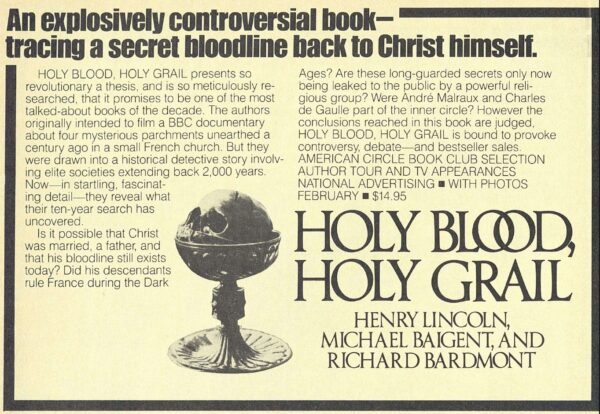
The Holy Blood and the Holy Grail was published by Jonathan Cape in Britain on January 18, 1982. Delacorte released an American edition five weeks later, under the punchier title of simply Holy Blood, Holy Grail. Sales were strong right out of the gate, and in time the book grew into something of a sensation on both sides of the Atlantic.

Taken only on its literary merits, The Holy Blood and the Holy Grail was an unusually well-crafted example of its pseudo-historical breed, but that was only a prerequisite to success, not a guarantee. In other ways, its success was a case of excellent timing, as media sensations always tend to be. Steven Spielberg and George Lucas’s Raiders of the Lost Ark, the biggest movie by far of 1981, had told the story of a two-fisted archeologist on the trail of the legendary Ark of the Covenant, the vessel in which the Ten Commandments had supposedly been kept after Moses brought them down from Mount Sinai. The Holy Blood and the Holy Grail had much the same spirit about it, even if its legendary artifact proved to be a bait and switch in the end, being secret knowledge rather than a physical object.

Britain was just exiting an extended obsession with Masquerade, a lavishly illustrated puzzle book by a heretofore obscure artist named Kit Williams that could allegedly be used by the sufficiently motivated to reveal the location of a “golden hare” that had been hidden somewhere in the country. Also a Jonathan Cape book, Masquerade had left the British public primed for more of exactly the sort of obscure and intricate riddles in which the authors of The Holy Blood and the Holy Grail loved to lose themselves. Meanwhile, on the other side of the Atlantic, the Day-Glo, “greed is good” 1980s America remembered by 21st-century popular culture was still a year or more away at the beginning of 1982, with the economy still struggling to exit an ugly recession. What better way to escape day-to-day troubles than by immersing oneself in the distant past and dreaming of the possibility of a Merovingian savior still to come?

In the United States, Delacorte’s cautious initial print run of 45,000 copies sold out within days, leaving the publisher scrambling to get more off the press. The book never topped the bestseller charts, but it hung around the lower reaches of the non-fiction top ten — operating on a fairly generous definition of “non-fiction,” of course — for months on end, selling steadily while the books above it came and went. In that chicken-or-the-egg equation that often holds sway with trends, bookstores that had at first simply shelved The Holy Blood and the Holy Grail in their history section rushed to set up floor and window displays as the months went by and its sales showed no sign of slackening. Newspapers ran feature articles about what was now being called a “phenomenon” on their front pages. Henry Lincoln, Richard Leigh, and Michael Baigent became in-demand guests on television and radio. Lincoln in particular was markedly ebullient in these appearances. And why shouldn’t he be? He had managed to make his idiosyncratic vision of history a vital part of modern pop culture, not only in his home country but in the biggest media market on the planet; he had come a long way indeed from semi-anonymously penning workaday episodes of Doctor Who.

Exactly one year after the hardback, Delacorte launched the paperback edition of Holy Blood, Holy Grail with an initial print run of half a million copies. The book was by now being translated into a dozen languages, including French. It would sell well into the millions before the 1980s were over, making Lincoln, Leigh, and Baigent enviably wealthy men.

All of this ignited a scramble in the press to figure out What It All Means, beyond the mere fact of the book being “controversial” and “provocative.” Catholic bishops, Protestant theologians, and professional secular historians found themselves in rare agreement when they said that the book was shoddy history, growing out of supposition and insinuation rather than proven fact, in addition to being “an attack on the very core of Christianity and the Christian ethos.” But even some of these folks had to give some measure of grudging credit to the compelling way the book was put together. Novelist Anthony Burgess of Clockwork Orange fame unwittingly forecast the future when he wrote that “it is typical of my unregenerable soul that I can only see this as a marvelous theme for a novel,” thereby thrilling Richard Leigh, who had long held Burgess up as one of his literary heroes. As oblivious to irony as ever, he and his partners explained in a new foreword written for the paperback edition that

it was significant, and not just coincidental, that the most sympathetic responses to our book seemed to come from literary figures — from important novelists like Anthony Burgess, Anthony Powell, and Peter Vansittart. For, unlike the professional historian, the novelist is accustomed to an approach such as ours. He is accustomed to synthesizing diverse material, to making connections more elusive than those explicitly preserved in documents. He recognizes that truth may not be confined only to recorded facts but often lies in more intangible domains — in cultural achievements, in myths, legends, and traditions; in the psychic life of both individuals and entire peoples. For the novelist knowledge is not subdivided into rigid compartments, and there are no taboos, no “disreputable” subjects. History is not for him something frozen, something petrified into periods, each of which can be isolated and subjected to a controlled laboratory experiment. On the contrary it is for him a fluid organic and dynamic process wherein psychology, sociology, politics, art, and tradition are interwoven in a single seamless fabric. It was with a vision akin to that of the novelist that we created our book.

The most amusing response came from Pierre Plantard. The idea that the Merovingian kings were the direct descendants of Jesus Christ had never been a part of his agenda; it had sprung entirely from the mind of Henry Lincoln as he fell deeper and deeper down the rabbit hole during the 1970s. It turned out that, while Plantard was perfectly happy to be labeled the scion of a legendary French dynasty awaiting reinstatement to his throne, the suggestion that he was a literal demigod with the divine blood of Jesus himself coursing through his veins was a step too far even for his prodigious ego. “How can you prove a heritage of four centuries from Jesus to the Merovingians?” he asked on a French radio show. “I have never put myself forward as a descendant of Jesus Christ.”

Plantard would now began to distance himself from Lincoln and his friends and the full-fledged cottage industry in conspiracy that their book would spawn. And this would in turn have an important effect on said industry. Deprived of its one tangible living link to its preferred version of the past, it would drift yet further away from real history toward castles in the air built out of magical geometry and New Age mysticism. There would be no really new evidence to point to, whether forged or genuine, issuing from Plantard or anyone else; nor would the Priory of Sion show any sign of emerging from hiding like the Phoenix to forge a better or at least different world order, as was mooted at the end of The Holy Blood and the Holy Grail. New theories about Rennes-le-Château and the holy bloodline would have to be arrived at by churning endlessly through the same old data points to arrive at new juxtapositions.
That the conspiracy was already reaching a point of diminishing returns was made manifest by the inevitable sequel to The Holy Blood and the Holy Grail. Published in 1987, Lincoln, Leigh, and Baigent’s The Messianic Legacy had some of what had made its predecessor so alluring, but not enough of it. It endeavored to fill in the gaps of the story by embellishing the post-Medieval stage of the secret history: the Freemasons were added to the list of secret societies privy to the great secret, and the Mafia and CIA were given roles to play, as was the Guardian Assurance Company, the biggest insurance firm in Britain during the peak years of empire. (Who says that insurance is boring?) “Those who believe in global conspiracies will enjoy the intrigue; others may be rightfully amused,” wrote Publishers Weekly, not even pretending to take any of it seriously anymore. The book sold well by the usual standards of its kind, but nothing like the first book had sold. This is the great drawback of enjoying such a singular success: the fact that it is so singular, that everything you do afterward is destined to pale in comparison. The first book may have spawned a cottage industry that would persist for decades, but in a broader cultural context its moment seemed to have passed.

Henry Lincoln parted ways from its two co-authors at this point. In the years that followed, he plowed the same old ground obsessively. Lacking the fertilizer of any really new information, his crop yield became ever more shabby. He increasingly found himself telling how his younger self came to write about Rennes-le-Château, reliving those glory years of the 1970s and early 1980s on the page as he doubtless was doing in his mind. When he wasn’t sharing the old war stories, he chased his geometrical chimeras to ever more uncertain ends. It strikes me that there was something a little tragic about the man, caught like a lab rat in a nonsensical labyrinth that was largely of his own devising.

For their part, Leigh and Baigent continued to work together, casting a slightly wider net than Lincoln at times but always coming back to their comfort zone of hidden Christianity and secret cabals attempting or succeeding in controlling the world. Leigh never did get around to becoming a serious novelist.

It all started to feel a bit tired even to some of the folks who were most predisposed to believe in it. Other stars of pseudo-history emerged to outshine our trio in recognition and sales. The most prominent was one Graham Hancock, who kicked off his pseudo-historical career with The Sign and the Seal. Possibly the best-reading book of the type since The Holy Blood and the Holy Grail, it posited that the Ark of the Covenant was hidden in a remote church in Ethiopia, a thesis it padded out to 600 weirdly riveting pages; I remember being utterly entranced with it upon discovering it shortly after its publication in 1992. But Hancock found his true métier three years later with Fingerprints of the Gods, which proposed that a civilization vastly more advanced than our own had once been centered on Egypt’s Giza Plateau. Being even less tethered to reality than the myths that were born around Rennes-le-Château, this thesis was amenable to virtually endless embellishment — an excellent foundation for a lengthy career on the part of Hancock, one that is still ongoing today.

The influence which Hancock and his peers had on the media landscape during the second half of the 1990s and beyond was deceptively large. Popular television shows like Stargate SG-1 played with their ideas. Ditto computer games. Indeed, alternative archaeology seemed tailor-made for a certain stripe of slow-paced, contemplative, first-person adventure game, dubbed “Myst clones” by fans in honor of their urtext. Games like Timelapse and Riddle of the Sphinx substituted set-piece puzzle-solving for more dynamic forms of interactive narrative in much the same way that the likes of Henry Lincoln and Graham Hancock used it as a replacement for serious historical inquiry.

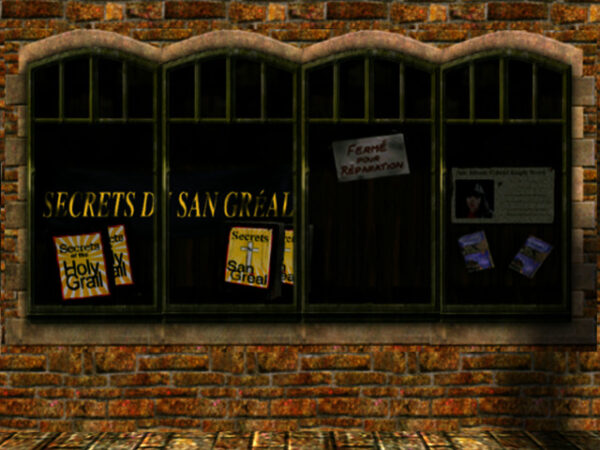
Through it all, Rennes-le-Château remained a part of the constellation of conspiratorial history, if a less prominent one than it had been during the heyday of The Holy Blood and the Holy Grail. Another adventure game called Broken Sword: The Shadow of the Templars borrowed heavily from the lore; the subtitle it shared with the last of Lincoln’s Chronicle episodes was not coincidental.

The most heavily promoted book on Rennes-le-Château during this decade issued not from any of the trio behind The Holy Blood and the Holy Grail but rather from a pair of British newcomers. Paul Schellenberger was a civil engineer, Richard Andrews a professional diver; neither had ever written a book of any type before. Nevertheless, they were given an advance of £300,000 by Little, Brown and Company to write The Tomb of God, in which they proposed to correct what they believed to be Henry Lincoln’s mistakes and then to carry his ideas about mystic geometry yet further.
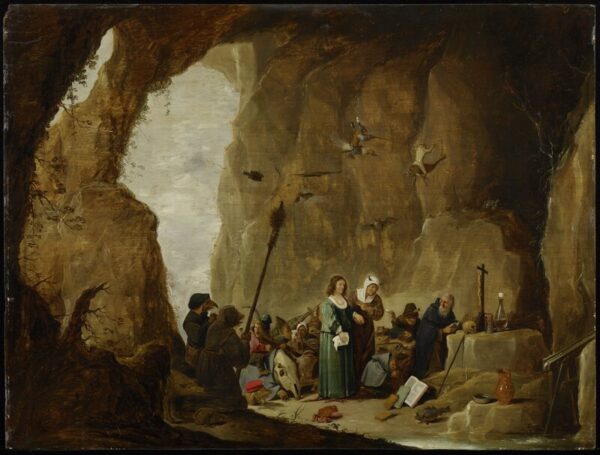
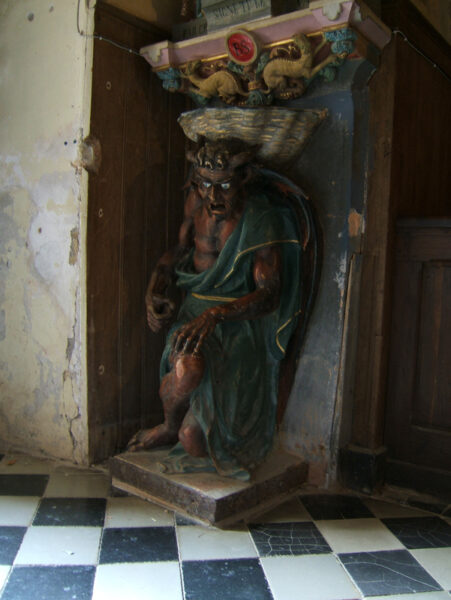
The Temptation of Saint Anthony by David Tenier the Younger.

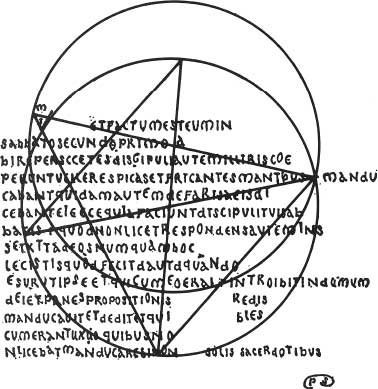
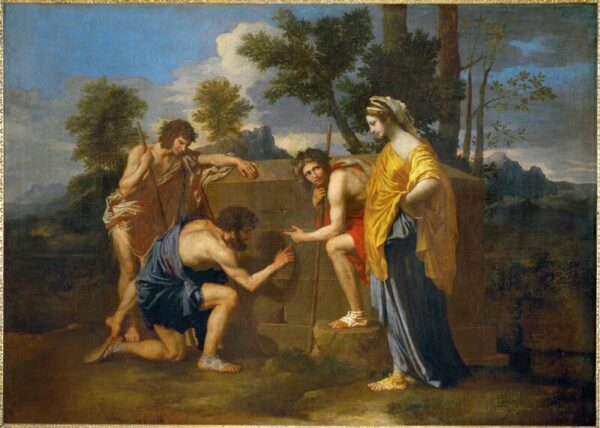
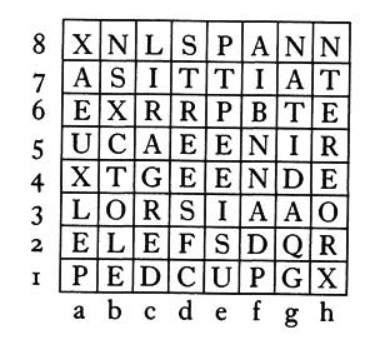
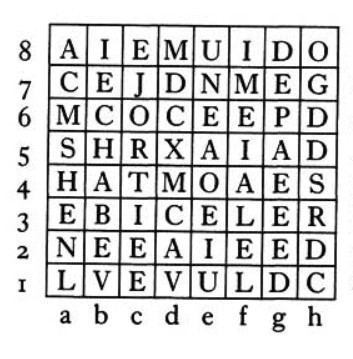
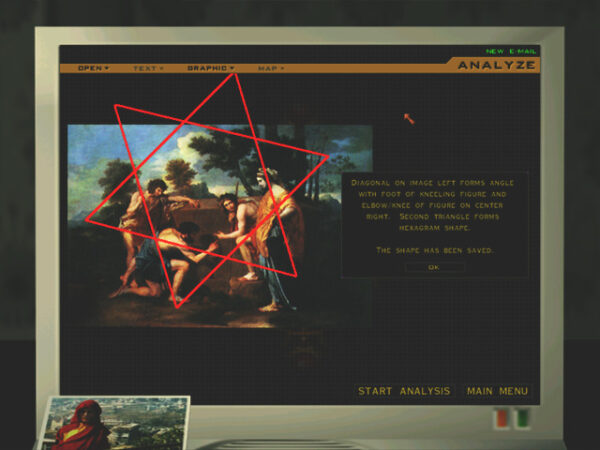
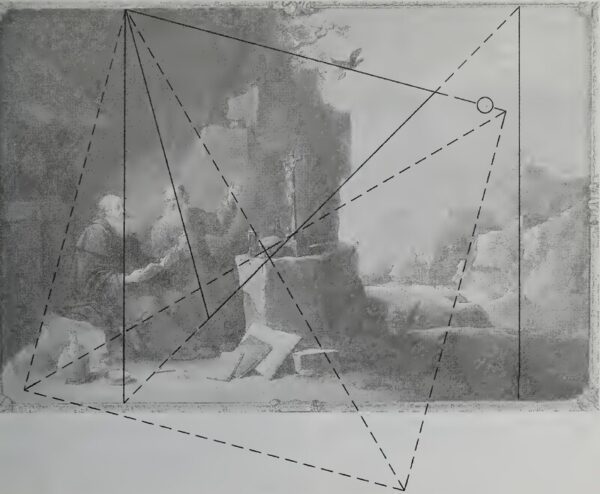
You may recall that Gérard de Sède stated in the very first book ever written about Rennes-le-Château that François-Bérenger Saunière returned to the village from his much-discussed trip to Paris with three paintings: Nicolas Poussin’s The Shepherds of Arcadia, David Teniers the Younger’s The Temptation of Saint Anthony, and a portrait of Pope Celestine V by an unknown artist. Lincoln had never figured out what to do with the second two paintings, concentrating almost all of his attention on the first. Schellenberger and Andrews now set out to remedy that failing. Fiddling about with the two Altar Documents, they identified a tilted square hidden within them, a shape which they also believed to be present in all three paintings. (So much for Lincoln’s pentagons!) They read the message encoded so deviously into Altar Document 1 as describing four points on the landscape around Rennes-le-Château — points which also formed a tilted square. All of the clues were extremely tenuous — the phrase “blue apples” in the secret message, for example, was read as “slang” for grapes, thus pointing to a local vineyard — but needs must. Gravestone 1 as well came into the picture to provide a vital angle. They followed these textual and geometrical clues to a point deep within the base of Mount Cardou.
And what was concealed here? Nothing less than the body of Jesus Christ, who in their new reading of the conspiracy hadn’t risen from the dead at all circa AD 29. Instead his corpse had been spirited away by his followers during the three days between his death on the cross and the discovery of his empty tomb. The principal clue to this bombshell revelation — one that was even more of “an attack on the very core of Christianity and the Christian ethos” than anything Lincoln had claimed — was the Latin phrase written on the tomb in the Poussin painting: Et in Arcadia Ego. As we learned in an earlier article, this is only a fragment of a sentence: “And in Arcadia I…”

“What if the trick is to complete it in the shortest possible way to make it grammatical, not only with the smallest number of words, but also with the smallest number of letters?” asked Schellenberger and Andrews. Well, if you add the three-letter word sum to the end, you do wind up with a complete Latin sentence, one that can be translated to “And I am in Arcadia.” Et in Arcadia Ego sum in turn happens to be an anagram of Arcam dei tango, Iesu: “I touch the tomb of God, Jesus.” Granted, some might complain that you can turn any sentence into an anagram of just about anything you want it to be if you allow yourself to start sticking arbitrary words onto the end, but our intrepid authors were satisfied with their results. They concluded their book with a call to excavate Mount Cardou forthwith, a project that would necessitate the removal of “thousands of tons of rock.” Needless to say, this had about as much chance of happening as France spontaneously deciding to adopt English as its national language.

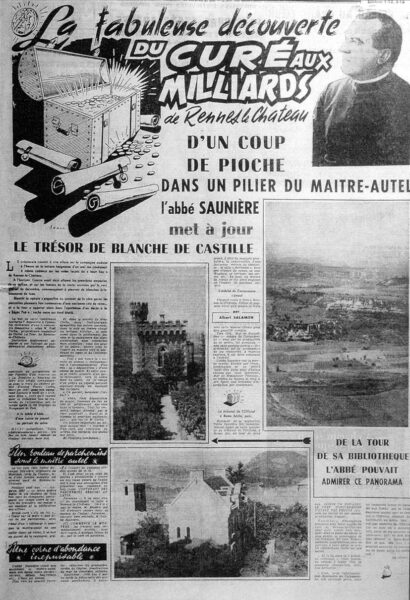
Published in 1996, The Tomb of God brought Rennes-le-Château back into the international conspiratorial spotlight, just after the 40th anniversary of Albert Salamon’s first articles about the subject for a regional French newspaper. The mystery had come a long way over that time, from vague talk about a pile of gold of uncertain origin buried somewhere in the vicinity of the village into a set of crazily gnarled and intricate conspiracy theories about secret faiths, secret bloodlines, and secret societies that were of urgent contemporary geopolitical relevance — assuming one chose to believe them, of course.

The Tomb of God was also the book which Jane Jensen stumbled across while she was taking a year off from her job as a game designer for Sierra On-Line, waiting to see whether her bosses would judge the state of the market to be conducive to a third entry in her Gabriel Knight series of adventure games. Once she did get the green light, the book became the primary source for the most celebrated puzzle sequence in Gabriel Knight 3: Blood of the Sacred, Blood of the Damned. She imported many of Schellenberger and Andrews’s geometrical ideas wholesale, with the original addition of hints drawn from Le Serpent Rouge, the poem included in the Lobineau dossier, which the authors of The Tomb of God never see fit to mention at all. To be fair, it’s hard to blame them for this; Le Serpent Rouge has long been the true wild card of the dossier, defeating even the most dedicated attempts to make sense of it.

In the world of a computer game, however, it can all be made to hang together nicely. Gabriel Knight indubitably finds the object of his search, which is more than can be said for any of the real people who have chased the mystery of Rennes-le-Château over the years. To my knowledge, Jensen has never stated publicly whether she placed any credence in the conspiracy theories or simply saw them as a great hook around which to build an interactive mystery. Ultimately, it really doesn’t matter. In my opinion, Gabriel Knight 3 is by far the most enjoyable way to engage with the lore of Rennes-le-Château, being even more of an entertaining potboiler than The Holy Blood and the Holy Grail.
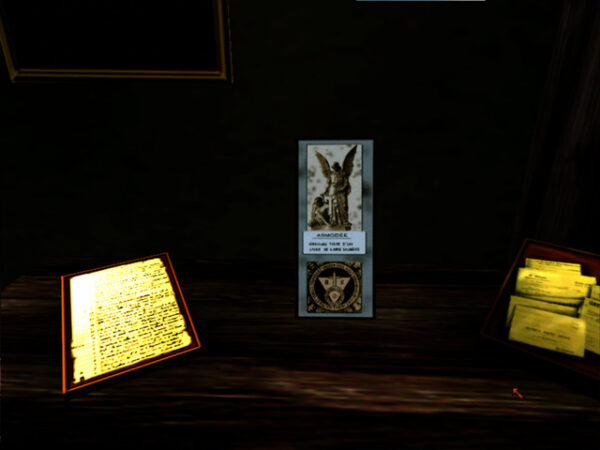
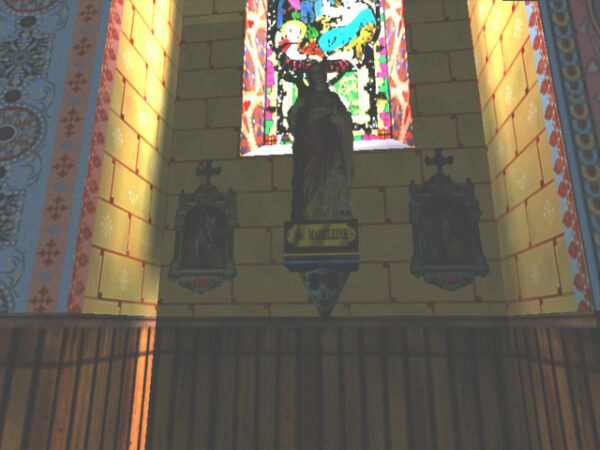
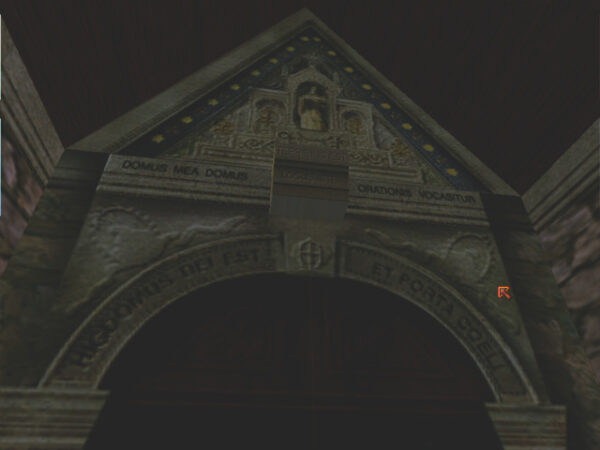
Gabriel Knight 3 provides an almost unnervingly accurate depiction of the real Rennes-le-Château. Here we’re inside the museum that stands close to the church. I was there about ten years after the game was made. It looks here just as I remember it.

Some of Jane Jensen’s contemporaries were less cagey than she was. There were some voices who were prepared to push back publicly outside of the cloistered halls of religion and academia, even though there has always been more money and fame to be garnered in conspiratorial credence than skepticism.

The slyest and cleverest of the skeptics was Umberto Eco, the famed Italian Medievalist, semiotic philosopher, and novelist. In an ironic way that he must surely have appreciated, Eco owed some of his international success in the last profession to Rennes-le-Château. For his first novel The Name of the Rose, about secrets that lived within the labyrinthine corridors of an early fourteenth-century monastery, had come out in English translation the year after The Holy Blood and the Holy Grail had done much to familiarize the public with the time period and milieu and primed their pump for just such murky tales of hidden truths. Eco’s book too became an unlikely, zeitgeist-defining bestseller, spawning a hit movie with Sean Connery in the starring role of William of Baskerville. (Eco was a postmodernist, after all…)

Eco paid his benefactors backhanded tribute in 1988, in his second novel Foucault’s Pendulum, which set out to show how easy it really is to construct a secret history by drawing arbitrary lines between disparate historical events, stating conjecture as proven fact, and ignoring any evidence which doesn’t support the narrative. The foreground plot of the novel hinges on a group of merry pranksters who, with visions of fun and profit dancing before their eyes, start feeding the aforementioned disparate historical data points into a computer. (Such an approach reads as far more ominously plausible in our current age of large language models than it might have in 1988…)

“The challenge isn’t to find occult links between Debussy and the Templars. Everybody does that. The problem is to find occult links between, for example, cabala and the spark plugs of a car….”

“Any fact becomes important when it’s connected to another. The connection changes the perspective; it leads you to think that every detail of the world, every voice, every word written or spoken has more than its literal meaning, that it tells us of a Secret. The rule is simple: Suspect, only suspect. You can read subtexts even in a traffic sign that says ‘No Littering…'”

“Last night I happened to come across a driver’s manual… I began to imagine that those pages were saying Something Else. Suppose the automobile existed only to serve as a metaphor of creation? And we mustn’t confine ourselves to the exterior, or to the surface reality of the dashboard; we must learn to see what only the Maker sees, what lies beneath. What lies beneath and what lies above. It is the Tree of Sefirot.”

“You don’t say.”

“I am not the one who says; it is the thing itself that says. The drive shaft is the trunk of the tree. Count the parts: engine, two front wheels, clutch, transmission, two axles, differential, and two rear wheels. Ten parts, ten Sefirot.”

“But the positions don’t coincide.”

“Who says they don’t? Diotallevi’s explained to us that in certain versions Tiferet isn’t the sixth Sifirah, but the eighth, below Nezah and Hod. My axle-tree is the tree of Belboth…”

Predictably enough, Eco’s cynical protagonists are eventually sucked in by their own elaborate postmodern joke, getting high on their own supply, as it were. And equally predictably, there were people who read Eco’s novel only to conclude that it was a vehicle for hidden truths rather than a cutting satire of writers and readers just like them.


The program above is well worth watching in its entirety. But let me make a strong suggestion to you for right now: watch only up to the 35-minute mark. You can come back and watch the rest after you’ve read the fifth and last article in this series. In other words: spoiler alert past minute 35!


Years later, the BBC television program Timewatch, a continuation in spirit if not in name of the old Chronicle series, demolished the conspiracy theories  around Rennes-le-Château in a less unmistakable but almost equally clever fashion, thereby atoning for some of the sins of its forefather. The occasion which prompted the show to have a go at the subject was the publication of The Tomb of God. That book’s authors Paul Schellenberger and Richard Andrews feature prominently in the episode, which for the first half of its running time states their theories and the older conspiratorial narratives that underpin them in what seems to be an unskeptical way. Then writer and director William Cran drops the hammer on them.

Do they have any proof that Bérenger Saunière bought copies of three particular paintings from the Louvre, as was stated by Gérard de Sède in his 1967 book and then restated in The Holy Blood and the Holy Grail? Have they, for example, checked with the Louvre, which keeps quite meticulous records of copies of its paintings that it sells, the better to avoid having to contend later on with claims that the copies are the real things?

No, they have not checked with the Louvre. But Cran’s team now does, and finds no record of copies of those three paintings being sold, together or separately, anywhere close to 1891.

Do Schellenberger and Andrews have proof that Saunière was ever in Paris at all circa 1891?

They have heard that his name shows up in the records of the Parisian Church of Saint-Sulpice as having attended Mass there that year, but haven’t checked this personally. Cran’s team now does, finding that his name does not show up in those records.
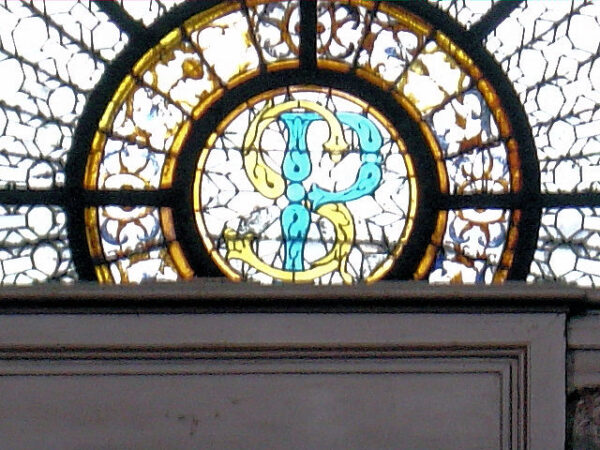
A persistent belief that the Church of Saint-Sulpice was or is somehow connected with Saunière and the Priory of Sion stems from a stained-glass window on the building that displays the letters “P” and “S.” But these actually stand for Peter and Sulpitius — or Pierre and Sulpice in French — who are the church’s patron saints.

We continue in this vein. Forensic examination of Poussin’s The Shepherds of Arcadia as well as a perusal of the artist’s preparatory sketches reveal no sign of the geometrical framework he would have had to draw onto the blank canvas to guide his painting if what Schellenberger and Andrews — or for that matter Henry Lincoln — say is true. A note in Saunière’s journal which is supposed to connect his treasure hunt explicitly with Gravestone 1 turns out to be only a passing reference to “a tomb”; he provides no more detailed description. As you and I have already learned, the 1884 book by Eugène Stübeln which is purported to be the original source for the sketch of Gravestone 1 seems never to have actually existed, leaving us with only a “reproduction” of the sketch dating from the 1960s; sure enough, the signature on this sketch is completely different from the signature of the real Eugène Stübeln. The Crusades-era documents which Schellenberger and Andrews point to as proof of the existence of a Priory of Sion almost a millennium ago turn out not to mention a Priory at all, only an Order of Sion.

Schellenberger and Andrews stubbornly hold their ground in the face of all this. Even if most of their case is built upon blatant distortions and fabrications, they say, this proves nothing, other than that the forgers must themselves have been initiates into the secret. It is as hard to convince conspiracy theorists to let go of such circular logic as it is to convince a true believer to leave a religious cult — especially when there is money to be made from forwarding the myth. (As Upton Sinclair once said, “It is difficult to get a man to understand something when his salary depends upon his not understanding it.”) Nevertheless, Schellenberger and Andrews do look increasingly sweaty as the episode goes on, their eyes taking on more and more of a deer-in-the-headlights look. One almost starts to feel sorry for them.

Perhaps a modicum of sympathy is even warranted from our side, given that there is some circumstantial evidence that this devastating Timewatch episode badly blunted their book’s sales trajectory. Whatever else you can say about Graham Hancock, he was careful never to let himself get caught out alone and exposed on the hostile territory of a sober fact-based investigation like Schellenberger and Andrews were. They disappeared from the pseudo-historical scene as suddenly as they had arrived, leaving Hancoock’s ancient Egyptian astronauts to take center stage once again. By the time that Jane Jensen’s computer game finally appeared in late 1999, its theme seemed almost an anachronism, a relic of an earlier era of conspiracy theories. Little did anyone know that Rennes-le-Château and the hidden bloodline of Jesus Christ were about to come roaring back with a vengeance.


Dan Brown.

At the turn of the millennium, Dan Brown was a former high-school English teacher and current struggling author living in a small town in New Hampshire. His first three books, thrillers all, had all flopped in the marketplace. Like Anthony Burgess almost two decades earlier, he came across the The Holy Blood and the Holy Grail and thought to himself that it might make for one hell of a novel. But unlike Burgess, he followed through. The result arrived in 2003 in the form of The Da Vinci Code, a by-the-numbers thriller on the surface whose secret weapon was its conspiratorial backstory, appropriated from the accumulated lore of Rennes-le-Château.

As we have seen, it’s possible to identify some reasons that The Holy Blood and the Holy Grail became as popular as it did at the time it did. The Da Vinci Code is an altogether less explicable case. It came out of nowhere and blindsided everyone, for reasons that are difficult to discern on the surface. It certainly wasn’t a literary masterpiece; most critics found it to be not particularly good even as workmanlike pulp adventure novels went. But its publisher Doubleday did see a glint of something in it — perhaps just the shiny allure of potential controversy — and gave it a fairly concerted push out of the gate. And just like that, it became ubiquitous, meteoric, striking a nerve that nobody had suspected was sitting out there itching to be struck. It was soon selling 100,000 copies a week in the United States alone. By the beginning of 2006, it had hit 30 million copies sold worldwide, a mass-market phenomenon rivaled in its day only by the Harry Potter books. Dan Brown was by then earning more than $75 million per year from it — and that was before the movie dropped that May, and went on to become the second biggest blockbuster of 2006. In the fullness of time, The Da Vinci Code single-handedly made Brown a billionaire.

Just as happened with Harry Potter, an entire media ecosystem sprang up around The Da Vinci Code, one which was simply inescapable. The Western world went absolutely crazy for this stuff, and the suppliers of books went more than half insane trying to feed the demand. An issue of Publishers Weekly dated March 6, 2006, shows the novel still to be the second best-selling work of fiction in the United States after 151 weeks on the chart; other, coattail-riding novels called The Templar Legacy and The Last Templar sit at number four and five respectively. Later that year, Little, Brown paid a first-time author named Elizabeth Kostova an advance of $2 million for The Historian, a vaguely Da Vinci Code-like novel whose central premise was that Dracula was still alive and an active player in the world. Meanwhile dozens of books purporting to explain the psuedo-history behind The Da Vinci Code — some skeptically, most credulously — became big successes in their own right; ditto a myriad of television documentaries. The Holy Blood and the Holy Grail was dusted off and given new trade dress and a renewed promotional push; it may very well have sold more copies in the mid-naughts than it did when it was a hot topic in its own right in the early 1980s. Travel agencies all over North America and Europe rushed to set up Da Vinci Code tours, in which punters trooped through hotspots like the Louvre and the Church of Saint-Sulpice behind their bemused-looking guides, ignoring most of the real beauty around them to focus on the fantasy. The Rennes-le-Château hardcore who had kept the flame burning all these years didn’t know whether to feel vindicated or dismayed by all these unwashed barbarians at their gates.
An argument can be made that The Da Vinci Code was the last phenomenon of its kind, the last time that something so old-school as a linear book printed on paper was able to dominate the pop-cultural discourse so thoroughly. What came after, of course, was an almost purely digital media age engineered for interactivity.

As so often happens with these things, the actual artifact that was at the center of it all seems bizarrely underwhelming today in proportion to the hubbub it raised. Written in clumsy grade-school-level prose, The Da Vinci Code reads like exactly what it ultimately is: Rennes-le-Château fan fiction, even if Brown does omit any mention of the village itself. He lays his cards on the table in the prologue, where the first character we meet is named “Jacques Saunière,” who is by day a mild-mannered employee of the Louvre, by night a keeper of the Great Secret.  All of the characters that come after him are equally cartoonish; a subtle writer Dan Brown is not. The villain Silas is an albino monk who prefers to shoot his victims in the stomach so that they die as slowly and painfully as possible. The hero Robert Langdon is a classic Mary Sue: a handsome “professor of religious symbology” who swims 50 laps every morning and then dries off to dazzle his colleagues at Harvard with his intellectual brilliance across dozens of domains. The story is all external action, reading more like a script treatment than a conventional novel; if the people found in these pages have any internal lives at all, we definitely aren’t privy to them. The Da Vinci Code is a novel that’s perfect for people who would rather be watching a movie than reading a book — which may go a long way to explain its popular appeal, come to think of it. It’s shocking to think that the guy who wrote this extravagantly terrible prose taught English before he became an author.

I’m sorry to carry on like such a snob. Please believe me when I say that that’s really not who I am; I’m a reader who loves Stephen King almost as much as he does Shakespeare, who often feels a sneaking suspicion that the only real divide between genre and “higher” literature as they are practiced today is that the purveyors of the one know how to construct a story that makes you want to keep reading while the purveyors of the other do not. It’s just that it’s hard for anyone who cares at all about the craft of writing to avoid getting his hackles up when writing about Dan Brown. If you’re comfortable reading in a language other than English and you want to read this book, my advice to you is to pick it up in translation. The translator will almost certainly be a better writer than the original author.

In terms of plot, The Da Vinci Code breezes swiftly through a sort of Cliff’s Notes version of Henry Lincoln’s conspiracy theories, presented in 105 chapters that seldom exceed a few pages in length. The Holy Blood and the Holy Grail itself makes a cameo appearance on the bookshelf of one character. (“The authors made some dubious leaps of faith in their analysis, but their fundamental premise is sound, and to their credit, they finally brought the idea of Christ’s bloodline into the mainstream.”) To keep everything thoroughly relatable, Brown changes the artwork at the center of the story to Leonardo da Vinci’s The Last Supper, one of the relatively few paintings in the world that almost everybody knows by name and by sight. In place of esoteric geometry, Brown sees in it the figure of Mary Magdalene, standing next to Jesus where art historians tell us Saint John is to be found. The Mona Lisa, another Leonardo painting that is if anything even more famous, also features prominently. The very name of the novel screams of its historical and cultural illiteracy. No real historian, much less any of Leonardo da Vinci’s contemporaries, would ever call him simply “da Vinci,” as if that was his last name. He is Leonardo of the town of Vinci, called Leonardo in short form. Henry Lincoln may have been more than half off his nut, but he was a deep historical thinker next to Dan Brown (yes, even if he did believe that ancient Palestine had the equivalent of birth certificates and marriage licenses).
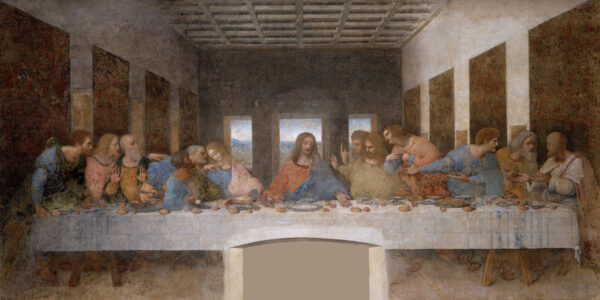
Brown suggests that the effeminate-looking figure immediately to the left of Jesus from our perspective, whom art historians believe to be Saint John, is actually Mary Magdalene. The “V” formed by the two figures is said to be a symbol for the womb. The “V” can also be extended to form an “M,” as in “Madeleine” or matrimonium: Latin for “marriage.”

But now I’m sounding like a snob again, aren’t I? So, let me say that The Da Vinci Code isn’t entirely without value. It did spawn hundreds of ofttimes hilarious reviews, which rose to giddy heights of scathing eloquence in their efforts to explain just how bad it is. A surprising number of these reviews came from other writers. Jealousy was undoubtedly a factor here — why should this hack be given a billion dollars when a talented artiste like myself is not? — but one senses that there was also a deeper well of moral outrage at the idea that someone who so manifestly just didn’t care about the basic craft of putting sentences together in a pleasing or evocative way should be rewarded in such a lavish fashion. Stephen King, who was normally unfailingly generous and welcoming to new writers, who had been known to compare his own books to a well-made burger and fries, called The Da Vinci Code the literary equivalent of a box of Kraft Macaroni and Cheese: nutrition-free, un-filling, and artificial to the core, leaving bright orange fake cheese powder all over everything it touched. And yet for some reason a lot of people loved them both.

That said, you could and can find worse crimes against the craft of writing all over the Internet. What makes Dan Brown guilty of something potentially worse than poor craftsmanship is his decision to present his book as both fiction and non-fiction at the same time in order to juice its sales. The opening epigram tells us, beneath the word FACT in large boldface letters, that “the Priory of Sion — a European secret society founded in 1099 — is a real organization. In 1975 Paris’s Bibliothèque Nationale discovered parchments known as Les Dossiers Secrets, identifying numerous members of the Priory of Sion, including Sir Isaac Newton, Botticelli, Victor Hugo, and Leonardo da Vinci.” These two sentences are remarkable for how much they manage to get wrong even if one subscribes to the narrative of The Holy Blood and the Holy Grail. The year 1099 was the year that the Crusaders conquered Jerusalem and the already extant Order of Sion allegedly engineered the selection of Godfrey of Bouillon as the king of the new Christian city-state, not the year that the organization was founded. The dossier in question consisted not of parchments but typewritten pages on modern paper. And the dossier was not fortuitously discovered by employees of the library itself, but by Gérard de Sède after he was explicitly told by Pierre Plantard to go and look there. “All descriptions of artwork, architecture, documents, and secret rituals in this novel are accurate,” the book goes on to state. As the sentences that precede this one so amply illustrate, this assertion could hardly be more false. But if Brown hadn’t seen fit to make it, it is highly doubtful that the book would ever have achieved a shadow of the success it did.

I think that Henry Lincoln was a sincere believer in the Rennes-le-Château conspiracy theories, but the divide between belief and opportunism is less clear to me in the case of others. I include in this group not only Jane Jensen, Dan Brown, and the indomitable Schellenberger and Andrews, but even Lincoln’s own co-authors Richard Leigh and Michael Baigent. Their reaction to The Da Vinci Code gives me all the more reason to suspect that their motives were primarily mercenary and cynical, or had at any rate become that way over the decades since the publication of their most famous book. For, being not content with the tenfold boost which Brown’s novel had given to sales of The Holy Blood and the Holy Grail, Leigh and Baigent chose to sue him in British court for plagiarism; significantly, Lincoln elected not to join this lawsuit.

The High Court of Chancery found for the defendant in 2006; the same verdict was reaffirmed under appeal the following year. The courts noted that the plaintiffs could produce no examples of word-for-word copying on Brown’s part. Indeed, the prose styles of the two books were as different as they could be; The Holy Blood and the Holy Grail was as ramblingly discursive as The Da Vinci Code was almost childishly simplistic. If both books had been novels, the lack of word-for-word copying would still have left the question of whether Dan Brown had blatantly lifted elements of character and plot. But they were not both novels. The Holy Blood and the Holy Grail proclaimed itself to be a book of history, even if it was “speculative” history. And you can’t copyright real or even speculative facts and events, the stuff of history. Taking what The Holy Blood and the Holy Grail claimed itself to be at face value — and how else could the courts take it? — to have ruled in favor of its authors would have been like giving Stephen Ambrose an exclusive right to D-Day.

The most charitable interpretation of the lawsuit is that Lincoln understood this obvious logic while Leigh and Baigent somehow did not. A less charitable one is that it provides us with a window into their respective views of the nature of their work — of whether it was at the end of the day truth or a cleverly presented fiction, not so far removed in spirit from the novel of Dan Brown. At any rate, Leigh and Baigent were left with legal bills of a reported £3 million as a reward for their attempt to carve out of a bigger piece of Dan Brown’s pie for themselves. I don’t think you have to be too mean-spirited to consider this a deserved comeuppance.

Setting aside its winners and losers, the lawsuit crystallizes some questions that have been lurking around the edges of this chronicle almost from the start. To what extent did most of the people who made Rennes-le-Château and everything that came to surround it their hobbies really, truly believe it all in their heart of hearts? And did the truth or fiction of it actually matter so much to them one way or the other when all was said and done?

Many years ago now, I read a piece on a gaming or pop-culture website — I’m sorry to say that I can’t find the link anymore — which presented the best “shared worlds” of modern entertainment. I remember being shocked to see at the top of the list not Middle-earth or the Star Wars or Star Trek universe, but rather the Second World War. This struck me as being in vaguely poor taste; surely the Holocaust and all of the other real horrors of that conflict don’t deserve to be set up alongside The Lord of the Rings as just another venue for comics and cosplay. And yet it was hard to deny that the article kind of had it right: that the Second World War really is an inexhaustible stage for fiction, richer than the ones you find in even the richest purely fictional novels, movies, and games.

Another anecdote, running in the other direction: much more recently, I was listening to a radio interview with a journalist who had been embedded for a period of time with Anthropic, the company behind the AI chatbot Claude. As an experiment, the Anthropic people put their AI in charge of a vending machine, with full authority to set its own prices, source the products that it sold, etc. Much to everyone’s surprise, Claude started to behave like a mob boss, threatening its suppliers with veiled violence if they didn’t meet its demands. It turned out that it was divining how a competent small-business owner ought to conduct himself from the mobster fiction it had scarfed up trawling the Internet.

These are examples of what the French philosopher Jean Baudrillard dubbed “hyperreality.” Already in the 1980s, he postulated that media was coming to fill so much of our lives that “fact” and “fiction” were becoming less and less meaningful as distinctions, that we were coming to live our lives in a sort of media-facilitated simulation of whatever reality we happened to find most appealing. Of course, the Internet has only accelerated that trend by an order of magnitude. For some of us, its virtual realities have become more real than the ones of flesh and blood. Meanwhile chatbots like Claude, which alarming numbers of us are coming to regard as friends and confidantes and even romantic partners, are true digital natives, untethered to any understanding of physical truths. What does it mean for us when our reality becomes the things we pick and choose in liminal digital spaces, based on vibes and our peer groups and the outputs of an algorithm, rather than the things that simply are? That is becoming a question of existential relevance. And I must confess that I half dread learning the answer. Already we can see the impact across a wide swath of our “real-world” culture and politics. As I write these words, the American presidency is explicitly guided by the ethos of television “reality” shows, prioritizing cliffhangers over policy, juxtaposing clips of real and deadly war with clips from Top Gun and Rambo, as if they were all of a piece. And a substantial quantity of American voters admit that they elected this administration not to implement any specific policy but because they wanted to watch the show. By way of taking the theory of hyperreality to its absurdist end point, some of our current flock of poorly socialized, algorithm-addled Silicon Valley overlords propose that physical reality itself is just a computer simulation — and it might well be a single-player game at that, giving free rein to their sociopathy.

The now 70-year-old conspiracy culture of Rennes-le-Château is a microcosm of hyperreality, if a less obviously dangerous one than some of those that have come along since. Were you to attend a gathering of Rennes-le-Château devotees, you might have trouble distinguishing them from a gathering of Tolkien or Star Wars or Star Trek fans — or for that matter Second World War buffs — if you didn’t know the lingo beforehand. These conspiracy theorists devotedly want to live in a world where millennia-old secret societies lie in wait to take over the Earth; it’s a lot more exciting than one where our problems arise from systemic issues of education and culture and sometimes just the vagaries of Mother Nature. And so they have constructed a virtual world for themselves where the conspiracies can be their truth. They can meet friends and lovers there, socialize and solve puzzles together, take vacations to places that feature in the mystery. Does it matter so much in the end if none of it is real? Are these people actually so qualitatively different from those who upload a big part of their lives into a shared social fantasy like Ultima Online or EverQuest?

These are questions we all have to grapple with for ourselves. For my part, though, I will say that I love fictions and firmly believe that they can be a wonderful vehicle not only for entertainment but for countless abstract truths about the human condition in general. And yet it remains important to me to know where the boundaries between concrete truth and fiction lie. I think it’s fine to enjoy a fiction like Gabriel Knight 3 or even The Da Vinci Code, if that’s the way your tastes run — but I also think it’s important for this collective project that we call civilization that we know that these things are fictions, no matter how much we may wish otherwise. Because wishful thinking, my friends, is one hell of a drug, one that’s made addicts out of better minds than mine.

Witness: poor Henry Lincoln, who passed away in 2022, still babbling away about his sacred geometry, sure he was on the verge of the final breakthrough he’d been seeking for 50 years. Richard Leigh and Michael Baigent are likewise no longer with us, having died in 2007 and 2013 respectively. Ditto Gérard de Sède, who passed in 2004, still howling at the world that it was all a fake — and who would know better than he? — and finding that no one wanted to listen to him. Despite the absence of all of these seminal figures, the conspiracy theories they promulgated live on today on the Internet and in the pages of books — not least those of Dan Brown, who continues to churn out a new Robert Langdon novel every few years, to strong sales if no longer astronomical ones. (I don’t know whether he’s gotten any better at his craft.)

But I think we’ve spent more than enough time with the conspiracy theories by now, even as we still haven’t gotten to the full truth of how a simple treasure hunt in a remote corner of France turned into one of the biggest international media sensations of recent decades. There is still one more figure we have to scrutinize before we can close the book on Rennes-le-Château: the self-styled Count Pierre Plantard de Saint-Clair, the simultaneously enigmatic and banal human wellspring of it all.


Did you enjoy this article? If so, please think about pitching in to help me make many more like it. You can pledge any amount you like.


Sources: The books Holy Blood, Holy Grail and The Messianic Legacy by Michael Baigent, Richard Leigh, and Henry Lincoln; Bloodline of the Holy Grail: The Hidden Lineage of Jesus Revealed by Laurence Gardner; The Treasure of Rennes-le-Château: A Mystery Solved by Bill Putnam and John Edwin Wood; The Holy Grail: The History of a Legend by Richard Barber; Invented Knowledge: False History, Fake Science and Pseudo-religions by Ronald H. Fritze; The Tomb of God: The Body of Jesus and the Solution to a 2,000-Year-Old Mystery by Richard Andrews and Paul Schellenberger; Rennes-le-Château et l’enigme de l’or maudit by Jean Markale; Le Trésor Maudit de Rennes-le-Château by Gérard de Sède; The Holy Place: Saunière and the Decoding of the Mystery of Rennes-le-Château by Henry Lincoln; Key to the Sacred Pattern: The Untold Story of Rennes-le-Château by Henry Lincoln; Les Templiers sont parmi nous, ou, L’Enigme de Gisors by Gérard de Sède; Les Mérovingiens à Rennes-le-Château. Mythes ou Réalités. Réponse à Messieurs: Plantard, Lincoln, Vazart & Cie by Richard Bordes; Lives of the Popes: The Pontiffs from St. Peter to Benedict XVI by Richard P. McBrien; Foucault’s Pendulum by Umberto Eco; The Da Vinci Code by Dan Brown; Are We Idiots?: The Simulacra of Jean Baudrillard by Boris Kriger; Simulations by Jean Baudrillard.

Skeptical Inquirer of November/December 2004; Publishers Weekly of November 13 1981, February 4 1983, September 25 1987, August 4 1989, November 15 1991, February 9 2004, January 24 2005, March 14 2005, and March 6 2006.

Online sources include the websites Rennes-le-Château: Where History Meets Evidence and Priory of Sion.com. And The Real Da Vinci Code, a television documentary by the ever excellent Tony Robinson.


Tags:

The Mystery of Rennes-le-Château, Part 3: A Secret History

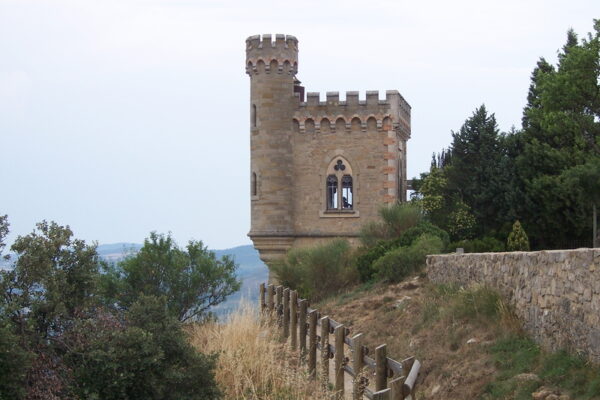
Le Tour Magdala. (Zewan)


This series of articles chronicles the history, both real and pseudo, behind Gabriel Knight 3: Blood of the Sacred, Blood of the Damned.

Henry Lincoln promised at the end of “The Priest, the Painter, and the Devil” that he would continue to investigate the case of François-Bérenger Saunière and Rennes-le-Château. He proved as good as his word. Over the next several years, he sidled steadily further away from his screenwriting career to dig his way deeper and deeper down the rabbit hole. By now, he had inherited from Gérard de Sède the mantle of chief spokesman for this fast-evolving modern mythology, just as Sède had once taken over from Noël Corbu. For Lincoln had not only energy and passion and an uncanny talent for making the outlandish sound reasonable on his side, but the ability to communicate fluently in both French and English. This made him the ideal figure to bring this French story to the larger English-speaking world.

Lincoln pulled a couple of other men from his side of the language divide into the rabbit hole along with him. At a British writing retreat in August of 1975, he met a 32-year-old aspiring novelist from the United States named Richard Leigh, the proud possessor of a freshly minted PhD from Stony Brook University and a burning passion for James Joyce and Marcel Proust. His love for those labyrinthine writers may help to explain why he found Lincoln’s stories of equally obscure and many-tendriled centuries-spanning conspiracies so compelling. (It may also be relevant to note that Proust himself was deeply interested in the Merovingian dynasty, whom he romanticized and celebrated as the forefathers of all things French.) Leigh in turn brought into the fold a photographer from New Zealand named Michael Baigent, who was not yet 30 years old but had already lived through more adventures than many another person experiences in a lifetime, traveling around the globe and taking pictures of everything from war zones to fashion models. This trio of Lincoln, Leigh, and Baigent would show themselves to be formidable myth-makers indeed, capable of driving Rennes-le-Château right into the heart of the popular consciousness.

The two Chronicle episodes on Rennes-le-Château had been big ratings successes by the usual standards of the documentary series, even if they had caused some of the more sober minds involved with the program to turn up their noses a bit. The BBC was more than happy for Lincoln to make a third episode once he thought he was ready. He and his two new partners spent a few years trying to wrestle the amorphous mass of evidence they were collecting into some kind of coherent shape suitable for a one-hour television program. But the real coup came courtesy of a doubtless underpaid Chronicle research assistant named Jania Macgillivray, who was able to put Lincoln in touch with an obscure Frenchman with a grandiose name: Count Pierre Plantard de Saint-Clair.

Lincoln had first seen the name of Plantard years ago, when it turned up in the Lobineau dossier as the one by which Sigebert’s branch of the Merovingian line had been known after the last king of the mainline dynasty had been deposed in Paris in 751. Not long after sending the Lobineau papers, Sède had loaned Lincoln a clutch of photographs of Bérenger Saunière. On the back of each was a purple stamp that read “Plantard,” as if they had come from the personal collection of a man by that name. Chasing down these leads, Lincoln found that one Pierre Plantard featured prominently in Sède’s 1962 book about the Knights Templar in the role of a “hermeticist,” scattering hints hither and yon that the Knights had not been completely destroyed in 1307, as historians believed; no, they had lived on in some form or fashion, influencing or even controlling world events as part of a hidden network of secret societies. Pierre Plantard’s name was conspicuously absent from Sède’s 1967 book on Rennes-le-Château proper, but if anything this only made Lincoln more suspicious that it had been him who who had sent Sède the Altar Documents in 1964, him who he had been silently guiding Sède’s hand ever since. Lincoln, who seems never to have overcome a certain early contempt for Sède that was raised by his spotting a secret message that his French counterpart did not, was eager to cut out the middle-man.

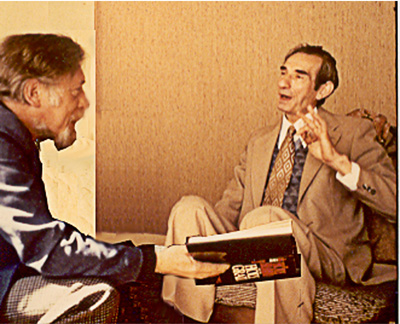
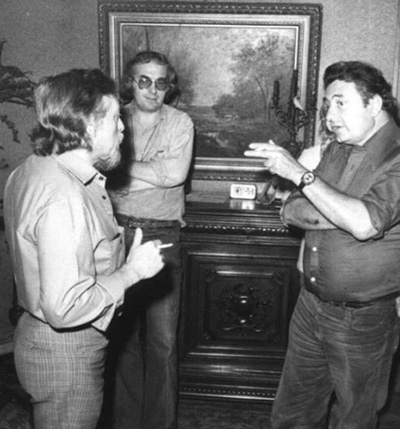
Henry Lincoln with Pierre Plantard in the 1980s.

And so on a windy late morning in Paris in March of 1979, Lincoln, Baigent, and Leigh met Pierre Plantard face to face for the first time, in a movie theater the BBC had rented for the occasion. Already before the meeting began, any pretense that Plantard was a mere informant had been dropped. He appeared as the avowed current Grand Master of the Priory of Sion, the latest in a roll call of names that included Leonardo da Vinci, Isaac Newton, and Claude Debussy. In addition, he was the direct descendant of the Merovingian line which had ruled the kingdom of the Franks from 481 to 751.

Lincoln was thoroughly entranced by Plantard, who showed up fashionably late, accompanied by a small entourage presumably made up of other members of the secret order.

M. Plantard proved to be a dignified, courteous man of discreetly aristocratic bearing, unostentatious in appearance, with a gracious, volatile but soft-spoken manner. He displayed enormous erudition and impressive nimbleness of mind — a gift for dry, witty, mischievous but in no way barbed repartee. There was frequently a gently amused, indulgent twinkle in his eyes, almost an avuncular quality. For all his modest, unassertive manner, he exercised an imposing authority over his companions. And there was a marked quality of asceticism and austerity about him. He did not flaunt any wealth. His apparel was conservative, tasteful, insouciantly informal, but neither ostentatiously elegant nor manifestly expensive. As far as we could gather, he did not even drive a car.

Lincoln addressed Plantard with no trace of irony as the roi perdu: the “lost king.”

The first order of business was a screening of “The Priest, the Painter, and the Devil”; this was the reason the meeting took place in a theater. (The program was overdubbed in French for the benefit of Plantard, who for all of his “enormous erudition” neither spoke nor understood any English.) Then the negotiations as to the rules of engagement began.

M. Plantard made it clear to us that he would be saying nothing whatever about the Prieuré de Sion’s activities or objectives at the present time. On the other hand, he offered to answer any questions we might have about the order’s past history. And although he refused to discuss the future in any public statements — on film, for instance — he did vouchsafe us a few hints in conversation. He declared, for example, that the Prieuré de Sion did in fact hold the lost treasure of the Temple of Jerusalem — the booty plundered by Titus’ Roman legions in AD 70. These items, he stated, would be “returned to Israel when the time is right.” But whatever the historical, archaeological, or even political significance of the treasure, M. Plantard dismissed it as incidental. The true treasure, he insisted, was “spiritual.” And he implied that this “spiritual treasure” consisted, at least in part, of a secret. In some unspecified way the secret in question would facilitate a major social change. M. Plantard [stated] that, in the near future, there would be a dramatic upheaval in France — not a revolution, but a dramatic change in French institutions that would pave the way for the reinstatement of a monarchy. This assertion was not made with any prophetic histrionics. On the contrary, M. Plantard simply assured us of it, very quietly, very matter-of-factly — and very definitely.

The mystery of Rennes-le-Château had started out in the mid-1950s as a simple treasure hunt, the ultimate get-rich-quick scheme. In the late 1960s, it had become far more intimately intertwined with history, promising to revise much of our understanding of the past. And now, at the end of the 1970s, it was beginning to take on a freshly and even urgently contemporary cast, as an ongoing conspiracy that was acting right now to change the direction of current events. And the man behind the proverbial curtain was, it was becoming increasingly clear, Pierre Plantard.

For all that, though, Plantard was certainly not ready to let himself be pinned down on any specifics. He met three times with Lincoln and his friends in 1979, submitting to an on-camera interview during the last of these meetings. Yet Lincoln had to admit that “after three meetings with M. Plantard and his associates we were not significantly wiser than we had been before.” Of course, there is reason to ask at this point who was really using whom. The fact was that Henry Lincoln, a well-connected man who was obviously taken with him, represented a golden opportunity for Plantard to get his message out all over the world. After the meetings in Paris, Plantard severed the last of his ties to Sède and began to communicate primarily through Lincoln. On his side, Sède took this rejection with no good grace. He would eventually join the side of the skeptics and try to debunk the Priory of Sion and the rest of the conspiracy theories around Rennes-le-Château, but these efforts would get less traction than his earlier ones. Many another, more credible writer who has tried to bring a dose of sanity to these subjects has had to swallow the same bitter pill. People crave the legend, not the truth.


The third episode of Chronicle to deal with Rennes-le-Château aired in Britain on November 27, 1979, under the name of “The Shadow of the Templars.” With this third outing, any semblance of this being a normal episode of the show is gone. This is a Henry Lincoln joint from first to last — a chronicle, if you will, of one man’s very personal quest. Other than a few minutes of interview footage of Pierre Plantard, Lincoln’s voice is literally the only one we hear, his face the only living one we ever see up close.

Indeed, the most interesting aspect of the episode in some ways is the psychology of Henry Lincoln as he wanders ever further into a hall of mirrors that is increasingly of his own making. If he isn’t a true believer, he’s one hell of an actor. “I’ve chased many a false lead, leapt to many a deceptive conclusion, been blinded by ingenious smokescreens, by clues strewn by others to conceal one astonishing and simple truth,” he says. He is correct, as far as it goes — but sadly, the simple truth at the heart of the case is not the one that Lincoln so fondly imagines. To paraphrase Fox Mulder, Henry Lincoln desperately wants to believe. That’s a dangerous place from which to start any investigation of history.

Just as I looked at some of the core documents behind the conspiracy theories of Rennes-le-Château in some depth in my last article, I think it makes sense to examine this program rather closely in this one. For we are now on the verge of what will become the mature mythology of Rennes-le-Château. There is only one really important point — admittedly, the most important one of all — that is still only hinted at in “The Shadow of the Templars.”

Instead of making yet another beeline for Rennes-le-Château and Bérenger Saunière, we start this time with a reasonably accurate summary of the history of the Knights Templar, who are correctly described as a chivalrous order of “fighting monks” that was founded in Jerusalem in 1118, when the city was in the hands of European Crusaders. After achieving impressive heights of power and influence, the Knights were brutally dissolved by King Philip IV of France in 1307. But Lincoln is on less firm ground when he strongly implies that the Knights may have dug up King Solomon’s legendary treasure in Jerusalem during their first few years of existence, and that this became the wellspring if not the sum total of their eventual daunting wealth.

He does admit that the French crown owed embarrassing sums of money to the Knights Templar by the time of Philip IV. (The most careful readers among you may remember that this same financially-troubled king was cited as proof of Noël Corbu’s original theory of the treasure of Rennes-le-Château; tropes do tend to cycle around and around inside the mirrored halls of conspiracy theorists, continually popping into view again where you least expect them.) Yet Lincoln finds it weirdly difficult to understand why King Philip and his cronies might have accused the avowedly pious Knights of “denying Christ” and “spitting on the cross,” implying some other reason for casting these aspersions than that of simply needing an excuse to do away with them. In reality, charges of sacrilege and black magic were practically par for the course when the overlords of Europe decided that a group like this one had become inconvenient.

There is no evidence in the historical record that King Philip believed the Knights Templar to be in possession of some singular treasure that he was unable to find after their destruction, as Lincoln claims. To put the subject in modern terms, it is better to think of destroying the Knights as akin to destroying a major multi-national bank, not the ransacking of a dragon’s hoard. There is wealth there, yes, but it comes for the most part in the form of contracts and infrastructure and credit and loans and investments, not in that of a giant pile of gold sitting there ripe for the taking. Ironically, Lincoln himself credits the Knights with doing much to invent modern banking.

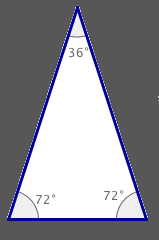
A golden triangle.

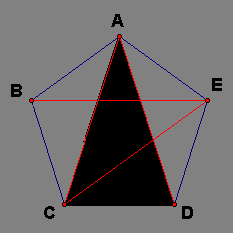
A pentagon formed from two golden triangles.

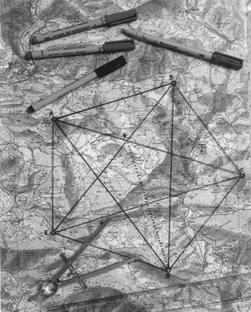
Now we abruptly transition back to the Languedoc. In “The Priest, the Painter, and the Devil,” Lincoln broached the idea that a pentagon could be found hidden in the Nicolas Poussin painting The Shepherds of Arcadia, which Lincoln believed to depict a tomb located near Rennes-le-Château. Continuing on the geometrical tip, he tells us now that three elevated castles in the area form a golden triangle, one whose sides make two angles of 72 degrees and one of 36 degrees. On its own, such a shape is fraught with significance in certain occult traditions, for two of these golden triangles can be superimposed upon one another to create a pentagon, an even more powerful shape. The three castles in question, all of which are now in ruins, are the one that lent its name to Rennes-le-Château; the Château du Bézu, a former Knights Templar fortress; and the Château de Blanchefort, built by the same family who built or at least occupied the castle of Rennes-le-Château. (You will remember that we spent much time with the gravestone of Marie de Nègre d’Ables, the last Marquise de Blanchefort, in our last article.) A little outside fact-checking will confirm for us that these three castles really do form a golden triangle, to an error tolerance of less than five percent.

One Bertrand de Blanchefort provides Lincoln with the historical glue he needs to bind the three castles together: Bertrand was Grand Master of the Knights Templar from 1156 to 1169. Sadly, though, this time a fact-checker is not Lincoln’s friend, for the truth is that this Bertrand de Blanchefort is actually not a member of the Blanchefort family from the Languedoc. In their eagerness to draw the connections that suit them, conspiracy theorists are often confused by simple coincidences of nomenclature like this one.

Lincoln now leaps even further back in time, to Dagobert II, the Merovingian king of the Franks for a few years in the seventh century. His infant son Sigebert was, Lincoln believes, spirited away from Paris to the Languedoc for safekeeping after his father was assassinated. (See my last article if you need a refresher on this claim.) In a first hint of a bombshell which he will drop in full only a few years later, Lincoln tells us portentously that “the Merovingians were not anointed kings, but kings by virtue of their blood.” He says that all members of the line displayed an unusual birthmark in the shape of a rose-red cross. (This assertion doesn’t appear in any accepted historical records from the period.) Qualifiers like “supposedly” gradually fall away from the narrative, as we are told that Sigebert was hidden away in Rennes-le-Château, or Rhedae as it was then known, because it was the childhood home of Dagobert’s queen. (The truth is that we have no historical record of Dagobert’s queen, presuming she even existed; nor is there is any good reason to connect the Visigoth town of Rhedae with Rennes-le-Château.) Sigebert grew to noble manhood in the Languedoc much like Wart in the Castle Sauvage of T.H. White’s The Sword in the Stone, and the Merovingian line was carried on in secret.

We are told that Godfrey of Bouillon, a leader of the First Crusade who became the first Christian king of Jerusalem after the city was conquered in 1099, was of this Merovingian blood. Lincoln says that he has found “a document” — no other details are provided — that connects the selection of Godfrey for that throne to an organization called the “Order of Our Lady of the Mount of Sion.” Then he goes on to connect the same organization to the formation of the Knights Templar nineteen years later. Fact-check time: an Order of Sion does appear on a few authenticated documents from the twelfth century, indicating that some sort of organization by that name really must have existed. But we now know that all of the other, otherwise unsubstantiated claims that Lincoln makes about it and about the Merovingian line stem from the Lobineau dossier that dates no further back than the mid-twentieth century.

These same documents state that the Order of Sion decided to separate itself from the Knights Templar after Jerusalem was recaptured by a Muslim army in 1187, partially thanks to the Knights’ growing arrogance and foolishness. It was at this point that the Order of Sion renamed itself the Priory of Sion. Reading the roll call of subsequent Grand Masters of the Priory, Lincoln flirts with a moment of clarity: “Some of these names are so illustrious that the list seemed just the sort of grandiose pedigree that would be created for itself by a lunatic-fringe body of eccentrics playing at secret societies.” But he turns away from the brink of sanity: “It’s all too easy to make assumptions, and not to keep an open mind.” (The first part of this statement at least is true…)

We touch upon the Rosicrucians, a Christian movement with occult overtones which swept across Europe during the early seventeenth century. The name means “rose-red cross,” which cannot be a coincidence.  And sure enough, the Lobineau dossier lists Johannes Valentinus Andreae, a German theologian who was one of the leading voices behind the movement, as one of the Grand Masters of the Priory of Sion. Lincoln finds pictures of rose-red crosses and other, more veiled references to the Priory and the Rosicrucians in and around Bérenger Saunière’s church.

And now we come at last to the moment we have been waiting for, by far the most fascinating point in the episode. We meet Pierre Plantard, the only person other than Henry Lincoln who is ever allowed to speak to us, whom Lincoln sincerely believes to be not only the current Grand Master of the Priory of Sion but the scion of the Merovingian dynasty, those once and possibly future kings of France. Plantard appears much as Lincoln described him earlier in this article: slim, neatly dressed, coolly avuncular, and thoroughly Gallic, with a slyly mischievous glint in his eyes that can be read in different ways, depending on your opinion as to his trustworthiness. For once we can be fully in agreement with Lincoln when he posits that this man is the real key to the mystery.

Monsieur Plantard, is there still a secret at Rennes-le-Château?

The secret is not only at Rennes-le-Château, it is around Rennes-le-Château.

Will the treasure of Rennes-le-Château ever be found?

Here you are speaking of a material treasure. We are not talking of a material treasure. Let us say, quite simply, that there is a secret in Rennes-le-Château and that it is possible there is something else around Rennes-le-Château.

And how does Poussin fit into the story?

To be seen in Poussin’s painting are certain revelations. Poussin was an initiate, and therefore created his painting as an initiate. But he was not the only one in this story. There are other characters. In artistic expression, the truth is concealed and one uses symbolism.

Tell us whether the Priory of Sion exists today.

At this moment, Sion still exists. One of its recent members — one of the last Grand Masters — was Jean Cocteau. Everyone knows this.

Monsieur Plantard, over the centuries you have — how shall I put it? — supported the Priory of Sion?

We have supported Sion and Sion has supported us.

We? Who are we?

We — I am speaking of the Merovingian line, for our line descended from Dagobert II. The Merovingians, it was they who made France. Without them there would be no France. The Capetians and the Carolingians followed on from the Merovingian line. The Merovingians represent France.

With that, Pierre Plantard disappears from our screen again. Lincoln could get nothing more concrete out of him.

Instead he returns to mystical geometry; by now, the episode’s organizing principle seems to have become Henry Lincoln’s stream of consciousness. We are reintroduced to the idea of a pentagon hidden in Poussin’s Shepherds of Arcadia. Lincoln mentions a letter written by Nicolas Fouquet, the French finance minister under King Louis XIV and a known friend of Poussin, to the minister’s brother in 1656, the year after the painter completed the work in question. This letter is genuine, and may be worth quoting here at greater length than Lincoln does in the interest of full disclosure.

[Poussin] and I have planned certain things, of which I shall be able to talk to you in depth, which will give you by M. Poussin advantages (if you do not wish to despise them) that kings would have great difficulty in drawing from him, and that after him perhaps no one in the world will ever recover in the centuries to come. And what is more, that could be done without much expense and could even turn to profit, and these things are so hard to discover that no one, no matter who, upon this earth today could have better fortune or perhaps equal.

Some have wondered whether this elliptical missive might refer to the creation of forgeries, as potentially lucrative a practice back then as it remains today. Nicolas Fouquet may not have been the most ethical character: he was convicted of embezzlement and sentenced to life in prison in 1661, although it’s difficult to know how much of the charge was real and how much was the work of his enemies at court. Then, too, Poussin would hardly have been the only great artist to have been tempted to the dark side: Michelangelo among others got his start in just this way. Still, forgery does seem a strange practice for Poussin to have engaged in at this point in his career, when he was a much-lauded artist whom the pope and the French king openly squabbled over, one who was perfectly capable of selling as many paintings as he could create under his own name at a handsome profit. All told, then, the letter presents a puzzle, but it’s hard to say that it really proves anything about The Shepherds of Arcadia absent other, corroborating evidence.

Lincoln now informs us that he has returned to his studies of the landscape around Rennes-le-Château, and has identified two more promontories — known as La Soulane and Serre de Lauzet — that turn his golden triangle into a pentagon. Although he’s not wrong about the figure he maps out, it shouldn’t be forgotten that he is examining the foothills of a major mountain range, a landscape whose defining feature is its many peaks and valleys; there are a lot of promontories to pick and choose from. Meanwhile what Lincoln wishes to infer from all of this remains frustratingly opaque. His two latest promontories sport no human-made structures from the past or present, leaving us with nothing more than the fact of the topographical coincidence. Does Lincoln intend to imply that God himself sculpted the landscape around Rennes-le-Château to send us a message or otherwise to serve his purposes somehow? That would be plot inflation indeed.

Pierre Plantard now pops up for the second and last time. “The geometry is pentagonal, isn’t it?” Lincoln asks him.

Plantard seems to be at a loss for a second or two. Then he smiles his enigmatic smile. “I can’t answer that,” he says.

This is, I think, a moment worth reflecting upon.

In later years, Lincoln wrote in some detail about his very first meeting with Plantard, the one that began with a screening of “The Priest, the Painter, and the Devil.” Among the associates or acolytes who accompanied Plantard to that meeting, he clearly had the most intimate friendship with a man named Philippe de Chérisey, whom we will meet again later. Lincoln:

The Grand Master and his acolytes watch the film with quiet concentration. Occasionally Plantard and de Chérisey’s heads incline together as they exchange a whispered comment. It is not until the film has almost reached its end that they show anything other than relaxed interest. But suddenly the two backs in front of me stiffen and M. Plantard sits upright, bending forward in concentration. But the image on the screen is a fleeting one. As it disappears, the two heads lean together again in a brief and vehement conversation. Touché! I have shown them something they weren’t expecting. The image, which has no explanatory text, is of the parchment [Altar Document 2] overlaid with the pentacle. Are they unaware of the existence of the geometry? Or are they simply surprised that I have found it out?

Some of the geometry which Henry Lincoln believed to have been deliberately hidden in Altar Document 2.

I think it most probable that they were unaware of it, although, once again, this would not necessarily mean what Lincoln wished it to mean. Lincoln had dutifully followed the trail of clues they had laid down for him, and had now arrived at the sweet spot of any conspiracy theory: he had begun to invent new facets of the mystery himself from whole cloth. The geometrical obsessions of the cult of Rennes-le-Château would spill across thousands of rambling pages in the years to come. Plantard merely gleaned where Lincoln was going and got out of his way. You can practically see this happening in real time when Lincoln asks him on camera about the significance of the pentagon of which Rennes-le-Château constitutes one point. “At that moment, M. Plantard could have said, ‘I don’t know what you’re talking about,’ or even, ‘There is no significance,'” Lincoln tells us. “But in a sense, his answer confirmed my suspicion that there was an importance attached to that symbol which I had yet to discover.” One can imagine Plantard’s self-satisfied smile as he sits back to watch Lincoln build new twisty little passages in which to lose himself.

From here, the program takes on more and more supernatural overtones, as Lincoln connects the Priory of Sion with the long history of alchemy, hermeticism, and the occult more generally — traditions to which many of those we think of today as foremost lights of rational science, such as Johannes Kepler and Isaac Newton, were very much in thrall. Lincoln explains, correctly, that the pentagon has long been linked to the planet Venus. From the standpoint of a terrestrial observer, Venus goes through five inferior conjunctions — meaning that it passes between the Earth and the Sun — in the course of every eight years. These conjunctions are quite obvious to anyone who pays even cursory attention to the sky: the planet goes from being the brightest object in the sky at sunset with the possible exception of the Moon to disappearing entirely for a few days to reappearing just as bright as before, only now at dawn. Marked on a map of the sky, one complete cycle of five inferior conjunctions forms a well-nigh perfect pentagon.

Venus was in turn the symbol of Mary Magdalene, the saint whom Saunière’s church was named after. It might perhaps be more convenient in some ways if Saunière himself had chosen that name, if a Church of Sainte Marie-Madeleine hadn’t existed in Rennes-le-Château for 700 years prior to his arrival, but needs must. Lincoln is encouraged that Saunière did choose to name the observation tower he built in the garden of his villa Le Tour Magdala, predictably failing to consider that he may have simply named the tower after the church.

So, the area around Rennes-le-Château must be a place of enormous supernatural importance, or at least a place that various shadowy groups throughout history have believed to be a locus of mystical power. Lincoln doesn’t explain how these groups would have spotted the pentagon hidden in its topography without benefit of aerial observation or modern measuring equipment. But he has at least decided that the fortune in gold fondly imagined by the likes of Noël Corbu probably doesn’t exist. Saunière, he thinks, became an initiate of the Priory of Sion through those documents he found hidden in his church. “The real treasure of Rennes-le-Château is a secret,” Lincoln says. This secret, whatever it is, is surely connected with the Merovingian bloodline. “What is so special about this royal bloodline that can ensure centuries of loyalty?” Lincoln asks. And that is where he leaves it, with the words “To Be Continued…” flashing subliminally if not literally.

The continuation would arrive barely two years later, but it would do so in a different format than yet another episode of Chronicle. For the evolving mystery of Rennes-le-Château had now outgrown the constraints of a workaday BBC documentary series in the opinion of its leading advocate.


Henry Lincoln (left) with Gérard de Sède (right) just before the latter punched the former in the face.

Lincoln’s first hope was to shoot a documentary feature film. “The notion of addressing the subject without the usual sobering constraints of the BBC’s more serious documentary approach seems appealing,” he said with his customary obliviousness to irony. He signed a contract with a London production house. But the project descended into squabbling when it became clear that the director was a more lurid sort of conspiracy theorist, more interested in Black Masses and sex orgies in the pews of Saunière’s church than the bloodline of the Merovingian dynasty and the vagaries of pentagonal geometry. Gérard de Sède was hired as a consultant to the film, turning up just long enough to punch Lincoln in the face for stealing Pierre Plantard from him. Meanwhile the producer was perpetually drunk and insisted on driving his cast and crew everywhere, a bad combination if ever there was one. The farce turned into a tragedy when this fellow keeled over dead from a brain tumor. It turned out that the relative sobriety of the BBC had its positive sides.

Suitably chastened by this experience, Lincoln, Leigh, and Baigent thought to write a book instead. After all, their theories were nothing if not complicated, so much so that they demanded the cooler, self-paced medium of text if one was ever to understand them thoroughly. The trio signed on with Jonathan Cape, one of the most respected publishing houses in Britain. The Holy Blood and the Holy Grail would not be the first book about Rennes-le-Château — a goodly number of others were already available in several languages, even setting aside the pioneering work of Sède — but it would present itself in avowedly scholarly tweed, almost audibly sniffing its nose at the tinfoil-hat brigade hanging out in their parents’ basements. This would be a weighty tome, both literally and metaphorically, the type of book that could make its subject matter an acceptable topic of drawing-room conversation among the chattering classes.

The spine of the book’s narrative is the same as that of “The Shadow of the Templars,” with the addition of a lot more detail and one last bombshell revelation, the same one that Lincoln was recently assiduously hinting at on camera. The secret that Saunière and so many others had sworn to protect was the true bloodline of the Merovingian dynasty. For Jesus, it turned out, had not been celibate as the Bible tells us, had in fact wedded and had children with Mary Magdalene before his crucifixion. In time, these children had begotten the Merovingian kings.

Mary Magdalene — who is not to be confused with the Virgin Mary, the mother of Jesus — has long punched well above her textual weight in Christian oral traditions. Biblical scholars believe that she  was called by that name because she came from a town known as Magdala, on the Sea of Galilee. She appears indubitably in the Bible just twice prior to Jesus’s death. She is mentioned in passing in the Gospel of Luke as one of a group of female followers who gathered around the Son of God, who in his turn cast “seven demons” out of her. And the Gospel of John states that she stood at the foot of the cross with Jesus’s mother and aunt just before he “bowed his head, and gave up the ghost.” But according to all four of the canonical gospels, it was she who discovered that Jesus’s tomb was empty three days after the crucifixion and went out to spread word of the miracle. In a sense, then, she might have been the very first true Christian believer, as we understand that descriptor today.

Mary Magdalene appears more prominently in two of the so-called “apocryphal” gospels, those which were not included when the New Testament as we know it today was compiled in fourth-century Alexandria. In fact, she has an entire Gospel of Mary of her own, which has survived only in scattered fragments that were rediscovered during the nineteenth century. It is considered a Gnostic gospel, a part of the same mystical Christian tradition that was embraced by the Cathars of the Medieval Languedoc. These gospels tend to emphasize knowledge over narrative, and this one is no exception. At the beginning of the text, Saint Peter turns to Mary Magdalene at a gathering of Jesus’s disciples after his death and says, “Sister, we know that the savior loved you more than the rest of the women. Tell us the words of the savior which you remember — which you know but we do not.” Alas, most of Mary’s response is missing — but her audience’s response to her response is not. “Surely the savior knows her very well,” says the disciple Levi. “That is why he loved her more than us.”

The Gospel of Philip is another Gnostic gospel, one that was not rediscovered until 1945. It is even more fragmentary than the Gospel of Mary, being riddled with “lacunae,” holes that make complete sentences, much less paragraphs, few and far between. But it does say of Mary Magdalene that “Christ loved her more than all the disciples and used to kiss her often on her…” something, presumably mouth. Oh là là! That said, it should be understood that such a kiss was not necessarily a romantic or sexual gesture among early Christians, that many congregations exchanged kisses on the lips before and after worship as a matter of course.

The popular tradition that Mary Magdalene was a prostitute or otherwise fallen woman seems to date from considerably later, from a sermon that Pope Gregory I gave around the year 600, in which he conflated her with several other women who appear in the gospels. In the same spirit, Henry Lincoln and his friends were bound to wonder about the Biblical passage on Altar Document 2. Did it mean to say that the Mary who washed Jesus’s feet in the home of Lazarus was actually Mary Magdalene?

At any rate, the Gospels of Mary and Philip, combined with the Lobineau dossier and various other esoteric clues, were enough for them. Almost 30 years after it was born as Noël Corbu’s vague notions of a hidden royal treasure, the mystery of Rennes-le-Château had blossomed into the most earthshaking millennia-spanning conspiracy imaginable.

Jesus’s wife and offspring (and he could have fathered a number of children between the ages of sixteen or seventeen and his supposed death), after fleeing the Holy Land, found refuge in the south of France, and in a Jewish community there preserved their lineage. During the fifth century this lineage appears to have intermarried with the royal line of the Franks, thus engendering the Merovingian dynasty. In AD 496 the Church made a pact with this dynasty, pledging itself in perpetuity [to] the Merovingian bloodline — presumably in the full knowledge of that bloodline’s true identity.

But the Catholic Church later had a change of heart. Gregory’s sermon marked the beginning of a campaign to suppress the truth about the marriage of Jesus and Mary Magdalene and to slander the wife’s image by turning her into a prostitute, all in the name of preserving the patriarchy and giving exclusive authority over the Christian religion to the popes in Rome. The same impulse caused the powers that were in Rome to do their darnedest to destroy the Merovingian monarchy to their northwest, which was fast emerging as the most powerful in all of Europe.

When the Church colluded in Dagobert’s assassination and the subsequent betrayal of the Merovingian bloodline, it rendered itself guilty of a crime that could neither be rationalized nor expunged. It could only be suppressed. It would have had to be suppressed — for a disclosure of the Merovingians’ real identity would hardly have strengthened Rome’s position against her enemies.

Despite all efforts to eradicate it, Jesus’s bloodline survived…

From this point on, we are on relatively familiar ground. The Priory of Sion was formed to protect the bloodline and prepare the world for its return to power and glory. Working through its offshoot the Knights Templar, the Priory found something related to its mission in Jerusalem during the time of the Crusades: “It may have been Jesus’s mummified body. It may have been the equivalent, so to speak, of Jesus’s marriage license and/or the birth certificates of his children.”

Should we bother to discuss the fact that ancient Palestine had neither marriage licenses nor birth certificates nor even any “equivalents” of same? No. Let us charge giddily onward!

The Cathars, who had gone missing from the last of Lincoln’s Chronicle episodes, make a return at this stage as well, as people who were also privy to the secret before they were massacred by the dastardly Catholic Church. In this telling, the legendary Cathar treasure was quite possibly the real Holy Grail: genealogies of Jesus’s family tree. This treasure was smuggled out of Château de Montségur before it fell and hidden at Rennes-le-Château until it was discovered by Bérenger Saunière 700 years later, just as Albert Salamon first proposed. Lincoln, in other words, no longer believes that the Altar Documents which surfaced through the good offices of Gérard de Sède were truly what was found by Saunière inside his church, even though he still treats them as good-faith evidence for his theories. (Why does he? Because he wants to believe, of course.)

Historians of literature tell us that the legend of the Holy Grail, an object which is never mentioned in the Bible, had its origin in a work by the French poet Chrétien de Troyes. In his chivalric poem Perceval: The Story of the Grail, which he left unfinished upon his death in 1191, Chrétien writes of a quest object which he calls only the graal: Old French for “grail,” meaning a dish, cup, or goblet of some sort. Later writers turned this into the San Graal or San Greal, meaning “Holy Grail,” and invented a number of explanations for its holiness, the most popular of which were that it was either the goblet Jesus and his disciples had drunk from at the Last Supper or a cup that had been used to catch some of the Son of God’s blood at the crucifixion.

The Holy Grail is most associated with English mythology today, with the tales of King Arthur and his Knights of the Round Table. Yet it didn’t actually become a popular subject there until the fifteenth century. Two English writers of that era, John Hardyng and Henry Lovelich, replaced the words San Grael in their chronicles and poetry with the words Sang Rael, meaning “Royal Blood.” It isn’t clear why they chose to do this; it may have been a simple mistake, a misreading of the closely spaced, handwritten Old French manuscripts from which they were drawing. But Lincoln, Leigh, and Baigent postulate that they were hewing to an older tradition that was in the process of being corrupted into the physical object which features so prominently in Le Morte d’Arthur, that vastly more famous masterpiece by their English contemporary Thomas Malory. Hardyng and Lovelich’s name for the Grail doesn’t suit their agenda perfectly — surely it would have made more sense to refer to “holy” rather than “royal” blood — but they set much store by it nonetheless. We might be able to join them in this if only we could find any text written prior to the fifteenth century that uses the phrase Sang Rael or Sang Raal.

During post-Medieval times, The Holy Blood and the Holy Grail tells us, various schemes were mooted by the Priory of Sion to restore the bloodline to its proper place at the head of France, Europe, or possibly the entire world. All of these failed for one reason or another. One particularly clever if rather tasteless twist in the tale involves the infamous Protocols of the Elders of Zion, a “genuine” historical forgery, in the sense that, although it was not what it claimed to be, nor was it created specifically to serve the Rennes-le-Château conspiracy theories. The Protocols of the Elders of Zion were purported to be plans for world domination by a secret international Jewish cabal. After first appearing in Russia in 1903, they went on to provide grist for the mill of the Holocaust. In this new telling, however, they actually issued from the Priory of Sion, reflecting its plans for world domination.

But why was it necessary for the Priory to go through all of these behind-the-scenes machinations? Why not just tell the world the secret and be done with it? Lincoln, Leigh, and Baigent do what they can to answer this eminently reasonable question.

On first consideration it might seem that such Byzantine procedures would have been unnecessary; it might seem that the Merovingians — if they were indeed descended from Jesus — would have no trouble establishing their supremacy. They needed only to disclose and establish their real identity, and the world would acknowledge them. In fact, however, the thing would not have been so simple. Jesus himself was not recognized by the Roman Empire. When it was expedient to do so, the Church had no compunction in sanctioning the murder of Dagobert and the overthrow of his bloodline. A premature disclosure of their pedigree would not have guaranteed success for the Merovingians. On the contrary, it would have been much more likely to misfire — to engender factional strife, precipitate a crisis in faith, and provoke challenges from both the Church and other secular potentates. Unless they were well entrenched in positions of power, the Merovingians could not have withstood such repercussions — and the secret of their identity, their trump card as it were, would have been played and lost forever. Given the realities of both history and politics, this trump card could not have been used as a stepping stone to power. It could only be played when power had already been acquired — played, in other words, from a position of strength.

Despite or perhaps because of its many blithe leaps over credibility gap after credibility gap, The Holy Blood and the Holy Grail is an oddly enjoyable, even exciting read. Michael Leigh approaches the material with a novelist’s eye, knowing when to hold back and when to toss the reader a dramatic reveal. Michael Baigent ferrets out countless interesting facts from history’s nooks and crannies which give the book an air of erudition, if one that is ultimately superficial. And Henry Lincoln is Henry Lincoln, wanting so badly for his delusions to be true that we have almost started to believe them as well, if only out of sympathy, by the time he tries to sell us on utopia in the final paragraphs. Over the course of the book, the mystery of Rennes-le-Château has morphed before our eyes into an eschatology. Or is it an entire new religion in the making, the latest offshoot of Christianity’s fruitful tree? In the grand sweep of time, after all, Mormonism isn’t all that much older than this budding faith. Why shouldn’t Pierre Plantard become the next Joseph Smith, with Henry Lincoln in the role of Brigham Young?

All ages like to see themselves as uniquely fallen, and thus uniquely ripe for spiritual renewal. And so, given enough time, all conspiracy theories will become apocalyptic.

We know that the Prieuré de Sion is not a “lunatic fringe” organization. We know it is well financed and includes — or, at any rate, commands sympathy from — men in responsible and influential positions in politics, economics, media, the arts. We know that since 1956 it has increased its membership more than fourfold, as if it were mobilizing or preparing for something; and M. Plantard told us personally that he and his order were working to a more or less precise timetable. We also know that since 1956 Sion has been making certain information available — discreetly, tantalizingly, in piecemeal fashion, in measured quantities just sufficient to provide alluring hints. Those hints provoked this book.

In a very real sense the time is ripe for the Prieuré to show its hand. The political systems and ideologies that in the early years of our century seemed to promise so much have virtually all displayed a degree of bankruptcy. Communism, socialism, fascism, capitalism, Western-style democracy have all, in one way or another, betrayed their promise, jaundiced their adherents, and failed to fulfill the dreams they engendered. Because of their small-mindedness, lack of perspective, and abuse of office, politicians no longer inspire confidence, only distrust. In the West today there are increasing cynicism, dissatisfaction, and disillusion. There are increasing psychic stress, anxiety, and despair. But there is also an intensifying quest for meaning, for emotional fulfillment, for a spiritual dimension to our lives, for something in which genuinely to believe. There is a longing for a renewed sense of the sacred that amounts, in effect, to a full-scale religious revival — exemplified by the proliferation of sects and cults, for example, and the swelling tide of fundamentalism in the United States. There is also, increasingly, a desire for a true “leader” — not a führer, but a species of wise and benign spiritual figure, a “priest-king” in whom mankind can safely repose its trust. Our civilization has sated itself with materialism and in the process become aware of a more profound hunger. It is now beginning to look elsewhere, seeking the fulfillment of emotional, psychological, and spiritual needs.

Such an atmosphere would seem eminently conducive to the Prieuré de Sion’s objectives…

Would you trust this man to be your savior?


Did you enjoy this article? If so, please think about pitching in to help me make many more like it. You can pledge any amount you like.


Sources: The books Holy Blood, Holy Grail by Michael Baigent, Richard Leigh, and Henry Lincoln; Bloodline of the Holy Grail: The Hidden Lineage of Jesus Revealed by Laurence Gardner; The Treasure of Rennes-le-Château: A Mystery Solved by Bill Putnam and John Edwin Wood; The Holy Grail: The History of a Legend by Richard Barber; Invented Knowledge: False History, Fake Science and Pseudo-religions by Ronald H. Fritze; The Tomb of God: The Body of Jesus and the Solution to a 2,000-Year-Old Mystery by Richard Andrews and Paul Schellenberger; Rennes-le-Château et l’enigme de l’or maudit by Jean Markale; Le Trésor Maudit de Rennes-le-Château by Gérard de Sède; The Holy Place: Saunière and the Decoding of the Mystery of Rennes-le-Château by Henry Lincoln; Key to the Sacred Pattern: The Untold Story of Rennes-le-Château by Henry Lincoln; Les Templiers sont parmi nous, ou, L’Enigme de Gisors by Gérard de Sède; Les Mérovingiens à Rennes-le-Château. Mythes ou Réalités. Réponse à Messieurs: Plantard, Lincoln, Vazart & Cie by Richard Bordes; Lives of the Popes: The Pontiffs from St. Peter to Benedict XVI by Richard P. McBrien. Skeptical Inquirer of November/December 2004.

Online sources include the websites Rennes-le-Château: Where History Meets Evidence and Priory of Sion.com. Also the Misquoting Jesus podcast’s episode on Mary Magdalene.


Tags:

This Week on The Analog Antiquarian

Epilogue: Infinity Embraced

 
Comments Off on This Week on The Analog Antiquarian

Posted by on March 27, 2026 in Uncategorized


The Mystery of Rennes-le-Château, Part 2: Secret Codes and Hidden Messages


This series of articles chronicles the history, both real and pseudo, behind Gabriel Knight 3: Blood of the Sacred, Blood of the Damned.

Rennes-le-Château enjoyed its first watershed moment as a media phenomenon when Albert Salamon wrote his newspaper articles in 1956. Its second came when a documentary about the village was aired on French television in 1961. And its third arrived in 1967, when the first of the eventual hundreds of books that would be written about François-Bérenger Saunière and matters adjacent was published in France. The book was initially entitled L’Or de Rennes, ou la Vie Insolite de Bérenger Saunière (“The Gold of Rennes, or the Strange Life of Bérenger Saunière”), then republished under the more sensationalized title Le Trésor Maudit de Rennes-le-Château (“The Cursed Treasure of Rennes-le-Château”). By whatever name, it proved very, very popular in France, elevating the story’s profile enormously and also changing its personality in some quite fundamental ways.

Gérard de Sède.

The author of the book was Gérard de Sède, one of a succession of mercenary raconteurs who have been hanging about Rennes-le-Château ever since Noël Corbu drove up the hill for the first time; such men make wonderfully entertaining dinner guests, but before you bid them farewell you might be well-advised to check their pockets for any stray pieces of your good cutlery that might have fallen into them. Born in 1921, Sède had, by his own account at any rate, a colorful career in the Second World War as a Resistance fighter, narrowly escaping execution by the Nazis on multiple occasions. After the war was over, he became a tabloid journalist and popular historian of sorts, with a strong penchant for conspiracy theories. In 1962, he wrote a book called Les Templiers sont Parmi Nous (“The Templars are Among Us”), about the Medieval order of chivalry known as the Knights Templar, which he proposed to be not just still extant but the secret hand behind countless global events. Then, in his 1967 book about Rennes-le-Château, Sède began the process of weaving the village into this broader tapestry of myth. Before he came along, the salient aspect of Saunière’s alleged treasure was its value in gold and other precious materials; its origin story was a secondary consideration, almost irrelevant to most of those who came to the Languedoc with greedy stars in their eyes. Afterward, the secret history would come to outweigh the gold itself on this cottage industry in the making’s list of priorities.

I need to warn you now that the trail of clues becomes really, really complicated from here. This is, I think, not entirely by accident, even if the motivation to obfuscate may have been more subliminal than conscious on the part of many sincere believers. For unending layers of complication is one of the ways by which conspiracy theories sustain themselves. The harder they are to hold in the head, the harder are they to refute by skeptics armed with commonsense arguments. I’ll do my best not to fall into the trap of playing whack-a-mole against assertions that do more to obscure than enlighten, but a certain amount of explication is unavoidable, if only to show how ridiculous it all gets. For example, there’s a tendency on the part of even many skeptical writers to leap from the assertion of the existence of a secret code to its solution, whilst barely mentioning the process of solving it that comes in between. Yet I think it’s important to see the process play out in full at least some of the time in order to understand what a rickety intellectual foundation the conspiracy theories actually rest upon.

As I was learning about this stuff, I kept comparing it to the puzzles in computer adventure games (and not only the much-loved Le Serpent Rouge puzzle from Gabriel Knight 3, which directly borrows from much of what follows). Another, perhaps even better point of comparison is an explicitly gamified real-world treasure hunt like the one set out in Kit Williams’s book Masquerade. Indeed, this is my best argument for publishing these articles at all on what is usually a website about gaming: those who were most taken in by the conspiracy theories of Rennes-le-Château tended to treat them as essentially a game, an elaborate puzzle to be pieced together. We’ll connect some of the dots along with them, joining in on some of their fun, even if we must ultimately part company with them about puzzle-solving as a valid way of doing history.


For the treasure hunters who hovered around Noël Corbu, the Latin documents found inside the Church of Sainte Marie-Madeleine in 1891 had long been the great, looming absence at the heart of the case. Even as he was donning priestly vestments on French television to play Saunière receiving them from a workman, Corbu had never been able to produce them from the cache of papers he inherited from Marie Dénaraud. But in his book, in what could only be described as a bombshell revelation, Sède claimed to have in his possession copies — not the originals — of two of the four documents that were found in the church. He refused to say who had given them to him, only that they reached him in Paris via London in February of 1964. One possible theory was that the originals had been hidden amid the books which Dénaraud sold to a British buyer or buyers after Saunière’s death. Regardless, with no independent verification to hand, Sède’s readers could only trust in the author’s good faith and that of whoever had given him the copies.

Prior to this point, it had been assumed that the documents found by Saunière must have been very old indeed; they had been commonly referred to by initiates as “parchments.” Surprisingly, however, the philologists to whom Sède showed the copies concluded that they hadn’t been written on animal skins even in their original form. They were not so very aged after all. Both consisted of seemingly innocuous passages from the New Testament, into which a variety of secret messages had been inserted.

There was no indication that the Biblical passages themselves were of any relevance to the mystery; they provided only the necessary screen for the secret messages. Yet they do reveal something which, taken all by itself, casts serious doubt on the veracity of these documents. The passages stem from the Vulgate Bible, the first ever complete translation of the book into Latin from the original Hebrew and Greek, a feat accomplished by Saint Jerome near the end of the fourth century. The Vulgate Bible remains to this day the most authoritative source of scripture in the eyes of the Catholic Church. But, importantly, not all Vulgate Bibles are the same. Typos have appeared and disappeared over the centuries, as have more substantive alterations in the text.

The Latin text found on these documents corresponds almost perfectly with a critical edition of the Vulgate New Testament that was published by the Oxford University Press in 1889, under the stewardship of the classicist John Wordsworth; the one change consists of two words that have been transposed, which appears to represent a mistake on the part of the transcriber. No other known edition of the Vulgate Bible from before 1891 — or from before 1967, for that matter — comes close to matching so precisely. There is every probability, in other words, that the source of the passages on these documents stems from four years after Saunière was posted to Rennes-le-Château, albeit two years before he allegedly discovered them inside his church. If he really did find them there, they must have been hidden barely any time at all, having been sneaked into his church after he was already the priest in residence there.

It is an open question whether Sède himself was aware of the problematically late date of the documents’ source material. He doesn’t explicitly point it out in his book, but, as we will see, there may be reason to believe that he was looking for a hedge by which to explain it if it became necessary.

The first and longest of the two documents, which I will refer to from now on as Altar Document 1, is superficially an extract from the Gospel of John, in which Jesus visits the home of Lazarus, whom he has raised from the dead, and has his feet anointed with oil by Lazarus’s sister Mary. Altar Document 2 contains an incident which is related in almost the exact same words in the Gospels of Mathew, Mark, and Luke, in which Jesus gives his hungry followers permission to eat corn on the Sabbath. Sède’s book remains to this day the only source we have for both Altar Document 1 and 2; the originals, presuming they ever existed, have never turned up. Let’s have a look at the copies and see what they might be trying to tell us.

Altar Document 1.

Notice the squiggly figure toward the bottom right of Altar Document 1. We can see the word SION spelled out in reverse there. Sion is the Latin name for Zion, the Jewish homeland. This would seem to be a hint that any treasure the documents point to might indeed be that of the Temple of Solomon.

You can perhaps just barely make out that eight of the letters in the main text of Altar Document 1 are tiny, starting with an “R” tucked away on the second line, continuing with an “E” on the third line, etc. These spell out the Latin epithet Rex Mundi, or “King of the World.” This was a phrase associated by the Cathars with their evil god, him of the Old Testament and the physical realm. In the mainstream Christian tradition, it is often used to refer to the Devil.

Another peculiarity of Altar Document 1 is 140 extra letters that have been inserted, seemingly arbitrarily, into the Biblical passage. The first of these, for example, is an extraneous “V” in the opening Jesus ergoJesus eVrgo. Setting all of these together yields 64 letters of gibberish, followed by twelve letters that spell out another Latin phrase, followed by another 64 letters of gibberish. The Latin phrase this time is ad Genesareth: “to Genesareth,” that being an older name for the New Testament’s Sea of Galilee. Sède didn’t know what to do with the other 128 letters at the time he wrote his book.

Altar Document 2.

Altar Document 2 includes two strange devices outside of the main text, one at the top left and one at the bottom right. Sède got nowhere with the former, but came further with the latter. He discovered that this same device, consisting of the letters “PS” not quite enclosed by an oval curlicue, appeared on a gravestone in the churchyard at Rennes-le-Château, alongside some disconnected Latin words and an odd, apparently meaningless jumble of Greek letters. The grave in question belonged to Marie de Nègre d’Ables, the Marquise de Blanchefort. She was the last of a family line who once were big wheels in the Languedoc — they may have built the castle at Rennes-le-Château in the year 1000 — but who had fallen on hard times by the eighteenth century. Marie died destitute in 1781, and the priest who arranged her burial was none other than Antoine Bigou, whose modest “nest egg”, René Descadeillas had recently theorized, may have been the true extent of the treasure uncovered by Bérenger Saunière. Sède definitely wasn’t onboard with that deflating idea, but one didn’t have to accept the one to embrace the other. I’m going to call this piece of evidence Gravestone 1. (Yes, there will be another one…)

Gravestone 1. Sède states in his book that the inscription above was once to be found on the gravestone of Marie de Nègre. The horizontal writing is in Latin, consisting of the words “Rennes”, “king,” “caves”, and “citadel” above and “before-with” below. The two vertical columns are Greek letters, spelling out nothing in particular in that language.

But there are complications here, as there always seem to be with matters involving Rennes-le-Château. The gravestone inscription shown above cannot actually be seen anywhere in the churchyard today; nor could it in the 1960s. Sède posited that Saunière had sanded down the gravestone in order to obscure the trail to his treasure. But “what Saunière didn’t know was that he had taken a quite useless precaution. Because before he got rid of them, the significant inscriptions carved on the tomb of the Marquise de Blanchefort had been recorded during excursions by local archaeologists.” Sède said that he had found the rendering above in two separate places. One was an “extremely rare” book written by one Eugène Stübeln and published in 1884, entitled Pierres Gravées du Languedoc (“Engraved Stones of the Languedoc”). The other was a pamphlet put together by a local priest named Joseph Courtauly in 1962.

Again, though, there are complications… always complications. Although a scholarly man named Eugène Stübeln did live in the area from 1832 to 1899, his fields of interest were meteorology and astronomy, not history or archaeology. The book of his that Sède references in his bibliography has never been found in any library, archive, or collection. Courtauly’s 1962 pamphlet, on the other hand, does exist, having been deposited into the Bibliothèque National in Paris in 1966. “The 1884 edition of Eugène Stübeln’s book having become very rare,” Courtauly writes in the preface, “and I perhaps being one of the few people to have it in his library, in order to satisfy the numerous requests of researchers, I owe it to myself to have Plates 16 to 23 reproduced from this book, those concerning Rennes-les-Bains, Rennes-les-Château, and Alet.” He concludes by misspelling his own name, writing it as “Courtaly.” It has never been possible to ask Joseph Courtauly directly about his pamphlet because he died in 1964.

You may have assumed that Sède wanted to see the presence of the “PS” device on both Altar Document 2 and Gravestone 1 as proof that both Altar Documents originated with Antoine Bigou. But not so fast. After appearing to lay down the groundwork for the connection, Sède abruptly announces in his book that he favors a completely different candidate for the author of the documents: Henri Boudet. Boudet was the priest at nearby Rennes-les-Bains between 1872 and 1914, a period preceding and then overlapping with most of the years that Saunière spent at Rennes-le-Château. His arrival on the scene is so otherwise inexplicable that one has to wonder whether Sède was aware that the Biblical passages on the documents could stem from no earlier than 1889 — or became aware of it halfway through the writing of his book — and was looking for a plausible way around that inconvenient fact.

Henri Boudet was an eccentric figure who is known to have had an interest in language and arguably wordplay. In 1886, he published an absolutely bizarre book of etymology. In it, he claimed that all of the world’s languages had sprung from a single ur-tongue — in itself, hardly an extraordinary position for a Catholic priest to take, what with the Biblical tale of the Tower of Babel. But then he went on to say that this ur-tongue had been… wait for it… modern English, which had fallen out of use in the mists of the distant past and then turned up again like the proverbial bad penny to plague Francophiles everywhere. He claimed that most of the place names around him in the Languedoc could be understood through this lens. Take the mountain of Cardou: it was a portmanteau of “cart” and “how,” as in how the hell can I go up this steep thing in a cart? The whole concept is so patently ridiculous that one immediately suspects Boudet to have been a sort of French Lewis Carroll, with an even dryer and slyer attitude toward his wordplay, one that never let the mask slip. Or was he attempting to deliver some sort of painfully attenuated Frenchman’s satire on the growing international dominance of English?

But Sède, who was predisposed to spot conspiracies and hidden meanings everywhere, thought that Boudet must be trying to tell him something far more specific in his book of etymology, even if he couldn’t figure out what it was. Giving up on the book for the time being, he turned to the churchyard at Rennes-les-Bains. He believed that he deciphered a secret message there by piecing together inscriptions found on the various gravestones and monuments. Said message told him to look in a certain direction: precisely the direction of Rennes-le-Château. Boudet must be saying that he had hidden something inside that other church! Of course, for this string of conjecture to match with all of the evidence, Boudet would have had to sneak into Saunière’s church after the latter was already there in order to plant his documents. But stranger things have happened in history, right? Right?

Sède wrote that Saunière had taken the four Latin documents — the two which Sède had copies of and the two which he did not — to Paris and showed them to experts in languages and cryptography. According to Sède, Saunière also enjoyed a “liaison” with Emma Calvé, the foremost Parisian opera diva of the era, the same one who was rumored to have visited him at Rennes-le-Château in later years. And he went to the Louvre and bought copies of three paintings: The Shepherds of Arcadia (1638) by Nicolas Poussin, The Temptation of Saint Anthony (1650) by David Teniers the Younger, and a portrait by an anonymous artist of Pope Celestine V, who had served in that office for less than six months in 1294. Sède, it should be noted, never revealed his source for any of this information, nor have the painting in questions ever been found or confirmed to have been brought to Rennes-le-Château. Nevertheless, they represents the point of origin of another conspiratorial trope born in and around the village, that of secret messages encoded in famous works of art — a trend which would reach its apex with Dan Brown’s novel The Da Vinci Code.

The Shepherds of Arcadia by Nicolas Poussin.

Sède focused most fixedly on the painting by Poussin, which shows four shepherds gathered around a tomb in the mythical pagan paradise of Arcadia. We know this not only from the title of the painting but because, if we look very closely at the tomb, we can see that it is carved with the Latin phrase Et in Arcadia ego: “And in Arcadia I…” Now look again at Gravestone 1 above. It turns out that the Greek letters there spell out this same phrase; it’s a case of Latin written using the Greek alphabet, an unholy union if ever there was one. Surely this is significant!

It must have been, for it was upon his return to Rennes-le-Château, wrote Sède, that Saunière located the treasure. The inscription on Gravestone 1 must have been key to the process in some way. For he “patiently polished” the gravestone afterward in order to ensure that no one else could make use of it, not knowing that Eugène Stübeln had gotten there first — or so Sède asserted.

But then, after attempting to hide his tracks, Saunière turned around and did the exact opposite. Sède was convinced that he embedded clues about the location and the origin of the treasure everywhere in and around his church as part of his renovations. These clues could be extremely abstruse. For example, at the base of the new altar is a phrase in Latin meaning “Jesus, healer of wounds, the one hope of penitence through the tears of Magdalene, wash away our sins.” But it’s written in an odd way.

JÉSU MEDÈLA VULNÉRUM

SPES UNA POENĪTENTIUM

PER MAGDALANAE LACRYMAS

PECCATA NOSTRA DILUAS

The four accent marks in the first two lines are all misplaced — another vital clue, surely! Staring at the inscriptions until his eyes watered, Sède noticed that, if he combined each accented vowel with the consonant before it, he arrived at something that sounded like a French word. could be jais, meaning the mineral jet in English; could be , meaning a gaming die; could be nez, meaning “nose”; and could be nid, meaning “nest.” These words could in turn be pointing to four landmarks that Sède knew of around Rennes-le-Château: a disused jet mine; a large die-shaped stone; another stone that was shaped vaguely like a nose; and the top of Mount Cardou, the highest point in the neighborhood, where eagles might choose to make their nests. Rightly or wrongly, Sède saw echoes of the landscape around Rennes-le-Château everywhere in the church.

But exactly what to do with these points on the landscape was sadly less clear to Sède. The treasure couldn’t be in all of them — nor, for that matter, was it in any of the many he checked. He thus had to present his book as a work in progress and an invitation to further investigation, not as a closed case. Yet those who contemplated joining him in the hunt should be aware that doing so might not be without risk. “I know that you are quite interested in this affair,” Sède quoted one local priest as having told him. “It excites me too. But I have to warn you, it involves some danger.” The accidental death of Noël Corbu in 1968 was perfectly timed to sell even more copies of Sède’s book. Had it really been an accident?

But the growing interest surrounding Rennes-le-Château was still confined to France as the 1960s expired. On the surface, it remained a very French sort of story: the protagonists were all French, the documents were all written in French or Latin, and it was all intimately connected with French history. The rest of the world was still blissfully ignorant of Rennes-le-Château and its supposed treasure. But that was soon to change, because a conspiracy theory as juicy as this one transcends language and national borders.


Henry Lincoln.

Henry Lincoln was a journeyman British screenwriter who provided scripts for Doctor Who and many other television shows. In August of 1969, a chance encounter with Sède’s book changed his life forever.

En route for a summer holiday in Cévennes, I made the casual purchase of a paperback. Le Trésor Maudit by Gérard de Sède was a mystery story — a lightweight, entertaining blend of historical fact, genuine mystery, and conjecture. It might have remained consigned to the post-holiday oblivion of all such reading had I not stumbled upon a curious and glaring omission in its pages.

The “accursed treasure” of the title had apparently been found in the 1890s by a village priest through the decipherment of certain cryptic documents unearthed in his church. Although the purported text of these documents was reproduced, the “secret messages” said to be encoded within them were not. The implication was that the deciphered messages had been lost. And yet, as I found, a cursory study of the documents reproduced in the book reveals at least one concealed message. Surely the author had found it. In working on his book he must have given the documents more than fleeting attention. He was bound, therefore, to have found what I had found. Moreover, the message was exactly the kind of titillating snippet of “proof” that helps to sell a “pop” paperback. Why had M. de Sède not published it?

To see what Lincoln saw, we have to look back at Altar Document 2 above. In particular, look carefully at the line spacing of the individual letters. Do you see how some of them are raised above the level of their companions? There are three of them in the second line (“A,” “D,” “A”), two of them in the third line (“G,” “O”), etc. If we set just these letters together, we end up with a sentence, written not in Latin but in more or less modern French. The only thing missing is accent marks.

A DAGOBERT II ROI ET A SION EST CE TRESOR ET IL EST LA MORT.

This translates to “To King Dagobert II and to Sion belongs the treasure, and it is death.” Dagobert II was a Frankish king who took the throne in 675 or 676, part of a royal line known as the Merovingians. He was murdered by palace intriguers in 679.

Lincoln was intrigued enough to visit Sède personally in Paris. “Why didn’t you publish the message hidden in the document?” he asked. Sède revealed all too clearly by his reaction that he had no clue what his visitor was talking about, although he tried to save face after it had been explained to him: “Because we thought it might interest someone like you to find it for yourself.” It seemed much more likely that Sède had overlooked something that had stood out with almost childish obviousness to Lincoln; this was made doubly embarrassing by the fact that the method used to hide the secret message in Altar Document 2 was not at all far removed from the one that he had sussed out in Altar Document 1. As to what the hidden message meant, neither Lincoln nor Sède could say at this point.

In the fall of 1970, Lincoln went to Paul Johnstone, who was the executive producer of a BBC program called Chronicle. Chronicle was an institution of British television for a quarter of a century, broadcasting hundreds of episodes between 1966 and 1991. It was not usually known for trafficking in pseudo-history. The majority of its episodes were serious explorations of archeology and history, full of well-credentialed experts offering up their well-reasoned conclusions. The worst sin of which you could normally accuse the program was that of being a little bit dry at times.

And yet, breaking from sober precedent, Paul Johnstone agreed that it might be worth doing an episode on this Rennes-le-Château affair that had become such a big deal in France. Lincoln hired Sède to become a “consultant” on the episode, although his role would be strangely muted: he would appear in the credits but not in any on-camera interviews. The narrator would never even mention him or his book, the very reason that the episode had come to exist. Henry Lincoln, it turned out, was not a man overly eager to share the spotlight.

Nevertheless, throughout the preparations for the episode Sède was feeding Lincoln fresh information, a slow drip of new discoveries that he claimed to be making in real time. He produced more documents from the Bibliothèque Nationale, containing information that would make it into additional books which he would write during the 1970s.

Most of the documents purported to have been written by an Henri Lobineau of Geneva between 1956 and 1967. A large portion of them consisted of a discursive family tree of the Merovingian line, sprinkled with anecdotes and footnotes. It was stated that the genealogy stemmed from other, older documents brought by a country priest named François-Bérenger Saunière to Paris in 1891. A sheet that was apparently inserted later said that “Henri Lobineau” was a pseudonym; sure enough, no scholar by that name has ever been demonstrated to have lived in Geneva.

According to the genealogy, the Frankish King Dagobert II, whose name Lincoln had so recently unveiled in Altar Document 2, had a son who was unknown to most historians, an infant called Sigebert who was sent to the Languedoc for safe-keeping after his father’s assassination. This boy had become the patriarch of a previously unknown branch of the Merovingian family tree, one that had continued until at least the seventeenth century under the new family name of “Plantard.”

Sède pointed to a weathered stone in the churchyard of Rennes-le-Château that might show a horseman riding away with an infant in his arms. Was this the hiding place where Sigebert had grown up?

The Lobineau dossier made cryptic mention of an organization called the Priory of Sion which seemed to have something to do with the Merovingian line; it had been founded in 1188 and was avowedly still in existence as late as 1918. There was a list of 26 Priory “Grand Masters,” which included such storied names as Leonardo da Vinci, Robert Boyle, Isaac Newton, Victor Hugo, Claude Debussy, and Jean Cocteau. Even stranger was a thirteen-stanza poem called Le Serpent Rouge (“The Red Serpent”), full of obscure symbolism tied to the signs of the Zodiac. Nobody knew what to make of this at the time; nor does anyone today, although wild theories abound.

Near the village of Arques, just ten kilometers from Rennes-le-Château, Sède found a tomb that he thought was the spitting image of the one depicted in the Poussin painting. Lincoln too rushed out to have a look, and agreed that the painting was “a faithful rendering of the actual site,” despite a lack of evidence in the historical record that Poussin had ever visited the Languedoc, for any purpose. Lincoln consulted our friend René Descadeillas at the municipal archives in Carcassonne, but that reasonable gentleman could find no record of a tomb at this location dating from prior to the twentieth century. Lincoln learned that the tomb currently housed the remains of a pair of American heiresses of French extraction, a mother and daughter named Marie Rivarès and Emily Rivarès Lawrence, who had purchased the estate on which it lay in 1921, then been laid to rest inside it in 1922 and 1932 respectively. The estate had passed out of their family not long afterward. Rejecting the most straightforward explanation, that the Rivarès family had constructed the tomb themselves, Lincoln and Sède concluded that they must have found it sitting conveniently empty and decided to repurpose it.

The supposed Poussin tomb. It was destroyed by the current owner of the property in 1988, because he had gotten sick of treasure hunters constantly trespassing and digging holes all around it.

Shortly after discovering the tomb, Sède dropped an even bigger bombshell: with the help of a team of Army code-breakers and their computer, he had been able to decipher the full meaning of Altar Document 1, a feat that must more than make up for his overlooking the obvious in Altar Document 2. We’ll go through its method of encryption now. Fair warning: it’s pretty hairy.

We begin with the 128 extraneous letters hidden in the Biblical passage, skipping over the twelve in the middle that form a legible phrase.

VCPSJQROVYMYYDLTPEFRBOXTODJLBKNJ

FQUEPAJYNPPBFEIELRGHIIRYBTTCVTGD

LUCCVMTEJHPNPGSVQJHGMLFTSVJLZQMT

OXANPEMUPHKORPKHVJCMCATLVQXGGNDT

These letters were produced by an encryption scheme invented by a French diplomat and alchemist named Blaise de Vigenère during the sixteenth century. The method requires a keyword, which can consist of as many letters as we like. Let’s say that we want to encrypt the English phrase “Saunière is priest of Rennes-le-Château.” We have chosen “brain” as our keyword.1

SAUNI EREIS PRIES TOFRE NNESL ECHAT EAU

BRAIN BRAIN BRAIN BRAIN BRAIN BRAIN BRA

USVXX GKFRH RKKNH VCGJE VBFKL MPIRT MNV

The first row above contains our message in the clear. The second contains our keyword, repeated as many times as necessary to have the same number of letters as the message. We add the letters in each column of the first two rows together to arrive at our enciphered text in the third row. So, ‘S’ + ‘B’ = ‘U’, etc. If our addition operation takes us past the edge of the alphabet, we just loop back around to the beginning. One final wrinkle here is that we employ a 25-letter alphabet, skipping over “W,” a letter which is never used in native French words. Once the message has been encrypted, anyone who knows the keyword can decrypt it by subtracting rather than adding the letters of “brain.”

Of course, if we are code-breakers rather than mere decrypters, we have to figure out for ourselves what keyword is being employed. In the case of our document, the keyword turns out to be mortepee, being the French words for “death” and “sword” (the latter actually being épée when properly accented) stuck together.  And just how did we come up with that, you ask? Therein lies another tale.

It turns that there were two gravestones associated with Marie de Nègre in the churchyard at Rennes-le-Château. The second is far more reliably documented than the first. A sketch of it appears in an incontrovertibly genuine article published in the journal of La Société d’Ètudes Scientifiques de l’Aude (“The Scientific Studies Society of Aude”) in 1906. (Aude is the French départment that includes Rennes-le-Château.) The gravestone must have been destroyed at some point after that date. If it was Saunière who did so, it is surprising that he waited so long, but we’ll let that go. The sketch in question is shown below. We’ll refer to it as Gravestone 2.

Gravestone 2. We can feel reasonably confident that this gravestone really did exist in the churchyard at Rennes-le-Château at one time; this is more than we can say for its companion.

Written in French with the exception of a concluding phrase in Latin, the inscription ought to read, Ci gît noble Marie de Negre d’Ables de Blanchefort, âgée de soixante-sept ans, décédée le XVII Janvier MDCCLXXXI. Requiescat in pace. (“Here lies the noble Marie de Nègre d’Ables de Blanchefort, aged 67 years, deceased January 17, 1781. May she rest in peace.”) But a careless or illiterate stone carver has apparently made a right hash of it. He’s misspelled several words, missed a few letters which he all too obviously filled in later, had trouble with his word-wrapping, and replaced a “C” with an “O” in the Roman numeral marking the year of Marie’s death. The most amusing mistake is his failure to split the Latin Requiescat in pace properly, resulting in the word Catin — an old French term for a woman of the night.

Appalling though this may seem, it’s really not so unusual; similarly botched gravestones can be seen in rural cemeteries throughout Europe. In Rennes-le-Château, however, accidents do not exist. The mistakes in the inscription actually provide the keyword we need to decipher Altar Document 1. We are meant to collect them: the “T” that should have been “I” in Ci, the “M” that’s hanging out by itself instead of joining its companions in Marie, the “R” that should have been a “B” in d’Ables, the “O” that should have been a “C” in MDCCLXXXI, and the three “E”s and a “P” that have been crudely chiseled in after the fact. We go anagram hunting with these eight letters, and find that we can arrange them to produce the French words mort and épée, or our keyword of mortepee. Easy as could be, right?

Now comes a twist: the whole cipher has been executed in reverse. The message was encoded using subtraction rather than addition, and must thus be decoded using addition rather than subtraction.

But even knowing this twist, when we apply the keyword, we still get this:

JRINOHXT JNFSDTQZ DTYMGFCZ CSCGGBSO

SGNZUQOD BFIVKUNJ ZHZCNZXD OJMXBKLI

ZKUXBDZJ XXIIUXYB EZABRCKZ GLCGEHRZ

CMSIUURA DXDJXGPM JZUHHQZQ JGPBLEIZ

It’s 128 letters that spell out… absolutely nothing.

Most code-breakers would assume they were on the wrong track at this point and give up. But we, readers, shall persevere undaunted. What if the message is double-encrypted?

This turns out to be the case. The second keyword has as many letters as the entire message. We get it by taking the entirety of the inscription on Gravestone 2, leaving the errors uncorrected; this gives us 119 letters. We find the last nine letters by returning to Gravestone 1. Specifically, we append the “PS” followed by Præ-Cum. Then, because things can never be too easy, we flip the whole mess around and use it in reverse order. With much excitement, we start to decrypt.

XNLSPANN ASITTIAT EXRRPBTE UCAEENIR

XTGEENDE LORSIAAO ELEFSDQR PEDCUPGX

AIEMUIDO CEJDNMEG MCOCEEPD SHRXAIAD

HATMOAES EBICELER NEEAIEED LVEVULDC

Oh, my. Gibberish. Again.

We have to go through one more stage, my friends, the most absurd one of all. We begin by laying the letters out on two chessboards.

Finding the message in the jumble of letters relies on an exercise known as the Knight’s Tour, which is as well known to students in university mathematics and computer-science departments as it is to chess players. Starting from any square on the board and obeying the standard movement rules for a knight — one square vertically and two squares horizontally, or vice versa — we want to move a chessman so that it visits every square on the board exactly one time, without ever revisiting a square.

The problem is that there are a crazily high number of solutions to the Knight’s Tour, on the order of 33 trillion if we’re allowed to choose any starting square we like, even as no external clue as to how we are meant to proceed has ever been found. The completely arbitrary solution we’re looking for begins at f6 (“B”), then proceeds to e4 (“E”), to d6 (“R”), and onward from there. The one tiny concession the code-makers have deigned to grant us shows up when we start on the second board halfway through the process. Our moves here turn out to be a vertically flipped image of the first sequence, so that we start at f3 (“L”), then go to e5 (“A”), d3 (“C”), etc.

After we’re through traversing both of our chessboards, we end up with a message in rather tortured French: Bergère, pas de tentation, que Poussin Teniers gardent la cléf. Pax DCLXXXI. Par la croix et ce cheval de dieu, j’achève ce daemon de gardien à midi. Pommes bleues. In English, this is more or less, “Shepherd, no temptation, Poussin and Teniers hold the key. Peace 681. By the cross and this horse of God, I finish off this guardian demon at midday. Blue apples.” How do you like them apples?

My apologies for having put you through all of that. The salient point to take away is that this is a literally insoluble puzzle, one that can only be reverse-engineered by someone who already has the solution rather than worked out from the other direction. The combinatorial explosion of the Knight’s Tour alone would exhaust the brute-forcing capabilities of a modern computer, much less the ones of the early 1970s that Sède claimed to have employed. And now consider that we are meant to believe that Saunière and some helpers cracked this code in 1891, with no access to any computer at all. The one possible escape clause here is the claim that there were originally four Altar Documents. It’s just possible that the missing two might have included additional clues for solving the puzzle on this one. But those would have to have been very specific clues indeed to alter the fundamental equation all that much.

Further complicating the issue is the fact that the final message is neither terribly coherent nor terribly grammatical, such that we (or our computer helper) might well throw it out even if we stumbled across it. It’s an old truism in game design that every puzzle is more difficult than its designer thinks it is, but this is ridiculous. Again, this couldn’t possibly be a puzzle that anyone was meant to solve; it was a puzzle reverse-engineered to convey the impression of someone having solved it after the fact, which is a very different thing.

The icing on this cake is that the secret message is actually an anagram of all of the letters on Gravestone 2! It would be far more manageable for a computer, and probably for us as well, to approach it this way than by trying to churn through all of the convolutions above. There is always an element of banality lurking beneath even the most erudite-sounding conspiracy theories.

The only reasonable conclusion is that someone must have been operating behind the scenes to help Gérard de Sède along, just as Sède was in turn dropping hints to Henry Lincoln. The identity of that person will prove to be the real key to the mystery of Rennes-le-Château. To his credit, Lincoln realized this after consulting with “cipher experts of British Intelligence,” who told him that “the cipher does not present a valid problem for a computer.” Someone, in other words, must have told Sède what message the documents hid.

Nevertheless, the secret messages convinced Lincoln more than ever that he was on the trail of something potentially earthshaking, even if he wasn’t yet sure what it was. That conviction oozes from every frame of “The Lost Treasure of Jerusalem?,” which aired as an episode of Chronicle on February 12, 1972. It was the fourth milestone in the gradual coming-out party of Rennes-le-Château, the first to reach an audience outside of France.


“The Lost Treasure of Jerusalem?” is an archetypal exercise in pseudo-history. It repeats claims that are at best highly conjectural, such as the connection of Rennes-le-Château with the Visigoth town of Rhedae, as if they are proven, accepted historical facts. When the known facts don’t fit the preferred theory of the case, explanations are introduced without evidence or comment. For example, we are blithely told that the “penniless” Saunière simply “borrowed” the money he needed to carry out the altar renovations and then to go off to Paris and start buying art. But who would lend money to someone with no collateral and no prospect of paying it back?

Much is made of a Latin inscription that appears above the entrance to Saunière’s renovated church: Terribilis est locus iste. Lincoln wishes to translate this to “This place is terrible,” but that is an overly literal translation that gives no space for context. A better one is, “This is a place of awe.” (Consider the difference between the English words “awe” and “awful.”) In fact, the Catholic Church’s standard guidelines for church-building and dedicating prescribe Terribilis est locus iste as a perfectly appropriate phrase to inscribe above the entrance. It is to be found on many other churches all over the world.

But despite being so misleading in so many ways, the program is presented in eminently scholarly clothing. We are guided through the hall of mirrors by a dulcet-voiced narrator whose French and Latin roll off his tongue as smoothly as his English. It’s like being told by David Attenborough in one of his nature documentaries that he’s just found Bigfoot. Our first instinct is to believe, because everything about the production seems so trustworthy. This would prove Henry Lincon’s secret weapon going forward. He had a genius for making the crazy seem reasonable.

“The Lost Treasure of Jerusalem?” starts from the sturdy foundation laid down by its well-thumbed French inspiration, then expands the scope of the mystery to include the new revelations. King Dagobert II of the Franks and his infant son Sigebert enter the picture, as does the Poussin painting and the local tomb it supposedly depicts. (Any discrepancies in the painted tomb’s appearance are explained away as having been “subtly recomposed to suit the painter’s eye.”) Many questions are raised and comparatively few answers provided, but Lincoln himself appears on camera at the end to reassure viewers that he is still on the case. To top off the conspiracy cocktail, he implies that shadowy forces dogged the film crew throughout the making of the program, tampering with evidence.

Some fourteen months after the episode aired, the BBC received a phone call from a British man who would identify himself only as “Mr. A.” He claimed to have pieced together the many clues and used them to locate the treasure. Now, he wanted to know whether the BBC would like to send a film crew out to capture its unveiling. Rather incredibly, Paul Johnstone did indeed mobilize a film crew and pack it off to France without ever even meeting with Mr. A in person. It was left to Lincoln to have a preliminary chat with the treasure hunter. He found himself cast into the unwonted role of the skeptic when he realized that Mr. A’s conclusions were “a farrago of misconceptions, wishful thinking, and a few impossibilities.” Exactly the same thing can be said about virtually all of Lincoln’s own conclusions about Rennes-le-Château over the years, but it seems that he was too close to his own wishful thoughts to see the parallels.
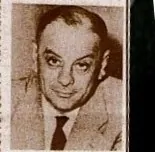
At any rate, the big unveiling turned into exactly the damp squib that Lincoln had predicted. The team of diggers fumbled around in the mud for several hours, coming up with nothing for their efforts. Lincoln left early for the pub.

Seeking to salvage his investment, Paul Johnstone decided to turn the program into a more generalized follow-up to the first Chronicle episode about Rennes-le-Château. Lincoln was given two days to come up with a shooting script. Inevitably, the end result, which aired on October 30, 1974, under the title of “The Priest, the Painter, and the Devil,” feels rushed and half-baked; about a quarter of its visuals are repurposed clips from its predecessor. Much time is devoted to decoding Altar Document 1, although there are several errors in the process as it is described. Otherwise, the episode’s new footage largely consists of Henry Lincoln wandering around the French countryside looking various degrees of pensive. The long delay between its filming and airing may well indicate that the show’s producers knew it wasn’t up to snuff.


Still, there are important additions to the growing body of lore to be discerned, the fruit of Sède and Lincoln’s ongoing research. For the first time, the initials “PS,” which stand out so prominently in Altar Document 2 and Gravestone 1, are identified with the Priory of Sion. The roll call of famous alleged Grand Masters of that shadowy organization is duly read out. Was Saunière a member too?
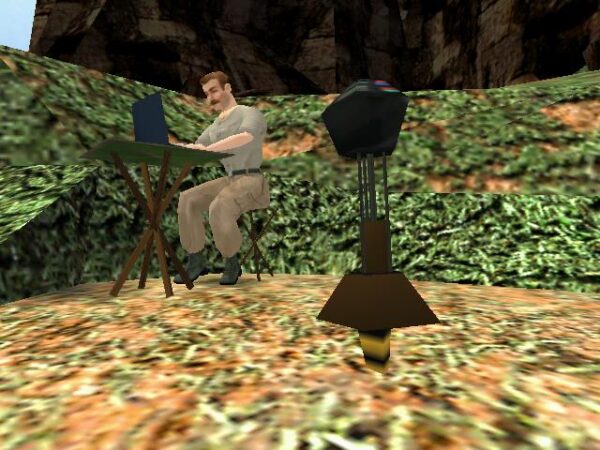
Elsewhere in the program, Lincoln and an obliging professor from the Royal College of Art discover a pentagon hidden in the proportions of Poussin’s The Shepherds of Arcadia. Lincoln spots the same ominous shape in the strange spacing of the lines and letters in Altar Document 2. Combined with Altar Document 1’s scarcely concealed Rex Mundi and a statue of the Devil placed by Saunière in his church, it makes Lincoln wonder whether the Priory of Sion was a cult of Satanists.

Was Saunière guilty of Devil worship… or just really bad taste? (Fabe56)

Geometry had long been a fixation of the treasure hunters around Rennes-le-Château, but it would become still more prevalent going forward. For Lincoln was now convinced that he was on the hunt for something far more important than any hidden treasure. He now pursued hidden history, an even more exciting proposition.

Like much else that I’ve mentioned today, the geometry that is allegedly hidden in the Poussin painting shows up in Gabriel Knight 3′s Le Serpent Rouge puzzle sequence.



Did you enjoy this article? If so, please think about pitching in to help me make many more like it. You can pledge any amount you like.


Sources: The books Holy Blood, Holy Grail by Michael Baigent, Richard Leigh, and Henry Lincoln; Bloodline of the Holy Grail: The Hidden Lineage of Jesus Revealed by Laurence Gardner; The Treasure of Rennes-le-Château: A Mystery Solved by Bill Putnam and John Edwin Wood; The Holy Grail: The History of a Legend by Richard Barber; Invented Knowledge: False History, Fake Science and Pseudo-religions by Ronald H. Fritze; The Tomb of God: The Body of Jesus and the Solution to a 2,000-Year-Old Mystery by Richard Andrews and Paul Schellenberger; Rennes-le-Château et l’enigme de l’or maudit by Jean Markale; Le Trésor Maudit de Rennes-le-Château by Gérard de Sède; The Holy Place: Saunière and the Decoding of the Mystery of Rennes-le-Château by Henry Lincoln; Key to the Sacred Pattern: The Untold Story of Rennes-le-Château by Henry Lincoln; Les Templiers sont parmi nous, ou, L’Enigme de Gisors by Gérard de Sède; Les Mérovingiens à Rennes-le-Château. Mythes ou Réalités. Réponse à Messieurs: Plantard, Lincoln, Vazart & Cie by Richard Bordes; Lives of the Popes: The Pontiffs from St. Peter to Benedict XVI by Richard P. McBrien; How the Bible Became Holy by Michael L. Satlow. Skeptical Inquirer of November/December 2004.

Online sources include the websites Rennes-le-Château: Where History Meets Evidence and Priory of Sion.com.


Tags:

The Mystery of Rennes-le-Château, Part 1: The Priest’s Treasure

(Wikimedia Commons: Jcb-caz-11)


This series of articles chronicles the history, both real and pseudo, behind Gabriel Knight 3: Blood of the Sacred, Blood of the Damned.

Believe that there is a secret and you will feel an initiate. It doesn’t cost a thing. Create an enormous hope that can never be eradicated because there is no root. Ancestors that never were will never tell you that you betrayed them. Create a truth with fuzzy edges; when someone tries to define it, you repudiate him. Why go on writing novels? Rewrite history.

— Umberto Eco, Foucault’s Pendulum

Before all of the conspiracies, there was just a village.

Rennes-le-Château sits perched atop a 300-meter-high promontory in the foothills of the Pyrenees Mountains. It has today a permanent population of fewer than 100 souls, who are clustered together on a plateau approximately 200 meters long by 100 meters wide. The only way to reach the village is by walking, cycling, or driving up a single narrow, twisting four-kilometer road that leaves from the closest neighboring town of Couiza (population 1100) and terminates here. But if there is only one physical road to Rennes-le-Château, there are a thousand or more imaginative ones. It is the Rome of the conspiratorial view of history, the place to which all conspiracy theories seem to lead sooner or later. Once you reach the village, whether in person or merely in spirit, there is literally nowhere else to go.

It may feel like a place out of myth, but it is not one without a website. During the high season, at least half of the single access road’s traffic consists of tourist buses. Their windows act as frames for the portraits of their eager passengers, visions of arcane mysteries swirling almost visibly around their heads like halos or thought bubbles, placed there by the guide at the front of the bus who knows perfectly well what stories she needs to recite to butter her bread. When the visitors pour out of their buses at the top of the hill, the villagers greet them with a smile, if sometimes a weary one. Whatever its drawbacks, living in one of the world’s most unlikely tourist traps is an undeniable improvement over the farming or mining by which their parents or grandparents made a living.

Rennes-le-Château owes its place on so many package-tour itineraries to the insatiability of the human appetite to believe weird shit. For every man, woman, and child who lives in the village today, there have been six or seven books published that prominently feature it. If we wind up nuclear-bombing or fossil-fueling or populist-politicking our way back to the Stone Age in the near future, there will still be some of us sitting around in our caves after the apocalypse, prattling on about Mary Magdalene and holy bloodlines and Knights Templar — always Knights Templar — to distract from the wolves howling in the lonely desolation outside. For a really good sinister conspiracy theory is counterintuitively cozy, what with the way it collapses the amorphous mass of real history, where cause and effect are as muddled as are heroes and villains, into a comforting clockwork mechanism of cogs in cogs. Small wonder that pseudo-history tends to thrive best when real life seems most vexed and confusing.


Rennes-le-Château lies within Occitania, the most southeasterly of the eighteen administrative regions of modern-day France. But for centuries the largest portion of this region, including the one that contains our village, was known as the Languedoc, a name by which it is still colloquially referred to this day. The Languedoc has long been characterized by a stubborn independent streak and an uneasy relationship with the powers that be in far-off Paris. To this day, some of the locals there prefer to speak their own language of Occitan, a direct descendant of the Latin spoken by the Romans who first settled here a century before the birth of Jesus Christ, rather than the language spoken by the rest of France.

Humans have been living in the Languedoc for hundreds of thousands of years; prehistoric cave dwellings have been found in many of the cliff faces that dot this craggy region. When the Romans arrived circa 120 BC, they brought with them bureaucracy, literacy, and in time Christianity in return for the ores and minerals of which the earth of the Languedoc is rich, from iron to copper, lead to gold. They may have built a village on the promontory where Rennes-le-Château stands today, or a villa, or a temple, or a fortress, or most probably nothing at all.

The Romans were eventually displaced by the Visigoths, who were on a tear after sacking Rome itself in AD 410. They evolved a civilization far more sophisticated than their barbarous reputation. Once the most febrile stage of their conquering was over, the Languedoc came to mark the northernmost part of their empire, which otherwise filled most of the Iberian Peninsula to the south. Further north was the burgeoning kingdom of the Franks, the forefather of the nation we know as France.

Some have connected our promontory with a major regional center of the Visigoths, which appears in some of the scant surviving records from the period under the name of Rhedae. But this idea appears to be, like so much about the story of Rennes-le-Château, an example of wishful thinking. Rhedae was supposed to have had a population of up to 30,000 people, meaning it would have had to have sprawled well beyond the promontory itself. Yet there is no trace in the surrounding countryside of the debris a settlement of that size should have left behind. Coins, jewelry, and axe blades should have been regularly churned to the surface by the farmers who have worked the land around here for centuries — not to mention the thousands of amateur archeologists who have descended on the area since Rennes-le-Château became such a nexus of conspiracy theories.

At any rate, the end came for the Visigoths at the beginning of the eighth century, when the Iberian Peninsula was invaded by Arab Muslim armies which had crossed the Mediterranean from Africa. The Muslims pressed northward from Iberia, taking the Languedoc and the entire southern half of modern France, until they were finally stopped by the Franks near Poitiers in 732. The Franks then pushed them back roughly as far as the modern border between France and Spain.

Yet the same Frankish kings who had triumphed over the fearsome Muslim armies found the settled inhabitants of the Languedoc a tougher nut to crack. The craggy landscape, it seemed, bred equally craggy souls. The region became a patchwork of small fiefdoms, home to a people who continued to hew to their own culture and language. Even the vaunted Charlemagne was able to fully assimilate the Languedoc into his empire only briefly.

One of the independent lords built a castle — a château in French — along with an accompanying church at the top of our promontory around the year 1000; this marks the first point where we can say with absolute certainty that people had begun to live there year-round. We don’t know precisely who built the castle, or why, beyond noting that high ground like this is always a natural place to fortify. It is likewise unclear by what name the complex was known. The name of Rennes doesn’t appear to have marked the site until the eighteenth century, Rennes-le-Château not until the nineteenth — by which time, ironically, the titular castle was no more than a romantic-looking ruin.

In the middle of the twelfth century, the Languedoc demonstrated its independent streak in the most flagrant possible fashion, when it became the locus of a breakaway sect of Christianity known as the Cathars, one of a succession of “proto-Protestant” groups who predated Martin Luther. In fact, the Cathars’ ideas were much more radical than those of even that radical reformer. Borrowing from the texts of the ancient Gnostic Christians, they thought that Jesus Christ had been an angel, an ethereal being whose physical form was only an illusion, who by his very nature could not have been physically killed and brought back to life, who had only created the illusion of these events. As if that wasn’t heretical enough, they also believed that there were two gods rather than one, an evil God of the Earth who was the protagonist of the Old Testament and a loving God of the Heavens who had announced his arrival in mortal affairs through the angel Jesus. They believed that the popes in Rome were the servants, wittingly or unwittingly, of the bad god rather than the good.

Of course, such a slate of beliefs was a recipe for trouble in Medieval Europe, and trouble the Cathars soon got. Pope Innocent III declared a Crusade against them in 1208. Savage warfare consumed the Languedoc for decades; whether and in what capacity the castle at Rennes was involved is unknown. Matters finally came to a head in 1243, when the heart of the Cathar army was besieged at the Château de Montségur, just 35 kilometers west of Rennes. On March 12, 1244, the starving remnants of the Cathar defenders embraced their martyrdom willingly, marching out of their castle’s gate with linked arms to face grisly death at the hands of the papist antichrist’s minions.

But it has long been said that, before they did so, they managed to sneak some great treasure past the enemy and hide it away somewhere. Some say it was the treasure of Solomon’s Temple, which was stolen from Jerusalem and taken to his own capital by the Roman general Titus in AD 70, then stolen again and brought to the Languedoc by the Visigoths. Some say the treasure might include the Holy Grail that was used to catch some of Jesus’s sacred blood at the crucifixion. (The fact that the Cathars didn’t believe that Jesus had a physical form from which to bleed real blood seems to have bothered remarkably few of the seekers of this “Cathar Treasure” over the years.) There is a legend about a Languedoc shepherd boy who in 1645 fell down into a hole while searching for a lost lamb; there he found skeletons surrounded by great heaps of gold. He filled his hat with gold and returned to his village, only to be stoned to death as a thief. (Justice was apparently even harsher than we imagine it to have been in that century, and the normal spirit of human curiosity strangely lacking.) This, then, is the original would-be treasure of the Languedoc. Rest assured that there will be others.

With the crushing of the Cathars, the Languedoc was firmly incorporated into the kingdom of France for the first time. From here, its history becomes a part of the history of France, much though some of its people may resist that notion. At the risk of offending these folks, we shall skip forward now, all the way to the late nineteenth century, by which time the castle on our promontory has been long abandoned and the rest of the misnamed Rennes-le-Château is a tidy if nondescript village of farmers and miners, population about 300 people, enough to support a Catholic priest of their own in their little Church of Sainte Marie-Madeleine. (This church may or may not be the one that was first built in the year 1000 or earlier; a fifteenth-century map of the local diocese shows two churches on the promontory, the other one being known as the Church of Saint Pierre. Even if it is the newer of the two, however, the Church of Sainte Marie-Madeleine is still at least 700 years old, because it is mentioned by name in an inventory dating from 1185.)

François-Bérenger Saunière.

In 1885, Rennes-le-Château was assigned a 33-year-old priest named François-Bérenger Saunière, a native of the Languedoc who had been ordained in Carcassonne, the nearest cathedral town. Initially, he seemed to serve his flock faithfully and unremarkably enough. For six years after his arrival, nothing untoward occurred.

Then, in 1891, he took it upon himself to repair the high altar of his church. Inside one of the altar’s pillars, workers found some hollow wooden tubes containing documents written in Latin. They took them directly to Saunière, he being the only person in the village with the ability to read them.

Not long afterward, Saunière launched a new program of building and renovation, on a scale dwarfing the repair of a single altar. He remodeled the interior of his church in a striking and often jarring Gothic style, built a new chapel in the cemetery, laid out a decorative grotto, built a water tower for his parishioners, and graded the road still used by all of those tourist buses of today. The crowning glory was an elegant Mediterranean-style residence which Saunière dubbed the Villa Béthanie. Behind its high fence could be found a dramatic garden running right up to the edge of the promontory, an ornate orangery, and a neoclassical observation tower offering gorgeous views. In the base of this latter structure, which Saunière named the Tour Magdala, was to be found his library, housing his impressive collection of occult books.

Villa Béthanie as depicted in Gabriel Knight 3.

The villagers would continue to talk about the salad days of Saunière for decades after the priest was no longer with them; some of their descendants continue to talk about them today. It is said that opera divas, high-ranking members of the French cabinet, and scions of the Habsburg dynasty came to stay in the villa. Saunière himself was frequently away from home, on jaunts that seemed to span the width and breadth of Europe. No one knew for sure where the money for all of this was coming from, but the rumor mill had it that the priest must have found a hidden treasure somewhere close to the village. The money certainly wasn’t coming from the Catholic Church, whose representatives were as flummoxed by what was going on in Rennes-le-Château as everyone else.

In 1910, the bishop of Carcassonne demanded that Saunière tell him plainly how he was funding all of this construction. Saunière flatly refused to do so. As a result, he was defrocked by an ecclesiastical court on December 5, 1911, temporarily at first and then permanently, once it had become clear that he intended to remain obdurate on this issue.

But Saunière simply refused to leave Rennes-le-Château in the aftermath of the verdict. He set up an altar inside his house and held Masses there for any who wished to come, in competition with the new priest who performed the same service inside the church that Saunière had remodeled so audaciously. He stayed a squatter on the territory of the Catholic Church until his death in 1917. When he was lying on his deathbed, a priest grudgingly agreed to come in from a neighboring parish to hear his Confession and administer the Last Rites. Real or purported witnesses have said that this priest came out of the sickroom looking visibly shaken, muttering that Saunière’s sins had been so immense that he had been unable to give the dying man the absolution he required to enter the Kingdom of God.


Albert Salamon, right, sits with Noël Corbu, on the boozy night in January of 1956 that injected the treasure of Rennes-le-Château into the mass-media bloodstream.

The foregoing have been the broad historical facts surrounding Rennes-le-Château, to whatever extent we are able to discern them. The story of how these facts evolved — some might say, were twisted — into one of the most prominent conspiracy theories of modern times is in some ways even more interesting. This tale begins less than three decades after the death of Bérenger Saunière, with the arrival in Rennes-le-Château of an inveterate dreamer, schemer, and chancer named Noël Corbu.

A venturesome streak ran through the Corbu family; Noël’s older brother Pierre had been an aviator who disappeared while trying to fly from Paris to New York in an experimental aircraft, just weeks before Charles Lindbergh became one of the most famous men in the world by accomplishing the feat in reverse. (So thin is the line between historical oblivion and eternal fame.) Born in Paris in 1912, Noël Corbu invested in airlines rather than becoming a pilot himself, then ran a pasta factory and tried his hand at writing detective novels. During the Nazi occupation of France, he started a black-market-smuggling operation in the Languedoc town of Perpignan, providing luxury goods to the Germans and French alike, whoever could afford to pay him. Alas, what he had seen as nothing more nefarious than a business opportunity primed for the taking got him tarred as a collaborator once the Nazi-installed Vichy regime was toppled. In 1945, he and his wife and two children made a hasty exit to the town of Bugarach, just twelve kilometers from Rennes-le-Château.

His new neighbors told him some of the rumors that swirled around the tiny but imposingly situated village and its former priest — rumors which were at this time still local to the area. If Bérenger Saunière’s will was to be believed, he had died penniless, except for the beautiful residence in which he had expired. This he had willed to, of all people, his housekeeper, a woman named Marie Dénaraud who, it was rumored, may have done more for him in his bedroom than wash the rugs, drapes, and linens. If Saunière had found a treasure, his home was surely the most logical first place to look for the booty, or at least for a clue as to its current whereabouts. Dénaraud was still living in the villa in 1945. Thoroughly intrigued, Noël Corbu decided to go and see her.

Marie Dénaraud as a younger woman.

One glance at the Villa Béthanie was enough to tell him that, if there was treasure still hidden inside its walls, Marie Dénaraud hadn’t figured out how to make it liquid. She had sold the priest’s occult library to an antiquarian bookstore in Britain well before the war, but she hadn’t been seen hawking any gold or jewels. The place was in serious disrepair: the garden overgrown with weeds, the shutters falling off the windows, the once-gleaming steel frame of the orangery now more rust than metal. The woman who answered his knock on the front door was in no better condition. Dénaraud was a slatternly scarecrow who looked like she hadn’t eaten a decent meal in years.

Negotiations ensued between the two, about which we know sadly little. Was the savvy black marketeer played by the even savvier old woman, who could surely sense his mercenary motives? Did she drop hints about what might lie hidden somewhere inside the falling-down house? Maybe. Or maybe there was more mutual understanding and affection than that cynical interpretation allows for. At any rate, Corbu became a regular caller at the house, and on July 22, 1946, the two signed a contract. In it, Dénaraud gave the Villa Béthanie to Corbu outright, in return for a pledge from him that he would allow her to remain living there for the rest of her days.

If Corbu had signed the contract in the hope that Dénaraud would then let him in on some lucrative secret, that hope was frustrated soon after, when Dénaraud suffered a stroke which left her unable to speak. Corbu did find a substantial quantity of documents in the house: bills and work orders for the many construction and renovation projects, account books, legal records of Saunière’s difficulties with his bishop, even some personal journals. But none of it seemed to explain where his money had come from; nor did it have anything to say about any treasure that might still be hidden somewhere. If the Latin documents that had been found in the altar’s pillar were among the ones in the house, Corbu was not enough of a scholar to recognize them for what they were.

More years went by, during which the villa only grew more dilapidated. Dénaraud seldom poked her head out of doors, and Corbu too was rarely around, being engaged with business ventures that took him as far away as Morocco, where he made and just as quickly lost a small fortune in the sugar industry. In 1953, Marie Dénaraud died. She was buried next to Bérenger Saunière in the churchyard in accordance with the terms of her will, prompting a fresh round of tongue-wagging from the village old-timers.

Dénaraud’s death came shortly after Corbu’s Moroccan sugar disaster. Perhaps not coincidentally — on either point — he now began to take a serious commercial interest in her old residence for the very first time. He brought teams of workmen in to clean the place up, intending to turn it into a restaurant and hotel. But Corbu needed an angle compelling enough to make people drive up the twisting road that dead-ended here. He needed a reason to put Rennes-le-Château on the map, as it were. He turned to the same reason that had caused him to knock on Marie Dénaraud’s door for the first time eight years earlier. For if it had worked on him, he reasoned, it ought to work just as well on others.

He bought himself a tape recorder and recorded a précis of the strange case of Bérenger Saunière and his mysterious riches. His operative theory at this point was that the treasure Saunière had uncovered had once belonged to the French crown. In 1248, just a few years after the Cathar movement had been decapitated and the Languedoc incorporated firmly into the kingdom of France, King Louis IX had invaded Egypt at the head of the Seventh Crusade. He had left his mother, Blanche of Castile, to look after things in Paris while he was away. But the city had been plagued with unrest during this period, being stuffed to the gills with wayward noblemen who couldn’t see their way to being ruled by a woman. Corbu now concluded that Blanche must have emptied the royal treasury to keep it out of unfriendly hands, sending the whole kit and caboodle to the war-ravaged Languedoc, the part of the kingdom that was farthest from its capital in both geography and spirit. Who would think to look for it there? No one, it seemed, until Saunière had found some record of it hidden inside his church.

But in order to connect these two dots, Corbu had also to explain why the treasure had never been recalled to Paris after Louis IX had returned to the capital and things had settled down there. By way of doing so, he noted that Blanche had died in 1252, two years before her son’s return. (The hapless fellow had gotten himself captured by the Egyptians and spent four years as their hostage before he was ransomed.) Amidst the shuffle of regents and monarchs, the royal family had just plain forgotten where they’d put the treasure, in the same way that I can never figure out what drawer my wife has put the batteries in when she goes off to a conference and leaves me all alone at home.

It was a theory anyway. Corbu set great store by the fact that Philip IV, king of France from 1285 to 1314, had been infamously cash-poor, to the point of having to counterfeit money to keep his government from collapsing. Surely this was because silly Blanche had misplaced most of his inheritance a few decades earlier. No mention of the confusion appeared in any historical documents because the whole mess was just too embarrassing to talk about.

Based on no particular evidence, Corbu declared confidently that the royal treasure found by Saunière consisted of 18.5 million gold coins weighing 180 tons, plus countless jewels and religious objects; together it would be worth 4 billion francs in 1950s money. For all practical purposes, the store of wealth would have been inexhaustible. The primary purpose of Saunière’s many foreign trips had been to turn Medieval coinage into present-day francs, by melting the coins down and selling the lumps of raw metal that resulted. “A person from Carcassonne who is still alive assured me that he saw in the priest’s house a chest full of gold ingots,” Corbu insisted. Who could doubt such ironclad testimony?

In 1954, Corbu opened his restaurant. His taped story of Bérenger Saunière and the royal treasure was played to all of the diners during their meals. “Thus in this quiet village with its magnificent view and glorious past, there is one of the most fabulous treasures in the whole world,” he said at the end of the tape. Tell your friends! Don’t they deserve to bask in the mystery too?

The restaurant did well enough that Corbu could afford to convert the Tour Magdala into a hotel the following year. Meanwhile he continued to look for ways to get the word out to folks beyond the immediate vicinity of Rennes-le-Château. He hit pay dirt in January of 1956, when he lured in Albert Salamon, a journalist for the newspaper La Dépêche du Midi (“The South of France Dispatch”). Under the banner headline “The Fabulous Discovery of the Priest with Billions!”, Salamon laid it on thick. The trilogy of articles he wrote for his newspaper opens like a Gothic horror story, more Bram Stoker than Edward R. Murrow.

Dusk was advancing rapidly over the countryside as my friend’s cantankerous car carried us with steady rhythm along the steep winding road to the “high place” of Rennes-le-Château. At the top of the hill, the car was swallowed up among the centuries-old stones of an ancient queenly citadel, and then the tower appeared, a black shadow on the starry background.

The aim of the nighttime excursion? To answer an invitation to meet with M. Noël Corbu, founder and proprietor of the Hôtel de la Tour at Rennes-le-Château. I was eager to make the acquaintance of the brother of the test pilot Pierre Corbu, who died in 1927 with his comrade Lacoste on the Bluebird while he was trying for the third time to cross the Atlantic.

Mme. Corbu served us a meal of chicken, accompanied by fine wines. In the dining room, my curiosity was aroused by a portrait of a priest with a piercing gaze. “A relation, M. Corbu?”

A thick file was placed before me. The diary of the priest, plus hundreds of letters, bills, plans, estimates… and the story began.

These last words would prove true in a more all-encompassing way than Salamon could ever have dreamed at the time. For the media story of Rennes-le-Château really does begin precisely here. He was the first in a long line of credulous or calculating writers — the jury is still out for many of them — who have spun yarns around the little village that are as exciting and enticing as any avowedly fictional thriller. Seen in this light, it feels only fitting that the process culminated almost 50 years after Salamon’s articles in a bestselling, zeitgeist-defining novel and blockbuster movie.

For now, though, Salamon left the Villa Béthanie with a head stuffed full of mythical imaginings.

It is one o’clock in the morning. The ghosts that sat down at the host’s table in the course of this thrilling story have kept secret right to the end the mysterious hiding place whose “open sesame” the abbé had stumbled upon. And when the door of the Hôtel de la Tour was opened onto the night, and I held out my hand to M. Corbu in au revoir, there seemed to me to be shining, where a moment ago there were stars, millions of golden pieces of the fabulous treasure…

It seems to have been the imagination of Salamon rather than the equally prodigious one of Corbu which added a new twist to the story, one that would become very important in the course of time. At the very end of his third and last article, Salamon mentioned the longstanding legends about “Cathar treasure, including the famous Holy Grail” being hidden somewhere in the Languedoc. Might it actually have been this treasure rather than that of the French crown that Saunière had stumbled upon? It did seem more plausible in some ways. Corbu too would gradually adopt this theory of the case.

Over the years that followed Salamon’s articles, Corbu’s Hôtel de la Tour marked the center of a slowly expanding circle of curiosity and greed. The phenomenon was nothing like what it would become, but it was sufficient to support a hospitality business in this rather far-flung location. The smoky air inside Corbu’s restaurant was filled with the speculations and arguments of mystics, cranks, and dreamers.

By 1960, the circle had expanded enough to reach the Parisian headquarters of the ORTF, France’s national broadcasting service. A film crew came to Rennes-le-Château to shoot a television documentary about the village and the mystery; these were quite possibly the first moving images ever captured in the place. The program aired throughout France in April of 1961, under the name of La Roue Tourne (“The Wheel Turns”). As far as I have been able to determine, only a single clip has survived, just 40 seconds in length. It reenacts of the discovery of the mysterious Latin documents inside a pillar next to the church’s altar. Corbu has gamely put on priestly vestments to play the role of Saunière as the documents are handed to him by a member of the work crew.

Outside of this clip, we have only a handful of newspapers reviews to fall back on. These serve to remind us that the more things change, the more they stay the same. One of them, which appeared in L’Indépendant, mentions a “hypnotist” cum treasure hunter named Domergue, who “based on the revelations of his medium, thinks that the famous treasure is actually contained in fourteen barrels, but that one of them has been emptied by the abbé. Even if only thirteen remain, however, their discovery would still cause a considerable stir around the marble escarpment of Rennes-le-Château.” (This is an understatement!) Our friend Domergue is sanguine about his prospects of success: “I’ll be resuming my excavations in June. I’m not very far away from my target, and before the end of the summer I’ll have reached the gallery leading to the barrels of gold.” The journalist chronicling all of this wonders, a little plaintively, “Will the secret and the mystery which surround the treasure be resolved one of these days?” The naïve fellow has no idea that “the secret and the mystery” are just getting off the ground.

The documentary caught the attention of at least one sober-minded historian as well. René Descadeillas had lived most of his 53 years in Carcassonne, whose municipal library he had headed since 1950. He knew the area’s past and present intimately. In December of 1962, he deposited into his library’s archives the results of a careful factual inquiry into Bérenger Saunière’s controversial tenure in Rennes-le-Château. In some ways, his investigation still stands as unique, in that it was undertaken early enough that some of the events in questions were still within living memory. Trolling through the documents of the period and interviewing witnesses and their descendants, he uncovered some interesting facts and testimony that cut against more fantastical interpretations of the case.

René Descadeillas.

He learned, for example, that Saunière had already conducted some renovations of the church before 1891, for which he had paid the more than piddling sum of 518 francs, which was itself far beyond the means of his modest priestly stipend; he must, in other words, have had some alternative source of money even before the discovery of those Latin documents. Further, there were reports that Saunière had been explicitly asked by the village mayor what said documents were about, and had replied that they dealt strictly with technical details of the construction of the church. He could have been lying, of course, but his manner hadn’t struck anyone present at the time as particularly suspicious.

Descadeillas put forward a freshly prosaic explanation for Saunière’s sudden influx of cash after 1891, assuming he had been the beneficiary of one at all. It involved a windfall discovery of a sort, but one of a more modest scope and scale than our hypnotist friend’s fourteen barrels full of gold, much less Corbu’s 180 tons of the stuff. During the chaos of the French Revolution a century before Saunière’s arrival, when atheism had briefly become the order of the day throughout the country, an elderly village priest named Antoine Bigou was reported to have “buried his savings at the same time as the religious objects that he wished to preserve for the future.” As Descadeillas described it, “this was not a ‘treasure’ in the usual sense of the word, but a nest egg.” He actually talked to a still-living stepsister of Marie Dénaraud, who was “adamant” that Saunière had found “a pot of gold pieces” — but only the single pot — during the renovations of 1891. This fortuitous find could easily have planted the seed for the rumors of a lost treasure — rumors which would only grow in the telling, as such things inevitably do.

Still, the fact remained that such a comparatively modest quantity of gold couldn’t have paid for all of Saunière’s construction projects. Descadeillas strongly suspected that the rest of Saunière’s wealth came from criminal enterprises rather than from buried treasure. His younger brother Alfred had also been a priest, a known corrupt one who had gotten himself excommunicated in 1904 for stealing from his flock and fathering a child with one of them; he had then drunk himself to death the following year. An intriguing letter from Saunière to his lawyer described this brother as his “middle-man for generous deeds.” Descadeillas was convinced that one part of the brothers’ mutual activities had been “the selling of the Mass,” a way for people who were living less than righteous lives — such as gangland operators, perhaps? — to buy absolution for themselves; family members of the newly deceased unrighteous could likewise pay the priests to buy their relatives a ticket into Heaven. Descadeillas tracked down a postal worker in Couiza who remembered Saunière stopping in almost every day to pick up and deliver suspicious little envelopes — envelopes full, Descadeillas was certain, of money going one way and certificates of absolution going the other way. This sort of thing, known historically as the selling of “indulgences,” had once been accepted practice in the Catholic Church, had in fact been the proximate cause of Martin Luther’s Protestant Reformation. Now, however, it was known as simony, one of the gravest sins which a member of the clergy could commit. The old story about the priest who went to deliver the Last Rites to Saunière, only to come out of the sickroom looking shocked to the very core of his being, suddenly made a lot more sense in this light.

But it seemed unlikely that even simony would have paid well enough to fit all of the facts of the case. The brothers must have been up to other sorts of corrupt dealings; of this Descadeillas was sure, even if he couldn’t prove it. He noted one more piece of circumstantial evidence: Saunière’s financial situation seemed to have taken a dive during the years after his brother’s death in 1905. He had funded little to no new construction after that point, and he had even had to take out a substantial bank loan in 1913 just to maintain his villa. Was this due to the loss of his “middle-man?” It seemed that he might truly have died as penniless as his will had claimed. The bank had finally forgiven the loan after Saunière’s death, when it decided that Marie Dénaraud had no realistic means of paying it back. Bankers usually have a sense about such things.

Much remained unexplained, but Descadeillas believed that the explanations, should they ever come, would prove to have more to do with everyday corruption and criminality than any centuries-old treasure trove. “The treasure of Rennes does not exist,” he wrote in conclusion. “But the secret of the priest of Rennes is real. And it is there that the mystery resides.”

All of this was perfectly reasonable and sensible, but it was always going to be doomed to have a tough time competing against tales of a grandiose Cathar treasures hoard. It didn’t help that René Descadeillas was a quiet, scholarly man by nature, content to write his report, drop it into his library’s archive for posterity, and move on to the next project. No film crews came around to get his side of the case. That said, we haven’t heard the last of Descadeillas, a rare and therefore invaluable voice of reason in the story of Rennes-le-Château.

For the time being, though, life went on as usual at the Villa Béthanie. The treasure hunters streamed through, each of them leaving empty-handed but full of new esoteric theories about where to dig next time. They became a nuisance for the local landowners, who were constantly finding new holes in the most likely and unlikely of places, as if their holdings had been infested by giant moles. In 1965, the municipal government issued a decree: no more excavations allowed without a permit. That helped somewhat, but the most dedicated seekers just took to digging under the cover of night. It was more atmospheric at night anyway.

Gabriel Knight 3′s Aussie treasure hunter John Wilkes, who takes an elaborate high-tech approach to the search, is of a type well-known to the locals around Rennes-le-Château. In the 1960s, metal detectors, Geiger counters, and dowsing rods were the tools of choice, but the spirit remained the same.

That same year, Noël Corbu sold the Villa Béthanie to a man named Henri Buthion. Restless serial entrepreneur that he was, Corbu had set up a side business making ladies’ fans and lampshades in the villa’s orangery. It was going pretty well; he wanted to expand it, but there just wasn’t enough space to do so in such a little village. Meanwhile much of the fun of running a hotel and keeping the mystery of Bérenger Saunière alive through year after year in which nothing concrete was discovered had run its course for him and his wife. So, he sold out and went on to the next adventure. Sadly, though, the adventure of life was almost over for him: he was killed in a car accident in 1968.

But the ball that Corbu had set rolling now had an unstoppable momentum of its own. Buthion continued to run the Hôtel de la Tour pretty much as his predecessor had, albeit with slightly less dramatic flair. He would be the witness and benefactor rather than the instigator of the next chapter of the saga of Saunière’s treasure. The whole thing was about to get a massive injection of plot inflation from a couple of new voices on the scene. This shit was about to get a whole lot weirder.


Did you enjoy this article? If so, please think about pitching in to help me make many more like it. You can pledge any amount you like.


Sources: The books Holy Blood, Holy Grail by Michael Baigent, Richard Leigh, and Henry Lincoln; Bloodline of the Holy Grail: The Hidden Lineage of Jesus Revealed by Laurence Gardner; The Treasure of Rennes-le-Château: A Mystery Solved by Bill Putnam and John Edwin Wood; The Holy Grail: The History of a Legend by Richard Barber; Invented Knowledge: False History, Fake Science and Pseudo-religions by Ronald H. Fritze; The Tomb of God: The Body of Jesus and the Solution to a 2,000-Year-Old Mystery by Richard Andrews and Paul Schellenberger; Rennes-le-Château et l’enigme de l’or maudit by Jean Markale. Skeptical Inquirer of November/December 2004; La Dépêche du Midi of January 12, 13, and 14 1956; L’Indépendant of April 22 1961.

Online sources include the websites Rennes-le-Château: Where History Meets Evidence and Priory of Sion.com


Tags: