RSS

Category Archives: Digital Antiquaria

The Road to IV

Ultima IV

Late in the fall of 1983, when it was clear that Ultima III was turning into a huge success and thus that their new company Origin Systems was going to be a viable operation, Robert Garriott came to his little brother Richard with a forlorn plea. Robert, you may remember, had for months been commuting via his private Cessna between the Garriotts’ family home in Houston, whose garage served as Origin’s development studio and assembly line, and North Andover, Massachusetts, where his wife Marcy worked for Bell Labs. It wasn’t, to say the least, an ideal way to run a marriage. Would Richard and the rest of the fledgling company agree to move to North Andover for three years? After that, Marcy expected a promotion that should make it much easier for her and Robert to move, and, assuming the company was still alive, they’d then move wherever Richard and the rest liked. Young, unattached, and ready for adventure as they were, just about everyone agreed. They packed their cars with their personal possessions and rented two trucks to fill with supplies, computers, and other equipment — most notably the precious shrink-wrap machine — and headed northeast just weeks later.

That winter was a bad one, with some of the worst storms of the decade. They hit major snow before they got out of Arkansas. Anyone who’s ever seen a Texan trying to drive on snow and ice can perhaps attest to what a miracle it was that they got to North Andover at all. Once there, the snow and bitter cold just continued for months. That first winter wasn’t the best introduction to the place that Richard still calls “the frozen wastes of New England.” He totaled his car on the icy streets within days; his house right next door to his brother Robert’s, which he rented with Chuck Bueche and Mary Fenton, was burglarized not once but twice, resulting in the loss of thousands of dollars worth of computers and home electronics; he and his buddies couldn’t seem to connect with any of the locals, who viewed their Texas accents and strange business of making computer games with suspicion. Things wouldn’t get much better; Richard in particular remained a hopeless fish out of water throughout his time in New England.

The only thing to do was to throw himself into life inside the Origin bubble. He made his own fun, instituting a daily five o’clock ritual called “Rubbaser war,” using $75 graphite-and-steel guns that could shoot rubber bands at speeds of up to 120 miles per hour; they hit with such force that the combatants had to wear helmets. He also continued to celebrate his favorite holiday with elaborate Halloween parties, even if the number of people around him eager to attend them had rather dwindled since the move. The moment when the locals decided once and for all that they wanted nothing to do with him may well have been the first of these: Richard, who was great at preparing for such big events but not so great at cleaning up after himself, left unnervingly realistic-looking bloody body parts strewn across his lawn through much of the following winter.

With Chuck Bueche’s action game Caverns of Callisto having failed to set the industry on fire, Origin now concentrated on, as their tagline would eventually have it, “creating worlds” in the form of big, ambitious games. Soon after the move to New England, they hired Dave Albert away from Penguin Software. Albert, who had majored in journalism at university and served as editor and writer for SoftSide magazine before coming to Penguin, would help Robert Garriott to put a professional face to this collection of young hackers. Albert also brought with him Greg Malone and his game in progress, the very original if polarizing oriental CRPG Moebius. Before releasing their next slate of games after Ultima III and Caverns of Callisto, Origin signed a distribution deal with Electronic Arts, becoming one of the first of what would eventually be quite a number of EA “Affiliated Labels.” This gave the still tiny Origin a badly needed presence in mass-market chains like Toys “R” Us and Sears.

Origin stretched out its tendrils in many intriguing directions during these early days. They entered into a contract with Steve Jackson Games — Steve Jackson was a friend of Richard’s from his Austin SCA troupe — to adapt that company’s popular board game Car Wars for the computer. They also agreed to make a computer game to accompany a planned film version of Morgan Llywelyn’s novel Lion of Ireland; Richard would get to spend two weeks on the set in southern Ireland soaking up the ambiance in the name of research. Richard also made tentative plans with none other than Andrew Greenberg of Wizardry fame to collaborate on “the ultimate fantasy role-playing game.” Most of this came to naught: the movie’s financing fell through and it never got made; the ultimate collaboration remained nothing more than talk. Only the Car Wars project survived, and only after a fashion: Chuck Bueche turned the turn-based board game into the real-time CRPG Autoduel over the considerable misgivings of Steve Jackson.

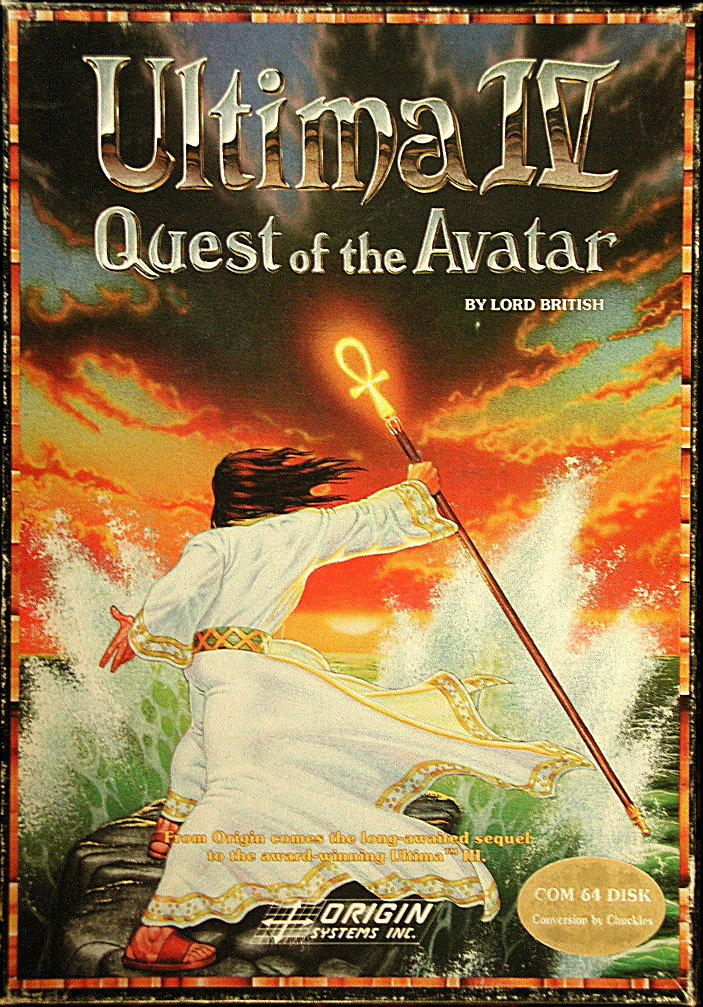
Meanwhile and preeminently, there was Ultima IV, the game that would change everything for Ultima and for Origin. As was his routine by now, Richard started working on it almost from the moment that Ultima III shipped, starting once again from the previous game’s code base and once again designing and coding virtually everything himself on his trusty Apple II. But, like the fourth Wizardry game that was its obvious competitor, it took much longer to complete than anyone had anticipated. Originally slated for Christmas 1984, it took a final desperate dash just to get it out in time for Christmas 1985.

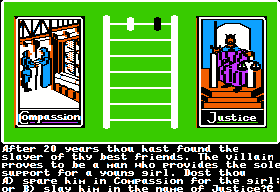
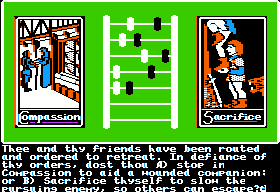
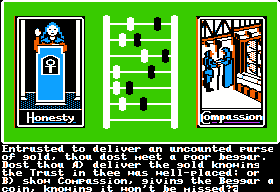
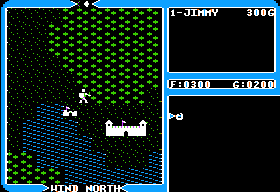
Anticipation grew all the while. For a game to remain in active, continuous development for two years at that time was virtually unprecedented. Truly Richard Garriott must be doing something amazing. The hints and tidbits that he let drop during interviews certainly sounded good: Ultima IV‘s world map would consist of 256 X 256 tiles, 16 times the size of Ultima III‘s 64 X 64-tile world; there would be a full parser-based conversation engine for talking with others; spells would now require reagents to cast, with the finding of their recipes and ingredients a mini-game within the game; dungeons would now contain “rooms” that opened into a tactical map. Yet the thing that Richard kept bringing up most was none of these incremental improvements, but something he insisted marked a change in the very nature of the game. There would be, he said, no evil character to defeat. Instead the player must become a better person, an “Avatar of Virtue.” What was that all about?

Richard Garriott has told many times the story of how Ultima IV came to be. Akalabeth, Ultima I, and Ultima II had, he says, existed for him in a vacuum — or, maybe better said, an echo chamber. Any fan mail or other feedback from players of those games had never reached him because neither California Pacific nor Sierra had bothered to forward it to him. Once Ultima III came out under his own company’s aegis, however, he started getting a flood of letters telling him how fans really played his games. This generally entailed lots of murdering, stealing, and all-around reprehensible behavior. Now, it’s perhaps a bit surprising that this should come as such a shock to Richard, since those early games essentially forced this behavior on the player if she wished to succeed. Still, the letters set it all out in unmistakeable black and white, as it were. And then there were the truly crazy letters from religious fundamentalists and anti-Dungeons and Dragons activists, which included such lovely epithets as “Satanic perverter of America’s youth.”

The first few of those letters that I got at the age of 22 really bothered me. You sit back and go, “Gosh, I know I’m not a wicked individual, I know I’m not teaching Satan worship, I know I’m not doing any of these things.” But the fact that someone would think so bothered me. It made me want to call the person up and say, “Look, you’re wrong, you just misinterpreted it.” But of course it would do no good to do so.

“People,” Richard said in another interview, “read things into my games that were simply statistical anomalies in the programming. They thought I was putting messages into the game.” To his mind, those first four games were all simply “here’s some money, here’s some weapons, here’s some monsters, go kill them and you win.” Like the Beatles a generation earlier, he now decided to give those who wanted hidden messages something that actually, you know, existed to think about it. Less facetiously, all of this feedback did make him begin to think seriously for the first time about the sorts of messages his games were delivering, to begin to understand they were not “just games,” that they could and did say something about the world. He began to understand that every creative work says something, whether its creator intends it to do so or not. It says something about the person who created it, the culture he came from, the audience to which it’s expected to appeal. Richard wasn’t sure he liked what his games were saying — albeit all but unbeknownst to their creator — so he decided to take conscious control of his message with Ultima IV.

It makes for kind of a beautiful story about a young man discovering himself as an artist, discovering that the work he puts into the world really does matter. And there’s no reason to believe it isn’t true in the large strokes. That said, there are indications that the full story may be at least a bit more complicated than the glib summary that Richard has given in almost thirty years worth of interviews.

In the November 1983 issue of Softline magazine is an interview with Richard in which he describes his plans for the nascent Ultima IV. Already at this stage the player’s goal was to become an enlightened avatar by acquiring sixteen attributes — twice as many as in the finished game.

Fifteen attributes represent powers over forces of nature and life, and the final attribute is clairvoyance. The first fifteen attributes may be obtained through certain great deeds in the physical world: areas like those portrayed by all the previous Ultima games. For the final attribute, the adventurer must make a quest into the ninth plane of Hell (presumably through all the lesser planes as well).

The article goes on to state that the resolutely non-bookish Richard had read Dante’s Inferno by way of preparation, “so we can expect the depictions of the planes to be vivid and graphic.”

This is fascinating stuff on a couple of levels. It’s of course always interesting to see how a major work like Ultima IV evolved (if you didn’t find it so, I assume you wouldn’t be reading this blog). It’s interesting that sixteen “attributes” — a word that positively reeks of Dungeons and Dragons — became a more manageable eight virtues. It’s interesting to note how Dante’s Hell turned into the more abstract Stygian Abyss of the final game, doubtless a very wise decision in light of the easily outraged folks already convinced that fantasy role-playing in general and Ultima in particular were the work of Satan. It’s interesting just to note the influence Dante had on Ultima IV, an influence which, for all the words that have been spilled about the game since its release, appears to have gone completely unremarked in all of them.

But perhaps most interesting of all is the timeline of all this. Given magazine lead times, the interview that led to this article must have been done bare weeks or days after Ultima III‘s release — hardly enough time to let Richard receive lots of fan mail and other feedback on the game, internalize it all, and proceed so far down the road to a response in the form of Ultima IV. If we take that as a given, it leaves open just two alternative possibilities: that Sierra at least had in fact been forwarding to Richard his fan mail (this wouldn’t hugely surprise me; demonizing those first two publishers who did so much to give him his start has unfortunately become one of Richard’s less noble hobbies in recent years), or that this feedback, when it arrived, would be a contributory factor to Ultima IV but not quite the prime motivator it’s become in Richard’s telling. With that in mind, let’s look at some of the other factors that may have been at play here.

It seems likely that the real point of genesis of Ultima IV was not a fan letter but rather a television documentary about the Dead Sea Scrolls. This program, mentioned by Richard in interviews but which I unfortunately haven’t been able to identify more specifically, apparently mentioned in passing the belief held by some Christians and Hindus that Jesus Christ visited India during the so-called “unknown years” of his life, that period between about age twelve and thirty which is not described in the New Testament or any other accepted record. Some such folks believe that Jesus was a Hindu “avatar,” a god descended to earth in human form. Richard was captivated by the concept. He wasn’t the first bright young person to seek in the religions of the East a spiritual alternative to the dogmatic rigidity of the Christianity that he saw around him in his daily life. His august company includes the likes of Roger Zelazny, Steve Jobs, and of course a certain four lads from Liverpool. “I am not a religious individual,” he once said, “but I do have difficulty with the scare tactics that religions use to teach ethics, saying you must be good or something bad will happen to you.”

But what was the religious history of the “not religious” Richard? He described it at greatest length to Shay Addams for The Official Book of Ultima:

My family did go to church when I was very young, but by the time I was in my teens we really didn’t. So I went to Sunday school at an interdenominational church, which was a very interesting upbringing because it was extremely interdenominational. I mean, all sorts of different sects of Christianity as well as Judaism and who knows what else — I was too young to know what else might have been there. But it was very interesting the way Sunday school was taught in this church, which I really believe was an amazingly responsible thing to do: they would read a Biblical story that had a moral to it, and they would tell you why this means achieved this end, and then say, “This is a story put in the Bible to teach this lesson.” Christians believe it because it was recorded in this way, and so on, and they would explain it to you not as “this is fact” but as “this is a story that exists for this purpose.”

Although I was a child, I accepted it as fact, literally, but they didn’t tell me this was fact — that you must believe or you are going to Hell. As an adult, I could reflect upon it and say, “I don’t have to believe that. I understand why it was told, and why it was recorded. But it is my choice as to whether I believe it or not.” My eldest brother is religious; myself and Robert are not. We had a choice, though, which is the point. That is why I find it amazingly responsible, the way they brought us up. My father, for instance, was not religious and my mother only somewhat religious, but they believed it was important that their children have that upbringing as a knowledge base, and they found a place where they could get it. So, we all got to make those choices as adults. I thought that was very responsible on my parents’ part and pretty rare.

The factors that made the notion of an interdenominational church so appealing to the pragmatic Richard were likely the same that drew him to the story of Jesus as Hindu avatar: an emphasis on shared spirituality and shared ethics over the niceties of religious dogma. He became fascinated with Hinduism and in particular with Hindu Yoga. Their influence would be all over that first conception of Ultima IV he outlined for Softline, and internalized somewhat more subtly into the finished game.

They have a belief that there are sixteen ways you could purify yourself. In one of these sixteen ways you would get some sort of power, spiritual power, based on that. Some Yogis can kind of like stop their heart and other bodily functions and things of this nature, and I believe these people can literally do those physical things. I’m not saying why they can do them, but apparently the biggest, most powerful Yogis can even do things like teleport themselves to other places on the planet, which I have never seen personally and am somewhat skeptical of, but you never know. But it’s a very interesting thing that the Hindus believe Christ was a very powerful Yogi who, when he studied with them, attained the most powerful level, the avatar. The culmination of Yogis is to become an avatar, and the definition of an avatar is someone who has purified themselves in all sixteen of these ways.

There are five ways of purifying your physical body, for example, and five ways of purifying your spirit, and so on, and the last one, the sixteenth way, was to become one with God Himself. Interestingly enough, to this day Hindus say there have been two avatars in existence throughout history: one was a woman who predates written history, and the second one was Christ.

Garriott’s conception of Hinduism and Yoga is, shall we say, a somewhat idiosyncratic and confused one, steeped at least as much in Dungeons and Dragons and his work-hard-and-achieve upbringing as Hindu or Biblical scripture; this was after all still the kid who had named the villain in Ultima III “Exodus” just because it sounded cool. Thus we have Christ “leveling up” until he becomes an avatar — a word which itself means something different in Hinduism from what Richard seems to think it means — at level 16. Still, what Richard learned or thought he learned about Hinduism and Yoga would remain a critical piece of Ultima IV.

If we postulate a new concern with the messages that his games were sending and a renewed interest in religion — particularly Hinduism — as two legs of the three-legged stool on which rests Ultima IV, the last must be something even more universal: the simple life experience of growing up. Richard had, truth be told, lived a pretty sheltered existence to this point in the bosom of his family and NASA and his Dungeons and Dragons buddies and later of the University of Texas and his SCA troupe. Escapism, whether into fantasy or just the well-scrubbed safety of high-school science fairs, is an obvious running theme. By Richard’s own admission, he was if anything quite immature for his age when Origin decamped for New England. But now he was suddenly living in a house he and his friends were renting for themselves, far from home in the “frozen wastes” of Massachusetts. He was becoming an adult at last, with adult responsibilities.

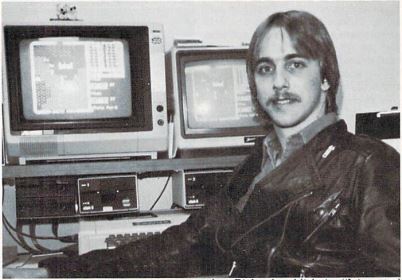
Lord British in leather

Lord British in leather

Richard started to feel his oats a bit during this period. He found his rather mild rebellious streak later than do many of us, but this did give him the luxury of something teenage rebels mostly lack: money. And so he replaced the practical car he had totaled in the snow with a new Mitsubishi Starion painted a striking jet black. He took to dressing in black leather pants and jacket, with studded bracelets around his wrists. He grew a single strand of hair into a long, braided pony tail that stretched beyond his shoulder blades. His relationship with his “extraordinarily conservative” brother and next-door neighbor Robert became decidedly strained; it seems Robert was usually more inclined to agree with his other neighbors than Richard regarding the latter’s parties and other antics. Warren Spector, a game designer who would become an important contributor to later Ultimas, was working as an assistant editor at Steve Jackson Games in Austin at this time. He describes the version of Richard that he glimpsed for the first time during one of the latter’s occasional return visits to Austin thus: “In drove this rock star in his Mitsubishi, all black. Got out, all black, bling everywhere. I was thinking, okay, I’m in the wrong line of work, I’ve got to find a way to work with this guy!”

The changes were not just external. Richard went through something of a minor existential crisis: “I wasn’t sure I knew what I was doing anymore. I tried to figure out who I was and what I was going to do next.” Trivial as it may sound, when Robert Garriott shook his head in embarrassment and the neighbors scowled at the body parts strewn across his lawn after Halloween or the empty trash cans that remained unretrieved at roadside for days on end, he was learning that actions — or, as the case may be, inaction — has consequences. All of these factors led Richard, like so many idealistically-inclined young men before him, to try to develop a philosophy of life that made sense to him. Richard was unique, however, in that he planned to put it all into a computer game — indeed, he saw doing so almost as a duty. He was well aware that the audience for his games was a pretty young and impressionable one, the most common demographic category being an adolescent boy.

If someone spends 100 hours playing my game, I have 100 hours of the input that makes that person what they are. With that comes, in my mind, a sense of responsibility regarding the content of what I’m going to pipeline into that individual for 100 hours. That was really the kernel thought that started what has now really changed Ultima henceforth and probably forever.

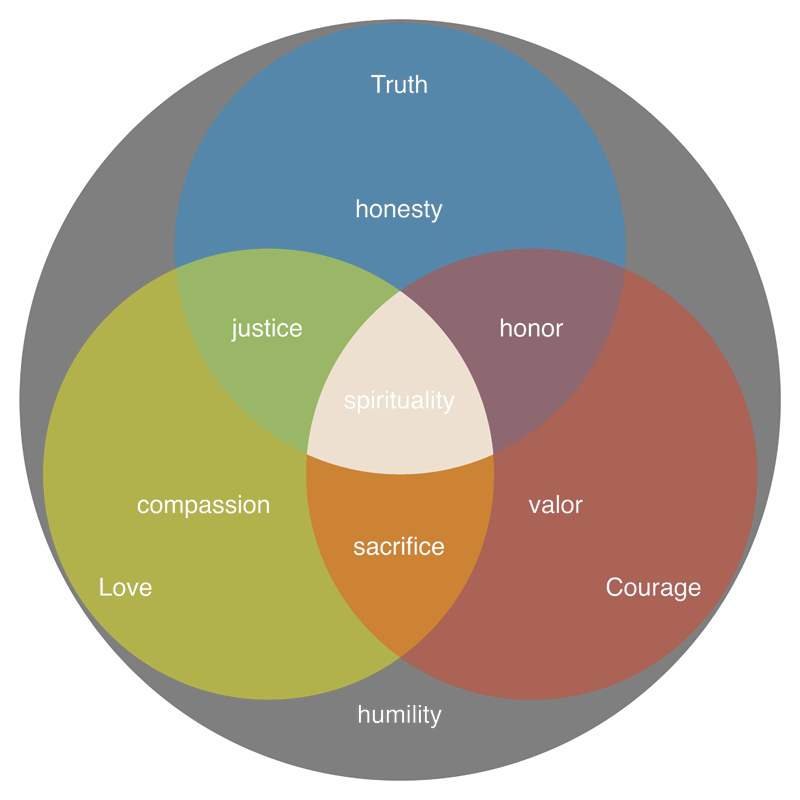
He set himself no less a task than the development of a complete code of ethics, a set of rules for living. As interesting as he found Hinduism and other religious traditions, it was very important to him that his rules for living must be explicitly divorced from any sort of supernatural agency. Some of the most brilliant thinkers in history, a list including Plato, Kant, and Nietzsche just for starters, devoted their lives to wrestling with the same task. Now the 22-year-old college drop-out Richard Garriott hung up a whiteboard, bought a stack of books, and prepared to do the same. The biggest issues he’d wrestled with for previous Ultimas were how many hit points this or that monster should have or how many experience points it should take to raise a character’s level. Now he was trying to devise a complete, internally consistent system of moral philosophy. It was a heady change indeed. Rather typically, Richard found the basic building blocks of the system of ethics he would finally include in Ultima IV not in any of the aforementioned highbrow philosophers but in The Wizard of Oz.

And that makes a pretty good place to stop for today. Next time we’ll look more closely at the ethical system he devised, along with much else in the finished game. Before I let you go, though, I do want to ask you to think about just what a remarkable conceptual leap Richard Garriott was making here, a leap made all the more remarkable by the fact that he did it all on its own, in a vacuum that still contained barely a whiff of our contemporary notions of serious games or ludic rhetoric, and in the genre of the CRPG that had heretofore been about little more than killing monsters and taking their stuff, with none of the higher-toned literary aspirations that Infocom and their competitors had brought to the text adventure.

Above all, it was — and I think this is a very important point with which to close — a tremendously brave choice. Richard was desperately worried about how it would be received by a public who expected just a bigger version of Ultima III. Should enough of those players accustomed to “kill, kill, kill” reject the game, it could bring down his company and put most of his closest friends out of work. The stress actually caused him to suffer the occasional panic attack while he programmed; his stomach would suddenly cramp up and he would have to lie down, willing himself to just breathe. “To succeed in this game,” he notes, “you had to radically change the way you’d ever played a game before.” This was the leap that the creators of Wizardry were unable to make, the one that transformed Ultima forevermore into something just a little bit nobler, a little bit more important, a little bit better than competing franchises. The fact that Richard was willing to make that leap, and that — yes, I’m sparing you the suspense — his public responded to it in huge numbers, makes it in its way as inspiring a story as any you’ll find in gaming history. Robert Gregg’s comments in Dungeons and Dreamers, describing the revelation that Ultima IV was to him when he first encountered it, offer the perfect closing thoughts: “The game was commenting on society, and on the observer himself, just like other forms of art. That was the most exciting part to me — watching the emergence of a new form of art, coming right off the computer.” You and me both, Robert.

(Sources for this article and the next include the books The Official Book of Ultima by Shay Addams, Dungeons and Dreamers by Brad King and John Borland, and Ultima: The Avatar Adventures by Rusel DeMaria and Caroline Spector; the Computer Gaming World issues of September/October 1984, November/December 1985, and March 1986; the Questbusters of August 1985; the Softline of November/December 1983; and the Commodore Power Play of August/September 1985. Also useful were Warren Spector’s video interview with Richard Garriott, and Matt Barton’s with Richard Garriott and with Chuck Bueche.)


Tags: , , ,

Of Wizards and Bards

After debuting within a few months of one another in 1981, the Ultima and Wizardry franchises proceeded to dominate the CRPG genre for the next several years to such an extent that there seemed to be very little oxygen for anyone else; their serious competition during this period was largely limited to one another. Otherwise there were only experiments that usually didn’t work all that well, like the Wizardry-meets-Zork hybrid Shadowkeep, along with workmanlike derivatives that all but advertised themselves as “games to play while you wait for the next Ultima or Wizardry.” One of these latter, SSI’s first CRPG Questron, so blatantly cloned the Ultima approach that it prompted outraged protest and an implied threat of legal action from Origin Systems. SSI President Joel Billings ended up giving Origin a percentage of the game’s royalties and some fine print on the back of the box: “Game structure and style used under license of Richard Garriott.” It’s highly debatable whether Origin really had a legal leg to stand on here, but these were days when Atari in particular was aggressively threatening publishers with similar “look and feel” lawsuits, sending lots of them running scared. Faced with the choice between a protracted legal battle and lots of industry bad will, neither of which his small company could well afford, or just throwing Origin some cash, Billings opted, probably wisely, for the latter.

In the competition between the two 800-pound gorillas of the industry, Wizardry won the first round with both the critics and the public. Compared to Ultima I, Wizardry I garnered more attention and more superlative reviews, and engendered a more dedicated cult of players — and outsold its rival by at least a two to one margin. Wizardry‘s victory wasn’t undeserved; with its attention to balance and polish, its sophisticated technical underpinnings, and its extensive testing, Wizardry felt like a game created by and for grown-ups, in contrast to the admittedly charming-in-its-own-way Ultima, which felt like the improvised ramblings of a teenager. (A very bright teenager and one hell of a rambler, mind you, but still…) The first Wizardry sold over 200,000 copies in its first three years, an achievement made even more remarkable when we consider that almost all of those were sold for a single platform, the Apple II, along with a smattering of IBM PC sales. While Infocom’s Zork may have managed similar numbers, it had the luxury of running on virtually every computer in the industry.

As early as 1982, however, the tables were beginning to turn. Richard Garriott continued to push Ultima forward, making games that were not just bigger but richer, prettier, and gradually more accessible, reaping critical praise and commercial rewards. As for Wizardry… well, therein lies a tale of misplaced priorities and missed opportunities and plain old mismanagement sufficient to make an MBA weep. While Ultima turned outward to welcome ever more new players to its ranks, Wizardry turned inward to the players who had bought its first iteration, sticking obstinately to its roots and offering bigger and ever more difficult games, but otherwise hardly changing at all through its first four sequels. You can probably guess which approach ended up being the more artistically and commercially satisfying. One could say that Ultima did not so much win this competition as Wizardry forfeited somewhere around the third round. Robert Woodhead, Andrew Greenberg, and Sir-Tech did just about everything right through the release of the first two games; after that they did everything just as thoroughly wrong.

As I wrote earlier, the second Wizardry, Knight of Diamonds, was an acceptable effort, if little more than a modest expansion pack to the original. It let players advance their characters to just about the point where they were too powerful to really be fun to play anymore, while giving them six more devious dungeon levels to explore, complete with new monsters and new tactical challenges. However, when the next game in the series, 1983’s Legacy of Llylgamyn, again felt like a not terribly inspired expansion pack, the franchise really began to go off the rails. Greenberg and Woodhead hadn’t even bothered to design this one themselves, outsourcing it instead to the Wizardry Adventurers Research Group, apparently code for “some of Greenberg’s college buddies.” Llylgamyn had the player starting over again with level 1 characters. Yet, incredibly, it still required that she purchase the first game to create characters; they could then be transferred into the third game as the “descendents” of her Wizardry I party. It’s hard to even account for this as anything other than a suicidal impulse, or (only slightly more charitably) a congenital inability to get beyond the Dungeons and Dragons model of buying a base set and then additional adventure modules to play with it. As Richard Garriott has occasionally pointed out over the years, in hewing to these policies Sir-Tech was effectively guaranteeing that each game in their series would sell fewer copies than the previous, would be played only by a subset of those who had played the one before. We see here all too clearly an unpleasant pedantry that was always Wizardry‘s worst personality trait: “You will start at the beginning and play properly!” It must have been about this time that the first masses of players began to just sigh and go elsewhere.

Speaking of pedantry: as I also described in an earlier article, a variety of player aids and character editors began to appear within months of the first Wizardry itself. Woodhead and Greenberg stridently denounced these products, pronouncing them “sleazy” in interviews and inserting a condescending letter to players in their game boxes stating their use would “interfere with the subtle balance” of the game and “substantially reduce their playing pleasure.” This is made particularly rich because, while Woodhead and Greenberg deserve credit for attempting to balance the game at all, the “subtle balance” of their first Wizardry was, in some pretty fundamental ways, broken; thus the tweaks they instituted for Knight of Diamonds. Did they really think players should ignore these issues and agree to spend dozens or hundreds of hours laboriously rebuilding countless lost parties, all because they told them to? Would players with so little capability for independent thought be able to complete the game in the first place? All the scolding did was put a sour face on the Wizardry franchise, giving it a No Fun Allowed personality in contrast to the more welcoming Ultima and, soon, plenty of other games. Players are perfectly capable of deciding what way of playing is most fun for them, as shown by the increasing numbers who began to decide that they could have more fun playing some other CRPG.

Meanwhile the Apple II’s importance as a gaming platform was steadily fading in the face of the cheaper and more audiovisually capable Commodore 64 in particular. Yet Sir-Tech made no effort for literally years to port Wizardry beyond the Apple II and the even less gaming-centric IBM PC. Their disinterest is particularly flabbergasting when we remember that the game ran under the UCSD Pascal P-Machine, whose whole purpose was to facilitate running the same code on multiple platforms. When asked about the subject, Woodhead stated that ports to the Commodore and Atari machines were “not technically possible” because neither ran any version of the UCSD Pascal language and because their disk systems were inadequate — too small in the case of the Atari and too slow in the case of the Commodore. Countless other companies would have and, indeed, did solve such problems by writing their own UCSD Pascal run-times — the system’s specifications were open and well-understood — and finding ways around the disk problems by using data compression and fast-load drivers. Sir-Tech was content to sit on their hands and wait for someone else to provide them with the tools they claimed they needed.

And then came the fiasco of Wizardry IV, a game which embodies all of the worst tendencies of the Wizardry series and old-school adventure gaming in general. This time Greenberg and Woodhead turned the design over to Roe R. Adams III, a fount of adventure-game enthusiasm who broke into the industry as a reviewer for Softalk magazine, made his reputation as the alleged first person in the world to solve Sierra’s heartless Time Zone, and thereafter seemed to be everywhere: amassing “27 national gaming titles,” writing columns and reviews for seemingly every magazine on the newsstand, testing for every publisher who would have him, writing manuals for Ultima games, and, yes, designing Wizardry IV. Subtitled The Return of Werdna, Wizardry IV casts you as the arch-villain of the first Wizardry. To complete the inversion, you start at the bottom of a dungeon and must make your way up and out to reclaim the Amulet that was stolen from you by those pesky adventurers of the first game.

Wizardry IV doesn’t require you to import characters from the earlier games, but that’s its only saving grace. Adams wanted to write a Wizardry for people just as hardcore as he was. Robert Sirotek, one of the few people at Sir-Tech who seemed aware of just how wrong-headed the whole project was, had this to say about it in a recent interview with Matt Barton:

It was insanely difficult to win that game. I had such issues with that. I felt that it went way beyond what was necessary in terms of complexity, but the people that developed it felt strongly to leave a mark in the industry that they had the hardest game to play — period, bar none. That’s fine if you’re not worried about catering to a customer and making sales.

Return of Werdna was the worst-selling product we ever launched. People would buy it, and it was unplayable. So they’d put it down, and word spread around. There were other hard-core players in the market that loved it. They said, “Ah, why doesn’t everybody do this?” Well, we don’t because you guys are a minority. If you’re a glutton for punishment, you’re going to have to get your pleasure somewhere else because nobody can survive catering to such a small number of people.

So, it was controversial in that way. In the end, I think I was proven correct that making crazy impossible products in terms of difficulty was not the way forward.

But insane difficulty is only part of the tale of Wizardry IV. It has another dubious honor, that of being one of the first notable specimens of a species that gamers would get all too familiar with in the years to come: that hot game of the perpetually “just around the corner!” variety. Sir-Tech originally planned to release Wizardry IV for the 1984 holiday season, just about a year after Legacy of Llylgamyn and thus right on schedule by the standard of the time. They felt so confident of this that, what with the lengthy lead times of print journalism, they told inCider magazine to just announce the title as already available in their November 1984 issue. It didn’t make it. In fact it took a staggering three more years, until late 1987, for Wizardry IV to finally appear, at which time inCider dutifully reported that Sir-Tech had spent all that time “polishing” the game. Those expecting a mirror shine must have been disappointed to see the same old engine with the same old wire-frame graphics. In addition to being unspeakably difficult, it was also ugly, an anachronism from a different era. Any remaining claim that the Wizardry franchise might have had to standing shoulder to shoulder with Ultima either commercially or artistically was killed dead by The Return of Werdna. Beginning with Wizardry V and especially VI, Sir-Tech would repair some of the damage with the help of a new designer, D.W. Bradley, but the franchise would never again be as preeminent in North America as it had in those salad days of 1981 and 1982.

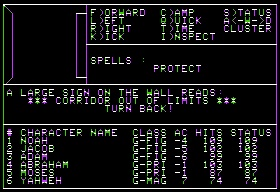
Wizardry I, 1981

Wizardry I, 1981

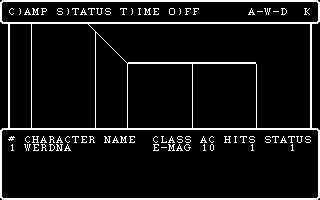
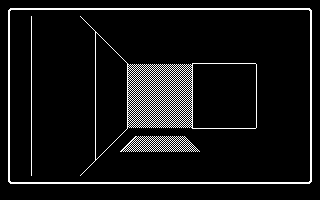
Wizardry IV, 1987. Not much has changed...

Wizardry IV, 1987. Not much has changed…

Those remaining fans who were underwhelmed by Wizardry IV were left asking just what Sir-Tech had been up to for all those years during the middle of the decade. Robert Woodhead at least hadn’t been completely idle. With Wizardry III Sir-Tech debuted a new interface they called “Window Wizardry,” which joined the likes of Pinball Construction Set in being among the first games to bring some of the lessons of Xerox PARC home to Apple II users even before the Macintosh’s debut; both earlier Wizardry games were also retrofitted to use the new system. In 1984 Woodhead improved the engine yet again, to take advantage of the new Apple II mouse should the player be lucky enough to have one. And a few months after that his port to the Macintosh arrived.

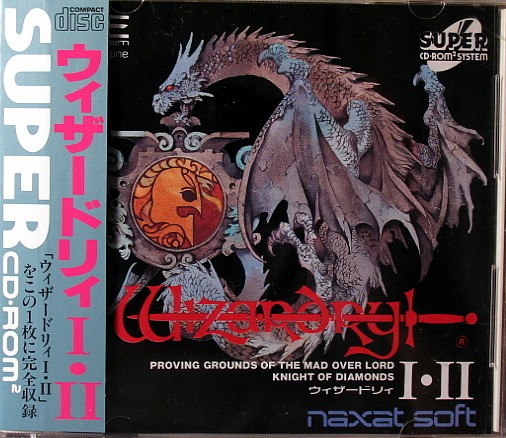
A Japanese edition of the first two Wizardry games, published by ASCII Corporation.

A Japanese edition of the first two Wizardry games, published by ASCII Corporation.

But Woodhead’s biggest distraction — and soon his greatest passion, one that would change his life forever — was Japan. After first marketing Wizardry in Japan through Starcraft, a Japanese company that specialized in localizing American software for the Japanese market and vice versa, Sir-Tech signed a blockbuster of a deal with another pioneering company, ASCII Corporation, publishers of the magazine Monthly ASCII that can be justifiably called the Japanese Byte and Creative Computing all rolled into one. Increasingly as the 1980s wore on, ASCII also became a very important software publisher. With Woodhead’s close support, ASCII turned Wizardry into a veritable phenomenon in Japan, huge even in comparison to the height of its popularity Stateside. By the latter half of the decade there were entire conventions in Japan dedicated to the franchise; when Woodhead visited them he was mobbed like a rock star. In the face of such profits and fame, he began to spend more and more of his time in Japan. After leaving Sir-Tech in 1988 he lived there full-time for a number of years, married a Japanese woman, and eventually founded a company with his old buddy Roe Adams which is dedicated to translating Japanese anime and other cinema into English and importing it to the West; it’s still going strong today. The Japanese Wizardry line also eventually spun off completely from Sir-Tech to go its own way; games are still being made today, and now far outnumber the eight Sir-Tech Wizardry games.

That explains what Woodhead was doing, but it doesn’t do much to otherwise explain Sir-Tech’s Stateside sloth until we consider this: incomprehensibly, Sir-Tech clung to Woodhead as their only technical architect, placing their entire future in the hands of this one idiosyncratic, mercurial hacker. (Greenberg filled mostly a designer’s as opposed to programmer’s role, and never worked full-time on Wizardry; after the second game his role was largely limited to that of an occasional consultant.) So, Woodhead was fascinated by the potential of the GUI and thought the Macintosh pretty neat; thus those projects got done. But he was dismissive of the cheap machines from Commodore and Atari, so those markets, many times the size of the Mac’s when it came to entertainment software, were roundly ignored. Only in 1987, with Woodhead all but emigrated to Japan, did Sir-Tech finally begin to look beyond him, funding a Commodore 64 port at last. But by then it was far too late.

Wizardry comes to the Commodore 64 at last. Predictably, not much has changed.

Wizardry comes to the Commodore 64 at last. Predictably, not much has changed.

For the reason why, we have to rewind to 1984, and move our wandering eyes from Sir-Tech’s Ogdensburg, New York, offices to a struggling little development company in the heart of Silicon Valley who called themselves Interplay. Interplay already had a couple of modestly successful illustrated adventure games to their credit when a friend of founder Brian Fargo named Michael Cranford suggested that he’d like to make a sort of next-generation Wizardry game in cooperation with them. They were all big fans of Wizardry and Dungeons and Dragons — Cranford had been Dungeon Master for Fargo’s D&D group back in high school — so everyone jumped aboard with enthusiasm. There’s been some controversy over the years as to exactly who did what on the game that would eventually become known as The Bard’s Tale, but it seems pretty clear that Cranford, who had already authored a proto-CRPG called Maze Master that was restricted in scope by its need to fit onto a 16 K cartridge, was the main driver. The most important other contributor was Bill “Burger” Heineman, who helped Cranford with some of the programming and did much of the work involved in porting the game to systems beyond its initial home on the Apple II. (Bill Heineman now lives as Rebecca Heineman. As per my usual editorial policy on these matters, I refer to her as “he” and by her original name only to avoid historical anachronisms and to stay true to the context of the times.) After Cranford parted ways with Interplay following The Bard’s Tale II, Heineman would take over his role of main programmer and designer for The Bard’s Tale III.

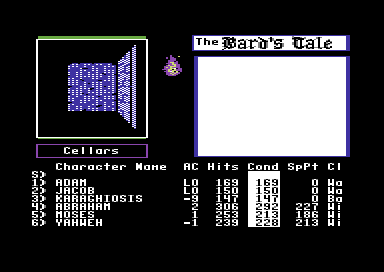
The Bard's Tale on the Commodore 64. Note that this predates the screenshot immediately above by two full years.

The Bard’s Tale on the Commodore 64. Note that this predates the screenshot immediately above by two full years.

In retrospect, the most surprising thing about the first Bard’s Tale, which was published through Electronic Arts in late 1985, is that nobody did it sooner. It was certainly no paragon of original design. If anything, it was even more derivative of Wizardry than Questron had been of Ultima, evincing not just the Wizardry template of play but almost the exact same screen layout and even most of the same command keys, right down to a bunch of spells that were cast by entering their four-letter codes found only in the manual (a useful form of copy protection). But Wizardry, thanks to Sir-Tech’s neglect, was vulnerable in ways that Ultima was not. Interplay did the commonsense upgrades to the Wizardry formula that Sir-Tech should have been doing, filling the game with colorful graphics, occasional dashes of spot animation, a bigger variety of monsters to fight, more equipment and spells and classes to experiment with. And, most importantly of all to its commercial success, they made sure a Commodore 64 version came out simultaneously with the Apple II. In the years that followed they funded loving ports to an almost Infocom-like variety of platforms, giving it further graphical facelifts for next-generation machines that the early Wizardry games would never reach, like the Commodore Amiga, Atari ST, and Apple IIGS.

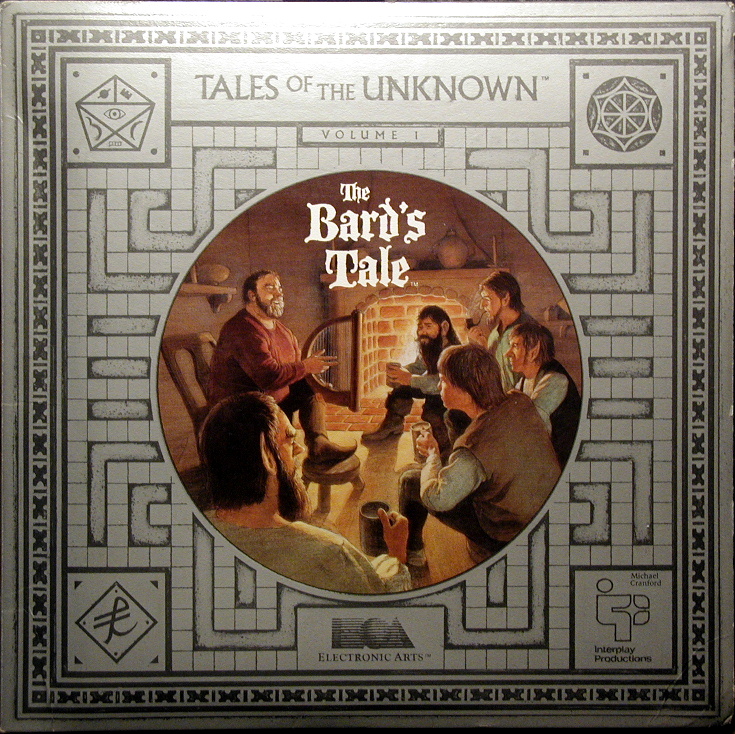
The Bard's Tale

The Bard’s Tale‘s original touches, while by no means entirely absent, tinker with the Wizardry formula more than revamp it. Instead of doing everything outside of the dungeons via a simple textual menu system, you now have an entire town with a serious monster infestation of its own to explore. In the town of Skara Brae you can find not only equipment shops and temples and all the other stops typical of the errand-running adventurer but also the entrances to the dungeons themselves — five of them, with a total of 16 levels between them, as opposed to the original Wizardry‘s single dungeon of 10 slightly smaller and generally simpler levels. But the most obvious way that The Bard’s Tale asserts its individuality is in the whimsical character class of the bard himself, who can perform magic by playing songs; you actually hear his songs playing on your computer, another flourish The Bard’s Tale has over its inspiration. More importantly, he lends the game some of his lovably roguish personality: “When the going gets tough, the bard goes drinking,” ran the headline of EA’s advertisements. The official name of the game is actually Tales of the Unknown, Volume 1: The Bard’s Tale; the rather white-bread Tales of the Unknown, in other words, was originally intended as the franchise’s name, The Bard’s Tale as the mere subtitle of this installment. Interplay originally planned to call the next game The Archmage’s Tale, next stop in a presumed cycling through many fantasy character archetypes. The bard proved so popular, however, such an indelible part of the game’s personality and public image, that those plans were quickly set aside. The next game was released as The Bard’s Tale II: The Destiny Knight, the Tales of the Unknown moniker quietly retired.

Commodore 64 owners especially, starved as they had been of the Wizardry experience for years, set upon The Bard’s Tale like a horde of the mad dogs who are some of the first monsters you encounter in its labyrinths. Combined with EA’s usual slick marketing, their pent-up desire was more than enough to make it a massive, massive success, the first CRPG not named Wizardry to be able to challenge the Ultima franchise head to head in terms of sales, if not quite critical respect (it was hard for even the forgiving gaming press of the 1980s to completely overlook just how derivative a game it was). The Bard’s Tale would wind up selling 407,000 copies by the end of 1990, becoming the best-selling single CRPG of the 1980s and single-handedly making Interplay a force to be reckoned with in the games industry. They would remain one of the major creative forces in gaming for the next decade and a half; we’ll have occasion to visit their story again and in more detail in future articles.

There is, however, a certain whiff of poetic justice to the way that Interplay allowed this particular franchise to go stale in much the same way that Sir-Tech had Wizardry. The Bard’s Tale II (1986) and III (1988) were each successful enough on their own terms, but a story all too familiar to Sir-Tech played out as each installment sold worse than the one before. The series then faded away quietly after The Bard’s Tale Construction Set (1991), for which Interplay polished up some of their internal authoring tools for public consumption. By then The Bard’s Tale was already long past its heyday, its position of yin to Ultima‘s yang taken up by yet another franchise, the officially licensed Advanced Dungeons and Dragons games from SSI. (At least two attempts at a Bard’s Tale IV never came to fruition, doomed by the IP Hell that resulted from Interplay parting company with EA; EA owned the name of the franchise, Interplay most of the content. Interplay’s attempt at a Bard’s Tale IV did eventually come to market as Dragon Wars, actually a far more ambitious game than any of its predecessors but one that was markedly unsuccessful commercially.)

The sequels did add some wrinkles to the formula. The Bard’s Tale II deployed a strangely grid-oriented wilderness to explore in addition to towns — six of them this time — and dungeons, and added range as a consideration to the combat engine. The Bard’s Tale III: The Thief of Fate offered more welcome improvements to the core engine, including a simple auto-mapping feature and, at long last, the ability to save the game even inside a dungeon. But mostly the sequels fell into a trap all too typical of CRPGs, of offering not so much new things to do as just ever larger amounts of the same interchangeably generic content to slog through and laboriously map; over the course of the trilogy we go from 16 to 25 to an absurd 84 dungeon levels. This despite the fact that there just aren’t that many permutations allowed by this simple dungeon-delving engine and its spinners, magical darknesses, teleporters, and traps. Long before the end of the first Bard’s Tale it’s starting to get a bit tedious; by the time you get to the sequels it’s just exhausting. It’s not hard to understand Interplay’s motivation for making the games ever huger. Gamers have always loved the idea of big games that give them more for their money, and by the third game Interplay’s in-house tools were sophisticated enough to allow them to slap together a gnarly dungeon level in probably much less time than it would take the average player to struggle through it. Still, the early Wizardry games stand up better as holistic designs today. The first Wizardry‘s ten modest dungeon levels were enough to consume quite some hours, but not too many; the game is over right about the time it threatens to get boring, a mark the latter Bard’s Tales in particular quite resoundingly overshoot.

So, I’m quite ambivalent about The Bard’s Tale franchise as a whole, as I admittedly am about many old-school CRPGs. To my mind, there are some time-consuming games, like Civilization or Master of Orion, that appeal to our better, more creative natures by offering endless possibilities to explore, endless interesting choices to make. They genuinely fascinate, tempting us to immerse ourselves in their mysteries for all the right reasons. And then there are some, like The Bard’s Tale or for that matter FarmVille, that somehow manage to worm their ways into our psyches and activate some perversely compulsive sense of puritanical duty. Does anyone really enjoy mapping her twentieth — not to mention eightieth! — dungeon inside a Bard’s Tale, wrestling all the while with spinners and teleporters and darkness squares that have long since gone from being intellectually challenging to just incredibly, endlessly annoying? The evidence of The Bard’s Tale‘s lingering fandom would seem to suggest that people do, but it’s a bit hard for me to understand why. Oh, I suppose one can enjoy the result, of having ultra-powerful characters or seeing chaos held at bay for another day via another page of graph paper neatly filled in, but is the process really that entertaining? And if not, why do so many of us feel so compelled to continue with it? Is there ultimately much point to a game that rewards not so much good play as just a willingness to put in lots and lots of time? I want to say yes, if the game has something to say to me or even just an interesting narrative to convey, but The Bard’s Tale, alas, has nothing of the sort. Ah, well… maybe it’s just down to my distaste for level grinding as an end in itself as opposed to as a byproduct of the interesting adventures you’re otherwise having — a distaste everyone obviously doesn’t share.

It can be oddly difficult to find a “clean” copy of this hugely popular game in its most popular incarnation, the Commodore 64 version. Most versions floating around on the Internet are played on, hacked, and/or, all too often, corrupted. If you want to experience The Bard’s Tale, a commercial and historical landmark of its genre despite any misgivings I may have about it, you may therefore want to download a virgin copy from this site. Alternately, all three games are included as a free bonus with a 2004 game of the same name that otherwise has very little to do with its predecessors. That’s available for various platforms from GOG.com, Steam, Google Play, and iTunes. Next time we’ll turn to a CRPG that does have something important to say, arguably the first of all too few examples of same in the history of the genre.

(Matt Barton has posted interviews with some of the folks I write about in this article on his YouTube channel: Rebecca Heineman, Brian Fargo, and Robert Sirotek. Interviews with Michael Cranford can be found on Lemon 64 and the RPG Codex. The Bard’s Tale Compendium has some background on the games and the people who made them. Now Gamer’s history of SSI includes details of the Questron tension with Origin Systems. The inCider magazine articles referenced above are in the November 1984 and November 1987 issues. See the August 1988 Computer Play for more on the Wizardry phenomenon in Japan, and the October 1983 Family Computing for Greenberg at his hectoring worst on the subject of third-party player aids and the necessity of playing Wizardry the “right” way. Finally, I located the Bard’s Tale sales figures in the March 1991 issue of Questbusters.)


Tags: , , ,

Comprehend

Inside Penguin Software, circa early 1983. From left: Mary Beth Pelczarski, Mark and Trish Glenn, Cheryl and Mark Pelczarski, Ron Schmitt, and (kneeling) Larry Weber.

Inside Penguin Software, circa early 1983. From left: Mary Beth Pelczarski, Mark and Trish Glenn, Cheryl and Mark Pelczarski, Ron Schmitt, and (at right front) Larry Weber.

It’s been quite some time since we’ve checked in with Penguin Software and its founder Mark Pelczarski, so let’s be about that today. The Penguin story is not only interesting in its own right but also a good illustration of what it was like for a small publisher trying to navigate the home-computer boom and bust.

On the heels of the considerable commercial success of Transylvania in 1982, Penguin was naturally eager to continue to work the games market. An old associate from Mark’s days at SoftSide magazine, Dave Albert, essentially took over that side of the company. Over the next couple of years he shepherded to completion a mixed bag of titles from outside contributors, including a number of action games, three more “hi-res adventures” in the mold of Transylvania, and even a couple of RPGs, one crazily original and one more typical of its genre. Most earned back their investment but were not major moneyspinners; only one of the action games, Spy’s Demise, and one of the adventures, The Quest, managed anything close to the numbers that Transylvania moved.

Penguin’s core product remained The Graphics Magician. Now with ports to the Commodore 64, Atari 8-bits, IBM PC and PCjr, and eventually even the new Apple Macintosh as well as the Apple II original, it was the closest thing the games industry had to a standard graphics tool in those wild early days, to be superseded only in the second half of the decade by Electronic Arts’s Deluxe Paint line. For a considerable period of time a considerable percentage of the games on the market employed it, as did countless amateur artists and programmers. Its ubiquity could bring its author into some surprising company.

There was, for instance, a period when Penguin kept getting calls from a kid named Conan O’Brien, editor of the Harvard Lampoon. The name was so crazy that it became a regular part of Penguin’s intra-office schtick: “Conan called again!” someone would shout almost every day. Mark finally agreed to come by Harvard on a business trip. Conan showed him around the campus, and also showed him a basketball “simulation” he and his buddies had developed with the aid of The Graphics Magician. In it the Boston Celtics took on a classical ballet troupe, to hilarious effect. Electronic Arts’s One-on-One, the spiritual father of the modern EA Sports line which pits Julius Erving against Larry Bird, was one of the most popular games in the country at the time; thus Conan’s little creation, whatever else it was, also qualified as satire of a sort. Conan claimed to have gotten a contract with EA to publish the game, but the project never made it to fruition. Had it done so, we might be talking today about Conan O’Brien the game developer rather than Conan O’Brien the talk-show host. (It’s also possible, of course, that “I have a contract” in this context meant “I’ve signed an agreement to quit publishing derivative works of EA intellectual property in exchange for not getting sued.”) For his part, Mark forgot about it — until he opened Newsweek a decade later to read that Conan O’Brien was replacing David Letterman in NBC’s late-night time slot.

The fury and frenzy of the home-computer boom was soon swirling around Penguin, bringing with it dramatic changes in the way that software was sold and marketed. Mark, a sober and grounded sort, wisely steered Penguin clear of the worst excesses of many of their competitors. Penguin didn’t flood the market with cheap cartridge-based titles (“it really didn’t match what we felt we were best at”); didn’t hire a big-name celebrity spokesperson; didn’t let the venture capitalists take control; didn’t mortgage their future via dangerous bank loans. Yet, as wise as those choices would soon prove to be, it became ever harder for a small company to get noticed amidst the glut of product being pumped into stores by 1984.

That year, concerned about the changes in the industry and increasingly nervous about relying so heavily for their sustenance upon a single product, Penguin formulated a three-pronged strategy for the future. They would devote about one third of their resources to continuing to support and improve The Graphics Magician. One third would go to a new line of edutainment software of which we’ll have occasion to hear more in a future article. And one third would go for a renewed and much more focused push into games. With Dave Albert about to leave Penguin to join Origin Systems, it seemed a good time for a change in strategy in this area. (Albert, incidentally, took with him to Origin Greg Malone and his oriental RPG Moebius amongst other projects in progress).

Henceforth Penguin would concentrate on adventure games, the genre which had been most successful for them and for which they were best known. Their previous adventures had all been essentially one-offs submitted by outside authors and programmed in whatever combination of assembly language and BASIC happened to seem most handy. All had originated on the Apple II, and porting them to the other popular platforms of the day had been tedious and expensive if it happened at all. Nor did their home-grown parsers acquit themselves all that well in this the heyday of Infocom’s reign. The answer to all these problems was to be Comprehend, a cross-platform adventure-game engine that should let Penguin put out more sophisticated adventures more quickly and on more platforms, and all in a consistent house style that players could come to know and intuitively understand like that of Infocom. In a collaboration he describes today as still “one of the most interesting and fun I’ve had writing and programming,” Mark designed Comprehend from whole cloth in front of a whiteboard over the summer of 1984 with a student from the nearby Northern Illinois University, Jeffrey Jay. They paid particular attention to the parser, which they put through a series of challenges posed to them by the folks at Infocom — pronoun handling, accurate handling of compound sentences, etc. — that most rival parsers definitively failed. What they ended up with didn’t come close to matching that magnificent Infocom parser, but it was several steps above the likes of the Telarium model.

Text adventures with graphics can be divided into two categories. First there are those, like the Telarium games, for which the graphics are static and ancillary to the text, there only for atmosphere — like, say, the occasional illustrations in an original-edition Dickens novel. Then there are those — counterintuitively, this is the older category, pioneered by Sierra’s original Hi-Res Adventure line — which make the graphics an integral part of the experience, using them to convey essential information about the game world that isn’t in the (generally much sparser) text and varying them with changes in its state: drawing dropped inventory objects and other characters that happen to be present into the scene, etc. This style had rather fallen out of fashion by 1984 as publishers rushed to jump onto the bookware bandwagon that posited adventure games as essentially literary experiences. Comprehend, however, bucked the trend by hewing to the older style that Sierra themselves had abandoned with the advent of AGI and King’s Quest. This could make Comprehend seem like a bit of a throwback even in its heyday. Still, the graphics possibilities were, as one might expect from “The Graphics People,” considerable, with the system even capable of some spot animation and other flourishes. The system also ran blazingly fast in comparison to the likes of Telarium’s SAL engine. Comprehend was, in short, a perfectly serviceable old-school adventure engine if hardly a technological game-changer. Now Penguin just needed some Comprehend games.

Antonio Antiochia, the teenage author of Transylvania, had been enjoying the fruits of that game’s success in the form of the royalty checks, insanely large by a high-school kid’s standard, that he found in his mailbox each month. Mark duly suggested to his young software star that he save his money for university, but Antonio did exactly what most of us would have done in his place: went out and bought a shiny new Mazda RX-7, which may or may not have contributed to his getting his “first bona fide girlfriend” late in his senior year. With such distractions on offer, it took Antonio some time to buckle down again to adventure writing. When he did, he decided he’d like to make a sequel to Transylvania, something that Penguin, in light of the success of the first game, was hardly likely to discourage. Antonio started drafting his game using a BASIC-based framework that another of Penguin’s outside authors, The Quest and Ring Quest author Dallas Snell, had developed, once again doing not only all the writing and programming but also drawing all of the pictures himself. (This incomplete early version leaked into pirating circles through the cracking group the Corsairs, and can still be found in some Apple II software archives today.) Later, when Comprehend was ready, Antonio dutifully learned its nuances and ported his work to the new system. After completing the sequel, dubbed The Crimson Crown, he returned to the original, crafting a new version for Comprehend with more text, locations, and puzzles. Together these became the first two Comprehend releases from Penguin in the fall of 1985. The Apple II versions of both games were reworked and re-released yet again early the following year, to use the “double-hi-res” graphics mode available on certain IIe setups and all models of the IIc. This welcome hardware enhancement let Penguin mostly if not entirely eliminate the color distortions that normally plagued Apple II graphics.

The Crimson Crown is a much bigger game than the original Transylvania. In fact, it’s really two adventure games, one on each side of its disk. Stealing a trick that was quite common in the British software market where sharply limited cassette-based machines were still the norm, The Crimson Crown arranges to funnel you through a bottleneck at its mid-point in which you lose your inventory and are moved to an entirely new piece of geography. In other words, everyone who gets this far is forced into the same state before continuing the game — or, I should say, before beginning the second game that occupies that second disk side.

The Crimson Crown

Following, like just about everyone else in the industry, the lead of Infocom, Penguin upped their packaging game considerably for the Comprehend line. The Crimson Crown shipped with not only an instruction manual but a separate journal setting the stage, a sealed letter to be opened at a certain point in the game, a map of Wallachia and Moldavia, and even a poster to hang on your wall. The Transylvania connection was oddly minimized, relegated to a subheading — “Further Adventures in Transylvania” — below the much larger Crimson Crown title. Mark Pelczarski notes today that such decisions point to a certain ongoing naivete at Penguin even in an increasingly cutthroat market, a determination to emphasize “fun and art” over “the monetary aspect.”

The mysterious tree stump of the original makes a return appearance.

The mysterious tree stump of the original makes a return appearance.

You play the hero of the first game, rescuer of the Princess Sabrina. The vampire who abducted her has turned out to be not as dead as everyone — you most of all — thought. (Well, I suppose he is technically dead, but you get the idea…) He’s murdered the king of your land of Wallachia and stolen the Crimson Crown that gives the king supernatural powers. And so it’s back into action, accompanied this time not only by Sabrina, who has gotten sick of playing the damsel in distress and scored one for female empowerment by learning the art of sorcery, but also her brother, the king-to-be Erik, more the earnest sword-wielding type. You’ll guide this three-headed monster through the entirety of the adventure, mostly doing things yourself but occasionally needing to call upon Sabrina or Erik’s prowess by giving them instructions.

You must contend this time with a zombie, sign of a more modern horror sensibility.

You must contend this time with a zombie, sign of a more modern horror sensibility.

The sequel has most of the same qualities going for it that made the original Transylvania such an old-school favorite of mine. Some of the delicious B-horror-movie atmosphere is absent, with the game this time having a bit more of a conventional fantasy feel; in addition to the vampire, there’s a zombie, a troll, a centaur, and a dragon to contend with this time instead of the werewolf of the original, and much of the second game takes place in what amounts to a typical fantasy dungeon rather than the Gothic landscape of the original. Indeed, Antonio seems to have been playing quite some Dungeons and Dragons at this point in his life; you and your companions are repeatedly referred to as “the party.” And the sequel is in general a bit trickier to solve. But, aside from one horrible choice which we’ll get to momentarily, The Crimson Crown is quite fair and even progressive in its design sensibilities, being notably free of mazes, uselessly empty geography, sudden random deaths, and most other things modern adventurers have come to hate. It even has a handy carry-all to make the inventory limit less onerous, and a “sage” who pops up from time to time to offer little nudges for some of the puzzles and strategic guidance for the game as a whole. Like its predecessor, it smartly works within its technological limitations. The parser, for instance, while not quite state of the art, doesn’t have to be because the game never tries to push it to places it isn’t capable of going — a marked contrast with Telarium, whose games made a habit of being too big for their parser’s britches. Despite these signs of maturity, The Crimson Crown retains its predecessor’s giddy teenage enthusiasm, which remains a big part of its charm. Solving this one is both possible and very, very enjoyable.

One of the occasional graphical flourishes, complete with some delightfully purple prose.

One of the occasional graphical flourishes, complete with some delightfully purple prose.

Except, that is, for the riddles. The Crimson Crown resoundingly fails to put its best foot forward by hitting you almost at the very beginning with four riddles. We’re talking absurdly abstract stuff like this:

I am, I’m not. I visit young and old,
Some I make timid and some I make bold,
Unwise is the one who pokes fun at me.
Beware, for I am a shadow of thee.

The answer to that one is “dream”, and if you solved it you’d best get to playing The Crimson Crown immediately because three more just like it await your powers. As for the rest of you, I actually recommend that you play as well, but don’t spare a moment of thought to the riddles. Here are the other answers: “windmill,” “fear,” and “cloud.” You can download The Crimson Crown in its double-hi-res Apple II incarnation from this very site if you like.

We’ll continue the story of Penguin and of Comprehend in later articles, but next we’re going to turn away from text adventures for a while to look at developments in other genres over this period in North America.

(My thanks to Mark Pelczarski and Antonio Antiochia, whose memories informed this article.)


Tags: , ,

An Alternate Chronicle of Amber

Those of you who’ve read the books will probably most appreciate this alternative version of them, as facilitated by Telarium.

I escape the hospital.

I escape the hospital.

I convince Flora to let me stay with her.

I convince Flora to let me stay with her.

Random arrives, and Flora and I help him to dispatch his pursuers.

Random arrives, and Flora and I help him to dispatch his pursuers.

Random and I begin the journey to Amber.

Random and I begin the journey to Amber.

Julian runs us down.

Julian runs us down.

But we turn the tables on him.

But we turn the tables on him.

We rescue Deirdre from Eric's men.

We rescue Deirdre from Eric’s men.

We part ways with Deirdre and march straight into Amber. A bit of toadying convinces Eric that I accept him as king.

We part ways with Deirdre and march straight into Amber. A bit of groveling convinces Eric that I accept him as king.

I Trump to Deirdre in Rebma and walk the Pattern (via a surprisingly entertaining mini-game).

I Trump to Deirdre in Rebma and walk the Pattern (via a surprisingly entertaining mini-game).

I use the Pattern to transport myself back to Amber.

I use the Pattern to transport myself back to Amber.

I Trump Bleys to me, and together we murder Eric.

I Trump Bleys to me, and together we murder Eric.

But now Bleys turns on me! This will really take some groveling...

But now Bleys turns on me! This will really take some groveling…

I locate Brand in shadow via his Trump, and rescue him from his imprisonment of Bleys's making.

I locate Brand in shadow via his Trump, and rescue him from his imprisonment of Bleys’s making.

We stumble across Benedict. Brand makes overtures which I reject, then leaves.

We stumble across Benedict. Brand makes overtures which I reject, then leaves.

I get a call from Bleys and Brand's former co-conspirator Fiona. We cut a deal of our own.

I get a call from Bleys and Brand’s former co-conspirator Fiona. We cut a deal of our own.

Amber is under attack! I agree to march with Benedict to her defense.

Amber is under attack! I agree to march with Benedict to her defense.

Back in Amber I reveal Bleys and Brand's nefarious schemes, leaving Fiona out of it. After I lead the forces of Amber to victory (doubtless from safely in the rear), most everyone except Bleys and Brand thinks I'm a pretty swell guy. I become king of Amber!

Back in Amber I reveal Bleys and Brand’s nefarious schemes, leaving Fiona out of it. After I lead the forces of Amber to victory (doubtless from safely in the rear), most everyone except Bleys and Brand thinks I’m a pretty swell guy. I become king of Amber!


Tags: , ,

Nine Princes in Amber

Nine Princes in Amber

Technological futurists and the people who love them have been talking for some time now about something called the Singularity, that moment in the (near?) future when computing technology will reach some critical mass and change everything forever in ways we can hardly begin to imagine. I’m not so interested in discussing the merits of the idea here, but I do want to say that singularities can take many forms, and to note that the sort of singularities one sees are perhaps more emblematic of one’s own personal hobby horses than some might like to admit. In that spirit, I’d like to propose a singularity of my own, albeit one recently passed rather than oncoming. It landed right about the middle of the 1960s.

To see what I’m talking about, watch a movie or listen to a hit song from 1960 followed by one from 1970. While it may be extreme and rather narcisstic and certainly horridly Western-centric to divide all recent history into pre-1960s and post-1960s, it’s nevertheless hard for me to come up with another instant when everything changed so completely. Films and songs are of course only signifiers of the deeper changes in the culture: changes in gender roles and responsibilities, in race relations, in attitudes toward war and peace and government and the rights and responsibilities of the citizen. The 1960s changed the way people talked, the way they dressed, they way they thought in a way far more profound than the mere vicissitudes of fashion. Perhaps most of all, they changed what is still for so many the most uncomfortable of uncomfortable subjects, sex, forever. We’re still dealing with the fallout every day: in the United States, at least, your decision of which party to vote for still has a great deal to do with whether you think all of these changes were in general a good or a bad thing.

Even written science fiction, that literary ghetto which had hitherto marched along blissfully ignoring and being ignored by changes in the larger world of arts and letters, wasn’t insulated from these winds of change. A New Wave of writers poured into — the old guard might, and sometimes did, say “invaded” — the stolid old halls that the pulps had built. These new writers were very different from the old holy trinity of Asimov, Clarke, and Heinlein. They replaced an absolute faith in objectivity and rationalism with a tolerance for ambiguity and an honest curiosity about spirituality, particularly (this being the 1960s) of the Eastern variety. They replaced adventures in outer space with explorations (this again being the 1960s, when psychedelics were everywhere) of inner space. They replaced workmanlike (not to say clunky) prose with literary flights of fancy and experimental structures showing the influence of folks like James Joyce and William S. Burroughs; a surprising number of the New Wave stars were poets in addition to short-story writers or novelists, for God’s sake. They replaced characters that served primarily as grist for the mill of Plot and Idea with real, three-dimensional humans whose subjective experiences were the point of the works in which they featured. American science fiction, like seemingly every other institution in the country, went to war with itself for a time, with John W. Campbell opining on behalf of the Old Guard in the pages of Analog that the Kent State protestors had gotten what they deserved while Michael Moorcock preached anarchism and feminism from his soapbox as editor of New Worlds.

Roger Zelazny

Roger Zelazny

One of the biggest stars of the New Wave is our real subject for today: the man with the perfect science-fiction writer’s name of Roger Zelazny. He burst onto the scene in the mid-1960s with a series of dazzling short stories and a short novel, This Immortal, which took place on a post-apocalyptic Earth populated by creatures and minor gods from a sort of fever dream of Greek mythology. Then in 1967 he delivered Lord of Light, an audacious transplantation of the Hindu pantheon — if you haven’t realized it already, Zelazny was big on myth — to an interstellar milieu. The structure was as intricate as many a Modernist novel, the language gorgeous. The central character, Mahasamatman (he “called himself Sam”), reminds one in his rebellion against the rest of the pantheon of no one so much as the Satan of Paradise Lost.

Lord of Light deservedly swept science fiction’s two biggest prizes, the Hugo and the Nebula Awards, for its year. Along with a groundbreaking collection of short stories of the same year edited by Harlan Ellison and to which Zelazny also contributed, Dangerous Visions, it’s gone on to stand as perhaps the perfect exemplar of New Wave science fiction and why it mattered — this even though Zelazny himself rejected the label. There was a moment there when Roger Zelazny was accorded the honor amongst a ridiculously strong field of fellow up-and-comers of being just possibly the most promising young writer in science fiction. Lord of Light was great, but, what with Zelazny still so young, many predicted even better things from him once he matured a bit, got beyond just dazzling with the sheer high-wire virtuosity of his language and plots and began to really dig into his worlds and themes.

But somehow that never quite happened. Oh, he continued to be astonishingly prolific, releasing for instance three novels in 1969 alone. His books remained readable; Zelazny was too professional to deliver anything else. Yet, while the reputation of contemporaries like Ursula Le Guin have only soared higher in the years since the heyday of the New Wave, Zelazny gradually found himself banished to the mid-lists, just another competent and salable genre writer. Much of his later work felt kind of forgettable, at its worst even kind of facile. Maybe it was down to an unwillingness to go to the hard places. Certainly it’s hard not to feel that this writer, who throughout his career cranked out novels at the rate of one or two every year along with a steady stream of short stories, might have benefited from just slowing down a bit, from applying all of his enormous energy to a single book for a while.

On the other hand, lots of readers — more than had enjoyed the likes of Lord of Light, actually — liked the later Zelazny, liked his readable, fast-paced novels that weren’t too demanding on either their reader or their writer. Zelazny, for his part, always rejected aspirations to literature in interviews, making it clear that he considered himself simply a working writer whose first consideration must be the financial. Even Lord of Light, he eventually revealed, had some commercial calculation at its base: he made it straddle the line between science fiction and fantasy in order to maximize its readership. Lovers of Zelazny’s early work could at least console themselves that even his most pedestrian novels still showed flashes of the old brilliance. Anyway, there was still plenty of time for him to buckle down and deliver another masterpiece. Until suddenly there wasn’t: he died of colorectal cancer at age 58 in 1995.

The flash point for lovers and haters of newer Zelazny is a series of ten fantasy novels set in a world called Amber. Drawing upon Zelazny’s usual mythical archetypes as well as Platonic philosophy, the Amber series postulates a perfect shining city on a hill, Amber itself, of which all other reality — or realities; infinite alternate universes worth of them — are but imperfect shadows. As one travels outward from Amber the shadows become steadily wilder and stranger, until one arrives at last at Amber’s polar opposite, the Courts of Chaos. The elemental forces of Order and Chaos which Amber and the Courts respectively represent exist in an uneasy symbiotic state — which doesn’t prevent them from constantly trying to get the upper hand on one another. Within Amber lives a royal family of superhumans and apparent immortals. They can communicate with one another and instantly jump to one another’s locations in Amber or in shadow via a set of magical cards, the family Trumps. They can also, albeit more laboriously, visit anywhere in shadow by simply walking — or driving, or riding — there, slowly manipulating and adjusting the reality around them as they go until they arrive at just the place they were looking for. (The early books dwell for some time on the intriguing philosophical question of whether they are visiting lands that always existed in shadow or creating them in their mind’s eye; like much else, however, this question is forgotten in the later books, by which time Amber is conducting trade negotiations with lands in shadow.) Amber’s royal family, consisting of an inconveniently absent father along with nine brothers and four sisters, is riven with far more strife and suspicion than one might expect from a family supposedly representing Order. Upon their various plots rest most of the series’s most compelling plots.

The first five Amber books, later to become known as the “Corwin Cycle,” were published between 1970 and 1978. They tell of the struggles of Prince Corwin of Amber, first against his hated brother Eric for the throne and later against the forces of Chaos who threaten Amber and the very fabric of reality itself. The books proved to be very popular, by far the most popular thing Zelazny had ever written. And so he wrote another five books, the “Merlin Cycle” describing the adventures of Corwin’s son, between 1985 and 1991. Most critics will tell you that the series declines in quality almost linearly, a half-step or so at a time starting right from the second book. The first book, Nine Princes in Amber, while much more straightforwardly written and plotted than the likes of Lord of Light, breathes the old Zelazny magic as we learn about this grandly mysterious multiverse and are introduced one by one to the family of Amber and their Shakespearian intrigues and rivalries. But as the books go on with strangely little differentiation from one to another — it really does feel as if Zelazny would just write the story until he had the 225 pages that was his publisher’s ideal length, then stop for a while — it begins to feel like just a series of long, anecdotal meanderings, particularly by the time we get to the much inferior Merlin Cycle. It’s pretty clear after a certain point in the latter that he’s making it up as he goes along, and apparently forgetting in the process a good part of what he’s already written. As Amber turns from a magical perfection to a mundane place that doesn’t seem all that qualitatively different from any of the shadows, as characters reverse themselves or change personalities entirely to suit Zelazny’s newest plotting whims, as ultimately pointless digressions come to occupy entire books worth of story, the later books manage to retroactively spoil much of what came before. By the time the whole thing sputters to a halt with the most anti-climactic of endings in which Merlin does exactly what he spent the previous several books saying he didn’t want to do, much of the allure of Nine Princes in Amber has long since been ground into dust.

That, anyway, is my attitude today. I should note that 25 years ago when I first read the Amber books I thought they were magnificent, Corwin and even Merlin the most dashing and cool heroes imaginable. Now they seem as often as not like smug, smirking jerks who are nowhere near as clever as they think they are. Merlin in particular, I’ve gradually come to realize, is actually as dumb as a box of rocks; he spends most of his time like the player’s character in a videogame, being manipulated and led by the nose through his foreordained plot by other characters in the story. Still, Amber remains readable even at its worst, even when you know that none of this is really going anywhere in particular; Zelazny knew how to craft a page turner. My wife and I used my omnibus Chronicles of Amber as bedtime reading for several months. By the end we were spending a lot of time making fun of its endless, exhaustively detailed fight scenes, the occasional stabs at free-verse poetry that misfire horribly, the creepy Mary Sue quality to Corwin and Merlin (like them, we weren’t surprised to learn, Zelazny was a fencing aficionado, but presumably beautiful women didn’t all fall swooning before him the way they did for them), and the sheer stupidity of the hapless Merlin, but we did finish all ten books. I suppose that says something. Thomas M. Wagner summed up the Amber series about as charitably as one can on his reviews site: “There’s no point in pretending this is great literature any more than, say, Edgar Rice Burroughs, but it captures the quintessence of pulp escapism with just about as much purity. It’s fast-paced, gobs of fun, and requires about as many brain cells as an old Johnny Weismuller movie.” That should be good enough. Or it would be if Zelazny hadn’t proved himself capable of so much more. I’ll leave you to come down on whichever side you prefer.

Given its intriguing if not exactly rigorous fantasy milieu as well as the politicking that can make it seem like a fantastical version of Diplomacy, not to mention its considerable popularity at one time, Amber made a compelling setting for ludic narrative. In 1991, Erick Wujcik published the Amber Diceless Roleplaying Game, one of several streamlined tabletop RPG systems that appeared around that time with an emphasis on story and texture and, most of all, character interaction; this in contrast to older games like Dungeons and Dragons with their obsession with minutiae and tactical combat. Each player in the Amber Diceless Roleplaying Game takes the role of a member of the royal family. If everyone is in the proper Amber spirit, the gamemaster need not say much beyond that; the intrigues and betrayals all blossom naturally. Although it never gained the commercial prominence of fellow second-generation RPGs like White Wolf’s Vampire: The Masquerade, Amber attracted a cult of loyal players who still keep it alive today.

But long before The Diceless Roleplaying Game there was another ludic Amber, this one produced by Telarium for the computer. Like the simultaneously released Perry Mason game, Nine Princes in Amber appeared just as its source material was getting a boost in the form of new installments after a fallow period of some years. In the case of Amber, this material took the form of Trumps of Doom, the first volume in the Merlin Cycle and first Amber novel since the Corwin Cycle had concluded seven years before. Roger Zelazny was happy to cash Telarium’s checks, but otherwise contributed even less to the project than had Arthur C. Clarke and Ray Bradbury to their respective games. He did graciously sign his name to a suitable back-of-the-box blurb: “I’m thrilled to see my Amber books become a challenging computer adventure. For anyone interested in exploring contingent paths through my tale, the possibilities here are almost endless.” The actual game, however, is a product of the same committee approach that yielded Perry Mason.

As such things go, it’s at least a very relevant blurb. Like Perry Mason, Nine Princes in Amber is a crazily unusual and ambitious work of interactive fiction. There’s a modest slate of object-oriented puzzles to deal with as well as an elaborate and frustrating fencing simulation that has all the problems typical of randomized combat in text adventures. There’s also a graphics-based mini-game that is, unlike the horrid arcade sequences in earlier Telarium games, actually quite fun to play. Yet the main focus is once again on character interaction. The included verb list is even more far-ranging than that of Perry Mason, including some entrants that have quite possibly never featured in another work of interactive fiction before or since: verbs like “placate,” “flatter,” “mention,” “bluff,” and “stall.” The heart of the game is a series of tense encounters with your various siblings in which you’ll have the opportunity to try out those and many more.

That said, Nine Princes in Amber can at first seem underwhelming. The game seems to play out as a linear series of Reader’s Digest condensed scenes from the first two books, with most of the texture — like, inevitably, that provided by Corwin’s occasional amorous encounters — painfully absent. Do in any given scene what Corwin did in the book, and you get to continue to the next; do something else, and you get killed and see one of the “forty possible final endings” the box copy trumpets. As Jason Compton put it in a review on Lemon 64, gameplay can seem to devolve into, “All right, dammit, I know what Corwin did in the book, so how can I express it in terms the parser will understand?” In comparison to, say, Fahrenheit 451, which used its source novel as a springboard for something entirely new, this can seem depressingly unambitious, not to mention unchallenging for those who have read the books and impossible for those who haven’t.

But then, when you blunder your way at last to the end by trying to recreate the events of the novels as faithfully as possible, you get a shock: the ending you get is not a particularly good one. And so you begin to reexamine and reevaluate, and discover that Nine Princes in Amber is doing — or at least trying to do — something very audacious. It really is possible to forge your own path through the story, to end up with a set of allies and enemies radically different from those the novel’s Corwin ended up with in his own quest for the kingship of Amber. The claim of forty endings may be a stretch, but it’s possible to reach and win the climactic battle and still see the story branch at least four ways depending on your actions earlier in the game and your relationships with your siblings.

While the Corwin of the novels eventually thinks better of his own ambition to be king, this remains the goal of the Corwin of the game. The game’s universe is even more amoral than that of the novels; not for nothing do you find a copy of The Prince in your sister Flora’s study early in the story. I found I could be most successful by going into full Harry Flashman mode, lying and backstabbing and wheedling my way through events.

There are several choke points through which the narrative will always funnel, whether the player is trying to diverge from the novel or follow its plot exactly. Veterans of the books will recognize them immediately: the Pattern walk in Rebma, the time in the dungeon of Amber, the encounter with Benedict near Avalon, the final battle at the foot of Mount Kolvir. In between, the narrative can branch off in many directions. (This certain amount of linearity is necessary not least because the game is distributed on four disk sides for the Apple II and Commodore 64; the amount of disk flipping required would otherwise be horrendous.) Impressively, the reasons you arrive at the various choke points can be very different, and the relationships you’ve built or failed to build are preserved as you pass through them. In this sense of making all the pieces fit while preserving the player’s freedom, Nine Princes in Amber is one hell of an intricate piece of design.

Indeed, the game is in its way an amazing achievement. I know of no other text adventure from its era — and, come to think of it, possibly of any other — that offers this level of choice over not just the beats of the story or the order in which puzzles are solved but of the very direction of such a grand narrative. Yet it’s also often a pain to play, thanks as usual to that problematic Telarium parser. It’s nice that the game offers verbs like “placate,” but most of the time, even in conversations, most of these clever verbs do nothing; worse, it’s often hard to figure out whether any given verb is doing anything or not. Nine Princes in Amber has, in other words, all of the same problems as Perry Mason. If anything, they’re even more pronounced here.

After thinking about it a bit, I began to feel that even if its parser was much better something would still be off about the game. Many commands that do work are absurdly wide in scope and open to interpretation, sometimes causing hours or weeks to pass in the story: “walk in shadow,” “go to Brand,” “attack Amber.” Then it struck me: Nine Princes in Amber is really a choice-based narrative that’s been saddled with the wrong interface. Parsers are very good for complex but granular manipulations. Parser-based games are excellent tools for exploring geographical spaces and manipulating their contents, but not so good for exploring story spaces, for manipulating the narrative itself as does the player of Nine Princes in Amber. As Sam Kabo Ashwell wrote in his great series of articles about Choose Your Own Adventure books and other gamebooks (many of a vintage similar to this game), “CYOA is where you go when you want to prioritise free-flowing, bigger-scale narrative over deep or difficult interaction.” These are indeed the priorities of Nine Princes in Amber. The parser in this context only obfuscates what should be a delightful garden of forking paths. It leaves you constantly poking at unrewarding blind alleys that don’t work simply because that’s not one of the ways the plot is allowed to branch right now.

But imagine Nine Princes in Amber as a hypertext narrative with some limited state tracking and it all falls into place. One could create a node diagram like those Ashwell created for his articles if one was willing to spend enough time plumbing the game’s depths. This isn’t the first time I’ve observed such a disconnect between interface and content; I once went so far as to re-implement one of Robert Lafore’s pioneering experiments in ludic narrative as a choice-based game to prove a similar point. I won’t do the same here, although it is tempting; copyright concerns as well as the vastly greater complexity of the Telarium game prevent me. You’ll have to accept my word that this game would work perfectly well in any of the several viable modern hypertext-narrative engines.

So, chalk up Nine Princes in Amber as — stop me if you’ve heard this before — one more noble Telarium experiment that doesn’t really work as a playable game. Still, like Perry Mason, it’s worth some of your time just to marvel at its ambitions. Failures are after all often more instructive than successes. To experience Nine Princes in Amber, an interesting blend of both, feel free to download the Commodore 64 version here.


Tags: , ,