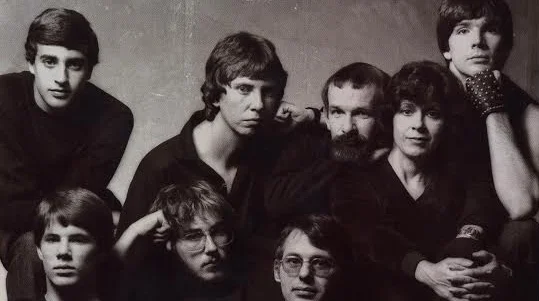
Stevie Case and John Romero early in their courtship.
Note that there is a sexually suggestive image below that may be Not Safe For Work!
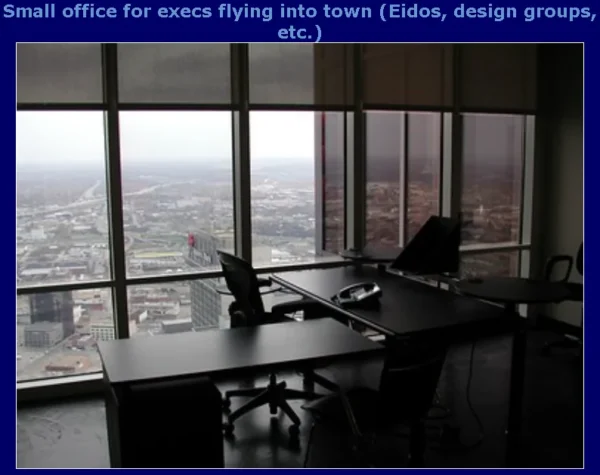
In the badlands of what used to be Texas, rumor has it that John Romero has thrown himself out the window of Ion Storm’s penthouse offices. Apparently Romero had finally finished Daikatana, only to have the Y2K bug destroy the gaming rigs of the world mere seconds later, thus rendering the last three years of Romero’s life terribly, terribly moot.
— Computer Gaming World, January 2000 issue
When Stevana “Stevie” Case arrived for her freshman year at the University of Nebraska in 1996, her conception of digital games was limited to the likes of Super Mario Bros. The daughter of a science professor, she had grown up in Kansas in comfortable middle-class surroundings, a precocious overachiever who told her family early on that her goal in life was to become the first female president of the United States. As her first steps toward that position, at age seventeen she had unsuccessfully run for the Kansas state legislature and successfully run for president of her high-school student body, in which capacity she had shaken hands with Bill Clinton. Now, she intended to become a lawyer as her next steppingstone to Clinton’s current office. She was already familiar with the inside of a courtroom, because she and her family had sued her school in federal court for banning Annie on My Mind, a young-adult novel about a lesbian relationship, from its library. They had won the suit, forcing the school to reimburse their costs and, most importantly, return the book to the library shelves. Prim and articulate, Stevie Case gave every sign of being destined for a bright future in the public sphere.
But then, almost as soon as she arrived at university, some of the young men who lived in her dorm complex showed her DOOM and Quake. She was immediately transfixed. Hyper-competitive ever since she had muscled her way onto a boys’ T-ball team when she was barely out of preschool, she adored the deathmatch ethos: “It was really fast, and you felt like you were flying through that world. And then when you added the ability to compete and beat other people, it just felt really addictive. I was all about the rockets and blowing shit up.” She was soon spending far more time playing Quake than studying.
These were the dawning days of what we call e-sports today, when deathmatchers were beginning to organize themselves into teams and leagues and hold tournaments to test their mettle against one another in public. This burgeoning culture of competition was clustered around the nation’s universities, whose fast local-area networks made it possible. Case won her first Quake tournament at her university in January of 1997, playing as the only woman on a team called Impulse 9. Her personal handle was KillCreek, after a Midwestern indie-rock band by the same name. She was a solid enough player, but it was her gender that truly made her stand out; her fame as “the girl who is pretty damn good at Quake” spread quickly online.
Despite his responsibilities as a founder of Ion Storm, man-of-the-people John Romero was still an active participant in the deathmatch community. “Hey, I know a girl that can kick your ass,” said a member of his circle. “No way. Never happen,” he replied.
One thing led to another, and it was arranged for the two of them to meet and do battle that spring, during a road trip to Dallas that Case and some of her friends had already planned. That semi-anonymous city of technology and finance, so often overshadowed by oil-rich Houston, music-rich Austin, and romantic San Antonio, had finally forged a proper identity for itself, among people like Case at any rate, as the wellspring of first-person shooters, home of id, 3D Realms, and now Ion Storm. For a shooter fan in 1997, making a pilgrimage there was akin to a flower-power hippie hitchhiking to San Francisco 30 years earlier. And now Stevie Case was not only going there, but going there to meet the fragger-power movement’s equivalent of Jerry Garcia.
When Romero walked into the room in his full rock-star regalia, she perceived him as a “god”: “And I’m just some person from Kansas. I had no idea if I could beat this guy or not.” As it turned out, she couldn’t, at least not on this occasion. She put up a decent fight, but Romero won fairly easily. Afterward, he posted online that “deathmatch is a man’s game and women will never fully understand it.”
Still, the novelty of a girl who could play Quake decently well was difficult for the community to resist. Encouraged to try again, Case publicly challenged Romero to a rematch, a best-of-three this time, with the loser expected to create an “online shrine” to the winner. Pressured by his own fans to pick up the gauntlet, Romero agreed to her terms. And so, once again, Case made the trek to Dallas — her ambition to become president, and with it her studies, had pretty thoroughly fallen by the wayside by now — to join battle with gaming’s biggest rock star.
She came prepared this time, having learned a bit about Romero’s play style from the previous match, more from talking to others. Her newfound confidence caught him by surprise; she won the first game handily. Romero then buckled down and took the second one, trash-talking ever more volubly and profanely as he did so, with plenty of disparaging references to her gender. The momentum seemed to be with him going into the final match. Case was thrown back on her heels in the early stages of the tiebreaker. But then…
“I’m hearing him say this running sexist commentary,” she remembers, “and it’s like something snapped in my brain. It was just this moment of, ‘Fuck this, this is not happening!’ So, I went on a rampage.” She turned the tide and won the game. As she recalls it, Romero responded ungraciously, by smashing his keyboard to pieces in a fit of pique and storming out of the room. Once he had calmed down, however, he did create the online shrine demanded by the terms of his deal with Case, even if he couldn’t resist making a backhanded excuse for the loss: “Maybe someday I will learn the secret of her master ability, or maybe next time I will, uh, eat some food before playing.”
When Case returned home from university for summer break, she told her confused parents that she was dropping out and moving to Dallas. She rented a truck, filled it with her things, and drove south to her gaming promised land.
She found herself a job there in tech-support to pay the bills, and renewed her connection to Romero through the new Cyberathlete Professional League, an organization that had him on its board of directors and routinely conducted its meetings in Ion Storm’s offices. The same species of awed, slightly clueless mainstream journalists who would soon be trooping through the Ion Storm penthouse in Chase Tower beat a path to the CPL’s door as well, trying to understand and translate what was going on there to their viewers and readers. Case made for a compelling human-interest story, being virtually the only female about the place. She began to appear with some regularity in their reporting. Her role as a mascot was valuable enough that the CPL agreed to pay her a fixed monthly stipend of $1000.
Cases’s prominence undoubtedly helped to lure more women into the scene, although they would always remain a decided minority. John Carmack was recruited to hand out the grand prize at one deathmatch tournament for women only: a signed garter belt. Such a prize encapsulated the queasy mixture of empowerment and objectification that came to characterize the female participants’ experience of this testosterone-soaked realm of endeavor.
Like her peers, Case enjoyed some of the attention that came her way thanks to her gender, but by no means all of it. Her email inbox filled up with messages from men, everything from shy inquiries into her relationship status to meticulously detailed fantasies of sex, rape and sometimes murder. She had never spared that much effort on fashion before, favoring low-maintenance bobbed hair, baggy sweaters, and jeans. But on Halloween in 1997, she went to a deathmatch party dressed as a femme fatale in a tight black dress, and was amazed and gratified by the reaction it provoked, the sense of power it gave her. Around the same time, she found herself cornered in the car of a creepy fellow who had offered her a ride, who now demanded that she show him “it” — meaning her vagina — as payment for the lift. On the spur of the moment, she did as he asked, pulling down her pants to give him a quick peek as he licked his lips in shocked silence. Again, this act seemed to turn the tables on her harasser, to give her power over him.
So, Stevie Case began to radically alter her appearance and demeanor. She had her hair styled, bought a new wardrobe, hit the gym daily, put increasingly revealing and provocative photos up on her personal website, eventually bought herself the most widely discussed breast implants in the history of gaming. “I’ll never regret having a breast augmentation,” she would say to Rolling Stone magazine in 2000. “Did people look at me differently? You’re damn right they did!”
In a sense, Case was of a piece with other unlikely suspects who found some form or other of satisfaction through sexual exhibitionism on the early Web. Whether her moves were the “correct” response to the challenges she faced, whether her newly sexualized persona reflected genuine empowerment or merely internalized misogyny, isn’t a question I can answer for you. I will only venture to say that, if a woman was going to try to turn the male gaze against itself in this way, the deathmatch scene was probably a fairly safe place to do it in comparison to many others, if only because most of its young male participants tended to be more talk than action when it came to matters sexual, not having a surfeit of experience with same in real life. (To wit: the stunned posture of Case’s harasser in the car…) They were well-primed to be cowed by, for example, an all-woman team going under the name of PMS, what with the vagaries of the female body and psyche still being such a mystery to most of them.
Case was well into her transformation in July of 1998, when she became a permanent resident of the Chase Tower penthouse suite, having been hired by Ion Storm as a tester. Shortly thereafter, she began a romantic relationship with the newly divorced John Romero. At a glance, they looked like a rock star and his supermodel girlfriend: he in his leather and chains, she in her leopard pants and high heels. The mainstream press took it as just one more layer to the human-interest story. The gaming press, just about out of patience with Romero eight months after the infamous “bitch” advertisement, was less positively disposed toward his new girlfriend.
Then came the walkout of the heart of the Daikatana team in November. Looking for loyalty in a workplace riven with rumor, innuendo, and guile, Romero promoted Case to level designer, the position she had had her eyes on all along. “I was ecstatic,” she says. “I felt like this brotherhood of designers had accepted me.”
Alas, it didn’t quite turn out that way in practice. Many in the shooter fraternity perceived Case as gaming’s Yoko Ono, an interloper whose talents lay strictly in the direction of distracting her man, stirring up dissension, and raising her own media profile. Their comments could get really, really ugly: “Just another slut that swallowed her way to fifteen minutes of fame”; “Yeah, she’s John Romero’s slut”; “She sucked about 80 dicks to get into games.”
The months that followed Case’s promotion were not easy ones for Ion Storm. On January 14, 1999, The Dallas Observer, a free local newspaper best known for concert reviews and singles ads, published an unusually lengthy piece of investigative journalism. Under the innocuous-sounding headline “Stormy Weather for Popular Computer-Game Company,” journalist Christine Biederman, a future recipient of the Pulitzer Prize, expended 7000 words detailing Ion Storm’s checkered history and what she described as its “toxic mix of prima donnas and personality cults,” sourced largely from an extensive tranche of emails smuggled out of the place by disgruntled current and former employees. It hit the world of gaming like the bombshell it was. I was playing games only occasionally at the time, but I nevertheless vividly remember stumbling upon the exposé for the first time in a copy of the Observer lying on the table in my workplace break room and reading it through in slack-jawed disbelief. The stir it caused came down to its truthiness, the way it confirmed in stark black-and-white newsprint everyone’s worst suspicions. Needless to say, copies of the article were all over the Internet within hours. Although none of the principals are much inclined to thank Biederman for writing it even today, none have refuted her reporting in any serious way either. (I relied on it extensively for the previous article in this duology.)
As if to confirm Biederman’s claims, Romero had to go to Eidos soon after the article dropped to tell them that he would not be able to deliver Daikatana to them that spring, as he had promised to do before most of his development team had walked out the previous autumn. He did his best to mollify the impatient publisher by pointing to his recent hiring of Chris Klie as the project’s new lead designer and Stephen Ash as its latest lead programmer. Both came from LucasArts, where they had worked together on the Western-themed shooter Outlaws and the expansion pack to Jedi Knight. Their arrival in Dallas really did bring some much-needed professionalism to the team.
But even when Romero made wise choices for his game, external events conspired to undermine him. On April 20, 1999, came a shock felt round the world, when two alienated teenage shooter fans — deathmatch handles “RebDoomer” and “Vodka” — walked into their high school in Columbine, Colorado, and shot the place up with portable arsenals that were all too real, killing 14 people and injuring another 23 before turning their weapons on themselves. For all his wild-man reputation, Romero had more natural empathy for the parents who were left grieving for their senselessly murdered offspring than did most hardcore players of his games, having brought three children into the world himself with his two wives. He still calls that April 20 “one of the darkest days of my life,” a day which forced him to confront the question of his own culpability in what had transpired. He had never shot a real gun in his life, had never imagined anything like this, had always assumed that the people with whom he deathmatched were just like him, with no interest in turning the bloody hyper-violence they saw on the monitor screen into a tragic lived reality. Now he had learned in a single searing instant that this was not uniformly correct.
From the moment the news programs broadcast footage of police officers carrying DOOM paraphernalia out of the perpetrators’ bedrooms, Columbine transformed the mainstream culture’s perception of id, Ion Storm, and all of their fellow travelers. Since the last brouhaha over violence and sex in videogames, the one initiated by Senator Joseph Lieberman in 1993, had convinced the industry to grudgingly accept a content-rating system, the subject had been treated with more bemusement than real concern even in non-gaming circles. But now, Lieberman was back, more exercised than ever, calling for “a ceasefire in the virtual arms race” with new allies by his side, such as the syndicated columnist Ellen Goodman, who claimed that the military was using DOOM to “desensitize” new recruits to the horrors of combat in advance, and President Bill Clinton, who held up some of the more macabre advertisements for “so-called first-person-shooter videogames” during a press conference. Gaming executives rushed to sanitize and/or postpone their latest hyper-violent releases.
It would all blow over in time, as these things always do; by the following spring, Activision would dare to belatedly publish Soldier of Fortune, which upped the ante on grisly violence higher than ever through “26 different hit locations on each enemy for pinpoint accuracy and realism!” Nonetheless, for many who had come of age with shooters in the freewheeling 1990s, deathmatch would never feel quite the same again.
The 1999 E3 show took place just a month after Columbine, still very much under its cloud. Ion Storm brought all three of their works in progress. Deus Ex was looking very promising indeed; it was shown off by Warren Spector, pleasant and articulate as ever and, it was now more obvious than ever, very eager to distance himself and his game from the rest of Ion Storm. Tom Hall’s Anachronox looked interesting, if massively under-baked for a game that had been in active development for almost two and a half years. (To be fair, this project had tended to get the short end of all of the sticks at Ion Storm.) But Daikatana… Daikatana was a disaster. For some reason that even Romero didn’t understand, the frame rate of the demo at the show was painfully, unplayably slow. “What the fuck is going on? What the fuck happened?” he could be heard to shout from his company’s booth, his rage and stress palpable. Ion Storm had become a laughingstock yet again.
As Romero has long told the story, the cause of the disaster was Todd Porter, who had ordered some last-minute changes to the build of the demo that was sent to E3, then never bothered to see how it performed. Romero says that, after two years of constant low- or high-intensity conflict with his cofounder, he finally reached his breaking point at this juncture: he went to Eidos just after the show to tell them that “either Todd goes or I go. There’s always some kind of bullshit going on.” This was an odd ultimatum to lay down on the face of it, considering that Eidos did not formally own even a piece of Ion Storm at this point, and thus ought not to have anything to say about its personnel decisions — but then again, nothing about the relationship between the two companies was typical, much to Eidos’s chagrin. Even the Tomb Raider juggernaut wasn’t enough to offset the constant drain on Eidos’s finances that propping up Ion Storm had become; the publisher posted a substantial loss that year.
However it transpired, a deal was engineered over the next few months, in which Eidos would pay Todd Porter and his crony Jerry O’Flaherty a (still undisclosed) sum of cash to leave and would take over the studio completely, forgiving the nearly $30 million they had advanced Ion Storm to date in lieu of any payment to the other two owners. John Romero, Tom Hall, and Warren Spector all promised to stay on as employees at least long enough to finish their respective games. All three were eager to trumpet the acquisition as a turning of a page that would finally let them buckle down and focus on making the best games possible.
Yet even now, the various wars of words in the press continued. Having stolen Romero’s last development team out from under him, Mike Wilson apparently considered his debt of honor duly paid, and now took Romero’s side. He informed Computer Gaming World that Ion Storm was poised at long last to become “the powerhouse it always should have been. Everyone that truly understands the goings-on at that company can tell you that 99 percent of their problems stemmed from Todd Porter and his hand puppet O’Flaherty. It took John and Tom longer than it should have to fix the problem, but the important thing is that it’s fixed, and that the games coming out of that tower look phenomenal. I expect great things from them now.” Not to be outdone, Bob Wright, a corporate lawyer and loyalist of Porter who had helped to set up the studio, riposted that “John [Romero] hates confrontation. John didn’t want to run the business, he just wanted to be a celebrity. [Porter has] a tremendous capacity to rise above impending doom. I’ve never seen anything like it. It’s like trying to drown a cat. He stands on the bodies of the people he’s buried.” (Rather disturbing imagery, that, especially so close on the heels of Columbine.) Gamers lapped it up and waited for the next turn of events in their favorite soap opera.
Like clockwork, Stevie Case now came roaring back into view to add another heaping dollop of sex to all of the delicious backbiting. That fall, she agreed to do a nude pictorial for the Playboy website. The reaction to the photo spread from some gamers was cruel enough to make her begin to question some of her recent life choices. This may not be, she reluctantly concluded, the best way to build a long-lived career for herself as a game designer. “The more I leaned into being beautiful, the more intense the harassment became, and the louder that message of ‘You are worthless!’ came from the community,” she told journalist David Kushner in 2022. John Romero seemed incapable of giving her the sort of support she needed, being still compelled, presumably by his own insecurities, to play the edgelord rock star for his (increasingly disgruntled) fan base. “Just imagine having sex with a super hot model,” he said to one online interviewer who asked about the couple’s love life. “She’s so hot, we have to get back home as fast as possible almost every day! I was going to send some photos, but the attachment was too big.” Case developed bulimia as her self-worth plummeted.

Rolling Stone seemed scarcely less horny than a panting teenage gamer when it did a photo shoot and profile of Stevie Case in 2000. As any real gamer could have told the magazine, the irony of this picture was that nobody played shooters using a joystick anymore. Case had to track down and borrow a suitably phallic-looking example of the peripheral.
In the meanwhile, Ion Storm still had three games to finish — none of which would, a frustrated but unsurprised Eidos was informed, be ready for the Christmas of 1999, thus making that holiday season the studio’s third in a row with no product to sell. Deus Ex at least was looking more impressive than ever, as Warren Spector’s team down in Austin settled in for the sprint to the finish line with camaraderie and purpose. Daikatana and Anachronox, by contrast, were lurching along in an awkward shamble. Daikatana especially exuded the stench of failure and obsolescence. Romero was finding it harder than ever to hold a team together. Chris Klie and Stephen Ash, the veteran hands who were supposed to have been the project’s saviors, both decamped to less chaotic work assignments after less than nine months on the job. Few other established professionals were interested in joining a project and studio that had become a punchline, leaving Romero to rely, this time out of necessity rather than idealism, on yet more inexperienced amateur modders and promoted testers. He insisted to Eidos that the morale and productivity of his team had been tremendously improved by the departure of Porter and O’Flaherty, and he was probably correct as far as it went, but the lack of simple game-making competence among the rank and file was more painfully evident than ever.
Despite it all, Eidos told Romero, who was no longer in any position to argue, that they wanted Daikatana in stores by May of 2000, no matter what it looked and played like at that point. Faced with his first unshiftable deadline, he met it — after a fashion anyway. Daikatana finally shipped. “It was not the game we hoped it might be, but we had run out of time,” says Romero, apparently oblivious to the irony that Eidos had given Ion Storm fully three and a half years and many millions of dollars to make it live up to the hype. Through all the turmoil of the last several years, the basic structure of a battle through time for a magical Japanese sword had remained intact. But the old aspirations to elevate the art of shooter storytelling and make the player cry were comprehensively not achieved. This was a game to make its player cry — and laugh — for completely different reasons.
Daikatana’s use of the two-and-a-half-year-old Quake II engine, coming after id had already dropped Quake III on the world, was the least of its problems. The reviewers who had been waiting for it with knives out were not disappointed; if anything, the game outdid even their high expectations for terribleness. They savaged it with glee. Robert Coffey’s colorful takedown for Computer Gaming World came under the headline of “Yep… It Stinks.”
Daikatana has a story buried in it somewhere, something about a magic time-traveling sword, and some evil guy using it for nefarious ends, and some other stuff, but odds are you won’t follow it. Not that the game fails to devote time to the story. No, the game devotes too much time to the plot, spelling it out in the most tedious cutscenes imaginable. Unbearably long and wordy, the cutscenes are the epitome of the “3D Model Standing Around Bobbing Its Head at Another 3D Model Bobbing Its Head” school of storytelling. An irritating series of swooping camera pans futilely tries to inject life into these stillborn dramas.
Immediately after the opening movie comes the definitive Daikatana moment, a moment you’ll relive hundreds of times throughout the game: you mutter, “What were they thinking?” The game is carved up into four time periods, and the execrable first episode — set in 2455 Japan — brazenly throws down a gauntlet, daring you not to uninstall the game. Drenched from the first second in a godawful puke green, Daikatana wastes no time besetting you with the worst first-level enemies ever, a robotic frog and his buddy robo-mosquito. Almost impossible to see as you tromp through the stereotypical sewers, the poisonous Froginators are as fun as a cold sore and the hideous buzzing of the mosquitoes stays with you even after you’ve left the game. That persistent buzzing is the sound your brain makes as it desperately tries to slither out the back of your skull…
This opening act against mechanical amphibians and insects was inexplicably the hardest of the whole game. “I decided to make the first level super challenging, but players didn’t like that,” says Romero, “something that would surely be revealed in today’s focus-test-driven development.” I’m all for focus groups in general, but I must say that I do wonder why a seasoned designer like him should have needed a focus group to tell him that your on-ramp for your players shouldn’t be a brick wall. It smacks of an old-school, retrograde theory of game design, which says that players need to pay their dues to be deemed worthy of actually having fun. Games can and should be fun from the very start.
Once you got a ways into Daikatana, you met your two companions, the same ones who had been so widely hyped in the early previews. These embarrassing attempts by nerdy white men to capture the personalities of a Japanese woman and a black American man — named “Superfly,” no less! — turned out to be arguably the worst thing of all about this very bad game. They hopped constantly into your line of fire when they weren’t shooting you in the back. From the moment of their arrival on, Daikatana became more of a babysitting simulation than a shooter, as you struggled to devise ways to keep your idiotic companions and yourself alive in the face of the broken artificial intelligence and glitches galore — trying to keep them from getting their heads embedded into the walls and from climbing and falling down the same ladder again and again for eternity. These two dimwits, the death of either of which spelled an instant Game Over, became your true nemeses. Thanks to them, the most frequent adjective applied to Daikatana isn’t any of the more flamboyantly disdainful ones; it’s simply “irritating.” This was the game that it had taken John Romero, the mastermind of DOOM’s most brilliant levels, three and a half years to make?
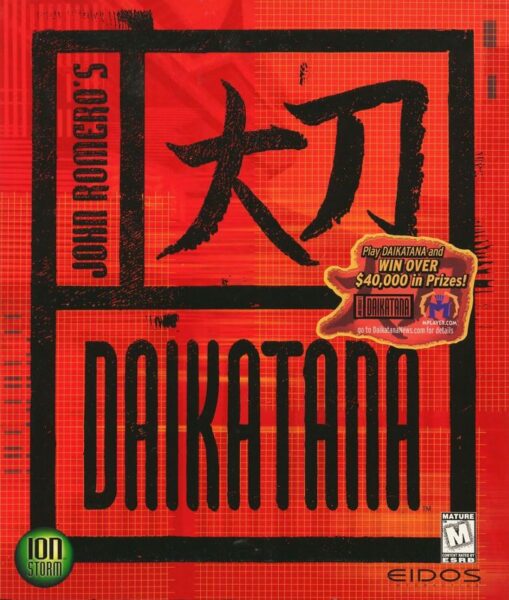
Word on the street was that it was called John Romero’s Daikatana because nobody else wanted their name associated with this thing.
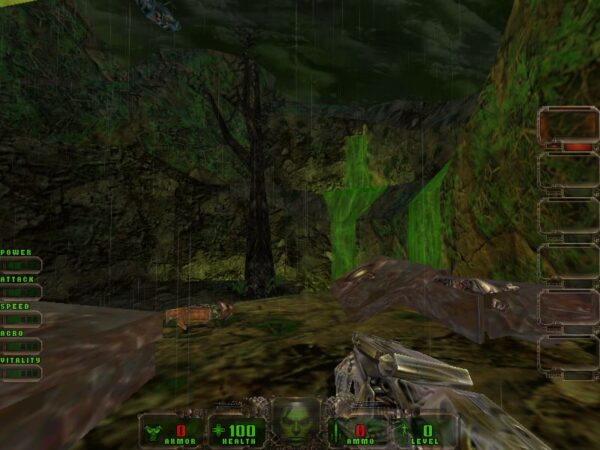
What does Daikatana have to do with The Muppet Movie? They both start with someone wishing they weren’t stuck in a swamp. (Bah-bum-dum! I’ll be here all week, folks…)
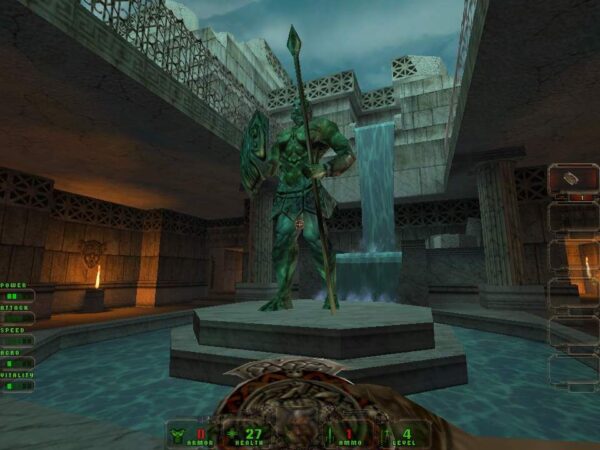
Most agree that the second of Daikatana’s four chapters, which takes place in ancient Greece, comes the closest to being tolerable, with the additions by subtraction of no robot frogs and mosquitoes and companions who mostly take a backseat to the action.
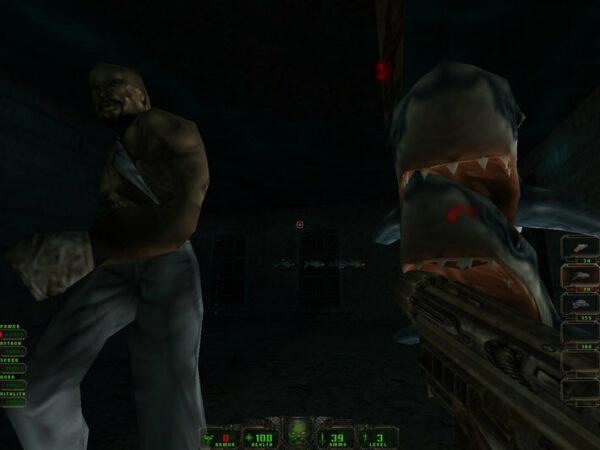
Superfly Johnson (yes, he’s really called that), whose dialog sounds like it was written by that little white-guy rap fan from Office Space. And yes, the graphics really are this bad.
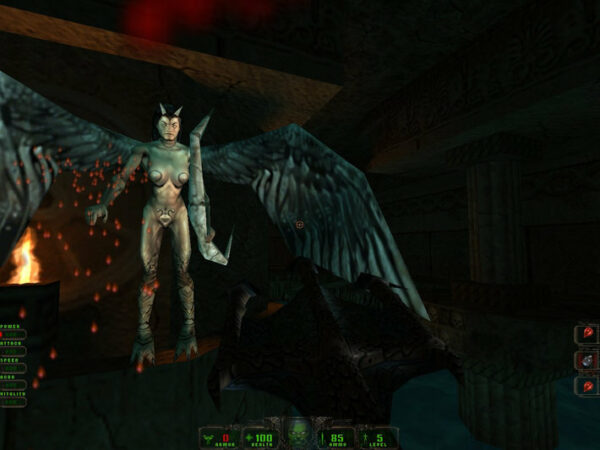
Here we have… you know what? I think we’ve all had enough. Never has a game so made me want to gather all of its makers together in a room and shout at them, “Grow the F up already!”
Setting its many granular infelicities aside, Daikatana just felt old and out of touch, an anachronism from a pre-millennial (pre-Columbine?) version of gaming that had fallen out of the zeitgeist. Oddly for a man so closely identified with the deathmatch, Romero had chosen to focus heavily on the story-driven single-player campaign, leaving the multiplayer mode as an even more broken afterthought; this at a time when online play had become so dominant that id hadn’t even bothered to include a single-player campaign in Quake III. Lingering traces of Romero’s infatuation with Japanese console games showed up not only in its elaborate if incoherent story but in an irritating (there’s that word again!) console-style save system that required you to collect and expend in-game gems for the privilege of being able to step away from your computer for a little while. Small wonder that, after all the time and all the drama that had gone into making it, Daikatana sold just 41,000 copies in North America.
From Eidos’s perspective, the one bright spot was that, by pushing Daikatana out first, they ensured that they got the worst over with first. Just one month later, they published Deus Ex to reviews that were as positive as those of Daikatana had been negative. Every inch an immersive sim of the old Looking Glass school, a fine heir to Warren Spector’s work on Ultima Underworld and System Shock, Deus Ex alone would eventually be deemed by many gamers to have amply made up for all of the rest of the Ion Storm fiasco. And it was a million-selling hit as well, a feat of which the Looking Glass games that preceded and inspired it had not been able to brag. Romero claims that “Eidos easily earned out its investment in Ion Storm on Deus Ex sales alone.” Although it’s hard for me to see how this statement could be correct when I sit down to do the math for myself, there can be no question that Spector’s game made the whole Ion Storm train wreck look substantially better from a financial point of view than it otherwise would have. (I’ll dig into Deus Ex and its legacy in more depth in my next article.)
Deus Ex’s success was enough to save the team who had created it; Warren Spector and company embarked immediately on a sequel down in Austin. Meanwhile much of the Daikatana team was unceremoniously let go that summer, the rest moved over to the laggardly Anachronox, all too aware that finishing that game would probably mark the end of their tenures inside the Chase Tower — indeed, of the absurdly costly gamers’ penthouse itself. Now plainly under-populated, with large parts of the space abandoned and closed off to save on air-conditioning costs, the penthouse already felt like a ghost town. No more awed reporters trooped through. Even the gaming sites didn’t much care what went on here anymore now that they had had their fun mocking Daikatana. Ion Storm had become an anachronistic artifact of a different era. The bravado and excess of its heyday seemed silly and passé in this post-millennial context.
Hoping against hope, John Romero busied himself for a while drawing up designs for another shooter that might salvage his reputation and restore his rock-star mojo. But in time he got the message that this was not going to happen — not at this studio, at any rate — and buckled down to help his old buddy Tom Hall make his game as good as he could. When it came out in June of 2001, fully a year after Deus Ex, Anachronox proved a rough-cut gem by any objective standard. Still, it wasn’t another Daikatana; while all too clearly less than what it had been intended to be, it was able to coast a surprising distance on Hall’s native gee-whiz enthusiasm and the likability this instilled. Unfortunately, it didn’t sell very well. (Rest assured that I’ll look at Anachronox too in more detail in a future article.)
With this game done, the two remaining Ion Storm founders quietly shut off the lights at the top of Chase Tower and went home. “See you,” said Romero to Hall as they climbed into their cars in the parking garage. “Yeah, see you,” answered Hall.
And so it was all over, but for Warren Spector’s gaggle of survivors in Austin, who had never had all that much to do with their colleagues in Dallas anyway. John Romero’s adventure in Behind the Music-style excess had led to one awful game in Daikatana, one merely bad one in Dominion, one fairly brilliant one in Deus Ex, and one that lay somewhere in between all of the extremes in Anachronox. All things considered, it could have been much, much worse. Thank God for Warren Spector!
Still, the Ion Storm saga as a whole had already been enshrined in gaming lore as a monument to rampant egotism and entitled indolence. Nobody was knocking at the door to hire John Romero now; one of the two hottest names in the business five years ago, he was now all but unemployable. Longing to recapture the fun of the early days at id Software, when it had just been a matter of a few friends in a clubhouse inventing gaming’s future, Romero formed Monkeystone Games with Tom Hall and Stevie Case. They would forgo the big budgets and large teams in favor of small games aimed at handheld devices like the new Pocket PC, games not all that far removed from the ones id had made before John Carmack turned his friends on to the potential of first-person 3D graphics. To emphasize the sense of a new beginning and raise some much-needed cash, Romero sold his mock-Tudor mansion and his Ferrari; he even cut his hair. Instead of auctioning off his trademark flowing locks for a doubtless hefty sum, he sent them to a nonprofit that made hairpieces for cancer-stricken children. Whatever his faults, John Romero was never a man without a heart.
The pivot to mobile showed prescience about where gaming would go in the smartphone era to come, but Monkeystone was just a little bit too early on that scene, and never made that much of an impact. The same can be said of most of what Romero and Hall did after Monkeystone closed up shop in 2004. Neither has been given the chance to helm another big-budget game since Daikatana and Anachronox; in this sense, their years of excess at Ion Storm continue to haunt them.
For her part, Stevie Case was secretly relieved when the Ion Storm rat race ended, taking with it her fifteen minutes of fame as, to quote Rolling Stone, “a real-life Lara Croft,” on the arm of gaming’s biggest rock star. The end of that era certainly improved her mental health. But it wasn’t enough to save her relationship with Romero in the longer term. Although he was nine years her senior, she felt herself to be growing up in ways that he could not or would not. “He was like a perpetual fifteen-year-old boy,” she says. “That’s ultimately why I wanted to leave him. ‘I’m not fifteen anymore. I want an adult life. I want to have dinner parties and adult friends.’ And he had no interest in that.” The couple split permanently in 2003.
Case never did become president of the United States, but she did go on to a very successful career as a Silicon Valley executive. Today she is the chief revenue officer of Vanta, a digital-security firm worth $4 billion as of its latest valuation. She no longer plays shooters or any other games with any frequency, but says that she will always be a gamer in spirit.

An older and wiser and once more lavishly coiffured John Romero in 2022.
In 2023, John Romero published a memoir called DOOM Guy: Life in First Person. The name is a disarmingly accurate assessment of his current place in gaming culture; he is, quite literally, still “the DOOM guy,” both to gamers of his own generation and those who came later. Unlike his old partner in crime John Carmack, who managed to remain at the forefront of gaming technology for many years after the turn of the millennium, Romero is doomed (ha!) to be remembered for just one decade of his life, bookended by the soaring triumphs that were Wolfenstein 3D and DOOM and the disastrous crash landing that was Daikatana. The table of contents of his book doesn’t lie: 22 out of its 27 chapters are devoted to the years before the closure of Ion Storm Dallas ended his tenure as an A-list game developer, leaving him to summarize the last quarter-century of false starts and nostalgia-fueled celebrity in an anticlimactic whirlwind.
To be honest, I didn’t expect much from his memoir when I picked it up, having always found his rock-star posture be the apotheosis of the grating bro-gamer man-child; I half expected every sentence to begin or end with the word “dude,” as most of his email communications did back in the day. Imagine my surprise, then, to meet a more or less thoughtful and reflective man in its pages, one who fesses up with surprising readiness to many of his mistakes, at Ion Storm especially: “As you read, you will likely note moments where I should have made a different decision or seen the writing on the wall, and you will not be wrong. I own the train wreck that was Ion Storm. If nothing else, writing this book has been a transformative process. It has allowed me to see patterns that have followed and defined me, patterns I may not otherwise have seen.” The book thus makes it clear that Stevie Case was wrong in her assessment of her boyfriend, at least in the long term: this is a guy who can and has grown up. Having lived through the maelstrom of Ion Storm and all that came before and after, John Romero has by all indications come out to a place of acceptance and gratitude, aging far more gracefully than many of his peers. “When I was a kid,” he tells us, “all I wanted to do was wake up and make games every day for the rest of my life. How lucky am I that this has happened?” The rebel has become an elder statesman, always ready with a pat of encouragement and a word of advice for young would-be game developers who aren’t so different from the kid he used to be.
In retrospect, I shouldn’t have been so surprised that John Romero, like all of us, can contain multitudes. There were always hints of it to be found, such as in his expressed desire to make a computer game with a story that could make you cry, or the revelation that, in between the bouts of herculean lovemaking that he loved to describe to his slathering fans, he used to read books — yes, actual books — to Stevie Case in bed at night. Quite some years ago now, near the beginning of this history project of mine, Mark Pelczarski, an Apple II magazine columnist and founder of an important early software maker called Penguin, shared this anecdote with me.
John Romero tracked me down and e-mailed me sometime in the mid-90’s, with a subject line that was simply “YOU!” He wrote this e-mail about how he learned programming back in the early 80’s using [Penguin’s] Graphics Magician and reading my articles, and that’s how he got his start. Actually, I had no idea who John was at the time, but he signed it “John Romero, id Software”, and “id” rang a bell. I thought it was the company that published DOOM, so I looked it up, found I was right, then was startled to find John’s connection to that [game] and his other work. Cool.
Actually, that led to one of my coolest teaching moments. I was teaching freshman/sophomore C++ courses for CS majors, and I mentioned this e-mail from this Romero guy in one of my classes. Turns out I had a student, Chris Avila (now in the software industry himself) who was one of those who held John up to rock-star status. So Chris e-mails John, asking if he really knew me, and John writes him this glowing e-mail about how I was one of his heroes when he was first learning programming, etc., etc. (Chris showed it to me, and it really WAS nice.) So Chris shows up to me next class basically with his jaw hanging to the floor in disbelief, saying something like, “John Romero is my idol, and then I find out my CS teacher is HIS idol….” (his choice of words, probably not John’s), and standing there bug-eyed just trying to grok it all. Priceless.
Shortly after the events Pelczarski has just described for us, Romero held a reunion for many of his game-development heroes from the 1980s up there at the top of the Chase Tower. Most of them, Mark Pelczarski included, were long since out of the industry, and could only gawk in astonishment at the spectacle of how far it had come from the suburban garages and spare bedrooms where they had founded their companies and made their first games.
The important point here, of course, is that Romero didn’t have to hold this reunion, and yet he did. So, rock on, John Romero… rock on. I suspect that you have always been more generous than not at heart — more generous perhaps than I have given you credit for — even as I know that you have always genuinely loved games.
Did you enjoy this article? If so, please think about pitching in to help me make many more like it. You can pledge any amount you like.

Sources: The books Masters of DOOM: How Two Guys Created an Empire and Transformed Pop Culture by David Kushner, Online Game Pioneers at Work by Morgan Ramsay, DOOM Guy: Life in First Person by John Romero, and Protecting Intellectual Freedom in Your School Library: Scenarios from the Front Lines by Pat R. Scales. Retro Gamer 75; Dallas Observer of January 19 1999; Computer Gaming World of August 1999, January 2000, July 2000, and August 2000; Rolling Stone of October 12 2000; Los Angeles Times of August 1 1999.
Online sources include “A Hardcore Elegy for Ion Storm” by Christian Divine for Salon, “Stevie Case vs. the World” by David Kushner for Vanity Fair, and a vintage “Daikatana Demo Review” by Daily Radar.
Where to Get It: Daikatana is available for digital purchase at GOG.com. If you want to try it and you aren’t a complete masochist, be sure to apply the unofficial patch, which in the reckoning of some elevates a godawful mess of a game almost to the status of mediocrity.