RSS

Tag Archives: microsoft

IBM’s New Flavor

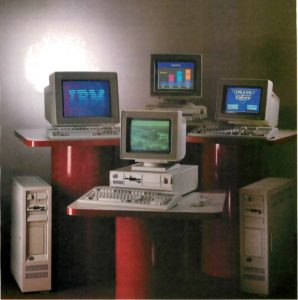
The PS/2 lineup

IBM’s greatest triumph was inextricably linked with what by 1986 was turning into their biggest problem. Following its introduction five years before, the IBM PC had remade the face of corporate computing in its image, legitimizing personal computing in the eyes of the Fortune 500 and all those smaller companies who dreamed of someday joining their ranks. The ecosystem that surrounded the IBM PC and its successors was now worth countless billions, the greatest story of American business success of them all to play out during Ronald Reagan’s storied Morning in America.

The problem, at least as IBM and many of their worried stockholders perceived it, was that they now seemed on the verge of losing control of the very standard they had created. A combination of the decisions that had allowed the original IBM PC to become a standard in the first place — its simple, workmanlike design that utilized only off-the-shelf components; the scrupulously thorough documentation of said design; the decision to outsource the machine’s operating system to Microsoft, a third party all too willing to license the same operating system to other parties as well — had led to a thriving market in so-called “clone” machines whose combined revenues now far exceeded IBM’s personal-computer sales. IBM believed that the clonesters were lifting billions out of their pockets every year, even as they saw their own sales, which had broken record after record in the first few years following the IBM PC’s launch, beginning to show signs of stagnation.

Compaq of Houston, Texas, the most aggressive and innovative of the clonesters, had first begun to collect for themselves a reputation to rival IBM’s own with their very first product back in 1983, a portable — or, perhaps better said, “luggable” — all-in-one IBM-compatible. The Compaq Portable had forced IBM for the first time to play catch-up with a personal-computing rival, rushing to market a luggable of their own. To make matters worse, the IBM version of portable computing had proved far less practical than the Compaq, as many a reviewer wasn’t shy about pointing out.

Now, in 1986, Compaq threatened to wrangle away from IBM the mantle of technological leadership via a machine that represented a more fundamental advance than a new form factor. After hearing that IBM didn’t have any immediate plans to release a machine built around the Intel 80386, a new 32-bit processor that was sending waves of excitement rippling through the industry, Compaq decided to push ahead with a 386-based machine of their own — right now, this very year. The public launch of the Compaq Deskpro 386 on September 9, 1986 — almost exactly five years after the debut of the original IBM PC — was another watershed moment, the first time one of the clonesters had released a machine more powerful than anything in IBM’s stable. Compaq’s CEO Rod Canion, never a shrinking violet under any circumstances, outdid himself at the launch, declaring the Deskpro 386 “the third generation of the personal-computer revolution” after the Apple II and the IBM PC, thus implicitly placing his own Compaq on a par with those two storied companies.

The clone market was getting so big that there seemed a danger that the clones wouldn’t be dismissed under that selfsame moniker much longer. People in the business world were beginning to replace the phrase “IBM clone” with phrases like “the MS-DOS standard” or “the Intel standard,” giving no credit to the company that had really created that standard. As was well attested by their checkered history of antitrust investigations and allegations of unfair competitive practices, IBM had never been known as a bastion of corporate generosity. It may not be exaggerating the case to say that they felt themselves to have a moral right to the PC standard they’d created, a right that encompassed not just an acknowledgement that said standard was still the IBM standard but also the ability to continue to steer every aspect of the further development of that standard. And by all rights the right should also encompass — and this was the sticking point that really irked — their fair share of all those billions that all those other companies were making from IBM’s standard.

In addition to furnishing what they saw as ample evidence of a need for them to reassert control of their industry, this period found IBM at another, more purely technical crossroads. The imminent move from 16-bit to 32-bit computing represented by the new 80386 would have to bring with it some elaborations on IBM’s tried-and-true architecture — elaborations that would undoubtedly define the face of mainstream business computing into the 1990s. IBM saw in those elaborations a way to remedy the ongoing problem of the clonesters as well. Unknown to everyone outside the company, they were about to initiate the so-called “bus wars,” a premeditated strike aimed directly at what they saw as parasites like Compaq.

The bus in this context referred not to a mode of public transportation but rather to the system of expansion slots that allowed the innermost core of an IBM-compatible computer — little more than the processor and memory — to communicate with just about everything else that made up a full-fledged PC: floppy and hard disk drives, monitors, modems, printers, ad infinitum, from the most generalized components found in just about every office to the most specialized for the most esoteric of tasks. The original IBM PC, built around a hybrid 8-bit and 16-bit chip called the Intel 8088, had used an 8-bit bus, meaning the electronic “channel” it used to talk to all these myriad devices was just 8 bits wide. In 1984, IBM had released the PC/AT, built around the newer fully 16-bit Intel 80286, and in that machine had expanded the original bus to support 16-bit devices while remaining backward compatible with the older 8-bit standard. The result retroactively came to be known as the Industry Standard Architecture, or ISA.

Now, with the 32-bit 80386 a reality, it was time to think about revisiting the bus again, to make it support 32-bit communications. To fail to do so would be to cripple the 386, forcing it to act like a 16-bit chip every time it wanted to communicate with a peripheral; impressive as they were in many ways, the Compaq Deskpro 386 and other early 386 clones saw their performance limited by exactly this problem. Most people expected IBM to do for the 386 what they had previously done for the 286, delivering a new bus which would support 32-bit peripherals but remain compatible with older 16-bit and even 8-bit devices. Instead they delivered something they called the Micro Channel Architecture, or MCA, a complete break with the past which supported only 32-bit peripherals.
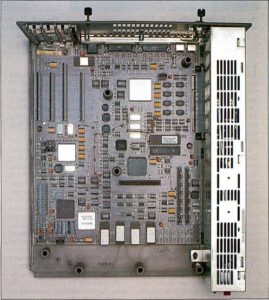
So much controversy over something barely noticeable. The four Micro Channel slots sit at the left rear of this PS/2 Model 50.

So much controversy over something barely noticeable. The four Micro Channel slots sit at the left rear of this PS/2 Model 50. Many of the components that would have been housed in expansion cards in earlier IBM systems, such as the video card and hard-drive controller, were moved onto the motherboard with the PS/2 line.

MCA debuted as a key component in a new line of personal computers in April of 1987, the most ambitious such IBM had ever or would ever introduce. The Personal System/2 lineup — better known as the PS/2 — was envisioned as exactly the next generation in personal computing that an ebullient Rod Canion had perhaps overenthusiastically declared the Compaq Deskpro 386 to represent barely six months before. IBM was determined to once again remake the computer industry in their image — and to get it right this time, avoiding the perceived mistakes that had led to the rise of the clonesters. The PS/2 lineup did encompass lower-end machines using the old 16-bit PC/AT bus, but the real point of the effort lay with the higher-end models, IBM’s first to use the 80386 and their first to use the new MCA bus architecture to take advantage of all of the 32 bits of throughput offered by that chip. IBM offered various technical justifications for the failure of MCA to support their older bus standards, but they always rang false. As the more astute industry observers quickly realized, MCA had more to do with business and marketing than it did with technology in the abstract.

IBM was attempting a delicate trick with MCA. They wanted to be able to continue to reap the enormous benefits of the business-computing standard they had birthed, with its huge constellation of compatible software that by now even more so than IBM’s reputation made an MS-DOS machine the only kind to be seriously considered by the vast majority of corporate purchasing departments. At the same time, though, they wanted to cut off the oxygen to the clonesters who were also benefiting so conspicuously from that same universal acceptance, and to reassert their role as the ultimate authorities on the direction business computing would take in the future. They believed they could accomplish all of that, in the long term at least, by threading the needle of compatibility — keeping the 386-based PS/2 lineup software-compatible with the older machines while deliberately breaking the hardware compatibility so relied on by the clonesters. In doing so, they would take the hardware to a place the clonesters couldn’t follow, thus securing for themselves all those billions the clonesters had heretofore been stealing out of their pockets.

Unlike the original IBM bus architecture, MCA was locked up inside an ironclad cage of patents, making it legally uncloneable unless one could somehow negotiate a license to do so through IBM. The patents even extended to add-on cards and other peripherals that might be compatible with MCA, meaning that absolutely anyone who wanted to make a hardware add-on for an MCA machine would have to negotiate a license and pay for the privilege. The result should be not only a lucrative new revenue stream but also complete control of business computing’s further evolution. Yes, the clonesters would be able to survive for a few more years making machines using the older 16-bit bus architecture. In the longer term, however, as personal computing inevitably transitioned into a realm of 32 bits, they would survive purely at IBM’s whim, their fate predicated on IBM’s willingness to grant them a patent license for MCA and their own willingness to pay dearly for it.

The clonesters rightly and immediately saw MCA as nothing less than an existential threat, and were thrown into a tizzy trying to figure out how to respond to it. It was the ever-quotable Rod Canion who came up with the best line of attack, drawing an analogy between MCA and the recent soft-drink marketing disaster of New Coke. (What with Pepsi alumnus John Sculley in charge over at Apple, computers and soft drinks seemed to be running oddly in parallel during this era.) Clever, pithy, and blessedly non-technical, Canion’s comparison spread like wildfire through the business press, regurgitated ad nauseam by journalists who often had little to no idea what this MCA thing that it referenced actually was. IBM never quite managed to formulate a response that didn’t sound nefariously evasive.

With the “New Coke” meme setting the tone, just about everything about the PS/2 line turned into an unexpected uphill struggle for IBM. While plenty of early reviewers dutifully toed the line, doubtless mindful that if no one ever got fired for buying IBM no one was likely to get fired for giving them a positive review either, a surprising number of the reviews were distinctly lukewarm. The complaints started and often ended with the prices. Even the low-end 16-bit PS/2 models started at a suggested list price of $2295 without monitor, while the high-end models topped out at almost $7000. Insider reports had it that IBM was enjoying profit margins of 40 percent or more, leading to rampant speculation on what the cost of entry into business-friendly personal computing might become if they really should manage to stamp out the clonesters.

The high-end models in particular struck many as a pointless waste of money given that IBM didn’t have an operating system ready to take advantage of their capabilities. The machines were all still saddled with MS-DOS, clunky and archaic and barely worthy of the name “operating system” even in the terms of 1987. In one of the more striking examples of hardware running away from software in computing history, the higher-end models shipped with 1 MB of memory, but couldn’t actually use more than 640 K of it thanks to MS-DOS’s built-in limitations. IBM promised a new, next-generation operating system called OS/2 to unlock the real potential of these next-generation machines. But OS/2, a project they had once again chosen to turn over to Microsoft, was still an unknown number of months away, with the so-called “Presentation Manager” that would add to it a Macintosh-style GUI due yet further months after that. [1]The full story of OS/2 and the Presentation Manager and their relationship to Microsoft Windows and even Apple’s MacOS is a complex yet fascinating one, but also one best reserved for a future article where I can give it its proper due. And, as a final little bit of buyer discouragement, IBM planned to charge the people who had already spent many thousands on their PS/2 hardware another $800 or so for the privilege of using the eventual OS/2 to take advantage of it.

The PS/2 launch prompted constant comparisons with the original IBM PC launch of five and a half years before, and constantly came up wanting. IBM’s publicity campaign was lavish — as it ought to have been, given those profit margins — but unfocused and uninspired. Its centerpiece was a series of commercials involving much of the cast from M*A*S*H, playing their old sitcom characters inexplicably transported from the Korean War to a modern office. With M*A*S*H still a beloved cultural touchstone only a few years removed from its record-shattering final episode, the spots had plenty of sheer star power, but lacked even a modicum of the charm or creativity that had characterized the award-winning “Charlie Chaplin” advertisements for the original IBM PC.

Likewise, it was hard not to compare the unexpected spirit of openness that had suffused the 1981 IBM PC with the domination and control IBM so plainly intended to assert with the 1987 PS/2 launch. Apple’s iconic old “Big Brother” Macintosh advertisement, a soaring triumph of rhetoric over substance back in its day, would have fit much better to the PS/2 line than it had to the state of business computing back in 1984. Many chose to blame the change in tone on the loss of Don Estridge, the leader of the small team that had built the original IBM PC. An unusually charismatic personality and independent thinker for the famously conservative and bureaucratic IBM — enough so that he had been courted by Steve Jobs to fill the CEO role John Sculley ended up taking at Apple — Estridge had been killed in a plane crash in 1985. His stewardship over IBM’s microcomputer division had been succeeded by that of William Lowe, a much more traditional rank-and-file, buttoned-down IBM man. Whether due to this reason or some other, the shift in tone and direction from 1981 to 1987 was striking.

In the months following the PS/2 line’s release, the media narrative drifted from one of uncertain excitement to reports of the new machines’ disappointing reception in many quarters. IBM sold around 200,000 MCA-equipped PS/2s in the first six months, mostly to the biggest of big business; United Airlines alone, for example, bought 40,000 of them as part of a complete revamping of their reservations system. But far too many even within the Fortune 500 proved stubbornly, unexpectedly resistant to IBM’s unsubtle prodding to jump onto the PS/2 train. Many chose to invest in the clonesters’ cheaper 80386 offerings instead; the 16-bit bus used by those machines, while far from ideal from a purely technical standpoint, did at least have the advantage of compatibility with existing peripherals. Seventeen months after MCA’s debut, 66 percent of all business computers being sold each month were still using the old bus architecture, versus just 20 percent that used MCA. (The remainder was largely accounted for by the Macintosh.) Survey after survey reported IBM to be losing market share rather than gaining it since the arrival of the PS/2. By this point OS/2 and its “Presentation Manager” GUI were finally available, but, hampered by that high price tag, the new operating system’s uptake had also been limited at best.

And then, just when it seemed the news couldn’t get much worse for IBM, much of the industry went into unthinkable open revolt against their ongoing hegemony. On September 13, 1988, a group of the clonesters, driven as usual by Compaq and with the tacit support of Intel and Microsoft, announced the creation of a new 32-bit bus standard, to be called the Extended Industry Standard Architecture, or EISA. Unlike MCA, EISA would be compatible with older 16-bit and 8-bit peripherals. And it would manage to be so without performing notably worse than MCA, thus giving the lie to IBM’s claims that their decision to abandon bus compatibility had been motivated by technical rather than business concerns. The press promptly dubbed the budding consortium, which included virtually every manufacturer of IBM-compatible computers not named IBM, the “Gang of Nine” after the allegedly traitorous Gang of Four of the Chinese Cultural Revolution. Machines using the new EISA bus entered production within a year.
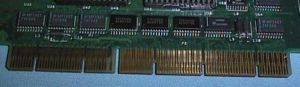
This shot of an EISA card illustrates the unique two-layer connection that allowed the same sockets to work for both the older ISA standard and the newer EISA. The shorter pins correspond to the older 16-bit standard; the longer extend it to 32 bits.

This shot of an EISA card illustrates the unique two-layer connection devised by the Gang of Nine to extend the old ISA standard without requiring ridiculously long, unwieldy cards and sockets. The shorter pins correspond to the older 16-bit standard; the longer extend it to 32 bits.

In the end, EISA would prove of limited technical importance in the evolution of the Intel architecture. The new standard didn’t have much more luck than had MCA in establishing itself as the market’s default. Instead, by the time a 32-bit bus became a truly commonplace need among ordinary computer users, EISA and MCA alike were replaced by a still newer and better standard than either called the Peripheral Component Interconnect, or PCI. The bus wars of the late 1980s and very early 1990s can thus all too easily be seen as just another of the industry’s tempests in a teapot, an obscure squabble over technical esoterica of interest only to hardcore hackers.

Look a little harder at EISA, however, and we see a watershed moment in the history of the personal computer that dwarfs even the arrival of the Compaq Portable or the Deskpro 386. The Gang of Nine’s announcement brought with it a torrent of press coverage that for the first time openly questioned IBM’s continuing dominance of business-oriented computing. CNN’s Moneyline, the most-watched business report on cable television, dredged up Canion’s evergreen New Coke analogy yet again, going so far as to open its reports on the Gang of Nine’s announcement with a shot of soda bottles moving down a production line. IBM was “faced with overwhelming resistance to the flavor of ‘New Compute,'” declared the breathless report that followed; September 13, 1988, “was a day that left Big Blue looking black and blue.” An only slightly more sober Wall Street Journal article had it that the Gang of Nine “was joining forces in an audacious attempt to wrest away from IBM the power of setting the standard for how personal computers are designed, and they seem to have a chance of succeeding.” The article threw all its metaphors in a blender for the big conclusion: “For IBM, the Gang’s announcement yesterday is at best a dust storm of confusion, and, at worst, a dagger to the heart of its PC strategy.” When the Wall Street Journal threatens to turn against your big business, you know you have problems.

And, indeed, September 13, 1988, wound up representing everything the pundits and journalists said it might and more. Simply put, this was the instant that IBM finally and definitively lost control of the business-computing industry, the moment when the architecture they had created back in 1981 left the nest to go its own way. After this instant, no one would ever defer to IBM again. In January of 1989, Arlan Levitan, a columnist for the big consumer-computing magazine Compute! — like most such magazines, not particularly known for the boldness of its editorial stances — signaled the shifting conventional wisdom. His editors empowered him to launch a satirical broadside at IBM, the PS/2, MCA, and even all those who had bought into the hype, a group that very much included their own magazine.

During a Monday morning press breakfast hosted by IBM, over a thousand representatives of the computing press were shocked to hear newly hired Entry Systems Division president P.W. Herman declare that the firm’s PS/2 computer systems and its associated products were part of an elaborate psychological study undertaken at the behest of the National Institute of Mental Health. “I sure am glad the American people haven’t lost their sense of humor. It’s good to know that in these times everybody still appreciates a good joke.” According to Herman, the study was intended to quantify the limits of the operational parameters associated with Abraham Lincoln’s most famous aphorism. Said Herman, “I guess you really can’t fool all of the people all of the time. I’ll tell ya, though — the Micro Channel Architecture even had me going for a while.” All PS/2 owners will receive a letter signed by Herman and thanking them for their personal contribution toward furthering the present-day understanding of aberrant behavior. Corporate executives who committed their firms to IBM’s $800 OS/2 operating system will receive free remedial therapy in DOS reeducation centers. Those who took advantage of IBM’s trade-in policy, whereby users gave up their XTs or ATs for a PS/2, will receive their weight in PCjr computers. According to internal IBM sources, all costs associated with manufacturing and promoting PS/2s will cumulatively qualify as a tax-deductible research grant.

In terms of hardware if not software — Microsoft’s long, often damaging domination was just beginning in the latter realm — the industry was now a meritocracy, bound together only by a set of mutually if often only tacitly agreed-upon standards. That could only mean hard times for IBM, who were hardly used to competing on such a level playing field. In 1993, they posted a loss of a staggering $8 billion, the largest to that point in American business history, prompting a long, painful process of reinvention as a smaller, nimbler, dare I say it even humbler company. In 2004, in another watershed moment symbolic of many things, IBM stopped making PCs altogether, selling what was left of their personal-computer division to the Chinese computer manufacturer Lenovo in order to focus on consulting services.

The PS/2 story has rightfully gone down in business history as a classic tale of overweening arrogance that received its justified comeuppance. In attempting so aggressively to seize complete control of business computing — all of it — IBM pissed away the enviable dominance they already enjoyed. In attempting to build an empire that stood utterly alone and unchallenged, they burned the one they already had.

Yet there is another side to the PS/2 story that also deserves its due. Existing in those seemingly misbegotten machines alongside MCA and the cynicism it represented was a more positive, one might even say technically idealistic determination to advance the state of the art for this architecture that had long since become the mainstream face of computing, dwarfing in terms of the sheer money it generated any other platform.

And make no mistake: the world of the IBM compatibles was in sore need of advancement on multiple fronts. While machines like the Apple Macintosh and Commodore Amiga had opened whole new paradigms of computing — the former with its friendly GUI interface and crisp almost print-quality display, the latter with its multitasking operating system and implementation of the ideal of multimedia computing long before “multimedia” became a buzzword — the world of the clones had remained as bland as ever, a land of green or amber text-only displays, unpleasant beeps and squawks, and inscrutable command lines. For all the apparently proud users and sellers who took all this ugliness as a sign of serious businesslike intent, there were others who recognized that IBM and the clonesters had long since ceded the high ground of real, fundamental innovation in computing to rival platforms. Thankfully, some inside IBM were included in the latter group, and the results could be seen in the PS/2 machines.

Given how far the IBM-compatible world had fallen behind, it’s not surprising that many or most of the alleged innovations of the PS/2 were really a case of playing catch-up. For example, IBM finally produced their first-ever mouse for the line. They also switched over from the old, fragile 5.25-inch floppy-disk format to the newer, more robust and higher-capacity 3.5-inch format already being used by machines like the Macintosh and Amiga.

But undoubtedly the most welcome and significant of all the PS/2’s new technical developments were some desperately needed display improvements. The Video Graphics Array, or VGA, was included with the higher-end PS/2 models; lower-end models shipped with something called the Multi-Color Graphics Array (MCGA), with many but not quite all of the capabilities of VGA. After allowing their machines’ graphics capabilities to languish for years, IBM through VGA and to some extent MCGA finally brought them up to a level that compared very favorably with the Amiga. VGA and MCGA defined a palette of fully 262,144 colors, a huge leap over the 64 offered by the Enhanced Graphics Adapter (EGA), IBM’s previous best display option for their mainstream machines. The Amiga, by contrast, offered just 4096 colors, although its blitter and other custom hardware still gave it some notable advantages in the realm of fast animation.

All of these new developments marked IBM’s last great gifts to the standard they had birthed — gifts destined to long outlive the PS/2 line itself. The mouse connection IBM developed, for instance, remained a standard well beyond the millennium, with so-called “PS/2” connectors remaining common jargon, used by younger tech-heads and system builders who likely had only the vaguest idea from whence the usage derived. The VGA standard proved even longer-lived. It still survives today as the lowest-common-denominator baseline for computer displays, while ports matching the specification defined by IBM all those years ago remain on the back of every monitor and television set.

Ironically given IBM’s laser focus on using the PS/2 line to secure their dominance of business computing, its technical innovations ultimately proved most important in making the architecture viable as a proposition for the home, paving the way for the Microsoft-dominated second home-computer revolution of the 1990s. With good graphics falling into place at last thanks to VGA and the raw power of the 32-bit 80386, only two barriers remained to making PC-compatible machines realistic rivals to the likes of the Amiga as compelling home computers: decent sound to replace those atrocious beeps and squawks, and a decent price.

The first problem wouldn’t be a problem at all for very much longer. The first gaming-focused sound cards began to reach the market within a year of the PS/2 line’s debut, and by 1989 Creative Music Systems and Ad Lib both offered popular cards at street prices of $200 or less.

But the prices of home-oriented systems incorporating all of the PS/2 line’s innovations — MCA excepted — would, alas, take a little longer to fall. As late as July of 1989, when the VGA standard was already more than two years old, Computer Gaming World ran an article titled “Is VGA Worth It?” that seriously questioned whether it was indeed worth the still very considerable expense — VGA boards still cost $500 or more — to so equip a machine, especially given how few games supported VGA at that point. Nor did the 80386 find an immediate place in homes. As the 1980s turned into the 1990s, the newer chip was still a piece of pricey exotica in terms of the average consumer’s budget; the vast majority of the Intel-based PCs that were in consumers’ homes were still built around the 80286 or even the venerable old 8088.

Still, in the long run prices could only fall in such a hyper-competitive market. Given Commodore’s lackadaisical attitude toward improving the Amiga and Apple’s almost complete neglect of the consumer market in their eagerness to force the Macintosh into the offices of corporate America, the emerging standard of a 32-bit Intel-based PC with VGA graphics and a sound card came to the fore effectively unopposed. With the Internet having yet to emerge as home computing’s killer app to end all killer apps, it was games that drove this shift. In 1989, an Amiga was still the ultimate gaming computer. By 1991, it was an afterthought for American game publishers, the market being absolutely dominated by what was now starting to be called the “Wintel” standard. While game consoles and mobile devices have come and gone by the handful over the years since, in the realm of desktop- and laptop-based personal computing the heirs of the original IBM PC remain the overwhelming standard to this day. How ironic that this decades-long dominance was ensured by the PS/2, simultaneously the downfall of IBM and the savior of the inadvertently standard architecture IBM created.

(Sources: the books Big Blues: The Unmaking of IBM by Paul Carroll, Open: How Compaq Ended IBM’s PC Domination and Helped Invent Modern Computing by Rod Canion, and Hard Drive: Bill Gates and Making of the Microsoft Empire by James Wallace and Jim Erickson; Byte of June 1987, July 1987, August 1987, and December 1987; Compute! of June 1988, January 1989, and March 1989; Computer Gaming World of July 1989 and September 1989; Wall Street Journal of September 14 1988; the episodes of The Computer Chronicles titled “Intel 386 — The Fast Lane,” “IBM Personal System/2,” and “Bus Wars.”)

Footnotes

Footnotes
1 The full story of OS/2 and the Presentation Manager and their relationship to Microsoft Windows and even Apple’s MacOS is a complex yet fascinating one, but also one best reserved for a future article where I can give it its proper due.


Tags: , ,

A Pirate’s Life for Me, Part 3: Case Studies in Copy Protection

Copy-protection schemes, whether effected through software, a combination of software and hardware, or hardware alone, can and do provide a modicum of software protection. But such schemes alone are no better forms of security than locks. One with the appropriate tools can pick any lock. Locks only project the illusion of protection, to both the owner and the prospective thief.

Our focus on copy protection is the primary reason why our industry’s software-protection effort has come under skeptical scrutiny and intense attack. Many users now consider the copy-protection scheme to be just an obstacle to be overcome en route to their Congressionally- and self-granted right to the backup copy.

Dale A. Hillman
President, XOR Software
1985

An impregnable copy-protection scheme is a fantasy. With sufficient time and effort, any form of copy protection can be broken. If game publishers didn’t understand this reality at the dawn of their industry, they were given plenty of proof of its veracity almost as soon as they began applying copy protection to their products and legions of mostly teenage crackers began to build their lives around breaking it.

Given the unattainability of the dream of absolute protection, the next best thing must be protection that is so tough that the end result of a cracked, copyable disk simply isn’t worth the tremendous effort required to get there. When even this level of security proved difficult if not impossible to achieve, some publishers — arguably the wisest — scaled back their expectations yet further, settling for fairly rudimentary schemes that would be sufficient to deter casual would-be pirates but that would hardly be noticed by the real pros. Their games, so the reasoning went, were bound to get cracked anyway, so why compound the loss by pouring money into ever more elaborate protection schemes? Couldn’t that money be better used to make the game themselves better?

Others, however, doubled down on the quixotic dream of the game that would never be cracked, escalating a war between the copy-protection designers who developed ever more devious schemes and the intrepid crackers of the scene, the elite of the elite who staked their reputations on their ability to crack any game ever made. In the long term, the crackers won every single battle of this war, as even many of the publishers who waged it realized was all but inevitable. The best the publishers could point to was a handful of successful delaying actions that bought their games a few weeks or months before they were spread all over the world for free. And even those relative successes, it must be emphasized, were extremely rare. Few schemes stood up much more than a day or two under the onslaught of the scene’s brigade of talented and highly motivated crackers.

Just as so many crackers found the copy-protection wars to be the greatest game of all, far more intriguing and addictive than the actual contents of the disks being cracked, the art of copy protection — or, as it’s more euphemistically called today, digital-rights management or DRM — remains an almost endlessly fascinating study for those of a certain turn of mind. Back in the day, as now, cracking was a black art. Both sides in the war had strong motivations to keep it so: the publishers because information on how their schemes worked meant the power to crack them, and the crackers because their individual reputations hinged on being the first and preferably the only to crack and spread that latest hot game. Thus information in print on copy protection, while not entirely unheard of, was often hard to find. It’s only long since that wild and woolly first decade of the games industry that much detailed information on how the most elaborate schemes worked has been widely available, thanks to initiatives like The Floppy Disk Preservation Project.

This article will offer just a glimpse of how copy protection began and how it evolved over its first decade, as seen through the schemes that were applied to four historically significant games that we’ve already met in other articles: Microsoft Adventure for the TRS-80, Ultima III for the Apple II, Pirates! for the Commodore 64, and Dungeon Master for the Atari ST. Sit back, then, and join me on a little tour through the dawn of DRM.

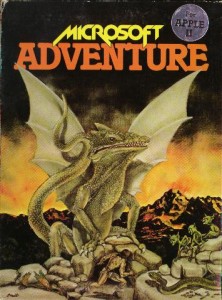
Microsoft Adventure box art

The release of Microsoft Adventure in late 1979 for the Radio Shack TRS-80 marks quite a number of interrelated firsts for the games industry. It was the first faithful port of Will Crowther and Don Woods’s perennial Adventure, itself one of the most important computer games ever written, to a home computer. It accomplished this feat by taking advantage of the capabilities of the floppy disk, becoming in the process the first major game to be released on disk only, as opposed to the cassettes that still dominated the industry. And to keep those disks from being copied, normally a trivially easy thing to do in comparison to copying a cassette, Microsoft applied one of the earliest notable instances of physical copy protection to the disk, a development novel enough to attract considerable attention in its own right in the trade press. Byte magazine, for instance, declared the game “a gold mine for the enthusiast and a nightmare for the software pirate.”

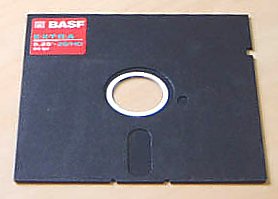
Floppy Disk

The core of a 5¼-inch floppy disk, the type used by the TRS-80 and most other early microcomputers, is a platter made of a flexible material such as Mylar — thus the “floppy” — with a magnetic coating made of ferric oxide or a similar material, capable of recording the long sequences of ones and zeroes (or ons and offs) that are used to store all computer code and data. The platter is housed within a plastic casing that exposes just enough of it to give the read/write head of the disk drive access as the platter is spun.

The floppy disk is what’s known as a random-access storage medium. Unlike a cassette drive, a floppy drive can access any of its contents at any time at a simple request from the computer to which it’s attached. To allow this random access, there needs to be an organizing scheme to the disk, a way for the drive to know what lies where and, conversely, what spaces are still free for writing new files. A program known as a “formatter,” which must be run on every new disk before it can be used, writes an initially empty framework to the disk to keep track of what it contains and where it all lives on the disk’s surface.

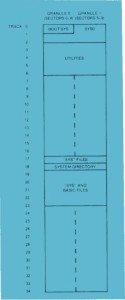
In the case of the TRS-80, said surface is divided into 35 concentric rings, known as “tracks,” numbered from 0 to 34, with track 0 lying at the outer margin of the disk and track 34 closest to the inner ring. Each track is subdivided along its length into 10 equal-sized sectors, each capable of storing 256 bytes of data. Thus the theoretical maximum capacity of an entire disk is about ((256 * 10 * 35) / 1024) 87 K.

Figure 1

Figure 1 (click to expand)

Figure 1 shows the general organization of the tracks on a TRS-80 disk. Much of this is specific to the TRS-80’s operating system and thus further down in the weeds than we really need to go, but a couple of details are very relevant to our purposes. Notice track 18, the “system directory.” It’s just what its name would imply. The entire track is reserved to be the disk’s directory service, a list of all the files it contains along with the track and sector numbers where each begins. The directory is placed in the middle of the disk for efficiency’s sake. Because it must be read from every time a file is requested, having it here minimizes the distance the head must travel both to read from the directory and, later, to access the file in question. For the same reason, most floppy-disk systems try to fill disks outward from the directory track, using the farthest-flung regions only if the disk is otherwise full.

The one exception to this rule in the case of the TRS-80 as well as many other computers is the “boot sector”: track 0, sector 0. It contains code, stored outside the filesystem described in the directory, which the computer will always try to access and execute on boot-up. This “bootstrap” code tells the computer how to get started loading the operating system and generally getting on with things. There isn’t much space here — only a single sector’s worth, 256 bytes — but it’s enough to set the larger process in motion.

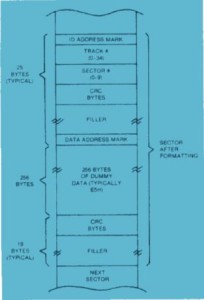
Figure 2

Figure 2

Figure 2 shows the layout of an individual disk sector. This diagram presumes a newly formatted disk, so the “dummy data” represents the sector’s 256 bytes of available storage, waiting to be filled. Note the considerable amount of organizing and housekeeping information surrounding the actual data, used to keep the drive on track and aware at all times of just where it is. Again, there’s much more here than we need to dig into today. Relevant for our purposes are the track and sector numbers stored near the beginning of each sector. These amount to the sector’s home address, its index in the directory listing.

Microsoft Adventure introduces a seeming corruption into the disk’s scheme. Beginning with track 1 — track 0 must be left alone so the system can find the boot sector and get started — the tracks are numbered not from 1 to 34 but from 127 to 61, in downward increments of 2. The game’s bootstrap inserts a patch into the normal disk-access routines that tells them how to deal with these weirdly numbered tracks. But, absent the patch, the normal TRS-80 operating system has no idea what to make of it. Even a so-called “deep” copier, which tries to copy a disk sector by sector rather than file by file to create a truly exact mirror image of the original, fails because it can’t figure out where the sectors begin and end.

If one wants to make a copy of a protected program, whether for the legal purpose of backing it up or the illegal one of software piracy, one can take either of two approaches. The first is to find a way to exactly duplicate the disk, copy protection and all, so that there’s no way for the program it contains to know it isn’t running on an original. The other is to crack it, to strip out or ignore the protection and modify the program itself to run correctly without it.

One of the first if not the first to find a way to duplicate Microsoft Adventure and then to crack it to boot was an Australian teenager named Nick Andrew (right from the beginning, before the scene even existed, cracking already seemed an avocation for the young). After analyzing the disk to work out how it was “corrupted,” he rewrote the TRS-80’s usual disk formatter to format disks with the alternate track-numbering system. Then he rewrote the standard copier to read and write to the same system. After “about two days,” he had a working duplicate of the original disk.

But he wasn’t quite done yet. After going through all the work of duplicating the disk, the realization dawned that he could easily go one step further and crack it, turn it into just another everyday disk copyable with everyday tools. To do so, he wouldn’t need his modified disk formatter at all. He needed only make a modification to his customized copier, to read from a disk with the alternate track-numbering system but write to a normal one. Remove the custom bootstrap to make Adventure boot like any other disk, and he was done. This first “nightmare for the software pirate” was defanged.

Ultima III

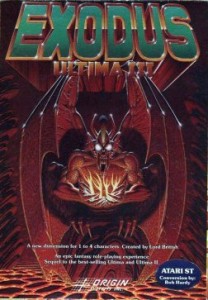
Released in 1983, Ultima III was already the fourth commercial CRPG to be written by the 22-year-old Richard Garriott, but the first of them to be published by his own new company, Origin Systems. With the company’s future riding on its sales, he and his youthful colleagues put considerable effort into devising as tough a copy-protection scheme as possible. It provides a good illustration of the increasing sophistication of copy protection in general by this point, four years after Microsoft Adventure.

Apple II floppy-disk drives function much like their TRS-80 equivalents, with largely only practical variations brought on by specific engineering choices. The most obvious of the differences is the fact that the Apple II writes its data more densely to the disk, giving it 16 256-byte sectors on each of its 35 tracks rather than the 10 of the TRS-80. This change increases each disk’s capacity to ((256 * 16 * 35) / 1024) 140 K.

Ultima III shipped on two disks, one used to boot the game and the other to load in data and to save state as needed during play. The latter is a completely normal Apple II disk, allowing the player to make copies as she will in the name of being able to start a fresh game with a new character at any time. The former, however, is a different story.

The game’s first nasty trick is to make the boot disk less than half a disk. Only tracks 0 through 16 are formatted at all. Like the TRS-80, the Apple II expects the disk’s directory to reside in the middle of the disk, albeit on track 17 rather than 18. In this case, though, track 17 literally doesn’t exist.

But how, you might be wondering, can even a copy-protected disk function at all without a directory? Well, it really can’t, or at least it doesn’t in this case. Again like the TRS-80, the beginning of an Apple II disk is reserved for a boot block. The Ultima III bootstrap substitutes alternative code for a standard operating-system routine called the “Read Write Track Sector” routine, or, more commonly, the “RWTS.” It’s this routine that programs call when they need to access a disk file or to do just about any other operation to a disk. Ultima III provides an RWTS that knows to look for the directory listing not on track 17 but rather on track 7, right in the middle of its half-a-disk. Thus it knows how to find its files, but no one else does.

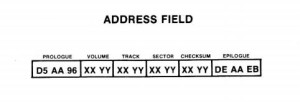
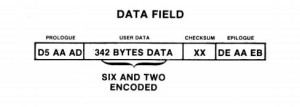
Ultima III‘s other trick is similar to the approach taken by Microsoft Adventure in theory, but far more gnarly in execution. To understand it, we need to have a look at the structure of an Apple II sector. As on the TRS-80, each sector is divided into an “address field,” whose purpose is to keep the drive on track and help it to locate what it’s looking for, and a “data field” containing the actual data written there. Figures 3 and 4 show the structure of each respectively.

Figure 3

Figure 3

Figure 4

Figure 4

Don’t worry too much about the fact that our supposed 256 bytes of data have suddenly grown to 342. This transformation is down to some nitty-gritty details of the hardware that mean that 256 logical bytes can’t actually be packed into 256 bytes of physical space, that the drive needs some extra breathing room. A special encoding process, known as Group Code Recording (GCR) on the Apple II, converts the 256 bytes into 342 that are easily manipulable by the drive and back again. If we were really serious about learning to create copy protection or how to crack it, we’d need to know a lot more about this. But it’s not necessary to understand if you’re just dipping your toes into that world, as we’re doing today.

Of more immediate interest are the “prologues” and “epilogues” that precede and trail both the address and data fields. On a normal disk these are fixed runs of numbers, which you see shown in hexadecimal notation in Figures 3 and 4. (If you don’t know what that means, again, don’t worry too much about it. Just trust me that they’re fixed numbers.) Like so much else here, they serve to keep the drive on track and to reassure it that everything is kosher.

Ultima III, however, chooses other numbers to place in these spaces. Further, it doesn’t just choose a new set of fixed numbers — that would be far too easy — but rather varies the expected numbers from track to track and even sector to sector according to a table only it has access to, housed in its custom RWTS. Thus what looks like random garbage to the computer normally suddenly becomes madness with a method behind it when the computer has been booted from the Ultima III disk. If any of these fields doesn’t match with what it should be — i.e., if someone is trying to use an imperfect copy —  the game loads no further.

It’s a tough scheme, particularly for its relatively early date, but far from an unbreakable one. There are a couple of significant points of vulnerability. The first is the fact that Ultima III doesn’t need to read and write only protected disks. There is, you’ll remember, also that second disk in a standard format. The modified RWTS needs to be able to fall back to the standard routine when using that second disk, which is no more readable by the modified routine than the protected disk is by the standard. It relies on the disk’s volume number to decide which routine to use: volume 1 is the first, protected disk; volume 2 the second, unprotected (if the volume number is anything else, it knows somebody must be up to some sort of funny business and just stops entirely). Thus if we can just get a copy of the first disk in an everyday disk format and set its volume number to 2, Ultima III will happily accept it and read from it.

But that “just” is, of course, a tricky proposition. We would seemingly need to write a program of our own to read from a disk — or rather from half of a disk — with all those ever-changing prologue and epilogue fields. That, anyway, is one approach. But, if we’re really clever, we won’t have to. Instead of working harder, we can work smarter, using Ultima III‘s own code to crack it.

One thing that legions of hackers and crackers came to love about the Apple II was its integrated machine-language monitor, which can be used to pause and break into a running program at almost any point. We can use it now to pause Ultima III during its own boot process and look up the address of its customized RWTS in memory; because all disk operations use the RWTS, it is easily locatable via a global system pointer. Once we know where the new RWTS lives, we can save that block of memory to disk for later use.

Next we need only boot back into the normal system, load up the customized RWTS we saved to disk, and redirect the system pointer to it rather than the standard RWTS. Remember that the custom RWTS is already written to assume that disks with a volume number of 1 are in the protected format, those with a volume number of 2 in the normal format. So, if we now use an everyday copy program to copy from the original, which has a volume number of 1, to a blank disk which we’ve formatted with a volume number of 2, Ultima III essentially cracks itself. The copy operation, like all disk operations, simply follows the modified system pointer to the new RWTS, and is never any the wiser that it’s been modified. Pretty neat, no? Elegant tricks like this warm any hacker’s heart, and are much of the reason that vintage cracking remains to this day such an intriguing hobby.

Pirates!

Ultima III‘s copy protection was clever enough in its day, but trivial compared to what would start to appear just a year or so later as the art reached a certain level of maturity. As the industry itself got more and more cutthroat, many of the protection schemes also got just plain nasty. The shadowy war between publisher and pirate was getting ever more personal.

A landmark moment in the piracy wars was the 1984 founding of the Software Publishers Association. It was the brainchild of a well-connected Washington, D.C., lawyer named Ken Wasch who decided that what the industry really needed was a D.C.-based advocacy group and that he, having no previous entanglements within it, was just the neutral party to start it. The SPA had a broad agenda, from gathering data on sales trends from and for its members to presenting awards for “software excellence,” but, from the perspective of the outsider at any rate, seemed to concern itself with the piracy problem above all else. Its rhetoric was often strident to the point of shrillness, while some of its proposed remedies smacked of using a hydrogen bomb to dig a posthole. For instance, the SPA at one point protested to Commodore that multitasking shouldn’t be a feature of the revolutionary new Amiga because it would make it too easy for crackers to break into programs. And Wasch lobbied Congress to abolish the user’s right to make backup copies of their software for personal archival purposes, a key part of the 1980 Software Copyright Act that he deemed a “legal loophole” because it permitted the existence of programs capable of copying many forms of copy-protected software — a small semi-underground corner of the software industry that the SPA was absolutely desperate to eliminate rather than advocate for. The SPA also did its best to convince the FBI and other legal authorities to investigate the bulletin-board systems of the cracking scene, with mixed success at best.

Meanwhile copy protection was becoming a business in its own right, the flip side to the business of making copying programs. In place of the home-grown protection schemes of our first two case studies, which amounted to whatever the developers themselves could devise in whatever time they had available, third-party turnkey protection systems, the products of an emerging cottage industry, became increasingly common as the 1980s wore on. The tiny companies that created the systems weren’t terribly far removed demographically from the crackers that tried to break them; they were typically made up of one to three young men with an encyclopedic knowledge of their chosen platforms and no small store of swagger of their own. Their systems, sporting names like RapidLok and PirateBusters, were multifaceted and complex, full of multiple failsafes, misdirections, encryptions, and honey pots. Copy-protection authors took to sneaking taunting messages into their code, evincing a braggadocio that wouldn’t have felt out of place in the scene: “Nine out of ten pirates go blind trying to copy our software. The other gets committed!”

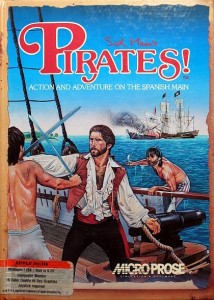
Protection schemes of this later era are far too complex for me to describe in any real detail in an accessible article like this one, much less explain how people went about cracking them. I would, however, like to very briefly introduce RapidLok, the most popular of the turnkey systems on the Commodore 64. It was the product of a small company called the Dane Final Agency, and was used in its various versions by quite a number of prominent publishers from early 1986 on, including MicroProse. You’ll find it on that first bona fide Sid Meier classic, the ironically-titled-for-our-purposes Pirates!, along with all of their other later Commodore 64 games.

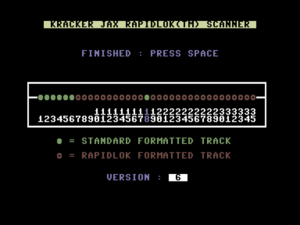
The protection schemes we’ve already seen have modified their platforms’ standard disk formats to confuse copy programs. RapidLok goes to the next level by implementing its own custom format from scratch. A standard Commodore 64 disk has 17 to 21 sectors per track, depending on where the track is located; a RapidLok disk has 11 or 12 much larger sectors, with the details of how those sectors organize their data likewise re-imagined. Rapidlok also adds a track to the standard 35, shoved off past the part of the disk that is normally read from or written to. This 36th track serves as an encrypted checksum store for all of the other tracks. If any track fails the checksum check — indicating it’s been modified from the original — the system immediately halts.

Like any protection scheme, RapidLok must provide a gate to its walled garden, an area of the disk formatted normally so that the computer can boot the game in the first place. Further, writing to RapidLok-formatted tracks isn’t practical. The computer would need to recalculate the checksum for the track as a whole, encrypt it, and rewrite that portion to the checksum store out past the normally accessible part of the disk — a far too demanding task for a little Commodore 64. For these reasons, Rapidlok disks are hybrids, partially formatted as standard disks and partially in the protected format. Figure 5 below shows the first disk of Pirates! viewed with a contemporary copying utility.

Figure 5

Figure 5

As the existence of such a tool will attest, techniques did exist to analyze and copy RapidLok disks in their heyday. Among the crackers, Mitch of Eagle Soft was known as the RapidLok master; it’s his vintage crack of Pirates! and many other RapidLok-protected games that you’ll find floating around the disk-image archives today. Yet even those cracks, masterful as they were, were forced to strip out a real advantage that RapidLok gave to the ordinary player, that was in fact the source of the first part of its name: its custom disk format was much faster to read from than the standard, by a factor of five or six. Pirates who chose to do their plundering via Mitch’s cracked version of Pirates! would have to be very patient criminals.

But balanced against the one great advantage of RapidLok for the legitimate user was at least one major disadvantage beyond even the obvious one of not being able to make a backup copy. In manipulating the Commodore 64 disk drive in ways its designers had never intended, RapidLok put a lot of stress on the hardware. Drives that were presumably just slightly out of adjustment, but that nevertheless did everything else with aplomb, proved unable to load RapidLok disks, or, almost worse, failed intermittently in the middle of game sessions (seemingly always just after you’d scored that big Silver Train robbery in the case of Pirates!, of course). And, still worse from the standpoint of MicroProse’s customer relations, a persistent if unproven belief arose that RapidLok was actually damaging disk drives, throwing them out of alignment through its radical operations. It certainly didn’t sound good in action, producing a chattering and general caterwauling and shaking the drive so badly one wondered if it was going to walk right off the desktop one day.

The belief, quite probably unfounded though it was, that MicroProse and other publishers were casually destroying their customers’ expensive hardware in the name of protecting their own interests only fueled the flames of mistrust between publisher and consumer that so much of the SPA’s rhetoric had done so much to ignite. RapidLok undoubtedly did its job in preventing a good number of people from copying MicroProse games. A fair number of them probably even went out and bought the games for themselves as an alternative. Whether those sales were worth the damage it did to MicroProse’s relations with their loyal customers is a question with a less certain answer.

Dungeon Master

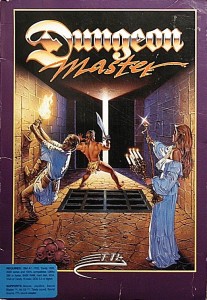
No discussion of copy protection in the 1980s could be complete without mentioning Dungeon Master. Like everything else about FTL’s landmark real-time CRPG, its copy protection was innovative and technically masterful, so much so that it became a veritable legend in its time. FTL wasn’t the sort of company to be content with any turnkey copy-protection solution, no matter how comprehensive. What they came up with instead is easily as devious as any dungeon level in the game proper. As Atari ST and Amiga crackers spent much of 1988 learning, every time you think you have it beat it turns the tables on you again. Let’s have a closer look at the protection used on the very first release of Dungeon Master, the one that shipped for the ST on December 15, 1987.

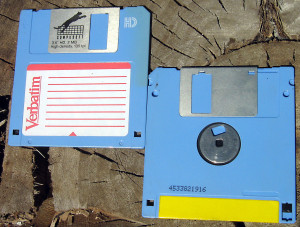
3 1/2 inch floppy disk

With the ST and its 68000-based companions, we’ve moved into the era of the 3½-inch disk, a format that can pack more data onto a smaller disk and also do so more reliably; the fragile magnetic platter is now protected beneath a rigid plastic case and a metal shield that only pulls away to expose it when the disk is actually inserted into a drive. The principles of the 3½-inch disk’s operation are, however, the same as those of the 5¼-inch, so we need not belabor the subject here.

Although most 3½-inch drives wrote to both sides of the disk, early STs used just one, in a format that consisted of 80 tracks, each with 9 512-byte sectors, for a total of ((512 * 9 * 80) / 1024) 360 K of storage capacity. The ST uses a more flexible filesystem than was the norm on the 8-bit machines we’ve discussed so far, one known as FAT, for File Allocation Table. The FAT filesystem dates back to the late 1970s, was adopted by Microsoft for MS-DOS in 1981, and is still in common use today in a form known as FAT32; the ST uses FAT12. The numerical suffix refers to the number of bits allocated to each file’s home address on the disk, which in turn dictates the maximum possible capacity of the disk itself. FAT is designed to accommodate a wide range of floppy and hard disks, and thus allows the number of tracks and sectors to be specified at the beginning of the disk itself. Thanks to FAT’s flexibility, Dungeon Master can easily bump the number of sectors per track from 9 to 10, a number still well within the capabilities of the ST’s drive. That change increases the disk’s storage capacity to ((512 * 10 * 80) / 1024) 400 K. It was only this modification, more a response to a need for just a bit more disk space than an earnest attempt at copy protection, that allowed FTL to pack the entirety of Dungeon Master onto a single disk.

Dungeon Master‘s real protection is a very subtle affair, which is one of the keys to its success. At first glance one doesn’t realize that the disk is protected at all — a far cry from the radical filesystem overhaul of RapidLok. The disk’s contents can be listed like those of any other, its individual files even read in and examined. The disk really is a completely normal one — except for track 0, sectors 7 and 8.

Let’s recall again the two basic methods of overcoming copy protection: by duplicating the protection on the copy or by cracking the original, making it so that you don’t need to duplicate the protection. Even with a scheme as advanced as RapidLok, duplication often remained an option. Increasingly by the era of Dungeon Master, though, we see the advent of schemes that are physically impossible for the disk drives on the target machines to duplicate under any circumstances, that rely on capabilities unique to industrial-scale disk duplicators. Nate Lawson, a reader of this blog who was hugely helpful to me in preparing this article, describes good copy protection as taking advantage of “asymmetry”: “the difference between the environment where the code is executed versus where it was produced.” The ultimate form of asymmetry must be a machine on the production side that can write data in a format that the machine on the execution side physically cannot.

Because FTL duplicated their own disks in-house rather than using an outside service like most publishers, they had a great deal of control over the process used to create them. They used their in-house disk duplicator to write an invalid sector number to a single sector: track 0, sector 8 is labeled sector 247. At first blush, this hardly seems special; Microsoft Adventure, that granddaddy of copy-protected games, had after all used the same technique eight years earlier. But there’s something special about this sector 247: due to limitations of the ST’s drive hardware that we won’t get into here, the machine physically can’t write that particular sector number. Any disk with a sector labeled 247 has to have come from something other than an ST disk drive.

Track 0, sector 7, relies on the same idea of hardware asymmetry, but adds another huge wrinkle sufficient to warm the heart of any quantum physicist. Remember that the data stored on a disk boils down to a series of 1s and 0s, magnetized or demagnetized areas that are definitively in one state or the other. But what if it was possible to create a “fuzzy” bit, one that capriciously varies between states on each successive read? Well, it wasn’t possible to do anything like that on an ST disk drive or even most industrial disk duplicators. But FTL, technology-driven company that they were, modified their own disk duplicator to be able to do just that. By cramming a lot of “flux reversals,” or transitions between a magnetic and demagnetized state, into a space far smaller than the read resolution of the ST disk drive, they could create bits that lived in a perpetually in-between state — bits that the drive would randomly read sometimes as on and sometimes as off.

Dungeon Master has one of these fuzzy bits on track 0, sector 7. When the disk is copied, the copy will contain not a fuzzy bit but a normal bit, on or off according to the quantum vagaries of the read process that created it.

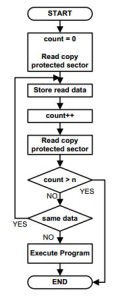
Figure 6

Figure 6

As illustrated in Figure 6, Dungeon Master‘s copy-protection routines read the ostensible fuzzy bit over and over, waiting for a discordant result. When that comes, it can assume that it’s running from an original disk and continue. If it tries many times, always getting the same result, it assumes it’s running from a copy and behaves accordingly.

FTL’s scheme was so original that they applied for and were granted a patent on it, one that’s been cited many times in subsequent filings. It represents a milestone in the emerging art and science of DRM. Ironically, the most influential aspect of Dungeon Master, a hugely influential game on its own terms, might just be its fuzzy-bit copy protection. Various forms of optical media continue to use the same approach to this day.

With duplication a complete non-starter in the case of both this sector numbered 247 and the fuzzy bit, the only way to pirate Dungeon Master must be to crack it. Doing so must entail diving into the game’s actual code, looking for the protection check and modifying it to always return a positive response. In itself, that wasn’t usually too horrible; crackers had long ago learned to root through code to disable look-up-a-word-in-the-manual and code-wheel-based “soft” protection schemes. But FTL, as usual, had a few tricks up their sleeves to make it much harder: they made the protection checks multitudinous and their results non-obvious.

Instead of checking the copy protection just once, Dungeon Master does it over and over, from half-a-dozen or so different places in its code, turning the cracker’s job into a game of whack-a-mole. Every time he thinks he’s got it at last, up pops another check. The most devious of all the checks is the one that’s hidden inside a file called “graphics.dat,” the game’s graphics store. Who would think to look for executable code there?

Compounding the problem of finding the checks is the fact that even on failure they don’t obviously do anything. The game simply continues, only to become unstable and start spitting out error messages minutes later. For this reason, it’s extremely hard to know when and whether the game is finally fully cracked. It was the perfect trap for the young crackers of the scene, who weren’t exactly known for their patience. The pirate boards were flooded with crack after crack of Dungeon Master, all of which turned out to be broken after one had actually played a while. In a perverse way, it amounted to a masterful feat of advertising. Many an habitual pirate got so frustrated with not being able properly to play this paradigm-shattering game that he made Dungeon Master the only original disk in his collection. Publishers had for years already been embedding their protection checks some distance into their games, both to make life harder for crackers and to turn the copies themselves into a sort of demo version that unwitting would-be pirates distributed for them for free. But Dungeon Master used the technique to unprecedented success in terms of pirated copies that turned into sold originals.

Dungeon Master still stands as one of copy protection’s — or, if you like, DRM’s — relatively few absolutely clear, unblemished success stories. It took crackers more than a year, an extraordinary amount of time by their usual standards, to wrap their heads around the idea of a fuzzy bit and to find all of the checks scattered willy-nilly through the code (and, in the case of “graphics.dat,” out of it). After that amount of time the sales window for any computer game, even one as extraordinary as Dungeon Master, must be closing anyway. Writing about the copy protection twenty years later, Doug Bell of FTL couldn’t resist a bit of crowing.

Dungeon Master exposed the fallacy in the claims of both the pirates and the crackers. The pirates who would never have paid for the game if they could steal it did pay for it. Despite a steadily growing bounty of fame and notoriety for cracking the game, the protection lasted more than a year. And the paying customer was rewarded with not just a minimally invasive copy-protection scheme, but, just as importantly, with the satisfaction of not feeling like a schmuck for paying for something that most people were stealing.

As the developer of both Dungeon Master and the software portion of its copy protection, I knew that eventually the copy protection would be broken, but that the longer it held out the less damage we would suffer when it was broken.

Dungeon Master had a greater than 50-percent market penetration on the Atari ST—that is, more than one copy of Dungeon Master was sold for each two Atari ST computers sold. That’s easily ten times the penetration of any other game of the time on any other platform.

So what’s the lesson? That piracy does take significant money out of the pocket of the developer and that secure anti-piracy schemes are viable.

Whether we do indeed choose to view Dungeon Master as proof of the potential effectiveness of well-crafted DRM as a whole or, as I tend to, as something of an historical aberration produced by a unique combination of personalities and circumstances, it does remain a legend among old sceners, respected as perhaps the worthiest of all the wily opponents they encountered over the years — not just technically brilliant but conceptually and even psychologically so. By its very nature, the long war between the publishers and the crackers could only be a series of delaying actions on the part of the former. For once, the delay created by Dungeon Master‘s copy protection was more than long enough.

And on that note we’ll have to conclude this modest little peek behind the curtain of 1980s copy protection. Like so many seemingly narrow and esoteric topics, it only expands and flowers the deeper you go into it. People continue to crack vintage games and other software to this day, and often document their findings in far more detail than I can here. Apple II fans may want to have a look at the work of one “a2_4am” on Mastodon, while those of you who want to know more about RapidLok may want to look into the C64 Preservation Project‘s detailed RapidLok Handbook, which is several times the length of this article. And if all that’s far, far more information than you want — and no, I really don’t blame you — I hope this article, cursory as it’s been, has instilled some respect for the minds on both sides of the grand software-piracy wars of the 1980s.

(Sources: Beneath Apple DOS by Don Worth and Pieter Lechner; The Anatomy of the 1541 Disk Drive by Lothar Englisch and Norbert Szczepanowski; Inside Commodore DOS by Richard Immers and Gerald G. Newfeld; The Kracker Jax Revealed Trilogy; Commodore Power Play of August/September 1985; Kilobaud of July 1982; New Zealand Bits and Bytes of May 1984; Games Machine of June 1988; Transactor 5.3; 80 Microcomputing of November 1980; Byte of December 1980; Hardcore Computist #9 and #11; Midnite Software Gazette of April 1986. Online sources include Nick Andrew’s home page, the aforementioned C64 Preservation Project, and The Dungeon Master Encyclopedia. See also Jean Louis-Guérin’s paper “Atari Floppy Disk Copy Protection.” Information on the SPA’s activities comes from the archive of SPA-related material donated to the Strong Museum of Play by Doug Carlston, first fruit of my research here in Rochester.

My huge thanks to Nate Lawson for doing something of a peer review of this article prior to publication!)


Tags: , , , , , , , , , , , ,

The IBM PC, Part 4

IBM officially announced the IBM PC on August 12, 1981, at the Waldorf Astoria Hotel in New York. With 16 K of RAM and a single floppy drive, the machine had a suggested price of $1565; loaded, it could reach $6000. Those prices got you Microsoft BASIC for free, hosted in ROM. MS-DOS, sold under IBM’s license as PC-DOS, would cost you $40, while UCSD Pascal would cost you over $500. IBM also announced that CP/M-86 would be available — at some point. In the end, it would be over six months before Digital would finally deliver CP/M-86. When they did, IBM dutifully put it in their catalog, but at a price of some $240. Kildall, who remained convinced until his death that MS-DOS was a rip-off of CP/M and from time to time claimed to be able to prove it via this secretly imbedded message or that odd API attribute, believed that IBM deliberately priced CP/M six times higher than MS-DOS in order to make sure no one actually bought it, thus honoring the letter of their agreement but not the spirit. IBM, for its part, simply claimed that Digital had demanded such high licensing fees that they had no choice. Of the four operating paradigms, three of them — CP/M, Microsoft BASIC, and UCSD Pascal — ended up being used so seldom that few today even remember they were options in the first place. MS-DOS, of course, went on to conquer the world.

The hardware, meanwhile, is best described as stolid and, well, kind of boring. For all of its unusual (by IBM standards) development process, the final product really wasn’t far removed from what people had come to expect from IBM. There was no great creative flair about its design, but, from its keyboard that clunked satisfyingly every time you pressed a key to its big, substantial-looking case with lots of metal inside, it looked and operated like a tool you could rely on. And that wasn’t just a surface impression. Whatever else you could say about it, the IBM PC was built to last. Perhaps its most overlooked innovation is its use of memory with an extra parity bit to automatically detect failures. It was the first mass-market microcomputer to be so equipped, giving protection from rare but notoriously difficult to trace memory errors that could cause all sorts of unpredictable behavior on other early PCs. RAM parity isn’t really the sort of thing that inflames the passions of hackers, but for a businessperson looking for a machine to entrust with her livelihood, it’s exactly the sort of thing that made IBM IBM. They made you feel safe.

Indeed, and even if its lack of design imagination would just confirm hackers’ prejudices, for plenty of businesspeople uncertain about all these scruffy upstart companies the IBM PC’s arrival legitimized the microcomputer as a serious tool for a serious purpose. Middle managers rushed to buy them, because no one ever got fired for buying an IBM — even if no one was ever all that excited about buying one either. IBM sold some 13,500 PCs in the last couple of months of 1981 alone, and the numbers just soared from there.

With IBM in the PC game at last — machines actually started shipping ahead of schedule, in October — those who had been there all along were left to wonder what it all meant. Radio Shack’s John Roach had the most unfortunate response: “I don’t think it’s that significant.” Another Radio Shack executive was only slightly less dismissive: “There definitely is a new kid on the block, but there is nothing that IBM has presented that would blow the industry away.” Apple, then as now much better at this public-relations stuff than just about anyone else, took a full-page advertisement in the Wall Street Journal saying, “Welcome IBM. Seriously.” Like so much Apple advertising, it’s quite a masterful piece of rhetoric, managing to sound gracious while at the same time making it clear that a) IBM is the latecomer and b) Apple intend to treat them as peers, nothing more.

Years later it would be clear that the arrival of the IBM PC was the third great milestone in PC history, following the first microcomputer kits in 1975 and the trinity of 1977. It also marked the end of the first era of Microsoft’s history, as a scrappy but respected purveyor of BASICs, other programming languages, and applications software (in that order). In the wake of the IBM PC’s launch, Microsoft quite quickly cut their ties to the older, more hacker-ish communities in which they had grown up to hitch their wagon firmly to the IBM and MS-DOS business-computing train. Plenty of aesthetic, technical, and legal ugliness waited for them down those tracks, but so did hundreds and hundreds of billions.

The other players in this little history I’m just completing had more mixed fates. Seattle Computer Products straggled on for a few more years, but finally went under in 1985. Rod Brock did, however, still have one thing of immense value. You’ll remember that Brock had sold 86-DOS to Microsoft outright, but had received an exclusive license to it in return. With his company failing, he decided to cash out by selling that license on the open market to the highest bidder. Microsoft, faced with seeing a huge vendor like Radio Shack, Compaq, or even IBM themselves suddenly able to sell MS-DOS-equipped machines without paying Microsoft anything, decided retroactively that the license was non-transferrable. The whole thing devolved into a complicated legal battle, one of the first of many for Microsoft. In the end Brock did not sell his license, but he did receive a settlement check for $925,000 to walk away and leave well enough alone.

Of course, the man that history has immortalized as the really big loser in all this is Gary Kildall. That, however, is very much a matter of degree and interpretation. Digital Research lost their position at the head of business computing, but continued for years as a viable and intermittently profitable vendor of software and niche operating systems. Kildall also became a household name to at least the nerdier end of the television demographic as the mild-mannered, slightly rumpled co-host of PBS’s Computer Chronicles series. Novell finally bought Digital in 1991, allowing Kildall to retire a millionaire. For a loser, he did pretty well for himself in the end. Kildall, always more interested in technology than in business, was never cut out to be Bill Gates anyway. Gates may have won, but one suspects that Kildall had a lot more fun.

Although the IBM PC marked the end (and beginning) of an era, eras are things that are more obvious in retrospect than in the moment. In the immediate aftermath of the launch, things didn’t really change all that much for happy Apple, Commodore, Atari, and Radio Shack users. IBM throughout the development process had imagined the IBM PC as a machine adaptable for virtually any purpose, including going toe to toe with those companies’ offerings — thus the BASIC in ROM, the cassette option, and even an insistence that it should be possible to hook one up to a television. They even made a deal to sell it through that bastion of mainstream Americana, Sears. Still, the machine was quite expensive in even its most basic configurations, and it lacked the base of casual software (particularly games) and the dedicated users of those competitors. Nor were its graphics and sound capabilities, if perhaps surprising for existing at all, particularly tempting, especially when a new machine called the Commodore 64 came down the pipe in 1982. So, while the business community flocked to the IBM and MS-DOS in remarkably short order, the world of home, hobbyist, and educational computing would remain fairly divorced from that of the IBM PC for quite some time to come. MS-DOS would win out in the end here as well, but that would take more than a decade instead of mere months, allowing space for some of the most vibrant and fun computing cultures ever to grow and thrive. Thus, just as with its predecessor CP/M, I’ll likely have less occasion to talk about the MS-DOS world than its industry success might suggest — at least until about 1990, should we get that far.

Of course, to get to 1990 we really have to get out of 1981, don’t we? I have just one more subject to cover, and then we’ll do that at last.

(Usually when I write about something in this blog I’m digging for every scrap of information to try to piece together a history I can have confidence in. In the case of this topic, though, I had mountains of material at my disposal; the birth of the IBM PC and particularly the downfall of Kildall and CP/M must be one of the most commonly told tales in computing history. As such, the hardest thing became trying to separate the, shall we say, “folk histories” from the more rigorously researched sources. Some quick but by no means exhaustive notes on sources:

Of the many mainstream books that profile Gates and/or Microsoft, I was most impressed with Hard Drive by James Wallace (in spite of the cheesy title), and used it most extensively of all.

The very first issue of PC Magazine gives a great picture of the IBM PC’s earliest months, when no one was certain of the uses to which it would eventually be put, and also features a great interview with a Bill Gates on the verge of becoming, well, Bill Gates.

David J. Bradley wrote a great memoir of Project Chess for Byte‘s September 1990 issue, and another that admittedly goes over much of the same ground in the IEEE Computer of August 2011.

Tim Paterson wrote articles about the development of MS-DOS for the March 1983 Softalk for the IBM PC and the June 1983 Byte.

Accidental Empires and its television companion Triumph of the Nerds are fun and give decent overviews, but don’t really drill much beyond easy stereotypes, and by focusing almost exclusively on Apple, Microsoft, and IBM miss about 85% of what was interesting about computing in the 1980s. Kind of like this series of posts, come to think of it, but, hey, this is just one topic in a blog, right?)


Tags: , ,

The IBM PC, Part 3

In November of 1979, Microsoft’s frequent partner Seattle Computer Products released a standalone Intel 8086 motherboard for hardcore hobbyists and computer manufacturers looking to experiment with this new and very powerful CPU. The 8086 was closely related to the 8088 that IBM chose for the PC; the latter was a cost-reduced version of the former, an 8-bit/16-bit hybrid chip rather than a pure 16-bit like the 8086. IBM opted for the less powerful 8088 partly to control costs, but also to allow the use of certain hardware that required the 8-bit external data bus found on the 8088. But perhaps the biggest consideration stemmed, as happens so often, from the marketing department rather than engineering. The 8086 was such a powerful chip that an IBM PC so equipped might convince some customers to choose it in lieu of IBM’s own larger systems; IBM wanted to take business from other PC manufacturers, not from their own other divisions.

The important thing to understand for our purposes, though, is that both chips shared the instruction set, and thus could run the same software. Everyone wanted to run CP/M on the SCP boards, but CP/M existed only for the Intel 8080 and Zilog Z80. Thus, SCP had the same problem that Sams and IBM would face months later. Digital Research repeatedly promised an 8086/8088 version of CP/M, but failed to deliver. So, in April of 1980 Tim Paterson of SCP decided to write his own 8086/8088 operating system. He called it QDOS — the “Quick and Dirty Operating System.”

The ethicality or lack thereof of what Paterson did has been debated for years. Gary Kildall stridently claimed many times that he ripped off the actual CP/M source code, but this is a very problematic assertion. There is no evidence that he even had access to the source, which Digital, like most companies then and now, guarded carefully. On the other hand, Paterson freely admits that he pulled out his CP/M reference manual and duplicated each of its API calls one by one. On the other other hand, and while it may not have reflected much originality or creative thinking, what he did was pretty clearly legal even by the standards of today. Courts have ruled again and again that APIs cannot be copyrighted, only specific implementations thereof, and that reverse engineering is therefore allowed. (Well, there is patent law, but that’s a swamp we’re going to stay well away from…) Food for thought for open-source advocates and Microsoft haters: if QDOS was ethically wrong, then Linux — largely a reimplementation of the Unix standards — must be equally wrong. Paterson claims that he had a good reason to copy CP/M so closely: he wanted to make it as easy as possible for programmers to move existing CP/M software over to QDOS. He also claims that beneath the surface, where he could get away with it, he substantially improved upon his model, notably in disk- and file-handling.

In the meantime Gates was wondering how he was going to come up with an operating system for IBM in the time frame they wanted. Then one day Paterson called Paul Allen of Microsoft to tell him about QDOS, just in case Microsoft was interested in writing some software for it or using it in-house. Gates, just the man to recognize an out-of-the-blue savior when he saw one, called Sams, asking, “Do you want to get [it], or do you want me to?” Sams’s answer to that question would cost IBM billions and billions over the decades to come. “By all means, you get it,” he said. Recognizing that PC software was far from his realm of expertise, Sams had already pretty much thrown all of his systems-software problems into Microsoft’s lap, and he saw no reason to change course now. “We wanted this to be their problem,” he later said. Microsoft’s “problem” would in a few years become a big, big problem for IBM.

On September 30, Gates, Ballmer, and Bob O’Rear flew down to Florida to make their final proposal to IBM. For Sams, who wanted to essentially foist the software problem on someone else, their plan sounded ideal. Microsoft would take responsibility for providing an operating system, four programming languages (BASIC, COBOL, FORTRAN, Pascal), and a range of other software to be available at launch (including our old friend Microsoft Adventure). One point Gates carefully stipulated: Microsoft would license all of this to IBM, not outright sell it to them, and would expect to be paid on a per-copy royalty basis. IBM, feeling there was opportunity enough for everyone to do well out of this and that it couldn’t hurt to have Microsoft’s own fate tied so closely to that of the IBM PC, agreed. This huge company, legendarily risk-averse and conservative, elected to place the fate of one of their biggest projects ever in the hands of a 24-year-old. If Microsoft failed to come through, the IBM PC itself would be stillborn. On November 6, Microsoft and IBM officially signed the contract, which immediately paid Microsoft $700,000 to begin porting all of this disparate software to the new architecture. Ironically, by that time both Lowe and Sams, who had played such prominent roles in everything that came before, had been transferred to other divisions. Project Chess may have been an Independent Business Unit, but it obviously wasn’t entirely immune to the fickle ways of the IBM bureaucracy. Don Estridge took over leadership of the project.

While the software deal was being finalized, Project Chess had not been idle. That same November Microsoft received its first two prototype machines. IBM, desperately concerned about secrecy, demanded they keep them in a windowless vault secured with locks they themselves provided. Microsoft and IBM’s Project Chess, just about as physically far apart as two organizations can be and still be in the United States, nevertheless developed a working relationship that seems similar to those of today, when geography matters far less. They communicated constantly through telephone and (especially) a special email system they set up, shuttled packages back and forth via an overnight service, and visited one another frequently — and sometimes without warning. (This became a particular concern for Microsoft; IBM had a habit of dropping in unannounced to see if all of their byzantine security procedures were being practiced.) The IBM team of course had plenty to keep them busy, but Microsoft were truly up against it. Thanks to all of the negotiations, they were according to Gates already “three months behind schedule” the day the contract was finalized. Everyone worked months of seven-day weeks. Most didn’t even take Christmas off.

The first goal had to be to get the machine running in its two modes of operation: BASIC and the disk-based operating system. The former Microsoft could handle on their own, but the latter left them dependent on Seattle Computer Products. Even as Microsoft had been finalizing their deal with IBM and starting to work, Paterson and SCP had been continuing their own work, refining QDOS from a “quick and dirty” hack into an operating system they could sell. Along the way they renamed it, for obvious reasons, to 86-DOS. As 1980 drew to a close, they at last had a version they felt was suitable for the outside world.

Until this point, Bill Gates has basically behaved himself, acting like a hard-driving but straightforward businessman. Now, however, we start to see some of that legendary Gates shiftiness come out. He wanted for Microsoft a royalty-based agreement that would let them share in the hoped-for success of the IBM PC. But he wasn’t ready to share those fruits with SCP, who still had no idea that the IBM project was even happening or that their modest little one-man-authored operating system was key to the plans of one of the biggest companies in the world. Gates wanted to keep them in the dark, but he needed 86-DOS, like, yesterday. He therefore needed to pry 86-DOS out of their hands without letting them know why he wanted it.

Paul Allen negotiated an agreement with SCP owner Rod Brock in January, implying that Microsoft had a whole stable of customers eager to run 86-DOS. The deal would essentially allow Microsoft to act as middleman — or, if you like, retailer — in these transactions. For each customer to whom they sold a license for 86-DOS, they would pay SCP $10,000, or $15,000 if the license also included the source code. They would also pay SCP an initial fee of $10,000 to begin the agreement. For SCP, a much smaller, hardware-focused company without the reach or marketing skills of Microsoft, the agreement sounded great — especially because business lately had not been particularly good. Microsoft seemed convinced that they could sell quite a few licenses, bringing in effortless money for SCP for this operating system Paterson had begun almost on a lark. One clause buried in the contract might have raised a red flag: “Nothing in this licensing agreement shall require Microsoft to identify its customer to Seattle Computer Products.” Brock later said, “That seemed strange to us, but we agreed to go along.” In reality, of course, Microsoft had no stable of eager licensees. They had just one, the biggest fish of all: IBM. Microsoft sold just one license under the agreement, acquiring IBM’s operating system for them complete with source for just $25,000.

In February, Bob O’Rear of Microsoft got 86-DOS to boot for the first time on one of the prototype machines:

“It was like the middle of the night. It was one of the most joyous moments of my life, to finally after all the preparation and work, and back and forth, to have that operating system boot up and tell you that it’s ready to accept a command. That was an exciting moment.”

IBM was soon requesting a number of changes to 86-DOS. Microsoft thus found themselves in the awkward position of having to go back to Paterson, who of course knew 86-DOS far better than anyone else and whom they had signed to a consulting contract, to request changes without telling him where the requests were really coming from. In the end they convinced him to leave SCP and come to work for them full-time. “It’s IBM!” they told him as soon as he walked through the door on his first day as an employee. Ironically for Paterson, who has spent decades battling critics who claim he ripped off CP/M, many of the changes IBM requested actually made 86-DOS look even more like CP/M. For instance, the command prompt showing the current drive — i.e., “A>” — was the result of one of IBM’s requests, and a carbon copy of CP/M’s. Paterson says it made him “want to throw up,” but of course on this project what IBM requested IBM generally got.

IBM planned to announce the IBM PC in August of 1981 — as per the original plan, which gave Project Chess exactly one year to complete its work. They weren’t interested in postponing, so everyone in Boca Raton and especially at Microsoft just worked harder as smaller deadlines were missed but the biggest one just stayed fixed. They also began confidentially approaching other developers, of software such as VisiCalc and the word-processing package Easy Writer, to add to Microsoft’s lineup of applications and games. They even arranged to make another of our old friends, the UCSD Pascal P-System, available for those who wanted to run it in lieu of 86-DOS or the Microsoft BASIC environment. Incredibly given its expanding scope, the project remained a complete secret for quite a long time. But finally in June InfoWorld printed a detailed article that described the entire plan down almost to the last detail, even mentioning that the operating system would not be CP/M but would be “CP/M-like.” They missed only the planned announcement date, saying it would happen in July rather than August. The Datamaster, the earlier “PC-like” project that had provided technology and personnel to Project Chess, did make its own belated debut that month. Many assumed that the project InfoWorld had scooped was the Datamaster, and thus that the magazine had gotten it all quite wrong. Those better connected, however, knew better by this time.

Then on July 27, 1981, barely two weeks before the planned announcement, Bill Gates made what has often been called the deal of the century.

Rod Brock at SCP was a disappointed man. The legion of 86-DOS licensees he had anticipated following the Microsoft deal hadn’t materialized, and now he had lost Paterson, the one software guy at his hardware-focused company, to Microsoft. It was pretty obvious by now who the one 86-DOS sub-licensee must be, but SCP was strapped for cash and lacked the ability to support an operating system. He started to shop 86-DOS around a bit, looking for someone willing to take over support in return for an exclusive license to it. Gates pounced immediately, offering SCP a much-needed $50,000 for the deal — with one crucial difference. He stipulated that Microsoft would not be buying an exclusive license, but would be buying the software itself, outright. They would then grant the exclusive license to SCP, essentially turning the deal on its head. Brock was uncertain, but he really did need the money, and he didn’t quite know what to do with 86-DOS himself anyway…

He signed the agreement, making Microsoft the sole owner of 86-DOS — or, as it was immediately renamed, MS-DOS. It’s yet another example of the terrible financial decision-making that was so endemic to the early microcomputer industry, as hackers who knew everything about bits and bytes but nothing about business suddenly found themselves running companies. These were the kinds of mistakes that Gates never made, but knew how to exploit and even engender in others. When dealing with innocents like Brock, it was as easy as leading the proverbial lambs to slaughter. MS-DOS, purchased for $50,000, was earning Microsoft more than $200 million per year by 1991. Even more importantly, it was the key building block in the Microsoft monopoly that would absolutely dominate business computing by the mid-1980s, and dominate virtually all computing throughout the 1990s. This decision, more than any other, is the one that made Microsoft the giant it still is today.

But Microsoft (and IBM) suddenly had one more legal hurdle to clear. By this time, with the IBM PC becoming more and more of an open secret in the industry, Gary Kildall had seen a copy of 86-DOS/MS-DOS in action. He was convinced that Paterson had stolen his operating system, that he had somehow gotten a copy of the source code, made only those changes needed to get it running on the Intel 8086/8088, filed off the digital serial numbers, and sold it to IBM. Now he began to threaten legal action, and (perhaps of more concern to IBM) to cause a huge stink in the press that could cast a cloud over the upcoming announcement. He and Gates met for lunch to try to hash things out, but to no avail. “It was one of those meetings where everybody was nice to each other, then everyone shouted at each other, then everyone was nice to each other, then everyone shouted at each other,” recalled John Katsaros, a Digital Research colleague who was also there. And so IBM stepped in to make a deal. They would also offer CP/M-86, the 8088-compatible version of the operating system which Digital were still messing about with, on the IBM PC just as soon Kildall could give them a completed version. Kildall, at least somewhat placated, accepted. The IBM PC, which IBM had from the start envisioned as a true “anything machine,” would now have no fewer than four available operating paradigms: the ROM-hosted BASIC, MS-DOS, CP/M, or UCSD Pascal.


Tags: , ,

The IBM PC, Part 2

Having been so favorably impressed with Bill Gates and Microsoft, Jack Sams returned to them almost as soon as IBM officially gave Project Chess the green light — on August 21, 1980. After having Gates sign yet another NDA, he was ready to move beyond the theoretical and talk turkey. He explained that IBM was planning to make its own PC, something that surprised no one in the room. In keeping with the philosophy of building a machine that could be configured to do anything, he planned to offer the user a choice of using a ROM-hosted BASIC environment similar to that of the Apple II, PET, and TRS-80, or of booting into the disk-oriented operating system CP/M, hugely popular among business users. Microsoft, the premier provider of microcomputer BASICs, was the obvious place to go for the first of these. They had also recently branched out into other, compiled languages like FORTRAN, and Sams wouldn’t mind having him some of those either. Robert X. Cringely and others make much of IBM’s turning to an outside vendor like Microsoft for its software (more of the “slapdash” trope), but this was really not at all unusual. Apple, Commodore, and Radio Shack amongst many others had in fact all done the same, sourcing their BASICs from Microsoft.

Sams was, however, very confused about something else. That spring Microsoft had introduced its first hardware product, the Z80 SoftCard. It was a Z80 CPU on a card which plugged into one of the Apple II’s expansion slots. Once the card was installed, the user could elect whether to give control of her machine to its standard 6502 CPU or to the Z80; the card contained circuitry to allow the Z80 to use the Apple II’s standard memory and other peripherals. Developed in partnership with Seattle Computer Products, a small hardware company with which Microsoft had quite close relations at this time, it really was a marvelous little hack. Because CP/M ran only on Z80 processors, Apple II users had hitherto been cut off from the universe of CP/M business software. Now they had the best of both worlds: all of the fun and educational software that took advantage of the Apple II’s graphics capabilities (not to mention VisiCalc), and all of the text-oriented, businesslike CP/M applications. The SoftCard became a huge success, second only to VisiCalc itself in making the Apple II the only 6502-based machine to be significantly adopted by American business; an Apple II with SoftCard soon became the single most popular CP/M hardware configuration. Based on the SoftCard, which shipped with a copy of CP/M, Sams assumed that Microsoft owned the operating system. Now Gates explained that this was not the case, that Microsoft had only licensed it from its real owner, a company called Digital Research.

Gates and Gary Kildall, the head of Digital and original programmer of CP/M, had known each other for years, and had developed a mutual respect and sort of partnership. When a new machine came out, Microsoft did the languages and Digital did the operating system. Steve Wood, an early Microsoft programmer:

“When we were talking to another OEM, a hardware customer who wanted to run BASIC or any of our products, we got to a point by 1977 or ’78 where we were always trying to get them to go to Digital first and get CP/M running because it made our job a whole lot easier. When we were doing custom things like the General Electric version or NCR version, it got to be a real headache. It made our lives a lot easier if someone would just go license CP/M and get that up on their machines and then our stuff would pretty much run as is. And Gary would do likewise. If someone went to him to license CP/M and they were looking for languages, he would refer people to Microsoft. It was a very synergistic kind of thing.”

Gates and Kildall had even discussed merging their companies at one point. As it was, there was a sort of unwritten understanding that Microsoft would stay out of operating systems and Digital would stay out of languages. In late 1979, however, Digital began distributing a non-Microsoft BASIC with some of their CP/M packages, a development Gates and others at Microsoft viewed as a betrayal of that trust.

Still, Gates dutifully called Kildall right there in Sams’s presence to set up a meeting for Sams and his team for the very next day. He told him they were very important customers, “so treat them right.” For his part, Sams was not thrilled. He was so very impressed with Gates and Microsoft, and “we really only wanted to deal with one person” for all of the systems software. Yet he didn’t see a choice. CP/M, you’ll remember, ran on the Z80 CPU. Sams therefore needed much more than to just purchase a license from Digital; he needed them to agree to port the operating system to the newer 8088 architecture, and to do it on his schedule. The next morning he and his team were on an airplane bound for Pacific Grove, California, home of Digital Research.

This is where the story gets famously unclear. Both Sams and Kildall were asked many times in later years about the events of August 22, 1980. Their stories are so factually disparate that it seems impossible to attribute their differences to mere shading or interpretation. Someone (or perhaps both), it seems, was simply not telling the truth.

Sams claims that he and his team arrived at the Victorian house that served as Digital’s headquarters right on time, only to be told that Kildall had decided to take advantage of a beautiful day by blowing off the meeting and going flying in his private plane. Sams and company were left in the hands of Digital’s business manager, Kildall’s wife Dorothy. Shocked but stalwart, Sams pulled out his NDA as a prelude to getting down to business. Now, on the face of it, this was an intimidating and unfair agreement, saying essentially that the other party could be sued if they revealed any of IBM’s secrets, but that IBM had complete immunity from legal action for the reverse. Gates had had, in his own words, “faith,” and signed right away. Dorothy, however, said no, that she would have to consult with her lawyer first. While Sams fidgeted impatiently in the lobby, she and the lawyer, Gerry Davis, dithered until three o’clock in the afternoon, when she finally signed. With most of the day gone and with the technical mastermind who would need to actually do the port not even present, negotiations didn’t really get anywhere. Sams left Digital, frustrated and annoyed, without even the beginning of an agreement, and immediately started casting about for an alternative to dealing with these people.

For his part, Kildall (who died in 1994 under very strange circumstances) admitted that he was out flying when Sams arrived for his meeting. He claimed, however, that, far from joyriding (joyflying?), he was flying himself home from a business trip. He said it was perfectly okay for the IBM team to have been left in the hands of Dorothy at the beginning of the meeting, as she was much more involved in all business negotiations than he. He nevertheless said that he was back by the afternoon, and that it was in fact him who convinced Dorothy and Davis to just sign the NDA and get on with it. After that negotiations proceeded quickly, and IBM and Digital had a “handshake agreement” by the time the day was over. Further, Kildall claimed that he and Dorothy flew out that night (via commercial airliner this time) to begin a vacation in Florida, and that the IBM group happened to be on the same flight. There they all talked about their plans some more.

Sams says that he did not even fly to Florida immediately after the meeting, but rather back to Seattle to continue to talk with Microsoft, admitting only that perhaps one or two members of the group might have gone directly back to Boca Raton. For years he also adamantly maintained that he never met Kildall at all that day, “unless he was there pretending to be someone else.” Only in recent years has he softened that stance somewhat, saying it’s “possible” Kildall was there, although he “doesn’t remember it.” He also recently said, “We spun it, Kildall spun it, and Microsoft spun it.” This might be read as the last refuge of a man who hasn’t always been entirely truthful, but who knows really. There are witnesses that partially corroborate each version of events. A Digital executive and friend of Kildall named Tom Rolander says he was on the business trip with Kildall, and that they did indeed meet with Sams that afternoon. Meanwhile Davis, Digital’s lawyer, says that he is certain no handshake deal was reached that day, and other IBM staffers do recall Sams saying immediately after the expedition that Kildall never showed up for the meeting.

So, what to make of all this? We might start by looking at Kildall’s personality in contrast to Gates’s. Popular accounts of these events often boil Gates and Kildall down to caricatures, the maniacally driven East Coast businessman versus the laid-back California hippie. They’re actually not awful as caricatures go. Both were wonderful hackers, but they could otherwise have hardly been more different. Gates was determined to prove himself and to win, over and over. When a bigger fish like IBM came calling, he was perfectly willing to humble himself, even to the point of obsequiousness, as long as he needed them as a steppingstone to the next level. (Once he didn’t need them anymore, of course, all bets were off.) It may not have been grounded in the most admirable of traits, but Gates’s ambition made Microsoft beloved by many of their partners. Not only had Gates assembled a very talented team, but they reflected their boss’s personality in being willing to work like dogs and walk through walls to get the job done and outdo their competitors. Kildall, meanwhile, often didn’t even seem certain he wanted to be running a business in the first place:

In one of the darkest of those moments in the late ’70s, Gary passed the parking lot by on his way in to work, and continued around the block, realizing that he just couldn’t bring himself to go in the door. He circled the block three times before he could force himself to confront another day at DRI.

One can’t imagine a remotely similar moment of doubt plaguing Gates.

The joy of hacking was what was important to Kildall. Users needed just be patient. While he would be happy to work with IBM, they needed to get in line like everyone else. Certainly he wasn’t interested in groveling to them. Digital’s vice president in 1980, Gordon Eubanks, says, “Gary cared a lot more about partying than running a business.” In addition to partying, Kildall cared about software. Gates cared about the software business. Eubanks:

The differences between Bill and Gary were just striking. Bill saw an opportunity, he would drive, he’d commit, he’d probably over commit, no problem. Gary was like, “I don’t care, I’m Digital Research. You deal with me, and you deal with me on my terms.”

And then of course there’s the personality of Sams, or rather of his corporate parent. IBM was the big dog in computers, and they expected to be treated like it. If they condescended to visit the likes of Microsoft or Digital, they should be treated like the VIPs they were, shown that the company in question really wanted their business. When Digital failed to demonstrate their respect and thankfulness to the same degree as did Microsoft — and whatever else happened that day, it does seem pretty clear that this at least was the case; Eubanks describes Dorothy as constantly “bitchy” to everyone, including potential customers — Sams was angry. “Don’t these people know who I am?” he must have wondered. Further, it’s pretty clear that Sams was unhappy about having to deal with Digital in lieu of Gates before he ever boarded that flight for California. As our mothers always told us, going into something with a bad attitude usually yields a bad result.

What is certain is that, handshake or no handshake and regardless of what impression Kildall might have been under, Sams was not pleased with his experience at Digital. He asked Gates, who had by this time signed an official consulting deal, whether he might find him an alternative to CP/M. Gates said he would see what he could do. In the meantime Sams claims he continued to try to work out something with Digital, but couldn’t get a commitment to develop an 8088 CP/M on the strict timetable he needed. Eubanks says that Kildall just didn’t find the project all that “interesting,” in spite of the obvious, pressing business need for it, and thus worked on it only halfheartedly.

And then Gates came back with QDOS.


Tags: , ,