RSS

Tag Archives: need for speed

Porsche Unleashed

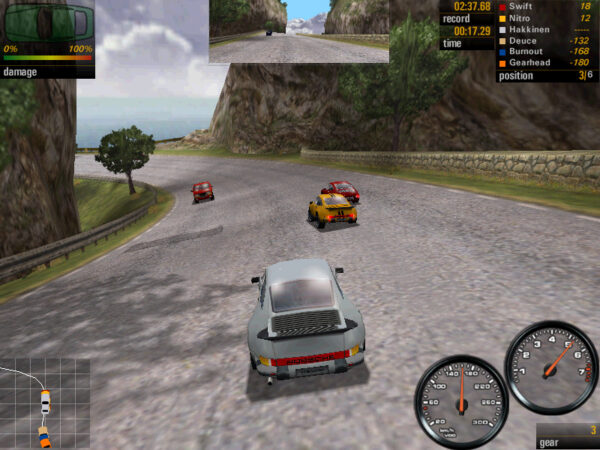
This Porsche is very much leashed. The one I got wasn’t even a turbo model.

I’ve had a running joke with my wife Dorte for almost as long as we’ve been a couple. I reasoned back in the day that, since she was going to be a doctor — a more reliable source of income than writing about computer games — she should be expected to buy me the Porsche of my dreams at some point. Needless to say, I’m still waiting. I had to learn the hard way that a doctor in Denmark doesn’t earn quite as much as one in the United States. (On the other hand, a doctor here doesn’t have to work such ridiculously long hours or have to pay ridiculous insurance premiums either, so it all balances out.)

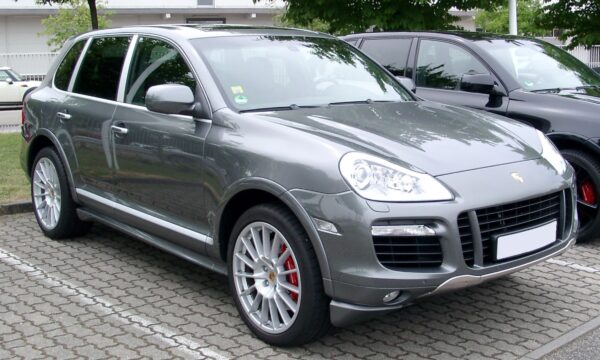
The closest my dream ever did come to fruition was not that long after we moved to Denmark, when Dorte decided to empty out much of our meager bank account to rent me a Porsche for a weekend as a birthday present. But bless her heart, she didn’t know one model from another. So, what with our finances being so stretched, she just took the cheapest one when she booked the rental online — something called a Cayenne.

This was not the Porsche of my dreams. It was a hulking SUV of the sort that… well, I won’t say that I left the United States just to escape them, but I did enjoy not being surrounded by so many of them on European roads, especially given that my standard mode of conveyance in my new life was a bicycle. Having had no idea where we were going when we climbed into a bus that morning to get to the rental place, I was more confused than disappointed as I handed over my freshly minted Danish driver’s license to the man behind the desk in order to drive away in the least interesting vehicle on the premises.

Of course, it didn’t take me that long to work out what had happened. When I did, I didn’t know whether to laugh at the best wife in the world or hug her as I observed her dismay. So, I did a little bit of both. It was like landing in an O. Henry story — but with Porsches.

In that same “Gift of the Magi” spirit, the Cayenne turned into the gift that kept on giving. We drove down to Germany that weekend to visit my in-laws, whom Dorte had informed of my big surprise beforehand. Their faces showed as much shock as hers had when they saw what we rolled up in. I then had to inform everyone, in my insufferable car-nerd way, that this Porsche was no real Porsche at all, that it was just a rebadged and gussied-up Volkswagen, with an automatic transmission, for Pete’s sake. My father-in-law thought this speech was the best part of all. He still talks regularly about the “Volksporsche” Dorte found for me.

In the end, then, we all got more pleasure out of that frumpy Cayenne than any Boxster or 911 could have given. Even Dorte has come around to admitting that the whole episode was pretty darn funny.

She hasn’t tried again; in fact, I haven’t driven another Porsche since. (In real life, that is; more on the virtual breed momentarily.) The next time Dorte led me to an undisclosed location on my birthday, it was to meet the kitten she’d picked out for me. Thankfully, unlike my Porsche, the kitten was just exactly perfect.

As the car enthusiasts among you are doubtless already raising hands to point out, the irony of my Volksporsche story is that the two brands — the one so utilitarian, the other so prestigious — have always been intimately linked. The Volkswagen Beetle was, after all, designed by a fellow named Ferdinand Porsche. And for most of the second half of the twentieth century, Porsche sports cars and that humble Volkswagen were the only mass-produced cars to sport rear-mounted, air-cooled engines. This is just one of the things that you will learn if you spend some time with Need for Speed: Porsche Unleashed, a rather unusual entry in Electronic Arts’s signature series of aspirational driving games.
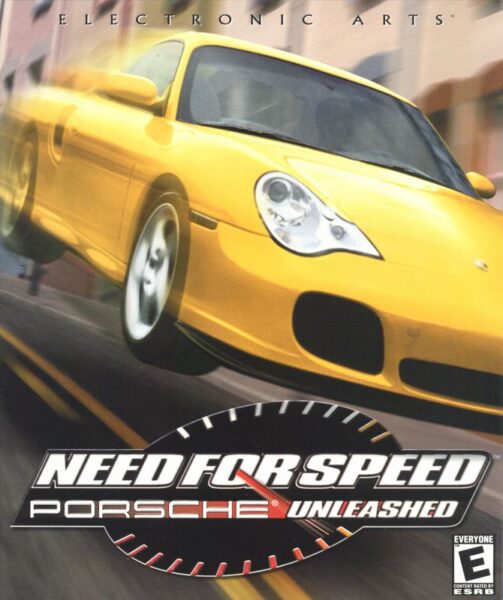

Porsche Unleashed is a digital love letter to the marque. No other driving game has ever been so laser-focused on a single brand; even the police cars in this game are Porsches. You could say that it all amounts to an extended corporate infomercial, and you’d be completely correct. But what an infomercial!

Like all aspirational driving games, Porsche Unleashed is a snapshot of the moment it was created. Released in March of 2000, it captured the storied sports-car maker as it charged into the new millennium with renewed purpose and optimism. Porsche had recently survived a near-death experience, and, like many a survivor of same, it had emerged determined to seize life by the throat and make up for lost time.

In 1986, Porsche had a record year, turning out 50,000 cars. In 1993, it made 14,000. Between these two data points lay a brutal sales collapse, exacerbated by a global economic downturn but primarily caused, said many, by arrogance and complacency. Hemorrhaging money, facing the very real prospect of bankruptcy, the company turned to a 38-year-old wunderkind engineer named Wendelin Wiedeking to turn things around. He remains a polarizing figure among Porsche enthusiasts to this day.

For Wiedeking utterly remade the company, turning it from an old-school maker of semi-handcrafted vehicles to an efficient, ultra-modern mass manufacturer. He went to Japan to tour the factories of Toyota, Honda, and Nissan, then returned to Porsche’s hometown of Stuttgart to implement the same processes there. In five years, he reduced the amount of time it took to make a Porsche 911 from 128 hours to 70 hours, increasing throughput in terms of cars per employee per year from 4.9 to 9.1.
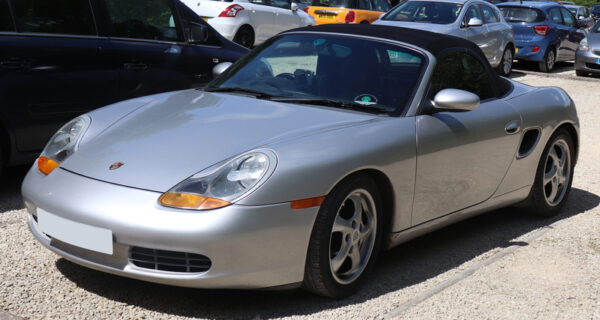
The Boxster, the car which did much to pull Porsche back from the brink. Unsurprisingly, it features prominently in Porsche Unleashed.

More controversially, he revamped the model lineup, saying it was no longer possible to survive by making vehicles that appealed exclusively to the kind of uncompromising sports-car connoisseurs who had bought Porsches in the past — the sort of people who regarded heel-and-toe braking as an essential life skill and weren’t bothered in the least by fiddly maintenance procedures or a complete lack of luggage space. He introduced the Boxster, a mid-engine roadster that was cheaper than the flagship 911 model, more livable, and less demanding to drive and maintain. Porsche sold 16,000 of them in their debut year of 1996. For his next trick, Wiedeking gave the world a more robust and practical variant of the 911 itself, the first ever to be powered by a water-cooled engine; the anguished cries of the purists can still be heard echoing down through the years. By the turn of the millennium, Porsche’s total vehicle production had returned to its 1984 levels, with profit margins that were much higher. The financial pages were calling Porsche the automotive turnaround story of the decade, calling Wendelin Wiedeking a genius. Not content to rest on his laurels, he had moved on to his next trick: a luxury SUV called the Cayenne, based on a Volkswagen design, that was set to reach dealers in 2003. The purists (hey, that’s me!) would soon have more cause than ever to howl.

As of the year 2000, though, Porsche was still a maker of sports cars only, with a proud past, a winning present, and a bright future. It felt it had something to celebrate. And indeed, Porsche Unleashed was nothing if not a celebration.

This, then, was Porsche’s motivation. That of Electronic Arts is slightly harder to discern. Like so many other driving and sports games, the Need for Speed series has always been a bit of a black box, lacking the big public-facing personalities who place their stamp on the more design-centric genres. The decision to go in a more historical, simulation-focused direction with Porsche Unleashed is counter-intuitive on the face of it, in that this was the opposite of the direction the series had been trending over its last couple of installments — and, for that matter, the direction it would continue down as soon as this installment was done. It may be relevant to note here that Hanno Lemke, the series’s guiding light from its inception until 2007, seems to have had the least to do with this entry; he is credited here as only the executive producer rather than a line producer.

For whatever reason, Porsche Unleashed is in some ways of a piece with what came before — it’s still every inch an aspirational driving game — while being quite dramatically different in tone and feel. It is, dare I say it… classier? The only tacky part of this game is the name; Porsche Unleashed sounds more like branding for a man’s razor or a sexual supplement than a vital creative work.

I originally played it not long after its release, attracted by its Porsche-centric focus and by a stellar review from the long-defunct Games Domain, my favorite gaming website lo those many years ago. I vaguely remember loving it, but my most indelible recollection is of breaking at least three driving wheels — pulling the shift paddles right off, I believe — in my over-enthusiasm to finish first. When I picked the game up again last year, I was curious whether my jaded middle-aged self would respond to it in the same way. I didn’t buy a driving wheel, for two reasons: because it seemed incompatible with my present-day preference for playing games from the couch, and because I knew that Dorte would laugh at me as soon as I emerged from my office with such a contraption just as much as I’ve laughed at her for the Cayenne fiasco over the years. But even with a plain old Xbox controller, the magic was still there for me.

In the interest of full disclosure, I should tell you at this point something that you may have already gathered for yourself: that Porches have always been the exception to my general disinterest in high-priced, high-powered sports cars. This may be down to their shared heritage with Volkswagen, a brand with which I was quite enamored and could actually afford in my younger days. The very first Porsche-branded car was the 356, built in the immediate aftermath of the Second World War, by some reports with money looted from a factory for military vehicles which Ferdinand Porsche and Anton Piëch, the company’s patriarchs, had set up in Stuttgart. That first 356 was little more than a Volkswagen Beetle with a different body, a stiffened-up chassis, and a souped-up engine capable of churning out all of 40 horsepower. (If that doesn’t sound like much, know that it was almost twice what you could expect from a Beetle in those early days.)

Prior to the tenure of Wendelin Wiedeking, there was a clarity of purpose — almost an austerity — about Porsches that I have always adored. They didn’t chase trends. In fact, they scarcely changed at all over whole stretches of years (which, yes, was doubtless a big reason for the morass the company had sunk into by the beginning of the 1990s.) They remained rear-engined and air-cooled long after even Volkswagen had given up on that design. To drive a car of such a design fast, you really had to know what you were doing. If you didn’t, that heavy rear end would start to come around on you, you’d hit the brakes trying to plant it down again, and in the best case you’d find yourself sitting in a roadside ditch with the hood pointing in the wrong direction entirely. Some people, myself included, found something deeply appealing about such an uncompromising vehicle. You bought a Ferrari or a Lamborghini to show off to others. You bought a Porsche for yourself. Looking back on the late 1980s — my formative years in car culture, as they were those of the modern aspirational driving game — I find that the Porsches from that time have aged a heck of a lot better than their slightly more expensive companions in games like Test Drive, even if the company wasn’t selling as many of them as it might have wished.

So, all of this is surely bound up with my appreciation for Porsche Unleashed. But I think a difference is discernible in this Need for Speed game regardless. Certainly you won’t find a sleeker and more stylish game from the turn of the millennium, a time when tastes in gaming aesthetics in general were often still those of nerdy adolescents. Although it was made in Canada, the feel of the game is more European than North American, which is only appropriate given the subject matter. The chilly house beats that play behind the proceedings are a perfect match for the airbrushed discotheque-ready sheen of the rest of the production.


Another thing you’ll notice before you actually set yourself behind the wheel are the gallery of photographs and press clipping awaiting your perusal, now or later. Although I’ve never been to Porsche’s official museum in Stuttgart, I can imagine that its mood might be a lot like this, at least if they’re doing it right.

But of course, none of this would matter at all if the cars weren’t fun to drive. Happily, then, fun they are. Really, really fun. Porsche Unleashed lands in exactly the right sweet spot between an obviously artificial arcade game like the old Outrun and a fiddly, rigorous simulator like the NASCAR games from Papyrus Design. It is, in other words, an aesthetic simulation par excellence; it feels like you’re actually driving one of these cool cars. The 911s are the highlight of the experience, as they by all rights ought to be. You have to learn that, when that infamously squirrelly rear end comes around on you, you can’t follow your natural instinct to hit the brakes, for that way lies a disastrous spin. No, you have to step on the gas, which will transfer the car’s weight to the rear and let those loosy-goosy tires grip the road again. When you figure out that you can throw your car into the curves, let the back end drift around deliberately, and then down-shift and clomp down on the accelerator to power out of them, it’s an awesome, well-nigh revelatory moment. I’m not sure that I can recall a more satisfying feeling in all my decades of playing videogames. Spend some time with this game, and you will begin to understand why people love those vintage 911s so much.
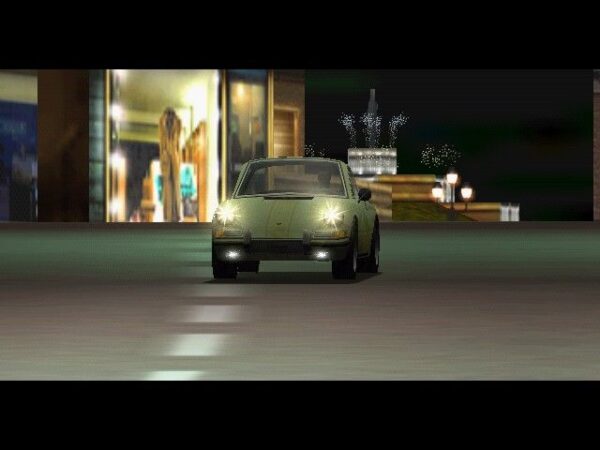
The streets of Monte Carlo.

All of the courses you can drive are located in Europe. They include the streets of Monte Carlo, the German Autobahn, and a rather generic industrial zone that could be found on any of six continents. But most of them put you on twisting smaller roads, mostly in France. While this is in some ways an odd choice for a game about a legendary German automaker, the end result is so lovely that I’ll let it pass without further comment.

These courses are all a blast to drive and explore, with plenty of the shortcuts and hidden byways that virtual motorists love. They looked spectacular in the year 2000, and still stand up surprisingly well today; this game is almost as effective an advertisement for France as it is for Porsche. It seems weird to use the word “bucolic” in reference to a franchise called Need for Speed, but for this installment it really is applicable. I sometimes like to take an old, slow 356 out just to practice my line through the courses and enjoy the scenery. Call it a reminder of what driving a sports car used to mean: driving well, and having a great time doing it, even if you weren’t going all that fast in absolute terms.
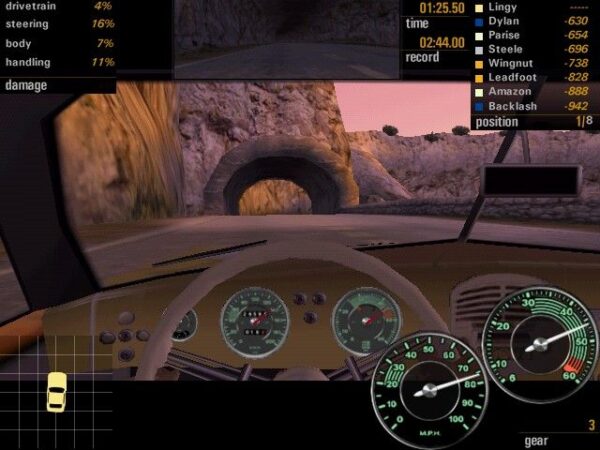
Out for a Sunday drive in a 356. I’ve said it before and I’ll say it again: it’s funner to drive a slow car fast than a fast car slow…

Just one year after Need for Speed: High Stakes introduced a longer-term meta-game to the franchise, Porsche Unleashed gave you two of them, both equally well-done. Its direct equivalent to the High Stakes career mode is called Evolution. Just like in the previous game, you start out with a single modest car and an equally modest sum of cash, with the dictate to go forth and win races to improve the state of your garage and your bank account. But Porsche Unleashed adds a larger historical chronology to the proceedings. As you open up new races to enter, you also advance through time from your starting point in 1950, when the only car you can buy is a Porsche 356 that sways and rolls more than a fat man on a bender and is powered by what sounds and performs like a lawn-mower engine.
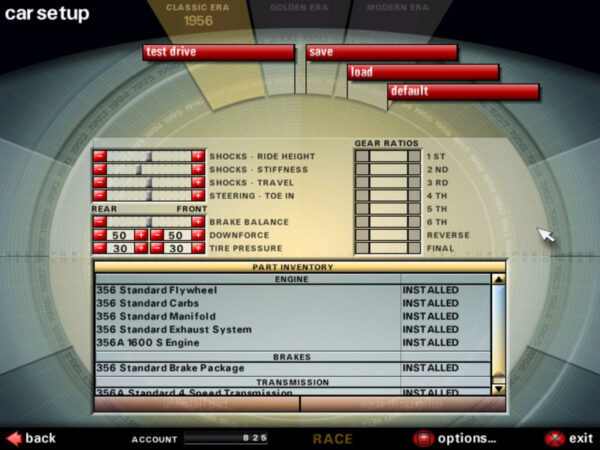
In one of the few reflections of the direction the franchise took after this game, Porsche Unleashed lets you tune your cars in career mode. I must admit that this sort of thing exceeds my patience level. I find it easier just to buy new cars instead of mucking about with my existing ones.

In addition to its other attractions, the Evolution mode is another fine history lesson, this time an interactive, hands-on one. When the 911 comes onto the stage in 1964, well after the 356 has overcome its humble origins to get pretty darn good, you might feel like many a 356 aficionado did at the time: skeptical of the newcomer, to put it mildly. But rest assured that the 911, an automotive icon for a reason, will win you over quickly enough.

To its credit, the Evolution mode includes lots of Porsches that aren’t the 356s and 911s around which the brand built its reputation. The 914 is here — this being the semi-infamous Volksporsche which combined a Porsche chassis with the exact same motor that powered the Volkswagen bus I owned all those years ago. (I kid you not.) And we can have a go with the 944, a later lower-end sports car, and the 928, the grand tourer that Porsche made twenty years before the Cayenne was a gleam in Wendelin Wiedeking’s eye. None of these cars is as fun to drive as the fishy-tailed 911, but it’s great to see them nonetheless. Ditto the real oddballs, such as the Porsche 550 Spyder, which looks like an overturned bathtub and is a terrifying handful on the road, such that you can understand all too well how the actor James Dean could have met his death in one in 1955. All told, playing through the entirety of the Evolution mode, from that first 356 to the Y2K incarnations of the Boxster and 911, is quite a trip. A course that used to take you six or seven minutes to traverse will be done in barely two by the time you’ve finished assembling your garage full of Porsches. Evolution indeed!
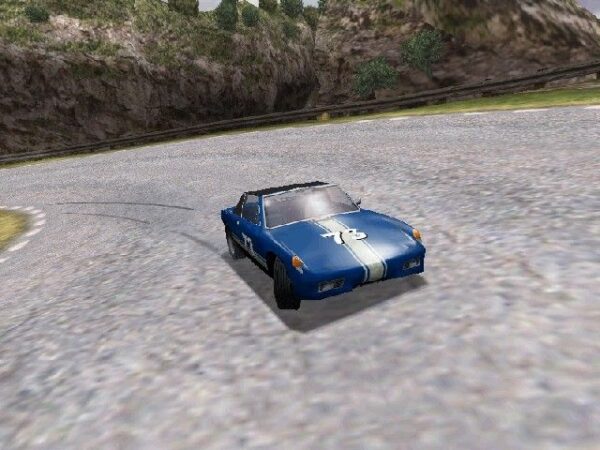
The 914, the ugly duckling of the Porsche flock.

The other meta-game here is a dramatic new innovation for the series. The Factory Driver mode is a sign of the changing times in gaming circa 2000, when more and more genres were finding ways to include set-piece story lines. The story here isn’t a particularly good one in the abstract, mind you, but it’s notable for existing at all. More importantly, it’s at least as entertaining as the Evolution mode in practice.
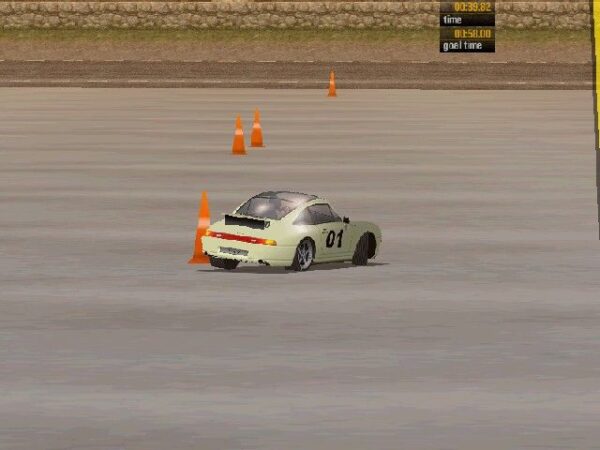
On the skid pad in Factory Driver mode.

You’ve come to Porsche to work as a test driver. Over 34 assignments, you have to prove your mettle and fend off various challengers from among your colleagues. Some assignments take place on a slalom course right there in the factory parking lot, but most repurpose the same roadways that you race on in Evolution mode. Realism is not a priority; I certainly hope that the real Porsche doesn’t deliver its cars to the port for shipment by racing them at breakneck speeds over public thoroughfares. Some of the assignments are really hard, at least for a middle-aged man like me; it took me more than an hour of trying to complete an embarrassing number of them. But boy, are they fun, and boy, is it satisfying when you win a race against the clock that had seemed impossible at the outset.
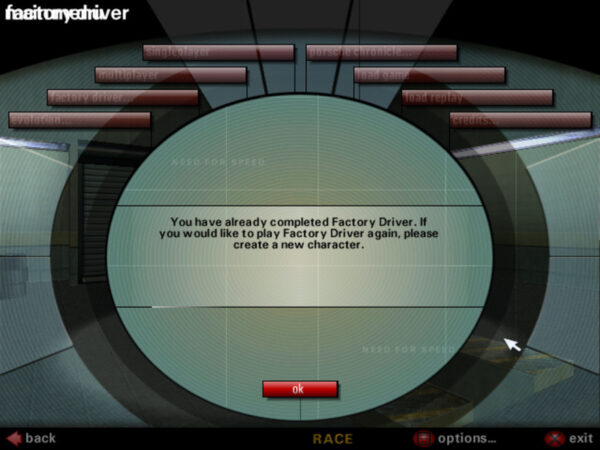
Yes, I am proud. It wasn’t easy, let me tell you.

In fact, I think that I adore this part of the game even more than the rest of it; I don’t even mind that you’re mostly driving 1990s-vintage Porsches in Factory Driver mode, with only the occasional blast from the past. This mode is actually an excellent place to start with the game, as it will teach you skills that will serve you well when you move on to Evolution mode. The only drawback to this ordering is that, if you’re at all like me, you may find that Evolution mode, good as it is, pales just slightly in comparison.

As has surely become all too clear by now, I have very little bad to say about this game. Normally, when I’m writing about a game, I try to temper my criticisms by reminding myself that there is someone out there who likes it a lot more than I do, who cares about it more than I do. Well, that may not be the case with Porsche Unleashed. Even grizzled, jaded critics like me have those special games that stick in our craw for reasons that we may not be entirely able to articulate. Porsche Unleashed is one of those games for me. It seems that all I can bring myself to do is gush over it.

Yes, it’s easy enough to call it too slick by half, to call it corporate propaganda. But it’s just so well-done, so aesthetically masterful and so carefully calibrated for the maximum enjoyment of yours truly, that I don’t care. Part of me feels bad that I haven’t found any other driving games to fall in love with in the same way as this one. Another part of me — the bigger part, I think — feels that, when a driving game is as good as this one, what’s the point of having any others?

Despite reviews that tended to be almost as gushing as the one I’ve just written, Porsche Unleashed was less commercially successful than its predecessors in the Need for Speed series. That disappointment prompted a franchise course correction — or rather re-correction, back to the direction the series had been trending before this detour into a single marque’s history. I feel like I ought to write that this was a shame, but, honestly, what would more games in this spirit have looked like? Ferrari UnleashedLamborghini Unleashed? I suppose you could try, but somehow it wouldn’t be the same. Or maybe that’s just the Porsche lover in me talking once again.

As it was, the Need for Speed series soared to new commercial heights early in the aughts by capitalizing on the craze among the youth for “tuning” and (illegally) racing more ordinary and accessible cars, as celebrated by the 2001 cinematic blockbuster The Fast and the Furious and its sequels. For many post-millennial driving-game fans, Porsche Unleashed remained relevant primarily for the sixteen-year (!) exclusive license Porsche had granted to Electronic Arts; this meant that their cars could not appear in anyone else’s games, even as EA’s own were now favoring Hondas and Nissans and even Volkswagens over Porsches and Ferraris and Lamborghinis. When the long moratorium finally ended in 2016, it was front-page news on many a gaming website. (Would we have gotten more exclusively Porsche Need for Speed games if the first one had been more successful? It’s tempting to wonder — but, again, what else could those games have done that the first one didn’t?)

Today, the expired status of the same license agreement means that Porsche Unleashed is not available for purchase anywhere. But you can still find it in the musty back hallways of the Internet, including at a certain archiving organization. It can be tricky to get running well on modern hardware, but it’s not impossible. A good place to start is with the “Combined Patch” by Tsalikon. Just make sure to play the Windows rather than the Playstation version; the latter is so dramatically stripped down as to be for all practical purposes a different, inferior game altogether.

Naturally, you will have to decide for yourself whether it’s worth the effort to track down the game and get it running. I can only say that it was most emphatically worth it for me to renew my relationship with this old flame. I am, it seems, a driving-game monogamist. What I lack in my breadth of appreciation for them is made up for by the depth of my attachment to this one.


Did you enjoy this article? If so, please think about pitching in to help me make many more like it. You can pledge any amount you like.


Sources: I drew my brief summation of Porsche’s recent history and situation circa 2000 from a Harvard Business School case study by Jeffrey Fear and Carin-Isabel Knoop. And let me recommend the book The Nazi Billionaires by David de Jong to anyone who wants to explore the darker side of Volkswagen and Porsche’s origins, the stuff you will never see in a slick propaganda piece like this one.

 
21 Comments

Posted by on September 4, 2026 in Digital Antiquaria, Interactive Fiction


Tags: , ,

A Need for Speed

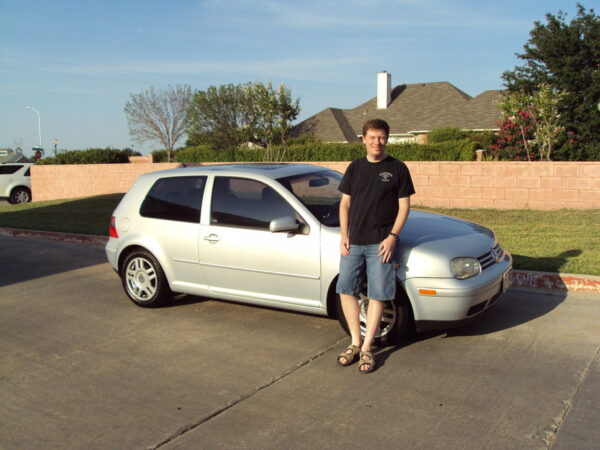
Your humble author in 2009, with his last even vaguely cool car, a 2000 Volkswagen GTI. I sold the GTI and left the United States that same summer. I wouldn’t own another car for ten years.

Looking back from the vantage point of today, it’s hard for even me to believe, but it’s true all the same: I used to be a full-blown car guy. I bought my first car, a 1966 Volkswagen Beetle, for $800 in 1989, when I was sixteen years old. The bad thing about a Beetle was that you could generally expect no more than 60,000 miles or so out of the motor; the good thing was that you could rebuild the motor in your garage over a long weekend and make it good as new again. My inner Luddite, who seems to become stronger almost by the day in our current era of feverish tech-sector nonsense, still feels that something was lost when we stopped making cars that were so amenable to shade-tree mechanics.

I had a couple of other Beetles over the decade and a half that followed that first one, along with a number of other vehicles that made them look like the height of sober-minded practicality.

I had a 1965 Ford Mustang that was rusted out so badly it was literally on the verge of breaking in two. (I maybe should have taken a look underneath before I bought it.) I sold it to a fellow who ran an import/export business; the plan was to send it to Finland for restoration and resale, which means my old Mustang may have beat me to northern Europe by about fifteen years.

I had a 1969 MGB that was determined to prove every cliché about the quirky unreliability of British sports cars to be the gospel truth. I learned that there’s a reason that Lucas Industries, which was responsible for the electrical systems in those cars, is known in enthusiast circles as “the Prince of Darkness.” That MGB is the only car I’ve ever driven where you had a choice between headlights and windshield wipers; there wasn’t enough juice to run them both at the same time. Then again, you probably didn’t want to be driving in the rain anyway, because never was an MGB made without a top that leaked like a sieve. All that aside, the car was a hell of a lot of fun whenever the weather was good and it decided it was in the mood to start.

I had a 1975 Nissan — or Datsun, as they were known in the United States back then — 280Z. It was more fun to drive than any car I’ve ever owned, even the MGB, with an in-line six-cylinder engine that was the stuff of which car-nerd wet dreams are made. For some reason, I decided to swap that 280Z for a 1981 280ZX. I knew I had made a terrible mistake within a week, even if the new car did have the exact same engine. It was like trading the svelte Elvis of 1956 for the fat one of 1976.

But the all-around funnest vehicle I’ve ever owned — not just fun to drive, but fun in general — was a 1972 Volkswagen camper van. It would do about 50 miles per hour flat-out on level ground. Driving it felt weirdly like guiding a boat, and not only because the engine was chirping away about fifteen feet behind you when you sat at the wheel. You could expect a delay of several seconds to any control input as it bobbed and swayed gently on its well-worn springs. So, you just kind of pointed it in the general direction you wanted to go and hoped for the best. Looking back on it, it was a good thing that it wouldn’t go any faster.

That little Volkswagen bus could sleep four people — or rather two couples, assuming you didn’t want to cuddle too much with mere friends. There could be two in the back and two under the pop-up roof, with just a thin net between them and the great outdoors. It had a little refrigerator, a little stove, and even a little heater that ran on — I kid you not — pure gasoline. It’s a wonder that we didn’t blow ourselves up at some point during the weekends that we drove the magic bus up from Dallas to southern Oklahoma’s Arbuckle Mountains.

The joys of all of these oddball vehicles started to pale a bit for me as I entered my thirties. (Come to think of it, it was at about this same point that I started to feel too old for backpacker hostels; this must have been the borderline that marked the onset of a belated adulthood.) In 2004, I bought a Volkswagen GTI that was just a few years old instead of a few decades. It was a nice enough car, but it was kind of soft and heavy in the same way that the Datsun 280ZX had been. Still, it did have the advantage of being (more or less) reliable.

Then I moved to Denmark in 2009 with my new wife, and that was that for the car life. We didn’t even own a car for ten years thereafter. I re-familiarized myself with the lost (to me) art of biking, which is certainly a healthier way to get around as one closes in on middle age. These days we have a Hyundai Plug-In Hybrid, which is… fine, but it doesn’t exactly get the blood pumping, you know? Discounting the odd roadside emergency, I haven’t looked under a hood with deadly intent in seventeen years. I can’t even tell one (modern) car from another anymore.

And yet nothing that we have done and been in our lives ever truly and completely leaves us, does it? Our current house, which we moved into four and a half years ago, has quite a big yard, such that I have to cut the grass with a garden tractor. I still feel a certain quickening in my soul when I smell gasoline and oil and hear the motor fire up, still enjoy doing the maintenance myself. In fact, I just bought a new (to me) tractor this year; I’ll go so far as to say that it’s the best one in our village. I do like to ride around on it, the child being the father to the man and all. As one of my wife’s uncles likes to say, every man should have a tractor of his own, whether real or metaphorical.

But that’s far as I go these days. Sometimes I muse about getting a project car, but I know that I don’t really have the time, and probably not the long-term desire either. I content myself with the occasional veteran bil exhibition (as they’re called here in Denmark) and with seeing what’s on Jay Leno’s Garage each week on YouTube. (If it’s something old, I’m in; if it’s something new, I move on; if it’s something borrowed or something blue, I’m as confused as you are.)

Here’s the weird thing, though: I never had all that much interest in driving cars on the computer, even when my passion for the real McCoys was at its peak. Of course, there are various sub-genres of driving games, as there are of all other types. I’m not so surprised that I never got into the hardcore racing simulations, where it becomes all about grip and downforce and gear ratios and wind-tunnel coefficients and many other numbers I don’t really understand. God bless those who like that sort of thing, but I never had the patience for it, whether the vehicle being modeled is an airplane, a ship, a submarine, or a racing car. Yet I never cared much more about what we might call the aspirational driving games: you know, the ones that assemble a bunch of exotic street cars and set you loose with them, on the premise that, if you can’t afford them in the real world, you can satisfy at least some of your lust for them vicariously on the computer.

I think the problem for me here was that I didn’t aspire to what these aspirational games were offering. At some point many years ago now — definitely before I learned to drive in the real world — high-end sports car reached a level of performance that made them, in my opinion, less rather than more fun. They started to not just include but require traction control and all manner of other driver-assistance measures just to make them controllable, which detracted from the purity of the experience. At the same time, they became so ridiculously fast in comparison to the traffic laws of the realm that I’m left wondering what you’re actually supposed to do with them, assuming you don’t want to be a jerk who endangers everyone else on the road and likely gets himself thrown in jail and his car confiscated before all is said and done. (Denmark isn’t known for being tough on crime, but they do love to confiscate cars here…)

There’s an old saying that has long been my mantra on this subject: “It’s more fun to drive a slow car fast than a fast car slow.” Just last year, my wife and I took a holiday to Zagori, a mountainous region in the northwest of Greece, close to the border with Albania. We were there to hike, but I had just as much fun driving our rental car, a Ford something-or-other with a gerbil wheel attached to a couple of rubber bands for an engine, up and down switchback mountain roads that sometimes had me shifting all the way down to first gear. I know that electric cars are the socially responsible future and all, but I’m a little sad that I most presumably won’t be able to rent a simple, basic traditional car like this one for much longer, then proceed to wring every last bit of potential out of it in the old-fashioned, manual way. In my book, that’s a lot more fun than driving a Ferrari responsibly on the same roads would be.

Waiting for goats to cross the road in the Pindus Mountains. A little later, the goat herder emerged, and we had a “conversation” that relied principally on smiling and gesturing. It may be a romanticized whimsy, but I kept thinking that his life wasn’t all that different from that of his ancestors of 1000 years ago. There’s a part of me that hopes his descendants are still living the same way 1000 years hence.

In short, then, the aspirational driving sims were sold on the premise that you really, really wanted to own the exotic cars they featured, and I never particularly did; if we’re being completely honest, I find most post-1970s supercars to be painfully tacky-looking in addition to everything else. This goes a long way toward explaining why I’ve scarcely seen fit to mention driving games in these histories before today. On top of my personal proclivities, I would add one last factor. Some gaming genres, I’ve come to learn, age better than other ones, and thus do more to encourage re-visitation. If you ask me, adventure, puzzle, and action games age the best, followed by CRPG and strategy games. (The latter tending to be more complicated genres in general, they do often fall completely or partially victim to shifting interface conventions; we’ve learned how to present information and let the player twiddle the knobs so much better over the decades that going too far back can be a pain.)

At the bottom of the heap in this respect are undoubtedly sports games and vehicular simulations. As purported simulations of the real world, such games foreground technology more than they do design, meaning that there’s less reason to revisit them when the technology moves on and can present simulations of a better fidelity. If you were to create a list of the most prominent and respected designers of gaming’s various ages, you would find that virtually none of them worked in these genres. (The only name I can think of off-hand is Sid Meier, who did so very early in his career, a fact that I hear trotted out from time to time as a curious anecdote: “Did you know he used to make flight simulators before Pirates! and Railroad Tycoon and Civilization?”)

Sports games and sims tend to be as ephemeral as they are anonymous. The former are generally cranked out on an explicitly annual basis, with the year appended right there to the name, with all of the teams and athletes of right now. If you’re still stuck with an earlier year’s edition, and if you don’t happen to be a very special sort of cultural time traveler indeed, you’re left out, bereft and bereaved. You can still find plenty of die-hard partisans of Civilization II or IV or VI. I presume that you can also find footie fans who insist that FC 24 is where it’s really at and the later versions are pants — you can find anything on the Internet if you look hard enough — but they seem to be a lot less common. Driving games are for all practical purposes the same. Each new annual or biennial edition of the big franchises comes chock-a-block with all of the hot cars of that moment. Who wants to be stuck with a bunch of old cars? (I do! I do! But much older…)

All of which helps to clarify why a quick glance around the retro-gaming blogosphere reveals a CRPG Addict, a Wargaming Scribe, an Adventurers’ Guild, an All the (Text) Adventures project, even a Space Game Junkie, but no one seems to be documenting every iteration of Tiger Woods PGA Tour or Microsoft Flight Simulator in similarly granular detail. Call it the rest of the explanation of why I too have given those genres short shrift in these histories.

Nevertheless, said histories do try to capture the landscape of gaming as it was viewed at the time, not just the nostalgic, fannish perspective of today. Sports games and vehicular simulations were a huge part of that landscape, representing as much as 40 percent of the market at times during the 1980s and 1990s. So, today I’ll try to remedy my neglect at least a little bit, by tracing aspirational driving games back to their point of origin. (Sports game will have to wait for another day.) This will lead us nicely into a big exception to the general rule I’ve just belabored at such length: the one vintage driving game that I actually do dig, even today.


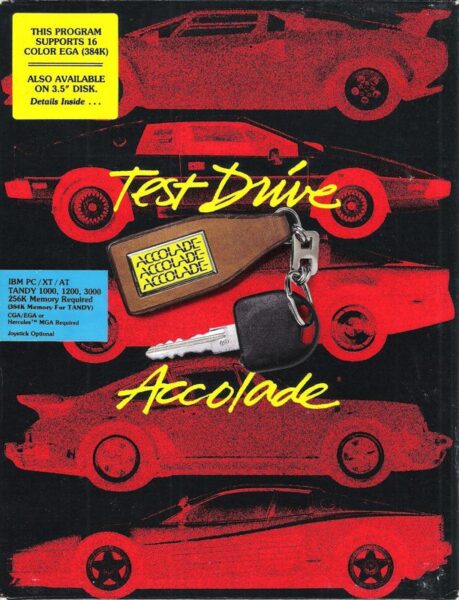
The exception to another rule, that of me ignoring driving sims in the past, is a game called Test Drive, to which I devoted a handful of paragraphs many years ago. Developed by a Vancouver-based outfit called Distinctive Software and published by Accolade in 1987, Test Drive was a fine place to break my silence on the subject of driving sims, however briefly, in that it was arguably the most important such game ever to appear on personal computers. I say this not because it generated enormous sales — it was a big success by the standards of its time, but later driving sims would sell many, many times more copies — but because it was the template for countless games to come. For it introduced the driving sim as an aspirational lifestyle product, almost as much an exercise in branding and promotion for the car makers whose vehicles were included as it was a self-contained game.

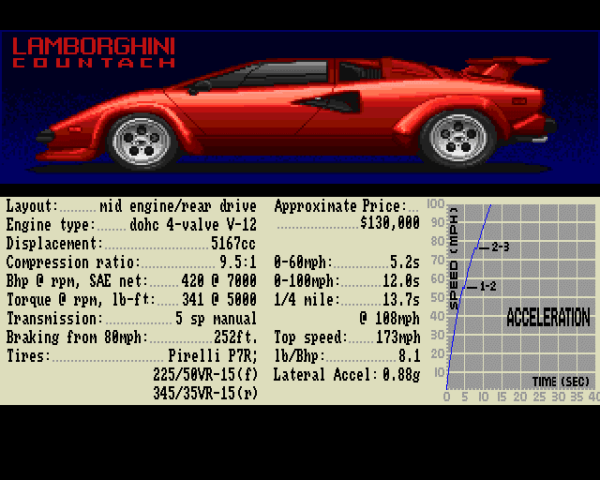
Test Drive offered up five of the cars whose posters could be found stuck to the wall in teenage-male bedrooms from sea to shining sea: a Porsche 911 Turbo, a Ferrari Testarossa, a Lotus Esprit Turbo, a Lamborghini Countach, and (for those with slightly less exotic tastes) a Chevrolet Corvette. You got to pick one of these cars, then drive it up a twisting mountain road as quickly as possible, dodging slower traffic and trying to stay ahead of the police cars who were in somewhat inept pursuit. The meta-game that took place when you weren’t behind the steering wheel extended no further than trying to get your time on a high-scores list. It wasn’t much in comparison to what these games would become — but it was enough. You got the chance to drive a car you weren’t likely to ever even ride in, and you got to do it in all the reckless ways that only a maniac would in real life. For the car manufacturers, being featured in sleek and stylish games like this one would soon become an important promotional strategy, creating the customers of tomorrow from the teenagers of today. It was an early step in gaming’s integration into the larger consumer economy, one which happened at almost the same time that sports games began to move toward a season-by-season model that kept them in tune with the latest headlines on ESPN.

Just to further blur the lines between game and advertisement, between game and aspirational lifestyle product, Test Drive helpfully included the sticker prices of each of its cars on the information screen alongside all of the other statistics.

The bona fides of games like these as simulations was a case of a delicate balancing act. On the one hand, you didn’t want to make the cars too dauntingly difficult to drive, in the way of so many hardcore flight simulations — or for that matter some hardcore motorsports simulations, such as Papyrus Design’s IndyCar and NASCAR series. On the other hand, you wanted to ensure that the player could tell the difference between a Countach and a Corvette. You wanted to convey the impression of what it would be like to drive a supercar, in a way that remained accessible even to kids who might not have a driver’s license for the family minivan yet. Michael Bate, a designer for Artech, another Canada-based studio whose works were published by Accolade during the 1980s, called games hewing to this impressionistic philosophy “aesthetic simulations,” a neologism I’ve returned to again and again ever since I first heard it. Hanno Lemke, the producer of Test Drive, describes that game’s goals in classic aesthetic-simulation terms: to “create the most immersive, visceral, and relevant kind of car experiences [emphasis mine] you could imagine.”

When I grew up, it was the white Lamborghini poster in your bedroom or the red Ferrari, and it was very much about [how] the exotics mattered back then. And so, immersion was really important — getting into the driver’s seat, that virtual fantasy, you know. No real-life consequences — I can drive as fast as I want, the cops can chase me, but largely it was all about what it would feel like to drive these exotics.

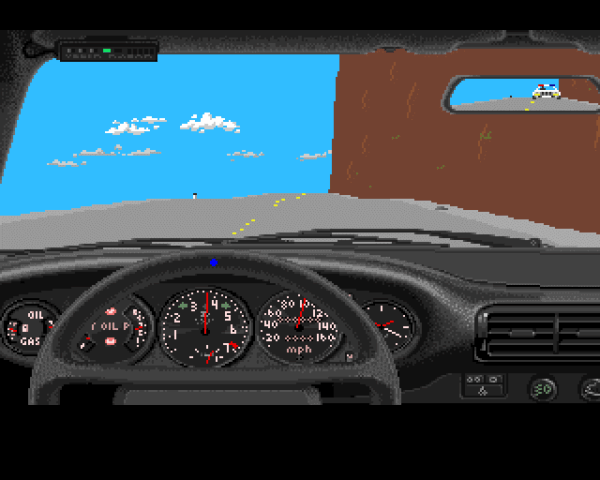
Each dashboard in Test Drive was a painstaking re-creation of the real thing. This is, believe it or not, that of a Porsche 911. I would have expected a bit more for my money…

Accolade published sequels to Test Drive in 1989 and 1990, alongside separate boxed add-ons with new cars to try out and scenery to traverse, thereby pioneering the model of the driving game as an entire ecosystem you bought into. (Today, that model is driven by the ubiquitous DLC packs.) By Test Drive III: The Passion, other staples of modernity were creeping in as well, such as the ability to rewatch and share your exploits after a particularly good (or bad) run and even a radio where you could select your own station, although we were still a long way from the times when bands and singers would lobby almost as aggressively as car companies to have their music included in such products.

Despite its innovations, the third game was not as well-reviewed or well-received as the ones before. Accolade had developed this installment in-house instead of letting Distinctive do it; this may be the reason that many gamers found it to be lacking a certain ineffable feel for the road. Then, too, some of the design choices were just weird: Test Drive III made keeping your windshield clear of bugs into a central aspect of its gameplay. The franchise effectively ended here, not to be revived until years later, as an also-ran rather than a pioneer.

The third game’s shortcomings notwithstanding, if you’ve played or even seen any of the modern driving sims, and try out any one of these Test Drive games today, you’ll immediately sense the same vibe, even if you are less impressed by the implementation. That’s a remarkable thing to contemplate all these decades later. For all that gaming has changed, it’s amazing how much it’s stayed the same in some of its core genres.


Distinctive was acquired by Electronic Arts in 1991. The new EA Canada focused more than ever on, for lack of a better term, “lifestyle games.” Being Canadian, it was given responsibility for creating the annual installments of the EA Sports National Hockey League franchise in the exploding console-game space. It has continued to this day to crank out a new edition every single year: 34 installments and counting as of this writing. This must surely be a record of some sort.

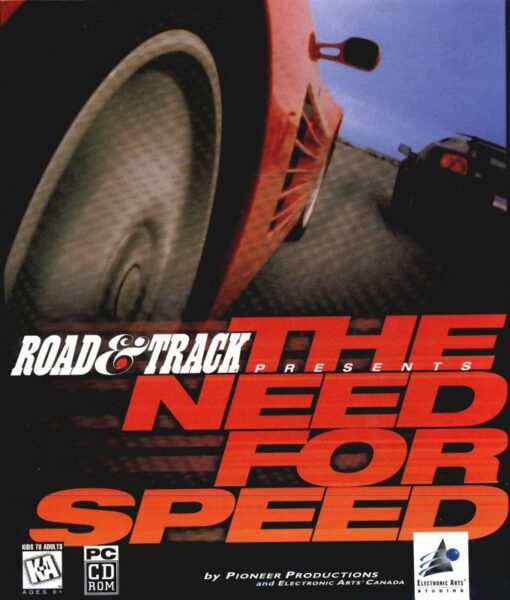
Driving games soon returned to the agenda as well. EA negotiated a deal with Road & Track, a slick magazine that sold an only modestly more grounded version of the fantasy of fast cars with expensive price tags than had Test Drive. Hanno Lemke was put in charge of Road & Track Presents: The Need for Speed, with many of the same people who had helped him build Test Drive working under him. It was to be a launch title for the 3DO, a new games console cum “multimedia appliance” whose finances were thoroughly muddled up with those of EA: Trip Hawkins, the founder of EA, had left that company with his board’s blessing and plenty of their investment dollars to embark on this new venture. The 3DO was envisioned as a sort of lifestyle console, appealing to an older demographic than the likes of Nintendo and Sega. It requires no great imaginative leap to understand why a game like The Need for Speed could be a good fit with that vision. If all went according to plan, the same people who perused Road & Track might soon be picking up 3DOs.

The 3DO’s not-so-secret weapon was to be the CDs on which all of its games would ship. These CDs would in turn enable lots and lots of digitized video and sound sourced from the real world, a possibility which would have seemed like science fiction just a few years earlier. The Need for Speed embraced said possibility with all the enthusiasm that was expected of a 3DO game; you didn’t see a computer-drawn car on your screen until you settled down into the driver’s seat of one.

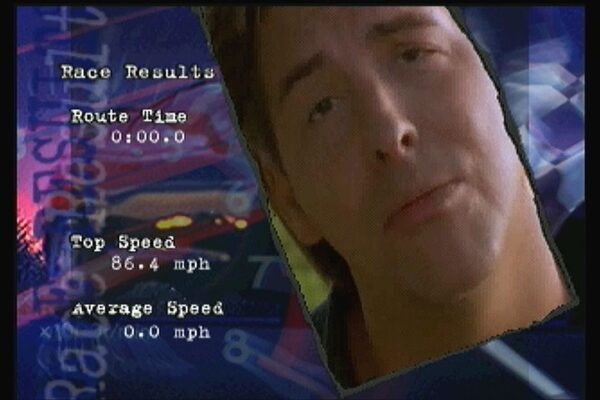
The video clips were typical of the era — which is to say, amazing simply for existing at the time of the game’s release in 1994, but ho-hum at best today. The worst decision was to add a shakily acted fellow named Mr. X to serve as the player’s antagonist, popping up from time to time with some trash talk. This was exactly as grating as it sounds like it would be, especially after you had seen him deliver every one of his limited repertoire of one-liners multiple (dozen?) times.

Mr. X has something to say about your performance. He is aptly described by a contributor to MobyGames as “a face you love to punch.”

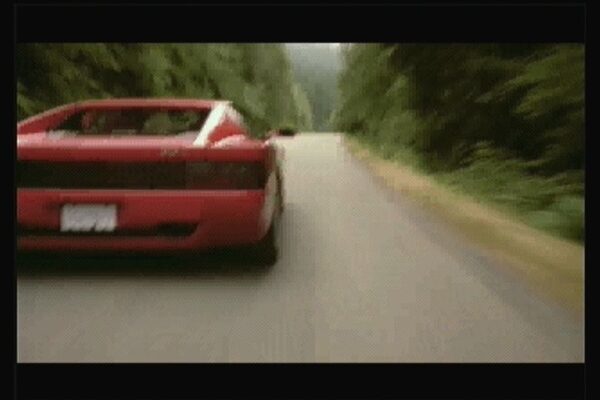
The means of production of all this video reflected the fact that the games industry, for all its rapid evolution, still had a ways to go before it would be competing on a level field with Hollywood. EA didn’t even have the clout to borrow cars from the manufacturers whose vehicles were included. So, Hanno Lemke and his friends had to go begging. Luckily, Road & Track had whole filing cabinets full of still photographs of the cars in question that were ripe for digitizing. In the category of the moving image, the Ferrari Testarossa seen in the video clips belonged to Chris Roberts of Wing Commander fame, the Lamborghini Diablo to Richard Garriott of Ultima fame, and the Porsche 911 to an EA Canada executive. Other cars were scavenged by still more humble methods, being vehicles that the team simply spotted driving by and chased down to ask the owners if they were interested in making a cameo appearance in a videogame.

Speaking of people with punchable faces: Chris Roberts’s Ferrari. (I kid! I kid!)

Once you got past all of the multimedia-age gilding, however, you found a very credible aesthetic simulation waiting for you. The Need for Speed reinvented no wheels; it was a recapitulation of Test Drive on a larger canvas, right down to the vaguely hapless cops who lay in wait to chase you down public highways. Once again, you had a selection of mouth-watering sports cars to hand, updated to reflect the latest developments in the field. (This time, the Japanese got a chance: no fewer than three of the eight cars — the Mazda RX-7, the Toyota Supra, and the Acura NSX — came from the Land of the Rising Sun.) But it was all done better, reflecting the seven years of steady technological advancement that separated The Need for Speed from the original Test Drive.

The game nailed the look and feel it was going for. No one would accuse this of being a hardcore simulation of driving — not when you could bump and bash and grind against the other vehicles with impunity, when even crashing head-on at speed into the side of a building resulted in little visible damage to the car. (This was a requirement of the contracts with the manufacturers, who had no desire to see their halo vehicles getting smashed up and exploding on screens; such requirements are still the rule in the contracts of today.) Even the non-police computerized drivers you could race against — another advancement over Test Drive — were more interested in showing you a good time and keeping the adrenaline level up than they were in earnestly trying to win. As one reviewer put it, “the AI drivers don’t race; they shadow.”

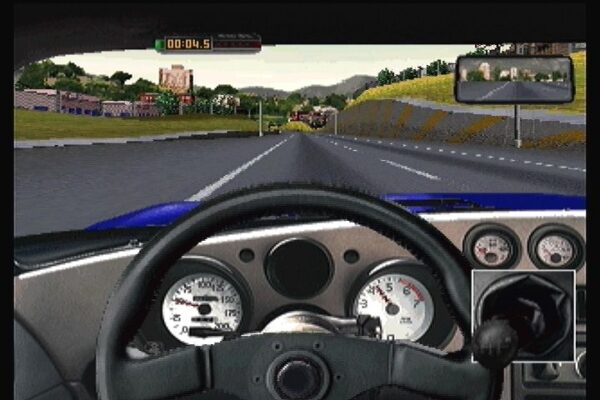
Driving a Dodge Viper, one of the new supercars that had appeared on the scene since Test Drive.

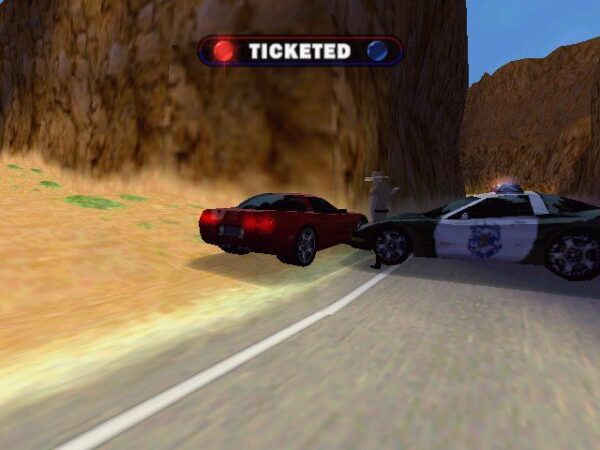
The point was that it was fun, being just close enough — but not too close — to what racing cars such as these might really be like. The game presented an alternative universe where you could not only afford a supercar, but one where insurance premiums didn’t exist and the police would give you no more than a ticket and a stern talking-to if they caught you driving 170 miles per hour down a heavily trafficked road. This was a universe that teenage boys everywhere — even the ones who happened to be in their twenties, thirties, forties or fifties — could well and truly get behind.

But sadly for everyone involved, the 3DO console was a marketplace flop. On the supply side, a scheme for renting out the console’s specifications and firmware to multiple consumer-electronics makers proved a recipe for confusion, while the slightly older folks who wanted to play multimedia videogames in their living rooms of an evening in lieu of watching television proved rather less plentiful than anticipated. Still believing they had a good thing on their hands, one which was just on the wrong platform at the moment, EA Canada reworked The Need for Speed for ordinary personal computers. This allowed them to turn it into the biggest game ever to be born on Trip Hawkins’s misbegotten console.

Released in 1995, this incarnation of The Need for Speed dialed back on the most annoying aspects of the 3DO version — Mr. X got the well-deserved axe — while keeping everything that had made it appealing. In its review, Computer Gaming World magazine made note of the tightrope it walked with such aplomb: “Realistic elements are usually compromised for the sake of a quick learning curve and blazing arcade action. But Need for Speed is kind of an anomaly: it borrows some from both styles and thrills the senses along the way.” It became a huge hit on personal computers. It was then ported to the Sony PlayStation, a new CD-based console which had set out to do much of what the 3DO had, and would pull it off much better. The Need for Speed took off there as well. Indeed, in some ways games like these were always more natural fits for consoles.

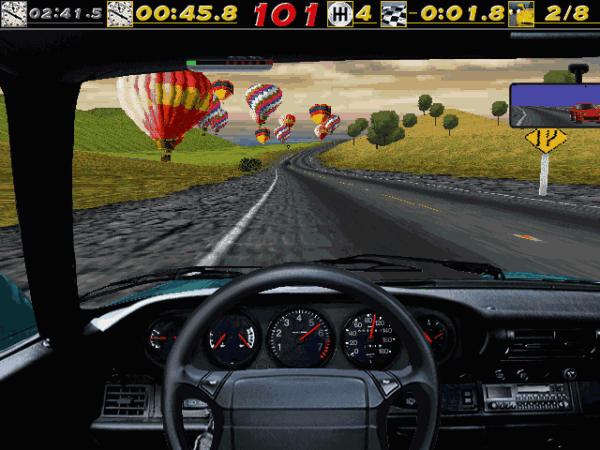
“Balloons ahoy!” in the computer version of The Need for Speed.

So, out of the smoking rubble of the 3DO, a long-running driving-game franchise arose. Need for Speed II came out in 1997. Along with the definite article in the name, it dropped the Road & Track partnership; EA now had more than enough clout to get all of the glamor shots and test models it could want from the manufacturers. Some complained that the advancement was all in the department of graphics and sound, but that was fine for most fans of this most deeply experiential of all gaming genres. “Little details like hearing the shift click mattered back then,” says Hanno Lemke, who would continue to act as the franchise’s primary producer until 2007. “Watching the dials move mattered.” (There is a reason that I like to call these games aesthetic simulations.)

The series was moving now toward an annual release schedule, just like the sports games. In that spirit of ongoing perpetuity, Need for Speed III: Hot Pursuit, which came out in 1998, was the last installment with a Roman numeral and the first with a subtitle. To further press home the notion of Need for Speed as a subculture you bought into rather than a single game you bought, EA began to regularly put up new, downloadable content — most importantly, new supercars to add to the ever-growing list of same — on its website.

The police have upgraded their stodgy cruisers to Camaros in Need for Speed III.

In a decision which was polarizing in some circles but doubtless exhaustively market-researched, this installment leaned further toward the arcade game at the expense of the simulation. As its subtitle would imply, it heavily emphasized the police-chase aspect. The cops, who had verged on being little more than props at times in the past, could now go so far as to set up roadblocks ahead of you, complete with tire spikes. But, as Computer Gaming World’s reviewer captured, the core attributes of the aspirational lifestyle game, as deft at promoting the cars it featured as it was at being good fun in its own right, remained as pronounced as ever.

During the time I was writing this review, I went driving in the mountains. As I cruised along narrow, twisting roads, I kept thinking about how much the experience reminded me of playing Need for Speed III — at least as far as handling the car went. I wasn’t being chased by the police, and I wasn’t pushing my Lamborghini much past 60 miles per hour. Okay, so I don’t own a Lamborghini. But after playing this game, I sure wish that I did.

Need for Speed: High Stakes appeared right on time in 1999. In order to give the Buford T. Justices of the world some redemption, it let you become the police instead of forever being chased by them. But the less gimmicky, vastly more significant addition was that of a career mode, which finally provided a proper meta-game to bridge and give context to your exploits on the highways and raceways. You started with only enough money to buy what passed for a budget car in this august assemblage: a Mercedes SLK or a BMW Z3. You had to earn your way into the more exclusive rides by winning ever more challenging tournaments, whilst keeping your repair bills to a minimum in the process. High Stakes wasn’t quite the first aspirational driving game to introduce a career mode — that distinction belongs to Gran Turismo, a PlayStation-exclusive competitor — but it was a huge step forward nonetheless. Suddenly the individual races had… well, high stakes, that extended beyond the moment-to-moment maneuvering on the road, that might even cause you to exercise a modicum of caution out there from time to time. And as you progressed, you slowly amassed a garage full of tricked-out, exotic sports cars. I trust that I’ve flogged my hobby horse sufficiently by now to not have to tell you what this meant for these games as aspirational lifestyle products.

Your garage in High Stakes looks like a car dealer’s showroom. This is not a coincidence…

All of this was great, if you were interested in buying what these games were so explicitly selling. I must confess that I really wasn’t, even back in the day. The cars that were featured weren’t generally the ones I lusted after, and I found the whole presentation a bit too boy-racer for my tastes. But then Need for Speed took a surprising detour — one that would prove a bit of a blind alley for the franchise, but one that I enjoyed immensely. I’ll tell you all about that next time.


Did you enjoy this article? If so, please think about pitching in to help me make many more like it. You can pledge any amount you like.


Sources: Edge of October 1994; Retro Gamer 59 and 178; Computer Gaming World of February 1988, April 1991, November 1995, August 1997, March 1998, and January 1999; the Harvard Business School case studies “Electronic Arts in 1995,” “Electronic Arts in 2002,” and “Electronic Arts: The Blockbuster Strategy.”

Online sources include “A Distinctive Lineage” by Chris LaVigne for The Escapist, “How Need for Speed Became the World’s Biggest Racing Game” by Mack Hogan for Road & Track, and an interview with Hanno Lemke conducted by John Davison for 1UP.com.

Where to Get Them: Unfortunately, none of the games discussed here are available for legal purchase, presumably due to the expiration of the various licensing agreements with automobile manufacturers. It’s another reason that these sorts of games are so easily forgotten by history…


Tags: , , , ,