RSS

Tag Archives: RTS

Starcraft (A History in Two Acts)

Act 1: Starcraft the Game


Great success brings with it great expectations. And sometimes it brings an identity crisis as well.

After Blizzard Entertainment’s Warcraft: Orcs and Humans became a hit in 1995, the company started down a very conventional path for a new publisher feeling its oats, initiating a diverse array of projects from internal and external development teams. In addition to the inevitable Warcraft sequel, there were a streamlined CRPG known as Diablo, a turn-based tactical-battle game known as Shattered Nations, a 4X grand-strategy game known as Pax Imperia II, even an adventure game taking place in the Warcraft universe — to be called, naturally enough, Warcraft Adventures. Then, too, even before Warcraft II: Tides of Darkness was finished, Blizzard had already started on a different sort of spinoff than Warcraft Adventures, one which jettisoned the fantasy universe but stayed within the same gameplay genre of real-time strategy. It was to be called Starcraft, and was to replace fantasy with science fiction. Blizzard thought that one team could crank it out fairly quickly using the existing Warcraft II engine, while another one retooled their core RTS technology for Warcraft III.

In May of 1996, with Warcraft II now six months old and a massive hit, Blizzard brought early demos of Starcraft and most of their other works in progress to E3, the games industry’s new annual showcase. One could make a strong argument that the next few days on the E3 show floor were the defining instant for the Blizzard brand as we still know it today.

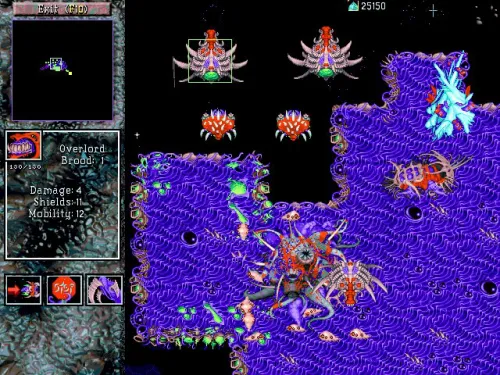
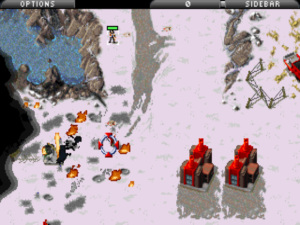
The version of Starcraft that Blizzard brought to the 1996 E3 show. Journalists made fun of its fluorescent purple color palette among other things. Was this game being designed by Prince?

The gaming press was not particularly kind to the hodgepodge of products that Blizzard showed them at E3. They were especially cruel to Starcraft, which they roundly mocked for being exactly what it was, a thinly reskinned version of Warcraft II — or, as some journalists took to calling it, Orcs in Space. Everyone from Blizzard came home badly shaken by the treatment. So, after a period of soul searching and much fraught internal discussion, Blizzard’s co-founders Allen Adham and Mike Morhaime decided not to be quite so conventional in the way they ran their business. They took a machete to their jungle of projects which seemed to have spontaneously sprouted out of nowhere as soon as the money started to roll in. When all was said and done, they allowed only two of them to live on: Diablo, which was being developed at the newly established Blizzard North, of San Mateo, California; and Starcraft, down at Blizzard South in Irvine, California. But the latter was no longer to be just a spinoff. “We realized, this product’s just going to suck,” says Blizzard programmer Pat Wyatt of the state of the game at that time. “We need to have all our effort put into it. And everything about it was rebooted: the team that was working on it, the leadership, the design, the artwork — everything was changed.”

Blizzard’s new modus operandi would be to publish relatively few games, but to make sure that each and every one of them was awesome, no matter what it took. In pursuit of that goal, they would do almost everything in-house, and they would release no game before its time. The time of Starcraft, that erstwhile quickie Warcraft spinoff, wouldn’t come until March of 1998, while Warcraft III wouldn’t drop until 2002. In defiance of all of the industry’s conventional wisdom, the long gaps between releases wouldn’t prove ruinous; quite the opposite, in fact. Make the games awesome, Blizzard would learn, and the gamers will be there waiting with money in hand when they finally make their appearance.

Adham and Morhaime fostered as non-hierarchical a structure as possible at Blizzard, such that everyone, regardless of their ostensible role — from programmers to artists, testers to marketers — felt empowered to make design suggestions, knowing that they would be acted upon if they were judged worthy by their peers. Thus, although James Phinney and Chris Metzen were credited as “lead designers” on Starcraft, the more telling credit is the one that attributes the design as a whole simply to “Blizzard Entertainment.” The founders preferred to promote from within, retaining the entry-level employees who had grown up with the Blizzard Way rather than trying to acclimatize outsiders who were used to less freewheeling approaches. Phinney and Metzen were typical examples: the former had started at Blizzard as a humble tester, the latter as a manual writer and line artist.

For all that Blizzard’s ambitions for Starcraft increased dramatically over the course of its development, it was never intended to be a radical formal departure from what had come before. From start to finish, it was nothing more nor less than another sprite-based 2D RTS like Warcraft II.  It was just to be a better iteration on that concept — so much better that it verged on becoming a sort of Platonic ideal for this style of game. Blizzard would keep on improving it until they started to run out of ideas for making it better still. Only then would they think about shipping it.

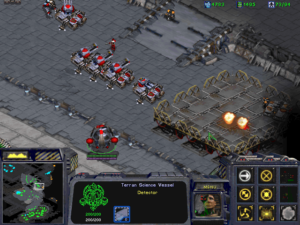
The finished Starcraft in action, looking much more chic than it did during its Orcs in Space days.

The exceptions to this rule of iteration rather than blue-sky invention all surrounded the factions that you could either control or play against. There were three of them rather than the standard two, for one thing. But far more importantly, each of the factions was truly unique, in marked contrast to those of Warcraft and Warcraft II. In those games, the two factions’ units largely mirrored one another in a tit-for-tat fashion, merely substituting different names and sprites for the same sets of core functions. Yet Starcraft had what Blizzard liked to call an “asymmetric” design; each of the three factions played dramatically differently, with none of the neat one-to-one correspondences that had been the norm within the RTS genre prior to this point.

In fact, the factions could hardly have been more different from one another. There were the Terrans, Marines in space who talked like the drill sergeant in Full Metal Jacket and fought with rifles and tanks made out of good old reliable steel; the Zerg, an insectoid alien race in thrall to a central hive mind, all crunchy carapaces and savage slime; and the Protoss, aloof, enigmatic giants who could employ psionic powers as devastatingly as they could their ultra-high-tech weaponry.

The single-player campaign in which you got to take the factions for a spin was innovative in its way as well. Instead of asking you to choose a side to control at the outset, the campaign expected you to play all three of them in succession, working your way through a sprawling story of interstellar conflict, as told in no fewer than 30 individual scenarios. It cleverly began by placing you in control of the Terrans, the most immediately relatable faction, then moved on to the movie-monster-like Zerg and finally the profoundly alien Protoss once you’d gotten your sea legs.

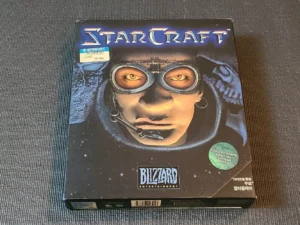
Although it seems safe to say that the campaign was never the most exciting part of Starcraft for the hyper-competitive young men at Blizzard, they didn’t stint on the effort they put into it. They recognized that the story and cinematics of Westwood Studio’s Command & Conquer — all that stuff around the game proper — was the one area where that arch-rival RTS franchise had comprehensively outdone them to date. Determined to rectify this, they hired Harley D. Huggins II, a fellow who had done some CGI production on the recent film Starship Troopers — a movie whose overall aesthetic had more than a little in common with Starcraft — as the leader of their first dedicated cinematics team. The story can be a bit hard to follow, what with its sometimes baffling tangle of groups who are forever allying with and then betraying one another, the better to set up every possible permutation of battle. (As Blizzard wrote on their back-of-the-box copy, “The only allies are enemies!”) Still, no one can deny that the campaign is presented really, really well, from the cut-scenes that come along every few scenarios to the voice acting during the mission briefings, which turn into little audio dramas in themselves. That said, a surprising amount of the story is actually conveyed during the missions, when your objectives can unexpectedly change on a dime; this was new to the RTS genre.

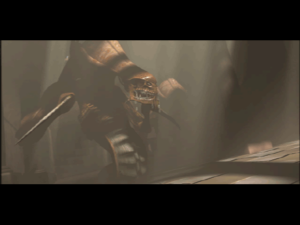
One of the cut-scenes which pop up every few scenarios during the campaign. Blizzard’s guiding ethic was to make them striking but short, such that no one would be tempted to skip them. Their core player demographic was not known for its patience with long-winded exposition…

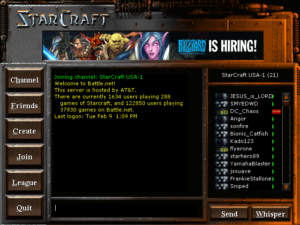
Nonetheless, any hardcore Starcraft player will tell you that multiplayer is where it’s really at. When Blizzard released Diablo in the dying days of 1996, they debuted alongside it Battle.net, a social space and matchmaking service for multiplayer sessions over the Internet. Its contribution to Diablo’s enormous success is incalculable. Starcraft was to be the second game supported by the service, and Blizzard had no reason to doubt that it would prove just as important if not more so to their latest RTS.

If all of Starcraft was to be awesome, multiplayer Starcraft had to be the most awesome part of all. This meant that the factions had to be balanced; it wouldn’t do to have the outcome of matches decided before they even began, based simply upon who was playing as whom. After the basic framework of the game was in place, Blizzard brought in a rare outsider, a tireless analytical mind by the name of Rob Pardo, to be a sort of balance specialist, looking endlessly for ways to break the game. He not only played it to exhaustion himself but watched match after match, including hundreds played over Battle.net by fans who were lucky enough to be allowed to join a special beta program, the forerunner of Steam Early Access and the like of today. Rather than merely erasing the affordances that led to balance problems — affordances which were often among the funnest parts of the game — Pardo preferred to tweak the numbers involved and/or to implement possible countermeasures for the other factions, then throw the game out for yet another round of testing. This process added months to the development cycle, but no one seemed to mind. “We will release it when it’s ready,” remained Blizzard’s credo, in defiance of holidays, fiscal quarters, and all of the other everyday business logic of their industry. Luckily, the ongoing strong sales of Warcraft II and Diablo gave them that luxury.

Indeed, Blizzard veterans like to joke today that Starcraft was just two months away from release for a good fourteen months. They crunched and crunched and crunched, living lifestyles that were the opposite of healthy. “Relationships were destroyed,” admits Pat Wyatt. “People got sick.” At last, on March 27, 1998, the exhausted team pronounced the game done and sent it off to be pressed onto hundreds of thousands of CDs. The first boxed copies reached store shelves four days later.

Starcraft was a superb game by any standard, the most tactically intricate, balanced, and polished RTS to date, arguably for years still to come. It was familiar enough not to intimidate, yet fresh enough to make the purchase amply justifiable. Thanks to all of these qualities, it sold more than 1.5 million copies in the first nine months, becoming the biggest new computer game of the year. By the end of 1998, Battle.net was hosting more than 100,000 concurrent users during peak hours. Blizzard was now the hottest name in computer gaming; they had left even id Software — not to mention Westwood of Command & Conquer fame — in their dust.

There was always a snowball effect when it came to online games in particular; everyone wanted the game their friends were already playing, so that they too could get in on the communal fun. Thus Starcraft continued to sell well for years and years, flirting with 10 million units worldwide before all was said and done, by which time it had become almost synonymous with the RTS in general for many gamers. Although your conclusions can vary depending on where you move the goalposts — Myst sold more units during the 1990s — Starcraft has at the very least a reasonable claim to the title of most successful single computer game of its decade. Everyone who played games during its pre- and post-millennial heyday, everyone who had a friend that did so, everyone who even had a friend of a friend that did so remembers Starcraft today. It became that inescapable. And yet the Starcraft mania in the West was nothing compared to the fanaticism it engendered in one mid-sized Asian country.

If you had told the folks at Blizzard on the day they shipped Starcraft that their game would soon be played for significant money by professional teams of young people who trained as hard or harder than traditional athletes, they would have been shocked. If you had told them that these digital gladiators would still be playing it fifteen years later, they wouldn’t have believed you. And if you had told them that all of this would be happening in, of all places, South Korea, they would have decided you were as crazy as a bug in a rug. But all of these things would come to pass.


Act 2: Starcraft and the Rise of Gaming as a Spectator Sport


Why Starcraft? And why South Korea?

We’ve gone a long way toward answering the first question already. More than any RTS that came before it and the vast majority of those that came after it, Starcraft lent itself to esport competition by being so incredibly well-balanced. Terran, Zerg, or Protoss… you could win (and lose) with any of them. The game was subtle and complex enough that viable new strategies would still be appearing a decade after its release. At the same time, though, it was immediately comprehensible in the broad strokes and fast-paced enough to be a viable spectator sport, with most matches between experienced players wrapping up within half an hour. A typical Command & Conquer or Age of Empires match lasted about twice as long, with far more downtime when little was happening in the way of onscreen excitement.

The question of why South Korea is more complicated to answer, but by no means impossible. In the three decades up to the mid-1990s, the country’s economy expanded like gangbusters. Its gross national product increased by an average of 8.2 percent annually, with average annual household income increasing from $80 to over $10,000 over that span. In 1997, however, all of that came to a crashing halt for the time being, when an overenthusiastic and under-regulated banking sector collapsed like a house of cards, resulting in the worst recession in the country’s modern history. The International Monetary Fund had to step in to prevent a full-scale societal collapse, an intervention which South Koreans universally regarded as a profound national humiliation.

This might not seem like an environment overly conducive to a new fad in pop culture, but it proved to be exactly that. The economic crash left a lot of laid-off businessmen — in South Korea during this era, they were always men — looking for ways to make ends meet. With the banking system in free fall, there was no chance of securing much in the way of financing. So, instead of thinking on a national or global scale, as they had been used to doing, they thought about what they could do close to home. Some opened fried-chicken joints or bought themselves a taxicab. Others, however, turned to Internet cafés — or “PC bangs,” as they were called in the local lingo.

Prior to the economic crisis, the South Korean government hadn’t been completely inept by any means. It had seen the Internet revolution coming, and had spent a lot of money building up the country’s telecommunications infrastructure. But in South Korea as in all places, the so-called “last mile” of Internet connectivity was the most difficult to bring to an acceptable fruition. Even in North America and Western Europe, most homes could only access the Internet at this time through slow and fragile dial-up connections. South Korean PC bangs, however, jacked directly into the Internet from city centers, justifying the expense of doing so with economies of scale: 20 to 100 computers, each with a paying customer behind the screen, were a very different proposition from a single computer in the home.

The final ingredient in the cultural stew was another byproduct of the recession. An entire generation of young South Korean men found themselves unemployed or underemployed. (Again, I write about men alone here because South Korea was a rigidly patriarchal society at that time, although this is slowly — painfully slowly — changing now.) They congregated in the PC bangs, which gave them unfettered access to the Internet for about $2 per hour. It was hard to imagine a cheaper form of entertainment. The PC bangs became social scenes unto themselves, packed at all hours of the day and night with chattering, laughing youths who were eager to forget the travails of real life outside their four walls. They drank bubble tea and slurped ramen noodles while, more and more, they played online games, both against one another and against the rest of the country. In a way, they actually had it much better than the gamers who were venturing online in the Western world: they didn’t have to deal with all of the problems of dial-up modems, could game on rock-solid connections running at speeds of which most Westerners could only dream.

A few months after it had made its American debut, Starcraft fell out of the clear blue South Korean sky to land smack dab in the middle of this fertile field. The owners of the PC bangs bought copies and installed them for their customers’ benefit, as they already had plenty of other games. But something about Starcraft scratched an itch that no PC-bang patron had known he had. The game became a way of life for millions of South Koreans, who became addicted to the adrenaline rush it provided. Soon many of the PC bangs could be better described as Starcraft bangs. Primary-school children and teenagers hung out there as well as twenty-somethings, playing and, increasingly, just watching others play, something you could do for free. The very best players became celebrities in their local community. It was an intoxicating scene, where testosterone rather than alcohol served as the social lubricant. Small wonder that the PC bangs outlived the crisis that had spawned them, remaining a staple of South Korean youth culture even after the economy got back on track and started chugging along nicely once again. In 2001, long after the crisis had passed, there were 23,548 PC bangs in the country, roughly the same number of Internet cafés as there were 7-Elevens.

Of course, the PC bangs were all competing with one another to lure customers through their doors. The most reliable way to do so was to become known as the place where the very best Starcraft players hung out. To attract such players, some enterprising owners began hosting tournaments, with prizes that ranged from a few hours of free computer time to up to $1000 in cash. This was South Korean esports in their most nascent form.

The impresario who turned Starcraft into a professional sport as big as any other in the country was named Hwang Hyung Jun. During the late 1990s, Hwang was a content producer at a television station called Tooniverse, whose usual fare was syndicated cartoons. He first started to experiment with videogame programming in the summer of 1998, when he commemorated that year’s World Cup of Football by broadcasting simulated versions of each match, played in Electronic Arts’s World Cup 98. That led to other experiments with simulated baseball. (Chan Ho Park, the first South Korean to play Major League Baseball in North America, was a superstar on two continents at that time.)

But it was only when Hwang tried organizing and broadcasting a Starcraft tournament in 1999 that he truly hit paydirt. Millions were instantly entranced. Among them was a young PC bang hanger-on and Starcraft fanatic named Baro Hyun, who would go on to write a book about esports in his home country.

Late one afternoon, I returned from school, unloaded my backpack, and turned on the television in the living room. Thanks to my parents, we had recently subscribed to a cable-TV network with dozens of channels. As a cable-TV newbie, I navigated my way through what felt like a nearly infinite number of channels. Movie channel; next. Sports channel; next. Professional Go channel; popular among fathers, but a definite next for me.

Suddenly I stopped clicking and stared open-mouthed at the television. I could not believe what I was seeing. A one-on-one game of Starcraft was on TV.

Initially, I thought I’d stumbled across some sort of localized commercial made by Blizzard. Soon, however, it became obvious that wasn’t the case. The camera angle shifted from the game screen to the players. They were oddly dressed, like budget characters in Mad Max. Each one wore a headset and sat in front of a dedicated PC. They appeared to be engaged in a serious Starcraft duel.

This was interesting enough, but when I listened carefully, I could hear commentators explaining what was happening in the game. One explained the facts and game decisions of the players, while another interpreted what those decisions might mean to the outcome of the game. After the match, the camera angle switched to the caster and the commentators, who briefed viewers on the result of the game and the overall story. The broadcast gave the unmistakable impression of a professional sports match.

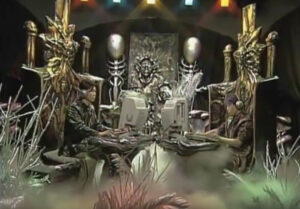
Esports history is made, as two players face off in one of the first Starcraft matches ever to be broadcast on South Korean television, from a kitschy set that looks to have been constructed from the leavings of old Doctor Who episodes.

These first broadcasts corresponded with the release of Brood War, Starcraft’s first and only expansion pack. Its development had been led by the indefatigable Rob Pardo, who used it to iron out the last remaining balance issues in the base game. (“Starcraft [alone] was not a game that could have been an esport,” wrote a super-fan bluntly years later in an online “Brief History of Starcraft.” “It was [too] simple and imbalanced.”)

Now, the stage was set. Realizing he had stumbled upon something with almost unlimited potential, Hwang Hyung Jun put together a full-fledged national Starcraft league in almost no time at all. From the bottom rungs at the level of the local PC bangs, players could climb the ladder all the way to the ultimate showcase, the “Tooniverse Starleague” final, in which five matches were used to determine the best Starcraft player of them all. Surprisingly, when the final was held for the first time in 2000, that player turned out to be a Canadian, a fellow named Guillaume Patry who had arrived in South Korea just the year before.

No matter; the tournament put up ratings that dwarfed those of Tooniverse’s usual programming. Hwang promptly started his own television channel. Called OnGameNet, it was the first in the world to be dedicated solely to videogames and esports. The Starcraft players who were featured on the channel became national celebrities, as did the sportscasters and color commentators: Jung Il Hoon, who looked like a professor and spoke in the stentorian tones of a newscaster; Jeon Yong Jun, whom words sometimes failed when things got really exciting, yielding to wild water-buffalo bellowing; Jung Sorin, a rare woman on the scene, a kindly and nurturing “gamer mom.” Their various shticks may have been calculated, but they helped to make the matches come alive even for viewers who had never played Starcraft for themselves.

A watershed was reached in 2002, when 20,000 screaming fans packed into a Seoul arena to witness that year’s final. The contrast with just a few years before, when a pair of players had dueled on a cheap closed set for the sake of mid-afternoon programming on a third-tier television station, could hardly have been more pronounced. Before this match, a popular rock band known as Cherry Filter put on a concert. Then, accepting their unwonted opening-act status with good grace, the rock stars sat down to watch the showdown between Lim Yo Hwan and Park Jung Seok on the arena’s giant projection screens, just like everyone else in the place. Park, who was widely considered the underdog, wound up winning three matches to one. Even more remarkably, he did so while playing as the Protoss, the least successful of the three factions in professional competitions prior to this point.

Losing the 2002 final didn’t derail Lim Yo Hwan’s career. He went on to become arguably the most successful Starcraft player in history. He was definitely the most popular during the game’s golden age in South Korea. His 2005 memoir, advising those who wanted to follow in his footsteps to “practice relentlessly” and nodding repeatedly to his sponsors — he wrote of opening his first “Shinhan Bank account” as a home for his first winnings — became a bestseller.

Everything was in flux; new tactics and techniques were coming thick and fast, as South Korean players pushed themselves to superhuman heights, the likes of which even the best players at Blizzard could scarcely have imagined. By now, they were regularly performing 250 separate actions per minute in the game.

The scene was rapidly professionalizing in all respects. Big-name corporations rushed in to sponsor individual players and, increasingly, teams, who lived together in clubhouses, neglecting education and all of the usual pleasures of youth in favor of training together for hours on end. The very best Starcraft players were soon earning hundreds of thousands of dollars per year from prize money and their sponsorship deals.

Baseball had long been South Korea’s most popular professional sport. In 2004, 30,000 people attended the baseball final in Seoul. Simultaneously, 100,000 people were packing a stadium in Busan, the country’s second largest city, for the OnGameNet Starcraft final. Judged on metrics like this one, Starcraft had a legitimate claim to the title of most popular sport of all in South Korea. The matches themselves just kept getting more intense; some of the best players were now approaching 500 actions per minute. Maintaining a pace like that required extraordinary reflexes and mental and physical stamina — reflexes and stamina which, needless to say, are strictly the purview of the young. Indeed, the average professional Starcraft player was considered washed up even younger than the average soccer player. Women weren’t even allowed to compete, out of the assumption that they couldn’t possibly be up to the demands of the sport. (They were eventually given a league of their own, although it attracted barely a fraction of the interest of the male leagues — sadly, another thing that Starcraft has in common with most other professional sports.)

Ten years after Starcraft’s original release as just another boxed computer game, it was more popular than ever in South Korea. The PC bangs had by now fallen in numbers and importance, in reverse tandem with the rise in the number of South Korean households with computers and broadband connections of their own. Yet esports hadn’t missed a beat during this transition. Millions of boys and young men still practiced Starcraft obsessively in the hopes of going pro. They just did it from the privacy of their bedrooms instead of from an Internet café.

Starcraft fandom in South Korea grew up alongside the music movement known as K-pop, and shares many attributes with it. Just as K-pop impresarios absorbed lessons from Western boy bands, then repurposed them into something vibrantly and distinctly South Korean, the country’s Starcraft moguls made the game their own; relatively few international tournaments were held, simply because nobody had much chance of beating the top South Korean players. There was an almost manic quality to both K-pop and the professional Starcraft leagues, twin obsessions of a country to which the idea of a disposable income and the consumerism it enables were still fairly new. South Korea’s geographical and geopolitical positions were precarious, perched there on the doorstep of giant China alongside its own intransigent and bellicose mirror image, a totalitarian state hellbent on acquiring nuclear weapons. A mushroom cloud over Seoul suddenly ending the party remained — and remains — a very real prospect for everyone in the country, giving ample reason to live for today. Rather than the decadent hedonism that marked, say, Cold War Berlin, South Korea turned to a pop culture of giddy, madding innocence for relief.

A 2010 match in the Korean Air Headquarters Hangar in Gimpo.

Alas, though, it seems that all forms of sport must eventually pass through a loss of innocence. Starcraft’s equivalent of the 1919 Major League Baseball scandal started with Ma Jae-yoon, a former superstar who by 2010 was struggling to keep up with the ever more demanding standard of play. Investigating persistent rumors that Ma was taking money to throw some of his matches, the South Korean Supreme Prosecutors’ Office found that they were truer than anyone had dared to speculate. Ma stood at the head of a conspiracy with as many tendrils as a Zerg, involving the South Korean mafia and at least a dozen other players. The scandal was front-page news in the country for months. Ma ended up going to prison for a year and being banned for life from South Korean esports. (“Say it ain’t so, Ma!”) His crimes cast a long shadow over the Starcraft scene; a number of big-name sponsors pulled out completely.

The same year as the match-fixing scandal, Blizzard belatedly released Starcraft II: Wings of Liberty. Yet another massive worldwide hit for its parent company, the sequel proved a mixed blessing for South Korean esports. The original Starcraft had burrowed its way deep into the existing players’ consciousnesses; every tiny quirk in the code that Blizzard had written so many years earlier had been dissected, internalized, and exploited. Many found the prospect of starting over from scratch deeply unappealing; perhaps there is space in a lifetime to learn only one game as deeply as millions of South Korean players had learned the first Starcraft. Some put on a brave face and tried to jump over to the sequel, but it was never quite the same. Others swore that they would stop playing the original only when someone pried it out of their cold, dead hands — but that wasn’t the same either. A third, disconcertingly large group decided to move on to some other game entirely, or just to move on with life. By 2015, South Korean Starcraft was a ghost of its old self.

Which isn’t to say that esports as a whole faded away in the country. Rather than Starcraft II, a game called League of Legends became the original Starcraft’s most direct successor in South Korea, capable of filling stadiums with comparable numbers of screaming fans. (As a member of a newer breed known as “multiplayer online battle arena” (MOBA) games, League of Legends is similar to Starcraft in some ways, but very different in others; each player controls only a single unit instead of amassing armies of them.) Meanwhile esports, like K-pop, were radiating out from Asia to become a fixture of global youth culture. The 2017 international finals of League of Legends attracted 58 million viewers all over the world; the Major League Baseball playoffs that year managed just 38 million, the National Basketball Association finals only 32 million. Esports are big business. And with annual growth rates in the double digits in percentage terms, they show every sign of continuing to get bigger and bigger for years to come.

How we feel about all of this is, I fear, dictated to a large extent by the generation to which we happen to belong. (Hasn’t that always been the way with youth culture?) Being a middle-aged man who grew up with digital games but not with gaming as a spectator sport, my own knee-jerk reaction vacillates between amusement and consternation. My first real exposure to esports came not that many years ago, via an under-sung little documentary film called State of Play, which chronicles the South Korean Starcraft scene, fly-on-the-wall style, just as its salad days are coming to an end. Having just re-watched the film before writing this piece, I still find much of it vaguely horrifying: the starry-eyed boys who play Starcraft ten to fourteen hours per day; the coterie of adult moguls and handlers who are clearly making a lot of money by… well, it’s hard for me not to use the words “exploiting them” here. At one point, a tousle-headed boy looks into the camera and says, “We don’t really play for fun anymore. Mostly I play for work. My work just happens to be a game.” That breaks my heart every time. Certainly this isn’t a road that I would particularly like to see any youngster I care about go down. A happy, satisfying life, I’ve long believed, is best built out of a diversity of experiences and interests. Gaming can be one of these, as rewarding as any of the rest, but there’s no reason it should fill more than a couple of hours of anyone’s typical day.

On the other hand, these same objections perchance apply equally to sports of the more conventionally athletic kind. Those sports’ saving grace may be that it’s physically impossible to train at most of them for ten to fourteen hours at a stretch. Or maybe it has something to do with their being intrinsically healthy activities when pursued in moderation, or with the spiritual frisson that can come from being out on the field with grass underfoot and sun overhead, with heart and lungs and limbs all pumping in tandem as they should. Just as likely, though, I’m merely another old man yelling at clouds. The fact is that a diversity of interests is usually not compatible with ultra-high achievement in any area of endeavor.

Anyway, setting the Wayback Machine to 1998 once again, I can at least say definitively that gaming stood on the verge of exploding in unanticipated, almost unimaginable directions at that date. Was Starcraft the instigator of some of that, or was it the happy beneficiary? Doubtless a little bit of both. Blizzard did have a way of always being where the action was…


Did you enjoy this article? If so, please think about pitching in to help me make many more like it. You can pledge any amount you like.


Sources: The books Stay Awhile and Listen, Book II by David L. Craddock and Demystifying Esports by Baro Hyun; Computer Gaming World of May 1997, September 1997, and July 1998; Retro Gamer 170; International Journal of Communication 14; the documentary film State of Play.

Online sources include Soren Johnson’s interview of Rob Pardo for his Designer’s Notes podcast, “Behind the Scenes of Starcraft’s Earliest Days” by Kat Bailey at VG247, and “A Brief History of Starcraft at TL.net.

Starcraft and the Brood War expansion are now available for free at Blizzard’s website.


Tags: , , , ,

A Dialog in Real Time (Strategy)

At the end of the 1990s, the two most popular genres in computer gaming were the first-person shooter and the real-time strategy game. They were so dominant that most of the industry’s executives seemed to want to publish little else. And yet at the beginning of the decade neither genre even existed.

The stories of how the two rose to such heady heights are a fascinating study in contrasts, of how influences in media can either go off like an explosion in a TNT factory or like the slow burn of a long fuse. Sometimes something appears and everyone knows instantly that it’s just changed everything; when the Beatles dropped Sgt. Pepper’s Lonely Hearts Club Band in 1967, there was no doubt that the proverbial goalposts in rock music had just been shifted. Other times, though, influence can take years to make itself felt, as was the case for another album of 1967, The Velvet Underground & Nico, about which Brian Eno would later famously say that it “only sold 10,000 copies, but everyone who bought it formed a band.”

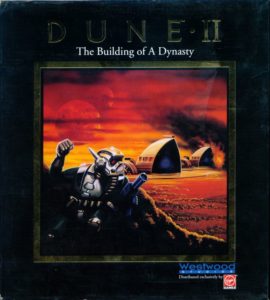
Games are the same. Gaming’s Sgt. Pepper was DOOM, which came roaring up out of the shareware underground at the tail end of 1993 to sweep everything from its path, blowing away all of the industry’s extant conventional wisdom about what games would become and what role they would play in the broader culture. Gaming’s Velvet Underground, on the other hand, was the avatar of real-time strategy, which came to the world in the deceptive guise of a sequel in the fall of 1992. Dune II: The Building of a Dynasty sported its Roman numeral because its transnational publisher had gotten its transatlantic cables crossed and accidentally wound up with two separate games based on Frank Herbert’s epic 1965 science-fiction novelone made in Paris, the other in Las Vegas. The former turned out to be a surprisingly evocative and playable fusion of adventure and strategy game, but it was the latter that would quietly — oh, so quietly in the beginning! — shift the tectonic plates of gaming.

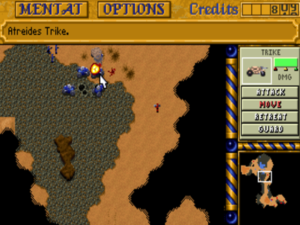
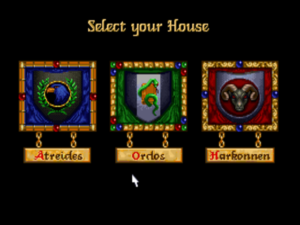
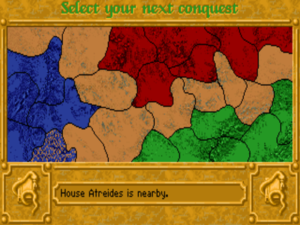
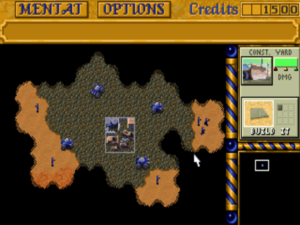
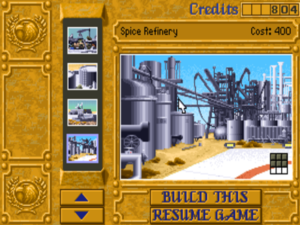
For Dune II, which was developed by Westwood Studios and published by Virgin Games, really was the first recognizable implementation of the genre of real-time strategy as we have come to know it since. You chose one of three warring trading houses to play, then moved through a campaign made up of a series of set-piece scenarios, in which your first goal was always to make yourself an army by gathering resources and using them to build structures that could churn out soldiers, tanks, aircraft, and missiles, all of which you controlled by issuing them fairly high-level orders: “go here,” “harvest there,” “defend this building,” “attack that enemy unit.” Once you thought you were strong enough, you could launch your full-on assault on the enemy — or, if you weren’t quick enough, you might find yourself trying to fend off his attack. What made it so different from most of the strategy games of yore was right there in the name: in the fact that it all played out in real time, at a pace that ranged from the brisk to the frantic, making it a test of your rapid-fire mousemanship and your ability to think on your feet. Bits and pieces of all this had been seen before — perhaps most notably in Peter Molyneux and Bullfrog’s Populous and the Sega Genesis game Herzog Zwei — but Dune II was where it all came together to create a gaming paradigm for the ages.

That said, Dune II was very much a diamond in the rough, a game whose groundbreaking aspirations frequently ran up against the brick wall of its limitations. It’s likely to leave anyone who has ever played almost any other real-time-strategy game seething with frustration. It runs at a resolution of just 320 X 200, giving only the tiniest window into the battlefield; it only lets you select and control one unit at a time, making coordinated attacks and defenses hard to pull off; its scenarios are somewhat rote exercises, differing mainly in the number of enemy hordes they throw against you as you advance through the campaign rather than the nature of the terrain or your objectives. Even its fog of war is wonky: the whole battlefield is blank blackness until one of your units gets within visual range, after which you can see everything that goes on there forevermore, whether any of your units can still lay eyes on it or not. And it has no support whatsoever for the multiplayer free-for-alls that are for many or most players the biggest draw of the genre.

Certainly Virgin had no inkling that they had a nascent ludic revolution on their hands. They released Dune II with more of a disinterested shrug than a fulsome fanfare, having expended most of their promotional energies on the other Dune, which had come out just a few months earlier. It’s a testimony to the novelty of the gameplay experience that it did as well as it did. It didn’t become a massive hit, but it sold well enough to earn its budget back and then some on the strength of reasonably positive reviews — although, again, no reviewer had the slightest notion that he was witnessing the birth of what would be one of the two hottest genres in gaming six years in the future. Even Westwood seemed initially to regard Dune II as a one-and-done. They wouldn’t release another game in the genre they had just invented for almost three years.

But the gaming equivalent of all those budding bedroom musicians who listened to that Velvet Underground record was also out there in the case of Dune II. One hungry, up-and-coming studio in particular decided there was much more to be done with the approach it had pioneered. And then Westwood themselves belatedly jumped back into the fray. Thanks to the snowball that these two studios got rolling in earnest during the mid-1990s, the field of real-time strategy would be well and truly saturated by the end of the decade, the yin to DOOM‘s yang. This, then, is the tale of those first few years of these two studios’ competitive dialog, over the course of which they turned the real-time strategy genre from a promising archetype into one of gaming’s two biggest, slickest crowd pleasers.


Blizzard Studios is one of the most successful in the history of gaming, so much so that it now lends its name to the Activision Blizzard conglomerate, with annual revenues in the range of $7.5 billion. In 1993, however, it was Westwood, flying high off the hit dungeon crawlers Eye of the Beholder and Lands of Lore, that was by far the more recognizable name. In fact, Blizzard wasn’t even known yet as Blizzard.

The company had been founded in late 1990 by Allen Adham and Mike Morhaime, a couple of kids fresh out of university, on the back of a $15,000 loan from Morhaime’s grandmother. They called their venture Silicon & Synapse, setting it up in a hole-in-the-wall office in Costa Mesa, California. They kept the lights on initially by porting existing games from one platform to another for publishers like Interplay — the same way, as it happened, that Westwood had gotten off the ground almost a decade before. And just as had happened for Westwood, Silicon & Synapse gradually won opportunities to make their own games once they had proven themselves by porting those of others. First there was a little auto-racing game for the Super Nintendo called RPM Racing, then a pseudo-sequel to it called Rock ‘n’ Roll Racing, and then a puzzle platformer called The Lost Vikings, which appeared for the Sega Genesis, MS-DOS, and the Commodore Amiga in addition to the Super Nintendo. None of these titles took the world by storm, but they taught Silicon & Synapse what it took to create refined, playable, mass-market videogames from scratch. All three of those adjectives have continued to define the studio’s output for the past 30 years.

It was now mid-1993; Silicon & Synapse had been in business for more than two and a half years already. Adham and Morhaime wanted to do something different — something bigger, something that would be suitable for computers only rather than the less capable consoles, a real event game that would get their studio’s name out there alongside the Westwoods of the world. And here there emerged another of their company’s future trademarks: rather than invent something new from whole or even partial cloth, they decided to start with something that already existed, but make it better than ever before, polishing it until it gleamed. The source material they chose was none other than Westwood’s Dune II, now relegated to the bargain bins of last year’s releases, but a perennial after-hours favorite at the Silicon & Synapse offices. They all agreed as to the feature they most missed in Dune II: a way to play it against other people, like you could its ancestor Populous. The bane of most multiplayer strategy games was their turn-based nature, which left you waiting around half the time while your buddy was playing. Real-time strategy wouldn’t have this problem of downtime.

That became the design brief for Warcraft: Orcs & Humans: remake Dune II but make it even better, and then add a multiplayer feature. And then, of course, actually try to sell the thing in all the ways Virgin had not really tried to sell its inspiration.

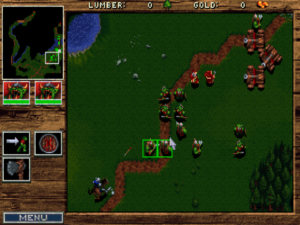
To say that Warcraft was heavily influenced by Dune II hardly captures the reality. Most of the units and buildings to hand have a direct correspondent in Westwood’s game. Even the menu of icons on the side of the screen is a virtual carbon copy — or at least a mirror image. “I defensively joked that, while Warcraft was certainly inspired by Dune II, [our] game was radically different,” laughs Patrick Wyatt, the lead programmer and producer on the project. “Our radar mini-map was in the upper left corner of the screen, whereas theirs was in the bottom right corner.”

In the same spirit of change, Silicon & Synapse replaced the desert planet of Arrakis with a fantasy milieu pitting, as the subtitle would suggest, orcs against humans. The setting and the overall look of Warcraft owe almost as much to the tabletop miniatures game Warhammer as the gameplay does to Dune II; a Warhammer license was seriously considered, but ultimately rejected as too costly and potentially too restrictive. Years later, Wyatt’s father would give him a set of Warhammer miniatures he’d noticed in a shop: “I found these cool toys and they reminded me a lot of your game. You might want to have your legal department contact them because I think they’re ripping you off.”

Suffice to say, then, that Warcraft was even more derivative than most computer games. The saving grace was the same that it would ever be for this studio: that they executed their mishmash of influences so well. The squishy, squint-eyed art is stylized like a cartoon, a wise choice given that the game is still limited to a resolution of just 320 X 200, so that photo-realism is simply not on the cards. The overall look of Warcraft has more in common with contemporary console games than the dark, gritty aesthetic that was becoming so popular on computers. The guttural exclamations of the orcs and the exaggerated Monty Python and the Holy Grail-esque accents of the humans, all courtesy of regular studio staffers rather than outside voice actors, become a chorus line as you order them hither and yon, making Dune II seem rather stodgy and dull by comparison. “We felt too many games took themselves too seriously,” says Patrick Wyatt. “We just wanted to entertain people.”

Slavishly indebted though it is to Dune II in all the broad strokes, Warcraft doesn’t neglect to improve on its inspiration in those nitty-gritty details that can make the difference between satisfaction and frustration for the player. It lets you select up to four units and give them orders at the same time by simply dragging a box around them, a quality-of-life addition whose importance is difficult to overstate, one so fundamental that no real-time-strategy game from this point forward would dare not to include it. Many more keyboard shortcuts are added, a less technically impressive addition but one no less vital to the cause of playability when the action starts to heat up. There are now two resources you need to harvest, lumber and gold, in places of Dune II‘s all-purpose spice. Units are now a little more intelligent about interpreting your orders, such that they no longer blithely ignore targets of opportunity, or let themselves get mauled to death without counterattacking just because you haven’t explicitly told them to. Scenario design is another area of marked improvement: whereas every Dune II scenario is basically the same drill, just with ever more formidable enemies to defeat, Warcraft‘s are more varied and arise more logically out of the story of the campaign, including a couple of special scenarios with no building or gathering at all, where you must return a runaway princess to the fold (as the orcs) or rescue a stranded explorer (as the humans).

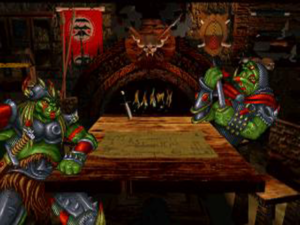
The orc on the right who’s stroking his “sword” looks so very, very wrong — and this screenshot doesn’t even show the animation…

And, as the cherry on top, there was multiplayer support. Patrick Wyatt finished his first, experimental implementation of it in June of 1994, then rounded up a colleague in the next cubicle over so that they could became the first two people ever to play a full-fledged real-time-strategy game online. “As we started the game, I felt a greater sense of excitement than I’d ever known playing any other game,” he says.

It was just this magic moment, because it was so invigorating to play against a human and know that it wasn’t some stupid AI. It was a player who was smart and doing his absolute best to crush you. I knew we were making a game that would be fun, but at that moment I knew the game would absolutely kick ass.

While work continued on Warcraft, the company behind it was going through a whirlwind of changes. Recognizing at long last that “Silicon & Synapse” was actually a pretty terrible name, Adham and Morhaime changed it to Chaos Studios, which admittedly wasn’t all that much better, in December of 1993. Two months later, they got an offer they couldn’t refuse: Davidson & Associates, a well-capitalized publisher of educational software that was looking to break into the gaming market, offered to buy the freshly christened Chaos for the princely sum of $6.75 million. It was a massive over-payment for what was in all truth a middling studio at best, such that Adham and Morhaime felt they had no choice but to accept, especially after Davidson vowed to give them complete creative freedom. Three months after the acquisition, the founders decided they simply had to find a decent name for their studio before releasing Warcraft, their hoped-for ticket to the big leagues. Adham picked up a dictionary and started leafing through it. He hit pay dirt when his eyes flitted over the word “blizzard.” “It’s a cool name! Get it?” he asked excitedly. And that was that.

So, Warcraft hit stores in time for the Christmas of 1994, with the name of “Blizzard Entertainment” on the box as both its developer and its publisher — the wheels of the latter role being greased by the distributional muscle of Davidson & Associates. It was not immediately heralded as a game that would change everything, any more than Dune II had been; real-time strategy continued to be more of a slowly growing snowball than the ton of bricks to the side of the head that the first-person shooter had been. Computer Gaming World magazine gave Warcraft a cautious four stars out of five, saying that “if you enjoy frantic real-time games and if you don’t mind a linear structure in your strategic challenges, Warcraft is a good buy.” At the same time, the extent of the game’s debt to Dune II was hardly lost on the reviewer: “It’s a good thing for Blizzard that there’s no precedent for ‘look and feel’ lawsuits in computer entertainment.”[1]This statement was actually not correct; makers of standup arcade games of the classic era and the makers of Tetris had successfully cowed the cloning competition in the courts.

Warcraft would eventually sell 400,000 units, bettering Dune II‘s numbers by a factor of four or more. As soon as it became clear that it was doing reasonably well, Blizzard started on a sequel.


Out of everyone who looked at Warcraft, no one did so with more interest — or with more consternation at its close kinship with Dune II — than the folks at Westwood. “When I played Warcraft, the similarities between it and Dune II were pretty… blatant, so I didn’t know what to think,” says the Westwood designer Adam Isgreen. Patrick Wyatt of Blizzard got the impression that his counterparts “weren’t exactly happy” at the slavish copying when they met up at trade shows, though he “reckoned they should have been pleased that we’d taken their game as a base for ours.” Only gradually did it become clear why Warcraft‘s existence was a matter of such concern for Westwood: because they themselves had finally decided to make another game in the style of Dune II.

The game that Westwood was making could easily have wound up looking even more like the one that Blizzard had just released. The original plan was to call it Command & Conquer: Fortress of Stone and to set it in a fantasy world. (Westwood had been calling their real-time-strategy engine “Command & Conquer” since the days of promoting Dune II.) “It was going to have goldmines and wood for building things. Sound familiar?” chuckles Westwood’s co-founder Louis Castle. “There were going to be two factions, humans and faerie folk… pretty fricking close to orcs versus humans.”

Some months into development, however, Westwood decided to change directions, to return to a science-fictional setting closer to that of Dune II. For they wanted their game to be a hit, and it seemed to them that fantasy wasn’t the best guarantee of such a thing: CRPGs were in the doldrums, and the most recent big strategy release with a fantasy theme, MicroProse’s cult-classic-to-be Master of Magic, hadn’t done all that well either. Foreboding near-future stories, however, were all the rage; witness the stellar sales of X-COM, another MicroProse strategy game of 1994. “We felt that if we were going to make something that was massive,” says Castle, “it had to be something that anybody and everybody could relate to. Everybody understands a tank; everybody understands a guy with a machine gun. I don’t have to explain to them what this spell is.” Westwood concluded that they had made the right decision as soon as they began making the switch in software: “Tanks and vehicles just felt better.” The game lost its subtitle to become simply Command & Conquer.

While the folks at Blizzard were plundering Warhammer for their units and buildings, those at Westwood were trolling the Jane’s catalogs of current military hardware and Soldier of Fortune magazine. “We assumed that anything that was talked about as possibly coming was already here,” says Castle, “and that was what inspired the units.” The analogue of Dune II‘s spice — the resource around which everything else revolved — became an awesomely powerful space-born element come to earth known as tiberium.

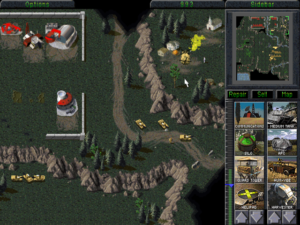
Westwood included most of the shortcuts and conveniences that Blizzard had built into Warcraft, but went one or two steps further more often than not. For example, they also made it possible to select multiple units by dragging a box around them, but in their game there was no limit to the number of units that could be selected in this way. The keyboard shortcuts they added not only let you quickly issue commands to units and buildings, but also jump around the map instantly to custom viewpoints you could define. And up to four players rather than just two could now play together at once over a local network or the Internet, for some true mayhem. Then, too, scenario design was not only more varied than in Dune II but was even more so than in Warcraft, with a number of “guerilla” missions in the campaigns that involved no resource gathering or construction. It’s difficult to say to what extent these were cases of parallel innovation and to what extent they were deliberate attempts to one-up what Warcraft had done. It was probably a bit of both, given that Warcraft was released a good nine months before Command & Conquer, giving Westwood plenty of time to study it.

But other innovations in Command & Conquer were without any precedent. The onscreen menus could now be toggled on and off, for instance, a brilliant stroke that gave you a better view of the battlefield when you really needed it. Likewise, Westwood differentiated the factions in the game in a way that had never been done before. Whereas the different houses in Dune II and the orcs and humans in Warcraft corresponded almost unit for unit, the factions in Command & Conquer reflected sharply opposing military philosophies, demanding markedly different styles of play: the establishment Global Defense Initiative had slow, strong, and expensive units, encouraging a methodical approach to building up and husbanding your forces, while the terroristic Brotherhood of Nod had weaker but faster and cheaper minions better suited to madcap kamikaze rushes than carefully orchestrated combined-arms operations.

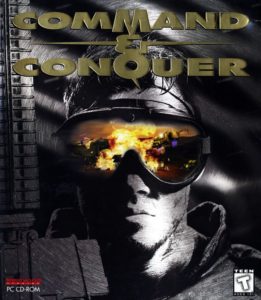
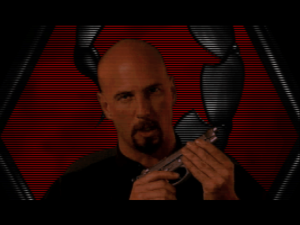
Yet the most immediately obvious difference between Command & Conquer and Warcraft was all the stuff around the game. Warcraft had been made on a relatively small budget with floppy disks in mind. It sported only a brief opening cinematic, after which scenario briefings consisted of nothing but scrolling text and a single voice over a static image. Command & Conquer, by contrast, was made for CD-ROM from the outset, by a studio with deeper pockets that had invested a great deal of time and energy into both 3D animation and full-motion video, that trendy art of incorporating real-world actors and imagery into games. The much more developed story line of Command & Conquer is forwarded by little between-mission movies that, if not likely to make Steven Spielberg nervous, are quite well-done for what they are, featuring as they do mostly professional performers — such as a local Las Vegas weatherman playing a television-news anchorman — who were shot by a real film crew in Westwood’s custom-built blue-screen studio. Westwood’s secret weapon here was Joseph Kucan, a veteran theater director and actor who oversaw the film shoots and personally played the charismatic Nod leader Kane so well that he became the very face of Command & Conquer in the eyes of most gamers, arguably the most memorable actual character ever associated with a genre better known for its hordes of generic little automatons. Louis Castle reckons that at least half of Command & Conquer‘s considerable budget went into the cut scenes.

The game was released with high hopes in August of 1995. Computer Gaming World gave it a pretty good review, four stars out of five: “The entertainment factor is high enough and the action fast enough to please all but the most jaded wargamers.”

The gaming public would take to it even more than that review might imply. But in the meantime…


As I noted in an earlier article, numbered sequels weren’t really commonplace for strategy games prior to the mid-1990s. Blizzard had originally imagined Warcraft as a strategy franchise of a different stripe: each game bearing the name would take the same real-time approach into a completely different milieu, as SSI was doing at the time with their “5-Star General” series of turn-based strategy games that had begun with Panzer General and continued with the likes of Fantasy General and Star General. But Blizzard soon decided to make their sequel a straight continuation of the first game, an approach to which real-time strategy lent itself much more naturally than more traditional styles of strategy game; the set-piece story of a campaign could, after all, always be continued using all the ways that Hollywood had long since discovered for keeping a good thing going. The only snafu was that either the orcs or the humans could presumably have won the war in the first game, depending on which side the player chose. No matter: Blizzard decided the sequel would be more interesting if the orcs had been the victors and ran with that.

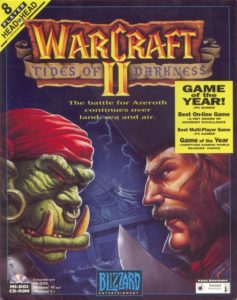
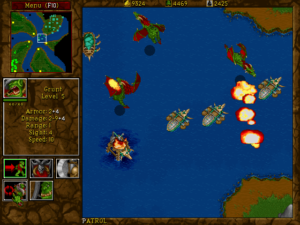
Which isn’t to say that building upon its predecessor’s deathless fiction was ever the real point of Warcraft II: Tides of Darkness. Blizzard knew now that they had a competitor in Westwood, and were in any case eager to add to the sequel all of the features and ideas that time had not allowed them to include in the first game. There would be waterways and boats to sail on them, along with oil, a third resource, one that could only be mined at sea. Both sides would get new units to play with, while elves, dwarves, trolls, ogres, and goblins would join the fray as allies of one of the two main racial factions. The interface would be tweaked with another welcome shortcut: selecting a unit and right-clicking somewhere would cause it to carry out the most logical action there without having to waste time choosing from a menu. (After all, if you selected a worker unit and sent him to a goldmine, you almost certainly wanted him to start collecting gold. Why should you have to tell the game the obvious in some more convoluted fashion?)

But perhaps the most vital improvement was in the fog of war. The simplistic implementations of same seen in the first Warcraft and Command & Conquer were inherited from Dune II: areas of the map that had been seen once by any of your units were revealed permanently, even if said units went away or were destroyed. Blizzard now made it so that you would see only a back-dated snapshot of areas currently out of your units’ line of sight, reflecting what was there the last time one of your units had eyes on them. This innovation, no mean feat of programming on the part of Patrick Wyatt, brought a whole new strategic layer to the game. Reconnaissance suddenly became something you had to think about all the time, not just once.

Other improvements were not so conceptually groundbreaking, but no less essential for keeping ahead of the Joneses (or rather the Westwoods). For example, Blizzard raised the screen-resolution stakes, from 320 X 200 to 640 X 480, even as they raised the number of people who could play together online from Command & Conquer‘s four to eight. And, while there was still a limit on the number of units you could select at one time using Blizzard’s engine, that limit at least got raised from the first Warcraft‘s four to nine.

The story and its presentation, however, didn’t get much more elaborate than last time out. While Westwood was hedging its bets by keeping one foot in the “interactive movie” space of games like Wing Commander III, Blizzard was happy to “just” make Warcraft a game. The two series were coming to evince very distinct personalities and philosophies, just as gamers were sorting themselves into opposing groups of fans — with a large overlap of less partisan souls in between them, of course.

Released in December of 1995, Warcraft II managed to shake Computer Gaming World free of some of its last reservations about the burgeoning genre of real-time strategy, garnering four and a half stars out of five: “If you enjoy fantasy gaming, then this is a sure bet for you.” It joined Command & Conquer near the top of the bestseller lists, becoming the game that well and truly made Blizzard a name to be reckoned with, a peer in every sense with Westwood.

Meanwhile, and despite the sometimes bitter rivalry between the two studios and their fans, Command & Conquer and Warcraft II together made real-time strategy into a commercial juggernaut. Both games became sensations, with no need to shirk from comparison to even DOOM in terms of their sales and impact on the culture of gaming. Each eventually sold more than 3 million copies, numbers that even the established Westwood, much less the upstart Blizzard, had never dreamed of reaching before, enough to enshrine both games among the dozen or so most popular computer games of the entire 1990s. More than three years after real-time strategy’s first trial run in Dune II, the genre had arrived for good and all. Both Westwood and Blizzard rushed to get expansion packs of additional scenarios for their latest entries in the genre to market, even as dozens of other developers dropped whatever else they were doing in order to make real-time-strategy games of their own. Within a couple of years, store shelves would be positively buckling under the weight of their creations — some good, some bad, some more imaginative, some less so, but all rendered just a bit anonymous by the sheer scale of the deluge. And yet even the most also-ran of the also-rans sold surprisingly well, which explained why they just kept right on coming. Not until well into the new millennium would the tide begin to slacken.


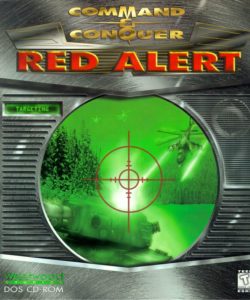
With Command & Conquer and Warcraft II, Westwood and Blizzard had arrived at an implementation of real-time strategy that even the modern player can probably get on with. Yet there is one more game that I just have to mention here because it’s so loaded with a quality that the genre is known for even less than its characters: that of humor. Command & Conquer: Red Alert is as hilarious as it is unexpected, the only game of this style that’s ever made me laugh out loud.

Red Alert was first envisioned as a scenario pack that would move the action of its parent game to World War II. But two things happened as work progressed on it: Westwood decided it was different enough from the first game that it really ought to stand alone, and, as designer Adam Isgreen says, “we found straight-up history really boring for a game.” What they gave us instead of straight-up history is bat-guano insane, even by the standards of videogame fictions.

We’re in World War II, but in a parallel timeline, because Albert Einstein — why him? I have no idea! — chose to travel back in time on the day of the Trinity test of the atomic bomb and kill Adolf Hitler. Unfortunately, all that’s accomplished is to make world conquest easier for Joseph Stalin. Now Einstein is trying to save the democratic world order by building ever more powerful gadgets for its military. Meanwhile the Soviet Union is experimenting with the more fantastical ideas of Nikola Tesla, which in this timeline actually work. So, the battles just keep getting crazier and crazier as the game wears on, with teleporters sending units jumping instantly from one end of the map to the other, Tesla coils zapping them with lightning, and a fetching commando named Tanya taking out entire cities all by herself when she isn’t chewing the scenery in the cut scenes. Those actually display even better production values than the ones in the first game, but the script has become pure, unadulterated camp worthy of Mel Brooks, complete with a Stalin who ought to be up there singing and dancing alongside Der Führer in Springtime for Hitler. Even our old friend Kane shows up for a cameo. It’s one of the most excessive spectacles of stupidity I’ve ever seen in a game… and one of the funniest.

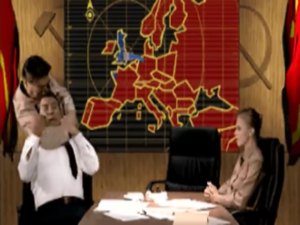
Joseph Stalin gets rough with an underling. When you don’t have the Darth Vader force grip, you have to do things the old-fashioned way…

Up there at the top is the killer commando Tanya, who struts across the battlefield with no regard for proportion.

Released in the dying days of 1996, Red Alert didn’t add that much that was new to the real-time-strategy template, technically speaking; in some areas such as fog of war, it still lagged behind the year-old Warcraft II. Nonetheless, it exudes so much joy that it’s by far my favorite of the games I’ve written about today. If you ask me, it would have been a better gaming world had the makers of at least a few of the po-faced real-time-strategy games that followed looked here for inspiration. Why not? Red Alert too sold in the multiple millions.


Did you enjoy this article? If so, please think about pitching in to help me make many more like it. You can pledge any amount you like.


(Sources: the book Stay Awhile and Listen, Book I by David L. Craddock; Computer Gaming World of January 1995, March 1995, December 1995, March 1996, June 1996, September 1996, December 1996, March 1997, June 1997, and July 1997; Retro Gamer 48, 111, 128, and 148; The One of January 1993; the short film included with the Command & Conquer: The First Decade game collection. Online sources include Patrick Wyatt’s recollections at his blog Code of Honor, Dan Griliopoulos’s collection of interviews with Westwood alumni at Funambulism, Soren Johnson’s interview with Louis Castle for his Designer’s Notes podcast, and Richard Moss’s real-time-strategy retrospective for Ars Technica.

Warcraft: Orcs & Humans and Warcraft II: Tides of Darkness, are available as digital purchases at GOG.com. The first Command & Conquer and Red Alert are available in remastered versions as a bundle from Steam.)

Footnotes

Footnotes
1 This statement was actually not correct; makers of standup arcade games of the classic era and the makers of Tetris had successfully cowed the cloning competition in the courts.
 

Tags: , , , , , ,

Controlling the Spice, Part 3: Westwood’s Dune

Brett Sperry and Louis Castle

Louis Castle first became friends with Brett Sperry in 1982, when the two were barely out of high school. Castle was selling Apple computers at the time at a little store in his native Las Vegas, and Sperry asked him to print out a file for him. “I owned a printer, so I invited him over,” remembers Castle, “and he looked at some animation and programming I was working on.”

They found they had a lot in common. They were both Apple II fanatics, both talented programmers, and both go-getters accustomed to going above and beyond what was expected of them. Through Castle’s contacts at the store — the home-computer industry was quite a small place back then — they found work as contract programmers, porters who moved software from one platform to another. It wasn’t the most glamorous job in the industry, but, at a time when the PC marketplace was fragmented into close to a dozen incompatible platforms, it was certainly a vital one. Sperry and Castle eventually came to specialize in the non-trivial feat of moving slick action games such as Dragonfire and Impossible Mission from the Commodore 64 to the far less audiovisually capable Apple II without sacrificing all of their original appeal.

In March of 1985, they decided to give up working as independent contractors and form a real company, which they named Westwood Associates. The “Westwood” came from the trendy neighborhood of Los Angeles, around the UCLA campus, where they liked to hang out when they drove down from Las Vegas of a weekend. “We chose Westwood as the company name,” says Castle, “to capture some of the feeling of youthful energy and Hollywood business.” The “Associates,” meanwhile, was nicely non-specific, meaning they could easily pivot into other kinds of software development if the games work should dry up for some reason. (The company would become known as Westwood Studios in 1992, by which time it would be pretty clear that no such pivot would be necessary.)

The story of Westwood’s very first project is something of a harbinger of their future. Epyx hired them to port the hoary old classic Temple of Apshai to the sexy new Apple Macintosh, and Sperry and Castle got a bit carried away. They converted the game from a cerebral turn-based CRPG to a frenetic real-time action-adventure, only to be greeted with howls of protest from their employers. “Epyx felt,” remembers Castle with no small sense of irony, “that gamers would not want to make complicated tactical and strategic decisions under pressure.” More sensibly, Epyx noted that Westwood had delivered not so much a port as a different game entirely, one they couldn’t possibly sell as representing the same experience as the original. So, they had to begrudgingly switch it back to turn-based.

This blind alley really does have much to tell us about Westwood’s personality. Asked many years later what common thread binds together their dizzily eclectic catalog of games, Louis Castle hit upon real-time gameplay as the one reasonable answer. This love of immediacy would translate, as we’ll soon see, into the invention of a whole new genre known as real-time strategy, which would become one of the most popular of them all by the end of the 1990s.

But first, there were more games to be ported. Having cut their teeth making Commodore 64 games work within the constraints of the Apple II, they now found themselves moving them in the other direction: “up-porting” Commodore 64 hits like Super Cycle and California Games to the Atari ST and Commodore Amiga. Up-porting was in its way as difficult as down-porting; owners of those more expensive 16-bit machines expected their capabilities to be used to good effect, even by games that had originated on more humble platforms, and complained loudly at straight, vanilla ports that still looked like they were running on an 8-bit computer. Westwood became one of the best in the industry at a very tricky task, not so much porting their source games in any conventional sense as remaking them, with dramatically enhanced graphics and sound. They acquired a reputation for technical excellence, particularly when it came to their compression systems, which allowed them to pack their impressive audiovisuals into very little space and stream them in quickly from disk. And they made good use of the fact that the Atari ST and Amiga were both built around the same Motorola 68000 CPU by developing a library for the Amiga which translated calls to the ST’s operating system into their Amiga equivalents on the fly; thus they could program a game for the ST and get the same code running on the Amiga with very few changes. If you wanted an 8-to-16-bit port done efficiently and well, you knew you could count on Westwood.

Although they worked with quite a number of publishers, Westwood cultivated a particularly close relationship with SSI, a publisher of hardcore wargames who badly needed whatever pizazz Sperry and Castle’s flashier aesthetic could provide. When SSI wanted to convince TSR to give them the hugely coveted Dungeons & Dragons license in 1987, they hired Westwood to create some of the graphics demos for their presentation. The pitch worked; staid little SSI shocked the industry by snatching the license right out from under the noses of heavier hitters like Electronic Arts. Westwood remained SSI’s most trusted partner thereafter. They ported the  “Gold Box” line of Dungeons & Dragons CRPGs to the Atari ST and Amiga with their usual flair, adding mouse support and improving the graphics, resulting in what many fans consider to be the best versions of all.

Unfortunately, Westwood’s technical excellence wasn’t always paired with equally good design sense when they occasionally got a chance to make an original game of their own. Early efforts like Mars Saga, Mines of Titan, Questron II, and BattleTech: The Crescent Hawk’s Inception all have a lot of ideas that aren’t fully worked through and never quite gel, along with third acts that fairly reek of, “We’re out of time and money, and now we just have to get ‘er done.” Ditto the first two original games they did for SSI under the Dungeons & Dragons license: the odd California Games/Gold Box mashup Hillsfar and the even odder dragon flight simulator Dragon Strike.

Still, Brett Sperry and Louis Castle were two very ambitious young men, and neither was willing to settle for the anonymous life of a strict porting house. Nor did such a life make good business sense: with the North American market at least slowly coalescing around MS-DOS machines, it looked like porting houses might soon have no reason to exist. The big chance came when Sperry and Castle convinced SSI to let them make a full-fledged Dungeons & Dragons CRPG of their own — albeit one that would be very different from the slow-paced, turn-based Gold Box line. Westwood’s take on the concept would run in — you guessed it — real time, borrowing much from FTL’s Dungeon Master, one of the biggest sensations of the late 1980s on the Atari ST and Amiga. The result was Eye of the Beholder.

At the time of the game’s release in February of 1991, FTL had yet to publish an MS-DOS port of Dungeon Master. Eye of the Beholder was thus the first real-time dungeon crawl worth its salt to become available on North America’s computer-gaming platform of choice, and this fact, combined with the Dungeons & Dragons logo on the box, yielded sales of 130,000 copies in the United States alone — a sales figure far greater than that of any previous original Westwood game, greater even than all but the first two of SSI’s flagship Gold Box line. The era of Westwood as primarily a porting house had passed.


Over at Virgin Games, the indefatigable Martin Alper, still looking to make a splash in the American market, liked what he saw in Westwood, this hot American developer who clearly knew how to make the sorts of games Americans wanted to buy. And yet they were also long-established experts at getting the most out of the Amiga, Europe’s biggest gaming computer; Westwood would do their own port of Eye of the Beholder to the Amiga, in which form it would sell in considerable numbers in Europe as well. Such a skill set made the little Las Vegas studio immensely attractive to this executive of Virgin, a company of truly global reach and vision.

Alper knew as soon as he saw Eye of the Beholder that he wanted to make Westwood a permanent part of the Virgin empire, but, not wanting to spook his target, he approached them initially only to ask them to develop a game for him. As far as Alper or anyone else outside Virgin’s French subsidiary knew at this point, the Cryo Dune game was dead. But Alper hadn’t gone to all the trouble of securing the license not to use it. In April of 1991 — just one month before the departure of Jean-Martial Lefranc from Virgin Loisirs, combined with a routine audit, would bring the French Dune conspiracy to light — Alper signed Westwood to make a Dune game of their own. It wasn’t hard to convince them to take it on; it turned out that Dune was Brett Sperry’s favorite novel of all time.

Even better, Westwood, perhaps influenced by their association with the turn-based wargame mavens at SSI, had already been playing around with ideas for a real-time (of course!) game of military conflict. “It was an intellectual puzzle for me,” says Sperry. “How can we take this really small wargame category, bring in some fresh ideas, and make it a fun game that more gamers can play?” The theme was originally to be fantasy. But, says Louis Castle, “when Virgin offered up the Dune license, that sealed our fate and pulled us away from a fantasy theme.”

Several months later, after Martin Alper reluctantly concluded that Cryo’s Dune had already cost too much money and had too much potential of its own to cancel, he found himself with quite a situation on his hands. Westwood’s Dune hadn’t been in development anywhere near as long as Cryo’s, but he was already loving what he had seen of it, and was equally unwilling to cancel that project. In an industry where the average game frankly wasn’t very good at all, having two potentially great ones might not seem like much of a problem. For Virgin’s marketers, however, it was a nightmare. Their solution, which pleased neither Cryo nor Westwood much at all, was to bill the latter’s game as a sequel to the former’s, naming it Dune II: The Building of a Dynasty.

Westwood especially had good reason to feel disgruntled. They were understandably concerned that saddling their fresh, innovative new game with the label of sequel would cause it to be overlooked. The fact was, the sequel billing made no sense whatsoever, no matter how you looked at it. While both games were, in whole or in part, strategy games that ran in real time, their personalities were otherwise about as different as it was possible for two games to be. By no means could one imagine a fan of Cryo’s plot-heavy, literary take on Dune automatically embracing Westwood’s action-heavy, militaristic effort. Nor did the one game follow on from the other in the sense of plot chronology; both games depict the very same events from the novel, albeit with radically different sensibilities.

The press too was shocked to learn that a sequel to Cryo’s Dune was due to be released the very same year as its predecessor. “This has got to be a new world record for the fastest ever followup,” wrote the British gaming magazine The One a few weeks after the first Dune‘s release. “Unlike the more adventure-based original, Dune II is expected to be more of a managerial experience comparable to (if anything) the likes of SimCity, as the two warring houses of Atreides and Harkonnen attempt to mine as much spice as possible and blow each other up at the same time.”

The Westwood Studios team who made Dune II. On the front row are Ren Olsen and Dwight Okahara; on the middle row are Judith Peterson, Joe Bostic, Donna Bundy, and Aaron Powell; on the back row are Lisa Ballan and Scott Bowen. Of this group, Bostic and Powell were the game’s official designers, and thus probably deserve the most credit for inventing the genre of real-time strategy. Westwood’s co-founder Brett Sperry also played a critical — perhaps the critical — conceptual role.

It was, on the whole, about as good a description of Dune II as any that appeared in print at the time. Not only was the new game dramatically different from its predecessor, but it wasn’t quite like anything at all which anyone had ever seen before, and coming to grips with it wasn’t easy. Legend has it that Brett Sperry started describing Dune II in shorthand as “real-time strategy” very early on, thus providing a new genre with its name. If so, though, Virgin’s marketers didn’t get the memo. They would struggle mightily to describe the game, and what they ended up with took unwieldiness to new heights: a “strategy-based resource-management simulation with a heavy real-time combat element.” Whew! “Real-time strategy” does have a better ring to it, doesn’t it?

These issues of early taxonomy, if you will, are made intensely interesting by Dune II‘s acknowledged status as the real-time-strategy urtext. That is to say that gaming histories generally claim, correctly on the whole in my opinion, that it was the first real-time strategy game ever.

Yet we do need to be careful with our semantics here. There were actually hundreds of computerized strategy games prior to Dune II which happened to be played in real time, not least among them Cryo’s Dune. The neologism of “real-time strategy” (“RTS”) — like, say, those of “interactive fiction” or even “CRPG” — has a specific meaning separate from the meanings of the individual words which comprise it. It has come to denote a very specific type of game — a game that, yes, runs in real time, but also one where players start with a largely blank slate, gather resources, and use them to build a variety of structures. These structures can in turn build military units who can carry out simple orders of the “attack there” or “defend this” stripe autonomously. The whole game plays on an accelerated time scale which yields bursts if not sustained plateaus of activity as frantic as any action game. This combination of qualities is what Westwood invented, not the abstract notion of a strategy game played in real time rather than turns.

Of course, all inventions stand on the shoulders of those that came before, and RTS is no exception. It can be challenging to trace the bits and pieces which would gel together to become Dune II only because there are so darn many of them.

Utopia

The earliest strategy game to replace turns with real time may have been Utopia, an abstract two-player game of global conquest designed and programmed by Don Daglow for the Intellivision console in 1982. The same year, Dan Bunten’s [1]Dan Bunten died in 1998 as the woman Danielle Bunten Berry. As per my usual editorial policy on these matters, I refer to her as “he” and by her original name only to avoid historical anachronisms and to stay true to the context of the times. science-fiction-themed Cytron Masters and Chris Crawford’s Roman-themed Legionnaire became the first computer-based strategy games to discard the comfortable round of turns for something more stressful and exciting. Two years later, Brøderbund’s very successful The Ancient Art of War exposed the approach to more players than ever before.

In 1989, journalists started talking about a new category of “god game” in the wake of Will Wright’s SimCity and Peter Molyneux’s Populous. The name derived from the way that these games cast you as a god able to control your people only indirectly, by altering their city’s infrastructure in SimCity or manipulating the terrain around them in Populous. This control was accomplished in real time. While, as we’ve seen, this in itself was hardly a new development, the other innovations of these landmark games were as important to the eventual RTS genre as real time itself. No player can possibly micromanage an army of dozens of units in real time — at least not if the clock is set to run at anything more than a snail’s pace. For the RTS genre as we’ve come to know it to function, units must have a degree of autonomous artificial intelligence, must be able to carry out fairly abstract orders and react to events on the ground in the course of doing so. SimCity and Populous demonstrated for the first time how this could work.

By 1990, then, god games had arrived at a place that already bore many similarities to the RTS games of today. The main things still lacking were resource collecting and building. And even these things had to some extent already been done in non-god games: a 1987 British obscurity called Nether Earth demanded that you build robots in your factory before sending them out against your enemy, although there was no way of building new structures beyond your starting factory. Indeed, even the multiplayer death matches that would come to dominate so much of the RTS genre a generation later had already been pioneered before 1990, perhaps most notably in Dan Bunten’s 1988 game Modem Wars.

Herzog Zwei

But the game most often cited as an example of a true RTS in form and spirit prior to Dune II, if such a thing is claimed to exist at all, is one called Herzog Zwei, created by the Japanese developer Technosoft and first published for the Sega Genesis console in Japan in 1989. And yet Herzog Zwei‘s status as an alternative RTS urtext is, at the very least, debatable.

Players each start the game with a single main base, and an additional nine initially neutral “outposts” are scattered over the map. Players “purchase” units in the form of Transformers-like flying robots, which they then use to try to conquer outposts; controlling more of them yields more revenue, meaning one can buy more units more quickly. Units aren’t completely out of the player’s direct control, as in the case of SimCity and Populous, but are ordered about in a rather general way: stand and fight here, patrol this radius, retreat to this position or outpost. The details are then left to the unit-level artificial intelligence. For this reason alone, perhaps, Herzog Zwei subjectively feels more like an RTS than any game before it. But on the other hand, much that would come to mark the genre is still missing: resource collection is still abstracted away entirely, while there’s only one type of unit available to build, and no structures. In my opinion, Herzog Zwei is best seen as another of the RTS genre’s building blocks rather than an urtext.

The question of whether and to what extent Herzog Zwei influenced Dune II is a difficult one to answer with complete assurance. Brett Sperry and Louis Castle have claimed not to even have been aware of the Japanese game’s existence prior to making theirs. In fact, out of all of the widely acknowledged proto-RTS games I’ve just mentioned, they cite only Populous as a major influence. Their other three stated inspirations make for a rather counter-intuitive trio on the face of it: the 1984 Apple II game Rescue Raiders, a sort of Choplifter mated to a strategic wargame; the 1989 NEC TurboGrafx-16 game Military Madness, an abstract turn-based strategy game; and, later in the development process, Sid Meier’s 1991 masterpiece Civilization (in particular, the tech tree therein).

Muddying these waters, however, is an anecdote from Stephen Clarke-Willson, an executive in Virgin’s American offices during the early 1990s. He says that “everyone at the office was playing Herzog Zwei” circa April of 1991: “I was given the task of figuring out what to do with the Dune license since I’d read the book a number of times. I thought from a gaming point of view the real stress was the battle to control the spice, and that a resource-strategy game would be good.” Clarke-Willson further claims that from the outset “Westwood agreed to make a resource-strategy game based on Dune, and agreed to look at Herzog Zwei for design ideas.” Sperry and Castle, by contrast, describe a far more open-ended agreement that called for them simply to make something interesting out of the license, allowing the specifics of their eventual Dune to arise organically from the work they had already started on their fantasy-themed real-time wargame.

For what it’s worth, neither Sperry nor Castle has a reputation for dishonesty. Quite the opposite, in fact: Westwood throughout its life stood out as a bastion of responsibility and stability in an industry not much known for either. So, whatever the true facts may be, we’re better off ascribing these contradictory testimonies to the vagaries of memories than to disingenuousness. Certainly, regardless of the exact influences that went into it, Dune II has an excellent claim to the title of first RTS in the modern neologism’s sense. This really was the place where everything came together and a new genre was born.

In the novel of Dune, the spice is the key to everything. In the Westwood game, even in the absence of almost everything else that makes the novel memorable, the same thing is true. The spice was, notes Louis Castle, “very adaptable to this harvest, grow, build for war, attack gambit. That’s really how [Dune II] came about.” Thus was set up the gameplay loop that still defines the RTS genre to this day — all stemming from a novel published in 1965.

The overarching structure of Dune II is also far more typical of the games of today than those of its peers in the early 1990s. You play a “campaign” consisting of nine scenarios, linked by snippets of narrative, that grow progressively more difficult. There are three of these campaigns to choose from, depicting the war for Arrakis from the standpoint of House Atreides, House Harkonnen, and House Ordos — the last being a cartel of smugglers who don’t appear in the novel at all, having been invented for a non-canonical 1984 source book known as The Dune Encyclopedia. In addition to a different narrative, each faction has a slightly different slate of structures and units at its command.

There’s the suggestion of a more high-level strategic layer joining the scenarios together: between scenarios, the game lets you choose your next target for attack by clicking on a territory on a Risk-like map of the planet. Nothing you do here can change the fixed sequence of scenario goals and opposing enemy forces the game presents, but it does change the terrain on which the subsequent scenario takes place, thus adding a bit more replayability for the true completionists.

You begin a scenario with a single construction yard, a handful of pre-built units, and a sharply limited initial store of spice, that precious resource from which everything else stems. Fog of war is implemented; in the beginning, you can see only the territory that immediately surrounds your starting encampment. You’ll thus want to send out scouts immediately, to find deposits of spice ripe for harvesting and to learn where the enemy is.

While your scouts go about their business, you’ll want to get an economy of sorts rolling back at home. The construction yard with which you begin can build any structure available in a given scenario, although it’s advisable to first build a “concrete slab” to serve as its foundation atop the shifting sands of Arrakis. The first real structure you’re likely to build is a “wind trap” to provide power to those that follow. Then you’ll want a “spice refinery,” which comes complete with a unit known as a “harvester,” able to collect spice from the surrounding territory and return it to the refinery to become the stuff of subsequent building efforts. Next you’ll probably want an “outpost,” which not only lets you see much farther into the territory around your base without having to deploy units there but is a prerequisite for building any new units at all. After your outpost is in place, building each type of unit requires its own kind of structure, from a “barracks” for light infantry (read: cannon fodder) to a “high tech factory” for the ultimate weapon of airpower. Naturally, more powerful units are more expensive, both in terms of the spice required to build the structures that produce them and that required to build the units themselves afterward.

Your real goal, of course, is to attack and overwhelm the enemy — or, in some later scenarios, enemies — before he or they have the chance to do the same to you. There’s a balancing act here that one could describe as the central dilemma of the game. Just how long do you concentrate on building up your infrastructure and military before you throw your units into battle? Wait too long and the enemy could get overwhelmingly powerful before you cut him down to size; attack too soon and you could be defeated and left exposed to counterattack, having squandered the units you now need for defense. The amount of spice on the map is another stress point. The spice deposits are finite; once they’re gone, they’re gone, and it’s up to whatever units are left to battle it out. Do you stake your claim to that juicy spice deposit just over the horizon right now? Or do you try to eliminate that nearby enemy base first?

If you’ve played any more recent RTS games at all, all of this will sound thoroughly familiar. And, more so than anything else I could write here, it’s this sense of familiarity, clinging as it does to almost every aspect of Dune II, which crystallizes the game’s influence and importance. The only substantial piece of the RTS puzzle that’s entirely missing here is the multiplayer death match; this game is single-player only, lacking the element that for many is the most appealing of all about the RTS genre. Otherwise, though, the difference between this and more modern RTS games is in the details rather than the fundamentals. This anointed first example of an RTS is a remarkably complete example of the breed. All the pieces are here, and all the pieces fit together as we’ve come to expect them to.

So much for hindsight. As for foresight…

Upon its release in the fall of 1992, Dune II was greeted, like its predecessor from Cryo, with positive reviews, but with none of the fanfare one might expect for a game destined to go down in history as such a revolutionary genre-spawner. Computer Gaming World called it merely “a gratifying experience,” while The One was at least a bit more effusive, with the reviewer pronouncing it “one of the most absorbing games I’ve come across.” Yet everyone regarded it as just another fun game at bottom; no one had an inkling that it would in time birth a veritable new gaming subculture. It sold well enough to justify its development, but — very probably thanks in part to its billing as a sequel to a game with a completely different personality, which had itself only been on the market a few months — it never threatened Eye of the Beholder for the crown of Westwood’s biggest hit to date.

Nor did it prompt an immediate flood of games in the same mold, whether from Westwood or anyone else. The next notable example of the budding genre, Blizzard’s Warcraft, wouldn’t appear until late 1994. That title would be roundly mocked by the gaming intelligentsia for its similarities to Dune IIComputer Gaming World would call it “a perfect bit of creative larceny” — but it would sell much, much better, well and truly setting the flame to the RTS torch. To many Warcraft fans, Westwood would seem like the bandwagon jumpers when they belatedly returned to the genre they had invented with 1995’s Command & Conquer.

By the time that happened, Westwood would be a very different place. Just as they were finishing up Dune II, Louis Castle got a call from Richard Branson himself. “Hello, Louis, this is Richard. I’d like to buy your company.”

“I didn’t know it was for sale,” replied Castle.

“In my experience, everything is for sale!”

And, indeed, notwithstanding their unhappiness about Dune II‘s sequel billing, Brett Sperry and Louis Castle sold out to Virgin, with the understanding that their new parent company would stay out of their hair and let them make the games they wanted to make, holding them accountable only on the basis of the sales they generated. Unlike so many merger-and-acquisition horror stories, Westwood would have a wonderful relationship with Virgin and Martin Alper, who provided the investment they needed to thrive in the emerging new era of CD-ROM-based, multimedia-heavy gaming. We’ll doubtless be meeting Sperry, Castle, and Alper again in future articles.


Looked upon from the perspective of today, the two Dune games of 1992 make for an endlessly intriguing pairing, almost like an experiment in psychology or sociology. Not only did two development teams set out to make a game based on the same subject matter, but they each wound up with a strategy game running in real time. And yet the two games could hardly be more different.

In terms of historical importance, there’s no contest between the two Dunes. While Cryo’s Dune had no discernible impact on the course of gaming writ large, Westwood’s is one of the most influential games of the 1990s. A direct line can be traced from it to games played by tens if not hundreds of millions of people all over the world today. “He who controls the spice, controls the universe,” ran the blurb on the front cover of millions of Dune paperbacks and movie posters. Replace “spice” with the resource of any given game’s choice, and the same could be stated as the guiding tenet of the gaming genre Dune birthed.

And yet I’m going to make the perhaps-surprising claim that the less-heralded first Dune is the more enjoyable of the two to play today. Its fusion of narrative and strategy still feels bracing and unique. I’ve never seen another game which plays quite like this one, and I’ve never seen another ludic adaptation that does a better job of capturing the essential themes and moods of its inspiration.

Dune II, by contrast, can hardly be judged under that criterion at all, given that it’s just not much interested in capturing any of the subtleties of Herbert’s novel; it’s content to stop at “he who controls the spice controls the universe.” Judged on its own terms, meanwhile, strictly as a game rather than an adaptation, it’s become the ironic victim of its own immense influence. I noted earlier that all of the pieces of the RTS genre, with the exception only of the multiplayer death match, came together here for the first time, that later games would be left to worry only about the details. Yet it should also be understood that those details are important. The ability to give orders to groups of units; the ability to give more complex orders to units; ways to get around the map more quickly and easily; higher-resolution screens able to show more of the map at one time; a bigger variety of unit types, with greater variance between opposing factions; more varied and interesting scenarios and terrains; user-selectable difficulty levels (Dune II often seems to be stuck on “Brutal”)… later games would do all of this, and so much more besides. Again, these things do matter. Playing Dune II today is like playing your favorite RTS game stripped down to its most basic foundation. For a historian or a student of game design, that’s kind of fascinating. For someone who just wants to play a fun game, it’s harder to justify.

Still, none of this should detract from the creativity and sheer technical chops that went into realizing Dune II in its own time. Most gaming genres require some iteration to work out the kinks and hone the experience. The RTS genre in particular has been so honed by such a plethora of titles, all working within such a sharply demarcated set of genre markers, that Dune II is bound to seem like a blunt instrument indeed when we revisit it today.

So, there you have it: two disparate Dune games, both inspired and worthy, but in dramatically different ways. Dune as evocative storytelling experience or Dune as straightforward interactive ultra-violence? Take your pick. The choice seems appropriate for a novel that’s been pulled back and forth along much the same axis ever since its first publication in 1965. Does it have a claim to the mantle of High Literature or is it “just” an example of a well-crafted genre novel? Take your pick. The same tension shows itself in the troubled history of Dune as movie, in the way it could attract both filmmakers who pursued — or at least believed themselves to be pursuing — a higher artistic calling, like Alejandro Jodorowsky, and purveyors of the massiest of mass-market entertainments, like Arthur P. Jacobs. Dune as art film or Dune as blockbuster? Take your pick — but please, choose one or the other. Dino and Raffaella De Laurentiis, the first people to get an actual Dune film made, tried to split the difference, making it through a mainstream Hollywood studio with a blockbuster-sized budget, but putting all those resources in the hands of a director of art films. As we’ve seen, the result of that collision of sensibilities was unsatisfying to patrons of multiplexes and art-house theaters alike.

In that light, perhaps it really was for the best that Virgin wound up accidentally releasing two Dune games. Cryo’s Dune locked down the artsier side of Dune‘s split media personality, while Westwood’s was just good fun, satisfying the timeless urge of gamers to blow stuff up in entertaining ways. Thanks to a colossal bureaucratic cock-up at Virgin, there is, one might say, a Dune game for every Dune reader. Which one really is “better” is an impossible question to answer in the end. I’ve stated my opinion, but I have no doubt that plenty of you readers could make an equally compelling case in the other direction. So, vive la différence! With all due apologies to Frank Herbert, variety is the real spice of life.

(Sources: Computer Gaming World of April 1993, August 1993, and January 1995; Game Developer of June 2001; The One of October 1992, January 1993, and July 1993; Retro Gamer 90; Westwood Studios’s customer newsletter dated Fall 1992. Online sources include Louis Castle’s interview for Soren Johnson’s Designer Notes podcast, “Retro Throwback: Dune 2 by Cole Machin on CGM, “Build, gather, brawl, repeat: The history of real-time strategy games” by Richard Moss on Ars Technica, “A New Dawn: Westwood Studios 15th Anniversary” by Geoff Keighly with Amer Ajami on GameSpot, and “The Origin of Realtime Strategy Games on the PC” by Stephen Clarke Willson on his blog Random Blts.

Feel free to download Dune II from right here, packaged so as to make it as easy as possible to get running using your chosen platform’s version of DOSBox.)

Footnotes

Footnotes
1 Dan Bunten died in 1998 as the woman Danielle Bunten Berry. As per my usual editorial policy on these matters, I refer to her as “he” and by her original name only to avoid historical anachronisms and to stay true to the context of the times.


Tags: , , ,