Although I’ve played way too many games for way too many hours over the way too many years I’ve been writing these histories, it’s safe to say that I haven’t spent more time with any one game than Heroes of Might and Magic II. Partly this was down to circumstance. Heroes II showed up on the syllabus just as I was embarking on one of my periodic digressions, a long series about international communications networks and how they culminated in the World Wide Web. Without the need to write in detail about a new game every fortnight, I was freer than I usually am just to play whatever I felt like playing. And what I felt like playing at that time was Heroes II. I beat every single Heroes II scenario in my Heroes of Might and Magic Millennium Edition set, some alone, some in multiplayer mode with my wife Dorte, who became almost as obsessed as I was. I must confess that my usual rule of no more than two hours of gaming per day was strained at times, shattered completely at others. But we were still in the midst of the pandemic then and there wasn’t much else for me to do with my free time, so I figured it was okay to set self-discipline aside for a while. Maybe it was even good experiential research, in that it re-familiarized me with that strange hungover feeling you get when you’ve spent hours and hours peering into an imaginary world behind your monitor screen — like butter that’s been scraped over too much bread, to steal a phrase from Tolkien. (For what it’s worth, I’ve found that the best cure for this condition is the same as that for a conventional hangover: a long walk in nature.)
I played and enjoyed Heroes III a lot as well, but not quite as much as Heroes II. Again, I’m sure that this was down to circumstance as much as anything else. By the time I got to that game, the pandemic was over, I was busier with real life again, and my two-hour rule was firmly back in place. Then, too, I had played a lot of Heroes of Might and Magic by that point, and was perchance finally growing tired of the basic concept in the abstract. So, when I say that I don’t like the more conventionally “gamer-dark” Heroes III art style as well as the previous game’s brighter, more cartoony vibe, and say that I am not entirely convinced that its new factions and other additional complexities really add that much to the experience, take that with a grain of salt. My opinion might be just the opposite if I had encountered these games in the opposite order.
Anyway, all of this had led me to ask two questions. Why did I find these particular games so appealing, given that I’ve never been all that hugely taken with world-conquering strategy games in the abstract? And what else is out there in a similar vein that I might also enjoy?
To try to answer the first question first: I think I like the unreality of fantasy strategy. I’m not at all averse to games that depict the real world, mind you, but I do start to have a problem when such games tackle weighty subjects in a thoughtless way. Call me a woke snowflake, but I just don’t want to play a Nazi general preparing Europe for the Holocaust or a Spanish conquistador subjugating the native inhabitants of the New World. I know too much about what those job descriptions entailed. I have no objection to playing a wizard, however — not even an evil one. For I know that the elves and dwarves he kills do not and never have actually existed.
The rest of this article constitutes the merest beginning of an answer to that other question I asked, about what else is out there when it comes to turn-based fantasy strategy. As most of you doubtless know, games fitting this broad description have been around since the dawn of personal computers. Knowing that I couldn’t possibly play all of them, I decided to confine this investigation to the late 1990s, the era of Heroes II and III and the period we still find ourselves in in the larger chronology of these histories. I picked out three examples of the species that are generally regarded as worthy: Warlords III, Age of Wonders, and Disciples: Sacred Lands. Let’s give them each a spin and see how we go, shall we? Maybe one of them will turn out to be Just Right for me or for you.
As the name would imply, Warlords III is the third entry in a series, one that was designed by the Aussie Steve Fawkner and developed by a little Australian studio called Strategic Studies Group. But just to keeping things from becoming too straightforward, there are actually two games that bear the name of Warlords III, both of them published by Red Orb Entertainment, a brief-lived subsidiary label of the venerable Brøderbund Software. Warlords III: Reign of Heroes was released in 1997, only to be superseded the following year by Warlords III: Darklords Rising, which sported more unit types and additional campaigns. In a sudden outbreak of good taste, it also excised its predecessor’s hilariously cheesy cutscenes, featuring real human actors — by a generous definition of the term “actor,” that is — dressed up in crude latex monster suits. One of the enduring mysteries of the 1990s is why anyone ever thought this sort of thing was a good idea…
I must say that I adore the name Strategic Studies Group (SSG from here on), a wonderful example of the longstanding grognard determination to dodge the insinuation that they were engaged in anything so frivolous as making and playing games. No, friends, these are strategic studies of the battlefield, which in this case just happens to be filled with orcs and zombies and dragons in lieu of tanks and infantry and airplanes. (See TSR, or “Tactical Studies Rules,” and SSI, or “Strategic Simulations, Incorporated,” for other canonical examples of the trend.)
I’ve mentioned SSG only in passing before today; The Wargaming Scribe has done the best job of documenting their story that I know of. As he tells us, the company was founded in a suburb of Sydney, Australia, by two military-history and wargame buffs named Ian Trout and Roger Keating. They enjoyed a noteworthy international success right out of the gate in 1983 with their wide-frame conquer-the-galaxy game Reach for the Stars, the forerunner of interstellar 4X strategy games like my beloved Master of Orion. (I think that I tend to gravitate to this sub-genre for the same reason I do fantasy strategy: no messy, complicated real history to prick the conscience and muck up the joy of megalomaniac conquest.)
After Reach for the Stars put them on the map, SSG settled down to become a reliable purveyor of historical wargames, a kind of Aussie counterpart to the American SSI. Trout and Keating’s strong suit was the artificial intelligence that powered their computer opponents. In an era when even games like the landmark Civilization were able to offer up a challenge only by augmenting the rudimentary algorithms governing their computer players with an ever higher stack of material advantages, to the point that the human and the computer were in effect playing different games entirely, Trout and Keating obstinately refused to cheat in this fashion. Their computer players were widely acknowledged to be the craftiest in the business, capable of genuinely surprising human players from time to time with a clever bit of subterfuge or an unexpected ambush — no mean feat on an 8-bit machine with as little as 64 kilobytes of memory.
Fantasy strategy was added to SSG’s portfolio after Steve Fawkner sent the founders an early version of Warlords I for their consideration. The story goes that an unimpressed Ian Trout threw the disk in the trash — only to have his son come along, fish it out, and spend hours playing the game. On the basis of his testimony as to its merit, Keating and Trout gave it a second look, and eventually hired Fawkner to develop it further. This proved one of the best decisions they ever made. Released in 1989, Warlords I was simple and clean in a way that no SSG game had been since Reach for the Stars. Not coincidentally, it sold better than any SSG game since Reach for the Stars. Warlords II followed in 1993, and also did well by the company’s modest standards.
For the third installment, Fawkner and his colleagues updated their paradigm in some ways to suit the changing times. Instead of relying strictly on randomly generated maps, Reign of Heroes offered up a ten-episode pre-scripted campaign, complete with the aforementioned cheesy cutscenes. In other areas, however, Fawkner stuck to his guns. Most notably, he refused to add player-managed tactical combat. When two armies meet on the strategic map, the computer resolves the outcome with a series of virtual dice rolls that flash across the screen while you wring your hands and hope for the best from the sidelines.
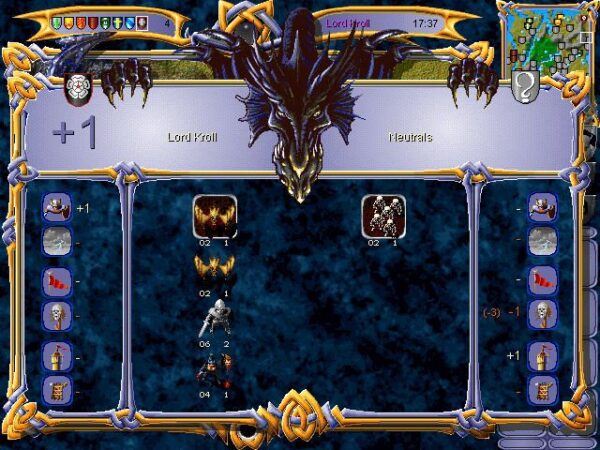
Believe it or not, this screen shows a battle in progress.
Once you get past the tacky cutscenes, which probably cost as much as the rest of the game combined if industry norms held true, Warlords III can seem almost like a shareware game. The in-game graphics are best described as rudimentary — in my opinion, actually worse than those in the previous games, which had a colorful low-res charm that these lack. The writing in the tutorial and campaign gives cause to wonder whether the author has entered a contest to see how many overwrought clichés he can pack into a small volume of sentences.
It was 1252 years since the founding of the Selentine Empire when the greatest threat to the free races of Etheria reared its ugly head (1). In the icy wastelands (2) of the far north, Lord Bane, Master of the Undead, and Lord Sartek, Keeper of the Chaos Beasts, had formed an unholy alliance (3). Like a plague (4), they swept down from the northern tundra, crushing the citadels of the High Elves beneath their bony feet (5).
(Not bad for three sentences…)
But we aren’t supposed to care about any of this, we are told by a small but devoted cult of Warlords III admirers. This game is all about the gameplay.
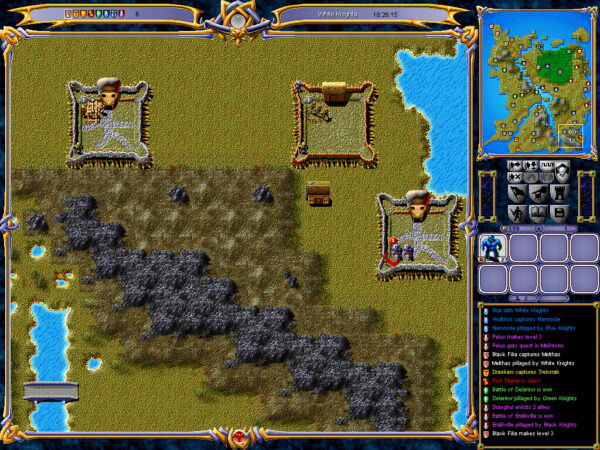
In practice, it feels very much like a board game. You start out with a single hero, and can recruit more as a scenario goes on, but, unlike in Heroes of Might and Magic, you’re free to move your armies — or “stacks,” as the game prefers to call them, thus maintaining the tabletop feel — without a leader at their head. Although the maps in the campaigns are fixed, there is a lot of randomness embedded within them. For instance, you can accept randomized quests on behalf of your heroes. These often entail plundering the dungeons, ruins, barrows, and other such archetypes of fantasy architecture that are scattered around the map for randomized treasure and experience; in keeping with the nature of the combat, the results of any given expedition are revealed to you with a simple onscreen message. The scale of the strategic maps is usually huge, with dozens of towns to dispute with your foes in addition to the other points of interest, but the lack of a tactical component means that the game plays quickly even by comparison with Heroes of Might and Magic.
All of this is… fine, I guess, but I struggled to grow invested in it. I admit that I didn’t get far enough into the campaign to say whether the much-vaunted SSG artificial intelligence makes a difference. With no way to control my units on the battlefield or in the dungeons, I felt like I was playing half a game while someone else played the other half for me and told me what happened. Meanwhile the aesthetics did nothing to make me want to spend time in this world. I tip my hat to anyone who has gotten past these initial impressions and embraced the great game which I am told is lurking underneath. But, speaking personally, Warlords III flew pretty wide of my strike zone.
Next up is Age of Wonders, which came out late in 1999. Designed by Lennart Sas and Arno van Wingerden, it was the first game ever from a Dutch outfit known as Triumph Studios. It was published in North America by Gathering of Developers and elsewhere in the world by GOD’s biggest shareholder, Take Two Interactive.
The impression its opening cutscene gives is the polar opposite of Warlords III‘s: digitized cheese is replaced with lush hand-drawn art (even if it does unveil a dubious new innovation in videogame babes, the first female suit of armor to display the poor girl’s nipples as bas-reliefs). The dramatically different aesthetic sensibility obscures the ironic reality that Age of Wonders owes a massive debt to the older, uglier Warlords series.
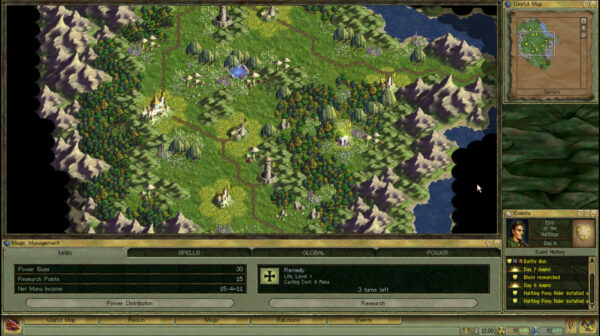
Indeed, Age of Wonders makes for a fascinating study in game design as dialog and evolution, in that almost all of its elements are so obviously lifted from earlier exercises in turn-based fantasy strategy. The core of its movement and logistics is Warlords III, with the same stacks of up to eight units, one or more of which may be heroes who can go up in levels and gain skills and equipment. We likewise have the same large maps strewn with towns to conquer, resources to corner, and dungeons to delve.
But when armies meet one another on one of these maps, there emerges an important difference. You have the option to let the battle resolve itself automatically — i.e., Warlords-style — but you can also oversee the fray yourself in a tactical game that smacks strongly of MicroProse’s much-loved classic Master of Magic. There’s a global magic system here which is straight out of that game as well. You receive a certain number of mana points per turn, derived from the number of magical wellsprings you control on the map. You can invest your mana into researching new spells for your magic-using heroes or have them expend it by casting the spells they already know. Some of these spells are triggered from the strategic map, where they can remain in effect for many turns as long as you have the necessary mana to sustain them. Others are one-shots for use on the battlefield. And some spells, such as heals and buffs, can be used in either situation.
When you add in a town-management layer that falls somewhere between Warlords and Master of Magic in complexity, you wind up with a considerably heavier game than Heroes of Might and Magic. Speaking of which: the influence of that series can be most readily detected in Age of Wonders’s interest in set-piece storytelling, which extends far beyond the procedurally generated maps of Master of Magic or the halfhearted, poorly written campaigns of Warlords III. The campaign here is presented as a literal storybook, in which you can choose to join the side of one of two elvish factions, one peaceful and idealistic and the other warlike and pragmatic, who are each responding in their own way to an invasion by a new race known as… wait for it… the Humans. Rather than handing you a simple linear ladder of scenarios to overcome, the game lets you make choices at the macro-level from time to time, even gives you the opportunity to switch sides mid-campaign.
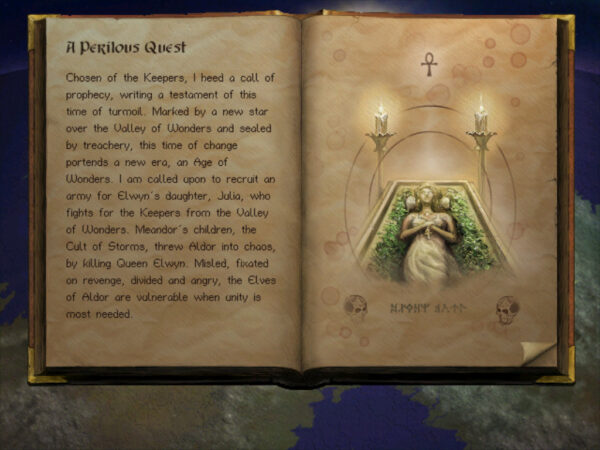
Age of Wonders’s commitment to its fiction is impressive. The diligent and inquisitive player will come to realize that even the standalone scenarios constitute an extended story; if you play them in the order of the dates which stand in their descriptions, you wind up living through a prequel to the main campaign. The atmosphere throughout is slavishly Tolkienesque high fantasy — not exactly the highest-hanging fruit in gaming, but this game pulls it off with more panache than most. Aesthetically speaking, Age of Wonders has aged remarkably well. The art and the music seem as lovely today as they must have the day it was released. (The one odd exception is the sound effects during the tactical battles, which sound like they were lifted from old Three Stooges reels.)
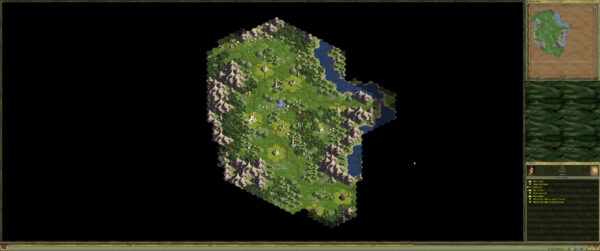
Age of Wonders supports any screen resolution you care to throw at it, including widescreen ones. It ran happily for me in my monitor’s native resolution of 3440 X 1440, making it only the second game I’ve come upon in this fifteen-years-long-and-counting journey through time about which I can make such a statement. The interface elements don’t scale, and became so small at that resolution that the game is effectively unplayable, at least for someone with middle-aged eyes like me — but still, the fact that it works at all right out of the box is amazing.
For all that, though, I couldn’t quite make friends with Age of Wonders either. My problem with it comes down to what the legendary game designer Sid Meier has immortalized as “the Covert Action Rule,” after a flawed and otherwise forgotten game of his that came out in 1991. Meier believes that the reason his attempt to do for spies what his earlier Pirates! had done for corsairs didn’t work as well was that its mini-games were ironically too well-developed, such that they could take too long for the player to complete. By the time she finally gets back to the overarching strategic layer, goes the theory, she’s forgotten what she was doing there, has lost that ineffable sense of flow. “One good game is better than two great ones” stuffed into the same box, goes one of Meier’s oft-quoted design principles. Of course, game design is as much art as science, and the Covert Action Rule is a real problem right up until the point when it inexplicably isn’t. Speaking for myself, I don’t even think it’s the principal issue with the game Covert Action itself.
But I do think that it’s my problem — mileages will obviously vary here — with Age of Wonders. Those tactical battles you get dropped into when armies clash are very slow. Your units usually start out well away from the enemy, far enough away that just maneuvering them into range can require several turns of careful micro-management. Worst of all are the dungeon-delving expeditions, in which you find yourself trying to move up to eight units one by one through a series of twisty little passages, hoping not to get any of them caught out by the monsters that might be lurking around every corner. It takes forever. When you’re finally dumped back into the overland map after one of these extended interludes, it can be downright disorienting, as if you really are trying to play two completely different games at the same time.
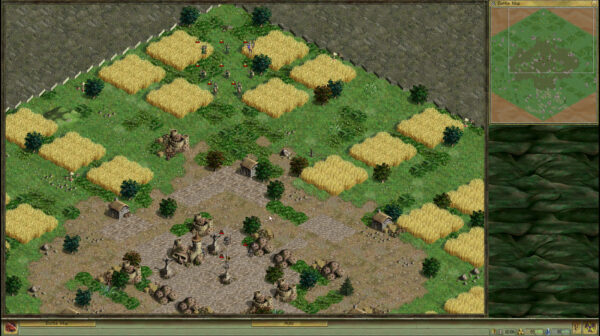
These big, bland tactical maps can be kind of tiring just to look at.
It’s true that Age of Wonders has the option to auto-resolve the battles if not the dungeon-delving. But doing so seldom produces the results you can achieve by taking charge yourself, even as the scenarios tend to be mercilessly tough by the middle stages of the campaign, requiring you to make use of every advantage at your disposal. And anyway, as I already noted in the context of Warlords III, I don’t find auto-resolving the battles very satisfying either.
So, yes, I’m a tough crowd to win over. If Warlords III feels to me like too little game, Age of Wonders feels like too much of one, full of side-quests that are more burdensome than fun. I will say that I’m curious to try the sequels to Age of Wonders at some point in the future; I understand that Triumph Studios made an effort in them to address some of my complaints, by starting tactical fights with the armies closer together and by eliminating the manual dungeon-delving entirely. For this reason, the sequels are definitely on my syllabus.
In the meantime, though, I sort of promised you a Goldilocks game right there in the title of this article, didn’t I? I’m a hard guy to please by this point in my life, after playing games for more than 40 years, but I’m not a hopelessly jaded player. It is possible to strike a balance that makes me happy, as Heroes of Might and Magic proves… and as does Disciples: Sacred Lands.
Disciples comes to us by way of a Canadian company called Strategy First, which was founded in Montreal around 1990 by Don McFatridge and Steve Wall. After playing supporting roles in the industry for a number of years, they decided to try to make a go of it as a full-fledged developer and publisher late in the decade, peddling lower-budget, nichier games than those that tended to interest the established publishers. Disciples, which was released at about the same time as Age of Wonders, was created by a small French-Canadian studio, previously known as Micomeq, which Strategy First had recently acquired.
The game was designed by one Danny Bélanger. Sometimes dismissed by reviewers even today as just a low-budget Heroes of Might and Magic clone, it actually has a mind and personality that are very much its own. Its most obvious fresh idea is its approach to territorial gain, the source of its subtitle. (The name “Disciples,” on the other hand, has nothing much to do with anything here as far as I can tell; the developers seem to have chosen it just because they thought it sounded cool.) You don’t manually tag the gold and mana sources on the map with your armies to claim them for yourself, as you do in most other games of this style. Instead there is a zone of influence around each town a player owns, which widens its circumference gradually at a rate of one square per turn. This process continues until the expanding circle of influence is blocked, by the territory of a rival, a border of the map, or a mountain range, ocean, or other impassible landmark. Thanks to this system, you can tell from a glance at the map which faction is winning: the human Empire’s territory is lush green, the Undead Horde’s bleak and dark, the dwarven Mountain Clan’s a snowy white, and the Legions of the Damned’s a fiery red. In fact, many of the scenarios have victory conditions that crown as the winner the first faction whose terrain fills a given percentage of the map. It’s a unique and enjoyable mechanic, with the potential added bonus of staving off the late-game tedium of conquering the last few enemy towns left on the map.
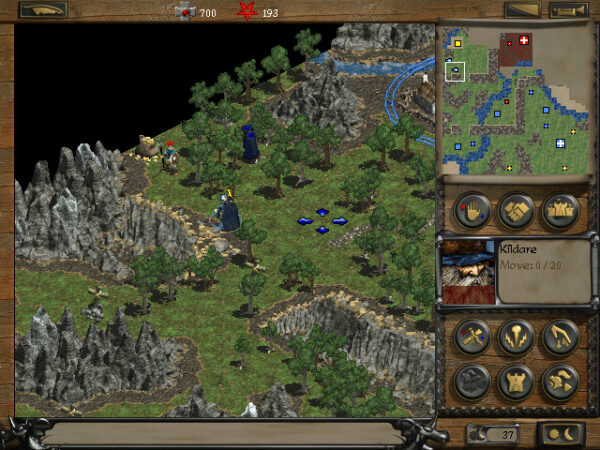
The symbol of the evil Legion of the Damned faction (as seen on the mini-map at top right here) is the Danish flag. I’m not sure what to make of that…
Doing a clean sweep of the whole map would be almost impossible anyway, because each faction’s capital comes complete with a single super-strong unit that cannot be moved but is virtually impossible to defeat. In effect, then, you never really have to worry about losing your capital. This is especially nice in multiplayer sessions, as it means that no one has to suffer the indignity of being knocked out of the game early and then sitting around waiting for the other players to finish, feeling like the world’s biggest loser all the while.
As in Heroes of Might and Magic, units here can only move if led by a hero. Each of these can have from zero to five subordinates, depending on his or her Leadership level. In another break from other games of this general type, even the underlings here are explicitly cast as individuals, not groups, and have the ability to level up and get stronger just like the main heroes as they fight battles and win experience points, as long as you have built the appropriate upgrades in your capital to enable their advancement. (These features led Strategy First to call Disciples a full-fledged CRPG in some of their press materials, but this is going rather too far.) Each faction has a different selection of hero and underling types that can be purchased in its towns — as many of each as you can afford — and then further customized as they gain levels. (Pro tip: more Leadership is always the right choice for your heroes whenever it’s available.) The game is quite well-balanced on the whole, with no faction having a truly decisive advantage.
Now, to address the Goldilocks in the room: there is tactical combat in the game, but it’s extremely simple even in comparison to Heroes of Might and Magic, much less Age of Wonders. Each unit has exactly one attack to inflict upon its enemies, or, in the case of defensive units, one heal or one buff to apply to its comrades. Your job in combat entails nothing more than deciding whom your units hurt or help when their turns come up, by clicking the appropriate enemy or friend. Maneuvering on the battlefield is not a consideration, for the very good reason that it’s impossible. The whole exercise is so ridiculously simple that at first you might think it rote, nothing but a more click-intensive version of Warlord’s automated battles. Give it a chance, though, and you’ll find that it’s not entirely bereft of Sid Meier’s proverbial Interesting Decisions. Whom do you choose to attack first? Whom do you heal or buff? These decisions can be the difference between victory and defeat in a close fight.
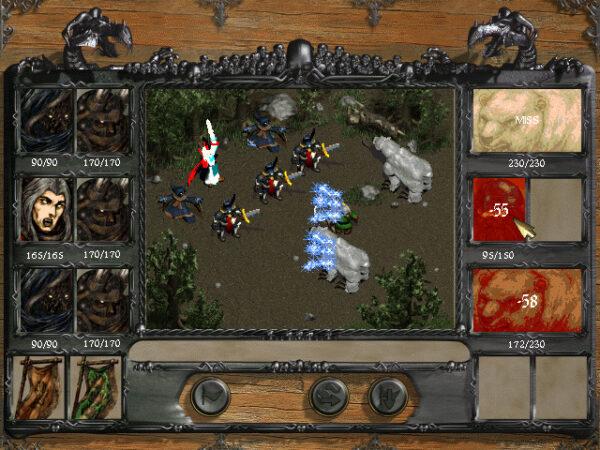
The combat screen. I’ve just hit all of my enemies with an area attack, although my hero missed one of the polar bears. (Ah, well… we’re supposed to be trying to save the polar bears, right?) Two members of my party here are specters, who paralyze a single opponent for one turn rather than damage him. I just have to decide whom to paralyze. That’s where some dilemmas start to creep in…
There’s a magic system here too, a highly streamlined take on the Master of Magic approach. You have to research spells before you can cast them. You can’t use these spells in battle (other than if your unit has a “built-in” magic spell as its one and only move), but you can use them on the strategic map to soften up enemy stacks before you attack them, to buff your own units, or to do other things, such as revealing a section of map hidden by the fog of war or, conversely, hiding a piece of it from your opponents once again. With the tactical combat being so basic, success often hinges on what you do before a fight begins.
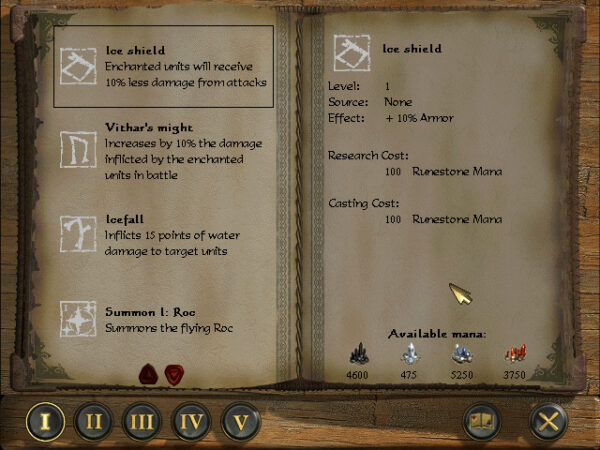
The spell book. Each faction has one type of mana that it favors and its own unique set of spells to research. The only way to obtain other spells is to trade for them.
Disciples isn’t what anyone would call an overly complex game, but it has more subtleties to it than you might think. Dorte and I had more fun with this game in multi-player mode than we have with any since Heroes III. (She found Warlords III too ugly and dull and Age of Wonders too complicated to want to play them with me.) We’re not particularly cut-throat competitors, especially against one another, so we appreciated being able to approach the scenarios more as a race for third-party towns and territory than a mano a mano fight to the death.
Of course, there are aspects of the game that could stand improvement. On the whole, Disciples’s flaws are the inevitable byproducts of a small team working within a budget of well under $1 million Canadian. The artificial intelligence of your enemies could be better, as could the single-player campaigns in general. There are four of these, one for each faction, albeit consisting of just four scenarios each. I found them to be pretty much incomprehensible in terms of narrative, just a lot of portentous word-salad speechifying adding up to nothing. They must relate to one another somehow, must be parts of some grander story, but I certainly couldn’t explain it to you even after watching all of the cutscenes on YouTube. Nor do I care enough to want to try — which is always the worst indictment anyone can level against any piece of fiction, isn’t it?
Within the campaign scenarios, the developers attempt to compensate for the poor artificial intelligence by stacking the odds more and more wildly against you; this is, in other words, another one of those asymmetric strategy games which SSG so decried. Even so, I never found the one campaign I actually completed — that of the Empire faction — all that taxing.
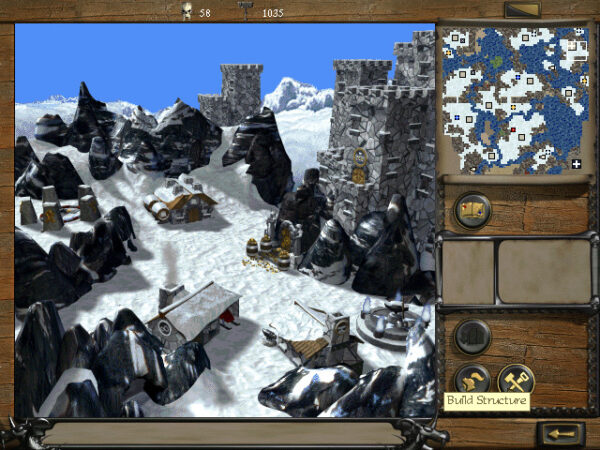
The capital-management screen for the Mountain Clans. It changes as you build more structures, but to tell the truth that’s something I scarcely notice. The graphics in this game aren’t actively bad, but are kind of anonymous-looking, with a palette dominated by dull browns and grays.
The above means that Disciples is easier for me to recommend as a game to play with a friend or two than as a single-player experience. When played with others, the stupid enemies no longer matter so much and the disarmingly elegant core rules are allowed to shine. Disciples hits that sweet spot of being easy to pick up but… okay, not exactly hard to master, but not trivial either. I love it when I discover a new game that Dorte and I can enjoy together. And it’s always great to see a small team with original ideas come up with something as well put-together as this. The graphics and sound they could afford are not those of a AAA game — not even a AAA game from 1999 — but they’re just good enough not to be actively distracting, living somewhere between those of Warlords III and Age of Wonders.
Everyone’s mileage will vary, but for me, Disciples is the keeper of this trio. Fast-playing and straightforward, it’s the perfect game to share with someone else on the patio on a warm summer day in between sipping on a cool beverage and shooting the breeze. I like it. I like it quite a lot. And I very much look forward to trying out Disciples II.
Did you enjoy this article? If so, please think about pitching in to help me make many more like it. You can pledge any amount you like.

Sources: This article is a bit more experiential than a product of deep research, but there are a few online sources that proved exceptionally useful. These are The Wargaming Scribe’s write-up of SSG and Reach for the Stars, an old Gamespy piece by John Keefer on “Developer Origins,” a Game Daily interview with Don McFatridge, a Home LAN interview with McFatridge, and a Kotaku interview with Steve Fawkner. Also the February/March 2000 issue of the French magazine Cyber Stratege.
Where to Get Them: Warlords III: Darklords Rising, Age of Wonders, and Disciples: Sacred Lands are all available as digital purchases at GOG.com.