RSS

Tag Archives: tsr

Planescape: Torment, Part 2: …to the Desktop

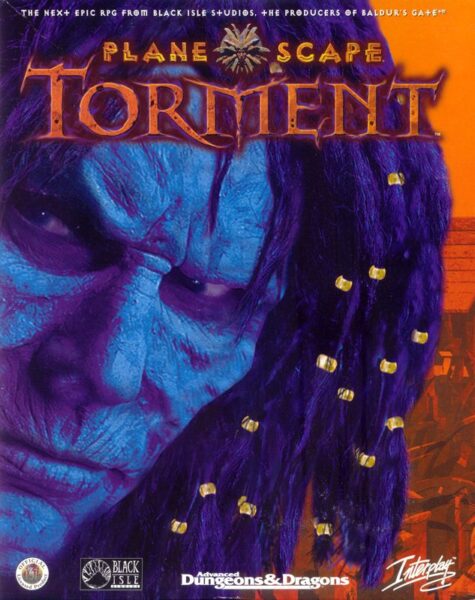
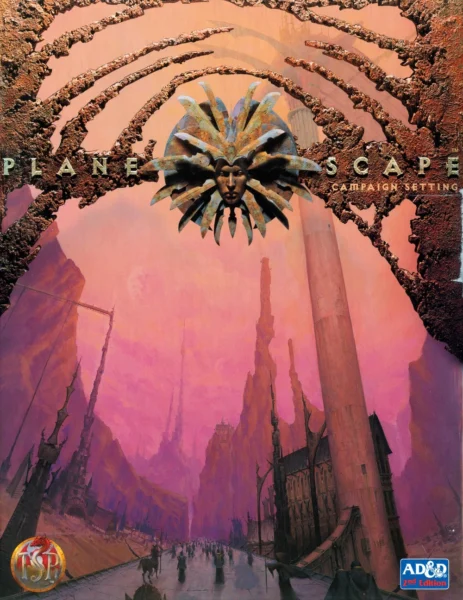
The photographer’s model for the visage of The Nameless One on the now-iconic Planescape: Torment box was actually Guido Henkel, the game’s producer, who was enlisted at the last minute when the planned professional model had a “scheduling conflict.”


This article tells part of the story of Dungeons & Dragons on the tabletop and on computers.

Usually if you choose the longest dialog option, that’s the best option.

— Chris Avellone

Quite some years ago now, I briefly interviewed Brian Fargo about Interplay’s 1988 adaptation of the William Gibson novel Neuromancer. He was plainly busy and a little distracted with more modern game-development matters — this was in the midst of the Kickstarter-funded Wasteland revivals — but he was helpful and friendly enough during the half-hour or so that I spoke to him. Toward the end of our conversation, he mentioned that he had a box full of papers from his Interplay days gathering dust in a filing cabinet in his home office. Upon hearing this, I leapt immediately to make a pitch for my archivist friends at the Strong Museum of Play in Rochester, New York. And lo and behold, a Brian Fargo collection showed up at the Strong within a year or so. I don’t know whether these two events are related, but I like to think that they are.

Regardless, the next time I made it up to the Strong, I naturally made it a point to go through the collection. And it was there, amidst a mishmash of other documents spanning the nearly twenty years that Fargo spent running Interplay, that I first stumbled upon the original pitch document for Planescape: Torment, the one that crossed his desk in June of 1997 and led to the project being formally green-lit. I found this document rather shocking at the time, in that its tone was so totally out of keeping with the hallowed reputation which the game had long enjoyed even then as the most credible claimant to the status of true Interactive Art that the CRPG genre has ever produced. Much of this pitch, by contrast, seemed to have been written by Joe Lieberman’s most stereotypical nightmare: by a sadistic, DOOM-addled teenager who turned it out in between dry-humping everything around him with an even vaguely feminine shape.

No more using boring swords, daggers, or bows to carve bloody swaths through opponents. Plunge scalpels into foes’ eyes, lace their food with poisonous embalming fluid, push them into man-eating pockets of ooze, sic them with sarcastic biting skulls, hurl them into razorvines, conjure burrowing rot grubs within a victim’s brain, cast spells that make them bleed from every orifice, or change a person’s scent so they attract packs of hungry rats. Deliver punishment in ways that will bring a smile to your face.

“Fireball” can go hide in the fucking corner when you unleash your arsenal. Jam your hand into an opponent’s body, rip out his soul, and tell it to kill its owner. Make a gesture and summon a blanket of crawling, biting insects to turn your enemy into a Happy Meal. Send your foes on a field trip to Hell without a permission slip. Taunt someone to death. Summon your darkest shadows from across existence and send them into battle to feed on your opponent’s physical strength. Your succubus ally can kiss your opponents to death — they die with a smile on their face.

This game will have lots of babes that make the player go wow. There will be fiendish babes, human babes, angelic babes, Asian babes, and even undead babes. Think babes. Then think more babes.

To which one can only reply, whoa… whoa. Settle down there, Beavis, before you rub that thing raw.

This document, which has long since surfaced publicly and made the rounds of the Internet, has become something of a problem for Planescape: Torment’s cult fandom, being so markedly at odds with what they wish the game to be. Some have gone so far as to claim that the juvenile profanity was nothing more than an elaborate ruse to get Brian Fargo and his marketing cronies to sign off on such an uncompromising piece of art, or that this is the only corporate pitch document in the history of the world to inhabit the category of satire. But personally, I’m not buying these pat explanations. I think that the finished Planescape: Torment that we know is a blending of the adolescent and the rarefied, the commercial and the idealistic. It’s not that the higher concepts and grander themes don’t exist. It’s just that they’re embedded into a licensed and branded Dungeons & Dragons computer game — made by, let’s face it, a bunch of nerdy twenty-something American men with the same predilections and blind spots as their peers elsewhere in the industry. We probably shouldn’t allow ourselves to get quite as precious about it as we often do.

For what’s worth, I suspect that Chris Avellone himself might more or less agree with this assessment deep down in his heart of hearts. In every interview I’ve seen him give on the subject of Planescape: Torment, he’s been distinctly reluctant to take on the persona of the auteur creating timeless art for the ages. He tends to speak more in the terms of a creative professional who was given a job to do: “Like just about every game I’ve worked on in my career, the franchise or premise was mandated, and then I worked within the parameters given.” He prefers to frame the protagonist’s journey to self-knowledge more as a way of flattering the typical gamer’s sensibilities than a conscious artistic masterstroke.

It is a very selfish game. After about ten years of game-mastering players… that’s really all they care about. They want the entire adventure to revolve around them. Players want to hear people talking about them. It’s the ultimate ego stroke.

Again, this is not to say that Planescape: Torment doesn’t resonate in certain places with the proverbial human condition. It’s merely to say that it’s a complicated, piebald beast. Is it art? Maybe, depending on how you define such things, since art is always in the eye of the beholder. Is it a penetrating work of moral philosophy? Maybe, to some extent, but maybe not quite so much as some folks want it to be. Is it well-written? Intermittently, although seldom on a sentence-by-sentence level. Is it brave and groundbreaking in the context of its time and circumstances? Absolutely. Is it a great game, full stop? Eh…
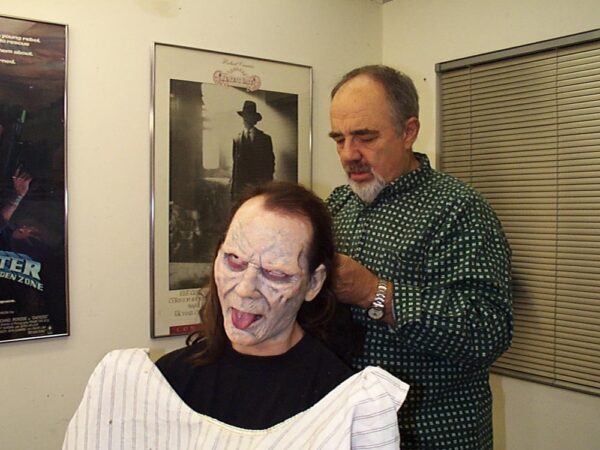

Building the perfect box-cover beast…

Fair warning: a considerable number of Planescape: Torment spoilers follow!

Baldur’s Gate, the only Infinity Engine game to precede Planescape: Torment, attempts very explicitly to recreate the pleasures of playing tabletop Dungeons & Dragons with your friends. The companions whom you collect around you could easily be the avatars of said friends. Each of them is an archetype — fighter, magic user, cleric, thief — which constitutes one part of a Gary Gygax-approved well-balanced adventuring party. The game employs the classic “a group of adventurers met in a bar and went questing” setup. There’s an overarching plot, but it’s really just an excuse to explore more terrain, fight more monsters, and grow steadily stronger.  If you want, you can even play Baldur’s Gate together with your real-life friends, with each of you taking control of one character (although it’s rather clunky in practice, being subject to the technological limitations of the late 1990s).

Whatever else it happens to be, Planescape: Torment is nothing like that. It’s the very specific story of one very specific character, presented it a way that would never have worked with a gang of others sitting around the tabletop. Companions do arrive to accompany him, but they are always peripheral to his central psychodrama. There is no multi-player mode here. Having one would make no sense.

The protagonist of Planescape: Torment is the appropriately named Nameless One, a zombified shamble of flesh and bone who wakes up at the beginning of the game on a mortuary slab in Sigil, the city of inter-planar doors, with no idea who he is or how he got there. So, he sets off to try to find out. Along the way, he meets the aforementioned companions who join him on his journey. One or two of them he even meets in a bar, but these are not your typical happy-go-lucky adventurers with mercenary stars in their eyes. The fact is that each of their stories has long ago become interwoven with that of the Nameless One himself, generally to their detriment, and even though he can’t remember any of it. His own backstory will prove to be far longer and stranger than you or he might ever have thought possible, encompassing hundreds of lifetimes lived out all over the planes of existence, during which he has been good and evil and everything in between. His true quest, it will gradually become clear, is not merely to find out who he really is. Doing so is just a prerequisite to stopping the cycle of rebirths, owning his sins, and finally bringing his story to an end.
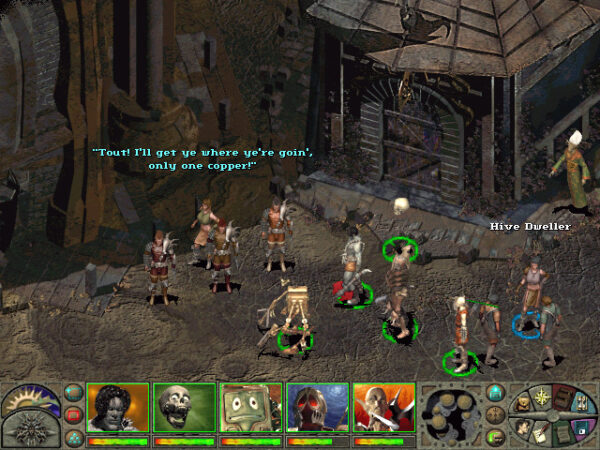
Planescape: Torment demonstrates the flexibility of the Infinity Engine. In keeping with the more personal focus of the story, the team at Interplay moved the camera in closer to show the characters on the screen better, condensed the interface down to a single bar at the bottom of the screen, and reworked the controls to make use of a popup, adventure-game-style radial verb menu.

Not only does Planescape: Torment subvert the traditional plot outline of a CRPG by turning a triumphalist power fantasy into a tragic journey of self-discovery, but it subverts many of the standard CRPG mechanics to serve its agenda. The Nameless One is immortal, which means that defeat and “death” in combat is a minor inconvenience at worst; he will always wake up once again on his mortuary slab, with all of his inventory, companions, and experience points intact. (In some places, he is even required to “die” in order to advance the plot.) With physical threats being thus robbed of their menace, a clever dialog response is almost always worth more experience points than defeating the same interlocutor in battle. Swords, armor, and most of the other usual trappings of heroic adventure are seldom seen, replaced by stranger concoctions, like a floating skull who can upgrade his attack by acquiring sharper teeth. Planescape: Torment is not your parents’ CRPG.

To wit: if you come to this game expecting a plane-skipping roller-coaster ride through a wide variety of environments, I’m afraid you’re destined to be disappointed. Most of it takes place within Sigil. You start out in the slums and eventually make your way to slightly posher districts of the city, but the general atmosphere remains one of futility and decay from first to last. I’m frankly not sure how to respond to this. My wide-eyed inner child, the one who used to consume pulpy sci-fi novels by the dozen, thinks it’s false advertising to promise us a city of doors to infinite possibility and then deliver only this sad-sack assemblage of run-down mundanities. My more mature incarnation, the one who studied (or in some cases suffered through) the literary classics at university, thinks it might be an admirable case of a game sticking to its guns. But even he begins to feel crushed under the sheer weight of misery on display here, begins to wonder what pathetic excuse for a multiverse this is that has such a squalid, nihilistic centerpiece.
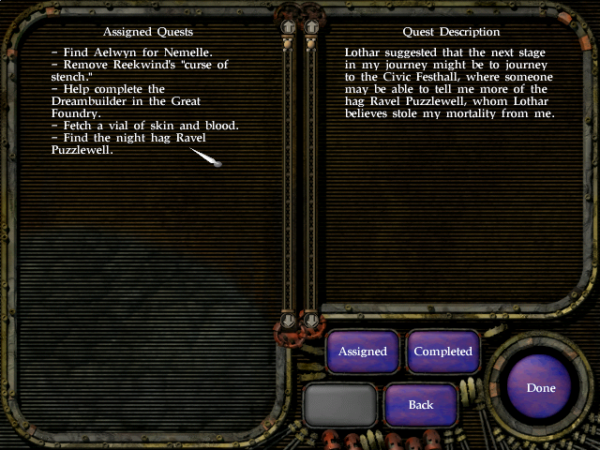
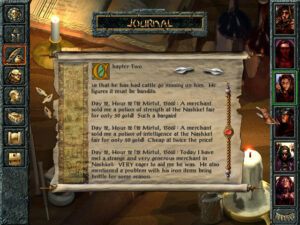
Planescape: Torment has its share of interface issues, but the quest log at least is far more usable than the one in Baldur’s Gate.

In practice, much of your time in Planescape: Torment will be spent wandering through each new district of Sigil as it opens up, clicking on every character who has a name or otherwise non-generic description in order to initiate conversation. Make no mistake. These people like to talk… oh, my God, do they like to talk. A minority of them have information or assistance to offer that pertains to the main quest, or at least to one of the many side-quests. Most of them, however, just “rattle their bone-box,” as the Sigil lingo goes, for the sake of hearing it rattle, telling you all about their hardscrabble lives in paragraph after paragraph of text. I find that it becomes numbing after a while, a symphony of despair that just keeps hammering away on the same relentlessly grim note. It’s Down and Out in Paris and London, except an order of magnitude longer in a different dimension.

The Cant — the Cockney-inspired lingo of Sigil — is striking, even if it is lifted from TSR’s Planescape boxed set rather than being an innovation of this development team. All the same, the writing has a rough-draft quality to it that includes but is by no means limited to the typos and minor grammatical errors that are strewn fairly liberally throughout, the well-nigh inevitable result of laying down so very much text in a relatively short span of time. It’s enough to make you long for the days when computers were primitive enough that even text was expensive, such that developers had to choose their words with care, had to make sure that every single one of them counted. Failing that, we might wish that someone in Interplay’s marketing department had insisted that the whole game be voice-acted, which would have served the same purpose of forcing the developers to include only those words that really matter. (As it is, only the occasional line or two is voiced.)

Editing, in any sense of the word, was clearly not a priority here. Back in the 1980s, Infocom employed a full-time editor from the book-publishing world to polish and tighten the prose in its games. But alas, such work was far beyond the core competencies of a 1990s studio like Interplay. The only guiding principle here seems to be the more words, the better. Matters reach a kind of absurd climax when you wander into a bar in which the patrons spout verbatim paragraphs from the old TSR Planescape campaign setting, copied and pasted into the computer game. One can easily imagine that the developers must have been paid by the word, the way people like to say that the similarly verbally incontinent Charles Dickens once was. Whether they were or not, talk is way, way too cheap in Planescape: Torment.
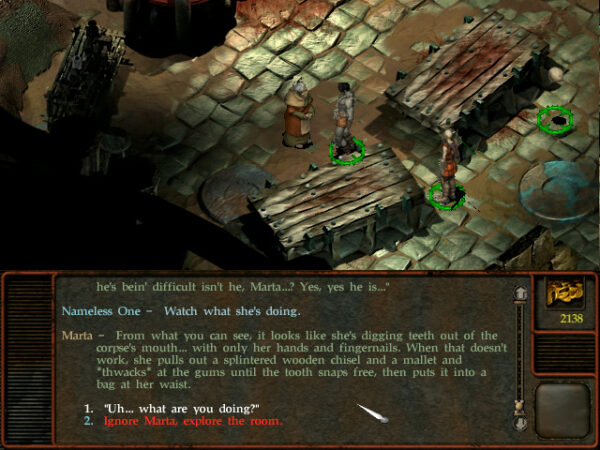
At times, you can almost palpably sense Chris Avellone and his friends straining to put words in the mouths of so many superficially indistinguishable characters in ways that might make them stand out. You want to tell them that it’s okay, give yourself a break: literary merit is not measured by the kilogram of verbiage. Occasionally the writing surrounding the many bit players of Sigil can surprise you with a clever metaphor or a flash of insight or compassion, but more often it just wallows in the squalor. Many of the grotesques you meet are gross just for the sake of being gross, thus revealing that the sniggering lover of blood and boobs who wrote so much of the pitch document remains a part of the development team’s collective unconscious if nothing else.

A man is looking at you with a strange, bug-eyed stare. His eyes are huge… so huge they look ready to pop out of their sockets and roll across the cobblestones. He nods eagerly as you approach, bobbing his head like a bird… and as you near him, you suddenly notice the smell of the urine and feces surrounding him. The man sniffles, wiping his nose on his sleeve, then opens his mouth to reveal blackened, rotted gums…

Reekwind coughs, his eyes almost popping out of his skull as he does so. His cough seems to loosen his bowels, for he breaks wind loudly, as if to accentuate his point…
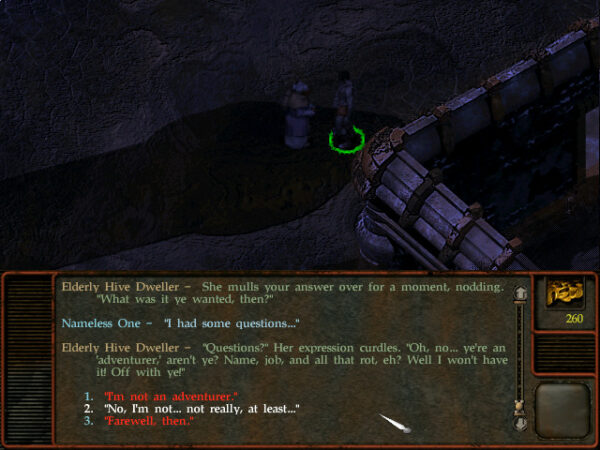
In a moment of levity, the game has fun with some of the tropes of golden-age CRPGs. “I’ll bet ye’ve all *sorts* o’ barmy questions! Greetin’s, I have some questions… can ye tell me about this place? Who’s the Lady o’ Pain? I’m lookin’ fer the magic Girdle o’ Swank Iron, have ye seen it? Do ye know where a portal ta the 2817th Plane o’ the Abyss might be? Do ye know where the Holy Flamin’ Frost-Brand Gronk-Slayin’ Vorpal Hammer o’ Woundin’ an’ Returnin’ an’ Shootin’-Lightnin’-Out-Yer-Bum is? I ought ta kick ye in the shins fer even pesterin’ a poor ol’ woman about it all!”

The companions with whom you hack your way through this forest of words instead of monsters are a mixed bag. Morte the talking skull is your first party member, already at your side when you wake up on the mortuary slab for the first time, already seeking to make up for having betrayed you in one of your earlier lives. His redemption arc aside, he’s clearly meant to provide a note of comic relief amidst the cavalcade of misery you encounter, even if in practice his humor misses rather more than it hits; the necrophiliac jokes about every female ghoul and zombie you meet get pretty old pretty quickly.
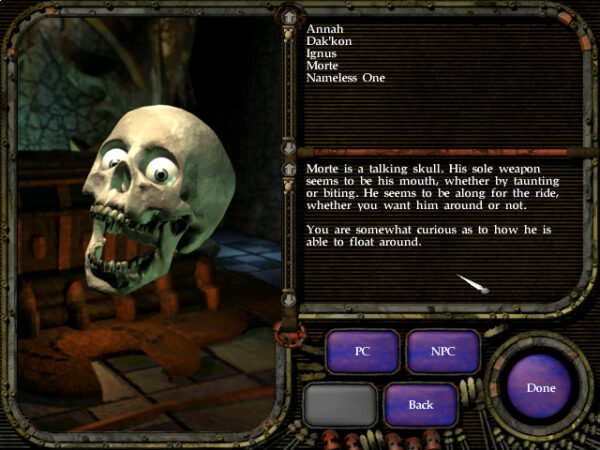
Your companion Dak’kon belongs to the githzerai, a planar race of ascetics who prize order and harmony over all else. Unfortunately for him, a crisis of faith has led to him being cast out by his own people.
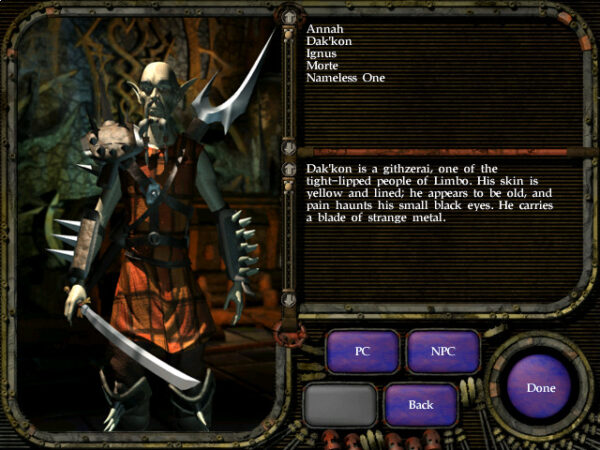
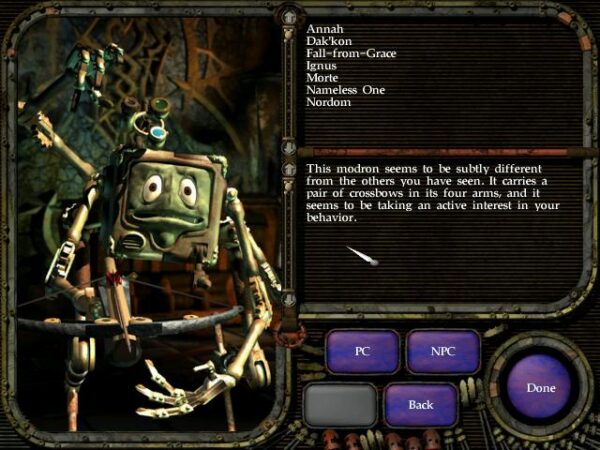
Nordom is not so much cast out as dropped in from what feels like it ought to be a different game entirely. Recruitable only via a lengthy side-quest that’s disarmingly easy to miss completely, he’s a robot who has evolved into sentience and is trying to figure out what to do next. He’s essentially WALL-E nine years before Pixar came up with him; he’s even drawn in a cartoon style, a jack-in-the-box with big, sad eyes and way too many gangling limbs.
And then we have the two female companions. They are defined by their gender and sexuality in a way that their male counterparts are not, occupying an uncomfortable liminal space between adolescent wish-fulfillment and earnest character-building. The pitch document tells you most of what you really need to know about them when it promises “to fill the game with deep, meaningful interactions with characters that happen to have swaying, pendulous breasts.” Both Fall-from-Grace the reformed succubus and Annah the reforming tiefling thief look like your standard videogame hot chicks. The way they’re written, on the other hand, arguably provides less fodder for students of literature or philosophy than it does for psycho-anthropologists who happen to be studying a certain subset of turn-of-the-millennium young men.

Fall-from-Grace runs the embarrassingly named “Brothel of Slaking Intellectual Lusts.” This establishment is full of hot chicks just like her, who invite their male customers in to… well, just to talk to them about all the nerdy interests that cause other comely young women to roll their eyes and start sidling toward the nearest exit.
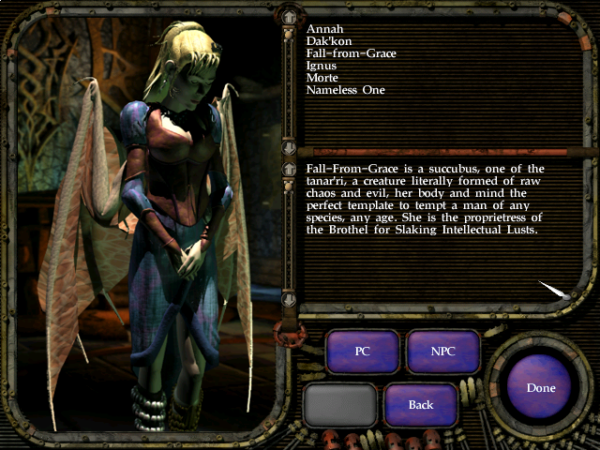
Annah is an apparently jaded girl of the streets who, it will eventually turn out, has never known the touch of a man (because of course she hasn’t) and thinks that The Nameless One might be the right one to finally teach her the ways of love (because of course she does).
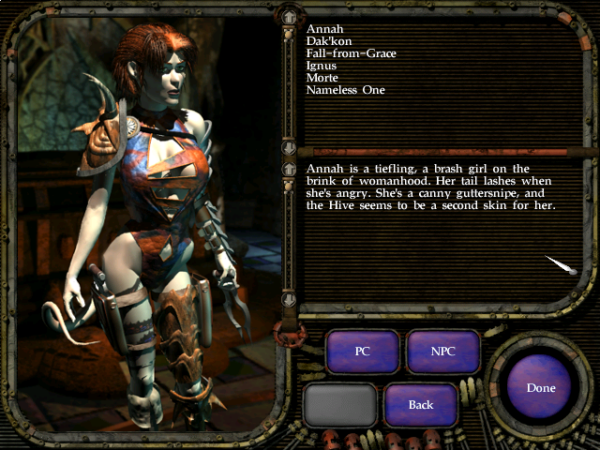
Fun fact: Annah the tiefling was voiced by Scottish pop singer Sheena Easton. Sadly, The Nameless One never does get to spend a night inside her sugar walls.

Now, I don’t want to jump all over Chris Avellone and his friends for this. I believe we should weigh intent at least as heavily as effect when passing judgment on anything, and the intent here is as sweet in its way as it is perchance inadvertently revealing. If the “babes, babes, and more babes” guy from the pitch document is the person these lads were with their peer group, then the wide-eyed romantic who came up with Fall-from-Grace and Annah was likely the person they became alone at night after their buddies had gone home. I remember seeing the girls I crushed on — the ones I really crushed on, that is — in much the same way when I was their age or only a little younger. To my teenage eyes, they were well-nigh celestial beings whom I wanted to shelter from the ugliness of the world (not least all those other guys who were better at sports than I was) and commune with in a way that transcended sex (not least because I was none too confident in my own abilities in that department in comparison to those other guys). It’s a phase a lot of us go through, but also one that we hopefully outgrow. The problem with such attitudes is that they still preclude one from seeing the object of one’s fancy as a fully-realized human being with a full measure of agency in her own right. Men have been using these velvet cages, sometimes consciously and sometimes unconsciously, to hold women down since time immemorial. The women of Planescape: Torment contribute to the sense of a writing team who are punching a little too far above their own weight — or, maybe better said, their life experience.

The overwriting and the gawkiness are present in the main plot line as well. Below is a short extract from the game’s turning point, a long-sought-after and predictably prolonged dialog with Ravel Puzzlewell, a witch who knows much about The Nameless One’s real nature.

“A shadow with substance, a-seeking that which casts the light. I know you more and no… know…” Ravel pauses, her eyes dimming. “No more than I know the nature of ANY man. Crossed pasts have we… a man tainted with un-death, still feeling the pangs of separation, and an old withered crone, now all-imprisoned. Seems it that we are a-meeting for the first time? No, no, not, not… knot?” Ravel seems confused for a moment, then shudders, as if throwing off a weight. “Knot at all. An echo of a future meeting this is… or a past meeting, depending on which way time is facing.”

The first thing we notice here is the inverted sentence structures of Yoda-speak, a kind of default setting for mysterious and profound characters in way too many games. It serves to remind us that, for all their aspirations toward Philosophy, these writers are better versed in the works of George Lucas than Aristotle or Nietzsche.

Meanwhile all this punning on “know” and “no,” “passed” and “past,” “not” and “knot,” is the sort of thing that clever and ambitious young writers often turn out, and grizzled and remorseless editors draw a line through just as quickly. For it works only on the page (or the screen, in this case); if it was spoken, as we’re supposed to imagine dialog being, it would all fly right past the interlocutor. In the end, then, the only purpose it serves is to point out the cleverness of the author, which isn’t — or oughtn’t to be — the purpose of writing anything. If we keep at it long enough, most of us writers learn to nip such cherished little darlings in the bud before they can pull our readers out of the story we’re trying to tell.

And now, looking back on what I’ve written, I see that I’ve been hard on Planescape: Torment, harder than I really intended to be. And yet there are criticisms I haven’t even gotten to yet. For example, I haven’t mentioned how unsatisfying and annoying the combat is — yes, it does exist, and is actually quite extended and extensive at times, such as when you have to leave the streets of Sigil to delve into its tombs and sewers, or when you leave Sigil’s dimension entirely during the last quarter or so of the game. (Never fear: the other dimensions you visit are if anything even bleaker than this one.) Ironically, the same changes to the Infinity Engine that make this game feel more personal than the likes of Baldur’s Gate also serve to explain why Bioware made the choices they did for their own, more conventionally combat-oriented CRPG. Here, the close-in camera makes it harder to keep track of what is going on during a fight, even as the other interface changes make it harder to micro-manage your party when you really need to. Most of the standard CRPG elements — character levels, ability scores, spell books, etc. — feel like phantom limbs here; tragic psychodrama makes a strange fit with the power fantasy of Dungeons & Dragons. The final impression which I just can’t escape is that of an engine and system of rules which are badly out of sync with the game they’re being asked to present. If you want to call that further evidence of subversive intent on the part of the development team, be my guest. I just call it unfortunate.

For all that, though, I don’t want what I’ve written to read as an invalidation of the experience of those who have played Planescape: Torment and felt a wind of profundity blowing through its dreary environs. I’ve felt the same wind myself. (And no, I’m not talking about our friend Reekwind.) As you learn more and more about The Nameless One’s endless cycle of pain and suffering, both caused and endured, themes and ideas that games seldom touch on begin to emerge. One particular question is brought up again and again: “What can change the nature of a man?” To its credit, the game never offers a definitive answer, but two possibilities come to the forefront: “Regret” and “Belief.” As Saint Augustine tells us, these are two sides of the same coin: the weight of Regret engenders Belief, while our Belief fills us with Regret for all the ways we fail to live up to our moral potential. Thus the need for Confession to cleanse our souls and be worthy of that which we believe in… and so the cycle continues.
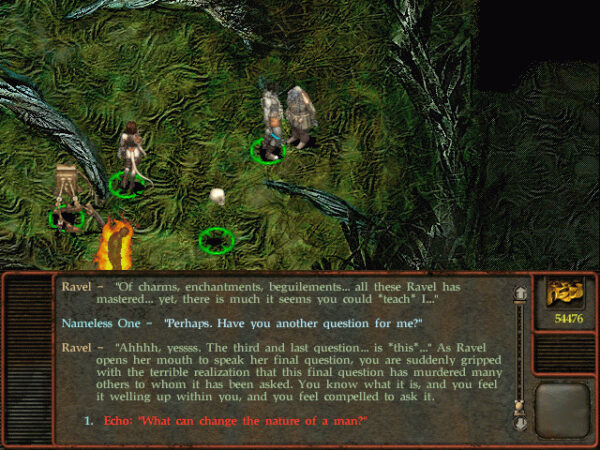
In a revelation that genuinely shook me, you learn near the end of the game that resurrection isn’t free, that every time The Nameless One is brought back to life on his familiar mortuary slab after a failed combat or some other misguided escapade, the life of some other poor mortal schmuck is taken in compensation for his rebirth. The “best” ending has him breaking that cycle by recognizing, acknowledging, and internalizing the suffering he has caused, looking that unwanted self-knowledge and its terrible consequences straight in the face. What follows is by no means conventionally happy, but it is the only fitting way to bring his story to a close. Kudos to Chris Avellone for not chickening out at the last minute, as other game designers have done.

Planescape: Torment is the first game of any stripe that I know of since Infocom’s Trinity to unabashedly don the mantle of Tragedy in the classical sense. Although Chris Avellone’s understanding of what that means is perhaps less nuanced than that of “Professor” Brian Moriarty, the author of Trinity, his take on it is more searingly immediate. For Trinity is the tragedy of an entire civilization, bereft of any characters at all who aren’t bit players, while Planescape:Torment is the tragedy of an individual whom we come to know all too well. Regular commenter P-Tux7 asked in response to the first article of this little duology of mine whether “it is right to punish someone who doesn’t remember doing the crime,” whether “someone can ever become not the person who did the crime,” and whether “justice demands an equivalent amount of suffering.” Such questions constitute the essence of tragedy, which writers have been struggling with as long as the written word has existed.

Despite all its granular failings of execution, then, Planescape: Torment leaves us with much to ponder, regarding both the nature of a man and — on a slightly more plebeian note — the nature of game design. Some of the themes that this game broaches are among the most profound we can wrestle with as human beings. The story of The Nameless One rhymes with the myth of Oedipus, who also looked terrible self-knowledge right in the face and had his soul shriven to the core. Or we might choose to read The Nameless One as a Christ figure, who redeems his fallen companions through a supremely unselfish final sacrifice. But there are likewise obvious parallels to Eastern religion and philosophy, which stress the need to escape the very same eternal life that Christianity purports to offer us. Meanwhile the existentialists among us must ponder whether a Nameless One who can’t remember the actions of his previous incarnations, who possesses no obvious continuity with his previous selves, can be said to truly be the same man at all. In fact, can any of us be said to be the same person we were when we were younger? After all, time is a river that changes all of us second by second, and, as Heraclitus told us almost 3000 years ago, it is impossible to step into the same river twice. Any game that can make its player ponder such thoughts as these is not to be dismissed lightly.

At the same time, though, Planescape: Torment belongs to a category of critic’s darling that always seems to get my curmudgeonly dander up (and tends to land me in hot water with some of my readers): games which are said to be so ridiculously effective as stories and settings that any gameplay inconveniences that dog them pale into insignificance by comparison. Grim Fandango is one of these: we’re told to forget the clumsy interface and nonsensical puzzle design and just enjoy the ride with a walkthrough by our side. Final Fantasy VII is another: forget the endless cavalcade of tedious random encounters and the fact that you can win all of them just by pounding the “attack” button over and over and enjoy the story. No matter how hard I try, I can’t see my way to giving games like these a pass. I love a good story and setting, but the fact remains that interactivity is the defining attribute of a game. It seems to me that it needs to work well too if we are to start throwing around accolades like “masterpiece.”

Much of what strikes me as flaws in this particular would-be masterpiece could have been fixed with a little more time and some more judicious oversight. The writing could be pared down at the same time that it was polished up; 800,000 words are not needed to convey a vivid sense of place and atmosphere, only a subset of the right ones. The tedious combat could be overhauled or perhaps eliminated entirely. Indeed, I sometimes think that my ideal Planescape: Torment would be a ten-hour point-and-click adventure game that doesn’t waste my time with unneeded mechanics or unnecessary talk, that makes every moment count. I doubt that Chris Avellone would go that far, but, again, I sense that he may just agree with me about some of the game’s infelicities. It’s just that he would prefer to improve the other systems rather than narrow the focus to the core story. “If the moment-to-moment gameplay is lacking,” he says, “then you’ve failed as a game designer. The combat was pretty weak, and I did feel it could have used more dungeon-crawling areas for players to explore and have fun in in addition to having fun exploring the conversations in the game.” Who knows? Maybe that would work too.

For when it comes right down to it, I still don’t know quite how to feel about Planescape: Torment; when I called it confounding at the start of this pair of articles, I meant it. I first tried to play it not long after it came out, only to give up after a few hours, bored by the depressing setting and all of the people there who never shut up. I returned to it in order to write these articles, and my sense of professional duty carried me all the way through this time around, even though I was once again bored for much of the time. Still, I’m glad I stuck it out, glad to truly know one of the most celebrated computer games in history. Yet I must confess that I’m equally glad to be done with it. I am of the opinion that the most fundamental responsibility of a game, before theme and meaning can even enter the discussion, is to entertain or at least interest its player. Planescape: Torment failed that test too often for me to call it a great game. If you want me to call it a brave and intriguing one, though… well, that I can definitely get behind. Seldom has any group of creators in this field challenged the expectations of their audience so thoroughly. And that in itself is a brave feat well worth applauding.


Did you enjoy this article? If so, please think about pitching in to help me make many more like it. You can pledge any amount you like.


Sources: The book Beneath a Starless Sky: Pillars of Eternity and the Infinity Engine Era of RPGs by David L. Craddock; Computer Gaming World of March 2000 and April 2000; the 2015 GamesTM special issue on “controversial” games; Retro Gamer 113. Plus the materials found in the Brian Fargo Collection in the archives of the Strong Museum of Play.

Online sources include Soren Johnson’s interview with Chris Avellone for his Designer’s Notes podcast, a Last Game Standing interview with Avellone, and Guido Henkel’s pictures and memories of posing for the Planescape: Torment box cover.

Where to Get It: Planescape: Torment is available as digital purchase from GOG.com in an “enhanced edition.” Buying it also gives you access to the original version.
 

Tags: , , , , ,

Planescape: Torment, Part 1: From the Tabletop…

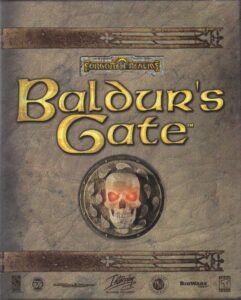
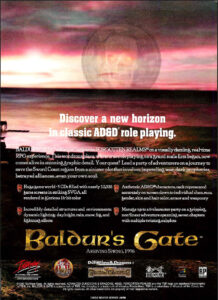
By 1999, Interplay had begun crediting its internally developed CRPGs to “Black Isle Studios,” a distinction that represented very little difference, given that Black Isle shared office space and personnel with its parent publisher. Note the careful choice of words on the box above, to call Black Isle the “producers” — not the developers — of Baldur’s Gate.


This article tells part of the general story of Dungeons & Dragons on the tabletop and on computers, which includes the more specific one of the Infinity Engine games.

My power fantasy when playing a role-playing game is to confront a villain, explain point by point why his master plan is flawed, and then get him to admit that he hadn’t thought things through as carefully as I had, and ask me what I think he should do. Conversation-based player characters can have their bad-ass moments just as much as someone wielding a gun…

— Chris Avellone

Planescape: Torment is the damnedest game. Its list of failings is longer than that of many a game that I’ve simply written off as bad, full stop, and moved on from without a second thought. The pacing is glacial for long stretches; the interface is fussy and clunky; the combat is both irritating and utterly superfluous to the game’s design goals. Even much of the writing, by far the most celebrated aspect of Planescape: Torment, tends to seem proportionally less profound and more banal as one becomes farther removed in age and life experience from the twenty-somethings who first put all of these words — so many, many words, a reported 800,000 of them in all — onto our monitor screens more than a quarter-century ago. In so very many ways, Planescape: Torment is an undisciplined hot mess.

And yet it’s a hot mess that refuses to be dismissed lightly. For Planescape: Torment is also a vanishingly rare thing in the realm of game narratives: a genuine interactive tragedy, in the sense that Aeschylus, Shakespeare, and Nietzsche understood that word. That it recognizes the tragic side of life while inhabiting a genre whose whole point in the eyes of most of its fans is the triumphalism of going from a weakling to a demigod is incredibly brave and subversive. That it did this in 1999, when the games industry was smack dab in the middle of one of the most homogenized, risk-averse periods in its history, is as inexplicable as it is astonishing.

Clearly we have much to unpack…


TSR sold surprisingly few copies of the original Planescape campaign setting, even at the stupidly cheap price of just $30. It goes for $250 among collectors today.

Whatever else it is, Planescape: Torment is first and foremost a licensed adaptation of Dungeons & Dragons, a part of Interplay’s attempt to revive that storied tabletop game’s digital fortunes amidst the collapse of its parent company TSR and TSR’s acquisition by Wizards of the Coast. This particular computer game was no mere branding exercise, as was the case with some of them that came out in Dungeons & Dragons trade dress during the 1990s. On the contrary, Planescape: Torment was deeply, intimately informed by the creative work that took place in TSR’s Wisconsin headquarters earlier in the decade. The extent to which this is the case is often glossed over or forgotten entirely when retrospectives of it are written today. So, let me make it crystal clear here right from the start: love it or hate it, a huge chunk of what makes Planescape: Torment so unique and memorable originated not in Interplay’s Southern California offices but in the nation’s dairy-cow heartland.

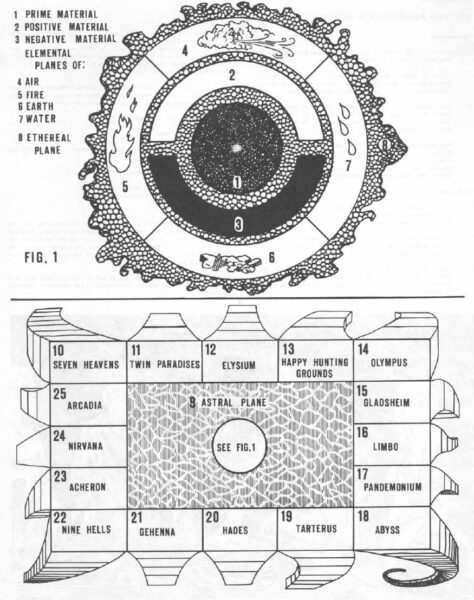
It will presumably surprise no one when I write that the “planes” of Planescape are alternate planes of existence, separate from the “Prime Material Plane” in which most Dungeons & Dragons campaigns take place. They were introduced by Gary Gygax already in the late 1970s, in the iconic first editions of the Player’s Handbook and Dungeon Master’s Guide. His cosmology was a melange of a little bit of everything: quantum physics, Renaissance-era alchemy and astronomy, the holy texts of various religions, New Age philosophy, Dante and Milton, twentieth-century fantasy and horror novels.

Gary Gygax’s vision of the Dungeons & Dragons multiverse, as found in an appendix to the Player’s Handbook.

The Prime Material Plane stands at the center of it all, much like the Earth was once imagined to stand at the center of our universe. It is surrounded by the Inner Planes that embody the physical building blocks of existence, which are in turned enclosed by the Outer Planes that embody the metaphysical alignments, those nine possible combinations of Lawful, Neutral, and Chaotic, Good, Neutral, and Evil.

Gygax was always prepared to muse and to elaborate, on this subject as on so many others. Small wonder that these alleged rule books — surely the most chatty and discursive books of rules ever written, the heart of the Gospel of Saint Gary — were perused and pored over endlessly by his young fans, many of whom were discovering for the first time the countless disparate philosophical ideas he threw into the pot. Gygax wasn’t an overly sophisticated thinker in most contexts, but he was a prolific one, who always had ten more ideas waiting in the wings if you didn’t respond to his last one.

For those of you who haven’t really thought about it, the so-called planes are your ticket to creativity, and I mean that with a capital C! Everything can be absolutely different, save for those common denominators necessary to the existence of the player characters coming to the plane. Movement and scale can be different; so can combat and morale. Creatures can have more or different attributes. As long as the player characters can somehow relate to it, then it will work…

I have recommended that Boot Hill and Gamma World be used in campaigns. There is also Metamorphoses Alpha, Tractics, and all sorts of other offerings which can be converted to man-to-man role-playing scenarios. While as of this writing there are no commercially available “other planes” modules, I am certain that there will be soon — it is simply too big an opportunity to pass up, and the need is great.

This was a remarkably prescient description of where planar travel in Dungeons & Dragons would go — eventually. For a long time after The Dungeon Master’s Guide appeared in 1979, the other planes of existence were one of those Dungeons & Dragons concepts that were kind of floating out there in the ether (or was it the Ethereal Plane?) without anyone knowing quite what to do with it. Apart from some sketchy guidelines for “ethereal” and “astral” travel and combat, the rule books remained sadly short on specifics. The 1980 adventure module Queen of the Demonweb Pits, designed by Gygax and David C. Sutherland III, did take players on a jaunt to the Abyssal Plane, but that was a one-shot thing. For all that Gygax had claimed, in his indelibly Gygaxian way, that “the need is great,” as if an understanding of the planes of Dungeons & Dragons was an urgent matter of national security, neither he nor anyone else seemed to be in all that much of a hurry to address said need. The occasional slightly dodgy article in Dragon magazine aside, Dungeons & Dragons remained in practice a very Prime Material sort of game.

This situation first started to change in the latter half of the 1980s. By then, Gygax was on his way out of TSR and the Dungeons & Dragons craze of the decade’s beginning had just about run its course. Necessity was forcing TSR to adjust its business model, from selling the core Dungeons & Dragons game to new players to selling an ever expanding lineup of rules extensions, campaign settings, and pre-crafted adventures to its surviving base of loyal, hardcore players. The planes seemed like fresh fodder for all three types of product.

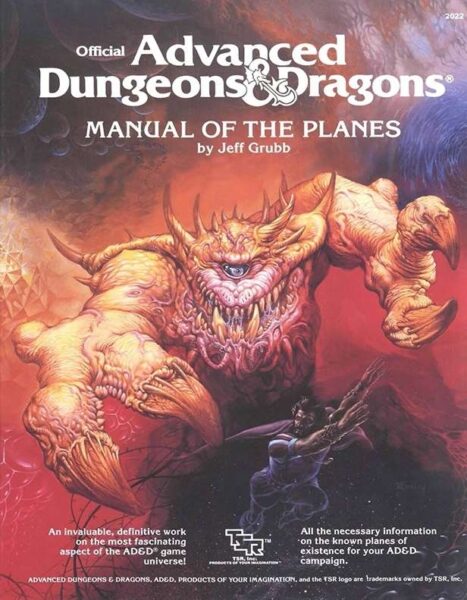
A longtime TSR stalwart named Jeff Grubb took the first concerted swing at it. In 1987, the company published his Manual of the Planes, the latest in its ever-growing line of new Dungeons & Dragons hardbacks for the hardcore. Grubb took it as his mission to give Gygax’s abstract cosmology a grounding in lived experience, to explain what it would actually be like to visit these places. Unfortunately, he prioritized alchemical realism over playability, winding up with a collection of environments that were as brutally, hilariously inhospitable to even high-level characters as one might imagine a plane of nothing but fire or air to be. “The book was fascinating reading,” notes Dori Hein, an ordinary Dungeons & Dragons fan at the time whom we will meet again in another role. “I loved the mythology and the grand majesty of all the planes, but — try as I might — I couldn’t create an adventure without killing all my players.” In the same vein, Sean Gandert of the website Exposition Break writes that “the planes’ complete resistance to being remotely welcoming is both what makes them fascinating to read about and also makes the book completely skippable and largely irrelevant. It is a work of cosmology and mythology, not a plan for where to send adventurers.”

The Manual of the Planes went out of print in fairly short order anyway, after TSR commenced rolling out a second edition of Advanced Dungeons & Dragons in 1989. The cynical interpretation of this initiative is that it was the best way TSR had yet devised for continuing to extract money from its static pool of players, by forcing them to buy the game they loved all over again in its most basic form in order to stay up to date with the times. The idealistic one is that it let TSR clean up a game system that had grown ever more baggily shambolic over the past decade of supplement after supplement. In reality, the second edition was doubtless a little of both, being seen one way by the people surrounding Lorraine Williams in her executive suite and another by the creative types in the cubicles.

That said, and looking back on what I’ve written about the later period of TSR’s history elsewhere on this site, I fear I may have overemphasized the cynicism at the expense of the idealism. There’s no question that the company fell prey to a set of perverse incentives during the last decade of its existence, many of them born out of idiosyncrasies in its longstanding distribution contract with the book publisher Random House. By the early 1990s, this had resulted in an absolute hailstorm of product brought down upon the heads of Dungeons & Dragons fans, more than all but the most well-heeled among them could possibly afford to buy, much less find the time to bring to the tabletop. But there’s likewise no question that these products were made with enormous love and care by the creative staff. This was the heyday of the alternative campaign setting, when TSR offered up the chance to leave conventional high fantasy behind and play Dungeons & Dragons in post-apocalyptic worlds, in the lands of the Arabian Nights, in Gothic castles, on the high seas, even in outer space. So what if there was no way to justify so many settings’ existence as commercial products, if each successive one sold worse than the one before, especially after the collectible-card game Magic: The Gathering arrived on the scene to tempt away large chunks of TSR’s remaining customer base. Circumstance had granted the people making these settings a rare reprieve from the harsh logic of supply and demand, and they didn’t let it go to waste.

Given this cavalcade of rich but disconnected settings, it was perhaps inevitable that TSR would look once again to the planar multiverse as a way of unifying a crazily diverse set of experiences bearing the name of Dungeons & Dragons. A boxed set reviving Gygax’s multiverse could bring them all together conceptually, could even provide a set of practical mechanisms to allow the same set of player characters to jump from setting to setting, just like Saint Gary had first proposed all those years ago.

In addition to being a unifying force for Dungeons & Dragons itself, Planescape was quite explicitly intended as a response to Vampire: The Masquerade, an RPG from an upstart company known as White Wolf Games that flipped everything you thought you knew about the tabletop scene on its head. Whereas Dungeons & Dragons, even in its supposedly cleaned-up second-edition incarnation, was infamous for the complexity of its rules, Vampire gave you just enough of them to provide a runway for storytelling. That fact, combined with its subject matter, attracted fresh blood to the hobby: Goth rockers and theater kids and Anne Rice readers, among them a surprising number of girls and women. At the end of the day, Vampire may have been full of as many clichés as vanilla Dungeons & Dragons —  clichés which are all the more evident from the perspective of today, after several more decades worth of vampire fictions — but they had the advantage of feeling relatively fresh from the perspective of the early 1990s. Indeed, this was the only period in the entire history of tabletop RPGs when it seemed possible that a different game might just unseat Dungeons & Dragons from its throne as the undisputed standard bearer for the hobby. Vampire’s rise made TSR nervous enough to want to make something of its own that was grittier, messier, and a bit less morally straightforward, less of a single-unit wargame and more of a vehicle for improvisational drama. It was no accident that the Dungeons & Dragons brand appeared on the eventual Planescape box only as a small logo tucked away in the corner.

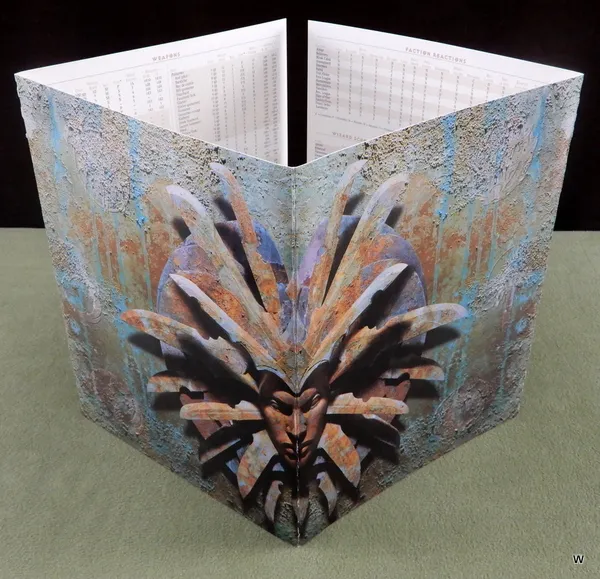
David “Zeb” Cook, another veteran TSR hand, was made lead designer on Planescape. Dori Hein, who had by now graduated from merely playing TSR’s games to working there, became the producer, overseeing a team of artists, cartographers, writers, editors, and play-testers. They pulled out all the stops for a set that wound up consisting of no fewer than four separate books, printed on thick and creamy Pentair Suede paper, and four sturdy cardboard posters. The luscious package was capped off by the most intimidating Dungeon Master’s screen ever devised. One of TSR’s purchasing managers had a sign hanging in his office: “The pleasure of a product well done lingers far longer than the excitement of a bargain.” As it happened, though, the Planescape set was both: it sold for just $30, a ridiculously cheap price for such a luxurious product even by the standards of the 1990s. It may have been no more than a break-even price, or not even that, settled upon in the hope that Planescape would revive TSR’s flagging fortunes in the longer run by spawning a whole new ecosystem of supplements, adventure modules, and tie-in novels.

The Planescape Dungeon Master’s screen. Sitting down around a table that had this thing on top of it, you knew you were in for a mind-bending journey that was more Salvador Dali than Boris Vallejo.

Zeb Cook’s first and most important stroke of brilliance was to give his vision of the planes a hub around which to operate. This was Sigil, a “city of doors” giving unto the many other planes, a meeting ground and melting pot for the entire multiverse. Ranging far afield from the pulpy fantasy of Jack Vance and the stately epic fantasy of J.R.R. Tolkien, the two most obvious inspirations for traditionalist Dungeons & Dragons, Cook read postmodern, experimental novels by Milorad Pavić and Italo Calvino for inspiration. Sigil, a city of angles as well as doors, became a physical embodiment of their twisted, self-referential approach to narrative: “Get it right out front: Sigil’s an impossible place, a city built on the inside of a tire that hovers over the top of a gods-know-how-tall spike, which rises from a universe shaped like a giant pancake.”

Sigil is not so refined a place as some might expect for the central hub of the multiverse, but that’s fair enough, given that Cook’s multiverse itself isn’t all that refined. The dominant note of the city, even outside of its plentiful and teeming slum districts, is what we might call dirty Victoriana, of a piece with 21st-century novels like Sarah Water’s Fingersmith and Michel Faber’s The Crimson Petal and the White, which read like genuine Victorian “sensation novels” with the added ability to state outright the disreputable things that their ancestors could only imply. The dialect of Sigil’s streets is vintage Cockney slang in spirit if not always in the details of the vocabulary, with the same uncanny talent for being roundabout and penetrating at the same time: “berks” and “cutters” are no-account people; “the dark” is knowledge; “jink” is money; one’s “kip” is one’s (usually humble) abode; one’s “bone-box” is one’s mouth; to “pike off” means to scram. In keeping with all the best slang, these are words that you know when you hear them even if you don’t actually know them, if you take my meaning. As we’ve already seen, the books in the Planescape box that describe Sigil are themselves written in this vernacular: “Welcome, addle-cove!” begins the Planescape “Player’s Guide.” This is not the Dungeons & Dragons of 1980s school cafeterias; both dungeons and dragons are mostly missing from Sigil, replaced by far stranger things.

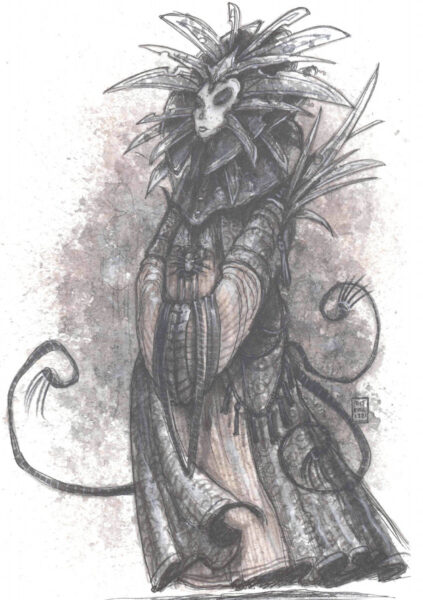
Instead of embracing the simplistic good-versus-evil dynamics of traditional Dungeons & Dragons, Sigil is divided into fifteen factions whose adherents are aptly described as “philosophers with clubs,” from the chivalric and vaguely fascistic Godsmen to the nihilistic Bleak Cabal, who preach that “once a sod believes it all means nothing, it all starts to make sense.” Ruling over the whole place, ensuring that no single faction gets too powerful, is the Lady of Pain, who can flay the skin from a poor berk just by looking at him. The overriding theme is that ideas and beliefs matter, are literally woven right into the substance of the multiverse, and can kill or save you just as indubitably as the physical elements of earth, air, wind, and fire. Sigil is the ultimate argument for the value of a good humanities education.

The Lady of Pain.

If there’s a weakness to the Planescape set, it’s that it spends so much space on Sigil that it doesn’t have enough left over for all those other planes of existence that were supposed to be the whole point of the endeavor. Instead of offering a wide-open set of possibilities, it can feel paradoxically claustrophobic, like the crowded filthy alleyways of the city itself.

Nevertheless, the Planescape box was endlessly audacious and imaginative, as different from the typical Dungeons & Dragons experience as anyone could have asked for. But, whether despite or because of these factors, it was not a commercial success. It sold just 60,000 copies over the five years after its release in April of 1994, a thin foundation indeed on which to build a new gaming ecosystem. The add-on lines, which offered opportunities to flesh out the multiverse in some of the way that the boxed set had failed to do, continued in fits and starts for longer than you might expect — another tribute to the topsy-turvy economic incentives that marked TSR at the time — but petered out for good after the failing company was acquired in 1997 by its own worst enemy Wizards of the Coast, the maker of Magic: The Gathering. The Vampire craze did eventually fade, but its travails had nothing to do with TSR’s efforts. It was rather something to do with the ever-shifting winds of pop culture, which soon replaced teenagers’ Cure and Alice in Chains records with the Backstreet Boys and Britney Spears.

So, had things turned out just a little bit differently, Planescape would be fondly remembered today only by a few tabletop nostalgics as a piece of work of unusual vision that never got its due. Instead, though, it went on to become a landmark of another stripe, in a different medium entirely.


Chris Avellone.

TSR had begun dangling the prospect of a Planescape computer game in front of publishers even before the boxed set shipped; such a thing was regarded as a potentially vital part to the product line that had become the latest Great White Hope for reversing the company’s accelerating downward spiral. Interplay rose to the bait, signing the contract before 1994 was out. In fact, it went so far as to hire Zeb Cook himself, who had concluded that “it didn’t seem like there was going to be a long-term future” for him on the tabletop. But the initial rush of enthusiasm petered out; Cook soon departed again, leaving the digital future of Planescape in limbo. And yet the idea of a Planescape computer game never completely went away. Late in 1995, when an inexperienced youngster named Chris Avellone came to Interplay for a job interview, he was asked how he would design such a game. He brainstormed in the spur of the moment the genesis of the eventual Planescape: Torment: “I would start it after the death screen. What happens after the main character dies?”

Avellone had grown up in the 1980s playing Dungeons & Dragons with his friends in his hometown of Alexandria, Virginia. By the time he went off to university, he had two possible futures in mind for himself: either to become a comic-book author or to become a tabletop-RPG designer. Neither field could exactly be called a growth industry at the time, but he made the best of it. On the gaming side, he sent a long string of submissions not only to TSR but to Steve Jackson Games, the maker of GURPS (“Generic Universal Role-Playing System”), and to Hero Games, the maker of the superhero RPG Champions. Initially, he met only with rejection; his closest brush with his heroes at TSR came when Monte Cook, yet another well-known name among the Dungeons & Dragons cognoscenti, took time out to plead with him personally to just stop submitting stuff already.

But Avellone persevered, and finally began to see some of his gaming material accepted and published. Yet he still had to confront the reality that the life of a freelance tabletop-RPG writer and designer left a little something to be desired: specifically, money. Most of the royalty checks that came in from the beleaguered companies that published his work — the Magic: The Gathering craze was in full flight, pushing RPGs to the margins of the same shops where they had once been the dominant attraction — had just two digits before the decimal point. Avellone, who had by now graduated from the College of William & Mary with a Bachelors in English, was still at loose ends when it came to the all-important question of how he was going to put food on his table as a responsible adult. Everyone told him that the wise choice was to acquire a teaching certificate, but all he wanted to do was find a way to make games full-time.

Oddly enough, he had never seriously thought about becoming a computer-game developer, despite having played his fair share of The Bard’s Tale and its ilk as a teenager. It took Steve Peterson, his editor at Hero Games, to point out to him how different the economics of that adjacent industry were. Peterson pulled some strings to secure Avellone an interview at Interplay Productions, for something which he was unlikely to find anytime soon in the moribund tabletop field: an honest-to-goodness full-time job. He got the job.

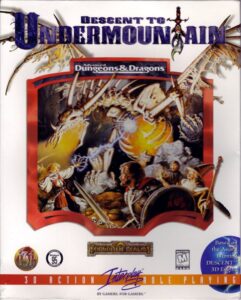
Although he had been asked about Planescape at his interview, he wasn’t allowed to spend all or even most of his time on that perpetually incipient project after he was hired. As the low man on the totem pole, he was shuffled around from team to team, plugging gaps in the design plumbing wherever needed. He worked on the infamous Descent to Undermountain, the nadir of digital Dungeons & Dragons during the 1990s; on Conquest of the New World, Interplay’s workmanlike take on the same theme as MicroProse’s Colonization; and on Starfleet Academy, an attempt to do TIE Fighter in the Star Trek universe that never felt true to its source material, in that it had the usually stately likes of the USS Enterprise dog-fighting in space as if it was, well, a TIE Fighter.

But betwixt and between all of the above, Avellone sat in his cubicle writing his Planescape game. He did so as much for his own peace of mind — because he needed something that he could feel passionate about — as out of any real conviction that the game would ever get made. The winds blowing against it seemed positively gale-force. For by now it was clear that Planescape would not prove the savior of Dungeons & Dragons on the tabletop. The TSR boxed set had barely sold at all, even as, commercially speaking, CRPGs were scarcely in better shape than their tabletop counterparts in the mid-1990s. Interplay already had one game in the stagnant genre under active development, in the form of Fallout. That looked like one too many in the eyes of most of the bean-counters.

Slowly, however, the murky picture started to take on some brighter shades. Just as 1996 was turning into 1997, Blizzard Entertainment unleashed a game called Diablo. Debate raged on Usenet and the young World Wide Web over whether Diablo, with its procedurally generated dungeons and its emphasis on constant action over a fleshed-out narrative, was a “real” CRPG at all or just a watered-down pretender. What was undeniable, though, was that it sold like crazy, raising the question of whether more complex, textured CRPGs might be ripe for a revival as well. Meanwhile a bankrupt TSR was by now in the process of being acquired by Wizards of the Coast. Wizards was saying all the right things about resurrecting Dungeons & Dragons for this new era, and its Magic revenues left it primed to spend more money on that endeavor than TSR could ever have dreamed of even before the collectible-card-game craze had cleaned its clock.

In what had seemed at the time like a triumph of hope over recent experience, earlier in 1996 the Interplay producer Feargus Urquhart had enlisted a fledgling Canadian studio known as Bioware to make yet another Dungeons & Dragons CRPG for Interplay to publish. In what had seemed a minor stipulation of the deal at the time the contract between Bioware and Interplay was signed, the former had agreed to allow the latter full access to the “Infinity Engine” it planned to use to build and run the game. By the spring of 1997, those arrangements were looking like they might prove more important, both to Interplay and to the whole industry, than anyone had anticipated at the time.

The Bioware game, for which Feargus Urquhart himself had come up with the name of Baldur’s Gate, was pitched straight down the middle, being about as traditionalist as a Dungeons & Dragons CRPG could get. It took place in the game’s more or less default setting of the Forgotten Realms, a world that took every cliché of epic fantasy and ran with it. Obviously this was the safest choice for a revival. But, in the wake of Diablo’s smashing success, Urquhart thought there might be space to throw up a curve ball as well to serve as a more outré companion piece. He asked Chris Avellone to condense his massive Planescape notebook into a proper project proposal.

The proposal reached the desk of Brian Fargo, the founder and head of Interplay, at the end of June 1997. “There was always a balance in running a studio between being commercial, being creative, and having your creative people be happy, and having them do things that are interesting to them,” says Fargo. “I was willing to take creative risks from time to time in order to allow these things to happen. Planescape: Torment was clearly one of those. When it came across my desk, I said, ‘Well, that’s as high-concept as you can get.’ But I thought that RPG players would like it, and I loved the writing and sensibility they put into the document. That got me interested in doing it.” It didn’t hurt, of course, that it ought to be possible to do the game fairly cheaply, since it would be able to re-purpose Bioware’s Infinity Engine.

The heart of the Planescape: Torment team was lead designer Chris Avellone, lead programmer Daniel Spitzley, the artists Tim Donley and Aaron Meyers, and producer Guido Henkel (a recent German immigrant who had helped to make the CRPGs Blade of Destiny and Star Trail in his native land). The project was not a major priority at Interplay for the majority of its existence, even after Fallout came out late in 1997 and sold pretty well, thus demonstrating that there truly was a reasonably sized market for more complex, conversation-heavy CRPGs than Diablo, provided that they were done well. In fact, in an ironic sort of way, Fallout’s success was to Planescape: Torment’s detriment. Eager to capitalize on the first non-sequel, non-licensed Interplay release to garner an appreciable buzz among hardcore gamers since Descent in 1995, Brian Fargo decreed that a Fallout 2 had to come out within a year of its predecessor. As a result, Planescape: Torment was all but suspended for much of 1998, while most of the team, Avellone included, moved over to pitch in on the Fallout sequel.

Although they did get it done on time, the biggest CRPG success story of the Christmas of 1998 proved not to be Fallout 2 but rather Baldur’s Gate, which introduced digital Dungeons & Dragons to a whole new generation of gamers who were more familiar with Diablo than Pool of Radiance. Just like that, Dungeons & Dragons on the computer became a hot topic again. With a Baldur’s Gate II not slated for release until 2000, Planescape: Torment was left to carry the Infinity Engine water in the interim. That brought a fresh influx of energy and resources to the project, and these were sufficient to get the game finished just in time for the Christmas of 1999.

It entered stores accompanied by stellar reviews whose fulsome praise felt only slightly obligatory in a Stockholm Syndrome sort of way. (Many reviewers did point out the “tome of text” to be read in tones that suggested that they might not have found it as uniformly delightful as their five-star verdicts suggested.) Nonetheless, as a computer game based on a tabletop setting that had been discontinued more than eighteen months earlier, Planescape: Torment was in a strange position for a licensed product. Even against weak competition — the only other high-profile CRPG release that holiday season was the abjectly terrible Ultima IX — the game’s sales were a shadow of the figures put up by Baldur’s Gate. In an ironic way, the lack of ringing commercial success may have been a positive for Planescape: Torment’s legacy, confirming its modern status as a cult classic that’s for the CRPG sophisticates rather than the hoi polloi.

As for my opinion… well, I’m afraid I’m going to need another article to properly interrogate the reputation and reality of the game. For, whether one happens to be sitting with the prosecution or the defense or just back in the jury box trying to sort through it all, the case of Planescape: Torment is a complicated one.


Did you enjoy this article? If so, please think about pitching in to help me make many more like it. You can pledge any amount you like.


Sources: The books Slaying the Dragon: A Secret History of Dungeons & Dragons by Ben Riggs, Beneath a Starless Sky: Pillars of Eternity and the Infinity Engine Era of RPGs by David L. Craddock, and Designers & Dragons: A History of the Roleplaying Game Industry volumes 1 (the 1970s) and 3 (the 1990s) by Shannon Appelcline; Dragon of March 1994, April 1994, May 1994, July 1994, and August 1994; Computer Gaming World of March 2000 and April 2000; the 2015 GamesTM special issue on “controversial” games; Retro Gamer 113. Plus the Advanced Dungeons & Dragons Player’s HandbookDungeon Master’s GuideManual of the Planes, and the Planescape boxed set. Plus the materials found in the Brian Fargo Collection in the archives of the Strong Museum of Play.

Online sources include Soren Johnson’s interview with Chris Avellone for his Designer’s Notes podcast, a Last Game Standing interview with Avellone, and Sean Gandert’s series of articles about the evolution of planar travel in Dungeons & Dragons for the website Exposition Break.

Where to Get It: Planescape: Torment is available as digital purchase from GOG.com in an “enhanced edition.” Buying it also gives you access to the original version.
 

Tags: , , , , ,

The CRPG Renaissance, Part 5: Fallout 2 and Baldur’s Gate

As we learned in the earlier articles in this series, Interplay celebrated the Christmas of 1997 with two new CRPGs. One of them, the striking post-apocalyptic exercise called Fallout, was greeted with largely rave reviews. The other, of course, was the far less well-received licensed Dungeons & Dragons game called Descent to Undermountain. The company intended to repeat the pattern in 1998, with another Fallout and another Dungeons & Dragons game. This time, however, the public’s reception of the two efforts would be nearly the polar opposite of last time.


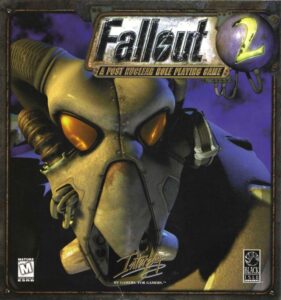
It’s perhaps indicative of the muddled nature of the project that Interplay couldn’t come up with any plot-relevant subtitle for Fallout 2. It’s just another “Post-Nuclear Role-Playing Game.”

Tim Cain claims that he never gave much of a thought to any sequels to Fallout during the three and a half years he spent working on the first game. Brian Fargo, on the other hand, started to think “franchise” as soon as he woke up to Fallout’s commercial potential circa the summer of 1997. Fallout 2 was added to Interplay’s list of active projects a couple of months before the original game even shipped.

Interplay’s sorry shape as a business made the idea of a quick sequel even more appealing than it might otherwise have been. For it should be possible to do it relatively cheaply; the engine and the core rules were already built. It would just be a matter of generating a new story and design, ones that would reuse as many audiovisual assets as possible.

Yet Fargo was not pleased by the initial design proposals that reached his desk. So, just days after Fallout 1 had shipped, he asked Tim Cain to get together with his principal partners Leonard Boyarsky and Jason Anderson and come up with a proposal of their own for the sequel. The three were dismayed by this request; exhausted as they were by months of crunch on Fallout 1, they had anticipated enjoying a relaxing holiday season, not jumping right back into the fray on Fallout 2. Their proposal reflected their mental exhaustion. It spring-boarded off of a joking aside in the original game’s manual, a satirical advertisement which Jason Anderson had drawn up in an afternoon when he was told by Interplay’s printer that there would be an unsightly blank page in the booklet as matters currently stood. The result was the “Garden of Eden Creation Kit”: “When all clear sounds on your radio, you don’t want to be caught without one!” Elaborating on this thin shred of a premise, the sequel would cast you as a descendant of the star of the first game, sent out into the dangerous wastelands to recover one of these Garden of Eden Kits in lieu of a water chip. This apple did not fall far from the tree.

But as it turned out, that suited Brian Fargo just fine. Within a month of Fallout 1′s release, Cain, Boyarsky, and Anderson had been officially assigned to the Fallout 2 project. None of them was terribly happy about it; what all three of them really wanted were a break, a bonus check, and the chance to work on something else, roughly in that order of priority. In January of 1998, feeling under-appreciated and physically incapable of withstanding the solid ten months of crunch that he knew lay before him, Cain turned in his resignation. Boyarsky and Anderson quit the same day in a show of solidarity. (The three would go on to found Troika Studios, whose games we will be meeting in future articles on this site, God willing and the creek don’t rise.)

Following their exodus, Fallout 2 fell to Feargus Urquhart and the rest of his new Black Isle CRPG division to turn into a finished product. Actually, to use the word “division” is to badly overstate Black Isle’s degree of separation from the rest of Interplay. Black Isle was more a marketing label and a polite fiction than a lived reality; the boundaries between it and the mother ship were, shall we say, rather porous. Employees tended to drift back and forth across the border without anyone much noticing.

This was certainly the case for most of those who worked on Fallout 2, a group which came to encompass about a third of the company at one time or another. Returning to the development approach that had yielded Wasteland a decade earlier, Fargo and Urquhart parceled the game out to whoever they thought might have the time to contribute a piece of it. Designer and writer Chris Avellone, who was drafted onto the Fallout 2 team for a few months while he was supposed to be working on another forthcoming CRPG called Planescape: Torment, has little positive to say about the experience: “I do feel like the heart of the team had gone. And all that was left were a bunch of developers working on different aspects of the game like a big patchwork beast. But there wasn’t a good spine or heart to the game. We were just making content as fast as we could. Fallout 2 was a slapdash product without a lot of oversight.”

Still, the programmers did fix some of what annoyed me about Fallout 1, by cleaning up some of the countless little niggles in the interface. Companions were reworked, such that they now behave more or less as you’d expect: they’re no longer so likely to shoot you in the back, are happy to trade items with you, and don’t force you to kill them just to get around them in narrow spaces. Although the game as a whole still strikes me as more clunky and cumbersome than it needs to be — the turn-based combat system is as molasses-slow as ever — the developers clearly did make an effort to unkink as many bottlenecks as they could in the time they had.

But sadly, Fallout 2 is a case of one step forward, one step back: although it’s a modestly smoother-playing game, it lacks its predecessor’s thematic clarity and unified aesthetic vision. Its world is one of disparate parts, slapped together with no rhyme, reason, or editorial oversight. It wants to be funny — always the last resort of a game that lacks the courage of its fictional convictions — but it doesn’t have any surfeit of true wit to hand. It tries to make up for the deficit the same way as many a game of this era, by transgressing boundaries of taste and throwing out lazy references to other pop culture as a substitute for making up its own jokes. This game is very nerdy male, very adolescent-to-twenty-something, and very late 1990s — so much so that anyone who didn’t live through that period as part of the same clique will have trouble figuring out what it’s on about much of the time. I do understand most of the spaghetti it throws at the walls — lucky me! — but that doesn’t keep me from finding it fairly insufferable.
Fallout 2 shipped in October of 1998, just when it was supposed to. But its reception in the gaming press was noticeably more muted than that of its predecessor. Reviewers found it hard to overlook the bugs and glitches that were everywhere, the inevitable result of its rushed and chaotic development cycle, even as the more discerning among them made note of the jarring change in tone and the lack of overall cohesion to the story and design. The game under-performed expectations commercially as well, spending only one week in the American top ten. In the aftermath, Brian Fargo’s would-be CRPG franchise looked like it had already run its course; no serious plans for a Fallout 3 would be mooted at Interplay for quite some time to come.

Yet Fallout 2 did do Interplay’s other big CRPG for that Christmas an ironic service. When BioWare told Fargo that they would like a couple of extra months to finish Baldur’s Gate up properly, the prospect of another Interplay CRPG on store shelves that October made it easier for him to grant their request. So, instead of taking full advantage of the Christmas buying season, Baldur’s Gate didn’t finally ship until a scant four days before the holiday. Never mind: the decision not to ship it before its time paid dividends that some quantity of ephemeral Christmas sales could never have matched. Plenty of gamers proved ready to hand over their holiday cash and gift cards in the days right after Christmas for the most hotly anticipated Dungeons & Dragons computer game since Pool of RadianceBaldur’s Gate sold 175,000 units before 1998 was over. (Just to put that figure in perspective, this was more copies than Fallout 1 had sold in fifteen months.) Its sales figures would go on to top 1 million units in less than a year, making it the bestselling CRPG to date that wasn’t named Diablo. The cover provided by Fallout 2 helped to ensure that Dr. Muzyka and Dr. Zeschuk would never have to see another patient again.


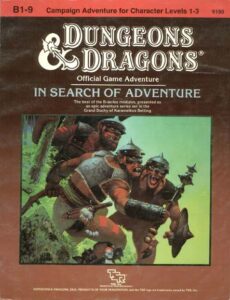
I’m not someone who places a great deal of sentimental value on physical things. But despite my lack of pack-rattery, some bits of flotsam from my early years have managed to follow me through countless changes of address on both sides of a very big ocean. Playing Baldur’s Gate prompted me to rummage around in the storage room until I came up with one of them. It goes by the name of In Search of Adventure. This rather generically titled little book is, as it says on the front cover, a “campaign adventure” for tabletop Dungeons & Dragons. Note the absence of the “Advanced” prefix; this adventure is for the non-advanced version of the game, the one that was sold in those iconic red and blue boxes that conquered the cafeteria lunch tables of Middle America during the first few years of the 1980s, when TSR dared to dream that their flagship game might become the next Monopoly. If we’re being honest, I always preferred to play this version of the game even after its heyday passed away. It seemed to me more easy-going, more fun-focused, less stuffily, pedantically Gygaxian.

Anyway, the campaign adventure in question came out in 1987, well after my preferred version of Dungeons & Dragons had become the weak sister to its advanced, hardcore sibling — unsurprisingly so, given that pretty much the only people still playing the game by that point were hardcore by definition.

In Search of Adventure is actually a compilation of nine earlier adventure modules that TSR published for beginning-level characters, crammed together into one book with a new stub of a plot to serve as a connecting tissue. I dug it out of storage and have proceeded to talk about it here because it reminds me inordinately of Baldur’s Gate, which works on exactly the same set of principles. There’s an overarching story to it, sure, but it too is mostly just a big grab bag of geography to explore and monsters to fight, in whatever order you prefer. In this sense and many others, it’s defiantly traditionalist. It has more to do with Dungeons & Dragons as it was played around those aforementioned school lunch tables than it does with the avant-garde posturings of TSR’s latter days. As I noted in my last article, the Forgotten Realms in which Baldur’s Gate is set — and in which In Search of Adventure might as well be set, for all that it matters — is so appealing to players precisely because it’s so uninterested in challenging them. The Forgotten Realms is the archetypal place to play Dungeons & Dragons. Likewise, Baldur’s Gate is an archetypal Dungeons & Dragons computer game, the essence of the “a group of adventurers meet in a bar…” school of role-playing. (You really do meet some of your most important companions in Baldur’s Gate in a bar…)

Luke Kristjanson, the BioWare writer responsible for most of the dialog in Baldur’s Gate, says that he never saw the computer game as “a simulation of a fully-realized Medieval world”: “It was a simulation of playing [tabletop] Dungeons & Dragons.” This statement is, I think, the key to understanding where BioWare was coming from and what still makes their game so appealing today, more than a quarter-century on.

Opening with a Nietzsche quote leads one to fear that Baldur’s Gate is going to try to punch way, way above its weight. Thankfully, it gets the pretentiousness out of its system early and settles down to meat-and-potatoes fare. BioWare’s intention was never, says Luke Kristjanson, to make “a serious fantasy for serious people.” Thank God for that!

But here’s the brilliant twist: in order to conjure up the spirit of those cafeteria gatherings of yore, Baldur’s Gate uses every affordance of late-1990s computer technology that it can lay its hands on. It wants to give you that 1980s vibe, but it wants to do it better — more painlessly, more intuitively, more prettily — than any computer of that decade could possibly have managed. Call it neoclassical digital Dungeons & Dragons.

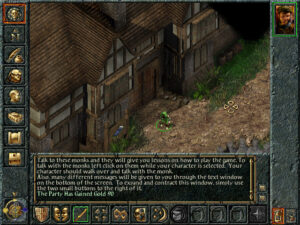
The game begins in a walled cloister known as Candlekeep, which has a bit of a Name of the Rose vibe, being full of monks who have dedicated their lives to gathering and preserving the world’s knowledge. The character you play is an orphan who has grown up in Candlekeep as the ward of a kindly mage named Gorion. This bucolic opening act gives you the opportunity to learn the ropes, via a tutorial and a few simple, low-stakes quests. But soon enough, a fearsome figure in armor shatters the peace of the cloister, killing Gorion and forcing you to take to the road in search of adventure (to coin a phrase). The game does suggest at the outset that you visit a certain tavern where you might find some useful companions, but it never insists that you do this or anything else. Instead you’re allowed to go wherever you want and to do exactly that thing which pleases you most once you get there. When you do achieve milestones in the main plot, whether deliberately or inadvertently, they’re heralded with onscreen chapter breaks which demonstrate that the story is progressing, because of or despite your antics. In this way, the game tries to create a balance between player freedom and the equally bracing sense of being caught up in an epic plot, one in which you will come to play the pivotal role — being, as you eventually learn, the “Chosen One” who has been marked by destiny. Have I mentioned that Baldur’s Gate is not a game that shirks from fantasy clichés?

The inclusion of a tutorial heralds the dawning of a more user-friendly era of the CRPG.

Of course, there’s an unavoidable tension between the set-piece plot of the chapter-based structure and the open-world aspect of the game — a tension which we’ve encountered in other games I’ve written about. The main plot is constantly urging you forward, insisting that the fate of the world is at stake and time is of the essence. Meanwhile the many side quests are asking you to rescue a lost housecat or collect wolf pelts for a merchant. If you take the game at its word and rush forward with a sense of urgency, you’ll not only come to the climax under-leveled but will have missed most of the fun. All of which is to say that Baldur’s Gate is best approached like that In Search of Adventure module: just start walking around. Go see what is to be found in those parts of your map that are still blank. Sooner or later, you’ll trigger the next chunk of the main plot anyway.

It’s amazing how enduring some of what is to be found in those blank spaces has proved. My wife likes to read graphic novels. I was surprised recently to see that she’d started on a Dungeons & Dragons-branded one called Days of Endless Adventure, with a copyright date of 2021. I was even more surprised when I flipped it open idly and came face to face with the simple-minded ranger Minsc and his precious pet hamster Boo, both of whom were introduced to the world in Baldur’s Gate.

A congenital visual blurriness dogs this game, the result of a little bit too much detail being crammed into a relatively low resolution of 640 X 480, combined with a subdued, brown- and gray-heavy color palette. My middle-aged eyes weren’t always so happy about it, especially when I played on a television in the living room.

As it happened, I had had quite a time with Minsc when I played the game. He joined my party fairly early on, on the condition that we would try to rescue his friend, a magic user named Dynaheir who was being imprisoned in a gnoll stronghold. Unfortunately, I applied the same logic to his principal desire that I did to the main quest line; I’d get to it when I got to it. I maintained this attitude even as he nagged me about it with increasing urgency. One day the dude just flipped out on me, went nuts and started to attack me and my other companions. What’s a person to do in such a situation? Reader, I killed him and his pet hamster.

I was playing a ranger myself, so I didn’t think losing his services would be any big problem. I didn’t notice until days later that killing him — even though, I rush to stipulate again, he attacked me first — had turned me into a “fallen ranger.” I’m told by people who know about such things that this is far from ideal, because it means that you’ve essentially been reduced to the status of a vanilla fighter, albeit one who craves a lot more experience points than usual to advance a level. Oh, well. I didn’t feel like going back so many hours, and I was in more of a “roll with the punches” than a “try and try again” frame of mind anyway. (I’m also told that there will be a way to reverse my fallen condition when I get around to playing Baldur’s Gate II with the same party. So that’s something to look forward to, I guess.) By way of completing the black comedy, I later did rescue Dynaheir and took her into my party. But I was careful not to mention that I had ever met her mysteriously vanished friend…

“Minsc? Uh, no, never heard the name. Shall we talk about something else?”

Any given play-through of Baldur’s Gate is guaranteed to generate dozens of such anecdotes, which combine to make its story your story, even if the text of the chapter breaks is the same for everyone. You don’t have to walk on eggshells, afraid that you’re going to break some necessary piece of plot machinery. Again, it’s you who gets to choose where you go, what you do there, and who travels with you on your quest. Any mistake you make along the way that doesn’t get you and all your friends killed can generally be recovered from or at least lived with, as I did my fallen-ranger status. Tabletop Dungeons & Dragons, says Luke Kristjanson, is about “[being with] your friends [and] doing something fun. And occasionally one’s a jackass and does something weird and you roll with it.” It does seem to me that rolling with it is the only good way to play this second-order simulation of that social experience.

The first companion to join you will probably be Imoen, a spunky female thief. The personalities of your companions are all firmly archetypal, but most of them are likeable enough that it’s hard to complain. Sometimes fantasy comfort food goes down just fine.

Baldur’s Gate’s specific methods of presenting its world of freedom and opportunity have proved as influential as the design philosophies that undergird it. The Infinity Engine provided the presentational blueprint for a whole school of CRPGs that are still with us to this day. You look down on the environment and the characters in it from a free-scrolling isometric point of view. You can move the “camera” anywhere you like in the current area, independent of the locations of your characters. That said, a fog-of-war is implemented: places your characters have not yet seen are completely blacked out, and you can’t know what other people or monsters are getting up to if they’re out of your characters’ line of sight.

The interface proper surrounds this view on three sides. Portraits of the members of your party — up to five of them, in addition to the character you create and embody from the outset — run down the right side of the screen. Command icons — some pertaining to the individual party members and some to the group as a whole or to the computer on which you’re running the game — stretch across the left side and bottom of the screen. An area just above the bottom line of icons can expand to display text, of which there is an awful lot in this game, mostly in the form of menu-driven conversations. (In 1998, we were still far from the era when it would be practical and cost-effective to have full voice-acting in a game with this much yammering. Instead just the occasional line of dialog is voiced, to establish personalities and set tones.) The interface is perhaps a bit more obscure and initially daunting than it might be in a modern game, but the contrast with the old keyboard-driven SSI Gold Box games could hardly be more stark. And thankfully, unlike Fallout’s, Baldur’s Gate’s interface doesn’t make the mistake of prioritizing aesthetics over utility.

In short, Baldur’s Gate tries really, really hard to be approachable in the way that modern players have come to expect, even if it doesn’t always make it all the way there. Take, for instance, its journal, an exhaustive chronicle of the personal story that you are generating as you play. That’s great. But what’s less great is that it can be inordinately difficult to sift through the huge mass of text to find the details of a quest you’re pretty sure you accepted sometime last week. Most of us would love to have a simple bullet list of quests to go along with the verbose diary, however much that may cause the hardcore immersion-seekers to howl in protest at the gameyness of it all. Later Infinity Engine games corrected oversights like this one.

The most oft-discussed and controversial aspect of the Infinity Engine, back in the day and to some extent even today, is its implementation of combat. As we’ve learned, makers of CRPGs in the late 1990s faced a real conundrum when it came to combat. They wanted to preserve a measure of tactical complexity, but they also had to reckon with the reality of a marketplace that showed a clear preference for fast-paced, fluid gameplay over turn-based models. Fallout tried to square that circle by running in real-time until a fight began, at which point it forced you back into a turn-based framework; Might and Magic VI did a little better in my opinion by letting you decide when you wanted to go turn-based. In a way, BioWare was even more constrained than the designers of either of those two games, because they were explicitly making a digital implementation of a turn-based set of tabletop rules.

Their solution to the conundrum was real-time-with-pause, in which the computer automatically acts out the combat, adhering to the rules of tabletop Dungeons & Dragons but, critically, without advertising the breaks between rounds and turns. The player can assert her will at any point in the proceedings by tapping the space bar to pause the action, issuing new commands to her charges, and then tapping it again to let the battle resume.

Clever though the scheme is, not everyone loves it. And, to be sure, there are valid complaints to levy against it. Big fights can all too quickly degenerate into a blob of intersecting sprites, with spells going off everywhere and everyone screaming at once; it’s like watching twenty Tasmanian Devils — the Looney Tunes version, that is — in a fur-flying free-for-all. Yet there are ways to alleviate the confusion by making judicious use of the option to “auto-pause,” a hugely important capability that is mentioned only in oblique passing in the game’s 160-page manual, presumably because that document was sent to the printing press before the software it described had been finalized. Auto-pause will let you stop the action automatically whenever certain conditions of your choice are met — or even at the end of every single action taken by every single member of your party, if you choose to go that far. Doing so lets you effectively turn Baldur’s Gate into a purely turn-based game, if that’s your preference. Or you can go fully turn-based only for the really big fights that you know will require careful micro-management. This is what I do. The rest of the time, I just use a few judicious break points — a character is critically wounded, a spell caster has finished casting a spell, etc. — and otherwise rely on the good old space bar.

Another option — the best one for those most determined to turn the game into a simulation of playing tabletop Dungeons & Dragons with your mates — is to turn on artificial intelligence for every member of your party but the one you created. Then you just let them all do their things while you do yours. You may find yourself less enamored with this approach, however, after you become part of the collateral damage of one of Dynaheir’s Fireball spells for the first time. (Shades of the stone-stupid and deadly companions in Fallout…)

Baldur’s Gate’s combat definitely isn’t perfect, but in its day it was a good-faith attempt to deliver an experience that was recognizably Dungeons & Dragons while also catering to the demands of the contemporary marketplace. I think it holds up okay today, especially when placed in the context of the rest of the game that houses it, which has ambitions for its world and its fiction that transcend the tactical-combat simulations that the latter-day Gold Box games especially lapsed into. It is true that your companions’ artificial intelligence could be better, as it is true that it’s sometimes harder than it ought to be to figure out what’s really going on, a byproduct of graphics that are somewhat muddy even at the best of times and of having way too many character sprites in way too small a space. But your fighters, who don’t usually require too much micro-management, are the most affected by this latter problem, while your spell casters ought to be standing well back from the fray anyway, if they know what’s good for them. Another not-terrible approach, then, is to control your spell casters yourself, since they’re the ones who can most easily ruin their companions’ day, and leave your fighters to their own devices. But you’ll doubtless figure out what works best for you within the first few hours.

Indeed, Baldur’s Gate feels disarmingly modern in the way that it bends over backward to adjust itself to your preferred style of play. This encompasses not only the myriad of auto-pause and artificial-intelligence options but an adjustable global difficulty slider for combat. All of this allows you to breeze through the fights with minimal effort or hunker down for a long series of intricate tactical struggles, just as you choose. Giving your player as many ways to play as possible is seldom a bad choice in commercial game design. Not everyone had yet figured that out in the late 1990s.

If you want the ultimate simulation of playing tabletop Dungeons & Dragons with your friends, you can turn on an option to watch the actual die rolls scrolling past during combat.

BioWare and Interplay released an expansion pack to Baldur’s Gate called Tales of the Sword Coast just six months after the base game. Rather than serving as a sequel to the main plot, it’s content merely to add some new ancillary areas to explore betwixt and between fulfilling your destiny as The Chosen One. Given that I definitely don’t consider the main plot the most interesting part of Baldur’s Gate, I have no problem with this approach in theory. Nevertheless, the expansion pack strikes me as underwhelming and kind of superfluous — like a collection of all the leftover bits that failed to make the cut the first time around, which I suspect is exactly what it is. The biggest addition is an elaborate dungeon known as Durlag’s Tower, created to partially address one of the principal ironies of the base game: the fact that it contains surprisingly little in the way of dungeons and no dragons whatsoever. The latter failing would have to wait for the proper sequel to be corrected, but BioWare did try to shore up the former aspect by presenting an old-school, tactically complex dungeon crawl of the sort that Gary Gygax would have loved, a maze rife not only with tough monsters but with secret doors, illusions, traps, and all manner of other subtle trickery. Personally, I tend to find this sort of thing more tedious than exciting at this stage of my life, at least when it’s implemented in this particular game engine. I decided pretty quickly after venturing inside to let old Durlag keep his tower, since he seemed to be having a much better time there than I was.

Durlag’s Tower. The Infinity Engine doesn’t do so well in such narrow, trap-filled spaces. It’s hard to keep your characters from blundering into places that they shouldn’t.

While your reaction to the über-dungeon may be a matter of taste, a more objective ground for concern is all of the new sources of experience points the expansion adds, whilst raising the experience and level caps on your characters only modestly. As a result, it becomes that much easier to max out your characters before you finish the game, a state of affairs which is no fun at all. In my eyes, then, Baldur’s Gate is a better, tighter game without the expansion. For better or for worse, though, Tales of the Sword Coast has become impossible to extricate from the base game, being automatically incorporated into all of the modern downloadable editions. So, I’ll content myself with telling you to feel free to skip Durlag’s Tower and/or any of the other additional content if it’s not your thing. There’s nothing essential to the rest of the game to be found there.

Whatever its infelicities and niggles, it’s almost impossible to overstate the importance and influence of Baldur’s Gate in the broader context of gaming history. Forget the comparisons I’ve been making again and again in these articles to Pool of Radiance: one can actually make a case for Baldur’s Gate as the most important single-player CRPG released between 1981, the landmark year of the first Wizardry and Ultima, and the date of this very article that you’re reading.

Baldur’s Gate’s unprecedented level of commercial success transformed the intersection between tabletop Dungeons & Dragons and its digital incarnations from a one-way avenue into a two-way street; all of the future editions of the tabletop rules that would emerge under Wizards of the Coast’s watch would be explicitly crafted with an eye to what worked on the computer as well. At the same time, Baldur’s Gate cemented one of the more enduring abstract design templates in digital gaming history; witness the extraordinary success of 2023’s belated Baldur’s Gate 3. The CRPGs that more immediately followed Baldur’s Gate I, both those that were powered by the Infinity Engine and those that only borrowed some of its ideas, found ways to improve on the template in countless granular details, but they were all equally the heirs to this very first Infinity Engine game. Yes, Fallout got there first, and in some respects did it even better, with a less clichéd, more striking setting and an even deeper-seated commitment to acknowledging and responding to its player’s choices. And there’s more than a little something to be said for the role played by the goofy, janky, uninhibited Monty Haul fun of Might and Magic VI in the rehabilitation of the CRPG genre as well. Yet the fact remains that it was Baldur’s Gate that truly led the big, meaty CRPG out of the wilderness and back into the mainstream.

Then again, gaming history is not a zero-sum game. The note on which I’d prefer to end this series of articles is simply that the CRPG genre was back by 1999. Increasingly, it would be the computer games that drove sales of tabletop Dungeons & Dragons rather than the other way around. Meanwhile a whole lot of other CRPGs, including some of the most interesting ones of all, would be given permission to blaze their own trails without benefit of a license. I look forward to visiting or revisiting some of them with you in the years to come, as we explore this genre’s second golden age.


Did you enjoy this article? If so, please think about pitching in to help me make many more like it. You can pledge any amount you like.


Sources: For Baldur’s Gate, see my last article, with the addition of the book BioWare: Stories and Secrets from 25 Years of Game Development, which commenter Infinitron was kind enough to tell me about.

For Fallout 2: the book Beneath a Starless Sky: Pillars of Eternity and the Infinity Engine Era of RPGs by David L. Craddock. Computer Gaming World of February 1999; Retro Gamer 72 and 188. Also Chris Avellone’s appearance on Soren Johnson’s Designer Notes podcast and Tim Cain’s YouTube channel.

Where to Get Them: Fallout 2 and Baldur’s Gate are both available as digital purchases at GOG.com, the latter in an “enhanced edition” that sports some welcome quality-of-life improvements alongside some additional characters and quests that don’t sit as well with everyone. Note that it buying it does give you access to the original game as well.


Tags: , , , , , ,

The CRPG Renaissance, Part 4: …Long Live Dungeons & Dragons!

In December of 1997, Interplay Entertainment released Descent to Undermountain, the latest licensed Dungeons & Dragons computer game. It’s remembered today, to whatever extent it’s remembered at all, as one of the more infamous turkeys of an era with more than its share of over-hyped and half-baked creations, a fiasco almost on par with Battlecruiser 3000AD or Daikatana. The game was predicated on the dodgy premise that Dungeons & Dragons would make a good fit with the engine from Descent, Interplay’s last world-beating hit — and also a hit that was, rather distressingly for Brian Fargo and his colleagues, more than two years in the past by this point.

Simply put, Undermountain was a mess, the kind of career-killing disaster that no self-respecting game developer wants on his CV. The graphics, which had been crudely up-scaled from the absurdly low resolution of 320 X 240 to a slightly more respectable 640 X 480 at the last minute, still didn’t look notably better than those of the five-year-old Ultima Underworld. The physics were weirdly floaty and disembodied, perhaps because the engine had been designed without any innate notion of gravity; rats could occasionally fly, while the corpses of bats continued to hover in midair long after shaking off their mortal coil. In design terms as well, Undermountain was trite and rote, just another dungeon crawl in the decade-old tradition of Dungeon Master, albeit not executed nearly so well as that venerable classic.

Computer Gaming World, hot on the heels of giving a demo of Undermountain a splashy, breathless write-up (“This game looks like a winner…”), couldn’t even muster up the heart to print a proper review of the underwhelming finished product. The six-sentence blurb the magazine did deign to publish said little more than that “the search for a good Dungeons & Dragons role-playing game continues, because Descent to Undermountain is certainly not it.” The website GameSpot was less inclined to pull its punches: after running through a damning litany of the game’s problems, it told its readers bluntly that “if you buy Descent to Undermountain after reading this, you get what you deserve.” The critical consensus has not changed over the decades since. On the clearinghouse site MobyGames, Undermountain ranks today as the thirteenth worst digital RPG ever released, out of 9085 candidates in all. Back in 1997, reviewers and gamers alike marveled that Interplay, the same company that had released the groundbreaking and aesthetically striking Fallout just weeks earlier, could follow it up so quickly with something so awful.

In its way, then, Descent to Undermountains name was accidentally appropriate. For it represented the absolute nadir of Dungeons & Dragons on computers, the depth of ignominy to which all of the cookie-cutter products from SSI and others had been inexorably descending over the last five years.

Then again, as a wise person once said, there does come a point where there’s nowhere left to go but up. Less than one year after Undermountain was so roundly scorned wherever it wasn’t ignored, another Dungeons & Dragons CRPG was released amidst an atmosphere of excitement and expectation that put even the reception of Pool of Radiance to shame. Almost as surprisingly, it too bore on its box the name of Interplay, a publisher whose highs and lows in the CRPG genre were equally without parallel. So, our goal for today is to understand how Interplay went from Descent to Undermountain to Baldur’s Gate. It’s an unlikely tale in the extreme, not least in the place and manner in which it begins.


Edmonton, Alberta, is no one’s idea of a high-tech incubator. “The Gateway to the North,” as the city styles itself, was built on oil and farming. These two things have remained core to its identity, alongside its beloved Edmonton Oilers hockey team and its somewhat less beloved but stoically tolerated sub-zero winter temperatures. The frontier ethic has never entirely left Edmonton; it has more in common with Billings, Montana, than it does with coastal Canadian cities like Montreal and Vancouver.

Into this milieu, insert three young men who were neither roughnecks nor farmers. Ray Muzyka, Greg Zeschuk, and Augustine Yip didn’t know one another when they were growing up in different quarters of Edmonton in the 1980s, but they were already possessed of some noteworthy similarities. Although all three had computers in their homes and enjoyed experimenting with the machines and the games they could play from an early age — Muzyka has recorded his first two games ever as Pirate Adventure and Wizardry on the Apple II — they directed their main energies toward getting into medical school and becoming doctors. “We never conceived of the possibility that you could have a career in videogames,” says Zeschuk. “You know, we’re from Edmonton, Canada. There were no companies that did that. There were some in Vancouver, but they were just starting out, like the Distinctive Software guys who would join Electronic Arts.”

The three men finally met in medical school — more specifically, at the University of Alberta during the late 1980s. Even here, though, they didn’t become fast friends right away. Only gradually did they come to realize that they had a set of shared interests that were anything but commonplace among their classmates: all three continued to play computer games avidly whenever the pressure of their studies allowed it. Witnessing the rapid evolution of personal computers, each began to ask himself whether he might be able to combine medicine with the technology in some satisfying and potentially profitable way. Then they began to have these conversations with each other. It seemed to them that there were huge opportunities in software for educating doctors. Already in 1990, a couple of years before they graduated from medical school, they started looking for technology projects as moonlighting gigs.

They kept at it after they graduated and became family practitioners. The projects got more complex, and they hired contractors to help them out. Their two most ambitious software creations were an “Acid-Base Simulator,” which they finished in 1994, and a “Gastroenterology Patient Simulator,” which they finished the following year. As their titles will attest, these products were a long, long way from a mainstream computer game, but the good doctors would cover the intervening distance with astonishing speed.

Wanting to set themselves on a firmer professional footing in software, Muzyka, Zeschuk, and Yip founded a proper corporation on February 1, 1995. They called it BioWare, a name that reflected a certain amount of bets-hedging. On the one hand, “BioWare” sounded fine as a name for a maker of medical software like the gastroenterology simulator they were still finishing up. On the other, they thought it was just catchy and all-purpose enough to let them branch out into other sorts of products, if doing so should prove feasible. In particular, they had become very interested in testing the waters of mainstream game development. “I liked medicine a lot,” says Muzyka. “I really liked it. I’m glad I was able to help people’s lives for the years that I did practice. I did a lot of emergency medicine in under-served areas in rural Alberta. It was really hard work, but really fun, really engaging, really exciting. [But] I love videogames.”

Their medical degrees were a safety net of a sort that most first-time entrepreneurs could only wish they had; they knew they could always go back to doctoring full-time if BioWare didn’t work out. “We maxed out our debt and our credit cards,” Muzyka says. “We just kind of went for it. It was like, whatever it took, this is what we’re doing. It never occurred to us [that] there would be risk in that. For me, it was a fun hobby at that point.”

Yet some differences soon became apparent between Muzyka and Zeschuk and their third partner Augustine Yip. Although the first two were willing and able to practice medicine only on the side while they devoted more and more time and energy to BioWare, the last had moved into another stage of life. He already had children to support, and didn’t feel he could scale back his medical career to the same degree for this other, far chancier venture. Muzyka and Zeschuk would wind up buying out his share of BioWare in mid-1996.

Well before this event, in the spring of 1995, Activision’s MechWarrior 2: 31st Century Combat hit the gaming world with all the force of the giant killer robot on its box. Thanks not least to Activision’s work in creating bespoke versions of MechWarrior 2 for the many incompatible 3D-accelerator cards that appeared that year, it became by many metrics the game of 1995. Suddenly every publisher wanted a giant-mech game of their own. Muzyka and Zeschuk saw the craze as their most surefire on-ramp to the industry as a new, unproven studio without even an office to their name. They paid a few contractors to help them make a demo, sent it to ten publishers, and started cold-calling them one after another. Their secret weapon, says Muzyka, was “sheer stubbornness and persistence. We just kept calling.” Amazingly, they were eventually offered a development deal by nine out of the ten publishers; suffice to say that mechs were very much in favor that year. Interplay came with the most favorable terms, so the partners signed with them. Just like that, BioWare was a real games studio. Now they had to deliver a real game.

They found themselves some cut-price office space not far from the University of Alberta. Ray Muzyka:

There were only four plugs on the wall. We had a power-up sequence for the computers in the office so that we didn’t blow the circuit breaker for the whole building. Everybody would be like, “I’m on. I’m on. I’m on.” We had found by trial and error that if you turned them on in a certain order, it wouldn’t create a power overload. If you turned on the computers in the wrong order, for sure, it would just flip the switch and you had to run downstairs, get the key, and open up the electrical box. It was an interesting space.

During the first year or so, about a dozen employees worked in the office in addition to the founders. Half of these were the folks who had helped to put together the demo that had won BioWare the contract with Interplay. The other half were a group of friends who had until recently hung out together at a comic-book and tabletop-gaming shop in Grande Prairie, Alberta, some 300 miles northwest of Edmonton; one of their number, a fellow named James Ohlen, actually owned the store. This group had vague dreams of making a CRPG; they tinkered around with designs and code there in the basement. Unfortunately, the shop wasn’t doing very well. Even in the heyday of Magic: The Gathering, it was difficult to keep such a niche boutique solvent in a prairie town of just 30,000 people. Having heard about BioWare through a friend of a friend, the basement gang all applied for jobs there, and Muzyka and Zeschuk hired them en masse. So, they all came down to Edmonton, adopting various shared living arrangements in the cheap student-friendly housing that surrounded the university. Although they would have to make the mech game first, they were promised that there was nothing precluding Bioware from making the CRPG of their dreams at some point down the road if this initial project went well.

Shattered Steel, BioWare’s first and most atypical game ever, was published by Interplay in October of 1996. It was not greeted as a sign that any major new talent had entered the industry. It wasn’t terrible; it just wasn’t all that good. Damning it with faint praise, Computer Gaming World called it “a decent first effort. But if Interplay wants to provide serious competition for the MechWarrior series, the company needs to provide more freedom and variety.” Sales hovered in the low tens of thousands of units. That wasn’t nothing, but BioWare’s next game would need to do considerably better if they were to stay in business. Luckily, they already had something in the offing that seemed to have a lot of potential.

A BioWare programmer named Scott Greig  had been tinkering lately with a third-person, isometric, real-time graphics engine of his own devising. He called it the Infinity Engine. Muzyka and Zeschuk had an idea about what they might use it for.

A low background hum was just beginning to build about the possibilities for a whole new sort of CRPG, where hundreds or thousands of people could play together in a shared persistent world, thanks to the magic of the Internet. 3DO’s Meridian 59, the first of the new breed, was officially open for business already, even as Sierra’s The Realm was in beta and Origin’s Ultima Online, the most ambitious of the shared virtual worlds by far, was gearing up for its first large-scale public test. Muzyka and Zeschuk, who prided themselves on keeping up with the latest trends in gaming, saw an opportunity here. Even before Shattered Steel shipped, it had been fairly clear to them that they had jumped on the MechWarrior train just a little bit too late. Perhaps they could do better with this nascent genre-in-the-offing, which looked likely to be more enduring than a passing fancy for giant robots.

They decided to show the Infinity Engine to their friends at Interplay, accompanied by the suggestion that it might be well-suited for powering an Ultima Online competitor. They booked a meeting with one Feargus Urquhart, who had started at Interplay six years earlier as a humble tester and moved up through the ranks with alacrity to become a producer while still in his mid-twenties. Urquhart was skeptical of these massively-multiplayer schemes, which struck him as a bit too far out in front of the state of the nation’s telecommunications infrastructure. When he saw the Infinity Engine, he thought it would make a great fit for a more traditional style of CRPG. Further, he knew well that the Dungeons & Dragons brand was currently selling at a discount.  Muzyka and Zeschuk, who were looking for any way at all to get their studio established well enough that they could stop taking weekend shifts at local clinics, were happy to let Urquhart pitch the Infinity Engine to his colleagues in this other context.

Said colleagues were for the most part less enthused than Urquhart was; as we’ve learned all too well by now, the single-player CRPG wasn’t exactly thriving circa 1996. Nor was the Dungeons & Dragons name on a computer game any guarantee of better sales than the norm in these latter days of TSR. Yet Urquhart felt strongly that the brand was less worthless than mismanaged. There had been a lot of Dungeons & Dragons computer games in recent years — way too many of them from any intelligent marketer’s point of view — but they had almost all presumed that what their potential buyers wanted was novelty: novel approaches, novel mechanics, novel settings. As they had pursued those goals, they had drifted further and further from the core appeal of the tabletop game.

Despite TSR’s fire hose of strikingly original, sometimes borderline avant-garde boxed settings, the most popular world by far in which to actually play tabletop Dungeons & Dragons remained the Forgotten Realms, an unchallenging mishmash of classic epic-fantasy tropes. The Forgotten Realms was widely and stridently criticized by the leading edge of the hobby for being fantasy-by-the-numbers, and such criticisms were amply justified in the abstract. But those making them failed to reckon with the reality that, for most of the people who still played tabletop Dungeons & Dragons, it wasn’t so much a vehicle for improvisational thespians to explore the farthest realms of the imagination as it was a cozy exercise in dungeon delving and monster bashing among friends; the essence of the game was right there in its name. For better or for worse, most people still preferred good old orcs and kobolds to the mind-bending extra-dimensional inhabitants of a setting like Planescape or the weird Buck Rogers vibe of something like Spelljammer. The Forgotten Realms were gaming comfort food, a heaping dish of tropey, predictable fun. And the people who played there wouldn’t have had it any other way.

And yet fewer and fewer Dungeons & Dragons computer games had been set in the Forgotten Realms since the end of the Gold Box line. (Descent to Undermountain would be set there, but it had too many other problems for that to do it much good.) SSI and their successors had also showed less and less fidelity to the actual rules of Dungeons & Dragons over the years. The name had become nothing more than a brand, to be applied willy-nilly to whatever struck a publisher’s fancy: action games, real-time-strategy games, you name it. In no real sense were you playing TSR’s game of Dungeons & Dragons when you played one of these computer games; their designers had made no attempt to implement the actual rules found in the Player’s Handbook and Dungeons Master’s Guide. It wasn’t clear anymore what the brand was even meant to stand for. It had been diluted to the verge of meaninglessness.

But Feargus Urquhart was convinced that it was not yet beyond salvation. In fact, he believed that the market was ready for a neoclassical Dungeons & Dragons CRPG, if you will: a digital game that earnestly strove to implement the rules and to recreate the experience of playing its tabletop inspiration, in the same way that the Gold Box line had done. Naturally, such a game would need to take place in the tried-and-true Forgotten Realms. This was not the time to try to push gamers out of their comfort zone.

At the same time, though, Urquhart recognized that it wouldn’t do to simply re-implement the Gold Box engine and call it a day. Computer gaming had moved on from the late 1980s; people expected a certain level of audiovisual razzle-dazzle, wanted intuitive and transparent interfaces that didn’t require reading a manual to learn how to use, and generally preferred the fast-paced immediacy of real-time to turn-based models. If it was to avoid seeming like a relic from another age, the new CRPG would have to walk a thin line, remaining conservative in spirit but embracing innovation with gusto in all of its granular approaches. The ultimate goal would not be to recreate the Gold Box experience. It must rather be to recreate the same tabletop Dungeons & Dragons experience that the Gold Box games had pursued, but to embrace all of the affordances of late-1990s computers in order to do it even better — more accurately, more enjoyably, with far less friction. Enter the Infinity Engine.

But Urquhart’s gut feeling was about more than just a cool piece of technology. He had served as the producer on Shattered Steel, in which role he had visited BioWare several times and spent a fair amount of time with the people there. Thus he knew there were people in that Edmonton office who still played tabletop Dungeons & Dragons regularly, who had forged their friendships in the basement of a tabletop-gaming shop. He thought that a traditionalist CRPG like the one he had in mind might be more in their wheelhouse than any giant-robot action game or cutting-edge shared virtual world.

He felt this so strongly that he arranged a meeting with Brian Fargo, the Big Boss himself, whose soft spot for the genre that had put Interplay on the map a decade earlier was well known. When he was shown the Infinity Engine, Fargo’s reaction was everything Urquhart had hoped it would be. What sprang to his mind first was The Faery Tale Adventure, an old Amiga game whose aesthetics he had always admired. “It didn’t look like a bunch of building blocks,” says Fargo today of the engine that Urquhart showed him in 1996. “It looked like somebody had free-hand-drawn every single screen.”

As Urquhart had anticipated would be the case, it wasn’t hard for Fargo to secure a license from the drowning TSR to make yet another computer game with the name of Dungeons & Dragons on it. The bean counters on his staff were not excited at the prospect; they didn’t hesitate to point out that Interplay already had Fallout and Descent to Undermountain in development. Just how many titles did they need in such a moribund genre? They needed at least one more, insisted Fargo.

BioWare’s employees were astonished and overjoyed when they were informed that a chance to work on a Dungeons & Dragons CRPG had fallen into their laps out of the clear blue sky. James Ohlen and his little gang from Grande Prairie could scarcely have imagined a project more congenial to their sensibilities. Ohlen had been running tabletop Dungeons & Dragons campaigns for his friends since he was barely ten years old. Now he was to be given the chance to invent one on the computer, one that could be enjoyed by the whole world. It was as obvious to Urquhart as it was to everyone at BioWare that the title of Lead Designer must be his. He called his initial design document The Iron Throne. When a cascade of toilet jokes rained down on his head in response, Urquhart suggested the more distinctive name of Baldur’s Gate, after the city in the Forgotten Realms where its plot line would come to a climax.

The staff of BioWare, circa 1997. (Note the Edmonton Oilers jersey at front and center.) “It’s 38 kids I barely recognize, myself included,” says Lukas Kristjanson, who along with James Ohlen wrote most of the text in the game. “I look at that face and think, ‘Man, you did not know what you were doing.'”

BioWare eagerly embraced Urquhart’s philosophy of being traditionalist in spirit but modern in execution. The poster child for the ethic must surely be Baldur’s Gate’s approach to combat. BioWare faithfully implemented almost every detail of the Advanced Dungeons & Dragons rules, complete with all of the less intuitive legacies of Gary Gygax, such as the armor-class statistic that goes down rather than up as it gets better. But, knowing that a purely turn-based system would be a very hard sell in the current market, they adopted a method of implementing them that became known as “real-time-with-pause.” Like much in Baldur’s Gate, it was borrowed from another game, a relatively obscure 1992 CRPG called Darklands, which was unique for being set in Medieval Germany rather than a made-up fantasy world.

Real-time-with-pause means that, although the usual tabletop rounds and turns are going on in the background, along with the expected initiative rolls and to-hit rolls and all the rest, it all takes place seamlessly on the computer — that’s to say, without pausing between turns, unless and until the player stops the action manually to issue new orders to her party. James Ohlen:

Ray [Muzyka] was a big fan of turn-based games, the Gold Box games, and my favorite genre was real-time strategy; I played Warcraft and Starcraft more than you can imagine. So, [real-time-with-pause] came from having to have a real-time game that satisfied fans of that genre, but also satisfied turn-based fans. Maybe I shouldn’t say it, but I was never a fan of Fallout. I liked the story and the world, but the fact it paused and took turns for moving, I never liked that. RPGs are about immersing you in their world, so the closer you get to the feeling of real the better.

The project was still in its earliest stages when Diablo dropped. “I remember when Diablo came out, the whole office shut down for a week,” says James Ohlen. Needless to say, many another games studio could tell the same tale.

The popularity of Blizzard Entertainment’s game was the first really positive sign for the CRPG genre as a whole in several years. In this sense, it was a validation for Baldur’s Gate, but it was also a risk. On a superficial level, the Diablo engine didn’t look that different from the Infinity Engine; both displayed free-scrolling, real-time environments from an isometric point of view. Blizzard’s game, however, was so simplified and streamlined that it prompted endless screaming rows on the Internet over whether it ought to qualify as a “real” CRPG at all. There was certainly no real-time-with-pause compromise in evidence here; Diablo was real-time, full stop. Given its massive success, someone at Interplay or BioWare — or more likely both — must surely have mused about dropping most of the old-school complexity from Baldur’s Gate and adopting Diablo as the new paradigm; the Infinity Engine would have been perfectly capable of bringing that off. But, rather remarkably on the face of it, no serious pressure was ever brought to bear in that direction. Baldur’s Gate would hew faithfully to its heavier, more traditionalist vision of itself, even as the people who were making it were happily blowing off steam in Diablo. The one place where Diablo did clearly influence Baldur’s Gate was a networked multiplayer mode that was added quite late in the development cycle, allowing up to six people to play the game together. Although BioWare deserves some kudos  for managing to make that work at all, it remains an awkward fit with such a text- and exposition-heavy game as this one.

As James Ohlen mentions above, the BioWare folks were playing a lot of Blizzard’s Warcraft II as well, and borrowing freely from it whenever it seemed appropriate. Anyone who has played a real-time-strategy game from the era will see many traces of that genre in Baldur’s Gate: the isometric graphics, the icons running around the edges of the main display, your ability to scroll the view independently of the characters you control, even the way that active characters are highlighted with colored circles. The Infinity Engine could probably have powered a fine RTS game as well, if BioWare had chosen to go that route.

Even more so than most games, then, Baldur’s Gate was an amalgamation of influences, borrowing equally from James Ohlen’s long-running tabletop Dungeons & Dragons campaign and the latest hit computer games, along with older CRPGs ranging from Pool of Radiance to Darklands. I hate to use the critic’s cliché of “more than the sum of its parts,” but in this case it may be unavoidable. “If you’re a Dungeons & Dragons fan, you feel like you’re playing Dungeons & Dragons, but at the same time it felt like a modern game,” says James Ohlen. “It was comparable to Warcraft and Diablo in terms of the smoothness of the interface, the responsiveness.”

Baldur’s Gate started to receive significant press coverage well over a year before its eventual release in December of 1998. Right from the first previews, there was a sense that this Dungeons & Dragons computer game was different from all of the others of recent years; there was a sense that this game mattered, that it was an event. The feeling was in keeping with — and to some extent fed off of — the buzz around Wizards of the Coast’s acquisition of TSR, which held out the prospect of a rebirth for a style of play that tabletop gamers may not have fully recognized how much they’d missed. Magic: The Gathering was all well and good, but at some point its zero-sum duels must begin to wear a little thin. A portion of tabletop gamers were feeling the first inklings of a desire to return to shared adventures over a long afternoon or evening, adventures in which everyone got to win or lose together and nobody had to go home feeling angry or disappointed.

A similar sentiment was perhaps taking hold among some digital gamers: a feeling that, for all that Diablo could be hella fun when you didn’t feel like thinking too much, a CRPG with a bit more meat on its bones might not go amiss. Witness the relative success of Fallout in late 1997 and early 1998; it wasn’t a hit on the order of Diablo, no, but it was a solid seller just the same. Even the miserable fiasco that was Descent to Undermountain wasn’t enough to quell the swelling enthusiasm around Baldur’s Gate. Partially to ensure that nothing like Undermountain could happen again, Brian Fargo set up a new division at Interplay to specialize in CRPGs. He placed it in the care of Feargus Urquhart, who named the division and the label Black Isle, after the Black Isle Peninsula in his homeland of Scotland.

Interplay was already running full-page advertisements like this one in the major magazines before 1997 was out. Note the emphasis on “true role-playing on a grand scale” — i.e., not like that other game everyone was playing, the one called Diablo.

The buzz around Baldur’s Gate continued to build through 1998, even as a planned spring release was pushed back to the very end of the year. A game whose initial sales projections had been on the order of 100,000 units at the outside was taking on more and more importance inside the executive suites at Interplay. For the fact was that Interplay as a whole wasn’t doing very well — not doing very well at all. Brian Fargo’s strategy of scatter-bombing the market with wildly diverse products, hoping to hit the zeitgeist in its sweet spot with at least a few of them, was no longer paying off for him. As I mentioned at the opening of this article, Interplay’s last real hit at this stage had been Descent in 1995. Not coincidentally, that had also been their last profitable year. The river of red ink for 1998 would add up to almost $30 million, a figure one-quarter the size of the company’s total annual revenues. In October of 1998, Fargo cut about 10 percent of Interplay’s staff, amounting to some 50 people. (Most of them had been working on Star Trek: The Secret of Vulcan Fury, a modernized follow-up to the company’s classic Star Trek: 25th Anniversary and Judgment Rites adventure games. Its demise is still lamented in some corners of Star Trek and gaming fandom.)

Fargo was increasingly seeing Baldur’s Gate as his Hail Mary. If the game did as well as the buzz said it might, it would not be able to rescue his sinking ship on its own, but it would serve as much-needed evidence that Interplay hadn’t completely lost its mojo as its chief executive pursued his only real hope of getting out of his fix: finding someone willing to buy the company. The parallels with the sinking ship that had so recently been TSR doubtless went unremarked by Fargo, but are nonetheless ironically notable.

BioWare’s future as well was riding on what was destined to be just their second finished game. The studio in the hinterlands had grown from 15 to 50 people over Baldur’s Gate’s two-year development cycle, leaving behind as it did so its electrically-challenged hovel of an office for bigger, modestly more respectable-looking digs. Yet appearances can be deceiving; BioWare was still an unproven, unprofitable studio that needed its second game to be a hit if it was ever to make a third one. It was make-or-break-time for everyone, not least Ray Muzyka and Greg Zeschuk. If Baldur’s Gate was a hit, they might never have to take up their stethoscopes again. And if it wasn’t… well, they supposed it would be back to the clinic for them, with nothing to show for their foray into game development beyond a really strange story to tell their grandchildren.


Did you enjoy this article? If so, please think about pitching in to help me make many more like it. You can pledge any amount you like.


Sources: The books Beneath a Starless Sky: Pillars of Eternity and the Infinity Engine Era of RPGs by David L. Craddock, Gamers at Work: Stories Behind the Games People Play by Morgan Ramsay, and Online Game Pioneers at Work by Morgan Ramsay. Computer Gaming World of December 1996, January 1997, October 1997, January 1998, April 1998, January 1999, and June 1999; Retro Gamer 110 and 188; PC Zone of December 1998.

Online sources include BioWare’s current home page, “How Bioware revolutionised the CRPG” by Graeme Mason at EuroGamer, IGN Presents the History of BioWare” by Travis Fahs, “The long, strange journey of BioWare’s doctor, developer, beer enthusiast” by Brian Crecente at Polygon, Jeremy Peel’s interview with James Ohlen for Rock Paper Shotgun, and GameSpot’s vintage review of Descent to Undermountain.

I also made use of the Interplay archive donated by Brian Fargo to the Strong Museum of Play.


Tags: , , , , , ,

The CRPG Renaissance, Part 3: TSR is Dead…

“How do you make a small fortune in tabletop gaming?” runs an old joke.

The punchline, of course, is that you come to that market with a large one.

The tabletop truly is a brutally challenging place to try to earn money, one which you have to be either wildly deluded or unbelievably passionate to even contemplate entering. Nevertheless, people have been making a go of it there for quite some decades by now. We’ll give them the benefit of the doubt and assume that love rather than mental illness is the motivating force. For, whatever else you can say about these folks, nobody is more passionate about their hobby than old-school tabletoppers.

If you do dare to dream of making real money on the tabletop, there are two ways you might envision doing so. One is to strike gold with a once-in-a-blue-moon mass-market perennial of the sort that eventually winds up in every other family’s closet: a Monopoly, a Scrabble, a Clue, a Trivial Pursuit. Under this model, you sell that one game to tens if not hundreds of millions of people, the majority of whom might not buy another board game for five or ten years after buying yours.

The other pathway to profit — or at least to long-term survival — is to score a hit in the hobbyist market. Here your sales ceiling is much lower. But, because you’re selling to people who see tabletop gaming as a lifestyle rather than a gambit to divert the kids on a rainy afternoon, you can potentially keep selling them additions to the same basic game for years and years, turning it into not so much a single product as a whole ecosystem of same. It’s a tougher row to hoe in that it requires an ongoing effort on your part to come up with a steady stream of new content that appeals to your customers, but it’s marginally more achievable than winning the lottery that is the mass market.

That said, any given game need not be exclusively of the one sort or the other. Crossover hits are possible and even increasingly common. In recent decades, several hobbyist games — among them titles such as Catan, Carcassonne, and Ticket to Ride — have proved to possess the necessary blend of relatability, simplicity, and fun to be sold in supermarkets and greeting-card shops in addition to the scruffy hobbyist boutiques.

Way back in the early 1980s, Dungeons & Dragons was successful enough that its maker, the Lake Geneva, Wisconsin-based TSR, dared to wonder whether that game might be able to make the leap to the mainstream, however strange it may have seemed to imagine that an exercise in elaborate make-believe and tactical monster-fighting might have the same sort of legs as Monopoly. After all, despite its complexity and subject matter, Dungeons & Dragons was already far more culturally visible than Monopoly, a fixture of school cafeterias and anti-Satanic evangelical sermons alike.

Alas, it was not to be. The Dungeons & Dragons wave crested in 1982, after which the bandwagon jumpers began to jump off the wagon again. True mass-market success was probably never in the cards for a company whose acronym stood for “Tactical Studies Rules.” Luckily for TSR, they retained a core group of loyalists who were willing to splash out considerable sums of money on their hobby. Indeed, for a goodly while it seemed like they would snatch up as much new Dungeons & Dragons product as TSR cared to throw at them.

A new era of Dungeons & Dragons merchandising dawned in 1984, when TSR rolled out a trans-media property known as Dragonlance: twelve individual adventure modules, plus two source books and even a strategic board game, all meant to allow a group of players to interactively experience an epic tale of fantasy war that could also be read about in a trilogy of thick conventional novels, the first of their kind that TSR had ever published. It was a brilliant conception in its way, and it became hugely popular with the fan base, heralding a slow shift in TSR’s rhetoric around Dungeons & Dragons. In the past, it had been promoted as a game of free-flowing imagination, primarily a system for making up your own worlds and stories. In the future, the core rules would be marketed as a foundation that you built upon not so much with your own creativity as with other, more targeted TSR products: settings to inhabit, adventures to go through in those settings, new rule books to make a complicated game still more complicated.

The transaction was not so cynical as I might have made it sound. The products themselves were often excellent, thanks to TSR’s dedicated and imaginative staff, and many or most fans felt they got fair value for their ongoing investment. Yet the fact remained that this was also TSR’s only viable way of remaining solvent after the mainstream culture had dismissed Dungeons & Dragons as a weird, kitschy fad or a shorthand for abject nerdiness.

As it was, though, TSR coasted along fairly comfortably on these terms for quite some years. The Dungeons & Dragons supplements continued to sell, even after there were so many of them that it was difficult to see how even the most committed zealot could possibly find the time to get more than a tiny percentage of them to the table. (TSR doubtless benefited from the fact that a lot of fans could get pleasure out of the source books without ever using them for their intended purpose: a surprising number of people over the years have told me that they liked to read such books just to appreciate the meticulous world-building.) The release of a modestly revised “Second Edition” of Advanced Dungeons & Dragons in 1989 sent the fans scrambling to re-buy a game they already owned, if for no other reason than to stay compatible with that fire hose of adventures and supplements. Meanwhile TSR found an unexpectedly rich new revenue stream in the many Dungeons & Dragons novels that followed in the wake of that first Dragonlance trilogy; the sales of virtually any of these dwarfed the unit sales of the typical gaming product, while the most popular of all among them, such as R.A. Salvatore’s tales of the dark-elf ranger Drizzt, climbed high on the New York Times bestseller charts. Add to this a deal with SSI to make Dungeons & Dragons-branded computer games, five of which sold more than 100,000 copies from 1988 to 1991. Between the novels and the computer games, Dungeons & Dragons had become as much an abstract lifestyle brand as a concrete tabletop game by the beginning of the 1990s.

It was at about this time that it all started to go wrong — subtly wrong at first, then obviously, and then disastrously. The root of the rot is hard to pinpoint precisely, as these things always are.

Some people point as far back as 1985, when Lorraine Williams, a wealthy heiress who owed her fortune primarily to the Buck Rogers character of comic-book, movie-serial, and television fame, ousted Gary Gygax and took over the company in a palace coup. She is not, to say the least, a highly regarded figure among old-school Dungeons & Dragons fandom. For our part, we need to tread cautiously here; there’s an ugly undertone of gatekeeping and/or misogyny that clings to many fan narratives about Williams’s tenure at the head of TSR. Nonetheless, it is true that she had little intrinsic interest in Dungeons & Dragons; in fact, she sometimes seemed to regard the game’s fans with something perilously close to contempt. In the beginning, TSR was in a strong enough position to overcome her estrangement from the market she served. Later on, this would no longer be the case.

Other people prefer to point to 1991, when a new publisher called White Wolf released a tabletop RPG called Vampire: The Masquerade, which portrayed its titular monsters not as blood-sucking horrors but as sexy lovers of the night straight out of an Anne Rice novel. That, combined with its rules-light approach, attracted a whole new demographic who wouldn’t have been caught dead battling hobgoblins in a fantasy dungeon: too-cool-for-school Goths, who gave free rein to their inner fiends around the gaming table in between Cure concerts. Even in its allegedly streamlined second edition, Advanced Dungeons & Dragons looked stodgy and pedantic to the eyes of many gamers when compared with its younger, slicker competition. For arguably the only time in the entire history of the tabletop RPG, there was real reason to question whether Dungeons & Dragons would continue to be the unrivaled giant of the field going forward. Sales of TSR’s rules and supplements fell off gradually, while sales on the digital front fairly fell off a cliff: no other Dungeons & Dragons computer game from SSI would come anywhere close to sales of 100,000 units after Eye of the Beholder in 1991.

Then, just when it looked like Dungeons & Dragons was at risk of losing its position at the top of the tabletop-RPG pile, another sort of game entirely came along to kick the whole stack right out from under all of them. In August of 1993, a little card game called Magic: The Gathering, designed by a graduate student in combinatorics named Richard Garfield and bearing the logo of a heretofore unsuccessful publisher of tabletop-RPG material named Wizards of the Coast, was debuted at the Gen Con trade show in Wisconsin — a show which had been started by Gary Gygax all the way back in 1968, and which was still put on every year by TSR. At this 26th installment of Gen Con, however, the talk was all about Magic rather than Dungeons & Dragons. Allen Varney later wrote in TSR’s own house magazine Dragon how

people clustered three deep around the Wizards of the Coast table, craning to see the ongoing demonstrations of this game. Everywhere I went I saw someone playing it. In discussing it, some players showed reserved admiration, others enthusiasm, but body language told more than words. Everyone hunched forward intently, the way you do in deep discussions of politics or religion. Onlookers and devoted fans alike felt compelled to grapple with the idea of this game. It achieved more than just a commercial hit; it redefined gamers’ perspectives on their hobby.

The scenes that Varney witnessed were a microcosm of what was about to happen to hobbyist gaming in general, as tabletop fantasy, for so many years a relatively stable market, was hit by this new, profoundly destabilizing force.

We can point to any number of grounds for Magic’s enormous appeal. Many of them boil down to convenience: it was quick to set up and could be played in twenty minutes or so by just two people, without either of them having to read much in the way of rules beyond what was printed on the cards themselves. (Compare this with needing to assemble at least four or five friends to play Dungeons & Dragons, as well as with that game’s hundreds of pages of rules, the crushing weight of preparation and responsibility it put on the Dungeon Master who guided the session, and its equally extreme demands of time; many a Dungeons & Dragons party hadn’t yet decided what equipment to carry into the dungeon by the time twenty minutes had elapsed.) Then, too, the Magic cards were beautifully illustrated, such that collecting them could become an end unto itself. Finally, add to all of this a feeling that had  been setting in even before that pivotal Gen Con: that Dungeons & Dragons had become old hat, an artifact of the last two decades rather than this one. A new generation of gamers craved something fresh. For better or for worse, it seemed that Magic was that thing.

Magic became an unprecedented phenomenon in tabletop gaming, its astounding growth curve eclipsing by a veritable order of magnitude even the early days of Dungeons & Dragons. More than TSR ever had, Wizards of the Coast had well and truly mastered the art of making money in hobbyist gaming by selling the same group of people an infinite stream of content for the same basic game. They had mastered it so well, in fact, that there wasn’t much room left for TSR; a gamer who spent all of his allowance or paycheck on new Magic decks simply didn’t have any money left to give to Dungeons & Dragons.

Like many other shell-shocked publishers in the tabletop-RPG space, TSR tried to fight back by quite literally playing Wizards of the Coast’s own game. Already in 1994, they released a collectible card game of their own called Spellfire.  It’s doubtful whether it would have been able to overcome Magic’s first-mover advantage even if its use of recycled, clashing artwork from previous eras of Dungeons & Dragons hadn’t made it look so much like the rushed knockoff product it was. TSR mustered a modicum more creativity for 1995’s Dragon Dice, which replaced collectible cards with — you guessed it — collectible dice. But it too failed to attract the critical mass of players it needed in order to become self-sustaining. Collectible anything games writ large were a zero-sum game, one in which all of the cards seemed to belong to Wizards and Magic.

Any reasonably thoughtful observer who looked at TSR from the outside at mid-decade would have seen a deeply troubled company, whose flagship game was shrinking away before its eyes. Only one fact might have tended to disabuse our observer of that notion: the fact that TSR kept pumping out product for that same incredible shrinking game at a more furious pace than ever. And make no mistake: TSR’s tabletop Dungeons & Dragons products weren’t slapdash in the way of Spellfire. They were crafted with self-evident love and care, were beautifully illustrated and packaged. The mystery was how the company could afford to put out so darn much quality content in the face of so many financial headwinds. By 1995, TSR had no fewer than twelve separate Advanced Dungeons & Dragons campaign settings on the market, each of them taking the form of a mouth-wateringly lavish and rather pricey boxed set. J.R.R. Tolkien and Jack Vance were no longer the alpha and omega of Dungeons & Dragons. You could now play in a post-apocalyptic milieu, in a surrealistic alternate dimension worthy of a Salvador Dali painting, or in outer space. If you liked vampires and gothic horror, you could even play with them without having to jump ship to White Wolf, by picking up a copy of Ravenloft. Committing one’s regular gaming group to any one of these settings meant forgoing all of the others for months or years to come. Even if our observer recognized that a high percentage of customers bought the boxed sets just to browse them and dream about what they might do with them someday, the deluge of content still seemed out of all proportion to the shrinking market for Dungeons & Dragons in general.

Really: just who was buying up enough of this content so that TSR had the money to keep putting out still more of it? The answer to that question would have stunned our hypothetical mid-1990s observer.

In the book Slaying the Dragon, his 2022 “Secret History of Dungeons & Dragons,” Ben Riggs pulls back the curtain on the perverse incentives that were dictating much of TSR’s publication schedule by this point. Since the first incipient rumblings of a full-blown Dungeons & Dragons fad back in 1979, TSR had used the print-publishing mega-corporation Random House as their vehicle for getting product into bookstores. That is to say that TSR continued to act as their own publisher, but they used Random House as their distributor. In a normal arrangement of this sort, the publisher sends their products after they’ve been printed to their distributor, who stashes them in a warehouse and proceeds to take orders from retail stores. As orders come in, the distributor ships out the products, and sends back to the publisher the price of each order, minus the distributor’s own cut for services rendered. Many contracts do allow retailers to send back products that have sat on the shelf for a given span of time without selling, but we need not get into those complications here, because the contract that TSR had with Random House was a highly unusual one in another respect.

Instead of paying TSR as retail stores ordered their products, Random House paid for each shipment up-front, as soon as it arrived at their warehouse, and then tried to recoup that money by selling it on to retail. If we squint just right, we can see why Random House might have agreed to such a seemingly disadvantageous arrangement back in 1979. At that time, TSR might have looked to be a rising star, but they were still rather cash- and investment-poor. On the theory that it’s best to strike while the iron is hot, it might have made sense to someone at Random House to give TSR a way to produce more products more quickly, without having to wait for the revenues from the earlier ones to filter back into their coffers. But the inadvertent byproduct was to break the most fundamental laws of capitalism. “The printing of products was essentially the printing of money,” writes Ben Riggs. “The company had broken free of supply and demand. Perhaps this is why the company kept making settings, even though almost every new iteration sold less than the last one.” The logic was as simple as it was degenerate: if you weren’t making enough money on Dungeons & Dragons, the best remedy was to make more Dungeons & Dragons and send it to Random House. Let them worry about finding a way to unload the stuff.

There was just one problem with that formulation: the payment which Random House sent back to TSR upon receiving each truck-load of product was actually considered to be a loan, unless and until Random House recouped their costs through sales to retailers. The checks from Random House turned into an unpaid bar tab that just kept building and building while Dungeons & Dragons’s retail sales went south. Whether out of benevolence or just because they weren’t really paying attention, Random House was remarkably patient about demanding that TSR settle their tab. But by mid-1995 TSR owed Random House $12 million, with no realistic prospect at current sales volumes of paying off the debt. How long could the mega-corporation’s largess persist?

On every front, TSR was now scrabbling for traction. The digital realm was looking as ugly as that of the tabletop, as SSI’s latest computer games struggled to compete amidst a new fixation on fast-paced real-time as opposed to turn-based forms of gameplay and a more generalized CRPG downturn in the marketplace. After 1993’s Dark Sun: Shattered Lands, which was supposed to be something of a reboot for the Dungeons & Dragons brand on computers, sold fewer than 50,000 copies, TSR began looking for alternatives to SSI. In truth, while SSI had certainly done the license few favors of late — they had released too many games too quickly, with too many of them of workmanlike quality at best — the brand’s woes on the computer went well beyond one injudicious publisher. The malaise of the tabletop was no less prevalent on the digital side of the divide. Dungeons & Dragons just didn’t seem cool anymore — not even nerdy cool.

Nevertheless, TSR terminated their exclusive contract with SSI as soon as it was possible to do so. It came to an end on January 1, 1995, although SSI was given a grace period of six months to put out the last games they had in the pipeline on a non-exclusive basis. Instead of signing another all-encompassing deal like the one they had had with SSI, TSR opted for a bespoke approach, allowing individual publishers to come to them with proposals for individual games. In 1996, Acclaim Entertainment released a rather lame Dungeons & Dragons-branded action game called Iron & Blood: Warriors of Ravenloft (“NO 3-D FIGHTER CAN MATCH THE BRUTAL ACTION OF IRON & BLOOD!”). Blood & Magic, which Interplay published later that year, was a real-time-strategy game that Computer Gaming World magazine felt free to dismiss as “a poor man’s Warcraft — and mind you, I’m comparing it to the original, not the sequel.” In 1997, Sierra delivered a more conceptually interesting but poorly executed CRPG/strategy hybrid called Birthright: The Gorgon’s Alliance. These publishers were most definitely not trying to recreate the Dungeons & Dragons tabletop experience on computers, as SSI had so earnestly strained to do in the days of Pool of Radiance. They viewed the Dungeons & Dragons name, which was selling at a steep discount by now, merely as a way to squeeze a few extra unit sales out of the mediocre games to which they applied it.

By the time the aforementioned computer games appeared, TSR was well into its death spiral. At this point, even the Dungeons & Dragons novels, for years the company’s most stable income stream, weren’t selling like they used to. The market had become over-saturated with these things too — TSR published fourteen of them in 1994 alone — even as the brand’s innate cachet had declined and the most popular authors of the past, most notably R.A. Salvatore, had been lost to other book publishers who tended to pay far better.

Unsurprisingly, the beginning of the end came when Random House got serious at last about trying to get their money back. In the summer of 1995, they forced TSR to agree to a debt-repayment plan. TSR was to reduce their outstanding obligation from $12 million to $8.2 million by the end of the year, then pare it down to less than $1 million by the end of 1996. If TSR failed to do so, Random House said, they would initiate legal proceedings to recover the money they were owed.

To their credit, TSR did make an effort to meet Random House’s terms. They were able to reduce the debt to $9.5 million by early in 1996, largely on the strength of the novel Dragons of Summer Flame, a much-hyped continuation of the original Dragonlance saga by Margaret Weis and Tracey Hickman, the primary architects of the mid-1980s trans-media project that still stood as such a landmark in the history of Dungeons & Dragons. But a demonstration of good-faith effort was no longer good enough in the opinion of Random House; their forbearance had run out. In April of 1996, they sued TSR for the remaining millions, just as they had said they would. At the same time, they stopped accepting more product from TSR for distribution — a sensible policy under the circumstances, given that every book, supplement, or game that arrived at their warehouse only added to the debt they were trying to collect. Yet this move deprived TSR of the better half of their distribution network, making the prospect of another fluke hit like Dragons of Summer Flame that much more unlikely.

It was right about this time that TSR stopped paying the majority of their bills. Authors stopped receiving their royalty checks, and TSR’s printer too went uncompensated. Desperate to head off a lawsuit from the latter on top of the one they were facing from Random House, TSR resorted to giving them their offices, then leasing the premises back. In another delaying tactic, TSR pledged the Dungeons & Dragons trademark itself, the crown jewel of their intellectual property, as collateral on their debt to Random House. Needless to say, such last-ditch machinations could only put off the inevitable final reckoning.

The layoffs began in December of 1996. There was a poignancy to these that vastly exceeded the loss of any ordinary job. The people who worked at TSR, more often than not for shockingly low salaries, did it purely out of passion. All of the content they churned out may have made no economic sense, but one only has to glance through the books to see the amount of love and care that was put into them. There was literally no other job in the world like a job at TSR. I can’t help but be reminded of the 1989 shuttering of Infocom, another sui generis creative collective. Ben Riggs:

What do you do, what do you say, when someone is fired from TSR? What would their next job be? Teacher? Journalist? Marketing? Whatever it was, you wouldn’t be working on Dungeons & Dragons. You wouldn’t be paid to think about bugbears, beholders, or bladesingers. For some, leaving the company wasn’t just losing a job, it was leaving a life…

The annual Christmas party turned into a wake for the departed, who were toasted by surviving comrades who knew that their own turn must be coming soon. For it was hard for anyone at TSR to see how the company could possibly recover. Sure enough, within days of the Christmas party, TSR’s printer/landlord stopped printing anything at all for them and initiated eviction proceedings to claim their office space for paying tenants.

Few at TSR realized that a way out had been available to Lorraine Williams for a couple of years by this point. Peter Adkison, the founder and head of Wizards of the Coast, was in a rare position for a chief executive in the tabletop industry: that of running a company that was flush with cash. Despite having done so much to engineer TSR’s doom through Magic, he was very fond of Dungeons & Dragons, and believed that the game and the brand could be resuscitated and made (nerdy) cool again if it was just managed and marketed properly. And unlike TSR, he was in a position to pour serious resources into that task, thanks to his Magic money-printing machine. He let it be known that he would be very interested in doing a deal.

And yet his feelers were steadfastly ignored for two years. Lorraine Williams had an intensely personal loathing for Adkison and his company. Even as Magic had been devouring Dungeons & Dragons at the cash registers of hobby shops, Wizards had repeatedly upstaged TSR in other ways, making tabletop gaming’s lion in winter look stodgy and out of touch over and over again.

Take, for example, the respective reactions to the nascent World Wide Web. TSR saw the fans who flocked online to discuss their hobby and share their ideas, experiences, and creations mostly as a threat to their intellectual property. A set of “guidelines” issued by TSR in 1994 is breathtaking in its wrong-headedness; it essentially makes a “no Dungeons & Dragons allowed” zone out of the entire Internet, with the threat of legal action lurking not so subtly behind its words.

If the party encounters a hydra, let the game master look up the stats for the hydra in the game system he is using. Don’t set the adventures in a TSR world. Create your own or use one from history or legend. Don’t use monsters, spells, etc. that were created by TSR. Create and name your own. Draw on history, legend or reality. Even spell their actual names backward for uniqueness.

Threatening one’s most devoted customers is not a good way to inculcate trust and loyalty in them; nor is forcibly silencing them a good way to spread the word about one’s products. The fans decided that the TSR acronym must really stand for “They Sue Regularly.”

Peter Adkison, on the other hand, recognized the enormous potential of the new digital medium of instant worldwide communication whose rise coincided almost exactly with that of Magic. He made sure Wizard’s site was one of the most advanced on the young Web, granted lengthy interviews to the most prominent of the third-party sites that were soon springing up by the dozen each month, and made no move to interfere when fans began using the Internet to buy and sell Magic cards, at a time when e-commerce in general was still little more than a gleam in a few venture capitalists’ eyes. Such a grass-efforts grapevine was, he knew, better publicity than he could buy with millions of dollars of worth of traditional advertising. It’s no wonder that Lorraine Williams grew to hate him so. To her, he must have seemed bent on demonstrating to the world every single day how much cleverer and more clued-in he was. Even with her own company sinking beneath her feet, Williams refused to countenance climbing onboard her one available lifeboat.

The impasse was finally broken by a wily third party named Bob Abramowitz. Abramowitz was the CEO of yet another game publisher, an outfit called Five Rings Publishing whose flagship product was a collectable card game called Legend of the Five Rings. He met Lorraine Williams at the American International Toy Fair in February of 1997. (Incredibly, she was still attending such events at this late juncture, even though her company was now utterly paralyzed, thanks to their angry printer who refused to accept new jobs.) Being well acquainted with the rumors that were swirling around the industry about TSR’s dire straits, Abramowitz broached a visit to their Lake Geneva headquarters to kick the tires and discuss a possible purchase, even though he knew full well that he was possessed of nothing like the financing that would be necessary to pull off such a deal.

Luckily for him, Williams invited him to come on out without bothering to check his bona fides. Over the course of several days in Lake Geneva, he and a couple of associates pored over TSR’s books, learning to their shock that things there were actually much, much worse than they had ever dreamed they might be. Abramowitz would later describe how “in the halls that had produced the stuff of my childhood fantasies, and had fired my imagination and become unalterably intertwined with my own sense of self, I found echoes, empty desks, and the terrible depression of lost purpose.” At the end of the visit, Abramowitz and Williams signed a formal letter of intent, in which the latter stated that she was prepared to sell TSR to the former for $25 million. Because any such sale would come complete with $30 million in unpaid debts, the effective price tag would amount to about $55 million.

In reality, Abramowitz hadn’t a prayer of raising even $25 million. What he did have, however, was a plan. He finagled a meeting with Peter Adkison and showed him the letter of intent. It proved that Williams was willing and even eager to sell her company in principle. The sticking point was whether she could be convinced to sell it to Peter Adkison and Wizards of the Coast. Having gotten this far with her, Abramowitz thought he could talk her around to that distasteful prospect. He was prepared to try his hardest to do so — as long as Adkison agreed to also buy Five Rings, whose own collectible card game was struggling mightily to compete with Magic.

“But why not just let TSR go bankrupt, and then buy it without assuming all that debt?” Adkison asked.

“Because,” Abramowitz explained, “the trademarks are already mortgaged. What’s valuable here isn’t TSR itself. It’s Dungeons & Dragons. The only way you can be sure of getting it is to buy the whole company now, while it’s still intact.”

Adkison tried a bit more to play devil’s advocate, but his heart wasn’t really in it. Abramowitz had already seen his interlocutor’s eyes light up when he had first mentioned a deal involving TSR and Dungeons & Dragons. He had known then and there that he had hooked his whale.

His plan worked like a charm. He flew back to Lake Geneva, and, in the course of a tense 90-minute conversation, convinced Lorraine Williams to sell her company to the last person in the world she wanted to. Then he sold Five Rings as well to Wizards, walking away from the spate of deal-making rid of that money-losing albatross and with a substantial sum of cash for the pockets of him and his partners. Bravo for him.

The impending purchase was announced on April 10, 1997; the sale was finalized on June 2. By this point, Wizards was a far bigger, wealthier company than TSR had ever been. They were able to buy TSR and bulldoze away the mountain of debt without taking any new bank financing of their own — so much money were they bringing in through Magic.

Peter Adkison held an all-hands meeting with the understandably nervous remaining staff of TSR on June 3. At it, he told them that he had bought the company for two things: for Dungeons & Dragons, yes, but also for the very people who were gathered in that room, the ones who made the game. TSR’s Lake Geneva offices would be closed, marking the end of Wisconsin’s unlikely tenure as the center of the tabletop-RPG universe, but most employees would receive an offer to move to Seattle and work in Wizard’s headquarters. With Magic doing such gangbusters business, Wizards of the Coast had the time and money to rebuild the Dungeons & Dragons brand carefully and methodically, even if it took years. They would soon begin work on a third edition of the rules, the most sweeping revision ever, intended to make the game understandable and appealing to a whole new generation of players without losing the core of what had made it such a sensation in the first place. The future of Dungeons & Dragons was bright, Adkison insisted.

What Adkison couldn’t have envisioned on that day was that the resuscitation of Dungeons & Dragons would begin in the digital rather than the tabletop realm, courtesy of one of the most iconic CRPGs of all time — a Pool of Radiance for this new decade.


Did you enjoy this article? If so, please think about pitching in to help me make many more like it. You can pledge any amount you like.


Sources: The books Beneath a Starless Sky: Pillars of Eternity and the Infinity Engine Era of RPGs by David L. Craddock; Designers & Dragons: A History of the Roleplaying Game Industry, Volumes 1 and 3, by Shannon Appelcline; Slaying the Dragon: A Secret History of Dungeons & Dragons by Ben Riggs; and Generation Decks: The Unofficial History of Magic: The Gathering by Titus Chalk; Game Wizards: The Epic Battle for Dungeons & Dragons by Jon Peterson. Dragon of January 1994; Computer Gaming World of April 1997.

Online sources include DM David’s blog, especially “TSR Declares War on the Internet’s D&D Fans” and “The Threat That Nearly Killed Dungeons & Dragons — Twice.”

I also made use of the SSI archive donated by Joel Billings to the Strong Museum of Play.

 
54 Comments

Posted by on February 21, 2025 in Digital Antiquaria, Interactive Fiction


Tags: , , ,