RSS

Tag Archives: tsr

Magic and Loss, Part 1: Magic in the Cards


Imagine a card game where there are hundreds of cards, with more being made all the time. Some cards are rare and some are common. You build a deck with whatever cards you want. You have no idea what’s in your opponent’s deck. And then you duel.

— Richard Garfield to Peter Adkison, 1991

Most revolutions have humble origins. Magic: The Gathering, the humble little card game that upended its industry in the 1990s, is no exception. It began with an ordinary-seeming fellow from the American heartland by the name of Peter Adkison.

Adkison grew up in rural Idaho in a family of Seventh Day Adventists, an idiosyncratic branch of evangelical Christianity. When not in church, the household played card and board games of all descriptions, a hobby for which the dark, snowy winters of their part of the country left ample time.

Adkison had moved to eastern Washington State to attend Walla Walla College when the Dungeons & Dragons craze of the early 1980s hit. Unfortunately, the game was soon banned from his college, itself a Seventh Day Adventists institution, because it was believed to have ties to Satanism. But fortunately, his mother, who had recently left both his father and the faith, gave him and his friends a safe space to play in her basement during vacations and holidays.

In 1985, Adkison graduated with a degree in computer science and went to work for Boeing in Seattle. Half a decade later, having grown disenchanted with the humdrum day-to-day of corporate aerospace engineering, he founded a would-be games publisher called Wizards of the Coast in his own basement. Looking for the right ticket into the hobby-game industry, he posted an open call on Usenet for designers who might be willing to sign on with a new and unproven company such as his. It was answered by two graduate students in mathematics at the University of Pennsylvania, whose names were Mike Davis and Richard Garfield. They all agreed to meet in person on August 17, 1991, in Portland, Oregon, the home of Garfield’s parents.

Adkison realized quickly at that meeting that the specific design the pair had come to pitch to him was untenable for Wizards of the Coast, at least at this juncture. Called Robo Rally, it portrayed a madcap race by out-of-control robots across a factory floor, the players continually “programming” them a few moves ahead of time to deal with whatever obstacles looked like they were coming next. The game was (and is) pretty brilliant, but it required far too many bobs and thingamajigs in the box to be practical under Adkison’s current budgetary constraints.

Nevertheless, he was impressed by the pair — especially by Garfield, a PhD student in the field of combinatorics, who seemed the more committed, passionate, and creative of the two. Mind you, it wasn’t that he cut a particularly rousing figure by conventional metrics. “Then, as now,” says Adkison, “he wore mismatched socks, had strange bits of thread and fabric hanging from parts of his clothing, and generally looked like someone who had just walked into the Salvation Army [Store] and grabbed whatever seemed colorful.” It was Garfield’s sheer love of games — all kinds of games — that drew Adkison in: “His vision was clear, and went to the heart of gaming. He was looking for entertainment, social interaction, mental exercise, creativity, and challenge. I suddenly felt stupid, remembering the time I had refused to play Pictionary, even though I knew I would probably enjoy it.”

Still, Adkison recognized that he had no choice but to let this weirdly inspiring new acquaintance down as gently as possible: It’s not your game design, it’s my lack of the resources to do it justice. Whereupon Garfield spoke the words that would change both their lives forever: “If you don’t want Robo Rally, what do you want? Describe a game concept — any concept — and I’ll design a game around it for you.”

Adkison was taken aback. He had been hoping to serendipitously stumble upon the ideal game, and now he had the chance to have one designed to order. What made the most sense for getting his company off the ground? It ought to be something small and simple, something cheap and easy to produce. Perhaps… yes! A card game would be ideal; that way, there would be no need for the manufacturing complications of boards or dice or injection-molded plastic figurines. And yet it could still be colorful and exciting to look at, if he brought in some good illustrators for the cards. It could be a snack-sized game for two people that was playable in twenty minutes or less, perfect for filling those down times around the table while waiting for the rest of the group to show up, or waiting for that week’s designated away team to return with the pizzas. There always seemed to be a shortage of that kind of game in the hobbyist market, where everybody wanted to go epic, man all the time. It could be displayed next to the cash register at gaming stores as a potential impulse buy, could become a little stocking stuffer for that special gamer in your life. Such a game would be a splendid way of getting Wizards of the Coast off the ground. Once that was accomplished, there would be plenty of time for the likes of Robo Rally.

A nodding Richard Garfield took it all in and promised to think about it.

They all met up again at a Seattle gaming convention a week later. Here Adkison learned that, true to his word, Garfield had indeed been thinking about his requested snack-sized card game. In fact, he’d been thinking rather hard. He proposed a game in which the players would be wizards who engaged in a duel, summoning minions to do their bidding and hurling spells at one another. Thematically speaking, it wasn’t exactly groundbreaking in a gaming milieu that had J.R.R. Tolkien and Gary Gygax as its patron saints. Nevertheless, as Garfield expanded on his concept, Adkison’s eyes kept getting wider. And when he was done, Adkison ran outside to the parking lot so that he could whoop for joy without inhibition. Garfield’s idea was, he was convinced, the best one to come along in the tabletop space since Dungeons & Dragons. He could already smell the money it was going to make all of them.

The true genius of Garfield’s idea — the reason that Adkison knew it could make him rich — was ironically external to the core gameplay loop that is the alpha and omega of most games. That said, that loop needed to be rock solid for the rest of the magic of Magic: The Gathering to happen. And this it most certainly was. I should take a moment to go over it here before I continue my story.


You Can Do Magic: A Very (Very, Very) Brief Introduction

While it is possible for more than two players to participate in a game of Magic, we’ll play it today as a one-on-one duel, by far its most common incarnation in its glory days of the 1990s. Indeed, because we’re doing history here, I’ll be describing the game in general as it was played in the 1990s. The modern game has not changed markedly, but there has been some tinkering here and there.

Unless another number has been agreed upon, each player starts with twenty life points. The objective is to reduce your opponent’s life points to zero before she can do the same to you. Alternatively — and less commonly — you can win through attrition, by causing her to run out of cards to play before you do.

Each player starts with her own freshly shuffled deck of cards. How many cards? That’s a little bit complicated to get into right now, involving as it does the aforementioned revolutionary aspects of the game that are external to the core rules. Suffice for now to say that the range is usually but not always between about 40 and 60, and that the number of cards is not necessarily the same for both players.

These cards fall into two broad categories. There are land cards, which provide mana, the fuel for the spells you will cast. And there are spell cards, which represent the spells themselves. There are five different types of land, from Swamps to Mountains, and each provides a different color of mana. Likewise, most of the spell cards require some quantity of a specific color of mana to play.

One of the key attributes that sets Magic apart from most card games is its asymmetry. As I already noted, each player has her own deck of cards, and these decks are not identical, what with their contents being selected by the players themselves. Some might go with a completely White deck, some with all Black. Slightly more adventurous souls might mix two colors; the really smart, brave, and/or foolhardy might dare to blend three. To use more colors than that in a deck is generally agreed to be a recipe for disaster.

In theory at least, the cards of each color are equally powerful in the aggregate, but they lend themselves to divergent play styles. White (using mana drawn from Plains) is the color of healing and protection, and its cards reflect this. Black (Swamps), on the other hand, is the color of decay, corruption, and pestilence. And so it goes with the other colors: Blue (Islands) is the color of trickery and deception, Red (Mountains) of unbridled destruction and mayhem, Green (Forests) of nature and life. The Magic colors you prefer to play with are a sort of Rorschach test, defining what sort of player you want to be if not what sort of person you already are.

On the theory that the best way to learn something is often by example, let’s begin a sample duel. I’ll play a Red and Green deck against my much cleverer wife Dorte, who is playing Black and Blue.

At the beginning of the match, Dorte and I each draw the seven cards that compose our starting hand. The game then proceeds in rounds, during each of which each player takes one turn. I’ll be the starting player, the one who takes his turn first each round. (This is not always an advantage.)
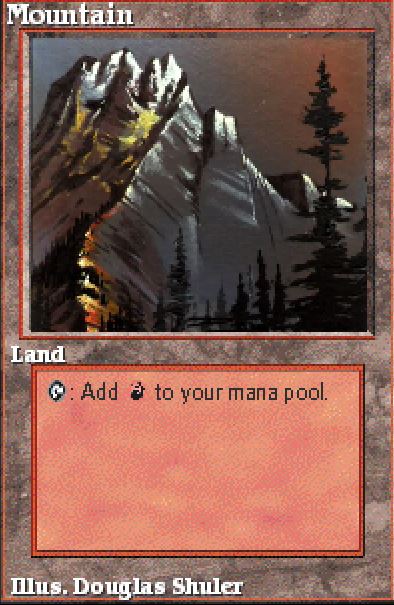
Each player gets to draw one more card at the beginning of his or her turn, and each player is then allowed to deploy a maximum of one land card during that turn. I do both, placing a Mountain on the table in front of me.
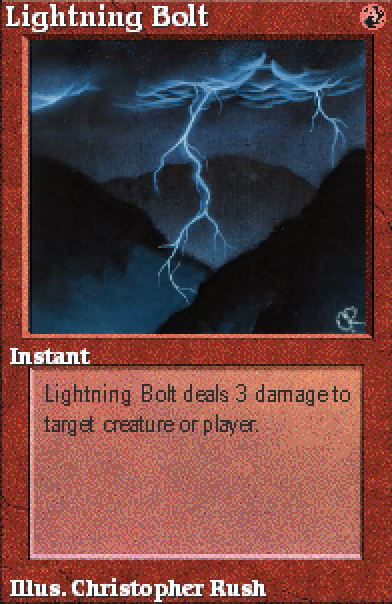
Most spell cards require you to tap your store of mana — signified by turning one or more deployed land cards sideways — in order to play them. I happen to have in my hand a Lightning Bolt, which, I can see from the symbol at the top right of the card, requires just one Red mana to cast. That’s perfect for an early strike to wake up my enemy! I tap my freshly deployed Mountain and hurl the spell, doing three points of damage to Dorte just like that, reducing her life total to seventeen. “Instant” spells like this one go directly to the graveyard — known in most other card games as the player’s discard pile — once they’ve been cast. They’re gone forever from that point on — except under special circumstances, such as a spell that lets one pull cards out of the graveyard. (One quickly learns that every rule in Magic comes with that same implied asterisk.)
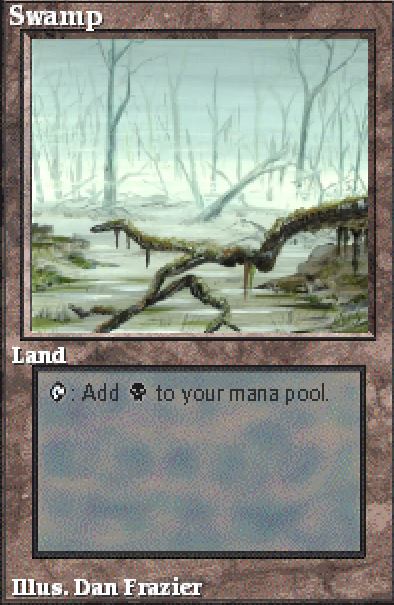

On her turn, Dorte draws a card, deploys a Swamp, and does nothing else. Presumably she doesn’t have any spell cards in her hand that cost just one Black mana to cast — or any that she wants to cast right now, at any rate.

The first round is now finished, so I can untap the Mountain I’ve already put on the table. This means I will be able to use it again on my next turn.

I draw another card to start my second turn. But after doing so, I find that there’s nothing else that I’m willing and able to do with my current hand, other than to grow my Red mana stockpile a bit by deploying another Mountain. Quick turns like the ones Dorte and I have just taken are not at all unusual during the early rounds of a game. Most spells cost more than the Lightning Bolt I happened to have handy at the start, and it can take time to build up the supply of mana needed to cast them. Because land cards that have been deployed in one turn stay deployed in those that follow, the amount of mana in play escalates steadily during a game of Magic, allowing more and more powerful spell cards to be played.
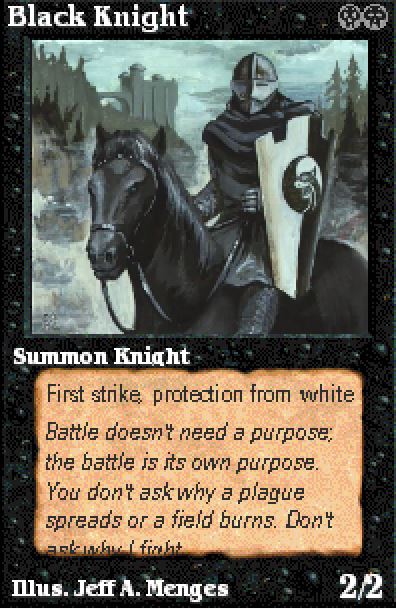
Unhappily for me, Dorte doesn’t need to wait around anymore. After drawing a card and deploying a second Swamp, she has enough mana to summon a Black Knight. As a summoned minion rather than a one-shot spell, he goes out onto the table in front of her, next to her supply of land. He will soon be able to attack me, or do battle with my own minions, should I manage to summon any. Thankfully, though, he is not allowed to attack on the same turn he is summoned. And so the round ends without further ado.
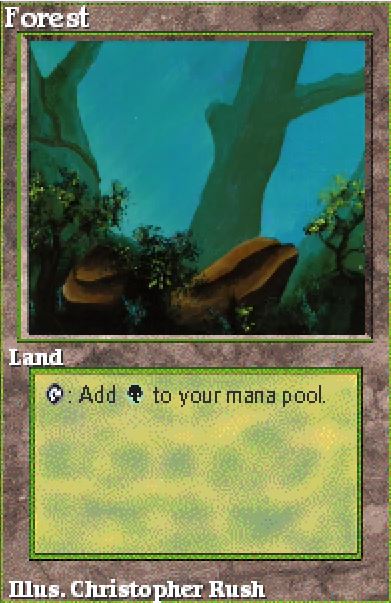
I get some luck of my own on my next turn; I draw the Forest card I’ve been looking for. I immediately deploy my Forest alongside my two preexisting Mountains, giving me one Green and two Red mana to work with this turn.
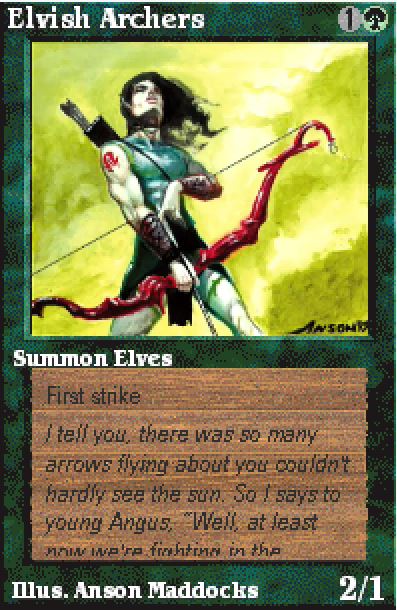
I use one of each to summon my first minion (or rather minions): a group of Elven Archers. (The symbols at the top right of this card tell me that it costs one Green mana and one additional mana of any color to play.) And then, because they too aren’t allowed to attack on the turn in which I summoned them, I can do nothing else.
Dorte deploys an Island on her turn, giving her one Blue and two Black mana in her reservoir.

Then she sends her Black Knight to attack me. I’m about to respond with my Elven Archers as defenders. Take a close look at both cards. The numbers at the bottom right tell us that both attack with a power of two, but that, while the Black Knight dies only after absorbing two points of damage, my Elven Archers are more fragile, dying after taking just one point of damage. Both also have special abilities. The Black Knight is invulnerable to White enemies, but this is irrelevant in this match, since I won’t be summoning any of them. On the other hand, both the Black Knight and the Elven Archers have a “First Strike” ability. This requires a bit more unpacking.

When minions clash, they normally damage one another simultaneously. A creature with First Strike, however, damages its enemy first; if and only if the enemy is left alive by the attack does it get to inflict retaliatory damage of its own. Yet in this case, both attacker and defender have First Strike. Their special abilities cancel one another out, causing them to inflict damage on one another simultaneously as usual. The result ought to be that both are killed, going to their respective players’ graveyards. I am, in other words, prepared to sacrifice my Elven Archers in order to get Dorte’s Black Knight — a slightly more formidable pugilist on the whole — out of the game as well.
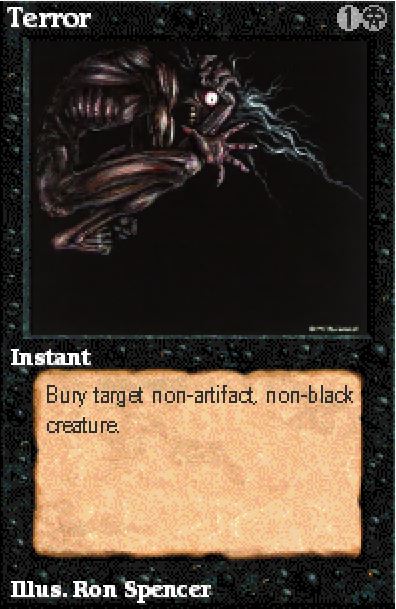
But that’s not what actually happens here — because Dorte, who hasn’t yet tapped any of her lands, does so now in order to cast a Terror spell, killing my Elven Archers outright before they can move to block her Black Knight. With his way thus cleared, the Black Knight can attack me directly, reducing my life points to eighteen. And so the round ends.
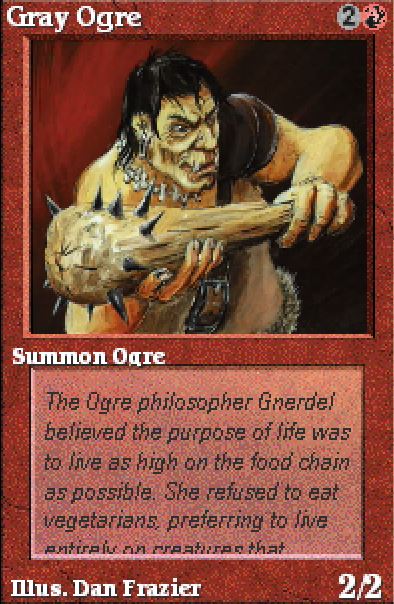
On my next turn, I deploy another Mountain, giving me a total of three Red and one Green mana. That’s more than enough to summon another minion from my hand, a Gray Ogre this time. Having done so, I end my turn.
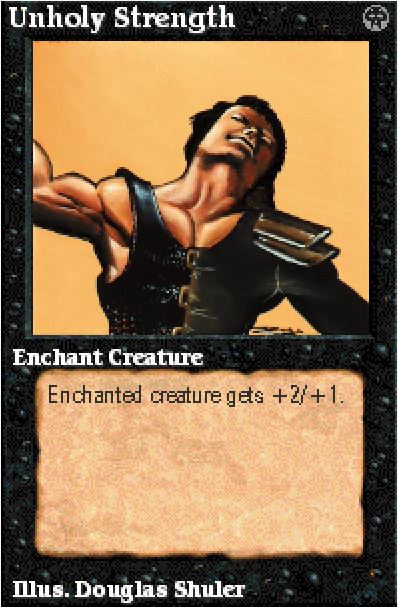
Dorte now deploys another Island, giving her a pool of two Blue and two Black mana. She uses one Black mana to cast Unholy Strength on her Black Knight, increasing his attack power to four and his hit points to three.
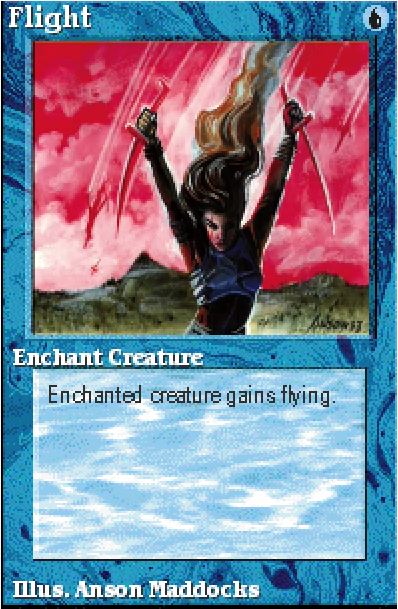
Then she uses one Blue mana to cast a Flight spell, giving the same Black Knight the “Flying” special ability, meaning it will be able to soar right over my (non-flying) Gray Ogre and do four points of damage to me directly. This match does not appear to be going my way.

But appearances can be deceiving. It so happened that I drew another Lightning Bolt on my last turn, and I still have one untapped Mountain left to use to cast it — not directly against Dorte this time, but rather against her augmented Black Knight. The spell’s three points of damage will be just enough to kill him, even with his newfound Unholy Strength; nor can his ability to Fly save him.
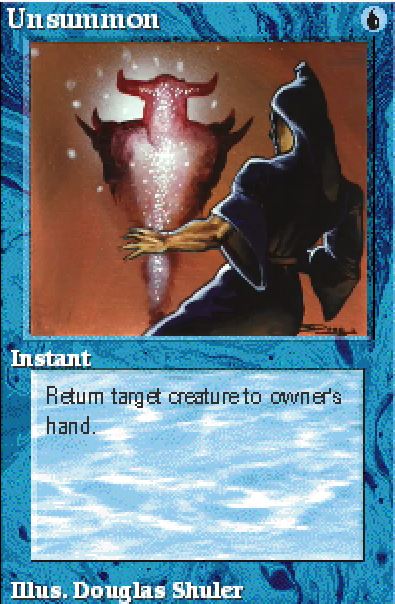
But I did tell you that Dorte is clever, right? Not wanting to lose her Black Knight permanently, she hurriedly casts Unsummon with her last remaining point of Blue mana. This allows her to take him back into her hand, to be summoned again on some future turn to fight another day — minus his buffs, which now go to her graveyard without him.

The outcome of the last round has been mixed, but by no means ruinously so for me. I’ve been able to avoid taking any more damage, have forced Dorte’s only minion out of play for the moment, and now have a minion of my own poised to take the offensive next round. I’ll chalk the round up as more successful than not, even as I worry about what Dorte might still have up her sleeve — or rather in her hand — for dealing with my Gray Ogre.

And so it goes. A game of Magic is a cat-and-mouse one of move and countermove, strike and counterstrike, feint and counter-feint.


Although the explanation above is highly simplified, the core gameplay loop of Magic really is fairly easy to teach and to learn. The game’s ability to obsess its players over the long term derives not from its core rules but from the cards themselves. Through them, a simple game becomes devilishly complex — albeit complex in a different sense from, say, Advanced Dungeons & Dragons, with its hundreds of pages of closely typed rules. In Magic, by contrast, all of the rules beyond the most basic are literally printed right there on the cards. The rules thus rewrite themselves every time somebody brings a new card to a session. This was unprecedented enough in the early 1990s to be called revolutionary — and not only in the sense of pure game design, but in a cultural and commercial sense as well. For Magic, you see, was envisioned from the start as a collectible card game, the world’s first.

This meant that there wouldn’t be a single monolithic Magic game to buy, containing everything you needed to play. Each player would instead assemble his own unique deck of cards by buying one or more card packs from Wizards of the Coast and/or by trading cards with his friends. All of the card packs produced by Wizards would be randomized. No one — not Wizards, not the store that sold them, definitely not you the buyer — could know for sure what cards any given pack contained. You would have to pay your money and take your chances on whatever pack seemed to be calling to you from its shelf in the store on that day.

The concept was utterly original, arguably more so than anything that had been seen in tabletop gaming since Gary Gygax and Dave Arneson had unleashed their “single-unit wargame” Dungeons & Dragons. But because of its unprecedented nature, Magic took a long, long time to turn into a reality. For, whatever its other merits, Magic did not live up to Peter Adkison’s request for a card game that would be simple and cheap to turn into a finished product.

First there was the work of making up hundreds of cards and their abilities, then of testing them against one another over and over to find out which ones were too powerful, which ones weren’t powerful enough, and which ones had been a bad idea from the get-go. Richard Garfield’s expertise in combinatorics was a godsend here, as was that of the other mathematicians who surrounded him at the University of Pennsylvania. “Richard would grab people for games all the time,” remembers one of those colleagues, the fellow who had the office across the hall from his. “If you said yes once, you were in the loop.” Magic became a way of life at the math department, threatening to derail graduations and theses. The University of Pennsylvania was the first educational institution to be so afflicted; it would not be the last.

The process of hewing a real game out of Garfield’s stroke of genius took so long that Peter Adkison came close to writing the whole project off, notwithstanding his bellow of enthusiasm in that Seattle parking lot after he had first been told of it. While he waited to see if Garfield would come through, he tried to bootstrap Wizards of the Coast by making supplements for established RPG lines. But his very first effort in this direction, a source book dealing with deities and their religions, nearly brought an end to the whole operation; the included notes on how to use the material with The Palladium Fantasy Role-Playing Game got him sued. He wound up having to scrap the source book and pay Palladium Books a settlement he really couldn’t afford. All he could do was chalk it up as a lesson learned. It wasn’t worth it to piggyback on anyone else’s intellectual property, he decided. Better for Wizards of the Coast to build its own inviolate empire with Magic.

Early in 1993 — fully eighteen months after that eureka moment in Seattle — Garfield finally delivered an initial slate of 300 different cards that he judged to be adequately tested and balanced. Now Adkison’s work began. He considered it essential that Magic look as good as it played; a part of the appeal of collecting the cards should be purely aesthetic. He farmed the illustrations out to a small army of freelance artists, most of them students at Seattle’s Cornish College of the Arts, who agreed to work for royalties and stock in lieu of the up-front fees that Adkison couldn’t afford to pay them; he also offered them the unusual bonus of seeing their names featured right there on the fronts of the cards themselves.

You would begin your journey into the realms of Magic by buying a 60-card “Starter Deck,” at a price of $7.95. After that, you could add to your deck’s possibilities by buying 15-card “Booster Packs,” which would sell for $2.45 each. Working out the top-secret algorithms that would dictate the card packs’ contents was an enormously complicated exercise in combinatorics, one that put even Garfield’s skills to the test. Starter Decks, for example, had to be reasonably playable all by themselves, with a balance between types of land and spells that required that color of mana. To introduce a modicum of balance into the Magic economy as a whole, Garfield classified each card as common, uncommon, or rare, with their proportions in a print run and in each individual pack within that run to be dictated accordingly. Adkison awarded the contract to print the cards to a firm in far-off Belgium, the only one he could find that was willing and able to piece together so many bespoke packages.

He planned to introduce Magic to the world in August of 1993 at Gen Con, the highlight of the hobbyist-gaming calendar. It very nearly didn’t happen. Having paid for a booth at the tabletop-gaming Mecca, he was flustered when the cards he intended to show and sell there failed to arrive in time from Belgium. He spent the first and most of the second day of the four-day show standing in front of the empty booth, telling nonplussed gamers about the revolutionary game he would like to be showing them but for a logistical snafu. Needless to say, it was not a good look.

At long last, on the afternoon of the second day, the truck he had been waiting for arrived from the East Coast. Adkison and his people ripped open the shipping boxes right there on the show floor and began stacking the card packs around them. The show attendees still looked skeptical, still didn’t quite seem to understand the concept: “What? Each player needs his own deck?” But eventually a few took the plunge on a Starter Pack, then a few more. Then a lot of people did so, even as the earliest adopters started coming back to pick up Booster Packs. And then the second wave of Starter Pack buyers returned to buy more Booster Packs, as the future of Magic played out in microcosm right there in the hallways, hotel rooms, cafeterias, and gaming halls of Gen Con. Adkison sold $25,000 worth of Magic that weekend. On Monday morning, he walked into Boeing and tendered his resignation.

Dragon magazine, the journal of record of hobbyist gaming on the tabletop, had a reporter on the scene at the show. Allen Varney’s article is prescient in many ways, although even he couldn’t possibly know just how big Magic would become.

Through the Gen Con Game Fair, people clustered three deep around the Wizards of the Coast table, craning to see the ongoing demonstrations of this game. Everywhere I went I saw someone playing it. In discussing it, some players showed reserved admiration, others enthusiasm, but body language told more than words. Everyone hunched forward intently, the way you do in deep discussions of politics or religion. Onlookers and devoted fans alike felt compelled to grapple with the idea of this game. It achieved more than just a commercial hit; it redefined gamers’ perspectives on their hobby.

The Magic: The Gathering card game, the trailblazer in what may become an entire industry category, combines card-game rules with trading-card collectability…

The Magic game requires a medium to large league of players to bring out its magic. Fortunately, its low entry price, simplicity, and quick play make this easier to achieve. It makes an ideal choice for conventions or lunch boxes. Its drawbacks seem minor beside its groundbreaking achievement.

Things happened quickly after Gen Con — so quickly that Dragon saw the need to append a hasty postscript to Varney’s original review in the very same issue in which it first appeared. Already at this point Magic could only be described as a “phenomenon.”

As I write this postscript, about six weeks after the game’s release, Magic has attracted legions of instant fanatics. The decks have sold out everywhere. Retailers frantically await follow-up shipments of millions of cards. I know lots of gamers who play the game long into the night, and weigh trade offers the way home buyers study mortgage contracts. I wonder what these junkies did before the game appeared; probably the junkies wonder too.

Yes, if you must know, I have become a junkie myself. The review above fails to highlight the game’s addictive quality, which clicks in when you appreciate the diverse strategies you can pursue in tailoring your deck or decks; you may create decks for different situations, like a golfer choosing irons. These decks display fascinating contrasts keyed to the colors and creatures they use, and to the players who use them…

Owning a large number of different cards seems to confer an odd, unspoken status. So does ownership of a particular rare card that no one else owns. Because every deck contains rare cards, this means a neophyte can buy one Magic deck and acquire instant stature among these long-time players: “Wow, he’s got a Lord of the Pit!” This seems to me something new in the gaming subculture, another sign of the game’s pioneering nature…

The allure of the rarest cards was partially down to the collector instinct alone; while those who called Magic the nerdy kid’s version of baseball cards overlooked much of the full picture, they weren’t entirely wrong either. In addition, though, uncommon and especially rare cards tended to be, when played properly, more powerful than their more plebeian comrades that might have been acquired inside the same cellophane wrapping.

It’s extraordinary to think that all of this was happening already just six weeks after Magic‘s debut. No other game in the hobby market had ever exploded out of the gates like this. Peter Adkison had used every dime he could scrape together from family, friends, bankers, and personal savings to fund an initial print run of 2.6 million cards, which he had thought should get him through the next year if the game took off like he hoped it would. It sold out within a week, leaving him scrambling to put together a second run of 7.3 million cards. That one too sold out in pre-orders before it had even arrived Stateside from Belgium. Not only were gamers demanding more cards in general, but also more types of cards. Adkison set Richard Garfield, who had just received a PhD after his name that he would never need to use now, to dreaming up and play-testing new cards.

Why was Magic such a hit? The answer is not that hard to grasp in the broad strokes, but there were some troubling ethical dilemmas lurking behind its success. While there’s no doubt that Magic was a genuinely great, compelling game, there’s also little doubt that it ruthlessly exploited the insecurities of its primary fan base: teenage males of a, shall we say, mathematical rather than athletic disposition. As anyone who has ever seen a computer-coding contest or a DOOM deathmatch can tell you, these kids aren’t a jot less competitive than the jocks that they mock and are mocked by; they’ve just transferred their competitive instinct to a different arena. It does seem to me that hyper-competitiveness is rooted in personal insecurity. And who is as insecure as a teenage boy of any high-school clique, other than perchance a teenage girl?

In practice, then, the story might go something like this:

A kid keeps hearing about this neat new game called Magic, and finally goes out and buys himself a Starter Pack. Now, he needs people to play with. So he shows his cards to some of his buddies, and convinces them to go out and buy Starter Packs of their own. They all start to play together — in fact, they start to play every chance they get, because the game turns out to be really, really fun. Taking less than twenty minutes to play a match as it does, it’s perfect for squeezing into school lunch breaks and the like.

So far, so good. But one kid in the group is having a bit more trouble than the others coming to terms with the game. He loses more than any of his friends, perhaps even becomes known as the pushover of the group, to be teased accordingly. Being a teenage boy, he likes that not at all. He’s been seeing these Booster Packs at the local gaming store. Could one of those give him a leg up? He decides to take a chance. And he’s rewarded for his initiative: he gets one or two powerful new cards, and suddenly he isn’t losing so much anymore.

Of course, the other kids in the group are hardly unaware of the source of their friend’s novel formidability. They grumble about how pathetic it is to go out and buy your way to victory. Eventually, though, one of them breaks down and buys a Booster Pack of his own. And so the arms race begins. Soon the boys are spending allowances, lawn-cutting and paper-route earnings, paychecks from Burger King on more and more Booster Packs. They tear each new one open, flinging the common and even uncommon cards into a big pile of the undesirable in the center of their bedroom, which sits there like vanities awaiting the bonfire while their owners look desperately for that Time Walk or Ancestral Recall that will let them dominate. The blessed day comes they do find what they’ve been looking for — but then they find that it’s still not enough, because the other boys have also upgraded their decks. And so the vicious cycle continues, fueled by the more cards that Wizards of the Coast is constantly inventing and churning out as quickly as a body ludic of adolescent addicts can absorb them into its bloodstream.

I hasten to add that it never had to go down this way. Theoretically speaking, a group of friends could decide to get into Magic, buy a Starter Pack or two each, and agree that that was as far as they would go. Such disciplined souls would be rewarded with an entertaining, deceptively intricate little card game that was well worth the relatively paltry sum they’d paid for it. But still, the chance that someone would give in to the shrink-wrapped temptations beckoning from the shelves of the local gaming store was always there. And after they did so, all bets were off.

I must acknowledge here as well that the motivation to buy more and more Booster Packs wasn’t always or even usually purely egotistical. Deck-building became a fascinating art and science in itself. Among advanced players, Magic duels tended to be won or lost before they even began, being determined by the mix of cards each player had in his deck. Remember that the number and types of cards in a deck were entirely up to that deck’s owner. Refining a deck into a precision-guided killing machine was an education in itself in probability and statistics. For example, how many land versus spell cards were optimal? If you drew too few land cards, you might find yourself unable to do much of anything while your opponent pounded on you; too many land cards, on the other hand, were clutter in your hand that just as effectively prevented you from getting summoned minions and other spells into play. And how many cards should you have in total, for that matter? Inexperienced players with more money than sense tended to assemble motley monstrosities of decks with 80 cards or more, only to learn that their probability of getting the right combinations of cards into their hand with such a deck was far too low. Lean and mean decks that did just a few things extremely well were almost always better than a random smorgasbord of even the rarest, most powerful cards.

All of which is to say that, at the most advanced level, Magic came to revolve around specific, devious combinations of cards that multiplied one another’s strengths in unexpected ways. Allow me to cite a simple example, laughably so by the standards of skilled players.
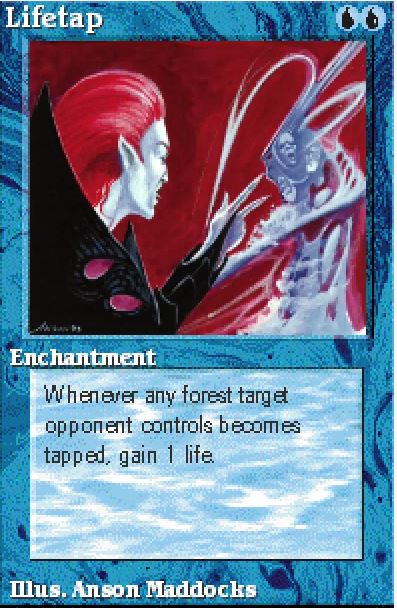
Consider the case of the Lifetap. This card is deadly against an opponent who relies heavily on Green mana, because it lets you gain one point of life every single time he taps one of his Forests for the mana he needs. It puts him in a place where literally everything he tries to do to kill you only makes you stronger. Yet it’s useless against an opponent who isn’t using Green mana, nothing but clutter in your deck. Or is it?
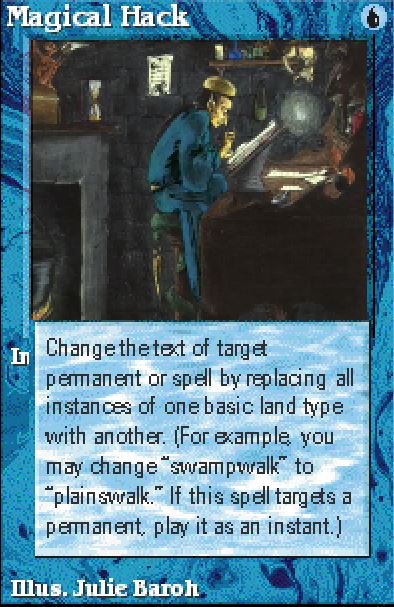
If you can put it into a play alongside a Magic Hack, it becomes an all-purpose game changer. For Magic Hack, you see, will let you change the word “Forest” on the Lifetap card to whatever land your opponent happens to be relying on most of all.

Of course, you have to balance the number of Lifetaps and Magic Hacks in your deck to give yourself a reasonable chance of getting them into play in combination, without having so many that you don’t see enough of the other cards you will need to win. And so begins the endless process of tinkering and honing that is the fate and the passion of the serious student of Magic

By way of summation, then, Magic: The Gathering was simultaneously a great game in its own right and a downright dangerous pastime for the right (or wrong?) kind of mind. It could deliver an enormous amount of satisfying fun, or it could eat up all of one’s money and free time, distracting from other, less zero-sum forms of social interaction and trapping its victims into a wallet-emptying spiral of addiction. Even teenage players could recognize its dangers, for all that they often couldn’t see their way clear of them; they took to calling those tempting Booster Packs “Crack in a Pack.” In Generation Decks, his thoughtful book-length history of Magic, Titus Chalk describes the unhealthily cloistered air of the shop backrooms in which Magic thrived.

These shops are turf. The tangible space a community has carved out for itself, and which it is loath to surrender again. Here there is safety in numbers. Reassurance in peers who look, act, and speak the same. And a comfort to looking inwards rather than out through cluttered windows. Hiding in the shadows, these places preserve the community’s cosiness, without holding it up to scrutiny or opening it up to others whose different values might enrich it. The physical environment is a symptom of its inhabitants’ insecurities. In gloomy backrooms, Magic cloaks itself in stigma.

How do you encourage a community to look outwards when it is so accustomed to lurking in the margins?

Richard Garfield insists that exploiting his young players was never on his mind when he was designing Magic, and we have no reason to disbelieve him. Indeed, his original vision for the Magic economy was actually quite different from what the reality became. He imagined that Magic would become primarily a trading game, in which a pool of cards that grew only slowly if at all would circulate busily among a community of players. Barry Reich, a fellow graduate student at the University of Pennsylvania who helped Garfield refine the game before its release, says that they imagined back then that “extravagant people might buy two [Starter] Decks and [thereafter] a Booster Pack or two a year.”

The game’s most notorious early rule stemmed directly from this vision of a semi-closed economy with only limited external stimulus in the form of new cards. That rule was the “ante.” It stipulated that, before beginning a game, each player would randomly draw one card from his deck and set it aside; the winner of the match would then get to take the loser’s ante card home with him. If you squint just right, you can sort of see this rule through Garfield’s eyes. The ante would get and keep cards moving through the Magic community.

Still, its problematic aspects ought to have been obvious even to an innocent like him. How much fun could it be for a new player, trying Magic for the first time, to pay for the learning experience by losing card after card? As if that wasn’t argument enough against it, the rule effectively turned Magic into a Wizards of the Coast-sanctioned form of gambling, one that was literally illegal according to the laws of many American states; you were, after all, playing a game with a strong element of chance for objects of real monetary value. The fact that the gamblers in this case were mostly underage only made the optics that much worse. Small wonder that, within a few years of Magic‘s release, the ante would be quietly retired and scrubbed as much as possible from the game’s history. Its only saving grace while it existed was that it was officially described as “optional.”
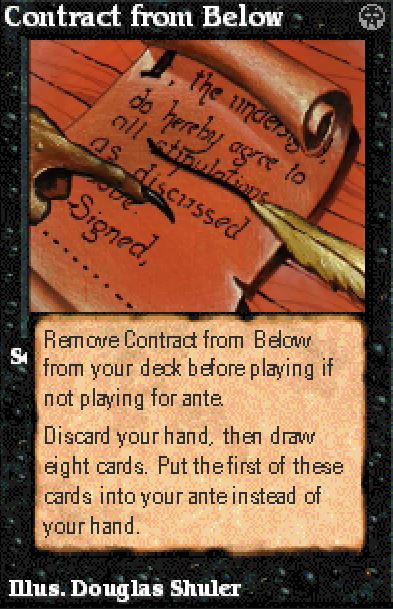
In the spirit that every rule in Magic comes complete with a card-provided asterisk, some early cards played with the ante mechanic. This one, which lets you draw seven new cards into your hand for the price of just one Black mana, is very potent. But you also pay for that potency by risking two cards instead of one on the outcome of the match.

Wizards of the Coast grew from a handful of people working out of Peter Adkison’s basement in 1993 to 50 employees in 1994, then to 250 in 1995. It even started publishing Magic novels — a rather cheeky move, given how thin the fiction and “universe” of the card game was, drawing indiscriminately on everything from the myths of King Arthur to the mythos of H.P. Lovecraft. (Lots of Magic addicts bought the books mainly for the coupons to be found at the back of them, which could be mailed in to receive a card that was otherwise unavailable.) The company was drowning in money, with profit margins on the ubiquitous little cards that the makers of traditional tabletop games could only dream of.

It soon became all too clear that, although Magic was certainly drawing some new folks into the circle of tabletop gamers, most of its success was coming at the expense of every other company in that market — not least the 800-ton mothership, TSR of Dungeons & Dragons fame, the host of the Gen Con convention where Magic had gotten its start. The marketplace calculus proved to be as relentlessly zero-sum as a Magic duel: the new game’s young fans had only a limited amount of funds to splash around, so that every dollar they spent on Magic was a dollar they couldn’t spend on Dungeons & Dragons or the like. Anyone from the industry’s old guard who might have been sleeping at the switch was fully alerted to the magnitude of the crisis at the 1994 Gen Con, which seemed to be about little else than this little card game that was now celebrating its first birthday. “The joke of the convention was that if there was any horizontal space, Magic players were playing on it,” says Mark Rosewater, then a writer for The Duelist, Wizards of the Coast’s new in-house magazine. “As you walked through the convention halls, you could see Magic players camped out all over the floor.” The first annual Magic World Championship was held at the convention: 500 players dueling for the title of best in the world, overshadowing everything else that went on there. Soon there would be a Magic Pro Tour to compete with the World Series of Poker.

The growing chorus of grumbles about Magic that could be detected underneath all the hysteria was the very definition of sour grapes, on the part of gamers and companies who saw a silly card game stealing away from them a hobby that they loved. But be that as it may, there were valid points to be detected amidst the chorus. In Dungeons & Dragons, you lived through the triumphs and tragedies of the dice together with your friends; in Magic, you did your level best to beat them. Something about the game seemed to bring out the worst in many of its players. The vibes in the room at Magic tournaments weren’t always the most pleasant.

Then, too, Dungeons & Dragons was a creative endeavor in a way that Magic wasn’t. Although it was easy to forget amidst the torrent of source books and adventure modules unleashed by the TSR of the 1990s, Dungeons & Dragons had once taken it as a given that you would make up your own worlds and adventures from whole cloth, and that ideal was still lodged somewhere deep in even in the current game’s DNA; in principle, you could still have a marvelous time exploring realms of the imagination with your friends after buying no more than the core trio of rule books. Magic, on the other hand, belonged to Wizards of the Coast, not to its players; the latter could only play with the content their ludic overlords deigned to give them, content of which they were forced to keep buying more and more by peer pressure and the need to stay competitive — which were largely one and the same, of course.

Yet such philosophical objections didn’t stop the other gaming companies from doing what they felt they had to in order to survive: making Magic-style collectible card games of their own. TSR was actually one of the first to do so, rushing out a product called Spellfire, reportedly designed over a weekend and then slapped together using recycled Dungeons & Dragons art. When it didn’t set the world on fire, they tried again with Dragon Dice, which at least scored some points for innovation by replacing cards with piles and piles of bespoke dice. Many, many others joined the fray as well. There were collectible card games based on Mortal Kombat, on The Lord of the Rings, on Babylon 5, on Star Wars and Star Trek, even on Monty Python, to say nothing of the dozens of also-rans who tried to make a go of it without the benefit of a license. Some did okay for a while, but none came anywhere close to Magic numbers. This applied even to Netrunner and The BattleTech Collectible Card Game, both designed by Richard Garfield himself for Wizards of the Coast, both commercial disappointments.

And then too there was a Magic computer game, to which one of the most famous designers in that industry lent his considerable talents. It will be our subject next time…


Did you enjoy this article? If so, please think about pitching in to help me make many more like it. You can pledge any amount you like.


Sources: The books Designers & Dragons: The 80s by Sheldon Appelcline, Slaying the Dragon: A Secret History of Dungeons & Dragons by Ben Riggs, and Generation Decks: The Unofficial History of Gaming Phenomenon Magic: The Gathering by Titus Chalk, Of Dice and Men: The Story of Dungeons & Dragons and the People Who Play It by David M. Ewalt, and The Fantasy Roleplaying Bible, second edition, by Sean Patick Fannon. Plus the Dragon of January 1994 and the January 2018 issue of Seattle Met. Online sources include interviews with Richard Garfield on Board Game Geek, Vice, Star City GamesMagic F2F, and the official Magic YouTube channel.

 
50 Comments

Posted by on September 8, 2023 in Digital Antiquaria, Interactive Fiction


Tags: , , ,

Opening the Gold Box, Part 7: Back to the Roots

We made it simple yet complex enough for those people who really got into it. We added graphics and made it a beautiful game with a totally transparent interface. It took all the ugly stuff out of playing a military strategy game and left the fun and the gameplay. That was a conscious effort. It wasn’t just, “Gee, I like artwork in wargames, so let’s throw it in.”

— SSI marketing manager Karen Conroe, speaking about Panzer General in 1996

When we last checked in with Joel Billings and his crew of grognards turned CRPG mavens at SSI, it was early 1994 and they had just lost their Dungeons & Dragons license, by far their biggest source of revenue over the past seven years. While Billings continued to beat the bushes for the buyer that his company plainly needed if it was to have any hope of surviving in the changed gaming landscape of the mid-1990s, it wasn’t immediately obvious to the rest of the in-house staff just what they should be doing now. Ever since signing the Dungeons & Dragons deal with TSR back in 1987, virtually all they had worked on were games under that license; SSI’s other games had all come from outside studios. But now here they were, with no Dungeons & Dragons, no clear direction forward, and quite possibly no long-term future at all. Instead of devoting their time to polishing up their résumés, as most people in their situation would have done, they plunged into a passion project the likes of which they hadn’t been able to permit themselves for many years. And lo and behold, the end result would prove to be the game that turned their commercial fortunes around, for a while anyway.

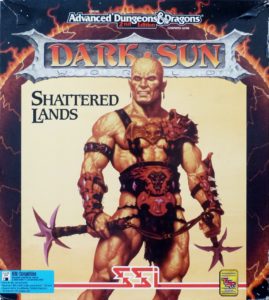
The project began with Paul Murray, an SSI stalwart who had first begun to program games for the company back in 1981. Most recently, he had been assigned to port Dark Sun: Shattered Lands, SSI’s ambitious and expensive attempt to prove to TSR that they deserved to retain the Dungeons & Dragons license, to the Super Nintendo console. But cash-flow problems during 1993 had forced Billings to shelve the port, leaving Murray without much to do. So, he started to tinker with a style of game which SSI hadn’t done in-house in nearly a decade: a traditional hex-based wargame, based on World War II in Europe. From the beginning, he envisioned it as a “lite” game, emphasizing fun at least as much as historical accuracy — i.e., what old-timers called a “beer and pretzels” wargame. In much of this, he was inspired by a Japanese game for the Sega Genesis console called Advanced Daisenryaku, which had never been officially imported to the United States or even translated into English, but which he and his office mates had somehow stumbled upon and immediately found so addicting that they were willing to struggle their way through it in Japanese. (When Alan Emrich from Computer Gaming World magazine visited the SSI offices, he saw them all playing it “with a crude translation of the Japanese manual lying beside the Sega Genesis.”)

After Dark Sun was released to disappointing sales, thus sounding the death knell for the Dungeons & Dragons license, Murray continued to poke away at his “fast and fun little wargame,” which he called Panzer General. And a remarkable thing happened: more and more of his colleagues, both those in technical and creative roles and those ostensibly far removed from them, coalesced around him. Even Joel Billings and his right-hand man Chuck Kroegel, who between them made all of the big decisions in the executive suites, rolled up their sleeves and made their first active contributions to the nuts and bolts of an SSI game in years. They did so largely after hours, as did many of the others who worked on Panzer General. It became a shared labor of love, a refuge from those harsh external realities that seemed destined to crush SSI under their weight.

At this point, a music fan like me finds it hard to resist comparisons with some of great dead-ender albums in the history of that art form, like Big Star’s Third. If SSI’s beer-and-pretzels wargame doesn’t have quite the same heft as an artistic statement like that one, it is true that the staff there felt the same freedom to experiment, to make exactly the game they wanted to make, all born from the same sense that there was nothing really left to lose. Desperation can be oddly freeing in that respect. Billings still speaks of Panzer General as the most satisfying single project he’s ever been involved with. After the extended detour into Dungeons & Dragons, he and his like-minded colleagues got to go back to the type of game that they personally loved most. It felt like going home. If this was to be the end of SSI, how poetically apt to bring things full circle before the curtain fell.

But make no mistake: Panzer General was not to look or sound like the ugly, fussy SSI wargames of yore. It was very much envisioned as a product of the 1990s, bringing all of the latest technology to bear on the hoary old wargame genre in a way that no one had yet attempted. It would be the first SSI game to require high-resolution SVGA graphics cards, the first to incorporate real-world video clips and voice acting, the first to take full advantage of the capabilities of CD-ROM. Luckily, the nature of the game lent itself to doing much of this on the cheap. Instead of filming actors, SSI could simply digitize public-domain newsreel footage of World War II battle scenes. Meanwhile the voice acting could be limited to a single Reichsmarschall giving you your orders in the sort of clipped, German-accented English that anyone who has ever seen a 1950s Hollywood war movie will feel right at home with. Thanks to the re-purposed media and plenty of free labor from SSI staffers, Panzer General wound up costing less than $400,000 to make — barely a third the cost of Dark Sun.

In addition to all of its multimedia flash, Panzer General evinced a lot of clever design. During 1994, strategy-game designers seemed to discover all at once the value of personalizing their players’ experiences, by giving them more embodied roles to play and by introducing elements of story and CRPG-style character progression. X-COM and Master of Magic are the first two obvious examples of these new approaches from that year, while Panzer General provides the third. One can only assume that SSI learned something from all those Dungeons & Dragons CRPGs.

The overall structure of Panzer General draws heavily from Advanced Daisenryaku. It’s a scenario-based rather than a grand-strategy game. If you choose to play the full campaign, you begin on September 1, 1939, leading the Wehrmacht into Poland. You then progress through a campaign which includes 38 potential scenarios in all, covering the Western and Eastern Fronts of the war in Europe as well as the battles in North Africa, but you’ll never see all of them on a single play-through. Panzer General rather uses a Wing Commander– style campaign tree: doing poorly will lead you to the “loser scenario,” and can eventually get you drummed out of the military entirely; doing well leads you to the next stage of world domination, with additional rewards in the form of “prestige points” which you can spend to improve your army. There’s an inherent design tension in such an approach, which I discussed at some length already in the context of Wing Commander: it gives beginning or unskilled players an unhappy experience by punishing them with ever more brutally difficult missions, even as it “rewards” the players who might actually have a chance of beating those missions by bypassing them. Within its chosen framework, however, Panzer General‘s campaign is very well-executed, with plenty of alternative outcomes on offer. In the absolute best case — in game terms, that is — you can invade and defeat Britain in 1940, as Adolf Hitler so conspicuously failed to do in real life, then go on to take Moscow, and finally attain the ultimate Panzer General achievement: conquering Washington, D.C.

As that last unlikely battle in particular would suggest, Panzer General‘s fidelity to real history is limited at best. You don’t have to look too far to find veteran grognards complaining about all the places where it falls short as a simulation, perhaps most notably in its near-complete disinterest in the vagaries of supply lines. But then again, the realism of even those wargames that strive more earnestly for historical accuracy can be and often is exaggerated; those games strike me more as arbitrary systems tweaked to produce the same results as the historical battles they purport to simulate than true simulations in the abstract.

The most important thing Panzer General has going for it is that, historically accurate or not, it’s fun. The interface is quick and well-nigh effortless, while the scenario-based approach assures that you’re only getting the exciting parts of warfare; your forces are already drawn up facing the enemy as each scenario begins. And the game is indeed very attractive to look at, with the flashier elements employed sparingly enough that they never start to annoy.

Still, its true secret weapon lies in those aforementioned CRPG elements. Even as you play the role of a German general who collects more and more prestige, accompanied by more and more exciting battlefield assignments, the units you command also move from battle to battle with you, improving their own skills as they go. The effect comes close to matching the identification which X-COM so effectively manages to create between you and your individual soldiers; you can even name your units here, just as you can your soldiers in that other game. You develop a real bond with the units — infantry, artillery, tanks, airplanes, in places even ships — who have fought so many battles for you. You begin to husband them, to work hard to rescue them when they get into a jam, and find yourself fairly shattered — and then fairly livid — when an enemy ambush takes one of them out. You can even mold the makeup of your army to suit your play style to some extent, by choosing which types of units to spend your precious prestige points on. This makes your personal investment in their successes and failures all the greater; the emotional stakes are surprisingly high in this game.


Each scenario in Panzer General begins with some vintage newsreel footage, an approach which has ironically aged much better than the cutting-edge green-screened full-motion-video presentations of so many of its contemporaries. Unlike them, Panzer General has remained an aesthetically attractive game to this day.

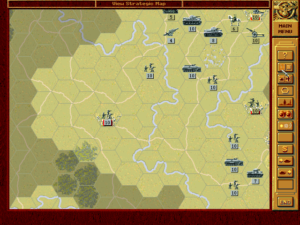
The map where all of the actions take place. The game is entirely controlled by clicking on your units and the strip of icons running down the right side of the screen. You can mouse over a unit or icon to see a textual description of its status and/or function at the bottom or top of the screen — as close as any 1995 game got to the tool tips of today. SSI’s overarching priority was to make accessible a genre previously known for its inscrutability.

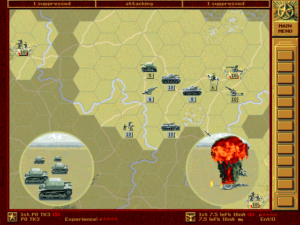
Clashes between units take place right on the main map, accompanied by little animations which spice up the proceedings without overstaying their welcome.

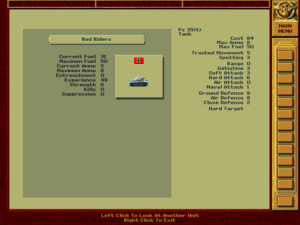
A unit-information screen, showing not only its raw statistics but a running tally of its battle record. You can name your units and watch them collect experience and battle citations as the war goes on.

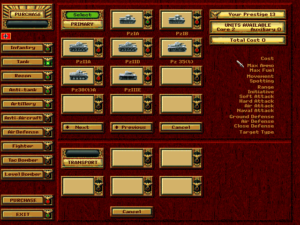
You can tailor the makeup of your army by spending prestige points to purchase units that suit your style of play.


While his staff beavered away on Panzer General, Joel Billings continued to cast about for a buyer for his company before it was too late. It wasn’t easy; with the loss of the Dungeons & Dragons license he had lost his most enticing single asset. All of SSI’s core competencies were profoundly out of fashion; CRPGs in general were in the doldrums, and wargames were niche products in an industry that had little shelf space left for anything beyond the broadly popular. Nevertheless, he managed in the end to make a deal.

The backstory leading up to that deal has much to tell us about the waves of mergers and acquisitions that had been sweeping the industry for years by this point. It begins with The Software Toolworks, a company founded by an enterprising kit-computer hacker named Walt Bilofsky all the way back in 1980. He quietly built it into a major player in educational and consumer software over the course of the next decade, by jumping early into the distribution and media-duplication sides of the industry and through two blockbuster products of the sort which don’t attract the hardcore gamer demographic and thus seldom feature in histories like this one, but which had immense Main Street appeal in their day: The Chessmaster 2000 and Mavis Beacon Teaches Typing. The combined sales of these two alone exceeded 750,000 units by 1989, the year The Software Toolworks acquired Mindscape.

The latter company was formed in 1983 by one Roger Buoy, and went on to make a name in educational software as well as with innovative games of a slightly intellectual bent: the civilian-spaceflight simulation The Halley Project; a line of bookware text adventures; the early point-and-click graphic adventures developed by ICOM Simulations; Balance of Power, Chris Crawford’s seminal anti-wargame of contemporary geopolitics. Then, too, Mindscape imported and/or distributed many additional games, including those of Cinemaware. But as the decade wound down their bottom line sank increasingly into the red, and in December of 1989 Buoy sold out to The Software Toolworks for $21.5 million.

In the years that followed that acquisition, The Software Toolworks moved into the Nintendo market, releasing many games there under the Mindscape imprint; console titles would make up 42 percent of their overall revenue by 1994. At the same time, they continued to enjoy great success on computers, with the Mavis Beacon series in particular. That entirely fictional typing teacher — a black woman at that, a brave and noble choice to have made in the mid-1980s — became an odd sort of virtual celebrity, with other companies going so far as to ask for her endorsement of their own products, with journalists who joined much of the general public in assuming she was a real person repeatedly asking for interviews. In 1994, The Software Toolworks’s annual sales hit $150 million. On May 12 of that year, the Pearson Group of Britain bought the fast-growing company.

Pearson was a giant of print publishing, both in their homeland and internationally. Formed in 1843 as a construction company, they began buying up magazines and newspapers in the 1920s, building themselves a veritable print empire by the 1970s, with such household names as Penguin Books in their stable. Their sudden plunge into computer software in 1994 was endemic of what we might call the second wave of bookware, when it was widely anticipated that interactive multimedia “books” published on CD-ROM would come to supplement if not entirely supplant the traditional paper-based variety. Bookware’s second wave would last little longer than its first — it would become clear well before the decade’s end that the Internet rather than physical CD-ROMs was destined to become the next century’s preferred method of information exchange — but while it lasted it brought a lot of big companies like the Pearson Group into software, splashing lots of money around in the process; Pearson paid no less than $462 million for The Software Toolworks. Being unenamored with the name of the entity they had just purchased, Pearson changed it — to Mindscape, an imprint that had heretofore represented only a quarter or so of The Software Toolworks’s overall business.

But the wheeling and dealing wasn’t over yet. Within weeks of being themselves acquired, the new Mindscape entered into serious talks with Joel Billings about the prospect of buying SSI. The latter was manifestly dealing from a position of weakness. The Dungeons & Dragons license was gone, as was the reputation SSI had enjoyed during the 1980s as the industry’s premiere maker of strategy games; that crown had been ceded to MicroProse. The only really viable franchise that remained to them was the Tony La Russa Baseball series. Nevertheless, Mindscape believed they saw talent both in SSI’s management and in their technical and creative staff. Said talent was worth taking a chance on, it was decided, given that the price was so laughably cheap. On October 7, 1994, an independent SSI ceased to exist, when Mindscape bought the company for slightly under $2.6 million. Billings was promised that it would be business as usual for most of them in their Sunnyvale, California, office, apart from the quarter of existing staff, mostly working on the sales and packaging side, who were made redundant by the acquisition and would have to be let go.

Once that pain was finished, a rather spectacular honeymoon period began. Mindscape was able to give SSI distribution they could only have dreamed of in the past, getting their games onto the shelves of such mainstream retailers as Office Depot and K-Mart. And in return, SSI delivered Panzer General. Released just a month after the acquisition was finalized, it garnered a gushing five-out-of-five-stars review from Computer Gaming World, who called it “not just a wargame but an adventure” in reference to its uniquely embodied campaign. Add to that its attractive multimedia presentation and its fun and accessible gameplay, then sprinkle over the whole the eternal American nostalgia for all things World War II, and you had a recipe for one of the breakout hits of that Christmas season — the first example of same which SSI had had since Eye of the Beholder back in 1991. Helped along no doubt by Mindscape’s distributional clout, it went on to sell more than 200,000 copies in its first fifteen months. Eventually it surpassed even the sales figures of Pool of Radiance to become SSI’s most popular single game ever. In fact, Panzer General still stands today as the most successful computerized wargame in history.

The game’s success was positively thrilling for Joel Billings, now ensconced as a “regular, full-time employee” of Mindscape, complete with a 401(k) plan and eligibility for the Executive Bonus Plan. His real passion had always been wargames; those were, after all, the games he had originally founded his company in order to make. To have come full circle here at the end of SSI’s independent existence, and to have done so in such smashing fashion at that, felt like a belated vindication. There was only one slight regret to mar the picture. “I wonder what would have happened if Panzer General had come out before the Mindscape acquisition…” he can’t help but muse today.

Taken as a whole, Panzer General deserved every bit of its success: it was and is a fine game. For some of us then and now, there is only one fly in the ointment: we have no desire to play a Nazi. I’ll return to a range of issues which Panzer General raises about the relationship of games to the real world and to our historical memory in my next article. For today, however, I have another story to finish telling.


To say that Mindscape was initially pleased with their new acquisition hardly begins to state the case. “We rocketed!” thanks to Panzer General, remembers Billings: “Mindscape loved us!” And why not? As an in-house-developed original product with no outside royalties whatsoever to pay on its huge sales, Panzer General alone recouped two and a half times the cost of purchasing SSI in its first year on the market. A set of three shovelware collections which between them included all of the old Gold Box Dungeons & Dragons CRPGS also did surprisingly well, selling more than 100,000 profit-rich copies in all before the final expiration of even SSI’s non-exclusive deal with TSR forced them off the market on July 1, 1995.

In the longer run, however, the mass-market ambitions of Mindscape proved a poor fit with the nichey tradition of SSI. To save production costs and capitalize on the success of Panzer General, SSI used its engine as the basis of a 5-Star General series, first presenting World War II from the perspective of an Allied general in Europe, then moving farther afield to a high-fantasy setting, to outer space, to World War II in the Pacific. Although those games certainly had their fans — Fantasy General in particular is fondly remembered today — the overall trend line was dismayingly similar to that of the Gold Box games: a rather brilliant initial game followed by a series of increasingly rote sequels running inside an increasingly decrepit-seeming engine, resulting in steadily decreasing sales figures. By the time the engine was updated for Panzer General IIPeople’s General, Panzer General III, and, Lord help us, Panzer General 3D Assault, a distinct note of desperation was peeking through. SSI’s other attempts to embrace the mass-market, such as a series of real-time strategy games based on the tabletop-miniatures game Warhammer, felt equally sterile, as if their hearts just weren’t in it.

Certainly Joel Billings personally found the mainstream market to be less than congenial. In February of 1996, he was promoted to become the head of Mindscape’s entire games division, but found himself completely out of his depth there. Within six months, he asked for and was granted a demotion, back to being merely the head of SSI.

But even SSI was no longer the place it once had been; it seemed to lose a little more of its identity with each passing year, as the acquisitions and consolidations continued around it. Mindscape was bought by The Learning Company in 1998, after Pearson’s realization that software — at least software shipped on physical media — was not destined to be the future of publishing writ large. Then Mattel bought The Learning Company in 1999. They closed SSI’s Sunnyvale offices the following year, keeping the name as a brand only. That same year, they sold The Learning Company once again, to the Gores Technology Group, who then turned around and sold all of the gaming divisions to the French publisher Ubisoft in 2001. SSI was now a creaky anachronism in Ubisoft’s trendy lineup. The last game to ship with the SSI name on its box was Destroyer Command, in February of 2002 — almost exactly 22 years after a young Joel Billings had first started calling computer stores to offer them something called Computer Bismark.

Billings himself was long gone by 2002, cast adrift with the final closing of SSI’s Sunnyvale offices. Thoroughly fed up with the mainstream-gaming rat race, he returned to the only thing he had ever truly wanted to do, making and selling his beloved wargames. For almost two decades now he’s run 2 By 3 Games with Gary Grigsby and Keith Brors, two designers and programmers from the salad days of SSI. They make absurdly massive, gleefully complex, defiantly inaccessible World War II wargames, implemented at a level of depth and breadth of which SSI could only have dreamed. And, thanks to the indie revolution in games and the wonders of digital distribution, they manage to sell enough of them to keep at it. Good for them, I say.

Melancholy though SSI’s ultimate fate proved to be, they did outlive their erstwhile partners TSR. After flooding their limited and slowly shrinking market of active Dungeons & Dragons players with way too many campaign settings and rules supplements during the first half of the 1990s, TSR saw the chickens come home to roost right about the time they parted ways with SSI, when sales of the paperback novels that had done much to sustain them to this point also began to collapse. For all that they had never been anyone’s idea of literary masterpieces, the early Dungeons & Dragons novels had been competently plotted, fast-paced reads that more than satisfied their target demographic’s limited expectations of them. For years, though, editorial standards there as well had been slowly falling, and it seemed that readers were finally noticing. After the Christmas season of 1996, Random House, who distributed all of TSR’s products to the bookstore trade, informed them that they would be returning millions of dollars worth of unsold books and games. TSR lacked the cash to pay Random House, as they did to print more product. And, laboring under a serious debt load already, they found there was no one willing to lend them any more money. They were caught in a classic corporate death spiral.

The savior that emerged was welcome in its way — any port in a storm, right? — but also deeply humiliating. Wizards of the Coast, the maker of the collectible card game Magic: The Gathering which had done so much to decimate TSR’s Dungeons & Dragons business in recent years, now bought their victim from Lorraine Williams for about $30 million, with much or most of that sum going to repay of the debts TSR had accrued.

Still, TSR’s final humiliation proved a welcome development on the whole for their most famous game; in the eyes of most gamers, Wizards became a better steward of Dungeons & Dragons than TSR had been for a long time if ever. They cut back on the fire hose of oft-redundant product, whilst streamlining the rules for new editions of the game that were more intuitively playable than the old. Ironically, many of the new approaches were ported back to the tabletop from digital iterations of Dungeons & Dragons, which themselves found a new lease on life with Interplay’s massive hit Baldur’s Gate in 1998. Meanwhile the “open gaming” D20 license, which Wizards of the Coast launched with great fanfare along with the official third edition of Dungeons & Dragons in 2000, drew from the ideals of open-source software. While tabletop Dungeons & Dragons would have its ups and downs under Wizards of the Coast, it would never again descend to the depths it had plumbed in 1997. A world without Dungeons & Dragons now seems all but unimaginable; in 1997, it was all too real a prospect.

All of which is to say that Dungeons & Dragons will continue to be a regular touchstone here as we continue our voyage through gaming history. Whether the computerized versions of the game that came after the end of an independent TSR and SSI are up to the standards of the Gold Box line is of course a matter of opinion. But one thing cannot be debated: the story of Dungeons & Dragons and computers is far from over.

(Sources: As with all of my SSI articles, much of this one is drawn from the SSI archive at the Strong Museum of Play. Other sources include the book Designers and Dragons, ’70 to ’79 by Shannon Appelcline; Computer Gaming World of June 1994, September 1994, December 1994, and January 1995; PC Review of June 1992; Retro Gamer 94 and 198; Chicago Tribune of December 2 1985 and December 6 1989; New York Times of June 13 1994. Online sources include Matt Barton’s interview with Joel Billings, the Video Game Newsroom Time Machine interview with Joel Billings, and the Mental Floss “profile” of the fictional Mavis Beacon.

Oddly given its popularity back in the day and its ongoing influence on computer wargaming, the original Panzer General has not been re-released for digital distribution; this is made doubly odd by the fact that some of the less successful later games in the 5-Star General series have been re-released. It’s too large for me to host here even if I wasn’t nervous about the legal implications of doing so, but I have prepared a stub of the game that’s ready to go if you just add to the appropriate version of DOSBox for your platform of choice and an ISO image of the CD-ROM. A final hint: as of this writing, you can find the latter on archive.org if you look hard enough.)


Tags: , , ,

Opening the Gold Box, Part 6: A Troubled Marriage

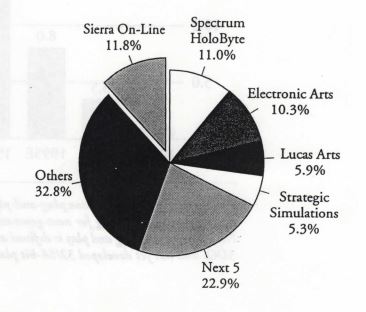
This pie chart prepared by the investment firm Piper Jaffray Research provides a snapshot of the American computer-game industry as of 1993. Sierra leads the pack with a market share of 11.8 percent, trailed closely by Spectrum Holobyte, who have just increased their profile dramatically by acquiring MicroProse Software. Electronic Arts comes in at only third place here, even following their recent acquisition of Origin Systems, but this chart reflects only their computer-game sales; their total sales including computers and consoles are vastly higher than those of Sierra by this point. SSI manages to come in at a respectable fifth place, thanks not least to the two aforementioned acquisitions of comparably sized competitors, but their trend lines are all moving in the wrong direction; their last new release to cross the magical threshold of 100,000 copies sold was Eye of the Beholder from February of 1991, while their biggest game of 1993 will sell just over 70,000 copies.

Two individually unhappy spouses aren’t the recipe for a happy marriage. By 1992, the computer-game publisher SSI and the tabletop-game publisher TSR, whose announcement of a partnership had so shocked both of their industries back in 1987, were learning this reality the hard way. Dungeons & Dragons, both on the computer and on the tabletop, was in trouble, and the marketing synergy which the two companies had so successfully created just a few years before had now turned into a deadly embrace that threatened to pull them both under.

In many ways, SSI’s problems were typical of any small publisher in their changing industry. Players’ audiovisual expectations of the games they purchased were growing rapidly, and it just wasn’t clear where the money to meet them was to come from. SSI had ridden their Gold Box engine for Dungeons & Dragons CRPGs way too hard, churning out nine games using it — eleven if you count two reskinned science-fictional Buck Rogers games — in a span of less than four years. The engine had received some modest improvements over the course of that time, in the form of rudimentary mouse support and VGA- rather than EGA-standard graphics, but at bottom it still played like what it was: an artifact from an entirely different epoch of gaming, designed around the affordances of the 8-bit Commodore 64 rather than the latest 32-bit Intel wonders. It was so outdated as to seem almost laughable beside a boundary-pushing wunderkind like Origin Systems’s Ultima VII.

Just as distressingly, SSI hardly seemed to be trying anymore even when it came to their Gold Box designs. No later Gold Box game had possessed anything like the creative flair of Pool of Radiance and Curse of the Azure Bonds, the first two games of the line and by far the best.

And so, as the technology had aged and design standards had fallen, gamers had reacted appropriately: sales had dropped almost linearly from title to title. Pool of Radiance had sold 264,536 copies upon its release in August of 1988; Dark Queen of Krynn, the anticlimactic end of the Gold Box line, sold 40,640 copies after its release in May of 1992. SSI was still profitable that year, but only by a whisker: during the fiscal year which ended on September 30, 1992, profits amounted to just $168,000 on sales of a little under $13 million, the latter of which fell short of expectations by $1 million. What would the next year bring?

TSR was a larger and more diversified company, but they were facing the same essential problem: sales of their own Dungeons & Dragons line for the tabletop had been going in the wrong direction as well for the past couple of years, and it wasn’t immediately clear how to reverse that trend. A flood of new rules supplements and settings — by 1993, TSR would offer an extraordinary eight separate boxed “worlds” in which to play the game, ranging from traditional high fantasy to the Arabian Nights to the depths of outer space — certainly wasn’t doing the trick. In fact, by making Dungeons & Dragons ever more impenetrable to newcomers, the torrent of product was arguably hurting TSR more than it was helping them.

Thanks to these trends, Dungeons & Dragons was in danger of seeing its position as the commercial ne plus ultra of tabletop RPGs usurped for the first and only time in the history of the hobby. The biggest threat to its status came from a new RPG called Vampire: The Masquerade, whose rules-lite, storytelling-oriented approach was the antithesis of the baggy monstrosity which Dungeons & Dragons had become. By catching a wave of “goth” inspiration that was sweeping pop culture more generally, Vampire had even accrued a degree of street cred the likes of which TSR’s nerdier, more pedantic offerings couldn’t have hoped to match even in their early 1980s heyday. TSR’s entire Dungeons & Dragons gaming line was in danger of becoming the world’s most elaborate loss leader, fueling sales of the one part of their empire that was still consistently earning money: their vast and ever-growing lineup of fantasy novels based on their gaming properties.

Human nature being what it is, it was perhaps inevitable that SSI and TSR, these two partners with good reason to be profoundly worried about their futures, would each come to blame the other for at least some of their difficulties. SSI noted pointedly that the Gold Box line was supposed to have been a creative as well as financial partnership between the two companies, with TSR’s staff contributing much of the content for the computer games and TSR themselves publishing tie-in products for the tabletop. All of those synergies, however, had dried up after Pool of Radiance and Curse of the Azure Bonds. (The status of these two very first games as the very best of their line begins to seem like less of a puzzle in light of TSR’s active involvement with them.) SSI had been left to their own devices from 1990 on, albeit still subject to the frequently exercised veto power which TSR enjoyed over their ideas.

Meanwhile, even as SSI complained about their creative abandonment, it was hardly lost on TSR that the Gold Box engine had fallen badly behind the state of the art. As they judged it, its antiquity had become extreme enough to actively hurt their brand, not only on the computer but on the tabletop as well; when struggling against their tabletop game’s popular image as a kitschy relic of the 1980s, TSR’s marketers weren’t excited to be confronted with computer games that themselves looked like products of the previous decade. TSR was also unhappy with SSI’s failure to port the Gold Box games from computers to consoles; out of all of them, only Pool of Radiance had been ported to the Nintendo Entertainment System, by a Japanese developer rather than SSI themselves. SSI tried to point out that this port, which played badly and sold worse, only served to illustrate all the ways in which this style of game just wasn’t suitable for consoles, but TSR was having none of it. In their view, the porting issue was a problem for SSI to solve rather than to explain away.

Behind all the bickering loomed a daunting reality: SSI’s exclusive license to Dungeons & Dragons was due to expire on January 1, 1993. One of the partners had far more cause for concern about this fact than the other. For those in the boardroom at TSR, the question of the contract’s renewal was just another business debate to be hashed out, but for SSI it was quite possibly of existential importance. After signing his first contract with TSR, Joel Billings, SSI’s founder and president, had rejiggered the public and private face of his company, from that of a maker of hardcore wargames inspired by the tabletop grognard tradition of Avalon Hill and SPI into the Computerized Home of Dungeons & Dragons. While SSI still published some wargames in the early 1990s, they generally sold even worse than the final stragglers from the Gold Box line, and were made strictly by outside developers; almost the entirety of SSI’s internal development efforts had been devoted to Dungeons & Dragons for the past five years. SSI’s identity had become so bound up with TSR’s flagship property that it wasn’t clear what they could or should be without the Dungeons & Dragons license.

The uncertainty surrounding the future of the contract left SSI paralyzed. It was obvious that they needed a better, more modern engine if they were to continue to make Dungeons & Dragons CRPGs, but it would be foolhardy to embark on that expensive project before they were sure of retaining the license that would let them use it for its intended purpose.

Thus Billings must have breathed a sigh of relief in early 1992, when TSR, despite all their recent misgivings about SSI’s handling of the license, agreed to an eighteen-month contract extension. It would take the license out to July 1, 1994, giving SSI enough time to make a new engine and at least one new game with it. Still, the short length of extension served notice that they were on probation; if the marriage was to continue, SSI would have to deliver a hit of Pool of Radiance proportions.

Billings put his people to work on an engine that would build upon the best ideas of SSI’s competitors, not least Origin’s much-admired Ultima VII engine. Like that one, this one would be designed with a mouse in mind from the start; would offer free-scrolling real-time movement over a large world; would go almost entirely mode-less in terms of interface, integrating combat into the same view where conversation and exploration took place. Gone would be the fussy paragraph books, graph-paper maps, and code wheels of the Gold Box games, which could make the experience of playing them feel almost like a hybrid between a computer and tabletop game. SSI had a very different experience in mind this time out. They planned to make the engine effortless enough for the player that it could be ported to the Super Nintendo for play on living-room couches. And if that version did well, other console ports would follow.

TSR, eager to give a boost to one of their sales-challenged alternate settings, convinced SSI to set the first game made with the new engine in the land of Dark Sun, a desert world with a vaguely post-apocalyptic feel. Billings, aware that he was on shaky ground with TSR, also initiated development of an original science-fiction game that was to use the engine as well, just in case the Dungeons & Dragons license went away.

Creating such a complex engine alongside the first two games to use it was a truly enormous task — by far the biggest thing SSI had ever attempted, dwarfing even the initial software engineering that had gone into the Gold Box engine. Development dragged on and on after the Gold Box line had petered out with Dark Queen of Krynn. SSI attempted to plug the Gold Box-sized gap in their product line with such second-string releases as Prophecy of the Shadow, an internally developed, non-licensed CRPG-lite (25,875 copies sold); Pirates of Realmspace, a buggy computerized take on TSR’s Spelljammer setting from an outside developer known as Cybertech (23,280 copies sold); The Summoning, a simple action-RPG from Event Horizon Software (25,273 copies sold); Veil of Darkness, a game of a similar stripe to the previous from the same developer (9866 copies sold); Legends of Valor, a poor man’s Ultima Underworld from Synthetic Dimensions (12,588 copies sold); and Unlimited Adventures, a final hurrah for the Gold Box in the form of a public release of many of SSI’s internal development tools, thereby to let the diehards make more games of their own of the old type (32,362 copies sold).

As the sales figures above attest, none of these games set the world on fire. Indeed, their sales managed to make even the latter days of the Gold Box line look pretty good by comparison. In all, SSI released just three games between the summers of 1992 and 1993 that managed to top 40,000 units: Great Naval Battles in September (43,774 copies sold), Tony La Russa Baseball II in March (70,902 copies sold), and Eye of the Beholder III in May (50,664 copies sold). Of this trio, only the last was a Dungeons & Dragons title, and only the last was developed internally. Needless to say, the bottom line suffered. During the fiscal year which ended on September 30, 1993, revenues fell to $10.5 million, and the company lost $500,000 — the first annual loss SSI had posted in more than a decade.

Joel Billings wrote in that year’s annual report that it had been “the most difficult year in SSI’s 14-year history.” He spoke his personal truth not least. Throughout this period, over the course of which development of the Dark Sun game and its engine kept dragging on far longer than expected, Billings was scrambling madly to stem the bleeding. He put an organization that had always had the atmosphere of a family company through the trauma of its first-ever layoff, slashing the employee rolls from 115 to 75 employees; the memory of doing so still haunts Billings, a gentle soul at heart, to this day. Having been forced to cut the staff needed to create the science-fiction game earmarked for the new engine, he cut that as well, putting all his eggs into the single basket that was the Dark Sun game. Even the Super Nintendo version of that game, which his programmers had been struggling mightily to realize, would have to be set aside as well, at least for now. Much to TSR’s chagrin, this latest Dungeons & Dragons game too would have to live or die on computers.

Yet all of Billings’s scrambling constituted no more than financial triage. The existential obstacle which SSI faced was that of being a small, boutique publisher in an industry whose economies of scale were making it harder and harder for such an entity to survive. It was getting ever harder to win shelf space at retail, harder to pay for advertising in the glossy magazines — and, most of all, harder to foot the ever-increasing bill of developing modern games that met all of the expectations of the 1990s. Billings reluctantly concluded that he had but one choice: he had to sell out, had to find a buyer for the family business he had spent almost a decade and a half building from the ground up.

Accordingly, he spent much of his time in 1993 beating the bushes for just such a buyer. Yet here he was stymied once again by the realities of the marketplace. SSI was far from the only small publisher looking for a port in the storm, and many of the others had — or at least were judged to have — more attractive portfolios of extant and forthcoming games. Thus Billings faced a dispiriting, borderline-humiliating series of near misses, of seeing SSI cast aside in favor of alternative acquisitions in the fast-consolidating industry.

At the beginning of June, he thought he had made a deal with Spectrum HoloByte, an oddly bifurcated publisher that was almost entirely dependent on two wildly divergent games: the ultra-hardcore flight simulator Falcon, whose manual was roughly the size of a Tom Clancy novel, and the casual phenomenon Tetris, a game so brilliantly simple that it took only about 30 seconds of experimentation at the keyboard to spawn a lifetime’s addiction. Both of these games, radically different though they were in personality, were equally successful with their own demographics. Just as importantly, Spectrum HoloByte was absurdly well-connected with the movers and shakers of international finance, and was awash in venture capital as a result.

Due diligence between SSI and Spectrum HoloByte was completed, and a plan was made to meet again and sign a letter of intent as soon as that year’s Summer Consumer Electronics Show was behind both of them. At that show, however, Spectrum HoloByte met with Microprose, whose financial circumstances were even more desperate than those of SSI but who had a much more impressive array of upcoming titles to show to potential suitors. To make a long story short, Spectrum HoloByte bought MicroProse instead, leaving SSI stranded at the altar.

A few months later, the same scenario repeated itself. This time the would-be acquirer was Electronic Arts, a company with which SSI already had a longstanding relationship: Trip Hawkins had been a member of SSI’s board since before he founded EA, SSI had been piggybacking on EA’s distribution network as an “affiliated label” since 1987, and EA in fact already owned 20 percent of SSI thanks to an investment made in 1987, when the smaller company was first scaling up to take on Dungeons & Dragons. For all these reasons, the deal at first seemed a natural one. But Hawkins, the biggest proponent of the acquisition on EA’s side, was busy with a new semi-subsidiary known as 3DO and no longer had the day-to-day involvement necessary with the parent company to push it through. After kicking the tires a bit, the rest of EA’s management decided that SSI just wasn’t worth the asking price — especially given that EA already owned Origin Systems, one of SSI’s biggest rivals in CRPGs. Contrary to Joel Billings’s best intentions, SSI would thus be forced to exit 1993 as they had entered it: still an independent company, facing a future that looked more perilous than ever.

SSI’s struggle to find a buyer was a sign not only of their own weakness but of the diminished commercial profile of Dungeons & Dragons. Five years earlier, three quarters of the industry would have rushed to scoop up SSI, if only to acquire the enviable licensing deal they had recently signed. Now, though, the tabletop game was at a low ebb of its own, even as it seemed hopelessly antithetical to all of the winds of change in digital gaming. Where did this nerdy game played in parents’ basements, all tables and charts and numbers, fit in an industry rushing to make slick, kinetic interactive movies featuring real Hollywood actors? Dungeons & Dragons just wasn’t cool. It had never really been cool, of course, but that hadn’t been a problem when the computer-game industry as well was thoroughly uncool. But now, as computer-game moguls were busily penning paeans to themselves as the next wave in mainstream entertainment, its uncoolness was extremely problematic.

Amidst all of this — in September of 1993, to be specific — Dark Sun: Shattered Lands finally got completed and released. It was the most important game SSI had published since Pool of Radiance; the future of the TSR partnership, and thus their own future as a company, rode on its success or lack thereof.

When viewed separately from all of these external pressures, as just a game to be played and hopefully enjoyed, it revealed itself to be a nobly earnest attempt to improve on SSI’s most recent efforts in the realm of CRPGs, even if it wasn’t an entirely unblemished one. On the technological side, SSI’s next-generation engine largely delivered where it needed to: it was indeed vastly slicker, prettier, easier, and more modern than the Gold Box engine, feeling like a true product of the 1990s rather than a holdover from the last decade. It was an engine that could even stand next to the likes of an Ultima VII without undue embarrassment. Indeed, SSI seemed to have learned from their rival’s mistakes and done Origin one better in some places. For example, in place of the real-time, well-nigh uncontrollable frenzy that was combat in Ultima VII, SSI’s engine lapsed seamlessly into a turn-based mode as soon as a fight began; this allowed combat in Shattered Lands to retain most of the tactical complexity and interest that had marked its implementation in the Gold Box games, with the additional advantages of increased audiovisual interest and a less cryptic interface.

At the same time that they endeavored to keep combat interesting, however, SSI’s design team had clearly made a concerted effort to move beyond the exercises in incessant combat and very little else which the Gold Box games had become by the end. Shattered Lands offered much better-developed characters to talk to, along with heaps of real choices to make and alternative pathways to discover. The new approach was enough to impress even so committed an SSI skeptic as Scorpia, Computer Gaming World magazine’s longtime adventure columnist, who had been roundly criticizing the Gold Box games in print for their “incessant, fight-after-fight” nature for half a decade by this point. Now, she could write that “SSI is taking their role-playing line in a new direction, which is good to see”: “the solution to every problem is not kill, kill, kill.” Shay Addams, another prominent adventure pundit, had a similar take: “It’s no secret that I never liked the Gold Box games. Dark Sun, however, kept me coming back to the dungeon for more: more combat, more exploring, more story.”

Still, the game had its fair share of niggles — more than enough of them, in fact, to prevent its achieving a classic status to rival Pool of Radiance and Curse of the Azure Bonds. While SSI was to be commended for attempting to give the setting and plot more nuance and texture, that just wasn’t the sort of thing they did best, and they were still receiving little to no help from TSR on that front. The writing and plotting were derivative in several different directions at once, hackneyed even by the usual standards of the genre. Mind you, the writing wasn’t actually worse than most of that which had accompanied the Gold Box games — but here, moved as it was from a paragraph book onto the screen and expected as it was to do a lot more heavy lifting, its weaknesses were magnified.

Shattered Lands was also damaged as a computer game by its need to conform to TSR’s tabletop rules. The boxed set which presented the Dark Sun setting for the tabletop included a whole range of new rules complications and variations to distinguish it from the already convoluted Dungeon & Dragons base game, and most of these SSI was expected to implement faithfully as part of their licensing agreement. And so Shattered Lands came complete with a bunch of races and classes unfamiliar even to most Gold Box and tabletop Dungeons & Dragons veterans, along with a veritable baseline expectation that every character would be double- or triple-classed. Clerics suddenly had to choose an “element” to worship, which limited their selection of spells — and now everyone had access to a whole parallel sphere of magic known as psionics, and had to choose a specialty there as well. No game designer starting a CRPG from scratch would ever have inserted so much cruft of such marginal utility to the ultimate goal of fun; it was the sort of thing that could only arise from a company like TSR throwing rule after rule at the wall over the course of years in order to sell more supplements. Certainly none of it made much sense in a game explicitly envisioned as a new beginning for Dungeons & Dragons on computers, a place for fresh players to jump aboard. Nor, for that matter, did the choice of the oddball world of Dark Sun as a setting; for all that critics like me have long railed against the tendency, gamers for time immemorial have been demonstrating their preference for CRPGs set in generic high-fantasy worlds — such as that of TSR’s own Forgotten Realms, home of the most commercially successful of the Gold Box games — over more unique settings like this one.

But whatever its intrinsic strengths and weaknesses, Shattered Lands suffered most of all from one undeniable external failing: it was deeply, thoroughly unfashionable in the context of 1993. At a time when the whole industry was moving toward multimedia “talkies,” its many conversations and descriptions were still implemented via screenful after screenful of boring old text. And in addition to the old-fashioned implementation, there also remained the fact that the Dungeons & Dragons name just wasn’t the force it once had been. A measure of the industry’s attitude toward the game and its commercial prospects can be gleaned from its placement in the magazines. Even as they were giving it reasonably positive reviews, Computer Gaming World buried it on page 124 of 276, Shay Addams’s Questbusters newsletter on page 8 of 16. (The lead review of that issue, evidently judged to be more immediately interesting to the newsletter’s readers than a review of Shattered Lands, was of Legend Entertainment’s Gateway 2, a fine game in its own right but one which still had a parser, for God’s sake.)

So, you’ve probably guessed where this is going: Dark Sun: Shattered Lands proved a devastating disappointment to TSR and especially to SSI. After costing more than $1 million and eighteen months to make, with the additional opportunity cost of preventing SSI’s internal developers from doing much of anything else over the course of that period, it sold just 45,917 copies. To put this figure into perspective, consider that it’s barely 5000 more copies than the last tired release of the old Gold Box line, or that it’s about one-sixth of the sales of Pool of Radiance — this in spite of an expanded marketplace in which the number of copies which a hit game could hope to sell was actually far greater than it had been five years before.

When SSI and TSR met again early in 1994, after it had become all too clear that Shattered Lands wasn’t to be the next Pool of Radiance, TSR stated matter-of-factly that they no longer wished to remain in the marriage. Some tense negotiation followed, during which TSR did make some concessions to a frantic SSI, who were facing down the apocalyptic prospect of a license due to expire in less than six months while they still had a lot more Dungeons & Dragons product from third-party developers in the pipeline. TSR agreed to extend the exclusive license for six more months, to January 1, 1995, and to allow SSI to continue to release new games under a non-exclusive license until July 1, 1995. After that, though, the marriage was through. TSR emphasized that there would be no further settlement agreements.

Thus SSI’s final string of Dungeons & Dragons releases, of which there would still be a considerable number, would have something of the feel of a lame-duck session of government. DreamForge Intertainment provided two real-time CRPGs set in TSR’s Gothic world of Ravenloft and a third set in the Forgotten Realms; Cyberlore Studios provided a similar game set in the Arabian Nights World of Al-Qadim; Lion Entertainment provided a Doom-influenced hack-and-slasher set nowhere in particular. An overoptimistic SSI had launched into Dark Sun: Wake of the Ravager, a sequel to Shattered Lands, before the commercial verdict on the first game and TSR’s final judgment on the whole partnership that had led to it had come in. They finished that game up too, after a fashion anyway, and released it, still full of bugs, unimplemented features, and placeholder writing. It became their final in-house-developed Dungeons & Dragons title. It made for a slightly pathetic way to bow out, but at this point they just couldn’t be bothered to do better; they were now a long way indeed from those enthusiastic early days of Pool of Radiance. None of these games sold more than a few tens of thousands of copies. But then, no one, least of all SSI, had much expected them to.

The news that TSR and SSI were parting ways reached the magazines almost immediately. The two newly minted divorcees couldn’t resist a bit of veiled sniping in the press. SSI, for instance, told Computer Gaming World that they were “unhappy with the rules and restrictions imposed with the license that limited their creativity,” and said they could be perfectly happy and very successful making original CRPGs instead. TSR, for their part, said they’d learned a lesson about binding themselves too inextricably to others, and thus wouldn’t be entering into any more exclusive arrangements at all. Instead they’d play the field, signing deals with publishers on a title-by-title basis, and might just learn how to make computer games of their own.

Yet behind all these brave words lurked a difficult reality for both companies; it was by no means clear that either or both of them would really be better off apart than they’d been together. As if it hadn’t had problems enough already, tabletop Dungeons & Dragons was now getting pummeled by a new arrival with huge appeal to the same demographic: Magic: The Gathering, a fast-playing, accessible “collectible card game” of fantasy combat psychologically engineered to sell an endless amount of content to gamers looking for that one perfect card which could give them an edge over their chums. Magic decks were soon eating up much of the shelf space in hobby stores that had once gone to Dungeons & Dragons, and pushing it out of their display windows entirely. TSR’s only solution was the same as it had always been: to churn out yet more source books. And so the spiral of diminishing returns continued.

The contrast between TSR and Wizards of the Coast, the upstart makers of Magic, was a telling one. The latter engaged with their customers directly at every opportunity, skillfully goosing the grass-roots excitement around their products to yet further extremes. But TSR, still led by the widely disliked non-gamer Lorraine Williams, seemed out of touch, utterly disinterested in their fans and their opinions. Ryan Dancey, who has done a lot of research into TSR’s history, sums up the company’s attitude in damning fashion:

In all my research into TSR’s business, across all the ledgers, notebooks, computer files, and other sources of data, there was one thing I never found — one gaping hole in the mass of data we had available. No customer profiling information. No feedback. No surveys. No “voice of the customer.” TSR, it seems, knew nothing about the people who kept it alive.

The brainy kids who used to fall into the Dungeons & Dragons rabbit hole around the time they entered junior high were now getting their first Magic decks at that age instead. With the red ink beginning to pile up to a truly alarming extent — even the novels were no longer selling like they used to — TSR looked to be headed for an ugly reckoning.

And yet, if TSR was in dire straits, SSI’s position was if anything even worse. Without Dungeons & Dragons, they had almost literally nothing; the strongest remaining item in their portfolio was the Tony La Russa Baseball franchise developed by Stormfront Studios. But a baseball simulation alone wouldn’t be enough to sustain the company, and the sales picture of their other recent products wasn’t pretty. They were still in desperate need of a savior, but now lacked even the TSR connection to offer to potential buyers. Who in the age of multimedia would want to buy a failing publisher of stats-heavy wargames and traditionalist CRPGs? Joel Billings didn’t know, but he had no choice but to keep looking for someone crazy enough to take the plunge.

(Sources: As with all of my SSI articles, much of this one is drawn from the SSI archive at the Strong Museum of Play. Other sources include the book Designers and Dragons by Shannon Appelcline; Computer Gaming World of September 1993, December 1993, April 1994, and December 1994; Questbusters of October 1993. Online sources include Matt Barton’s video interviews with Joel Billings and David Shelley and Laura Bowen.

The two Dark Sun games are available as digital purchases at GOG.com.)

 
27 Comments

Posted by on September 20, 2019 in Digital Antiquaria, Interactive Fiction


Tags: , ,

Opening the Gold Box, Part 4: Pool of Radiance

Pool of Radiance

Pool of Radiance is one of the most important CRPGs of all time in terms of both design and the genre’s commercial history. Coming as it did near the end of the line for an 8-bit CRPG tradition that began in earnest with the original Ultima and Wizardry games back in 1981, it’s easy to see it as the culmination of that tradition, blending the ideas and approaches of its predecessors with its own brand new commercial trump card, the Dungeons & Dragons license. The latter was more than enough to move Pool of Radiance and the Gold Box line it spawned into place as the 1B to the Ultima series’s perennial 1A, replacing the Bard’s Tale games, whose own shooting star was now in the descendant. As Wizardry had been replaced by The Bard’s Tale not so long ago, so was The Bard’s Tale now replaced by the Gold Box.

My wife Dorte and I recently played through Pool of Radiance as the first stage in a grander project of trying to take the same party of characters through the entire four-game series that it begins. This article describes what we found therein.

Being the first game in a series that would spawn three direct sequels, Pool of Radiance limits your characters to somewhere between level 6 and 9, depending on class; this is strictly a low- to mid-level adventure, reserving the real power-gaming for its sequels. Still, there’s a big difference between level 1 and level 6, and the thrill of seeing your characters advance and grow in power, so much at the heart of an RPG’s appeal, is the greatest at the lower levels.

The story is appropriate to the characters’ somewhat limited powers. It’s surprisingly modest in scale and scope, at least within the over-the-top context of ludic fantasy in general. Instead of saving the world, you’re “only” out to save a little town called Phlan that’s been largely overrun with monsters in recent years. Like so much about Pool of Radiance, the scenario harks back to the tabletop Dungeons & Dragons experience, to iconic low-level adventures like Gary Gygax’s own The Keep on the Borderlands and the classic British module The Sinister Secret of Saltmarsh. In these, as in Pool of Radiance, the stakes for the campaign world are relatively low but the stakes for the players’ party couldn’t be higher. There are, thank God, no “Chosen Ones” or existential universal threats in Pool of Radiance, a welcome distinction that largely holds true throughout the Gold Box line.

In addition to the decidedly modest heights to which characters are allowed to rise in Pool of Radiance specifically, the need to fit the Gold Box games in general into TSR’s existing milieus tended to rein in such excesses. You can’t have every party saving the world when said world needs to be shared by hundreds of adventure modules, source books, computer games, and novels. Those who are invested in the Forgotten Realms as a setting will be able to situate Phlan on a map of the Realms and enjoy the lengthy explication of the region’s history and geography included with the game. Those like me who couldn’t really care less how Phlan fits into the greater Realms don’t have to worry about it.

More interesting to me is the game’s method of telling the more immediate story of your own party of adventurers. As in the contemporaneous Wasteland, much of that story is moved into an accompanying booklet of paragraphs. To my mind, though, Pool of Radiance‘s paragraph book is richer and more interesting than that of Wasteland. In addition to flavor text, you’ll also find maps, diagrams, and illustrations inside the paragraph book to further enrich the experience. And, while I wouldn’t accuse the writing of being precisely good, it is knowing and entertaining in its pulpy cheesiness — and really, how much more can one expect out of such an artificial narrative experience as a traditional monster-bashing CRPG? Dorte and I laughed at the writing a lot, but, hey, it was good-natured laughter; we didn’t go in expecting Shakespeare.

Pool of Radiance

When starting Pool of Radiance, the first order of business — after getting past the irritating code-wheel-based copy protection, that is — must be to create your six-character adventuring party. As was remarked often by disappointed purists back in the day, Pool of Radiance offers nothing close to a full implementation of the byzantine collection of Advanced Dungeons & Dragons hardcovers. You can, for instance, choose among only the four core, archetypal character classes of fighter, cleric, magic user, and thief, combining them with the six races of human, dwarf, elf, gnome, half-elf, and halfling. Personally, I don’t consider such simplifications a negative at all really. Trust me, what’s here is more than (over)complicated enough. More on that later.

Don't you just love the 1980s permed hair and headband? Makes me want to listen to a little Olivia Newton John.

Don’t you love the 1980s permed hair and headband? Makes me want to listen to a little Olivia Newton John.

As usual for games of this tradition, Pool of Radiance lets you re-roll a character’s statistics as many times as you like to get someone you consider viable. Or, if you like, the game lets you bypass all of the virtual dice-rolling and just input starting ability scores of your choice for your characters. Implemented in the service of some ill-defined scheme to let you move your favorite tabletop characters into the computer game, the feature was promptly used by legions of cheaters to make parties full of super characters with the maximum score of 18 in every attribute. But the final joke was on them: Pool of Radiance punishes such players by scaling some of the fights to the overall power of the party, leading to some long, drawn-out combats for the cheaters that those who play fair will breeze through. As we’re beginning to see already, this game does have a way of proving itself more cleverly designed than one initially wants to give it credit for.

You can combine male heads with female bodies and vice versa when creating a portrait for your character, a feature apparently left in because it amused SSI's programmers. Combined with the questionable fashion choices, the results can be kind of horrifying.

You can combine male heads with female bodies and vice versa when creating a portrait for your character, a feature apparently left in because it amused SSI’s programmers. Combined with the questionable fashion choices, the results can be kind of horrifying.

You can also choose what each character’s “tabletop miniature” will look like, a feature reaching all the way back to Dungeons & Dragons‘s earliest roots in hardcore miniatures wargaming. Unfortunately, it’s hard to see much difference in the icons with these pixelated graphics.

Pool of Radiance

Once you’ve put your party together, you can finally begin the game proper. It opens with your arrival by boat at the last remaining human enclave in the once-thriving village, and a brief guided tour thereof by a representative of the town. The screen layout will be immediately familiar to anyone who’s played a Wizardry or Bard’s Tale game. I would say, however, that just the guide’s introduction alone already contains more text and story content than either of those games.

After the guide is finished, you can start to explore. The opening area is devoid of monsters and completely safe (well, almost; stay out of taverns for a while). It contains all the expected accoutrements of a CRPG home base: shops of various sorts, temples for healing, a training hall for leveling up.

Pool of Radiance

It wouldn’t be Advanced Dungeons & Dragons if the shops didn’t offer a healthy selection of Gary Gygax’s beloved but incomprehensible-to-the-rest-of-us Medieval arms. (“How many kinds of pole arms do you need, Gary?” asked Dave Arneson. “It’s a stick with a pointy thing on the end of it!”) Players of course always ignore all the Gallic gibberish and just pick out a trusty long sword, axe, or mace. None of the weird stuff is used by any of the creatures you fight, nor is it found in any of their treasure hoards, triggering a sneaking suspicion that the designers of Pool of Radiance had no more idea what any of this is than the rest of us do.

Pool of Radiance

Another nod to the classic tabletop experience is the table of “tavern tales” found in the paragraph book, just like the ones found in Keep on the Borderlands and all those other early Dungeons & Dragons adventure modules. (How many modules start with the party meeting in a tavern and overhearing rumors about that nearby castle/dungeon/graveyard/monastery?)

Pool of Radiance

Your goals in Pool of Radiance are delivered in the form of commissions found at the city clerk’s office. Several are usually available at any one time, giving the game a welcome non-linearity. As you carry out commissions, you return to the clerk to check them off your to-do list and to receive rewards in the form of experience and money. The whole process is immensely satisfying. As you build up your party, you venture further and further afield, claiming back more and more of Phlan from the monsters. This modest exercise in urban renewal feels far more rewarding than the elaborate save-the-world plots found in most CRPGs.

Another thing that happens as you complete commissions is that you gain a better and better overview of Phlan and its environs as a whole, learning how it all fits together. As usual in such old-school CRPGs as this one, each area is a fixed size, of 16 by 16 squares in this case. Yet SSI made the effort to make them fit together in logical, even intriguing ways to build a larger environment. If you can manage to get yourself in the right frame of mind, mapping really does become one of Pool of Radiance‘s pleasures. Dorte, a spatial-puzzle-loving fan of Carcassonne and Blokus in all the ways I am not, is the cartographer when we play Gold Box games. (I’m the driver; she wants nothing to do with that quirky interface.) I caught her from time to time when we weren’t playing redrawing and repositioning and even taping together her level maps to create a grand plan of Phlan: “This is fun!”

Making mapping far more fun in Pool of Radiance is the game’s complete disinterest in all of the nonsense that’s usually associated with it. There are no spinners or teleports or other artificial time-extenders and frustration-inducers. Unlike The Bard’s Tale, Pool of Radiance has enough real content that it doesn’t need that stuff. Indeed, the designers bent over backward to make mapping as painless as possible. Your grid location on the current map is usually shown right there onscreen, as is the direction you’re currently facing; note the “5, 5” and the “E” respectively on the screenshot above. There’s even an overhead auto-map of sorts. It’s not quite ideal — doors don’t show up on it, nor for that matter anything else other than walls and corridors — but, hey, it shows that they were trying. It’s all part of a thoroughgoing theme of Pool of Radiance, that of duplicating most of the gameplay of its predecessors in the broadest strokes, but doing it all just a little bit better, a little bit smarter, and most of all with a little bit more mercy on you, the long-suffering player.

For instance, consider the case of the wandering monster. In Wizardry or The Bard’s Tale, entering a new area always brings a little thrill of excitement as you get to see what types of new critters now come after you. That excitement dissipates, however, as the same handful of monsters just keep coming at you. Pretty soon you just wish you could move around and finish drawing your map without being attacked by endless hordes of the same old same old.

Pool of Radiance fixes this problem, simply and ingeniously and without requiring much technical innovation at all. When you enter a new area, you do indeed find it populated with the expected horde of wandering monsters. Once you’ve fought and won a certain number of combats, though, they simply stop coming. Your overarching goal being to clear the monsters out of Phlan, this makes a great deal of thematic sense for this particular game. But more importantly, it makes a lot of sense as good game design in general. Combined with lots of interesting fixed encounters, far more than the one or two typical of a Wizardry or Bard’s Tale dungeon level, it keeps the game from ever descending into a dull grindfest. Just when you’re starting to get tired of a stream of samey encounters, they stop. I can’t overemphasize what a difference this one simple act of mercy makes for my own enjoyment of Pool of Radiance. Suddenly an entire genre of gaming that used to bore me becomes a pleasure. The older I get and the more loath I become to waste my time on anything if I can help it, the more my first rule of game design becomes a match for my first rule of writing: don’t be boring.

Pool of Radiance

Pool of Radiance‘s adherence to that maxim extends to the times when you do have to fight; combat in this game is a magnificent experience. I think most fans of Pool of Radiance and the other Gold Box games would agree with me that their beating heart is the best combat engine yet devised for a CRPG at the time of their release. Indeed, some would argue that these games still haven’t been bettered in this respect if your definition of good CRPG combat is a cerebral, tactical, turn-based affair. (Granted, such a thing is not particularly in step with mainstream tastes these days.) There’s a welcome logic at play here that’s painfully absent from virtually all of the Gold Box series’s rivals. Because combat is what you spend the vast majority of your time doing in these old CRPGs, the designers of this one decided to take the time to make it really, really great.

And, like so much about the Gold Box games, the focus on intricate combat is also a perfect fit for the tabletop Dungeons & Dragons license. Many have accused that game of not being a role-playing game at all, rather a 1:1-scale wargame focusing on combat almost to the exclusion of all else. Whether you consider that description to be a criticism or not — one suspects that that’s exactly what many if not most players really wanted from the game anyway — Pool of Radiance does its inspiration proud. Just as combat is the essence of Dungeons & Dragons, combat is the essence of the Gold Box games.

Take, for instance, the inevitable mass-damage Fireball spell, a staple of just about every fantasy CRPG ever made. When your magic user gains access to Fireball in the latter stages of Pool of Radiance, it’s a big moment. Yet it’s still not something you can use quite as mindlessly as you can in other games. This Fireball spell has a set area of effect, and doesn’t discriminate between friend and foe. Therefore you need to place it very, very carefully to avoid nuking your own party. You also have to reckon with range, line of sight, and even the spell’s casting time when doing so; if your magic user gets hit while she’s busy casting a spell, she loses it. None of which is to say that a spell like Fireball isn’t wonderful. Quite the opposite: it’s all the more satisfying when a well-placed explosion takes out an entire rank of orcs. And then there’s Lightning Bolt, another spell you’ll acquire at about the same time as Fireball that’s even more tricky to set up just perfectly, and even more satisfying when it works. There are many layers to the onion of Gold Box combat, and they only multiply as you climb the ranks and build more powerful characters — and of course find yourself fighting more powerful monsters as you do so, often with special attacks of their own to go with unique immunities and vulnerabilities that demand you adjust your tactics constantly.

In fact, one might argue that when it comes to combat Pool of Radiance actually betters the typical tabletop experience as most real players knew it. Gary Gygax’s elaborate rules for combat presumed a lot of knowledge about where all of the various combatants were standing in relation to one another and the environment, but it was never entirely clear how to plot and keep track of all that without infinite time to draw up floor plans or construct scale models of the environment. But the computerized Dungeons & Dragons has no problem coming up with such plans on the fly, presenting each battle using wargamey “miniatures” that would have warmed Gygax’s heart and keeping track of all of the other complications that usually led to fudging, simplifying, and house-ruling the tabletop game. One might say that all those fiddly rules were just waiting all along for SSI to come along and make them actually playable. Gold Box combat rules. I can’t emphasize that enough. It’s so wonderful that I’m willing to forgive a lot about the rest of the game that surrounds it.

And that’s good because, almost paradoxically given how progressive Pool of Radiance is in many ways, there really is quite a lot to forgive here. The game’s biggest strength is also its biggest weakness: almost every one of its numerous frustrating, infuriating qualities stems from an overzealous faithfulness to the fiddly rules of Advanced Dungeons & Dragons.

To begin with, there’s the racial level limits, which arbitrarily cap the maximum advancement in all classes except thief for all races except humans. The level limits are something of a hidden poison pill whose effect won’t hit you until you import your old party with all of their hard-won experience into Pool of Radiance‘s sequel. It comes as a hard blow indeed when you realize that some of your stalwarts are going to be untenable because they can’t keep pace with the escalating power of the opponents they will be facing in that game and the ones that follow. All you can do is cast your old non-human characters aside and roll up new, human characters to replace them. This is terrible game design, all courtesy of our old friend Gary Gygax. Here’s his justification:

The character races in the AD&D system were selected with care. They give variety of approach, but any player selecting a non-human (part- or demi-human) character does not have any real advantage. True, some of those racial types give short-term advantages to the players who choose them, but in the long run, these same characters are at an equal disadvantage when compared to human characters with the same number of experience points. This was, in fact, designed into the game. The variety of approach makes role selection more interesting. Players must weigh advantages and disadvantages carefully before opting for character race, human or otherwise. It is in vogue in some campaigns to remove restrictions on demi-humans — or at least relax them somewhat. While this might make the DM popular for a time with those participants with dwarven fighters of high level, or elven wizards of vast power, it will eventually consign the campaign as a whole to one in which the only races will be non-human. Dwarves, elves, et al will have all the advantages and no real disadvantages, so the majority of players will select those races, and humankind will disappear from the realm of player character types. This bears upon the various hybrid racial types, as well.

Like so many of Gygax’s justifications, this one is patent nonsense. (I do, however, treasure the smirking reference to what’s “in vogue” — classic Gygax through and through.) The way to ensure that humans stay viable and desirable, if that’s a design goal, isn’t to cripple all of the other races so badly that they become pointless, but to offer some similar off-setting advantage to humans. Humans in TSR’s own Star Frontiers tabletop RPG, for instance, get to add some bonus points to the ability scores of their players’ choice, justified with a paean to humanity’s sheer jack-of-all-trades adaptability in contrast to the more specialized powers of the other races.

Pool of Radiance

We also have Gygax to thank for Pool of Radiance‘s convoluted method of handling spells. Unlike virtually every other CRPG but like tabletop Advanced Dungeons & Dragons, a cleric or magic user’s list of spells in this game isn’t treated as a handy universal repository from which she can fire off the spell of her choice at will (as long, of course, as she still has the mana to do so). No, in the Gold Box games you have to memorize ahead of time the precise spells you think you will actually want to use on your next expedition. Because you usually don’t know precisely what kind of monsters you’ll be fighting in the course of said expedition, you’re continually being caught out with the wrong selection of spells. Run into a pack of disease-causing undead without having memorized Cure Disease? Too bad; reload back at camp and try a different spell arsenal. Run into the rare locked door that your fighters can’t bash in, and you don’t have Knock memorized? Take the long walk back to a safe area to rest and memorize it. There’s no strategy to any of this, just rote trial and error. The system is actively damaging to the pleasure induced by that magnificent combat engine. Because so many of the more specialized spells are useful only in specific situations, you end up treating every encounter as a nail and always having lots of Fireball hammers memorized to bash it with. How much better would it be to feel the thrill of satisfaction that comes with a well-timed Animate Dead, Blink, or Invisibility 10′ Radius?

One can only be thankful that SSI didn’t see fit to implement the tabletop rules’ requirement that characters collect a bunch of “material components” to cast most spells. (Interestingly, a similar system did show up in Ultima, with its system of “reagents.”) Presumably it was just too much to fit into a program that needed to run on a Commodore 64 — and thank God for that.

The most initially baffling of all the design choices in Pool of Radiance — baffling, that is, if you aren’t familiar with the tabletop game — is its handling of money. First of all, the game insists on dividing your funds into different types of coins — platinum, gold, electrum, ad nauseam — and keeping rigorous track of exactly how many of each coin your characters carry. It would be like a game with a contemporary setting telling you that you have 2 five-dollar bills, 2 one-dollar bills, 3 quarters, 1 dime, 1 nickel, and 7 pennies instead of just telling you you have $12.97. All because, once again, that’s how Gygax says you should do it. The Gold Box games are quite possibly the only CRPGs in history where your quest can hinge on whether you have the correct change for something. How’s that for heroic fantasy?

Pool of Radiance

And then there’s just so much money. Phlan and its environs are drowning in wealth. Because the weight of all of those individualized coins is meticulously tracked, you can’t carry it all; never have Dorte and I wished more for a bank than during our time in Phlan. Within a few hours, you’ll be leaving mountains of coins behind after encounters as a matter of course, dropping coins in the street, leaving shopkeepers 1000-platinum-piece tips after spending 10 gold pieces on a few arrows. Forget trying to reclaim the village from the monsters; there’s enough money in Phlan to buy each and every citizen a mansion in whatever is the Forgotten Realms’s equivalent of Beverly Hills. What on earth is going on here? Why would anyone design a game this way?

Well, what’s going on here is a vicious conflict between the needs of Pool of Radiance the computer game and the tabletop Advanced Dungeons & Dragons rules. Those rules are as persnickety about experience points as they are about most things, allowing Dungeon Masters to award them for exactly two things: killing monsters and finding treasure. A tabletop Dungeons & Dragons campaign is — or was meant to be — a slow-paced affair, with characters spending many months at each level. In the Dungeon Master’s Guide and elsewhere, Dungeon Masters are continually cautioned not to let their campaigns devolve into “Monty Haul” affairs where magic items and experience points are passed out like candy. Yet a CRPG like Pool of Radiance is in fact by necessity a Monty Haul affair. People don’t want to spend months waiting for their computer characters to level up. People want to see them move through the ranks in relatively short order, want a more concentrated dose of the RPG experience. So, SSI needed to increase the pace. The obvious way to do that was to hand out more experience more quickly. Yet they were bound to the Advanced Dungeons & Dragons rules that coupled experience awards strictly to monsters killed and hoards looted. And now we begin to understand the broken economy: all that money is flying around strictly as a way of passing experience to characters without violating the letter of the Advanced Dungeons & Dragons rules; the spirit of the rules is, of course, another matter entirely.

The natural next question is to ask why SSI felt themselves bound so strictly to the tabletop rules, even when it proved so damaging to the finished product. The obvious supposition is that TSR, fiercely protective of Dungeons & Dragons as they always were both before and after the era of Gary Gygax, told them they were so bound. The contemporary adventure-game reviewer and columnist Shay Addams, who may or may not have been reporting information gleaned from contacts at SSI, claimed that “TSR insisted that SSI stick by the original rules, and they had final say on the finished product.” While the latter assertion is certainly true, the idea of an overly pedantic, nitpicky TSR is somewhat cast into doubt by the fact that people who were associated with the Gold Box project at SSI don’t tend to describe the relationship in those terms today. Instead we hear always of a genuinely collaborative relationship filled with lots of give and take, a relationship so warm that it spawned cross-company friendships that persisted in some cases long after both companies ceased to exist. Further, one has to presume that the folks SSI was working with at TSR were all too aware themselves of what a confusing muddle Advanced Dungeons & Dragons could be, for they were hard at work on a second edition of the rules that was meant to untangle some of their Gygaxian knots at the very time that SSI was developing Pool of Radiance.

But, whether the compulsion to so literally translate so many rules from tabletop to desktop arose from within TSR or SSI, Addams is right about its effect: “That restriction must have been creatively inhibiting, for it means ignoring much of what game designers have learned about writing RPGs designed to be played on a computer — which are decidedly different from face-to-face games.” Advanced Dungeons & Dragons proved a double-edged sword for Pool of Radiance, the source of much of what is good in it and most of what is bad. I’m not sure that I’ve ever reviewed another game that so freely mixes really good ideas with really bad ones. Too often Pool of Radiance feels like playing tabletop Dungeons & Dragons with the most humorlessly pedantic Dungeon Master ever.

On balance, though, the good outweighs the bad — which I must say kind of surprises me, given that there’s so very much I love to complain about in this game. One big difference-maker is certainly that the thing that Pool of Radiance does best, tactical combat, it does so insanely well. And then when we get out of the weeds of the irritating minutiae of Advanced Dungeons & Dragons and look at Pool of Radiance in a more holistic sense, those shocking progressive tendencies do overshadow the pedanticism in the final reckoning. Unlike so many of its contemporary CRPGs, there’s a sense about this one that its designers actually tried to walk a mile in their players’ shoes. Pool of Radiance is very solvable in comparison to an Ultima with its fragile string-of-pearls approach to plotting, and doesn’t wear out its welcome like a Bard’s Tale with its boring empty mazes and boring endless combats. If you told me that you only planned to play one 1980s-vintage CRPG in your life, I’d tell you to make it this one.

Thankfully, it’s recently become much easier to do just that. Pool of Radiance and its three sequels are now available on GOG.com along with all the other Gold Box games, ready to run on modern computers. These versions emulate the MS-DOS versions, which are faster, prettier (relatively speaking), and easier to play than the Commodore 64 originals. (Trust me, you don’t want to play 8-bit CRPGs in their 8-bit incarnations, unless you really, really enjoy swapping mounds of disks and waiting, waiting, waiting at every turn.)

I won’t lie to you: the learning curve can be a little steep with these games. To try to alleviate that just a bit, I’ll close today by offering some hard-won tips Dorte and I assembled after our own recent play-through. Crude and ugly and opaque though it may appear in the beginning, stick with it for an hour or two and you may be surprised at just how compelling Pool of Radiance can become. Sure, you might find yourself complaining the whole time you play; it’s just that kind of game. But give it a fair chance and soon you might not want to quit playing either. And that’s the real test, isn’t it?


A Few Tips On How to Best Enjoy Your Time in Phlan (and Beyond)

  • Take the time (and paper and ink) to print out the paragraph book rather than relying on a digital copy. There’s something to be said for the old-school physicality of flipping through actual pages to find notes and clues. And of course if you have a physical copy it’s easy to put a tick next to the entries you’ve read. Don’t peek at entries you haven’t been asked to read, and certainly don’t just read the paragraph book straight through. This game deserves to be played fair, on its own terms.
  • Plenty of modern players will want to bail as soon as they get a look at Pool of Radiance‘s bizarre-by-modern-standards keyboard-only interface. But have faith: yes, the interface is bizarre, but it’s consistent in its bizarreness. In general, you move up and down through vertical menus of nouns by using the 7 and 1 key on the numeric keypad, and select from horizontal menus of verbs by pressing the first letter of your choice. Every option available to you at any given time is always displayed onscreen, showing that SSI was by no means totally ignorant of the principles of good interface design. You can move your party about the world and move the cursor about the scene of combat using the numeric keypad as well. Within a few hours the interface will start to feel like a comfortable old shoe. No, really. Trust me.
  • Especially if you’re planning to take the grand tour through all three of Pool of Radiance‘s sequels, you’ll want to think carefully about the party you put together. All of the non-human races are pretty much right out, despite their ability to multi-class and other special abilities, because they come with crippling level limits that you will likely hit well before the end of the second game. As for classes, Dorte and I did quite well with a party made up of three fighters, two clerics, and one magic user. (I’m not a big fan of thieves, although their back-stabbing ability can be fun.) Having an extra cleric on-hand to heal and fight alongside your fighters can really come in handy at the lower levels, and having two clerics to turn undead in the graveyard, one of the toughest parts of Pool of Radiance, can be a lifesaver in many combats. In the second game you get the chance to turn one of your clerics and perhaps one of your fighters into magic users by doing something called dual-classing — which, yes, is different from multi-classing. Use it to build an offensive-magic-heavy party for the later games, where spells count for more and more and swords for less and less.
  • You’ll want to take your time making each individual character, re-rolling as many times as necessary to get one that will be viable in the long term; attribute scores, if not quite set in stone, can be increased only very rarely throughout the series. I recommend that each character should have a score of at least 17 in her class’s core attribute (Strength for fighters, Intelligence for magic users, Wisdom for clerics, Dexterity for thieves). Every character should have at least a 15 in Dexterity and Constitution, respectively to be able to move quickly in combat and to get bonus hit points with every level gain. And even the less critical ability scores shouldn’t be too awful; I would set 12 as an absolute floor. In order to dual-class in a later game, a character has to have at least a 15 in the core attribute of her old class and at least a 17 in that of her new; keep that in mind when planning your party and rolling your characters.
  • Buy a hand mirror for each character in one of the general stores in Phlan right away. No, it’s not vanity (although some of the hairstyles in Pool of Radiance might make you think otherwise). Trust me, you’ll thank me when the time comes.
  • Buy a bow and arrows for each of your fighters to go with their melee weapons. Thanks to the turn-based combat, you can switch back and forth at will on the fly, and it’s great to be able to cut down enemies at a distance.
  • Stay out of taverns early in the game to avoid the classic first-time Pool of Radiance experience of getting your new party embroiled in a massive, baffling free-for-all of a bar fight that leaves them all dead and you wondering what the hell just happened. I suspect that more players have bailed permanently on the game right there than at any other point.
  • Maps of all of Pool of Radiance are available in many places, including the official clue book that comes with the game if you buy it from GOG.com. Use them if you must. Before you do, though, at least take a stab at mapping the old-fashioned way. Again, the physicality of mapping on graph paper adds an ineffable something to the experience.
  • When pursuing commissions, remember that you don’t need to do them in the order they’re presented to you. If one is proving too difficult, save it for later and try another.
  • Dead trolls come back to life after a certain number of combat rounds. To prevent this, either kill them with fire — tricky to do at the lower levels — or keep a character standing on the exact spot where the troll died.
  • Early in your travels, you’ll encounter a notoriously difficult room full of trolls. Don’t feel like you have to defeat them right there and then. Go on and build up your strength a bit more, then come back for them.
  • To tackle the graveyard, your entire party needs to be equipped with silver or (preferably) magical weapons. Remember to use your cleric(s) to turn undead at the beginning of every fight involving undead monsters!
  • Dead, in the sense of 0 hit points, is not usually dead in Pool of Radiance. Unless the character was hit very hard, you can usually keep her alive but unconscious for the rest of the fight by bandaging her or casting Cure Light Wounds on her. You’ll definitely want to do so, given that…
  • Another one of Pool of Radiance‘s hidden poison pills is that if you pay to have a character resurrected in a temple (not like you don’t have enough money for it!) she loses 1 point of Constitution, a stiff price to pay indeed given how precious ability scores are. Think long and hard about whether that’s a price you’re willing to pay, or whether you should just try that last fight again.
  • You can convert your lower-denomination coins to platinum by “Pooling” your money inside a shop, then picking it up — or some portion of it — before you leave. This gives you more buying power for less weight carried. Even better, you can store your wealth yet more efficiently as gems and jewelry that you can sell whenever you have need of a little walking-around money.
  • If you have a set of the old first-edition Advanced Dungeons & Dragons hardcovers lying around, or are willing to spring for digital copies, it’s a good idea to consult them when you aren’t sure what something does or is. Some of the more obscure magic items and spells in Pool of Radiance aren’t properly explained anywhere else. Dorte thought these musty old books with the cheesy covers were hilarious when I dug them out — she persisted in calling them “the nerd books” — but she did keep asking me to look stuff up in them. Which brings me to…
  • Play with a partner, one of you mapping and one of you driving. Like all good things in life, a good game becomes even better when it’s shared. And wouldn’t you like to have someone to high-five when you use all your (combined) wits to win a tough fight?

(Sources: Shay Addams’s review of Pool of Radiance is found in the October 1988  Questbusters, and the Gary Gygax quote in the September 1979 Dragon.)


Tags: , , ,

Opening the Gold Box, Part 3: From Tabletop to Desktop

Joel Billings of SSI never had a whole lot of use for Dungeons & Dragons, TSR, or RPGs in general. In this he was hardly unique among hardcore wargamers. The newer hobby had arisen directly from the older, forcing each and every grognard to a judgement and a reckoning. Some wargamers saw in RPGs the experiential games they had really been wanting to play all along; they jumped onto the RPG bandwagon and never looked back. Others, the ones who found Montgomery and Rommel far more interesting than Frodo and Sauron, scoffed at RPGs and their silly fantasies and clung all the tighter to their Avalon Hill and SPI boxes. And of course some split the difference, playing a little of this and a little of that.

Joel counted himself among the scoffers. His one experience with playing Dungeons & Dragons hadn’t been a positive one: a sadistic Dungeon Master killed his whole party before he had even begun to figure out what was going on. “This is the stupidest game I’ve ever seen,” he concluded. He never felt seriously tempted to try it again.

By the time that SSI was off and running, Joel and other wargame stalwarts like him had more reasons than ever to dislike RPGs. The late 1970s, you’ll remember, had seen the wargame at its commercial zenith, the RPG the exciting, fast-rising upstart genre. As the 1980s dawned and Dungeons & Dragons exploded into a popularity no wargame had ever dreamed of, it was hard not to blame one genre’s rapid rise for the other’s slow decline. Already in 1982 SPI, alongside Avalon Hill one of the twin giants of wargaming, found themselves in a serious financial crisis brought on partly by the general decline of the wargame market, partly by the general recession afflicting the American economy at the time, and partly by general mismanagement all too typical of their hobbyist-driven industry. TSR, now more than ten times the size of SPI thanks to the Dungeons & Dragons fad, gave them a secured loan of $425,000 to keep their doors open a while longer.

It will likely never be known whether what happened next was the result of Machiavellian scheming or just Gary Gygax and the Blume brothers’ usual bumbling approach to running TSR. Just two weeks after giving SPI the loan, TSR inexplicably called it in again. Having already used TSR’s money to satisfy their other creditors, SPI had no possible way to pay back the loan. TSR therefore foreclosed, announcing that they were taking over SPI. Shortly thereafter, realizing that SPI was so financially upside down as to become a negative asset on their books, they announced that what they had actually meant to say was that they were assuming ownership of all of SPI’s assets but none of their debts. When SPI’s creditors balked at this brazen attempt by TSR to have their cake and eat it too, TSR negotiated to pay them off for pennies on the dollar; something was better than nothing, figured the creditors. The end result was an SPI bankruptcy filing in effect if not in fact.

But any old wargamer who thought that the TSR purchase heralded better days for the company and the hobby was quickly disabused of that notion. TSR proved a terrible steward of SPI’s legacy, alienating their entire old design team so badly that they left en masse to reform as a new Avalon Hill subsidiary called Victory Games. Worse, TSR claimed that their acquisition of SPI’s assets had not included the paid-up subscriptions to SPI’s beloved house organ Strategy & Tactics; subscriptions were not assets at all, you see, but “liabilities.” Every Strategy & Tactics subscriber, even those who had splashed out a bundle for a “lifetime” subscription, would have to re-up immediately to continue receiving the magazine. And no, there would be no compensation for missed issues from the old regime. This act of betrayal of SPI’s most loyal customers didn’t just kill the most respected wargaming magazine in the world; it also, as Greg Costikyan puts it, shot the old subculture of wargaming in general in the head.

So, if a veteran wargamer like Joel Billings needed further reason to dislike all this Dungeons & Dragons silliness, there he had it. Trip Hawkins, a member of SSI’s board from the company’s inception, claims that he started telling Joel that he should branch out into CRPGs almost immediately after SSI was founded. But, although SSI quickly began to supplement their wargames with sports titles and other sorts of strategy games, Joel resisted CRPGs, saying that he preferred to publish “the games that he enjoyed personally.” RPGs, whether played on the tabletop or the desktop, clearly weren’t in that category.

Although Joel did nothing to encourage CRPG submissions, in late 1983 a fairly decent one arrived of its own accord. Written by two teenage brothers, Charles and John Dougherty, Questron had already ping-ponged around the industry a bit before it reached SSI. When the Dougherty brothers had sent it to Origin Systems, Richard Garriott had not only rejected it but told them in no uncertain terms to expect legal trouble if they dared to release something he considered to be so obviously derivative of his own Ultima games. Word of Garriott’s displeasure may very well have made the other major publishers shy away, until it ended up with the Doughertys’ long-shot, nichey little SSI. Joel decided that, with a first entry in the genre all but gift-wrapped on his desk, he might as well dip a toe into these new waters and see how it went. SSI published Questron in February of 1984, albeit only after finding a way to placate an angry Garriott, who learned of their plans to do so at the January 1984 Winter Consumer Electronics Show and pitched a royal fit. Joel gave him a small stake in Questron‘s action and a small note on its box: “Game structure and style used under license of Richard Garriott.”

Questron

Questron proved a modest start to something very significant. The game, benefiting from the lack of new Ultima or Wizardry titles during 1984, did unexpectedly well. In fact, when the Commodore 64 port of the Apple II original shipped in August, it became the fastest-selling new release SSI had ever enjoyed. The final total would hit almost 35,000 copies, pretty good numbers for a company whose average game still failed to break 10,000 copies. Some meeting notes dated December 2, 1984, make the new thinking that resulted clear: “Going into fantasy games now, could really affect sales favorably.” A little over a month later, SSI was already going through something of an identity crisis: are we a “wargame company” or a more generalized “computer-game company,” more meeting notes plaintively ask.

But SSI would have a hard time building on the momentum of Questron in the time-honored game-industry way of turning it into a franchise. In the contract the Dougherty brothers had signed with SSI, the latter was granted a right of first refusal of a potential sequel. This put the Doughertys in essentially the same situation as a restricted free agent in sports: they were free to shop a potential Questron II to other publishers if they wished, but they had to allow SSI the chance to match any publisher’s offer before signing a final contract. Not understanding or choosing to ignore this stipulation, the Doughertys allowed themselves to be poached by none other than Trip Hawkins’s Electronic Arts, who, with The Bard’s Tale series still in the offing, were eager to hedge their bets with another potential new CRPG franchise. SSI knew nothing about what was going on until the Doughertys announced that they had gone over to the slicker, better-distributed Electronic Arts — farewell and thank you very much for everything. Feeling compelled to defend his own company’s interests, Joel sued Electronic Arts and the Doughertys. A potential Questron series remained in limbo, its momentum dissipating, while the lawsuit dragged on. The situation doubtless made for some strained times back at SSI’s offices, where board-member Trip Hawkins was still coming every month for the directors meeting.

The suit wasn’t settled until April of 1987, ostensibly at least largely in SSI’s favor. The Doughertys’ long-delayed sequel was published shortly thereafter by Electronic Arts, but under the new title of Legacy of the Ancients. Meanwhile the Doughertys were obliged to design, but not to program, a Questron II for SSI; the programming of the sequel could either be done in-house by SSI or outsourced elsewhere at their discretion. It ended up going to Westwood Associates, a frequent SSI contractor on ports and other unglamorous technical tasks who would soon be making a bigger name for themselves as a developer of original games. Released at last in February of 1988, Questron II felt rather uninspired, as one might expect given the forced circumstances of its creation. It did surprisingly well, though, outselling the first Questron by some 16,000 copies. Rather than its own merits, its success was likely down to increasing enthusiasm for CRPGs in general among gamers, and to other things going on that year that were suddenly making little SSI among the biggest names in the genre.

Questron II

In the immediate wake of Questron I‘s release and success, however, those events were still well in the future. Neither Joel Billings’s troubles with his two teenage problem children nor his personal ambivalence toward CRPGs deterred him from recognizing the potential that game had highlighted. Never a publisher to shy away from releasing lots of games, SSI added CRPGs to their ongoing firehose of new wargames. To Joel Billings the businessman’s pleasure if perhaps to Joel Billings the wargamer’s chagrin, the average SSI CRPG continued to do far, far better than the average wargame. Indeed, their very next CRPG(ish) game after Questron, an unusual action hybrid called Gemstone Warrior released in December of 1984, became their first game of any type to top 50,000 copies sold. The more traditional Phantasie — names weren’t really SSI’s strong suit — in March of 1985 also topped the magic 50,000 mark. Soon the CRPGs were coming almost as quickly as the wargames: Rings of Zilfin (January 1986, 17,479 sold); Phantasie II (February 1986, 30,100 sold); Wizard’s Crown (February 1986, 47,676 sold); Shard of Spring (July 1986, 11,942 sold); Roadwar 2000 (August 1986, 44,044 sold); Gemstone Healer (September 1986, 6030 sold); Realms of Darkness (February 1987, 9022 sold); Phantasie III (March 1987, 46,113 sold); The Eternal Dagger (June 1987, 18,471 sold); Roadwar Europa (July 1987, 18,765 sold).

As the list above attests, sales figures for these games were all over the place, but trended generally a bit downward over time as SSI flooded the market. Yet one thing did remain constant: the average SSI CRPG continued to outsell the average SSI wargame by a healthy margin. (The only exception to this rule was Roger Damon’s remarkable Wargame Construction Set, which after its release in October of 1986 became a surprise hit, the first SSI game to crack 60,000 copies sold.) All of these SSI CRPGs — so many coming so close together that it’s difficult even for dedicated fans of the genre’s history to keep them all straight — occupied a comfortable if less than prestigious second rung in the industry as a whole. To describe them as the games you played while you waited for the next Ultima or The Bard’s Tale may sound unkind, but it’s largely accurate. Like SSI’s other games, they tended to be a little bit uglier and a little bit clunkier than the competition.

Wizard's Crown

At their best, though, the rules behind these games felt more consciously designed than the games in the bigger, more respected series — doubtless a legacy of SSI’s wargame roots. This quality is most notable in Wizard’s Crown. The most wargamey of all SSI’s CRPGs, Wizard’s Crown was not coincidentally also the first CRPG to be designed in-house by the company’s own small staff of developers, led by Paul Murray and Keith Brors, the two most devoted tabletop Dungeons & Dragons fans in the office. Built around a combat engine of enormous tactical depth in comparison to Ultima and The Bard’s Tale, it may not be a sustainedly fun game — the sheer quantity and detail of the fights gets exhausting well before the end, and the game has little else to offer — but it’s one of real importance in the history of both SSI and the CRPG. Wizard’s Crown and its sequel The Eternal Dagger, you see, were essentially a dry run for the series of games that would remake SSI’s image.

Coming off a disappointing 1986, the first year in which SSI had failed to increase their earnings over the previous year, Joel Billings was greeted with some news that was rapidly sweeping the industry: that TSR was interested in making a Dungeons & Dragons computer game, and that they would soon be listening to pitches from interested parties. To say that Dungeons & Dragons was a desirable license hardly begins to state the case. This was the license in CRPGs, the name that inexplicably wasn’t there already, a yawning absence about to become a smothering presence at last. Everyone wanted it, and had wanted it for quite some time. That group included SSI as much as anyone; once again pushing aside any misgivings about getting into bed with the company that had shot his own favorite hobby in the head, Joel had been one of the many to contact TSR in earlier years, asking if they were interested in a licensing deal. They hadn’t been then, but now they suddenly were. Encouraged by Murray and Brors and other rabid Dungeons & Dragons fans around the office, Joel decided to put on a “full-court press,” as he describes it, to spare no effort in trying to get the deal for his own little company. Sure, it looked like one David versus a whole lot of Goliaths, but what the hell, right?

The full list of Goliaths with which SSI was competing for the license has never been published, but in interviews Joel has mentioned Origin Systems (of Ultima fame) and Electronic Arts (of The Bard’s Tale fame) as having been among them. As for the other contenders, we do know that there were at least seven more of them. One need only understand the desirability of the license to assume that the seven (or more) must have been a veritable computer-game who’s who. “We were going head to head with the best in the industry,” remembers Chuck Kroegel, a programmer and project manager on SSI’s in-house development team.

SSI was duly granted their hearing, scheduled for April 8, 1987, at TSR’s Lake Geneva, Wisconsin, headquarters. With a scant handful of weeks to prepare, they scrambled desperately to throw together some technology demos; these felt unusually important to SSI’s pitch, given that they were hardly known as a producer of slick or graphically impressive games. Those with a modicum of artistic talent digitized some monster portraits out of the Monster Manual on a Commodore Amiga, coloring them and adding some spot animation. Meanwhile the programmers put together a scrolling three-dimensional dungeon maze, reminiscent of The Bard’s Tale but better (at least by SSI’s own reckoning), on a Commodore 64.

But it was always understood that these hasty demos were only a prerequisite for making a pitch, a way to show that SSI had the minimal competency to do this stuff rather than a real selling point. When SSI’s five-man team — consisting of Joel Billings, Keith Brors, Chuck Kroegel, the newly hired head of internal development Victor Penman, and Vice President of Sales Randy Broweleit — boarded their plane for Lake Geneva, they were determined to really sell TSR on a vision: a vision of not just a game or two but a whole new computerized wing of Dungeons & Dragons that might someday equal or eclipse the tabletop variant. The pitch document that accompanied their presentation has been preserved in the SSI archive at the Strong Museum of Play. I want to quote its key paragraphs, the “Overview,” in full.

The Advanced Dungeons & Dragons computer game system would be provided as a series of modules built around a central character-creation, combat, and magic system. The first release would be this central system, which would include a modest dungeon adventure. It would be followed by the release of a number of adventure modules suitable for beginning-level characters. With the passage of time, higher-level adventures and more character types would be offered. Editors which would permit users to create their own dungeons, outdoors, and cities would also be provided. The timing on the introduction of these later releases would be determined by market demand.

The first release would be the central system. It would be similar to the Player’s Handbook in that it would provide for the creation of a number of character classes, combat, and spells. The players would draw on these abilities to create their characters for adventuring. Also included in this first release would be an introductory dungeon adventure in which the computer program would perform as DM.

This first release would be followed by a number of adventure games similar to TSR’s dungeon and adventure modules. The earliest of these would be aimed at beginning characters. As time passed and players had an opportunity to build up more powerful characters, more challenging modules would be released.

It is anticipated that at least three game sets will be released as a result of periodic improvements in and expansions of the game system. Each of these would be built on an improved and expanded version of the central system. The systems would be kept upwardly compatible so that characters developed on earlier versions of the system could take advantage of its improvements. Dungeon and adventure modules would be created for each of these game sets.

At some point (to be determined by marketing considerations) a number of editors would be released. These editors would enable the users to create their own computer adventures. The first of these would be a Dungeon Master’s Guide-type package, which would provide instructions and tools for setting up the adventures and a Monster Manual-type package to provide monsters for these adventures (the monster disk might be released much earlier since we can see non-DMs wanting it). Specialized packages for creating outdoor adventures, city adventures, overland adventures, seafaring adventures, underwater adventures, etc., would be added to meet market demand.

SSI's original plan for a Dungeons & Dragons "product family," as presented at their pitch. You can see traces of what would come here -- the eventual "Gold Box" line of CRPGs would be grouped into three separate series, each offering the chance to import characters from one game into the next -- the idea of a central "game disk" and add-on "adventure modules" would be thankfully abandoned.

SSI’s original plan for a Dungeons & Dragons “product family,” as presented at their pitch. You can see glimmers of what would come later here — the eventual “Gold Box” line of CRPGs would be grouped into three separate series, each offering the chance to import characters from one game into the next — but the idea of a central “game disk” and add-on “adventure modules” would be thankfully abandoned.

In some ways, what this overview offers is a terrible vision. The Wizardry series had opted for a similar overly literal translation of Dungeons & Dragons‘s core-game/adventure-module structure, requiring anyone who wanted to play any of the later games in the series to first buy and play the first in order to have characters to import. The fallout from that decision was all too easy to spot in the merest glance at the CRPG market as of 1987: the Wizardry series had long since pissed away the position of dominance it had enjoyed after its first game to become an also-ran (much like SSI’s own CRPG efforts) to Ultima and The Bard’s Tale.

On the other hand, though, this overview is a vision, which apparently stood it in marked contrast to most other pitches, focused as they were on just getting a single Dungeons & Dragons game out there as quickly as possible so everyone could start to clean up. TSR innately understood SSI’s more holistic approach. With the early 1980s Dungeons & Dragons fad now long past, their business model relied less on selling huge quantities of any one release than in leveraging — some would say “exploiting” — their remaining base of hardcore players, each of whom was willing to spend lots of money on lots of new products.

Further, the TSR people and the SSI people immediately liked and understood one another; the importance of being on the same psychological wavelength as a potential business partner should never be underestimated. Born out of wargames, TSR seemed to have that culture and its values entwined in their very DNA, even after the ugly SPI episode and all the rest of the chaos of the past decade and change. Many of the people there knew exactly where scruffy little SSI was coming from, born and still grounded in the culture of the tabletop as they were. These same folks at TSR weren’t so sure about all those bigger, slicker firms. While Joel Billings may not have had a lot of personal use for Dungeons & Dragons, that certainly wasn’t true of many of his employees. Joel claims that the “bottom line” that sold TSR on SSI was “an R&D staff that knows AD&D games, plays AD&D games, and enjoys AD&D games.” They would feel “honored to be doing computer AD&D games. If you’re doing fantasy games, the AD&D game is the one to do.” Chuck Kroegel sums up SSI’s biggest advantage over their competitors in fewer words: “We wanted this project more than the other companies.” That genuine personal interest and passion, along with SSI’s idea that this would be a big, ambitious, multi-layered, perhaps era-defining collaboration — TSR had never been known for thinking small — were the important things. The details could be worked out later.

At the Summer Consumer Electronics Show in June — yes, it’s that landmark CES again — SSI and TSR announced their unlikely partnership, formally signing the contract right there at the show in front of the press and SSI’s shocked rivals. The contract was for five years of Dungeons & Dragons software, with options to renew thereafter. It would officially go into effect on January 1, 1988, although development of a planned torrent of products would start immediately.

There would be three distinct Advanced Dungeons & Dragons product lines. One line, which grew out of whole cloth during the negotiations, would be a series of “multi-player action/arcade games” that used settings and characters from TSR’s various novels and supplements, but otherwise had little to do with the tabletop game: “These games will focus on special aspects of AD&D, such as swordplay, spell-casting, and dungeon and wilderness exploration.” Having no particular competence in the area of action games, SSI would sub-contract with their European publishers, U.S. Gold, to make these games, drawing from the deep well of hotshot British game programmers to which U.S. Gold had access.

Another line evolved out of SSI’s original plan for a sort of “Dungeons & Dragons Construction Set.” Instead of letting Dungeon Masters make new computerized adventures — SSI and TSR, like many other companies, were worried about killing the market for future games by putting too good game-making tools in the hands of players — the Dungeon Masters Assistant line would be designed to aid in the construction of adventures and campaigns for the tabletop game.

And finally there was the big line: a full-fledged implementation of Advanced Dungeons & Dragons as a series of CRPGs. The idea of a “central system” with “adventure modules” blessedly disappeared within a few months of the contract signing, replaced by a series of standalone games that would allow those who wished to do so to import the same party into each sequel; those who didn’t wish to do so, or who hadn’t played the earlier games at all, would still be able to create new characters in the later games.

The choice of a partner for this high-profile deal had been driven entirely by the creative types at TSR and the kinship they felt for SSI. That’s doubly surprising when you consider that it occurred well into the reign of Lorraine Williams, whose supposed dislike of games and gamers and constant meddling in the design process would later win her an infamous place in fan legend as the most loathed real-life villain in the history of the tabletop RPG. Whatever the veracity of the other claims made against her, in this case she ignored lots of very sensible questions to let her creative people have the partner they wanted. Could nichey little SSI improve their marketing and distribution enough to get the games in front of as many potential customers as someone like Electronic Arts? Could SSI raise the standards of their graphics and programming to make something attractive and slick enough to match the appeal of the Dungeons & Dragons trademark? In short, was SSI really up to this huge project, many times greater in scope than anything they’d done before? Lorraine Williams was betting five years of her flagship brand’s future, the most precious thing TSR owned, on the answer to all of these questions being yes. It was one hell of a roll of the dice.

SSI was more than ready to crow about their coup.

SSI was more than ready to crow about their coup from the moment the contract was signed.

If SSI was to pull it off, they would have to mortgage their hopefully bright future as the software face of Dungeons & Dragons and expand dramatically. In the months following the contract-signing ceremony, their in-house development staff expanded from 7 to 25 people. Among the new hires were SSI’s first full-time pixel artists, hired to give the new products a look worthy of the license. SSI’s games having never been the sort to wow anyone with their beauty, figuring out the graphics thing presented perhaps the greatest challenge of all, as Victor Penman recognized:

In the past, when SSI was primarily a wargames company, graphics were not as important as game play. Now the graphics will be better, making this product more of an improvement than any other. We’re committed to carrying out state-of-the-art graphics all the way down the line, so we’re dedicated to game sophistication and a new level of graphics more so than anything we’ve done to date.

With the action games outsourced to U.S. Gold and the Dungeon Masters Assistant line being less demanding projects likely to be of only niche appeal anyway, the big push at SSI was on the first full-fledged Dungeons & Dragons CRPG. The new project used the two Wizard’s Crown games, especially those games’ intricate tactical-combat system, as a jumping-off point; most of the SSI veterans who had worked on those games were now employed on this new one. But that could only be a jumping-off point, for SSI’s plans needed to be much more ambitious now to please both TSR and the gaming public, who would expect this first real Dungeons & Dragons CRPG to be something really, truly special. As the first CRPG of a series that would come to include many more, a whole software ecosystem needed to be built from scratch to create it. A multi-platform game engine, interpreters, scripting languages, and level editors were all needed just for starters.

In a move that SSI would soon have cause to regret, the tool chain was built around the Commodore 64, then enjoying its belated final year as the American home-computer industry’s dominant platform. The choice isn’t hard to understand in the context of 1987: the 64 had been around for so long and for so strong that one could almost believe it would continue forever. SSI had sold 35 percent of all their games on the Commodore 64 during 1986, 10 percent more than its closest rival, the Apple II. If anything, these numbers were low for the industry in general, reflecting SSI’s specialization in cerebral strategy games, traditionally a bastion of the Apple II market. With this new partnership, SSI’s bid for the big time, there seemed every reason to think that the 64’s percentage of the pie would only increase. Therefore they would build and release the Dungeons & Dragons games first on the Commodore 64, ensuring that they looked and ran well on that all-important platform. Then they could adapt the same engine to run on the other, often more capable platforms.

The arrival of Dungeons & Dragons at SSI and the dramatic upending of the daily routine that it wrought created inevitable tensions at what had always been a low-key, workmanlike operation. The minority of staffers assigned to the non-Dungeons & Dragons business-as-usual — i.e., the company’s wargames and the last sprinkling of non-licensed CRPGs in the pipeline — started to feel, in the words of Chuck Kroegel, like “outcasts.” Staffers referred to themselves as either working in Disneyland (everything Dungeons & Dragons) or being exiled to Siberia (everything non-Dungeons & Dragons). Sometimes those descriptions could feel distressingly literal: desperate for space, SSI exiled the small team that tested and perfected non-Dungeons & Dragons external submissions to an unheated, cheerless nearby building. “There was a feeling on their part that we were getting all the goodies and they got all the cold Arctic air,” remembers Keith Brors.

Jim Ward, who got on fabolously with SSI, visits in 1990 to celebrate the company's tenth anniversary along with his plus-one.

Jim Ward, who got on fabulously with SSI, visits along with his plus-one in 1990 to celebrate the company’s tenth anniversary.

The folks in Disneyland got plenty of help from Lake Geneva. In the beginning the TSR/SSI partnership really was a partnership, standing it in marked contrast to most similar licensing deals. The scenario for the first Dungeons & Dragons CRPG was first written and designed as a tabletop adventure module by three of TSR’s most experienced staff designers, working under one Jim Ward, whose own history with Dungeons & Dragons went back to well before that name existed, when he had played in Gary Gygax’s earliest campaigns. The tabletop module was passed on to SSI for implementation on the computer in January of 1988. SSI had their hands plenty full before that date just getting the game engine up and running; that job was described by Victor Penman as “equivalent to producing the Player’s Handbook, the Dungeon Master’s Guide, and the Monster Manual in one program.”

TSR’s close involvement ensured that the end result really did feel like tabletop Dungeons & Dragons, more so than any of the competing CRPG series — and this, of course, was exactly what its audience wanted. Ward’s team chose to set the game in TSR’s new campaign world of the Forgotten Realms, envisioned as the more generic, default alternative to the popular but quirky Dragonlance world of Krynn. The big boxed set that introduced the Forgotten Realms was published well after the contract signing with SSI, allowing TSR to carve out a space on the world’s map reserved for the computer games right from the outset. While many have grumbled that words like “generic” and “default” do all too good a job of describing the Forgotten Realms — “vanilla” is another strong candidate — Ward and company nevertheless drowned their scenario in the lore of the place, such as it is, leading to a CRPG with a sense of place comparable only to the Ultima series and its world of Britannia. To further cement the connection between Dungeons & Dragons the tabletop game and its computerized implementation, TSR prepared tie-in products of their own, including a novelization of the first CRPG written by Jim Ward with the help of Jane Cooper Hong and the original tabletop adventure module that had served as SSI’s design document.

SSI had promised TSR when making their original pitch that they could have an official Dungeons & Dragons CRPG ready to go within thirteen months at the outside of signing a deal. Joel Billings always took great pride in his company’s punctuality. Lingering, “troubled” projects of any stripe were a virtual unknown there during the 1980s; outside and in-house developers alike quickly learned to just get their games done and move on to the next if they wanted to continue to work with SSI. Dungeons & Dragons proved to be no exception. SSI would manage to meet their deadline of summer 1988.

With the big day drawing near, Joel Billings took an important step to address the still-lingering questions about whether SSI had the promotional and distributional resources to properly sell Dungeons & Dragons on the computer. It marked the next phase in SSI’s long, multi-faceted relationship with Trip Hawkins and his company Electronic Arts. Barely a year removed from settling SSI’s lawsuit and less than a year removed from losing the big TSR contract to them, Electronic Arts bought into SSI to the tune of 20 percent in May of 1988, giving the smaller company some much-needed cash to spend on a big Dungeons & Dragons promotional effort. SSI also became one of Electronic Arts’s affiliated labels, thus solving the distribution problems. As previous tales told on this blog will attest, such deals with the titans of the industry could be dangerous territory for smaller publishers like SSI. But SSI did have advantages that most of the affiliated labels didn’t: in addition to the longstanding personal relationship enjoyed by Trip Hawkins and Joel Billings, the buy-in would give Electronic Arts a real stake in SSI’s success, making them much harder to gut and cast aside if they should disappoint.

Grognards to the end, Trip Hawkins and Joel Billings dressed up as generals to celebrate their strategic alliance of May 1988.

Grognards to the end, Trip Hawkins and Joel Billings dress up as generals to celebrate their “strategic alliance” of May 1988.

SSI released the first title in all three branches of their new Dungeons & Dragons family tree in August of 1988, each on a different platform of the several each title would eventually reach. Dungeon Masters Assistant Volume I: Encounters shipped on the Apple II. It would sell 26,212 copies across four platforms — not bad for such a specialized utility. Heroes of the Lance, an action game set in Dragonlance‘s world of Krynn that was developed and delivered as promised from Britain, shipped on the Atari ST. The first of what would come to be known as the “Silver Box” line of action-oriented Dungeons & Dragons games, it would sell an impressive 88,808 copies across four platforms, enough to easily qualify it as SSI’s all-time biggest seller.

Enough, that is, if it hadn’t been for Pool of Radiance, first of the “Gold Box” line of full-on Dungeons & Dragons CRPGs. Recognized as The Big One in the lineup right from the start, it didn’t disappoint. Beginning on the Commodore 64 and moving on to MS-DOS, the Apple II, the Macintosh, and the Amiga, its final sales total reached 264,536 copies in North America alone. By far the most successful release of SSI’s history as an independent company, it became exactly the transformative work that SSI (and Electronic Arts) had been banking on, a ticket to the big leagues if ever there was one. Even the Pool of Radiance clue book outsold any previous SSI game, to the tune of 68,395 copies.

Summer CES, June 1988. The big day draws near.

Summer CES, June 1988. The big day draws near.

The second serious attempt of 1988 to adapt a set of tabletop-RPG rules to the computer, Pool of Radiance makes, like its contemporary Wasteland, an enlightening study in game design for that reason and others. Happily, it’s mostly worthy of its huge success; there’s a really compelling game in here, even if you sometimes have to fight a little more than you ought to to tease it out. As a game, it’s more than worthy of an article in its own right. By way of concluding my little series on SSI and TSR and my bigger one on the landmark CRPGs of 1988, I’ll give it that article next time.

(Sources: As with all of my SSI articles, much of this one is drawn from the SSI archive at the Strong Museum of Play. Other sources include the Questbusters of March 1988, Computer Gaming World of March 1988 and July 1988, and Dragon of November 1987, May 1988, and July 1990. Also the book Designers and Dragons by Shannon Appelcline, and Matt Barton’s video interviews with Joel Billings.)


Tags: , , ,