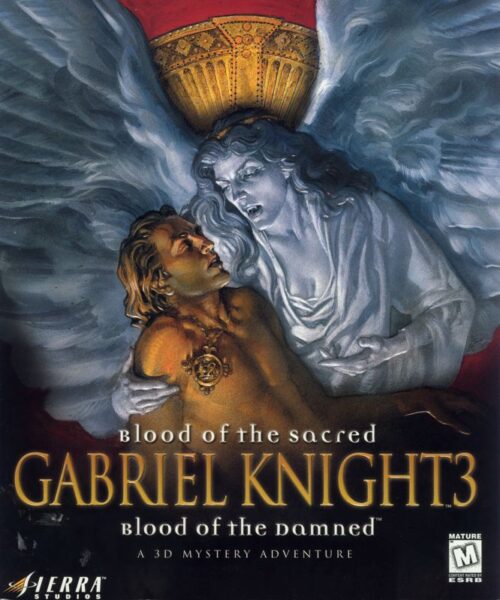
I think I became convinced when I went to CES [in January of 1997] and I walked around the show looking at all these titles that were the big new things, and not one screen had full-motion video. I realized that if I wanted anyone to look at the game, it had to be in 3D.
— Jane Jensen
Gabriel Knight 3: Blood of the Sacred, Blood of the Damned is proof that miracles do occur in gaming. It was remarkable enough that the game ever got made at all, in the face of gale-force headwinds blowing against the adventure genre. But the truly miraculous thing is that it turned out as well as it did. In my last article, I told you about Ultima IX, the sad-sack conclusion to another iconic series. The story of Gabriel Knight 3′s development is eerily similar in the broad strokes: the same real or perceived need to chase marketplace trends, the same unsupportive management, the same morale problems that resulted in an absurdly high turnover rate on the team. But Gabriel Knight 3 had one thing going for it that Ultima IX did not. Whereas Richard Garriott, the father of Ultima, always seemed to be somewhere else when someone might be on the verge of asking him to get his hands dirty, Jane Jensen was on the scene from first to last with her project. Just as much as the first two games, Gabriel Knight 3 managed at the last to reflect her unique vision more than some corporate committee’s view of what an adventure game should be in 1999. And that made all the difference.
In fact, I’m going to go out on a limb right here and now and deliver this article’s bombshell up-front: in defiance of the critical consensus, Gabriel Knight 3 is actually my favorite of the trilogy. As always, I don’t necessarily expect you to agree with me, but I will do my best to explain just what it is that delights, intrigues, and even moves me so much about this game.
Before we get to that, though, we need to turn the dial of our time machine back another few years from 1999, to late 1995, when Jane Jensen has just finished The Beast Within, her second Gabriel Knight game. That game was the product of a giddy but ultimately brief-lived era at Sierra On-Line, when the company’s founders Ken and Roberta Williams were convinced that the necessary future of mass-market gaming was a meeting of the minds of Silicon Valley and Hollywood: it would be a case of players making the decisions for real live actors they saw on the screen. Sierra was so committed to this future that it built its own professional-grade sound stage in its hometown of tiny Oakhurst, California. Gabriel Knight 2 was the second game to emerge from this facility, following Roberta Williams’s million-selling Phantasmagoria. But, although Gabriel Knight 2 acquitted itself vastly better as both a game and a work of fiction than that schlocky splatter-fest, it sold only a fraction as many copies. “I thought we’d done a hell of a job,” says Jensen. “I thought it would appeal to that mass market out there. I thought it would be top ten. And it was — for about a week. I watched the charts in the months after shipping and saw the games that outsold [it], and I thought, ‘Ya know, I’m in the wrong industry.'”
The underwhelming sales figures affected more than just the psyche of Jane Jensen. Combined with the similarly disappointing sales figures of other, similar games, they sent the Siliwood train careening off the rails when it had barely left the station. In the aftermath, everyone was left to ponder hard questions about the fate of the Gabriel Knight series, about the fate of Sierra, and about the fate of adventure games in general.
No offer to make a third Gabriel Knight game was immediately forthcoming. Jane Jensen took a year’s sabbatical from Sierra, busying herself with the writing of novelizations of the first two games for Roc Books. While she was away, the new, more action-focused genres of the first-person shooter and real-time strategy completed their conquest of the computer-gaming mainstream, and Sierra itself was taken over by an unlikely buyer of obscure provenance and intent known as CUC.
Thus she found that everything was different when she returned to Sierra, bubbling over with excitement about a new idea she had. During her break, she had read a purportedly non-fiction book called The Tomb of God, the latest in a long and tangled skein of literature surrounding the tiny French village of Rennes-le-Château. The stories had begun with a mysteriously wealthy nineteenth-century priest and rumors of some treasure he may have hidden in or around the village, then grown in the telling to incorporate the Holy Grail, Mary Magdalene, the Knights Templar, the Freemasons, the true bloodline of Jesus Christ, and the inevitable millennia-spanning conspiracy to control the world and hide The Truth. The bizarre cottage industry would reach its commercial zenith a few years into the 21st century, with Dan Brown’s novel The Da Vinci Code and the movie of same that followed. It’s unclear whether Jensen herself truly believed any of it, but she did see a way to add vampires to the equation — she had long intended the third Gabriel Knight game to deal with vampires — and turn it into an adventure game that blended history and horror in much the same audacious way as Gabriel Knight 2, which had dared to posit that “Mad King” Ludwig II of Bavaria had been a werewolf, then went on to make an uncannily believable case for that nutso proposition.
Sierra’s new management agreed to make the game, for reasons that aren’t crystal clear but can perhaps be inferred. It was the end of 1996, still early enough that a sufficiently determined industry observer could make the case that the failure of the adventure genre to produce any new million-selling hits of late might be more of a fluke than a long-term trend. Ken Williams was still on the scene at Sierra, albeit with greatly diminished influence in comparison to the years when he alone had called the shots. For better and sometimes for worse, he had always loved the idea of “controversial” games. The would-be Gabriel Knight 3 certainly seemed like it would fit that bill, what with being based around the heretical premise that Jesus Christ had not been celibate, had in fact married Mary Magdalene and conceived children with her in the biological, less-than-immaculate way. A few centuries earlier, saying that sort of thing would have gotten you drawn and quartered or burnt at the stake; now, it would just leave every priest, preacher, and congregation member in the country spluttering with rage. It was one way to get people talking about adventure games again.
Even so, it wasn’t as if everything could just be business as usual for the genre. The times were changing: digitized human actors were out, real-time 3D was in, and even an unfashionable straggler of a genre like this one would have to adapt. So, Gabriel Knight 3 would be done in immersive 3D, both for the flexibility it lent when contrasted with the still photographs and chunks of canned video around which Gabriel Knight 2 had been built and because it ought to be, theoretically at least, considerably cheaper than trying to film a whole cast of professional actors cavorting around a sound stage. The new game would be made from Sierra’s new offices in Bellevue, Washington, to which the company had been gradually shifting development for the past few years.
Jane Jensen officially returned to Sierra in December of 1996, to begin putting together a script and a design document while a team of engineers got started on the core technology. The planned ship date was Christmas of 1998. But right from the get-go, there were aspects of the project to cause one to question the feasibility of that timeline.
Sierra actually had three projects going at the same time which were all attempting to update the company’s older adventure series for this new age of real-time 3D. And yet there was no attempt made to develop a single shared engine to power them, despite the example of SCI, one of the key building blocks of Sierra’s earlier success, which had powered all of its 2D adventures from late 1988 on. Gabriel Knight 3 was the last of the three 3D projects to be initiated, coming well after King’s Quest: Mask of Eternity and Quest for Glory V. Its engine, dubbed the G-Engine for obvious reasons, was primarily the creation of a software engineer named Jim Napier, who set the basics of it in place during the first half of 1997. Unfortunately, Napier was transferred to work on SWAT 3 after that, leaving the technology stack in a less than ideal state.
Abrupt transfers like this one would prove a running theme. The people working on Gabriel Knight 3 were made to feel like the dregs of the employee rolls, condemned to toil away on Sierra’s least commercially promising game. Small wonder that poor morale and high turnover would be constant issues for the project. Almost 50 people would be assigned to Gabriel Knight 3 before all was said and done, but never more than twenty at a time. Among them would be two producers, three art directors, and three project leads. The constant chaos, combined with the determination to reinvent the 3D-adventure wheel every time it was taken for a spin, undermined any and all cost savings that might otherwise have flowed from the switch from digitized video to 3D graphics. Originally projected to cost around $1.5 million, Gabriel Knight 3 would wind up having cost no less than $4.2 million by the time it was finished. That it was never cancelled was more a result of inertia and an equally insane churn rate in Sierra’s executive suites than any real belief in the game’s potential.
For her part, Jane Jensen displayed amazing resilience and professionalism throughout. She had shot too high with Gabriel Knight 2, turning in a script that had to be cut down by 25 percent or more during development, leaving behind some ugly plot and gameplay holes to be imperfectly papered over. This time around, she kept in mind that game development, like politics, is the art of the possible. Despite all the problems, very little of her design would be cut this time.
The people around her were a mixture of new faces who were there because they had been ordered to be and a smattering of old-timers who shared her passion for this set of themes and characters. Among these latter was her husband Robert Holmes, who provided his third moody yet hummable soundtrack for the series, and Stu Rosen, who had directed the voice-acting cast in Gabriel Knight 1. Rosen convinced Tim Curry, who had voiced the title role in that game but sat out the live-action Gabriel Knight 2, to return for this one. His exaggerated New Orleans drawl is not to all tastes, but it did provide a welcome note of continuity through all of the technological changes the series had undergone. Recording sessions began already in November of 1997, just after Jane Jensen returned from her first in-person visit to Rennes-le-Château.
But as we saw with Ultima IX, such sessions are superficial signs of progress only, and as such are often the refuge of those in denial about more fundamental problems. When one Scott Bilas arrived in early 1998 to become Gabriel Knight 3′s latest Technical Lead, he concluded that “the engineering team must have been living in a magical dream world. I can’t find any other way to explain it. At that point, the game was a hacked-up version of a sample application that Jim Napier wrote some time earlier to demonstrate the G-Engine.” Bilas spent months reworking the G-Engine and adding an SCI-like scripting language called Sheep to separate the game design from low-level engine programming. His postmortem of the project, written for Game Developer magazine about six months after Gabriel Knight 3′s release, makes for brutal reading. For most of the people consigned to it, the project was more of a death march than a labor of love, being a veritable encyclopedia of project-management worst practices.
There was a serious lack of love and appreciation [from Sierra’s management] throughout the project. Recognition of work (other than relief upon its completion) was very rare, lacked sincerity, and was always too little, too late. Internally, a lot of the team believed that the game was of poor quality. And of course, the many websites and magazines that proclaimed “adventure games are dead” only made things worse. Tim Schafer’s Grim Fandango, although a fabulous game and critically acclaimed, was supposedly (we heard) performing poorly in the marketplace…
The low morale resulted in a lot of send-off lunches for developers seeking greener pastures. Gabriel Knight 3 had a ridiculous amount of turnover that never would have been necessary had these people been properly cast or well-treated…
After a certain amount of time on a project like this, morale can sink so low that the team develops an incredible amount of passive resistance to any kind of change. Developers can get so tired of the project and build up such hatred for it that they avoid doing anything that could possibly make it ship later. This was a terrible problem during the last half of the Gabriel Knight 3 development cycle…
Our engineers never had an accurate development schedule; the schedules we had were so obviously wrong that everybody on the team knew there was no way to meet them. Our leads often lied to management about progress, tasks, and estimates, and I believe this was because they were in over their heads and weren’t responding well to the stress. Consequently, upper management thought the project was going to be stable and ready to ship long before it actually was, and we faced prolonged crunch times to deliver promised functionality…
Most of the last year of the project we spent in [crunch] mode, which meant that even small breaks for vacations, attending conferences, and often even taking off nights and weekends were looked down upon. It was time that the team “could not afford to lose.” The irony is that this overtime didn’t help anyway; the project didn’t move any faster or go out any sooner. The lack of respect for our personal lives and attention to our well-being caused our morale to sink…
Gabriel Knight 3 became a black hole that sucked in many developers from other projects, often at the expense of those projects. Artists were shifted off the team to cut the burn rate, and then pulled back on later because there was so much work left to do…
Management, thinking that it would save time, often encouraged content developers to hack and work around problems rather than fix them properly…
All of this happened against a backdrop of thoroughgoing confusion and dysfunction at Sierra in general. A sidelined Ken Williams got fed up and left the company he had founded in August of 1997. At the end of that year, Sierra’s new parent CUC merged with another large conglomerate called HFS to create a new entity named Cendant. Just a few months later, CUC was revealed to have been a house of cards the whole time, the locus of one of the biggest accounting scandals in the history of American business. For a long stretch of the time that Gabriel Knight 3 was in the works, there was reason to wonder whether there would even still be a Sierra for the team to report to in a week or a month. Finally, in November of 1998, Sierra was bought again, this time by the French media mega-corp Vivendi, whose long-term plan was, it slowly became evident, to end all internal game development and leverage the label’s brand recognition by turning it into a publisher only. Needless to say, this did nothing for the morale of the people who were still making games there.
Sierra’s Oakhurst office was shut down in February of 1999. The first wave of layoffs swept through Bellevue the following summer, while the Gabriel Knight 3 team were striving desperately to get the game out in time for the Christmas of 1999 instead of 1998. In a stunning testimony to corporate cluelessness about the psychology of human beings, some of those working on Gabriel Knight 3 were told straight-up that they were to be fired, but not until they had given the last of their blood, sweat, and tears to finish the game. “Having a group of people who are (understandably) upset with your company for laying them off and actively looking for a job while still trying to contribute to a project is a touchy situation that should be avoided,” understates Scott Bilas. The words “no shit, Sherlock” would seem to apply here.
But the one person who comes in for sustained praise in Bilas’s postmortem is Jane Jensen, whose vision and commitment never wavered.
Gabriel Knight 3 would have simply fallen over and died had we had a less experienced designer than Jane Jensen. Throughout the entire development process, the one thing that we could count on was the game design. It was well thought-out and researched, and had an entertaining and engrossing story. Best of all, Jane got it right well in advance; aside from some of the puzzles, nothing really needed to be reworked during development. She delivered the design on time and maintained it meticulously as the project went on.
This was Gabriel Knight 3′s secret weapon, the thing that prevented it from becoming a disaster like Ultima IX. With Jane Jensen onboard, there was always someone to turn to who knew exactly what the game was meant to do and be. The vision thing matters.
When Gabriel Knight 3: Blood of the Sacred, Blood of the Damned shipped in November of 1999, it marked the definitive end of an era, being the last Sierra adventure game ever, the final destination of a cultural tradition that stretched all the way back to Mystery House almost twenty years before, to a time when the computer-game industry was more inchoate than concrete. During the graphic adventure’s commercial peak of the early 1990s, Sierra and LucasArts had been the yang and the yin of the field, the bones of endless partisan contentions among gamers. It’s therefore intriguing and perhaps instructive to compare the press reception of Gabriel Knight 3 with that of 1998’s Grim Fandango, the most recent high-profile adventure release from LucasArts.
Grim Fandango was taken up as a sort of cause célèbre by critics, who rightly praised its unusual setting, vividly drawn characters, and moving story, even as they devoted less attention to its clumsy interface and convoluted and illogical puzzle structure. Those who wrote about games tended to be a few years older on average than those who simply played them. Many of this generation of journalists had grown up with Maniac Mansion and/or The Secret of Monkey Island. They were bothered by the notion of a LucasArts that no longer made adventure games, and sought to make this one enough of a success to avoid that outcome. At times, their reviews took on almost a hectoring tone: you must buy this game, they lectured their readers. The pressure campaign failed to fully accomplish its goal; Grim Fandango wasn’t a complete flop, but it did no more than break even at best, providing LucasArts with no particularly compelling financial argument for making more games like it.
Alas, when it arrived a year later, Gabriel Knight 3 was not given the same benefit of the doubt as to its strengths and weaknesses. Some of the reviews were not just negative but savagely so, almost as if their writers were angry at the game for daring to exist at all in this day and age. GameSpot pronounced this third installment fit “only for the most die-hard fans of the series.” Even the generally sober-minded Computer Gaming World, the closest thing the industry had to a mature journal of record, came at this game with knives out. In a two-stars-out-of-five review, Tom Chick said that “you’ll spend a lot of time fumbling in limbo, wandering aimlessly, trying to trigger whatever unknowable act will end the time block.” Okay — but it’s very hard to reconcile this criticism with the same magazine’s four-and-a-half star, “Editor’s Choice”-winning review of Grim Fandango. In my experience at least, aimless wandering and unknowable acts are far more of a fact of life in that game than in Gabriel Knight 3, which does a far better job of telling you what your goals are from story beat to story beat.
What might be going on here? To begin with, we do have to factor in that LucasArts had historically enjoyed better reviews and the benefit of more doubts than Sierra, whose adventure games came more frequently but really did tend to be rougher around the edges in the aggregate. Yet I don’t think that explains the contrast in its entirety. The taste-makers of mainstream gaming were still in a bargaining phase when it came to adventure games in 1998, still trying to find a place for them amidst all the changes that had come down the pipe since id Software unleashed DOOM upon the world. That bargaining had been given up as a lost cause a year later. The adventure game, said the new conventional wisdom, was dead as a doorknob, and it wasn’t coming back. A pack mentality kicked in and everyone rushed to pile on. It’s a disconcerting, maybe even disturbing thing to witness, but such is this thing we call human nature sometimes. If the last few years of our more recent social history tell us anything, it is that cultural change can burst upon the scene with head-snapping speed and force to make yesterday’s conventional wisdom suddenly beyond the pale today.
Adventure games would soon disappear entirely from the catalogs of the major publishers and from the tables of contents of the magazines and websites that followed them. In a rare sympathetic take on the genre’s travails, the website Gamecenter wrote just after the release and less than awe-inspiring commercial performance of Gabriel Knight 3 that “now it seems people want more action than adventure. They would rather run around in short shorts raiding tombs than experience real stories.” This was the true nub of the issue, for all that the belittling tone was no more necessary here than when it was directed in the opposite direction. People just wanted different things; a player of Gabriel Knight 3 was not inherently more or less smart, wise, or culturally sophisticated than a player of Starcraft or Unreal Tournament.
So, then, at the risk of stating the obvious, the core problem for the adventure genre was a mismatch between the desires of the majority of gamers at the turn of the millennium and the things the adventure game could offer them. The ultimate solution was for the remaining adventure fans to get their own cottage industry to make for them the games that they enjoyed, plus their own media ecosystem to cover them, replete with sympathetic critics who wanted the same things from gaming that their readers did. That computer gaming as a whole could sustain being siloed off into parallel ecosystems was a testament to how much bigger the tent had gotten over the course of the 1990s. But as of 1999, the siloing hadn’t quite happened yet, leaving a game like Gabriel Knight 3 trapped on the stage of an unfriendly theater, staring down an audience who were no longer interested in the type of entertainment it was peddling. While the game was still in development, Jane Jensen had mused about the controversial elements that may have helped to get it funded: “I guess the worst case would be that no one would care, or even notice.”
The worst case came true. Gabriel Knight 3 became its woebegone genre’s sacrificial lamb, controversial only for daring to exist at all as an ambitious adventure game in 1999. It deserved better, for reasons which I shall now go into.
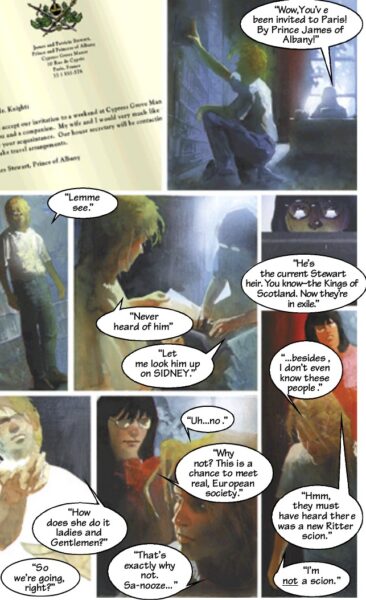
This final Sierra adventure game opens with something else that was not long for this world in 1999: a story setup that’s conveyed in the manual — or rather in an accompanying comic book — instead of in a cutscene. Four years on from their hunt for werewolves in Gabriel Knight 2, Gabriel and his assistant Grace Nakimura are asked to come to the Paris mansion of one Prince James, a scion of the Stuart line that once ruled Scotland and England. After they arrive, the good prince explains that he needs their help to protect his infant son from “Night Visitors” — i.e., vampires. Gabriel and Grace agree to take on the task, only to fail at it rather emphatically; the baby is kidnapped out from under their noses that very night. But Gabriel does manage to give chase, tracking the men or monsters who have absconded with the infant to the vicinity of Rennes-le-Château. Not sure how to proceed from here, he checks into a hotel in the village. The game proper begins the next morning.
At breakfast, he learns that a tour group of treasure hunters has also just arrived at the hotel, all of them dreaming of the riches that are purported to be hidden somewhere in or near the village. In addition to the fetching French tour guide Madeline (to whom Gabriel reacts in his standard lecherous fashion), there are Emilio, a stoic Middle Easterner; Lady Lily Howard and Estelle Stiles, a British blue-blood and her companion; John Wilkes, an arrogant, muscle-bound Aussie; and Vittorio Buchelli, an irritable Italian scholar. To this cast of characters worthy of an Agatha Christie novel we must add Gabriel’s old New Orleans running buddy Detective Frank Mosely, who, in a coincidence that would cause Charles Dickens to roll over in his grave, just happens to have joined this very tour group to try his hand at treasure hunting. Each member of the group has his or her own theory about the real nature of the treasure and how to find it, leaving Gabriel to try to sort out which ones really are the hopeless amateurs they seem to be and which ones have relevant secrets to hide, possibly involving the kidnapping which brought him here.
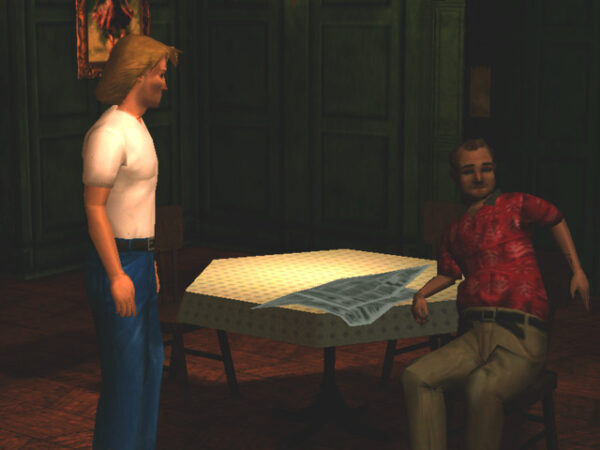
Gabriel has an unexpected meeting with Mosely.
Anyone who has played the first two Gabriel Knight games will be familiar with this one’s broad approach to its story. It takes place over three days, each of which is divided up into a number of time blocks. Rather than running on clock time, the game runs on plot time: the clock advances only when you’ve fulfilled a set of requirements for ending a time block. Grace arrives at the hotel on the evening of the first day. Thereafter, you control her and Gabriel alternately, just as in Gabriel Knight 2, with Gabriel’s sections leaning harder on conversations and practical investigation, while Grace delves deep into the lore and conspiracy theories of Rennes-le-Château. Don’t let the fact that the whole game is compressed into just three days fool you: they’re three busy days (and nights), busier than any three days could reasonably be in real life.
In this article, I won’t say anything more about the mystery of Rennes-le-Château. For the time being, you’ll just have to trust me when I tell you that it’s an endlessly fascinating rabbit hole. In fact, it fascinates on two separate levels: that of the tinfoil-hat theories themselves, and the meta-level of how they came to find such purchase here in this real world of ours, which is — spoiler alert! — actually not controlled by secret cabals of Knights Templar and the like. I’ll be exploring these subjects in some articles that will follow this one. It’s a digression from my normal beat, but one that I just can’t resist; I hope you’ll wind up agreeing with me that it was well worth it.
Today, though, let me tell you about some of the other aspects of this game. One of Jane Jensen’s greatest talents as a writer is her skill at evoking a sense of place, whether her setting be Louisiana, Bavaria, or now southern France. If you ask me, this game is her magnum opus in this sense. The 3D graphics here are pretty crude — far from state of the art even by the standards of 1999, never mind today. Characters move more like zombies or robots than real people and look like collections of interchangeable parts crudely sewn together. Gabriel’s hair looks like an awkwardly shaped helmet that’s perpetually in danger of falling right off his head, while trees and plants are jagged-edged amalgamations of pixels that look like they could slice him right open if he bumped into them. And yet darned if playing this game doesn’t truly feel like exploring a sun-kissed village on the edge of the French Riviera. The screenshots may not come off very well in an article like this one, but there’s an Impressionistic quality (how French, right?) to the game’s aesthetics that may actually serve it better than more photo-realistic graphics would. When I think back on it now, I do so almost as I might a memorable vacation, the kind whose contours are blended and softened by the soothing hand of sentiment. If a good game is a space where you want to go just to hang out, then Gabriel Knight 3 is a very good game indeed.
The geography is fairly constrained, meaning you’ll be visiting the same places again and again as the plot unfolds. Far from a drawback, I found this oddly soothing too. I mentioned Agatha Christie earlier; let me double-down on that reference now, and say that the geography is tight enough to remind me of a locked-room cozy mystery. The fact that you’re staying in a hotel with a gaggle of tourists only enhances the feeling of being on a virtual holiday. Playing this game, you never sense the stress and conflict and exhaustion that were so frequently the lot of its developers. Call it one more way in which Gabriel Knight 3 is kind of miraculous; most games reflect the circumstances of their creation much more indelibly.
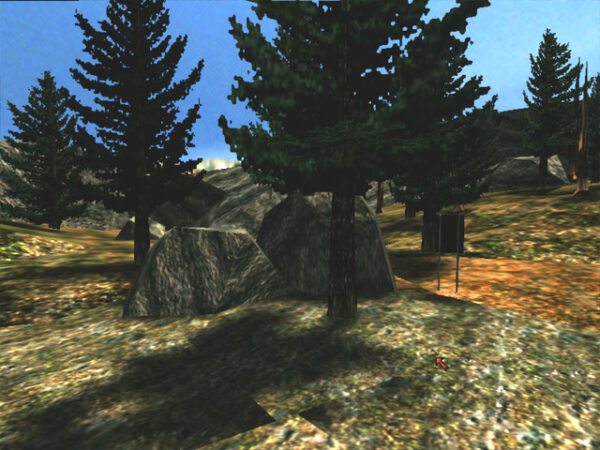
I suppose it could be considered a problem with Gabriel Knight 3 as a piece of fiction that the setting comes off so bucolic when the stakes are meant to be so high. But I don’t care. I like it here; I really like it.
Meet the story where it lives and let it unfold at its own pace, and you’ll be amply rewarded. Both the backstory of the historical conspiracy and the foreground plot with which it becomes intertwined, about finding the vampiric kidnappers, become riveting. I often play games on the television in the living room while my wife Dorte reads or crochets or does something else, popping up from time to time with a comment, usually one making fun of whatever nerdy thing I happen to be up to tonight. But Gabriel Knight 3 grabbed her too, something that doesn’t happen all that often. She had to go off to a week-long course just as I was getting close to the end. She informed me in no uncertain terms that I was not allowed to finish without her, because she wanted to see how it ended as well. Trust me when I tell you that that is really saying something.
The 3D engine that powers all of this is one of a goodly number of alternative approaches to the traditional point-and-click adventure that appeared as the genre was flailing against the dying of the mainstream light, aimed at helping it to feel more in tune with the times and, in some cases, making it a more friendly fit with alternative platforms like the Sony PlayStation. Few of these reinventions make much of a case for their own existence in my opinion, but the G-Engine is an exception. It’s a surprisingly effective piece of kit. Instead of relying on fixed camera angles, as Grim Fandango does in its 3D engine, Gabriel Knight 3 gives you a free-floating camera that you can move about at will. The environment fills the whole screen; there are no fixed interface elements. Clicking on a hot spot brings up a context-sensitive menu of interaction possibilities. And naturally, you can delve into an inventory screen to look at and combine the items you’re carrying, or to snatch them up for use out in the world. I really, really like the system, which genuinely does add something extra that you wouldn’t get from 2D pixel graphics. You can look up and down, left and right, under and on top of things. A room suddenly feels like a real space, full of nooks and crannies to be explored.
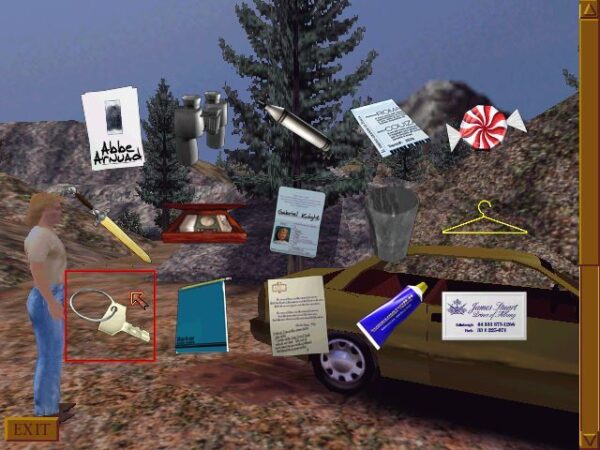
Admittedly, the setup is kind of weird on a conceptual level, in that you’re doing all of this exploration while Gabriel or Grace, whichever one you happen to be controlling, is standing stock still. This game, in other words, lends fresh credence to Scott Adams’s age-old conception of the player of an adventure game being in command of a “puppet” that does her bidding. Here you’re a disembodied spirit who does all the real work, pressing Gabriel or Grace into service only when you have need of hands, feet, or a mouth. You can even “inspect” an object in the room without their assistance — doing so shows it to you in close-up — although you do need them to help you “look,” which elicits a verbal description from your puppet. Gabriel Knight 3 doesn’t take place in a contiguous world; discrete “rooms” are loaded in when you direct your puppet to cross a boundary from one to another. Nevertheless, some of the rooms can be quite large. When you’re out and about on the streets of Rennes-le-Château, for example, the camera might be a block away from Gabriel or Grace, well out of his or her line of sight. It’s odd to think about, but it works a treat in practice.
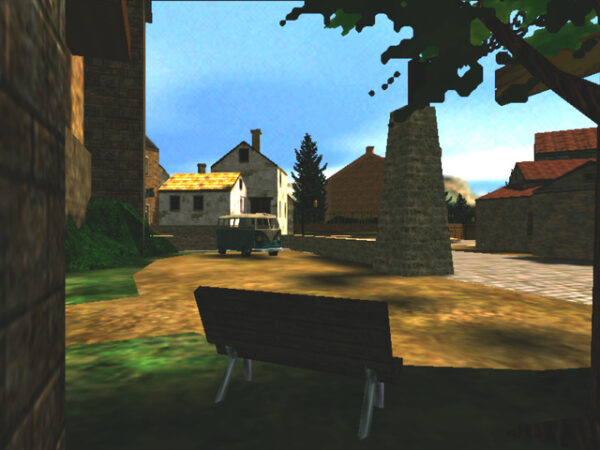
One of the strangest things about the G-Engine is how the camera seems to have a corporeal form. You can get it hung up behind objects like this bench.
The G-Engine doesn’t add much in the way of emergent possibility. Reading between the lines of some of the reviews, one can’t help but sense that some critics thought the switch to 3D ought to make Gabriel Knight 3 play more like Tomb Raider — and who knows, perhaps this was even envisioned by the developers as well at one time. The game we have, however, is very much an adventure game of the old school, a collection of set-piece puzzles with set-piece solutions, with a set-piece plot that is predestined to play out in one and only one way. Some alternative solutions are provided, even some optional pathways and puzzles that you can engage with for extra points, but there’s no physics engine to speak of here, and definitely no possibility to do anything that Jane Jensen never anticipated for you to do.
That said, there are a few places where the game demands timing and reflexes, especially at the climax. These bits aren’t horrible, but they aren’t likely to leave you wishing there were more of them either. In the end, they too are set-piece exercises, more Dragon’s Lair than Tomb Raider.
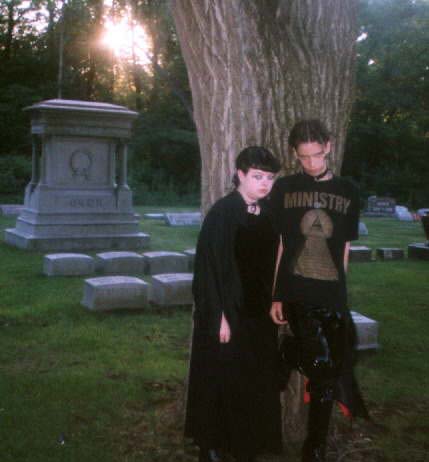
Erik Wolpaw and Chet Faliszek wrote Gabriel Knight 3 into gaming history for all the wrong reasons via their website Old Man Murray. They created fictional teenage personas for themselves, Erik being a “fat, girl-looking boy” and Chet being a kid who “likes Ministry and not much else.” How meta, right?
We can’t avoid it anymore, my friends. It’s impossible to discuss Gabriel Knight 3′s puzzles in any depth without addressing the elephant — or rather the cat-hair mustache — that’s been in the room with us this whole time. The uninitiated among you, assuming there are any, will require a bit of explanation.
During the burgeoning years of the World Wide Web, many gaming sites popped up to live on the hazy border between fanzines and professional media organs. One of these went for some reason by the name of Old Man Murray, a place for irreverent piss takes on the games that Computer Gaming World was covering with more earnestness and less profanity. Erik Wolpaw, one of the proprietors, took exception to one particular puzzle that crops up fairly early on in Gabriel Knight 3. He vented his frustration in a… a column, I guess we can call it?… published on September 11, 2000 — i.e., ten months after the game’s release, and well after its lackluster commercial fate had already been decided.
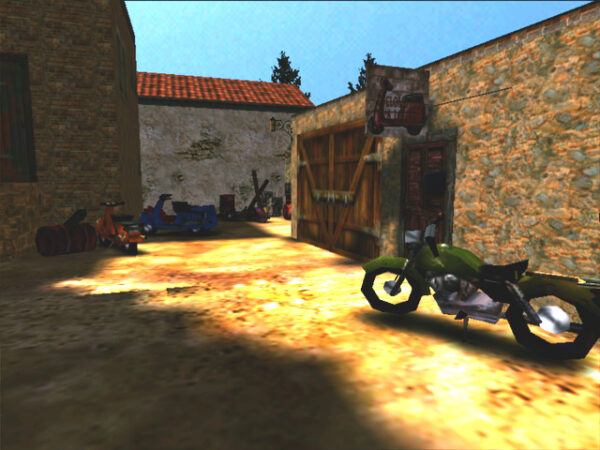
Gabriel needs to get his hands on some form of transportation in order to explore the countryside around Rennes-le-Château. Unfortunately, the motorbike rental lot right next door to the hotel mostly offers only sissy-looking mopeds of a sort that he wouldn’t be caught dead riding. The sole exception is a gleaming Harley-Davidson — but it has been reserved, by, of all people, his old buddy Mosely. Gabriel must engage in an extended round of subterfuge to pretend to be Mosely and secure the bike. This will turn out to involve, among other things, stealing the poor fellow’s passport and concocting a disguise for himself that involves masking tape, maple syrup, and a stray tuft of cat hair. I’ll let Erik tell you more about it. (The bold text below is present in the original.)
Dumb as your television enjoying ass probably is, you’re smarter than the genius adventure gamers who, in a truly inappropriate display of autism-level concentration, willingly played the birdbrained events. Permit me to summarize:
- Gabriel Knight must disguise himself as a man called Mosley [sic] in order to fool a French moped rental clerk into renting him the shop’s only motorcycle.
- In order to construct the costume, Gabriel Knight must manufacture a fake moustache. Utilizing the style of logic adventure game creators share with morons, Knight must do this even though Mosely does not have a moustache.
- So in order to even begin formulating your strategy, you have to follow daredevil of logic Jane Jensen as she pilots Gabriel Knight 3 right over common sense, like Evel Knievel jumping Snake River Canyon. Maybe Jane Jensen was too busy reading difficult books by Pär Lagerkvist to catch what stupid Quake players learned from watching the A-Team: The first step in making a costume to fool people into thinking you’re a man without a moustache, is not to construct a fake moustache.
- Still, you might think that you could yank some hair from one of the many places it grows out of your own body and attach it to your lip with the masking tape in your inventory. But obviously, Ms. Jensen felt that an insane puzzle deserved a genuinely deranged solution. In order to manufacture the moustache, you must attach the masking tape to a hole at the base of a toolshed then chase a cat through the hole. In the real world, such as the one that stupid people like me and Adrian Carmack use to store our televisions, this would result in a piece of masking tape with a few cat hairs stuck to it, or a cat running around with tape on its back. Apparently, in Jane Jensen’s exciting, imaginative world of books, masking tape is some kind of powerful neodymium supermagnet for cat hair.
- Remember how shocked you were at the end of the Sixth Sense when it turned out Bruce Willis was a robot? Well, check this out: At the end of this puzzle, you have to affix the improbable cat hair moustache to your lip with maple syrup! Someone ought to give Jane Jensen a motion picture deal and also someone should CAT scan her brain.
A penetrating work of satire for the ages this column is not, but it nevertheless went viral, until it seemed to be absolutely everywhere on the Internet. In an ironic, backhanded way, Gabriel Knight 3′s cat-hair mustache puzzle became one of the most famous puzzles in all of adventure-gaming history, right up there with the Babel Fish in The Hitchhiker’s Guide to the Galaxy or Monkey Island’s Monkey Wrench. It became so famous that it has its own Wikipedia page today. At the same time, it became Exhibit Number One in the burgeoning debate over Why Adventure Games Died. Right up to this day, whenever talk turns to the genre’s fall from grace at the end of the twentieth century, a reference to the cat-hair mustache cannot be long in coming. For a considerable number of people today, Gabriel Knight 3 is not a game about vampires or the source material of The Da Vinci Code before Dan Brown discovered it; it’s a game about a cat-hair mustache.
So, what is a Gabriel Knight 3 apologist like myself supposed to do with this? First, let me acknowledge that this is not a great puzzle in strictly mimetic terms, in that it’s impossible to take seriously as a part of the game’s fiction. Setting aside all of the other improbable steps Gabriel has to go through, he steals and defaces — more on the latter in a moment — his good friend’s passport in order to work the scam. All of this instead of just, you know, asking his buddy to help him out. (Mosely is gruff on the outside, but he’s a good egg underneath, as Gabriel knows better than anyone.) Or he could just suck it up and ride a moped for a few days, given that the fate of an innocent baby and who knows what else may depend on it.
Of course, Gabriel Knight 3 is hardly the only adventure game that makes sociopathic behavior a staple of its puzzle tree. This is the root of the genre’s centrifugal pull toward comedy, which almost invariably injects a patina of goofiness even into allegedly serious games like this one. Stuff like this is more naturally at home in a game like Monkey Island. But leave it entirely out of any sort of adventure, and you run the risk of having a game without enough gameplay. If we aren’t afraid of a little bit of whataboutism, we might defend the adventure game by noting here that it’s hardly the only genre whose gameplay is frequently at odds with its fiction: think of putting saving the world on hold in order to hunt down lost pets and carry out a hundred other piddling side-quests in a CRPG, or researching the same technologies over and over from scratch in an RTS campaign. I’ll leave you to decide for yourself how compelling such a defense is.
For what it’s worth, there are reports that this puzzle was not in Jane Jensen’s original design, that it was swapped in late in the day in place of another one that had proved impractical to implement. Rest assured that you won’t catch me calling it a great puzzle, either in the context of this game or of adventure history.
But here’s the thing: mimesis aside, it’s nowhere near as terrible a puzzle as the one that our friend Erik describes either. I played this game a few months ago for the first time, knowing vaguely that it included an infamous puzzle involving a cat-hair mustache — how could I not? — but knowing nothing of the specifics. I went in fully expecting the worst, keeping in mind the design issues I remembered from the first two Gabriel Knight games. I was therefore surprised by how smoothly — and, yes, even enjoyably — the whole puzzle played out for me. Perhaps I was helped by the knowledge I brought with me into the game, but I never had the feeling that I was relying on it, never felt that I couldn’t have progressed without it. There are two hugely important mitigating factors which Erik neglects to mention.
The first is that there actually is a logic to Gabriel making a mustache for himself to imitate the clean-shaven (more or less) Mosely. He thinks that the facial hair will disguise the very different facial bone structures of the two men. Therefore he draws a mustache onto Mosely’s passport photo with a marker — how would you like to have a friend like him? — to complete the deception.
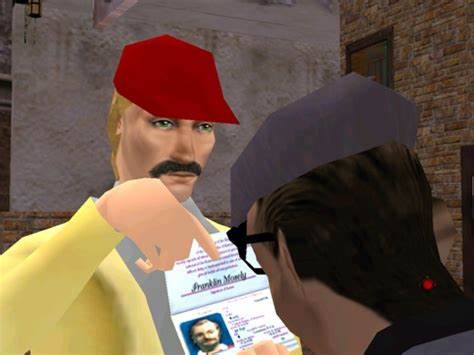
Notice that Mosely does have a mustache in his passport photo now.
The second factor is more thoroughgoing: the player is guided through all of the steps quite explicitly by Gabriel himself. (Who’s the puppet now, right?) In addition to “Look” and “Inspect,” many hot spots pop up a handy light-bulb icon when you click them: “Think.” These provide vital guidance on, well, what your character is thinking — or rather what Jane Jensen is thinking, what avenues she expects you to explore to advance the story. It’s not a walkthrough — what fun would that be? — but it does give you the outlines of what you’re trying to accomplish. In this case, looking carefully at and “thinking” about all of the objects involved turn a puzzle that truly would be absurdly unfair without this extra information into one that’s silly on the face of it, yes, but pretty good fun all the same. I’ve ranted plenty over bad adventure-game puzzles in the past, the kind where you have no clue what the game wants you to do or how it wants you to do it. This is not one of those. This puzzle doesn’t deserve the eternal infamy in which Old Man Murray draped it.
In point of fact, Gabriel Knight 3 is a major leap forward over the first two games in terms of pure design. Although it’s not trivial to solve by any means, nor does it seem to hate its player in the way of so many older Sierra games. The “Think” verb is one example. And for another one: once you solve the cat-hair-mustache-puzzle, get on your ill-gotten Harley, and start visiting the places around Rennes-le-Château, you can start to ask the game to show you where you still need to accomplish things in your current time block; this alone does much to alleviate the sense of “fumbling around in limbo,” as Tom Chick described it in Computer Gaming World. I don’t know whether the more soluble design of this game is a result of Jane Jensen improving her craft, unsung heroes on the team she worked with, or possibly even directives that came down from the dreaded upper management. I just know that it’s really, really nice to see — nice to be surprised by a game that turns out to be better than its reputation.
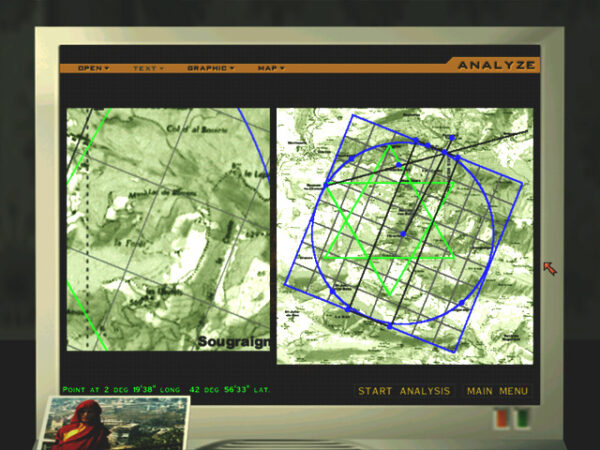
Solving the Le Serpent Rouge puzzle. Jane Jensen cribbed all this business about “sacred geometries” from the book The Tomb of God, which in turn borrowed it from Renaissance and Early Modern hermetic philosophy. (Johannes Kepler was very big on this sort of thing when he wasn’t developing the first credible model of our heliocentric solar system.) It may be nonsense, but it’s wonderfully evocative nonsense when it’s embedded in a story like this one.
The other puzzles here are a commodious grab bag of types. A few of them are every bit as silly as the cat-hair mustache, but most of them are more pertinent to the mysteries you’re actually trying to solve. The most elaborate of them all is a whole chain of puzzles that become Grace’s principal focus over the second and third days, and that are almost as well-remembered within hardcore adventure circles today as the cat-hair mustache is outside of them. The Le Serpent Rouge puzzle sequence — another one with its own Wikipedia page, if you can believe it — takes its name from a 1967 poem by an anonymous author that has become an indelible part of the conspiracy lore surrounding Rennes-le-Château. The reliably bookish Grace has to ferret out its coded meanings, verse by verse, using a variety of software tools on her laptop computer. Some reviewers have called it the best adventure-game puzzle of all time.
For my part, I can’t go quite that far. Like everything else in the G-Engine, the software Grace uses is more of a veneer over the set-piece design than a true simulation. At several stages, I more or less just clicked on things until the game told me I had it right. But if it has its limitations as a set of pure puzzles, Le Serpent Rouge succeeds brilliantly as interactive drama. You’re fully invested by the time it comes along, and the buzz you get as you close in on the heart of the mystery, step by step, is not to be dismissed lightly. In a more just world it would be these puzzles rather than the cat-hair-mustache one that have taken a place in mainstream-gaming lore. For they show just how exciting and gripping smart, textured, context-appropriate adventure-game puzzles can be.
Much the same sentiment can be applied to Gabriel Knight 3 as a whole, a rare Sierra adventure game that I find to be underrated rather than overrated. I’ve not always been so kind toward Sierra’s games, as many of you know all too well. But almost twenty years on, just before they turned the lights out for good, they finally got everything right. This game is my favorite of the entire Sierra catalog. It’s the antithesis of Ultima IX, as high of a note to go out on as that game was a low one. Let’s hear it for lost causes and eleventh-hour miracles.
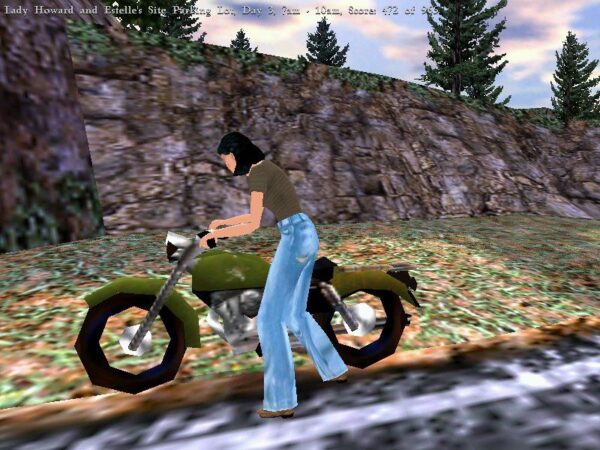
Girls can ride Harleys too, y’all.
I have to admit that my experience with Gabriel Knight 3 has to some extent caused me to reevaluate the whole series of which it is a part. Bloody-minded iconoclast that I am, I find that I have to rank the games in reverse chronological order, the opposite of the typical fan’s ordering. I still can’t get fully behind Gabriel Knight I, even when I try to separate the story and setting from my nightmares about searching for a two-pixel-wide snake scale in a Bayou swamp and tapping out nonsensical codes on a bongo drum. Gabriel Knight 2, though… that really is an edge case for me. I still have my share of quibbles with its design, but its flaws are certainly less egregious than those of its predecessor, even as it has stuck in my memory in a way that very few of the narrative-oriented games which I’ve played for these histories have been able to do. Both the second and the third games make me feel emotions that aren’t primary-colored, that are more textured and complex than love and hate, fight and flight. And that is nothing to be sneezed at in the videogame medium.
So, readers, I think I have to put both Gabriel Knight 2 and 3 into my personal Hall of Fame. It was a long time coming for the former, but I did come around to old Gabe and Gracie eventually. It’s only too bad that their story had to end here, just when it was starting to get juicy.
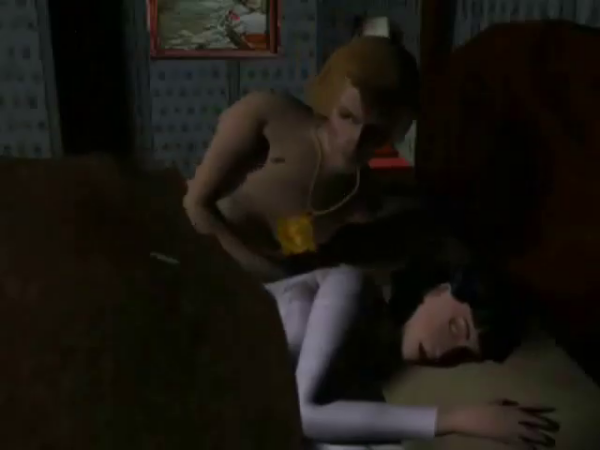
Oh là là!
Did you enjoy this article? If so, please think about pitching in to help me make many more like it. You can pledge any amount you like.

Sources: The book Gabriel Knight 3: Prima’s Official Strategy Guide by Rick Barba and Jane Jensen: Gabriel Knight, Adventure Games, Hidden Objects by Anastasia Salter. Computer Gaming World of February 1999, June 1999, and April 2000; Game Developer of June 2000; PC Zone of July 1998; Sierra’s newsletter InterAction of Spring 1999.
Online sources include Adventure Gamer’s interview with Gabriel Knight 3 design assistant Adam D. Bormann, Women Gamers’s interview with Jane Jensen, the vintage GameSpot review of Gabriel Knight 3, the Old Man Murray column discussed in the article, and a designer diary that Jane Jensen wrote for GameSpot during the game’s development.
Where to Get It: Gabriel Knight 3: Blood of the Sacred, Blood of the Damned is available as a digital purchase at GOG.com.







William Hern
February 20, 2026 at 6:21 pm
Brilliant work Jimmy – another adventure to add to my ever-growing list of games to play sometime!
A small typo at the end of the final sentence – “… just when it get was starting to get juicy.” One “get” too many!
Jimmy Maher
February 20, 2026 at 6:27 pm
Thanks!
Bmp
February 20, 2026 at 6:30 pm
Erik from Old Man Murray who wrote that article in September 2000 should be the same Erik Wolpaw who wrote the Gamespot review in December 1999, so he did play the game himself before writing about the mustache puzzle. He and Chet Faliszek worked at Valve later on.
Jimmy Maher
February 20, 2026 at 7:13 pm
Oh, wow, I totally missed that. That surprises me. I don’t agree with the GameSpot review, but it’s a lot better written than the stuff on Old Man Murray. Anyway, thanks!
Jeff Sampson
February 21, 2026 at 12:17 am
They may have been adolescents at heart, but Erik Wolpaw and Chet Faliszek were out of their teens when they started Old Man Murray, see https://half-life.fandom.com/wiki/Erik_Wolpaw and https://half-life.fandom.com/wiki/Chet_Faliszek.
They may have become big fans of straight ahead action games and developed a marked preference for that type of title, but they were not teenage Quake fanatics at the time of Gabriel Knight 3’s release(the picture of the two teenagers on Old Man Murray is supposed to be a joke of course, that’s the kind of “humor” they often went for). They’re actually very early gamers, which comes across in some of their, uh, oeuvre.
They also got a lot of traffic out of the Daikatana drama, Wolpaw delivered the coup de grace with a Gamespot review. Apparently the game journo community at the time loved their irreverence, as did Valve(who they shilled for very hard, which paid off in the end).
Jimmy Maher
February 21, 2026 at 12:57 am
Wow, there’s a lot of levels to this thing, aren’t there? And I wandered right in and took it all at face value! This almost makes me wonder whether Erik is actually a lot cleverer and more mature than he seems to be in that piece and is writing in character… ah, my head is starting to hurt! Thanks!
Mike Russo
February 21, 2026 at 1:14 am
Wolpaw didn’t just work at Valve; he was also lead writer for Portal 1 and 2, and the Half-Life 2 Episodes, having started out in the industry at Double-Fine where he co-wrote Psychonauts. Having hung around there back in the day, Old Man Murray was definitely a bit; they enjoyed making fun of games, with a millennial edgelordism that hasn’t at all aged well, but they were very much self-aware about it all, and given their subsequent careers I’d say it’s likely they did have a good eye for quality writing.
(I will say, I also like GK3 quite a lot – I should give it a replay, I haven’t looked at it again since it came out! – but I do find the OMM piece funny even today, and in fact used the cat-mustache puzzle as an example of moon logic on the IntFic forum just yesterday. It’s definitely a bit of writing that sticks in your head!)
Jeff Sampson
February 21, 2026 at 1:23 am
It took me a bit to catch on to the fact that they had adopted personas, but it becomes obvious if you read posts like their running mockery of Roberta Williams(https://www.oldmanmurray.com/features/374.html), or Erik riffing on E3 booth babes: https://www.oldmanmurray.com/news/news3.html.
Their was another forum where they would post out of character, it did seem that Erik resented the idea that certain genres were more “cerebral” than action games, and I don’t think he was a big fan of traditional narrative in gaming, even though he would go on to write for a beloved puzzle game with an equally beloved story. I remember him saying the cutscenes in GTA IV were the first that weren’t a chore for him to sit through. I might add some more reminiscences later.
Joshua Barrett
April 3, 2026 at 1:33 am
At their best OMM could be quite good. In particular, the famous “Seconds to Crate” article still holds up quite well as a mockery of ye olde complaints about a lack of “review objectivity” from gamers or developers who are mad that their favorite games didn’t get the review scores they so richly deserved.
Jason
February 20, 2026 at 7:28 pm
Your last image caption says “Girls can right Harleys too, y’all.” but I think you mean _ride_ Harleys, yeah?
Jimmy Maher
February 20, 2026 at 7:40 pm
Yes. Thanks!
Opiter
February 20, 2026 at 7:50 pm
“(Johannes Kepler was very big on this sort of thing when he wasn’t developing the first credible model of our heliocentric solar system.)” As a devoted reader of both of your websites, I always love to see them brought together like this, even if tangentially.
Ken Brubaker
February 21, 2026 at 12:48 am
Far from a drawback, I found this too oddly soothing.
Should the ‘too’ maybe be at the end of this sentence? It seems a little awkward to me.
Jimmy Maher
February 21, 2026 at 1:12 am
Thanks, but I think I’m okay with the way it reads…
arcanetrivia
February 23, 2026 at 6:24 am
Without some commas, it tends to become attached to the “oddly” and become an intensifier of that rather than having the meaning “also” which I think is what you were actually intending (“this, too,…”)
Jimmy Maher
February 23, 2026 at 7:02 am
Fair enough. Thanks!
Jeff Sampson
February 21, 2026 at 1:49 am
“The bizarre cottage industry would reach its commercial zenith a few year into the 21st century”
Should that be “a few years”? The Da Vinci Code was published in 2003.
Jimmy Maher
February 21, 2026 at 7:28 am
Yes. Thanks!
Gregor Klajnsek
February 21, 2026 at 8:04 am
I am so happy to see Scott Bilas mentioned here. While not one of the most famous programmers, he did have huge impact on the future of game development with his later endeavors.
At GDC 2002 Scott Bilas presented a talk called ‘A Data-Driven Game Object System’ in which he described one of the technological solutions used in Dungeon Siege. This is considered a seminal talk for the development of Entity Component Systems, a software architectural pattern especially popular in game development. While other developers and studios used similar solutions earlier (e.g. Looking Glass Studios for Thief), his presentation has significantly popularized it.
The well known game engine Unity is based on this architecture. One of Unity founders even mentioned at a game dev conference that once they saw that presentation they switched from working on their own game (which, according to him, sucked) to developing a game engine.
And Dungeon Siege was also used as an engine for two high caliber Ultima remake projects Ultima V: Lazarus and Ultima 6 project. As a programmer involved in both of these projects I can say that the tech stack for modding that Scott Bilas set up was beautiful and a pleasure to work with.
Sorry, I just had to put this piece of info here as Scott Bilas deserves it!
Gunther
February 21, 2026 at 9:50 am
Finally, a fellow GK3 apologist. I really enjoy the interface in the game, and the whole game is – as you say – fascinating. I read “The Holy Blood and the Holy Grail”, another book about the mystery, as it seemed to be the one that ties in directly with the game; I wasn’t aware of the one you mention!
The authors of THB&THG later sued Dan Brown over The Da Vinci Code cribbing from them, but lost because they presented their book as fact. Whoops!
Jason
February 22, 2026 at 3:59 am
I found the cat hair puzzle in GK3 absolutely awful and looked up the solution. By the time I reached Le Serpent Rouge at the end of the game, I missed out on a really good puzzle because I no longer trusted that I was in good hands and was overly reliant on hints.
Not sure if I realized at the time that adventure games were finished, and there wouldn’t be any more puzzles like it.
Chinnico
February 22, 2026 at 4:25 am
I have never played Gabriel Knight game yet, but now I have them on my list!
As an Italian, I thought the name of the character ‘Vittorio Buccheilli’ may have been spelt wrongly.
Looking around, I found it may need indeed to be written as ‘Bucchelli’.
Jimmy Maher
February 22, 2026 at 8:19 am
Thanks!
Ross
February 22, 2026 at 5:22 am
I felt much the same way as you did about the mustache puzzle. It’s up there with a lot of infamous “bad” adventure game puzzles where the puzzle itself, context removed, is so ridiculous that people ignore that it was a puzzle that existed in a context. And, as you say, the game handholds you through it. No one had to guess that you needed cat fur and maple syrup; the game straight up told you, and it told you why (Admittedly, it’s lacking a good ah-ha moment where Gabe muses something like “I can’t make myself look like Mostly, and I can’t make the picture look like me, but maybe…”
I never finished GK3, though. I set it aside for a long time and then when I tried to go back to it, it wouldn’t run. I even called tech support. They mocked me for playing such an old game and suggested I buy one of their sports games since no one played adventure games any more.
I’m not making that up.
Frans de Jonge
February 22, 2026 at 1:31 pm
The monkey wrench puzzle isn’t as bad as it’s often claimed to be either. There are two primary ways to comprehend the solution.
1. You know what a monkey wrench is. This is how my wife solved the puzzle without issue.
2. You have never heard of a monkey wrench but the monkey looks like a wrench. This is how I solved it without issue when I was 12. People claim you have to try every object, but you don’t.
There is however the corollary that in case two you have no reason to mess with the monkey other than that you’re playing Guybrush Threepwood, professional meanie pants who messes with things.
Michael
February 22, 2026 at 3:50 pm
I’ve always defended the monkey wrench puzzle, for an even simpler reason: the game was originally designed in America, for a primarily American audience. Overseas was an afterthought at that time.
So, a puzzle that references the American name for an item doesn’t seem unreasonable to me.
While some people be on the puzzle, to me it’s one of the best in the genre.
Frans de Jonge
February 22, 2026 at 8:06 pm
I’m not sure to what extent that holds up. Here are some interviews with the German translator saying that they changed multiple things in the game’s code during the five month translation process to aid with the German localization, but that stubborn Ron Gilbert insisted to keep the monkey wrench puzzle as is. Or are you saying that modern games intentionally dumb down their English?
https://www.gamersglobal.de/interview/interview-mit-boris-schneider-0?page=0,1
https://www.kultboy.com/Boris-Schneider-Johne-Interview/3/
Brent
February 22, 2026 at 12:31 pm
While I certainly wouldn’t rate this game over the Quest for Glories I did finish it back and the day and had a very strong desire to visit Rennes-les-Chateau. In fact a friend of mine did just that! The game does have an incredible sense of place.
The Longest Journey came out relatively soon after this game and also had a huge howler of a puzzle early on. Yet it’s remembered very fondly based on the writing alone…
Frans de Jonge
February 22, 2026 at 8:10 pm
I have yet to play GK3, since I never got around to it. I did enjoy GK2 quite a lot, and I tried to play GK1 but I always reach a point where I just can’t be bothered to continue. The graphics probably aged better though.
M. Casey
February 23, 2026 at 12:07 am
Is this the first time that OMM essay came up on this blog? At the time of its writing it really did seem like a blast of fresh air… For a long time many of us had felt that adventure games had been shambling along, trading on past glories and whatever jokes could still be dug out of the long-overworked Adams or Meretzky humor mines.
OMM put into words what I felt after I myself bounced off of Grim Fandango, that feeling of “this is all kind of bullshit, right?” I’d been buying adventure games since LOOM–there was no other genre with better stories–but a decade later that itch was scratched so much better by games like Planescape: Torment, or even Fallout 2. A good RPG was a much better adventure game than an adventure game.
Was OMM unfair to GK3? A little bit, yeah. But not to the genre as a whole.
The Great Quux
February 23, 2026 at 3:25 pm
Yeah, I think the OMM piece resonated with people because even if they hadn’t played this particular game or had to deal with this particular puzzle, they understood exactly what was meant. There was a reason Infocom (especially pre-Activision purchase) was held in such high regard, and it was the playtesting and adjustments to make puzzles logical and well-clued. The Babblefish puzzle really did give you all the clues you needed to solve it every step of the way, and was a lot of fun in the end. There really is a good argument to be made that this is the kind of that that “killed” adventure games, or took them out of the spotlight they’d enjoyed since 1977 at least.
arcanetrivia
February 23, 2026 at 6:28 am
During the graphic adventure’s commercial peak of the early 1990s, Sierra and LucasArts had been the yin and the yang of the field
Rather the other way around, IMO, Sierra being the yang and LucasArts the yin.
Gabriel Knight 3′s cat-hair mustache puzzle became one of the most famous puzzles in all of adventure-gaming history, right up there with the Babel Fish in The Hitchhiker’s Guide to the Galaxy or Monkey Island’s Insult Sword-Fighting.
That last one may be famous, but not for the same reason as the mustache or the Babel fish dispenser, surely? There are some puzzles in some Monkey Island games that are obtuse or even moon-logicky (depending on your tolerance), but insult swordfighting is straightforward and basically impossible to fail even if the final stages where you have to match your comebacks to new insults doesn’t immediately click for someone (if all else fails, there’s always brute force). It’s famous for its humor and novelty, not its difficulty.
Jimmy Maher
February 23, 2026 at 7:04 am
Thanks on both points!
I always mix up my yangs and yins.
I wasn’t really thinking of *difficult* puzzles specifically with those comparisons, only famous ones, but I can that one of these things is not like the others. I replaced it with the monkey-wrench puzzle that some of you have been discussing.
The Great Quux
February 23, 2026 at 3:27 pm
>I’ll be exploring these subjects in some articles that will follow this one. It’s a digression from my normal beat, but one that I just can’t resist; I hope you’ll wind up agreeing with me that it was well worth it.
Dude, we’re always up for a digression like this! And it really does tie into the pop culture of the moment, which influences game design and storytelling, as can be seen here, and so isn’t really totally off-topic.
Aaron White
February 23, 2026 at 5:45 pm
It’s a small thing, but the quotation marks in the comic book’s word balloons are not something any professional comics letterer would do. The art is nice though
Darkling
March 5, 2026 at 9:17 am
That page is riddled with typos, too. “Wow, You’v e”, “Never heard of him” (no full stop), “How does she do it ladies and Gentlemen?” (no comma after “it”, inappropriately capitalised G).
George C
February 23, 2026 at 6:50 pm
The GK games are probably my favorites of all time. I love each one for unique reasons but in many ways I think GK3 is my favorite. It’s such an ambitious game. While not without flaws, it does many things really well. Kind of like Return of the Jedi – some lows but some very high highs.
Sure, the 3D is a bit rough, but it doesn’t get in the way of playing the game and the art direction is solid. Facial animations are pretty good and expressive with good sync. I agree with your points that the game does a pretty good job of making you feel like you’re exploring the town and surrounding areas. I always loved using the free floating camera to explore every nook and cranny.
One thing to mention is how when you’re moving the camera around, if it is pointing away from Gabriel or Grace, they will “teleport” in right behind your position so that you don’t have to wait for them to move from point A to B. It doesn’t work if you are far away and Gabe/Grace is in your field of view, even if there is a structure in the way and you can’t actually see them. Still, a very neat quality of life improvement. The interface works well and was a nice return to form from the single cursor/action of GK2.
Overall GK3 is a really well structured and well designed game. The time blocks keep the gameplay and objectives focused. Some puzzles, like in the climax, might feel like “3D puzzle for 3D’s sake” but they’re fine. It’s too bad the Old Man Murray article has overshadowed this game’s legacy for 25+ years. It always seemed to me the article was being tongue-in-cheek and hyperbolic to make a valid point about the silliness of the cat mustache puzzle, but people took it way to literally about the puzzle being the death of adventure games.
Le Serpent Rouge is a fantastic multi-part puzzle. One thing you can always give Jane Jensen credit for is the level of research she put into her games. LSR gives the player that perfect feeling of “Ah ha!” while at the same time being fairly logical in how you progress step by step, never feeling too obtuse or far-fetched. A great sense of discovery.
The music also deserves extra mention. I can’t quite recall how much of it was by Robert Holmes and how much was his collaborator David Henry, but I want to say that Henry was the primary composer with Holmes providing supporting work/guidance. Don’t quote me on that, though. You can read an old bio of Henry here – https://gkpages.altervista.org/Team/DavidHenry.html
The bittersweet ending of GK3 still gets to me. It’s a shame we never got a proper follow up. TBH I wouldn’t want one at this point. I’m happy for things to be as they left off. There’s a hint in SIDNEY that if you search for “gk4” it brings up a page about ghosts – apparently Jane would have done ghosts in Scotland. Her idea for Gray Matter 2 during her 2012 Kickstarter (in which Moebius was chosen for development) was also to take place in Scotland.
Overall the GK series is a highlight of the point-and-click genre. I love how each game is a relic of a different style – VGA, live action FMV, and 3D. The first game is charming for being a modern gothic horror, while GK2 and especially GK3 are grander in their scope. Some of my best memories as a kid were playing these games and I’ll always be grateful for that.
Sorry for the long post. Thanks for talking about GK3, Jimmy!
– long time reader, first time commenter
Grey Magistrate
February 25, 2026 at 4:30 am
My brother and I grew up playing Sierra games, including Gabriel Knight, and we played GK3 together back in our early twenties. We loved the artstyle of the manual, the voice acting, the atmosphere — but when we got to the Big Reveal, it ruined the illusion. We couldn’t stop laughing, it was so utterly ridiculous. We kept playing all the way to its coffinated-conclusion, but the serious drama had unintentionally become a comedy. I suppose this is the same problem that physicists have watching Star Trek or spies watching James Bond.
Years later when The Da Vinci Code hit it big, my brother and I had the same incredulous reaction. Didn’t we just go through this in GK3? How could anyone take this seriously? Especially when Jane Jensen’s take was so much more creative and interesting than Dan Brown’s.
That aside, I have a lot of appreciation for GK3. I still use a screenshot from the comic strip for my Steam avatar. I wish they would have used that same artstyle for the entire game!
f
February 25, 2026 at 5:50 pm
I remember playing GK3 at a friend’s at the time, but not being particularly impressed with it; come to think of it, the negative press it received at release may have actually colored my opinion. But I do remember thinking that the (rather crude) environments in the game did indeed exude a very strong sense of place. Maybe it’s time to go and finally revisit the game.
Also, a heartfelt reading recommendation for anyone who enjoys the themes explored in the game: Umberto Eco’s Foucault’s Pendulum. One of my all-time favorite books. It pretty much skewers the cottage industry in the most erudite and entertaining way. And you can’t really go wrong with Eco, anyway.
(A few years after first reading Eco’s book, I picked up Dan Brown’s – then newly released – The Da Vinci Code in an airport bookstore, hoping it would be at a similar level, but alas: it had me shaking my head just a few pages in. It doesn’t even remotely come close.)
Phil Colvin
February 25, 2026 at 10:37 pm
Another long time reader and first time commenter! GK3 was my first experience of closely following a game from announcement to release and holds a special place in my heart. I recently played it with Clark Kromenaker’s re-implementation of the G-Engine which is doing a fine job in bringing some modern quality of life improvements and bypassing the game’s sometimes problematic anti-piracy features: https://github.com/kromenak/gengine
I want to offer another example from GK3 which – perhaps more succinctly than the cat-hair-moustache discourse – explains why adventure game puzzling provoked such heated reactions at the turn of this century.
After the game’s release, I got into a knock-down, drag-out disagreement with a fellow member of the official Sierra forums because of the “Suppuration H” puzzle. In this one, you have to open a stuck window using a – ahem – medical cream you swipe from one of the other hotel guests. The other forum member was incensed by this puzzle, and wanted to take Jensen and the team to task for implementing something so silly. I, however, argued it was a fair puzzle. When Gabriel looks at the offending window he remarks that the wood is “swollen” and when he uses the vaunted ‘Think’ icon on the cream he remarks: “Reduces swelling… Hmmm…” In other words it’s not a real life puzzle, but more of a word association puzzle like you’d find in a cryptic crossword. Obtuse and odd – but fundamentally fair according to the rules of puzzling.
This is, I think, the crux of this genre’s issues. Here’s a set of puzzles trying to appeal to players who are likely to be spending their free time reading those Murdle books or plowing through the puzzle pages of newspapers, at the point when the industry is skewing at younger players whose free time is almost exclusively spent on video games. And, yet, even the former group gets frustrated because they feel belittled by a game which wants them to feel smart when they’re sticking cat hair to their face with maple syrup.
That’s a shame because, as you rightly point out, Le Serpent Rouge offers a different sort of puzzle experience which avoids the ‘comic’ sensibilities of the cat hair / Suppuration H (and monkey wrench!) challenges this genre got hung up on.
Looking around the landscape today, there are some great examples of games which have taken up the mantle of adventure game logic and implemented it in more satisfying ways. Return of the Obra Dinn, The Case of the Golden Idol and Blue Prince are all examples of games which bear as much relationship to newspaper logic puzzles as they do these old point and click games, but they succeed because they present their challenges in distinct, engrossing styles which make players feel smart when they find the solutions.
Jack Brounstein
March 2, 2026 at 5:50 pm
It’s a very small note, but since you mention that the cat-hair mustache puzzle has its own Wikipedia page as a symbol of its notoriety, it’s worth saying that the Le Serpent Rouge puzzle does as well.
Jimmy Maher
March 4, 2026 at 4:38 pm
Wow, I didn’t know that. I added a link. Thanks!
RandomGamer
March 5, 2026 at 4:42 pm
I don’t quite understand why you are so hung up on Grim Fandango. It is a very fair game, which is easier than a typical 2D graphic adventure since all active areas (of which there are not too many) are indicated by Manny, and there is no variety of verbs to pick from. I got through it recently with a hint only at the very end, where I missed an active point.
Grim Fandango had the best kind of “adventure game” logic: it is a logic of a different world with different rules, which is mostly internally consistent, but different from that of our own. It also has a remarkably balanced “not loser but not winner” protagonist.
Jeff Sampson
March 6, 2026 at 3:14 pm
It seems that GK3 and SWAT 3 were the last “gamers’ games” developed by internal Sierra teams, as opposed to hardcore titles from acquired studios like Dynamix. A fitting way for Sierra to end as a development entity for core gamers.
Also, synchronicity watch: Erik Wolpaw wrote for Pyschonauts, a game created by Tim Schafer, who also created Grim Fandango, one of the last prominent games in a genre that Erik declared dead. Erik and Chet also posted on Tom Chick’s forum, and Erik wrote freelance for CGW, I remember Erik reviewing FF8 and The Italian Job in the magazine. Tom Chick is infamous for his off base reviews, I might say more in the future regarding Deux Ex.
Old Man Murray apparently started as a business called “Murray and Sons”, to make it stand out, even though there was no Murray or sons. I remember the website at one point claimed their origin story was that they thought they had found a great side hustle: selling copies of Bungie’s Myth bought at wholesale at a discount. But they had to stock other inventory to be a proper reseller. There’s a podcast that seems to confirm the story: https://www.idlethumbs.net/designernotes/episodes/chet-faliszek. IIRC, they started putting sarcastic descriptions next to their inventory items, which eventually became their short review section. (The short review for Games People Play. “The successful sequel to Games People Don’t Play”). Then the site morphed into a blog, before that term was even in vogue.
There was also a forum section that Chet shut down in spite one evening. It would probably be embarrassing to read now as anything other than a time capsule, just a lot of anonymous posters trying too hard to be clever and vicious. But someone did a fun parody of Citizen Kane, “Citizen Romero”. John Romero’s last words are “Suck it down, b-“, and a reporter from gaming news aggregator Blue’s News is assigned to find the out what the enigmatic “b-” was referring to. (In the smoke filled newsroom, the eponymous Blue says: “We have to find an original angle for this! We just can’t copy and paste news from other websites!”) And of course, there’s a flashback to young John Romero being taken away from his family by John Carmack, then Carmack being astonished to read in CGW that Romero is leaving to form his own company…
And a little fun gaming lore from that era: though he started his site as a Quake news aggregator, Blue of Blue’s News got his handle from Wing Commander’s Blue Hair.
Coxymla
March 9, 2026 at 7:59 am
“conceived children with her in the biological, less-than-immaculate way”
Sorry for the gotcha!, but the Immaculate Conception refers to the Virgin Mary herself being conceived without original sin, not Jesus.
Jimmy Maher
March 10, 2026 at 8:27 am
I hear you, but I think we can get away with it here. The Immaculate Conception is one thing; an immaculate conception in everyday usage simply refers to conception without sexual intercourse — or, just to rule out the obvious modern scenarios, without a male sperm fertilizing a female egg.
John B
April 1, 2026 at 12:15 am
I just read through this, having no idea that is was just published as well! I’ve always been intrigued by this third game (it has great box art, the way that Beast Within did as well!!), but could never get past the early 3D graphics used.
The above being said, I loved GK1, ‘enjoyed’ GK2…and GK3 does seem like the next logical step to take story-wise. Thank you for pointing out all the positives that the game has going for it, as I’m “hoping” that I’ll be able to fall into the story after getting past the early 3D jank. Similar to how, when watching an ultra-old VHS or laserdisc, the resolution bothers us initially — but after a while it becomes all about the story & the jank magically disappears. ;)