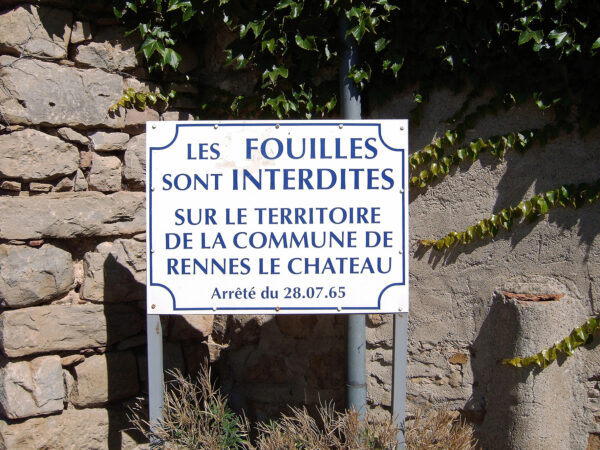
Rennes-le-Château enjoyed its first watershed moment as a media phenomenon when Albert Salamon wrote his newspaper articles in 1956. Its second came when a documentary about the village was aired on French television in 1961. And its third arrived in 1967, when the first of the eventual hundreds of books that would be written about François-Bérenger Saunière and matters adjacent was published in France. The book was initially entitled L’Or de Rennes, ou la Vie Insolite de Bérenger Saunière (“The Gold of Rennes, or the Strange Life of Bérenger Saunière”), then republished under the more sensationalized title Le Trésor Maudit de Rennes-le-Château (“The Cursed Treasure of Rennes-le-Château”). By whatever name, it proved very, very popular in France, elevating the story’s profile enormously and also changing its personality in some quite fundamental ways.
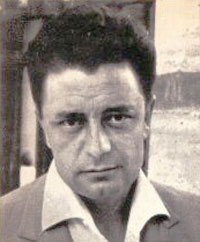
Gérard de Sède.
The author of the book was Gérard de Sède, one of a succession of mercenary raconteurs who have been hanging about Rennes-le-Château ever since Noël Corbu drove up the hill for the first time; such men make wonderfully entertaining dinner guests, but before you bid them farewell you might be well-advised to check their pockets for any stray pieces of your good cutlery that might have fallen into them. Born in 1921, de Sède had, by his own account at any rate, a colorful career in the Second World War as a Resistance fighter, narrowly escaping execution by the Nazis on multiple occasions. After the war was over, he became a tabloid journalist and popular historian of sorts, with a strong penchant for conspiracy theories. In 1962, he wrote a book called Les Templiers sont Parmi Nous (“The Templars are Among Us”), about the Medieval order of chivalry known as the Knights Templar, which he proposed to be not just still extant but the secret hand behind countless global events. Then, in his 1967 book about Rennes-le-Château, de Sède began the process of weaving the village into this broader tapestry of myth. Before he came along, the salient aspect of Saunière’s alleged treasure was its value in gold and other precious materials; its origin story was a secondary consideration, almost irrelevant to most of those who came to the Languedoc with greedy stars in their eyes. Afterward, the secret history would come to outweigh the gold itself on this cottage industry in the making’s list of priorities.
I need to warn you now that the trail of clues becomes really, really complicated from here. This is, I think, not entirely by accident, even if the motivation to obfuscate may have been more subliminal than conscious on the part of many sincere believers. For unending layers of complication is one of the ways by which conspiracy theories sustain themselves. The harder they are to hold in the head, the harder are they to refute by skeptics armed with commonsense arguments. I’ll do my best not to fall into the trap of playing whack-a-mole against assertions that do more to obscure than enlighten, but a certain amount of explication is unavoidable, if only to show how ridiculous it all gets. For example, there’s a tendency on the part of even many skeptical writers to leap from the assertion of the existence of a secret code to its solution, whilst barely mentioning the process of solving it that comes in between. Yet I think it’s important to see the process play out in full at least some of the time in order to understand what a rickety intellectual foundation the conspiracy theories actually rest upon.
As I was learning about this stuff, I kept comparing it to the puzzles in computer adventure games (and not only the much-loved Le Serpent Rouge puzzle from Gabriel Knight 3, which directly borrows from much of what follows). Another, perhaps even better point of comparison is an explicitly gamified real-world treasure hunt like the one set out in Kit Williams’s book Masquerade. Indeed, this is my best argument for publishing these articles at all on what is usually a website about gaming: those who were most taken in by the conspiracy theories of Rennes-le-Château tended to treat them as essentially a game, an elaborate puzzle to be pieced together. We’ll connect some of the dots along with them, joining in on some of their fun, even if we must ultimately part company with them about puzzle-solving as a valid way of doing history.
For the treasure hunters who hovered around Noël Corbu, the Latin documents found inside the Church of Sainte Marie-Madeleine in 1891 had long been the great, looming absence at the heart of the case. Even as he was donning priestly vestments on French television to play Saunière receiving them from a workman, Corbu had never been able to produce them from the cache of papers he inherited from Marie Dénaraud. But in his book, in what could only be described as a bombshell revelation, de Sède claimed to have in his possession copies — not the originals — of two of the four documents that were found in the church. He refused to say who had given them to him, only that they reached him in Paris via London in February of 1964. One possible theory was that the originals had been hidden amid the books which Dénaraud sold to a British buyer or buyers after Saunière’s death. Regardless, with no independent verification to hand, de Sède’s readers could only trust in the author’s good faith and that of whoever had given him the copies.
Prior to this point, it had been assumed that the documents found by Saunière must have been very old indeed; they had been commonly referred to by initiates as “parchments.” Surprisingly, however, the philologists to whom de Sède showed the copies concluded that they hadn’t been written on animal skins even in their original form. They were not so very aged after all. Both consisted of seemingly innocuous passages from the New Testament, into which a variety of secret messages had been inserted.
There was no indication that the Biblical passages themselves were of any relevance to the mystery; they provided only the necessary screen for the secret messages. Yet they do reveal something which, taken all by itself, casts serious doubt on the veracity of these documents. The passages stem from the Vulgate Bible, the first ever complete translation of the book into Latin from the original Hebrew and Greek, a feat accomplished by Saint Jerome near the end of the fourth century. The Vulgate Bible remains to this day the most authoritative source of scripture in the eyes of the Catholic Church. But, importantly, not all Vulgate Bibles are the same. Typos have appeared and disappeared over the centuries, as have more substantive alterations in the text.
The Latin text found on these documents corresponds almost perfectly with a critical edition of the Vulgate New Testament that was published by the Oxford University Press in 1889, under the stewardship of the classicist John Wordsworth; the one change consists of two words that have been transposed, which appears to represent a mistake on the part of the transcriber. No other known edition of the Vulgate Bible from before 1891 — or from before 1967, for that matter — comes close to matching so precisely. There is every probability, in other words, that the source of the passages on these documents stems from four years after Saunière was posted to Rennes-le-Château, albeit two years before he allegedly discovered them inside his church. If he really did find them there, they must have been hidden barely any time at all, having been sneaked into his church after he was already the priest in residence there.
It is an open question whether de Sède himself was aware of the problematically late date of the documents’ source material. He doesn’t explicitly point it out in his book, but, as we will see, there may be reason to believe that he was looking for a hedge by which to explain it if it became necessary.
The first and longest of the two documents, which I will refer to from now on as Altar Document 1, is superficially an extract from the Gospel of John, in which Jesus visits the home of Lazarus, whom he has raised from the dead, and has his feet anointed with oil by Lazarus’s sister Mary. Altar Document 2 contains an incident which is related in almost the exact same words in the Gospels of Mathew, Mark, and Luke, in which Jesus gives his hungry followers permission to eat corn on the Sabbath. De Sède’s book remains to this day the only source we have for both Altar Document 1 and 2; the originals, presuming they ever existed, have never turned up. Let’s have a look at the copies and see what they might be trying to tell us.
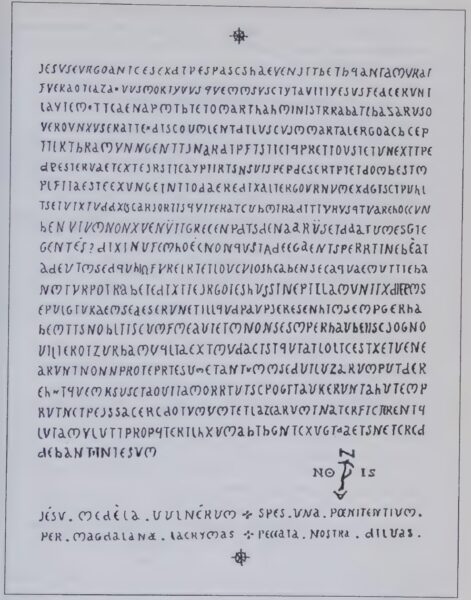
Altar Document 1.
Notice the squiggly figure toward the bottom right of Altar Document 1. We can see the word SION spelled out in reverse there. Sion is the Latin name for Zion, the Jewish homeland. This would seem to be a hint that any treasure the documents point to might indeed be that of the Temple of Solomon.
You can perhaps just barely make out that eight of the letters in the main text of Altar Document 1 are tiny, starting with an “R” tucked away on the second line, continuing with an “E” on the third line, etc. These spell out the Latin epithet Rex Mundi, or “King of the World.” This was a phrase associated by the Cathars with their evil god, him of the Old Testament and the physical realm. In the mainstream Christian tradition, it is often used to refer to the Devil.
Another peculiarity of Altar Document 1 is 140 extra letters that have been inserted, seemingly arbitrarily, into the Biblical passage. The first of these, for example, is an extraneous “V” in the opening Jesus ergo: Jesus eVrgo. Setting all of these together yields 64 letters of gibberish, followed by twelve letters that spell out another Latin phrase, followed by another 64 letters of gibberish. The Latin phrase this time is ad Genesareth: “to Genesareth,” that being an older name for the New Testament’s Sea of Galilee. De Sède didn’t know what to do with the other 128 letters at the time he wrote his book.
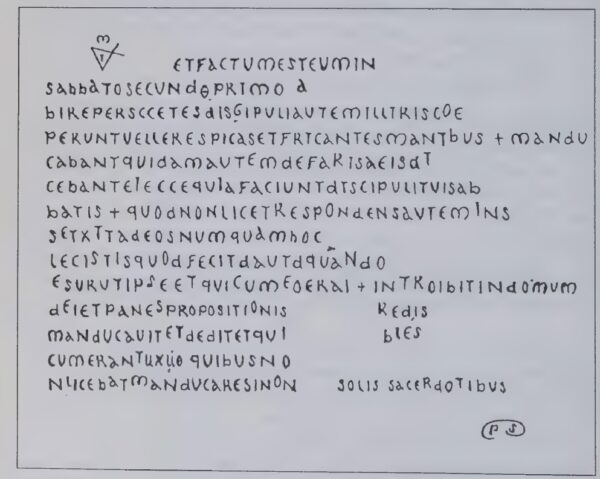
Altar Document 2.
Altar Document 2 includes two strange devices outside of the main text, one at the top left and one at the bottom right. De Sède got nowhere with the former, but came further with the latter. He discovered that this same device, consisting of the letters “PS” not quite enclosed by an oval curlicue, appeared on a gravestone in the churchyard at Rennes-le-Château, alongside some disconnected Latin words and an odd, apparently meaningless jumble of Greek letters. The grave in question belonged to Marie de Nègre d’Ables, the Marquise de Blanchefort. She was the last of a family line who once were big wheels in the Languedoc — they may have built the castle at Rennes-le-Château in the year 1000 — but who had fallen on hard times by the eighteenth century. Marie died destitute in 1781, and the priest who arranged her burial was none other than Antoine Bigou, whose modest “nest egg”, René Descadeillas had recently theorized, may have been the true extent of the treasure uncovered by Bérenger Saunière. de Sède definitely wasn’t onboard with that deflating idea, but one didn’t have to accept the one to embrace the other. I’m going to call this piece of evidence Gravestone 1. (Yes, there will be another one…)
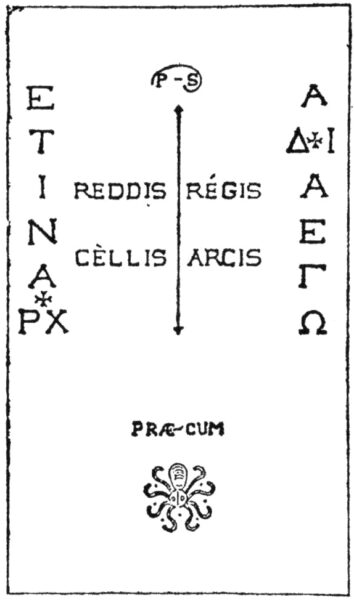
Gravestone 1. Sède states in his book that the inscription above was once to be found on the gravestone of Marie de Nègre. The horizontal writing is in Latin, consisting of the words “Rennes”, “king,” “caves”, and “citadel” above and “before-with” below. The two vertical columns are Greek letters, spelling out nothing in particular in that language.
But there are complications here, as there always seem to be with matters involving Rennes-le-Château. The gravestone inscription shown above cannot actually be seen anywhere in the churchyard today; nor could it in the 1960s. De Sède posited that Saunière had sanded down the gravestone in order to obscure the trail to his treasure. But “what Saunière didn’t know was that he had taken a quite useless precaution. Because before he got rid of them, the significant inscriptions carved on the tomb of the Marquise de Blanchefort had been recorded during excursions by local archaeologists.” De Sède said that he had found the rendering above in two separate places. One was an “extremely rare” book written by one Eugène Stübeln and published in 1884, entitled Pierres Gravées du Languedoc (“Engraved Stones of the Languedoc”). The other was a pamphlet put together by a local priest named Joseph Courtauly in 1962.
Again, though, there are complications… always complications. Although a scholarly man named Eugène Stübeln did live in the area from 1832 to 1899, his fields of interest were meteorology and astronomy, not history or archaeology. The book of his that de Sède references in his bibliography has never been found in any library, archive, or collection. Courtauly’s 1962 pamphlet, on the other hand, does exist, having been deposited into the Bibliothèque National in Paris in 1966. “The 1884 edition of Eugène Stübeln’s book having become very rare,” Courtauly writes in the preface, “and I perhaps being one of the few people to have it in his library, in order to satisfy the numerous requests of researchers, I owe it to myself to have Plates 16 to 23 reproduced from this book, those concerning Rennes-les-Bains, Rennes-les-Château, and Alet.” He concludes by misspelling his own name, writing it as “Courtaly.” It has never been possible to ask Joseph Courtauly directly about his pamphlet because he died in 1964.
You may have assumed that de Sède wanted to see the presence of the “PS” device on both Altar Document 2 and Gravestone 1 as proof that both Altar Documents originated with Antoine Bigou. But not so fast. After appearing to lay down the groundwork for the connection, de Sède abruptly announces in his book that he favors a completely different candidate for the author of the documents: Henri Boudet. Boudet was the priest at nearby Rennes-les-Bains between 1872 and 1914, a period preceding and then overlapping with most of the years that Saunière spent at Rennes-le-Château. His arrival on the scene is so otherwise inexplicable that one has to wonder whether de Sède was aware that the Biblical passages on the documents could stem from no earlier than 1889 — or became aware of it halfway through the writing of his book — and was looking for a plausible way around that inconvenient fact.
Henri Boudet was an eccentric figure who is known to have had an interest in language and arguably wordplay. In 1886, he published an absolutely bizarre book of etymology. In it, he claimed that all of the world’s languages had sprung from a single ur-tongue — in itself, hardly an extraordinary position for a Catholic priest to take, what with the Biblical tale of the Tower of Babel. But then he went on to say that this ur-tongue had been… wait for it… modern English, which had fallen out of use in the mists of the distant past and then turned up again like the proverbial bad penny to plague Francophiles everywhere. He claimed that most of the place names around him in the Languedoc could be understood through this lens. Take the mountain of Cardou: it was a portmanteau of “cart” and “how,” as in how the hell can I go up this steep thing in a cart? The whole concept is so patently ridiculous that one immediately suspects Boudet to have been a sort of French Lewis Carroll, with an even dryer and slyer attitude toward his wordplay, one that never let the mask slip. Or was he attempting to deliver some sort of painfully attenuated Frenchman’s satire on the growing international dominance of English?
But de Sède, who was predisposed to spot conspiracies and hidden meanings everywhere, thought that Boudet must be trying to tell him something far more specific in his book of etymology, even if he couldn’t figure out what it was. Giving up on the book for the time being, he turned to the churchyard at Rennes-les-Bains. He believed that he deciphered a secret message there by piecing together inscriptions found on the various gravestones and monuments. Said message told him to look in a certain direction: precisely the direction of Rennes-le-Château. Boudet must be saying that he had hidden something inside that other church! Of course, for this string of conjecture to match with all of the evidence, Boudet would have had to sneak into Saunière’s church after the latter was already there in order to plant his documents. But stranger things have happened in history, right? Right?
De Sède wrote that Saunière had taken the four Latin documents — the two which de Sède had copies of and the two which he did not — to Paris and showed them to experts in languages and cryptography. According to de Sède, Saunière also enjoyed a “liaison” with Emma Calvé, the foremost Parisian opera diva of the era, the same one who was rumored to have visited him at Rennes-le-Château in later years. And he went to the Louvre and bought copies of three paintings: The Shepherds of Arcadia (1638) by Nicolas Poussin, The Temptation of Saint Anthony (1650) by David Teniers the Younger, and a portrait by an anonymous artist of Pope Celestine V, who had served in that office for less than six months in 1294. De Sède, it should be noted, never revealed his source for any of this information, nor have the painting in questions ever been found or confirmed to have been brought to Rennes-le-Château. Nevertheless, they represents the point of origin of another conspiratorial trope born in and around the village, that of secret messages encoded in famous works of art — a trend which would reach its apex with Dan Brown’s novel The Da Vinci Code.
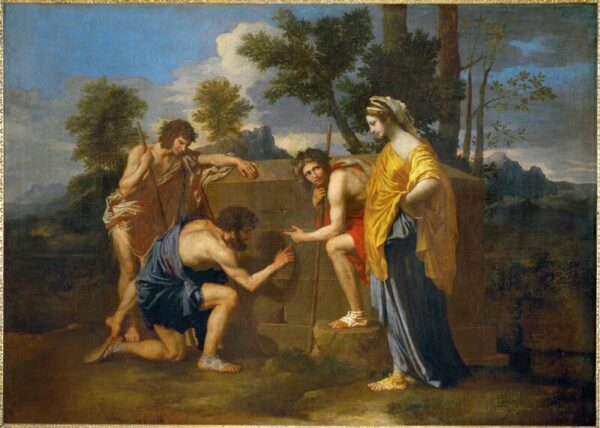
The Shepherds of Arcadia by Nicolas Poussin.
De Sède focused most fixedly on the painting by Poussin, which shows four shepherds gathered around a tomb in the mythical pagan paradise of Arcadia. We know this not only from the title of the painting but because, if we look very closely at the tomb, we can see that it is carved with the Latin phrase Et in Arcadia ego: “And in Arcadia I…” Now look again at Gravestone 1 above. It turns out that the Greek letters there spell out this same phrase; it’s a case of Latin written using the Greek alphabet, an unholy union if ever there was one. Surely this is significant!
It must have been, for it was upon his return to Rennes-le-Château, wrote de Sède, that Saunière located the treasure. The inscription on Gravestone 1 must have been key to the process in some way. For he “patiently polished” the gravestone afterward in order to ensure that no one else could make use of it, not knowing that Eugène Stübeln had gotten there first — or so de Sède asserted.
But then, after attempting to hide his tracks, Saunière turned around and did the exact opposite. de Sède was convinced that he embedded clues about the location and the origin of the treasure everywhere in and around his church as part of his renovations. These clues could be extremely abstruse. For example, at the base of the new altar is a phrase in Latin meaning “Jesus, healer of wounds, the one hope of penitence through the tears of Magdalene, wash away our sins.” But it’s written in an odd way.
JÉSU MEDÈLA VULNÉRUM
SPES UNA POENĪTENTIUM
PER MAGDALANAE LACRYMAS
PECCATA NOSTRA DILUAS
The four accent marks in the first two lines are all misplaced — another vital clue, surely! Staring at the inscriptions until his eyes watered, de Sède noticed that, if he combined each accented vowel with the consonant before it, he arrived at something that sounded like a French word. JÉ could be jais, meaning the mineral jet in English; DÈ could be dé, meaning a gaming die; NÉ could be nez, meaning “nose”; and NĪ could be nid, meaning “nest.” These words could in turn be pointing to four landmarks that de Sède knew of around Rennes-le-Château: a disused jet mine; a large die-shaped stone; another stone that was shaped vaguely like a nose; and the top of Mount Cardou, the highest point in the neighborhood, where eagles might choose to make their nests. Rightly or wrongly, de Sède saw echoes of the landscape around Rennes-le-Château everywhere in the church.
But exactly what to do with these points on the landscape was sadly less clear to de Sède. The treasure couldn’t be in all of them — nor, for that matter, was it in any of the many he checked. He thus had to present his book as a work in progress and an invitation to further investigation, not as a closed case. Yet those who contemplated joining him in the hunt should be aware that doing so might not be without risk. “I know that you are quite interested in this affair,” de Sède quoted one local priest as having told him. “It excites me too. But I have to warn you, it involves some danger.” The accidental death of Noël Corbu in 1968 was perfectly timed to sell even more copies of de Sède’s book. Had it really been an accident?
But the growing interest surrounding Rennes-le-Château was still confined to France as the 1960s expired. On the surface, it remained a very French sort of story: the protagonists were all French, the documents were all written in French or Latin, and it was all intimately connected with French history. The rest of the world was still blissfully ignorant of Rennes-le-Château and its supposed treasure. But that was soon to change, because a conspiracy theory as juicy as this one transcends language and national borders.
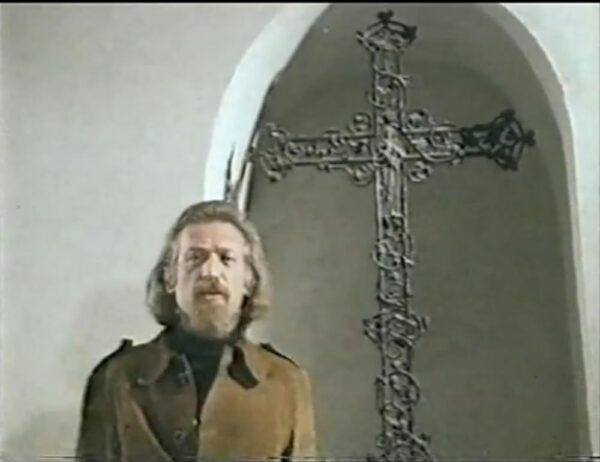
Henry Lincoln.
Henry Lincoln was a journeyman British screenwriter who provided scripts for Doctor Who and many other television shows. In August of 1969, a chance encounter with de Sède’s book changed his life forever.
En route for a summer holiday in Cévennes, I made the casual purchase of a paperback. Le Trésor Maudit by Gérard de Sède was a mystery story — a lightweight, entertaining blend of historical fact, genuine mystery, and conjecture. It might have remained consigned to the post-holiday oblivion of all such reading had I not stumbled upon a curious and glaring omission in its pages.
The “accursed treasure” of the title had apparently been found in the 1890s by a village priest through the decipherment of certain cryptic documents unearthed in his church. Although the purported text of these documents was reproduced, the “secret messages” said to be encoded within them were not. The implication was that the deciphered messages had been lost. And yet, as I found, a cursory study of the documents reproduced in the book reveals at least one concealed message. Surely the author had found it. In working on his book he must have given the documents more than fleeting attention. He was bound, therefore, to have found what I had found. Moreover, the message was exactly the kind of titillating snippet of “proof” that helps to sell a “pop” paperback. Why had M. de Sède not published it?
To see what Lincoln saw, we have to look back at Altar Document 2 above. In particular, look carefully at the line spacing of the individual letters. Do you see how some of them are raised above the level of their companions? There are three of them in the second line (“A,” “D,” “A”), two of them in the third line (“G,” “O”), etc. If we set just these letters together, we end up with a sentence, written not in Latin but in more or less modern French. The only thing missing is accent marks.
A DAGOBERT II ROI ET A SION EST CE TRESOR ET IL EST LA MORT.
This translates to “To King Dagobert II and to Sion belongs the treasure, and it is death.” Dagobert II was a Frankish king who took the throne in 675 or 676, part of a royal line known as the Merovingians. He was murdered by palace intriguers in 679.
Lincoln was intrigued enough to visit de Sède personally in Paris. “Why didn’t you publish the message hidden in the document?” he asked. de Sède revealed all too clearly by his reaction that he had no clue what his visitor was talking about, although he tried to save face after it had been explained to him: “Because we thought it might interest someone like you to find it for yourself.” It seemed much more likely that de Sède had overlooked something that had stood out with almost childish obviousness to Lincoln; this was made doubly embarrassing by the fact that the method used to hide the secret message in Altar Document 2 was not at all far removed from the one that he had sussed out in Altar Document 1. As to what the hidden message meant, neither Lincoln nor de Sède could say at this point.
In the fall of 1970, Lincoln went to Paul Johnstone, who was the executive producer of a BBC program called Chronicle. Chronicle was an institution of British television for a quarter of a century, broadcasting hundreds of episodes between 1966 and 1991. It was not usually known for trafficking in pseudo-history. The majority of its episodes were serious explorations of archeology and history, full of well-credentialed experts offering up their well-reasoned conclusions. The worst sin of which you could normally accuse the program was that of being a little bit dry at times.
And yet, breaking from sober precedent, Paul Johnstone agreed that it might be worth doing an episode on this Rennes-le-Château affair that had become such a big deal in France. Lincoln hired de Sède to become a “consultant” on the episode, although his role would be strangely muted: he would appear in the credits but not in any on-camera interviews. The narrator would never even mention him or his book, the very reason that the episode had come to exist. Henry Lincoln, it turned out, was not a man overly eager to share the spotlight.
Nevertheless, throughout the preparations for the episode de Sède was feeding Lincoln fresh information, a slow drip of new discoveries that he claimed to be making in real time. He produced more documents from the Bibliothèque Nationale, containing information that would make it into additional books which he would write during the 1970s.
Most of the documents purported to have been written by an Henri Lobineau of Geneva between 1956 and 1967. A large portion of them consisted of a discursive family tree of the Merovingian line, sprinkled with anecdotes and footnotes. It was stated that the genealogy stemmed from other, older documents brought by a country priest named François-Bérenger Saunière to Paris in 1891. A sheet that was apparently inserted later said that “Henri Lobineau” was a pseudonym; sure enough, no scholar by that name has ever been demonstrated to have lived in Geneva.
According to the genealogy, the Frankish King Dagobert II, whose name Lincoln had so recently unveiled in Altar Document 2, had a son who was unknown to most historians, an infant called Sigebert who was sent to the Languedoc for safe-keeping after his father’s assassination. This boy had become the patriarch of a previously unknown branch of the Merovingian family tree, one that had continued until at least the seventeenth century under the new family name of “Plantard.”
De Sède pointed to a weathered stone in the churchyard of Rennes-le-Château that might show a horseman riding away with an infant in his arms. Was this the hiding place where Sigebert had grown up?
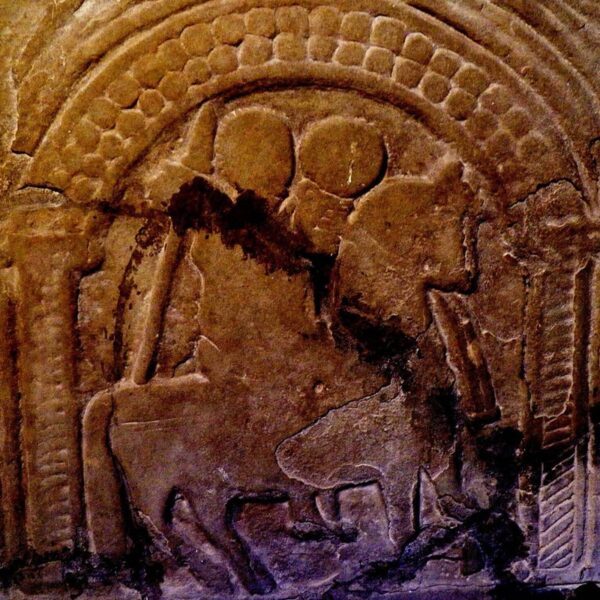
The Lobineau dossier made cryptic mention of an organization called the Priory of Sion which seemed to have something to do with the Merovingian line; it had been founded in 1188 and was avowedly still in existence as late as 1918. There was a list of 26 Priory “Grand Masters,” which included such storied names as Leonardo da Vinci, Robert Boyle, Isaac Newton, Victor Hugo, Claude Debussy, and Jean Cocteau. Even stranger was a thirteen-stanza poem called Le Serpent Rouge (“The Red Serpent”), full of obscure symbolism tied to the signs of the Zodiac. Nobody knew what to make of this at the time; nor does anyone today, although wild theories abound.
Near the village of Arques, just ten kilometers from Rennes-le-Château, de Sède found a tomb that he thought was the spitting image of the one depicted in the Poussin painting. Lincoln too rushed out to have a look, and agreed that the painting was “a faithful rendering of the actual site,” despite a lack of evidence in the historical record that Poussin had ever visited the Languedoc, for any purpose. Lincoln consulted our friend René Descadeillas at the municipal archives in Carcassonne, but that reasonable gentleman could find no record of a tomb at this location dating from prior to the twentieth century. Lincoln learned that the tomb currently housed the remains of a pair of American heiresses of French extraction, a mother and daughter named Marie Rivarès and Emily Rivarès Lawrence, who had purchased the estate on which it lay in 1921, then been laid to rest inside it in 1922 and 1932 respectively. The estate had passed out of their family not long afterward. Rejecting the most straightforward explanation, that the Rivarès family had constructed the tomb themselves, Lincoln and de Sède concluded that they must have found it sitting conveniently empty and decided to repurpose it.
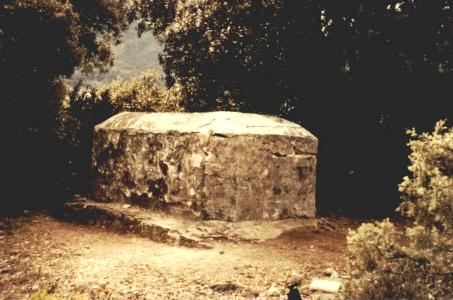
The supposed Poussin tomb. It was destroyed by the current owner of the property in 1988, because he had gotten sick of treasure hunters constantly trespassing and digging holes all around it.
Shortly after discovering the tomb, de Sède dropped an even bigger bombshell: with the help of a team of Army code-breakers and their computer, he had been able to decipher the full meaning of Altar Document 1, a feat that must more than make up for his overlooking the obvious in Altar Document 2. We’ll go through its method of encryption now. Fair warning: it’s pretty hairy.
We begin with the 128 extraneous letters hidden in the Biblical passage, skipping over the twelve in the middle that form a legible phrase.
VCPSJQROVYMYYDLTPEFRBOXTODJLBKNJ
FQUEPAJYNPPBFEIELRGHIIRYBTTCVTGD
LUCCVMTEJHPNPGSVQJHGMLFTSVJLZQMT
OXANPEMUPHKORPKHVJCMCATLVQXGGNDT
These letters were produced by an encryption scheme invented by a French diplomat and alchemist named Blaise de Vigenère during the sixteenth century. The method requires a keyword, which can consist of as many letters as we like. Let’s say that we want to encrypt the English phrase “Saunière is priest of Rennes-le-Château.” We have chosen “brain” as our keyword.1
SAUNI EREIS PRIES TOFRE NNESL ECHAT EAU
BRAIN BRAIN BRAIN BRAIN BRAIN BRAIN BRA
USVXX GKFRH RKKNH VCGJE VBFKL MPIRT MNV
The first row above contains our message in the clear. The second contains our keyword, repeated as many times as necessary to have the same number of letters as the message. We add the letters in each column of the first two rows together to arrive at our enciphered text in the third row. So, ‘S’ + ‘B’ = ‘U’, etc. If our addition operation takes us past the edge of the alphabet, we just loop back around to the beginning. One final wrinkle here is that we employ a 25-letter alphabet, skipping over “W,” a letter which is never used in native French words. Once the message has been encrypted, anyone who knows the keyword can decrypt it by subtracting rather than adding the letters of “brain.”
Of course, if we are code-breakers rather than mere decrypters, we have to figure out for ourselves what keyword is being employed. In the case of our document, the keyword turns out to be mortepee, being the French words for “death” and “sword” (the latter actually being épée when properly accented) stuck together. And just how did we come up with that, you ask? Therein lies another tale.
It turns that there were two gravestones associated with Marie de Nègre in the churchyard at Rennes-le-Château. The second is far more reliably documented than the first. A sketch of it appears in an incontrovertibly genuine article published in the journal of La Société d’Ètudes Scientifiques de l’Aude (“The Scientific Studies Society of Aude”) in 1906. (Aude is the French départment that includes Rennes-le-Château.) The gravestone must have been destroyed at some point after that date. If it was Saunière who did so, it is surprising that he waited so long, but we’ll let that go. The sketch in question is shown below. We’ll refer to it as Gravestone 2.
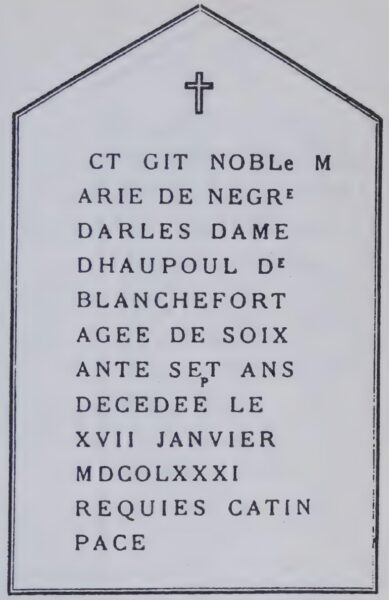
Gravestone 2. We can feel reasonably confident that this gravestone really did exist in the churchyard at Rennes-le-Château at one time; this is more than we can say for its companion.
Written in French with the exception of a concluding phrase in Latin, the inscription ought to read, Ci gît noble Marie de Negre d’Ables de Blanchefort, âgée de soixante-sept ans, décédée le XVII Janvier MDCCLXXXI. Requiescat in pace. (“Here lies the noble Marie de Nègre d’Ables de Blanchefort, aged 67 years, deceased January 17, 1781. May she rest in peace.”) But a careless or illiterate stone carver has apparently made a right hash of it. He’s misspelled several words, missed a few letters which he all too obviously filled in later, had trouble with his word-wrapping, and replaced a “C” with an “O” in the Roman numeral marking the year of Marie’s death. The most amusing mistake is his failure to split the Latin Requiescat in pace properly, resulting in the word Catin — an old French term for a woman of the night.
Appalling though this may seem, it’s really not so unusual; similarly botched gravestones can be seen in rural cemeteries throughout Europe. In Rennes-le-Château, however, accidents do not exist. The mistakes in the inscription actually provide the keyword we need to decipher Altar Document 1. We are meant to collect them: the “T” that should have been “I” in Ci, the “M” that’s hanging out by itself instead of joining its companions in Marie, the “R” that should have been a “B” in d’Ables, the “O” that should have been a “C” in MDCCLXXXI, and the three “E”s and a “P” that have been crudely chiseled in after the fact. We go anagram hunting with these eight letters, and find that we can arrange them to produce the French words mort and épée, or our keyword of mortepee. Easy as could be, right?
Now comes a twist: the whole cipher has been executed in reverse. The message was encoded using subtraction rather than addition, and must thus be decoded using addition rather than subtraction.
But even knowing this twist, when we apply the keyword, we still get this:
JRINOHXT JNFSDTQZ DTYMGFCZ CSCGGBSO
SGNZUQOD BFIVKUNJ ZHZCNZXD OJMXBKLI
ZKUXBDZJ XXIIUXYB EZABRCKZ GLCGEHRZ
CMSIUURA DXDJXGPM JZUHHQZQ JGPBLEIZ
It’s 128 letters that spell out… absolutely nothing.
Most code-breakers would assume they were on the wrong track at this point and give up. But we, readers, shall persevere undaunted. What if the message is double-encrypted?
This turns out to be the case. The second keyword has as many letters as the entire message. We get it by taking the entirety of the inscription on Gravestone 2, leaving the errors uncorrected; this gives us 119 letters. We find the last nine letters by returning to Gravestone 1. Specifically, we append the “PS” followed by Præ-Cum. Then, because things can never be too easy, we flip the whole mess around and use it in reverse order. With much excitement, we start to decrypt.
XNLSPANN ASITTIAT EXRRPBTE UCAEENIR
XTGEENDE LORSIAAO ELEFSDQR PEDCUPGX
AIEMUIDO CEJDNMEG MCOCEEPD SHRXAIAD
HATMOAES EBICELER NEEAIEED LVEVULDC
Oh, my. Gibberish. Again.
We have to go through one more stage, my friends, the most absurd one of all. We begin by laying the letters out on two chessboards.
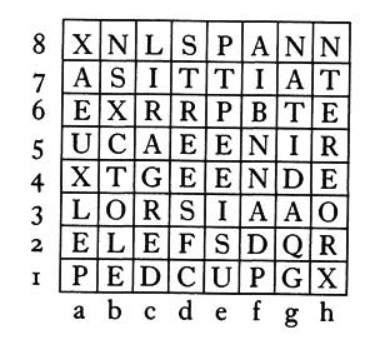
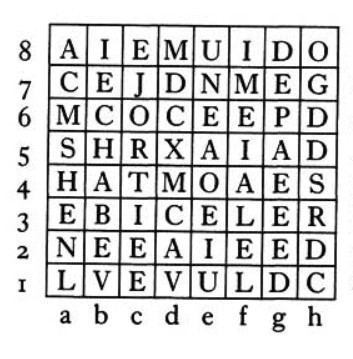 Finding the message in the jumble of letters relies on an exercise known as the Knight’s Tour, which is as well known to students in university mathematics and computer-science departments as it is to chess players. Starting from any square on the board and obeying the standard movement rules for a knight — one square vertically and two squares horizontally, or vice versa — we want to move a chessman so that it visits every square on the board exactly one time, without ever revisiting a square.
The problem is that there are a crazily high number of solutions to the Knight’s Tour, on the order of 33 trillion if we’re allowed to choose any starting square we like, even as no external clue as to how we are meant to proceed has ever been found. The completely arbitrary solution we’re looking for begins at f6 (“B”), then proceeds to e4 (“E”), to d6 (“R”), and onward from there. The one tiny concession the code-makers have deigned to grant us shows up when we start on the second board halfway through the process. Our moves here turn out to be a vertically flipped image of the first sequence, so that we start at f3 (“L”), then go to e5 (“A”), d3 (“C”), etc.
After we’re through traversing both of our chessboards, we end up with a message in rather tortured French: Bergère, pas de tentation, que Poussin Teniers gardent la cléf. Pax DCLXXXI. Par la croix et ce cheval de dieu, j’achève ce daemon de gardien à midi. Pommes bleues. In English, this is more or less, “Shepherd, no temptation, Poussin and Teniers hold the key. Peace 681. By the cross and this horse of God, I finish off this guardian demon at midday. Blue apples.” How do you like them apples?
My apologies for having put you through all of that. The salient point to take away is that this is a literally insoluble puzzle, one that can only be reverse-engineered by someone who already has the solution rather than worked out from the other direction. The combinatorial explosion of the Knight’s Tour alone would exhaust the brute-forcing capabilities of a modern computer, much less the ones of the early 1970s that de Sède claimed to have employed. And now consider that we are meant to believe that Saunière and some helpers cracked this code in 1891, with no access to any computer at all. The one possible escape clause here is the claim that there were originally four Altar Documents. It’s just possible that the missing two might have included additional clues for solving the puzzle on this one. But those would have to have been very specific clues indeed to alter the fundamental equation all that much.
Further complicating the issue is the fact that the final message is neither terribly coherent nor terribly grammatical, such that we (or our computer helper) might well throw it out even if we stumbled across it. It’s an old truism in game design that every puzzle is more difficult than its designer thinks it is, but this is ridiculous. Again, this couldn’t possibly be a puzzle that anyone was meant to solve; it was a puzzle reverse-engineered to convey the impression of someone having solved it after the fact, which is a very different thing.
The icing on this cake is that the secret message is actually an anagram of all of the letters on Gravestone 2! It would be far more manageable for a computer, and probably for us as well, to approach it this way than by trying to churn through all of the convolutions above. There is always an element of banality lurking beneath even the most erudite-sounding conspiracy theories.
The only reasonable conclusion is that someone must have been operating behind the scenes to help Gérard de Sède along, just as de Sède was in turn dropping hints to Henry Lincoln. The identity of that person will prove to be the real key to the mystery of Rennes-le-Château. To his credit, Lincoln realized this after consulting with “cipher experts of British Intelligence,” who told him that “the cipher does not present a valid problem for a computer.” Someone, in other words, must have told de Sède what message the documents hid.
Nevertheless, the secret messages convinced Lincoln more than ever that he was on the trail of something potentially earthshaking, even if he wasn’t yet sure what it was. That conviction oozes from every frame of “The Lost Treasure of Jerusalem?,” which aired as an episode of Chronicle on February 12, 1972. It was the fourth milestone in the gradual coming-out party of Rennes-le-Château, the first to reach an audience outside of France.
“The Lost Treasure of Jerusalem?” is an archetypal exercise in pseudo-history. It repeats claims that are at best highly conjectural, such as the connection of Rennes-le-Château with the Visigoth town of Rhedae, as if they are proven, accepted historical facts. When the known facts don’t fit the preferred theory of the case, explanations are introduced without evidence or comment. For example, we are blithely told that the “penniless” Saunière simply “borrowed” the money he needed to carry out the altar renovations and then to go off to Paris and start buying art. But who would lend money to someone with no collateral and no prospect of paying it back?
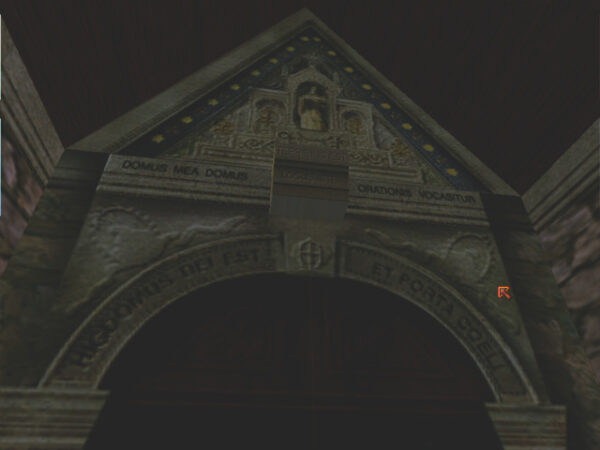
Much is made of a Latin inscription that appears above the entrance to Saunière’s renovated church: Terribilis est locus iste. Lincoln wishes to translate this to “This place is terrible,” but that is an overly literal translation that gives no space for context. A better one is, “This is a place of awe.” (Consider the difference between the English words “awe” and “awful.”) In fact, the Catholic Church’s standard guidelines for church-building and dedicating prescribe Terribilis est locus iste as a perfectly appropriate phrase to inscribe above the entrance. It is to be found on many other churches all over the world.
But despite being so misleading in so many ways, the program is presented in eminently scholarly clothing. We are guided through the hall of mirrors by a dulcet-voiced narrator whose French and Latin roll off his tongue as smoothly as his English. It’s like being told by David Attenborough in one of his nature documentaries that he’s just found Bigfoot. Our first instinct is to believe, because everything about the production seems so trustworthy. This would prove Henry Lincon’s secret weapon going forward. He had a genius for making the crazy seem reasonable.
“The Lost Treasure of Jerusalem?” starts from the sturdy foundation laid down by its well-thumbed French inspiration, then expands the scope of the mystery to include the new revelations. King Dagobert II of the Franks and his infant son Sigebert enter the picture, as does the Poussin painting and the local tomb it supposedly depicts. (Any discrepancies in the painted tomb’s appearance are explained away as having been “subtly recomposed to suit the painter’s eye.”) Many questions are raised and comparatively few answers provided, but Lincoln himself appears on camera at the end to reassure viewers that he is still on the case. To top off the conspiracy cocktail, he implies that shadowy forces dogged the film crew throughout the making of the program, tampering with evidence.
Some fourteen months after the episode aired, the BBC received a phone call from a British man who would identify himself only as “Mr. A.” He claimed to have pieced together the many clues and used them to locate the treasure. Now, he wanted to know whether the BBC would like to send a film crew out to capture its unveiling. Rather incredibly, Paul Johnstone did indeed mobilize a film crew and pack it off to France without ever even meeting with Mr. A in person. It was left to Lincoln to have a preliminary chat with the treasure hunter. He found himself cast into the unwonted role of the skeptic when he realized that Mr. A’s conclusions were “a farrago of misconceptions, wishful thinking, and a few impossibilities.” Exactly the same thing can be said about virtually all of Lincoln’s own conclusions about Rennes-le-Château over the years, but it seems that he was too close to his own wishful thoughts to see the parallels.
At any rate, the big unveiling turned into exactly the damp squib that Lincoln had predicted. The team of diggers fumbled around in the mud for several hours, coming up with nothing for their efforts. Lincoln left early for the pub.
Seeking to salvage his investment, Paul Johnstone decided to turn the program into a more generalized follow-up to the first Chronicle episode about Rennes-le-Château. Lincoln was given two days to come up with a shooting script. Inevitably, the end result, which aired on October 30, 1974, under the title of “The Priest, the Painter, and the Devil,” feels rushed and half-baked; about a quarter of its visuals are repurposed clips from its predecessor. Much time is devoted to decoding Altar Document 1, although there are several errors in the process as it is described. Otherwise, the episode’s new footage largely consists of Henry Lincoln wandering around the French countryside looking various degrees of pensive. The long delay between its filming and airing may well indicate that the show’s producers knew it wasn’t up to snuff.
Still, there are important additions to the growing body of lore to be discerned, the fruit of de Sède and Lincoln’s ongoing research. For the first time, the initials “PS,” which stand out so prominently in Altar Document 2 and Gravestone 1, are identified with the Priory of Sion. The roll call of famous alleged Grand Masters of that shadowy organization is duly read out. Was Saunière a member too?
Elsewhere in the program, Lincoln and an obliging professor from the Royal College of Art discover a pentagon hidden in the proportions of Poussin’s The Shepherds of Arcadia. Lincoln spots the same ominous shape in the strange spacing of the lines and letters in Altar Document 2. Combined with Altar Document 1’s scarcely concealed Rex Mundi and a statue of the Devil placed by Saunière in his church, it makes Lincoln wonder whether the Priory of Sion was a cult of Satanists.
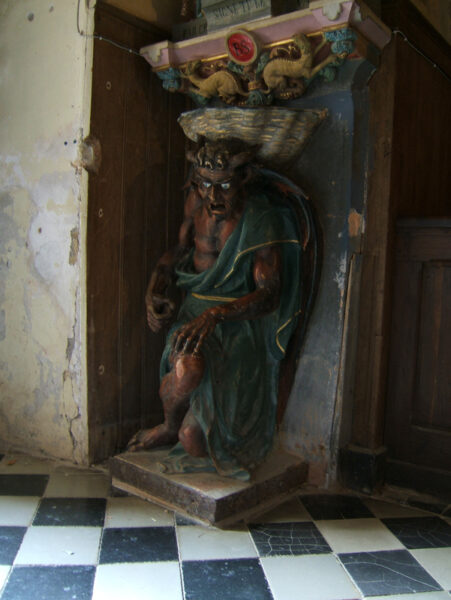
Was Saunière guilty of Devil worship… or just really bad taste? (Fabe56)
Geometry had long been a fixation of the treasure hunters around Rennes-le-Château, but it would become still more prevalent going forward. For Lincoln was now convinced that he was on the hunt for something far more important than any hidden treasure. He now pursued hidden history, an even more exciting proposition.
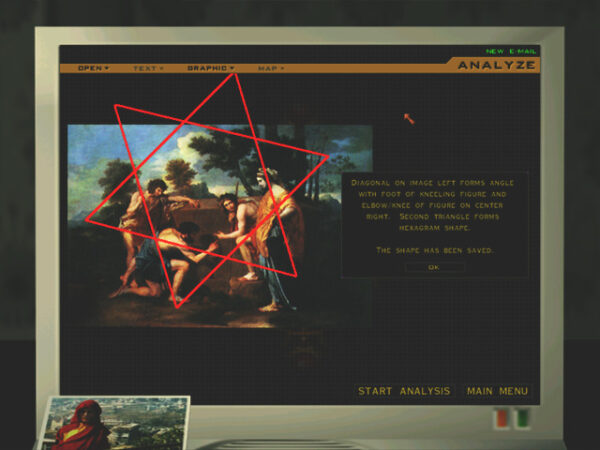
Like much else that I’ve mentioned today, the geometry that is allegedly hidden in the Poussin painting shows up in Gabriel Knight 3′s Le Serpent Rouge puzzle sequence.
Did you enjoy this article? If so, please think about pitching in to help me make many more like it. You can pledge any amount you like.

Sources: The books Holy Blood, Holy Grail by Michael Baigent, Richard Leigh, and Henry Lincoln; Bloodline of the Holy Grail: The Hidden Lineage of Jesus Revealed by Laurence Gardner; The Treasure of Rennes-le-Château: A Mystery Solved by Bill Putnam and John Edwin Wood; The Holy Grail: The History of a Legend by Richard Barber; Invented Knowledge: False History, Fake Science and Pseudo-religions by Ronald H. Fritze; The Tomb of God: The Body of Jesus and the Solution to a 2,000-Year-Old Mystery by Richard Andrews and Paul Schellenberger; Rennes-le-Château et l’enigme de l’or maudit by Jean Markale; Le Trésor Maudit de Rennes-le-Château by Gérard de Sède; The Holy Place: Saunière and the Decoding of the Mystery of Rennes-le-Château by Henry Lincoln; Key to the Sacred Pattern: The Untold Story of Rennes-le-Château by Henry Lincoln; Les Templiers sont parmi nous, ou, L’Enigme de Gisors by Gérard de Sède; Les Mérovingiens à Rennes-le-Château. Mythes ou Réalités. Réponse à Messieurs: Plantard, Lincoln, Vazart & Cie by Richard Bordes; Lives of the Popes: The Pontiffs from St. Peter to Benedict XVI by Richard P. McBrien; How the Bible Became Holy by Michael L. Satlow. Skeptical Inquirer of November/December 2004.
Online sources include the websites Rennes-le-Château: Where History Meets Evidence and Priory of Sion.com.
Footnotes
- What follows is a slightly modified version of an example presented in the book The Treasure of Rennes-le-Château: A Mystery Solved by Bill Putnam and John Edwin Wood.






Lars Skovlund
March 20, 2026 at 7:48 pm
I’m not reading the whole thing I think, but as regards Gravestone 1, the Greek letters do actually spell something out: “Et in Arcadia ego…” which also played a role in GK3. But the phrase is Latin, even though the letters are Greek.
Jimmy Maher
March 20, 2026 at 7:50 pm
Well spotted! Read on… ;)
BabylonAS
March 21, 2026 at 8:26 am
It’s not just the use of Greek letters that make the Gravestone 1 inscription weird. The transcription itself is strange. “Arcadia” is written with the “chi” where a “kappa” should have been (ΑΡΧΑΔΙΑ instead of ΑΡΚΑΔΙΑ). “Chi” has had various pronunciations over the history and, if it were Greek, the resulting word could be pronounced in different ways, none of them exactly corresponding to the original Greek name (or its correct Latin transcription); the best match would be the “classic” (Attic) Ancient Greek spelling where “chi” is an aspirated “k” much like the one usually seen at the beginning of English words, such as “Christ”. Perhaps whoever “discovered” the gravestone had intentionally misspelled “Arcadia” that way.
On the other side of the gravestone inscription, “Ego” is written using the “omega” instead of “omicron” (ΕΓΩ instead of ΕΓΟ). This is actually correct Greek spelling because it has basically the exact same word for pronoun “I” as Latin, but Latin did not use two different “o” letters even to mark long vowels. Given that the right-side part that ends with “ego” also begins with the letter “alpha” (in “arc-adia”), it could be an attempt to reference “the Alpha and the Omega”.
Leo Vellés
March 20, 2026 at 8:34 pm
As soon as I read the name Henri Lobineau a bell started ringing in my head…until I remembered that one good friend of Broken Sword’s Nico is André Lobineau, who is very versed in Medieval history. I suppose this is just a coincidence….or not? ;)
Jimmy Maher
March 20, 2026 at 8:38 pm
Nothing around Rennes-le-Château is ever a coincidence. ;)
But seriously, it me be a deliberate homage. This stuff had a huge influence on Broken Sword as well as Gabriel Knight 3. As we’ll see, “Shadow of the Templars” is even the name of Henry Lincoln’s third episode on the subject for Chronicle.
Leo Vellés
March 20, 2026 at 8:38 pm
Oh, and a other coincidence. Plantard is the name of another character from Broken Sword, he is the guy who hets killed in the intro. Mmmmm….the plot thickens!
mb
March 20, 2026 at 9:03 pm
That isn’t a pentagon…
Jimmy Maher
March 21, 2026 at 8:42 am
Woops! Thanks!
Martin
March 20, 2026 at 10:14 pm
There is a “had had” in the paragraph two above the “horseman” picture.
Also, the last picture’s text, it talks of a pentagon but in red is a six-sided “star of David”. Not sure what you were trying to say.
Sniffnoy
March 21, 2026 at 3:25 am
Perhaps instead of “pentagon”, “hexagram” was meant?
Jimmy Maher
March 21, 2026 at 8:43 am
Thanks!
Andrew McCarthy
March 21, 2026 at 1:13 am
The French phrase “il est la mort” can also be read as “il est là mort” with an accent missing. In that case the meaning wouldn’t be “it is death”, but instead either “he is dead there” or “he died there”.
Andrew McCarthy
March 21, 2026 at 1:14 am
Naturally, once the whole tomb-of-Jesus idea got incorporated into this conspiracy theory, the theorists tended to default to the former translation…
Ross
March 21, 2026 at 3:47 am
In French, for curious historical reasons, the past tense of verbs which have to do, abstractly, with “arrival” or “departure”, are formed with the helping verb etre (to be) rather than the more common “avoir” (to have).
Shanghay
March 22, 2026 at 8:26 pm
Man, I am dying to know what those curious historical reasons are. All the French people I have ever asked why some verbs use être as auxiliary verb have only ever been able to tell me that it is for arrival/departure verbs – but not why it is that way. Please tell me what you know!
Jan Heijmans
March 21, 2026 at 9:27 am
“one that never slip the mask slip” doesn’t sound right to me. Perhaps “never lets the mask slip”? Thanks for the article!
Jimmy Maher
March 23, 2026 at 12:34 pm
Thanks!
John
March 21, 2026 at 5:24 pm
All this so-called cryptography reminds me of the Bible Code fad of the late 1990s. There are secret prophecies encoded in the text of the Torah! Except, no, it turns out that there are similar “secret prophecies” encoded in literally any sufficiently long document, including War and Peace and Moby Dick.
Michael
March 24, 2026 at 11:28 pm
One instance of “Mervingian” instead of “Merovingian.”
Then, there’s this sentence: “For example, we are blithely told that the “penniless” Saunière simply “borrowed” the money he needed to carry out the altar renovations that led to the discovery of the Altar Documents, and then to go off to Paris with them and starting buying art.”
I think it would be strictly grammatical if you just change “starting” to “start,” but I found it hard to parse with the sudden switch in verb tense from present (“are told”) to past (“borrowed) to present (“to carry”), back to past (“led”) and then present again (“to go off”), and I started over a couple of times just when I hit “and then to go off” even though it does follow from “to carry out” well enough. If there’s some way to simplify this, it could be easier to follow.
Jimmy Maher
March 25, 2026 at 5:38 am
I simplified the sentence a bit. Thanks!
Martin
March 29, 2026 at 7:58 pm
I didn’t know much of anything about Rennes-le-Château so far. Who knew it was *so* whacky!
Jeff Sampson
April 3, 2026 at 5:32 am
The Knight’s Tour and algorithm complexity is a tricky subject. Wikipedia has a good page on it, but the 33 trillion count was an incorrect count by Löbbing and Wegener, which one Brendan McKay recomputed to be 13,267,364,410,532 *undirected* tours(the number of paths where direction doesn’t matter, double that if direction does matter, which it does when you’re concatenating letters from the 8×8 boards): https://plus.maths.org/knights-tour.
Except that was for *closed* tours, tours where the knight ends one move away from where he started. The “puzzle” here uses *open* tours, where the knight can end up anywhere. Alexander Chernov may have computed the number of open tours to be 19,591,828,170,979,904, but I don’t know if that’s been confirmed to be accurate. And the Château puzzle isn’t about counting the number of tours, it’s about constructing a sentence from the boards, so merely knowing the number of tours doesn’t help.
That said, I think it’s a smaller search space than constructing anagrams from the modified Gravestone 2 message. For example, the Q at g2 on the first board can only be transposed near adjacent letters when playing the Knight’s Tour game, whereas for an anagram it can be transposed anywhere. The number of possible anagrams for 128 letters is 128 factorial(128 * 127 * 126… * 1), before even worrying about spacing and punctuation.
So intractable either way, right? And even if you could somehow generate all those combinations of letters, you’d still need a computer to look through them. But there’s the rub. Large problems are never tackled using brute force in computing.
Similar to how early AI chess programs avoided searching most paths in the decision tree, a computer search of a knight’s tour graph of the two letter boards could use phonetic checking plus dictionary lookup to avoid paths there were producing gibberish, and only go down paths that produced words in French, Greek, Latin, along with Roman numerals. (Somewhat arbitrary, but this is a Christian conspiracy theory.) It’s a much smaller search space than a chess decision tree, even with two 8×8 boards to search, so finding semi-plausible sentences via computer search of a knight’s tour graph may actually have been possible in the early 1970s. (Not to say it actually happened.)
It’d be amusing if a program written to find phrases from the two chessboards actually yielded a more cogent French sentence than the blue apples nonsense, and even more amusing if the program implementer was plunged into a life or death Vatican plot involving the *real* conspiracy. As for solving the Knight’s Tour game in the pre-computing world of the late 19th Century, I concur that would have required hints, luck, a ouija board/seance, or divine intervention.
I don’t remember hearing about the Knight’s Tour in computer science, the Traveling Salesman is a more commonly mentioned and far more important graph search problem. I may have seen the eight queens problem mentioned, but as a useful exercise, not a canonical concept. “Blue apples” on the other hand, anticipates a classic Simpsons joke: Purple Monkey Dishwasher.
Steven THOMAS
April 21, 2026 at 1:14 pm
There is a BBC radio programme called Archive on 4 (radio 4) from 2023 that has an episode on this topic called Throne of Blood that debunks all of this.