The photographer’s model for the visage of The Nameless One on the now-iconic Planescape: Torment box was actually Guido Henkel, the game’s producer, who was enlisted at the last minute when the planned professional model had a “scheduling conflict.”
Usually if you choose the longest dialog option, that’s the best option.
— Chris Avellone
Quite some years ago now, I briefly interviewed Brian Fargo about Interplay’s 1988 adaptation of the William Gibson novel Neuromancer. He was plainly busy and a little distracted with more modern game-development matters — this was in the midst of the Kickstarter-funded Wasteland revivals — but he was helpful and friendly enough during the half-hour or so that I spoke to him. Toward the end of our conversation, he mentioned that he had a box full of papers from his Interplay days gathering dust in a filing cabinet in his home office. Upon hearing this, I leapt immediately to make a pitch for my archivist friends at the Strong Museum of Play in Rochester, New York. And lo and behold, a Brian Fargo collection showed up at the Strong within a year or so. I don’t know whether these two events are related, but I like to think that they are.
Regardless, the next time I made it up to the Strong, I naturally made it a point to go through the collection. And it was there, amidst a mishmash of other documents spanning the nearly twenty years that Fargo spent running Interplay, that I first stumbled upon the original pitch document for Planescape: Torment, the one that crossed his desk in June of 1997 and led to the project being formally green-lit. I found this document rather shocking at the time, in that its tone was so totally out of keeping with the hallowed reputation which the game had long enjoyed even then as the most credible claimant to the status of true Interactive Art that the CRPG genre has ever produced. Much of this pitch, by contrast, seemed to have been written by Joe Lieberman’s most stereotypical nightmare: by a sadistic, DOOM-addled teenager who turned it out in between dry-humping everything around him with an even vaguely feminine shape.
No more using boring swords, daggers, or bows to carve bloody swaths through opponents. Plunge scalpels into foes’ eyes, lace their food with poisonous embalming fluid, push them into man-eating pockets of ooze, sic them with sarcastic biting skulls, hurl them into razorvines, conjure burrowing rot grubs within a victim’s brain, cast spells that make them bleed from every orifice, or change a person’s scent so they attract packs of hungry rats. Deliver punishment in ways that will bring a smile to your face.
“Fireball” can go hide in the fucking corner when you unleash your arsenal. Jam your hand into an opponent’s body, rip out his soul, and tell it to kill its owner. Make a gesture and summon a blanket of crawling, biting insects to turn your enemy into a Happy Meal. Send your foes on a field trip to Hell without a permission slip. Taunt someone to death. Summon your darkest shadows from across existence and send them into battle to feed on your opponent’s physical strength. Your succubus ally can kiss your opponents to death — they die with a smile on their face.
This game will have lots of babes that make the player go wow. There will be fiendish babes, human babes, angelic babes, Asian babes, and even undead babes. Think babes. Then think more babes.
To which one can only reply, whoa… whoa. Settle down there, Beavis, before you rub that thing raw.
This document, which has long since surfaced publicly and made the rounds of the Internet, has become something of a problem for Planescape: Torment’s cult fandom, being so markedly at odds with what they wish the game to be. Some have gone so far as to claim that the juvenile profanity was nothing more than an elaborate ruse to get Brian Fargo and his marketing cronies to sign off on such an uncompromising piece of art, or that this is the only corporate pitch document in the history of the world to inhabit the category of satire. But personally, I’m not buying these pat explanations. I think that the finished Planescape: Torment that we know is a blending of the adolescent and the rarefied, the commercial and the idealistic. It’s not that the higher concepts and grander themes don’t exist. It’s just that they’re embedded into a licensed and branded Dungeons & Dragons computer game — made by, let’s face it, a bunch of nerdy twenty-something American men with the same predilections and blind spots as their peers elsewhere in the industry. We probably shouldn’t allow ourselves to get quite as precious about it as we often do.
For what’s worth, I suspect that Chris Avellone himself might more or less agree with this assessment deep down in his heart of hearts. In every interview I’ve seen him give on the subject of Planescape: Torment, he’s been distinctly reluctant to take on the persona of the auteur creating timeless art for the ages. He tends to speak more in the terms of a creative professional who was given a job to do: “Like just about every game I’ve worked on in my career, the franchise or premise was mandated, and then I worked within the parameters given.” He prefers to frame the protagonist’s journey to self-knowledge more as a way of flattering the typical gamer’s sensibilities than a conscious artistic masterstroke.
It is a very selfish game. After about ten years of game-mastering players… that’s really all they care about. They want the entire adventure to revolve around them. Players want to hear people talking about them. It’s the ultimate ego stroke.
Again, this is not to say that Planescape: Torment doesn’t resonate in certain places with the proverbial human condition. It’s merely to say that it’s a complicated, piebald beast. Is it art? Maybe, depending on how you define such things, since art is always in the eye of the beholder. Is it a penetrating work of moral philosophy? Maybe, to some extent, but maybe not quite so much as some folks want it to be. Is it well-written? Intermittently, although seldom on a sentence-by-sentence level. Is it brave and groundbreaking in the context of its time and circumstances? Absolutely. Is it a great game, full stop? Eh…
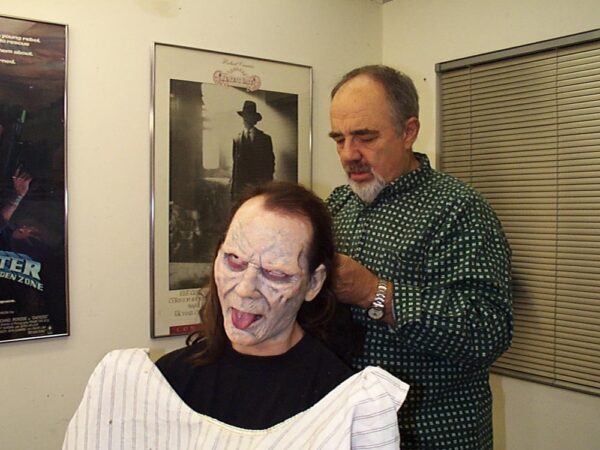
Building the perfect box-cover beast…
Fair warning: a considerable number of Planescape: Torment spoilers follow!
Baldur’s Gate, the only Infinity Engine game to precede Planescape: Torment, attempts very explicitly to recreate the pleasures of playing tabletop Dungeons & Dragons with your friends. The companions whom you collect around you could easily be the avatars of said friends. Each of them is an archetype — fighter, magic user, cleric, thief — which constitutes one part of a Gary Gygax-approved well-balanced adventuring party. The game employs the classic “a group of adventurers met in a bar and went questing” setup. There’s an overarching plot, but it’s really just an excuse to explore more terrain, fight more monsters, and grow steadily stronger. If you want, you can even play Baldur’s Gate together with your real-life friends, with each of you taking control of one character (although it’s rather clunky in practice, being subject to the technological limitations of the late 1990s).
Whatever else it happens to be, Planescape: Torment is nothing like that. It’s the very specific story of one very specific character, presented it a way that would never have worked with a gang of others sitting around the tabletop. Companions do arrive to accompany him, but they are always peripheral to his central psychodrama. There is no multi-player mode here. Having one would make no sense.
The protagonist of Planescape: Torment is the appropriately named Nameless One, a zombified shamble of flesh and bone who wakes up at the beginning of the game on a mortuary slab in Sigil, the city of inter-planar doors, with no idea who he is or how he got there. So, he sets off to try to find out. Along the way, he meets the aforementioned companions who join him on his journey. One or two of them he even meets in a bar, but these are not your typical happy-go-lucky adventurers with mercenary stars in their eyes. The fact is that each of their stories has long ago become interwoven with that of the Nameless One himself, generally to their detriment, and even though he can’t remember any of it. His own backstory will prove to be far longer and stranger than you or he might ever have thought possible, encompassing hundreds of lifetimes lived out all over the planes of existence, during which he has been good and evil and everything in between. His true quest, it will gradually become clear, is not merely to find out who he really is. Doing so is just a prerequisite to stopping the cycle of rebirths, owning his sins, and finally bringing his story to an end.
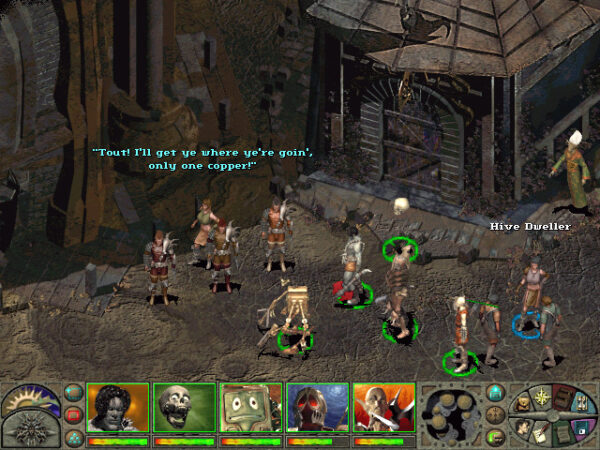
Planescape: Torment demonstrates the flexibility of the Infinity Engine. In keeping with the more personal focus of the story, the team at Interplay moved the camera in closer to show the characters on the screen better, condensed the interface down to a single bar at the bottom of the screen, and reworked the controls to make use of a popup, adventure-game-style radial verb menu.
Not only does Planescape: Torment subvert the traditional plot outline of a CRPG by turning a triumphalist power fantasy into a tragic journey of self-discovery, but it subverts many of the standard CRPG mechanics to serve its agenda. The Nameless One is immortal, which means that defeat and “death” in combat is a minor inconvenience at worst; he will always wake up once again on his mortuary slab, with all of his inventory, companions, and experience points intact. (In some places, he is even required to “die” in order to advance the plot.) With physical threats being thus robbed of their menace, a clever dialog response is almost always worth more experience points than defeating the same interlocutor in battle. Swords, armor, and most of the other usual trappings of heroic adventure are seldom seen, replaced by stranger concoctions, like a floating skull who can upgrade his attack by acquiring sharper teeth. Planescape: Torment is not your parents’ CRPG.
To wit: if you come to this game expecting a plane-skipping roller-coaster ride through a wide variety of environments, I’m afraid you’re destined to be disappointed. Most of it takes place within Sigil. You start out in the slums and eventually make your way to slightly posher districts of the city, but the general atmosphere remains one of futility and decay from first to last. I’m frankly not sure how to respond to this. My wide-eyed inner child, the one who used to consume pulpy sci-fi novels by the dozen, thinks it’s false advertising to promise us a city of doors to infinite possibility and then deliver only this sad-sack assemblage of run-down mundanities. My more mature incarnation, the one who studied (or in some cases suffered through) the literary classics at university, thinks it might be an admirable case of a game sticking to its guns. But even he begins to feel crushed under the sheer weight of misery on display here, begins to wonder what pathetic excuse for a multiverse this is that has such a squalid, nihilistic centerpiece.
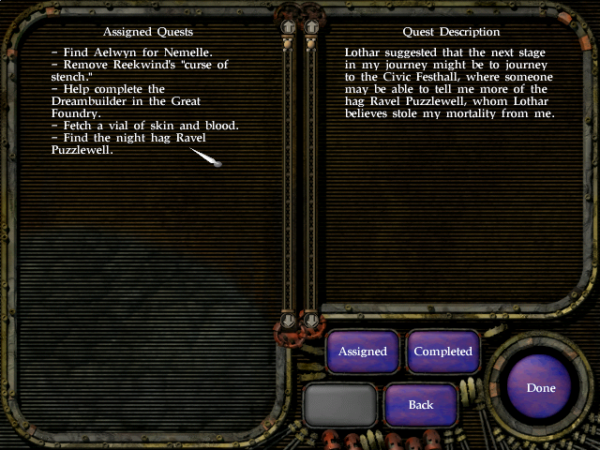
Planescape: Torment has its share of interface issues, but the quest log at least is far more usable than the one in Baldur’s Gate.
In practice, much of your time in Planescape: Torment will be spent wandering through each new district of Sigil as it opens up, clicking on every character who has a name or otherwise non-generic description in order to initiate conversation. Make no mistake. These people like to talk… oh, my God, do they like to talk. A minority of them have information or assistance to offer that pertains to the main quest, or at least to one of the many side-quests. Most of them, however, just “rattle their bone-box,” as the Sigil lingo goes, for the sake of hearing it rattle, telling you all about their hardscrabble lives in paragraph after paragraph of text. I find that it becomes numbing after a while, a symphony of despair that just keeps hammering away on the same relentlessly grim note. It’s Down and Out in Paris and London, except an order of magnitude longer in a different dimension.
The Cant — the Cockney-inspired lingo of Sigil — is striking, even if it is lifted from TSR’s Planescape boxed set rather than being an innovation of this development team. All the same, the writing has a rough-draft quality to it that includes but is by no means limited to the typos and minor grammatical errors that are strewn fairly liberally throughout, the well-nigh inevitable result of laying down so very much text in a relatively short span of time. It’s enough to make you long for the days when computers were primitive enough that even text was expensive, such that developers had to choose their words with care, had to make sure that every single one of them counted. Failing that, we might wish that someone in Interplay’s marketing department had insisted that the whole game be voice-acted, which would have served the same purpose of forcing the developers to include only those words that really matter. (As it is, only the occasional line or two is voiced.)
Editing, in any sense of the word, was clearly not a priority here. Back in the 1980s, Infocom employed a full-time editor from the book-publishing world to polish and tighten the prose in its games. But alas, such work was far beyond the core competencies of a 1990s studio like Interplay. The only guiding principle here seems to be the more words, the better. Matters reach a kind of absurd climax when you wander into a bar in which the patrons spout verbatim paragraphs from the old TSR Planescape campaign setting, copied and pasted into the computer game. One can easily imagine that the developers must have been paid by the word, the way people like to say that the similarly verbally incontinent Charles Dickens once was. Whether they were or not, talk is way, way too cheap in Planescape: Torment.
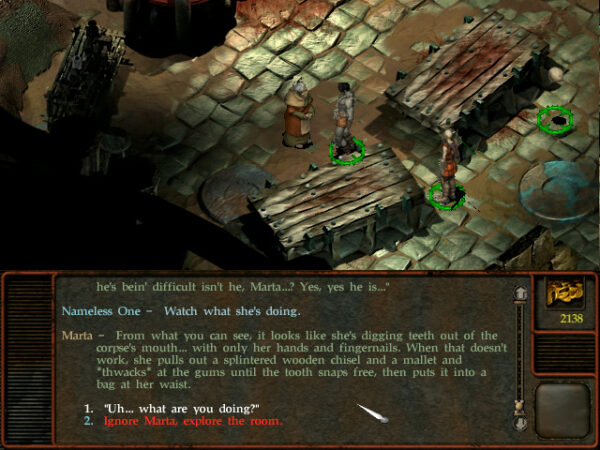
At times, you can almost palpably sense Chris Avellone and his friends straining to put words in the mouths of so many superficially indistinguishable characters in ways that might make them stand out. You want to tell them that it’s okay, give yourself a break: literary merit is not measured by the kilogram of verbiage. Occasionally the writing surrounding the many bit players of Sigil can surprise you with a clever metaphor or a flash of insight or compassion, but more often it just wallows in the squalor. Many of the grotesques you meet are gross just for the sake of being gross, thus revealing that the sniggering lover of blood and boobs who wrote so much of the pitch document remains a part of the development team’s collective unconscious if nothing else.
A man is looking at you with a strange, bug-eyed stare. His eyes are huge… so huge they look ready to pop out of their sockets and roll across the cobblestones. He nods eagerly as you approach, bobbing his head like a bird… and as you near him, you suddenly notice the smell of the urine and feces surrounding him. The man sniffles, wiping his nose on his sleeve, then opens his mouth to reveal blackened, rotted gums…
Reekwind coughs, his eyes almost popping out of his skull as he does so. His cough seems to loosen his bowels, for he breaks wind loudly, as if to accentuate his point…
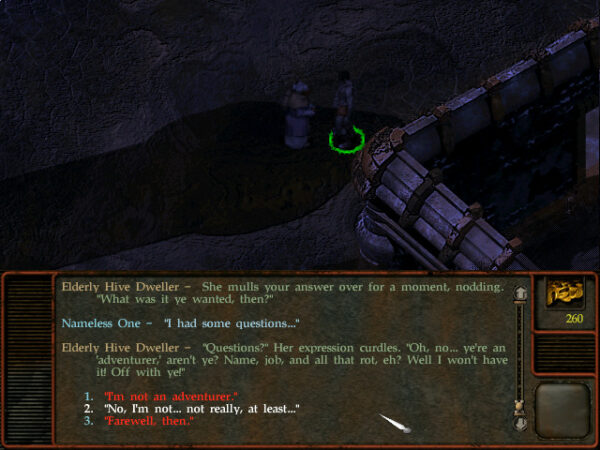
In a moment of levity, the game has fun with some of the tropes of golden-age CRPGs. “I’ll bet ye’ve all *sorts* o’ barmy questions! Greetin’s, I have some questions… can ye tell me about this place? Who’s the Lady o’ Pain? I’m lookin’ fer the magic Girdle o’ Swank Iron, have ye seen it? Do ye know where a portal ta the 2817th Plane o’ the Abyss might be? Do ye know where the Holy Flamin’ Frost-Brand Gronk-Slayin’ Vorpal Hammer o’ Woundin’ an’ Returnin’ an’ Shootin’-Lightnin’-Out-Yer-Bum is? I ought ta kick ye in the shins fer even pesterin’ a poor ol’ woman about it all!”
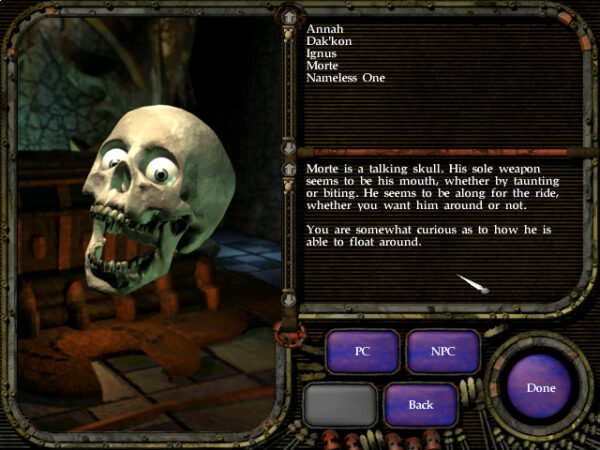
The companions with whom you hack your way through this forest of words instead of monsters are a mixed bag. Morte the talking skull is your first party member, already at your side when you wake up on the mortuary slab for the first time, already seeking to make up for having betrayed you in one of your earlier lives. His redemption arc aside, he’s clearly meant to provide a note of comic relief amidst the cavalcade of misery you encounter, even if in practice his humor misses rather more than it hits; the necrophiliac jokes about every female ghoul and zombie you meet get pretty old pretty quickly.
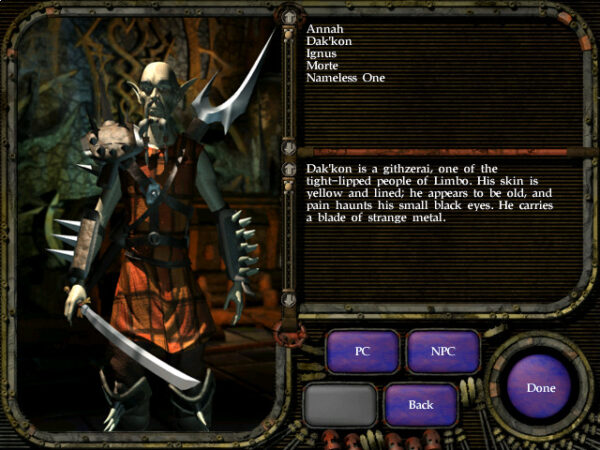
Your companion Dak’kon belongs to the githzerai, a planar race of ascetics who prize order and harmony over all else. Unfortunately for him, a crisis of faith has led to him being cast out by his own people.
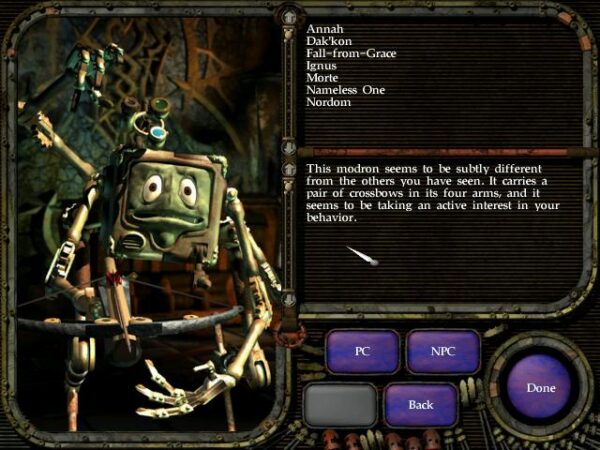
Nordom is not so much cast out as dropped in from what feels like it ought to be a different game entirely. Recruitable only via a lengthy side-quest that’s disarmingly easy to miss completely, he’s a robot who has evolved into sentience and is trying to figure out what to do next. He’s essentially WALL-E nine years before Pixar came up with him; he’s even drawn in a cartoon style, a jack-in-the-box with big, sad eyes and way too many gangling limbs.
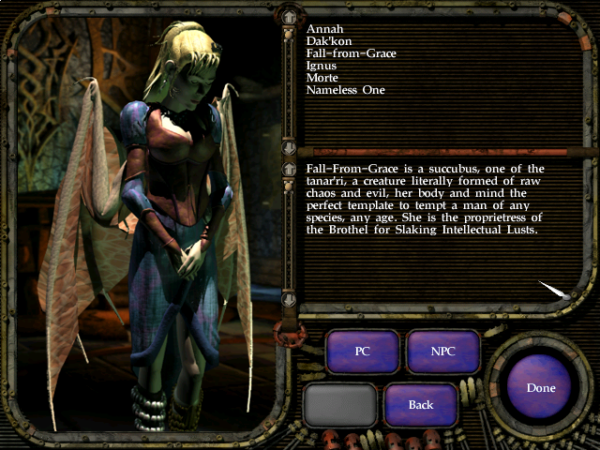
And then we have the two female companions. They are defined by their gender and sexuality in a way that their male counterparts are not, occupying an uncomfortable liminal space between adolescent wish-fulfillment and earnest character-building. The pitch document tells you most of what you really need to know about them when it promises “to fill the game with deep, meaningful interactions with characters that happen to have swaying, pendulous breasts.” Both Fall-from-Grace the reformed succubus and Annah the reforming tiefling thief look like your standard videogame hot chicks. The way they’re written, on the other hand, arguably provides less fodder for students of literature or philosophy than it does for psycho-anthropologists who happen to be studying a certain subset of turn-of-the-millennium young men.
Fall-from-Grace runs the embarrassingly named “Brothel of Slaking Intellectual Lusts.” This establishment is full of hot chicks just like her, who invite their male customers in to… well, just to talk to them about all the nerdy interests that cause other comely young women to roll their eyes and start sidling toward the nearest exit.
Annah is an apparently jaded girl of the streets who, it will eventually turn out, has never known the touch of a man (because of course she hasn’t) and thinks that The Nameless One might be the right one to finally teach her the ways of love (because of course she does).
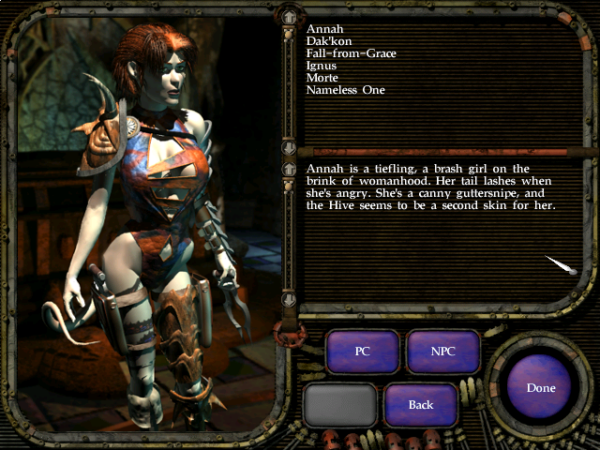
Fun fact: Annah the tiefling was voiced by Scottish pop singer Sheena Easton. Sadly, The Nameless One never does get to spend a night inside her sugar walls.
Now, I don’t want to jump all over Chris Avellone and his friends for this. I believe we should weigh intent at least as heavily as effect when passing judgment on anything, and the intent here is as sweet in its way as it is perchance inadvertently revealing. If the “babes, babes, and more babes” guy from the pitch document is the person these lads were with their peer group, then the wide-eyed romantic who came up with Fall-from-Grace and Annah was likely the person they became alone at night after their buddies had gone home. I remember seeing the girls I crushed on — the ones I really crushed on, that is — in much the same way when I was their age or only a little younger. To my teenage eyes, they were well-nigh celestial beings whom I wanted to shelter from the ugliness of the world (not least all those other guys who were better at sports than I was) and commune with in a way that transcended sex (not least because I was none too confident in my own abilities in that department in comparison to those other guys). It’s a phase a lot of us go through, but also one that we hopefully outgrow. The problem with such attitudes is that they still preclude one from seeing the object of one’s fancy as a fully-realized human being with a full measure of agency in her own right. Men have been using these velvet cages, sometimes consciously and sometimes unconsciously, to hold women down since time immemorial. The women of Planescape: Torment contribute to the sense of a writing team who are punching a little too far above their own weight — or, maybe better said, their life experience.
The overwriting and the gawkiness are present in the main plot line as well. Below is a short extract from the game’s turning point, a long-sought-after and predictably prolonged dialog with Ravel Puzzlewell, a witch who knows much about The Nameless One’s real nature.
“A shadow with substance, a-seeking that which casts the light. I know you more and no… know…” Ravel pauses, her eyes dimming. “No more than I know the nature of ANY man. Crossed pasts have we… a man tainted with un-death, still feeling the pangs of separation, and an old withered crone, now all-imprisoned. Seems it that we are a-meeting for the first time? No, no, not, not… knot?” Ravel seems confused for a moment, then shudders, as if throwing off a weight. “Knot at all. An echo of a future meeting this is… or a past meeting, depending on which way time is facing.”
The first thing we notice here is the inverted sentence structures of Yoda-speak, a kind of default setting for mysterious and profound characters in way too many games. It serves to remind us that, for all their aspirations toward Philosophy, these writers are better versed in the works of George Lucas than Aristotle or Nietzsche.
Meanwhile all this punning on “know” and “no,” “passed” and “past,” “not” and “knot,” is the sort of thing that clever and ambitious young writers often turn out, and grizzled and remorseless editors draw a line through just as quickly. For it works only on the page (or the screen, in this case); if it was spoken, as we’re supposed to imagine dialog being, it would all fly right past the interlocutor. In the end, then, the only purpose it serves is to point out the cleverness of the author, which isn’t — or oughtn’t to be — the purpose of writing anything. If we keep at it long enough, most of us writers learn to nip such cherished little darlings in the bud before they can pull our readers out of the story we’re trying to tell.
And now, looking back on what I’ve written, I see that I’ve been hard on Planescape: Torment, harder than I really intended to be. And yet there are criticisms I haven’t even gotten to yet. For example, I haven’t mentioned how unsatisfying and annoying the combat is — yes, it does exist, and is actually quite extended and extensive at times, such as when you have to leave the streets of Sigil to delve into its tombs and sewers, or when you leave Sigil’s dimension entirely during the last quarter or so of the game. (Never fear: the other dimensions you visit are if anything even bleaker than this one.) Ironically, the same changes to the Infinity Engine that make this game feel more personal than the likes of Baldur’s Gate also serve to explain why Bioware made the choices they did for their own, more conventionally combat-oriented CRPG. Here, the close-in camera makes it harder to keep track of what is going on during a fight, even as the other interface changes make it harder to micro-manage your party when you really need to. Most of the standard CRPG elements — character levels, ability scores, spell books, etc. — feel like phantom limbs here; tragic psychodrama makes a strange fit with the power fantasy of Dungeons & Dragons. The final impression which I just can’t escape is that of an engine and system of rules which are badly out of sync with the game they’re being asked to present. If you want to call that further evidence of subversive intent on the part of the development team, be my guest. I just call it unfortunate.
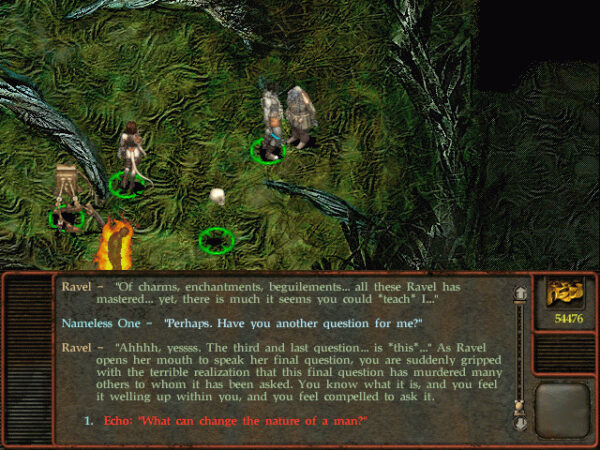
For all that, though, I don’t want what I’ve written to read as an invalidation of the experience of those who have played Planescape: Torment and felt a wind of profundity blowing through its dreary environs. I’ve felt the same wind myself. (And no, I’m not talking about our friend Reekwind.) As you learn more and more about The Nameless One’s endless cycle of pain and suffering, both caused and endured, themes and ideas that games seldom touch on begin to emerge. One particular question is brought up again and again: “What can change the nature of a man?” To its credit, the game never offers a definitive answer, but two possibilities come to the forefront: “Regret” and “Belief.” As Saint Augustine tells us, these are two sides of the same coin: the weight of Regret engenders Belief, while our Belief fills us with Regret for all the ways we fail to live up to our moral potential. Thus the need for Confession to cleanse our souls and be worthy of that which we believe in… and so the cycle continues.
In a revelation that genuinely shook me, you learn near the end of the game that resurrection isn’t free, that every time The Nameless One is brought back to life on his familiar mortuary slab after a failed combat or some other misguided escapade, the life of some other poor mortal schmuck is taken in compensation for his rebirth. The “best” ending has him breaking that cycle by recognizing, acknowledging, and internalizing the suffering he has caused, looking that unwanted self-knowledge and its terrible consequences straight in the face. What follows is by no means conventionally happy, but it is the only fitting way to bring his story to a close. Kudos to Chris Avellone for not chickening out at the last minute, as other game designers have done.
Planescape: Torment is the first game of any stripe that I know of since Infocom’s Trinity to unabashedly don the mantle of Tragedy in the classical sense. Although Chris Avellone’s understanding of what that means is perhaps less nuanced than that of “Professor” Brian Moriarty, the author of Trinity, his take on it is more searingly immediate. For Trinity is the tragedy of an entire civilization, bereft of any characters at all who aren’t bit players, while Planescape:Torment is the tragedy of an individual whom we come to know all too well. Regular commenter P-Tux7 asked in response to the first article of this little duology of mine whether “it is right to punish someone who doesn’t remember doing the crime,” whether “someone can ever become not the person who did the crime,” and whether “justice demands an equivalent amount of suffering.” Such questions constitute the essence of tragedy, which writers have been struggling with as long as the written word has existed.
Despite all its granular failings of execution, then, Planescape: Torment leaves us with much to ponder, regarding both the nature of a man and — on a slightly more plebeian note — the nature of game design. Some of the themes that this game broaches are among the most profound we can wrestle with as human beings. The story of The Nameless One rhymes with the myth of Oedipus, who also looked terrible self-knowledge right in the face and had his soul shriven to the core. Or we might choose to read The Nameless One as a Christ figure, who redeems his fallen companions through a supremely unselfish final sacrifice. But there are likewise obvious parallels to Eastern religion and philosophy, which stress the need to escape the very same eternal life that Christianity purports to offer us. Meanwhile the existentialists among us must ponder whether a Nameless One who can’t remember the actions of his previous incarnations, who possesses no obvious continuity with his previous selves, can be said to truly be the same man at all. In fact, can any of us be said to be the same person we were when we were younger? After all, time is a river that changes all of us second by second, and, as Heraclitus told us almost 3000 years ago, it is impossible to step into the same river twice. Any game that can make its player ponder such thoughts as these is not to be dismissed lightly.
At the same time, though, Planescape: Torment belongs to a category of critic’s darling that always seems to get my curmudgeonly dander up (and tends to land me in hot water with some of my readers): games which are said to be so ridiculously effective as stories and settings that any gameplay inconveniences that dog them pale into insignificance by comparison. Grim Fandango is one of these: we’re told to forget the clumsy interface and nonsensical puzzle design and just enjoy the ride with a walkthrough by our side. Final Fantasy VII is another: forget the endless cavalcade of tedious random encounters and the fact that you can win all of them just by pounding the “attack” button over and over and enjoy the story. No matter how hard I try, I can’t see my way to giving games like these a pass. I love a good story and setting, but the fact remains that interactivity is the defining attribute of a game. It seems to me that it needs to work well too if we are to start throwing around accolades like “masterpiece.”
Much of what strikes me as flaws in this particular would-be masterpiece could have been fixed with a little more time and some more judicious oversight. The writing could be pared down at the same time that it was polished up; 800,000 words are not needed to convey a vivid sense of place and atmosphere, only a subset of the right ones. The tedious combat could be overhauled or perhaps eliminated entirely. Indeed, I sometimes think that my ideal Planescape: Torment would be a ten-hour point-and-click adventure game that doesn’t waste my time with unneeded mechanics or unnecessary talk, that makes every moment count. I doubt that Chris Avellone would go that far, but, again, I sense that he may just agree with me about some of the game’s infelicities. It’s just that he would prefer to improve the other systems rather than narrow the focus to the core story. “If the moment-to-moment gameplay is lacking,” he says, “then you’ve failed as a game designer. The combat was pretty weak, and I did feel it could have used more dungeon-crawling areas for players to explore and have fun in in addition to having fun exploring the conversations in the game.” Who knows? Maybe that would work too.
For when it comes right down to it, I still don’t know quite how to feel about Planescape: Torment; when I called it confounding at the start of this pair of articles, I meant it. I first tried to play it not long after it came out, only to give up after a few hours, bored by the depressing setting and all of the people there who never shut up. I returned to it in order to write these articles, and my sense of professional duty carried me all the way through this time around, even though I was once again bored for much of the time. Still, I’m glad I stuck it out, glad to truly know one of the most celebrated computer games in history. Yet I must confess that I’m equally glad to be done with it. I am of the opinion that the most fundamental responsibility of a game, before theme and meaning can even enter the discussion, is to entertain or at least interest its player. Planescape: Torment failed that test too often for me to call it a great game. If you want me to call it a brave and intriguing one, though… well, that I can definitely get behind. Seldom has any group of creators in this field challenged the expectations of their audience so thoroughly. And that in itself is a brave feat well worth applauding.
Did you enjoy this article? If so, please think about pitching in to help me make many more like it. You can pledge any amount you like.

Sources: The book Beneath a Starless Sky: Pillars of Eternity and the Infinity Engine Era of RPGs by David L. Craddock; Computer Gaming World of March 2000 and April 2000; the 2015 GamesTM special issue on “controversial” games; Retro Gamer 113. Plus the materials found in the Brian Fargo Collection in the archives of the Strong Museum of Play.
Online sources include Soren Johnson’s interview with Chris Avellone for his Designer’s Notes podcast, a Last Game Standing interview with Avellone, and Guido Henkel’s pictures and memories of posing for the Planescape: Torment box cover.
Where to Get It: Planescape: Torment is available as digital purchase from GOG.com in an “enhanced edition.” Buying it also gives you access to the original version.