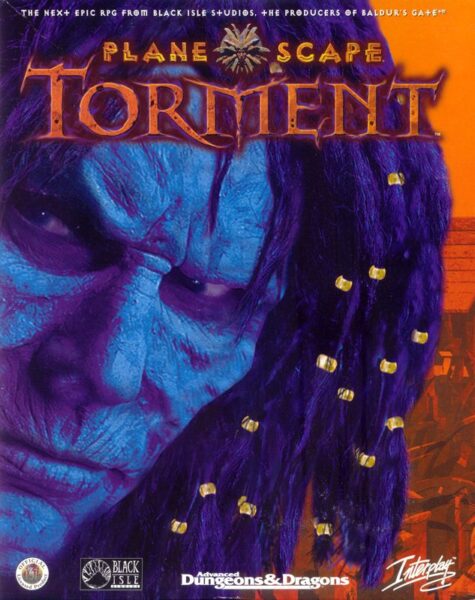
By 1999, Interplay had begun crediting its internally developed CRPGs to “Black Isle Studios,” a distinction that represented very little difference, given that Black Isle shared office space and personnel with its parent publisher. Note the careful choice of words on the box above, to call Black Isle the “producers” — not the developers — of Baldur’s Gate.
My power fantasy when playing a role-playing game is to confront a villain, explain point by point why his master plan is flawed, and then get him to admit that he hadn’t thought things through as carefully as I had, and ask me what I think he should do. Conversation-based player characters can have their bad-ass moments just as much as someone wielding a gun…
— Chris Avellone
Planescape: Torment is the damnedest game. Its list of failings is longer than that of many a game that I’ve simply written off as bad, full stop, and moved on from without a second thought. The pacing is glacial for long stretches; the interface is fussy and clunky; the combat is both irritating and utterly superfluous to the game’s design goals. Even much of the writing, by far the most celebrated aspect of Planescape: Torment, tends to seem proportionally less profound and more banal as one becomes farther removed in age and life experience from the twenty-somethings who first put all of these words — so many, many words, a reported 800,000 of them in all — onto our monitor screens more than a quarter-century ago. In so very many ways, Planescape: Torment is an undisciplined hot mess.
And yet it’s a hot mess that refuses to be dismissed lightly. For Planescape: Torment is also a vanishingly rare thing in the realm of game narratives: a genuine interactive tragedy, in the sense that Aeschylus, Shakespeare, and Nietzsche understood that word. That it recognizes the tragic side of life while inhabiting a genre whose whole point in the eyes of most of its fans is the triumphalism of going from a weakling to a demigod is incredibly brave and subversive. That it did this in 1999, when the games industry was smack dab in the middle of one of the most homogenized, risk-averse periods in its history, is as inexplicable as it is astonishing.
Clearly we have much to unpack…
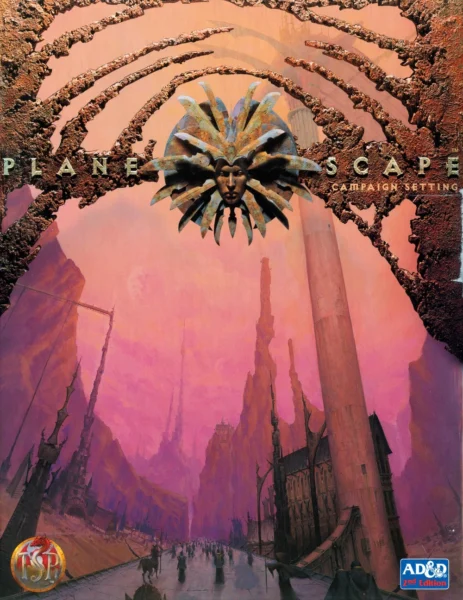
TSR sold surprisingly few copies of the original Planescape campaign setting, even at the stupidly cheap price of just $30. It goes for $250 among collectors today.
Whatever else it is, Planescape: Torment is first and foremost a licensed adaptation of Dungeons & Dragons, a part of Interplay’s attempt to revive that storied tabletop game’s digital fortunes amidst the collapse of its parent company TSR and TSR’s acquisition by Wizards of the Coast. This particular computer game was no mere branding exercise, as was the case with some of them that came out in Dungeons & Dragons trade dress during the 1990s. On the contrary, Planescape: Torment was deeply, intimately informed by the creative work that took place in TSR’s Wisconsin headquarters earlier in the decade. The extent to which this is the case is often glossed over or forgotten entirely when retrospectives of it are written today. So, let me make it crystal clear here right from the start: love it or hate it, a huge chunk of what makes Planescape: Torment so unique and memorable originated not in Interplay’s Southern California offices but in the nation’s dairy-cow heartland.
It will presumably surprise no one when I write that the “planes” of Planescape are alternate planes of existence, separate from the “Prime Material Plane” in which most Dungeons & Dragons campaigns take place. They were introduced by Gary Gygax already in the late 1970s, in the iconic first editions of the Player’s Handbook and Dungeon Master’s Guide. His cosmology was a melange of a little bit of everything: quantum physics, Renaissance-era alchemy and astronomy, the holy texts of various religions, New Age philosophy, Dante and Milton, twentieth-century fantasy and horror novels.
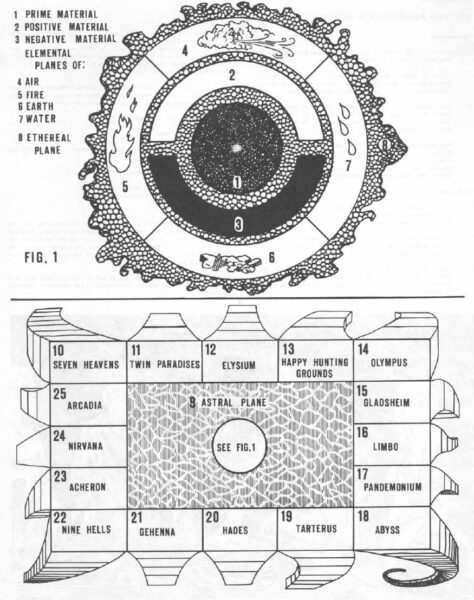
Gary Gygax’s vision of the Dungeons & Dragons multiverse, as found in an appendix to the Player’s Handbook.
The Prime Material Plane stands at the center of it all, much like the Earth was once imagined to stand at the center of our universe. It is surrounded by the Inner Planes that embody the physical building blocks of existence, which are in turned enclosed by the Outer Planes that embody the metaphysical alignments, those nine possible combinations of Lawful, Neutral, and Chaotic, Good, Neutral, and Evil.
Gygax was always prepared to muse and to elaborate, on this subject as on so many others. Small wonder that these alleged rule books — surely the most chatty and discursive books of rules ever written, the heart of the Gospel of Saint Gary — were perused and pored over endlessly by his young fans, many of whom were discovering for the first time the countless disparate philosophical ideas he threw into the pot. Gygax wasn’t an overly sophisticated thinker in most contexts, but he was a prolific one, who always had ten more ideas waiting in the wings if you didn’t respond to his last one.
For those of you who haven’t really thought about it, the so-called planes are your ticket to creativity, and I mean that with a capital C! Everything can be absolutely different, save for those common denominators necessary to the existence of the player characters coming to the plane. Movement and scale can be different; so can combat and morale. Creatures can have more or different attributes. As long as the player characters can somehow relate to it, then it will work…
I have recommended that Boot Hill and Gamma World be used in campaigns. There is also Metamorphoses Alpha, Tractics, and all sorts of other offerings which can be converted to man-to-man role-playing scenarios. While as of this writing there are no commercially available “other planes” modules, I am certain that there will be soon — it is simply too big an opportunity to pass up, and the need is great.
This was a remarkably prescient description of where planar travel in Dungeons & Dragons would go — eventually. For a long time after The Dungeon Master’s Guide appeared in 1979, the other planes of existence were one of those Dungeons & Dragons concepts that were kind of floating out there in the ether (or was it the Ethereal Plane?) without anyone knowing quite what to do with it. Apart from some sketchy guidelines for “ethereal” and “astral” travel and combat, the rule books remained sadly short on specifics. The 1980 adventure module Queen of the Demonweb Pits, designed by Gygax and David C. Sutherland III, did take players on a jaunt to the Abyssal Plane, but that was a one-shot thing. For all that Gygax had claimed, in his indelibly Gygaxian way, that “the need is great,” as if an understanding of the planes of Dungeons & Dragons was an urgent matter of national security, neither he nor anyone else seemed to be in all that much of a hurry to address said need. The occasional slightly dodgy article in Dragon magazine aside, Dungeons & Dragons remained in practice a very Prime Material sort of game.
This situation first started to change in the latter half of the 1980s. By then, Gygax was on his way out of TSR and the Dungeons & Dragons craze of the decade’s beginning had just about run its course. Necessity was forcing TSR to adjust its business model, from selling the core Dungeons & Dragons game to new players to selling an ever expanding lineup of rules extensions, campaign settings, and pre-crafted adventures to its surviving base of loyal, hardcore players. The planes seemed like fresh fodder for all three types of product.
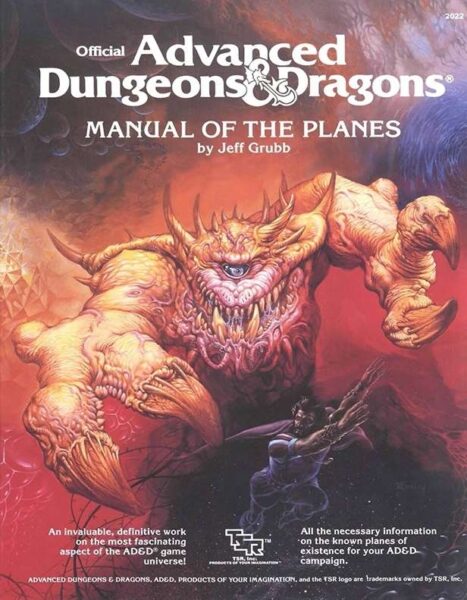
A longtime TSR stalwart named Jeff Grubb took the first concerted swing at it. In 1987, the company published his Manual of the Planes, the latest in its ever-growing line of new Dungeons & Dragons hardbacks for the hardcore. Grubb took it as his mission to give Gygax’s abstract cosmology a grounding in lived experience, to explain what it would actually be like to visit these places. Unfortunately, he prioritized alchemical realism over playability, winding up with a collection of environments that were as brutally, hilariously inhospitable to even high-level characters as one might imagine a plane of nothing but fire or air to be. “The book was fascinating reading,” notes Dori Hein, an ordinary Dungeons & Dragons fan at the time whom we will meet again in another role. “I loved the mythology and the grand majesty of all the planes, but — try as I might — I couldn’t create an adventure without killing all my players.” In the same vein, Sean Gandert of the website Exposition Break writes that “the planes’ complete resistance to being remotely welcoming is both what makes them fascinating to read about and also makes the book completely skippable and largely irrelevant. It is a work of cosmology and mythology, not a plan for where to send adventurers.”
The Manual of the Planes went out of print in fairly short order anyway, after TSR commenced rolling out a second edition of Advanced Dungeons & Dragons in 1989. The cynical interpretation of this initiative is that it was the best way TSR had yet devised for continuing to extract money from its static pool of players, by forcing them to buy the game they loved all over again in its most basic form in order to stay up to date with the times. The idealistic one is that it let TSR clean up a game system that had grown ever more baggily shambolic over the past decade of supplement after supplement. In reality, the second edition was doubtless a little of both, being seen one way by the people surrounding Lorraine Williams in her executive suite and another by the creative types in the cubicles.
That said, and looking back on what I’ve written about the later period of TSR’s history elsewhere on this site, I fear I may have overemphasized the cynicism at the expense of the idealism. There’s no question that the company fell prey to a set of perverse incentives during the last decade of its existence, many of them born out of idiosyncrasies in its longstanding distribution contract with the book publisher Random House. By the early 1990s, this had resulted in an absolute hailstorm of product brought down upon the heads of Dungeons & Dragons fans, more than all but the most well-heeled among them could possibly afford to buy, much less find the time to bring to the tabletop. But there’s likewise no question that these products were made with enormous love and care by the creative staff. This was the heyday of the alternative campaign setting, when TSR offered up the chance to leave conventional high fantasy behind and play Dungeons & Dragons in post-apocalyptic worlds, in the lands of the Arabian Nights, in Gothic castles, on the high seas, even in outer space. So what if there was no way to justify so many settings’ existence as commercial products, if each successive one sold worse than the one before, especially after the collectible-card game Magic: The Gathering arrived on the scene to tempt away large chunks of TSR’s remaining customer base. Circumstance had granted the people making these settings a rare reprieve from the harsh logic of supply and demand, and they didn’t let it go to waste.
Given this cavalcade of rich but disconnected settings, it was perhaps inevitable that TSR would look once again to the planar multiverse as a way of unifying a crazily diverse set of experiences bearing the name of Dungeons & Dragons. A boxed set reviving Gygax’s multiverse could bring them all together conceptually, could even provide a set of practical mechanisms to allow the same set of player characters to jump from setting to setting, just like Saint Gary had first proposed all those years ago.
In addition to being a unifying force for Dungeons & Dragons itself, Planescape was quite explicitly intended as a response to Vampire: The Masquerade, an RPG from an upstart company known as White Wolf Games that flipped everything you thought you knew about the tabletop scene on its head. Whereas Dungeons & Dragons, even in its supposedly cleaned-up second-edition incarnation, was infamous for the complexity of its rules, Vampire gave you just enough of them to provide a runway for storytelling. That fact, combined with its subject matter, attracted fresh blood to the hobby: Goth rockers and theater kids and Anne Rice readers, among them a surprising number of girls and women. At the end of the day, Vampire may have been full of as many clichés as vanilla Dungeons & Dragons — clichés which are all the more evident from the perspective of today, after several more decades worth of vampire fictions — but they had the advantage of feeling relatively fresh from the perspective of the early 1990s. Indeed, this was the only period in the entire history of tabletop RPGs when it seemed possible that a different game might just unseat Dungeons & Dragons from its throne as the undisputed standard bearer for the hobby. Vampire’s rise made TSR nervous enough to want to make something of its own that was grittier, messier, and a bit less morally straightforward, less of a single-unit wargame and more of a vehicle for improvisational drama. It was no accident that the Dungeons & Dragons brand appeared on the eventual Planescape box only as a small logo tucked away in the corner.
David “Zeb” Cook, another veteran TSR hand, was made lead designer on Planescape. Dori Hein, who had by now graduated from merely playing TSR’s games to working there, became the producer, overseeing a team of artists, cartographers, writers, editors, and play-testers. They pulled out all the stops for a set that wound up consisting of no fewer than four separate books, printed on thick and creamy Pentair Suede paper, and four sturdy cardboard posters. The luscious package was capped off by the most intimidating Dungeon Master’s screen ever devised. One of TSR’s purchasing managers had a sign hanging in his office: “The pleasure of a product well done lingers far longer than the excitement of a bargain.” As it happened, though, the Planescape set was both: it sold for just $30, a ridiculously cheap price for such a luxurious product even by the standards of the 1990s. It may have been no more than a break-even price, or not even that, settled upon in the hope that Planescape would revive TSR’s flagging fortunes in the longer run by spawning a whole new ecosystem of supplements, adventure modules, and tie-in novels.
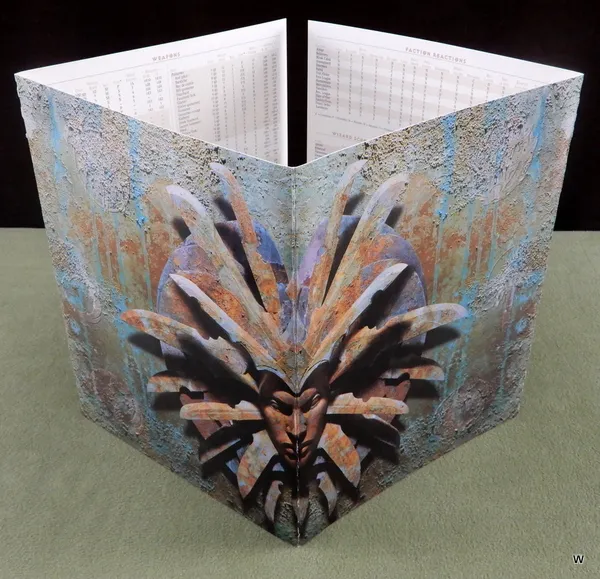
The Planescape Dungeon Master’s screen. Sitting down around a table that had this thing on top of it, you knew you were in for a mind-bending journey that was more Salvador Dali than Boris Vallejo.
Zeb Cook’s first and most important stroke of brilliance was to give his vision of the planes a hub around which to operate. This was Sigil, a “city of doors” giving unto the many other planes, a meeting ground and melting pot for the entire multiverse. Ranging far afield from the pulpy fantasy of Jack Vance and the stately epic fantasy of J.R.R. Tolkien, the two most obvious inspirations for traditionalist Dungeons & Dragons, Cook read postmodern, experimental novels by Milorad Pavić and Italo Calvino for inspiration. Sigil, a city of angles as well as doors, became a physical embodiment of their twisted, self-referential approach to narrative: “Get it right out front: Sigil’s an impossible place, a city built on the inside of a tire that hovers over the top of a gods-know-how-tall spike, which rises from a universe shaped like a giant pancake.”
Sigil is not so refined a place as some might expect for the central hub of the multiverse, but that’s fair enough, given that Cook’s multiverse itself isn’t all that refined. The dominant note of the city, even outside of its plentiful and teeming slum districts, is what we might call dirty Victoriana, of a piece with 21st-century novels like Sarah Water’s Fingersmith and Michel Faber’s The Crimson Petal and the White, which read like genuine Victorian “sensation novels” with the added ability to state outright the disreputable things that their ancestors could only imply. The dialect of Sigil’s streets is vintage Cockney slang in spirit if not always in the details of the vocabulary, with the same uncanny talent for being roundabout and penetrating at the same time: “berks” and “cutters” are no-account people; “the dark” is knowledge; “jink” is money; one’s “kip” is one’s (usually humble) abode; one’s “bone-box” is one’s mouth; to “pike off” means to scram. In keeping with all the best slang, these are words that you know when you hear them even if you don’t actually know them, if you take my meaning. As we’ve already seen, the books in the Planescape box that describe Sigil are themselves written in this vernacular: “Welcome, addle-cove!” begins the Planescape “Player’s Guide.” This is not the Dungeons & Dragons of 1980s school cafeterias; both dungeons and dragons are mostly missing from Sigil, replaced by far stranger things.
Instead of embracing the simplistic good-versus-evil dynamics of traditional Dungeons & Dragons, Sigil is divided into fifteen factions whose adherents are aptly described as “philosophers with clubs,” from the chivalric and vaguely fascistic Godsmen to the nihilistic Bleak Cabal, who preach that “once a sod believes it all means nothing, it all starts to make sense.” Ruling over the whole place, ensuring that no single faction gets too powerful, is the Lady of Pain, who can flay the skin from a poor berk just by looking at him. The overriding theme is that ideas and beliefs matter, are literally woven right into the substance of the multiverse, and can kill or save you just as indubitably as the physical elements of earth, air, wind, and fire. Sigil is the ultimate argument for the value of a good humanities education.
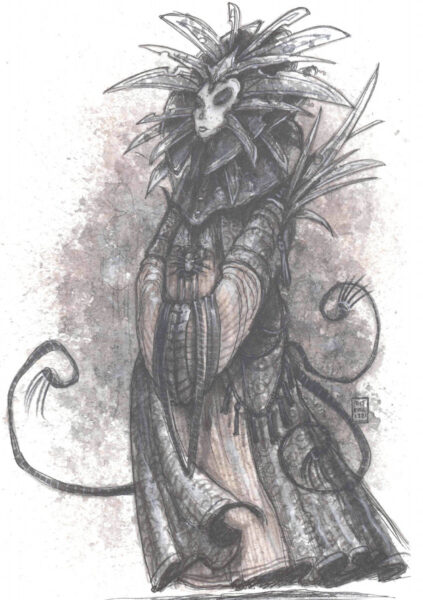
The Lady of Pain.
If there’s a weakness to the Planescape set, it’s that it spends so much space on Sigil that it doesn’t have enough left over for all those other planes of existence that were supposed to be the whole point of the endeavor. Instead of offering a wide-open set of possibilities, it can feel paradoxically claustrophobic, like the crowded filthy alleyways of the city itself.
Nevertheless, the Planescape box was endlessly audacious and imaginative, as different from the typical Dungeons & Dragons experience as anyone could have asked for. But, whether despite or because of these factors, it was not a commercial success. It sold just 60,000 copies over the five years after its release in April of 1994, a thin foundation indeed on which to build a new gaming ecosystem. The add-on lines, which offered opportunities to flesh out the multiverse in some of the way that the boxed set had failed to do, continued in fits and starts for longer than you might expect — another tribute to the topsy-turvy economic incentives that marked TSR at the time — but petered out for good after the failing company was acquired in 1997 by its own worst enemy Wizards of the Coast, the maker of Magic: The Gathering. The Vampire craze did eventually fade, but its travails had nothing to do with TSR’s efforts. It was rather something to do with the ever-shifting winds of pop culture, which soon replaced teenagers’ Cure and Alice in Chains records with the Backstreet Boys and Britney Spears.
So, had things turned out just a little bit differently, Planescape would be fondly remembered today only by a few tabletop nostalgics as a piece of work of unusual vision that never got its due. Instead, though, it went on to become a landmark of another stripe, in a different medium entirely.

Chris Avellone.
TSR had begun dangling the prospect of a Planescape computer game in front of publishers even before the boxed set shipped; such a thing was regarded as a potentially vital part to the product line that had become the latest Great White Hope for reversing the company’s accelerating downward spiral. Interplay rose to the bait, signing the contract before 1994 was out. In fact, it went so far as to hire Zeb Cook himself, who had concluded that “it didn’t seem like there was going to be a long-term future” for him on the tabletop. But the initial rush of enthusiasm petered out; Cook soon departed again, leaving the digital future of Planescape in limbo. And yet the idea of a Planescape computer game never completely went away. Late in 1995, when an inexperienced youngster named Chris Avellone came to Interplay for a job interview, he was asked how he would design such a game. He brainstormed in the spur of the moment the genesis of the eventual Planescape: Torment: “I would start it after the death screen. What happens after the main character dies?”
Avellone had grown up in the 1980s playing Dungeons & Dragons with his friends in his hometown of Alexandria, Virginia. By the time he went off to university, he had two possible futures in mind for himself: either to become a comic-book author or to become a tabletop-RPG designer. Neither field could exactly be called a growth industry at the time, but he made the best of it. On the gaming side, he sent a long string of submissions not only to TSR but to Steve Jackson Games, the maker of GURPS (“Generic Universal Role-Playing System”), and to Hero Games, the maker of the superhero RPG Champions. Initially, he met only with rejection; his closest brush with his heroes at TSR came when Monte Cook, yet another well-known name among the Dungeons & Dragons cognoscenti, took time out to plead with him personally to just stop submitting stuff already.
But Avellone persevered, and finally began to see some of his gaming material accepted and published. Yet he still had to confront the reality that the life of a freelance tabletop-RPG writer and designer left a little something to be desired: specifically, money. Most of the royalty checks that came in from the beleaguered companies that published his work — the Magic: The Gathering craze was in full flight, pushing RPGs to the margins of the same shops where they had once been the dominant attraction — had just two digits before the decimal point. Avellone, who had by now graduated from the College of William & Mary with a Bachelors in English, was still at loose ends when it came to the all-important question of how he was going to put food on his table as a responsible adult. Everyone told him that the wise choice was to acquire a teaching certificate, but all he wanted to do was find a way to make games full-time.
Oddly enough, he had never seriously thought about becoming a computer-game developer, despite having played his fair share of The Bard’s Tale and its ilk as a teenager. It took Steve Peterson, his editor at Hero Games, to point out to him how different the economics of that adjacent industry were. Peterson pulled some strings to secure Avellone an interview at Interplay Productions, for something which he was unlikely to find anytime soon in the moribund tabletop field: an honest-to-goodness full-time job. He got the job.
Although he had been asked about Planescape at his interview, he wasn’t allowed to spend all or even most of his time on that perpetually incipient project after he was hired. As the low man on the totem pole, he was shuffled around from team to team, plugging gaps in the design plumbing wherever needed. He worked on the infamous Descent to Undermountain, the nadir of digital Dungeons & Dragons during the 1990s; on Conquest of the New World, Interplay’s workmanlike take on the same theme as MicroProse’s Colonization; and on Starfleet Academy, an attempt to do TIE Fighter in the Star Trek universe that never felt true to its source material, in that it had the usually stately likes of the USS Enterprise dog-fighting in space as if it was, well, a TIE Fighter.
But betwixt and between all of the above, Avellone sat in his cubicle writing his Planescape game. He did so as much for his own peace of mind — because he needed something that he could feel passionate about — as out of any real conviction that the game would ever get made. The winds blowing against it seemed positively gale-force. For by now it was clear that Planescape would not prove the savior of Dungeons & Dragons on the tabletop. The TSR boxed set had barely sold at all, even as, commercially speaking, CRPGs were scarcely in better shape than their tabletop counterparts in the mid-1990s. Interplay already had one game in the stagnant genre under active development, in the form of Fallout. That looked like one too many in the eyes of most of the bean-counters.
Slowly, however, the murky picture started to take on some brighter shades. Just as 1996 was turning into 1997, Blizzard Entertainment unleashed a game called Diablo. Debate raged on Usenet and the young World Wide Web over whether Diablo, with its procedurally generated dungeons and its emphasis on constant action over a fleshed-out narrative, was a “real” CRPG at all or just a watered-down pretender. What was undeniable, though, was that it sold like crazy, raising the question of whether more complex, textured CRPGs might be ripe for a revival as well. Meanwhile a bankrupt TSR was by now in the process of being acquired by Wizards of the Coast. Wizards was saying all the right things about resurrecting Dungeons & Dragons for this new era, and its Magic revenues left it primed to spend more money on that endeavor than TSR could ever have dreamed of even before the collectible-card-game craze had cleaned its clock.
In what had seemed at the time like a triumph of hope over recent experience, earlier in 1996 the Interplay producer Feargus Urquhart had enlisted a fledgling Canadian studio known as Bioware to make yet another Dungeons & Dragons CRPG for Interplay to publish. In what had seemed a minor stipulation of the deal at the time the contract between Bioware and Interplay was signed, the former had agreed to allow the latter full access to the “Infinity Engine” it planned to use to build and run the game. By the spring of 1997, those arrangements were looking like they might prove more important, both to Interplay and to the whole industry, than anyone had anticipated at the time.
The Bioware game, for which Feargus Urquhart himself had come up with the name of Baldur’s Gate, was pitched straight down the middle, being about as traditionalist as a Dungeons & Dragons CRPG could get. It took place in the game’s more or less default setting of the Forgotten Realms, a world that took every cliché of epic fantasy and ran with it. Obviously this was the safest choice for a revival. But, in the wake of Diablo’s smashing success, Urquhart thought there might be space to throw up a curve ball as well to serve as a more outré companion piece. He asked Chris Avellone to condense his massive Planescape notebook into a proper project proposal.
The proposal reached the desk of Brian Fargo, the founder and head of Interplay, at the end of June 1997. “There was always a balance in running a studio between being commercial, being creative, and having your creative people be happy, and having them do things that are interesting to them,” says Fargo. “I was willing to take creative risks from time to time in order to allow these things to happen. Planescape: Torment was clearly one of those. When it came across my desk, I said, ‘Well, that’s as high-concept as you can get.’ But I thought that RPG players would like it, and I loved the writing and sensibility they put into the document. That got me interested in doing it.” It didn’t hurt, of course, that it ought to be possible to do the game fairly cheaply, since it would be able to re-purpose Bioware’s Infinity Engine.
The heart of the Planescape: Torment team was lead designer Chris Avellone, lead programmer Daniel Spitzley, the artists Tim Donley and Aaron Meyers, and producer Guido Henkel (a recent German immigrant who had helped to make the CRPGs Blade of Destiny and Star Trail in his native land). The project was not a major priority at Interplay for the majority of its existence, even after Fallout came out late in 1997 and sold pretty well, thus demonstrating that there truly was a reasonably sized market for more complex, conversation-heavy CRPGs than Diablo, provided that they were done well. In fact, in an ironic sort of way, Fallout’s success was to Planescape: Torment’s detriment. Eager to capitalize on the first non-sequel, non-licensed Interplay release to garner an appreciable buzz among hardcore gamers since Descent in 1995, Brian Fargo decreed that a Fallout 2 had to come out within a year of its predecessor. As a result, Planescape: Torment was all but suspended for much of 1998, while most of the team, Avellone included, moved over to pitch in on the Fallout sequel.
Although they did get it done on time, the biggest CRPG success story of the Christmas of 1998 proved not to be Fallout 2 but rather Baldur’s Gate, which introduced digital Dungeons & Dragons to a whole new generation of gamers who were more familiar with Diablo than Pool of Radiance. Just like that, Dungeons & Dragons on the computer became a hot topic again. With a Baldur’s Gate II not slated for release until 2000, Planescape: Torment was left to carry the Infinity Engine water in the interim. That brought a fresh influx of energy and resources to the project, and these were sufficient to get the game finished just in time for the Christmas of 1999.
It entered stores accompanied by stellar reviews whose fulsome praise felt only slightly obligatory in a Stockholm Syndrome sort of way. (Many reviewers did point out the “tome of text” to be read in tones that suggested that they might not have found it as uniformly delightful as their five-star verdicts suggested.) Nonetheless, as a computer game based on a tabletop setting that had been discontinued more than eighteen months earlier, Planescape: Torment was in a strange position for a licensed product. Even against weak competition — the only other high-profile CRPG release that holiday season was the abjectly terrible Ultima IX — the game’s sales were a shadow of the figures put up by Baldur’s Gate. In an ironic way, the lack of ringing commercial success may have been a positive for Planescape: Torment’s legacy, confirming its modern status as a cult classic that’s for the CRPG sophisticates rather than the hoi polloi.
As for my opinion… well, I’m afraid I’m going to need another article to properly interrogate the reputation and reality of the game. For, whether one happens to be sitting with the prosecution or the defense or just back in the jury box trying to sort through it all, the case of Planescape: Torment is a complicated one.
Did you enjoy this article? If so, please think about pitching in to help me make many more like it. You can pledge any amount you like.

Sources: The books Slaying the Dragon: A Secret History of Dungeons & Dragons by Ben Riggs, Beneath a Starless Sky: Pillars of Eternity and the Infinity Engine Era of RPGs by David L. Craddock, and Designers & Dragons: A History of the Roleplaying Game Industry volumes 1 (the 1970s) and 3 (the 1990s) by Shannon Appelcline; Dragon of March 1994, April 1994, May 1994, July 1994, and August 1994; Computer Gaming World of March 2000 and April 2000; the 2015 GamesTM special issue on “controversial” games; Retro Gamer 113. Plus the Advanced Dungeons & Dragons Player’s Handbook, Dungeon Master’s Guide, Manual of the Planes, and the Planescape boxed set. Plus the materials found in the Brian Fargo Collection in the archives of the Strong Museum of Play.
Online sources include Soren Johnson’s interview with Chris Avellone for his Designer’s Notes podcast, a Last Game Standing interview with Avellone, and Sean Gandert’s series of articles about the evolution of planar travel in Dungeons & Dragons for the website Exposition Break.
Where to Get It: Planescape: Torment is available as digital purchase from GOG.com in an “enhanced edition.” Buying it also gives you access to the original version.






Play History
May 22, 2026 at 5:28 pm
Planescape has always fascinated me as a setting, as has the concept of parallel dimensions. I’ve only played the opening of Torment so I can’t judge it much as a game, but I really love the attempt of the setting to be truly odd and encapsulating. Sigil as a place where power and mind mix is deeply enthralling to me – even the less developed outer planes really stoked my imagination as a DM. I have an idea for a Planescape game sitting in my back pocket that I’d love to try…
At one time, there was some backlash against stories using alternate worlds (whether that be parallel realities or entirely new dimensions) as bad storytelling. The idea was that the implication that stories as important as the one you’re telling are going on at the same time undermines the one you’re telling – though in a weird way that’s kind of more realistic. Now that the concept of ‘multiverse’ is embedded in pop culture, I don’t think anyone makes that argument anymore.
Not that the concept can’t be overwhelming and confusion. Moorcock invented and immediately overused the idea with his Eternal Champion crossovers. It also can be used as a continuity excuse, see: Comics. But I think there’s merit in weaving these things together and I’m glad that Planescape was never just a hub. The people involved in late era 2nd Ed and 3rd Ed remain people that fascinate me with their ingenuity.
On that note,
“The idealistic one is that it let TSR reboot a game system that had never been anyone’s idea of clean and elegant”
I don’t know that you can really say that there was any intention to “reboot”. Until 3rd Ed, D&D editions were backwards compatible with OD&D – though only through Advanced and through Basic lines respectively. 2nd Ed AD&D was not really tidying up 1st Ed substantially, and like I said you could carry your modules and rules through to it.
Jimmy Maher
May 22, 2026 at 5:53 pm
“Reboot” was probably the wrong verb there. Thanks!
Jason Dyer
May 22, 2026 at 6:48 pm
The combat thing is admittedly the part I’ve been most confused about in reading other people writing about this game.
I played it back in the day when it first was released, thought the combat was fine, found out years later the combat was (supposedly) not fine. This is not just from Jimmy here, but literally every single other person I’ve ever read, including random screeds deep in website threads. It got to the point I wondered if I was playing some sort of alternate-universe game. There was a labyrinth bit that was boring but it was also clearly optional so I skipped it.
Maybe it’s because I was playing a mage rather than some other build? (That’s admittedly not a good thing if there’s only one viable way to make it fun.) I didn’t find it that much different from Baldur’s Gate, which doesn’t get nearly the same tongue-lashing. Of the games from this time, I thought Icewind Dale was the one with the horrifically bad combat (so much needing to kite, and the fights were generally dull besides; the DLC tried to reduce kiting by alerting all the enemies on the map at once, but that just led to an absolute mess in terms of tactics).
Zed Banville
May 23, 2026 at 6:57 am
The reason people complain about the combat in Planescape: Torment is not particular to that game but rather that it was built using Bioware’s execrable Infinity Engine, which adapted its combat system from the “Real-Time Strategy” genre, on the premise that computer game audiences were no longer willing to play turn-based games (and ignoring successful real-time CRPGs subgenres established by Dungeon Master in 1987 and Ultima Underworld: The Stygian Abyss in 1992). This “Real-Time with Pause” combat system simply merged the weaknesses of turn-based and real-time combat, without any strengths, as the player passively watches the party members auto-attack with an occasional intervention.
You “didn’t find it that much different from Baldur’s Gate” because it’s exactly the same terrible system, devised by people who considered tactical RPGs, Wizardry-likes, and Rogue-likes to be obsolete. Ironically, over the last dozen years, there has been a revival of tactical RPGs and the adjacent genre of squad-based tactics games with RPG elements, with even Baldur’s Gate 3 implementing turn-based tactical combat, and now RTwP is perceived to be outdated.
Mike Russo
May 23, 2026 at 2:19 pm
We’re very fortunate that there’s a natural experiment proving that this take is completely correct – because of course only a couple of years after this, Pool of Radiance II came out, and its way-more-fun-and-tactical-than-the-Infinity-Engine turn-based combat powered it to far greater critical and commercial success.
Mike Russo
May 23, 2026 at 5:29 pm
To make the point less snarkily: turn-based good, real-time with pause bad, is a thought-terminating cliche; indulging in it makes it harder to understand both the general question of why RTwP was an effective response to late 90’s technological and design trends but hasn’t been as successful lately, and the specific question of why people who aren’t hung up on this shibboleth tend to think Torment’s combat is generally the worst of the IE games.
The former is a bit of a non sequitur to Jason’s post, but very briefly, a major problem mid-to-late-90s turn-based games were running into was that increasing graphics hardware and art design chops meant that both designers and players wanted to see their actions animated in lovingly-rendered detail. But implementing all of that tended to slow things down quite a lot, especially on contemporary hardware. Simultaneously, RPG system design hadn’t yet adopted the MMO-induced everyone’s-a-wizard ethos; in a DnD-derived party-based RPG, at most half the characters would be doing something other than just attacking the same guy they were already on any given turn. As a result, large combats in games like Fallout 1/2, PoR 2, etc., were often tactically uninteresting and were slow as molasses. In these circumstances, a RTwP implementation that had bells and whistles, and allowed players to speed through the boring bits while slowing down when careful thought was required, hit a real sweet spot. But as time has shifted, that sweet spot is no longer so sweet — in particular, the drive over the last 15ish years towards giving every one of the 4-6 members of an RPG party their own palette of special moves that need to be carefully deployed round by round sits very uneasily with traditional RTwP systems, which is why something like Pillars of Eternity doesn’t work nearly as well as its inspirations did.
Anyway, on Torment in particular, I’d agree that the difference between it and the rest of the IE games is somewhat overstated, but I think there are three particular reasons why people make the critique:
1) the field of view is noticeably zoomed in, compared to the other IE games, which means that battles can feel more chaotic and harder to manage, as you often can’t get a good handle on everything that’s happening or prepare for a fight before everybody’s bunched up in a scrum.
2) the encounter design isn’t as varied or challenging as in its peers; the BG and especially IWD games tend to mix things up with lots of different kinds of enemies grouped together, occasional mini-bosses and bosses who require different approaches to take down, or terrain that forces you to adapt to a new set of strategies. Torment’s fights are much more same-y — the Modron Maze is the worst example of this, but in general there aren’t too many unique enemies or set-piece battles.
3) related to the above points and connected to something Jimmy mentioned, combat is just not a major focus of the game’s design or story. Most combat areas don’t climax with a boss, but with a conversation, and overall the biggest narrative beats and mechanical boosts come out of non-combat interaction rather than fighting. Unlike in BG2 where taking down a dragon is a big deal in story terms and will get you awesome loot, in Torment combat is the stuff you need to slog through to get to the good stuff, both in terms of plot but also XP increases, powerful items, and so on. Even if this is more about the context of the combat than its mechanics, the net impact is still to make the fighting seem less exciting and therefore “bad”.
Jimmy Maher
May 23, 2026 at 7:22 pm
A couple of other reasons that Planescape’s combat is worse than that of the other Infinity Engine games:
1. The decision to replace some on-screen buttons with a pop-up radial menu results in more fiddly right-and-left clicking.
2. Less flexibility with auto-pause breakpoints. Planescape is actually on par with the original Baldur’s Gate in this respect, but more breakpoint options were patched into the latter beginning with the Tales of the Sword Coast expansion. This was never done for Planescape.
Jason Dyer
May 24, 2026 at 10:51 pm
Ok, the patch thing is legit interesting – I’ve never played Baldur’s Gate other than in its original incarnation.
Also, I did very little auto-pausing, it didn’t seem like the engine was really made for that. I always did manual pause.
Jimmy Maher
May 25, 2026 at 5:31 am
I make extensive use of auto-pause when playing Infinity Engine games: at the end of every round, on enemy sighted, after a spellcaster casts a spell, etc. I think the engine would be unplayable for me without this facility.
Michael
May 26, 2026 at 11:32 pm
Wow, I’ve been playing BG1 (yes, I still play on a weekly basis), and I’d never heard of such a thing as “auto-pause” until today. Guess I’ll try it – though it actually sounds a bit annoying to me.
metzomagic
May 25, 2026 at 8:54 am
Agree. I always went for manual pausing, usually when I had to heal one of my team mid-combat.
It was Fallout that got me into CRPGs in the first place, and Torment that cemented my love for this genre. I think I would rate Torment as my fav RPG of all time, especially for the intricate dialogue. Though… I finally just got around to playing Baldur’s Gate Enhanced Edition after all these years as it was going for a fiver on GOG. Yeah, that was a great game, too.
Gwydden
May 23, 2026 at 8:10 pm
I really appreciate this write-up, as someone who personally finds RTwP an awkward compromise between turn-based and real time proper. I’ve been playing through the Pillars of Eternity series lately (the first one in the original RTwP, the second one in the post-release turn-based mode), and it hadn’t occurred to me that RTwP would feel less painful if, unlike in those games, one didn’t have to manage six characters’ worth of unique abilities in each fight.
My 90s gaming experience is mostly in strategy games; I only get into RPGs starting in the next decade and find it difficult to go back to earlier examples of the genre. Which is why blogs like these are so neat: I can experience gaming history vicariously through our host.
Another Alex
May 29, 2026 at 5:30 pm
Agreed on your second and third points. Getting into a big fight in Torment means you missed a dialogue check somewhere, so it feels more like punishment than a reward.
One thing I found frustrating about combat in this game is how the spells/abilities don’t really line up with the types of encounters. Torment is absolutely full of buffs and debuffs, but you never really get into the kinds of fights that merit them. Giving your team +5 to-hit against a dragon feels great; doing so against yet more thugs feels like a waste. It’s a pity since the game really wants you to care about these, and puts a lot of flavor into them, but there’s just no real need to e.g. improve Morte’s insults.
The Wargaming Scribe
May 23, 2026 at 11:03 pm
I never had any issue with PS:T combat. My main gripe with the game is the change of style/pace in the last third of the game, after leaving Sigil to meet the witch Ravel, you’re taken into a tunnel with very little freedom of movement and generally mediocre dialogues (except Ravel) until your return to Sigil and the end of the game.
Still an incredible experience of an unique kind, with no game approaching it until – of course – Disco Elysium.
Kai
May 24, 2026 at 11:49 am
I guess for me, the biggest issue with PS:T combat is that there is combat at all, or at least in such abundance. As with Ultima VII, the qualities of the game are anywhere but in the combat encounters, so maybe those should have been reduced dramatically or outright removed, as was eventually the case with Torment: Tides of Numenera and Disco Elysium.
In my initial play through, right around the time it released, I got stuck on one of the more unique fights (against Trias) and after several failed attempts put the game aside for half a year or so. I eventually picked it up again, and what wonder, beat him on the first attempt, but it felt strange to me to put in such roadblocks when before (and after) fights were mostly easy and forgettable.
Some years back I played the first half of the game in the Enhanced Edition, and found that most combat is actually avoidable, but I stopped shortly after the meeting with Ravel, for precisely the reasons you mentioned. Plus, I think, I’m not really keen on meeting Trias again.
Vauban
May 29, 2026 at 11:41 pm
> those should have been reduced dramatically or outright removed, as was eventually the case with Torment: Tides of Numenera and Disco Elysium.
On the other hand, neither Numenera nor Disco Elysium would exist in their current form without Torment paving the way. Pitching a D&D game with rare or no fights in 1998 would probably have resulted in Avellone & Co. getting kicked out of the door.
I always liked the RTwP system of the Infinity Engine games. Many people dislike it, so I guess it’s a matter of taste. For me, playing a turn-based game where at each turn I have to tell my party members what to do, then sit and wait my opponents to act, feels not particularly fun, especially in crowded battles.
The combat in PS:T was OK in my opinion: not particularly memorable but necessary to space out the plot developments. The FMV sequences of the top-level spells were a nice addition. A pain point I felt was the awful pathfinding, but still a very minor issue in my enjoyment of the game.
James Neal
May 31, 2026 at 8:36 pm
Trias is trivialized by Morte’s taunt ability. Not that that makes the fight good, but it makes it not a stumbling block.
Martin Kramer
May 27, 2026 at 4:47 pm
I quite like RTwP, as to me it’s the best of both worlds. I used auto-pause mainly for trap detection, and not much else.
I do see that not everyone might like Infinity Engine combat, as it is idiosyncratic, but for me it was always fine and also somewhat innovative at the time.
Sean
May 22, 2026 at 7:45 pm
I feel absolutely honored that you read some of my writing about Planescape. Thanks so much for the nod–one day I’ll hopefully get to interview Avellone and some of his compatriots about this as well.
Jimmy Maher
May 23, 2026 at 10:48 am
It’s me who should be thanking you. Your articles on TSR’s various takes on the planes were super-useful to me.
John
May 22, 2026 at 8:59 pm
The Planescape sourcebook is the one D&D sourcebook I’ve ever read from cover to cover. A friend of mine owned a copy and either let me borrow it or insisted that I read it. I can’t quite remember which. It wouldn’t have been the only time I asked to borrow a sourcebook–he was kind enough to loan me several Battletech/Mechwarrior books–but it would have been the only D&D sourcebook I ever asked to borrow.
The main thing that I remember now, over thirty years later, is how novel the setting was. I, like most people, associated Dungeons & Dragons with generic quasi-medieval, quasi-European fantasy. Planescape was anything but that. Somehow, it was even weirder than the other non-standard D&D settings I knew about, the post-apocalyptic fantasy of Dark Sun or the Ptolemaic space-fantasy of Spelljammer.
I can’t remember any of the factions any more. In retrospect, the real appeal of Planescape is Sigil itself rather than any of the factions or the possibility of planar travel. A big, weird, dangerous, sort of magical-realist city seems like a neat place for a campaign. I’m a little sorry that we never actually played one set there, though none of us were great GMs and I doubt we could have properly made use of the setting’s potential.
I don’t have a lot to say about Torment itself, so I’ll save that for next time. Thanks for the article, Jimmy.
Andrew McCarthy
May 22, 2026 at 10:19 pm
As somebody who’s never played this game or tabletop D&D in general, I can’t help always wanting to read the game title as “Plan: Escape Torment.”
vykromond
May 22, 2026 at 10:33 pm
The neat thing is, it’s a valid reading of the title!
xxx
May 26, 2026 at 8:12 am
Ironically, you have accidentally summarized the plot of the game.
I am very stoked for this series. PS:T is one of the all-time great games for me — despite being a bizarre, wonky amalgam of things that couldn’t possibly work (in particular, AD&D rules are just about the worst possible way to implement this game), it has so many beautiful little bits that hit like a truck. Its absolute commitment to the themes of the setting, plus the generally excellent writing, meant that it’s one of the only games from this era that felt like it had something meaningful to say.
Martin
May 23, 2026 at 3:17 am
Oh great serendipity, you found me tonight!
I’ve had a video kicking around in my YouTube recommendations for the last week about the “horrors of megastructures in fiction”. I finally got around to watching it tonight and one of the places it mentioned, and it was a memorable one was this place named “The Sigil”.
Half an hour, I got around to reading “The weekly Jimmy”, and what was it about …..
What to make of it? What to make of it? :)
Zed Banville
May 23, 2026 at 6:45 am
“As it happened, though, Interplay proved the only publisher to even nibble at the bait.”
While Interplay may or may not have been the only CRPG developer interested in the Planescape campaign setting, the fact is that it acquired the rights to Planescape quickly enough that TSR was able to announce this in the November 1994 issue of Dragon Magazine (#211). Not exactly just nibbling at the bait.
Moreover, Brian Fargo was apparently so enthusiastic about the Planescape campaign setting that Interplay initiated work on three Planescape games and hired both the setting’s creator, David Zeb Cook, and another designer for the setting, Colin McComb. One of these three games would have been a console RPG modeled after the Underworld-like game King’s Field by From Software, with Colin McComb as a lead, and another would have been a PC RPG, with David Zeb Cook himself as the lead. Turmoil at Interplay, however, resulted in both of these being cancelled (or, for the latter, being transformed into a non-Planescape project before being cancelled), while the Planescape: Last Rites project assigned to Chris Avellone was delayed for years.
Jimmy Maher
May 23, 2026 at 7:43 am
That’s great background that I missed. Thanks!
Adamantyr
May 23, 2026 at 5:44 pm
Great start! I have my own thoughts about the game, but I’ll wait for your next part to share them.
Some observations as someone who lived during that era with a brother who’s primary hobby was tabletop gaming… In the early 90’s, AD&D was really in a bad place. Besides Vampire: The Masquerade showing them up, a lot of the regular gamers thought 2nd edition was boring. Just 1st but with demons/devils removed as well as the assassin class. So a lot of the wild crazy settings got introduced to try and make AD&D look edgy and cool again.
Funny enough, I look at Planescape now and I notice that it’s rather dated in it’s design. Modern gamers now have the whole concept of variant timelines and infinite worlds in their heads, thanks to the MCU. And yet there is none of that in the planar design of D&D, and I can’t really see a way you could insert it cleanly either.
Sniffnoy
May 24, 2026 at 5:59 pm
I would hardly attribute the MCU for spreading the idea, when it’s been commonplace in popular science fiction for quite some time now, and the MCU only started doing it pretty recently!
Adamantyr
May 24, 2026 at 6:01 pm
Yes it existed before for decades, but it was the MCU that made the general public aware of it.
Gnoman
May 24, 2026 at 7:22 pm
There was a massively popular TV show in the 90s that was built around the concept of parallel alternate timelines. The general public was very familiar with the idea before the MCU
Adamantyr
May 24, 2026 at 8:04 pm
Yes, I recall Sliders.
Mick
May 26, 2026 at 4:15 pm
I agree AD&D second edition was considered boring at the time. However, as time goes on, I am more and more coming around to the opinion that second edition is the worst form of D&D, except for every other form I have tried. And… dare I say it? The satanic panic forced TSR to write around American conceptions of hell, the devil, and so on. Latter-edition classes like warlocks never fit very well into relaxed tabletop gaming for me.
What I am saying in the context of this article, I suppose, is that the Grubb concept of inhospitable outer planes was perfectly fine for me. Creatures, objects, and politics from the other planes might occasionally intrude onto the adventures on the Prime Material, and Manual of the Planes could help in keeping some kind of internal consistency going when they did, but the adventurers themselves rarely if ever ventured into the weirder dimensions.
Krsto
May 23, 2026 at 9:19 pm
In a way, you could say that Planescape: Torment is the CRPG equivalent of The Velvet Underground & Nico album: not everyone who played it went on to make CRPGs, but those who did made them very differently. Its influence really begged the question: can a CRPG truly be devoid of combat mechanics? To paraphrase PS:T: “What can change the nature of a (C)RPG?”
James Neal
May 31, 2026 at 7:04 pm
Decades later, Disco Elysium would dare to answer the question…
Percapit
June 9, 2026 at 6:21 pm
In an infinitely more subtle, smart, and compassionate way. You can tell it wasn’t written by virgins.
Jeff Sampson
May 24, 2026 at 1:40 pm
“The Planescape Dungeon Master’s screen. Sitting down around a table that had this thing in top of it,” Should that be *on* top of it?
Jeff Sampson
May 24, 2026 at 2:05 pm
Looks like there’s also a “knew you” copy: “you knew you knew you were in for a mind-bending journey that was more Salvador Dali than Boris Vallejo.”
Jimmy Maher
May 24, 2026 at 8:26 pm
Thanks!
Darkling
May 24, 2026 at 4:13 pm
As a pen-and-paper RPG enthusiast at the time that the Planescape setting was released, it’s fascinating to me to read how it was received (since I didn’t have internet at the time and thought everything coming out of TSR had to be gold considering how much they were pumping out).
Typo alert: early on in the article, just after the graphic of the box art, you call it ‘Planescope’.
Jimmy Maher
May 24, 2026 at 8:27 pm
Thanks!
Kalin M. Nenov
May 26, 2026 at 6:52 am
One thing that amazes me to this day about P:T is how _different_ its characters sound. Never mind the companions (where obviously a lot of thought went); listen to all those NPCs. There’re so many of them I could eventually recognize just from a brief dialogue, without looking at their name or sprite.
As a lover of words (long before I became a lover of games), I’m invariably impressed by such feats. In fact, I can’t think of a single _book_, which has so many distinct voices. Closest thing that comes to mind is Steven Erikson’s Malazan Book of the Fallen–but it’s still very, very far behind.
I’m looking forward to hear what Jimmy–a fellow lover of language–will have to say about that. :)
Aaron White
May 26, 2026 at 3:24 pm
https://rpgwatch.com/files/Files/00-0208/Torment_Vision_Statement_1997.pdf
I’m not sure for whom this document was compiled, but it does include hints about the planned multiple endings, as well as dispiriting stuff about “babes”.
Infinitron
May 26, 2026 at 6:26 pm
What, you don’t like Asian babes?
xxx
May 26, 2026 at 6:46 pm
The past is a foreign country; they do stupid things there.
Mike Russo
May 26, 2026 at 7:25 pm
Regrettably consistent with Chris Avellone’s behavior, as it turns out.
Percapit
June 9, 2026 at 6:22 pm
Because he used his money to bully some woman into silence we’re supposed to pretend he’s “innocent” and not a drunken burnout with issues.
Kalin M. Nenov
May 26, 2026 at 9:34 pm
The tone of this document drips with sarcasm–and I don’t mean the proto-Morte meta mocks. Consider “you may be a fat dateless loser in real life, but in _Last Rites_, you get the
women and respect you’ve always craved.” How’s that for a power fantasy? I’d take anything inside with a bag of salt. ;)
And I’m ecstatic not all of these ideas made their way into the final game.
(@Mike Russo: do we really wanna go there? Wasn’t enough that Avellone lost five productive years of his life because people learnt to use @MeToo as a bludgeon? A foreign country indeed. :( )
Kalin M. Nenov
May 26, 2026 at 9:43 pm
One thing this doc encapsulates well is Avellone’s determination to turn every RPG trope and cliche on its head. That is the other thing that keeps astonishing me about P:T: the level of subversion and deconstruction–which in no way detracts from its obvious love for the genre.
Mike Russo
May 29, 2026 at 3:39 am
I mean, it’s natural to note that Dostoevsky was anti-Semitic when one comes across weird stuff about Jews in Brothers Karamazov; I’m not sure what’s controversial about the reference here, given that Avellone’s defenders concede that he regularly drank heavily with decades-younger women looking to break into the industry and then had sex with them, which is a relevant factoid considering all the times there’s weird stuff about women in his writing.
(Those who don’t count themselves among his defenders would press a stronger argument, of course).
I still like Brothers Karamazov and I still like Torment, for what it’s worth, but it’s good to be clear-eyed about such things.
Kalin M. Nenov
May 29, 2026 at 8:03 am
Okay, I thought this was about the abuse allegations. (The ones that ended with the two accusers stating “Mr. Avellone never sexually abused either of us” and “We have no knowledge that he has ever sexually abused any women.”) Sorry if I overreacted.
Still, as I said above, most of the claims in the vision statement sound blatantly sarcastic–including the section on “babes.” That’s why I wouldn’t take them as an indication of their author’s character. ;)
Percapit
June 9, 2026 at 6:24 pm
What a shock that a wealthy man with high powered lawyers was able to manipulate two women with no resources into an arrangement to silence them. That never happens in this country.
Meanwhile he’s burned all his bridges and the industry knows what kind of a man he is.
Kalin M. Nenov
June 10, 2026 at 4:50 pm
Sure.
Especially the bridge to Disco Elysium’s spiritual sequel.
Percapit
June 26, 2026 at 2:55 am
Pfft. I’ll believe it when I see it. Half the janky projects in his disgrace era he attached himself to end up cutting out anything he contributed.
Kalin M. Nenov
May 29, 2026 at 8:10 am
P.S. That section on “babes” becomes particularly hilarious when you consider how many “babes” ended up in the actual game.
Oh Ravel, apple of my eye! Oh Lady of Ppppppppppp–
(Also, I don’t think I’ll be able to use the word “babes” unchucklingly over the next week.)
Kalin M. Nenov
May 26, 2026 at 9:48 pm
Last comment for tonight: I just saw this document contains ENORMOUS SPOILERS. Peruse with caution.
dks
May 27, 2026 at 12:06 pm
“TSR had begun dangling the prospect of a Planescape computer game before publishers even before the boxed set shipped”
Is this sentence as intended? It sounds strange, at least to this non-native speaker.
Jimmy Maher
May 27, 2026 at 3:24 pm
As intended, thanks.
Mike Taylor
May 28, 2026 at 2:42 pm
For what it’s worth, I tripped over it, too, and had to go back and re-read.
Jimmy Maher
May 28, 2026 at 3:51 pm
Okay, we’ll try “in front of” instead of “before.” Thanks!
arcanetrivia
May 27, 2026 at 4:19 pm
The first “before” in this sentence does not refer to a sequence of time, but means “in front of”, that is, TSR was suggesting or offering the idea of making such game. (Figuratively speaking, they were dangling the game like a lure.)
dks
May 28, 2026 at 6:36 am
Ok, I see. Thanks.
Salathor
May 30, 2026 at 9:55 pm
“Even much of the writing, by far the most celebrated aspect of Planescape: Torment, tends to seem proportionally less profound and more banal as one becomes farther removed in age and life experience from the twenty-somethings who first put all of these words”
I got to experience this with Baldur’s Gate (the first one). I tried playing it as a 10-11 year old when it first came out but couldn’t figure out how to win. Came back a half-decade ago or so and was frankly mystified that I had heard so many things about the game being particularly well-written. It all just felt very amateur/immature (take your pick). Didn’t detract from fun combat and a decent exploration game, but was definitely a negative part of the experience.
James Neal
May 31, 2026 at 8:43 pm
Torment is a pretty different experience from that. The writing is consistent and polished enough on a workman-like standard. It’s just, a bit sophmoric at times. Has kind of an air of the dorm room bull session to it. (Ravel really is a wonderful character though.)
Thomas
June 1, 2026 at 2:22 am
Baldur’s Gate is well written compared to other computer games, and it’s on about the same level and feels similar to d&d novels which were very popular in the late 80s and early 90s. What I’m trying to say is that gamers had low standards.
Alejo
June 3, 2026 at 8:58 pm
With an introduction like that, I’m eager to read how much Planescape… tormented you :v
DamoclesAlpha
June 4, 2026 at 10:50 am
It might at some point be interesting to read Jimmy’s thoughts on the two modern CRPGs based on the Pathfinder TTRPG, Pathfinder: Kingmaker and Pathfinder: Wrath of the Righteous. The first edition of the Pathfinder ruleset (used by both games) is based on and meant to be compatible with D&D 3.5 while the setting (Golarion) has both notable similarities to and differences (the latter usually for the better in my humble opinion) from Forgotten Realms.
The two CRPG adaptations make genuinely impressive effort in adapting the rules and combat of the original TTRPG and combining this with solid writing and other game mechanics (such as the kingdom management in Kingmaker). While Kingmaker originally used purely real-time combat with pause, an alternative turn-based mode was eventually patched in as an option with both modes being available in WOTR out of the box.
P-Tux7
June 8, 2026 at 1:47 am
I sadly cannot seem to find the quote in time for the article tomorrow… but I once saw it said on Reddit about this game: “How do you get funding for an adventure game in 1999? You pitch it as a CRPG.” Do you think there’s a kernel of truth to that? Or do you think that the Planescape: Torment developers really did want to do the tabletop mechanics right, but they just always gave them short shrift when it was time to decide where all the time-allocation should go in the project? Whether or not that’s true, there’s something I ultimately want to know your opinion on that is for sure in the game: the fate of the main character… I hope you will answer it in the article tomorrow, but if not, I’d still love to hear it in a comment. Is it right to punish someone who doesn’t remember doing the crime?; Can someone ever become not the person who did that crime?; Does justice demand an equivalent exchange of suffering?
Jimmy Maher
June 8, 2026 at 9:58 am
I understand where the reading that Planescape:Torment was an adventure game disguised as a CRPG came from, but I think it is an anachronistic one. Nothing I’ve ever read from Chris Avellone supports the notion that he was trying to get one over in this way, or for that matter that he was consciously trying to create a meditation on the tragic human condition. When asked what he would like to have done different, he tends to speak of things that would make it a far less unconventional CRPG: punching up the combat system, adding more combat- and logistics-oriented spaces to explore, etc.
Which doesn’t mean he didn’t stumble into some philosophical terrain that games seldom dare to enter, of course.
Busca
August 18, 2026 at 10:24 pm
In spite of its limited commercial success, years later the concept for a potential sequel, Planescape: Unraveled, was pitched, but no one wanted to fund it at the time, as recently reported by the people involved.