RSS

Monthly Archives: June 2026

The Goldilocks Principle in Fantasy Strategy

Although I’ve played way too many games for way too many hours over the way too many years I’ve been writing these histories, it’s safe to say that I haven’t spent more time with any one game than Heroes of Might and Magic II. Partly this was down to circumstance. Heroes II showed up on the syllabus just as I was embarking on one of my periodic digressions, a long series about international communications networks and how they culminated in the World Wide Web. Without the need to write in detail about a new game every fortnight, I was freer than I usually am just to play whatever I felt like playing. And what I felt like playing at that time was Heroes II. I beat every single Heroes II scenario in my Heroes of Might and Magic Millennium Edition set, some alone, some in multiplayer mode with my wife Dorte, who became almost as obsessed as I was. I must confess that my usual rule of no more than two hours of gaming per day was strained at times, shattered completely at others. But we were still in the midst of the pandemic then and there wasn’t much else for me to do with my free time, so I figured it was okay to set self-discipline aside for a while. Maybe it was even good experiential research, in that it re-familiarized me with that strange hungover feeling you get when you’ve spent hours and hours peering into an imaginary world behind your monitor screen — like butter that’s been scraped over too much bread, to steal a phrase from Tolkien. (For what it’s worth, I’ve found that the best cure for this condition is the same as that for a conventional hangover: a long walk in nature.)

I played and enjoyed Heroes III a lot as well, but not quite as much as Heroes II. Again, I’m sure that this was down to circumstance as much as anything else. By the time I got to that game, the pandemic was over, I was busier with real life again, and my two-hour rule was firmly back in place. Then, too, I had played a lot of Heroes of Might and Magic by that point, and was perchance finally growing tired of the basic concept in the abstract. So, when I say that I don’t like the more conventionally “gamer-dark” Heroes III art style as well as the previous game’s brighter, more cartoony vibe, and say that I am not entirely convinced that its new factions and other additional complexities really add that much to the experience, take that with a grain of salt. My opinion might be just the opposite if I had encountered these games in the opposite order.

Anyway, all of this had led me to ask two questions. Why did I find these particular games so appealing, given that I’ve never been all that hugely taken with world-conquering strategy games in the abstract? And what else is out there in a similar vein that I might also enjoy?

To try to answer the first question first: I think I like the unreality of fantasy strategy. I’m not at all averse to games that depict the real world, mind you, but I do start to have a problem when such games tackle weighty subjects in a thoughtless way. Call me a woke snowflake, but I just don’t want to play a Nazi general preparing Europe for the Holocaust or a Spanish conquistador subjugating the native inhabitants of the New World. I know too much about what those job descriptions entailed. I have no objection to playing a wizard, however — not even an evil one. For I know that the elves and dwarves he kills do not and never have actually existed.

The rest of this article constitutes the merest beginning of an answer to that other question I asked, about what else is out there when it comes to turn-based fantasy strategy. As most of you doubtless know, games fitting this broad description have been around since the dawn of personal computers. Knowing that I couldn’t possibly play all of them, I decided to confine this investigation to the late 1990s, the era of Heroes II and III and the period we still find ourselves in in the larger chronology of these histories. I picked out three examples of the species that are generally regarded as worthy: Warlords IIIAge of Wonders, and Disciples: Sacred Lands. Let’s give them each a spin and see how we go, shall we? Maybe one of them will turn out to be Just Right for me or for you.


As the name would imply, Warlords III is the third entry in a series, one that was designed by the Aussie Steve Fawkner and developed by a little Australian studio called Strategic Studies Group. But just to keeping things from becoming too straightforward, there are actually two games that bear the name of Warlords III, both of them published by Red Orb Entertainment, a brief-lived subsidiary label of the venerable Brøderbund Software. Warlords III: Reign of Heroes was released in 1997, only to be superseded the following year by Warlords III: Darklords Rising, which sported more unit types and additional campaigns. In a sudden outbreak of good taste, it also excised its predecessor’s hilariously cheesy cutscenes, featuring real human actors — by a generous definition of the term “actor,” that is — dressed up in crude latex monster suits. One of the enduring mysteries of the 1990s is why anyone ever thought this sort of thing was a good idea…

I must say that I adore the name Strategic Studies Group (SSG from here on), a wonderful example of the longstanding grognard determination to dodge the insinuation that they were engaged in anything so frivolous as making and playing games. No, friends, these are strategic studies of the battlefield, which in this case just happens to be filled with orcs and zombies and dragons in lieu of tanks and infantry and airplanes. (See TSR, or “Tactical Studies Rules,” and SSI, or “Strategic Simulations, Incorporated,” for other canonical examples of the trend.)

I’ve mentioned SSG only in passing before today; The Wargaming Scribe has done the best job of documenting their story that I know of. As he tells us, the company was founded in a suburb of Sydney, Australia, by two military-history and wargame buffs named Ian Trout and Roger Keating. They enjoyed a noteworthy international success right out of the gate in 1983 with their wide-frame conquer-the-galaxy game Reach for the Stars, the forerunner of interstellar 4X strategy games like my beloved Master of Orion. (I think that I tend to gravitate to this sub-genre for the same reason I do fantasy strategy: no messy, complicated real history to prick the conscience and muck up the joy of megalomaniac conquest.)

After Reach for the Stars put them on the map, SSG settled down to become a reliable purveyor of historical wargames, a kind of Aussie counterpart to the American SSI. Trout and Keating’s strong suit was the artificial intelligence that powered their computer opponents. In an era when even games like the landmark Civilization were able to offer up a challenge only by augmenting the rudimentary algorithms governing their computer players with an ever higher stack of material advantages, to the point that the human and the computer were in effect playing different games entirely, Trout and Keating obstinately refused to cheat in this fashion. Their computer players were widely acknowledged to be the craftiest in the business, capable of genuinely surprising human players from time to time with a clever bit of subterfuge or an unexpected ambush — no mean feat on an 8-bit machine with as little as 64 kilobytes of memory.

Fantasy strategy was added to SSG’s portfolio after Steve Fawkner sent the founders an early version of Warlords I for their consideration. The story goes that an unimpressed Ian Trout threw the disk in the trash — only to have his son come along, fish it out, and spend hours playing the game. On the basis of his testimony as to its merit, Keating and Trout gave it a second look, and eventually hired Fawkner to develop it further. This proved one of the best decisions they ever made. Released in 1989, Warlords I was simple and clean in a way that no SSG game had been since Reach for the Stars. Not coincidentally, it sold better than any SSG game since Reach for the StarsWarlords II followed in 1993, and also did well by the company’s modest standards.

For the third installment, Fawkner and his colleagues updated their paradigm in some ways to suit the changing times. Instead of relying strictly on randomly generated maps, Reign of Heroes offered up a ten-episode pre-scripted campaign, complete with the aforementioned cheesy cutscenes. In other areas, however, Fawkner stuck to his guns. Most notably, he refused to add player-managed tactical combat. When two armies meet on the strategic map, the computer resolves the outcome with a series of virtual dice rolls that flash across the screen while you wring your hands and hope for the best from the sidelines.
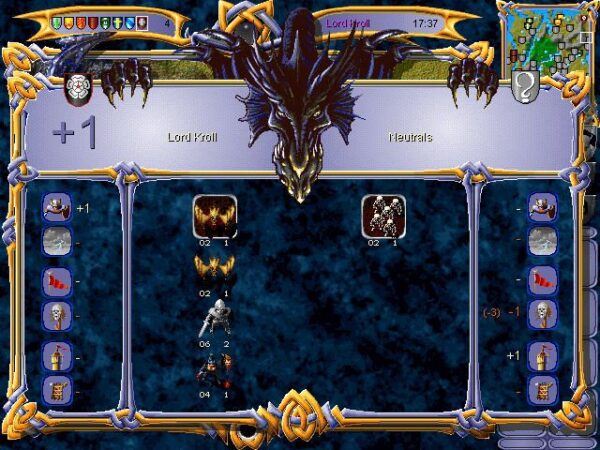
Believe it or not, this screen shows a battle in progress.

Once you get past the tacky cutscenes, which probably cost as much as the rest of the game combined if industry norms held true, Warlords III can seem almost like a shareware game. The in-game graphics are best described as rudimentary — in my opinion, actually worse than those in the previous games, which had a colorful low-res charm that these lack. The writing in the tutorial and campaign gives cause to wonder whether the author has entered a contest to see how many overwrought clichés he can pack into a small volume of sentences.

It was 1252 years since the founding of the Selentine Empire when the greatest threat to the free races of Etheria reared its ugly head (1). In the icy wastelands (2) of the far north, Lord Bane, Master of the Undead, and Lord Sartek, Keeper of the Chaos Beasts, had formed an unholy alliance (3). Like a plague (4), they swept down from the northern tundra, crushing the citadels of the High Elves beneath their bony feet (5).

(Not bad for three sentences…)

But we aren’t supposed to care about any of this, we are told by a small but devoted cult of Warlords III admirers. This game is all about the gameplay.
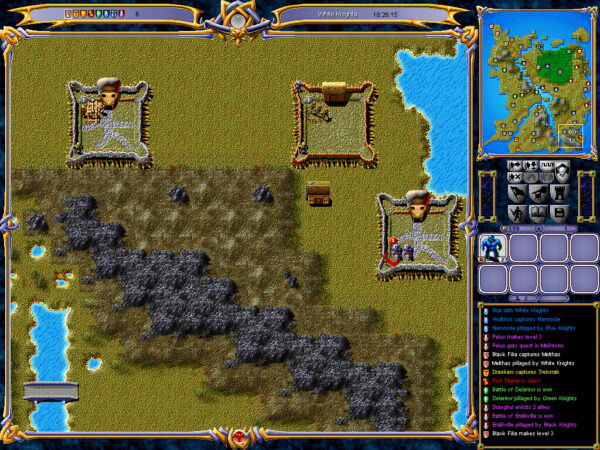
In practice, it feels very much like a board game. You start out with a single hero, and can recruit more as a scenario goes on, but, unlike in Heroes of Might and Magic, you’re free to move your armies — or “stacks,” as the game prefers to call them, thus maintaining the tabletop feel — without a leader at their head. Although the maps in the campaigns are fixed, there is a lot of randomness embedded within them. For instance, you can accept randomized quests on behalf of your heroes. These often entail plundering the dungeons, ruins, barrows, and other such archetypes of fantasy architecture that are scattered around the map for randomized treasure and experience; in keeping with the nature of the combat, the results of any given expedition are revealed to you with a simple onscreen message. The scale of the strategic maps is usually huge, with dozens of towns to dispute with your foes in addition to the other points of interest, but the lack of a tactical component means that the game plays quickly even by comparison with Heroes of Might and Magic.

All of this is… fine, I guess, but I struggled to grow invested in it. I admit that I didn’t get far enough into the campaign to say whether the much-vaunted SSG artificial intelligence makes a difference. With no way to control my units on the battlefield or in the dungeons, I felt like I was playing half a game while someone else played the other half for me and told me what happened. Meanwhile the aesthetics did nothing to make me want to spend time in this world. I tip my hat to anyone who has gotten past these initial impressions and embraced the great game which I am told is lurking underneath. But, speaking personally, Warlords III flew pretty wide of my strike zone.


Next up is Age of Wonders, which came out late in 1999. Designed by Lennart Sas and Arno van Wingerden, it was the first game ever from a Dutch outfit known as Triumph Studios. It was published in North America by Gathering of Developers and elsewhere in the world by GOD’s biggest shareholder, Take Two Interactive.

The impression its opening cutscene gives is the polar opposite of Warlords III‘s: digitized cheese is replaced with lush hand-drawn art (even if it does unveil a dubious new innovation in videogame babes, the first female suit of armor to display the poor girl’s nipples as bas-reliefs). The dramatically different aesthetic sensibility obscures the ironic reality that Age of Wonders owes a massive debt to the older, uglier Warlords series.
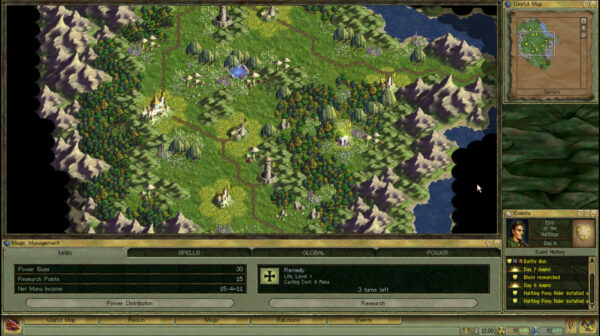
Indeed, Age of Wonders makes for a fascinating study in game design as dialog and evolution, in that almost all of its elements are so obviously lifted from earlier exercises in turn-based fantasy strategy. The core of its movement and logistics is Warlords III, with the same stacks of up to eight units, one or more of which may be heroes who can go up in levels and gain skills and equipment. We likewise have the same large maps strewn with towns to conquer, resources to corner, and dungeons to delve.

But when armies meet one another on one of these maps, there emerges an important difference. You have the option to let the battle resolve itself automatically — i.e., Warlords-style —  but you can also oversee the fray yourself in a tactical game that smacks strongly of MicroProse’s much-loved classic Master of Magic. There’s a global magic system here which is straight out of that game as well. You receive a certain number of mana points per turn, derived from the number of magical wellsprings you control on the map. You can invest your mana into researching new spells for your magic-using heroes or have them expend it by casting the spells they already know. Some of these spells are triggered from the strategic map, where they can remain in effect for many turns as long as you have the necessary mana to sustain them. Others are one-shots for use on the battlefield. And some spells, such as heals and buffs, can be used in either situation.

When you add in a town-management layer that falls somewhere between Warlords and Master of Magic in complexity, you wind up with a considerably heavier game than Heroes of Might and Magic. Speaking of which: the influence of that series can be most readily detected in Age of Wonders’s interest in set-piece storytelling, which extends far beyond the procedurally generated maps of Master of Magic or the halfhearted, poorly written campaigns of Warlords III. The campaign here is presented as a literal storybook, in which you can choose to join the side of one of two elvish factions, one peaceful and idealistic and the other warlike and pragmatic, who are each responding in their own way to an invasion by a new race known as… wait for it… the Humans. Rather than handing you a simple linear ladder of scenarios to overcome, the game lets you make choices at the macro-level from time to time, even gives you the opportunity to switch sides mid-campaign.
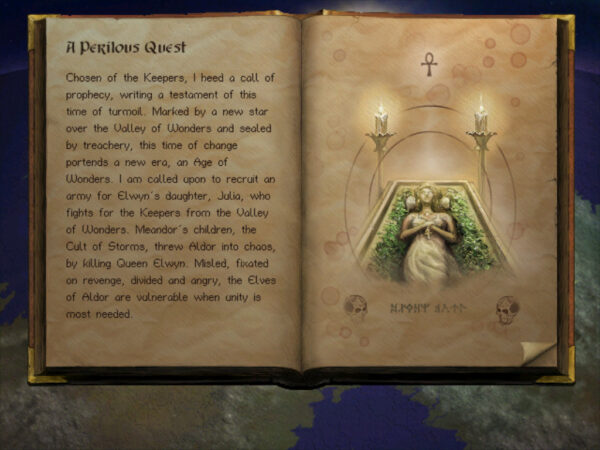
Age of Wonders’s commitment to its fiction is impressive. The diligent and inquisitive player will come to realize that even the standalone scenarios constitute an extended story; if you play them in the order of the dates which stand in their descriptions, you wind up living through a prequel to the main campaign. The atmosphere throughout is slavishly Tolkienesque high fantasy — not exactly the highest-hanging fruit in gaming, but this game pulls it off with more panache than most. Aesthetically speaking, Age of Wonders has aged remarkably well. The art and the music seem as lovely today as they must have the day it was released. (The one odd exception is the sound effects during the tactical battles, which sound like they were lifted from old Three Stooges reels.)
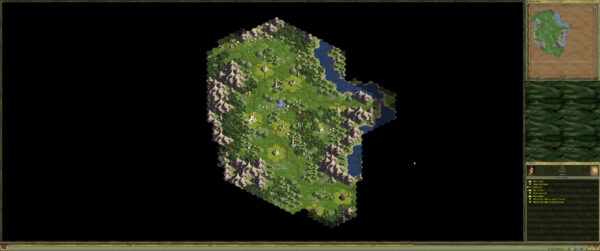
Age of Wonders supports any screen resolution you care to throw at it, including widescreen ones. It ran happily for me in my monitor’s native resolution of 3440 X 1440, making it only the second game I’ve come upon in this fifteen-years-long-and-counting journey through time about which I can make such a statement. The interface elements don’t scale, and became so small at that resolution that the game is effectively unplayable, at least for someone with middle-aged eyes like me — but still, the fact that it works at all right out of the box is amazing.

For all that, though, I couldn’t quite make friends with Age of Wonders either. My problem with it comes down to what the legendary game designer Sid Meier has immortalized as “the Covert Action Rule,” after a flawed and otherwise forgotten game of his that came out in 1991. Meier believes that the reason his attempt to do for spies what his earlier Pirates! had done for corsairs didn’t work as well was that its mini-games were ironically too well-developed, such that they could take too long for the player to complete. By the time she finally gets back to the overarching strategic layer, goes the theory, she’s forgotten what she was doing there, has lost that ineffable sense of flow. “One good game is better than two great ones” stuffed into the same box, goes one of Meier’s oft-quoted design principles. Of course, game design is as much art as science, and the Covert Action Rule is a real problem right up until the point when it inexplicably isn’t. Speaking for myself, I don’t even think it’s the principal issue with the game Covert Action itself.

But I do think that it’s my problem — mileages will obviously vary here — with Age of Wonders. Those tactical battles you get dropped into when armies clash are very slow. Your units usually start out well away from the enemy, far enough away that just maneuvering them into range can require several turns of careful micro-management. Worst of all are the dungeon-delving expeditions, in which you find yourself trying to move up to eight units one by one through a series of twisty little passages, hoping not to get any of them caught out by the monsters that might be lurking around every corner. It takes forever. When you’re finally dumped back into the overland map after one of these extended interludes, it can be downright disorienting, as if you really are trying to play two completely different games at the same time.
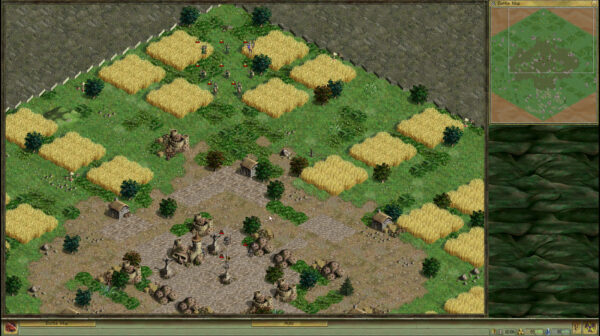
These big, bland tactical maps can be kind of tiring just to look at.

It’s true that Age of Wonders has the option to auto-resolve the battles if not the dungeon-delving. But doing so seldom produces the results you can achieve by taking charge yourself, even as the scenarios tend to be mercilessly tough by the middle stages of the campaign, requiring you to make use of every advantage at your disposal. And anyway, as I already noted in the context of Warlords III, I don’t find auto-resolving the battles very satisfying either.

So, yes, I’m a tough crowd to win over. If Warlords III feels to me like too little game, Age of Wonders feels like too much of one, full of side-quests that are more burdensome than fun. I will say that I’m curious to try the sequels to Age of Wonders at some point in the future; I understand that Triumph Studios made an effort in them to address some of my complaints, by starting tactical fights with the armies closer together and by eliminating the manual dungeon-delving entirely. For this reason, the sequels are definitely on my syllabus.

In the meantime, though, I sort of promised you a Goldilocks game right there in the title of this article, didn’t I? I’m a hard guy to please by this point in my life, after playing games for more than 40 years, but I’m not a hopelessly jaded player. It is possible to strike a balance that makes me happy, as Heroes of Might and Magic proves… and as does Disciples: Sacred Lands.


The narrator’s voice here always makes me a do a double-take, because it reminds me so much of that of the Irish poet Paul Durcan, who lent his talent’s to Van Morrison’s “In the Days Before Rock ‘n’ Roll.”


Disciples comes to us by way of a Canadian company called Strategy First, which was founded in Montreal around 1990 by Don McFatridge and Steve Wall. After playing supporting roles in the industry for a number of years, they decided to try to make a go of it as a full-fledged developer and publisher late in the decade, peddling lower-budget, nichier games than those that tended to interest the established publishers. Disciples, which was released at about the same time as Age of Wonders, was created by a small French-Canadian studio, previously known as Micomeq, which Strategy First had recently acquired.

The game was designed by one Danny Bélanger. Sometimes dismissed by reviewers even today as just a low-budget Heroes of Might and Magic clone, it actually has a mind and personality that are very much its own. Its most obvious fresh idea is its approach to territorial gain, the source of its subtitle. (The name “Disciples,” on the other hand, has nothing much to do with anything here as far as I can tell; the developers seem to have chosen it just because they thought it sounded cool.) You don’t manually tag the gold and mana sources on the map with your armies to claim them for yourself, as you do in most other games of this style. Instead there is a zone of influence around each town a player owns, which widens its circumference gradually at a rate of one square per turn. This process continues until the expanding circle of influence is blocked, by the territory of a rival, a border of the map, or a mountain range, ocean, or other impassible landmark. Thanks to this system, you can tell from a glance at the map which faction is winning: the human Empire’s territory is lush green, the Undead Horde’s bleak and dark, the dwarven Mountain Clan’s a snowy white, and the Legions of the Damned’s a fiery red. In fact, many of the scenarios have victory conditions that crown as the winner the first faction whose terrain fills a given percentage of the map. It’s a unique and enjoyable mechanic, with the potential added bonus of staving off the late-game tedium of conquering the last few enemy towns left on the map.
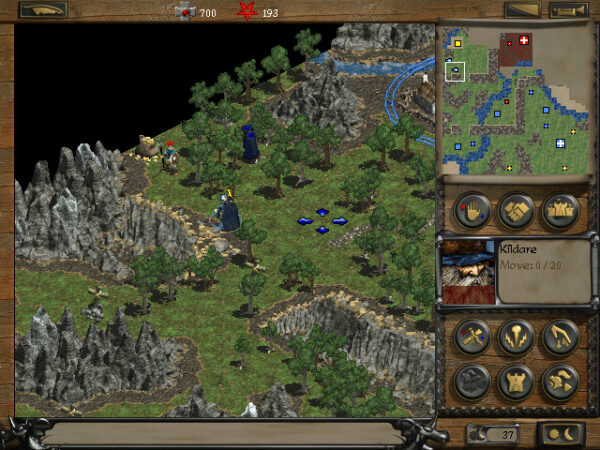
The symbol of the evil Legion of the Damned faction (as seen on the mini-map at top right here) is the Danish flag. I’m not sure what to make of that…

Doing a clean sweep of the whole map would be almost impossible anyway, because each faction’s capital comes complete with a single super-strong unit that cannot be moved but is virtually impossible to defeat. In effect, then, you never really have to worry about losing your capital. This is especially nice in multiplayer sessions, as it means that no one has to suffer the indignity of being knocked out of the game early and then sitting around waiting for the other players to finish, feeling like the world’s biggest loser all the while.

As in Heroes of Might and Magic, units here can only move if led by a hero. Each of these can have from zero to five subordinates, depending on his or her Leadership level. In another break from other games of this general type, even the underlings here are explicitly cast as individuals, not groups, and have the ability to level up and get stronger just like the main heroes as they fight battles and win experience points, as long as you have built the appropriate upgrades in your capital to enable their advancement. (These features led Strategy First to call Disciples a full-fledged CRPG in some of their press materials, but this is going rather too far.) Each faction has a different selection of hero and underling types that can be purchased in its towns — as many of each as you can afford — and then further customized as they gain levels. (Pro tip: more Leadership is always the right choice for your heroes whenever it’s available.) The game is quite well-balanced on the whole, with no faction having a truly decisive advantage.

Now, to address the Goldilocks in the room: there is tactical combat in the game, but it’s extremely simple even in comparison to Heroes of Might and Magic, much less Age of Wonders. Each unit has exactly one attack to inflict upon its enemies, or, in the case of defensive units, one heal or one buff to apply to its comrades. Your job in combat entails nothing more than deciding whom your units hurt or help when their turns come up, by clicking the appropriate enemy or friend. Maneuvering on the battlefield is not a consideration, for the very good reason that it’s impossible. The whole exercise is so ridiculously simple that at first you might think it rote, nothing but a more click-intensive version of Warlord’s automated battles. Give it a chance, though, and you’ll find that it’s not entirely bereft of Sid Meier’s proverbial Interesting Decisions. Whom do you choose to attack first? Whom do you heal or buff? These decisions can be the difference between victory and defeat in a close fight.
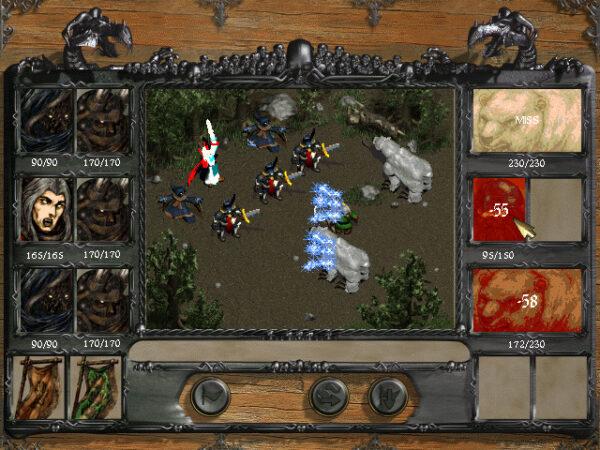
The combat screen. I’ve just hit all of my enemies with an area attack, although my hero missed one of the polar bears. (Ah, well… we’re supposed to be trying to save the polar bears, right?) Two members of my party here are specters, who paralyze a single opponent for one turn rather than damage him. I just have to decide whom to paralyze. That’s where some dilemmas start to creep in…

There’s a magic system here too, a highly streamlined take on the Master of Magic approach. You have to research spells before you can cast them. You can’t use these spells in battle (other than if your unit has a “built-in” magic spell as its one and only move), but you can use them on the strategic map to soften up enemy stacks before you attack them, to buff your own units, or to do other things, such as revealing a section of map hidden by the fog of war or, conversely, hiding a piece of it from your opponents once again. With the tactical combat being so basic, success often hinges on what you do before a fight begins.
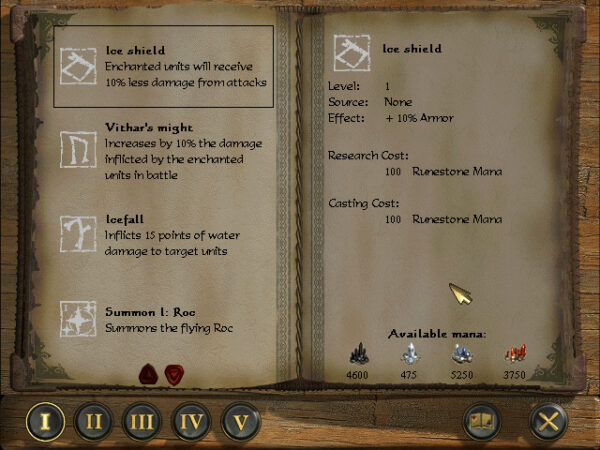
The spell book. Each faction has one type of mana that it favors and its own unique set of spells to research. The only way to obtain other spells is to trade for them.

Disciples isn’t what anyone would call an overly complex game, but it has more subtleties to it than you might think. Dorte and I had more fun with this game in multi-player mode than we have with any since Heroes III. (She found Warlords III too ugly and dull and Age of Wonders too complicated to want to play them with me.) We’re not particularly cut-throat competitors, especially against one another, so we appreciated being able to approach the scenarios more as a race for third-party towns and territory than a mano a mano fight to the death.

Of course, there are aspects of the game that could stand improvement. On the whole, Disciples’s flaws are the inevitable byproducts of a small team working within a budget of well under $1 million Canadian. The artificial intelligence of your enemies could be better, as could the single-player campaigns in general. There are four of these, one for each faction, albeit consisting of just four scenarios each. I found them to be pretty much incomprehensible in terms of narrative, just a lot of portentous word-salad speechifying adding up to nothing. They must relate to one another somehow, must be parts of some grander story, but I certainly couldn’t explain it to you even after watching all of the cutscenes on YouTube. Nor do I care enough to want to try — which is always the worst indictment anyone can level against any piece of fiction, isn’t it?

Within the campaign scenarios, the developers attempt to compensate for the poor artificial intelligence by stacking the odds more and more wildly against you; this is, in other words, another one of those asymmetric strategy games which SSG so decried. Even so, I never found the one campaign I actually completed — that of the Empire faction — all that taxing.
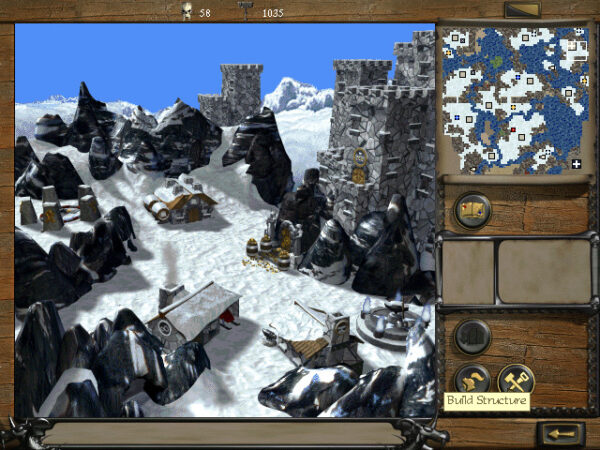
The capital-management screen for the Mountain Clans. It changes as you build more structures, but to tell the truth that’s something I scarcely notice. The graphics in this game aren’t actively bad, but are kind of anonymous-looking, with a palette dominated by dull browns and grays.

The above means that Disciples is easier for me to recommend as a game to play with a friend or two than as a single-player experience. When played with others, the stupid enemies no longer matter so much and the disarmingly elegant core rules are allowed to shine. Disciples hits that sweet spot of being easy to pick up but… okay, not exactly hard to master, but not trivial either.  I love it when I discover a new game that Dorte and I can enjoy together. And it’s always great to see a small team with original ideas come up with something as well put-together as this. The graphics and sound they could afford are not those of a AAA game — not even a AAA game from 1999 — but they’re just good enough not to be actively distracting, living somewhere between those of Warlords III and Age of Wonders.

Everyone’s mileage will vary, but for me, Disciples is the keeper of this trio. Fast-playing and straightforward, it’s the perfect game to share with someone else on the patio on a warm summer day in between sipping on a cool beverage and shooting the breeze. I like it. I like it quite a lot. And I very much look forward to trying out Disciples II.


Did you enjoy this article? If so, please think about pitching in to help me make many more like it. You can pledge any amount you like.


Sources: This article is a bit more experiential than a product of deep research, but there are a few online sources that proved exceptionally useful. These are The Wargaming Scribe’s write-up of SSG and Reach for the Stars, an old Gamespy piece by John Keefer on “Developer Origins,”Game Daily interview with Don McFatridge, a Home LAN interview with McFatridge, and a Kotaku interview with Steve Fawkner. Also the February/March 2000 issue of the French magazine Cyber Stratege.

Where to Get Them: Warlords III: Darklords RisingAge of Wonders, and Disciples: Sacred Lands are all available as digital purchases at GOG.com.

 

Tags: , , , , , ,

Planescape: Torment, Part 2: …to the Desktop

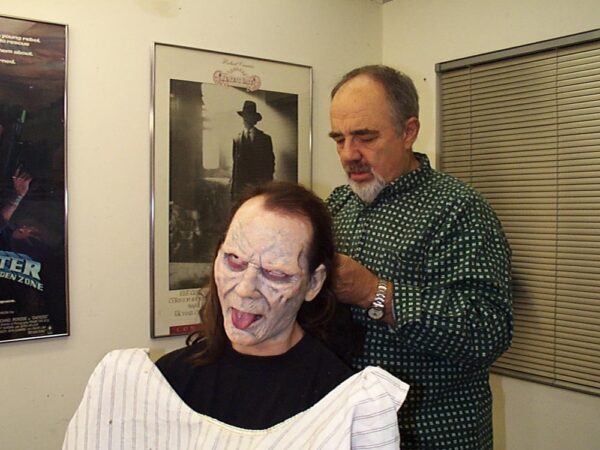
The photographer’s model for the visage of The Nameless One on the now-iconic Planescape: Torment box was actually Guido Henkel, the game’s producer, who was enlisted at the last minute when the planned professional model had a “scheduling conflict.”


This article tells part of the story of Dungeons & Dragons on the tabletop and on computers.

Usually if you choose the longest dialog option, that’s the best option.

— Chris Avellone

Quite some years ago now, I briefly interviewed Brian Fargo about Interplay’s 1988 adaptation of the William Gibson novel Neuromancer. He was plainly busy and a little distracted with more modern game-development matters — this was in the midst of the Kickstarter-funded Wasteland revivals — but he was helpful and friendly enough during the half-hour or so that I spoke to him. Toward the end of our conversation, he mentioned that he had a box full of papers from his Interplay days gathering dust in a filing cabinet in his home office. Upon hearing this, I leapt immediately to make a pitch for my archivist friends at the Strong Museum of Play in Rochester, New York. And lo and behold, a Brian Fargo collection showed up at the Strong within a year or so. I don’t know whether these two events are related, but I like to think that they are.

Regardless, the next time I made it up to the Strong, I naturally made it a point to go through the collection. And it was there, amidst a mishmash of other documents spanning the nearly twenty years that Fargo spent running Interplay, that I first stumbled upon the original pitch document for Planescape: Torment, the one that crossed his desk in June of 1997 and led to the project being formally green-lit. I found this document rather shocking at the time, in that its tone was so totally out of keeping with the hallowed reputation which the game had long enjoyed even then as the most credible claimant to the status of true Interactive Art that the CRPG genre has ever produced. Much of this pitch, by contrast, seemed to have been written by Joe Lieberman’s most stereotypical nightmare: by a sadistic, DOOM-addled teenager who turned it out in between dry-humping everything around him with an even vaguely feminine shape.

No more using boring swords, daggers, or bows to carve bloody swaths through opponents. Plunge scalpels into foes’ eyes, lace their food with poisonous embalming fluid, push them into man-eating pockets of ooze, sic them with sarcastic biting skulls, hurl them into razorvines, conjure burrowing rot grubs within a victim’s brain, cast spells that make them bleed from every orifice, or change a person’s scent so they attract packs of hungry rats. Deliver punishment in ways that will bring a smile to your face.

“Fireball” can go hide in the fucking corner when you unleash your arsenal. Jam your hand into an opponent’s body, rip out his soul, and tell it to kill its owner. Make a gesture and summon a blanket of crawling, biting insects to turn your enemy into a Happy Meal. Send your foes on a field trip to Hell without a permission slip. Taunt someone to death. Summon your darkest shadows from across existence and send them into battle to feed on your opponent’s physical strength. Your succubus ally can kiss your opponents to death — they die with a smile on their face.

This game will have lots of babes that make the player go wow. There will be fiendish babes, human babes, angelic babes, Asian babes, and even undead babes. Think babes. Then think more babes.

To which one can only reply, whoa… whoa. Settle down there, Beavis, before you rub that thing raw.

This document, which has long since surfaced publicly and made the rounds of the Internet, has become something of a problem for Planescape: Torment’s cult fandom, being so markedly at odds with what they wish the game to be. Some have gone so far as to claim that the juvenile profanity was nothing more than an elaborate ruse to get Brian Fargo and his marketing cronies to sign off on such an uncompromising piece of art, or that this is the only corporate pitch document in the history of the world to inhabit the category of satire. But personally, I’m not buying these pat explanations. I think that the finished Planescape: Torment that we know is a blending of the adolescent and the rarefied, the commercial and the idealistic. It’s not that the higher concepts and grander themes don’t exist. It’s just that they’re embedded into a licensed and branded Dungeons & Dragons computer game — made by, let’s face it, a bunch of nerdy twenty-something American men with the same predilections and blind spots as their peers elsewhere in the industry. We probably shouldn’t allow ourselves to get quite as precious about it as we often do.

For what’s worth, I suspect that Chris Avellone himself might more or less agree with this assessment deep down in his heart of hearts. In every interview I’ve seen him give on the subject of Planescape: Torment, he’s been distinctly reluctant to take on the persona of the auteur creating timeless art for the ages. He tends to speak more in the terms of a creative professional who was given a job to do: “Like just about every game I’ve worked on in my career, the franchise or premise was mandated, and then I worked within the parameters given.” He prefers to frame the protagonist’s journey to self-knowledge more as a way of flattering the typical gamer’s sensibilities than a conscious artistic masterstroke.

It is a very selfish game. After about ten years of game-mastering players… that’s really all they care about. They want the entire adventure to revolve around them. Players want to hear people talking about them. It’s the ultimate ego stroke.

Again, this is not to say that Planescape: Torment doesn’t resonate in certain places with the proverbial human condition. It’s merely to say that it’s a complicated, piebald beast. Is it art? Maybe, depending on how you define such things, since art is always in the eye of the beholder. Is it a penetrating work of moral philosophy? Maybe, to some extent, but maybe not quite so much as some folks want it to be. Is it well-written? Intermittently, although seldom on a sentence-by-sentence level. Is it brave and groundbreaking in the context of its time and circumstances? Absolutely. Is it a great game, full stop? Eh…


Building the perfect box-cover beast…

Fair warning: a considerable number of Planescape: Torment spoilers follow!

Baldur’s Gate, the only Infinity Engine game to precede Planescape: Torment, attempts very explicitly to recreate the pleasures of playing tabletop Dungeons & Dragons with your friends. The companions whom you collect around you could easily be the avatars of said friends. Each of them is an archetype — fighter, magic user, cleric, thief — which constitutes one part of a Gary Gygax-approved well-balanced adventuring party. The game employs the classic “a group of adventurers met in a bar and went questing” setup. There’s an overarching plot, but it’s really just an excuse to explore more terrain, fight more monsters, and grow steadily stronger.  If you want, you can even play Baldur’s Gate together with your real-life friends, with each of you taking control of one character (although it’s rather clunky in practice, being subject to the technological limitations of the late 1990s).

Whatever else it happens to be, Planescape: Torment is nothing like that. It’s the very specific story of one very specific character, presented it a way that would never have worked with a gang of others sitting around the tabletop. Companions do arrive to accompany him, but they are always peripheral to his central psychodrama. There is no multi-player mode here. Having one would make no sense.

The protagonist of Planescape: Torment is the appropriately named Nameless One, a zombified shamble of flesh and bone who wakes up at the beginning of the game on a mortuary slab in Sigil, the city of inter-planar doors, with no idea who he is or how he got there. So, he sets off to try to find out. Along the way, he meets the aforementioned companions who join him on his journey. One or two of them he even meets in a bar, but these are not your typical happy-go-lucky adventurers with mercenary stars in their eyes. The fact is that each of their stories has long ago become interwoven with that of the Nameless One himself, generally to their detriment, and even though he can’t remember any of it. His own backstory will prove to be far longer and stranger than you or he might ever have thought possible, encompassing hundreds of lifetimes lived out all over the planes of existence, during which he has been good and evil and everything in between. His true quest, it will gradually become clear, is not merely to find out who he really is. Doing so is just a prerequisite to stopping the cycle of rebirths, owning his sins, and finally bringing his story to an end.

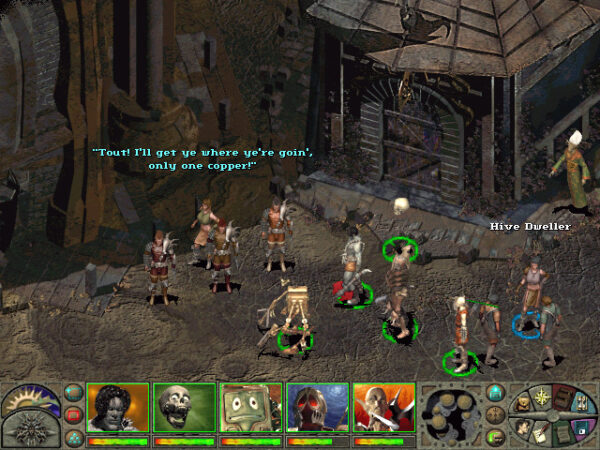
Planescape: Torment demonstrates the flexibility of the Infinity Engine. In keeping with the more personal focus of the story, the team at Interplay moved the camera in closer to show the characters on the screen better, condensed the interface down to a single bar at the bottom of the screen, and reworked the controls to make use of a popup, adventure-game-style radial verb menu.

Not only does Planescape: Torment subvert the traditional plot outline of a CRPG by turning a triumphalist power fantasy into a tragic journey of self-discovery, but it subverts many of the standard CRPG mechanics to serve its agenda. The Nameless One is immortal, which means that defeat and “death” in combat is a minor inconvenience at worst; he will always wake up once again on his mortuary slab, with all of his inventory, companions, and experience points intact. (In some places, he is even required to “die” in order to advance the plot.) With physical threats being thus robbed of their menace, a clever dialog response is almost always worth more experience points than defeating the same interlocutor in battle. Swords, armor, and most of the other usual trappings of heroic adventure are seldom seen, replaced by stranger concoctions, like a floating skull who can upgrade his attack by acquiring sharper teeth. Planescape: Torment is not your parents’ CRPG.

To wit: if you come to this game expecting a plane-skipping roller-coaster ride through a wide variety of environments, I’m afraid you’re destined to be disappointed. Most of it takes place within Sigil. You start out in the slums and eventually make your way to slightly posher districts of the city, but the general atmosphere remains one of futility and decay from first to last. I’m frankly not sure how to respond to this. My wide-eyed inner child, the one who used to consume pulpy sci-fi novels by the dozen, thinks it’s false advertising to promise us a city of doors to infinite possibility and then deliver only this sad-sack assemblage of run-down mundanities. My more mature incarnation, the one who studied (or in some cases suffered through) the literary classics at university, thinks it might be an admirable case of a game sticking to its guns. But even he begins to feel crushed under the sheer weight of misery on display here, begins to wonder what pathetic excuse for a multiverse this is that has such a squalid, nihilistic centerpiece.

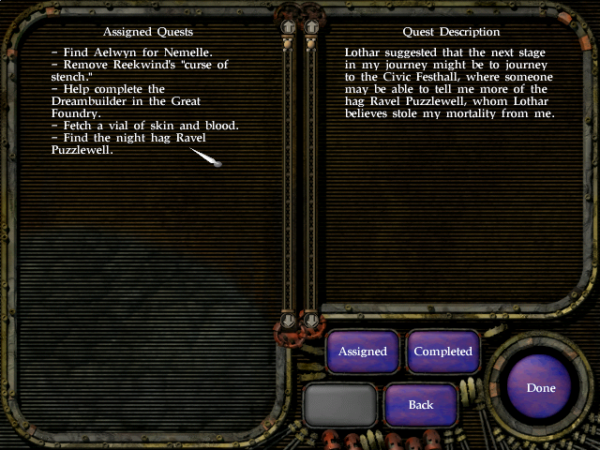
Planescape: Torment has its share of interface issues, but the quest log at least is far more usable than the one in Baldur’s Gate.

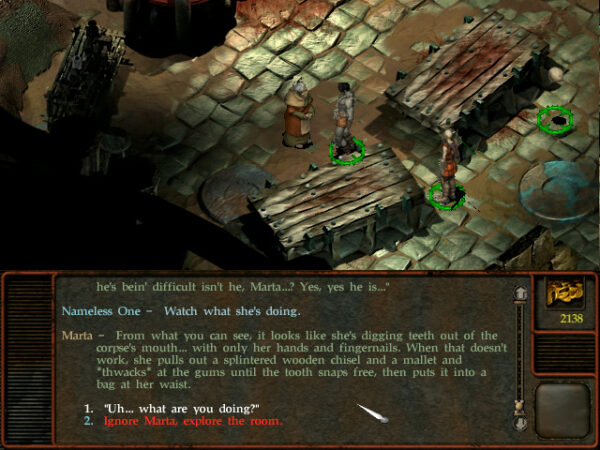
In practice, much of your time in Planescape: Torment will be spent wandering through each new district of Sigil as it opens up, clicking on every character who has a name or otherwise non-generic description in order to initiate conversation. Make no mistake. These people like to talk… oh, my God, do they like to talk. A minority of them have information or assistance to offer that pertains to the main quest, or at least to one of the many side-quests. Most of them, however, just “rattle their bone-box,” as the Sigil lingo goes, for the sake of hearing it rattle, telling you all about their hardscrabble lives in paragraph after paragraph of text. I find that it becomes numbing after a while, a symphony of despair that just keeps hammering away on the same relentlessly grim note. It’s Down and Out in Paris and London, except an order of magnitude longer in a different dimension.

The Cant — the Cockney-inspired lingo of Sigil — is striking, even if it is lifted from TSR’s Planescape boxed set rather than being an innovation of this development team. All the same, the writing has a rough-draft quality to it that includes but is by no means limited to the typos and minor grammatical errors that are strewn fairly liberally throughout, the well-nigh inevitable result of laying down so very much text in a relatively short span of time. It’s enough to make you long for the days when computers were primitive enough that even text was expensive, such that developers had to choose their words with care, had to make sure that every single one of them counted. Failing that, we might wish that someone in Interplay’s marketing department had insisted that the whole game be voice-acted, which would have served the same purpose of forcing the developers to include only those words that really matter. (As it is, only the occasional line or two is voiced.)

Editing, in any sense of the word, was clearly not a priority here. Back in the 1980s, Infocom employed a full-time editor from the book-publishing world to polish and tighten the prose in its games. But alas, such work was far beyond the core competencies of a 1990s studio like Interplay. The only guiding principle here seems to be the more words, the better. Matters reach a kind of absurd climax when you wander into a bar in which the patrons spout verbatim paragraphs from the old TSR Planescape campaign setting, copied and pasted into the computer game. One can easily imagine that the developers must have been paid by the word, the way people like to say that the similarly verbally incontinent Charles Dickens once was. Whether they were or not, talk is way, way too cheap in Planescape: Torment.

At times, you can almost palpably sense Chris Avellone and his friends straining to put words in the mouths of so many superficially indistinguishable characters in ways that might make them stand out. You want to tell them that it’s okay, give yourself a break: literary merit is not measured by the kilogram of verbiage. Occasionally the writing surrounding the many bit players of Sigil can surprise you with a clever metaphor or a flash of insight or compassion, but more often it just wallows in the squalor. Many of the grotesques you meet are gross just for the sake of being gross, thus revealing that the sniggering lover of blood and boobs who wrote so much of the pitch document remains a part of the development team’s collective unconscious if nothing else.

A man is looking at you with a strange, bug-eyed stare. His eyes are huge… so huge they look ready to pop out of their sockets and roll across the cobblestones. He nods eagerly as you approach, bobbing his head like a bird… and as you near him, you suddenly notice the smell of the urine and feces surrounding him. The man sniffles, wiping his nose on his sleeve, then opens his mouth to reveal blackened, rotted gums…

Reekwind coughs, his eyes almost popping out of his skull as he does so. His cough seems to loosen his bowels, for he breaks wind loudly, as if to accentuate his point…

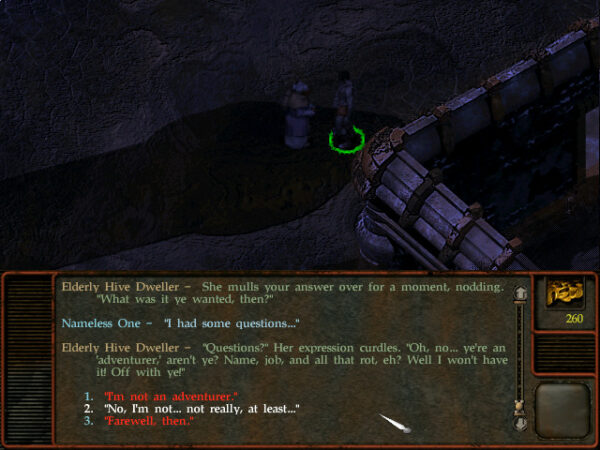
In a moment of levity, the game has fun with some of the tropes of golden-age CRPGs. “I’ll bet ye’ve all *sorts* o’ barmy questions! Greetin’s, I have some questions… can ye tell me about this place? Who’s the Lady o’ Pain? I’m lookin’ fer the magic Girdle o’ Swank Iron, have ye seen it? Do ye know where a portal ta the 2817th Plane o’ the Abyss might be? Do ye know where the Holy Flamin’ Frost-Brand Gronk-Slayin’ Vorpal Hammer o’ Woundin’ an’ Returnin’ an’ Shootin’-Lightnin’-Out-Yer-Bum is? I ought ta kick ye in the shins fer even pesterin’ a poor ol’ woman about it all!”

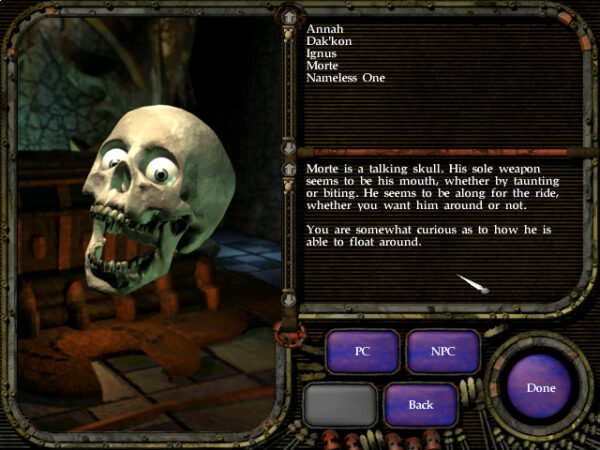
The companions with whom you hack your way through this forest of words instead of monsters are a mixed bag. Morte the talking skull is your first party member, already at your side when you wake up on the mortuary slab for the first time, already seeking to make up for having betrayed you in one of your earlier lives. His redemption arc aside, he’s clearly meant to provide a note of comic relief amidst the cavalcade of misery you encounter, even if in practice his humor misses rather more than it hits; the necrophiliac jokes about every female ghoul and zombie you meet get pretty old pretty quickly.

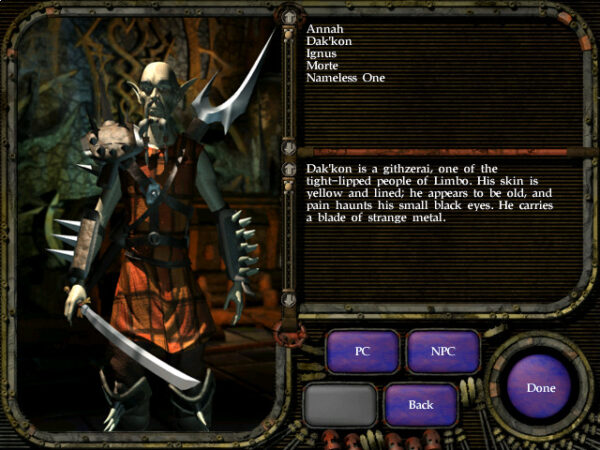
Your companion Dak’kon belongs to the githzerai, a planar race of ascetics who prize order and harmony over all else. Unfortunately for him, a crisis of faith has led to him being cast out by his own people.

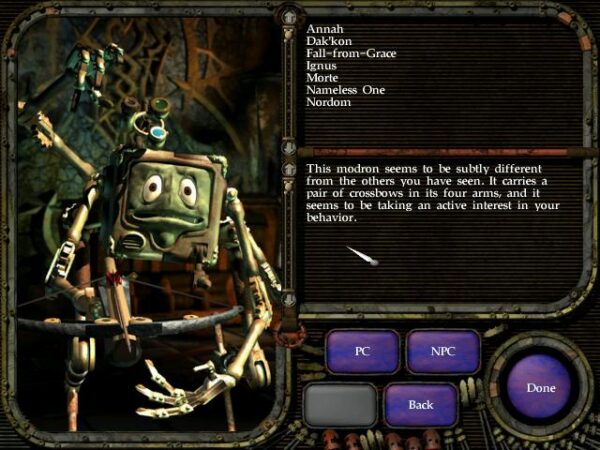
Nordom is not so much cast out as dropped in from what feels like it ought to be a different game entirely. Recruitable only via a lengthy side-quest that’s disarmingly easy to miss completely, he’s a robot who has evolved into sentience and is trying to figure out what to do next. He’s essentially WALL-E nine years before Pixar came up with him; he’s even drawn in a cartoon style, a jack-in-the-box with big, sad eyes and way too many gangling limbs.

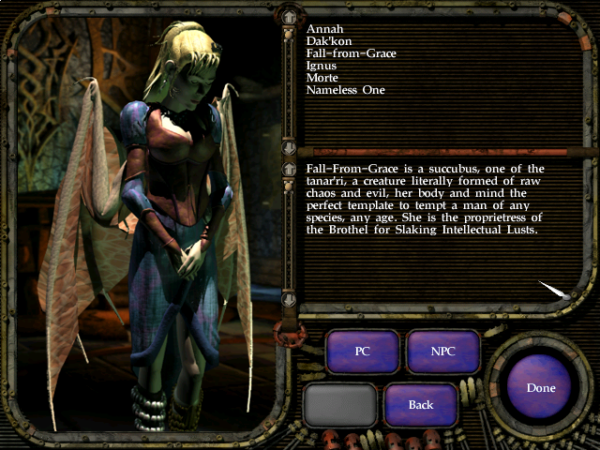
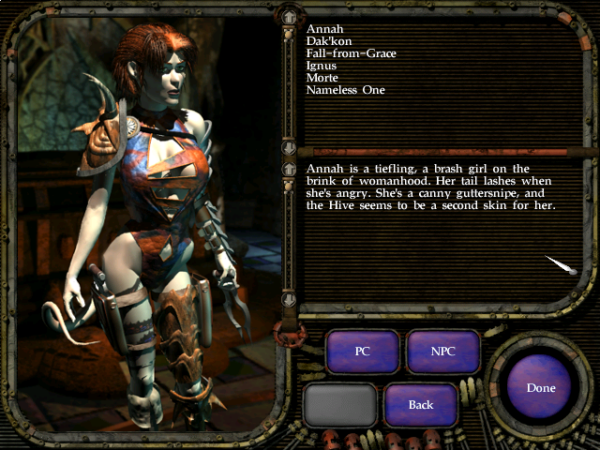
And then we have the two female companions. They are defined by their gender and sexuality in a way that their male counterparts are not, occupying an uncomfortable liminal space between adolescent wish-fulfillment and earnest character-building. The pitch document tells you most of what you really need to know about them when it promises “to fill the game with deep, meaningful interactions with characters that happen to have swaying, pendulous breasts.” Both Fall-from-Grace the reformed succubus and Annah the reforming tiefling thief look like your standard videogame hot chicks. The way they’re written, on the other hand, arguably provides less fodder for students of literature or philosophy than it does for psycho-anthropologists who happen to be studying a certain subset of turn-of-the-millennium young men.

Fall-from-Grace runs the embarrassingly named “Brothel of Slaking Intellectual Lusts.” This establishment is full of hot chicks just like her, who invite their male customers in to… well, just to talk to them about all the nerdy interests that cause other comely young women to roll their eyes and start sidling toward the nearest exit.

Annah is an apparently jaded girl of the streets who, it will eventually turn out, has never known the touch of a man (because of course she hasn’t) and thinks that The Nameless One might be the right one to finally teach her the ways of love (because of course she does).

Fun fact: Annah the tiefling was voiced by Scottish pop singer Sheena Easton. Sadly, The Nameless One never does get to spend a night inside her sugar walls.

Now, I don’t want to jump all over Chris Avellone and his friends for this. I believe we should weigh intent at least as heavily as effect when passing judgment on anything, and the intent here is as sweet in its way as it is perchance inadvertently revealing. If the “babes, babes, and more babes” guy from the pitch document is the person these lads were with their peer group, then the wide-eyed romantic who came up with Fall-from-Grace and Annah was likely the person they became alone at night after their buddies had gone home. I remember seeing the girls I crushed on — the ones I really crushed on, that is — in much the same way when I was their age or only a little younger. To my teenage eyes, they were well-nigh celestial beings whom I wanted to shelter from the ugliness of the world (not least all those other guys who were better at sports than I was) and commune with in a way that transcended sex (not least because I was none too confident in my own abilities in that department in comparison to those other guys). It’s a phase a lot of us go through, but also one that we hopefully outgrow. The problem with such attitudes is that they still preclude one from seeing the object of one’s fancy as a fully-realized human being with a full measure of agency in her own right. Men have been using these velvet cages, sometimes consciously and sometimes unconsciously, to hold women down since time immemorial. The women of Planescape: Torment contribute to the sense of a writing team who are punching a little too far above their own weight — or, maybe better said, their life experience.

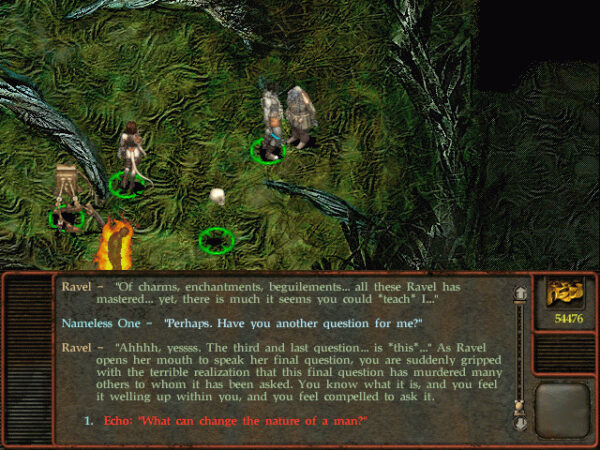
The overwriting and the gawkiness are present in the main plot line as well. Below is a short extract from the game’s turning point, a long-sought-after and predictably prolonged dialog with Ravel Puzzlewell, a witch who knows much about The Nameless One’s real nature.

“A shadow with substance, a-seeking that which casts the light. I know you more and no… know…” Ravel pauses, her eyes dimming. “No more than I know the nature of ANY man. Crossed pasts have we… a man tainted with un-death, still feeling the pangs of separation, and an old withered crone, now all-imprisoned. Seems it that we are a-meeting for the first time? No, no, not, not… knot?” Ravel seems confused for a moment, then shudders, as if throwing off a weight. “Knot at all. An echo of a future meeting this is… or a past meeting, depending on which way time is facing.”

The first thing we notice here is the inverted sentence structures of Yoda-speak, a kind of default setting for mysterious and profound characters in way too many games. It serves to remind us that, for all their aspirations toward Philosophy, these writers are better versed in the works of George Lucas than Aristotle or Nietzsche.

Meanwhile all this punning on “know” and “no,” “passed” and “past,” “not” and “knot,” is the sort of thing that clever and ambitious young writers often turn out, and grizzled and remorseless editors draw a line through just as quickly. For it works only on the page (or the screen, in this case); if it was spoken, as we’re supposed to imagine dialog being, it would all fly right past the interlocutor. In the end, then, the only purpose it serves is to point out the cleverness of the author, which isn’t — or oughtn’t to be — the purpose of writing anything. If we keep at it long enough, most of us writers learn to nip such cherished little darlings in the bud before they can pull our readers out of the story we’re trying to tell.

And now, looking back on what I’ve written, I see that I’ve been hard on Planescape: Torment, harder than I really intended to be. And yet there are criticisms I haven’t even gotten to yet. For example, I haven’t mentioned how unsatisfying and annoying the combat is — yes, it does exist, and is actually quite extended and extensive at times, such as when you have to leave the streets of Sigil to delve into its tombs and sewers, or when you leave Sigil’s dimension entirely during the last quarter or so of the game. (Never fear: the other dimensions you visit are if anything even bleaker than this one.) Ironically, the same changes to the Infinity Engine that make this game feel more personal than the likes of Baldur’s Gate also serve to explain why Bioware made the choices they did for their own, more conventionally combat-oriented CRPG. Here, the close-in camera makes it harder to keep track of what is going on during a fight, even as the other interface changes make it harder to micro-manage your party when you really need to. Most of the standard CRPG elements — character levels, ability scores, spell books, etc. — feel like phantom limbs here; tragic psychodrama makes a strange fit with the power fantasy of Dungeons & Dragons. The final impression which I just can’t escape is that of an engine and system of rules which are badly out of sync with the game they’re being asked to present. If you want to call that further evidence of subversive intent on the part of the development team, be my guest. I just call it unfortunate.

For all that, though, I don’t want what I’ve written to read as an invalidation of the experience of those who have played Planescape: Torment and felt a wind of profundity blowing through its dreary environs. I’ve felt the same wind myself. (And no, I’m not talking about our friend Reekwind.) As you learn more and more about The Nameless One’s endless cycle of pain and suffering, both caused and endured, themes and ideas that games seldom touch on begin to emerge. One particular question is brought up again and again: “What can change the nature of a man?” To its credit, the game never offers a definitive answer, but two possibilities come to the forefront: “Regret” and “Belief.” As Saint Augustine tells us, these are two sides of the same coin: the weight of Regret engenders Belief, while our Belief fills us with Regret for all the ways we fail to live up to our moral potential. Thus the need for Confession to cleanse our souls and be worthy of that which we believe in… and so the cycle continues.

In a revelation that genuinely shook me, you learn near the end of the game that resurrection isn’t free, that every time The Nameless One is brought back to life on his familiar mortuary slab after a failed combat or some other misguided escapade, the life of some other poor mortal schmuck is taken in compensation for his rebirth. The “best” ending has him breaking that cycle by recognizing, acknowledging, and internalizing the suffering he has caused, looking that unwanted self-knowledge and its terrible consequences straight in the face. What follows is by no means conventionally happy, but it is the only fitting way to bring his story to a close. Kudos to Chris Avellone for not chickening out at the last minute, as other game designers have done.

Planescape: Torment is the first game of any stripe that I know of since Infocom’s Trinity to unabashedly don the mantle of Tragedy in the classical sense. Although Chris Avellone’s understanding of what that means is perhaps less nuanced than that of “Professor” Brian Moriarty, the author of Trinity, his take on it is more searingly immediate. For Trinity is the tragedy of an entire civilization, bereft of any characters at all who aren’t bit players, while Planescape:Torment is the tragedy of an individual whom we come to know all too well. Regular commenter P-Tux7 asked in response to the first article of this little duology of mine whether “it is right to punish someone who doesn’t remember doing the crime,” whether “someone can ever become not the person who did the crime,” and whether “justice demands an equivalent amount of suffering.” Such questions constitute the essence of tragedy, which writers have been struggling with as long as the written word has existed.

Despite all its granular failings of execution, then, Planescape: Torment leaves us with much to ponder, regarding both the nature of a man and — on a slightly more plebeian note — the nature of game design. Some of the themes that this game broaches are among the most profound we can wrestle with as human beings. The story of The Nameless One rhymes with the myth of Oedipus, who also looked terrible self-knowledge right in the face and had his soul shriven to the core. Or we might choose to read The Nameless One as a Christ figure, who redeems his fallen companions through a supremely unselfish final sacrifice. But there are likewise obvious parallels to Eastern religion and philosophy, which stress the need to escape the very same eternal life that Christianity purports to offer us. Meanwhile the existentialists among us must ponder whether a Nameless One who can’t remember the actions of his previous incarnations, who possesses no obvious continuity with his previous selves, can be said to truly be the same man at all. In fact, can any of us be said to be the same person we were when we were younger? After all, time is a river that changes all of us second by second, and, as Heraclitus told us almost 3000 years ago, it is impossible to step into the same river twice. Any game that can make its player ponder such thoughts as these is not to be dismissed lightly.

At the same time, though, Planescape: Torment belongs to a category of critic’s darling that always seems to get my curmudgeonly dander up (and tends to land me in hot water with some of my readers): games which are said to be so ridiculously effective as stories and settings that any gameplay inconveniences that dog them pale into insignificance by comparison. Grim Fandango is one of these: we’re told to forget the clumsy interface and nonsensical puzzle design and just enjoy the ride with a walkthrough by our side. Final Fantasy VII is another: forget the endless cavalcade of tedious random encounters and the fact that you can win all of them just by pounding the “attack” button over and over and enjoy the story. No matter how hard I try, I can’t see my way to giving games like these a pass. I love a good story and setting, but the fact remains that interactivity is the defining attribute of a game. It seems to me that it needs to work well too if we are to start throwing around accolades like “masterpiece.”

Much of what strikes me as flaws in this particular would-be masterpiece could have been fixed with a little more time and some more judicious oversight. The writing could be pared down at the same time that it was polished up; 800,000 words are not needed to convey a vivid sense of place and atmosphere, only a subset of the right ones. The tedious combat could be overhauled or perhaps eliminated entirely. Indeed, I sometimes think that my ideal Planescape: Torment would be a ten-hour point-and-click adventure game that doesn’t waste my time with unneeded mechanics or unnecessary talk, that makes every moment count. I doubt that Chris Avellone would go that far, but, again, I sense that he may just agree with me about some of the game’s infelicities. It’s just that he would prefer to improve the other systems rather than narrow the focus to the core story. “If the moment-to-moment gameplay is lacking,” he says, “then you’ve failed as a game designer. The combat was pretty weak, and I did feel it could have used more dungeon-crawling areas for players to explore and have fun in in addition to having fun exploring the conversations in the game.” Who knows? Maybe that would work too.

For when it comes right down to it, I still don’t know quite how to feel about Planescape: Torment; when I called it confounding at the start of this pair of articles, I meant it. I first tried to play it not long after it came out, only to give up after a few hours, bored by the depressing setting and all of the people there who never shut up. I returned to it in order to write these articles, and my sense of professional duty carried me all the way through this time around, even though I was once again bored for much of the time. Still, I’m glad I stuck it out, glad to truly know one of the most celebrated computer games in history. Yet I must confess that I’m equally glad to be done with it. I am of the opinion that the most fundamental responsibility of a game, before theme and meaning can even enter the discussion, is to entertain or at least interest its player. Planescape: Torment failed that test too often for me to call it a great game. If you want me to call it a brave and intriguing one, though… well, that I can definitely get behind. Seldom has any group of creators in this field challenged the expectations of their audience so thoroughly. And that in itself is a brave feat well worth applauding.


Did you enjoy this article? If so, please think about pitching in to help me make many more like it. You can pledge any amount you like.


Sources: The book Beneath a Starless Sky: Pillars of Eternity and the Infinity Engine Era of RPGs by David L. Craddock; Computer Gaming World of March 2000 and April 2000; the 2015 GamesTM special issue on “controversial” games; Retro Gamer 113. Plus the materials found in the Brian Fargo Collection in the archives of the Strong Museum of Play.

Online sources include Soren Johnson’s interview with Chris Avellone for his Designer’s Notes podcast, a Last Game Standing interview with Avellone, and Guido Henkel’s pictures and memories of posing for the Planescape: Torment box cover.

Where to Get It: Planescape: Torment is available as digital purchase from GOG.com in an “enhanced edition.” Buying it also gives you access to the original version.


Tags: , , , , ,