RSS

Category Archives: Digital Antiquaria

Perry Mason: The Case of the Mandarin Murder

Perry Mason: The Case of the Mandarin Murder

When they announced the first Telarium games to considerable press fanfare in 1984, Spinnaker Software promised that they would represent not just a new line of adventure games but a whole new approach to interactive fiction that would take the form beyond what even Infocom had so far achieved. The new Telarium philosophy was expressed in interviews by PR mastermind Seth Godin:

The adventure-game market has been pretty much the same since 1976, when the first adventure game came out. That is, they’ve been puzzle-based games, be they text or graphics — they’ve always been based on a series of logic puzzles.

We’re trying to make a game that is based on plot and characterization, not puzzles — the way a book is. If you read Fahrenheit 451, you don’t get stuck on page 50. And if you play the game, you don’t get stuck on frame 50, because the whole idea is that you’re interested in the game because of the characters and the plot and what’s happening. You care about what’s going on.

In short, Telarium promised to “replace puzzles with character-oriented situations.”

Anyone who had been working with adventure games for a while and thus knew what a difficult proposition that was had their skepticism amply justified when the first slate of Telarium games actually appeared near the end of the year. Rendezvous with Rama was, predictably enough given its almost bizarrely adventure-game-like source novel, exactly the “collection of logic puzzles” set in a deserted landscape that Godin had said Telarium wasn’t interested in making. Fahrenheit 451, Dragonworld, and Amazon all played out in more populated worlds, but used their non-player characters as window dressing or, at best, puzzle solutions and password vending machines. And thanks largely to a parser that was truculent even by the standards of the era, Fahrenheit 451 in particular was full of exactly the sort of opportunities to get infuriatingly “stuck on frame 50” that Godin had promised wouldn’t be there. The games just didn’t live up to the hype.

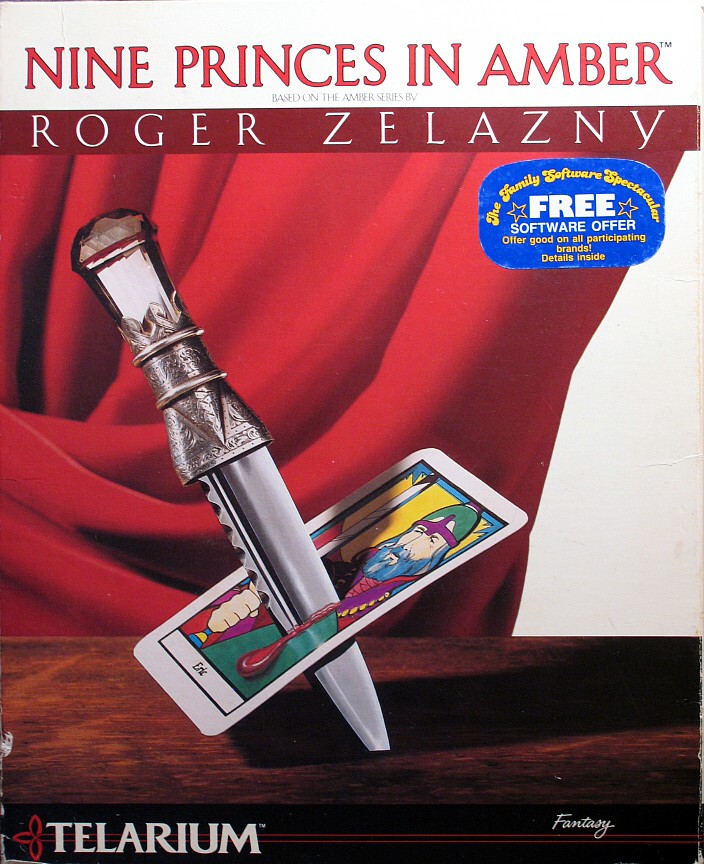
All of which made the next two releases in the line, which trickled out almost a year after that initial glut, doubly surprising. Both Perry Mason: The Case of the Mandarin Murder and Nine Princes in Amber try much more earnestly to do the sorts of things that Godin had been talking about all along. Indeed, their character-interaction ambitions and determination to turn the adventure game into genuine interactive fiction exceed even Infocom’s farthest voyages into those fraught realms. Mind you, their ambitions don’t reach anything close to fulfillment, and can be read as an object lesson in the reasons that Infocom chose to shy away from similar projects in the name of crafting playable games. Still, their determination to push the boundaries make them if nothing else some of the most interesting games of their era.

These games can also serve as an object lesson in just how quickly the times can change. By the time they appeared ominous warning signs had turned into a full-blown home-computer-industry slump from which nothing suffered more than the nascent phenomenon of bookware. Perhaps due to the disappointing sales of that initial slate of games (from which, only and oddly, Michael Crichton’s Amazon was excepted), Byron Preiss and his team of talented young writers and illustrators had parted company with Spinnaker, taking with them an apparently all but complete game based on Robert Heinlein’s Starman Jones as well as deals in the works with the likes of Philip José Farmer and Alfred Bester. Undaunted, Spinnaker took creative as well as technical ownership of Perry Mason and Nine Princes in Amber in-house; both games are products of committees, including in the case of Perry Mason no fewer than four people — among them the irrepressible Mr. Godin — writing the “scripts.” Whatever the usual merits of such an approach, in this case it results in no noticeable drop-off in quality or ambition. Whatever else you can say about them, these games are no camels.

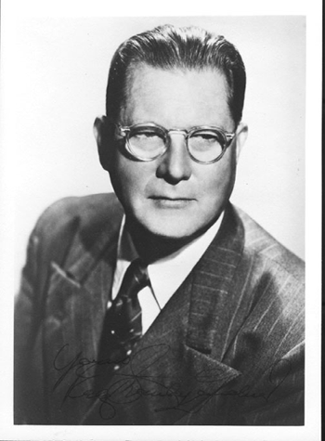
Erle Stanley Gardner

The original creator of Perry Mason, Erle Stanley Gardner, can stand proudly alongside Dennis Wheatley as one of the great bad writers of the twentieth century, his life story a monument to sheer dogged persistence more so than any innate talent. A rather abrasive personality cut in the classic can-do American mold, he passed the bar and became a lawyer in 1911 without ever darkening the door of a law school. He turned to writing action, adventure, detective, and science fiction with the arrival of the pulps in the 1920s. Showing the commitment with which he approached everything he attempted, he forced himself to churn out 4000 words per night, 1.2 million per year. He was unashamed of his motivations: “I write to make money, and I write to give the reader sheer fun.” When questioned why his heroes always seemed to finish off the bad guy at last with the last bullet in their guns, Gardner said, “At three cents a word, every time I say ‘Bang’ in the story I get three cents. If you think I’m going to finish the gun battle while my hero still has fifteen cents worth of unexploded ammunition in his gun, you’re nuts.”

Once his finances allowed, Gardner further refined his approach to writing, hiring as many as six secretaries to whom he dictated outlines of his stories for completion and polishing; this literary assembly line earned him the sobriquet “the Henry Ford of detective fiction.” By the time of his death in 1970 his oeuvre was so huge and published in such diverse and often ephemeral places as to be virtually uncatalogable. It includes at least 150 novels, at least 500 short stories, a significant body of nonfiction writing (largely on travel and history) for the glossy magazines, radio and television scripts. His sales in his heyday were equally enormous: at one time the Guinness Book of World’s Records could name him nothing less than the best selling writer of all time.

For all that productivity, Gardner would be regarded, like Wheatley, as little more than an historical curiosity today were it not for a single member of his large stable of lawyers, private eyes, and adventurers: Perry Mason. The redoubtable lawyer first appeared in 1933 as the star of the novel The Case of the Velvet Claws. That version of Mason was created in the hard-boiled image of Sam Spade: a two-fisted brawler who’s all about the money his services will earn him and isn’t afraid to resort to blackmail to achieve his ends. But as time passed and Gardner and Mason made the transition from the rough-and-tumble world of the pulps to the more genteel environs of the Saturday Evening Post, Gardner’s Mason gradually softened into something in at least the same zip code as the glibly savvy do-gooder soon to become a fixture of American television.

In the years before that star-making turn by Raymond Burr, Perry Mason was adapted many times into other media, including a string of low-budget movies and a long-running radio serial. Like the novels themselves, all are largely forgotten today, along with the many actors who portrayed Mason in them. But when Gardner saw Burr audition for the television version in 1957, he just knew he’d found his man at last: “Raymond Burr is Perry Mason!” he declared. Aside from a brief, ill-considered stab at the role by Monte Markham in 1973, no one but Burr would ever dare play Perry Mason again.

Burr’s Mason became one of the most enduring characters in the history of television, lasting through not only the original series’s staggering 9-year, 271-episode run (they cranked ’em out quick in those days) but also a series of 26 well-received television specials broadcast between 1985 and Burr’s death in 1993. He remains a fixture of daytime syndication schedules today, his theme song still immediately identifiable as soon as it comes over the airwaves (or cable line, or Internet…). The televised version of Mason came to entirely supersede his print counterpart, to the extent that even many loyal viewers of the television series then and now don’t realize that there ever was a Perry Mason before Raymond Burr.

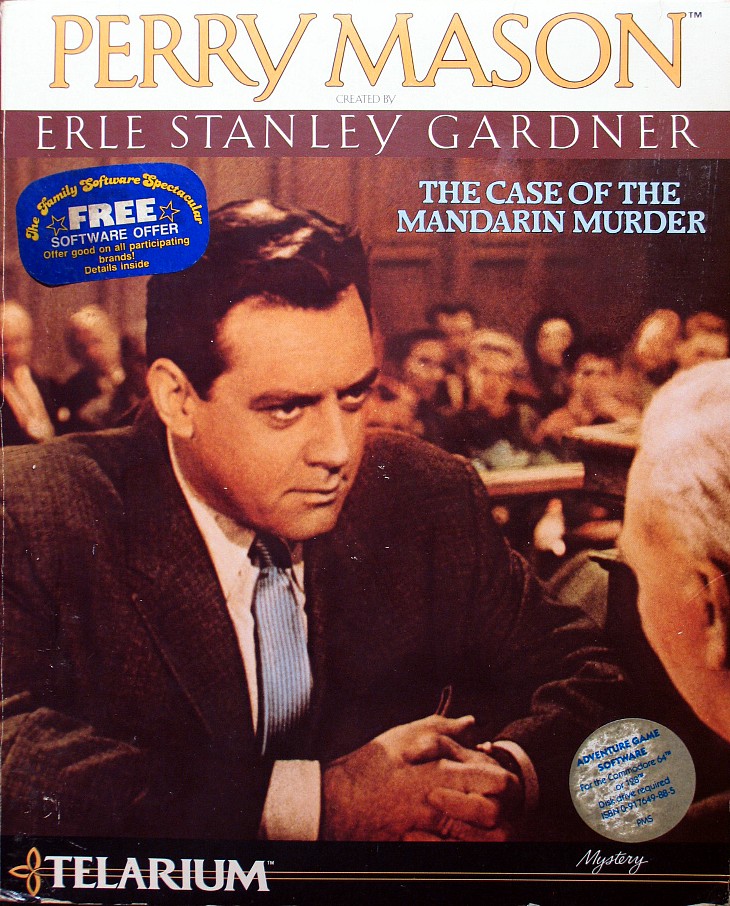
Which brings us back to Telarium’s adaptation. Telarium was of course supposed to be a line of book adaptations. Spinnaker had already demonstrated what contortions they would go through to uphold the bookware concept with Shadowkeep, for which they hired Alan Dean Foster to write an inconveniently absent source novel. Still, no one in 1985 was interested in playing a game based on Gardner’s Perry Mason novels, which had largely fallen out of print and into obscurity following his death in 1970. So what we have is a hybrid that duly plays homage to the bookware concept by featuring the name of Erle Stanley Gardner prominently on the cover along with a nice “about the author” blurb to describe him, but which is otherwise an unabashed re-creation of the television version. This Mason is clearly Burr’s Mason. Not only does he feature on the package cover, but his colleagues and opponents in the in-game illustrations are perfect likenesses of the actors who portrayed them on television. The game even opens with a computerized rendering of that iconic theme song.

For obvious reasons, the polite fiction that the authors of the Telarium source materials were all intimately involved with their adaptations is here quietly but definitively dispensed with. This is a licensing deal, pure and simple, with the Gardner estate’s Paisano Productions holding company also getting its name on the box, albeit in the copyright fine print. The timing must have seemed perfect to both Spinnaker and Paisano: Perry Mason’s star was suddenly rising in the wider culture, thanks to the first of that series of television revivals that brought him back to prime time for the first time in many years just as the game was being published.

The game’s case could have fit easily into either the television show or one of Gardner’s books. Your client, one Laura Kapp, was apprehended by the police in an insentient state in her apartment with a gun lying just a few feet away — the same gun, in fact, that killed her husband Victor, who was found lying across the room. It seems that Laura was just released from a mental hospital and was extremely jealous as well as unstable, and for good reason: it appears that Victor was conducting at least one affair in her absence. Open-and-shut case, right? Anyone who says yes has never seen an episode of Perry Mason; the fellow amassed a final record of 268 to 3 (with one defeat later overturned on appeal) on television getting clients out of equally tough spots.

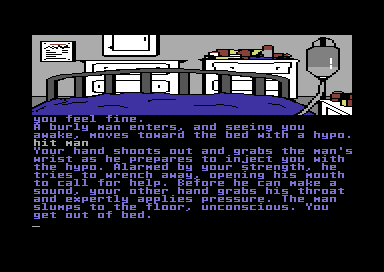
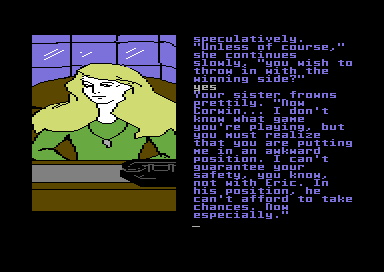
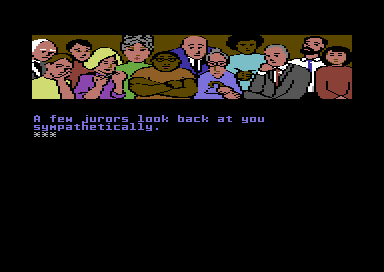
But if The Case of the Mandarin Murder is a fairly typical episode of Perry Mason, it’s a very atypical adventure game, minimizing or dispensing entirely with some of the most established conventions of the genre, among them object-oriented puzzles, mapping and (geographical) exploration, even compass directions. The first part of the game, during which you search the Kapp apartment for clues under the watchful eyes of the police, is the most traditional. But that is only a prelude to the real meat of the experience, which plays out as a series of examinations and cross-examinations in the courtroom. Just as in the television show, you’ll need to direct your faithful colleagues Paul Drake and Della Street to follow up the leads that emerge in the apartment and over the course of the trial; they’ll often be running in to give you vital information in the very nick of time. Also present are Mason’s usual long-suffering foils, Police Lieutenant Arthur Tragg and District Attorney Hamilton Burger (one can’t help but wonder, given his record against Mason alone in the most open-and-shut of cases, how the latter in particular manages to keep his job). And then there are of course this episode’s guest stars and potential suspects, in the form of Laura herself along with the mysterious femme fatale with whom Victor was supposedly conducting his affair, Victor’s business partner and said partner’s wife, a restaurant critic with a grudge, and a doorman with a shady past. The trial can go in many different directions, with various final outcomes possible. It’s not that hard to amass enough evidence and cast doubt on enough testimony to gain a hung jury or even an acquittal for Laura. But to unmask the real culprit and force a patented Perry Mason confession amidst a hail of tears and recriminations… aye, there’s the rub, for both the right and the wrong reasons.

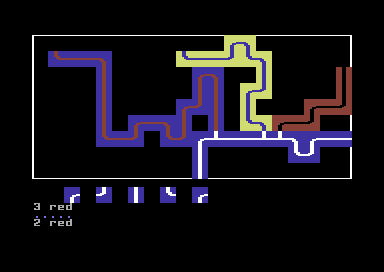
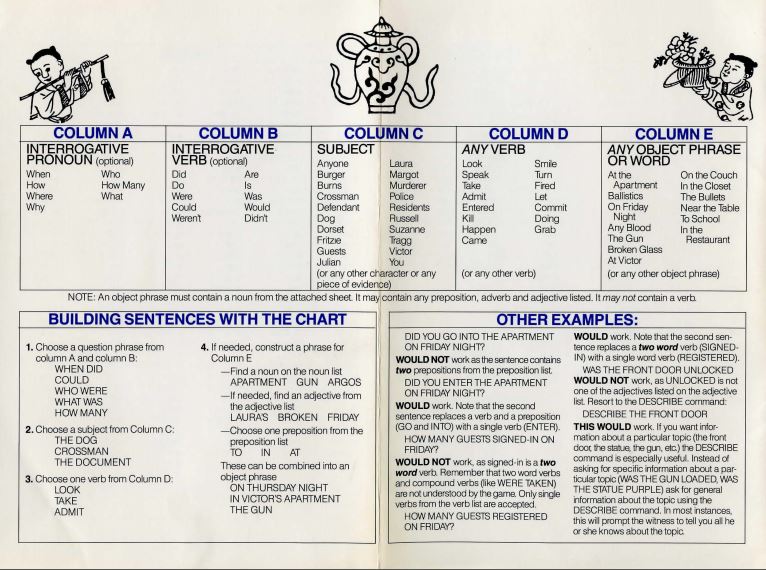
If you read my articles about the earlier Telarium games (or, better yet, if you’ve played any of them), you may be wondering how Telarium’s problematic parser fares in a production as dependent on character interaction as this one. The answer is, slightly better than you might think, but still nowhere near well enough. It’s not that the folks at Spinnaker, perhaps still stinging from criticisms of the parsing in those earlier games, weren’t aware of the challenge. Why else would they include in the package an elaborate and really quite clever “Mandarin Menu” which includes not only a vocabulary list but also a sentence-building chart for phrasing your interrogations?

Perry Mason's sentence-building menu

Still, it doesn’t work out all that well. Many queries, including plenty that seem to comply perfectly well with the chart, fall flat. It’s just way too hard to figure out how the game wants you to phrase things, what keywords — and remember we’re dealing here with lots of abstract subjects like feelings and affairs and alibis — it wants from you to trigger a response in a witness. Combine that with the stubborn lack of feedback typical of the Telarium parser, and you end up with a feeling all too common in interactive fiction, that of never being sure whether a given line of questioning is really unproductive or whether you’re just not phrasing things correctly. In other words, is this witness shaking his head at you for diegetic reasons, because his answer is really no, or is he doing it because the extra-diegetic parser doesn’t understand you? To further complicate matters, you’re constantly being graded by the jury on your competence, confidence and flair for courtroom drama. As soon as you start to bumble and stumble around up there the game is up. Thus playing becomes a matter of experimenting on each witness to figure out what she can understand and what you can get from her, then restoring to play the polished and all but omniscient Mr. Mason we know from television.

Perry Mason: The Case of the Mandarin Murder

Another problem is more subtle than the war with the parser. The solution to the case, when it finally emerges, is convoluted and, well, pretty much ridiculous — hardly an anomaly in the world of Perry Mason. The problem in the context of a Perry Mason game, however, is that it’s effectively impossible for you to ever arrive at it until the guilty party breaks down and confesses. With no real hard evidence pointing to that guilty party, you’re largely left to just hammer on everyone until somebody finally cracks. You’re rather left in the position of the would-be know-it-all detective in Simon Christiansen’s modern interactive fiction Death Off the Cuff. Yet whereas that game knows what it’s doing and, indeed, is meant as a send-up of absurdly omniscient detectives just like Perry Mason, this game is not so knowing. Believe me when I say that the solution totally comes out of left field — and is totally stupid at that.

Another thing about the case, not so much annoying as just strange: while Victor was a prominent restauranter, nothing “Mandarin” has any real bearing on the case. The subtitle is apparently a reference to the restaurant Victor was planning to open next, but said restaurant isn’t germane to much of anything about the actual murder. About the best thing you can say about it is that it allows for that neat “Mandarin Menu” of sentence composition, a sort of backdoor homage to the hacker’s traditional love for Chinese food. (The subtitle could also be taken as an advertent or inadvertent homage to Gardner himself, who built his early law practice defending the rights of Chinese immigrants. He remained fascinated by China throughout his life, visiting the country several times and allegedly building up a passable proficiency in Cantonese, no mean feat for a Westerner.)

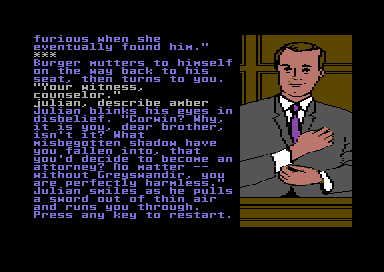
So, no, The Case of the Mandarin Murder doesn’t entirely work as game or as courtroom drama. Yet it’s nonetheless kind of fascinating for what it tries to do as well as for the way it tries to do it. Although it sprawls across the four disk sides typical of all the Telarium games, a single playthrough is unlikely to take much more than two hours (or maybe three if you play the Commodore 64 version I’m making available for download here, what with that machine’s painfully slow disk access). It’s implemented in depth rather than breadth, loaded with details to be uncovered and secrets to be discovered. Sure, some of the Easter eggs are just silly; the dumbest plays on the fact that one of the characters is named Julian, same as a character in Telarium’s contemporaneous Nine Princes in Amber game.

Perry Mason: The Case of the Mandarin Murder

But that sort of silliness is more the exception than the norm. Better are the moments here and there when the parser does understand you for a few turns at a stretch and you really do feel like Perry Mason up there jabbing and feinting at the witness and playing it up for the jury. Those moments, if not quite enough to make it worthy of an unabashed recommendation, are more than enough to make me toast its ludic dreams and ambitions nobly striven after if ultimately unfulfilled.

(Sorry for the long delay between posts, as well as this site’s going offline for a day or two recently. My mother suddenly and unexpectedly died, which led to lots of emotional turbulence and a frenzied trip back to America. In the midst of all that I neglected to renew my domain registration. Things will hopefully now be settling back into a normal rhythm.

Sources on Telarium this time out were pretty much the usual referenced in previous articles, especially the December 1984 Compute!’s Gazette and the June/July 1985 Commodore Power Play. A couple of interesting summaries among many of Erle Stanley Gardner’s life and career can be found at Thrilling Detective and at the website of his long-term home town of Temecula, California. And thanks as always to C. David Seuss for sharing some of his memories and some valuable resources from the glory days of Spinnaker Software.)
 

Tags: ,

Spellbreaker

Spellbreaker

As Infocom settled into their middle and latter period, their game releases also settled into a fairly predictable pattern that tried to balance innovation with traditionalism. Steve Meretzky:

The hardcore gamers, the people who liked Zork and just wanted more like Zork from Infocom, they were always made unhappy by [games like] A Mind Forever Voyaging or Plundered Hearts or Nord and Bert Couldn’t Make Head or Tail of It. Anything that we did that was moving in a different direction or in any way experimental, they would always squawk. So the company’s plan was basically to try to do some of each, to always do a game or two every year that would be the “red meat” for those original hardcore players, and then to try to innovate with some of the other games each year.

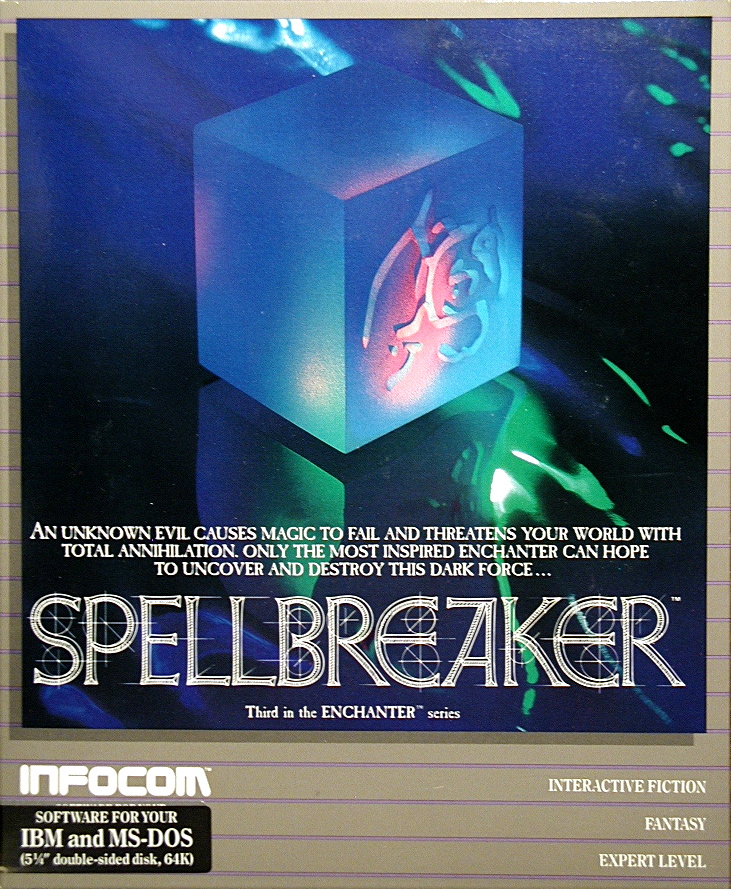
Our subject for today, Spellbreaker, was the long-awaited third game in the Enchanter trilogy as well as Infocom’s most blatant of all bits of pandering to these traditionalists, who made up a much larger percentage of the company’s fan base than Infocom’s modern reputation for relentless innovation and dedication to the literary aspects of the humble text adventure might seem to imply. An “Expert” level game, it was explicitly created by Dave Lebling as a response to the carping of the hardcore of the hardcore that Infocom’s games had been getting much too easy since the days of Zork. “You want a diamond-hard, traditional puzzlefest?” Infocom asked. “Fine, we’ll give you a diamond-hard, traditional puzzlefest!” Coming out just weeks after the radical departure that was A Mind Forever Voyaging, Spellbreaker could almost be read as an apology to the hardcore for that namby-pamby, touchy-feely effort.

That said, it should also be noted that the concerns about creeping easiness, engendered by an ever more thorough testing process and the thoroughgoing sense of fair play that was always one of Infocom’s noblest traits, were not confined to fans outside the company. Meretzky himself, the perpetrator of A Mind Forever Voyaging, has noted that he also felt concerned as time wore on that at least certain types of Infocom games were losing some of their core appeal, that the struggle and sweat of the Zork games, the compulsion to jump out of bed in the middle of the night to test out some crazy action that just might solve a heretofore intractable puzzle, was the very thing that drew many people to them. Spellbreaker would be Infocom’s attempt to rekindle the masochistic joy of Zork.

There’s always a tendency in all forms of criticism to fetishize innovation over virtually everything else; music critics, for instance, will always favor the Clash, who morphed and relentlessly experimented and soon collapsed under the sheer weight of their artistic ambitions, over their punk-era counterparts Stiff Little Fingers, who have just continued to do what they’re good at for decades. It’s an understandable and even defensible impulse, but I also have to confess that, just as I’m more likely to pull out Stiff Little Fingers’s Go For It! than any Clash album, if you asked me which game among A Mind Forever Voyaging and Spellbreaker I most enjoy just playing every five to ten years, I’d have to name Spellbreaker. Spellbreaker is as constrained a design as A Mind Forever Voyaging is boundary-shattering: constrained by its need to please the puzzle-hungry hardcore, by its need to fit in with the two previous games of the Enchanter trilogy and continue with their spell-based puzzle mechanics and Zorkian fantasy premises. But it’s also an absolutely brilliant specimen of traditionalist adventure gaming, one of the best, tightest examples of pure game design Infocom ever crafted.

As old school as its sensibilities may appear in comparison to its immediate predecessor, Spellbreaker is not devoid of theoretical or historical interest. Far from it. In its quiet way, it asserts a profoundly important idea for the craft of adventure-game design: that fairness and difficulty are two independent scales. If virtually any of Infocom’s contemporaries decided to make a self-consciously difficult game like Spellbreaker, they would have simply filled it with punishing mazes and riddles and guess-the-verb problems and inscrutable puzzles dependent on unmotivated actions. We know this because that’s exactly what they did, over and over again. (For instance, have a look at Scott Adams’s two-part alleged brain-burner Savage Island for everything not to do in an adventure game in one convenient place). Certain designers never could seem to separate fairness from difficulty in their minds. (I can’t help but think of Anita Sinclair, who pronounced on the eve of Magnetic Scrolls’s second release Guild of Thieves that this would be an “easier” game. Actually, no, it turned out to be a very hard game — just one that wasn’t blatantly, repeatedly unfair like its predecessor The Pawn.) Many fans still have trouble with the concept today; I get occasional emails in response to my coverage of notable offenders like Roberta Williams’s The Wizard and the Princess and Time Zone asking why I’m so hard on “difficult” games, forcing me to respond that, no, I’m actually only hard on unfair games. One could advance a fairly compelling argument that the failure of the adventure-game industry at large to grasp this distinction played a big part in the commercial death of the text adventure — how many veteran gamers still remember the form largely for mazes, guess-the-verb, and illogical puzzles? — as well as the longstanding commercial doldrums of graphical adventures, what with their pixel hunts and click-everywhere-and-use-everything-on-everything-else-until-something-happens model of game design.

Spellbreaker is very tough, but it’s also downright noble in its commitment to fairness. There is, if you’ll pardon me, no bullshit here, none of the cheap tricks, designed and implemented in less time than it takes to drink a cup of coffee, that designers have so often used to artificially lengthen games and make players pull their hair out. You don’t even need to draw a map to play Spellbreaker — but never fear, you will likely want pen and paper to sketch and plan and diagram a long series of tantalizing puzzles that have been lovingly crafted over days and weeks. In my book, that’s the way a game like this ought to be. Spellbreaker is a veritable capsule history of adventure-game puzzles (the good ones, that is): intricate pure spatial and mathematical puzzles like those so common in the Phoenix games; clever object-application puzzles; logistical puzzles requiring long-term planning; the best and most satisfying application yet of the spell system invented for Enchanter; the latest and greatest and most intricate in an ongoing series of Infocom time-travel puzzles; even a social-interaction puzzle to keep you on your toes. And there are lots and lots of them. While it runs under the standard 128 K Z-Machine, Spellbreaker stuffs it right to its limit, and will take quite some hours to complete. There are one or two puzzles that I might wish had been a bit less difficult — most notably a certain puzzle that takes place in a lava field and hinges on a property of a certain little box that you’re unlikely to discover until you really have exhausted every possibility for experimentation — but none that I can label truly unfair if we’re willing to give the game a free pass on Graham Nelson’s prohibitions against the occasional need for knowledge of future events and knowledge gained from dying. The key thing is that you can trust Spellbreaker as you try to beat it, can trust that the solution to the puzzle on which you’re currently working can be arrived at through observation and deduction rather than being some random phrase to be typed or senseless action to perform. I can’t emphasize enough what a difference this trust — or, perhaps better said, its absence in so many other games — makes for the player’s experience.

The plot is obviously not the first priority for either player or writer of a game like this, but Spellbreaker‘s is in some ways more interesting than it ought to be. Having averted two previous disasters in Enchanter and Sorcerer, you’ve been elevated to head of the Circle of Enchanters. But now suddenly magic itself has begun to fail throughout the realm. The game opens at a conclave of Guildmasters that has been called to address the problem. Lebling was, along with Brian Moriarty and perhaps Jeff O’Neill, the best crafter of prose amongst all the Imps, and his writing is particularly good here, sparkling with subtle wit.

Sneffle of the Guild of Bakers is addressing the gathering. "Do you know what this is doing to our business? Do you know how difficult it is to make those yummy butter pastries by hand? When a simple 'gloth' spell would fold the dough 83 times it was possible to make a profit, but now 'gloth' hardly works, and when it does, it usually folds the dough too often and the butter melts, or it doesn't come out the right size, or..." He stops, apparently overwhelmed by the prospect of a world where the pastries have to be hand-made. "Can't you do anything about this? You're supposed to know all about magic!"

Hoobly of the Guild of Brewers stands, gesturing at the floury baker. "You don't know what trouble is! Lately, what comes out of the vats, like as not, is cherry flavored or worse. The last vat, I swear it, tasted as if grues had been bathing in it. It takes magic to turn weird vegetables and water into good Borphee beer. Well, without magic, there isn't going to be any beer!" This statement has a profound effect on portions of the crowd. You can hear rumblings from the back concerning Enchanters. The word "traitors" rises out of nowhere. Your fellow Enchanters are looking at one another nervously.

Then everyone except for you is abruptly turned into some variety of small amphibian, and your adventure truly begins. Ah, well, what did a committee hearing ever accomplish anyway?

You find yourself pursuing a mysterious antagonist — obviously the source of the magical disruptions — through a whole series of interlinked scenic vignettes, most no more than a few rooms in size (thus the lack of the need for mapping), which you reach by casting the Blorple spell (“explore an object’s mystic connections”) on a series of magical cubes you find. The acquisition of more of these cubes, representing as each does the next waypoint in a grand chase across time and space, turns out to be the main goal of most of the scenes you visit.

While certain aspects of Spellbreaker, like a group of wandering boulders on which you have to hitch a ride at one point, suggest that Lebling may have been reading Roger Zelazny’s Amber novels (as it happens, a subject we’ll get to very soon in another article), the most marked literary influence is Ursula Le Guin’s classic fantasy A Wizard of Earthsea, a great favorite of Lebling’s. Like the young wizard Ged, the protagonist of Spellbreaker realizes at the story’s climax that the shadowy being against whom he has been struggling is in fact a shadow of himself. The discovery is followed by Spellbreaker‘s ambiguously profound coda.

The shadow, now as solid as a real person, performs a back flip into the tesseract. "No!" It screams. "Stop! Fool, you've destroyed me! You've destroyed magic itself! All my lovely plans!" Now glowing as brightly as the construction it made, the figure approaches the center. It grows smaller and smaller, and just before it disappears, the hypercube vanishes with a pop, and the "magic" cube melts in your hand like an ice cube.

You find yourself back in Belwit Square, all the Guildmasters and even Belboz crowding around you. "A new age begins today," says Belboz after hearing your story. "The age of magic is ended, as it must, for as magic can confer absolute power, so it can also produce absolute evil. We may defeat this evil when it appears, but if wizardry builds it anew, we can never ultimately win. The new world will be strange, but in time it will serve us better."

Your score is 600 of a possible 600, in 835 moves. This puts you in the class of Scientist.

As with so much of Brian Moriarty’s best work, Spellbreaker‘s ending makes more mythic than literal sense. It seems our efforts have only led to the end of the Age of Magic and the beginning of the Age of Science. You can read this in many ways — personal and public, negative and positive. You can cast it as the proverbial setting aside of childish things (while hopefully still leaving space for the occasional computer game), marching into a future of adulthood and responsibility with clear eyes. You can cast it in a melancholy light, as the loss of, well, magic in a modern world where everything is already explored and mapped and monitored. Or you can, as I prefer, cast it as the dawning of a better age free of the prejudices and superstitious dependencies of the past. Any way you cast it, to my mind this textual Rorschach test is one of the strongest endings in the Infocom canon; the contrast of “Scientist” with your penultimate title of “Archimage” is bracing and surprising in all the right ways.

That, then, is Spellbreaker, and a thoroughly admirable effort it is. But I couldn’t conclude this article without also describing the great Spellbreaker vs. Mage feud of 1985, an internal struggle so pitched that it still prompts sheepish half-grins and slight discomfort amongst the principal antagonists, Mike Dornbrook and Dave Lebling, today.

Almost from the point he first accepted the assignment to finish out the Enchanter trilogy, Lebling had planned to call his game Mage. It not only gave the names in the trilogy a nice consonance, what with all being synonyms for a wizard or magic user, but also implied a progression of increasing magical potency. When Dornbrook’s marketing people did some impromptu person-on-the-street questioning, however, they discovered a dismaying fact: most people had never heard the word “mage” and had no idea how to pronounce it. Most opted for either something that rhymed with “badge” or a vaguely French pronunciation, like the second syllable in “garage.” The package designers were also concerned that the name was just too short and bland-looking, that it wouldn’t “pop” like it needed to on a store shelf. So Dornbrook went back to Lebling to tell him that the name just wasn’t going to work; they’d have to come up with another.

This in itself wasn’t all that unusual; games like Wishbringer, which had the perfect name almost from the beginning and kept it until release, were more the exception than the rule at Infocom. Most of the time the Imp responsible realized that his title was less than ideal and was willing to accept alternatives. That, however, was not the case this time. Lebling got his back up, determined that his game would be Mage and only Mage. Dornbrook got his up in response, and a lengthy struggle ensued. The other Imps and the other marketers fell in behind their respective standard bearers, leaving poor Jon Palace caught in the middle trying to broker some sort of compromise for a situation which didn’t really seem to allow for one; after all, in the end the game would either be called Mage or it wouldn’t.

From the perspective of today, the most interesting thing about this whole situation is the fact that so many people didn’t know the word “mage” in the first place. It really serves to highlight how much fantasy (nerd?) culture has penetrated the mainstream in this post-Peter Jackson, post-Harry Potter, post-World of Warcraft world in which we live. In 1985 Lebling’s strongest argument against marketing’s findings, one which strikes me as entirely reasonable, was that Dornbrook and company had simply been polling the wrong people. While the average person on the street may not have known the word “mage,” those likely to be interested in the third game of a fantasy trilogy explicitly pitched toward Infocom’s most hardcore fans almost certainly did. As for the aforementioned person on the street, she wasn’t likely to buy the game no matter what it was called.

As usual with such spats inside any relationship, there was actually a lot going on here beyond the ostensible bone of contention. Dornbrook had been frustrated for years already by what he saw as the Imps’ refusal to properly leverage the most valuable marketing tool at their disposal, the name Zork itself. Back in the company’s earliest days, when he had founded the Zork Users Group, he had simply assumed that Infocom would stamp the Zork brand on everything that would hold still for long enough.

It [the game that became Deadline] would have been Zork: The Mystery, etc. I thought that made sense at the time. We had this incredibly strong brand name. To me they were just going to be Zorks. We were going to own a word like “aspirin.” The name for a text adventure was going to be a Zork, and we were going to own that. But a decision was made while I was in business school and not contributing to the decision-making that we didn’t want to go down that path.

Dornbrook’s frustrations were made worse by 1983’s Enchanter, which everyone had assumed would be Zork IV until very shortly before its release, when Lebling and his coauthor Marc Blank suddenly announced that they didn’t want to be “typecast” by forever doing Zorks. Dornbrook tried fruitlessly to explain that, while it might not make sense that people would buy a game if it was called Zork but not if it was called Enchanter, that was just the way that branding worked. Observing how each game in the new trilogy sold fewer copies than the Zork games had and, even more dismayingly, fewer copies than its immediate predecessor, Dornbrook was soon convinced that the company had sacrificed tens or even hundreds of thousands of sales to the Imps’ effete artistic sensibilities.

I felt that marketing needed to be a little more respected, and if we had a strong feeling about something they [the Imps] shouldn’t just… I mean, the game developers, I got along very well and respected them, but there was a bit of, um… they were a little too full of themselves. A little too self-important. A little too, at times, megalomaniacal. Okay, that’s too strong a word… but it was frustrating sometimes from just a business standpoint. They kind of positioned themselves as, “We’re above all that! We’re artists!” Sometimes it seemed a little too precious.

As the 1980s wore on, Dornbrook couldn’t help but compare Infocom to competitors like Origin Systems and Sierra, who unabashedly milked their flagship brands — Ultima and King’s Quest respectively — for all they were worth via an open-ended series of numbered sequels, and, not coincidentally he believed, by mid-decade and beyond were selling far more games than Infocom. Dornbrook now saw a convenient opportunity to force through a mid-course correction of sorts. He thought about how Enchanter still had the internal inventory code of “Z4” at Infocom, Sorcerer and Lebling’s new game “Z5” and “Z6” respectively.

There was a time later on when I came back and seriously suggested, when there was the big fight over Mage vs. Spellbreaker, why don’t we just call it Zork VI? “You can’t do that! What about Zork IV and V?” I said, “Won’t that create a whole bunch of great questions? Maybe it will help sell Enchanter and Sorcerer if they finally realize, oh, those were Zork IV and V.” I never won that argument.

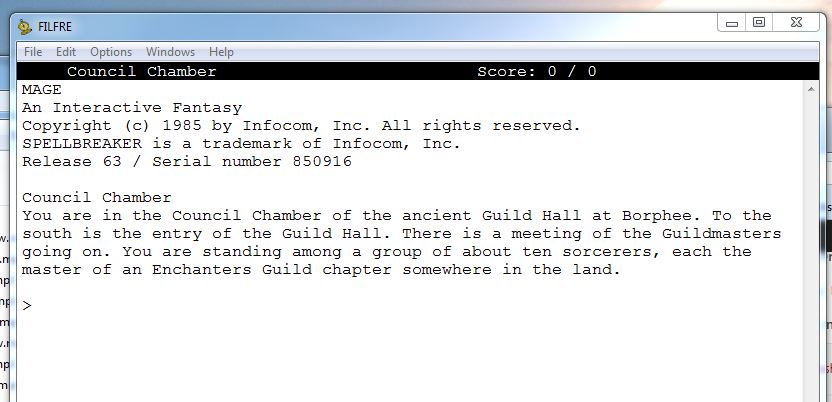
So Dornbrook still didn’t get his Zork; Lebling, who admits he was “terribly exercised” over the whole situation, wasn’t going to allow him that satisfaction, although he does concede it to have been an interesting idea worth considering today. But Lebling didn’t get his Mage either. The game shipped as another suggestion of Dornbrook’s people, Spellbreaker — not a half-bad name in my book, for what it’s worth. Lebling, however, wasn’t pleased at all, and indulged in an uncharacteristic final bit of sour-grapesmanship by sneaking a new routine into the final version that caused it to call itself Mage in the title line about one time out of every hundred.

Spellbreaker

The worrisome downward sales trend that Dornbrook had spotted wasn’t halted by Spellbreaker. Like its predecessor A Mind Forever Voyaging, it sold only about 30,000 copies, making these latest games the two least successful Infocom had so far released. There were obvious reasons for the low sales of each attributable to it specifically rather than Infocom’s position in the market as a whole — A Mind Forever Voyaging was highly experimental and required a fairly powerful computer to run, while Spellbreaker was unlikely to appeal to anyone who wasn’t already a hardcore Infocom fan who had already played Enchanter and Sorcerer — but, well, let’s just say that Dornbrook and everyone else had good reason to be worried.

But such external concerns needn’t distract us from playing and enjoying Spellbreaker today. It’s certainly not the place to start with Infocom, but when you’re ready for it it will be there waiting for you. It really is a masterful piece of game design, and even offers some lovely writing as well. It just might be Dave Lebling’s finest hour — and considering that Lebling also co-wrote Enchanter (and considering how much this critic loves that game as well) that’s really saying something.

(Most of the information here is, again, drawn from Jason Scott’s Get Lamp interview archives. The insight about A Wizard of Earthsea‘s influence on Spellbreaker I owe to an eight-year-old email exchange with Graham Nelson — to whom I also owe thanks just for getting me to read that book.)


Tags: , , , ,

A Mind Forever Voyaging, Part 3: Through Strange Seas of Thought, Alone

A Mind Forever Voyaging

Let’s begin today with the ending of A Mind Forever Voyaging, with that lengthy epilogue which we discussed last time. Not only does it present a glorious public future modeled on liberal notions of good governance, but an equally glorious personal future for Perry Simm. He and Jill remain blissfully in love, about to head off into space for their last and grandest adventure as members of the first of a dozen generations that will live out their lives aboard the colony ship Silver Dove, “mankind’s first interstellar journey.” Their son Mitchell, in this timeline a marine biologist rather than a fascist, calls to wish them bon voyage with grandchildren and great-grandchildren and in-laws arrayed behind him — a touching scene, even if it is a bit strange that neither Mitchell nor anyone else could be bothered to actually come to Rockvil to take advantage of the last chance they will ever have to see Perry and Jill in person. (I suspect old Mitchell is still a bad seed at heart.) It would all be pretty heartwarming stuff, except for one mantra I can’t seem to excise from my head when I play through it: none of this is real! What are we supposed to make of all this in that light?

The PRISM program that spawned Perry — the name it shares with the recent American mass-surveillance program is presumably coincidental, if ironic in light of the dangers about which Steve Meretzky was so desperate to warn us — is described by its founder and leading researcher, Abraham Perelman, in the edition of Dakota Online included with the game. Earlier attempts at creating artificial intelligence by laboriously coding self-awareness into a machine, he notes, all failed miserably.

“If you recall, the previous attempts had failed not because of the design of their machines, but because of their methods of inputting data.” The Vice-President nodded. “The theory behind our process was to make the programming of the machine as similar to the ‘programming’ of the human mind as possible. We would simulate EXACTLY the life experiences of a human being from the very first day of its life.

“Naturally, it was easier said than done. We had to design inputs that would precisely simulate every human sense. A cluster of five computers, each one nearly as large as PRISM itself, would be needed simply to monitor and control the simulation. Here’s an example of how this soliptic programming process works:

“It’s the earliest stage of the process, and the simulation cluster is feeding PRISM all the impressions of a six-month-old human infant. The visual is providing an image of a set of keys dangling in front of him. The aural is providing the jangling sounds. In response to this stimulus, PRISM decides to grab the keys with what his senses tell him is his tiny fist. The visual shows the tiny fist moving into view toward the keys, and then the tactile begins sending the hard, smooth, and jagged feel of the keys. Just one of a million examples that make up a single day’s worth of experiences.

“With the help of a Williams-Mennon grant, we began building PRISM and the simulation cluster in 2020, and the programming process began a year later.”

As the story opens, Perry has “lived” his first twenty years inside the simulated reality Perelman and his colleagues have so painstakingly prepared for him.

The basic idea here is one that’s been batted around AI circles for decades. It arises from an insight transcendently described by Douglas Hofstadter in Gödel, Escher, Bach: An Eternal Golden Braid a few years before A Mind Forever Voyaging‘s release and given a more practical application to AI by Marvin Minsky in The Society of Mind a few years after: that incredibly complex systems, even what we call consciousness, can emerge from the most primitive of building blocks, like a bunch of tiny neurons that can each be either on or off — or a bunch of electrical bits inside a computer that can each be in one of the same two states. We may not be able to program intelligence, but we should be able to grow it like a baby by exposing a sufficiently powerful computer to stimulus.

Or maybe not. With all due apologies to Aristotle and Thomas Aquinas, it must be said that a human baby is not a tabula rasa. She comes into the world with her pump already well primed, with lots of, if you like, programming already in place. A good example is the process of language acquisition. As Noam Chomsky has persuasively argued, babies emerge from the womb with intellects keenly honed, with lots of programming already in place, for picking up language. This ability then atrophies as early as age five. This explains why we never quite know any language as well as our mother tongue; why it’s the only one we can speak without a trace of an accent; why people like my wife who grew up with two (or more) languages are so unbelievably fortunate; why people like me who need to learn new languages later in life and aren’t preternatural linguistic geniuses like, say, James Joyce often find it to be a lifelong struggle that they can never entirely win. What equivalent can a would-be intelligent computer muster to this biological firmware? And without this nature to prime the pump, how can nurture do its thing? This is just one of the unresolved (unresolvable?) problems that PRISM presents to us who are dutifully trying to take A Mind Forever Voyaging at face value.

There’s a seemingly fanciful idea that some physicists have been discussing for some time now: that we are all actually Perry Simms, entities living inside an inconceivably huge and sophisticated simulation. When you get down to the subatomic level, our rich analog universe does seem oddly digital, ultimately made up of tiny indivisible particles (even if we’re not quite sure yet that we’ve found this tiniest and most basic building block). Less facetiously, philosopher Nick Bostrom has set forth an argument that, as such grandly conceptual arguments go, seems fairly airtight. Moore’s Law being what it is, he says, any race of intelligent beings given enough time must eventually develop the ability to simulate a universe as complex as ours inside a machine. Therefore one of three possibilities must hold true: all intelligent races somehow go extinct before they reach that point; all intelligent races decide for some reason not to continue to obsess over virtual realities the way that we humans do today; or the “real” universe, wherever and whatever it may be, is filled with countless simulated universes — very likely simulations nested within simulations nested within simulations — and our universe is almost certainly one of them.

Now let’s think about that idea within the frame of A Mind Forever Voyaging. One thing on which Bostrom and his hard-science colleagues agree is that we won’t have the computing power to even begin to contemplate such a simulation for many, many generations to come. Yet Perelman has apparently done it in 2020, using a hardware setup that sounds suspiciously like the fleet of red DEC refrigerators that powered Infocom’s development efforts. You might argue that he’s actually only simulating one mid-sized town — luckily for everyone, it seems Perry never developed a yen for travel — but, well, butterflies do flap their wings outside the borders of Rockvil, and that has its effects within the town’s borders. And of course that problematic epilogue busts those boundaries wide open by sending Perry on a journey to the stars. The simulation runs not just in real time, but in better than real time; Perry’s first twenty years required only eleven in the world outside the simulation. For the PRISM project to succeed in its goal of raising a human with all the affect and intuitive knowledge of you and me, the simulated reality must be of absolute fidelity. No crude abstractions will serve the purpose, even if they do offer a tempting excuse for the sometimes sketchy implementation of the Rockvil we encounter through our screens and keyboards. Certainly Perry never remarks that the real world of Perelman and Senator Ryder and the rest that he encounters after his “awakening” is any richer or more believable than the one he knew before, nor that its inhabitants feel any more real.

Let’s think about that last for a moment. Perry has lived for twenty years surrounded by fellow humans who apparently see and feel and talk and live and love just as he does. Here we come to the biggest paradox of all: in order to raise Perry in such realistic surroundings, in order to create the affective construct AI researchers have been dreaming of since before Colossus sprang to life, Perelman would need to be able to create not just an affective AI construct but a whole city — universe? — full of them. It’s the chicken or the egg writ large, an eternal golden braid indeed.

Given that he’s managed to create this magnificent simulated universe hundreds or thousands of years ahead of schedule, why is Perelman so obsessed with one simulated inhabitant named Perry Simm? What distinguishes Perry from anyone else being simulated, other than Perelman’s inexplicable regard? Why does Perelman need Perry to go into his own pocket universe and tell him what’s going on in there? Wouldn’t an impartial researcher be able to view the data more effectively and scientifically from outside the bubble? Did Perelman and his programmers really forget to build a user interface for their program? If so, what have they been doing in the eleven years since they started it running? For that matter, just why does everyone trust this simulation so absolutely that they’re willing to let it decide the fate of the nation by telling them what the likely outcome of Richard Ryder’s plan will be?

As Duncan Stevens noted in a comment to my last article, the most charitable reading you can give to A Mind Forever Voyaging as the piece of hard science fiction it seems to want to be is that PRISM is an elaborate scam concocted by Perelman, who’s exactly the sort of unscrupulous and devious liberal megalomaniac that partisan Republicans are accustomed to seeing behind every bush. No other reading makes any sense at all.

Things don’t make a whole lot more sense if we forget the bigger picture and just look at things from the perspective of Perry. Dakota Online mentions the “shock” and “terror” you would feel upon waking up to realize that you’re nothing but a simulated construct, but in truth Perry seems to experience very little of either. It’s all well and good to talk about a Nietzschean will to power and the forging of one’s own meaning for existence out of whole cloth if necessary, but it’s a lot easier to do that when there’s at least some degree of doubt about the fundamental nature of the universe. Confronted with the unassailable fact that the bogeyman in the closet of centuries of philosophy is in fact real, that the existence of the people I thought I knew and loved are all shams, I think I’d be a quivering mass of existential jelly for quite some years at the least. Perry just shrugs and heads off for the World News Network Feed to watch some TV.

When Perry returns to a Rockvil that he’s now well aware to be a computer simulation this knowledge doesn’t seem to affect his experience at all. When Jill is ripped from his arms by Church thugs to be dispatched to a concentration camp, he never seeks refuge in the thought that at least none of this is really happening. Much of this cognitive dissonance is perhaps down to a persistent confusion about which version of Perry we’re inhabiting — a confusion which dogs all of our experiences in Rockvil. As I noted in my last article, the Perry we control inside the simulation often possesses knowledge that the Perry from the outside world wouldn’t.

And then of course comes that epilogue, in which Perry sails off into the sunset with Jill, blissfully untroubled by the knowledge that he’s devoting the rest of his life to playing the world’s most elaborate and immersive computer game. Ironically, the same scenario has a place in A Mind Forever Voyaging‘s earlier stages. The world of 2031 is dogged by a certain amount of low-level controversy about virtual-reality entertainment systems known as “joybooths,” where a disturbing number of people are spending a disturbing amount of time. Joybooths allow them to “escape their worries, even to the point of abandoning their lives.” “Joybooth suicides” are a major thing, claiming nearly 40,000 lives every year. In the first simulated version of Rockvil that we can enter, that of 2041, Perry can experience a joybooth for himself in the local mall. He emerges with “an almost physical longing to return to your fantasy.” The game paints joybooths as a Bad Thing, one of a number of troubling portents hidden by the general economic prosperity of the early post-Plan years. Lest you doubt, consider that Richard Ryder is supported by a pro-joybooth advocacy group called The Joybooth Manufacturers of North America; anything Ryder approves of in A Mind Forever Voyaging is pretty much guaranteed to be wrong and/or evil. Yet what else does Perry do at game’s end but commit the most elaborate and expensive joybooth suicide in history? Poor Dr. Perelman and his colleagues will have to maintain the PRISM computers for decades to come so Perry can enjoy his fantasy. Or maybe not: maybe they pull the plug just as the game ends…

Now, you might say that this article descended into pointless nitpicking quite some paragraphs ago, that a certain amount of handwaving and blasé acceptance is needed to appreciate the larger message of A Mind Forever Voyaging. You might even say that A Mind Forever Voyaging is really a fable or an allegory, not a piece of realistic fiction. But it doesn’t feel like it wants to be a Pilgrim’s Progress for the modern political age. It feels like it wants to be a piece of credible, thoughtful hard science fiction. Why else include all of the backstory about the PRISM project and Perry’s origins, all of those details about AI theory?

Lest I be accused of doing nothing but carp, let me note that there are ways to fix at least some of A Mind Forever Voyaging‘s more seemingly intractable problems. Meretzky might have eliminated the whole “Perry Simm waking up to reality” angle and just cast the player as a real-world researcher experiencing the near future through the eyes of an unabashedly simulated Perry qualitatively no different from any of the other inhabitants of Rockvil. This might have cost the game some of the pathos evoked in us by poor Perry’s plight as an AI construct, but would have led to a much more coherent work of fiction. As it is, A Mind Forever Voyaging is, like these last two articles, bifurcated in intent, trying to offer both a compelling and impassioned political argument and a more thoughtful and philosophical exploration of the ramifications of virtual realities and strong AI. It succeeds to a limited extent at the former; it collapses into contradiction and nonsensicality when it comes to the latter. Perhaps because Meretzky knew he would likely get few such carte-blanche opportunities in the future, A Mind Forever Voyaging tries to do far, far too much.

But then again that very overstuffed quality is a big part of its appeal. If a proverbial Great Work is one that gets us thinking and talking and even obsessing over ramifications — even if only in reaction against much of what the work seems to be saying — then judging from the amount of virtual ink I’ve spilled on it A Mind Forever Voyaging would seem to qualify. If we’re feeling extremely kind, we might even postulate that the game is aware of all of its ironies and internal contradictions: that the juxtaposition of the joybooth-suicide plague with the epilogue, for instance, is intentional; even that it’s well aware of a possible subversive reading of Perry’s voyages into the simulated future as a conspiracy spawned by Perelman to put paid to Ryder and his Plan. This would make it a work of stunning subtlety. However, judging from everything I’ve ever heard anyone involved say about the game (which is quite a lot), I’m not buying that argument. The next question, then, is whether self-awareness or lack thereof matters. Does authorial intent trump all, or is a work of art that accidentally does what it does, even one that undermines the very arguments its author wants to make, legitimate on its own terms? Many contemporary scholars would claim the latter, and for what it’s worth I think they might be right in this case at least.

Its artistic merits aside, A Mind Forever Voyaging‘s historical importance is unimpeachable, not only as the first predominately puzzleless adventure game but as the first attempt to emphatically use the medium for something more than escapism, to say something important and immediate and real about the world around us. If we can call it a masterpiece only by grading it on a curve as steep as Mount Rushmore, well, so be it. These were early days for ludic narrative still in 1985, and it would have been a bit unrealistic to expect Steve Meretzky to crank out an Anna Karenina. That he had an A Mind Forever Voyaging in him is more than remarkable enough.


Tags: , ,

A Mind Forever Voyaging, Part 2: Don’t Go Back to Rockvil

A Mind Forever Voyaging

Our theme song for today is the inevitable.

During the mid-1980s American liberalism was arguably at its lowest ebb of the century. This was the era of Ronald Reagan’s “Morning in America,” when liberalism was viewed as the cause of the economic doldrums of the previous decade and the social unrest of the decade before that, when the de facto voice of the Democratic party for many people was still Jimmy Carter’s handwringing “malaise” speech. While Carter told the people that they needed to fundamentally change their ways of life, to carpool and conserve energy, Ronald Reagan told them the country’s only problem was that they weren’t being American enough. After a somewhat rocky first few years in office, by 1984 the economy was booming as it hadn’t in almost two decades, and Reagan soared to reelection that year. Oddly for an ideology so rooted in tradition and fixated on a mythical America of the past, conservatism felt fresh and vigorous and new, like the future, as the “Greed is Good!” 1980s got rolling at last in earnest. To stand in opposition to Reaganomics was to blow into the face of a hurricane; even counterculture icons like Neil Young were making noises about supporting Reagan. Yet it was at this moment, before the Iran-Contra scandal began to at least reopen a window for debate in the American body politic, that Steve Meretzky penned A Mind Forever Voyaging. Whatever else you can say about it, it was one hell of a brave piece of work.

Meretzky’s stand-in for Reagan — with a bit of Joseph McCarthy thrown in for good measure — is a charismatic senator named Richard Ryder (subtle Meretzky ain’t). It’s 2031, and the United States of North America is once again gripped by economic malaise. Ryder is promoting something called The Plan for Renewed National Purpose to fix all that. I might complain that the name is rather too fascistic-sounding, except that I’m not really sure it sounds any more ominous than The Patriot Act. I might complain that the specifics of the Plan hew a bit too closely to the Republican agenda of 1985, except that the Republican agenda of 1985 is largely still the Republican agenda of today. So why not 2031 as well?

* cut tax rates by fifty percent
* vigorous prosecution of tax evasion
* decentralization of federal responsibilities
* deregulation of all major industries
* reinstatement of the military draft
* emphasis on fundamentals and traditional values in education
* mandatory conscription for troublemakers and criminals
* a strict "USNA First" trade policy
* termination of aid to nations not pro-USNA
* cutbacks on all types of bureaucracy, e.g. registering cars, guns
* termination of government subsidies to outmoded industries

A Mind Forever Voyaging‘s criticism of these policies and the mindset that spawned them will grow increasingly strident, as befits a muckraking work meant to shake the people and get them to wake up! But the criticism builds slowly. When we first enter the future Rockvil, in 2041, it seems a pretty nice place.

As Jason Scott noted in his comment to my previous article, Rockvil itself is a major achievement not just for its sheer size but also, more so, for what a believable place it is. Rockvil is a prosperous mid-sized town perhaps about the size and character of a real-world place I once lived, Olympia, Washington. It’s laid out in a way that just feels intuitively right. There’s a tourist district in the north with a zoo, a sports stadium, parkland, concert halls and theaters; a bustling downtown at the city’s center, with residences for city-dwelling hipsters (Perry Simm among them) along its edges; a university in the west surrounded by the expected student hangouts like a bar and a cheap Chinese joint; the obligatory shopping mall and cineplex to the east. Traveling south takes one across “the proverbial railroad tracks” — every city has them — to the less photogenic parts of town: the power station, the skycar factory (“the last surviving smokestack industry in the area”), the city dump, liquor stores and laundromats and gun shops and tenements and reminders of a more industrial past in the form of shuttered factories and warehouses. Surrounding the whole, but beyond “the boundary of this simulation,” are the suburbs.

We spend the majority of the game wandering about Rockvil, and we come to care for the place almost as if we really had grown up there. In 2041 it’s largely a happy, welcoming place for a (presumably) successful young writer like Perry, with just a few ominous signs, if you’re inclined to view them as such, like the growing underclass on the other side of the tracks and the population of Rockvil Reformatory: “From what you’ve heard, the prison is overcrowded, because today’s stricter law enforcement and mandatory sentencing regulations are putting people into the penal system even faster than the military draft can remove them.” The city’s slow decline is horrifying, as the place becomes a nightmare version of itself like Festeron in Wishbringer but without a trace of that game’s whimsy. (It’s funny to think that Infocom released two games back to back that relied on such a similar mechanic, another of a number of odd confluences in their history.) A weird cult-like religion rises and finally takes over the government; infrastructure crumbles and publicly-funded museums close or fall into horrid neglect; the criminals and police both get ever more brutal; the films showing at the local cineplex get baser and uglier, as does the graffiti on the streets; racism becomes institutionalized and celebrated; the credit card in your wallet is replaced with a ration card. There’s much here that’s disturbing and/or heartrending, like the “monkey torturing” that becomes the zoo’s main draw or the eventual use to which the stadium is put: “Execution Matches.” The last version of Rockvil, from 2081, is an apparent post-nuclear wasteland inhabited by roving bands of possibly mutated, certainly cannibalistic savages. We don’t last long there.

There’s a message to this progression that’s as relevant now as it was in 1985: what seems expedient in the short term can be profoundly destructive in the long term. And, without putting too fine a point on it, I can’t help but note a certain extra layer of ominous prescience for those of us playing the game thirty years after it was written. Many of the government’s worst abuses are initially justified in the name of preventing terrorism. The apartment Perry shares with his wife and son is subject to unannounced raids by the “Border Security Force” — Homeland Security, anyone? — even in 2041. A sign in the airport soon reads, “All international travellers must pass through strip-search. No exceptions!”

The apartment is a special nexus of interest in each version of Rockvil. While Perry gets a lengthy backstory in the game’s manual, his wife Jill and son Mitchell are the only people we meet with whom he has a personal relationship. Not that we learn much about either in the bare handful of substantial paragraphs that relate to Perry’s home life: Mitchell is just an average little boy; Jill is a painter who is addicted to trashy romance novels and madly loved by and in love with Perry (perhaps relevantly, Meretzky himself got married just after finishing A Mind Forever Voyaging). But it’s enough to make their final appearance in 2071 the most harrowing scene in the game:

Six or eight heavily armed Church police storm into the apartment. You see a look of horror come over Jill, as she covers her mouth with the back of her hand, as though stifling some silent scream. You follow her gaze, and -- a shock of recognition -- sauntering in behind the police...

The ten years since you last saw him have left scant change on the face of your son. "Mitchell!" you yell, and take a step toward him, but a blow from one of the cops sends your frail, old body flying against the wall.

"She is the one." The voice is Mitchell's, but the tone is cold, unrecognizable, sending shivers through you. He raises a fur-clad arm, pointing at his mother without a hint of emotion. "She spake against the Church; she tried to poison the mind of a child too young to know the Truth." The thugs grab Jill, who reaches toward Mitchell, tears of terror streaming down her face. Totally unresponsive, he turns and walks calmly out of the apartment.

As Jill is dragged, screaming and crying, through the front door, you try to follow, but a cop pummels you in the stomach with his club. You fall to the floor, retching, as the apartment door slams closed, shutting you off forever from the son you cannot understand and the wife you will never see again.

Now, one could argue with some justification that this is rather emotionally manipulative, that the game hasn’t characterized anyone involved well enough to really earn our pathos. But like Floyd’s death, it’s unforgettable and affecting in spite of it all — more so, really, because it fits in so well with the tone of the game around it rather than coming out of nowhere as an aberration in the middle of a science-fiction comedy.

There’s a lot to quibble about in Rockvil. As believable as the city in general is, the writing is sometimes frustratingly perfunctory. Meretzky has a tendency to just tell us what something is in the manner of a tourist guidebook or government brochure rather than give a real physical sense of place. So, we learn that “Rockvil Municipal Stadium is a multipurpose sporting event facility, home of both baseball’s Rockvil Bobcats and soccer’s Rockvil Rockets.” Okay, but what’s it like there? Where am I standing inside? What do I see and smell and hear and feel? This mode of description gets particularly confusing as we go deeper into the future. The game always acts as if Perry knows this place intimately. Yet the whole ostensible purpose of visiting these future Rockvils is to find out what the (simulated) future holds. If I have full access already to the simulated memories of the Perry of the future, why do I need to go there to access them? But here we’re getting into the more problematic if also philosophically interesting parts of the game, which I’m going to reserve for the next article…

I also wish the implementation was less sketchy. There are lots of interesting little Easter eggs, but they’re hard to find because most of the time the game doesn’t much reward actions other than just wandering around and reading the room descriptions. And even when you do stumble upon them they sometimes leave you wanting more. When I played the game before writing these articles, I found in 2041 a delightful little book store where I bought The Wizard of Oz, a favorite from Perry’s childhood. Given the tradition of bookstores in dystopian literature as seats of resistance and beacons of freedom, I went back there in every later time: to see how it had changed, to see how the “kindly” proprietor was doing, to hopefully buy more books that would tell me more about Perry’s state of mind amidst the societal decline. But there was nothing new to see or do, until the place was closed completely and that was that. I of course understand that many of these complaints can be laid directly at the feet of technical limitations. Still, I can’t help but think about how A Mind Forever Voyaging could be even better with better writing and a deeper world to explore.

The other obvious complaint to make is thematic: that A Mind Forever Voyaging isn’t exactly the fairest of political critiques. At risk of sounding too inflammatory, I will say that the game puts its finger on a certain authoritarian impulse that strikes me as a bothersome undercurrent to so much Republican political thought. But still, the game’s message that we’re all going to wind up food for roving cannibalistic mutants if we vote Republican is a bit farther than I’m willing to go. In the last act of the game we meet Richard Ryder himself at last. Consistent with Meretzky’s view of Reagan as an “asshole,” he’s content to just make Ryder a mustache-twirling villain, guilty not only of bad policy but of fundamentally bad faith. There’s literally no division in the game’s universe between a Reagan Republican and a full-blown fascist.

"Now let's get a few ground rules straight, Perelman. Nothing is stopping the Plan. Even if I didn't think your damn tapes were faked, I wouldn't give a damn. A helluva lot of people have a helluva lot at stake in this thing, and so what if a lot of creeps who can't take care of themselves get a little hurt." "I'm very frightened, Senator," says Perelman, his voice laced with sarcasm. "Shut up," Ryder shouts back. "I said that I'm doing the talking here!

"And let me tell you another thing, Perelman. Don't think that just because you've been on the news and been a big hot shot around here, you're gonna get some special consideration, because all that doesn't mean diddly-squat in the kind of power circles I'm talking about!"

Ryder is getting really worked up; his normal, fatherly demeanor is completely gone. "Perelman, you're an even bigger idiot than I imagined if you think we'd let some two-bit egghead scientist and some high-tech whiz bang computer stand in our way! Remember this -- if you were to have some unforeseen accident, you wouldn't be the first person who's gotten crushed by standing in the way of the Plan!" Perelman, with a quick glance in your direction, says, "Quite an oration, Senator. Vintage thug. I wish I could save it for posterity. Would you be willing to go on the record with that statement?" Ryder becomes even more livid. "A real jokester, huh? Lemme tell you this, Perelman -- you'd better stop joking and start listening to my advice, or you're not going to be around to care about posterity, understand?

"So, here's the bottom line, Perelman. My men are going to stay here and keep the lid shut tight on you troublemakers, until the Plan is the law of this land. Nobody leaves, no communications at all, and don't worry about visitors; we'll take care of that. And if I get any trouble out of you, I swear to God I'll personally pull the plug on that goddam wonder machine of yours. Got it?" He stomps out without waiting for a reply, leaving Perelman sputtering in anger. A few seconds later, National Guardsmen enter and escort Perelman away.

Again, and while righteous anger certainly has a power of its own, I sometimes wish A Mind Forever Voyaging had a little more nuance about it.

After we prevent Ryder from pulling PRISM’s plug and thwart his Plan, a sequence which contains the only significant puzzles in the game, we come to the lengthy and justifiably oft-remarked epilogue in a Rockvil of the 2091 of a different timeline, a veritable liberal utopia.

The headline story is about a newly released study which indicates that the average life expectancy for both sexes has now passed one hundred years, and success in the development of regeneratives should send that figure even higher. Despite the dropping mortality rate, global population remains stable at just under two billion, with offworlding now running at a staggering seven million people annually.

To celebrate next month's special twentieth anniversary Disarmament Day, the World Council has passed a bill authorizing fireworks displays in each of the former capital cities of the twenty-two former nuclear powers. The fireworks displays, by Aerialist designer Jean M'gomo, will feature disarmament themes, and will be the largest display of pyrotechnic art in this century.

A story on an inside page catches your eye: "Perry Simm, Noted Author, To Join Crew of Silver Dove," reads the headline. "Perry Simm, author and poet, recipient of the 2089 Mexicana Prize, has been selected from nearly a thousand applicants to be the resident author aboard the Silver Dove, the space colony that is currently being equipped for mankind's first interstellar journey, a trip expected to last a dozen generations."

The epilogue, of which the above newspaper is only a modest part, goes on to show Perry reunited with a healthy and happy Jill and with a clean, prosperous, and peaceful Rockvil in which everyone has excellent health care, access to higher education, support when they need it, and freedom to do and be whatever they wish. And you know what? Having lived for almost five years now in two of the three happiest countries in the world, I have to say that that’s just a better way to run a country. Oh, sure, the epilogue is over the top, so much so that it’s almost hard to take entirely at face value. Yet Meretzky clearly, profoundly cares. In this era of irony and antiheroes and cool detachment, the gawky sentimentality of A Mind Forever Voyaging‘s epilogue comes across as brave and inspiring and kind of beautiful. Really, what is so funny about peace, love, and understanding?

Infocom saw A Mind Forever Voyaging as likely to prompt discussion and controversy, just as a similarly strident book-borne critique of Reaganomics would. Far from running from it, they positively courted such a response, a remarkable fact indeed when one considers that they were still desperately trying to sell Cornerstone to a corporate America who thought Reagan was pretty great. The back of the package announced A Mind Forever Voyaging as a “major departure for Infocom,” and the game was announced at a press conference held at the New York Public Library to emphasize its literary qualities. In light of all this, the game’s reception was perhaps the most dismaying possible: nobody seemed to have much of anything substantive to say about it. Astonishingly given how unsubtle it is, many or most reviewers didn’t realize the political critique existed at all — or, if they did, knew better (or their editors did) than to touch on it even in passing. A Mind Forever Voyaging attracted none of the buzz of Chris Crawford’s contemporaneous Balance of Power. The mainstream press was moving on from bookware and with it moving on from Infocom, and everyone inside the industry took it as just another adventure game, albeit one with a weird shortage of puzzles. Sales amounted to no more than 30,000 or so, making A Mind Forever Voyaging Infocom’s least successful game to date (excepting the oddball Fooblitzky). Infocom took this as a rejection of the whole idea of puzzleless interactive fiction, even though their final game of 1985, the much more traditional Spellbreaker, wouldn’t sell much better despite being available on many more platforms. Neither Meretzky nor Infocom would ever attempt anything quite like A Mind Forever Voyaging again.

We, however, aren’t yet done with the game. There’s a whole additional set of ideas here which are if anything even more interesting than the more straightforward political allegory. We’ll get to them next time.


Tags: , ,

A Mind Forever Voyaging, Part 1: Steve Meretzky’s Interiors

A Mind Forever Voyaging

Steve Meretzky earned the right to write A Mind Forever Voyaging. That, anyway, is one way to look at it, and one with which I believe many staffers at Infocom tacitly agreed. After his first game, Planetfall, his next two games had been works created to specifications with cheerful equanimity and breathtaking efficiency and not a trace of artistic angst. First there had been Sorcerer, the necessary second installment in the Enchanter trilogy that freed up Marc Blank to work on technology and Dave Lebling to write Suspect. And then of course there was The Hitchhiker’s Guide to the Galaxy, which fell into Meretzky’s lap because he was the only available Imp willing to play the subordinate role in a creative partnership with Douglas Adams. That game’s huge sales were almost certainly the only thing that allowed Infocom to survive (after a fashion) their disastrous 1985, thus making Meretzky in some sense the savior of everyone still employed there. Throw in the four contract-fulfilling Zork gamebooks he cranked out betwixt and between the computer games, plus all the help he gave to others with their designs, plus the way he just kept everyone insanely sane during all of the trials of the Cornerstone era with his parties and games and antics… yeah, Meretzky deserved carte blanche to make his next game exactly what he wanted it to be.

As funny a guy as he was, Meretzky was interested in being more than just Infocom’s go-to wacky comedy writer. Indeed, and even setting aside Floyd, anyone really looking at Planetfall can’t help but see an attention to science-fictional realism, even a certain amount of earnest worldbuilding, that its oft-cited similarity to Douglas Adams’s just-in-it-for-the-jokes settings and characters belies. Had he had his druthers, Meretzky’s follow-up to Planetfall may very well have been a carefully researched and very sober historical piece taking place aboard the Titanic. “Meretzky’s Titanic game” hung about Infocom so long and was proposed by him so many times that it became a running joke in itself. The rest of the company never warmed to the idea, feeling it lacked commercial potential — an extraordinary judgment call indeed in light of a certain movie from the following decade. Then again, Meretzky didn’t have Leonardo DiCaprio.

But in the immediate aftermath of Hitchhiker’s in late 1984, with complete carte blanche for the first and only time during his tenure with Infocom, Meretzky decided to go in another direction entirely. Even as he was basking in the glow of Hitchhiker’s huge initial sales and publicity, Ronald Reagan was defeating Walter Mondale in one of the biggest routs in American electoral history; Mondale carried exactly 1 state to Reagan’s 49.

The impetus to start working on it was Reagan’s reelection. I was appalled that he was not only reelected but reelected in a landslide. Everyone was talking about what an absorbing medium computer games in general and particularly interactive fiction was because even when you weren’t playing you were spending all your time thinking about it. You were always working on puzzles. When you were playing you were absorbed in it 100 percent, and when you weren’t playing part of your brain was still working on it, thinking about it.

I thought about how other media were constantly trying to get messages across, change people’s thinking. It seemed to me that interactive fiction could be an even more powerful medium for doing that. So that was my mission. I wanted to show people what a war-mongering, Christian-Right-pandering, environment-trashing, rights-trampling asshole Reagan was.

And of course the game was so successful that we’ve never had another President like that!

The question of just how to convey that message within the context of an interesting, playable work of interactive fiction was rather more fraught than the above description might imply. Could interactive fiction change hearts and minds the way that Art does it, not by offering reasoned arguments but by making the player really see and feel? Whatever else you could say about them, adventure games — even Infocom’s interactive fiction — hadn’t been doing a lot of that sort of thing. They’d been more than content to work within safe, established, inoffensive genre boundaries, a defensible enough choice at a time when just offering, say, a reasonably good interactive facsimile of a forgettable mystery novel could be rightly greeted as an amazing achievement. There had been glimpses of potential to do and be more, like Floyd’s death in Planetfall or Infidel‘s shocking ending. But could something like that be maintained over the course of an entire work? Sure, Meretzky could craft a broad satire in which Reagan would stand in for Lord Dimwit Flathead the Excessive, but he wanted to do something more thoughtful, more expressive.

Interactive fiction is an almost perversely limited medium from the perspective of a writer of static fiction. There are many, many things that it just can’t do well, and any sort of direct facsimile of literary fiction, even literary science fiction, is one of them. Such works invariably end up being either fundamentally un-interactive, the proverbial railroaded novel separated by the occasional command prompt, or impossible to implement; the grand bargains and life choices that are the stuff of literature represent a combinatorial explosion with which interactive fiction is utterly unequipped to deal. This doesn’t mean that interactive fiction can’t move and change us. It does, however, mean that its authors must approach their goals in different, more oblique ways than conventional authors.

Steve Meretzky, about to craft the first largely puzzleless work of interactive fiction ever to be released by a publisher, intuitively grasped this reality that has eluded many would-be “literary” interactive-fiction authors since. The central premise of the game that would become A Mind Forever Voyaging came to him one day at his breakfast table. It was an idea that played perfectly to his medium’s strengths. Interactive fiction does setting incredibly well, perhaps better than it does anything else. Intricate plotting it does painfully and reluctantly and usually clunkily. Therefore why not make the player not so much a participant in the plot as an observer? He would make the player’s avatar a “self-aware computer” observing the effects of Republican policies over a span of decades inside a simulation. There would still be room for player agency, secrets to be found and hidden corners to be investigated. But the larger-scale machinery of the simulation could grind on largely unaffected by this. A cop out? Perhaps, but also a brilliant one. The rest of the story — about the computer, named PRISM, and how he came to be — now began to flow.

Cop out or not, Meretzky’s idea was still hugely ambitious. He wanted to do nothing less than create a whole city in software not once but five times — the same place over a span of five decades. And woven around this central simulation would have to be a lot more material relating to PRISM’s operation and his exploratory mission. The scale of the whole was out of line with anything Infocom had attempted since the original PDP-10 Zork — you know, the one they’d had to chop into pieces to get onto microcomputers. Thankfully, Meretzky had a trump card in the form of a new technology that had been born at Infocom during 1984.

The system would be known to the world as Interactive Fiction Plus, and internally as either the version 4 Z-Machine or just EZIP. (“Extended Z-Machine Interpreter”; ordinary interpreters were customarily called “ZIPs,” a name which has nothing to do with the compression format of the same name.) The Imps had been growing increasingly frustrated with the Z-Machine, with its sharp limitations of 128 K of total code and data (allowing at best a short novella’s worth of text), its maximum of 256 objects (a much more restrictive number than it might appear at first glance when you consider that objects included not only items in the game but also rooms, your avatar and other people and animals, and even various abstractions like compass directions), its support for nothing more elaborate in the way of onscreen formatting than a fixed status line and a scrolling stream of text. They were aching to push their worlds and their parsers further than the cramped Z-Machine could allow.

Marc Blank and Mike Berlyn, who made a surprising but enduring pair of running buddies, worked toward a next-generation technology for interactive fiction even as Berlyn was also heading the cross-platform graphics initiative and designing Fooblitzky and also writing Cutthroats. They dreamed of a parser capable of understanding “kinds and qualities,” capable of facilitating real conversations with other characters. Blank:

We worked on it for quite a while before we realized it just wasn’t getting anywhere. It was too open-ended; it was hard to know where to go with it and what was going to be the interesting part of it. Or were you turning it into a simulation, where you build a big world you can wander around in but not much happens? We kind of hit a wall.

It of course didn’t help that Cornerstone was continuing to suck more and more oxygen away from such blue-sky initiatives, nor that Blank himself was getting more and more distracted and embroiled in his disputes with Al Vezza and the rest of the Board. Berlyn and Blank’s grander plans never saw the light of day. However, the more plebeian technological foundation Blank had laid to support them did as Interactive Fiction Plus.

EZIP extended the basic Z-Machine in a fairly elegant, straightforward way. Maximum story size doubled to 256 K. The maximum number of objects expanded to a number big enough that nobody would ever, ever — even in the modern era — need to think about it again. A modest new set of opcodes building on work that had been begun to facilitate Seastalker‘s sonar display gave some new options for text layout and screen formatting. And that was about it really. Still, it should be just enough to let Meretzky build his city.

The luxuries of EZIP didn’t come without a steep price tag. Getting EZIP onto many of the target machines stretched the considerable talents of Dan Horn’s Micro Group to the limit. Andrew Kaluzniacki, for instance, had to invent a new filesystem for the Apple II to increase the capacity of a disk side. Even with such wizardry the new system was simply too much for a huge swathe of the many machines Infocom supported with the standard Z-Machine, like the Commodore 64, the Atari 8-bit line, and the many extant Apple IIs with less than 128 K of memory. The lowest common denominator for EZIP would have to be a machine with 128 K and an 80-column text display.

That looked like a dangerous move, especially in 1984 before the arrival of many of the more powerful consumer-focused machines of the latter 1980s like the Commodore 128 and Amiga and the Atari ST. But even then it wasn’t completely unprecedented. Sierra had elected to make 128 K a requirement for King’s Quest and its sequels, and had done quite well commercially by it. In fact, that game seemed to have discovered an audience of players with higher-speced machines who bought it because it required 128 K and thus was presumably more advanced than others on the market. Perhaps a similar touch of snobbery would rub off on Interactive Fiction Plus.

It was just one more way in which Meretzky’s project was an iffy proposition. Yet he got remarkably little pushback from marketing or anyone else about his game. He had gotten it off the ground at the perfect time, just before the disasters of 1985 would make such a risky project look crazy indeed to the embattled company. By the time the full horror of their financial situation started to become clear around mid-year, the game was far too far along to stop even had anyone seriously wanted to. But it’s far from clear that anyone did. Even Dave Lebling, the most conservative of the Imps and thus the most likely to find Meretzky’s game objectionable, declared that he was fine with the game, that it was a point of view which Meretzky had every right to express.

It was “Hollywood” Dave Anderson, a key tester who would later become an Implementor in his own right, who gave the project its enduring label inside Infocom: “Steve Meretzky’s Interiors.” Interiors, for those of you who aren’t Woody Allen fans, was Allen’s 1978 follow-up to the Best Picture-winning Annie Hall. All of Allen’s previous films had been comedies, if funny in increasingly nuanced ways. Interiors, however, was a complete departure, a somber Bergman-esque character study that begins with a separation and ends with a suicide, with nary a laugh in between. Allen later incorporated the reaction of many of his fans into Stardust Memories, whose filmmaker protagonist is constantly being asked when he’s going to get back to making “funny” movies again. Anderson’s epithet knowingly or unknowingly foreshadowed the similar reaction many of Infocom’s fans would soon have to Meretzky’s great artistic experiment.

Meretzky found a particularly great supporter and booster in Jon Palace, who still names the game today as by far his favorite. Palace, who when hired at the beginning of 1984 had not even known what interactive fiction was, had become one of the foremost proponents within Infocom of the medium’s potential to be meaningful and relevant and beautiful — to be Art. Many of the more experimental games of Infocom’s second half, beginning with A Mind Forever Voyaging, owe Palace an enormous debt for his dedication to the proposition of Infocom interactive fiction as something more than endless Zork rehashes even as times got leaner and commercial pressures mounted. Palace:

I really tried to emphasize the storytelling aspect rather than the puzzle aspect just because that’s what I liked. AMFV started as a story without puzzles, and even though puzzles went back in AMFV was about the story. It wasn’t about the puzzles. I was very, very pleased with that one.

At the same time, its reception was definitely mixed. A lot of the rabid puzzle-loving fans did not like it. They might have liked the politics — or maybe they didn’t like the politics — but some people did not like the lack of puzzles. But for me it was, like, “Great! Look, we can really elicit an emotional response!” — an emotional response which isn’t trite. That for me was the best.

Meretzky hugely valued Palace’s unstinting “advice and support” as he ventured into these uncharted waters, thanking him lastly and most prominently in the acknowledgements of the finished game.

Called simply PRISM through most of its development, A Mind Forever Voyaging‘s final name is lifted from a passage in William Wordsworth’s lifetime endeavor, the epic narrative poem The Prelude. There it’s applied to Isaac Newton, a statue of whom stood near the “nook obscure” where the young Wordsworth slept at Cambridge:

And from my pillow, looking forth by light
Of moon or favouring stars, I could behold
The antechapel where the statue stood
Of Newton with his prism and silent face,
The marble index of a mind for ever
Voyaging through strange seas of Thought, alone.

The original Apple Computer logo

The original Apple Computer logo

It’s a passage that already had a place in hacker lore long before Meretzky stumbled upon it in Bartlett’s Familiar Quotations. The first logo deployed by the nascent Apple Computer, created by the company’s forgotten third founder Ronald Gerald Wayne using pen and ink, consisted of a picture of Newton leaning against a tree, with the end of the passage quoted above running along the border. The very un-Apple-like logo didn’t last long; neither did Wayne, who sold his share back to Steve Jobs and Steve Wozniak for $800 less than two weeks later.

While the strong political message remained, A Mind Forever Voyaging gradually evolved into a scenario much more complicated than Meretzky’s initial determination simply to out Reagan as an “asshole” might imply. Drawing upon the knowledge of artificial-intelligence theory which the collection of refugees from MIT’s Lab for Computer Science surrounding him possessed in spades, he created a detailed backstory for Perry Simm — i.e., PRISM — as an entity who has unknowingly lived his first two decades inside a computer simulation before suddenly being jerked out of his simulated reality and into the real world, to be assigned the mission of investigating the likely effects of one Senator Richard Ryder’s Plan for Renewed National Purpose on his home town, the fictional Rockvil, South Dakota, ten years in the future. The “present” in the game’s world is 2031, with simulated futures eventually reaching as far as 2081, making A Mind Forever Voyaging one more entry in science fiction’s huge catalog of works that are ostensibly about the future but really about the here and now. The implications and philosophical questions that surround Perry’s simulated version of existence, many of which the game doesn’t directly address and sometimes seems oddly oblivious of, end up being at least as intriguing as its more straightforward political message.

A Mind Forever Voyaging isn’t the unblemished masterpiece many fans accuse it of being. The writing is compelling in many places, cursory in other places, gawky and awkward in yet others — sometimes endearingly so and sometimes just, well, awkwardly so. The sprawling city of Rockvil itself, impressive as it is as by far the largest contiguous space ever to appear in an Infocom game, is also often only sketchily implemented and described. (Much of this is certainly down to the space limitations of even the version 4 Z-Machine; the final game file reportedly has about ten bytes to spare, not enough for even a single extra sentence.) The dystopia that gradually emerges as you progress further into the simulation is, to say the least, rather derivative of Nineteen Eighty-Four; even some of the vocabulary, like “lustfilm” and “hatefilm,” seems lifted straight from a Newspeak dictionary. And as political commentary it’s at best simplistic and heavy-handed.

Yet A Mind Forever Voyaging manages the neat trick of being interesting because of its flaws rather than despite them. It’s a big, messy piece of work that tries to do a lot of things with mixed success even as it sort of accidentally does other things that I’m not entirely sure its maker was even aware of. Its nooks and crannies offer a downright bewildering number of things to talk about, seemingly endless philosophical tangents to wander down. While I can’t promise we’ll get to all of them, we are going to take our time here, not only because it’s one of the most significant games in interactive-fiction history but also because — and more so, really — the ideas it contains are just so interesting to think about. Thus the “Part 1” in this article’s title. With its history and technical logistics behind us, we’ll be ready next time to delve into the game itself.

(This and the following articles are drawn from, in addition to the game itself, my usual Infocom source of Jason Scott’s Get Lamp interview archives. Also useful was the Steve Meretzky interview in Richard Rouse III’s Game Design: Theory and Practice.)


Tags: , ,