RSS

Tag Archives: microsoft

Doing Windows, Part 10: Chicago

(As the name would indicate, this article marks a belated continuation of my series about the life and times of Microsoft Windows. But, because any ambitious dive into history such as this site has become is doomed to be a tapestry of stories rather than a single linear one, this article and the next couple of them will also pull on some of the other threads I’ve left dangling — most obviously, my series on the origins of the Internet and the World Wide Web, on the commercial online networks of the early personal-computing era, and on the shareware model for selling software online and the changes it wrought in the culture of gaming in particular. You might find some or all of the aforementioned worthwhile to read before what follows. Or just dive in and see how you go; it’s all good.)

For the vast majority of us in the PC software business, it’s important to realize that systems such as Windows 95 will be important and that systems such as Windows NT won’t be. Evolutionary changes are much easier for the market to accept. For a revolutionary upset to be accepted, it must be an order of magnitude better than what it seeks to replace. Not 25 percent or 33 percent better, but at least ten times better. Otherwise, change had better be gradual, like Windows 95. Products such as NT speak to too small a niche to be interesting. And even the NT sales that do occur don’t lead anywhere: right now I’m running on a network with an NT server, but no software is ever likely to be bought for that server. It sits in a closet that no one touches for weeks at a time. This is not the sort of platform on which to base your fortune.

If you’re choosing platforms for which to develop software, remember that what ultimately matters is not technical excellence but market penetration. The two rarely go hand-in-hand. This is not simply a matter of bowing to the foolish whims of the market, however: market penetration leads to standardization, and standards have tangible benefits that are more important than the coolest technical feature. Yes, Windows 95 still uses MS-DOS; no, it’s not a pure Win32 system; no, it’s not particularly integrated; no, it hasn’t been rewritten from the ground up; and yes, it is lacking some nice features found in Windows NT or OS/2. But none of these compromises will hurt Windows 95’s chances for success, and some will actually help make Windows 95 a success. Windows 95 will be the standard desktop-computing platform for the next five years, and that by itself is worth far more than the coolest technology.

— Andrew Schulman, 1994

In July of 1992, Microsoft hosted the first Windows NT Professional Developers Conference in San Francisco. The nearly 5000 hand-picked attendees were each given a coveted pre-release “developer’s version” of Windows NT (“New Technology”), the company’s next-generation operating system. “The major operating systems of today, DOS and Windows, were designed eight to twelve years ago, so they lie way behind our current hardware capabilities,” said one starry-eyed Microsoft partner. “We’ve now got bigger disks, displays, and memory, and faster CPUs than ever before. As a true 32-bit operating system, Windows NT exploits the power of the 32-bit chip.” Unlike Microsoft’s current 3.1 version of Windows and its predecessors, which were balanced precariously on the narrow foundation of MS-DOS like an elephant atop a lamp pole, Windows NT owed nothing to the past, and performed all the better for it.

But what follows is not the story of Windows NT.

It is rather the story of another operating system that was publicly mentioned for the very first time in passing at that same conference, an operating system whose user base over the course of the 1990s would eclipse that of Windows NT by a margin of about 50 to 1. Microsoft was calling it “Chicago” in 1992. The name derived from “Cairo,” a code name for a projected future version of Windows NT. “We wanted something between Seattle” — Microsoft’s home metropolitan area, which presumably stood for the current status quo — “and Cairo in terms of functionality,” said a Microsoft executive later. “The less ambitious picked names closer to Seattle — like Spokane for a minor upgrade, all the way to London for something closer to Cairo.” Chicago seemed like a suitable compromise — a daunting distance to travel, but not too daunting. The world would come to know the erstwhile Chicago three years later as Windows 95. It would become the most ballyhooed new operating system in the entire history of computing, even as it remained a far more compromised, less technically impressive piece of software architecture than Windows NT.

Why did Microsoft split their efforts along these two divergent paths? One answer lay in the wildly divergent hardware that was used to run their operating systems. Windows NT was aimed at the latest and the greatest, while Chicago was aimed at the everyday computers that everyday people tended to have in their offices and homes. But another reason was just as important. Microsoft had gotten to where they were by the beginning of the 1990s — to the position of the undisputed dominant force in personal computing — not by always or even usually having the best or most innovative products, but rather by being always the safe choice. “No one ever got fired for buying IBM,” ran an old maxim among corporate purchasing managers; in this new era, the same might be said about Microsoft. Part of being safe was placing a heavy emphasis on backward compatibility, thus ensuring that the existing software an individual or organization had gotten to know and love would continue to run on their shiny new Microsoft operating system. In the context of the early 1990s, this meant, for better or for worse, continuing to build at least one incarnation of Windows on top of MS-DOS, so that it could continue to run even a program written for the original IBM PC from 1981. Windows NT broke that compatibility in the name of power and performance — but, if getting that 1985-vintage version of WordPerfect up and running was more important to you than such distractions, Microsoft still had you covered.

Which isn’t to say, of course, that Microsoft wouldn’t have preferred for you to give up your hoary old favorites and enter fully into the brave new Windows world of mice and widgets. They had struggled for most of the 1980s to make Windows into a place where people wanted to live and work, and had finally broken through at the dawn of the new decade, with the release of Windows 3.0 in 1990 and 3.1 in 1992. The old stars of MS-DOS productivity software — names like the aforementioned WordPerfect, as well as Lotus, Borland, and others — were scrambling to adapt their products to a Windows-driven marketplace, even as Microsoft, whose ambitions for domination knew few bounds, was driving aggressively into the gaps with their own Microsoft Office lineup, which was tightly integrated with the operating system in ways that their competitors found difficult to duplicate. (This was due not least to Microsoft’s ability to take advantage of so-called “undocumented APIs,” hidden features and shortcuts provided by Windows which the company neglected to tell its competitors about — an underhanded trick that was an open secret in the software industry.) By  the summer of 1993, when Windows NT officially debuted with very little fanfare in the consumer press, Windows 3.x had sold 30 million copies in three years, and was continuing to sell at the healthy clip of 1.5 million copies per month. Windows had become the face of computing as the majority of people knew it, the MS-DOS command line a dusty relic of a less pleasant past.

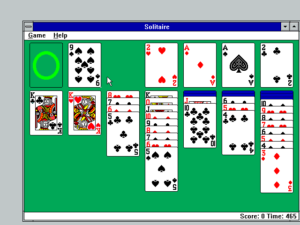
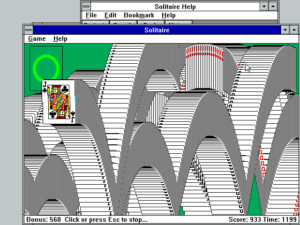
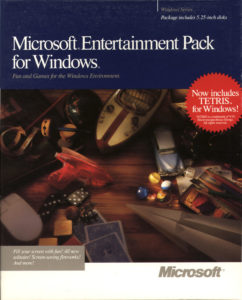
With, that is, one glaring exception that is of special interest to us: Windows 3 had never caught on for hardcore gaming, and never would. Games were played on Windows 3, mind you. In fact, they were played extensively. Microsoft Solitaire, which was included with every copy of Windows, is almost certainly the single most-played computer game in history, having served as a distraction for hundreds of millions of bored office workers and students all over the world from 1990 until the present day. Some other games, generally of the sort that weren’t hugely demanding in hardware terms and that boasted a fair measure of casual appeal, did almost equally well. Myst, for example, sold an astonishing 5 million or more copies for Windows 3, while Microsoft’s own “Entertainment Packs,” consisting mostly of more simple time fillers much like Solitaire, also did very well for themselves.

But then there were the hardcore gamers, the folks who considered gaming an active hobby rather than a passive distraction, who waited eagerly for each new issue of Computer Gaming World to arrive in their mailbox and spent hundreds or thousands of dollars every year keeping the “rigs” in their bedrooms up to date, in much the same way that a previous generation of mostly young men had tinkered endlessly with the hot rods in their garages. The people who made games for this group told Microsoft, accurately enough, that Windows as it was currently constituted just wouldn’t do for their purposes. It was too inflexible in its assumptions about the user interface and much else, and above all just too slow. They loved the idea of a runtime environment that would let them forget about the idiosyncrasies of 1000 different graphics and sound cards, thanks to the magic of integrated device drivers. But it had to be flexible, and it had to be fast — and Windows 3 was neither of those things. Microsoft admitted in one of their own handbooks that “game graphics under Windows make slug racing look exciting.”

One big issue that game developers had with Windows 3 for a long time was that it was a 16-bit operating system in a world where even the most ordinary off-the-shelf computer hardware had long since gone 32 bit. The largest number that can be represented in 16 bits is 65,535, or 64 kilobytes. A 16-bit program can therefore only allocate memory in discrete segments of no more than 64 K. This became more and more of a problem as games grew more complex in terms of logic and especially graphics and sound. MS-DOS was also 16-bit, but, being far simpler, it was much easier to hack. The tools known as “32-bit DOS extenders” did just that, giving game developers a way of using 32-bit processors to their maximum potential more or less transparently, with a theoretical upper limit of fully 4 GB per memory segment. (This was, needless to say, much, much more memory than anyone actually had in their computers in the early 1990s.) Ironically, Windows 3 itself depended on a 32-bit DOS extender to be able to run on top of MS-DOS, but it didn’t extend all of its benefits to the applications it hosted. That did finally change, however, in July of 1993, when Microsoft released an add-on called “Win32S” that did make it possible to run 32-bit applications in Windows 3 (including many applications written for Windows NT).

That was one problem more or less solved. But another one was the painfully slow Windows graphics libraries that served as the intermediary between applications software and the bare metal of the machine. These were impossible to bypass by design; one of the major points of Windows was to provide a buffer between applications and the hardware, to enable features such as multitasking, virtual memory, and a consistent look and feel from program to program. But game developers saw only how slow the end result was. The only way they could consider coding for Windows was if Microsoft could provide libraries that were as fast — or at least 90 percent as fast — as banging the bare metal in MS-DOS.

In the meantime, game developers would continue to write for vanilla MS-DOS and to sweat the details of all those different graphics and sound cards for themselves, and the hardcore gamers would have to continue to spend hours tweaking memory settings and IRQ addresses in order to get each new game they bought up and running just exactly perfectly. Admittedly, some gamers did consider this almost half the fun, a talent for it as much a badge of honor as a high score in Warcraft; boys do love their technological toys, after all. Still, it was obvious to any sensible observer that the games industry as a whole would be better served by a universal alternative to the current bespoke status quo. Hardcore gamers made up a relatively small proportion of the people using computers, but they were a profitable niche, what with their voracious buying habits, and they were also trail blazers and influencers in their fashion. It would seem that Microsoft had a vested interest in keeping them happy.

Windows NT might sound like the logical place for such early adopters to migrate, but this was not Microsoft’s view. “Serious” users of computers in corporate and institutional environments — the kind at which Windows NT was primarily targeted — had a long tradition of looking down on computers that happened to be good at playing games, and this attitude had by no means disappeared entirely by the early 1990s. In short, Microsoft had no wish to muddy the waters surrounding their most powerful operating system with a bunch of scruffy gamers. Games of all stripes were to be left to the consumer-grade operating systems, meaning the current Windows 3 and the forthcoming Chicago. And even there, they seemed to be a dismayingly low priority for Microsoft in the eyes of the people who made them and played them.

This doesn’t mean that there was no progress whatsoever. By very early in 1994, a young Microsoft programmer named Chris Hecker, working virtually alone, had put together a promising system called WinG, which let Windows games and other software render graphics surprisingly quickly to a screen buffer, with a minimum of interference from the heretofore over-officious operating system.

Hecker knew exactly what game to target as a proof of concept for WinG: DOOM, id Software’s first-person shooter, which had recently risen up from the shareware underground to complete the remaking of a broad swath of gamer culture in the image of id’s fast-paced, ultra-violent aesthetic. If DOOM could be made to run well under WinG, that would lend the system an instant street cred that no other demonstration could possibly have equaled. So, Hecker called up John Carmack, the man behind the DOOM engine. A skeptical Carmack said he didn’t have time to learn the vagaries of WinG and do the port, even assuming it was possible, whereupon Hecker said that he would do it himself if Carmack would just give him the DOOM source — under the terms of a strict confidentiality agreement, of course. Carmack agreed, and Hecker did the job in a single frenzied weekend. (It doubtless helped that Carmack’s DOOM code, which has long since been released to the entire world, is famously clean and readable, and thus eminently portable.)

Hecker brought WinDOOM, as he called it, to the Computer Game Developers Conference in April of 1994, the place where the leading lights of the industry gathered to talk shop among themselves. When he showed them DOOM running at full speed on Windows, just four months after it had become a sensation on MS-DOS, they were blown away. “WinG could usher in a whole new era for computer-based entertainment,” wrote Computer Gaming World breathlessly in their report from the conference. “As a result of this effort, we should expect to see universal installation routines, hardware independence, and an end to the memory-configuration haze that places a minimum technical-expertise barrier over our hobby and keeps out the novice user.”

Microsoft officially released WinG as a Windows 3 add-on in September of 1994, but it never quite lived up to its glowing advance billing. Hecker was a lone-wolf coder, and by some reports at least a decidedly difficult one to work with. Microsoft insiders from the time characterize WinG more as a “hack” than a polished piece of software engineering. Hecker “was able to take a piece of shit called Windows and make games work on it,” says Rick Segal, a Microsoft executive who was then in charge of “multimedia evangelism.” “He strapped a jet engine on a Beechcraft and got the thing in the air.” But when developers started trying to work with it in the real world, “the wings came off first, followed by the rest of the plane.” That’s perhaps overstating the case: WinG combined with Win32S was used to bring a few dozen games to Windows more or less satisfactorily between 1994 and 1997, from strategy games like Colonization to adventure games like Titanic: Adventure Out of Time. WinG was not so much a defective tool as a sharply limited one. While it gave developers a way of getting graphics onto the screen reasonably quickly, it gave them no help with the other pressing problems of sound, joysticks and other controllers, and networking in a game context.

Many of Microsoft’s initiatives during this period were organized by and around their team of “evangelists,” charismatic bright sparks who were given a great deal of freedom and a substantial discretionary budget in the cause of advancing the company’s interests and “fucking the competition,” as it was put by the evangelist for WinG, an unforgettable character named Alex St. John. St. John was a 350-pound grizzly bear of a man who had spent much of his childhood in the wilds of Alaska, and still sported a lumberjack’s beard and a backwoods sartorial sense; in the words of one horrified Microsoft marketing manager, he “looked like a bomb going off.” Shambling onto the stage, the living antithesis of the buttoned-down Microsoft rep that everybody expected, he told his audiences of gamers and game developers that he knew just what they thought of Windows. Then he showed them a clip of a Windows logo being blown away by a shotgun. “The gamers loved it,” says Rick Segal. “They thought they had someone who had their interests at heart.”

St. John soon decided that his constituency deserved something much, much better than WinG. His motivations were at least partly personal. He had come to loathe Chris Hecker, who was intense in a quieter, more penetrating way that didn’t mix well with St. John’s wild-man persona; St. John was therefore looking for a way to freeze Hecker out. But he was also sincere in his belief that WinG just didn’t go far enough toward making Windows a viable platform for hardcore gaming. With Chicago on the horizon, now was the perfect time to change that. He thundered at his bosses that games were a $5 billion market already, and they were just getting started. Windows’s current ineptitude at running them threatened Microsoft’s share in not only that market but the many other consumer-computing spaces that surrounded it. At some point, game developers would say farewell to antiquated MS-DOS. If Microsoft didn’t provide them with a viable alternative, somebody else would.

He rallied two programmers by the names of Craig Eisler and Eric Engstrom to his cause. In attitude and affect, the trio seemed a better fit for the unruly halls of id Software than those of Microsoft. They ran around terrorizing their colleagues with plastic battle axes, and gave their initiative the rather tasteless name of The Manhattan Project — a name their managers found especially inappropriate in light of Japan’s importance in gaming. But they remained unapologetic: “The Manhattan Project changed the world, for good or bad,” shrugged Eisler. “And we really like nuclear explosions.”

As I just noted, St. John’s title of evangelist afforded him a considerable degree of latitude and an equally considerable financial war chest. Taking advantage of the lack of any definitive rejection of their schemes more so than any affirmation of them among the higher-ups, the trio wrote the first lines of code for their new, fresh-from-the-ground-up tools for Windows gaming on December 24, 1994. (The date was characteristic of these driven young men, who barely noticed a family holiday such as Christmas.) St. John was determined to have something to show the industry at the next Computers Game Developers Conference in less than four months.
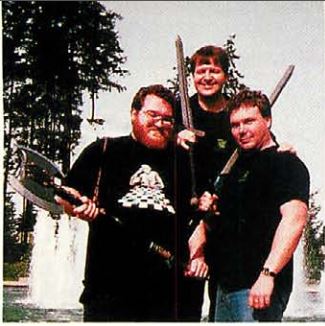
Alex St. John, Craig Eisler, and Eric Engstrom prepare to run amok.

WinG was also still alive at this point, under the stewardship of the hated Chris Hecker — but not for long. Disney had released a CD-ROM tie-in to The Lion King, the year’s biggest movie, just in time for that Christmas of 1994. It proved a debacle; hundreds of thousands of children unwrapped the box on Christmas morning, pushed the shiny disc eagerly into the family computer… and found out that it just wouldn’t work, no matter how long Mom and Dad fiddled with it. The Internet lit up with desperate parents of sobbing children, and news of the crisis soon reached USA Today and Billboard, who declared Disney’s “Animated Storybook” to be 1994’s Grinch: the game that had ruined Christmas.

Although the software used WinG, that was neither the only nor the worst source of its problems. (That honor goes to its support for 16-bit sound cards only, as stipulated in tiny print on the box, at a time when many or most people still had 8-bit sound cards and the large majority of computers owners had no idea whether they had the one or the other.) Nevertheless, the disaster was laid at the feet of WinG inside the games industry, creating an overwhelming consensus that a far more comprehensive solution was needed if games were ever to move en masse from MS-DOS to Windows. Alex St. John shed no tears: “I was happy to be proven right about WinG’s inadequacy.” The WinG name was hopelessly tainted now, he argued. Chris Hecker was moved to another project, an event which marked the end of active development on WinG. When it came to Windows gaming in the long term, it was now the Manhattan Project or bust.

By the spring of 1995, St. John had managed to assemble a team of about a dozen programmers, mostly contractors with something to prove rather than full-time Microsoft employees. They settled on the label of “Direct” for their suite of libraries, a reference to the way that they would let game programmers get right down to making cool things happen quickly, without having to mess around with all of the usual Windows cruft. DirectDraw would do what WinG had done only better, letting programmers draw on the screen where, how, and when they would; DirectSound would give the same level of flexible control over the sound hardware; DirectInput would provide support for joysticks and the like; and DirectPlay would be in some ways the most forward-looking piece of all, providing a complete set of tools for online multiplayer gaming. The collection as a whole would come to be known as DirectX. St. John, a man not prone to understatement, told Computer Gaming World that “the PC game market has been suppressed for two major reasons: difficulty with installation and configuration, and lack of significant new hardware innovation for games, because developers have had to code so intimately to the metal that it has become a nightmare to introduce new hardware and get it widely adopted. We’re going to bring all the benefits of device independence to games, and none of the penalties that have discouraged them from using APIs.”

It’s understandable if many developers greeted such broad claims with suspicion. But plenty of them became believers in April of 1995, when Alex St. John crashed into the Computer Game Developers Conference like a force of nature. Founded back in 1988 by Chris Crawford, one of gaming’s most prominent philosophers, the CGDC had heretofore been a fairly staid affair, a domain of gray lecture halls and earnest intellectual debates over the pressing issues of the day. “My job was to see DirectX launched successfully,” says St. John. “I concluded that if we set up a session or a suite at the conference itself, no one would come. Microsoft would have to do something so spectacular that it couldn’t be ignored.” So, he rented out the entirety of the nearby Great America amusement park and invited everyone to come out on the day after the conference ended for rides and fun — and, oh, yes, also a presentation of this new thing called DirectX. When he took the stage, the well-lubricated crowd started mocking him with a chant of “DOS! DOS! DOS!” But the chanting ceased when St. John pulled up a Windows port of a console hit called Bubsy, running at 83 frames per second. It became clear then and there that the days of MS-DOS as the primary hardcore-gaming platform were as numbered as those of the old, hype-immune, comfortably collegial CGDC — both thanks to Alex St. John.

St. John and company had never intended to make a version of DirectX for Windows 3; it was earmarked for Chicago, or rather Windows 95, the now-finalized name for Microsoft’s latest consumer operating system. And indeed, most of us old-timer gamers still remember the switch to Windows 95 as the time when we began to give up our MS-DOS installations and have our fun as well as get our work done under Windows. But for all that DirectX couldn’t exist outside of Windows 95, it wasn’t quite of Windows 95. It wasn’t included with the initial version of the operating system that finally shipped, a year behind schedule, in August of 1995; the first official release of DirectX didn’t appear until a month later. “DirectX was built to be parasitic,” says St. John. “It was carried around in games, not the operating system.” What he means is that he arranged to make it possible for game publishers to distribute the libraries free of charge on their installation CDs. When a game was installed, it checked to see whether DirectX was already on the computer, and if so whether the version there was as new as or newer than the one on the CD; if the answer to either of these questions was no, the latest version of DirectX was installed alongside the game it enabled. In an era when Internet connectivity was still spotty and online operating-system updates still a new frontier, this approach doubtless saved game makers many, many thousands of tech-support calls.

Now, though, we should have a look at some of the new features that were an integral part of Windows 95 from the start. Previous versions of Windows were more properly described as operating environments than full-fledged operating systems; one first installed MS-DOS, then installed Windows on top of that, starting it up via the MS-DOS command line. Windows 95, on the other hand, presented itself to the world as a self-contained entity; one could install it to an entirely blank hard drive, and could boot into it without ever seeing a command line. Yet the change really wasn’t as dramatic as it appeared. Unlike Windows NT, Windows 95 still owed much to the past, and was still underpinned by MS-DOS; the elephant balanced on a light pole had become a blue whale perched nimbly up there on one fin. Microsoft had merely become much more thorough in their efforts to hide this fact.

And we really shouldn’t scoff at said efforts. Whatever its underpinnings, Windows 95 did a very credible job of seeming like a seamless experience. Certainly it was by far the most approachable version of Windows ever. It had a new interface that was a vast improvement over the old one, and it offered countless other little quality-of-life enhancements to boot. In fact, it stands out today as nothing less than the most dramatic single evolutionary leap in the entire history of Windows, setting in place a new usage paradigm that has been shifted only incrementally in all the years since. A youngster of today who has been raised on Windows 10 or 11 would doubtless find Windows 95 a bit crude and clunky in appearance, but would be able to get along more or less fine in it without any coaching. This is much less true in relation to Windows 3 and its predecessors. Tellingly, whenever Microsoft has tried to change the Windows 95 interface paradigm too markedly in the decades since, users have complained so loudly that they’ve been forced to reverse course.

Windows 95 may still have been built on MS-DOS, but 32-bit applications were now the standard, the ability to run 16-bit software relegated to a legacy feature in the name of Microsoft’s all-important backward compatibility. (Microsoft went to truly heroic lengths in the service of the latter, to the extent of special-casing a raft of popular programs: “If you’re running this specific program, do this.” An awful kludge, but needs must…) Another key technical feature, from which tens of millions of people would benefit without ever realizing they were doing so, was “Plug and Play,” which made installing new hardware a mere matter of plugging it in, turning on the computer, and letting the operating system do the rest; no more fiddling about with an alphabet soup of IRQ, DMA, and port settings, trying to hit upon the magic combination that actually worked. Equally importantly, Windows 95 introduced preemptive multitasking in place of the old cooperative model, meaning the operating system would no longer have to depend upon the willingness of individual programs to yield time to others, but could and would hold them to its own standards. At a stroke, all kinds of scenarios — like, say, rendering 3D graphics in the background while doing other work (or play) in the foreground — became much more practical.

A Quick Tour of Windows 95
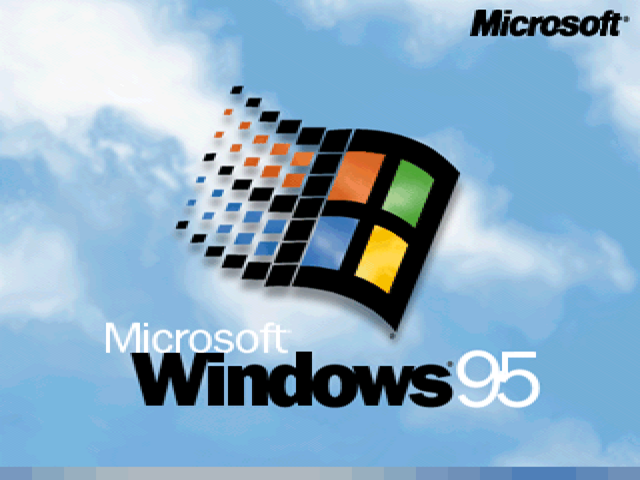

One of the simplest but most effective ways that Microsoft concealed the still-extant MS-DOS underpinnings of Windows 95 and made it seem like its own, self-contained thing was giving it a graphical boot screen.
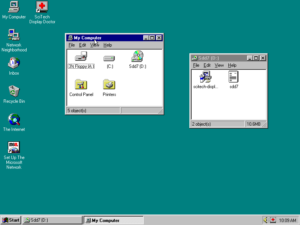
It seems almost silly to exhaustively explicate Windows 95’s interface, given that it’s largely the one we still see in Windows today. Nevertheless, I started a tradition in the earlier articles in this series that I might as well continue. So, note that the old “Program Manager” master window has been replaced by a Mac-like full-screen desktop, with a “Start” Menu of all installed applications at the bottom left, a task bar at the bottom center for switching among running applications, and quick-access icons and the clock at the bottom right. Window-manipulation controls too have taken on the form we still know today, with minimize, maximize, and close buttons all clustered at the top right of each window.
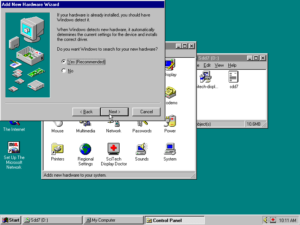
Plug And Play was one of the most welcome additions to Windows 95. Instead of manually fiddling with esoteric settings, you just plugged in your hardware and let Windows do it all for you.
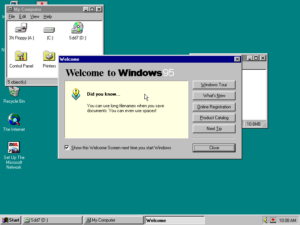
Microsoft bent over backward to make Windows 95 friendly and approachable for the novice. What experienced users found annoying and condescending, new users genuinely appreciated. That said, the hand-holding would only get more belabored in the future, trying the patience of even many non-technical users. (Does anyone remember Clippy?)
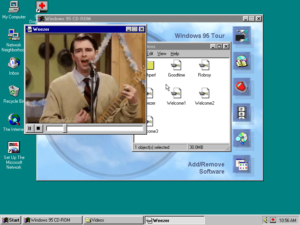
In keeping with its role in the zeitgeist, the Windows 95 CD-ROM included a grab bag of random pop-culture non sequiturs, such as a trailer for the movie Rob Roy and a Weezer music video.
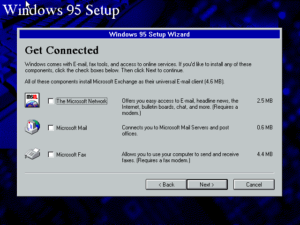
While Windows 95 made a big point of connectivity and did include a built-in TCP/IP stack for getting onto the Internet, it initially sported no Web browser. But that would soon change, with consequences that would reverberate from Redmond, Washington, to Washington, D.C., from Silicon Valley to Brussels.
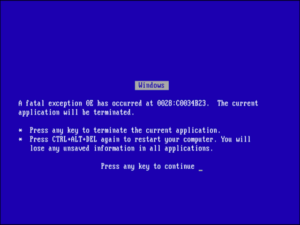
The most obvious drawback to Windows’s hybrid architecture was its notorious instability; the “Blue Screen of Death” became an all too familiar sight for users. System crashes tended to stem from those places where the new rubbed up against the old — from the point of contact, if you will, between the blue whale’s flipper and the light pole.


Windows 95 stretched the very definition of what should constitute an operating system; it was the first version of Windows on which you could do useful things without installing a single additional application, thanks to built-in tools like WordPad (a word processor more full-featured than many of the commercially available ones of half a decade earlier) and Paint (as the name would imply, a paint program, and a surprisingly good one at that). Some third-party software publishers, suddenly faced with the prospect of their business models going up in smoke, complained voraciously to the press and to the government about this bundling. Nonetheless, the lines between operating systems and applications had been blurred forever.

Indeed, this was in its way the most revolutionary of all aspects of Windows 95, an operating system that otherwise still had one foot rooted firmly in the past. That didn’t much matter to most people because it was a new piece of software engineering second, a flashy new consumer product first. Well before the launch, a respected tech journalist named Andrew Schulman told how “the very name Windows 95 suggests this product will play a leading role” in “the movement from a technology-based into a consumer-product-based industry.”

If a Windows program queries the GetVersion function in Windows 95, it will get back 4.0 as the answer; a DOS program will get back the answer 7.0. But in its marketing, Microsoft has decided to trade in the nerdy major.minor version-numbering scheme (version x.0 had always given the company trouble anyway) for a new product-naming scheme based on that used by automobile manufacturers and vineyards. Windows 95 isn’t foremost a technology or an operating system; it’s a product. It is targeted not at developers or end users but at consumers.

In that spirit, Microsoft hired Brian Eno, a famed composer and producer of artsy rock and ambient music, to provide the now-iconic Windows 95 startup theme. Eno:

The thing from the agency said, “We want a piece of music that is inspiring, universal, blah-blah, da-da-da, optimistic, futuristic, sentimental, emotional,” this whole list of adjectives, and then at the bottom it said, “And it must be 3.25 seconds long.”

I thought this was funny, and an amazing thought to actually try to make a little piece of music. It’s like making a tiny little jewel.

In fact, I made 84 pieces. I got completely into this world of tiny, tiny little pieces of music. Then when I’d finished that and I went back to working with pieces that were like three minutes long, it seemed like oceans of time…

Ironically, Eno created this, his most-heard single composition, on an Apple Macintosh. “I’ve never used a PC in my life,” he said in 2009. “I don’t like them.”


On a more populist musical note, Microsoft elected to make the Rolling Stones tune “Start Me Up” the centerpiece of their unprecedented Windows 95 advertising blitz. By one report, they paid as much as $12 million to license the song, so enamored were they by its synergy with the new Windows 95 “Start” menu, apparently failing to notice in their excitement that the song is actually a feverish plea for sex. “[Mick] Jagger was half kidding” when he named that price, claimed the anonymous source. “But Microsoft was in a big hurry, so they took the deal, unlike anything else in the software industry, where they negotiate to death.” Of course, Microsoft was careful not to include in their commercials the main chorus of “You make a grown man cry.” (Much less the fade-out chorus of “You make a dead man come.”)


Microsoft spent more than a quarter of a billion dollars in all on the Windows 95 launch, making it by a veritable order of magnitude the most lavish to that point in the history of the computer industry. One newspaper said the campaign was “how the Ten Commandments would have been launched, if only God had had Bill Gates’s money.” The goal was to make Windows, as journalist James Wallace put, “the most talked-about consumer product since New Coke” — albeit one that would hopefully enjoy a better final fate. Both goals were achieved. If you had told an ordinary American on the street even five years earlier that a new computer operating system, of all things, would shortly capture the pop-culture zeitgeist so thoroughly, she would doubtless have looked at you like you had three heads. But now it was 1995, and here it was. The Cold War was over, the War on Terror not yet begun, the economy booming, and the wonders of digital technology at the top of just about everyone’s mind; the launch of a new operating system really did seem like just about the most important thing going on in the world at the time.

The big day was to be August 24, 1995. Bill Gates made 29 separate television appearances in the week leading up it. A 500-foot banner was unfurled from the top floor of a Toronto skyscraper, while hundreds of spotlights served to temporarily repaint the Empire State Building in the livery of Windows 95. Even the beloved Doonesbury comic strip was co-opted, turning into a thinly veiled Windows 95 advertisement for a week. Retail stores all over the continent stayed open late on the evening of August 23, so that they could sell the first copies of Windows 95 to eager customers on the stroke of midnight. (“Won’t it be available tomorrow?” asked one baffled journalist to the people standing in line.) There were reports that some impressionable souls got so caught up in the hype that they turned up and bought a copy even though they didn’t own a computer on which to run it.

But the excitement’s locus was Microsoft’s Redmond, Washington, campus, which had been turned into a carnival grounds for the occasion, with fifteen tents full of games and displays and even a Ferris wheel to complete the picture. From here the proceedings were telecast live to millions of viewers all over the world. Gates took the stage at 11:00 AM with a surprise sparring partner: comedian Jay Leno, host of The Tonight Show, the country’s most popular late-night talk show. He worked the crowd with his broad everyman humor; this presentation was most definitely not aimed at the nerdy set. His jokes are as fine a time capsule of the mid-1990s as you’ll find. “To give you an idea of how powerful Windows 95 is, it is able to keep track of all O.J.’s alibis at once,” said Leno. Gates wasn’t really so much smarter than the rest of us; Leno had visited his house and found his VCR’s clock still blinking 12:00. As for Windows 95, it was like a good date: “smart, user-friendly, and under $100.” The show ended with Microsoft’s entire senior management team displaying their dubious dance moves up there onstage to the strains of “Start Me Up.” “It was the coolest thing I’ve ever been a part of,” gushed Gates afterward.
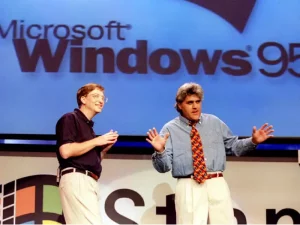
Bill Gates and Jay Leno onstage.

Windows 95 sold 1 million copies in its first four days, 30 million copies in its first seven months, 65 million copies in its first sixteen months. (For the record, this last figure was 15 million more copies than the best-selling album of all time, thus cementing the operating system’s place in pop-culture as well as technology history.) By the beginning of 1998, when talk turned to its successor Windows 98, it boasted an active user base three and a half times larger than that of Windows 3.

And by that same point in time, the combination of Windows 95 and DirectX had remade the face of gaming. A watershed moment arrived already just one year after the debut of Windows 95, when Microsoft used DirectX to make the first-ever Windows version of their hugely popular Flight Simulator, for almost a decade and a half now the company’s one really successful hardcore gamer’s game. From that moment on, DirectX was an important, even integral part of Microsoft’s corporate strategy. As such, it was slowly taken out of the hands of Alex St. John, Craig Eisler, and Eric Engstrom, whose bro-dude antics, such as hiring a Playboy Playmate to choose from willing male “slaves” at one industry party and allowing the sadomasochistic shock-metal band GWAR to attend another with an eight-foot tall anthropomorphic vagina and penis in tow, had constantly threatened to erupt into scandal if they should ever escape the ghetto of the gaming press and make it into the mainstream. Whatever else one can say about these three alpha-nerds, they changed gaming forever — and changed it for the better, as all but the most hidebound MS-DOS Luddites must agree. By the time Windows 98 hit the scene, vanilla MS-DOS was quite simply dead as a gaming platform; all new computer games for a Microsoft platform were Windows games, coming complete with quick and easy one-click installers that made gaming safe even for those who didn’t know a hard drive from a RAM chip. The DirectX revolution, in other words, had suffered the inevitable fate of all successful revolutions: that of becoming the status quo.

St. John’s inability to play well with others got him fired in 1997, while Eisler and Engstrom grew up and mellowed out a bit and moved into Web technologies at Microsoft. (The Web-oriented software stack they worked on, which never panned out to the extent they had hoped, was known as Chrome; it seems that everything old truly is new again at some point.)

Speaking of the Internet: what did Windows 95 mean for it, and vice versa? I must confess that I’ve been deliberately avoiding that question until now, because it has such a complicated answer. For if there was one tech story that could compete with the Windows 95 launch in 1995, it was surely that of the burgeoning World Wide Web. Just two weeks before Bill Gates enjoyed the coolest day of his life, Netscape Communications held its initial public offering, ending its first day as a publicly traded company worth a cool $2.2 billion in the eyes of stock buyers. Some people were saying even in the midst of all the hype coming out Redmond that Microsoft and Windows 95 were computing’s past, a new era of simple commodity appliances connecting to operating-system-agnostic networks its future. Microsoft’s efforts to challenge this wisdom and compete on this new frontier were just beginning to take shape at the time, but they would soon become the company’s overriding obsession, with well-nigh earthshaking stakes for everyone involved with computers or the Web.

(Sources: the books Renegades of the Empire: How Three Software Warriors Started a Revolution Behind the Walls of Fortress Microsoft by Michael Drummond, Dungeons and Dreamers: The Rise of Computer Game Culture from Geek to Chic by Brad King and John Borland, Overdrive: Bill Gates and the Race to Control Cyberspace by James Wallace, The Silicon Boys by David A. Kaplan, Show-stopper!: The Breakneck Race to Create Windows NT and the Next Generation at Microsoft by G. Pascal Zachary, Masters of DOOM: How Two Guys Created an Empire and Transformed Pop Culture by David Kushner, Unauthorized Windows 95: A Developer’s Guide to the Foundations of Windows “Chicago” by Andrew Schulman, Undocumented Windows: A Programmer’s Guide to Reserved Microsoft Windows API Functions by Andrew Schulman, David Maxey, and Matt Pietrek, and Windows Internals: The Implementation of the Windows Operating Environment by Matt Pietrek; Computer Gaming World of August 1994, June 1995, and September 1995; Game Developer of August/September 1995; InfoWorld of March 15 1993; Mac Addict of April 2000; Windows Magazine of April 1996; PC Magazine of November 8 2005. Online sources include an Ars Technica piece on Microsoft’s efforts to keep Windows compatible with earlier software, a Usenet thread about the Lion King CD-ROM debacle which dates from Christmas Day 1994, a Music Network article about Brian Eno’s Windows 95 theme, an SFGate interview with Eno, and Chris Hecker’s overview of WinG for Game Developer. I owe a special thanks to Ken Polsson for his personal-computing chronology, which has been invaluable for keeping track of what happened when and pointing me to sources during the writing of this and other articles. Finally, I owe a lot to Nathan Lineback for the histories, insights, comparisons, and images found at his wonderful online “GUI Gallery.”)

 
68 Comments

Posted by on November 18, 2022 in Digital Antiquaria, Interactive Fiction


Tags: ,

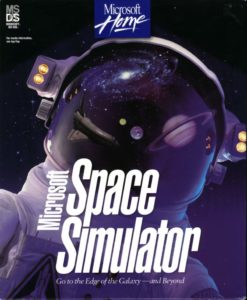
Microsoft Space Simulator (or, Charles Guy’s Galaxy in a Box)

No one regards what is before his feet; we all gaze at the stars.

— Quintus Ennius, circa 200 BC

It had been one hell of a year for the United States and most of the rest of the Western world — a year of rampant chaos and conflict at home and abroad, when the very foundations of democratic society seemed on the verge of crumbling to dust. In the course of twelve months, a brutal war with no prospect of ending had escalated to an unimaginable degree, a fractious nation’s most prominent civil-rights leader and one of its presumptive presidential candidates had been assassinated, and the streets had burned with radical and reactionary violence. And there had been a pandemic to boot, an unusually virulent flu virus responsible for an estimated 100,000 deaths in the United States alone.

And then, at the end of it all, human beings orbited another world. Apollo 8 slipped the surly bonds of Earth on December 21, 1968. Not quite three days later, on Christmas Eve, it entered Lunar orbit.

Astronauts Frank Borman, Jim Lovell, and William Anders sent home pictures of the Moon from close up to mark this momentous event. But the photographs they took that resonated the most were actually those of the Earth, revealed from 240,000 miles away to be the tiniest of islands in the hostile ocean of the cosmos. The straight-laced pilots and engineers inside the spacecraft were the farthest thing from poets, but they rose to the occasion on this enchanted evening. As millions of people all over the Earth gazed at their planet — at their desperately fragile-looking home — flickering there on their television screens, the astronauts read aloud from the Book of Genesis. At that moment, it didn’t matter whether you were a believer or not; those ancient words echoing down through time transcended religious dogma — transcended, dare we say it, religion itself.

In the beginning God created the heaven and the earth.
And the earth was without form, and void; and darkness was upon the face of the deep.
And the Spirit of God moved upon the face of the waters. And God said, Let there be light: and there was light.
And God saw the light, that it was good: and God divided the light from the darkness.

And God called the light Day, and the darkness he called Night. And the evening and the morning were the first day.
And God said, Let there be a firmament in the midst of the waters, and let it divide the waters from the waters.
And God made the firmament, and divided the waters which were under the firmament from the waters which were above the firmament: and it was so.
And God called the firmament Heaven. And the evening and the morning were the second day.

And God said, Let the waters under the heavens be gathered together unto one place, and let the dry land appear: and it was so.
And God called the dry land Earth; and the gathering together of the waters called he Seas: and God saw that it was good.

Mission Commander Borman closed the proceedings just before the spacecraft swung around to the dark side of the Moon and lost contact with home: “And from the crew of Apollo 8, we close with good night, good luck, a merry Christmas, and God bless all of you — all of you on the good Earth.”


Although my editing process means it will be a couple of weeks yet before you read these words, I’m writing them between the Christmas and New Year’s of 2020, a natural time for contemplation and stock-taking. And we certainly have plenty to contemplate: 2020 was also one hell of a year, arguably the most cataclysmic in the Western world since 1968. The last twelve months have been marked by a worldwide pandemic which has altered all of our lives immeasurably, combined with worldwide demands for racial justice that are, one might say, the business that was left unfinished after Martin Luther King’s assassination. The world around us today looks completely different from the one we knew 365 days ago, and it’s not clear when or even whether the Old Normal will return.

But alas, there was no grace note like Apollo 8 to close this year and help us to put things in their proper perspective. Back in 1968, we firmly believed that this year’s most memorable Christmas greeting might come from astronauts near Jupiter or Saturn, but the reality is that a human being hasn’t left Earth orbit since 1972.

Nevertheless, some sort of perspective is sorely needed after a year like the one we’ve just experienced. For better or for worse, we’re living an ever-increasing proportion of our lives virtually. So, perhaps we can find a way to see a bigger picture that way. Perhaps the time is right to talk about Microsoft Space Simulator.


Space Simulator was the brainchild of an enigmatic fellow named Charles Guy, who didn’t give interviews during his lifetime and who died young from cancer in 2004, thus complicating the work of writers like me immeasurably. Born in 1961 in Indianapolis, Indiana, he attended the University of Purdue, but dropped out when his expertise in 3D graphics won him a job at subLogic in Champaign, Illinois, the maker of the hugely successful Flight Simulator. Bruce Artwick and Stu Moment, the company’s founders, first brought Guy on to help Artwick with the programming burden as they ported their flagship product to more and more platforms.

Soon, however, Guy got a project of his own: he was placed in charge of Jet, a simulation of the F-16 and F/A-18 fighter jets. As they had done with Flight Simulator, subLogic ported and supported Jet for years after its initial release in 1985, keeping Guy plenty busy. But the Jet line ended in 1989, when subLogic effectively split into two separate companies amidst lawsuits and recriminations, with each of the companies being led by one of the two erstwhile founders.

Guy backed the right horse; he left subLogic to join Artwick’s appropriately named Bruce Artwick Organization, which had walked away with the crown jewel of the old subLogic simulation empire: the contract to make Microsoft Flight Simulator for MS-DOS and the Macintosh. He worked on those programs for a brief while, then convinced Artwick and Microsoft to let him make Space Simulator.

The fact was, Guy’s bona fides as an expert in winged flight weren’t quite up to those of Bruce Artwick or Stu Moment. He had duly attempted to qualify for a pilot’s license back in the 1980s, thus conforming to what had become something of a subLogic tradition, but his airplane nearly spun out of control when he was practicing stalls one night. “He managed to recover, but never flew a plane again after that,” remembers a friend.

Guy’s real passion was astronomy. Heaven in the metaphorical and literal sense was one to him: few things moved him more than a clear night sky full of stars. It had all begun when he was fifteen years old and happened to look up on just such a perfect night:

What I saw was so intense that it frightened me. I had to look down at the ground. It was too much. Slowly, I built up the nerve to look at it more and more with my naked eyes. And eventually, I got to the point where I couldn’t stop looking at it. I became more and more obsessed with it.

The scale of it was frightening to me. I felt like I was standing on a pinpoint, oppressed by the size of this thing. It really did frighten me, but I found that this fear really isn’t like normal fear. It is the kind of fear that is respectful, although it becomes a fear that must be conquered and resolved. It leads toward growth and understanding.

When he talked about stargazing, he did so as if he was actually traveling to the stars he saw through his telescope, as perhaps he was in spirit: “I’ll tell you where I’m headed. I’m headed to Sagittarius. I’ll often go to M22, then M8, then M17. I like to go south to north, hitting all the H2 regions, and the good globular and open clusters. There are a lot of them in Sagittarius.” It was only natural for him to make a game where you could take just the sorts of trips he was already taking in his mind’s eye.


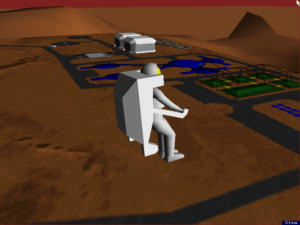
Space Simulator is a game of two halves — assuming, that is, that we can agree to call a piece of software with no goals and no real rules a game at all — and they don’t always fit together perfectly. On the one hand, Space Simulator is exactly what you might expect from its own name and that of the development studio behind it: a serious simulation of spaceflight. You can fly historical craft like the Apollo Command and Lunar Modules, the Space Shuttle, or even the Manned Maneuvering Unit used by Shuttle astronauts for spacewalks. Or you can explore farther afield from Earth in one of a variety of theoretical spacecraft of the future. Either way, the experience can be as realistic as you want it to be. You can use the program’s many available shortcuts to slew your way around the galaxy without ever touching a thruster control for yourself, or you can sit down with pen and paper and plot your own orbits and trajectories; doing so requires far more higher-math skills than I possess, but I’m told that, if you have the requisite skills, you’ll find the program to be an entirely consistent, entirely realistic environment in which to play NASA navigator. Of course, at some point you’ll have to bite the bullet and embrace some of the simulator’s shortcuts, as some of the voyages you can plot for yourself will take billions of years if you insist on making them in real time.

The other side of Space Simulator — the side nearer to Charles Guy’s heart, one senses — are the actual places you can fly or slew your way to. In fact, Space Simulator boasts what must be as large a virtual “world” as has ever been built into a game, encompassing the full extent of the Milky Way Galaxy and some distance beyond. (“Can you believe that we’re going to try to put all of this inside a computer?” exclaimed Guy spontaneously one evening under one of his beloved clear night skies.) You can visit the stars and planets and moons of our solar system or the ones that are theorized to exist in others, and just gaze in wonder or make pictures or even videos of your discoveries, knowing that what you see and record is as accurate as the state of the science of astronomy during the early 1990s could make it. All of it is presented in Super VGA graphics at a resolution of 800 X 600, meaning it still looks pretty good today. The sense of wonder was and still remains strong with this one.

Indeed, a palpable spirit of starry-eyed idealism still clings to Microsoft Space Simulator all these years later. Defying their 1990s reputation as soulless dirty tricksters — a reputation which was well-earned in many other contexts — Microsoft worked enthusiastically with Charles Guy and the rest of the Bruce Artwick Organization for some three years to stuff the entirety of a galaxy onto three floppy disks. Grant Fjermedal, a journalist who was there through much of the process, shares this anecdote about the arrival of an early version at Microsoft, one which for the first time let you explore the galaxy using a joystick.

The evening after it arrived, in March of 1993, program manager Jon Solon carried [the] disks home and loaded it on his machine. He flew through space until after midnight, chasing down planets and orbiting the Moon, excited about being able to leave the keyboard controls behind in favor of the more fluid joystick. Jon, who had been program manager for three versions of Flight Simulator, compared the experience to the first time he took off from Chicago’s Meigs Field, circled the skyscrapers, and successfully landed.

All the next day at Microsoft, people were hunting through storage rooms (and through the offices of their pals) looking for joysticks that weren’t being used. There were those who flew, and those who enthused. People were being flagged down and dragged into offices: “I’ve got to show you something — watch this!” It was a day when the door seemed to open wider than ever before.

Far from limiting the scope of the simulation, Jon Solon and the others at Microsoft encouraged Charles Guy to expand it. It was Solon, for example, who insisted that it ought to be possible to land your spacecraft on the planets you encountered, in order to see their diverse environments firsthand.

When the finished Space Simulator finally shipped in late 1994, Microsoft got behind it in a big way. The manual they included in the box was a minor wonder in itself, a patient introduction to the program’s complexities in more than 200 friendly, well-written, eminently approachable pages; few to no other software publishers would have had it in them to produce a manual like this, for any sort of program. In addition to a lavish advertising campaign positioning Space Simulator as the natural heir to the 3-million-selling Flight Simulator, Microsoft published not one but two strategy guides through their own press, and granted Sybex Books special inside access so they could publish a third. (These three books nicely encompassed the full range of Space Simulator‘s personality: the Sybex book was the hardcore one, its second half chock full of equations and subsection titles like “Geometric Properties of All Conic Sections”; meanwhile one of the Microsoft books was most interested simply in helping you to take in the galaxy’s sights, while the third aimed for a point somewhere in between the other two.)

With support like this behind his creation, an ebullient Charles Guy was moved to exclaim that Space Simulator “might bring on a whole new social revolution!” Or a “spiritual revolution,” as Grant Fjermedal put it: “Perhaps a tool to simulate even a part of the vastness of space will lead us to ponder what that vastness might mean for humanity, as we glide through the soft darkness of space, clutching hold of our garden planet in orbit around our gracious middle-aged Sun.” For truly Space Simulator contains multitudes. One can be merrily slewing through the galaxy, only to look down and realize that 40 years, 400,000 years, 4 million years have passed since one left Earth. Through Space Simulator, we can almost glimpse infinity. The contemplation of such enormity, like that of a single grain of sand, can be a source of both existential terror and spiritual comfort. “It was while traveling the stars at a time-scale setting of 68 years per second,” writes Fjermedal, “that I most fully understood the vastness of our galaxy and the brevity of our lives.”

Unfortunately, the public proved for once resistant to Microsoft’s much-vaunted marketing acumen when it came to Space Simulator. In retrospect at least, the problems with the product as a commercial proposition aren’t hard to identify. It was the ultimate in “make your own fun” games, even more so than a so-called “software toy” like, say, SimCity — or for that matter Flight Simulator. When you start the game, you find yourself parked in orbit around Earth. From there, it’s entirely up to you to decide what you want to do and how you want to do it by digging through a cryptic nest of menus; Space Simulator absolutely demands that you read that brilliant manual through, carefully and completely, to get much of anywhere with it. And even after you do so, it demands that you be the type of person who considers unguided, goal-less exploration fun. Space Simulator does have support for “missions,” which are exactly what they sound like they would be, even to the point of including a scoring system, but this capability is weirdly under-utilized. The game includes just two of them out of the box: one covering Apollo 17, the final mission to the Moon, and the other covering a typical Shuttle mission. One suspects that Microsoft envisioned a robust Space Simulator aftermarket that would have included more “mission disks” among other products, much like the many scenery disks which were released for Flight Simulator.

But sadly, sales of Microsoft Space Simulator never justified any such further releases. The dedicated gaming press, and dedicated gamers in general, didn’t know quite what to make of it, even as it was far too demanding for more casual users. Of course, Microsoft Flight Simulator was another willfully cerebral, esoteric, goal-less experience that defied all of the conventional wisdom about what made a hit computer game, and yet managed to become the best-selling computer-gaming franchise of its generation. Why was Space Simulator so different? Perhaps its spaces were just too vast, its conceptual grandiosity too intimidating. It’s easier to get a handle on the idea of flying a small plane from airport to airport, even if there isn’t much point to it beyond the fantasy of being up there in the wild blue yonder, than it is to conceive and plan a voyage to Polaris in a Bussard ramjet. Maybe the idea of a voyage of a million years simply strained too many imaginations past the breaking point.

Whatever the reason for its commercial failure, Microsoft Space Simulator went quietly out of print within a couple of years, even as Flight Simulator continued to go strong. Charles Guy left the Bruce Artwick Organization shortly after it became clear that his passion project would not be fomenting any social revolutions. He bounced around the games industry in various programming roles for the rest of his life, but never got a chance to helm a game of his own of any sort again, much less one with the scope of this one.

Space Simulator is an oddly forgotten artifact today; you’ll be hard-pressed to find any online discussion of it at all. And that’s a shame, as it possesses at least two sources of enduring interest. In one sense, it’s a fascinating product of its time, that heady cusp of the second, ultimately more enduring home-computer boom, when the multimedia capabilities of the latest machines were inspiring more big companies than just Microsoft to take a flier on unabashedly intellectual, crazily idealistic software.

In another sense, though, Space Simulator transcends its time. No one since Charles Guy has attempted to make a piece of software quite like this one. There are certainly technical simulations of spaceflight that are even more detailed than Space Simulator, just as there are planetarium programs to let you do virtual stargazing with the benefit of an additional quarter-century of astronomical discoveries. Yet no one else has given you a spacecraft and then just set you loose to go explore the natural wonders of our galaxy with it, thereby giving you a more embodied sort of window onto our staggeringly magnificent and terrifyingly immense universe than any planetarium can hope to create. Computer games are not known for their ability to provoke spiritual awakenings, but if any one of them can, perhaps it is this one. Stare, if you dare, into the vastness, and see that it is good. A little perspective is never a bad thing.


A Microsoft Space Simulator Gallery


Saturn, possibly the most beautiful of all the planets of our solar system — after Earth, that is. While we watch the planet itself rotate in the top window, we watch some of the more prominent of its dozens of moons orbit in the bottom window. You may find that you can spend a surprisingly long time just watching their clockwork motion.

Another view of Saturn, with the spaceship we’ve used to visit it in the foreground.

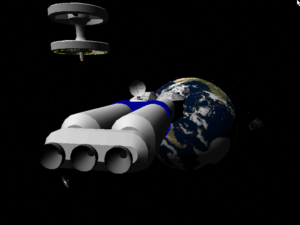
Returning to Earth in the Galactic Explorer, a spacecraft obviously modeled after the Discovery from 2001: A Space Odyssey. In fact, given that the space station before us betrays the same influence, we can almost imagine this scene as a lost frame from Stanley Kubrick’s 1968 film.

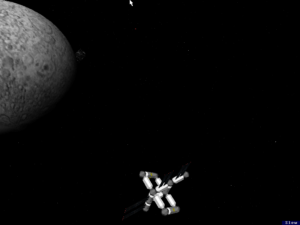
In another scene that might easily have come from 2001, a space station orbits the Moon.

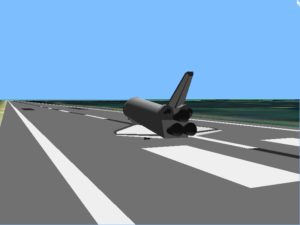
A once-familiar sight from the real world: the Space Shuttle touches down at Cape Canaveral.

The Andromeda Galaxy, seen from well beyond the border of our own Milky Way Galaxy. The programmers among you will appreciate what an awesome feat it is to devise a coordinate system able to pinpoint a location 2.5 million light years from Earth as well as it can a single runway in Florida.

The Whirlpool Galaxy, 23.5 million light years away from Earth.

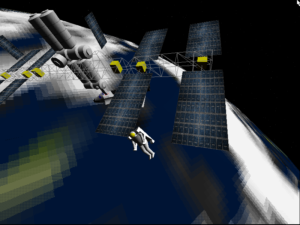
The dream of constructing a Space Station Freedom in Earth orbit was still alive when Space Simulator was under development. The plan to do so, first mooted by President Ronald Reagan in his State of the Union Address in 1984, was scrapped completely by the end of the 1990s.

In yet another scene from a future that’s been inordinately slow in arriving, we soar above a colony on Mars.

Space Simulator can also be used as a planetarium, showing a view of the sky from any position on Earth at any time you wish.

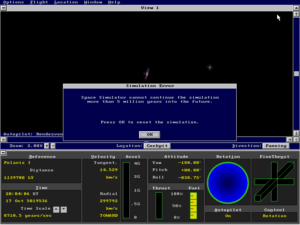
This error message appears surprisingly often as you explore, providing as good an illustration as any of the sheer scale of the simulation.

Our one and only home in a beautiful but inhospitable universe. May we be better stewards of it after 2020 than we’ve been in the years prior…

(Sources: the books Microsoft Space Simulator: The Official Strategy Guide by Rick Barba, Adventures in Space Simulator: The Ultimate Desktop Astronaut’s Guide by Grant Fjermedal, and Space Simulator Strategies and Secrets by Nick Dargahi; Computer Gaming World of December 1994; Computer Play of November 1988. The “Talk” page of the Wikipedia entry on Microsoft Space Simulator proved one of my few sources of personal information on the enigmatic Charles Guy.

Microsoft Space Simulator has been out of print for many years. Therefore I’ve put it up here for download, packaged so as to be as easy as possible to get running under DOSBox on a modern Windows, Macintosh, or Linux system. Happy exploring! May you find the perspective you crave.)


Tags: , , ,

The Dream of Flight

After Edison’s original phonograph came out, people said that they could not detect a difference between a phonograph and a real performance. Clearly the standard that they had for audio fidelity back in 1910 was radically different from the standard we have. They got the same enjoyment out of that Edison phonograph that we do out of [a] high-fidelity [stereo]. As audio fidelity has gotten better and better, our standards have gotten higher and higher; if we listen to a phonograph from 1910, it sounds horrible to our modern ears.

The same thing has obviously happened to flight simulators.

— Brand Fortner, 2010

It seems to me that vintage flight simulators have aged worse than just about any other genre of game. No, they weren’t the only games that required a large helping of imagination to overlook their underwhelming audiovisuals, that had sometimes to ask their players to see them as what they aspired to be rather than what they actually were. But they were perhaps the ones in which this requirement was most marked. When we look back on them today, we find ourselves shaking our heads and asking what the heck we were all thinking.

Growing up in the 1980s, I certainly wasn’t immune to the appeal of virtual flight; I spent many hours with subLogic’s Flight Simulator II and MicroProse’s Gunship on my Commodore 64, then hours more with F/A-18 Interceptor on my Commodore Amiga. Revisited today, however, all of those games strike me as absurdly, unplayably primitive. Therefore they and the many games like them have appeared in these histories only in the form of passing mentions.

The case of flight simulators thus serves to illustrate some of the natural tensions implicit in what I do here. On the one hand, I want to celebrate the games that still stand up today, maybe even get some of you to try them for the first time all these years later — and I’ve yet to find a vintage flight simulator which I can recommend on those terms. But on the other hand, I want to sketch an accurate, non-anachronistic picture of these bygone eras of gaming as they really were. In this latter sense, my efforts to date have been sadly inadequate in the case of flight simulators; the harsh fact is that these games which I’ve neglected so completely were in fact among the most popular of their time, accounting on occasion for as much as 25 percent of the computer-game industry’s total revenue. Microsoft Flight Simulator, the prototypical and perennial product of its type, was the most commercially successful single franchise in all of computer gaming between 1982 and 1995 — all despite having no goals other than the ones you set for yourself and for the most part no guns either. (Let that sink in for a moment!)

All of which is to say that a reckoning is long overdue here. This article, while it may not quite give Microsoft Flight Simulator and its siblings their due, will at least begin to redress the balance.


Many people assumed in the 1980s, as they still tend to do today, that the early microcomputer flight simulators were imperfect imitations of the bigger simulators that were used to train pilots for real-world flying. In point of fact, though, the relationship between the two was more subtle — even more symbiotic — than one might guess. To appreciate how this could be, we need to remember that the 3D-graphics techniques that were being used to power all flight simulators by the 1980s were a new technology at the time — new not just to microcomputers but to all computers. Until the 1980s, the “big” flight simulators made for training purposes were very different beasts from the ones that came later.

That said, the idea of flight simulation in general goes back a long, long way, almost all the way back to the dawn of powered flight itself. It took very little time at all after Orville and Wilbur Wright made their first flights in Kitty Hawk, North Carolina, for people to start asking how they might train new pilots in some more forgiving, less dangerous way than putting them behind the controls of a real airplane and hoping for the best. A 1910 issue of Flight magazine — the “first aero weekly in the world” — describes the “Sanders Teacher,” a mock-up of a real airplane mounted on a pivoting base so that it could sway with the wind in response to control inputs; unlike the fragile real aircraft of its era, this one was best “flown” when there was a stiff breeze.

The Sanders Teacher, one of the earliest attempts to simulate flight.

In 1929, Edwin Link of Binghamton, New York, created the Link Trainer, the first flight simulator that we might immediately recognize as such today. An electro-mechanical device driven by organ bellows in its prototype form, it looked like an amputated single-seater-airplane cockpit. The entire apparatus pitched and turned in response to a trainee’s movements of the controls therein, while an instructor sat next to the gadget to evaluate his performance. After an initially skeptical response from the market, usage of the Link Trainer around the world exploded with the various military buildups that began in the mid-1930s. It was used extensively, in both its official incarnation and in unlicensed knock-offs, by virtually every combatant nation in World War II; it was a rite of passage for tens of thousands of new pilots, marking the most widespread use of technology in the cause of simulation to that point in the history of the world.

An American student pilot in a Link Trainer, circa 1943.

The programmable digital computers which began to appear after the war held out the prospect of providing a more complete simulation of all aspects of flight than analog devices like the Link Trainer and its successors could hope to achieve. Already in 1950, the United States Navy funded a research effort in that direction at the University of Pennsylvania. Yet it wasn’t until ten years later that the first computerized flight simulators began to appear. Once again, Link Aviation Devices provided the breakthrough machine here, in the form of the Link Mark 1, whose three processors shared 10 K of memory to present the most credible imitation of real flight yet, with even wind and engine noise included if you bought the most advanced model. By 1970, virtually all flight simulators had gone digital.

But there was a persistent problem afflicting all of these efforts at flight simulation, even after the dawn of the digital age. Although the movements of cockpit instruments and even the physical motion of the aircraft itself could be practically implemented, the view out the window could not. What these machines thus wound up simulating was a totally blind form of flying, as in the heaviest of fogs or the darkest of nights, when the pilot has only her instruments to guide her. Flying-by-instruments was certainly a useful skill to have, but the inability of the simulators to portray even a ground and horizon for the pilot to sight on was a persistent source of frustration to those who dreamed of simulating flight as it more typically occurred in the real world.

Various schemes were devised to remedy the situation, some using reels of film that were projected on the “windows” of the cockpit, some even using a moving video camera which “flew” over model terrain. But snippets of static video are a crude tool indeed in an interactive context, and none of these solutions yielded anything close to the visual impression of real flight. What was needed was an out-the-window view that was generated on the fly in real time by the computer.

In 1973, McDonnell-Douglas introduced the VITAL II, a computerized visual display which could be added to existing flight simulators. Even its technology, however, was different in a fairly fundamental sense from that of the flight simulators that would appear later. The computers which ran the latter would use what’s known as raster-based or bitmap graphics: a grid of pixels stored in memory, which are painted to the monitor screen by the computer’s display circuitry without additional programming. VITAL II, by contrast, used something known as vector graphics, in which the computer’s processor directly controls the electron gun inside the display screen, telling it where to go and when to fire to produce an image on the screen. Although bitmap graphics are far easier for the programmer to work with and more flexible in countless ways, they do eat up memory, a commodity which most computers of the early 1970s had precious little of to spare. Therefore vector graphics were still being used for many applications, including this one.

Thanks to the limitations of its hardware, the VITAL II could only show white points of light on the surface of a black screen, and thus could only be used to depict a night flight. Indeed, it showed only lights — the lights of runways, airports, and to some extent their surrounding cities.


Such was the state of the art in flight simulation during the mid-1970s, when a young man named Bruce Artwick was attending the University of Illinois in Champaign.


Flight simulators aside, this university occupies an important place in the history of computing in that it was the home of PLATO, the pioneering computer network that anticipated much of the digital culture that would come two decades or more after it. A huge variety of games were developed for PLATO, including the first CRPGs and, most importantly for our purposes today, the first flight simulator to be intended for entertainment and casual exploration rather than professional pilot training. Brand Fortner’s game of Airfight wasn’t quite a real-time simulation as we think of it today — you had to hit the NEXT key over and over to update the screen — but it could almost feel like it ran in real time to those willing and able to pound their keyboards with sufficient gusto. Brian Dear described the experience in his book about the PLATO system:

By today’s standards, Airfight’s graphics and realism, like every other PLATO game, are hopelessly primitive. But in the 1970s Airfight was simply unbelievable. These rooms full of PLATO terminals weren’t “PLATO classrooms,” they were PLATO arcades, and they were free. If you were lucky enough to get in (there were always more people wanting to play than the game could handle), you joined the Circle or the Triangle teams, chose from a list of different airplane types to fly, and suddenly found yourself in a fighter plane, looking out of the cockpit window at the runway in front of you, with the control tower far down the runway… You’d hit “9” to set the throttle at maximum, “a” for afterburners, “w” a few times to pull the stick back, and then NEXT NEXT NEXT NEXT NEXT NEXT NEXT to update the screen as you rolled down the runway, lifted off, and shot up into the sky to join the fight. It might be seconds or minutes, depending on how far away the enemy airplanes were, before you saw dots in the sky, dots that as you flew closer and closer turned into little circles and triangles. (So they weren’t photorealistic airplanes — it didn’t matter. You didn’t notice. This was battle. This was Airfight.) As you got closer and closer to one of these planes, the circles and triangles got more defined — still small, still pathetically primitive by today’s standards — but you knew you were getting closer and that’s all that mattered. As you got closer and closer you hit “s” to put up your sights, to aim. Eventually, if you were good, lucky, or both, you would be so close that you’d see a little empty space, an opening, inside the little circle or triangle icon. That’s when you were close enough to see what players called “the whites of their eyes” and that’s when you let ’em have it: SHIFT-S to shoot. SHIFT-S again. And again. Until you’d run out of ammo and KABOOM! It was glorious.

And it was addictive. People stayed up all night playing Airfight. If you went to a room full of PLATO terminals, you’d hear the clack-clack-clack-clack-clack-CLACKETY-CLACK-CLACK-BAM-BAM!-WHAM!-CLACK-CLACK! of everyone’s keyboards, as the gamers pounded them, mostly NEXT-NEXT-NEXT’ing to update their view and their radar displays (another innovation of this game — in-cockpit radar displays, showing you where the enemy was).

The standard PLATO terminal at that time was an astonishingly advanced piece of hardware to place at the disposal of everyday university students: a monochrome bitmap display of no less than 512 X 512 pixels. Thus Airfight, in addition to being the first casual flight simulator, was the first flight simulator of any kind to use a bitmap display. This fact wasn’t lost on Bruce Artwick when he first saw the game in action — for Artwick already knew a little something about the state of the art in serious flight simulation.

The University of Illinois’s Institute of Aviation was one of the premiere aerospace programs in the country, training both engineers and pilots. Artwick happened to be pursuing a master’s degree in general electrical engineering, but he roomed with one of the university’s so-called “aviation jocks”: an accomplished pilot named Stu Moment, who was training to become a flight instructor at the same time that he pursued a degree in business. “We agreed that Stu would teach me to fly if I taught him about digital electronics,” Artwick remembers. Although Artwick’s electrical-engineering program would seemingly mark him as a designer of hardware, the technological disciplines were more fluid in the 1970s than they’ve become today. His real passion, indulged willingly enough by his professors, had turned out to be the nascent field of bitmap 3D graphics. So, he found himself with one foot in the world of 3D programming, the other in that of aviation: the perfect resumé for a maker of flight simulators.

Airfight hit Artwick like a revelation. In a flash, he understood that the PLATO terminal could become the display technology behind a flight simulator used for more serious purposes. He sought and received funding from the Office of Naval Research to make a prototype 3D display useful for that purpose as his master’s thesis. Taking advantage of his knowledge of hardware engineering, he managed to connect a PLATO terminal to one of the DEC PDP-11 minicomputers used at the Aviation Institute. He then employed this setup to create what his final thesis called “a versatile computer-generated flight display,” submitting his code and a 60-page description of its workings to his instructors and to the Office of Naval Research.

It’s hard to say whether Artwick’s thesis, which he completed in May of 1976, was at all remarked among the makers of flight simulators already in use for pilot training. Many technical experiments like it came out of the aerospace-industrial complex’s web of affiliated institutions, sometimes to languish in obscurity, sometimes to provide a good idea or two for others to carry forward, but seldom to be given much credit after the fact. We can say, however, that by the end of the 1970s the shift to bitmap graphics was finally beginning among makers of serious flight simulators. And once begun, it happened with amazing speed; by the mid-1980s, quite impressive out-the-cockpit views, depicting nighttime or daytime scenery in full color, had become the norm, making the likes of the VITAL II system look like the most primordial of dinosaurs.

This photo from a 1986 brochure by a flight-simulator maker known as Rediffusion Simulation shows how far the technology progressed in a remarkably short period of time after bitmap 3D graphics were first introduced on the big simulators. Although the graphical resolution and detail are vastly less than one would find in a simulator of today, the Rubicon has already been crossed. From now on, improvements will be a question of degree rather than kind.

Meanwhile the same technology was coming home as well, looking a bit less impressive than the state-of-the-art simulators in military and civilian flight schools but a heck of a lot better than VITAL II. And Artwick’s early work on that PLATO terminal most definitely was a pivotal building block toward these simulators, given that the most important person behind them was none other than Artwick himself.


After university, Artwick parlayed his thesis into a job with Hughes Aircraft in California, but found it difficult to develop his innovations further within such a large corporate bureaucracy. His now-former roommate Stu Moment started working as a flight instructor right there in Champaign, only to find that equally unsatisfying. In early 1977, the two decided to form a software company to serve the new breed of hobbyist-oriented microcomputers. It was an auspicious moment to be doing so; the Trinity of 1977 — the Apple II, Radio Shack TRS-80, and Commodore PET, constituting the first three pre-assembled personal computers — was on the near horizon, poised to democratize the hobby for those who weren’t overly proficient with a soldering iron. Artwick and Moment named their company subLogic, after a type of computer circuit. It would prove a typical tech-startup partnership in many ways: the reserved, retiring Artwick would be the visionary and the technician, while the more flamboyant, outgoing Moment would be the manager and the salesman.

Artwick and Moment didn’t initially conceive of their company as a specialist in flight simulators; they rather imagined their specialty to be 3D graphics in all of their potential applications. Accordingly, their first product was “The subLogic Three-Dimensional Micrographics Package,” a set of libraries to help one code one’s own 3D graphics in the do-it-yourself spirit of the age. Similar technical tools continued to occupy them for the first couple of years, even as both partners continued to work their day jobs, hoping that grander things might await them in the future, once the market for personal computers had had time to mature a bit more.

In June of 1979, they decided that moment had come. Artwick quit his job at Hughes and joined Moment back in Champaign, where he started to work on subLogic’s first piece of real consumer software. Every time he had attempted to tell neophytes in the past about what it was his little company really did, he had been greeted with the same blank stare and the same stated or implied question: “But what can you really do with all this 3D-graphics stuff?” And he had learned that one response in particular on his part could almost always make his interlocutors’ eyes light up with excitement: “Well, you could use it to make a flight simulator, for instance.” So, subLogic would indeed make a flight simulator for the new microcomputers. Being owned and operated by two pilots — one of them a licensed flight instructor and the other one having considerable experience in coding for flight simulators running on bigger computers — subLogic was certainly as qualified as anyone for the task.

They released a product entitled simply Flight Simulator for the Apple II in January of 1980. One can’t help but draw comparisons with Will Crowther and Don Woods’s game of Adventure at this point; like it, Flight Simulator was not only the first of its kind but would lend its name to the entire genre of games that followed in its footsteps.

Fearing that his rudimentary, goal-less simulation would quickly bore its users, Artwick at the last minute added a mode called “British Ace,” which featured guns and enemy aircraft to be shot down in an experience distinctly reminiscent of Airfight. But he soon discovered, rather to his surprise, that most people didn’t find those additional accoutrements to be the most exciting aspect of the program. They enjoyed simply flying around this tiny virtual world with its single runway and bridge and mountain — enjoyed it despite all the compromises that a host machine with six-color graphics, 32 K of memory, and a 1 MHz 8-bit CPU demanded. It turned out that a substantial portion of early microcomputer owners were to a greater or lesser degree frustrated pilots, kept from taking to the air by the costs and all of the other logistics involved with acquiring a pilot’s license and getting time behind the controls of a real airplane. They were so eager to believe in what Flight Simulator purported to be that their imaginations were able to bridge the Grand Canyon-sized gap between aspiration and reality. This would continue to be the case over the course of the many years it would take for the former to catch up to the latter.

Flight Simulator on the Apple II.

Still, subLogic didn’t immediately go all-in for flight simulation. They released a variety of other entertainment products, from strategy games to arcade games. They even managed one big hit in the latter category, one that for a time outsold all versions of Flight Simulator: Bruce Artwick’s Night Mission Pinball was a sensation in Apple II circles upon its release in the spring of 1982, widely acknowledged as the best game of its type prior to Bill Budge’s landmark Pinball Construction Set the following year. subLogic wouldn’t release their last non-flight simulator until 1986, when an attempt to get a sports line off the ground fizzled out with subLogic Football. In the long run, though, it was indeed flight simulation that would make subLogic one of the most profitable companies in their industry, all thanks to a little software publisher known as Microsoft.

In late 1981, Microsoft came to subLogic looking to make a deal. IBM had outsourced to the former the operating system of the new IBM PC, whilst also charging them with creating or acquiring a variety of other software for the machine, including games. So, they wanted Artwick to create a “second generation” of his Flight Simulator for the IBM PC, taking full advantage of its comparatively torrid 4.77 MHz 16-bit processor.

Artwick spent a year on the project, working sixteen hours or more per day during the last quarter of that period. The program he turned in at the end of the year was both a dramatic improvement on what had come before and a remarkably complete simulation of flight for its era. Its implementation of aeronautics had now progressed to the point that a specific airplane could be said to be modeled: a Cessna 182 Skylane, a beloved staple of private and recreational aviation that was first manufactured in 1956 and has remained in production to this day. Artwick replaced the wire-frame graphics of the Apple II version with solid-filled color, replaced its single airport with more than twenty of them from the metropolitan areas of New York, Chicago, Seattle, and Los Angeles. He added weather, as well as everything you needed to fly through the thickest fog or darkest night using instruments alone; you could use radio transponders to navigate from airport to airport. You could even expect to contend with random engine failures if you were brave enough to turn that setting on. And, in a move that would have important implications in the future, Artwick also designed and implemented a coordinate system capable of encompassing the greater portion of North America, from southern Canada down to the Caribbean, although it was all just empty green space at this point outside of the four metropolitan areas.

Microsoft Flight Simulator 1.0

This first Microsoft Flight Simulator was released in late 1982, and promptly became ubiquitous on a computer that was otherwise not known as much of a game machine. Many stodgy business-oriented users who wouldn’t be caught dead playing any other game seemed to believe that this one was acceptable; it was something to do with the label of “simulator,” something to do with its stately, cerebral personality. Microsoft’s own brief spasm of interest in games in general would soon peter out, such that Flight Simulator would spend half a decade or more as the only game in their entire product catalog. Yet it would consistently sell in such numbers that they would never dream of dropping it.

When the first wave of PC clones hit the market soon after Flight Simulator was released, the computer magazines took to using it as a compatibility litmus test. After all, it pushed the CPU to its absolute limit, even as its code was full of tricky optimizations that took advantage of seemingly every single quirk of IBM’s own Color Graphics Adapter. Therefore, went the logic, if a PC clone could run Flight Simulator, it could probably run just about anything written for a real IBM PC. Soon all of the clone makers were rushing to buy copies of the game, to make sure their machines could pass the stringent test it represented before they shipped them out to reviewers.

Meanwhile Artwick began to port Microsoft Flight Simulator‘s innovations into versions for most other popular computers, under the rather confusing title of Flight Simulator II. (There had never been a subLogic Flight Simulator I on most of the computers for which this Flight Simulator II was released.) Evincing at least a modest spirit of vive la différence, these versions chose to simulate a Piper Cherokee, another private-aviation mainstay, instead of the Cessna.

Although the inexpensive 8-bit computers for which Flight Simulator II was first released were far better suited than the IBM PC for running many types of games, this particular game was not among them. Consider the case of the Commodore 64, the heart of the mid-1980s computer-gaming market. The 64’s graphics system had been designed with 2D arcade games in mind, not 3D flight simulators; its sprites — small images that could be overlaid onto the screen and moved about quickly — were perfect for representing, say, Pac-Man in his maze, but useless in the context of a flight simulator. At the same time, the differences between an IBM PC and a Commodore 64 in overall processing throughput made themselves painfully evident. On the IBM, Flight Simulator could usually manage a relatively acceptable ten frames or so per second; on the 64, you were lucky to get two or three. “We gave it a try and did the best we could,” was Artwick’s own less-than-promising assessment of the 8-bit ports.

Nevertheless, the Commodore 64 version of Flight Simulator II is the one that I spent many hours earnestly attempting to play as a boy. Doing so entailed peering at a landscape of garish green under a sky of solid blue, struggling to derive meaning from a few jagged white lines that shifted and rearranged themselves with agonizing slowness, each frame giving way to the next with a skip and a jerk. Does that line there represent the runway I’m looking for, or is it a part of one of the handful of other landmarks the game has deigned to implement, such as the Empire State Building? It was damnably hard to know.

Flight Simulator II on the Commodore 64.

As many a real pilot who tried Flight Simulator II noted, a virtual Piper Cherokee was perversely more difficult to fly than the real thing, thanks to the lack of perspective provided by the crude graphics, the clunky keyboard-based controls — it was possible to use a joystick, but wasn’t really recommended because of the imprecision of the instrument — and the extreme degree of lag that came with trying to cram so much physics modeling through the narrow aperture of an 8-bit microprocessor. Let’s say you’re attempting a landing. You hit a key to move the elevators a little bit and begin your glide path, but nothing happens for several long seconds. So, getting nervous as you see the white line that you think probably represents the runway getting a bit longer, you hit the same key again, then perhaps once more for good measure. And suddenly you’re in a power dive, your view out the screen a uniform block of green. So you desperately pound the up-elevator key and cut the throttle — and ten or twenty seconds later, you find the sky filling your screen, your plane on the verge of stalling and crashing to earth tail-first. More frantic course corrections ensue. And so it continues, with you swaying and bobbling through the sky like a drunken sailor transported to the new ocean of the heavens. Who needed enemy airplanes to shoot at in the face of all these challenges? Just getting your plane up and then down again in one piece — thankfully, the simulator didn’t really care at the end of the day whether it was on a runway or not! — was an epic achievement.

Needless to say, Flight Simulator II‘s appeal is utterly lost on me today. And yet in its day the sheer will to believe, from me and hundreds of thousands of other would-be pilots like me, allowed it to soar comfortably over all of the objections raised by its practical implementation of our grand dream of flight.

At a time when books on computer games had yet to find a place on the shelves of bookstores, books on Flight Simulator became the great exception. It began in 1985, when a fellow named Charles Gulick published 40 Great Flight Simulator Adventures, a collection of setups with exciting-sounding titles — “Low Pass on the Pacific,” “Dead-Stick off San Clemente” — that required one-tenth Flight Simulator and nine-tenths committed imagination to live up to their names. Gulick became the king of the literary sub-genre he had founded, writing five more books of a similar ilk over the following years. But he was far from alone: the website Flight Sim Books has collected no less than twenty of its namesake, all published between the the mid-1980s and the mid-1990s, ranging from the hardcore likes of Realistic Commercial Flying with Flight Simulator to more whimsical fare like A Flight Simulator Odyssey. The fact that publishers kept churning them out indicates that there was a solid market for them, which in turn points to just how committed to the dream the community of virtual fliers really was.

Of course, the game that called itself simply Flight Simulator was by no means the only one in the genre it had spawned. While a few companies did try to sell their own civilian flight simulators, none managed to seriously challenge the ones from subLogic. But military flight simulators were a different matter; MicroProse Software in particular made their reputation with a string of these. Often designed and programmed by Sid Meier, MicroProse’s simulators were distinguished by their willingness to sacrifice a fair amount of realism to the cause of decent frame rates and general playability, with the added attraction of enemy aircraft to shoot down and cities to bomb. (While the old “British Ace” mode did remain a part of the subLogic Flight Simulator into the late 1980s, it never felt like more than the afterthought it was.) Meier’s F-15 Strike Eagle, the most successful of all the MicroProse simulators, sold almost as well as subLogic’s products for a time; some sources claim that its total sales during the ten years after its initial release in 1984 reached 1 million units.

subLogic as well did dip a toe into military flight simulation with Jet in 1985. Programmed by one Charles Guy rather than Bruce Artwick, this F-16 and F/A-18 simulator was a bit more relaxed and a bit more traditionally game-like than the flagship product, offering air-, land-, and sea-based targets for your guns and bombs that could and did shoot back. Still, its presentation remained distinctly dry in comparison to the more gung-ho personality of the MicroProse simulators. Although reasonably successful, it never had the impact of its older civilian sibling. Instead Spectrum Holobyte’s Falcon, which debuted in 1987 for 16-bit and better machines only, took up the banner of realism-above-all-else in the realm of jet fighters — almost notoriously so, in fact: it came with a small-print spiral-bound manual of almost 300 pages, and required weeks of dedication just to learn to fly reasonably well, much less to fly into battle. And yet it too sold in the hundreds of thousands.

In the meantime, Artwick was continuing to plug steadily away, making his Flight Simulator slowly better. A version 2.0 of the Microsoft release, with four times as many airports to fly from and many other improvements, appeared already in 1984, soon after the 8-bit Flight Simulator II; it was then ported to the new Apple Macintosh, the only computing platform beside their own which Microsoft had chosen to officially support. When the Atari ST and Commodore Amiga appeared in 1985, sporting unprecedented audiovisual capabilities, subLogic released versions of Flight Simulator II for those machines with dazzling graphical improvements; these versions even gave you the option of flying a sleek Learjet instead of a humble single-prop airborne econobox. Version 3.0 of Microsoft Flight Simulator arrived in 1988, coming complete with the Learjet, support for the latest VGA graphics cards, and an in-game flight instructor among other enhancements.

Microsoft Flight Simulator 3.0 included the first attempt at in-program flight instruction. It would continue to appear in all subsequent releases, being slowly refined all the while, much like the simulator itself.

Betwixt and between these major releases, subLogic took advantage of Artwick’s foresight in designing a huge potential world into Flight Simulator by releasing a series of “scenery disks” to fill in all of that empty space with accurately modeled natural features and airports, along with selected other human-made landmarks. The sufficiently dedicated — i.e., those who were willing to purchase a dozen scenery disks at $20 or $30 a pop — could eventually fly all over the continental United States and beyond, exploring a virtual world larger than any other in existence at the time.

Indeed, the scenery disks added a whole new layer of interest to Flight Simulator. Taking in their sights and ferreting out all of their secrets became a game in itself, overlaid upon that of flying the airplane. It could add a much-needed sense of purpose to one’s airborne ramblings; inevitably, the books embraced this aspect with gusto, becoming in effect tour guides to the scenery disks. When they made a scenery disk for Hawaii in 1989, subLogic even saw fit to include “the very first structured scenery adventure”:

Locating the hidden jewel of the goddess Pele isn’t easy. You’ll have to find and follow an intricate set of clues scattered about the islands that, with luck, will guide you to your goal. This treasure hunt will challenge all of your flying skills, but the reward is an experience you’ll never forget!


The sales racked up by all of these products are impossible to calculate precisely, but we can say with surety that they were impressive. An interview with Artwick in the July 1985 issue of Computer Entertainment magazine states that Flight Simulator in all its versions has already surpassed 800,000 copies sold. The other piece of hard data I’ve been able to dig up is found in a Microsoft press release from December of 1995, where it’s stated that Microsoft Flight Simulator alone has sold over 3 million copies by that point. Added to that figure must be the sales of Flight Simulator II for various platforms, which must surely have been in the hundreds of thousands in their own right. And then Jet as well did reasonably well, while all of those scenery disks sold well enough that subLogic completed the planned dozen and then went still further, making special disks for Western Europe, Japan, and the aforementioned Hawaii, along with an ultra-detailed one covering San Francisco alone.

When we start with all this, and then add in the fact that subLogic remained a consistently small operation with just a handful of employees, we wind up with two founders who did very well for themselves indeed. Unsurprisingly, then, Bruce Artwick and Stu Moment, those two college friends made good, were a popular subject for magazine profiles. They were a dashing pair of young entrepreneurs, with the full complement of bachelor toys at their disposal, including a Cessna company plane which they flew to trade shows and, so they claimed, used to do modeling for their simulations. When David Hunter from the Apple II magazine Softalk visited them for a profile in January of 1983, he went so far as to compare them to Butch Cassidy and the Sundance Kid. (Sadly, he didn’t clarify which was which…)

Speed is exhilarating. Uncontrolled growth is intoxicating. As long as youth can dream, life will never move fast enough.

Whether it’s motorcycles, cars, planes, skiing, volleyball, or assembly language, Bruce Artwick likes speed. He likes Winchester disk drives, BMWs, zooming through undergraduate and graduate school in four years, and tearing down the Angeles Crest Highway on a Suzuki at a dangerous clip. The president of subLogic, Artwick is a tall, quiet, 29-year-old bachelor. He possesses a remarkable mind, which has created several of the finest programs ever to grace the Apple’s RAM.

Contrast Artwick with Stu Moment. Outgoing, of medium height, and possessed of an exceptional love of flying, Moment is subLogic’s chairman of the board. A businessman, Moment has steered the company to its present course, complementing Artwick’s superior software-engineering talents with organizational and financial skills. He’s even picked up some modest programming skills, designing a system for logging flight hours at a fair-sized flying institute.

Redford and Newman. Lewis and Clark. Laurel and Hardy. Jobs and Wozniak. Artwick and Moment. The grand adventurers riding the hard trail, living and playing at lives larger than life. It’s an old story.

Stu Moment and Bruce Artwick with their Cessna on a cold morning for flying, 1982.

When the journalists weren’t around, however, the dynamic duo’s relationship was more fractious than the public realized. Artwick wanted only to pursue the extremely profitable niche which subLogic had carved out for themselves, while Moment’s natural impulse was to expand into other areas of gaming. Most of all, though, it was likely just a case of two headstrong personalities in too close a proximity to one another, with far too much money flying through the air around them. That, alas, is also an old story.

As early as 1981, the two spent some time working out of separate offices, so badly were they treading on one another’s toes in the one. In 1984, Artwick, clearly planning for a potential future without Moment, formed his own Bruce Artwick Organization and started providing his software to subLogic, which was now solely Moment’s company, on a contract basis.

The final split didn’t happen until 1989, but when it did, it was ugly. Lawsuits flew back and forth, disputing what code and other intellectual property belonged to subLogic and what belonged to Artwick’s organization. To this day, each man prefers not to say the other’s name if he can avoid it.

This breakup marked the end of the Flight Simulator II product line — which was perhaps just as well, as the platforms on which it ran were soon to run out of rope anyway in North America. Moment tried to keep subLogic going with 1990’s Flight Assignment: Airline Transport Pilot, a simulation of big commercial aircraft, but it didn’t do well. He then mothballed the company for several years, only to try again to revive it by hiring a team to make an easier flight simulator for beginners. He sold both the company and the product to Sierra in November of 1995, and Flight Light Plus shipped three months later. It too was a failure, and the subLogic name disappeared thereafter.

It was Artwick who walked away from the breakup with the real prize, in the form of the ongoing contract with Microsoft. So, Microsoft Flight Simulator continued its evolution under his steady hand. Version 4.0 shipped in 1989, version 5.0 in 1993. Artwick himself names the latter as the entire series’s watershed moment; running on a fast computer equipped with one of the latest high-resolution Super-VGA graphics cards, it finally provided the sort of experience he’d been dreaming of when he’d written his master’s thesis on the use of bitmap 3D graphics in flight simulation all those years before. Any further audiovisual improvements from here on out were just gravy as far as he was concerned.

Flying above San Francisco in Microsoft Flight Simulator 5.0.


Such a watershed strikes me as a good place to stop today. Having so belatedly broken my silence on the subject, I’ll try to do a better job now of keeping tabs on Flight Simulator as it goes on to become the most long-lived single franchise in the history of computer gaming. (As of this writing, a new version has just been released, spanning ten dual-layer DVDs in its physical-media version, some 85 GB of data — a marked contrast indeed to that first cassette-based Flight Simulator for the 16 K TRS-80.) Before I leave you today, though, we should perhaps take one more moment to appreciate the achievements of those 1980s versions.

It’s abundantly true that they’re not anything you’re likely to want to play today; time most definitely hasn’t been kind to them. In their day, though, they had a purity, even a nobility to them that we shouldn’t allow the passage of time to erase. They gave anyone who had ever looked up at an airplane passing overhead and dreamed of being behind its controls a way to live that dream, in however imperfect a way. Although it billed itself as a hardcore simulation, Flight Simulator was in reality as much an exercise in fantasy as any other game. It let kids like me soar into the heavens as someone else, someone leading a very different sort of life. Yes, its success was a tribute to its maker Bruce Artwick, but it was also, I would argue, a tribute to everyone who persevered with it in the face of a million reasons just to give up. The people who flew Flight Simulator religiously, who bought the books and worked through a pre-flight checklist before taking off each time and somehow managed to convince themselves that the crude pixelated screen in front of them actually showed a beautiful heavenly panorama, did so out of love of the idea of flight. For them, the blue-and-green world of Flight Simulator was a wonderland of Possibility. Far be it from me to look askance upon them from my perch in their future.

(Sources: the book The Friendly Orange Glow: The Untold Story of the Rise of Cyberculture by Brian Dear and Taking Flight: History, Fundamentals, and Applications of Flight Simulation by Christopher D. Watkins and Stephen R. Marenka; Flight of December 10 1910 and March 22 1913; Softalk of January 1983; Kilobaud of October 1977; Softalk IBM of February 1983; Data Processing of April 1968; Compute!’s Gazette of January 1985; Computer Gaming World of April 1987 and September 1990; Computer Entertainment of July 1985; PC Magazine of January 1983; Illinois CS Alumni News of spring 1996; the article “High-Power Graphic Computers for Visual Simulation: A Real-Time Rendering Revolution” by Mary K. Kaiser, presented to the 1996 symposium Supercomputer Applications in Psychology; Bruce Artwick’s Masters thesis “A Versatile Computer-Generated Dynamic Flight Display”; flight-simulator product brochures from Link and Rediffusion; documents from the Sierra archive housed at the Strong Museum of Play in Rochester, New York; a brochure from an exhibition on the Link Trainer at the Roberson Museum and Science Center in 2000. Online sources include a VITAL II product-demonstration video; an interview with Bruce Artwick by Robert Scoble; a panel discussion from the celebration of PLATO’s 50th anniversary at the Computer History Museum; “A Brief History of Aircraft Flight Simulation” by Kevin Moore; the books hosted at Flight Sim Books. My guiding light through this article has been Josef Havlik’s “History of Microsoft Flight Simulator.” He did at least half of the research so that I didn’t have to…)


Tags: , , ,

The Games of Windows

There are two stories to be told about games on Microsoft Windows during the operating environment’s first ten years on the market. One of them is extremely short, the other a bit longer and far more interesting. We’ll dispense with the former first.

During the first half of the aforementioned decade — the era of Windows 1 and 2 — the big game publishers, like most of their peers making other kinds of software, never looked twice at Microsoft’s GUI. Why should they? Very few people were even using the thing.

Yet even after Windows 3.0 hit the scene in 1990 and makers of other kinds of software stampeded to embrace it, game publishers continued to turn up their noses. The Windows API made life easier in countless ways for makers of word processors, spreadsheets, and databases, allowing them to craft attractive applications with a uniform look and feel. But it certainly hadn’t been designed with games in mind; they were so far down on Microsoft’s list of priorities as to be nonexistent. Games were in fact the one kind of software in which uniformity wasn’t a positive thing; gamers craved diverse experiences. As a programmer, you couldn’t even force a Windows game to go full-screen. Instead you were stuck all the time inside the borders of the window in which it ran; this, needless to say, didn’t do much for immersion. It was true that Windows’s library for programming graphics, known as the Graphics Device Interface, or GDI, liberated programmers from the tyranny of the hardware — from needing to program separate modules to interact properly with every video standard in the notoriously diverse MS-DOS ecosystem. Unfortunately, though, GDI was slow; it was fine for business graphics, but unusable for most of the popular game genres.

For all these reasons, game developers, alone among makers of software, stuck obstinately with MS-DOS throughout the early 1990s, even as everything else in mainstream computing went all Windows, all the time. It wouldn’t be until after the first decade of Windows was over that game developers would finally embrace it, helped along both by a carrot (Microsoft was finally beginning to pay serious attention to their needs) and a stick (the ever-expanding diversity of hardware on the market was making the MS-DOS bare-metal approach to programming untenable).

End of story number one.

The second, more interesting story about games on Windows deals with different kinds of games from the ones the traditional game publishers were flogging to the demographic who were happy to self-identify as gamers. The people who came to play these different kinds of games couldn’t imagine describing themselves in those terms — and, indeed, would likely have been somewhat insulted if you had suggested it to them. Yet they too would soon be putting in millions upon millions of hours every year playing games, albeit more often in antiseptic adult offices than in odoriferous teenage bedrooms. Whatever; the fact was, they were still playing games. In fact, they were playing games enough to make Windows, that alleged game-unfriendly operating environment, quite probably the most successful gaming platform of the early 1990s in terms of sheer number of person-hours spent playing. And all the while the “hardcore” gamers barely even noticed this most profound democratization of computer gaming that the world had yet seen.


Microsoft Windows, like its inspiration the Apple Macintosh, used what’s known as a skeuomorphic interface — an interface built out of analogues to real-world objects, such as paper documents, a desktop,  and a trashcan — to present a friendlier face of computing to people who may have been uncomfortable with the blinking command prompt of yore. It thus comes as little surprise that most of the early Windows games were skeuomorphic as well, being computerized versions of non-threateningly old-fashioned card and board games. In this, they were something of a throwback to the earliest days of personal computing in general, when hobbyists passed around BASIC versions of these same hoary classics, whose simple designs constituted some of the only ones that could be made to fit into the minuscule memories of the first microcomputers. With Windows, it seemed, the old had become new again, as computer gaming started over to try to capture a whole new demographic.

The very first game ever programmed to run in Windows is appropriately prototypical. When Tandy Trower took over the fractious and directionless Windows project at Microsoft in January of 1985, he found that a handful of applets that weren’t, strictly speaking, a part of the operating environment itself had already been completed. These included a calculator, a rudimentary text editor, and a computerized version of a board game called Reversi.

Reversi is an abstract game for two players that looks a bit like checkers and plays like a faster-paced, simplified version of the Japanese classic Go. Its origins are somewhat murky, but it was first popularized as a commercial product in late Victorian England. In 1971, an enterprising Japanese businessman made a couple of minor changes to the rules of this game that had long been considered in the public domain, patented the result, and started selling it as Othello. Under this name, it enjoys modest worldwide popularity to this day. Under both of its names, it also became an early favorite on personal computers, where its simple rules and relatively constrained possibility space lent themselves well to the limitations of programming in BASIC on a 16 K computer; Byte magazine, the bible of early microcomputer hackers, published a type-in Othello as early as its October 1977 issue.

A member of the Windows team named Chris Peters had decided to write a new version of the game under its original (and non-trademarked) name of Reversi in 1984, largely as one of several experiments — proofs of concept, if you will — into Windows application programming. Tandy Trower then pushed to get some of his team’s experimental applets, among them Reversi, included with the first release of Windows in November of 1985:

When the Macintosh was announced, I noted that Apple bundled a small set of applications, which included a small word processor called MacWrite and a drawing application called MacPaint. In addition, Lotus and Borland had recently released DOS products called Metro and SideKick that consisted of a small suite of character-based applications that could be popped up with a keyboard combination while running other applications. Those packages included a simple text editor, a calculator, a calendar, and a business-card-like database. So I went to [Bill] Gates and [Steve] Ballmer with the recommendation that we bundle a similar set of applets with Windows, which would include refining the ones already in development, as well as a few more to match functions comparable to these other products.

Interestingly, MacOS did not include any full-fledged games among its suite of applets; the closest it came was a minimalist sliding-number puzzle that filled all of 600 bytes and a maze on the “Guided Tour of Macintosh” disk that was described as merely a tool for learning to use the mouse. Apple, whose Apple II was found in more schools and homes than businesses and who were therefore viewed with contempt by much of the conservative corporate computing establishment, ran scared from any association of their latest machine with games. But Microsoft, on whose operating system MS-DOS much of corporate America ran, must have felt they could get away with a little more frivolity.

Still, Windows Reversi didn’t ultimately have much impact on much of anyone. Reversi in general was a game more suited to the hacker mindset than the general public, lacking the immediate appeal of a more universally known design, while the execution of this particular version of Reversi was competent but no more. And then, of course, very few people bought Windows 1 in the first place.

For a long time thereafter, Microsoft gave little thought to making more games for Windows. Reversi stuck around unchanged in the only somewhat more successful Windows 2, and was earmarked to remain in Windows 3.0 as well. Beyond that, Microsoft had no major plans for Windows gaming. And then, in one of the stranger episodes in the whole history of gaming, they were handed the piece of software destined to become almost certainly the most popular computer game of all time, reckoned in terms of person-hours played: Windows Solitaire.

The idea of a single-player card game, perfect for passing the time on long coach or railway journeys, had first spread across Europe and then the world during the nineteenth century. The game of Solitaire — or Patience, as it is still more commonly known in Britain — is really a collection of many different games that all utilize a single deck of everyday playing cards. The overarching name is, however, often used interchangeably with the variant known as Klondike, by far the most popular form of Solitaire.

Klondike Solitaire, like the many other variants, has many qualities that make it attractive for computer adaptation on a platform that gives limited scope for programmer ambition. Depending on how one chooses to define such things, a “game” of Solitaire is arguably more of a puzzle than an actual game, and that’s a good thing in this context: the fact that this is a truly single-player endeavor means that the programmer doesn’t have to worry about artificial intelligence at all. In addition, the rules are simple, and playing cards are fairly trivial to represent using even the most primitive computer graphics. Unsurprisingly, then, Solitaire was another favorite among the earliest microcomputer game developers.

It was for all the same reasons that a university student named Wes Cherry, who worked at Microsoft as an intern during the summer of 1988, decided to make a version of Klondike Solitaire for Windows that was similar to one he had spent a lot of time playing on the Macintosh. (Yes, even when it came to the games written by Microsoft’s interns, Windows could never seem to escape the shadow of the Macintosh.) There was, according to Cherry himself, “nothing great” about the code of the game he wrote; it was no better nor worse than a thousand other computerized Solitaire games. After all, how much could you really do with Solitaire one way or the other? It either worked or it didn’t. Thankfully, Cherry’s did, and even came complete with a selection of cute little card backs, drawn by his girlfriend Leslie Kooy. Asked what was the hardest aspect of writing the game, he points today to the soon-to-be-iconic cascade of cards that accompanied victory: “I went through all kinds of hoops to get that final cascade as fast as possible.” (Here we have a fine example of why most game programmers held Windows in such contempt…) At the end of his summer internship, he put his Solitaire on a server full of games and other little experiments that Microsoft’s programmers had created while learning how Windows worked, and went back to university.

Months later, some unknown manager at Microsoft sifted through the same server and discovered Cherry’s Solitaire. It seems that Microsoft had belatedly started looking for a new game — something more interesting than Reversi — to include with the upcoming Windows 3.0, which they intended to pitch as hard to consumers as businesspeople. They now decided that Solitaire ought to be that game. So, they put it through a testing process, getting Cherry to fix the bugs they found from his dorm room in return for a new computer. Meanwhile Susan Kare, the famed designer of MacOS’s look who was now working for Microsoft, gave Leslie Kooy’s cards a bit more polishing.

And so, when Windows 3.0 shipped in May of 1990, Solitaire was included. According to Microsoft, its purpose was to teach people how to use a GUI in a fun way, but that explanation was always something of a red herring. The fact was that computing was changing, machines were entering homes in big numbers once again, and giving people a fun game to play as part of an otherwise serious operating environment was no longer anathema. Certainly huge numbers of people would find Solitaire more than compelling enough as an end unto itself.

The ubiquity that Windows Solitaire went on to achieve — and still maintains to a large extent to this day [1]The game got a complete rewrite for Windows Vista in 2006. Presumably any traces of Wes Cherry’s original code that might have been left were excised at that time. Beginning with Windows 8 in 2012, a standalone Klondike Solitaire game was no longer included as a standard part of every Windows installation — a break with more than twenty years of tradition. Perhaps due to the ensuing public outcry, the advertising-supported Microsoft Solitaire Collection did become a component of Windows 10 upon the latter’s release in 2015. — is as difficult to overstate as it is to quantify. Microsoft themselves soon announced it to be the “most used” Windows application of all, easily besting heavyweight businesslike contenders like Word, Excel, Lotus 1-2-3, and WordPerfect. The game became a staple of office life all over the world, to be hauled out during coffee breaks and down times, to be kept always lurking minimized in the background, much to the chagrin of officious middle managers. By 1994, a Washington Post article would ask, only half facetiously, if Windows Solitaire was sowing the seeds of “the collapse of American capitalism.”

“Yup, sure,” says Frank Burns, a principal in the region’s largest computer bulletin board, the MetaNet. “You used to see offices laid out with the back of the video monitor toward the wall. Now it’s the other way around, so the boss can’t see you playing Solitaire.”

“It’s swallowed entire companies,” says Dennis J. “Gomer” Pyles, president of Able Bodied Computers in The Plains, Virginia. “The water-treatment plant in Warrenton, I installed [Windows on] their systems, and the next time I saw the client, the first thing he said to me was, ‘I’ve got 2000 points in Solitaire.'”

Airplanes full of businessmen resemble not board meetings but video arcades. Large gray men in large gray suits — lugging laptops loaded with spreadsheets — are consumed by beating their Solitaire scores, flight attendants observe.

Some companies, such as Boeing, routinely remove Solitaire from the Windows package when it arrives, or, in some cases, demand that Microsoft not even ship the product with the game inside. Even PC Magazine banned game-playing during office hours. “Our editor wanted to lessen the dormitory feel of our offices. Advertisers would come in and the entire research department was playing Solitaire. It didn’t leave the best impression,” reported Tin Albano, a staff editor.

Such articles have continued to crop up from time to time in the business pages ever since — as, for instance, the time in 2006 when New York City Mayor Michael Bloomberg summarily terminated an employee for playing Solitaire on the job, creating a wave of press coverage both positive and negative. But the crackdowns have always been to no avail; it’s as hard to imagine the modern office without Microsoft Solitaire as it is to imagine it without Microsoft Office.

Which isn’t to say that the Solitaire phenomenon is limited to office life. My retired in-laws, who have quite possibly never played another computer game in either of their lives, both devote hours every week to Solitaire in their living room. A Finnish study from 2007 found it to be the favorite game of 36 percent of women and 13 percent of men; no other game came close to those numbers. Even more so than Tetris, that other great proto-casual game of the early 1990s, Solitaire is, to certain types of personality at any rate, endlessly appealing. Why should that be?

To begin to answer that question, we might turn to the game’s pre-digital past. Whitmore Jones’s Games of Patience for One or More Players, a compendium of many Solitaire variants, was first published in 1898. Its introduction is fascinating, presaging much of the modern discussion about Microsoft Solitaire and casual gaming in general.

In days gone by, before the world lived at the railway speed as it is doing now, the game of Patience was looked upon with somewhat contemptuous toleration, as a harmless but dull amusement for idle ladies, and was ironically described as “a roundabout method of sorting the cards”; but it has gradually won for itself a higher place. For now, when the work, and still more the worries, of life have so enormously increased and multiplied, the value of a pursuit interesting enough to absorb the attention without unduly exciting the brain, and so giving the mind a rest, as it were, a breathing space wherein to recruit its faculties, is becoming more and more recognised and appreciated.

In addition to illustrating how concerns about the pace of contemporary life and nostalgia for the good old days are an eternal part of the human psyche, this passage points to the heart of Solitaire’s appeal, whether played with real cards or on a computer: the way that it can “absorb the attention without unduly exciting the brain.” It’s the perfect game to play when killing time at the end of the workday, as a palate cleanser between one task and another, or, as in the case of my in-laws, as a semi-active accompaniment to the idle practice of watching the boob tube.

Yet Solitaire isn’t a strictly rote pursuit even for those with hundreds of hours of experience playing it; if it was, it would have far less appeal. Indeed, it isn’t even particularly fair. About 20 percent of shuffles will result in a game that isn’t winnable at all, and Wes Cherry’s original computer implementation at least does nothing to protect you from this harsh mathematical reality. Still, when you get stuck there’s always that “Deal” menu option waiting for you up there in the corner, a tempting chance to reshuffle the cards and try your hand at a new combination. So, while Solitaire is the very definition of a low-engagement game, it’s also a game that has no natural end point; somehow the “Deal” option looks equally tempting whether you’ve just won or just lost. After being sucked in by its comfortable similarity to an analog game of cards almost everyone of a certain age has played, people can and do proceed to keep playing it for a lifetime.

As in the case of Tetris, there’s room to debate whether spending so many hours upon such a repetitive activity as playing Solitaire is psychologically healthy. For my own part, I avoid it and similar “time waster” games as just that — a waste of time that doesn’t leave me feeling good about myself afterward. By way of another perspective, though, there is this touching comment that was once left by a Reddit user to Wes Cherry himself:

I just want to tell you that this is the only game I play. I have autism and don’t game due to not being able to cope with the sensory processing – but Solitaire is “my” game.

I have a window of it open all day, every day and the repetitive clicking is really soothing. It helps me calm down and mentally function like a regular person. It makes a huge difference in my quality of life. I’m so glad it exists. Never thought there would be anyone I could thank for this, but maybe I can thank you. *random Internet stranger hugs*

Cherry wrote Solitaire in Microsoft’s offices on company time, and thus it was always destined to be their intellectual property. He was never paid anything at all, beyond a free computer, for creating the most popular computer game in history. He says he’s fine with this. He’s long since left the computer industry, and now owns and operates a cider distillery on Vashon Island in Puget Sound.

The popularity of Solitaire convinced Microsoft, if they needed convincing, that simple games like this had a place — potentially a profitable place — in Windows. Between 1990 and 1992, they released four “Microsoft Entertainment Packs,” each of which contained seven little games of varying degrees of inspiration, largely cobbled together from more of the projects coded by their programmers in their spare time. These games were the polar opposite of the ones being sold by traditional game publishers, which were growing ever more ambitious, with increasingly elaborate storylines and increasing use of video and sound recorded from the real world. The games from Microsoft were instead cast in the mold of Cherry’s Solitaire: simple games that placed few demands on either their players or the everyday office computers Microsoft envisioned running them, as indicated by the blurbs on the boxes: “No more boring coffee breaks!”; “You’ll never get out of the office!” Bruce Ryan, the manager placed in charge of the Entertainment Packs, later summarized the target demographic as “loosely supervised businesspeople.”

The centerpiece of the first Entertainment Pack was a passable version of Tetris, created under license from Spectrum Holobyte, who owned the computer rights to the game. Wes Cherry, still working out of his dorm room, provided a clone of another older puzzle game called Pipe Dream to be the second Entertainment Pack’s standard bearer; he was even compensated this time, at least modestly. As these examples illustrate, the Entertainment Packs weren’t conceptually ambitious in the least, being largely content to provide workmanlike copies of established designs from both the analog and digital realms. Among the other games included were Solitaire variants other than Klondike, a clone of the Activision tile-matching hit Shanghai, a 3D Tic-tac-toe game, a golf game (for the ultimate clichéd business-executive experience), and even a version of John Horton Conway’s venerable study of cellular life cycles, better known as the game of Life. (One does have to wonder what bored office workers made of that.)

Established journals of record like Computer Gaming World barely noticed the Entertainment Packs, but they sold more than half a million copies in two years, equaling or besting the numbers of the biggest hardcore hits of the era, such as the Wing Commander series. Yet even that impressive number rather understates the popularity of Microsoft’s time wasters. Given that they had no copy protection, and given that they would run on any computer capable of running Windows, the Entertainment Packs were by all reports pirated at a mind-boggling rate, passed around offices like cakes baked for the Christmas potluck.

For all their success, though, nothing on any of the Entertainment Packs came close to rivaling Wes Cherry’s original Solitaire game in terms of sheer number of person-hours played. The key factor here was that the Entertainment Packs were add-on products; getting access to these games required motivation and effort from the would-be player, along with — at least in the case of the stereotypical coffee-break player from Microsoft’s own promotional literature — an office environment easygoing enough that one could carry in software and install it on one’s work computer. Solitaire, on the other hand, came already included with every fresh Windows installation, so long as an office’s system administrators weren’t savvy and heartless enough to seek it out and delete it. The archetypal low-effort game, its popularity was enabled by the fact that it also took no effort whatsoever to gain access to it. You just sort of stumbled over it while trying to figure out this new Windows thing that the office geek had just installed on your faithful old computer, or when you saw your neighbor in the next cubicle playing and asked what the heck she was doing. Five minutes later, it had its hooks in you.

It was therefore significant when Microsoft added a new game — or rather an old one — to 1992’s Windows 3.1. Minesweeper had actually debuted as part of the first Entertainment Pack, where it had become a favorite of quite a number of players. Among them was none other than Bill Gates himself, who became so addicted that he finally deleted the game from his computer — only to start getting his fix on his colleagues’ machines. (This creates all sorts of interesting fuel for the imagination. How do you handle it when your boss, who also happens to be the richest man in the world, is hogging your computer to play Minesweeper?) Perhaps due to the CEO’s patronage, Minesweeper became part of Windows’s standard equipment in 1992, replacing the unloved Reversi.

Unlike Solitaire and most of the Entertainment Pack games, Minesweeper was an original design, written by staff programmers Robert Donner and Curt Johnson in their spare time. That said, it does owe something to the old board game Battleship, to very early computer games like Hunt the Wumpus, and in particular to a 1985 computer game called Relentless Logic. You click on squares in a grid to uncover their contents, which can be one of three things: nothing at all, indicating that neither this square nor any of its adjacent squares contain mines; a number, indicating that this square is clear but said number of its adjacent squares do contain mines; or — unlucky you! — an actual mine, which kills you, ending the game. Like Solitaire, Minesweeper straddles the line — if such a line exists — between game and puzzle, and it isn’t a terribly fair take on either: while the program does protect you to the extent that the first square you click will never contain a mine, it’s possible to get into a situation through no fault of your own where you can do nothing but play the odds on your next click. But, unlike Solitaire, Minesweeper does have more of the trappings of a conventional videogame, including a timer which encourages you to play quickly to achieve the maximum score.

Doubtless because of those more overt videogame trappings, Minesweeper never became quite the office fixture that Solitaire did. Those who did get sucked in by it, however, found it even more addictive, perhaps not least because it does demand a somewhat higher level of engagement. It too became an iconic part of life with Microsoft Windows, and must rank high on any list of most-played computer games of all time, if the data only existed to compile such a thing. After all, it did enjoy one major advantage over even Solitaire for office workers with uptight bosses: it ran in a much smaller window, and thus stood out far less on a crowded screen when peering eyes glanced into one’s cubicle.

Microsoft included a third game with Windows for Workgroups 3.1, a variant intended for a networked office environment. True to that theme, Hearts was a version of the evergreen card game which could be played against computer opponents, but which was most entertaining when played together by up to four real people, all on separate computers. Its popularity was somewhat limited by the fact that it came only with Windows for Workgroups, but, again, that adjective is relative. By any normal computer-gaming standard, Hearts was hugely popular indeed for quite some years, serving for many people as their introduction to the very concept of online gaming — a concept destined to remake much of the landscape of computer gaming in general in years to come. Certainly I can remember many a spirited Hearts tournament at my workplaces during the 1990s. The human, competitive element always made Hearts far more appealing to me than the other games I’ve discussed in this article.

But whatever your favorite happened to be, the games of Windows became a vital part of a process I’ve been documenting in fits and starts over the last year or two of writing this history: an expansion of the demographics that were playing games, accomplished not by making parents and office workers suddenly fall in love with the massive, time-consuming science-fiction or fantasy epics upon which most of the traditional computer-game industry remained fixated, but rather by meeting them where they lived. Instead of five-course meals, Microsoft provided ludic snacks suited to busy lives and limited attention spans. None of the games I’ve written about here are examples of genius game design in the abstract; their genius, to whatever extent it exists, is confined to worming their way into the psyche in a way that can turn them into compulsions. Yet, simply by being a part of the software that just about everybody, with the exception of a few Macintosh stalwarts, had on their computers in the 1990s, they got hundreds of millions of people playing computer games for the first time. The mainstream Ludic Revolution, encompassing the gamification of major swaths of daily life, began in earnest on Microsoft Windows.

(Sources: the book A Casual Revolution: Reinventing Video Games and Their Players by Jesper Juul; Byte of October 1977; Computer Gaming World of September 1992; Washington Post of March 9 1994; New York Times of February 10 2006; online articles at Technologizer, The Verge, B3TA, Reddit, Game Set Watch, Tech Radar, Business Insider, and Danny Glasser’s personal blog.)

Footnotes

Footnotes
1 The game got a complete rewrite for Windows Vista in 2006. Presumably any traces of Wes Cherry’s original code that might have been left were excised at that time. Beginning with Windows 8 in 2012, a standalone Klondike Solitaire game was no longer included as a standard part of every Windows installation — a break with more than twenty years of tradition. Perhaps due to the ensuing public outcry, the advertising-supported Microsoft Solitaire Collection did become a component of Windows 10 upon the latter’s release in 2015.


Tags: ,

Doing Windows, Part 9: Windows Comes Home

This series of articles so far has been a story of business-oriented personal computing. Corporate America had been running for decades on IBM before the IBM PC appeared, so it was only natural that the standard IBM introduced would be embraced as the way to get serious, businesslike things done on a personal computer. Yet long before IBM entered the picture, personal computing in general had been pioneered by hackers and hobbyists, many of whom nursed grander dreams than giving secretaries a better typewriter or giving accountants a better way to add up figures. These pioneers didn’t go away after 1981, but neither did they embrace the IBM PC, which most of them dismissed as technically unimaginative and aesthetically disastrous. Instead they spent the balance of the 1980s using computers like the Apple II, the Commodore 64, the Commodore Amiga, and the Atari ST to communicate with one another, to draw pictures, to make music, and of course to write and play lots and lots of games. Dwarfed already in terms of dollars and cents at mid-decade by the business-computing monster the IBM PC had birthed, this vibrant alternative computing ecosystem — sometimes called home computing, sometimes consumer computing — makes a far more interesting subject for the cultural historian of today than the world of IBM and Microsoft, with its boring green screens and boring corporate spokesmen running scared from the merest mention of digital creativity. It’s for this reason that, a few series like this one aside, I’ve spent the vast majority of my time on this blog talking about the cultures of creative computing rather than those of IBM and Microsoft.

Consumer computing did enjoy one brief boom in the 1980s. From roughly 1982 to 1984, a narrative took hold within the mainstream media and the offices of venture capitalists alike that full-fledged computers would replace the Atari VCS and other game consoles in American homes on a massive scale. After all, computers could play games just like the consoles, but they alone could also be used to educate the kids, write school reports and letters, balance the checkbook, and — that old favorite to which the pundits returned again and again — store the family recipes.

All too soon, though, the limitations of the cheap 8-bit computers that had fueled the boom struck home. As a consumer product, those early computers with their cryptic blinking command prompts were hopeless; at least with an Atari VCS you could just put a cartridge in the slot, turn it on, and play. There were very few practical applications for which they weren’t more trouble than they were worth. If you needed to write a school report, a standalone word-processing machine designed for that purpose alone was often a cheaper and better solution, and the family accounts and recipes were actually much easier to store on paper than in a slow, balky computer program. Certainly paper was the safer choice over a pile of fragile floppy disks.

So, what we might call the First Home Computer Revolution fizzled out, with most of the computers that had been purchased over its course making the slow march of shame from closet to attic to landfill. That minority who persisted with their new computers was made up of the same sorts of personalities who had had computers in their homes before the boom — for the one concrete thing the First Home Computer Revolution had achieved was to make home computers in general more affordable, and thus put them within the reach of more people who were inclined toward them anyway. People with sufficient patience continued to find home computers great for playing games that offered more depth than the games on the consoles, while others found them objects of wonder unto themselves, new oceans just waiting to have their technological depths plumbed by intrepid digital divers. It was mostly young people, who had free time on their hands, who were open to novelty, who were malleable enough to learn something new, and who were in love with escapist fictions of all stripes, who became the biggest home-computer users.

Their numbers grew at a modest pace every year, but the real money, it was now clear, was in business computing. Why try to sell computers piecemeal to teenagers when you could sell them in bulk to corporations? IBM, after having made one abortive stab at capturing home computing as well via the ill-fated PCjr, went where the money was, and all but a few other computer makers — most notable among these home-computer loyalists were Commodore, Atari, and Radio Shack — followed them there. The teenagers, for their part, responded to the business-computing majority’s contempt in kind, piling scorn onto the IBM PC’s ludicrously ugly CGA graphics and its speaker that could do little more than beep and fart at you, all while embracing their own more colorful platforms with typical adolescent zeal.

As the 1980s neared their end, however, the ugly old MS-DOS computer started down an unanticipated road of transformation. In 1987, as part of the misbegotten PS/2 line, IBM introduced a new graphics standard called VGA that, with up to 256 onscreen colors from a palette of more than 260,000, outdid all of the common home computers of the time. Soon after, enterprising third parties like Ad Lib and Creative Labs started making add-on sound cards for MS-DOS machines that could make real music and — just as important for game fanatics — real explosions. Many a home hacker woke up one morning to realize that the dreaded PC clone suddenly wasn’t looking all that bad. No, the technical architecture wasn’t beautiful, but it was robust and mature, and the pressure of having dozens of competitors manufacturing machines meeting the standard kept the bang-for-your-buck ratio very good. And if you — or your parents — did want to do any word processing or checkbook balancing, the software for doing so was excellent, honed by years of catering to the most demanding of corporate users. Ditto the programming tools that were nearer to a hacker’s heart; Borland’s Turbo Pascal alone was a thing of wonder, better than any other programming environment on any other personal computer.

Meanwhile 8-bit home computers like the Apple II and the Commodore 64 were getting decidedly long in the tooth, and the companies that made them were doing a peculiarly poor job of replacing them. The Apple Macintosh was so expensive as to be out of reach of most, and even the latest Apple II, known as the IIGS, was priced way too high for what it was; Apple, having joined the business-computing rat race, seemed vaguely embarrassed by the continuing existence of the Apple II, the platform that had made them. The Commodore Amiga 500 was perhaps a more promising contender to inherit the crown of the Commodore 64, but its parent company had mismanaged their brand almost beyond hope of redemption in the United States.

So, in 1988 and 1989 MS-DOS-based computing started coming home, thanks both to its own sturdy merits and a lack of compelling alternatives from the traditional makers of home computers. The process was helped along by Sierra Online, a major publisher of consumer software who had bet big and early on the MS-DOS standard conquering the home in the end, and were thus out in front of its progress now with a range of appealing games that took full advantage of the new graphics and sound cards. Other publishers, reeling before a Nintendo onslaught that was devastating the remnants of the 8-bit software market, soon followed their lead. By 1990, the vast majority of the American consumer-software industry had joined their counterparts in business software in embracing MS-DOS as their platform of first — often, of only — priority.

Bill Gates had always gone where the most money was. In years past, the money had been in business computing, and so Microsoft, after experimenting briefly with consumer software in the period just before the release of the IBM PC, had all but ignored the consumer market in favor of system software and applications targeted squarely at corporate America. Now, though, the times were changing, as home computers became powerful and cheap enough to truly go mainstream. The media was buzzing about the subject as they hadn’t for years; everywhere it was multimedia this, CD-ROM that. Services like Prodigy and America Online were putting a new, friendlier face on the computer as a tool for communicating and socializing, and game developers were buzzing about an emerging new form of mass-market entertainment, a merger of Silicon Valley and Hollywood. Gates wasn’t alone in smelling a Second Home Computer Revolution in the wind, one that would make the computer a permanent fixture of modern American home life in all the ways the first had failed to do so.

This, then, was the zeitgeist into which Microsoft Windows 3.0 made its splashy debut in May of 1990. It was perfectly positioned both to drive the Second Home Computer Revolution and to benefit from it. Small wonder that Microsoft undertook a dramatic branding overhaul this year, striving to project a cooler, more entertaining image — an image appropriate for a company which marketed not to other companies but to individual consumers. One might say that the Microsoft we still know today was born on May 22, 1990, when Bill Gates strode onto a stage — tellingly, not a stage at Comdex or some other stodgy business-oriented computing event — to introduce the world to Windows 3.0 over a backdrop of confetti cannons, thumping music, and huge projection screens.

The delirious sales of Windows 3.0 that followed were not — could not be, given their quantity — driven exclusively by sales to corporate America. The world of computing had turned topsy-turvy; consumer computing was where the real action was now. Even as they continued to own business-oriented personal computing, Microsoft suddenly dominated in the home as well, thanks to the capitulation without much of a fight of all of the potential rivals to MS-DOS and Windows. Countless copies of Windows 3.0 were sold by Microsoft directly to Joe Public to install on his existing home computer, through a toll-free hotline they set up for the purpose. (“Have your credit card ready and call!”) Even more importantly, as new computers entered American homes in mass quantities for the second time in history, they did so with Windows already on their hard drives, thanks to Microsoft’s longstanding deals with the companies that made them.

In April of 1992,  Windows 3.1 appeared, sporting as one of its most important new features a set of “multimedia extensions” — this meaning tools for recording and playing back sounds, for playing audio CDs, and, most of all, for running a new generation of CD-ROM-based software sporting digitized voices and music and video clips — which were plainly aimed at the home rather than the business user.  Although Windows 3.1 wasn’t as dramatic a leap forward as its predecessor had been, Microsoft nevertheless hyped it to the skies in the mass media, rolling out an $8 million television-advertising campaign among other promotional strategies that would have been unthinkable from the business-focused Microsoft of just a few years earlier. It sold even faster than had its predecessor.

A Quick Tour of Windows for Workgroups 3.1


Released in April of 1992, Windows 3.1 was the ultimate incarnation of Windows’s third generation. (A version 3.11 was released the following year, but it confined itself to bug fixes and modest performance tweaks, introducing no significant new features.) It dropped support for 8088-based machines, and with it the old “real mode” of operation; it now ran only in protected mode or 386 enhanced mode. It made welcome strides in terms of stability, even as it still left much to be desired on that front. And this Windows was the last to be sold as an add-on to an MS-DOS which had to be purchased separately. Consumer-grade incarnations of Windows would continue to be built on top of MS-DOS for the rest of the decade, but from Windows 95 on Microsoft would do a better job of hiding their humble foundation by packaging the whole software stack together as a single product.

Stuff like this is the reason Windows always took such a drubbing in comparison to other, slicker computing platforms. In truth, Microsoft was doing the best they could to support a bewildering variety of hardware, a problem with which vendors of turnkey systems like Apple didn’t have to contend. Still, it’s never a great look to have to tell your customers, “If this crashes your computer, don’t worry about it, just try again.” Much the same advice applied to daily life with Windows, noted the scoffers.

Microsoft was rather shockingly lax about validating Windows 3 installations. The product had no copy protection of any sort, meaning one person in a neighborhood could (and often did) purchase a copy and share it with every other house on the block. Others in the industry had a sneaking suspicion that Microsoft really didn’t mind that much if Windows was widely pirated among their non-business customers — that they’d rather people run pirated copies of Windows than a competing product. It was all about achieving the ubiquity which would open the door to all sorts of new profit potential through the sale of applications. And indeed, Windows 3 was pirated like crazy, but it also became thoroughly ubiquitous. As for the end to which Windows’s ubiquity was the means: by the time applications came to represent 25 percent of Microsoft’s unit sales, they already accounted for 51 percent of their revenue. Bill Gates always had an instinct for sniffing out where the money was.

Probably the most important single enhancement in Windows 3.1 was its TrueType fonts. The rudimentary bitmap fonts which shipped with older versions looked… not all that nice on the screen or on the page, reportedly due to Bill Gates’s adamant refusal to pay a royalty for fonts to an established foundry like Adobe, as Apple had always done. This decision led to a confusion of aftermarket fonts in competing formats. If you used some of these more stylish fonts in a document, you couldn’t share that document with anyone else unless she also had installed the same fonts. So, you could either share ugly documents or keep nice-looking ones to yourself. Some choice! Thankfully, TrueType came along to fix all that, giving Macintosh users at least one less thing to laugh at when it came to Windows.

The TrueType format was the result of an unusual cooperative project led by Microsoft and Apple — yes, even as they were battling one another in court. The system of glyphs and the underlying technology to render them were intended to break the stranglehold Adobe Systems enjoyed over high-end printing; Adobe charged a royalty of up to $100 per gadget that employed their own PostScript font system, and were widely seen in consequence as a retrograde force holding back the entire desktop-publishing and GUI ecosystem. TrueType would succeed splendidly in its monopoly-busting goal, to such an extent that it remains the standard for fonts on Microsoft Windows and Apple’s OS X to this day. Bill Gates, no stranger to vindictiveness, joked that “we made [the widely disliked Adobe head] John Warnock cry.”

The other big addition to Windows 3.1 was the “multimedia extensions.” These let you do things like record sounds using an attached microphone and play your audio CDs on your computer. That they were added to what used to be a very businesslike operating environment says much about how important home users had become to Microsoft’s strategy.

In a throwback to an earlier era of computing, MS-DOS still shipped with a copy of BASIC included, and Windows 3.1 automatically found it and configured it for easy access right out of the box — this even though home computing was now well beyond the point where most users would ever try to become programmers. Bill Gates’s sentimental attachment to BASIC, the language on which he built his company before the IBM PC came along, has often been remarked upon by his colleagues, especially since he wasn’t normally a man given to much sentimentality. It was the widespread perception of Borland’s Turbo Pascal as the logical successor to BASIC — the latest great programming tool for the masses — that drove the longstanding antipathy between Gates and Borland’s flamboyant leader, Philippe Kahn. Later, it was supposedly at Gates’s insistence that Microsoft’s Visual BASIC, a Pascal-killer which bore little resemblance to BASIC as most people knew it, nevertheless bore the name.

Windows for Workgroups — a separate, pricier version of the environment aimed at businesses — was distinguished by having built-in support for networking. This wasn’t, however, networking as we think of it today. It was rather intended to connect machines together only in a local office environment. No TCP/IP stack — the networking technology that powers the Internet — was included.

But you could get on the Internet with the right additional software. Here, just for fun, I’m trying to browse the web using Internet Explorer 5 from 1999, the last version made for Windows 3. Google is one of the few sites that work at all — albeit, as you can see, not very well.

All this success — this reality of a single company now controlling almost all personal computing, in the office and in the home — brought with it plenty of blowback. The metaphor of Microsoft as the Evil Empire, and of Bill Gates as the computer industry’s very own Darth Vader, began in earnest in these years of Windows 3’s dominance. Neither Gates nor his company had ever been beloved among their peers, having always preferred making money to making friends. Now, though, the naysayers came out in force. Bob Metcalfe, a Xerox PARC alum famous in hacker lore as the inventor of the Ethernet networking protocol, talked about Microsoft’s expanding “death grip” on innovation in the computer industry. Indeed, zombie imagery was prevalent among many of Microsoft’s rivals; Mitch Kapor of Lotus called the new Windows-driven industry “the kingdom of the dead”: “The revolution is over, and free-wheeling innovation in the software industry has ground to a halt.” Any number of anonymous commenters mused about doing Gates any number of forms of bodily harm. “It’s remarkable how widespread the negative feelings toward Microsoft are,” mused Stewart Alsop. “No one wants to work with Microsoft anymore,” said noted Gates-basher Philippe Kahn of Borland. “We sure won’t. They don’t have any friends left.” Channeling such sentiments, Business Month magazine cropped his nerdy face onto a body-builder’s body and labeled him the “Silicon Bully” on its cover: “How long can Bill Gates kick sand in the face of the computer industry?”

Setting aside the jealousy that always follows great success, even setting aside for the moment the countless ways in which Microsoft really did play hardball with their competitors, something about Bill Gates rubbed many people the wrong way on a personal, visceral level. In keeping with their new, consumer-friendly image, Microsoft had hired consultants to fix up his wardrobe and work on his speaking style — not to mention to teach him the value of personal hygiene — and he could now get through a canned presentation ably enough. When it came to off-the-cuff interactions, though, he continued to strike many as insufferable. To judge him on the basis of his weedy physique and nasally speaking voice — the voice of the kid who always had to show how smart he was to the rest of the class — was perhaps unfair. But one certainly could find him guilty of a thoroughgoing lack of graciousness.

His team of PR coaches could have told him that, when asked who had contributed the most to the personal-computer revolution, he ought to politely decline to answer, or, even better, modestly reflect on the achievements of someone like his old friend Steve Jobs. But they weren’t in the room with him one day when that exact question was put to him by a smiling reporter, and so, after acknowledging that it really should be answered by “others less biased than me,” he proceeded to make the case for himself: “I will say that I started the first microcomputer-software company. I put BASIC in micros before 1980. I was influential in making the IBM PC a 16-bit machine. My DOS is in 50 million computers. I wrote software for the Mac.” I, I, I. Everything he said was true, at least if one presumed that “I” meant “Bill Gates and the others at Microsoft” in this context. Yet there was something unappetizing about this laundry list of achievements he could so easily rattle off, and about the almost pathological competitiveness it betrayed. We love to praise ambition in the abstract, but most of us find such naked ambition as that constantly displayed by Gates profoundly off-putting. The growing dislike for Microsoft in the computer industry and even in much of the technology press was fueled to a large extent by a personal aversion to their founder.

Which isn’t to say that there weren’t valid grounds for concern when it came to Microsoft’s complete dominance of personal-computer system software. Comparisons to the Standard Oil trust of the Gilded Age were in the air, so much so that by 1992 it was already becoming ironically useful for Microsoft to keep the Macintosh and OS/2 alive and allow them their paltry market share, just so the alleged monopolists could point to a couple of semi-viable competitors to Windows. It was clear that Microsoft’s ambitions didn’t end with controlling the operating system installed on the vast majority of computers in the country and, soon, the world. On the contrary, that was only a means to their real end. They were already using their status as the company that made Windows to cut deep into the application market, invading territory that had once belonged to the likes of Lotus 1-2-3 and WordPerfect. Now, those names were slowly being edged out by Microsoft Excel and Microsoft Word. Microsoft wanted to own more or less all of the software on your computer. Any niche outside developers that remained in computing’s new order, it seemed, would do so at Microsoft’s sufferance. The established makers of big-ticket business applications would have been chilled if they had been privy to the words spoken by Mike Maples, Microsoft’s head of applications, to his own people: “If someone thinks we’re not after Lotus and after WordPerfect and after Borland, they’re confused. My job is to get a fair share of the software applications market, and to me that’s 100 percent.” This was always the problem with Microsoft. They didn’t want to compete in the markets they entered; they wanted to own them.

Microsoft’s control of Windows gave them all sorts of advantages over other application developers which may not have been immediately apparent to the non-technical public. Take, for instance, the esoteric-sounding technology of Object Linking and Embedding, or OLE, which debuted with Windows 3.0 and still exists in current versions. OLE allows applications to share all sorts of dynamic data between themselves. Thanks to it, a word-processor document can include charts and graphs from a spreadsheet, with the one updating itself automatically when the other gets updated. Microsoft built OLE support into new versions of Word and Excel that accompanied Windows 3.0’s release, but refused for many months to tell outside developers how to use it.  Thus Microsoft’s applications had hugely desirable capabilities which their competitors did not for a long, long time. Similar stories played out again and again, driving the competition to distraction while Bill Gates shrugged his shoulders and played innocent. “We bend over backwards to make sure we’re not getting special advantage,” he said, while Steve Ballmer talked about a “Chinese wall” between Microsoft’s application and system programmers — a wall which people who had actually worked there insisted simply didn’t exist.

On March 1, 1991, news broke that the Federal Trade Commission was investigating Microsoft for anti-trust violations and monopolistic practices. The investigators specifically pointed to that agreement with IBM that had been announced at the Fall 1989 Comdex, to target low-end computers with Microsoft’s Windows and high-end computers with the two companies’ joint operating system OS/2 — ironically, an “anti-competitive” initiative that Microsoft had never taken all that seriously. Once the FTC started digging, however, they found that there was plenty of other evidence to be turned up, from both the previous decade and this new one.

There was, for instance, little question that Microsoft had always leveraged their status as the maker of MS-DOS in every way they could. When Windows 3.0 came out, they helped to ensure its acceptance by telling hardware makers that the only way they would continue to be allowed to buy MS-DOS for pre-installation on their computers was to buy Windows and start pre-installing that too. Later, part of their strategy for muscling into the application market was to get Microsoft Works, a stripped-down version of the full Microsoft Office suite, pre-installed on computers as well. How many people were likely to go out and buy Lotus 1-2-3 or WordPerfect when they already had similar software on their computer? Of course, if they did need something more powerful, said the little card included with every computer, they could have the more advanced version of Microsoft Works for the cost of a nominal upgrade fee…

And there were other, far more nefarious stories to tell. There was, for instance, the tale of DR-DOS, a 1988 alternative to MS-DOS from Digital Research which was compatible with Microsoft’s operating system but offered a lot of welcome enhancements. Microsoft went after any clone maker who tried to offer DR-DOS pre-installed on their machines with both carrots (they would undercut Digital Research’s price to the point of basically giving MS-DOS away if necessary) and sticks (they would refuse to license them the upcoming, hotly anticipated Windows 3.0 if they persisted in their loyalty to Digital Research). Later, once the DR-DOS threat had been quelled, most of the features that had made it so desirable turned up in the next release of MS-DOS. Digital Research — a company which Bill Gates seemed to delight in tormenting — had once again been, in the industry’s latest parlance, “Microslimed.”

But Digital Research was neither the first nor the last such company. Microsoft, it was often claimed, had a habit of negotiating with smaller companies under false pretenses, learning what made their technology tick under the guise of due diligence, and then launching their own product based on what they had learned. In early 1990, Microsoft told Intuit, a maker of a hugely successful money-management package called Quicken, that they were interested in acquiring them. After several weeks of negotiations, including lots of discussions about how Quicken was programmed, how it was used in the wild, and what marketing strategies had been most effective, Microsoft abruptly broke off the talks, saying they “couldn’t find a way to make it work.” Before the end of 1990, they had announced Microsoft Money, their own money-management product.

More and more of these types of stories were being passed around. A startup who called themselves Go came to Microsoft with a pen-based computing interface. (The latter was all the rage at the time; Apple as well was working on something called the Newton, a sort of pen-based proto-iPad that, like all of the other initiatives in this direction, would turn into an expensive failure.) After spending weeks examining Go’s technology, Microsoft elected not to purchase it or sign them to a contract. But, just days later, they started an internal project to create a pen-based interface for Windows, headed by the engineer who had been in charge of “evaluating” Go’s technology. A meme was emerging, by no means entirely true but perhaps not entirely untrue either, of Microsoft as a company better at doing business than doing technology, who would prefer to copy the innovations of others than do the hard work of coming up with their own ideas.

In a way, though, this very quality was a source of strength for Microsoft, the reason that corporate clients flocked to them now like they once had to IBM; the mantra that “no one ever got fired for buying IBM” was fast being replaced in corporate America by “no one ever got fired for buying Microsoft.” “We don’t do innovative stuff, like completely new revolutionary stuff,” Bill Gates admitted in an unguarded moment. “One of the things we are really, really good at doing is seeing what stuff is out there and taking the right mix of good features from different products.” For businesses and, now, tens of millions of individual consumers, Microsoft really was the new IBM: they were safe. You bought a Windows machine not because it was the slickest or sexiest box on the block but because you knew it was going to be well-supported, knew there would be software on the shelves for it for a long time to come, knew that when you did decide to upgrade the transition would be a relatively painless one. You didn’t get that kind of security from any other platform. If Microsoft’s business practices were sometimes a little questionable, even if Windows crashed sometimes or kept on running inexplicably slower the longer you had it on your computer, well, you could live with that. Alan Boyd, an executive at Microsoft for a number of years:

Does Bill have a vision? No. Has he done it the right way? Yes. He’s done it by being conservative. I mean, Bill used to say to me that his job is to say no. That’s his job.

Which is why I can understand [that] he’s real sensitive about that. Is Bill innovative? Yes. Does he appear innovative? No. Bill personally is a lot more innovative than Microsoft ever could be, simply because his way of doing business is to do it very steadfastly and very conservatively. So that’s where there’s an internal clash in Bill: between his ability to innovate and his need to innovate. The need to innovate isn’t there because Microsoft is doing well. And innovation… you get a lot of arrows in your back. He lets things get out in the market and be tried first before he moves into them. And that’s valid. It’s like IBM.

Of course, the ethical problem with this approach to doing business was that it left no space for the little guys who actually had done the hard work of innovating the technologies which Microsoft then proceeded to co-opt. “Seeing what stuff is out there and taking it” — to use Gates’s own words against him — is a very good way indeed to make yourself hated.

During the 1990s, Windows was widely seen by the tech intelligentsia as the archetypal Microsoft product, an unimaginative, clunky amalgam of other people’s ideas. In his seminal (and frequently hilarious) 1999 essay “In the Beginning… Was the Command Line,” Neal Stephenson described operating systems in terms of vehicles. Windows 3 was a moped in this telling, “a Rube Goldberg contraption that, when bolted onto a three-speed bicycle [MS-DOS], enabled it to keep up, just barely, with Apple-cars. The users had to wear goggles and were always picking bugs out of their teeth while Apple owners sped along in hermetically sealed comfort, sneering out the windows. But the Micro-mopeds were cheap, and easy to fix compared with the Apple-cars, and their market share waxed.”

And yet if we wished to identify one Microsoft product that truly was visionary, we could do worse than boring old ramshackle Windows. Bill Gates first put his people to work on it, we should remember, before the original IBM PC and the first version of MS-DOS had even been released — so strongly did he believe even then, just as much as that more heralded visionary Steve Jobs, that the GUI was the future of computing. By the time Windows finally reached the market four years later, it had had occasion to borrow much from the Apple Macintosh, the platform with which it was doomed always to be unfavorably compared. But Windows 1 also included vital features of modern computing that the Mac did not, such as multitasking and virtual memory. No, it didn’t take a genius to realize that these must eventually make their way to personal computers; Microsoft had fine examples of them to look at from the more mature ecosystems of institutional computing, and thus could be said, once again, to have implemented and popularized but not innovated them.

Still, we should save some credit for the popularizers. Apple, building upon the work done at Xerox, perfected the concept of the GUI to such an extent in LisaOS and MacOS that one could say that all of the improvements made to it since have been mere details. But, entrenched in a business model that demanded high profit margins and proprietary hardware, they were doomed to produce luxury products rather than ubiquitous ones. This was the logical flaw at the heart of the much-discussed “1984” television advertisement and much of the rhetoric that continued to surround the Macintosh in the years that followed. If you want to change the world through better computing, you have to give the people a computer they can afford. Thanks to Apple’s unwillingness or inability to do that, it was Microsoft that brought the GUI to the world in their stead — in however imperfect a form.

The rewards for doing so were almost beyond belief. Microsoft’s revenues climbed by roughly 50 percent every year in the few years after the introduction of Windows 3.0, as the company stormed past Boeing to become the biggest corporation in the Pacific Northwest. Someone who had invested $1000 in Microsoft in 1986 would have seen her investment grow to $30,000 by 1991. By the same point, over 2000 employees or former employees had become millionaires. In 1992, Bill Gates was anointed by Forbes magazine the richest person in the world, a distinction he would enjoy for the next 25 years by most reckonings. The man who had been so excited when his company grew to be bigger than Lotus in 1987 now owned a company that was larger than the next five biggest software publishers combined. And as for Lotus alone? Well, Microsoft was now over four times their size. And the Decade of Microsoft had only just begun.

In 2000, the company’s high-water point, an astonishing 97 percent of all consumer computing devices would have some sort of Microsoft software installed on them. In the vast majority of cases, of course, said software would include Microsoft Windows. There would be all sorts of grounds for concern about this kind of dominance even had it not been enjoyed by a company with such a reputation for playing rough as Microsoft. (Or would a company that didn’t play rough ever have gotten to be so dominant in the first place?) In future articles, we’ll be forced to spend a lot more time dealing with Microsoft’s various scandals and controversies, along with reactions to them that took the form of legal challenges from the American government and the European Union and the rise of an alternative ideology of software called the open-source movement.

But, as we come to the end of this particular series of articles on the early days of Windows, we really should give Bill Gates some credit as well. Had he not kept doggedly on with Windows in the face of a business-computing culture that for years wanted nothing to do with it, his company could very easily have gone the way of VisiCorp, Lotus, WordPerfect, Borland, and, one might even say, IBM and Apple for a while: a star of one era of computing that was unable to adapt to the changing times. Instead, by never wavering in his belief that the GUI was computing’s future, Gates conquered the world. That he did so while still relying on the rickety foundation of MS-DOS is, yes, kind of appalling for anyone who values clean, beautiful computer engineering. Yet it also says much about his programmers’ creativity and skill, belying any notion of Microsoft as a place bereft of such qualities. Whatever else you can say about the sometimes shaky edifices that were Windows 3 and its next few generations of successors, the fact that they worked at all was something of a minor miracle.

Most of all, we should remember the huge role that Windows played in bringing computing home once again — and, this time, permanently. The third generation of Microsoft’s GUI arrived at the perfect time, just when the technology and the culture were ready for it. Once a laughingstock, Windows became for quite some time the only face of computing many people knew — in the office and in the home. Who could have dreamed it? Perhaps only one person: a not particularly dreamy man named Bill Gates.

(Sources: the books Hard Drive: Bill Gates and the Making of the Microsoft Empire by James Wallace and Jim Erickson, Gates: How Microsoft’s Mogul Reinvented an Industry and Made Himself the Richest Man in America by Stephen Manes and Paul Andrews, and In the Beginning… Was the Command Line by Neal Stephenson; Computer Power User of October 2004; InfoWorld of May 20 1991 and January 31 1994. Finally, I owe a lot to Nathan Lineback for the histories, insights, comparisons, and images found at his wonderful online “GUI Gallery.”)
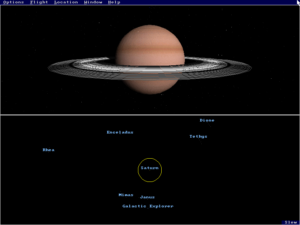


Tags: , , ,