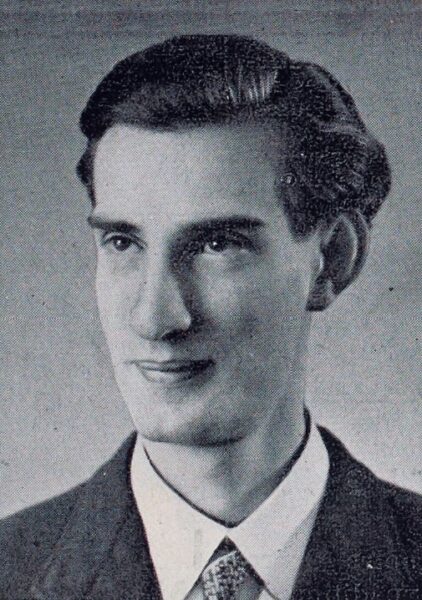
Pierre Plantard in 1942, at age 22.
It is possible to trace the Plantard family tree a fair ways back without relying on the Lobineau dossier, but not as far back as the time when the Merovingian kings ruled over the nascent nation of France. The real genealogical record shows that the Plantards were not a line of kings or demigods; they were rather ordinary laborers. The first trace we can find of them comes in the form of one Jean Plantard, who arrived from parts unknown to the town of Sémelay, about 300 kilometers southeast of Paris, during the first half of the seventeenth century. His descendants continued living in this region of France.
A Pierre Plantard was born in the village of Magny-Cours on October 11, 1877. Following a stint as a coal miner and a term of service in the French Army, he moved to Paris early in the new century to become a valet and butler, probably to one of the officers under whom he had served. (Such arrangements were common at the time.) He was called up again in that fateful month of August 1914, and spent the entire First World War fighting on the Western Front with his artillery regiment. He then returned to Paris to take up his domestic duties once again, working now for a wealthy Russian family who had fled the Bolshevik revolution in their country. He died in 1922 from a fall out of a second-floor1 window he had been attempting to clean, a sadly ironic fate for a man who had managed to survive four and a half years of brutal war.
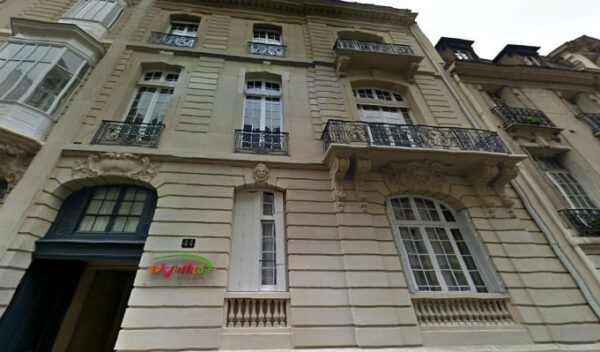
The older Pierre Plantard died from a fall out of one of these windows. One wonders whether his son might turned out differently if he had grown up with both of his parents.
But before he left this world, Pierre Plantard fathered a son with his wife Amélie, a fellow domestic servant. Born on March 18, 1920, the son was given the same name as the father he would never know.
This new edition of Pierre Plantard grew up coddled by his mother. By working day and night, she was able to supplement the small pension she had been awarded after the death of her husband enough to provide him with a reasonably good primary-school education. She and her son were mutually convinced that young Pierre was destined for greater things than his father, or, indeed, any of his other less-than-august ancestors.
Still, it wasn’t clear just how he was to rise to the level of his just desserts from such a humble point of origin. After he finished his standard schooling in 1937, his mother found that university was far beyond her means, no matter how many hours she worked or how she scrimped and saved. Being still in full agreement with his mother that he was above manual labor, Pierre spent almost all of his time in their apartment, expressing his political views in pamphlets which he gave away for free. He was of a type with a certain species of young man that can be found in the less savory corners of the Internet today (and occasionally showing up in this site’s usually friendly and thoughtful comment section to sound a discordant note). Intelligent in some ways but socially awkward, they channel the grievance born of their social isolation into reactionary cultural and political views. In the context of 1930s Europe, the endpoint of that journey was almost always fascism and its even uglier handmaiden of antisemitism.
Alas, Pierre Plantard was no exception. He advocated for the “purification and renewal of France,” a euphemism which, I trust, requires no elaboration. As an admirer of Adolf Hitler, he was traumatized when his country declared war against Germany in response to the latter’s invasion of Poland in September of 1939. He immediately dashed off a letter to Prime Minister Édouard Daladier to demand that he “put a stop to a war started by the Jews which we cannot win.”
In the decades to come, Plantard would claim that he joined the Resistance after a Nazi army marched into Paris in June of 1940. But in the early stages of the occupation at least, nothing could be farther from the truth. He was in fact an admirer and booster of the Vichy puppet regime that was installed to govern part of France under Marshal Philippe Pétain, an 84-year-old hero of the First World War who, to paraphrase the later words of Charles de Gaulle, went from glorious to deplorable in the view of French history in the space of an instant. A letter which Plantard wrote to Pétain on December 16, 1940, shows his delusions of grandeur already in fine fettle at age twenty. Claiming that he has knowledge of an assassination plot against Pétain, Plantard pushes the doddering old man to get a move-on implementing the Holocaust before it is too late.
Please forgive me for taking the liberty of writing to you this evening. Despite my various commitments, my lectures and my magazine, I am perhaps still unknown to you…
I know that, in the depths of your soldier’s heart, you are suffering from the knowledge that the people of France are questioning your sincerity and your patriotism, and are suffering more perhaps from that than from the effects of our recent disaster. But I know also of your great love for our country, and I am certain that you will do everything possible to save it once more…
You must act! Immediately upon receiving this letter you must issue strict but totally confidential orders. You must put an immediate stop to this terrible Masonic and Jewish conspiracy in order to save both France and the world as a whole from terrible carnage.
At present I have about 100 reliable men under me who are devoted to our cause. They are ready to fight to the bitter end in response to your orders. But what is 100 men when faced with the might of our enemies? Whatever the case may be, they will fight alongside me for our cause.
This letter would be laughable if the undertone wasn’t so dark. Plantard’s magazine was an amateurish pamphlet he passed out for free on the street; his lectures were nonexistent, as was the crack squad of 100 soldiers at his beck and call. He was just a skinny kid writing screeds in his mother’s apartment in lieu of facing the real world outside. Yet he would prove bizarrely adept at inhabiting an imaginary world throughout his life, never allowing reality to get too close to him.
In 1941, Plantard claimed to be the head of a youth group called Le Renovation Nationale Française (“The French National Renewal”). Under its auspices, he petitioned the Parisian police to let him seize the home of M. Shapiro, “an English Jew who is presently fighting alongside his fellows in the British armed forces,” to use as the group’s headquarters; he said he had already gotten permission to do so from the occupying Nazi authorities. In response, the police launched an investigation of his affairs. The verdict was as dismissive as it was scathing. From our standpoint, the most shocking aspect of the report is how fully-formed Plantard’s modus operandi was at such an early juncture.
M. Plantard describes himself as a journalist; in fact he lives entirely off his mother, who holds a pension granted to her following the accidental death of her husband…
Plantard, who boasts of having links with numerous politicians, seems to be one of those dotty, pretentious young men who run more or less fictitious groups in an effort to look important and who are taking advantage of the present trend toward a greater interest in young people in order to attract the government’s attention…
Le Renovation Nationale Française seems to be a “phantom” group whose existence is purely a figment of the imagination of M. Plantard. Plantard claims 3245 members, whereas this organization currently only has four members…
To date no meetings have been held…
It would seem that this organization is doomed to failure.
The report concludes that Plantard should not be allowed to steal M. Shapiro’s house, even if the latter is a Jew.
But Plantard soldiered on undaunted. By January of 1943, Le Renovation Nationale Française had morphed into a magazine called Vaincre (“To Conquer”). It mission was “to restore to the Fatherland the strength to live through an ideal based on chivalry and self-denial.” In what some might consider an abnegation of its stated ideal, Plantard still hadn’t found a paying job or moved out of his mother’s apartment.
His lifestyle was about to be dramatically disrupted, however. At some point during 1943 or 1944, Plantard was sent by the Nazi occupying authorities to Fresnes Prison, the primary holding place for Resistance agitators among others, for a four-month stint. This event is documented only by the French police, who were unsure of the reason for the sentence; the report author’s suspicion is that it was handed down primarily out of annoyance and exasperation, because Plantard had been badgering the German authorities with requests related to his various associations and publications as persistently as he had been the French ones. All of the relevant German documents seem to have been lost. Regardless of the reason for the prison stint, those four months, unpleasant though they doubtless were, would show themselves to have been a blessing in disguise after France was liberated, in that they prevented Plantard from being tarred with the broad brush of a full-on Nazi collaborator.
Indeed, he was quick to change his tune after an Allied army marched into Paris in August of 1944. The following month, he founded his latest organization, Alpha Galates (“Alpha Galatians”). Its object was “the creation, maintenance, and development of one or more welfare centers for young people who have suffered from German oppression (forced labor, deportation, imprisonment).” The one bar to membership was “to have been a member of any German or pro-German organization,” a standard which Plantard himself arguably didn’t meet. Another report in the archives of the French police, this one dated February 13, 1945, concludes that “this association has not engaged in any activity. It has had about 50 members, who resigned one after the other as soon as they sussed out the president of the association and worked out that it was not a serious enterprise. Plantard seems to be an odd young man who has gone off the rails, as he seems to believe that he and he alone is capable of providing French youth with proper leadership.” At the time of this report, he was back to living with his mother and still unemployed.
But not for too much longer. In December of 1945, the perpetual adolescent dipped a toe into the adult world. He got married to a woman named Anne-Léa Hisler and left the nest at long last. His activities over the next ten years are murky. He, his wife, and the daughter that would soon result from their union appear to have lived for a good part of that time in the town of Saint-Julien-en-Genevois, close to the border with Switzerland. He appears to have served two short prison sentences there, one in 1953 and the other in 1956; his wife left him around the time of this second prison stint, although the couple would not be formally divorced until 1970. The details of the convictions remain vague, thanks to French privacy laws, but mention has been made of “breach of trust,” “bad checks,” “fraud,” and, most alarmingly, “abuse of a minor,” which may refer to sexual relations with an underage girl. It isn’t clear how Plantard earned a living during these years; his attempts at playing a confidence man seem not to have been terribly lucrative. He himself would later mention working as an architect’s draftsman, but this may have been cover for other, humbler forms of employment.
It was also in 1956 that the series of events which would lead to the likes of The Holy Blood and the Holy Grail and The Da Vinci Code began in earnest. You may remember that it was in January of this year that Albert Salamon wrote the first French newspaper accounts of François-Bérenger Saunière’s possible hidden treasure. Later this same pivotal year, either just before or just after going to prison, or possibly from his prison cell, Pierre Plantard registered an organization called the Priory of Sion with the French government.
It is tempting to read more than coincidence into the dating of these events. But we must avoid falliing into the same trap that poor Henry Lincoln tumbled into again and again. There is no concrete reason to believe that Plantard read Salamon’s newspaper articles at the time they first appeared. Anathema though the notion is to conspiracy theorists, sometimes coincidence is just coincidence.
At this stage, the Priory of Sion was very much of a piece with what had come before, one more shell organization occupying a liminal space between a scam and a delusion, whose claimed membership count was at extreme odds with the reality of Plantard himself and a few others whom he had persuaded or cajoled into signing on as his “board.” As a subtitle, the Priory bore the acronym C.I.R.C.U.I.T.: Chevalerie d’Institution et Règle Catholique et d’Union Indépendante Traditionaliste (“Chivalric Institution and Catholic Rule and Independent Traditionalist Union”). Its founding statutes make it sound like an amalgamation of two of Plantard’s previous organizations, Le Renovation Nationale Française and Alpha Galates. It borrows from the former an interest in chivalry and Medieval life in general, from the latter an expressed interest in doing good deeds for the community. On the whole, it comes off like a French version of the Society for Creative Anachronism, albeit with a reactionary edge lurking in the corners. As a concession to the changing times, the overt fascism and antisemitism have been excised, but one can still feel their undertow beneath the surface: “The aim of the association is to found a Catholic order, with the intention of recreating in modern form, while preserving its traditional character, an ancient knighthood, which by its actions promoted a highly moralizing ideal and was a factor for steady improvement in the rule of life of the human personality.”
A C.I.R.C.U.I.T. newsletter from the fall of 1956 — the acronym was actually more prominent than the name the Priory of Sion early on — promises to institute a bus service for the local neighborhood, “to take your children to school and then bring them home again.” The fee is just 360 francs per month for one child, or 500 francs for two or more: “We would kindly ask you to enter details of your children on the attached form and deposit it in the letterbox of M. Plantard, Hill B, before Sunday evening, 21 October 1956.” There is no reason to believe that these buses ever ran. For that matter, it seems doubtful that this first incarnation of the Priory of Sion existed in even nominal form by the time 1956 was over.
Plantard returned to Paris in 1958, just as France was being plunged into its most serious political crisis of the postwar era. A revolt in the colony of Algeria had exposed the ineffectuality of the current system of parliamentary democracy, which was known as the Fourth Republic. In response, Charles de Gaulle, the hero of the Second World War, led a sort of soft coup that resulted in a system of government with more resemblance to the American approach than that of most European countries, complete with a strong president. De Gaulle himself became the first of these presidents.
While the outcome of his efforts was still in doubt, de Gaulle’s supporters all over France created organizations that bore the vaguely ominous name “committees of public safety” to forward his cause. These were catnip for Pierre Plantard. Forgetting that he had once preferred Marshal Pétain to General de Gaulle, he began to present himself to the press as one of the leaders of these committees. He was quoted in this guise several times by France’s national newspaper of record, Le Monde; this was rising higher than his fantasies had ever taken him before.
Once the Fifth Republic was firmly established and the committees dissolved, Plantard discovered a new vehicle for his schemes, one that would prove immensely important to the later history of the Priory of Sion and Rennes-le-Château. He found out that, through some colossal administrative oversight, anyone could deposit unvetted documents into the Bibliothèque Nationale. After this was done, they would be assigned a catalog number and be made available to researchers just like any other item in the library’s vast holdings. The Holy Blood and the Holy Grail, The Da Vinci Code, and all the rest of the lore and lucre of Rennes-le-Château could never have come to pass without this bureaucratic tribute to our natural instinct to trust one another. For trust was a quality just waiting to be weaponized by a man like Pierre Plantard.
His first application of the technique was to deposit documents which seemed to show that he had worked as de Gaulle’s right-hand man among the citizenry while the Fifth Republic was hanging in the balance. The clincher was a personal letter from the general — a forged one, naturally. (One problem with all of Plantard’s efforts at forgery is that he couldn’t shift himself from a stilted and fussy prose style that becomes readily recognizable, even when translated into English, as soon as you’ve seen it two or three times.)
My dear Plantard,
In my letter of 29 July 1958 I told you how much I appreciated the part that the committees of public safety had played in the restoration work that I have undertaken. Now that new institutions are being proposed that will enable our country to once again assume its place in the world, I think that the committees of public safety should be released from the obligations that have been imposed upon them to date and that they can be demolished.
This letter would later entice Henry Lincoln and his co-authors to make the ludicrous assertion that de Gaulle had “turned specifically to M. Plantard for aid” in realizing the Fifth Republic. (This after Plantard had engaged in “laudable activity” during the Second World War, including “editing the Resistance journal Vaincre,” and had then been imprisoned “more than a year” by “the Gestapo.” In between these two heroic periods of his life, he had resided near Lake Geneva, Switzerland, by explicit invitation of that country’s government, to be “one of the éminences grises from whom the great of this world seek counsel.” It certainly sounded better than languishing in a provincial prison cell for petty crimes.)
Plantard had been putting on aristocratic airs all his life, part and parcel of his longstanding fixation on the vanished life of the Middle Ages. By the time he returned to Paris, he had likely invented the idea that he himself was a long-lost scion of noble blood, may even have already linked himself to the Merovingian dynasty of almost a millennium and a half ago. But his self-aggrandizing fictions would never have reached as many people as they eventually did if he hadn’t met Philippe de Chérisey.
De Chérisey was exactly what Plantard most devoutly wished to be: a real nobleman, a count to be specific, with a pedigree stretching well back into Plantard’s beloved Middle Ages. But whereas Plantard had spent his life running toward a noble title that could become his only through deception, de Chérisey had spent his running away from the expectations of his family. Born in Paris three years after Plantard, he had enrolled in acting school as soon as the end of the Second World War made it possible. Adopting the stage name of Amédée as a sop to his family’s sensibilities, he appeared on radio and in a few reasonably successful films during the 1950s, until his other habits began to interfere with his career.
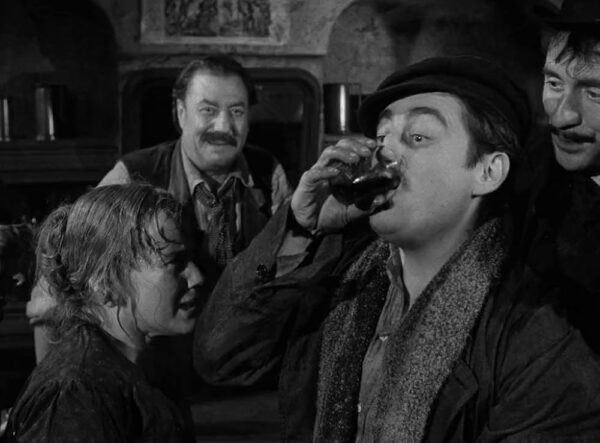
Philippe de Chérisey drinks up in the 1956 film Gervaise.
For de Chérisey was an unrepentant drunk, womanizer, and all-around bon vivant who wore his dissipation like a badge of pride, as if he had stepped straight out of the pages of Les Liaisons Dangereuses. He was also a card-carrying Surrealist, whose watchwords were anarchy and absurdity, born out of the belief that nothing in life — absolutely nothing — was worth taking all that seriously. The best reason to do something was because it was fun; the best reason not to do something was because it was not fun. Surrealist moral philosophy extended no farther than that.
De Chérisey collected rogues and misfits whom he found amusing in the way that some other people collect stray cats and dogs. We don’t know exactly how he came into contact with Pierre Plantard, but it is clear that he found that man, who approached his con artistry with all the gloomy intensity of a knight about to ride into bloody battle in the name of his lord and savior, incredibly amusing. Plantard didn’t so much willfully lie as attempt to reconfigure the order of things to the way it ought to be, with himself in the place of prominence that he deserved. De Chérisey, who already had that which Plantard most desired and affected not to care a whit about it, found it hilarious that such an unprepossessing man as this one could have such delusions of grandeur. He began paying Plantard’s bills in Paris so that the bizarre fellow could have free rein to do his bizarre thing.
De Chérisey happened to have another amusing friend, a fellow traveler in Surrealist circles named Gérard de Sède, who was working on a book about the Knights Templar that was to be, shall we say, not an overly rigorous history of the Medieval chivalric order. De Chérisey put the “hermeticist” Plantard in touch with de Sède. De Sède went on to quote Plantard prominently in his book.
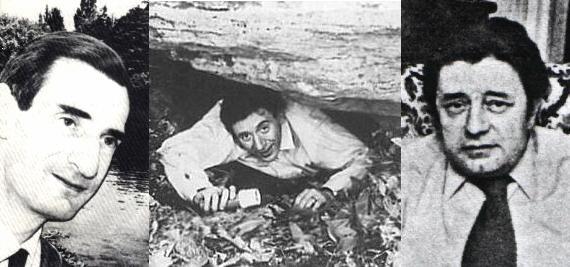
The real conspirators of Rennes-le-Château: Pierre Plantard, Philippe de Chérisey and Gérard de Sède.
It cannot be emphasized enough how essential de Sède and de Chérisey were to everything that followed. Plantard was as dull and pedantic by nature as he was dishonest; de Sède once described him as “a big nocturnal bird, very gloomy, very tall, very skinny. He’s not cultured; in fact, he’s quite ignorant.” De Sède and especially de Chérisey, on the other hand, were possessed of all the joie de vivre which Plantard lacked. They were able to give his ponderous genealogies a spark of wit and whimsy, able to turn the fraud into a game that could prove almost as enticing to those who didn’t believe in it as those who did. (Witness: the fact that this series of mine has now extended to five articles…) There is a reason that Plantard didn’t become a successful con man until he met de Chérisey and de Sède, the same reason that he was plunged into relative obscurity again almost as soon as the relationship ended.
Just as the exact time and circumstances of Plantard and de Chérisey’s first meeting are unknown, it isn’t clear when Rennes-le-Château first crossed their radar either. In the late 1970s, Plantard would spin a tale of a youthful visit.
I went to Rennes-le-Château in August 1938 to recover some letters which the priest Saunière had received from my grandfather. It was during the holidays and I was not yet twenty years old. ‘Marinette’ [Dénaraud], as they called her in the village, received me very hospitably at the Villa Bethania; I stayed there for three days. We celebrated the 70th anniversary of the old lady…
This upper-crust vision of tea in the garden of Saunière’s villa is a complete fabrication, like most of what Plantard said during his life.
In the category of more reliable witnesses, the Carcassonne librarian René Descadeillas believed Plantard made his first appearance in the area already in the late 1950s. This may be correct, but it seems at least as likely that this is a rare instance of Descadeillas being mistaken. For a documented reference to Rennes-le-Château from the pen of Plantard can’t be found until January 18, 1964. He may very well first have learned about Saunière and his alleged treasure the same way that so many of his countrymen did, through the documentary that aired on French television in early 1961. However it happened, he became one of the collection of misfits, cranks, and dreamers who took to hanging about the place, standing out only for being a bit more extreme in all three of those descriptions than most of the others. Calling him “strange,” Descadeillas wrote that
this man lived in Paris. He had no connections and no known relatives in the area. He was a difficult fellow to place, drab, secretive, cunning, with the gift of the gab, but people who spoke to him said it was hard to follow what he said. He was not having a course of medical treatment [the nearby town of Rennes-les-Baines, once the home of the French Lewis Carroll Henri Boudet, was known for its medicinal springs]. People asked about the reasons for his regular appearances, because he turned up unexpectedly, even in winter. They also speculated about his interest in archaeological and natural sights, because he was not an intellectual. They were intrigued by the strangeness of his behavior: he used to go around surveying the area and inquiring about the origin of properties. He would set his heart on scrubland or abandoned ground which did not interest anyone.
Philippe de Chérisey reportedly accompanied Plantard on some of these trips, and presumably funded all of them. Together, the two of them began to concoct the narrative that would soon spread through France and then the rest of the world, through the mediums of Gérard de Sède and Henry Lincoln respectively. Plantard may already have been working on the fake genealogies that were meant to suggest that he was a long-lost scion of the Merovingian dynasty for quite some time by this point. The earliest of those documents states that it stems from 1956 (again, that pivotal year!), but it’s impossible to say if this date is accurate. But his masterstroke — or perhaps de Chérisey’s — was to link these fantasies with the ones surrounding the treasure of Rennes-le-Château, thereby lending them the verisimilitude of being centered on a very specific place, one that anyone could go and see for themselves. Stumbling upon the tomb of a once-wealthy American heiress and her mother, constructed only 40 years before, Plantard thought it looked like the one seen in Nicolas Poussin’s The Shepherds of Arcady and worked that into the story. And of course the Priory of Sion was added to the plot, no longer as a Medieval-revivalist social club but as a shadowy cabal that had been associated with the hidden Merovingian bloodline since before the Crusades.
The reasons for the inclusion in the lore of the painting by David Teniers the Younger and the anonymous portrait of Pope Celestine V were and have remained far less obvious, such that they have been confusing treasure hunters ever since. Ditto Le Serpent Rouge, the nonsensical poem that also made its way into the growing dossier. De Chérisey, the unapologetic Surrealist prankster, must have relished blending the soluble conundrums with insoluble ones such as these, all in the service of turning the inept failed con artist Pierre Plantard into a king. What could be more absurd and hilarious?
Between 1963 and 1967, Plantard and/or de Chérisey deposited into the Bibliothèque Nationale the tranche of documents that Dan Brown would grandiosely call Les Dossiers Secrets in the opening pages of one of the best-selling novels in history. The holy texts of what would become practically a new religion to some are to be found right here. Among them are the genealogies of the Merovingians (and the Plantards), the list of Grand Masters of the Priory of Sion, and François-Bérenger Saunière’s connection to the mystery, including his fabled trip to Paris to have some “parchments” decoded and to buy three particular paintings. In short, the Lobineau dossier is the new religion’s version of the Bible or Koran. In time, much would be added to the theology that didn’t appear there, but it was the foundation of all that was to come.
It was de Chérisey who created the textual puzzle boxes we have been referring to as Altar Documents 1 and 2. He forged Gravestone 1, depositing it into the Bibliothèque Nationale with the names of Eugène Stübeln and a recently deceased local priest named Joseph Courtauly attached, and repurposed Gravestone 2 from an old journal put out by a Languedoc society of gentlemen scholars. We know all of this because he later told the French author Jean Markale exactly how he went about “inventing a story that the mayor [of Rennes-le-Château] had had a tracing made of the parchments discovered by the priest. Then I started to devise a coded copy based on passages from the gospels, and then I decoded myself what I had encoded.” The actual messages hidden in the documents were de Chérisey’s usual mixture of the sensical and the nonsensical. The results were superficially clever, but positively riddled with tells that they were far from aged, from the modern typesetting to the use of a far too recent edition of the Vulgate Bible. Nevertheless, they would, as de Chérisey put it, “work beyond my wildest dreams.”
For many years, it was assumed that Gérard de Sède was more or less a useful idiot in all of this, nothing more than Plantard and de Chérisey’s dupe for getting their invented mythology out into the world. But the indefatigable Rennes-le-Château skeptic Paul Smith, who has been fighting the good fight on his website since three years before Dan Brown’s novel hit, believes that de Sède, being a card-carrying Surrealist in his own right, was in on the joke all along. Smith’s theory of the case is that “originally, Plantard wrote a manuscript on the Rennes-le-Château story and during an eighteen-month period approached countless publishers to buy it. Nobody was interested. De Sède then rewrote the book, made it more comprehensible and less cluttered with detail. The result was the book L’Or de Rennes which was published in 1967 by Julliard.”
By way of bolstering his case, Paul Smith has placed the original publication contract for L’Or de Rennes on his website. Signed on January 13, 1967, it considers de Sède and Plantard to be full-fledged co-authors, and unequal ones at that: de Sède is to be awarded just one-third of the book’s royalties, Plantard the remaining two-thirds. The contract concludes that “in accordance with Mr. Pierre Plantard’s wishes, his name will not appear in any way either in the text or in any publicity relating to it.”
So, no one associated with the book was innocent; it was a knowing scam from top to bottom. The crowning masterstroke, which reeks of de Chérisey’s devious mind, was the decision to leave one fairly easily decipherable secret message undecoded, as a sort of exercise for the reader. That pulled Henry Lincoln into an intellectual black hole that he would never escape, providing the trio with a dupe par excellence.

Pierre Plantard during the heyday of the conspiracy.
We don’t need to dwell unduly on what happened during the 1970s, on how the myth-makers fed Lincoln a steady drip of fresh information, until he reached the point of making up his own lore, thus making the conspiracy theories self-sustaining. It seems unlikely that anyone had thought about secret geometries in the paintings and landscapes before Lincoln. And the ultimate piece of plot inflation, the transformation of Pierre Plantard from merely a long-lost king to a demigod on Earth with the sacred blood of Jesus Christ coursing through his veins, definitely caught the trio by surprise. It first occurred to Lincoln as a potential answer to a thoroughly commonsense question: why did it really matter to anyone, other than perhaps some scholars of genealogy and Medieval history, even if Plantard really was a long-lost Merovingian? On the other hand, everybody could understand why it mattered if he was Jesus’s direct descendant.
Ironically, the French themselves realized the truth about the conspiracy theories they had sprung on the world far earlier than everybody else. Already in 1974, when Henry Lincoln had barely gotten started, René Descadeillas returned to the subject out of sheer exasperation with the misinformation he saw flying all around him from his perch in the library of Carcassonne. This time, he wrote and published a proper book, Mythologie du Trésor de Rennes (“Mythology of the Treasure of Rennes”), thoroughly debunking the notion that Saunière had been anything but a corrupt priest with a taste for simony alongside the one that the various documents being passed around by de Sède could be anything more than an elaborate, eminently Gallic practical joke. Several other French authors wrote similarly detailed exposés in the decades that followed, but none of them were translated into other languages to directly challenge the gospels of Henry Lincoln and Dan Brown in the wider world.
The real, three-man conspiracy that stood behind it all started to fall apart already by the end of the 1970s. De Sède was the first to break ranks, angry at Plantard for communicating directly to Lincoln instead of using him as his exclusive intermediary. He was already gone when Lincoln filmed his fateful interview with the would-be Merovingian scion in March of 1979. Switching sides with the fecklessness of a conspiracist spurned, in 1988 he would publish the book Rennes-le-Château: Le Dossier, les Impostures, les Pantasmes, les Hypothèses (“The Dossier, the Impostures, the Phantasms, the Hypotheses”). It would explain almost everything, except the extent to which de Sède himself had been in on the scam all along.
Plantard’s break with de Chérisey came a few years after the one with de Sède, after Lincoln and his co-authors trumpeted the theory that Plantard was a direct descendant of Jesus Christ in The Holy Blood and the Holy Grail. He took extreme exception to this assertion, for reasons that aren’t really clear. One would think that this man of all men would love to be known as a demigod walking the Earth, but such was not the case. It may have been that, underneath all of the lies and deceptions, the Catholic faith he professed was in some sense genuine, and couldn’t abide a blasphemy such as this. Or it may have been simply that Lincoln and his cronies got rich by building on his cherished myth, while he did not.
De Chérisey, by contrast, loved this ultimate theory of the case, clearly seeing it as the perfect final punchline of the joke he had unleashed upon the world fifteen years earlier. He wrote articles and letters telling people so, which led Plantard to cut ties with him, as he already had with Henry Lincoln. De Chérisey died relatively young in 1985, a victim of way too much aristocratic decadence. Plantard refused to attend the funeral.
In the aftermath of the rupture, Plantard attempted to reboot a fraudulent legacy that, he must have felt, had gotten too far out of his control. He went back to his usual playbook, re-inaugurating the Priory of Sion as a social organization with a philosophy and a magazine but a dubious roll call of actual members. According to the latest mythology, the Priory dated not from before the Crusades or even from after the Second World War, but rather from September 19, 1738. I could try to explain the new secret history, which retained some elements of the old one and discarded others, but what would be the point? Suffice to say that Plantard was still up to his old tricks. Unfortunately for him, the loss of his co-conspirators meant that his efforts were subject once again to the weaknesses that had undermined his earlier attempts at fraud: his tendency toward pedantry, his tangled prose, his lack of personal charisma, and his utter inability to tell a straightforward story without getting himself and his reader irretrievably lost in the weeds.
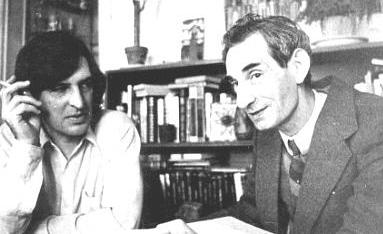
Pierre Plantard with author Jean-Luc Chaumeil during the 1980s.
One technique which Plantard had long used to good effect was that of attaching his tales to those of famous dead people, who, being dead, were unable to contradict him. “He was first and foremost a past master at putting words into the mouths of the dead”, says Jean-Luc Chaumeil, the author of several books about the mythology of Rennes-le-Château. “Once someone had died he produced all sorts of documents, letters, and so on, all forgeries of course.” This longstanding practice — as demonstrated most famously in his list of Grand Masters for the Priory of Sion, without which Dan Brown’s novel would have been left without a title — remained one of his go-to moves as he entered his septuagenarian years. This time around, however, it would wind up hoisting Plantard with his own petard, in a way delightfully surreal enough to cause Philippe de Chérisey to giggle in his grave.
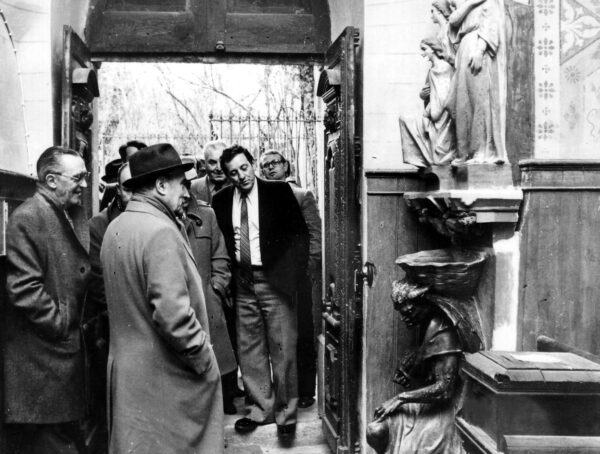
Roger-Patrice Pelat, at far left, in Rennes-le-Château in early 1981. His friend François Mitterand stands just to his right, wearing a hat.
Once upon a time in France, there was a prominent financier named Roger-Patrice Pelat, whose grievous life story would come to parallel that of his British counterpart Robert Maxwell. Pelat was very close to François Mitterrand, France’s president from 1981 to 1995, whom he had known since the two were prisoners of the Nazis together. They visited Rennes-le-Château during Mitterrand’s first presidential campaign, resulting in a well-traveled photograph of them standing inside Bérenger Saunière’s cluttered, rather tacky church. (The line between sinister trappings of the occult and mere bad taste is often thin.) Several years later, Pelat found himself at the center of a scandal when all sorts of improprieties in his dealings began to come to light. Mitterand distanced himself hurriedly, as politicians invariably do in such situations, and Pelat died alone and unlamented in March of 1989 of a literal broken heart.
Pierre Plantard moved to appropriate Pelat’s legacy for his purposes almost before the body was cold. In his telling, Pelat had become Grand Master of the Priory of Sion after he himself had stepped down from that post in 1984. But the Americans — these had become Plantard’s new bogeymen, a replacement for the Jews who had filled that role in his youth — had gotten to Pelat in some undefined way and brought him down.
For a long time, the American dream has been to dominate our country for financial and economic motives. The Priory, very many of whose members are themselves major financiers, politicians, directors of major insurance companies, magistrates, and so on, is the ideal CIRCUIT for various courses of action. That’s how Patrice Pelat was ensnared, and — I can say it here — I retain for him the most profound affection in spite of everything that has happened.
All would have been fine if Plantard had contented himself with spinning such fables exclusively for the all but nonexistent members of his largely imaginary organization. But on September 28, 1993, someone who called himself René-Roger Dagobert — yes, really — sent a number of documents to the court of law that was still investigating the dealings of the deceased Pelat. One of these, on the letterhead of the Priory of Sion, referred to Pelat as “our former Grand Master, who was always very much a man in the background, perfectly honest and just, who fell beneath the blows of various American initiates.”
In response, Judge Thierry Jean-Pierre ordered the police to search Plantard’s house and ordered the man himself to appear before his court, possibly because he suspected that the Priory of Sion may have been helping Pelat to launder money. This was a laughable notion on the face of it; Plantard’s operation was nowhere near that sophisticated, as must have been made all too clear by the documents that were seized. Nevertheless, Judge Jean-Pierre soon had Plantard under oath in his courtroom, and seems to have enjoyed making him squirm. There are conflicting reports about exactly how far he pushed him; transcripts of the proceedings remain sealed. Some reports have it that Plantard admitted only that he had lied about Roger-Patrice Pelat having been affiliated with the Priory of Sion, while others say that he confessed to all of the fraud, stretching back at least to 1956. Either way, Judge Jean-Pierre clearly put the fear of God into Pierre Plantard. For Plantard disappeared completely from public life after he went home from court for the last time on November 23, 1993; I might write now that he finally shuttered the Priory of Sion for good, if only there had actually existed much of anything to shutter. He died on February 3, 2000, just short of his 80th birthday.
The symmetry of the young and the old Pierre Plantard seems better suited to a novel than to real life. From first to last, he was founding grandiosely titled organizations in that aforementioned liminal space between wish-fulfillment and fraud, imagining thousands of members who didn’t exist, preaching his reactionary, nationalist politics in whatever form was deemed most acceptable at the time. He got his comeuppance at the hands of the Nazi occupiers of France during the 1940s and a French court of the 1990s for the same reason: for annoying them by spouting an endless stream of stupid, petty, self-aggrandizing lies instead of doing something better with his time.
Pierre Plantard was the embodiment of hyperreality, living his entire life in a virtual world of his own making. And he was the embodiment of another quality that hardcore hyperrealists often manifest: a complete inability to evolve. He was, whatever else he might have been, a perpetual adolescent. How strange to think that the mystery and the industry of Rennes-le-Château — the novels and the games and the movies and the tours and the earnest students of the lore who are poring over their sacred geometries even as I write these words — all came to exist because one emotionally stunted man decided to make himself the king he wanted to be as a replacement for a reality he refused to accept. In its way, his story is even more improbable than the mythology he spawned.

Farewell, Rennes-le-Château. It was an interesting place to visit, but I don’t want to live there.
There is much, much more that I could write about Rennes-le-Château, a sticky topic that can ensnare the skeptic almost as easily as it can the true believer. Every answer just leads you to five more questions if you let it.
But we shouldn’t let it. Once we cut through all of the tangential connections and secret codes and other nonsense, we find that the underlying truth is disarmingly straightforward. At the turn of the twentieth century, a corrupt French priest remade his church and his village into a lavish if tacky monument to his own eccentric tastes. In the 1950s, a hotelier harnessed the local legend of hidden treasure which the priest had left behind to drive business his way. Then a few other bored Frenchmen embellished the story for aggrandizement and amusement. Then Henry Lincoln heard the tale they were spouting and added some extravagant touches of his own to the story, because he wanted it to make sense so very badly. And then Dan Brown came along to mash it down and make it suitable for mass consumption, turning a chicken into a chicken nugget.
The peak of the Da Vinci Code mania is well past now, but the fantasies of Plantard, Lincoln, and their friends still echo through popular culture — not least the culture of gaming, which has long since become as mainstream as any other form of entertainment. Gabriel Knight 3, the game which started us on this journey, is just the tip of the iceberg. We will surely be encountering this mythology again as we proceed on this larger journey of ours through the history of gaming.
But at the same time that it has been an influence on games, the mystery of Rennes-le-Château is itself a sort of game — an “infinite game” in the words of Marian Tomatis, one whose playing board is the whole world. Anyone who claims to have solved the mystery and thus won the game is immediately perceived as a threat by a community of players who have made it their hobby, their social outlet, in some cases even their identity: “The game of Rennes-le-Château continues to provide amusement only if there is an underlying mystery, an unsolved puzzle to be explored. Any contribution academically sound is immediately rejected by the large community of players, because every demystifying statement closes at least one of the possible extensions of the game, thus threatening the very purpose of the infinite game, which is to continue indefinitely.”
Every gamer knows the feeling of wanting to keep a good game going. But the wise ones also maintain the barrier between the game and real life. For to do otherwise is to risk madness, as the lives of Plantard, Lincoln et al. so painfully demonstrate.
Did you enjoy this article? If so, please think about pitching in to help me make many more like it. You can pledge any amount you like.

Sources: The books Holy Blood, Holy Grail and The Messianic Legacy by Michael Baigent, Richard Leigh, and Henry Lincoln; Bloodline of the Holy Grail: The Hidden Lineage of Jesus Revealed by Laurence Gardner; The Treasure of Rennes-le-Château: A Mystery Solved by Bill Putnam and John Edwin Wood; The Holy Grail: The History of a Legend by Richard Barber; Invented Knowledge: False History, Fake Science and Pseudo-religions by Ronald H. Fritze; The Tomb of God: The Body of Jesus and the Solution to a 2,000-Year-Old Mystery by Richard Andrews and Paul Schellenberger; Rennes-le-Château et l’enigme de l’or maudit by Jean Markale; Le Trésor Maudit de Rennes-le-Château by Gérard de Sède; The Holy Place: Saunière and the Decoding of the Mystery of Rennes-le-Château by Henry Lincoln; Key to the Sacred Pattern: The Untold Story of Rennes-le-Château by Henry Lincoln; Les Templiers sont parmi nous, ou, L’Enigme de Gisors by Gérard de Sède; Les Mérovingiens à Rennes-le-Château. Mythes ou Réalités. Réponse à Messieurs: Plantard, Lincoln, Vazart & Cie by Richard Bordes; Lives of the Popes: The Pontiffs from St. Peter to Benedict XVI by Richard P. McBrien; Foucault’s Pendulum by Umberto Eco; The Da Vinci Code by Dan Brown; Are We Idiots?: The Simulacra of Jean Baudrillard by Boris Kriger; Simulations by Jean Baudrillard; Mythologie du Trésor de Rennes by René Descadeillas; Rennes-le-Château: Autopsie d’un Mythe by Jean-Jacques Bedu; Bérenger Saunière Curé à Rennes-le-Château by Abbé Bruno de Monts; Rennes-le-Château: Le Dossier, les Impostures, les Pantasmes, les Hypothèses by Gérard de Sède.
Skeptical Inquirer of November/December 2004; Politica Hermetica 10.
As should be made clear by the links sprinkled through the article, I owe a special debt to the material collected by Paul Smith on his website Priory of Sion.









Lars
May 1, 2026 at 4:24 pm
*Carcossonne?
Jimmy Maher
May 1, 2026 at 7:43 pm
Thanks!
hcs
May 1, 2026 at 6:14 pm
I’ve enjoyed this tangent, thanks!
> Plantard’s break with de Chérisey came a few years [..] the one with de Sède, after Lincoln
Jimmy Maher
May 1, 2026 at 7:43 pm
Thanks!
Phil B.
May 1, 2026 at 7:09 pm
I particularly appreciate this bust-down-the-walls article here at the end of the ride, pointing out what really happened. I never expected any less, of course, but having it all spelled out here is fantastic. What a wild, stupid, funny, and sad ride it’s been.