I’m still to this day just blown away by continental drift and things like that, stuff that most people think sounds pretty boring.
— Will Wright
Gamers are both extremely dedicated to and really good at preserving the history of their hobby. Seldom has a month gone by in the fifteen years that I’ve been writing for this site that I haven’t had cause to feel grateful for their efforts. During the early years, I was most thankful for their lovingly curated archives of 8-bit disk images and the emulators to run them on our modern-day supercomputers; more recently, it’s initiatives like ScummVM and the welter of patches and fixes that make it easier to experience games that are, for all that they may be infinitely more advanced than the ones I started out writing about, nevertheless decades old by this point, designed for versions of Microsoft Windows that fell out of support before some people who are old enough to vote today were even born. More recently still, projects like Wine and Lutris have allowed me to run these games on Linux, in many cases more easily than I could under Windows. And then of course there’s MobyGames, a site I have visited and will doubtless continue to visit almost every single day that I write about gaming history.
It therefore pains me just slightly to say that, for all the good they do, these same fans can create a somewhat distorted impression of the history they work so hard to preserve. The fact is that the version of our ludic past which you find chronicled on a site like MobyGames is often markedly at odds with the real facts on the ground from back in the day. The games which get most of the attention there, and garner multiple loving retrospectives in fan journals like Retro Gamer magazine, are seldom the ones that actually sold the best. Then as now, the best way to sell a lot of games was to make ones that appealed to people who don’t self-identify as gamers, who would have no idea how to even begin to interact with a DOOM or a Starcraft, to whom it would certainly never occur in a million years to visit a site like MobyGames. For these people, games are just a way of passing the time, not a passion or a lifestyle. And there are a lot more of them than there are of us, my friends. If you’re basing your understanding of which games were the most successful in their day on the ones that have the largest quantity of nostalgic reviews on MobyGames, Steam, and GOG.com, you’ve gone badly astray.
The canonical example of this disconnect is Myst. Widely dismissed by the hardcore set as nothing more than a slideshow of pretty pictures wired together with a handful of switch-flipping set-piece puzzles, Myst was the face of the multimedia revolution in personal computing in the eyes of Jack and Jill America during the 1990s. As a result, it became the best-selling single game of the decade. There’s a surprising number of other non-core-gaming successes of almost the same magnitude to be spotted if you only pause to look, most of them without the note of highbrow artsiness that has always elevated the discussion around Myst. The most successful game ever made by Dynamix — the studio behind such hardcore classics as Articfox, Red Baron, Betrayal at Krondor, and Aces of the Deep — was a far more populist offering called Trophy Bass, which as of this writing has precisely zero reviews on MobyGames. And don’t even get me started on Deer Hunter, the schlocky big-box-store sensation of the late 1990s, a punchline among hardcore gamers that just sold and sold and sold and sold.
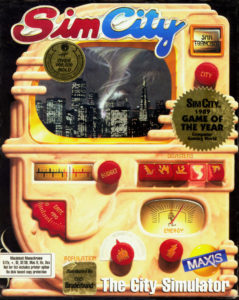
A subtler example of the phenomenon — also one that gives a modicum more hope than Deer Hunter for the taste and intelligence of the proverbial unwashed masses, even as it cuts across some of the boundaries behind hardcore and casual play — is SimCity. Designed by Will Wright and published in early 1989 by a company he co-founded called Maxis Software, SimCity‘s combination of compulsive playability with the serious, adult-approved theme of urban planning famously inspired Time magazine to write its first computer-game review ever within mere weeks of its release. The sky was the limit from there. The rumpled, chain-smoking, mile-a-minute-talking Wright became a minor celebrity in his own right as magazines, newspapers, and even television shows piled in to cover this game and this man that conformed to none of their preconceived stereotypes. Reflecting on those heady days in 2013, Wright called SimCity “kind of the earliest example of a game that was leaning more to a mainstream audience. They were interesting people that were not necessarily into dragons or history or sports. And so they were into games that were more about reality than fantasy.” The only game of the time that gained as much traction among people who didn’t usually play games was Tetris. But there was only so much you could say about a game of falling blocks, whereas the literally-titled SimCity, a game which really did purport to simulate an entire city, opened up endless vistas of thoughtful exposition in middlebrow media.
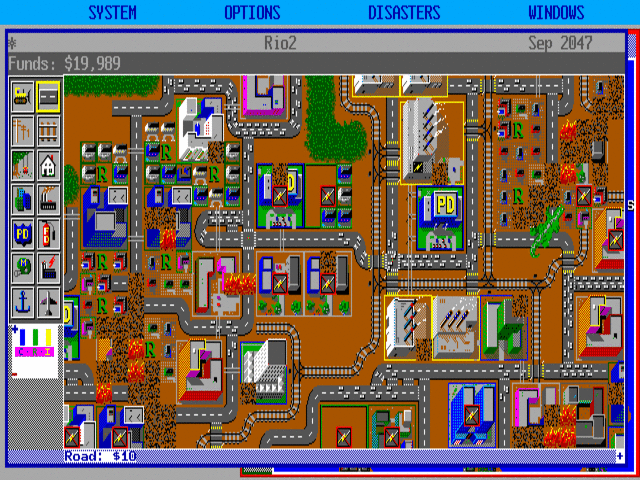
This discourse was frequently self-contradictory. On the one hand, SimCity’s lack of explicit goals or winning states caused it to be deemed the harbinger of a new generation of “software toys,” a frivolous-sounding description which Will Wright nevertheless enthusiastically embraced. On the other hand, the same media was full of reports of university professors and city councils who claimed to take the software toy seriously enough as a simulation to apply it to their work. Wright was more ambivalent about this sort of thing, presumably because he knew all too well just how much SimCity was not based on anything real in any but the most abstract of senses. Still, he couldn’t quite find it in himself to say that these folks were full of it either. Not until years later did he feel he could come completely clean and admit that SimCity was really “a caricature of the way a city works, not a realistic model.”
Many people come to us and say, “You should do the professional version.” That really scares me because I know how pathetic the simulations are, really, compared to reality. The last thing I want people to come away with is that we’re on the verge of being able to simulate the way that a city really develops, because we’re not.
At the time, though, few proved able to grasp this reality that, just because something walks like a duck and quacks like a duck on a computer screen, that doesn’t mean it is an accurate simulation of a duck. “When I was running Lower Gomorrah, something that looked like a city and felt like a city,” pondered tech journalist Steven Levy, “was I really manipulating anything that bore formal resemblance to a city? How relevant is the imitation of the real thing?” (The answers to these questions, for the record, are “not really” and “not very.”)
But whatever its shortcomings as a real, honest-to-God simulation of urban spaces, there can be no doubt that SimCity should be numbered among the most influential games of all time. In this respect, it makes a stark contrast to Myst, which proved to be something of an evolutionary dead end after the inevitable flurry of largely unsuccessful clones (and one almost as successful direct sequel) had exhausted themselves. SimCity spawned a new gaming sub-genre known as the city-builder, a niche category to be sure but one that proved far more popular and enduring than first-person slideshow adventure games. And yet this constitutes the merest beginning of SimCity’s actual influence. By showing how a real-time approach could benefit even a game that wasn’t particularly interested in testing its player’s reflexes, it revealed new possibilities to designers, who went on to implement real-time in a wide array of strategy games, from Railroad Tycoon to Europa Universalis. And in popularizing and legitimizing the notions of “builder games” and “software toys,” it likewise changed design aesthetics forever; after it, even games that did boast the campaigns and stories and goals that SimCity had so conspicuously lacked felt obliged to provide a “sandbox” or “free-play” mode to satisfy the appetites that Will Wright had inculcated. In all of these ways and more, SimCity’s influence extends astonishingly far afield. For example, Sid Meier has gone on record many times to say that Civilization would never have come to be absent SimCity. (He actually tried very, very hard to make the original Civilization run in real-time before finally accepting that it just wasn’t a good fit with the other parts of the design.) Whatever your favorite modern game happens to be, the odds are better than even that it bears a trace of SimCity somewhere in its DNA.
In a more immediate context, though, the success of SimCity posed a dilemma for Will Wright: what would he and Maxis do to follow up a game that was being discussed in borderline worshipful terms in such unlikely media organs as InfoWorld, The New York Times, and Newsweek? Wright was determined to keep on keeping on with his idiosyncratic vision of games as intricate systems to be tinkered with and learned from rather than competitions to be won or interactive stories to be experienced. Why should he do anything else, given the money and celebrity that SimCity was garnering him? Maxis’s co-founder Jeff Braun, the business mind to complement Wright’s creative one, thought his responsibility was “to protect him [Wright], in a sense, and create a structure where he can do his thing. It really was not about me and what I thought would be successful. It was about Will and getting his creative thing out.”
At the Game Developer’s Conference in the spring of 1990, Wright made a presentation that says as much about his way of thinking about games as it does the heady tenor of the times. He proposed an industry-wide standardized file format “so that players could switch accomplishments from one imaginary world to another. For instance, one might be able to use the road system from SimCity in order to race in Vette!, or one’s approval rating for the former might be enhanced by one’s accomplishments in, say, Ultima VI.” (Had these three games ever been mentioned together in the same sentence before?)
Naïve and ultimately pointless though the proposal may be, it demonstrates something important about Will Wright. In his mind, all of the games he would make or enable to be made in the future would be in some sense part of a single larger, overarching game, an entire simulated universe. To Will Wright it was, to paraphrase Neil Young, all one game.
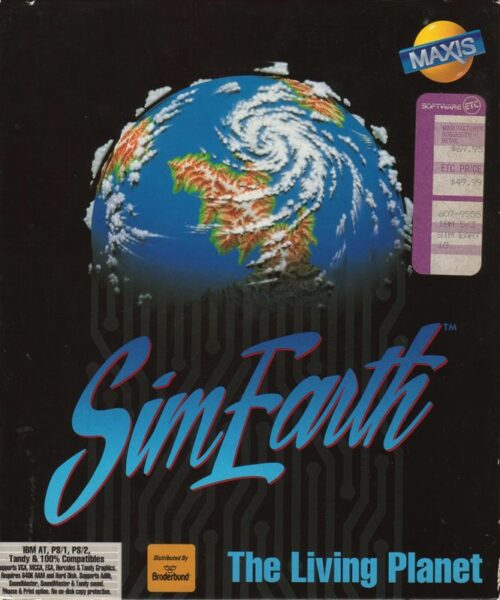
The dawn of the 1990s was an important period for environmental science, when talk of temporally and/or geographically localized effects like acid rain began to shift toward wider-frame discussions of human impacts on our planet over a scale of many generations; not coincidentally, it was at this time that the term “global warming” first entered the popular discourse in a big way. The original Civilization’s inclusion of global warming as a game mechanic, one of the few drawbacks it saw to its larger theme of boundless human Progress, is very much a reflection of the period in which it was conceived. This statement is even more true about Will Wright’s SimEarth, which appeared a year and a half before Civilization, in mid-1990. Rather than just incorporating one trending aspect of environmental theory as a mechanic, it aspired to be a full-blown simulation of the Gaia hypothesis about our planet.
Dating back to the mid-1970s, and with philosophical and spiritual roots stretching back thousands of year further, the Gaia hypothesis was the brainchild of a former NASA scientist named James Lovelock. It proposed that all of the Earth, both its living and its non-living components, ought to be seen and understood as a single interlocking system, almost a meta-organism unto itself. By Lovelock’s own description,
Gaia is a hard-science theory about the evolution of the Earth and the life upon it. In no way is it contradictory to Darwin; it extends Darwinism to include the evolution of the rocks, the atmosphere, and the oceans. Gaia theory sees the evolution of the material world and the evolution of the organisms as a tightly coupled process. Changes in the organisms always affect the environment, and vice versa.
The problem in the opinion of most mainstream scientists was that Lovelock was never able to adequately explain just how this symbiosis occurred, how the living could so comprehensively communicate with and affect the non-living. It sounded to them more like mysticism or religion than science, a point which they hammered home again and again. Said point is probably valid enough according to the principles of hard science, but the Gaia hypothesis remains immensely appealing and even inspiring as a thought experiment, almost regardless of its literal truth. This was expressed with surprising eloquence back in 1990 by gaming journalist Rusel DeMaria:
The Gaia hypothesis helps us to see this warm, blue sphere not as a rock which happens to support life in the middle of the forbidding void of space, but as an organism that has successfully sustained its own state of aliveness for billions of years. Are we part of the evolution of a super-organism? Will we be the beings that help that organism reproduce itself in space and throughout the galaxy? These are some of the questions I’ve considered since encountering Dr. Lovelock’s remarkable theory. My view of the world is forever changed.
James Lovelock was always interested in using computers to model and teach his hypothesis, believing that it was easier to understand Gaia if one could see it in action than if one could only read about it on the page. In the early 1980s, he and a colleague named Andrew Watson developed an extremely simple simulation they called Daisyworld, which modeled a planet that was host to only two forms of life: white daisies that reflected sunlight and black daisies that absorbed it. Therefore white daises would tend to make the planet cooler, all else being equal, while black daisies warmed it up. The fun, if you chose to call it that, was in tinkering with the daisy numbers and coverage to see what kind of climate resulted. Daisyworld was partly intended as riposte to those scientists who said that the Gaia hypothesis lacked a mechanism to explain how living things could affect the planet to the extent claimed. Alas, most of them were still not convinced: they said that such a simplified model was all well and good for understanding some aspects of the environment, not least human-caused climate change, but it didn’t begin to address the full scope of the symbiosis of the Gaia hypothesis.
But the point remains that Lovelock had a well-known interest in computer modeling. On that basis, Stewart Brand, a proudly unreformed hippie with a techno-optimist bent, the founder of The Whole Earth Catalog, introduced him to Will Wright in the first blush of the latter’s SimCity fame. The two quickly decided to collaborate on a simulation of a living planet that would be far more sophisticated than Daisyworld, that would model the evolution of a planet and all of the life that might eventually arise on it over billions and billions of years. This planet could be as similar to or different from our Earth as the player wished. At first, Wright and Lovelock thought to call their simulation simply Gaia, but bowed in the due course of things to the wisdom of Jeff Braun, who said that Maxis had the beginning of a wonderful brand in the name of SimCity and that they ought to exploit it. Thus Gaia became SimEarth: The Living Planet.
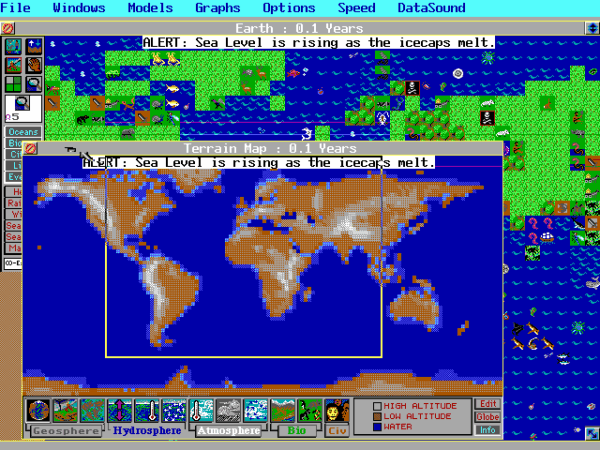
SimEarth was an almost achingly earnest exercise, a million miles away from what the average person on the street might imagine a videogame to be. The official strategy guide, written by the aforementioned Rusel DeMaria, included what might have been the only call to political action ever presented in this genre of books that were usually all about tips, tricks, and cheats to improve your score and impress your friends: “It is my hope that by bringing these issues to your attention, we’ll all be able to remember our priorities and perhaps take action to stop our destructive behaviors and find ways to live in harmony with our world.” Maxis promised to funnel a portion of the game’s proceeds into environmental charities. Lovelock wrote that he hoped SimEarth “might develop into something more [than just a game], a personal model that might become a guide for living right with the world. A way of testing for ourselves the long-term consequences of different ways of living.”
If there was a goal to be found in SimEarth, it must be to guide one’s personal Gaia along until it yielded intelligent life capable of surviving and thriving in harmony with the planet. Johnny L. Wilson, an ordained Christian minister who also happened to be the editor of Computer Gaming World magazine, took on the task of reviewing SimEarth himself. One might have expected him to be hostile to the very idea of a game where Darwinian evolution took such pride of place, but he declared that in the end SimEarth only reaffirmed his faith, by showing him that life could only evolve if he, in the role of the God of this simulation, tinkered with the system constantly to ensure that the fragile flora and fauna on his planet could progress from stage to stage. It wasn’t the dramatic creation narrative of the Book of Genesis, but it was good enough for him.
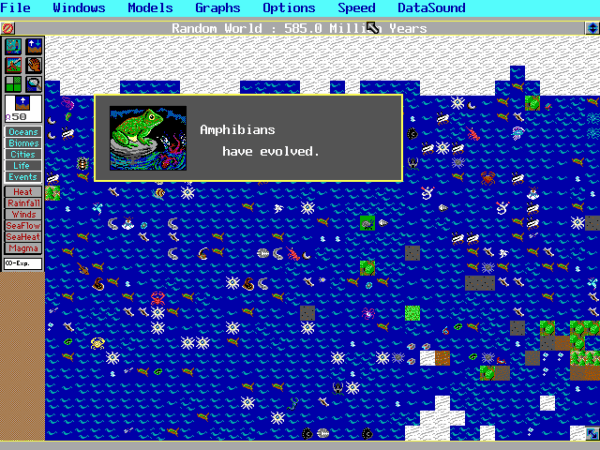
Of course, we shouldn’t get too carried away by SimEarth, any more than we should by SimCity. It may have been created with a more serious intent than SimCity, but all of the same caveats about its accuracy as a simulation apply; if anything, they’re amplified by the absurd vastness of its scope. Yet that need not have mattered so much if it could convince its players to think differently about our delicate planet and our relationship to it. Sadly, however, it never found anything like the same audience as SimCity, because it just wasn’t as relatable. Even colossal failures of urban planning could be fun in SimCity — in fact, sometimes the most fun of all. But if you failed to twiddle the knobs just right in SimEarth, you just wound up with a dead lump of rock rather than a cataclysmic fire or an epic traffic jam to gawk at. It was all so very slow and abstract, so divorced from real life as its players knew it.
This would prove to be something of a problem for Will Wright and Maxis going forward. Their earnest simulations of big ideas weren’t always all that obviously fun. Although SimEarth sold well initially, its momentum petered out as it became clear that this software toy was less joyously playful than its predecessor. The same fate would befall almost every Maxis game that didn’t bear the name of SimCity for a long time to come.

That said, Wright’s next game did include more whimsy and humor than were to be found in the stolidly portentous SimEarth. Like so many of his other games, 1991’s SimAnt: The Electronic Ant Colony was inspired by his readings in popular science: in this case, by the book The Ants by E.O. Wilson, the dark-horse winner of the 1991 Pulitzer Prize for General Nonfiction. This time, however, Wright was not able to work directly with the man whose theories he was trying to bring to interactive life on the computer. Wilson neglected to read closely the letter Wright sent him proposing a collaboration, and was thus left to find out about SimAnt after it was finished, just like everyone else. But when he did, he praised its “sophistication and precision,” so it was all good.
E.O. Wilson was the man who first discovered that individual ants, although each possessed of only the most rudimentary forms of awareness, communicate over amazingly long distances using pheromones, resulting in a group intelligence that enormously transcends that of its constituent parts. Seen in a certain light, then, Wright’s first three Sim games were all grappling with what he liked to called “distributed,” communal forms of sentience: SimEarth on a macro level, SimAnt on a micro level, and SimCity somewhere in between. In SimAnt, you have to find the right ratio of breeders to workers to soldiers in the colony you build around your all-important queen. You also have to contend with a rival ant colony and other, bigger creatures that can wreak havoc on your insect society, such as a marauding tarantula.
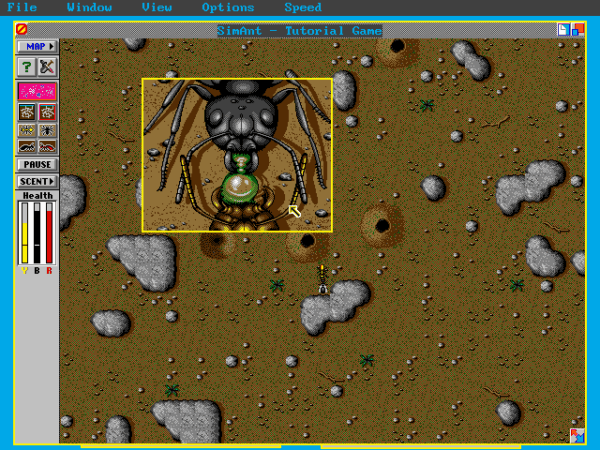
Wright and the slowly growing team around him at Maxis did look for ways to make this simulation more relatable than SimEarth. If you need an action fix, you can take direct control of one of your soldier ants and charge into battle. Maxis even deigned to include a score and a high-score table. The ultimate achievement is to drive a hapless human and his dog right out of their house. Observing all of this, Computer Gaming World noted that there weren’t actually all that many differences between the life of your ant colony and “an exciting space-opera story line”: “The horrible, nearly indestructible insect-like monster in the movie Alien was, after all, a souped-up, acid-puking, survivalist ant from a mixed marriage with a scorpion.”
But, for all that ravenous insects — not to mention hive minds — had been a staple of science fiction since the very beginning, the answer to the question of whether people wanted to spend hours on end seeing the world through insectoid compound photo-receptors proved mixed. Although SimAnt did considerably better than SimEarth in the long run, selling over 100,000 copies, Wright was vaguely disappointed that its primary demographic wound up being “ten-to-thirteen-year-old” boys, the group best primed to respond to its squishy sound effects and shadings of the grotesque: “I was expecting it to be more older people that would appreciate how amazingly interesting ants are as an example of distributed intelligence. But in fact, I ended up appealing to twelve-year-olds who just loved playing with ants.” Ah, well… it’s better to have the “wrong” customers than no customers at all. The latter would be the case to an alarming degree for the two games after SimAnt.
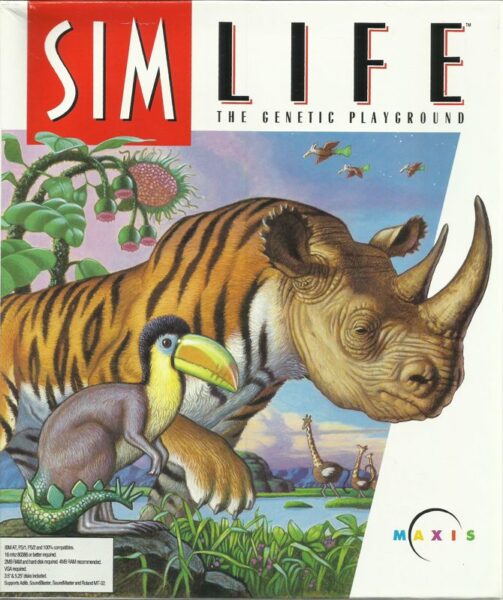
Those two games marked the first times that Maxis applied the Sim branding to the work of other designers than Will Wright. By now, the studio had developed into a utopian collective of thinkers and dreamers, who barely felt they were a part of the commercial games industry at all and definitely didn’t feel like they had to abide by its usual rules. SimCity, that gift that kept on giving, ensured that, funding whatever esoteric experiments they wished to pursue.
A former Apple hardware engineer named Ken Karakotsios was responsible for SimLife, Maxis’s most esoteric simulation yet, which abandoned all of the concessions to accessibility that were to be found in SimAnt. SimLife was responding to yet another buzz in popular science, in this case over the prospects for digital “cellular automata” — or, to use the title of a popular 1992 book by Steven Levy, Artificial Life.
This notion of self-replicating digital organisms was an old one in computer science even then, having originated in the 1940s with John von Neumann. It was given a practical spin circa 1970 by the mathematician John Conway, whose Game of Life allowed the user to set up collections of “cells” in different configurations on a computer and then watch to see what patterns they created as they lived and died. The claims that were made on the basis of simple experiments like this one were either boldly visionary or wildly overblown, depending on your point of view. But, as so often happens in fields of or adjacent to artificial intelligence, the boosters found it hard to explain how genuine consciousness was going to arise from their crude imitations of life.
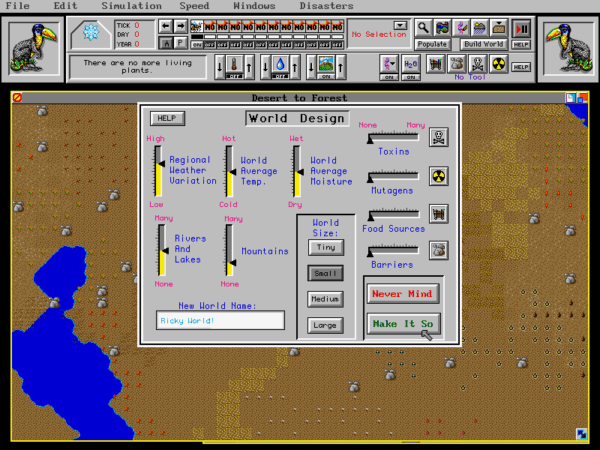
This isn’t to say that cellular-automata couldn’t be useful and intriguing. Will Wright himself had employed some of these approaches in all three of his Sim games. Ken Karakotsios’s implementation of them was at bottom a dramatically expanded version of The Game of Life, which permitted the single cells to evolve into all manner of plants and animals, then compete and cooperate in various simulated environments while the player tinkered from on-high as much or as little as she preferred. It was interesting enough conceptually even if one hadn’t drunk all of the artificial-life Kool Aid — it was a decent simulation of the way that evolution is believed to work in the non-digital world as well — but the things that had made SimEarth problematic as a marketplace proposition were exaggerated even further here: it was all just so attenuated, so very abstract. And it didn’t help that, on a superficial level at least, it was plowing so much of the same ground as SimEarth, which had also allowed you to watch lifeforms evolve, albeit in the context of a grander world simulation.
Computer scientist Christopher Langton, the most prominent academic booster of cellular automata at the time, said that SimLife was “awfully close to being a useful tool for scientific research.” Yet it was competing with games, not with scientific tools. It became Maxis’s worst-selling release to date.
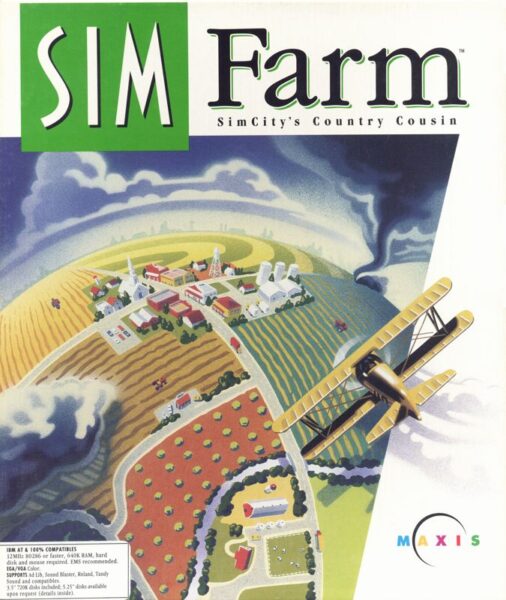
SimFarm, which was conceived and designed by a former Maxis playtester named Eric Albers, was more down to earth in all respects. As Maxis’s marketing copy put it, it was “SimCity’s country cousin,” simulating the life of a farm. But it turned out that digging irrigation ditches was less exciting than building roads, and that watching cows graze was less entertaining than watching human commuters go about their day. SimCity was kinetic; SimFarm just sat there baking in the sun, succeeding mostly in demonstrating why fleeing the farm for the bright lights and big city has long been such a staple of fiction and nonfiction. It didn’t sell much better than SimLife.

A meeting of great gaming minds. Shigeru Miyamoto, Will Wright, and Jeff Braun in Japan, October 1989.
Indeed, SimEarth, SimAnt, SimLife, and SimFarm combined struggled to come within an order of magnitude of SimCity’s total sales. Defying the usual logic of the computer-game marketplace, SimCity’s sales increased rather than decreased year by year, as more and more people who weren’t traditional gamers, hackers, or nerds brought computers into their homes, thanks to the excitement about CD-ROM and multimedia, the user-friendliness of the latest versions of Microsoft Windows, and, soon enough, the chatter about the burgeoning World Wide Web. SimCity subsidized everything else that Maxis did.
It had been widely ported from its first home on the Apple Macintosh. First it had made its way to the Commodore Amiga, then to MS-DOS, the platform where it really started to drum up the sales figures. After that came just about every other viable or semi-viable computing platform in the Western world, including even such aged refugees of an earlier computing epoch as the Commodore 64 (the machine on which Wright had coded his first prototype of the game), the Sinclair Spectrum, and the BBC Micro. But the next really key port after the MS-DOS one was to the new Super Nintendo Entertainment System, the much-anticipated successor to the best-selling single games console to date. When the SNES came to North America in August of 1991, SimCity was one of its launch titles, serving as an early demonstration that this console was capable of far more than the likes of Super Mario Bros.
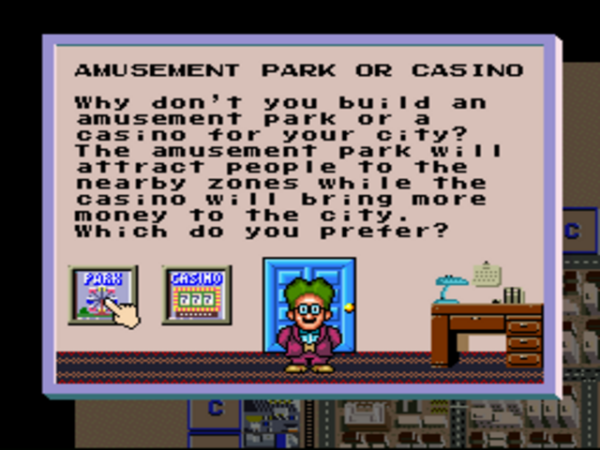
It’s therefore ironic to note that SimCity’s biggest champion inside Nintendo was none other than the creator of Super Mario Bros., the legendary Shigeru Miyamoto. Wright had first bonded with him over the course of a week-long, exploratory visit to Japan in October of 1989. Nintendo then agreed to undertake the port themselves under Miyamoto’s guidance, “Nintendoizing” the game without losing its essence. Miyamoto inserted his American friend into the proceedings as “Dr. Wright,” who popped up from time to time to offer comments and advice, doing much to personalize a game that was, like all of Maxis’s software toys, utterly bereft of identifiable characters in its original form. Having SimCity on the SNES, which quickly became a bigger self-contained market for games than all of the existing computer platforms combined, was another huge boon for Maxis, even if the more cartoony look wasn’t going to do them any favors with the furled-brow Time magazine crowd.
At the same time that they were expanding onto a living-room console, Maxis was becoming a publisher of out-of-house games. These weren’t generally given the Sim branding but did tend to be aligned with it in spirit. Maxis provided an entrée to the American market for any number of international studios whose abstruse concepts had been given short shrift by other publishers. Their games ranged from A-Train, a Japanese-developed, finance-heavy Railroad Tycoon competitor that gave the lie to the idea that all Japanese games were simple and cutesy like Super Mario Bros., to a passive Russian “aquarium simulator” called El-Fish that was as proudly goalless — some might opt for the term “pointless” — as anything that ever sprang from the mind of Will Wright.
Many of these were worthy, even noble efforts in their way, even if they don’t float your humble author’s particular boat. But that fact kind of points out the problem with them: they were ultra-nichey titles that demanded players who were seriously interested in their unusual subject matter, at a time when the distribution systems of commercial computer gaming were not well-suited to such products. Maxis struggled even to get them into the stores where they might be bought. Few retail orderers were excited about wasting precious shelf space on El-Fish when that same shelf could be filled with yet more copies of DOOM and Myst — and yes, of SimCity as well.
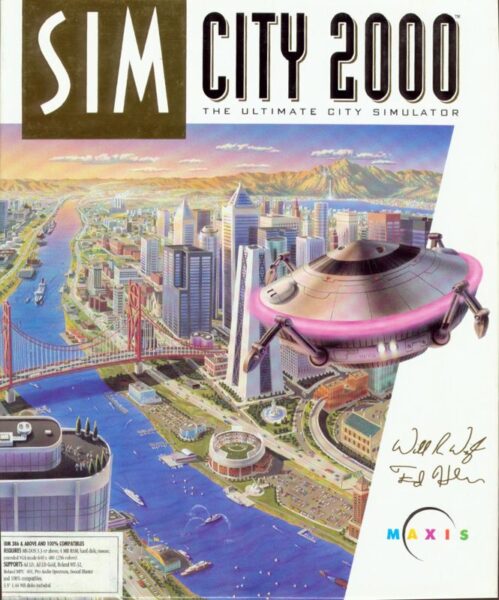
In the summer of 1992, Jeff Braun traded 30 percent of Maxis’s equity and a seat on the company’s board for a cash injection of $10 million from Warburg Pincus Ventures. The deal was predicated on the understanding that some of the money would be used for a new SimCity that was more in tune with the expectations of the 1990s, one that could be sold to all of the people who had bought the first one all over again, at the same time that it hopefully reached large numbers of new people.
At the time, Will Wright had been tinkering for months with something that even the dreamy minds around him didn’t quite understand, a virtual dollhouse that he was building up from some of the core algorithms of SimAnt. By Wright’s own admission, Braun had to “drag” him away from it to do SimCity 2000. He wound up devoting more than a year of his life to the project, but he did so more begrudgingly than passionately, because his trusted business partner was telling him that Maxis needed this game in order to survive and make possible all of the other ones. “I was in management mode,” he says. “I had a pretty clear idea of what the design would be, since we were basically just doing a sequel, which is always easier. It was more just making sure the engineering was good and the performance was decent.”
Co-designed by Fred Haslam, who had previously worked with Wright and James Lovelock on SimEarth, SimCity 2000 was a new software-development experience for Maxis all the way around. Prior to this point, Maxis had been as much a creative playground as a serious company, happily thumbing its nose at all of the established industry logic about what you needed to do to actually sell games. And, sure enough, they hadn’t sold all that terribly many games beyond the sui generis SimCity. Now, Braun told everyone, they needed to make their sequel to that game match a set of bullet points that were demanded by the marketplace, needed not to challenge anyone’s expectations unduly while they were doing so, and, most importantly of all, needed to have the finished product ready to go for the Christmas buying season of 1993. They managed all of these feats, but not without some friction and hard feelings. Some employees, finding the dictates to be a betrayal of everything they had thought Maxis stood for, quit rather than abide by them. Those who stayed became familiar before all was said and done with the nature of crunch, another new experience for Maxis people.
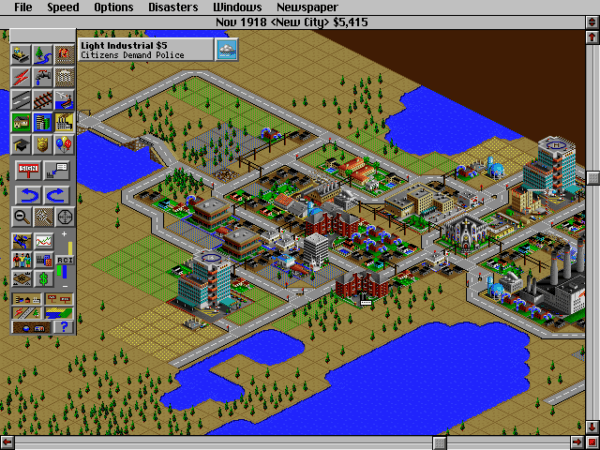
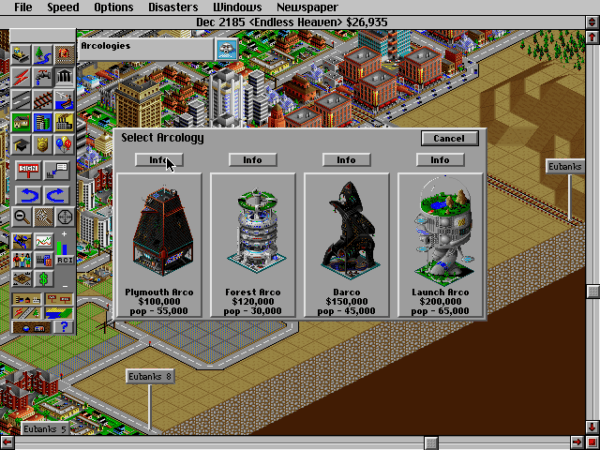
In the end, though, SimCity 2000 did exactly what was required of it, both as a computer program and as a commercial product. The most obvious improvement over its predecessor of four and a half years previous was in the visuals. An isometric view replaced the old top-down one, the onscreen color count increased from 16 to 256, and professional artists were… well, suffice to say that they were present this time. The difference really was night and day.
To the improved visuals were added an improved interface and a host of fairly commonsense gameplay extensions: hospitals and schools, new types of heavy industry and power plants, a plumbing system, subways and trains and other new transportation options. (One can detect some influence from Railroad Tycoon in these, feeding back into the game that had done so much to inspire it; game design has always been a dialog.) You could choose an historical starting date for your game and take advantage of new technologies as they became available: subways in 1910, buses in 1920, highways in 1930, etc., all the way up to microwave and fusion power in 2050. (If only…) As your city’s mayor, you could issue ordinances and read about your accomplishments and your follies in an in-game newspaper. It was all done well, but at the same time not overdone, being still eminently recognizable as the same SimCity that the old fans knew and loved. In the eyes of a business professional like Jeff Braun, it was the perfect sequel.
He was amply rewarded for his foresight in getting it out before the first SimCity cash cow had dried up completely. SimCity 2000 rocketed up the bestseller charts that Christmas of 1993 in just the way that all of those other recent Maxis games hadn’t. Then it kept right on selling for months and then years, another rare perennial in an intensely seasonal industry, a game so popular that it spawned three separate trade-paperback strategy guides from big outside book publishers. Although Maxis had as yet found only one way to actually make consistent money, they were fortunate in that it made them a lot of money. Having given SimCity another lease on life, they could go back to being weird… okay, no, let’s call it esoteric.
Did you enjoy this article? If so, please think about pitching in to help me make many more like it. You can pledge any amount you like.

Sources: The books Games That Sell! by Mark H. Walker, Building SimCity: How to Put the World in a Machine by Chaim Gingold, SimEarth: The Official Strategy Guide by Rusel DeMaria, SimCity 2000: Power, Politics, and Plumbing (revised ed.) by Nick Dargahi and Michael Bremer, SimCity 2000 Strategies and Secrets (2nd ed.) by Daniel A. Tauber and Brenda Kienan, The Official SimCity 2000 Planning Commission Handbook by Peter Spear and Johnny L. Wilson, Game Design Theory & Practice (2nd ed.) by Richard Rouse III, and Artificial Life: A Report from the Frontier Where Computers Meet Biology by Steven Levy. Macworld of April 1990; Computer Gaming World of September 1990, January 1991, March 1992, September 1992, April 1993, July 1993, and November 1993; Retro Gamer 115 and 210.
Online sources include the collection of Maxis articles by Phil Salvador at The Obscuratory, Matt Barton’s video interview with Jeff Tunnell, and Tristan Donovan’s interview with Will Wright for the old Gamasutra site.
Where to Get Them: Of the Maxis games described in this article, only SimCity 2000 is currently available as a digital purchase.










Venya
July 3, 2026 at 4:33 pm
The original SimCity (EGA for DOS on our 286) may still be the only computer game that my whole family played, even Mom and my otherwise non-gaming older brother.
Form
July 12, 2026 at 12:13 am
For me it was SNES Simcity that finally let me convince my parents to buy me an SNES. We were renting the system and a game for me to play until they both got obsessed with it.
Ross
July 13, 2026 at 11:55 pm
I only played the PC SimCity some time after being introduced to the SNES SimCity. Nintendo definitely knew how to adapt it in a way that maximized the toyetic elements; i was really struck by how much more the original felt like a “sterile simulation” while the snes version was very much a “game”.
Lt. Nitpicker
July 3, 2026 at 4:50 pm
>But the next really key port after the MS-DOS one was to the new Nintendo Super Entertainment System, the much-anticipated successor to the best-selling single games console to date.
I assume you meant to say Super Nintendo Entertainment System there.
Jimmy Maher
July 3, 2026 at 5:57 pm
Thanks!
Zed Banville
July 3, 2026 at 5:35 pm
You might include the source for that Stanislaw Lem quotation, the classic story “Non Serviam” in his collection A Perfect Vacuum (1971), formed of reviews of non-existent books (except that it begins with a review of A Perfect Vacuum itself).
Jimmy Maher
July 3, 2026 at 5:54 pm
Was it intended as irony or satire? I must admit I came across it secondhand in Steven Levy’s book. I’ll think better of him if it was. ;)
Zed Banville
July 4, 2026 at 4:14 am
Science Fiction story, in the guise of a book review, about a future scientific discipline in which artificial intelligent beings are created in computer simulations:
Professor Dobb’s book is devoted to personetics, which the Finnish philosopher Eino Kaikki has called “the cruelest science man ever created.” Dobb, one of the most distinguished personeticists today, shares this view. One cannot escape the conclusion, he says, that personetics is, in its application, immoral; we are dealing, however, with a type of pursuit that is, though counter to the principles of ethics, also of practical necessity to us. There is no way, in the research, to avoid its special ruthlessness, to avoid doing violence to one’s natural instincts, and if nowhere else it is here that the myth of the perfect innocence of the scientist as a seeker of facts is exploded. We are speaking of a discipline, after all, which, with only a small amount of exaggeration, for emphasis, has been called “experimental theogony.”.
…
Dr. Ian Combay once said to me, in a private conversation, that I could, after all, assure the society of personoids of my existence. Now, this I most certainly shall not do. For it would have all the appearance to me of soliciting a sequel—that is, a reaction on their part. But what exactly could they do or say to me, that I would not feel the profound embarrassment, the painful sting of my position as their unfortunate Creator? The bills for the electricity consumed have to be paid quarterly, and the moment is going to come when my university superiors demand the ‘wrapping up’ of the experiment—that is, the disconnecting of the machine, or, in other words, the end of the world. That moment I intend to put off as long as humanly possible. It is the only thing of which I am capable, but it is not anything I consider praiseworthy. It is, rather, what in common parlance is generally called ‘dirty work.’ Saying this, I hope that no one will get any ideas. But if he does, well, that is his business.”
andreas
July 4, 2026 at 6:38 am
Lem was often somewhat ironic or at least broadly pessimistic, and was always mindful of the complex dance between Eastern block authors of speculative fiction, government censors, and the reading public.
As Mr Zed has laid out, in this instance he is writing from the point of few of a deep future where such systems do exist.
Lem, an atheist, liked to quip that science fiction and theology shared the same problem: to write about the unknowable.
Jimmy Maher
July 4, 2026 at 7:11 am
Okay, that simultaneously raises my level of respect for Stanislaw Lem, an author I’ve never really explored, and reduces the suitability of his quote. I’ve reluctantly excised it. ;) Thanks to you both!
arthurdawg
July 4, 2026 at 9:04 pm
You should definitely read Solaris… And then watch the Tarkovsky film!
For an encore, check out Tarkovsky’s film “Stalker” based on “Roadside Picnic” by the Strugatsky brothers. Heck… Of course that means you need to read the story as well!
Zed Banville
July 7, 2026 at 2:12 am
Aside from being an author of science fiction, Stanislaw Lem also wrote serious commentary on science and technology, above all in his work Summa Technologiae, published in Polish in 1964 and finally translated into English in 2013. He might well himself have experienced a longing for the ability “to feel with immediacy the phenomenalism of mathematics” attributed to his fictional personoids from “Non Serviam”.
Summa Technologiae contains extensive discussion of what Lem termed “phantomatics”, conceptually more similar to what would later be called “virtual reality” than to videogames, but something that Lem foresaw becoming a form of entertainment and of art. At the end of the chapter on “Cosmogonic Engineering”, Lem discusses the possibility of a highly-advanced civilization creating an artificial reality, inhabited by intelligent artificial beings, in a manner similar to several of his SF stories:
…
Unlike in a phantomatic situation, in cosmogonics, both the world and its inhabitants are “artificial” (if this is the word we want to use for what is created). None of the inhabitants know about it—or can know about it—though. They experience exactly what a person in real life or in the phantomat does (because we already know that those two experiences cannot be told apart by the person undergoing them). Just as we cannot get out of our skin or see someone else’s consciousness, the inhabitants of that cosmic creation cannot find out about its hierarchical nature in any way, that is, about the fact that it is a world contained in another world (namely, ours).
…
The physicists from that world would only be able to discover the fact of creation (or rather of “having been created”) by comparing our real world with their own. It is only then that they would be able to see that our world is one level of Reality short when compared with theirs (since they are made of electrical impulses and it is only those impulses that are made of the same material that our world is). Figuratively speaking, a created world is perhaps like a very stable, very long, and internally coherent dream that no one is dreaming but that rather “is dreaming itself”—inside a “digital machine.”
…
Someone could ask whether I believe it is at least a little bit likely that humans will one day make such—or similar—plans. Asked directly like this, I should give a direct answer. I do not think so. Yet, if we take into account all those countless intelligent worlds revolving inside those enormous galaxies, while the number of those galaxies is incomparably higher than the number of dandelion seeds floating in the air above the wide meadows, and also than the number of the grains of sand in a desert, this very number makes any improbability possible—as long as it can be actualized (even if in one out of every million galaxies). Yet for no one in this whole abyss of stardust to arrive at an idea about such an undertaking, to try to bite more than it seems possible to chew—this indeed seems rather improbable to me. Before someone categorically disagrees, please take a moment: July nights, during which the sky is so starry and beautiful, really encourage such contemplation.
Zed Banville
July 4, 2026 at 4:19 am
Though even more relevant to SimCity and the other Sim games would be Stanislaw Lem’s story “The Seventh Sally OR How Trurl’s Own Perfection Led to No Good” from the Cyberiad (1965), in which the constructor Trurl creates a simulation for a deposed dictator:
…
Now Trurl had no intention of complying with this request of Excelsius, as doing so would bring about untold evil and suffering, yet at the same time he wished somehow to comfort and console the humiliated king. Thinking a moment or two, he came to the conclusion that, even in this case, not all was lost, for it would be possible to satisfy the king completely—without putting his former subjects in jeopardy. And so, rolling up his sleeves and summoning up all his mastery, Trurl built the king an entirely new kingdom. There were plenty of towns, rivers, mountains, forests and brooks, a sky with clouds, armies full of derring-do, citadels, castles and ladies’ chambers; and there were marketplaces, gaudy and gleaming in the sun, days of back-breaking labor, nights full of dancing and song until dawn, and the gay clatter of swordplay. Trurl also carefully set into this kingdom a fabulous capital, all in marble and alabaster, and assembled a council of hoary sages, and winter palaces and summer villas, plots, conspirators, false witnesses, nurses, informers, teams of magnificent steeds, and plumes waving crimson in the wind; and then he crisscrossed that atmosphere with silver fanfares and twenty-one gun salutes, also threw in the necessary handful of traitors, another of heroes, added a pinch of prophets and seers, and one messiah and one great poet each, after which he bent over and set the works in motion, deftly making last-minute adjustments with his microscopic tools as it ran, and he gave the women of that kingdom beauty, the men—sullen silence and surliness when drunk, the officials—arrogance and servility, the astronomers—an enthusiasm for stars, and the children—a great capacity for noise. And all of this, connected, mounted and ground to precision, fit into a box, and not a very large box, but just the size that could be carried about with ease. This Trurl presented to Excelsius, to rule and have dominion over forever; but first he showed him where the input and output of his brand-new kingdom were, and how to program wars, quell rebellions, exact tribute, collect taxes, and also instructed him in the critical points and transition states of that microminiaturized society—in other words the maxima and minima of palace coups and revolutions—and explained everything so well, that the king, an old hand in the running of tyrannies, instantly grasped the directions and, without hesitation, while the constructor watched, issued a few trial proclamations, correctly manipulating the control knobs, which were carved with imperial eagles and regal lions. These proclamations declared a state of emergency, martial law, a curfew and a special levy. After a year had passed in the kingdom, which amounted to hardly a minute for Trurl and the king, by an act of the greatest magnanimity—that is, by a flick of the finger at the controls—the king abolished one death penalty, lightened the levy and deigned to annul the state of emergency, whereupon a tumultuous cry of gratitude, like the squeaking of tiny mice lifted by their tails, rose up from the box, and through its curved glass cover one could see, on the dusty highways and along the banks of lazy rivers that reflected the fluffy clouds, the people rejoicing and praising the great and unsurpassed benevolence of their sovereign lord.
…
Zed Banville
July 4, 2026 at 4:33 am
And most of this excerpt from “The Seventh Sally” was already posted in your article on SimCity back in 2016. Think you can delete these two comments.
Whomever
July 3, 2026 at 6:07 pm
Surprised you don’t mention Simcity 4 that was so bad on release (totally buggy and unplayable) that it inspired Cities Skylines, which is the current go-to in City Simulators.
Dylan
July 3, 2026 at 7:28 pm
I think you’re thinking of SimCity 2013; SimCity 4 was back in 2003, well before Cities Skylines.
Fan of SimCity 4
July 3, 2026 at 7:49 pm
That wasn’t SimCity 4 (released in 2003), that was SimCity (2013).
Christopher Drum
July 4, 2026 at 1:58 am
I think the fact this article is labelled “Part 1” explains why the latter sequel wasn’t mentioned: he hasn’t gotten that far into the story yet.
B
July 4, 2026 at 6:36 pm
Perhaps because it’s completely irrelevant to the story at this point in history?
Alianora La Canta
September 21, 2026 at 6:57 pm
SimCity 4 had (slight) integration with Sims 2, because parts of the city layout could be used as Sims 2 neighbourhoods. I could therefore imagine it being covered in either 2003 or 2004.
As for SimCity / Cities: Skylines, that is far enough into the future that it can probably be left to look after itself for now.
Sniffnoy
July 3, 2026 at 6:54 pm
Hey now, fusion by 2050 might not be unrealistic if, say, Commonwealth Fusion Systems has anything to say about it! :)
Mateus Fedozzi
July 3, 2026 at 9:48 pm
Good memories… I have always been a huge Maxis fan and follower, and will forever love their entire output. Yes, this is the kind of gamer I am. SimCity 2000 was the only game, ever, that made me stay awake through one entire night. It was magical. And I was also into their outsourced and localized games. What about the legendary 3-D Space Cadet that came bundled with Windows? Damn, that thing made me a pinball addict for life. El-Fish and A-Train were superb, as were SimTower and Klik & Play. So sad I will have to wait two entire weeks to keep reading what you have to say about Maxis’ hour d’oeuvres.
P-Tux7
July 4, 2026 at 3:06 am
What a spooky coincidence – Data-Driven Gamer just started playing the original Fujitsu Micro-7 version of A-Train today.
andreas
July 4, 2026 at 6:30 am
Thanks for this concise write-up of a bunch of games – quite a few of which would merit a full investigation in their own right.
I think you definitely nailed the main issues with SimEarth: the over-reliance on the Gaia hypothesis; plus the teleological implementation of evolution – each clade will produce a linear series of species in a pre-determined fashion – indeed pleasing even Christian ministers.
Perhaps it got lost on the cutting-room floor, but Lovelock did not formulate Gaia by himself. Rather it was co-developed by Lynn Margulis, who had successfully introduced symbiosis as a core concept to cell biology: the eukaryotic cell itself being an ecosystem of organisms now known as “organelles”. Hence mainstream biologists took Gaia quite seriously, scrambling to retain Lynn Margulis’ work while ditching the philosophical underpinnings.
“just incorporating one trending aspect of environmental theory [global warming] as a mechanic”
Well, in SimEarth they didn’t “just incorporate” the greenhouse effect – they included a full-blown graphical flow chart simulation of the main drivers of atmospheric temperature on the level of a college text-book. Plus, the model was truly interactive: in sandbox mode the player could simply click on any of the arrows to directly regulate effects up or down (say make the influence of gases in the atmosphere stronger or weaker) and observe the consequences.
In proper gameplay these effect sizes where fixed, but one could build dedicated factories to produce or absorb greenhouse gases to boost or decrease the greenhouse effect and keep the planet on a suitable temperature range; as factories were quite expensive the player was nudged to instead foster self-replicating natural systems (plants and animals) to regulate the composition of the atmosphere (still, “Gaia” was quite a harsh mistress to get to self-stabilize in practice). They even had advanced levels for terraforming Mars (way too cold) or Venus (way too hot) showcasing these sets of mechanics.
I believe that a whole generation of scientists was first introduced to climate modeling through that “mechanic” alone – to any modeling of complex interlocking systems, really. And temperature dynamics was but one aspect of the game. Vastness of scope indeed, absurd or otherwise!
Sniffnoy
July 4, 2026 at 5:19 pm
You realize this is not a generally accepted idea, right? Most organelles cannot reasonably be called organisms according to current understanding. A few particular organelles originated from endosymbioses, and other endosymbioses still happen, but the bulk of a eukaryotic cell’s organelles are not thought to have originated from endosymbioses. In animals it’s just mitochondria. Margulis certainly deserves credit for what she got right but this more general idea of hers is not actually generally accepted at present.
andreas
July 5, 2026 at 6:31 am
Perhaps, yet one has to take the concept rather seriously. Even if the hypothesis it poses may be answered (partially) in the negative decades later on technical grounds, on balance.
In system sciences “radical” theorizing is rarely fully prescient, rather it is invaluable for opening up horizons of thinking, leading to more nuanced views.
(also mitochondria are important ;-)
arthurdawg
July 4, 2026 at 9:07 pm
SimEarth was the only Sim game I ever owned… Fun to tinker with indeed! I appreciated it even more when Lynn Margulis and SET were featured early on in my Bio 111 class in college!
xxx
July 4, 2026 at 5:01 pm
Is it “Daisyworld” or “DaisyWorld”? You use both.
I remember SimEarth fondly, but I also remember it as being less than the sum of its parts. So many neat ideas that never cohered into fun, remaining firmly in the realm of “interesting” instead. Wright would never really lose that inability to find the fun in his games — the theoretical nature of the game always seemed more important to him than the actual experience of playing it.
Jimmy Maher
July 4, 2026 at 6:28 pm
Daisyworld. Thanks!
And yeah, I feel the same about Will Wright’s games. For some people, all of this avoidance of narrative, structure, victory conditions, etc., represents a purist nobility of intent. For others, it just shows a disinterest in doing the hard work of turning a set of “interesting” systems into a proper game. I belong to the latter group, but I certainly don’t begrudge the former group their fun.
B
July 4, 2026 at 6:41 pm
The “software toy” label is totally apt – he’s a toymaker. As a kid I loved just messing around in SimEarth to see what would happen or to make my own goals and I knew a bunch of other kids that felt similarly (maybe because it ended up in educational contexts where it was the most game-like thing available). Obviously I was better at unstructured play back then, a lifetime of gaming trains you into wanting goals and a sense of completion.
Feldspar
July 5, 2026 at 2:30 am
Yeah I think that’s the truth for a lot of people and a good way of putting it. Back when I was a kid with a lot of shareware compilation CDs who very rarely actually finished games, I played around a fair bit in SimCity (mostly 2000), SimTower, SimAnt and even a bit of SimLife. These days I still play a lot of games, but always with the intent of finishing them, and I would probably get bored much more quickly with the likes of SimCity if I fired it up today.
Of course back then I never gave any thought to stuff like sales figures, but not a big surprise to hear that up until a certain 2000s title, none of them outside of SimCity sold very well. All I remember is that it felt like there was a huge number of Sim games to the point where it was a running joke with stuff like the Sierra “SimSim” joke and people releasing joke games like “SimStapler”.
A random bit of trivia that I feel compelled to add: Mr. Wright from the SNES SimCity had a cameo appearance in The Legend of Zelda: Link’s Awakening as “Mr. Write”, who thanks to the law of nominative determinism is a guy who’s really into writing letters.
Anon
July 4, 2026 at 7:26 pm
Peter Scott (the programmer of the BBC Micro version of SimCity that is archived on https://www.bbcmicro.co.uk/game.php?id=934 ) talks about squeezing his port into 20K in this YouTube video: https://youtu.be/ShZB5Rm62fs?t=7097 .
Manyleeks
July 4, 2026 at 8:53 pm
I have very fond memories of playing SimCity 2000 on an old Mac LC II. The chirpy (but highly repetitive) game music slowly drove my parents mad, and I was eventually given an ultimatum – either the music was disabled, or the game would be! The version I had came with an editor that allowed one to edit the designs of the buildings, and a few example sets. I wasn’t sufficiently artistic to design my own, but I remember being a big fan of the “futuristic” design set.
My experience with the other early Maxis titles was limited, but echoes the comments in both the article and above. SimEarth was a fascinating idea, but with a flawed implementation, and as I recall I ended up spending more time reading the manual than I did actually playing the game. The example of Daisyworld was a great introduction to the concept of emergent systems, and one that has stuck with me to this day.
Eagerly awaiting the next article, as there’s another Sim game not yet covered that absorbed even more of my childhood hours than SC2k did…
Jeff Sampson
July 4, 2026 at 8:57 pm
Didn’t Maxis keep doing Mac ports(assuming that wasn’t the development platform) throughout the 90s, after almost every other game publisher had abandoned the platform? Was that out of sentimentality, or was it still profitable for them to make Macintosh versions?
Jimmy Maher
July 5, 2026 at 5:31 am
They actually continued to develop first for the Mac, then port to Windows, throughout the 1990s. I would say these were quite Mac-friendly games, having that slightly more rarefied vibe that always marked the Mac market. And anyway, Maxis wasn’t all that focused on the bottom line. Their cash cow SimCity gave them the rare luxury of not having to be.
Rowan Lipkovits
July 4, 2026 at 10:36 pm
There’s never enough room for all the unnotable oddities even though they’re often the most delightful dead ends. Unfortunately there’s nowhere sensible to reference the recently-reclaimed-from-lost-media SimRefinery, kind of like MECC’s “Where in North Dakota Is Carmen Sandiego?”
Along the same lines, it would be awesome if we ever see a note about how the de-branded “Micropolis” was bundled with the similarly quixotic One Laptop Per Child initiative. But I appreciate that if you included all of these asides in every article, nothing would ever get published.
Don Hopkins
July 7, 2026 at 9:00 pm
>Along the same lines, it would be awesome if we ever see a note about how the de-branded “Micropolis” was bundled with the similarly quixotic One Laptop Per Child initiative. But I appreciate that if you included all of these asides in every article, nothing would ever get published.
I worked on that, and I am currently documenting and writing up the whole story, and will soon publishing videos discussing it with Will Wright, going to the source for first hand information. It’s too much to just dump into the comments here right now. But if you want to know more, please send me mail at don@donhopkins and we can discuss it if you’re interested.
Chaim Gingold wrote up part of the story in his Making SimCity book and before in his PhD thesis on play.
Open Sourcing SimCity, by Chaim Gingold
Excerpt from page 289–293 of “Play Design”, a dissertation submitted in partial satisfaction of the requirements for the degree of Doctor in Philosophy in Computer Science by Chaim Gingold.
https://donhopkins.medium.com/open-sourcing-simcity-58470a275446
But there is more to it than that, the origins go back further: In a nutshell, during the audience question and answer session of the Long Now Foundation discussion beween Will Wright and Brian Eno, two audience members asked the same question about making the SimCity and other source code free. I was in the audience and was not one of them, and did not plant those questions myself. But I’d written a proposal to Maxis years earlier.
Playing with Time | Brian Eno and Will Wright, the Long Now Foundation
https://www.youtube.com/watch?v=Dfc-DQorohc
Will Wright – Maxis – Interfacing to Microworlds – 1996-4-26:
https://www.youtube.com/watch?v=nsxoZXaYJSk
https://news.ycombinator.com/item?id=38160682
DonHopkins on Nov 6, 2023 | parent | context | favorite | on: Why Cities: Skylines 2 performs poorly
Here’s a proposal I wrote to Maxis in 2002 asking to license the rights to develop a commercial educational version of SimCity for Linux, based on the multi player Unix version, with the support of Columbia University. They didn’t bite at the time, but Will Wright and I eventually talked them into actually making it open source in 2008:
https://web.archive.org/web/20110611185928/http://www.donhopkins.com/drupal/node/24
>Educational Multi Player SimCity for Linux Proposal
>Submitted by dhopkins on Sat, 2004-02-07 14:27. C Cellular Automata Pie Menu Applications SimCity TCL Game Design
>Back in March 2002, Maxis told me they were interested in supporting the educational use of products like SimCity. Earlier, I had developed a multi player version of SimCity, which runs on Linux/X11, and was scriptable in TCL. Educators and researchers from Columbia University, MIT, IBM, Xerox and other educational and commercial institutions were excited about gaining access to this version of SimCity, and adapting it to teach and stimulate students’ interest in urban planning, computer simulation and game programming.
>So I wrote this proposal and presented it to Maxis, but nothing ever became of it. But recently, Will Wright has been pushing EA to relicense SimCity under the GPL, so the OLPC project can use it. So it may eventually see the light of day!
[…]
More SimCity stuff from my old Drupal blog:
https://web.archive.org/web/20110611162810/http://www.donhopkins.com/drupal/taxonomy/term/66
https://web.archive.org/web/20111109132608/http://www.donhopkins.com/drupal/taxonomy/term/66?page=1
Don E Hopkins
July 7, 2026 at 9:17 pm
Funnily enough, Lauren Elliott, who created the Carmen Sandiego series, was also Will Wright’s project manager at Broderbund on the game that led to SimCity, Raid on Bungeling Bay. We all worked together at Will’s Stupid Fun Club, and Lauren is now CEO of Will’s company Galium, where they work together on Proxi. They’ve been working together for at least forty years!
https://www.youtube.com/watch?v=u73_yZyuDS0
Dan Lew
July 5, 2026 at 2:41 am
> He proposed an industry-wide standardized file format “so that players could switch accomplishments from one imaginary world to another. For instance, one might be able to use the road system from SimCity in order to race in Vette!, or one’s approval rating for the former might be enhanced by one’s accomplishments in, say, Ultima VI.”
Such a system exists now! Check out Archipelago, a combination of randomizer + cross-game accomplishment tracker.
I’ve done a couple Archipelago rounds with friends. The way it works is that each of us picks a game. In our given game, any “unlock” we might normally get would, instead, send a random unlock to another player in another game.
For example, I picked DOOM. When I picked up what would normally be a key, I might send some new crafting recipe to a player in Subnautica. When they scan a fragment, they might send a heart container to a player in Zelda. And a Zelda player might give me a shotgun when they pick up a key.
Feldspar
July 5, 2026 at 3:42 pm
Funny also that a few years ago the grifters behind the crypto/NFT/”Metaverse” bubble were claiming they would create a very similar kind of cross-compatibility between completely unrelated games like Will Wright described (e.g. buy items with real money and use them in any game) and it went nowhere. Similarly Epic is trying to revive it again with Unreal 6 and it will probably go nowhere.
Meanwhile a bunch of hobbyist hackers behind stuff like Archipelago are the ones who actually came closest to making it a reality.
Chinnico
July 5, 2026 at 3:40 am
“and the welter of patches and fixes that make it easier to experiences games that are, ”
should be “that makes it easier to experience games that are…”
Chinnico
July 5, 2026 at 4:09 am
“and fusion power in 2050. (If only…) As your city’s mayor, ”
The full stop period should be after the parenthesis, not before it – I guess.
“and fusion power in 2050 (If only…). As your city’s mayor,”
Jimmy Maher
July 5, 2026 at 5:32 am
This one is as intended. Thanks for the other one!
Jeff Sampson
July 6, 2026 at 4:21 am
> He proposed an industry-wide standardized file format “so that players could switch accomplishments from one imaginary world to another. For instance, one might be able to use the road system from SimCity in order to race in Vette!”
Apparently, this was partially realized in SimCopter, where players could import their cities from SimCity 2000 to fly around in. So, a seminal strategy game inspired by an attack helicopter game became a source of content for a helicopter sim.
SimCopter also had quite the Easter egg. A developer on SimCopter claims the Easter egg creator was actually fired for going AWOL during the final two weeks before release, here: https://www.reddit.com/r/todayilearned/comments/n95oz/comment/c37byg4/?utm_source=share&utm_medium=web3x&utm_name=web3xcss&utm_term=1&utm_content=share_button. Of course, he could have been fired for the unauthorized Easter egg, save for the fact that he already been let go.
And it appears Sims could be imported into SimCity 4 too. And as mentioned, there was talk of NFTs being used to share user owned assets across games, right before the LLM AI hype boom made everyone forget about NFTs. Ludicrous idea of course, developers don’t have time to make models of every digital asset a player might own, let alone the desire to let them clash with the theme of their game.
But segueing back to The Sims, there was some appeal in the idea of digital assets having permanence beyond one game. Because right now all the assets you get from micro-transactions are tied to the title you bought them for.
In a case of parallel development, shortly before The Sims let users import custom Sim appearances, Quake and other shooters let players import custom “skins” or models for their 3d avatars. This was all free around the turn of the millennium, but companies soon learned the value of nickel and diming, and that gamers would pay to customize their in-game appearance. Add on top of that predatory FOMO, where you can only claim/buy digital duds during limited time events or “battle passes”, in order to boost the game’s active user count. Whether it’s The Sims 4 or Diablo IV, gamers will pay dearly to play digital dress up.
AdventureMaterials
July 15, 2026 at 9:50 pm
I was about to post about this. I played quite a bit of SimCopter as a kid, and I recall being really impressed by the idea.
That said, I seem to recall SimCopter being quite bad, so I’m not sure it made any difference.
Gregor Klajnšek
July 6, 2026 at 8:44 am
James Lovelock is a very interesting character indeed. There is another idea that connects him to a specific puzzle in video games:
https://www.youtube.com/watch?v=2tdiKTSdE9Y – A lovely video that contains an interview with 100 years old James Lovelock
Steph Cherrywell
July 6, 2026 at 6:38 pm
I was one of the (few, I guess) people who bought SimLife; the idea of simulating a full ecosystem complete with evolution has always captivated me, even if most of the attempts to actually do it in a game have, understandably, fallen far short of the dream (I’m sure we’ll get to Spore here eventually…) You had to use a lot of imagination if you wanted a TRULY alien world, as the representations of the animals pretty much all fell into the goofy mix-and-match critters visible above.
My fondest memories are actually not for the game itself, but for the instructions, a lovely tome from the age of thick manuals you could read for pleasure. It even had a continuing comic story involving (IIRC) a pair of feuding siblings who kept mutating each other. It delighted me as a kid.
Alejo
July 6, 2026 at 7:06 pm
YOU CAN’T CUT BACK ON AN IN DEPTH COVERAGE OF SIM CITY 2000! YOU WILL REGRET THIS!
CdrJameson
July 7, 2026 at 8:21 pm
I was involved in Artificial Life research and development in the mid 90s, and it really taught me that it’s quite easy to make these emergent systems do something interesting, but nearly impossible to make them do something useful.
People keep trying, because the former makes them convinced that the latter must be just around the corner.
This gives me a rather sanguine view of the current AI boom.
Michael
July 8, 2026 at 9:06 pm
“Defying the usual logical of…”
usual logic
Jimmy Maher
July 10, 2026 at 6:04 pm
Thanks!
Tom B
July 13, 2026 at 4:23 pm
I was one who did buy all those early Maxis titles, and even El Fish; the original SimCity was for my C-64, but I did later get the MS-DOS version when I got a 386 PC (my first MS-DOS machine). Then of course SimCity 2000.
Out of all those post-SimCity titles, I gave SimEarth the most time, but I agree, it was lacking a lot of fun and sure wasn’t the same as SimCity.
I don’t remember much of the others :-)
Jason
July 13, 2026 at 11:21 pm
I’m late catching up to this article, but I will say that in spite of poor sales, SimFarm did find an audience in certain corners. I grew up in a farming community in rural Canada, and in the early 90s we played it just as much as SimCity. It was a mainstay on the classroom computer at middle school and the floppy was traded from kid to kid to install at home. We certainly didn’t contribute to any sales but we did love that game.
Ross
July 14, 2026 at 12:01 am
I never played SimFarm (In fact, I don;t think I even knew about it at the time), but I do recall finding it strange at the time that they went from city to planet to… ant. And yet, SimAnt was probably the one I enjoyed the most of that generation.
I’m not sure what it is about me, but I tended to dislike the games that made the jump from 2D to isometric. SimCity 2000 and Civilization 2 both left me real cold because of that.
ZoltanTheHun
July 15, 2026 at 11:29 am
I think the continuing success of the Farming Simulator series shows that there was always a desire for a good farming game, and though I love Sim Farm, it just simply doesn’t hit that mark. There is a huge gap in production value between that game and Sim City 2000, and they were released the same year. SimFarm always makes me to think it is from 1991.
And Sim Farm is the one where the gameplay is at least mostly works, but overall all the other Sim games would have required more work to refine their gameplay to be enjoyable for a wider audience. Great ideas, mediocre execution.
M. Casey
July 16, 2026 at 12:54 am
I guess I was a Maxis fan as a kid, as I owned most of these, to generally diminishing returns.
SimCity (and SimCity 2000) were fantastic, not much more to note there.
I have a soft spot for SimEarth. Yes, you had to make your own fun, but maybe 11 years old was the right age for it; I still remember an epic avian civilization as well as finally turning the trichordates sentient.
SimAnt and SimFarm were fine, I guess, but looking back I agree, they just weren’t substantial enough.
I still have the box for SimLife but no memory of the actual game itself.
A-Train was an interesting one. There were some fascinating systems and I enjoyed the general gameplay loop, but there were two big problems: one, of the roster of trains, most were totally worthless, and two, past a certain point the map would stop developing (likely a function of the classic MS-DOS 640k RAM limit I imagine).
Juan Gomez
July 19, 2026 at 2:54 am
I was always fond of SimCity on the SNES. It had just enough personality to be charming and keep a young boy interested in city construction and urban planning. The music for that port also brought a sense of nostalgia and longing that still sticks with me to this day.
Heck, just witnessing the sheer chaos of cities being destroyed by the various types of natural disasters and, um, Bowser was also a fun exercise in its own way. I suspect this was true for many other people, way back in that early console generation.
I did read about SimLife in magazines with a degree of curiosity and briefly played around with SimEarth, but none of those ever made me feel quite the same.