
I don’t think people realize how much tactical and strategic forethought goes into their daily lives. There’s a whole subconscious time-efficiency layer in our lives. In essence, real-time strategy is our lives.
— Will Wright
On the morning of October 19, 1991, two weeks after writing his last bit of code for SimAnt, Will Wright climbed out of bed and smelled smoke. Looking out the window of his home in the Oakland Hills of California he saw a dense black cloud blowing in from the east. He called emergency services, who informed him that the culprit was a grass fire that was under control.
But after his morning shower, the smoke was worse than ever; great acrid plumes of the stuff were engulfing the house and seeping past the window frames, making it hard to breathe. The emergency-services number now yielded only a busy signal.
Wright gathered up his wife Joell and their five-year-old daughter Cassidy and bundled them into the family car along with a neighbor couple. They shot down the road under a rain of ashes and cinder, choking on smoke so thick that it was all Wright could do to keep the car’s tires on the pavement. Finally, they burst out of the maelstrom into blessedly clear air. Wright continued holding the accelerator down until they were well away. He guesses that, had they been five minutes slower getting away, their names would all have been added to the list of 25 victims of the Oakland Firestorm of 1991.
A week passed before the family could return to the charred remnants of their house, still smouldering there under a glowering autumn sky. There was virtually nothing left — except for the ants, that is. (Wright was rather primed to notice them…) “The interesting part was to find that I wasn’t really attached to much,” Wright says. “I started assessing my material needs: a toothbrush, underwear, a car, a house… I was surprised how I didn’t miss stuff. The fact [that] we got out and none of our family was hurt seemed much more important.”
Wright found himself asking,
What is life made of? Rarely do you do that in your real life. When something like this happens you get a big picture. Where do I want to live? What sort of things do I need to buy? You see your life almost as a project in process. When you’re embedded in your day-to-day life, you don’t get that perspective. I started to wonder about all the things we have and how we purchased them for a reason. Why do we need X or Y or Z? Why do we think something will make [us] happier? It almost comes down to Maslow’s Pyramid of Needs.
A period of reassessment like this might end for some people in a decision to climb a mountain, walk a camino, quit a job, write a novel, join a charity, or move into a monastery. But Will Wright wasn’t that sort of man; he was someone who thought in systems and algorithms. He wondered if there was a game — no, a simulation, or maybe just a software toy — lurking in the prospect he was now facing in the real world, that of assembling the material components of day-to-day life from scratch. Back at work at Maxis, he sat down in front of his computer to find out. His first three games since co-founding the company — SimCity, SimEarth, and SimAnt — had been simulations of complex systems with thousands of incidental living actors. Could you simulate the spaces and clutter of individual lives instead?
It would take him eight and a half years to answer that question affirmatively. The belated result of his close encounter with the Oakland Firestorm would be The Sims, the best-selling line of boxed computer games in history. Some would celebrate the series for offering a whole new vision of what games could do and the subject matter they could tackle, drawing in tens of millions of new players who would never have given SimCity — much less Diablo or Starcraft or any of the other hardcore standard bearers — a second glance. Some would condemn it for being just another empty monument to conspicuous consumption and shallow egotism, of a piece with the “reality” shows that were suddenly inescapable on American television screens. In the final reckoning, of course, it was a little of both.
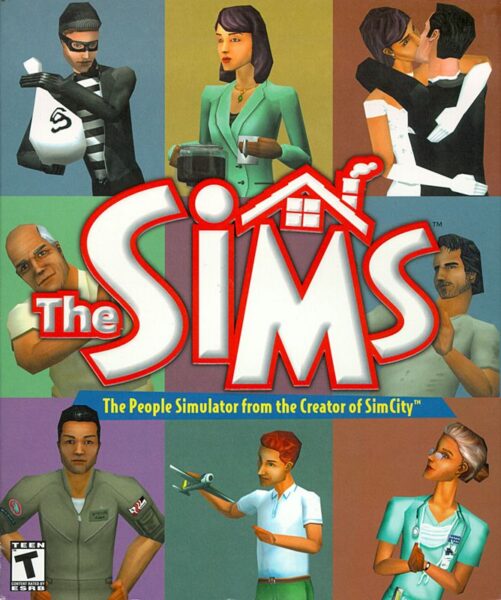
Stories of how The Sims came to be have a tendency to fall into some well-worn patterns. We are told how Will Wright, the brave and pioneering creator, had to fight for his dream against the unimaginative suits who surrounded him for the better part of a decade, until he finally got to enjoy sweet validation as he watched it turn into the biggest game ever. There is something to this telling of the tale, but it’s missing a lot of nuance. First and foremost, it commits the fallacy of assuming that the version of The Sims which Wright conceived in late 1991 was essentially the same as the game which was released in early 2000. In truth, it went through a protracted process of evolution, from which it emerged with a radically different focus. Along the way, several other people became almost as instrumental as Wright himself in shaping it into a game with such extraordinary mass appeal. This is not, in other words, another case of a single genius auteur imagining and implementing something unprecedented, as Wright did when he made the original SimCity. The creation of The Sims was a more organic, at times almost accidental process. For Wright specialized in systems, not in people. To make an appealing simulation of the latter, he had to draw on folks whose strengths were very different from his own.
But all of that was still in the future when Wright was contemplating the altered nature of his existence in the wake of the Oakland Firestorm. At that time, it was accurate enough to say that no one else at Maxis knew quite what to make of his new hobby horse. That he could so thoroughly flummox even this bunch, the makers and publishers of some of the most esoteric games in the world, really says something. Indeed, it may very well say that he himself wasn’t entirely sure what he was doing. Some game designers are like military strategists, speccing out every element of a campaign beforehand. Some are more like mad scientists, mixing a bit of this with a bit of that to see what turns into a useful synergy and what just blows up in their face. Wright is the poster child for the mad-scientist school.
For a long time, he called his idea Dollhouse. As the name would imply, it was all about architecture and interior design. He had become enamored with a book called A Pattern Language, written in 1977 by a Berkeley architecture professor named Christopher Alexander and several colleagues. It can be read as an attempt to define a Western version of the ancient Chinese concept of feng shui, explaining how our living spaces can be arranged so as to bring a sense of peace and harmony to our lives. It defines everything from the amount of green space a city should have to how many floors a building should contain to how high a windowsill should be, all based on universal and eternal “archetypes” that are “deeply rooted in the nature of things.” “You can use this book to design a house for yourself with your family,” wrote Alexander. “You can use it to work with your neighbors to improve your town and neighborhood; you can use it to design an office, or a workshop, or a public building.”
Wright wanted to use it to design a computer game, one that would bring Alexander’s theories to the masses, in the same way that his earlier games had promoted those of Jay Wright Forrester, James Lovelock, and E.O. Wilson. As in those games, the dolls in this dollhouse would be purely supporting players to the real star of the show, the physical environment itself. Their reaction to the spaces you put them in would provide a way of “scoring” how well your layout conformed to the principles of Christopher Alexander. This was their one important function.
Jeff Braun couldn’t have been thrilled at seeing his partner going down this rabbit hole, an abstruse one even by Maxis’s usual standards; SimCity this was not. But as always, he did his best to support Wright, whom he unabashedly regarded as a “genius.” He arranged for Wright to explain his concept to a focus group, just to gauge their reaction. Setting something called Dollhouse in front of a bunch of self-identified gamers circa 1992 was always destined to be a fraught endeavor, but Wright and Braun were nonetheless taken aback by the vehemence of the rejection. “This was probably the most negative focus-group experience I have ever seen,” says Wright. “It was actually quite remarkable. They universally hated it.”
Soon after, Braun wheedled his partner into agreeing to lead the development of SimCity 2000, pulling him away from his living-spaces simulation for a year. After that, the concept got muddled up with SimWorld, this attempt to make all of Maxis’s games interoperable so that they were all essentially one big game in the end. So, you would be able to pick a building in a SimCity city and zoom in to tinker with the fine details of its exterior and interior using Dollhouse. Part of the reason that Wright was so enamored with Yoot Saito’s SimTower was that it was already blurring some of the lines between SimCity and Dollhouse. (The Sony PlayStation port of SimTower even let you explore your skyscraper from a crudely implemented first-person perspective.)
That said, the people around Wright still didn’t entirely get what he was trying to do with Dollhouse. “It just felt kind of peculiar, you know?” says the Maxis researcher, writer, and producer Chris Trottier, whose first assignment as a new hire was to travel to real tropical islands and take pictures for SimIsle. (Nice work if you can get it…) “Will’s goal for it was that it was about efficiency and architectural layout and that the people were just there as a byproduct. The people were what measured your success in setting things up efficiently.”
But in trying to model the behavior of the people well enough to measure the quality of the player’s architectural and interior-design efforts, Wright would wind up inadvertently discovering a whole different, more immediately appealing game.
It began in 1995, when Jeff Braun agreed to bring on a bright young Stanford graduate named Jamie Doornbos to help program the dolls in Wright’s dollhouse. Doing that well enough to properly grade the player’s layouts proved to be far more difficult, complex, and time-consuming than Wright and Doornbos had thought it would be. Luckily, it was also more fascinating than they had ever imagined. Together they realized that the fun of the game may not be where Wright had thought it was. Wright:
We were trying to figure out how we could simulate an open-ended system where the behaviors [of the people] were expandable and they had the level of intelligence that we would require for the game, so that they could basically live out their whole home life and we could simulate it reasonably. So Jamie and I spent about a year and a half just working on the behavior model, as a little research project. At some point it just started really working out, and really looking pretty good.
It turned out that controlling the little people was actually more interesting. It was still fun designing houses for them, but controlling their lives actually turned out to be far more compelling, so the whole project took a turn toward the people. I kept the architecture tools in there, but then I just really started focusing more on the people and objects and their behaviors and relationships — all that sort of stuff.
Thus the stars of Dollhouse became the dolls, with their houses as supporting players, instead of the other way around.
As they did so, the simulation came more and more to resemble an oddity from the previous decade called Little Computer People. Created by Rich Gold and David Crane, Little Computer People was published by Activision in 1985 in the midst of that company’s artsy-fartsy period, when the warehouse full of cash it had collected on the pre-crash Atari VCS market gave it the luxury of venturing down a number of such avant-garde, high-concept alleyways. The “game,” if that’s what you chose to call it, was a bit like the Maxis-published El-Fish aquarium simulator, but with a human in the fishbowl. A little man lives in a little house inside your computer, and you can watch as he and his dog go about their day on a realistic albeit compressed schedule, with 24 hours inside the computer passing for every six outside of it. Depending on the time of day and his personality and mood, the fellow might prefer to relax with a book in his favorite armchair, make music on his piano, exercise, chat on the phone, wrestle with his dog, watch television, listen to his record collection, or play a game of cards with you — when he isn’t sleeping, brushing his teeth, or showering, that is. You can try to get him to do your bidding via a parser interface, but if you aren’t polite enough about it or if he’s just feeling cranky the answer is likely to be a big fat “No!”
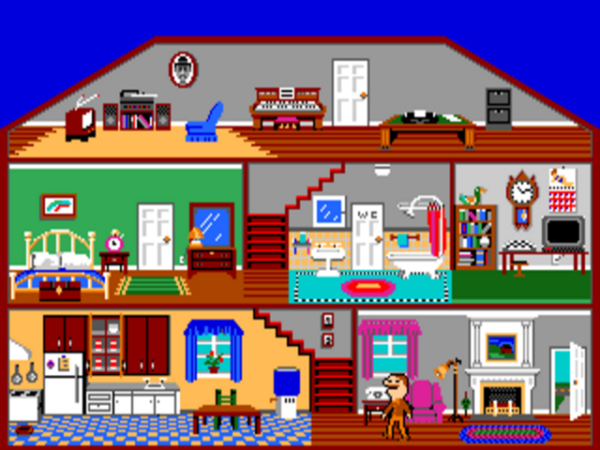
Little Computer People.
The most unique aspect of Little Computer People was that all of the little people were, well, unique. Each floppy disk that shipped had a different personality magnetically encoded on its sectors. You might wind up with a sluggard or an athlete, a Pigpen or a neat freak, according to the luck of the draw. Rich Gold envisioned Little Computer People becoming merely the beginning of a whole product ecosystem which would let you watch and nudge your little people in all sorts of different environments: at school, at work, during a night on the town, etc. Maybe you could even put your little person together with someone else’s to see how they got on! All of those plans were scrapped when sales were not up to snuff — but they were an uncanny reflection of the direction that Will Wright’s game would later go.
This was probably not completely coincidental. Wright has stated that he himself played Little Computer People in the mid-1980s; thus his early habit of referring to the characters in his own game as “little people.” During an online chat hosted by CNN in 2001, he said that “I’ve since gotten to know several who were involved with that project, and many of them gave valuable feedback, especially Rich Gold.” The most obvious differences between the two projects had to do with resources. Whereas Little Computer People had to run on an 8-bit Commodore 64, Dollhouse was implemented for a 32-bit Mac or Windows machine with a thousand times the storage and processing power. And whereas Little Computer People was made by two men in a handful of months, Wright had the privilege of tinkering for years, and would have a team of several dozen at his disposal before all was said and done.
For right now and quite some time to come, though, it was just Wright and Doornbos. They rechristened Dollhouse “Project X,” reflecting the reality that its goals were becoming more open-ended rather than less so, even more of a “little research project” than a coherent game. Which isn’t to say that the tech wasn’t cool and innovative. At bottom, Wright and Doornbos strove to create a simulation of the psychologist Abraham Maslow’s Hierarchy of Needs. This was a huge leap into the wild blue yonder for a project that had begun as a simulation of architecture and interior design. “I spent a lot of time thinking about how to make the behavior of these people very robust, interesting, and plausible, no matter what kind of environment you put them in,” says Wright. Chaim Gingold described the approach in his (highly recommended) 2024 book Building SimCity: How to Put the World in a Machine.
Wright crafted a simulation of a person’s needs. A simple prototype showed [how] a person’s hunger, bladder, and other needs evolve over time. If the person peed in their pants or fell asleep, a dialog box popped up. Doornbos incorporated this “motive engine,” a concise set of equations and coefficients, into a new Project X prototype focused on imbuing the people and things of this dollhouse world with behaviors.
“SimAntics,” as the language came to be known, went through many iterations, but from the start it had a graphical editor inspired by the diagrams Wright drew to explain how people would do things like go to the bathroom, brush their teeth, and make breakfast. These behavior scripts, which were compiled into a compact bytecode, told people and objects how to do things like select activities, walk around, animate, and, in the case of insensate objects like appliances, break. As in SimAnt, intelligence emerged from the coupling between agent and environment. Objects broadcast advertisements that claimed to service a person’s changing motives. A toilet, for instance, would advertise its ability to relieve the bladder motive. Crucially, the custom language scaffolded the design conversation between Doornbos and Wright, who could discuss its limitations. As a result, SimAntics was highly extensible; new objects could easily plug into Project X’s dollhouse world and describe both why and how a person might use them.
In a sense, then, the system worked by inverting the expected order of things, by making the people dumb and the objects smart. “This all happens behind the scenes,” Will Wright said, “but basically the fridge yells at [a person], ‘I can satisfy Hunger Five!’ and the chair says, ‘But I’m all about Comfort Four!’ and the bath says, ‘Hygiene Seven right here!'” This approach was rather brilliant in that it meant that you could add new objects without touching the core “needs” simulation, and have the inhabitants of the world respond believably. As we will see, this modularity, and the nearly infinite extendibility it brought with it, would be key to what Project X would become; stated in terms of filthy lucre, it was capable of turning one product into a potentially limitless line of same. In the meanwhile, notes Chaim, “Doornbos wasn’t sure if Project X would be fun, but he loved working for Wright.”
For a while, the two men were allowed to tinker in peace; again, Jeff Braun always prided himself on letting his resident genius do his thing without outside interference. Yet Wright and Doornbos would only be able to ignore the clouds that were gathering outside their blue-sky bubble for so long. As Maxis’s financial situation began to look worrisome, the now publicly-traded company’s board could hardly fail to note that its star designer hadn’t finished an original game since SimAnt almost five years ago, hadn’t contributed anything tangible to the bottom line since leading the SimCity 2000 effort. Nevertheless, it was Braun rather than Wright who was dismissed in August of 1996. Wright was then more or less forced by new CEO Sam Poole to take a hiatus from Project X and help out on SimCopter, the long-delayed proof of concept for SimWorld. Pressed to focus on something more realizable and practical than his people simulator even after SimCopter was finished, he spent time drawing up plans for a simulation of, of all things, the infamous German airship Hindenburg. He gave that up, he admits, only because “the Hindenburg had a swastika on the tail. And even if we took the swastika off, a lot of people have this association in their mind of the Hindenburg as a Nazi symbol.”
In June of 1997, the struggling Maxis was purchased by Electronic Arts. One might have guessed at the time that this event would represent the final kiss of death for Project X. Luc Barthelet, the manager whom the new corporate overlords sent in, was not at all a blue-sky type. On the contrary, he sounded almost like a caricature of a soulless gaming executive when he insisted that the time of Maxis as a maker of quirky little simulations of unusual things was well and truly over: from now on, he said, they would make only “top-ten” games.
And yet Barthelet surprised everyone by recognizing that Project X could be just that — recognizing it far better, in fact, than anyone had during Maxis’s years of independence, including Will Wright himself. He saw that all of the computers that were being sold in the wake of Windows 95 and the dot.com craze were being bought by new demographics with wildly divergent interests from conventional gamers. If you could give those people something fun and engaging to do on the computer when they weren’t surfing the young Web over creaky dial-up connections, you could open up and own a whole new market. So, rather than cancel Project X, he put roughly half of Maxis’s resources into it, while the other half worked on the safer and more predictable bet known as SimCity 3000. With the injection of employees and resources came a new focus on turning the research project into a product that could be sold; Will Wright says that it was “probably Luc more than anybody else [who] was responsible” for turning Project X into a proper game. It was rebranded simply The Sims, a name that had been used for the anonymous, interchangeable people in the company’s simulations since the days of the original SimCity. They would be anonymous and interchangeable no more; they would be the whole point of this latest game.
Whatever else they may have been, Will Wright and Jamie Doornbos weren’t touchy-feely guys. They had been and remained all about their algorithms, which had the potential to become the plumbing of a game, but were nothing like the sum total of one. The colleagues who joined them had the assignment of turning a research project into a playable, saleable game. Claire Curtin and Roxana Wolosenko, two women who joined the project in co-designer roles, strove to humanize the algorithms. Ditto the aforementioned Chris Trottier, another woman, who came aboard as an associate producer. The ranks of the team came tantalizingly close to gender parity, in an industry that was at least 90 percent male outside of Maxis’s offices. This surely had much to do with how appealing The Sims would become to a wide and divergent swath of folks, gamers and non-gamers alike.
As Maxis’s later promotional materials would advertise, the principal facets of the game were building, buying, and living. You made a place for your Sim to dwell, filled it with stuff, then helped her to deal with the fallout of your choices. It quickly became clear to the team that they needed to dial back some of Wright and Doornbos’s behavioral algorithms in order to give the player something to do during the living phases. In fact, in the finished game, Sims don’t do much of anything on their own volition other than eating. You have to tell them when to go to bed and when to get up, when to wash the dishes and water the plants — and yes, even when to go to the bathroom. If you fail to send them to the toilet in a timely manner, a messy and embarrassing accident will follow. Some future players would find this elevation of the mundanities of life to the heart of the gameplay loop weirdly riveting; others would find it mind-numbingly boring. But no one could deny that it was daringly different.
The Sims would be a lonely experience if it was, like Little Computer People, all about one person alone in a house. It ought to be possible to have friends and families living together, ought to be possible to have outsiders come over for a visit, for barbecues and pool parties — both kinds of pool — and even romantic trysts. At bottom, the game would remain a nesting simulator — there was no possibility for leaving the house and its environs — but at least there would be relationships inside the nest. Indeed, these would become the real heart of the game in the eyes of most of its players. This was no small achievement. Games tend to be good with structured fictional genres like mysteries, the kind that have goals which are never in doubt and are achievable by taking logical, concrete steps. Relationship drama is the opposite of that. Maxis pulled it off well enough to mimic a frothy sitcom or soap opera if not deathless literature — which was more than anyone else had managed.
The first and trickiest problem to solve in this context was the question of how the Sims should communicate with one another. Maxis wanted to create the impression of conversations without delivering literal meaning; as Will Wright noted, even if they included five CDs worth of voice-acted stock phrases, the conversations would soon start to sound repetitive and moronic, pulling the player right out of the fantasy. Maxis’s first idea was to use a language that few of their players would be able to identify, much less understand: they toyed with such tongues as Ukrainian, Estonian, and Navajo. But with them too, familiarity bred contempt, when it became clear that the Sims were repeating the same stock phrases over and over, even if the player didn’t know what they meant. Maxis finally settled on a gibberish that has become known as Simlish. Manipulated to suit the mood of an encounter, a fairly small amount of formless mumbling, provided by just two talented improv actors, could be stretched a surprisingly long way.
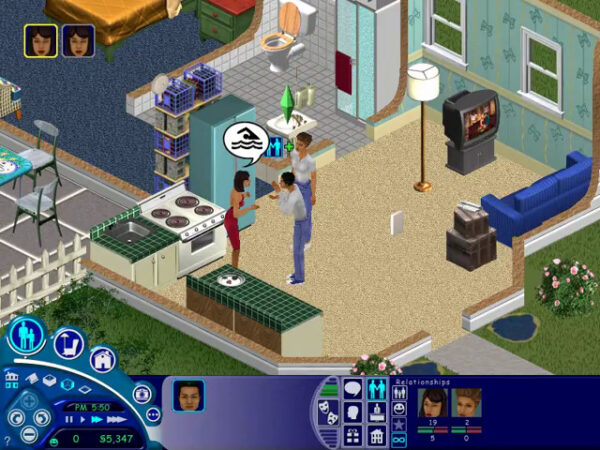
The speech bubbles convey the broad contours of what is being discussed. Here the topic is swimming.
Maxis created a look and personality for The Sims that were familiar from other forms of media but new to games. In place of the tacky-looking digital Arnold Schwarzeneggers and Pamela Andersons who dominated hardcore gaming, they offered up relatively normal-looking people — idealized to some degree, yes, but possessed of normal proportions and normal sartorial instincts. The people and environments were given an airbrushed sheen that was, if not quite realistic, sanguinely adjacent to real life in the turn-of-the-millennium United States. The aesthetic and the vibe of the game were of a piece with those of a “hangout” television show like Friends or Dawson’s Creek. The Sims too was real life, only better, with no truly intractable tribulations to suffer through, with stakes that were big enough to engage but not big enough to make anyone uncomfortable. We might go so far as to call it the first hangout game.
The music contributed as much as the visuals to making The Sims stand out from the gaming crowd. In place of the bombastic John Williams-inspired orchestral soundtracks and jackhammer metal tunes of other games, it featured perky, pleasant, melodic tracks with a range of inspirations spanning from Antonio Vivaldi to Keith Jarrett. Created by a whole stable of professional composers and musicians, herded by Maxis’s in-house sound man Jerry Martin, at its best the music of The Sims transcends the artifact to which it has been attached to become something pure and lovely in its own right. A surprising number of players would go so far as to buy EA’s official soundtrack CD, so that they could listen to the music without playing the game; many considered it a fine accompaniment to household chores, which seemed thoroughly appropriate. As Alex Robert Ross wrote in an article for Vice, “it wouldn’t be a stretch to say that more people have heard Jerry Martin’s minimal jazz than Thom Yorke’s measured howls on ‘Everything in Its Right Place.’” (This is a reference to Radiohead’s Kid A, arguably the most critically acclaimed album to be released in the same year as The Sims.)
In the spirit of being a welcoming space — real life with the sharp edges sanded off — The Sims broke ground by not just permitting same-sex romantic relationships but thoroughly normalizing them, treating them as just another thread in the fabric of humanity. This makes quite a contrast to Maxis’s swift backpedaling the moment the kissing lads of SimCopter were discovered. Gay relationships wound up in this game more by accident than any premeditated effort to stand up for equal rights. Then, once they were there, no one had the heart to take them out. It strikes me that a lot of positive change in the world happens in exactly this way.
The story in this case involves a programmer named Patrick J. Barrett III, who was himself gay. Unlike his predecessor Jacques Servin, who had deliberately inserted kissing men into SimCopter as an act of provocation and been fired for his trouble, Barrett really did do so accidentally, according to his own telling. He joined Maxis in October of 1998, after the decision had already been quietly made not to allow homosexual relationships; this was still a dismayingly commonsense one in the late-1990s United States. But nobody ever told Barrett about it. So, when he was asked to implement some algorithms found in a planning document for handling romantic relationships, he gave them equal weight for everyone. And once they were in the game, it seemed to all of his colleagues too sad and cowardly to even contemplate going back and taking them out. Nobody made a big deal out of it. Everyone “just pretty much ignored” that the rules had been changed, says Barrett. “The topic didn’t come up again.”
Under the new rules, every Sim started out in the dead center of a spectrum. If you prodded her to direct toward the opposite gender actions that were tagged as “romantic,” she would drift toward the heterosexual end; vice versa if you pointed her toward her own gender. If you played your cards just right, you could even keep her poised right in the middle of the spectrum — effectively, bisexual, or asexual if you preferred.
The low-key way in which the game tackled the subject would wind up being more powerfully validating to some of its players than a box festooned with rainbow flags and Pride regalia would have been. Patrick Barrett:
At the time, it wasn’t considered “normal” to be gay or lesbian. Some even saw it as dangerous. But in The Sims it was normal and safe to be a gay person. It was the first time we could play a game and be free to be ourselves within. It was a magical moment when my first same-sex Sims couple kissed. I still sometimes wonder how in the world I got away with it.
In keeping with the law of the land at the time, gay Sims could do everything except marry one another and have children. The picture of happy domestic cohabitation the game presented was enough to make you wonder why not — and that, of course, was a potent statement in itself.
The Sims had its coming-out party at the E3 trade show in May of 1999. It caused a buzz there that belied its modest booth in a back corner of the show floor. That E3 took place in the heart of Hollywood, and seemed to many attendees to mark the opening of a new chapter in gaming culture’s relationship with the rest of pop culture. Rock star David Bowie was there, exuding relaxed cool as he signed autographs, gave interviews, and even put on a concert, all to mark the inclusion of his songs, voice, and visage in the upcoming Omikron: The Nomad Soul. Despite bearing no surface resemblance whatsoever to Omikron, The Sims seemed somehow to be part and parcel of the same trends that had landed Bowie at this gathering. Indeed, taken purely as games, The Sims actually stood out far more than Omikron. It had no dragons, no spaceships, not even any guns. It struck many as an argument for the vitality and relevance of the medium that was even more convincing than cameos from an aging rock star.
Chris Trottier’s memories of the show are of near-pandemonium: “There were just rows of people, and we were just trying to project our voices. We were completely hoarse. That was the turning point.” Two female Sims kissed there on the screen in front of the assembled crowd on the very first day of the show. This provoked more excitement than controversy: “You might say that they stole the show,” says Patrick Barrett. Given the demographics of the attendees, it was probably for the best that the kissers were two women rather than two men: “I guess straight guys that make sports games loved the idea of controlling two lesbians.”
After that E3 show The Sims, which had heretofore received little outside attention, became a fixture in the gaming press. Some of the hardcore set reflexively kicked against it for watering down their hobby in some amorphous way, but most looked forward to seeing how it would turn out.
Just as had happened the previous year to SimCity 3000, The Sims wasn’t quite ready to go in time for that Christmas buying season. For the second year in a row, Luc Barthelet had the unenviable task of convincing his bosses at EA to choose quality over timing. And for the second year in a row, he succeeded.
The Sims shipped in February of 2000, exactly one year after SimCity 3000. It immediately became clear that, while SimCity 3000 had been a massive success by all of the usual metrics, The Sims was going to blow all of those same metrics right out of the water. It was exactly the right game at exactly the right time, feeding a latent demand from all of those new purchasers of personal computers for something absorbing and engaging, but also lighter, more approachable, less zero-sum, and less “gamer dark” than the industry’s standard fare. In many ways, it was the fulfillment of a dream that the games industry had been flirting with since Trip Hawkins founded EA back in 1982, with only localized and intermittent signs of success. This was the moment when digital games went fully and irrefutably mainstream, the moment when mothers and sisters, shopkeepers and hairdressers joined their nerdy brothers, sons, and husbands in the hobby. Most of these folks would never self-identify as gamers, but they played. Boy, did they play.
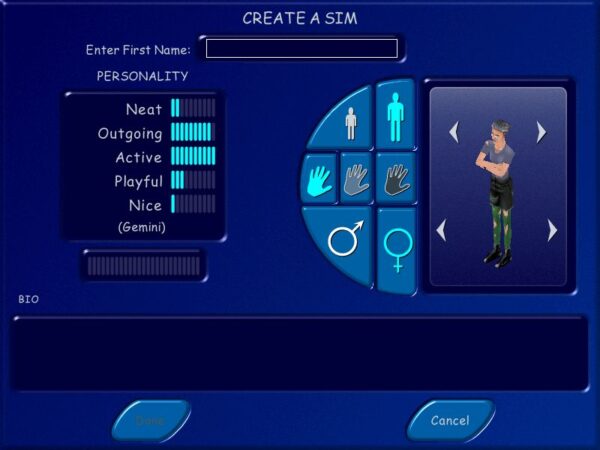
You start out by creating your Sim, giving her an appearance, a gender, and a personality profile defined along five continuums. In keeping with a game that is proudly goalless, the emphasis is not on making the best character, as in many CRPGs; it’s on making the character that you want to play.
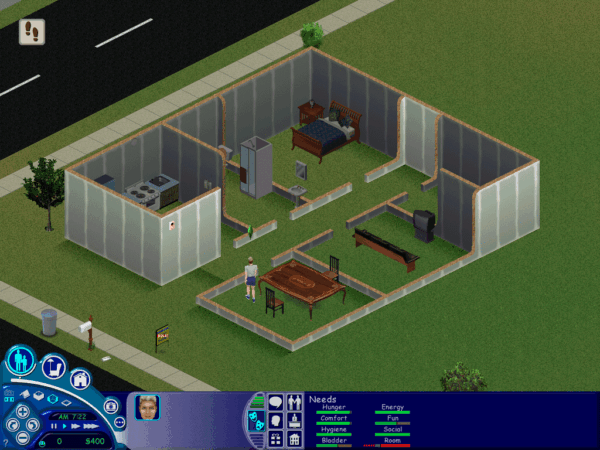
Next you need to build a house for your Sim to live in. You only have $20,000 to start with, so you have to economize. Note the bar graphs of her current needs. These lie at the heart of the gameplay loop. Your goal is to never let them drop any lower than they have to. Yes, this means that going to the toilet is as important as love and friendship. Perhaps this is more true to life than most of us would like to believe…
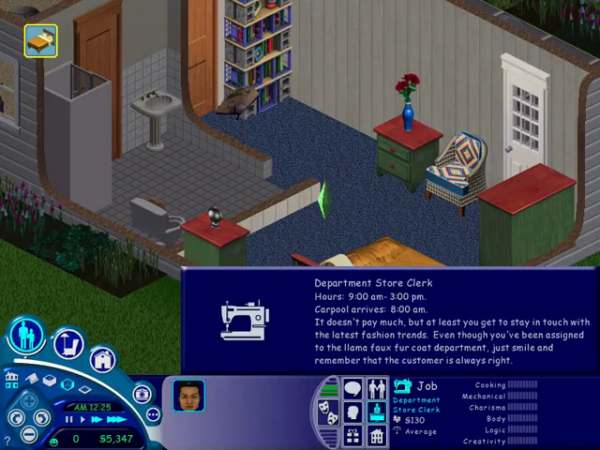
Now you need a job. You can advance along ten different career tracks in the original game, more if you’ve installed expansions. You don’t actually follow your Sim to work, but her performance on the job is dictated by how well her needs are being met at home. Send her to work tired or hungry, and she’ll under-perform and eventually get fired; send her out in tip-top condition, and a promotion could soon be coming, with the requisite higher salary attached. (This is where criticisms of the game as a consumption simulator can begin to take root…) In one of the game’s more baffling omissions, there are no weekends. Your Sim needs to go to work every single day. How’s that for a capitalist treadmill?
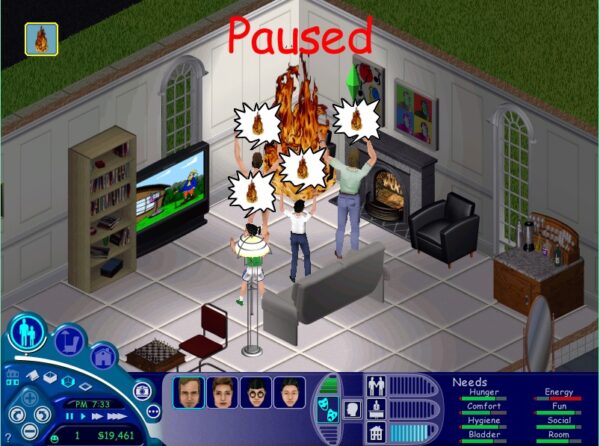
The Sims may have seemed like a kinder and gentler game by the standards of its time, but it’s much more unforgiving than its sequels. Your Sims can die in a housefire or even starve to death. Public assistance doesn’t exist in its dog-eat-dog economy, but one type of social worker does — the type who can carry off your Sims’ crying children if they aren’t being properly cared for. Predictably enough, some players found their fun after they got bored with being nurturing in making life hell for their Sims, from bulldozing their houses to killing their pets.
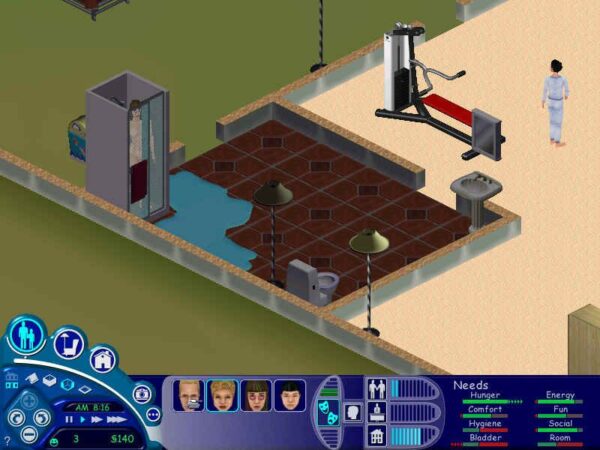
Naked Sims are discreetly blurred out, and there is no explicit sex.
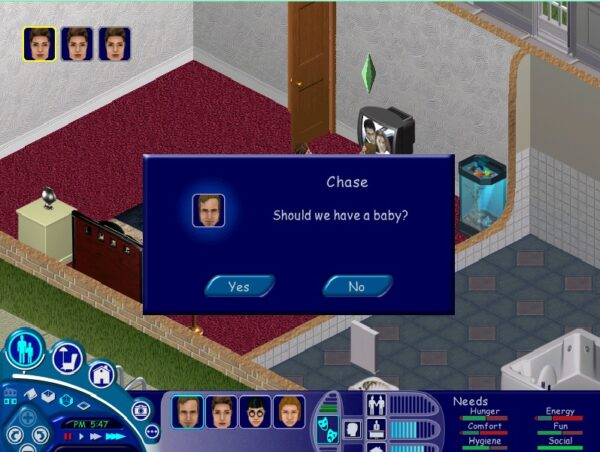
Sex is certainly implied, however, through home accessories like a “vibromatic heart bed” well-suited to “play.” This is contrasted with the more conventional “mission bed”; the folks at Maxis were winking and nudging so hard they must have developed permanent twitches. Sims can have extramarital affairs, or even engage in openly polygamous relationships. In retrospect, it’s a wonder more people didn’t notice and complain about this stuff.
The commercial trajectory of The Sims was unprecedented in the history of computer games. It shifted a million units within its first few months. It duplicated the achievement of SimCity 3000 by becoming the best-selling computer game of its release year; then it duplicated that feat again in 2001, all in an intensely novelty-driven industry where most titles went in and out of print in well under a year. In 2002, the two-year-old The Sims officially snatched the title of best-selling computer game of all time away from the nine-year-old Myst. It just kept on keeping on from there. Its total sales reached 16 million copies by 2005, numbers comparable to those an upper-echelon pop star could expect to put up with a hit album, a product with a far cheaper price tag and a far lower technological barrier to entry. Only four albums released in 2000 managed to sell as many or more copies than The Sims (and no, the critics’ darling Kid A was not among them.)
But that first boxed game was only the beginning of the marketplace story. Will Wright’s decade-old idea for an interoperable universe of games finally bore proper fruit now, as Maxis turned their hands to creating expansion after expansion, to add more environments, more stuff, more relationship options… just more, more, more. Take your Sims out on dates; take them on vacation; give them pets; even teach them to cast spells. The Superstar pack let you turn them into celebrity-tabloid fodder, which felt like closing a circle; as I noted earlier, The Sims had always had some of the same appeal and even many of the same visual cues as a fishbowl reality show like The Real World. The expansions packs included cameos by hot stars of the day like Avril Lavigne, Christina Aguilera, and Drew Carey, further blurring the lines between gaming culture and generalized pop culture. There were seven of them in all released between 2000 and 2003. Will Wright has confessed to some discomfort with the sheer quantity of them, but Maxis kept the quality just high enough, and they too sold in the tens of millions. Needless to say, lots of people — most prominently among them Will Wright and Luc Barthelet — got very, very wealthy in the process.
One can go so far as to say that Maxis, alongside the makers of early MMORPGs such as EverQuest, invented the modern approach of treating games as services, to be kept alive almost indefinitely by a steady stream of fresh content and a serious focus on community. By no means has this been an unmitigated positive for gaming — DLC and loot packs have deservedly garnered a terrible reputation in some corners, and that’s without even discussing such grift-adjacent boondoggles as Star Citizen and Shroud of the Avatar — but in this early, comparatively innocent age it worked a treat. As a supplement to the expansion packs, Maxis put up a lot of fresh content on The Sims website, which also gave fans the opportunity to share their own mods, objects, screenshots, and stories. Importantly in an era when CD burners had become commonplace, you needed a valid serial number to access all of this and become a full-fledged member of a community that was, estimated Will Wright, half of the reason people played the game. As he said, “If you register the game, you get more than a pirate would get.” This too doubtless drove sales.
The knock-on effects were enormous. The Sims essentially created the casual-game aesthetic that persisted throughout the aughts and beyond on portals like Big Fish Games and in series like Diner Dash: bright, colorful, pleasant environments and people, coupled to fictional premises with personal rather than epic stakes. Like The Sims itself, these games were the polar opposite of the ones preferred by the hardcore set, with their demanding, ultra-violent quests to save one more dark-fantasy world or other. You could dismiss the casual scene as Hallmark Channel pablum if you liked, but the fact remained that many people — especially women, who came to make up well over half of the casual player base — felt they had more than enough stress in their day-to-day lives already, and didn’t feel a need to seek out more of it in their interactive entertainments. Meanwhile, for publishers like EA, whose acquisition of Maxis had paid off beyond its wildest expectations, The Sims and what it spawned became the ultimate validation of the premise with which I opened this trio of articles: that the real money in games does not come from targeting gamers. By many reckonings, casual games would be outselling and out-earning hardcore games by a considerable margin by 2010.
A game this huge was bound to attract journalists, columnists, and academics. And did it ever. The Sims was SimCity times ten in that respect. It was widely lauded for finally cracking the puzzle of how to make a game with genuinely broad appeal, long after other misbegotten attempts like the “Siliwood” movement had been cast into the dustbin of history.
Other aspects of the game were perchance less laudable. It was hard for some to ignore how it restricted the simulated inhabitants of its world to conformist, bourgeois lives, in which happiness was derived from having the right interior accessories and a mate with a suitable income. In a contemporary journal article, Russell W. Belk pointed out how conventional and even retrograde — same-sex relationships excepted — the assumptions and expectations built into the game really were.
Many elements in this game represent a morality that is centered in the suburban America of the 1950s. Characters must get a job, get up early to catch their carpool (no telecommuting allowed), advance through a career path, earn more money, buy more things, clean house, and practice good personal hygiene. The Sims manual recommends having one spouse in a family stay at home and keep house. If possessions are bought on credit and the credit bills go unpaid, they are repossessed. The dating model of Hot Date is also retro in this age of hanging out and hooking up. Among the ways to impress a date (with greater intimacy being the payoff) are to bring flowers, go shopping together, give gifts, and take the date to more expensive bars and restaurants. The one who asks the other out does all the paying, and those with more money have a distinct advantage. Children must get enough sleep and food so that they don’t get picked up by the welfare worker or sent to military school. Maids and gardeners are also throwbacks to an earlier era when such pseudo-slavery was more democratized.
“A look at the homes and people uploaded by players onto The Sims’s website,” notes Belk, “will show much that mimics what is and has been and little or nothing that anticipates what might be.”
The Sims trivializes or ignores most of what really matters in human existence. Friends and romantic partners are interchangeable, a matter of changing numbers on a graph which you can see right there on the screen. Philosophy and religion and spirituality are nowhere to be found. Your Sim will never have her life changed by a book, sit at the bedside of a dying loved one, have an epiphany while out on a long walk, serve a country or a cause, create a work of art (even though she can learn to paint), commit a flagrant act of kindness, attend a funeral, or become the victim of a crime and have to choose whether to forgive or hate the perpetrator. The life the game presents is a plastic pantomime of the real thing.
There are no such things as social problems in The Sims. If your Sim has a problem, it’s her — or rather your — own fault. The only way to get ahead in its picket-fence world is to play the game of life according to the rules of the day. Some folks called it thinly veiled propaganda for the American consumer economy, of a piece with the hollow words of President George W. Bush when he said that the best way to be a patriot in the wake of the September 11 attacks was to go spend money at Disney World. (Never fear, Maxis had you covered with the Vacation expansion…)
Personally, I don’t get too up in arms about this commoditization of the human experience. I’m not even inclined to get too upset about the way the game places the needs of your Sim’s bladder on a level footing with her social needs; after all, it really is pretty darn hard to focus on anything else when you desperately need a toilet. I presume that few of the people who bought or played The Sims did so expecting life-changing epiphanies. Yet I can’t quite bring myself to ignore the perhaps uniquely American emptiness that yawns at the center of it either. In the end, it’s a social-status simulator in which everything and everyone are transactional. I’m sure that this is more an artifact of its algorithmic nature than any conscious or even unconscious attempt to inculcate a set of values, but it still leaves me with an uncomfortable feeling.
Setting questions about values aside, many old-school gamers responded to The Sims by asking why they should want to take out virtual trash and water virtual plants when they do plenty of that sort of thing in real life. In this case, too, I kind of find myself agreeing with the critics. Is it worth taking time out from your real life to lead a mundane virtual one? Will Wright said to Computer Gaming World shortly after The Sims’s release that, based on Maxis’s early playtesting, six out of every ten people loved it, two were lukewarm on it, and two hated it. I lie somewhere between the second and third groups, for reasons that were pinpointed by reviewer Chris Lombardi in the same issue.
The fundamental challenge of The Sims, as in life, is to find the time to meet all of your Sim’s basic needs and still have time to boogie. Each day, you face questions like: Do I spend my two hours of free time tonight playing pool with my friends or studying for a promotion? Computer games until the wee hours or a good night’s sleep? A bath tonight or in the morning? It’s the juggling act that each of us performs every single day, each in our own way and to varying degrees of success. It’s life in all of its drab, humdrum detail, as well as in the little victories and achievements that make it all worthwhile.
What can I say? These do not strike me as Interesting Decisions in a ludic sense, any more than “life in all of its drab, humdrum detail” strikes me as an overly compelling ludic premise. For me, The Sims is a fiddly, relentless minutiae simulator. The problem is doubtless compounded by my genetic difficulty with games that don’t give me concrete goals to work toward. (This same difficulty is the reason that I struggle with the entirety of Maxis’s catalog, SimIsle excepted.) Sheepish as I am to admit this, if The Sims gave me a to-do list, maybe I would suddenly feel differently about it.
But having said all that, I’m well past the stage of life where I judge people for their entertainment preferences or try to convince them to like the things that I do. So, by all means, play The Sims if you enjoy it, subject only to the one caveat that I attach to all games: don’t do so too much, to the point of neglecting your real life that is filled with all of those other, more ineffable experiences that The Sims does not and cannot include.
Whether you happen to be a fan or not, there is no denying that The Sims changed the face of gaming forever, possibly even more so than Will Wright’s previous masterstroke SimCity. In so doing, it opened up what had become a dismayingly homogeneous industry to fresh aesthetics, themes, and approaches, paving the way for other games that I do enjoy more than this one. For this reason alone, Wright must be considered one of the most important — not to mention commercially successful — people ever to work in his field. It may be that the only person whose games have reached more and more diverse people and created more change in their image is his old friend Shigeru Miyamoto. That’s not bad for a man who never really wanted to be a game designer at all, who preferred the label of software toy-maker. Under either heading, Will Wright transformed the way that people play.
Did you enjoy this article? If so, please think about pitching in to help me make many more like it. You can pledge any amount you like.

Sources: The books Games That Sell! by Mark H. Walker; Building SimCity: How to Put the World in a Machine by Chaim Gingold; Game Design Theory & Practice (2nd ed.) by Richard Rouse III; Time, Space, and the Market: Retroscapes Rising, edited by Stephen Brown and John F. Sherry Jr.; A Pattern Language: Towns, Buildings, Construction by Christopher Alexander, Sara Ishikawa, and Murray Silverstein with Max Jacobson, Ingrid Fiksdahl-King, and Shlomo Angel. Computer Gaming World of May 2000; Retro Gamer 115.
Online sources include Tristan Donovan’s interview with Will Wright for the old Gamasutra site, “SIMply Divine: The Story of Maxis Software” by Geoff Keighley for GameSpot, “Will Wright Inspired to Make The Sims After Losing a Home” by Tracey Taylor for Berkeleyside, “The Kiss That Changed Video Games” by Simon Parkin for the New Yorker website, “The Untold Story of The Sims, Your First Favorite Jazz Record” by Alex Robert Ross for Vice, and an online chat with Will Wright conducted by CNN on January 20, 2000.
Where to Get Them: The Sims and all of its expansions can be purchased as a “Legacy Collection” on Steam.










Alex Smith
August 7, 2026 at 4:41 pm
Great article. One comment: I am not sure you played up the SimAnt angle enough. Wright has gone on the record a few times (example https://www.engadget.com/2010-11-08-will-wright-explains-what-the-sims-and-an-ant-colony-have-in-com.html) that the core interaction between the Sims and their objects was a deliberate reapplication and expansion of the pheromone-based system used to direct the behavior of the ants in SimAnt. That is likely another reason for calling the new language SimAntics, which is truly a multi-layered pun. The connection is sorta made in passing in the Gingold book excerpt, but I feel it might be worth calling out more explicitly.
Play History
August 7, 2026 at 6:27 pm
My sister is a bit more of a gamer than average, but The Sims 2 and Animal Crossing were the only two games she ever really got into. Growing up with that sort of perspective has definitely changed a lot about how I look at games. Both of us would use the infinite money cheat and not play the game the normal way – we wanted to alleviate as much stress in the system as possible to focus on the relationships.
I think you should also note about the modding of The Sims being a big part of its initial draw. They put out modding tools before the game (later done with the creature creator in Spore) and that built a hardcore following that spurred the game’s momentum. It’s easy to focus on the corporate angle with the expansions when there’s a whole lot more to the bottom-up part of this story too.
A few corrections:
“Designed by Rich Gold and programmed by David Crane,”
Crane more claims that Rich Gold came up with the concept and he designed the game in a practical sense. Gold’s memoir/posthumous autobiography is a lot more vague on this point.
“Rich Gold and David Crane envisioned Little Computer People becoming merely the beginning of a whole product ecosystem,”
I don’t think Crane wanted to linger that much on it at all. Gold did all the weird promotional stuff that tried to position it as something other than it was.
“he spent time drawing up plans for a simulation of, of all things, the infamous German airship Hindenburg”
I know this is wedged into The Sims story but I thought you’d be way more interested to tackle this. While it was a simulation, it was also a Myst-style puzzle game to determine the cause of the airship’s disaster. In a way it ties into his sense of systems as uncovering truths about our reality.
Jimmy Maher
August 8, 2026 at 8:32 am
Thanks to both you and Alex for going deeper, but in this case I’m pretty comfortable with the article as it stands.
Alex Smith
August 9, 2026 at 4:53 pm
Your narrative, your focus, so that is all fine and good excepting that the Gold-Crane thing is an error. Crane did a whole lot of design once Activision bought Gold’s concept.
Jimmy Maher
August 10, 2026 at 5:14 am
Fair enough. Thanks!
Sniffnoy
August 7, 2026 at 6:48 pm
Typo spotting: You have “The Nomal Soul” for “The Nomad Soul”.
Jimmy Maher
August 7, 2026 at 6:50 pm
Thanks!
Lee Hauser
August 7, 2026 at 7:27 pm
Typo alert!
“But that first boxed games was only the beginning of the marketplace story.”
“games” should be singular.
But a great article. I never played The Sims, but have long been curious about it.
Jimmy Maher
August 7, 2026 at 7:42 pm
Thanks!
dsparil
August 7, 2026 at 8:08 pm
I won’t get ahead too much, but I greatly preferred The Sims 2 over the first game which was too basic. 3 would have been the best one since you could actually wander around the neighborhood, but EA basically made every cosmetic option a paid microtransaction. I haven’t played 4 after that, but apparently the base game is free now with paid expansions.
For the original game, I’ve always been under the impression that people using it as a sort of house constructor (by cheating and giving yourself huge starting cash) was a major player base. Other software at the time was angled towards serious use and wasn’t as good for making dream homes.
Andrew McCarthy
August 7, 2026 at 11:57 pm
I believe “Simish” should be “Simlish.”
Jimmy Maher
August 8, 2026 at 6:44 am
Thanks!
CornedBee
August 8, 2026 at 6:37 am
> Sheepish as I am to admits this
Typo: admits
I am utterly bored by the concept of the Sims, but it makes for a fascinating article.
Jimmy Maher
August 8, 2026 at 6:43 am
Thanks!
Andrew Pam
August 8, 2026 at 8:21 am
Typo: “tantalizing close” should be “tantalizingly close”.
Jimmy Maher
August 8, 2026 at 8:30 am
Thanks!
sam
August 8, 2026 at 12:27 pm
> It was rebranded simply The Sims, a name that had been used for the anonymous, interchangeable people in the company’s simulations since the days of the original SimCity. They would be anonymous and interchangeable no more; they would be the whole point of this latest game.
The story of the name is, if you can believe Hacker News comments, even twistier than that! ‘The Sims’ is definitely obvious in hindsight, connecting to SimCity and all the other titles, but there were other false starts and an apparently perfect name was forgotten during development shortly after discovery; I would quote from https://news.ycombinator.com/item?id=4946910, but I’d just be quoting the whole thing (and do read the replies, as well).
Typo watch:
> principals of Christopher Alexander
principles
Jimmy Maher
August 8, 2026 at 2:01 pm
Thanks!
Gwydden
August 8, 2026 at 5:30 pm
I played this series as a kid but haven’t really touched them since, and I’ll add that another vector of appeal is that for children the premise isn’t quite so mundane. Much like the analog version of playing house, The Sims lets kids indulge in a fantasy of adulting before they really know what it’s like.
Martin Kramer
August 16, 2026 at 10:35 am
That is exactly why me and my sisters loved it. Well, at least from today’s perspective, I couldn’t have told you this back in the day. I’m not sure how I would have responded to The Sims had I been ten or twenty years older, but for kids and teens who knew about the rosebud cheat (with as much exclamation marks and semicolons as the cinsole would allow), the game was beautiful and fun.
Great article, in any case. I stand by your point of bladder needs being really a bit more important than we all prefer.
James Turley
August 9, 2026 at 3:57 pm
My memory of the Sims coming out was of actually me and my hardcore gamer teenage buddies quite enjoying it, playing it properly for a bit, finding out all the ways to kill your sims for a bit, getting bored of it and going back to ‘real’ games, but discovering we now had to fight our little sisters for the PC. (Almost exactly the same sequence was true of Rollercoaster Tycoon.) I also found the endless sluice of expansions a little gauche.
At this remove, I’m suddenly curious to play it again if it’s cheap on Steam or something.
bret
August 9, 2026 at 5:59 pm
I would argue that “A Pattern Language” is closer to “seminal” or “renowned” than “odd and obscure”. It’s been one of the best-selling books on architecture since its publication. The general public might not recognize it, but it is universally known among urban designers, and its concepts have been influential and enduring.
It is by far Alexander’s best-known work, to a degree that he found irritating (because it was often misinterpreted as a prescriptive how-to manual, rather than one piece of his much more expansive program to restore beauty and wholeness to the built environment).
marcy
August 9, 2026 at 11:14 pm
It has also been influential in software, especially the ’80s and ’90s object-oriented design movement (the common term “design patterns” is borrowed from it).
xxx
August 10, 2026 at 12:34 am
Agreed — definitely not “odd and obscure”. It ended up having a huge influence on the field of computer science: https://en.wikipedia.org/wiki/Design_pattern
Jimmy Maher
August 10, 2026 at 5:14 am
Good to know. Thanks!
Doctor Casino
August 10, 2026 at 9:44 pm
Agreed! I would add that its influence was almost certainly the greatest within kinda counterculture-adjacent Boomer design culture. I’m sure it must have been advertised in The Whole Earth Catalog, and if it wasn’t, it ought to have been! Definitely something that a LOT of folks of Wright’s generation would have been talking up at cocktail parties.
Interestingly enough, Alexander’s approach was actually rooted, more than he might have wanted people to realize, in early digital/algorithmic design stuff. If I remember right, the number of variables/factors he allowed for was likely determined by either hardware or software limitations of the 1960s mainframe computer programmers he was initially collaborating with. I’m not an expert, but if memory serves, this take is told in one of the essays in A Second Modernism (Arindam Dutta, ed.), and you can find a couple of other scholarly articles online that dig into it as well.
In this regard, Alexander was one of several people in the 60s/70s imagining that software could be used to procedurally generate human environments. There’s been a lot of scholarship on The Architecture Machine Group projects like “Flatwriter,” that gets into this. Point being: Wright, in trying to take Alexander’s maxims back to a set of rules in software, was unknowingly reinventing the wheel!
Mayhem
August 10, 2026 at 12:07 pm
While I only played it a brief while, I know many of my non-gaming friends were incredibly into The Sims, and instantly bought The Sims 2 on release. It was far more life consuming than WoW, which was saying something.
I’ve also never forgotten some of the Something Awful Let’s Plays of The Sims 1 & 2, from the house built like a maze which meant you burned more energy walking than you gained eating to the constant drowning in pools by deleting the steps of anyone they disliked.
But the triumph was a brutal warped murdering playboy type with a deformed face, who eventually reproduced. The final moment was when the baby became a child, and immediately inherited the monstrous looks of the father.
Elmo Allén
August 10, 2026 at 4:46 pm
“In a contemporary journal article, Russell W. Belk pointed out how conventional and even retrograde — gay marriage excepted — the assumptions and expectations built into the game really were.”
Should this instead read “gay partnerships” or something like, as you wrote that gay marriage wasn’t possible in the first game?
Jimmy Maher
August 10, 2026 at 5:42 pm
Ah, good catch. Thanks!
Martin
August 12, 2026 at 1:42 am
Reading the article (am late reading it this week), did The Sims influence the modern day creation of Reality TV (thinking of stuff like Surviver or Big Brother) or did their creation around the same time just a coincidence?
Jimmy Maher
August 12, 2026 at 5:12 am
It was rather a case of The Sims taking its cues from reality television. The progenitor of the whole trend was The Real World, which started airing on MTV already circa 1993. Its influence on The Sims — watching people live their lives in a fishbowl, whilst stepping in to stir the pot from time to time — isn’t hard to spot. Both Big Brother and Survivor originated in Europe, both before the release of The Sims.
There’s a really good book called Cue the Sun! which was published a few years ago. It covers the whole history of reality television and its influence on many aspects of our culture. (It’s not an overly long trip from The Real World to modern egocentric influencer culture.) Well worth reading, if you’re at all interested in the subject.
Michael
August 12, 2026 at 10:43 pm
“put up a lots of”
Thanks for this. I never played the Sims, but at the time I remember being somewhat baffled by how popular it was. Now I understand a little bit more.
Jimmy Maher
August 13, 2026 at 7:18 am
Thanks!
Will Hyde
August 13, 2026 at 2:17 am
Fascinating how journalists in the 90’s criticized The Sims for glorifying a lifestyle many would kill for today: boring and comfortable stability in a nice enough house filled with family and an assortment of possessions. It comes across as spoiled and shortsighted in today’s nightmare economy.
CdrJameson
August 14, 2026 at 11:45 am
The mid-to-late 90s were probably the peak of the ‘Artificial Life’ movement, which focussed on this kind of emergent behaviour simulation. There was a lot of computer science work on motivation and needs-satisfaction going on, which definitely influenced games.
You could easily slot The Sims (and a lot of Maxis’ games) alongside games like the Creatures series and Tamagotchi toys.
Will Hyde
August 21, 2026 at 2:22 am
You could add Shenmue to the last as well.
Will Hyde
August 21, 2026 at 2:23 am
*list
Alianora La Canta
September 21, 2026 at 3:01 pm
I sank thousands of hours into The Sims (and Sims 2, for that matter). For perhaps a few weeks after I was given it as a Christmas present, the teenage me was playing The Sims like it was SimCity for people. However, within six weeks, it turned into a giant storytelling machine. I’d internalised how to get Sims to (mostly) survive well enough that I could bring some of the complexities of life that teenage me could muster and The Sims did not pretend to provide.
Once I started to be able to connect with the modding scene a couple of years in, it got even easier to use it to tell stories (which were never entirely predictable because of needing to throw in a Sim deciding the toilet was more important than whatever plot point had been getting set up for the previous couple of days’ gameplay). The result was a neighbourhood that had a continuous storyline for 24 years and 2 iterations of game. (I don’t think I can say “and counting” because I drifted away from Sims 2 a couple of years ago).
Sims 3 and I did not click when I tried a playable version at a shopping arcade pre-release, so I didn’t bother buying it. While I got Sims 4, I found it took too much control away and made too many assumptions of the post-war American consumerism sort to break my immersion with the game. Making philosophical points is something the Sims series has done best subtly and in the background, not when they have been an imposition on playstyle.