RSS

Tag Archives: origin

Mr Roberts Goes to Hollywood, Part 1: A Digital Anvil


This article tells part of the story of Chris Roberts.

What I’d really like to do is a game where you could travel from planet to planet — and there would be hundreds of planets — with full 3D action. You could go down and explore each planet in detail and interact with all sorts of live-action characters. Plus you could retool your ship with lots of different guns and engines.

The project would feature all the best elements of adventure and virtual reality, but with the same high production level of a Hollywood blockbuster. That means big-name stars and the look and quality of, say, Bladerunner. I guess my goal is to bring the superior production values of large Hollywood movies into the interactive realm — creating an environment that is really cool and fun and where you can spend hundreds of hours exploring a virtual universe that seems totally lifelike down to the smallest detail. Sort of a SimUniverse on steroids!

— Chris Roberts in early 1995, speaking from the department of The More Things Change…

One thing I believe I have learned during my 50-plus years on this planet is that flawed people are far more commonplace than genuinely, consciously bad ones. Given this, I try not to rush to attribute to malice aforethought that which can be explained by simple human weakness. I try to apply this rule when I weigh the surprising number of game developers who were well-nigh universally admired giants in their field during the twentieth century, only to become magnets for controversy in the 21st.

Thus I prefer to believe that Richard Garriott’s habit of lending his name to sketchy endeavors that never live up to expectations stems not from conscious grift but from a desire to still be seen as a gaming visionary, which is unfortunately accompanied by a reluctance to do the hard work that making really good games entails. Likewise, I think that Peter Molyneux’s habit of wildly over-promising stems not from his being “a pathological liar,” as journalist John Walker once infamously called him, but rather from a borderline pathological tendency to get high on his own supply. I’m prepared to come up with excuses for John Romero, for George Broussard, even for those two guys who have been trying to make a Space Quest successor — a dubiously necessary proposition in itself — for about fifteen years now. When you combine real but fairly venial character flaws with the eternal tendency of some fans to take their hobby just a little bit more seriously than it probably deserves, the result can be a toxic stew indeed.

Yet I must confess that one old warhorse from gaming’s younger days does give a degree of pause to my rationalizing. Few people have ever stretched so thin a thread of actual creative talent so far as has Chris Roberts. In the process, he’s amply demonstrated that his larger talents are for failing upward, and getting people to give him flabbergasting amounts of money while he’s at it. I’m not yet prepared to call him a conscious grifter, mind you, but I do think that there is a lot more plotting going on behind that seemingly guileless chipmunk smile of his than we might first suspect. Never fear: I’m not going to jump the chronology entirely to wade into the argument over whether Star Citizen, the most expensive game ever made even though it has not yet been made, was a giant scam from the start, a good-faith effort that later became a scam, or is still an honest endeavor thirteen years after its initial Kickstarter. What I do want to do is examine the period in Chris Roberts’s life between Wing Commander IV in 1996 and that first splashy Star Citizen Kickstarter of 2012. Who knows? Maybe doing so will help to explain some of what came later.


I have infinite respect for Chris Roberts, who wants to make interactive movies, but I can get a better cinematic experience by watching reruns of Diff’rent Strokes than by playing Wing Commander IV.

— Warren Spector, March 1997

In the summer of 1996, after it had become clear that Wing Commander IV was going to struggle just to earn back its development budget of more than $10 million, the management of its publisher Origin Systems sat down with Chris Roberts, the Wing Commander series’s creator and mastermind, to discuss the future of what had been the most popular franchise in computer gaming just a few years earlier. With a heritage like that behind it, the inhabitants of Origin’s executive suites weren’t yet ready to give up on Wing Commander completely. Yet they made it clear to Roberts that the next installment would have to scale back the budget and place less emphasis on the interactive-movie side of the experience and more on the space-combat side, in order to address a mounting chorus of complaints that the latter had been allowed to grow stale and rote in the last couple of installments while Roberts poured all of his energy into the former. Roberts thought for a few days about whether he was willing to continue to make Wing Commander games under his managers’ new terms, then turned in his resignation. No one could possibly have imagined at the time that Chris Roberts, who was not yet 30 years old, would still be one of the most prominent game developers in the world 30 years later, even though he would never manage to complete and ship another game of his own during that span of time. Our world is a deeply strange place sometimes.

That October, Roberts filed the necessary paperwork to found a company of his own with two other former Origin people: his brother Erin Roberts, who had just produced the poorly received Wing Commander spinoff Privateer 2: The Darkening, and Tony Zurovec, the programmer and designer behind the reasonably successful action-adventures Crusader: No Remorse and Crusader: No Regret. They called their new studio Digital Anvil. “I liked the idea of a name that could suggest Old World care and craftsmanship in the digital age,” said Roberts. “It’s like we’re hammering out fantastic experiences in our little forge.” By his account, their method of seeking funding was breathtaking in its naïveté. They got their hands on Bill Gates’s email address, and simply wrote him a letter. Incredibly, they received a call the next day from Ed Fries, who had been tasked with making Microsoft a major player in games, one of the few software markets the foremost ruthless mega-corporation of the era had yet to conquer. He had been given serious money to spend to make that initiative a reality. Digital Anvil, in other words, had been lucky enough to strike while the iron was hot.

On February 19, 1997, a press release announced that Microsoft had signed Digital Anvil to “a multi-title publishing deal” which entailed “a significant investment” on its part — in fact, an investment that made Microsoft the owner of just short of half of the new company. The trio of founders set up shop in rather lavish fashion in downtown Austin, Texas, not far from Origin’s offices. They hired an initial staff of about 35 people, who got to enjoy such Microsoft-funded perks as an onsite state-of-the-art movie theater with Dolby Sound and leather seats. On paper at least, the staff of Digital Anvil made for a diverse and impressive group. Hidden amidst a galaxy of bright and eager faces out of the nearby University of Texas could be glimpsed Chief Technology Officer John Miles, whose Miles Sound System had long been the standard for audio programming among game developers, and Robert Rodriguez, a young filmmaker who had recently directed Quentin Tarantino’s script of From Dusk Till Dawn and was now being talked about as the burgeoning Austin film scene’s next Richard Linklater. “The parameters of the film world are pretty set,” said Rodriguez. “You’ve got to work with a two-hour chunk of time and things like that. Some of the stories I want to tell don’t fit within those slots.”

Rodriguez’s presence was arguably the first sign of the muddled priorities that would become a fact of life at Digital Anvil. Chris Roberts told the magazine Texas Monthly in the summer of 1997 that the studio had four games in the works: a real-time-strategy game called Conquest, a Mad Max-inspired driving game called Highway Knight, a hyper-ambitious multiplayer space sim called Freelancer, and Rodriguez’s amorphous project, which was called Tribe. (“The idea is, he will write a movie, possibly direct it, and then write a game.”) Another game in the pipeline that went unmentioned was Erin Roberts’s Starlancer, which was to be a linear space sim with a set-piece story line, an even more obvious successor to Wing Commander than was Freelancer. (Students of the Robertses’ later careers will recognize a kinship between Freelancer and Starlancer on the one hand and Star Citizen and its single-player companion Squadron 42 on the other.) That’s five games in all: it was quite the agenda for such a small studio. And then the movies came calling.

If Robert Rodriguez was a filmmaker who was tempted by the possibilities of games, Chris Roberts was the opposite, a game maker who seemed for all the world like he really wanted to be making movies; if Wing Commander III and IV had shone a spotlight on nothing else, it was this. While still working for Origin Systems, he’d come up with an outline for a non-interactive Wing Commander movie. He gave it to Kevin Droney, a screenwriter who had earlier turned the Mortal Kombat games into a movie, to make a proper script out of it, then sent it to Hollywood on a wing and a prayer: “It was my passion project, my baby.” It finally reached a hard-bitten Svengali of a producer named Todd Moyer. He pronounced it “pretty bad” — “basically, it was a C-rate Star Wars ripoff” — but his ears perked up when the agent who had sent it to him explained that Wing Commander was a hit series of computer games. “I’m not very reverential toward videogame creators,” Moyer confesses. “Games just don’t get me excited.” Or rather, they didn’t do so as creative productions in their own right; as product lines, Moyer saw them as a largely untapped opportunity for franchising: “Once you own [the] intellectual property, you can carve out very different deals for the creators and for a lot of people.” Chris Roberts fell under Moyer’s spell from the first meeting, which came right in the middle of all of the work to build out Digital Anvil. For he had no fonder dream than that of making a real Hollywood movie, and he definitely wasn’t going to let the games studio he was building at the same time get in its way. Moyer was telling him precisely what he most wanted to hear.

That said, it’s fair to ask who was really pulling the wool over whose eyes. For all that the movie industry had a well-earned reputation for all manner of financial trickery, it was expected to reveal as a matter of course and trade-union law how much each film had cost to make and how much it earned back in ticket sales. Meanwhile budgets and sales figures were regarded as trade secrets by game publishers, to be divulged only when doing so served their interests. It’s hard not to suspect that Chris Roberts benefited from this opacity, which required an insider’s perspective to begin to penetrate. Todd Moyer was no one’s idea of a babe in the wood; nor for that matter was Microsoft’s Ed Fries. Yet both were new to the games industry, and by all indications in a bigger hurry to sign deals than to do their due diligence. The culture of gaming moved fast in the 1990s. Describing Wing Commander as a “series of hit computer games” in 1997 wasn’t an outright lie, but it did neglect the salient fact that this series’s best days as a marketplace proposition were already well behind it, that the last couple of Wing Commander games hadn’t been hits at all. While the series certainly still had its fans, far more hardcore gamers in 1997 were excited about Quake and Warcraft II and Diablo than Wing Commander. In short, there was ample reason for the observant to question how much appetite there really was for a Wing Commander movie — or, now that we’re on the subject, for the new space sims that Digital Anvil proposed to craft in the image of Chris Roberts’s most famous creation.

Nevertheless, Todd Moyer took it upon himself to make the movie happen, just as Microsoft had agreed to fund the games. He sent Droney’s screenplay to some (uncredited) script doctors for some hasty revision. He judged the new version “only a little bit better” when it came back to him, but decided it was good enough for franchise work. He convinced a rather bemused-seeming Origin Systems to agree to license the Wing Commander name and characters in return for a small piece of any profits. He convinced 20th Century Fox — the house that built Star Wars, as Chris Roberts knew well — to agree to distribute the eventual film to theaters. He didn’t even blink when Roberts came to him with his one real demand: that he be allowed to direct the movie himself. “No one gave a shit about Chris Roberts as a director or not a director,” he says. “With these movies, at the right price, nobody cares who directs them.”

In the end, Moyer put together what journalist Jamie Russell describes as “a stunning deal — or rather series of deals — that jigsawed together money from all over. It began with a small domestic minimum guarantee from Fox and was followed by a Luxembourg tax incentive, some French investment, an Australian tax shelter, UK financing, and foreign sales.” The whole pot together came to almost $30 million — a relatively modest sum by Hollywood action-movie standards, but three times what Chris Roberts had had to hand when he shot the movie parts of Wing Commander IV.

Roberts and Moyer would have few kinds words to say about one another in later years. “While Todd was good at doing deals, he didn’t give a damn or even know much about the creative process,” said Roberts in 2012. “As a first-time director, I really could have used the support of a proper creative producer who understood film-making and being on the set, rather than an ex-agent who couldn’t tell you the difference between a single or a master shot.” And yet for all the rancor that would follow the Wing Commander film becoming a laughingstock, it seems pretty clear from his subsequent career that Roberts was watching with keen eyes as Moyer scraped together funding for the movie in all sorts of head-scratching ways.

Indeed, even at this early juncture, Roberts was savvy enough to put together one eyebrow-raising arrangement of his own: he “hired” Digital Anvil, his own company, to provide the movie’s visual effects, thus funneling some substantial portion of that $30 million budget into his and his colleagues’ own coffers long before the movie ever made it into theaters. With this windfall, Digital Anvil doubled in size and announced to the world that they were now a cinematic special-effects house as well as a games studio. Chris Roberts insisted publicly that the two halves of the company were “entirely unrelated, except for me,” but nobody believed him. Coincidentally or not, John Miles and Robert Rodriguez both left Digital Anvil soon after. (Rodriguez would go on to become the marquee Hollywood director that Roberts had always dreamed of becoming, turning out hits such as Spy Kids and Sin City.) Microsoft, which had made its “significant investment” in Digital Anvil in the expectation that the studio would exclusively make games exclusively for it, could hardly have been pleased by the pivot into conventional film-making, but it showed remarkable patience and forbearance on the whole. Knowing that his mega-corp’s reputation as a ruthless monopolist preceded it, Ed Fries was determined to present a different face to the games industry, to show that Microsoft could be a good, supportive partner to the studios it took under its wing. An ugly lawsuit against Digital Anvil — even a justified one — would not have forwarded that agenda. Once again, in other words, Chris Roberts got lucky.

The cast of the Wing Commander movie was brokered by Todd Moyer, in ways intended to protect the piebald interests of his many investors. In one of their first conversations, he had carefully explained to Chris Roberts that Mark Hamill, the star of the third and fourth Wing Commander games, was not adored by the general public for having once played Luke Skywalker in the same way that he was by the hardcore-gaming demographics. To John and Jane Doe, he was just a middle-aged curiosity for the “Where are they now?” file. The rewritten script offered up as the protagonist a fresh-faced space jockey who had just earned his wings, a perfect fit for a younger, up-and-coming actor. It turned out that Fox had just such an actor in mind: Freddie Prinze, Jr., a 21-year-old who had recently become regular cover fodder for the teen magazines, thanks to a star turn in I Know What You Did Last Summer, a slasher flick that earned $125 million at the box office in 1997. He would play an earlier incarnation of Christopher Blair, Mark Hamill’s old role. For his sidekick Todd “Maniac” Marshall, Fox proposed another product of the 1990s teen-horror craze: Matthew Lillard, who had played a serial killer in Scream. Other cast members were hand-picked to enhance the film’s appeal in foreign markets: David Suchet, known to a generation of British television viewers for his depiction of Agatha Christie’s fussy detective Hercule Poirot; Jürgen Prochnow, who had portrayed a U-Boat captain in the German classic Das Boot; Tchéky Karyo, a veteran French character actor whose CV included films like The Bear and La Femme Nikita. Betwixt and between all of the new faces, there was some talk of bringing back some of the supporting cast from Wing Commander III and IV — the most sustained discussions were held with Malcolm McDowell — but all of those negotiations ultimately fell through for one reason or another. When all was said and done, the cast for the movie overlapped not at all with the one from the games.

As a byproduct of the Luxembourg tax incentives that had helped to bring it into being, the entirety of the movie was shot on a sound stage there between February and April of 1998. The process was by most accounts a difficult one at times. Not only had Chris Roberts never received any formal training as a film director, but the cast and crew had three different mother tongues, with wildly varying levels of proficiency in the other two languages. Still, by no means was it a case of rank amateurs at every level. The set designer, for example, was Peter Lamont, who came in fresh off James Cameron’s Titanic, the biggest blockbuster in film history; the cinematographer was Thierry Arbogast, who had just performed that same task for the The Fifth Element.

Once the shoot was finished, Chris Roberts returned to Austin with his reels of raw footage, to begin the work of splicing it together with the outer-space scenes being generated at Digital Anvil and turning it all into a proper movie. By December of 1998, he had a rough cut ready to go. In keeping with time-tested Hollywood tradition, Fox arranged for a handful of preview showings to ordinary members of the public. The feedback that came in was enough to tell the Fox executives, even if their own critical faculties could not, that they had a potential boat anchor — or maybe an anvil? — on their hands. They were left pondering what to do with this less-than-stellar take on outer-space adventure.

After hearing that Fox was considering condemning the movie to the memory hole of a direct-to-videotape release, Todd Moyer tried to buy the film studio out so that he could shop Wing Commander elsewhere. But at the end of January of 1999, just when he thought the buy-out deal was done, he got a phone call from Tom Sherack, Fox’s head of distribution. As Moyer reported it to Jamie Russell decades later, their conversation went something like this:

“Todd, I’m not giving you the picture.”

“But we had a deal!”

“Good fucking luck. I’ll never sign the papers. I don’t give a shit. I’m not doing it. If you want to have a huge lawsuit, go ahead.”

“Tom, I’ve got to tell you…

“No! It’s coming out in six weeks, and it’s going to have the Phantom Menace trailer on it.”

The Phantom Menace, George Lucas’s feverishly anticipated first prequel to his classic Star Wars trilogy, was scheduled to hit theaters in May of 1999. At the last minute, Fox had had the clever idea of attaching a trailer for that movie to the start of Wing Commander, making the latter the first place where the Star Wars faithful could catch a glimpse of what awaited them later that spring. Wing Commander was promptly slated for release in March of 1999, giving George Lucas and company just enough time to put the trailer together. It left no time, on the other hand, to mount a proper advertising campaign for Wing Commander. Nor did it leave Chris Roberts and company much time to try to fix the many infelicities that had been pointed out by the preview audiences.

The official Wing Commander world premiere took place on March 12. It was less than a gala affair, being held in Austin rather than Hollywood, with none of the cast in attendance; the actors in question were still saying polite things about the movie when forced into it, but quite obviously preferred to talk about something else. (Freddie Prinze, Jr., would grow less polite in later years, calling Wing Commander “a piece of shit” that he couldn’t stand to see or even think back on.) It appeared on 1500 screens across the country that same weekend, complete with the Star Wars trailer that Fox hoped would prove its secret weapon.

Alas, even this potent last-minute triage wasn’t enough to save the patient. Wing Commander brought in $5 million the first weekend, good for seventh place in the box-office listings. The reviews that appeared at the start of the following week were savage. Every critic in the land piled on to see who could come up with the best zinger. (Cinemax: “Filmed in Luxembourg(!), this low-flying turkey is an international co-production between the U.S., France, England, Germany, and Ireland. That pretty much spreads the blame as Wing Commander, in any language, goes down in computer-generated flames.” Entertainment Weekly: “It’s enough to make you wonder if the geniuses at Fox deliberately decided to release a movie this lifeless. They may have figured that everyone who showed up to see the new Star Wars trailer would be so bored by the main feature that they’d exit the theater screaming for a science-fiction movie that was actually fun.” SF Gate: “Wing Commander is the latest exhibit in the case to prove that Star Wars has wrecked American cinema.”) Perhaps in response to the reviews, more likely just as a result of natural gravity — most of the hardcore fans of the computer games presumably went out to see it right away — the movie earned just $2.2 million the next weekend, dropping to eleventh place. The third weekend, it was in fifteenth place with earnings of $1.1 million, and then it was out of American theaters and off the charts forever. A planned panoply of Wing Commander action figures, toy spaceships, backpacks, lunchboxes, tee-shirts, and Halloween costumes either never reached stores at all or were pulled from the shelves in short order. Star Wars this movie was not, in all sorts of ways.


Origin flew the teenage proprietors of the biggest Wing Commander fan site down to Austin for the premiere. (Aren’t they adorable, by the way?) They saw the movie four times in a single weekend — not a fate I would wish on anyone, but more power to them.

Chris Roberts at the premiere. Another fan in attendance wrote that “he seemed to be stressing that if he had had more money and time to spend on the movie, he would have made some changes.”

Richard Garriott at the premiere.

The general public was somewhat less enthused than our friends who saw the movie four times. These signs started to appear in theaters after it became a trend for patrons to buy a ticket, go in to watch the Star Wars trailer, then walk out and ask for their money back.


In light of the critical drubbing to which it was subjected and its modern-day status as a cinematic punchline, I watched Wing Commander: The Movie for the first time recently with, shall we say, considerable trepidation. My first reaction might serve as an argument for the value of low expectations: in many ways, it actually wasn’t as bad as I expected it to be.

The opening credits were snazzy and stylish, worthy of a far more respectable film. Even once the movie proper began, the production values and acting weren’t anywhere near as terrible as I had anticipated. This is not inexplicable: the belief shared by many fans that Wing Commander was an ultra-low-budget movie doesn’t hold water. As points of comparison, take the three vastly better received films which created and for a time cemented Freddie Prinze, Jr.’s standing as a teen heartthrob. I Know What You Did Last SummerI Still Know What You Did Last Summer, and She’s All That all sported budgets well below that of Wing Commander; the last named, which was shot after Wing Commander but released before, had only one-third the budget of Chris Roberts’s film. Of course, none of these others were science-fiction films with a need for lots of fancy visual effects. Nonetheless, you don’t sign a heavyweight production designer like Peter Lamont, nor for that matter a potential star-in-the-making like Prinze, if you don’t have a certain level of connections and financial resources.

All of which is to say that, if you were to walk into a room where Wing Commander happened to be showing on the television, it wouldn’t jump out to you immediately as B-grade schlock in the way of, say, the notorious Plan 9 from Outer Space. The sets look good enough; the cinematography and sound design are perfectly professional; the acting doesn’t stand out for being awful either. In an ironic sort of way, all of this is a problem, for it means that Wing Commander manages to be just good enough to be merely boring and irritating rather than lovable in its sheer cluelessness.

My second big takeaway from watching the Wing Commander movie is closely related to my first: I was surprised at how similar it is to the computer games, after having heard legions of fans complain about just the opposite. There’s the same jarring bifurcation between the scenes of character interaction, which are shot like a conventional movie, and the ones depicting the action in outer space, which are completely computer-generated and, indeed, look very much like scenes from a game — a game, that is, made five to ten years after this movie was made. Likewise, there’s the same sense of a cast and crew of professionals doing their level best, knowing that what they’re creating is never going to be high art or even high entertainment, but feeling a craftsman’s responsibility to make the material come across as well as it possibly can. Nobody in film ever wants to be the weak link, even on a bad movie.

Rather than being awful on the face of it, then, Wing Commander is awful in a subtler way. Its problems all stem from the script, which doesn’t do the things that even popcorn-movie storytelling needs to do to be successful, and from its director’s baffling decisions about what parts of the script to leave in and leave out. A work of fiction — any work of fiction — is a clockwork mechanism beneath the surface. The author has to move her characters around in arbitrary ways to set up the plot beats her narrative requires. The art comes in making the mechanistic feel natural, even inevitable; at the risk of hopelessly muddling my metaphors, call it applying the flesh and sinew that are needed to conceal the bones of the story. In Wing Commander, said bones are poking out everywhere. The result feels so artificial that one is left looking for a stronger word than “contrived” to try to capture it.

Take the opening beats. The race of evil felines known as the Kilrathi attack a Terran Confederation flagship and secure — just to provide a note of contemporary relevance for those of us living in the third decade of the 21st century — an “AI” that can lead them to Earth, the location of which planet is for some reason unknown to them. This is an existential threat for the Terrans.

There’s just one ship that might be able to intercept the Kilrathi and report on their numbers and disposition before they make the jump to Earth: the outer-space aircraft carrier Tiger’s Claw. Unfortunately, it’s impossible for Terran High Command to tell this ship to do so because it is “beyond the reach of our communications.” (Presumably, the Tiger’s Claw’s radio will start working again before it’s time to send the report on the Kilrathi.) Luckily, a resupply vessel which can be reached is on its way out to the Tiger’s Claw. Even better, this resupply vessel is captained by one “Paladin,” some sort of special Terran “scout” who is only playing the role of the captain of an ordinary freighter. (What he or anyone else hopes to achieve by this deception is never explained.) Admiral Tolwyn, who stands at the head of the Terran High Command brain trust, such as it is, likes Paladin so much that he gave him his ring. (Isn’t that sweet?) Now, he needs only call up his favorite scout and tell him to tell the captain of the Tiger’s Claw to get a move on and intercept the Kilrathi.

Is this what he in fact does? No, reader, it is not. Instead Tolwyn remembers that the freighter happens to be ferrying a couple of young pilots fresh out of flight school over to the Tiger’s Claw. One of them is named Christopher Blair. Another Blair with whom he once served — now sadly deceased — was the kid’s father. “He was a good man,” Tolwyn says. On the basis of a zealous belief in eugenics, he elects not to convey the vital orders and intelligence to the grizzled special agent to whom he gave his ring but rather to the wet-behind-the-ears kid whom he’s never met.

It just goes on and on and on like this, with characters constantly making decisions that don’t make any sense. If you want your audience to become invested in your story, you have to provide them with a coherent internal logic that they can follow, no matter how outlandish your larger premise may be.

Another barrier to investment, likewise reflecting a bizarre lack of understanding of the fundamentals of this sort of fiction, is the yawning absence of a villain. Star Wars had Darth Vader; the best-ever Star Trek movie had Khan. Wing Commander has a few animatronic cats who spend less than five minutes onscreen and look absolutely appalling — and not in a good way — while they’re doing it; the Kilrathi are the one place where Wing Commander really does look like a B-movie through and through. To his credit, Chris Roberts was perceptive enough to see that it wouldn’t be a good idea to use the version of the Kilrathi from the games, actors in furry costumes who wound up looking more like cuddly department-store mascots or sports-team cheerleaders than a galaxy-enslaving force for evil. But what he was able to put in their place was not any better, as he also recognized. This explains why they got so little screen time: “The Kilrathi sucked and were basically cut out of the movie.”

A subtler, more aesthetically sensitive director might have spun our lack of eyes on the Kilrathi into a positive, turning their very mysteriousness into a sinister virtue in much the same way that the FreeSpace space sims did their evil aliens, the Shivans. Suffice to say that Chris Roberts was not such a director. The lack of an identifiable antagonist just emphasizes the sense of plot gears arbitrarily clanking around, oblivious to the requirements of compelling fiction. We see a lot of people fighting and dying, but we never know why or against whom or what. A popcorn movie without a villain just doesn’t work.

As for the heroes: this cast could have easily served the purpose if given a stronger script to work with. None of the young actors comes across as unlikable, but no actor could fully compensate for dialog as bad as this. “It takes balls — big balls, not ovaries — to keep track of four enemy fighters!” says Maniac, as the script desperately tries to interest us in a bantering will-they-or-won’t-they situation between him and one of the female pilots. Wing Commander is that guy at a party who thinks he’s hilarious and cool, whom everyone else just thinks is an annoying dweeb.

The image that springs to my mind now when I think back on Wing Commander: The Movie is one that nobody ever talks about. Early in the film, when he and Maniac are still aboard the tramp freighter, Blair has to plot a daredevil hyperspace jump because… Reasons. He does so, using what looks like a Casio calculator keyboard and some innate genetic talent that comes courtesy of his background as a “Pilgrim,” a whole other unnecessary and confusing thing in the script that I can’t be bothered to go into here. Anyway, he plots the jump, and just as it’s about to be made Maniac raises his hands above his head as if he’s riding a roller coaster. As he does so, you can see the most delicious expression on actor Matthew Lillard’s face: he looks all sorts of confused and bemused, as if wondering if this lame joke is really what he’s being asked to do here, even as he’s gamely trying to stay in character and look cocksure and pumped. He gets through the scene, the joke utterly fails to land… and Chris Roberts proceeds to put it in the final cut of his movie, no doubt sure that his audience will find it hilarious. It’s what the kids today call Cringe.

In a saner world, I would be able to end this article by telling you that all of the foregoing explains why Chris Roberts never got another sniff at a career in Hollywood. But he did, my friends… he did. Failing upwards is his superpower.


You might want to hold on tight, Maniac. It’s gonna be a rough ride.

Our principal cast of hot young pilots. From left to right, Saffron Burrows plays Lieutenant Commander “Angel” Deveraux; Ginny Holder Lieutenant Rosie “Sassy” Forbes; Mathew Lillard is Todd “Maniac” Marshall; Freddie Prinze, Jr., is Lieutenant Christopher “Maverick” Blair. (Is a case of Top Gun envy involved?) Of the four, Lillard makes the best of the bad situation and delivers the most energetic performance. Prinze mostly just stands around looking conflicted and earnest. “I tried to make him young and confused,” Prinze said when asked what he wanted to bring to the character. Exactly what every action-movie lead should aspire to be, right?

Devearux enforces discipline in her squadron by pulling out a gun and threatening to murder one of her pilots. None of her superiors aboard the Tiger’s Claw expresses any concern about this unhinged behavior. For all his obvious fascination with military culture, I’m not sure that Chris Roberts understands how it works.

Maniac and Sassy consummate their romantic relationship with a lot of clumsy thrashing about without ever actually taking off their clothes. Thank God for small mercies. I shudder to think what a real Chris Roberts-directed sex scene would be like.

Oddly, it’s the veteran David Suchet who delivers the worst performance of the cast, constantly swinging between equanimity and rage for no apparent reason. I’m not sure I’d put Hercule Poirot in charge of a starship anyway.

At one point, our World War II aircraft carrier in space suddenly turns into a submarine, complete with sonar pings and “Silence in the boat!” (never mind the soundless vacuum of space) and all the rest. Why? Because Chris Roberts thinks submarines are pretty cool too, that’s why. At least actor Jürgen Prochnow (left) had experience with this sort of thing…

Our space fighters, on the other hand, are decommissioned 1950s-era fighter jets when they’re at home in the hangar.

For the most part, the visual effects that were created by Digital Anvil while they were supposed to be making games for Microsoft aren’t terrible.

The special effects get themselves into serious trouble only when they’re blended with shots of the actors. Not coincidentally, videogames tended to have the same problem.

Do you prefer your Kilrathi plush, as in the games…

…or plastic, as in the movie? This is what is known as a Hobbes’s Choice. (There’s a dad joke in there for you old-school Wing Commander fans.)


There has to be someone else out there besides us. I hope they won’t be hostile, and I hope Earth is cool and doesn’t screw up first contact. No doubt our military will be there to greet them, defending the country. That’s not good. These aliens will come out, and they’re not going to be heavily armed because they’re not about that. We have to be mellow and peaceful. If that happens, it’ll be cool. But I don’t think it’ll happen that way. I think we’ll come hard, which is probably standard operating procedure. And that’s not a cool thing because we’ll probably get worked.

— Words of wisdom from Freddie Prinze, Jr., on the possibility of real extraterrestrial contact


Did you enjoy this article? If so, please think about pitching in to help me make many more like it. You can pledge any amount you like.


SourcesThe book Generation Xbox: How Video Games Invaded Hollywood by Jamie Russell. Next Generation of March 1997; Computer Gaming World of May 1995 and June 1998; Starlog of May 1999, Austin Business Journal of March 2 1997, Texas Monthly of September 1997.

Online sources include “Chris Roberts explains what went wrong on the Wing Commander film” by Ben Kuchera at Penny Arcade, a 1998 Games On Line interview with Chris Roberts, a 2012 Chris Roberts “Ask Me Anything” from Reddit, a Microsoft press release announcing the Digital Anvil investment, the 1999-vintage Dan’s Wing Commander: The Movie Page (including the proprietor’s story of attending the premiere), and a 2002 Wing Commander retrospective by the German website PC Player Forever. I made extensive use of the Wing Commander Combat Information Center, and especially its voluminous news archives that stretch all the way back to 1998.

My invaluable cheat sheet for this article was “The Chris Roberts Theory of Everything” by Nick Monroe from Gameranx.

 
51 Comments

Posted by on November 21, 2025 in Digital Antiquaria, Interactive Fiction


Tags: , , , ,

The Space Sim’s Last Hurrah


This article tells part of the story of space sims.

Amidst so much else, the 1990s saw the rise and fall of the narrative-driven space sim. The sub-genre was effectively invented in 1990, when Wing Commander dared to add a set-piece story line to the sturdy foundation of the more open-ended British classic Elite. It reached a peak of commercial and critical acceptance in 1994 with Wing Commander III and TIE Fighter, only to fall off the big publishers’ radar completely by shortly after the turn of the millennium. As you regular readers know, I’ve been writing the final installments to a lot of stories recently, a symptom of the period of churn and consolidation in which these histories currently find themselves. Now I’m on the verge of writing my last words on not just a company but a whole category of games as a mainstream commercial force — almost, I’m tempted to say, a whole subculture of gaming, one of the oddest of them of all when you stop to think about it.

Even the phrase “space sim” is kind of strange and misleading. What were these games supposed to be simulating? Definitely not any form of real spaceflight — not when they chose to implement atmospheric drag, meaning that your ship slows down if you let off the throttle in exactly the way that a real vehicle out in the vacuum of space doesn’t. Their developers started with the way space combat was presented in the Star Wars films, which had themselves happily ignored everything we know about the nature of real space travel in favor of dogfights borrowed from old Second World War movies. Then they just piled on whatever seemed fun and interesting to them, which often entailed delving deeper into the same wellspring as George Lucas. (It was no coincidence that Lawrence Holland, one of the foremost practitioners of the space sim, cut his teeth as a game developer on World War II flight simulators.) Space sims were known by that name because of their vibe alone — because they subjectively felt like simulators, no matter how divorced they were from the reality of space travel. (There are lessons to be drawn from this, if we choose to heed them. The fact is that almost every game which is labelled a simulator is less of one than it purports to be. This is worth remembering any time anyone encourages you to take any game too seriously as a reflection of the real world.)

Chris Roberts’s Wing Commander games made the space-sim formula still more uncanny, by interleaving the missions in space with potboiler relationship drama. It may have been weird on the face of it, seemingly more a product of some random butterfly somewhere flapping its wings than anything flown in on the wings of fate, but for the better part of a decade quite a lot of people loved it.

And then they didn’t so much anymore…


Wing Commander III includes a love triangle. Because of course it does…

Being an inveterate hiker when I’m not sitting behind a computer, I can tell you that it’s sometimes harder than you think it ought to be to realize when you’ve reached peak elevation in a landscape. The same is true in the landscape of media. As I noted above, the space sim reached its peak already in 1994, even though it would take a few years for everyone to cotton onto that fact. For this was the year that both the Wing Commander series and LucasArts’s Star Wars space sims, the eternal yin and yang of the sub-genre, released their best-remembered installments.

Wing Commander III: Heart of the Tiger doubled down on creator Chris Roberts’s passion for the cinematic side of the experience by interleaving a fairly workmanlike space-combat game with a semi-interactive movie that featured digitized human actors, among them such established Hollywood talents as Jason Bernard, Malcolm McDowell, John Rhys-Davies, and Tom Wilson. In what was arguably the greatest feat of stunt casting in the history of games, the star of the show was none other than Mark Hamill. Over a decade after he had last portrayed Luke Skywalker on the big screen, he portrayed here another space-fighter jock, the player’s own avatar, Colonel Christopher Blair. The presence of so many recognizable actors garnered Wing Commander III considerable attention in the glossy mainstream press. The “Siliwood” dream of Northern and Southern California joining forces to forge a new form of entertainment was nearing its frenzied peak in tandem with the space sim in 1994. Wing Commander III was widely hailed, notwithstanding its computer-generated sets and general B-movie aesthetics, as a proof of concept for the better, richer interactive movies that were still to come. Hyped inside the industry as the most expensive game yet made, it garnered a rare five-stars-out-of-five review from Computer Gaming World, and sold at least half a million copies in the United States alone, at an average street price of about $70.

If Wing Commander III was trying to capitalize on gamers’ love for Star Wars in some less-than-subtle ways, LucasArts’s TIE Fighter had the advantage of literally being Star Wars, coming out of George Lucas’s very own games studio. It also had the advantage of being a much better, deeper game where it really counted, eschewing digitized actors and soapy relationship drama to focus firmly on the action in the cockpit. It too was given a perfect score by Computer Gaming World, and sold in similar numbers to Wing Commander III, albeit without attracting the same level of attention from the mainstream press.

Alas, it was mostly downhill for the two franchises from there; such is rather the nature of peaks, isn’t it? In early 1996, barely eighteen months after Wing Commander III, Chris Roberts and his employer Origin Systems were ready with Wing Commander IV: The Price of Freedom. Despite the short turnaround time, it represented another dramatic escalation in budget and ambition on the cinematic side of the equation. (The combat engine, with which Roberts by now hardly bothered to concern himself, was largely unchanged.) Mark Hamill and most of the rest of the previous cast were back, for a production that was shot on film this time rather than videotape, on real sets rather than in front of green screens that were filled in with computer-generated backgrounds after the fact. Yet many gamers found the end results to be paradoxically less stunning. The filmed sequences of Wing Commander IV fell into a sort of uncanny valley, being no longer clearly part of a computer game and yet having nowhere near the production values of even the most modest Hollywood features of the standard stripe. Probably more importantly, the Siliwood cultural moment was quickly passing, leaving the game with something of the odor of an anachronism. The mainstream was becoming more interested in the burgeoning World Wide Web than the wonders of multimedia and CD-ROM, even as hardcore gamers were embracing the non-stop action of the first-person-shooter and real-time-strategy genres, having lost patience with the long cutscenes and endless exposition of interactive movies.

For a cost of more than three times that of Wing Commander IIIWing Commander IV sold a third as many copies. Origin’s management told Chris Roberts that any future games in the series would have to scale back the movie angle and try harder to refresh the increasingly stale gameplay. By way of a response, Roberts quit his job at Origin.

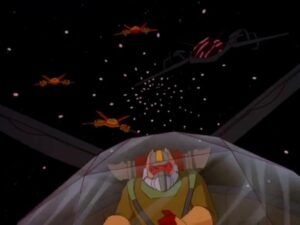
From here, the decline was steep for Wing Commander. In September of 1996, the USA television network debuted Wing Commander Academy, a Saturday-morning cartoon featuring the voices of Mark Hamill, Malcolm McDowell, and Tom Wilson among other actors from the last couple of games. All of the parties involved had envisioned the show capitalizing on a hit game. Absent said hit, it disappeared from the airwaves after just thirteen episodes.

The franchise’s last hurrah as a game came with Wing Commander: Prophecy, which appeared at the end of 1997. “Wing Commander III and IV were both great products,” said Prophecy’s producer Adam Foshko, straining hard to be diplomatic toward his predecessor Chris Roberts, “but they are more like unequal halves. This is a much more synergistic product. It’s very team-driven. It’s not one person’s vision, and I think it shows.” At its best, Prophecy really did play better than any Wing Commander in years, evincing the far greater level of attention the team paid to the action in the cockpit. Less positively, the movie sequences were cheesier and more constrained, even as a plan to bring the game fully in line with the hardcore set’s current priorities by adding a multiplayer component ultimately came to naught. When Prophecy didn’t sell well, that was that for Wing Commander as a gaming franchise. The commercial prospects of an expansion pack that the team had been working on — a return to the old “mission disks” that had made Origin a bundle back before the former Luke Skywalker and his Hollywood friends had entered the picture — looked so dire that Origin just dumped the whole thing onto the Internet for free.

Meanwhile Lawrence Holland and his colleagues had been going through some travails of their own. After making a well-received TIE Fighter expansion pack and a “Collector’s CD-ROM” with yet more new missions to fly, Holland left LucasArts on amicable terms to start a studio called Totally Games, taking his technology and most of his team with him. From the average fan’s perspective, this was a distinction without a difference: Totally’s games would still be Star Wars space sims, and they would still be published by LucasArts.

Like their counterparts at Origin, the folks at Totally could totally see the potential in offering a multiplayer mode to keep up with the changing times. But unlike them, they stuck with the program. In fact, the next iteration of their series was designed to be multiplayer first and foremost. Holland and his people spent almost two years finding ways to make multiplayer work reliably despite all of the challenges of the high-latency, dial-up Internet of the era.

The result of those efforts landed with a resounding thud in the spring of 1997, becoming a case study in the dangers of failing to understand your customers. Holland’s X-Wing and TIE Fighter games may not have been interactive movies in the sense of Wing Commander III and IV, but people had nevertheless loved their unfolding campaigns, loved the sense of playing a part in what could easily have been a novel set in the Star Wars Expanded Universe. The ingeniously titled X-Wing vs. TIE Fighter didn’t give them any of that; its single-player mode was little more than a place to practice for multiplayer matches. “The sad part is, I was really looking forward to this game,” wrote Computer Gaming World’s reviewer, echoing the sentiments of thousands upon thousands of deeply disappointed ordinary players. “After the high of TIE Fighter, I wanted another Star Wars experience that would be just as immersive and fun. And while my wish for multiplayer Star Wars action was fulfilled, my hope for an equivalent single-player experience wasn’t.” In a last-ditch attempt to save their baby, Totally put together an expansion pack whose sole purpose was to provide a single-player campaign of the old style. It did so competently enough, but inspired it was not, and it never had much chance of rescuing a base game that was already a fixture of bargain bins by the time the expansion appeared in January of 1998.

In contrast to Wing Commander, however, LucasArts and Totally’s space-sim series was afforded one more kick at the can after 1998. To hear Lawrence Holland talk about it when it was still in development, Star Wars: X-Wing Alliance was the be-all, end-all in space sims. For those who wanted a story-driven campaign, this game’s would be the biggest and best ever. For those who wanted multiplayer action, this game’s multiplayer mode would be more stable and convenient than that of X-Wing vs. TIE Fighter. For those who cared about graphics, this game’s would be the best yet, taking full advantage of the 3D-accelerator cards that were proliferating everywhere. It was an ambitious plan, especially considering that this old-school Star Wars game had to be finished before The Phantom Menace, the first new Star Wars movie in more than a decade and a half, reached theaters in May of 1999, bringing with it an onslaught of next-generation toys and games.

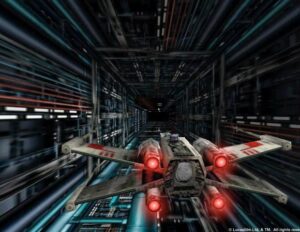
X-Wing Alliance met that goal, being released in March of 1999. The most remarkable thing about it is how many of its other lofty goals it managed to achieve against the strictures of time and budget. The story is almost Wing Commander-like in its elaborateness, presenting for the first time a named, strongly characterized protagonist, a youthful member of a trading family caught between the Rebel Alliance and the Empire. His story is told not only through the usual mission briefings but also through emails and radio chatter full of enough interpersonal drama to warm the cockles of Chris Roberts’s heart. The campaign begins on the ice-planet Hoth, is interwoven with the events of The Empire Strikes Back and Return of the Jedi, and climaxes with you getting to fly the Millennium Falcon at the Battle of Endor. What dedicated Stars Wars fan could resist?


Sadly, further examination of X-Wing Alliance reveals some significant shortcomings. The individual missions are often unpolished, sometimes failing to even convey adequately what their goals are; trying to complete some of them feels like trying to read the designers’ minds. Ironically, this is the same general set of issues that dragged down the original X-Wing, upon which TIE Fighter did such a magnificent job of improving. It’s disheartening to see them making a return at this late date. Like so many flawed games, X-Wing Alliance might have been amazing if it had just been allowed a few more months in the oven.

That said, the biggest obstacle that X-Wing Alliance faced in the marketplace was probably just the tenor of the times. As I already noted, at a time when everyone was excited and optimistic about The Phantom Menace, the new face of Star Wars, this game was old-school. And yet that was only the beginning of the commercial headwinds it faced. Gamers in general were turning away from simulations in droves; real-world flight and combat simulators too, which had in some earlier years accounted for more than 20 percent of the computer-game industry’s total revenues, had now fallen markedly out of favor. Fewer and fewer gamers even owned joysticks anymore. (To what extent this was a cause and to what extent it was a symptom of simulators’ declining fortunes is a matter of debate.) Existing fans and would-be fans of simulations were being tempted away by other action-packed genres that were quicker and easier to pick up and play for the first time, while still offering plenty of long-term rewards for those who stuck with them. It seemed that fewer people had the patience for games that started by asking you to read a thick manual, then required you to go through a veritable digital flight school before you could start playing them for real.

At any rate, by Y2K both Wing Commander and the Star Wars space sims had been consigned by their publishers to the dustbin of history. Other titles in development that had dreamed of competing with the space sim’s dynamic duo head-on suffered the same fate. The most high-profile of the cancellations was a space sim from Sierra that took place in the universe of the recently concluded Babylon 5 television series. Created with heavy input from Christy Marx, a Babylon 5 scriptwriter who had earlier designed a couple of point-and-click adventure games for Sierra, it was supposed to “tart up a tired genre” and “radically change the face of gaming” with “non-linear, non-branching storytelling, a brilliant modular refit job on nearly five hours of [television composer] Christopher Franke’s music, plus an attention to the physics of space travel that will raise the high bar on space-combat games for years to come.” It got to within a few months of completion, got as far as having the box art prepared before falling victim in late 1999 to an uncongenial marketplace and to the chaos inside Sierra that had followed that venerable mom-and-pop company’s purchase by two separate corporate conglomerates in a period of just a few years.

Still, the space-sim diehards did get one last pair of classics from an utterly unexpected source before their favored sub-genre disappeared from the catalogs of the big publishers forever. In fact, many a grizzled joystick jockey will tell you even today that the second of the two Freespace games is the best of its type ever created — yes, better even than the hallowed TIE Fighter.


The first mover without whom Freespace would never have come to be was a native Chicagoan named Mike Kulas, whose early gigs as a game programmer included stints at subLogic of Flight Simulator fame and at Lerner Research, a precursor to the legendary Looking Glass Studios. At the latter workplace, he befriended one Matt Toschlog. “If this is what it means to run a company, we can do it too,” the friends decided after spending two years at the dawn of the 1990s on an ultimately unsatisfying racing game that was sold in the trade dress of Car and Driver magazine. “What’s the worst that could happen? It’ll fail and we’ll have to go back to work for somebody else.” Kulas and Toschlog moved out of the Boston area and back to Champaign, Illinois, also the home of subLogic. Champaign seemed a good place to open a new studio: it had the advantages of fairly cheap rents and a large pool of enthusiastic young tech talent, thanks to the University of Illinois Urbana-Champaign, the source of such innovations as the pioneering PLATO system of the 1970s and the point-and-click Mosaic browser that was popularizing the nascent World Wide Web at that very moment.

Kulas and Toschlog founded Parallax Software in June of 1993, six months before DOOM ignited a craze for immersive 3D action that would remake much of the industry in its image over the next few years. Luckily, Parallax was well-equipped to capitalize on the trend, what with the founders’ experience with 3D graphics and the passionate young sparks they were able to recruit from the nearby university. Descent, their very first game, put you behind the controls of a small flying vehicle and set you loose inside a series of 3D-rendered outer-space mining complexes, filled with robots gone haywire. It was different enough to stand out in a sea of DOOM clones, yet felt very much in step with the times in a broader sense. Upon its release in March of 1995, Descent became a surprise hit for its publisher Interplay, whose marketers were left scrambling to catch up to the buzz on the street with a port to the Sony PlayStation and television campaigns starring mid-tier celebrities. Made for less than half a million dollars, the game was one heck of a debut for Parallax. It and its almost-as-successful 1996 sequel were enough to make them think that winning fame and fortune in the games industry was actually pretty easy.

Matt Toschlog had never been happy in Champaign. Flush with all of that Descent cash, he wanted to move Parallax somewhere else. Mike Kulas, on the other hand, preferred to stay put. Unable to find any other way out of the impasse, the founders agreed to split the company between them. In late 1996, Toschlog moved to Ann Arbor, Michigan, to start Outrage Entertainment. Kulas decided to rename his half of the company Volition — “an intense act of will to accomplish something” — after stumbling across the word in a book. Outrage’s first project was to be the inevitable Descent3; Volition’s was to be Freespace, a space sim that would, as its name implied, take the player out of the asteroid mines and into the limitless inky-black freedom that lay beyond.

Freespace isn’t shy about displaying its influences. Created by a bunch of guys who adored LucasArts’s X-Wing and TIE Fighter sims, it hews unabashedly to their template. After the requisite flight training, you’re tossed into an interstellar war between your Terran Alliance and an alien race known as the Vasudans. Then another group of aliens shows up, a shadowy enigma that comes to be called the Shivans, who are so powerful that the old antipathies are quickly forgotten, and Terrans and Vasudans unite to face the greatest threat either of their races has ever known.

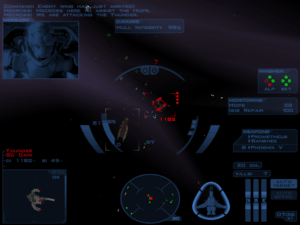
Although neither its core gameplay model nor its fiction is remotely revolutionary, Freespace stands out for how well it executes on this derivative material. The graphics are exceptional for their era, the possibility space behind the controls expansive, the mission design uniformly solid. Inspiration in game design is wonderful, but we should never forget the value of perspiration. The people who made Freespace loved what they were doing enough to sweat every small detail, and it shows. The only place where the game fell down a bit back in the day was a somewhat under-baked multiplayer mode.

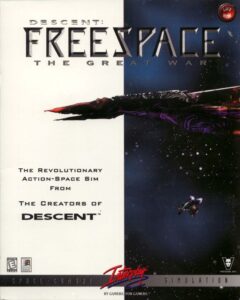
Interplay insisted on calling the game Descent: Freespace (“From the creators of Descent!”) in the hope of riding the coattails of the publisher’s biggest hit in recent memory. Whatever else you can say about it, it certainly wasn’t their worst exercise in Descent branding. (That would be Descent to Undermountain, an ill-advised attempt to use the old Parallax engine for, of all things, a Dungeons & Dragons-licensed CRPG.) And who knows? Maybe the branding even did some good. Upon its release in June of 1998, Freespace sold well enough to be modestly profitable for its studio and publisher and convince Interplay to fund an expansion pack and a sequel. The only catches were that Volition had to turn both out quickly, without spending too much money on them.

The expansion pack, which they called Silent Threat, ended up being short and perfunctory, the definition of inessential. The full-fledged sequel, however, was a minor miracle. It defied every cynical expectation raised by its abbreviated development cycle when it shipped on September 30, 1999.

Freespace 2 — Interplay allowed the cleaner name this time, perhaps to avoid confusion with the recently released Descent3 — did everything its predecessor had done well that much better, then added a finishing touch that it had lacked: a real sense of gravitas, provided largely by the one significant addition to the development team. Jason Scott (not to be confused with the archivist and Infocom documentarian of the same name) was Volition’s first dedicated writer. He made his presence felt with a campaign that was sometimes exhilarating, sometimes harrowing, but always riveting. The outer-space kitty-cats of Wing Commander, even Darth Vader and Emperor Palpatine, paled in comparison to the Shivans after Jason Scott got his hands on them. “The universe is very impersonal,” he says. “Your character is referred to only as ‘Pilot’ or ‘Alpha 1,’ and you’re up against countless waves of a seemingly unbeatable, genocidal adversary that never communicates its goals or motives. In the briefings, we tried to convey the sense of a much larger conflict unfolding in multiple systems, while at the same time hinting that your commanders weren’t telling you the whole story.”


Freespace 2 was never going to single-handedly rescue the space-sim sub-genre, but it did ensure that it went out on a high note. It’s a demanding game even by the usual standards of its kind, one that uses every key on the keyboard and then some, one that is guaranteed to leave you wishing you had more buttons on your joystick, no matter how nerdily baroque it might already be. Some of its more counter-intuitive commands, such as “target my target’s target,” have become memes in certain circles. Yet the developers are unapologetic. “We wanted players to feel like pilots in control of a complex, powerful, responsive, and technologically advanced machine,” says Jason Scott. “Complexity was a virtue.”

I’m almost tempted to write here that this was a shame, in that it put such a high barrier to entry in front of what was actually one of the more sophisticated ludic fictions of its era. My experience with the game probably isn’t unique: I struggled with it for a while, reached a point where I couldn’t seem to hit any enemy that I shot at even as said enemies had become all too good at hitting me, and wound up watching the rest on YouTube, as you do these days. On the other hand, though, why shouldn’t unabashedly demanding games that aren’t quite for me have good writing too?

Because you deserve to hear from someone other than a dabbler like me before we move on, I’m going to take the liberty of quoting Lee Hutchinson, who is a good friend of this site, a stalwart voice of reason in these increasingly unreasonable times of ours through his day job as a senior editor at Ars Technica, and, most importantly for our purposes, a hardcore space-sim junkie in all the ways that I am not. He can explain better than I can what Freespace 2 came to mean to its biggest fans, how it melded gameplay and narrative into an unforgettable roller-coaster ride.

If you’ve seen one of those simplified “evolution of man” charts, showing a chimp-like predecessor far at the left and an upright tool-using human all the way at the right, you’ve got a good idea of how Freespace 2 capped off the genre. It was the culmination of everything that had come before it, and every single gameplay element was refined and polished to a razor-sharp gleam.

Freespace 2 lets players experience a tremendous variety of missions in different fighters with a gamut of capabilities. Each mission is connected by an overarching plot: you may be ambushed while escorting some capital ships in one mission, and then in the next mission you might switch to flying a bomber and be assigned to take those capital ships out. You might be temporarily attached to a special-operations wing flying a prototype starship, or have to fly captured Shivan fighters in a deep-cover mission to scope out an enemy staging point, or deal with total mission failure and objective changes right in the middle of doing dozens of other things. Capital ships fire ridiculously large, ridiculously powerful beam weapons at each other, slicing each other to ribbons and providing a fantastic Babylon 5-esque backdrop while the player duels enemy fighters.

The targeting system is complex and rich; the wingman and escort system is complex and rich; the comms system is complex and rich. Everything about Freespace 2 shows care, love, and craftsmanship — from the chatter going back and forth between your wingmen as you blindly scout a nebula looking for a lost frigate, to the amazingly well-acted mission briefings. In practically every way, it is the Platonic ideal of a space-combat sim.

Starting at about the halfway point, Freespace 2 drops the hammer on the player with a series of tightly linked missions that absolutely do not let up. The war against the Shivans isn’t going well. A faction of Quisling-like humans is trying to defect to the Shivans’ side, taking a large chunk of the human military with it. At several points throughout the long campaign, it feels like the game is about to come to a crashing climax — only it doesn’t end. Things just get worse, and it’s an absolute rush to experience — flying your guts out, desperately trying to fight a rear-guard action against an unknowable enemy that seems to be totally unable to feel remorse, pity, or even fatigue.

I’ve never felt quite the combination of awe, fear, and eagerness I felt as I pushed through to Freespace 2’s endgame. There are lots of gaming experiences I wish I could relive for the first time, but playing Freespace 2 tops the list. That’s as good a way as any to judge a game as the best in its genre.

In the short term at least, Volition wasn’t rewarded very well for creating this game that Lee Hutchinson and more than a few others consider simply the best story-driven space sim ever made, the evolutionary end point of Chris Roberts’s original Wing Commander of 1990. Mike Kulas insists that Freespace 2 didn’t actually lose money for its studio or publisher, but it didn’t earn them much of anything either. Plans for a Freespace 3 were quietly shelved. Thus Freespace 2 came to mark the end of an era, not only for Volition but for computer gaming in general: while not quite the last space sim to be put out by a major publisher, it was the last that would go on to be remembered as a classic of its form.

What with there being no newer games that could compete with it, those who still loved the space sim clung all the tighter to Freespace 2 as the months since its release turned into years. They were incredibly lucky that Volition was staffed by genuinely nice, fair-minded people who felt their pain and were willing to “pay it forward,” as the saying goes. In 2002, Volition uploaded the full source code to Freespace 2 to the Internet for non-commercial use.

They couldn’t possibly have envisioned what followed. As of this writing, 23 years after that act of spontaneous generosity, the Freespace 2 engine has been improved and modernized almost beyond recognition, with support for eye-bleedingly high resolutions and all of the latest fancy graphical effects that my humble retro-gaming computers don’t even support. You can use the updated engine to play Freespace 1 and 2 and the Silent Threat expansion pack, in versions that have been polished to an even shinier gleam than the originals by the hands of hundreds of dedicated volunteers. Even more inspiringly, folks have used the technology to create a welter of new campaigns — effectively whole new space sims that run off what remains the best of all engines for this type of game.

The people who made Freespace 1 and 2 all those years ago are themselves awed by what their pair of discrete boxed computer games have been turned into. Freespace proved to be as much a new beginning as an ending. Long may the space sim fly on in the hands of those who love it most.


Did you enjoy this article? If so, please think about pitching in to help me make many more like it. You can pledge any amount you like.


Sources: Sierra On-Line’s customer newsletter InterAction of Spring 1999; Origin Systems’s internal newsletter Point of Origin of September 20 1996 and February 14 1997; Computer Gaming World of October 1994, February 1995, July 1997, April 1998, October 1998, November 1998, February 1999, July 1999, and January 2000; Retro Gamer 204.

Online sources include interviews with Jack Nichols and Randy Littlejohn on B5 Scrolls, “Growing Up Gaming: The Five Space Sims That Defined My Youth” by Lee Hutchinson at Ars Technica, an interview with some of the core members of the Freespace 2 team by the Space Game Junkie podcast, and a Game Informer documentary about Volition’s history.

Where to Get Them: Wing Commander I and IIWing Commander III: Heart of the TigerWing Commander IV: The Price of FreedomWing Commander: ProphecyX-WingTIE FighterX-Wing vs. TIE FighterX-Wing AllianceDescent: Freespace, and Freespace 2 are all available as digital purchases on GOG.com.
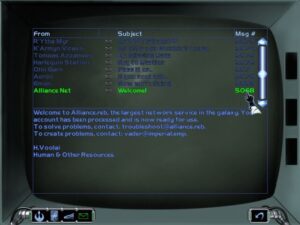
I strongly recommend that you run the Freespace games through the Freespace Open engine, even if you’re primarily looking for a retro experience. Both on native Windows 10 and running through WINE on Linux, I found the original Freespace to be subtly broken: I was given only a fraction of the time I ought to have been given to complete the last training mission. (This was not good at all, considering I’m rubbish at the game anyway.) Freespace Open is quite painless to install and maintain using a utility called Knossos. It will walk you through the setup process and then deliver a glitch-free game, whilst letting you select as many or as few modern niceties as you prefer.


Tags: , , , , , , , , , ,

The Rise of POMG, Part 4: A World for the Taking

Just as the Ultima Online beta test was beginning, Electronic Arts was initiating the final phase of its slow-motion takeover of Origin Systems. In June of 1997, the mother ship in California sent down two Vice Presidents to take over completely in Texas, integrate Origin well and truly into the EA machine, and end once and for all any semblance of independence for the studio. Neil Young became Origin’s new General Manager on behalf of EA, while Chris Yates became Chief Technical Officer. Both men were industry veterans.

Appropriately enough given that he was about to become the last word on virtual Britannia, Neil Young was himself British. He attributes his career choice to the infamously awful English weather. “There are a lot of people in the games industry that come from the UK,” he says. “I think it’s because the weather is so bad that you don’t have a lot to do, so you either go into a band or teach yourself to program.” He chose the latter course at a time when computer games in Britain were still being sold on cassette tape for a couple of quid. After deciding to forgo university in favor of a programming job at a tiny studio called Imagitec Design in 1988, he “quickly realized there were more gifted engineers,” as he puts it, and “moved into producing.” Having made a name for himself in that role, he was lured to the United States by Virgin Interactive in 1992, then moved on to EA five years later, which organization had hand-picked him for the task of whipping its sometimes wayward and lackadaisical stepchild Origin into fighting shape.

Chris Yates had grown up amidst the opposite of English rain, hailing as he did from the desert gambler’s paradise Las Vegas. He was hired by the hometown studio Westwood Associates in 1988, where he worked as a programmer on games like Eye of the Beholder, Dune II, and Lands of Lore. In 1994, two years after Virgin acquired Westwood, he moved to Los Angeles to join the parent company. There he and Young became close friends as well as colleagues, such that they chose to go to EA together as a unit.

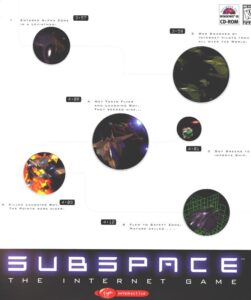
The two were so attractive to EA thanks not least to an unusual project which had occupied some of their time during their last year and a half or so at Virgin. Inspired by Air Warrior, the pioneering massively-multiplayer online flight simulator that had been running on the GEnie commercial online service since the late 1980s, a Virgin programmer named Rod Humble proposed in 1995 that his company invest in something similar, but also a bit simpler and more accessible: a massively-multiplayer version of Asteroids, the 1979 arcade classic whose roots stretched all the way back to Spacewar!, that urtext of videogaming. Neil Young and his friend Chris Yates went to bat for the project: Young making the business case for it as an important experiment that could lead to big windfalls later on, Yates pitching in to offer his exceptional technical expertise whenever necessary. Humble and a colleague named Jeff Paterson completed an alpha version of the game they called SubSpace in time to put it up on the Internet for an invitation-only testing round in December of 1995. Three months later, the server was opened to anyone who cared to download the client — still officially described as a beta version — and have at it.

SubSpace was obviously a very different proposition from the likes of Ultima Online, but it fits in perfectly with this series’s broader interest in persistent online multiplayer gaming (or POMG as I’ve perhaps not so helpfully shortened it). For, make no mistake, the quality of persistence was as key to its appeal as it was to that of such earlier featured players in this series as Kali or Battle.net. SubSpace spawned squads and leagues and zones; it became an entire subculture unto itself, one that lived in and around the actual battles in space. The distinction between it and the games of Kali and Battle.net was that SubSpace was massively — or at least bigly — multiplayer. Whereas an online Diablo session was limited to four participants, SubSpace supported battles involving up to 250 players, sometimes indulging in crazy free-for-alls, more often sorted into two or more teams, each of them flying and fighting in close coordination. It thus quickly transcended Asteroids in its tactical dimensions as well as its social aspects — transcended even other deceptively complex games with the same roots, such as Toys for Bobs’s cult classic Star Control. That it was playable at all over dial-up modem connections was remarkable; that it was so much fun to play and then to hang out in afterward, talking shop and taking stock, struck many of the thousands of players who stumbled across it as miraculous; that it was completely free for a good long time was the icing on the cake.

It remained that way because Virgin didn’t really know what else to do with it. When the few months that had been allocated to the beta test were about to run out, the fans raised such a hue and cry that Virgin gave in and left it up. And so the alleged beta test continued for more than a year, the happy beneficiary of corporate indecision. In one of his last acts before leaving Virgin, Neil Young managed to broker a sponsorship deal with Pepsi Cola, which gave SubSpace some actual advertising and another lease on life as a free-to-play game. During that memorable summer of the Ultima Online beta test, SubSpace was enjoying what one fan history calls its “greatest days” of all: “The population tripled in three months, and now there were easily 1500-plus people playing during peak times.”

With the Pepsi deal about to run out, Virgin finally took SubSpace fully commercial in October of 1997, again just as Ultima Online was doing the same. Alas, it didn’t go so well for SubSpace. Virgin released it as a boxed retail game, with the promise that, once customers had plunked down the cash to buy it, access would be free in perpetuity. This didn’t prevent half or more of the existing user base from leaving the community, even as nowhere near enough new players joined to replace them. Virgin shut down the server in November of 1998; “in perpetuity” had turned out to be a much shorter span of time than anyone had anticipated.

As we’ve seen before in this series, however, the remaining hardcore SubSpace fans simply refused to let their community die. They put up their own servers — Virgin had made the mistake of putting all the code you needed to do so on the same disc as the client — and kept right on space-warring. You can still play SubSpace today, just as you can Meridian 59 and The Realm. A website dedicated to tracking the game’s “population statistics” estimated in 2015 that the community still had between 2000 and 3000 active members, of whom around 300 might be online at any given time; assuming these numbers are to be trusted, a bit of math reveals that those who like the game must really like it, spending 10 percent or more of their lives in it. That same year, fans put their latest version of the game, now known as Subspace Continuum, onto Steam for free. Meanwhile its original father Rod Humble has gone on to a long and fruitful career in POMG, working on Everquest, The Sims Online, and Second Life among other projects.


But we should return now to the summer of 1997 and to Origin Systems, to which Neil Young and Chris Yates came as some of the few people in existence who could boast not only of ideas about POMG but of genuine commercial experience in the field, thanks to SubSpace. EA hoped this experience would serve them well when it came to Ultima Online.

Which isn’t to say that the latter was the only thing they had on their plates: the sheer diversity of Young’s portfolio as an EA general manager reflects the confusion about what Origin’s identity as a studio should be going forward. There were of course the two perennials, Ultima — meaning for the moment at least Ultima Online — and Wing Commander, which was, as Young says today, “a little lost as a product.” Wing Commander, the franchise in computer gaming during the years immediately prior to DOOM, was becoming a monstrous anachronism by 1997. Shortly after the arrival of Young and Yates, Origin would release Wing Commander: Prophecy, whose lack of the Roman numeral “V” that one expected to see in its name reflected a desire for a fresh start on a more sustainable model in this post-Chris Roberts era, with a more modest budget to go along with more modest cinematic ambitions. But instead of heralding the dawn of a new era, it would prove the franchise’s swan song; it and its 1998 expansion pack would be the last new Wing Commander computer games ever. Their intended follow-up, a third game in the Wing Commander: Privateer spinoff series of more free-form outer-space adventures, would be cancelled.

In addition to Ultima and Wing Commander, EA had chosen to bring under the Origin umbrella two product lines that were nothing like the games for which the studio had always been known. One was a line of military simulations that bore the imprimatur of “Jane’s,” a print publisher which had been the source since the turn of the twentieth century of the definitive encyclopedias of military hardware of all types. The Jane’s simulations were overseen by one Andy Hollis, who had begun making games of this type for MicroProse back in the early 1980s. The other line involved another MicroProse alum — in fact, none other than Sid Meier, whose name had entered the lexicon of many a gaming household by serving as the prefix before such titles as Pirates!, Railroad Tycoon, Civilization, and Colonization. Meier and two other MicroProse veterans had just set up a studio of their own, known as Firaxis Games, with a substantial investment from EA, who planned to release their products under the Origin Systems label. Origin was becoming, in other words, EA’s home for all of its games that were made first and usually exclusively for computers rather than for the consoles that now provided the large majority of EA’s revenues; the studio had, it seemed, more value in the eyes of the EA executive suite as a brand than as a working collective.

Still, this final stage of the transition from independent subsidiary to branch office certainly could have been even more painful than it was. Neil Young and Chris Yates were fully aware of how their arrival would be seen down in Austin, and did everything they could to be good sports and fit into the office culture. Brit-in-Texas Young was the first to come with the fish-out-of-water jokes at his own expense — “I was expecting a flat terrain with lots of cowboys, cacti, and horses, so I was pleasantly surprised,” he said of Austin — and both men rolled up their sleeves alongside Richard Garriott to serve the rest of the company a turkey dinner at Thanksgiving, a longtime Origin tradition.

Neil Young and Chris Yates on the Thanksgiving chow line.

Young and Yates had received instructions from above that Ultima Online absolutely had to ship by the end of September. Rather than cracking the whip, they tried to cajole and josh their way to that milestone as much as possible. They agreed to attend the release party in drag if the deadline was met; then Young went one step farther, promising Starr Long a kiss on the lips. Yates didn’t go that far, but he did agree to grow a beard to commemorate the occasion, even as Richard Garriott, whose upper lip hadn’t seen the sun since he’d graduated from high school, agreed to shave his.

Young and Yates got it done, earning for themselves the status of, if not the unsung heroes of Ultima Online, two among a larger group of same. The core group of ex-MUDders whose dream and love Ultima Online had always been could probably have kept running beta tests for years to come, had not these outsiders stepped in to set the technical agenda. “That meant trading off features with technology choices and decisions every minute of the day,” says Young. He brought in one Rich Vogel, who had set up and run the server infrastructure for Meridian 59 at The 3DO Company, to do the same for Ultima Online. In transforming Origin Systems into a maintainer of servers and a seller of subscriptions, he foreshadowed a transition that would eventually come to the games industry in general, from games as boxed products to gaming as a service. These tasks did not involve the sexy, philosophically stimulating ideas about virtual worlds and societies with which Raph Koster and his closest colleagues spent their time and which will always capture the lion’s share of the attention in articles like this one, but the work was no less essential for all that, and no less of a paradigm shift in its way.

So, the big day came and the deadline was met: Ultima Online shipped on September 24, 1997, three days before Meridian 59 would celebrate its first anniversary. The sleek black box was an end and a beginning at the same time. Young and Yates did their drag show, Starr Long got his kiss, and, most shockingly of all, Richard Garriott revealed his naked upper lip to all and sundry. (Opinions were divided as to whether the mangy stubble which Chris Yates deigned to grow before picking up his razor again really qualified as a beard or not.) And then everyone waited to see what would happen next.

A (semi-)bearded Chris Yates and a rare sight indeed: a clean-shaven Richard Garriott.

EA made and shipped to stores all over the country 50,000 copies of Ultima Online, accompanying it with a marketing campaign that was, as Wired magazine described it, of “Hollywood proportions.” The virtual world garnered attention everywhere, from CNN to The New York Times. These mainstream organs covered it breathlessly as the latest harbinger of humanity’s inevitable cyber-future, simultaneously bracing and unnerving. Flailing about for a way to convey some sense of the virtual world’s scope, The New York Times noted that it would take 38,000 computer monitors — enough to fill a football field — to display it in its entirety at one time. Needless to say, the William Gibson quotes, all “collective hallucinations” and the like, flew thick and fast, as they always did to mark events like this one.

Three weeks after the launch, 38,000 copies of Ultima Online had been sold and EA was spooling up the production line again to make another 65,000. Sales would hit the 100,000 mark within three months of the release. Such numbers were more than gratifying. EA knew that 100,000 copies sold of this game ought to be worth far more to its bottom line than 100,000 copies of any other game would have been, given that each retail sale hopefully represented only the down payment on a long-running subscription at $10 per month. For its publisher, Ultima Online would be the gift that kept on giving.

In another sense, however, the sales figures were a problem. When Ultima Online went officially live, it did so on just three shards: the Atlantic and Pacific shards from the beta test, plus a new Great Lakes one to handle the middle of the country. Origin was left scrambling to open more to meet the deluge of subscribers. Lake Superior came up on October 3, Baja on October 10, Chesapeake on October 16,  Napa Valley on November 14, Sonoma on December 13, Catskills on December 22. And still it wasn’t enough.

Origin’s estimates of how many players a single server could reliably support proved predictably overoptimistic. But rather than dial back on the number of players they allowed inside, thereby ensuring that each of them who did get in could have a reasonably enjoyable experience, they kept trying to cover the gap between technical theory and reality by hacking their code on the fly. As a result, Ultima Online became simultaneously the most loved and most hated game in the country. When it all came together, it was magic for many of its players. But truth be told, that didn’t happen anywhere near as often as one might have wished in that first year or so. Extreme lag, inexplicable glitches, dropped connections, and even total server crashes were the more typical order of the day. Of course, with almost everyone who surfed the Web still relying on dial-up modems running over wires that had been designed to carry voices rather than computer data, slowdowns and dropped connections were a reality of daily online life even for those who weren’t attempting to log onto virtual worlds. This created a veneer of plausible deniability, which Origin’s tech-support people, for lack of any other suggestions or excuses to offer, leaned on perhaps a bit too heavily. After all, who could say for sure that the problem any individual player might be having wasn’t downstream from Origin’s poor overtaxed server?

Weaselly excuses like these led to the first great act of civil disobedience by the residents of Britannia, just a few weeks after the launch, when hundreds of players gathered outside Lord British’s castle, stripped themselves naked, broke into the throne room, drank gallons of wine, and proceeded to disgorge all of it onto Richard Garriott’s virtual furniture, whilst chanting in unison their demands for a better, stabler virtual world. The world’s makers were appalled, but also weirdly gratified. What better sign of a budding civic life could there be than a full-on political protest? “We were all watching and thinking it was a grand statement about the project,” says Richard Garriott. “As unhappy as they were about the game, they voiced their unhappiness in the context of the game.” Much of what happened inside Ultima Online during the first year especially had the same quality of being amazing for philosophers of virtual worlds to witness, but stressful for the practical administrators who were trying to turn this one into a sustainable money tree. The rub was that the two categories were combined in the very same people, who were left feeling conflicted to say the least.

The journals of hardcore gaming, hardly known for their stoicism in the face of hype on most days, were ironically more reserved and skeptical than the mainstream press on the subject of Ultima Online, perchance because they were viewing the virtual world less as a harbinger of some collective cyber-future and more as a game that their readers might wish to, you know, actually play. Computer Gaming World wittily titled its scathing review, buried on page 162 and completely unmentioned on the cover of the issue in question, simply “Uh-Oh.” Among the litany of complaints were “numerous and never-ending bugs, horrible lag time, design issues [that] lead to repetitive and time-consuming activities, and [an] unbalanced economy.” The magazine did admit that “Ultima Online could become a truly great game. But we can’t review potential, we can only review concrete product.” Editor-in-chief Johnny L. Wilson, for his part, held out little hope for improvement. “Ultima Online begins with hubris and ends in Greek tragedy,” he said. “The hubris is a result of being unwilling to learn from others’ mistakes. The tragedy is that it could have been so much more.” Randy Farmer, co-creator of the earlier would-be virtual world Habitat, expressed a similar sentiment, saying that “Origin seems to have ignored many of the lessons that our industry has learned in the last ten years of building online worlds. They’re making the same mistakes that first-time virtual-world builders always make.”

The constant crashes and long periods of unexplained down time associated with a service for which people were paying good money constituted a corporate lawyer’s worst nightmare — or a different sort of lawyer’s wet dream. One of these latter named George Schultz began collecting signatures from Origin’s most disgruntled customers within weeks, filing a class-action lawsuit in San Diego at the beginning of March of 1998. Exhibit A was the copy right there on the back of the box, promising “a living, growing world where thousands of real people discover real fantasy and adventure, 24 hours a day, every day of the year,” with all of it taking place “in real time.” This was, claimed Schultz, a blatant case of false advertising. “We’re not trying to tell anyone how to design a good or a bad game,” he said. “What it’s about is holding Origin and EA to the promises they made on the box, in their advertising, and [in] the manual. It’s about the misrepresentations they’ve made. A big problem with the gaming industry is that they think there are some special rules that only apply to them.”

Whatever the truth of that last claim, there was no denying that just about half of the learning curve of Ultima Online was learning to navigate around the countless bugs and technical quirks. For example, Origin took down each shard once per day for a backup and a “therapeutic” reboot that was itself a testament to just what a shaky edifice the software and hardware were. When the server came back up again, it restored the state of the world from the last backup. But said state was a snapshot in time from one hour before the server went down. There was, in other words, an hour every day during which everything you did in virtual Britannia was doomed to be lost; this was obviously not a time to go on any epic, treasure- and experience-point-rich adventures. Yet such things were documented nowhere; one learned them only through the proverbial school of hard knocks.

In their defense, Origin was sailing into completely uncharted waters with Ultima Online. Although there had been online virtual worlds before, dating all the way back to that first MUD of 1978 or 1979, none of them — no, not even Meridian 59 and The Realm — had been as expansive, sophisticated, and most of all popular as these shards of Britannia. Most of the hardware technologies that would give rise to the era of Web 2.0, from DSL in homes to VPS’s in data centers, existed only as blueprints; ditto most of the software. No one had ever made a computer game before that required this much care and feeding after the initial sale. And it wasn’t as if the group entrusted with maintaining the beast was a large one. Almost the entirety of the Ultima IX team which had been parachuted in six months before the launch to just get the world done already was pulled out just as abruptly as soon as it started accepting paying subscribers, leaving behind a crew of maintainers that was little bigger than the original team of ex-MUDders who had labored in obscurity for so long before catching the eye of EA’s management. The idea that maintaining a virtual world might require almost as much manpower and ongoing creative effort as making it in the first place was too high a mental hurdle for even otherwise clever folks like Neil Young and Chris Yates to clear at this point.

Overwhelmed as they were, the maintainers began to rely heavily on unpaid volunteers from the community of players to do much of the day-to-day work of administrating the world, just as was the practice on MUDs. But Ultima Online ran on a vastly larger scale than even the most elaborate MUDs, making it hard to keep tabs on these volunteer overseers. While some were godsends, putting in hours of labor every week to make Britannia a better place for their fellow players, others were corrupted by their powers, manipulating the levers they had to hand to benefit their friends and punish their enemies. Then, too, the volunteer system was another legal quagmire, one that would doubtless have sent EA’s lawyers running screaming from the room if anyone had bothered to ask them about it before it was rolled out; sure enough, it would eventually lead to another lawsuit, this one more extended, serious, and damaging than the first.

In the meanwhile, though, most players did not rally behind the first lawsuit to anything like the degree that George Schultz might have been hoping. The fact was that even the ones who had vomited all over Lord British’s throne had done so because they loved their virtual Britannia and wanted to see it fixed rather than destroyed, as it would likely be if Schultz won the day. The suit concluded in a settlement at the end of 1998. The biggest concession on the part of the defendants was a rather weird one that gave no recompense to any individual inhabitant of virtual Britannia: EA agreed to donate $15,000 to the San Jose Tech Museum of Innovation. Perhaps Schultz thought that it would be able to innovate up a more reliable virtual world.

While many of the technical problems that beset Ultima Online were only to be expected in the context of the times, some of the other obstacles to enjoying the virtual world were more puzzling. First and foremost among these was the ever-present issue of players killing other players, which created so much frustration that George Schultz felt compelled to explicitly wall it off from the breach-of-trust claims that were the basis of his lawsuit: “We’re not getting into whether there should be player-killing.” Given that it had been such a constant theme of life (and death) in virtual Britannia going all the way back to the alpha-testing phase, the MUDders might have taken more steps to address it before the launch. As it was, though, one senses that, having seen so many of their ideas about a virtual ecology and the like not survive contact with real players, having been forced to give up in so many ways on virtual Britannia as a truly self-sustaining, living world, they were determined to make this the scene of their last stand, the hill that they would either hold onto or die trying.

Their great white hope was still the one that Richard Garriott had been voicing in interviews since well before the world’s commercial debut: that purely social pressures would act as a constraint on player-killing — that, in short, their world would learn to police itself. In fact, the presence of player-killing might act as a spur to civilization — for, as Raph Koster said, “cultures define and refine themselves through conflict.” They kept trying to implement systems that would nudge this particular culture in the right direction. They decided that, after committing murder five times, a player would be branded with literal scarlet letters: the color of his onscreen name would change from blue to red. Hopefully this would make him a pariah among his peers, while also making it very dangerous for him to enter a town, whose invulnerable computer-controlled guards would attack him on sight. The designers didn’t reckon with the fact that a virtual life is, no matter how much they might wish otherwise, simply not the same as a real life. Some percentage of players, presumably perfectly mild-mannered and law-abiding in the real world, reveled in the role of murderous outlaws online, taking the red letters of their name as a badge of honor rather than shame, the dangers of the cities as a challenge rather than a deterrent. To sneak past the city gates, creep up behind an unsuspecting newbie and stab her in the back, then get out of Dodge before the city watch appeared… now, that was good times. The most-wanted rolls posted outside the guard stations of Britannia became, says Raph Koster, “a high-score table for player killers.”

The MUDders’ stubborn inflexibility on this issue — an issue that was by all indications soon costing Ultima Online large numbers of customers — was made all the more inexplicable in the opinion of many players by the fact that it was, in marked contrast to so many of the other problems, almost trivial to address in programming terms. An “invulnerability” flag had long existed, to be applied not only to computer-controlled city guards but to special human-controlled personages such as Lord British to whom the normal laws of virtual time and space did not apply. All Origin had to do was add a few lines of code to automatically turn the flag on when a player walked into designated “safe” spaces. That way, you could have places where those who had signed up mostly in order to socialize could hang out without having to constantly look over their backs, along with other places where the hardcore pugilists could pummel one another to their heart’s content. Everyone would be catered to. Problem solved.

But Raph Koster and company refused to take this blindingly obvious step, having gotten it into their heads that to do so would be to betray their most cherished ideals. They kept tinkering around the edges of the problem, looking for a subtler solution that would preserve their world’s simulational autonomy. For example, they implemented a sort of karmic justice system, which dictated that players who had been evil during life would be resurrected after death only after losing a portion of their stats and skills. Inevitably, the player killers just took this as another challenge. Just don’t get killed, and you would never have to worry about it.

The end result was to leave the experience of tens of thousands of players in the unworthy hands of a relatively small minority of “griefers,” people who thrived on causing others pain and distress. Like all bullies, they preyed on the weak; their typical victims were the newbies, unschooled in the ways of defense, guiding characters with underwhelming statistics and no arms or armor to speak of. Such new players were, of course, the ones whose level of engagement with the game was most tentative, who were the mostly likely to just throw up their hands and go find something else to play after they’d been victimized once or twice, depriving Origin of potentially hundreds of dollars in future subscription revenue.

In light of this, it’s strange that no one from EA or Origin overrode the MUDders on this point. For his part, Richard Garriott was adamantly on their side, insisting that Ultima Online simply had to allow player-killing if it wasn’t to become a mockery of itself. It was up to the dissatisfied and victimized residents themselves to band together and turn Britannia into the type of world they wanted to live in; it wasn’t up to Origin to step in and fix their problems for them with a deus ex machina. “When we first launched Ultima Online, we set out to create a world that supported the evil player as a legitimate role,” said Garriott in his rather high-handed way. “Those who have truly learned the lessons of the [single-player] Ultima games should cease their complaining, rise to the challenge, and make Britannia into the place they want it to be.” He liked to tell a story on this subject. (Knowing Garriott’s penchant for embellishment, it probably didn’t happen, or at least didn’t happen quite like this. But that’s not relevant to its importance as allegory.)

One evening, he was wandering the streets of the capital in his Lord British persona, when he heard a woman screaming. Rushing over to her, he was told that a thief had stolen all of her possessions. His spirit of chivalry was awoken; he told her that he would get her things back for her. Together they tracked down the thief and cornered him in a back alley. Lord British demanded that the thief return the stolen goods, and the thief complied. They all went their separate ways. A moment later, the woman cried out again; the thief had done it again.

This time, Lord British froze the thief with a spell before he could leave the scene of the crime. “I told you not to do that,” he scolded. “What are you doing?”

“Sorry, I won’t do it again,” said the thief as he turned over the goods for a second time.

“If you do that again, I’m going to ban you from the game,” said Lord British.

You might be able to guess what happened next: the thief did it yet again. “I said I was going to ban you, and now I have to,” shouted Lord British, now well and truly incensed. “What’s wrong with you? I told you not to steal from this woman!”

The thief’s answer stopped Garriott in his tracks. “Listen. You created this world, and I’m a thief,” he said, breaking character for the first time. “I steal. That’s what I do. And now you’re going to ban me from the game for playing the role I’m supposed to play? I lied to you before because I’m a thief. The king caught me and told me not to steal. What am I going to do, tell you that as soon as you turn around I’m going to steal again? No! I’m going to lie.”

And Garriott realized that the thief was right. Garriott could do whatever he wished to him as Lord British, the reigning monarch of this world. But if he wished to stay true to all the things he had said in the past about what virtual Britannia was and ought to be, he couldn’t go outside the world to punish him as Richard Garriott, the god of the server looking down from on-high.

Some of the questions with which Origin was wrestling resonate all too well today: questions involving the appropriate limits of online free speech — or rather free action, in this case. They are questions with which everyone who has ever opened an Internet discussion up to the public, myself included, have had to engage. When does strongly felt disagreement spill over into bad faith, counterpoint into disruption for the sake of it? And what should we do about it when it does? In Origin’s case, the pivotal philosophical question at hand was where the boundary lay between playing an evil character in good faith in a fantasy world and purposely, willfully trying to cause real pain to other real people sitting behind other real computers. Origin had chosen to embrace a position close to the ground staked out by our self-described “free-speech maximalists” of today. And like them, Origin was learning that the issue is more dangerously nuanced than they had wished to believe.

But there were others sorts of disconnect at play here as well. Garriott’s stern commandment that his world’s inhabitants should “cease their complaining, rise to the challenge, and make Britannia into the place they want it to be” becomes more than a bit rich when we remember that it was being directed toward Origin’s paying customers. Many of them might have replied that it was up to Origin rather than they themselves to make Britannia a place they wanted to be, lest they choose to spend their $10 per month on something else. The living-world dynamic held “as long as everyone is playing the same game,” wrote Amy Jo Kim in an article about Ultima Online and its increasingly vocalized discontents that appeared in Wired magazine in the spring of 1998. “But what happens when players who think they’re attending an online Renaissance Faire find themselves at the mercy of a violent, abusive gang of thugs? In today’s Britannia, it’s not uncommon to stumble across groups of evil players who talk like Snoop Doggy Dogg, dress like gangstas, and act like rampaging punks.” To be sure, some players were fully onboard with the “living-world” policy of (non-)administration. Others, however, had thought, reasonably enough given what they had read on the back of the game’s box, that they were just buying an entertainment product, a place to hang out in a few hours per day or week and have fun, chatting and exploring and killing monsters. They hadn’t signed up to organize police forces or lead political rallies. Nor had they signed up to be the guinea pigs in some highfalutin social experiment. No; they had signed up to play a game.

As it was, Ultima Online was all but impossible to play casually, thanks not only to the murderers skulking in its every nook and cranny but to core systems of the simulation itself. For example, if you saved up until you could afford to build yourself a nice little house, made it just like you wanted it, then failed to log on for a few days, when you did return you’d find that your home had disappeared, razed to make room for some other, more active player to build something. Systems like these pushed players to spend more time online as a prerequisite to having fun when they were there. Some left when the demands of the game conflicted with those of real life, which was certainly the wisest choice. But some others began to spend far more time in virtual Britannia than was really good for them, raising the specter of gaming addiction, a psychological and sociological problem that would only become more prevalent in the post-millennial age.

Origin estimated that the median hardcore player spent a stunning if not vaguely horrifying total of six hours per day in the virtual world. And if the truth be told, many of the non-murderous things with which they were expected to fill those hours do seem kind of boring on the face of it. This is the flip side of making a virtual world that is more “realistic”: most people play games to escape from reality for a while, not to reenact it. With all due respect to our dedicated and talented real-world tailors and bakers, most people don’t dream of spending their free time doing such jobs online. Small wonder so many became player killers instead; at least doing that was exciting and, for some people at any rate, fun. From Amy Jo Kim’s article:

There’s no shortage of realism in this game — the trouble is, many of the nonviolent activities in Ultima Online are realistic to the point of numbingly lifelike boredom. If you choose to be a tailor, you can make a passable living at it, but only after untold hours of repetitive sewing. And there’s no moral incentive for choosing tailoring — or any honorable, upstanding vocation, for that matter. So why be a tailor? In fact, why not prey on the tailors?
True, Ultima Online is many things to many people. Habitués of online salons come looking for intellectual sparring and verbal repartee. Some other people log on in search of intimate but anonymous social relationships. Still others play the game with cunning yet also a discernible amount of self-restraint, getting rich while staying pretty honest. But there’s no avoiding where the real action is: an ever-growing number are playing Ultima Online to kill everything that moves.

All of this had an effect: all signs are that, after the first rush of sales and subscriptions, Ultima Online began to stagnate, mired in bad reviews, ongoing technical problems, and a growing disenchantment with the player-killing and the other barriers to casual fun. Raph Koster admits that “our subscriber numbers, while stratospheric for the day, weren’t keeping up” with sales of the boxed game, because “the losses [of frustrated newbies] were so high.”

Although Origin and EA never published official sales or subscriber numbers, I have found one useful data point from the early days of Ultima Online, in an internal Origin newsletter dated October 30, 1998. As of this date, just after its first anniversary, the game had 90,000 registered users, of whom approximately half logged on on any given day. These numbers are depicted in the article in question as very impressive, as indeed they were in comparison to the likes of Meridian 59 and The Realm. Still, a bit of context never hurts. Ultima Online had sold 100,000 boxed copies in its first three months, yet it didn’t have even that many subscribers after thirteen months, when its total boxed sales were rounding the 200,000 mark. The subscriber-retention rate, in other words, was not great; a lot of those purchased CDs had become coasters in fairly short order.
Nine shards were up in North America at this time, a number that had stayed the same since the previous December. And it’s this number that may be the most telling one of all. It’s true that, since demand was concentrated at certain times of day, Ultima Online was hosting just about all the players it could handle with its current server infrastructure as of October of 1998. But then again, this was by no means all the players it should be able to handle in the abstract: new shards were generally brought into being in response to increasing numbers of subscribers rather than vice versa. The fact that no new North American shards had been opened since December of 1997 becomes very interesting in this light.

I don’t want to overstate my case here: Ultima Online was extremely successful on its own, somewhat experimental terms. We just need to be sure that we understand what those terms were. By no means were its numbers up there with the industry’s biggest hits. As a point of comparison, let’s take Riven, the long-awaited sequel to the mega-hit adventure game Myst. It was released two months after Ultima Online and went on to sell 1 million units in its first year — at least five times the number of boxed entrées to Origin’s virtual world over the same time period, despite being in a genre that was in marked decline in commercial terms. Another, arguably more pertinent point of comparison is Age of Empires, a new entry in the red-hot real-time-strategy genre. Released just one month after Ultima Online, it outsold Origin’s virtual world by more than ten to one over its first year. Judged as a boxed retail game, Ultima Online was a middling performer at best.

Of course, Ultima Online was not just another boxed retail game; the unique thing about it was that each of the 90,000 subscribers it had retained was paying $10 every month, yielding a steady revenue of almost $11 million per year, with none of it having to be shared with any distributor or retailer. That was really, really nice — nice enough to keep Origin’s head above water at a time when the studio didn’t have a whole lot else to point to by way of justifying its ongoing existence to EA. And yet the reality remained that Ultima Online was a niche obsession rather than a mass-market sensation. As so often happens in life, taking the next step forward in commercial terms, not to mention fending off the competition that was soon to appear with budgets and publisher support of which Meridian 59 and The Realm couldn’t have dreamed, would require a degree of compromise with its founding ideals.

Be that as it may, however, one thing at least was now clear: there was real money to be made in the MMORPG space. Shared virtual worlds would soon learn to prioritize entertainment over experimentation. Going forward, there would be less talk about virtual ecologies and societies, and more focus on delivering slickly packaged fun, of the sort that would keep all kinds of players coming back for more — and, most importantly of all, get those subscriber counts rising once more.

I’ll continue to follow the evolution of PMOG, MMORPGs, and Ultima Online in future articles, and maybe see if I can’t invent some more confusing acronyms while I’m at it. But not right away… other subjects beg for attention in the more immediate future.


Did you enjoy this article? If so, please think about pitching in to help me make many more like it. You can pledge any amount you like.


Sources: the books Braving Britannia: Tales of Life, Love, and Adventure in Ultima Online by Wes Locher, Postmortems: Selected Essays, Volume One by Raph Koster, Online Game Pioneers at Work by Morgan Ramsay, Through the Moongate, Part II by Andrea Contato, Explore/Create by Richard Garriott, and MMOs from the Inside Out by Richard Bartle, and Dungeons and Dreamers by Bard King and John Borland. Origin Systems’s internal newsletter Point of Origin of February 20 1998 and October 30 1998; Computer Gaming World of February 1998 and November 1998; New York Times of October 20 1997; Wired of May 1998.

Web sources include a 2018 Game Developers Conference talk by some of the Ultima Online principals, an Ultima Online timeline at UOGuide, and GameSpot‘s vintage reviews of Ultima Online and its first expansion, The Second Age. On the subject of SubSpace, we have histories by Rod Humble and Epinephrine, another vintage GameSpot review, and a Vice article by Emanuel Maiberg.


Tags: , , , , , , , , , ,

The Rise of POMG, Part 3: Competition and Conflict

While the broth of Ultima Online was slowly thickening, not one but two other publishers beat EA and Origin Systems to the punch by releasing graphical persistent virtual worlds of their own. We owe it to them and to ourselves to have a look at these other POMG pioneers before we return to the more widely lauded one that was being built down in Texas. They were known as Meridian 59 and The Realm.


Meridian 59 was inspired by Scepter of Goth,[1]The first word in the name is often spelled Sceptre as well. a rare attempt to commercialize the text-only MUD outside of the walled gardens of online services such as CompuServe and GEnie. After a long gestation period on a mainframe of the Minnesota Educational Computer Consortium, it was ported in 1983 to an IBM PC/XT, to which were cabled sixteen modems and sixteen phone lines, one for each of the players who could be online at any given time. A company called InterPlay — no, not that Interplay — franchised the software out to operators in at least seven American cities. These franchisees then charged their customers an hourly fee to roam around inside the world. The business model worked surprisingly well for a couple of years, until InterPlay’s founder was sent to prison for tax evasion and his company went down with him.

During the fairly brief window of time that Scepter of Goth remained a going concern, a pair of brothers named Andrew and Chris Kirmse fell in love with the incarnation of it that was run out of their hometown of Fairfax, Virginia. Not yet teenagers when they discovered it, they never forgot it after it disappeared. In the summer of 1994, when Andrew had just earned his bachelor’s degree from MIT and Chris had just finished his junior year at Virginia Tech, they set about bringing something similar to life, albeit this time with a top-down graphical view of the world rather than scrolling text. By the end of the year, they felt they had “the foundation of a game,” as Andrew puts it.

A very early version of the game that would evolve into Meridian 59. At this point, it was known as Blackstone.

Then, like so many other young men of their generation and disposition, they found their productivity derailed by a little game called DOOM. “I spent the early part of 1995 playing DOOM II to the exclusion of all else,” admits Andrew. As soon as he had finished all of the single-player levels, he and a friend started to make a DOOM-like engine of their own — again, just as about a million other young programmers were doing at the time. But there was a key difference in Andrew’s case: he didn’t want to make a single-player game, nor even one oriented toward the one-and-done online deathmatches that were all the rage at university campuses all over the country. He rather wanted to combine DOOM with the persistent online game which he and his brother had already begun — that is to say, to make a DOOM that took place in a persistent world.

Andrew and Chris Kirmse cleared their schedules so that they could spend the summer of 1995 in their parents’ basement, figuring out whether it was possible and practical to make the unholy union a reality. With the Internet now entering the public consciousness in a big way, it was a no-brainer to move the game there, where it would be able to welcome far more than sixteen players without requiring a warehouse worth of modems. A handful of other young dreamers joined them as partners in a would-be company called Archetype Interactive, contributing art, world designs, and even a modicum of business acumen from locations all over the country. Like Kali and for that matter DOOM itself, it was the very definition of an underground project, springing to life far from the bright lights of the major publishers, with their slick “interactive movies” and their fixed — and, it would turn out, comprehensively wrong — ideas of the direction mainstream gaming was destined to go. At first the Archetypers wanted to call their game Meridian, simply because they thought the word sounded cool. But they found that the name was already trademarked, so they stuck an arbitrary number at the end of it to wind up with Meridian 59.

By December, they had a bare-bones world with, as Andrew Kirmse says, “no character advancement, no spells, no guilds, no ranged weapons, just the novelty of seeing other people walking around in 3D and talking to them.” Nevertheless, they decided they were ready for an alpha test, several months before Ultima Online would reach the same milestone. They fired up the server late one evening and went to bed, and were thrilled to wake up the next morning and find four people — out of a maximum of 35 — poking around in their world at the same time. Andrew still calls the excitement of that moment “the high point of the entire project.” They redoubled their efforts, roping in more interested observers to provide more art and expand upon the world and its systems, pushing out major updates every few weeks.

In an testament to the endearingly ramshackle nature of the whole project, the world of Meridian 59 was built using a hacked DOOM level editor. Likewise, much of the early art was blatantly stolen from DOOM.

The world went into beta testing in April of 1996. The maximum number of concurrent players had by now been raised by an order of magnitude, but Meridian 59 had become popular enough that the Archetypers still had to kick people out when they needed to log on themselves to check out their handiwork. Among the curious tire-kickers who visited was Kevin Hester, a programmer with The 3DO Company. Founded by Trip Hawkins five years earlier with the intention of bringing a “multimedia console” — don’t call it a games console! — to living rooms everywhere, 3DO was rather at loose ends by this point, having banked on a future of digital entertainment that was badly at odds with the encroaching reality. But Hawkins’s latest instincts were sounder than those of a half-decade previous: he had now decided that online play rather than single-player multimedia extravaganzas was the future. He jumped on Meridian 59 as soon as Hester brought it to his attention, putting together in a matter of days a deal to acquire the budding virtual world and its far-flung network of creators for $5 million in 3DO stock. The Archetypers all signed on the dotted line and moved to Silicon Valley, most of them meeting one another face to face for the first time on their first day in their new office, where they were thrilled to find five servers — enough for five separate instances of their virtual world! — just waiting for them to continue with the beta test.

It had started off like a hacker fairy tale, but the shine wore off quickly enough. Inspired by the shareware example of DOOM, the Kirmse brothers had expected to offer the game client as a free download, with the necessity to pay subscription fees kicking in only after players had been given a few hours to try it out. 3DO vetoed all of this, insisting that the client be made available only as a boxed product with a $50 initial price tag, plus a $15 monthly subscription fee. And instead of being given as much time as they needed to make their new world fit for permanent habitation, as they had been promised they would, the Archetypers were now told that they had to begin welcoming paying customers into Meridian 59 in less than three months. Damion Schubert, Meridian 59‘s world-design lead, claims that “3DO was using us to learn about the business of online gaming,” seeing their very first virtual world as a stepping-stone rather than a destination unto itself. Whatever the truth of that assertion, it is a matter of record that, while the Archetypers were trying to meet 3DO’s deadline, the stock they had been given was in free fall, losing 75 percent of its value in those first three months, thereby doing that much more to convince the accountants that Meridian 59 absolutely, positively had to ship before 3DO’s next fiscal year began on October 1.

An aesthetic triumph Meridian 59 was not.

So, the game that was officially released on September 27, 1996, was not quite the one the Kirmses had envisioned when they signed the contract with 3DO. To call it little more than a massively-multiplayer DOOM deathmatch with a chat system grafted on would be unkind but not totally unfair. Its pseudo-3D engine would have looked badly outdated in 1996, the year of Quake, even if the art hadn’t been such a mismatched grab bag of aesthetics and resolutions. Meridian 59 evinced none of the simulational aspirations of Ultima Online; this was not a world in which anyone was going to pass the time baking bread or chopping lumber. For lack of much else to do, people mostly occupied themselves by killing one another. Like Ultima Online, the software permitted player-versus-player combat anywhere and everywhere; unlike Ultima Online, there were no guards patrolling any of the world’s spaces to disincentivize it. A Meridian 59 server was a purely kill-or-be-killed sort of world, host to a new war every single day. Because there was no budget to add much other content to the world, this was just as well with its creators; indeed, they soon learned to lean into it hard. Activities in the world came to revolve around the possession of guild halls, of which each server boasted ten of varying degrees of splendor for the disparate factions to fight over. If you didn’t like to fight with your fellow players more or less constantly, Meridian 59 probably wasn’t the game for you.

Handed the first-ever full-fledged massively-multiplayer online role-playing game, 3DO’s marketers chose to… write non-sequiters about latex. This might be the worst advertisement I’ve ever seen; I literally have no idea what joke it’s trying and failing to land. Something about condoms, I presume?

Luckily, there were plenty of gamers who really, really did like to fight, as the popularity of DOOM deathmatches illustrated. Despite its dated graphics and despite promotional efforts from 3DO that were bizarrely inept when they weren’t nonexistent, Meridian 59 managed to attract 20,000 or more subscribers and to retain them for a good while, keeping all ten of the servers that were given over to it after the beta test humming along at near capacity most of the time. 3DO even approved a couple of boxed expansion packs that added a modicum of additional content.

But then, in late 1997, 3DO all but killed the virtual world dead at a stroke. Deciding it was unjust that casual players who logged on only occasionally paid the same subscription fee as heavy users who spent many hours per day online, they rejiggered the pricing formula into a tangle of numbers that would have baffled an income-tax accountant: $2.49 per day that one logged on, capped at $9.99 per week, with total fees also capped at $29.99 per month. But never mind the details. Since the largest chunk of subscribers by far belonged to the heavy-user category, it boiled down to a doubling of the subscription price, from $15 to $30 per month. The populations on the servers cratered as a result. Meridian 59‘s best days — or at least its most populous ones — thus passed into history.


The other graphical MMORPG to beat Ultima Online to market had a very different personality. Sierra’s The Realm was the direct result of Ken Williams’s musings about what an “online adventure game” might be like, the same ones that I quoted at some length in my last article. After trying and failing to convince Roberta Williams to add a multiplayer option to King’s Quest VII, he went to a programmer named David Slayback, saying, “Wouldn’t it be cool if we could do something like our adventure games, that was Medieval themed, and allowed players to swap items with each other, buy weapons, and attack monsters?” Slayback then took the ball and ran with it; as Ken himself acknowledges, that initial conversation was “the limit of my involvement creatively.”

The original plan was for The Realm to become a part of America Online, the great survivor of the pre-Web era of commercial online services. That deal, however, fell through. Meanwhile Sierra was itself acquired by an e-commerce firm called CUC International, and The Realm seemed to fall between two stools amidst the reshuffling of deck chairs that followed. A beta test in the summer of 1996 did lead to the acceptance of the first paying subscribers in December of that year, but Sierra never did any real promotion beyond its own customer magazine, making the client software available only via mail order. Still, by all indications this virtual world attracted a number of players comparable to that of Meridian 59, perhaps not least because in its case buying the boxed client entitled the customer to a full year of free online play.

The Realm stands today as a rather fascinating artifact, being the road largely not taken in the MMORPG space. In presentation, aesthetics, and culture, it has more in common with Habitat, an amazingly early attempt by Lucasfilm Games and America Online’s direct predecessor Quantum Link to build a non-competitive graphical space for online socializing, than it does with either Meridian 59 or Ultima Online. This world was very clear about where its priorities lay: “The Realm offers you a unique environment in which to socialize with online friends (or make some new ones) and also gives you something fun to do while you’re socializing.” It was, in other words, a case of social space first, game second. As such, it might be better read as a progenitor to the likes of Second Life or The Sims Online than something like World of Warcraft.

Each player started in her own house, which she had to fight neither to acquire nor to defend. The interface was set up like one of the point-and-click graphic adventures that had been Sierra’s bread and butter since the mid-1980s, with the player guiding her avatar in the third person across a map made up of “rooms” that filled exactly one screen each. The graphical style too was right out of King’s Quest. None of this is terribly surprising, given that The Realm was built using SCI, Sierra’s venerable adventure-game engine.

Although there were monsters to fight and treasure to collect, player-versus-player combat was impossible. Even profanity was expressly forbidden. (“This includes ‘masking’ by using asterisks as part of the word,” noted the FAQ carefully.) The combat was also unusual in that it was turn-based. This choice, combined with the way that The Realm off-loaded an unusual amount of work to the player’s local client, meant that Sierra didn’t have to spread it across multiple servers; uniquely for this era, there really was just one Realm.

All of this attracted a dramatically different clientele from that of Meridian 59; many more women hung out in The Realm, for one thing. Interior decoration and fashion trumped murder and theft in the typical range of pursuits. Beth Demetrescu wrote in Sierra’s magazine InterAction about her own first days there:

As with all newbies, I started in my house. I was a poor, hungry, fashion faux pas. After I got out of my house, moved about six screens, and was lost in my hometown, I encountered HorseWoman, whose biography said she was an eleven-year-old. She took me to her home, gave me decent clothes, and taught me about basic communication, navigation, and combat. This was my first experience with the warm, welcoming community of The Realm.

I soon found myself outside of the town fighting rats. There are plenty of large, ferocious beasts to fight, but for the time being, all I could handle were rats. I was really worried the first time one of these rats killed me, thinking I was going to get kicked out of the game and would have to log back on. Instead, I lost everything I was carrying, but I was found by wanderers who dragged me home to heal…

I learned of Realm weddings. BlueRose, the Justice of the Peace, often called the Lady of Love, conducts over half of the Realm weddings…

I have picked up several valuable things from the many Realmers I have encountered. Not only did I get important information on The Realm’s features and inhabitants, but I also learned from their example about The Realm’s vast, multinational community. These people are friendly and helpful.

The contrast with Meridian 59, where a bewildered newbie was more likely to be given a broadsword to the back of the neck than navigational and sartorial assistance, could hardly have been greater.

A wedding in The Realm.

All told, then, Meridian 59 and The Realm provided the early MMORPG space with its yang and its yin: the one being a hyper-violent, hyper-competitive free-for-all where pretty much anything went, the other a friendly social space that was kept that way by tight moderation. Nevertheless, the two did have some things in common. Neither ever became more than moderately popular, for one — and that according to a pretty generous interpretation of “moderately” in a fast-expanding games industry. And yet both proved weirdly hard to kill. In fact, both are still alive to this day, abandoned decades ago by their original publishers but kept online by hook or by crook by folks who simply refuse to let them go away — certainly not now, when the aged code that makes their worlds come alive can be run for a pittance on a low-end server tucked away in some back corner of an office or data center somewhere. Their populations on any given evening may now be in the dozens rather than the hundreds or thousands, but these virtual worlds abide. In this too, they’ve set a precedent for their posterity; the Internet of today is fairly littered with online games whose heyday of press notices and mainstream popularity are well behind them, but that seem determined to soldier on until the last grizzled graybeard who cut his teeth on them in his formative years shuffles off this mortal coil. MMORPGs especially are a bit like cockroaches in this respect — with no insult to either the worlds or the insects in question intended. Suffice to say that community can be a disarmingly resilient thing.


But we return now to the story of Ultima Online, whose makers viewed the less than overwhelming commercial acceptance of Meridian 59 and The Realm with some ambivalence. On the one hand, Ultima Online had avoided having its own thunder stolen by another MMORPG sensation. On the other, these other virtual worlds’ middling trajectories gave no obvious reason to feel hugely confident in Ultima Online‘s own commercial prospects.

This was a problem not least because, as 1996 turned the corner into 1997, the project’s financial well had just about run dry, just as this virtual Britannia was ready to go from the alpha to the beta stage of testing, with ten to twenty times the number of participants of earlier testing rounds. It wasn’t clear how this next step could be managed under the circumstances; the client software was by now too big to ask prospective testers to download it in its entirety in this era of dial-up connections, yet there simply wasn’t sufficient money in the budget to stamp and ship 20,000 or more CDs out to them. The team decided there was only one option, cheeky though it seemed: to ask each participant in effect to pay Origin for the privilege of testing their game for them, by sending in $5 to cover the cost of the CD. The principals claim today that 50,000 people did so as soon as the test was announced online, burying Origin in incoming mail; I suspect this number may be inflated somewhat, as many of those associated with Ultima Online tend to be in the memories of those who made it. But regardless of the exact figure, the response definitely was considerable, not to mention gratifying for the little team of ex-MUDders who had been laboring in disrespected obscurity up there on a gutted fifth floor. It was the first piece of incontrovertible evidence that there were significant numbers of people out there who were really, really excited by the idea of living out an Ultima game with thousands of others.

The original Ultima Online beta CDs have become coveted collectors’ items.

As the creators tell the story, the massive popular reaction to the call for beta testers was solely responsible for changing the hearts and minds of their managers at EA and Origin. Realizing suddenly that Ultima Online had serious moneymaking potential, they went overnight from passive-aggressively trying to kill it to being all-in with bells on. In March of 1997, they moved the MUDders from their barren exile down to the scene of the most important action at Origin, where a much larger team had been working on Ultima IX, the latest iteration in the single-player series. Yet it was the latter project that was now to go on hiatus, not Ultima Online. This new amalgamation of developers, five or six times the size of the team of the day before, had but one mandate: get the virtual world done already. After two years of living hand to mouth, the original world-builders had merely to state their wishes in terms of resources in order to see them granted.

Most of the conceptual work of building this new online world had already been done by the time the team was so dramatically expanded. Still, we shouldn’t dismiss the importance of this sudden influx of sometimes unwilling bandwagon jumpers. For they made Ultima Online look like at least a passable imitation of a AAA prestige project, in a way that Meridian 59 and The Realm did not. A high design standard combined with a relatively high audiovisual one would prove a potent combination.

With its isometric perspective, Ultima Online most resembled Ultima VII in terms of presentation. The graphics were by no means cutting-edge — Ultima VII had come out back in 1992, after all — but they were bright and attractive, without going full-on cartoon like The Realm.

Did all of this really happen simply because the response to the call for beta testers was better than expected? I have no smoking gun either way, but I must say that I tend to doubt it. Just about everyone loves a good creatives-versus-suits story, such that we seldom question them. Yet the reasoning that went on in the executive suites prior to this turnaround in Ultima Online‘s fortunes was perhaps a little more complex than that of a pack of ravenous wolves chasing a tasty rabbit that had finally been revealed to their unimaginative minds. Whatever else one can say about them, most of the suits didn’t get where they were by being stupid. So, maybe we should try to see the situation from their perspective — try to see what Origin looked like to the outsiders at EA’s California headquarters.

Throughout the 1990s, Origin lived on two franchises: Richard Garriott’s Ultima and Chris Roberts’s Wing Commander. To be sure, there were other games here and there, some of which even turned modest profits, but it was these two series that kept the lights on. When EA acquired Origin in September of 1992, both franchises were by all indications in rude health. Wing Commander I and II and a string of mission packs for each were doing tremendous numbers. Ultima VII, the latest release in Richard Garriott’s mainline series, had put up more middling sales figures, but it had been rescued by the spinoff Ultima Underworld, which had come out of nowhere — or more specifically out of the Boston-based studio Blue Sky Productions, soon to be rebranded as Looking Glass — to become another of the year’s biggest hits.

Understandably under the circumstances, EA overlooked what a dysfunctional workplace Origin was already becoming by the time of the acquisition, divided as it was between two camps: the “Friends of Richard” and the “Friends of Chris.” Those two personifications of Origin’s split identity were equally mercurial and equally prone to unrealistic flights of fancy; one can’t help but sense that both of their perceptions of the real world and their place in it had been to one degree or another warped by their having become icons of worship for a cult of adoring gamers at an improbably young age. Small wonder that EA grew concerned that there weren’t enough grounded adults in the room down in Austin, and, after first promising a hands-off approach, showed more and more of a tendency to micro-manage as time went on — so much so that, as we learned in the last article, Garriott was soon reduced to begging for money to start his online passion project.

Wing Commander maintained its momentum for quite some time after the acquisition, even after DOOM came along to upend much of the industry’s conventional wisdom with its focus on pure action at the expense of story and world-building, the things for which both Garriott and Roberts were most known. Wing Commander III was released almost a year after DOOM in late 1994 with a cast of real actors headed by Mark Hamill of Star Wars fame, and became another huge success. Ultima, however, started to lose its way almost as soon as the ink was dry on the acquisition contract. Ultima VIII, which was also released in 1994, chased the latest trends by introducing a strong action element and simplifying most other aspects of its gameplay. This was not done, as some fan narratives wish to state, at the behest of EA’s management, but rather at that of Richard Garriott himself, who feared that his signature franchise was at risk of becoming irrelevant. That said, EA can and should largely take the blame for the game being released too early, in a woefully buggy and unpolished state. The critical and commercial response was nothing short of disastrous, leaving plenty of blame to go around. Fans complained that Ultima VIII had more in common with Super Mario Bros. than the storied Ultima games of the past, bestowing upon it the nickname Super Avatar Bros. in a backhanded homage to the series’s most hallowed incarnation, 1985’s Ultima IV: Quest of the Avatar, whose unabashed idealism now seemed like something from a lifetime ago in a parallel universe.

Then, in early 1996, Origin’s other franchise went squishy as well. As the studio’s own press releases breathlessly trumpeted, Wing Commander IV was the most expensive digital game ever made to that date, with a claimed production budget of $12 million. The vast majority of that money went into a real Hollywood film shoot, directed by Chris Roberts himself and starring a returning Mark Hamill among a number of other recognizable faces from the silver screen. Wing Commander IV wound up costing four times as much as its predecessor and selling half as many copies, taking months of huffing and puffing to just about reach the break-even point. The interactive-movie era had reached the phase of diminishing returns; under no circumstances was EA going to let Origin make a game like this one again.

But what kinds of games should Origin be making? That was the million-dollar question in the aftermath of Wing Commander IV. After Chris Roberts left the studio to pursue his dream of becoming the latest George Lucas in Hollywood, Origin announced that his series was to be continued on a less grandiose scale, moving some of the focus away from the cut scenes and back to the gameplay. Yet there was no reason to believe such games would make many inroads beyond the hardcore Wing Commander faithful. Meanwhile Richard Garriott had pledged to repair the damage done by Ultima VIII, by making the next single-player Ultima the biggest, best one ever. But epic CRPGs in general had been in the doldrums for years, and the Ultima IX project was already showing signs of becoming another over-hyped, over-expensive boondoggle like Wing Commander IV. Exacerbating the situation was the loss of two of the only people at Origin who had shown themselves to be capable of restraining and channeling Garriott’s flights of fancy. Origin and EA alike felt keenly the loss of the diplomatic and self-effacing designer and producer Warren Spector, the first everyday project lead on Ultima IX, who decamped to Looking Glass in 1995 when that project was still in its infancy. Ditto the production manager Dallas Snell, a less cuddly character whose talent for Just Getting Things Done — by cracking heads if necessary — was almost equally invaluable.

Of course, one can still ding EA for failing to see that Richard Garriott was onto something with Ultima Online long before they did. In their partial defense, though, Garriott tended to propose a lot of crazy stuff. As his checkered post-millennial career in game development illustrates all too clearly, he has not been a detail-oriented creator since his days of conceiving and coding the early Ultima games all by himself. This has made his ideas — even his good ones, which Ultima Online certainly was — all too easy to dismiss.

Nonetheless, the potential of persistent online multiplayer gaming was becoming impossible to deny by early 1997, what with the vibrant virtual communities being built on the likes of Kali and Battle.net, in addition to the smaller but no less dedicated ones that had sprung up in Meridian 59 and The Realm. You’d have to be a fool not to be intrigued by the potential of Ultima Online in a milieu such as this one — and, again, EA’s executives most definitely weren’t fools. They wanted to keep Origin alive and viable and relevant as badly as anyone else. Suddenly this seemed the best way to do so. Thus the mass personnel transfer from Ultima IX, which was increasingly smelling like gaming’s past, into Ultima Online, which had the distinct whiff of its future.

It was a difficult transition for everyone, made that much more difficult by the fact that most of the people involved were still in their twenties, with all of the arrogant absolutism of youth. Both the project’s old-timers and its newcomers had plenty of perfectly valid complaints to hurl at their counterparts. Raph Koster, who had been told that he was the design lead, was ignored by more experienced developers who thought they knew better. And yet he did little for his cause by, as he admits today, “sulking and being very rude” and “behaving badly and improperly” even to Richard Garriott himself. From his point of view, the newcomers showed that they fundamentally didn’t understand online games when they wasted their time on fluff that players who needed to be captured for months or years would burn through in a matter of hours, such as lengthy, single-player-Ultima-style conversation trees for the non-player characters. Yet the newcomers were right to express shock and horror when they found that, amidst all the loving attention that had been given to simulating Britannia’s ecology and the like, no one on the original team had thought up a consistent system for casting spells, a bedrock of Ultima‘s appeal since the very beginning. Even today, one Ultima IX refugee accuses the MUDders of being “focused on minutia, what I would call silly little details that really added nothing to the game.”

When the two-month-long beta test finally began after repeated delays in June of 1997, the dogged simulation-first mentality of Koster and company faced a harsh reckoning with reality. Many of the systems that had seemed wonderful in theory didn’t work in practice, or displayed side effects that they’d never anticipated. Here as in many digital games, attempting to push the simulation too far just plunged the whole thing into a sort of uncanny valley, making it feel more rather than less artificial. For instance, the MUDders had made it possible for you to learn or improve skills simply by standing in close proximity to someone who was using the skill in question at a high level, on the assumption that your character was observing and internalizing this example of a master at work. But they’d also instituted a cap on the total pool of skill points a character could possess across all disciplines, on the assumption that no Jack of all trades could be a master of them all; just as is the case for most of us in real life, in Ultima Online you could be really good at a few things, or fair at a lot of them, but not really good at a lot of them. When a character hit her skill-point cap, learning new things would cause some of her other skills to decline to stay under it. In practice, this caused players to desperately try to avoid seeing what that baker or weaver was doing, for fear of losing their ability to hunt or cast spells as a result. Problems like these hammered home again and again the fact that any digital simulation is only the crudest approximation of a lived existence; in the real world, matters are not quite so zero-sum as instantly losing the ability to catch a fish because one has learned to cook a fish.

But the most extreme case of unforeseen consequences involved the aforementioned lovingly crafted ecology of virtual Britannia. To put it bluntly, the players destroyed it — all of it, within days if not hours. The population of deer and rabbits, the food sources of apex predators like dragons, were slaughtered to extinction by players instead. This was not done out of sheer bloody-mindedness alone, although that was undoubtedly a part of the equation. The truth was that deer and rabbits had value, in the form of meat and pelts. In a sense, then, virtual Britannia was becoming a real economy, just as its creators had always hoped it would. But it was an economy without real-world limits or controls, unimpeded by consequences which were themselves only virtual, never real; no one was going to go hungry in real life for over-hunting the forests and fields of Britannia. The same went for trees and fish and a hundred other precious resources that we of the real world usually make some effort to conserve, however imperfectly. With the simulation spinning wildly out of control, Origin had to start putting its thumb on the scales, applying external remedies such as magically re-spawning rabbits and trees, lest the world degenerate into a post-apocalyptic wasteland, a deserted moonscape where roving bands of starving players were chased hither and yon by equally hungry dragons. People came to an Ultima game expecting a Renaissance Faire version of Merry Olde England, not a Harlan Ellison story.

Of course, the external corrections themselves had further knock-on consequences. By creating an endless supply of animals to hunt and trees to fell, Origin was in effect giving the economy a massive, perpetual external stimulus. The overseers were therefore always on the lookout for ways to suck gold back out of the world. Ironically, one of the best was to let players get killed a lot, since between death and resurrection they lost whatever money they’d been carrying with them. Thus Origin had a perverse incentive not to try too hard to make Britannia a safer, more friendly place.

Such collisions between idealism and reality were scarring for the MUDders. “This was a wake-up call for me,” says Raph Koster. “The limits on what we can get an audience to go along with, and how much we can affect the bottom line. A lot of people [on the development team] were emotionally hurt by the player killing. Many of the tactics we would use on MUDs just didn’t work at a large scale. Players behaved differently. They were ruder to one another.” All of which is to say that Richard Garriott’s fondly expressed wish that the persistent quality of Ultima Online would serve to put a brake on the more toxic ways of acting out on the anonymous Internet did not come to pass to anything like the extent he had imagined.

At the same time, though, it wasn’t all destruction and disillusionment during that summer of the beta test. Some players proved less interested in killing than they were in crafting, becoming armorers and blacksmiths, jewelers and merchants, chefs and bankers and real-estate agents. Players cooked food and sold it from booths in the center of the cities or earned a (virtual) living as tour guides, leading groups of people on treks to scenic but dangerous corners of the world. Enterprising wizards set up a sort of long-distance bus service, opening up magical portals to shuttle their fellow players instantly from one side of the world to another for a fee. Many of the surprises of the beta period were just the kind the MUDders had been hoping to see, emerging from the raw simulational affordances of the environment. “[Players] used the ability to dye clothing to make uniforms for their guilds,” says Raph Koster, “and they [held] weddings with coordinated bridesmaids dresses. They started holding sporting events. They founded theater troupes and taverns and police forces.” The agents of chaos may have been perpetually beating at the door, but there was a measure of civilization appearing in virtual Britannia as well.

Or rather in the virtual Britannias. One of the most frustrating compromises the creators had to make was necessitated by, as compromises usually are in game development, the practical limitations of the technology they had to hand. There was no way that any one of the servers they possessed could contain the number of players the beta test had attracted. So, there had to be two virtual Britannias rather than just one, the precursors to many more that would follow. Both Garriott and Koster have claimed to be the one who came up with the word “shards” as a name for these separate servers, each housing its own initially identical but quickly diverging version of Britannia. The name was grounded in the lore of the very early days of Ultima. In Ultima I back in 1981, the player had shattered the Gem of Immortality, the key to the power of that game’s villain, the evil wizard Mondain. It was claimed now that each of the jewel’s shards had contained a copy of the world of Britannia, and that these were the duplicate worlds inhabited by the players of Ultima Online. Rather amusingly, the word “shard” has since become a generalized term for separate but equal server instances, co-opted not only by other MMORPGs but by administrators of large de-centralized online databases of many stripes, most of which have nothing to do with games.

Each shard could host about 2500 players at once. In these days when the nation’s Internet infrastructure was still in a relatively unrefined state, such that latency tended to increase almost linearly with distance, the shards were named after their real-world locations — there was one on each coast in the beginning, named “Atlantic” and “Pacific” — and players were encouraged to choose the server closest to them if at all possible. (Such concerns would become less pressing as the years went by, but to this day Ultima Online has continued the practice of naming its virtual Britannias after the locations of the servers in the real world.)

On the last day of the beta test, there occurred one of the more famous events in the history of Ultima Online, one with the flavor of a Biblical allegory if not a premonition. Richard Garriott, playing in-character as Lord British, made a farewell tour of the shards in the final hours, to thank everyone for participating before the servers were shut down, not to be booted up again until Ultima Online went live as a paid commercial service. Among fans of the single-player Ultima games, there was a longstanding tradition of finding ways to kill Lord British, who always appeared as a character in them as well. People had transplanted the tradition into Ultima Online with a vengeance, but to no avail; acknowledging that even the most stalwart commitment to simulation must have its limits when it comes to the person who signs your paycheck, the MUDders had agreed to provide Lord British with an “invulnerability” flag. As he stood up now before a crowd on the Pacific shard to deliver his valediction, someone threw a fireball spell at him. No matter; Lord British stepped confidently right into the flames. Whereupon he fell over and died. Someone had forgotten to set the invulnerability flag.

If Lord British couldn’t be protected, decided the folks at Origin on the spur of the moment, he must be avenged; in so deciding, they demonstrated how alluring virtual violence could be even to those most dedicated to creating a virtual civilization. Garriott:

It’s amazing how quickly the cloak of civilization can disappear. The word spread verbally throughout the office: let us unleash hell! My staff summoned demons and devils and dragons and all of the nightmarish creatures of the game, and they cast spells and created dark clouds and lightning that struck and killed people. The gamemasters had special powers, and once they realized I had been killed, they were able to almost instantly resurrect Lord British. And I gleefully joined in the revelry. Kill me, will you? Be gone, mortals! It was a slaughter of thousands of players in the courtyard.

It definitely was not the noble ending we had intended.

And while some players enjoyed the spontaneity of this event, others were saddened or hurt by it. When most characters die they turn into a ghost and are transported to a distant place on the map. Then they have to go find their body. So the cost of being killed is a temporary existence as a ghost. In the last three minutes of these characters’ existence, they suddenly found themselves alone, deep in the woods, unable to speak or interact with anyone else. The net result of this mass killing in retaliation for the assassination of Lord British was that not only were all of these innocent people slaughtered, they were also cast out of the presence of the creators at the final moment. As the final seconds trickled down, they desperately tried to get back, but most often failed. The fact that all of us, the creators and the players, were able to turn the last few moments of the beta test into this completely unplanned and even unimagined chaos was proof that we had built something unique, a platform that would allow players to do pretty much whatever they pleased, and that it was about to take on a life — and many deaths — of its own.

After more than two and a half years, during which the face of the games industry around it had changed dramatically and its own importance to its parent company had been elevated incalculably, Ultima Online was about to greet the real world as a commercial product. Whether the last minutes of its existence while it was still officially an experiment boded well or ill for its future depended on your point of view. But, as Richard Garriott says, the one certain thing was uncertainty: nobody knew quite what would happen next. Would Ultima Online be another Meridian 59 or The Realm, or would this be the virtual world that finally broke through? And what would it mean for gaming — and, for that matter, for the real world beyond gaming — if it did?


Did you enjoy this article? If so, please think about pitching in to help me make many more like it. You can pledge any amount you like.


Sources: the books Braving Britannia: Tales of Life, Love, and Adventure in Ultima Online by Wes Locher, Postmortems: Selected Essays, Volume One by Raph Koster, Online Game Pioneers at Work by Morgan Ramsay, Through the Moongate, Part II by Andrea Contato, Explore/Create by Richard Garriott, MMOs from the Inside Out by Richard Bartle, and Not All Fairy Tales Have Happy Endings by Ken Williams; Sierra’s customer newsletter InterAction of Spring 1996, Summer 1996, Spring 1997, Summer 1997, Fall 1997, Summer 1998, and Fall 1998; PC Powerplay of November 1996; Next Generation of March 1997.

Web sources include a 2018 Game Developers Conference talk by some of the Ultima Online principals, an Ultima Online timeline at UOGuide, “How Scepter of Goth Shaped the MMO Industry” by Justin Olivetti at Massively Overpowered, David A. Wheeler’s history of Scepter of Goth, “How the World’s Oldest 3D MMO Keeps Cheating Death” by Samuel Axon at Vice, Andrew Kirmse’s own early history of Meridian 59, Damion Schubert’s Meridian 59 postmortem and its accompanying slides from the 2012 Game Developers Conference, and Gavin Annand’s video interview with the Kirmse brothers.

Footnotes

Footnotes
1 The first word in the name is often spelled Sceptre as well.
 
18 Comments

Posted by on February 16, 2024 in Digital Antiquaria, Interactive Fiction


Tags: , , , , , , , , , , ,

The Rise of POMG, Part 2: Multima

This sign, executed in throwback 1980s Ultima iconography, hung on the wall outside the elevator on the fifth floor of Origin Systems’s office building, pointing the way to the Multima team. If you neglected to follow the sign’s advice and turned left instead of right here, you would plunge five stories to your doom.

To carry our story forward into the next phase of persistent online multiplayer gaming, we first need to go backward again — all the way back to the days when tabletop Dungeons & Dragons was new on the scene and people were first beginning to imagine how computers might make it more accessible. Some dreamed of eliminating the pesky need for other humans to play with entirely; others wondered whether it might be possible to use networked computers in place of the tabletop, so that you could get together and play with your friends without all of the logistical complications of meeting up in person. Still others dreamed bigger, dreamed of things that would never be possible even with a tabletop big enough to make King Arthur blush. What if you could use computers to make a living virtual world with thousands of human inhabitants? In a column in a 1983 issue of Starlog magazine, Lenny Kaye mused about just such a thing.

When played among groups of people, [tabletop] RPGs foster a sense of cooperation toward a common goal, something videogames have hardly approached.

But with the computer’s aid, the idea of the game network can expand outward, interfacing with all sorts of societal drifts. The technology for both video[games] and RPGs is still in its infancy — one with graphics and memory far from ideal, the other still attached to its boards and figurines — and yet, it’s not hard to imagine a nationwide game, in which all citizens play their part. Perhaps it becomes an arena in which to exercise and exorcise ourselves, releasing our animal instincts through the power of the mind, understanding the uses and misuses of our humanity.

While they waited for the technology which could make that dream a reality to appear, people did what they could with what they had. The ones who came closest to the ideal of a “nationwide game” were those running MUDs, those “multi-user dungeons” that allowed up to 100 players to interact with one another by typing commands into a textual parser, with teletype-style streaming text as their eyes and ears into the world they all shared.

Island of Kesmai did soon come along on the big online service CompuServe, with an interface that looked more like Rogue than the original game of Adventure. But again, only 100 people could play together simultaneously there, about the same number as on the biggest MUDs. And in this case, each of them had to pay by the minute for the privilege. For all that it was amazing that it could exist at all in its time and place, Island of Kesmai was more like a wealthy gated village than a teeming virtual world.

Still, it must be acknowledged that the sellers of traditional boxed computer games were even farther away from that aspiration, being content to offer up single-player CRPGs where combat — that being the aspect of tabletop RPGs that was easiest to implement on a computer — tended to overwhelm everything else. The one obvious exception to this norm was Origin Systems of Austin, Texas. Especially after 1985’s landmark Ultima IV, Origin’s Ultima series became not only the commercial standard bearer for CRPGs but the best argument for the genre’s potential to be about something more than statistics and combat tactics. These games were rather about world-building and about the Virtues of the (player’s) Avatar, daring to introduce an ethical philosophy that was applicable to the real world — and then, in later installments, to muddy the waters by mercilessly probing the practical limitations and blind spots inherent in any such rigid ethical code.

Richard Garriott — “Lord British” to his legion of fans, the creator of Ultima and co-founder of Origin — had first conceived of the games as a re-creation of the tabletop Dungeons & Dragons sessions that had made him a minor celebrity in his Houston neighborhood well before he got his hands on his first Apple II. The setting of computerized Ultima was the world of Britannia, the same one he had invented for his high-school friends. The idea of adventuring together with others through the medium of the computer thus made a lot of sense to him. Throughout the 1980s and beyond, he repeatedly brought up the hypothetical game that he called Multima, a multiplayer version of Ultima. In 1987, an Origin programmer was actually assigned to work on it for a while. Garriott, from a contemporary interview:

James Van Artsdalen, who does our IBM and Macintosh translations, is working on a program that lets several people participate in the game. Two people can do this with different computers directly connected via modems, or even more can play via a system with multiple modems. We don’t know if we’ll be able to support packet networks like CompuServe because they may be too slow for this application. We’ll do it if we can.

What you’ll buy in the store will be a package containing all the core graphics routines and the game-development stuff (all the commands and so on), which you could even plug into your computer and play as a standalone. But with a modem you could tie a friend into the game, or up to somewhere between eight and sixteen other players, all within the same game.

We will most likely run a game of this out of our office. Basically, we can almost gamemaster it. There could be a similar setup in each town, and anybody could run one. Our intention is to let anyone capable of having multiple modems on their system have the network software. Anybody can be a node: two people can play if they each own a package, just by calling each other. But to be a base, a multiplayer node, you’ve got to have multiple modems and may need additional software. If the additional software is needed, we’ll let anyone who wants it have it, since we’re just supporting sales of our own products anyway.

Should be a lot of fun, we think. We hope to have it out by next summer [the summer of 1988], and it should cost between $30 and $60. This will be able to tie different kinds of computers together, since the information being sent back and forth doesn’t include any graphics. I could play on my Apple while you’re on your IBM, for instance. The graphics will be full state-of-the-art Ultima graphics, but they’ll already be on your computer.

Alas, this Multima was quietly abandoned soon after the interview, having been judged just too uncertain a project to invest significant resources into when there was guaranteed money to be made from each new single-player Ultima. As we’ll soon see, it was not the last time that argument was made against a Multima.

Circa 1990, Multima was revived for a time, this time as a three-way partnership among Origin, the commercial online service GEnie, and Kesmai, the maker of Island of Kesmai. The last would be given the source code to Ultima VI, the latest iteration of the single-player series, and would adapt it for online play, after which GEnie would deploy it on its central mainframe. As it happened, a similar deal was already taking SSI’s Gold Box engine for licensed Dungeons & Dragons CRPGs through the same process of transformation. It would result in something called Neverwinter Nights[1]Not the same game as the 2002 Bioware CRPG of the same name. going up on America Online in 1991 with an initial capacity of 100 simultaneous players, eventually to be raised by popular demand to 500, making it the most massively multiplayer online game of the early 1990s. But Multima was not so lucky; the deal fell through before it had gotten beyond the planning stages, perchance having proved a simple case of too many cooks in the kitchen.

Richard Garriott had largely ceased to involve himself in the day-to-day work of making new Ultima games by this point, but he continued to set the overall trajectory of the franchise. And as he did so, he never forgot those old hopes for a Multima. Not long after Electronic Arts (EA) purchased Origin Systems in 1992, he thought he saw the stars aligning at long last. For 1993 brought with it NCSA Mosaic, the first broadly popular multimedia Web browser, the harbinger of the home Internet boom. This newly accessible public Internet could replace fragile peer-to-peer modems connections as easily as it could the bespoke private networks of CompuServe and GEnie, making the likes of Multima seem far more practical, both to implement and to offer to customers at an affordable price.

Richard Garriott in 1995.

For better or for worse, though, Origin was now a part of EA, who had the final say on which projects got funded. Garriott tried repeatedly over a period of a year and a half or more to interest EA’s CEO Larry Probst in his Multima schemes, without success. As he tells the story, he and a couple of other true believers from Origin resorted to guerrilla tactics at the third formal pitch meeting.

We literally just refused to give up the floor. They said, “No. Get out.” And we stomped our feet and held our breath. “We are not leaving until you guys get a clue. As a developer, we go over-budget by 25 to 50 percent every year. We’re only asking for $250,000 to build a prototype.” I already had a piece of paper prepared: “You approve of us going $250,000 over-budget to prove that this can work.” And finally, after heated yelling and screaming, they signed the piece of paper and kicked us in the ass as we left the room.

It must be said here that Garriott is generally not one to let an overly fussy allegiance to pedantic truth get in the way of a good story. Thus I suspect that the decision to green-light a Multima prototype may not have been arrived at in quite so dramatic a fashion as the tale above. (Garriott has in fact told a number of versions of the story over the years; in another of them, he’s alone in Larry Probst’s office, hectoring him one-and-one into signing the note granting him $250,000 to investigate the possibility.) Most important for our purposes, however, is that the decision was definitely made by early 1995.

The answer to another question is even more murky: that of just when the change was made from an Ultima that you could play online with a few of your buddies — a feature that would be seen well before the end of the 1990s in a number of otherwise more conceptually conventional CRPGs, such as Diablo and Baldur’s Gate — to a persistent virtual Britannia inhabited by dozens, hundreds, or even thousands of other players. The acronym by which we refer to such worlds today would be coined by Richard Garriott in 1997: the “massively multiplayer online role-playing game,” or MMORPG. (And you thought POMG was a mouthful!) Yet it appears that Multima may not have become an MMORPG in the minds of its creators until after Garriott secured his funding, and that that hugely important conceptual shift may not have originated with Garriott himself. One alternative candidate is the man to whom Garriott turned to become the nuts-and-bolts administrator of the project: Starr Long, a quality-assurance lead who had been one of his few Multima allies inside the company for quite some time. (“The original idea,” Long said in a 1996 interview — i.e., close to the events in question — “was to take an Ultima and just make it so you could have a party of people travel together.”) A third candidate is Rick Delashmit, the first and for a long time the only programmer assigned to the project, who unlike Garriott and Long had deep connections to the MUD scene, gaming’s closest extant equivalent to what Multima would become. In fact, Delashmit had actually co-founded a MUD of his own: LegendMUD, which was still running on a single 80486-based personal computer humming away under a desk in an Austin data center.

Regardless of who decided to do what, Long and Delashmit soon had cause to wonder whether signing onto Multima had been their worst career move ever. “We were kind of the bastard stepchild,” Long says. “No one got it and no one was really interested, because everyone wanted to build the next [single-player] Ultima or Wing Commander. Those were the sexy projects.” They found themselves relegated to the fifth floor of Origin’s Austin, Texas, headquarters, jammed into one corner of a space that was mostly being leased out to an unaffiliated advertising agency.

Making the best of it, Long and Delashmit hacked together a sort of prototype of a prototype. Stealing a trick and possibly some code from the last attempt at a Multima, they started with the now-archaic Ultima VI engine. “All you could do was run around and pick up a single object off of the ground,” says Long. “And then if another player ran into you, you would drop it. We had a scavenger hunt, where we hid a few objects around the map and then let the whole company loose to find them. Whoever was still holding them after an hour won.”

It was a start, but it still left a million questions unanswered. A game like this one — or rather a virtual world — must have a fundamentally different structure than a single-player Ultima, even for that matter than the tabletop RPG sessions that had inspired Richard Garriott’s most famous creations. Those games had all been predicated on you — or at most on you and a few of your best mates — being the unchallenged heroes of the piece, the sun around which everything else orbited. But you couldn’t fill an entire world with such heroes; somebody had to accept supporting roles. Some might even have to play evil rather than virtuous characters, upending the core message of Ultima since Ultima IV.

Garriott, Long, and Delashmit weren’t the only ones pondering these questions. In a 1993 issue of Sierra On-Line’s newsletter InterAction, that company’s head Ken Williams — a man who bore some surface similarities to Garriott, being another industry old-timer who had given up the details of game development for the big-picture view by this point in his career — asked how massively multi-player adventuring could possibly be made to function. He had good reason to ask: his own company’s Sierra Network was doing pioneering work in multiplayer gaming at the time, albeit as a closed dial-up service rather than on the open Internet.

I think a multiplayer adventure game is the next major step. Imagine a version of Police Quest, looking like it does now, except that your partner in the patrol car and the people in the street around you are real people. I think this would be cool.

For three months, Roberta [Williams, Ken’s wife], Chris [Williams, the couple’s son], and I have been arguing over how this would work. The problem is that most adventure games have some central quest story. Generally speaking, once you’ve solved the quest the game is over. You are there as the central character, and all of the other characters are there primarily to help move you towards completing your quest (or to get in your way).

A multiplayer adventure game would be a completely different animal. If 500 people were playing multiplayer King’s Quest at the same time, would there have to be 500 separate quests? There are also problems having to do with the fact that people aren’t always connected to the network. If my goal is to save you from an evil wizard, what do I do if neither you nor the evil wizard happen to sign on?

Here’s the thoughts we’ve had so far. What if we create a world that just contains nothing but forest as far as you can see? When you enter the game, you can do things like explore, or even build yourself a house. There’ll be stores where you can buy supplies. Soon, cities will form. People may want to build walls around their cities. Cities may want to bargain with each other for food. Or, for protection against common enemies. There needs to be some sense of purpose to the game. What if, after some amount of time in the land, the game “promotes” you to some status where your goals become to create the problems which affect the city, such as plagues, war, rampaging dragons, etc. In other words, some of the players are solving quests while others are creating them. Sooner or later, it becomes your turn to complicate the lives of others.

Either this is a remarkable case of parallel invention or someone was whispering in Ken Williams’s ear about MUDs. For the last paragraph above is an uncannily accurate description of how many of the latter were run, right down to dedicated and accomplished players being elevated to “wizard” status, with powers over the very nature of the virtual world itself. The general MUD design philosophy, which had been thoroughly tested and proven solid over the years, held that the creators of multiplayer worlds didn’t have to worry overmuch about the stories and quests and goals that were needed for compelling single-player games. It was enough simply to put a bunch of people together in an environment that contained the raw building blocks of such things. They’d do the rest for themselves; they’d find their own ways to have fun.

In our next article, we’ll see what resulted from Ken Williams’s ideas about massively-multiplayer adventure. For now, though, let us return to our friends at Origin Systems and find out how they attempted to resolve the quandary of what people should actually be doing in their virtual world.


In the immediate aftermath of that first online scavenger hunt, nobody there knew precisely what they ought to do next. It was at this point that Rick Delashmit offered up the best idea anyone had yet had. Multima would share many commonalities with textual MUDs, he said. So why not hire some more folks who knew those virtual worlds really, really well to help the Origin folks make theirs? He had two friends in mind in particular: a young couple named Raph and Kristen Koster, who had taken over the running of LegendMUD after he had stepped down.

The Kosters were graduate students in Alabama, meaning that much of the negotiation had to be conducted by telephone and computer. Raph was finishing up his program in poetry at the University of Alabama, while Kristen studied economics — a perfect pair of perspectives from which to tackle the art and science of building a new virtual world, as it happened. Raph Koster:

We started to get interview questions remotely as they worked to figure out whether we were qualified. All of the questions came from what was very much a single-player slant. We were sent examples of code and asked if we could write code like that and find the bugs that had been intentionally inserted into the code. It was something like a misplaced closing brace.

Finally, we were asked for a sample quest. I sent them the entire code and text of my quest for the Beowulf zone in LegendMUD, but then also said, “But we wouldn’t do quests this way at all now.” Kristen and I had been working on a simulation system based on artificial life and economic theory. We basically sent in a description of our design work on that. It was a system that was supposed to simulate the behavior of creatures and NPCs [non-player characters] using a simplistic version of Maslow’s Hierarchy of Needs, with abstract properties behind everything.

The Kosters were hired already in the spring of 1995, but couldn’t start on a full-time basis until September 1. Over the course of several drives between Tuscaloosa and Austin and back in the interim, they hashed out their vision for Multima.

They wanted to lean heavily into simulation, trusting that, if they did it right, quests and all the rest would arise organically from the state of the world rather than needing to be hard-coded. Objects in the world would be bundles of abstract qualities which interacted with one another in pre-defined ways; take an object with the quality of “wood” and touch it to one with the quality of “fire,” and exactly what you expected to happen would occur. This reliance on qualities would make it quick and easy for people — designers or just ordinary players — to create new objects on the fly and have them act believably.

But the system could go much further. The non-player creatures which populated the world would have different sorts of qualities attached, derived, as Raph Koster notes above, from Maslow’s Hierarchy of Needs. Each creature would have its own types of Food and Shelter that it sought to attain and retain, alongside a more elevated set of Desires to pursue and Aversions to avoid once it had served for its most basic needs.

An early preview of the game, written by Paul Schuytema for Computer Gaming World magazine, describes how the system would ideally work in action, how it would obviate the need for a human designer to generate thousands of set-piece quests to keep players busy.

Designing a dynamic world is a tricky business. How do you create enough quests to interest 2000 people? Origin’s solution: don’t. Create a world with enough logical conditions that it will generate its own quests. For example, consider a cave in the virtual world. Any self-respecting cave needs a monster, so you assign the cave a “need for monster” request of the game-world engine. Poof! A monster, let’s say a dragon, is then spontaneously created in the cave. Dragons are big eaters, so the dragon sends out a “need for meat” request. Meat, in the form of deer, roams the forest outside the cave, so the dragon’s life consists of leaving the cave to consume deer. If something happens that lowers the deer population (bad weather, over-hunting, or a game administrator strategically killing off deer), the dragon will have to widen its search for meat, which might lead it to the sheep pastures outside town.

At this point, NPCs can be useful to tell real players about a ravenous dragon roaming the countryside. NPCs can also sweeten the pot by offering rewards to anyone who can slay it. But what are they going to say?

“All of the [NPCs’] conversations come from a dynamic conversation pool which is linked to the world state,” explains Long. This means that if you, as a player, were to walk into this town, any one of the villagers will say something like, “Hey, we need your help. This dragon is eating all our sheep.” Thus, the “Kill the Dragon” quest is underway — succeed, and the villagers will handsomely reward you.

If you put it all together correctly, you would end up with a living world, to an extent that even the most ambitious textual MUDs had barely approached to that point. Everything that was needed to make it a game as well as a virtual space would come about of its own accord once you let real humans start to run around in it and interfere with the lives of the algorithmically guided dragons and guards and shopkeepers. It would be all the more fun for being true to itself, a complex dynamic system responding to itself as well as to thousands of human inputs that were all happening at once, a far cry from the typical single-player Ultima where nothing much happened unless you made it happen. Incidentally but not insignificantly, it would also be a sociologist’s dream, a fascinating study in mass human psychology, perhaps even a laboratory for insights into the evolution of real-world human civilizations.

When they arrived for their first day on the job, the Kosters were rather shocked to find that their new colleagues had already begun to implement the concepts which the couple had informally shared with them during the interview process and afterward. It was disconcerting on the one hand — “It freaked us out because we had assumed there was already a game design,” says Raph — but bracing on the other. This pair of unproven industry neophytes, with little on their résumés in games beyond hobbyist experimentation in the obscure culture of MUDs, was in a position to decide exactly what Multima would become. It would take a year or more for Raph Koster to be given the official title of “Creative Lead”; when he arrived, that title belonged to one Andrew Morris, a veteran of Ultima VII and VIII who had recently been transferred to the project, where he would struggle, like so many others at Origin, to wrap his head around the paradigm shift from single-player to multiplayer gaming. But for all intents and purposes, Raph and Kristen Koster filled that role from the start. Each was paid $25,000 per year for building this brave new world. They wouldn’t have traded it for a job that paid ten times the salary. At their urging, Origin hired several other MUDders to work with them on what was now to be called Ultima On-Line; the game would soon loose the hyphen to arrive at its final name.

I can’t emphasize enough what a leap into uncharted territory this was for Origin, as indeed it would have been for any other games studio of the time. To put matters in perspective, consider that Origin began working on Ultima Online before it even had a static website up on the Internet. The company had always been in the business of making packaged goods, games on disc that were sold once for a one-time price. Barring a patch or two in the worst cases, these games’ developers could wash their hands of them and move on once they were finished. But Ultima Online was to be something entirely different, a “game” — if that word even still applied — that was run as a service. How should people pay for the privilege of playing it? (Origin had no experience with billing its customers monthly.) And how much should they pay? (While everyone on the team could agree that Ultima Online needed to be appreciably cheaper than the games on CompuServe and its ilk, no one could say for sure where the sweet spot lay.) In short, the practical logistics of Ultima Online would have been a major challenge even if the core team of less than a dozen mostly green youngsters — median age about 22 — hadn’t also been trying to create a new world out of whole cloth, with only partially applicable precedents.

The early Multima team, or the “MUDders of Invention,” as they sometimes liked to call themselves. Clockwise from top left: Rick Delashmit, Edmond Mainfelder, Clay Hoffman, Starr Long, Micael Priest, Andrew Morris, Scott Phillips, Kristen Koster, and Raph Koster.

When the advertising agency that had been the team’s neighbor moved out, Origin decided to gut the now almost empty fifth floor where the latter was still ensconced. “They literally knocked out all the walls and the windows,” says Raph Koster. “So, the elevator surfaced to bare concrete. If you turned right, you went to see our team in a converted hallway, the only part left standing. If you turned left, you fell five floors to your death.” It was freezing cold up there in the winter, and the dust was thick in the air all year round, such that they learned to wrap their computers in plastic when they left for the day. “This team was given the least possible support you can imagine,” says Richard Garriott.

Undaunted, the little group did what the best game developers have always done when cast onto uncharted waters: they made something to start with, then tested it, then iterated, then tested some more, ad nauseum. Garriott came by “once a month or so,” in the recollection of Raph Koster, to observe and comment on their progress. Otherwise, their ostensible colleagues at Origin seemed hardly to know that they existed. “We were punk kids doing stuff in the attic,” says Raph, “and our parents had no idea what we were up to.”

In January of 1996, they put a message up on the Origin Systems website (yes, one had been built by this point): “Ultima Online (working title, subject to change) is now taking applications from people interested in play-testing a pre-alpha version, starting on March 1, 1996.” Almost 1500 people asked to take part in a test which only had space for a few dozen.

The test began a month behind schedule, but it proved that the core technology could work when it was finally run from April 1 until April 8. “This will be damn awesome when it comes!” enthused one breathless participant over chat. Richard Garriott thrilled the group by appearing in the world as his alter ego one evening. “We ran into LB! The REAL THING!” crowed a starstruck tester. “So what? I went adventuring with him to kill monsters!” scoffed another.

A more ambitious alpha test began about a month later, with participants logging in from as far away as Brazil and Taiwan. The developers waited with bated breath to see what they would do in this latest, far more feature-complete version of the virtual world. What they actually did do was an eye-opener, an early warning about some of the problems that would continue to dog the game and eventually, in the estimation of Raph Koster, cost it half its user base. Koster:

On the very first day of the alpha, players appeared in the tavern in Britain [the capital city of Ultima’s world of Britannia]. They waited for other newbies to walk out the doors, then they stood at the windows and shot arrows at them until they died. The newbies couldn’t shoot back because the archers were hidden behind the wall inside the building. This is, of course, exactly what archery slits were invented for, but it made for a truly lousy first impression of the game.

That was the first time that players took something inherent in the simulation and turned it against their fellow players. Not long after, someone spelled out “fuck” on the main bridge into Britain using fish. Not long after that, players figured out that explosive potions detonated other potions. It was illegal to kill someone in town; it would get you instantly killed by the guards. But if you ran a chain of potions a long distance, like a fuse, you could avoid that.

Chalk it up as another lesson, one to which the team perhaps should have paid more attention. The hope was always that the community would learn to police itself much like those of the real world, that the risks and the stigma of being a troublemaker would come to outweigh the gains and the jollies for all but the most hardened members of the criminal element. Richard Garriott seems to have been in an unusually candid mood when he expressed the hope in a contemporary interview:

One of the unfortunate side effects of computer gaming is that we have a whole generation of kids who have no social graces whatsoever. And this is exemplified in my mind by how much I hate going online for discussions I am invited to do once a month or so. And I truly abhor going to do that for a variety of reasons, one because it’s such a slow experience, but also because everyone has a level of anonymity behind their online persona, [and] they lose their normal and proper etiquette. So you have people screaming over each other to get their questions in, people screaming expletives, people popping in a chat room and making some dumb comment and then popping out again — the kind of behavior that you would never get away with in the real world. So one of the things that I’m really keen to introduce with Ultima Online is making people responsible for their actions, and this will happen as people are recognized by their online persona within the game. They won’t be so anonymous anymore.

This hope would be imperfectly realized at best. “I used to think that you could reform bad apples and argue with hard cases,” says an older and presumably wiser Raph Koster. “I’m more cynical these days.”

So, the alpha testers ran around breaking stuff and making stuff, while the gods of the new fantasy world watched closely from their perch on a gutted floor of an anonymous-looking office building in flesh-and-blood late-twentieth-century Texas to see what it was they had wrought. A bug in the game caused killed characters to respawn naked. (No, not even these simulation-committed developers were cruel enough to make death permanent…) Some players decided they liked it that way, leading to much of Britannia looking like a nudist colony. The guards in the cities had to be instructed to crack down on these victimless criminals as well as thieves and murderers.

But the most important finding was that most of the players loved it. All of it. “We had people who literally did not log off for a week,” says Starr Long. “Groups of players formed tribes, and at the end of the test there was a huge battle between the two largest tribes. None of that we set up. We gave them the world to play in, and human nature took over.” From one of the first substantial previews of the work-in-progress, published in Next Generation magazine:

In a very real sense, the world is what you make of it. One of the more interesting results of Ultima’s alpha testing is that when you have several hundred people in one place at one time, they tend to form their own micro-societies. There are already some two dozen player-created “guilds.” For example, when Richard Garriott signed on as his alter-ego Lord British, two groups sprang up: the Dragon Liberation Front, which pledged itself to destroying him, and the aptly named Protectors of Virtue & Lord British. Threats were made, battles were joined, and a fine time was had by all.

Just as gratifyingly, reports of the alpha test, in the form of previews like the above in many of the glossy gaming magazines, were received very positively by ordinary gamers who hadn’t known that a massively multiplayer Ultima was in the offing prior to this point. Some went so far as to form and run guilds through email, so that they would be ready to go when the day came that they could actually log in. There was still much work to be done before Ultima Online would be ready to welcome the unwashed masses inside, but the MUDders who were making it believed that all of the arrows were pointing in the right direction.

Until, that is, September 27, 1996, when it suddenly seemed that its thunder might have been well and truly stolen. On that date, The 3DO Company published something called Meridian 59, which purported to already be what Ultima Online intended to be: a massively-multiplayer persistent virtual fantasy world. Its box copy trumpeted that hundreds of people would be able to adventure together at the same time, killing monsters and occasionally each other, whilst also chatting and socializing. It sounded great — or terrible, if you happened to be working on Ultima Online.


Did you enjoy this article? If so, please think about pitching in to help me make many more like it. You can pledge any amount you like.


Sources: the books Braving Britannia: Tales of Life, Love, and Adventure in Ultima Online by Wes Locher, Postmortems: Selected Essays, Volume One by Raph Koster, Online Game Pioneers at Work by Morgan Ramsay, Through the Moongate, Part II by Andrea Contato, Explore/Create by Richard Garriott, and MMOs from the Inside Out by Richard Bartle; Questbusters of July 1987; Sierra’s customer newsletter InterAction of Summer 1993; Computer Gaming World of October 1995 and October 1996; Starlog of December 1983; PC Powerplay of November 1996; Next Generation of June 1996, September 1996, and March 1997; Origin’s internal newsletter Point of Origin of November 3 1995, January 12 1996, and April 5 1996.

Web sources include a 2018 Game Developers Conference talk by some of the Ultima Online principals, an Ultima Online timeline at UOGuide, and some details about LegendMUD, the winner of MUD Connector‘s coveted “MUD of the Month” prize for October 1995.

Footnotes

Footnotes
1 Not the same game as the 2002 Bioware CRPG of the same name.


Tags: , , , , , ,