RSS

Tag Archives: post-commercial IF

New Tricks for an Old Z-Machine, Part 1: Digging the Trenches

One of the most oddly inspiring stories I know of in all computing history is that of the resurrection and re-purposing of the Z-Machine, Infocom’s virtual machine of the 1980s, to serve a whole new community of interactive-fiction enthusiasts in the 1990s and well beyond. Even as the simple 8-bit computers for which it had originally been designed became obsolete, and then became veritable antiques, the Z-Machine just kept soldiering on, continuing to act as the delivery system for hundreds of brand new games that post-dated the company that had created it by years and eventually decades. The community of hobbyist practitioners who spawned the Interactive Fiction Renaissance of the mid-1990s made the Z-Machine one of their technological bedrocks for reasons more sentimental than practical: most of them worshiped Infocom, and loved the way that distributing their games via Infocom’s venerable virtual machine made them feel like the anointed heirs to that legacy. The Z-Machine was reborn, in other words, largely out of nostalgia. Very soon, though, the hobbyists’ restless creativity pushed and twisted the Z-Machine, and the genre of games it hosted, in all sorts of ways of which even Infocom at their most experimental could never have dreamed. Thus a regressive became a progressive impulse.

In the end, then, a design which Joel Berez and Marc Blank first sketched out hurriedly at their kitchen tables in 1979, in response to the urgently immediate problem of how to move their DEC PDP-10 game of Zork out of the MIT computer lab and onto microcomputers, didn’t fall out of general use as a delivery medium for new games until after 2010. And even today it still remains in active use as a legacy technology, the delivery medium for half or more of the best text adventures in the historical canon. In terms of the sheer number of platforms on which it runs, it must have a strong claim to being the most successful virtual machine in history; it runs on everything from e-readers to game consoles, from mobile phones to mainframes, from personal computers to electronic personal assistants. (To paraphrase an old joke, it really wouldn’t surprise me to learn that someone is running it on her toaster…) Its longevity is both a tribute to the fundamental soundness of its original design and to the enduring hold which Infocom’s pioneering interactive fiction of the 1980s has had upon more recent practitioners of the form. Like so many technology stories, in other words, the story of the Z-Machine is really about people.

One of the more ironic aspects of the Z-Machine story is the fact that it was never designed to be promulgated in this way. It was never intended to be a community software project; it was no Linux, no Mozilla, no Java. The ideological framework that would lead to such projects didn’t even exist apart from a handful of closeted university campuses at the time Berez and Blank were drawing it up. The Z-Machine was a closed, proprietary technology, closely guarded by Infocom during their heyday as one of their greatest competitive advantages over their rivals.

The first order of business for anyone outside of Infocom who wished to do anything with it, then, was to figure it out — because Infocom certainly wasn’t telling. This first article in a series of three is the story of those first intrepid Z-Machine archaeologists, who came to it knowing nothing and began, bit by bit, to puzzle it out. Little did they know that they were laying the foundation of an artistic movement. Graham Nelson, the most important single technical and creative architect of the Interactive Fiction Renaissance of the 1990s (and thus the eventual subject of my second and third articles), said it most cogently: “If I have hacked deeper than them, it is because I stand in their trenches.”


Although the Z-Machine was decidedly not intended as a community project, Infocom in their heyday made no particular attempt to hide the abstract fact that they were the proud possessors of some unusual technology. The early- and mid-1980s, Infocom’s commercial peak, was still the Wild West era of personal computing in the United States, with dozens of incompatible models jockeying for space on store shelves. Almost every published profile of Infocom — and there were many of them — made mention of the unique technology which somehow allowed them to write a game on a big DEC PDP-10 of the sort usually found only in universities and research laboratories, then move it onto as many as 25 normally incompatible microcomputers all at once. This was, perhaps even more so than their superb parser and general commitment to good writing and design, their secret weapon, allowing them to make games for the whole of the market, including parts of it that were served by virtually no other publishers.

So, even if highfalutin phrases like “virtual machine” weren’t yet tripping off the tongue of the average bedroom hacker, it wasn’t hard to divine what Infocom must be doing in the broad strokes. The specifics, however, were another matter. For, while Infocom didn’t hide the existence of a Z-Machine in the abstract, they had no vested interest in advertising how it worked.

The very first outsiders to begin to explore the vagaries of the Z-Machine actually had no real awareness of doing so. They were simply trying to devise ways of copying Infocom’s games — most charitably, so that they could make personal backups of them; most likely, so that they could trade them with their friends. They published their findings in organs like The Computist, an underground magazine for Apple II owners which focused mainly on defeating copy protection, hacking games, and otherwise doing things that the software publishers would prefer you didn’t. By 1984, you could learn how Infocom’s (unimpressive) copy-protection scheme worked from the magazine; by 1986, you could type in a program listing from it that would dump most of the text in a game for cheating purposes.

But plumbing the depths of a virtual machine whose very existence was only implicit was hard work, especially when one was forced to carry it out on such a basic computer as the Apple II. People tended to really dive in only when they had some compelling, practical reason. Thus users of the Apple II and other popular, well-supported platforms mostly contented themselves with fairly shallow explorations such as those just described. Users of some other platforms, however, weren’t fortunate enough to enjoy the ongoing support of the company that had made their computer and a large quantity of software on the shelves at their local computer store; they had a stronger motivation for going deeper.

Over the course of the 1980s, the American computing scene became steadily more monolithic, as an industry that had once boasted dozens of incompatible systems collapsed toward the uniformity that would mark most of the 1990s, when MS-DOS, Microsoft Windows, and (to rather a lesser extent) the Apple Macintosh would be the only viable options for anyone wishing to run the latest shrink-wrapped commercial software. This gradual change was reflected in Infocom’s product catalog. After peaking at 25 or so machines in 1984, they released their final few games in 1988 and 1989 on just four of them. The realities of the market by then were such that it just didn’t make sense to support more platforms than that.

But technical transitions like these always come with their fair share of friction. In this case, plenty of people who had been unlucky or unwise enough to purchase one of the orphaned machines were left to consider their options. Some of them gave up on computing altogether, while others sucked it up and bought another model. But some of these folks either couldn’t afford to buy something else, or had fallen hopelessly in love with their first computer, or were just too stubborn to give it up. This state of affairs led directly to the world’s first full-fledged Z-Machine interpreter to be born outside of Infocom.

The orphaned machine at the heart of this story is the Texas Instruments 99/4A, a sturdy, thoughtfully designed little computer in many respects which enjoyed a spectacular Christmas of 1982, only to be buried by Jack Tramiel under an avalanche of Commodore VIC/20s and 64s the following year. On October 28, 1983, Texas Instruments announced they were pulling out of the home-computer market entirely, thus marking the end of one of the more frantic boom-and-bust cycles in computing history. It left in its wake hundreds of thousands of people with 99/4As on their desks or in their closets — both those who had bought the machine when it was still a going proposition and many more who snatched up some of the unsold inventory which Texas Instruments dumped onto the market afterward, at street prices of $50 or less. The number of active 99/4A users would inevitably decrease sharply as time went on, but some clung to their machines like the first loves they often were, for all of the reasons cited above.

This little 99/4A fraternity would prove sufficiently loyal to the platform to support an under-the-radar commercial- software ecosystem of their own into the 1990s. For many users, the platform was appealing not least in that it never lost the homegrown charm of the very earliest days of personal computing, when every user was a programmer to one degree or another, when the magazines were full of do-it-yourself hardware projects and type-in program listings, and when one kid working from his bedroom could change the accepted best practices of everyone else almost overnight. The Z-Machine interpreter that interests us today was a reflection of this can-do spirit.

Ironically, Infocom didn’t begin to support the 99/4A until early 1984, when it was already an orphan. At that point, though, they made all of their existing games available, and went on to make versions of new games for the machine through The Hitchhiker’s Guide to the Galaxy in September of 1984. In all, they released no less than fourteen old and new games for the 99/4A during 1984.

But continuing to support any given machine was a more complicated proposition than simply continuing to use an already-extant interpreter. The Z-Machine in reality was more of a moving target than the abstract idea behind it might suggest. Infocom’s games got steadily bigger and richer as time went on, with more text, better parsers, and more ambitious world models. The original Z-Machine, as designed in 1979, had a theoretical maximum story-file size of 128 K, but the practical limitations of the machines running the interpreters kept the early games from reaching anything close to this size. (The original Zork, for example, Infocom’s very first game, was just 77 K.) As story files pushed ever closer to their theoretical maximum size in the years that followed, they began to exceed the practical limitations of some existing interpreters. When that happened, Infocom had to decide whether reworking the interpreter to support a larger story file was possible at all, and, if so, whether it was worth the effort in light of a platform’s sales figures. Following Hitchhiker’s (story-file size: 110 K), their fourteenth game, but before Suspect (story-file size: 120 K), their fifteenth, Infocom judged the answer to one or both of those questions to be no in the case of the 99/4A.

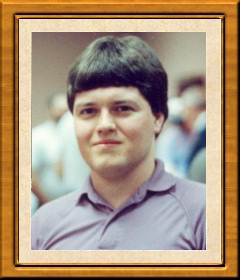
Barry Boone, the first person outside of Infocom to create a full-fledged Z-Machine interpreter.

As one might expect, this decision left a number of 99/4A users sorely disappointed. Among them was Barry Boone, a clever young man just out of high school who was already one of the leading lights of 99/4A hackery. Having read enough about Infocom to understand that their game format must be in some sense portable, he started doggedly digging into the details of its implementation. Soon he was able to make a clear delineation between the interpreter running natively on his machine and the story file it executed — a delineation the Apple II crowd writing for The Computist had yet to manage. And then he uncovered the big secret: that the interpreter packaged with one game could actually run the story file from another — even if said story file originated on a platform other than the 99/4A! Boone:

Having worked out the file format, I wrote a program to crunch the non-TI files and build the TI files. The resulting files appeared to work, but I quickly discovered [a] problem. If I converted an older game that already existed in TI format, everything worked perfectly. But with the newer games, there was a big problem.

The problem was that the interpreter software written for the TI had a number of bugs, many of which did not show up with the original set of games, but became all too apparent with the newer ones and made them unplayable. So I began a process of reverse-engineering the Z-Code interpreter for the TI. Once I reached a point of having recreated the source code, I began working on making the code more efficient, and fixing numerous bugs in the implementation. The largest bug I encountered was a vocabulary-table bug. Basically, the original TI interpreter would hit an overflow bug if the vocabulary table was too large, and the binary-search algorithm would start searching the wrong area of memory to look up words. This had the effect of making the last portion of the vocabulary inaccessible, and made the game impossible to play.

I also added a number of enhancements that allowed the games to load about twenty times faster, and modifications to play the games on TI systems equipped with 80-column displays. Finally, I had to make a second variation of the interpreter so that persons who had an extra 8 K of RAM (known as a Super Cart, or Super Space module) could play some of the games that required a larger memory footprint than 24 K of memory buffer. These games included Leather Goddesses.

Boone estimates that he finished his interpreter around 1986, whereupon he promptly began sharing it with his network of friends and fellow 99/4A enthusiasts, who used it to play many of the newer Infocom story files, transferring them from disks for other platforms. Boone was stymied only by the games from Infocom’s Interactive Fiction Plus line, such as A Mind Forever Voyaging and Trinity. Those games used an expanded version of the Z-Machine, known internally as version 4 — the mature version of the original virtual machine was version 3 — which expanded the available memory space to 256 K, far beyond what the 99/4A could possibly manage. Even without them, however, Boone gave himself and his mates ten new Infocom games to play — i.e., all of those released for the 128 K Z-Machine between October of 1984 and July of 1987, when this original incarnation of the virtual machine made its last bow in Infocom packaging.

But even that wasn’t quite the end of the story. An obscure footnote to Infocom’s history took shape in late 1988 or early 1989, when Chris Bobbitt, founder of a company called Asgard, the 99/4A software publisher that most resembled a real business as opposed to a hobbyist project, had the idea of contacting Infocom themselves to ask permission to market the newer games, running under Boone’s interpreter, as legitimate commercial products. Although Bobbitt doubtless didn’t realize it at the time, Infocom was by then on the verge of being shut down, and Mediagenic, their less-than-doting parent company, were also beginning to feel the financial stresses that would force them into bankruptcy in 1990. They saw Bobbitt’s proposal as a handy way to clear their warehouse of old stock and make some desperately needed cash. Jim Fetzner, who worked with Asgard at the time, remembers how the deal went down:

[Bobbitt] contacted Infocom to ask for permission to release the later Infocom releases, and was given permission to do so on one condition: that the packaging and disks had to be originals for other systems, relabeled (the packaging) and reformatted (the disks) for use with the TI. Infocom scoured their warehouse and sent Chris two very large boxes of the titles he was asking to reproduce—and noted on the invoice that these boxes included every single copy of the relevant titles that Infocom still had in their possession. Some of the titles were relatively plentiful, but others were included in much lower numbers. The boxes only contained four copies of Leather Goddesses of Phobos, for example. All other titles had at least ten copies each, and some had a lot more. He was permitted to buy more copies from remainders in the retail channels, though, so it is possible there are more properly badged Asgard copies of the titles that were harder to find. All of the stock he received from Infocom was gone in a matter of months.

These games, which Bobbitt bought for $5 apiece and sold on for several times that, thereby became the last new Infocom games ever sold in their original packaging — out-of-print games from a dead company sold to owners of an orphaned computer.

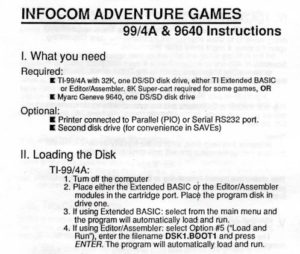
Asgard prepared their own platform-specific reference card after the Infocom example and inserted it into the box.

Well before Asgard entered the scene, however, another, more structured and sustainable project had led to a Z-Machine interpreter much more amenable to being ported and built upon than Boone’s incarnation of same for an idiosyncratic, bare-bones, orphaned platform. Not long after Boone first started sharing his 99/4A interpreter with friends, a few students at the University of Sydney in far-off Australia started disassembling another of Infocom’s own interpreters — in this case one for Zilog Z80-based computers running the operating system CP/M. The group included in their ranks David Beazley, George Janczuk, Peter Lisle, Russell Hoare, and Chris Tham. They gave themselves the rather grandiose name of the InfoTaskforce, but they initially regarded the project, said Janczuk to me recently, strictly as “a form of mental calisthenics”: “This was never meant to be a public exercise.”

Still, the group had several advantages which Boone had lacked — in addition, that is, to the advantage of sheer numbers. Boone had been a bedroom hacker working on fairly primitive hardware, where cryptic assembly language, highly specific to the computer on which it was running, was the only viable option. The InfoTaskforce, on the other hand, had more advanced hardware at their disposal, and were steeped in the culture of institutional hacking, where portable C was the most popular programming language and software was typically distributed as source code, ready to be analyzed, ported, and expanded upon by people other than its creators, quite possibly working on platforms of which said creators had never dreamed. And then, thanks to their university, the InfoTaskforce was connected to the Internet, long before most people had even heard of such a thing; this gave them a way to share their work quickly with others across a wide, international swath of computing. The contrast with the segregated ghetto that was the world of the 99/4A is telling.

David Beazley, who did almost all of the actual coding for the InfoTaskforce interpreter — the others had their hands full enough with reverse-engineering the Z-Machine architecture — did so in C on a first-generation Apple Macintosh. On May 25, 1987, he used this machine to compile the first truly portable Z-Machine interpreter in history. Within a week, he and his mates had also gotten it compiled and running on an MS-DOS machine and a big DEC VAX. (Ironically, the latter was the successor to the PDP-10 line so famously employed by Infocom themselves; thus one might say that the Z-Machine had already come full-circle.)

As Janczuk remembers it, the first version of the interpreter to reach the Internet actually did so accidentally. He gave it to a friend of his at university, who, as so many friends have done over the years, uploaded it without permission on June 2, 1987. There followed an immediate outpouring of interest from all over the world, which greatly surprised the interpreter’s own creators. It prompted them to release an official version 1.0, capable of playing any story file for the standard — i.e., 128 K — Z-Machine on August 1, 1987. Already by this time, the Commodore Amiga personal computer and several more big machines had been added to the list of confirmed-compatible host platforms. It was a milestone day in the history of interactive fiction; Infocom’s games had been freed from the tyranny of the hardware for which they’d originally shipped. And they could remain free of the vicissitudes and fashions of hardware forevermore, as long as there was an enterprising hacker ready to tweak an existing interpreter’s source code to suit the latest gadget to come down the pipe. (So far, there has been no shortage of such hackers…)

With their university days coming to an end, the InfoTaskforce boys worked on their interpreter only in fits and starts over the years that followed. Not until 1990 did they finish adding support for the Interactive Fiction Plus line; not until 1992, in a final burst of activity, did they add support for Infocom’s last few text-only games, which ran under what was known internally as the version 5 Z-Machine. This last release of the InfoTaskforce interpreter actually attracted a bit of scoffing for its inefficiency, and for generally lagging behind what other hackers had done by that point in other interpreters.

In reality, information and inspiration rather than the software itself were the most important legacies of the InfoTaskForce interpreter. Beazley’s C source told you almost all of what you really needed to know about the Z-Machine, so long as you were sufficiently motivated to dig out the information you needed; doing so was certainly a fair sight more pleasant than poring over eye-watering printouts of cryptic disassembled Z80 machine language, as Beazley and his pals had been forced to do before coming up with it. The InfoTaskforce interpreter thus became the gateway through which the Z-Machine burst into the public domain, even as Infocom was soon to collapse and abandon their virtual machine. This was a role which Boone’s interpreter, for all its naïve brilliance, just wasn’t equipped to play, for all of the reasons we’ve already explored.

An enterprising American hacker named Mark Howell did perhaps the most to build upon the foundation of the InfoTaskforce interpreter during the half-decade after its initial appearance. His own interpreter bore the name of ZIP (for “Z-Machine Implementation Program”), a name it shared with the popular compression format, to enormous confusion all the way around — although, to be fair, this was also the name by which Infocom knew their own interpreters. ZIP was faster and less buggy than the InfoTaskforce interpreter, and for this reason it soon surpassed its older sibling in popularity. But Howell also delved further into the architecture of the Z-Machine than anyone before him, analyzing its design like a computer scientist might rather than as a hacker simply trying to write a quick-and-dirty clone of Infocom’s existing interpreters. When he came up for air, he uploaded his set of “ZTools” — programs for probing story files in all sorts of ways, including a disassembler for the actual code they contained. These tools did much to set the stage for the next phase of the Z-Machine’s resurrection and liberation.

In 1992, another building block fell into place when Activision shipped their Lost Treasures of Infocom collection to unexpected success. It and its sequel collected all of the Infocom games together in one place at a reasonable price, stored as neatly discrete story files ready to be fed into either the original Infocom interpreters included on the disks or an alternative of one’s choice. Lost Treasures shipped only in versions for MS-DOS, the Apple Macintosh, and the Commodore Amiga — the last three commercially viable personal-computing platforms left in North America by that time (and the Amiga wouldn’t enjoy that status much longer). But users of orphaned and non-North American platforms were soon passing around the tip that, if you could just get the story files off of the original Lost Treasures disks, they could be run on their own platforms as well with one of the interpreters that had by now spread far and wide. For example, our old friends at The Computist, still carrying the 8-bit torch in these twilight days of the Apple II, published instructions on how to do just that — a fitting end point to their earliest explorations of the Infocom format.

Across the Atlantic, meanwhile, the magazine Acorn User published a similar article for users of the Acorn Archimedes, a machine that was virtually unknown outside of Britain, a few parts of mainland Europe, and Australasia. (“It’s hard to conceive of videogame nostalgia,” they wrote of the Lost Treasures collections, “but this is as close as it gets.” Little did they know…) It so happened that an Oxford doctoral candidate in mathematics named Graham Nelson was a stalwart Acorn loyalist and a regular reader of that magazine. By the time the article in question appeared, the window opened by the InfoTaskforce interpreter and all the software that had followed it, combined with the Lost Treasures collections, had already led him to begin sliding the next couple of building blocks of the Interactive Fiction Renaissance into place.

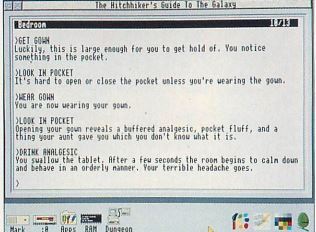
Infocom’s The Hitchhiker’s Guide to the Galaxy running on an Acorn Archimedes — a platform for which it was never officially released — under a third-party Z-Machine interpreter by Edouard Poor.

(Sources: The Computist 5, 7, 34, 41, 47, 57, 58, 63, and 86; Acorn User of July 1993; Asgard Software’s newsletters from 1989 and 1990. Online sources include Barry Boone’s memories of writing his Z-Machine interpreter at The Museum of Computer Adventure Game History and his bio for the TI99ers Hall of Fame. The original source for the InfoTaskforce interpreter can be found in various file archives. My huge thanks go to Barry Boone, Jim Fetzner, and George Janczuk for talking to me about their pioneering early work in Z-Machine archaeology.)


Tags: ,

The Last Works Before the Renaissance

By 1993, textual interactive fiction was reaching the end of the unsettled, uncertain half-decade-and-change between the shuttering of Infocom and the rise of a new Internet-centered community of amateur enthusiasts. Efforts by such collectives as Adventions and High Energy Software to sell text adventures via the shareware model had largely proved unfruitful, while, with the World Wide Web still in its infancy, advertisement and distribution were major problems even for someone willing to release her games for free. The ethos of text and parsers seemed about as divorced as anything could possibly be from the predominant ethos in game development more generally, with its focus on multimedia, full-motion video, and ultra-accessible mouse-driven interfaces. Would text adventures soon be no more than obscure relics of a more primitive past? To an increasing number even of the form’s most stalwart fans, an answer in the affirmative was starting to feel like a foregone conclusion. Few text-adventure authors had serious ambitions of matching the technical or literary quality of Infocom during this period, much less of exceeding it; the issue for the medium right now was one of simple survival. In this atmosphere, the arrival of any new text adventure felt like a victory against the implacable forces of technological change, which had conspired to all but strangle this new literary form before it had even had time to get going properly.

Thankfully, history would later mark 1993 as the year when the seeds of an interactive-fiction rebirth were planted, thanks to an Englishman who repurposed not only the Infocom aesthetic but also Infocom’s own technology in unexpected ways. Those seeds would flower richly in 1995, Year Zero of the Interactive Fiction Renaissance. I’ll begin that story soon.

Today, though, I’d like to tell you about some of the more interesting games to emerge from the final days of the interstitial period — games which actually overlap, although no one could realize it at the time, with the dawning of the modern interactive-fiction community. Indeed, the games I describe below manage to presage some of the themes of that community despite being the products of a text-adventuring culture that still spent more time looking backward than looking forward. I’m fond of all of them in one way or another, and I’m willing to describe at least one of them as a sadly overlooked classic.


The Horror of Rylvania

The hiking trip across Europe has been a wonderful experience for two recent college graduates like yourself and your friend Carolyn. From the mansions of England to the beaches of Greece, you’ve walked in the footsteps of the Crusaders and seen sights that few Americans have ever seen.

Carolyn had wanted to skip the Central European nation of Rylvania. “Why bother?” she’d said. “There’s nothing but farmers there, and creepy old castles - nothing we haven’t seen already. The Rylvanians are still living in the last century.”

That, you’d insisted, was exactly why Rylvania was a must-see. The country was an intact piece of living history, a real treasure in this modern age.

If only you hadn’t insisted! As night fell, as you approached a small farming village in search of a quaint inn to spend the night, the howling began. A scant hundred yards from the village, and it happened...the wolves appeared from the black forest around you and attacked. Big, black wolves that leaped for Carolyn’s throat before you could shout a warning, led by a great gray-black animal that easily stood four feet at the shoulder. Carolyn fell to the rocky path, blood gushing from her neck as the wolves faded back into the trees, unwilling, for some unknown reason, to press their attack.

If she dies, it will be your fault. You curse the darkening sky as you cradle Carolyn’s head, knowing that you have little time to find help. Perhaps in the village up the road to the north.

The Horror of Rylvania marks the last shareware release from Adventions, a partnership between the MIT graduate students Dave Baggett and D.A. Leary which was the most sustained of all efforts to make a real business out of selling interactive fiction during the interstitial period. Doubtless for this reason, the Adventions games are among the most polished of all the text adventures made during this time. They were programmed using the sophisticated TADS development system rather than the more ramshackle AGT, with all the benefits that accrued to such a choice. And, just as importantly, they were thoroughly gone over for bugs as well as spelling and grammar problems, and are free of the gawky authorial asides and fourth-wall-breakings that were once par for the course in amateur interactive fiction.

For all that, though, the Adventions games haven’t aged all that well in my eyes. The bulk of them take place in a fantasy land known as Unnkulia, which is trying so hard to ape Zork‘s Great Underground Empire that it’s almost painful to watch. In addition to being derivative, the Unnkulia games think they’re far more clever and hilarious than they actually are — the very name of the series/world is a fine case in point — while the overly fiddly gameplay can sometimes grate almost as much as the writing.

It thus made for a welcome change when Adventions, after making three and a half Unnkulia games, finally decided to try something else. Written by D.A. Leary, The Horror of Rylvania is more plot-driven than Adventions’s earlier games, a Gothic vampire tale in which you actually become a vampire not many turns in. It’s gone down in certain circles as a minor classic, for reasons that aren’t totally unfounded. Although the game has a few more potential walking-dead scenarios than is perhaps ideal, the puzzles are otherwise well-constructed, the implementation is fairly robust, and, best of all, most of the sophomoric attempts at humor that so marked Adventions’s previous games are blessedly absent.

That said, the end result still strikes me more as a work of craftsmanship than genius. The writing has been gone over for spelling and grammar without addressing some of its more deep-rooted problems, as shown even by the brief introduction above; really, now, have “few Americans ever seen” sights advertised in every bog-standard package tour of Europe? (Something tells me Leary hadn’t traveled much at the time he wrote this game.) The writing here has some of the same problems with tone as another Gothic horror game from 1993 set in an ersatz Romania: Quest for Glory IV. It wants to play the horror straight most of the time, and is sometimes quite effective at it — the scene of your transformation from man to vampire is particularly well-done — but just as often fails to resist the centrifugal pull which comedy has on the adventure-game genre.

Still, Horror of Rylvania is the Adventions game which plays best today, and it isn’t a bad choice for anyone looking for a medium-sized old-school romp with reasonably fair puzzles. Its theme adds to its interest; horror in interactive fiction tends to hew more to either H.P. Lovecraft or zombie movies than the Gothic archetypes which Horror of Rylvania intermittently manages to nail. Another extra dimension of interest is added by the ending, which comes down to a binary choice between curing your friend Carolyn from the curse of vampirism, which entails sacrificing yourself in the process, or curing yourself and letting Carolyn sod off. As we’ll shortly see, the next and last Adventions game perhaps clarifies some of the reasons for such a moral choice’s inclusion at the end of a game whose literary ambitions otherwise don’t seem to extend much beyond being a bit of creepy fun.


The Jeweled Arena

You let out a sigh of relief as you finish the last paper. “That’s the lot.”

“Good work, ma’am,” says Regalo, your squire. “I was almost afraid we’d be here until midnight.”

“Don’t worry, Regalo, I wouldn’t do a thing like that, especially on my first healthy day after the flu. In any case, Dora wants me home by eight. The papers look dry, so you can take them to Clara’s office.”

As Regalo carries the papers to the adjoining office, you stand up and stretch your aching muscles. You then look through the window and see a flash of lightning outside. It looks like quite a storm is brewing.

“I’m beginning to think my calendar is set wrong,” you say as Regalo returns. “Dibre’s supposed to be cool, dry, and full of good cheer; so far, we’ve had summer heat, constant rain, and far too many death certificates. Perhaps this storm will blow out the heat.”


“I hope it blows out the plague with it, ma’am. I’ve lost three friends already, and my wife just picked it up yesterday. No one likes it when the coroner’s staff is overworked.”

“It doesn’t help that Clara and Resa are both still sick. If we’re lucky, we’ll have Resa back tomorrow, which I’m sure your feet would appreciate. I presume Ernando and Miranda have already left for the day?”

“Yes ma’am.”

“Now I’m really worried. The only thing worse than being the victim of one of Miranda’s pranks is going a day without one of her pranks -– it usually means you missed something. Perhaps she decided to be discrete [sic] for a change.”

“I didn’t get the impression her sense of humor was taking the day off, but I don’t know what she did. It can wait until tomorrow. Is there anything else you need me to do before I leave?”

Written by David S. Raley, The Jeweled Arena was the co-winner of what would turn out to be the last of the annual competitions organized by AGT’s steward, David M. Malmberg, before he released the programming language as freeware and stepped away from further involvement with the interactive-fiction community. Set in a fantasy world, but a thankfully non-Zorkian and non-Tolkienesque one, it’s both an impressive piece of world-building and a game of unusual narrative ambition for its time.

In fact, the world of Valdalan seems like it must have existed in the author’s head for a long time before this game was written. The environment around you has the feeling of being rooted in far more lore and history than is explicitly foregrounded in the text, always the mark of first-class world-building. As far as I can tell from the text, Valdalan is roughly 17th-century in terms of its science and technology, but is considerably more enlightened philosophically. Interestingly, magic seems to have no place here, making it almost more of an alternative reality than a conventional fantasy milieu.

The story takes place in the city of Kumeran as it’s in the throes of a plague — a threat which is, like so much else in this game, handled with more subtlety than you might expect. The plot plays out in four chapters, during each of which you play the role of a different character. The first chapter is worthy of becoming a footnote in interactive-fiction history at the very least, in that it casts you as one half of a lesbian couple. In later years, certain strands of interactive fiction — albeit more of the hypertext than the parser-driven type — would become a hotbed of advocacy for non- hetero-normative lifestyles. The Jeweled Arena has perhaps aged better in this respect than many of those works have (or will); it presents its lesbian protagonist in a refreshingly matter-of-fact way, neither turning her into an easy villain or victim, as an earlier game might have done, nor celebrating her as a rainbow-flag-waving heroine, as a later game might have done. She’s just a person; the game takes it as a given that she’s worthy of exactly the same level of respect as any of the rest of us. In 1993, this matter-of-fact attitude toward homosexuality was still fairly unusual. Raley deserves praise for it.

Unfortunately, The Jeweled Arena succeeds better as a place and a story than it does as a game, enough so that one is tempted to ask why Raley elected to present it in the form of a text adventure at all. He struggles to come up with things for you to really do as you wander the city. This tends to be a problem with a lot of interactive fiction where the puzzles aren’t the author’s primary focus; A Mind Forever Voyaging struggles to some extent with the same issue when it sends you wandering through its own virtual city. But The Jeweled Arena, which doesn’t have a mechanic like A Mind Forever Voyaging‘s commandment to observe and record to ease its way, comes off by far the worse of the two. Most of the tasks it sets before you are made difficult not out of  authorial intention but due to poor authorial prompting and the inherent limitations of AGT. In other words, first you have to figure out what non-obvious trigger the game is looking for to advance the plot a beat, and then you have to figure out the exact way the parser wants you to say it. This constant necessity to read the author’s mind winds up spoiling what could have been an enjoyable experience, and makes The Jeweled Arena a game that can truly be recommended only to those with an abiding interest in text-adventure history or the portrayal of homosexuality in interactive media. A pity — with more testing and better technology, it could have been a remarkable achievement.


Klaustrophobia

You are standing at the top of an ocean bluff. Wind is whipping through your hair and blowing your voluminous black cape out behind you. You can hear the hiss of the surf crashing far below you. Out towards the horizon, a distant storm sends flickers of lightning across the darkening sky. The last rays of the setting sun reflect red off the windows of the grey stone mansion to the East. As you turn towards the house, you catch a glimpse of a haunting face in one of the windows. That face, you will never forget that face......

> wait
The surf and cliffs fade from sight............


You awake to find yourself in your living room,lying on the couch. Your cat, Klaus, is chewing and pulling on your hair. Static is hissing from the TV, as the screen flickers on a station long off the air. You look at your watch and realize that it is 3 AM.


You must have fallen asleep on the couch right after you got home from work, and settled down to read the newspaper.

I noted earlier that the Adventions games are “free of the gawky authorial asides and fourth-wall-breakings” that mark most early amateur interactive fiction. That statement applies equally to The Jeweled Arena, but not at all to Carol Hovick’s Klaustrophobia. The other winner of the final AGT competition, its personality could hardly be more different from its partner on the podium. This is a big, rambling, jokey game that’s anything but polished. And yet it’s got an unpretentious charm about it, along with puzzles that turn out to be better than they first seem like they’re going to be.

What Klaustrophobia lacks in polish or literary sophistication, it attempts to make up for in sheer sprawl. It’s actually three games in one — so big that, even using the most advanced and least size-constrained version of AGT, Hovick was forced to split it into three parts, gluing them together with some ingenious hacks that are doubtless horrifying in that indelible AGT way to any experienced programmer. The three parts together boast a staggering 560 rooms and 571 objects, making Klaustrophobia easily one of the largest text adventures ever created.

Like the Unnkulia series and so much else from the interstitial period, Klaustrophobia is hugely derivative of the games of the 1980s. The story and puzzles here draw heavily from Infocom’s Bureaucracy, which is at least a more interesting choice than yet another Zork homage. You’ve just won an all-expenses-paid trip to appear on a quiz show, but first you have to get there; this exercise comes to absorb the first third of the game. Then, after you’ve made the rounds of not one but several quiz shows in the second part, part three sends you off to “enjoy” the Mexican vacation you’ve won. As a member of that category of text adventure which the Interactive Fiction Database dubs the “slice of life,” the game has that time-capsule quality I’ve mentioned before as being such a fascinating aspect of amateur interactive fiction. Klaustrophobia is a grab bag of pop-culture ephemera from the United States of 1993: Willard Scott, Dolly Parton, The Price is Right. If you lived through this time and place, you might just find it all unbearably nostalgic. (Why do earlier eras of history almost invariably seem so much happier and simpler?) And if you didn’t… well, there are worse ways to learn about everyday American life in 1993, should you have the desire to do so, than playing through this unforced, agenda-less primary source.

The puzzles are difficult in all the typical old-school ways: full of time limits, requiring ample learning by death. Almost inevitably given the game’s premise, they sometimes fail to fall on the right side of the line between being comically aggravating and just being aggravating. And the game is rough around the edges in all the typical AGT ways: under-tested (a game this large almost has to be) and haphazardly written, and subject to all the usual frustrations of the AGT parser and world model. Yet, despite it all, the author’s design instincts are pretty good; most of the puzzles are clued if you’re paying attention. Many of them involve coming to understand and manipulate some surprisingly complex dynamic sequences taking place around you. The whole experience is helped immensely by the episodic structure which exists even within each of the three parts: you go from your home to the bank to the airport, etc., with each vignette effectively serving as its own little self-contained adventure game. This structure lets Klaustrophobia avoid the combinatorial explosion that can make such earlier text-adventure epics as Acheton and Zork Zero all but insoluble. Here, you can work out a single episode, then move on to the next at your leisure with a nice sense of achievement in your back pocket — as long, of course, as you haven’t left anything vital behind.

Klaustrophobia is a game that I regard with perhaps more affection than I ought to, given its many and manifest flaws. While much of my affection may be down to the fact that it was one of the first games I played when I rediscovered interactive fiction around the turn of the millennium, I like to believe this game has more going for it than nostalgia. It undoubtedly requires a certain kind of player, but, whether taken simply as a text adventure or as an odd sort of sociological study — a frozen-in-amber relic of its time and place — it’s not without its intrinsic appeal. Further, it strikes me as perfect for its historical role as the final major statement made with AGT; something more atypically polished and literary, such as Shades of Gray or even Cosmoserve, just wouldn’t work as well in that context. Klaustrophobia‘s more messy sort of charm, on the other hand, feels like the perfect capstone to this forgotten culture of text adventuring, whose games were more casual but perhaps in some ways more honest because of it.


The Legend Lives!

A pattern of bits shifts inside your computer. New information scrolls up the screen.


It is not good.

As the impact of the discovery settles on your psyche, you recall the preceding events: your recent enrollment at Akmi Yooniversity; your serendipitous discovery of the joys of Classical Literature – a nice change of pace from computer hacking; your compuarchaeological discovery of the long-forgotten treasures that will make your thesis one of the most important this decade. But now that’s all a bit moot, isn’t it?

How ironic: You were stunned at how *real* the primitive Unnkulian stories seemed. Now you know why.

David Baggett’s The Legend Lives! is the only game on this curated list that dates from 1994, the particularly fallow year just before the great flowering of 1995. The very last production of the Adventions partnership, it was originally planned as another shareware title, but was ultimately released for free, a response to the relatively tepid registration rate of Advention’s previous games. Having conceived it as nothing less than a Major Statement meant to prod the artistic growth of a nascent literary medium, Baggett stated that he wished absolutely everyone to have a chance to play his latest game.

Ironically, the slightly uncomfortable amalgamation that is The Legend Lives! feels every bit as of-its-time today as any of the less artistically ambitious text adventures I’ve already discussed in this article. Set in the far future of Adventions’s Unnkulia universe, it reads like a checklist of what “literary” interactive fiction circa 1994 might be imagined to require.

There must, first and foremost, be lots and lots of words for something to be literary, right? Baggett has this covered… oh, boy, does he ever. The first room description, for the humble dorm room of the university student you play, consists of six substantial paragraphs — two or three screenfuls of text on the typical 80-column monitor displays of the day. As you continue to play, every object mentioned anywhere, no matter how trivial, continues to be described to within an inch of its life. While Baggett’s dedication is admirable, these endless heaps of verbiage do more to confuse than edify, especially in light of the fact that this game is, despite its literary aspirations, far from puzzleless. There’s a deft art to directing the player’s attention to the things that really matter in a text adventure — an art which this game comprehensively fails to exhibit. And then there are the massive non-interactive text dumps, sometimes numbering in the thousands of words, which are constantly interrupting proceedings. Sean Molley, reviewing the game in the first gush of enthusiasm which accompanied its release, wrote that “I certainly don’t mind reading 10 screens of text if it helps to advance the story and give me something to think about.” I suspect that most modern players wouldn’t entirely agree. The Legend Lives! is exhausting enough in its sheer verbosity to make you long for the odd minimalist poetry of Scott Adams. “Ok, too dry. Fish die” starts looking pretty good after spending some time with this game.

And yet, clumsy and overwrought though the execution often is, there is a real message here — one I would even go so far as to describe as thought-provoking. The Legend Lives! proves to be an old-school cyberpunk tale — another thing dating it indelibly to 1994 — about a computer virus that has infected Unnkulia’s version of the Internet and threatens to take over the entirety of civilization. The hero that emerges and finally sacrifices himself to eliminate the scourge is known mostly by his initials: “JC.” He’s allegedly an artificial intelligence, but he’s really, it would seem, an immaculate creation, a divinity living in the net. An ordinary artificial intelligence, says one character, “is smart with no motivation, no goals; no creativity, ya see. JC, he’s like us.” What we have here, folks, is an allegory. I trust that I need not belabor the specific parallels with another famous figure who shares the same initials.

But I don’t wish to trivialize the message here too much. It’s notable that this argument for a non-reductionist view of human intelligence — for a divine spark to the human mind that can’t be simulated in silicon — was made by a graduate student in MIT’s artificial-intelligence lab, working in the very house built by Marvin Minsky and his society of mind. Whatever one’s feelings about the Christian overtones to Baggett’s message, his impassioned plea that we continue to allow a place for the ineffable has only become more relevant in our current age of algorithmization and quantization.

Like all of the Adventions games, this one has been virtually forgotten today, despite being widely heralded upon its release as the most significant work of literary interactive fiction to come along since A Mind Forever Voyaging and Trinity. That’s a shame. Yes, writers of later text adventures would learn to combine interactivity with literary texture in more subtle and effective ways, but The Legend Lives! is nevertheless a significant way station in the slow evolution of post-Infocom interactive fiction, away from merely reflecting the glory of a storied commercial past and toward becoming a living, evolving artistic movement in its own right.


Perdition’s Flames

*** You have died. ***

All is dark and quiet. There is no sensation, no time. Your mind floats peacefully in a void. You perceive nothing, you feel nothing, you think nothing. Sleep without dreams.

All is hazy and gray. Sensation is vague and indistinct. Your mind is sluggish, sleepy. You see gray shapes in a gray fog; you hear distant, muffled sounds. You think, but your thoughts are fleeting, disconnected, momentary flashes of light in a dark night. Time is still frames separated by eons of nothing, brief awakenings in a long sleep.

All is clear and sharp. Sensation crystalizes from a fog. You see, you hear, you feel. Your mind awakens; you become aware of a place, and a time.

You are on a boat.

Last but far from least, we come to the real jewel of this collection, a game which I can heartily recommend to everyone who enjoys text adventures. Perdition’s Flames was the third game written by Mike Roberts, the creator of the TADS programming language. While not enormous in the way of Klaustrophobia, it’s more than substantial enough in its own right, offering quite a few hours of puzzling satisfaction.

The novel premise casts you as a soul newly arrived in Hell. (Yes, just as you might expect, there are exactly 666 points to score.) Luckily for you, however, this is a corporate, postmodern version of the Bad Place. “Ever since the deregulation of the afterlife industry,” says your greeter when you climb off the boat, “we’ve had to compete with Heaven for eternal souls — because you’re free to switch to Heaven at any time. So, we’ve been modernizing! There really isn’t much eternal torment these days, for example. And, thanks to the Environmental Clean-up Superfund, we have the brimstone problem mostly under control at this point.”

As the game continues, there’s a lot more light satire along those lines, consistently amusing if not side-splittingly funny. Finishing the whole thing will require solving lots and lots of puzzles, which are varied, fair, and uniformly enjoyable. In fact, I number at least one of them among the best puzzles I’ve ever seen. (For those who have already played the game: that would be the one where you’re a ghost being pursued by a group of paranormal researchers.)

Although Perdition’s Flames is an old-school puzzlefest in terms of categorization, it’s well-nigh breathtakingly progressive in terms of its design sensibility. For this happens to be a text adventure — the first text adventure ever, to my knowledge — which makes it literally impossible for you to kill yourself (after all, you are already dead) or lock yourself out of victory. It is, in other words, the Secret of Monkey Island of interactive fiction, an extended proof that adventure games without deaths or dead ends can nevertheless be intriguing, challenging, and immensely enjoyable. Roberts says it right there in black and white:

Note that in Perdition’s Flames, in contrast to many other adventure games, your character never gets killed, and equally importantly, you’ll never find yourself in a position where it’s impossible to finish the game. You have already seen the only “*** You have died ***” message in Perdition’s Flames. As a result, you don’t have to worry as much about saving game positions as you may be accustomed to.

I can’t emphasize enough what an astonishing statement that is to find in a text adventure from 1993. Perdition’s Flames and its author deserve to be celebrated for making it every bit as much as we celebrate Monkey Island and Ron Gilbert.

Yet even in its day Perdition’s Flames was oddly overlooked in proportion to its size, polish, and puzzly invention alone, much less the major leap it represents toward an era of fairer, saner text adventures. And this even as the merciful spirit behind the humble statement above, found buried near the end of the in-game instructions, was destined to have much more impact on the quality of the average player’s life than all of the literary pretensions which The Legend Lives! so gleefully trumpets.

Roberts’s game was overshadowed most of all by what would go down in history as the text adventure of 1993: Graham Nelson’s Curses!. Said game is erudite, intricate, witty, and sometimes beautifully written — and runs on Infocom’s old Z-Machine, which constituted no small part of its appeal in 1993. But it’s also positively riddled with the types of sudden deaths and dead ends which Perdition’s Flames explicitly eschews. You can probably guess which of the pair holds up better for most players today.

So, as we prepare to dive into the story of how Curses! came to be, and of how it turned into the seismic event which revitalized the near-moribund medium of interactive fiction and set it on the path it still travels today, do spare a thought for Perdition’s Flames as well. While Curses! was the first mover that kicked the modern interactive-fiction community into gear, Perdition’s Flames, one might argue, is simply the first work of modern interactive fiction, full stop. All of its contemporaries, Curses! included, seem regressive next to its great stroke of genius. Go forth and play it, and rejoice. An Interactive Fiction Renaissance is in the offing.

(All of the games reviewed in this article are freely available via the individual links provided above and playable on Windows, Macintosh, and Linux using the Gargoyle interpreter among other options.)


Tags: , , , , , , ,

Shades of Gray

Ladies and gentlemen, come and see. This isn’t a country here but an epic failure factory, an excuse for a place, a weed lot, an abyss for tightrope walkers, blindman’s bluff for the sightless saddled with delusions of grandeur, proud mountains reduced to dust dumped in big helpings into the cruciform maws of sick children who crouch waiting in the hope of insane epiphanies, behaving badly and swamped besides, bogged down in their devil’s quagmires. Our history is a corset, a stifling cell, a great searing fire.

— Lyonel Trouillot

What’s to be done about Haiti?

Generations have asked that question about the first and most intractable poster child for postcolonial despair, the poorest country in North or South America now and seemingly forever, a place whose corruption and futility manages to make the oft-troubled countries around it look like models of good governance. Nowhere feels James Joyce’s description of history as “a nightmare from which I am trying to awake” more apt. Indeed, Haiti stands as perhaps the ultimate counterargument to the idealistic theory of history as progress. Here history really is just one damned thing after another — differing slightly in the details, but always the same at bottom.

But why should it be this way? What has been so perplexing and infuriating about Haiti for so long is that there seems to be no real reason for its constant suffering. Long ago, when it was still a French colony, it was known as the “Pearl of the Caribbean,” and was not only beautiful but rich; at the time of the American Revolution, it was richer than any one of the thirteen British American colonies. Those few who bother to visit Haiti today still call it one of the most beautiful places of all in the beautiful region that is the Caribbean. Today the Dominican Republic, the nation with which Haiti shares the island of Hispaniola, is booming, the most popular tourist spot in the Caribbean, with the fastest-growing economy anywhere in North or South America. But Haiti, despite being blessed with all the same geographic advantages, languishes in poverty next door, seething with resentment over its condition. It’s as if the people of Haiti have been cursed by one of the voodoo gods to which some of them still pray to act out an eternal farce of chaos, despair, and senseless violence.

Some scenes from the life of Haiti…

…you are a proud Mandingue hunter in a hot West African land. But you’re not hunting. You’re being hunted — by slavers, both black and white. You run, and run, and run, until your lungs are near to bursting. But it’s no use. You’re captured and chained like an animal, and thrust into the dank hold of a sailing ship. Hundreds of your countrymen and women are here — hungry, thirsty, some beaten and maimed by your captors. All are terrified for themselves and their families, from whom they’ve been cruelly separated. Many die on the long voyage. But when it’s over, you wonder if perhaps they were the lucky ones…

The recorded history of the island of Hispaniola begins with the obliteration of the people who had always lived there. The Spanish conquistadors arrived on the island in the fifteenth century, bringing with them diseases against which the native population, known as the Taíno, had no resistance, along with a brutal regime of forced labor. Within two generations, the Taíno were no more. They left behind only a handful of words which entered the European vocabulary, like “hammock,” “hurricane,” “savanna,” “canoe,” “barbecue,” and “tobacco.” The Spanish, having lost their labor force, shrugged their shoulders and largely abandoned Hispaniola.

But in the ensuing centuries, Europeans developed a taste for sugar, which could be produced in large quantities only in the form of sugarcane, which in turn grew well only in tropical climates like those of the Caribbean. Thus the abandoned island of Hispaniola began to have value again. The French took possession of the western third of the island — the part known as Haiti today — with the Treaty of Ryswick, which ended the Nine Years War in 1697. France officially incorporated its new colony of Saint-Domingue on Hispaniola the same year.

Growing sugarcane demanded backbreaking labor under the hot tropical sun, work of a kind judged unsuitable for any white man. And so, with no more native population to enslave, the French began to import slaves from Africa. Their labor turned Saint-Domingue in a matter of a few decades from a backwater into one of the jewels of France’s overseas empire. In 1790, the year of the colony’s peak, 48,000 slaves were imported to join the 500,000 who were already there. It was necessary to import slaves in such huge numbers just to maintain the population in light of the appalling death toll of those working in the fields; little Saint-Domingue alone imported more slaves over the course of its history than the entirety of the eventual United States.

…you’re a slave, toiling ceaselessly in a Haitian cane field for your French masters. While they live bloated with wealth, you and your fellows know little but hardship and pain. Brandings, floggings, rape, and killing are everyday events. And for the slightest infraction, a man could be tortured to death by means limited only by his owners’ dark imaginations. What little comfort you find is in the company of other slaves, who, at great risk to themselves, try to keep the traditions of your lost homeland alive. And there is hope — some of your brothers could not be broken, and have fled to the hills to live free. These men, the Maroons, are said to be training as warriors, and planning for your people’s revenge. Tonight, you think, under cover of darkness, you will slip away to join them…

The white masters of Saint-Domingue, who constituted just 10 percent of the colony’s population, lived in terror of the other 90 percent, and this fear contributed to the brutality with which they punished the slightest sign of recalcitrance on the part of their slaves. Further augmenting their fears of the black Other was the slaves’ foreboding religion of voodoo: a blending of the animistic cults they had brought with them from tribal Africa with the more mystical elements of Catholicism — all charms and curses, potions and spells, trailing behind it persistent rumors of human sacrifice.

Even very early in the eighteenth century, some slaves managed to escape into the wilderness of Hispaniola, where they formed small communities that the white men found impossible to dislodge. Organized resistance, however, took a long time to develop.

Legend has it that the series of events which would result in an independent nation on the western third of Hispaniola began on the night of August 21, 1791, when a group of slave leaders secretly gathered at a hounfour — a voodoo temple — just outside the prosperous settlement of Cap‑Français. Word of the French Revolution had reached the slaves, and, with mainland France in chaos, the time seemed right to strike here in the hinterlands of the empire. A priestess slit the throat of a sacrificial pig, and the head priest said that the look and taste of the pig’s blood indicated that Ogun and Ghede, the gods of war and death respectively, wanted the slaves to rise up. Together the leaders drank the blood under a sky that suddenly broke into storm, then sneaked back onto their individual plantations at dawn to foment revolution.

That, anyway, is the legend. There’s good reason to doubt whether the hounfour actually happened, but the revolution certainly did.

…you are in the middle of a bloody revolution. You are a Maroon, an ex-slave, fighting in the only successful slave revolt in history. You have only the most meager weapons, but you and your comrades are fighting for your very lives. There is death and destruction all around you. Once-great plantation houses lie in smouldering ruins. Corpses, black and white, litter the cane fields. Ghede walks among them, smiling and nodding at his rich harvest. He sees you and waves cheerfully…

The proudest period of Haiti’s history — the one occasion on which Haiti actually won something — began before a nation of that name existed, when the slaves of Saint-Domingue rose up against their masters, killing or driving them off their plantations. After the French were dispensed with, the ex-slaves continued to hold their ground against Spanish and English invaders who, concerned about what an example like this could mean for other colonies, tried to bring them to heel.

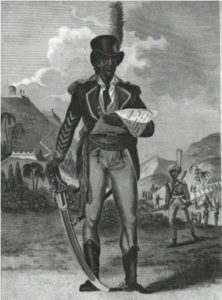
In 1798, a well-educated, wily former slave named Toussaint Louverture consolidated control of the now-former French colony. He spoke both to his own people and to outsiders using the language of the Enlightenment, drawing from the American Declaration of Independence and the French Declaration of the Rights of Man and the Citizen, putting a whole new face on this bloody revolution that had supposedly been born at a voodoo houfour on a hot jungle night.

Toussaint Louverture was frequently called the black George Washington in light of the statesmanlike role he played for his people. He certainly looked the part. Would Haiti’s history have been better had he lived longer? We can only speculate.

…and you are battling Napoleon’s armies, Europe’s finest, sent to retake the jewel of the French empire. You have few resources, but you fight with extraordinary courage. Within two years, sixty thousand veteran French troops have died, and your land is yours again. The French belong to Ghede, who salutes you with a smirk…

Napoleon had now come to power in France, and was determined to reassert control over his country’s old empire even as he set about conquering a new one. In 1802, he sent an army to retake the colony of Saint-Domingue. Toussaint Louverture was tricked, captured, and shipped to France, where he soon died in a prison cell. But his comrades in arms, helped along by a fortuitous outbreak of yellow fever among the French forces and by a British naval blockade stemming from the wars back in Europe, defeated Napoleon’s finest definitively in November of 1803. The world had little choice but to recognize the former colony of Saint-Domingue as a predominately black independent nation-state, the first of its type.

With Louverture dead, however, there was no one to curb the vengeful instincts of the former slaves who had defeated the French after such a long, hard struggle. It was perfectly reasonable that the new nation would take for its name Haiti — the island of Hispaniola’s name in the now-dead Taíno language — rather than the French appellation of Saint-Domingue. Less reasonable were the words of independent Haiti’s first leader, and first in its long line of dictators, Jean-Jacques Dessalines, who said that “we should use the skin of a white man as a parchment, his skull for an inkwell, his blood for ink, and a bayonet for a pen.” True to his words, he proceeded to carry out systematic genocide on the remaining white population of Haiti, destroying in the process all of the goodwill that had accrued to the new country among progressives and abolitionists in the wider world. His vengeance cost Haiti both much foreign investment that might otherwise have been coming its way and the valuable contribution the more educated remaining white population, by no means all of whom had been opposed to the former slaves’ cause, might have been able to make to its economy. A precedent had been established which holds to this day: of Haiti being its own worst enemy, over and over again.

…a hundred years of stagnation and instability flash by your eyes. As your nation’s economic health declines, your countrymen’s thirst for coups d’etat grows. Seventeen of twenty-four presidents are overthrown by guile or force of arms, and Ghede’s ghastly armies swell…

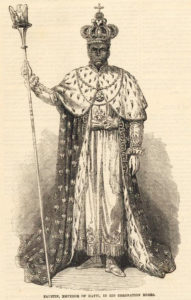
So, Haiti, having failed from the outset to live up to the role many had dreamed of casting it in as the first enlightened black republic, remained poor and inconsequential, mired in corruption and violence, as its story devolved from its one shining moment of glory into the cruel farce it remains to this day. The arguable lowlight of Haiti’s nineteenth century was the reign of one Faustin Soulouque, who had himself crowned Emperor Faustin I — emperor of what? — in 1849. American and European cartoonists had a field day with the pomp and circumstance of Faustin’s “court.” He was finally exiled to Jamaica in 1859, after he had tried and failed to invade the Dominican Republic (an emperor has to start somewhere, right?), extorted money from the few well-to-do members of Haitian society and defaulted on his country’s foreign debt in order to finance his palace, and finally gotten himself overthrown by a disgruntled army officer. Like the vast majority of Haiti’s leaders down through the years, he left his country in even worse shape than he found it.

Haiti’s Emperor Faustin I was a hit with the middle-brow reading public in the United States and Europe.

…you are a student, protesting the years-long American occupation of your country. They came, they said, to thwart Kaiser Wilhelm’s designs on the Caribbean, and to help the Haitian people. But their callous rule soon became morally and politically bankrupt. Chuckling, Ghede hands you a stone and you throw it. The uprising that will drive the invaders out has begun…

In 1915, Haiti was in the midst of one of its periodic paroxysms of violence. Jean Vilbrun Guillaume Sam, the country’s sixth president in the last four years, had managed to hold the office for just five months when he was dragged out of the presidential palace into the street and torn limb from limb by a mob. The American ambassador to Haiti, feeling that the country had descended into a state of complete anarchy that could spread across the Caribbean, pleaded with President Woodrow Wilson to intervene. Fearing that Germany and its allies might exploit this chaos on the United States’s doorstep if and when his own country should enter the First World War on the opposing side, Wilson agreed. On July 28, 1915, a small force of American sailors occupied the Haitian capital of Port-au-Prince almost without firing a shot — a far cry from Haiti’s proud struggle for independence against the French. Haiti was suddenly a colony again, although its new colonizers did promise that the occupation was temporary. It was to last just long enough to set the country on its feet and put a sound system of government in place.

When the Americans arrived in Haiti, they found its people’s lives not all that much different from the way they had lived at the time of Toussaint Louverture. Here we see the capital city of Port-au-Prince, the most “developed” place in the country.

The American occupation wound up lasting nineteen years, during which the occupiers did much practical good in Haiti. They paved more than a thousand miles of roadway; built bridges and railway lines and airports and canals; erected power stations and radio stations, schools and hospitals. Yet, infected with the racist attitudes toward their charges that were all too typical of the time, they failed at the less concrete tasks of instilling a respect for democracy and the rule of law. They preferred to make all the rules themselves by autocratic decree, giving actual Haitians only a token say in goings-on in their country. This prompted understandable anger and a sort of sullen, passive resistance among Haitians to all of the American efforts at reform, occasionally flaring up into vandalism and minor acts of terrorism. When the Americans, feeling unappreciated and generally hard-done-by, left Haiti in 1934, it didn’t take the country long to fall back into the old ways. Within four years President Sténio Vincent had declared himself dictator for life. But he was hardly the only waxing power in Haitian politics.

…a tall, ruggedly handsome black man with an engaging smile.

He is speaking to an assembled throng in a poverty-stricken city neighborhood. He tells moving stories about his experiences as a teacher, journalist, and civil servant. You admire both his skillful use of French and Creole, and his straightforward ideas about government. With eloquence and obvious sincerity, he speaks of freedom, justice and opportunity for all, regardless of class or color. His trenchant, biting criticisms of the establishment delight the crowd of longshoremen and laborers.

“Latin America and the Caribbean already have too many dictators,” he says. “It is time for a truly democratic government in Haiti.” The crowd roars out its approval…

The aspect of Haitian culture which had always baffled the Americans the most was the fact that this country whose population was 99.9 percent black was nevertheless riven by racism as pronounced as anywhere in the world. The traditional ruling class was the mulattoes: Haitians who could credit their lighter skin to white blood dating back to the old days of colonization, and/or to the fact that they and their ancestors hadn’t spent long years laboring in the sun. They made up perhaps 10 percent of the population, and spoke and governed in French. The rest of the population was made up of the noir Haitians: the darker-skinned people who constituted the working class. They spoke only the Haitian Creole dialect for the most part, and thus literally couldn’t understand most of what their country’s leaders said. In the past, it had been the mulattoes who killed one another to determine who ruled Haiti, while the noir Haitians just tried to stay out of the way.

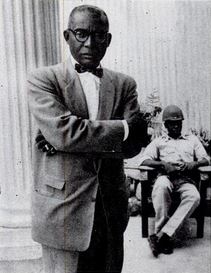
In the 1940s, however, other leaders came forward to advance the cause of the “black” majority of the population; these leaders became known as the noiristes. Among the most prominent of them was Daniel Fignolé, a dark-skinned Haitian born, like most of his compatriots, into extreme poverty in 1913. Unlike most of them, he managed to educate himself by dint of sheer hard work, became political at the sight of the rampant injustice and corruption all around him, and came to be known as the “Moses of Port-au-Prince” for the fanatical loyalty he commanded among the stevedores, factory workers, and other unskilled laborers in and around the capital. Fignolé emphasized again and again that he was not a Marxist — an ideology that had been embraced by some of the mulattoes and was thus out of bounds for any good noiriste. Yet he did appropriate the Marxist language of proletariat and bourgeoisie, and left no doubt which side of that divide he was fighting for. For years, he remained an agitating force in Haitian politics without ever quite breaking through to real power. Then came the tumultuous year of 1957.

Daniel Fignolé, the great noiriste advocate for the working classes of Haiti.

…but you’re now a longshoreman in Port-au-Prince, and your beloved Daniel Fignolé has been ousted after just nineteen days as Provisional President. Rumors abound that he has been executed by Duvalier and his thugs. You’re taking part in a peaceful, if noisy, demonstration demanding his return. Suddenly, you’re facing government tanks and troops. Ghede rides on the lead tank, laughing and clapping his hands in delight. You shout your defiance and pitch a rock at the tank. The troops open fire, and machine-gun bullets rip through your chest…

One Paul Magloire, better known as Bon Papa, had been Haiti’s military dictator since 1950. The first few years of his reign had gone relatively well; his stridently anticommunist posturing won him some measure of support from the United States, and Haiti briefly even became a vacation destination to rival the Dominican Republic among sun-seeking American tourists. But when a devastating hurricane struck Hispaniola in 1954 and millions of dollars in international aid disappeared in inimitable Haitian fashion without ever reaching the country’s people, the mood among the elites inside the country who had been left out of that feeding frenzy began to turn against Bon Papa. On December 12, 1956, he resigned his office by the hasty expedient of jumping into an airplane and getting the hell out of Dodge before he came to share the fate of Jean Vilbrun Guillaume Sam. The office of the presidency, a hot potato if ever there was one, then passed through three more pairs of hands in the next six months, while an election campaign to determine Haiti’s next permanent leader took place.

Of course, in Haiti election campaigns were fought with fists, clubs, knives, guns, bombs, and, most of all, rampant, pervasive corruption at every level. Still, in a rare sign of progress of a sort in Haitian politics, the two strongest candidates were both noiristes promising to empower the people rather than the mulatto elites. They were Daniel Fignolé and François Duvalier, the latter being a frequent comrade-in-arms of the former during the struggles of the last twenty years who had now become a rival; he was an unusually quiet, even diffident-seeming personality in terms of typical Haitian politics, so much so that many doubted his mental fortitude and intelligence alike. But Duvalier commanded enormous loyalty in the countryside, where he had worked for years as a doctor, often in tandem with American charitable organizations. Meanwhile Fignolé’s urban workers remained as committed to him as ever, and clashes between the supporters of the two former friends were frequent and often violent.

The workers around Port-au-Prince pledged absolute allegiance to Daniel Fignolé. He liked to call them his wuolo konmpresé — his “steamrollers,” always ready to take to the streets for a rally, a demonstration, or just a good old fight.

But then, on May 25, 1957, Duvalier unexpectedly threw his support behind a bid to make his rival the latest provisional president while the election ran its course, and Fignolé marched into the presidential palace surrounded by his cheering supporters. In a stirring speech on the palace steps, he promised a Haitian “New Deal” in the mold of Franklin D. Roosevelt’s American version.

The internal machinations of Haitian politics are almost impossible for an outsider to understand, but many insiders have since claimed that Duvalier, working in partnership with allies he had quietly made inside the military, had set Fignolé up for a fall, contriving to remove him from the business of day-to-day campaigning and thereby shore up his own support while making sure his presidency was always doomed to be a short one even by Haitian standards. At any rate, on the night of June 14, 1957 — just nineteen days after he had assumed the post — a group of army officers burst into Fignolé’s office, forced him to sign a resignation letter at gunpoint, and then tossed him into an airplane bound for the United States, exiling him on pain of death should he ever return to Haiti.

The deposing of Fignolé ignited another spasm of civil unrest among his supporters in Port-au-Prince, but their violence was met with even more violence by the military. There were reports of soldiers firing machine guns into the crowds of demonstrators. People were killed in the hundreds if not thousands in the capital, even as known agitators were rounded up en masse and thrown into prison, the offices of newspapers and magazines supporting Fignolé’s cause closed and ransacked. On September 22, 1957, it was announced that François Duvalier had been elected president by the people of Haiti.

Inside the American government, opinion was divided about the latest developments in Haiti. The CIA was convinced that, despite Fignolé’s worrisome leftward orientation, his promised socialist democracy was a better, more stable choice for the United States’s close neighbor than a military junta commanded by Duvalier. The agency thus concocted a scheme to topple Duvalier’s new government, which was to begin with the assassination of his foreign minister, Louis Raimone, on an upcoming visit to Mexico City to negotiate an arms deal. But the CIA’s plans accidentally fell into the hands of one Austin Garriot, an academic doing research for his latest book in Washington, D.C. Garriot passed the plans on to J. Edgar Hoover’s FBI, who protested strongly that any attempt to overthrow Duvalier would be counter to international law — and who emphasized as well that he had declared himself to be strongly pro-American and anti-Soviet. With the top ranks of the FBI threatening to expose the illegal assassination plot to other parts of the government if the scheme was continued, the CIA had no choice but to quietly abandon it. Duvalier remained in power, unmolested.

He had promised his supporters a bright future…

…before a shining white city atop a hill. A sign welcomes you to Duvalierville. As you walk through the busy streets, well-dressed, cheerful people greet you as they pass by. You are struck by the abundance of goods and services offered, and the cleanliness and order that prevails. Almost every wall is adorned with a huge poster of a frail, gray-haired black man wearing a dark suit and horn-rimmed glasses.

Under the figure are the words: “Je suis le drapeau Haitien, Uni et Indivisible. François Duvalier.”

Everyone you ask about the man says the same thing: “We all love Papa Doc. He’s our president for life now, and we pray that he will live forever.”

Instead the leader who became known as Papa Doc — this quiet country doctor — became another case study in the banality of evil. During his fourteen years in power, an estimated 60,000 people were executed upon his personal extra-judicial decree. The mulatto elite, who constituted the last remnants of Haiti’s educated class and thus could be a dangerous threat to his rule, were a particular target; purge after purge cut a bloody swath through their ranks. When Papa Doc died in 1971, his son Jean-Claude Duvalier — Baby Doc — took over for another fifteen years. The world became familiar with the term “Haitian boat people” as the Duvaliers’ desperate victims took to the sea in the most inadequate of crafts. For them, any shred of hope for a better life was worth grasping at, no matter what the risk.

…you find yourself at sea, in a ragged little boat. Every inch of space is crowded with humanity. They’re people you know and care about deeply. You have no food or water, but you have something more precious — hope. In your native Haiti, your life has become intolerable. The poverty, the fear, the sudden disappearances of so many people — all have driven you to undertake this desperate journey into the unknown.

A storm arises, and your small boat is battered by the waves and torn apart. One by one, your friends, your brothers, your children slip beneath the roiling water and are lost. You cling to a rotten board as long as you can, but you know that your dream of freedom is gone. “Damn you, Duvalier,” you scream as the water closes over your head…


And now I have to make a confession: not quite all of the story I’ve just told you is true. That part about the CIA deciding to intervene in Haitian politics, only to be foiled by the FBI? It never happened (as far as I know, anyway). That part, along with all of the quoted text above, is rather lifted from a fascinating and chronically underappreciated work of interactive fiction from 1992: Shades of Gray.

Shades of Gray was the product of a form of collaboration which would become commonplace in later years, but which was still unusual enough in 1992 that it was remarked in virtually every mention of the game: the seven people who came together to write it had never met one another in person, only online. The project began when a CompuServe member named Judith Pintar, who had just won the 1991 AGT Competition with her CompuServe send-up Cosmoserve, put out a call for collaborators to make a game for the next iteration of the Competition. Mark Baker, Steve Bauman, Belisana, Hercules, Mike Laskey, and Cindy Yans wound up joining her, each writing a vignette for the game. Pintar then wrote a central spine to bind all these pieces together. The end result was so much more ambitious than anything else made for that year’s AGT Competition that organizer David Malmberg created a “special group effort” category just for it — which, it being the only game in said category, it naturally won.

Yet Shades of Gray‘s unusual ambition wasn’t confined to its size or number of coauthors. It’s also a game with some serious thematic heft.

The idea of using interactive fiction to make a serious literary statement was rather in abeyance in the early 1990s. Infocom had always placed a premium on good writing, and had veered at least a couple of times into thought-provoking social and historical commentary with A Mind Forever Voyaging and Trinity. But neither of those games had been huge sellers, and Infocom’s options had always been limited by the need to please a commercial audience who mostly just wanted more fun games like Zork from them, not deathless literary art. Following Infocom’s collapse, amateur creators working with development systems like AGT and TADS likewise confined almost all of their efforts to making games in the mold of Zork — unabashedly gamey games, with lots of puzzles to solve and an all-important score to accumulate.

On the surface, Shades of Gray may not seem a radical departure from that tradition; it too sports lots of puzzles and a score. Scratch below the surface, though, and you’ll find a text adventure with more weighty thoughts on its mind than any since 1986’s Trinity (a masterpiece of a game which, come to think of it, also has puzzles and a score, thus proving these elements are hardly incompatible with literary heft).

It took the group who made Shades of Gray much discussion to arrive at its central theme, which Judith Pintar describes as one of “moral ambiguity”: “We wanted to show that life and politics are nuanced.” You are cast in the role of Austin Garriot, a man whose soul has become unmoored from his material being for reasons that aren’t ever — and don’t really need to be — clearly explained. With the aid of a gypsy fortune teller and her Tarot deck, you explore the impulses and experiences that have made you who you are, presented in the form of interactive vignettes carved from the stuff of symbolism and memory and history. Moral ambiguity does indeed predominate through echoes of the ancient Athens of Antigone, the Spain of the Inquisition, the United States of the Civil War and the Joseph McCarthy era. In the most obvious attempt to present contrasting viewpoints, you visit Sherwood Forest twice, playing once as Robin Hood and once as the poor, put-upon Sheriff of Nottingham, who’s just trying to maintain the tax base and instill some law and order.

> examine chest
The chest is solidly made, carved from oak and bound together with strips
of iron. It contains the villagers' taxes -- money they paid so you could
defend them against the ruffians who inhabit the woods. Unfortunately, the
outlaws regularly attack the troops who bring the money to Nottingham, and
generally steal it all.

Because you can no longer pay your men-at-arms, no one but you remains to protect the local villagers. The gang is taking full advantage of this, attacking whole communities from their refuge in Sherwood Forest. You are alone, but you still have a duty to perform.

Especially in light of the contrasting Robin Hood vignettes, it would be all too easy for a reviewer like me to neatly summarize the message of Shades of Gray as something like “there are two sides to every story” or “walk a mile in my shoes before you condemn me.” And, to be sure, that message is needed more than ever today, not least by the more dogmatic members of our various political classes. Yet to claim that that’s all there is to Shades of Gray is, I think, to do it a disservice. Judith Pintar, we should remember, described its central theme as moral ambiguity, which is a more complex formulation than just a generalized plea for empathy. There are no easy answers in Shades of Gray — no answers at all really. It tells us that life is complicated, and moral right is not always as easy to determine as we might wish.

Certainly that statement applies to the longstanding question with which I opened this article: What to do about Haiti? In the end, it’s the history of that long-suffering country that comes to occupy center stage in Shades of Gray‘s exploration of… well, shades of gray.

Haiti’s presence in the game is thanks to the contributor whose online handle was Belisana. [1]I do know her real name, but don’t believe it has ever been published in connection with Shades of Gray, and therefore don’t feel comfortable “outing” her here. It’s an intriguingly esoteric choice of subject matter for a game written in this one’s time and place; of the contributors, only Mark Baker had any sort of personal connection to Haiti, having worked there for several months back in 1980. Belisana began her voyage into Haitian history with a newspaper clipping, chanced upon in a library, from that chaotic year of 1957. She included a lightly fictionalized version of it in the game itself:

U.S. AID TO HAITI REDUCED TWO-THIRDS

PORT-AU-PRINCE, Haiti, Oct. 8 — The United States government today shut down two-thirds of its economic aid to Haiti. The United States Embassy sources stressed that the action was not in reprisal against the reported fatal beating of a United States citizen last Sunday.

The death of Shibley Matalas was attributed by Col. Louis Raimone, Haitian Foreign Minister, to a heart attack. Three U.S. representatives viewed Mr. Matalas’ body. Embassy sources said they saw extensive bruises, sufficient to be fatal.

Through my own archival research, I’ve determined that in the game Belisana displaced the date of the actual incident by one week, from October 1 to October 8, and that she altered the names of the principals: Shibley Matalas was actually named Shibley Talamas, and Louis Raimone was Louis Roumain. The incident in question occurred after François Duvalier had been elected president of Haiti but three weeks before he officially assumed the office. The real wire report, as printed in the Long Beach Press Telegram, tells a story too classically Haitian not to share in full.

Yank in Haitian Jail Dies, U.S. Envoy Protests

Port-au-Prince, Haiti (AP) — Americans were warned to move cautiously in Haiti today after Ambassador Gerald Drew strongly protested the death of a U.S. citizen apparently beaten while under arrest. The death of Shibley Talamas, 30-year-old manager of a textile factory here, brought the United States into the turmoil which followed the presidential election Sept. 22 in the Caribbean Negro republic.

Drew protested Monday to Col. Louis Roumain, foreign minister of the ruling military junta. The ambassador later cautioned Americans to be careful and abide by the nation’s curfew.

Roumain had gone to the U.S. Embassy to present the government’s explanation of Talamas’ death, which occurred within eight hours of his arrest.

The ambassador said Roumain told him Talamas, son of U.S. citizens of Syrian extraction, was arrested early Sunday afternoon in connection with the shooting of four Haitian soldiers. The soldiers were killed by an armed band Sunday at Kenscoff, a mountain village 14 miles from this capital city.

Drew said Roumain “assured me that Talamas was not mistreated.”

While being questioned by police, Talamas tried to attack an officer and to reach a nearby machine gun, Roumain told Drew. He added that Talamas then was handcuffed and immediately died of a heart attack.

The embassy said three reliable sources reported Talamas was beaten sufficiently to kill him.

One of these sources said Talamas’ body bore severe bruises about the legs, chest, shoulders, and abdomen, and long incisions that might have been made in an autopsy.

A Haitian autopsy was said to have confirmed that Talamas died of a heart attack. The location of the body remained a mystery. It was not delivered immediately to relatives.

Talamas, 300-pound son of Mr. and Mrs. Antoine Talamas, first was detained in the suburb of Petionville. Released on his promise to report later to police, he surrendered to police at 2 p.m. Sunday in the presence of two U.S. vice-consuls. His wife, Frances Wilpula Talamas, formerly of Ashtabula, Ohio, gave birth to a child Sunday.

Police said they found a pistol and shotgun in Talamas’ business office. Friends said he had had them for years.

Before seeing Roumain Monday, Drew tried to protest to Brig. Gen. Antonio Kébreau, head of the military junta, but failed in the attempt. An aid told newsmen that Kébreau could not see them because he had a “tremendous headache.”

Drew issued a special advisory to personnel of the embassy and U.S. agencies and to about 400 other Americans in Haiti. He warned them to stay off the streets during the curfew — 8 p.m. to 4 a.m. — except for emergencies and official business.

Troops and police have blockaded roads and sometimes prevented Americans getting to and from their homes. Americans went to their homes long ahead of the curfew hour Monday night. Some expressed fear that Talamas’ death might touch off other incidents.

Calm generally prevailed in the country. Police continued to search for losing presidential candidate Louis Déjoie, missing since the election. His supporters have threatened violence and charged that the military junta rigged the election for Dr. François Duvalier, a landslide winner in unofficial returns.

Official election results will be announced next Tuesday. Duvalier is expected to assume the presidency Oct. 14.

The Onion, had it existed at the time, couldn’t have done a better job of satirizing the farcical spectacle of a Haitian election. And yet all this appeared in a legitimate news report, from the losing candidate who mysteriously disappeared to the prisoner who supposedly dropped dead of a heart attack as soon as his guards put the handcuffs on him — not to mention the supreme leader with a headache, which might just be my favorite detail of all. Again: what does one do with a place like this, a place so corrupt for so long that corruption has become inseparable from its national culture?

But Shades of Gray is merciless. In the penultimate turn, it demands that you answer that question — at least this one time, in a very specific circumstance. Still playing the role of the hapless academic Austin Garriot, you’ve found a briefcase with all the details of the CIA’s plot to kill the Haitian foreign minister and initiate a top-secret policy of regime change in the country. The CIA’s contracted assassin, the man who lost the briefcase in the first place, is a cold fish named Charles Calthrop. He’s working together with Michael Matalas, vengeance-seeking brother of the recently deceased Shibley Matalas (né Talamas), and David Thomas, the CIA’s bureau chief in Haiti; they all want you to return the briefcase to them and forget that you ever knew anything about it. But two FBI agents, named Smith and Wesson (ha, ha…), have gotten wind of the briefcase’s contents, and want you to give it to them instead so they can stop the conspiracy in its tracks.

So, you are indeed free to take the course of action I’ve already described: give the briefcase to the FBI, and thereby foil the plot and strike a blow for international law. This will cause the bloody late-twentieth-century history of Haiti that we know from our own timeline to play out unaltered, as Papa Doc consolidates his grip on the country unmolested by foreign interventions.

Evil in a bow tie: François Duvalier at the time of the 1957 election campaign. Who would have guessed that this unassuming character would become the worst single Haitian monster of the twentieth century?

Or you can choose not to turn over the briefcase, to let the CIA’s plot take its course. And what happens then? Well, this is how the game describes it…

Smith and Wesson were unable to provide any proof of the CIA’s involvement in Raimone’s killing, and they were censured by Hoover for the accusation.

The following Saturday, Colonel Louis Raimone died from a single rifle shot through the head as he disembarked from a plane in Mexico City. His assassin was never caught, nor was any foreign government ever implicated.

It was estimated that the shot that killed Raimone was fired from a distance of 450 yards, from a Lee Enfield .303 rifle. Very few professionals were capable of that accuracy over that distance; Charles Calthrop was one of the few, and the Lee Enfield was his preferred weapon.

Duvalier didn’t survive long as president. Without the riot equipment that Raimone had been sent to buy, he was unable to put down the waves of unrest that swept the country. The army switched its allegiance to the people, and he was overthrown in March 1958.

Duvalier lived out the rest of his life in exile in Paris, and died in 1964.

Daniel Fignolé returned to govern Haiti after Duvalier was ousted, and introduced an American-style democracy. He served three 5-year terms of office, and was one of Kennedy’s staunchest allies during the Cuban missile crisis. He is still alive today, an elder statesman of Caribbean politics.

His brother’s death having been avenged, Michel Matalas returned to his former job as a stockman in Philadelphia. He joined the army and died in Vietnam in 1968. His nephew, Shibley’s son Mattieu, still lives in Haiti.

David Thomas returned to Haiti in his role as vice-consul, and became head of the CIA’s Caribbean division. He provided much of the intelligence that allowed Kennedy to bluff the Russians during the Cuban missile crisis before returning to take up a senior post at Langley.

What we have here, then, is a question of ends versus means. In the universe of Shades of Gray, at least, carrying out an illegal assassination and interfering in another sovereign country’s domestic politics leads to a better outcome than the more straightforwardly ethical course of abiding by international law.

Ever since it exited World War II as the most powerful country in the world, the United States has been confronted with similar choices time and time again. It’s for this reason that Judith Pintar calls her and her colleagues’ game “a story about American history as much as it is about Haiti.” While its interference in Haiti on this particular occasion does appear to have been limited or nonexistent in our own timeline, we know that the CIA has a long history behind it of operations just like the one described in the game, most of which didn’t work out nearly so well for the countries affected. And we also know that such operations were carried out by people who really, truly believed that their ends did justify their means. What can we do with all of these contradictory facts? Shades of gray indeed.

Of course, Shades of Gray is a thought experiment, not a serious study in geopolitical outcomes. There’s very good reason to question whether the CIA, who saw Daniel Fignolé as a dangerously left-wing leader, would ever have allowed him to assume power once again; having already chosen to interfere in Haitian politics once, a second effort to keep Fignolé out of power would only have been that much easier to justify. (This, one might say, is the slippery slope of interventionism in general.) Even had he regained and subsequently maintained his grip on the presidency, there’s reason to question whether Fignolé would really have become the mechanism by which true democracy finally came to Haiti. The list of Haitian leaders who once seemed similarly promising, only to disappoint horribly, is long; it includes on it that arguably greatest Haitian monster of all, the mild-mannered country doctor named François Duvalier, alongside such more recent disappointments as Jean-Bertrand Aristide. Perhaps Haiti’s political problems really are cultural problems, and as such are not amenable to fixing by any one person. Or, as many a stymied would-be reformer has speculated over the years, perhaps there really is just something in the water down there, or a voodoo curse in effect, or… something.

So, Shades of Gray probably won’t help us solve the puzzle of Haiti. It does, however, provide rich food for thought on politics and ethics, on the currents of history and the winds of fate — and it’s a pretty good little text adventure too. Its greatest weakness is the AGT development system that was used to create it, whose flexibility is limited and whose parser leaves much to be desired. “Given a better parser and the removal of some of the more annoying puzzles,” writes veteran interactive-fiction reviewer Carl Muckenhoupt, “this one would easily rate five stars.” I don’t actually find the puzzles all that annoying, but do agree that the game requires a motivated player willing to forgive and sometimes to work around the flaws of its engine. Any player willing to do so, though, will be richly rewarded by this milestone in interactive-fiction history, the most important game in terms of the artistic evolution of the medium to appear between Infocom’s last great burst of formal experiments in 1987 and the appearance of Graham Nelson’s milestone game Curses! in 1993. Few games in all the years of text-adventure history have offered more food for thought than Shades of Gray — a game that refuses to provide incontrovertible answers to the questions it asks, and is all the better for it.

In today’s Haiti, meanwhile, governments change constantly, but nothing ever changes. The most recent election as of this writing saw major, unexplained discrepancies between journalists’ exit polling and the official results, accompanied by the usual spasms of violence in the streets. Devastating earthquakes and hurricanes in recent years have only added to the impression that Haiti labors under some unique curse. On the bright side, however, it has been nearly a decade and a half since the last coup d’etat, which is pretty good by Haitian standards. You’ve got to start somewhere, right?

(Sources: the books Red & Black in Haiti: Radicalism, Conflict, and Political Change 1934-1957 by Matthew J. Smith, Haiti: The Tumultuous History — From Pearl of the Caribbean to Broken Nation by Philippe Girard, and Haiti: The Aftershocks of History by Laurent Dubois; Life of June 3 1957; Long Beach Press Telegram of October 1 1957. My huge thanks go to Judith Pintar for indulging me with a long conversation about Shades of Gray and other topics. You can read more of our talk elsewhere on this site.

You can download Shades of Gray from the IF Archive. You can play it using the included original interpreter through DOSBox, or, more conveniently, with a modern AGT interpreter such as AGiliTY or — best of all in my opinion — the multi-format Gargoyle.)

Footnotes

Footnotes
1 I do know her real name, but don’t believe it has ever been published in connection with Shades of Gray, and therefore don’t feel comfortable “outing” her here.
 
28 Comments

Posted by on September 14, 2018 in Digital Antiquaria, Interactive Fiction


Tags: , , , ,

A Conversation with Judith Pintar

Judith Pintar was responsible for what popular consensus holds to be the two best games ever created using AGT. She wrote 1991’s Cosmoserve herself, then organized the team of authors that created 1992’s Shades of Gray. Both works are inextricably bound up with the online life of their era. Cosmoserve is a simulation and gentle satire of daily life on CompuServe, the most popular of the pre-World Wide Web commercial online services, while Shades of Gray was created by people who had met one another only on CompuServe, who used a CompuServe chat room as their primary means of communication. Given that I’ve written so voluminously on the text adventures of Infocom and others over the years, and given I’ve spent most of the last two months chronicling the net before the Web, a conversation with Judith about text adventures on CompuServe seemed the perfect way to tie the two strands together.

As it happened, though, I got much more than I’d bargained for. Although Cosmoserve and Shades of Gray were written many years ago now, Judith’s interest in interactive fiction has never abated. For years she’s been using it as a tool for pedagogical purposes in the classes she teaches, and she’s recently started some fascinating projects in the realm of what we might call massively-multiauthored interactive fiction. I hope you enjoy this transcript of our wide-ranging conversation on such subjects as the pros and cons of AGT, the life and times of the CompuServe Gamers Forum, the fostering of empathy through interactivity, and the plight of verbally-oriented computer programmers in a STEM-heavy world.


Thank you for agreeing to do this so close to Christmas! It’s a great gift for me and my readers.

I’m so delighted that you got in touch with me. I’ve been a fan of your historical work.

It made a huge difference to me when I realized you had released your extended review and treatment of Cosmoserve in your IF history. It was at a really low point in my academic life, and I found it, and thought, “Oh, my God! This is who I am!” It was very nice.

Anyway, I like your writing style and your approach to the history of IF a lot. I teach from your work.

Thank you!

I played Cosmoserve and Shades of Gray for the first time… oh, must be fifteen years ago now. I had a job working in IT on the graveyard shift. We had twelve-hour shifts, from 7 PM to 7 AM, and a lot of the time there just wasn’t that much to do. I couldn’t play a conventional computer game, but I could play IF games because it would just look like I was working at a terminal, typing commands. So I went through the back-history of AGT, a lot of the games nobody ever plays anymore.

And that’s when I played Cosmoserve and Shades of Gray, which I think were probably just about the two best things that were ever done with AGT. It was a very limited system in some ways, but you certainly bent it to your will.

I was always a big cheerleader for AGT. It is true that I went into the Pascal source code for both CosmoServe and Shades of Gray, but most of the changes I made were to increase the available resources in order to accommodate the size of these games. I believed at the time that people’s complaints about AGT were not reasonable, that you could do pretty much whatever you wanted with the language if you were creative and diligent. I still believe this. Until Inform 7 came along, AGT was my IF teaching language of choice.

But obviously the technology improved with TADS and Inform. They’re more flexible languages; AGT had a fair number of assumptions about the world and so on built into it. TADS and Inform of course had some as well, but they could be modified much more easily.

And I do think one other thing that came in with what we think of as the modern IF community, with Curses and the first IF competition and so on in 1993 and 1994, was a strong ethic of quality, of testing games and taking the work very seriously. From my standpoint, that’s something that’s missing in a lot of the AGT work. There was more of a tendency for people to just write games and put them out there without seeking out much feedback or focusing on adding that final polish. So, it wasn’t strictly a matter of technology. There was a cultural shift as well.

I’m not sure that’s completely fair. Some different rules maybe came in with the IF Competition that took over from the AGT Competition, and it certainly broadened the number of people who were involved, but I think the situation is more complex.

I think it’s more accurate to say that there were multiple IF worlds. In CompuServe Gamers Forum, people were writing games and sharing them and critiquing them. Even the contest format really had its origins in the AGT Contest. There was no Internet around, so depending on what bulletin board or users group you were a member of, you could run in different circles. The people who wrote AGT games weren’t necessarily in the same circles as those who formed the modern community, and when AGT fell away, it was really…

Well, in my case, for example, I was not very motivated to learn TADS, because I was publicly identified with AGT. I felt protective of it, and of David Malmberg and what he had achieved with AGT, and what his contest did for popularizing the writing of IF in those early days.

I know it looks like I disappeared from the IF world. I had been a presence in the early 1990s, I was being interviewed, I was very active on CompuServe Gamers Forum, etc., etc. And then I just seemed to be gone. I wasn’t actually. I just went to graduate school. I was still writing IF and teaching AGT at a point when David announced he would no longer be maintaining it. That left me without a language. I could program in Pascal, but I wasn’t really able to take it over. When CompuServe was bought by AOL, that left me without my community too, though I was still part of the larger IF world. I never stopped writing and teaching IF.

Well, the “IF community” has always been very fragmented. You have this sort of central community associated with the IF Comp, which is the most academically respected today. But you also have a whole community of people working in a language called ADRIFT, which is easier to use than Inform or TADS. It’s not really a programming-oriented but a database-based system, where you can put a game together using a GUI. Then for a long time there was an “adult” interactive-fiction community, who focused on textual pornography. I’m not really sure how active they still are.

Is it true that they continued to use AGT?

Yes, they stuck with AGT for a long, long time. To whatever extent AGT developed a bad reputation among the larger IF community, I think that may have contributed somewhat to it. Many of the AIF people were using AGT to churn out a lot of junk games meant only for the purpose of getting off. They stuck with AGT well past 2000. If they’re still around, I suspect many of them may still be using it.

My sense of AGT comes from the fact that I taught it to middle-school and high-school kids. I found it to be a really wonderful teaching language. Just a few years ago, I got an email from an old student who now runs a children’s game conference in Austin. He credits that to the fact that I taught him to write games in AGT in the early 1990s.

I actually ported Cosmoserve to Inform; that’s how I learned Inform 7. Going from AGT to Inform 7 was very interesting. There are things — and you must believe me here! — that AGT does better and makes easier than Inform 7, even though Inform 7 is clearly a wildly more powerful language.

It might be useful to look back here to the earliest days of home computers, when BASIC was around, with line numbers and single-letter variable names, GOTO statements everywhere — everything “real” programmers hate.  So, people came along to tell all these computer owners that they should be using Pascal or some other more proper programming language. One famous computer scientist said that anyone who learned BASIC would be “mutilated beyond hope of regeneration.”

But during that era ordinary people were actually programming computers. They were writing games, writing little tools for their own use. That was part of the ethos of owning a computer. The old computer magazines were all very programming-oriented.

Today our programming languages are very well-engineered, excellent tools for professional programmers making heavy-duty applications, but we really do lack any modern equivalent to what BASIC used to be: something not so pretty, not so formally or theoretically correct, but that ordinary people can just pick up and make something with. Maybe in the context of IF it was AGT that was filling that role, to be replaced by slicker languages like TADS and Inform that lacked the same approachability.

I do have a story about AGT that you might like. Earlier I wrote about a game that officially won the 2nd AGT Contest — but it was the first real Contest. That was A Dudley Dilemma by Lane Barrow. I looked him up and interviewed him for the blog, as I’m interviewing you now. We talked quite a lot about his game’s design and what he would do differently if he made it today. He got inspired to pick up the old AGT tools and make some changes, changing a few things that by modern standards were a bit borderline on the fairness scale. That new version’s on the IF Archive now. He said he was shocked at how quickly he was able to pick up AGT again after not using it for 25 or maybe close to 30 years.

So, that’s a story you might appreciate. I never created anything with AGT, so I can’t speak to it that much.

But maybe we could go back and lay some groundwork about the person you were when you created Cosmoserve and Shades of Gray. I’m always amazed by the huge range of backgrounds and experiences that people working in IF have. The thing that leaps out first from your biography is that you were a Celtic harpist throughout the 1980s. That’s certainly an unusual career choice. Would you care to talk a bit about it?

Sure. I’ll tell you the skeleton story.

My BA from the University of Wisconsin was in folklore. It was a degree I put together myself because in my junior year I realized I had no major. So, I made an interdisciplinary major from courses I had already taken: Old Norse, Old English, Greek Mythology. This was the age of Joseph Campbell, and we were all sort of questing.

One summer I hitchhiked through Britain trying to find a harp-maker. My idea about this was intensely romantic, completely based on wanting to be a storyteller — a storyteller needed a harp. I ended up finding a harp-maker in Wales. I had to go back to get it six months later.

To my complete surprise, I was able to play this instrument. I took to it. I learned to play by composing. So I was really quickly performing original music in Milwaukee and around the Midwest.

On the strength of my folklore degree, I applied for a job in the Milwaukee Public School System as a storyteller, even though I had never told a story out loud. I got the job, which was terrifying. I thought I would go in front of a class with my harp and go “pling, pling” and tell little stories, but they walked me into a gym with 500 students waiting for me. I tanked so bad that first time.

Somehow I did become a professional storyteller. I played the harp and told stories in the folk-music circuit, at Renaissance fairs, at Celtic music festivals. I had also landed a recording contract with Sona Gaia, an imprint of the Narada new-age music label. My albums included liner notes with stories that had originally been performed live.

In 1987, I needed to make my third album, so I moved to Colorado, up in the mountains, with two wolf-hybrid dogs and my harp and a little pickup truck. I needed a computer, so for $1000 I bought a used PCs Limited XT clone, 8 MHz in “turbo” mode. On this computer was GAGS by Mark Welch, the precursor to AGT. It was shareware, so I sent a check to Mark Welch. He wrote back to tell me that GAGS was now AGT, and Dave Malmberg was maintaining it. So I purchased AGT.

One fun thing in Cosmoserve is that GAGS is running there.

Yeah, there’s a little GAGS game in there. Is there some in-joke to that, associated with being in Wisconsin on a dairy farm? It was kind of a non sequitur for me as a player. I was thinking, okay, why am I here of all places?

That’s a joke on me! I’m from Milwaukee, I wrote that cow game.

That was your first game?

It was one of them. My first games were written in a cabin in the mountains of Colorado. How’s that for a romantic beginning?

Very nice!

When you first got this copy of GAGS, was that actually your first exposure to text adventures?

No, no, no. Infocom, man! Infocom!

Okay, so you were already a hardcore Infocom fan.

My mom was a high-school math teacher, and she in the 1970s was as tech-savvy as a math teacher could be. Our first personal computer was an Apple II. My first gaming experience was typing in little BASIC text adventures. So, going back to the late 1970s and early 1980s, I was already writing IF, as much as that was possible in BASIC. Then I started playing the Infocom games at home with family and friends. I think I may own them all. So, as an Infocom freak, it was very exciting to find GAGS. It was the first time I realize it would be possible to author a full-length game.

Do you have any favorites in the Infocom catalog that spring to mind?

Well, I loved Zork. How do you not love Zork? And what’s the one that has all the little robots?

That’s Suspended.

Okay. I would say that of all the Infocom games I was most influenced by Suspended.

Interesting. That’s in some ways the most unusual Infocom game. It’s more of a strategy game that’s played in text than a traditional text adventure. It was also, incidentally, the game that prompted Douglas Adams to decide he wanted to make The Hitchhiker’s Guide to the Galaxy into an Infocom game. Now that you mention it, I fancy I can see some of it in Cosmoserve.

Absolutely. I wanted to shift or jar the player out of reading text and fool them into being present. I believe I succeeded because I got many emails from people telling me that when they played Cosmoserve they referred to it as “going online.” It felt to them like they were going online when they played. Of course, it looked identical to CompuServe. The logon screen was identical in what it said, and also in how long it took to load. There was some metalepsis because there were limits to how far I could make AGT imitate it. But I did pretty well in some places. When the virus infects your own computer and you do “chkdsk” in DOS, and it starts to show that you have all these files that are replicating at this incredible speed and things are starting to get corrupted, people would quit the game, terrified I had infected their computer.

So, backing up just for a moment, how did you end up on CompuServe in the first place?

I moved at the end of 1988 to Santa Cruz, California, with my husband-to-be. There I became an artist-in-residence and started to teach IF. And it was at that point or possibly earlier that I joined CompuServe Gamers Forum. That was huge for me; that was my IF community. More than an IF community. We talked all kinds of games.

It was very pleasant, very civil. There wasn’t a lot of trolling that I recall. Maybe partly because you were paying to be there. And it was really well-moderated. There was always a sysop present in the scheduled public chats.

My handle was Teela Brown. She’s a character in Larry Niven’s Ringworld; she’s the luckiest woman in the world. That’s how I felt in that era of my life. It’s still my handle now with the Interactive Fiction Technology Foundation.

I just have to say that I’m so excited about your work on CompuServe. I’m really so happy that you’ve written about CompuServe because I have a lot of sorrow about it as kind of a lost world. If Cosmoserve can help your project, that would be awesome.

Yeah. The problem is that in histories of these things the focus always goes to the early ARPANET, the invention of TCP/IP, etc. Which is important — incredibly important — but a huge part of contemporary online culture can’t actually be traced back to the ARPANET and early Internet. It was CompuServe that invented and/or popularized real-time chat, e-commerce, online travel reservations, online newspapers, online encyclopedias, much of online gaming, etc., etc. Few people seem to remember that. If you look at what you do on the Internet today, at least as much stems from the early commercial online services as from the early Internet. They should both be given their due.

One of the great tragedies for me as a historian is that all of this stuff that took place on CompuServe has apparently been lost forever. I can go back to look at Usenet discussions that took place 30 years ago; that stuff is still there. CompuServe unfortunately is a different story. That sad reality makes Cosmoserve hugely valuable as more than just an adventure game.

I actually just learned this year that CompuServe is a lost world, that there is no backup. It occurred to me then to be grateful that I had done this. I couldn’t now replicate the experience.

Yes. This to me is one of the fascinating things about text adventures. Unlike the vast majority of games, they’re very personal works, and they tend to be much more reflective of the lives of the people that made them. Of course, you have Cosmoserve, which shows what it was like to log onto this long-gone online service. But it goes even beyond that.

In the case of A Dudley Dilemma, Lane Barrow was a PhD student at Harvard, and he wrote a game about being a PhD student at Harvard. Son of Stagefright, which won the AGT Contest the year after A Dudley Dilemma, was written by a guy who was very active in community theater, so he set his game in the theater where he and his friends would put on plays. Or there’s a game called Save Princeton which was written by a young man who was a student at Princeton at the time, and he included all his friends in the game. That sort of thing is kind of frowned on in IF circles today because it’s not artistic or high-falutin’ enough, but at the same time, when I play that game now there’s actually something very poignant about it. I see all these bright kids who think they’ve got the world figured out, who are going to do this or do that after university. One of them has a Twin Peaks poster on his dorm-room wall; it’s a total time capsule. I wonder where these people are today.  Maybe it resonates more with me than it might with others because I was about their age at about the same time. But I do think that that personal, time-capsule quality is kind of overlooked when people talk about IF.

Yes, I agree. I haven’t read anything addressing that. It’s very interesting.

So, how would you describe the discussions on CompuServe? Was there a lot of talk about how games should be made, what is good and bad design, what is fair and unfair?

Absolutely. We talked about everything, and we absolutely had conversations about what made a good game. There were people in Gamers Forum who wrote games as well as played games. It was really easy to get beta testers.

Those were the people who beta-tested Cosmoserve, which I submitted to the AGT Contest and won. The next year I didn’t want to submit another game; I thought that wasn’t fair. So I decided to organize Shades of Gray instead.

The CompuServe Gamers Forum was a real place to me. It had a geography. There were rooms where you could enter and talk to people, and there was a library. It might seem strange that I would simulate CompuServe through IF, which is traditionally so map-based. But for me CompuServe was mapped too. Gamers Forum had an entirely different feel from other Forums. You traveled between them. They all felt like different geographic destinations in a work of IF. But there were other people there too. You could go into a Forum conference room at any time, day or night, and somebody might be there.

So I recreated that in Cosmoserve. You can just go to a conference and see if anybody is there. Sometimes they are, and sometimes they aren’t. That part feels really real.

And it’s not a bug in Cosmoserve the way the number of people who are supposedly in the Forum always changes. It’s randomized in Cosmoserve as a joke because I never believed it was true on CompuServe.

In terms of the Gamers Forum members who were writing text adventures, were they all or mostly all working with AGT? TADS came out in 1990, but it wasn’t used anywhere near as much as AGT during the early 1990s.

I wouldn’t say we were an AGT community. People were experimenting with many game-making systems — not just IF but other sorts of games as well. We tried all of them, so there was a discussion about tools too, and comparisons. We were pretty eclectic. We didn’t have an identity like the newsgroups had, of being an IF community. We IF people were just in there, fairly integrated. There was no sense of shame, no sense that we were lesser than other kinds of games at all. It was just one of the kinds of games that were being played by everyone.

I assume you as well were playing other kinds of games — certainly by 1990 or so, with Infocom gone. Do you recall what other games you were playing?

Sure. We played all the Sierra Online games. We enjoyed them, despite people having an attitude about the writing, that the general quality of game writing had declined when games went graphic. But that didn’t stop us from playing them! We all loved Myst when it came out too, and there were barely any words there at all.

I was also a big NetHack addict. It’s one of my favorite games ever. I like to teach it.

Have you ever ascended?

I have!

Congratulations!

Thanks!

I talk about that game because it shows that a good game can evoke emotion using an ASCII character. You cry when your pet dies. Your heart beats hard when the wizard is chasing you, even though it’s just a little letter going across the screen. So I always talk about that game in game-design classes. The power is in the design. You can have gorgeous graphics and interesting mechanics, and it can still be emotionally empty and touch you not at all. NetHack for me is very powerful.

So, as you’re working on Cosmoserve, it’s obviously a huge technical challenge to bend AGT in that direction. You’ve hinted that you were fairly friendly with David Malmberg. Did he help at all with the changes you had to make for Cosmoserve?

No, no. I hacked it. I did have to tell him that I had done it because I was concerned that I was cheating, but he wasn’t bothered. You can’t compile my game files with the regular compiler.

It started out as just a straight-up game, but as it went on it got bigger and there were things I wanted to do, especially how things printed to the screen. Because I was concerned about cheating in the contest, I did less than I might have. The rumors of my hacking are exaggerated! You didn’t need to change the program to do great things with AGT.

One thing about Cosmoserve that’s interesting is that you published it in 1991, but it’s set in 2001. You’re extrapolating what’s going to happen to computer technology in the future. You assume, as anyone might, that Intel would continue with the “x86” nomenclature instead of coming out with the Pentium line, so you have this “786” computer in there. And then it’s funny that you’re still using DOS ten years on.

It’s true that whenever you set a story in the future you have to live with what you imagined. I did imagine that there would be GUIs, but that R.J. Wright himself would still want to use DOS. This is also a self-reference. I miss DOS tremendously. I never liked GUIs. I’m verbally-oriented, not visually-oriented, and I was imagining that I would never give up DOS. On my desktop right now, my garbage can is called “Unnecessary Metaphor.” I used to be able to delete a file by typing “delete,” but now I have to imagine that the file is a little piece of paper and I have to physically pick it up and drag it to a little picture of a garbage can to get rid of it. I hated that from the first time that I saw it.

I thought of R.J. Wright too as the kind of person who into the 21st century would still be using DOS. But I was also imagining that there would be VR.

Yes, that’s a huge contrast. DOS and VR!

Right, I imagined more and less. I imagined VR would be more immersive and multiplayer than it is now, and I imagined that DOS would make it.

And there’s another thing: I never imagined the fall of Borland. The “Orfland” products that the player uses in Cosmoserve, and the quest to get Orfland customer service to provide a patch, are an affectionate send-up of Borland products — Turbo Pascal, Paradox, etc. — and the Borland Forum on CompuServe. When we lived in Santa Cruz my husband did some contract programming for Borland, so we were also in their corporate social circle.

A funny story from that era: while I was writing Cosmoserve, which was really a full time job for months and months, cash was tight. So I tried office temping, though I had no prior work experience. All I wrote on my application at the temp agency under skills, as I recall, was “Can Type Real Fast.” I got one job — I was sent to Borland CEO Philippe Kahn’s office, to type all the info from his personal Rolodex into his very large, state of the art mobile phone. Now, this Rolodex was jaw-dropping. It had in it the personal addresses and home phone numbers of pretty much every important personage in computing: Gates, Jobs, Wozniak, everybody. It took two days to finish the job because as soon as Philippe found out I was a musician we spent a lot of time hanging out and talking. I had heard his band, the Turbo Jazz Band, play at a big Borland employee gathering — he plays sax and flute. So we compared our experiences of composing and improvising and performing and recording and by the time I was finished, we were like friends, just fellow musicians, and we gifted each other with our latest CDs. I remember him as a charismatic man at the top of his game. I was going to write him into a sequel to Cosmoserve, but then Borland fell, and of course I never wrote that sequel. I did name my cat Philippe though.

One aspect of Cosmoserve which a modern player might not be too excited about is the time element. It’s a game which you really have to play several times. When I played it, I had to make a schedule for myself. First I’d go on these reconnaissance missions to see what was going on where and when. Then I could use my schedule to make a winning run. As I’m sure you know, there are a lot of modern players who absolutely hate that approach.

That actually got fixed in the 1997 release. I went to the IF Archive and asked them to switch out the old Cosmoserve version for the new version. And they said no, they wouldn’t delete it, because it didn’t belong to me anymore; it belonged to the public, but they’d be happy to add the new version. That was the moment I realized that there was a history of IF bigger than any individual game or designer. Now, being on the IFTF board, I love that caretaking our shared history is part of my job.

The new Inform 7 version of Cosmoserve is much more pleasant to play. I instituted a more comprehensive hint system in every part of the game so that the player can move through the game more smoothly.

I must not have played the 1997 version because I remember this fairly intense time pressure. But I’m an old-school player; I played the Infocom mysteries that were also constructed like this. So, if I know a game is constructed that way going in, it’s not a deal-breaker for me.

Just as a design question, how did you approach removing the time pressure?

I just started the story earlier in the day. The player now has nearly 24 hours to get their Pascal program ready for the courier coming to pick it up the next morning. That seems to be enough time, though I will be looking for additional beta-testing feedback on that. I also removed the much-hated “you must eat pizza or you will die” mechanic. If someone really misses these old-style pressure puzzles they can still play the original version. But the Inform 7 version is more pleasant for the modern player.

Then I also added a hint system using Aunt Edna. Did the version you played have Aunt Edna?

I think I remember her coming by and complaining that I’ll never get a girlfriend or a boyfriend if I keep living like this.

In the new Inform 7 version, you can send her away if you don’t want her. But she’s basically giving you hints to get you through the first phase in your house, to get you online faster. Without breaking the mood, she’ll give you hints to get that first part solved.

And then I’m in the game as Teela Brown. I always was, in VR, but I really improved that so that the game is tracking what you’ve done and not done. Instead of a big laundry list of things you can ask me, which breaks the mood, if you ask me for a hint I’ll tell you, “You need to do this by this time of night” or “This happened at 7:00 and you missed it,” so you don’t go all the way to the end of the game and realize, oh, my, God, I needed to have done this thing. That’s horrible; everybody hates that.

So, let’s talk about Shades of Gray just a little. Which part of that was yours?

The Tarot card reader.

Okay. She’s kind of the jumping-off point to all of the different vignettes.

Yes. I wrote the code that links them all. I also took the individual pieces and made them narratively coherent.

Shades of Gray was unusual for its era in that there’s an overt message to the game; it’s trying to say something. Infocom had done a little bit of that with A Mind Forever Voyaging and Trinity, but their options were always limited by being a commercial game company, by not wanting to offend anybody. Steve Meretzky at Infocom had a lot of ideas for other very political games, and his managers always said, no, you can’t do that.

Of course, later on in the IF community there would be a lot of people making very self-consciously “literary” games. But that was a little later than the AGT era. Do you recall how you decided you wanted to make a game that would not just be another adventure game, that would leave the player with a message?

We didn’t start with that. I started with a message asking who wanted to make a game for the next Competition. And a bunch of people said yes, they did. The team I wound up putting together included Mark Baker, Steve Bauman, Belisana, Hercules, Mike Laskey, and Cindy Yans in addition to myself.

There were a lot of logistics just getting to the nitty-gritty of game design. We didn’t have any clear idea what the game would be. And of course, trying to drive a carriage with twelve horses is really, really difficult. Everybody wanted to do their own thing.

We let people do that for a while while we continued to discuss themes, but pretty soon we came to the idea of moral ambiguity. Robin Hood is a scoundrel from the Sheriff’s point of view, for example. We wanted to show that life and politics are nuanced.

Belisana came up with the overarching narrative, and she wrote the ending.

Was she responsible for the Haiti historical material?

Yes.

For an American in 1992, that’s a little bit of an esoteric choice of subject. Did she have some connection to Haiti? Do you know where that came from?

I don’t. She came up with the idea and we all loved it. Without giving away any spoilers here, it is fair to say that this is a story about American history, as much as it is about Haiti. And she executed it brilliantly, in her vignette, and in the game ending.

Yes, that was definitely the most powerful part of the game for me.

The making of Shades of Gray was a CompuServe story, a pretty profound one, about what the service made possible, collaboratively. We didn’t know anything about each other personally. We were fellow forum members who became a team.

It was expensive to go on CompuServe; you had to pay per minute. So you rationed the amount of time you spent online. You wrote all your messages offline, then logged on to send them.  In order to do Shades of Gray on CompuServe, I had to convince the Gamers Forum to give us the “free flag.”

And this meant you got to be online for free?

Yes. Anybody involved with the project would get a free flag while they were working on this game. Not only did we get this free flag, but we got a room of our own. I never met any of the other people who worked on the game. That’s really normal now, in the age of the Internet, but at that time it was really strange.

We talked and talked and talked about what Shades of Gray would be; everybody had their own ideas. We had this general theme of moral ambiguity. Everybody wrote their code separately, then I had the job of taking it all and merging it, which was insanely difficult. And we won the AGT Competition. They had to make a special “group project” category for us, to be fair to the shorter games.

Creating Shades of Gray was really fun, and I’d say that the game was more influential on my career path in IF than Cosmoserve was. It’s the inspiration for what I do now at the University of Illinois at Urbana-Champaign, where my students engage in massive, ongoing  collaborative IF.

Wow!

I’ve just finished my third year teaching Inform 7 in an IF programming and design course at the U of I. Besides working on their own games, students collaborate on a game that is set on our campus — that is, if our campus had toilet stalls collapsing into underground tunnels with zombies gnawing on the bones of graduate students. Called The Quad Game, it’s an IF sandbox with hundreds of locations and fifty or so endings — so far. It is rough in patches and extravagantly incomplete, deliberately so.

On the first day of class I let the students play the game in groups, each group setting out in a different direction from the center of the campus. I ask them to write down everything that happens that is annoying or buggy or incomplete. I really encourage them to complain. Then I tell them to write at the top of the paper, “To Do.” By the end of the semester they will have to fix it all.

More ambitiously, I’m in the process of developing a public history/collaborative programming project called The Illinois Map. I usually explain it as something like Wikipedia-meets-Minecraft. The vision is to get the entire state of Illinois to become programming literate, by learning the Inform 7 language in order to write interactive, immersive games that simulate key moments in Illinois history.

The site will be like Wikipedia in that every project submitted will need to be referenced. Someone who wants to write a simulation on Abraham Lincoln’s career as a lawyer, for example, will have to provide historical background with primary sources and a justification for why their simulation is historically significant, using secondary sources. They also have to come up with a compelling little story, and then write the Inform 7 code to carry it out.

I’ve taught another IF class for the last two years in which students submit an Illinois Map proposal as their final project– I’ve got fifty of these ready to go as soon as the site is ready. They’re at various stages of narrative development and coding sophistication, but that’s the point. Like Wikipedia, multiple people will be able to collaborate on revising and improving the various parts of any project page.

I imagine that a High School Social Studies teacher will send their students to the Illinois Map. A student will search to see if anybody has done anything on their hometown, and lo and behold: there’s already a little game somebody has started. Maybe the research is good, but the story is lame and the code is pretty weak. They can give some feedback, suggest some edits, or offer code corrections. If their project veers too much, they can submit a new one.

They will gain status as they contribute to the Map, and will aspire to become proficient enough to take the best projects and incorporate them into a Master Game that will let players explore Illinois history from one end to the other, from its prehistoric beginnings to its imagined future.

And do you hope to release this publicly at some point?

The Quad Game is already available to the public. I’ve got some grant-writing to do before the Illinois Map goes live.

Then the other thing I’m working on is to teach Inform 7 inside an Inform 7 game. I want to write a game where the object is to write code, and where the code the player is writing changes the game they’re playing. You can see my first pass at that. What you get at the end is code which you can cut and paste and drop into Inform to play it.

A couple of people have done something similar to that. A game called Informatory some years ago taught not Inform 7 but Inform 6. And then Andrew Plotkin, whom I’m sure you know, made a game called Lists and Lists to teach a dialect of LISP.

That was actually one of my first languages! I learned LISP, then Pascal, then C++.

I have found Inform 7 to be an ideal first programming language. It introduces the concepts students need to pass a Python class: objects, inheritance, recursion, variables, loops, lists, tables, but it teaches them through story.  I don’t know of a Python course that doesn’t make you learn these concept through algebra. But Inform 7 teaches data relationships and ontologies through metaphor, which everyone’s brain is wired to understand. Pedagogically I call this approach “narrative-based computational thinking.”

This approach is also academically practical. We have an informatics minor here for which students must complete a CS class. These students come from any number of programs across campus — business, arts, journalism — and some of them have a hard time passing a CS course. We had the idea that students taking my Inform 7 class would be able to get through a Python class afterwards, no problem. I think that’s true, but I don’t have the research — yet! We’re going to try to demonstrate it.

I would like to make Inform 7 as ubiquitous as PowerPoint. I think it could be a breakthrough in widespread programming literacy.

So, I think you and I agree with each other philosophically. Our sense of the significance of IF, of where it belongs in the world.

I’m a very strange case. I got my first computer when I was quite young. I grew up with computers, have always loved them. At the same time, though, in everything apart from computers I’m a very verbally-oriented person. When I’d take standardized tests, I’d always score fifteen or twenty points higher on the verbal versus the math component. 

In a way, I think I’ve always seen programming a little bit differently. When I write code, my algorithms aren’t necessarily that wonderful, but I load up the code with commentary. So, the Inform 7 natural-language approach feels very natural to me. In a sense, I was already describing what I was doing in natural language, then having to translate it down to C or whatever. With Inform 7, I don’t have to take the second step.

I know you’re very busy with these massively collaborative IF projects, but have you ever thought about doing another game on your own or as part of a smaller team?

I never stopped writing games. I just didn’t release them publicly. I had won the two competitions I entered, so I was done with competitions, but competitions were how games were still being released. So for a decade or more, I mostly shared my games with my students, as tutorials, sort of like Emily Short’s games in the Inform 7 Cookbook.

But now I do have an Inform 7 game of my own in beta. I wrote it just because it was fun, and for the technical challenge. It’s an IF poker game. You’re Alice, and you’re falling down the well as you play poker with the white rabbit. You’re going down as the rabbit is going up. The cards are scattered randomly through the well. He picks up cards and you pick up cards, and the game keeps track of your hands. But the cards are alive; they fight with each other. So, there’s a story, but you can only access it by having certain cards together in your hand. On the one hand you’re trying to win the poker game, but on the other you can’t really win unless you have in your hand the right characters who will reveal information to you to get the backstory. This was so much fun to write.

Then I have another massive project…

Instead of publishing my sociology dissertation as an academic book, I wrote a novel based on my field experiences in Croatia in the late 1990s. I spent much of that time in Dubrovnik, where Game of Thrones and Star Wars both have filmed. The story tells the 1500-year history of Dubrovnik as a series of failed love affairs. I never found an agent to represent this opus — no one liked the asynchronous relationship between the contemporary story and the vignettes. It finally occurred to me that the real problem was that I had written a novel with the narrative sensibility of an IF. It needs to be read in a non-linear way.

So, now I want to turn it into an actual IF. I’m thinking of making it a multi-platform work where I would use Twine for some aspects of the game along with some parser-based elements. Maybe I can weigh in on the battle between choice-based and parser-based IF by embracing them both. And it also fulfills my other idea, which is IF as historical simulation. I’m interested in broadening IF beyond both games and literature. All of that is packed into the project, which unfortunately I can’t afford to take the time to do. I will eventually get to it.

That’s a very interesting direction which is under-explored. If you look at IF’s intrinsic qualities, probably the thing it does best of all — certainly the thing it does most easily — is setting. It can be an incredibly powerful tool for putting you in a place, whether it’s a fantastical place or an historical place. That’s actually something that comes more naturally to the form than narrative or plot, although ever since Infocom there’s been this huge focus on “waking up inside a story,” as they liked to put it.

Certainly IF as history hasn’t been done all that much. Trinity did it of course, and there’s a game called 1893: A World’s Fair Mystery that did it very well, but most IF tends to veer off toward science fiction or fantasy.

Yes. That’s what I’m investigating pedagogically: how to use IF in history classes, in social-science classes. An example of a student project from a class taught on American minority groups:

In Illinois in the early 1990s we had a controversy over a Native American burial mound which had become a museum called Dixon Mounds in Lewiston, Illinois. They had open graves; they’d been open since the 1930s, when an amateur anthropologist found this place and put up a museum around it. In the 1990s Native Americans started protesting Dixon Mounds. It was a really tangled couple of years between people who supported the museum and people coming into town to protest; one governor got involved, then another, etc.

So, my students studied this last year. Then they were divided up into six groups and they wrote an IF simulation of the same physical place from six different points in history: at the point when the people who made the burial mounds lived, then later when another Native group lived in the area, then when the bones were found, then when the museum was active, then the protests, and finally the present, when a new museum has covered the bones. The idea is to explore this geographic space through time, using real sources to make responsive NPCs. So a player going into the games could find out about the controversy by talking to people and experiencing it.

It’s not fun. A lot of the students in their reflections at the end of the semester said, “I wish you’d just let us write games.” To them I said, “Well, take my other class!” But the question on the table is whether a game can create empathy. Can we write a simulation that will cause players not to “have fun” — although it would be nice if they could enjoy themselves — and not even just to learn what happened, but to see another perspective.

I think you’re right that IF’s potential for this sort of thing has been under-explored. I really need to play Trinity again. I think I could use it to show my students what’s possible at the high end.

You know, games are or can be so good at fostering empathy. When you read a book or watch a movie, you’re always at a certain remove. But when you play a game, that’s you in the game.

And if you can put a player in the role of somebody else and say, “Okay, walk a mile in these shoes,” maybe you can do some good. What about a game that places you in the role of a Palestinian dealing with the situation in Jerusalem? Somebody who supports the recently announced move of the American embassy to Jerusalem, who believes the Israelis are entirely right and the Palestinians entirely wrong… well, we kind of come back to what your team did in Shades of Gray, right? Maybe if you put that player in the role of somebody from the other side, you can actually foster some empathy, make the player realize that there are two sides to this story.

Yes. I mentioned that I did role-playing with my students before they started to write code. It was based on an approach to classroom role-playing called “Reacting to the Past.” It’s a new thing in history education. You have these really complicated games which sometimes take a whole semester to play. The students immerse themselves in a character, become that character. They read historical documents and learn to act as that character. Some of these games are fairly brutal. You might be a slave owner and have to make speeches arguing for slavery. It can be difficult for students to do this, but it gets inside history in a way that’s incredibly powerful.

In reviews of that approach, there are stories like what you’re describing, where somebody takes the role of somebody politically opposite to their own point of view. It’s not that they change their mind, but that they come away with a more nuanced view of the opposition — they understand where the others are coming from.

I’m trying to see whether I can use some of these techniques in computer games. Can I get students writing scenarios, writing characters, that will provide the same thing for players?

Last year a student wrote a game for The Illinois Map where you start out in a Holocaust museum. You’re just looking at objects in the museum, learning a little bit of history. Then you open a closet door and find yourself on the streets of Skokie, Illinois. There’s a big protest going on. You start to chat with people, and realize these are Holocaust survivors and others protesting the fact that the KKK wants to have a rally here. Of course, you’re on their side because you’ve just come out of the Holocaust museum. But then a guy from the ACLU is there, and starts to talk to you about free speech.

And that’s the whole scenario. It just takes you and drops you into that morally ambiguous moment. And that’s the end of the game. These are the kinds of things I’m encouraging my students to write — not huge games, just moments.

Some students are working on a simulation of the Springfield race riots of 1908. You start as a little African-American girl hiding in the attic of her house, peeking out the window watching the riot approach. Then you shift to being a white teenager on the ground, with the riot going past you. Your father is there, going to the riot. As the player, you can go or not go. Just the power of that juxtaposition is really effective.

What if our way of teaching history incorporated interactivity and immersion? I can’t say I’m succeeding. I’m just trying. I can’t suggest it to anybody else until I myself try it.

You’ve been involved with an amazing range of pursuits over your life. In addition to the things we’ve talked about today, you’ve worked as a sociologist, studied trauma in Croatia, written a history of hypnotism. Why so many eclectic choices?

I would say that the thing that connects my entire career is narrative and the power of storytelling — collective storytelling, collective memory, collaborative storytelling. I have an academic interest in that, and I have a creative interest as well. Let’s Tell a Story Together… the name of your IF history. There’s something fairly profound in that. It’s why IF really is different from other types of games and other types of literature.

I think that may be a good note to leave on. Thank you again for doing this!

Thank you! This has been so much fun!

The feeling is mutual. This has been great. Take care, Judith.


Do remember to check out Judith’s personal projects and her fascinating classroom experiments, both now and in the future. I know that I for one will be watching with interest to see how her work evolves.


Tags: , , , , ,

The Text Adventures of 1991

Coming exactly halfway between the shuttering of Infocom and the release of Graham Nelson’s landmark epic Curses, 1991 was the most exciting year of the little-remembered interstitial between interactive fiction’s commercial era and its supposed rebirth as an endeavor of dedicated hobbyists. The games of 1991 show what a misnomer the word “rebirth” really is in this case; the text adventure never actually went away at all. The tools available to amateur authors were certainly rougher than they would be in years to come, design standards as well less thought-through, but the fact remains that not a single year has gone by since Adventure first took the computing world by storm in 1977 when at least one or two worthy text adventures haven’t been written. In fact, hobbyists did considerably better than that in 1991. Amidst its blizzard of activity, that year yielded the four games I’ll be writing about today: two classics, one enjoyable journeyman, and one heart-breaker which came that close to being one of the finest text adventures ever written. Not bad for a dead form, eh?


Cosmoserve

It seemed like such a good idea at the time.

As a self-employed computer consultant, working at home was the logical decision: no more long commutes, no expensive office to lease, no boss. Unfortunately you also have no secretary, no janitor and no weekends. Your living room has become a glorified break room and your only human contact is by Electronic Mail.

Thank God for your computer.

It is 3:30pm on Friday the 7th of September, 2001. Everyone else in your time zone is finishing up work and looking forward to a relaxing evening. But you, R.J. Wright, overtired undernourished overeager programmer that you are, have promised to deliver a finished program to a client by 8:00 tomorrow morning.

Time to get to work....

I’ve always been entranced by the personal aspect of so many vintage text adventures of the amateur stripe. In this respect, they stand apart from almost all other games of their era, which preferred to emphasize the science-fictional, the fantastical, the epic. Even when those other games aren’t demanding that we leave the world we know for some strange new one, they almost always prefer the macro to the micro: wars and battles lost and won, the rise and fall of civilizations, the grand sweep of history. But text adventures, by contrast, can give us an intimate view of a single person’s life, whether said life be that of a PhD student at Harvard or a community-theater volunteer in a small California town. To state the case in literary terms, these are the quieter novels of ordinary people that, for some of us at least, become far more interesting than the latest swords-and-sorcery doorstops as we get older.

Cosmoserve, a game written in AGT by a Celtic harpist and sociologist-to-be named Judith Pintar, has the added advantage of providing a window into a world I’ve just spent the last two months on this blog doing my level best to capture: that of the commercial online services of the 1980s and early 1990s, which pioneered so much of what has since become daily life on the Internet. The game’s title is of course playing on that of CompuServe, the most popular of these services for well over a decade, and a service to which Pintar herself was an active subscriber for many years.

Cosmoserve is ostensibly set in 2001, but we can’t award Pintar too many points for her skill at prognostication. She manages to simultaneously underrate and overrate the pace of technological change to come. In her version of 2001, the wide-open World Wide Web never came along to bury the closed ghettos of the commercial online services, Windows never entirely replaced MS-DOS, and Intel never abandoned their old “x86” nomenclature for their microprocessors. And yet, at the same time that Pintar’s fictional universe was progressing more slowly than ours in all these respects, full-on online virtual realities — the sort of thing that’s just starting to become imaginable for us in 2017 — had already become a thing there by 2001.

But then, prognostication isn’t the point of Cosmoserve. Rather than an extrapolation about computing’s future, what you’re actually getting here is a gentle satire of the computing present which Pintar knew as she was writing the game. If you were already a computer freak in 1991, you’ll find yourself chuckling at things that are barely remembered today but were a major feature of the landscape of those times. For instance, do you remember the way that Intel, thanks no doubt to some marketing genius of an MBA inside the company, used to release crippled “SX” versions of their latest chips — versions that in some cases actually performed worse than the chips of the previous generation? I barely did myself, until Pintar reminded me:

This is the newly-released Orfland 786SX. Most of the advanced features of the revolutionary 786 chip were factory-disabled for the SX model: it hasn't got enough memory to run a graphical interface and it chugs along at about 12Mhz, but hey, its still a 786!

The plot of Cosmoserve is a classic shaggy-dog story in text-adventure form, the same approach that would be used to more famous effect by Curses two years later. Playing the role of a harried free-lance computer consultant, you need to get a patch for Turbo Pascal — another blast from computing’s past; the Borland product was by far the most popular development tool in the world in 1991 — in order to complete an assignment for an important client. You should be able to get the patch on Compu… err, Cosmoserve. It’s when you fire up your computer to go online and fetch it that the game, after having started out as a slice of life set in your own house, begins to show its real cards.

Most of Cosmoserve plays as a simulation of that whizz-bang Orfland 786SX computer of yours. First you’ll have to navigate the DOS prompt to get yourself online; in the some-things-never-change department, remembering your password will pose a particular problem on that front. Then, once you do manage to get online, the simulation extends yet one level deeper, allowing you to roam the Cosmoserve service, visiting forums, chat rooms, file libraries, email — all the things I’ve spent so many recent articles describing — along with a few futuristic touches, like the virtual-reality area, presented in recognition of the fact that we’re allegedly in 2001. It eventually emerges that getting the Turbo Pascal patch and finishing your assignment will first require you to stop a computer virus that threatens to take over the world. For those who aren’t aware: yes, viruses were already a problem in 1991. I really could go on forever about this game’s palimpsest of the familiar and the obscure, how it constantly signals all the ways things have changed in computing and all the way they’ve remained the same.

As a purely technical achievement, Cosmoserve is remarkable, especially considering that Pintar wasn’t an experienced programmer. AGT was by the standards of text-adventure authoring systems to come a very primitive tool indeed, riddled with assumptions about the sorts of games it would be used to create that can be almost impossible to completely override. And yet Cosmoserve manages to push AGT farther out of its comfort zone than any other game I’ve ever seen. If its simulations of DOS, of a terminal program, of CompuServe/Cosmoserve itself — even of a text adventure within this text adventure which you can play from the DOS prompt — aren’t always perfect, they’re far better than they have any right to be.

From the standpoint of the modern player especially, Cosmoserve does have some drawbacks. It’s never an unfair game according to its own old-school lights, but it is a demanding one. If you’ve never used MS-DOS, or have forgotten everything you once knew, you’ll likely have to consult a reference manual in order to get anywhere at all. And you’ll certainly have to pay careful attention and make some notes if you hope to solve this one.

More controversially, Cosmoserve plays on a clock. Timing is tight, you have a lot to do, events happen online at specific times… meaning, yes, this is one of those try-and-try-again games which require you to make a series of losing reconnaissance runs to get the lay of the land before you put everything together for your victory dash. This design approach is absolute anathema to some people; if you’re one of those people, nothing I can say will persuade you otherwise. The good news, though, is that in this case at least I don’t really have to.

Judith Pintar revisited Cosmoserve in 1997, adding some further polish to the experience and, most importantly, greatly easing the time pressure. Which version you choose to play must be a reflection of your own preferences as a player. Personally, having been raised on the Infocom mysteries, I don’t mind the try-and-try-again approach overmuch, if it’s done within reason and if I know what I’m getting into. I thus actually prefer the earlier Cosmoserve, which feels like a purer expression of its designer’s original intent to me. But of course those of you who aren’t as old-school — masochistic? — as me should feel free to go for the later version.

Either way, I think you’ll find the experience worthwhile. Whether considered as a pure gaming challenge or as a cultural artifact of its very specific time and (virtual) place, Cosmoserve has a lot to offer; taken on either terms or both, the wit, humor, and humanity of its author shine through. It was given co-winner status in the 1991 AGT Competition, alongside a more traditional text adventure called The Multi-Dimensional Thief. The latter game, a confusing  mashup of Guild of Thieves and The Wizard of Oz that delights in insulting its player when it isn’t dead-ending her, hasn’t aged very well. Cosmoserve, on the other hand, has only become more essential as the online life it chronicles has faded into oblivion and its time-capsule qualities have come to the fore.

Although either the original or the updated version of Cosmoserve can be played most easily on modern computers using the AGT interpreter AGiliTy, you’ll lose much of the atmosphere provided by occasional sound effects, not to mention MS-DOS’s familiar old green text on a black background. I therefore recommend playing it under the original AGT interpreter, in DOS, to get the full effect. To make that as easy as possible for you, I provide versions of Cosmoserve and Cosmoserve 97 — take your pick — ready to run in the DOSBox emulator. Whether you have a Windows, MacOS, or Linux machine, just install the version of DOSBox for your platform and follow the instructions included in the zip file to get the game going.


The Dungeon of Dunjin

You are in a dark, mysterious and confusing forest. Tall fir-trees form a dark wall around you. A cold wind is blowing from the mountains, and in the far distance you can hear wolves howling. Faint trails lead east and south. To the north the forest seems to continue forever, and to the west the vegetation is so dense that it would be impossible to go in that direction.

If you’re anything like me, you may prefer the idea to the reality of the sprawling text adventures that ran on the big institutional computers of the 1970s. Still some of the largest works ever created in the medium of text and parser, games such as the original Zork and Acheton offer immense worlds of hundreds of locations and almost as many puzzles — worlds to get lost inside for weeks or months. They seem absolutely amazing at first. When you start to play them a little more, though, you come to realize that you just can’t trust these games. Standards of good and bad design simply didn’t exist at the time they were being made, meaning that they tend to be riddled with as many terrible puzzles as brilliant ones.

The Dungeon of Dunjin, written by a Swede named Magnus Olsson over the course of about five years, answers the question of what Zork might have been like if it hadn’t, as Robb Sherwin once so memorably put it, hated its player. The setup is as old-school as it gets: you, the nameless faceless adventurer, have arrived near the entrance to the titular dungeon with treasure on your mind. As you play, another plot line does begin to emerge, but it never feels all that compelling. At bottom, The Dungeon of Dunjin is best accepted as a game about looting a landscape and dropping your spoils in a repository for points — a concept that was beginning to feel a little retro already by the time Infocom left Zork behind in 1983. Olsson’s 1991 backward glance comes complete with a sprawling geography of some 180 rooms, filled with locations that in typically old-school fashion often fail to connect with one another in the expected ways; going south and then going north, in other words, isn’t guaranteed to return you to your starting position. (In light of this, you’ll wind up happy that the game engine doesn’t recognize secondary compass directions like northeast.) Needless to say, light sources, trolls, and dragons figure prominently in the puzzles and plot.

But the thing that separates The Dungeon of Dunjin from its legendary forebears is that all the really annoying old-school nonsense is blessedly missing. Olsson has clearly made a conscious, thoroughgoing effort to design a game that the motivated player can actually win, and without being bored to death by petty logistical problems in the process.

The game engine is home-grown, written in Turbo Pascal. (I did tell you it was everywhere in the early 1990s…) It’s nowhere close to the level of even the PDP-10 Zork, possessing only an extremely basic world model and a parser that’s for the most part limited to two-word verb-noun constructions. Many a designer forced to work with such an engine has wound up stretching it past the breaking point, stumbling into the territory of guess-the-verb puzzles and sheer logical incoherence in an attempt to make a more difficult game than the engine can really support. (I would argue that the entire Scott Adams catalog after the fifth or sixth game can be seen as extended proof of this thesis.) But Olsson is too smart to be caught in that trap: he knows how to work within his tools, avoiding puzzles — like those involving intricate mechanical manipulations — which his game engine just can’t handle. There’s enough that it can do, he realizes, to make a perfectly satisfying old-school adventure game.

The most unfortunate aspect of the writing actually comes right up front, in the horrid title. The Dungeon of Dunjin is no literary masterpiece — that’s hardly the point of a game like this one, is it? — but the writing acquits itself surprisingly well for that of a non-native English speaker. (Olsson does poke a little fun at the thing many people still think of first when they think of Sweden by making one puzzle revolve around an Abba record.) Like Adventure and Zork before it, the game never takes itself too seriously, freely mixing contemporary culture with high fantasy, placing computer labs practically next door to slavering dragons. Sometimes a sly Zorkian wit peeks through, as when you find a human skull in the dungeon that’s made of plastic and has “Made in Taiwan” printed on the side. The dungeon itself, meanwhile, proves in the end to be a closed-down tourist attraction; shades of the bizarre postmodern endgame of Adventure.

Filled with little homages to its predecessors like these, but perfectly playable if you don’t know a rusty rod with a star on the end from a lonely white house, The Dungeon of Dunjin is one of the better old-school puzzlefests I’ve played in my time, consistently surprising and amusing, consistently challenging — not least as a result of the combinatorial explosion that stems from its considerable size — and yet never insurmountable and only very rarely actively annoying. I enjoyed playing it immensely, and fancy that any of you who are up for a big adventure that will absorb quite some hours of your time and who don’t mind making a map and checking it twice — thankfully, we have Trizbort these days! — may just do so as well. Being a native citizen of MS-DOS, it can only be played through an emulator on modern computers. I’ve therefore prepared a version for you that will make that as easy as possible. Just add DOSBox.


Save Princeton

According to the brochure that the admissions department gave you, Princeton University is one of the last bastions of intellectual pursuit, where students can engage in the quest for learning unencumbered by worldly cares. As far as you can tell, though, the place looks like any one of a thousand clones of Cambridge University that clutter the American academic landscape. Still, you figure there must be something at least vaguely interesting about it, considering the reputation that the place has managed to accumulate over the past 250 or so years.

You decide, therefore, to take an Orange Key Tour. Minutes into it, though, you realize that you have no interest in being shown buildings with cannonball scars from the Revolutionary War. So, as the guide leads you through yet another archway, you break off from the group and wander through a nearby door. You find yourself in an entryway, standing in front of a door labeled with the number 21. When you turn the handle, the door swings open, and you enter, hoping no one will catch you being a voyeur.

As you poke around, the sound of gunfire coming from outside in the courtyard startles you. You dive for cover beneath a desk and remain there, shaking, until the tumult dies down. When you come out, you can sense a tension in the atmosphere. Clearly, something strange has happened.

Written by a Princeton University student named Jacob Weinstein with some assistance from his fellow student Karine Schaefer — “she just helped plot it, and left the geeky stuff to Jacob” — Save Princeton is another entry in a weirdly overstuffed sub-genre of interactive fiction: the collegiate text adventure, a category that includes such earlier classics as The Lurking Horror and A Dudley Dilemma. This game isn’t on the same level as either of those, but it has its charms.

As soon as you start Save Princeton, you’re smacked in the face with how much some things have changed since 1991; a plot involving terrorists taking over a major university would never be treated so flippantly in these times of ours. Here, though, it’s just a mechanism for pushing you to explore the campus and lap up — or, more likely, scratch your head at — the endless in-jokes. While nothing really stands out about the game’s puzzles or construction, there’s nothing notably objectionable either; this is all pretty standard fare, albeit delivered in a pretty user-friendly way, without the inscrutable puzzles, mazes — well, there is a fake maze — or parsing issues that were still typical of most amateur text adventures of this era. Doubtless helping the game’s cause is the fact that it’s written in TADS, a much more powerful and polished system for programming text adventures than AGT, if also a much less popular one in 1991. The writing is actually more ramshackle than the technology or the puzzle design, with the tossed-off feel that was also so typical of early amateur text adventures.

But it isn’t Save Princeton‘s merits as a piece of timeless game design, much less as a piece of writing, that makes me want to cautiously recommend it. It rather comes down once again to that personal quality of so much amateur interactive fiction.

Weinstein fills his slice of life not just with the architecture of Princeton, nor just with the pop-culture detritus of 1991 — “there are posters of such charming items as Laura Palmer’s corpse” — but with himself, along with the friends he has at university. Go to the “Girls’ Common Room” and there’s Lisa, “working on the New York Times crossword puzzle”; there’s Melisande, “buried in an Orson Scott Card novel.” Go to the boys’ room and there’s Eric, “humming the violin part of The Rite of Spring“; there’s Otis, the “fairly accomplished computer programmer” who “won the Mr. Princeton bodybuilding contest his freshman year.” Eventually you’ll also meet Karine — yes, Weinstein’s alleged coauthor — sitting in the romantic glow of a lava lamp, dreaming of Anthony Hopkins of all potential heartthrobs, “making an acidic comment regarding the cultural inferiority of every city in the world except for New York.” Somehow I suspect that Jacob was crushing hard on Karine, to the point of giving her a dubious authoring credit on his game, only to be stuck permanently in the Friend Zone.

Of course, I don’t really know what was going on with any of these young people. Nor have I ever even been on the Princeton campus, meaning that every in-joke is utterly lost on me. And yet — and you can chalk this up to my going all American Graffiti in my middle age if you like — there’s something about this unassuming little game that I find almost unbearably poignant. It so happens that I’m almost the exact same age as the kids we meet in it, and I can’t help but feel a connection with all these entitled little dreamers, so full of grand plans for the future, so convinced that the meaning of life can be revealed to them by the right song, book, or film. Where have their lives taken them? If they were given this game to play today, would they be surprised to meet the people they used to be?

Call me a sentimental fool, but Save Princeton, patently envisioned by its author as just a light-hearted adventure game, kind of puts a lump in my throat. Your own mileage may of course vary, but it’s certainly not a bad little game even if it doesn’t prompt in you the same ruminations about the cycle of life. You can download it from the IF Archive and play it using any of the many freely available TADS interpreters.


T-Zero

You awake from uneasy dreams. Since you're no longer on easy street, maybe that's the way your dreams are going to be from now on. Exactly where you are becomes clear as you sort out the sounds of the river to the east, the rustlings of birds to the north and west, and the sweet scent of sleep-inducing poppies wafting down from the northwest. Apparently, after a day of determined walking about, you burrowed down next to the river and let consciousness drift.

What exactly induced this bout of walking? Well, two nights ago, Count Zero handed you your walking papers and extracted your latchkey to the museum in exchange (little does he know that you keep a spare hidden in the topiary). It's just as well that you were dismissed from the museum--your duties as combination custodian and librarian involved either re-shelving books and dusting off clocks or rewinding timepieces and dusting off books. However, you were onto something. Exactly what is unclear since the pieces of the puzzle seem to disconnect with sleep. You resolve not to sleep until you've recollected and reconnected their jagged edges. You can be just as calculating as the Count. You can even reach beyond the Zero . . .

I had one of the most magical gaming experiences of my life with T-Zero.

About fifteen years ago, I was working the graveyard shift at a computer-services firm in Dallas. From 7 PM to 7 AM, three or four nights per week, I’d sit in a nearly deserted data center babysitting the servers and mainframes, just in case anything should happen. Most of the time, it didn’t, meaning I had a lot of free time on my hands. Boredom was a big problem. There were enough curious eyes wandering about the place doing their system modifications and whatnot that playing anything that looked like a game would have been a really bad idea. Text adventures, however, were a different story. I could sit typing away into a window filled with text, looking for all the world like I was hard at work on something vital. Thus I played a lot of text adventures during this period, delving back into a lot of forgotten games — often justifiably forgotten! — from the early issues of SPAG magazine. One of the games I played was T-Zero.

I was playing it one night when a message popped up out of nowhere, apropos of nothing I was actually doing in the game at the time. “It’s a full moon tonight,” it read. “Go outside and take a look.” So, curious whether this already very old game knew what it was talking about, I did.

Well, the game did know what it was talking about. Outside a huge harvest moon hovered low over the warm night. I’d always loved the silence of the predawn hours, when the only sounds you could hear were the omnipresent Texas crickets. Now the peaceful scene, blanketed in the moon’s silvery sheen, seemed to fuse with the peculiar beauty of the game I’d just been playing. I stood there in front of my employer’s antiseptic corporate building for quite some minutes, marveling at the beauty that can visit us at the most banal times. As I turned to go back inside, I knew that I’d never forget this night. And, as this little reminiscence demonstrates, I was right.

T-Zero truly is a magical game in some ways; at its best, it almost attains the same heights as Trinity, my all-time favorite work of interactive fiction. Indeed, comparisons between the two works strike me as unavoidable. T-Zero at the time of its release had the most subtly textured writing that had been seen in a text adventure since Trinity. More than that, though, it resembles and even pays homage to Infocom’s finest hour in many respects: a sundial and a gnomon, to name an obvious if superficial example, figure prominently in T-Zero as well as in Trinity. Less superficially, both games share an abiding obsession with the mystery of time, and both have a smile-through-tears quality, a gentle whimsy laced with melancholia.

T-Zero was written by one Dennis Cunningham, a person about whom I know nothing beyond his description of himself as “a programmer with literary leanings.” He is or was obviously very talented in both fields. For someone like me who loves words, T-Zero is a source of constant delight. As an example of its love of clever wordplay, consider that you begin it by waking up in the location known as “River Bed” — or consider the “buxom bell” you’ll soon be ringing. Unlike so many self-consciously “literary” interactive works, which tend to get buried under the weight of their own aspirations, T-Zero‘s writing dazzles without ever seeming to try to do so; Cunningham’s writerly touch is light where the others are heavy. I can perhaps best convey his game’s atmosphere by borrowing a line from one of his room descriptions: “Either your vision is becoming near-sighted or this scene has all the pointillist charm of a Monet painting.” Like an Impressionist painter, Cunningham is more interested in the interplay of light and shadow than he is with concrete forms. Maybe that explains why the moonlight affected me so on that one magical night.

I hesitate to trample over the delicate poetry of T-Zero too much more with my leaden reviewer’s prose, but will note that it takes place in the slightly surreal landscape which surrounds a strange museum where you until recently worked as a low-grade custodian and librarian. You will eventually learn that the time is out of joint, and you will have to learn to travel through time to visit the same locations in other millennia, learning of the other inhabitants who dwelt and will dwell here. These inhabitants are not human; nor is it ever entirely clear whether you yourself are. Again, T-Zero isn’t concerned with the concrete. It’s a dream and a meditation, and it’s all the better for it.

T-Zero has a spirit of unabashed intellectualism to it — a complete disinterest in talking down to its player — which looks forward to Graham Nelson’s Curses. Cunningham peppers his game with allusions: to Miguel de Cervantes and his deluded knight, to Edgar Allan Poe and his bells ringing in the night, to Douglas Hofstadter and his Eternal Golden Braid, to the Beatles and their Walrus. This sort of thing can veer into rank pretension in a hurry. But, again like Nelson, Cunningham’s erudition reads as intriguing rather than off-putting, sending you scurrying off to Wikipedia to learn more about the references you don’t entirely get.

With so much going on at the literary level, it may seem almost belittling to focus on the technology that underpins the game, but I’d actually be doing its author a disservice not to mention it. Like Magnus Olsson, Dennis Cunningham chose to write his game from scratch rather than use a text-adventure authoring system like AGT or TADS. And here I have to break out the superlatives yet again: the engine he created is quite simply the best bespoke text-adventure engine I’ve seen. Ever.

Cunningham doesn’t just meet the Infocom standard that was still the aspirational ideal among amateur text-adventure makers in 1991, he actually exceeds it in a number of respects. The parser handles even the most complicated constructions with aplomb, and the game is rife with little conveniences seldom seen during its era: things like undo, like a generous command-history buffer, like a menu-based restore command that doesn’t expect you to remember the name of every save file you create. The world model is complex and coherent, and the addition of carefully chosen shades of color, rather than just looking gaudy as color so often tends to do in an all-text game, adds to the rich atmosphere.

Just look at this! T-Zero offers a menu for disambiguation as one of the conveniences it’s absolutely rife with.

But now, having praised T-Zero to the skies, I have to tell you about its one tremendous flaw: this game is just way, way too hard. A goodly chunk of the puzzles involve wordplay of the Nord and Bert variety, the sort of thing that delights some players and drives others — especially players who don’t have English as a first language — absolutely crazy. This in itself may thus be enough reason for some of you to reject a game, but we’re just getting started with the litany of barriers to solving it. T-Zero muddies the waters further than Nord and Bert did in that it doesn’t have discrete sections devoted to discrete kinds of wordplay; you never know, in other words, whether it’s looking for an idiom or an anagram or an allusion. Or, for that matter, whether it’s looking for something else entirely: there are also plenty of traditional puzzles here, grounded in real-world — or at least text-adventure — physics. And then we have to throw onto the pile the fact that this is a big game with a lot of locations to explore, and over several time periods at that. Because the descriptions of these intricate landscapes are drawn in such loving detail, it’s really, really hard to know for sure which locations contain puzzles waiting to be solved and which just exist for you to drink in on their own terms.

Not helping the situation is a tendency for the parser, so flexible in most ordinary tasks, to suddenly become needlessly persnickety in some specific situations, with failure messages that can be not just unhelpful but actively misleading. For instance, at one point you need to tear the flyleaf out of a book. You need to type it exactly like that: “tear flyleaf out of book.” If you try to “pull flyleaf out of book,” you’re told that “your pull is next to nothing when it comes to the flyleaf.” Far worse, if you just type, “tear flyleaf,” you’re told that there’s “no reason to play the vandal”; if you’re foolish enough to take the game at its word here, you’ll never solve it. There aren’t heaps of situations like this one, but there are more than enough to ruin an otherwise brilliant game for its player even absent the other questionable design choices.

That said, it must also be admitted that there is a partial solution to all these problems built right into the game. Among its other technical wonders, T-Zero includes a full-fledged adaptive hint system that keeps track of your progress and doles out context-specific hints for each location — the first such system I’m aware of in the history of interactive fiction. It breaks my heart, but I have to recommend to any of you who choose to play this game that you use it liberally, typing “hint” as a matter of course in each location you visit. Sometimes doing so gives away the full answer to the puzzle; sometimes it at least leaves a little for you to work out on your own. The former in particular is far from ideal, but what else can you do if you’d prefer not to beat your head for hours and hours against this brick wall of a game? The shame, of course, is that there are some very good puzzles here which you won’t be able to enjoy thanks to the bad ones. Ah, well… at least T-Zero‘s wonderful version of the maze-that-isn’t-really-a-standard-maze, almost as venerable a text-adventure tradition by this point as mazes of the old drop-and-plot variety, isn’t entirely spoiled by the hint system.

Having to recommend that you play T-Zero in this way really does pain me, not least in that it destroys all the critical goodwill I have toward every other aspect of the game. As you regular readers know, I’m deeply skeptical of the idea of the “great, as long as you have a walkthrough” species of adventure game. Adventure games are interactive works, and when their interactivity fails them it’s hard for me to see why one should bother with them. As I once put it, “an adventure game that cannot be solved unaided, or for that matter that can be solved only through sheer doggedness and refusal to give in to tedium, is a bad game.”

But I will say now that this particular bad game comes closer than any other to making me recommend that you go ahead and play it anyway using the hints, just to experience the prose and the beautiful environment it evokes. In the end, you’ll have to decide for yourself whether this failure that by all rights should have been numbered among the all-time greats is worth your time. Once again, you can download an almost-ready-to-play version from this site. The only other thing you need is DOSBox.

 
26 Comments

Posted by on December 29, 2017 in Digital Antiquaria, Interactive Fiction


Tags: , , , , , , , , ,