RSS

Tag Archives: origin

The Rise of POMG, Part 2: Multima

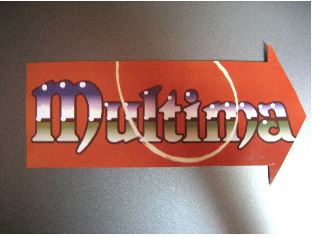
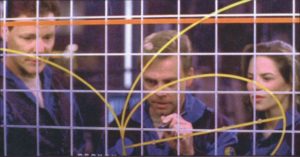
This sign, executed in throwback 1980s Ultima iconography, hung on the wall outside the elevator on the fifth floor of Origin Systems’s office building, pointing the way to the Multima team. If you neglected to follow the sign’s advice and turned left instead of right here, you would plunge five stories to your doom.

To carry our story forward into the next phase of persistent online multiplayer gaming, we first need to go backward again — all the way back to the days when tabletop Dungeons & Dragons was new on the scene and people were first beginning to imagine how computers might make it more accessible. Some dreamed of eliminating the pesky need for other humans to play with entirely; others wondered whether it might be possible to use networked computers in place of the tabletop, so that you could get together and play with your friends without all of the logistical complications of meeting up in person. Still others dreamed bigger, dreamed of things that would never be possible even with a tabletop big enough to make King Arthur blush. What if you could use computers to make a living virtual world with thousands of human inhabitants? In a column in a 1983 issue of Starlog magazine, Lenny Kaye mused about just such a thing.

When played among groups of people, [tabletop] RPGs foster a sense of cooperation toward a common goal, something videogames have hardly approached.

But with the computer’s aid, the idea of the game network can expand outward, interfacing with all sorts of societal drifts. The technology for both video[games] and RPGs is still in its infancy — one with graphics and memory far from ideal, the other still attached to its boards and figurines — and yet, it’s not hard to imagine a nationwide game, in which all citizens play their part. Perhaps it becomes an arena in which to exercise and exorcise ourselves, releasing our animal instincts through the power of the mind, understanding the uses and misuses of our humanity.

While they waited for the technology which could make that dream a reality to appear, people did what they could with what they had. The ones who came closest to the ideal of a “nationwide game” were those running MUDs, those “multi-user dungeons” that allowed up to 100 players to interact with one another by typing commands into a textual parser, with teletype-style streaming text as their eyes and ears into the world they all shared.

Island of Kesmai did soon come along on the big online service CompuServe, with an interface that looked more like Rogue than the original game of Adventure. But again, only 100 people could play together simultaneously there, about the same number as on the biggest MUDs. And in this case, each of them had to pay by the minute for the privilege. For all that it was amazing that it could exist at all in its time and place, Island of Kesmai was more like a wealthy gated village than a teeming virtual world.

Still, it must be acknowledged that the sellers of traditional boxed computer games were even farther away from that aspiration, being content to offer up single-player CRPGs where combat — that being the aspect of tabletop RPGs that was easiest to implement on a computer — tended to overwhelm everything else. The one obvious exception to this norm was Origin Systems of Austin, Texas. Especially after 1985’s landmark Ultima IV, Origin’s Ultima series became not only the commercial standard bearer for CRPGs but the best argument for the genre’s potential to be about something more than statistics and combat tactics. These games were rather about world-building and about the Virtues of the (player’s) Avatar, daring to introduce an ethical philosophy that was applicable to the real world — and then, in later installments, to muddy the waters by mercilessly probing the practical limitations and blind spots inherent in any such rigid ethical code.

Richard Garriott — “Lord British” to his legion of fans, the creator of Ultima and co-founder of Origin — had first conceived of the games as a re-creation of the tabletop Dungeons & Dragons sessions that had made him a minor celebrity in his Houston neighborhood well before he got his hands on his first Apple II. The setting of computerized Ultima was the world of Britannia, the same one he had invented for his high-school friends. The idea of adventuring together with others through the medium of the computer thus made a lot of sense to him. Throughout the 1980s and beyond, he repeatedly brought up the hypothetical game that he called Multima, a multiplayer version of Ultima. In 1987, an Origin programmer was actually assigned to work on it for a while. Garriott, from a contemporary interview:

James Van Artsdalen, who does our IBM and Macintosh translations, is working on a program that lets several people participate in the game. Two people can do this with different computers directly connected via modems, or even more can play via a system with multiple modems. We don’t know if we’ll be able to support packet networks like CompuServe because they may be too slow for this application. We’ll do it if we can.

What you’ll buy in the store will be a package containing all the core graphics routines and the game-development stuff (all the commands and so on), which you could even plug into your computer and play as a standalone. But with a modem you could tie a friend into the game, or up to somewhere between eight and sixteen other players, all within the same game.

We will most likely run a game of this out of our office. Basically, we can almost gamemaster it. There could be a similar setup in each town, and anybody could run one. Our intention is to let anyone capable of having multiple modems on their system have the network software. Anybody can be a node: two people can play if they each own a package, just by calling each other. But to be a base, a multiplayer node, you’ve got to have multiple modems and may need additional software. If the additional software is needed, we’ll let anyone who wants it have it, since we’re just supporting sales of our own products anyway.

Should be a lot of fun, we think. We hope to have it out by next summer [the summer of 1988], and it should cost between $30 and $60. This will be able to tie different kinds of computers together, since the information being sent back and forth doesn’t include any graphics. I could play on my Apple while you’re on your IBM, for instance. The graphics will be full state-of-the-art Ultima graphics, but they’ll already be on your computer.

Alas, this Multima was quietly abandoned soon after the interview, having been judged just too uncertain a project to invest significant resources into when there was guaranteed money to be made from each new single-player Ultima. As we’ll soon see, it was not the last time that argument was made against a Multima.

Circa 1990, Multima was revived for a time, this time as a three-way partnership among Origin, the commercial online service GEnie, and Kesmai, the maker of Island of Kesmai. The last would be given the source code to Ultima VI, the latest iteration of the single-player series, and would adapt it for online play, after which GEnie would deploy it on its central mainframe. As it happened, a similar deal was already taking SSI’s Gold Box engine for licensed Dungeons & Dragons CRPGs through the same process of transformation. It would result in something called Neverwinter Nights[1]Not the same game as the 2002 Bioware CRPG of the same name. going up on America Online in 1991 with an initial capacity of 100 simultaneous players, eventually to be raised by popular demand to 500, making it the most massively multiplayer online game of the early 1990s. But Multima was not so lucky; the deal fell through before it had gotten beyond the planning stages, perchance having proved a simple case of too many cooks in the kitchen.

Richard Garriott had largely ceased to involve himself in the day-to-day work of making new Ultima games by this point, but he continued to set the overall trajectory of the franchise. And as he did so, he never forgot those old hopes for a Multima. Not long after Electronic Arts (EA) purchased Origin Systems in 1992, he thought he saw the stars aligning at long last. For 1993 brought with it NCSA Mosaic, the first broadly popular multimedia Web browser, the harbinger of the home Internet boom. This newly accessible public Internet could replace fragile peer-to-peer modems connections as easily as it could the bespoke private networks of CompuServe and GEnie, making the likes of Multima seem far more practical, both to implement and to offer to customers at an affordable price.

Richard Garriott in 1995.

For better or for worse, though, Origin was now a part of EA, who had the final say on which projects got funded. Garriott tried repeatedly over a period of a year and a half or more to interest EA’s CEO Larry Probst in his Multima schemes, without success. As he tells the story, he and a couple of other true believers from Origin resorted to guerrilla tactics at the third formal pitch meeting.

We literally just refused to give up the floor. They said, “No. Get out.” And we stomped our feet and held our breath. “We are not leaving until you guys get a clue. As a developer, we go over-budget by 25 to 50 percent every year. We’re only asking for $250,000 to build a prototype.” I already had a piece of paper prepared: “You approve of us going $250,000 over-budget to prove that this can work.” And finally, after heated yelling and screaming, they signed the piece of paper and kicked us in the ass as we left the room.

It must be said here that Garriott is generally not one to let an overly fussy allegiance to pedantic truth get in the way of a good story. Thus I suspect that the decision to green-light a Multima prototype may not have been arrived at in quite so dramatic a fashion as the tale above. (Garriott has in fact told a number of versions of the story over the years; in another of them, he’s alone in Larry Probst’s office, hectoring him one-and-one into signing the note granting him $250,000 to investigate the possibility.) Most important for our purposes, however, is that the decision was definitely made by early 1995.

The answer to another question is even more murky: that of just when the change was made from an Ultima that you could play online with a few of your buddies — a feature that would be seen well before the end of the 1990s in a number of otherwise more conceptually conventional CRPGs, such as Diablo and Baldur’s Gate — to a persistent virtual Britannia inhabited by dozens, hundreds, or even thousands of other players. The acronym by which we refer to such worlds today would be coined by Richard Garriott in 1997: the “massively multiplayer online role-playing game,” or MMORPG. (And you thought POMG was a mouthful!) Yet it appears that Multima may not have become an MMORPG in the minds of its creators until after Garriott secured his funding, and that that hugely important conceptual shift may not have originated with Garriott himself. One alternative candidate is the man to whom Garriott turned to become the nuts-and-bolts administrator of the project: Starr Long, a quality-assurance lead who had been one of his few Multima allies inside the company for quite some time. (“The original idea,” Long said in a 1996 interview — i.e., close to the events in question — “was to take an Ultima and just make it so you could have a party of people travel together.”) A third candidate is Rick Delashmit, the first and for a long time the only programmer assigned to the project, who unlike Garriott and Long had deep connections to the MUD scene, gaming’s closest extant equivalent to what Multima would become. In fact, Delashmit had actually co-founded a MUD of his own: LegendMUD, which was still running on a single 80486-based personal computer humming away under a desk in an Austin data center.

Regardless of who decided to do what, Long and Delashmit soon had cause to wonder whether signing onto Multima had been their worst career move ever. “We were kind of the bastard stepchild,” Long says. “No one got it and no one was really interested, because everyone wanted to build the next [single-player] Ultima or Wing Commander. Those were the sexy projects.” They found themselves relegated to the fifth floor of Origin’s Austin, Texas, headquarters, jammed into one corner of a space that was mostly being leased out to an unaffiliated advertising agency.

Making the best of it, Long and Delashmit hacked together a sort of prototype of a prototype. Stealing a trick and possibly some code from the last attempt at a Multima, they started with the now-archaic Ultima VI engine. “All you could do was run around and pick up a single object off of the ground,” says Long. “And then if another player ran into you, you would drop it. We had a scavenger hunt, where we hid a few objects around the map and then let the whole company loose to find them. Whoever was still holding them after an hour won.”

It was a start, but it still left a million questions unanswered. A game like this one — or rather a virtual world — must have a fundamentally different structure than a single-player Ultima, even for that matter than the tabletop RPG sessions that had inspired Richard Garriott’s most famous creations. Those games had all been predicated on you — or at most on you and a few of your best mates — being the unchallenged heroes of the piece, the sun around which everything else orbited. But you couldn’t fill an entire world with such heroes; somebody had to accept supporting roles. Some might even have to play evil rather than virtuous characters, upending the core message of Ultima since Ultima IV.

Garriott, Long, and Delashmit weren’t the only ones pondering these questions. In a 1993 issue of Sierra On-Line’s newsletter InterAction, that company’s head Ken Williams — a man who bore some surface similarities to Garriott, being another industry old-timer who had given up the details of game development for the big-picture view by this point in his career — asked how massively multi-player adventuring could possibly be made to function. He had good reason to ask: his own company’s Sierra Network was doing pioneering work in multiplayer gaming at the time, albeit as a closed dial-up service rather than on the open Internet.

I think a multiplayer adventure game is the next major step. Imagine a version of Police Quest, looking like it does now, except that your partner in the patrol car and the people in the street around you are real people. I think this would be cool.

For three months, Roberta [Williams, Ken’s wife], Chris [Williams, the couple’s son], and I have been arguing over how this would work. The problem is that most adventure games have some central quest story. Generally speaking, once you’ve solved the quest the game is over. You are there as the central character, and all of the other characters are there primarily to help move you towards completing your quest (or to get in your way).

A multiplayer adventure game would be a completely different animal. If 500 people were playing multiplayer King’s Quest at the same time, would there have to be 500 separate quests? There are also problems having to do with the fact that people aren’t always connected to the network. If my goal is to save you from an evil wizard, what do I do if neither you nor the evil wizard happen to sign on?

Here’s the thoughts we’ve had so far. What if we create a world that just contains nothing but forest as far as you can see? When you enter the game, you can do things like explore, or even build yourself a house. There’ll be stores where you can buy supplies. Soon, cities will form. People may want to build walls around their cities. Cities may want to bargain with each other for food. Or, for protection against common enemies. There needs to be some sense of purpose to the game. What if, after some amount of time in the land, the game “promotes” you to some status where your goals become to create the problems which affect the city, such as plagues, war, rampaging dragons, etc. In other words, some of the players are solving quests while others are creating them. Sooner or later, it becomes your turn to complicate the lives of others.

Either this is a remarkable case of parallel invention or someone was whispering in Ken Williams’s ear about MUDs. For the last paragraph above is an uncannily accurate description of how many of the latter were run, right down to dedicated and accomplished players being elevated to “wizard” status, with powers over the very nature of the virtual world itself. The general MUD design philosophy, which had been thoroughly tested and proven solid over the years, held that the creators of multiplayer worlds didn’t have to worry overmuch about the stories and quests and goals that were needed for compelling single-player games. It was enough simply to put a bunch of people together in an environment that contained the raw building blocks of such things. They’d do the rest for themselves; they’d find their own ways to have fun.

In our next article, we’ll see what resulted from Ken Williams’s ideas about massively-multiplayer adventure. For now, though, let us return to our friends at Origin Systems and find out how they attempted to resolve the quandary of what people should actually be doing in their virtual world.


In the immediate aftermath of that first online scavenger hunt, nobody there knew precisely what they ought to do next. It was at this point that Rick Delashmit offered up the best idea anyone had yet had. Multima would share many commonalities with textual MUDs, he said. So why not hire some more folks who knew those virtual worlds really, really well to help the Origin folks make theirs? He had two friends in mind in particular: a young couple named Raph and Kristen Koster, who had taken over the running of LegendMUD after he had stepped down.

The Kosters were graduate students in Alabama, meaning that much of the negotiation had to be conducted by telephone and computer. Raph was finishing up his program in poetry at the University of Alabama, while Kristen studied economics — a perfect pair of perspectives from which to tackle the art and science of building a new virtual world, as it happened. Raph Koster:

We started to get interview questions remotely as they worked to figure out whether we were qualified. All of the questions came from what was very much a single-player slant. We were sent examples of code and asked if we could write code like that and find the bugs that had been intentionally inserted into the code. It was something like a misplaced closing brace.

Finally, we were asked for a sample quest. I sent them the entire code and text of my quest for the Beowulf zone in LegendMUD, but then also said, “But we wouldn’t do quests this way at all now.” Kristen and I had been working on a simulation system based on artificial life and economic theory. We basically sent in a description of our design work on that. It was a system that was supposed to simulate the behavior of creatures and NPCs [non-player characters] using a simplistic version of Maslow’s Hierarchy of Needs, with abstract properties behind everything.

The Kosters were hired already in the spring of 1995, but couldn’t start on a full-time basis until September 1. Over the course of several drives between Tuscaloosa and Austin and back in the interim, they hashed out their vision for Multima.

They wanted to lean heavily into simulation, trusting that, if they did it right, quests and all the rest would arise organically from the state of the world rather than needing to be hard-coded. Objects in the world would be bundles of abstract qualities which interacted with one another in pre-defined ways; take an object with the quality of “wood” and touch it to one with the quality of “fire,” and exactly what you expected to happen would occur. This reliance on qualities would make it quick and easy for people — designers or just ordinary players — to create new objects on the fly and have them act believably.

But the system could go much further. The non-player creatures which populated the world would have different sorts of qualities attached, derived, as Raph Koster notes above, from Maslow’s Hierarchy of Needs. Each creature would have its own types of Food and Shelter that it sought to attain and retain, alongside a more elevated set of Desires to pursue and Aversions to avoid once it had served for its most basic needs.

An early preview of the game, written by Paul Schuytema for Computer Gaming World magazine, describes how the system would ideally work in action, how it would obviate the need for a human designer to generate thousands of set-piece quests to keep players busy.

Designing a dynamic world is a tricky business. How do you create enough quests to interest 2000 people? Origin’s solution: don’t. Create a world with enough logical conditions that it will generate its own quests. For example, consider a cave in the virtual world. Any self-respecting cave needs a monster, so you assign the cave a “need for monster” request of the game-world engine. Poof! A monster, let’s say a dragon, is then spontaneously created in the cave. Dragons are big eaters, so the dragon sends out a “need for meat” request. Meat, in the form of deer, roams the forest outside the cave, so the dragon’s life consists of leaving the cave to consume deer. If something happens that lowers the deer population (bad weather, over-hunting, or a game administrator strategically killing off deer), the dragon will have to widen its search for meat, which might lead it to the sheep pastures outside town.

At this point, NPCs can be useful to tell real players about a ravenous dragon roaming the countryside. NPCs can also sweeten the pot by offering rewards to anyone who can slay it. But what are they going to say?

“All of the [NPCs’] conversations come from a dynamic conversation pool which is linked to the world state,” explains Long. This means that if you, as a player, were to walk into this town, any one of the villagers will say something like, “Hey, we need your help. This dragon is eating all our sheep.” Thus, the “Kill the Dragon” quest is underway — succeed, and the villagers will handsomely reward you.

If you put it all together correctly, you would end up with a living world, to an extent that even the most ambitious textual MUDs had barely approached to that point. Everything that was needed to make it a game as well as a virtual space would come about of its own accord once you let real humans start to run around in it and interfere with the lives of the algorithmically guided dragons and guards and shopkeepers. It would be all the more fun for being true to itself, a complex dynamic system responding to itself as well as to thousands of human inputs that were all happening at once, a far cry from the typical single-player Ultima where nothing much happened unless you made it happen. Incidentally but not insignificantly, it would also be a sociologist’s dream, a fascinating study in mass human psychology, perhaps even a laboratory for insights into the evolution of real-world human civilizations.

When they arrived for their first day on the job, the Kosters were rather shocked to find that their new colleagues had already begun to implement the concepts which the couple had informally shared with them during the interview process and afterward. It was disconcerting on the one hand — “It freaked us out because we had assumed there was already a game design,” says Raph — but bracing on the other. This pair of unproven industry neophytes, with little on their résumés in games beyond hobbyist experimentation in the obscure culture of MUDs, was in a position to decide exactly what Multima would become. It would take a year or more for Raph Koster to be given the official title of “Creative Lead”; when he arrived, that title belonged to one Andrew Morris, a veteran of Ultima VII and VIII who had recently been transferred to the project, where he would struggle, like so many others at Origin, to wrap his head around the paradigm shift from single-player to multiplayer gaming. But for all intents and purposes, Raph and Kristen Koster filled that role from the start. Each was paid $25,000 per year for building this brave new world. They wouldn’t have traded it for a job that paid ten times the salary. At their urging, Origin hired several other MUDders to work with them on what was now to be called Ultima On-Line; the game would soon loose the hyphen to arrive at its final name.

I can’t emphasize enough what a leap into uncharted territory this was for Origin, as indeed it would have been for any other games studio of the time. To put matters in perspective, consider that Origin began working on Ultima Online before it even had a static website up on the Internet. The company had always been in the business of making packaged goods, games on disc that were sold once for a one-time price. Barring a patch or two in the worst cases, these games’ developers could wash their hands of them and move on once they were finished. But Ultima Online was to be something entirely different, a “game” — if that word even still applied — that was run as a service. How should people pay for the privilege of playing it? (Origin had no experience with billing its customers monthly.) And how much should they pay? (While everyone on the team could agree that Ultima Online needed to be appreciably cheaper than the games on CompuServe and its ilk, no one could say for sure where the sweet spot lay.) In short, the practical logistics of Ultima Online would have been a major challenge even if the core team of less than a dozen mostly green youngsters — median age about 22 — hadn’t also been trying to create a new world out of whole cloth, with only partially applicable precedents.

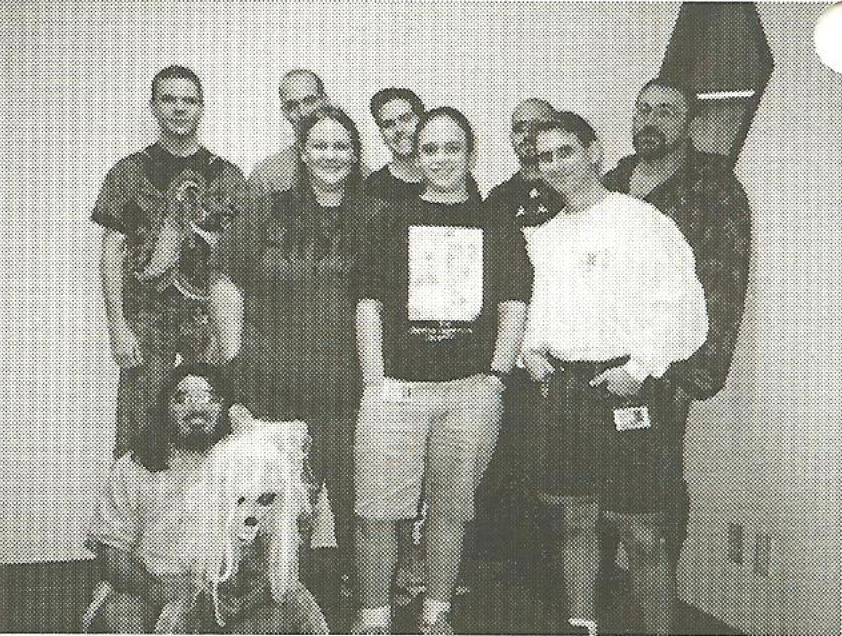
The early Multima team, or the “MUDders of Invention,” as they sometimes liked to call themselves. Clockwise from top left: Rick Delashmit, Edmond Mainfelder, Clay Hoffman, Starr Long, Micael Priest, Andrew Morris, Scott Phillips, Kristen Koster, and Raph Koster.

When the advertising agency that had been the team’s neighbor moved out, Origin decided to gut the now almost empty fifth floor where the latter was still ensconced. “They literally knocked out all the walls and the windows,” says Raph Koster. “So, the elevator surfaced to bare concrete. If you turned right, you went to see our team in a converted hallway, the only part left standing. If you turned left, you fell five floors to your death.” It was freezing cold up there in the winter, and the dust was thick in the air all year round, such that they learned to wrap their computers in plastic when they left for the day. “This team was given the least possible support you can imagine,” says Richard Garriott.

Undaunted, the little group did what the best game developers have always done when cast onto uncharted waters: they made something to start with, then tested it, then iterated, then tested some more, ad nauseum. Garriott came by “once a month or so,” in the recollection of Raph Koster, to observe and comment on their progress. Otherwise, their ostensible colleagues at Origin seemed hardly to know that they existed. “We were punk kids doing stuff in the attic,” says Raph, “and our parents had no idea what we were up to.”

In January of 1996, they put a message up on the Origin Systems website (yes, one had been built by this point): “Ultima Online (working title, subject to change) is now taking applications from people interested in play-testing a pre-alpha version, starting on March 1, 1996.” Almost 1500 people asked to take part in a test which only had space for a few dozen.

The test began a month behind schedule, but it proved that the core technology could work when it was finally run from April 1 until April 8. “This will be damn awesome when it comes!” enthused one breathless participant over chat. Richard Garriott thrilled the group by appearing in the world as his alter ego one evening. “We ran into LB! The REAL THING!” crowed a starstruck tester. “So what? I went adventuring with him to kill monsters!” scoffed another.

A more ambitious alpha test began about a month later, with participants logging in from as far away as Brazil and Taiwan. The developers waited with bated breath to see what they would do in this latest, far more feature-complete version of the virtual world. What they actually did do was an eye-opener, an early warning about some of the problems that would continue to dog the game and eventually, in the estimation of Raph Koster, cost it half its user base. Koster:

On the very first day of the alpha, players appeared in the tavern in Britain [the capital city of Ultima’s world of Britannia]. They waited for other newbies to walk out the doors, then they stood at the windows and shot arrows at them until they died. The newbies couldn’t shoot back because the archers were hidden behind the wall inside the building. This is, of course, exactly what archery slits were invented for, but it made for a truly lousy first impression of the game.

That was the first time that players took something inherent in the simulation and turned it against their fellow players. Not long after, someone spelled out “fuck” on the main bridge into Britain using fish. Not long after that, players figured out that explosive potions detonated other potions. It was illegal to kill someone in town; it would get you instantly killed by the guards. But if you ran a chain of potions a long distance, like a fuse, you could avoid that.

Chalk it up as another lesson, one to which the team perhaps should have paid more attention. The hope was always that the community would learn to police itself much like those of the real world, that the risks and the stigma of being a troublemaker would come to outweigh the gains and the jollies for all but the most hardened members of the criminal element. Richard Garriott seems to have been in an unusually candid mood when he expressed the hope in a contemporary interview:

One of the unfortunate side effects of computer gaming is that we have a whole generation of kids who have no social graces whatsoever. And this is exemplified in my mind by how much I hate going online for discussions I am invited to do once a month or so. And I truly abhor going to do that for a variety of reasons, one because it’s such a slow experience, but also because everyone has a level of anonymity behind their online persona, [and] they lose their normal and proper etiquette. So you have people screaming over each other to get their questions in, people screaming expletives, people popping in a chat room and making some dumb comment and then popping out again — the kind of behavior that you would never get away with in the real world. So one of the things that I’m really keen to introduce with Ultima Online is making people responsible for their actions, and this will happen as people are recognized by their online persona within the game. They won’t be so anonymous anymore.

This hope would be imperfectly realized at best. “I used to think that you could reform bad apples and argue with hard cases,” says an older and presumably wiser Raph Koster. “I’m more cynical these days.”

So, the alpha testers ran around breaking stuff and making stuff, while the gods of the new fantasy world watched closely from their perch on a gutted floor of an anonymous-looking office building in flesh-and-blood late-twentieth-century Texas to see what it was they had wrought. A bug in the game caused killed characters to respawn naked. (No, not even these simulation-committed developers were cruel enough to make death permanent…) Some players decided they liked it that way, leading to much of Britannia looking like a nudist colony. The guards in the cities had to be instructed to crack down on these victimless criminals as well as thieves and murderers.

But the most important finding was that most of the players loved it. All of it. “We had people who literally did not log off for a week,” says Starr Long. “Groups of players formed tribes, and at the end of the test there was a huge battle between the two largest tribes. None of that we set up. We gave them the world to play in, and human nature took over.” From one of the first substantial previews of the work-in-progress, published in Next Generation magazine:

In a very real sense, the world is what you make of it. One of the more interesting results of Ultima’s alpha testing is that when you have several hundred people in one place at one time, they tend to form their own micro-societies. There are already some two dozen player-created “guilds.” For example, when Richard Garriott signed on as his alter-ego Lord British, two groups sprang up: the Dragon Liberation Front, which pledged itself to destroying him, and the aptly named Protectors of Virtue & Lord British. Threats were made, battles were joined, and a fine time was had by all.

Just as gratifyingly, reports of the alpha test, in the form of previews like the above in many of the glossy gaming magazines, were received very positively by ordinary gamers who hadn’t known that a massively multiplayer Ultima was in the offing prior to this point. Some went so far as to form and run guilds through email, so that they would be ready to go when the day came that they could actually log in. There was still much work to be done before Ultima Online would be ready to welcome the unwashed masses inside, but the MUDders who were making it believed that all of the arrows were pointing in the right direction.

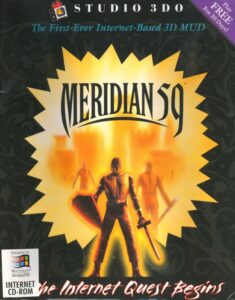
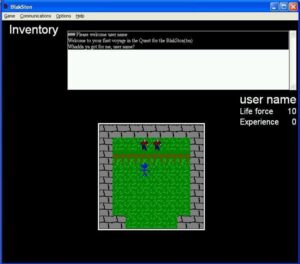
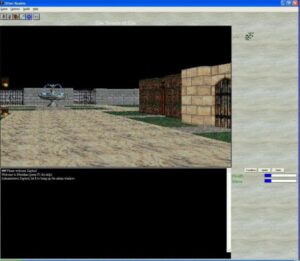
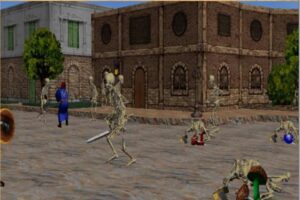
Until, that is, September 27, 1996, when it suddenly seemed that its thunder might have been well and truly stolen. On that date, The 3DO Company published something called Meridian 59, which purported to already be what Ultima Online intended to be: a massively-multiplayer persistent virtual fantasy world. Its box copy trumpeted that hundreds of people would be able to adventure together at the same time, killing monsters and occasionally each other, whilst also chatting and socializing. It sounded great — or terrible, if you happened to be working on Ultima Online.


Did you enjoy this article? If so, please think about pitching in to help me make many more like it. You can pledge any amount you like.


Sources: the books Braving Britannia: Tales of Life, Love, and Adventure in Ultima Online by Wes Locher, Postmortems: Selected Essays, Volume One by Raph Koster, Online Game Pioneers at Work by Morgan Ramsay, Through the Moongate, Part II by Andrea Contato, Explore/Create by Richard Garriott, and MMOs from the Inside Out by Richard Bartle; Questbusters of July 1987; Sierra’s customer newsletter InterAction of Summer 1993; Computer Gaming World of October 1995 and October 1996; Starlog of December 1983; PC Powerplay of November 1996; Next Generation of June 1996, September 1996, and March 1997; Origin’s internal newsletter Point of Origin of November 3 1995, January 12 1996, and April 5 1996.

Web sources include a 2018 Game Developers Conference talk by some of the Ultima Online principals, an Ultima Online timeline at UOGuide, and some details about LegendMUD, the winner of MUD Connector‘s coveted “MUD of the Month” prize for October 1995.

Footnotes

Footnotes
1 Not the same game as the 2002 Bioware CRPG of the same name.


Tags: , , , , , ,

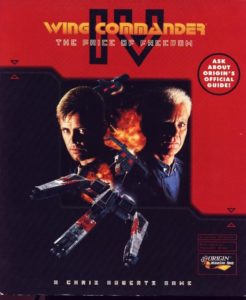
Wing Commander IV

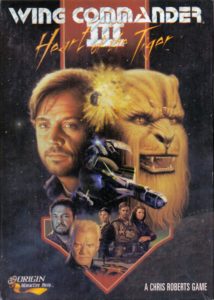
It’s tough to put a neat label on Wing Commander IV: The Price of Freedom. On the one hand, it was a colossally ambitious and expensive project — in fact, the first computer game in history with a budget exceeding $10 million. On the other, it was a somewhat rushed, workmanlike game, developed in half the time of Wing Commander III using the same engine and tools. That these two things can simultaneously be true is down to the strange economics of mid-1990s interactive movies.


Origin Systems and Chris Roberts, the Wing Commander franchise’s development studio and mastermind respectively, wasted very little time embarking on the fourth numbered game in the series after finishing up the third one in the fall of 1994. Within two weeks, Roberts was hard at work on his next story outline. Not long after the holiday season was over and it was clear that Wing Commander III had done very well indeed for itself, his managers gave him the green light to start production in earnest, on a scale of which even a dreamer like him could hardly have imagined a few years earlier.

Like its predecessor, Wing Commander IV was destined to be an oddly bifurcated project. The “game” part of the game — the missions you actually fly from the cockpit of a spaceborne fighter — was to be created in Origin’s Austin, Texas, offices by a self-contained and largely self-sufficient team of programmers and mission designers, using the existing flight engine with only modest tweaks, without a great deal of day-to-day communication with Roberts himself. Meanwhile the latter would spend the bulk of 1995 in Southern California, continuing his career as Hollywood’s most unlikely and under-qualified movie director, shooting a script created by Frank DePalma and Terry Borst from his own story outline. It was this endeavor that absorbed the vast majority of a vastly increased budget.

For there were two big, expensive changes on this side of the house. One was a shift away from the green-screen approach of filming real actors on empty sound stages, with the scenery painted in during post-production by pixel artists; instead Origin had its Hollywood partners Crocodille Productions build traditional sets, no fewer than 37 of them in all. The other was the decision to abandon videotape in favor of 35-millimeter stock, the same medium on which feature films were shot. This was a dubiously defensible decision on practical grounds, what with the sharply limited size and resolution of the computer-monitor screens on which Roberts’s movie would be seen, but it says much about where the young would-be auteur’s inspirations and aspirations lay. “My goal is to bring the superior production values of Hollywood movies to the interactive realm,” he said in an interview. Origin would wind up paying Crocodile $7.7 million in all in the pursuit of that lofty goal.

The hall of the Terran Assembly was one of the more elaborate of the Wing Commander IV sets, showing how far the series had come but also in a way how far it still had to go, what with its distinctly plastic, stage-like appearance. It will be seen on film in a clip later on in this article.

These changes served only to distance the movie part of Wing Commander from the game part that much more; now the folks in Austin didn’t even have to paint backgrounds for Roberts’s film shoot. More than ever, the two halves of the whole were water and oil rather than water and wine. All told, it’s doubtful whether the flying-and-shooting part of Wing Commander IV absorbed much more than 10 percent of the total budget.

Origin was able to hire most of the featured actors from last time out to return for Wing Commander IV. Once again, Mark Hamill, one of the most sensible people in Hollywood, agreed to head up the cast as Colonel Blair, the protagonist and the player’s avatar, for a salary of $419,100 for the 43-day shoot. (“A lot of actors spend their whole lives wanting to be known as anything,” he said when delicately asked if he ever dwelt upon his gradual, decade-long slide down through the ranks of the acting profession, from starring as Luke Skywalker in the Star Wars blockbusters to starring in videogames. “I always thought I should be happy for what I have instead of being unhappy for what I don’t have. So, you know, if things are going alright with your family… I don’t know, not really. I think it’s good.”) Likewise, Tom Wilson ($117,300) returned to play Blair’s fellow pilot and frenemy Maniac; Malcolm McDowell ($285,500) again played the stiffly starched Admiral Tolwyn; and John Rhys-Davies ($52,100) came back as the fighter jock turned statesman Paladin. After the rest of the cast and incidental expenses were factored in, the total bill for the actors came to just under $1.4 million.

Far from being taken aback by the numbers involved, Origin made them a point of pride. If anything, it inflated them; the total development cost of $12 million which was given to magazines like Computer Gaming World over the course of one of the most extensive pre-release hype campaigns the industry had ever seen would appear to be a million or two over the real figure, based on what I’ve been able to glean from the company’s internal budgeting documents. Intentionally or not, the new game’s subtitle made the journalists’ headlines almost too easy to write: clearly, the true “price of freedom” was $12 million. The award for the most impassioned preview must go to the British edition of PC Gamer, which proclaimed that the game’s eventual release would be “one of the most important events of the twentieth century.” On an only slightly more subdued note, Computer Gaming World noted that “if Wing Commander III was like Hollywood, this game is Hollywood.” The mainstream media got in on the excitement as well: CNN ran a segment on the work in progress, Newsweek wrote it up, and Daily Variety was correct in calling it “the most expensive CD-ROM production ever” — never mind a million or two here or there. Mark Hamill and Malcolm McDowell earned some more money by traveling the morning-radio and local-television circuit in the final weeks before the big release.


Wing Commander IV was advertised on television at a time when that was still a rarity for computer games. The advertisements blatantly spoiled what was intended to be a major revelation about the real villain of the story. (You have been warned!)


The game was launched on February 8, 1996, in a gala affair at the Beverly Hills Planet Hollywood, with most of the important cast members in attendance to donate their costumes — “the first memorabilia from a CD-ROM game to be donated to the internationally famous restaurant,” as Origin announced proudly. (The restaurant itself appears to have been less enthused; the costumes were never put on display after the party, and seem to be lost now.) The assembled press included representatives of CNN, The Today Show, HBO, Delta Airlines’s in-flight magazine, and the Associated Press among others. In the weeks that followed, Chris Roberts and Mark Hamill did a box-signing tour in conjunction with Incredible Universe, a major big-box electronics chain of the time.

Tom Wilson, Malcolm McDowell, and Mark Hamill at the launch party.

The early reviews were positive, and not just those in the nerdy media. “The game skillfully integrates live-action video with computer-generated graphics and sophisticated gameplay. Has saving the universe ever been this much fun?” asked Newsweek, presumably rhetorically. Entertainment Weekly called Wing Commander IV “a movie game that takes CD-ROM warfare into the next generation,” giving it an A- on its final report card. The Salt Lake City Tribune said that it had “a cast that would make any TV-movie director jealous — and more than a few feature-film directors as well. While many games tout themselves as interactive movies, Wing Commander IV is truly deserving of the title — a pure joy to watch and play.” The Detroit Free Press said that “at times, it was like watching an episode of a science-fiction show.”

The organs of hardcore gaming were equally fulsome. Australia’s Hyper magazine lived up to its name (Hyperventilate? Hyperbole?) with the epistemologically questionable assertion that “if you don’t play this then you really don’t own a computer.” Computer Gaming World, still the United States’s journal of record, was almost as effusive, writing that “as good as the previous installment was, it served only as a rough prototype for the polished chrome that adorns Wing Commander IV. This truly is the vanguard of the next generation of electronic entertainment.”

Surprisingly, it was left to PC Gamer, the number-two periodical in the American market, normally more rather than less hype-prone than its older and somewhat stodgier competitor, to inject a note of caution into the critical discourse, by acknowledging how borderline absurd it was on the face of it to release a game in which 90 percent of the budget had gone into the cut scenes.

How you feel about Wing Commander IV: The Price of Freedom is going to depend a lot on how you felt about Wing Commander III and the direction the series seems to be headed in.

When the original Wing Commander came out, it was a series of incredible, state-of-the-art space-combat sequences, tied together with occasional animated cut scenes. Today, Wing Commander IV seems more like a series of incredible, full-motion-video cut scenes tied together with occasional space-combat sequences. You can see the shift away from gameplay and toward multimedia flash in one of the ads for Wing Commander IV; seven of the eight little “bullet points” that list the game’s impressive new features are devoted to improvements in the quality of the video. Only the last point says anything about actual gameplay. If the tail’s not wagging the dog yet, it’s getting close.

For all its cosmetic improvements, Wing Commander IV feels just a little hollow. I can’t help thinking about what the fourth Wing Commander game might be like if the series had moved in the opposite direction, making huge improvements in the actual gameplay, rather than spending more and more time and effort on the stuff in between.

Still, these concerns were only raised parenthetically; even PC Gamer‘s reviewer saw fit to give the game a rating of 90 percent after unfurrowing his brow.


Today, however, the imbalance described above has become even more difficult to overlook, and seems even more absurd. As my regular readers know, narrative-oriented games are the ones I tend to be most passionate about; I’m the farthest thing from a Chris Crawford, insisting that the inclusion of any set-piece story line is a betrayal of interactive entertainment’s potential. My academic background is largely in literary studies, which perhaps explains why I tend to want to read games like others do books. And yet, with all that said, I also recognize that a game needs to give its player something interesting to do.

I’m reminded of an anecdote from Steve Diggle, a guitarist for the 1970s punk band Buzzcocks. He tells of seeing the keyboardist for the progressive-rock band Yes performing with “a telephone exchange of electronic things that nobody could afford or relate to. At the end, he brought an alpine horn out — because he was Swiss. It was a long way from Little Richard. I thought, ‘Something’s got to change.'” There’s some of the same quality to Wing Commander IV. Matters have gone so far out on a limb that one begins to suspect the only thing left to be done is just to burn it all down and start over.

But we do strive to be fair around here, so let’s try to evaluate the movie and the game of Wing Commander IV on their own merits before we address their imperfect union.

Chris Roberts is not a subtle storyteller; his influences are always close to the surface. The first three Wing Commander games were essentially a retelling of World War II in the Pacific, with the Terran Confederation for which Blair flies in the role of the United States and its allies and the evil feline Kilrathi in that of Japan. Now, with the alien space cats defeated once and for all, Roberts has moved on to the murkier ethical terrain of the Cold War, where battles are fought in the shadows and friend and foe are not so easy to distinguish. Instead of being lauded like the returning Greatest Generation were in the United States after World War II, Blair and his comrades who fought the good fight against the Kilrathi are treated more like the soldiers who came back from Vietnam. We learn that we’ve gone from rah-rah patriotism to something else the very first time we see Blair, when he meets a down-on-his-luck fellow veteran in a bar and can, at you the player’s discretion, give him a few coins to help him out. Shades of gray are not really Roberts’s forte; earnest guy that he is, he prefers the primary-color emotions. Still, he’s staked out his dramatic territory and now we have to go with it.

Having been relegated to the reserves after the end of the war with the Kilrathi, Blair has lately been running a planetside farm, but he’s called back to active duty to deal with a new problem on the frontiers of the Terran Confederation: a series of pirate raids in the region of the Border Worlds, a group of planets that is allied with the Confederation but has always preferred not to join it formally. Because the attacks are all against Confederation vessels rather than those of the Border Worlds, it is assumed that the free-spirited inhabitants of the latter are behind them. I trust that it won’t be too much a spoiler if I reveal here that the reality is far more sinister.

By all means, we should give props to Roberts for not just finding some way to bring the Kilrathi back as humanity’s existential threat. They are still around, and even make an appearance in Wing Commander IV, but they’ve seen the error of their ways with Confederation guidance and are busily rebuilding their society on more peaceful lines. (The parallels with World War II-era — and now postwar — Japan, in other words, still hold true.)

For all the improved production values, the Kilrathi in Wing Commander IV still look as ridiculous as ever, more cuddly than threatening.

The returns from Origin’s $9 million investment in the movie are front and center. An advantage of working with real sets instead of green screens is the way that the camera is suddenly allowed to move, making the end result look less like something filmed during the very earliest days of cinema and more like a product of the post-Citizen Kane era. One of the very first scenes is arguably the most impressive of them all. The camera starts on the ceiling of a meeting hall, looking directly down at the assembled dignitaries, then slowly sweeps to ground level, shifting as it moves from a vertical to a horizontal orientation. I’d set this scene up beside the opening of Activision’s Spycraft — released at almost the same time as Wing Commander IV, as it happens — as the most sophisticated that this generation of interactive movies ever got by the purely technical standards of film-making. (I do suspect that Wing Commander IV‘s relative adroitness is not so much down to Chris Roberts as to its cinematographer, a 21-year Hollywood veteran named Eric Goldstein.)


The acting, by contrast, is on about the same level as Wing Commander III: professional if not quite passionate. Mark Hamill’s dour performance is actually among the least engaging. (This is made doubly odd by the fact that he had recently been reinventing himself as a voice actor, through a series of portrayals — including a memorable one in the game Gabriel Knight: Sins of the Fathers — that are as giddy and uninhibited as his Colonel Blair isn’t.) On the other hand, it’s a pleasure to hear Malcolm McDowell and John Rhys-Davies deploy their dulcet Shakespearian-trained voices on even pedestrian (at best) dialog like this. But the happiest member of the cast must be Tom Wilson, whose agent’s phone hadn’t exactly been ringing off the hook in recent years; his traditional-cinema career had peaked with his role as the cretinous villain Biff in the Back to the Future films. Here he takes on the similarly over-the-top role of Maniac, a character who had become a surprise hit with the fans in Wing Commander III, and sees his screen time increased considerably in the fourth game as a result. As comic-relief sidekicks go, he’s no Sancho Panza, but he does provide a welcome respite from Blair’s always prattling on, a little listlessly and sleepy-eyed at times, about duty and honor and what hell war is (such hell that Chris Roberts can’t stop making games about it).

That said, the best humor in Wing Commander IV is of the unintentional kind. There’s a sort of Uncanny Valley in the midst of this business of interactive movies, as there is in so many creative fields. When the term was applied to games that merely took some inspiration from cinema, perhaps with a few (bad) actors mouthing some lines in front of green screens, it was easier to accept fairly uncritically. But the closer games like this one come to being real movies, the more their remaining shortcomings seem to stand out, and, paradoxically, the farther from their goal they seem to be. The reality is that 37 sets isn’t many by Hollywood standards — and most of these are cheap, sparse, painfully plastic-looking sets at that. Like in those old 1960s episodes of Star Trek, everybody onscreen visibly jumps — not in any particular unison, mind you — when the camera shakes to indicate an explosion and the party-supply-store smoke machines start up. The ray guns they shoot each other with look like gaudy plastic toys that Wal Mart would be ashamed to stock, while the accompanying sound effects would have been rejected as too cheesy by half by the producers of Battlestar Galactica.

All of this is understandable, even forgivable. A shooting budget of $9 million may have been enormous in game terms, but it was nothing by the standards of a Hollywood popcorn flick. (The 1996 film Star Trek: First Contact, for example, had five times the budget of Wing Commander IV, and it was not even an especially expensive example of its breed.) In the long run, interactive movies would find their Uncanny Valley impossible to bridge. Those who made them believed that they were uniquely capable of attracting a wider, more diverse audience than the people who typically played games in the mid-1990s. That proposition may have been debatable, but we’ll take it at face value. The problem was that, in order to attract these folks, they had to look like more than C-movies with aspirations of reaching B status. And the games industry’s current revenues simply didn’t give them any way to get from here to there. Wing Commander IV is a prime case in point: the most expensive game ever made still looked like a cheap joke by Hollywood standards.

The spaceships of the far future are controlled by a plastic steering wheel that looks like something you’d find hanging off of a Nintendo console. Pity the poor crew member whose only purpose in life seems to be to standing there holding on to it and fending off the advances of Major Todd “Maniac” “Sexual Harassment is Hilarious!” Marshall.

Other failings of Wing Commander IV, however, are less understandable and perchance less forgivable. It’s sometimes hard to believe that this script was the product of professional screenwriters, given the quantity of dialog which seems lifted from a Saturday Night Live sketch, which often had my wife and I rolling on the floor when we played the game together recently. (Or rather, when I played and she watched and laughed.) “Just because we operate in the void of space, is loyalty equally weightless?” Malcolm McDowell somehow manages to intone in that gorgeously honed accent of his without smirking. A young woman mourning the loss of her beau — as soon as you saw that these two had a thing going, you knew he was doomed, by the timeless logic of war movies — chooses the wrong horse as her metaphor and then just keeps on riding it out into the rhetorical sagebrush: “He’s out there along with my heart. Both no more than space dust. People fly through him every day and don’t even know it.”

Then there’s the way that everyone, excepting only Blair, is constantly referred to only by his or her call sign. This doesn’t do much to enhance the stateliness of a formal military funeral: “Some may think that Catscratch will be forgotten. They’re wrong. He’ll stay in our hearts always.” There’s the way that all of the men are constantly saluting each other at random moments, as if they’re channeling all of the feelings they don’t know how to express into that act — saluting to keep from crying, saluting as a way to avoid saying, “I love you, man!,” saluting whenever the screenwriters don’t know what the hell else to have them do. (Of course, they all do it so sloppily that anyone who really was in the military will be itching to jump through the monitor and smack them into shape.) And then there’s the ranks and titles, which sound like something children on a playground — or perhaps (ahem!) someone else? — came up with: Admiral Tolwyn gets promoted to “Space Marshal,” for Pete’s sake.

I do feel just a little bad to make fun of all this so much because Chris Roberts’s heart is clearly in the right place. At a time when an increasing number of games were appealing only to the worst sides of their players, Wing Commander IV at least gave lip service to the ties that bind, the things we owe to one another. It’s not precisely wrong in anything it says, even if it does become a bit one-note in that tedious John Wayne kind of way. Deep into the game, you discover that the sinister conspiracy you’ve been pursuing involves a new spin on the loathsome old arguments of eugenics, those beliefs that some of us have better genes than others and are thus more useful, valuable human beings, entitled to things that their inferior counterparts are not. Wing Commander IV knows precisely where it stands on this issue — on the right side. But boy, can its delivery be clumsy. And its handling of a more complex social issue like the plight of war veterans trying to integrate back into civilian society is about as nuanced as the old episodes of Magnum, P.I. that probably inspired it.

But betwixt and between all of the speechifying and saluting, there is still a game to play, consisting of about 25 to 30 missions worth of space-combat action, depending on the choices you make from the interactive movie’s occasional menus and how well you fly the missions themselves. The unsung hero of Wing Commander IV must surely be one Anthony Morone, who bore the thankless title of “Game Director,” meaning that he was the one who oversaw the creation of the far less glamorous game part of the game back in Austin while Chris Roberts was off in Hollywood shooting his movie. He did what he could with the limited time and resources at his disposal.

I noted above how the very way that this fourth game was made tended to pull the two halves of its personality even farther apart. That’s true on one level, but it’s also true that Morone made some not entirely unsuccessful efforts to push back against that centrifugal drift. Some of the storytelling now happens inside the missions themselves — something Wing Commander II, the first heavily plot-based entry in the series, did notably well, only to have Wing Commander III forget about it almost completely. Now, though, it’s back, such that your actions during the missions have a much greater impact on the direction of the movie. For example, at one point you’re sent to intercept some Confederation personnel who have apparently turned traitor. In the course of this mission, you learn what their real motivations are, and, if you think they’re good ones, you can change sides and become their escort rather than their attacker.

Indeed, there are quite a few possible paths through the story line and a handful of different endings, based on both the choices you take from those menus that pop up from time to time during the movie portions and your actions in the heat of battle. In this respect too, Wing Commander IV is more ambitious and more sophisticated than Wing Commander III.

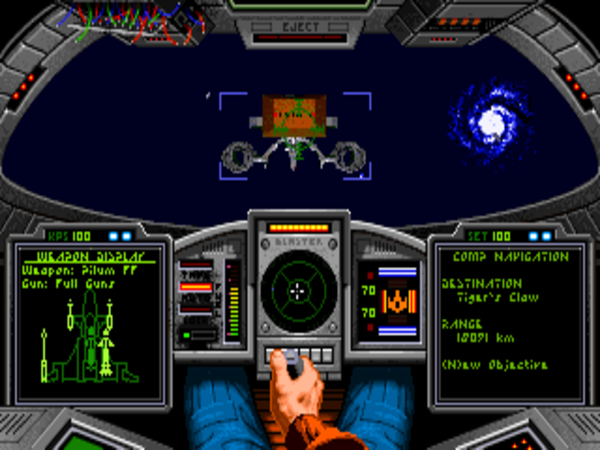
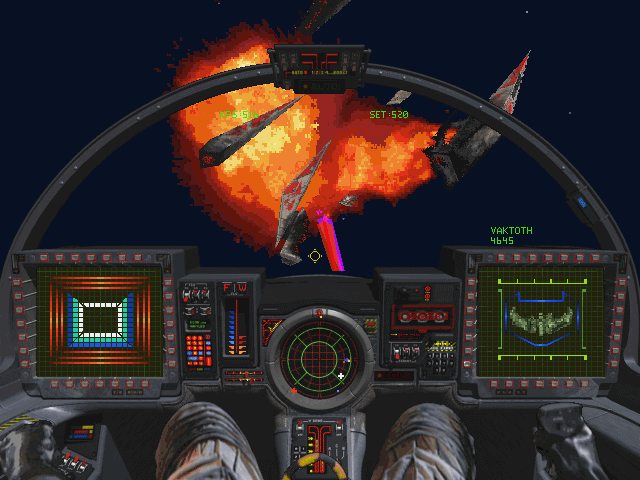
A change in Wing Commander IV that feels very symbolic is the removal of any cockpit graphics. In the first game, seeing your pilot avatar manipulate the controls and seeing evidence of damage in your physical surroundings was extraordinarily verisimilitudious. Now, all that has been discarded without a second thought by a game with other priorities.

But it is enough? It’s hard to escape a creeping sense of ennui as you play this game. The flight engine and mission design still lag well behind LucasArts’s 1994 release TIE Fighter, a game that has aged much better than this one in all of its particulars. Roughly two out of every three missions here still don’t have much to do with the plot and aren’t much more than the usual “fly between these way points and shoot whatever you find there” — a product of the need to turn Roberts’s movie into a game that lasts longer than a few hours, in order to be sure that players feel like they have gotten their $50 worth. Worse, the missions are poorly balanced, being much more difficult than those in the previous game; enemy missiles are brutally overpowered, being now virtually guaranteed to kill you with one hit. The sharply increased difficulty feels more accidental than intentional, a product of the compressed development schedule and a resultant lack of play-testing. However it came about, it pulls directly against Origin’s urgent need to attract more — read, more casual — gamers to the series in order to justify its escalating budgets. Here as in so many other places in this game, the left hand didn’t know what the right hand was doing, to the detriment of both.

In the end, then, neither the movie nor the game of Wing Commander IV can fully stand up on its own, and in combination they tend to clash more than they create any scintillating synergy. One senses when playing through the complete package that Origin’s explorations in this direction have indeed reached a sort of natural limit akin to that alpine-horn-playing keyboard player, that the only thing left to do now is to back up and try something else.


The magazines may have been carried away by the hype around Wing Commander IV, but not all ordinary gamers were. For example, one by the name of Robert Fletcher sent Origin the following letter:

I have noticed that the game design used by Origin has stayed basically the same. Wing Commander IV is a good example of a game design that has shown little growth. If one were to strip away the film clips, there would be a bare-bones game. The game would look and play like a game from the early 1980s. A very simple branching story line, with a little arcade action.

With all the muscle and talent at Origin’s command, it makes me wonder if Origin is really trying to push the frontier of game design. I know a little of what it takes to develop a game, from all the articles I have read (and I have read many). Many writers and developers are calling for their peers to get back to pushing the frontier of game design, over the development of better graphics.

Wing Commander IV has the best graphics I have seen, and it will be a while before anyone will match this work of art. But as a game, Wing Commander IV makes a better movie.

In its April 1996 issue — notice that date! — Computer Gaming World published an alleged preview of Origin’s plans for Wing Commander V. Silly though the article is, it says something about the reputation that Chris Roberts and his franchise were garnering among gamers like our Mr. Fletcher for pushing the envelope of money and technology past the boundaries of common sense, traveling far out on a limb that was in serious danger of being cut off behind them.

With Wing Commander IV barely a month old, Origin has already announced incredible plans for the next game in the highly successful series. In another first for a computer-game company, Origin says it will design small working models of highly maneuverable drones which can be launched into space, piloted remotely, and filmed. The craft will enable Wing V to have “unprecedented spaceflight realism and true ‘star appeal,'” said a company spokesman.

Although the next game in the science-fiction series sounds more like fiction than science, Origin’s Chris Roberts says it’s the next logical step for his six-year-old creation. “If you think about it,” he says, “Wing Commander [I] was the game where we learned the mechanics of space fighting. We made lots of changes and improvements in Wing II. With Wing III, we raised the bar considerably with better graphics, more realistic action, full-motion video, and big-name stars in video segments. In Wing IV, we upped the ante again with real sets, more video, and, in my opinion, a much better story. We’ve reached the point of using real stars and real sets — now it’s time to take our act on location: real space.”

Analysts say it’s nearly impossible to estimate the cost of such an undertaking. Some put figures at between $100 million and $10 billion, just to deploy a small number of remotely pilotable vehicles beyond Earth’s atmosphere. Despite this, Origin’s Lord British (Richard Garriott) claims that he has much of the necessary financial support from investors. Says Garriott, “When we told [investors] what we wanted to do for Wing Commander V, they were amazed. We’re talking about one of man’s deepest desires — to break free of the bonds of Earth. We know it seems costly in comparison with other games, but this is unlike anything that’s ever been done. I don’t see any problem getting the financial backing for this project, and we expect to recoup the investment in the first week. You’re going to see a worldwide release on eight platforms in 36 countries. It’s going to be a huge event. It’ll dwarf even Windows 95.”

Tellingly, some fans believed the announcement was real, writing Origin concerned letters about whether this was really such a good use of its resources.

Still, the sense of unease about Origin’s direction was far from universal. In a sidebar that accompanied its glowing review of Wing Commander IV in that same April 1996 issue, Computer Gaming World asked on a less satirical note, “Is it time to take interactive movies seriously?” The answer according to the magazine was yes: “Some will continue to mock the concept of ‘Siliwood,’ but the marriage of Hollywood and Silicon Valley is definitely real and here to stay. In this regard, no current game charts a more optimistic path to the future of multimedia entertainment than Wing Commander IV.” Alas, the magazine’s satire would prove more prescient than this straightforward opinion piece. Rather than the end of the beginning of the era of interactive movies, Wing Commander IV would go down in history as the beginning of the end, a limit of grandiosity beyond which further progress was impossible.

The reason came down to the cold, hard logic of dollars and cents, working off of a single data point: Wing Commander IV sold less than half as many copies as Wing Commander III. Despite the increased budget and improved production values, despite all the mainstream press coverage, despite the gala premiere at Planet Hollywood, it just barely managed to break even, long after its initial release. I believe the reason why had everything to with that Uncanny Valley I described for you. Those excited enough by the potential of the medium to give these interactive movies the benefit of the doubt had already done so, and even many of these folks were now losing interest. Meanwhile the rest of the world was, at best, waiting for such productions to mature enough that they could sit comfortably beside real movies, or even television. But this was a leap that even Origin Systems, a subsidiary of Electronic Arts, the biggest game publisher in the country, was financially incapable of making. And as things currently stood, the return on investment on productions even the size of Wing Commander IV — much less still larger — simply wasn’t there.

During this period, a group of enterprising Netizens took it upon themselves to compile a weekly “Internet PC Games Chart” by polling thousands of their fellow gamers on what they were playing just at that moment. Wing Commander IV is present on the lists they published during the spring of 1996, rising as high as number four for a couple of weeks. But the list of games that consistently place above it is telling: Command & Conquer, Warcraft II, DOOM II, Descent, Civilization II. Although some of them do have some elements of story to bind their campaigns together and deliver a long-form single-player experience, none of them aspires to full-blown interactive movie-dom (not even Command & Conquer, which does feature real human actors onscreen giving its mission briefings). In fact, no games meeting that description are ever to be found anywhere in the top ten at the same time as Wing Commander IV.

Thanks to data like this, it was slowly beginning to dawn on the industry’s movers and shakers that the existing hardcore gamers — the people actually buying games today, and thereby sustaining their companies — were less interested in a merger of Silicon Valley and Hollywood than they were. “I don’t think it’s necessary to spend that much money to suspend disbelief and entertain the gamer,” said Jim Namestka of Dreamforge Intertainment by way of articulating the emerging new conventional wisdom. “It’s alright to spend a lot of money on enhancing the game experience, but a large portion spent instead on huge salaries for big-name actors… I question whether that’s really necessary.”

I’ve written quite a lot in recent articles about 1996 as the year that essentially erased the point-and-click adventure game as one of the industry’s marquee genres. Wing Commander IV isn’t one of those, of course, even if it does look a bit like one at times, when you’re wandering around a ship talking to your crew mates. Still, the Venn diagram of the interactive movie does encompass games like Wing Commander IV, just as it does games like, say, Phantasmagoria, the biggest adventure hit of 1995, which sold even more copies than Wing Commander III. In 1996, however, no game inside that Venn diagram became a million-selling breakout hit. The best any could manage was a middling performance relative to expectations, as was the case for Wing Commander IV. And so the retrenchment began.

It would have been financially foolish to do anything else. The titles that accompanied and often bested Wing Commander IV on those Internet PC Games Charts had all cost vastly less money to make and yet sold as well or better. id Software’s Wolfenstein 3D and DOOM, the games that had started the shift away from overblown storytelling and extended multimedia cut scenes and back to the nuts and bolts of gameplay, had been built by a tiny team of scruffy outsiders working on a shoestring; call this the games industry’s own version of Buzzcocks versus Yes.

The shift away from interactive movies didn’t happen overnight. At Origin, the process of bargaining with financial realities would lead to one more Wing Commander game before the franchise was put out to pasture, still incorporating real actors in live-action cut scenes, but on a less lavish, more sustainable — read, cheaper — scale. The proof was right there in the box: Wing Commander: Prophecy, which but for a last-minute decision by marketing would have been known as Wing Commander V, shipped on three CDs in early 1997 rather than the six of Wing Commander IV. By that time, the whole franchise was looking hopelessly passé in a sea of real-time strategy and first-person shooters whose ethic was to get you into the action fast and keep you there, without any clichéd meditations about the hell that is war. Wing Commander IV had proved to be the peak of the interactive-movie mountain rather than the next base camp which Chris Roberts had imagined it to be.

This is not to say that digital interactive storytelling as a whole died in 1996. It just needed to find other, more practical and ultimately more satisfying ways to move forward. Some of those would take shape in the long-moribund CRPG genre, which enjoyed an unexpected revival close to the decade’s end. Adventure games too would soldier on, but on a smaller scale more appropriate to their reduced commercial circumstances, driven now by passion for the medium rather than hype, painted once again in lovely pixel art instead of grainy digitized video. For that matter, even space simulators would enjoy a golden twilight before falling out of fashion for good, thanks to several titles that kicked against what Wing Commander had become by returning the focus to what happened in the cockpit.

All of these development have left Wing Commander IV standing alone and exposed, its obvious faults only magnified that much more by its splendid isolation. It isn’t a great game, nor even all that good a game, but it isn’t a cynical or unlikable one either. Call it a true child of Chris Roberts: a gawky chip off the old block, with too much money and talent and yet not quite enough.


Did you enjoy this article? If so, please think about pitching in to help me make many more like it. You can pledge any amount you like.


(Sources: the book Origin’s Official Guide to Wing Commander IV: The Price of Freedom by Melissa Tyler; Computer Gaming World of February 1995, May 1995, December 1995, April 1996, and July 1997; Strategy Plus of December 1995; the American PC Gamer of September 1995 and May 1996; Origin’s internal newsletter Point of Origin of September 8 1995, January 12 1996, February 12 1996, April 5 1996, and May 17 1996; Retro Gamer 59. Online sources include the various other internal Origin documents, video clips, pictures, and more hosted at Wing Commander News and Mark Asher’s CNET GameCenter columns from March 24 1999 and October 29 1999. And, for something completely different, Buzzcocks being interview at the British Library in 2016. RIP Pete Shelley.

Wing Commander IV: The Price of Freedom is available from GOG.com as a digital purchase.)


Tags: , , , ,

System Shock

We approached games as immersive simulations. We wanted to build game environments that reacted to player’s decisions, that behaved in natural ways, and where players had more verbs than simply “shoot.” DOOM was not an influence on System Shock. We were trying something more difficult and nuanced, [although] we still had a lot of respect for the simplicity and focus of [the id] games. There was, to my recollection, a vague sense of fatalism about the parallel tracks the two companies were taking, since it was clear early on that id’s approach, which needed much less player education and which ran on adrenaline rather than planning and immersion, was more likely to be commercially successful. But we all believed very strongly in Looking Glass’s direction, and were proud that we were taking games to a more cerebral and story-rich place.

— Dorian Hart

We hope that our toiling now to make things work when it is still very hard to do effectively will mean that when it is easier to do, we can concentrate on the parts of the game that are less ephemeral than polygons per second, and distinguish ourselves by designing detailed and immersive environments which are about more than just the technology.

— Doug Church

In late 1992, two separate studios began working on two separate games whose descriptions sound weirdly identical to one another. Each was to make you the last human survivor on a besieged space station. You would roam its corridors in real time in an embodied first-person view; both studios prided themselves on their cutting-edge 3D graphics technology. As you explored, you would have to kill or be killed by the monsters swarming the complex. Yet wresting back control of the station would demand more than raw firepower: in the end, you would have to outwit the malevolent intelligence behind it all. Both games were envisioned as unprecedentedly rich interactive experiences, as a visceral new way of living through an interactive story.

But in the months that followed, these two projects that had started out so conceptually similar diverged dramatically. The team that was working on DOOM at id Software down in Dallas, Texas, decided that all of the elaborate plotting and puzzles were just getting in the way of the simpler, purer joys of blowing away demons with a shotgun. Lead programmer John Carmack summed up id’s attitude: “Story in a game is like story in a porn movie. It’s expected to be there, but it’s not that important.” id discovered that they weren’t really interested in making an immersive virtual world; they were interested in making an exciting game, one whose “gameyness” they felt no shame in foregrounding.

Meanwhile the folks at the Cambridge, Massachusetts-based studio Looking Glass Technologies stuck obstinately to their original vision. They made exactly the uncompromising experience they had first discussed, refusing to trade psychological horror in for cheaper thrills. System Shock would demand far more of its players than DOOM, but would prove in its way an even more rewarding game for those willing to follow it down the moody, disturbing path it unfolded.

It was in this moment, then, that the differences between id and Looking Glass, the yin and the yang of 1990s 3D-graphics pioneers, became abundantly clear.


Looking Glass arrived at their crossroads moment just as they were completing their second game, Ultima Underworld II. Both it and its predecessor were first-person fantasy dungeon crawls set in and around Britannia, the venerable world of the Ultima CRPG series to which their games served as spinoffs. And both were very successful, so much so that they almost overshadowed Ultima VII, the latest entry in the mainline series. Looking Glass’s publisher Origin Systems would have been happy to let them continue making games in this vein for as long as their customers kept buying them.

But Looking Glass, evincing the creative restlessness that would define them throughout their existence, was ready to move on to other challenges. In the months immediately after Ultima Underworld II was completed, the studio’s head Paul Neurath allowed his charges to start three wildly diverse projects on the back of the proceeds from the Underworld games, projects which were unified only by their heavy reliance on 3D graphics. One was a game of squad-level tactical combat called Terra Nova, another a civilian flight simulator called Flight Unlimited. And the third — actually, the first of the trio to be officially initiated — was System Shock.

Doug Church, the driving creative force behind Ultima Underworld, longed to create seamless interactive experiences, where you didn’t so much play a game as enter into its world. The Underworld games had been a big step in that direction within the constraints of the CRPG form, thanks to their first-person, free-scrolling perspective, their real-time gameplay, and, not least, the way they cast you in the role of a single embodied dungeon delver rather than that of the disembodied manager of a whole party of them. But Church believed that there was still too much that pulled you out of their worlds. Although the games were played entirely from a single screen, which itself put them far ahead of most CRPGs in terms of immediacy, you were still switching constantly from mode to mode within that screen. “I felt that Underworld was sort of [four] different games that you played in parallel,” says Church. “There was the stats-based game with the experience points, the inventory-collecting-and-managing game, the 3D-moving-around game, and there was the talking game — the conversation-branch game.” What had seemed so fresh and innovative a couple of years earlier now struck Church as clunky.

Ironically, much of what he was objecting to is inherent to the CRPG form itself. Aficionados of the genre find it endlessly enjoyable to pore over their characters’ statistics at level-up time, to min-max their equipment and skills. And this is fine: the genre is as legitimate as any other. Yet Church himself found its cool intellectual appeal, derived from its antecedents on the tabletop which had no choice but to reveal all of their numbers to their players, to be antithetical to the sort of game that he wanted to make next:

In Underworld, there was all this dice rolling going on off-screen basically, and I’ve always felt it was kind of silly. Dice were invented as a way to simulate swinging your sword to see if you hit or miss. So everyone builds computer games where you move around in 3D and swing your sword and hit or miss, and then if you hit you roll some dice to simulate swinging a sword to decide if you hit or miss. How is anyone supposed to understand unless you print the numbers? Which is why, I think, most of the games that really try to be hardcore RPGs actually print out, “You rolled a 17!” In [the tabletop game of] Warhammer when you get a five-percent increase and the next time you roll your attack you make it by three percent, you’re all excited because you know that five-percent increase is why you hit. In a computer game you have absolutely no idea. And so we really wanted to get rid of all that super opaque, “I have no idea what’s going on” stuff. We wanted to make it so you can watch and play and it’s all happening.

So, there would be no numbers in his next game — no character levels, no character statistics, not even quantifiable hit points. There would just be you, right there in the world, without any intervening layers of abstraction.

Over the course of extensive discussions involving Doug Church himself, Paul Neurath, Looking Glass designer and writer Austin Grossman, and their Origin Systems producer Warren Spector, it was decided to make a first-person science-fiction game with distinct cyberpunk overtones, pitting you against an insane computer known as SHODAN. Cyberpunk was anything but a novelty in the games of the 1990s, a time when authors like William Gibson, Bruce Sterling, and Neal Stephenson all occupied prominent places on the genre-fiction bestseller charts and the game developers who read their novels rushed to bring their visions to life on monitor screens. Still, cyberpunk would suit Looking Glass’s purposes unusually perfectly by presenting a credible explanation for the diegetic interface Church was envisioning. You would play a character with a neural implant that let you “see” a heads-up display sporting a life bar for yourself, an energy bar for your weapons and other hardware, etc. — all of it a part of the virtual world rather than external to it. When you switched between “modes,” such as when bringing up the auto-map or your inventory display, it would be the embodied you who did so in the virtual world, not that other you who sat in front of the computer telling a puppet what to do next.

System Shock‘s commitment to its diegetic presentation is complete. As you discover new software and gadgets, they’re added to the heads-up display provided by your in-world neural implant. This serves the same purpose that leveling up did in Ultima Underworld, but in a more natural, realistic way.

Dissatisfied with what he saw as the immersion-killing conversation trees of Ultima Underworld, Church decided to get rid of two-way conversation altogether. When the game began, there would be enticing signs that other humans were still alive somewhere on the space station, but you would be consistently too late to reach them; you would encounter them only as the zombies SHODAN turned them into after death. Of course, all of this too was highly derivative, and on multiple levels at that. Science-fiction fans had been watching their heroes take down out-of-control computers since the original Star Trek television series if not before; “I don’t think if you wrote the novel [of System Shock] it would fly off the shelves,” admits Church. Likewise, computer games had been contriving ways to place you in deserted worlds, or in worlds inhabited only by simple-minded creatures out for your blood, for as long as said games had existed, always in order to avoid the complications of character interaction; the stately isolation of the mega-hit adventure game Myst was only the most recent notable example of the longstanding tradition at the time System Shock was in development.

But often it’s not what you do in any form of media, it’s how well you do it. And System Shock does what it sets out to do very, very well indeed. It tells a story of considerable complexity and nuance through the artifacts you find lying about as you explore the station and the emails you receive from time to time, allowing you to piece it all together for yourself in nonlinear fashion. “We wanted to make the plot and story development of System Shock be an exploration as well,” says Church, “and that’s why it’s all in the logs and data, so then it’s very tied into movement through the spaces.”

Reading a log entry. The story is conveyed entirely through epistolary means like these, along with occasional direct addresses from SHODAN herself that come booming through the station’s public-address system.

Moving through said spaces, picking up bits and pieces of the horrible events which have unfolded there, quickly becomes highly unnerving. The sense of embodied realism that clings to every aspect of the game is key to the sense of genuine, oppressive fear it creates in its player. Tellingly, Looking Glass liked to call System Shock a “simulation,” even though it simulates nothing that has ever existed in the real world. The word is rather shorthand for its absolute commitment to the truth — fictional truth, yes, but truth nevertheless — of the world it drops you into.

Story is very important to System Shock — and yet, in marked contrast to works in the more traditionally narrative-oriented genre of the adventure game, its engine also offers heaps and heaps of emergent possibility as you move through the station discovering what has gone wrong here and, finally, how you might be able to fix it. “It wasn’t just, ‘Go do this sequence of four things,'” says Church. “It was, ‘Well, there are going to be twelve cameras here and you gotta take out eight of them. Figure it out.’ We [also] gave you the option [of saying], ‘I don’t want to fight that guy. Okay, maybe I can find another way…'”

Thus System Shock manages the neat trick of combining a compelling narrative with a completely coherent environment that never reduces you to choosing from a menu of options, one where just about any solution for any given problem that seems like it ought to work really does work. Just how did Looking Glass achieve this when so many others before and since have failed, or been so daunted by the challenges involved that they never even bothered to try? They did so by combining technical excellence with an aesthetic sophistication to which few of their peers could even imagine aspiring.

Just as the 3D engine that powers Ultima Underworld is more advanced than the pseudo-3D of id’s contemporaneous Wolfenstein 3D, the System Shock engine outdoes DOOM in a number of important respects. The enormous environments of System Shock curve over and under and around one another, complete with sloping floors everywhere; lighting is realistically simulated; you can jump and crouch and look up and down and lean around corners; you can take advantage of its surprisingly advanced level of physics simulation in countless ingenious ways. System Shock even boasts perspective-correct texture mapping, a huge advance over Ultima Underworld, and no easy thing to combine with the aforementioned slopes.

Each of the ten “levels” of System Shock is really multiple levels in the physical sense, as the corridors often curve over and under one another. Just as in Ultima Underworld, you can annotate the auto-map for yourself. But even with this aid, just finding your way around in these huge, confusing spaces can be a challenge in itself.

That said, it’s also abundantly true that a more advanced engine doesn’t automatically make for a better game. Any such comparison must always carry an implied addendum: better for whom? Certainly DOOM succeeded beautifully in realizing its makers’ ambitions, even as its more streamlined engine could run well on many more of the typical computers of the mid-1990s than System Shock‘s could. By no means do the engines’ respective advantages all run one way: in addition to being much faster than the System Shock engine, the DOOM engine allows rooms of arbitrary sizes and non-orthogonal walls, neither of which is true of its counterpart from Looking Glass.

In the end, System Shock wants to be a very different experience than DOOM, catering to a different style of play, and its own engine is designed to allow it to realize its own ambitions. It demands a more careful approach from its player, where you must constantly use light and shadow, walls and obstacles, to aid you in your desperate struggle. For you are not a superhuman outer-space marine in System Shock; you’re just, well, you, scared and alone in a space station filled with rampaging monsters.

A fine example of the lengths to which Looking Glass’s technologists were willing to go in the service of immersion is provided by the mini-games you can play. Inspired by, of all things, the similarly plot-irrelevant mini-games found in the LucasArts graphic adventure Sam and Max Hit the Road, they contribute much more to the fiction in this case than in that other one. As with everything in System Shock, the mini-games are not external to the world of the main game. It’s rather you playing them through your neural implant right there in the world; it’s you who cowers in a safe corner somewhere, trying to soothe your soul with a quick session of Breakout or Missile Command. You get the chance to collect more and better games as you infiltrate the station’s computer network using the cyberspace jacks you find scattered about — a reward of sorts for a forlorn hacker trying to survive against an all-powerful entity and her horrifying minions.

Taking the edge off with a quick game of Pong (in the window at lower left).

Sean Barret, a programmer who came to Looking Glass and to the System Shock project well into the game’s development, implemented the most elaborate by far of the mini-games, a gentle satire of Origin Systems’s Wing Commander that goes under the name of Wing 0. The story of its creation is a classic tale of Looking Glass, a demonstration both of the employees’ technical brilliance and their insane levels of commitment to the premises of their games. Newly arrived on the team and wishing to make a good impression, Barrett saw a list of mini-game ideas on a whiteboard; a “Wing Commander clone” was among them. So, he set to work, and some days later presented his creation to his colleagues. They were as shocked as they were delighted; it turned out that the Wing Commander clone had been a joke rather than a serious proposal. In the end, however, System Shock got its very own Wing Commander after all.

Still, there were many other technically excellent and crazily dedicated games studios in the 1990s, just as there are today. What truly set Looking Glass apart was their interest in combining the one sort of intelligence with another kind that has not always been in quite so great a supply in the games industry.

As Looking Glass grew, Paul Neurath brought some very atypical characters into the fold. Already in late 1991, he placed an advertisement in the Boston Globe for a writer with an English degree. He eventually hired Austin Grossman, who would do a masterful job of scattering the puzzle pieces of Doug Church’s story outline around the System Shock space station. There soon followed another writer with an English degree, this one by the name of Dorian Hart, who would construct some of the station’s more devious internal spaces using the flair for drama which he had picked up from all of the books he had read. He was, as he puts it, “a liberal-arts nobody with no coding skills or direct industry experience, thrown onto arguably the most accomplished and leading-edge videogame production team ever assembled. It’s hard to explain how unlikely that was, and how fish-out-of-water I felt.” Nevertheless, there he was — and System Shock was all the better for his presence.

Another, even more unlikely set of game developers arrived in the persons of Greg LoPiccolo and Eric and Terri Brosius, all members of a popular Boston rock band known as Tribe, who had been signed to a major label amidst the Nirvana-fueled indie-rock boom of the early 1990s, only to see the two albums they recorded fail to duplicate their local success on a national scale. They were facing a decidedly uncertain future when Doug Church and Dan Schmidt — the latter being another Looking Glass programmer, designer, and writer — showed up in the audience at a Tribe show. They loved the band’s angular, foreboding songs and arrangements, they explained afterward, and wanted to know if they’d be interested in doing the music for a science-fiction computer game that would have much the same atmosphere. Three members of the band quickly agreed, despite knowing next to nothing about computers or the games they played. “Being young, not knowing what would happen next, that was part of the magic,” remembers Eric Brosius. “We were willing to learn because it was just an exciting time.”

Terri Brosius became the voice of SHODAN, a role that fell to her by default: artificial intelligences in science fiction typically spoke in a female voice, and she was the only woman to be found among the Looking Glass creative staff. But however she got the part, she most definitely made it her own. She laughs that “people tend to get freaked out” when they hear her speak today in real life. And small wonder: her glitchy voice ringing through the empty corridors of the station, dripping with sarcastic malice, is one of the indelible memories that every player of System Shock takes away with her. Simply put, SHODAN creeps you the hell out. “You had a recurring, consistent, palpable enemy who mattered to you,” notes Doug Church — all thanks to Austin Grossman’s SHODAN script and Terri Brosius’s unforgettable portrayal of her.


As I think about the combination of technical excellence and aesthetic sophistication that was Looking Glass, I find one metaphor all but unavoidable: that of Looking Glass as the Infocom of the 1990s. Certainly Infocom, their predecessors of the previous decade on the Boston-area game-development scene, evinced much the same combination — the same thoroughgoing commitment to excellence and innovation in all of their forms — during their own heyday. If the 3D-graphics engines of Looking Glass seem a long way from the text and parsers of Infocom, let that merely be a sign of just how much gaming itself had changed in a short span of time. Even when we turn to more plebeian matters, there are connections to be found beyond a shared zip code. Both studios were intimately bound up with MIT, sharing in the ideas, personnel, and, perhaps most of all, the culture of the university; both had their offices on the same block of CambridgePark Drive; two of Looking Glass’s programmers, Dan Schmidt and Sean Barrett, later wrote well-received textual interactive fictions of their own. The metaphor isn’t ironclad by any means; Legend Entertainment, founded as it was by former Infocom author Bob Bates and employing the talents of Steve Meretzky, is another, more traditionalist answer to the question of the Infocom of the 1990s. Still, the metaphor does do much to highlight the nature of Looking Glass’s achievements, and their importance to the emerging art form of interactive narrative. Few if any studios were as determined to advance that art form as these two were.

But Looking Glass’s ambitions could occasionally outrun even their impressive abilities to implement them, just as could Infocom’s at times. In System Shock, this overreach comes in the form of the sequences that begin when you utilize one of those aforementioned cyberspace jacks that you find scattered about the station. System Shock‘s cyberspace is an unattractive, unwelcoming place — and not in a good way. It’s plagued by clunky controls and graphics that manage to be both too minimalist and too garish, that are in fact almost impossible to make head or tail of. The whole thing is more frustrating than fun, not a patch on the cyberspace sequences to be found in Interplay’s much earlier computer-game adaption of William Gibson’s breakthrough novel Neuromancer. So, it turns out that even the collection of brilliant talent that was assembled at Looking Glass could have one idea too many. Doug Church:

We thought [that] it fit from a conceptual standpoint. You’re a hacker; shouldn’t you hack something? We thought it would be fun to throw in a different movement mode that was more free-form, more action. In retrospect, we probably should have either cut it or spent more time on it. There is some fun stuff in it, but it’s not as polished as it should be. But even so, it was nice because it at least reinforced the idea that you were the hacker, in a totally random, arcadey, broken kind of way. But at least it suggested that you’re something other than a guy with a gun. We were looking at ourselves and saying, “Oh, of course we should have cyberspace! We’re a cyberpunk game, we gotta have cyberspace! Well, what can we do without too much time? What if we do this crazy thing?” Off we went…

By way of compounding the problem, the final confrontation with SHODAN takes place… in cyberspace. This tortuously difficult and thoroughly unfun finale has proven to be too much for many a player, leaving her to walk away on the verge of victory with a terrible last taste of the game lingering in her mouth.

Cyberspace was a nice idea, but its implementation leaves much to be desired.

Luckily, it’s possible to work around even this weakness to a large extent, thanks to another of the generous affordances which Looking Glass built into the game. You can decide for yourself how complex and thus how difficult you wish the game to be along four different axes: Combat (the part of the game that is most like DOOM); Mission (the non-combat tasks you have to accomplish to free the station from SHODAN’s grip); Puzzle (the occasional spatial puzzles that crop up when you try to jigger a lock or the like); and Cyber (the cyberspace implementation). All of these can be set to a value between zero and three, allowing you to play System Shock as anything from a straight-up shooter where all you have to do is run and gun to an unusually immersive and emergent pure adventure game populated only by “feeble” enemies who “never attack first.” The default experience sees all of these values set at two, and this is indeed the optimal choice in my opinion for those who don’t have a complete aversion to any one of the game’s aspects — with one exception: I would recommend setting Cyber to one or even zero in order to save yourself at lot of pain, especially at the very end. (The ultimate challenge for System Shock veterans, on the other hand, comes by setting the Mission value to three; this imposes a time limit on the whole game of about seven hours.)

If you really, really want to play System Shock as a DOOM clone, that’s okay with Looking Glass.

System Shock was released in late 1994, almost two full years after Ultima Underworld II, Looking Glass’s last game. It sold acceptably but not spectacularly well for a studio that was already becoming well-acquainted with the financial worries that would continue to dog them for the rest of their existence. Reviews were quite positive, yet many of the authors of same seemed barely to have noticed the game’s subtler qualities, choosing to lump it in instead with the so-called “DOOM clones” that were beginning to flood the market by this point, almost a year after the original DOOM‘s release. (One advantage of id Software’s more limited ambitions for their game was the fact that it was finished much, much quicker than System Shock; in fact, a DOOM II was already on store shelves by the time System Shock made it there.)

Although everyone at Looking Glass took the high road when asked about the DOOM connection, the press and public’s tendency to diminish their own accomplishment in 3D virtual-world-building had to rankle at some level; former employees insist to this day that DOOM had no influence whatsoever on their own creation, that System Shock would have turned out the same even had DOOM never existed. The fact is, Looking Glass’s own claim to the title of 3D-graphics pioneers is every bit as valid as that of id, and their System Shock engine actually was, as we’ve seen, more advanced than that of DOOM in a number of ways. No games studio in history has ever deserved less to be treated as imitators rather than innovators.

Alas, mainstream appreciation would be tough to come by throughout the remaining years of Looking Glass’s existence, just as it had sometimes been for Infocom before them. A market that favored the direct, visceral pleasures of id’s DOOM and, soon, Quake didn’t seem to know quite what to do with Looking Glass’s more nuanced 3D worlds. And so, yet again as with Infocom, it would not be until after Looking Glass was no more that the world of gaming would come to fully appreciate everything they had achieved. When asked pointedly about the sales charts which his games so consistently failed to top, Doug Church showed wisdom beyond his years in insisting that the important thing was just to earn enough back to make the next game.

id did a great job with [DOOM]. And more power to them. I think you want to do things that connect with the market and you want to do things that people like and you want to do things that get seen. But you also want to do things you actually believe in and you personally want to do. Hey, if you’re going to work twenty hours a day and not get paid much money, you might as well do something you like. We were building the games we were interested in; we had that luxury. We didn’t have spectacular success and a huge win, but we had enough success that we got to do some more. And at some level, at least for me, sure, I’d love to have huge, huge success. But if I get to do another game, that’s pretty hard to complain about.

Today, free of the vicissitudes of an inhospitable marketplace, System Shock more than speaks for itself. Few games, past or present, combine so many diverse ideas into such a worthy whole, and few demonstrate such uncompromising commitment to their premise and their fiction. In a catalog filled with remarkable achievements, System Shock still stands out as one of Looking Glass’s most remarkable games of all, an example of what magical things can happen when technical wizardry is placed in the service of real aesthetic sophistication. By all means, go play it now if you haven’t already. Or, perhaps better said, go live it now.

(Sources: the books Game Design Theory and Practice, second edition, by Richard Rouse III and System Shock: Strategies and Secrets by Bernie Yee; Origin’s official System Shock hint book; Origin’s internal newsletter Point of Origin from June 3 1994, November 23 1994, January 13 1995, February 10 1995, March 14 1995, and May 5 1995; Electronic Entertainment of December 1994; Computer Gaming World of December 1994; Next Generation of February 1995; Game Developer of April/May 1995. Online sources include “Ahead of Its Time: The History of Looking Glass” and “From Looking Glass to Harmonix: The Tribe,” both by Mike Mahardy of Polygon. Most of all, huge thanks to Dorian Hart, Sean Barrett, and Dan Schmidt for talking with me about their time at Looking Glass.

System Shock is available for digital purchase at GOG.com.)


Tags: , , ,

Wing Commander III

Movies and computer games are my two favorite things. If I weren’t doing one I’d be doing the other.

— Chris Roberts

Prior to the release of DOOM in late 1993, Wing Commander I and II and their assorted spinoffs and expansion packs constituted not just the most popular collection of outer-space shoot-em-ups since the heyday of Elite but the most popular computer-gaming franchise of the new decade in any genre.

Upon its release in September of 1990, the first Wing Commander had taken the world by storm by combining spectacular graphics with a secret weapon whose potency surprised even Origin Systems, its Austin, Texas-based developer and publisher: a thin thread of story connected its missions together, being conveyed through the adventure-game style interface that was employed for the scenes taking place on the Tiger’s Claw, the outer-space “aircraft” carrier from which you and your fellow fighter pilots flew in a life-or-death struggle against the Kilrathi, a race of genocidal space cats who regarded humans the same way that Earthbound cats do mice. Having seen what their customers wanted, Origin doubled down on the drama in Wing Commander II, which was released in August of 1991; it told a much more elaborate and ambitious story of betrayal and redemption, complete with plenty of intrigue of both the political and the romantic stripe.

After that, the spinoffs and expansion packs had to carry the franchise’s water for quite some time, while Chris Roberts, its father and mastermind, brought its trademark approach to a near-future techno-thriller called Strike Commander, which was released after considerable delay in the spring of 1993. It was only when gamers proved less receptive to the change in milieu than Roberts and Origin had hoped that the former turned his full attention at last to Wing Commander III: Heart of the Tiger.

At the time, the game that would eventually be released under that name was already in development, but the company’s ambitions for it were much smaller than they would soon become. The project was in the hands of what Robin Todd, a programmer on the project,[1]Robin Todd was living as Chris Todd at the time, and is credited under that name in the game’s manual. today calls a “small and inexperienced team”: “three main programmers with minimal game-dev experience, working cheap.” Their leader was one Frank Savage, an Origin-fan-turned-Origin-programmer so passionate about the Wing Commander franchise that his car bore the personalized license plate “WNGCMDR.” Had the group completed the game according to the original plan, it would likely have been released as yet another spinoff rather than the next numbered title in the series.

As it was, though, the project was about to take on a whole new dimension: Chris Roberts stepped in to become the “director” of what was now to be Wing Commander III. Having been recently acquired by Electronic Arts, Origin felt keenly the need to prove themselves to their new owners by delivering an unequivocal, out-of-the-ballpark home run, and the third major iteration of their biggest franchise seemed as close to a guaranteed commercial winner as one could hope to find in the fickle world of computer gaming.

Roberts had built his reputation on cutting-edge games that pushed the state of the art in personal-computer technology to its absolute limit; the first Wing Commander had been one of the first games to require an 80386 processor to run at all well, while Compaq had used Strike Commander as an advertisement for their latest Pentium-based computer models. Now, he decided that Wing Commander III ought to employ the latest technological development to take the industry by storm: not a new processor but rather the inclusion of live human actors on the monitor screen — as captured on videotape, digitized, overlaid onto conventional computer graphics, and delivered on the magical new storage medium of CD-ROM. From a contemporary interview with Roberts:

If you wanted to show your hot machine off back in 1990, Wing I was the game to do it. I think that right now we are in a phase where CD-ROM is becoming standard and everyone is getting a multimedia machine, but I don’t really think the software is out there yet that truly shows it off. That’s what I think Wing III is going to do.

Everyone’s been talking about interactive movies, but we hadn’t heard of anyone doing it right, so we wanted to go out and do it properly. With Wing III, we tried to apply the production values to an interactive movie that we’d applied on the computer side with the previous Wing Commanders. The goal was, if someone said, “What’s an interactive movie?” we’d just hand them the CDs from Wing Commander III and say, “Here, check this out.”

In keeping with his determination to make his interactive movie “right,” Roberts wanted to involve real film professionals in the production. Through the good offices of the California-based Electronic Arts, Hollywood screenwriters Frank DePalma and Terry Borst were hired; they were a well-established team who had demonstrated their ability to deliver competent work on time on several earlier projects, among them a low-budget feature film entitled Private War. Their assignment now was to turn Roberts’s plot outline into a proper screenplay, with the addition of occasional branch points where the player could make a choice to affect the flow of the narrative. After they did so, a Hollywood-based artist turned their script into a storyboard, the traditional next step in conventional film-making.

The thoroughgoing goal was to make Wing Commander III in just the same way that “real” movies were made. Thus a director of photography, assistant director, and art director as well were brought over from the film industry. And then came the hair and makeup people, the caterers, the Hollywood sound stage itself. Origin even spent some $15,000 trying to figure out how to digitize 35-millimeter film prints before being forced to acknowledge that humdrum videotape was vastly more practical.

The one great exception to the rule of film professionals doing what they did best was Chris Roberts himself, a 25-year-old programmer and game designer who knew precisely nothing about making movies, but who nevertheless sat in the time-honored canvas-backed director’s chair throughout the shoot with a huge how-did-I-get-here grin on his face. And why not? For a kid who had grown up on Star Wars, making his own science-fiction film was a dream come true.

That said, Wing Commander III was dramatically different from Star Wars when it came to the very important question of its budget: Origin anticipated that it would cost $2.8 million in all. This was an astronomical budget for a computer game at the time — the budgets of the most expensive, most high-profile games had begun to break the $1 million barrier only in the last year or two — but a bad joke by the standards of even the cheapest Hollywood production. Origin made up the difference by not building any sets whatsoever; their actors would perform on an empty sound stage in front of an expansive green screen, with all of the scenery to be inserted behind them after the fact by Origin’s computer artists.

Truly sought-after actors would cost far more than Origin had to spend, so they settled for a collection of hopeful up-and-comers mixed with older names whose careers were not exactly going gangbusters at the time, all spiced up with a certain amount of stunt casting designed to appeal to the typical computer-gaming demographic of slightly nerdy young men. At the head of the list, a real catch by this standard, was Mark Hamill — none other than Luke Skywalker himself. If some of his snobby Hollywood peers might have judged his appearance in a computer game as another sign of just how much his post-Star Wars career had failed to live up to popular expectations, Hamill himself, a good egg with both feet planted firmly on the ground, seemed to have long since made peace with that same failure and adopted a “just happy to have work” attitude toward his professional life. Wing Commander III wasn’t even his first computer game; he had previously voice-acted one of the roles in the adventure game Gabriel Knight: Sins of the Fathers. He was originally recruited to Wing Commander III for the supporting role of Maniac, one of the player’s fellow pilots, who lives up to his name with a rather, shall we say, rambunctious flying style; only late in negotiations did he agree to take the role of Colonel Blair, the player-controlled protagonist of the story.

Joining him were other veteran actors who had lost some of their mojo in recent years, but who likewise preferred working to sitting at home: Malcolm McDowell, best known for his starring roles in the controversial A Clockwork Orange and the even more controversial Caligula during the 1970s; John Rhys-Davies, who had played Indiana Jones’s sidekick Sallah in Raiders of the Lost Ark and Indiana Jones and the Last Crusade (he would go on to enjoy something of a late-career renaissance when he was cast as Gimli the dwarf in the Lord of the Rings films); Jason Bernard, a perennial supporting actor on 1970s and 1980s television; Tom Wilson, who had played the cretinous bully Biff Tannen in the three Back to the Future movies. (He replaced Hamill in the role of Maniac — a role not that far removed from his most famous one, come to think of it.)

A more eyebrow-raising casting choice was Ginger Lynn Allen, a once and future porn star whose oeuvre may perhaps have been more familiar to more of Origin’s customers than might have admitted that fact to their mothers. (She played Blair’s sexy mechanic, delivering her innuendo with enthusiastic abandon: “Are we going to kick in the afterburners here?”; “There’s a lot more thrust in those jets than I imagined…”)

On the Set with Wing Commander III


Jason Bernard, who played the captain of the Victory, the spaceborne aircraft carrier where Colonel Blair is stationed, is seen here with Mark Hamill, who played Blair himself.

Chris Roberts and Malcolm McDowell. The latter played Admiral Tolwyn, a human who is almost as much of an enemy of Colonel Blair as the Kilrathi.

Chris Roberts and John Rhys-Davies. The latter played Paladin, an old comrade-at-arms of Blair — he appears in the very first Wing Commander as a fellow pilot — whom age has now forced out of the cockpit.

Tom Wilson chats with a member of the film crew. He was by all accounts the life of the party on-set, and brought some of that same exuberance to Maniac, a rambunctious fighter jock. Computer Gaming World magazine gave him an award for “Best Male Onscreen Performance in Multimedia” for 1994 (a sign of the times if ever there was one). And indeed, a few more performances like his would have made for a more entertaining movie…

The actor inside a Kilrathi costume gets some much-needed fresh air, courtesy of a portable air-conditioning unit. Just about everyone present at the shoot — even those not ensconced in heavy costumes — has remarked on how hot it was on-set.

Shooting a scene with a Kilrathi. The costumes were provided by a Hollywood special-effects house. Their faces were animatronic creations, complex amalgamations of latex and machinery which could be programmed to run through a sequence of movements and expressions while the cameras rolled.

The 50-year-old John Rhys-Davies was the only cast member who showed any interest in actually playing Wing Commander III. Here he is at a press event, sitting next to the game’s media director Jenni Evans, whose herculean efforts helped to win the project an unprecedented amount of mainstream attention. Behind them stand Chris Roberts and Frank Savage; the latter managed development of the space simulator back in Austin while the former was off in Hollywood chasing his dream of directing his very own science-fiction film.


Computer Gaming World magazine would later reveal how much some of these folks were paid for their performances. As the star, Mark Hamill got $153,000 up-front and a guaranteed 1.75 percent of the game’s net earnings after the first 175,000 copies were sold; Jason Bernard got a lump sum of $60,000; Malcolm McDowell earned $50,000; Ginger Lynn Allen received just $10,000. (The same article reveals that Origin sought Charlton Heston for the game, but balked at his agent’s asking price of $100,000.)

Principal photography lasted most of the month of May 1994, although not all of the actors were present through the whole of filming. “More than 80 experienced film professionals worked up to eighteen-hour days in order to realize Chris Roberts’s vision of the final chapter of the Terran-Kilrathi struggle,” wrote Origin excitedly in their in-house newsletter to commemorate the shoot’s conclusion. “Although always intense and frequently frustrating, the shoot progressed without any major complications, thanks in part to a close monitoring of contracts, budgets, and schedules by resident ‘suits’ in both Austin and San Mateo.” (The latter city was the home of Electronic Arts.) Few to none of the actors and other Hollywood hands understood what the words “interactive movie” actually meant, but they all did their jobs like the professionals they were. In all, some 200 hours of footage was shot, to eventually be edited down to around three hours in the finished game.

The presence of so many recognizable actors on the set, combined with the broader mass-media excitement over multimedia and CD-ROM, brought a parade of mainstream press to the shoot. The Today show, VH-1, the Los Angeles Times, Premiere magazine, the Associated Press, USA TodayNewsweekForbes, and Fortune were just some of the media entities that stopped in to take some pictures, shoot some video, and conduct a few interviews. At a time when the likes of DOOM was still well off the mainstream radar, Wing Commander III was widely accepted as the prototype for gaming’s inevitable future. Even many of the industry’s insiders accepted this conventional wisdom about “Siliwood” — a union of Silicon Valley and Hollywood, as described by Alex Dunne that year in Game Developer magazine:

Ninety years after it first burst onto the scene, cinema is undergoing a renaissance. More than just a rebirth actually, it’s really a fusion with computer and video games that’s resulting in some cool entertainment: a new breed of interactive, “live-action” games featuring Hollywood movie stars. Such games, like Hell, Under a Killing Moon, and Wing Commander III, are coming out with more frequency, and they’re boosting the acting careers of some people in Tinseltown.

As Siliwood comes into its own, the line between games and movies will rapidly fade. Ads in game magazines already look like blockbuster movie ads, and we’ve begun to see stars’ mug shots alongside blurbs detailing the minimum system requirements. Interactive game drama is here, so forget the theater and renting movies — fire up the Intel nickelodeon.

Amidst all the hype, peculiarly little attention was paid to the other part of Wing Commander III, the ostensible heart of the experience: the actual missions you flew behind the controls of an outer-space fighter plane. This applied perhaps as much inside Origin as it did anywhere else. Chris Roberts was a talented game designer and programmer — he had, after all, been responsible for the original Wing Commander engine which had so wowed gamers back in 1990 — but his attention was now given over almost entirely to script consultations, film shoots, and virtual set design. Tellingly, Origin devoted far more resources to the technology needed to make the full-motion video go than they did to that behind the space simulator.

On the other hand, that choice may have been a perfectly reasonable one, given that they already had what they considered to be a perfectly reasonable 3D-simulation engine, a legacy of Strike Commander. Although that game had used VGA graphics only, at a resolution of 320 X 200, its engine had been designed from the start with the necessary hooks to enable Super VGA graphics, at a resolution of 640 X 480, when the time came. And that time was now. No one would be able to say that Wing Commander III‘s spaceflight sequences didn’t look very nice indeed. For its was a full-fledged 3D engine, complete with texture mapping and all the other bells and whistles. As such, it was a major upgrade over the one found in Wing Commander I and II, which had been forced by the hardware limitations of its time to substitute scaled sprites for real 3D models. With Roberts so busy scripting and filming his interactive movie, most of the responsibility for what happened in the cockpit continued to rest on the shoulders of Frank Savage, whose official title was now “game development director.”

Wing Commander III was a high-risk project for Origin. Since being acquired by Electronic Arts in September of 1992, they had yet to come up with a really big hit: Strike Commander had, as already noted, under-performed relative to expectations upon its release in the spring of 1993, while the launch of Ultima VIII a year later had been an unmitigated disaster. Under the assumption that you have to swing for the fences to hit a home run — or simply that you have to spend money to make money — Origin and their nervous corporate parent didn’t object even when Wing Commander III‘s budget crept up to $4 million, making it the most expensive computer game ever made by a factor of more than two. Their one inflexible requirement was that the game had to ship in time for the Christmas of 1994. And this it did, thanks to the absurdly long hours put in by everyone; not for nothing would Origin go down in history as the company that largely invented crunch time as the industry knows it today. Programmer Robin Todd:

In retrospect the crunch was vicious, but at the time I had nothing else to compare it to. Everything was a blur during the months before we shipped. At whatever time I was too tired to go on programming, I’d go back to my apartment to sleep. And when I woke up, I’d go back to the office. And that was it. What time of day it was didn’t matter. I remember the apartment manager knocking on my door one morning because I was so spaced from working that I’d forgotten to pay my rent for weeks. Sleeping under our desks started as something of a joke, but it quickly became true. There was one designer who wanted to take the evening off for his mom’s birthday, and was told that if he did, then he shouldn’t bother coming back.

I shared an office with two designers, and during a particularly late evening, one of the them turned to me and said, “If I’m still here when the sun comes up, I quit.” And sure enough, we were still there at dawn. He got up and turned in his resignation.

The day the project went gold I tendered my resignation.

At the last minute, it was discovered that the four CDs which were required to contain the game were packed a little too full; some CD-ROM drives were refusing to read them. A hasty round of cuts resulted in a serious plot hole. But so be it; the show went on.

This wall inside Origin’s offices tracked Wing Commander III‘s progress from genesis to completion for the benefit of employees and visitors alike.

Publicly at least, Chris Roberts himself expressed no concern whatsoever about the game’s commercial prospects. “I have a name brand,” he said, adopting something of the tone of the Hollywood executives with whom he’d recently been spending so much time. “I am not going to lose money on it.” He predicted that Wing Commander III would sell 500,000 copies easily at a suggested list price of $70, enough to bank a tidy profit for everyone — this despite the fact that it required a pricey Pentium-based computer with a fast SVGA graphics card to run optimally, a double-speed CD-ROM drive to run at all.

His confidence was not misplaced. Three major American gaming magazines put Wing Commander III on their covers to commemorate its release in November of 1994, even as features appeared across mainstream media as well to greet the event. Ginger Lynn Allen appeared on Howard Stern’s nationally syndicated radio show, while Malcolm McDowell turned up on MTV’s The Jon Stewart Show. Segments appeared on Entertainment Tonight and CNN; even Japan’s Fuji TV aired a feature story. In short, Wing Commander III married its title of most expensive game ever to that of the most widely covered, most widely hyped computer-game debut in the history of the industry. Within ten months of its release, Next Generation magazine could report that its sales had surpassed Roberts’s predicted half a million copies. Once ported to the Apple Macintosh computer and the 3DO and Sony PlayStation consoles, its total sales likely approached 1 million copies.

It doubtless would have sold even better in its original MS-DOS incarnation if not for those high system requirements and its high price. As it was, though, Origin and Electronic Arts were satisfied. The Hollywood experiment had proved a roaring success; Wing Commander IV was quickly green-lit.


One of my briefs in articles like this one is to place the game in question into its historical context; another is to examine it outside of that context, to ask how it holds up today, what other designers might learn from it, and whether some of you readers might find it worth playing. This is the point in the article where I would normally transition from the one brief to the other. In this case, though, it strikes me as unfair to do so without at least a little bit of preamble.

For, if it’s self-evident that all games are products of their time, it’s also true that some seem more like products of their time than others — and Wing Commander III most definitely belongs in this group. There is a very short window of years, stretching from about 1993 to 1996, from which this game could possibly have sprung; I mean that not so much in terms of technology as in terms of concept. This was the instant when the “Siliwood” approach, as articulated by Alex Dunne above, was considered the necessary, well-nigh inevitable future of gaming writ large. But of course that particular version of the future did not come to pass, and this has left Wing Commander III in an awkward position indeed.

Seen from the perspective of today, a project like this one seems almost surreal. At what other moment in history could a complete neophyte like Chris Roberts have found himself behind the camera directing veteran Hollywood talent who had previously worked under the likes of George Lucas and Stanley Kubrick? It was truly a strange time.

The foregoing is meant to soften the blow of what I have to say next. Because, if you ask me whether Wing Commander III is a good game in the abstract, my answer has to be no, it really is not. It’s best reserved today for those who come to it for nostalgia’s sake, or who are motivated by a deep — not to say morbid! — curiosity about the era which it so thoroughly embodies.

I can hardly emphasize enough the extent to which gaming during the 1990s was a technological arms race. Developers and publishers rushed to take advantage of all the latest affordances of personal computers that were improving with bewildering speed; every year brought faster processors and CD-ROM drives, bigger memories and hard drives, graphics and sound cards of yet higher fidelity. The games that exploited these things to raise the audiovisual bar that much higher dazzled the impressionable young journalists who were assigned to review them so utterly that these earnest scribes often described and evaluated their actual gameplay as little more than an afterthought. Computer Gaming World was the most mature and thoughtful of the major American magazines, and thus less prone to this syndrome than most of its peers. By no means, however, was it entirely immune to it, as Martin E. Cirulis’s five-stars-out-of-five review of Wing Commander III illustrates.

They say that every successful person carries within her the seeds of her own destruction. In the same spirit, many a positive review contains the makings of a negative one. After expounding at length on how “simply incredible” the game is, Cirulis has this to say:

I’m afraid I’ve come to the conclusion that the space-combat aspect of Wing Commander III is almost incidental to playing the thing. The story you are moving through is so interesting and the characters so well-detailed that you almost wish you didn’t have to strap into the fighter just to see what happens next. The story line of a Wing Commander game used to be a gimmick to make what was basically a space-combat game seem more interesting, especially to people who weren’t dedicated sim pilots; but things have come full circle now, and it’s the story that is the point and the flight sim that is the gimmick.

I realize that there will be those who think that I have been blinded by chrome and taken in by pretty pictures and have failed to “critique the game.” Well, more power to them.

Another writer — perhaps even one named Martin E. Cirulis at another moment in time — might frame a review of a game whose cut scenes are its most entertaining part rather differently. Sadly, I’m afraid that I have to become that writer now.


By the standards of most productions of this nature, the game’s cinematic sequences don’t acquit themselves too horribly. If you can look past the inherent cheesiness of pixelated human actors overlaid upon computer-generated backgrounds, you can see some competent directing and acting going on. The game’s eleven-minute opening sequence in particular shows a familiarity with the language of cinema that eludes most other interactive movies. Throughout the game, there is a notable lack of the endless pregnant pauses, the painful periods where the director seems to have no idea where to point the camera, the aura of intense discomfort and vague embarrassment radiating from the actors that was such par for the course during the full-motion-video era. Likewise, the script shows an awareness of how to set up dialog and use it to convey information clearly and concisely.

I give the film-making professionals who helped Chris Roberts to “direct” his first feature film more credit for all of this than I do that young man himself. (Anyone who has seen the later, non-interactive Wing Commander movie knows that Roberts is no natural-born cinematic auteur.) Rather credit him and the rest of Origin for realizing that they needed help and going out and getting it. This unusual degree of self-awareness alone placed them well ahead of most of their peers.

At the same time, though, the production’s competence never translates into goodness. There’s a sort of fecklessness that clings to the thing, of professionals doing a professional job out of professional pride, but never really putting their hearts into it. It’s hard to blame them; the plot outline provided by Roberts was formulaic, derivative stuff, right down to climaxing with a breakneck flight down a long trench. (Star Wars much, Mr. Roberts?) And the less said the better about the inevitable love triangle, in which you must choose between a good girl and a bad girl who both have the hots for you; it’s just awful, on multiple levels.

In cinematic terms, the whole thing is hopelessly stretched in length to boot, a result of the need to give customers their $70 worth. One extended blind alley, involving a secret weapon that’s supposed to end the war with the Kilrathi at a stroke, ends up consuming more than a quarter of the script before it’s on to the next secret weapon and the next last remaining hope for humanity… no, for real this time. The screenwriters noted that their movie wound up having seventeen or eighteen acts instead of the typical three. Putting the best spin they could on things, they said said that scripting Wing Commander III was like scripting “a little miniseries.”

The acting as well is a study in competence without much heart. The actors do their jobs, but never appear to invest much of themselves into their roles; Mark Hamill seems to have had much more fun playing the slovenly Detective Moseley in Gabriel Knight that he did playing the straight-laced Colonel Blair here. Again, though, the script gives the actors so little to work with that it’s hard to blame them. The parade of walking, talking war-movie clichés which they’re forced to play are all surface on the page, so that’s how the actors portray them on the screen. Only Tom Wilson and Ginger Lynn Allen bring any real gusto to their roles. Tellingly, they do so by not taking things very seriously, chewing the (virtual) scenery with a B-movie relish. I don’t know whether more of that sort of thing from the others would have made Wing Commander III a better film under the criteria Chris Roberts was aiming for, but it certainly would have made it a more knowing, entertaining one in my eyes.

Instead, and as usual for a Chris Roberts production, the painful earnestness of the whole affair just drags it down. For all its indebtedness to Star WarsWing Commander III lacks those movies’ sense of extravagant fun. Roberts wants us to take all of this seriously, but that’s just impossible to do. The villains are giant cats, for heaven’s sake, who look even more ridiculous here than they do in the earlier games, like some overgrown conglomeration of Tigger from Winnie the Pooh and the anthropomorphic chimpanzees from Planet of the Apes.

I’m sorry, but it’s just really, really hard for me to take the Kilrathi seriously.

As is the norm in games of this style, your degree of actual plot agency in all of this is considerably less than advertised. Yes, you can pick the good girl or the bad girl, or reject them both; you can pick your wingman for each mission; you can choose your character’s attitude in dialog, which sometimes has some effect on others’ attitudes toward you later on. But your agency is sharply circumscribed by the inherent limitations of pre-shot, static snippets of video and the amount of storage space said video requires; it was enough of a challenge for Origin to pack one movie onto four CDs, thank you very much. These limitations mean you can’t steer the story in genuinely new directions during the movie segments. The “interactive” script is, in other words, a string of pearls rather than a branching tree; when you make a choice, the developers’ priority is to acknowledge it more or less perfunctorily and then to get you back into the main flow of their pre-ordained plot.

The developers did design a branching mission tree into the game, but your progression down it is dictated by your performance in the cockpit rather than by any conscious choices you make outside your spacecraft. Nevertheless, there are some generous touches here, including a heroic but doomed last stand of a mission if the war goes really badly. But Origin knew well by this point that most players preferred to replay failed missions instead of taking their lumps and continuing down the story’s “losing” branch, and this knowledge understandably influenced the amount of work they were willing to put into crafting missions which most players would never see; the alleged mission tree in this game is really a linear stream with just a few branching tributaries which either end or rejoin the main flow as quickly as possible. Certainly the most obvious problem with the approach — the fact that the branching mission tree gives less skilled players harder missions so that they can fail even worse after failing the first time, while it gives more skilled players easier missions that might well bore them — is not solved by Wing Commander III.

When it comes to its nuts and bolts as a space simulator, Wing Commander III surprises mostly by how little it’s progressed in comparison to the first two games. The 3D engine looks much better than what came before, is smoother and more consistent, and boasts the welcome addition of user-selectable difficulty levels. At bottom, though, the experience in space remains the same; neither the ships you fly nor their weapons load-outs have changed all that much. The engine’s one genuinely new trick is an ability to simulate flight over a terrestrial landscape, a legacy of its origins with the twentieth-century techno-thriller Strike Commander. Yet even this new capability isn’t utilized until quite late in the game.

Wing Commander III runs at a much higher resolution than the first Wing Commander, but the general look of the game is surprisingly little changed, as this direct comparison shows. This is not necessarily a bad thing in itself, of course — there’s something to be said for a franchise holding onto its look and feel, as Origin learned all too well when they attempted to foist the misbegotten Ultima VIII upon the world — but the lack of any real gameplay evolution within that look and feel perhaps is.

Each of the 50 or so missions which you have to fly before you get to that bravura climax breaks down into one of just a few types — patrol these waypoints, destroy that target, or protect this vessel — that play out in very similar ways each time. There’s never much sense of a larger unfolding battle, just a shooting gallery of Kilrathi coming at you. The artificial triggers of the mission designs are seldom well-concealed: reaching this waypoint magically spawns a Kilrathi fighter squadron from out of nowhere, reaching that one spawns a corvette. Meanwhile the need to turn on the auto-pilot and slew your way between the widely separated waypoints within most missions does little for your sense of immersion. Wing Commander III isn’t a complete failure as an arcadey space shooter; some players might even prefer its gung-ho, run-and-gun personality to more nuanced approaches. But I would venture to say that even some of them might find that it gets a little samey well before the 50 missions are complete. (Personally, I maintain that the first Wing Commander, which didn’t stretch itself so thin over so many missions and which was developed first and foremost as a compelling action game rather than an interactive movie, remains the best of the series from the standpoint of excitement in the cockpit.)

Looking back on 1994 from the rarefied heights of 2021, I find that Wing Commander III‘s weaknesses as both interactive movie and space simulator are highlighted by the strengths of a contemporary competitor in both categories.

In the former category, we have Access Software’s Under a Killing Moon, which was released almost simultaneously with Wing Commander III; the two games were often mentioned in the same breath by the trade press because each packed four CDs to the bursting point, giving each an equal claim to the title of largest game ever in terms of sheer number of bytes. Under a Killing Moon was a more typical early full-motion-video production than Wing Commander III in many ways, being a home-grown project that utilized the talents of only a few hired guns from Hollywood. But, for all that the actors’ performances and the camera work often betray this, the whole combines infectious enthusiasm — “We’re making a movie, people!” — with that edge of irony and humor that Chris Roberts’s work always seems to lack. If Wing Commander III is the glossy mainstream take on interactive cinema, Under a Killing Moon is the upstart indie version. It remains as endearing as ever today, one of the relatively few games of its ilk that I can unreservedly recommend. But then, I do tend to prefer the ditch to the middle of the road…

In the realm of space simulators, we have LucasArts’s Star Wars: TIE Fighter, which shipped about six months before Wing Commander III. Ironically given its own cinematic pedigree, TIE Fighter had no interest in Hollywood actors, love triangles, or even branching mission trees, but was rather content merely to be the best pure space simulator to date. Here you can’t hope to succeed as the lone hero charging in with guns blazing; instead you have to coordinate with your comrades-in-arms to carry out missions whose goals are far more complex than hitting a set sequence of waypoints, missions where dozens of ships might be pursuing individual agendas at any given time in dynamic unfolding battles of awesome scale. It’s true that TIE Fighter and its slightly less impressive predecessor X-Wing would probably never have come to exist without the example of the Wing Commander franchise — but it’s also true that LucasArts had well and truly bettered their mentors by the time of TIE Fighter, just their second attempt at the genre.


And now, reading back over what I’ve written, I see that I’ve been as unkind to Wing Commander III as I’d feared I would. Therefore let me say clearly now that neither half of the game is irredeemably bad; I’ve enjoyed action and simulation games with much more hackneyed storytelling, just as I’ve enjoyed narrative-oriented games whose writing and aesthetics are more interesting than their mechanics. The problem with Wing Commander III is that neither side of it is strong enough to make up for the failings of the other. Seen in the cold, hard light of 2021, it’s a poorly written low-budget movie without any vim and vinegar, married to an unambitious retread of a space shooter.

But in the context of 1994, of course, it was a very different story. The nerdy kitsch that most of us see when we look at the game today in no way invalidates the contemporary experiences of those who, like Computer Gaming World‘s Martin E. Cirulis, looked at it and decided that “we are witnessing the birth of something new.” The mid-1990s were a period of tremendous ferment in the world of computing, with new possibilities seeming to open up by the month. Wing Commander III is, whatever else it may be, a reflection of that optimistic time, as it is of the spirit of its wide-eyed creator and its hundreds of thousands of players who were not all that different from him, who came to it ready and willing to be wowed by it. Its unprecedented budget alone made a powerful statement, being tangible proof that computer gaming was becoming a big business that everyone in media had to take seriously.

Created in the best of faith and with the noblest of intentions to move gaming forward, Wing Commander III seemed like a dispatch from the future for a brief window of time. In the long run, though, the possible future it came from was not the one that its medium would wind up embracing, leaving it stranded today on an island of its own making. Such is sometimes the fate of pioneers.

Some Scenes from the Film


Malcolm McDowell plays Admiral Tolwyn. With commanding officers like these, who needs Kilrathi?

Courtney Gains plays Lieutenant “Radio” Rollins; imagine Radar from M*A*S*H with an attitude problem.

Tom Wilson, the only comic actor in the troupe, plays Maniac with a weirdly endearing mixture of bravura and insecurity.

Jason Bernard plays Captain Eisen. Like many of the performances, his is neither really good nor really bad. It’s just kind of there.

Ginger Lynn Allen plays Rachel, Blair’s mechanic and potential love interest. The scriptwriters love to sprinkle her dialog with not-so-subtle innuendo, and the actress loves to deliver it.

B.J. Jefferson plays Cobra, a character who’s even more one-note than most of them. She really, really hates Kilrathi. (The Hobbes who’s being discussed is a Kilrathi defector who now flies for the human side.)


(Sources: The books Origin’s Official Guide to Wing Commander III and Wing Commander III: Authorized Combat Guide; Computer Gaming World of September 1994, December 1994, and February 1995; Game Developer of February/March 1005 and June/July 1995; CD-ROM Today of August/September 1994; Next Generation of November 1995; Origin Systems’s internal newsletter Point of Origin of May 6 1994, June 3 1994, July 15 1994, September 9 1994, October 7 1994, November 23 1994, January 13 1995, February 10 1995, March 14 1995, April 7 1995, and May 3 1995. Online sources include the Wing Commander Combat Information Center‘s treasure trove of information on the game. And thank you to Robin Todd for sharing with me her memories of working on Wing Commander III, crunch time included.

Wing Commander III is available today as a digital purchase at GOG.com.)

Footnotes

Footnotes
1 Robin Todd was living as Chris Todd at the time, and is credited under that name in the game’s manual.
 

Tags: , , , ,

Ultima VIII (or, How to Destroy a Gaming Franchise in One Easy Step)

In 1994, Origin Systems’s Ultima series was the most universally lauded franchise in computer gaming. Over the course of seven mainline games and five spinoffs and side stories, the Ultima brand had consistently stood for elaborate but doggedly nonlinear plots which seriously engaged with questions of ethics; for the familiar but ever-evolving and ever-welcoming world of Britannia in which most of the games took place; for a merry group of recurring boon companions with whom the Avatar, the player-defined protagonist of the games, adventured each time; for complex rules systems and knotty central mysteries that required brainpower and lots of notepaper rather than reflexes to work through.

But then, for the eighth game in the mainline Ultima series, Origin decided to try something just a little bit different. They made a game in which you played a thoughtless jerk moving on rails through a linear series of events; in which you never went to Britannia at all, but stayed instead on a miserable hellhole of a world called Pagan; in which you spent the whole game adventuring alone (after all, who would want to adventure with a jerk like you?); in which the core mechanics were jumping between pedestals like Super Mario and pounding your enemies over the head with your big old hammer.

Tens of thousands of eager Ultima fans, some of whom had been buying every installment of the series for ten years or more, rushed home from their local software stores with Ultima VIII: Pagan in their hot little hands. An hour later, they were one and all sitting there scratching their heads and asking themselves what the hell had happened. Had they bought the wrong game entirely? No, it said “Ultima” right there on the box!

For the past quarter century, Ultima fans have continued to ask themselves that same question: what the hell happened with Ultima VIII? It stands today as one of the most bizarre would-be series continuations in gaming history, such a colossal failure to meet its players’ expectations that, alone and unaided, it killed dead at a stroke the most venerable franchise in computer gaming. No, really: Origin couldn’t have shot Ultima in the head more efficiently if they’d tried. And so we ask ourselves again: what the hell happened? What the hell was Origin thinking?

In seeking to explain the seemingly unexplainable, Ultima fans have tended to hew to a simple, naturally appealing narrative that paints Electronic Arts — gaming’s very own Evil Empire — as the unmitigated villain. After acquiring Origin in late 1992, so the story goes, EA forced them to abandon all of the long-established principles of Ultima in order to reach the mass market of lowest-common-denominator players to which EA aspired. Richard Garriot — a.k.a. “Lord British,” the father of Ultima and co-founder of Origin — has embraced this explanation with gusto, part and parcel of a perhaps too prevalent tendency with His Lordship to lay his failures at the feet of others. From Garriott’s 2017 memoir:

The reality is that EA earns most of its revenue with terrific games like Madden Football. Every year they publish a new edition, which reflects the changes in the NFL. They don’t have to create much that’s new — they just tweak their football-game engine and update the rosters. The rules of football change slowly. At the deadline they wrap it up and release it. The audience is pre-sold.

Conversely, the games we were making could easily take two years or more to create. We released them when we were done. That was not EA’s way of doing business. “Richard,” they told me, “your release of games is incredibly unreliable.” They wanted us to change our development process to meet their deadlines. The game we were developing when we sold Origin was Ultima VIII; EA wanted it on the shelves in time for the following Christmas. This was the first time in my life that the realities of business became more important than the quality of a product. They were adamant: “Richard, you need to cut whatever needs to be cut to get this game done.” So I cut it; I cut it and I cut it and I cut it, and as a result I shipped the most incomplete, dumb, buggy game I’ve ever shipped. I still believe that if we had waited until it was complete, Ultima VIII would have been a great game. We would have been the first to market with a variety of features that eventually proved very popular in other games. But we didn’t wait, and that was my fault. I bowed to the outside pressure.

Most distressing was seeing the results of making those cuts on both the game and my team. The team saw past the warts, knew what we were up against, and loved the game for what it was; they appreciated the innovations in it rather than bemoaning what it could have been. But the press, as well as a number of players, didn’t like it at all. The reviews were terrible. All the money I’d been paid had no meaning. I felt awful that I had let down so many people in my effort to be loyal and learn from EA.

And a lot of people had made serious sacrifices to meet EA’s schedule. Many of our programmers had worked twelve hours a day, seven days a week for ten months. We would bring dinner in for them because we were afraid if they left, they might not come back. The last month or so we gave them every other Sunday off so, as one of them pointed out, they could see their family or do some laundry. The creative joy we’d once shared in developing a game had been replaced by the prosaic demands of running a business. It was hard to believe how much had changed; only a few years earlier our people would happily work all night and love every minute of it, and now we had become a sweatshop.

At least partially as a consequence of that disappointment, management told me, basically, that they didn’t want me making big games like Ultima anymore.

This classic passive-aggressive apology — “I felt awful that I had let down so many people in my effort to be loyal and learn from EA” doesn’t exactly ring out with contrition — isn’t even internally consistent; if the development team loved their game so much, why was Origin’s management forced to devise stratagems to keep them from going home out of the fear that they wouldn’t come back? Nevertheless, it does contain a fair amount of truth alongside its self-serving omissions; one would be foolish to deny that the EA acquisition played a major role in the Ultima VIII debacle. And yet the discussion should perhaps be framed rather differently. It might be more accurate to see Origin’s acquisition by EA and the eventual Ultima VIII as mutual symptoms rather than cause and effect, both being the result of Origin trying to negotiate trends that seemed to leave Ultima with less and less space to be what it had always been.

Let’s start by looking more closely at the timeline than Garriott deigns to do above. EA and Origin signed the acquisition contract in September of 1992, just five months after Ultima VII: The Black Gate had shipped. Ultima VIII would still have been in the early-concept phase at best at that point. When he refers to “the following Christmas” above, Garriott thus presumably means the Christmas of 1993. While this release date may have been a stated aspiration, it’s hard to believe it was a serious one; it would have marked the swiftest turnaround time between two mainline Ultima games since the first three of them in the early 1980s. As it was, Ultima VIII wouldn’t ship until March of 1994, still in a woefully unfinished state.

Yet the story of Ultima VIII is more than that of just one more game that was released before its time. Even had all of Origin’s plans for it come off perfectly, it would still have been a radical, seemingly nonsensical departure from everything Ultima had been in the past. Multiple sources confirm that it was in fact Richard Garriott himself rather than any soulless suit from EA who decided that the latest installment in Origin’s epic CRPG series ought to become a… platformer. He was inspired in this not by Super Mario Bros., as many fans would later suspect, but rather by Prince of Persia, Broderbund Software’s hugely popular, widely ported, elegantly minimalist, intensely cinematic linear action game. Prince of Persia was and is a more than worthy game in its own right, but it seems a strange choice indeed to use as inspiration for the latest Ultima. We should try to understand where the choice came from in the context of the times.

Garriott has often joked that he spent the first twelve years of his career making essentially the same game over and over — merely making said game that much bigger and better each time out. If so, then Ultima VII was the ultimate, if you will, version of that game. Today its reputation is as hallowed as that of any game of its era; it remains a perennial on lists of the best CRPGs of all time. Yet its mixed reception in 1992 rather belies its modern reputation. Many reviewers expressed a certain ennui about the series as a whole, and ordinary gamers seemed less excited by its arrival than they had been by that of Ultima IV, V, or VI. Ultima Underworld, a more action-oriented spinoff which was created by the outside studio Blue Sky Productions and published by Origin just a month before Ultima VII, collected more critical praise and, likely most frustratingly of all for the hyper-competitive Garriott, continued to outsell its supposed big brother even after the latter’s release. A survey in the March 1993 issue of Computer Gaming World magazine is particularly telling: Ultima VII is rated as the 30th favorite game of the magazine’s readers, while Ultima Underworld is in a tie for third favorite. Meanwhile Origin’s eighteen-month-old Wing Commander II, a cinematic action game of Star Wars-style space combat, still sits at number six.

Indeed, the role of Wing Commander in all of this should not be neglected. The brainchild of an enthusiastic young Englishman named Chris Roberts, the first game in that series had upon its release in 1990 surprised everyone by handily outselling that same year’s Ultima VI. The Wing Commander franchise had kept on outselling Ultima ever since, whilst being faster and easier to make on an installment-by-installment basis.This too could hardly have sat well with Garriott. The House That Ultima Built had become The Home of Wing Commander, and Chris Roberts was now more in demand for interviews than Lord British. The harsh truth was that EA had been far more excited about Wing Commander than Ultima when they decided to acquire Origin.

Taken as a whole, all of this must have seemed intensely symbolic of a changing industry. As computers got faster and came to sport higher-fidelity audiovisual capabilities, visceral action titles were taking a bigger and bigger slice of computer-game sales, as evinced not only by the success of Ultima Underworld and Wing Commander but by other big hits like id Software’s Wolfenstein 3D. Onscreen text was out of fashion, as was sprawl and complexity and most of the other traditional markers of an Ultima. Shorter, more focused games of the sort that one could pick up and play quickly were in. Origin had to keep up with the trends if they hoped to survive.

In fact, Origin was in an extremely perilous financial state just before the EA acquisition. EA’s deep pockets would allow them to keep pace with spiraling development costs for the time being. But in return, the games they made had to have enough mass-market appeal to recoup their larger budgets.

This, then, was the calculus that went into Ultima VIII, which begins to make the inexplicable at least somewhat more comprehensible. At this juncture in time, epic CRPGs were at literally their lowest ebb in the entire history of computer games. Therefore Ultima, the series that was virtually synonymous with the epic CRPG in the minds of most gamers, needed to become something else. It needed to become simpler and faster-paced, and if it could also jump on the trend toward grittier, more violent ludic aesthetics — I point again to the rise of id Software — so much the better. It may not have been a coincidence that, when Ultima VIII eventually shipped, it did so in a box sporting garish orange flames and a huge pentagram — the same general graphics style and even iconography as was seen in DOOM, id’s latest ultra-violent hit.

Of course, the flaws in the thought process that led to Ultima VIII aren’t hard to identify in retrospect. Games which lack the courage of their own convictions seldom make for good company, any more than do people of the same stripe. The insecure child of a nervous creator who feared the world of gaming was passing him by, Ultima VIII could likely never have aspired to be more than competent in a derivative sort of way.

The biggest blunder was the decision to slap the Ultima name on the thing at all, thereby raising expectations on the part of the franchise’s preexisting fan base which the game was never designed to meet. Ironically, the audience for an Ultima was every bit as “pre-sold,” as Garriott puts it above, as the audience for the latest Madden. And yet one game that fails to meet fan expectations can destroy just such a pre-sold audience really, really quickly, as Garriott was about to prove. (An analogy to the radical change in course of Ultima VIII might be a Madden installment that suddenly decided to become a cerebral stat-based game of football management and strategy instead of an exercise in fast-paced on-the-field action…) It would have been better to announce that Ultima was taking a break while Lord British tried something new. But it seems that Garriott identified so strongly with the only line of games he had ever seriously worked on that he couldn’t imagine not calling his latest one Ultima VIII.

So much for the conceptual flaws in the project. Alas, its execution would prove even more of a disaster.

Richard Garriott’s involvement in the day-to-day work of game development had been decreasing almost year by year, ever since he had first agreed to let other programmers help him with Ultima V back in 1986. The Ultima VIII project was set up in the same way that the last couple had been: Garriott provided a set of general design goals and approaches along with a plot outline, then dropped in occasionally on the Origin staff who were assigned to the project while they made it all happen. This time the role of project director fell to one Mike McShaffry, who had come to Origin in 1990 to work as a programmer on Ultima Worlds of Adventure 2: Martian Dreams, then held the same role on Ultima VII. Meanwhile the nuts-and-bolts designers of Ultima VIII became John Watson and Andrew Morris.

None of these people were incompetent; all would continue to pursue fruitful careers in the games industry after Ultima VIII was behind them. But on this occasion they found themselves in an untenable situation, given neither the time nor the support they needed to make a competent game even of the dubious type for which Garriott was asking. Ultima VIII would not employ the talents of Raymond Benson, the accomplished wordsmith who had made Ultima VII‘s script so exceptionally rich and subtle; he was now gone from the company, driven away like many of his peers by the insanely long hours Origin demanded of their employees. Rather than replacing him with another proper writer, Origin cobbled together a collection of programmers, artists, and designers to provide all of its comparatively scant text, most of them doing double duty with their other roles on the project. After all, it was now the age of multimedia action. How much did mere words really matter anymore?

As 1993 wore on, external events heaped more and more pressure on the team. Chris Roberts’s latest game Strike Commander appeared in the spring of 1993; it moved his patented Wing Commander approach into the milieu of a near-future techno-thriller. Everyone confidently expected it to become Roberts’s latest blockbuster hit, EA’s first great dividend on the price of the Origin acquisition. But instead it under-performed relative to expectations; gamers seemed nonplussed by the change in setting, and their computers struggled to meet its high system requirements. Origin would manage to score some successes on a more modest scale in 1993 with other, cheaper Wing Commander spinoffs and an Ultima VII Part Two, but their big cannon for the year had shot a dud. It was now up to Ultima VIII to put smiles on the faces of EA’s management.

For all that the EA acquisition certainly was a major factor in the story of Ultima VIII, it’s difficult to say for sure how much of the pressure Origin felt was brought directly to bear by their new corporate parent and how much was merely perceived. As we’ve seen, Richard Garriott hasn’t hesitated to chalk the failure of Ultima VIII up to EA’s interference, full stop. Yet the actual EA executives in question have vociferously denied micromanaging the project, insisting on the contrary that it was conceived, created, and finally shipped on terms dictated by no one outside of Origin. Even some Origin employees have admitted that EA handled their new charge with a fairly light touch for the first couple of years; it was only after such disappointments as Strike Commander and Ultima VIII had convinced them that adult supervision was sorely needed down in Austin that they took a more hands-on approach. In the end, then, we can say for sure only that the appalling state in which Ultima VIII was released was down to some gradation in between an earnest desire on Origin’s behalf to please their parent and a stern dictate from said parent to ship it now, or else!

It must be said as well that the reality of crunch time at Origin prior to Ultima VIII was somewhat different from the rosy picture which Garriott paints above. The bad-cop counterpart to Garriot the lunch-providing good cop was Dallas Snell, Origin’s hard-driving production manager. The company’s internal newsletters from the early 1990s are littered with complaints about the stresses of crunch time, sometimes accompanied by Snell’s strident but unconvincing attempts to defend the practice on the basis of passion, dedication, and esprit de corps. As a result, Raymond Benson was only one of a steady stream of talented people who came to Origin, stayed there a relatively brief period of time, and then moved on to other parts of the games industry or to other industries entirely, having made the perfectly sensible decision that no job is worth sacrificing one’s health and general well-being for.

Still, the crunch that produced Ultima VIII was extreme even by Origin’s usual standards, and the stress was undoubtedly compounded by the bad vibe of compromise and trend-chasing that had clung to the project from the start. It didn’t help that Mike McShaffry had never attempted to manage a software-development project of any sort before; he was completely unequipped to bring any semblance of order to all of the frantic effort, as he freely admits today:

To a lot of people on the development team, Ultima VIII unfortunately was a very negative development experience. Most of the team who were managing Ultima VIII — myself especially — you know, it was our first really big management task, and so…to say I really screwed it up doesn’t really come close, I don’t think, to the truth.

You can’t just put anybody at the helm of an oil tanker and say, “Take it through the strait!” and not expect something really horrible to happen. And Ultima’s a big ship to steer, and it was unfortunate that I never had the chance to figure out how to manage a team that large. It took me another ten years to really get better at it.

All of these factors led to Ultima VIII shipping in a state that almost defies critical description; seldom has a game so blatantly unfinished been allowed onto store shelves. The writing is so sparse and unrefined that it often seems like placeholder text, and yet still manages to leave threads dangling and plot holes yawning everywhere; the cloth map that is included in the box bears almost no relation to the world in the game itself, what with so much of the latter having gone missing in action; what’s left of the CRPG mechanics are so broken that it’s possible to max out your character in less than an hour of play; every place in the game looks the same, being all too clearly built from the same handful of pre-rendered graphics (giant mushrooms everywhere for the win!); every single chest in the game explodes, even if it doesn’t contain anything, as if the developers didn’t have time to address each one individually and so just set a global flag somewhere; your unresponsive lunk of a character drowns instantly if he falls into two feet of water. Tellingly, the one part of Ultima VII that is painstakingly preserved in Ultima VIII is its most annoying: an impossible inventory-management system that forces you to spend minutes at a time dragging around tiny overlapping icons just to find anything.

But none of that was quite enough to make the original version of Ultima VIII worthy of the adjective “unplayable.” What served for that was the absurdly broken jumping system. Super Mario Bros. and Prince of Persia had been designed for joypads and joysticks. Seeking to translate those paradigms to a moused-based computer, Origin came up with a relativistic jumping system whereby the length of your leap would be determined by the distance the cursor was from your character when you clicked the mouse, rather than opting for the more intuitive solution whereby you simply pointed at and clicked on a would-be destination to attempt to jump there. McShaffry:

I think, for us, it was such a departure from what we were used to. And honestly, a jumping mechanic like what we were trying to do… I think that we just didn’t have enough people on the team who were really hardcore platformer players. Something like Mario, where you have an intuitive feel for what works in a jumping system and what doesn’t work in a jumping system. I certainly hadn’t played a lot of those games until then, and so I honestly didn’t know what I was looking for.

Honestly, that’s a case where we should have listened a whole lot more to QA. They were platformers! They played every Nintendo console [game] out there, and they came back to us and said, “Hey, this jumping is kind of busted.”

I think sometimes in product development we’d get on the high horse and go, “It’s not busted; we know what we’re doing.” And in that case… that was a horrible mistake on our part to not listen to them. But hey, we were in our twenties; when you’re in your twenties, you think you’ve got god-like powers and you’re immortal.

In truth, jumping in Ultima VIII wasn’t “kind of busted” at all; it was completely, comprehensively busted. Figuring out where any given jump would land you was a black art, thanks to the sloppy mouse cursor and the impossibility of accurately judging depths in the game’s canted isometric view. The only way to get anywhere was to save before each jump and give it a try, then reload and adjust until you got it right. After four or five attempts, you might just manage it if you were lucky. Then you got to rinse and repeat for the next jump, out of what might be a dozen or more in all to get across a single obstacle. In order to fully appreciate the horror of all this, you have to remember that every single save or restore would have taken on the order of 30 seconds back in 1994. And now imagine trying to work through this process when some of the platforms you need to jump from and to are moving. On release day, Ultima VIII really was perilously close to being literally unplayable.

Oh, my… I’m afraid we’re going to be here a while…

In keeping with a tradition dating back to the early 1980s, Richard Garriott, Mike McShaffry, and several other members of the development team turned up on CompuServe for an online conference with fans just a couple of weeks after the game’s release. These affairs were heavily moderated, and this prevented the outrage that was already percolating through the fan community from being expressed too aggressively. Nevertheless, the developers quickly learned that this meetup was not to be the usual love fest. Instead they got an earful from the fans:

Let me say that I have been playing Ultimas since I was charmed and amazed by Ultima IV on my Commodore 64. One of the best things about Ultimas was the rich, detailed world and intricate, lengthy storylines. I could look forward to easily over 100 hours with each new Ultima, an excellent value for the money. Ultima VIII, on the other hand, is way too short…

It seems like there were a lot of bugs in Ultima VIII…

I thought the game was a little rough around the edges, especially the jumping. Since many Ultima players don’t like the heavy arcade element, are you set on keeping Ultima a CRPG/action game?…

My favorite part of Ultima VII was the large world. I was a little disappointed when I found that the world in Ultima VIII was actually smaller. Will Ultima IX have a larger world and more puzzles that require thinking, as opposed to jumping and running?…

I note with some trepidation your interest/fascination with “action” and “digital speech.” I think that too many game companies are spending too many resources on the latest graphics, sounds, etc., and nowhere near enough on character development and story and interaction. Is the swing to action/arcade a marketing-driven decision, your personal [decision], or [down to] some other reason?…

I have noticed a trend toward a single-threaded story line. Any hopes of returning to the original roots with the Ultima IX story line?…

What I and a lot of other old Ultima fans saw disappear after Ultima VII was the great ability to interact. Like baking bread, etc., and I would like to know if you plan for this to return in Ultima IX. And will you pay more attention to the plot?…

I’m concerned about the decline in the Avatar’s principles. I spent two days trying to solve Bane and Vordion without breaking my oath…

I am disappointed about the length of Ultima VIII, as others have said. There’s too much running around, and the clues to locations are far too vague…

I’m disappointed in Ultima VIII. I’ve played every single Ultima, and I feel Ultima VIII is a serious step back from previous Ultimas. I hope you realize that it takes more than glitz and sound to make a good CRPG. Lastly, I really do hope you’ll fix more bugs. I had to reformat my whole hard drive because of Ultima VIII…

Are we ever going to get various sexes and races of Avatars to choose from again?…

If they didn’t know it before, Origin must have realized by the time this conference ended that they had a big, big problem on their hands. The subsequent fan reactions to Ultima VIII were and remain far more entertaining than the game itself; few games have inspired as many unhinged, poetically profane rants as this one. Writing in the fannish newsletter Questbusters, Charles Don Hall struggled to reconcile this awful game with the Lord British cult of personality that so much of hardcore Ultima fandom had always been: “My best guess is that Lord British had nothing at all to do with it, and turned development over to soulless drones who were capable of playing the earlier Ultimas but incapable of understanding what made them such great games.”

The glossier magazines weren’t quite sure what to do about Ultima VIII. Torn between the need to serve their readerships and Origin’s advertising dollars, they equivocated like crazy, often settling on an “it’s not the game, it’s me” approach: i.e., I didn’t much enjoy Ultima VIII, but you might.

The big exception was Computer Gaming World, the most long-lived and respected of all the journals, whose status gave it a degree of insulation from the need to chase advertisers. Scorpia, the magazine’s influential adventure-gaming columnist, ripped the game to shreds in her review. I’ll share just a few highlights here:

Pagan, the purported Ultima VIII, is unlike any other Ultima you may have played. If you were expecting characterization, rich story, role-playing — you’re expecting it from the wrong game…

The game might easily have been called, as a friend of mine put it, “Mario: The Avatar.” If the name “Ultima” wasn’t on the box, you might think you’d picked up the latest Sega or Nintendo game by mistake…

Pagan could well be subtitled “School Daze,” as a good 75 percent of it is having the Avatar prove he is worthy to belong to a particular magic organization. “You want to be a Necromancer? First, you must be tested!” “You want to be a Theurgist? First, you must be tested!” “You want to be a Sorcerer? First you must be tested!”…

The story, such as it is, can be summed up as “Homeward-Bound Avatar Wrecks World…”

[The Avatar] lies to become a Necromancer; joins the Theurgists solely to steal an item (thereby negating their spell-casting abilities); betrays a Sorcerer who trusted him (thereby becoming an accessory to murder); kills (in supposed self-defense) the Master of Sorcerers to obtain another needed item; and frees the two bound Titans, so the world is wracked by continual violent storms and lava rain…

Overall, Pagan is a disaster, and an embarrassment to Origin, Lord British, and Ultima fans everywhere. It tries to go in two directions at once, and succeeds only in tearing itself apart, failing dismally on all fronts…

Instead of giving a smattering of hints and tips for Ultima VIII, as was her wont with the games she reviewed, Scorpia published an outright walkthrough, in order to “help anyone playing it to finish quickly and move on to better things.” For the following issue, she wrote a detailed retrospective of Ultima IV, her avowed favorite game of all time, pointing out all the ways in which it was the archetypal Ultima — and, by pointed implication, all of the ways in which Ultima VIII had failed to live up to its legacy.

In that very same issue, Origin offered an unprecedented mea culpa for Ultima VIII. Having clearly decided that this installment was beyond hope, they tried to save the franchise’s future by throwing it, and to at least some extent its project leader Mike McShaffry, under the bus. Richard Garriott had, he said, “heard the cry of his fans”; he admitted that “the latest game design had moved too close to action gaming and strayed too far from the strengths of the series.” Origin would, they promised, place the rock-steady Warren Spector — the man who had helmed Ultima VI, Martian Dreams, and the two Ultima Underworld games — in charge of Ultima IX. “If,” Spector pleaded, “we can get some of our followers who were disappointed in Pagan to try Ultima IX, we don’t think they’ll be disappointed.” In the meantime, an all-but-complete Ultima VIII expansion disk was axed as part of a general desire to forget that the game had ever happened.

One man, however, could not possibly forget. Mike McShaffry says today that he “felt like persona non grata at Origin because I personally felt like I was being blamed for the mistakes.” After months of ineffectual bad feelings, he finally decided to do something about it. He took all of the Ultima VIII code home with him over the Thanksgiving weekend of 1994 and, as he puts it, “fixed the jumping myself,” replacing the weird system of relative leaps with a simple click-here-to-jump-here approach. Despite their wish to flush the whole thing down the memory hole, Origin agreed to put out a patch incorporating this change and a number of other desperately needed quality-of-life improvements.

It’s this version of Ultima VIII that you’ll find hosted on digital storefronts today. It’s definitely a vast improvement over the original, even taking into account the philosophical objection that it turns the jumping — intended to be a major part of the experience — into a triviality. Much respect to Mike McShaffry for making it; if he hadn’t done so, the game’s reputation would be even worse today. Even Scorpia took note of the patch in her column, and was prompted to soften her stance toward the game ever so slightly. (“I can’t guarantee the game will be more fun, but it will certainly be less frustrating.”)

Indeed, it’s quite common to hear today that Ultima VIII really wasn’t a bad game at all — that it was merely a bad Ultima, in departing way too radically from that series’s established traditions. Some fuel for this argument is provided by Crusader: No Remorse and Crusader: No Regret, a pair of science-fiction action games that used the engine developed for Ultima VIII, but were able to do so without the baggage which the Ultima name brought with it. Both were well-received upon their release in 1995 and 1996 respectively, and are still fondly remembered in some circles today. Some have gone so far as to claim that the engine influenced Diablo, Blizzard Entertainment’s 1997 mega-hit of a streamlined, story-light action-CRPG.

Still, to say that McShaffry’s patch makes a good game out of Ultima VIII strikes me as a leap too far (pun intended). At best, it moves it from unplayable to the lower end of mediocre: the boring environments, uninteresting and/or broken mechanics, poor and sometimes nonexistent writing, and general air of unpleasantness remain unpatched. Ultima VIII is not the misunderstood classic that a few thoroughgoing contrarians would have it be.

Ultima VIII is best studied not as an exercise in game design in the abstract but as an endlessly illustrative sign of its times, showing what happened when the changes being wrought upon the culture of computer gaming by the likes of Wolfenstein 3D and DOOM — not to mention Wing Commander! — collided head-on with one of that culture’s traditional standard bearers. In this case, the standard bearer in question would never be the same again. The Ultima IX which certain factions inside Origin were so eager to make as a way of spitting out the bad taste of Ultima VIII would keep getting pushed down in the priority queue after Wing Commander III appeared in late 1994 and finally provided the big hit which Origin had been looking for ever since the EA acquisition. With that event, Wing Commander‘s takeover of Origin was complete. It would be over two and a half years before gamers would hear the name of Ultima from Origin again.

(Sources: the books Explore Create by Richard Garriott with David Fisher and Dungeons and Dreamers by Brad King and John Borland; Computer Gaming World of March 1994, July 1994, August 1994, and May 1995; Electronic Entertainment of April 1994; Questbusters 111; PC Gamer of May/June 1994; PC Zone of June 1994; Dragon of August 1994; Origin Systems’s internal newsletter Point of Origin of December 1993, March 1994, and May 5 1995. Online sources include Sheri Graner Ray’s memories of her time at Origin Systems, “The Conquest of Origin” at The Escapist, and the Ultima Codex interviews with Mike McShaffry and Jason Ely. My huge thanks to Judith Pintar for digging up the online CompuServe conference that followed Ultima VIII‘s release. Note that I’ve heavily edited the excerpts that are included here for grammar, clarity, and brevity; feel free to download the full, unedited transcript.

Ultima VIII is available as a digital purchase at GOG.com.)

 
100 Comments

Posted by on February 19, 2021 in Digital Antiquaria, Interactive Fiction


Tags: , , ,