RSS

Tag Archives: jensen

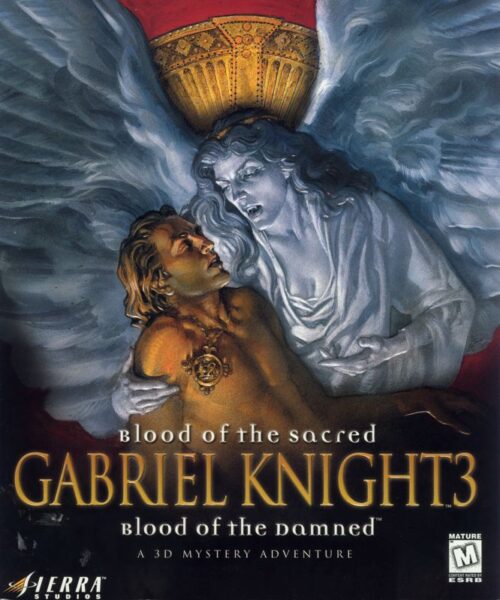
Gabriel Knight 3: Blood of the Sacred, Blood of the Damned


This article tells part of the story of Jane Jensen.

I think I became convinced when I went to CES [in January of 1997] and I walked around the show looking at all these titles that were the big new things, and not one screen had full-motion video. I realized that if I wanted anyone to look at the game, it had to be in 3D.

— Jane Jensen

Gabriel Knight 3: Blood of the Sacred, Blood of the Damned is proof that miracles do occur in gaming. It was remarkable enough that the game ever got made at all, in the face of gale-force headwinds blowing against the adventure genre. But the truly miraculous thing is that it turned out as well as it did. In my last article, I told you about Ultima IX, the sad-sack conclusion to another iconic series. The story of Gabriel Knight 3′s development is eerily similar in the broad strokes: the same real or perceived need to chase marketplace trends, the same unsupportive management, the same morale problems that resulted in an absurdly high turnover rate on the team. But Gabriel Knight 3 had one thing going for it that Ultima IX did not. Whereas Richard Garriott, the father of Ultima, always seemed to be somewhere else when someone might be on the verge of asking him to get his hands dirty, Jane Jensen was on the scene from first to last with her project. Just as much as the first two games, Gabriel Knight 3 managed at the last to reflect her unique vision more than some corporate committee’s view of what an adventure game should be in 1999. And that made all the difference.

In fact, I’m going to go out on a limb right here and now and deliver this article’s bombshell up-front: in defiance of the critical consensus, Gabriel Knight 3 is actually my favorite of the trilogy. As always, I don’t necessarily expect you to agree with me, but I will do my best to explain just what it is that delights, intrigues, and even moves me so much about this game.
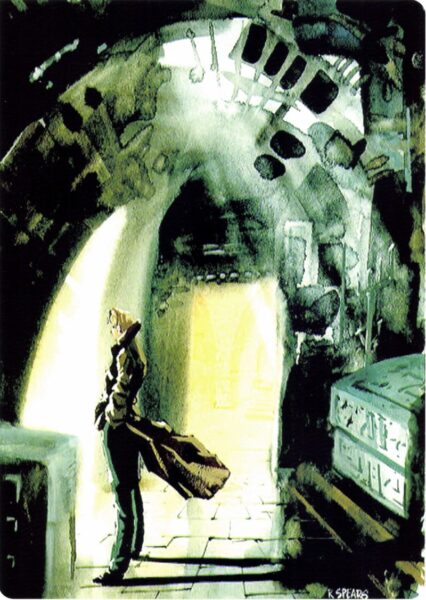

Before we get to that, though, we need to turn the dial of our time machine back another few years from 1999, to late 1995, when Jane Jensen has just finished The Beast Within, her second Gabriel Knight game. That game was the product of a giddy but ultimately brief-lived era at Sierra On-Line, when the company’s founders Ken and Roberta Williams were convinced that the necessary future of mass-market gaming was a meeting of the minds of Silicon Valley and Hollywood: it would be a case of players making the decisions for real live actors they saw on the screen. Sierra was so committed to this future that it built its own professional-grade sound stage in its hometown of tiny Oakhurst, California. Gabriel Knight 2 was the second game to emerge from this facility, following Roberta Williams’s million-selling Phantasmagoria. But, although Gabriel Knight 2 acquitted itself vastly better as both a game and a work of fiction than that schlocky splatter-fest, it sold only a fraction as many copies. “I thought we’d done a hell of a job,” says Jensen. “I thought it would appeal to that mass market out there. I thought it would be top ten. And it was — for about a week. I watched the charts in the months after shipping and saw the games that outsold [it], and I thought, ‘Ya know, I’m in the wrong industry.'”

The underwhelming sales figures affected more than just the psyche of Jane Jensen. Combined with the similarly disappointing sales figures of other, similar games, they sent the Siliwood train careening off the rails when it had barely left the station. In the aftermath, everyone was left to ponder hard questions about the fate of the Gabriel Knight series, about the fate of Sierra, and about the fate of adventure games in general.

No offer to make a third Gabriel Knight game was immediately forthcoming. Jane Jensen took a year’s sabbatical from Sierra, busying herself with the writing of novelizations of the first two games for Roc Books. While she was away, the new, more action-focused genres of the first-person shooter and real-time strategy completed their conquest of the computer-gaming mainstream, and Sierra itself was taken over by an unlikely buyer of obscure provenance and intent known as CUC.

Thus she found that everything was different when she returned to Sierra, bubbling over with excitement about a new idea she had. During her break, she had read a purportedly non-fiction book called The Tomb of God, the latest in a long and tangled skein of literature surrounding the tiny French village of Rennes-le-Château. The stories had begun with a mysteriously wealthy nineteenth-century priest and rumors of some treasure he may have hidden in or around the village, then grown in the telling to incorporate the Holy Grail, Mary Magdalene, the Knights Templar, the Freemasons, the true bloodline of Jesus Christ, and the inevitable millennia-spanning conspiracy to control the world and hide The Truth. The bizarre cottage industry would reach its commercial zenith a few years into the 21st century, with Dan Brown’s novel The Da Vinci Code and the movie of same that followed. It’s unclear whether Jensen herself truly believed any of it, but she did see a way to add vampires to the equation — she had long intended the third Gabriel Knight game to deal with vampires — and turn it into an adventure game that blended history and horror in much the same audacious way as Gabriel Knight 2, which had dared to posit that “Mad King” Ludwig II of Bavaria had been a werewolf, then went on to make an uncannily believable case for that nutso proposition.

Sierra’s new management agreed to make the game, for reasons that aren’t crystal clear but can perhaps be inferred. It was the end of 1996, still early enough that a sufficiently determined industry observer could make the case that the failure of the adventure genre to produce any new million-selling hits of late might be more of a fluke than a long-term trend. Ken Williams was still on the scene at Sierra, albeit with greatly diminished influence in comparison to the years when he alone had called the shots. For better and sometimes for worse, he had always loved the idea of “controversial” games. The would-be Gabriel Knight 3 certainly seemed like it would fit that bill, what with being based around the heretical premise that Jesus Christ had not been celibate, had in fact married Mary Magdalene and conceived children with her in the biological, less-than-immaculate way. A few centuries earlier, saying that sort of thing would have gotten you drawn and quartered or burnt at the stake; now, it would just leave every priest, preacher, and congregation member in the country spluttering with rage. It was one way to get people talking about adventure games again.

Even so, it wasn’t as if everything could just be business as usual for the genre. The times were changing: digitized human actors were out, real-time 3D was in, and even an unfashionable straggler of a genre like this one would have to adapt. So, Gabriel Knight 3 would be done in immersive 3D, both for the flexibility it lent when contrasted with the still photographs and chunks of canned video around which Gabriel Knight 2 had been built and because it ought to be, theoretically at least, considerably cheaper than trying to film a whole cast of professional actors cavorting around a sound stage. The new game would be made from Sierra’s new offices in Bellevue, Washington, to which the company had been gradually shifting development for the past few years.

Jane Jensen officially returned to Sierra in December of 1996, to begin putting together a script and a design document while a team of engineers got started on the core technology. The planned ship date was Christmas of 1998. But right from the get-go, there were aspects of the project to cause one to question the feasibility of that timeline.

Sierra actually had three projects going at the same time which were all attempting to update the company’s older adventure series for this new age of real-time 3D. And yet there was no attempt made to develop a single shared engine to power them, despite the example of SCI, one of the key building blocks of Sierra’s earlier success, which had powered all of its 2D adventures from late 1988 on. Gabriel Knight 3 was the last of the three 3D projects to be initiated, coming well after King’s Quest: Mask of Eternity and Quest for Glory V. Its engine, dubbed the G-Engine for obvious reasons, was primarily the creation of a software engineer named Jim Napier, who set the basics of it in place during the first half of 1997. Unfortunately, Napier was transferred to work on SWAT 3 after that, leaving the technology stack in a less than ideal state.

Abrupt transfers like this one would prove a running theme. The people working on Gabriel Knight 3 were made to feel like the dregs of the employee rolls, condemned to toil away on Sierra’s least commercially promising game. Small wonder that poor morale and high turnover would be constant issues for the project. Almost 50 people would be assigned to Gabriel Knight 3 before all was said and done, but never more than twenty at a time. Among them would be two producers, three art directors, and three project leads. The constant chaos, combined with the determination to reinvent the 3D-adventure wheel every time it was taken for a spin, undermined any and all cost savings that might otherwise have flowed from the switch from digitized video to 3D graphics. Originally projected to cost around $1.5 million, Gabriel Knight 3 would wind up having cost no less than $4.2 million by the time it was finished. That it was never cancelled was more a result of inertia and an equally insane churn rate in Sierra’s executive suites than any real belief in the game’s potential.

For her part, Jane Jensen displayed amazing resilience and professionalism throughout. She had shot too high with Gabriel Knight 2, turning in a script that had to be cut down by 25 percent or more during development, leaving behind some ugly plot and gameplay holes to be imperfectly papered over. This time around, she kept in mind that game development, like politics, is the art of the possible. Despite all the problems, very little of her design would be cut this time.

The people around her were a mixture of new faces who were there because they had been ordered to be and a smattering of old-timers who shared her passion for this set of themes and characters. Among these latter was her husband Robert Holmes, who provided his third moody yet hummable soundtrack for the series, and Stu Rosen, who had directed the voice-acting cast in Gabriel Knight 1. Rosen convinced Tim Curry, who had voiced the title role in that game but sat out the live-action Gabriel Knight 2, to return for this one. His exaggerated New Orleans drawl is not to all tastes, but it did provide a welcome note of continuity through all of the technological changes the series had undergone. Recording sessions began already in November of 1997, just after Jane Jensen returned from her first in-person visit to Rennes-le-Château.

But as we saw with Ultima IX, such sessions are superficial signs of progress only, and as such are often the refuge of those in denial about more fundamental problems. When one Scott Bilas arrived in early 1998 to become Gabriel Knight 3′s latest Technical Lead, he concluded that “the engineering team must have been living in a magical dream world. I can’t find any other way to explain it. At that point, the game was a hacked-up version of a sample application that Jim Napier wrote some time earlier to demonstrate the G-Engine.” Bilas spent months reworking the G-Engine and adding an SCI-like scripting language called Sheep to separate the game design from low-level engine programming. His postmortem of the project, written for Game Developer magazine about six months after Gabriel Knight 3′s release, makes for brutal reading. For most of the people consigned to it, the project was more of a death march than a labor of love, being a veritable encyclopedia of project-management worst practices.

There was a serious lack of love and appreciation [from Sierra’s management] throughout the project. Recognition of work (other than relief upon its completion) was very rare, lacked sincerity, and was always too little, too late. Internally, a lot of the team believed that the game was of poor quality. And of course, the many websites and magazines that proclaimed “adventure games are dead” only made things worse. Tim Schafer’s Grim Fandango, although a fabulous game and critically acclaimed, was supposedly (we heard) performing poorly in the marketplace…

The low morale resulted in a lot of send-off lunches for developers seeking greener pastures. Gabriel Knight 3 had a ridiculous amount of turnover that never would have been necessary had these people been properly cast or well-treated…

After a certain amount of time on a project like this, morale can sink so low that the team develops an incredible amount of passive resistance to any kind of change. Developers can get so tired of the project and build up such hatred for it that they avoid doing anything that could possibly make it ship later. This was a terrible problem during the last half of the Gabriel Knight 3 development cycle…

Our engineers never had an accurate development schedule; the schedules we had were so obviously wrong that everybody on the team knew there was no way to meet them. Our leads often lied to management about progress, tasks, and estimates, and I believe this was because they were in over their heads and weren’t responding well to the stress. Consequently, upper management thought the project was going to be stable and ready to ship long before it actually was, and we faced prolonged crunch times to deliver promised functionality…

Most of the last year of the project we spent in [crunch] mode, which meant that even small breaks for vacations, attending conferences, and often even taking off nights and weekends were looked down upon. It was time that the team “could not afford to lose.” The irony is that this overtime didn’t help anyway; the project didn’t move any faster or go out any sooner. The lack of respect for our personal lives and attention to our well-being caused our morale to sink…

Gabriel Knight 3 became a black hole that sucked in many developers from other projects, often at the expense of those projects. Artists were shifted off the team to cut the burn rate, and then pulled back on later because there was so much work left to do…

Management, thinking that it would save time, often encouraged content developers to hack and work around problems rather than fix them properly…

All of this happened against a backdrop of thoroughgoing confusion and dysfunction at Sierra in general. A sidelined Ken Williams got fed up and left the company he had founded in August of 1997. At the end of that year, Sierra’s new parent CUC merged with another large conglomerate called HFS to create a new entity named Cendant. Just a few months later, CUC was revealed to have been a house of cards the whole time, the locus of one of the biggest accounting scandals in the history of American business. For a long stretch of the time that Gabriel Knight 3 was in the works, there was reason to wonder whether there would even still be a Sierra for the team to report to in a week or a month. Finally, in November of 1998, Sierra was bought again, this time by the French media mega-corp Vivendi, whose long-term plan was, it slowly became evident, to end all internal game development and leverage the label’s brand recognition by turning it into a publisher only. Needless to say, this did nothing for the morale of the people who were still making games there.

Sierra’s Oakhurst office was shut down in February of 1999. The first wave of layoffs swept through Bellevue the following summer, while the Gabriel Knight 3 team were striving desperately to get the game out in time for the Christmas of 1999 instead of 1998. In a stunning testimony to corporate cluelessness about the psychology of human beings, some of those working on Gabriel Knight 3 were told straight-up that they were to be fired, but not until they had given the last of their blood, sweat, and tears to finish the game. “Having a group of people who are (understandably) upset with your company for laying them off and actively looking for a job while still trying to contribute to a project is a touchy situation that should be avoided,” understates Scott Bilas. The words “no shit, Sherlock” would seem to apply here.

But the one person who comes in for sustained praise in Bilas’s postmortem is Jane Jensen, whose vision and commitment never wavered.

Gabriel Knight 3 would have simply fallen over and died had we had a less experienced designer than Jane Jensen. Throughout the entire development process, the one thing that we could count on was the game design. It was well thought-out and researched, and had an entertaining and engrossing story. Best of all, Jane got it right well in advance; aside from some of the puzzles, nothing really needed to be reworked during development. She delivered the design on time and maintained it meticulously as the project went on.

This was Gabriel Knight 3′s secret weapon, the thing that prevented it from becoming a disaster like Ultima IX. With Jane Jensen onboard, there was always someone to turn to who knew exactly what the game was meant to do and be. The vision thing matters.

When Gabriel Knight 3: Blood of the Sacred, Blood of the Damned shipped in November of 1999, it marked the definitive end of an era, being the last Sierra adventure game ever, the final destination of a cultural tradition that stretched all the way back to Mystery House almost twenty years before, to a time when the computer-game industry was more inchoate than concrete. During the graphic adventure’s commercial peak of the early 1990s, Sierra and LucasArts had been the yang and the yin of the field, the bones of endless partisan contentions among gamers. It’s therefore intriguing and perhaps instructive to compare the press reception of Gabriel Knight 3 with that of 1998’s Grim Fandango, the most recent high-profile adventure release from LucasArts.

Grim Fandango was taken up as a sort of cause célèbre by critics, who rightly praised its unusual setting, vividly drawn characters, and moving story, even as they devoted less attention to its clumsy interface and convoluted and illogical puzzle structure. Those who wrote about games tended to be a few years older on average than those who simply played them. Many of this generation of journalists had grown up with Maniac Mansion and/or The Secret of Monkey Island. They were bothered by the notion of a LucasArts that no longer made adventure games, and sought to make this one enough of a success to avoid that outcome. At times, their reviews took on almost a hectoring tone: you must buy this game, they lectured their readers. The pressure campaign failed to fully accomplish its goal; Grim Fandango wasn’t a complete flop, but it did no more than break even at best, providing LucasArts with no particularly compelling financial argument for making more games like it.

Alas, when it arrived a year later, Gabriel Knight 3 was not given the same benefit of the doubt as to its strengths and weaknesses. Some of the reviews were not just negative but savagely so, almost as if their writers were angry at the game for daring to exist at all in this day and age. GameSpot pronounced this third installment fit “only for the most die-hard fans of the series.” Even the generally sober-minded Computer Gaming World, the closest thing the industry had to a mature journal of record, came at this game with knives out. In a two-stars-out-of-five review, Tom Chick said that “you’ll spend a lot of time fumbling in limbo, wandering aimlessly, trying to trigger whatever unknowable act will end the time block.” Okay — but it’s very hard to reconcile this criticism with the same magazine’s four-and-a-half star, “Editor’s Choice”-winning review of Grim Fandango. In my experience at least, aimless wandering and unknowable acts are far more of a fact of life in that game than in Gabriel Knight 3, which does a far better job of telling you what your goals are from story beat to story beat.

What might be going on here? To begin with, we do have to factor in that LucasArts had historically enjoyed better reviews and the benefit of more doubts than Sierra, whose adventure games came more frequently but really did tend to be rougher around the edges in the aggregate. Yet I don’t think that explains the contrast in its entirety. The taste-makers of mainstream gaming were still in a bargaining phase when it came to adventure games in 1998, still trying to find a place for them amidst all the changes that had come down the pipe since id Software unleashed DOOM upon the world. That bargaining had been given up as a lost cause a year later. The adventure game, said the new conventional wisdom, was dead as a doorknob, and it wasn’t coming back. A pack mentality kicked in and everyone rushed to pile on. It’s a disconcerting, maybe even disturbing thing to witness, but such is this thing we call human nature sometimes. If the last few years of our more recent social history tell us anything, it is that cultural change can burst upon the scene with head-snapping speed and force to make yesterday’s conventional wisdom suddenly beyond the pale today.

Adventure games would soon disappear entirely from the catalogs of the major publishers and from the tables of contents of the magazines and websites that followed them. In a rare sympathetic take on the genre’s travails, the website Gamecenter wrote just after the release and less than awe-inspiring commercial performance of Gabriel Knight 3 that “now it seems people want more action than adventure. They would rather run around in short shorts raiding tombs than experience real stories.” This was the true nub of the issue, for all that the belittling tone was no more necessary here than when it was directed in the opposite direction. People just wanted different things; a player of Gabriel Knight 3 was not inherently more or less smart, wise, or culturally sophisticated than a player of Starcraft or Unreal Tournament.

So, then, at the risk of stating the obvious, the core problem for the adventure genre was a mismatch between the desires of the majority of gamers at the turn of the millennium and the things the adventure game could offer them. The ultimate solution was for the remaining adventure fans to get their own cottage industry to make for them the games that they enjoyed, plus their own media ecosystem to cover them, replete with sympathetic critics who wanted the same things from gaming that their readers did. That computer gaming as a whole could sustain being siloed off into parallel ecosystems was a testament to how much bigger the tent had gotten over the course of the 1990s. But as of 1999, the siloing hadn’t quite happened yet, leaving a game like Gabriel Knight 3 trapped on the stage of an unfriendly theater, staring down an audience who were no longer interested in the type of entertainment it was peddling. While the game was still in development, Jane Jensen had mused about the controversial elements that may have helped to get it funded: “I guess the worst case would be that no one would care, or even notice.”

The worst case came true. Gabriel Knight 3 became its woebegone genre’s sacrificial lamb, controversial only for daring to exist at all as an ambitious adventure game in 1999. It deserved better, for reasons which I shall now go into.
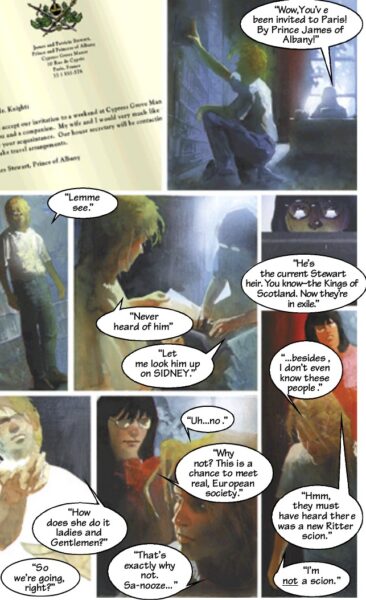

This final Sierra adventure game opens with something else that was not long for this world in 1999: a story setup that’s conveyed in the manual — or rather in an accompanying comic book — instead of in a cutscene. Four years on from their hunt for werewolves in Gabriel Knight 2, Gabriel and his assistant Grace Nakimura are asked to come to the Paris mansion of one Prince James, a scion of the Stuart line that once ruled Scotland and England. After they arrive, the good prince explains that he needs their help to protect his infant son from “Night Visitors” — i.e., vampires. Gabriel and Grace agree to take on the task, only to fail at it rather emphatically; the baby is kidnapped out from under their noses that very night. But Gabriel does manage to give chase, tracking the men or monsters who have absconded with the infant to the vicinity of Rennes-le-Château. Not sure how to proceed from here, he checks into a hotel in the village. The game proper begins the next morning.

At breakfast, he learns that a tour group of treasure hunters has also just arrived at the hotel, all of them dreaming of the riches that are purported to be hidden somewhere in or near the village. In addition to the fetching French tour guide Madeline (to whom Gabriel reacts in his standard lecherous fashion), there are Emilio, a stoic Middle Easterner; Lady Lily Howard and Estelle Stiles, a British blue-blood and her companion; John Wilkes, an arrogant, muscle-bound Aussie; and Vittorio Buchelli, an irritable Italian scholar. To this cast of characters worthy of an Agatha Christie novel we must add Gabriel’s old New Orleans running buddy Detective Frank Mosely, who, in a coincidence that would cause Charles Dickens to roll over in his grave, just happens to have joined this very tour group to try his hand at treasure hunting. Each member of the group has his or her own theory about the real nature of the treasure and how to find it, leaving Gabriel to try to sort out which ones really are the hopeless amateurs they seem to be and which ones have relevant secrets to hide, possibly involving the kidnapping which brought him here.
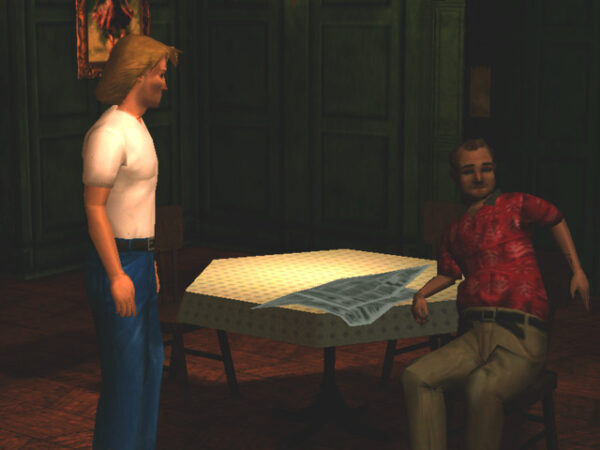
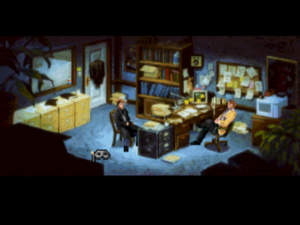
Gabriel has an unexpected meeting with Mosely.

Anyone who has played the first two Gabriel Knight games will be familiar with this one’s broad approach to its story. It takes place over three days, each of which is divided up into a number of time blocks. Rather than running on clock time, the game runs on plot time: the clock advances only when you’ve fulfilled a set of requirements for ending a time block. Grace arrives at the hotel on the evening of the first day. Thereafter, you control her and Gabriel alternately, just as in Gabriel Knight 2, with Gabriel’s sections leaning harder on conversations and practical investigation, while Grace delves deep into the lore and conspiracy theories of Rennes-le-Château. Don’t let the fact that the whole game is compressed into just three days fool you: they’re three busy days (and nights), busier than any three days could reasonably be in real life.

In this article, I won’t say anything more about the mystery of Rennes-le-Château. For the time being, you’ll just have to trust me when I tell you that it’s an endlessly fascinating rabbit hole. In fact, it fascinates on two separate levels: that of the tinfoil-hat theories themselves, and the meta-level of how they came to find such purchase here in this real world of ours, which is — spoiler alert! — actually not controlled by secret cabals of Knights Templar and the like. I’ll be exploring these subjects in some articles that will follow this one. It’s a digression from my normal beat, but one that I just can’t resist; I hope you’ll wind up agreeing with me that it was well worth it.

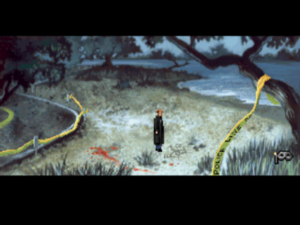
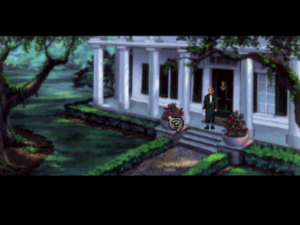
Today, though, let me tell you about some of the other aspects of this game. One of Jane Jensen’s greatest talents as a writer is her skill at evoking a sense of place, whether her setting be Louisiana, Bavaria, or now southern France. If you ask me, this game is her magnum opus in this sense. The 3D graphics here are pretty crude — far from state of the art even by the standards of 1999, never mind today. Characters move more like zombies or robots than real people and look like collections of interchangeable parts crudely sewn together. Gabriel’s hair looks like an awkwardly shaped helmet that’s perpetually in danger of falling right off his head, while trees and plants are jagged-edged amalgamations of pixels that look like they could slice him right open if he bumped into them. And yet darned if playing this game doesn’t truly feel like exploring a sun-kissed village on the edge of the French Riviera. The screenshots may not come off very well in an article like this one, but there’s an Impressionistic quality (how French, right?) to the game’s aesthetics that may actually serve it better than more photo-realistic graphics would. When I think back on it now, I do so almost as I might a memorable vacation, the kind whose contours are blended and softened by the soothing hand of sentiment. If a good game is a space where you want to go just to hang out, then Gabriel Knight 3 is a very good game indeed.

The geography is fairly constrained, meaning you’ll be visiting the same places again and again as the plot unfolds. Far from a drawback, I found this oddly soothing too. I mentioned Agatha Christie earlier; let me double-down on that reference now, and say that the geography is tight enough to remind me of a locked-room cozy mystery. The fact that you’re staying in a hotel with a gaggle of tourists only enhances the feeling of being on a virtual holiday. Playing this game, you never sense the stress and conflict and exhaustion that were so frequently the lot of its developers. Call it one more way in which Gabriel Knight 3 is kind of miraculous; most games reflect the circumstances of their creation much more indelibly.
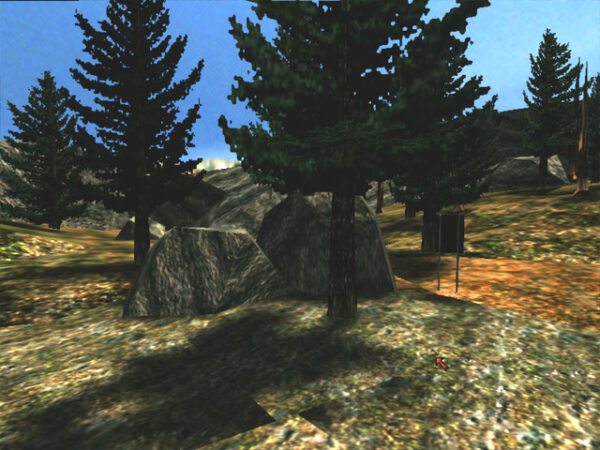
I suppose it could be considered a problem with Gabriel Knight 3 as a piece of fiction that the setting comes off so bucolic when the stakes are meant to be so high. But I don’t care. I like it here; I really like it.

Meet the story where it lives and let it unfold at its own pace, and you’ll be amply rewarded. Both the backstory of the historical conspiracy and the foreground plot with which it becomes intertwined, about finding the vampiric kidnappers, become riveting. I often play games on the television in the living room while my wife Dorte reads or crochets or does something else, popping up from time to time with a comment, usually one making fun of whatever nerdy thing I happen to be up to tonight. But Gabriel Knight 3 grabbed her too, something that doesn’t happen all that often. She had to go off to a week-long course just as I was getting close to the end. She informed me in no uncertain terms that I was not allowed to finish without her, because she wanted to see how it ended as well. Trust me when I tell you that that is really saying something.

The 3D engine that powers all of this is one of a goodly number of alternative approaches to the traditional point-and-click adventure that appeared as the genre was flailing against the dying of the mainstream light, aimed at helping it to feel more in tune with the times and, in some cases, making it a more friendly fit with alternative platforms like the Sony PlayStation. Few of these reinventions make much of a case for their own existence in my opinion, but the G-Engine is an exception. It’s a surprisingly effective piece of kit. Instead of relying on fixed camera angles, as Grim Fandango does in its 3D engine, Gabriel Knight 3 gives you a free-floating camera that you can move about at will. The environment fills the whole screen; there are no fixed interface elements. Clicking on a hot spot brings up a context-sensitive menu of interaction possibilities. And naturally, you can delve into an inventory screen to look at and combine the items you’re carrying, or to snatch them up for use out in the world. I really, really like the system, which genuinely does add something extra that you wouldn’t get from 2D pixel graphics. You can look up and down, left and right, under and on top of things. A room suddenly feels like a real space, full of nooks and crannies to be explored.
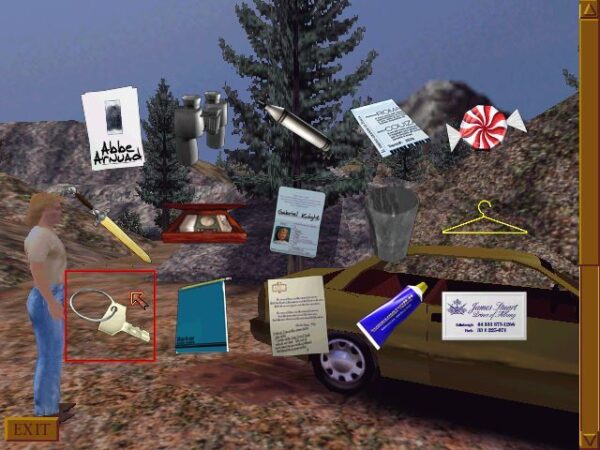
Admittedly, the setup is kind of weird on a conceptual level, in that you’re doing all of this exploration while Gabriel or Grace, whichever one you happen to be controlling, is standing stock still. This game, in other words, lends fresh credence to Scott Adams’s age-old conception of the player of an adventure game being in command of a “puppet” that does her bidding. Here you’re a disembodied spirit who does all the real work, pressing Gabriel or Grace into service only when you have need of hands, feet, or a mouth. You can even “inspect” an object in the room without their assistance — doing so shows it to you in close-up — although you do need them to help you “look,” which elicits a verbal description from your puppet. Gabriel Knight 3 doesn’t take place in a contiguous world; discrete “rooms” are loaded in when you direct your puppet to cross a boundary from one to another. Nevertheless, some of the rooms can be quite large. When you’re out and about on the streets of Rennes-le-Château, for example, the camera might be a block away from Gabriel or Grace, well out of his or her line of sight. It’s odd to think about, but it works a treat in practice.
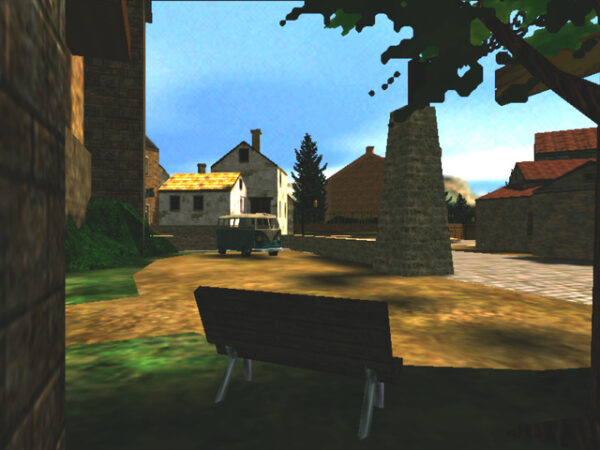
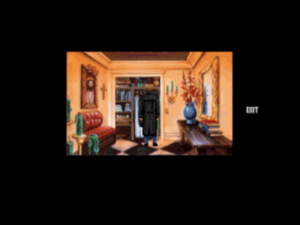
One of the strangest things about the G-Engine is how the camera seems to have a corporeal form. You can get it hung up behind objects like this bench.

The G-Engine doesn’t add much in the way of emergent possibility. Reading between the lines of some of the reviews, one can’t help but sense that some critics thought the switch to 3D ought to make Gabriel Knight 3 play more like Tomb Raider — and who knows, perhaps this was even envisioned by the developers as well at one time. The game we have, however, is very much an adventure game of the old school, a collection of set-piece puzzles with set-piece solutions, with a set-piece plot that is predestined to play out in one and only one way. Some alternative solutions are provided, even some optional pathways and puzzles that you can engage with for extra points, but there’s no physics engine to speak of here, and definitely no possibility to do anything that Jane Jensen never anticipated for you to do.

That said, there are a few places where the game demands timing and reflexes, especially at the climax. These bits aren’t horrible, but they aren’t likely to leave you wishing there were more of them either. In the end, they too are set-piece exercises, more Dragon’s Lair than Tomb Raider.
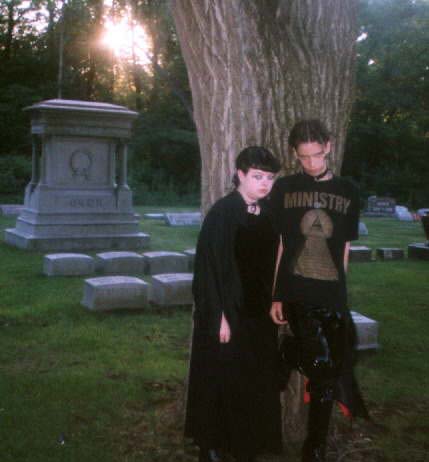

Erik Wolpaw and Chet Faliszek wrote Gabriel Knight 3 into gaming history for all the wrong reasons via their website Old Man Murray. They created fictional teenage personas for themselves, Erik being a “fat, girl-looking boy” and Chet being a kid who “likes Ministry and not much else.” How meta, right?

We can’t avoid it anymore, my friends. It’s impossible to discuss Gabriel Knight 3′s puzzles in any depth without addressing the elephant — or rather the cat-hair mustache — that’s been in the room with us this whole time. The uninitiated among you, assuming there are any, will require a bit of explanation.

During the burgeoning years of the World Wide Web, many gaming sites popped up to live on the hazy border between fanzines and professional media organs. One of these went for some reason by the name of Old Man Murray, a place for irreverent piss takes on the games that Computer Gaming World was covering with more earnestness and less profanity. Erik Wolpaw, one of the proprietors, took exception to one particular puzzle that crops up fairly early on in Gabriel Knight 3. He vented his frustration in a… a column, I guess we can call it?…  published on September 11, 2000 — i.e., ten months after the game’s release, and well after its lackluster commercial fate had already been decided.
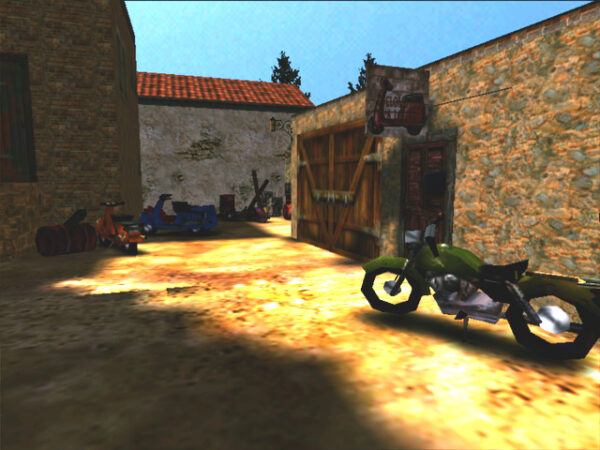
Gabriel needs to get his hands on some form of transportation in order to explore the countryside around Rennes-le-Château. Unfortunately, the motorbike rental lot right next door to the hotel mostly offers only sissy-looking mopeds of a sort that he wouldn’t be caught dead riding. The sole exception is a gleaming Harley-Davidson — but it has been reserved, by, of all people, his old buddy Mosely. Gabriel must engage in an extended round of subterfuge to pretend to be Mosely and secure the bike. This will turn out to involve, among other things, stealing the poor fellow’s passport and concocting a disguise for himself that involves masking tape, maple syrup, and a stray tuft of cat hair. I’ll let Erik tell you more about it. (The bold text below is present in the original.)

Dumb as your television enjoying ass probably is, you’re smarter than the genius adventure gamers who, in a truly inappropriate display of autism-level concentration, willingly played the birdbrained events. Permit me to summarize:

  • Gabriel Knight must disguise himself as a man called Mosley [sic] in order to fool a French moped rental clerk into renting him the shop’s only motorcycle.
  • In order to construct the costume, Gabriel Knight must manufacture a fake moustache. Utilizing the style of logic adventure game creators share with morons, Knight must do this even though Mosely does not have a moustache.
  • So in order to even begin formulating your strategy, you have to follow daredevil of logic Jane Jensen as she pilots Gabriel Knight 3 right over common sense, like Evel Knievel jumping Snake River Canyon. Maybe Jane Jensen was too busy reading difficult books by Pär Lagerkvist to catch what stupid Quake players learned from watching the A-Team: The first step in making a costume to fool people into thinking you’re a man without a moustache, is not to construct a fake moustache.
  • Still, you might think that you could yank some hair from one of the many places it grows out of your own body and attach it to your lip with the masking tape in your inventory. But obviously, Ms. Jensen felt that an insane puzzle deserved a genuinely deranged solution. In order to manufacture the moustache, you must attach the masking tape to a hole at the base of a toolshed then chase a cat through the hole. In the real world, such as the one that stupid people like me and Adrian Carmack use to store our televisions, this would result in a piece of masking tape with a few cat hairs stuck to it, or a cat running around with tape on its back. Apparently, in Jane Jensen’s exciting, imaginative world of books, masking tape is some kind of powerful neodymium supermagnet for cat hair.
  • Remember how shocked you were at the end of the Sixth Sense when it turned out Bruce Willis was a robot? Well, check this out: At the end of this puzzle, you have to affix the improbable cat hair moustache to your lip with maple syrup! Someone ought to give Jane Jensen a motion picture deal and also someone should CAT scan her brain.

A penetrating work of satire for the ages this column is not, but it nevertheless went viral, until it seemed to be absolutely everywhere on the Internet. In an ironic, backhanded way, Gabriel Knight 3′s cat-hair mustache puzzle became one of the most famous puzzles in all of adventure-gaming history, right up there with the Babel Fish in The Hitchhiker’s Guide to the Galaxy or Monkey Island’s Monkey Wrench. It became so famous that it has its own Wikipedia page today. At the same time, it became Exhibit Number One in the burgeoning debate over Why Adventure Games Died. Right up to this day, whenever talk turns to the genre’s fall from grace at the end of the twentieth century, a reference to the cat-hair mustache cannot be long in coming. For a considerable number of people today, Gabriel Knight 3 is not a game about vampires or the source material of The Da Vinci Code before Dan Brown discovered it; it’s a game about a cat-hair mustache.

So, what is a Gabriel Knight 3 apologist like myself supposed to do with this? First, let me acknowledge that this is not a great puzzle in strictly mimetic terms, in that it’s impossible to take seriously as a part of the game’s fiction. Setting aside all of the other improbable steps Gabriel has to go through, he steals and defaces — more on the latter in a moment — his good friend’s passport in order to work the scam. All of this instead of just, you know, asking his buddy to help him out. (Mosely is gruff on the outside, but he’s a good egg underneath, as Gabriel knows better than anyone.) Or he could just suck it up and ride a moped for a few days, given that the fate of an innocent baby and who knows what else may depend on it.

Of course, Gabriel Knight 3 is hardly the only adventure game that makes sociopathic behavior a staple of its puzzle tree. This is the root of the genre’s centrifugal pull toward comedy, which almost invariably injects a patina of goofiness even into allegedly serious games like this one. Stuff like this is more naturally at home in a game like Monkey Island. But leave it entirely out of any sort of adventure, and you run the risk of having a game without enough gameplay. If we aren’t afraid of a little bit of whataboutism, we might defend the adventure game by noting here that it’s hardly the only genre whose gameplay is frequently at odds with its fiction: think of putting saving the world on hold in order to hunt down lost pets and carry out a hundred other piddling side-quests in a CRPG, or researching the same technologies over and over from scratch in an RTS campaign. I’ll leave you to decide for yourself how compelling such a defense is.

For what it’s worth, there are reports that this puzzle was not in Jane Jensen’s original design, that it was swapped in late in the day in place of another one that had proved impractical to implement. Rest assured that you won’t catch me calling it a great puzzle, either in the context of this game or of adventure history.

But here’s the thing: mimesis aside, it’s nowhere near as terrible a puzzle as the one that our friend Erik describes either. I played this game a few months ago for the first time, knowing vaguely that it included an infamous puzzle involving a cat-hair mustache — how could I not? — but knowing nothing of the specifics. I went in fully expecting the worst, keeping in mind the design issues I remembered from the first two Gabriel Knight games. I was therefore surprised by how smoothly — and, yes, even enjoyably — the whole puzzle played out for me. Perhaps I was helped by the knowledge I brought with me into the game, but I never had the feeling that I was relying on it, never felt that I couldn’t have progressed without it. There are two hugely important mitigating factors which Erik neglects to mention.

The first is that there actually is a logic to Gabriel making a mustache for himself to imitate the clean-shaven (more or less) Mosely. He thinks that the facial hair will disguise the very different facial bone structures of the two men. Therefore he draws a mustache onto Mosely’s passport photo with a marker — how would you like to have a friend like him? — to complete the deception.
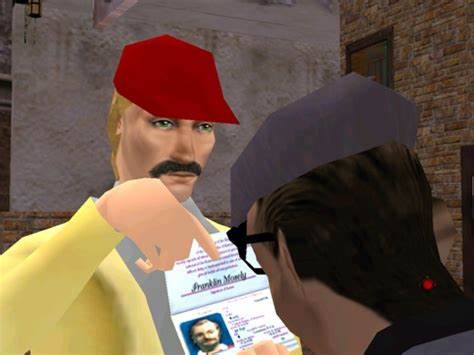
Notice that Mosely does have a mustache in his passport photo now.

The second factor is more thoroughgoing: the player is guided through all of the steps quite explicitly by Gabriel himself. (Who’s the puppet now, right?) In addition to “Look” and “Inspect,” many hot spots pop up a handy light-bulb icon when you click them: “Think.” These provide vital guidance on, well, what your character is thinking — or rather what Jane Jensen is thinking, what avenues she expects you to explore to advance the story. It’s not a walkthrough — what fun would that be? — but it does give you the outlines of what you’re trying to accomplish. In this case, looking carefully at and “thinking” about all of the objects involved turn a puzzle that truly would be absurdly unfair without this extra information into one that’s silly on the face of it, yes, but pretty good fun all the same. I’ve ranted plenty over bad adventure-game puzzles in the past, the kind where you have no clue what the game wants you to do or how it wants you to do it. This is not one of those. This puzzle doesn’t deserve the eternal infamy in which Old Man Murray draped it.

In point of fact, Gabriel Knight 3 is a major leap forward over the first two games in terms of pure design. Although it’s not trivial to solve by any means, nor does it seem to hate its player in the way of so many older Sierra games. The “Think” verb is one example. And for another one: once you solve the cat-hair-mustache-puzzle, get on your ill-gotten Harley, and start visiting the places around Rennes-le-Château, you can start to ask the game to show you where you still need to accomplish things in your current time block; this alone does much to alleviate the sense of “fumbling around in limbo,” as Tom Chick described it in Computer Gaming World. I don’t know whether the more soluble design of this game is a result of Jane Jensen improving her craft, unsung heroes on the team she worked with, or possibly even directives that came down from the dreaded upper management. I just know that it’s really, really nice to see — nice to be surprised by a game that turns out to be better than its reputation.
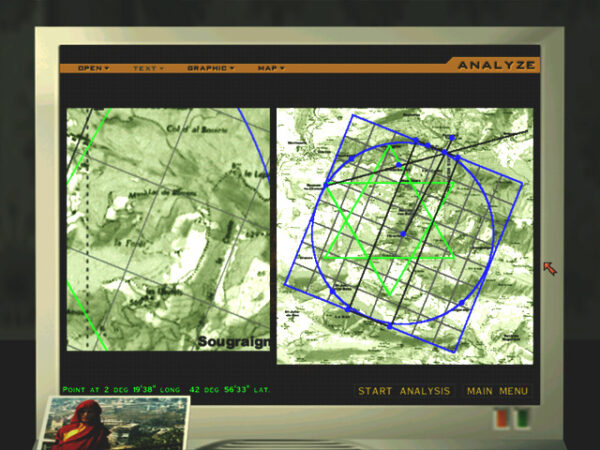
Solving the Le Serpent Rouge puzzle. Jane Jensen cribbed all this business about “sacred geometries” from the book The Tomb of God, which in turn borrowed it from Renaissance and Early Modern hermetic philosophy. (Johannes Kepler was very big on this sort of thing when he wasn’t developing the first credible model of our heliocentric solar system.) It may be nonsense, but it’s wonderfully evocative nonsense when it’s embedded in a story like this one.

The other puzzles here are a commodious grab bag of types. A few of them are every bit as silly as the cat-hair mustache, but most of them are more pertinent to the mysteries you’re actually trying to solve. The most elaborate of them all is a whole chain of puzzles that become Grace’s principal focus over the second and third days, and that are almost as well-remembered within hardcore adventure circles today as the cat-hair mustache is outside of them. The Le Serpent Rouge puzzle sequence — another one with its own Wikipedia page, if you can believe it — takes its name from a 1967 poem by an anonymous author that has become an indelible part of the conspiracy lore surrounding Rennes-le-Château.  The reliably bookish Grace has to ferret out its coded meanings, verse by verse, using a variety of software tools on her laptop computer. Some reviewers have called it the best adventure-game puzzle of all time.

For my part, I can’t go quite that far. Like everything else in the G-Engine, the software Grace uses is more of a veneer over the set-piece design than a true simulation. At several stages, I more or less just clicked on things until the game told me I had it right. But if it has its limitations as a set of pure puzzles, Le Serpent Rouge succeeds brilliantly as interactive drama. You’re fully invested by the time it comes along, and the buzz you get as you close in on the heart of the mystery, step by step, is not to be dismissed lightly. In a more just world it would be these puzzles rather than the cat-hair-mustache one that have taken a place in mainstream-gaming lore. For they show just how exciting and gripping smart, textured, context-appropriate adventure-game puzzles can be.

Much the same sentiment can be applied to Gabriel Knight 3 as a whole, a rare Sierra adventure game that I find to be underrated rather than overrated. I’ve not always been so kind toward Sierra’s games, as many of you know all too well. But almost twenty years on, just before they turned the lights out for good, they finally got everything right. This game is my favorite of the entire Sierra catalog. It’s the antithesis of Ultima IX, as high of a note to go out on as that game was a low one. Let’s hear it for lost causes and eleventh-hour miracles.
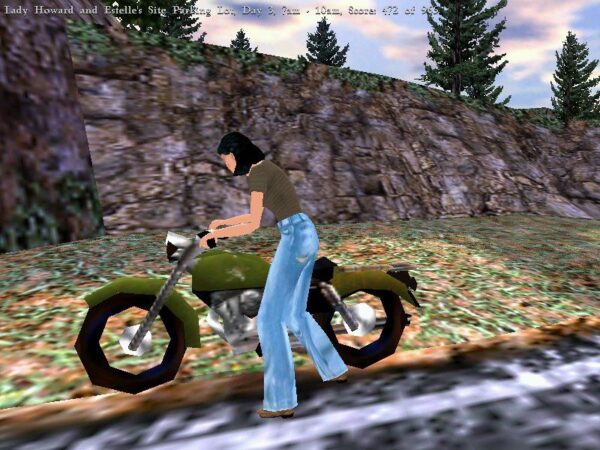

Girls can ride Harleys too, y’all.

I have to admit that my experience with Gabriel Knight 3 has to some extent caused me to reevaluate the whole series of which it is a part. Bloody-minded iconoclast that I am, I find that I have to rank the games in reverse chronological order, the opposite of the typical fan’s ordering. I still can’t get fully behind Gabriel Knight I, even when I try to separate the story and setting from my nightmares about searching for a two-pixel-wide snake scale in a Bayou swamp and tapping out nonsensical codes on a bongo drum. Gabriel Knight 2, though… that really is an edge case for me. I still have my share of quibbles with its design, but its flaws are certainly less egregious than those of its predecessor, even as it has stuck in my memory in a way that very few of the narrative-oriented games which I’ve played for these histories have been able to do. Both the second and the third games make me feel emotions that aren’t primary-colored, that are more textured and complex than love and hate, fight and flight. And that is nothing to be sneezed at in the videogame medium.

So, readers, I think I have to put both Gabriel Knight 2 and 3 into my personal Hall of Fame. It was a long time coming for the former, but I did come around to old Gabe and Gracie eventually. It’s only too bad that their story had to end here, just when it was starting to get juicy.
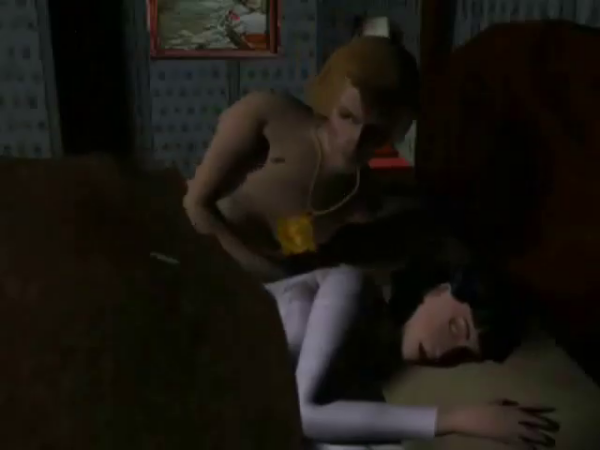
Oh là là!


Did you enjoy this article? If so, please think about pitching in to help me make many more like it. You can pledge any amount you like.


Sources: The book Gabriel Knight 3: Prima’s Official Strategy Guide by Rick Barba and Jane Jensen: Gabriel Knight, Adventure Games, Hidden Objects by Anastasia Salter. Computer Gaming World of February 1999, June 1999, and April 2000; Game Developer of June 2000; PC Zone of July 1998; Sierra’s newsletter InterAction of Spring 1999.

Online sources include Adventure Gamer’s interview with Gabriel Knight 3 design assistant Adam D. Bormann, Women Gamers’s interview with Jane Jensen, the vintage GameSpot review of Gabriel Knight 3, the Old Man Murray column discussed in the article, and a designer diary that Jane Jensen wrote for GameSpot during the game’s development.

Where to Get It: Gabriel Knight 3: Blood of the Sacred, Blood of the Damned is available as a digital purchase at GOG.com.

 
45 Comments

Posted by on February 20, 2026 in Digital Antiquaria, Interactive Fiction


Tags: , ,

The Beast Within: A Gabriel Knight Mystery

Personally, I’ve never been one to imagine small things.

— Jane Jensen

When Jane Jensen first said that she would like to make a dark-tinged, adult-oriented mystery of a Sierra adventure game, revolving around an antihero of a paranormal detective named Gabriel Knight, her boss Ken Williams wasn’t overly excited about the idea. “Okay, I’ll let you do it,” he grumbled. “But I wish you’d come up with something happier!”

What a difference a year and a half can make. At the end of that period of time, Gabriel Knight: Sins of the Fathers was a hit, garnering vive la différence! reviews and solid sales from gamers who appreciated its more sophisticated approach to interactive storytelling. Rather than remaining an outlier in the company’s catalog, it bent Sierra’s whole trajectory in its direction, as Ken Williams retooled and refocused on games that could appeal to a different — and larger — demographic of players.

There was no question whatsoever about a sequel. In January of 1994, just six weeks after the first Gabriel Knight game had shipped, Jane Jensen was told to get busy writing the second one.


She was more than ready to do so. In fact, she already knew exactly what she wanted the second story to be: a tale of werewolves, Richard Wagner, and Ludwig II, the (in)famously eccentric last king of an independent Bavaria. She’d developed a fascination for all of these subjects when she’d spent nine months living in Germany just before coming to Sierra. “It was initially the plot for the first game,” she says, “but when I started looking at it, I felt I needed to go back further in the characters’ history.” Now, having told how a New Orleans pulp-novel writer, bookstore owner, lady’s man, and general layabout named Gabriel Knight became a “Schattenjäger” — a “shadow hunter” of things that go bump in the night — she was ready to send him to Germany to face The Beast Within.

Very early on during the design phase if not right away, The Beast Within was earmarked to become the second of a new generation of Sierra adventures, which were to be built around filmed snippets of live actors. It was an enormous change from the hand-painted pixel graphics of the first game, but Jensen was, as she says, “all for it.” Although shooting on location in Germany would have been her dream scenario, there was no way the budget would stretch that far. Instead her actors would have to perform in front of a blue screen that would be filled in with computer-generated backgrounds after the shoot, as was the norm for these kinds of productions.

In lieu of taking the whole project to Germany, she did convince management to allow her to bring a piece of that country to Sierra’s offices in Oakhurst, California. During the second half of 1994, she and other Sierra staffers made three separate trips to Germany, spending more than a month there in all, painstakingly photographing among other places Munich’s city center, the Wagner Museum in Bayreuth, and Neuschwanstein, “mad king” Ludwig’s fairy-tale castle. These photos were then touched up as necessary to serve as the scenery behind the actors. This in itself represented a marked change in approach from the 3D-modeled backgrounds employed by Phantasmagoria, Sierra’s first game of this type. It was a wise choice for this project; while the mixing of media is by no means always seamless, the photographic look gives The Beast Within an unusually strong atmosphere of place. The hazy, slightly washed-out look of the backgrounds — an unavoidable byproduct of the state of digital imaging at the time — contributes to rather than detracts from the mood. “We were lucky in all three of the trips over there in that it was fairly overcast, so we didn’t have any harsh, direct lighting on most of the things,” says Nathan Gams, the project’s creative director and chief photographer. “We wanted a soft, gloomy kind of European spring feel. It kind of reflects the alien place where Gabriel is at this time.”

With the background images duly captured, it was time to think about the foreground actors. The budget only allowed for the Screen Actors Guild minimum wage, which precluded “name” stars such as Tim Curry and Mark Hamill, both of whom had provided voice acting in the first game.

Sierra wound up casting in the role of Gabriel one Dean Erickson, a 36-year-old with an interesting story behind him. He had been working in finance on Wall Street at age 30, when he suddenly decided that he wanted to be an actor instead, despite having never performed in so much as a high-school play prior to that point. Six years on from that decision, his chief claim to fame was a bit part in three episodes of the sitcom Frasier. Jane Jensen was initially uncertain that he had the chops to play the role of Gabriel, even though in appearance he was “spookily like what I would have thought the character would be”: “It was more a matter of being sure that he could play all the different faces of Gabriel Knight.” But she allowed herself to be convinced in the end.

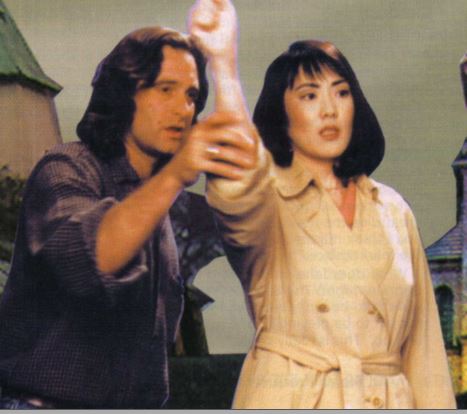
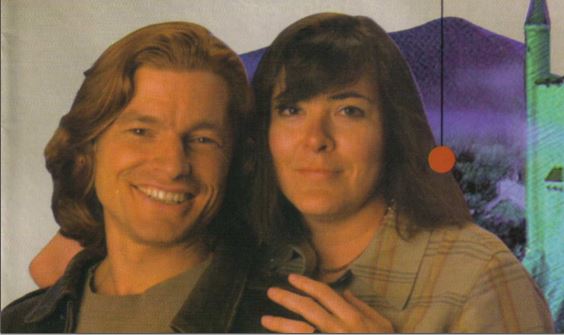
Dean Erickson and Jane Jensen.

“I would like to be the lead guy in major features,” Erickson himself said at the time, “and hopefully my performance in this will lead someone to believe that I can help carry a movie.” Hope does tend to spring particularly eternal in Hollywood. In the world of reality rather than Hollywood fantasy, a much older and perhaps wiser Dean Erickson would come to look back on The Beast Within as the best that things ever got for him as an actor, what with “making SAG scale for three and a half months in an idyllic setting under controlled conditions with nice people.”

It was intense in that we shot fairly quickly, only one or two takes per shot. But we were mostly shooting on an air-conditioned sound stage in a beautiful part of the country during the summer near a lake. We worked mostly nine to five, Monday through Friday, so it was about the best situation one could have as an actor. It truly couldn’t have worked out better, other than maybe getting work afterwards.

The role of Grace Nakimura, Gabriel’s strait-laced research assistant and potential love interest, went to Joanne Takahashi, a stage actress and print-advertising model who was also trying to break through in Hollywood. Meanwhile a Polish actor named Peter Lucas would all but steal the show in the role of the darkly enigmatic Baron Friedrich Von Glower, who slowly emerges as the principal antagonist of the story. The cast was rounded out with more than 40 other speaking parts, all recruited like the leads from the ranks of Hollywood hopefuls flashing their SAG membership cards.

Sierra’s original choice as director was an in-demand music-video maker named Mark Miremont, whose grainy, hyperkinetic productions can be credited with inculcating much of the look of MTV during the grunge era. It would have been intriguing indeed to see what he might have done with The Beast Within. But those plans fell through at the last minute, and Sierra instead hired a less distinctive aesthetic personality named Will Binder, a graduate of UCLA film school who had recently been serving as a director’s assistant in such films as The Scent of a Woman.[1]This résumé would later lead to my favorite ever interview opening, from the adorably fannish website Adventure Classic Gaming: “You have worked with some of the best actors in the business — Al Pacino, Michael J. Fox, Bruce Boxleitner, Mira Furlan, Philip Seymour Hoffman, and of course, Dean Erickson and Joanne Takahashi.” Two of these names are not like the others…

Before talking about how any of these folks performed, it’s only fair that we take a moment to appreciate just how awkward this style of “film-making” really was. The difficulties and constraints extended even to the clothing worn by the cast; the chroma-keying process which allowed the programmers to superimpose the live actors over the digitized photographic backgrounds came complete with many restrictions, as noted by costumer Marcelle Gravel:

There are a lot of limitations in terms of colors. [We can’t use] anything that is close to blue or anything white that can reflect the blue, or any green that has a little blue in it. Sometimes black doesn’t work because when it gets wrinkled, it reflects.

So the wardrobe has to be very safe. Gabriel was supposed to be wearing a black jacket, a white tee-shirt, and blue jeans — an American uniform. It is James Dean, Marlon Brando, all those people. And when I started Gabriel, I can’t use black, I can’t use white, I can’t use blue. So what am I going to do to create that effect?

He ended up wearing green. Since he’s got the red hair, I think the green has a good effect on him.

The blue screen also meant that much or most of the evolved language of film had to be tossed. The camera wasn’t allowed to swoop or soar; it had to remain stock still if the computer-generated backgrounds were to look coherent after they were inserted. Thus the scenes had to be staged and blocked like live-theater productions which happened to perform for a camera rather than a live audience.

Making an interactive story, in which scenes could occur in many different orders, played havoc with the actors’ ability to inhabit their roles. Will Binder:

[The player] can jump around during the game at any point, so the actor has to have a neutral emotion at the start of each scene. [The scene currently being filmed] could [be] before a big scene happened or could [be] after a big scene.

In a regular movie, you would like to tell [the actor], “Okay, this just happened: you just broke up with your girlfriend.” Or, “An hour ago you found out some information about a person you have been dealing with.”

In the game,  [the player] can go anywhere [they] want. So there is no linear progression.

Joanne Takahashi:

With this shoot, you are taking so many different paths you are not sure where the character is going. It is a challenge.

I am just feeling it through and letting things come to me as I go along. It was something to adjust to because a lot of what actresses do is inspired by what they are feeling. That was a difficult challenge, but that was a requirement on this kind of project.

Most of the actors were not technically oriented, and had little concept of how the scenes they were shooting would be cobbled together into a coherent final product. Certainly there was nothing like the daily rushes of conventional filmmaking, which help actors understand how a production is coming together while the shoot is still in progress. The actors working on The Beast Within were swimming blind in unknown waters.

Keeping all that in mind, then, how did the actors do?

Dean Erickson is a rather counterintuitive case in some ways. On the one hand, he badly misses the mark of the Gabriel Knight that Jane Jensen likes to describe. Far from a cool lady-killer, he radiates discomfort in his own skin virtually every moment he spends onscreen; he’s forever sighing and twitching and glancing nervously away as if looking for direction (which he quite possibly is, come to think of it), coming across as a guy for whom propositioning a girl comes as naturally as foreign languages. (American to the core, Gabriel has managed to avoid picking up a word of German during the months he’s already spent in the country.) Needless to say, nothing about this performance will convince you that Erickson is Hollywood leading-man material.

And yet Erickson’s take on Gabriel kind of works despite itself. His discomfort before Will Binder’s cameras mirrors that which any born-and-bred New Orleanian would feel after being transplanted to such an utterly foreign clime as southern Germany. For all of Erickson’s manifest limitations as an actor, I have to say that I like his Gabriel more than I do the one Tim Curry voice-acted in Sins of the Fathers. He’s relatable in his way, and, if he doesn’t exactly radiate masculine virility, nor does he come across like a member of the #metoo Most Wanted brigade, as Curry’s Gabriel too often did. He’s not bad company on the whole, once you get used to his incessant fidgeting. In achieving this much, he fulfills the first and most important criterion of any good adventure-game protagonist.

Will Binder directs Joanne Takahashi. She needed all the help she could get.

But Joanne Takahashi’s Grace is, alas, less likeable. This is a problem in that Grace steps up to almost equal time with Gabriel in this second game; the player controls her rather than Gabriel through two and a half of the game’s six chapters. Her apparently unrequited affection for Gabriel and jealousy of his beautiful German secretary Gerde are doubtless intended to be endearing, but are written and acted with all the subtlety of a wrecking ball to the head. Whether because she’s got them old lovesick blues or because she’s just made that way, Grace is bitchy toward everyone and everything she encounters for much of the game. Only toward the end, when she’s finally accepted that Gerde isn’t after her man and that Gabriel really needs her help, does she start to lighten up a bit. But even then, the actress who plays her remains stiff as a board.

Peter Lucas by contrast gives by far the most natural performance, as Baron Von Glower, the libertine leader of a mysterious big-game hunting club which Gabriel stumbles upon in the course of his investigations. Every time he appears, he lights up the screen with his romance-novel looks and his enticing aura of danger; his scenes with Gabriel flare with far more sexual tension than Gabriel ever strikes up with Grace. Lucas’s onscreen performance stands out as one of the best of the entire full-motion-video era of gaming — granted, not an overly high bar to clear, but we should give him his props nevertheless.

The smoldering attraction between Gabriel and Van Glower is remarkable in the context of its time. Mass-market computer games just didn’t go to these places in 1995. If the beats of the plot can be read as allegorical in a thoroughly retrograde way — Gabriel must overcome the temptation of lycanthropy, which in turn becomes accidentally or purposefully associated with homosexuality in the script, in order to return to the good girl Grace — what we see on the screen never feels as judgmental as that formulation would imply. (It is perhaps not completely inappropriate to mention at this juncture that Jane Jensen has become a successful writer of gay romance fiction in recent years.)


The Beast Within took over Sierra’s new Oakhurst sound stage in May of 1995. Filming there lasted almost four months in all. At its conclusion, the crew moved to Seattle for a few days to shoot the game’s climactic scenes on location in the city’s opera house, complete with many of the local opera company’s own players. Here the constraints imposed by the game’s peculiar technological stew fell away, and Will Binder got to shoot something resembling scenes from a proper movie. He was a lucky guy; very few other full-motion-video productions from the 1990s ponied up for a full-fledged location shoot.


Coming to this article, I had fonder memories of The Beast Within than Sins of the Fathers, and I was curious to find out whether that impression would hold up. I was gratified that it generally did. The game is as shaggy as its namesake even if one looks beyond the uneven acting, being full of unnecessary stumbling blocks in its interactivity that prevent me from giving it a full-throated recommendation here or making a place for it in my personal Hall of Fame, where fairness to the player is a prerequisite. But it’s a fascinating piece of work all the same, created as it was just at the apogee of that window of time when interactive narratives starring “real” actors were considered the necessary future of gaming by big companies like Sierra — so much so that they were building million-dollar sound stages for themselves to churn them out with the alacrity of any Hollywood studio. Jane Jensen would never get a chance to work on a scale like this again. And it must be said that she made the most of it: the overweening ambition of The Beast Within — the sheer grandiosity of it all — makes it a sight to behold. This is a computer game for which an opera was composed, for God’s sake. Everyone involved with it was unabashedly shooting for the moon.

The game opens several months after the conclusion of Sins of the Fathers, when a very reluctant Gabriel has moved into his ancestral castle in Germany to take up the family business of shadow-hunting. Meanwhile Grace has been left behind in New Orleans to run his old bookstore.

One dark night, a group of German villagers straight out of Hammer Horror central casting knocks on the front door of Gabriel’s castle. “We have come for the Schattenjäger,” says their leader. It seems that a little girl living in another small town near Munich has been killed — by, the visitors believe, a werewolf. (“At least she died quickly,” says the village patriarch to her grieving father, a line so hilariously tone deaf that one has to assume it was intended to be funny.) Gabriel has his doubts, but he agrees to take the case. His investigations will eventually lead him to the hunting club led by Baron Von Glower.

When Grace learns of the case, she hightails it to Germany, but doesn’t join up directly with Gabriel. Instead she occupies herself with research on the real or mythical history of lycanthropy. She learns that Ludwig II, king of Bavaria from 1864, seems to have become a werewolf himself while still a young man, and that this may account for much of his legendarily strange behavior. Further, she discovers that he told his friend Richard Wagner of his plight, prompting the latter to compose a magical opera which he hoped would be able to drive out the curse. But he was unable to complete it before Ludwig died under mysterious circumstances in 1886 — he had become a persistent irritant to the new, Prussia-dominated united Germany, making his death fodder for all sorts of conspiracy theories — and the opera was never performed. What there was of it was lost, seemingly forever — until the dogged Grace digs it up again. She soon has urgent need of it, as Gabriel has by now gotten himself infected with the curse.

All of this is mind-bogglingly ridiculous, of course, but the game leans into it with a commitment that would make Dan Brown proud, and darned if it doesn’t do a pretty good job of selling it. The Beast Within is nothing if not a slow burn. Gabriel doesn’t meet his first indubitable werewolf in the flesh until over two-thirds of the way in, while Grace’s chapters involve little more than poring over musty books and museum exhibits, giving them at times more of the flavor of an educational CD-ROM than an adventure game.

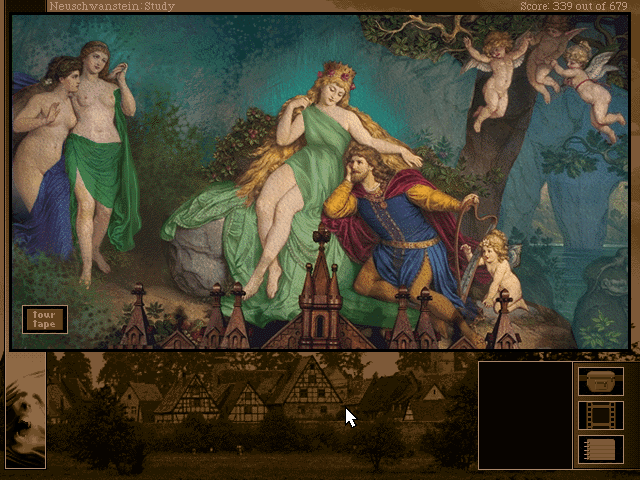
Much of Grace’s time is spent touring Neuschwanstein Castle, complete with the obligatory tourist audio guide.

Clearly Jane Jensen was touched by the wistful, sorrowful life of Ludwig, enough so as to make it the thematic bedrock of her game. She saw parallels with a certain modern eccentric whose days would also end in tragedy and controversy:

He was a real misfit, never in sync with the world. He lived in a fantasy world, and because he had a lot of money, he could surround himself with fantasy, not unlike Michael Jackson now.

As time went on, he got more and more beaten down by the world. His relationships never worked out, and he was always disillusioned. He was a very sensitive soul who was just hurt by everything, who kept retreating and withdrawing.

When he was young, he was very much a Prince Charming type. And of course his end was very tragic. So I just think it is a very beautiful, sad story of a life.

Grace’s historical research and Gabriel’s more active investigations meet only in the sixth and final chapter of the game, when the former arranges a public premiere of the lost opera in order to cure the latter of the affliction he’s picked up. The audacity of this bit is almost unbelievable. Not only did the game’s soundtrack composer Robert Holmes — also Jane Jensen’s husband — dare to write an opera, he had the colossal cheek to make it a lost Wagner opera. It took him “about a week,” as he remembers it. (One has to assume that the real Wagner devoted somewhat more time to his masterworks). I’m in no way qualified to judge the worthiness of Holmes’s opera, but I must assume it to be dire enough to send aficionados running from the room with their hands over their ears. Nevertheless, here’s to ambition. One certainly can’t accuse this game of pulling any of its punches.

All of its interest in place and history can rather overshadow its bona fides as a work of horror. Much of the time, it’s more eerie than terrifying, more melancholy than thrilling; suffice to say that it lives in a place far removed from the schlocky sensationalism of Roberta Williams’s Phantasmagoria. When the time finally does come to confront werewolves nose to snout, however, The Beast Within doesn’t disappoint. There’s one scene in the penultimate chapter — anyone who’s played the game will know which one I’m talking about — that’s unsettling enough to give you nightmares. While it’s easy enough to laugh off Phantasmagoria‘s cartoonish execution scenes, you won’t be laughing at this one. If the climax in the opera house is ironically less horrifying than what comes immediately before it, fair enough; one scene like that should be enough for any game.

All of which is to say that The Beast Within is a richly textured, admirably complex work of fiction in many ways. At its best and judged in the context of its time, it was one of the most impressive interactive narratives yet attempted on a computer by 1995. But alas, it isn’t always this best version of itself. What with so much love having been so clearly poured into the game from so many different quarters, I can’t help but wonder why Jane Jensen couldn’t manage to make it just a little bit better. Mixed in with all of its rarefied intellectual and thematic aspirations is plenty of B-movie amateurishness. The language barrier gets erected and torn down willy-nilly, depending on whether Jensen wants to make a plot element out of it or not at any given instant; particularly amusing is the Schattenjäger library in Gabriel’s family castle, consisting of a bunch of Medieval texts helpfully written in modern English. There’s no reason that plausible ways around the language problems couldn’t have been built into the game’s puzzle structure, doing much for its sense of mimesis and potentially even for its character-building in the process. (Perhaps Grace needs to enlist the help of the hated Gerde to translate?) Similarly, the game’s timeline makes no sense whatsoever. Gabriel and Grace’s separate investigations overlap with one another in ways that would only be possible if one or both had a time machine to hand.

These may strike some as the pettiest of niggles, but the fact is that continuity matters in the crafting of believable fictions of any stripe. No credible book-publishing house or film studio would allow a story to go out in such a state as this one. Plot may stand at a lower rung on the artistic totem pole than character or theme in the minds of many, but even most of these will acknowledge that a coherent plot is a necessary prerequisite to those other things.

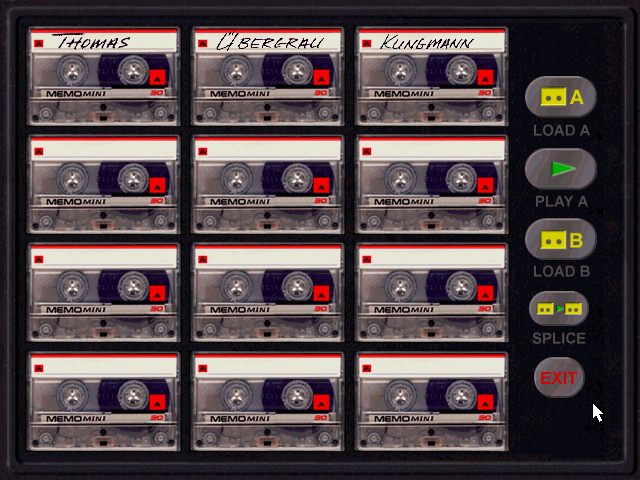
The Beast Within has some really good puzzles that stretch the interface beyond the typical “use item X on hotspot Y.” One, for example, requires you to construct a fake telephone message by splicing together snippets of recorded speech.

And then there is the interactive design. Jane Jensen resisted any pressure that may have come her way to dumb down The Beast Within in the manner of Phantasmagoria: her game is full of real puzzles worthy of the name, in some cases pretty good ones. In fact, it fares considerably better on this metric than Sins of the Fathers. Nevertheless, there remains a smattering of bad design choices that serve to pull you out of the game every time you feel yourself on the verge of becoming truly immersed in its world. A few of the puzzles hinge on the sort of moon logic for which adventure games have been so often justifiably criticized. (Using a cuckoo clock on a potted plant? Really, Jane?) Even one example of this sort of thing can be ruinous to the player’s experience, in that it destroys her trust in the game’s interactive design at the same time that it demolishes the integrity of its fiction.

In Grace’s chapters, Jensen lays claim to the dubious status of being the inventor of the hidden-object genre: you have to pixel-hunt your way through several big areas, looking for that one tiny thing you overlooked the last dozen times through. You see, this game really, really wants you to know everything possible about Richard Wagner and King Ludwig II: it won’t let the plot proceed until you’ve clicked on every last hotspot on every last detail in every last musty little corner of their respective museum and castle — in a few cases twice. Finding it all can be a challenge even if you’re playing directly from a walkthrough.

And when we get to the big finale, Jensen falls into the common trap of assuming that the ending of an adventure game ought to be much harder than what has come before. (In reality, the opposite is true; the player has already done lots of thinking during the mushy middle, and now just wants an exciting climax followed by victory, with a minimum of fuss.) One key puzzle here hinges on manipulating an object in a way that the interface has never allowed before and never even hinted was a possibility. And the literal last action you need to do in the game is a tricky exercise in perfect timing and precise clicking that’s also out of keeping with everything that’s come before, so much so that you could easily assume you’ve missed something and waste hours looking for it.

But regular readers have heard similar litanies of design sins from me many times before, so I won’t belabor these issues further here. The Beast Within is yet another checkered product of Sierra’s creative culture, which, in marked contrast to such other adventure specialists as Infocom, LucasArts, and Legend Entertainment, never emphasized outside play-testing or even serious discussion of the craft of design in the abstract. Interesting and engaging as it is in its present state, it could have been so much better, if only a process had been put in place to make it better. Whatever the merits of his year-to-year choices as a businessman, Ken Williams’s failure to do so — a byproduct of his personal disinterest in actually playing his company’s games — will always stand as his biggest single lapse in my book.


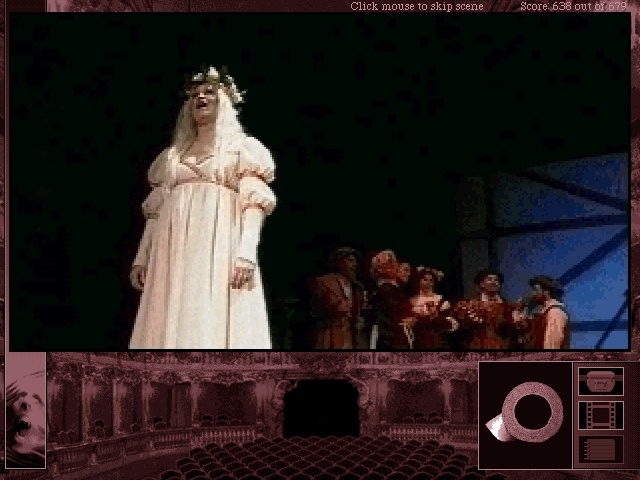
Wagner’s Lost Opera, the grand finale to The Beast Within. Most games, then and since, have tended to front-load their most impressive scenes so that everyone — not least potential buyers — can see them. This one’s willingness to hold off until the very end says something, I think, about the spirit of grandiose (operatic?) idealism that marked the whole project.

The Beast Within: A Gabriel Knight Mystery shipped on six CDs less than a week before the Christmas of 1995, half a year after Phantasmagoria had been greeted with huge sales and much mainstream-press attention. Everything about this latest release reflected the current ebullient mood at Sierra, where everyone was convinced they were about to truly hit the big time, with a vastly expanded customer base. For example, the box was careful not to say that this was “Gabriel Knight 2,” for fear of scaring away that new generation of buyers, who might not be keen on starting a series in the middle and might be even less keen on playing an “old-fashioned” game like Sins of the Fathers.

Indeed, even Sierra’s new fictional genre of choice reflected the new focus on the mainstream. Horror was a less stereotypically nerdy ghetto than fantasy or science fiction, yet one that was still fairly well-suited to adventure-game modes of interaction. So, after never touching the genre for the first decade and change of their existence, Sierra was now all over it. Three of the five domestically-developed adventures they released in 1995 were horror games. (The third companion to Phantasmagoria and The Beast Within in this respect was the lower-profile Shivers, a solitary Myst-style first-person puzzler created by a breakaway team at Bright Star, Sierra’s educational-software subsidiary.)

In comparison to the adventure-lite Phantasmagoria, The Beast Within was perhaps a wolf in sheep’s clothing: it was, as we’ve seen, a game that evinced a full measure of respect for its audience’s collective intelligence, with challenging puzzles and complex present-day and historical mysteries to tease out. Still, there’s little reason to believe it was because of this that it failed to sell anywhere near as well as its predecessor. The mainstream magazines and newspapers that had covered the older game as a curiosity showed little interest in the newer one; ditto the many people who had bought Phantasmagoria strictly to show off their new multimedia computer systems. That left only the traditional adventure market, the same people who had bought Sins of the Fathers. It seemed that Sierra was suddenly back to square one.

This state of affairs was, to say the least, deeply disconcerting to everyone there, as they all found themselves having to adjust their paradigm of gaming’s necessary future at lightning speed. Sierra programmer Greg Tomko-Pavia expressed the collective confusion in a contemporary online interview whose frankness presumably wouldn’t have endeared it to his managers:

I must say that I’m surprised Phantasmagoria has done so well. Presently, we’ve sold over 700,000 copies — more than any other Sierra game. I can’t account for it. In my opinion, Phantasmagoria suffered from weak writing, acting, and direction. I don’t understand why Gabriel Knight 2, to my mind superior in every detail, isn’t doing nearly so well. What do I know? I just write code!

At the time of The Beast Within‘s release, Sierra was already filming their third big interactive horror film on their Oakhurst sound stage, a sequel-in-name-only to Phantasmagoria subtitled A Puzzle of Flesh. Its garish grindhouse aesthetic made its two boundary-pushing predecessors look downright prudish — which was, one supposes, further progress of a sort. But it would prove the last production of its type. Once it too had disappointed in the marketplace, its feverish courting of controversy having largely come up dry, the facility Sierra had built with such pride and at such expense would be used only occasionally, for 3D motion captures and the like. It was now clear that gaming writ large was going in a different direction entirely, leaving the sound stage a fork in a world of soup.

As for Gabriel and Grace: against all the odds, they would return for one final game, but that would be a more constrained production than this one, using one of the 3D engines that were taking over the industry. There’s a world-weariness about that game — a sense of existential despair on the part of its creators that’s almost palpable when playing it — that you won’t find in this one, which was created by a team who saw only limitless potential everywhere they looked. The Beast Within is the product of a rare moment when the creative and the commercial impulse seemed united as one. For all its frustrating infelicities, it positively soars with its makers’ enthusiasm, with their bracing willingness to just try. Neither Jane Jensen nor any of the rest of them realized how lucky they were to be given the time and money to do so.

Six months after the release of The Beast Within, Roberta Williams, who was always the bellwether of the current creative direction of Sierra, gave a new verdict on the current state of adventure games that contradicted everything Sierra had been saying and doing for the past couple of years:

I believe adventure games have now gotten too plot-heavy. Not just ours, but also a lot of our competitors’ games. I think game designers need to get back to the game and forget all this wanna-be-writer-and-director stuff. They don’t realize people just want to play a game. They want to have control over what happens. Video clips are fine — if they’re very short, to the point, concise, and then… get out of there.

The times, they were still a-changing.

(Sources: the books Influential Game Designers: Jane Jensen by Anastasia Salter and The Beast Within: Official Player’s Guide by Corey Sandler with Jane Jensen; Computer Gaming World of November 1995 and February 1996; Sierra’s customer newsletter InterAction of Fall 1994, Spring 1995, Fall 1995, Holiday 1995, Spring 1996, and Summer 1996. Online sources include Anthony Larme’s interview with Greg Tomko-Pavia, “The Making of… the Gabriel Knight Trilogy” at Edge Online, Andrea Santorio’s interview with Jane Jensen, Martin Bourassa’s interview with Dean Erickson, Jane Jensen and Robert Holmes’s appearance on a Reddit “Ask Me Anything,” and Ingrid Heyn’s interview with Will Binder.

Now re-titled with the numeral Sierra once eschewed, Gabriel Knight 2: The Beast Within is available as a digital purchase at GOG.com.)

Footnotes

Footnotes
1 This résumé would later lead to my favorite ever interview opening, from the adorably fannish website Adventure Classic Gaming: “You have worked with some of the best actors in the business — Al Pacino, Michael J. Fox, Bruce Boxleitner, Mira Furlan, Philip Seymour Hoffman, and of course, Dean Erickson and Joanne Takahashi.” Two of these names are not like the others…


Tags: , ,

Gabriel Knight: Sins of the Fathers

Fair warning: spoilers for Gabriel Knight: Sins of the Fathers are to be found herein!

In 1989, a twenty-something professional computer programmer and frustrated horror novelist named Jane Jensen had a close encounter with King’s Quest IV that changed her life. She was so inspired by the experience of playing her first adventure game that she decided to apply for a job with Sierra Online, the company that had made it. In fact, she badgered them relentlessly until they finally hired her as a jack-of-all-trades writer in 1990.

Two and a half years later, after working her way up from writing manuals and incidental in-game dialog to co-designing the first EcoQuest game with Gano Haine and the sixth King’s Quest game with Roberta Williams, she had proved herself sufficiently in the eyes of her managers to be given a glorious opportunity: the chance to make her very own game on her own terms. It really was a once-in-a-lifetime proposition; she was to be given carte blanche by the biggest adventure developer in the industry at the height of the genre’s popularity to make exactly the game she wanted to make. Small wonder that she would so often look back upon it wistfully in later years, after the glory days of adventure games had become a distant memory.

For her big chance, Jensen proposed making a Gothic horror game unlike anything Sierra had attempted before, with a brooding and psychologically complex hero, a detailed real-world setting, and a complicated plot dripping with the lore of the occult. Interestingly, Jensen remembers her superiors being less than thrilled with the new direction. She says that Ken Williams in particular was highly skeptical of the project’s commercial viability: “Okay, I’ll let you do it, but I wish you’d come up with something happier!”

But even if Jensen’s recollections are correct, we can safely say that Sierra’s opinion changed over the year it took to make Gabriel Knight: Sins of the Fathers. By the time it shipped on November 24, 1993, it fit in very well with a new direction being trumpeted by Ken Williams in his editorials for the company’s newsletter: a concerted focus on more “adult,” sophisticated fictions, as exemplified not only by Sins of the Fathers but by a “gritty” new Police Quest game and another, more lurid horror game which Roberta Williams had in the works. Although the older, more lighthearted and ramshackle [this, that, and the other] Quest series which had made Sierra’s name in adventure games would continue to appear for a while longer, Williams clearly saw these newer concepts as the key to a mass market he was desperately trying to unlock. Games like these were, theoretically anyway, able to appeal to demographics outside the industry’s traditional customers — to appeal to the sort of people who had hitherto preferred an evening in front of a television to one spent in front of a monitor.

Thus Sierra put a lot of resources into Sins of the Fathers‘s presentation and promotion. For example, the box became one of the last standout packages in an industry moving inexorably toward standardization on that front; in lieu of anything so dull as a rectangle, it took the shape of two mismatched but somehow conjoined triangles. Sierra even went so far as to hire Tim Curry of Rocky Horror Picture Show fame, Mark Hamill of Star Wars, and Michael Dorn of Star Trek: The Next Generation for the CD-ROM version’s voice-acting cast.

Jane Jensen with the first Gabriel Knight project’s producer and soundtrack composer Robert Holmes, who would later become her husband, and the actor Tim Curry, who provided the voice of Gabriel using a thick faux-New Orleans accent which some players judge hammy, others charming.

In the long run, the much-discussed union of Silicon Valley and Hollywood that led studios like Sierra to cast such high-profile names at considerable expense would never come to pass. In the meantime, though, the game arrived at a more modestly propitious cultural moment. Anne Rice’s Gothic vampire novels, whose tonal similarities to Sins of the Fathers were hard to miss even before Jensen began to cite them as an inspiration in interviews, were all over the bestseller lists, and Tom Cruise was soon to star in a major motion picture drawn from the first of them. Even in the broader world of games around Sierra, the influence of Rice and Gothic horror more generally was starting to make itself felt. On the tabletop, White Wolf’s Vampire: The Masquerade was exploding in popularity just as Dungeons & Dragons was falling on comparatively hard times; the early 1990s would go down in tabletop history as the only time when a rival system seriously challenged Dungeons & Dragons‘s absolute supremacy. And then there was the world of music, where dark and slinky albums from bands like Nine Inch Nails and Massive Attack were selling in the millions.

Suffice to say, then, that “goth” culture in general was having a moment, and Sins of the Fathers was perfectly poised to capitalize on it. The times were certainly a far cry from just half a decade before, when Amy Briggs had proposed an Anne Rice-like horror game to her bosses at Infocom, only to be greeted with complete incomprehension.

Catching the zeitgeist paid off: Sins of the Fathers proved, if not quite the bridge to the Hollywood mainstream Ken Williams might have been longing for, one of Sierra’s most popular adventure games of its time. An unusual number of its fans were female, a demographic oddity it had in common with all of the other Gothic pop culture I’ve just mentioned. These female fans in particular seemed to get something from the game’s brooding bad-boy hero that they perhaps hadn’t realized they’d been missing. While games that used sex as a selling point were hardly unheard of in 1993, Sins of the Fathers stood out in a sea of Leisure Suit Larry and Spellcasting games for its orientation toward the female rather than the male gaze. In this respect as well, its arrival was perfectly timed, coming just as relatively more women and girls were beginning to use computers, thanks to the hype over multimedia computing that was fueling a boom in their sales.

But there was more to Sins of the Father‘s success than its arrival at an opportune moment. On the contrary: the game’s popularity has proved remarkably enduring over the decades since its release. It spawned two sequels later in the 1990s that are almost as adored as the first game, and still places regularly at or near the top of lists of “best adventure games of all time.” Then, too, it’s received an unusual amount of academic attention for a point-and-click graphic adventure in the traditional style (a genre which, lacking both the literary bona fides of textual interactive fiction and the innate ludological interest of more process-intensive genres, normally tends to get short shrift in such circles). You don’t have to search long in the academic literature to find painfully earnest grad-student essays contrasting the “numinous woman” Roberta Williams with the “millennium woman” Jane Jensen, or “exploring Gabriel as a particular instance of the Hero archetype.”

So, as a hit in its day and a hit still today with both the fans and the academics, Gabriel Knight: Sins of the Fathers must be a pretty amazing game, right? Well… sure, in the eyes of some. For my own part, I see a lot of incongruities, not only in the game itself but in the ways it’s been received over the years. It strikes me as having been given the benefit of an awful lot of doubts, perhaps simply because there have been so very few games like it. Sins of the Fathers unquestionably represents a noble effort to stretch its medium. But is it truly a great game? And does its story really, as Sierra’s breathless press release put it back in the day, “rival the best film scripts?” Those are more complicated questions.

But before I begin to address them, we should have a look at what the game is all about, for those of you who haven’t yet had the pleasure of Gabriel Knights’s acquaintance.

Our titular hero, then, is a love-em-and-leave-em bachelor who looks a bit like James Dean and comes complete with a motorcycle, a leather jacket, and the requisite sensitive side concealed underneath his rough exterior. He lives in the backroom of the bookshop he owns in New Orleans, from which he churns out pulpy horror novels to supplement his paltry income. Grace Nakimura, a pert university student on her summer holidays, works at the bookshop as well, and also serves as Gabriel’s research assistant and verbal sparring partner, a role which comes complete with oodles of sexual tension.

Gabriel’s bedroom. What woman wouldn’t be excited to be brought back here?

Over the course of the game, Gabriel stumbles unto a centuries-old voodoo cult which has a special motivation to make him their latest human sacrifice. While he’s at it, he also falls into bed with the comely Malia, the somewhat reluctant leader of the cult. He learns amidst it all that not just voodoo spirits but many other things that go bump in the night — werewolves, vampires, etc. — are in fact real. And he learns that he’s inherited the mantle of Schattenjäger — “Shadow Hunter” — from his forefathers, and that his family’s legacy as battlers of evil stretches back to Medieval Germany. (The symbolism of his name is, as Jensen herself admits, not terribly subtle: “Gabriel” was the angel who battled Lucifer in Paradise Lost, while “Knight” means that he’s, well, a knight, at least in the metaphorical sense.) After ten days jam-packed with activity, which take him not only all around New Orleans but to Germany and Benin as well — Sins of the Fathers is a very generous game indeed in terms of length — Gabriel must choose between his love for Malia and his new role of Schattenjäger. Grace is around throughout: to serve as the good-girl contrast to the sultry Malia (again, the symbolism of her name isn’t subtle), to provide banter and research, and to pull Gabriel’s ass bodily out of the fire at least once. If Gabriel makes the right choice at the end of the game, the two forge a tentative partnership to continue the struggle against darkness even as they also continue to deny their true feelings for one another.

As we delve into what the game does well and poorly amidst all this, it strikes me as useful to break the whole edifice down along the classic divide of its interactivity versus its fiction. (If you’re feeling academic, you can refer to this dichotomy as its ludological versus its narratological components; if you’re feeling folksy, you can call it its crossword versus its narrative.) Even many of the game’s biggest fans will admit that the first item in the pairing has its problematic aspects. So, perhaps we should start there rather than diving straight into some really controversial areas. That said, be warned that the two things are hard to entirely separate from one another; Sins of the Fathers works best when the two are in harmony, while many of its problems come to the fore when the two begin to clash.

Let’s begin, though, with the things Sins of the Fathers gets right in terms of design. While I don’t know that it is, strictly speaking, impossible to lock yourself out of victory while still being able to play on, you certainly would have to be either quite negligent or quite determined to manage it at any stage before the endgame. This alone shows welcome progress for Sierra — shows that the design revolution wrought by LucasArts’s The Secret of Monkey Island was finally penetrating even this most stalwart redoubt of the old, bad way of making adventure games.

Snarking aside, we shouldn’t dismiss Jensen’s achievement here; it’s not easy to make such an intricately plot-driven game so forgiving. The best weapon in her arsenal is the use of an event-driven rather than a clock-driven timetable for advancing the plot. Each of the ten days has a set of tasks you must accomplish before the day ends, although you aren’t explicitly told what they are. You have an infinite amount of clock time to accomplish these things at your own pace. When you eventually do so — and even sometimes when you accomplish intermediate things inside each day — the plot machinery lurches forward another step or two via an expository cut scene and the interactive world around you changes to reflect it. Sins of the Fathers was by no means the first game to employ such a system; as far as I know, that honor should go to Infocom’s 1986 text adventure Ballyhoo. Yet this game uses it to better effect than just about any game that came before it. In fact, the game as a whole is really made tenable only by this technique of making the plot respond to the player’s actions rather than forcing the player to race along at the plot’s pace; the latter would be an unimaginable nightmare to grapple with in a story with this many moving parts. When it works well, which is a fair amount of the time, the plot progression feels natural and organic, like you truly are in the grip of a naturally unfolding story.

The individual puzzles that live within this framework work best when they’re in harmony with the plot and free of typical adventure-game goofiness. A good example is the multi-layered puzzle involving the Haitian rada drummers whom you keep seeing around New Orleans. Eventually, a victim of the voodoo cult tells you just before he breathes his last that the drummers are the cult’s means of communicating with one another across the city. So, you ask Grace to research the topic of rada drums. Next day, she produces a book on the subject filled with sequences encoding various words and phrases. When you “use” this book on one of the drummers, it brings up a sort of worksheet which you can use to figure out what he’s transmitting. Get it right, and you learn that a conclave is to be held that very night in a swamp outside the city.

Working out a rada-drum message.

This is an ideal puzzle: complicated but not insurmountable, immensely satisfying to solve. Best of all, solving it really does make you feel like Gabriel Knight, on the trail of a mystery which you must unravel using your own wits and whatever information you can dig up from the resources at your disposal.

Unfortunately, not all or even most of the puzzles live up to that standard. A handful are simply bad puzzles, full stop, testimonies both to the fact that every puzzle is always harder than its designer thinks it is and to Sierra’s disinterest in seeking substantive feedback on its games from actual players before releasing them. For instance, there’s the clock/lock that expects you to intuit the correct combination of rotating face and hands from a few scattered, tangential references elsewhere in the game to the number three and to dragons.
Even the rather brilliant rada-drums bit goes badly off the rails at the end of the game, when you’re suddenly expected to use a handy set of the drums to send a message of your own. This requires that you first read Jane Jensen’s mind to figure out what general message out of the dozens of possibilities she wants you to send, then read her mind again to figure out the exact grammar she wants you to use. When you get it wrong, as you inevitably will many times, the game gives you no feedback whatsoever. Are you doing the wrong thing entirely? Do you have the right idea but are sending the wrong message? Or do you just need to change up your grammar a bit? The game isn’t telling; it’s too busy killing you on every third failed attempt.

Other annoyances are the product not so much of poor puzzle as poor interface design. In contrast to contemporaneous efforts from competitors like LucasArts and Legend Entertainment, Sierra games made during this period still don’t show hot spots ripe for interaction when you mouse over a scene. So, you’re forced to click on everything indiscriminately, which most of the time leads only to the narrator intoning the same general room description over and over in her languid Caribbean patois. The scenes themselves are well-drawn, but their muted colors, combined with their relatively low resolution and the lack of a hot-spot finder, constitute something of a perfect storm for that greatest bane of the graphic adventure, the pixel hunt. One particularly egregious example of the syndrome, a snake scale you need to find at a crime scene on a beach next to Lake Pontchartrain, has become notorious as an impediment that stops absolutely every player in her tracks. It reveals the dark flip side of the game’s approach to plot chronology: that sinking feeling when the day just won’t end and you don’t know why. In this case, it’s because you missed a handful of slightly discolored pixels surrounded by a mass of similar hues — or, even if you did notice them, because you failed to click on them exactly.

You have to click right where the cursor is to learn from the narrator that “the grass has a matted appearance there.” Break out the magnifying glass!

But failings like these aren’t ultimately the most interesting to talk about, just because they were so typical and so correctable, had Sierra just instituted a set of commonsense practices that would have allowed them to make better games. Much more interesting are the places that the interactivity of Sins of the Fathers clashes jarringly with the premise of its fiction. For it’s here, we might speculate, that the game is running into more intractable problems — perhaps even running headlong into the formal limitation of the traditional graphic adventure as a storytelling medium.

Take, for example, the point early in the game when Gabriel wants to pay a visit to Malia at her palatial mansion, but, as a mere civilian, can’t get past the butler. Luckily, he happens to have a pal at the police department — in fact, his best friend in the whole world, an old college buddy named Mosely. Does he explain his dilemma to Mosely and ask for help? Of course not! This is, after all, an adventure game. He decides instead to steal Mosely’s badge. When he pays the poor fellow a visit at his office, he sees that Mosely’s badge is pinned, as usual, to his jacket. So, Gabriel sneaks over to turn up the thermostat in the office, which causes Mosely to remove the jacket and hang it over the back of his chair. Then Gabriel asks him to fetch a cup of coffee, and completes the theft while he’s out of the room. With friends like that…

Gabriel is turned away from Malia’s door…

…but no worries, he can just figure out how to steal a badge from his best friend and get inside that way.

In strictly mechanical terms, this is actually a clever puzzle, but it illustrates the tonal and thematic inconsistencies that dog the game as a whole. Sadly, puzzles like the one involving the rada drums are the exception rather than the rule. Most of the time, you’re dealing instead with arbitrary roadblocks like this one that have nothing whatsoever to do with the mystery you’re trying to solve. It becomes painfully obvious that Jensen wrote out a static story outline suitable for a movie or novel, then went back to devise the disconnected puzzles that would make a game out of it.

But puzzles like this are not only irrelevant: they’re deeply, comprehensively silly, and this silliness flies in the face of Sins of the Fathers‘s billing as a more serious, character-driven sort of experience than anything Sierra had done to date. Really, how can anyone take a character who goes around doing stuff like this seriously? You can do so, I would submit, only by mentally bifurcating the Gabriel you control in the interactive sequences from the Gabriel of the cut scenes and conversations. That may work for some — it must, given the love that’s lavished on this game by so many adventure fans — but the end result nevertheless remains creatively compromised, two halves of a work of art actively pulling against one another.

Gabriel sneaks into the backroom of a church and starts stealing from the priests. That’s normal behavior for any moodily romantic protagonist, right? Right?

It’s at points of tension like these that Sins of the Fathers raises the most interesting and perhaps troubling questions about the graphic adventure as a genre. Many of its puzzles are, as I already noted, not bad puzzles in themselves; they’re only problematic when placed in this fictional context. If Sins of the Fathers was a comedy, they’d be a perfectly natural fit. This is what I mean when I say, as I have repeatedly in the past, that comedy exerts a strong centrifugal pull on any traditional puzzle-solving adventure game. And this is why most of Sierra’s games prior to Sins of the Fathers were more or less interactive cartoons, why LucasArts strayed afield from that comfortable approach even less often than Sierra, and, indeed, why comedies have been so dominant in the annals of adventure games in general.

The question must be, then, whether the pull of comedy can be resisted — whether compromised hybrids like this one are the necessary end result of trying to make a serious graphic adventure. In short, is the path of least resistance the only viable path for an adventure designer?

For my part, I believe the genre’s tendency to collapse into comedy can be resisted, if the designer is both knowing and careful. The Lost Files of Sherlock Holmes, released the year before Sins of the Fathers, is a less heralded game than the one I write about today, but one which works better as a whole in my opinion, largely because it sticks to its guns and remains the type of fiction it advertises itself to be, eschewing goofy roadblock puzzles in favor of letting you solve the mystery at its heart. By contrast, you don’t really solve the mystery for yourself at all in Sins of the Fathers; it solves the mystery for you while you’re jumping Gabriel through all the irrelevant hoops it sets in his path.

But let’s try to set those issues aside now and engage with Sins of the Fathers strictly in terms of the fiction that lives outside the lines of its interactivity. As many of you doubtless know, I’m normally somewhat loathe to do that; it verges on a tautology to say that interactivity is the defining feature of games, and thus it seems to me that any given game’s interactivity has to work, without any qualifiers, as a necessary precondition to its being a good game. Still, if any game might be able to sneak around that rule, it ought to be this one, so often heralded as a foremost exemplar of sophisticated storytelling in a ludic context. And, indeed, it does fare better on this front in my eyes — not quite as well as some of its biggest fans claim, but better.

The first real scene of Sins of the Fathers tells us we’re in for an unusual adventure-game experience, with unusual ambitions in terms of character and plot development alike. We meet Gabriel and Grace in medias res, as the former stumbles out of his backroom bedroom to meet the latter already at her post behind the cash register in the bookstore. Over the next couple of minutes, we learn much about them as people through their banter — and, tellingly, pretty much nothing about what the real plot of the game will come to entail. This is Bilbo holding his long-expected party, Wart going out to make hay; Jane Jensen is settling in to work the long game.

As Jensen slowly pulls back the curtain on what the game is really all about over the hours that follow, she takes Gabriel through that greatest rarity in interactive storytelling, a genuine internal character arc. The Gabriel at the end of the game, in other words, is not the one we met at the beginning, and for once the difference isn’t down to his hit points or armor class. If we can complain that we’re mostly relegated to solving goofy puzzles while said character arc plays out in the cut scenes, we can also acknowledge how remarkable it is for existing at all.

Jensen is a talented writer with a particular affinity for just the sort of snappy but revealing dialog that marks that first scene of the game. If anything, she’s better at writing these sorts of low-key “hang-out” moments than the scenes of epic confrontation. It’s refreshing to see a game with such a sense of ease about its smaller moments, given that the talents and interests of most game writers tend to run in just the opposite direction.

Then, too, Jensen has an intuitive understanding of the rhythm of effective horror. As any master of the form from Stephen King to the Duffer Brothers will happily tell you if you ask them, you can’t assault your audience with wall-to-wall terror. Good horror is rather about tension and release — the horrific crescendos fading into moments of calm and even levity, during which the audience has a chance to catch its collective breath and the knots in their stomachs have a chance to un-clench. Certainly we have to learn to know and like a story’s characters before we can feel vicarious horror at their being placed in harm’s way. Jensen understands all these things, as do the people working with her.

Indeed, the production values of Sins of the Fathers are uniformly excellent in the context of its times. The moody art perfectly complements the story Jensen has scripted, and the voice-acting cast — both the big names who head it and the smaller ones who fill out the rest of the roles — are, with only one or two exceptions, solid. The music, which was provided by the project’s producer Robert Holmes — he began dating Jensen while the game was in production, and later became her husband and constant creative partner — is catchy, memorable, and very good at setting the mood, if perhaps not hugely New Orleans in flavor. (More on that issue momentarily.)

Still, there are some significant issues with Sins of the Fathers even when it’s being judged purely as we might a work of static fiction. Many of these become apparent only gradually over time — this is definitely a game that puts its best foot forward first — but at least one of them is front and center from the very first scene. To say that much of Gabriel’s treatment of Grace hasn’t aged well hardly begins to state the case. Their scenes together often play like a public-service video from the #MeToo movement, as Gabriel sexually harasses his employee like Donald Trump with a fresh bottle of Viagra in his back pocket. Of course, Jensen really intends for Gabriel to be another instance of the archetypal charming rogue — see Solo, Han, and Jones, Indiana — and sometimes she manages to pull it off. At far too many others, though, the writing gets a little sideways, and the charming rogue veers into straight-up jerk territory. The fact that Grace is written as a smart, tough-minded young woman who can give as good as she gets doesn’t make him seem like any less of a sleazy creep, more Leisure Suit Larry than James Dean.

I’m puzzled and just a little bemused that so many academic writers who’ve taken it upon themselves to analyze the game from an explicitly feminist perspective can ignore this aspect of it entirely. I can’t help but suspect that, were Sins of the Fathers the product of a male designer, the critical dialog that surrounds it would be markedly different in some respects. I’ll leave it to you to decide whether this double standard is justified or not in light of our culture’s long history of gender inequality.

As the game continues, the writing starts to wear thin in other ways. Gabriel’s supposed torrid love affair with Malia is, to say the least, unconvincing, with none of the naturalism that marks the best of his interactions with Grace. Instead it’s in the lazy mold of too many formulaic mass-media fictions, where two attractive people fall madly in love for no discernible reason that we can identify. The writer simply tells us that they do so, by way of justifying an obligatory sex scene or two. Here, though, we don’t even get the sex scene.

Pacing also starts to become a significant problem as the game wears on. Admittedly, this is not always so much because the writer in Jane Jensen isn’t aware of its importance to effective horror as because pacing in general is just so darn difficult to control in any interactive work, especially one filled with road-blocking puzzles like this one. Even if we cut Jensen some slack on this front, however, sequences like Gabriel’s visit to Tulane University, where he’s subjected to a long non-interactive lecture that might as well be entitled “Everything Jane Jensen Learned about Voodoo but Can’t Shoehorn in Anywhere Else,” are evidence of a still fairly inexperienced writer who doesn’t have a complete handle on this essential element of storytelling and doesn’t have anyone looking over her shoulder to edit her work. She’s done her research, but hasn’t mastered the Zen-like art of letting it subtly inform her story and setting. Instead she infodumps it all over us in about the most unimaginative way you can conceive: in the form of a literal classroom lecture.

Gabriel with Professor Infodump.

The game’s depiction of New Orleans itself reveals some of the same weaknesses. Yes, Jensen gets the landmarks and the basic geography right. But I have to say, speaking as someone who loves the city dearly and has spent a fair amount of time there over the years, that the setting of the game never really feels like New Orleans. What’s missing most of all, I think, is any affinity for the music that so informs daily life in the city, giving the streets a (literal) rhythm unlike anywhere else on earth. (Robert Holmes’s soundtrack is fine and evocative in its own right; it’s just not a New Orleans soundtrack.) I was thus unsurprised to learn that Jensen never actually visited New Orleans before writing and publishing a game set there. Tellingly, her depiction has more to do with the idiosyncratic, Gothic New Orleans found in Anne Rice novels than it does with the city I know.

The plotting too gets more wobbly as time goes on. A linchpin moment comes right at the mid-point of the ten days, when Gabriel makes an ill-advised visit to one of the cult’s conclaves — in fact, the one he located via the afore-described rada-drums puzzle — and nearly gets himself killed. Somehow Grace, of all people, swoops in to rescue him; I still have no idea precisely what is supposed to have happened here, and neither, judging at least from the fan sites I’ve consulted, does anyone else. I suspect that something got cut here out of budget concerns, so perhaps it’s unfair to place this massive non sequitur at the heart of the game squarely on Jensen’s shoulders.

But other problems with the plotting aren’t as easy to find excuses for. There is, for example, the way that Gabriel can fly from New Orleans to Munich and still have hours of daylight at his disposal when he arrives on the same day. (I could dismiss this as a mere hole in Jensen’s research, the product of an American designer unfamiliar with international travel, if she hadn’t spent almost a year living in Germany prior to coming to Sierra.) In fact, the entirety of Gabriel’s whirlwind trip from the United States to Germany to Benin and back home again feels incomplete and a little half-baked, from its cartoonish German castle, which resembles a piece of discarded art from a King’s Quest game, to its tedious maze inside an uninteresting African burial mound that likewise could have been found in any of a thousand other adventure games. Jensen would have done better to keep the action in New Orleans rather than suddenly trying to turn the game into a globetrotting adventure at the eleventh hour, destroying its narrative cohesion in the process.

Suddenly we’re in… Africa? How the hell did that happen?

As in a lot of fictions of this nature, the mysteries at the heart of Sins of the Fathers are also most enticing in the game’s earlier stages than they have become by its end. To her credit, Jensen knows exactly what truths lie behind all of the mysteries and deceptions, and she’s willing to show them to us; Sins of the Fathers does have a payoff. Nevertheless, it’s all starting to feel a little banal by the time we arrive at the big climax inside the voodoo cult’s antiseptic high-tech headquarters. It’s easier to be scared of shadowy spirits of evil from the distant past than it is of voodoo bureaucrats flashing their key cards in a complex that smacks of a Bond villain’s secret hideaway.

The tribal art on the wall lets you know this is a voodoo cult’s headquarters. Somehow I never expected elevators and fluorescent lighting in such a place…

Many of you — especially those of you who count yourselves big fans of Sins of the Fathers — are doubtless saying by now that I’m being much, much too hard on it. And you have a point; I am holding this game’s fiction to a higher standard than I do that of most adventure games. In a sense, though, the game’s very conception of itself makes it hard for a critic to avoid doing so. It so clearly wants to be a more subtle, more narratively and thematically rich, more “adult” adventure game that I feel forced to take it at its word and hold it to that higher standard. One could say, then, that the game becomes a victim of its own towering ambitions. Certainly all my niggling criticisms shouldn’t obscure the fact that, for all that its reach does often exceed its grasp, it’s brave of the game to stretch itself so far at all.

That said, I can’t help but continue to see Sins of the Fathers more as a noble failure than a masterpiece, and I can’t keep myself from placing much of the blame at the feet of Sierra rather than Jane Jensen per se. I played it most recently with my wife, as I do many of the games I write about here. She brings a valuable perspective because she’s much, much smarter than I am but couldn’t care less about where, when, or whom the games we play came from; they’re strictly entertainments for her. At some point in the midst of playing Sins of the Fathers, she turned to me and remarked, “This would probably have been a really good game if it had been made by that other company.”

I could tell I was going to have to dig a bit to ferret out her meaning: “What other company?”

“You know, the one that made that time-travel game we played with the really nerdy guy and that twitchy girl, and the one about the dog and the bunny. I think they would have made sure everything just… worked better. You know, fixed all of the really irritating stuff, and made sure we didn’t have to look at a walkthrough all the time.”

That “other company” was, of course, LucasArts.

One part of Sins of the Fathers in particular reminds me of the differences between the two companies. There comes a point where Gabriel has to disguise himself as a priest, using a frock stolen from St. Louis Cathedral and some hair gel from his own boudoir, in order to bilk an old woman out of her knowledge of voodoo. This is, needless to say, another example of the dissonance between the game’s serious plot and goofy puzzles, but we’ve covered that ground already. What’s more relevant right now is the game’s implementation of the sequence. Every time you visit the old woman — which will likely be several times if you aren’t playing from a walkthrough — you have to laboriously prepare Gabriel’s disguise all over again. It’s tedium that exists for no good reason; you’ve solved the puzzle once, and the game ought to know you’ve solved it, so why can’t you just get on with things? I can’t imagine a LucasArts game subjecting me to this. In fact, I know it wouldn’t: there’s a similar situation in Day of the Tentacle, where, sure enough, the game whips through the necessary steps for you every time after the first.

Father Gabriel. (Sins of the fathers indeed, eh?)

This may seem a small, perhaps even petty example, but, multiplied by a hundred or a thousand, it describes why Sierra adventures — even their better, more thoughtful efforts like this one — so often wound up more grating than fun. Sins of the Fathers isn’t a bad adventure game, but it could have been so much better if Jensen had had a team around her armed with the development methodologies and testing processes that could have eliminated its pixel hunts, cleaned up its unfair and/or ill-fitting puzzles, told her when Gabriel was starting to sound more like a sexual predator than a laid-back lady’s man, and smoothed out the rough patches in its plot. None of the criticisms I’ve made of the game should be taken as a slam against Jensen, a writer with special gifts in exactly those areas where other games tend to disappoint. She just didn’t get the support she needed to reach her full potential here.

The bitter irony of it all is that LucasArts, a company that could have made Sins of the Fathers truly great, lacked the ambition to try anything like it in lieu of the cartoon comedies which they knew worked for them; meanwhile Sierra, a company with ambition in spades, lacked the necessary commitment to detail and quality. I really don’t believe, in other words, that Sins of the Father represents some limit case for the point-and-click adventure as a storytelling medium. I think merely that it represents, like all games, a grab bag of design choices, some of them more felicitous than others.

Still, if what we ended up with is the very definition of a mixed bag, it’s nevertheless one of the most interesting and important such in the history of adventure games, a game whose influence on what came later, both inside and outside of its genre, has been undeniable. I know that when I made The King of Shreds and Patches, my own attempt at a lengthy horror adventure with a serious plot, Sins of the Fathers was my most important single ludic influence, providing a bevy of useful examples both of what to do and what not to do. (For instance, I copied its trigger-driven approach to plot chronology — but I made sure to include a journal to tell the player what issues she should be working on at any given time, thereby to keep her from wandering endlessly looking for the random whatsit that would advance the time.) I know that many other designers of much more prominent games than mine have also taken much away from Sins of the Fathers.

So, should you play Gabriel Knight: Sins of the Fathers? Absolutely. It’s a fascinating example of storytelling ambition in games, and, both in where it works and where it fails, an instructive study in design as well. A recent remake helmed by Jane Jensen herself even fixes some of the worst design flaws, although not without considerable trade-offs: the all-star cast of the original game has been replaced with less distinctive voice acting, and the new graphics, while cleaner and sharper, don’t have quite the same moody character as the old. Plague or cholera; that does seem to be the way with adventure games much of the time, doesn’t it? With this game, one might say, even more so than most of them.

The big climax. Yes, it does look a little ridiculous — but hey, they were trying.

(Sources: the book Influential Game Designers: Jane Jensen by Anastasia Salter; Sierra’s newsletter InterAction of Spring 1992, Summer 1993, and Holiday 1993; Computer Gaming World of November 1993 and March 1994. Online sources include “The Making of… The Gabriel Knight Trilogy” from Edge Online; an interview with Jane Jensen done by the old webzine The Inventory, now archived at The Gabriel Knight Pages; “Happy Birthday, Gabriel Knight from USgamer; Jane Jensen’s “Ask Me Anything” on Reddit. Academic pieces include “Revisiting Gabriel Knight” by Connie Veugen from The Heidelberg Journal of Religions on the Internet Volume 7; Jane Jensen’s Gabriel Knight: Sins of the Fathers: The Numinous Woman and the Millennium Woman” by Roberta Sabbath from The Journal of Popular Culture Volume 31 Issue 1. And, last but not least, press releases, annual reports, and other internal and external documents from the Sierra archive at the Strong Museum of Play.

Gabriel Knight: Sins of the Fathers is available for purchase both in its original version and as an enhanced modern remake.)


Tags: , ,

The Mortgaging of Sierra Online

The Sierra Online of the 1980s and very early 1990s excelled at customer relations perhaps more than anything else. Through the tours of their offices (which they offered to anyone who cared to make the trip to rural Oakhurst, California), the newsletter they published (which always opened with a folksy editorial from their founder and leader Ken Williams), and their habit of grouping their games into well-delineated series with predictable content, they fostered a sense of loyalty and even community which other game makers, not least their arch-rivals over at LucasArts, couldn’t touch — this even though the actual games of LucasArts tended to be much better in design terms. Here we see some of the entrants in a Leisure Suit Larry lookalike contest sponsored by Sierra. (Yes, two of the contestants do seem suspiciously young to have played a series officially targeted at those 18 and older.) Sadly, community-building exercises like these would become increasingly rare as the 1990s wore on and Sierra took on a different, more impersonal air. This article will chronicle the beginning of those changes.

“The computer-game industry has become the interactive-entertainment industry.”

— Ken Williams, 1992

Another even-numbered year, another King’s Quest game. Such had been the guiding rhythm of life at Sierra Online since 1986, and 1992 was to be no exception. Why should it be? Each of the last several King’s Quest installments had sold better than the one before, as the series had cultivated a reputation as the premier showcase of bleeding-edge computer entertainment. Once again, then, Sierra was prepared to pull out all the stops for King’s Quest VI, prepared to push its development budget to $1 million and beyond.

This time around, however, there were some new and worrisome tensions. Roberta Williams, Sierra’s star designer, whose name was inseparable from that of King’s Quest itself in the minds of the public, was getting a little tired of playing the Queen of Daventry for the nation’s schoolchildren. She had another, entirely different game she wanted to make, a sequel to her 1989 mystery starring the 1920s girl detective Laura Bow. So, a compromise was reached. Roberta would do Laura Bow in… The Dagger of Amon Ra and King’s Quest VI simultaneously by taking a sort of “executive designer” role on both projects, turning over the nitty-gritty details to assistant designers.

Thus for the all-important King’s Quest VI, Sierra brought over Jane Jensen, who was fresh off the task of co-designing the rather delightful educational adventure EcoQuest: The Search for Cetus with Gano Haine. Roberta Williams described her working relationship with her new partner in a contemporary interview, striking a tone that was perhaps a bit more condescending than it really needed to be in light of Jensen’s previous experience, and that was oddly disparaging toward Sierra’s other designers to boot:

I took on a co-designer for a couple of reasons: I wanted to train Jane because I didn’t want Sierra to be dependent on me. Someone else needs to know how to do a “proper” adventure game. We’re all doing a good job from a technology standpoint, but not on design. In my opinion, the best way to learn it properly is side by side. Overall, it was a positive experience, and it was very good for the series because Jane brought in some new ideas. She learned a lot, too, and can take what she’s learned to help create her new games.

There’s something of a consensus among fans today that the result of this collaboration is the best overall King’s Quest of them all. This strikes me as a fair judgment. While it’s not a great adventure game by any means, King’s Quest VI: Heir Today, Gone Tomorrow isn’t an outright poor one either in terms of writing or design, and this is sufficient for it to clear the low bar of the previous games in the series. The plot is still reliant on fairy-tale clichés: a princess imprisoned in a tower, a prince who sets out to rescue her, a kingdom in turmoil around them. Yet the writing itself is more textured and coherent this time around, the implementation is far more complete (most conceivable actions yield custom messages of some sort in response), the puzzles are generally more reasonable, and it’s considerably more difficult than it was in the earlier games to wander into a walking-dead situation without knowing it. Evincing a spirit of mercy toward its players of a sort that Sierra wasn’t usually known for, it even has a branching point where you can choose from an easier or a harder pathway to the end of the game. And when you do get to the final scene, there are over a dozen possible variants of the ending movie, depending on the choices you’ve made along the way. Again, this degree of design ambition — as opposed to audiovisual ambition — was new to the series at the time.

The fans often credit this relative improvement completely to Jensen’s involvement. And this judgment as well, unkind though it is toward Roberta Williams, is not entirely unfounded, even if it should be tempered by the awareness that Jensen’s own later games for Sierra would all have significant design issues of their own. Many of the flaws that so constantly dogged Roberta’s games in particular were down to her insistence on working at a remove from the rest of the people making them. Her habit was to type up a design document on her computer at home, then give it to the development team with instructions to “call if you have any questions.” For all practical purposes, she had thus been working as an “executive designer” long before she officially took on that role with King’s Quest VI. This method of working tended to result in confusion and ultimately in far too much improvisation on the part of her teams. Combined with Sierra’s overarching disinterest in seeking substantive feedback from players during the development process, it was disastrous more often than not to the finished product. But when the time came for King’s Quest VI, Jane Jensen was able to alleviate at least some of the problems simply by being in the same room with the rest of the team every day. It may seem unbelievable that this alone was sufficient to deliver a King’s Quest that was so markedly better than any of the others — but, again, it just wasn’t a very high bar to clear.

For all that it represented a welcome uptick in terms of design, Sierra’s real priority for King’s Quest VI was, as always for the series, to make it look and sound better than any game before. They were especially proud of the opening movie, which they outsourced to a real Hollywood animation studio to create on cutting-edge graphics workstations. When it was delivered to Sierra’s offices, the ten-minute sequence filled a well-nigh incomprehensible 1.2 GB on disk. It would have to be cut down to two minutes and 6 MB for the floppy-disk-based release of the game. (It would grow again to six minutes and 60 MB for the later CD-ROM release.) A real showstopper in its day, it serves today to illustrate how Sierra’s ambitions to be a major media player were outrunning their aesthetic competencies; even the two-minute version manages to come off as muddled and overlong, poorly framed and poorly written. In its time, though, it doubtless served its purpose as a graphics-and-sound showcase, as did the game that followed it.

My favorite part of the much-vaunted King’s Quest VI introductory movie are the sailors that accompany Prince Alexander on his quest to rescue Princess Cassima. All sailors look like pirates, right?

A more amusing example of the company’s media naiveté is the saga of the King’s Quest VI theme song. Sierra head Ken Williams, who like many gaming executives of the period relished any and all linkages between games and movies, came up with the idea of including a pop song in the game that could become a hit on the radio, a “Glory of Love” or “I Will Always Love You” for his industry. Sierra’s in-house music man Mark Seibert duly delivered a hook-less dirge of a “love theme” with the distressingly literal title of “Girl in the Tower,” then hired an ersatz Michael Bolton and Celine Dion to over-emote it wildly. Then, Sierra proceeded to carpet-bomb the nation’s radio stations with CD singles of the song, whilst including an eight-page pamphlet in every copy of the game with the phone numbers for all of the major radio stations and a plea to call in and request it. Enough of Sierra’s loyal young fans did so that many a program director called Ken in turn to complain about his supremely artificial “grass-roots” marketing strategy. His song was terrible, they told him (correctly), and sometimes issued vague legal threats regarding obscure Federal Communications Commission laws he was supposedly violating. Finally, Ken agreed to pull the pamphlet from future King’s Quest VI boxes and accept that he wasn’t going to become a music as well as games impresario. Good Taste 1, Sierra 0. Rather hilariously, he was still grousing about the whole episode years later: “In my opinion, the radio stations were the criminals for ignoring their customers, something I believe no business should ever do. Oh, well… the song was great.”

The girl in the tower. Pray she doesn’t start singing…

While King’s Quest VI didn’t spawn a hit single, it did become a massive hit in its own right by the more modest sales standards of the computer-games industry. In fact, it became the first computer game in history to be certified gold by the Software Publishers Association — 100,000 copies sold — before it had even shipped, thanks to a huge number of pre-orders. Released in mid-October of 1992, it was by far the hottest game in the industry that Christmas, with Sierra struggling just to keep up with demand. Estimates of its total sales vary widely, but it seems likely that it sold 300,000 copies in all at a minimum, and quite possibly as many as 500,000 copies.

Despite its immediate success, King’s Quest VI was a mildly frustrating project for Sierra in at least one way. Everyone there agreed that this game, more so than any of the others they had made before, was crying out for CD-ROM, but too few consumers had CD-ROM drives in their computers in 1992 to make it worthwhile to ship the game first in that format. So, it initially shipped on nine floppy disks instead. Once decompressed onto a player’s hard drive, it filled over 17 MB — this at a time when 40 MB was still a fairly typical hard-disk size even on brand-new computers. Sierra recommended that players delete the 6 MB opening movie from their hard disks after watching it a few times just to free up some space. With stopgap solutions like this in play, there was a developing sense that something had to give, and soon. Peter Spears, author of an official guide to the entire King’s Quest series, summed up the situation thusly:

King’s Quest VI represents a fin de siecle, the end of an era. It is a game that should have been — needed to be — first published on CD-ROM. For all of its strengths and gloss, it is ill-served being played from a hard drive. If only because of its prominence in the world of computer entertainment, King’s Quest VI is proof that the era of CD playing is upon us.

Why? It is because imagination has no limits, and current hardware does. There are other games proving this point today, but King’s Quest has always been the benchmark. It is the end of one era, and when it is released on CD near the beginning of next year, it should be the beginning of another. Kill your hard drives!

Sierra had been evangelizing for CD-ROM for some time by this point, just as they earlier had for the graphics cards and sound cards that had transformed MS-DOS computers from dull things suitable only for running boring business applications into the only game-playing computers that really mattered in the United States. But, as with those earlier technologies, consumer uptake of CD-ROM had been slower than Sierra, chomping at the bit to use it, would have liked.

Thankfully, then, 1993 was the year when CD-ROM, a technology which had been around for almost a decade by that point, finally broke through; this was the year when the hardware became cheap enough and the selection of software compelling enough to power a new wave of multimedia excitement which swept across the world of computing. As with those graphics cards and sound cards earlier on, Sierra’s relentless prodding doubtless played a significant role in this newfound consumer acceptance of CD-ROM. And not least among the prods was the CD-ROM version of King’s Quest VI, which boasted lusher graphics in many places and voices replacing text absolutely everywhere. The voice acting marked a welcome improvement over the talkie version of King’s Quest V, the only previous game in the series to get a release on CD-ROM. The fifth game had apparently been voiced by whoever happened to be hanging around the office that day, with results that were almost unlistenably atrocious. King’s Quest VI, on the other hand, got a professional cast, headed by Robby Benson, who had just played the male protagonist in the hit Disney cartoon of Beauty and the Beast. Although Sierra could all too often still seem like babes in the woods when it came to media aesthetics, they were slowly learning on at least some fronts.

In the meantime, they could look to the bottom line of CD-ROM uptake with satisfaction. They shipped just 13 percent of their products on CD-ROM in 1992; in 1993, that number rose to 36 percent. Already by the end of that year, they had initiated their first projects that were earmarked only for CD-ROM. The dam had burst; the floppy disk was soon to be a thing of the past as a delivery medium for games.

This ought to have been a moment of unabashed triumph for Sierra in more ways than one. Back in the mid-1980s, when the company had come within a whisker of being pulled under by the Great Home Computer Crash, Ken Williams had decided, against the conventional wisdom of the time, that the long-term future of consumer computing lay with the operating systems of Microsoft and the open hardware architecture inadvertently spawned by the original IBM PC. He’d stuck to his guns ever since; while Sierra did release some of their games for other computer platforms, they were always afterthoughts, mere ways to earn a little extra money while waiting for the real future to arrive. And now that future had indeed arrived; Ken Williams had been proved right. The monochrome cargo vans of 1985 had improbably become the multimedia sports cars of 1993, all whilst sticking to the same basic software and hardware architecture.

And yet Ken was feeling more doubtful than triumphant. While he remained convinced that CDs were the future of game delivery, he was no longer so convinced that MS-DOS was the only platform that mattered. On the contrary, he was deeply concerned by the fact that, while MS-DOS-based computers had evolved enormously in terms of graphics and sound and sheer processing power, they remained as cryptically hard to use as ever. Just installing and configuring one of his company’s latest games required considerable technical skill. His ambition, as he told anyone who would listen, was to build Sierra into a major purveyor of mainstream entertainment. Could he really do that on MS-DOS? Yes, Microsoft Windows was out there as well — in fact, it was exploding in popularity, to the point that it was already becoming hard to find productivity software that wasn’t Windows-based. But Windows had its own fair share of quirks, and wasn’t really designed for running high-performance games under any circumstances.

Even as MS-DOS and Windows thus struggled with issues of affordability, approachability, and user-friendliness in the context of games, new CD-based alternatives to traditional computers were appearing almost by the month. NEC and Sega were selling CD drives as add-ons for their TurboGrafx-16 and Genesis game consoles; Philips had something called CD-i; Commodore had CDTV; Trip Hawkins, founder of Electronic Arts, had split away from his old company to found 3DO; even Tandy was pushing a free-standing CD-based platform called the VIS. All of these products were designed to be easy for ordinary consumers to operate in all the ways a personal computer wasn’t, and they were all designed to fit into the living room rather than the back office. In short, they looked and operated like mainstream consumer electronics, while personal computers most definitely still did not.

But even if one assumed that platforms like these were the future of consumer multimedia, as Ken Williams was sorely tempted to do, which one or two would win out to become the standard? The situation was oddly similar to that which had faced software makers like Sierra back in the early 1980s, when the personal-computer marketplace had been fragmented into more than a dozen incompatible platforms. Yet the comparison only went so far: development costs for the multimedia software of the early 1990s were vastly higher, and so the stakes were that much higher as well.

Nevertheless, Ken Williams decided that the only surefire survival strategy for Sierra was to become a presence on most if not all of the new platforms. Just as MS-DOS had finally, undeniably won the day in the field of personal computers, Sierra would ironically abandon their strict allegiance to computers in general. Instead, they would now pledge their fealty to CDs in the abstract. For Ken had grander ambitions than just being a major player on the biggest computing platform; he wanted to be a major player in entertainment, full stop. “Sierra is an entertainment company, not a software company,” he said over and over.

So, at no inconsiderable expense, Ken instituted projects to port the SCI engine that ran Sierra’s adventure games to most of the other extant platforms that used CDs as their delivery medium. In doing so, however, he once again ran into a problem that Sierra and other game developers of the early 1980s, struggling to port their wares to the many incompatible platforms of that period, had become all too familiar with: the fact that every platform had such different strengths and weaknesses in terms of interface, graphics, sound, memory, and processing potential. Just because a platform of the early 1990s could accept software distributed on CD didn’t mean it could satisfactorily run all of the same games as an up-to-date personal computer with a CD-ROM drive installed. Corey Cole, who along with his wife Lori Ann Cole made up Sierra’s most competent pair of game designers at the time, but who was nevertheless pulled away from his design role to program a port of the SCI engine to the Sega Genesis with CD drive:

The Genesis CD system was essentially identical to the Genesis except for the addition of the CD. It had inadequate memory for huge games such as the ones Sierra made, and it could only display 64 colors at a time from a 512 color palette. Sierra games at the time used 256 colors at a time from a 262,144 color palette. So the trick became how to make Sierra games look good in a much smaller color space.

Genesis CD did supply some tricks that could be used to fake an expanded color space, and I set out to use those. The problem was that the techniques I used required a lot of memory, and the memory space on the Genesis was much smaller than we expected on PCs at the time. One of the first things I did was to put a memory check in the main SCI processing loop that would warn me if we came close to running out of memory. I knew it would be close.

Sierra assigned a programmer from the Dynamix division to work with me. He had helped convert Willy Beamish to the Genesis CD, so he understood the system requirements well. However, he unintentionally sabotaged the project. In his early tests, my low-memory warning kicked in, so he disabled it. Six months later, struggling with all kinds of random problems (the hard-to-impossible kind to fix), I discovered that the memory check was disabled. When I turned it back on, I learned that the random bugs were all caused by insufficient memory. Basically, Sierra games were too big to fit on the Genesis CD, and there was very little we could do to shoehorn them in. With the project now behind schedule, and the only apparent solution being a complete rewrite of SCI to use a smaller memory footprint, Sierra management cancelled the project.

While Corey Cole spun his wheels in this fashion, Lori Ann Cole was forced to design most of Quest for Glory III alone, at significant cost to this latest iteration in what had been Sierra’s most creative and compelling adventure series up to that point.

The push to move their games to consoles also cost Sierra in the more literal sense of dollars and cents, and in the end they got absolutely no return for their investment. Some of the porting projects, like the one on which Corey worked, were abandoned when the target hardware proved itself not up to the task of running games designed for cutting-edge personal computers. Others were rendered moot when the entire would-be consumer-electronics category of multimedia set-top boxes for the living room — a category that included CD-i, CDTV, 3DO, and VIS — flopped one and all. (Radio Shack employees joked that the VIS acronym stood for “Virtually Impossible to Sell.”) In the end, King’s Quest VI never came out in any versions except those for personal computers. Ken Williams’s dream of conquering the living room, like that of conquering the radio waves, would never come to fruition.

The money Sierra wasted on the fruitless porting projects were far from the only financial challenge they faced at the dawn of the CD era in gaming. Although everyone at the company had chafed against the restrictions of floppy disks, those same restrictions had, by capping the amount of audiovisual assets one could practically include in a game, acted as a restraint on escalating development budgets. With CD-ROM, all bets were off in terms of how big a game could become. Sierra felt themselves to be in a zero-sum competition with the rest of their industry to deliver ever more impressive, ever more “cinematic” games that utilized the new storage medium to its full potential. The problem, of course, was that such games cost vastly more money to make.

It was a classic chicken-or-the-egg conundrum. Ken Williams was convinced that games had the potential to appeal to a broader demographic and thus sell in far greater numbers than ever before in this new age of CD-ROM. Yet to reach that market he first had to pay for the development of these stunning new games. Therein lay the rub. If this year’s games cost less to make but also come with a much lower sales cap than next year’s games, the old financial model — that of using the revenue generated by this year’s games to pay for next year’s — doesn’t work anymore. Yet to scale back one’s ambitions for next year’s games means to potentially miss out on the greatest gold rush in the history of computer gaming to date.

As if these pressures weren’t enough, Sierra was also facing the slow withering of what used to be another stable source of revenue: their back catalog. In 1991, titles released during earlier years accounted for fully 60 percent of their sales; in 1992, that number shrank to 48 percent, and would only keep falling from there. In this new multimedia age, driven by audiovisuals above all else, games that were more than a year or two old looked ancient. People weren’t buying them, and stores weren’t interested in stocking them. (Another chicken-or-the-egg situation…) This forced a strike-while-the-iron-is-hot mentality toward development, increasing that much more the perceived need to make every game look and sound spectacular, while also instilling a countervailing need to release it quickly, before it started to look outdated. Sierra had long been in the habit of amortizing their development costs for tax and other accounting purposes: i.e., mortgaging the cost of making each game against its future revenue. Now, as the size of these mortgages soared, this practice created still more pressure to release each game in the quarter to which the accountants had earmarked it. None of this was particularly conducive to the creation of good, satisfying games.

At first blush, one might be tempted to regard what came next as just more examples of the same types of problems that had always dogged Sierra’s output. Ken Williams had long failed to instill the culture and processes that consistently lead to good design, which had left well-designed games as the exception rather than the rule even during the company’s earlier history. Now, though, things reached a new nadir, as Sierra began to ship games that were not just poorly designed but blatantly unfinished. Undoubtedly the most heartbreaking victim of these pressures was Quest for Glory IV, Corey and Lori Ann Cole’s would-be magnum opus, which shipped on December 31, 1993 — the last day of the fiscal quarter to which it had been earmarked — in a truly woeful condition, so broken it wasn’t even possible to complete it. Another sorry example was Outpost, a sort of SimCity in space that was rendered unplayable by bugs. And an even worse one was Alien Legacy, an ambitious attempt to combine strategy with adventure gaming in a manner reminiscent of Cryo Interactive’s surprisingly effective adaptation of Dune. We’ll never know how well Sierra’s take on the concept would have worked because, once again, it shipped unfinished and essentially unplayable.

Each of these games had had real potential if they had only been allowed to realize it. One certainly didn’t need to be an expert in marketing or anything else to see how profoundly unwise it was in the long run to release them in such a state. While each of them met an arbitrary accounting deadline, thus presumably preventing some red ink in one quarter, Sierra sacrificed long-term profits on the altar of this short-term expediency: word quickly got around among gamers that the products were broken, and even many of those who were unfortunate enough to buy them before they got the word wound up returning them. That Sierra ignored such obvious considerations and shoved the games out the door anyway speaks to the pressures that come to bear as soon as a company goes public, as Sierra had done in 1988. Additionally, and perhaps more ominously, it speaks to an increasing disconnect between management and the people making the actual products.

Through it all, Ken Williams, who seemed almost frantic not to miss out on what he regarded as the inflection point for consumer software, was looking to expand his empire, looking to make Sierra known for much more than adventure games. In fact, he had already begun that process in early 1990, when Sierra acquired Dynamix, a development house notable for their 3D-graphics technology, for $1 million in cash and some stock shenanigans. That gambit had paid off handsomely; Dynamix’s World War II flight simulator Aces of the Pacific became Sierra’s second biggest hit of 1992, trailing only the King’s Quest VI juggernaut whilst — and this was important to Ken — appealing to a whole different demographic from their adventure games. In addition to their flight simulators, Dynamix also spawned a range of other demographically diverse hits over this period, from The Incredible Machine to Front Page Sports: Football.

With a success story like that in his back pocket, it was time for Ken to go shopping again. In July of 1992, Sierra acquired Bright Star Technology, a Bellevue, Washington-based specialist in educational software, for $1 million. Ken was convinced that educational software, a market that had grown only in fits and starts during earlier years, would become massive during the multimedia age, and he was greatly enamored with Bright Star’s founder, a real bright spark himself named Elon Gasper. “He thinks, therefore he is paid,” was Ken’s description of Gasper’s new role inside the growing Sierra. Bright Star also came complete with some innovative technology they had developed for syncing recorded voices to the mouths of onscreen characters — perhaps not the first problem one thinks of when contemplating a CD-ROM-based talkie of an adventure game, but one which quickly presents itself when the actual work begins. King’s Quest VI became the first Sierra game to make use of it; it was followed by many others.

Meanwhile Bright Star themselves would deliver a steady stream of slick, educator-approved learning software over the years to come. Less fortunately, the acquisition did lead to the sad demise of Sierra’a in-house “Discovery Series” of educational products, which had actually yielded some of their best designed and most creative games of any stripe during the very early 1990s. Now, the new acquisition would take over responsibility for a “second, more refined generation of educational products,” as Sierra’s annual report put it. But in addition to being more refined — more rigorously compliant with established school curricula and the latest pedagogical theories — they would also be just a little bit boring in contrast to the likes of The Castle of Dr. Brain. Such is the price of progress.

Sierra’s third major acquisition of the 1990s was more complicated, more expensive, and more debatable than the first two had been. On October 29, 1993, they bought the French developer and publisher Coktel Vision for $4.6 million. Coktel had been around since 1985, unleashing upon European gamers such indelibly (stereotypically?) French creations as Emmanuelle: A Game of Eroticism, based on a popular series of erotic novels and films. But by the early 1990s, Coktel was doing the lion’s share of their business in educational software. In 1992, estimates were that 50 to 75 percent of the software found in French schools came from Coktel. The character known as Adi, the star of their educational line, is remembered to this day by a whole generation of French schoolchildren.

Sierra had cut a deal more than a year before the acquisition to begin distributing Coktel’s games in the United States, and had made a substantial Stateside success out of Gobliiins, a vaguely Lemmings-like puzzle game. That proof of concept, combined with Coktel’s educational line and distributional clout in Europe — Ken was eager to enter that sprawling market, where Sierra heretofore hadn’t had much of a footprint — convinced the founder to pull the trigger.

But this move would never quite pan out as he had hoped. Although the text and voices were duly translated, the cultural idiom of Adi just didn’t seem to make sense to American children. Meanwhile Coktel’s games, which mashed together disparate genres like adventure and simulation with the same eagerness with which they mashed together disparate presentation technologies like full-motion video and 3D graphics, encountered all the commercial challenges that French designs typically ran into in the United States. Certainly few Americans knew what to make of a game like Inca; it took place in the far future of an alternate history where the ancient Incan civilization had survived, conquered, and taken to the stars, where they continued to battle, Wing Commander-style, with interstellar Spanish galleons. (The phrase “what were they smoking?” unavoidably comes to mind…) Today, the games of Coktel are remembered by American players, if they’re remembered at all, mostly for the sheer bizarreness of premises like this one, married to puzzles that make the average King’s Quest game seem like a master class in good adventure design. Coktel’s European distribution network undoubtedly proved more useful to Sierra than the company’s actual games, but it’s doubtful whether even it was useful to the tune of $4.6 million.

Inca, one of the strangest games Sierra ever published — and not really in a good way.

Ken Williams was playing for keeps in a high-stakes game with all of these moves, as he continued to do as well with ImagiNation, a groundbreaking, genuinely visionary online service, oriented toward socializing and playing together, which stubbornly refused to turn a profit. All together, the latest moves constituted a major shift in strategy from the conservative, incrementalist approach that had marked his handling of Sierra since the company’s near-death experience of the mid-1980s. From 1987 — the year the recovering patient first managed to turn a profit again — through 1991, Sierra had sold more games and made more money each year. The first of those statements held true for 1992 as well, as sales increased from $43 million to within a whisker of $50 million. But profits fell off a cliff; Sierra lost almost $12.5 million that year alone. Sales increased impressively again in 1993, to $59.5 million. Yet, although the bottom line looked less ugly, it remained all too red thanks to all of the ongoing spending; the company lost another $4.5 million that year.

In short, Ken Williams was now mortgaging Sierra’s present against its future, in precisely the way he’d sworn he’d never do again during those dark days of 1984 and 1985. But he felt he had to make his play for the big time now or never; CD-ROM was a horse he just had to ride, hopefully all the way to the nerve center of Western pop culture. And so he did something else he’d sworn he would never do: he left Oakhurst, California. In September of 1993, Ken and Roberta and select members of Sierra’s management team moved to Bellevue, Washington, to set up a new “corporate headquarters” there; sales and marketing would gradually follow over the months to come. Ken had long been under pressure from his board to move to a major city, one where it would be easier to recruit a “first-rate management team” to lead Sierra into a bold new future. Bellevue, a suburb of Seattle that was close to Microsoft, Nintendo of America, and of course Sierra’s own new subsidiary of Bright Star, seemed as good a choice as any. Ken promised Sierra’s creative staff as well as their fans that nothing would really change: most of the games would still be made in the cozy confines of Oakhurst. And he spoke the truth —  at least in literal terms, at least for the time being.

Nevertheless, something had changed. The old dream of starting a software company in the woods, the one which had brought a much younger, much shaggier Ken and Roberta to Oakhurst in 1980, had in some very palpable sense run its course. Sierra had well and truly gone corporate; Ken and Roberta were back in the world they had so consciously elected to escape thirteen years before. Oh, well… the arrows of both revenue and profitability at Sierra were pointing in the right direction. One more year, Ken believed, and they ought to be in the black again, and in a stronger position in the marketplace than ever at that. Chalk the rest of it up as yet one more price of progress.

(Sources: the book Influential Game Designers: Jane Jensen by Anastasia Salter; Sierra’s newsletter InterAction of Spring 1992, Fall 1992, Winter 1992, June 1993, Summer 1993, Holiday 1993, Spring 1994, and Fall 1994; The One of April 1989; ACE of May 1989; Game Players PC Entertainment of Holiday 1992; Compute! of May 1993; Computer Gaming World of January 1992; press releases, annual reports, and other internal and external documents from the Sierra archive at the Strong Museum of Play. An online source was the Game Nostalgia article on King’s Quest VI. And my thanks go to Corey Cole, who took the time to answer some questions about this period of Sierra’s history from his perspective as a developer there.)


Tags: , , ,

The Sierra Discovery Adventures

Among the most rewarding hidden gems in Sierra’s voluminous catalog must be the games of the Discovery Series, the company’s brief-lived educational line of the early 1990s. Doubtless because of that dreaded educational label, these games are little-remembered today even by many hardcore Sierra fans, and, unlike most of the better-known Sierra games, have never been reissued in digital-download editions.

In my book, that’s a real shame. For reasons I’ve described at exhaustive length by now in other articles, I’m not a big fan of Sierra’s usual careless approach to adventure-game design, but the games of the Discovery Series stand out for their lack of such staple Sierra traits as dead ends, illogical puzzles, and instant deaths, despite the fact that they were designed and implemented by the very same people who were responsible for the “adult” adventure games. These design teams were, it seems, motivated to show children the mercy they couldn’t be bothered to bestow upon their adult players. While it’s true that even the Discovery games weren’t, as we’ll see, entirely free of regrettable design choices, these forgotten stepchildren ironically hold up far better today than most of their more popular siblings. For that reason, they’re well worth highlighting as part of this ongoing history.

I’ve already written about the Discovery Series’s two Dr. Brain games, creative and often deceptively challenging puzzle collections that can be enjoyed by adults as easily as by children. Today, then, I’d like to complete my coverage. Although some of the other Discovery games were aimed at younger children, and are thus outside the scope of our usual software interests, three others could almost have been sold as regular Sierra adventure games. So, I’ll use this article to look at this trio more closely — the first of which in particular is a true classic, in my opinion the best Sierra adventure of any stripe released during 1992.


Gano Haine

One of the ways in which Sierra stood out in a positive way from their peers was their willingness to employ women in the roles of writer and designer. At a time when almost no one else in the computer-games industry had any women in prominent creative roles, Sierra’s gender balance approached fifty-fifty at times.

Gano Haine, one of these female designers, was also a fine example of what we might call a second-generation adventure designer — someone who had seen the genre evolve from the perspective of a player in the 1980s, and was now ready to make her own mark on it in the 1990s. She took a roundabout route into the industry. A mother and junior-high teacher of fifteen years standing, hers was a prominent voice in the Gamers Forum on CompuServe in the latter 1980s. She wrote extensively there about the good and bad of each game she played. “I don’t think it’s something you do to yourself on purpose,” she said of her adventure-game addiction. “I soon realized that I needed to find a way to make it a profession or I’d starve.” Luckily, Sierra hired her, albeit initially only as an informal consultant. Soon, though, she moved to Oakhurst, California, to become a full-time Sierra game designer. That happened in 1991, just as the Discovery Series was being born.

Everyone among the designers, whether a wizened veteran or a fresh-faced recruit, was given an opportunity to pitch an idea for the new line. The stakes were high because those whose pitches were not accepted would quite probably wind up working in subservient roles on those projects which had been given the green light. Yet Haine was motivated by more than personal ambition when she offered up her idea. One teenage memory that had never left her came to the fore.

I worked a lot in children’s summer camps. There was a beach where we took the children every Wednesday, a beautiful beach, with rocks and glittering sand. I remember once we sat on the rocks and watched a whole school of porpoises jumping in the waves.

Anyway, the next season when we went there, the whole beach was covered with litter. As I walked down to the water with the kids, I looked down, and there was human sewage running across the sand and into the ocean. To see that beautiful place trashed was tremendously painful to me.

Thus was born EcoQuest: an adventure game meant to teach its young players about our precious, fragile natural heritage. After her idea was accepted, Haine was assigned Jane Jensen, a former Hewlett Packard programmer and frustrated novelist who had been hired at almost the same time as her, to work with her as co-designer. This meant that EcoQuest would not only have a female lead designer, but would become the first computer game in history that was the product of an all-female design team.

Thinking, as Sierra always encouraged their designers to do, in terms of an all-new game’s series potential, Haine and Jensen created a young protagonist named Adam. Adam’s father is an ecologist who spends his life traveling the globe dealing with various environment catastrophes, and his lonely son tags along, finding his friends among the animals living in the places they visit.

In light of the disturbing memory that had spawned the series, the first game had always been destined to take place in the ocean. Adam gets recruited by one of his anthropomorphic animal friends, a dolphin named Delphineus, to search for Cetus, the great sperm whale whom all of the other undersea creatures look to for guidance, but who’s now gone missing. (One guess which species of bipedal mammal is responsible…) The game was therefore given the subtitle of The Search for Cetus to join the EcoQuest series badge.

Sierra was by no means immune to the allure of the trendy, and certainly there was a whiff of just that to making this game at this time. The first international Earth Day had taken place on April 22, 1990, accompanied by a well-orchestrated media campaign that turned a spotlight — arguably a brighter spotlight than at any earlier moment in history — onto the many environmental catastrophes that were facing our planet even then. This new EcoQuest series was very much of a piece with Earth Day and the many other media initiatives it spawned. Still, the environmental message of EcoQuest isn’t just a gimmick; anthropomorphic sea creatures aside, it’s very much in scientific earnest. Haine and Jensen worked with the Marine Mammal Center of Sausalito, California, to get the science right, and Sierra even agreed to donate a portion of the profits to the same organization.

There’s a refreshing sweetness to the game that some might call naivete, an assumption that the most important single factor contributing to the pollution of our oceans is simple ignorance. For example, Adam meets a fishing boat at one point whose propeller lacks a protective cage to prevent it from injuring manatees and other ocean life. He devises a way of making such a cage and explains its importance to the fisherman, who’s horrified to learn the damage his naked propeller had been causing and more than happy to be given this solution. The only glaring exception to the rule of human ignorance rather than malice is the whaling ship that, it turns out, has harpooned poor Cetus.

The message of The Search for Cetus would thus seem to be that, while there are a few bad apples among us, most people want to keep our oceans as pristine as possible and want the enormous variety of species which live in them to be able to survive and thrive. Is this really so very naive? From my experience, at any rate, most people would react just the same as the fisherman in an isolated circumstance like his. It’s the political and financial interests that keep getting in the way, preventing large-scale change by inflaming passions that have little bearing on the practicalities at hand. Said interests are obviously outside the scope of this children’s adventure game, but the same game does serve as a reminder that many things in this world aren’t really so complicated in themselves; they’re complicated only because some among us insist on making them so, often for disingenuous purposes.

Yet The Search for Cetus is never as preachy as the paragraph I’ve just written. Jane Jensen would later go on to become one of the most famed adventure designers in history through her trilogy of supernatural mysteries starring the reluctant hero Gabriel Knight. The talent for characterization that would make those games so beloved is also present, at least in a nascent form, in The Search for Cetus. From an hysterical hermit crab to a French artiste of a blowfish, the personalities are all a lot of fun. “The characters’ voices and personalities are used to humanize their plight,” said Jensen, “giving a voice to the faceless victims of our carelessness.” Most critically, the characters all feel honestly cute or comic or both; The Search for Cetus never condescends to its audience. This is vitally important to the goal of getting the game’s environmental message across because children can smell adult condescension from a mile away, and it’s guaranteed to make them run screaming.

The techniques the game uses to educate in a natural-feeling interactive context are still worthy of study today. For example, a new verb is added to the standard Sierra control panel: “recycle.” This comes to function as a little hidden-object game-within-the-game, as you scan each screen for trash, getting a point for every piece that you recycle. Along the way, you’ll be astonished both by the sheer variety of junk that makes its way into our oceans and the damage it causes: plastic bags suffocate blowfish, organic waste causes algae to grow out of control, plastic six-pack rings entangle swordfish and dolphins, balloons get eaten by turtles, bleach poisons the water, tar and oil kills coral. In the non-linear middle section of the game, you solve a whole series of such problems for the ocean’s inhabitants, learning a great deal about them in the process. You even mark a major chemical spill for cleanup. The game refuses to throw up its hands at the scale of the damage humanity has done; its lesson is that, yes, the damage is immense, but we — and even you, working at the individual level — can do something about it. This may be the most important message of all to take away from The Search for Cetus.

The game isn’t hard by any means, but nor is it trivial. Jane Jensen:

Gano and I are both Sierra players, so when we started to design our first Sierra game, we designed a game that we would want to play. The puzzles in EcoQuest are traditional Sierra adventure-game puzzles, with an ecological and educational slant. You can’t die in the game, but other than that, it’s a real Sierra adventure. Because it is aimed at an older audience, the gameplay isn’t simplified like Mixed-Up Mother Goose or Fairy Tales. The puzzles are challenging, and lots of fun.

Thus the concessions to the children that were expected to become the primary audience take the form not of complete infantilization, but rather a lack of pointless deaths, a lack of unwinnable states, and a number of optional puzzles which score points but aren’t required to finish the game. Many outside Sierra’s rather insular circle of designers, of course, would call all of these things — especially the first two — simply good design, full stop.

Released in early 1992, The Search for Cetus did well enough that Sierra funded a CD-ROM version with voice acting to supplement the original floppy-based version about a year later. And they funded a further adventure of young Adam as well, which was also released in early 1993. In Lost Secret of the Rainforest, he and his father head for the Amazon, where they confront the bureaucrats, poachers, and clear-cutters that threaten another vital ecosystem’s existence.

With this second game in the series, Sierra clearly opted for not fixing what isn’t broken: all of the educational approaches and program features we remember from the original, from the anthropomorphic animals to the recycling icon, make a return. There’s even a clever new minigame this time around, involving an “ecorder,” a handheld scanner that identifies plants and animals and other things you encounter and provides a bit of information about them. So, in addition to hunting for toxic trash, you’re encouraged to try to find everything in the ecorder’s database as you explore the jungle.

Unfortunately, though, it just doesn’t all come together as well as it did the first time around. Jane Jensen didn’t work on Lost Secret, leaving the entirety of the game in the hands of Gano Haine, who lacked her talent for engaging characters and dialog. She obviously strove mightily, but the results too often come across as labored, unfunny, and/or leaden. (Haine did mention in an interview that, responding to complaints from some quarters that the text in Search for Cetus was too advanced for some children, she made a conscious attempt to simplify the writing in the sequel; this may also have contributed to the effect I’m describing.)

The puzzle design as well is unbalanced, being fairly straightforward until a scene in the middle which seems to have been beamed in from another game entirely. This scene, in which Adam has been captured by a group of poachers and needs to escape, all but requires a walkthrough to complete for players of any age, combining read-the-author’s-mind puzzles with the necessity for fiddly, pinpoint-precise clicking and timing. And then, after you clear that hurdle, the game settles back down into the old routine, running on to the end in its old straightforward manner, as if nothing out of the way had ever happened. It’s deeply strange, and all by itself makes Lost Secret difficult to recommend with anything like the same enthusiasm as its predecessor. It’s not really a bad game on the whole — especially if you go into it forewarned about its one truly bad sequence — but it’s not a great one either.

The poacher named Slaughter has a pink-river dolphin carcass hanging over his door, book stands made from exotic horns, a jaguar-skin rug on his floor, and a footstool made from an elephant’s foot. Laying it on just a bit thick, perhaps?

And on that somewhat disappointing note, the EcoQuest series ended. The science behind the two games still holds up, and the messages they impart about environmental stewardship are more vital than ever. From the modern perspective, the infelicities in the games’ depiction of environmental issues mostly come in their lack of attention to another threat that has become all too clear in the years since they were made: the impact global warming is having on both our oceans and our rain forests. This lack doesn’t, however, invalidate anything that EcoQuest does say about ecological issues. The second game in particular definitely has its flaws, but together the two stand as noble efforts to use the magic of interactivity as a means of engagement with pressing real-world issues — the sort of thing that the games industry, fixated as it always has been on escapist entertainment, hasn’t attempted as much as it perhaps ought to. “Environmental issues are very emotional,” acknowledges Gano Haine, “and you inevitably contact people who have very deep disagreements about those issues.” Yet the EcoQuest series dares to present, in a commonsense but scientifically rigorous way, the impact some of our worst practices are having on our planet, and dares to ask whether we all couldn’t just set politics aside and try to do that little bit more to make the situation better.

In that spirit, I have to note that some of the most inspiring aspects of the EcoQuest story are only tangentially related to the actual games. A proud moment for everyone involved with the series came when Sierra received a letter from a group of kids in faraway Finland, who had played The Search for Cetus and been motivated to organize a cleanup effort at a polluted lake in their neighborhood. Meanwhile the research that went into making the games caused the entire company of Sierra Online to begin taking issues of sustainability more seriously. They started printing everything from game boxes to pay stubs on recycled paper; started reusing their shipping pallets; started using recycled disks; started sorting their trash and sending it to the recycler. They also started investigating the use of water-based instead of chemical-based coatings for their boxes, soybean ink for printing, and fully biodegradable materials for packing. No, they didn’t hesitate to pat themselves on the back for all this in their newsletter (which, for the record, was also printed on recycled paper after EcoQuest) — but, what the hell, they’d earned it.

The words they wrote in their newsletter apply more than ever today: “It’s not always easy, but it’s worth it. Saving the planet isn’t a passing fad. It’s critical, for our own future and for the future of our children.” One can only hope that the games brought some others around to the same point of view — and may even continue to do so today, for those few who discover them moldering away in some archive or other.


Lorelei Shannon and Jane Jensen

Pepper’s Adventures in Time, the third and final adventure game released as part of the Discovery Series, was a very different proposition from EcoQuest. Its original proposer wasn’t one of Sierra’s regular designers, but rather Bill Davis, the veteran television and film animator who had been brought in at the end of the 1980s to systematize the company’s production processes to suit a new era of greater audiovisual fidelity and exploding budgets. His proposal was for a series called Twisty History, which would teach children about the subject by asking them to protect history as we know it from the depredations wrought by the evil inventor of a time machine. Because Davis wasn’t himself a designer, the first game in the planned series became something of a community effort, a collaboration that included Gano Haine and Jane Jensen as well as Lorelei Shannon and Josh Mandel. (That is, for those tracking gender equality in real time, three female designers and one male.)

Lockjaw has been captured by a spoiled brat of a Royalist!

The star of the series, as sketched by Bill Davis and filled in by the design team, is a girl named Pepper Pumpernickel, a spunky little thing who doesn’t take kindly to the opposite sex telling her what she can and can’t do. Her costar is Lockjaw, her pet dog. Davis:

We’d recently lost a dog to leukemia, had gone through an extended period of mourning, and had decided it was time to adopt. So my wife and son headed for our favorite adoption agency, the local animal shelter. They came home with a German shepherd/terrier mix. The terrier turned out to be Staffordshire terrier. For those in the dark, as we were, Staffordshire terrier is synonymous with “pit bull.” Anyway, she turned out to be a lovable little mutt with a bit of an attitude. Thirty pounds of attitude, to be precise. Well, as I was sitting at the drawing board designing characters for Twisty, she shoved her attitude up my behind and into the game proposal.

Lockjaw threatens at times to steal the game from Pepper — as, one senses, he was intended to. The player even gets to control him rather than Pepper from time to time, using his own unique set of doggie verbs, like a nose icon for sniffing, a paw icon for digging, and a mouth icon for eating — or biting. It’s clear that the designers really, really want you to be charmed by their fierce but lovable pooch, but for the most part he is indeed as cute as they want him to be, getting himself and Pepper into all kinds of trouble, only to save the day when the plot calls for it.

Ben Franklin’s doctrine of sober industriousness has been corrupted into hippie indolence. It’s up to Pepper to right the course of history as we know it.

Otherwise, the theme of this first — and, as it would turn out, only — game in the series is fairly predictable for a work of children’s history written in this one’s time and place. Pepper travels back to “Colonial” times, that semi-mythical pre-Revolutionary War period familiar to every American grade-school student, when Ben Franklin was flying his kite around, Thomas Paine was writing about the rights of the citizen, and the evil British were placing absurd levies on the colonists’ tea supply. (Perish the thought!)

While its cozily traditional depiction of such a well-worn era of history doesn’t feel as urgent or relevant as the environmental issues presented by EcoQuest, the game itself is a lot of fun. The script follows the time-tested cartoon strategy of mixing broad slapstick humor aimed at children with subtler jokes for any adults who might be playing along: referencing Monty Python, poking fun at the tedious professors we’ve all had to endure. Josh Mandel had worked as a standup comedian before coming to Sierra, and his instinct for the punchline combined with Jane Jensen’s talent for memorable characterization can’t help but charm.

The puzzle design too is pretty solid, with just a couple of places that could have used a bit more guidance for the player and/or a bit more practical thinking-through on the part of the designers. (Someone really should have told the designers that fresh tomatoes and ketchup aren’t remotely the same thing when it comes to making fake blood…) And, once again, the game does a good job of blending the educational elements organically into the whole. This time around, you have a “truth” icon you can use to find out what is cartoon invention and what is historically accurate; the same icon provides more background on the latter. You use what you have (hopefully) learned in this way to try to pass a quiz that’s presented at the end of each chapter, thus turning the study of history into a sort of scavenger hunt that’s more entertaining than one might expect, even for us jaded adults.

What had been planned as the beginning of the Twisty History series was re-badged as the one-off Pepper’s Adventures in Time just before its release in the spring of 1993. This development coincided with the end of the Discovery Series as a whole, only two years after it had begun. Sierra had just acquired a Seattle software house known as Bright Star Technology, who were henceforward to constitute their official educational division. Bright Star appropriated the character of Dr. Brain, but the rest of the budding collection of series and characters that constituted the Discovery lineup were quietly retired, and the designers who had made them returned to games meant strictly to entertain. And so passed into history one of the most refreshing groups of games ever released by Sierra.

(Sources: the book Jane Jensen: Gabriel Knight, Adventure Games, and Hidden Objects by Anastasia Salter; Sierra’s newsletter InterAction of Spring 1992, Fall 1992, Winter 1992, and June 1993; Compute! of January 1993; Questbusters of March 1992; materials in the Sierra archive at the Strong Museum of Play. And my thanks go to Corey Cole, who took the time to answer some questions about this period of Sierra’s history from his perspective as a developer there.

Feel free to download EcoQuest: The Search for Cetus, EcoQuest: Lost Secret of the Rainforest, and Pepper’s Adventures in Time from this site, in a format that will make them as easy as possible to get running using your platform’s version of DOSBox or ScummVM.)


Tags: , , ,