RSS

Tag Archives: post-commercial IF

A Conversation with Andrew Plotkin

For some of you, Andrew Plotkin will need no introduction. The rest of you ought to know that he’s quite an amazing guy, easily one of the half-dozen most important figures in the history of post-Infocom interactive fiction. By my best reckoning, he’s written an even dozen fully realized, polished text adventures in all, from 1995’s A Change in the Weather, the co-winner of the very first IF Competition, to his 2014 Kickstarter-funded epic Hadean Lands. While he was about it, he made vital technical contributions to interactive fiction as well; perhaps most notably, he invented a new virtual machine called Glulx, which finally allowed games written with the Inform programming language to burst beyond the boundaries of Infocom’s old Z-Machine, while the accompanying Glk input-output library allowed then to make use of graphics, sound, and modern typography. Over the last ten years or so, Andrew — or “Zarf,” as his friends who know him just a little bit better than I do generally call him — has moved into more of an organizing role in the interactive-fiction community, taking steps to place it on a firm footing so that its most important institutions can outlive old-timers like him and me.

Andrew was kind enough to sit down with me recently for a wide-ranging conversation that started with his formative years as an Infocom superfan in the 1980s, went on to encompass some of his seminal games and other contributions of the 1990s and beyond, and wound up in the here and now. I hope you’ll enjoy reading this transcript of our discussion as much as I enjoyed chatting with Andrew screen to screen. He’s refreshingly honest about the sweet and the bitter of being a digital creator working mostly in niche forms.

One final note before we get started: Andrew is currently available for contract or full-time employment. If you have need of an experienced programmer, systems architect, writer, and/or game designer whose body of work speaks for itself, you can contact him through his website.


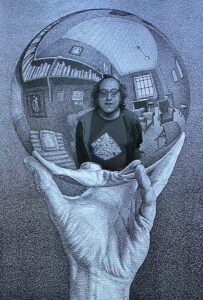
The munchkin Zarf, 1971.

Perhaps we should start with some very general background. Have you lived in the Boston area your whole life?

No, not at all! I only moved to Boston in 2005.

I was born in 1970 in Syracuse, New York, a place that I don’t remember at all because my family moved to New Jersey when I was about three. We lived there for a couple of years, then my father got a job in the Washington, D.C., area. I went to primary school through high school there.

And when and where did you first encounter interactive fiction?

It must have been around 1979. My father’s company had a “bring your family to work” day. A teletype there was running Adventure. My father plunked me down in front of it and explained what was going on. I thought it was the best thing in the universe. I banged on it for a couple of hours while everybody else was running around the office, although I didn’t get very far.

For the next few months, Dad was playing it at work, illicitly — that was how everybody played it. He would bring home these giant sheets of fan-fold printer paper showing his latest progress. As I recall, I suggested the solution to the troll-bridge puzzle: giving the golden eggs to the troll. That was great, the first adventure-game puzzle I solved.

When did you first get a computer at home?

Around 1980, we got an Apple II Plus. We acquired the first three Scott Adams games and Zork, which was newly available, plus Microsoft’s port of Adventure to the Apple II.

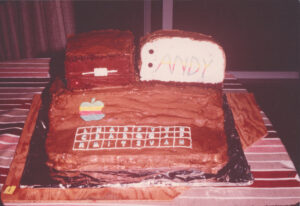
Andrew’s bar mitzvah cake took the form of an Apple II.

That started my lifelong attachment to Infocom. I played all the games as they came out. I begged my folks to buy them for me. Later, I spent my own money on them.

You played all of the Infocom games upon their first release?

Pretty much, up until I went off to college. I remember that I did not play Plundered Hearts when it came out.

That one was a hard sell for a lot of young men — although it’s a brilliant game.

Yeah. I didn’t play it because I was a seventeen-year-old boy.

I also didn’t play Zork Zero or the [illustrated] games that came after it because I had gone off to college and didn’t have the Apple II anymore. But I did catch up with all of them a few years later.

You mention that you did get some adventure games from other companies when you first got the Apple II. Did that continue, or were you exclusively loyal to Infocom?

Well, I was haunting the download BBSes and snarfing any pirated game I could. I played Wizardry and Ultima. I didn’t play too many other text adventures. I knew they existed — I had seen ads for Mike Berlyn’s pre-Infocom stuff — but I didn’t really hunt them down because I knew that Infocom was actually better at it. I remember that we had The Wizard and the Princess, which was just clunky and weird and not actually solvable.

I know that you also wrote some of your own text adventures on the Apple II in BASIC, as a lot of people were doing at this time.

Yes. The first one I did was a parody of Enchanter. I called it Enchanter II. It was a joke game that I could upload to the BBSes: “Look, it’s the sequel!” It was very silly. It started out pretending to be an Infocom game, then started throwing in Doctor Who jokes. The closing line was, “You may have lost, but we have gained,” the ending from the Apple II Prisoner game. It was terrible.

But I did write it and release it. Unfortunately, as far as I know it’s lost. I’ve never seen it archived anywhere.

I did Inhumane after that. That was another parody game, but it was meant to have actual puzzles. It was inspired by the Grimtooth’s Traps role-playing books. I liked the idea of people dying in funny ways.

Inhumane is obviously juvenilia, but at the same time it shows some of what was to come in your games. There’s a subversive angle to it: here’s a game full of traps where the objective is to hit all the traps. That’s the way I play a lot of games, but inadvertently. Here that’s the point.

Were you heavily into tabletop RPGs?

No. Tabletop role-playing I was never into. I get performance anxiety when I’m asked to come up with stories on the fly. I just don’t enjoy sitting at a table and being in that position. It’s not my thing.

But I was interested in role-playing scenarios and source books. First, because of the long-term connection to [computer] adventure games, second because they had so much creative world-building and storytelling, just to read. So, yeah. I was interested in tabletop role-playing games but not in actually playing them.

A surprising number of people have told me the same: they never played tabletop RPGs much but they liked the source books. For some people, the imagination that goes into those is enough, it seems.

So, you go off to university. Why did you choose Carnegie Mellon University?

I got rejected by MIT! It was second on the list.

Were you aware that Infocom was connected so closely to MIT?

No. I knew that they were in Cambridge because I subscribed to the Status Line newsletter. There was a running theme of them mentioning stuff around Cambridge. And I’d played The Lurking Horror. But I didn’t have the full context of “these were MIT students who made Zork at MIT.”

I guess it would have made the rejection even more painful if you’d known.

At university, you’re exposed to Unix and the Mac for the first time.

Yes. And to the Internet. And I started learning “real” programming languages like C.

Did you also play games at university?

Yes. I ran into roguelikes for the first time.

Which ones did you play?

I played a fair bit of Advanced Rogue, but I never got good at it. There were people playing NetHack, but it was clear that that was a game where you had to put in a lot of time to make any serious progress. Rogue was a little bit lighter.

Yeah. I never was willing to put in the hours and hours that it takes to get good at those games. Now especially, when I write about so many games, I just don’t have the time to devote 200 hours to NetHack.

You’ve since re-implemented one of your own programming experiments from university, Praser 5.

That was not originally a parser-based text adventure. It was a puzzle stuck inside the CMU filesystem. Every “room” was a directory, connected by symlinks. You literally CDed into the directory and typed “ls,” and the description would pop up in the file listing. Then you would type, “cd up,” “cd left,” whatever, to follow symlinks to other directories. It was an experiment in using the tools of a shared computer system to make an embedded game. The riddles were a matter of running a small executable which was linked in each directory. I used file permissions to give people access to more things as they solved more puzzles.

Much later, after I had learned Inform 6, I did the parser version.

What did you do right after university?

I graduated in 1992, but I wanted to stick around the Pittsburgh area because a lot of my friends hadn’t graduated yet. I got a job in the CMU computer-science department and shacked up with a couple of classmates in a rundown apartment.

That was great. I bought my first Macintosh and started writing stuff on it. That’s when I started working on System’s Twilight. I figured it was time for me to get into my games career. I decided to write a game and release it as shareware to make actual money. So, I bought a tremendous number of Macintosh programming manuals, which I still have.

System’s Twilight has the fingerprints of Cliff Johnson of Fool’s Errand fame all over it.

Yes. It was an homage.

When did you first play his games? Was that at university?

Yeah. Those came out between 1988 and 1992, when I was there. I had a campus job, so I could afford a couple of games. I played them on the campus Macintoshes.

I remember very well being in one of the computer clusters at two in the morning, solving the final meta-puzzle of The Fool’s Errand. I had written down all of the clues the game had fed me on papers that were spread out all over the desk. Every time I used one of the clues, I’d grab the piece of paper, crumple it up, and throw it over my shoulder. When I finished, the desk was empty and I was surrounded by paper.

We had an amazing experience with The Fool’s Errand as well. My wife fell in love with it. It was our obsession for two weeks. When I talked to Cliff Johnson years ago, my wife told me to tell him that he was the only man other than me that she could see herself marrying. I wasn’t sure how to take that.

What were your expectations for System’s Twilight?

I intended to make some money. I didn’t know how much would show up or whether it would lead to more things. It was just something I could do that would be a lot more fun than the programming I was doing in my day job.

Now that you had your own Macintosh and a steady income, I guess you started buying more commercial games again? I know you have a huge love for Myst, which came out around this time.

I was actually a little bit late to Myst. I didn’t play it until 1994, when everybody was already talking about it.

But when you did, it was love at first sight?

Yeah. The combination of the environment and the soundscape was great and the puzzles were fun. It felt like someone was finally doing the graphical adventure right. I’d never gotten into the LucasArts and Sierra versions of graphical adventures because they were sort of parodic, and the environments weren’t actually attractive. They were very pixelated. They just weren’t trying to be immersive. But Myst was doing it right.

As long as we’re on the subject: I guess Riven absolutely blew your mind?

Yes, it did. It was vastly larger and more interesting and more cohesively thought-through than Myst had been. I played it obsessively and solved it and was very happy.

At what point did you get involved with the people who would wind up being the founders of a post-Infocom interactive-fiction community?

In 1993 or 1994, someone pointed me to an open-source Infocom interpreter. I hadn’t really been aware of the technology stack behind Infocom’s games. But now you could pull all of the games off of the Lost Treasures disks and run them on Unix machines. That was kind of interesting.

I don’t remember how I encountered the rec.arts.int-fiction newsgroup. But when I did, people were talking about reverse-engineering the Infocom technology. I wrote an interpreter of my own for [Unix] X Windows that had proportional fonts, command-line editing, command history, scroll bars — all the stuff we take for granted nowadays. I released that, then ported it to the Macintosh. That was my first major interaction with rec.arts.int-fiction.

It must have been around this time that Kevin Wilson made a very historically significant post on Usenet, announcing the very first IF Competition. You submitted A Change in the Weather and won the Inform category. Did you write that game specifically for the Comp?

Let me back up a little bit. In early 1995, I got an offer from a game company in Washington, D.C, called Magnet Interactive, to port games from 3DO to Macintosh. So, I moved to Washington — I was very sad to leave Pittsburgh behind — and rented a terrible little rundown apartment there. I was also making some money from System’s Twilight, and had started working on a sequel, which was to be called Moondials. It was a slog. I had some ideas for puzzles, but the story was just not coming together.

So, when Kevin Wilson said, “Hey, let’s do this thing,” I said, “I’m going to take a break from Moondials and write a text adventure very fast.” The process started with downloading Inform 5 and the manual and reading it. I think I blasted through the manual five times in a week.

The start of the Competition was a little weird because we didn’t yet have the idea of all of the games being made available at the same time. Kevin just said, “Upload your games to the IF Archive.” So, all of the games trickled in at different times. For the second Comp, we settled very firmly on the idea of all games being released at the same time because the 1995 experience was not very satisfactory.

I know that it’s always frustrating to be asked where ideas come from. But sometimes it’s unavoidable, so I’m going to ask it about A Change in the Weather.

I think I was drawing on the general sense of being an introvert and not making friends easily — being separated from people and feeling alienated from my social group. My college experience wasn’t solidly that. I was an introvert, but I was at a computer college, and there were a lot of introverts and introvert-centered social groups. I had friends, had housemates after college, as I said. But I still struggled somewhat with social activities. It was a failure mode I was always aware of, that I might end up on the edge not really talking to people. I drew on that experience in general in creating the scenario of A Change in the Weather.

That’s interesting. From my outsider perspective, I can see that much more in So Far, your next game. It really dwells on this theme of alienation and connection, or the lack thereof. That also strikes me as the game of yours that’s most overtly influenced by Myst. Just from the nature of the environment and the magical-mechanical puzzles. It’s not deserted like Myst, but you can’t interact in any meaningful way with the people who are there — which goes back to this theme of alienation.

I wasn’t thinking of Myst specifically there, but it was part of my background by that point. The direct emotional line in So Far was breaking up with my college girlfriend. That was a couple of years in the past by this point. That had been in Pittsburgh. A lot of the energy for working on System’s Twilight came from suddenly being stuck at home after that relationship ended. I channeled my frustrations into programming.

But then I tried to drop it into So Far as a theme of people being separated. None of the specifics of what had happened were relevant to the game — just the feeling.

By the time of So Far, you were as big as names get in modern interactive fiction. Your next game Lists and Lists was arguably not a game at all. What made you decide to write a LISP tutorial as interactive fiction? Do you have a special relationship with LISP?

Yes! I hate it! I had taken functional-programming courses in college and learned LISP. But I just did not jibe with it at all.

That’s ironic because Infocom’s programming language ZIL was heavily based on LISP.

Right. It was an MIT thing, but it was not my thing. Nevertheless, the concept of building it into the Z-Machine with a practical limit of 64 K of RAM — or really less than that — seemed doable. And I had written a LISP interpreter as a programming exercise during my first or second year in college. So, I was aware of the basics. Doing it in Inform wasn’t a gigantic challenge, just a certain amount of work.

Were you already starting to feel restless with the traditional paradigm of interactive fiction? Right after Lists and Lists, you released The Space Under the Window, which might almost work better if it was implemented in hypertext. It’s almost interactive poetry.

I wasn’t bored with traditional games, but I did want to try different things and see what could be done. And writing in Inform was simple enough that I could just whip out an idea and see whether it worked. That was inspiring the whole community at this point. That was the lesson of the first IF Comp: you can just sit down and try an idea, and a month later people will be talking about it. There was a very rapid fermentation cycle.

Yes. It led to much more formal experimentation. Before the Comp came along, everybody was trying to follow the Infocom model and make big games. But if you have an idea that’s more conceptual or avant garde, it’s often better suited to a smaller game. The Comp created a space for that. If you do something and submit it to the Comp, even if it’s highly experimental, it will get played and noticed and discussed.

Now we come to The Big One of your games in many people’s eyes. And I must admit that this applies to me as well. Spider and Web is such a brilliantly conceived game. I’m in awe of this game. So, thank you for that.

You’re welcome. It’s always tricky to have a game which is so purely built out of a single idea because then, when you try to write another game, you think you have to come up with another idea that’s as good, and it’s never possible.

Was this idea born out of any particular experience, perhaps with other media?

I don’t think it was. I was prying into what we would now call the triangle of identities — prying into the idea that what the game’s text is telling you is a point of view that might have biases behind it. There is a dialog between what the player thinks about the world and what the game thinks about the world, and there can be cracks in between. That led to the idea of using the storytelling of the game to tell a lie, and that there is a truth behind it which can be discerned.

I started with that kernel and started coming up with puzzle scenarios. Here is an outcome that is verifiable. But there’s two different versions of what happened that could have led to that outcome. I’m going to tell one, but the other is going to be the truth. I strung together a few different versions of that. Then I said, okay, if we’re lying, then the introduction of the game has to introduce the lie. So I folded that in from the start. I knew that I wanted a two-part structure: you learn what’s going on, then you make use of all of the information.

The moment of transition between the two is often referred to as simply The Puzzle. It’s been called the best single text-adventure puzzle ever created. Did you realize how special it was at the time?

No. I figured it would be a puzzle. I didn’t understand how much of an impact it would have. I knew that I wanted to surprise players by having a possibility suddenly become available. Here’s a thing that I can do, and I will do it. Any kind of good puzzle solution is a surprise when you think of it. Afterward it seems obvious. I knew I had a good combination of elements to make it work, but I wasn’t thinking about the way that it would reorient the entire history of the game in the player’s head in one fell swoop. I don’t know. Maybe I had an inkling.

What I love is that the game is called Spider and Web. Suddenly when you solve that puzzle, those two categories get reversed. Who is really the spider and who is caught in the web?

The reason I called it Spider and Web was actually the old idiom “What a tangled web we weave when we practice to deceive.” The notion of deception was meant to be part of the title, and the spider was there just to go with the web. But yes, it’s multi-valent.

I know you’re a big reader of science fiction and fantasy. I wouldn’t picture you reading a James Bond novel. What made you decide to go in the direction of spy fiction here?

Honestly, I thought of it as science fiction. The spy fiction was merely because the story was about deception, and somebody had to be fooling somebody. But conceptually, I had it pinned as a science-fiction scenario from some kind of dystopian cold war, but with magically advanced technology.

You entered Hunter, in Darkness into the 1999 IF Comp. It’s a riff on Hunt the Wumpus, which is about the most minimalist imaginable text adventure, if you can even call it that. Your game, by contrast, is a lushly atmospheric, viscerally horrifying fiction. Were you just being cheeky?

Yeah, I was. I just wanted to put in all the stuff that Wumpus didn’t have, without getting away from the core concept. I thought it would be a funny thing to do. I worked really hard on the claustrophobia and the creepy bats. I remember crawling under a chair to try to get the feel of being in a narrow passage and not being able to move around — just to get the bodily sense of that.

Then we have Shade from 2000, which is another of my favorites of your games. Even more than Hunter, in Darkness, it has a horror vibe.

Yes. I leaned into it harder in Shade.

There are all kinds of opinions about what is really going on in Shade. I know you like to let people draw their own conclusions about your games, so I won’t press you on that…

I don’t think there’s a lot of disagreement on the main point, that you’re dying and this is all a hallucination.

Yeah, that was absolutely my take on it, that you’re dying of thirst in the desert. I saw it pointed out in a review that everything you’re trying to do is the opposite of the real problem you have. You’re trying to get out of your apartment in the hallucination, but your real problem is that you are out, lost in the desert. Was that something you were consciously doing, or are we all reading too much into it?

Well, neither. I don’t think I was consciously thinking that way, but that doesn’t mean that you’re reading stuff into it. It’s deliberately ambiguous. I had a lot of images in my head that I threw out at random. I did have the notion that this environment in your apartment was from your past. You really had packed up your apartment and called a taxi and gotten out, and reiterating it was… inappropriate but real. It was in your head while you were having this terrible experience, and it was being replayed by your brain in a broken way. You’re in a place of blinding light — it’s very hot — and the experience you’re replaying is very dim and dark, except that when light occurs it’s painful.

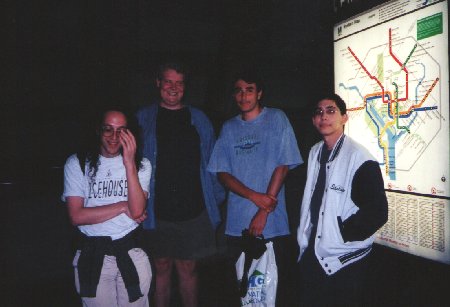
A rare 1999 meeting in the flesh of interactive-fiction luminaries. From left: Andrew Plotkin, Chris Klimas, David Dyte, and Adam Cadre.

Although your games of the 1990s are fondly remembered and still played, you were also making major technical contributions. Probably most important was the Glulx — sorry, I can’t say that word! — virtual machine to let Inform games expand beyond the strictures of Infocom’s old Z-Machine. How did that come about?

No one knows how to pronounce it!

I started to think about it in probably 1996, when Graham [Nelson] came out with version 7 and 8 of the Z-Machine. Version 8 was big — big enough for Graham’s Jigsaw — but it was still just a stopgap. It was only twice as big as Infocom’s version 5. There were all kinds of things that didn’t scale. It seemed worthwhile to make a fresh design that would be 32-bit from the start. I just didn’t want to deal with more incremental changes. And being able to jettison all of the weird legacy stuff about the Z-Machine seemed like a win too — being able to rethink all of these decisions in a technological context that is not 1979.

One of the things I wanted to do was to separate out the input-output layer. I had already written Z-Machine interpreters for X Windows and Mac that used Mark Howell’s ZIP engine with different interface front-ends. When TADS went open-source around 1997, I made an interpreter for that. So, now I had this matrix, right? I’ve got an X Windows front-end and a Mac front-end, and they both slap onto the Z-Machine and the TADS virtual machine. In a pretty clear way, these things are just plug and play. All the virtual machine does is accept text input and generate text output. I mean, yes, there’s the status line, maybe sound and graphics, but fundamentally that’s what it’s doing. And the front-end presents that text in a way that suits the platform on which it’s running. I was doing the same thing that Infocom did, just slicing it into more layers. Infocom had an interpreter and a game file. I said, we’re going to have an interpreter engine and an interpreter front-end. Thus there will be more flexibility.

I designed the front-end first, the Glk library. I made an implementation for Mac and for X Windows and for the Unix command line. Then I started thinking about the virtual machine. I ripped apart the Inform 6 compiler so it could compile to Glulx from the same game source code.

As I recall, the Glulx virtual machine is bigger than the Z-Machine — for all practical purposes, its capacity is infinite — but also simpler. There’s less of the hard-coded stuff that Infocom included, like the object tables.

Yes, exactly. I figured the more generic and simple I could make it, the better. It would be simpler to design and simpler to implement. It adds complexity to the compiler, but the compiler already needs code to generate object tables in a specific format. It would still be doing that, but there wouldn’t be any hardware support for them. I’d just have to include veneer routines to handle object tables in this format. Then, if we ever need to change the format, no problem. We just change the compiler. We don’t need to change the virtual machine.

When did you publish the Glulx specification?

April 1, 1999.

Were you still living in Washington, D.C., at this time?

I had moved around a lot, actually. The job in D.C. only lasted about a year and a half. After the porting project I had been doing finished up, the company dropped me onto a project to do a Highlander licensed game, which we had absolutely no concept of how to do. This would have been like a 3D action game. That project got canned.

Then I worked for a document company in Maryland for a while. Then I moved back to Pittsburgh and worked for a startup. The startup got acquired by Red Hat, and they moved us down to North Carolina. That was from like 1999 to 2000. Then Red Hat fired us and I moved back to Pittsburgh. From 2000 to 2005 I worked for a filesystem company in Pittsburgh.

You took a break from writing interactive fiction for a few years after Shade. Then there was a little bit of a shift in focus when you did come back in 2004 with The Dreamhold. Your earlier games don’t try too hard to be accessible. When you returned, you seemed more interested in outreach and accessibility. What was the thought process there?

Only the obvious one. It’s true that all of my previous games were written very much for the community. They were written for people who knew how IF worked. But The Dreamhold was specifically an outreach game. I wanted to try to expand the community. We’d been doing this for about ten years at that point, and it was kind of the same crowd of people. I thought to create an outreach game as a total wild-ass experiment to try to bring in people from other parts of the gaming world. I didn’t know whether it would work, but I figured it was worth a try. So I designed a game specifically for that purpose, built around explaining how traditional interactive fiction worked to people who didn’t know how to play it.

That meant doing some wacky stuff. There are some rooms in The Dreamhold that you enter by going north, but to go back you have to go east, because I figured, this is really uncomfortable, but people are going to run into this if they get into IF, so they should be familiar with the concept. I’ll try to introduce it as smoothly as possible by putting messages like, “The corridor turns as you head to the north.” Then put in the [room] description, “You can go back the way you came, toward the east,” to try to make it more tangible. But I wanted to introduce complicated maps and darkness and all of the hardcore stuff that the community was used to. And also make it fun.

There were a number of these outreach efforts at the time. Some people were taking IF games to more conventional game jams. There were cheat sheets of “how to play IF” going around. My impression is that these efforts weren’t super successful. Is that your impression as well?

Yes, it is. None of it actually worked. It’s great that we made the on-ramps and it’s good that we still maintain them, but there was not a huge influx of new people coming onto the scene at that point.

My impression is that the community didn’t really start to grow until it opened itself up to non-parser-driven games: the Twine games and ChoiceScript games and so on. Presumably some percentage of those players became willing to try the parser games as well.

Yeah, but that was a little bit later, after 2010 or so. There was still a gap. I decided, well, The Dreamhold didn’t make an impact, so I’m just going to go back to writing wacky puzzle games.

Of course, in 2007 Inform 7 came out. I would say that drew people into creating games, because it was much more approachable for people who were not C programmers. There was a bit of a revolution there. It was just harder to see because it was new authors rather than new players.

The time around 2010 was an exciting one for you personally as well as the community. In addition to the ongoing buzz about Inform 7, Jason Scott released his Get Lamp documentary, and you launched a Kickstarter to make a game called Hadean Lands soon after.

Yes. In 2010, Jason Scott premiered Get Lamp at PAX East. He had interviewed me two or three years earlier — probably in 2007.

Yeah, he worked on that movie for almost ten years.

Exactly. It’s kind of funny to look back at 2007 and see me talking about releasing commercial interactive fiction.

But in 2010, all of the old Infocom guys showed up at PAX East. I was on that panel, sitting with Dave Lebling, Brian Moriarty, and Steve Meretzky. I was going… [genuflecting]

PAX East, 2010. From left: Dave Lebling, Don Woods, Brian Moriarty, Andrew Plotkin, Nick Montfort, Steve Meretzky, and Jason Scott. (Photo by Eric Havir.)

I’m not worthy!

Exactly.

Jason Scott brought Get Lamp to a game class at Tufts University a few weeks later. Since I was living about half a mile away, I came in and said, “Hi, I’m in this movie.” Afterward, I went up to Jason and said, “You know, people are talking about interactive fiction for the first time in fifteen years outside of our little community. Do you think I should do a Kickstarter for a giant IF game?” And Jason looks at me like I’ve got bananas growing out of my ears and says, “Yes, you should!”

He’s the most enthusiastic person in the world.

Yes. And of course, he’d just done a Kickstarter for the Get Lamp release. This was early for Kickstarter. There had been gaming Kickstarter projects before, but no really gigantic ones. So, getting $30,000 for an IF Kickstarter was kind of a big deal in 2010. So I went to the boss at my day job and said, “Well, I guess this is it for us. I’m quitting.” I knew that $30,000 wasn’t actually going to last me very long, living in Boston. But of course, I’d been in the software industry for decades by this point, so I had a fair amount of savings cushion built up. And I had a pile of Red Hat stock which was worth some money. I could live on it while I found my footing as an indie developer.

The Dreamhold had taken me nine months. I thought Hadean Lands would take me a year. Ha! It turned out that writer’s block is a hell of a thing. Hadean Lands kept getting sidelined. I got totally knocked over by the idea of doing a hypertext MUD. I spent a year writing that. That was Seltani, which was hugely popular for about two months in the Myst fan community; I did it as a Myst fan game and presented it at a Myst convention. Everybody loved it. But I wasn’t writing Hadean Lands, and eventually my KickStarter backers started to get upset about that.

I did slog through it. I got Hadean Lands done [in 2014]. I don’t feel like the story is hugely successful, but I’m very happy with the puzzle structure and the game layout.

As you know as well as I do, there’s a whole checkered history of people trying to monetize IF. A few years ago, Bob Bates of Infocom and Legend fame released Thaumistry. I was a beta-tester on that game. The game was very good, but these things just never work. It’s always a disappointment in the end. Nobody has ever cracked that code.

If you look at the Thaumistry Kickstarter and the Hadean Lands Kickstarter, you see that they made almost the same amount of money from almost the same number of backers. It’s the same crowd showing up: “Yeah, we still love ya!” But they’re not enough to make a living from…

The problem is getting outside of that crowd.

It’s no wonder that people like Emily Short have long since decamped, saying, “I have to work on different kinds of games with a larger reach.”

What about you? Do you think you will ever return to parser-based interactive fiction?

That’s a fair question. I’ve had a lot of starts toward things that I thought might be interesting. I started working on a framework for a kind of text game that’s not parser-based but also not hypertext in the sense that Twine is. It’s more combinatoric. I got two-thirds of the way done with building the engine and one-third of the way done with writing a game, then I kind of lost it. But I still think it’s interesting and I might go back to it. I don’t think it would go big the way Twine did, but it might reach a different audience. It’s a different way of thinking about the game structure.

Would you care to talk about your partnership with Jason Shiga to turn his interactive comic books into digital apps? I have played Meanwhile, the first of those.

Sure. I’d been aware of Jason Shiga ever since I started hanging out with Nick Montfort at MIT after I moved to Boston. Nick had a bunch of his early self-published stuff. He had the original printing of Meanwhile, as a black-and-white hand-cut book. I thought it was really neat.

Totally by coincidence, Meanwhile got picked up by a publisher just before that 2010 PAX East we talked about. A nice big hardback version of it was published. It was being sold at PAX East. I thought, man, this is great, I’d really love to do an iPhone version. This was 2010; iPhone games were big.

A little later, I did the Hadean Lands Kickstarter and quit my job. I needed to have more projects than just one text adventure, so I wrote to Jason Shiga and said, “Hey, I’m a big fan. I’d love to do an app version of your book.” Jason was amenable, so we had the usual conversations with lawyers and agents and signed a contract. I worked on that at the same time that I was planning out Hadean Lands. The iPhone app came out in 2011.

So, the finances of making a go of it as an independent creator of digital content without a day job didn’t quite pan out for you in the end. I feel your pain, believe me. It’s a hard row to hoe. What came next?

After Meanwhile and Hadean Lands, I felt very stuck. Jason [Shiga] was off working on non-interactive comics, so there wasn’t anything to do there. I bummed around for a while trying to find something that would make any kind of money at all, but I was not successful.

I’m skipping over huge chunks of time here, but in 2017 Emily Short and Aaron Reed were working on a project to do NPC dialog as a commercial product. It was essentially taking Emily’s old ideas about threaded dialog in parser games and turning them into a plugin which game designers could use in any game to have interesting multi-threaded conversations. I spent a couple of years working on that project with them. But it turned out that management at that company sucked and everybody bailed.

Since then until this year, I’ve been working for big and small games studios, working on the dialog parts of their games.

Coding dialog engines or writing dialog?

I’ve been a software engineer, working on the coding part, but working with the writers.

Also during this period, Jason Shiga started writing what he calls “Adventuregame Comics,” which are shorter Meanwhile-style books. I’ve started porting those. The Steam port of The Beyond and the iOS and Steam port of Leviathan are available now. The iOS port of The Beyond will be coming later.

Since Hadean Lands, you’ve stepped into more of an organizing role in the IF community.

Yes. I’m very proud to have transitioned from being a hotshot game writer to someone who is doing community support, building structures and traditions and conferences. I never wanted to be a person who was only famous for writing games, especially after I started writing fewer games. I really didn’t want to be a person who was famous for having been a big game writer in the 1990s. That’s a sucky position to be stuck in. There needs to be a second act.

It’s maybe a maturation process as well. When you get a little bit older, you realize that some things are important in a way you may not have when you were a young, hotshot game writer.

Yeah. I slowed down writing games because I started to second-guess myself too much. When you’ve written a lot of games that people got really excited about…

Then you’re competing with your own back catalog.

It doesn’t feel good. I’ve had trouble getting away from that.

You’ve done most of your organizational work in the context of the Interactive Fiction Technology Foundation, so maybe we should talk about that more specifically. I’ll give you my impression of the reasons for its founding, and you can tell me if I’m right. You and some other people decided it would be wise to institutionalize things a little bit more, so that the community is no longer so dependent on individuals who come and go. With a foundation and a funding model and all of these institutional aspects, hopefully you set up the community for the long haul, so that it can survive if a server goes down or someone goes away.

Yeah, that’s exactly where it started. We’d been running for decades on people just setting up a server somewhere and saying, “Hey, I’ll run this thing!” That was the original IF Archive, the Usenet newsgroups, IF Comp, the Interactive Fiction Database, the IF Forum. It was workable, but everything was being paid out of somebody’s pocket. There wasn’t a lot of discussion about who was doing what or how much it cost. There was no fallback plan and no thinking about what would come next if somebody stopped doing something. Like, there was a long period when IFDB wasn’t getting any updates because Mike Roberts had a day job. Some things about it were clunky and hard to use, but you couldn’t fix them.

So, in 2015 or early 2016, Jason McIntosh, who was running the IF Comp at that point, had a conversation with somebody who said, “Why don’t you have a non-profit organization to support the IF Comp? Then you could get donations from people.” And Jason started running around in circles with a gleam in his eye, saying, “Yes! We should do this! We should do this! Whom do I know who can help?” He started talking to other people who were longtime supporters of things in the community. That included Chris Klimas, who had been supporting Twine for three or four years, and me — I’d been supporting the IF Archive for a while. Then Carolyn VanEseltine and Flourish Klink joined. Flourish was the only one who knew how to set up a non-profit. They had run a Harry Potter fan conference as a teenager, and, being excited and not knowing things were hard, had just done it.

We got into contact with the same lawyer Flourish had used. The lawyer told us what we needed: forms, bylaws, etc. Jason was the first president, I was the first treasurer. We went down to my bank and opened a business account for the organization. Then we wrote to the IRS to become a 501 C3 non-profit. We set up a website, found someone to give us a basic Web design and a logo. Then we announced it.

At the start, we just did the IF Comp; we collected about $8000 that first year for a prize pool. But over the course of the first couple of years, we added Twine and the IF Archive. The IF Forum was the next big addition. Then the IF Wiki and IFDB. Today each has its own steering group. And we have a grants committee now.

The NarraScope conference is another IFTF project. Would you like to tell a bit about that?

That was my idea. I’d always been keen on the idea of having a narrative-game-oriented conference. I’d been going to GDC for many years. GDC has a sub-track, a narrative-game summit, which is where people like Emily Short and Jon Ingold hang out. But it’s a very tiny slice of what GDC is. And of course GDC is expensive, so it’s hard to bring in the hobbyists and the indie people and the people who write IF Comp games. They just can’t afford GDC. I wanted to provide an alternative that was more approachable and affordable and friendly.

Once we as an organization had steady members and contributors and could bring in money, I said, “It’s time to think about a conference. Our first de novo project.” So, I talked to people I knew who had been involved in conferences, like the Myst fan conference, which is a very tiny thing that happens every year, like 100 people. But it’s been going for years and years. And of course Flourish had run a fan conference.

In 2017 or 2018, I went to GDC with a bunch of business cards that said, “We want to run an interactive-fiction, adventure, and narrative-oriented game conference. Want to help us?” I handed one to everybody I talked to. I found a bunch of people who were interested in helping. Nick Montfort said he could get us a space at MIT for the event relatively cheap. We put up a call for speakers, a website, etc. We were coordinating with the IFTF Education Committee, which is run by Judith Pintar, who goes all the way back to Shades of Gray.

Yeah, I had a great talk with Judith some years ago now.

I had strong opinions about how a friendly conference should feel. We had to bring in lunch so people would sit around and have conversations rather than splitting up and running all over Cambridge. I wanted long breaks between talks so people would have space to socially interact. I wanted badges that didn’t distinguish between speakers and attendees; we’re all here, and we’re not going to have superstars. I wanted an open and honest tone.

We made sure to have a keynote speaker who wasn’t an old fart. We didn’t want somebody like Scott Adams coming in and talking about what it was like back in the 1980s.

You didn’t want to become a retro-gaming conference.

Right. And we deliberately made the scope larger than just interactive fiction as found in the IF Comp or the IFDB. We didn’t want to limit the conference to those topics. We kept the admission price down to about $85.

That was 2019. We had about 250 people, and everything miraculously went perfectly. The worst disaster was when the Dunkin’ Donuts guy was dropping off coffee and hot cocoa. One of the urns blew its spout and dumped gallons of cocoa all over the floor. Someone said, “I know where there’s a mop,” and went and got the mop and cleaned it up. Great, let’s have the rest of the conference!

Local game companies made contributions, maybe $500 or $1000. Between that and the registration fees, the conference broke even. I admit that I threw in $2000 myself to make it balance, but that was because we splurged out and rented a bar on Sunday night. I said, okay, I’ll cover that, so that everybody can go out and have pizza and beer.

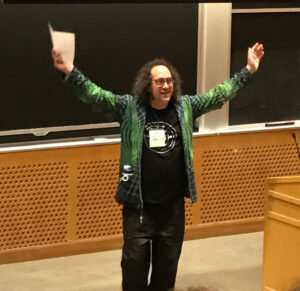
A dream achieved: Andrew closes the 2019 NarraScope conference in Boston. Time for pizza and beer!

It was a huge success. We said we would do it again next year. But of course next year was 2020. You know how that story goes.

But it was exciting enough that we wanted to keep going anyway, so we had an online event in 2020. We skipped 2021, then came back in 2022 with an online conference. Then we had a hybrid model for 2023 in Pittsburgh and 2024 in Rochester. And that’s the history of the thing in a nutshell. By now I’ve become just an advisor, which is a great relief.

How many people have attended the later conferences?

It’s very easy to attend an online conference, so about 500 or 600 people signed up for those. But in person in Pittsburgh, there were about 100, either because people didn’t want to travel in the pandemic era or because we were offering an online option, so a lot of people who could have showed up decided to stay home and watch the stream instead. This year was a little higher, like 120.

You were at the Strong Museum of Play in Rochester this year?

Yeah. The space was spread out, which turned out to be a win, because we had to walk through the museum and walk past all the cool exhibits. People were jumping out between talks to explore the museum. It was a really neat space — but unfortunately more expensive than a university.

And there will be another conference in 2025?

There absolutely will. It’s going to be in Philadelphia at Drexel University. NarraScope has not yet become big enough to replace GDC, but we’re optimistic. [smile]

I don’t think you want that. It becomes very bureaucratic and soulless.

Yeah, obviously. But Justin Bortnick, who is the current IFTF president, has been talking to GDC about booth space to present IFTF on the show floor. The Video Game History Foundation had a booth there this year. We thought, we’re educational too! We could do that! It may actually happen.

Maybe we can wind up this conversation by talking about the current status of the IF community itself. For many years, it seemed to be quite stagnant in terms of numbers. We already talked about the outreach efforts that took place around 2005 and largely did not succeed. But about five years later, the hypertext systems started to come online. There was a big jump at that point. If you look at the number of games entered in the Comp, they actually trend down through the 2000s, then suddenly there’s a big spike around 2010 to 2012. They’ve stayed at quite a high level since then. Do you have a sense of whether these new, presumably younger people are jumping over to the parser-based stuff as well?

There are new faces on both sides. There is now an active group of retro-fans interested in parser games. That is, people who are excited about making new games and running them on Commodore 64s and the like. We had to update Inform to fix the support for the version 3 Z-Machine, which had been broken over time as everybody was writing bigger and bigger games. Now people want to write small games again.

And there is more interest in hybrid systems, intermediate models which are neither pure hypertext nor pure parser. For years and years, there were no new parser tools. I thought the last great parser development systems had already been implemented; people would stick with TADS 3 and Inform 7 forever. Then a parser system called Dialog appeared, which is a little bit different from them.

But there is certainly more energy on the hypertext side, especially because a lot of us old farts have drifted away. I’m not writing games anymore, Emily Short isn’t writing text games anymore, Jon Ingold and Aaron Reed went off and did their things, Adam Cadre went off to work on film scripts. There are new people writing new games, but I think the pool is going to shrink over time. But that’s okay. Everything that Jon Ingold has done at Inkle Studios is informed by the early text games he worked on and how he wanted to expand that to reach a bigger audience. Everything Sam Barlow has done — Her Story, Telling L!es, Immortality — is informed by his experience writing text games. The same goes for Emily Short. It’s still part of the conversation. It’s just not the center of it anymore.

Yeah. This is a discussion I’ve had from time to time since I started this site. My opinion is that when our generation dies that will probably mark the end of parser-based text adventures. You can say that’s tragic if you want to. At the same time, though, nobody’s writing plays like Shakespeare anymore, but Shakespeare’s plays are still out there.

And there’s still theater.

Yeah. Trends in interactive media, just the same as others forms of entertainment and art, come and go. They have their time, and then their time is over. I’m quite at peace with that.

I’m sort of handicapped by the fact that I haven’t played IF Comp games in quite a while.

I haven’t either. To be honest, I’ve played almost nothing made in the last ten years, just because I have so many old games on the syllabus for this site. Having too many games to play is not the worst problem to have, but it’s made me kind of a time traveler. I live in the past in that sense.

I do know that this year’s IF Comp winner was by Chandler Groover. I don’t think he’s our age. Ryan Veeder is younger than us.

I do look at the Comp website sometimes to see what’s going on. I’ve noticed that it still seems to be a parser-based game that actually wins the thing most of the time. That’s a sign of something, I guess.

Yeah. Maybe it’s a sign of old farts hanging on too long? But seriously, I think there is a new generation of parser-game authors. Whether it’s big enough to sustain itself after you and I are doddering in a nursing home, I don’t know.

There’s been so much progress with computer understanding of natural language. A lot of it is associated with large language models, of course, which is a fraught subject in itself. But I could imagine a system — a front-end — that could take natural language and translate that into something a traditional parser could more readily understand, then funnel it through even an old text adventure. I’m kind of surprised I haven’t heard of anything like that.

Someone did do that as an experiment and posted about it on the forum. Experimenting both with using LLMs on the input side to translate natural language into parserese, and also on the output side to translate generic room descriptions into more flowery, expanded text. I’m more interested in the input side because I like hand-crafted output, but that’s getting into the whole question of AI.

Yes, I have no interest whatsoever in reading AI-generated text in any context.

I think there wasn’t a lot of uptake on that idea just because the kind of people who are excited about AI aren’t excited about parser games in the first place. There have been several attempts to make an AI-generated text adventure, but they’ve all been by people who were not good at text adventures and didn’t know what they wanted out of it. There’s AI Dungeon, which uses an LLM to pretend to be a parser game. But because it’s all AI generated, it doesn’t really produce anything interesting.

The people who are interested in making parser games are mostly old-fashioned artisans who want to hand-craft everything and are not motivated to dive into AI as a shiny new pool. It might be different if someone who was an established parser-game author jumped in and wholeheartedly tried to make it happen. Revolutions are the result of one person getting involved and building something that takes off. Someone has to actually do the work. And to this point, nobody has done that. It’s very possible the whole AI thing will collapse in six months anyway.

I think that’s a very good possibility, but I think that if it does, it will leave behind some pieces in the rubble that are actually useful. Maybe a solution to our parsing problems can be one of them.

But I’ve kept you long enough. Thanks so much for the talk!

Thank you!


Did you enjoy this article? If so, please think about pitching in to help me make many more like it. You can pledge any amount you like.


Tags: , , , ,

Retro No More: Interactive Fiction of the Early Comp Era

In 2002, Paul O’Brian, a prolific author, reviewer, and commentator on the contemporary interactive-fiction scene, attempted to compile a list of those people who had done the most to help text adventures live on beyond the death of Infocom. Among the names he listed were those of Mike Roberts and Graham Nelson, the creators of TADS and Inform; Andrew Plotkin, who contributed crucial technical innovations of his own and authored a number of perplexing, intriguing games; and Adam Cadre, who wrote the single most-played text adventure of the post-Infocom era. None of these names will come as a surprise to anyone who has been even a casual tourist of the interactive-fiction scene over the years. But another of them very well might: that of Gerry Kevin “Whizzard” Wilson. And yet one can make an argument that his skill set was the most unique and thus the most essential of them all.

It will presumably come as a shock to no one when I write that those folks who were still happy to play games consisting of nothing but text in the era of multimedia and 3D tended to be as quiet and bookish as the games themselves. Such personality types are not overly known for their organizing or marketing acumen. The burgeoning interactive-fiction community was thus incredibly lucky to have Wilson, who was the exception to the rule of introversion. An Infocom superfan who just couldn’t bear to see text adventures go gentle into that good night, he became an activist and community organizer par excellence.

In May of 1994, when he was just eighteen years old, Wilson published the first issue of an electronic newsletter which he called SPAG: “Society for the Preservation of Adventure Games.” Later, when it was concluded that text adventures as a species were no longer actively endangered, the word “Preservation” was changed to “Promotion.” By whatever name, SPAG served as the journal of record of the community from 1994 until 2010, a clearinghouse for reviews of the latest games along with news, announcements, and commentary. (Yours truly was the last long-serving editor of SPAG, just before I became a digital antiquarian…)

It was Wilson as well who reached out to Activision, the corporate inheritor of the Infocom legacy. He found an ally there in one Laird Malamed, the project leader of Zork: Grand Inquisitor, Activision’s third and last graphical Zork adventure game. Together, Wilson and Malamed sneaked half a dozen recent amateur-authored text adventures onto the Masterpieces of Infocom shovelware collection. The writers of same even received actual, albeit small, royalty checks for their efforts, meaning that they were, technically speaking, amateurs no longer.

Then Wilson convinced the ex-Infocom authors Marc Blank and Mike Berlyn to write one last text-only Zork, which he himself implemented using Graham Nelson’s Inform programming language and which Activision officially released as a free taster for Grand Inquisitor. These efforts helped to inspire Berlyn to start a new company called Cascade Mountain Publishing; a commercial game from Kevin Wilson and one from Mike Berlyn and his wife Muffy became its only two digital releases. (I’ll have more to say about that ambitious if doomed effort in a later article.) It’s hard to imagine anyone else in the amateur community orchestrating such sweeping outreach to the world of games beyond the Usenet newsgroups where the Infocom diehards hung out.

But for all the other things he accomplished through his sheer energy, likability, and enthusiasm, the core of Wilson’s claim to being the Indispensable Man in the community will always come down to a single one of the hundreds of messages he posted to Usenet during the 1990s. On June 26, 1995, he announced “The First Annual Text Adventure Authorship Competition,” whose purpose was “to inspire authors to write something, however small, and make it available for people to play. Interactive fiction as a hobby cannot survive unless there are people out there writing and playing it. Hopefully, some of the people who enter the competition will enjoy it, and decide to write more on their own.”

Entrants had to be submitted by September 1 of that year, which in and of itself precluded them from being very long, assuming that each author began his game just for the competition. The entrants were divided into two categories, one for those created with TADS, the other for those created with Inform. The final tally was six entrants in each of the categories, for a dozen new games in all, a massive bounty by the standards of the time. The winners, determined by a popular community vote after a month in which to play the games had elapsed, were Magnus Olsson’s Uncle Zebulon’s Will on the TADS side and Andrew Plotkin’s A Change in the Weather on the Inform side.

Already in this very first year, the entrants bore many of the hallmarks of Comps to come. Some of them were unabashedly experimental in form: Gareth Rees’s The Magic Toyshop took place entirely within a single room; C.E. Forman’s Mystery Science Theater 3000 Presents “Detective” (say that three times fast!) was a meta-textual roasting of a really bad earlier game; Neil deMause’s Undo expected you the player to work around the bugs in another terrible, broken game, a (meta-)fictional one this time. Such games would almost certainly never have come to exist without a Comp to give their authors permission to work on a smaller scale, one that lent itself to such single-concept creations. It encouraged authors to pursue other goals than that of simply being as good as Infocom at the things which Infocom had done best. In this sense, the advent of the Comp marked the beginning of the end of what I referred to as the community’s “neoclassical” phase in an earlier article.

The next year, the same event, now known as The Interactive Fiction Competition, was held again, without the rather pointless division into TADS and Inform categories; authors could now freely choose to use either of those development systems or any other, knowing their games would be judged alongside their peers without favor or prejudice. Another significant change was that the Comp was now more explicitly branded as being for short games, ideally “playable in two hours or less.” This time, it attracted no fewer than 26 entrants, and was won by Graham Nelson’s The Meteor, the Stone, and a Long Glass of Sherbet.

Kevin Wilson unplugged himself from the community after 1998, to aim his prodigious energies in other directions. He became a prominent designer of hobbyist board games, ones that usually had a pronounced narrative thrust and that sometimes borrowed their names and themes from popular digital games like DOOM, Warcraft, and Civilization. Yet his legacy lives on in interactive fiction in the form of the IF Comp, whose 30th installment has been recently concluded as of this writing. Throughout the last three decades, it has remained the essential event on the community’s annual calendar, the sun around which everything else revolves. For community stalwarts, its arrival each year has become as indelible a marker of autumn as the changing color of the leaves, pumpkins on display on roadside stands, and the first nips of Old Man Winter on the breeze.

The positives and negatives of building a community around the IF Comp have been discussed and debated ad nauseam over the years. On the one hand, it surely did encourage many people to take a stab at writing a text adventure who would not have done so back in the days when these games were expected to be as big as one of Infocom’s if they were to be taken seriously. Then, too, as we’ve already seen, it actively encouraged experimentation and innovation. The late 1990s were chock-a-block with games that departed radically from the points-for-treasure model of Zork: self-consciously literary games, games written in bizarre forms of language, one-room games, even a very well received one-turn game.

On the other hand, however, the Comp came to suck up so much of the communal oxygen that some authors felt obligated to enter it in order to get their games noticed at all. And this in turn caused them to write to the specific set of constraints which it encouraged. Although games lasting longer than two hours were never outright disqualified in the official rules, they were guaranteed to provoke some degree of anger among harried judges for being “too long for the Comp,” with some voters giving them bad scores on principle for that sin alone. This produced a not-so-subtle pressure not to make bigger games at all anymore.

On the other other hand, though, the extent of that pressure was probably exaggerated by some. Certainly a steady dribble of big games did continue to appear outside the Comp throughout the latter half of the 1990s. Indeed, an article which I’m planning to write for this site next year will focus on the surprising number of absolutely huge games — most of them far bigger than any made by Infocom — that appeared in 1998 and 1999 alone.

Having said that, I must admit that I do have my fair share of issues with the sorts of games that the Comps of the late 1990s tended to produce. For all that this period may have been a necessary phase for the community to pass through if it was to begin to escape the long shadow of Infocom, a lot of the games themselves really haven’t aged all that well in my opinion. When works in any creative medium start to prioritize meta-textual cleverness — when they become primarily commentaries on the nature of the medium itself instead of the wider world around it — insularity tends to be the result. It’s hard to exempt the interactive-fiction community from this charge — not by the time it was releasing elaborate in-jokes like J. Robinson Wheeler’s Being Andrew Plotkin, which replaced the hero of the film Being John Malkovich with the titular author of modern text adventures. The cliquish — not to say incestuous — feel of games like this did nothing to welcome newcomers into the fold.

Of course, such complaints by no means apply to every single Comp entrant of this period. I’ve brought them up here mainly in order to explain why some types of games will not be much in evidence in the rest of this article, nor in any others on these subjects that might follow it in the future. The late 1990s also brought its share of fine games that are complete in themselves, with no knowledge of the community and its personalities or any of its raging debates about the theory and practice of interactive fiction required. In fact, 1998 can be reasonably called the interactive-fiction community’s best single year in all its history, in that it produced no fewer than three of the most widely played post-commercial text adventures of all time, all of which are included in the little roundup that follows. Each of the games below is possessed of its own authorial voice, distinct from that of any of the people who worked for Infocom. And yet each is as finely calibrated a marriage of plot, place, and puzzles as any of the best games of Infocom — with just one exception, that is, whose reasons for appearing on this list nevertheless will be made clear in due course.

In short, whether it’s your first text adventure or your thousandth, I do think you can enjoy any of the games on this roundup. In the former case, you will have to put in a bit of effort to familiarize yourself with the conventions of the form — but trust me, it’s not all that hard and it’s eminently worth it.

So, why not pick a game and give it a shot? What have you got to lose? Of all the virtues of the text adventures of the 1990s and beyond, the most undeniable is the fact that almost all of them are entirely free. You can try any of these games directly in your browser by clicking the “PLAY ONLINE” link. If you decide to stay with it, you may want to download an offline interpreter and the story file. For the former, I recommend an application called Gargoyle, which will play all of the games below. For the latter, you’ll want to look on the right side of the Interactive Fiction Database page for each game, which you get to by clicking on its title below. (You always want the latest release, generally the first on the list.) Trizbort is a handy application for making maps of the territory you explore. I find filling in a map to be a joy of its own.

I’ve included below a very rough guess as to how long it might take the typical person to play each game. But keep in mind that it’s only a guess. All of these games deserve to be savored for however long strikes you as appropriate.


She’s Got a Thing for a Spring by Brent VanFossen
Estimated Play Time: three hours
PLAY ONLINE

"This is it!" he says as he dodges the last pothole and brings the truck to a stop. After twenty miles of the worst washboard road the country has to offer, you're just happy to have arrived.

You place your sandaled feet on solid ground and take a deep breath. The smells of autumn are at once sweet and earthy and full of the aroma of moisture and living things. A cool breeze blows in your face, soft and gentle. What a nice change, what a welcome relief from the tension and hustle of all you've left behind this weekend. It's just you and your husband, as he promised over a month ago.

You look around. What passes for the road you just traveled ends abruptly here. Over the last hour, bad asphalt gave way to gravel, which gave way, in turn, to the rutted two-track you see beside you. Ahead, the ruts continue, but it'll be on foot if you're to go any further. The old beater truck stands here, engine off but still ticking from the trip. Your husband closes the driver's door and comes around the rear to join you.

"How's my pretty lady?" he asks as he wraps his arms around you and places a kiss on your cheek from behind. "Tired, huh? Come on. Let's get the stuff. We'll be able to relax better once the tent's up."

He takes the two packs from the back of the truck and helps you into yours, then leads the way through the brush to the north. You roll up on the balls of your feet and give your pack a nudge, then pull the waist strap tight. Without looking back, you follow.

That was last night, and you hiked a short trail to a campsite off in the woods. Together you set up the tent, fixed a quick dinner, and fell asleep in each other's arms...

You wake with a start, something's missing, and you notice the sleeping bag is empty beside you. On his pillow is a handwritten note, which you collect. He must have crawled out early, as the sky is only now beginning to lighten.

You dress quickly, slip out of the tent, and follow the trail to the east.

Aspen Grove
You stand in the middle of a grove of aspen, which extends in all directions. Slender white trunks reach for the sky with long thin fingers, stroking the clouds that blow in the autumn breeze. Leaves of gold rattle as the winds shift, and here and there one floats to the ground to join others that crackle underfoot when you move. A narrow path disappears east into the trees, and a camping area is visible through a small opening to the west. North is a wide meadow.

I was better equipped to appreciate She’s Got a Thing for a Spring when I played it fairly recently than I was when I first encountered it quite some years ago. For it seems that the older I get, the more I just want to be outside walking. In fact, I replayed this game while my wife and I were on a walking holiday in Tuscany, on a morning when the rain was coming down so heavily that there wasn’t anything for it but to stay at our hotel. I sat there on our covered balcony for several hours with my laptop and She’s Got a Thing for a Spring, while the rain pattered and the thunder boomed. I can’t imagine a more perfect soundtrack for this game. Then the storm blew itself out and we went walking again for real.

In She’s Got a Thing for a Spring, which took fourth place in the 1997 IF Comp, you play a wife whose husband has arranged a special treat for your fifth wedding anniversary: a visit to a hidden hot spring somewhere in Colorado or thereabouts. Just to keep it interesting — and to give us a game — he’s first challenged her to find the spring for herself. The stakes are no higher than that. Nor, it must be said, do they need to be.

There’s more personal experience behind this particular interactive fiction than is commonplace in the genre. Beginning one year before and continuing for fourteen years after he released it, our author Brent VanFossen lived full-time with his wife Lorelle in a motor home, exploring the natural wonders of the Americas. He wrote She’s Got a Thing for a Spring, he tells us in his “about” text, as a gift for Lorelle on her birthday. His love for nature and for his wife comes through in every word. There’s a distinct whiff of sensuality to his descriptions of both; said wife is, after all, trying to join him at a hot spring for a secret, skinny-dipping, midnight tryst. In some other games where a male author has tried to embody a female protagonist, it’s gone horribly wrong, coming across as handsy adolescent leering. But this is not that. It’s sexy but not raunchy, sensual but not exploitive. Just the way these things ought to be, in other words.

She’s Got a Thing for a Spring garnered a lot of attention back in the day for the one non-player character with whom you can interact extensively, who is actually not the husband. (He shows up in the flesh only for the last couple of turns.) Said character is rather a humble fellow named Bob, a grandfatherly sort who’s retired to a quiet life in a little cabin in the woods. You can talk to him about an impressive number of topics, both relevant and irrelevant to your quest, as he putters about his house, sweeping the porch, repairing an old rocking chair, picking lettuce and tomatoes and strawberries, making sandwiches for lunch and strawberry shortcake for dessert, fixing a loose plank and re-caulking his windows, painting a picture in watercolors. Throughout, he natters away pleasantly about his chores and about bigger subjects, such as the wife he lost (“Cancer got her, and we never even knew it until it was too late”) and the brother who is coming for a visit soon (“Joe’s an engineer, works on all those commercial jet airplanes in the Northwest”). This is a man who has clearly known pain and loss, yet also one who is completely at peace with himself and his life. Some of that serenity rubs off on the player who spends time with him — or it did on this player, at least. Plus, his strawberry shortcake really is excellent; I tried the recipe that is described step by step in the game after we came home from Italy.

But as special and technically impressive as Bob is, the real magic of this game is the immersion in nature that it provides, which is as complete as the protagonist’s eventual immersion in the spring of its title. You start off with a book — A Field Guide to the Natural History of the Mountainous Regions — already in your possession. You can look up in its pages any of the flora and fauna you encounter during your hiking, to learn a bit more about it from a scientific point of view. Or you can forget about science and its facts and figures for once in your life and just take in the natural world that’s all around you.

The puzzles here do their job by giving structure and motivation to your wanderings. They’re fun to solve whilst being very much in tune with the pastoral atmosphere of their surroundings. There are a few jarring deaths that might have been better elided — you can get yourself gored to death by a bull moose if you aren’t careful — but those are about the only places where the author puts a foot wrong. This is a game about the quiet moments, about peace and beauty and love rather than war and strife and hatred, about the best parts of us rather than the worst. It’s a pity that it’s the only piece of interactive fiction that Brent VanFossen ever wrote. We could use a lot more games like it.


Babel by Ian Finley
Estimated Play Time: four hours
PLAY ONLINE

Black.
White. Cold.
Dry.
The sun is just about to rise on latitude 74. In the darkness the last stars
pierce the air and the arctic wind is a dying songbird. Below the snow dunes,
you are waking. Something is wrong.

North End
One by one, your senses speak to you. There is one absolute: cold. The
hard surface you're lying on is cold, the thin gown thrown over your body is
cold, the disinfectant-tinged air is cold, the darkness around you is cold.
Even your mind is cold and empty. Where are you? Who are you? You feel the
warm edge of a memory, but it fades as you approach. Slowly, your joints
bulging with ache, you get to your feet and look around.

You're standing in a cold, dimly lit hall which runs south toward a feeble light and terminates at a door to the north, out of which juts a weird device. Next to the door, in the northeast corner, is a heavy bulkhead, and you can just make out a third door on the west wall.

Babel is the first of three games that were authored between 1997 and 2000 by Ian Finley, a professional playwright, actor, and theater instructor. As a game with points and puzzles and most of the other standard accoutrements of the traditional text adventure, it is by far the most conventional of the trio. It placed second in the 1997 IF Comp.

Babel’s setting and premise verge on the clichéd. It takes place in an isolated polar research complex where Horrible Things transpire, a staple premise for science fiction and horror stretching back many, many decades. Yet the game serves as proof that execution will always trump whole-cloth invention. Few works of narrative art have done claustrophobic dread better than this one.

There is an interesting twist to the premise here. The Horrible Things in question have already happened as the game begins, when you come to consciousness shivering in the frigid air inside a complex that is now inhabited only by the corpses of your former colleagues. (Yes, an amnesic protagonist is an even more hackneyed cliché than the isolated research complex gone wrong, but remember what I said about execution.) As you begin to explore, knowledge of what happened comes back to you in the form of sudden flashes of memory that are like psychotic breaks, so jarring and traumatic are they. The sense of foreboding — of dawning knowledge that you’d prefer not to have — mounts and mounts as you solve a series of quite simple, straightforward puzzles to gain access to more and more of the complex and unlock more and more of your own unconscious. At last, it all comes to a head in a hair-raisingly twisted ending.

Babel did garner some criticism in its day for taking the easy way out with its storytelling. Relying on the classic gambit of uncovering a backstory rather than participating in a full-blown drama in the here and now lets it sidestep most of the difficulties of doing elaborate plotting through the mechanisms of text and parser. Yet what another critic might call a cop-out, I call making smart use of the tools at one’s disposal; ironic though it is to say this about a medium that likes to go by the name of “interactive fiction,” novelistic storytelling isn’t what parser-driven games tend to do best. Tying Babel’s story so closely to exploration — something interactive fiction does do very well — strikes me as thoroughly sensible.

I certainly can’t argue with the results here. Babel is a masterclass in tension, dread, and atmosphere, the perfect game to play in front of the fire on some cold, dark winter night when the snow is piling up alarmingly high on the other side of the window.


Spider and Web by Andrew Plotkin
Estimated Play Time: four hours
PLAY ONLINE

On the whole, it was worth the trip. The plains really were broad and grain-gold, if scarred with fences and agricultural crawlers. The mountains were overwhelming. And however much of the capital city is crusted with squat brick and faceless concrete hulks, there are still flashes of its historic charm. You've seen spires above the streets -- tiny green parks below tenements -- hidden jewels of fountains beyond walls. Any bland alley can conceal balconies wrought into iron gardens, fiery mosaics, a tree or bed of flowers nurtured by who knows who.

This alley, however, is a total washout. It ends in flat bare dirty brick, and you've found nothing but a door which lacks even the courtesy of a handle. Maybe you should call it a day.

End of Alley
It's a narrow dead end here, with walls rising oppressively high in three directions. The alley is quite empty, bare even of trash. (Your guidebook warned you: the police are as efficient about litter laws as about everything else they do.) You can retreat to the south.

A plain metal door faces you to the east, near the alley's end. It's firmly shut.

Following the example of Paul O’Brian, I don’t hesitate for a moment to stand Andrew Plotkin up alongside Mike Roberts and Graham Nelson as one of the people who did the most to keep the humble text adventure alive during the 1990s and beyond. In addition to a whole raft of vital technical and administrative contributions, he has written more important and highly lauded games over a longer span of time than anyone else. Many of them are slyly subversive; he has a gift for translating the interior of his protagonists’ minds into landscapes that aren’t quite what they appear to be. If I was forced to point to a weakness in his work, however, I might say that he has sometimes made his player work a little too hard for her experience, especially during the early phase of his career. A minimalist by instinct, his early games don’t exactly bend over backward to welcome the player in. “Here I am,” they seem to say. “Come inside if you like. I don’t really care one way or the other.”

But Spider and Web doesn’t have that problem, if problem it be. The deft opening above, seemingly written from the point of view of an adventurous tourist on a visit to an unnamed Eastern European country during the Cold War era, definitely has no trouble capturing my interest. Coincidentally or not, this game, which Plotkin released in February of 1998, is still regarded by many or most text-adventure aficionados as his masterpiece. I count myself among their number.

Spider and Web is an exploration of the old fictional trope of the unreliable narrator, carried out in a way that would be impossible in a non-interactive medium. I can best explain some of what it’s doing by describing how its first handful of turns are likely play out for you. In the role of the tourist, you poke and fiddle with the inscrutably blank door in front of you for a while, until, seeing no way to get through it, you walk off to discover what else lies to the south. As soon as you do so, a “glaring light” appears before your eyes, and you find yourself in an interrogation chamber. “Don’t be absurd,” says your interrogator. “You’re no more a sightseer than the Old Tree in Capitol Square; and if you’d had enough sense to walk away from that door, you wouldn’t be here. You’re going to start by telling me how you got through that door.”

And then you’re thrown back to the start of the game. But this time the opening text is subtly different.

On the whole, it was worth the trip. The plains really were broad and grain-gold, if scarred with fences and agricultural crawlers. The mountains were overwhelming. And however much of the capital city is scarred with squat brick and faceless concrete hulks, there are still flashes of its historic charm.

This alley, however, has no time for charm. It ends in flat bare dirty brick, and a door which lacks even the courtesy of a handle. Not that you'll wait on courtesy.

End of Alley
It's a narrow dead end here, with walls rising oppressively high in three directions. The alley is quite empty, bare even of trash. (You're sure the police are as efficient about litter laws as about everything else they do.) You can retreat to the south.

A plain metal door faces you to the east, near the alley's end. It's firmly shut.

From here on, you keep trying to tell your interrogator a story that minimizes your exposure as a foreign agent and saboteur, and he keeps calling you out on it, forcing you to change the details.

Until, that is, deep into the game, when you arrive at the moment that changes everything. People tend to refer to this moment as simply The Puzzle. It’s not an enormously difficult puzzle, but it’s nonetheless been called, with no hyperbole whatsoever, the best text-adventure puzzle of all time, all of the games of Infocom included. It’s far too brilliant to spoil here, but suffice to say that, when the light bulb does goes off in your head and you feverishly type the necessary command and see that you were right, you’ll be jumping out of your chair and pumping your fist as if you’ve just defeated the last boss in Dark Souls. The roles of the spider and the insect trapped in its web will have reversed themselves, and it will feel amazing.

After that, Spider and Web is just a chase scene, albeit a very well-executed one. But my, what a genius conceit comes before it, and what a genius puzzle to bring the conceit to its perfect fruition. Epistemology was never so much fun.

(A quick programming note: an extended interview with Andrew Plotkin is coming to this site soon.)


Anchorhead by Michael Gentry
Estimated Play Time: ten hours
PLAY ONLINE

November, 1997.

You take a deep breath of salty air as the first raindrops begin to spatter the pavement, and the swollen, slate-colored clouds that blanket the sky mutter ominous portents amongst themselves over the little coastal town of Anchorhead.

Squinting up into the glowering storm, you wonder how everything managed to happen so fast. The strange phone call over a month ago, from a lawyer claiming to represent the estate of some distant branch of Michael's family, was bewildering enough in itself... but then the sudden whirlwind of planning and decisions, legal details and travel arrangements, the packing up and shipping away of your entire home, your entire life...

Now suddenly here you are, after driving for the past two days straight, over a thousand miles away from the familiar warmth of Texas, getting ready to move into the ancestral mansion of a clan of relatives so far removed that not even Michael has ever heard of them. And you've only been married since June and none of this was any of your idea in the first place, and already it's starting to rain.

These days, you often find yourself feeling confused and uprooted.

You shake yourself and force the melancholy thoughts from your head, trying to focus on the errand at hand. You're to meet with the real estate agent and pick up the keys to your new house while Michael runs across town to take care of some paperwork at the university. He'll be back to pick you up in a few minutes, and then the two of you can begin the long, precarious process of settling in.

A sullen belch emanates from the clouds, and the rain starts coming down harder -- fat, cold drops smacking loudly against the cobblestones. Shouldn't it be snowing in New England at this time of year? With a sigh, you open your umbrella.

Outside the Real Estate Office
A grim little cul-de-sac, tucked away in a corner of the claustrophobic tangle of narrow, twisting avenues that largely constitute the older portion of Anchorhead. Like most of the streets in this city, it is ancient, shadowy, and leads essentially nowhere. The lane ends here at the real estate agent's office, which lies to the east, and winds its way back toward the center of town to the west. A narrow, garbage-choked alley opens to the southeast.

“Anyone who had ever read anything by H.P. Lovecraft, or even stood downwind of someone who has, will immediately recognize his influence throughout this game,” writes Michael Gentry in his introductory notes for Anchorhead. And indeed, this sprawling game, which Gentry released in May of 1998, is to my mind the definitive work of digital Lovecraftia, easily outdoing the likes of The Lurking Horror and Alone in the Dark.

Like all of the best Lovecraft homages, Anchorhead succeeds by embracing the best parts of its inspiration and binning the worst. Our protagonist here is a strong, capable woman, something that was well beyond the most fevered imaginings of old Howard himself. Along with the rampant misogyny, gone too is the almost unbelievably virulent racism that is at the core of so much of the man’s output. And I’m almost equally happy to be able to say that Gentry is adept at capturing the flavor of Lovecraft’s prose without descending into the pseudo-eighteenth-century word salads for which his inspiration is so famous. Yet the horror at the heart of Anchorhead is the same existential dread, the same indelible product of the modern secular condition onto which Lovecraft stumbled. It isn’t the horror of malevolent godlike entities; it is the horror of godlike entities who care about human beings no more than we care about the ants we trample underfoot.

You play a young wife, married less than half a year, whose husband, a soft-spoken professor of history, has just received an unexpected inheritance from relatives he never knew he had in the New England harbor town of Anchorhead. So, the two of you have upped stakes to move halfway across the country, into a palatial if rather sinister-looking abode at the edge of town. But now your husband is starting to behave strangely, almost as if he’s fallen under some sort of spell.

The core of this game’s strange allure is the downtrodden town of Anchorhead itself. As you play, you can see its sad gray walls and cobblestones under its sad gray skies; hear the forlorn cawing of seagulls and the background hum of the waves; feel cold rain on your hair and wet moss on your hands; taste the sour sea breeze; smell the stale tobacco of the sulky old men who spend their days drinking up the gloom in the world’s least cozy tavern. Few places in interactive fiction have ever been as thoroughly realized as this one. It’s deliciously repulsive.

Add onto this geographical framework the plot, which is the definition of a slow burn. You spend the first half or more of the game mainly conducting research, uncovering more and more ominous details about your husband’s cursed heritage. Finally, your mounting forebodings explode into some frantic scenes of terror. Even in the game’s latter half, however, Gentry understands that effective horror is a matter of tension and release. He knows when to pour it on and when to ease the pressure, to let you catch your breath and recover your frazzled wits before your next peek into the abyss.

Anchorhead does a superb job of integrating its puzzles, if that’s what we wish to call them, into this vivid setting and unfolding plot. They’re never arbitrary, but consistently driven by your need to find out more. Then, once you’ve found out all too much, you have to find a way to survive the forces unleashed against you, to save your husband from a fate worse than death, and possibly to save the entire planet while you’re at it. If you read through the fruits of your research carefully and do the thing that seems most logical in some admittedly awful circumstances, you’ll find that that thing generally works about as well as can be expected.

Play it, live it, and learn to love its eldritch blasphemies. Scary text adventures — heck, ludic horror in general — simply don’t get any better than Anchorhead, folks.

(Do note that, in addition to the free version from 1998, Michael Gentry made available an enhanced twentieth-anniversary edition of this landmark game in 2018, with additional scenes, puzzles, and details, plus 50 illustrations to accompany the text. He’s also tinkered with the design to remove some unwinnable situations and added some features to make the game more newbie friendly in general. I haven’t played this version yet, but I have no reason to doubt that it makes a great game even better. If I was playing Anchorhead for the first time, this is definitely the version I’d go for. The price of $10 is very reasonable for a game of this size and scope.)


The Plant by Michael J. Roberts
Estimated Play Time: five hours
PLAY ONLINE

You're just starting to doze off when a jerking motion brings you back to
alertness. You look over to see your boss, Mr. Teeterwaller, struggling to
steer the car onto the shoulder as the engine dies. You can see that all of
the dashboard lights are on as the car jerks to a stop.


This is turning into a fine business trip. First Mr. Teeterwaller insists on
making the five-hour car trip in the middle of the night so the company won't
have to pay for a hotel, then you spend an hour stuck behind a convoy of slow
trucks on Teeterwaller's two-lane supposed short-cut, and now his aging
bargain-basement car strands you out in the middle of nowhere.

Teeterwaller turns off the headlights and turns on the hazard lights. "I just had this thing in the shop," he mumbles.

In the car
The Toyunchknisk Piglet was imported from Blottnya during the brief period
between the fall of the old iron-fisted regime and the ethnic unrest that
divided the tiny country into several even tinier countries whose names you
can't recall, since the press lost interest several years ago. The car is
almost comically spartan, so it's just like your boss to own one. The only
amenity the dashboard offers is a glove compartment; no radio, no air
conditioner, no console armrest, no cup-holders.

You're sitting in the rather uncomfortable passenger's seat. The driver's door is closed, and your door is closed.

Sitting on the back seat is a jacket, a map, a Project Tyche manual, and a magazine. The ignition seems to contain a car key.

Your boss Mr. Teeterwaller is here.

You're carrying your temporary ID card.

Mike Roberts’s The Plant, which took third place in the 1998 IF Competition in spite of a considerable number of complaints that it was “too big for the Comp,” is in some ways the most old-school game in this roundup, a sturdy puzzlefest without any overt agenda beyond that of entertaining you. In another sense, though, it’s the most inextricably bound to the late 1990s. For it positively radiates the influence of The X-Files, which was right at the zenith of its popularity at the time this game was released. In terms of plot and setting, The Plant plays like one of the show’s more comedic, postmodern episodes — perhaps one of those written by Darin Morgan or Vince Gilligan, the sort where you never quite know where earnestness ends and satire begins.

The plant of the title isn’t the kind that grows in dirt, but rather a strange factory complex that you stumble upon on a road trip with your boss, the skinflint Mr. Teeterwaller, in the latter’s Toyunchknisk Piglet, a car which makes a Yugo seem like a Mercedes. The tropes of 1990s conspiracy culture are rolled out one by one: desolate desert highways, convoys of unmarked trucks driving through the dead of night carrying who knows what, anonymous men in black, impossible technologies that seem unlikely to be of terrestrial origin, riddles piled upon mysteries piled upon enigmas. A ufologist magazine you find, demanding “an investigation into a previous investigation of an alleged coverup,” might easily have been found in the X-Files episode “Jose Chung’s From Outer Space.”

It’s all fodder for a well-crafted, good-natured, slightly goofy text adventure of the sort at which Mike Roberts excels. There are a lot of really enjoyable puzzles here, not too hard but not too trivial either, and always meticulously fair. The Plant breaks no new ground whatsoever, but it does provide a rollicking good time from start to finish. Its secret weapon is Mr. Teeterwaller, who follows you around over dune and dale, up ladders and elevators and scaffolds, mumbling and fretting all the while but never abandoning you. He seems useless — until suddenly he isn’t.

In his review of The Plant, Paul O’Brian recommended it most of all to those who were “a little impatient with all the growing that the medium of interactive fiction is doing, and long for a good old-fashioned Infocom-style thrill ride.” Although O’Brian’s overall review is very positive, that sentence is too dismissive by half; the sort of game we have here is exactly the one that the medium of text and parser was invented to provide, and is still the one for which it is most intrinsically suited. The Plant’s stolid old-school approach has aged better than that of many of the games that once thought they represented the future of the medium.


Photopia by Adam Cadre
Estimated Play Time: one hour
PLAY ONLINE

Speeding down Montgomery Boulevard
The streetlights are bright. Unbearably bright. You have to squint as hard as you can to keep your retinas from bursting into flame.

"Welcome back to the land of the LIVING, bud," Rob says. "You planning to stick around for a while or you gonna pass out again? Cause one thing I've learned about chicks is that they actually DON'T LIKE IT when you pass out on them in the middle of gettin' it on. You hear me? So if that's, like, your PLAN, then I'm droppin' you off and showin' up solo."

You don't exactly remember where the day went, but as you listen to Rob rant on, bits of it start to float back to you: a day on the slopes, the brisk February wind against your face; polishing off a keg back at the lodge; those two girls you and Rob had hit it off with, the ones who'd given you their address in town. "We all should get together sometime!" they'd said. Of course, Rob insisted that by "sometime" they'd meant "later tonight." You hadn't been so sure, but then you'd blacked out before you could argue the point.

How Rob came to be driving your car you're not exactly sure. Apparently he couldn't wait till you were sober enough to drive it yourself. From the way he's weaving all over the road, he also apparently couldn't wait till HE was sober enough to drive it, either.

Rob checks himself out in the rearview mirror. "Man, I am one handsome dude," he says approvingly.

And so we come to the smallest game on this list, which is nevertheless The Big One of 1998, even more so than Spider and Web or Anchorhead. In fact, Adam Cadre’s Photopia is without a doubt the best-known and most-played parser-based interactive fiction of the entire post-Infocom era. The winner of the 1998 IF Comp, it has today twice as many ratings as any other game on The Interactive Fiction Database, and has been written up countless times in magazines and websites that normally don’t cover this sort of thing. Thousands upon thousands of people over the years have found it a profoundly moving work of literature. I would never presume to tell these people that they’re wrong to feel as they do. Yet I do have to say that I’m somewhat less smitten.

Photopia is about a teenage girl named Alley, but you never inhabit her directly. Instead you see her from the perspectives of other people in her life. You spend the most time as Wendy, a much younger girl whom she babysits. The two make up stories together in which Wendy is an astronaut or an undersea explorer. As they do so, Alley effectively becomes the computer game with which you are interacting, a gimmick which hearkens to the text adventure’s origins in the shared story spaces of tabletop Dungeons & Dragons. “Read you a story?” asks Alley of her charge. “What fun would that be? I’ve got a better idea: let’s tell a story together.”

But there are also vignettes from the real world, in which you see Alley through the eyes of her mother, her father, and the boy at school who has a crush on her. Most searingly, you briefly inhabit Wendy’s father, who is driving Alley home from her babysitting gig when his car gets side-swiped by a drunk driver, killing his young passenger instantly.

Photopia is almost completely puzzle-less. That said, the one interaction that might be construed as a puzzle is the most transcendent moment in the game. As with The Puzzle in Spider and Web, the solution to this one comes in a dazzling rush of insight. It serves as the ideal therapy for anyone who’s tired to death of the boring, drop-em-and-map-em mazes that are found in so many old-school text adventures. To say any more would be to spoil another of the most magical moments in all of interactive fiction.

Otherwise, though, Photopia falls a little flat for me, no matter how hard I try to love it like so many other people do. Its one amazing puzzle and the meta-textual cleverness of the story you and Alley tell together can’t overcome the emotional immaturity of the fiction as a whole. This is the poison pill that comes with taking text adventures up-market. When you invite me to consider your piece as a game, I compare it with other games; when you invite me to consider it as deathless fiction, I start to compare it with truly deathless fictions.

At bottom, Alley is as much a male-adolescent fantasy as Lara Croft. She’s a nerd-friendly version of a Manic Pixie Dream Girl: “She’s beautiful and nice and she likes science!” We never learn a single bad or even ambivalent thing about her. She’s sweet and loving to her parents, the kind of girl who likes to do science projects in the garage and lie on a blanket at night beside her father cataloging the stars overhead. She navigates the savage politics of high school with preternatural aplomb, being friends with all and cruel to none. And, as we’ve seen, she’s never too tired or distracted to spin endlessly imaginative yarns for the little girl she babysits. Simply put, she’s too perfect to be real. Has she no discontents at all? Is she never in a bad mood? Has she any inner life at all? To mow down this Hallmark movie version of a teenage girl with a drunk driver at the end smacks more of bathos than pathos.

Adam Cadre was a very young man when he wrote Photopia. I fancy that it shows. Tellingly, the most successful part of the story is the one written from the point of view of a character who is, I suspect, the closest to the author himself: the boy in Alley’s school who’s crazy about her. I can remember seeing the girls I crushed on when I was his age in just the way he does: as magical creatures, as far above the mundane day-to-day of life as the angels painted on the ceiling of a cathedral. What I didn’t understand back then was that, in insisting on seeing them this way, I was refusing to see them as fully actualized flesh-and-blood human beings just like me. I don’t get the feeling that Cadre fully understood this yet at the time he wrote Photopia.

Still, stickily sentimental though I find Photopia to be, by no means do I want to discourage you from playing it. Even if you come away seeing it as a snapshot of a certain stage in male rather than female adolescence, as I tend to do, that too has a resonance all its own. (Ah, to be sixteen again… an age at which I would probably have adored this game, had it existed then.) Then, too, there’s no denying Photopia’s importance to the history of its medium. And it has the virtue of being short, with that one magical moment that’s well worth investing an hour of your life to experience. As for the rest of it… who knows? You might find that you unabashedly love it. Plenty of people whose opinions are every bit as valid as mine do.


Did you enjoy this article? If so, please think about pitching in to help me make many more like it. You can pledge any amount you like.

 
37 Comments

Posted by on November 22, 2024 in Digital Antiquaria, Interactive Fiction


Tags: , , , , , , , , , , , ,

The Neo-Classical Interactive Fiction of 1995

For all that it was a period with some significant sparks of heat and light, we might reasonably call the time between 1989 and 1994 the Dark Ages of Interactive Fiction. It was only in 1995 that the lights were well and truly turned on again and the Interactive Fiction Renaissance began in earnest. This was the point when a number of percolating trends — the evolving TADS and Inform programming languages, the new generation of Z-Machine interpreters, the serious discussions of design craft taking place on Usenet — bore a sudden and rather shockingly verdant fruit. It became, one might say, Year One of the interactive-fiction community as we know it today.

The year is destined always to be remembered most of all for the very first Interactive Fiction Competition, better known as simply the “IF Comp” to its friends. Its influence on the design direction of what used to be called text adventures would soon become as undeniable as it was unwelcome in the eyes of some ultra-traditionalists: its guidance that entries should be finishable in two hours or so led in the course of things to an interest in depth in place of breadth, in literary and formal experimentation in place of the “gamier” pleasures of point-scoring and map-making.

But the Comp’s influence would take time to make itself known. This first edition of it, organized by an early community pillar named G. Kevin Wilson, was a relatively modest affair, with just twelve entries, six in each of the two categories into which it was divided: one for TADS games, one for Inform games. (This division would fall by the wayside in future Comps.) The entries did prefigure some of the self-referential experimentation to come: Undo by Neil deMause placed you at the very end of a (deliberately) broken, corrupted game and expected you to muddle your way to victory; Mystery Science Theater 3000 Presents Detective by C.E. Forman made somewhat mean-spirited, television-inspired fun of a really, really bad game released a few years earlier by a twelve-year-old author; The Magic Toyshop by Gareth Rees took place all in one room, thus becoming the perfect treat for mapping haters. Yet in my opinion none of these games join the ranks of the year’s very best works.

In retrospect, the lineup of games in that first Comp is perhaps most notable for becoming the venue for the first polished work of interactive fiction by Andrew Plotkin; his influence on the future direction of the community, in terms of both aesthetics and technology, would be comparable only to that of Mike Roberts and Graham Nelson among the figures we’ve already met in previous articles. But his A Change in the Weather, a punishingly difficult meta-puzzle of a game which one couldn’t hope to solve without many replays, stands as a fairly minor entry in his impressive oeuvre today, despite winning the Inform category of that first Comp.

So, I’d like to reserve any more discussion of this and subsequent IF Comps for future articles, and focus today on what I consider to be the real standout text adventures of 1995, of which there are a gratifying number. The games below evince no concern whatsoever about keeping their playing time down to a couple of hours. On the contrary: all of the games that follow are big enough that Infocom could conceivably have released them, while at least one or two of them are actually bigger than Infocom’s technology could possibly have allowed. Over the years, I’ve come to realize that works like these are my personal sweet spot for interactive fiction: big, puzzly works which are well-written but which aren’t afraid to be games — albeit games which incorporate the design lessons of those pioneers that came before them. Neo-classical interactive fiction, if you will. (Yes, I’m aware that we’ve jumped from the Renaissance to Neoclassicism with dizzying speed. Such is life when you’re making broad — overly broad? — historical metaphors.) If your preferences are anything like mine, the games that follow will be heaven for you.

In fact, let me close this introduction with something of a personal plea. I’ve noticed a reluctance on the part of many diehard Infocom fans to give what came afterward a fair shake. I do understand that nostalgia is a big part of the reason people read sites like this one and play the games that are featured here, and there’s nothing inherently wrong with that. Although I do try very hard to keep nostalgia out of my own game criticism, I firmly believe that no reason to play a game is ever a wrong one, as long as you’re enjoying yourself. And yet I also believe, and with equal firmness, that the games you’ll find below aren’t just as good as those of Infocom: in a lot of ways, they’re superior. There’s nothing postmodern or pretentious or precious here (all of these being labels I’ve heard applied to other strands of post-Infocom interactive fiction as a reason for not engaging with it), just good clean old-school fun, generally absent the worst old-school annoyances. Please do consider giving one or more of these games a try, if you happen to be a fan of Infocom who hasn’t yet explored what came afterward. Nostalgia is all well and good, but sometimes it’s nice to make new memories.


Christminster

You haven't seen your brother Malcolm since he received his fellowship at Biblioll College - pressure of work was his excuse not to come down to London. So when you received that telegram from him you leapt at the excuse to come up to the university town of Christminster for the day and visit him.

It’s all too easy to dismiss Gareth Rees’s “interactive conspiracy” Christminster as a sort of Curses-lite. It shares with Graham Nelson’s epic a droll, very English prose style, an arch sense of humor, and a casual erudition manifested in a love of literary quotations and classical references. Indeed, the connections between the games go deeper still: Graham and Gareth were not only both Oxbridge academics but friends who helped one another out creatively and technically. If you spend enough time poking around in Christminster‘s library, you’ll discover that their games apparently belong to the same universe, when you uncover numerous references to the Meldrew family of Curses fame. But going too far with this line of description is doing Christminster a disservice. It may be smaller than Curses — to be fair, very few games aren’t — but it’s plenty rich in its own right, whilst being vastly more soluble by a reasonably motivated person in a reasonable amount of time.

Christminster takes place in the fictional English university town of the same name, but is obviously drawn to a large extent from the author’s lived experience.[1]For example, Graham Nelson informs us that “the appalling Professor Bungay,” the principal villain of the piece, “is a thinly disguised portrait of [name withheld], a Cambridge tutor, an awful man in a number of respects though not quite so bad as Gareth makes out. There is a wonderful bit where he can be heard gratuitously bullying a history undergraduate, winding up with a line like ‘Perhaps you had better change to Land Economy.’ This was an eccentric Cambridge degree which combined the second sons of the gentry, who would actually have to run large landed estates as their career, with a random selection of hapless students washed out of more high-brow subjects. Switching to Land Economy was Cambridge jargon for failing maths.” The time in which it occurs is kept deliberately vague; I vote for the 1950s, but one could almost equally opt for any point within a few decades to either side of that one. You play Christabel, a prim young lady who’s come up to Christminster to visit her brother Malcolm. But she soon discovers that he’s nowhere to be found, and that a shadowy occult enterprise seems to be afoot within his college’s ivy-covered walls. And so the hunt is on to find out what’s become of him and who is responsible.

None of this need be taken overly seriously. The game’s milieu of bumbling, slightly cracked old dons comes straight from the pages of Waugh, Amis, and Wodehouse, while its gloriously contrived central mystery would doubtless have pleased Agatha Christie. Thankfully, Christminster runs on plot time rather than clock time: the story evolves in response to your progress rather than placing you in thrall to some inexorable turn counter, in the way of the polarizing early Infocom mysteries. This leaves plenty of time to poke at every nook and cranny of the musty old campus and to enjoy some ingenious puzzles. In a few places, the design does show its age; the very first puzzle of the game is one of the very hardest, leaving you trapped outside of the college’s walls with nothing to do until you solve it — not exactly the most welcoming opening! But by all means do try to carry on, as the English like to say. If you do, you might just find Christminster to be one of the best cozy mysteries you’ll ever play.


John’s Fire Witch

It’s a cold weekend in December of 1990, and it’s been far too long since you have seen your friend John Baker! But you’ve finally managed to take some time out of your schedule to drive to Columbus and spend some “quality time” together. Quality time, of course, means that you and he are going to sample every bar that Ohio State University’s High Street has to offer.

John was to meet you at a favorite pizza and beer spot to start off the evening, but he hasn’t showed up. John’s always been rather spontaneous (read that as ‘erratic’), so you think he’ll show up eventually. But as the night wears on and you tire of downing beers by yourself, you decide to drive to his place and see if he’s left a note or something for you there.

You find his front door unlocked and John nowhere to be found. Pretty tired from your earlier drive, and also buzzing a bit from the beer you drank, you quickly doze off in the living room.

It is now morning. A terrible snow storm is raging outside, the worst you’ve ever seen. You can’t believe how much snow has piled up over the night. You still haven’t heard from John, and you seem to now be trapped in his apartment.

John’s Fire Witch by John Baker is an example of what we used to call “snack-sized interactive fiction” back in the day. Although the shortest game featured in this collection of reviews, it would be considered medium-sized today, with a typical play time in the range of two to five hours — i.e., not much if any shorter than, say, Infocom’s The Witness.

But no self-respecting member of the interactive-fiction literati would dare to release a game that opens like this one today. Waking up in your slovenly friend’s apartment is just one step removed from that ultimate in text-adventure clichés: the game that starts in your — or rather the author’s — bedroom. Make that half a step removed: note that the guy whose apartment you wake up in and the author of this game are the same person. “John, like many IF characters,” wrote David Welbourn in an online play-through of the game, “seems to live in a pigsty and eat nothing but snow.”

So, John’s Fire Witch is willfully unambitious; all it wants to do is entertain you for a few hours. Poking around your vanished friend’s apartment, you discover that he’s gotten himself caught up in a metaphysical struggle between an “ice wizard” and a “fire witch.” It’s up to you to rescue him by completing a number of unlikely tasks, such as collecting a handy grab bag of the seven deadly sins for a certain pitchfork-wielding character who dwells in the Down Below. (Luckily, good old John tends to partake in just about all of them on a regular basis, so his apartment makes a pretty good hunting ground.)

For two and a half decades now, critics like me have been intermittently trying to explain why John’s Fire Witch succeeds in being so appealing almost in spite of itself. Its prose treads that fine line between breezy and tossed-off, its thematic aspirations are non-existent, its puzzles are enjoyable but never breathtaking. In the end, maybe it just comes down to being good company. Its author’s personality comes through in droves, and you can’t help but like him. Beyond that… well, if it never does anything all that amazingly great, it never does anything all that egregiously wrong either.

The real John Baker disappeared without a trace after making this modest little game — good luck Googling that name! — leaving it behind as his only interactive-fiction legacy. He tells us that he’d like his players to send him $6, for lunch: “My favorite lunch is a soup & sandwich combo at a restaurant on Sawmill Road.” I for one would be happy to pay. Just drop me a line, John.


Lethe Flow Phoenix

A cool wind whips across the peak you stand on, sending tiny dust-devils whirling about your feet. The stars above you seem especially bright tonight, their silver light reaching across generations to speak to you. It is midnight, the hour of magic. The moon is not in sight tonight. All is still. All is waiting.

Perhaps it was a mistake to come and camp out here on this night. Not something you could have predicted in advance, of course, but still ... perhaps it was a little foolish. All Hallows’ Eve is not the most auspicious of nights. Still, you packed your bags up, tossed them next to the one-man tent in your trunk, and drove out here to spend a few days and get your life sorted out.

You were awakened in the middle of the night by something. You weren’t quite sure what, but you could tell something was wrong when you woke up. The desert was too quiet, too dark ... too eager. Like a sleep walker, you stumbled to the cliff nearby. You stood for a minute, catching your breath, and looked around. Behind you, at the other end of the shaky dirt trail, your car and tent wait patiently for your return. In other directions, you have a wide-open view of the desert, and can see it stretches in all directions, until it touches the feet of the mountains. The missing moon, curiously, does not concern you, nor does the fact that you can see as well now as if it were there.

You absentmindedly take another step forwards. If possible, the night becomes even more quiet, and the stars even brighter. Another step, and then another. You stand silently at the very edge of the cliff, looking outwards.

Then the ground gives way. “I’ve gone too far,” you think, almost casually. Not even screaming, you fall from the edge of the cliff.

***


There is a sudden sense of a presence around you as you fall. When you are rescued in mid-air, the event seems almost natural – bluesilver wings surround you, feathers caress you, and merciful darkness embraces you.

***

You awaken, and find yourself in a grassy field. The sun is shining brightly overhead, and a brook babbles gently as it flows along. A small tree grows in the center of the field, its branches ripe with apples.

If John’s Fire Witch is the My Stupid Apartment sub-genre of interactive fiction elevated to a weirdly sublime pitch, then Dan Shiovitz’s Lethe Flow Phoenix does the same for another hackneyed perennial of the post-commercial era: the Deeply Meaningful Exploration of the Subconscious. One always seems to find one or two games of this stripe, generally the products of younger scribes whose earnestness is almost painfully palpable, sloshing about in the lower rungs of any given IF Comp. Alas, their attempts to reveal inner truths through surrealistic imagery tend to come off as more banal than profound — rather like reading the diary of that angst-ridden fifteen-year-old so many of us used to be.

Dan Shiovitz was himself a fairly young man when he wrote Lethe Flow Phoenix, a game whose labored Latinate title doesn’t appear to bode well. Yet it turns out to be far better than one would ever dare to hope. Shiovitz has a knack for devising and describing beautifully twisted landscapes, through which he then proceeds to thread a series of deviously satisfying puzzles. At times, this game almost plays like a textual version of Myst, with much the same atmosphere of stately desolation and the same style of otherworldly but oddly logical dilemmas to overcome.

And then, around the halfway point, Lethe Flow Phoenix turns into something else entirely. Shiovitz provides an explanation for his protagonist’s personal problems, and it’s not at all what you might expect. I hesitate to say too much more here, but will go so far as to reveal that aliens from outer space — as opposed to just alienated humans — suddenly come into the picture. Again, this development should be disastrous, but somehow it works. The game manages to maintain your interest right up to its happy ending.

Dan Shovitz went on to write several other text adventures after this one, perhaps most notably Bad Machine, an exploration of the frontiers of language sufficient to set any postmodern linguistic theorist’s heart aflutter. But even that experimental masterstroke shouldn’t be allowed to overshadow this early piece of work. Yes, the author of Lethe Flow Phoenix is clearly a young man, but this particular young man is also an observant, talented writer. His protagonist’s final redemption is genuinely moving, the journey to that point satisfying on several levels. Lethe Flow Phoenix pairs heart with craftsmanship, and the results are pretty great.


The Light: Shelby’s Addendum

A strangeness has fallen. You first became aware of it with the darkening of the skies: the majestic, threatening storm clouds that seemed on the verge of deluging the earth in a torrent, yet hung motionless, impatient, as though awaiting further instructions from some unseen and malignant higher power. Of course Holcroft had on many occasions disproved to you the existence of such higher beings with his charts and calculations, and you do not believe in such foolishness as ghosts, gods and goblins, but events such as those unfolding before you now are causing you to question all that you have learned.

First the clouds, then the sudden silence of the birdsong, and the people. Where were the people? The village was deserted as you passed through. Not a soul to be seen. You knew you had to alert Barclay and Holcroft that something was terribly wrong with the balance of things, but before you had reached even the main gate an impenetrable mist had rolled in from below the cliffs and obscured the path to the lighthouse.

You decided to wait in the drum shed until the mist had lifted, rather than risk life and limb on the cliff walk, but you were weary from your journey and fell into a deep sleep. When you awoke it was near nightfall. The mist had barely dissipated, but your task was too important, so you took your chances on the cliff walk regardless. It was so dark. Why hadn’t Barclay or Holcroft lit the beacon? In the two years since beginning your apprenticeship you had never known the Regulators to neglect their duties. On the contrary, you found them to be slavishly by the book. “Routine begets knowledge,” Barclay once told you. (He had obviously never cleaned the septic tank every month for two straight years).

When, at last, you reached the courtyard entrance, something even stranger happened. You began to feel suddenly and inexplicably weak, as though the very life were being drawn from your bones. You had eaten well on the train journey from the Commission’s headquarters in the capital city, and passed your last physical with glowing colors, yet you felt as though you were at death’s door.

You had to see Holcroft. He, perhaps, could explain....

Colm McCarthy’s The Light: Shelby’s Addendum is another game that’s better than its ambiguously pretentious name. You play the eponymous Shelby, a junior — very junior — apprentice in a lonely lighthouse that provides more than just illumination: its beam maintains a delicate balance between our reality and other, alternate planes of existence. The hows and wherefores of its functioning are never explained all that well; ditto just when and where this story is supposed to be taking place. (We’re definitely on the Earth, probably in the near future, but is this our Earth or an alternate Earth?) In the end, the vagueness matters not a whit. A more thorough explanation would only interfere with the game’s atmosphere of mysterious Lovecraftian dread. You can almost smell the fetid seaside air as you play.

As the game opens, you’re returning to your post from a much-deserved holiday, only to find the lighthouse and even the village near it devoid of their usual inhabitants. Worse, the beacon itself has gone haywire, and the multiverse is slipping out of harmony as a result, producing unsettling effects all around you. Exploring the environs, you turn up evidence of the all-too-human disputes that gave rise to this slow-moving cosmic disaster. It looks like you are the only one who can correct the fault in our stars.

A big, lavish game, carefully written and implemented in most ways, The Light does from time to time trade in its polished personality for a more ramshackle old-school feel. If you don’t solve a pivotal puzzle within the first 100 turns — and you almost certainly won’t the first time through — it’s game over, thanks for playing. And there’s a mid-game submarine ride where the atmosphere suddenly changes from Lovecraftian dread to a scene straight out of the Beatles’ Yellow Submarine. Like most reviewers, I can only shake my head at this bit’s existence and wonder what the heck McCarthy was thinking.

Still, such breakdowns are very much the exception to the rule here. I’m nonplussed by some reviewers’ struggles with the puzzles; I solved the entire game without a hint, a feat which I’m happy to consider a testament to good design rather than any genius on my part. I’m kind of bummed that the sequel Colm McCarthy promises us in his denouement has never materialized. I’d love to know whether poor Shelby finally got a promotion after saving the multiverse and all.


Theatre

Another day, another dollar! Life is good at the moment, the property market is booming. Still, it does have its down side; when showing those Mulluer Corporation executives around that old theatre dump, err, opportunity you must have left your pager down in the basement. Better hurry, you have to meet the others at the opera in an hour, and be careful. It wouldn’t do to show up with your clothes all dirty.

Brendon Wyber’s “interactive night of horror” Theatre does us the favor of including its inspiration right in the game itself. As Wyber writes in his introduction, he made Theatre after reading an allegedly true haunted-house story by Joel Furr, one of the early Internet’s more prominent online characters, whose claims to fame include popularizing the term “spam.” Furr’s story, which is readable in its entirety via an in-game menu, is riveting whether you choose to go on to play said game itself or not. It involves the Lyric Theatre of Blacksburg, Virginia, a rambling old place stemming from 1930 that has been restored and is enjoying a new lease on life today, but was at its lowest ebb when Furr made its acquaintance in the early 1990s. As a Kiwi, Wyber had never been to the Lyric, yet that didn’t stop him from using Furr’s description of it as the basis for the setting if not the plot of his game.

You play a yuppie real-estate agent who rushes back inside the old theater he’s trying to unload to retrieve his forgotten pager — this is the 1990s, after all! — only to emerge again to find his car stolen. Rather than venturing out into the seedy neighborhood around the theater on foot, you opt to spend the night inside. Let the haunting begin…

Our frustrations with the medium understandably cause us to spend a lot of time talking about the things that textual interactive fiction, and adventure games in general for that matter, struggle to do well. For better or for worse, we tend to spend less time on the medium’s natural strengths. I’ll just note here, then, that setting must top any list of same. All of the games I’ve featured in this piece make this point, but none do it better than this one. Its name is no misnomer: the theater truly is this game’s main attraction. Its geography expands slowly and organically as you solve puzzles to open up new areas; there’s always some new cranny or crawlspace to uncover in the building, always some new aspect of its sinister history to bring to light. And it’s a fresh spine-shivering delight every time you do.

Before you become a full-fledged participant in the proceedings, you learn about the horror story at the center of it all through the journal pages you discover as you worm your way deeper and deeper into the theater’s bowels, deeper and deeper into its past. I must say that I like the first two-thirds of the game best, when it has a Gothic flavor in complete harmony with Joel Furr’s story. In time, however, it goes full Lovecraft, and not even in the relatively understated way of The Light. Still, one can’t accuse Wyber of pulling any punches; the big climax is as exciting as you could ask for.

Through it all, the real star remains the theater itself, whose faded elegance and delicious decay will remain with you long after you’ve exorcised the malevolent spirits that roam its spaces. You might want to save this one for Halloween.


Jigsaw

New Year's Eve, 1999, a quarter to midnight and where else to be but Century Park! Fireworks cascade across the sky, your stomach rumbles uneasily, music and lasers howl across the parkland... Not exactly your ideal party (especially as that rather attractive stranger in black has slipped back into the crowds) - but cheer up, you won't live to see the next.

As the follow-up to his two-year-old Curses, Graham Nelson’s “interactive history” Jigsaw was the most hotly anticipated text adventure of 1995. This game is even bigger than Curses — so big that Nelson had to employ a new, post-Infocom incarnation of the Z-Machine, a version 8 standard with the ability to handle story files of up to 512 K in size, in order to run the full version.[2]Nelson did also provide a version of Jigsaw that could run on older interpreters by moving his historical notes and some other bits to a separate story file. Although it will never be able to compete with its predecessor in terms of its importance to the history of its medium, in this critic’s opinion Jigsaw is the more accessible and enjoyable of the two games to play today.

It definitely doesn’t lack for ambition. Written just as millennial jitters were beginning to find a home in the minds of many of us, it’s a time-travel caper focusing on the horrible, magnificent century that was about to pass away, ranging in time and space from Kitty Hawk, North Carolina, on the day of the Wright brothers’ first flight to Berlin on the day the Wall came down. The principal antagonist and possible love interest — a timeline-wrecking “rather attractive stranger” of indeterminate gender, whom the game refers to only as “Black” after his or her choice of wardrobe — is misguided rather than evil, attempting to alleviate some of the century’s many injustices rather than bring on any apocalypse. But such retroactive changes are out of our mortal purview, of course, and can only lead to worse tragedies. “The time is out of joint,” as Hamlet said. Now, it’s up to you to set it right.

The amount of research required for the game’s fourteen historical vignettes was considerable to say the least — and that before a universe of information was only a visit to Wikipedia away, when one still had to go to brick-and-mortar libraries with printed encyclopedias on their shelves. Nelson doesn’t always get every detail correct: I could nitpick that the Titanic was actually not the first ship in history to send an SOS distress signal, for example, or note that his depiction of the Beatles of 1967 (“lurching wildly from one project to the next, hardly collaborating, always arguing”) seems displaced in time by at least a year.[3]Still less can I agree with his opinion that “a good deal of their music was dross by this stage.” I’ll be the first to argue that the Beatles never made a better album than A Hard Day’s Night, only different ones, but come on… Likewise, he’s sometimes a bit too eager to place ironic twists on the things we learned in our grade-school history classes. In light of what Nelson took on here, though, we can forgive him for all of this. He does a wonderful job of capturing the feel of each historical event. I also appreciate that his choices of historical linchpins aren’t always the obvious ones. For every voyage aboard a Titanic, there’s a visit to the cork-lined Parisian flat of Marcel Proust; for every trip to the Moon, there’s a sojourn in the filthy and disorganized laboratory of Alexander Fleming, the luckiest microbiologist who ever lived.

The episodic structure keeps Jigsaw manageable despite its overall sprawl, in marked contrast to Curses. Nelson, who had been thinking and writing seriously about design since his first game, went so far as to include a helpful little gadget which can alert you as to whether you’re leaving behind anything vital in each time period. Meanwhile the puzzles themselves are never less than solid, and are often inspired. One of them, in which you must decode a secret message using an only slightly simplified example of the German Enigma machines from the Second World War, has justly gone down in interactive-fiction lore as one of the best ever. Like so much of Jigsaw, it teaches even as it intrigues and entertains. I missed an important clue when I played through the game recently, which made this particular puzzle much harder than it was supposed to be. No worries — I enjoyed my two or three hours as a member of Alan Turing’s legendary team immensely, and positively jumped for joy when I finally produced a clear, cogent message from a meaningless scramble of letters.

My one real design complaint is the endgame, which takes place in a surreal fantasy landscape of the sort we’ve seen in too many other adventure games already. It feels both extraneous and thoroughly out of keeping with what has come before — and too darn hard to boot. I’ve said it before and I’ll say it again: by the time an adventurer reaches the endgame, especially of a work of this size, she just wants to be made to feel smart once or twice more and then to win. The designer’s job is to oblige her rather than to try to make himself feel smart. I must confess that I broke down and used hints for the endgame of Jigsaw, after solving the entirety of the rest of the game all by myself.

But the frustration of the endgame pales before the other delights on offer here. Nelson would never attempt a game of this size and scope again, making Jigsaw only that much more worth cherishing. Curses may be his most important game, but by my lights Jigsaw is his masterpiece.

Bonus:

Graham Nelson on Jigsaw


Curses had been written under the spell of the great cave games – Colossal Cave, Zork, Acheton. Games delving into a miscellany of doors, light puzzles, collection puzzles, and the like. Games written incrementally which ended up with epic, sprawling maps, but which started out only as entertainments written for friends. Each of those things is true about Curses as well.

But not Jigsaw. Once again Gareth Rees and Richard Tucker were the playtesters and de-facto editors, and the two games were recognisably from the same stable. There are many similarities, even down to having a one-word title, which I liked because it meant that the filename on an FTP server would likely be the whole title. It was always going to be a Z-machine story file once again, written with Inform. And it was playable under the same .z5 format as Curses, though I also offered a sort of director’s cut version with some extra annotation using the new .z8 format. (This was a sneaky way to try to persuade interpreter-writers to adopt .z8, which I worried people might think bogus and non-canonical, and so would not implement.)

Unlike Curses, though, Jigsaw was conceived holistically, had a rigorous plan, and was meant for the public rather than for friends. I set out to make the sort of rounded cultural artefact which middle-period Infocom might have offered — Dave Lebling’s Spellbreaker and Brian Moriarty’s Trinity are the obvious antecedents, but not the only ones. (Let me also praise Mike Dornbrook here, who was instrumental in making those games into clearly delineated works.) Those mature works of Infocom were satisfying to start, and satisfying to finish, and distinctive from each other. Infocom wasn’t big on historical settings (a shame that Stu Galley never completed his draft about the Boston of 1776), but in presentation, Jigsaw wouldn’t look out of place in their catalogue. In that sense, it’s rather derivative, even imitative, but this wasn’t seen as an eccentric or retro choice at the time; more of a mark of quality. But in any case, Jigsaw had other ambitions as well, and it’s on those other ambitions that it stands or falls.

Jigsaw strains to be a work of art, and though the strain shows from time to time, I think it mostly gets there. There are little embedded prose poems, generally at hinges in the story. Certain images – the nightjar, for example – are suggestive rather than explicated. There is also something a little poetic — and here I’m perhaps thinking more of the modernism of Ezra Pound’s cantos than of his more famous friend Eliot — about the interleaving of old formulations, old turns of speech. Jigsaw plays on the tantalising way that past times were so confident at being themselves. Nobody using an Apollo Guidance Computer thought of it as twee or retro. And you could say the same about a tram-ticket or a gas lamp, things that people used without a second thought. We have absolute confidence only about our own present moment, while the past seems hazy and uncertain. But the people who lived in that past felt exactly the same about their own present moments. For historical fiction to work, it has to side with them, not with us.

And on the other hand, while it is a modernist impulse to clash the old and the new, it’s a Romantic one to re-enact the old, to imaginatively take part in it. I’ve always liked the biographer Richard Holmes’s observation that to write a biography is an inherently Romantic act.

As I wrote Jigsaw in 1995, the twentieth century was coming to a relatively placid end — I hope anyone caught up in the Yugoslav civil wars will forgive me writing that. It was zeitgeisty to see the story of the age as being mostly done, even with a few years still to go. Francis Fukuyama’s The End of History (1992) was less sceptically received at the time than its later reputation might suggest. People were already gathering and tidying up the twentieth century. So I wasn’t the only one to jump the gun in writing about it.

Jigsaw has a classical IF structure, with a prologue, a middle game, and an end game. Less conventionally, a form of the end game – an area called “The Land” – is seen in a ghostly way throughout, while the middle game is divided into a grid of what amount to mini-games. Notably, these have named chapter headings.

The prologue takes place on the final night of 1999, on the margins of a public festival. I anticipated an event at a London park, and that was indeed the English response, though it turned out to be the ultra-modern Millennium Dome at Greenwich (begun in 1997) and not my more Victorian-sounding “Century Park”. The setting has something of the flavour of H. G. Wells’s The Time Machine, but in fact I semi-lifted it from an episode of Charles Chilton’s iconic BBC radio serial Journey into Space. That involved an enigmatic character named Whittaker who had been taken out of normally-running time in 1924 from a London park celebration (“There are special trains from Baker Street”). Other than scene-setting, the prologue’s goal is to make the complex jigsaw mechanism comprehensible. It’s a familiar IF travel-around-the-map mechanism, with the puzzle pieces serving as objects of desire which unlock further play. But at the same time, it is also the game’s organising metaphor. So these mechanics have to seem natural and fun to players. Getting the textual display and command verbs right was a major concern in early play-testing.

With prologue out of the way, we enter the past. Jigsaw claims in its banner to be “an interactive history”, which is awfully bold of it. As we’ve already established, it’s a work of fantasy. But perhaps the claim to be “a history” can just about be made. Attempts to define what that even means — cf. E. H. Carr, “What Is History?”; Richard Evans, “In Defence of History” — end up devoting much of their space just to enumerating lines of approach, after all. Mine is odder than most, but less odd than some. At its crudest, the historian’s choice is between asking “who took what decisions?” and asking “what was life like?”. Is 19th-century Europe the story of Napoleon and Bismarck and Garibaldi, who started wars and redrew maps, or is all of that froth compared to railways, manufacturing, anesthetics, and newspapers? Jigsaw goes the second way, with Lenin being I think the only world leader seen close up.

The Titanic sequence, the first one I wrote, is the one I would now leave out. Rich people drowned, but other rich people took their places, and history wasn’t much dented. Perhaps it left a greater sense of possible catastrophe in the popular imagination, but the Sarajevo 1914 sequence makes that point better anyway. Besides, having an accidental time traveller arrive on the Titanic is a very hackneyed plot device. (I’ve just been dismayed to find from Wikipedia that it’s even the pilot episode plot of Irwin Allen’s spangly TV show The Time Tunnel.) Still, the ocean liner was fun to recreate as a period piece. The bit where a passenger says, “Never mind, worse things happen at sea,” is my favourite joke in the whole game. And researching this did lead to one happy accident. Going through a heap of books and pamphlets in the Bodleian Library, I chanced on something I remembered from somewhere else, and this led to a short paper in the literary-discoveries journal Notes & Queries. That squib of a paper is still occasionally cited, and I was amused to see “Nelson, Graham” back to back with “Nietzsche, Friedrich” in the bibliography of a monograph as a result.

A better choice was the Apollo programme. The lunar module was controlled using VERB and NOUN commands, which made it pleasingly IF-sounding: why not send the player to the moon? I also wanted to have something about the mid-century zenith of big-state action — a world in which Kennedy could just decide that the United States would do something immense, and it would happen. (The Manhattan Project is another example, but Trinity had already done that.) Another take on Apollo would be that it changed our sensibility, forcing us to see ourselves from the outside. The cover art for Jigsaw is the Apollo 8 shot of the earth rising from lunar orbit, maybe the most reproduced photo of the century. But I also tried to evoke Apollo’s troubling sense of abandonment. First steps were last steps. The century’s most powerful civilisation did something astonishing and then just lost interest. To me, the question about the Pyramids is not why the pharaohs built them, but why they stopped.

In fact, even as I wrote, Apollo’s posthumous reputation was beginning a slow comeback. A new generation of geeks devoured Andrew Chaikin’s landmark book A Man on the Moon (1994). Also, the Internet had arrived. In 1995, Eric Jones’s Apollo Lunar Surface Journal became an extremely useful website. I corresponded a little with Eric at the time; he was, tellingly, having trouble finding a publisher. But thanks to his work, the Apollo sequence of Jigsaw — whatever its fantastical additions — is quite true to the actual Taurus-Littrow valley of the moon, and not a grey abstraction.

Fourteen historical vignettes is too many. It was hard to do much in so few rooms and items each, especially as they had to be playable in multiple orders. A fundamentally un-cave-like quality of Jigsaw is that you can’t wander about from era to era, and it is only rarely that something in one era is helpful in another. (Even then, alternative solutions are sometimes provided.) But I worried that the lack of space made these mini-games too easy, and over-compensated with highly convoluted device-based puzzles. Fly your very own B-52! I truly repent of how difficult that sequence is to play.

A happier example was the Enigma machine. I’ve used one in real life, encoding a very short message on a surviving Enigma which belongs to the science writer Simon Singh. Still, this section was really based on the oral histories of Bletchley Park edited by Hinsley and Stripp in 1993; accounts which, a bit madly, had only just been declassified. I imbibed some of the recherché jargon of the codebreakers, who lived in a strangely appealing world of their own. I was very taken with the vulnerability of Enigma, caused by the frequent presence of double letters in German words. One of the myths of Bletchley was that the invention of the computer flat-out defeated Enigma, as if you just had to press a button. It would be fairer to say that the computer made breaking the code just on the edge of what was possible. A certain cunning was still needed, and luck as well. They found ways to make their own luck, but there were also terrible periods when they failed, and when many sailors went to the bottom of the Atlantic as a result. My grandfather served on two Royal Navy convoys to Murmansk, and he was fortunate that those coincided with a good run at Bletchley, though he never knew it. That, and the thought that I might have been there myself if I had been an Oxford maths post-doc in 1942 rather than 1995, made this vignette more personal to me.

Fourteen vignettes is also too few. I chose Marcel Proust and the Beatles as my artists of the century, for example, and with them I had used up the entire space available for cultural history. My fourteen moments have to spread themselves very thinly over a lot of ground, and there is clearly no single or perfect solution to this. Still, Jigsaw has a clear Western bias. I probably should have chosen the release of Nelson Mandela in 1990 rather than the fall of the Berlin Wall in 1989. Africa appears only tangentially, in the Suez Crisis of 1956, which has to stand for the whole of postcolonialism. Even then, my main inspiration was Christopher Hampton’s autobiographical play White Chameleon, and Hampton is British. China does not appear at all, which from a 21st-century viewpoint seems very jarring. From the vantage point of 2021, civil rights also look pretty salient, but in 1995 it did not seem that way: the movement for women’s suffrage is all you get. Why no M.L.K.? That now seems very odd, except that I had plenty of the 1960s already. Some potential topics were also dropped just for lack of puzzles about them, or because they didn’t really fit anywhere. Though I don’t know to what extent players were ever aware of it, the connection points on the jigsaw pieces tried to suggest thematic links. The Wright brothers to Apollo, and so on.

Another consideration was, for want of a better word, taste. Fascism seemed mostly done in 1995, but it had clearly been a big part of the story. It isn’t a big part of Jigsaw because, in the end, is there any ethical way to recreate the experience of being massacred for no reason? The Holocaust does have a presence in Jigsaw, but very indirectly. Buried somewhere is a little anecdote about a young Jewish boy in Berlin in the 1930s, who had picked up a shiny badge in the street with no understanding that it was Nazi regalia which he could be killed just for touching – one of the few moments in Jigsaw told to me by an eye-witness, the boy himself, who survived to be a retired professor. What I really did not want to do was to recreate a version of Auschwitz which came with an escape hatch. And then of course Vietnam, Cambodia, the genocide of the Armenian Turks, Kosovo, Rwanda, you name it. Quite the charnal house we made for ourselves, you have to say. In a room of the end game which, if memory serves, was called the Toll Gate, there is a cumulative graph of humans deliberately killed, plotted against time. This graph surges at the World Wars but it certainly isn’t flat in between them.

There are a few other grim moments like that in the endgame, too. The endgame is the strangest part of Jigsaw and probably the least successful. But here’s what I think I was trying for. The Land does partly bring in concerns not tied to specific moments – pollution, for example, though not global warming, which we were all cheerfully ignoring in 1995. (But not now, right? Right?) At the same time, I didn’t want bleakness to dominate, and I wanted to end on brighter, more fantastical colours. There is supposed to be a sort of Eden-like rebirth as another century is coming, with this endgame area as the Garden of that Eden. Underlying all of history, but often invisible from it, there is always the goodness of the world, our one place of happiness. The chapter title for the endgame is “The Living Land”, and it’s about life in opposition to death.

But it is also too fiddly and is not the enjoyable romp I intended it to be. I don’t like the self-indulgent references to past IF games: what are they even for? The extent of the Land was a more understandable mistake — it’s because of the structural obsession of Jigsaw with its key mechanic. Rooms in The Land correspond to the original pieces, but that meant having quite a lot of them, which in turn meant padding out this space with puzzles. In fact, the endgame is so long that it has a little endgame of its own, taking us back to Century Park. But that was absolutely the right way to end. When you are composing a set of variations, finish on a da capo repetition of the original theme.

Finally, whereas Curses has no significant characters other than the protagonist, in Jigsaw the player has a significant other, called Black. In timecop sci-fi novels, the hero generally does battle with a rival time traveller. One tries to rewrite history, the other to keep it on track. Well, that is basically the situation here. Emphasising this, Black is a symbolic and non-human sort of name: White’s opponent in a game. (The Apollo lunar lander shared with Black has the call-sign “Othello”, and this is a reference to the strategy game, not the Shakespeare play.) The neutral name Black also worked better for blurring gender than having to use contrived unisex forenames like Hilary, Pat, or Stevie.

In retrospect, this genderless romance is the main thing people remember about Jigsaw. I wouldn’t make much claim for the depth or solidity of that romantic subplot: but at least it was there, and was something you wouldn’t find in the Nancy Drew/Hardy Boys sort of milieu of most earlier IF. There is even, however glancingly, a presence of sex. That much was deliberate. But when I was writing, the absence of genders seemed just another narrative choice. I wanted a certain universalism, a sort of every-person quality to the player. And I didn’t want some sort of performative nonsense like the barroom scene at the start of Leather Goddesses of Phobos, where you demonstrate your gender by picking a bathroom, but have no way to demonstrate your orientation.

Anyway, this seemed like a statement only after publication, when I began to get rather touching emails from players. I think Jigsaw may have been quite widely played, and this was easily the aspect most responded to. Happy emails were often from women. I did also get a smaller amount of homophobic mail, and that was invariably from men, who reacted as if they’d been catfished.

We easily forget now that in 1995 gay relationships were socially invisible. There were no openly gay characters in The West Wing, Gilmore Girls, or Star Trek: The Next Generation. A handful of New York sitcoms were just starting to go there, but for the most part, in popular culture, gay people existed as people with problems. Tom Hanks won an Oscar for Philadelphia in 1993, but it’s a movie about a closeted man with AIDS. Sleepless in Seattle, the same year, could easily have played some non-binary games with its two lovers, since they don’t meet until the very end. But it doesn’t. In the 1990s, romance in popular culture was almost exclusively straight. Nobody thought that odd at the time, and nor did I. I didn’t write a gay romance at all, I simply wrote a romance which was whatever you wanted to imagine it was. I would like to say that the gender games in Jigsaw were a nod to the gradual emancipation of love in the twentieth century. But that was the one thing about Jigsaw which was completely unplanned.

One of those emails I received was from the young Emily Short, though we did not meet for many years, and it was in another century that we married. History is full of surprises.


(All of the games reviewed in this article are freely available via the individual links provided above and are playable on Windows, Macintosh, and Linux using the Gargoyle interpreter among other options.)

Footnotes

Footnotes
1 For example, Graham Nelson informs us that “the appalling Professor Bungay,” the principal villain of the piece, “is a thinly disguised portrait of [name withheld], a Cambridge tutor, an awful man in a number of respects though not quite so bad as Gareth makes out. There is a wonderful bit where he can be heard gratuitously bullying a history undergraduate, winding up with a line like ‘Perhaps you had better change to Land Economy.’ This was an eccentric Cambridge degree which combined the second sons of the gentry, who would actually have to run large landed estates as their career, with a random selection of hapless students washed out of more high-brow subjects. Switching to Land Economy was Cambridge jargon for failing maths.”
2 Nelson did also provide a version of Jigsaw that could run on older interpreters by moving his historical notes and some other bits to a separate story file.
3 Still less can I agree with his opinion that “a good deal of their music was dross by this stage.” I’ll be the first to argue that the Beatles never made a better album than A Hard Day’s Night, only different ones, but come on…
 
34 Comments

Posted by on September 3, 2021 in Digital Antiquaria, Interactive Fiction


Tags: , , , , , , , , , , ,

New Tricks for an Old Z-Machine, Part 3: A Renaissance is Nigh

In 1397, a Byzantine scholar named Manuel Chrysoloras arrived in Florence, Italy. He brought with him knowledge of Greek, along with many ancient manuscripts in Greek and Latin that had been lost to the West in the chaos following the collapse of the Roman Empire. This event is considered by many historians to mark the first stirrings of the Italian Renaissance, and with them the beginning of the epoch of scientific, material, and social Progress which has persisted right up to the present day.

In 1993, an Oxford graduate student named Graham Nelson released a text adventure called Curses that, among other things, functioned as an advertisement for a programming language he called Inform, which targeted Infocom’s old Z-Machine. This event is considered by most of us who have seriously thought about the history of text adventures in the post-Infocom era to mark the first stirrings of the Interactive Fiction Renaissance, and with them the beginning of an interactive-fiction community that remains as artistically vibrant as ever today.

Yes, I can see you rolling your eyes at the foregoing. On one level, it is indeed an unbearably pretentious formulation, this comparing of one of the most earthshaking events in human culture writ large with the activities of a small community of niche enthusiasts. Yet, if we can agree to set aside the differences in scale and importance for the moment, the analogy really is a surprisingly apt one. Like the greater Renaissance in Europe, the Interactive Fiction Renaissance prepared a group of people to begin moving forward again by resurfacing old things that had been presumed lost forever. Taking pride of place among those things, being inextricably bound up with everything that followed, was the Z-Machine, functioning first as a means of running Infocom’s classic games, as we saw in the first article in this series; and then as a means of running new games, as we began to see in the second article and will examine in still more detail today.


As Graham Nelson began to pursue the dream of writing new software to run on Infocom’s old virtual machine, he had no access to the refined tools Infocom had used for that task. Thus he was forced to start from nothing — from what amounted to a bare chunk of (virtual) computing hardware, with no compilers or any other software helpers to aid his efforts. He had to start, in other words, at the bare metal, working in assembly language.

Assembly language is the lowest level at which any computer, whether real or virtual, can be (semi-)practically programmed. Its statements correspond to the individual opcodes of the processor itself, which normally encompass only the most granular of commands: add, subtract, multiply, or divide these numbers together; grab the number from this local register and put it into that memory location; etc. Assembly language is the primordial language which underpins everything, the one which must be utilized first to write the compilers that allow programmers to develop software in less granular, more structured, more human-friendly languages such as C, Pascal, and BASIC.

Already at this level, however, the Z-Machine separates itself from an ordinary computer. Alongside the rudimentary, granular opcodes that are common to any Turing-complete computer, it implements other opcodes that are absurdly baroque. The “read” opcode, for example, does all of the work of accepting a full line of text from the keyboard, then separating out its individual words and “tokenizing” them: i.e., looking them up in a dictionary table stored at a defined location in the virtual machine’s memory and converting them into the codes listed there. Another opcode, “save,” simply orders the interpreter to save the current state of the machine to disk, however it prefers to go about it; ditto the “restore” opcode. These complex and highly specialized opcodes exist because the Z-Machine, while it is indeed a Turing-complete, fully programmable anything machine in the abstract, is nevertheless heavily optimized toward the practical needs of text adventures. Thus an object table meant to represent rooms and things in the world of a game is hard-coded right into its memory map, and there are other single opcodes which encapsulate relatively complex tasks like looking up or changing the properties of an object in the world, or moving one object into another object.

Strictly speaking, none of this is really necessary; the Z-Machine is far more complicated than it needs to be in abstract terms. Infocom could have created a robust virtual machine which implemented only traditional low-level opcodes, building everything else out in the form of software libraries running on said virtual machine. But they had a strong motivation for hard-coding so many of the needs of a text adventure right into the virtual hardware: efficiency. A baroque opcode like “read” meant that all of the many steps and stages which went into accepting the player’s command could take place at the interpreter level, running natively on the host computer. Implementing a virtual machine of any sort was a serious challenge on a 1 MHz 8-bit computer like an Apple II or Commodore 64; Infocom needed every advantage they could get.

By the time of Graham Nelson’s experimentation with the Z-Machine, most of the concerns that had led Infocom to design it in this way had already fallen by the wayside. The average computer of the early 1990s would have been perfectly capable of running text adventures through a simpler and more generic virtual machine where the vagaries of the specific application were implemented in software. Nevertheless, the Z-Machine was the technology Graham had inherited and the one he was determined to utilize. When he began to work on Inform, he tailored it to the assumptions and affordances of the Z-Machine. The result was a high-level programming language with an unusual degree of correspondence to its underlying (virtual) hardware. Most obviously, the earliest versions of Inform couldn’t make games whose total compiled size exceeded 128 K, the limit for the version 3 Z-Machine they targeted. (This figure would be raised to 256 K once Inform began to target the version 4 and 5 Z-Machine.)

Yet this limitation was only the tip of the iceberg. Each function in Inform was limited to a maximum of 15 local variables because that was all that the stack mechanism built into the Z-Machine allowed. Meanwhile only 240 global variables could exist because that was the maximum length of the table of same hard-coded into the Z-Machine’s memory map. Much of Inform came to revolve around the Z-Machine’s similarly hard-coded object table, which was limited to just 255 objects in version 3 of the virtual machine. (This limitation was raised to 65,535 objects in the version 4 and 5 Z-Machine, thereby becoming in practice a non-issue.) Further, each object could have just 32 attributes, or states of being — its weight, its open or closed status, its lit or unlit status, etc. — because that was all that was allowed by the Z-Machine’s standard object table. (Starting with version 4 of the Z-Machine, objects could have up to 48 attributes.) All of the dynamic data in a game — i.e., data that could change during play, as opposed to static data like code and text strings — had to fit into the first 64 K of the story file, an artifact of the Z-Machine’s implementation of virtual memory, which had allowed it to pack 128 K or more of game into computers with far less physical memory than that. This limitation too was inherited by Inform despite the fact that by the early 1990s the virtual-memory system had become superfluous, a mere phantom limb which Inform nevertheless had to accept as part of the bargain with the past which it had struck.

Indeed, having been confronted with so many undeniable disadvantages arising from the use of the Z-Machine, it’s natural for us to ask what actual advantages accrued from the use of a fifteen-year-old virtual machine designed around the restrictions of long-obsolete computers, as opposed to taking the TADS route of designing a brand new virtual machine better suited to the modern world. One obvious answer is portability. By the early 1990s, several different open-source Z-Machine interpreters already existed, which between them had already been ported to virtually every computing platform in the world with any active user base at all. Any Inform game that Graham Nelson or anyone else chose to write would become instantly playable on all of these computers, whose combined numbers far exceeded those to which Mike Roberts, working virtually alone on TADS, had so far managed to port his interpreter. (The only really robust platform for running TADS games at the time was MS-DOS; even the Macintosh interpreters were dogged by bugs and infelicities. And as for Graham’s favored platform, the British-to-the-core Acorn Archimedes… forget about it.)

In reality, though, Inform’s use of the Z-Machine appealed at least as much to the emotions as to technical or practical considerations. The idea of writing new games to run on Infocom’s old virtual machine had a romantic and symbolic allure that many found all but irresistible. What better place to build a Renaissance than on the very foundations left behind by the storied ancients? Many or most of the people who came to use Inform did so because they wanted to feel like the heirs to Infocom’s legacy. Poor TADS never had a chance against that appeal to naked sentimentality.

Even as Inform was first gaining traction, it was widely known that Infocom had had a programming language of their own for the Z-Machine, which they had called ZIL: the “Zork Implementation Language.” Yet no one outside of Infocom had ever seen any actual ZIL code. How closely did Inform, a language that, like ZIL, was designed around the affordances and constraints of the Z-Machine, resemble its older sibling? It wasn’t until some years after Inform had kick-started the Interactive Fiction Renaissance that enough ZIL code was recovered to give a reasonable basis for comparison. The answer, we now know, is that Inform resembles ZIL not at all in terms of syntax. Indeed, the two make for a fascinating case study in how different minds, working on the same problem and equipped with pretty much the same set of tools for doing so, can arrive at radically different solutions.

As I described in an article long ago, ZIL was essentially a subset of the general-purpose programming language MDL, which was used heavily during the 1970s by the Dynamic Modeling Group at MIT, the cradle from which Infocom sprang. (MDL was itself a variant of LISP, for many years the language of choice among artificial-intelligence researchers.) A bare-bones implementation of the famous brass lantern in Zork I looked like this in ZIL:

<OBJECT LANTERN 
           (LOC LIVING-ROOM) 
           (SYNONYM LAMP LANTERN LIGHT) 
           (ADJECTIVE BRASS) 
           (DESC "brass lantern") 
           (FLAGS TAKEBIT LIGHTBIT) 
           (ACTION LANTERN-F) 
           (FDESC "A battery-powered lantern is on the trophy 
             case.") 
           (LDESC "There is a brass lantern (battery-powered) 
             here.") 
           (SIZE 15)>


Inform has a fairly idiosyncratic syntax, but most resembles C, a language which was initially most popular among Unix systems programmers, but which was becoming by the early 1990s the language of choice for serious software of many stripes running under many different operating systems. The same lantern would look something like this in a bare-bones Inform implementation:

Object -> lantern "brass lantern"
  with name 'lamp' 'lantern' 'light' 'brass',
    initial
      "A battery-powered lantern is on the trophy case.",
    description
      "There is a brass lantern (battery-powered) here.",
  after [;
    SwitchOn:
      give self light;
      StartDaemon(self);
    SwitchOff:
      give self ~light;
  ],
  size 15,
  has switchable;


After enough information about ZIL finally emerged to allow comparisons like the above, many Infocom zealots couldn’t help but feel a little disappointed about how poorly Infocom’s language actually fared in contrast to Graham Nelson’s. Having been designed when the gospel of object-oriented programming was still in its infancy, ZIL, while remarkable for embracing object-oriented principles to the extent it does, utilizes them in a slightly sketchy way, via pointers to functions which have to be defined elsewhere in the code. (This is the purpose of the “ACTION LANTERN-F” statement in the ZIL code above — to serve as a pointer to the routine that should run when the player tries to light the lantern.) Inform, on the other hand, allows all of the code and data associated with an object such as the brass lantern to be neatly encapsulated into its description. (The “SwitchOn” and “SwitchOff” statements in the Inform excerpt above explain what should happen when the player tries to light or extinguish the lantern.) A complete implementation of the Zork I lantern in Inform would probably fill a dozen or more lines than what we see above, monitoring the charge of the battery, allowing the player to swap in a new battery, etc. — all neatly organized in one chunk of code. In ZIL, it would be scattered all over the place, wired together via a confusing network of pointers. In terms of readability alone, then, Inform excels in comparison to ZIL.

Most shockingly of all given the Infocom principals’ strong grounding in computer science, they never developed a standard library for ZIL — i.e., a standardized body of code to take care of the details that most text adventures have in common, such as rooms and compass directions, inventory and light sources, as well as the vagaries of parsing the player’s commands and keeping score. Instead the author of each new game began by cannibalizing some of the code to do these things from whatever previous game was deemed to be most like this latest one. From there, the author simply improvised. The Inform standard library, by contrast, was full-featured, rigorous, and exacting by the time the language reached maturity — in many ways a more impressive achievement than the actual programming language which undergirded it.

Because it was coded so much more efficiently than Infocom’s ad-hoc efforts, this standard library allowed an Inform game to pack notably more content into a given number of kilobytes. The early versions of Curses, for example, were already sprawling games by most standards, yet fit inside the 128 K Z-Machine. Later versions did move to, and eventually all but fill, the version 5 Z-Machine with its 256 K memory map. Still, the final Curses offers vastly more content than anything Infocom ever released, with the possible exception only of Zork Zero (a game which was itself designed for a version 6 Z-Machine that took the ceiling to 512 K). Certainly any comparison of A Mind Forever Voyaging and Trinity — both famously big games with a story-file size pegged to the version 4 and 5 limit of 256 K — to the final version of Curses — story-file size: 253 K — must reveal the last to be an even more complex, even more expansive experience.

So, the Inform development system could hold its head up proudly next to ZIL; in fact, it was so well-thought-through that ZIL would thoroughly disappoint by comparison once hobbyists finally learned more about it. But what of Curses itself, the game with which Inform was so indelibly linked during the first few years of its existence? Was it also up to the Infocom standard?


Before delving into that question in earnest, I should perhaps elaborate a bit on Graham Nelson’s own description of Curses from the previous article.

In the game, then, you play the role of a rather hapless scion of a faded aristocratic family. Aristocratic life not being what it once was, you’ve long since been forced to register the familial mansion with the National Trust and open it up to visitors on the weekends in order to pay the bills. As the game proper begins, your family is about to take a jaunt to Paris, and you’ve come up to the attic — a place in as shabby a state as the rest of the house — to look for a tourist map you just know is lying around up here somewhere.

It's become a matter of pride now not to give up. That tourist map of Paris must be up here somewhere in all this clutter, even if it has been five years since your last trip. And it's your own fault. It looks as if your great-grandfather was the last person to tidy up these lofts...

Attic
The attics, full of low beams and awkward angles, begin here in a relatively tidy area which extends north, south and east. The wooden floorboards seem fairly sound, just as well considering how heavy all these teachests are. But the old wiring went years ago, and there's no electric light.


A hinged trapdoor in the floor stands open, and light streams in from below.

In the best tradition of shaggy-dog stories, your search for the map turns into an extended adventure through space and time. You just keep finding more and more secret areas and secret things in the attics and the grounds surrounding the house, including a disconcerting number of portals to other times and places. The whole thing eventually comes to revolve around an ancient familial curse reaching back to the time of Stonehenge. If you manage to get to the end of the game — no small feat, believe me! — you can finally lift the curse. And, yes, you can finally find the bloody Paris tourist map.

It’s hard to know where to start or end any discussion of Curses. It’s one of those works that sends one off on many tangents: its technology, its historical importance, its literary worth as a writing exercise or its ludic worth as an exercise in design. Faced with this confusion, we might as well start with what Curses has meant to me.

For Curses is indeed a game which carries a lot of personal importance for me. I first discovered it about four or five years after its original release, when I was working a painfully dull job as a night-shift system administrator — a job which paid not so much for what I did each night as for my just being there if something should go wrong. I had, in other words, copious amounts of free time on my hands. I used some of it playing a bunch of post-Infocom text adventures which I hadn’t previously realized existed. Because they looked — or could be made to look — like just another scrolling terminal window, they suited my purposes perfectly. Thus my memory of many a 1990s classic is bound up with those nights in a deserted data center — with the strange rhythm of being awake when everyone else is asleep, and vice versa.

Of all the games I played during that time, Curses made one of the greatest impressions on me. I was still young enough then to be profoundly impressionable in general, and I found its casual erudition, its willingness to blend science with poetry, mathematics with history, to be absolutely entrancing. Having been a hopeless Anglophile ever since I first heard a Beatles record at circa six years old, I was well-primed to fall in love with Graham Nelson’s dryly ironic and oh-so-English diction. In fact, as I began to write more seriously and extensively myself in the years that followed, I shamelessly co-opted some of his style as my own. I like to think that I’ve become my own writer in the time since that formative period, but some piece of Graham is undoubtedly still hiding out down there somewhere in the mishmash of little ticks and techniques that constitute my writer’s voice.

For all that Curses entranced me, however, I never came close to completing it. At some point I’d get bogged down by its combinatorial explosion of puzzles and places, by its long chains of dependencies where a single missed or misplaced link would lock me out of victory without my realizing it, and I’d drift away to something else. Eventually, I just stopped coming back altogether.

I was therefore curious and maybe even slightly trepidatious to revisit Curses for this article some two decades after I last attempted to play it. How would it hold up? The answer is, better than I feared but somewhat worse than I might have hoped.

The design certainly shows its age. I have less patience than ever today for walking-dead scenarios that are as easy to stumble into as they are here. I wholeheartedly agree with Graham’s own statement that “Curses is by any reasonable standard too hard.”

So far, so expected. But I was somewhat more surprised by my crotchety middle-aged take on the writing. Mind you, some aspects of it still bring a smile to my face; I still can’t resist saying, “It’s a wrench, but I’ll take it,” every time I pick up a wrench in real life, much to my wife’s disgust. (Luckily, as she’d be the first to point out, I’m not much of a handyman, so I don’t tend to pick up too many of them.) In other places, though, what used to strike me as delightful now seems just a little bit too precious for its own good. I can still recognize the influence it had over me and my own writing, but it does feel at times like an influence I’ve ever so slightly outgrown. Today, things like the game’s quotation of the lovely Dorothy Parker poem “Inventory” — “Four be the things I’d been better without: Love, curiosity, freckles, and doubt.” — when you first type the command of the same name can feel just a little bit facile. Curses is constantly making cultural cross-connections like these, but they’re ultimately more clever than they are profound. It’s a game packed with a lot of cultural stuff, but not one with much to really say about any of it. It instead treats its cultural name-dropping as an end unto itself.

Curses strikes me as a young man’s game, in spite of its showy erudition — or perhaps because of it. It was written by a prodigious young man in that wonderful time of life when the whole world of the intellect — all of it — is fresh and new and exciting, when unexpected pathways of intellectual discovery seem to be opening up everywhere one looks. In this light, Emily Short’s description of it as a game about the sheer joy of cultural discovery rings decidedly true. Graham himself recognizes that he could never hope to write a game like it today; thus his wise decision not to return to the well for a sequel.

But to fairly evaluate Curses, we need to understand its place in the timeline of interactive fiction as well as in the life of the man who created it. It’s often billed — not least by myself, in this very article’s introduction — as the game which kicked off the Interactive Fiction Renaissance, the first of a new breed which didn’t have to settle for being the next best thing to more Infocom games. It was the first hobbyist game which could stand proudly shoulder to shoulder with the best works of Infocom in terms of both technical and literary quality.

On the face of it, this is a fair evaluation — which is, after all, the reason I’ve deployed it. Yet the fact remains that Curses‘s mode of production and overall design aesthetic mark it as a distinctly different beast from the best later works of the Renaissance it heralded. While the games of Infocom certainly were an influence on it, they weren’t the only influence. Indeed, their influence was perhaps less marked in reality than one might imagine from the game’s intimate connection to the Z-Machine, or from its borrowing of some fairly superficial aesthetic elements from Infocom, such as the letterboxed literary quotations which were first employed to such good effect by Trinity. While Curses‘s technology and its prose were unquestionably up to the Infocom standard, in spirit it verged on something else entirely.

In the beginning — the very beginning — text adventures were written on big institutional computers by unabashed eggheads for a very small audience of other eggheads. Games of this type were expected to be hard; questions of fairness rarely even entered the conversation. For these games weren’t just designed for single eggheads to play and conquer — they were rather designed for entire teams of same; adventure gaming in these early days was regarded as a group activity. These games were made publicly available while still works-in-progress; their mode of production bore an ironic resemblance to modern attitudes about “software as a service,” as manifested in modern gaming in things like the Steam Early Access program. In fact, these text-adventures-as-a-service tended not to ever really get finished by their designers; they simply stopped growing one day when their designers left the institution where they lived or simply got bored with them. Graham Nelson was exposed to this tradition early on, via his first encounters with the Crowther and Woods Adventure. (Remember his telling reminiscence: “It seemed like something you were exploring, not something you were trying to win.”) When he came to Cambridge in 1987, he was immersed in a sustained late flowering of this design aesthetic, in the form of the text adventures made for the Phoenix mainframe there.

This attitude cut against the one which Infocom had long since come to embrace by the time Graham arrived at Cambridge: the notion that text adventures should be interactive fictions, soluble by any single player of reasonable intelligence in a reasonable amount of time. As the name “interactive fiction” would imply, Infocom adopted a fundamentally literary mode of production: a game was written, went through lots of internal testing to arrive at some consciously complete state, and then and only then was sent out into the world as the final, definitive work. Infocom might release subsequent versions to fix bugs and incongruities that had slipped through testing, just as the text of a book might receive some additional correcting and polishing between print runs, but Infocom’s games were never dramatically expanded or overhauled after their release. Post-Curses, the hobbyist interactive-fiction community would embrace this Infocom model of production almost exclusively. In fact, a game released “before its time,” still riddled with bugs and sketchily written and implemented, would attract the most scathing of rebukes, and could damage the reputation of its author to the point that she would have a hard time getting anyone to even look at a subsequent game.

Yet Curses was anything but an exemplar of this allegedly enlightened interactive-fiction production function. Graham Nelson’s game grew up in public like the institutional games of yore, being expanded and improved in six major stages, with more than two years elapsing from its first release to its last. Betwixt and between them, Graham shared yet more versions on a more private basis, both among his local peer group and among the burgeoning community of Curses superfans on the Internet. As each new version appeared, these armies of players would jump into it to find the new puzzles and give their feedback on what else might be added to or improved, just as an army of MIT students once did every time the people who would eventually found Infocom put up a new build of the PDP-10 Zork. There are, for example, seven separate ways to solve an early puzzle involving the opening of a stubborn medicine bottle in the final version of Curses, most of them the result of player suggestions.

So, Curses should be understood as an ongoing creative effort — almost, one might say, a collaboration between Graham Nelson and his players — that grew as big as it could and then stopped. A scrupulous commitment to fairness just wasn’t ever in the cards, any more than a rigorously pre-planned plot line. In a telling anecdote, Graham once let slip that he was surprised how many people had finished Curses at all over the years. It was designed, like his beloved Crowther and Woods Adventure, to be a place which you came back to again and again, exploring new nooks and crannies as the fancy took you. If you actually wanted to solve the thing… well, you’d probably need to get yourself a group for that. Even the hint system, grudgingly added in one of the later versions, is oblique; many of the hints come from a devil who tells you the exact opposite of what you ought to be doing. And all of the hints are obscure, and you’re only allowed three of them in any given session.

All of which is to say that, even as it heralded a new era in interactive fiction which would prove every bit as exciting as what had come before, Curses became the last great public world implemented as a single-player text adventure. It’s an archetypal Renaissance work, perched happily on the crossroads between past and future. Its shared debt to the institutional tradition that had stamped so much of interactive fiction’s past and to the Infocom approach that would dictate its future is made most explicit in the name of the language which Graham developed alongside the game. As he told us in the previous article in this series, the first syllable of “Inform” does indeed refer to Infocom, but the second syllable reflects the habit among users of the Cambridge Phoenix mainframe of appending the suffix “-form” to the name of any compiler.

Speaking of Inform: Curses also needs to be understood in light of its most obvious practical purpose at the time of its creation. Most new text-adventure creation systems, reaching all the way back to the time of Scott Adams, have been developed alongside the first game to be written using them. As we’ve seen at some length now in this article and the previous one, Inform was no exception. As Graham would add new features to his language, he would finds ways to utilize them in Curses in order to test them out for himself and demonstrate them to the public. So, just as Inform reflects the Z-Machine’s core capabilities, Curses reflects Inform’s — all of them. And because Inform was designed to be a powerful, complete system capable of producing games equal in technical quality to those of Infocom or anyone else, the puzzles which found their way into Curses became dizzying in their sheer multifariousness. Anything ZIL could do, Graham was not so subtly implying, Inform could do as well or better.

Here, then, the Infocom influence on Curses is much more pronounced. You can almost go through the Infocom catalog game by game, looking at the unique new interactive possibilities each release implemented and then finding a demonstration somewhere in Curses of Inform’s ability to do the same thing. Zork II introduced a robot to which the player’s avatar could issue verbal commands, so Curses does the same thing with a robot mouse; Enchanter had an underground maze whose interconnections the player could alter dynamically, so Curses has a hedge maze which let its player do the same thing; Infidel drew hieroglyphic symbols on the screen using groups of ASCII characters, so Curses has to demonstrate the same capability; etc., etc. (One of the few Infocom affordances that doesn’t show up anywhere in Curses is a detailed spell-casting system, the linchpin of the beloved Enchanter trilogy — but never fear, Graham wrote an entirely separate game just to demonstrate Inform’s capabilities in that area.) If all this doesn’t always do much for the game’s internal coherence, so be it: there were other motivations at work.


Graham Nelson’s own story of the first release of Curses is stamped with the unassuming personality of the man. On May 9, 1993, he uploaded it to an FTP site connected with the Gesellschaft für Mathematik und Datenverarbeitung — a research institute in Bonn, Germany, where a friendly system administrator named Volker Blasius had started an archive for all things interactive fiction. He then wrote up a modest announcement, and posted it to the Usenet newsgroup rec.arts.int-fiction — a group originally set up by stuffy academic hypertext enthusiasts of the Eastgate stripe, which had since been rudely invaded and repurposed by unwashed masses of text-adventure enthusiasts. After doing these things, Graham heard…nothing. Feeling a little disappointed, but realizing that he had after all written a game in a genre whose best days seemed to be behind it, he went about his business — only to discover some days later that his incoming Usenet feed was bollixed. When he got it fixed, he found that his little game had in fact prompted a deluge of excitement. No one had ever seen anything like it. Just where had this mysterious new game that somehow ran on Infocom’s own Z-Machine come from? And where on earth had its equally mysterious author gone to after releasing it?

It really is hard to overstate the impact which Curses, and shortly after it Inform, had on the interactive-fiction community of 1993. Text adventures at that time were largely an exercise in nostalgia; even all of the work that had been done to understand the Z-Machine and make new interpreters for it, which had been such a necessary prerequisite for Graham’s own work, had been done strictly to let people play the old games. While some people were still making new games, none of them could comprehensively stand up next to Infocom at their best. Yes, some of them evinced considerable creativity, even a degree of real literary ambition, but these were held back by the limitations of AGT, the most popular text-adventure development system at the time. Meanwhile Adventions, the makers of the most polished games of this period, who were wise enough to use the technically excellent TADS rather than the more ramshackle AGT, were more competent than inspired in churning out slavish homages to Zork. All of the absolute best text adventures, the ones which combined literary excellence and technical quality, were still those of Infocom, and were all more than half a decade old.

And then along came Curses as a bolt out of the blue. Even if we wish to argue that some aspects of it haven’t aged terribly well, we cannot deny how amazing it was in 1993, with its robust determination to do everything Infocom had done and more, with its distinct and confident literary sensibility, and not least — the appeal this held really cannot be emphasized enough — the fact that it ran on Infocom’s own virtual machine. It dominated all online discussion of text adventures throughout the two years Graham spent continuing to improve and expand it in public. The gravitational pull of Curses was such that when Mike Roberts, the creator of TADS, released an epic of his own later in 1993, it went oddly unremarked — this despite the fact that Perdition’s Flames was progressive in many ways that Curses distinctly wasn’t, making it impossible to lock yourself out of victory, prioritizing fairness above all other considerations. It stands today as the better game in mechanical terms at least, recommendable without the caveats that must accompany Graham’s effort. Yet it never stood a chance in 1993 against the allure of Curses.

And so it was that the quiet, thoughtful Englishman Graham Nelson — hardly the most likely leader of a cultural movement — used Curses and Inform to sculpt a new community of creation in his own image.

Graham’s technological choices became the community’s standards to a well-nigh shocking extent. The version 5 Z-Machine, the last and most advanced of its text-only iterations to come out of Infocom, had only been used by a few late Infocom games, none of them hugely beloved. Thus its implementation had tended to be a somewhat low priority among interpreter writers. But when Curses outgrew the 128 K memory space of the version 3 Z-Machine fairly early in its release cycle, and Graham stepped up to the 256 K version 5 Z-Machine, that decision drove interpreter writers to add support for it; after all, any Z-Machine interpreter worth its salt simply had to be able to play Curses, the sensation of the text-adventure world. Thus the version 5 Z-Machine became the new standard for the hobbyist games that followed, thanks not only to its expanded memory space but also to its more advanced typography and presentation options. (Graham would later define two new versions of the Z-Machine for really big games: an experimental and seldom-used version 7 and a version 8 which did come into common use. Both would allow story files of up to 512 K, just like Infocom’s graphical version 6 Z-Machine.)

Graham was utterly disinterested in making money from his projects. He made Inform entirely free, destroying the shareware model of AGT and TADS. David Malmberg, the longtime steward of AGT, stepped down from that role and released that system as well as freeware in 1994, signalling the end of its active development. Mike Roberts did continue to maintain and improve TADS, but soon bowed to the new world order ushered in by Inform and made it free as well. Not coincidentally, the end of the era of shareware text adventures as well as shareware text-adventure development systems coincided with Graham’s arrival on the scene; from now on, people would almost universally release their games for free. It’s also of more than symbolic significance that, unlike earlier hotbeds of text-adventure fandom which had coalesced around private commercial online services such as CompuServe and GEnie, this latest and most enduring community found its home on the free-and-open Internet.

It’s important to note that Graham’s disinterest in making money in no way implied a lack of seriousness. He approached everything he did in interactive fiction with the attitude that it was worth doing, and worth doing well. In the long run, his careful attention to detail and belief in the medium as something worthy of serious effort and serious study left as pronounced a stamp on the culture of interactive fiction as Inform or Curses themselves.

In 1995, he produced “The Z-Machine Standards Document,” which replaced years of speculation, experimentation, and received hacker wisdom with a codified specification for all extant versions of the Z-Machine. At the same time that he worked on that project, he embarked on The Inform Designer’s Manual, which not only explained the nuts and bolts of coding in the language but also delved deep into questions of design. “The Craft of Adventure,” its included essay on the subject, remains to this day the classic work of its type. Working with what was by now an enthusiastic hobbyist community which tempered its nostalgia for the medium’s commercial past with a belief in its possibilities for the present and future, Graham even saw The Inform Designer’s Manual — all 500-plus pages of it — printed as a physical book, at a time when self-publishing was a much more fraught endeavor than it is today.

But the most amusing tribute to the man’s sheer, well-earned ubiquity may be the way that his personality kept peeking through the cracks of every game made with Inform, unless its author went to truly heroic lengths to prevent it. His wryly ironic standard responses to various commands, as coded into the Inform standard library — “As good-looking as ever” when you examined yourself; “Violence isn’t the answer to this one” when you gave in to frustration and started trying to beat on something; “You are always self-possessed” when you attempted to take yourself — proved damnably difficult to comprehensively stamp out. Thus you’d see such distinctly non-Nelsonian efforts as zombie apocalypses or hardcore erotica suddenly lapsing from time to time into the persona of the bemused Oxford don wandering about behind the scenes, wondering what the heck he’d gotten himself into this time.


Seen with the hindsight of the historian, the necessary prerequisites to an Interactive Fiction Renaissance aren’t hard to identify. The Internet gave text-adventure fans a place to gather and discuss the games of the past, as well as to distribute new ones, all unbeholden to any commercial entity. Free Z-Machine interpreters made it easy to play Infocom’s games, widely recognized as the best of their type ever made, in convenient ways on virtually every computer in existence. Activision’s two Lost Treasures of Infocom collections made the complete Infocom canon easy to acquire, placing all text-adventure fans on an even footing in the course of providing them with their equivalent of The Complete Works of William Shakespeare. And then Graham Nelson came along and gave so much: a superb programming language in Inform, a superb demonstration of where interactive fiction could go in the post-Infocom era in Curses, documentation that exceeded the standard of most professional efforts, and, perhaps most of all, a living example of how interactive fiction was worth taking seriously in all its aspects, worth doing completely and well — and forget worrying about making money out of it. So, my next statement is as cringe-worthy as it is inevitable: Graham Nelson became interactive fiction’s Renaissance Man.

Now, it was just a matter of time before all of these forces forged something rather extraordinary. The year after Graham arrived on the scene in such exciting fashion was actually one of the quietest in the history of text adventures in terms of new releases; AGT was dying, while Inform was just beginning to pick up steam as an entity separate from Curses. But the following year, 1995, would see an embarrassment of worthy releases, large and small, trying all sorts of things, even as the cultural capstone to the new edifice of post-Infocom interactive fiction — an annual Interactive Fiction Competition — arrived to complete the construction process. The events of 1993 had been the harbinger; 1995 would become the true Year One of the Interactive Fiction Renaissance.

(Sources: the book The Inform Designer’s Manual by Graham Nelson; Stephen Granade’s timeline of interactive fiction on Brass Lantern; archives of rec.arts.int-fiction and rec.games.int-fiction, available on the IF Archive. My warmest thanks go once again to Graham Nelson for sharing so much of his story for these articles.

Curses remains available for free. It can of course be played on any Z-Machine interpreter.)

 
48 Comments

Posted by on November 22, 2019 in Digital Antiquaria, Interactive Fiction


Tags: , , , ,

New Tricks for an Old Z-Machine, Part 2: Hacking Deeper (or, Follies of Graham Nelson’s Youth)

Earlier this year, I reached out to Graham Nelson, the most important single technical architect of interactive fiction’s last three decades, to open a dialog about his early life and work. I was rewarded with a rich and enjoyable correspondence. But when the time came to write this article based on it, I found myself on the horns of a dilemma. The problem was not, as it too often is, that I lacked for material to flesh out his personal story. It was rather that Graham had told his own story so well that I didn’t know what I could possibly add to it. I saw little point in paraphrasing what Graham wrote in my own words, trampling all over his spry English irony with my clumsy Americanisms. In the end, I decided not to try.

So, today I present to you Graham Nelson’s story, told as only he can tell it. It’s a rare treat given that Graham is, like so many people of real accomplishment, usually reluctant to speak at any length about himself. I’ll just offer a couple of contextual notes before he begins. The “Inform” to which Graham eventually refers is a specialized text-adventure programming language by that name targeting the Z-Machine (and much later a newer virtual machine known as Glulx which has finally come to supersede Infocom’s venerable creation); Inform has been the most popular tool of its type through the last quarter-century. And Curses is the first full-fledged game ever written with Inform, a puzzly yet eminently literary time-traveling epic which took the huddled, beleaguered text-adventure diehards by storm upon its release in 1993, giving them new hope for their beloved form’s future and inspiring many of them to think of making their own games — using Inform more often than not. In the third and final article of this series on the roots of the Interactive Fiction Renaissance, I’ll examine both of these seminal artifacts in depth with the detachment of a third party, trying to place them in their proper historical context for you. For today, though, I give you Graham Nelson unfiltered to tell you his story of how they — and he — came to be…


Great Baddow, the quiet Essex village where Graham Nelson grew up.

I was born in 1968, so I’m coeval with The White Album and Apollo 8. I was born in Chelmsford, in Essex, and grew up mainly in Great Baddow, a quiet suburban village. There were arable farms on one side, where in those days the stubble of the wheat would still be burned off once a year. (In fact, I see that the Wikipedia page for “stubble burning” features a photo from the flat countryside of Essex, taken in 1986. The practice is banned now.) My street, Hollywood Close, had been built in the early 1960s on what used to be Rothman’s Farm. The last trees were still being cut down when I was young, though that was mainly because of Dutch Elm Disease. The houses having been sold all at once, to young families of a similar age, my street was full of seven-year olds when I was seven, and full of fifteen-year olds when I was fifteen. I went to local schools, never more than walking distance away. My primary school, Rothman’s Junior, was built on another field of the same farm, in fact.

My father Peter was an electronics engineer at English Electric Valve. My mother Christine — always “Chris” — was a clerical civil servant before she had me, at the National Assistance Board, which we would call social security today. In those days, women left work when they had a child, which is exactly what she did when she had me and my brother. But later on she trained as a personal assistant, learning Pitman shorthand, which I never picked up, and also typing, which I sort of did: I am a two-fingered typist to this day, but unusually fast at it. I did try the proper technique, but on our home typewriter, my little finger just wasn’t strong enough to strike an “A”. Or perhaps I saw no reason to learn how other people did things.

My parents had met in school in Gosport, a naval village opposite Portsmouth, on the south coast of England. As a result, both sides of my family were in the same town; indeed, we were the eccentric ones, having moved away to Essex. My many aunts, uncles, second cousins, and so on were almost all still in Portsmouth, and we would stay there for every holiday or school break. In effect, it was a second home. Though I didn’t know him for long, a formative influence was my mother’s father Albert, a navy regular who became a postman in civilian life. He was ship’s cook on HMS Belfast during the Second World War; my one successful poem (in the sense of being reprinted, which is the acid test for poems) is in his memory.

None of these people had any higher education at all. I would be the first to go to a university, though my father did the correspondence-course Open University degree in the 1970s, and my mother went to any number of evening classes. (She ended up with a ridiculous number of O-levels, rather the way that some Scouts go on collecting badges until their arms are completely covered.) They both came from genuinely poor backgrounds, where you grew a lot of your own food, and had to make and mend. You didn’t buy books, you borrowed them from the library — though my grandmother did have the Pears Cyclopaedia for 1938 and a dictionary for crosswords. But I didn’t grow up in any way that could be called deprived. My father made a solid middle-class income at a time when that could keep a family of four in a house of their own and run a car. He wasn’t a top-bracket professional, able to sign passport applications as a character reference, like a doctor or a lawyer, but he was definitely white-collar staff, not blue-collar. Yes, he worked in a factory, but in the R&D lab at one end. This is not a Bruce Springsteen song. He would not have known what to do with a six pack of beer.

My brother Toby, who later became a professional computer programmer working at Electronic Arts and other places, was two years younger than me, which meant he passed through school with teachers expecting him to be like me, which he both is and isn’t. He’s my only sibling, though I now also have a brother-in-law and sister-in-law. “Graham” and “Toby” are both definitely unusual names in England in our generation, which is the sort of thing that annoys you as a child, but is then usefully distinctive in later life. At least “Graham” is unabbreviable, for which I have always been grateful.

The local education authority would have expected me to pass the eleven-plus exam, and move up the social ladder to King Edward VI Grammar School, the best in the area by far. But my parents, who believed in universal education, chose not to enter me. So at eleven and a half, I began at Great Baddow Comprehensive School. I didn’t regret this then, and don’t now. I had some fine teachers, and though I was an oddity there, I would have been an oddity anywhere. Besides, I had plenty of friends; it wasn’t the social snake-pit which American high schools always seem to be on television.

Until around 1980, there were no commercial home computers in the UK, which was consistently a couple of years behind the United States in that respect. But my father Peter was also an electronics hobbyist. Practical Electronics magazine tended to be around the house, and even American magazines like Byte, on occasion; I had a copy of the legendary Smalltalk number of Byte, with its famous hot-air-balloon cover. But the gap between these magazines — and the book in my school library about Unix — and reality was enormous. All we had in the house was a breadboard and some TTL chips. Remarkably, my father nevertheless built a computer the size of a typewriter. It had no persistent storage; you had to key in opcodes in hex with a numeric keypad. But it worked. It was a mechanism with no moving parts. It’s hard to explain now how almost alchemical that seemed. He would give a little my-team-has-won-again cheer from his armchair whenever the BBC show Tomorrow’s World used the words “integrated circuits”. (I think this was a little before the term “microchips” came into common usage, or possibly the BBC simply thought it a vulgar colloquialism. They were more old-school back then.)

Until I was twelve years old, then, computing was something done on mainframes – or at any rate “minis” like the DEC VAX, running payroll for medium-sized companies. Schools never had these, or anything else for that matter. In the ordinary way of things, I would never have seen or touched a real computer. But I did, on just a few tantalising occasions.

Great Baddow was not really a tech town, but it was where Marconi had set up, and so there were avionics businesses, such as the one my father worked for, English Electric Valve. Because of that, a rising industry figure named Ian Young lived in our street. His two boys were just about the same age as me and my brother, and he and his wife Gill were good friends of my parents — I caught up with them at my parents’ sixtieth wedding anniversary only a few weeks ago. Ian soon relocated to Reading as an executive climbing the ranks of Digital Equipment Corporation, then the world’s number two computer company after IBM, but our families kept in touch. A couple of times each year my brother and I would go off to spend a week with the Youngs during the school holidays. This is beginning to sound like a Narnia book, and in a way it was a little like that. Ian would sportingly take us four boys to DEC’s headquarters — in particular, to the darkened rooms where the programmers worked, in an industrial space shared with a biscuit factory. (Another fun thing about the Youngs was that they always had plenty of chocolate-coated Club biscuits from factory surplus.) We would sit at a VT-220 terminal with a fluorescent green screen and play the DECUS user group’s collection of games for the VAX. These were entirely textual, though a few, like chess or Star Trek, rendered a board using ASCII art. Most of these games were flimsy nothings: a boxing simulator, I remember, a Towers of Hanoi demo, and so on. But the exception was Crowther and Woods’s Adventure, which I played less than a year after Don Woods’s canonical first version was circulated by DECUS. Adventure was like nothing else, and had a depth and an ability to entrance which is hard to overstate. There was no such thing as saving the game — or if there was, we didn’t know about it. We simply remembered that you had to unlock the grating, and that the rusty iron rod would… and so on. Our sessions almost invariably ended in one of the two unforgiving mazes. But that was somehow not an unsatisfying thing. It seemed like something you were exploring, not something you were trying to win.

It was, of course, maddening to be hooked on a game you could play perhaps once every six months. I got my first actual computer in 1980, for my twelfth birthday: an Acorn Atom. I had the circuit diagram on my wall; it was the first and last computer I’ve ever owned which I understood the physical workings of. My father assembled it from the kit form. This was £50 cheaper — not a trivial sum in those days — and was also rather satisfying for him, both because it was a lovely bit of craftsmanship to put together (involving two weekends of non-stop soldering), and also because he was never such a hero to his son as when we finally plugged it in and it worked flawlessly. Curious how much of this story appears to be about fathers and sons…

At any rate, I began thinking about implementing “adventures” very early on. This was close to impossible on a computer with 12 K of RAM (and even that only after I slowly expanded it, buying 0.5 K memory chips one at a time from a local hardware store). And yet… I can still remember the epiphany when I realised that you could model the location of an object by storing this in a byte which was either a room number or a special value to mean “being carried”. I think the most feasible creation I came up with was a procedurally-generated game on a squared grid, ten rooms wide by infinity rooms long, where certain rooms were overridden with names and puzzles. It had no title, but was known in my family as “the adventure of Igneous the Dwarf”, after its only real character. My first published game was an imitation of the arcade game Frogger for the Acorn Atom. I made something like £70 in royalties from it, but it really had no interactive-fiction content of any kind.

My first experience of commercial interactive fiction came for the BBC Micro, the big brother of the Acorn Atom; my father being my big brother in this instance, since he bought one in 1981. The Scott Adams line made it onto the BBC Micro, and so did ports of the Cambridge mainframe games, marketed first by Acornsoft and then by Topologika. I thus played some of the canonical Cambridge games quite a while before going to Cambridge. (Cambridge was then the lodestone of the UK computing industry; things like the BBC Micro and the ARM chip are easily overlooked in Cambridge’s history, given the university’s work with gravity, evolution, the electron, etc., but this was not a small deal at the time.) In particular, the most ambitious of the Cambridge games, Acheton, came out from Acornsoft on a disk release, and I played it. This was an extraordinary thing; in the United Kingdom, few computer owners had disk drives, and no more than a handful of BBC Micro games were ever released in that format.

I made something fractionally like a graphical adventure, called Crystal Castle, for the BBC Micro. (In 2000, Toby helpfully, if that’s the word, found the last existing cassette tape of this, digitised it to a WAV file, signal-processed the result, and ended up with about 22 K of program and data. To our astonishment, it ran.) It was written in binary machine code, which thus had no source code. Crystal Castle was nearly published, but the deal ultimately fell through. Superior Software, then the best marque for BBC Micro stuff, exchanged friendly letters with me, and for a while it really did look like it would happen. But I really needed an artist, and a bit more design skill. So, they passed. I imagine they had quite a large slush pile of games on cassette sent in by aspiring coders back then. You should not think of me as a teenage entrepreneur; I was mostly unsuccessful.

I did get two BBC Micro games published in 1984 by a cottage-industry sort of software house somewhere in Essex, run by a local teacher. Anybody who could arrange to duplicate cassette tapes and print inlay cards could be a “software house” in those days, and quite a lot of firms with improvised names (“Aardvark Software”, etc.) were actually people running a mail-order business out of their front rooms. They sold my two games as one, in that they were side A and side B of the same cassette. The games had the somewhat Asimovian names Galaxy’s Edge and Escape from Solaris. I honestly remember little about them, except that Escape from Solaris was a two-handed game. To play, you had to connect two BBC Micros back-to-back with an RS-423 cable, and then you had to type alternate commands. One program would stall while the other was active, but the thing worked. I cannot imagine that these games were any good, but the milieu was that of alien science being indistinguishable from magic. The role-playing game Traveller may have been an influence, I suppose, but my local library had also stocked a great deal of golden-age science fiction, and I had read every last dreg of it. (I hadn’t, at that time, played Starcross, though I’d probably seen Level 9’s Snowball.) I do not still have copies, and I am therefore spared the moral dilemma of whether I should make them publicly available. I did get a piece of fan mail, I remember, by someone who asked if I was a chemist. From this memory, I infer that there were some science-based puzzles.

The Quill-written games weren’t any influence on me, nor really the Magnetic Scrolls ones. The Quill was a ZX Spectrum phenomenon — and the Spectrum came from Acorn’s arch-enemy Sinclair. I think my father regarded it as unsound. It certainly did not have a keyboard designed to the requirement that it survive having a cup of coffee poured through it, as the BBC Micro did. But it did have an enormous amount of RAM — or rather, it didn’t consume all of that precious RAM on screen memory. The way that it avoided this was a distasteful hack, but also a stroke of genius, making the Spectrum a perfect games machine. As a result, those of my friends whose fathers knew anything about computers had BBC Micros, and the rest had Spectrums. It is somehow very English of us to have invented a new class distinction in the 1980s, but I rather think we did. Magnetic Scrolls were a different case, since they were adopting an Infocom-like strategy of releasing for multiple platforms, but they came along later, and always seemed to me to be more style than substance. The Pawn was heavily promoted, but I didn’t care for it.

I really must mention Level 9, though. They wrote 200-room cave adventures – albeit sometimes the cave was a starship – and by dint of some ingenious compression were able to get them out on tape. In particular, I played through to completion all three of the original Level 9 fantasy trilogy: the first being an extended version of the Crowther and Woods Adventure, the second and third being new but in the same style. I still think these good, in some relative sense. Level 9’s version of the Crowther and Woods Adventure, Colossal Adventure, was the first version which I fully explored, so that it still half seems to me like the definitive version. Ironically, none of Level 9’s games had levels in the normal gaming sense.

I didn’t play any of Infocom’s games until, I think, 1987. I bought a handful, one at a time, from Harrod’s in Knightsbridge — a department store for the rich and, it would like to imagine, the socially elite. I was neither of those things, but I knew what I wanted. Infocom’s wares were luxury goods, and luxury goods tend to stay on the shelves until they sell. Harrod’s had a modest stock, which almost nobody else in the UK did, though you could find a handful of early Infocom titles such as Suspended for the Commodore 64 if you trawled the more plebeian electronics shops of Tottenham Court Road. The ones I bought were CP/M editions of some of the classic titles of 1983 to 1985: Enchanter, I remember, being the first. These we were able to run on my brother’s computer, which was an Amstrad, a British machine built for word processing, but which — thanks to the cheapness of Alan Sugar, Amstrad’s proprietor, a sort of British version of Commodore’s Jack Tramiel — ran CP/M rather than MS-DOS.

That was just after I had begun as an undergraduate at Cambridge and joined the mainframe there, Phoenix, as a user. Each user had an allocation of “shares”, which governed how much computing time you could have. As the newest kid to arrive, I had ten shares. There were legends of a man in computational chemistry, modelling the Schrödinger equation for polythene, who had something like 10,000. At any rate, ten shares was only just enough to read your email in daytime. To run anything like Dungeon, the IBM port of Zork, you had to sit up at night — which we did, a little. I think Dungeon was the only externally-written game playable on Phoenix; the others were all homegrown, using TSAL, the game assembler written by David Seal and Jonathan Thackray. As I wrote long ago, to me and others who played them those games “are as redolent of late nights in the User Area as the soapy taste of Nestlé’s vending-machine chocolate or floppy, rapidly-yellowing line printer paper.” As I noted earlier, most of them ultimately migrated to Acornsoft and Topologika releases.

But there were other social aspects to Phoenix as well. There was a rudimentary bulletin board called GROGGS (the “General Reverse-Ordered Gossip-Gathering System”) and it was tacitly encouraged by the Phoenix administrators because it stopped people abusing the Suggest program as a noticeboard. (We did not then have access to Usenet.) GROGGS was unusually egalitarian — students and faculty somewhat mingled, which was not typical of Cambridge then. Its undoubted king was Jonathan Partington (JRP1), a young professor who had a generous, playful wit. The Phoenix administrators dreaded his parodies of their official announcements. In his presence, GROGGS was a little like the salon in which the hangers-on of Oscar Wilde would attempt to keep up. Numerous people had a schtick; mine was to mutate my user-name to some version of the Prufrockian “I am not Prince Hamlet”. Commenting on the new Dire Straits album, I would post as “I am not Mark Knopfler”. That sort of thing. Jonathan wrote some of the Cambridge mainframe games. He taught me for a few second-year options.

There was also a form of direct messaging, the “notify” command, and you had the ability to link your filespace to somebody else’s, in effect giving them shared access. At some point Mark Owen and Matthew Richards, inseparable friends at Trinity College, observed that these links turned the users of Phoenix into a directed graph — what we would now call a social network. Mark and Matthew converted the whole mainframe into a sort of adventure game on this basis, in which user filespaces were the rooms, and links were map connections between them. You could store a little text file in your filespace as your own room description. Mark and Matthew’s system was called MEGA, a name chosen as an anagram of GAME. Mark went on to take a PhD in neural networks, back in the days when they didn’t work and were considered a dead end; he eventually wrote a book on signal processing. Matthew, a gifted algebraist and one of the nicest people I have ever known, died of Hodgkin’s disease only a couple of years into his own PhD — the first shock of death close up that most of us had known. The doctors tried everything to keep him alive. There’s no length they won’t go to with a young, strong patient, however cruel.

At any rate, back in the days of MEGA, it occurred to me that more could be done. Rather than storing just a single room description, each user could store a larger blob of content, and we would then have a form of MUD. This system, jointly coded by myself and a CS student called John Croft, was called TERA (I forget why we didn’t go up from MEGA to GIGA — perhaps there already was one?) and its compiler was “teraform”. This is the origin of the “-form” suffix in Inform’s name.

Cambridge mathematics degrees were in four parts: IA, IB, II, and III. Part III was an optional fourth year, which now earns you a master’s, but which for arcane funding reasons didn’t in my day. The Part III people were the aspiring professionals, hoping for a PhD grant at the end of it. Only seven or eight were available, which lent a competitive edge to a social group which was all too competitive already. I was thoroughly settled in Cambridge, living in an old Victorian house off Trumpington Street with four close friends, down by the river meadows. It was a very happy time in my life, and I had absolutely no intention of giving it up. As a geometer, I was hoping to be a research student of Frank Adams, a legendary topologist but a man with an awkward, stand-offish character. I’m now rather glad that this didn’t happen, though I’m sorry about the reason, which was that he died in a car crash. The only possible alternative, the affable Ray Lickorish, was just going on sabbatical. And so I found myself obliged to apply to Oxford instead. I was very fortunate to become the student of Simon Donaldson, only the fifth British mathematician to win the Fields Medal. (He is warmly remembered at St Anne’s College, where I now am, not for the Fields, or the Crafoord Prize, or for being knighted, or winning a $3 million award — not for any of that, but for having been a good Nursery Fellow, looking after the college crèche.) Having opened up a new and, almost at once, a rapidly-moving field of study, Simon was over-extended with collaborators, and I wasn’t often a good use of his time. Picture me as one of those plodding Viennese students Beethoven was obliged to give piano lessons to. But it was a privilege even to be present at an important moment in the history of modern geometry, and in his quietly kind way, Simon was an inspirational leader.

So, although I did find myself a doctoral perch, I had time on my hands — not work time, as I had plenty to do on that front, but social time, since everyone I knew was back in Cambridge. I read a great many books, buying up remaindered Faber literary paperbacks from the Henry Pordes bookshop in Charing Cross Road, London, whenever I was passing through. The plays of Tom Stoppard, Alan Bennett, David Hare; the poems of Philip Larkin, Seamus Heaney, Auden, Eliot, and so forth. I wrote a novel, which had to do with two people who worked in a research lab doing unethical things attempting to control chimpanzees. He took the work at face value, she didn’t, or perhaps it was the other way around. By the time I finished, I knew enough to know that it wasn’t any good, but in so far as you become a writer simply by writing, I had become a writer. I then wrote four short stories, and a one-act play called A Church by Daylight (a title which is a tag borrowed from Much Ado About Nothing). This play was thin on plot but had to do with loss. I wasn’t much good at dialogue, and in some way I boiled the play down to its essence, which was eventually published as a twelve-line poem called “Requiem”.

It was during my second year as a DPhil student that The Lost Treasures of Infocom came out. At this time my computer was an Acorn Archimedes with a 20 MB hard drive. I bought the MS-DOS box because I could read the story files from the MS-DOS disks, even if I couldn’t run the MS-DOS interpreter. I had no modem or network access from my house, and could only get files on or off by taking a floppy disk to the computing-service building right across town. I used the InfoTaskforce interpreter to actually play the games on my Archimedes.

So, I would say that the existence of a community-written interpreter was an essential precondition for Inform. In the period from 1990 to 1992, there were two significant Infocom-archaeology projects going on independently, though they were certainly aware of each other: the InfoTaskforce interpreter, and a disassembler called “txd” by Mark Howell. The InfoTaskforce people were based in Australia, and I had no contact with them, but I saw their code. Mark, however, I did exchange emails with. I remember emailing him to ask if anyone had written an assembler to make new games for the Z-Machine, and he replied with some wording close to: “Many people have had many dreams”. I set myself the task of faking a story file just well enough to allow it to execute on the InfoTaskforce interpreter.

I recall that my first self-made story file computed a prime factorisation and then printed the result. Except that it didn’t. I would double-click on the story file, and nothing would happen. I would assume that this was because there was some further table in the story file which I needed to fake: that the interpreter was refusing my file because it lacked this table, let’s say. As a result, I got into a cycle of making more and more elaborate fakes, always with negative results. Eventually I found that these faux story files had been correct all along; it was just that the user interface for the Acorn Archimedes port of the InfoTaskforce interpreter displayed nothing onscreen until the first moment when a game’s output hit the bottom of its virtual display and caused a scroll event. My story files, uniquely in the history of the Z-Machine, simply printed a few lines and then quit. They didn’t produce enough output to scroll, so nothing ever showed up onscreen. (This is why, for several years, the first thing that an Inform-written game did was to print a run of newlines.) So, when I finally managed to make a story file which factorised the numbers 2 to 100, and found that it worked correctly, I had a fairly elaborate assembler. This was called “zass”, and eventually became Inform 1.

The project might have gone no further except for the arrival of Usenet and the rec.arts.int-fiction newsgroup. Suddenly my email address was one which people could contact, and my posts were replied to. I was no longer on GROGGS, talking to a handful of people I knew in real life; I was on Usenet, talking to those I would likely never meet. People didn’t really use Inform much until around Inform 3, but still, there was feedback. An appetite seemed to exist.

A curious echo of the fascination the Z-machine held is that a couple of tiny story files produced by me in the course of these experiments — I remember one with two rooms in it and a few sample objects, one of them a football — themselves started to be collected by people. Of course there were soon to be lots of story files, an unending supply of them. But for just a brief period, even the output of Inform had a sort of second-hand glory reflected onto it.

Inform 1 was the result of my experiments to synthesise a story file, so it preceded Curses; it’s not that I set out to create both. Still, I did once write that Inform and Curses were Siamese twins, though the expression makes me flinch now. It’s not a comedic thing to be born conjoined. That aside, was it true, or did it simply sound clever? It’s true in part. I steadily improved Inform as I was building up Curses in size, and Curses undeniably played a role as a proof of concept. Numerous half-finished interactive-fiction systems had been abandoned with no notable games to their credit, but TADS, especially, shone by having been used for full-scale works. Yet this linkage is only part of the story.

In retrospect, the decision to write Curses fits with the pattern of imitation which you tend to find in the juvenilia of writers. I had read some novels, I wrote a novel; I had read some plays, I wrote a play; and so on. Lost Treasures may have played the same role for me, in computer-game terms, that those 1980s Faber & Faber paperbacks played in literary terms. But I also wrote Curses as an entertainment for my friends back in Cambridge, who attacked it without mercy. A very early version caused hilarity not so much for its intrinsic qualities as because the command “unlock fish” crashed it right out.

The title alludes to the recurring ancestral curses of the Meldrew family, each generation doomed never quite to achieve anything. (Read into that what you will, but it caused my father to raise an amused eyebrow.) The name was actually a hindrance for a while. In the days of Archie and Veronica and other pre-Web systems for searching FTP sites, “curses” was a name already taken by the software library for text windows on Unix.

What is Curses about? A few years ago Emily Short and I were interviewed, one after another, at the Seattle Museum of Pop Culture. Emily described Curses as being about the richness of culture and the excitement of discovering it. This may be an overly generous verdict, but I see what she means. Curses has a kind of exuberance to it. The ferment of what I was reading infuses the game, and although most people saw it as a faithful homage to Infocom, it was also a work of Modernism, assembled from the juxtaposed fragments of other texts. At Meldrew Hall, I could connect everything with everything.

There were four main strands here. Most apparent is the many-volume Oxford History of England, an old-school reference work, which lined up on my shelf in pale blue dust jackets. I had collected them by scouring second-hand book shops with the same assiduity as a kid completing an album of football stickers. Something of each went into Curses, from Roman England (Vol. I) through to society paintings by Sir Joshua Reynolds, and so on. The second strand was Eliot and The Waste Land, not solely for its content but also for its permissive style, as if it had authorised me to throw everything together. The third strand was classics: I was reading a lot of those “Cambridge Companion to Ancient Greek Philosophy” type of books, and I liked to grab the picturesque parts. Lastly, of course, the fourth strand is Infocom. Some of the puzzle design is lovingly imitative of Lebling, especially. The hieroglyphics from Infidel make a direct appearance. I also took affectionate swipes at the conventions, as with the infamous “You have missed the point entirely” death incurred simply by going down from the opening room, or the part where the narrator awards some points and then, a few turns later, takes them back again. Or the devil, who gives hints, all of which are lies. People actually filed bug reports over that. But really, I don’t think I did anything so transgressive that Infocom might not have done the same itself.

Those four strands are the main ingredients, but I should also acknowledge the indirect influence of the 1980s turn towards magical realism in fantasy novels, where it became possible to marry the fantastical with the merely historical. I had certainly read John Crowley’s Little, Big, for example. You could, at a stretch, say that Curses lies in the same genre.

The art of the Modernist collage is to somehow provide some cement which will hold the whole thing together. In the case of Curses, that cement is provided by the continuity of the Meldrew family and of the house – to which, and this is crucial, the player is always returning, and which ramifies with endless secret rooms. Moreover, you always experience the house through its behind-the-scenes places, joined in a skeletal way around the public areas which you never get to visit. The game is at its best when this cement is strongest, with the puzzles directly related to family members or to the house’s nooks and crannies. It loses coherence when it goes further afield, and this is why a final proposed addition, to do with the subway systems of various world cities all being joined up, was dropped. It didn’t feel like Curses any more. The weakest parts of Curses are the last parts added, and I suspect that the penultimate release is probably a better experience than the final one.

I am sometimes asked if Curses was autobiographical. As the above makes clear, in one sense yes, in that it’s a logbook of my reading. And in another obvious sense, no: I never actually teleported to ancient Alexandria. Nor have I ever lived in a grand house. My family home was built around 1960. It had seven rooms, none of them secret, and its map was an acyclic graph. There were early players who imagined that I might really be from some cadet branch of the landed gentry, with spacious grounds out of my window. This was not the case. Our estate consisted of one apple tree and two gooseberry bushes. All the same, England is not like America in this respect. Because of the Second World War, and because of inheritance tax, the great stately homes of England had essentially all become public places by the time I was a child. A routine way to entertain visiting grandparents was to take them around, say, the Jacobean manor house at Hatfield, where the Cecils had lived since the reign of James I. You didn’t have to be at all rich to do this.

The Attic area of Curses, where the game begins, does also contain just a little of my real family. The most intriguing place in my childhood home was, for sure, the attic, because it was so seldom accessible to me: a windowless but large space, properly floored, but never converted into a living area. My father would develop photographs up there, pouring chemicals into a tray, under a red lamp with a pull-cord switch. He would allow me to pull this cord. The house also had an airing cupboard — that is, a space around the hot-water boiler where towels could be dried. In this cupboard, my mother at one time made home-brew wine, in a sort of slow chemistry experiment with evil-looking demijohns. My brother doesn’t really make an appearance in Curses, which I’m sad about now, but it’s essential that the protagonist has ancestors rather than contemporaries. Though the protagonist has a spouse and children, mentioned right up front, they never appear, which I think is worth noting in a game where almost everything else that is foreshadowed eventually comes to pass.

Curses is by any reasonable standard too hard. In its first releases, I would update it with new material each time I made bug fixes, so that the game evolved and grew. Some players would play each version as it came out, and this enabled them to get further in, because they had prior experience from earlier builds. A dedicated fan base sent in bug reports, my favourite being that the brass key could not be picked up by the robot mouse, because brass is non-magnetic. The reward for any bug reported was that the reporter could nominate a new song to be added to the radio’s playlist, provided that it was both catchy and objectively dreadful. It would be interesting to extract that playlist now and put it on Spotify.

Feedback from players gave Curses a certain polish, but it wasn’t the only thing. I think it’s noteworthy that, just as Infocom had an editor as well as play-testers, so too I had an editor for at least part of the process: Gareth Rees, a Cambridge friend, author of the very wonderful Christminster. Richard Tucker also weighed in. I have the impression that before 1992 works of interactive fiction didn’t have much quality control, not so much because people didn’t want it, but because networking conditions didn’t allow for it.

To my great regret, the source code for Curses is now lost. It was for a while on a disk promisingly labelled “Curses source code”, but that disk is unreadable, and not for want of trying. Somewhere in my many changes of address and computer, I lost the necessary tech, or damaged it. (And Jigsaw too, alas.) It wouldn’t be hard to resurrect something, by working from a disassembly of the story file: there’s actually a tool to turn story files into Inform 6 out there somewhere. I occasionally think of asking if anyone would like to do that, and perhaps produce a faithful Inform 7 implementation.

Today, people play Curses with a walkthrough by their sides. But the game never quite goes away. Mike Spivey told me recently that he introduced himself to modern interactive fiction – “modern” interactive fiction – by playing Curses in 2017. A few people, at least, still tread Meldrew Hall. I remain fond of the place, as you can probably gather from the length of this reminiscence. Once in a blue moon I am tempted to write a sequel, Curses Foiled. But no. Sometimes you really can’t go back.


Tags: , , , ,